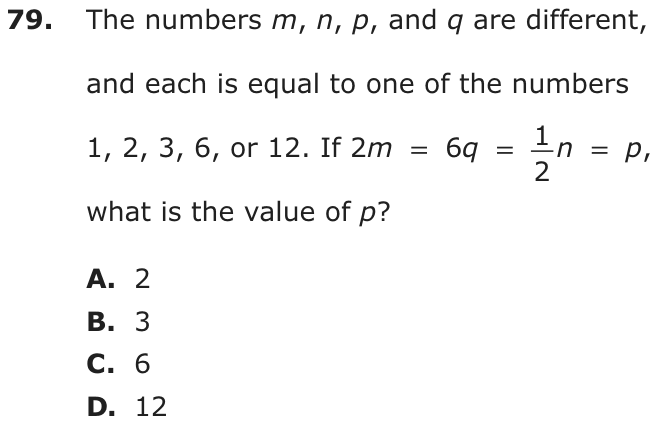
Question
The numbers m, n, p, and q are different, and each is equal to one of the numbers 1, 2, 3, 6, or 12. If , what is the value of p?
- A2
- B3
- C6
- D12
Show the answer
Correct answer: C
Substitute each answer option for p to see which value will work:
Option A:
If , then , so . This cannot be the answer, because n cannot equal 4.
Option B:
If , then , so . This cannot be the answer, because q cannot equal 0.5.
Option C:
If , then , so ; , so ; and , so . This is the correct answer.
Option D:
If , then , so . This cannot be the answer, because n cannot equal 24.
Question analysis
Four letters, m, n, p and q, stand for different numbers from the list 1, 2, 3, 6 and 12, and the expressions 2m, 6q, half of n, and p are all equal. Students find the value of p. The puzzle-like setup has no single equation to solve, so testing values against every condition is the reliable route.
- Grade level
- Grade 6 content, by NYS standard
- Compared with grade 7
- Above grade 7 The equations involve only doubling, halving and multiplying by 6, all grade 6 skills. What goes beyond grade 7 practice is the chain of four equal expressions, with every letter limited to a short list of different numbers.
- Estimated difficulty
- Moderate: several steps, or a close reading with one strong distractor.
- Thinking it demands
- Depth of knowledge 2, skills and concepts · mainly analyze
- What makes it hard
- Variables instead of numbers moderate
- Every choice must be checked moderate
- Solution
- 3 steps
- Reading level
- Question and choices: about grade 5, 27 words.
- Students, last 30 days
- Not enough answers yet to show (it takes 10).
Why it is hard, traps and wrong answers (shows the answer)
Why it is hard
The chain looks forbidding, but it gives each letter as a simple multiple of p: m is half of p, q a sixth of it, and n twice it. Seen that way, q = p/6 forces p to be 6 or 12, and n = 2p rules out 12, so only one value fits. Students who check one or two of the letters, but not all three, can accept 2 or 12.
Variables instead of numbers moderate Understanding the question
Four letters are tied by one chain of equalities, 2m = 6q = ½n = p, and the only numbers are the five allowed values, so each letter has to be written in terms of p. (Koedinger & Nathan, 2004; Enright, Morley & Sheehan, 2002)
Every choice must be checked moderate Choosing the answer
Each choice for p must be tested against three letters, m = p/2, q = p/6 and n = 2p, and all of them must land on different numbers from 1, 2, 3, 6 and 12. (Embretson & Wetzel, 1987)
Strategy: Test each choice as p: find m, q and n from it, and keep the value for which all three are different numbers from the list 1, 2, 3, 6 and 12.
Traps
- Answers a different question: A choice is right for another quantity: the other unknown, the rest instead of the part, the part instead of the whole.
- Misreads the question: Misses or misreads a condition or a word in the question: "at least", "each", "remaining", "not".
The wrong answers, classified
A Misreads the question (Hegarty, Mayer & Monk, 1995)
Checks only m, finding that p = 2 gives m = 1 on the list, and misses that q would be 1/3 and n would be 4.
B Answers a different question (King et al., 2004; Hegarty, Mayer & Monk, 1995)
Finds the solution, m = 3, q = 1, n = 12 and p = 6, then answers with m's value, 3, instead of the value of p.
D Misreads the question (Hegarty, Mayer & Monk, 1995)
Tests p = 12 against 2m and 6q, getting m = 6 and q = 2, both on the list, and stops before seeing that ½n = 12 needs n = 24.
Worked solution, step by step
Formulas used
- Undoing a multiplication
- a is a number that multiplies m, and p is the result. Dividing by a undoes multiplying by a. Use it to write each letter using p.
Sort out the question
m, n, p and q are four different numbers. Each one is 1, 2, 3, 6 or 12. The chain says that four amounts are all equal to p. You need the value of p.
Write each letter using p
Each part of the chain equals p. Undo each multiplication.
Half of n is p, so n is twice p.
Test each choice for p
p m q n All on the list? 2 1 4 No 3 1.5 0.5 6 No 6 3 1 12 Yes 12 6 2 24 No Only p = 6 puts every letter on the list.
Check that the letters are different
With p = 6, you get m = 3, q = 1 and n = 12. All four numbers are on the list, and no two are the same. Watch out: p = 12 makes m = 6 and q = 2, which look fine. But n = 24 is not on the list, so choice D fails. Also, the question asks for p, not m. Picking 3 is choice B. So the answer is C, 6.
Check your answer
Put the values into the chain: , , , and p = 6. All four parts equal 6. The numbers 3, 1, 12 and 6 are all different and all on the list.
More questions like this
The original DOE question