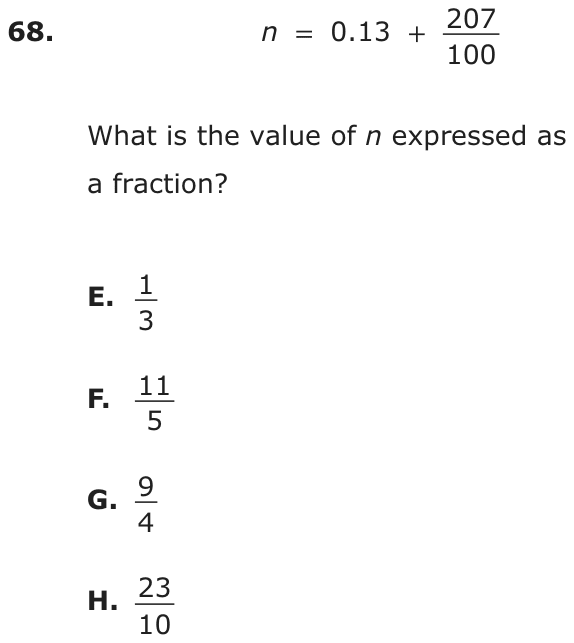
Question
What is the value of n expressed as a fraction?
- A
- B
- C
- D
Show the answer
Correct answer: B
Question analysis
The number n equals 0.13 plus 207/100, and students must write n as a single fraction. This question mixes a decimal with a fraction in hundredths. Converting both to the same form, adding, and reducing to lowest terms are the steps, and the four fractions offered look quite different at first glance.
- NYS standards
- 6.NS.3 multi-digit decimal operations
- Grade level
- Grade 6 content, by NYS standard
- Compared with grade 7
- Below grade 7 Converting decimals to fractions and simplifying are skills taught before grade 7. Both numbers here are in hundredths, so the addition is immediate and only the final reduction takes thought.
- Estimated difficulty
- Routine: one familiar step, little to misread.
- Thinking it demands
- Depth of knowledge 1, recall and reproduction · mainly apply
- What makes it hard
- Solution
- 2 steps
- Reading level
- Question and choices: about grade 7, 15 words.
- Students, last 30 days
- Not enough answers yet to show (it takes 10).
Why it is hard, traps and wrong answers (shows the answer)
Why it is hard
Converting 0.13 to hundredths makes this a single addition, 13 + 207 = 220 hundredths, so the question tests little beyond reducing a fraction. Two of the wrong choices sit close to 2.2 but come from no common working, and the third only echoes the digits of 0.13. A student who checks each choice as a decimal finds only one equal to 2.2.
An answer in an unexpected form minor Choosing the answer
The sum comes out as 220/100 or 2.2, but the choices are in lowest terms, so it must be reduced, or each choice converted, before anything matches. (Enright, Morley & Sheehan, 2002)
Error-prone arithmetic minor Working it out
One term is a decimal and the other a fraction; writing 0.13 as 13/100 puts both in hundredths, and a misplaced digit there changes the sum. (Brown & Burton, 1978; Junker & Sijtsma, 2001)
Strategy: Write 0.13 as 13/100 so both terms are in hundredths, add the numerators, then divide the top and bottom by their greatest common factor.
Traps
- Answer in another form: The right answer is written differently from the way you worked it out.
- Numbers taken from the question: Combines the numbers in the question without a model of the situation, or is simply a number that appears in the question.
The wrong answers, classified
A Numbers taken from the question (Hegarty, Mayer & Monk, 1995)
Echoes the digits of 0.13, reading it as the fraction 1/3, and ignores the 207/100 altogether.
C Little reason to choose it (Haladyna & Downing, 1993; Rodriguez, 2005)
No common working gives 9/4, which is 2.25; adding 13 and 207 hundredths gives 2.2, so this mostly draws guesses near the sum.
D Little reason to choose it (Haladyna & Downing, 1993; Rodriguez, 2005)
Nothing leads to 23/10 except 13 + 207 coming out as 230, a slip with no reason behind it, so it mostly catches guesses.
Worked solution, step by step
Formulas used
- Decimals as hundredths
- The second place after the decimal point is the hundredths place. So a decimal with two places counts hundredths. Write its digits over 100. For example, 0.47 is 47/100.
- Adding fractions with the same bottom
- a and b are the tops. c is the shared bottom, the denominator. When the bottoms match, the pieces are the same size. So add the tops and keep the bottom.
Sort out the question
n equals 0.13 plus . One part is a decimal and one is a fraction. You need n as a fraction. The choices are in lowest terms, which means they can’t be simplified any more.
Write the decimal as a fraction
The 3 in 0.13 is in the hundredths place. So 0.13 is 13 hundredths.
Now both numbers are in hundredths. Watch out: 0.13 is not . That only copies the digits, choice A.
Add the hundredths
Use the rule for adding fractions. The bottoms match, so add the tops and keep the 100 on the bottom.
Simplify the fraction
is not a choice, so simplify it. Find the greatest number that divides both 220 and 100. That is 20.
So the answer is B, .
Check your answer
Change both to decimals. . And . They match. Choices C and D are close, but and .
More questions like this
The original DOE question