Multiple choice
This test has the first 120 of the 776 questions that match.
Question 1 of 120
2026 Practice Test A English, question 8Passage The Best Laid Plans of Ravens
The Best Laid Plans of Ravens
In Edgar Allan Poe’s poem “The Raven,” a raven visits a lonely man’s home and responds to the man’s pleading questions with only the word “nevermore.” The poem’s narrator interprets the word as a prediction of doom for his future. A talking, prophetic raven may seem to be the wild imaginings of the poet, but a new study published in the journal Science hints that one particular idea behind the poem might not be as far-fetched as it seems. For most of human history, people assumed that animals do not understand the passage of time in the same way people do. Some people believed that animals might remember events from the past and that instinct might drive them to make preparations in order to guarantee survival, but most people did not think that animals had the ability to plan. At Lund University in Sweden, researchers argue that ravens may be able to think ahead and even plan for the future.
It can be difficult to test an animal’s ability to plan because human observers must be certain they are not mistaking instinctual behavior for intentional planning. For example, many animals hoard food so that they will not run out later, but scientists who study animals would not call hoarding a decision to plan for the future. This action is merely instinctual. Cognitive scientists argue that in order for an animal’s behavior to qualify as preparing for the future, the animal must use specific decision-making skills to solve a problem.
To avoid mistaking instinctual behavior for evidence of decision-making, the Lund University researchers designed two experiments to test ravens’ ability to plan. Ravens belong to the corvid family, a group of birds known for their intelligence. A study in 2007 showed that corvids have the tendency to save only certain types of food, which suggests that they are planning for the future rather than acting on instinct. In order to investigate that theory, the researchers had to design experiments that would achieve results that could not be explained by an instinctual behavior of food hoarding. Therefore, the ravens were taught two behaviors that they do not normally perform in the wild.
For the first experiment, the researchers showed the birds how to use a small stone to open a box and get treats. Once the ravens learned the behavior, the researchers presented the birds with four stones. Only one stone was the right size to open the box. The birds learned to select that stone and set it aside until the researchers presented the box. The second experiment involved bartering. A researcher would trade the ravens a large treat for a bottle cap. Later, the researchers presented the ravens with a group of items, including small treats and the bottle cap. The ravens chose the bottle cap over the treats and waited for the original researcher to trade with them again so that they could get more treats. In both experiments, the ravens waited patiently for up to seventeen hours for the researcher to return.
The results of these experiments are exciting, but more evidence needs to be gathered before scientists can fully conclude that ravens can plan for the future. Some scientists argue that the ravens might be choosing the stone and bottle cap because the ravens have been trained to do so, not necessarily because the ravens are thinking ahead. Regardless, like other recent advances in animal science, these experiments show that ravens could be much smarter than first believed, and scientists now believe that ravens do actually think about their own future.
Question
Read this sentence from paragraph 1.
At Lund University in Sweden, researchers argue that ravens may be able to think ahead and even plan for the future.
Which sentence from paragraph 4 provides support for this argument?
- A“Once the ravens learned the behavior, the researchers presented the birds with four stones.”
- B“A researcher would trade the ravens a large treat for a bottle cap.”
- C“Later, the researchers presented the ravens with a group of items, including small treats and the bottle cap.”
- D“The ravens chose the bottle cap over the treats and waited for the original researcher to trade with them again so that they could get more treats.”
Show the answer
Correct answer: D
The question asks which sentence from paragraph 4 supports the argument presented in the sentence from paragraph 1.
A. Incorrect. This sentence from paragraph 4 refers to the ravens’ ability to adapt and learn but not to plan and think ahead.
B. Incorrect. This sentence from paragraph 4 relates the actions of the researcher rather than the actions of the ravens and does not provide evidence in support of the argument that ravens have the ability to think and plan ahead.
C. Incorrect. This sentence from paragraph 4 does not describe a behavior of the ravens that would support the argument in the sentence from paragraph 1; instead it relates the actions of the researchers without giving any information about the ravens’ responses.
D. CORRECT. This sentence from paragraph 4 shows that the ravens seem to make a decision, which involves a thought process. The ravens chose to wait for the researcher rather than take the treats, suggesting that the ravens understood that the researcher would trade a larger treat for the bottle cap.
Question analysis
This evidence question on the science article “The Best Laid Plans of Ravens” quotes the claim from paragraph 1 that ravens may be able to think ahead and plan for the future. Students choose the sentence from paragraph 4, where two experiments are described, that supports it. Every choice comes from the same experiments, so each must be weighed against the claim.
- Grade level
- Grade 7 reading and task
- Compared with grade 7
- At grade 7 Choosing the sentence that backs a quoted claim is standard grade 7 evidence work. The claim is printed in the question and all four choices come from one paragraph, so the search is short, though each sentence must be tested against the claim.
- Estimated difficulty
- Straightforward: two steps or one careful reading.
- Thinking it demands
- Depth of knowledge 2, skills and concepts · mainly evaluate
- What makes it hard
- Evidence
- Answered from one paragraph or stanza
- Reading level
- Passage: about grade 11, 599 words; question and choices: about grade 8, 107 words.
- Students, last 30 days
- Not enough answers yet to show (it takes 10).
Why it is hard, traps and wrong answers (shows the answer)
Why it is hard
The claim is about what ravens can do, and only one of the four sentences shows the birds deciding anything. Students who read quickly accept any sentence about the experiments, especially the one where the ravens have just learned a skill, because learning sounds like intelligence. Asking who acts in each sentence, the birds or the researchers, settles the question in seconds.
Reading between the lines minor Working it out
The right sentence never says “plan”; students must see that choosing the cap over the treats and waiting “so that they could get more treats” is acting now for a later reward. (Graesser, Singer & Trabasso, 1994; Kintsch, 1998)
Every choice must be checked minor Choosing the answer
All four sentences come from paragraph 4’s experiments, and three of them report what the researchers did, so each must be checked for a decision made by the ravens. (Embretson & Wetzel, 1987)
Strategy: Underline “think ahead” and “plan” in the quoted claim, then ask of each sentence whether it, on its own, would convince a doubter that ravens can do that.
Traps
- Supports only part of the claim: In a question about evidence: a line that backs one half of the claim but not the other, or a related point rather than the claim itself.
- True but not the answer: A choice says something accurate about the text that does not answer this question.
The wrong answers, classified
A Supports only part of the claim (King et al., 2004; Thissen, Steinberg & Fitzpatrick, 1989)
Takes “Once the ravens learned the behavior” as proof of planning, but learning to open a box shows only that the birds can be taught, and the rest is the researchers’ act.
B True but not the answer (King et al., 2004; Embretson & Wetzel, 1987)
Picks the opening of the bartering test because it mentions the trade, yet the sentence reports only what a researcher offered, not anything the ravens decided.
C True but not the answer (King et al., 2004; Embretson & Wetzel, 1987)
Knows the bottle-cap test holds the evidence and picks its setup, the researchers laying out treats and the cap, one sentence before the ravens make their choice.
Working it out, step by step
Figure out what the question asks
This asks for evidence: the sentence that best supports a claim. The claim is that ravens “may be able to think ahead and even plan for the future.” To plan is to decide now what you will do later, so you get something you want. You need a sentence from paragraph 4 that shows ravens doing that.
Ask who acts in each sentence
Only something the ravens do can prove what ravens can do. So check each choice for its doer. In A, B and C, the researchers do most of the acting. They hand out stones, offer a trade and set out items. Only one sentence shows the ravens making a choice of their own.
Find the ravens’ choice
Paragraph 4 says “The ravens chose the bottle cap over the treats and waited for the original researcher to trade with them again so that they could get more treats.” The ravens could have eaten a small treat right away. Instead they took a bottle cap, which is worthless by itself. They kept it because the researcher would trade a large treat for it later.
Explain why this shows planning
The words “so that” give the reason for the choice. The ravens gave up something now to get something better later. That is exactly what planning ahead means. You do the same thing when you save your allowance for a bigger toy next month.
Check each choice
- A does not fit. The ravens have only learned a skill. The rest of the sentence tells what the researchers did next.
- B does not fit. It tells what a researcher offered, not what the ravens decided.
- C does not fit. It is the setup of the test, before the ravens choose anything.
- D fits. The ravens choose now and wait for a later reward.
Watch out: A sounds smart because the ravens “learned the behavior.” But being taught a skill is not the same as thinking ahead.
Choose the answer
Only one sentence shows the ravens making a choice now for a reward later. So the answer is D.
Why this answer and not the closest wrong one
A is the closest wrong choice, because learning a skill sounds clever. But learning to open a box shows only that the birds can be taught. It says nothing about the future. In D, the ravens pass up treats today to get more treats later. That is planning.
More questions like this
The original DOE question
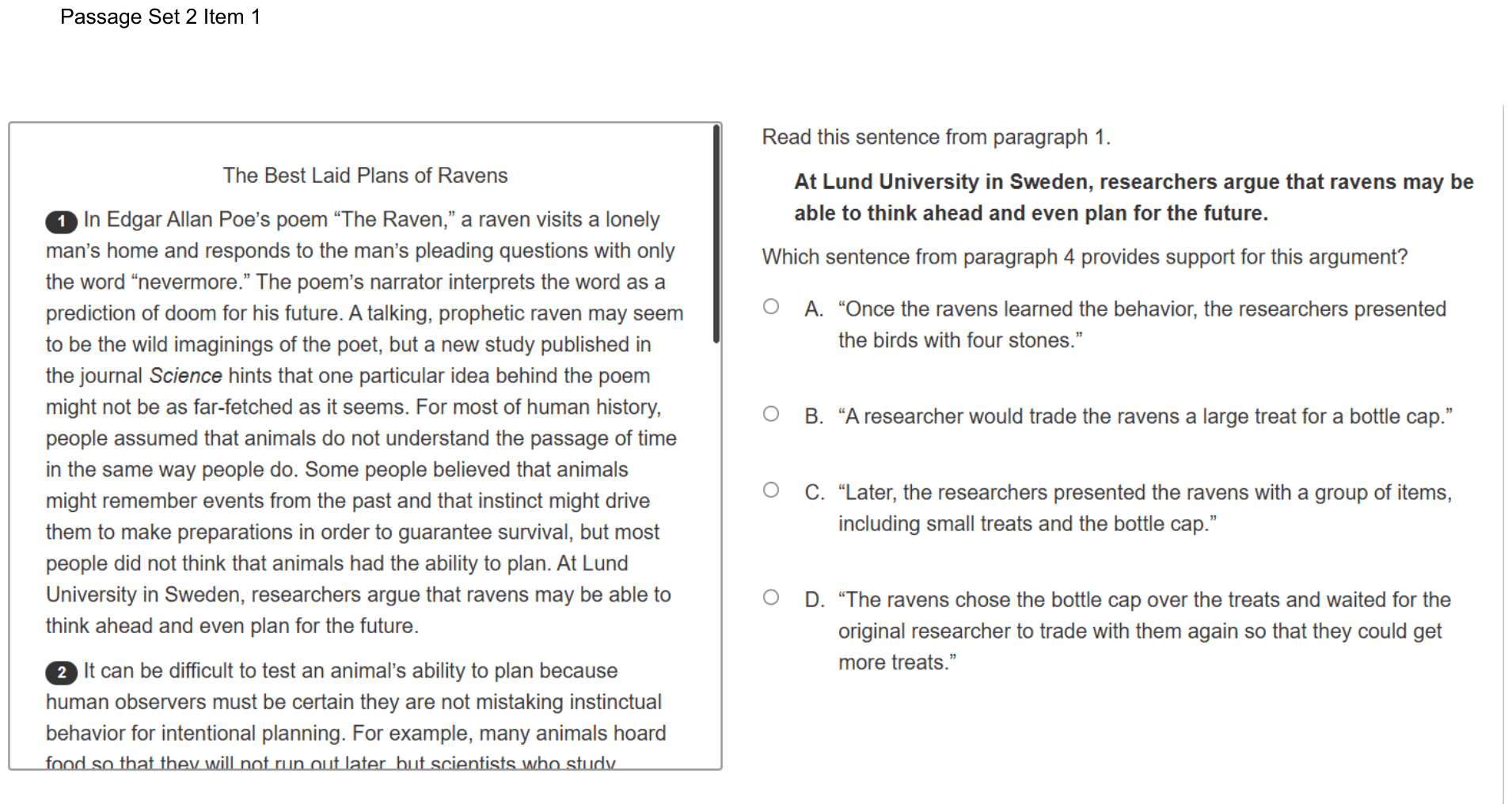
The passage “The Best Laid Plans of Ravens” as printed (page 12)
Question 2 of 120
2026 Practice Test A English, question 9Uses the passage above: “The Best Laid Plans of Ravens”.
Question
Read these sentences from paragraph 2.
For example, many animals hoard food so that they will not run out later, but scientists who study animals would not call hoarding a decision to plan for the future. This action is merely instinctual.
Which statement describes the effect of the phrase “merely instinctual” in the passage?
- AIt implies that animals are skilled at finding and saving food for later consumption.
- BIt conveys that many animals will usually prioritize gathering food over other activities.
- CIt suggests that animals often store more food than they will be able to consume.
- DIt emphasizes that many animals collect food automatically rather than with true intention.
Show the answer
Correct answer: D
The question asks which statement describes the effect in the passage of the phrase “merely instinctual” from paragraph 2.
A. Incorrect. The passage does not question animals’ ability to find and save food but rather whether this or other behavior involves thought and planning for the future.
B. Incorrect. While the sentence states that “many animals hoard food,” the passage does not suggest that they give priority of thought to this activity; they hoard food out of instinct.
C. Incorrect. Although the passage discusses animals’ tendency to store a great deal of food, it does not suggest that their hoarding goes beyond their needs.
D. CORRECT. The passage suggests that in order for an animal’s actions to qualify as planning for the future, “the animal must use specific decision-making skills to solve a problem” (paragraph 2). The behavior of hoarding food is based on instinct and done automatically without real thought.
Question analysis
This word-in-context question from “The Best Laid Plans of Ravens” asks about the effect of the phrase “merely instinctual,” which the article applies to food hoarding in paragraph 2. Students read two quoted sentences and decide what the phrase emphasizes about how animals behave. The choices all sound like reasonable facts about animals, so the answer has to come from how the article uses the phrase.
- Grade level
- Grade 7 reading and task
- Compared with grade 7
- Below grade 7 Grade 7 word-meaning questions often need clues gathered from a whole paragraph. Here the phrase is short and familiar, and the sentence just before it supplies a direct contrast, so one careful reading of the two quoted sentences is enough.
- Estimated difficulty
- Routine: one familiar step, little to misread.
- Thinking it demands
- Depth of knowledge 2, skills and concepts · mainly understand
- What makes it hard
- Hard words minor
- The right answer is reworded minor
- Evidence
- Answered from one paragraph or stanza
- Reading level
- Passage: about grade 11, 599 words; question and choices: about grade 10, 108 words.
- Students, last 30 days
- Not enough answers yet to show (it takes 10).
Why it is hard, traps and wrong answers (shows the answer)
Why it is hard
Most students know that an instinct is something an animal does without thinking, and the sentence just before the phrase says hoarding is not “a decision to plan.” The only real pitfall is “merely”: a student who skips it can hear praise of a natural talent, and one who thinks only about hoarding may pick a choice about storing too much. Reading the phrase with its contrast makes the answer plain.
Hard words minor Understanding the question
The phrase pairs “merely,” which shrinks what follows, with “instinctual,” and the sentence before it uses “hoard”; a student unsure of any of the three has little to go on. (Perfetti, 2007; Freedle & Kostin, 1993)
The right answer is reworded minor Choosing the answer
The right choice restates the idea as acting “automatically rather than with true intention,” while the wrong ones stay with the sentence’s own subject, finding, gathering and storing food. (Freedle & Kostin, 1993; Kirsch & Mosenthal, 1990)
Strategy: Ask what the word “merely” adds to “instinctual,” then reread the sentence before the phrase and use its contrast to decide what the author is saying about hoarding.
Traps
- Dictionary meaning, not meaning here: A common meaning of the word that does not fit its use in this text.
- Outside knowledge: A choice is plausible in the real world but not supported by this text.
The wrong answers, classified
A Wrong tone or attitude (Graesser, Singer & Trabasso, 1994)
Hears “instinctual” as a natural gift, as in an instinctive athlete, and turns the phrase into praise of animals’ skill, missing that “merely” makes it a put-down.
B Outside knowledge (King et al., 2004; Recht & Leslie, 1988)
Brings in the idea of instinct as an urge that overrides everything else, but the passage never ranks food gathering above an animal’s other activities.
C Dictionary meaning, not meaning here (Perfetti, 2007)
Gives “hoard” its everyday sense of piling up too much, though the passage says animals store food so they “will not run out later,” not beyond their needs.
Working it out, step by step
Figure out what the question asks
This asks about the effect of a phrase. What do the words “merely instinctual” add to what the passage says about animals and food? Read the phrase together with the sentence before it.
Read the sentences around the phrase
Paragraph 2 says “many animals hoard food so that they will not run out later, but scientists who study animals would not call hoarding a decision to plan for the future. This action is merely instinctual.” To hoard is to collect and store a lot of something.
Work out what the phrase means
An instinct is a natural urge an animal is born with. It acts on it without thinking it through. So instinctual behavior is automatic. Merely means “only” or “just.” Put together, the phrase says hoarding is just automatic. It is not a real decision. The next sentence agrees: to count as planning, “the animal must use specific decision-making skills to solve a problem.”
Check each choice
- A does not fit. The phrase does not praise animals’ skill. “Merely” makes the behavior sound smaller.
- B does not fit. The passage never says animals put food ahead of other activities.
- C does not fit. The passage never says animals store too much. They store food “so that they will not run out later.”
- D fits. “Automatically rather than with true intention” means by instinct, not on purpose. An intention is a plan you have in mind.
Choose the answer
The phrase stresses that animals hoard food without real thought or purpose. So the answer is D.
Why this answer and not the closest wrong one
A is the closest wrong choice, because an instinct can sound like a natural talent. But “merely” turns the phrase into a put-down. The author is saying hoarding is only instinct, not a real choice. D says the same thing: animals collect food automatically, not with true intention.
More questions like this
The original DOE question
Question 3 of 120
2026 Practice Test A English, question 10Uses the passage above: “The Best Laid Plans of Ravens”.
Question
In the first experiment described in paragraph 4, which of the ravens’ behaviors provides the strongest evidence for the claim that the birds are capable of planning?
- AThey accepted treats from the box.
- BThey set aside the stone that would open the box.
- CThey learned which stone could open the box.
- DThey waited for researchers to bring the box.
Show the answer
Correct answer: B
The question asks which of the ravens’ behaviors in the first experiment described in paragraph 4 most strongly supports the claim that the birds are capable of planning.
A. Incorrect. While “the researchers showed the birds how to use a small stone to open a box and get treats” (paragraph 4), the acceptance of the treats does not demonstrate planning.
B. CORRECT. Once the ravens learned which stone would open the box, they consistently selected only that stone.
C. Incorrect. Although the birds learned which stone opened the box, this behavior demonstrates not their ability to plan but rather their intelligence.
D. Incorrect. The birds’ patience shows their anticipation for and understanding of the future gain of a treat but does not provide the strongest evidence of their ability to plan.
Question analysis
This evidence question on “The Best Laid Plans of Ravens” asks which of the ravens’ behaviors in the first experiment, the one with a stone and a box of treats, gives the strongest evidence that the birds can plan. Several behaviors seem to fit, so students must weigh them against the passage’s own idea of what planning is.
- Grade level
- Grade 8 reading and task
- Compared with grade 7
- Above grade 7 Grade 7 evidence questions usually ask which detail supports a claim. This one asks which of the ravens’ behaviors gives the strongest support, and several seem to fit, so students must apply paragraph 2’s test for planning to paragraph 4.
- Estimated difficulty
- Hard: combines ideas, needs a plan, and has more than one tempting wrong answer.
- Thinking it demands
- Depth of knowledge 3, strategic thinking · mainly evaluate
- What makes it hard
- A very close wrong answer major
- Reading between the lines moderate
- Evidence in several places minor
- Evidence
- Answered from several paragraphs or stanzas
- Reading level
- Passage: about grade 11, 599 words; question and choices: about grade 5, 58 words.
- Students, last 30 days
- Not enough answers yet to show (it takes 10).
Why it is hard, traps and wrong answers (shows the answer)
Why it is hard
Every choice describes something the ravens really did, so the work is ranking, not finding. The passage’s dramatic detail, birds waiting up to seventeen hours, draws attention away from the quieter act of keeping the right stone ready, which is the behavior that most clearly prepares for the future. Students who weigh each behavior against paragraph 2’s idea of decision-making, rather than against how impressive it sounds, separate the two.
A very close wrong answer major Choosing the answer
Setting the stone aside and waiting for the box both come from one sentence, “set it aside until the researchers presented the box”; only the first is an action taken now for a later need. (Embretson & Wetzel, 1987; Gorin & Embretson, 2006; Ascalon et al., 2007)
Reading between the lines moderate Working it out
The passage never says which behavior counts as planning, so students must apply paragraph 2’s test, that the animal “must use specific decision-making skills to solve a problem,” to each one. (Graesser, Singer & Trabasso, 1994; Kintsch, 1998)
Evidence in several places minor Working it out
The waiting that tempts students is stressed at the end of paragraph 4, “up to seventeen hours,” well after the stone sentence, and paragraph 2 holds the standard for judging both. (Kirsch & Mosenthal, 1990; Gorin & Embretson, 2006)
Strategy: Use paragraph 2’s description of what counts as planning as a yardstick, then rank the four behaviors by how well each meets it instead of taking the first that seems clever.
Traps
- Supports only part of the claim: In a question about evidence: a line that backs one half of the claim but not the other, or a related point rather than the claim itself.
- True but not the answer: A choice says something accurate about the text that does not answer this question.
The wrong answers, classified
A True but not the answer (King et al., 2004; Embretson & Wetzel, 1987)
Picks the payoff of the experiment, taking treats from the box, which any trained animal does and which shows nothing about thinking ahead.
C Supports only part of the claim (King et al., 2004; Thissen, Steinberg & Fitzpatrick, 1989)
Sees intelligence in learning which of the four stones fits, but knowing the right tool is not the same as keeping it ready for a box that comes later.
D Supports only part of the claim (King et al., 2004; Thissen, Steinberg & Fitzpatrick, 1989)
Is drawn by the stress on waiting “up to seventeen hours,” which shows the birds expect the box, but waiting is passive; holding the right stone ready is the planning act.
Working it out, step by step
Figure out what the question asks
This asks which thing the ravens did in the first experiment, the one with the stone and the box, is the strongest evidence that they can plan. More than one choice really happened. You must rank them and pick the best one.
Decide what counts as planning
Paragraph 2 gives a test. To count as preparing for the future, “the animal must use specific decision-making skills to solve a problem.” In plain words, planning means doing something now to get ready for something later. Use that as your measuring stick.
Find the key sentence
Paragraph 4 says “The birds learned to select that stone and set it aside until the researchers presented the box.” To set something aside is to put it away to use later. When the birds did this, the box was not there yet.
Explain why this is planning
The ravens had nothing to open at that moment. Still, they picked the one stone that would work and saved it. They did this because they expected to need it later. It is like packing an umbrella in the morning because rain is coming in the afternoon. That is a choice made now to solve a future problem.
Check each choice
- A does not fit. Taking treats is the reward. Any trained animal does that.
- B fits. Saving the right stone gets the bird ready for a box that comes later.
- C does not fit. Learning which stone works shows the birds can be taught. Knowing the right tool is not the same as keeping it ready.
- D does not fit as well. Waiting shows the birds expected the box. But waiting is doing nothing, so it is weaker proof.
Watch out: D is tempting because the passage stresses waiting “up to seventeen hours.” Long waiting is impressive, but it is not an action.
Choose the answer
Setting the stone aside is the clearest act of getting ready for the future. So the answer is B.
Why this answer and not the closest wrong one
D is the closest wrong choice. Waiting and setting the stone aside come from the same sentence. But while a bird waits, it does nothing. Setting the stone aside is a choice. The bird keeps the right tool ready for a box that is not there yet. That act of getting ready makes B stronger evidence.
More questions like this
The original DOE question
Question 4 of 120
2026 Practice Test A English, question 11Uses the passage above: “The Best Laid Plans of Ravens”.
Question
How does paragraph 5 fit into the overall structure of the passage and contribute to the development of ideas?
- AIt introduces a problem with the results of the study at Lund University, suggesting that some scientists believe that further research will not lead to a clear answer.
- BIt summarizes the final steps of the study at Lund University, emphasizing the difficulties researchers had in differentiating between true planning and practiced actions.
- CIt provides a conclusion to the information about the Lund University study, indicating that some scientists think further research is needed in order to prove the idea.
- DIt lists the effects of the study at Lund University, implying that researchers should have designed experiments that better differentiated between planning and instinct.
Show the answer
Correct answer: C
The question asks how paragraph 5 fits into the overall structure of the passage and contributes to the development of ideas.
A. Incorrect. While paragraph 5 states that “more evidence needs to be gathered before scientists can fully conclude that ravens can plan for the future,” this statement suggests that more research is needed, not that the results of the Lund University study are problematic.
B. Incorrect. Paragraph 5 does not discuss steps of the study or emphasize difficulties in determining whether the behaviors shown in the study were planned or practiced; instead it simply suggests that more study is required to make such a determination.
C. CORRECT. Paragraph 5 notes that some doubt remains (“Some scientists argue that the ravens might be choosing the stone and bottle cap because the ravens have been trained to do so, not necessarily because the ravens are thinking ahead”) and that more experimentation is needed; the author concludes that there is reason to believe the originally stated theory that ravens are quite smart and can give thought to how future events may affect them.
D. Incorrect. Paragraph 5 does not list the effects of the study or criticize the experiment for not differentiating between planning and instinct. The paragraph explains why the results of the experiments are not conclusive and emphasizes that more research is needed.
Question analysis
This text-structure question asks how the last paragraph of the article “The Best Laid Plans of Ravens” fits into the passage and develops its ideas. Students must see what that paragraph does once the experiments have been described. Each long choice names a role and then adds a claim, so a choice can begin well and end wrong.
- Grade level
- Grade 7 reading and task
- Compared with grade 7
- At grade 7 Explaining the role of a final paragraph is regular grade 7 structure work. The choices are long, though, and each pairs a role with a claim about scientists’ views, so both halves must be checked against a paragraph that mixes doubt with enthusiasm.
- Estimated difficulty
- Moderate: several steps, or a close reading with one strong distractor.
- Thinking it demands
- Depth of knowledge 2, skills and concepts · mainly analyze
- What makes it hard
- A very close wrong answer moderate
- How, not what moderate
- A lot to read minor
- Evidence
- Answered from several paragraphs or stanzas
- Reading level
- Passage: about grade 11, 599 words; question and choices: about grade 15, 121 words.
- Students, last 30 days
- Not enough answers yet to show (it takes 10).
Why it is hard, traps and wrong answers (shows the answer)
Why it is hard
Paragraph 5 makes three moves, excitement, doubt and a hopeful conclusion, and each wrong choice builds on one of them and then goes too far. Students who notice the doubt but read past “before scientists can fully conclude” pick the claim that research will never settle the question. Summing up the paragraph before reading the choices, and then checking the second half of each, is what earns the point.
A very close wrong answer moderate Choosing the answer
The choice about a problem with the results matches the right one in its first half, a doubt raised in paragraph 5, and differs only in claiming that more research will not give a clear answer. (Embretson & Wetzel, 1987; Gorin & Embretson, 2006; Ascalon et al., 2007)
How, not what moderate Working it out
The question asks what paragraph 5 does in the article, closing the account of the Lund study, so students must name its role rather than repeat its caution about training. (Anderson & Krathwohl, 2001)
A lot to read minor Understanding the question
The choices run 24 to 28 words, and each pairs a role with a second claim about what scientists or researchers think or did, so both halves of every choice have to be checked. (Kintsch, 1998; Gorin & Embretson, 2006; Freedle & Kostin, 1993)
Strategy: Sum up paragraph 5 in one sentence of your own, then check both parts of each choice, the job it names and the idea it attributes to scientists, against that summary.
Traps
- Half right: One half of a two-part choice is right and the other is not.
- Twists what the text says: Uses the text's topic and ideas but changes what it says: who did it, how much, when, or why.
- Reads too much in: A reasonable-sounding conclusion that goes further than the text allows.
The wrong answers, classified
A Half right (King et al., 2004; Thissen, Steinberg & Fitzpatrick, 1989)
Rightly sees that paragraph 5 raises a doubt about the results, but adds that more research will not settle it, when the paragraph says more evidence is needed to reach a conclusion.
B Twists what the text says (King et al., 2004)
Turns the objection some scientists raise, that the birds may simply be trained, into the Lund researchers’ own struggle, though the paragraph describes no steps of the study.
D Reads too much in (Graesser, Singer & Trabasso, 1994)
Reads the call for more evidence as a verdict that the experiments were badly designed, though the author calls the results “exciting” and faults no one.
Working it out, step by step
Figure out what the question asks
This asks about structure: what job paragraph 5 does in the article. Each choice has two parts, a job and an idea about scientists. Both parts must be right.
See where paragraph 5 sits
Paragraphs 3 and 4 describe the Lund University experiments. Paragraph 5 is the last paragraph. It comes after the whole study has been described. So it is the place where the author sums up what the study means.
Read what paragraph 5 says
It opens: “The results of these experiments are exciting, but more evidence needs to be gathered before scientists can fully conclude that ravens can plan for the future.” Next, it says some scientists think the ravens may just be trained. Then it says “Regardless,” the experiments show ravens “could be much smarter than first believed.” Regardless means “even so.”
Put the paragraph in your words
Paragraph 5 wraps up the study. The results are exciting but not proven yet. More research is needed to be sure. A conclusion is the ending part that sums things up. So paragraph 5 is the conclusion to the study, and it says more evidence is needed.
Check each choice
- A does not fit. Paragraph 5 does raise a doubt. But it never says more research will fail to give a clear answer.
- B does not fit. Paragraph 5 describes no steps of the study.
- C fits. It wraps up the study and says more research is needed.
- D does not fit. It lists no effects and blames no one. The author calls the results “exciting.”
Choose the answer
Paragraph 5 ends the story of the study and calls for more evidence. So the answer is C.
Why this answer and not the closest wrong one
A is the closest wrong choice, because its first half is right: paragraph 5 raises a doubt. But A says more research will not lead to a clear answer. The paragraph says more evidence is needed “before scientists can fully conclude,” so research is the way to an answer. C says this.
More questions like this
The original DOE question
Question 5 of 120
2026 Practice Test A English, question 12Uses the passage above: “The Best Laid Plans of Ravens”.
Question
The author conveys a point of view on the study of animal intelligence mainly by
- Asharing details about experiments that tested the ability of an animal to plan for the future.
- Bcomparing the results of different experiments that were designed to test animal intelligence.
- Ccritiquing experiments that aimed to demonstrate that certain animals are capable of planning for the future.
- Dexplaining how modern experiments show that previously held beliefs about animal intelligence are inaccurate.
Show the answer
Correct answer: A
The question asks how the author conveys a point of view on the study of animal intelligence.
A. CORRECT. Paragraphs 3 and 4 focus on the process and details of the experiments that scientists conducted. This detailed information from the author provides a sense of how the ravens demonstrated planning abilities beyond natural instinct. The author supports the claims from the experiments, calling the findings “exciting” and stating in the conclusion that “these experiments show that ravens could be much smarter than first believed” (paragraph 5).
B. Incorrect. Although two experiments are described in the passage, the description presents the experiments as building on each other and does not compare their results. The passage states that “these experiments show that ravens could be much smarter than first believed, and scientists now believe that ravens do actually think about their own future” (paragraph 5).
C. Incorrect. The author presents information from the experiments and the results that were gathered from them; while there is an admission that “more evidence needs to be gathered before scientists can fully conclude that ravens can plan for the future” (paragraph 5), the author does not criticize the experiments that are presented.
D. Incorrect. While the author does discuss some previously held beliefs about animal intelligence in paragraph 1, the focus of the passage is that experiments indicate that there is reason to question these beliefs, since “these experiments show that ravens could be much smarter than first believed” (paragraph 5). The previously held beliefs are not considered inaccurate by the discussion in the passage because only one example—the raven—is provided. The passage does not state that beliefs about animal intelligence as a whole are inaccurate.
Question analysis
This author’s point-of-view question asks how the writer of “The Best Laid Plans of Ravens” mainly conveys a view of research into animal intelligence. Students must look at the article as a whole and decide how it presents that view. The choices describe ways of writing in abstract terms, which makes them easy to blur together.
- Grade level
- Grade 8 reading and task
- Compared with grade 7
- Above grade 7 Grade 7 point-of-view questions usually ask what an author thinks. This one asks how the author mainly conveys a view across the whole article, and the choices name methods that sound alike, closer to grade 8 work on how authors handle differing views.
- Estimated difficulty
- Hard: combines ideas, needs a plan, and has more than one tempting wrong answer.
- Thinking it demands
- Depth of knowledge 3, strategic thinking · mainly analyze
- What makes it hard
- How, not what major
- Reading between the lines moderate
- Every choice must be checked minor
- Evidence
- Answered from the whole text
- Reading level
- Passage: about grade 11, 599 words; question and choices: about grade 13, 74 words.
- Students, last 30 days
- Not enough answers yet to show (it takes 10).
Why it is hard, traps and wrong answers (shows the answer)
Why it is hard
The right choice sounds too plain to carry a point of view, which is exactly what makes this question hard. Students expect a view to be argued, so they reach for the choice that says the experiments prove old beliefs wrong, an overstatement of the author’s hedged “could be,” or for criticism, which belongs to other scientists. The article persuades by reporting the experiments in detail and calling them exciting.
How, not what major Working it out
The question asks how the view comes across, not what it is, and the answer is a method: the author lets the detailed account of the experiments in paragraphs 3–4 carry a favorable view. (Anderson & Krathwohl, 2001)
Reading between the lines moderate Working it out
The author never states an opinion outright; the view must be pieced together from words such as “exciting” and “could be much smarter than first believed” in paragraph 5. (Graesser, Singer & Trabasso, 1994; Kintsch, 1998)
Every choice must be checked minor Choosing the answer
The choices name ways of writing in abstract terms, sharing, comparing, critiquing and explaining, so each must be held against what the whole article actually does. (Embretson & Wetzel, 1987)
Strategy: Settle first on how the author regards the raven research, then check each choice against what the article actually does from beginning to end, not against a single paragraph.
Traps
- Too broad or too strong: A choice overstates, generalizes, or uses absolute words the text does not support.
- Wrong tone or attitude: Misjudges the tone, attitude or point of view, such as reading admiration as criticism, or taking a character's or subject's feelings for the author's.
- Twists what the text says: Uses the text's topic and ideas but changes what it says: who did it, how much, when, or why.
The wrong answers, classified
B Twists what the text says (King et al., 2004)
Notices that two experiments are described and assumes they are set side by side, but the article reports the stone test and the bartering test in turn without comparing results.
C Wrong tone or attitude (Graesser, Singer & Trabasso, 1994)
Takes the doubt that “some scientists” raise about training for the author’s own criticism, though the author calls the results “exciting” and moves past the objection.
D Too broad or too strong (King et al., 2004)
Builds on the point that ravens may be smarter than believed but overstates it: the author hedges with “could be,” discusses only ravens, and never calls older beliefs wrong.
Working it out, step by step
Figure out what the question asks
This asks about the author’s point of view, what the author thinks about studying animal intelligence. It also asks how the author mainly shows that view. Think about the whole article, not one paragraph.
Find the author’s view
In paragraph 5, the author says the results “are exciting.” The author also says the experiments “show that ravens could be much smarter than first believed.” So the author is interested in this research and hopeful about it.
See how the article is built
Most of the article explains the experiments. Paragraph 3 tells why the researchers planned two of them. Paragraph 4 gives the details step by step: the stone, the box, the bottle cap, the trades and the long wait. The author lets these details show why the research matters. Then the author calls the results exciting.
Check each choice
- A fits. The author shares details of experiments that tested whether an animal can plan.
- B does not fit. The two experiments are told one after the other. Their results are never compared.
- C does not fit. The doubt comes from “some scientists,” not the author. The author answers it with “Regardless.”
- D does not fit. It goes too far. The author says ravens “could be” smarter, which means maybe. The article never calls old beliefs wrong.
Watch out: D is tempting because paragraph 1 describes old beliefs. But “could be” is not the same as “are.”
Choose the answer
The author shows a view mostly through details of the experiments. So the answer is A.
Why this answer and not the closest wrong one
D is the closest wrong choice. The author does think ravens may be smarter than people believed. But the author is careful and says they “could be.” D says experiments prove old beliefs wrong, which is too strong. What the author mostly does is share the experiments’ details. That is A.
More questions like this
The original DOE question
Question 6 of 120
2026 Practice Test A English, question 13Uses the passage above: “The Best Laid Plans of Ravens”.
Question
With which statement would the author of the passage most likely agree?
- AScientists are unlikely to be able to conduct an experiment that can genuinely distinguish between instinctual and learned behaviors in animals.
- BScientists should continue researching to determine whether or not animals can demonstrate advanced intelligence.
- CScientists should be careful about making conclusions about animal intelligence based on experiments that rely on training animals.
- DScientists can confirm data on whether animals have the ability to plan by performing experiments on additional species known for their intelligence.
Show the answer
Correct answer: B
The question asks the reader to choose the statement with which the author of the passage would most likely agree.
A. Incorrect. It is very likely that additional experiments or changes to the experiments presented can help scientists tell the difference between the types of behavior that the animals are showing. The current research supports “other recent advances in animal science” and also shows that ravens are “much smarter” (paragraph 5) than previously believed, making them excellent candidates for further research.
B. CORRECT. As paragraph 5 notes, “more evidence needs to be gathered before scientists can fully conclude that ravens can plan for the future.” The evidence is not yet considered definitive because “some scientists argue that the ravens might be choosing the stone and bottle cap because the ravens have been trained to do so, not necessarily because the ravens are thinking ahead” (paragraph 5). Therefore, more research is needed in order to draw a complete conclusion as to whether or not the animals are demonstrating advanced intelligence or simply the results of training.
C. Incorrect. The passage shows that the scientists did not draw conclusions based on one experiment alone. The passage also states in paragraph 5 that additional research and experiments are necessary in order to obtain conclusive evidence of ravens’ abilities to think and plan ahead.
D. Incorrect. The passage claims that more evidence must be gathered in order to make a claim that animals can definitely plan for the future. The evidence presented helps scientists “believe that ravens do actually think about their own future” (paragraph 5), but more confirmation is needed. The passage does not discuss performing experiments on additional species.
Question analysis
This inference question asks which statement the author of “The Best Laid Plans of Ravens” would most likely agree with. Students must work out the author’s own view of the raven experiments and of research into animal thinking. The article reports more than one viewpoint, so students have to keep track of which ideas belong to the author.
- Grade level
- Grade 7 reading and task
- Compared with grade 7
- At grade 7 Inferring which statement an author would accept is common grade 7 work. The author’s view is stated fairly plainly in the last paragraph, but that paragraph also reports what other scientists argue, so students must separate the author’s position from theirs.
- Estimated difficulty
- Moderate: several steps, or a close reading with one strong distractor.
- Thinking it demands
- Depth of knowledge 3, strategic thinking · mainly analyze
- What makes it hard
- Reading between the lines moderate
- A very close wrong answer moderate
- Much to keep track of minor
- Evidence
- Answered from one paragraph or stanza
- Reading level
- Passage: about grade 11, 599 words; question and choices: about grade 15, 87 words.
- Students, last 30 days
- Not enough answers yet to show (it takes 10).
Why it is hard, traps and wrong answers (shows the answer)
Why it is hard
The passage reports several opinions, and the hard part is telling which one is the author’s. Students who notice the training objection in paragraph 5 often adopt it as the author’s warning, but “Regardless” shows the author weighing it and moving on to a hopeful view that still calls for more evidence. The other wrong choices either turn “difficult” into “unlikely” or bring in research the article never mentions.
Reading between the lines moderate Working it out
The author’s view is never stated as advice; it has to be read from paragraph 5, where “more evidence needs to be gathered” is followed by “Regardless” and a hopeful conclusion. (Graesser, Singer & Trabasso, 1994; Kintsch, 1998)
A very close wrong answer moderate Choosing the answer
The choice about caution with experiments that train animals shares the right one’s careful stance and differs in one detail, training, the objection the author raises only to set aside. (Embretson & Wetzel, 1987; Gorin & Embretson, 2006; Ascalon et al., 2007)
Much to keep track of minor Working it out
The article mixes four voices, what people long assumed, the Lund researchers, “some scientists” who doubt them and the author, and each statement must be traced to the right one. (Sweller, 1988; Carpenter, Just & Shell, 1990)
Strategy: Find the sentences where the author speaks in their own voice, especially in paragraph 5, and pick the statement that follows from them without adding claims the article never makes.
Traps
- Wrong tone or attitude: Misjudges the tone, attitude or point of view, such as reading admiration as criticism, or taking a character's or subject's feelings for the author's.
- Too broad or too strong: A choice overstates, generalizes, or uses absolute words the text does not support.
- Outside knowledge: A choice is plausible in the real world but not supported by this text.
The wrong answers, classified
A Too broad or too strong (King et al., 2004)
Builds on paragraph 2’s point that planning is “difficult” to test and hardens it into “unlikely,” a pessimism the author, who finds the results “exciting,” never expresses.
C Wrong tone or attitude (Graesser, Singer & Trabasso, 1994)
Takes the objection that the ravens may only have been trained, which “some scientists” raise, as the author’s own view, though the author answers it with “Regardless.”
D Outside knowledge (King et al., 2004; Recht & Leslie, 1988)
Offers a sensible research idea, testing other clever species, that the article never suggests; the author’s call for more evidence concerns ravens alone.
Working it out, step by step
Figure out what the question asks
This asks which statement the author would most likely agree with. You must find the author’s own view. The article also reports what other people think, so keep those ideas apart.
Sort out the voices in paragraph 5
Paragraph 5 says “Some scientists argue that the ravens might be choosing the stone and bottle cap because the ravens have been trained to do so.” That is what other scientists think. The author’s own words are “The results of these experiments are exciting, but more evidence needs to be gathered.”
Put the author’s view in plain words
The author thinks the research is promising but not finished. After the doubt, the author says “Regardless,” which means “even so,” and stays hopeful. So the author wants scientists to keep studying until they can be sure.
Check each choice
- A does not fit. The author never says a good test is unlikely. The author finds the results exciting.
- B fits. The author says more evidence must be gathered.
- C does not fit. The worry about training belongs to “some scientists.” The author sets it aside with “Regardless.”
- D does not fit. The article never mentions testing other kinds of animals.
Watch out: C sounds careful, like a scientist. But it repeats the other scientists’ view, not the author’s.
Choose the answer
The author wants scientists to keep gathering evidence before anyone decides. So the answer is B.
Why this answer and not the closest wrong one
C is the closest wrong choice. It sounds careful, and the author is careful too. But the warning about training comes from “some scientists.” The author answers it with “Regardless” and stays hopeful. The author’s own point is that “more evidence needs to be gathered.” That matches B.
More questions like this
The original DOE question
Question 7 of 120
2026 Practice Test A English, question 15Passage Excerpt from A Voice in the Wilderness
Excerpt from A Voice in the Wilderness
by Grace Livingston Hill
With a lurch the train came to a dead stop and Margaret Earle, hastily gathering up her belongings, hurried down the aisle and got out into the night.
It occurred to her, as she swung her heavy suit-case down the rather long step to the ground, and then carefully swung herself after it, that it was strange that neither conductor, brakeman, nor porter had come to help her off the train, when all three had taken the trouble to tell her that hers was the next station; but she could hear voices up ahead. Perhaps something was the matter with the engine that detained them and they had forgotten her for the moment.
The ground was rough where she stood, and there seemed no sign of a platform. Did they not have platforms in this wild Western land, or was the train so long that her car had stopped before reaching it?
She strained her eyes into the darkness, and tried to make out things from the two or three specks of light that danced about like fireflies in the distance. She could dimly see moving figures away up near the engine, and each one evidently carried a lantern. The train was tremendously long. A sudden feeling of isolation took possession of her. Perhaps she ought not to have got out until some one came to help her. Perhaps the train had not pulled into the station yet and she ought to get back on it and wait. Yet if the train started before she found the conductor she might be carried on somewhere and he justly blame her for a fool.
There did not seem to be any building on that side of the track. It was probably on the other, but she was standing too near the cars to see over. She tried to move back to look, but the ground sloped and she slipped and fell in the cinders, bruising her knee and cutting her wrist.
In sudden panic she arose. She would get back into the train, no matter what the consequences. They had no right to put her out here, away off from the station, at night, in a strange country. If the train started before she could find the conductor she would tell him that he must back it up again and let her off. He certainly could not expect her to get out like this.
She lifted the heavy suit-case up the high step that was even farther from the ground than it had been when she came down, because her fall had loosened some of the earth and caused it to slide away from the track. Then, reaching to the rail of the step, she tried to pull herself up, but as she did so the engine gave a long snort and the whole train, as if it were in league against her, lurched forward crazily, shaking off her hold. She slipped to her knees again, the suit-case, toppled from the lower step, descending upon her, and together they slid and rolled down the short bank, while the train . . . ran giddily off into the night.
The horror of being deserted helped the girl to rise in spite of bruises and shock. She lifted imploring hands to the unresponsive cars as they hurried by her—one, two, three, with bright windows, each showing a passenger, comfortable and safe inside, unconscious of her need.
A moment of useless screaming, running, trying to attract some one’s attention, a sickening sense of terror and failure, and the last car slatted itself past with a mocking clatter, as if it enjoyed her discomfort.
Margaret stood dazed, reaching out helpless hands, then dropped them at her sides and gazed after the fast-retreating train, the light on its last car swinging tauntingly, blinking now and then with a leer in its eye, rapidly vanishing from her sight into the depth of the night.
She gasped and looked about her for the station that but a short moment before had been so real to her mind; and, lo! on this side and on that there was none!
The night was wide like a great floor shut in by a low, vast dome of curving blue set with the largest, most wonderful stars she had ever seen. Heavy shadows of purple-green, smoke-like, hovered over earth darker and more intense than the unfathomable blue of the night sky. It seemed like the secret nesting-place of mysteries wherein no human foot might dare intrude. It was incredible that such could be but common sage-brush, sand, and greasewood wrapped about with the beauty of the lonely night.
No building broke the inky outlines of the plain, nor friendly light streamed out to cheer her heart. Not even a tree was in sight, except on the far horizon, where a heavy line of deeper darkness might mean a forest. Nothing, absolutely nothing, in the blue, deep, starry dome above and the bluer darkness of the earth below save one sharp shaft ahead like a black mast throwing out a dark arm across the track.
As soon as she sighted it she picked up her baggage and made her painful way toward it, for her knees and wrist were bruised and her baggage was heavy.
A soft drip, drip greeted her as she drew nearer; something plashing down among the cinders by the track. Then she saw the tall column with its arm outstretched, and looming darker among the sage-brush the outlines of a water-tank. It was so she recognized the engine’s drinking-tank, and knew that she had mistaken a pause to water the engine for a regular stop at a station.
cinders: track bed made from the residue of burnt coal
From A VOICE IN THE WILDERNESS by Grace Livingston Hill—Public Domain
Question
Which sentence from the excerpt best supports the idea that Margaret is unaccustomed to traveling to new places by train?
- A“With a lurch the train came to a dead stop and Margaret Earle, hastily gathering up her belongings, hurried down the aisle and got out into the night.” (paragraph 1)
- B“Perhaps something was the matter with the engine that detained them and they had forgotten her for the moment.” (paragraph 2)
- C“Did they not have platforms in this wild Western land, or was the train so long that her car had stopped before reaching it?” (paragraph 3)
- D“She could dimly see moving figures away up near the engine, and each one evidently carried a lantern.” (paragraph 4)
Show the answer
Correct answer: C
The question asks for evidence from the excerpt that best supports the idea that Margaret is unfamiliar with traveling to new places by train.
A. Incorrect. Margaret’s actions in the sentence from paragraph 1 are decisive as she gathers her belongings to exit the train; she is familiar with rail travel.
B. Incorrect. In the sentence from paragraph 2, Margaret is using her knowledge about trains to attempt to interpret the actions of others; she is familiar with trains, even if a particular destination has not been mentioned.
C. CORRECT. If Margaret has never traveled to this region by train before, she must guess or attempt to interpret what she sees. This idea is best represented in the sentence in paragraph 3 where she questions whether the stations in the West have platforms.
D. Incorrect. While the sentence from paragraph 4 shows that Margaret is trying to better understand her situation in the darkness, her ability to identify the train’s engine and the figures carrying lanterns indicates some familiarity with her mode of travel.
Question analysis
Students choose the sentence from Grace Livingston Hill’s A Voice in the Wilderness that best supports the idea that Margaret is unaccustomed to traveling to new places by train. The four choices come from paragraphs 1–4, as she steps down from the train into the dark. Each reveals something about her, so students must test them against this one idea.
- NYS standards
- 7R1 textual evidence and inferences
- Grade level
- Grade 7 reading and task
- Compared with grade 7
- At grade 7 A typical grade 7 evidence task: the four quotations come from the opening paragraphs and carry paragraph numbers. The challenge is that several show Margaret unsure of herself, so students must match the specific idea in the claim, not any sign of doubt.
- Estimated difficulty
- Moderate: several steps, or a close reading with one strong distractor.
- Thinking it demands
- Depth of knowledge 2, skills and concepts · mainly evaluate
- What makes it hard
- Every choice must be checked moderate
- Reading between the lines minor
- Evidence
- Answered from several paragraphs or stanzas
- Reading level
- Passage: about grade 8, 981 words; question and choices: about grade 11, 113 words.
- Students, last 30 days
- Not enough answers yet to show (it takes 10).
Why it is hard, traps and wrong answers (shows the answer)
Why it is hard
Uncertainty runs through all four quotations, so the general mood of the opening cannot pick the answer. The claim is specific, a traveler new to such places, and only one sentence ties her confusion to the region itself rather than to a delay, the darkness or her haste. Students who match feelings instead of the claim usually settle on her guess about engine trouble.
Every choice must be checked moderate Choosing the answer
All four quotations, from paragraphs 1 to 4, show Margaret unsure in the dark, so each has to be tested against the narrower idea of someone new to this kind of journey. (Embretson & Wetzel, 1987)
Reading between the lines minor Working it out
No sentence says Margaret is new to the West; students must infer it from her puzzled question whether stations in “this wild Western land” lack platforms. (Graesser, Singer & Trabasso, 1994; Kintsch, 1998)
Strategy: Restate the claim in your own words, then ask of each quotation whether it proves that idea specifically or only shows some other feeling Margaret has at that moment.
Traps
- Supports only part of the claim: In a question about evidence: a line that backs one half of the claim but not the other, or a related point rather than the claim itself.
The wrong answers, classified
A Supports only part of the claim (King et al., 2004; Thissen, Steinberg & Fitzpatrick, 1989)
Reads her hurried exit as a nervous newcomer’s, though “hastily gathering up her belongings” shows someone who knows what to do when her stop is called.
B Supports only part of the claim (King et al., 2004; Thissen, Steinberg & Fitzpatrick, 1989)
Hears doubt in “Perhaps something was the matter with the engine,” but guessing at the cause of a delay is how an experienced rider reasons, not a newcomer puzzling over a place.
D Supports only part of the claim (King et al., 2004; Thissen, Steinberg & Fitzpatrick, 1989)
Notices the guesswork in “dimly” and “evidently,” but the darkness causes it, and she still picks out the engine and the crew’s lanterns, which shows she knows trains.
Working it out, step by step
Figure out what the question asks
This asks for evidence: the sentence that best supports an idea. The idea is that Margaret is unaccustomed to traveling to new places by train. Unaccustomed means not used to something. So look for a sentence where a new place puzzles her.
Notice what the choices share
All four sentences come from paragraphs 1 to 4, just after Margaret steps off the train at night. In most of them she is unsure. So feeling unsure is not enough. The right sentence must tie her confusion to the strange place itself.
Look closely at paragraph 3
Paragraph 3 asks “Did they not have platforms in this wild Western land, or was the train so long that her car had stopped before reaching it?” A platform is the raised floor beside the tracks where people get on and off. Margaret wonders if stations out West even have them. She does not know how things work in this region. That shows she is not used to traveling here.
Check each choice
- A does not fit. She is “hastily gathering up her belongings,” which means in a hurry. She knows what to do when her stop comes.
- B does not fit. Guessing about engine trouble is how someone who knows trains would think.
- C fits. She does not know what stations are like in this new land.
- D does not fit. The dark makes it hard to see. Yet she still picks out the engine and the lanterns.
Watch out: B begins with “Perhaps,” so it sounds unsure. But her doubt is about the train, not the place.
Choose the answer
Only the question about platforms shows that this place is unfamiliar to her. So the answer is C.
Why this answer and not the closest wrong one
B is the closest wrong choice, since Margaret is unsure in it too. But there she reasons like an experienced rider: maybe the engine broke down. In C, she wonders what stations are like in “this wild Western land.” Only C shows a traveler who is not used to new places.
More questions like this
The original DOE question
The passage “Excerpt from A Voice in the Wilderness” as printed (pages 128–129)
Question 8 of 120
2026 Practice Test A English, question 17Uses the passage above: “Excerpt from A Voice in the Wilderness”.
Question
How do Margaret’s earlier interactions with the conductor, brakeman, and porter affect the plot?
- AThey prompt Margaret to get off the train without further assistance.
- BThey cause Margaret to think that she knows what to do once she gets off the train.
- CThey compel Margaret to wonder whether the train has not pulled all the way into the station.
- DThey lead Margaret to believe that train stations in rural areas lack platforms.
Show the answer
Correct answer: A
The question asks how Margaret’s earlier interactions with the conductor, brakeman, and porter affect the plot.
A. CORRECT. Because the conductor, brakeman, and porter have all “taken the trouble to tell her that hers was the next station” (paragraph 2), Margaret assumes that the next time the train stops, she will have reached her station. This assumption causes Margaret to get off the train at the next stop without waiting for help or confirmation, but the stop turns out to be just “a pause to water the engine” (paragraph 15). This mistaken assumption creates the main problem that Margaret confronts in the passage.
B. Incorrect. Although Margaret’s earlier interactions with the three railroad employees cause her to think that she knows when to get off the train, it is clear from paragraph 4 that Margaret is deeply confused and does not know what to do once she has exited the train car. She muses uneasily, “Perhaps she ought not to have got out until some one came to help her. Perhaps the train had not pulled into the station yet and she ought to get back on it and wait” (paragraph 4).
C. Incorrect. Margaret wonders in paragraph 3 whether the train is “so long that her car had stopped before reaching [the station]” and speculates in paragraph 4 that “the train had not pulled into the station yet.” These thoughts reflect her assumption (based on her interactions with the three railroad employees) that the next stop is her station. However, Margaret’s speculation that the train has not fully pulled into the station does not significantly affect the plot.
D. Incorrect. Margaret wonders in paragraph 3 whether they “have platforms in this wild Western land” and is expecting to see a platform because her interactions with the three railroad employees have led her to believe that she has reached a station. However, it is unclear whether Margaret really believes that rural stations all lack platforms, and her speculation on this point is not further developed in the passage and does not affect the plot.
Question analysis
This plot question on A Voice in the Wilderness asks how Margaret’s earlier dealings with the conductor, brakeman and porter, mentioned only in passing in paragraph 2, affect what happens to her. Students must connect that brief remark to later events in the excerpt. Several choices describe things that do happen, so students must judge which one those conversations truly cause.
- Grade level
- Grade 8 reading and task
- Compared with grade 7
- Above grade 7 Grade 7 plot questions ask how story elements affect one another, usually through an event and its result. Here the cause is a clause inside a long sentence of century-old prose, and students must trace its effect across the excerpt rather than within one paragraph.
- Estimated difficulty
- Hard: combines ideas, needs a plan, and has more than one tempting wrong answer.
- Thinking it demands
- Depth of knowledge 3, strategic thinking · mainly analyze
- What makes it hard
- Evidence in several places moderate
- Reading between the lines moderate
- Complex sentences minor
- Evidence
- Answered from the whole text
- Reading level
- Passage: about grade 8, 981 words; question and choices: about grade 7, 72 words.
- Students, last 30 days
- Not enough answers yet to show (it takes 10).
Why it is hard, traps and wrong answers (shows the answer)
Why it is hard
The talks with the trainmen are mentioned once, in the middle of a long sentence, and the question asks students to see them as the start of the whole plot. Several choices describe thoughts Margaret really has right after she steps down, which makes them feel connected, but those thoughts change nothing. The point goes to students who trace cause to consequence: told her stop was next, she gets off alone at a water tank.
Evidence in several places moderate Working it out
The cause sits in paragraph 2, where all three men had told her “hers was the next station,” and the effect shows only in paragraph 15, when the stop proves to be a water tank. (Kirsch & Mosenthal, 1990; Gorin & Embretson, 2006)
Reading between the lines moderate Working it out
The excerpt never says the men’s words made her step off; students must infer that their assurance is why she left the train at the first stop without waiting for anyone. (Graesser, Singer & Trabasso, 1994; Kintsch, 1998)
Complex sentences minor Understanding the question
The interactions appear in a 66-word sentence in paragraph 2, tucked into a “when” clause after a run of commas, so they read as a passing detail rather than a cause. (Abedi & Lord, 2001; Freedle & Kostin, 1993; Messick, 1989)
Strategy: Reread paragraph 2 to find what the three men told Margaret, then trace how that information shapes the events that follow, and choose the effect that matters most to the plot.
Traps
- True but not the answer: A choice says something accurate about the text that does not answer this question.
- Twists what the text says: Uses the text's topic and ideas but changes what it says: who did it, how much, when, or why.
- Reads too much in: A reasonable-sounding conclusion that goes further than the text allows.
The wrong answers, classified
B Twists what the text says (King et al., 2004)
Rightly links the men’s words to her confidence about when to get off, but stretches it to knowing what to do afterward, when paragraph 4 shows her at a loss.
C True but not the answer (King et al., 2004; Embretson & Wetzel, 1987)
Names a real result of the men’s words, her guess in paragraphs 3 and 4 that the train has not yet reached the station, but that passing worry changes nothing in the plot.
D Reads too much in (Graesser, Singer & Trabasso, 1994)
Turns her puzzled question about platforms in “this wild Western land” into a firm belief about rural stations, an idea the excerpt never develops.
Working it out, step by step
Figure out what the question asks
This asks how something from earlier affects the plot. The plot is the chain of events in a story. What did the three train workers tell Margaret, and what did that cause?
Find what the workers told her
Paragraph 2 says it was strange that “neither conductor, brakeman, nor porter had come to help her off the train, when all three had taken the trouble to tell her that hers was the next station.” A conductor, a brakeman and a porter are all people who work on a train.
Trace what happened because of it
Three workers told her that her stop was next. So when the train stopped, she was sure she had arrived. She got off alone, without waiting for anyone to help. But in paragraph 15 she learns it was only “a pause to water the engine.” Their words set off the whole problem: she is left alone in the dark.
Check each choice
- A fits. Their words led her to get off by herself.
- B does not fit. They told her when to get off, not what to do next. In paragraph 4 she is lost: “Perhaps she ought not to have got out until some one came to help her.”
- C does not fit. She does wonder this, but the thought changes nothing in the story.
- D does not fit. She only asks a question about platforms. She never decides anything about country stations.
Choose the answer
The workers’ words made Margaret step off the train on her own at the wrong stop. So the answer is A.
Why this answer and not the closest wrong one
C is the closest wrong choice. The workers’ words do make her guess that the train has not reached the station yet. But that guess goes nowhere. What changes the story is that she gets off alone at a stop that is not a station. That is A.
More questions like this
The original DOE question
Question 9 of 120
2026 Practice Test A English, question 18Uses the passage above: “Excerpt from A Voice in the Wilderness”.
Question
How does Margaret’s experience in paragraph 9 emphasize a theme of the excerpt?
- AIt confirms Margaret’s understanding that she cannot rely on help from anyone else.
- BIt leads Margaret to realize that her desire to change her situation is impractical.
- CIt causes Margaret to believe that her own actions led to an unfavorable outcome.
- DIt reinforces Margaret’s frustration about her lack of control over her surroundings.
Show the answer
Correct answer: A
The question asks about the relationship between the theme and paragraph 9, where Margaret desperately tries to get someone on the train to notice her.
A. CORRECT. One important theme of this excerpt concerns Margaret’s willingness to take action to ensure that she reaches her destination. This determination, described in Option A, is why she gathers her belongings together without help, gets off the train without being assisted by employees, and then attempts to climb back on while the train employees are busy examining the engine.
B. Incorrect. While the narrator describes her screaming as useless, she does not feel that her efforts overall are useless, and she does not give up until paragraph 10.
C. Incorrect. While Margaret is feeling a sense of “failure” in paragraph 9, she does not condemn herself as the train moves away.
D. Incorrect. Margaret expresses “terror” in paragraph 9 over being unable to catch someone’s attention, not frustration about her lack of control over her surroundings.
Question analysis
This theme question asks how Margaret’s experience in paragraph 9 of A Voice in the Wilderness, as she screams and runs while the train pulls away, emphasizes a theme of the excerpt. It is a lightly reworded version of an earlier handbook question. Every choice describes a believable reaction to being left behind, so the answer depends on the excerpt’s larger pattern.
- Grade level
- Grade 8 reading and task
- Compared with grade 7
- Above grade 7 Typical grade 7 theme questions trace a given theme through a text. Here students must decide which theme one frantic paragraph supports, and all four choices describe reactions that fit the scene, so the decision draws on the whole excerpt.
- Estimated difficulty
- Among the hardest on the SHSAT: a non-obvious approach, heavy reading, or a well-hidden trap.
- Thinking it demands
- Depth of knowledge 3, strategic thinking · mainly analyze
- What makes it hard
- Reading between the lines major
- Evidence in several places moderate
- Evidence
- Answered from the whole text
- Reading level
- Passage: about grade 8, 981 words; question and choices: about grade 10, 65 words.
- Students, last 30 days
- Not enough answers yet to show (it takes 10).
Why it is hard, traps and wrong answers (shows the answer)
Why it is hard
Each choice names a feeling a stranded traveler might have, and two lean on the paragraph’s own words, “useless” and “failure,” so the paragraph alone cannot decide it. Paragraph 9 must be read as the last link in a chain of trainmen, passengers and a departing train that all leave her to herself. Students who judge from that one paragraph often decide she has given up, though she soon picks up her bags and walks toward the dark shaft by the track.
Reading between the lines major Working it out
The theme is never stated; it must be drawn from paragraph 9’s cries that no one answers and from the passengers “comfortable and safe inside, unconscious of her need” in paragraph 8. (Graesser, Singer & Trabasso, 1994; Kintsch, 1998)
Evidence in several places moderate Working it out
The pattern begins in paragraph 2, when no trainman helps her off, and runs through the train lurching away “as if it were in league against her” in paragraph 7. (Kirsch & Mosenthal, 1990; Gorin & Embretson, 2006)
Strategy: Sum up in a phrase what keeps happening to Margaret from the start of the excerpt to its end, then check which choice paragraph 9’s own words most clearly add to.
Traps
- Too broad or too strong: A choice overstates, generalizes, or uses absolute words the text does not support.
- Wrong tone or attitude: Misjudges the tone, attitude or point of view, such as reading admiration as criticism, or taking a character's or subject's feelings for the author's.
The wrong answers, classified
B Too broad or too strong (King et al., 2004)
Stretches the “useless screaming” of one moment into a judgment that changing her situation is impractical, though she soon gathers her bags and sets off toward the shaft ahead.
C Reads too much in (Graesser, Singer & Trabasso, 1994)
Turns the “sense of terror and failure” into self-blame, though Margaret never says that her own choice to step off the train caused her trouble.
D Wrong tone or attitude (Graesser, Singer & Trabasso, 1994)
Fits the indifferent train, but names frustration over control where paragraph 9 stresses terror at being ignored by everyone aboard.
Working it out, step by step
Figure out what the question asks
This asks about a theme: a big idea a story keeps coming back to. How does what happens in paragraph 9 point to a theme? The right choice should fit a pattern across the whole excerpt.
Read paragraph 9
Paragraph 9 describes “A moment of useless screaming, running, trying to attract some one’s attention, a sickening sense of terror and failure.” Margaret screams and runs, trying to get someone to notice her. No one does. The last car rolls past “as if it enjoyed her discomfort.”
Find the same thing earlier
This is not the first time. In paragraph 2, none of the workers “had come to help her off the train.” In paragraph 8, the passengers sit “comfortable and safe inside, unconscious of her need.” That means they don’t know she needs help. Paragraph 9 is one more time when nobody comes. She will have to count on herself.
Check each choice
- A fits. Her cries go unanswered, just as before. She cannot rely on anyone else.
- B does not fit. Impractical means not sensible or workable. Her screaming fails, but she never decides that trying to change things is pointless. In paragraph 14 she “picked up her baggage” and set off again.
- C does not fit. She feels “failure,” but she never blames herself.
- D does not fit. The paragraph shows terror at being ignored, not frustration about having no control over her surroundings.
Choose the answer
Paragraph 9 adds one more moment where no one helps Margaret. So the answer is A.
Why this answer and not the closest wrong one
B is the closest wrong choice, because paragraph 9 calls her screaming “useless.” But one failed moment does not mean she gives up. Soon she takes her bags and walks toward the tall dark shape ahead. What stays true from paragraph 2 to paragraph 9 is that no one helps her. That is A.
More questions like this
The original DOE question
Question 10 of 120
2026 Practice Test A English, question 19Uses the passage above: “Excerpt from A Voice in the Wilderness”.
Question
How does paragraph 11 contribute to the plot of the excerpt?
- AIt reveals that the reality of the situation is different from Margaret’s assumptions.
- BIt illustrates that Margaret’s main problem is her own imagination.
- CIt shows that Margaret is surprised by the unexpected adventure she is about to undertake.
- DIt provides insight into how Margaret reacts to stressful situations.
Show the answer
Correct answer: A
The question asks how paragraph 11 contributes to the plot of the excerpt.
A. CORRECT. In paragraph 5, Margaret assumes there is a station (“It was probably on the other [side], but she was standing too near the cars to see”), but in paragraph 11, the station that had been “so real” in Margaret’s mind actually does not exist.
B. Incorrect. Margaret’s main problem is not that her imagination has led her astray but rather that her inexperience with this train route has caused her to misinterpret the events that have occurred. Paragraph 11 reveals that she has been acting on faulty assumptions; however, her assumptions are somewhat justified by the events that have occurred.
C. Incorrect. While Margaret seems somewhat in awe of her surroundings in paragraph 12 and she “gasped” in paragraph 11, her exclamation is one of shock at the discovery, not surprise over an unexpected adventure.
D. Incorrect. While paragraph 11 describes how Margaret responds to the distressing situation that her actions and decisions have created, the paragraph does not offer insight into how Margaret generally responds to problems or conflicts.
Question analysis
This plot-structure question asks how paragraph 11 of A Voice in the Wilderness, a single exclaiming sentence that begins “She gasped,” contributes to the plot once Margaret is alone beside the track. Students relate the paragraph to what comes before and after it. Its archaic phrasing, with “lo!” and an inverted clause, makes the plain meaning harder to see.
- Grade level
- Grade 7 reading and task
- Compared with grade 7
- At grade 7 Explaining what a single paragraph adds to a plot is standard grade 7 structure work. Paragraph 11 is one short sentence, but its old-fashioned exclamation has to be linked to the paragraphs around it, which adds a step.
- Estimated difficulty
- Moderate: several steps, or a close reading with one strong distractor.
- Thinking it demands
- Depth of knowledge 2, skills and concepts · mainly analyze
- What makes it hard
- Evidence in several places moderate
- A very close wrong answer moderate
- Hard words minor
- Evidence
- Answered from several paragraphs or stanzas
- Reading level
- Passage: about grade 8, 981 words; question and choices: about grade 10, 58 words.
- Students, last 30 days
- Not enough answers yet to show (it takes 10).
Why it is hard, traps and wrong answers (shows the answer)
Why it is hard
Paragraph 11 is a single exclaiming sentence whose job is to overturn what Margaret, and the reader, have believed since she stepped down. Students who link it to her earlier guesses about a platform and a building see the reversal at once. Those who read it alone fasten on her gasp or on the words “so real to her mind,” and choose a reading about her character or her imagination rather than the plot.
Evidence in several places moderate Working it out
The assumption the paragraph overturns was built earlier: in paragraph 3 she wonders about a platform, and in paragraph 5 she decides the station is “probably on the other” side. (Kirsch & Mosenthal, 1990; Gorin & Embretson, 2006)
A very close wrong answer moderate Choosing the answer
The choice about her imagination and the right one both describe a gap between what Margaret pictured and what is there; they differ on whether the fault lies in her mind or in the missing station. (Embretson & Wetzel, 1987; Gorin & Embretson, 2006; Ascalon et al., 2007)
Hard words minor Understanding the question
The paragraph announces its reversal in old-fashioned words, “lo! on this side and on that there was none,” which students unused to such phrasing may read past. (Perfetti, 2007; Freedle & Kostin, 1993)
Strategy: Translate paragraph 11 into plain modern English, reread the paragraphs just before and after it, and judge each choice by what this paragraph itself shows.
Traps
- Twists what the text says: Uses the text's topic and ideas but changes what it says: who did it, how much, when, or why.
- Too broad or too strong: A choice overstates, generalizes, or uses absolute words the text does not support.
The wrong answers, classified
B Twists what the text says (King et al., 2004)
Seizes on “so real to her mind” and blames her imagination, though the station she expected is truly missing and the danger she faces is real.
C Wrong tone or attitude (Graesser, Singer & Trabasso, 1994)
Hears surprise in “gasped” and “lo!” but takes it for eagerness about an adventure, when it is shock at finding no station on either side.
D Too broad or too strong (King et al., 2004)
Makes a general claim about how Margaret handles stress, which could fit almost any paragraph, while this one reports a single discovery that turns the plot.
Working it out, step by step
Figure out what the question asks
This asks how paragraph 11 moves the plot, the chain of events, forward. What changes for Margaret in this paragraph?
Read paragraph 11
Paragraph 11 is one sentence: “She gasped and looked about her for the station that but a short moment before had been so real to her mind; and, lo! on this side and on that there was none!”
Put it in plain words
“Lo!” is an old word that means “Look!” The words “on this side and on that there was none” mean there was no station on either side of the track. Earlier, in paragraph 5, she guessed the building “was probably on the other” side. An assumption is something you believe without checking. Now she sees that her assumption was wrong. There is no station at all.
Check each choice
- A fits. What she assumed, a station, is different from what is real, no station.
- B does not fit. Her imagination is not the problem. The missing station is a real problem.
- C does not fit. Her gasp is shock, not excitement about an adventure.
- D does not fit. She gasps, but the paragraph’s job is the discovery. It does not show how she usually handles stress.
Choose the answer
Paragraph 11 shows that the station Margaret counted on is not there. So the answer is A.
Why this answer and not the closest wrong one
B is the closest wrong choice. Both A and B notice a gap between what Margaret pictured and what is there. But B blames her imagination. Her trouble is real: there is no station, and the train is gone. A says what the paragraph does. It shows the truth is different from what she assumed.
More questions like this
The original DOE question
Question 11 of 120
2026 Practice Test A English, question 29Passage Excerpt from “The Spirit of the Herd”
Excerpt from “The Spirit of the Herd”
by Dallas Lore Sharp
In this excerpt, published in 1914, author and professor Dallas Lore Sharp describes a summer cattle roundup in Oregon. The heat and dust had been relentless for three days. The cowboys were exhausted, and the cattle were restless. The ranch boss, Wade, had led the drive to a watering place, only to find it empty.
Along with the wagon had come the fresh horses—one of them being Peroxide Jim, a supple, powerful, clean-limbed buckskin, a horse, I think, that had as fine and intelligent an animal-face as any creature I ever saw. Wade had been saving this horse for emergency work. And why should he not have been saved fresh for just such a need as this? Are there not superior horses as well as superior men—a Peroxide Jim to complement a Wade?
The horse knew the cattle business and knew his rider perfectly; and though there was nothing like sentiment about the boss of the P Ranch riders, his faith in Peroxide Jim was complete. . . .
The desert, where the herd was camped, was one of the highest of a series of tablelands, or benches; it lay as level as a floor, rimmed by sheer rock, from which there was a drop to the bench of sage below. The herd when overtaken by the dusk had been headed for a pass descending to the next lower bench, but was now halted within a mile of the rim rock on the east, where there was a perpendicular fall of about three hundred feet. . . .
In the taut silence of the stirless desert night, with the tension of the herd at the snapping-point, any quick, unwonted sight or sound would stampede them. The sneezing of a horse, the flare of a match, would be enough to send the whole four thousand headlong—blind, frenzied, trampling—till spent and scattered over the plain.
And so, as he rode, Wade began to sing. The rider ahead of him took up the air and passed it on until, above the stepping stir of the hoofs rose the faint voices of the men, and all the herd was bound about by the slow plaintive measures of some old song. It was not to soothe their savage breasts that the riders sang to the cattle, but rather to preempt the dreaded silence, to relieve the tension, and so to prevent the shock of any sudden startling noise.
So they sang and rode and the night wore on to one o’clock, when Wade, coming up on the rim-rock side, felt a cool breeze fan his face, and caught a breath of fresh, moist wind with the taste of water in it.
He checked his horse instantly, listening as the wind swept past him over the cattle. But they must already have smelled it, for they had ceased their milling, the whole herd standing motionless, the indistinct forms close to him in the dark showing their bald faces lifted to drink the sweet wet breath that came over the rim. Then they started on again, but faster, and with a rumbling now from their hoarse throats that tightened Wade’s grip on the reins.
The sound seemed to come out of the earth, a low, rumbling mumble, as dark as the night and as wide as the plain, a thick, inarticulate bellow that stood every rider stiff in his stirrups. . . .
Then the breeze caught the dust and carried it back from the gray-coated, ghostly shapes, and Wade saw that the animals were still moving in a circle. He must keep them going. He touched his horse to ride on with them, when across the black sky flashed a vivid streak of lightning.
There was a snort from the steers, a quick clap of horns and hoofs from far within the herd, a tremor of the plain, a roar, a surging mass—and Wade was riding the flank of a wild stampede. Before him, behind him, beside him, pressing hard upon his horse, galloped the frenzied steers, and beyond them a multitude borne on, and bearing him on, by the heave of the galloping herd.
Wade was riding for his life. He knew it. His horse knew it. He was riding to turn the herd, too, back from the rim, as the horse also knew. The cattle were after water—water-mad—ready to go over the precipice to get it, carrying horse and rider with them. Wade was the only rider between the herd and the rim. It was black as death. He could see nothing in the sage, could scarcely discern the pounding, panting shadows at his side. He knew that he was being borne toward the rim, how fast he could not tell, but he knew by the swish of the brush against his tapaderos and the plunging of the horse that the ground was growing stonier, that they were nearing the rocks.
To outrun the herd was his only chance for life. If he could come up with the leaders he might not only escape, but even stand a chance of heading them off upon the plain and saving the herd. There were cattle still ahead of him; how many, what part of them all, he could not make out in the dark. But the horse knew. The reins hung on his straight neck, where his rider had dropped them, as, yelling and firing over the wild herd, he had given this horse the race to win, to lose.
They were riding the rim. Close on their left bore down the flank of the herd, and on their right, under their very feet, was a precipice, so close that they felt its blackness—its three hundred feet of fall! . . .
. . . Then Wade found himself racing neck and neck with a big white steer, which the horse, with marvelous instinct, seemed to pick out from a bunch, and to cling to, forcing him gradually ahead, till, cutting him free from the bunch entirely, he bore him off into the swishing sage.
The steers coming on close behind followed their leader, and in, after them, swung others. The tide was turning from the rim. More and more were veering, and within a short time the whole herd, bearing off from the cliffs, was pounding over the open plains.
Whose race was it? It was Peroxide Jim’s, according to Wade, for not by word or by touch of hand or knee had the horse been directed in the run. From the flash of the lightning the horse had taken the bit, had covered an indescribably perilous path at top speed, had outrun the herd and turned it from the edge of the rim rock, without a false step or a tremor of fear.
From “The Spirit of the Herd” by Dallas Lore Sharp—Public Domain
tablelands: plateaus, flat areas of land sharply elevated from the surrounding area
tapaderos: leather covers for stirrups
Question
Which sentence from the excerpt best explains why Wade reserved Peroxide Jim for “emergency work” (paragraph 1)?
- A“Are there not superior horses as well as superior men—a Peroxide Jim to complement a Wade?” (paragraph 1)
- B“Before him, behind him, beside him, pressing hard upon his horse, galloped the frenzied steers, and beyond them a multitude borne on, and bearing him on, by the heave of the galloping herd.” (paragraph 10)
- C“He knew that he was being borne toward the rim, how fast he could not tell, but he knew by the swish of the brush against his tapaderos and the plunging of the horse that the ground was growing stonier, that they were nearing the rocks.” (paragraph 11)
- D“From the flash of the lightning the horse had taken the bit, had covered an indescribably perilous path at top speed, had outrun the herd and turned it from the edge of the rim rock, without a false step or a tremor of fear.” (paragraph 16)
Show the answer
Correct answer: D
The question asks which sentence from the excerpt best explains why Wade reserved Peroxide Jim for “emergency work” (paragraph 1).
A. Incorrect. While the sentence from paragraph 1 refers to Peroxide Jim as being a superior horse, it does not tell why he would be useful in an emergency. The mention of Peroxide Jim’s superiority does not describe the attributes that would make him an appealing choice for use in an emergency.
B. Incorrect. The sentence from paragraph 10 does not describe the actions of Peroxide Jim. The sentence describes what Wade and the horse were experiencing, but it does not include any reference to how Peroxide Jim was responding to the situation.
C. Incorrect. The sentence from paragraph 11 describes Wade’s experiences and does not focus on the actions of Peroxide Jim. It reveals Wade’s awareness of the danger he was in, but the only reference to Peroxide Jim in this sentence is the description of the horse having to work harder to run on the stonier ground as they neared the edge: from “the plunging of the horse,” Wade knew “that the ground was growing stonier, that they were nearing the rocks.” This quotation does not show that Peroxide Jim was the right horse to use for emergency work because it does not indicate, at this point in the text, that he was responding in a way that saved the herd or Wade.
D. CORRECT. The sentence from paragraph 16 describes Peroxide Jim’s high level of skill and ability to perform in a life-and-death situation. Not only did Peroxide Jim recognize the emergency immediately (“From the flash of the lightning the horse had taken the bit”), but the horse also proved to have the physical capability (“had covered an indescribably perilous path at top speed, had outrun the herd and turned it from the edge of the rim rock”) and the mental toughness (“without a false step or a tremor of fear”) required to respond appropriately to the dangerous situation.
Question analysis
This evidence question on Dallas Lore Sharp’s “The Spirit of the Herd,” a 1914 account of a night stampede on an Oregon cattle drive, asks which sentence best explains why the ranch boss Wade kept his horse Peroxide Jim for “emergency work.” The four quoted sentences come from different parts of the excerpt and are long, so the choice takes careful reading.
- Grade level
- Grade 8 reading and task
- Compared with grade 7
- At grade 7 Finding the sentence that best explains a detail is regular grade 7 evidence work. The four quotations, though, are long sentences from across a dense excerpt written in 1914, so the reading load is heavier than usual.
- Estimated difficulty
- Moderate: several steps, or a close reading with one strong distractor.
- Thinking it demands
- Depth of knowledge 2, skills and concepts · mainly evaluate
- What makes it hard
- Evidence in several places moderate
- A lot to read minor
- Reading between the lines minor
- Evidence
- Answered from the whole text
- Reading level
- Passage: about grade 8, 1160 words; question and choices: about grade 13, 160 words.
- Students, last 30 days
- Not enough answers yet to show (it takes 10).
Why it is hard, traps and wrong answers (shows the answer)
Why it is hard
The question links the start of the excerpt to its end, and the nearest quotation is the most tempting: the narrator’s rhetorical question about “superior horses” sits beside the phrase and seems to explain it. It praises the horse without showing what he can do. The two stampede sentences show the emergency itself, so the point goes to students who look for the horse acting on his own and find it in the final paragraph.
Evidence in several places moderate Working it out
The phrase “emergency work” is in paragraph 1, but the proof of the horse’s worth comes only at the very end, in paragraph 16, after the stampede has been turned. (Kirsch & Mosenthal, 1990; Gorin & Embretson, 2006)
A lot to read minor Understanding the question
Three of the quotations run 33 to 46 words, and two of them describe the stampede in vivid detail without saying what the horse does, so sorting them takes time. (Kintsch, 1998; Gorin & Embretson, 2006; Freedle & Kostin, 1993)
Reading between the lines minor Working it out
Students must decide what an emergency horse needs, speed, nerve and judgment without a rider’s guidance, before the last sentence reads as an answer to paragraph 1. (Graesser, Singer & Trabasso, 1994; Kintsch, 1998)
Strategy: Decide what a horse saved for emergencies would need to be able to do, then pick the quotation that gives the clearest proof that Peroxide Jim can do it.
Traps
- Supports only part of the claim: In a question about evidence: a line that backs one half of the claim but not the other, or a related point rather than the claim itself.
- True but not the answer: A choice says something accurate about the text that does not answer this question.
The wrong answers, classified
A Supports only part of the claim (King et al., 2004; Thissen, Steinberg & Fitzpatrick, 1989)
Stays beside the phrase in paragraph 1 and accepts the claim that Peroxide Jim is “superior,” which praises him but gives no sign of what makes him useful in a crisis.
B True but not the answer (King et al., 2004; Embretson & Wetzel, 1987)
Picks the most vivid picture of the stampede, which shows the emergency itself but says nothing about how Peroxide Jim handles it.
C Supports only part of the claim (King et al., 2004; Thissen, Steinberg & Fitzpatrick, 1989)
Notices “the plunging of the horse” at a tense moment, but the sentence is about Wade sensing the rocks ahead, not about the horse meeting the danger.
Working it out, step by step
Figure out what the question asks
This asks for evidence. In paragraph 1, Wade was saving Peroxide Jim for “emergency work.” Which sentence best explains why? You need a sentence that shows what this horse can do when something goes wrong.
Decide what to look for
An emergency is a sudden, dangerous event. A horse saved for one should be fast, steady and smart. It should act quickly when things go wrong. So look for the sentence that shows the horse himself doing that.
Read the last sentence of the excerpt
Paragraph 16 says “From the flash of the lightning the horse had taken the bit, had covered an indescribably perilous path at top speed, had outrun the herd and turned it from the edge of the rim rock, without a false step or a tremor of fear.”
Put the sentence in plain words
The bit is the metal bar in a horse’s mouth that the reins attach to. A horse that “had taken the bit” runs on its own. Perilous means dangerous. A tremor is a small shake. So the moment the stampede began, the horse took charge. He raced along a dangerous path, got ahead of the herd and turned it from the cliff. He never stumbled or showed fear.
Check each choice
- A does not fit. It calls him “superior,” but it shows no skill.
- B does not fit. It shows the stampede, but not how the horse handles it.
- C does not fit. It is about Wade sensing the rocks ahead.
- D fits. It shows the horse saving the herd in a real emergency.
Watch out: A sits right next to “emergency work” in paragraph 1, so it seems to explain it. But praise is not proof.
Choose the answer
The last sentence shows exactly why the horse was worth saving for emergencies. So the answer is D.
Why this answer and not the closest wrong one
A is the closest wrong choice. It sits beside the words “emergency work” and praises the horse. But calling a horse “superior” does not say what it can do. D shows the horse in action: fast, sure-footed and fearless in a real emergency. That explains why Wade saved him.
More questions like this
The original DOE question
The passage “Excerpt from “The Spirit of the Herd”” as printed (page 41)
Question 12 of 120
2026 Practice Test A English, question 30Uses the passage above: “Excerpt from “The Spirit of the Herd””.
Question
Paragraphs 1–2 contribute to the development of the central idea of the excerpt by
- Arevealing the respect Wade had for his horse.
- Bemphasizing Wade’s high expectations of his horse and himself.
- Cindicating that Wade and his horse understood the cattle business.
- Ddemonstrating Wade’s ability to gauge a horse’s competence.
Show the answer
Correct answer: A
The question asks how paragraphs 1–2 contribute to the development of the central idea of the excerpt.
A. CORRECT. The description of Peroxide Jim in paragraph 1 indicates that the horse was a fine animal (“Along with the wagon had come the fresh horses—one of them being Peroxide Jim, a supple, powerful, clean-limbed buckskin, a horse, I think, that had as fine and intelligent an animal-face as any creature I ever saw” [paragraph 1]). The statement in paragraph 2 that Wade’s “faith in Peroxide Jim was complete” supports the central idea of the excerpt that Wade believed in Peroxide Jim’s abilities even before the horse turned the herd and saved the cattle.
B. Incorrect. Paragraphs 1–2 do not emphasize Wade’s high expectations for himself, nor are these expectations a central idea of the excerpt. The narrator expresses a high opinion of Wade’s abilities in his comparison of Peroxide Jim and Wade, referring to the horse as a “complement” (paragraph 1) for Wade; however, Wade showed complete trust in the horse’s ability to save the herd without his help, as evidenced by Wade dropping the reins to allow the horse to control the situation (paragraph 12).
C. Incorrect. The paragraphs refer to Peroxide Jim’s ability to handle cattle; in fact, paragraph 2 says that “the horse knew the cattle business.” It can be inferred that Wade had this knowledge as well, but this idea is not the focus of paragraphs 1–2 and is not the central idea of the excerpt.
D. Incorrect. Wade’s ability to judge a horse’s competence is not a central idea of the excerpt. The event described in the text is proof that Wade knew how to judge a horse’s ability: Wade trusted Peroxide Jim, and Peroxide Jim did not let him down. The option puts the focus on Wade and one of his strengths, when the central idea and focus of the excerpt is Peroxide Jim’s abilities and strengths, not Wade’s.
Question analysis
This central-idea question asks how the first two paragraphs of “The Spirit of the Herd,” which introduce the buckskin horse Peroxide Jim and the ranch boss Wade, contribute to the excerpt’s central idea. Students connect these opening details to the story of the stampede that follows. The narrator’s old-fashioned rhetorical questions can make the paragraphs’ point hard to pin down.
- Grade level
- Grade 8 reading and task
- Compared with grade 7
- At grade 7 Explaining how opening paragraphs build a central idea is typical grade 7 work. The two paragraphs are short, but the narrator’s rhetorical questions and old-fashioned phrasing must be decoded, and the central idea must come from the rest of the excerpt.
- Estimated difficulty
- Moderate: several steps, or a close reading with one strong distractor.
- Thinking it demands
- Depth of knowledge 2, skills and concepts · mainly analyze
- What makes it hard
- Reading between the lines moderate
- How, not what moderate
- Complex sentences minor
- Evidence
- Answered from several paragraphs or stanzas
- Reading level
- Passage: about grade 8, 1160 words; question and choices: about grade 9, 48 words.
- Students, last 30 days
- Not enough answers yet to show (it takes 10).
Why it is hard, traps and wrong answers (shows the answer)
Why it is hard
The opening paragraphs talk about both Wade and his horse, so every choice can find a foothold in them. The question turns on the excerpt as a whole, which ends by giving the race to Peroxide Jim, and only Wade’s regard for the horse points toward that ending. Students lose the point by picking a skill of Wade’s own, which his trust only implies, or by repeating “knew the cattle business,” a line said of the horse alone.
Reading between the lines moderate Working it out
Respect is never named; it must be read from Wade “saving this horse for emergency work” and from his “faith in Peroxide Jim” being “complete” in paragraph 2. (Graesser, Singer & Trabasso, 1994; Kintsch, 1998)
How, not what moderate Working it out
The question asks how two opening paragraphs serve the excerpt’s central idea, so students must know where the story ends, with the race credited to the horse, before judging them. (Anderson & Krathwohl, 2001)
Complex sentences minor Understanding the question
Paragraph 1 makes its point through two old-fashioned rhetorical questions, beginning “And why should he not” and “Are there not superior horses,” whose answers students must supply. (Abedi & Lord, 2001; Freedle & Kostin, 1993; Messick, 1989)
Strategy: Restate paragraphs 1 and 2 in plain words, decide what the excerpt as a whole is mainly about, and pick the option that links the two.
Traps
- Half right: One half of a two-part choice is right and the other is not.
- Word match: Repeats striking words or phrases from the text, so it looks supported, but its meaning does not fit the question.
- Reads too much in: A reasonable-sounding conclusion that goes further than the text allows.
The wrong answers, classified
B Half right (King et al., 2004; Thissen, Steinberg & Fitzpatrick, 1989)
Takes “superior horses as well as superior men” as Wade’s demands on both, but the paragraphs show only his trust in the horse, never his expectations of himself.
C Word match (Freedle & Kostin, 1993)
Repeats “knew the cattle business,” which paragraph 2 says of the horse alone, and treats that background detail as the point the excerpt builds toward.
D Reads too much in (Graesser, Singer & Trabasso, 1994)
Credits Wade with a talent for judging horses, which his trust implies, but the paragraphs show faith in one horse, and the excerpt’s focus is that horse’s deeds.
Working it out, step by step
Figure out what the question asks
This asks how paragraphs 1 and 2 help build the central idea. The central idea is the most important idea of the whole excerpt. So first find the central idea. Then see how the opening leads to it.
Find the central idea
The excerpt ends in paragraph 16: “Whose race was it? It was Peroxide Jim’s, according to Wade.” The horse saved the herd on his own, and Wade gives him the credit. The central idea is that Peroxide Jim is a remarkable horse who earns Wade’s trust.
Read paragraphs 1 and 2
Paragraph 1 says “Wade had been saving this horse for emergency work.” Paragraph 2 says “though there was nothing like sentiment about the boss of the P Ranch riders, his faith in Peroxide Jim was complete.”
Work out what they show
Sentiment means soft, tender feelings. Wade was a tough boss, not a soft one. Faith means trust. Even so, he trusted this horse completely. Saving the horse for the hardest jobs shows the same respect. The rest of the excerpt proves that respect was deserved.
Check each choice
- A fits. The paragraphs show how much Wade respected his horse.
- B does not fit. They never say what Wade expects of himself.
- C does not fit. “The horse knew the cattle business” is said about the horse, and it is only background.
- D does not fit. His trust may hint that he judges horses well. But the paragraphs show faith in one horse, and the excerpt is about what that horse does.
Choose the answer
The opening shows Wade’s respect, and the ending shows the horse deserved it. So the answer is A.
Why this answer and not the closest wrong one
D is the closest wrong choice. Wade’s trust does hint that he knows good horses. But paragraphs 1 and 2 show his faith in one horse, not a skill at judging horses. The excerpt is about that horse. Wade’s respect points straight to the end, where he gives the race to Peroxide Jim. That is A.
More questions like this
The original DOE question
Question 13 of 120
2026 Practice Test A English, question 31Uses the passage above: “Excerpt from “The Spirit of the Herd””.
Question
How does paragraph 3 convey the effect of the setting on the cattle drive?
- AIt shows how the growing darkness created challenges for the riders in getting the herd to move.
- BIt describes how the changing elevation contributed to the dangerousness of the environment.
- CIt describes how the desert created an uncomfortable feeling of isolation for the riders and the cattle.
- DIt shows how the steep terrain made it difficult for the cattle to keep moving forward.
Show the answer
Correct answer: B
The question asks how paragraph 3 conveys the effect of the setting on the cattle drive.
A. Incorrect. The riders were not trying to move the herd through the darkness. Instead, the reference to the growing darkness (“overtaken by the dusk”) indicates that the riders had halted the animals for the night because moving the herd across the desert in the darkness would have been much too dangerous because of the sheer drop-off at the edge of the tableland. The riders needed the daylight to navigate the herd safely through the “pass descending to the next lower bench.”
B. CORRECT. Paragraph 3 describes the land where the herd was as being “as level as a floor” but “rimmed by sheer rock, from which there was a drop to the bench of sage below.” The drop was “a perpendicular fall of about three hundred feet”—any animal or person could fall over that edge. It was the change in height, from flat tableland to sheer drop-off, that made the terrain so dangerous.
C. Incorrect. The use of the word “desert” in the first sentence of the paragraph does not highlight the isolation of the setting or indicate that the riders and the herd were uncomfortable being alone. Instead, the word merely establishes the setting where the action occurred: “it lay as level as a floor, rimmed by sheer rock, from which there was a drop to the bench of sage below.”
D. Incorrect. The excerpt does not indicate that the steep terrain made it difficult for the herd to move forward. The herd was not expected to navigate the steep terrain. Instead, the steep terrain presented a danger to the herd that must be avoided. The riders intended to move the herd safely through passes that descended gradually to lower elevations.
Question analysis
This setting question on “The Spirit of the Herd” asks how paragraph 3, which describes the high desert where the herd has stopped for the night, conveys the setting’s effect on the cattle drive. Students must understand unusual landform words, one explained in a footnote, and work out what the land means for the herd. Several choices name a real feature of the scene.
- Grade level
- Grade 8 reading and task
- Compared with grade 7
- Above grade 7 Grade 7 students analyze how setting affects a story, usually from plainly worded description. This paragraph relies on terms such as tablelands, benches and rim rock, and never names the effect, so students must work it out from the description.
- Estimated difficulty
- Hard: combines ideas, needs a plan, and has more than one tempting wrong answer.
- Thinking it demands
- Depth of knowledge 2, skills and concepts · mainly analyze
- What makes it hard
- A very close wrong answer moderate
- Hard words moderate
- Reading between the lines minor
- Evidence
- Answered from one paragraph or stanza
- Reading level
- Passage: about grade 8, 1160 words; question and choices: about grade 9, 76 words.
- Students, last 30 days
- Not enough answers yet to show (it takes 10).
Why it is hard, traps and wrong answers (shows the answer)
Why it is hard
Paragraph 3 reads like a surveyor’s report, flat land ending in a sheer drop, with no word of fear. Students must turn its landforms into a picture and see that a herd camped a mile from a three-hundred-foot fall is in danger. The strongest wrong answer gets the cliff right but makes it a barrier to the drive, and others seize on the dusk or on the loneliness a desert suggests.
A very close wrong answer moderate Choosing the answer
The choice about steep terrain blocking the herd and the right one both rest on the drop at the rim; they differ only in its effect, a hazard to avoid or an obstacle to movement. (Embretson & Wetzel, 1987; Gorin & Embretson, 2006; Ascalon et al., 2007)
Hard words moderate Understanding the question
The paragraph’s landforms, “tablelands, or benches,” “rim rock,” a “pass descending to the next lower bench” and a “perpendicular fall,” must be pictured before the danger is clear. (Perfetti, 2007; Freedle & Kostin, 1993)
Reading between the lines minor Working it out
The paragraph never calls the drop dangerous; students must infer it from “sheer rock” and “about three hundred feet,” a danger that becomes real only when the herd stampedes toward the rim. (Graesser, Singer & Trabasso, 1994; Kintsch, 1998)
Strategy: Make a quick sketch of the land paragraph 3 describes and mark where the herd is halted, then ask what that setting means for the drive and test each choice against it.
Traps
- Twists what the text says: Uses the text's topic and ideas but changes what it says: who did it, how much, when, or why.
- Outside knowledge: A choice is plausible in the real world but not supported by this text.
The wrong answers, classified
A Twists what the text says (King et al., 2004)
Turns “overtaken by the dusk” into a struggle to get the herd moving, though the herd was halted for the night and the paragraph stresses the drop, not darkness.
C Outside knowledge (King et al., 2004; Recht & Leslie, 1988)
Assumes a desert must feel lonely, a common association, though the paragraph uses “desert” only to place the herd on a level plain and says nothing of isolation.
D Twists what the text says (King et al., 2004)
Rightly notices the sheer drop but makes it an obstacle to forward movement, when the herd was headed for a pass and the cliff was a hazard to avoid.
Working it out, step by step
Figure out what the question asks
This asks about setting, the place and time of a story. How does the land in paragraph 3 affect the cattle drive? A cattle drive is a trip where riders move a large herd of cattle across the land.
Read paragraph 3
The herd is camped on high, flat land “rimmed by sheer rock, from which there was a drop to the bench of sage below.” The herd “was now halted within a mile of the rim rock on the east, where there was a perpendicular fall of about three hundred feet.”
Picture the land
The note says tablelands are “flat areas of land sharply elevated from the surrounding area.” A bench is another name for one. Picture giant steps. The herd is on a high step. Its edge is sheer rock, a straight drop. Perpendicular means straight up and down. So the herd has stopped within a mile of a cliff about 300 feet high.
Work out the effect
Elevation is how high the land is. Here the elevation changes suddenly, from flat ground to a steep cliff. A scared herd could run right over the edge. That makes the place dangerous. Later, this danger comes true when the stampede races toward the rim.
Check each choice
- A does not fit. The herd was halted for the night. The riders were not trying to move it.
- B fits. The sudden drop makes the place dangerous.
- C does not fit. The paragraph says nothing about feeling lonely.
- D does not fit. The herd was headed for a pass, an easier way down. The cliff was a danger to avoid.
Choose the answer
The change in height, from flat land to a sheer drop, makes the setting dangerous. So the answer is B.
Why this answer and not the closest wrong one
D is the closest wrong choice, because it also points to the steep drop. But the herd was not trying to climb down the cliff. It was headed for a pass and had stopped for the night. The drop matters because the herd could fall over it. That danger is what B describes.
More questions like this
The original DOE question
Question 14 of 120
2026 Practice Test A English, question 32Uses the passage above: “Excerpt from “The Spirit of the Herd””.
Question
Read this sentence from paragraph 13.
Close on their left bore down the flank of the herd, and on their right, under their very feet, was a precipice, so close that they felt its blackness—its three hundred feet of fall!
The phrase “bore down the flank of the herd” conveys that Wade
- Astruggled to see the front of the herd.
- Bhad to ride quickly to keep up with the herd.
- Cwas forced to ride between the edge of the cliff and the herd.
- Dknew that the drop of the cliff would frighten the herd.
Show the answer
Correct answer: C
The question asks what the phrase “bore down the flank of the herd” (paragraph 13) conveys about Wade.
A. Incorrect. While Wade struggled to see the front of the herd, the words “bore down the flank of the herd” (paragraph 13) are meant to convey the intensity of the situation Wade was in, not the way the herd is blocking his vision.
B. Incorrect. The sentence from paragraph 13 states that the herd was “close on their left” and includes the phrase “bore down.” Both of these phrases indicate that Wade was trapped between the stampeding herd and the steep cliff. Wade and Peroxide Jim were struggling to reach the very front of the herd to turn it away from the edge.
C. CORRECT. The phrase “bore down the flank of the herd” from paragraph 13 conveys the overwhelming strength of the herd. The herd was forcing Wade toward the cliff. The wording in the quotation emphasizes the immediate danger of the situation and conveys the idea that Wade and Peroxide Jim were almost forced over the edge of the precipice by the stampeding herd.
D. Incorrect. The phrase “bore down the flank of the herd” (paragraph 13) does not indicate anything about the fear felt by the herd. The phrase is about Wade’s position between the edge of the stampeding herd and the drop-off. Wade was aware of the danger the herd was in if he and Peroxide Jim could not turn the cattle from the edge.
Question analysis
This vocabulary-in-context question quotes a sentence from paragraph 13 of “The Spirit of the Herd,” at the height of the stampede, and asks what the phrase “bore down the flank of the herd” conveys about Wade. Students need the meaning of “bore down” and “flank” as they are used here. Some choices describe real moments of the stampede, so students must stick to what this phrase shows.
- Grade level
- Grade 7 reading and task
- Compared with grade 7
- At grade 7 Working out a phrase’s meaning from its sentence is routine grade 7 work. The words “bore down” and “flank” are less common, but the full sentence is quoted with the question, so the task stays within one sentence.
- Estimated difficulty
- Straightforward: two steps or one careful reading.
- Thinking it demands
- Depth of knowledge 2, skills and concepts · mainly understand
- What makes it hard
- Complex sentences moderate
- Hard words minor
- Evidence
- Answered from one sentence or line
- Reading level
- Passage: about grade 8, 1160 words; question and choices: about grade 3, 94 words.
- Students, last 30 days
- Not enough answers yet to show (it takes 10).
Why it is hard, traps and wrong answers (shows the answer)
Why it is hard
Once the sentence is untangled, the herd pressing in on the left and the cliff on the right, the answer is a picture of Wade squeezed between them. The trouble is the word order and the phrase itself: students who read “bore down” as speed think about keeping pace, and those who recall the darkness of the paragraph before pick a detail this sentence never mentions.
Complex sentences moderate Understanding the question
The sentence is inverted: “the flank of the herd” is the subject of “bore down,” placed after its verb, so a quick reader may think Wade bore down along the herd instead. (Abedi & Lord, 2001; Freedle & Kostin, 1993; Messick, 1989)
Hard words minor Understanding the question
Both “flank,” the side of the herd, and “bore down,” pressed in hard, are uncommon in this sense, and the stem asks about exactly those words. (Perfetti, 2007; Freedle & Kostin, 1993)
Strategy: Read the whole quoted sentence rather than the phrase alone, picture the scene it describes, and pick what this sentence itself shows about Wade.
Traps
- Dictionary meaning, not meaning here: A common meaning of the word that does not fit its use in this text.
- Wrong part of the text: A choice is true of another paragraph, stanza or speaker than the one asked about.
- Reads too much in: A reasonable-sounding conclusion that goes further than the text allows.
The wrong answers, classified
A Wrong part of the text (Kirsch & Mosenthal, 1990)
Recalls from paragraph 12 that Wade could not tell how many cattle were ahead of him, which is true there, but this sentence says nothing about what he could see.
B Dictionary meaning, not meaning here (Perfetti, 2007)
Takes “bore down” in its sense of rushing forward and gives the speed to Wade, when in this sentence it is the herd’s flank pressing in on his left.
D Reads too much in (Graesser, Singer & Trabasso, 1994)
Assumes the cliff would scare the cattle, but they are “water-mad” and ready to go over the edge, and the phrase describes Wade’s position, not their fear.
Working it out, step by step
Figure out what the question asks
This asks what the phrase “bore down the flank of the herd” shows about Wade. To answer, read the whole sentence, not just the phrase.
Learn the hard words
A flank is the side of an animal or of a group. To bear down, here “bore down,” means to press in hard on something. A precipice is a cliff, a very steep drop.
Untangle the sentence
The sentence puts its words in an unusual order. In everyday order it would say: The flank of the herd bore down close on their left. So the side of the herd pushed in on Wade and his horse from the left. On the right, “under their very feet, was a precipice.”
Picture where Wade is
Wade is squeezed. Thousands of running cattle press in on one side. A 300-foot drop sits on the other side. He has no room to move away from either one. He is forced to ride in the narrow space between the herd and the cliff edge.
Check each choice
- A does not fit. Paragraph 12 says he could not tell how many cattle were ahead, but this sentence is about the sides.
- B does not fit. Here the herd does the bearing down, not Wade.
- C fits. He rides between the herd and the cliff.
- D does not fit. The cattle were “water-mad,” ready to go over the edge. Nothing says the cliff scared them.
Choose the answer
The phrase shows the herd pushing Wade toward the edge. So the answer is C.
Why this answer and not the closest wrong one
B is the closest wrong choice, because “bore down” can mean rushing forward fast. But in this sentence the herd does the bearing down, not Wade. The herd presses in from the left while the cliff waits on the right. That squeeze is what C describes.
More questions like this
The original DOE question
Question 15 of 120
2026 Practice Test A English, question 33Uses the passage above: “Excerpt from “The Spirit of the Herd””.
Question
Read these sentences from the excerpt.
He was riding to turn the herd, too, back from the rim, as the horse also knew. (paragraph 11)
It was Peroxide Jim’s, according to Wade, for not by word or by touch of hand or knee had the horse been directed in the run. (paragraph 16)
How do these sentences develop a central idea in the excerpt?
- AThey suggest that Wade would have been unable to save the herd without Peroxide Jim.
- BThey imply that Wade spent many hours training Peroxide Jim to herd cattle.
- CThey show that Peroxide Jim was able to understand a situation and take action.
- DThey indicate that Peroxide Jim was unafraid of the dangers presented by the stampede and the cliff.
Show the answer
Correct answer: C
The question asks how the sentences from paragraph 11 and paragraph 16 develop a central idea in the excerpt.
A. Incorrect. While Peroxide Jim’s presence was critical to saving the herd, the details in paragraph 11 and paragraph 16 do not focus on this idea. The primary idea is that the horse was so intelligent and aware that he acted on his own.
B. Incorrect. The excerpt does not tell who trained Peroxide Jim. It can be inferred that Peroxide Jim had been well trained and was knowledgeable of working cattle; however, there is no indication that Wade was the person who trained Peroxide Jim, only that Wade knew of Peroxide Jim’s abilities, respected the skilled horse, and was “saving this horse for emergency work” (paragraph 1). Because the reader cannot infer from the excerpt that Wade was the trainer, this idea cannot be considered central to the excerpt.
C. CORRECT. Wade recognized that Peroxide Jim knew to turn the herd without any instruction from him. Throughout the excerpt, Wade exhibited confidence in his horse, Peroxide Jim. For example, the narrator says that Wade’s “faith in Peroxide Jim was complete” in paragraph 2. After Wade let go of the reins (paragraph 12), the horse took over, doing exactly what needed to be done to save Wade, the herd, and himself: “a big white steer, which the horse, with marvelous instinct, seemed to pick out from a bunch, and to cling to, forcing him gradually ahead, till, cutting him free from the bunch entirely, he bore him off into the swishing sage” (paragraph 14).
D. Incorrect. The sentence from paragraph 11 and the sentence from paragraph 16 show that Peroxide Jim acted skillfully and with the knowledge that the ride was dangerous (“Wade was riding for his life. He knew it. His horse knew it” [paragraph 11]). Neither sentence indicates whether Peroxide Jim was afraid. The excerpt does say, later in paragraph 16, that the horse turned the herd “without a false step or a tremor of fear,” but these two sentences focus on his awareness of the danger and his ability to act on his own, not on his lack of fear.
Question analysis
This question quotes two sentences from “The Spirit of the Herd,” one from the middle of the stampede and one from its end, and asks how together they develop a central idea of the excerpt. Students must see what the two sentences share and connect it to the story as a whole. Each choice sounds reasonable for this story, which makes the exact wording of the two sentences decisive.
- Grade level
- Grade 8 reading and task
- Compared with grade 7
- Above grade 7 Grade 7 central-idea questions usually ask about one paragraph or the whole text. Here students must find what two sentences five paragraphs apart have in common and link it to the excerpt’s central idea, among choices that all sound believable.
- Estimated difficulty
- Hard: combines ideas, needs a plan, and has more than one tempting wrong answer.
- Thinking it demands
- Depth of knowledge 3, strategic thinking · mainly analyze
- What makes it hard
- Reading between the lines moderate
- Complex sentences moderate
- Evidence in several places moderate
- Evidence
- Answered from several paragraphs or stanzas
- Reading level
- Passage: about grade 8, 1160 words; question and choices: about grade 6, 121 words.
- Corrected from the DOE handbook
- An inaccurate statement in the explanation was corrected.
- Students, last 30 days
- Not enough answers yet to show (it takes 10).
Why it is hard, traps and wrong answers (shows the answer)
Why it is hard
Each choice says something a reader could believe about this story, so the exact content of the two quoted sentences decides it. What they share is knowledge and independence: the horse knew the goal and ran the race undirected. Fearlessness is stated in the very next sentence of paragraph 16, which makes it easy to credit to these two, and the claim that Wade could not have managed alone sounds like a fair summary of the ending.
Reading between the lines moderate Working it out
Neither sentence says the horse understood; that has to be read from “as the horse also knew” and from the race being his because he was not directed “by word or by touch.” (Graesser, Singer & Trabasso, 1994; Kintsch, 1998)
Complex sentences moderate Understanding the question
The second sentence is an inverted negative passive, “not by word or by touch of hand or knee had the horse been directed,” and the first tucks its point into a trailing clause. (Abedi & Lord, 2001; Freedle & Kostin, 1993; Messick, 1989)
Evidence in several places moderate Working it out
The two sentences sit five paragraphs apart, and the detail that tempts students most, “without a false step or a tremor of fear,” follows the second one in paragraph 16. (Kirsch & Mosenthal, 1990; Gorin & Embretson, 2006)
Strategy: Note what the two quoted sentences have in common, then pick the option that states that shared point, making sure it comes from these sentences and not from elsewhere in the excerpt.
Traps
- Wrong part of the text: A choice is true of another paragraph, stanza or speaker than the one asked about.
- Reads too much in: A reasonable-sounding conclusion that goes further than the text allows.
- Outside knowledge: A choice is plausible in the real world but not supported by this text.
The wrong answers, classified
A Reads too much in (Graesser, Singer & Trabasso, 1994)
Goes a step past the sentences: the horse clearly mattered, but they stress what he knew and did on his own, not that Wade would have failed without him.
B Outside knowledge (King et al., 2004; Recht & Leslie, 1988)
Assumes a rider trains his own horse, a common idea, but the excerpt never says who trained Peroxide Jim, and these sentences stress what he did undirected.
D Wrong part of the text (Kirsch & Mosenthal, 1990)
Draws on “without a false step or a tremor of fear,” which comes after the quoted sentence in paragraph 16; the two sentences show his understanding, not his courage.
What was corrected from the DOE handbook, and why
- Explanation: The handbook’s explanation of Option D says “There is no indication that Peroxide Jim was not afraid; in fact, it is likely the awareness of the danger and the fear associated with that knowledge contributed to the horse’s motivation to turn the herd.” Paragraph 16 says the opposite: the horse turned the herd “without a false step or a tremor of fear” (the handbook’s explanation of question 29 cites these words as his mental toughness). The site now says that neither of the two quoted sentences indicates whether Peroxide Jim was afraid, which is still why Option D is wrong: they focus on his awareness of the danger and his ability to act on his own.
Working it out, step by step
Figure out what the question asks
This asks what two quoted sentences have in common and how they build a central idea, the main idea of the excerpt. Focus on what these two sentences say, not on other parts of the story.
Read the first sentence
Paragraph 11 says “He was riding to turn the herd, too, back from the rim, as the horse also knew.” To turn the herd is to make it change direction. The words “as the horse also knew” mean the horse understood the goal too.
Read the second sentence
Paragraph 16 says the race was the horse’s, “for not by word or by touch of hand or knee had the horse been directed in the run.” Directed means told where to go. Riders guide a horse with their voice, their hands on the reins and their knees. Wade did none of that. The horse ran the race on his own.
Put the two together
Both sentences show the same thing. The horse understood what was happening. Then he acted on his own, with no one telling him what to do. This builds the central idea that Peroxide Jim is a smart horse who saves the herd by himself.
Check each choice
- A does not fit. The sentences do not say whether Wade could have done it alone. They focus on what the horse knew and did.
- B does not fit. The excerpt never says who trained the horse.
- C fits. The horse understood the situation and took action.
- D does not fit. The horse was fearless, but neither quoted sentence says so.
Choose the answer
The two sentences show a horse that understood the danger and acted on his own. So the answer is C.
Why this answer and not the closest wrong one
D is the closest wrong choice, because the horse really was fearless. But that comes from a later sentence in paragraph 16: “without a false step or a tremor of fear.” The two quoted sentences say nothing about fear. They show that the horse knew the goal and acted with no one guiding him. That is C.
More questions like this
The original DOE question
Question 16 of 120
2026 Practice Test A English, question 34Uses the passage above: “Excerpt from “The Spirit of the Herd””.
Question
How do the details in paragraphs 14–16 help convey a central idea of the excerpt?
- AThey highlight Peroxide Jim’s natural ability to control the herd.
- BThey emphasize the danger of the situation from which Peroxide Jim rescued the herd.
- CThey show that Peroxide Jim’s physical strength allowed him to force the herd to turn.
- DThey indicate that Peroxide Jim anticipated the herd’s stampede before the men did.
Show the answer
Correct answer: A
The question asks how the details in paragraphs 14–16 help convey a central idea of the excerpt.
A. CORRECT. Paragraphs 14–16 describe how Peroxide Jim’s “marvelous instinct” headed off the herd and drove it away from the cliff. Wade acknowledged that without his instruction, Peroxide Jim knew to find the leader of the herd, cut him off from the rest of the herd, and then lead him to safety, confident that the remainder of the herd would follow. Paragraph 16 confirms this: “Whose race was it? It was Peroxide Jim’s, according to Wade, for not by word or by touch of hand or knee had the horse been directed in the run.” This reinforces a central idea of the excerpt regarding the horse’s amazing intellect and ability.
B. Incorrect. Although paragraphs 14–16 mention the “rim,” the “cliffs,” and the “indescribably perilous path,” these details are not the focus of the paragraphs. They are descriptions of the setting where Peroxide Jim’s able and effective actions saved the stampeding herd, and it is these actions that are the central idea being conveyed.
C. Incorrect. Although Peroxide Jim is called “powerful” in paragraph 1, his physical strength is neither a central idea of the excerpt nor the focus of paragraphs 14–16. His success at turning the herd was attributed to his intellect and instinct, not his physical strength.
D. Incorrect. The excerpt does not suggest that Peroxide Jim anticipated the herd’s stampede before the men did. In fact, the excerpt indicates that Wade led the men in singing to cover sudden noises that might cause the herd to stampede, indicating that Wade was alert to that possibility. Paragraph 7 also indicates that Wade anticipated the stampede, as he “checked his horse instantly” and “tightened [his] grip on the reins” as soon as he smelled water on the wind and heard the low rumbling of the herd that preceded the lightning strike. The narrator notes Wade’s actions well before the horse’s actions. Paragraphs 14–16 describe how Peroxide Jim acted after the stampede began.
Question analysis
This central-idea question asks how the details in the last three paragraphs of “The Spirit of the Herd,” where the stampede is finally turned away from the cliff, help convey a central idea. Students must decide what those details mainly show about Peroxide Jim. Several choices touch on something real in the story, so the paragraphs’ main emphasis decides it.
- Grade level
- Grade 7 reading and task
- Compared with grade 7
- At grade 7 Linking a passage’s final paragraphs to its central idea is a familiar grade 7 task. Paragraphs 14–16 are short and vivid, but several choices mention something those paragraphs touch on, so students must judge what the details mainly emphasize.
- Estimated difficulty
- Moderate: several steps, or a close reading with one strong distractor.
- Thinking it demands
- Depth of knowledge 2, skills and concepts · mainly analyze
- What makes it hard
- How, not what moderate
- The right answer is reworded minor
- Complex sentences minor
- Evidence
- Answered from several paragraphs or stanzas
- Reading level
- Passage: about grade 8, 1160 words; question and choices: about grade 8, 66 words.
- Corrected from the DOE handbook
- Details in the explanation that are not in the excerpt were corrected.
- Students, last 30 days
- Not enough answers yet to show (it takes 10).
Why it is hard, traps and wrong answers (shows the answer)
Why it is hard
The three paragraphs mix danger with skill, so a choice about danger can quote them and still miss what they emphasize. The detail that carries the central idea is that no word or touch directed the horse: he picked out the lead steer himself and the herd followed. Students who remember that Peroxide Jim was called “powerful” credit his strength, and a few reverse the order of events, putting his reaction before Wade’s.
How, not what moderate Working it out
The question asks what the details in paragraphs 14–16 do, so students must see that the rim and the “perilous path” are background and the horse’s choices are the point. (Anderson & Krathwohl, 2001)
The right answer is reworded minor Choosing the answer
The right choice calls the horse’s skill a “natural ability,” a plain paraphrase of “marvelous instinct,” while a wrong choice repeats the danger words the paragraphs use. (Freedle & Kostin, 1993; Kirsch & Mosenthal, 1990)
Complex sentences minor Understanding the question
Paragraph 14 tells how the horse turns the herd in one 50-word sentence full of commas, “which the horse, with marvelous instinct, seemed to pick out from a bunch, and to cling to.” (Abedi & Lord, 2001; Freedle & Kostin, 1993; Messick, 1989)
Strategy: Note what paragraphs 14–16 mostly focus on, then test each choice by asking whether it names that focus or only a detail mentioned along the way.
Traps
- True but not the answer: A choice says something accurate about the text that does not answer this question.
- Twists what the text says: Uses the text's topic and ideas but changes what it says: who did it, how much, when, or why.
- Reversed relationship: Cause and effect, or the order of events, turned around.
The wrong answers, classified
B True but not the answer (King et al., 2004; Embretson & Wetzel, 1987)
Notices the “rim,” the “cliffs” and the “indescribably perilous path,” but these details set the scene; the paragraphs dwell on how the horse turned the herd.
C Twists what the text says (King et al., 2004)
Gets right that the horse turned the herd, perhaps recalling “powerful” from paragraph 1, but the paragraphs credit his “marvelous instinct,” not his strength.
D Reversed relationship (King et al., 2004)
Puts the horse’s reaction before the men’s, but Wade sensed trouble in paragraph 7 when the wind changed, and the horse took the bit only at the lightning.
What was corrected from the DOE handbook, and why
- Explanation: The handbook’s explanation of Option D says Wade reacted “as soon as he smelled the rain and heard the low rumble of thunder that preceded the lightning strike.” The excerpt has no rain and no thunder. In paragraph 6 Wade catches “a breath of fresh, moist wind with the taste of water in it,” and in paragraph 7 the rumbling comes “from their hoarse throats,” the cattle’s; that rumbling is what “tightened Wade’s grip on the reins.” The site now says “as soon as he smelled water on the wind and heard the low rumbling of the herd that preceded the lightning strike.”
Working it out, step by step
Figure out what the question asks
This asks how the details in paragraphs 14 to 16 help show a central idea, a main idea of the excerpt. What do these last three paragraphs mostly focus on?
Read paragraphs 14 to 16
In paragraph 14, the horse, “with marvelous instinct, seemed to pick out from a bunch” a big white steer. Paragraph 15 says “The steers coming on close behind followed their leader.” Paragraph 16 says the race was the horse’s, “for not by word or by touch of hand or knee had the horse been directed in the run.”
Work out what the details show
An instinct is a natural sense of what to do, without being taught or told. A steer is one of the cattle. The horse picked out one big steer and pushed it off into the sage, away from the cliff. The rest followed it as their leader. No one guided the horse. So the horse controlled the whole herd using his own natural skill.
Check each choice
- A fits. The details show the horse’s natural ability to control the herd.
- B does not fit. The “rim” and the “cliffs” set the scene. The focus is how the horse turned the herd.
- C does not fit. The horse does not overpower the herd. He picks the leader, and the others follow.
- D does not fit. In paragraph 7, Wade sensed trouble first. The cattle’s rumbling “tightened Wade’s grip on the reins.” The horse took charge only “From the flash of the lightning.”
Choose the answer
The last three paragraphs show the horse’s natural skill at turning the herd. So the answer is A.
Why this answer and not the closest wrong one
B is the closest wrong choice, because the paragraphs do mention the rim and a “perilous,” or dangerous, path. But the danger is the background. The paragraphs mostly show what the horse did: he chose the lead steer and turned the herd with no one guiding him. That natural skill is A.
More questions like this
The original DOE question
Question 17 of 120
2026 Practice Test A English, question 35Uses the passage above: “Excerpt from “The Spirit of the Herd””.
Question
Which sentence from the excerpt best reveals the mood on the drive before the lightning struck?
- A“The herd when overtaken by the dusk had been headed for a pass descending to the next lower bench, but was now halted within a mile of the rim rock on the east, where there was a perpendicular fall of about three hundred feet.” (paragraph 3)
- B“It was not to soothe their savage breasts that the riders sang to the cattle, but rather to preempt the dreaded silence, to relieve the tension, and so to prevent the shock of any sudden startling noise.” (paragraph 5)
- C“He checked his horse instantly, listening as the wind swept past him over the cattle.” (paragraph 7)
- D“Then the breeze caught the dust and carried it back from the gray-coated, ghostly shapes, and Wade saw that the animals were still moving in a circle.” (paragraph 9)
Show the answer
Correct answer: B
The question asks which sentence from the excerpt best reveals the mood on the drive before the lightning struck.
A. Incorrect. The sentence from paragraph 3 describes the setting but does not contain words that create a strong mood. In fact, this sentence shows that while there were dangerous surroundings, the riders and the herd were “now halted.”
B. CORRECT. The sentence from paragraph 5 describes the riders singing “to preempt the dreaded silence, to relieve the tension” and to prevent “shock” from any sudden noise. These words provide a strong sense of the tense, heavy mood in which a terrible event such as a stampede could quickly happen.
C. Incorrect. In the sentence from paragraph 7, Wade has become aware of a change in the weather (“caught a breath of fresh, moist wind with the taste of water” [paragraph 6]) and is seeking to verify it. Even though a rainstorm was one concern the riders had, the words describing Wade’s immediate reaction to his discovery do not best convey the mood of dread and foreboding that the men and horses feel just before the lightning strike.
D. Incorrect. While the words “ghostly” and “still moving in a circle” in the sentence from paragraph 9 create a strange and mysterious image, the mood before the lightning struck was not one of mystery or suspense. Instead, these descriptive words are used to indicate Wade’s faint ability to see the herd moving in the dark.
Question analysis
This mood question on “The Spirit of the Herd” asks which sentence best reveals the mood on the cattle drive before the lightning struck and set off the stampede. Students compare four long quotations from paragraphs 3, 5, 7 and 9. All four describe the night leading up to it, so students must weigh which one’s wording does the most to set a mood.
- Grade level
- Grade 7 reading and task
- Compared with grade 7
- At grade 7 Picking the sentence that best reveals a mood is ordinary grade 7 work on word choice. The four quotations are long, come from four different paragraphs and are written in 1914 English, so the main demand is reading them closely.
- Estimated difficulty
- Straightforward: two steps or one careful reading.
- Thinking it demands
- Depth of knowledge 2, skills and concepts · mainly evaluate
- What makes it hard
- Hard words minor
- A lot to read minor
- Evidence
- Answered from several paragraphs or stanzas
- Reading level
- Passage: about grade 8, 1160 words; question and choices: about grade 11, 143 words.
- Students, last 30 days
- Not enough answers yet to show (it takes 10).
Why it is hard, traps and wrong answers (shows the answer)
Why it is hard
Only one quotation names a feeling outright, and once students notice “dreaded silence” and “tension,” the question is easy. The losses come from mood-sounding words elsewhere: the “ghostly shapes” of paragraph 9 suggest an eerie mystery, and Wade’s sudden stop in paragraph 7 suggests alarm. Neither captures the strained waiting that hangs over the whole drive.
Hard words minor Understanding the question
The right sentence is the hardest to read: “preempt” and the old saying about soothing “savage breasts” surround the plain mood words “dreaded” and “tension.” (Perfetti, 2007; Freedle & Kostin, 1993)
A lot to read minor Understanding the question
The quotations from paragraphs 3 and 5 run 44 and 37 words, and all four describe the night before the stampede, so each must be read for words that carry feeling. (Kintsch, 1998; Gorin & Embretson, 2006; Freedle & Kostin, 1993)
Strategy: Underline the words in each quotation that carry feeling, then pick the one whose wording most directly captures the mood of the drive before the lightning.
Traps
- Supports only part of the claim: In a question about evidence: a line that backs one half of the claim but not the other, or a related point rather than the claim itself.
- Wrong tone or attitude: Misjudges the tone, attitude or point of view, such as reading admiration as criticism, or taking a character's or subject's feelings for the author's.
The wrong answers, classified
A Supports only part of the claim (King et al., 2004; Thissen, Steinberg & Fitzpatrick, 1989)
Senses danger in the “perpendicular fall of about three hundred feet,” but the sentence states facts about the land and contains no word of feeling.
C Supports only part of the claim (King et al., 2004; Thissen, Steinberg & Fitzpatrick, 1989)
Sees alertness in Wade checking his horse “instantly,” but the sentence reports one quick reaction to the wind, not the feeling that hangs over the drive.
D Wrong tone or attitude (Graesser, Singer & Trabasso, 1994)
Is drawn to “ghostly shapes,” a phrase with a mood of its own, but it describes how dimly Wade saw the cattle through the dust, not the riders’ tension.
Working it out, step by step
Figure out what the question asks
This asks about mood, the feeling a piece of writing gives you. Which sentence best shows the feeling on the drive before the lightning struck? Look for words that name or carry a feeling.
Read the sentence from paragraph 5
Paragraph 5 says “It was not to soothe their savage breasts that the riders sang to the cattle, but rather to preempt the dreaded silence, to relieve the tension, and so to prevent the shock of any sudden startling noise.”
Work out what it means
“Soothe their savage breasts” is an old saying about calming wild feelings with music. To preempt something is to act early to stop it. So the singing was not meant as soothing music. The riders sang to fill a silence they dreaded, or feared, and to ease the tension. They also wanted to keep any sudden noise from scaring the herd. The mood is tense and nervous.
Check each choice
- A does not fit. It tells where the herd stopped and how far the drop was. It gives facts, not feelings.
- B fits. Words like “dreaded” and “tension” name the feeling.
- C does not fit. Wade stops to listen. That is one quick action, not the mood of the night.
- D does not fit. “Ghostly shapes” sounds spooky, but it describes cattle seen dimly through dust.
Choose the answer
Only one sentence names the tense feeling of the night. So the answer is B.
Why this answer and not the closest wrong one
D is the closest wrong choice, because “ghostly” sounds eerie. But that word only describes how the cattle looked in the dark and the dust. B names the feeling outright: a “dreaded silence” and “tension.” That is the mood on the drive before the lightning struck.
More questions like this
The original DOE question
Question 18 of 120
2026 Practice Test A English, question 36Passage Massachusetts: Lowell National Historical Park
Massachusetts: Lowell National Historical Park
During the first half of the 19th century, Lowell, Massachusetts, quickly transformed itself from a farm town to a bustling industrial city. In time, Lowell became a model of industry, gaining global recognition for its state-of-the-art technology, innovative canal and dam system, mill architecture, boardinghouses, churches, and ethnic neighborhoods. Young Yankee women, immigrant families, and European tourists all flocked to Lowell to find work at one of the many textile mills, or visit the industrious city that was becoming a popular tourist destination. As one Scottish traveler observed during his visit to America, “Niagara and Lowell are the two objects I will longest remember in my American journey, the one the glory of American scenery, the other of American industry.” Today, Lowell National Historical Park welcomes visitors to enjoy the sights of Lowell and learn about the history of one of America’s most significant industrial cities.
The Boston merchants who founded Lowell in 1821 and named it after Francis Cabot Lowell chose to locate the town along Massachusetts’s Merrimack River to take advantage of the kinetic energy offered by the Pawtucket waterfalls. Over six miles of canals powered the waterwheels of Lowell’s mills, whose massive five- and six-story brick buildings dominated the city’s landscape. . . . The most recognized of these buildings are the Lowell Manufacturing Company chartered in 1821, the Suffolk or Wannalancit Mill completed around the 1880s, the Boott Mill Company established in 1835, and the Boott Mill Boardinghouse that opened in 1838. By the 1850s, 40 textile mills employing over 10,000 workers stretched for about a mile along the river. . . .
The city’s female workforce was significant in the history of Lowell. From the early to mid-1800s, women left the constricted lifestyle of small rural towns and rural areas for independent industrial city life. Most were young single Yankee girls, who were tired of the limited opportunities offered by their domestic work. Women found that Lowell’s mills offered monthly wages for their services and provided them room and board. Although these women gained economic independence in Lowell, the mill boardinghouse keepers constantly supervised their social activities, for which they hardly had any time, considering their daily 12- to 14-hour work schedules. At the end of the day, the factory bell signaled the “mill girls” to return to their boardinghouses. They were expected to adhere to the strict code of conduct respecting curfew and attending church.
Yankee “mill girls” continued to dominate the Lowell workforce until the 1840s, when the city began to find it difficult to compete with the growing industrial development in other New England communities. As profits fell, the mill industry cut wages. These wage cuts, deteriorating working conditions, and long workdays led the “mill girls” to protest and organize strikes. When their demands went unheard, the women left Lowell, and immigrant groups replaced them in the workforce. Despite the low wages and unhealthy work conditions, immigrants were eager to find work.
The immigrants replacing the Yankee “mill girls” during the 1840s were predominantly Irish Catholics, who traveled to America during the Great Potato Famine. Although Lowell received an influx of Irish families during this time, the Irish were a part of the city’s history from its birth, and before the “mill girls” arrived, they built Lowell’s historic canals, mills, and boardinghouses. Initially, Lowell’s Protestant community was slow to welcome Irish immigrants, but the hostility between Yankee Protestants and Irish Catholics eventually disappeared. Irish immigrants dominated the industrial scene until the Civil War, when other immigrant groups began to work in the city mills.
Like the Irish, the French-Canadians, Greeks, Poles, Portuguese, Russian Jews, and Armenians who came to work in Lowell’s mills faced long work hours, low wages, and poor living conditions in the city’s crowded tenements. By the time Lowell’s industry declined, the city had become an ethnic melting pot, where each group claimed its own distinct neighborhood, like the Irish immigrants’ “New Dublin” or “Acre,” and the French-Canadians’ “Little Canada.” The city officially began to close down its mills in the 1920s and ’30s after Lowell’s outdated mills could no longer compete against the state-of-the-art cotton mills in other communities and working conditions continued to decline as Lowell’s companies stopped reinvesting in their mills. . . . Despite a brief resurgence during World War II, the city shut down its last surviving mill by the mid-1950s.
From “Massachusetts: Lowell National Historical Park”—Public Domain/National Park Service
Yankee: native to New England
Niagara: a town in northwestern New York State well known as the location of Niagara Falls, a series of waterfalls on the Canadian border
domestic work: household duties like cooking and cleaning
Question
Read this sentence from paragraph 1.
As one Scottish traveler observed during his visit to America, “Niagara and Lowell are the two objects I will longest remember in my American journey, the one the glory of American scenery, the other of American industry.”
The author most likely includes the quotation from the Scottish traveler in order to
- Asuggest that people around the world saw the direct contribution of nature and industry to the United States.
- Bcompare the natural and industrial attractions in the United States at that time.
- Cconvey the idea that the United States offered both natural and industrial attractions.
- Dimply that the natural resources in the United States contributed to the development of industry.
Show the answer
Correct answer: C
The question asks why the author most likely includes the quotation from the Scottish traveler in paragraph 1 of the passage.
A. Incorrect. While it is likely that people outside the United States recognized that both the natural landscape and the bustling industry were significant, the quotation from the Scottish traveler is meant to convey the variety of the types of attractions in the U.S., not to make a general statement about their contribution.
B. Incorrect. The Scottish traveler mentions both “American scenery” and “American industry” in the quotation, but the intent is to highlight that they are each points of interest. The quotation does not provide a comparison of the two attractions.
C. CORRECT. The quotation emphasizes the idea that the United States offers different attractions. The Scottish traveler highlights the two places in the United States that he will most remember: first, the beautiful natural formation of Niagara Falls (“ ‘the glory of American scenery’ ”) and second, the industrial city of Lowell (“ ‘the glory . . . of American industry’ ”).
D. Incorrect. The Scottish traveler mentions both “American scenery” and “American industry” in the quotation but does not imply that the natural resources contributed to the development of industry.
Question analysis
This reading question asks why the author of a National Park Service article about Lowell, Massachusetts, quotes a Scottish traveler who named Niagara and Lowell as the sights he would remember longest from his American journey. Students must work out the job a quotation does in an opening paragraph, and the traveler's compressed, old-fashioned wording has to be untangled first.
- NYS standards
- 7R5 structure and genre features
- Grade level
- Grade 7 reading and task
- Compared with grade 7
- At grade 7 Grade 7 readers regularly explain why an author includes a quotation. This one adds a sentence in older English built on a compressed “the one…, the other…” pattern, but it is a single sentence in a plainly organized opening paragraph, so the demand stays typical.
- Estimated difficulty
- Moderate: several steps, or a close reading with one strong distractor.
- Thinking it demands
- Depth of knowledge 2, skills and concepts · mainly analyze
- What makes it hard
- A very close wrong answer moderate
- How, not what moderate
- Complex sentences minor
- Evidence
- Answered from one sentence or line
- Reading level
- Passage: about grade 15, 764 words; question and choices: about grade 11, 115 words.
- Students, last 30 days
- Not enough answers yet to show (it takes 10).
Why it is hard, traps and wrong answers (shows the answer)
Why it is hard
Most of the work is translating the traveler's compressed remark into plain words: Niagara stands for American scenery, Lowell for American industry, and both are high points of his trip. Students who see the two placed side by side often take the pairing for a comparison, while others read more into it, a worldwide verdict or a link between waterfalls and mills. The question rewards stating only what the remark does in the paragraph, which is to set Lowell beside Niagara as a sight worth the journey.
A very close wrong answer moderate Choosing the answer
The comparison choice names the same pair as the key, Niagara's scenery and Lowell's industry; it differs only in the verb, “compare” instead of conveying that the country offered both kinds of attraction. (Embretson & Wetzel, 1987; Gorin & Embretson, 2006; Ascalon et al., 2007)
How, not what moderate Working it out
The stem asks why the author placed the traveler's remark in paragraph 1, so its job, backing the sentence before it about tourists visiting the industrious city, matters more than its content. (Anderson & Krathwohl, 2001)
Complex sentences minor Understanding the question
The 37-word sentence ends in the compressed, old-fashioned “the one the glory of American scenery, the other of American industry,” where the verb and the second “glory” are left out. (Abedi & Lord, 2001; Freedle & Kostin, 1993; Messick, 1989)
Strategy: Put the traveler's remark into plain modern words, reread the sentence before it about who came to Lowell, and pick the purpose that fits both without reading more into the remark than it says.
Traps
- Wrong purpose or structure: Names a purpose, structure or effect that the part does not serve, or describes what a part says when the question asks what it does.
- Reads too much in: A reasonable-sounding conclusion that goes further than the text allows.
- Too broad or too strong: A choice overstates, generalizes, or uses absolute words the text does not support.
The wrong answers, classified
A Too broad or too strong (King et al., 2004)
Stretches one Scottish visitor's memory into what “people around the world” saw, perhaps from the paragraph's “global recognition,” and adds a “direct contribution” that the remark never claims.
B Wrong purpose or structure (Anderson & Krathwohl, 2001)
Takes the remark's side-by-side pattern, “the one … the other,” for a comparison, though the traveler weighs neither against the other and simply names each as a highlight.
D Reads too much in (Graesser, Singer & Trabasso, 1994)
Connects Niagara's waterfalls to the Pawtucket falls that powered Lowell's mills in paragraph 2, a link between nature and industry that the traveler's remark never draws.
Working it out, step by step
Figure out what the question asks
This question asks about the author’s purpose. You need to say why the author put the Scottish traveler’s words into paragraph 1. Don’t just restate what he says. Ask what job his words do in the paragraph.
Find the quotation and its neighbor
The traveler’s words are in paragraph 1: “Niagara and Lowell are the two objects I will longest remember in my American journey.” He ends with “the one the glory of American scenery, the other of American industry.” Now look at the sentence just before it. It says European tourists came to “visit the industrious city that was becoming a popular tourist destination.”
Put his words in plain English
The old-fashioned ending leaves words out. “The one” means the first place he named, Niagara. “The other” means the second place, Lowell. Glory means the finest thing, the pride. Industry means factories and the work done in them. So he is saying: Niagara Falls is the best of America’s natural beauty, and Lowell is the best of its industry. Both are the sights he will remember longest.
Check each choice
- A is wrong. One visitor is not “people around the world.” He also never says nature or industry made a “direct contribution” to the country.
- B is wrong. He names the two places side by side, but he never weighs one against the other.
- C is right. He names a natural wonder and an industrial wonder as the two highlights of his trip. So America offered both kinds of attraction.
- D is wrong. He never says nature helped industry grow. The waterfalls that powered the mills come up in paragraph 2, not in his words.
Watch out: “The one” and “the other” set the two places side by side. That can feel like a comparison, which leads to B. But he praises both. He does not compare them.
Choose the answer
The author uses the quotation to show that America had two kinds of sights worth the trip: natural ones like Niagara and industrial ones like Lowell. So the answer is C.
Why this answer and not the closest wrong one
B is the closest wrong answer. It names the same pair, nature and industry. But to compare is to show how two things are alike or different. The traveler doesn’t do that. He simply names Niagara and Lowell as two highlights. C says just that: the country offered both kinds of attraction.
More questions like this
The original DOE question
The passage “Massachusetts: Lowell National Historical Park” as printed (page 50)
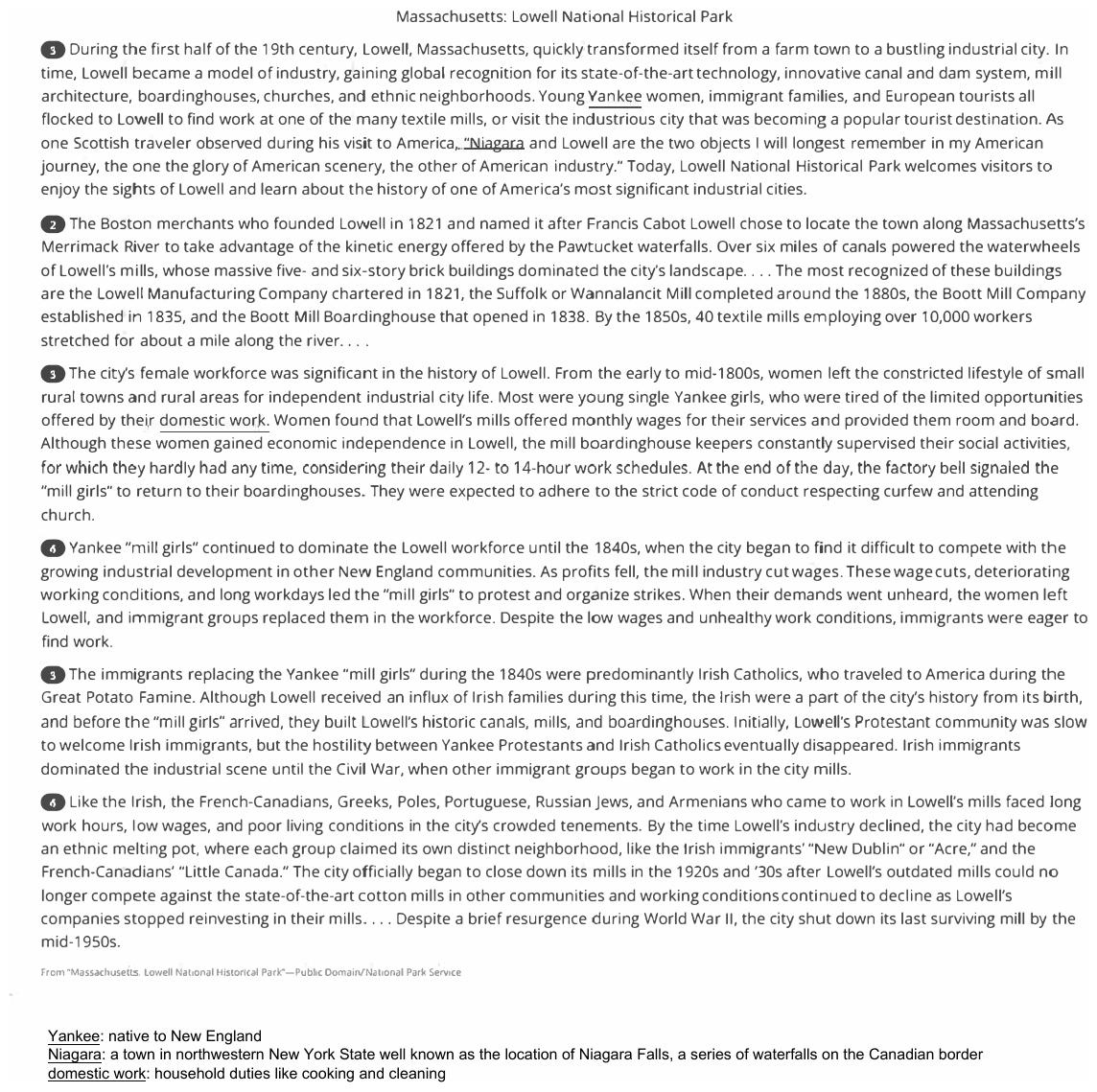
Question 19 of 120
2026 Practice Test A English, question 37Uses the passage above: “Massachusetts: Lowell National Historical Park”.
Question
A central idea that Lowell was “one of America’s most significant industrial cities” (paragraph 1) is conveyed in the passage primarily through a description of the
- Acanals, mills, and boardinghouses that were built by immigrants.
- Bmill girls and immigrants who comprised Lowell’s workforce.
- Cdevelopment of the mills and the workforce established to support them.
- Dcultural diversity of the people who lived in the area.
Show the answer
Correct answer: C
The question asks which description conveys the central idea that Lowell was “one of America’s most significant industrial cities” (paragraph 1).
A. Incorrect. While the passage does state that the city’s canals, mills, and boardinghouses were built by early immigrants from Ireland, these details do not contribute to the development of the overall idea that Lowell was a significant industrial city.
B. Incorrect. The details about the women and immigrants who worked in the mills are important to the passage, but these details alone do not show that Lowell was a significant industrial city.
C. CORRECT. The details throughout the passage about the development of the mills and the people who worked in them convey the significance of Lowell in early American industry. Paragraph 2 shares details about the businesses that started in the 1800s and contributed to the development of industry in the region (“The most recognized of these buildings are the Lowell Manufacturing Company chartered in 1821, the Suffolk or Wannalancit Mill completed around the 1880s, the Boott Mill Company established in 1835, and the Boott Mill Boardinghouse that opened in 1838”). Then paragraphs 3–6 provide specific details about the people who worked in the mills at different points in time.
D. Incorrect. Although the passage references Lowell’s culturally diverse community (“Young Yankee women, immigrant families, and European tourists all flocked to Lowell to find work at one of the many textile mills” [paragraph 1]), these groups alone are not what marked Lowell as a significant industrial city.
Question analysis
This central idea question asks which kind of description in an article about the Massachusetts mill city of Lowell does most to show that it was one of America's most significant industrial cities. Students need a map of all six paragraphs, because every choice names something the passage really describes, and the question turns on which description does the main work.
- Grade level
- Grade 8 reading and task
- Compared with grade 7
- Above grade 7 Grade 7 students trace how a central idea is developed, usually through a few supporting details. Here the strands to weigh run through six dense paragraphs of dates, mills and worker groups, and the stem is long and passive, so it asks more than typical.
- Estimated difficulty
- Hard: combines ideas, needs a plan, and has more than one tempting wrong answer.
- Thinking it demands
- Depth of knowledge 3, strategic thinking · mainly analyze
- What makes it hard
- A very close wrong answer major
- Evidence in several places moderate
- A lot to read minor
- Complex sentences minor
- Evidence
- Answered from the whole text
- Reading level
- Passage: about grade 15, 764 words; question and choices: about grade 10, 63 words.
- Corrected from the DOE handbook
- A grammatical error in the explanation was corrected.
- An inaccurate detail in the explanation was corrected.
- Students, last 30 days
- Not enough answers yet to show (it takes 10).
Why it is hard, traps and wrong answers (shows the answer)
Why it is hard
Every choice names something the passage really describes, so truth rules nothing out; the question turns on which description carries the claim that Lowell mattered as an industrial city. Because four of the six paragraphs follow the workers, the workforce alone looks like the passage's main thread, and students who forget paragraph 2's mills take the half for the whole. Diversity and the immigrant builders are real themes too, but neither says anything about Lowell's industrial standing.
A very close wrong answer major Choosing the answer
The workforce choice is the key with one half removed: both describe the people who worked the mills, but only the key also names the development of the mills, which paragraph 2 builds with dates and numbers. (Embretson & Wetzel, 1987; Gorin & Embretson, 2006; Ascalon et al., 2007)
Evidence in several places moderate Working it out
The industrial picture is built in two stages, the canals and mills of paragraph 2 and the successive workforces of paragraphs 3 to 6, so each choice must be measured against the whole passage. (Kirsch & Mosenthal, 1990; Gorin & Embretson, 2006)
A lot to read minor Understanding the question
Six paragraphs pack in mill names, dates from 1821 to the 1950s and a string of worker groups, from Yankee mill girls to Irish, French-Canadian and Greek immigrants. (Kintsch, 1998; Gorin & Embretson, 2006; Freedle & Kostin, 1993)
Complex sentences minor Understanding the question
The stem is a long passive sentence that quotes paragraph 1 inside it and holds the real question, “primarily through a description of the,” until its last words. (Abedi & Lord, 2001; Freedle & Kostin, 1993; Messick, 1989)
Strategy: Note in a phrase what each of the six paragraphs is about, then test each choice against the stem's claim: would that description make a reader see Lowell as a major industrial city?
Traps
- Too narrow: A single detail offered as the central idea or a summary, or a summary that keeps minor details and leaves out an essential part.
- True but not the answer: A choice says something accurate about the text that does not answer this question.
The wrong answers, classified
A Too narrow (King et al., 2004)
Seizes on paragraph 5's clause that Irish workers built the canals, mills and boardinghouses, one fact about construction rather than the account of mills and workers that shows Lowell's importance.
B Too narrow (King et al., 2004)
Sees that paragraphs 3 to 6 follow the mill girls and the immigrants who replaced them, but leaves out the mills themselves, the heart of paragraph 2's industrial picture.
D True but not the answer (King et al., 2004; Embretson & Wetzel, 1987)
Recalls paragraph 6's “ethnic melting pot” and paragraph 1's “ethnic neighborhoods,” which are real, but the city's diversity says nothing about its standing as an industrial city.
What was corrected from the DOE handbook, and why
- Explanation: The handbook’s explanation of Option B says “The details about the women and immigrants who worked in the mills is important to the passage.” The subject is “details,” so the site now says “are important.”
- Explanation: The handbook’s explanation of Option C says paragraph 2 describes “the businesses that started in the early 1800s,” but the sentence it then quotes includes “the Suffolk or Wannalancit Mill completed around the 1880s,” late in the century. The site now says “the businesses that started in the 1800s.”
Working it out, step by step
Figure out what the question asks
This is a central idea question. A central idea is a main point that the whole passage builds. The point here is that Lowell was “one of America’s most significant industrial cities.” Significant means important. You need the description that does the most to show this.
Map the six paragraphs
- Paragraph 1: Lowell grows from a farm town into a famous industrial city.
- Paragraph 2: The mills: canals, huge brick buildings, mills started across the 1800s, and by the 1850s, “40 textile mills employing over 10,000 workers.”
- Paragraphs 3 and 4: The Yankee “mill girls” who worked in the mills.
- Paragraphs 5 and 6: The Irish and other immigrants who took their place.
See how the picture is built
The passage shows Lowell’s importance in two parts. First it describes the mills: how they were built and how big they grew. Then it follows the workers who ran them, group after group. Together, the mills and the workforce show a major industrial city. Workforce means all the people who do the work. Either part alone tells only half the story.
Check each choice
- A is wrong. Paragraph 5 does say the Irish built the canals, mills and boardinghouses. But that is one fact in one sentence, not the main description.
- B is wrong. The mill girls and immigrants fill paragraphs 3 to 6. But this choice leaves out the mills themselves, the heart of paragraph 2.
- C is right. It covers both parts: how the mills grew and the workers who kept them running.
- D is wrong. Lowell did become an “ethnic melting pot.” But a mix of cultures doesn’t show that a city was an industrial leader.
Watch out: Four of the six paragraphs are about workers, so B looks like the main thread. It is only half of it.
Choose the answer
The central idea is carried by the growth of the mills plus the workforce gathered to run them. So the answer is C.
Why this answer and not the closest wrong one
B is the closest wrong answer. It matches the second half of C, the people who worked in the mills. But it drops the mills, with their six miles of canals and, by the 1850s, 40 mills. Workers alone don’t make a city an industrial giant. C keeps both halves, so it fits the whole passage.
More questions like this
The original DOE question
Question 20 of 120
2026 Practice Test A English, question 38Uses the passage above: “Massachusetts: Lowell National Historical Park”.
Question
Which sentence from paragraph 2 best supports the idea that Lowell became “a bustling industrial city” (paragraph 1) in a short period of time?
- A“The Boston merchants who founded Lowell in 1821 and named it after Francis Cabot Lowell chose to locate the town along Massachusetts’s Merrimack River to take advantage of the kinetic energy offered by the Pawtucket waterfalls.”
- B“Over six miles of canals powered the waterwheels of Lowell’s mills, whose massive five- and six-story brick buildings dominated the city’s landscape.”
- C“The most recognized of these buildings are the Lowell Manufacturing Company chartered in 1821, the Suffolk or Wannalancit Mill completed around the 1880s, the Boott Mill Company established in 1835, and the Boott Mill Boardinghouse that opened in 1838.”
- D“By the 1850s, 40 textile mills employing over 10,000 workers stretched for about a mile along the river.”
Show the answer
Correct answer: D
The question asks for the sentence in paragraph 2 that best supports the idea that Lowell became “a bustling industrial city” (paragraph 1) in a short period of time.
A. Incorrect. While the sentence provides details on when the town of Lowell was founded and the natural features of the area, it does not support the idea that the city became “a bustling industrial city” in a short period of time.
B. Incorrect. Although this sentence indicates that the mill buildings were a noticeable feature of the city and provides details on how the mills worked, it does not specifically show that Lowell had become “a bustling industrial city” in a short period of time.
C. Incorrect. While this sentence lists some recognizable mill buildings along the river and notes when their associated businesses were established, it does not support the idea that Lowell had become “a bustling industrial city” in a short period of time.
D. CORRECT. This sentence indicates that within only a few decades of the city’s founding, it experienced massive industrial growth, with “40 textile mills employing over 10,000 workers,” supporting the idea that Lowell became “a bustling industrial city” in a short period of time.
Question analysis
Here students choose which sentence from the second paragraph of an article about Lowell, Massachusetts, best supports the claim that the town became a bustling industrial city in a short period of time. All four sentences describe Lowell's founding, mills or canals, and several carry dates, so students must weigh what each one actually shows about how fast the city grew.
- NYS standards
- 7R1 textual evidence and inferences
- Grade level
- Grade 7 reading and task
- Compared with grade 7
- At grade 7 Picking the sentence that best supports a claim is standard grade 7 evidence work. The claim carries a time condition as well as a description, and all four choices come from one short paragraph, so the demand is typical of grade 7.
- Estimated difficulty
- Moderate: several steps, or a close reading with one strong distractor.
- Thinking it demands
- Depth of knowledge 2, skills and concepts · mainly evaluate
- What makes it hard
- Reading between the lines moderate
- Every choice must be checked minor
- Evidence
- Answered from one paragraph or stanza
- Reading level
- Passage: about grade 15, 764 words; question and choices: about grade 14, 131 words.
- Students, last 30 days
- Not enough answers yet to show (it takes 10).
Why it is hard, traps and wrong answers (shows the answer)
Why it is hard
The claim has two parts, a bustling industrial city and a short time to get there, and most sentences in paragraph 2 meet only one. The list of mills with their founding dates is the strongest pull, because its dates seem to answer the time half, yet they run into the 1880s and show four buildings, not a busy city. The question rewards pairing the 1850s figures with the 1821 founding.
Reading between the lines moderate Working it out
The 1850s sentence shows speed only beside the founding date in the paragraph's first sentence: getting from 1821 to 40 mills and 10,000 workers took about thirty years, a span students must work out. (Graesser, Singer & Trabasso, 1994; Kintsch, 1998)
Every choice must be checked minor Choosing the answer
All four sentences come from paragraph 2 and describe Lowell's mills or canals, and three carry dates, so each must be tested for both the scale and the speed of growth. (Embretson & Wetzel, 1987)
Strategy: Split the claim into its two parts, a busy industrial city and a short span of time, and check each sentence for evidence of both rather than accepting one that fits only half.
Traps
- Supports only part of the claim: In a question about evidence: a line that backs one half of the claim but not the other, or a related point rather than the claim itself.
- True but not the answer: A choice says something accurate about the text that does not answer this question.
The wrong answers, classified
A True but not the answer (King et al., 2004; Embretson & Wetzel, 1987)
Takes the founding year, 1821, as evidence about time, but the sentence only explains why the merchants built beside the Pawtucket falls and says nothing about how the city grew.
B Supports only part of the claim (King et al., 2004; Thissen, Steinberg & Fitzpatrick, 1989)
Sees six miles of canals and “massive five- and six-story brick buildings” as proof of a bustling city, but the sentence gives no date, so it cannot show speed.
C Supports only part of the claim (King et al., 2004; Thissen, Steinberg & Fitzpatrick, 1989)
Treats the list of charters and openings as proof of fast growth, but it names only four buildings, and the Wannalancit Mill's 1880s date stretches the list over some sixty years.
Working it out, step by step
Split the claim into two parts
This is an evidence question. You need the sentence that best supports a claim, and the claim has two parts. First, Lowell became “a bustling industrial city,” a busy factory town. Second, it happened “in a short period of time.” The best sentence must support both parts, not just one.
Find the starting date
Paragraph 2 opens with the town’s start. The Boston merchants “founded Lowell in 1821.” That gives you a starting point. Now look for a sentence that shows how big Lowell got, and by when.
Work out how long it took
The last sentence of paragraph 2 says: “By the 1850s, 40 textile mills employing over 10,000 workers stretched for about a mile along the river.” From 1821 to the 1850s is only about 30 years. In that time, Lowell went from a new town to 40 mills and over 10,000 workers. That is fast growth, and it is clearly bustling.
Check each choice
- A is wrong. It tells why the town was built by the waterfalls. It says nothing about how the city grew.
- B is wrong. Six miles of canals and “massive five- and six-story brick buildings” do sound busy. But there is no date, so it can’t show speed.
- C is wrong. It has dates, but they run from 1821 to the 1880s, about 60 years. And it names just four buildings, not a whole busy city.
- D is right. It shows a big city of mills and workers only about 30 years after Lowell began.
Watch out: C is tempting because it is full of dates. But dates alone don’t prove speed, and these are spread over decades.
Choose the answer
Only one sentence shows both a busy industrial city and a short time to get there. So the answer is D.
Why this answer and not the closest wrong one
C is the closest wrong answer, since its dates seem to answer the time part. But they stretch from 1821 to the 1880s, and they cover only four buildings. D gives the size of the whole mill city, 40 mills and over 10,000 workers, about 30 years after the founding.
More questions like this
The original DOE question
Question 21 of 120
2026 Practice Test A English, question 39Uses the passage above: “Massachusetts: Lowell National Historical Park”.
Question
Read this sentence from paragraph 3.
From the early to mid-1800s, women left the constricted lifestyle of small rural towns and rural areas for independent industrial city life.
Which statement best describes how the sentence fits into the overall structure of the passage?
- AIt provides a transition from a description of the mills to a description of the workforce in those mills.
- BIt indicates a shift in tone from positive and hopeful to negative and dissatisfied with working conditions at the mill.
- CIt summarizes a challenge that led many women to leave their hometown and seek work in urban areas.
- DIt begins a comparison of the mill workforce between the mid-1800s and the late 1800s.
Show the answer
Correct answer: A
The question asks which statement best describes how the sentence in paragraph 3 fits into the overall structure of the passage.
A. CORRECT. The sentence in paragraph 3 provides a transition from the overall description of the city and the mills to a description of the women who made up the workforce in the mills. The idea that women left domestic life in favor of working in the mills is important in the passage, and the sentence serves to connect that idea to the previous discussion about the mills.
B. Incorrect. While the mill girls’ dissatisfaction with their working conditions is addressed later in the passage (“These wage cuts, deteriorating working conditions, and long workdays led the ‘mill girls’ to protest and organize strikes” [paragraph 4]), the sentence in paragraph 3 does not indicate a shift in tone from positive to negative. The sentence provides a transition to the discussion of the women who worked in the mills.
C. Incorrect. Although the sentence in paragraph 3 mentions that women became interested in working in the mills because of the “constricted lifestyle of small rural towns,” structurally the sentence does not function as a summary because, instead of expanding on the idea of the difficulties or challenges of life in small rural towns and rural areas, the paragraph goes on to describe the advantages and disadvantages of life in the city for these women.
D. Incorrect. The sentence in paragraph 3 focuses on the choices women made to leave rural towns to work in the city in the early to mid-1800s, not the mid-1800s to the late 1800s. The sentence does not create a comparison between the workforce in the mid-1800s and that in the late 1800s.
Question analysis
A sentence from the start of paragraph 3 of the Lowell article, about women leaving the limited life of rural towns for the city, is the focus of this text-structure question. Students decide how it fits into the structure of the passage as a whole, so they must place it within the order of all six paragraphs instead of judging it by itself.
- NYS standards
- 7R5 structure and genre features
- Grade level
- Grade 8 reading and task
- Compared with grade 7
- Above grade 7 Grade 7 structure questions often ask what a paragraph does. This one asks how a single sentence serves a six-paragraph history and offers four abstract roles, so the student must hold the passage's whole plan in mind, more than typical grade 7 work.
- Estimated difficulty
- Hard: combines ideas, needs a plan, and has more than one tempting wrong answer.
- Thinking it demands
- Depth of knowledge 3, strategic thinking · mainly analyze
- What makes it hard
- How, not what moderate
- Evidence in several places moderate
- Reading between the lines minor
- Evidence
- Answered from the whole text
- Reading level
- Passage: about grade 15, 764 words; question and choices: about grade 9, 116 words.
- Students, last 30 days
- Not enough answers yet to show (it takes 10).
Why it is hard, traps and wrong answers (shows the answer)
Why it is hard
The answer depends on seeing the passage's plan, mills first and then the people who ran them, and placing this sentence at the seam. Its wording invites a content answer instead, since it really does describe a hardship that drove women to the city, and the later strikes tempt students to see a darker tone beginning here. The fit of the key is also imperfect, because the paragraph's opening sentence starts the turn, so students must choose the best description rather than an exact one.
How, not what moderate Working it out
The question asks what the sentence does in the passage, and its content, women escaping a “constricted lifestyle,” is easy to restate, which makes a summary of that content feel like an answer. (Anderson & Krathwohl, 2001)
Evidence in several places moderate Working it out
The sentence's role shows only from its neighbors: paragraph 2 ends with 40 mills and 10,000 workers, and paragraph 3 then follows the women who left rural towns to work in them. (Kirsch & Mosenthal, 1990; Gorin & Embretson, 2006)
Reading between the lines minor Working it out
Paragraph 3's first sentence, “The city's female workforce was significant,” already names the new subject, so students must see this second sentence as part of the turn rather than a fresh point. (Graesser, Singer & Trabasso, 1994; Kintsch, 1998)
Strategy: Sum up each paragraph in a few words, then look at what comes just before and just after this sentence and decide what role it plays at that point in the passage.
Traps
- Wrong purpose or structure: Names a purpose, structure or effect that the part does not serve, or describes what a part says when the question asks what it does.
- Wrong tone or attitude: Misjudges the tone, attitude or point of view, such as reading admiration as criticism, or taking a character's or subject's feelings for the author's.
The wrong answers, classified
B Wrong tone or attitude (Graesser, Singer & Trabasso, 1994)
Expects a turn toward complaint because the mill girls later strike, but this sentence is hopeful about “independent industrial city life,” and the protests wait until paragraph 4.
C Wrong purpose or structure (Anderson & Krathwohl, 2001)
Restates what the sentence says, women escaping a “constricted lifestyle,” instead of what it does, and the paragraph goes on to life in Lowell rather than rural hardship.
D Wrong purpose or structure (Anderson & Krathwohl, 2001)
Sees the dates “early to mid-1800s” and expects a then-and-later contrast, though the sentence opens the mill girls' story and the passage sets up no such comparison.
Working it out, step by step
Figure out what the question asks
This is a structure question. Structure is how a passage is put together. You need to say what job this sentence does in the whole passage. Don’t just restate what it says. Ask what comes before it and what comes after it.
Look at what comes before
Paragraph 2 is all about the mills. It ends with “40 textile mills employing over 10,000 workers.” Then paragraph 3 begins: “The city’s female workforce was significant in the history of Lowell.” Workforce means the people who do the work. The sentence in the question comes right after that: “From the early to mid-1800s, women left the constricted lifestyle of small rural towns and rural areas for independent industrial city life.”
Look at what comes after
Constricted means tight and limited. So women left small, limited farm towns to live on their own in the city. After this, the passage stays with the workers. Paragraphs 3 and 4 tell about the mill girls’ wages, rules, strikes and leaving. Paragraphs 5 and 6 tell about the immigrants who replaced them. So the passage turns here, from the mills to the people who worked in them.
Check each choice
- A is right. The sentence helps carry the reader from the mills to the workforce in those mills.
- B is wrong. The tone isn’t negative here. “Independent industrial city life” sounds hopeful. The protests and strikes don’t come until paragraph 4.
- C is wrong. It tells what the sentence says, not what it does. And the paragraph goes on to life in Lowell, not to more about hard times back home.
- D is wrong. The passage never compares workers of the mid-1800s with workers of the late 1800s.
Watch out: C sounds right because the sentence really does describe a limited life that women wanted to leave. But the question asks about its role, not its content.
Choose the answer
Paragraph 3’s first sentence names the new subject. This sentence carries it forward by telling where the workers came from. Together they move the passage from mills to people. So the answer is A.
Why this answer and not the closest wrong one
C is the closest wrong answer. It is true that women wanted to escape a “constricted lifestyle.” But C describes what the sentence says, not the job it does. The paragraph then moves on to life in Lowell. A names the job: the sentence links the story of the mills to the story of the mill workers.
More questions like this
The original DOE question
Question 22 of 120
2026 Practice Test A English, question 40Uses the passage above: “Massachusetts: Lowell National Historical Park”.
Question
Read this sentence from paragraph 5.
Although Lowell received an influx of Irish families during this time, the Irish were a part of the city’s history from its birth, and before the “mill girls” arrived, they built Lowell’s historic canals, mills, and boardinghouses.
How does this sentence contribute to the development of ideas in the passage?
- AIt implies that Lowell was founded by early Irish immigrants.
- BIt emphasizes the important role Irish immigrants played in Lowell’s history.
- CIt suggests that the new Irish immigrants were readily accepted into the community.
- DIt highlights the working relationship between the mill girls and the new Irish immigrants.
Show the answer
Correct answer: B
The question asks how the sentence in paragraph 5 contributes to the development of ideas in the passage.
A. Incorrect. The sentence from paragraph 5 does not imply that Lowell was founded by early Irish immigrants. The sentence explains how Irish immigrants had been settling in Lowell since the city was established and that they contributed to the construction of the city, which allowed it to become an industrial center several decades later.
B. CORRECT. The sentence from paragraph 5 shows that early Irish immigrants were critical to the success of Lowell as an industrial city. This information supports the development of the idea that the work of Irish immigrants and immigrants from other places is an important element in the historical significance of industry in Lowell.
C. Incorrect. The sentence from paragraph 5 does not suggest that new Irish immigrants were readily accepted into the community. Paragraph 5 states that “initially, Lowell’s Protestant community was slow to welcome Irish immigrants, but the hostility between Yankee Protestants and Irish Catholics eventually disappeared.”
D. Incorrect. The sentence from paragraph 5 does not highlight the relationship between the mill girls and the new Irish immigrants. Paragraph 4 explains how the mill girls left Lowell, and paragraph 5 states that the mill girls were replaced by “predominantly Irish Catholics, who traveled to America during the Great Potato Famine” but does not discuss a relationship between them.
Question analysis
This question quotes a sentence from paragraph 5 of the Lowell article about Irish families, who arrived in large numbers in the 1840s but had been part of the city since its birth. Students explain how the sentence contributes to the development of the passage's ideas, and because it packs several groups and periods into one line, they must keep straight who did what and when.
- Grade level
- Grade 7 reading and task
- Compared with grade 7
- At grade 7 Explaining how one sentence develops a passage's ideas is a core grade 7 skill. The sentence is long but its meaning is direct, and the text around it settles most of the choices, so the demand is typical.
- Estimated difficulty
- Straightforward: two steps or one careful reading.
- Thinking it demands
- Depth of knowledge 2, skills and concepts · mainly analyze
- What makes it hard
- Complex sentences minor
- Evidence in several places minor
- Evidence
- Answered from one paragraph or stanza
- Reading level
- Passage: about grade 15, 764 words; question and choices: about grade 10, 103 words.
- Students, last 30 days
- Not enough answers yet to show (it takes 10).
Why it is hard, traps and wrong answers (shows the answer)
Why it is hard
Once the long sentence is untangled, its point is plain: the Irish were in Lowell from the start and built its canals, mills and boardinghouses. The likeliest slip is reading “from its birth” as founding the city, which paragraph 2 credits to Boston merchants. The other wrong choices invent a welcome or a partnership that the surrounding sentences contradict or never mention, so a quick check of paragraph 5 settles them.
Complex sentences minor Understanding the question
The 37-word sentence moves through three times at once, the influx “during this time,” the city's birth and the years before the mill girls arrived, so who did what and when must be sorted out. (Abedi & Lord, 2001; Freedle & Kostin, 1993; Messick, 1989)
Evidence in several places minor Working it out
Ruling out the founding choice needs paragraph 2's “Boston merchants who founded Lowell,” and ruling out a warm welcome needs the next sentence's “slow to welcome Irish immigrants.” (Kirsch & Mosenthal, 1990; Gorin & Embretson, 2006)
Strategy: Put the quoted sentence into your own words, then check each choice against the sentences around it in paragraph 5 and against what earlier paragraphs say about the city's beginnings.
Traps
- Twists what the text says: Uses the text's topic and ideas but changes what it says: who did it, how much, when, or why.
- Reads too much in: A reasonable-sounding conclusion that goes further than the text allows.
The wrong answers, classified
A Twists what the text says (King et al., 2004)
Reads “part of the city's history from its birth” and building the canals as founding the city, though paragraph 2 says Boston merchants founded Lowell in 1821.
C Twists what the text says (King et al., 2004)
Remembers that the hostility toward Irish Catholics “eventually disappeared” and overlooks “Initially, … slow to welcome,” turning a gradual change into a ready acceptance.
D Reads too much in (Graesser, Singer & Trabasso, 1994)
Sees the Irish and the mill girls named in one sentence and assumes they worked side by side, a relationship the passage never describes; the Irish later replaced them.
Working it out, step by step
Figure out what the question asks
This structure question asks what one sentence adds to the passage’s ideas. First you need to understand the sentence. It is long and jumps between three times, so take it apart piece by piece.
Break the sentence into parts
The sentence is in paragraph 5. Here are its three parts:
- “Although Lowell received an influx of Irish families during this time”: an influx is a big wave of people arriving, and “this time” means the 1840s.
- “the Irish were a part of the city’s history from its birth”: its birth means the city’s very beginning.
- “they built Lowell’s historic canals, mills, and boardinghouses”: this happened before the mill girls came.
Say it in your own words
Put together, the sentence says: Many Irish families came in the 1840s, but the Irish had been in Lowell from the start. They built its canals, mills and boardinghouses. Without those canals and mills, there would be no industrial city. So the sentence shows how much the Irish mattered to Lowell’s story.
Check each choice
- A is wrong. Being there “from its birth” is not the same as founding the city. Paragraph 2 names the founders: “The Boston merchants who founded Lowell in 1821.”
- B is right. The Irish were there from the start and built the city’s mills and canals. That is an important role.
- C is wrong. The very next sentence says “Lowell’s Protestant community was slow to welcome Irish immigrants.” So they were not readily, or easily, accepted.
- D is wrong. The passage never says the Irish and the mill girls worked together. Later, the Irish replaced them.
Watch out: “From its birth” can sound like they started the city, which leads to A. Check paragraph 2 to see who founded Lowell.
Choose the answer
The sentence makes clear that the Irish helped build Lowell from its first days. So the answer is B.
Why this answer and not the closest wrong one
A is the closest wrong answer, because the sentence links the Irish to the city’s “birth.” But being part of a city from the start is different from founding it. Boston merchants founded Lowell. The Irish built its canals and mills. B fits, because it names that important role without stretching it.
More questions like this
The original DOE question
Question 23 of 120
2026 Practice Test A English, question 41Uses the passage above: “Massachusetts: Lowell National Historical Park”.
Question
Which sentence best summarizes the mill girls’ experience as the dominant workforce in Lowell?
- AThe mill girls were eager to leave their domestic duties and small towns behind, so they went to work in the mills of Lowell.
- BOriginally, the mill girls were satisfied to work in Lowell, but as they left their jobs at the Lowell mills, immigrants arrived to fill the empty positions.
- CYoung women left home to work in the Lowell mills, but the mill girls soon became dissatisfied with the working conditions and rigid boardinghouse rules.
- DThe mill girls embraced city life when they came to work in Lowell’s mills, but when their protests about unfavorable working conditions went unanswered, they left.
Show the answer
Correct answer: D
The question asks for the sentence that best summarizes the mill girls’ time as the dominant workforce in Lowell.
A. Incorrect. While the passage explains that mill girls were initially eager to leave the domestic duties of life in rural areas, the summary sentence does not address the details about the mill girls’ time working in the mills or the changes that led the mill girls to leave the industry.
B. Incorrect. Mill girls initially found satisfaction in the mill work and lifestyle, and when they did leave, immigrants filled the empty jobs. This summary sentence, however, does not address the details about the mill girls’ time as the primary workforce in Lowell or the circumstances that led them to leave their jobs in the mid-1800s.
C. Incorrect. Mill girls did leave home to work in the Lowell mills, and they did grow dissatisfied over time, but this summary sentence does not include details about the mill girls’ actions to improve the working conditions.
D. CORRECT. This sentence summary best captures the mill girls’ experience as outlined in paragraphs 3 and 4. The sentence concisely summarizes both the women’s initial excitement about the opportunity to live independently (“Women found that Lowell’s mills offered monthly wages for their services and provided them room and board” [paragraph 3]) and their eventual inability to secure better working conditions (“When their demands went unheard, the women left Lowell, and immigrant groups replaced them in the workforce” [paragraph 4]).
Question analysis
This summary question asks which sentence best sums up the experience of the Yankee mill girls during the years they were Lowell's main workforce. Students must pull together the account spread over paragraphs 3 and 4, and every choice is a two-part sentence that sounds accurate, so each must be checked for what it includes, what it leaves out and what it gets slightly wrong.
- Grade level
- Grade 8 reading and task
- Compared with grade 7
- Above grade 7 Summarizing part of a text is a grade 7 standard, usually tested with one clearly complete choice. Here all four summaries are long, two-part and largely accurate, so ranking them by completeness and precision asks more than typical grade 7 work.
- Estimated difficulty
- Hard: combines ideas, needs a plan, and has more than one tempting wrong answer.
- Thinking it demands
- Depth of knowledge 2, skills and concepts · mainly understand
- What makes it hard
- Every choice must be checked moderate
- A very close wrong answer moderate
- Evidence in several places minor
- Evidence
- Answered from several paragraphs or stanzas
- Reading level
- Passage: about grade 15, 764 words; question and choices: about grade 11, 116 words.
- Students, last 30 days
- Not enough answers yet to show (it takes 10).
Why it is hard, traps and wrong answers (shows the answer)
Why it is hard
This is a completeness question: every summary is built from true pieces of paragraphs 3 and 4, and the right one is the only one that runs from arrival to departure with the cause in between. Students who stop at dissatisfaction feel they have the whole arc, because the turn against working conditions is the story's middle. Writing a one-line summary first, with a beginning, a turning point and an end, makes the gaps in the others easy to see.
Every choice must be checked moderate Choosing the answer
All four summaries are two-part sentences of 24 to 27 words that sound accurate, so each has to be checked for what it leaves out: the arrival, the wage cuts and protests, or the departure. (Embretson & Wetzel, 1987)
A very close wrong answer moderate Choosing the answer
The dissatisfaction summary shares the key's shape, women coming to the mills and then turning against their working conditions; it differs only in the ending, where the key has unanswered protests and the women leaving. (Embretson & Wetzel, 1987; Gorin & Embretson, 2006; Ascalon et al., 2007)
Evidence in several places minor Working it out
The mill girls' story runs from paragraph 3, on why they came and how they lived, to paragraph 4, on wage cuts, strikes and their departure in the 1840s. (Kirsch & Mosenthal, 1990; Gorin & Embretson, 2006)
Strategy: Write your own one-sentence summary of paragraphs 3 and 4 before reading the choices, then compare each choice with it claim by claim, including its words about timing and cause.
Traps
- Too narrow: A single detail offered as the central idea or a summary, or a summary that keeps minor details and leaves out an essential part.
The wrong answers, classified
A Too narrow (King et al., 2004)
Covers only why the women came, leaving domestic work and small towns behind, and stops before their years as the workforce, the wage cuts and their leaving.
B Too narrow (King et al., 2004)
Gets the start and the replacement by immigrants right but drops the wage cuts, protests and strikes that paragraph 4 gives as the reason the women left.
C Too narrow (King et al., 2004)
Keeps the arrival and the growing discontent, adding the minor boardinghouse rules, but leaves out the protests and the women leaving, and “soon” skips the years before the 1840s wage cuts.
Working it out, step by step
Figure out what the question asks
This question asks for the best summary. A summary retells the main events in a few words. It covers the beginning, the middle and the end. Here you sum up the mill girls’ time as Lowell’s main workforce. Their story is in paragraphs 3 and 4.
Find the beginning of their story
Paragraph 3 says the women came for “independent industrial city life.” They found that the mills “offered monthly wages for their services and provided them room and board.” Room and board means a place to live and meals. So at first, they were glad to come. Their days were long, though, and the rules were strict.
Find the middle and the end
Paragraph 4 gives the turning point. In the 1840s, profits fell and the mills cut wages. “These wage cuts, deteriorating working conditions, and long workdays” led the women to protest and strike. Deteriorating means getting worse. Then comes the end: “When their demands went unheard, the women left Lowell.”
Check each choice
- A is wrong. It tells only why they came. It stops before their years at work and their leaving.
- B is wrong. It has the start and the end. But it skips the middle: the wage cuts and protests that made them leave.
- C is wrong. It has the start and the unhappy middle, but no protests and no leaving. Also, “soon” is off, since the trouble came years later, in the 1840s.
- D is right. It covers all three parts: they embraced city life, protested bad conditions, and left when no one listened. Embraced means happily welcomed.
Watch out: C feels complete because it ends with the women unhappy. But their story doesn’t end there. They protested, and then they left.
Choose the answer
Only one summary runs from the mill girls’ arrival to their leaving, with the cause in between. So the answer is D.
Why this answer and not the closest wrong one
C is the closest wrong answer. Like D, it starts with the women coming to the mills and then growing unhappy. But it stops there. It leaves out the protests and the women leaving Lowell, which is how their time as the main workforce ended. D tells the whole story.
More questions like this
The original DOE question
Question 24 of 120
2026 Practice Test A English, question 42Uses the passage above: “Massachusetts: Lowell National Historical Park”.
Question
The reason Lowell lost its status as an industrial leader is best illustrated through the
- Adescription of poor living and working conditions.
- Bexplanation for why some immigrant groups struggled to live together.
- Ccomparison with other mills that used modern methods.
- Dinformation about the mills opening temporarily during World War II.
Show the answer
Correct answer: C
The question asks for the reason that best illustrates why Lowell lost its status as an industrial leader.
A. Incorrect. While the passage discusses the “long work hours, low wages, and poor living conditions in the city’s crowded tenements” (paragraph 6) in Lowell, these details highlight the living and working conditions of immigrant groups. The author does not state that poor living and working conditions are the reason Lowell lost its status as a “model of industry.”
B. Incorrect. Paragraph 5 in the passage acknowledges that there was some tension between the different ethnic and religious groups in Lowell, but this idea is not what led to Lowell’s decline as a “model of industry.”
C. CORRECT. When Lowell was initially established, the mills in the city thrived because of their advanced manufacturing methods (“gaining global recognition for its state-of-the-art technology, innovative canal and dam system, [and] mill architecture” [paragraph 1]). However, manufacturing technology changed and improved over time, and many mill owners chose to close the mills rather than modernize them, resulting in Lowell’s loss of status as a “model of industry” (“The city officially began to close down its mills in the 1920s and ’30s after Lowell’s outdated mills could no longer compete against the state-of-the-art cotton mills in other communities” [paragraph 6]).
D. Incorrect. The details about the temporary revival of the mills during World War II do not show why Lowell is no longer considered a “model of industry.” The mills were used briefly during wartime because of an increased need for supplies, but this use of the mills was short-lived.
Question analysis
Why did Lowell lose its place as an industrial leader, a decline that ended with its last mill closing by the mid-1950s? This evidence question asks which part of the article best illustrates the reason, so students must find where the passage explains the cause and match it to a choice worded in general terms, while other late details compete for attention.
- Grade level
- Grade 7 reading and task
- Compared with grade 7
- At grade 7 Using a text to explain a cause is typical grade 7 work. The reason is stated directly near the end of the passage, but the choices name it in abstract terms, so a careful match is needed, as in ordinary grade 7 reading.
- Estimated difficulty
- Moderate: several steps, or a close reading with one strong distractor.
- Thinking it demands
- Depth of knowledge 2, skills and concepts · mainly evaluate
- What makes it hard
- The right answer is reworded moderate
- Complex sentences minor
- Evidence in several places minor
- Evidence
- Answered from one paragraph or stanza
- Reading level
- Passage: about grade 15, 764 words; question and choices: about grade 9, 50 words.
- Students, last 30 days
- Not enough answers yet to show (it takes 10).
Why it is hard, traps and wrong answers (shows the answer)
Why it is hard
The reason is stated, but in a sentence that pairs it with worsening working conditions, and conditions get far more space in the passage, from paragraph 4's wage cuts to paragraph 6's crowded tenements. Students who match the choices to familiar words land on the conditions, which the passage presents as a result of companies not reinvesting. The key has to be recognized in new wording, as a comparison with modern mills elsewhere.
The right answer is reworded moderate Choosing the answer
The key's “comparison with other mills that used modern methods” rewords “could no longer compete against the state-of-the-art cotton mills,” while wrong choices repeat the text's “poor living conditions,” “working conditions” and “World War II.” (Freedle & Kostin, 1993; Kirsch & Mosenthal, 1990)
Complex sentences minor Understanding the question
The 47-word sentence that gives the reason joins two clauses under one “after,” outdated mills that “could no longer compete” and working conditions that “continued to decline,” so both can look like causes. (Abedi & Lord, 2001; Freedle & Kostin, 1993; Messick, 1989)
Evidence in several places minor Working it out
The cause echoes earlier hints, paragraph 1's “state-of-the-art technology” and paragraph 4's trouble competing with “other New England communities,” which confirm that competition is the passage's explanation. (Kirsch & Mosenthal, 1990; Gorin & Embretson, 2006)
Strategy: Find the sentence that tells why Lowell's mills shut down, restate the cause in your own words, then choose the description that matches that cause rather than a detail that merely appears nearby.
Traps
- Supports only part of the claim: In a question about evidence: a line that backs one half of the claim but not the other, or a related point rather than the claim itself.
- True but not the answer: A choice says something accurate about the text that does not answer this question.
- Twists what the text says: Uses the text's topic and ideas but changes what it says: who did it, how much, when, or why.
The wrong answers, classified
A Supports only part of the claim (King et al., 2004; Thissen, Steinberg & Fitzpatrick, 1989)
Finds the sentence about the closings but takes its declining working conditions as the reason, though they follow from companies no longer reinvesting, the same neglect that left the mills outdated.
B Twists what the text says (King et al., 2004)
Recasts paragraph 5's hostility between Yankee Protestants and Irish Catholics, which “eventually disappeared,” as a struggle among immigrant groups, though the passage never ties it to the decline.
D True but not the answer (King et al., 2004; Embretson & Wetzel, 1987)
Picks the World War II detail because it belongs to the mills' last years, but a “brief resurgence” describes a short revival, not why Lowell fell behind.
Working it out, step by step
Figure out what the question asks
This evidence question asks why Lowell lost its place as an industrial leader. First find where the passage gives the reason. Then pick the choice that matches it, even if it uses different words.
Find the reason in paragraph 6
Look near the end of the passage, where the mills close. Paragraph 6 says the city began to close its mills “after Lowell’s outdated mills could no longer compete against the state-of-the-art cotton mills in other communities.” This is the reason the passage gives.
Put the reason in plain words
Outdated means old-fashioned. State-of-the-art means the newest and best. To compete is to keep up with rivals. So mills in other places had newer machines, and Lowell’s old mills couldn’t keep up. That is a comparison: Lowell’s mills next to more modern mills elsewhere. It is a big change, too. In paragraph 1, Lowell was famous for its own “state-of-the-art technology.”
Rule out the working conditions
Choice A is the hard one to rule out. The same sentence says working conditions got worse “as Lowell’s companies stopped reinvesting in their mills.” Reinvesting means putting money back in, for repairs and new machines. Mills that get no new money also fall out of date. So the worse conditions came along with the decline. Falling behind modern mills elsewhere is what cost Lowell its lead. The passage’s longer descriptions of poor conditions, in paragraphs 4 and 6, tell how hard life was for workers. They don’t explain why the mills closed.
Check the other choices
- B is wrong. The passage tells of tension between Yankee Protestants and Irish Catholics, which “eventually disappeared.” It never links this to the mills closing.
- C is right. It matches the reason: Lowell’s mills fell behind more modern mills.
- D is wrong. The World War II “brief resurgence” was a short comeback. It doesn’t explain why Lowell fell behind.
Watch out: A repeats words from the passage, so it feels safe. But matching the words is not the same as matching the reason.
Choose the answer
The passage says Lowell’s outdated mills could not keep up with modern mills in other places. Choice C names that comparison. So the answer is C.
Why this answer and not the closest wrong one
A is the closest wrong answer, because the closing sentence also says “working conditions continued to decline.” But the passage ties that to the companies no longer spending on their mills. A leader loses its place when others get ahead. C names that: other mills used modern methods, and Lowell’s did not.
More questions like this
The original DOE question
Question 25 of 120
2026 Practice Test A English, question 43Passage The Benefits of Indoor Plants
The Benefits of Indoor Plants
(1) In an age of endless media content, it is easy to see why people might prefer to stay inside. (2) According to a study sponsored by the Environmental Protection Agency, Americans spend an average of 87 percent of their time indoors. (3) Scientists say that this separation between people and nature puts people at risk for physical and psychological issues.
(4) During the process of photosynthesis, plants convert carbon dioxide into oxygen and remove many harmful toxins from the air. (5) Spending prolonged periods of time indoors, away from plants, deprives people of these benefits. (6) Air that is not regularly detoxified can lead to a condition known as sick building syndrome. (7) This disorder first came to light in the 1970s when many office workers in the United States began to complain of unexplained flu-like symptoms. (8) Researchers determined the cause to be volatile organic compounds, or VOCs. (9) VOCs are harmful chemicals that are emitted by everyday objects such as carpet, furniture, cleaning products, and computers. (10) The NASA Clean Air Study found a simple way to remove a significant number of VOCs within a 24-hour period: add plants to indoor spaces.
(11) Adding plants to indoor spaces has psychological benefits too. (12) Research has long linked time spent in natural environments with increased energy and feelings of contentment. (13) While being outdoors is an excellent option for improving a person’s mental health, recent research has indicated that encountering natural elements while indoors can also help. (14) To experience the maximum benefit of natural elements, experts suggest placing at least one live plant per 100 square feet of home or office space.
(15) Connecting with nature, even just by being near an indoor plant, is a significant factor in a person’s well-being. (16) Sitting in front of an electronic screen all day isn’t natural, and today’s workers need to get up and get outdoors. (17) Richard Ryan, a psychology professor at the University of Rochester, puts it this way: “Nature is something within which we flourish, so having it be more a part of our lives is critical, especially when we live and work in built environments.”
Question
Which sentence should follow sentence 3 to best introduce the topic of the passage?
- APlacing plants in homes and offices can provide a healthy bridge between nature and the indoors.
- BIt is important for people to realize that they need to spend more time near plants, whether indoors or out in nature.
- CFor their personal health and well-being, people need to spend more time outdoors or bring the outdoors in.
- DIndividuals with little connection to nature can experience illness, depression, and higher levels of stress.
Show the answer
Correct answer: A
The question asks which sentence should follow sentence 3 to best introduce the topic of the passage.
A. CORRECT. The sentence introduces the overall topic by previewing the main ideas in the passage. It introduces the connection between natural elements and well-being (“a healthy bridge”) and sets up the main argument of the passage (“Placing plants in homes and offices” can increase people’s well-being).
B. Incorrect. Although sentence 3 mentions the connection between “people and nature,” this sentence references the importance of spending time near plants while both indoors and outdoors. However, the passage focuses specifically on the benefits of having indoor plants.
C. Incorrect: Though the sentence describes a reason why indoor plants are important (“For [people’s] personal health and well-being”), the topic of the passage is related to the need for indoor plants, not the need for people to spend more time outdoors.
D. Incorrect. While the sentence refers to how time away from nature can affect health and well-being, the vague wording (“little connection to nature”) makes this sentence too broad to introduce the topic of the passage, and thus, it should not follow sentence 3.
Question analysis
This revising question works with the four-paragraph passage “The Benefits of Indoor Plants” and asks which sentence should follow sentence 3 to introduce the passage's topic. The opening paragraph ends on the health risks of time spent away from nature, and every choice continues that thought in some way, so students must judge which one prepares a reader for what the passage goes on to cover.
- NYS standards
- 7W2a introducing and organizing a topic
- Grade level
- Grade 7 reading and task
- Compared with grade 7
- At grade 7 Introducing a topic so that it previews what follows is a grade 7 writing standard, practised often in class. The passage is short and plainly worded, and the choices differ in focus rather than in grammar, typical grade 7 revision.
- Estimated difficulty
- Moderate: several steps, or a close reading with one strong distractor.
- Thinking it demands
- Depth of knowledge 2, skills and concepts · mainly evaluate
- What makes it hard
- A very close wrong answer moderate
- Evidence in several places moderate
- How sentences fit together minor
- Evidence
- Answered from the whole text
- Reading level
- Passage: about grade 12, 346 words; question and choices: about grade 9, 84 words.
- Students, last 30 days
- Not enough answers yet to show (it takes 10).
Why it is hard, traps and wrong answers (shows the answer)
Why it is hard
The first paragraph ends on a problem, and all four choices continue it plausibly, so the decision is about scope. The passage is about plants indoors, and the near miss offers outdoor time as an equal remedy, while another widens the subject to plants anywhere and a third simply restates the danger. Students who skim the topic sentences of the later paragraphs before choosing see that only an indoor solution introduces what follows.
A very close wrong answer moderate Choosing the answer
The choice ending “or bring the outdoors in” sounds like the key's “bridge between nature and the indoors,” but it adds spending more time outdoors, a remedy the passage does not develop. (Embretson & Wetzel, 1987; Gorin & Embretson, 2006; Ascalon et al., 2007)
Evidence in several places moderate Working it out
The topic only emerges from the later paragraphs: plants cleaning indoor air in sentences 4–10, their psychological benefits in 11–14, and nature brought indoors in 15–17. (Kirsch & Mosenthal, 1990; Gorin & Embretson, 2006)
How sentences fit together minor Working it out
The new sentence must follow sentence 3's warning about “separation between people and nature” and lead into sentence 4's photosynthesis, so it has to name plants as the remedy. (Halliday & Hasan, 1976)
Strategy: Skim the first sentence of each later paragraph to see what the passage actually covers, then test each choice: would it set up those paragraphs without promising something they never discuss?
Traps
- Half right: One half of a two-part choice is right and the other is not.
- Too broad or too strong: A choice overstates, generalizes, or uses absolute words the text does not support.
- Says it twice: Repeats an idea that the sentence or passage already states.
The wrong answers, classified
B Too broad or too strong (King et al., 2004)
Accepts a sentence about needing plants, but “whether indoors or out in nature” widens the subject to plants anywhere, while the passage discusses only plants inside.
C Half right (King et al., 2004; Thissen, Steinberg & Fitzpatrick, 1989)
Is drawn by “bring the outdoors in” and “health and well-being,” but the other half, spending more time outdoors, is a remedy the passage never goes on to develop.
D Says it twice (Connors & Lunsford, 1988)
Follows sentence 3 smoothly by naming illness, depression and stress, but that only restates its “physical and psychological issues” and never introduces plants, the passage's subject.
Working it out, step by step
Figure out what the question asks
This revising question asks you to add a sentence that introduces the topic. Such a sentence tells the reader what the passage will be about. For example, an essay about why dogs make good pets might start: Dogs make loyal, loving pets. The new sentence goes after sentence 3, so it must also follow from it.
Find the passage’s topic
Skim the rest of the passage. Sentences 4–10 tell how plants clean indoor air. Sentences 11–14 say plants indoors help the mind. Sentences 15–17 say even an indoor plant connects you with nature. So the topic is plants inside homes and offices. The title says it too: “The Benefits of Indoor Plants.”
Connect it to sentence 3
Sentence 3 names a problem: “this separation between people and nature puts people at risk for physical and psychological issues.” Psychological means having to do with the mind and feelings. The best next sentence should name the fix the passage talks about: bringing plants indoors.
Check each choice
- A is right. It names plants “in homes and offices” as “a healthy bridge between nature and the indoors.” A bridge connects two things, so plants bring nature inside. That sets up every later paragraph.
- B is wrong. “Whether indoors or out in nature” widens the topic to plants anywhere. The passage only discusses plants inside.
- C is wrong. It offers two fixes: more time outdoors, or bringing the outdoors in. The passage develops only the second. C never even mentions plants.
- D is wrong. It just repeats sentence 3’s problem in new words. It never brings up plants, the subject of the passage.
Look closely at choice C
Watch out: C sounds close because of “bring the outdoors in.” But the passage gives no tips for spending more time outside. Sentence 13 mentions being outdoors only on its way to the indoor point. So half of C promises something the passage never delivers.
Choose the answer
Only one choice moves from sentence 3’s problem to the passage’s answer, plants inside. So the answer is A.
Why this answer and not the closest wrong one
C is the closest wrong answer, because “bring the outdoors in” sounds like A. But C gives equal weight to spending more time outdoors, and the passage never develops that idea. A points only to plants indoors, which is exactly what the rest of the passage is about.
More questions like this
The original DOE question
The passage “The Benefits of Indoor Plants” as printed (page 60)
Question 26 of 120
2026 Practice Test A English, question 44Uses the passage above: “The Benefits of Indoor Plants”.
Question
Which transition word or phrase should be added to the beginning of sentence 5 to emphasize the relationship between sentences 4 and 5?
Move the correct answer to the box.
(5) ____ spending prolonged periods of time indoors, away from plants, deprives people of these benefits.
On the test you drag one of the tiles into the box; here, choose it.
- AAs a result,
- BPrimarily,
- CIn contrast,
- DUnfortunately,
Show the answer
Correct answer: D
The question asks for the transition word or phrase that should be added to the beginning of sentence 5.
“As a result,” is incorrect and should not be added. The transition phrase “As a result” conveys a cause-and-effect relationship that does not exist between the ideas in sentence 4 and sentence 5. Although the plants’ conversion of carbon dioxide into oxygen removes harmful toxins from the air, the process of photosynthesis (sentence 4) does not deprive people of the plants’ benefits (sentence 5).
“Primarily,” is incorrect and should not be added. Although the passage describes why people should spend time nearby or in close proximity to plants, the idea in sentence 5 shifts from the benefits described in sentence 4 to what people lose without them, rather than elaborating on sentence 4. The transition word “Primarily” incorrectly suggests that the sentences describe the same idea.
“In contrast,” is incorrect and should not be added. Although sentence 4 describes a positive idea (plants are beneficial) and sentence 5 describes a negative idea (deprivation), the transition phrase “In contrast” conveys an inaccurate relationship between the ideas in the sentences. Sentence 5 is not arguing against the beneficial effect of plants and should not begin with a transition that implies opposition.
“Unfortunately,” is correct and should be added. The relationship between the ideas in the sentences is correctly conveyed with the transition word “Unfortunately,” which signals the shift from the positive effect described in sentence 4 (plants are helpful) to the emphasis in sentence 5 that the positive effect is dependent on proximity or nearness to plants.
Question analysis
In this revising question, sentence 5 of the indoor-plants passage has a blank at its start, and on the test students move one of four word tiles into the box. They must decide how sentence 5, on what long stretches indoors cost people, relates to sentence 4, on what plants do for the air, since every tile is a common transition that sounds possible.
- NYS standards
- 7W2d transitions in informative writing
- Grade level
- Grade 7 reading and task
- Compared with grade 7
- At grade 7 Choosing a transition that shows how two sentences relate is routine grade 7 writing work. The two sentences are short and the four options familiar, but more than one sounds acceptable on a first reading, so the demand is a careful but typical one.
- Estimated difficulty
- Moderate: several steps, or a close reading with one strong distractor.
- Thinking it demands
- Depth of knowledge 2, skills and concepts · mainly evaluate
- What makes it hard
- How sentences fit together moderate
- Reading between the lines minor
- Evidence
- Answered from one paragraph or stanza
- Reading level
- Passage: about grade 12, 346 words; question and choices: about grade 7, 48 words.
- Corrected from the DOE handbook
- The explanation contradicted itself about how sentences 4 and 5 relate; one sentence was corrected.
- Students, last 30 days
- Not enough answers yet to show (it takes 10).
Why it is hard, traps and wrong answers (shows the answer)
Why it is hard
Two of the tiles name relationships that seem to fit at first: sentence 5 does follow from sentence 4, and it does turn from good news to bad. Neither is exact, because spending time indoors is not caused by photosynthesis, and missing out on a benefit does not oppose it. The answer is a word of regret rather than a logical connector, which students trained on cause and contrast words may not consider first.
How sentences fit together moderate Working it out
Sentence 5's “these benefits” points back to sentence 4's cleaner air, and the link is a downside of what was just praised, people indoors missing out, which neither cause nor opposition captures. (Halliday & Hasan, 1976)
Reading between the lines minor Working it out
The right tile signals the writer's regret rather than a logical link, so students who look only for cause, contrast or emphasis must infer that a negative turn is what the sentences need. (Graesser, Singer & Trabasso, 1994; Kintsch, 1998)
Strategy: Say in your own words what sentence 4 states and what sentence 5 adds, name the link between them before looking at the tiles, then reject any tile that claims a relationship the sentences do not have.
Traps
- Wrong transition: A connecting word or phrase that signals the wrong relationship, such as contrast where the idea continues.
The wrong answers, classified
A Wrong transition (Halliday & Hasan, 1976)
Hears sentence 5 as a consequence of sentence 4, but time spent indoors is not a result of photosynthesis; the loss comes from being away from plants.
B Wrong transition (Halliday & Hasan, 1976)
Uses “Primarily” to stress sentence 5's point, but the word ranks one idea above others and expresses no relationship to sentence 4 at all.
C Wrong transition (Halliday & Hasan, 1976)
Senses the turn from plants' benefits to people missing them and calls it a contrast, but sentence 5 does not dispute sentence 4; it depends on its “these benefits.”
What was corrected from the DOE handbook, and why
- Explanation: Rejecting “Primarily,”, the handbook's explanation says sentence 5 “is actually in opposition to the idea in sentence 4”. Rejecting “In contrast,”, the same explanation says sentence 5 “is not arguing against the beneficial effect of plants and should not begin with a transition that implies opposition”, and it explains the answer as a shift from the benefits to what people lose. The first sentence now describes that shift. The answer, “Unfortunately,”, is unchanged.
Working it out, step by step
Figure out what the question asks
You need a transition to start sentence 5. A transition is a word or phrase that shows how two ideas connect. On the test, you drag one tile into the box. To choose, first work out how sentence 5 connects to sentence 4.
Read sentences 4 and 5
Sentence 4 gives good news. Photosynthesis is how plants make food from sunlight, air and water. As they do it, plants “convert carbon dioxide into oxygen and remove many harmful toxins from the air.” Toxins are poisons. Sentence 5 says that spending long stretches indoors, away from plants, “deprives people of these benefits.” To deprive means to keep someone from having something.
Name the link between them
“These benefits” points back to sentence 4. So sentence 5 doesn’t argue with sentence 4. It agrees that plants help. Then it adds bad news: people stuck indoors miss out on that help. You need a word that turns from good news to a downside.
Learn what each tile signals
- As a result, shows cause and effect: It rained hard. As a result, the game was canceled.
- Primarily, means mainly. It ranks one thing above others.
- In contrast, shows two things that are opposites: Cats like to be alone. In contrast, dogs like company.
- Unfortunately, signals bad news: The pool is great. Unfortunately, it is closed today.
Test each tile in sentence 5
- A, As a result, is wrong. Photosynthesis doesn’t cause people to stay indoors. Sentence 4 is not the cause of sentence 5.
- B, Primarily, is wrong. It shows no link to sentence 4 at all.
- C, In contrast, is wrong. Sentence 5 doesn’t oppose sentence 4. It builds on “these benefits.”
- D, Unfortunately, is right. It turns from what plants do for us to what we lose without them.
Watch out: The ideas do go from good to bad, so “In contrast” is tempting. But missing out on a benefit is not the opposite of the benefit. That is the trap in C.
Choose the answer
With the tile in place, sentence 5 reads: Unfortunately, spending prolonged periods of time indoors, away from plants, deprives people of these benefits. Prolonged means long. So the answer is D: move the tile “Unfortunately,” into the box.
Why this answer and not the closest wrong one
“In contrast,” is the closest wrong tile, since sentence 5 does turn from good news to bad. But a contrast needs two ideas that pull against each other. Sentence 5 depends on sentence 4’s “these benefits” and says people miss them. “Unfortunately,” fits that turn exactly.
More questions like this
The original DOE question
Question 27 of 120
2026 Practice Test A English, question 45Uses the passage above: “The Benefits of Indoor Plants”.
Question
Which sentence could best follow sentence 13 to support the ideas in the third paragraph (sentences 11–14)?
- AA global study of 7,600 workers from sixteen countries revealed that employees who worked in spaces with natural elements, such as indoor plants, were more creative and productive than employees who worked in spaces without natural elements.
- BSpecifically, a study suggests that one well-known hotel is popular among guests because its owners have made a significant investment in landscaping and indoor plants known to have a relaxing effect.
- CIn fact, one recent study suggested that people who are routinely exposed to natural elements seem to increase their compassion for others, perhaps because that exposure generates compassion for the environment in which they live.
- DAccording to a study that was conducted in 2003, plants can reduce the amount of noise that people perceive in indoor spaces with hard surfaces, just as adding carpet can make a room seem quieter.
Show the answer
Correct answer: A
The question asks for the sentence that could best follow sentence 13 to support the ideas in the third paragraph (sentences 11–14).
A. CORRECT. The sentence could best follow sentence 13 because it directly supports the main idea of the third paragraph that indoor plants provide “psychological benefits” (sentence 11) by presenting the findings of a relevant research study. The details about the study provide a concrete example of the mental benefits of indoor plants: the employees in the study who worked near plants “were more creative” and accomplished more than those who worked in spaces without plants.
B. Incorrect. Although the sentence describes a study in which indoor plants were found to have a positive effect, it does not clearly support the ideas in sentences 11–14, because the sentence focuses on the popularity of the hotel rather than psychological benefits. Therefore, this sentence does not best follow sentence 13 to support the ideas in the third paragraph.
C. Incorrect. Although the sentence suggests that being “routinely exposed to natural elements” can increase the positive emotion of compassion, it could not best follow sentence 13, because the reference to “natural elements” is too vague to sufficiently support the ideas in the third paragraph. The sentence does not logically follow the idea from sentence 13, which refers specifically to “encountering natural elements while indoors.”
D. Incorrect. The sentence develops the idea that indoor plants are helpful by comparing them to carpeting and stating that they can reduce the amount of noise that people perceive. Noise cancellation, though convenient, is irrelevant to the topic of the third paragraph, which is specific to the psychological benefits of indoor plants. Therefore, this sentence does not best follow sentence 13 to support the ideas in the third paragraph.
Question analysis
This supporting-details question asks which sentence could best follow sentence 13 to back up the third paragraph (sentences 11–14) of the indoor-plants passage. All four options report a study or finding about plants or nature, so students must check each against what the paragraph is about and where sentence 13 leaves off.
- NYS standards
- 7W2b developing a topic
- Grade level
- Grade 8 reading and task
- Compared with grade 7
- Above grade 7 Grade 7 writers choose relevant evidence for a point. Here each option is a long sentence describing a plausible study, and the best fit depends on matching the paragraph's exact point, a finer judgment than typical grade 7 work.
- Estimated difficulty
- Hard: combines ideas, needs a plan, and has more than one tempting wrong answer.
- Thinking it demands
- Depth of knowledge 2, skills and concepts · mainly evaluate
- What makes it hard
- A very close wrong answer moderate
- How sentences fit together moderate
- A lot to read minor
- Evidence
- Answered from one paragraph or stanza
- Reading level
- Passage: about grade 12, 346 words; question and choices: about grade 15, 151 words.
- Students, last 30 days
- Not enough answers yet to show (it takes 10).
Why it is hard, traps and wrong answers (shows the answer)
Why it is hard
Every option cites a study about plants or nature, and two name feelings, a relaxing effect and compassion, which sound more psychological than the key's creativity and productivity. The decision rests on two conditions from the paragraph: the benefit must be psychological, and the nature must be indoors. Students who test only one condition end up with the compassion study, which is not about indoor spaces, or the hotel, whose finding is about popularity.
A very close wrong answer moderate Choosing the answer
The compassion choice and the key both report a study tying natural elements to a mental effect; the compassion study drops the indoor setting that sentence 13 specifies and turns to caring for others. (Embretson & Wetzel, 1987; Gorin & Embretson, 2006; Ascalon et al., 2007)
How sentences fit together moderate Working it out
The added sentence sits between sentence 13's research on “encountering natural elements while indoors” and sentence 14's one plant per 100 square feet, so it must give evidence about nature indoors. (Halliday & Hasan, 1976)
A lot to read minor Understanding the question
The options run 31 to 37 words, each describing a different study, so four separate findings must be read and held against the paragraph's point. (Kintsch, 1998; Gorin & Embretson, 2006; Freedle & Kostin, 1993)
Strategy: Restate sentences 11 and 13 in your own words, then ask of each option whether it gives evidence for that exact point or for a related benefit the paragraph does not discuss.
Traps
- Off the point: Adds or keeps something that does not support the paragraph's or the passage's focus, or an introduction or conclusion that misses the main point.
- Too broad or too strong: A choice overstates, generalizes, or uses absolute words the text does not support.
The wrong answers, classified
B Off the point (Halliday & Hasan, 1976)
Spots indoor plants and a “relaxing effect,” but the finding is that a hotel is popular with guests, a business result rather than evidence about people's well-being.
C Too broad or too strong (King et al., 2004)
Sees compassion as a psychological benefit, but the study covers exposure to “natural elements” in general, not the indoor encounters of sentence 13, and its benefit is caring for others.
D Off the point (Halliday & Hasan, 1976)
Accepts any benefit of indoor plants, but rooms that seem quieter are an acoustic advantage, not the psychological effects that sentence 11 names as the paragraph's subject.
Working it out, step by step
Figure out what the question asks
This revising question asks for a supporting detail. A supporting detail is a fact or example that backs up a paragraph’s point. The new sentence goes after sentence 13, in the third paragraph. So first pin down that paragraph’s exact point.
Find the paragraph’s point
Sentence 11 states it: “Adding plants to indoor spaces has psychological benefits too.” Psychological benefits are good effects on the mind and feelings. Sentence 13 adds that “encountering natural elements while indoors can also help.” Natural elements are bits of nature, like plants.
Set two tests
So the new sentence must pass two tests. First, it must show a benefit for the mind. Second, it must be about nature indoors. Think of a paragraph about how bedtime reading helps kids sleep. A study about bedtime reading would fit. A study about reading on the bus would not.
Check each choice
- A is right. Workers near “natural elements, such as indoor plants,” were “more creative and productive.” Creative means good at new ideas. Productive means getting more done. Both are benefits for the mind, and the plants are indoors.
- B is wrong. The finding is that a hotel is popular with guests. That is about business, not people’s minds.
- C is wrong. It is about being “routinely exposed to natural elements” anywhere, not indoors. Its benefit is caring for others.
- D is wrong. Making a room seem quieter is about sound, not the mind.
Watch out: C names a feeling, compassion, so it sounds like a benefit for the mind. But it drops the indoor setting that sentence 13 is about.
Choose the answer
Only one choice shows a benefit for the mind from nature indoors. So the answer is A.
Why this answer and not the closest wrong one
C is the closest wrong answer, because compassion is a feeling. But its study is about natural elements in general, not inside a building. Sentence 13 is about nature indoors, and sentence 14 tells how many plants to put in a room. A fits right between them.
More questions like this
The original DOE question
Question 28 of 120
2026 Practice Test A English, question 46Uses the passage above: “The Benefits of Indoor Plants”.
Question
Which sentence presents ideas irrelevant to the topic of the passage and should be deleted?
- Asentence 11
- Bsentence 14
- Csentence 15
- Dsentence 16
Show the answer
Correct answer: D
The question asks for the sentence that presents ideas irrelevant to the topic of the passage and should be deleted.
A. Incorrect. Sentence 11 presents one of the key reasons why plants are so important in indoor spaces: they have a positive effect on mental health. The idea that plants provide psychological benefits is relevant to the topic of the passage, and the sentence should not be deleted.
B. Incorrect. Sentence 14 is relevant to the topic because it explains how many plants a person should add to a space in order to experience “the maximum benefit of natural elements.” This idea addresses the main topic of the passage, and the sentence should not be deleted.
C. Incorrect. Although “connecting with nature” is somewhat broader than the topic of the passage, sentence 15 is relevant and belongs in the passage because it specifically refers to using indoor plants as one way to connect with nature (“even just by being near an indoor plant”). Therefore, the sentence should not be deleted.
D. CORRECT. While the topic of the passage is the harm caused by the “separation between people and nature” (sentence 3), the reference in sentence 16 to “an electronic screen” is irrelevant to the topic of the passage. The idea that “today’s workers need to get up and get outdoors” (sentence 16) is, in fact, the opposite of what the passage argues, and the sentence should be deleted.
Question analysis
Which sentence in the last two paragraphs of the indoor-plants passage presents ideas irrelevant to its topic and should be deleted? Each of the four listed sentences mentions nature, plants or well-being in some way, so students must pin down exactly what the passage argues before deciding which one does not serve it.
- NYS standards
- 7W2b developing a topic
- Grade level
- Grade 7 reading and task
- Compared with grade 7
- At grade 7 Spotting a sentence that strays from a passage's topic is regular grade 7 revision work. The passage is short and plainly worded, and its topic is named in its title, so this is a typical grade 7 demand.
- Estimated difficulty
- Straightforward: two steps or one careful reading.
- Thinking it demands
- Depth of knowledge 2, skills and concepts · mainly analyze
- What makes it hard
- How sentences fit together moderate
- Every choice must be checked minor
- Evidence
- Answered from the whole text
- Reading level
- Passage: about grade 12, 346 words; question and choices: about grade 6, 19 words.
- Students, last 30 days
- Not enough answers yet to show (it takes 10).
Why it is hard, traps and wrong answers (shows the answer)
Why it is hard
The stray sentence is camouflaged by its links to the opening: screens recall the media of sentence 1, and “isn't natural” sounds like the passage's theme. What gives it away is its advice, to leave the building, when the passage argues for bringing nature into it, along with its chatty tone. Students who cut a sentence for being general or practical have judged by style rather than by the passage's claim.
How sentences fit together moderate Working it out
Sentence 16 echoes sentence 1's “endless media content” with its “electronic screen,” so it seems connected, yet its call to “get outdoors” pulls against a passage about bringing plants inside. (Halliday & Hasan, 1976)
Every choice must be checked minor Choosing the answer
The four listed sentences span paragraphs 3 and 4, and each mentions nature, plants or well-being, so each must be read in place and tested against the passage's point. (Embretson & Wetzel, 1987)
Strategy: Say in one phrase what the whole passage argues, then read each listed sentence in place and ask whether it supports that argument or steers the reader toward a different idea.
Traps
- Fixes what isn't broken: Changes a part of the sentence that was already correct, while the real error stays; or, where the question asks which sentence has an error or should go, picks one that is correct and belongs.
The wrong answers, classified
A Fixes what isn't broken (Connors & Lunsford, 1988)
Cuts sentence 11 because it turns from air quality to the mind, though it is the topic sentence of the paragraph on psychological benefits.
B Fixes what isn't broken (Connors & Lunsford, 1988)
Sees the advice of one live plant per 100 square feet as a practical aside, though it tells readers how to get the benefit the passage describes.
C Fixes what isn't broken (Connors & Lunsford, 1988)
Thinks sentence 15's “connecting with nature” strays beyond indoor plants, missing that “even just by being near an indoor plant” ties it directly to the passage's topic.
Working it out, step by step
Figure out what the question asks
You need to find the sentence that is off topic. Every sentence in a passage should support its main point. For example, in a paragraph about why dogs make good pets, My cousin has a red bike doesn’t belong. You would cut a sentence like that.
Name the passage’s topic
The title is “The Benefits of Indoor Plants.” The passage says plants inside clean the air and help the mind. Its fix for too much time indoors is to bring nature inside, with plants in homes and offices.
Read sentence 16 in place
Sentence 16 says, “Sitting in front of an electronic screen all day isn’t natural, and today’s workers need to get up and get outdoors.” It switches to screens. It tells workers to go outside. It never mentions plants. The passage doesn’t object to going outdoors. Sentence 13 even calls it “an excellent option.” But sentence 16 steers away from the topic, plants indoors, to a different fix.
Check each choice
- A is wrong. Sentence 11 is the third paragraph’s topic sentence: plants indoors help the mind.
- B is wrong. Sentence 14 tells how many plants to use, one per 100 square feet. That helps readers get the benefit.
- C is wrong. “Connecting with nature” sounds broad. But it adds “even just by being near an indoor plant,” which ties it to the topic.
- D is right. Sentence 16 is about screens and going outside, not indoor plants.
Watch out: Sentence 15 is tempting because it starts with a big idea. Read the whole sentence before you cut it.
Choose the answer
Without sentence 16, sentence 15 leads straight into the professor’s words about nature in our lives. Nothing is lost. So the answer is D, sentence 16.
Why this answer and not the closest wrong one
Sentence 15 is the closest wrong answer, because “connecting with nature” sounds wider than the topic. But it names an indoor plant, so it supports the passage. Sentence 16 names no plant at all. It sends workers outdoors, a different idea from bringing nature inside.
More questions like this
The original DOE question
Question 29 of 120
2026 Practice Test A English, question 47Uses the passage above: “The Benefits of Indoor Plants”.
Question
Which concluding sentence should follow sentence 17 to best support the information presented in the passage?
- ABecause indoor plants absorb the carbon dioxide in our air and release the oxygen we need to breathe, they are vital to our wholeness and wellness.
- BExperts say that adding a Boston fern, a spider plant, or an aloe vera plant is a good place to start if you want to begin to incorporate nature into your home or office.
- CMore people should consider bringing natural elements inside to improve general wellness and reverse some of the negative effects of an indoor-centered society.
- DAs one study has confirmed, houseplants are a wise investment because they can remove almost 90 percent of the toxins in the air within the span of 24 hours.
Show the answer
Correct answer: C
The question asks for the concluding sentence that should follow sentence 17 to best support the information presented in the passage.
A. Incorrect. Although the sentence describes plants as “vital to our wholeness and wellness,” the detail about the absorption of carbon dioxide from the air is overly specific and does not capture the broader argument presented in the passage (that placing plants indoors “is a significant factor in a person’s well-being” [sentence 15]).
B. Incorrect. The sentence’s reference to particular types of plants suitable for indoor spaces supports the idea of incorporating nature into a home or office, but the sentence does not address the benefits people can experience for doing so and thus does not present a logical conclusion for the information in the passage.
C. CORRECT. The sentence directly presents the argument of the passage (“More people should consider bringing natural elements inside”) and supports the central ideas in the second and third paragraphs relating to the health and psychological benefits of having indoor plants.
D. Incorrect. Although the sentence notes the positive impact that houseplants can have on air quality, the sentence does not logically follow the preceding information about the overall benefits to a person’s health and well-being.
Question analysis
This conclusion question asks which sentence should follow the last line of the indoor-plants passage, a quotation from a psychology professor about nature and people who live and work in built environments. Students must choose an ending that fits the passage as a whole, not only its last paragraph, and every option sounds like a reasonable closing line when read on its own.
- NYS standards
- 7W2e concluding informative writing
- Grade level
- Grade 7 reading and task
- Compared with grade 7
- At grade 7 Choosing a concluding sentence that reflects a whole passage is standard grade 7 writing work. The passage is seventeen plain sentences, so keeping its main points in view is manageable, and the task matches typical grade 7 revision.
- Estimated difficulty
- Straightforward: two steps or one careful reading.
- Thinking it demands
- Depth of knowledge 2, skills and concepts · mainly evaluate
- What makes it hard
- Evidence in several places moderate
- The right answer is reworded minor
- Evidence
- Answered from the whole text
- Reading level
- Passage: about grade 12, 346 words; question and choices: about grade 13, 125 words.
- Students, last 30 days
- Not enough answers yet to show (it takes 10).
Why it is hard, traps and wrong answers (shows the answer)
Why it is hard
Three of the endings sound like conclusions: one praises plants as “vital,” one offers practical first steps, and one cites a striking statistic. Only one, though, restates the passage's whole argument, that people should bring nature indoors for their health. Students lose the point when an ending repeats a single fact, such as photosynthesis or toxin removal, or adds new specifics, and the question rewards weighing each ending against all four paragraphs.
Evidence in several places moderate Working it out
A fitting ending must gather the air-cleaning benefits of sentences 4–10, the psychological benefits of 11–14 and the closing case for keeping nature near, ideas that lie across three paragraphs. (Kirsch & Mosenthal, 1990; Gorin & Embretson, 2006)
The right answer is reworded minor Choosing the answer
The key speaks of “natural elements” and “an indoor-centered society,” new wording for the passage's argument, while two wrong endings repeat its carbon dioxide, oxygen and toxins. (Freedle & Kostin, 1993; Kirsch & Mosenthal, 1990)
Strategy: List what each paragraph contributes, then choose the ending that sums up the passage's message rather than repeating a single fact or adding a new one.
Traps
- Too narrow: A single detail offered as the central idea or a summary, or a summary that keeps minor details and leaves out an essential part.
- Off the point: Adds or keeps something that does not support the paragraph's or the passage's focus, or an introduction or conclusion that misses the main point.
The wrong answers, classified
A Too narrow (King et al., 2004)
Likes the conclusive “vital to our wholeness and wellness,” but the ending rests on one air-quality fact from sentence 4 and leaves out the psychological benefits.
B Off the point (Halliday & Hasan, 1976)
Likes ending on a practical first step, but naming a Boston fern, a spider plant and aloe vera adds new details and says nothing about why plants help.
D Too narrow (King et al., 2004)
Returns to the toxin-removal finding of paragraph 2 with a new figure, “almost 90 percent,” narrowing the ending to air quality and dropping the mental-health benefits.
Working it out, step by step
Figure out what the question asks
You need a concluding sentence, the last line of the passage. A good conclusion sums up the main point of the whole passage. It doesn’t add new facts. For example, an essay about recess might end: Recess helps kids’ bodies and minds, so schools should keep it.
Sum up the passage
- Sentences 1–3: People spend most of their time indoors, away from nature, and that puts their health at risk.
- Sentences 4–10: Indoor plants clean the air.
- Sentences 11–14: Indoor plants help the mind.
- Sentences 15–17: Being near nature, even one plant, matters for well-being.
So the main point is: bring nature indoors to help both body and mind.
Check each choice
- A is wrong. It rests on one fact from sentence 4, about carbon dioxide and oxygen. It leaves out the benefits for the mind.
- B is wrong. It adds new details, three kinds of plants. It doesn’t say why plants help.
- C is right. “Bringing natural elements inside” is the passage’s fix. Wellness means good health, of body and mind. “An indoor-centered society” recalls sentences 1 and 2, about people staying inside.
- D is wrong. It brings back only the toxins, with a new number, “almost 90 percent.” It drops the benefits for the mind.
Watch out: A sounds like an ending because it calls plants “vital to our wholeness and wellness.” But its reason covers only the air we breathe.
Choose the answer
Only one ending sums up the whole passage: people should bring nature inside for their health. So the answer is C.
Why this answer and not the closest wrong one
A is the closest wrong answer, because it sounds like a strong ending. But it repeats one fact, that plants turn carbon dioxide into oxygen. The passage also argues that plants help the mind. C covers the whole argument: bring nature inside to improve wellness.
More questions like this
The original DOE question
Question 30 of 120
2026 Practice Test A English, question 48Question
Which sentence of the paragraph should be revised to correct a vague pronoun?
(1) Eliza and Brianna have been singing in their school chorus since they were in fourth grade. (2) The girls always sing a duet at the school talent show, and they take turns singing the national anthem before school sporting events. (3) Outside of school, she also sings in a choir made up of young and old members of her community. (4) Both girls hope that they will be able to continue singing for many more years.
- Asentence 1
- Bsentence 2
- Csentence 3
- Dsentence 4
Show the answer
Correct answer: C
The question asks for identification of the sentence with a vague pronoun.
A. Incorrect. There is no vague pronoun in sentence 1, which correctly uses the plural pronouns “their”/“they” to refer to both Eliza and Brianna.
B. Incorrect. There is no vague pronoun in sentence 2, which uses the pronoun “they” to correctly refer to both girls again.
C. CORRECT. Sentence 3 is the only sentence where the pronoun is vague. The sentence uses the pronoun “she” near the beginning, but whether “she” refers to Eliza or Brianna is unclear.
D. Incorrect. There is no vague pronoun in sentence 4, which uses the pronoun “they” to correctly refer to “both girls.”
Question analysis
This editing question gives a short paragraph about Eliza and Brianna, two girls who have sung in their school chorus since fourth grade, and asks which sentence should be revised to fix a vague pronoun. Students must trace each pronoun back to the person or people it stands for and ask whether a reader could tell who is meant.
- NYS standards
- 7L1 grammar and usage conventions
- Grade level
- Grade 6 reading and task
- Compared with grade 7
- Below grade 7 Recognizing and fixing vague pronouns is taught in grade 6. This paragraph is four short sentences in everyday language with one rule to apply, lighter than the multi-error paragraphs typical of grade 7 editing.
- Estimated difficulty
- Routine: one familiar step, little to misread.
- Thinking it demands
- Depth of knowledge 1, recall and reproduction · mainly apply
- What makes it hard
- Evidence
- Answered from one paragraph or stanza
- Reading level
- Question and choices: about grade 5, 90 words.
- Students, last 30 days
- Not enough answers yet to show (it takes 10).
Why it is hard, traps and wrong answers (shows the answer)
Why it is hard
The paragraph is short, plainly worded and about two named girls, so the one singular pronoun stands out once students look for the person each pronoun stands for. Points are lost mainly by students unsure what “vague” means, who suspect a sentence with several pronouns or a plural “they” instead. Tracing each pronoun back to its noun settles the question in seconds.
Something you must already know minor Working it out
Students must know what makes a pronoun vague: “she” in sentence 3 could mean either Eliza or Brianna, while each plural “they” clearly means both girls. (Anderson & Krathwohl, 2001)
Strategy: Circle every pronoun, draw a line from each to the noun it replaces, and look for one where the line could go to more than one person.
Traps
- Fixes what isn't broken: Changes a part of the sentence that was already correct, while the real error stays; or, where the question asks which sentence has an error or should go, picks one that is correct and belongs.
The wrong answers, classified
A Fixes what isn't broken (Connors & Lunsford, 1988)
Sees two pronouns, “their” and “they,” in the first sentence and suspects confusion, though both are plural and plainly refer to Eliza and Brianna together.
B Fixes what isn't broken (Connors & Lunsford, 1988)
Thinks “The girls” and “they” are too general and wants the names repeated, though both point clearly back to the two girls just named.
D Fixes what isn't broken (Connors & Lunsford, 1988)
Wonders whether “they” could include the choir members of the sentence before, though “Both girls” at the start of sentence 4 fixes who “they” are.
Working it out, step by step
Learn the rule for pronouns
A pronoun is a short word that stands in for a noun, like she, he, they or it. A pronoun is vague when the reader can’t tell who it means. For example: Ana and Lily went to the park, and she fell. Who fell, Ana or Lily? You can’t tell.
Trace each pronoun to its noun
- Sentence 1: “their” and “they” mean both girls, Eliza and Brianna.
- Sentence 2: “they” means “The girls,” both of them.
- Sentence 3: “she” and “her” mean one girl. But which one?
- Sentence 4: “they” means “Both girls.”
Find the vague one
Sentence 3 says, “Outside of school, she also sings in a choir made up of young and old members of her community.” Two girls were just named. “She” could be Eliza or Brianna. The reader can’t tell who sings in the choir.
Show the fix
Replace the pronoun with a name: Outside of school, Brianna also sings in a choir made up of young and old members of her community. It could just as well be Eliza. The point is to name one girl. Now the reader knows who sings in the choir.
Check each choice
- A is wrong. “Their” and “they” are plural, meaning more than one. Both clearly mean the two girls.
- B is wrong. “They” points back to “The girls,” just named.
- C is right. “She” could mean either girl.
- D is wrong. “Both girls” at the start makes “they” clear.
Watch out: Having many pronouns doesn’t make a sentence vague. Sentence 1 has two, but each one is clear.
Choose the answer
Only sentence 3 has a pronoun that could point to two different people. So the answer is C, sentence 3.
Why this answer and not the closest wrong one
Sentence 1 is the closest wrong answer, because it has two pronouns, “their” and “they.” But both are plural, and both mean Eliza and Brianna together. In sentence 3, the singular “she” could mean either girl. So only sentence 3 needs a fix.
More questions like this
The original DOE question
Question 31 of 120
2026 Practice Test A English, question 49Question
Which pair of revisions is needed to correct the errors in the paragraph?
(1) Yalina, Michael, and Malcolm love making pancakes with their granddad on Saturday mornings. (2) Yalina’s job is to open the box and pour the pancake mix into a bowl, slowly adding water, eggs, melted butter, and blueberries. (3) Michael uses a wooden spoon to vigorously stir the mixture until it is smooth, and Malcolm helps Granddad carefully pour the batter onto a griddle one-fourth cup at a time. (4) Granddad turns each pancake when they start to bubble, while all three siblings get the table ready for a sweet delicious breakfast.
- ASentence 1: Delete the comma after Yalina, AND change their to her.
- BSentence 2: Change is to are, AND delete the comma after bowl.
- CSentence 3: Change it is to they are, AND delete the comma after smooth.
- DSentence 4: Change they start to it starts, AND insert a comma after sweet.
Show the answer
Correct answer: D
The question asks which two revisions are needed to correct the paragraph.
A. Incorrect. The comma is needed after “Yalina” to separate the first and second names in the series of three names (Yalina, Michael, and Malcolm). The possessive determiner “their” is also correct as written because it refers back to “Yalina, Michael, and Malcolm,” a plural group of people.
B. Incorrect. Changing “is” to “are” would introduce an error in subject-verb agreement into the sentence; the singular subject “Yalina’s job” requires the singular verb “is.” The comma after “bowl” is required because it separates the phrase “slowly adding water, eggs, melted butter, and blueberries,” which modifies how Yalina prepares the batter, from the remainder of the sentence.
C. Incorrect. “It is” refers to the singular noun “mixture,” so this singular pronoun and verb form is correct. The comma after “smooth” is necessary because this is a compound sentence where two independent clauses (“Michael uses a wooden spoon to vigorously stir the mixture until it is smooth” and “Malcolm helps Granddad carefully pour the batter onto a griddle one-fourth cup at a time”) are joined using a coordinating conjunction, which requires a comma.
D. CORRECT. The plural pronoun “they” refers incorrectly to a singular antecedent, “each pancake.” The pronoun should be changed to a singular one to match its antecedent. A comma is needed between two adjectives of equal importance that modify the noun “breakfast.” Because “sweet” and “delicious” could be written as “sweet and delicious,” they are of equal importance, and a comma is needed.
Question analysis
This editing question gives a four-sentence paragraph about three siblings making blueberry pancakes with their granddad and asks which pair of revisions corrects its errors. Eight words or commas are underlined, and each choice bundles a pronoun or verb change with a comma change in one sentence, so a choice is right only if both of its edits are needed.
- Grade level
- Grade 7 reading and task
- Compared with grade 7
- At grade 7 Pronoun and verb agreement and comma use are grade 6 and 7 conventions. Checking eight underlined spots across four long sentences, and accepting a pair only when both edits are needed, matches typical grade 7 editing.
- Estimated difficulty
- Moderate: several steps, or a close reading with one strong distractor.
- Thinking it demands
- Depth of knowledge 2, skills and concepts · mainly apply
- What makes it hard
- A rule that doesn't sound wrong moderate
- Every choice must be checked moderate
- Evidence
- Answered from one paragraph or stanza
- Reading level
- Question and choices: about grade 8, 149 words.
- Students, last 30 days
- Not enough answers yet to show (it takes 10).
Why it is hard, traps and wrong answers (shows the answer)
Why it is hard
The errors sit together in the paragraph's last sentence, and neither is heard easily, so students who judge by ear look for problems elsewhere. The strongest pull applies two familiar but wrong rules, no comma before “and” and a plural pronoun for a mixture of several ingredients, to a sentence that is already correct. The question rewards testing each pronoun against its noun and each comma against a rule before reading the pairs.
A rule that doesn't sound wrong moderate Working it out
Both real errors sound natural: “each pancake … when they start to bubble” passes because several pancakes are cooking, and “sweet delicious breakfast” seldom sounds as if it needs a comma between its adjectives. (Connors & Lunsford, 1988)
Every choice must be checked moderate Choosing the answer
Eight underlined spots are paired into four proposed revisions, one pair per sentence, and a pair is right only if both of its edits fix real errors, so every edit has to be tried in place. (Embretson & Wetzel, 1987)
Strategy: Before reading the choices, test each underlined spot yourself: find what each pronoun and verb refers to, and decide whether each comma is needed. Then look for the pair whose two edits both fix real errors.
Traps
- Fixes what isn't broken: Changes a part of the sentence that was already correct, while the real error stays; or, where the question asks which sentence has an error or should go, picks one that is correct and belongs.
- Agreement: A verb that does not agree with its subject, or a pronoun that does not agree with the word it stands for.
- Punctuation: A comma, semicolon, colon, dash or apostrophe used where it does not belong, or missing where it does.
The wrong answers, classified
A Fixes what isn't broken (Connors & Lunsford, 1988)
Deletes the comma after the first of three names in a series and changes “their” to “her,” though the pronoun refers to all three siblings.
B Agreement (Connors & Lunsford, 1988)
Counts two tasks, opening the box and pouring, and wants the plural “are,” though the subject is the singular “job,” and drops the comma before “slowly adding.”
C Punctuation (Connors & Lunsford, 1988)
Applies the rule that a comma never comes before “and,” though this one joins two complete clauses, and makes “it” plural for the ingredients, though it means the mixture.
Working it out, step by step
Figure out what the question asks
Eight spots are underlined. Each choice offers two changes in one sentence. A choice is right only if both of its changes fix real errors. So test each underlined spot yourself first.
Test sentence 1
Commas go between the items in a list of three or more: ham, eggs, and toast. So the comma after “Yalina” is needed. “Their” is plural, and it means all three kids, so it is correct too. Nothing needs fixing here, so A is out.
Test sentence 2
A verb must match its subject, the word the sentence is about. Here the subject is “Yalina’s job,” one job, so “is” is right. Example: My chore is easy, not My chore are easy. The comma after “bowl” is needed too. It shows that “slowly adding water” tells what Yalina does. Without it, the bowl seems to be adding the water. So B is out.
Test sentence 3
“It” means “the mixture,” one thing, so “it is” is correct. The comma after “smooth” comes before “and.” When and joins two complete sentences, put a comma before it. Example: I made the salad, and Dad grilled the fish. Here both halves are complete: Michael stirs, and Malcolm pours. So C is out.
Watch out: Some students learn that a comma never goes before and. That is not true when and joins two complete sentences. Believing it leads to C.
Fix the pronoun in sentence 4
A pronoun must match its noun in number. One thing takes it, and more than one takes they. Here the noun is “each pancake,” one at a time. So “they start” should be “it starts.” Example: Each cookie is done when it turns brown.
Watch out: Many pancakes are on the griddle, so they sounds fine. But each means you are talking about one pancake at a time.
Fix the comma in sentence 4
Two describing words of equal weight need a comma between them. Test: can you put and between them, or swap them? Sweet and delicious breakfast and delicious, sweet breakfast both work. So write sweet, delicious breakfast. Compare three small dogs. You can’t say three and small dogs, so no comma there.
Choose the answer
Both changes in sentence 4 fix real errors. Fixed, it reads: Granddad turns each pancake when it starts to bubble, while all three siblings get the table ready for a sweet, delicious breakfast. So the answer is D.
Why this answer and not the closest wrong one
C is the closest wrong answer. It relies on two wrong ideas: that a comma never comes before and, and that a mix of many ingredients needs they. But the comma joins two complete sentences, and “it” means the one mixture. Only D’s two changes both fix real errors.
More questions like this
The original DOE question
Question 32 of 120
2026 Practice Test A English, question 50Question
Which sentence in the paragraph contains an error in construction?
(1) The blobfish, a creature that certainly resembles its name, is an unusual fish whose body is mostly composed of pink, gelatinous flesh. (2) Because it has very few muscles and its density is close to that of water, the blobfish spends its life floating slightly above the ocean floor. (3) It must wait patiently for whatever edible matter might float by its mouth. (4) The blobfish’s downturned mouth, slimy skin, and pale coloring caused them to be voted the World’s Ugliest Animal in 2013.
Move the answer to the box. There is only one error in construction.
Contains an error in construction
On the test you drag one of the tiles into the box; here, choose it.
- ASentence 1
- BSentence 2
- CSentence 3
- DSentence 4
Show the answer
Correct answer: D
The question asks for identification of the one sentence in the paragraph that contains an error in construction.
Sentence 1: Construction is correct. The singular pronoun “its” matches the number of the word it refers to, the singular noun “blobfish.” Additionally, the appositive phrase “a creature that certainly resembles its name” is correctly set off by commas to provide an extra, but not essential, detail about the blobfish. The comma separating “pink” and “gelatinous” is correct because these are coordinate adjectives. There are no errors in sentence 1.
Sentence 2: Construction is correct. The singular pronouns “it” and “its” match the number of the word they refer to, the singular noun “blobfish.” Additionally, the structure of the sentence correctly shows that the clause “Because it has very few muscles and its density is close to that of water” explains why “the blobfish” spends its life floating. There are no errors in sentence 2.
Sentence 3: Construction is correct. The “it” and “its” in the sentence refer to “the blobfish” mentioned in the previous sentence. The use of singular pronouns in sentence 3 is consistent with the rest of the paragraph. There are no errors in sentence 3.
Sentence 4: Contains an error in construction. Sentence 4 erroneously uses the plural pronoun “them” to refer to the blobfish, when the singular “it” should have been used. Although sentence 4 starts by correctly referring to the blobfish in the singular (“the blobfish’s”), it erroneously switches to plural usage midway through: “caused them to be voted.” This is an error because the rest of the paragraph refers to the blobfish in the singular. The singular construction of the paragraph starts with “a creature” and “an unusual fish” in sentence 1 and continues throughout sentence 2 (“it has,” “its density,” “the blobfish,” and “its life”), sentence 3 (“It must” and “its mouth”), and the first half of sentence 4 (“the blobfish’s”). Proper construction requires sentence 4 to maintain the paragraph’s consistent use of singular references. To fix the construction error in sentence 4, the plural pronoun “them” should be changed to the singular pronoun “it” (i.e., “The blobfish’s downturned mouth, slimy skin, and pale coloring caused it to be voted the World’s Ugliest Animal in 2013.”).
Question analysis
This editing question gives a four-sentence paragraph describing the blobfish, a pink, jelly-like fish that floats just above the ocean floor, and asks which sentence contains an error in construction. On the test students move a sentence tile into a box; the kind of error is not named, so every sentence, with its commas, describing phrases and pronouns, must be checked.
- NYS standards
- 7L1 grammar and usage conventions
- Grade level
- Grade 7 reading and task
- Compared with grade 7
- At grade 7 The grammar here is taught by grade 6, but the question does not say what kind of error to look for, and the correct sentences carry commas, describing phrases and pronouns of their own, which is typical of grade 7 editing.
- Estimated difficulty
- Moderate: several steps, or a close reading with one strong distractor.
- Thinking it demands
- Depth of knowledge 2, skills and concepts · mainly analyze
- What makes it hard
- A rule that doesn't sound wrong moderate
- Every choice must be checked moderate
- Evidence
- Answered from one paragraph or stanza
- Reading level
- Question and choices: about grade 6, 112 words.
- Corrected from the DOE handbook
- Two grammar terms in the explanation were wrong; both sentences were corrected.
- Students, last 30 days
- Not enough answers yet to show (it takes 10).
Why it is hard, traps and wrong answers (shows the answer)
Why it is hard
The faulty pronoun is camouflaged by the list right before it, which makes a plural sound natural, so students who read by ear pass the last sentence and flag a correct one. The likeliest victim is sentence 2, where “it” comes before the noun it stands for, which some students wrongly believe is not allowed. The question rewards asking, for each pronoun, what noun it stands for and whether the number matches.
A rule that doesn't sound wrong moderate Working it out
“Them” in sentence 4 follows the plural list “downturned mouth, slimy skin, and pale coloring,” so it sounds right, though what was voted ugliest is the singular blobfish. (Connors & Lunsford, 1988)
Every choice must be checked moderate Choosing the answer
The stem names no kind of error, and every sentence has a pronoun or a set-off phrase that could be suspect, from the opening appositive to the “Because it has” clause, so all four must be checked. (Embretson & Wetzel, 1987)
Strategy: Check each sentence in turn: the subject and verb, what every pronoun refers to, and what each describing phrase attaches to, without trusting how smoothly the sentence sounds.
Traps
- Fixes what isn't broken: Changes a part of the sentence that was already correct, while the real error stays; or, where the question asks which sentence has an error or should go, picks one that is correct and belongs.
The wrong answers, classified
A Fixes what isn't broken (Connors & Lunsford, 1988)
Suspects the long interruption “a creature that certainly resembles its name” or the comma in “pink, gelatinous,” though both are correct and the sentence is complete.
B Fixes what isn't broken (Connors & Lunsford, 1988)
Believes a pronoun cannot come before its noun, so flags “Because it has very few muscles,” though “it” correctly looks ahead to “the blobfish” in the main clause.
C Fixes what isn't broken (Connors & Lunsford, 1988)
Assumes “It” must point to the nearest noun, “the ocean floor,” and calls it unclear, though only the blobfish could wait for food to float by.
What was corrected from the DOE handbook, and why
- Explanation: The handbook's explanation of sentence 1 calls “a creature that certainly resembles its name” a clause; it is an appositive phrase, a noun phrase that renames “the blobfish”, and now says so. Its explanation of sentence 2 says the “Because…” clause “modifies the words ‘the blobfish’”; an introductory “because” clause tells why something happens, so it modifies the verb, and the sentence now says it explains why the blobfish spends its life floating. The answer, sentence 4, is unchanged.
Working it out, step by step
Figure out what the question asks
You need the one sentence with an error in construction, a mistake in how the sentence is built. The question doesn’t say what kind of error. So check each sentence’s commas, phrases and pronouns. A pronoun is a word like it or them that stands in for a noun.
Check sentence 1
“A creature that certainly resembles its name” is an extra phrase that renames the blobfish. Commas around an extra phrase are correct: Max, my brother, plays drums. In “pink, gelatinous,” a comma sits between two describing words of equal weight. Gelatinous means jelly-like. You could say pink and gelatinous, so the comma is right.
Check sentences 2 and 3
Sentence 2 starts, “Because it has very few muscles.” This part tells why the blobfish floats. Here “it” comes before “the blobfish.” That is allowed when the noun follows soon after: Because she was tired, Maya went to bed. In sentence 3, “It” can only mean the blobfish. Only the fish could wait for food to float by its mouth. Both sentences are correct.
Watch out: Some students think a pronoun can never come before its noun. That makes sentence 2 look wrong, which leads to B.
Find the error in sentence 4
Sentence 4 says the fish’s features “caused them to be voted the World’s Ugliest Animal in 2013.” What was voted the ugliest animal? The blobfish, one animal. A pronoun must match its noun in number. So it should be it, not them. The rest of the paragraph calls the blobfish it every time.
Watch out: The list just before, “downturned mouth, slimy skin, and pale coloring,” is plural. That makes them sound right. But a mouth, skin and coloring can’t be voted an animal.
Show the fix
Fixed, the sentence reads: The blobfish’s downturned mouth, slimy skin, and pale coloring caused it to be voted the World’s Ugliest Animal in 2013. Now the pronoun matches the one blobfish.
Choose the answer
Sentences 1, 2 and 3 are built correctly. Only sentence 4 has a pronoun that doesn’t match its noun. So the answer is D: move the tile “Sentence 4” into the box labeled “Contains an error in construction.”
Why this answer and not the closest wrong one
Sentence 2 is the closest wrong answer, because “it” comes before the word “blobfish.” That is allowed, since the noun follows right away. In sentence 4, though, “them” is plural but stands for one blobfish. That mismatch is the real error.
More questions like this
The original DOE question
Question 33 of 120
2026 Practice Test B English, question 8Passage A Miracle Mile
A Miracle Mile
In the 1950s people compared running one mile in four minutes to scaling Mount Everest and nicknamed the feat a “dream mile.” Although such an accomplishment was considered humanly impossible, several elite runners aimed to break that supposedly impenetrable barrier. One of them was a twenty-five-year-old medical student named Roger Bannister.
Roger Bannister had tasted failure during the 1952 Olympics. There, he was favored to win the 1,500-meter competition, a distance slightly shorter than a mile, but he finished in a dismal fourth place instead. Bannister’s performance was a disappointment for him and his country, Great Britain. Determined to redeem himself, Bannister postponed his plans to retire from racing and focused on the ultimate prize—breaking the four-minute-mile barrier.
Bannister attacked the elusive milestone with a positive attitude and logical planning. The amateur athlete decided to use intensive interval training to develop endurance and speed. For these workouts, Bannister ran an interval of ten consecutive laps on a quarter-mile track, aiming for sixty seconds each lap. In between intervals, he let his body recover for two minutes.
By early 1954, Bannister had succeeded in lowering his quarter-mile pace to sixty-one seconds, but he had to shave off at least one more second in order to reach his target. Frustrated by the plateau he had reached, Bannister took a break from training and went mountain climbing for three days. The rest from running permitted his muscles to recuperate and left him feeling refreshed. When Bannister returned to the track, he completed ten quarter-mile-long intervals at fifty-nine seconds each. He finally felt prepared to attempt to break the world record.
As a member of the Amateur Athletic Association (AAA), Bannister joined the AAA team for a track meet against Oxford University. The event took place on a cinder track in Oxford on May 6, 1954. Bannister and his two AAA teammates, Chris Chataway and Chris Brasher, were close friends and frequent running partners. Chataway and Brasher agreed to help Bannister accomplish his goal by being his “rabbits.”
In track and field, rabbits are runners who enter the race solely to pace a teammate for a segment of the course. Typically, a runner settles in behind the rabbit and allows the rabbit to set an appropriate tempo. Additionally, by running behind the rabbit, the runner conserves about 15 percent of his or her effort. When the starting pistol fired, Brasher pounced into the lead, and Bannister followed behind his first rabbit.
Propelled by the excitement, Bannister lost his instinctive feel for his pace and shouted “Faster!” at Brasher. Brasher, however, remained composed and maintained his current steady but grueling pace, completing the first two laps in a desirable one minute and fifty-eight seconds. Then Chataway surged forward, leading Bannister at this same punishing rate for another lap and a half. At the beginning of the back straightaway of the track, Bannister bolted past Chataway. Bannister said, “I felt that the moment of a lifetime had come. There was no pain, only a great unity of movement and aim.” Bannister crossed the finish line in 3 minutes 59.4 seconds. The ecstatic crowd erupted the moment the timekeeper announced the word “three.”
Soon after Bannister’s achievement, four other athletes matched his performance. A new mindset had taken root among runners. Over the years, the record continued to fall. However, the current record, 3 minutes 43.13 seconds, has stood unbroken since 1999. Some question whether this record represents the limits of human ability. But perhaps there is another Bannister, an athlete who, with willpower and dedication, will accomplish the miraculous.
Question
The words “feat,” “humanly impossible,” and “impenetrable barrier” in paragraph 1 affect the tone of the paragraph because they
- Ahighlight the idea that only the most skilled runners would be able to run a four-minute mile.
- Bemphasize the idea that running a mile in less than four minutes was a seemingly unattainable goal.
- Cconvey the competitiveness among elite runners to consistently set and break speed records.
- Dshow the intensity of the training programs athletes endure in order to achieve their goals.
Show the answer
Correct answer: B
The question asks how the words “feat,” “humanly impossible,” and “impenetrable barrier” in paragraph 1 affect the tone of the paragraph.
A. Incorrect. Although paragraph 1 states that “several elite runners aimed to break that supposedly impenetrable barrier,” the words “feat,” “humanly impossible,” and “impenetrable barrier” suggest that the goal was unattainable even for the most skilled runners.
B. CORRECT. No one had ever been able to run a mile in less than four minutes, and the words “feat,” “humanly impossible,” and “impenetrable barrier” imply that the goal seemed unattainable. These words also reinforce the comparison of running a four-minute mile to “scaling Mount Everest” (paragraph 1).
C. Incorrect. The words “feat,” “humanly impossible,” and “impenetrable barrier” describe how challenging and almost impossible running a four-minute mile seemed, and while other elite runners “aimed to break that supposedly impenetrable barrier” (paragraph 1), the paragraph focuses on Roger Bannister, not the competition among elite runners seeking to break the record.
D. Incorrect. Bannister’s training program is described in paragraphs 3 and 4, and the words “feat,” “humanly impossible,” and “impenetrable barrier” are used in paragraph 1 to describe the magnitude of Bannister’s goal to run a four-minute mile. Though his training program was intense, these words relate to the intensity of the goal itself, not to the intensity of his training.
Question analysis
This tone question on “A Miracle Mile,” an article about Roger Bannister and the four-minute mile, asks how three word choices in the opening paragraph, “feat,” “humanly impossible” and “impenetrable barrier,” affect its tone. Students must read the connotations of strong words in context and decide what they stress, while choices that echo other parts of the passage compete for attention.
- Grade level
- Grade 6 reading and task
- Compared with grade 7
- Below grade 7 Grade 7 tone questions often ask students to find the telling words themselves. Here the three words are quoted and sit in one short opening paragraph, and their shared meaning is strong and plain, so one careful reading is enough.
- Estimated difficulty
- Straightforward: two steps or one careful reading.
- Thinking it demands
- Depth of knowledge 2, skills and concepts · mainly analyze
- What makes it hard
- A very close wrong answer minor
- Hard words minor
- Evidence
- Answered from one paragraph or stanza
- Reading level
- Passage: about grade 10, 587 words; question and choices: about grade 11, 80 words.
- Students, last 30 days
- Not enough answers yet to show (it takes 10).
Why it is hard, traps and wrong answers (shows the answer)
Why it is hard
The three quoted words all make the same point, and the opening comparison with “scaling Mount Everest” makes it again, so the effect is easy to sense. Points are lost on degree: the sentence holding two of the three words also names “several elite runners,” which makes a choice about only the best runners look supported. Students who hold on to “humanly impossible” rule it out, and the choices about rivalry and training fall away once they check that the words describe the goal, not the runners or their preparation.
A very close wrong answer minor Choosing the answer
The choice about only the most skilled runners and the right one both stress how hard the four-minute mile was; they differ on degree, possible for the best runners or thought impossible for anyone. (Embretson & Wetzel, 1987; Gorin & Embretson, 2006; Ascalon et al., 2007)
Hard words minor Understanding the question
“Impenetrable” and “feat” carry the tone, and a student who does not know that impenetrable means impossible to break through may miss how absolute the barrier sounded. (Perfetti, 2007; Freedle & Kostin, 1993)
Strategy: Decide what feeling the three quoted words share, then reread paragraph 1 to see what they describe, and keep only a choice that fits both the feeling and the thing described.
Traps
- Twists what the text says: Uses the text's topic and ideas but changes what it says: who did it, how much, when, or why.
- Word match: Repeats striking words or phrases from the text, so it looks supported, but its meaning does not fit the question.
- Wrong part of the text: A choice is true of another paragraph, stanza or speaker than the one asked about.
The wrong answers, classified
A Twists what the text says (King et al., 2004)
Sees that the words stress difficulty but scales it down to a feat for the best runners only, though “humanly impossible” says no runner at all was thought able to do it.
C Word match (Freedle & Kostin, 1993)
Picks up “elite runners aimed to break” from the same sentence and turns it into a rivalry over records, though the three words describe the barrier, not the runners.
D Wrong part of the text (Kirsch & Mosenthal, 1990)
Carries the intensive interval training of paragraphs 3 and 4 back to paragraph 1, where the words measure the size of the goal, not the effort of preparing for it.
Working it out, step by step
Figure out what the question asks
This is a tone question. Tone is the feeling or attitude that a writer’s words give a passage. The question names three word choices from paragraph 1. You need to decide what feeling they share and what they describe.
Find the words in paragraph 1
Paragraph 1 says people “compared running one mile in four minutes to scaling Mount Everest.” Scaling means climbing. Mount Everest is the tallest mountain on Earth. The paragraph calls running that fast a “feat.” The next sentence says “Although such an accomplishment was considered humanly impossible, several elite runners aimed to break that supposedly impenetrable barrier.”
Work out what the words mean
A feat is an amazing deed that is very hard to do. Humanly impossible means no person could ever do it. Impenetrable means impossible to break through, and a barrier is a wall. All three say the same thing. A mile under four minutes seemed like a goal no one could reach. A word for that is unattainable.
Check each choice
- A does not fit. It says the best runners could do it. But “humanly impossible” means no one could.
- B fits. The words make the four-minute mile sound out of reach.
- C does not fit. The words describe the barrier, not a contest between runners.
- D does not fit. Training comes later, in paragraphs 3 and 4. These words describe the goal itself.
Watch out: A is tempting because the same sentence mentions “several elite runners.” Elite means the very best. But even they were not expected to succeed.
Choose the answer
The three words make the goal sound almost impossible for anyone. So the answer is B, “emphasize the idea that running a mile in less than four minutes was a seemingly unattainable goal.”
Why this answer and not the closest wrong one
A is the closest wrong choice. It also says the four-minute mile was hard. But A says that only the most skilled runners could do it. The passage says it was “considered humanly impossible.” People thought no runner at all could do it. That is why B fits better.
More questions like this
The original DOE question
The passage “A Miracle Mile” as printed (page 13)
Question 34 of 120
2026 Practice Test B English, question 9Uses the passage above: “A Miracle Mile”.
Question
Read these sentences from paragraph 7.
Bannister said, “I felt that the moment of a lifetime had come. There was no pain, only a great unity of movement and aim.”
The sentences contribute to the development of ideas in the passage by showing that Bannister
- Aknew that he was about to achieve the goal he had worked toward.
- Bwas no longer experiencing personal disappointment from his past failure in the Olympics.
- Cfelt grateful to his teammates for helping him take the lead.
- Dwas satisfied that his training had helped him perfect his running technique.
Show the answer
Correct answer: A
The question asks how the sentences from paragraph 7 contribute to the development of ideas in the passage.
A. CORRECT. The sentences from paragraph 7 show that toward the end of the race, Bannister knew that the goal of breaking the four-minute-mile barrier was within his grasp and that he had the focus necessary to achieve it. The sentence following Bannister’s quotation states that he did indeed meet his goal, crossing “the finish line in 3 minutes 59.4 seconds” (paragraph 7).
B. Incorrect. The feelings Bannister expressed in the sentences from paragraph 7 did not erase those feelings related to his loss at the 1952 Olympics, which were what drove him to the achievement he was about to make.
C. Incorrect. While the quotation states that Bannister felt “unity,” this pertains to his running, not to his work with the team. The sentences from paragraph 7 capture Bannister’s focus on his chance to break the barrier and what he was feeling at that moment.
D. Incorrect. The sentences from paragraph 7 express Bannister’s realization that he was on the verge of reaching a goal. The sentences show that in the seconds before crossing the finish line, Bannister was fully focused on the end goal and was not thinking about his training or his running technique.
Question analysis
This question quotes Roger Bannister’s own words from his famous race, “I felt that the moment of a lifetime had come,” and asks how they contribute to the development of ideas in “A Miracle Mile.” Students interpret an athlete’s description of a feeling and decide what it shows about him. Each choice links the quotation to a different part of his story.
- Grade level
- Grade 7 reading and task
- Compared with grade 7
- At grade 7 Explaining what a quoted sentence adds to a passage is everyday grade 7 work, and these two sentences are short. Their abstract phrase “a great unity of movement and aim” takes some interpreting, which keeps the demand typical rather than light.
- Estimated difficulty
- Moderate: several steps, or a close reading with one strong distractor.
- Thinking it demands
- Depth of knowledge 2, skills and concepts · mainly analyze
- What makes it hard
- Reading between the lines moderate
- Figurative or literary language minor
- Evidence
- Answered from one paragraph or stanza
- Reading level
- Passage: about grade 10, 587 words; question and choices: about grade 7, 93 words.
- Students, last 30 days
- Not enough answers yet to show (it takes 10).
Why it is hard, traps and wrong answers (shows the answer)
Why it is hard
Bannister’s words describe a feeling, and each choice explains it by a different part of his story. The right reading comes from where the quotation sits: on the back straight, seconds from the finish, so “the moment of a lifetime” is the record within reach. Students who take “unity of movement” as polished form, or “no pain” as the end of his Olympic hurt, tie the quotation to his training or his past instead of to this race.
Reading between the lines moderate Working it out
The quotation never names the record; students must link “the moment of a lifetime had come” to the four-minute goal and to the finish in 3 minutes 59.4 seconds reported right after it. (Graesser, Singer & Trabasso, 1994; Kintsch, 1998)
Figurative or literary language minor Understanding the question
“A great unity of movement and aim” is abstract, and “There was no pain” can be heard as emotional relief, so the words invite readings about technique, teamwork or old disappointment. (Graesser, Singer & Trabasso, 1994; Kintsch, 1998)
Strategy: Read the quotation together with the sentences around it in paragraph 7, put Bannister’s state of mind into your own words, and test each choice against what the quotation itself says.
Traps
- Wrong part of the text: A choice is true of another paragraph, stanza or speaker than the one asked about.
- Reads too much in: A reasonable-sounding conclusion that goes further than the text allows.
- Dictionary meaning, not meaning here: A common meaning of the word that does not fit its use in this text.
The wrong answers, classified
B Reads too much in (Graesser, Singer & Trabasso, 1994)
Hears “There was no pain” as the end of the hurt from his 1952 fourth place, but the pain meant is the strain of the race, and the quotation never looks back.
C Dictionary meaning, not meaning here (Perfetti, 2007)
Takes “unity” in its everyday sense of people pulling together and credits his rabbits, though the unity is of his own “movement and aim,” just after he passed Chataway to run alone.
D Wrong part of the text (Kirsch & Mosenthal, 1990)
Brings in the training of paragraphs 3 and 4 and reads “unity of movement” as perfected technique, but the quotation records a feeling during the race, not a verdict on his preparation.
Working it out, step by step
Figure out what the question asks
This asks what Bannister’s words show about him at that moment in the race. To answer, you need to know where the quotation comes. So read the sentences just before it and just after it.
Find where the quotation comes
Paragraph 7 tells the story of the race. Just before the quotation, “Bannister bolted past Chataway.” Bolted means ran off suddenly and fast. Chataway was his second rabbit, a teammate who set the pace. Now Bannister was in front, near the end. Just after the quotation, “Bannister crossed the finish line in 3 minutes 59.4 seconds.” That is under four minutes.
Put his words in your own words
He says “I felt that the moment of a lifetime had come.” The moment of a lifetime is the most important moment a person ever has. For Bannister, that was breaking the four-minute mile. “A great unity of movement and aim” means his body and his goal were working as one. He could feel that he was about to do it.
Check each choice
- A fits. He senses that his big goal is about to happen.
- B does not fit. “There was no pain” means he felt no strain in the race. He is not thinking back to 1952.
- C does not fit. The unity is of his own “movement and aim,” not of his team. He had just passed Chataway to run alone.
- D does not fit. The words describe a feeling during the race. They say nothing about his training or his technique, which means his way of running.
Watch out: D is tempting because “unity of movement” sounds like perfect running form. But Bannister is not judging his training here. He is feeling the big moment arrive.
Choose the answer
The quotation shows Bannister sensing that his goal was near, and the next sentence shows he reached it. So the answer is A, “knew that he was about to achieve the goal he had worked toward.”
Why this answer and not the closest wrong one
D is the closest wrong choice. His training did help him, and he was running well. But the quotation is about a feeling: “the moment of a lifetime had come.” It looks ahead to the finish, not back at his practice. A matches that feeling of a goal about to be reached.
More questions like this
The original DOE question
Question 35 of 120
2026 Practice Test B English, question 10Uses the passage above: “A Miracle Mile”.
Question
Which sentence best supports the idea that Bannister needed an alternative to “logical planning” (paragraph 3) in order to accomplish his goal?
- A“Bannister’s performance was a disappointment for him and his country, Great Britain.” (paragraph 2)
- B“The amateur athlete decided to use intensive interval training to develop endurance and speed.” (paragraph 3)
- C“For these workouts, Bannister ran an interval of ten consecutive laps on a quarter-mile track, aiming for sixty seconds each lap.” (paragraph 3)
- D“Frustrated by the plateau he had reached, Bannister took a break from training and went mountain climbing for three days.” (paragraph 4)
Show the answer
Correct answer: D
The question asks which sentence best supports the idea that Bannister needed an alternative to “logical planning” (paragraph 3) in order to accomplish his goal.
A. Incorrect. The outcome of the 1952 Olympics, referenced in the sentence from paragraph 2, is what prompted Bannister to seek a new goal: “Determined to redeem himself, Bannister . . . focused on the ultimate prize—breaking the four-minute-mile barrier” (paragraph 2).
B. Incorrect. The sentence from paragraph 3 does not show an alternative to Bannister’s training plan to “develop endurance and speed” (paragraph 3) and his focus on using logical planning in order to accomplish his goal.
C. Incorrect. The sentence from paragraph 3 focuses on details of his training plan, explaining the “intensive interval training” (paragraph 3) that Bannister used to build his endurance and speed, not an alternative form of preparation.
D. CORRECT. The sentence from paragraph 4 explains that Bannister reached a point where he could not improve his time despite the strict training plan he had created. Taking a break from his training to spend time mountain climbing “permitted his muscles to recuperate and left him feeling refreshed” (paragraph 4).
Question analysis
This textual evidence question on “A Miracle Mile” asks which sentence best supports the idea that Roger Bannister needed an alternative to the “logical planning” described in paragraph 3. Students must understand what his plan was before they can recognize a departure from it. The four sentences come from paragraphs 2 to 4, which cover his Olympic loss and his training.
- Grade level
- Grade 7 reading and task
- Compared with grade 7
- At grade 7 Matching a sentence to an idea is standard grade 7 evidence work, and the four sentences come from three short, plain paragraphs. The idea itself is worded abstractly, so students must first decide what an alternative to “logical planning” would look like.
- Estimated difficulty
- Straightforward: two steps or one careful reading.
- Thinking it demands
- Depth of knowledge 2, skills and concepts · mainly evaluate
- What makes it hard
- Evidence
- Answered from several paragraphs or stanzas
- Reading level
- Passage: about grade 10, 587 words; question and choices: about grade 12, 92 words.
- Corrected from the DOE handbook
- A wrong paragraph number in the explanation was corrected.
- Students, last 30 days
- Not enough answers yet to show (it takes 10).
Why it is hard, traps and wrong answers (shows the answer)
Why it is hard
The question turns on one decision: the interval training is the logical plan, so a sentence describing it cannot show an alternative to it. Once that is settled, three days of mountain climbing stand out as the only break from the plan. Students lose the point when they read “alternative” loosely and pick the sentence that introduces the training, or when they treat the Olympic disappointment as the moment his methods had to change.
Reading between the lines minor Working it out
The stem never says what the “logical planning” was; students must see that it is the interval training of paragraph 3, so the alternative has to be a step away from that training. (Graesser, Singer & Trabasso, 1994; Kintsch, 1998)
Evidence in several places minor Working it out
The stem points to paragraph 3, where two of the four sentences sit, but the departure from the plan comes in paragraph 4, after Bannister stalls at sixty-one seconds a lap. (Kirsch & Mosenthal, 1990; Gorin & Embretson, 2006)
Strategy: First reread paragraph 3 to see what Bannister’s “logical planning” was, then ask of each sentence whether it shows that plan or something different from it.
Traps
- Supports only part of the claim: In a question about evidence: a line that backs one half of the claim but not the other, or a related point rather than the claim itself.
- True but not the answer: A choice says something accurate about the text that does not answer this question.
The wrong answers, classified
A True but not the answer (King et al., 2004; Embretson & Wetzel, 1987)
Picks the 1952 disappointment, an accurate sentence that explains why Bannister took up the goal, but it comes before the plan and shows no step away from it.
B Supports only part of the claim (King et al., 2004; Thissen, Steinberg & Fitzpatrick, 1989)
Takes the decision to use intensive interval training as the alternative, missing that this training is the logical plan itself, so the sentence shows the plan, not a departure from it.
C Supports only part of the claim (King et al., 2004; Thissen, Steinberg & Fitzpatrick, 1989)
Chooses the workout details, ten laps aimed at sixty seconds each, which spell out the plan’s routine rather than any change to it.
What was corrected from the DOE handbook, and why
- Explanation: The DOE’s explanation of Option C begins “The sentence from paragraph 4 focuses on details of his training plan.” Option C quotes a sentence from paragraph 3 (“For these workouts, Bannister ran an interval of ten consecutive laps on a quarter-mile track, aiming for sixty seconds each lap”) and labels it “(paragraph 3),” and the explanation goes on to describe the “intensive interval training” of paragraph 3. The site now says “The sentence from paragraph 3.” The DOE’s 2021–2022 guide, where this question first appeared, has the same slip.
Working it out, step by step
Figure out what the question asks
This asks for evidence: the sentence that best supports an idea. The idea is that Bannister needed an alternative to his “logical planning.” An alternative is a different way of doing something. So first find out what his plan was. Then look for a sentence where he steps away from it.
Find the logical plan in paragraph 3
Paragraph 3 says “Bannister attacked the elusive milestone with a positive attitude and logical planning.” The next sentence tells what the plan was: “The amateur athlete decided to use intensive interval training to develop endurance and speed.” Interval training means running hard for a set stretch, resting, then running hard again.
Find where the plan stopped working
Paragraph 4 says he got down to sixty-one seconds a lap, but he needed sixty. Then “Frustrated by the plateau he had reached, Bannister took a break from training and went mountain climbing for three days.” A plateau is a point where you stop getting better. Climbing was not part of his plan. Afterward, he ran each lap in fifty-nine seconds.
Check each choice
- A does not fit. It is from paragraph 2. It tells why he chose the goal, before he had any plan.
- B does not fit. Interval training is the logical plan, not an alternative to it.
- C does not fit. It is from paragraph 3. It gives details of the same plan: ten laps, sixty seconds each.
- D fits. He stops training, does something else, and it works.
Watch out: B is tempting because it describes a choice Bannister made. But that choice was the plan itself.
Choose the answer
Only D shows Bannister trying something outside his plan. So the answer is D, “Frustrated by the plateau he had reached, Bannister took a break from training and went mountain climbing for three days.”
Why this answer and not the closest wrong one
B is the closest wrong choice. It names a decision Bannister made. But that decision, interval training, was his logical plan. The question asks for a step away from the plan. Only D shows him leaving training behind. The rest “permitted his muscles to recuperate,” which means recover.
More questions like this
The original DOE question
Question 36 of 120
2026 Practice Test B English, question 11Uses the passage above: “A Miracle Mile”.
Question
Which sentence from the passage indicates that Bannister nearly made a mistake that would have cost him the world record?
- A“By early 1954, Bannister had succeeded in lowering his quarter-mile pace to sixty-one seconds, but he had to shave off at least one more second in order to reach his target.” (paragraph 4)
- B“When the starting pistol fired, Brasher pounced into the lead, and Bannister followed behind his first rabbit.” (paragraph 6)
- C“Propelled by the excitement, Bannister lost his instinctive feel for his pace and shouted ‘Faster!’ at Brasher.” (paragraph 7)
- D“At the beginning of the back straightaway of the track, Bannister bolted past Chataway.” (paragraph 7)
Show the answer
Correct answer: C
The question asks which sentence indicates that Bannister nearly made a mistake that would have cost him the world record.
A. Incorrect. The sentence from paragraph 4 describes a challenge Bannister faced during his training period, when he used “intensive interval training to develop endurance and speed” (paragraph 3). Bannister ran laps on a “quarter-mile track” (paragraph 3) and was able to control his pace at this time—unlike during the actual race to break the record.
B. Incorrect. The sentence from paragraph 6 describes the start of the race and Brasher’s role as “first rabbit” for Bannister. Bannister was behind Brasher, following their plan for breaking the record.
C. CORRECT. If Bannister had begun running faster than the “steady but grueling pace” (paragraph 7) set by his “rabbit,” he would likely not have had enough energy to finish the race. As paragraph 6 notes, “the runner conserves about 15 percent of his or her effort” by allowing the rabbit to set the pace. Bannister had “lost his instinctive feel for his pace” (paragraph 7) in the excitement of the race. If he had given in to his impulse to run faster and bypassed the rabbit at that point in the race, it would have cost him energy, and, in turn, the record.
D. Incorrect. The sentence from paragraph 7 describes how Bannister leaped ahead of Chataway, his second “rabbit,” at the appropriate time in the effort to break the record. Chataway had “surged forward, leading Bannister at this same punishing rate for another lap and a half” (paragraph 7) before Bannister moved past him.
Question analysis
This textual evidence question asks which sentence from “A Miracle Mile” shows that Roger Bannister nearly made a mistake that could have cost him the world record. The passage never says outright that he slipped, so students must use what it explains about running a race to judge which moment was a real danger. The four choices span both his training and the race itself.
- Grade level
- Grade 7 reading and task
- Compared with grade 7
- At grade 7 Grade 7 evidence questions usually match a sentence to an idea the text states. This mistake is never named as one, so students must infer which moment put the record at risk, a typical grade 7 inference within a short, clear passage.
- Estimated difficulty
- Moderate: several steps, or a close reading with one strong distractor.
- Thinking it demands
- Depth of knowledge 2, skills and concepts · mainly evaluate
- What makes it hard
- Reading between the lines moderate
- Evidence in several places minor
- Every choice must be checked minor
- Evidence
- Answered from several paragraphs or stanzas
- Reading level
- Passage: about grade 10, 587 words; question and choices: about grade 11, 102 words.
- Students, last 30 days
- Not enough answers yet to show (it takes 10).
Why it is hard, traps and wrong answers (shows the answer)
Why it is hard
The near mistake is easy to miss because it never happens: Brasher ignores the shout, and the race goes on at the planned pace. Students must see that losing his feel for the pace put the record at risk, using what paragraph 6 explains about rabbits. The sudden surge past Chataway sounds rash and the training plateau sounds like a near failure, so students who look for drama or for falling short land on the wrong moment.
Reading between the lines moderate Working it out
The passage never calls the shout of “Faster!” a mistake; students must infer it from “lost his instinctive feel for his pace” and from Brasher’s refusal to change his steady pace. (Graesser, Singer & Trabasso, 1994; Kintsch, 1998)
Evidence in several places minor Working it out
Why running faster would have cost the record is explained a paragraph earlier, in paragraph 6, where following a rabbit saves a runner about 15 percent of his or her effort. (Kirsch & Mosenthal, 1990; Gorin & Embretson, 2006)
Every choice must be checked minor Choosing the answer
Each sentence shows a setback or a bold move, from the training plateau to the final surge, so each has to be judged against the idea of a near mistake. (Embretson & Wetzel, 1987)
Strategy: For each quoted sentence, ask whether it shows Bannister doing something that could have hurt his chances, and use what the passage explains about racing to judge how serious it was.
Traps
- Reads too much in: A reasonable-sounding conclusion that goes further than the text allows.
- Supports only part of the claim: In a question about evidence: a line that backs one half of the claim but not the other, or a related point rather than the claim itself.
- Outside knowledge: A choice is plausible in the real world but not supported by this text.
The wrong answers, classified
A Supports only part of the claim (King et al., 2004; Thissen, Steinberg & Fitzpatrick, 1989)
Takes the 1954 plateau, one second short of the target pace, as the near miss, but it was a setback in training that rest overcame, not a mistake.
B Outside knowledge (King et al., 2004; Recht & Leslie, 1988)
Assumes that trailing at the start is a racing error, but paragraph 6 explains that a runner behind a rabbit saves about 15 percent of his or her effort.
D Reads too much in (Graesser, Singer & Trabasso, 1994)
Reads “bolted” as a reckless burst, but Bannister passed Chataway only after his rabbits had paced him for three and a half laps, and the move won him the record.
Working it out, step by step
Figure out what the question asks
This asks for a sentence that shows a near mistake. That is something that almost went wrong. It would have cost Bannister the record. So look for a moment when he did something that could have ruined the race.
Learn how a rabbit helps
Paragraph 6 explains rabbits. They are teammates who run in front to set the speed. It says “Typically, a runner settles in behind the rabbit and allows the rabbit to set an appropriate tempo.” Tempo means speed. Also, “by running behind the rabbit, the runner conserves about 15 percent of his or her effort.” Conserves means saves.
Find the moment that went wrong
Paragraph 7 begins “Propelled by the excitement, Bannister lost his instinctive feel for his pace and shouted” at Brasher to go faster. He lost his natural sense of how fast to run. If Brasher had sped up, Bannister could have used up his energy too soon. But Brasher “remained composed,” which means calm. He kept the steady pace, and that saved the race.
Check each choice
- A does not fit. The training plateau was a setback, not a mistake. A rest fixed it.
- B does not fit. Following a rabbit was the plan. Paragraph 6 shows that it saves effort.
- C fits. Bannister wanted to go faster too early, which could have worn him out.
- D does not fit. Passing Chataway near the end was the right move. It won him the record.
Watch out: D is tempting because “bolted” sounds wild. But he waited until his rabbits had paced him for three and a half laps.
Choose the answer
Only C shows Bannister almost doing something that could have cost him the record. So the answer is C, “Propelled by the excitement, Bannister lost his instinctive feel for his pace and shouted ‘Faster!’ at Brasher.”
Why this answer and not the closest wrong one
D is the closest wrong choice, since bolting past Chataway was a bold, sudden move. But it came at the right time, and it led to the record. In C, Bannister lost his sense of pace and wanted to speed up too early. Only his rabbit’s calm saved him. That is a near mistake.
More questions like this
The original DOE question
Question 37 of 120
2026 Practice Test B English, question 12Uses the passage above: “A Miracle Mile”.
Question
Bannister’s loss in the 1952 Olympics influenced his decision to pursue breaking the four-minute-mile barrier by
- Aallowing him to recognize his weaknesses and improve his running ability.
- Bprompting him to take a different approach to his regular training.
- Cmotivating him to prove to himself that he could set and achieve a goal.
- Dgiving him the opportunity to reach a goal no runner had ever accomplished.
Show the answer
Correct answer: C
The question asks how Bannister’s loss in the 1952 Olympics influenced his decision to pursue breaking the four-minute-mile barrier.
A. Incorrect. While Bannister recognized the weaknesses that led to his poor performance in the Olympics and worked “to develop endurance and speed” (paragraph 3), the loss made him “determined to redeem himself” (paragraph 2). The desire for redemption influenced Bannister to focus specifically on running a mile in under four minutes, rather than on winning other races or training for other distances.
B. Incorrect. Although Bannister developed an “intensive interval training” plan to improve his “endurance and speed” (paragraph 3), he applied a different approach only after his progress toward a four-minute mile reached a “plateau” (paragraph 4) in 1954. It was his desire to “shave off at least one more second in order to reach his target” (paragraph 4) that prompted him to take a break from interval training and go mountain climbing for three days.
C. CORRECT. Bannister sought to redeem himself after “he finished in a dismal fourth place” at the Olympics (paragraph 2). He thought that his performance “was a disappointment for him and his country, Great Britain,” and he responded by setting a goal to successfully conquer the four-minute mile, which was considered the “ultimate prize” (paragraph 2).
D. Incorrect. Bannister’s loss at the 1952 Olympics motivated him to change his training focus to reaching the “ultimate prize” (paragraph 2) of breaking the four-minute-mile barrier, which no other runner had accomplished. His loss at the Olympics did not present him with a specific opportunity to reach this goal.
Question analysis
This cause-and-effect question on “A Miracle Mile” asks how Roger Bannister’s disappointing finish at the 1952 Olympics shaped his decision to chase the four-minute mile. Students trace how one event led to a choice. The passage gives the reason in a single phrase, and the choices restate it alongside effects that sound believable for any athlete after a loss.
- Grade level
- Grade 7 reading and task
- Compared with grade 7
- At grade 7 Explaining how one event influenced a person’s decision is standard grade 7 work, and the cause is set out in one short paragraph. The choices put the passage’s ideas in new words, so students must match meaning rather than phrases.
- Estimated difficulty
- Moderate: several steps, or a close reading with one strong distractor.
- Thinking it demands
- Depth of knowledge 2, skills and concepts · mainly understand
- What makes it hard
- The right answer is reworded moderate
- Hard words minor
- Evidence
- Answered from one paragraph or stanza
- Reading level
- Passage: about grade 10, 587 words; question and choices: about grade 10, 64 words.
- Students, last 30 days
- Not enough answers yet to show (it takes 10).
Why it is hard, traps and wrong answers (shows the answer)
Why it is hard
The answer sits in a single phrase, but the choices compete with stories that fit any athlete after a loss, such as learning from weaknesses or changing a routine. Both sound right because Bannister did train hard afterward, yet the passage ties the loss only to his wish to redeem himself, and the change of routine comes later, from the 1954 plateau. Students who keep to the question’s focus, the decision to chase the record, find a motive rather than a method.
The right answer is reworded moderate Choosing the answer
Paragraph 2 says the loss left Bannister “determined to redeem himself”; the right choice recasts this as proving to himself he could set and reach a goal, while a wrong one reuses the passage’s word “training.” (Freedle & Kostin, 1993; Kirsch & Mosenthal, 1990)
Hard words minor Understanding the question
“Redeem himself,” to make up for a failure, is the key phrase, and a student unsure of it may not see that the loss gave him a reason rather than a lesson. (Perfetti, 2007; Freedle & Kostin, 1993)
Strategy: Find the sentence in paragraph 2 that tells how Bannister responded to the 1952 loss, restate it in your own words, and compare each choice with your restatement.
Traps
- Half right: One half of a two-part choice is right and the other is not.
- Outside knowledge: A choice is plausible in the real world but not supported by this text.
- Wrong part of the text: A choice is true of another paragraph, stanza or speaker than the one asked about.
The wrong answers, classified
A Outside knowledge (King et al., 2004; Recht & Leslie, 1988)
Supplies a familiar sports lesson, that a loss shows an athlete what to fix, but paragraph 2 makes the loss a reason to redeem himself and names no weaknesses.
B Wrong part of the text (Kirsch & Mosenthal, 1990)
Borrows the change of routine from paragraph 4, where the 1954 plateau, not the Olympic loss, sent Bannister off to climb mountains for three days.
D Half right (King et al., 2004; Thissen, Steinberg & Fitzpatrick, 1989)
Gets right that no runner had yet broken four minutes, but the loss opened no door for him; finishing fourth gave him a motive, not a chance.
Working it out, step by step
Figure out what the question asks
This asks about cause and effect. The cause is Bannister’s loss at the 1952 Olympics. The effect is his decision to chase the four-minute mile. You need to find how the first led to the second.
Read paragraph 2
Paragraph 2 says he “finished in a dismal fourth place instead.” Dismal means very disappointing. Then it says “Bannister’s performance was a disappointment for him and his country, Great Britain. Determined to redeem himself, Bannister postponed his plans to retire from racing and focused on the ultimate prize.” The prize was breaking the four-minute mile.
Understand what redeem himself means
To redeem yourself means to make up for a failure. You show that you are better than your worst moment. Bannister had let himself down. So he set a huge new goal to prove what he could do. The loss gave him a reason to try, which is a motive.
Check each choice
- A does not fit. Paragraph 2 never names any weaknesses he found.
- B does not fit. He changed his routine in paragraph 4, in 1954. That was because of a plateau, not the Olympic loss.
- C fits. He wanted to make up for the loss by reaching a big goal.
- D does not fit. Losing did not give him a chance at the record. It gave him a reason.
Watch out: A sounds like a common sports lesson: losing shows you what to fix. But the passage does not say that.
Choose the answer
The loss made Bannister “determined to redeem himself” with a new goal. So the answer is C, “motivating him to prove to himself that he could set and achieve a goal.”
Why this answer and not the closest wrong one
A is the closest wrong choice. Athletes often learn from a loss, so it sounds right. But paragraph 2 never says what Bannister was bad at. It says the loss made him “determined to redeem himself.” That is about motivation, so C fits better.
More questions like this
The original DOE question
Question 38 of 120
2026 Practice Test B English, question 13Uses the passage above: “A Miracle Mile”.
Question
How did interval training affect Bannister’s performance?
- AIt helped him learn how to moderate his pace while running.
- BIt helped him conserve effort when running with teammates.
- CIt helped him improve his pace and stamina while running.
- DIt helped him decrease his recovery time after an intense run.
Show the answer
Correct answer: C
The question asks how interval training affected Bannister’s performance.
A. Incorrect. The moderation of his pace was achieved through the use of “rabbits,” described in paragraph 6, more than through his method of interval training.
B. Incorrect. Bannister worked individually during the interval training period and then paced himself with a two-person team of “rabbits,” which were introduced in paragraph 5 and explained in paragraph 6. It was the use of “rabbits” during the race that helped him conserve some of his effort, not the interval training.
C. CORRECT. As paragraph 3 states, the goal of Bannister’s training program was to “develop endurance and speed,” which are synonyms of the words “stamina” and “pace.”
D. Incorrect. Although Bannister “let his body recover for two minutes” (paragraph 3) during interval training, this was not the primary effect of the training on Bannister’s performance. Instead, interval training allowed him to develop greater endurance and speed.
Question analysis
This question asks how interval training affected Roger Bannister’s performance as he prepared to run a mile in under four minutes, according to “A Miracle Mile.” It tests finding a detail the passage states and recognizing it in a choice that may use different words. The passage describes several parts of his preparation and race, so students must keep track of which one the question is about.
- Grade level
- Grade 6 reading and task
- Compared with grade 7
- Below grade 7 Below typical grade 7 demand: the passage states the purpose of the training in a single sentence. A grade 7 student only needs to locate it and compare the choices with it, without inferring anything.
- Estimated difficulty
- Straightforward: two steps or one careful reading.
- Thinking it demands
- Depth of knowledge 1, recall and reproduction · mainly understand
- What makes it hard
- Evidence
- Answered from one paragraph or stanza
- Reading level
- Passage: about grade 10, 587 words; question and choices: about grade 7, 48 words.
- Corrected from the DOE handbook
- The DOE’s 2026 explanations appendix skips this question; the explanation and answer key here are the DOE’s own, from its 2021–2022 guide (question 40), relettered.
- Students, last 30 days
- Not enough answers yet to show (it takes 10).
Why it is hard, traps and wrong answers (shows the answer)
Why it is hard
Paragraph 3 states what the training was for, so the task is to match that sentence and ignore details from elsewhere. The rabbits of paragraph 6, who set Bannister’s tempo and save his effort, supply two tempting effects that belong to the race, not the workouts. The two-minute rests sit in the training paragraph itself, so a student skimming for “recover” can mistake part of the method for its result.
A very close wrong answer minor Choosing the answer
The choice about moderating his pace and the right one both concern pace; only the right one matches the training’s stated aim, to “develop endurance and speed.” (Embretson & Wetzel, 1987; Gorin & Embretson, 2006; Ascalon et al., 2007)
The right answer is reworded minor Choosing the answer
The right choice turns “endurance and speed” into stamina and pace, while two wrong ones reuse the passage’s own words, “conserves” effort from paragraph 6 and “recover” from paragraph 3. (Freedle & Kostin, 1993; Kirsch & Mosenthal, 1990)
Strategy: Find the paragraph that introduces interval training, note what the training was meant to develop, and pick the choice that means the same thing.
Traps
- Wrong part of the text: A choice is true of another paragraph, stanza or speaker than the one asked about.
- Word match: Repeats striking words or phrases from the text, so it looks supported, but its meaning does not fit the question.
- Twists what the text says: Uses the text's topic and ideas but changes what it says: who did it, how much, when, or why.
The wrong answers, classified
A Twists what the text says (King et al., 2004)
Sees the sixty-second laps as practice in holding a pace, but the training aimed to build speed and endurance, and in the race his rabbits had to hold his tempo for him.
B Wrong part of the text (Kirsch & Mosenthal, 1990)
Matches the saving of “about 15 percent of his or her effort,” which paragraph 6 credits to running behind a rabbit in the race, not to interval training.
D Word match (Freedle & Kostin, 1993)
Spots “recover” in paragraph 3 and picks the choice about recovery time, though the two-minute rest is part of the workout, and nothing says it grew shorter.
What was corrected from the DOE handbook, and why
- Explanation and answer key: The 2026 printable test includes this question (Passage Set 2, Item 6), but the explanations appendix skips it: it explains only five of the six questions on “A Miracle Mile.” The question is question 40 of the DOE’s NYC Guide to the SHSAT for 2022 Admissions (the 2021–2022 guide, page 165), with the same stem and options lettered E–H. The explanation is the guide’s (page 218) and its key is G; both are relettered E–H to A–D here, so the key is C.
Working it out, step by step
Figure out what the question asks
This asks what interval training did for Bannister’s running. So find the paragraph that first describes interval training. Look for what it was meant to build.
Find interval training in paragraph 3
Paragraph 3 says “The amateur athlete decided to use intensive interval training to develop endurance and speed.” In each workout he ran ten laps, aiming for sixty seconds a lap. Then he rested for two minutes and ran again. That is what an interval is here: a hard stretch of running between rests.
See what the training did
Endurance means being able to keep going for a long time. Another word for it is stamina. Speed is how fast you run, which is your pace. Paragraph 4 shows the result. By early 1954, he had lowered “his quarter-mile pace to sixty-one seconds.” He was getting faster.
Check each choice
- A does not fit. To moderate your pace means to keep it steady and not too fast. In the race, his rabbits did that for him. He even lost his feel for his pace.
- B does not fit. Saving effort came from running behind rabbits in the race (paragraph 6).
- C fits. Stamina and pace are other words for endurance and speed.
- D does not fit. He rested two minutes between runs. Nothing says that rest got shorter.
Watch out: D is tempting because paragraph 3 mentions rest: “he let his body recover for two minutes.” But the rest is part of the workout, not a result of it.
Choose the answer
Interval training built Bannister’s speed and endurance. So the answer is C, “It helped him improve his pace and stamina while running.”
Why this answer and not the closest wrong one
A is the closest wrong choice, because it is also about pace. But the training aimed “to develop endurance and speed,” not to keep his pace in check. In the race, Bannister “lost his instinctive feel for his pace,” and Brasher had to keep it steady. C matches what the training was for.
More questions like this
The original DOE question
Question 39 of 120
2026 Practice Test B English, question 14Passage Excerpt from In Search of the Unknown
Excerpt from In Search of the Unknown
by Robert W. Chambers
It was at that time the policy of the trustees and officers of the Zoological Gardens neither to employ collectors nor to send out expeditions in search of specimens. The society decided to depend upon voluntary contributions, and I was always busy, part of the day, in dictating answers to correspondents who wrote offering their services as hunters of big game, collectors of all sorts of fauna, trappers, snarers, and also to those who offered specimens for sale, usually at exorbitant rates.
To the proprietors of . . . mangy lynxes, moth-eaten coyotes, and dancing bears I returned courteous but uncompromising refusals—of course, first submitting all such letters, together with my replies, to Professor Farrago.
One day towards the end of May, however, just as I was leaving Bronx Park to return to town, Professor Lesard, of the reptilian department, called out to me that Professor Farrago wanted to see me a moment; so I . . . retraced my steps to the temporary, wooden building occupied by Professor Farrago, general superintendent of the Zoological Gardens. The professor, who was sitting at his desk before a pile of letters and replies submitted for approval by me, pushed his glasses down and looked over them at me with a whimsical smile that suggested amusement, impatience, annoyance, and perhaps a faint trace of apology.
“Now, here’s a letter,” he said, with a deliberate gesture towards a sheet of paper impaled on a file—“a letter that I suppose you remember.” He disengaged the sheet of paper and handed it to me.
“Oh yes,” I replied, with a shrug; “of course the man is mistaken—or—”
“Or what?” demanded Professor Farrago, tranquilly, wiping his glasses.
“—Or a liar,” I replied.
After a silence he leaned back in his chair and bade me read the letter to him again, and I did so with a contemptuous tolerance for the writer, who must have been either a very innocent victim or a very stupid swindler. I said as much to Professor Farrago, but, to my surprise, he appeared to waver.
“I suppose,” he said, with his near-sighted, embarrassed smile, “that nine hundred and ninety-nine men in a thousand would throw that letter aside and condemn the writer as a liar or a fool?”
“In my opinion,” said I, “he’s one or the other.”
“He isn’t—in mine,” said the professor, placidly.
“What!” I exclaimed. “Here is a man living all alone on a strip of rock and sand between the wilderness and the sea, who wants you to send somebody to take charge of a bird that doesn’t exist!”
“How do you know,” asked Professor Farrago, “that the bird in question does not exist?”
“It is generally accepted,” I replied, sarcastically, “that the great auk has been extinct for years. Therefore I may be pardoned for doubting that our correspondent possesses a pair of them alive.”
“Oh, you young fellows,” said the professor, smiling wearily, “you embark on a theory for destinations that don’t exist.”
He leaned back in his chair, his amused eyes searching space for the imagery that made him smile.
“Like swimming squirrels, you navigate with the help of Heaven and a stiff breeze, but you never land where you hope to—do you?”
Rather red in the face, I said: “Don’t you believe the great auk to be extinct?”
“Audubon saw the great auk.”
“Who has seen a single specimen since?”
“Nobody—except our correspondent here,” he replied, laughing.
I laughed, too, considering the interview at an end, but the professor went on, coolly:
“Whatever it is that our correspondent has—and I am daring to believe that it is the great auk itself—I want you to secure it for the society.”
When my astonishment subsided my first conscious sentiment was one of pity. Clearly, Professor Farrago was on the verge of dotage—ah, what a loss to the world!
I believe now that Professor Farrago perfectly interpreted my thoughts, but he betrayed neither resentment nor impatience. I drew a chair up beside his desk—there was nothing to do but to obey, and this fool’s errand was none of my conceiving.
Together we made out a list of articles necessary for me and itemized the expenses I might incur, and I set a date for my return, allowing no margin for a successful termination to the expedition.
“Never mind that,” said the professor. “What I want you to do is to get those birds here safely. Now, how many men will you take?”
“None,” I replied, bluntly; “it’s a useless expense, unless there is something to bring back. If there is I’ll wire you, you may be sure.”
“Very well,” said Professor Farrago, good-humoredly, “you shall have all the assistance you may require. Can you leave to-night?”
The old gentleman was certainly prompt. I nodded, half-sulkily, aware of his amusement.
“So,” I said, picking up my hat, “I am to start north to find a place called Black Harbor, where there is a man named Halyard who possesses, among other household utensils, two extinct great auks—”
We were both laughing by this time. I asked him why on earth he credited the assertion of a man he had never before heard of.
“I suppose,” he replied, with the same half-apologetic, half-humorous smile, “it is instinct. I feel, somehow, that this man Halyard has got an auk—perhaps two. I can’t get away from the idea that we are on the eve of acquiring the rarest of living creatures. It’s odd for a scientist to talk as I do; doubtless you’re shocked—admit it, now!”
But I was not shocked; on the contrary, I was conscious that the same strange hope that Professor Farrago cherished was beginning, in spite of me, to stir my pulses, too.
“If he has—” I began, then stopped.
The professor and I looked hard at each other in silence.
“Go on,” he said, encouragingly.
But I had nothing more to say, for the prospect of beholding with my own eyes a living specimen of the great auk produced a series of conflicting emotions within me which rendered speech profanely superfluous.
From IN SEARCH OF THE UNKNOWN by Robert W. Chambers—Public Domain
Audubon: John James Audubon, an ornithologist and artist who created scientific illustrations of birds
dotage: a loss of reasoning brought about by old age
Question
Read paragraph 2 from the excerpt.
To the proprietors of . . . mangy lynxes, moth-eaten coyotes, and dancing bears I returned courteous but uncompromising refusals—of course, first submitting all such letters, together with my replies, to Professor Farrago.
This paragraph helps develop the plot by establishing that the narrator
- Adislikes writing refusal letters for the animals offered to the zoological society.
- Battempts to predict what the professor would say in the refusal letters.
- Cbelieves that many of the animals offered are not acceptable for the zoological society.
- Dresents the professor’s insistence on reviewing the refusal letters.
Show the answer
Correct answer: C
The question asks how paragraph 2 helps develop the plot.
A. Incorrect. As paragraph 1 indicates, writing such letters is one of the main parts of the narrator’s job (“and I was always busy, part of the day, in dictating answers to correspondents”), and he shows no indication of disliking this work. The letters are to inform people whether the zoo will accept their animals.
B. Incorrect. Paragraph 2 indicates that the narrator offers his letters to the professor merely for official approval. At the start of the excerpt, the narrator is confident in his reply and does not anticipate that his response will differ from that of the professor, so he has no need to “predict what the professor would say.”
C. CORRECT. The phrase “uncompromising refusals” in paragraph 2 indicates the confidence that the narrator initially has in his belief that the animals described in the letters are not of value to the society. This confidence is badly shaken as the plot unfolds, as when Professor Farrago states that “ ‘I am daring to believe that it is the great auk itself’ ” (paragraph 23). The narrator’s transition from an attitude of dismissive doubt to one of budding hopefulness is a major part of the plot (“But I was not shocked; on the contrary, I was conscious that the same strange hope that Professor Farrago cherished was beginning, in spite of me, to stir my pulses, too” [paragraph 34]).
D. Incorrect. The narrator does not resent the professor’s review of the letters; instead, the phrase “of course” in paragraph 2 shows that he expects to submit the letters to the professor as part of his job.
Question analysis
In this plot question on an excerpt from Robert W. Chambers’s novel In Search of the Unknown, students read paragraph 2, in which a zoo employee describes answering people who offer animals for sale. The question asks what the paragraph establishes about the narrator. Its old-fashioned vocabulary and its long, dash-broken sentence make the narrator’s attitude harder to pin down.
- Grade level
- Grade 7 reading and task
- Compared with grade 7
- At grade 7 Explaining how one paragraph develops a plot is regular grade 7 work, and this one is quoted in full. Its early-1900s wording, with words such as “proprietors” and “uncompromising,” adds some load but no unusual reasoning.
- Estimated difficulty
- Straightforward: two steps or one careful reading.
- Thinking it demands
- Depth of knowledge 2, skills and concepts · mainly analyze
- What makes it hard
- Hard words moderate
- Complex sentences minor
- The right answer is reworded minor
- Evidence
- Answered from one paragraph or stanza
- Reading level
- Passage: about grade 9, 1066 words; question and choices: about grade 11, 94 words.
- Students, last 30 days
- Not enough answers yet to show (it takes 10).
Why it is hard, traps and wrong answers (shows the answer)
Why it is hard
The paragraph’s attitude sits in its adjectives: lynxes that are “mangy,” coyotes that are “moth-eaten” and refusals that are “uncompromising.” Students who read that scorn as the narrator’s mood about his job, or who hear grumbling in “of course,” choose a feeling about the work instead of a judgment of the animals. The plot point is that the narrator starts out sure the offers are worthless, the confidence the great auk letter is about to test.
Hard words moderate Understanding the question
“Proprietors,” “uncompromising,” “mangy” and “moth-eaten” carry the meaning: the owners of shabby animals get firm refusals, and a student who misses these words cannot tell what the narrator thinks of the offers. (Perfetti, 2007; Freedle & Kostin, 1993)
Complex sentences minor Understanding the question
The paragraph is one inverted sentence that opens with “To the proprietors of,” reaches “I returned” only midway and ends with a dash clause about the professor’s review. (Abedi & Lord, 2001; Freedle & Kostin, 1993; Messick, 1989)
The right answer is reworded minor Choosing the answer
Three wrong choices repeat the paragraph’s “refusals” and “letters,” while the right one restates the scorn for the animals as a judgment that they do not suit the society. (Freedle & Kostin, 1993; Kirsch & Mosenthal, 1990)
Strategy: Paraphrase paragraph 2 in plain modern words, noting what each descriptive word reveals about the narrator, then keep only a choice those words actually support.
Traps
- Twists what the text says: Uses the text's topic and ideas but changes what it says: who did it, how much, when, or why.
- Wrong tone or attitude: Misjudges the tone, attitude or point of view, such as reading admiration as criticism, or taking a character's or subject's feelings for the author's.
- Reads too much in: A reasonable-sounding conclusion that goes further than the text allows.
The wrong answers, classified
A Twists what the text says (King et al., 2004)
Moves the scorn of “mangy” and “moth-eaten” from the animals to the task, though the refusals are “courteous” and paragraph 1 presents answering letters as routine daily work.
B Reads too much in (Graesser, Singer & Trabasso, 1994)
Builds a guessing game from his sending each reply to Professor Farrago, though he expects his refusals simply to be approved and nothing shows him second-guessing the professor.
D Wrong tone or attitude (Graesser, Singer & Trabasso, 1994)
Hears irritation in the dash and “of course,” but the phrase marks the review as routine, and his clash with the professor begins only with the great auk letter.
Working it out, step by step
Figure out what the question asks
This asks what paragraph 2 tells you about the narrator, the person telling the story. It also asks how that sets up the plot, the chain of events in a story. The paragraph is one long, old-fashioned sentence. So put it in plain words first.
Put paragraph 2 in plain words
Proprietors are owners. People wrote offering animals to the zoo. The narrator lists some: “mangy lynxes, moth-eaten coyotes, and dancing bears.” Mangy means with patchy, sick-looking fur. Moth-eaten means old and worn out. He sent the owners “courteous but uncompromising refusals.” Courteous means polite. Uncompromising means firm, with no chance of changing his mind.
Decide what it shows about him
The words “mangy” and “moth-eaten” show what he thinks of the animals. To him, they are shabby and not good enough for the zoo. He turns them all down. This sets up the plot. When the letter about the great auk comes, he is ready to reject it too. That is where the story’s conflict begins.
Check each choice
- A does not fit. His refusals are polite, and paragraph 1 shows that answering letters is his everyday job. Nothing says he dislikes it.
- B does not fit. He sends his replies to the professor to be approved. He is not guessing what the professor would say.
- C fits. He judges that the animals offered are not good enough.
- D does not fit. “Of course” shows that the review is normal. He does not resent it, or feel bitter about it.
Watch out: A is tempting because the narrator sounds scornful. But his scorn is for the animals, not for the job.
Choose the answer
Paragraph 2 shows the narrator turning down animals he thinks are unfit. So the answer is C, “believes that many of the animals offered are not acceptable for the zoological society.”
Why this answer and not the closest wrong one
A is the closest wrong choice. The narrator’s words do sound scornful. But the scorn is aimed at the animals, “mangy” and “moth-eaten,” not at the job of writing letters. His refusals are even “courteous.” C names his real judgment: these animals are not right for the zoo.
More questions like this
The original DOE question
The passage “Excerpt from In Search of the Unknown” as printed (page 21)
Question 40 of 120
2026 Practice Test B English, question 15Uses the passage above: “Excerpt from In Search of the Unknown”.
Question
Read this sentence from paragraph 3.
The professor, who was sitting at his desk before a pile of letters and replies submitted for approval by me, pushed his glasses down and looked over them at me with a whimsical smile that suggested amusement, impatience, annoyance, and perhaps a faint trace of apology.
What does the phrase “a faint trace of apology” convey about the professor?
- AIt indicates that the professor feels bad that he has to call the narrator to his office after work.
- BIt shows that the professor is hesitant to share his opinions with the narrator.
- CIt implies that the professor is uncomfortable criticizing the narrator’s work.
- DIt suggests that the professor knows that the conversation will be frustrating for the narrator.
Show the answer
Correct answer: D
The question asks what the phrase “a faint trace of apology” in paragraph 3 conveys about the professor.
A. Incorrect. The fact that the narrator had intended to leave the office for the day is not the source of the professor’s faintly apologetic manner, which is instead caused by the professor’s understanding that their conversation about the letter and the expedition is likely to cause an argument (“with a whimsical smile that suggested amusement, impatience, annoyance” [paragraph 3]). In paragraph 29, the professor asks the narrator if he can leave on an expedition that same evening, which indicates that the professor does not feel bad about taking up the narrator’s time after work.
B. Incorrect. The paragraphs that follow the sentence from paragraph 3 show the professor sharing his opinions without pause, even when his opinion of the narrator is unflattering (“ ‘Like swimming squirrels, you navigate with the help of Heaven and a stiff breeze, but you never land where you hope to—do you?’ ” [paragraph 17]).
C. Incorrect. The professor knows that the narrator will push back regarding the letter, but the professor is not uncomfortable challenging the narrator. Professor Farrago seems perfectly at ease and comfortable as he begins the discussion with the narrator.
D. CORRECT. The professor is both amused and annoyed by the narrator’s dismissal of the possibility that great auks still exist, and the professor knows that the narrator is likely to react negatively to being sent on what the narrator considers a “fool’s errand” (paragraph 25).
Question analysis
This question focuses on a single phrase in the excerpt from Robert W. Chambers’s In Search of the Unknown: as the professor looks up from a pile of letters, his whimsical smile shows “a faint trace of apology.” Students must work out what that hint of apology says about him. The phrase is brief and old-fashioned, and several explanations for it seem natural.
- Grade level
- Grade 8 reading and task
- Compared with grade 7
- Above grade 7 Grade 7 students often infer a character’s feelings from a description. Here the phrase ends a 46-word sentence of early-1900s prose, follows three other moods, and has to be interpreted from the scene as a whole, beyond typical grade 7 work.
- Estimated difficulty
- Among the hardest on the SHSAT: a non-obvious approach, heavy reading, or a well-hidden trap.
- Thinking it demands
- Depth of knowledge 3, strategic thinking · mainly analyze
- What makes it hard
- Reading between the lines major
- A very close wrong answer moderate
- Evidence in several places moderate
- Complex sentences minor
- Evidence
- Answered from several paragraphs or stanzas
- Reading level
- Passage: about grade 9, 1066 words; question and choices: about grade 10, 123 words.
- Students, last 30 days
- Not enough answers yet to show (it takes 10).
Why it is hard, traps and wrong answers (shows the answer)
Why it is hard
The phrase comes before a word of the conversation is spoken, so the reason for the apology lies ahead in the text. Two natural guesses compete with it: the professor has called the narrator back just as he was leaving, and he is about to question one of the narrator’s replies. Only a reader who follows the scene to the narrator’s scorn for the letter and the errand sees that the professor, at ease throughout, is sorry for what he is about to put the narrator through.
Reading between the lines major Working it out
Nothing explains the apology; students must reason from the talk that follows, in which the professor sends the narrator after birds the narrator believes extinct, that the professor expects resistance. (Graesser, Singer & Trabasso, 1994; Kintsch, 1998)
A very close wrong answer moderate Choosing the answer
The choice about criticizing the narrator’s work and the right one both tie the apology to the coming talk about a letter; one places discomfort in the professor, the other frustration in the narrator. (Embretson & Wetzel, 1987; Gorin & Embretson, 2006; Ascalon et al., 2007)
Evidence in several places moderate Working it out
What the professor anticipates appears only later: the narrator’s scorn for the letter in paragraphs 5–14 and his view of the trip as a “fool’s errand” in paragraph 25. (Kirsch & Mosenthal, 1990; Gorin & Embretson, 2006)
Complex sentences minor Understanding the question
The phrase closes a 46-word sentence, after a clause about the pile of letters and a run of three other moods, “amusement, impatience, annoyance.” (Abedi & Lord, 2001; Freedle & Kostin, 1993; Messick, 1989)
Strategy: Read the full sentence and then the conversation it opens, and test each choice against how the professor actually speaks and acts in that conversation.
Traps
- Reads too much in: A reasonable-sounding conclusion that goes further than the text allows.
- Half right: One half of a two-part choice is right and the other is not.
- Twists what the text says: Uses the text's topic and ideas but changes what it says: who did it, how much, when, or why.
The wrong answers, classified
A Reads too much in (Graesser, Singer & Trabasso, 1994)
Ties the apology to the timing, since Professor Lesard stopped the narrator as he was leaving Bronx Park, but the professor later asks him to leave on the trip that same night.
B Twists what the text says (King et al., 2004)
Reads the apology, and the “embarrassed smile” of paragraph 9, as reluctance to speak, though the professor states his belief in the letter plainly and even teases the narrator.
C Half right (King et al., 2004; Thissen, Steinberg & Fitzpatrick, 1989)
Rightly senses that the professor is about to challenge the narrator’s reply to a letter, but he does it “placidly” and “coolly,” with no sign of discomfort.
Working it out, step by step
Figure out what the question asks
This asks what one phrase shows about the professor: “a faint trace of apology.” Faint means slight, and a trace is a small sign. So his smile looks a little bit sorry. Why would he feel sorry? You find out from the talk that follows.
Read the whole sentence
Paragraph 3 says the professor looked at the narrator “with a whimsical smile that suggested amusement, impatience, annoyance, and perhaps a faint trace of apology.” Whimsical means playful. He is amused by the narrator and a bit annoyed with him. Then he picks up a letter the narrator has already turned down.
See what the professor is about to do
The professor is about to defend that letter. Then he sends the narrator after the birds in it. The narrator thinks the birds are extinct, or all dead. In paragraph 25 he calls the trip “this fool’s errand,” a pointless job. The professor seems to know the narrator will hate this. That is why his smile looks a little sorry.
Check each choice
- A does not fit. He later asks, “Can you leave to-night?” (paragraph 29). He is not sorry about taking the narrator’s time.
- B does not fit. He shares his opinion plainly: “He isn’t—in mine” (paragraph 11).
- C does not fit. He does challenge the narrator, but calmly. He speaks “placidly” and “coolly,” with no sign of being uneasy.
- D fits. He knows the talk will annoy the narrator.
Watch out: C is tempting because the professor is about to disagree with the narrator. But nothing shows that he is uncomfortable about it.
Choose the answer
The slight apology shows that the professor expects the narrator to be frustrated. So the answer is D, “It suggests that the professor knows that the conversation will be frustrating for the narrator.”
Why this answer and not the closest wrong one
C is the closest wrong choice. Both C and D link the apology to the talk about the letter. But C puts the bad feeling in the professor, as if he were nervous. He is not. He speaks “placidly,” which means calmly. D puts the bad feeling in the narrator, and the narrator does get upset.
More questions like this
The original DOE question
Question 41 of 120
2026 Practice Test B English, question 16Uses the passage above: “Excerpt from In Search of the Unknown”.
Question
How does the exchange between the professor and the narrator in paragraphs 8–11 contribute to the development of the characters?
- AIt establishes the conflict between the professor and the narrator concerning the validity of the letter.
- BIt suggests a theme of collaboration because the narrator and the professor regularly work together.
- CIt reveals the characters’ traits by contrasting the narrator’s distrust with how easily the professor is deceived by what he reads.
- DIt hints that the resolution will involve the narrator accepting the professor’s opinion about the content of the letter.
Show the answer
Correct answer: A
The question asks how the exchange between the professor and the narrator in paragraphs 8–11 contributes to the development of the characters.
A. CORRECT. Paragraphs 8–11 help develop the characters by revealing the difference between the opinions of the narrator and the professor. The narrator believes without any doubts that Halyard, the man who wrote the letter about the auks, is either “ ‘a liar or a fool’ ” (paragraph 9), while the professor believes in the possibility that the writer of the letter could actually be telling the truth (“I said as much to Professor Farrago, but, to my surprise, he appeared to waver” [paragraph 8]).
B. Incorrect. In paragraph 8, the narrator reacts to the letter writer with “a contemptuous tolerance,” and he is shocked to learn that the professor actually agrees with the man (paragraph 11) whom the narrator has bluntly condemned as a liar or a fool (“ ‘In my opinion,’ said I, ‘he’s one or the other.’ ” [paragraph 10]). The exchange presents an emphatic disagreement between the narrator and the professor, and it does not show them working together in a collaborative manner.
C. Incorrect. Although the narrator initially distrusts the contents of the letter and shows “contemptuous tolerance for the writer” (paragraph 8), the excerpt portrays the professor as experienced and intelligent, not as one who is easily deceived.
D. Incorrect. While the narrator does begin to consider the professor’s perspective at the end of the excerpt, paragraphs 8–11 primarily serve to establish the difference of opinion between the narrator and the professor about the writer of the letter.
Question analysis
This question on the excerpt from In Search of the Unknown asks how a short exchange in paragraphs 8–11, in which the narrator and Professor Farrago discuss a letter about a bird, contributes to the development of the two characters. Students must read what each man says and decide what the exchange adds. Some choices describe the pair accurately in part only.
- Grade level
- Grade 8 reading and task
- Compared with grade 7
- At grade 7 The task matches the grade 8 standard on how lines of dialogue reveal character, but the four paragraphs are short and the two speakers’ positions are stated outright, so the demand stays at a typical grade 7 level.
- Estimated difficulty
- Moderate: several steps, or a close reading with one strong distractor.
- Thinking it demands
- Depth of knowledge 2, skills and concepts · mainly analyze
- What makes it hard
- A very close wrong answer moderate
- How, not what minor
- Reading between the lines minor
- Evidence
- Answered from several paragraphs or stanzas
- Reading level
- Passage: about grade 9, 1066 words; question and choices: about grade 13, 90 words.
- Students, last 30 days
- Not enough answers yet to show (it takes 10).
Why it is hard, traps and wrong answers (shows the answer)
Why it is hard
The four paragraphs are short and the disagreement is plain, so most students see that the men differ about the letter. The difficulty lies in the wording of the choices. One describes the contrast in terms of character, which suits the stem, but calls the professor easily deceived, a judgment only the narrator holds. The right choice speaks of a conflict, which sounds like plot rather than character, so students must trust that the conflict is what reveals the two men.
A very close wrong answer moderate Choosing the answer
The choice that contrasts the narrator’s distrust with an easily deceived professor and the right one both set the men’s views of the letter against each other; they part on whether the professor is fooled. (Embretson & Wetzel, 1987; Gorin & Embretson, 2006; Ascalon et al., 2007)
How, not what minor Working it out
The stem asks about the characters, while the right choice names a conflict over the letter, so students must see that the disagreement itself is what reveals each man. (Anderson & Krathwohl, 2001)
Reading between the lines minor Working it out
The professor’s side is four words, “He isn’t—in mine,” and students must read them as openness to the letter’s truth, set against the narrator’s flat “one or the other.” (Graesser, Singer & Trabasso, 1994; Kintsch, 1998)
Strategy: Sum up in a phrase what each man says and does in paragraphs 8–11, then check every part of each choice against those four paragraphs, since a choice can describe one character correctly and the other not.
Traps
- Half right: One half of a two-part choice is right and the other is not.
- Wrong part of the text: A choice is true of another paragraph, stanza or speaker than the one asked about.
- True but not the answer: A choice says something accurate about the text that does not answer this question.
The wrong answers, classified
B True but not the answer (King et al., 2004; Embretson & Wetzel, 1987)
Rests on a true fact, that the narrator submits his work to the professor, but in paragraphs 8–11 the two disagree sharply and nothing shows them cooperating.
C Half right (King et al., 2004; Thissen, Steinberg & Fitzpatrick, 1989)
Gets the narrator’s distrust right but adopts his view that the professor is gullible, though the professor only declines to call the writer a liar or a fool and stays calm.
D Wrong part of the text (Kirsch & Mosenthal, 1990)
Knows that the narrator later comes to share the professor’s hope, in paragraph 34, but in paragraphs 8–11 he still insists the writer is “one or the other.”
Working it out, step by step
Figure out what the question asks
This asks what paragraphs 8–11 show about the two characters. Look at what each man says about the letter. Then compare their views.
Find the narrator’s view
In paragraph 8, the narrator reads the letter with “a contemptuous tolerance for the writer.” Contemptuous means full of scorn. He thinks the writer is “either a very innocent victim or a very stupid swindler.” A swindler is a cheat. In paragraph 10, he says the writer is a liar or a fool: “he’s one or the other.”
Find the professor’s view
The professor does not agree. In paragraph 8, the narrator notices that “to my surprise, he appeared to waver.” To waver means to be unsure. In paragraph 11, the professor answers, “He isn’t—in mine.” He means that in his opinion the writer is not a liar or a fool. So the two men clash over whether the letter is true. A clash like this is a conflict.
Check each choice
- A fits. The two men disagree about whether the letter can be trusted. Validity means whether something is true.
- B does not fit. They do work together, but here they disagree.
- C does not fit. The narrator’s distrust is right, but the professor is not fooled. He calmly refuses to call the writer a liar.
- D does not fit. The narrator starts to hope later, in paragraph 34. In paragraphs 8–11 he does not budge.
Watch out: C is tempting because half of it is true. The narrator does distrust the letter. But the idea that the professor has been fooled is only the narrator’s view.
Choose the answer
Paragraphs 8–11 set the narrator’s scorn against the professor’s open mind. So the answer is A, “It establishes the conflict between the professor and the narrator concerning the validity of the letter.”
Why this answer and not the closest wrong one
C is the closest wrong choice. It is right about the narrator’s distrust. But it speaks of “how easily the professor is deceived.” Deceived means tricked. The story never shows that. He stays calm and thinks for himself. A describes both men correctly: they disagree about the letter.
More questions like this
The original DOE question
Question 42 of 120
2026 Practice Test B English, question 17Uses the passage above: “Excerpt from In Search of the Unknown”.
Question
The professor’s observations in paragraphs 15–17 create tension in the excerpt by causing the narrator to feel
- Aflustered by the professor’s criticism of his logic.
- Bannoyed by the professor’s sarcasm about his inexperience.
- Cconfused by the professor’s lack of respect for his opinion.
- Dfrustrated by the professor’s lack of interest in his theory.
Show the answer
Correct answer: A
The question asks how the professor’s observations in paragraphs 15–17 create tension in the excerpt.
A. CORRECT. The professor criticizes “ ‘you young fellows’ ” (paragraph 15), suggesting that the ideas of young scientists like the narrator are unsupported (“ ‘like swimming squirrels’ ” [paragraph 17]) and inaccurate (“ ‘but you never land where you hope to—do you?’ ” [paragraph 17] and “ ‘you embark on a theory for destinations that don’t exist’ ” [paragraph 15]). The narrator then becomes “red in the face” (paragraph 18), indicating that the narrator is upset by the professor’s criticism, and asks the professor about the great auk in an attempt to defend himself.
B. Incorrect. While the narrator does experience a negative reaction to the professor’s words, the professor is being genuine, not sarcastic. In fact, the sarcasm comes from the narrator in paragraph 14 (“ ‘It is generally accepted,’ I replied, sarcastically, ‘that the great auk has been extinct for years. Therefore I may be pardoned for doubting that our correspondent possesses a pair of them alive’ ”), not from the professor.
C. Incorrect. The professor’s observations cause the narrator to blush with embarrassment (“rather red in the face” [paragraph 18]), but the narrator understands the point that the professor is making about the narrator’s acceptance of the idea that great auks do not exist. The narrator recognizes that the professor is criticizing his youthful ideas, not his opinion.
D. Incorrect. The professor shows amusement with the narrator’s perspective. The narrator is embarrassed and upset by the professor’s words, but the narrator does not display frustration with the professor’s lack of interest in a commonly held view of the existence of a certain species of bird.
Question analysis
In this question on In Search of the Unknown, Professor Farrago makes remarks about “you young fellows,” comparing them to swimming squirrels that never land where they hope. Students must decide how these remarks in paragraphs 15–17 make the narrator feel and so create tension. The comparison is odd and old-fashioned, and the four choices name similar negative feelings with different causes.
- Grade level
- Grade 8 reading and task
- Compared with grade 7
- Above grade 7 Grade 7 students infer feelings from a character’s reactions, usually from plainly stated emotions. Here the cause is a puzzling figurative jab about “swimming squirrels,” the reaction is shown only through a physical sign, and the choices offer four close negative feelings.
- Estimated difficulty
- Hard: combines ideas, needs a plan, and has more than one tempting wrong answer.
- Thinking it demands
- Depth of knowledge 2, skills and concepts · mainly analyze
- What makes it hard
- Figurative or literary language major
- A very close wrong answer moderate
- Reading between the lines moderate
- Evidence
- Answered from several paragraphs or stanzas
- Reading level
- Passage: about grade 9, 1066 words; question and choices: about grade 9, 52 words.
- Students, last 30 days
- Not enough answers yet to show (it takes 10).
Why it is hard, traps and wrong answers (shows the answer)
Why it is hard
The professor’s two images are odd, and students must decode them as a comment on how the narrator reasons before they can say why he blushes. Every choice names an unpleasant feeling, so the decision rests on its cause. “You young fellows” makes sarcasm about inexperience the natural guess, but the sarcasm in this scene is the narrator’s own, and the professor smiles “wearily” and speaks in earnest. The narrator’s pointed reply shows he followed the criticism, not that it confused him.
Figurative or literary language major Understanding the question
The criticism comes in images: young men who “embark on a theory for destinations that don’t exist” and who, like swimming squirrels, “never land where you hope to,” a picture of reasoning that goes astray. (Graesser, Singer & Trabasso, 1994; Kintsch, 1998)
A very close wrong answer moderate Choosing the answer
The choice about annoyance at sarcasm and the right one both name a bad reaction to the professor’s remarks; they part on the cause, sincere criticism of his logic or mockery of his youth. (Embretson & Wetzel, 1987; Gorin & Embretson, 2006; Ascalon et al., 2007)
Reading between the lines moderate Working it out
The narrator never names his feeling; it shows only in “Rather red in the face” and in the defensive question that follows about whether the great auk is extinct. (Graesser, Singer & Trabasso, 1994; Kintsch, 1998)
Strategy: Paraphrase what the professor says about “you young fellows” in paragraphs 15–17, find how the narrator reacts in paragraph 18, and choose the feeling and the cause that both fit.
Traps
- Wrong tone or attitude: Misjudges the tone, attitude or point of view, such as reading admiration as criticism, or taking a character's or subject's feelings for the author's.
- Twists what the text says: Uses the text's topic and ideas but changes what it says: who did it, how much, when, or why.
- Word match: Repeats striking words or phrases from the text, so it looks supported, but its meaning does not fit the question.
The wrong answers, classified
B Wrong tone or attitude (Graesser, Singer & Trabasso, 1994)
Hears mockery in “Oh, you young fellows,” but the professor is sincere; the sarcasm belongs to the narrator, who “sarcastically” insists in paragraph 14 that the great auk is extinct.
C Twists what the text says (King et al., 2004)
Takes the blush in paragraph 18 as confusion, though the narrator answers at once with a pointed question, which shows he understood the professor’s point well enough to push back.
D Word match (Freedle & Kostin, 1993)
Is drawn by “theory” in paragraph 15 and calls the professor uninterested, though he engages the narrator’s view closely enough to answer it with two vivid images.
Working it out, step by step
Figure out what the question asks
This asks how the professor’s words in paragraphs 15–17 make the narrator feel. Tension is a feeling of strain between characters. Each choice names a feeling and a cause. Both parts must be right.
Read what the professor says
In paragraph 15 he says, “Oh, you young fellows,” and “you embark on a theory for destinations that don’t exist.” To embark means to set out on a trip. He means young men set out with an idea toward places that are not there. Their reasoning leads them to wrong answers. In paragraph 17 he adds, “Like swimming squirrels, you navigate with the help of Heaven and a stiff breeze, but you never land where you hope to—do you?”
Understand the picture
A swimming squirrel can’t really steer. It drifts with luck and the wind. The professor is saying the narrator’s thinking drifts the same way and misses the truth. That is a criticism of his logic, or reasoning. In paragraph 18, the narrator is “Rather red in the face.” He is flustered, which means embarrassed and upset.
Check each choice
- A fits. He turns red after the professor criticizes his reasoning.
- B does not fit. Sarcasm is saying the opposite of what you mean in order to mock. The professor means what he says. The sarcastic one is the narrator, in paragraph 14.
- C does not fit. He is not confused. He fires back a sharp question right away.
- D does not fit. The professor answers the narrator’s idea closely, so he is interested in it.
Watch out: B is tempting because “you young fellows” points to the narrator’s youth. But the professor is sincere, not sarcastic.
Choose the answer
The professor says the narrator’s reasoning goes astray, and the narrator turns red. So the answer is A, “flustered by the professor’s criticism of his logic.”
Why this answer and not the closest wrong one
B is the closest wrong choice. Both A and B say the narrator feels bad. But B blames sarcasm. Paragraph 14 says the narrator “replied, sarcastically,” so the sarcasm is his own. The professor means his words seriously. A names the real cause: criticism of the narrator’s thinking.
More questions like this
The original DOE question
Question 43 of 120
2026 Practice Test B English, question 18Uses the passage above: “Excerpt from In Search of the Unknown”.
Question
How does the interaction between the narrator and the professor in paragraphs 26–28 contribute to the development of the theme?
- AIt illustrates the professor’s patience as the narrator argues against making the expedition.
- BIt reveals the narrator’s frustration with his limited role in making decisions for the zoological society.
- CIt emphasizes the professor’s desire to acquire new specimens for the zoological society at any cost.
- DIt shows the narrator’s acceptance of his assignment despite his personal objections.
Show the answer
Correct answer: D
The question asks how the interaction between the narrator and the professor in paragraphs 26–28 contributes to the development of the theme.
A. Incorrect. Paragraphs 26–28 do not show the narrator arguing against making the expedition. He instead argues that it is unnecessary for the professor to pay to send extra men on the expedition. The narrator points out that he can ask for assistance if he does, in fact, find great auks (“ ‘None,’ I replied, bluntly; ‘it’s a useless expense, unless there is something to bring back. If there is I’ll wire you, you may be sure’ ” [paragraph 28]).
B. Incorrect. When the professor criticizes the narrator’s blind acceptance of the theory about the existence of the auks, the narrator is frustrated and embarrassed. This frustration does not stem from his inability to make decisions for the zoological society.
C. Incorrect. The professor states that “ ‘what I want you to do is to get those birds here safely’ ” (paragraph 27), which indicates that his main priority is the birds’ safety rather than acquiring specimens regardless of the consequences (i.e., at any cost).
D. CORRECT. Paragraph 26 describes the professor and the narrator making practical plans for the expedition (“we made out a list of articles necessary for me and itemized the expenses I might incur”), indicating the narrator’s acceptance of his assignment while also revealing that he does not anticipate a “successful termination to the expedition.” Paragraph 28 further describes the personal objections of the narrator, who believes that adding extra men to the expedition is pointless (“ ‘a useless expense’ ”), since he does not expect to find any great auks to bring back.
Question analysis
This theme question on In Search of the Unknown asks how paragraphs 26–28, in which the narrator and Professor Farrago talk over supplies, expenses and how many men to bring, contribute to the development of the theme. Students must decode formal, old-fashioned phrasing, then judge what the interaction shows. Every choice sounds like something the excerpt might say.
- Grade level
- Grade 8 reading and task
- Compared with grade 7
- Above grade 7 Grade 7 theme questions trace an idea through clear events. Paragraphs 26–28 are dense with formal phrasing such as “allowing no margin for a successful termination,” and each choice pairs a real detail with a claim, which pushes the task above grade 7.
- Estimated difficulty
- Hard: combines ideas, needs a plan, and has more than one tempting wrong answer.
- Thinking it demands
- Depth of knowledge 2, skills and concepts · mainly analyze
- What makes it hard
- Complex sentences moderate
- Reading between the lines moderate
- How, not what minor
- Evidence
- Answered from several paragraphs or stanzas
- Reading level
- Passage: about grade 9, 1066 words; question and choices: about grade 13, 76 words.
- Students, last 30 days
- Not enough answers yet to show (it takes 10).
Why it is hard, traps and wrong answers (shows the answer)
Why it is hard
Each choice pairs a real feature of the scene with a claim, and the claims must be checked against three short paragraphs of formal prose. The narrator does object, bluntly, so the choice that has him arguing against the trip draws strongly; what he rejects is the cost of extra men, while he plans the trip itself. Students who decode “allowing no margin for a successful termination” see the whole picture: he is going, and he expects to fail.
Complex sentences moderate Understanding the question
Paragraph 26 is a 36-word sentence that ends “allowing no margin for a successful termination to the expedition,” formal wording for planning as if the search will fail. (Abedi & Lord, 2001; Freedle & Kostin, 1993; Messick, 1989)
Reading between the lines moderate Working it out
The narrator never says he accepts the trip; his acceptance shows in the planning, and his objection in the blunt “None” and “a useless expense” of paragraph 28. (Graesser, Singer & Trabasso, 1994; Kintsch, 1998)
How, not what minor Working it out
The stem asks about the theme, yet every choice describes a character’s attitude, so students must judge which attitude these paragraphs show rather than look for a stated theme. (Anderson & Krathwohl, 2001)
Strategy: Translate each of paragraphs 26–28 into plain modern words, then check each choice’s claim about the narrator or the professor against exactly what those three paragraphs show.
Traps
- Half right: One half of a two-part choice is right and the other is not.
- Too broad or too strong: A choice overstates, generalizes, or uses absolute words the text does not support.
- Wrong part of the text: A choice is true of another paragraph, stanza or speaker than the one asked about.
The wrong answers, classified
A Half right (King et al., 2004; Thissen, Steinberg & Fitzpatrick, 1989)
Gets the professor’s patience right, since he answers “Never mind that,” but the narrator never argues against going; he refuses only to take men along.
B Wrong part of the text (Kirsch & Mosenthal, 1990)
Carries over the grudging obedience of paragraph 25, “nothing to do but to obey,” though in paragraphs 26–28 the narrator sets his own return date and decides how many men to take.
C Too broad or too strong (King et al., 2004)
Inflates the professor’s wish for the birds into a desire for specimens “at any cost,” though the two men itemize expenses and he asks for the birds to arrive safely.
Working it out, step by step
Figure out what the question asks
This asks how paragraphs 26–28 build the theme. A theme is a big message of a story. Read the three paragraphs. Decide what the narrator does and what he thinks.
Read paragraph 26
Paragraph 26 says “Together we made out a list of articles necessary for me and itemized the expenses I might incur.” Articles are supplies, and itemized means listed one by one. So the narrator is planning the trip. But he sets a return date “allowing no margin for a successful termination to the expedition.” A margin is extra room. He leaves no extra time in case he finds the birds. He plans as if he will find nothing.
Read paragraphs 27 and 28
The professor asks how many men he will take. The narrator answers bluntly, which means in a short, plain way. He takes none. Extra men would be “a useless expense, unless there is something to bring back.” He still thinks the birds are not real. Yet he does not refuse to go. He accepts the job while doubting it.
Check each choice
- A does not fit. The professor is patient, but the narrator never argues against going. He only refuses to take men.
- B does not fit. Here the narrator makes decisions himself, like his return date and how many men to take.
- C does not fit. They count the costs, and the professor wants the birds safe. That is not “at any cost.”
- D fits. He plans the trip but shows he thinks it is pointless.
Watch out: A is tempting because the professor does stay calm. But the narrator is planning the trip, not fighting it.
Choose the answer
The narrator does the job while making his doubts clear. So the answer is D, “It shows the narrator’s acceptance of his assignment despite his personal objections.”
Why this answer and not the closest wrong one
A is the closest wrong choice. The professor does answer calmly, “Never mind that.” But A says the narrator argues against making the trip. He does not. He helps plan it and only objects to taking men. D captures both parts: he goes, and he still doubts.
More questions like this
The original DOE question
Question 44 of 120
2026 Practice Test B English, question 19Uses the passage above: “Excerpt from In Search of the Unknown”.
Question
Which sentence from the excerpt best explains why the professor is eager to send the narrator on an expedition?
- A“I believe now that Professor Farrago perfectly interpreted my thoughts, but he betrayed neither resentment nor impatience.” (paragraph 25)
- B“Together we made out a list of articles necessary for me and itemized the expenses I might incur, and I set a date for my return, allowing no margin for a successful termination to the expedition.” (paragraph 26)
- C“ ‘What I want you to do is to get those birds here safely.’ ” (paragraph 27)
- D“ ‘I can’t get away from the idea that we are on the eve of acquiring the rarest of living creatures.’ ” (paragraph 33)
Show the answer
Correct answer: D
The question asks which sentence from the excerpt best explains why the professor is eager to send the narrator on an expedition.
A. Incorrect. The sentence from paragraph 25 says that the professor “perfectly interpreted” the narrator’s thoughts: in paragraph 24, the narrator suspects the professor is losing his ability to reason because his request (to secure the great auk for the society) seems impossible. The professor is excited about the discovery, but the narrator doubts whether the discovery is real. The sentence does not explain why the professor is excited, however.
B. Incorrect. Paragraph 26 shows the professor and the narrator planning the logistics of the trip, but it does not explain why the professor is eager to send the narrator on the expedition.
C. Incorrect. Although the sentence from paragraph 27 expresses the professor’s interest in having the narrator bring the birds back safely, it does not show the underlying reason why the safety of the birds is so crucial, which is that the great auk is extremely rare.
D. CORRECT. The sentence from paragraph 33 reveals the professor’s excitement to get “ ‘the rarest of living creatures,’ ” the great auk. In paragraph 14, the narrator states that “it is generally accepted . . . that the great auk has been extinct for years,” which would make a living auk incredibly rare and explains the professor’s eagerness for the narrator to go on the expedition.
Question analysis
This textual evidence question asks which sentence from In Search of the Unknown best explains why Professor Farrago is eager to send the narrator to collect a pair of great auks from a man who wrote to the zoo. Students must find the sentence that gives the professor’s reason, and the four quotations, from paragraphs 25 to 33, all concern the expedition in some way.
- Grade level
- Grade 7 reading and task
- Compared with grade 7
- At grade 7 Choosing the sentence that best explains a character’s motive is standard grade 7 evidence work. The four quotations are short and labeled, but students must tell a reason for the professor’s eagerness apart from sentences that merely relate to the trip.
- Estimated difficulty
- Moderate: several steps, or a close reading with one strong distractor.
- Thinking it demands
- Depth of knowledge 2, skills and concepts · mainly evaluate
- What makes it hard
- A very close wrong answer moderate
- Reading between the lines minor
- Hard words minor
- Evidence
- Answered from several paragraphs or stanzas
- Reading level
- Passage: about grade 9, 1066 words; question and choices: about grade 12, 109 words.
- Corrected from the DOE handbook
- A detail in the explanation was attributed to the wrong paragraph; it was corrected.
- Students, last 30 days
- Not enough answers yet to show (it takes 10).
Why it is hard, traps and wrong answers (shows the answer)
Why it is hard
Every quotation concerns the expedition, so the question rests on the difference between a sentence that relates to the trip and one that gives the professor’s reason for wanting it. The order to bring the birds back safely shows his eagerness plainly and draws students who stop there. Only the sentence about “the rarest of living creatures” supplies a motive, and it gains its weight from the narrator’s earlier claim that the great auk is extinct.
A very close wrong answer moderate Choosing the answer
The professor’s order to “get those birds here safely” and the right sentence are both his words about the birds; one says what he wants, the other why he wants it. (Embretson & Wetzel, 1987; Gorin & Embretson, 2006; Ascalon et al., 2007)
Reading between the lines minor Working it out
The right sentence never mentions the expedition, and its force depends on paragraph 14, where the narrator says the great auk “has been extinct for years.” (Graesser, Singer & Trabasso, 1994; Kintsch, 1998)
Hard words minor Understanding the question
“On the eve of acquiring” is an idiom for being about to obtain, and a student who takes “eve” as evening misses that the professor feels the prize is near. (Perfetti, 2007; Freedle & Kostin, 1993)
Strategy: Restate the question as “Why does the professor want the narrator to go?” and ask of each quotation whether it gives a reason or only describes part of the plan.
Traps
- Supports only part of the claim: In a question about evidence: a line that backs one half of the claim but not the other, or a related point rather than the claim itself.
- Word match: Repeats striking words or phrases from the text, so it looks supported, but its meaning does not fit the question.
- True but not the answer: A choice says something accurate about the text that does not answer this question.
The wrong answers, classified
A True but not the answer (King et al., 2004; Embretson & Wetzel, 1987)
Picks the professor reading the narrator’s doubts with “neither resentment nor impatience,” a true picture of his calm that says nothing about why he wants the birds.
B Word match (Freedle & Kostin, 1993)
Is drawn by “the expedition” at the end of the sentence, but the list of supplies, costs and a return date is planning, not the professor’s motive.
C Supports only part of the claim (King et al., 2004; Thissen, Steinberg & Fitzpatrick, 1989)
Takes the professor’s instruction to bring the birds safely as his reason, but it states what he wants done; why the birds matter appears only in paragraph 33.
What was corrected from the DOE handbook, and why
- Explanation: The DOE’s explanation of Option A says “In the sentence from paragraph 25, the narrator suspects the professor is losing his ability to reason.” That suspicion is in paragraph 24 (“Clearly, Professor Farrago was on the verge of dotage,” where dotage is “a loss of reasoning brought about by old age”). The sentence from paragraph 25, which is Option A, says that the professor “perfectly interpreted my thoughts” and showed “neither resentment nor impatience.” The site now says: “The sentence from paragraph 25 says that the professor ‘perfectly interpreted’ the narrator’s thoughts: in paragraph 24, the narrator suspects the professor is losing his ability to reason.” The rest of the explanation is unchanged: Option A is still wrong because the sentence does not explain why the professor is eager to send the narrator.
Working it out, step by step
Figure out what the question asks
This asks for evidence: the sentence that best explains why the professor is eager to send the narrator. So look for a reason, not a plan or an order.
Recall what the narrator believes
In paragraph 14, the narrator says “that the great auk has been extinct for years.” Extinct means no longer alive anywhere on Earth. So a living great auk would be amazingly rare. The letter writer claims to have two of them.
Find the professor’s reason
In paragraph 33, the professor says, “I can’t get away from the idea that we are on the eve of acquiring the rarest of living creatures.” On the eve of means just about to. Acquiring means getting. He thinks the zoo is close to getting the rarest animal alive. That is why he is eager to send the narrator.
Check each choice
- A does not fit. It is from paragraph 25. It says the professor understood the narrator’s thoughts. Those thoughts are in paragraph 24: the professor was “on the verge of dotage,” or losing his reason in old age. A shows the professor’s calm, not his reason.
- B does not fit. It describes planning the trip, not why.
- C does not fit. It says what the professor wants done, but not why the birds matter.
- D fits. It gives his reason: a chance at the rarest of creatures.
Watch out: C is tempting because the professor is talking about the birds. But it is an order, not a reason.
Choose the answer
Only D explains what makes the trip so exciting to the professor. So the answer is D, “I can’t get away from the idea that we are on the eve of acquiring the rarest of living creatures.”
Why this answer and not the closest wrong one
C is the closest wrong choice. In C, the professor says “What I want you to do is to get those birds here safely.” That tells what he wants. D tells why he wants it: the birds may be “the rarest of living creatures.” The question asks for the reason, so D fits better.
More questions like this
The original DOE question
Question 45 of 120
2026 Practice Test B English, question 20Uses the passage above: “Excerpt from In Search of the Unknown”.
Question
How does paragraph 34 help develop the plot of the excerpt?
- AIt shows that the narrator is beginning to consider the possibility of finding the great auks.
- BIt demonstrates that the narrator is struggling to understand why the professor thinks the great auks exist.
- CIt establishes that the narrator is willing to let the professor overrule him about the great auks.
- DIt emphasizes that the narrator feels a sense of urgency to complete the expedition to locate the great auks.
Show the answer
Correct answer: A
The question asks how paragraph 34 helps develop the plot of the excerpt.
A. CORRECT. Despite his initial disbelief, the narrator admits in paragraph 34 that he is starting to feel the “same strange hope” the professor feels, which is to find the great auks (paragraph 33).
B. Incorrect. While the narrator does make an effort in paragraphs 11–22 to understand the professor’s thinking, paragraph 34 reveals that the narrator has been affected by the professor’s “strange hope” for the auks and is beginning to share this hope “in spite of” himself.
C. Incorrect. The narrator describes a feeling of hope in paragraph 34 that would not be present if he had simply been overruled by the professor and did not share any of the professor’s belief in the possibility that the auks exist. In addition, it was established before paragraph 34 that the narrator was willing to be overruled (“I drew a chair up beside his desk—there was nothing to do but to obey, and this fool’s errand was none of my conceiving” [paragraph 25]).
D. Incorrect. The narrator does not express a sense of urgency in paragraph 34 to complete the expedition. Instead, he expresses hope that the great auks might really exist.
Question analysis
This plot question on In Search of the Unknown asks how paragraph 34, a single long sentence near the end of the excerpt, helps develop the story of the narrator’s assignment to bring back two great auks. Students must put its formal phrasing into plain words and connect it to the conversation that comes before it.
- Grade level
- Grade 7 reading and task
- Compared with grade 7
- At grade 7 Explaining how a paragraph moves a plot forward is regular grade 7 work, and paragraph 34 is a single sentence. Its formal wording, such as “in spite of me” and “stir my pulses,” has to be put into plain words first.
- Estimated difficulty
- Straightforward: two steps or one careful reading.
- Thinking it demands
- Depth of knowledge 2, skills and concepts · mainly analyze
- What makes it hard
- Complex sentences minor
- Figurative or literary language minor
- Evidence
- Answered from one paragraph or stanza
- Reading level
- Passage: about grade 9, 1066 words; question and choices: about grade 10, 79 words.
- Students, last 30 days
- Not enough answers yet to show (it takes 10).
Why it is hard, traps and wrong answers (shows the answer)
Why it is hard
Put into plain words, the paragraph has the narrator admitting that the professor’s hope is starting to take hold of him, which is the turn the question asks about. The losses come from reading it through earlier scenes: his obedience in paragraph 25 makes giving way to the professor look like the point, and the word “strange” makes puzzlement look likely. The paragraph records a change in what he believes, not in what he does.
Complex sentences minor Understanding the question
Paragraph 34 is one 31-word sentence that turns on “on the contrary” and breaks its main clause with “in spite of me,” so its point, a hope beginning to stir, arrives late. (Abedi & Lord, 2001; Freedle & Kostin, 1993; Messick, 1989)
Figurative or literary language minor Understanding the question
“To stir my pulses” means to excite, and a student who reads it as a racing heart may take it for haste to leave rather than hope that the birds exist. (Graesser, Singer & Trabasso, 1994; Kintsch, 1998)
Strategy: Restate paragraph 34 in plain modern words, then test each choice against what this paragraph itself says about the narrator.
Traps
- Wrong part of the text: A choice is true of another paragraph, stanza or speaker than the one asked about.
- Reads too much in: A reasonable-sounding conclusion that goes further than the text allows.
- Twists what the text says: Uses the text's topic and ideas but changes what it says: who did it, how much, when, or why.
The wrong answers, classified
B Twists what the text says (King et al., 2004)
Takes “the same strange hope” as the narrator puzzling over the professor’s belief, though the sentence says that hope is now stirring in the narrator himself.
C Wrong part of the text (Kirsch & Mosenthal, 1990)
Brings in paragraph 25, where the narrator draws up a chair because he must obey, but paragraph 34 shows him starting to share the hope, not yielding to an order.
D Reads too much in (Graesser, Singer & Trabasso, 1994)
Reads stirring pulses as eagerness to finish the trip quickly, though the excitement is about the chance that the birds exist, and the paragraph says nothing of speed.
Working it out, step by step
Figure out what the question asks
This asks how paragraph 34 moves the story forward. Read that paragraph closely. Then decide what has changed for the narrator.
Read paragraph 34 closely
Paragraph 34 says “But I was not shocked; on the contrary, I was conscious that the same strange hope that Professor Farrago cherished was beginning, in spite of me, to stir my pulses, too.” On the contrary means the opposite is true. Cherished means held dear. To stir his pulses means to make his heart beat faster with excitement.
Put it in your own words
The professor hopes the great auks are real. Now the narrator feels that same hope starting in himself. “In spite of me” means he did not want to feel it, but he does. Before, he called the letter writer a liar or a fool. Now he is starting to think the birds might really be found.
Check each choice
- A fits. He begins to hope that the birds could be found.
- B does not fit. He is not puzzling over the professor’s belief. He is starting to share it.
- C does not fit. Giving in to the professor came earlier, in paragraph 25: “there was nothing to do but to obey.” Paragraph 34 is about hope, not obeying.
- D does not fit. Nothing in the paragraph is about hurrying.
Watch out: D is tempting because a racing pulse can sound like rushing. But the excitement is about the birds, not about speed.
Choose the answer
Paragraph 34 shows the narrator’s doubt starting to turn into hope. So the answer is A, “It shows that the narrator is beginning to consider the possibility of finding the great auks.”
Why this answer and not the closest wrong one
C is the closest wrong choice. The narrator did agree to obey the professor. But that happened in paragraph 25, and he was not happy about it. In paragraph 34, something new happens. He feels “the same strange hope” as the professor. A names that change.
More questions like this
The original DOE question
Question 46 of 120
2026 Practice Test B English, question 21Uses the passage above: “Excerpt from In Search of the Unknown”.
Question
Which sentence best demonstrates the professional relationship between the narrator and the professor?
- A“He disengaged the sheet of paper and handed it to me.” (paragraph 4)
- B“Clearly, Professor Farrago was on the verge of dotage—ah, what a loss to the world!” (paragraph 24)
- C“I drew a chair up beside his desk—there was nothing to do but to obey, and this fool’s errand was none of my conceiving.” (paragraph 25)
- D“ ‘Very well,’ said Professor Farrago, good-humoredly, ‘you shall have all the assistance you may require.’ ” (paragraph 29)
Show the answer
Correct answer: C
The question asks which sentence best demonstrates the professional relationship between the narrator and the professor.
A. Incorrect. Although the professor’s handing of the paper to the narrator indicates that they are beginning to discuss the letter about the great auk, the sentence from paragraph 4 does not convey the relationship between a subordinate employee (the narrator) and a superior (the professor).
B. Incorrect. The sentence from paragraph 24 presents the narrator’s immediate internal reaction to the professor’s words. The sentence emphasizes that the professor’s belief in the great auk’s existence is so outrageous that the narrator initially thinks the professor is starting to lose touch with reality. This is a momentary reaction to the professor’s words, not a demonstration of the professional relationship between the two.
C. CORRECT. The sentence from paragraph 25 reveals that while the narrator disagrees with the professor (“this fool’s errand was none of my conceiving”), he obeys because he works for the professor (“there was nothing to do but to obey”).
D. Incorrect. The professor’s good-humored offer of assistance in the sentence from paragraph 29 does not best demonstrate the underlying employer-employee relationship between the professor and the narrator. The narrator has to go on the expedition because the professor, his boss, told him to.
Question analysis
This textual evidence question on In Search of the Unknown asks which sentence best demonstrates the professional relationship between the narrator, who answers letters for a zoological society, and Professor Farrago. The four quotations come from different points in their conversation about a letter. Several show the two men dealing with each other, so students must weigh which one shows the relationship most clearly.
- Grade level
- Grade 7 reading and task
- Compared with grade 7
- At grade 7 Picking the sentence that best shows a relationship between characters is typical grade 7 evidence work. The four quotations are short and labeled, and the main step is deciding what a professional relationship would look like in this scene.
- Estimated difficulty
- Moderate: several steps, or a close reading with one strong distractor.
- Thinking it demands
- Depth of knowledge 2, skills and concepts · mainly evaluate
- What makes it hard
- Reading between the lines moderate
- Every choice must be checked minor
- Hard words minor
- Evidence
- Answered from several paragraphs or stanzas
- Reading level
- Passage: about grade 9, 1066 words; question and choices: about grade 10, 84 words.
- Students, last 30 days
- Not enough answers yet to show (it takes 10).
Why it is hard, traps and wrong answers (shows the answer)
Why it is hard
Several quotations show the two men interacting, and the professor’s offer of “all the assistance you may require” even shows him controlling the society’s resources. The best evidence is the sentence in which the employee’s position is plain: he disagrees, yet he must obey. Students who read “professional” loosely as anything that happens at work pick the handing over of the letter, and those who look only at the professor’s authority stop at his offer of help.
Reading between the lines moderate Working it out
Students must first decide what a professional relationship looks like here, a superior and an employee bound to carry out his orders, before they can see it in “nothing to do but to obey.” (Graesser, Singer & Trabasso, 1994; Kintsch, 1998)
Every choice must be checked minor Choosing the answer
All four sentences show the two men dealing with each other, from handing over a letter to granting help, so each must be weighed for what it shows about rank. (Embretson & Wetzel, 1987)
Hard words minor Understanding the question
The right sentence ends “this fool’s errand was none of my conceiving,” old-fashioned wording for saying the pointless trip was not his idea, which shows the disagreement that makes his obedience telling. (Perfetti, 2007; Freedle & Kostin, 1993)
Strategy: Decide first what a professional relationship between these two men involves, then ask of each quotation whether it shows that relationship or only a passing moment between them.
Traps
- Supports only part of the claim: In a question about evidence: a line that backs one half of the claim but not the other, or a related point rather than the claim itself.
- True but not the answer: A choice says something accurate about the text that does not answer this question.
- Reads too much in: A reasonable-sounding conclusion that goes further than the text allows.
The wrong answers, classified
A Reads too much in (Graesser, Singer & Trabasso, 1994)
Treats the handing over of a letter as a boss giving an order, though the gesture only opens their discussion and shows nothing about who must answer to whom.
B True but not the answer (King et al., 2004; Embretson & Wetzel, 1987)
Chooses the narrator’s private verdict that the professor is near “dotage,” an accurate view of his thoughts in paragraph 24 but a passing reaction, not a sign of their working roles.
D Supports only part of the claim (King et al., 2004; Thissen, Steinberg & Fitzpatrick, 1989)
Sees the professor granting help as a superior’s power, which is partly right, but the sentence shows his good humor more than the narrator’s duty to follow orders.
Working it out, step by step
Figure out what the question asks
This asks for the sentence that best shows their professional relationship. That means how they relate at work: who is the boss, and who must follow orders. Paragraph 3 calls Professor Farrago the “general superintendent of the Zoological Gardens.” He is the man in charge. The narrator sends him letters for approval.
Look for a sign of boss and worker
Paragraph 25 says “I drew a chair up beside his desk—there was nothing to do but to obey, and this fool’s errand was none of my conceiving.” To obey means to do what you are told. A fool’s errand is a pointless task. “None of my conceiving” means it was not his idea.
Put it in your own words
The narrator thinks the trip is silly. Still, he must do it, because the professor is his boss. A worker who disagrees but follows orders anyway shows a work relationship clearly. That is what this sentence does.
Check each choice
- A does not fit. Handing over a letter starts their talk. It shows nothing about who is in charge.
- B does not fit. It is the narrator’s private thought that the professor is losing his reason in old age. It is a passing reaction.
- C fits. The narrator must obey even though he disagrees.
- D does not fit. It shows the professor in a good mood. It does not show the narrator’s duty to follow orders.
Watch out: D is tempting because a boss is the one who offers help. But the sentence mostly shows his good humor.
Choose the answer
Only C shows the narrator following an order he does not agree with. So the answer is C, “I drew a chair up beside his desk—there was nothing to do but to obey, and this fool’s errand was none of my conceiving.”
Why this answer and not the closest wrong one
D is the closest wrong choice. The professor does have the power to offer “all the assistance you may require.” But that sentence mainly shows him being friendly. C shows the heart of the work relationship. The narrator thinks the job is foolish, yet he has “nothing to do but to obey.”
More questions like this
The original DOE question
Question 47 of 120
2026 Practice Test B English, question 22Uses the passage above: “Excerpt from In Search of the Unknown”.
Question
How does the author develop the contrast between the narrator’s point of view and the professor’s point of view?
- Aby providing both the narrator’s and professor’s thoughts on how age and experience influence each other’s reasoning
- Bby using the conversation between the narrator and the professor to emphasize their reactions to the letter
- Cby describing the professor’s persistent efforts to change the narrator’s mind about the letter
- Dby including dialogue that explains why the professor is the supervisor and the narrator is his subordinate
Show the answer
Correct answer: B
The question asks how the author develops the contrast between the narrator’s point of view and the professor’s point of view.
A. Incorrect. The excerpt does not describe the narrator’s thoughts about how age and experience influence the professor’s reasoning in enough detail to fully contrast them against the thoughts about the narrator that the professor expresses in paragraphs 15–17. The narrator’s idea that the professor might be “on the verge of dotage” (paragraph 24) is meant in a humorous way.
B. CORRECT. The primary conflict of the excerpt revolves around the narrator’s disagreement with the professor about whether the letter about the great auks could be true. As the two men converse, their contrasting attitudes toward the letter become clear: the narrator dismisses the possibility of great auks out of hand (“ ‘of course the man is mistaken’ ” [paragraph 5]; “ ‘here is a man . . . who wants you to send somebody to take charge of a bird that doesn’t exist!’ ” [paragraph 12]), while the professor calmly admits that although “ ‘nine hundred and ninety-nine men in a thousand would throw that letter aside and condemn the writer’ ” (paragraph 9), he himself believes that the writer could be telling the truth (“ ‘How do you know,’ asked Professor Farrago, ‘that the bird in question does not exist?’ ” [paragraph 13]).
C. Incorrect. The professor explains why he disagrees with the narrator (paragraphs 19–21), but he does not make persistent efforts to convince the narrator to change his mind about the letter. Instead he states that the narrator will go on an expedition to retrieve “ ‘whatever it is that our correspondent has’ ” (paragraph 23), thereby requiring the narrator to go collect the great auks whether the narrator believes in them or not.
D. Incorrect. The point of the dialogue is not to explain the subordinate-supervisor relationship between the narrator and the professor but rather to contrast what each character believes about the contents of the letter.
Question analysis
This point-of-view question asks how Robert W. Chambers develops the contrast between the narrator’s outlook and Professor Farrago’s in the excerpt from In Search of the Unknown. Students must step back from single lines and judge the author’s method across the whole excerpt. The choices describe techniques in general terms, and several connect to real moments in the story.
- Grade level
- Grade 8 reading and task
- Compared with grade 7
- Above grade 7 Analyzing how an author contrasts two characters’ points of view is the grade 7 standard itself, but here students must judge the main method across the whole excerpt, and each choice names an abstract method that touches something in the text.
- Estimated difficulty
- Hard: combines ideas, needs a plan, and has more than one tempting wrong answer.
- Thinking it demands
- Depth of knowledge 3, strategic thinking · mainly analyze
- What makes it hard
- How, not what major
- A very close wrong answer moderate
- Evidence in several places moderate
- Evidence
- Answered from the whole text
- Reading level
- Passage: about grade 9, 1066 words; question and choices: about grade 11, 84 words.
- Students, last 30 days
- Not enough answers yet to show (it takes 10).
Why it is hard, traps and wrong answers (shows the answer)
Why it is hard
The right choice is plain enough to seem too obvious, so students look for something more specific. The excerpt offers a candidate: the professor teases “you young fellows,” and the narrator decides the old man is near “dotage,” which makes age look like the method. Those remarks are passing jokes, while the men’s opposite reactions to Halyard’s letter run through the whole conversation. The question rewards judging what carries the contrast from start to end rather than what is most striking.
How, not what major Working it out
The question asks for the author’s method across the whole excerpt, and every choice names an abstract technique, so students must step back from single lines to see that the dialogue carries the contrast. (Anderson & Krathwohl, 2001)
A very close wrong answer moderate Choosing the answer
The choice about age and experience and the right one both describe the two men’s opposed views as they come out in the excerpt; they part on the subject, their ages or the letter. (Embretson & Wetzel, 1987; Gorin & Embretson, 2006; Ascalon et al., 2007)
Evidence in several places moderate Working it out
The contrast builds from the narrator’s “of course the man is mistaken” in paragraph 5 to the professor’s appeal to “instinct” in paragraph 33, so no single passage shows the method. (Kirsch & Mosenthal, 1990; Gorin & Embretson, 2006)
Strategy: For each choice, find where the excerpt does what the choice describes, and ask whether that method carries the contrast through the whole excerpt or appears only once or twice.
Traps
- Too narrow: A single detail offered as the central idea or a summary, or a summary that keeps minor details and leaves out an essential part.
- Twists what the text says: Uses the text's topic and ideas but changes what it says: who did it, how much, when, or why.
- Wrong purpose or structure: Names a purpose, structure or effect that the part does not serve, or describes what a part says when the question asks what it does.
The wrong answers, classified
A Too narrow (King et al., 2004)
Notices the jab at “you young fellows” and the narrator’s thought of “dotage,” but two passing remarks about age are not how the author builds the contrast across the excerpt.
C Twists what the text says (King et al., 2004)
Overstates the professor’s role, since he asks a few calm questions and then simply assigns the trip, never working to win the narrator over.
D Wrong purpose or structure (Anderson & Krathwohl, 2001)
Knows that the professor is the superior, but no line of dialogue explains how either man got his position; the talk is about the letter, not their ranks.
Working it out, step by step
Figure out what the question asks
This asks about the author’s method. How does the author show that the two men see things differently? Look at how the whole excerpt is built, not just one line.
Notice how the excerpt is told
Most of the excerpt is a conversation. The two men talk back and forth about the letter. Each answer shows how one man reacts to it. So their reactions to the letter are where the contrast shows up. A contrast is a clear difference between two things.
Find the two reactions
The narrator says “of course the man is mistaken” (paragraph 5). He laughs at the idea of “a bird that doesn’t exist!” (paragraph 12). The professor stays open. In paragraph 13 he asks how the narrator can be sure “that the bird in question does not exist.” In paragraph 23, he is “daring to believe” it is the great auk.
Check each choice
- A does not fit. Age comes up only twice: “you young fellows” and the narrator’s thought about “dotage.” Two short remarks do not build the contrast.
- B fits. The talk about the letter shows their opposite reactions.
- C does not fit. The professor asks a few calm questions and then simply sends the narrator. He does not keep trying to change his mind.
- D does not fit. No line explains how either man got his job.
Watch out: A is tempting because those remarks about age are real. But they are passing moments, not the author’s main method.
Choose the answer
The author builds the contrast through the two men’s talk about the letter. So the answer is B, “by using the conversation between the narrator and the professor to emphasize their reactions to the letter.”
Why this answer and not the closest wrong one
A is the closest wrong choice. The professor does tease “you young fellows,” and the narrator does think of “dotage.” But those are two quick remarks. From paragraph 5 to paragraph 33, the two men keep reacting to the letter in opposite ways. That steady back-and-forth builds the contrast, so B fits.
More questions like this
The original DOE question
Question 48 of 120
2026 Practice Test B English, question 23Passage Looking for the Smallest Spark of Everything
Looking for the Smallest Spark of Everything
Located underground near Geneva, Switzerland, the Large Hadron Collider (LHC) helps scientists study and understand how the smallest particles of matter interact with one another. The LHC propels atomic particle beams along a 17-mile-long ring.
There are the things the world is made of,
things we can see and feel, and then
there are the things even smaller, things that seem
to exist only when we are looking right at them.
So beneath the level of molecules are atoms,
and beneath the level of atoms, we find
protons, electrons, neutrons; and beneath that—
what, exactly? Because we are talking about
everything here: your fingernail,
the candy at the back of your mouth,
the coffee your teacher drank this morning,
your little sister, and the stuffed dog
she used to carry around with her everywhere.
And everywhere.
Everything and everywhere
are made up of the same stuff, whatever
it is. How do we find it? We can listen for it
in the wavelengths from deep space,
talking back to us from unimaginable
distances. Or we can build long,
deep circular tunnels beneath the surface
of this Earth and race particles
(like racing cars, only very tiny cars
flashing along at close to the speed of light)
until everything we think we know
bangs against everything else we know.
And there, in the explosion, in the darkness,
briefly incandescent, they appear:
the quarks, the leptons, and the bosons;
the baryons and the mesons. Their names
sound like dinosaurs or maybe bands
playing terrible music in someone’s garage.
The one thing we know for sure
is that they spin. This is how gravity
enters our world, how our world is held
both together and apart, what keeps
together the pencil in your hand right now
as well as separate from, say,
Jupiter. They spin, and it is only down there
in the darkness—in the vast garage
where physicists jot down
what they can, whatever seems most real—
that they let us perceive their wild dancing,
combusting to the music they make.
Question
Read lines 5–8 from the poem.
So beneath the level of molecules are atoms,
and beneath the level of atoms, we find
protons, electrons, neutrons; and beneath that—
what, exactly?
The lines help develop a central idea of the poem by revealing the speaker’s
- Ainterest in determining how the parts of matter work together.
- Bcuriosity about what makes up matter.
- Cdesire to prove that particles make up matter.
- Dquestions about what tools are needed to study matter.
Show the answer
Correct answer: B
The question asks what lines 5–8 reveal about the speaker to help develop a central idea of the poem.
A. Incorrect. In lines 5–8, the speaker is demonstrating knowledge about the structure of matter, not demonstrating interest in how matter’s parts work together; for example, “beneath the level of molecules are atoms, / and beneath the level of atoms, we find / protons, electrons, neutrons” (lines 5–7).
B. CORRECT. Lines 5–8 show the connection between the particles by using the words “beneath the level” repeatedly. The progression of particles of matter, from atoms to subatomic particles, “protons, electrons, neutrons” (line 7), ends with a question. By asking, “what, exactly?” (line 8), the speaker questions the mysteries that are still unsolved about the nature of matter, which is a central idea of the poem.
C. Incorrect. The speaker expresses curiosity in line 8 (“what, exactly?”) but does not use language in lines 5–8 that expresses a desire to prove a point. The poem does not show any conflict, either from within or from other scientists, about the concept that particles make up matter.
D. Incorrect. While the poem is about the Large Hadron Collider, which, according to the introductory text before the poem, is a tool that “helps scientists study and understand how the smallest particles of matter interact with one another,” lines 5–8 do not suggest the use of tools but rather question what comes after the “protons, electrons, neutrons” (line 7).
Question analysis
This question on the poem “Looking for the Smallest Spark of Everything,” about the Large Hadron Collider, quotes lines 5–8, which move from molecules down to atoms and smaller particles. Students decide what the lines reveal about the speaker and how that develops a central idea of the poem. The choices name related attitudes toward matter and science, so precise reading matters.
- Grade level
- Grade 6 reading and task
- Compared with grade 7
- Below grade 7 Below typical grade 7 demand: the four lines are quoted in the question and use everyday words, so a single step of interpretation links them to the speaker’s attitude and to the poem’s larger subject.
- Estimated difficulty
- Straightforward: two steps or one careful reading.
- Thinking it demands
- Depth of knowledge 2, skills and concepts · mainly analyze
- What makes it hard
- Evidence
- Answered from one paragraph or stanza
- Reading level
- Passage: 346 words (a poem; reading level not measured); question and choices: about grade 7, 76 words.
- Students, last 30 days
- Not enough answers yet to show (it takes 10).
Why it is hard, traps and wrong answers (shows the answer)
Why it is hard
The lines move down level by level, molecules, atoms, protons, and then stop at a question, so the speaker’s curiosity is close to the surface. The choice about how the parts work together comes nearest to the right one, helped by the head-note, which says the collider studies how particles “interact.” Students who notice that the lines list what lies beneath what, and never how things interact, settle on curiosity about what matter is made of.
Reading between the lines minor Working it out
The speaker never names a feeling; the curiosity shows in the dash and the question “what, exactly?” that cut off a confident list of layers. (Graesser, Singer & Trabasso, 1994; Kintsch, 1998)
A very close wrong answer minor Choosing the answer
The choice about how the parts of matter work together and the right one both give the speaker an interest in matter; they part on its object, how parts interact or what matter is made of. (Embretson & Wetzel, 1987; Gorin & Embretson, 2006; Ascalon et al., 2007)
Strategy: Read lines 5–8 as one sentence, describe in a word or two what the speaker is doing in them, and pick the choice that matches those exact lines.
Traps
- Twists what the text says: Uses the text's topic and ideas but changes what it says: who did it, how much, when, or why.
- Wrong part of the text: A choice is true of another paragraph, stanza or speaker than the one asked about.
- Reads too much in: A reasonable-sounding conclusion that goes further than the text allows.
The wrong answers, classified
A Twists what the text says (King et al., 2004)
Keeps the speaker’s interest in matter but shifts it from what lies beneath atoms to how parts interact, the subject the head-note gives the collider, not these lines.
C Reads too much in (Graesser, Singer & Trabasso, 1994)
Reads the confident list of layers as a case being argued, though the speaker treats them as known and ends on a question, seeking rather than proving.
D Wrong part of the text (Kirsch & Mosenthal, 1990)
Jumps ahead to stanza 3, where the speaker asks “How do we find it?” and describes tunnels, but lines 5–8 say nothing about tools or ways of studying matter.
Working it out, step by step
Figure out what the question asks
This asks what lines 5–8 show about the speaker, the voice talking in the poem. It also asks how that fits a central idea, a main point of the whole poem. Decide what the speaker is doing in these lines.
Read lines 5–8
The lines say “So beneath the level of molecules are atoms, / and beneath the level of atoms, we find / protons, electrons, neutrons; and beneath that— / what, exactly?” Matter is the stuff everything is made of. A molecule is a tiny group of atoms joined together. Protons, electrons and neutrons are the even tinier parts of an atom.
See what the speaker is doing
The speaker goes down layer by layer: molecules, then atoms, then the parts of atoms. Then the list stops with a dash and a question: “what, exactly?” The speaker does not know what lies beneath, and wants to know. That is curiosity. The whole poem keeps asking what everything is made of.
Check each choice
- A does not fit. The lines ask what is underneath, not how the parts work together.
- B fits. The speaker wonders what matter is made of at its smallest.
- C does not fit. The speaker is not trying to prove a point. The lines end with a question.
- D does not fit. Ways to search, like tunnels, come later, in lines 17–22. Lines 5–8 do not mention them.
Watch out: A is tempting because the note before the poem says scientists study how particles “interact,” or act on one another. But lines 5–8 are only about what lies beneath.
Choose the answer
The question “what, exactly?” shows a speaker who wants to know what matter is made of. So the answer is B, “curiosity about what makes up matter.”
Why this answer and not the closest wrong one
A is the closest wrong choice, since it also shows interest in matter. But A is about how the parts work together. Lines 5–8 never talk about that. They go down layer by layer and end with “what, exactly?” That question asks what matter is made of, so B fits.
More questions like this
The original DOE question
The passage “Looking for the Smallest Spark of Everything” as printed (pages 32–33)
Question 49 of 120
2026 Practice Test B English, question 24Uses the passage above: “Looking for the Smallest Spark of Everything”.
Question
The main purpose of the comparison in lines 23–24 of the poem is to show
- Athat the particles’ size makes them difficult to see.
- Bhow the particles move within the tunnel.
- Cthat the particles have a familiar shape.
- Dhow the particles can be seen only in darkness.
Show the answer
Correct answer: B
The question asks what the comparison in lines 23–24 of the poem is mainly meant to show.
A. Incorrect. While the particles are moving “close to the speed of light” (line 24), which would make them difficult to see, the comparison in lines 23–24 focuses on the movement of the particles, not how visible they are.
B. CORRECT. Lines 23–24 describe “tiny cars / flashing along at close to the speed of light,” which describes how the particles move.
C. Incorrect. Lines 23–24 do not describe the shape of the particles but rather their movement, which is “flashing along at close to the speed of light” (line 24).
D. Incorrect. The word “flashing” in line 24 does not refer to light in darkness but rather to speed, and the word “light” is used to reference a measurement of speed, not brightness in darkness.
Question analysis
This figurative language question asks for the main purpose of a comparison in lines 23–24 of the poem “Looking for the Smallest Spark of Everything,” where particles in an underground tunnel are likened to tiny racing cars. Students must work out what the image is mainly meant to show about the particles, judging the comparison as a whole rather than word by word.
- Grade level
- Grade 6 reading and task
- Compared with grade 7
- Below grade 7 Explaining what a simple comparison shows is grade 6 work, and this one likens particles to racing cars in two short lines of familiar words, so a single step of interpretation is enough.
- Estimated difficulty
- Routine: one familiar step, little to misread.
- Thinking it demands
- Depth of knowledge 2, skills and concepts · mainly understand
- What makes it hard
- Evidence
- Answered from one sentence or line
- Reading level
- Passage: 346 words (a poem; reading level not measured); question and choices: about grade 5, 46 words.
- Students, last 30 days
- Not enough answers yet to show (it takes 10).
Why it is hard, traps and wrong answers (shows the answer)
Why it is hard
The image is built from words about motion, racing cars “flashing along at close to the speed of light,” so most students see its purpose quickly. Each wrong choice seizes one piece of the picture, the cars’ tininess, their shape or the word “light,” and makes it the point. Students who ask what the whole comparison makes them picture, rather than what one word suggests, avoid all three.
Figurative or literary language minor Understanding the question
The comparison sits in parentheses, “like racing cars, only very tiny cars / flashing along at close to the speed of light,” and students must see that racing cars stand for speed. (Graesser, Singer & Trabasso, 1994; Kintsch, 1998)
Strategy: Name the two things being compared in lines 23–24 and ask what a reader is meant to picture, then choose the purpose that the comparison’s own words support.
Traps
- Taking figurative language literally: A choice reads a figure of speech or image at face value.
- Word match: Repeats striking words or phrases from the text, so it looks supported, but its meaning does not fit the question.
- Dictionary meaning, not meaning here: A common meaning of the word that does not fit its use in this text.
The wrong answers, classified
A Word match (Freedle & Kostin, 1993)
Fixes on “very tiny cars” and decides the point is that the particles are too small to see, though racing cars are chosen for their speed, not their size.
C Taking figurative language literally (Graesser, Singer & Trabasso, 1994)
Takes the comparison at face value, as if particles looked like little cars, when the speaker uses racing to picture how they move, not what shape they have.
D Dictionary meaning, not meaning here (Perfetti, 2007)
Reads “flashing” and “light” as a glow, like the one in the darkness of lines 27–28, but “the speed of light” measures how fast the particles travel.
Working it out, step by step
Figure out what the question asks
This asks why the poet makes a comparison in lines 23–24. A comparison shows how two different things are alike. First find the two things. Then ask what the reader is meant to picture.
Read the lines around it
Lines 20–22 describe building “deep circular tunnels beneath the surface / of this Earth” to race particles. Then lines 23–24 add “(like racing cars, only very tiny cars / flashing along at close to the speed of light)”. The speed of light is the fastest speed there is.
Work out the comparison
The particles are compared to racing cars. Racing cars zoom around a track, lap after lap, very fast. The particles zoom around the round tunnel the same way. “Flashing along” means moving so fast they are a blur. So the comparison helps you picture how the particles move.
Check each choice
- A does not fit. The cars are “very tiny,” but the point is racing, not being hard to see.
- B fits. Like racing cars, the particles speed around the tunnel.
- C does not fit. The particles do not look like cars. The comparison is about motion, not shape.
- D does not fit. “Light” here measures speed. It is not about glowing in the dark.
Watch out: A is tempting because of the word “tiny.” But a poet picks racing cars to show speed, not size.
Choose the answer
The racing cars help you picture particles speeding around the tunnel. So the answer is B, “how the particles move within the tunnel.”
Why this answer and not the closest wrong one
A is the closest wrong choice, since the poem does call them “very tiny cars.” But the comparison is to racing cars “flashing along at close to the speed of light.” Every word there is about speed and motion. So B, how the particles move, fits better.
More questions like this
The original DOE question
Question 50 of 120
2026 Practice Test B English, question 25Uses the passage above: “Looking for the Smallest Spark of Everything”.
Question
Read lines 27–28 from the poem.
And there, in the explosion, in the darkness,
briefly incandescent, they appear:
The imagery in the lines reveals that the speaker
- Aenvies the physicists who research colliding particles.
- Bhas personally observed colliding particles.
- Cadmires the powerful reactions that occur when particles collide.
- Dhas a simplistic understanding of how particles collide.
Show the answer
Correct answer: C
The question asks what the imagery in lines 27–28 reveals about the speaker.
A. Incorrect. The physicists mentioned in the fifth stanza (lines 33–44) are described as mere observers: they “jot down / what they can” (lines 41–42). In lines 27–28, the speaker is focused on the reaction between the colliding particles, not on the physicists who study them.
B. Incorrect. The speaker describes the particle collision in detail, but the text does not imply that the speaker has personally witnessed a collision. The speaker implies that his or her understanding of the collision is based on the experiences of the physicists observing the phenomenon (“They spin, and it is only down there / in the darkness—in the vast garage / where physicists jot down / what they can, whatever seems most real— / that they let us perceive their wild dancing” [lines 39–43]).
C. CORRECT. The word “explosion” and the phrase “briefly incandescent” create a picture of rapid changes and short bursts of bright light, revealing how powerful the new particles are. The language the speaker uses is positive, revealing that the speaker admires the power of the reaction and stands in awe of the new particles.
D. Incorrect. The poem reveals the speaker’s deep knowledge about subatomic particles. For example, the speaker is able to name the new particles discovered—“the quarks, the leptons, and the bosons; / the baryons and the mesons” (lines 29–30)—and is able to use imagery to create a powerful picture that reveals the complexity of a scientific process that humans have never been able to see.
Question analysis
This imagery question asks what lines 27–28 of “Looking for the Smallest Spark of Everything” reveal about the poem’s speaker, as particles appear “briefly incandescent” in an explosion inside a particle collider. Students must infer what a vivid image says about the person describing it. The word “incandescent” may be unfamiliar, and the choices are about very different things.
- Grade level
- Grade 8 reading and task
- Compared with grade 7
- Above grade 7 Grade 7 students infer a speaker’s attitude from imagery, but these two lines turn on the uncommon word “incandescent,” state nothing about the speaker outright, and the choices range over the speaker’s knowledge, experience and feelings, which is harder than typical grade 7 work.
- Estimated difficulty
- Hard: combines ideas, needs a plan, and has more than one tempting wrong answer.
- Thinking it demands
- Depth of knowledge 2, skills and concepts · mainly analyze
- What makes it hard
- Reading between the lines major
- Hard words moderate
- Figurative or literary language minor
- Evidence
- Answered from one paragraph or stanza
- Reading level
- Passage: 346 words (a poem; reading level not measured); question and choices: about grade 9, 55 words.
- Students, last 30 days
- Not enough answers yet to show (it takes 10).
Why it is hard, traps and wrong answers (shows the answer)
Why it is hard
Nothing in the two lines names a feeling, so students must judge the speaker’s attitude from the image alone, and its key word is uncommon. The vividness is itself a trap: a scene described this sharply can seem to be one the speaker watched, though the poem says the particles are perceived only through the physicists’ work. The choices range over envy, experience, admiration and understanding, so each must be tested against the lines rather than against an overall impression.
Reading between the lines major Working it out
The lines describe particles, not the speaker, and contain no word of feeling; admiration has to be inferred from the drama of “the explosion” and the glow of “briefly incandescent.” (Graesser, Singer & Trabasso, 1994; Kintsch, 1998)
Hard words moderate Understanding the question
“Incandescent,” glowing with heat and light, is the word that makes the image dazzling, and a student who does not know it sees only an explosion in the dark. (Perfetti, 2007; Freedle & Kostin, 1993)
Figurative or literary language minor Understanding the question
The two lines are pure imagery, a burst of light in darkness as the particles “appear,” and the question asks what that picture reveals about the person painting it. (Graesser, Singer & Trabasso, 1994; Kintsch, 1998)
Strategy: Picture the scene in lines 27–28, including what “incandescent” means, decide what the description suggests about the speaker, and test each choice against these two lines.
Traps
- Taking figurative language literally: A choice reads a figure of speech or image at face value.
- Reads too much in: A reasonable-sounding conclusion that goes further than the text allows.
The wrong answers, classified
A Reads too much in (Graesser, Singer & Trabasso, 1994)
Reasons that someone so drawn to the scene must envy the physicists who study it, though the physicists appear only in lines 39–44 and nothing in the poem hints at envy.
B Taking figurative language literally (Graesser, Singer & Trabasso, 1994)
Takes the vivid scene of particles that “appear” in a glow as something the speaker witnessed, though lines 39–43 place that sight “down there,” where physicists record what they can.
D Reads too much in (Graesser, Singer & Trabasso, 1994)
Treats the poem’s playful comparisons, racing cars and garage bands, as a sign of shallow knowledge, though the next lines have the speaker naming quarks, leptons, bosons, baryons and mesons.
Working it out, step by step
Figure out what the question asks
This asks what the imagery in lines 27–28 shows about the speaker. Imagery is language that helps you see, hear or feel a scene. The lines describe particles, not the speaker. So you must infer, or figure out from clues, how the speaker feels.
Read lines 27–28
The lines say “And there, in the explosion, in the darkness, / briefly incandescent, they appear:” Briefly means for a short time. Incandescent means glowing with heat and light. So picture a burst of bright light flashing in the dark. The particles have just crashed into each other, or collided. In that flash, the tiny particles appear.
Decide how the speaker feels
The words are bold and bright: “explosion,” “incandescent,” “appear.” The speaker makes the moment sound dramatic and amazing. People describe something this way when they are in awe of it. So the speaker admires, or looks up to, the power of the crash.
Check each choice
- A does not fit. Physicists come up only later, in line 41. Nothing shows envy, or wanting what they have.
- B does not fit. Nothing says the speaker was there. Lines 39–42 place the sight “down there,” where “physicists jot down / what they can.”
- C fits. The glowing burst in the dark shows the speaker’s wonder.
- D does not fit. Right after, the speaker names quarks, leptons, bosons, baryons and mesons. That is not a simple understanding.
Watch out: B is tempting because the scene is so vivid. But a writer can picture something without seeing it in person.
Choose the answer
The bright, explosive picture shows a speaker who is amazed by the crash. So the answer is C, “admires the powerful reactions that occur when particles collide.”
Why this answer and not the closest wrong one
B is the closest wrong choice, because the scene feels like an eyewitness report. But the lines never say the speaker was in the tunnel. What they do show is a feeling. Words like “explosion” and “briefly incandescent” make the moment thrilling. That is admiration, so C fits.
More questions like this
The original DOE question
Question 51 of 120
2026 Practice Test B English, question 26Uses the passage above: “Looking for the Smallest Spark of Everything”.
Question
Read lines 30–32 from the poem.
Their names
sound like dinosaurs or maybe bands
playing terrible music in someone’s garage.
The speaker refers to familiar objects and events in the lines most likely to
- Aexplain confusing information in simple terms to help the reader understand more about the topic.
- Bdemonstrate how scientific ideas can be explained by describing situations that many people are familiar with.
- Cemphasize that the process being used to research particles is still in the early stages of development.
- Dsuggest that the scientific language used to describe particles seems silly by making a humorous comparison.
Show the answer
Correct answer: D
The question asks why the speaker refers to familiar objects and events in lines 30–32.
A. Incorrect. In lines 30–32, the speaker only gives an opinion about what the names sound like and does not simplify confusing information about how these newly discovered particles function or exist.
B. Incorrect. In lines 30–32, the speaker is only describing what the names of the particles sound like: “dinosaurs or maybe bands” (line 31). These descriptions illustrate the speaker’s opinion but do not explain specific scientific ideas.
C. Incorrect. In lines 30–32, the mention of the names of the particles sounding like “dinosaurs or maybe bands” (line 31) reveals the speaker’s opinion about the names but does not explain the process of researching the particles.
D. CORRECT. The phrase “their names” (line 30) refers to the scientific names of the particles: “the quarks, the leptons, and the bosons; / the baryons and the mesons” (lines 29–30). In lines 30–32, the speaker expresses the opinion that these scientific terms sound nonsensical, much like the strange scientific names of dinosaurs or silly band names.
Question analysis
In “Looking for the Smallest Spark of Everything,” the speaker says the names of particles sound like dinosaurs or bands playing in someone’s garage. This question asks why the speaker refers to such familiar things in lines 30–32. Students must read the comparison’s tone and purpose, and the choices offer several reasons poets compare science with everyday life.
- Grade level
- Grade 7 reading and task
- Compared with grade 7
- At grade 7 Explaining why a speaker includes a comparison is typical grade 7 work on word choice and tone. The three lines are quoted and their images are everyday ones, but the choices state purposes that differ in subtle ways.
- Estimated difficulty
- Moderate: several steps, or a close reading with one strong distractor.
- Thinking it demands
- Depth of knowledge 2, skills and concepts · mainly analyze
- What makes it hard
- How, not what moderate
- Figurative or literary language moderate
- Reading between the lines minor
- Evidence
- Answered from one paragraph or stanza
- Reading level
- Passage: 346 words (a poem; reading level not measured); question and choices: about grade 10, 97 words.
- Students, last 30 days
- Not enough answers yet to show (it takes 10).
Why it is hard, traps and wrong answers (shows the answer)
Why it is hard
Two choices give the textbook reason for an everyday comparison, to make hard science easier, and they draw students who answer from what comparisons usually do. These lines explain nothing; they say how the particles’ names sound, and “terrible music in someone’s garage” is a joke at the expense of the jargon. Students who trace “Their names” back to the list before it and hear the teasing tone reach the right purpose.
How, not what moderate Working it out
The question asks why the speaker makes the comparison, and two choices offer the usual reason for likening science to everyday things, making it easier to grasp, which these lines do not do. (Anderson & Krathwohl, 2001)
Figurative or literary language moderate Understanding the question
The humor has to be heard: names that sound like dinosaurs or like bands “playing terrible music in someone’s garage” are being teased, which signals a joke, not an explanation. (Graesser, Singer & Trabasso, 1994; Kintsch, 1998)
Reading between the lines minor Working it out
“Their names” points back to the list in lines 29–30, quarks, leptons, bosons, baryons and mesons, and students must see that the lines judge those words, not the particles. (Graesser, Singer & Trabasso, 1994; Kintsch, 1998)
Strategy: Find what “Their names” refers to in the lines just before, then ask what the comparison says about those names and in what tone, and match the purpose to both.
Traps
- Wrong purpose or structure: Names a purpose, structure or effect that the part does not serve, or describes what a part says when the question asks what it does.
- Too broad or too strong: A choice overstates, generalizes, or uses absolute words the text does not support.
- Reads too much in: A reasonable-sounding conclusion that goes further than the text allows.
The wrong answers, classified
A Wrong purpose or structure (Anderson & Krathwohl, 2001)
Assumes that comparing science with familiar things is meant to simplify it, but these lines explain nothing about particles; they only say what the names sound like.
B Too broad or too strong (King et al., 2004)
Turns three lines into a general claim about teaching science through familiar situations, though no scientific idea is described here, only the sound of some names.
C Reads too much in (Graesser, Singer & Trabasso, 1994)
Hears “someone’s garage” as an amateur workshop and concludes that particle research is just beginning, a meaning the lines, which tease the names, never suggest.
Working it out, step by step
Figure out what the question asks
This asks why the speaker compares the particles’ names to familiar things. Familiar means well known from everyday life. First find what “Their names” points to. Then decide what the comparison says about those names, and in what tone.
Find what their names means
Lines 29–30 list the particles: “the quarks, the leptons, and the bosons; / the baryons and the mesons.” Then the speaker says “Their names / sound like dinosaurs or maybe bands / playing terrible music in someone’s garage.” So “their names” means these science words.
Hear the joke
Dinosaurs have long, strange names. A garage band is a group of beginners who practice in a garage. Their music is often loud and bad. The speaker is teasing the science words. They sound odd and a little silly. This is a humorous, or funny, comparison.
Check each choice
- A does not fit. The lines explain nothing about particles. They only say how the names sound.
- B does not fit. No science idea is explained here.
- C does not fit. “Garage” is part of the band joke. It does not say the research is new.
- D fits. The joke makes the science names sound silly.
Watch out: A is tempting because comparisons to everyday things often make science easier. But these lines make fun of names. They do not explain anything.
Choose the answer
The speaker compares the particle names to dinosaurs and bad garage bands to poke fun at them. So the answer is D, “suggest that the scientific language used to describe particles seems silly by making a humorous comparison.”
Why this answer and not the closest wrong one
A is the closest wrong choice. Writers often compare science to everyday things to make it simpler. But ask what these lines explain. Nothing about how particles work is made clearer. The lines only say the names sound like “bands / playing terrible music.” That is a joke about the words, so D fits.
More questions like this
The original DOE question
Question 52 of 120
2026 Practice Test B English, question 27Uses the passage above: “Looking for the Smallest Spark of Everything”.
Question
Read lines 36–39 from the poem.
both together and apart, what keeps
together the pencil in your hand right now
as well as separate from, say,
Jupiter.
The poet includes these lines most likely to emphasize that
- Ait is important for physicists to continue their research about particles.
- Bthese particles have a powerful effect on everything.
- Cthe discoveries about particles provide little information.
- Dthe study of particles and the study of objects in space are similar.
Show the answer
Correct answer: B
The question asks for the most likely reason the poet includes lines 36–39 in the poem.
A. Incorrect. While the poem implies that the research is important, lines 36–39 do not point to a need for more research. Instead, the lines explain the power of the particles in the universe.
B. CORRECT. The particles that are “Everything and everywhere” (line 15) make up the objects mentioned in lines 36–39: a “pencil in your hand” and the planet “Jupiter.” Even though these objects are different from each other and extremely far apart in the universe, they are made up of and affected by these particles. The “powerful effect” is that the particles keep the objects “both together and apart” (line 36).
C. Incorrect. While the physicists can only “jot down / what they can, whatever seems most real” (lines 41–42), the discoveries about particles are ongoing and informative. The speaker shares that the particles are “everything and everywhere” (line 15) and that they “spin” (line 34), and that “this is how gravity / enters our world” (lines 34–35).
D. Incorrect. The speaker states that particles keep together objects in space, such as Jupiter, as well as objects on Earth, such as “the pencil in your hand right now” (line 37). However, in lines 36–39, the speaker is not comparing the study of subatomic particles with the study of objects in space (astronomy); the speaker is implying that because particles are “everything and everywhere” (line 15), the study of particles affects our understanding of everything in the universe, regardless of location.
Question analysis
This question asks why the poet of “Looking for the Smallest Spark of Everything” includes lines 36–39, about what keeps a pencil in your hand together and separate from the planet Jupiter. The quoted lines begin partway through a sentence, so students must read the lines before them to see what the sentence is about before judging the poet’s purpose.
- Grade level
- Grade 7 reading and task
- Compared with grade 7
- At grade 7 Explaining why a poet includes certain lines is typical grade 7 work. The quoted lines start partway through a sentence, so students must read lines 33–35 to see what the sentence is about, an extra step but not an unusual one.
- Estimated difficulty
- Moderate: several steps, or a close reading with one strong distractor.
- Thinking it demands
- Depth of knowledge 2, skills and concepts · mainly analyze
- What makes it hard
- Complex sentences moderate
- Reading between the lines minor
- Evidence
- Answered from one paragraph or stanza
- Reading level
- Passage: 346 words (a poem; reading level not measured); question and choices: about grade 8, 75 words.
- Corrected from the DOE handbook
- The explanation of C reversed cause and effect in the poem; one word was changed.
- Students, last 30 days
- Not enough answers yet to show (it takes 10).
Why it is hard, traps and wrong answers (shows the answer)
Why it is hard
The quoted lines are the tail of a sentence, and without its start they read like a list of objects. Students who go back to lines 33–35 see that the spin of the particles is what holds things “together and apart,” and the pencil and Jupiter show how far that reaches. Those who read the fragment alone fasten on Jupiter and think of astronomy, while those who read on to the physicists who “jot down / what they can” may decide that little is known.
Complex sentences moderate Understanding the question
The quoted lines begin mid-sentence with “both together and apart, what keeps,” so students must read back to lines 33–35 to learn that the subject is the particles’ spin, “how gravity / enters our world.” (Abedi & Lord, 2001; Freedle & Kostin, 1993; Messick, 1989)
Reading between the lines minor Working it out
The lines never say “everything”; students must see that a pencil in your hand and a distant planet stand for things near and small and things far and huge, so the effect reaches all matter. (Graesser, Singer & Trabasso, 1994; Kintsch, 1998)
Strategy: Read lines 33–39 as one sentence, work out what the subject of “what keeps” is, and then ask what point the two examples in lines 37–39 are meant to make.
Traps
- Twists what the text says: Uses the text's topic and ideas but changes what it says: who did it, how much, when, or why.
- Wrong part of the text: A choice is true of another paragraph, stanza or speaker than the one asked about.
- Reads too much in: A reasonable-sounding conclusion that goes further than the text allows.
The wrong answers, classified
A Reads too much in (Graesser, Singer & Trabasso, 1994)
Assumes the lines push for more research, a common message in writing about science, but they state what the particles do, not what physicists should go on doing.
C Wrong part of the text (Kirsch & Mosenthal, 1990)
Draws on “The one thing we know for sure” in line 33 and the physicists who “jot down / what they can” in lines 41–42, but lines 36–39 state confidently what the particles do.
D Twists what the text says (King et al., 2004)
Sees a planet next to a pencil and builds a comparison between particle physics and astronomy, though the lines show one force acting on both objects, not two fields of study.
What was corrected from the DOE handbook, and why
- Explanation: Rejecting C, the handbook's explanation says the particles “spin” “because ‘this is how gravity / enters our world’”. The poem says it the other way round: “The one thing we know for sure / is that they spin. This is how gravity / enters our world”, so the spinning is how gravity enters. It now says the particles “spin”, and that “this is how gravity / enters our world”. The answer, B, is unchanged.
Working it out, step by step
Figure out what the question asks
This asks why the poet includes lines 36–39. The lines start in the middle of a sentence. So read the whole sentence, from line 33, to see what it is about.
Read lines 33–39 as one sentence
Lines 33–34 say “The one thing we know for sure / is that they spin.” “They” means the tiny particles. Then the poem goes on: “This is how gravity / enters our world, how our world is held / both together and apart, what keeps / together the pencil in your hand right now / as well as separate from, say, / Jupiter.”
Work out what it means
“This” points back to the spinning. The spinning is how gravity comes into our world. Gravity is the pull that draws things toward each other. So the particles’ spin holds a pencil together and keeps it apart from Jupiter. A pencil is small and close. Jupiter is a huge planet, far away. Together they stand for everything.
Check each choice
- A does not fit. The lines say what particles do. They do not say physicists must keep working.
- B fits. The particles affect everything, from a pencil to a planet.
- C does not fit. These lines state facts with confidence. The physicists who “jot down / what they can” come later, in lines 41–42.
- D does not fit. The pencil and Jupiter are things the particles affect. They are not two subjects of study being compared.
Watch out: D is tempting because Jupiter is in space. But the lines show one force acting on both objects, not two kinds of science.
Choose the answer
A small pencil and a giant planet show that the particles’ effect reaches everything. So the answer is B, “these particles have a powerful effect on everything.”
Why this answer and not the closest wrong one
D is the closest wrong choice, since it also notices Jupiter. But D is about studying particles and studying space. The lines are not about study. They say the spin is “what keeps / together the pencil in your hand” and keeps it apart from Jupiter. Small and near, huge and far: that means everything, so B fits.
More questions like this
The original DOE question
Question 53 of 120
2026 Practice Test B English, question 28Uses the passage above: “Looking for the Smallest Spark of Everything”.
Question
Read lines 39–44 from the poem.
They spin, and it is only down there
in the darkness—in the vast garage
where physicists jot down
what they can, whatever seems most real—
that they let us perceive their wild dancing,
combusting to the music they make.
The lines reveal the speaker’s
- Afrustration with the research facilities physicists use.
- Bbelief that physicists are frantically working toward a new discovery.
- Cinterest in physicists and their study of particles.
- Dcertainty that physicists are working in secrecy.
Show the answer
Correct answer: C
The question asks what lines 39–44 reveal about the speaker.
A. Incorrect. While the discoveries are made “in the darkness” (line 40), the imagery conveys the speaker’s positive tone through descriptions like “perceive their wild dancing” (line 43) and “combusting to the music they make” (line 44), not frustration.
B. Incorrect. In lines 39–44, the imagery of energetic movement (“They spin,” “their wild dancing,” and “combusting to the music they make”) is used to describe the particles, not the physicists.
C. CORRECT. The speaker uses the phrases “only down there” (line 39), “physicists jot down … whatever seems most real” (lines 41–42), and “they let us perceive” (line 43) to convey that the physicists have a rare role in studying the mysteries of the universe and that the speaker appreciates and is interested in their work.
D. Incorrect. While the description of the experiments occurring “in the darkness” (line 40) may create a sense of secrecy, the secrets that the darkness refers to are the mysteries of subatomic particles, not the work processes that the physicists use.
Question analysis
The final six lines of “Looking for the Smallest Spark of Everything” describe particles spinning in the darkness of a “vast garage” where physicists work. This question asks what those lines reveal about the speaker. The long sentence is broken by dashes and mixes images of the particles with images of the scientists, so students must sort out which words describe which.
- Grade level
- Grade 8 reading and task
- Compared with grade 7
- Above grade 7 Grade 7 students infer a speaker’s attitude, usually from a clear statement. These six lines form one sentence broken by dashes, students must keep track of who does what, and the attitude is never stated, so the task is above typical grade 7 work.
- Estimated difficulty
- Hard: combines ideas, needs a plan, and has more than one tempting wrong answer.
- Thinking it demands
- Depth of knowledge 2, skills and concepts · mainly analyze
- What makes it hard
- Complex sentences major
- Figurative or literary language moderate
- Reading between the lines moderate
- Evidence
- Answered from one paragraph or stanza
- Reading level
- Passage: 346 words (a poem; reading level not measured); question and choices: about grade 8, 82 words.
- Students, last 30 days
- Not enough answers yet to show (it takes 10).
Why it is hard, traps and wrong answers (shows the answer)
Why it is hard
The sentence is the hardest part: the physicists appear in a clause set off by dashes, and the two uses of “they” around them refer to different subjects. Students who attach “wild dancing” to the physicists see frantic work, and those who stop at “in the darkness” see secrecy. The right choice is mild and general, so it is easy to pass over, yet it fits because the speaker lingers on the scene with evident fascination and nothing in the lines expresses frustration or certainty.
Complex sentences major Understanding the question
Lines 39–44 are one sentence broken by a dash clause, and its two uses of “they” point different ways: “what they can” means the physicists, “they let us perceive” the spinning particles. (Abedi & Lord, 2001; Freedle & Kostin, 1993; Messick, 1989)
Figurative or literary language moderate Understanding the question
The particles’ “wild dancing,” “combusting to the music they make,” and the lab as “the vast garage” are images whose tone, delight rather than complaint, students must judge. (Graesser, Singer & Trabasso, 1994; Kintsch, 1998)
Reading between the lines moderate Working it out
No line states the speaker’s attitude; interest has to be read from how closely the speaker follows the work of physicists who “jot down / what they can, whatever seems most real.” (Graesser, Singer & Trabasso, 1994; Kintsch, 1998)
Strategy: Untangle the sentence in lines 39–44 by finding who spins, who jots things down and who lets us perceive, then decide what the description reveals about how the speaker regards the scene.
Traps
- Twists what the text says: Uses the text's topic and ideas but changes what it says: who did it, how much, when, or why.
- Wrong tone or attitude: Misjudges the tone, attitude or point of view, such as reading admiration as criticism, or taking a character's or subject's feelings for the author's.
- Reads too much in: A reasonable-sounding conclusion that goes further than the text allows.
The wrong answers, classified
A Wrong tone or attitude (Graesser, Singer & Trabasso, 1994)
Links “the vast garage” to the garage bands’ “terrible music” of line 32 and hears a complaint, though the lines end on the delighted image of “wild dancing.”
B Twists what the text says (King et al., 2004)
Gives the particles’ “wild dancing” and “combusting” to the physicists, misled by the pronouns around them, though the physicists only “jot down / what they can.”
D Reads too much in (Graesser, Singer & Trabasso, 1994)
Reads “only down there / in the darkness” as a sign of hidden work, though the darkness belongs to the underground tunnel, and nothing in the lines suggests secrecy.
Working it out, step by step
Figure out what the question asks
This asks what lines 39–44 show about the speaker. The lines are one long sentence. It uses the word “they” for two different groups. So first sort out who is doing what.
Sort out who does what
- “They spin” means the particles spin.
- “physicists jot down / what they can” means the physicists write down what they can. Here “they” is the physicists.
- “they let us perceive their wild dancing” means the particles let us see their dance. Perceive means notice or see. Here “they” is the particles again.
Put the sentence in plain words
The part between the dashes describes the place. It is the huge tunnel, “the vast garage,” where physicists take notes. Without that part, the sentence says this: only down there do the particles let us see their wild dance. Combusting means bursting into flame. It is a lively, joyful picture.
Decide what it shows about the speaker
The speaker brings the physicists into the scene and shows their careful work. They write down “whatever seems most real.” The speaker also shows that all of us see the particles only through this research. The speaker cares about the physicists and what they study. That is interest.
Check each choice
- A does not fit. “The vast garage” is playful, and the lines end in delight. There is no complaint.
- B does not fit. The wild motion belongs to the particles. The physicists only “jot down / what they can.”
- C fits. The speaker follows the physicists’ work and the particles they study.
- D does not fit. It is dark because the tunnel is underground. Nothing suggests the work is secret.
Watch out: B is tempting because the lines sound frantic, or wild and rushed. But “they let us perceive” means the particles, so the dancing is theirs, not the physicists’.
Choose the answer
The lines show the speaker paying close attention to physicists and the particles they study. So the answer is C, “interest in physicists and their study of particles.”
Why this answer and not the closest wrong one
B is the closest wrong choice. The words “wild dancing” and “combusting” do sound frantic. But they describe the particles. In “they let us perceive,” “they” means the particles. The physicists just “jot down / what they can.” So the lines do not show physicists rushing. They show the speaker’s interest, which is C.
More questions like this
The original DOE question
Question 54 of 120
2026 Practice Test B English, question 29Passage Using Fire to Keep a Prairie Healthy
Using Fire to Keep a Prairie Healthy
Inside the 40,000-acre Joseph H. Williams Tallgrass Prairie Preserve in northern Oklahoma, herds of bison roam on the scenic land that is home to hundreds of different species of plants and animals. While one of the greatest threats to the prairie is wildfire, the use of controlled fires is actually an effective way to protect this idyllic landscape.
Fires that are started by lightning or other natural circumstances are inevitable, and the results can be disastrous. However, hundreds of years ago the American Indian people who inhabited the Great Plains area between Minnesota and Texas realized that these fires could also be helpful. The bison in the area seemed to prefer grazing on tender new grass on the recently burned land rather than on grass in the unburned areas. The American Indian people began to deliberately burn areas of land for bison to graze on, which enticed the herds away from the people’s crops.
Today conservationists at the Tallgrass Prairie Preserve and farmers in the Great Plains continue to use controlled burns for land management. Intentionally burning a portion of land can dramatically improve the quality of the vegetation that regrows there. The fires burn away weedy undergrowth and help limit the overcrowding of shrubs and trees in the burn area, creating less competition for water and nutrients. Additionally, the process of burning excess plant matter adds nitrogen, an essential element for plant growth, to the soil.
One common target of controlled burns at the preserve and the surrounding area is the invasive red cedar tree. A single red cedar tree can consume up to 40 gallons of water per day, taking this vital resource away from other plant life. These tall trees also cast shade that prevents sunlight from reaching the plants beneath them. The fast-growing red cedar trees tend to crowd out prairie grasses, the primary food source for wild and domestic animals that make the prairie their home. An imbalance in one component of the prairie’s ecosystem affects the entire web of life. Controlled burns help maintain this ecosystem’s delicate balance.
Of course, these controlled fires are intended to burn only a portion of an area. A total burn, which is a risk with an uncontrolled wildfire, would destroy all wildlife as well as the crops farmers plant for income. The key to using controlled fires is knowing which areas of land to burn and when. Conservation experts at the preserve employ the “patch-burn” approach, meaning they rotate which portion of land is burned each year. They study the land to find out which areas would most benefit from being burned, and then they arrange about a dozen burns over one-third of the land. This patch burning contains the fire within a specific area and allows animals in the burn area to safely relocate. The following year, conservationists will burn a different section of the preserve, while the land burned the previous year regrows healthier than before.
Researchers have tracked and studied the variety of plant species and animals that live on the preserve, and their studies show that the patch-burn approach has restored biodiversity to the area by promoting the growth of species that were at risk of being crowded out. The patch-burn system is so successful that the conservationists at the preserve provide training to prairie farmers about conducting controlled burns on their own land. Burning land to make it healthy may seem counterintuitive, but strategic controlled fires have helped the prairie sustain life for hundreds of years and, with careful management, will continue to do so.
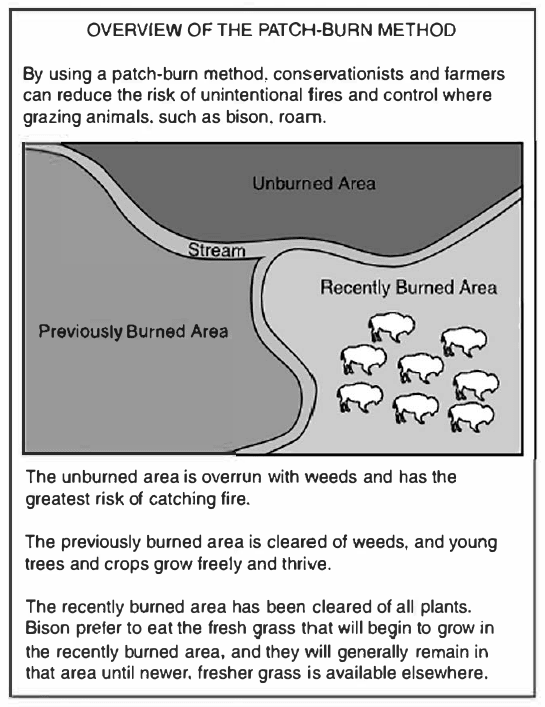
Question
According to the passage, how did fires started by natural causes prompt American Indians to begin practicing controlled burns?
- Aby drawing animals in to the area to feed on the new growth sprouting from the burned land
- Bby destroying tall trees and reducing the shade that had hindered the growth of planted crops
- Cby burning off excess vegetation and increasing the availability of nutrients for the remaining plants
- Dby causing changes to the bison’s migration habits as bison herds fled from the wildfires on the prairie
Show the answer
Correct answer: A
The question asks how observing the effects of the fires started by natural causes prompted American Indians to begin practicing controlled burns.
A. CORRECT. In paragraph 2, the author states that American Indians observed bison “grazing on tender new grass on the recently burned land rather than on grass in the unburned areas.” These observations prompted the practice of controlled burns as a means of enticing “the herds away from the people’s crops.”
B. Incorrect. Although the author mentions in paragraph 4 that the primary targets of a controlled burn are red cedar trees and that “these tall trees also cast shade that prevents sunlight from reaching the plants beneath them,” this detail supports why conservationists use controlled burns today, not what initially prompted the use of controlled burns.
C. Incorrect. While the author states in paragraph 3 that “the process of burning excess plant matter adds nitrogen, an essential element for plant growth, to the soil” and that “intentionally burning a portion of land can dramatically improve the quality of the vegetation that regrows there,” these details do not explain the initial observations that prompted American Indians to practice controlled burning.
D. Incorrect. While paragraph 2 mentions that bison moved to a new area to graze because they preferred the “tender new grass on the recently burned land,” there is no indication in the passage that bison changed their migration habits in order to flee wildfires.
Question analysis
This key-details question about an article on controlled burns at an Oklahoma tallgrass prairie preserve asks how fires started by lightning or other natural causes led American Indians to begin burning land on purpose. Students must find the passage's account of that early practice, and since the article describes several effects of fire, each choice has to be checked against what those first observers actually saw.
- Grade level
- Grade 7 reading and task
- Compared with grade 7
- At grade 7 Finding a stated cause in an informational text is regular grade 7 reading. The answer sits in one short paragraph, but the article describes several effects of fire, old and new, and the choices draw on them, which keeps the demand typical.
- Estimated difficulty
- Straightforward: two steps or one careful reading.
- Thinking it demands
- Depth of knowledge 2, skills and concepts · mainly understand
- What makes it hard
- Evidence
- Answered from one paragraph or stanza
- Reading level
- Passage: about grade 11, 598 words; question and choices: about grade 9, 86 words.
- Students, last 30 days
- Not enough answers yet to show (it takes 10).
Why it is hard, traps and wrong answers (shows the answer)
Why it is hard
The stem points to one short paragraph, but the article goes on to list many more benefits of fire, and two wrong choices borrow them: shade cleared from under red cedars and nutrients returned to the soil. Both are true of controlled burns today, not of what the Great Plains peoples first noticed. Students who return to paragraph 2 and restate the bison’s taste for freshly burned grass find the answer quickly.
Every choice must be checked minor Choosing the answer
Two wrong choices name real benefits of burning from later paragraphs, cedar shade removed in paragraph 4 and nutrients freed in paragraph 3, so each must be tested against what the early peoples saw. (Embretson & Wetzel, 1987)
Reading between the lines minor Working it out
Paragraph 2 never says the bison’s grazing caused the practice; students connect “realized that these fires could also be helpful” to the preference for burned land and the deliberate burns that follow. (Graesser, Singer & Trabasso, 1994; Kintsch, 1998)
Strategy: Go to the paragraph about the Great Plains peoples of hundreds of years ago, restate in your own words what they noticed after natural fires, and test each choice against that observation.
Traps
- Wrong part of the text: A choice is true of another paragraph, stanza or speaker than the one asked about.
- True but not the answer: A choice says something accurate about the text that does not answer this question.
- Twists what the text says: Uses the text's topic and ideas but changes what it says: who did it, how much, when, or why.
The wrong answers, classified
B Wrong part of the text (Kirsch & Mosenthal, 1990)
Borrows paragraph 4’s red cedars, whose shade blocks sunlight from the plants beneath them, and adds “planted crops,” though that shade explains modern burns, not the first deliberate ones.
C True but not the answer (King et al., 2004; Embretson & Wetzel, 1987)
States paragraph 3’s real benefits, weedy undergrowth burned away and nitrogen added to the soil, but the article gives them as reasons for burning today, not as what the early peoples observed.
D Twists what the text says (King et al., 2004)
Remembers that bison moved onto burned land but turns their preference for “tender new grass” into herds fleeing wildfire, a change in migration the passage never describes.
Working it out, step by step
Figure out what the question asks
This question asks about a cause. Long ago, fires started by lightning gave American Indians an idea. They began to burn land on purpose. You need to find what they saw that led them to do it. A controlled burn is a fire that people set and keep inside a planned area.
Find the right paragraph
Paragraph 2 tells this part of the story. It says the people “realized that these fires could also be helpful.” Then it says what they noticed: “The bison in the area seemed to prefer grazing on tender new grass on the recently burned land rather than on grass in the unburned areas.”
Put it in your own words
Grazing means eating grass. After a fire, soft new grass grew, and the bison liked it best. So the people began to burn land on purpose. The new grass pulled the herds to that land. That kept the bison away from the crops. The paragraph says the burning “enticed the herds away from the people’s crops.” Enticed means tempted or drew.
Check each choice
- A is right. The burned land drew animals, the bison, to eat the new grass.
- B is wrong. The shade of tall trees comes from paragraph 4. It explains why people burn red cedars today, not how burning began.
- C is wrong. Burning off weeds and adding nutrients come from paragraph 3. Nutrients are what plants need to grow. These are reasons for burning today.
- D is wrong. The bison moved toward the fresh grass. The passage never says herds fled from fires.
Watch out: C is true about controlled burns. But the question asks what first gave the people the idea. Paragraph 2 says it was the bison.
Choose the answer
The early people saw bison come to burned land to eat the new grass. So the answer is A: “by drawing animals in to the area to feed on the new growth sprouting from the burned land.”
Why this answer and not the closest wrong one
C is the closest wrong answer, because it names real good effects of fire. But paragraph 3 gives those as reasons people burn land “today.” The question asks how burning began hundreds of years ago. Paragraph 2 says it began when people watched bison feed on burned land.
More questions like this
The original DOE question
The passage “Using Fire to Keep a Prairie Healthy” as printed (page 41)
Question 55 of 120
2026 Practice Test B English, question 30Uses the passage above: “Using Fire to Keep a Prairie Healthy”.
Question
Targeting red cedar trees in controlled burns affects the animals that live on the prairie mostly by
- Aensuring that the animals’ main food source has the conditions needed for it to thrive.
- Bendangering the animals that live near the trees scheduled for removal.
- Cmaking sure that the water supply for the animals is sufficient.
- Dreducing the animals’ natural source of shade and protection from the elements.
Show the answer
Correct answer: A
The question asks how targeting red cedar trees in controlled burns affects the animals that live on the prairie.
A. CORRECT. According to information in paragraph 4, targeting invasive red cedar trees with controlled burns affects animals that live on the prairie by ensuring that these trees do not “crowd out prairie grasses, the primary food source for wild and domestic animals that make the prairie their home.” The paragraph also states that each red cedar tree consumes “up to 40 gallons of water per day, taking this vital resource away from other plant life.” Removing red cedars thus increases the amount of water available to the prairie grasses and helps maintain favorable conditions for the animals’ main source of food.
B. Incorrect. Although the author mentions the potential danger to wildlife from an uncontrolled burn in paragraph 5, the author emphasizes that patch burning “allows animals in the burn area to safely relocate.” Therefore, the animals that live near trees scheduled for removal are not endangered by the controlled burns.
C. Incorrect. In paragraph 4, the author states that “a single red cedar tree can consume up to 40 gallons of water per day, taking this vital resource away from other plant life.” However, the author does not suggest that reducing the number of red cedar trees through controlled burns ensures a sufficient water supply for animals that live on the prairie.
D. Incorrect. In paragraph 4, the author states that “these tall trees also cast shade that prevents sunlight from reaching the plants beneath them.” However, the author does not suggest that using controlled burns to eliminate red cedar trees reduces a natural source of shade for prairie animals. The red cedar trees are invasive; therefore, the author does not consider them a “natural” part of the prairie ecosystem.
Question analysis
This question asks how burning invasive red cedar trees on purpose mostly affects the wild and domestic animals that live on the Oklahoma prairie. Students follow a chain of cause and effect through the paragraph on red cedars, which describes the trees' heavy water use, their shade and their spread, and must pick out the effect that matters most to the animals.
- Grade level
- Grade 7 reading and task
- Compared with grade 7
- At grade 7 Grade 7 readers routinely trace how one change leads to another in an informational text. This chain stays within one paragraph, but the paragraph names several things the cedars take from the prairie, and the stem's “mostly” asks for the main effect.
- Estimated difficulty
- Moderate: several steps, or a close reading with one strong distractor.
- Thinking it demands
- Depth of knowledge 2, skills and concepts · mainly analyze
- What makes it hard
- Reading between the lines moderate
- Much to keep track of minor
- The right answer is reworded minor
- Evidence
- Answered from one paragraph or stanza
- Reading level
- Passage: about grade 11, 598 words; question and choices: about grade 9, 66 words.
- Students, last 30 days
- Not enough answers yet to show (it takes 10).
Why it is hard, traps and wrong answers (shows the answer)
Why it is hard
Paragraph 4 lists three harms the red cedar does, drinking water, casting shade and crowding out grasses, and the wrong choices hand the water and the shade straight to the animals. In the text, all three harms fall on plants, and animals feel them only through the grasses they eat. Students who ask who suffers each harm see that protecting the food supply is the main effect the stem’s “mostly” asks for.
Reading between the lines moderate Working it out
Paragraph 4 never names an effect on animals; students must chain the cedars crowding out “prairie grasses,” the grasses being “the primary food source,” and the burns that remove the cedars. (Graesser, Singer & Trabasso, 1994; Kintsch, 1998)
Much to keep track of minor Working it out
The paragraph names three harms at once, 40 gallons of water a day, shade over the plants below and crowding, and students must track which living things each harm reaches. (Sweller, 1988; Carpenter, Just & Shell, 1990)
The right answer is reworded minor Choosing the answer
The right choice speaks of “conditions needed for it to thrive” without naming grass or cedars, while the wrong ones repeat the paragraph’s vivid details of water and shade. (Freedle & Kostin, 1993; Kirsch & Mosenthal, 1990)
Strategy: Reread the paragraph about red cedars and list each way the trees harm the prairie, then ask which of those harms reaches the animals and which would matter to them most.
Traps
- Twists what the text says: Uses the text's topic and ideas but changes what it says: who did it, how much, when, or why.
- Outside knowledge: A choice is plausible in the real world but not supported by this text.
The wrong answers, classified
B Outside knowledge (King et al., 2004; Recht & Leslie, 1988)
Assumes that fire near animals must endanger them, a common belief, though paragraph 5 says patch burning “allows animals in the burn area to safely relocate.”
C Twists what the text says (King et al., 2004)
Seizes on the 40 gallons a red cedar drinks each day, but the passage says that water is taken from “other plant life,” not from the animals’ supply.
D Twists what the text says (King et al., 2004)
Turns the cedars’ shade, which blocks sunlight from “the plants beneath them,” into shelter for animals, though the passage treats the invasive trees as a harm, never a natural refuge.
Working it out, step by step
Figure out what the question asks
This question asks about cause and effect. People burn red cedar trees on purpose. You need to find how that mostly helps the animals. The word “mostly” means you want the biggest effect, not just any effect.
Find what the red cedars do
Paragraph 4 is about red cedars. It names three harms. First, one tree can drink “up to 40 gallons of water per day, taking this vital resource away from other plant life.” Second, the trees “cast shade that prevents sunlight from reaching the plants beneath them.” Third, they “tend to crowd out prairie grasses, the primary food source for wild and domestic animals.”
Ask who each harm hurts
Look at who loses each time. The water is taken from “other plant life.” The shade blocks light from “the plants beneath them.” The crowding pushes out prairie grasses. So every harm falls on plants. The animals feel it through the grass, because grass is their main food. Primary means main. So burning the cedars mostly helps the animals by protecting their food.
Check each choice
- A is right. The animals’ main food source is prairie grass. With the cedars gone, the grass gets water, sunlight and room to grow.
- B is wrong. Paragraph 5 says patch burning “allows animals in the burn area to safely relocate.” Relocate means move somewhere else.
- C is wrong. The cedars take water from plants. The passage never says the animals run short of water.
- D is wrong. The shade blocks light from plants. The passage never calls it shelter for animals.
Watch out: The 40 gallons of water is a striking fact, so C is tempting. But that water is taken from “other plant life.”
Choose the answer
Burning the cedars keeps the grass healthy, and the grass feeds the animals. Thrive means grow well. So the answer is A: “ensuring that the animals’ main food source has the conditions needed for it to thrive.”
Why this answer and not the closest wrong one
C is the closest wrong answer, because paragraph 4 does talk about water. But it says the cedars take water from plants, not from animals. The grass, the animals’ main food, is what suffers from all three harms. So A fits better.
More questions like this
The original DOE question
Question 56 of 120
2026 Practice Test B English, question 31Uses the passage above: “Using Fire to Keep a Prairie Healthy”.
Question
Read this sentence from paragraph 6.
The patch-burn system is so successful that the conservationists at the preserve provide training to prairie farmers about conducting controlled burns on their own land.
The author includes this sentence to show that
- Athe conservationists are better qualified to lead preservation efforts than farmers are.
- Bthe conservationists are eager to involve others in the preservation of the prairie.
- Cthe conservationists’ efforts will restore the original beauty and biodiversity of the region.
- Dthe conservationists’ training program should serve as a model for other conservation organizations.
Show the answer
Correct answer: B
The question asks what the author intends to show by using the second sentence in paragraph 6 in the passage.
A. Incorrect. Although the author refers to the conservationists as “experts” in paragraph 5 and states that conservationists “provide training to prairie farmers” (paragraph 6), the second sentence in paragraph 6 does not imply that the conservationists are better qualified to lead preservation efforts than farmers are. Instead, the sentence shows that conservationists believe that prairie farmers are capable of performing the controlled burns that contribute to overall conservation efforts.
B. CORRECT. The conservationists are eager to involve others in the preservation of the prairie, because “studies show that the patch-burn approach has restored biodiversity to the area by promoting the growth of species that were at risk of being crowded out” and that the process has “helped the prairie sustain life for hundreds of years” (paragraph 6). The second sentence in paragraph 6 describes how conservationists are sharing their knowledge about preservation techniques with people who live on the prairie.
C. Incorrect. Although the author points out in paragraph 6 that “studies show that the patch-burn approach has restored biodiversity to the area by promoting the growth of species that were at risk of being crowded out,” the idea that controlled burns may help restore the original biodiversity of the prairie is not the focus of the second sentence in paragraph 6, which notes only that conservationists are providing training to farmers about controlled burns.
D. Incorrect. The author mentions in paragraph 6 that the patch-burn system has been “successful” and suggests in the last sentence of the paragraph that the use of controlled burns will continue to benefit the prairie ecosystem. These details imply that this system will continue to be used and may even become more widespread. However, the second sentence in paragraph 6 merely describes a patch-burn training program that already exists and does not suggest that this program should serve as a model for other organizations.
Question analysis
This question quotes a sentence from the last paragraph of the prairie article, about the preserve's conservationists training farmers to run controlled burns on their own land, and asks why the author includes it. Students must work out what this one sentence contributes, and because every choice sounds like something a successful program might show, the test is whether the sentence itself supports it.
- NYS standards
- 7R5 structure and genre features
- Grade level
- Grade 7 reading and task
- Compared with grade 7
- At grade 7 Explaining why an author includes a sentence is everyday grade 7 work. The sentence is short and plainly worded, and the choices stay close to the passage's ideas, so each must be measured against what the sentence itself says.
- Estimated difficulty
- Moderate: several steps, or a close reading with one strong distractor.
- Thinking it demands
- Depth of knowledge 2, skills and concepts · mainly analyze
- What makes it hard
- How, not what moderate
- Reading between the lines moderate
- Evidence
- Answered from one sentence or line
- Reading level
- Passage: about grade 11, 598 words; question and choices: about grade 11, 89 words.
- Students, last 30 days
- Not enough answers yet to show (it takes 10).
Why it is hard, traps and wrong answers (shows the answer)
Why it is hard
Every choice reads something into one plain sentence, so the decision is how far the sentence lets a reader go. Teaching farmers to burn their own land shows a wish to spread the work, which the right choice calls eagerness to involve others. The wrong choices go further: to a ranking of experts over farmers, to restoring the region’s original beauty, or to a model for other organizations, none of which the sentence states.
How, not what moderate Working it out
The stem asks why the author includes the training sentence, so students must say what it adds after the studies of restored biodiversity, not merely restate that farmers are trained. (Anderson & Krathwohl, 2001)
Reading between the lines moderate Working it out
Nothing in the sentence calls the conservationists “eager”; that has to be read from their choosing to teach their method to farmers so that it spreads beyond the preserve. (Graesser, Singer & Trabasso, 1994; Kintsch, 1998)
Strategy: Restate the sentence in your own words, then ask what it adds to the paragraph's account of the patch-burn system's success, rejecting any choice that claims more than the sentence says.
Traps
- Reads too much in: A reasonable-sounding conclusion that goes further than the text allows.
- Wrong part of the text: A choice is true of another paragraph, stanza or speaker than the one asked about.
- Too broad or too strong: A choice overstates, generalizes, or uses absolute words the text does not support.
The wrong answers, classified
A Reads too much in (Graesser, Singer & Trabasso, 1994)
Reads experts training farmers as a ranking of who should lead, though the sentence shows trust that farmers can run burns themselves, not a claim of superior qualifications.
C Wrong part of the text (Kirsch & Mosenthal, 1990)
Draws on the sentence before, where studies show “the patch-burn approach has restored biodiversity,” and adds “original beauty,” though the training sentence itself is about sharing the method.
D Too broad or too strong (King et al., 2004)
Takes “so successful” as an endorsement and stretches one preserve’s training of local farmers into a model that other conservation organizations should follow, a recommendation the author never makes.
Working it out, step by step
Figure out what the question asks
This question asks why the author put one sentence in the passage. The sentence says the patch-burn system works so well that the preserve’s experts train farmers. You need to decide what that sentence shows, and no more.
Read the sentence closely
The sentence says “the conservationists at the preserve provide training to prairie farmers about conducting controlled burns on their own land.” Conservationists are people who work to protect nature. Conducting means carrying out. So the experts teach farmers to do the burns themselves.
Decide what it shows
Why would experts teach their method to others? Because they want more people to help. Their method works, so they share it. Then the burns can happen on farms too, not only at the preserve. That shows they want others to join in protecting the prairie. Preservation means keeping something safe and healthy.
Check each choice
- A is wrong. Teaching farmers shows trust that farmers can do it. It doesn’t say experts should lead instead of farmers.
- B is right. Training farmers brings more people into caring for the prairie.
- C is wrong. Restored biodiversity comes from the sentence before. Biodiversity means many kinds of living things. This sentence is about sharing the method.
- D is wrong. The author never says other groups should copy this program.
Watch out: The words “so successful” make D sound right. But the sentence only says the preserve trains local farmers. It doesn’t call the program a model for others.
Choose the answer
The experts share their method so farmers can help too. So the answer is B: “the conservationists are eager to involve others in the preservation of the prairie.”
Why this answer and not the closest wrong one
D is the closest wrong answer, because “so successful” sounds like high praise. But D adds an idea the sentence never states: that other groups should copy the program. B stays with what the sentence shows, experts teaching farmers so they can help.
More questions like this
The original DOE question
Question 57 of 120
2026 Practice Test B English, question 32Uses the passage above: “Using Fire to Keep a Prairie Healthy”.
Question
Which sentence supports the idea that farmers and people who manage land may be concerned about using fire as a way to benefit the land?
- A“While one of the greatest threats to the prairie is wildfire, the use of controlled fires is actually an effective way to protect this idyllic landscape.” (paragraph 1)
- B“The American Indian people began to deliberately burn areas of land for bison to graze on, which enticed the herds away from the people’s crops.” (paragraph 2)
- C“This patch burning contains the fire within a specific area and allows animals in the burn area to safely relocate.” (paragraph 5)
- D“The following year, conservationists will burn a different section of the preserve, while the land burned the previous year regrows healthier than before.” (paragraph 5)
Show the answer
Correct answer: A
The question asks which sentence supports the idea that farmers and people who manage land may be concerned about using fire as a way to benefit the land.
A. CORRECT. The sentence from paragraph 1 supports the idea that farmers and people who manage land may be concerned about using fire as a way to benefit the land because it acknowledges that “one of the greatest threats to the prairie is wildfire.”
B. Incorrect. Although the sentence from paragraph 2 relates how American Indians “began to deliberately burn areas of land for bison to graze on” and to protect people’s crops, the sentence does not support the idea that farmers and people who manage land may be concerned about using fire as a way to benefit the land. Instead, it focuses on the cause-and-effect relationship between bison and newly burned areas.
C. Incorrect. The sentence from paragraph 5 provides details about how “patch burning contains the fire” and “allows animals in the burn area to safely relocate,” but it does not adequately support the idea that farmers and people who manage land may be concerned about using fire as a way to benefit the land, because it does not mention that wildfires can be a threat to the prairie.
D. Incorrect. While the sentence from paragraph 5 does explain how “conservationists will burn a different section of the preserve” in order to rotate the process year after year so that the burned land has time to regrow, the sentence does not support the idea that farmers and people who manage land may be concerned about using fire as a way to benefit the land because it does not mention the potential for total burns.
Question analysis
This evidence question asks which sentence from the article on controlled prairie burns supports the idea that farmers and others who manage land may be concerned about using fire to benefit it. The passage never states that concern directly, so students must infer it, and all four quoted sentences, taken from across the article, talk about burning land in some way.
- Grade level
- Grade 8 reading and task
- Compared with grade 7
- Above grade 7 Grade 7 evidence questions usually ask for support of an idea the text states. This idea, that people who manage land may worry about using fire, is never stated outright, so students must infer which sentence implies it, more than typical.
- Estimated difficulty
- Hard: combines ideas, needs a plan, and has more than one tempting wrong answer.
- Thinking it demands
- Depth of knowledge 3, strategic thinking · mainly evaluate
- What makes it hard
- Reading between the lines major
- A very close wrong answer moderate
- Every choice must be checked minor
- Evidence
- Answered from one sentence or line
- Reading level
- Passage: about grade 11, 598 words; question and choices: about grade 13, 123 words.
- Students, last 30 days
- Not enough answers yet to show (it takes 10).
Why it is hard, traps and wrong answers (shows the answer)
Why it is hard
The idea to support is about people’s feelings, yet none of the four sentences mentions farmers worrying, so students have to decide what would justify such worry. The opening sentence does it by naming wildfire as a great threat before praising controlled fire, a concession many students read past as background. The strongest pull is the sentence on containing the fire, which implies caution but presents patch burning as the answer, not the concern.
Reading between the lines major Working it out
No sentence mentions worry; students must see that calling wildfire “one of the greatest threats to the prairie” gives landowners a reason to fear fire, and that “actually” answers that fear. (Graesser, Singer & Trabasso, 1994; Kintsch, 1998)
A very close wrong answer moderate Choosing the answer
The patch-burn sentence about containing the fire “within a specific area” also hints at fire’s danger; it differs from the right one by describing the safeguard without ever naming a threat. (Embretson & Wetzel, 1987; Gorin & Embretson, 2006; Ascalon et al., 2007)
Every choice must be checked minor Choosing the answer
The four sentences come from paragraphs 1, 2 and 5, and each is about burning land, so each must be tested for a hint of risk rather than for its topic. (Embretson & Wetzel, 1987)
Strategy: Before rereading the choices, decide what a sentence would need to say to show that landowners have reason to be wary of fire, then test each quoted sentence for exactly that.
Traps
- Supports only part of the claim: In a question about evidence: a line that backs one half of the claim but not the other, or a related point rather than the claim itself.
- True but not the answer: A choice says something accurate about the text that does not answer this question.
The wrong answers, classified
B True but not the answer (King et al., 2004; Embretson & Wetzel, 1987)
Links “the people’s crops” to farmers, but the sentence tells how early burns drew bison away from the crops and shows no worry about fire itself.
C Supports only part of the claim (King et al., 2004; Thissen, Steinberg & Fitzpatrick, 1989)
Sees caution in containing the fire “within a specific area,” but the sentence explains how patch burning keeps animals safe and never says fire threatens the land.
D Supports only part of the claim (King et al., 2004; Thissen, Steinberg & Fitzpatrick, 1989)
Takes the yearly rotation as a careful precaution, but the sentence describes the schedule and land that “regrows healthier than before,” which backs the benefit, not the worry.
Working it out, step by step
Figure out what the question asks
This is an evidence question. Evidence is the words in a text that back up an idea. The idea here is that farmers might worry about using fire to help land. No sentence says farmers are worried. So look for a sentence that gives them a reason to fear fire.
Decide what the evidence needs
A sentence that supports this idea must show that fire can be dangerous. If fire can harm land, people have a reason to be careful with it. So test each sentence with one question: does it say fire is a threat?
Look closely at paragraph 1
Choice A quotes paragraph 1. Its first half says “one of the greatest threats to the prairie is wildfire.” That is a reason to fear fire. Its second half says controlled fires are “actually” helpful. The word “actually” pushes back against that fear. It means: you might expect fire to hurt the land, but here it helps.
Check each choice
- A is right. It names wildfire as a great threat. That gives farmers a reason to worry about fire.
- B is wrong. It tells how early burns drew bison away from crops. It shows no danger from fire.
- C is wrong. It tells how patch burning keeps the fire in one area. It describes a safety step but never names a threat.
- D is wrong. It describes burning a new section each year. It shows a benefit: land that “regrows healthier than before.”
Watch out: C hints that fire must be contained, or kept in, so it sounds careful. But it describes the solution, not the danger.
Choose the answer
Only one sentence names fire as a danger. So the answer is A, the sentence from paragraph 1: “While one of the greatest threats to the prairie is wildfire, the use of controlled fires is actually an effective way to protect this idyllic landscape.” Idyllic means peaceful and lovely.
Why this answer and not the closest wrong one
C is the closest wrong answer, because keeping fire “within a specific area” suggests caution. But C only explains how patch burning works. It never says fire can harm the prairie. A does, by calling wildfire one of the greatest threats.
More questions like this
The original DOE question
Question 58 of 120
2026 Practice Test B English, question 33Uses the passage above: “Using Fire to Keep a Prairie Healthy”.
Question
Read this sentence from paragraph 6.
Burning land to make it healthy may seem counterintuitive, but strategic controlled fires have helped the prairie sustain life for hundreds of years and, with careful management, will continue to do so.
The words “counterintuitive” and “strategic” in the sentence convey the idea that
- Athe safest methods are sometimes the least effective at solving complex challenges.
- Bthorough investigation of uncommon methodologies can lead to beneficial results.
- Cdetailed planning can ensure that a potentially destructive action has a positive impact.
- Dplans that entail a certain amount of risk almost always result in success.
Show the answer
Correct answer: C
The question asks which idea the words “counterintuitive” and “strategic” convey in the last sentence in paragraph 6 in the passage.
A. Incorrect. Though the author states in paragraph 6 that conservationists have used safe and “strategic” methods, those methods have not been ineffective, since “the patch-burn system is so successful that the conservationists at the preserve provide training to prairie farmers about conducting controlled burns on their own land” (paragraph 6). Therefore, the words “counterintuitive” and “strategic” in the last sentence of paragraph 6 do not convey the idea that the safest methods are sometimes the least effective at solving complex challenges.
B. Incorrect. Although the author points out in paragraph 6 that researchers’ studies have shown “that the patch-burn approach has restored biodiversity to the area by promoting the growth of species that were at risk of being crowded out,” the author does not suggest that the methodologies conservationists used to conduct the patch burns are uncommon, since the methods were used by “the American Indian people [who] began to deliberately burn areas of land for bison to graze on” (paragraph 2). Therefore, the words “counterintuitive” and “strategic” in the last sentence of paragraph 6 do not convey the idea that thorough investigation of uncommon methodologies can lead to beneficial results.
C. CORRECT. In paragraph 1, the author states that “one of the greatest threats to the prairie is wildfire,” so the idea of conducting controlled burns suggests risk and runs “counter,” or contrary, to people’s common expectations, or “intuition,” about the dangers of fires. Thus, the words “counterintuitive” and “strategic” in the last sentence of paragraph 6 convey the idea that detailed planning can ensure that a potentially destructive action has a positive impact.
D. Incorrect. The author states in paragraph 6 that “the patch-burn system is so successful that the conservationists at the preserve provide training to prairie farmers.” This statement supports the idea of the action being “strategic” in order to achieve success. However, the statement does not suggest that because the process is “counterintuitive,” or unexpected, it involves a certain amount of risk to achieve that success. Therefore, the words “counterintuitive” and “strategic” in the last sentence of paragraph 6 do not convey the idea that plans that entail a certain amount of risk almost always result in success.
Question analysis
This vocabulary question takes the last sentence of the prairie article, which says burning land to make it healthy may seem counterintuitive, and asks what the words “counterintuitive” and “strategic” convey together. Students need the meaning of a hard word built from a prefix, then must match the pair to a general statement, and the choices are worded abstractly.
- Grade level
- Grade 8 reading and task
- Compared with grade 7
- Above grade 7 A typical grade 7 vocabulary question asks what one word means in context. This one pairs a hard word, “counterintuitive,” with “strategic” and asks for the idea they express together, with four abstract general statements to weigh.
- Estimated difficulty
- Hard: combines ideas, needs a plan, and has more than one tempting wrong answer.
- Thinking it demands
- Depth of knowledge 2, skills and concepts · mainly understand
- What makes it hard
- A very close wrong answer moderate
- Hard words moderate
- Combines ideas minor
- Evidence
- Answered from one sentence or line
- Reading level
- Passage: about grade 11, 598 words; question and choices: about grade 11, 97 words.
- Students, last 30 days
- Not enough answers yet to show (it takes 10).
Why it is hard, traps and wrong answers (shows the answer)
Why it is hard
Students first need the meaning of “counterintuitive,” then must see what it says here: that burning land to heal it seems backward because fire destroys. “Strategic” supplies the other half, careful planning. The most tempting wrong answer gets the planning right but misreads the first word as “uncommon,” and others turn the pair into a rule about risk or a warning about safe methods. The question rewards translating each word before reading the abstract choices.
A very close wrong answer moderate Choosing the answer
The choice about “thorough investigation of uncommon methodologies” follows the key’s pattern, planning that leads to a good result, and differs only in calling the method uncommon instead of potentially destructive. (Embretson & Wetzel, 1987; Gorin & Embretson, 2006; Ascalon et al., 2007)
Hard words moderate Understanding the question
“Counterintuitive,” contrary to what one would expect, is an uncommon word, and the choices add “methodologies” and “entail,” so the options are as hard to read as the sentence. (Perfetti, 2007; Freedle & Kostin, 1993)
Combines ideas minor Working it out
The two words point different ways, one to burning that seems harmful and one to careful planning, and the answer must join both into a single general statement. (Embretson, 1998; Daniel & Embretson, 2010)
Strategy: Break “counterintuitive” into its parts, counter and intuitive, decide what each of the two words says about burning land, then find the statement that joins both meanings without adding claims of its own.
Traps
- Half right: One half of a two-part choice is right and the other is not.
- Too broad or too strong: A choice overstates, generalizes, or uses absolute words the text does not support.
- Twists what the text says: Uses the text's topic and ideas but changes what it says: who did it, how much, when, or why.
The wrong answers, classified
A Twists what the text says (King et al., 2004)
Reads “counterintuitive” as a hint that the safe choice fails, but the sentence praises carefully managed fire and never says safer methods are less effective.
B Half right (King et al., 2004; Thissen, Steinberg & Fitzpatrick, 1989)
Matches “strategic” to thorough investigation, since the experts “study the land,” but takes “counterintuitive” to mean uncommon, though the passage traces burning back hundreds of years.
D Too broad or too strong (King et al., 2004)
Hears risk in “counterintuitive” and success in “strategic” but turns them into a rule that risky plans “almost always” succeed, far more than one sentence about the prairie claims.
Working it out, step by step
Figure out what the question asks
This question asks about two words in the last sentence: “counterintuitive” and “strategic.” You need the idea the two words give together. So first figure out what each word means here.
Break down “counterintuitive”
Counter means against. Intuitive means what you would naturally expect. So counterintuitive means the opposite of what you would expect. The sentence says “Burning land to make it healthy may seem counterintuitive.” Fire usually destroys things. So burning land to help it seems backward. Paragraph 1 even calls wildfire “one of the greatest threats to the prairie.”
Figure out “strategic”
Strategic means carefully planned to reach a goal. Paragraph 5 shows that planning. The experts “study the land to find out which areas would most benefit from being burned.” Then they burn only part of the land each year. Put the two words together. Fire seems harmful, but careful planning makes it helpful.
Check each choice
- A is wrong. The sentence doesn’t say safe methods fail. It praises a method that works.
- B is wrong. It treats counterintuitive as if it meant uncommon. But burning isn’t new. Paragraph 2 says people did it “hundreds of years ago.”
- C is right. Strategic matches detailed planning. Counterintuitive matches an action that could destroy, fire, which turns out to help.
- D is wrong. “Almost always” is far too strong. The sentence is about prairie fires, not all risky plans.
Watch out: B gets strategic right, since the experts study the land. But counterintuitive doesn’t mean uncommon. It means against what you would expect.
Choose the answer
Fire seems destructive, but a careful plan makes it helpful. So the answer is C: “detailed planning can ensure that a potentially destructive action has a positive impact.”
Why this answer and not the closest wrong one
B is the closest wrong answer, because its first part, careful study, fits strategic. But its second part calls the method uncommon, and people have burned the prairie for hundreds of years. C fits both words: careful planning, and an action that seems harmful but helps.
More questions like this
The original DOE question
Question 59 of 120
2026 Practice Test B English, question 34Uses the passage above: “Using Fire to Keep a Prairie Healthy”.
Question
With which statement would the author most likely agree?
- AIt is important to explain the purposes and the risks of controlled burns to the people living near a proposed burn area.
- BIt is necessary to thoroughly examine a particular region in order to plan and execute a successful controlled burn.
- CMonitoring animals’ reactions after a controlled burn on the prairie is a minor part of scientists’ research.
- DConservationists should consider the helpful aspects of invasive species before executing a controlled burn.
Show the answer
Correct answer: B
The question asks with which statement the author of the passage would most likely agree.
A. Incorrect. In paragraph 5, the author states that “patch burning contains the fire within a specific area and allows animals in the burn area to safely relocate,” and paragraph 6 states that conservationists “provide [important] training to prairie farmers about conducting controlled burns on their own land.” However, the author does not explicitly take a position about the importance of explaining the purposes and the risks of controlled burns to the people living near a proposed burn area. Therefore, the evidence in the passage does not strongly suggest that the author would agree with this statement.
B. CORRECT. In paragraph 5, the author points out that conservationists “study the land to find out which areas would most benefit from being burned, and then they arrange about a dozen burns over one-third of the land” and “rotate which portion of land is burned each year” so that animals, such as bison, can “safely relocate.” Therefore, the author would most likely agree that it is necessary to thoroughly examine a particular region in order to plan and execute a successful controlled burn.
C. Incorrect. The author of the passage would be unlikely to agree that monitoring animals’ reactions after a controlled burn on the prairie is a minor part of scientists’ research. In paragraph 5, the author explains that patch burning “allows animals in the burn area to safely relocate” and that conservationists “burn a different section of the preserve” each year to ensure that animals have an abundant area to graze while other areas are being burned.
D. Incorrect. According to the information in paragraph 4, conservationists commonly target invasive red cedar trees because they are tall trees that “crowd out prairie grasses, the primary food source for wild and domestic animals that make the prairie their home.” Since the focus is on the harm that the invasive red cedar can cause, the author would be unlikely to agree that conservationists should consider the helpful aspects of invasive species before executing a controlled burn.
Question analysis
This point-of-view question asks which statement the author of the prairie-burning article would most likely agree with. Students infer the author's position from details spread through the passage, and since some choices sound like sensible advice in general, each must be traced back to what the article actually supports.
- Grade level
- Grade 7 reading and task
- Compared with grade 7
- At grade 7 Inferring what an author would agree with is typical grade 7 work on point of view. The choices draw on different paragraphs, and the author's views are stated fairly plainly, so careful checking settles it without a long chain of inference.
- Estimated difficulty
- Straightforward: two steps or one careful reading.
- Thinking it demands
- Depth of knowledge 2, skills and concepts · mainly analyze
- What makes it hard
- Every choice must be checked moderate
- Reading between the lines minor
- Evidence
- Answered from several paragraphs or stanzas
- Reading level
- Passage: about grade 11, 598 words; question and choices: about grade 11, 81 words.
- Students, last 30 days
- Not enough answers yet to show (it takes 10).
Why it is hard, traps and wrong answers (shows the answer)
Why it is hard
The right statement is close to a paraphrase of paragraph 5, where the experts study the land before choosing where to burn, so careful readers settle this quickly. The risk is a statement that sounds wise in general: explaining a burn’s purposes and risks to its neighbors is good practice, but the article never raises it. The other two contradict the text, which values research on animals and treats red cedars only as a harm.
Every choice must be checked moderate Choosing the answer
The statements touch different parts of the article, research in paragraph 6, invasive species in paragraph 4 and safety in general, so each must be traced to what the author says, if anything. (Embretson & Wetzel, 1987)
Reading between the lines minor Working it out
The author never gives an opinion on planning burns; agreement must be inferred from the report that experts “study the land” before arranging about a dozen burns. (Graesser, Singer & Trabasso, 1994; Kintsch, 1998)
Strategy: For each statement, find the paragraph it relates to and ask whether the author says something close to it, says the opposite, or says nothing; choose only a statement the text backs.
Traps
- Outside knowledge: A choice is plausible in the real world but not supported by this text.
- Twists what the text says: Uses the text's topic and ideas but changes what it says: who did it, how much, when, or why.
The wrong answers, classified
A Outside knowledge (King et al., 2004; Recht & Leslie, 1988)
Agrees with a sensible safety practice, telling neighbors about a burn’s purposes and risks, but the article discusses training farmers, never informing people who live near a burn.
C Twists what the text says (King et al., 2004)
Notices that the article says more about land than about animals and calls watching them minor, though paragraph 6 reports researchers tracking the preserve’s animals and finding biodiversity restored.
D Outside knowledge (King et al., 2004; Recht & Leslie, 1988)
Imagines a balanced view in which invasive species have helpful sides, though paragraph 4 presents the red cedar only as a threat that drinks water, blocks sunlight and crowds out grasses.
Working it out, step by step
Figure out what the question asks
This question asks which statement the author would most likely agree with. The author doesn’t state an opinion on these ideas outright. So check each statement against what the passage says. Pick the one the passage backs up.
Find what the author stresses
Paragraph 5 says “The key to using controlled fires is knowing which areas of land to burn and when.” Next it says the experts “study the land to find out which areas would most benefit from being burned.” Only after that do they plan “about a dozen burns over one-third of the land.” A dozen means 12.
Put it in your own words
The author calls knowing where and when to burn “the key.” A key is the most important part. The experts study the land before they plan a single burn. So the author thinks careful study comes first. A burn works only when people know the land well.
Check each choice
- A is wrong. This sounds like good advice. But the passage never talks about warning neighbors before a burn.
- B is right. It matches paragraph 5. The experts study the land, then plan the burns.
- C is wrong. Paragraph 6 says researchers “tracked and studied” the animals. The author treats that research as important, not minor.
- D is wrong. Paragraph 4 shows the invasive red cedar only as harmful. Invasive means spreading where it doesn’t belong.
Watch out: A is tempting because it is wise in real life. But you must pick what this author would agree with, based on the passage.
Choose the answer
The author shows the experts studying the land before they plan. Execute here means carry out. So the answer is B: “It is necessary to thoroughly examine a particular region in order to plan and execute a successful controlled burn.”
Why this answer and not the closest wrong one
A is the closest wrong answer, because explaining a burn to the neighbors is sensible. But the passage never raises it. B matches what paragraph 5 actually says: the experts “study the land” before they plan the burns.
More questions like this
The original DOE question
Question 60 of 120
2026 Practice Test B English, question 35Uses the passage above: “Using Fire to Keep a Prairie Healthy”.
Question
How do the diagram and its text provide additional support for the topic presented in the passage?
- Aby depicting how the landscape in a given area changes as the patch-burn method is applied
- Bby indicating that patch-burn fires are best suited for use in areas with certain features
- Cby revealing that the patch-burn method is used primarily on uninhabited areas of land
- Dby comparing the size of the area burned by the patch-burn method with that of unburned areas
Show the answer
Correct answer: A
The question asks how the diagram and its text provide additional support for the topic presented in the passage.
A. CORRECT. The text of the diagram states that “by using a patch-burn method, conservationists and farmers can reduce the risk of unintentional fires and control where grazing animals, such as bison, roam.” By showing the pattern of controlled burns and the resulting bison migration in a given area, the diagram depicts how the landscape changes as the patch-burn method is applied.
B. Incorrect. Although the text mentions areas “where grazing animals, such as bison, roam,” the diagram does not depict distinctive features of the land such as trees or brush and therefore does not indicate that patch-burn fires are best suited for use in areas with certain features.
C. Incorrect. While the text mentions “grazing animals, such as bison” and the diagram shows the bison grazing in only one area, the diagram and its text do not indicate that the patch-burn method is used on uninhabited land.
D. Incorrect. While the areas of land depicted in the diagram do indicate that the sizes of the areas differ, the text provided does not compare the sizes of the areas burned by the patch-burn method with those of unburned areas or indicate that this factor is important in reducing the risk of uncontrolled fires or controlling “where grazing animals, such as bison, roam.”
Question analysis
This question asks how a diagram titled “Overview of the Patch-Burn Method,” printed with the article on controlled burns at an Oklahoma prairie preserve, supports the passage's topic. The diagram shows a stretch of land divided into three areas, each with a caption, so students must take in what the picture and its text show together and tie that to the article.
- Grade level
- Grade 7 reading and task
- Compared with grade 7
- At grade 7 Explaining how a graphic adds to a text is a grade 7 skill. This diagram is simple and clearly labeled, but students must take in its three areas and captions together and match them to an abstract description, a typical demand.
- Estimated difficulty
- Moderate: several steps, or a close reading with one strong distractor.
- Thinking it demands
- Depth of knowledge 2, skills and concepts · mainly analyze
- What makes it hard
- Reading a figure, table or graph moderate
- Reading between the lines moderate
- How, not what minor
- Evidence
- Answered from the whole text
- Reading level
- Passage: about grade 11, 598 words; question and choices: about grade 9, 79 words.
- Students, last 30 days
- Not enough answers yet to show (it takes 10).
Why it is hard, traps and wrong answers (shows the answer)
Why it is hard
The diagram shows three areas side by side, and the key insight is that they are one piece of land at three moments in the patch-burn cycle. Students who read it only as a map look for spatial claims instead, about land features, people or the sizes of the areas. The caption calling the unburned area “overrun with weeds” is the likeliest snare, since it sounds like advice on which land to burn.
Reading a figure, table or graph moderate Understanding the question
The diagram’s meaning is split among a map of three shaded areas, an introduction and three captions, which must be read together to see what the picture adds to the passage. (Lesh, Post & Behr, 1987; Kirsch & Mosenthal, 1990)
Reading between the lines moderate Working it out
Nothing in the diagram mentions the passing of time; students must infer that the unburned, recently burned and previously burned areas are stages the same land passes through as the burns rotate. (Graesser, Singer & Trabasso, 1994; Kintsch, 1998)
How, not what minor Working it out
The stem asks how the diagram supports the passage, a question of function, so describing what is drawn is not enough; it must be tied to the yearly rotation of paragraph 5. (Anderson & Krathwohl, 2001)
Strategy: Read the diagram's title, introduction and three captions before the choices, sum up in one sentence what the diagram shows, and check each choice against something you can actually point to in it.
Traps
- Reads too much in: A reasonable-sounding conclusion that goes further than the text allows.
- True but not the answer: A choice says something accurate about the text that does not answer this question.
The wrong answers, classified
B Reads too much in (Graesser, Singer & Trabasso, 1994)
Reads the caption calling the unburned area “overrun with weeds” as advice on which land suits a burn, though the captions describe each stage, not features that make land suitable.
C Reads too much in (Graesser, Singer & Trabasso, 1994)
Sees no houses or people on the map and decides patch burns are kept to empty land, though bison graze there and a caption mentions crops growing.
D True but not the answer (King et al., 2004; Embretson & Wetzel, 1987)
Notices that the three shaded areas differ in size, which is true of the drawing, but no caption compares them, and size is not what the diagram explains.
Working it out, step by step
Figure out what the question asks
This question asks how the diagram helps the passage. A diagram is a drawing that explains how something works. You need to say what it adds, not just what it shows. So read its title, its short introduction and its three captions. Captions are the short notes under a picture.
Read the diagram
The title, printed in capital letters, is “Overview of the Patch-Burn Method.” The drawing shows one stretch of land. A stream splits it into three areas, labeled “Unburned Area,” “Recently Burned Area” and “Previously Burned Area.” A herd of bison stands in the recently burned area.
Read the three captions
- The unburned area “is overrun with weeds and has the greatest risk of catching fire.”
- The recently burned area “has been cleared of all plants.” Bison come to eat the fresh grass that grows there.
- The previously burned area “is cleared of weeds, and young trees and crops grow freely and thrive.”
These are three stages the same land goes through: weedy, burned, then healthy. Paragraph 5 says the experts burn a different section each year, while “the land burned the previous year regrows healthier than before.”
Check each choice
- A is right. The diagram shows land changing from weedy, to burned, to healthy as the method is used.
- B is wrong. The captions describe each stage. They don’t say some kinds of land suit burning best.
- C is wrong. Bison live in the drawing, and a caption mentions crops. Uninhabited means with no one living there, and nothing says that.
- D is wrong. The areas are different sizes in the drawing. But no caption compares sizes.
Watch out: B is tempting because “overrun with weeds” sounds like a reason to burn. But that caption describes the first stage. It is not a rule for choosing land.
Choose the answer
Depicting means showing in a picture. So the answer is A: “by depicting how the landscape in a given area changes as the patch-burn method is applied.”
Why this answer and not the closest wrong one
B is the closest wrong answer, because the weedy unburned area does sound like land that needs a fire. But the diagram gives no rules for picking land. It shows one piece of land changing, stage by stage, as the burns rotate. That is what A says.
More questions like this
The original DOE question
Question 61 of 120
2026 Practice Test B English, question 36Passage Letter from Brooklyn
Letter from Brooklyn
by Jacob Scheier
I can already see how this will end.
How I will grow tired of the bridge’s
steep incline, and the absent-minded tourists
wandering into the bicycle path.
The weather will turn cold.
But that all happens later.
For now it is the early edge of fall,
leaves green still while the air narrows,
is slightly crisp, almost grazing
the hair of my arm like a passing stranger,
as though the air has been forced into intimacy
by the brevity of daylight.
But when it starts darkening at 4,
this closeness, I know, will be a felt distance,
like someone drawing your attention
to their lack of intimacy.
These days I am still walking at a cathedral pace
beneath the branches bending across avenues,
brownstones like rows of lived-in chapels,
like a pop-up picture book I could have had as a child,
but didn’t. How Brooklyn makes me nostalgic
for the moment I am walking inside of.
These late afternoons filled
with a loneliness that makes me feel
distinctly myself, and an awareness
of how rare that is.
“Letter from Brooklyn” from LETTER FROM BROOKLYN: POEMS by Jacob Scheier, published by ECW Press. Copyright © 2013 by Jacob Scheier All rights reserved.
brevity: briefness
cathedral: meditative
chapels: private places of prayer or worship
nostalgic: yearning for the past
Question
How does the structure of the poem affect the poem’s meaning?
- AThe lack of a rhyming pattern suggests that the beauty of each passing day is unique.
- BThe lengths of the sentences represent the complexity of the thoughts being represented.
- CThe use of complete sentences implies the speaker’s appreciation for the clear beginning and ending of each season.
- DThe single long stanza reflects the continuous flow of the speaker’s thoughts.
Show the answer
Correct answer: D
The question asks how the structure of the poem affects its meaning.
A. Incorrect. Though the poem lacks a rhyming pattern, such a structure is not related to the uniqueness of the passing days. The speaker is savoring “the early edge of fall” (line 7) and describes walks taken on “these days” (line 17), but the beauty the speaker appreciates is attributed to the fall season rather than to a unique day. Further, the poem is primarily concerned with broad seasonal shifts, not the passing of each day, and the absence of rhyme does not suggest that each day is unique in its beauty.
B. Incorrect. The poem includes both long sentences (such as the one in lines 7–12) and short sentences (such as those in lines 5 and 6). However, the sentence lengths are not connected with the complexity of the ideas expressed.
C. Incorrect. A complete sentence serves to present the beginning and the end of a single thought, but the poem is not primarily concerned with the speaker’s thoughts on the “clear beginning and ending of each season.” Though it contrasts the speaker’s feelings and experiences during different seasons, the poem does not present descriptions focused specifically on the beginnings or ends of these seasons.
D. CORRECT. Unlike poems that are broken into stanzas reflecting unified groups of thoughts, this poem is one long stanza. This structure serves to emphasize the uninterrupted flow of the speaker’s thoughts from time to time and experience to experience without a clear break between any specific thoughts.
Question analysis
This poetry question asks how the structure of Jacob Scheier's “Letter from Brooklyn,” a poem about walking through the city in early fall, affects its meaning. Students must look at how the poem is built, its sentences, line breaks, stanzas and lack of rhyme, and decide which feature really shapes what the poem says.
- NYS standards
- 7R5 structure and genre features
- Grade level
- Grade 7 reading and task
- Compared with grade 7
- At grade 7 Grade 7 standards ask how a poem's form shapes its meaning. Here each choice names a feature of form that students must first confirm in the poem and then link to its meaning, a typical grade 7 poetry task on a short poem.
- Estimated difficulty
- Moderate: several steps, or a close reading with one strong distractor.
- Thinking it demands
- Depth of knowledge 2, skills and concepts · mainly analyze
- What makes it hard
- How, not what moderate
- Every choice must be checked moderate
- Something you must already know minor
- Evidence
- Answered from the whole text
- Reading level
- Passage: 217 words (a poem; reading level not measured); question and choices: about grade 8, 70 words.
- Students, last 30 days
- Not enough answers yet to show (it takes 10).
Why it is hard, traps and wrong answers (shows the answer)
Why it is hard
Checking whether a feature exists rules out little here, since the poem is unrhymed, its sentences vary widely and it has one stanza. The decision rests on which feature matches what the speaker does: thoughts move from future to present to memory without a break. The strongest pull ties the lack of rhyme to the uniqueness of each day, which sounds like the poem’s theme of rare moments but is not something rhyme or its absence can show.
How, not what moderate Working it out
The question is about form, so students must ask what the single unbroken stanza does: it carries the speaker from the coming cold back to the present walk without a pause. (Anderson & Krathwohl, 2001)
Every choice must be checked moderate Choosing the answer
Three choices name features the poem really has, no rhyme, sentences from five words to six lines, and one stanza, so the meaning each feature is given is what separates them. (Embretson & Wetzel, 1987)
Something you must already know minor Working it out
Students must know what a stanza and a rhyming pattern are, and that a poem without stanza breaks has no white space marking separate groups of thought. (Anderson & Krathwohl, 2001)
Strategy: For each choice, first check that the poem really has the feature named, then ask whether that feature fits what the speaker is doing throughout the poem, not just in one line.
Traps
- Wrong purpose or structure: Names a purpose, structure or effect that the part does not serve, or describes what a part says when the question asks what it does.
- Reads too much in: A reasonable-sounding conclusion that goes further than the text allows.
The wrong answers, classified
A Reads too much in (Graesser, Singer & Trabasso, 1994)
Applies the habit of finding meaning in free verse, linking the missing rhyme to each day’s unique beauty, which echoes “how rare that is” but follows from nothing in the form.
B Wrong purpose or structure (Anderson & Krathwohl, 2001)
Rightly sees sentences ranging from five words to six lines, but gives their length a job, matching complex thoughts, that the poem never connects to it.
C Wrong purpose or structure (Anderson & Krathwohl, 2001)
Assumes complete sentences marking each season’s clear start and end, though the last four lines are a fragment and the poem follows fall’s gradual early turn.
Working it out, step by step
Figure out what the question asks
This question asks how the poem’s structure shapes its meaning. Structure means how the poem is built: its stanzas, its sentences and its rhyme. A stanza is a group of lines set apart by a blank line. It is like a paragraph in a poem.
Look at how the poem is built
The poem has 26 lines and no blank lines, so it is one long stanza. The lines don’t rhyme. The sentences have many lengths. Line 5, “The weather will turn cold,” is short. The sentence in lines 7–12 runs six lines.
Follow the speaker’s thoughts
The speaker is the voice talking in the poem. Line 1 jumps ahead: “I can already see how this will end.” Line 6 comes back: “But that all happens later.” Then the speaker describes the fall air, then the walk, then a lonely feeling. One thought slides into the next with no stop. One unbroken stanza matches that steady flow.
Check each choice
- A is wrong. The poem has no rhyme. But missing rhyme can’t show that each day’s beauty is unique, or one of a kind.
- B is wrong. The sentences do vary in length. But the poem doesn’t link long sentences to hard thoughts.
- C is wrong. The poem isn’t about each season’s clear start and end. It describes fall just starting to turn.
- D is right. The single stanza matches thoughts that flow on with no breaks.
Watch out: Three choices name real features of the poem. So don’t stop at Is this true? Ask whether that feature really creates the meaning the choice gives it.
Choose the answer
Continuous means going on without stopping. So the answer is D: “The single long stanza reflects the continuous flow of the speaker’s thoughts.”
Why this answer and not the closest wrong one
A is the closest wrong answer, because the poem does praise a rare moment. But rhyme, or no rhyme, can’t show that each day is unique. One long stanza can show thoughts flowing without a stop. That is how the speaker thinks, from line 1 to line 26.
More questions like this
The original DOE question
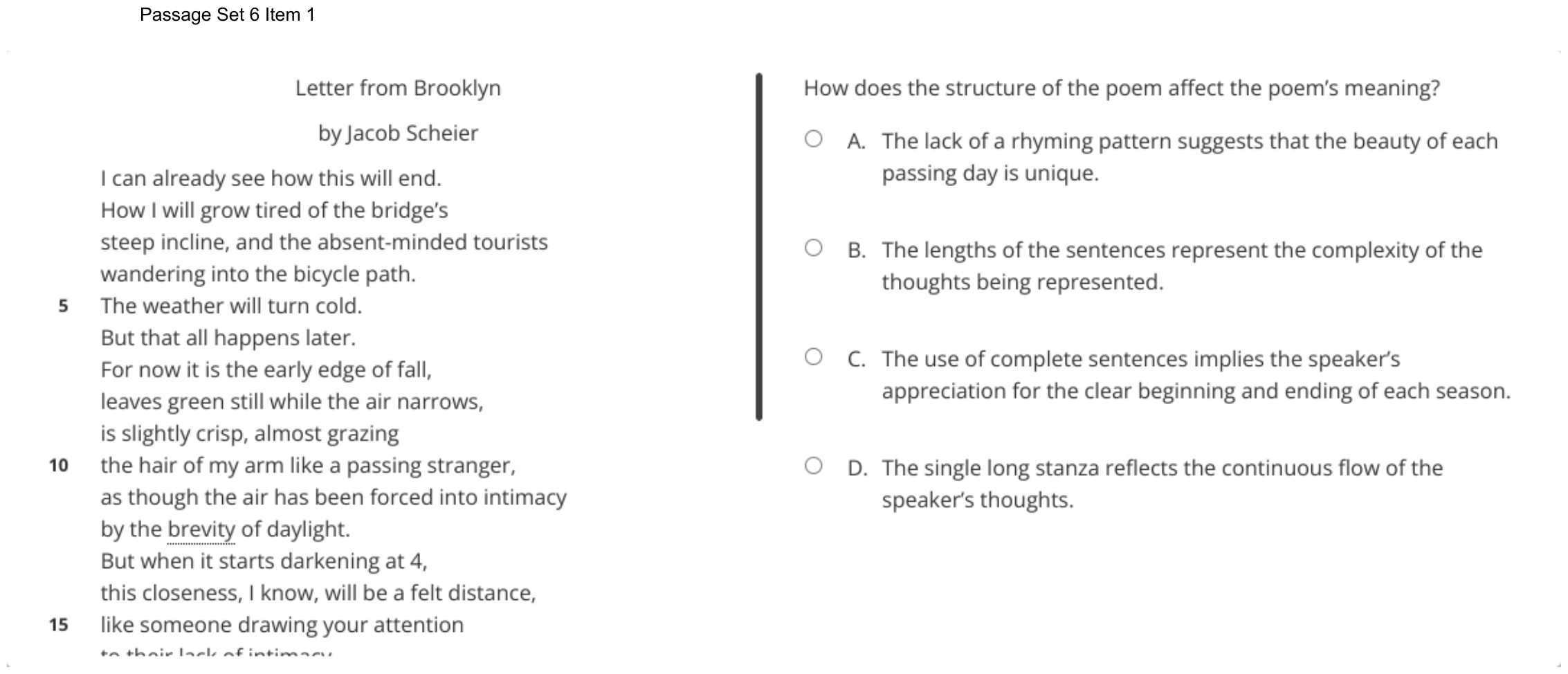
The passage “Letter from Brooklyn” as printed (page 50)
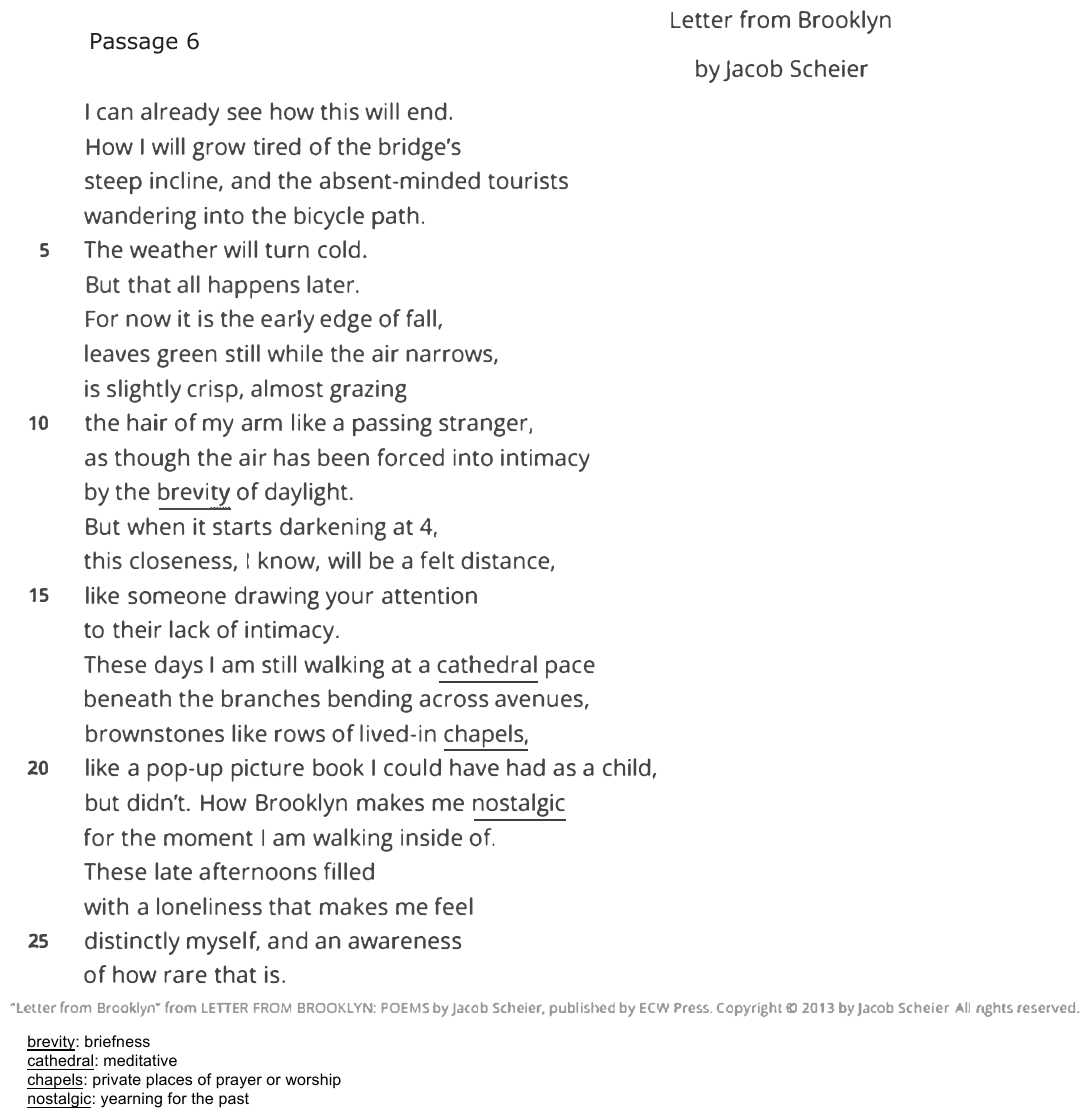
Question 62 of 120
2026 Practice Test B English, question 37Uses the passage above: “Letter from Brooklyn”.
Question
Which lines support the idea that a change in the weather will lessen the speaker’s appreciation for the city?
- A“as though the air has been forced into intimacy / by the brevity of daylight.” (lines 11–12)
- B“But when it starts darkening at 4, / this closeness, I know, will be a felt distance,” (lines 13–14)
- C“like someone drawing your attention / to their lack of intimacy.” (lines 15–16)
- D“These days I am still walking . . . / beneath the branches bending across avenues,” (lines 17–18)
Show the answer
Correct answer: B
The question asks which lines from the poem support the idea that a change in the weather will lessen the speaker’s appreciation for the city.
A. Incorrect. These lines focus on the positive way the air feels to the speaker during “the early edge of fall” (line 7). They suggest that the speaker appreciates this experience currently, while being aware that the feeling might not last.
B. CORRECT. In these lines, the speaker describes the shift in the “closeness” of the air as the weather changes and “it starts darkening at 4.” The speaker clearly indicates that the positive emotions surrounding this closeness, with “leaves green still” and the air “slightly crisp” (lines 8–9), will soon be “a felt distance,” suggesting that the turn in the weather will make the city less appealing.
C. Incorrect. Although these lines compare the darkening, changing weather to a person revealing a “lack of intimacy,” that specific comparison does not focus on a diminishing appreciation for the city.
D. Incorrect. These lines describe the “cathedral pace” (line 17) at which the speaker walks, emphasizing a meditative or thoughtful experience. Such a description suggests the speaker still appreciates the city, not that the speaker’s appreciation will lessen.
Question analysis
This evidence question asks which lines from “Letter from Brooklyn” support the idea that a change in the weather will lessen the speaker's appreciation for the city. All four choices come from the middle of the poem, where the speaker describes the feel of the early-fall air through figurative comparisons, so students must read each pair of lines closely for both parts of the idea.
- Grade level
- Grade 8 reading and task
- Compared with grade 7
- Above grade 7 Choosing lines that support an idea is standard grade 7 evidence work. Here the idea is carried by figurative comparisons about the air, and the four choices sit within a few lines of one another, so separating them takes closer reading than is typical.
- Estimated difficulty
- Hard: combines ideas, needs a plan, and has more than one tempting wrong answer.
- Thinking it demands
- Depth of knowledge 2, skills and concepts · mainly evaluate
- What makes it hard
- A very close wrong answer moderate
- Figurative or literary language moderate
- Reading between the lines minor
- Evidence
- Answered from one sentence or line
- Reading level
- Passage: 217 words (a poem; reading level not measured); question and choices: about grade 6, 74 words.
- Students, last 30 days
- Not enough answers yet to show (it takes 10).
Why it is hard, traps and wrong answers (shows the answer)
Why it is hard
All four choices come from lines 11–18, and three speak of closeness, distance or intimacy, so the vocabulary of the claim is everywhere. The idea has two parts, a change in the weather and a weaker feeling for the city, and only one pair of lines holds both. The strongest pull is the second half of the same sentence, which puts the loss of intimacy most vividly but leaves the darkening behind in the lines before.
A very close wrong answer moderate Choosing the answer
Lines 13–14 and 15–16 are one sentence split in two: the first half names the darkening at 4 and the coming distance, the second only describes what that distance feels like. (Embretson & Wetzel, 1987; Gorin & Embretson, 2006; Ascalon et al., 2007)
Figurative or literary language moderate Understanding the question
The weaker feeling for the city is never stated; it comes through images, the air’s “closeness” turning into “a felt distance,” like a person pointing out their “lack of intimacy.” (Graesser, Singer & Trabasso, 1994; Kintsch, 1998)
Reading between the lines minor Working it out
Students must accept “when it starts darkening at 4” as the change in the weather the stem names, since the lines speak of daylight, not of cold or rain. (Graesser, Singer & Trabasso, 1994; Kintsch, 1998)
Strategy: Split the idea into its two parts, a change in the weather and a weaker feeling for the city, and choose the lines that hold both on their own, without help from the lines around them.
Traps
- Supports only part of the claim: In a question about evidence: a line that backs one half of the claim but not the other, or a related point rather than the claim itself.
The wrong answers, classified
A Supports only part of the claim (King et al., 2004; Thissen, Steinberg & Fitzpatrick, 1989)
Takes “the brevity of daylight” as the coming change, but these lines say the short days force the air “into intimacy,” a closeness the speaker enjoys now.
C Supports only part of the claim (King et al., 2004; Thissen, Steinberg & Fitzpatrick, 1989)
Chooses the vivid “lack of intimacy,” which does show the feeling weakening, but these lines only finish the simile and never mention the darkening that causes it.
D Supports only part of the claim (King et al., 2004; Thissen, Steinberg & Fitzpatrick, 1989)
Hears a coming change in “still walking,” but the lines show the speaker enjoying a slow walk under the branches now and say nothing of the weather turning.
Working it out, step by step
Figure out what the question asks
This is an evidence question. The idea has two parts. First, the weather will change. Second, the speaker will enjoy the city less. You need the lines that hold both parts by themselves.
Read the lines around the choices
Lines 9–12 describe the early-fall air now. It is “almost grazing / the hair of my arm like a passing stranger.” Grazing here means lightly touching. The speaker says the air feels close, like “intimacy.” Intimacy means a warm, close feeling between people. Lines 13–16 then look ahead to shorter days.
Find both parts in lines 13–14
Lines 13–14 say: “But when it starts darkening at 4, / this closeness, I know, will be a felt distance”. Darkening at 4 means the sun setting at 4 o’clock, as days get shorter. That is the change in the weather. “This closeness” is the warm feeling the speaker has now. It will turn into distance. So the good feeling will fade.
Check each choice
- A is wrong. Lines 11–12 describe the closeness the speaker enjoys now. Nothing has faded yet.
- B is right. It names the change, the early dark, and the loss, closeness turning into “a felt distance.”
- C is wrong. Lines 15–16 finish the comparison: the distance feels like a person pointing out their “lack of intimacy.” But these lines never mention the weather.
- D is wrong. Lines 17–18 show the speaker enjoying a slow walk now. They say nothing about the weather turning.
Watch out: C is tempting because “lack of intimacy” sounds like a lost feeling. But the change in weather is back in lines 13–14.
Choose the answer
Only one pair of lines holds both the change and the fading feeling. So the answer is B, lines 13–14, which begin “But when it starts darkening at 4”.
Why this answer and not the closest wrong one
C is the closest wrong answer, because it shows the good feeling slipping away. But lines 15–16 only describe what that distance feels like. They don’t say what causes it. Lines 13–14 give both parts: the early dark and the fading closeness.
More questions like this
The original DOE question
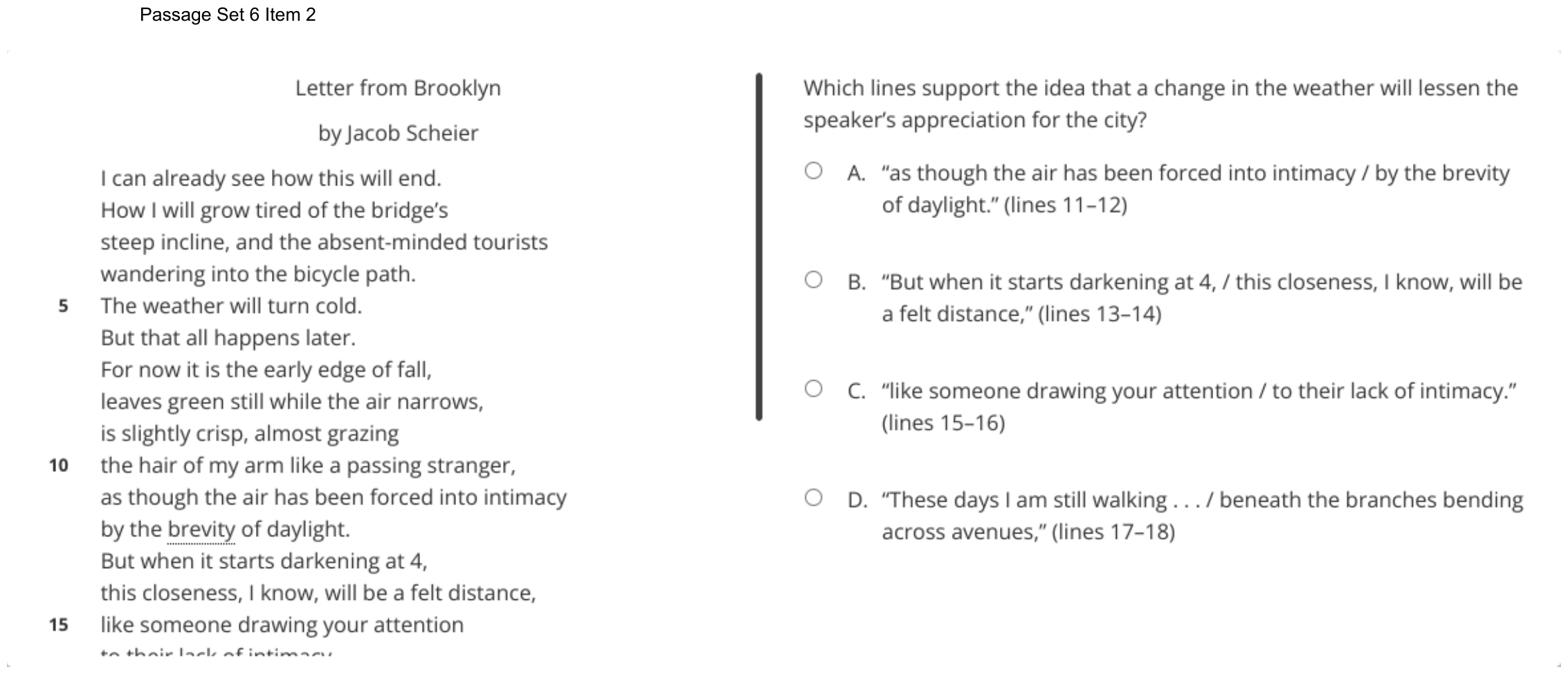
Question 63 of 120
2026 Practice Test B English, question 38Uses the passage above: “Letter from Brooklyn”.
Question
Read lines 5–6 from the poem.
The weather will turn cold.
But that all happens later.
How do the lines develop a central theme of the poem?
- AThey highlight a contrast between the different seasons.
- BThey show the sequence of the changes that are expected to occur.
- CThey warn about a problem that requires thoughtful preparation.
- DThey emphasize the importance of valuing the present.
Show the answer
Correct answer: D
The question asks how lines 5–6 develop a central theme of the poem.
A. Incorrect. In this poem, the speaker describes the impressions of one day in one season: “For now it is the early edge of fall, / leaves green still while the air narrows, / is slightly crisp” (lines 7–9). Despite the reference in line 5 to the eventual arrival of cold weather, lines 5–6 primarily emphasize the speaker’s wish to stay focused on the present moment. A contrast between seasons is not a central theme of the poem.
B. Incorrect. The words “The weather will turn cold” in line 5 refer to one change that is expected to occur, but lines 5–6 do not show a sequence of changes. The line that follows returns to the present: “For now . . .” (line 7).
C. Incorrect. Although the statement that the weather “will turn cold” in line 5 could be construed as a warning, there is no support in lines 5–6 for the idea that some problems require thoughtful preparation. The speaker is reflecting on a fleeting experience, not preparing to solve a problem.
D. CORRECT. Immediately after the line “The weather will turn cold” (line 5), the speaker returns to the current moment: “But that all happens later” (line 6). These lines help develop a central theme by emphasizing the speaker’s choice to value and focus on the present moment. The “But” at the start of line 6 shows the speaker pulling back from the future and refocusing on the present, thus emphasizing the importance of savoring “the moment I am walking inside of” (line 22).
Question analysis
This theme question quotes two short lines from early in “Letter from Brooklyn,” where the speaker says the weather will turn cold, and asks how they develop a central theme of the poem. Students must work out what the pair of lines does at that point and connect it to the whole poem, since each choice describes something two lines about the future could plausibly do.
- Grade level
- Grade 7 reading and task
- Compared with grade 7
- At grade 7 Explaining how particular lines develop a poem's theme is core grade 7 work. These two lines are short and plainly worded, so the demand lies in relating them to the theme of the whole poem, which is typical.
- Estimated difficulty
- Moderate: several steps, or a close reading with one strong distractor.
- Thinking it demands
- Depth of knowledge 2, skills and concepts · mainly analyze
- What makes it hard
- Reading between the lines moderate
- How, not what moderate
- Evidence
- Answered from one paragraph or stanza
- Reading level
- Passage: 217 words (a poem; reading level not measured); question and choices: about grade 5, 63 words.
- Students, last 30 days
- Not enough answers yet to show (it takes 10).
Why it is hard, traps and wrong answers (shows the answer)
Why it is hard
Two short, plain lines carry a theme only when read with their neighbors: the speaker forecasts cold, then dismisses it with “But that all happens later” and returns to “For now.” Students who read line 5 alone take the pair as a forecast and look for contrast, sequence or warning. The tempting contrast choice has some truth, since “But” does mark a turn, yet the turn is from future to present, not from one season to another.
Reading between the lines moderate Working it out
Line 6 never says the present matters; students infer it from “But” pulling back from the forecast and from “For now” in line 7 turning to the early fall around the speaker. (Graesser, Singer & Trabasso, 1994; Kintsch, 1998)
How, not what moderate Working it out
The stem asks how two lines develop a theme, so students must see their job, setting the future aside, rather than their content, a prediction of cold weather. (Anderson & Krathwohl, 2001)
Strategy: Read the lines just before and after lines 5–6, decide what the speaker does with the thought of cold weather, and connect that to what the poem as a whole keeps returning to.
Traps
- Wrong purpose or structure: Names a purpose, structure or effect that the part does not serve, or describes what a part says when the question asks what it does.
- Wrong part of the text: A choice is true of another paragraph, stanza or speaker than the one asked about.
- Reads too much in: A reasonable-sounding conclusion that goes further than the text allows.
The wrong answers, classified
A Wrong purpose or structure (Anderson & Krathwohl, 2001)
Sees cold weather set against early fall and hears contrast in “But,” yet the turn in line 6 is from later to now, and the poem never weighs one season against another.
B Wrong part of the text (Kirsch & Mosenthal, 1990)
Takes the opening forecast, tiring of the bridge and the tourists and then the cold, as a sequence, though lines 5–6 name one change and then set it aside.
C Reads too much in (Graesser, Singer & Trabasso, 1994)
Treats the coming cold as a problem to plan for, though the speaker makes no preparations and simply dismisses the future with “But that all happens later.”
Working it out, step by step
Figure out what the question asks
This question asks how lines 5–6 help build a theme. A theme is a big message about life that a poem keeps coming back to. So ask what these two lines do in the poem. Then link that to the whole poem.
Read the lines in place
Lines 1–5 look ahead. The speaker will grow tired of the bridge and the tourists, and “The weather will turn cold.” Then line 6 says, “But that all happens later.” Line 7 begins “For now it is the early edge of fall.” So the speaker thinks of the future, then pushes it aside.
Put it in your own words
“But” marks a turn. The speaker turns from later back to now. It is like saying, Sure, winter is coming, but it isn’t here yet. Then the poem spends many lines enjoying the fall walk. Line 22 speaks of “the moment I am walking inside of.” So lines 5–6 help show a big idea: enjoy the present while you have it.
Check each choice
- A is wrong. The turn is from later to now, not from one season to another. The poem doesn’t compare seasons.
- B is wrong. Lines 5–6 name one change, cold weather, and then set it aside. That is not a sequence, or series of steps.
- C is wrong. The speaker doesn’t get ready for the cold. The speaker simply says it “happens later.”
- D is right. The lines push the future aside so the speaker can enjoy the present.
Watch out: A is tempting because “But” signals a contrast. Ask what is being contrasted. It is later and now, not two seasons.
Choose the answer
Valuing means treating something as precious. So the answer is D: “They emphasize the importance of valuing the present.”
Why this answer and not the closest wrong one
A is the closest wrong answer, because line 6 does turn with “But.” Yet the turn moves from the future back to “For now.” The poem never weighs one season against another. It keeps coming back to the present moment, which is what D says.
More questions like this
The original DOE question
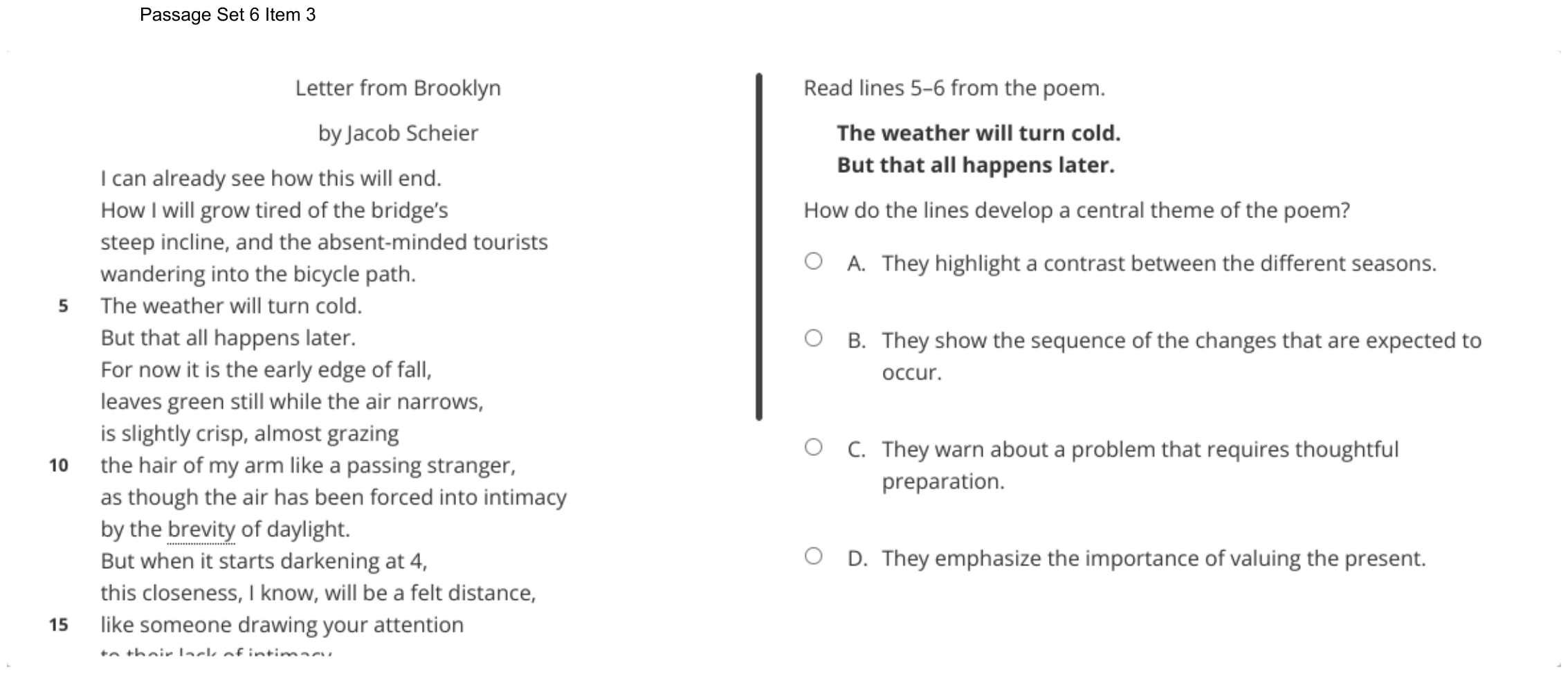
Question 64 of 120
2026 Practice Test B English, question 39Uses the passage above: “Letter from Brooklyn”.
Question
Read lines 7–9 from the poem.
For now it is the early edge of fall,
leaves green still while the air narrows,
is slightly crisp,
The word choice in the lines helps convey the speaker’s belief that
- Athe beauty of the current season should still be appreciated.
- Bthe changes in the weather signify the end of the most pleasant season.
- Cthe transition from one season to another happens swiftly and without warning.
- Dthe change in the weather is so subtle that people rarely observe or feel it.
Show the answer
Correct answer: A
The question asks what belief of the speaker is conveyed by the word choice in lines 7–9 of the poem.
A. CORRECT. Words and phrases in these lines, such as “leaves green still” and “slightly crisp,” have a positive connotation, indicating that the speaker believes in appreciating this season while it still lasts.
B. Incorrect. Although imagery such as “leaves green still” and “slightly crisp” in these lines suggests that the speaker enjoys the season, the speaker never indicates that the present season is the most pleasant of all seasons.
C. Incorrect. The phrases “the early edge of fall” and “the air narrows” in these lines imply that the season is just beginning to change, but there is no indication from these phrases that the changes will be swift and without warning. In fact, the narrowing of the air could be a warning of a greater, more gradual change in weather.
D. Incorrect. The speaker experiences the change in weather as subtle: “the air narrows, / is slightly crisp.” However, the speaker does not refer to the viewpoints of others. The entire viewpoint in the poem is personal and introspective, as represented by the use of the pronoun “I” throughout.
Question analysis
This word-choice question quotes three lines from “Letter from Brooklyn” describing the early edge of fall, when the leaves are still green and the air is slightly crisp. Students must work out what the connotations of these words reveal about the speaker's belief, and several choices mix an accurate reading of the lines with a claim they do not support.
- Grade level
- Grade 7 reading and task
- Compared with grade 7
- At grade 7 Explaining how word choice conveys a speaker's feelings is everyday grade 7 work. These three lines are short and concrete, but their meaning rests on the connotations of a few small words, which matches a typical grade 7 task.
- Estimated difficulty
- Moderate: several steps, or a close reading with one strong distractor.
- Thinking it demands
- Depth of knowledge 2, skills and concepts · mainly understand
- What makes it hard
- Figurative or literary language moderate
- Reading between the lines minor
- Evidence
- Answered from one sentence or line
- Reading level
- Passage: 217 words (a poem; reading level not measured); question and choices: about grade 5, 86 words.
- Students, last 30 days
- Not enough answers yet to show (it takes 10).
Why it is hard, traps and wrong answers (shows the answer)
Why it is hard
The three lines are short, and every choice builds on something real in them: a change in the weather, a season ending, subtlety. What separates the answer is the time words, “For now,” “early edge” and “still,” which say that something good is present and passing. Students lose the point by stretching a reasonable sense of loss into a claim about the best season, or by turning the speaker’s private notice into what other people miss.
Figurative or literary language moderate Understanding the question
The belief lies in connotation: “early edge of fall” and “leaves green still” mark a season only starting to turn, and “the air narrows” describes the change through an image. (Graesser, Singer & Trabasso, 1994; Kintsch, 1998)
Reading between the lines minor Working it out
“For now” at the start of line 7 signals that the moment will pass, and students must infer that the speaker values it for that reason, since no line states the belief. (Graesser, Singer & Trabasso, 1994; Kintsch, 1998)
Strategy: Mark the words in lines 7–9 that describe time and the feel of the air, decide whether each sounds positive, negative or neutral, then choose the belief that fits those connotations and nothing more.
Traps
- Half right: One half of a two-part choice is right and the other is not.
- Reads too much in: A reasonable-sounding conclusion that goes further than the text allows.
- Twists what the text says: Uses the text's topic and ideas but changes what it says: who did it, how much, when, or why.
The wrong answers, classified
B Reads too much in (Graesser, Singer & Trabasso, 1994)
Senses loss in a turning season, which the poem does suggest, but claims the speaker sees this as ending “the most pleasant season,” a ranking the lines never make.
C Twists what the text says (King et al., 2004)
Reads “the air narrows” as a sudden shift, though “early edge” and “slightly crisp” describe a season only beginning to turn, gradually and with clear signs.
D Half right (King et al., 2004; Thissen, Steinberg & Fitzpatrick, 1989)
Rightly hears the change as subtle in “slightly crisp,” but adds that people rarely notice it, though the lines record the speaker feeling it on the hair of an arm.
Working it out, step by step
Figure out what the question asks
This question is about word choice. The exact words a poet picks can show feelings. You need the belief that lines 7–9 show. So look at what each word suggests, not only what it means.
Mark the time words
The lines say “For now it is the early edge of fall, / leaves green still while the air narrows, / is slightly crisp.” Notice the time words. “For now” means this won’t last. “Early edge” means fall has just begun. “Still” means the leaves have not changed color yet.
Hear what the words suggest
“Slightly crisp” means a little cool and fresh. It sounds pleasant, not harsh. When the air “narrows,” it seems to tighten and grow cooler. So the speaker enjoys this moment. The time words show the speaker knows it will pass. Put together, they say: this lovely early fall is still here, so enjoy it now.
Check each choice
- A is right. “Still” and “For now” show the season is still here to enjoy.
- B is wrong. The speaker never calls this the most pleasant season. Nothing ranks the seasons.
- C is wrong. “Early edge” and “slightly” describe a slow, gentle change, not a sudden one.
- D is wrong. The change is subtle, or hard to notice. But the speaker feels it on “the hair of my arm.” The lines say nothing about other people.
Watch out: D starts out right, because the change is gentle. But it adds a claim about other people that the lines never make.
Choose the answer
The words show a pleasant season that is still here, for now. So the answer is A: “the beauty of the current season should still be appreciated.”
Why this answer and not the closest wrong one
B is the closest wrong answer, because the poem does hint that something good is ending. But the lines never call fall the best season. They say only that this pleasant time is here “for now.” That fits A: enjoy the season while it lasts.
More questions like this
The original DOE question
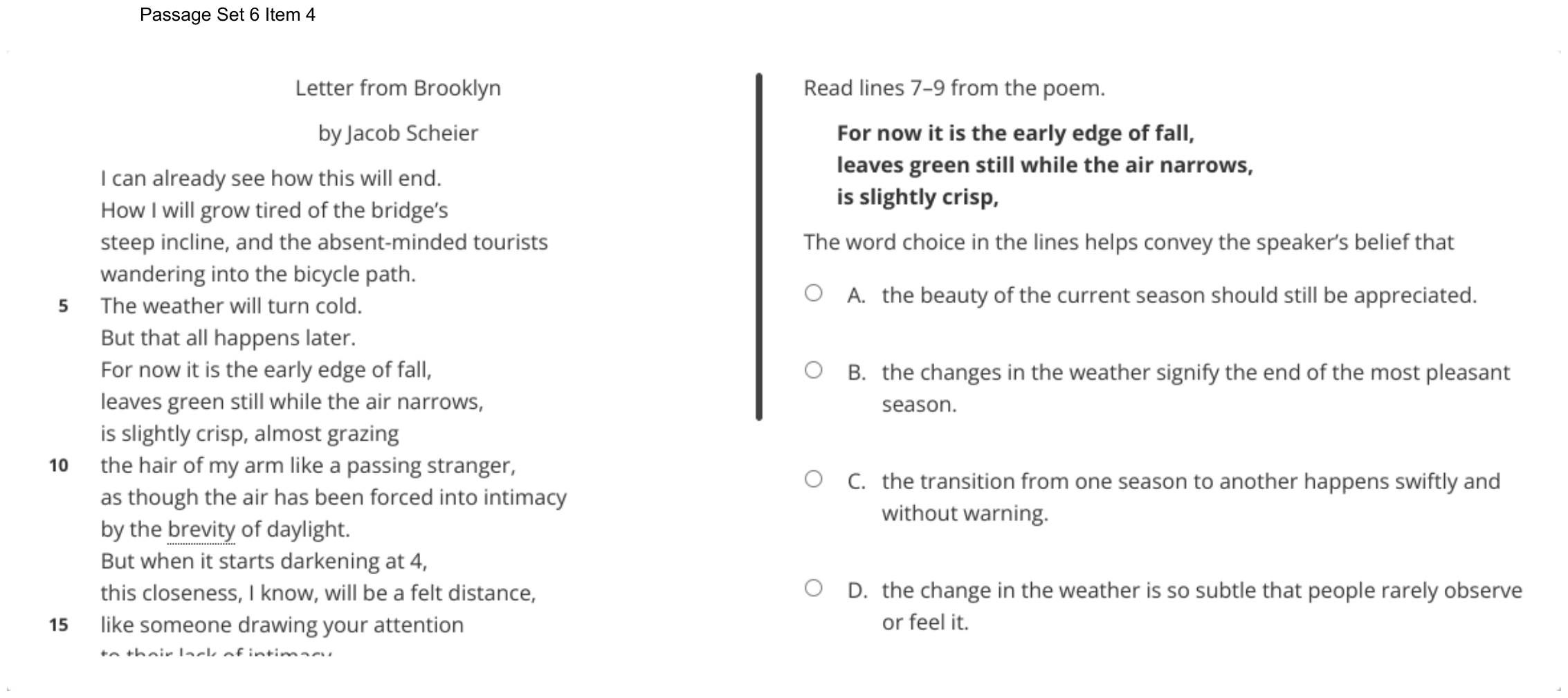
Question 65 of 120
2026 Practice Test B English, question 40Uses the passage above: “Letter from Brooklyn”.
Question
Which idea does the comparison of the brownstone houses to “a pop-up picture book I could have had as a child, / but didn’t” in lines 20–21 convey?
- AIt reveals that some people are still influenced by powerful images from childhood.
- BIt indicates that the neighborhood the speaker is walking through is charming and appealing.
- CIt suggests that the speaker has wanted to live in the neighborhood since childhood.
- DIt suggests that people often experience lingering regret from their past.
Show the answer
Correct answer: B
The question asks what the comparison of the brownstone houses to “a pop-up picture book I could have had as a child, / but didn’t” (lines 20–21) conveys.
A. Incorrect. While the lines explain that the neighborhood reminds the speaker of images from childhood pop-up books, those images are not described as very powerful or influential.
B. CORRECT. Pop-up picture books are likely to delight a child with their unique, often beautiful representations of buildings that pop up out of the page. The comparison in these lines helps explain how the speaker views these brownstones with a childlike wonder and appreciation.
C. Incorrect. Though in these lines the speaker compares this neighborhood to scenes in children’s pop-up picture books, there is no clear evidence that the speaker wants to live there, only that the speaker appreciates its appeal.
D. Incorrect. The lines state that the speaker did not have a “pop-up picture book” of the neighborhood’s brownstones as a child, but not in a way that emphasizes regret. Rather, the speaker compares the neighborhood to images from pop-up books in general to suggest that the neighborhood looks beautiful and delightful.
Question analysis
This figurative-language question asks what idea the poem conveys by comparing Brooklyn's brownstone houses to “a pop-up picture book I could have had as a child, / but didn't.” Students must interpret a simile in context, deciding how the closing words “but didn't” fit with the rest of the comparison and with the speaker's mood during the walk.
- Grade level
- Grade 7 reading and task
- Compared with grade 7
- At grade 7 Interpreting a simile in a poem is routine grade 7 work. This comparison uses a familiar childhood object, and the only complication is the added “but didn't,” which invites a reading that the rest of the lines must confirm or rule out.
- Estimated difficulty
- Straightforward: two steps or one careful reading.
- Thinking it demands
- Depth of knowledge 2, skills and concepts · mainly understand
- What makes it hard
- Figurative or literary language moderate
- Reading between the lines minor
- Evidence
- Answered from one sentence or line
- Reading level
- Passage: 217 words (a poem; reading level not measured); question and choices: about grade 8, 78 words.
- Students, last 30 days
- Not enough answers yet to show (it takes 10).
Why it is hard, traps and wrong answers (shows the answer)
Why it is hard
The core of the simile is easy: a row of brownstones looks like a pop-up picture book, something charming. The difficulty is the closing “but didn’t,” which tempts students toward regret or toward a story about the speaker’s childhood. Students who ask what the comparison says about the houses, rather than about the speaker’s past, see that the lines praise the neighborhood.
Figurative or literary language moderate Understanding the question
The simile likens brownstones to a pop-up picture book, and its point, that the street looks as delightful as a child’s book, has to be drawn from what such books are like. (Graesser, Singer & Trabasso, 1994; Kintsch, 1998)
Reading between the lines minor Working it out
The tag “but didn’t” invites a reading of regret, so students must decide from the walk at a “cathedral pace” around it that the comparison is about delight, not loss. (Graesser, Singer & Trabasso, 1994; Kintsch, 1998)
Strategy: Work out what the brownstones and a pop-up picture book have in common, decide what part “but didn't” plays in the comparison, and test each choice against what the lines actually say.
Traps
- Wrong tone or attitude: Misjudges the tone, attitude or point of view, such as reading admiration as criticism, or taking a character's or subject's feelings for the author's.
- Taking figurative language literally: A choice reads a figure of speech or image at face value.
- Too broad or too strong: A choice overstates, generalizes, or uses absolute words the text does not support.
The wrong answers, classified
A Too broad or too strong (King et al., 2004)
Generalizes from one speaker’s comparison to what “some people” feel and calls the images “powerful,” though the lines describe how the brownstones look, not lasting childhood influences.
C Taking figurative language literally (Graesser, Singer & Trabasso, 1994)
Reads “could have had as a child” as a fact about the speaker’s childhood wishes, though the simile only compares the houses to pages in a book.
D Wrong tone or attitude (Graesser, Singer & Trabasso, 1994)
Hears regret in “but didn’t” and widens it to people in general, though the speaker mentions the missing book only in passing while enjoying the walk.
Working it out, step by step
Figure out what the question asks
This question asks about a simile. A simile compares two things using like or as. Here the speaker compares brownstones to a pop-up picture book. Brownstones are old row houses built of reddish-brown stone. You need the idea this comparison gives.
Read the comparison
Lines 19–21 say “brownstones like rows of lived-in chapels, / like a pop-up picture book I could have had as a child, / but didn’t.” A pop-up book has pictures that stand up off the page when you open it. These books often show houses and streets. Children love them.
Put it in your own words
So the street looks charming and magical, like a page in a child’s favorite book. The words “but didn’t” just mean the speaker never owned such a book. Around these lines the speaker walks at a “cathedral pace.” The glossary says cathedral means “meditative,” or calm and thoughtful. The mood is peaceful and happy, not sad.
Check each choice
- A is wrong. The lines describe how the houses look. They don’t claim childhood pictures stay powerful for people.
- B is right. Comparing the houses to a pop-up book shows they look charming, or delightful.
- C is wrong. The speaker never says they wanted to live there as a child.
- D is wrong. “But didn’t” is said in passing. The speaker is enjoying the walk, not full of regret, or sorrow over the past.
Watch out: “But didn’t” can sound sad, so D is tempting. Ask what the comparison says about the houses, not about the speaker’s past.
Choose the answer
The comparison praises how the houses look. So the answer is B: “It indicates that the neighborhood the speaker is walking through is charming and appealing.”
Why this answer and not the closest wrong one
D is the closest wrong answer, because “but didn’t” hints at something missed. But the speaker is enjoying a slow walk under the branches. The simile’s job is to show how lovely the brownstones look. That points to B, not to regret.
More questions like this
The original DOE question
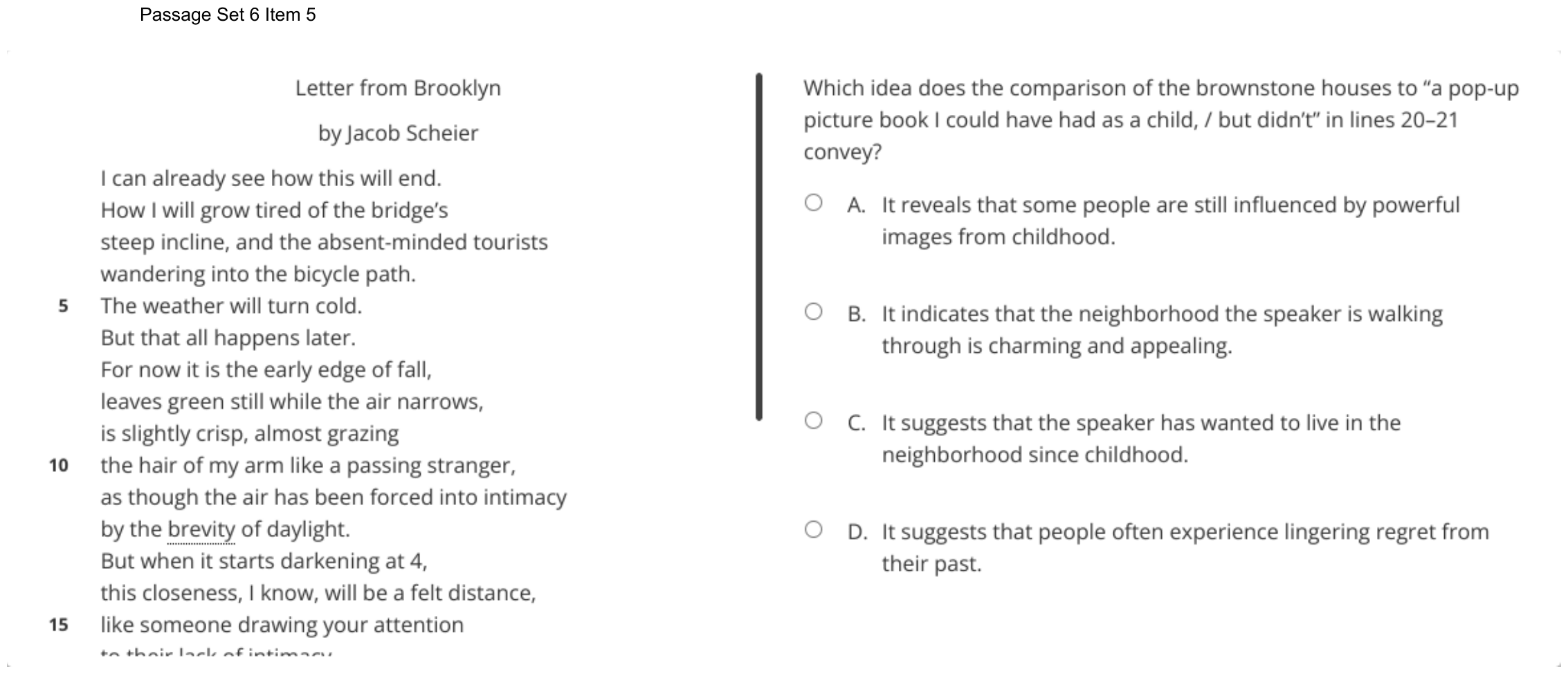
Question 66 of 120
2026 Practice Test B English, question 41Uses the passage above: “Letter from Brooklyn”.
Question
Read these lines from the poem.
I can already see how this will end. (line 1)
How Brooklyn makes me nostalgic
for the moment I am walking inside of. (lines 21–22)
The lines develop a central idea of the poem by
- Asuggesting the speaker’s desire to find a way to break free from the repetitive pattern of daily life.
- Brevealing the speaker’s feelings of disappointment over the predictable change in season.
- Cemphasizing the speaker’s awareness of the future significance of the present moment in the setting.
- Dshowing the speaker’s anticipation of specific emotions caused by an intimate knowledge of the setting.
Show the answer
Correct answer: C
The question asks how line 1 and lines 21–22 develop a central idea of the poem.
A. Incorrect. Although these lines suggest that life is governed by repetitive patterns, such as the change of seasons, they do not suggest that the speaker wishes to break free from these natural cycles of change, and a desire for freedom is not a central idea of the poem.
B. Incorrect. Although the speaker acknowledges that colder weather will inevitably bring disappointment, the speaker does not suggest in these lines that the predictability of changing weather is itself disappointing. Rather, the speaker recognizes the value of enjoying the present moment.
C. CORRECT. These lines connect the present warmer weather with the future colder weather and develop the central idea that the present “moment I am walking inside of” must be embraced because the speaker will be “nostalgic” for it in the future.
D. Incorrect. In these lines, the speaker is aware that specific emotions will occur in the future, during cold weather, but this awareness is only part of the more complex central idea of the poem, which is that current emotions and feelings must be recognized, experienced, and appreciated.
Question analysis
This central-idea question pairs the first line of “Letter from Brooklyn” with lines 21–22, where Brooklyn makes the speaker nostalgic “for the moment I am walking inside of,” and asks how they develop a central idea of the poem. Students must link excerpts from opposite ends of the poem, untangle a paradoxical image and choose among four abstract statements.
- Grade level
- Grade 8 reading and task
- Compared with grade 7
- Above grade 7 Grade 7 students analyze how lines develop a central idea. Here two excerpts twenty lines apart must be read together, one of them built on a paradox, and the four choices are long and abstract, well beyond typical grade 7 work.
- Estimated difficulty
- Among the hardest on the SHSAT: a non-obvious approach, heavy reading, or a well-hidden trap.
- Thinking it demands
- Depth of knowledge 3, strategic thinking · mainly analyze
- What makes it hard
- Figurative or literary language major
- A very close wrong answer moderate
- Evidence in several places moderate
- Evidence
- Answered from several paragraphs or stanzas
- Reading level
- Passage: 217 words (a poem; reading level not measured); question and choices: about grade 7, 99 words.
- Students, last 30 days
- Not enough answers yet to show (it takes 10).
Why it is hard, traps and wrong answers (shows the answer)
Why it is hard
This is among the hardest questions in the set because the two excerpts must be joined through a paradox and then matched to four long, abstract statements. Line 1 foresees an ending; lines 21–22 miss a moment while it is still happening, so both look at now from the future. Students who see only the foresight pick the choice about anticipated emotions, while those who hear gloom in “how this will end” settle on disappointment or a wish to escape.
Figurative or literary language major Understanding the question
Lines 21–22 are a paradox: “nostalgic,” glossed as yearning for the past, is aimed at “the moment I am walking inside of,” so the speaker already feels the present as a future memory. (Graesser, Singer & Trabasso, 1994; Kintsch, 1998)
A very close wrong answer moderate Choosing the answer
The choice about anticipating “specific emotions” shares the key’s link between future and present; it differs by tracing those feelings to knowing the setting well, which neither excerpt says. (Embretson & Wetzel, 1987; Gorin & Embretson, 2006; Ascalon et al., 2007)
Evidence in several places moderate Working it out
The excerpts are the poem’s first line and lines 21–22, twenty lines apart, and what joins them, the speaker looking ahead at the present, shows only when they are read side by side. (Kirsch & Mosenthal, 1990; Gorin & Embretson, 2006)
Strategy: Paraphrase each excerpt on its own, using the glossary's meaning of “nostalgic,” then decide what the first line and the last two share and match that to a choice.
Traps
- Half right: One half of a two-part choice is right and the other is not.
- Wrong tone or attitude: Misjudges the tone, attitude or point of view, such as reading admiration as criticism, or taking a character's or subject's feelings for the author's.
- Reads too much in: A reasonable-sounding conclusion that goes further than the text allows.
The wrong answers, classified
A Reads too much in (Graesser, Singer & Trabasso, 1994)
Links “how this will end” and growing tired of the bridge to a dull routine and imagines a wish to escape it, which the poem never expresses.
B Wrong tone or attitude (Graesser, Singer & Trabasso, 1994)
Hears resignation in “I can already see how this will end” and reads it as disappointment with the seasons, missing that the speaker treasures the present walk.
D Half right (King et al., 2004; Thissen, Steinberg & Fitzpatrick, 1989)
Rightly sees the speaker foreseeing feelings in line 1, but traces them to an “intimate knowledge of the setting,” while lines 21–22 long for the present moment itself.
Working it out, step by step
Figure out what the question asks
This question gives two pieces of the poem: line 1 and lines 21–22. You need the central idea they build together. A central idea is the main point the poem keeps working toward. Read each piece alone first, then join them.
Read line 1
Line 1 says “I can already see how this will end.” The speaker looks ahead. Lines 2–5 then list what will come: growing tired of the bridge, and the cold. So the speaker already pictures the future while living in the present.
Read lines 21–22
The lines say “How Brooklyn makes me nostalgic / for the moment I am walking inside of.” The glossary says nostalgic means “yearning for the past.” Yearning means longing. But the speaker longs for now, a moment still happening. That is a paradox, an idea that seems impossible but makes sense. The speaker knows this walk will be a precious memory.
Join the two pieces
Both pieces look at the present from the future. In line 1, the speaker sees the end coming. In lines 21–22, the speaker already misses the walk. So the speaker knows this present moment will matter later. Significance means importance.
Check each choice
- A is wrong. The speaker never wants to break free from daily routine.
- B is wrong. Line 1 can sound gloomy. But the speaker isn’t upset with the seasons. The speaker treasures the walk.
- C is right. The speaker sees that this moment in Brooklyn will be precious later.
- D is wrong. The speaker does foresee feelings. But neither piece says they come from knowing the place well.
Watch out: D gets the looking-ahead part of line 1 right. But lines 21–22 long for the moment itself, not for feelings caused by knowing the city.
Choose the answer
So the answer is C: “emphasizing the speaker’s awareness of the future significance of the present moment in the setting.”
Why this answer and not the closest wrong one
D is the closest wrong answer, because line 1 does show the speaker foreseeing feelings. But D says they come from an “intimate knowledge of the setting.” Neither piece says that. Lines 21–22 miss the moment while it is still happening. C captures that: the present will matter in the future.
More questions like this
The original DOE question
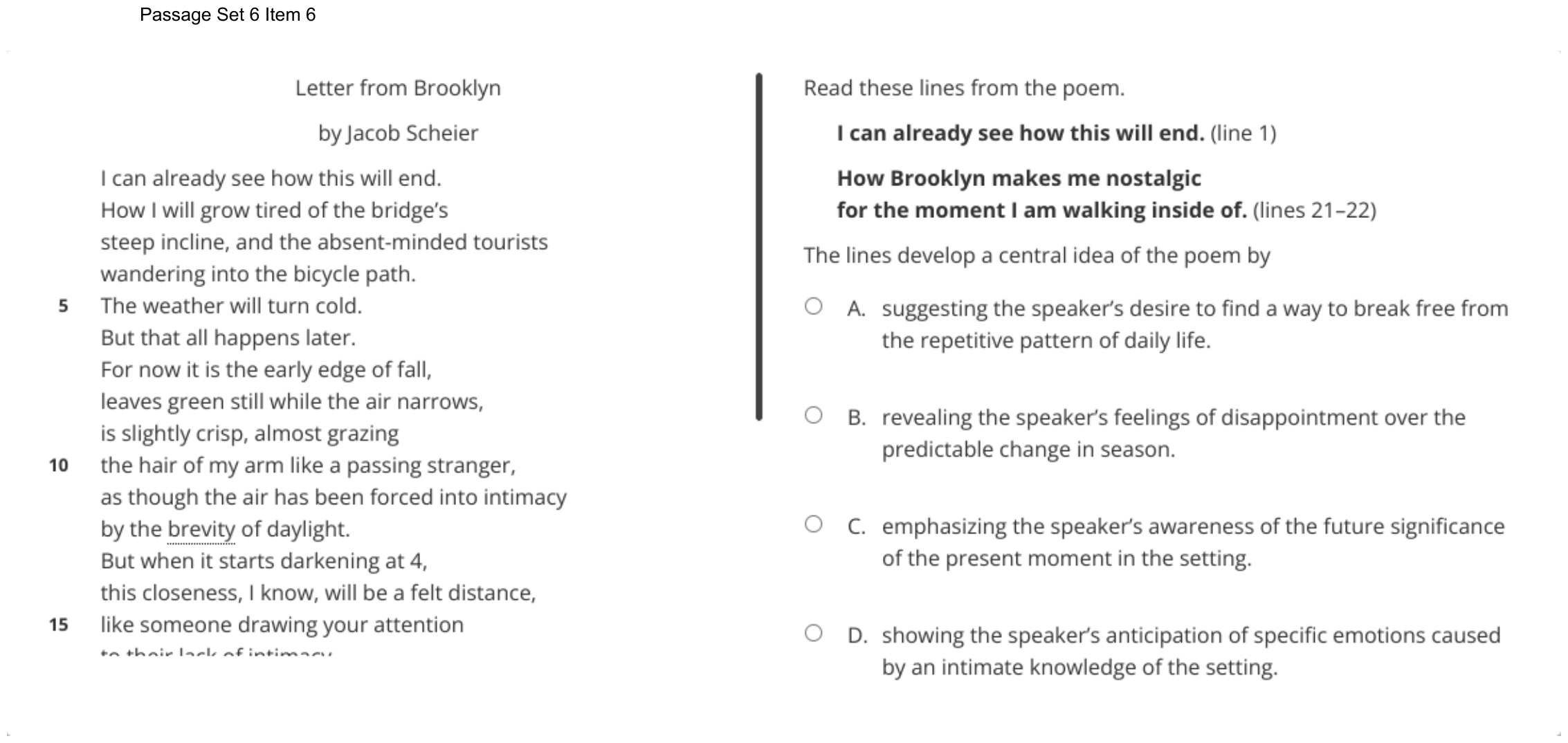
Question 67 of 120
2026 Practice Test B English, question 42Uses the passage above: “Letter from Brooklyn”.
Question
The speaker’s thoughts throughout the poem develop a theme by showing that
- Aalthough people may hold expectations for the future, some people long for present experiences while they are still happening.
- Bthough people come from different places, most people feel drawn to the special charm a city holds.
- Calthough people can make decisions about their life, there will always be some things beyond their control.
- Dthough general expectations exist, people have no way of knowing what a given day will actually bring.
Show the answer
Correct answer: A
The question asks how the speaker’s thoughts throughout the poem develop a theme.
A. CORRECT. The speaker’s thoughts develop some tension because seasonal change will inevitably come: “The weather will turn cold” (line 5). However, the speaker is still able to enjoy the present experience because “that all happens later” (line 6). In lines 21–22, the speaker begins to describe experiences that create a longing for the present, even while it is still happening (“How Brooklyn makes me nostalgic / for the moment I am walking inside of”), developing a theme of the poem.
B. Incorrect. The speaker’s thoughts reveal an appreciation for the city, but this appreciation is highly personal and individual. These thoughts do not indicate that most people will feel drawn to cities.
C. Incorrect. Some things, such as seasons, are beyond human control, as the speaker concedes: “I can already see how this will end” (line 1). However, the theme of the poem is not that certain things are inevitable, but that one can live in the present moment and enjoy that experience before change occurs.
D. Incorrect. The speaker’s thoughts are not showing that people are surprised by what the days bring; the thoughts of the speaker suggest that people experience many seasons in Brooklyn and have reasonable expectations about what these days will bring.
Question analysis
This theme question asks what theme the speaker's thoughts develop across all of “Letter from Brooklyn,” from the opening line about how things will end to the closing lines about loneliness on late afternoons. Each choice is a broad statement about people in two parts, so students must check both halves against the speaker's reflections.
- NYS standards
- 7R2 theme or central idea
- Grade level
- Grade 8 reading and task
- Compared with grade 7
- Above grade 7 Stating a theme is a grade 7 standard, often tested with one clearly fitting choice. Here every choice is a two-part general statement about people, and students must test both halves of each against a whole poem of abstract reflection, more than typical.
- Estimated difficulty
- Hard: combines ideas, needs a plan, and has more than one tempting wrong answer.
- Thinking it demands
- Depth of knowledge 3, strategic thinking · mainly analyze
- What makes it hard
- Reading between the lines moderate
- Every choice must be checked moderate
- Evidence in several places minor
- Evidence
- Answered from the whole text
- Reading level
- Passage: 217 words (a poem; reading level not measured); question and choices: about grade 9, 82 words.
- Students, last 30 days
- Not enough answers yet to show (it takes 10).
Why it is hard, traps and wrong answers (shows the answer)
Why it is hard
The four themes are broad statements about people, each in two halves, and every one can borrow something from the poem: the seasons are beyond control, the city has charm, the future brings surprises. The right one matches the speaker’s double vision, knowing what is coming and longing for the present while it lasts. The strongest pull is the theme about things beyond control, whose second half fits the turning seasons and whose first half the poem never raises.
Reading between the lines moderate Working it out
The poem never states its theme; it must be built from the speaker’s forecasts in lines 1–6 and the paradox of being “nostalgic / for the moment I am walking inside of.” (Graesser, Singer & Trabasso, 1994; Kintsch, 1998)
Every choice must be checked moderate Choosing the answer
Every choice is a two-part “although” or “though” statement about people, and three have one plausible half, so each half must be checked against the poem on its own. (Embretson & Wetzel, 1987)
Evidence in several places minor Working it out
The theme draws on the whole poem, from the opening “I can already see how this will end” to the lonely late afternoons of lines 23–26. (Kirsch & Mosenthal, 1990; Gorin & Embretson, 2006)
Strategy: Sum up in a sentence what the speaker keeps thinking about from the first line to the last, then test both halves of each choice against the poem and reject any half it does not support.
Traps
- Half right: One half of a two-part choice is right and the other is not.
- Too broad or too strong: A choice overstates, generalizes, or uses absolute words the text does not support.
- Twists what the text says: Uses the text's topic and ideas but changes what it says: who did it, how much, when, or why.
The wrong answers, classified
B Too broad or too strong (King et al., 2004)
Turns one speaker’s love of Brooklyn into a claim that “most people” feel drawn to a city’s charm, though no other person’s view appears in the poem.
C Half right (King et al., 2004; Thissen, Steinberg & Fitzpatrick, 1989)
Accepts the half about things beyond control, since the weather will turn cold regardless, but the poem says nothing about people making decisions about their lives.
D Twists what the text says (King et al., 2004)
Turns the coming season into an unknown, though the speaker opens with “I can already see how this will end” and knows exactly what the weather will bring.
Working it out, step by step
Figure out what the question asks
This question asks for the theme of the whole poem. A theme is a big message about life. Each choice has two halves, joined by although or though. Both halves must fit the poem. If one half doesn’t, the choice is wrong.
Trace the speaker’s thoughts
The poem opens by looking ahead: “I can already see how this will end.” The speaker expects to tire of the bridge, and “The weather will turn cold.” Then the speaker turns to now: “But that all happens later.” Most of the poem enjoys the fall walk. Lines 21–22 sum it up: “How Brooklyn makes me nostalgic / for the moment I am walking inside of.”
Put it in your own words
Nostalgic means longing for the past. Yet the speaker longs for the present, while it is still going on. So the speaker does two things at once. The speaker expects what the future will bring. And the speaker treasures, or deeply values, the present. That is the theme.
Check each choice
- A is right. First half: the speaker expects cold weather and boredom. Second half: the speaker longs for the walk while it is still going on.
- B is wrong. Only one person speaks in the poem. Nothing says most people feel drawn to cities.
- C is wrong. The weather is beyond anyone’s control, so its second half fits. But the poem never talks about people making decisions about their lives.
- D is wrong. The speaker knows what is coming. The future isn’t a mystery here.
Watch out: C is tempting because the speaker can’t stop the cold. But test both halves. Its first half, about making decisions, isn’t in the poem.
Choose the answer
So the answer is A: “although people may hold expectations for the future, some people long for present experiences while they are still happening.”
Why this answer and not the closest wrong one
C is the closest wrong answer, because the seasons are beyond the speaker’s control. But the poem never mentions people making decisions about their lives. A matches both halves: the speaker expects what is coming, and longs for the present while it lasts.
More questions like this
The original DOE question
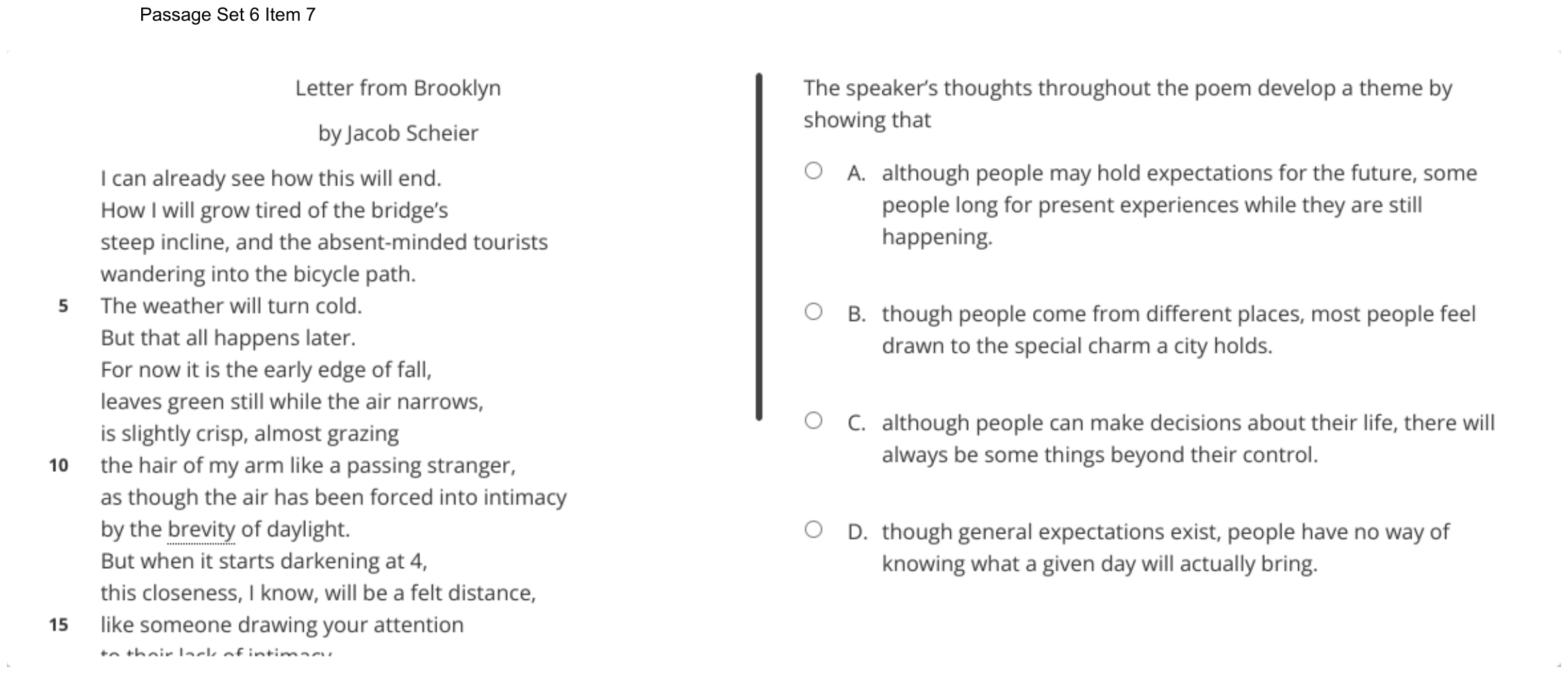
Question 68 of 120
2026 Practice Test B English, question 43Passage The End of an Era
The End of an Era
(1) In 2004, the National Aeronautics and Space Administration (NASA) landed a rover, or robotic vehicle, named Opportunity on the surface of Mars. (2) The rover’s mission was to search for evidence of water and life on the planet. (3) The rover was designed to gather data on Mars for about 90 days, but Opportunity’s assignment did not come to an end until nearly 15 years later in 2019.
(4) During the rover’s mission, a high-resolution camera on the rover’s robotic arm took magnified photographs of the surface of Mars. (5) The photographs revealed small round rocks scattered across the surface of the planet. (6) The scientists nicknamed these rocks “blueberries” based on the rocks’ resemblance to the fruit. (7) These rocks were important because their spherical shape suggested that liquid water may have flowed over them for a substantial amount of time.
(8) Opportunity continued to provide valuable data about craters and other surface features. (9) Throughout the mission, the rover traveled a total of 28.06 miles across Mars’ surface. (10) When Opportunity had traveled nearly the length of a marathon, scientists celebrated the accomplishment by naming the valley that the rover was in Marathon Valley. (11) However, in 2018, a dust storm spread all over the planet, putting the rover’s progress on hold.
(12) Prior to this planet-wide dust storm, minor dust storms had periodically deposited a layer of dust onto the solar panels of the rover. (13) These prevented it from charging its batteries. (14) Scientists then had to rely on the passing winds and dust devils to clean off the solar panels. (15) After the massive 2018 dust storm subsided, scientists expected to be able to reestablish communication with Opportunity. (16) They made repeated attempts but to no avail. (17) In 2019, NASA finally declared Opportunity’s mission complete.
(18) Opportunity was an important asset in scientists’ study of Mars; it returned valuable data about our neighbor planet and survived powerful dust storms. (19) NASA described the mission of Opportunity as “one of the most successful and enduring feats of interplanetary exploration.” (20) Even though this rover’s journey ended, other rovers still roam the surface of Mars.
Question
Which sentence should follow sentence 3 to best introduce the topic of the passage?
- ADespite the challenges of operating on the surface of another planet, the Opportunity rover made many valuable contributions to the field of space research.
- BThe Opportunity rover mission was a success because it informed NASA scientists about how water might have existed on Mars.
- CThroughout the historic mission of the Opportunity rover, NASA scientists had to overcome challenges created by the flaws in the rover’s design.
- DThe Opportunity rover mission surpassed the original timeline of the assignment and allowed scientists to collect additional data about the planet Mars.
Show the answer
Correct answer: A
The question asks for the sentence that should follow sentence 3 to best introduce the topic of the passage.
A. CORRECT. This sentence best introduces the passage’s topic: the Opportunity rover had many accomplishments on its mission, despite numerous challenges. Some of those accomplishments include providing high-resolution photographs (paragraph 2), traveling long distances (paragraph 3), and providing data about craters and other surface features (paragraph 3).
B. Incorrect. Although paragraph 2 discusses how photographs taken by the rover showed rocks that may have been shaped by water, this idea alone is not the topic of the entire passage.
C. Incorrect. While this sentence incorporates ideas about difficulties the scientists encountered because of the Opportunity rover’s design (paragraph 4), the main topic of the passage is not the design flaws and obstacles scientists encountered throughout the mission. The passage primarily focuses on the achievements of the mission.
D. Incorrect. While it is true that the Opportunity rover mission lasted much longer than planned (sentence 3), this fact is a supporting detail of the passage, not the main topic of the passage; surpassing the original timeline is only one of the rover’s many achievements mentioned in the passage.
Question analysis
This revising question works with “The End of an Era,” a passage about NASA's Opportunity rover on Mars, and asks which sentence should follow sentence 3 to best introduce the topic. Students must keep the whole passage in view, from the rover's photographs and travels to the dust storms that ended its mission, and judge which choice previews it best.
- NYS standards
- 7W2a introducing and organizing a topic
- Grade level
- Grade 7 reading and task
- Compared with grade 7
- At grade 7 Choosing a sentence that introduces a passage's topic is a standard grade 7 writing task. The passage is twenty plain sentences about one rover mission, and every choice draws on that mission, so it calls for a typical careful comparison.
- Estimated difficulty
- Moderate: several steps, or a close reading with one strong distractor.
- Thinking it demands
- Depth of knowledge 2, skills and concepts · mainly evaluate
- What makes it hard
- Evidence in several places moderate
- How sentences fit together minor
- Evidence
- Answered from the whole text
- Reading level
- Passage: about grade 11, 337 words; question and choices: about grade 14, 101 words.
- Students, last 30 days
- Not enough answers yet to show (it takes 10).
Why it is hard, traps and wrong answers (shows the answer)
Why it is hard
Sentence 3 already tells a striking story, a 90-day mission that lasted nearly fifteen years, and the most tempting continuation simply repeats it in new words. The other near misses each pick one part of the passage, the water evidence or the dust problems, and make it the whole. The question rewards skimming every paragraph first and choosing the sentence that covers both the achievements and the hardships, the pairing the final paragraph makes.
Evidence in several places moderate Working it out
The topic only emerges from the later paragraphs: the “blueberries” of sentences 4–7, the 28.06 miles of paragraph 3, the dust storms of paragraph 4 and NASA’s praise in sentence 19. (Kirsch & Mosenthal, 1990; Gorin & Embretson, 2006)
How sentences fit together minor Working it out
The new sentence follows sentence 3’s surprise that a 90-day mission lasted nearly 15 years, so it must turn from that fact to what the mission achieved. (Halliday & Hasan, 1976)
Strategy: Skim the opening sentence of each later paragraph to see what the passage covers, then ask which choice would prepare a reader for all of it.
Traps
- Too narrow: A single detail offered as the central idea or a summary, or a summary that keeps minor details and leaves out an essential part.
- Says it twice: Repeats an idea that the sentence or passage already states.
- Off the point: Adds or keeps something that does not support the paragraph's or the passage's focus, or an introduction or conclusion that misses the main point.
The wrong answers, classified
B Too narrow (King et al., 2004)
Picks the water finding of paragraph 2, a real result, but it covers one paragraph and leaves out the rover’s travels, its endurance and the dust storms.
C Off the point (Halliday & Hasan, 1976)
Builds on the dust that blocked the solar panels in paragraph 4, but the passage never blames flaws in the rover’s design and dwells on its achievements.
D Says it twice (Connors & Lunsford, 1988)
Follows sentence 3 smoothly, but saying the mission “surpassed the original timeline” only restates the 90 days that became 15 years instead of introducing what comes next.
Working it out, step by step
Figure out what the question asks
This revising question asks for a sentence to add after sentence 3. It should introduce the topic of the whole passage. A good introduction gives a preview, a quick look at everything coming. It doesn’t repeat one fact or zoom in on one part. For example, a report on a soccer season might begin: The team lost two stars but still won the title. That previews both the struggles and the wins.
Skim each paragraph
- Paragraph 2 (sentences 4–7): The rover’s camera found small round rocks that hinted at water.
- Paragraph 3 (sentences 8–11): It sent data and traveled 28.06 miles. Then a huge dust storm stopped it.
- Paragraph 4 (sentences 12–17): Dust had covered its solar panels before. After the 2018 storm, NASA could not reach it.
- Paragraph 5 (sentences 18–20): It “returned valuable data about our neighbor planet and survived powerful dust storms.”
Name the topic
So the passage covers two things. One is what the rover achieved: photos, data and miles. The other is its challenges, mainly the dust storms. Challenges are hard problems. Sentence 18 puts both together. The new sentence should preview both.
Check each choice
- A is right. It names the challenges and the “many valuable contributions.” That covers the whole passage.
- B is wrong. Water is only paragraph 2. It leaves out the travel and the dust storms.
- C is wrong. The passage never blames flaws in the rover’s design. It mostly praises the rover.
- D is wrong. Sentence 3 already says the mission lasted far past 90 days. D repeats it instead of looking ahead.
Watch out: D follows sentence 3 smoothly, so it sounds right. But it only restates sentence 3 in new words.
Choose the answer
So the answer is A: “Despite the challenges of operating on the surface of another planet, the Opportunity rover made many valuable contributions to the field of space research.”
Why this answer and not the closest wrong one
D is the closest wrong answer, because it flows right after sentence 3. But it only repeats that the mission lasted longer than planned. A previews both halves of the passage: the rover’s achievements and the challenges it survived. Sentence 18 sums up the same two ideas.
More questions like this
The original DOE question
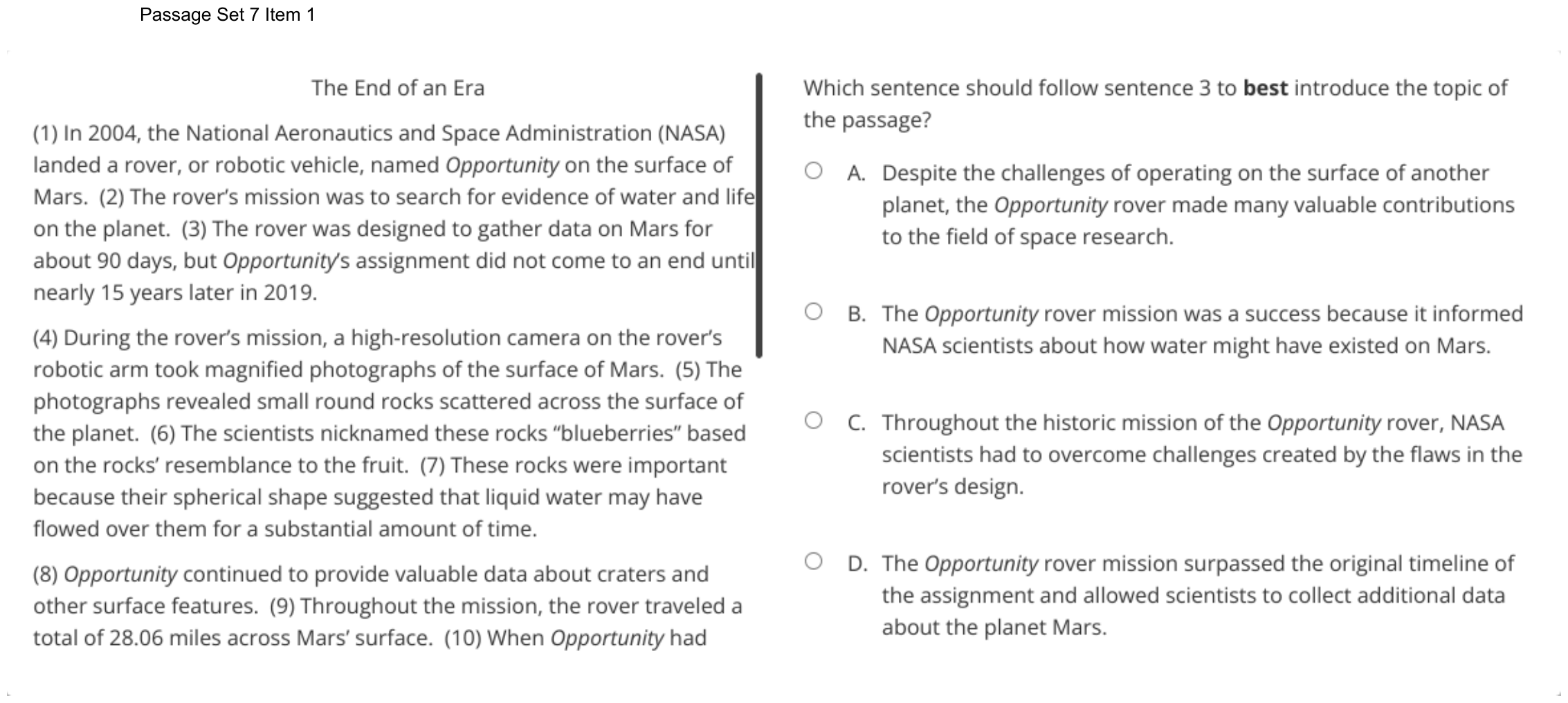
The passage “The End of an Era” as printed (page 60)
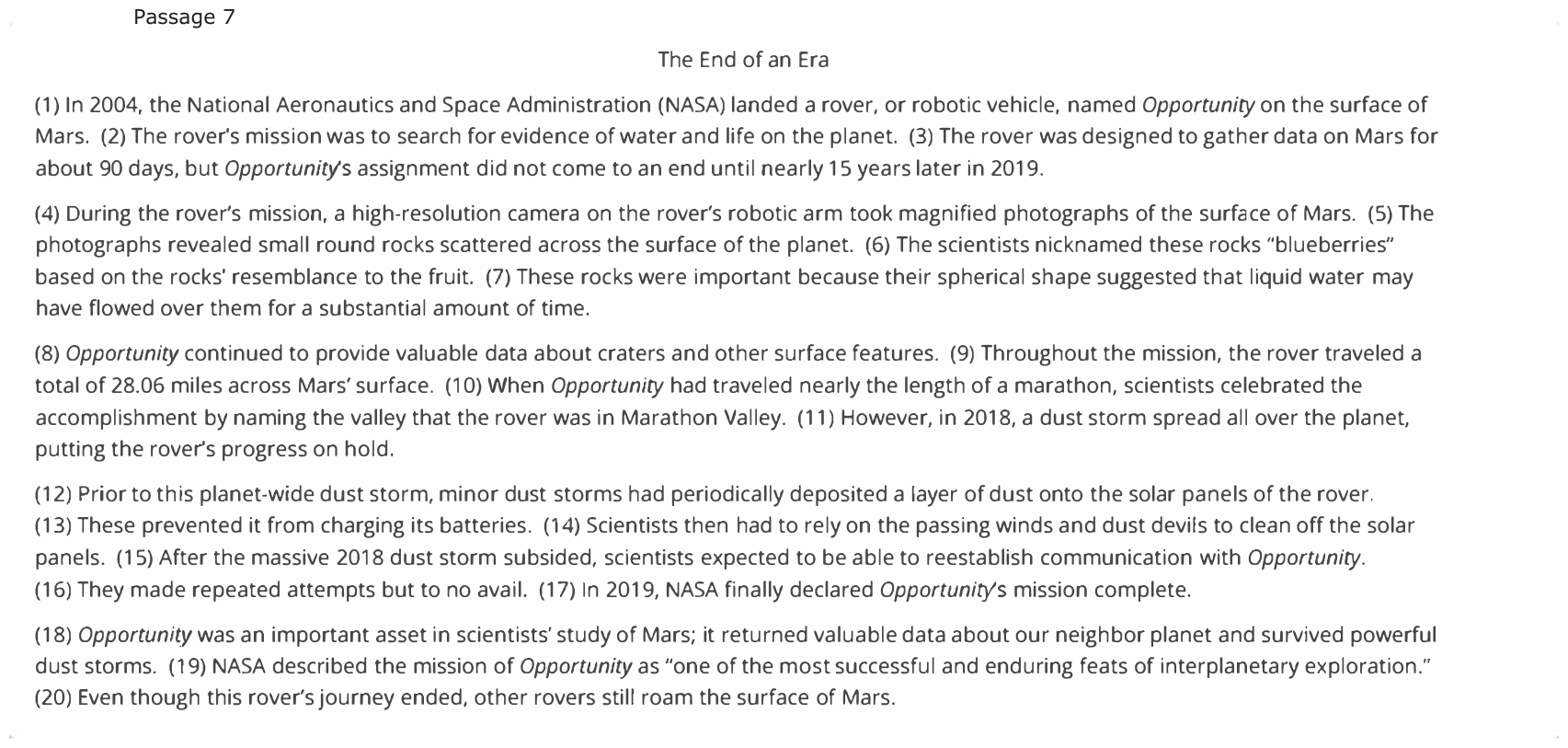
Question 69 of 120
2026 Practice Test B English, question 44Uses the passage above: “The End of an Era”.
Question
Which word should be added to the beginning of sentence 8 to provide a better transition to the third paragraph (sentences 8–11)?
Move the correct answer to the box.
(8) ____ Opportunity continued to provide valuable data about craters and other surface features.
On the test you drag one of the tiles into the box; here, choose it.
- AOverall,
- BFurthermore,
- CMeanwhile,
- DConsequently,
Show the answer
Correct answer: C
The question asks for the word that should be added to the beginning of sentence 8 to provide a better transition to the third paragraph (sentences 8–11).
“Overall,” is incorrect and should not be added. While sentence 8 is a more general statement than sentence 7, the word “Overall” would imply that all of the third paragraph features general information about the Opportunity rover. Instead, paragraphs 2 and 3 both describe specific accomplishments of the Opportunity rover (the discovery of possible water on Mars and the distance the rover traveled), so these paragraphs require a word between them that does not transition from the specific to the general.
“Furthermore,” is incorrect and should not be added. The word “Furthermore” would suggest that the author is making an argument in paragraph 2 that is further developed by the statement in sentence 8 and the rest of paragraph 3. Because this is not the case, the word “Furthermore” is not a suitable transition from one paragraph to the next.
“Meanwhile,” is correct and should be added. The word “Meanwhile” is an appropriate transition to add to the beginning of sentence 8, since the actions of the Opportunity rover in paragraph 2 (taking photographs) and in paragraph 3 (traveling long distances) happened at the same time and both served critical functions to the overall mission.
“Consequently,” is incorrect and should not be added. The word “Consequently” would create a cause-and-effect relationship that does not exist between the paragraphs. The passage gives no indication that the rover’s actions in the third paragraph (traveling a far distance) resulted from the actions in the second paragraph (taking photographs).
Question analysis
In this transition question, sentence 8 opens the third paragraph of the Opportunity rover passage with a blank, and on the test students move one of four word tiles into the box. The paragraph before ends with the “blueberries,” small round rocks that hinted at water, so students must decide how the rover's further work relates to that discovery.
- NYS standards
- 7W2d transitions in informative writing
- Grade level
- Grade 7 reading and task
- Compared with grade 7
- Above grade 7 Choosing a transition is regular grade 7 writing work, but this one links two paragraphs, and two of the four words fit the sentence's grammar and sound natural, so the choice turns on exactly how the paragraphs relate.
- Estimated difficulty
- Hard: combines ideas, needs a plan, and has more than one tempting wrong answer.
- Thinking it demands
- Depth of knowledge 2, skills and concepts · mainly evaluate
- What makes it hard
- A very close wrong answer moderate
- How sentences fit together moderate
- Reading between the lines minor
- Evidence
- Answered from several paragraphs or stanzas
- Reading level
- Passage: about grade 11, 337 words; question and choices: about grade 9, 43 words.
- Students, last 30 days
- Not enough answers yet to show (it takes 10).
Why it is hard, traps and wrong answers (shows the answer)
Why it is hard
Two tiles sound natural in the blank, and the one most students reach for first is an all-purpose adding word. The key goes a step further: it marks the rover’s work in paragraph 3 as happening alongside the photographs of paragraph 2, a relationship the word “continued” supports. Students who test each tile against how the paragraphs relate, rather than against the sound of the sentence, also rule out a summing-up word and a cause word.
A very close wrong answer moderate Choosing the answer
“Furthermore” and “Meanwhile” both let paragraph 3 add to paragraph 2; only “Meanwhile” also says the rover’s further work went on during the same mission, as “continued” implies. (Embretson & Wetzel, 1987; Gorin & Embretson, 2006; Ascalon et al., 2007)
How sentences fit together moderate Working it out
The tile must link the “blueberries” of paragraph 2 to the craters and miles of paragraph 3, so students must decide how two paragraphs relate, not just two sentences. (Halliday & Hasan, 1976)
Reading between the lines minor Working it out
The timing is never stated; it comes from “During the rover’s mission” in sentence 4 and “continued” in sentence 8, which place both kinds of work in the same years. (Graesser, Singer & Trabasso, 1994; Kintsch, 1998)
Strategy: State in your own words how what the rover did in paragraph 2 relates to what it did in paragraph 3, then test the relationship each tile signals against that.
Traps
- Wrong transition: A connecting word or phrase that signals the wrong relationship, such as contrast where the idea continues.
The wrong answers, classified
A Wrong transition (Halliday & Hasan, 1976)
Treats sentence 8 as a summing up because it is broader than sentence 7, though paragraph 3 goes on to give new specifics such as the 28.06 miles.
B Wrong transition (Halliday & Hasan, 1976)
Adds paragraph 3 as one more achievement, which sounds natural, but “Furthermore” signals a point being built up, not two kinds of work carried on during one mission.
D Wrong transition (Halliday & Hasan, 1976)
Hears “continued” as a result of the blueberry discovery and adds a cause-and-effect link, though nothing says the rover’s later work followed from its photographs.
Working it out, step by step
Figure out what the question asks
On the test, you move one word tile into the box at the start of sentence 8. The word is a transition, a word that shows how two ideas connect. Some transitions add an idea, some show a result, some sum up, and some show time. You need the one that links paragraph 2 to paragraph 3.
Compare the two paragraphs
Paragraph 2 begins “During the rover’s mission.” It tells how the camera found the round rocks called “blueberries.” Paragraph 3 begins “Opportunity continued to provide valuable data about craters and other surface features.” Craters are bowl-shaped holes in the ground. So paragraph 3 tells about other work the rover kept doing in those same years.
Test each transition
- Overall sums things up. But paragraph 3 gives new facts, like the 28.06 miles.
- Furthermore adds one more reason to an argument, as in Dogs are loyal. Furthermore, they are fun. But paragraph 2 isn’t arguing a point. It tells what the rover did.
- Meanwhile means during that same time. It links things that go on together.
- Consequently means as a result. But the photos didn’t cause the rover’s later work.
See why “Meanwhile” fits
While the camera was finding blueberries, the rover was also studying craters and driving many miles. The word “continued” in sentence 8 shows that the work kept going. “Meanwhile” tells the reader these jobs happened during the same mission.
Watch out: “Furthermore” sounds natural in the blank, so many students choose B. But it only says here is one more point. It doesn’t show two kinds of work going on at the same time.
Choose the answer
With the tile in place, sentence 8 reads: Meanwhile, Opportunity continued to provide valuable data about craters and other surface features. So the answer is C: move the tile “Meanwhile,” into the box.
Why this answer and not the closest wrong one
B, “Furthermore,” is the closest wrong answer, because it also adds information. But it treats paragraph 2 as one point in an argument. The passage just tells what the rover did. “Meanwhile” links the two paragraphs in time, and it matches the word “continued.”
More questions like this
The original DOE question
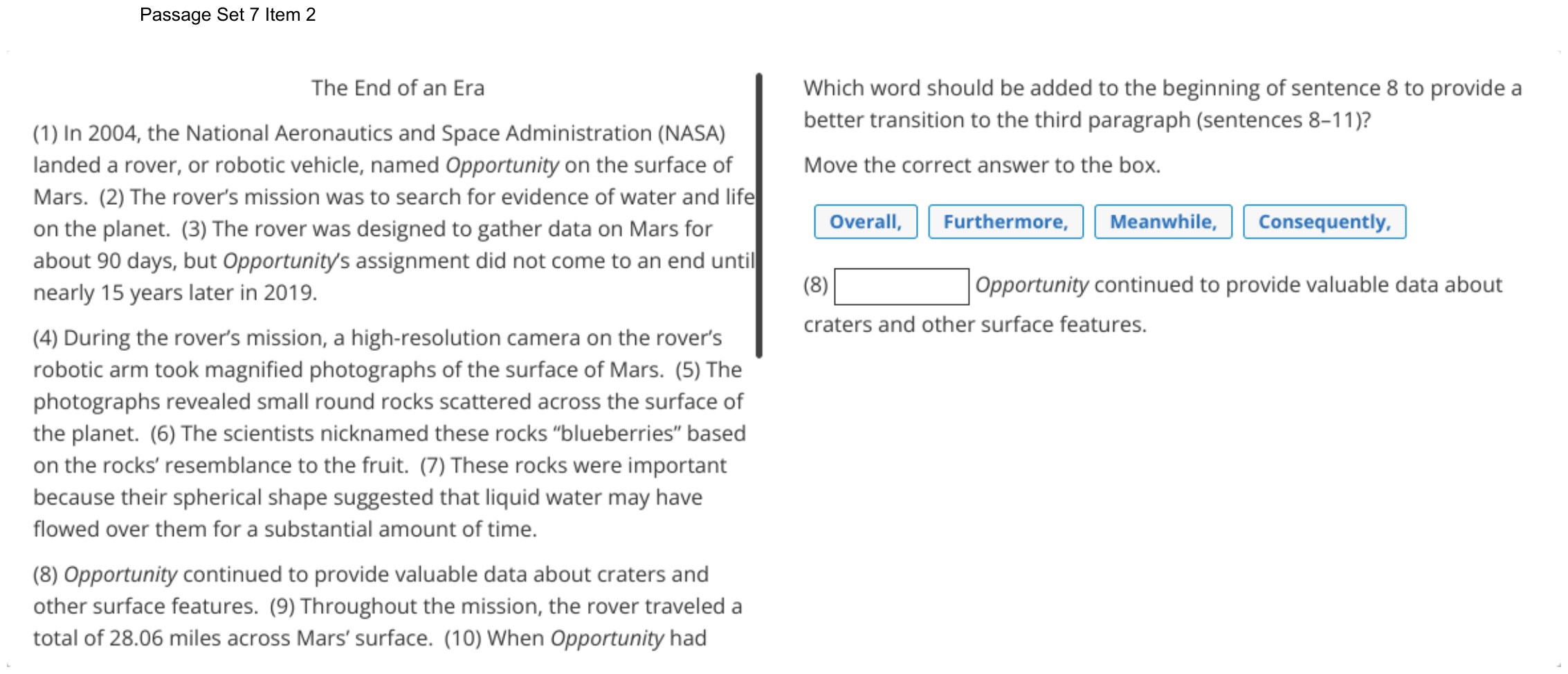
Question 70 of 120
2026 Practice Test B English, question 45Uses the passage above: “The End of an Era”.
Question
Which revision of sentence 11 best maintains the formal style established in the passage?
- AHowever, in 2018, a dust storm covered the planet, bringing the rover’s progress to a standstill.
- BHowever, in 2018, a dust storm shrouded the planet, impermanently halting the rover’s progress.
- CHowever, in 2018, a dust storm enveloped the whole of the planet, arresting the rover’s progress for a time.
- DHowever, in 2018, a dust storm covered up the whole planet, which quickly brought a stop to the progress of the rover.
Show the answer
Correct answer: A
The question asks for the revision of sentence 11 that best maintains the formal style established in the passage.
A. CORRECT. This sentence uses clear and formal writing throughout. The phrase “covered the planet” is accurate and formal without being overly poetic, and “standstill” is a precise word for putting something “on hold,” as expressed by the original sentence, while maintaining the formal style of the passage.
B. Incorrect. Although the sentence is formal in style, the word “shrouded” is overly poetic, and the phrase “impermanently halting” is too stilted and formal for the style and tone of the passage.
C. Incorrect. Although the sentence is formal in style, the words “enveloped” and “arresting” are overly poetic, especially when used in the same sentence, and the phrases “the whole of the planet” and “for a time” are needlessly wordy and imprecise, compared with the formal scientific language of the passage.
D. Incorrect. The phrases “covered up the whole planet” and “quickly brought a stop to the progress of the rover” are less formal and unnecessarily wordy, compared with the formal style established by the rest of the passage.
Question analysis
This style question asks which revision of sentence 11, about the 2018 dust storm that covered Mars and stopped the Opportunity rover, best maintains the formal style of the passage. All four versions say the same thing, so students must compare word choice and wordiness and decide which one reads like the rest of the passage.
- Grade level
- Grade 8 reading and task
- Compared with grade 7
- Above grade 7 Keeping a formal style is grade 7 writing work, usually tested by spotting slang or casual wording. Here all four revisions keep the meaning and differ in register by degrees, so students must judge the passage's own style closely, more than typical.
- Estimated difficulty
- Hard: combines ideas, needs a plan, and has more than one tempting wrong answer.
- Thinking it demands
- Depth of knowledge 2, skills and concepts · mainly evaluate
- What makes it hard
- Something you must already know moderate
- Every choice must be checked moderate
- Hard words minor
- Evidence
- Answered from one sentence or line
- Reading level
- Passage: about grade 11, 337 words; question and choices: about grade 9, 80 words.
- Students, last 30 days
- Not enough answers yet to show (it takes 10).
Why it is hard, traps and wrong answers (shows the answer)
Why it is hard
The question turns on what “formal” means. Many students equate it with impressive words and choose the revision with “enveloped” and “arresting,” or the one with “shrouded,” missing that both are more poetic than a passage that reports dates and distances. The casual revision is easy to reject, so the real test is preferring the plainest formal sentence to the grandest one.
Something you must already know moderate Working it out
Students must know that a formal informational style is plain and precise, so words such as “shrouded,” “enveloped” and “arresting” are too ornate for a passage that reports miles and dates. (Anderson & Krathwohl, 2001)
Every choice must be checked moderate Choosing the answer
All four revisions keep the meaning of sentence 11 and differ only in register and length, so each must be heard against the passage’s voice rather than checked for errors. (Embretson & Wetzel, 1987)
Hard words minor Understanding the question
“Impermanently,” “shrouded” and “arresting,” in its sense of stopping, are uncommon words, and students must judge how they sound in the passage, not only what they mean. (Perfetti, 2007; Freedle & Kostin, 1993)
Strategy: Reread a few sentences around sentence 11 to hear the passage's voice, then check each revision for casual phrasing, needless words and words that would sound out of place in that voice.
Traps
- Wordy, vague or informal: A revision is grammatical but wordy, imprecise or too casual for the passage.
The wrong answers, classified
B Wordy, vague or informal (Connors & Lunsford, 1988)
Equates formal with elevated, so “shrouded” and “impermanently halting” seem best, though both are stilted and poetic beside the passage’s plain reporting of facts.
C Wordy, vague or informal (Connors & Lunsford, 1988)
Avoids casual words, but “enveloped” and “arresting” are poetic, and “the whole of the planet” and “for a time” add words the plain version does without.
D Wordy, vague or informal (Connors & Lunsford, 1988)
Keeps the meaning, but the casual “covered up” and the roundabout “brought a stop to the progress of the rover” make it wordier and less formal.
Working it out, step by step
Figure out what the question asks
This question asks which version of sentence 11 keeps the passage’s formal style. Formal writing is serious and clear, like a textbook. It avoids slang and casual words. But formal doesn’t mean fancy. Formal writing about science uses plain, exact words. For example, The game got called off is casual. The contest was halted indefinitely is too fancy. The game was canceled is formal and plain.
Hear the passage’s voice
Sentence 9 says “the rover traveled a total of 28.06 miles across Mars’ surface.” Sentence 12 says minor storms “deposited a layer of dust onto the solar panels.” The words are exact and plain. The passage gives dates and numbers. It doesn’t paint poetic pictures.
Check each revision
- A is right. “Covered the planet” is plain and exact. A standstill is a complete stop, a clear way to say “on hold.”
- B is wrong. “Shrouded” is poetic. A shroud is a cloth wrapped around a body. “Impermanently halting” sounds stiff and odd.
- C is wrong. “Enveloped” and “arresting” are fancy words. Here arresting means stopping. “The whole of the planet” and “for a time” add extra words.
- D is wrong. “Covered up” is casual. “Brought a stop to the progress of the rover” is wordy, or longer than it needs to be.
Watch out: Many students think formal means big words, so they choose C. But a passage of dates and miles calls for plain words.
Choose the answer
Only A is both formal and plain, like the rest of the passage. So the answer is A: “However, in 2018, a dust storm covered the planet, bringing the rover’s progress to a standstill.”
Why this answer and not the closest wrong one
C is the closest wrong answer, because it has no slang and sounds serious. But “enveloped” and “arresting” are poetic, and “the whole of the planet” is wordy. The passage reports facts in plain words. A says the same thing in the plainest formal way.
More questions like this
The original DOE question
Question 71 of 120
2026 Practice Test B English, question 46Uses the passage above: “The End of an Era”.
Question
Read this sentence.
One of Opportunity’s major contributions was finding possible evidence of the presence of water on Mars.
Where should the sentence be added to the passage?
- Abetween sentences 2 and 3
- Bat the beginning of the second paragraph (before sentence 4)
- Cat the end of the second paragraph (after sentence 7)
- Dbetween sentences 8 and 9
Show the answer
Correct answer: B
The question asks where the sentence should be added to the passage.
A. Incorrect. While sentence 2 refers to Opportunity’s mission to search for evidence of water, sentence 3 mentions the rover lasting much longer than anticipated. Placing the sentence between these two ideas, rather than at the start of the second paragraph, where it introduces the topic of the paragraph, would create a disjointed and confusing experience for the reader.
B. CORRECT. The sentence introduces the idea of finding possible evidence of water on Mars, which is the main topic of the second paragraph.
C. Incorrect. The sentence sets up the main idea of paragraph 2, which is the possibility of water on Mars. As a concluding sentence, it would be repetitive and confusing.
D. Incorrect. The sentence introduces the possibility of water on Mars, while sentences 8 and 9 discuss other surface features and the distance traveled by the rover. Adding the sentence here would create a disorganized paragraph.
Question analysis
This organization question gives a new sentence about Opportunity's possible discovery of evidence of water on Mars and asks where it should be added to the rover passage. Students must follow the order of ideas across the first three paragraphs, because the sentence echoes ideas that appear in several places and could seem to fit more than one of them.
- NYS standards
- 7W2a introducing and organizing a topic
- Grade level
- Grade 7 reading and task
- Compared with grade 7
- At grade 7 Deciding where a sentence belongs is typical grade 7 revision work. The four positions span three paragraphs of a plain passage, and the sentence's wording connects to more than one of them, so the order of ideas must be checked.
- Estimated difficulty
- Moderate: several steps, or a close reading with one strong distractor.
- Thinking it demands
- Depth of knowledge 2, skills and concepts · mainly analyze
- What makes it hard
- How sentences fit together moderate
- A very close wrong answer moderate
- Evidence
- Answered from several paragraphs or stanzas
- Reading level
- Passage: about grade 11, 337 words; question and choices: about grade 7, 52 words.
- Students, last 30 days
- Not enough answers yet to show (it takes 10).
Why it is hard, traps and wrong answers (shows the answer)
Why it is hard
The new sentence reads well in more than one place, because water comes up in sentence 2, in sentence 7 and near the “valuable data” of sentence 8. Its wording settles the matter: “One of Opportunity’s major contributions” announces a topic, so it belongs ahead of the evidence. The strongest pull places it as a closing line after sentence 7, where it restates the point the blueberries have just made.
How sentences fit together moderate Working it out
The new sentence names a contribution in general terms, so it belongs before sentence 4, where the camera and the “blueberries” supply the details, not after them. (Halliday & Hasan, 1976)
A very close wrong answer moderate Choosing the answer
The two positions in paragraph 2, before sentence 4 and after sentence 7, both keep the sentence beside the water evidence; they differ only in whether it introduces the details or sums them up. (Embretson & Wetzel, 1987; Gorin & Embretson, 2006; Ascalon et al., 2007)
Strategy: Find what the new sentence is about and where the passage discusses that, then read the sentence in each offered position and check whether it introduces, interrupts or repeats the ideas around it.
Traps
- Sentence in the wrong place: Puts a sentence where it breaks the order of ideas or separates it from what it refers to.
- Says it twice: Repeats an idea that the sentence or passage already states.
The wrong answers, classified
A Sentence in the wrong place (Halliday & Hasan, 1976)
Matches the sentence to sentence 2’s search for water, but there it announces the finding before the photographs are described and cuts into the account of the mission’s length.
C Says it twice (Connors & Lunsford, 1988)
Uses it as a wrap-up after the blueberries, a common paragraph shape, but there it only repeats sentence 7’s point about water instead of introducing the paragraph’s topic.
D Sentence in the wrong place (Halliday & Hasan, 1976)
Links “major contributions” to the “valuable data” of sentence 8, though paragraph 3 covers craters, distance traveled and the dust storm, not water.
Working it out, step by step
Figure out what the question asks
This question asks where a new sentence belongs. First find what the sentence is about. Then find where the passage talks about that. Last, decide whether the sentence should start that part, interrupt it or end it.
Read the new sentence
It says that one of Opportunity’s major contributions was “finding possible evidence of the presence of water on Mars.” It names a big idea in general terms. A sentence like that is a topic sentence. A topic sentence tells what a paragraph will be about. It usually comes first. For example, Dogs help people in many ways. comes before the details about guiding, herding and comforting.
Find where water comes up
Paragraph 2 (sentences 4–7) gives the details. The camera took close-up photos. They showed small round rocks, nicknamed “blueberries.” Sentence 7 says the rocks’ round shape “suggested that liquid water may have flowed over them.” So the new sentence should come right before these details, at the start of paragraph 2.
Check each choice
- A is wrong. Between sentences 2 and 3, it would announce the finding before the photos are described. It would also break up the facts about the mission’s length.
- B is right. Before sentence 4, it introduces the paragraph about the round rocks and water.
- C is wrong. After sentence 7, it would only repeat the point sentence 7 just made.
- D is wrong. Paragraph 3 is about craters, miles and the dust storm, not water.
Watch out: C is tempting because some paragraphs end with a summary. But sentence 7 already makes the point about water.
Choose the answer
So the answer is B: “at the beginning of the second paragraph (before sentence 4).”
Why this answer and not the closest wrong one
C is the closest wrong answer, because it keeps the sentence in the paragraph about water. But the sentence names a topic, so it works best before the details. After sentence 7, it would repeat what the blueberries just showed. Before sentence 4, it tells readers what is coming.
More questions like this
The original DOE question
Question 72 of 120
2026 Practice Test B English, question 47Uses the passage above: “The End of an Era”.
Question
What is the best way to combine sentences 12 and 13?
- APreventing the rover from charging its batteries, minor dust storms had periodically deposited a layer of dust onto the solar panels of the rover prior to this planet-wide dust storm.
- BPeriodically depositing a layer of dust onto the solar panels of the rover prior to this planet-wide dust storm, minor dust storms had prevented it from charging its batteries.
- CMinor dust storms, prior to this planet-wide dust storm, prevented the rover from charging its batteries because they had periodically deposited a layer of dust onto the solar panels of the rover.
- DPrior to this planet-wide dust storm, minor dust storms had periodically deposited a layer of dust onto the solar panels of the rover, preventing it from charging its batteries.
Show the answer
Correct answer: D
The question asks for the best way to combine sentences 12 and 13.
A. Incorrect. The phrase “this planet-wide dust storm” in the original sentence 12 makes a direct reference to sentence 11 and therefore acts as a transition that should be kept at the beginning. In this sentence, the transition phrase is placed at the end of the sentence, making the phrase confusing. In addition, the sentence is unnecessarily repetitive and wordy.
B. Incorrect. This combination unnecessarily turns sentence 12 into an overly long participial phrase, making the connection between “it” and its antecedent, “the rover,” unclear and distracting from the subject of the sentence, “minor dust storms.”
C. Incorrect. Not only does this combination move the reference to “this planet-wide dust storm” farther from sentence 11, but it is also unnecessarily wordy, adding “because” and repeating “the rover.”
D. CORRECT. This sentence efficiently and accurately adds sentence 13 to sentence 12 as a participial phrase by changing “These prevented” to “preventing,” while also retaining the meanings of the original sentences 12 and 13.
Question analysis
This sentence-combining question asks for the best way to join two sentences from the rover passage: one saying minor dust storms had periodically coated the rover's solar panels, the other saying this kept it from charging its batteries. The four versions keep the same facts in different orders, so students must judge which is clearest and most concise in context.
- Grade level
- Grade 8 reading and task
- Compared with grade 7
- Above grade 7 Combining two sentences is grade 7 work, usually with one version clearly better. These four are long, keep the same facts and differ in order and wording, so students must weigh clarity and concision across nearly identical sentences, more than typical.
- Estimated difficulty
- Hard: combines ideas, needs a plan, and has more than one tempting wrong answer.
- Thinking it demands
- Depth of knowledge 2, skills and concepts · mainly evaluate
- What makes it hard
- How sentences fit together moderate
- Every choice must be checked moderate
- Complex sentences minor
- Evidence
- Answered from one sentence or line
- Reading level
- Passage: about grade 11, 337 words; question and choices: about grade 13, 129 words.
- Corrected from the DOE handbook
- Two grammar terms in the explanation were corrected.
- Students, last 30 days
- Not enough answers yet to show (it takes 10).
Why it is hard, traps and wrong answers (shows the answer)
Why it is hard
None of the versions is plainly ungrammatical, so the ear gives little help, and the version with “because” looks best to students who value a clearly stated cause. Its cost is wordiness and a weaker link: the result comes first and the reference back to sentence 11 is buried mid-sentence. The question rewards keeping the original order, cause then effect, and folding sentence 13 in as a short closing phrase.
How sentences fit together moderate Working it out
“Prior to this planet-wide dust storm” points back to sentence 11, so the best version keeps it first; three versions move it later, which loosens the link between the two sentences. (Halliday & Hasan, 1976)
Every choice must be checked moderate Choosing the answer
All four versions keep every fact of sentences 12 and 13 and run 29 to 32 words, so none can be ruled out by content; order, pronouns and repetition decide. (Embretson & Wetzel, 1987)
Complex sentences minor Understanding the question
Each version is one long sentence built around a participial phrase or a “because” clause, and at that length a stranded “it” or a doubled “the rover” is easy to miss. (Abedi & Lord, 2001; Freedle & Kostin, 1993; Messick, 1989)
Strategy: Read sentence 11 first, then compare the versions on how smoothly each connects to it, how many words it uses, and whether every pronoun has a clear antecedent.
Traps
- Wordy, vague or informal: A revision is grammatical but wordy, imprecise or too casual for the passage.
- Unclear pronoun: A pronoun whose reference is vague or ambiguous, or one in the wrong case.
The wrong answers, classified
A Wordy, vague or informal (Connors & Lunsford, 1988)
Opens with the effect as a participial phrase, which pushes “prior to this planet-wide dust storm,” the link to sentence 11, to the end and names “the rover” twice.
B Unclear pronoun (Connors & Lunsford, 1988)
Packs sentence 12 into a 19-word opening phrase, so “it” follows “this planet-wide dust storm” and no longer points clearly to the rover buried inside the phrase.
C Wordy, vague or informal (Connors & Lunsford, 1988)
Likes the clear cause word “because,” but the result now comes first, “the rover” appears twice, and “prior to this planet-wide dust storm” splits the subject from its verb.
What was corrected from the DOE handbook, and why
- Explanation: The DOE’s explanation of Option B says the combination turns sentence 12 into “an overly long dependent clause,” and its explanation of Option D says Option D adds sentence 13 to sentence 12 “as a dependent clause” by changing “These prevented” to “preventing.” Neither is a clause: “Periodically depositing a layer of dust onto the solar panels of the rover prior to this planet-wide dust storm” (Option B) and “preventing it from charging its batteries” (Option D) have no subject or finite verb of their own. Both are participial phrases, and the site now calls them that. The reasoning and the answer, Option D, are unchanged.
Working it out, step by step
Figure out what the question asks
This question asks for the best way to join sentences 12 and 13 into one sentence. The best version keeps the meaning, uses few words and is clear. It should also connect smoothly to sentence 11, the sentence before.
Read the sentences in order
Sentence 11 tells about the giant 2018 dust storm. Sentence 12 begins “Prior to this planet-wide dust storm.” Prior to means before. That phrase points back to sentence 11, so it works best at the start. Sentence 12 says small storms put dust on the solar panels. Sentence 13 gives the result: “These prevented it from charging its batteries.”
Learn the tool: a participial phrase
A participial phrase is a group of words built on a verb form, often an -ing word. It describes something, but it has no subject and can’t stand alone. Example: The dog ran to the door. It wagged its tail. becomes The dog ran to the door, wagging its tail. Choice D does this. It turns “These prevented” into “preventing.”
Check each choice
- A is wrong. It starts with the result. It moves “prior to this planet-wide dust storm” to the end, far from sentence 11. It also says “the rover” twice.
- B is wrong. Its long opening phrase hides the rover. Then “it” comes after “minor dust storms,” so it is hard to tell what “it” means.
- C is wrong. It adds “because,” puts the result first and says “the rover” twice. It is wordier than D.
- D is right. It keeps the link to sentence 11 first, gives the cause, then adds the result as a short participial phrase.
Watch out: C looks clear because “because” names the cause. But it is longer, and it puts an extra phrase between “Minor dust storms” and its verb.
Choose the answer
So the answer is D: “Prior to this planet-wide dust storm, minor dust storms had periodically deposited a layer of dust onto the solar panels of the rover, preventing it from charging its batteries.”
Why this answer and not the closest wrong one
C is the closest wrong answer, because “because” makes the cause very clear. But C puts the result first and repeats “the rover.” D keeps the original order, cause then result. It also keeps the link to sentence 11 up front, in fewer words.
More questions like this
The original DOE question
Question 73 of 120
2026 Practice Test B English, question 48Question
In September 2016 the National Museum of African American History and Culture opened as part of the Smithsonian Institution, the museum is already the Smithsonian’s third most popular site. Experts say that they expect this newest Smithsonian facility to welcome nearly 4 million visitors a year. The museum features more than 30,000 objects, including Muhammad Ali’s boxing gloves and a dress sewn by Rosa Parks. A commemorative copy of the Emancipation Proclamation, written in 1863 during the presidency of Abraham Lincoln, is also on display at the museum.
Which part of the paragraph contains an error in sentence structure?
Select the one error.
On the test you click the words in the text; here, choose them below.
- AInstitution, the
- Byear. The
- Cobjects, including
- DProclamation, written
Show the answer
Correct answer: A
The question asks which part of the paragraph contains an error in sentence structure.
Choice 1: “Institution, the” contains an error in sentence structure. The comma between these two words creates a type of run-on sentence known as a comma splice because both clauses—“In September 2016 the National Museum of African American History and Culture opened as part of the Smithsonian Institution” and “the museum is already the Smithsonian’s third most popular site”—are independent clauses, and must be separated with either a period or semicolon. If a comma is used to join the clauses together, a conjunction such as and would need to be added after the comma [converting the comma splice into a correct compound sentence].
Choice 2: “year. The” is correctly constructed, with independent clauses on both sides of the period (“Experts say that they expect this newest Smithsonian facility to welcome nearly 4 million visitors a year” and “The museum features more than 30,000 objects, including Muhammad Ali’s boxing gloves and a dress sewn by Rosa Parks”).
Choice 3: “objects, including” is correctly constructed. The sentence is correct as written with the nonrestrictive prepositional phrase (“including Muhammad Ali’s boxing gloves and a dress sewn by Rosa Parks”) properly preceded by a comma.
Choice 4: “Proclamation, written” is correctly constructed. The sentence is correct, with the nonrestrictive participial phrase (“written in 1863 during the presidency of Abraham Lincoln”) properly offset by a comma on either side.
Question analysis
This sentence-structure question shows a short paragraph about the 2016 opening of the National Museum of African American History and Culture, with four short phrases underlined. On the test students click the one part that contains an error in sentence structure, and the long names and the commas in the paragraph can make every spot look suspicious.
- Grade level
- Grade 6 reading and task
- Compared with grade 7
- Below grade 7 Finding run-ons and fragments is taught before grade 7, and here students check four short underlined spots in one paragraph for a single error in sentence structure. Long institution names add reading load but no extra grammar.
- Estimated difficulty
- Straightforward: two steps or one careful reading.
- Thinking it demands
- Depth of knowledge 2, skills and concepts · mainly apply
- What makes it hard
- A rule that doesn't sound wrong moderate
- Complex sentences minor
- Every choice must be checked minor
- Evidence
- Answered from one paragraph or stanza
- Reading level
- Question and choices: about grade 10, 107 words.
- Corrected from the DOE handbook
- Two grammar terms in the explanation were corrected.
- Students, last 30 days
- Not enough answers yet to show (it takes 10).
Why it is hard, traps and wrong answers (shows the answer)
Why it is hard
Students no longer have to supply the fix, only find the faulty spot, so the question rests on recognizing a comma splice. The error sits in the first sentence behind a long museum name, while the phrases “including Muhammad Ali’s boxing gloves” and “written in 1863” look more suspicious to anyone unsure about phrases set off by commas. Testing each spot for a full sentence on both sides finds it quickly.
A rule that doesn't sound wrong moderate Working it out
A comma alone joins two full clauses at “Institution, the,” and because the long museum name delays the break, the comma reads as a pause rather than a missing period. (Connors & Lunsford, 1988)
Complex sentences minor Understanding the question
The first clause runs 19 words, most of them the museum’s name, so by the time “the museum is already” arrives it sounds like a continuation, not a new sentence. (Abedi & Lord, 2001; Freedle & Kostin, 1993; Messick, 1989)
Every choice must be checked minor Choosing the answer
Each of the four clickable phrases straddles a comma or a period, so students must check, at every one, whether the words on each side could stand as a sentence. (Embretson & Wetzel, 1987)
Strategy: Find the subject and main verb of each sentence and count how many complete thoughts it holds, then check whether the punctuation at each underlined spot suits what comes on either side.
Traps
- Fixes what isn't broken: Changes a part of the sentence that was already correct, while the real error stays; or, where the question asks which sentence has an error or should go, picks one that is correct and belongs.
The wrong answers, classified
B Fixes what isn't broken (Connors & Lunsford, 1988)
Suspects the break after “year” because two sentences meet there, though a period already separates two complete sentences correctly, each with its own subject and verb.
C Fixes what isn't broken (Connors & Lunsford, 1988)
Believes a phrase opening with “including” after a comma is a fragment, though it correctly attaches examples to “more than 30,000 objects” within a complete sentence.
D Fixes what isn't broken (Connors & Lunsford, 1988)
Thinks “written in 1863” cannot describe the copy without “which was,” though the sentence already has its verb “is” and the participial phrase is correctly set off.
What was corrected from the DOE handbook, and why
- Explanation: The DOE’s explanation of choice 3 calls “including Muhammad Ali’s boxing gloves and a dress sewn by Rosa Parks” a “nonrestrictive appositive phrase.” An appositive renames a noun; this phrase gives examples of the objects, and “including” followed by a noun phrase works as a preposition, so it is a prepositional phrase. The explanation of choice 4 calls “written in 1863 during the presidency of Abraham Lincoln” a “nonrestrictive clause”; it has no subject or finite verb of its own, so it is a participial phrase. The site now says “nonrestrictive prepositional phrase” and “nonrestrictive participial phrase.” Both parts are still correctly constructed, and the answer, “Institution, the,” is unchanged.
Working it out, step by step
Figure out what the question asks
This question asks you to find the one error in sentence structure. Sentence structure is how a sentence is built. On the test, you click the part with the mistake. At each part, ask: could the words on each side stand as a sentence?
Learn the rule: no comma splice
An independent clause is a group of words with a subject and a verb that can stand alone as a sentence. You can’t join two of them with just a comma. That mistake is called a comma splice. Example: I ran home, the rain started. Fix it with a period: I ran home. The rain started. You could also add and after the comma.
Test “Institution, the”
Before the comma: “In September 2016 the National Museum of African American History and Culture opened as part of the Smithsonian Institution.” That is a full sentence. After the comma: “the museum is already the Smithsonian’s third most popular site.” That is a full sentence too. Only a comma joins them, so this is a comma splice. Fix: put a period after Institution and start The museum with a capital.
Check “year. The” and “objects, including”
- “year. The” is correct. A period already separates two full sentences.
- “objects, including” is correct. A preposition is a linking word like with or for, and “including” works like one here. A prepositional phrase is that word plus the words after it. “Including Muhammad Ali’s boxing gloves and a dress sewn by Rosa Parks” is a prepositional phrase. It gives examples of the objects, and a comma correctly attaches it.
Check “Proclamation, written”
“Written in 1863 during the presidency of Abraham Lincoln” is a participial phrase. That is a group of words built on a verb form, here written, with no subject of its own. It tells when the Proclamation was written. Commas correctly set it off, and the sentence keeps its main verb, “is.”
Watch out: Phrases starting with “including” and “written” can’t stand alone, so they may look like errors. But each one is attached to a full sentence. That is correct.
Choose the answer
Only the first part joins two full sentences with just a comma. So the answer is A: “Institution, the” contains the error. On the test, you would click that phrase.
Why this answer and not the closest wrong one
“Objects, including” is the closest wrong answer, because the words after its comma can’t stand alone. But they don’t need to. That phrase only adds examples to a full sentence. At “Institution, the,” both sides are full sentences, so a comma alone is not enough.
More questions like this
The original DOE question
Question 74 of 120
2026 Practice Test B English, question 49Question
Read these sentences.
(1) Flyby missions near Jupiter have been happening since 1973.
(2) Flyby missions allow scientists to collect data about Jupiter and its moons.
What is the best way to combine the sentences to clarify the relationship between the ideas?
- AWhile flyby missions near Jupiter have been happening since 1973, scientists collect data about the planet and its moons.
- BAlthough there have been flyby missions near Jupiter since 1973, they have allowed scientists to collect data about the planet and its moons.
- CFlyby missions near Jupiter, which allow scientists to collect data about the planet and its moons, have been happening since 1973.
- DFlyby missions have been happening near Jupiter, but scientists have been collecting data about the planet and its moons since 1973.
Show the answer
Correct answer: C
The question asks for the best way to combine the sentences to clarify the relationship between the ideas.
A. Incorrect. Even though the two ideas from the original sentences are incorporated into the combined sentence, the use of the conjunction “while” in the first part of the sentence suggests that there is a simultaneous but unrelated relationship between the two ideas, which is incorrect.
B. Incorrect. The combined sentence incorporates the ideas from both sentences, but the conjunction “although” suggests that scientists were allowed to collect data even though there were flyby missions, which is an inaccurate way to express the relationship between the ideas.
C. CORRECT. This sentence is the best way to combine the sentences because it accurately reflects the relationship between the ideas by using the nonrestrictive clause “which allow scientists to collect data about the planet and its moons” to describe the purpose of the flyby missions. (Nonrestrictive clauses are adjective clauses that give additional information about a word or phrase. They sometimes begin with the relative pronoun “which” and are set off by commas.) The idea that the missions “have been happening since 1973” follows the nonrestrictive clause.
D. Incorrect. The combined sentence uses the conjunction “but” to connect the ideas in the two original sentences. This suggests a contrasting relationship between ideas, which is an inaccurate way to connect the ideas expressed in the original sentences.
Question analysis
This sentence-combining question gives two short sentences about flyby missions near Jupiter, one saying they have happened since 1973 and the other that they let scientists collect data about the planet and its moons. Students choose the combination that makes the relationship between the ideas clear, weighing what each connecting word or clause says about how the facts relate.
- NYS standards
- 7L1 grammar and usage conventions
- Grade level
- Grade 7 reading and task
- Compared with grade 7
- At grade 7 Combining two short sentences so their relationship is clear is regular grade 7 work. Both sentences here are brief and plainly related, and the versions differ mainly in their connecting words, so this is a typical, fairly quick task.
- Estimated difficulty
- Straightforward: two steps or one careful reading.
- Thinking it demands
- Depth of knowledge 2, skills and concepts · mainly evaluate
- What makes it hard
- How sentences fit together moderate
- Every choice must be checked minor
- Evidence
- Answered from one sentence or line
- Reading level
- Question and choices: about grade 9, 119 words.
- Corrected from the DOE handbook
- A wrong word in the explanation of D was corrected.
- Students, last 30 days
- Not enough answers yet to show (it takes 10).
Why it is hard, traps and wrong answers (shows the answer)
Why it is hard
The two sentences are short, and the work lies in naming how they relate before reading the versions. The most tempting one, beginning “While,” keeps both facts but drops the word “allow,” so the missions no longer explain the data. Students who test each connector against the relationship also catch the concession in “Although” and the contrast in “but,” which also moves the date onto the data collection.
How sentences fit together moderate Working it out
Students must first name the relationship, that the missions make the data possible, a link only the version with “which allow” keeps, since the others recast it as time, concession or contrast. (Halliday & Hasan, 1976)
Every choice must be checked minor Choosing the answer
All four versions keep both facts and read smoothly, so each joining word, “While,” “Although,” “which” and “but,” has to be tested for what it claims. (Embretson & Wetzel, 1987)
Strategy: Before reading the choices, decide in a few words how the two facts are connected, then reject any version whose joining word signals a different relationship or shifts what a detail describes.
Traps
- Wrong transition: A connecting word or phrase that signals the wrong relationship, such as contrast where the idea continues.
- Changes the meaning: A revision is correct English but no longer says what the writer meant.
The wrong answers, classified
A Wrong transition (Halliday & Hasan, 1976)
Keeps both facts and reads smoothly, but “While” presents the missions and the data collection as merely happening at the same time and drops “allow,” the link between them.
B Wrong transition (Halliday & Hasan, 1976)
Treats “Although” as a neutral joining word, but it makes the data collection happen in spite of the missions, when the missions are what make it possible.
D Changes the meaning (Connors & Lunsford, 1988)
Joins the facts with “but,” implying a contrast, and moves “since 1973” from the missions to the data collection, so the date now describes something else.
What was corrected from the DOE handbook, and why
- Explanation: Rejecting D, the handbook's explanation says “but” “suggests an adverse relationship between ideas”. “Adverse” means harmful; the point is that “but” signals a contrast, which the two sentences don't have. It now says “a contrasting relationship”. The answer, C, is unchanged.
Working it out, step by step
Figure out what the question asks
This question asks for the best way to join two sentences. The joined sentence must show how the ideas are related. So first decide how they connect. Then pick the version whose joining word shows that link.
Find the relationship
Sentence 1 says flyby missions near Jupiter “have been happening since 1973.” A flyby mission sends a spacecraft past a planet without landing. Sentence 2 says the missions “allow scientists to collect data about Jupiter and its moons.” Data means facts and measurements. So sentence 2 tells what the missions do for scientists. The ideas don’t contrast, or clash. They fit together.
Learn the tool: a which clause
A clause is a group of words with a subject and a verb. A which clause adds extra facts about a noun. Commas set it off. Example: My bike, which has red wheels, is new. The extra facts describe the bike. In C, “which allow scientists to collect data about the planet and its moons” describes the missions.
Check each choice
- A is wrong. “While” makes the two facts just happen at the same time. It drops “allow,” so the missions no longer explain the data.
- B is wrong. “Although” means in spite of the fact that. It suggests scientists got data even though there were missions. That is backward.
- C is right. The which clause tells what the missions do, and the date stays with the missions.
- D is wrong. “But” signals a contrast that isn’t there. It also moves “since 1973” onto the data collecting.
Watch out: A reads smoothly and keeps both facts. But “While” loses the link: the missions are what make the data possible.
Choose the answer
So the answer is C: “Flyby missions near Jupiter, which allow scientists to collect data about the planet and its moons, have been happening since 1973.”
Why this answer and not the closest wrong one
A is the closest wrong answer, because it keeps both facts and sounds fine. But “While” only says two things happen at once. It drops the word “allow,” which shows the missions make the data collection possible. C keeps that link with its which clause.
More questions like this
The original DOE question
Question 75 of 120
2026 Practice Test B English, question 50Question
Which sentence in the paragraph contains an error in construction and should be revised?
(1) On the evening of July 13, 2019, a major power outage affected the Upper West Side of Manhattan in New York City. (2) Leaving approximately 73,000 residents without electricity for three long hours, lights did not function, refrigerators did not stay cold, and air conditioners did not work. (3) Longtime city residents were particularly confused because an eerily similar event had occurred years earlier—on the exact same day! (4) The famous New York City Blackout of 1977, which lasted for 25 hours, also happened on July 13, an odd coincidence to say the least.
Move the answer to the box. There is only one error in construction.
Contains an error in construction
On the test you drag one of the tiles into the box; here, choose it.
- ASentence 1
- BSentence 2
- CSentence 3
- DSentence 4
Show the answer
Correct answer: B
The question asks which sentence in the paragraph contains an error in construction.
Sentence 1: Construction is correct. An introductory prepositional phrase is correctly punctuated in sentence 1 and describes when the power outage occurred. Similarly, the direct object, “the Upper West Side of Manhattan in New York City,” is presented clearly in terms of what area was “affected” by the power outage.
Sentence 2: Contains an error in construction. In sentence 2, the phrase “Leaving approximately 73,000 residents without electricity for three long hours” is a dangling modifier because it is not clearly modifying any word or words in the sentence. It actually further describes the “power outage” in sentence 1. In clear and correct construction, all modifiers should be in the same sentence as and near the words they describe in order to avoid confusion.
Sentence 3: Construction is correct. A dash is used appropriately in sentence 3 to show a break in thought and to introduce the phrase “on the exact same day.”
Sentence 4: Construction is correct. Two commas are used correctly in sentence 4 to set off the nonessential clause “which lasted for 25 hours” from the rest of the sentence. Similarly, one comma is used to set off the nonessential appositive “an odd coincidence to say the least.” Both of these elements are nonessential to the sentence’s overall meaning and are thus correctly separated from the sentence by the use of commas.
Question analysis
This editing question gives a four-sentence paragraph about the July 13, 2019, blackout on Manhattan's Upper West Side, which fell on the same date as the famous 1977 New York City blackout. On the test students move one sentence tile into a box marked as containing an error in construction, and since the error is not named, every sentence must be checked.
- NYS standards
- 7L1 grammar and usage conventions
- Grade level
- Grade 7 reading and task
- Compared with grade 7
- At grade 7 Finding a sentence with a construction error in a short paragraph is typical grade 7 editing. The question does not name the kind of error, and the paragraph's dash, exclamation point and added phrases all give students something to second-guess.
- Estimated difficulty
- Moderate: several steps, or a close reading with one strong distractor.
- Thinking it demands
- Depth of knowledge 2, skills and concepts · mainly analyze
- What makes it hard
- A rule that doesn't sound wrong moderate
- Every choice must be checked moderate
- Evidence
- Answered from one paragraph or stanza
- Reading level
- Question and choices: about grade 8, 122 words.
- Students, last 30 days
- Not enough answers yet to show (it takes 10).
Why it is hard, traps and wrong answers (shows the answer)
Why it is hard
The dangling phrase is easy to accept because the reader already knows from sentence 1 what left the residents in the dark. Students who do not ask what the opening phrase describes look elsewhere, and sentence 4 is the likeliest victim, since its closing phrase about an odd coincidence seems to hang loose. The question rewards naming the subject of each sentence and checking that every added phrase belongs to it.
A rule that doesn't sound wrong moderate Working it out
The opening phrase of sentence 2, “Leaving approximately 73,000 residents without electricity,” has no word to modify; it sounds acceptable because sentence 1’s power outage supplies the missing subject. (Connors & Lunsford, 1988)
Every choice must be checked moderate Choosing the answer
The error is not named, and three sentences hold features that invite doubt: sentence 1’s date and place names, sentence 3’s dash and exclamation point, sentence 4’s two set-off phrases. (Embretson & Wetzel, 1987)
Strategy: Take the sentences one at a time: name the subject and main verb, ask what each opening or added phrase describes, and check whether each mark of punctuation has a job.
Traps
- Fixes what isn't broken: Changes a part of the sentence that was already correct, while the real error stays; or, where the question asks which sentence has an error or should go, picks one that is correct and belongs.
The wrong answers, classified
A Fixes what isn't broken (Connors & Lunsford, 1988)
Suspects the long opening date or the string of place names, though sentence 1 has a clear subject and verb and its introductory phrase is correctly punctuated.
C Fixes what isn't broken (Connors & Lunsford, 1988)
Treats the dash and the exclamation point as errors because they look informal, though the dash correctly sets off “on the exact same day” and the sentence is complete.
D Fixes what isn't broken (Connors & Lunsford, 1988)
Rightly checks what each phrase describes but decides “an odd coincidence to say the least” dangles, though it correctly sums up the whole clause before it.
Working it out, step by step
Figure out what the question asks
This question asks which sentence is built wrong. On the test, you move one sentence tile into the box. The question doesn’t name the kind of error. So check each sentence. Find its subject, who or what the sentence is about, and its verb.
Learn the rule: no dangling modifier
A modifier is a word or phrase that describes something. An opening phrase must describe the subject right after the comma. If it can’t, it is a dangling modifier. Example: Running to the bus, my backpack fell. The backpack wasn’t running! Fix: Running to the bus, I dropped my backpack.
Test sentence 2
Sentence 2 opens with “Leaving approximately 73,000 residents without electricity for three long hours.” What did the leaving? The power outage did, but the outage is back in sentence 1. After the comma, the subject is “lights.” Lights didn’t leave people without power. So the opening phrase dangles. One fix: The outage left about 73,000 residents without electricity for three long hours. Then a new sentence lists what stopped working.
Check the other sentences
- Sentence 1 is correct. Its opening phrase tells when, and a comma sets it off. Its subject is “a major power outage,” and its verb is “affected.”
- Sentence 3 is correct. The dash sets off “on the exact same day” for effect. The sentence is complete.
- Sentence 4 is correct. Commas set off “which lasted for 25 hours.” The ending, “an odd coincidence to say the least,” sums up the fact before it.
Watch out: Sentence 4 tempts many students, because its ending seems to hang loose. But it names the whole fact before it, the same date. That is allowed.
Choose the answer
Only sentence 2 has an opening phrase with nothing to describe. So the answer is B: move the tile “Sentence 2” into the box labeled “Contains an error in construction.”
Why this answer and not the closest wrong one
Sentence 4 is the closest wrong answer, because “an odd coincidence to say the least” seems loose. But it sums up the whole idea before it, which is correct. In sentence 2, the opening phrase should describe the outage. Yet the word after the comma is “lights.”
More questions like this
The original DOE question
Question 76 of 120
2026 Practice Test B English, question 51Question
How should the paragraph be revised?
(1) Danielle spent several hours preparing for an upcoming audition for a play at the community theater. (2) First she did vocal exercises to practice her diction and projection so that her words would carry clearly throughout the large auditorium. (3) Then she studies the text of the monologue to better understand the emotions, and motivations of the character she plans to portray. (4) Finally she recited her monologue in front of a mirror many times, making slight adjustments and improvements to her performance each time.
- ASentence 1: Change spent to had spent, AND insert a comma after play.
- BSentence 2: Change did to does, AND insert a comma after projection.
- CSentence 3: Change studies to studied, AND delete the comma after emotions.
- DSentence 4: Change recited to recites, AND delete the comma after times.
Show the answer
Correct answer: C
The question asks how the paragraph should be revised.
A. Incorrect. The revisions in this option introduce new errors. The word “spent” is correct in the simple past tense because it encompasses the actions described throughout the rest of the paragraph, all of which happened during those “several hours.” Additionally, adding a comma after the word “play” would be incorrect because it would unnecessarily separate the prepositional phrase “at the community theater” from the rest of the sentence.
B. Incorrect. The revisions in this option introduce new errors. The word “did” is correct as written in the past tense because the past tense is used throughout the paragraph. There is no comma needed after the word “projection” because “so” is functioning not as a conjunction but rather as part of the conjunction phrase “so that,” which does not take a comma.
C. CORRECT. Changing the word “studies” from the present tense to the past tense “studied” is necessary to match the past tense established in the paragraph (“spent,” “recited”). Additionally, the comma after the word “emotions” needs to be removed because the words “emotions and motivations” are part of a group (series) of two elements, and when there are only two elements in a series, a comma is not used.
D. Incorrect. The revisions in this option introduce new errors. The word “recited” is correct as written in the past tense because the past tense is used throughout the paragraph. Also, removing the comma after “times” is incorrect because the comma is needed in order to separate the modifying phrase “making slight adjustments and improvements to her performance each time” from the main clause.
Question analysis
This grammar and punctuation question gives a four-sentence paragraph about Danielle preparing for an audition at the community theater, with eight spots underlined. Each answer choice pairs a verb change with a comma change in a single sentence, so students must judge verb tense and comma use together and accept a choice only if both of its edits are needed.
- Grade level
- Grade 6 reading and task
- Compared with grade 7
- Below grade 7 Keeping verb tense consistent and using commas correctly are taught before grade 7, and this paragraph is short and plain. Each choice bundles two edits, so a student who spots one real error can confirm the answer with the other.
- Estimated difficulty
- Routine: one familiar step, little to misread.
- Thinking it demands
- Depth of knowledge 1, recall and reproduction · mainly apply
- What makes it hard
- Evidence
- Answered from one paragraph or stanza
- Reading level
- Question and choices: about grade 10, 133 words.
- Students, last 30 days
- Not enough answers yet to show (it takes 10).
Why it is hard, traps and wrong answers (shows the answer)
Why it is hard
The shift to “Then she studies” stands out in a story told in the past tense with “spent,” “did” and “recited,” and finding either half of the right option is enough to choose it. That makes this one of the easiest editing questions. Students who miss it usually trust a half-remembered comma rule, such as a comma before “so,” and stop checking the verb in the same option.
A rule that doesn't sound wrong minor Working it out
Only two nouns, “emotions” and “motivations,” follow “the,” so the comma between them has no job, yet a habit of putting commas before “and” in lists hides it. (Connors & Lunsford, 1988)
Every choice must be checked minor Choosing the answer
The four options each pair a tense change with a comma change, one option per sentence, and an option is right only when both of its edits repair real errors. (Embretson & Wetzel, 1987)
Strategy: Find the tense of the paragraph's first verb, check every underlined verb against it, and then confirm that the comma change in the same choice is needed too.
The wrong answers, classified
A Verb tense or form (Connors & Lunsford, 1988)
Thinks “had spent” is needed because the preparing came before the audition, and accepts a comma after “play” that would cut off “at the community theater.”
B Punctuation (Connors & Lunsford, 1988)
Applies the rule of a comma before “so” joining two clauses, missing that “so that” opens a purpose clause with no comma, and accepts the present-tense “does.”
D Verb tense or form (Connors & Lunsford, 1988)
Notices that the tenses clash but takes the present-tense “studies” as the standard, shifts “recited” to match, and drops the comma that sets off “making slight adjustments.”
Working it out, step by step
Figure out what the question asks
This question asks how to fix the paragraph. Each choice makes two changes in one sentence: a verb change and a comma change. A choice is right only if both changes fix real errors. So check both halves.
Rule 1: keep one tense
Tense is when an action happens: past, present or future. A story should stay in one tense. Example: I woke up and eat breakfast mixes tenses. It should be I woke up and ate breakfast. This paragraph is in the past: “spent,” “did,” “recited.” But sentence 3 says “Then she studies.” That is present tense. It should be “studied.”
Rule 2: no comma between two
When only two things are joined by and, don’t put a comma between them. Example: I like apples and pears. Sentence 3 says “the emotions, and motivations.” There are only two things, so the comma should go. Fixed: the emotions and motivations of the character.
Check each choice
- A is wrong. “Spent” is already correct past tense. A comma after “play” would cut off “at the community theater.”
- B is wrong. “Does” is present tense, so it would create an error. And no comma goes before “so that.”
- C is right. “Studied” fixes the tense, and dropping the comma fixes the pair.
- D is wrong. “Recites” would create an error. The comma after “times” is needed to set off “making slight adjustments and improvements to her performance each time.”
Watch out: B tempts students who remember a comma before “so.” But “so that” tells a purpose, why she practiced, and takes no comma.
Choose the answer
So the answer is C: “Sentence 3: Change studies to studied, AND delete the comma after emotions.”
Why this answer and not the closest wrong one
B is the closest wrong answer, because many students put a comma before “so.” But “so that” explains a purpose, and it takes no comma. Also, B’s change to “does” would break the past tense. Both of C’s changes fix real errors.
More questions like this
The original DOE question
Question 77 of 120
2026 Practice Test B Math, question 24Question
A chemical decays in such a way that the amount left at the end of each week is 20% less than the amount at the beginning of that same week. What percentage of the original amount is left after two weeks?
- A40%
- B60%
- C64%
- D80%
Show the answer
Correct answer: C
Let x be the original amount of the chemical. It loses 20% after each week, which means 80% of the chemical remains at the end of each week. End of first week:
At the end of the second week, 80% of the amount left at the end of the first week remains.
End of second week: or 64%
Question analysis
A chemical loses 20% of the amount present at the start of each week, and students find what percentage of the original amount is left after two weeks. It tests applying a percent decrease more than once. The question turns on which amount each week's loss is measured against.
- NYS standards
- 7.RP.3 multistep ratio and percent problems
- Grade level
- Grade 7 content, by NYS standard
- Compared with grade 7
- Above grade 7 A typical grade 7 percent task applies one increase or decrease to one amount. This one applies a weekly decrease twice in a row, an early form of exponential decay that goes beyond typical grade 7 work.
- Estimated difficulty
- Hard: combines ideas, needs a plan, and has more than one tempting wrong answer.
- Thinking it demands
- Depth of knowledge 2, skills and concepts · mainly apply
- What makes it hard
- A very close wrong answer major
- Turning words into math moderate
- Variables instead of numbers minor
- Solution
- 2 steps
- Reading level
- Question and choices: about grade 8, 40 words.
- Students, last 30 days
- Not enough answers yet to show (it takes 10).
Why it is hard, traps and wrong answers (shows the answer)
Why it is hard
Two equal decreases in a row feel like one decrease of twice the size, and that is the trap: 20% and 20% suggest 40% gone. The stem states the rule, each loss measured from that week’s start, in one quick phrase. Working week by week from 100 shows the second loss is 16, not 20, which separates the answer from the choice four points away, while stopping after one week or reporting the loss costs the point more simply.
A very close wrong answer major Choosing the answer
The choices 60% and 64% sit four percentage points apart, so a rough estimate cannot choose between them; only seeing that the second 20% is taken from 80, not 100, does. (Embretson & Wetzel, 1987; Gorin & Embretson, 2006; Ascalon et al., 2007)
Turning words into math moderate Understanding the question
The phrase “the amount at the beginning of that same week” sets each week’s base, so the second week’s 20% is measured from what was left after the first week. (Hegarty, Mayer & Monk, 1995; Koedinger & Nathan, 2004)
Variables instead of numbers minor Understanding the question
No starting amount is given, so students must pick one, such as 100 grams, or work with a percent of a percent, 0.8 × 0.8. (Koedinger & Nathan, 2004; Enright, Morley & Sheehan, 2002)
Strategy: Use a starting amount of 100 so that percents become units, find what remains after the first week, then apply the same 20% loss to that remainder.
Traps
- Percent of the wrong amount: Finding the whole from a part, or a percent change measured from the wrong starting amount.
- Stops one step early: A choice is a number from partway through the solution.
- Answers a different question: A choice is right for another quantity: the other unknown, the rest instead of the part, the part instead of the whole.
The wrong answers, classified
A Answers a different question (King et al., 2004; Hegarty, Mayer & Monk, 1995)
Adds the weekly losses, 20% + 20% = 40%, and gives that figure, which describes the amount lost rather than the percentage still left.
B Percent of the wrong amount (Parker & Leinhardt, 1995)
Subtracts 20% of the original amount twice, 100 − 20 − 20 = 60, though the second week’s 20% comes from the 80% left, not the starting amount.
D Stops one step early (King et al., 2004; Gierl et al., 2017)
Finds that 80% remains after the first week and stops, never taking the second week’s 20% from that remainder.
Worked solution, step by step
Formulas used
- Percent of an amount
- p is the percent, and amount is the whole you take the percent of. Percent means out of 100, so 20% is 20/100. Multiply to find the part. Be sure the amount is the right whole. Here, each week uses the amount at the start of that week.
- Percent left after a loss
- The whole amount is 100%. If 20% goes away, the rest stays. So 80% of each week’s starting amount is left at the end of that week. Keeping 80% is the same as multiplying by 0.8.
Sort out the question
Each week the chemical loses 20% of what it has. The key words are “the amount at the beginning of that same week.” So each week’s 20% comes from that week’s starting amount. No amount is given. You need the percent of the original amount that is left after two weeks.
Pick an easy starting amount
Pretend the chemical starts at 100 grams. With 100, the number of grams left is the same as the percent left. Any starting amount gives the same percent, so choose the easiest one.
Work out the first week
Use the percent formula. The first week starts with 100 grams:
The chemical loses 20 grams, so grams are left. That is 80% after one week.
Watch out: 80% is only the first week. Stopping here gives choice D.
Work out the second week
The second week starts with 80 grams, not 100. So take 20% of 80:
This time the chemical loses only 16 grams, so grams are left.
Watch out: taking away 20 grams again uses the original amount. That gives 60%, choice B. Choice A, 40%, adds the two losses. But the question asks what is left, and only 36% was lost.
Read the answer as a percent
Week Start (grams) Loss (grams) Left (grams) 1 100 20 80 2 80 16 64 Another way: each week keeps 80%, or 0.8, of its start. Two weeks gives , which is 64%.
64 grams out of the original 100 grams is 64%. So the answer is C, 64%.
Check your answer
Think about the size of the second loss. The second week starts with less, so it loses less than 20 grams. That means more than 60% is left. It does lose something, so less than 80% is left. Of the four choices, only 64% is between 60% and 80%.
More questions like this
The original DOE question
Question 78 of 120
2026 Practice Test B Math, question 31Question
A pizza shop offers a choice of 3 sizes (small, medium, and large) and 7 different toppings. Different pizzas can be created by changing the size and the choice of toppings. If Cody wants to order a pizza with exactly 2 different toppings, how many different pizzas can he create?
- A6
- B21
- C63
- D126
Show the answer
Correct answer: C
Figure out how many different topping pairs are possible. Use 1, 2, 3, 4, 5, 6, 7 to represent the toppings, and create a list of possible pairs:
1,2; 1,3; 1,4; 1,5; 1,6; 1,7
2,3; 2,4; 2,5; 2,6; 2,7
3,4; 3,5; 3,6; 3,7
4,5; 4,6; 4,7
5,6; 5,7
6,7
So there are 21 different topping combinations for one pizza.
Since there are 3 pizza sizes, multiply the total number of combinations by 3 to get the total number of different pizzas Cody can create: .
Question analysis
Cody orders a pizza with exactly 2 of 7 toppings in one of 3 sizes, and students count how many different pizzas he could create. It tests counting combinations, where the order of the toppings does not matter, combined with a second choice. The challenge is to count every possible pizza exactly once.
- NYS standards
- 7.SP.8b sample spaces for compound events
- Grade level
- Grade 7 content, by NYS standard
- Compared with grade 7
- Above grade 7 In grade 7, compound events are usually ordered pairs, such as a coin with a number cube. Here an unordered pair of toppings is chosen from seven and then matched with three sizes, a combination count beyond typical grade 7 work.
- Estimated difficulty
- Hard: combines ideas, needs a plan, and has more than one tempting wrong answer.
- Thinking it demands
- Depth of knowledge 2, skills and concepts · mainly apply
- What makes it hard
- Combines ideas moderate
- Something you must already know minor
- Solution
- 3 steps
- Reading level
- Question and choices: about grade 8, 47 words.
- Students, last 30 days
- Not enough answers yet to show (it takes 10).
Why it is hard, traps and wrong answers (shows the answer)
Why it is hard
The question packs two counts into one sentence, each with its own trap. Order does not matter among the toppings, while the size multiplies every pair, and students tend to remember one of these and forget the other. Listing pairs systematically, each topping matched only with later ones, keeps the first count honest, and the stem’s “changing the size and the choice of toppings” is the reminder that size counts too.
Combines ideas moderate Working it out
Two counts are joined: the unordered pairs of toppings from 7, then the 3 sizes each pair can come in, and a mistake in either count changes the total. (Embretson, 1998; Daniel & Embretson, 2010)
Something you must already know minor Working it out
Students must know that a pizza with mushroom and onion is the same as one with onion and mushroom, so the ordered count 7 × 6 has to be halved. (Anderson & Krathwohl, 2001)
Strategy: Number the toppings 1 to 7, list each pair once by matching every topping only with higher-numbered ones, count the list, then bring in the choice of size.
Traps
- Stops one step early: A choice is a number from partway through the solution.
- Overlapping groups: Things in two groups at once are counted twice, or not subtracted.
The wrong answers, classified
A Numbers taken from the question (Hegarty, Mayer & Monk, 1995)
Multiplies the 3 sizes by the 2 toppings Cody wants, using the number of toppings on the pizza instead of the number of possible pairs.
B Stops one step early (King et al., 2004; Gierl et al., 2017)
Lists or counts the 21 pairs of toppings correctly, then stops without giving each pair its 3 possible sizes.
D Overlapping groups (King et al., 2004)
Counts ordered pairs, 7 × 6 = 42, so each pair of toppings appears twice, and then multiplies by the 3 sizes to reach 126.
Worked solution, step by step
Formulas used
- The counting principle
- m is the number of ways to make one choice, and n is the number of ways to make a second choice. Every first choice can go with every second choice, so you multiply. Here, every pair of toppings can come in every size.
- Pairs when order does not matter
- n is the number of items to choose from. There are n ways to pick a first item and n − 1 ways to pick a different second one. That counts each pair twice, once in each order. Dividing by 2 counts each pair once.
Sort out the question
Each of Cody’s pizzas has one size and exactly 2 different toppings. There are 3 sizes and 7 toppings. Pizzas differ by “changing the size and the choice of toppings.” So a small and a large with the same toppings are two different pizzas. You need to count every pizza once.
List the topping pairs
Order does not matter: onion with peppers is the same pizza as peppers with onion. So number the toppings 1 to 7, and pair each one only with bigger numbers. Then no pair shows up twice.
Topping Pairs with Pairs 1 2, 3, 4, 5, 6, 7 6 2 3, 4, 5, 6, 7 5 3 4, 5, 6, 7 4 4 5, 6, 7 3 5 6, 7 2 6 7 1 There are 21 different pairs of toppings.
Check the pairs with the formula
Use the pairs formula with 7 toppings:
Watch out: 7 × 6 = 42 counts every pair twice, once as 1 then 2 and once as 2 then 1. Keeping 42 leads to , choice D.
Bring in the sizes
Each of the 21 topping pairs can come in any of the 3 sizes. Use the counting principle:
Watch out: stopping at 21 leaves out the sizes, which gives choice B. Choice A, 6, multiplies the 3 sizes by the 2 toppings on one pizza. That does not count pizzas.
Give the answer
There are 21 topping pairs, and each one comes in 3 sizes. Cody can create 63 different pizzas. So the answer is C, 63.
Check your answer
Count one size at a time. A small pizza can have any of the 21 pairs, so there are 21 small pizzas. There are also 21 medium and 21 large ones: . That is more than the 21 pairs but fewer than 126, so it is reasonable.
More questions like this
The original DOE question
Question 79 of 120
2026 Practice Test C English, question 8Passage Excerpt from “Niagara Falls”
Excerpt from “Niagara Falls”
by Rupert Brooke
The real secret of the beauty and terror of the Falls is not their height or width, but the feeling of colossal power and of unintelligible disaster caused by the plunge of that vast body of water. If that were taken away, there would be little visible change, but the heart would be gone.
The American Falls do not inspire this feeling in the same way as the Canadian. It is because they are less in volume, and because the water does not fall so much into one place. By comparison their beauty is almost delicate and fragile. They are extraordinarily level, one long curtain of lacework and woven foam. Seen from opposite, when the sun is on them, they are blindingly white, and the clouds of spray show dark against them. With both Falls the colour of the water is the ever-altering wonder. Greens and blues, purples and whites, melt into one another, fade, and come again, and change with the changing sun. Sometimes they are as richly diaphanous as a precious stone, and glow from within with a deep, inexplicable light. Sometimes the white intricacies of dropping foam become opaque and creamy. And always there are the rainbows. If you come suddenly upon the Falls from above, a great double rainbow, very vivid, spanning the extent of spray from top to bottom, is the first thing you see. If you wander along the cliff opposite, a bow springs into being in the American Falls, accompanies you courteously on your walk, dwindles and dies as the mist ends, and awakens again as you reach the Canadian tumult. And the bold traveller who attempts the trip under the American Falls sees, when he dare open his eyes to anything, tiny baby rainbows, some four or five yards in span, leaping from rock to rock among the foam, and gambolling beside him, barely out of hand’s reach, as he goes. One I saw in that place was a complete circle, such as I have never seen before, and so near that I could put my foot on it. It is a terrifying journey, beneath and behind the Falls. The senses are battered and bewildered by the thunder of the water and the assault of wind and spray; or rather, the sound is not of falling water, but merely of falling; a noise of unspecified ruin. So, if you are close behind the endless clamour, the sight cannot recognise liquid in the masses that hurl past. You are dimly and pitifully aware that sheets of light and darkness are falling in great curves in front of you. Dull omnipresent foam washes the face. Farther away, in the roar and hissing, clouds of spray seem literally to slide down some invisible plane of air.
Beyond the foot of the Falls the river is like a slipping floor of marble, green with veins of dirty white, made by the scum that was foam. It slides very quietly and slowly down for a mile or two, sullenly exhausted. Then it turns to a dull sage green, and hurries more swiftly, smooth and ominous. As the walls of the ravine close in, trouble stirs, and the waters boil and eddy. These are the lower rapids, a sight more terrifying than the Falls, because less intelligible. Close in its bands of rock the river surges tumultuously forward, writhing and leaping as if inspired by a demon. It is pressed by the straits into a visibly convex form. Great planes of water slide past. Sometimes it is thrown up into a pinnacle of foam higher than a house, or leaps with incredible speed from the crest of one vast wave to another, along the shining curve between, like the spring of a wild beast. Its motion continually suggests muscular action. The power manifest in these rapids moves one with a different sense of awe and terror from that of the Falls. Here the inhuman life and strength are spontaneous, active, almost resolute. . . . A place of fear.
One is drawn back, strangely, to a contemplation of the Falls, at every hour, and especially by night, when the cloud of spray becomes an immense visible ghost, straining and wavering high above the river, white and pathetic and translucent. The Victorian lies very close below the surface in every man. There one can sit and let great cloudy thoughts of destiny and the passage of empires drift through the mind; for such dreams are at home by Niagara. I could not get out of my mind the thought of a friend, who said that the rainbows over the Falls were like the arts and beauty and goodness, with regard to the stream of life—caused by it, thrown upon its spray, but unable to stay or direct or affect it, and ceasing when it ceased. In all comparisons that rise in the heart, the river, with its multitudinous waves and its single current, likens itself to a life, whether of an individual or of a community. A man’s life is of many flashing moments, and yet one stream; a nation’s flows through all its citizens, and yet is more than they. In such places, one is aware, with an almost insupportable and yet comforting certitude, that both men and nations are hurried onwards to their ruin or ending as inevitably as this dark flood. Some go down to it unreluctant, and meet it, like the river, not without nobility. And as incessant, as inevitable, and as unavailing as the spray that hangs over the Falls, is the white cloud of human crying. . . . With some such thoughts does the platitudinous heart win from the confusion and thunder of a Niagara peace that the quietest plains or most stable hills can never give.
From LETTERS FROM AMERICA by Rupert Brooke—Public Domain
diaphanous: sheer, translucent
platitudinous: clichéd, common
Question
Read this sentence from paragraph 3.
These are the lower rapids, a sight more terrifying than the Falls, because less intelligible.
Which statement best describes how the sentence fits into the overall structure of the excerpt?
- AIt signals a change from the positive aspects of the Falls to the negative aspects.
- BIt indicates a progression from the literal description of the water to a discussion of timeless truths.
- CIt reinforces a shift from the qualities of the Falls to the qualities of the river.
- DIt introduces a contrast between the obvious and the hidden features of the rapids.
Show the answer
Correct answer: C
The question asks for the statement that best describes how the sentence from paragraph 3 fits into the overall structure of the excerpt.
A. Incorrect. Although in paragraph 2 the author describes the beauty of the Falls as both an “ever-altering wonder” and an “assault of wind and spray,” in paragraph 3 the author does not signal a change from the positive aspects of the Falls to the negative aspects. Instead, the author provides a description of the river and the rapids below the Falls.
B. Incorrect. While the author compares the water of the river to “a slipping floor of marble, green with veins of dirty white, made by the scum that was foam” in paragraph 3, the statement that the lower rapids are “more terrifying than the Falls, because less intelligible” does not indicate a progression from the literal description of the water to a discussion of timeless truths. Instead, the author is merely describing all aspects of the rapids, both literally and figuratively.
C. CORRECT. The first sentence of paragraph 3 moves the description “beyond the foot of the Falls” to “the river” and then the paragraph begins to describe this location in further detail (“a dull sage green,” “hurries more swiftly,” “smooth and ominous,” “waters boil and eddy”) before reinforcing this shift by confirming it again with the words “These are the lower rapids, a sight more terrifying than the Falls.”
D. Incorrect. Although the author states that the waters of the rapids “boil and eddy” and suggests that the rapids are “less intelligible,” these statements do not introduce a contrast between the obvious and the hidden features of the rapids. They merely describe a feature and the sight of the lower rapids.
Question analysis
This text structure question quotes a sentence from paragraph 3 of Rupert Brooke’s “Niagara Falls,” in which the lower rapids are called “more terrifying than the Falls,” and asks how it fits the excerpt’s overall organization. It rewords a question from the 2018 handbook’s Test B. Every choice describes a turn the essay could plausibly take, so students need a clear picture of what each paragraph covers.
- NYS standards
- 7R5 structure and genre features
- Grade level
- Grade 8 reading and task
- Compared with grade 7
- Above grade 7 A typical grade 7 structure question asks what one paragraph adds. This one asks where a sentence from the middle of paragraph 3 fits in the whole essay, which means summing up four long paragraphs of century-old prose.
- Estimated difficulty
- Hard: combines ideas, needs a plan, and has more than one tempting wrong answer.
- Thinking it demands
- Depth of knowledge 3, strategic thinking · mainly analyze
- What makes it hard
- How, not what major
- Much to keep track of moderate
- Hard words moderate
- Evidence
- Answered from several paragraphs or stanzas
- Reading level
- Passage: about grade 9, 987 words; question and choices: about grade 8, 97 words.
- Students, last 30 days
- Not enough answers yet to show (it takes 10).
Why it is hard, traps and wrong answers (shows the answer)
Why it is hard
A sentence that compares the rapids with the Falls is easy to misplace, because both of its subjects appear elsewhere in the excerpt. The strongest pull is a real turn in the essay, from describing water to musing on destiny, that comes a paragraph later, while “more terrifying” draws students who forget that terror runs through the excerpt from its first sentence. The 2026 verb “reinforces” rewards those who saw that paragraph 3 had already left the Falls with “Beyond the foot of the Falls the river.”
How, not what major Working it out
The task is to place one sentence in the essay’s plan, and the sentence pulls the wrong way: it mentions “the Falls” and “more terrifying,” though its job is to confirm that paragraph 3 has already moved downstream to the rapids. (Anderson & Krathwohl, 2001)
Much to keep track of moderate Working it out
Placing the sentence takes a summary of all four long paragraphs at once: the Falls’ power, the two Falls’ beauty and the trip behind them, the river below, and the night thoughts on destiny. (Sweller, 1988; Carpenter, Just & Shell, 1990)
Hard words moderate Understanding the question
“Less intelligible” means harder to make sense of; a student who takes it as harder to see is led toward a contrast between obvious and hidden features of the rapids. (Perfetti, 2007; Freedle & Kostin, 1993)
Strategy: Sum up each of the four paragraphs in a few words, find where this sentence sits in that outline, and choose the description of the essay’s movement at exactly that point.
Traps
- Wrong part of the text: A choice is true of another paragraph, stanza or speaker than the one asked about.
The wrong answers, classified
A Twists what the text says (King et al., 2004)
Takes “more terrifying” as the essay’s first turn from the Falls’ beauty to their dangers, but this sentence is about the rapids, and paragraph 1 already speaks of “unintelligible disaster.”
B Wrong part of the text (Kirsch & Mosenthal, 1990)
Names a turn the excerpt really makes, from describing the water to “thoughts of destiny and the passage of empires,” but that turn comes in paragraph 4, not at the rapids.
D Wrong purpose or structure (Anderson & Krathwohl, 2001)
Reads “less intelligible” as less visible and finds a contrast between obvious and hidden features, though rapids that “boil and eddy” and leap like “a wild beast” are in plain view.
Working it out, step by step
Figure out what the question asks
This is a text structure question. Structure is the plan of a piece of writing: what each part does and how the parts connect. You get one sentence from paragraph 3. You must decide what job it does in the plan of the whole excerpt. So first sum up what each of the four paragraphs is about.
Sum up the four paragraphs
- Paragraph 1: the real secret of the Falls is “the feeling of colossal power.” Colossal means huge.
- Paragraph 2: the two Falls, their colors, the rainbows, and the scary trip behind the water.
- Paragraph 3: the river below the Falls and its wild rapids.
- Paragraph 4: the author goes back to the Falls at night and thinks about life and destiny, or what happens in the end.
See where paragraph 3 begins
Paragraph 3 opens with “Beyond the foot of the Falls the river is like a slipping floor of marble.” Beyond the foot means past the bottom. So the author has already left the Falls. He follows the river as it “hurries more swiftly” and the waters “boil and eddy,” or swirl. Then comes the sentence: “These are the lower rapids, a sight more terrifying than the Falls, because less intelligible.” Rapids are a stretch of fast, rough water. Less intelligible means harder to make sense of.
Decide what the sentence does
The sentence names the new place: the lower rapids. It also sets the rapids against the Falls. That tells you again that the essay has moved from the Falls to the river below them. To reinforce something is to make it stronger. The sentence reinforces a shift, or change of subject, that the paragraph’s first sentence began.
Check each choice
- A does not fit. Terror is not new here. Paragraph 1 already speaks of “unintelligible disaster,” and paragraph 2 calls the trip behind the Falls “a terrifying journey.”
- B does not fit. The essay does turn to big, timeless ideas, but in paragraph 4, not here.
- C fits. The sentence confirms the move from the Falls to the river.
- D does not fit. The rapids are in plain sight. “Less intelligible” means harder to understand, not hidden.
Watch out: B names a real turn in the essay. But it comes one paragraph later, with “thoughts of destiny and the passage of empires.”
Choose the answer
The sentence names the rapids and compares them with the Falls. That confirms the essay has moved downstream. So the answer is C, “It reinforces a shift from the qualities of the Falls to the qualities of the river.”
Why this answer and not the closest wrong one
B is the closest wrong choice, because the essay really does move from describing water to big ideas about life. But that move comes in paragraph 4, at night. The sentence in paragraph 3 is still describing water. Its job is to name the rapids and confirm that the essay has left the Falls for the river.
More questions like this
The original DOE question
The passage “Excerpt from “Niagara Falls”” as printed (pages 134–135)
Question 80 of 120
2026 Practice Test C English, question 11Uses the passage above: “Excerpt from “Niagara Falls””.
Question
In paragraph 4, the idea that human life and history ultimately end in the same way is illustrated mainly through
- Athe discussion of how the rainbows visible in the Falls are like the art and beauty created by humankind.
- Bthe comparison between the movement of water in the Falls and the human experience.
- Cthe inclusion of details that show that every observer’s experience with the Falls is different.
- Dthe acknowledgment that contemplating the Falls at night sparks an awareness of humankind’s destiny.
Show the answer
Correct answer: B
The question asks how paragraph 4 of the excerpt mainly illustrates the idea that human life and history ultimately end in the same way.
A. Incorrect. In paragraph 4, the author compares the rainbows visible in the Falls to “the arts and beauty,” which share the rainbows’ dependence on “the stream of life”—that is, they are “caused by it, thrown upon its spray, but unable to stay or direct or affect it, and ceasing when it ceased.” This comparison does not illustrate the idea that human life and history ultimately end in the same way but rather that art and beauty, like human beings, are unable to “stay or direct or affect” their ultimate fate.
B. CORRECT. The author concludes in paragraph 4 that the movement of the Falls can be compared to people and history when he writes, “both men and nations are hurried onwards to their ruin or ending as inevitably as this dark flood.” This comparison illustrates the idea that human life and history ultimately end in the same way.
C. Incorrect. Although in paragraph 4 the author states that “One is drawn back, strangely, to a contemplation of the Falls” and provides an account of “a friend, who said that the rainbows over the Falls were like the arts and beauty and goodness, with regard to the stream of life,” the author does not provide details to show that every observer’s experience with the Falls is different. Rather, the author explains that “the Victorian lies very close below the surface in every man” (paragraph 4).
D. Incorrect. While the setting at night does provide a place of contemplation, the author notes the “dark flood” as the overall illustration of the human experience.
Question analysis
In this question on the closing paragraph of Rupert Brooke’s “Niagara Falls,” students identify the main way the author illustrates the idea that human life and history ultimately end in the same way. It is a lightly reworded version of a 2018 Test B question. The paragraph is long and reflective, mixing several images with abstract thoughts, so students must decide which of them actually illustrates this particular idea.
- Grade level
- Grade 8 reading and task
- Compared with grade 7
- Above grade 7 Most grade 7 work asks how an idea is shown in plain modern prose. This paragraph is a century-old reflection in long sentences with words like “certitude” and “unavailing,” and several of its images could each seem to carry the idea.
- Estimated difficulty
- Hard: combines ideas, needs a plan, and has more than one tempting wrong answer.
- Thinking it demands
- Depth of knowledge 2, skills and concepts · mainly analyze
- What makes it hard
- Complex sentences major
- The right answer is reworded moderate
- Hard words minor
- Evidence
- Answered from one paragraph or stanza
- Reading level
- Passage: about grade 9, 987 words; question and choices: about grade 11, 81 words.
- Students, last 30 days
- Not enough answers yet to show (it takes 10).
Why it is hard, traps and wrong answers (shows the answer)
Why it is hard
Paragraph 4 offers three pictures, the spray as a night ghost, the friend’s rainbows and the river as a life, and only one of them shows people and nations meeting an end. The 2026 stem’s “ultimately end” makes the rainbows’ “ceasing when it ceased” more tempting, and the night-time “thoughts of destiny” sound like the idea itself. Students who ask what the paragraph uses to show the idea, rather than where it mentions endings or destiny, land on the dark flood.
Complex sentences major Understanding the question
The idea sits inside a hedged sentence, “one is aware, with an almost insupportable and yet comforting certitude, that both men and nations are hurried onwards to their ruin or ending,” and the comparison comes last: “as inevitably as this dark flood.” (Abedi & Lord, 2001; Freedle & Kostin, 1993; Messick, 1989)
The right answer is reworded moderate Choosing the answer
The key sums up the paragraph’s river-and-life likeness in its own words, “movement of water” and “human experience,” while the other choices borrow the paragraph’s vocabulary: “rainbows,” “art and beauty,” “night” and “destiny.” (Freedle & Kostin, 1993; Kirsch & Mosenthal, 1990)
Hard words minor Understanding the question
“Multitudinous,” “certitude,” “insupportable” and “unavailing” all sit in the lines that carry the idea, and the footnoted “platitudinous” closes the paragraph, so the comparison has to be read through them. (Perfetti, 2007; Freedle & Kostin, 1993)
Strategy: Find the sentence in paragraph 4 that actually states the idea about life and history ending, then ask how that very sentence makes its point and match a choice to it.
Traps
- Supports only part of the claim: In a question about evidence: a line that backs one half of the claim but not the other, or a related point rather than the claim itself.
- Outside knowledge: A choice is plausible in the real world but not supported by this text.
The wrong answers, classified
A Supports only part of the claim (King et al., 2004; Thissen, Steinberg & Fitzpatrick, 1989)
Settles on the friend’s rainbows because they end “ceasing when it ceased,” which echoes the stem’s ending, but the likeness is about art and beauty, not the lives of men and nations.
C Outside knowledge (King et al., 2004; Recht & Leslie, 1988)
Relies on the common idea that every visitor sees the Falls in a personal way, but the paragraph speaks of “one” and “every man” in general and records no differences.
D Supports only part of the claim (King et al., 2004; Thissen, Steinberg & Fitzpatrick, 1989)
Joins the night view to “thoughts of destiny,” both real in paragraph 4, but they tell when and where the reflecting happens, not which picture shows lives and nations sharing an end.
Working it out, step by step
Figure out what the question asks
This asks how an idea is shown in paragraph 4. The idea is that people’s lives and whole nations end in the same way: they all come to an end. You need the picture the author mainly uses to show that idea. Paragraph 4 has several pictures, so find the one tied to this idea.
Find the sentence with the idea
Paragraph 4 says “both men and nations are hurried onwards to their ruin or ending as inevitably as this dark flood.” Men means people. Nations means countries and their history. Inevitably means in a way that can’t be stopped. The “dark flood” is the river’s dark water rushing over the Falls.
See how the comparison works
Just before, the author says “the river, with its multitudinous waves and its single current, likens itself to a life.” Multitudinous means very many. A current is water flowing one way. Likens itself to means seems like. A life has many moments but moves one way, like the river. And just as the water must rush on, people and nations rush toward their end. So the idea is shown by comparing moving water with human life.
Check each choice
- A does not fit. A friend compares the rainbows to “the arts and beauty and goodness.” That picture is about art, not about lives and nations ending.
- B fits. The river’s movement stands for human lives and history.
- C does not fit. The paragraph never says that each visitor sees the Falls differently.
- D does not fit. The night view and the “thoughts of destiny” tell when and where the author thinks. They do not show how lives end.
Watch out: D is tempting because destiny, or what happens in the end, sounds like the idea itself. But the question asks what illustrates the idea, and that is the river.
Choose the answer
The author pictures people and nations rushing to their end like the river’s water. So the answer is B, “the comparison between the movement of water in the Falls and the human experience.”
Why this answer and not the closest wrong one
D is the closest wrong choice. Paragraph 4 really does say the Falls at night stir “great cloudy thoughts of destiny.” But that only tells you the author was thinking about such things. The picture that shows lives and nations ending is the river. They are “hurried onwards to their ruin or ending as inevitably as this dark flood.”
More questions like this
The original DOE question
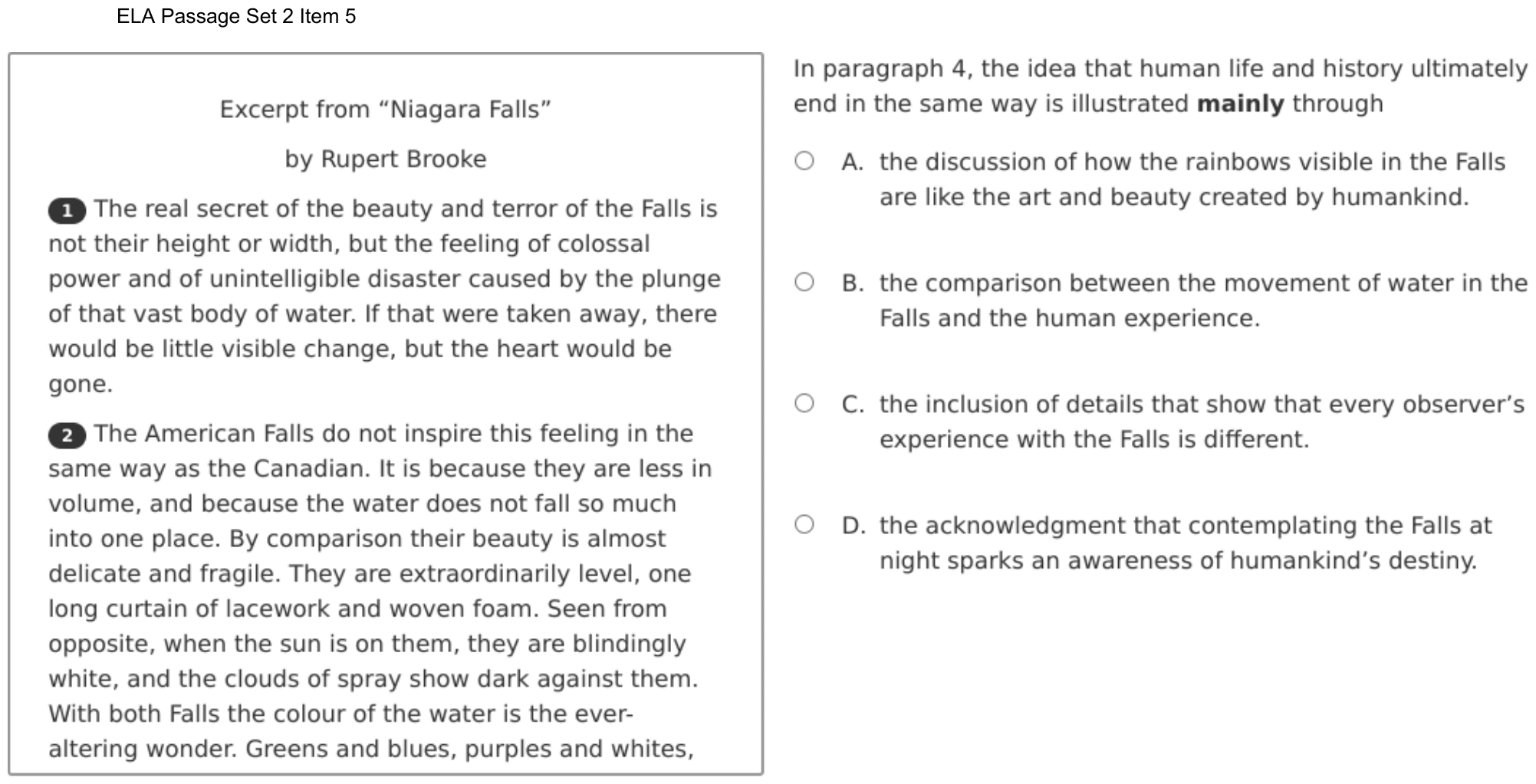
Question 81 of 120
2026 Practice Test C English, question 20Passage Bird Talk
Bird Talk
by Carl Sandburg
And now when the branches were beginning to be heavy,
It was the time when they once had said, “This is the
beginning of summer.”
The shrilling of the frogs was not so shrill as in the
first weeks after the broken winter;
The birds took their hops and zigzags a little more
anxious; a home is a home; worms are worms.
The yellow spreads of the dandelions and buttercups
reached across the green pastures.
Tee whee and tee whee came on the breezes, and the grackles
chuzzled their syllables.
And it was the leaves with a strong soft wind over them
that talked most of all and said more than any others
though speaking the fewest words.
It was the green leaves trickling out the gaunt nowhere
of winter, out on the gray hungry branches—
It was the leaves on the branches, beginning to be heavy,
who said as they said one time before, “This is the be-
ginning of summer.”
We shall never blame the birds who come
where the river and the road make the Grand Crossing
and talk there, sitting in circles talking bird talk.
If they ask in their circles as to who is here
and as to who is not here and who used to be here,
Or if instead of counting up last year as against
this year, they count up this year as against next
year, and have their bird chatter about who is here
this year who won’t be here next year,
We shall never blame the birds.
If I have put your face among leaf faces, child,
Or if I have put your voice among bird voices,
Blame me no more than the bluejays.
“Bird Talk” by Carl Sandburg—Public domain.
Question
Read lines 6–7 from the poem.
The birds took their hops and zigzags a little more
anxious; a home is a home; worms are worms.
What idea from the second stanza do the lines help develop?
- AThe birds are eager for the return of warmer months.
- BThe birds are most likely to thrive during the spring.
- CThe birds naturally adjust to the seasonal changes.
- DThe birds instinctively prepare for the future.
Show the answer
Correct answer: C
The question asks how lines 6–7 from the poem develop an idea from the second stanza.
A. Incorrect. In lines 2–3, the tree branches exclaim that “ ‘This is the / beginning of summer,’ ” and the birds respond by taking “their hops and zigzags a little more / anxious” (lines 6–7); however, the birds’ eager reaction to the return of warmer weather is not referenced in the second stanza of the poem, which is more about the nature of birds generally than the changing of the seasons.
B. Incorrect. Birds are more likely to thrive in warmer weather as evidenced by some birds’ migration to a warmer climate during winter, and the creatures in the first stanza are responding to the “ ‘beginning of summer’ ” (line 3) in their own way, such as the birds who are taking “their hops and zigzags a little more / anxious” (lines 6–7). However, the thriving of birds during a particular season is not the focus of the second stanza; rather, it is focused on the general nature of birds.
C. CORRECT. The birds are taking “their hops and zigzags a little more / anxious” (lines 6–7) in light of warmer weather, but they are not making a big to-do of the change because “a home is a home; worms are worms” (line 7) any time of the year. Such a natural adjustment to seasonal changes is reflected in the second stanza, where the birds “count up this year as against next / year” (lines 26–27) because they are well accustomed to the cyclical nature of things.
D. Incorrect. Although the birds’ actions of “hops and zigzags” (line 6) may indicate some sort of preparation, these actions are not preparation but rather the internalized cognizance of the change that has occurred with little conscious thought. As revealed in the second stanza, birds do not ponder much about past or future but rather adapt naturally as things change.
Question analysis
This question on Carl Sandburg’s poem “Bird Talk” quotes lines 6–7, where the birds hop and zigzag “a little more anxious,” and asks which idea from the second stanza they help develop. Students must link two compressed lines in the first stanza to a later stanza about birds gathered at the Grand Crossing, and every choice sounds like a fair claim about birds.
- Grade level
- Grade 8 reading and task
- Compared with grade 7
- Above grade 7 Typical grade 7 poetry questions ask what one line or stanza shows on its own. Here two compressed lines from the first stanza must be tied to an idea the second stanza never states, in Sandburg’s loose, unusual phrasing.
- Estimated difficulty
- Among the hardest on the SHSAT: a non-obvious approach, heavy reading, or a well-hidden trap.
- Thinking it demands
- Depth of knowledge 3, strategic thinking · mainly analyze
- What makes it hard
- Reading between the lines major
- A very close wrong answer moderate
- Evidence in several places moderate
- Figurative or literary language moderate
- Evidence
- Answered from several paragraphs or stanzas
- Reading level
- Passage: 296 words (a poem; reading level not measured); question and choices: about grade 5, 70 words.
- Students, last 30 days
- Not enough answers yet to show (it takes 10).
Why it is hard, traps and wrong answers (shows the answer)
Why it is hard
The stem runs in an unusual direction: two lines from the first stanza must help develop an idea that only the second stanza holds, and the poem never states it. Students who read “next year” as planning are drawn to preparation, a choice built on the key’s own frame, while others answer from the first stanza’s summer or from what they know about birds. The question rewards hearing the birds’ roll call of who is gone as the same matter-of-fact acceptance as “worms are worms.”
Reading between the lines major Working it out
Neither stanza states the shared idea: students must hear calm acceptance in “a home is a home; worms are worms” and in birds tallying “who won’t be here next year,” then call it adjusting to change. (Graesser, Singer & Trabasso, 1994; Kintsch, 1998)
A very close wrong answer moderate Choosing the answer
The choice about instinctive preparation shares the key’s shape, birds acting by nature as time passes; it differs only in what the birds do, prepare for the future rather than adjust to the seasons. (Embretson & Wetzel, 1987; Gorin & Embretson, 2006; Ascalon et al., 2007)
Evidence in several places moderate Working it out
Lines 6–7 sit in the first stanza and the idea lives in the second, lines 20–29, so students must carry two lines across the poem and match them to the gathering at the Grand Crossing. (Kirsch & Mosenthal, 1990; Gorin & Embretson, 2006)
Figurative or literary language moderate Understanding the question
“A home is a home; worms are worms” says nothing on its surface; its meaning, a shrug that life goes on as it always has, has to be read from the repetition. (Graesser, Singer & Trabasso, 1994; Kintsch, 1998)
Strategy: Paraphrase the second stanza first: what are the birds doing and saying at the Grand Crossing? Then reread lines 6–7 and ask which idea about birds both passages share.
Traps
- Reads too much in: A reasonable-sounding conclusion that goes further than the text allows.
- Wrong part of the text: A choice is true of another paragraph, stanza or speaker than the one asked about.
- Outside knowledge: A choice is plausible in the real world but not supported by this text.
The wrong answers, classified
A Wrong part of the text (Kirsch & Mosenthal, 1990)
Hears “a little more anxious” as eagerness for the summer announced in lines 2–3, an idea of the first stanza, while the second stanza never mentions weather or warmth.
B Outside knowledge (King et al., 2004; Recht & Leslie, 1988)
Brings in the real fact that birds do well in warm weather, which neither lines 6–7 nor the birds’ talk of who is gone says, and the poem’s season is summer, not spring.
D Reads too much in (Graesser, Singer & Trabasso, 1994)
Sees nest-building in “a home is a home” and planning in counting “this year as against next / year,” but the birds only note who will be missing and make no preparations.
Working it out, step by step
Figure out what the question asks
This question points in an unusual direction. Lines 6–7 are in the first stanza. A stanza is a group of lines set apart by a blank line. But the idea you need is in the second stanza, lines 20–29. The question asks which idea in stanza 2 these earlier lines also help build. So find the idea in stanza 2 first. Then see how lines 6–7 support it.
Find the idea in stanza 2
In stanza 2, birds sit “in circles talking bird talk.” They ask “who is here / and as to who is not here and who used to be here.” They also talk about “who is here / this year who won’t be here next year.” The birds simply count the changes. They are not upset by them. The speaker says, “We shall never blame the birds.” The idea: birds take the changes that time brings as a normal part of life.
Read lines 6–7 closely
Lines 6–7 say “The birds took their hops and zigzags a little more / anxious; a home is a home; worms are worms.” As summer comes, the birds hop about a little more nervously and busily. That is a small change. Then the speaker shrugs: “a home is a home; worms are worms.” Life goes on as it always does. The birds change a little and carry on, with no fuss.
See what the two parts share
Both parts show birds meeting change calmly. In lines 6–7, the season turns, and the birds adjust a little. To adjust is to change a little to fit something new. In stanza 2, the birds note who has come and gone, and life goes on. So lines 6–7 help build stanza 2’s idea: birds naturally adjust to the changing seasons.
Check each choice
- A does not fit. Stanza 2 never mentions warm weather or being eager for it.
- B does not fit. Nothing in the poem says birds do best in spring. The poem’s season is the start of summer.
- C fits. Both parts show birds taking seasonal change calmly, as a matter of course.
- D does not fit. The birds talk about next year, but they make no plans for it.
Watch out: D is tempting because “a home is a home” can sound like nest building. But the birds only count who will be missing. They do not get ready for anything.
Choose the answer
Lines 6–7 and stanza 2 both show birds accepting change as natural. So the answer is C, “The birds naturally adjust to the seasonal changes.”
Why this answer and not the closest wrong one
D is the closest wrong choice. Like C, it says birds act by nature as time passes. But D says they prepare, or get ready. In stanza 2, the birds talk about next year only to count who “won’t be here next year.” In lines 6–7, they hop about and carry on. They adjust to change. They do not plan for it.
More questions like this
The original DOE question
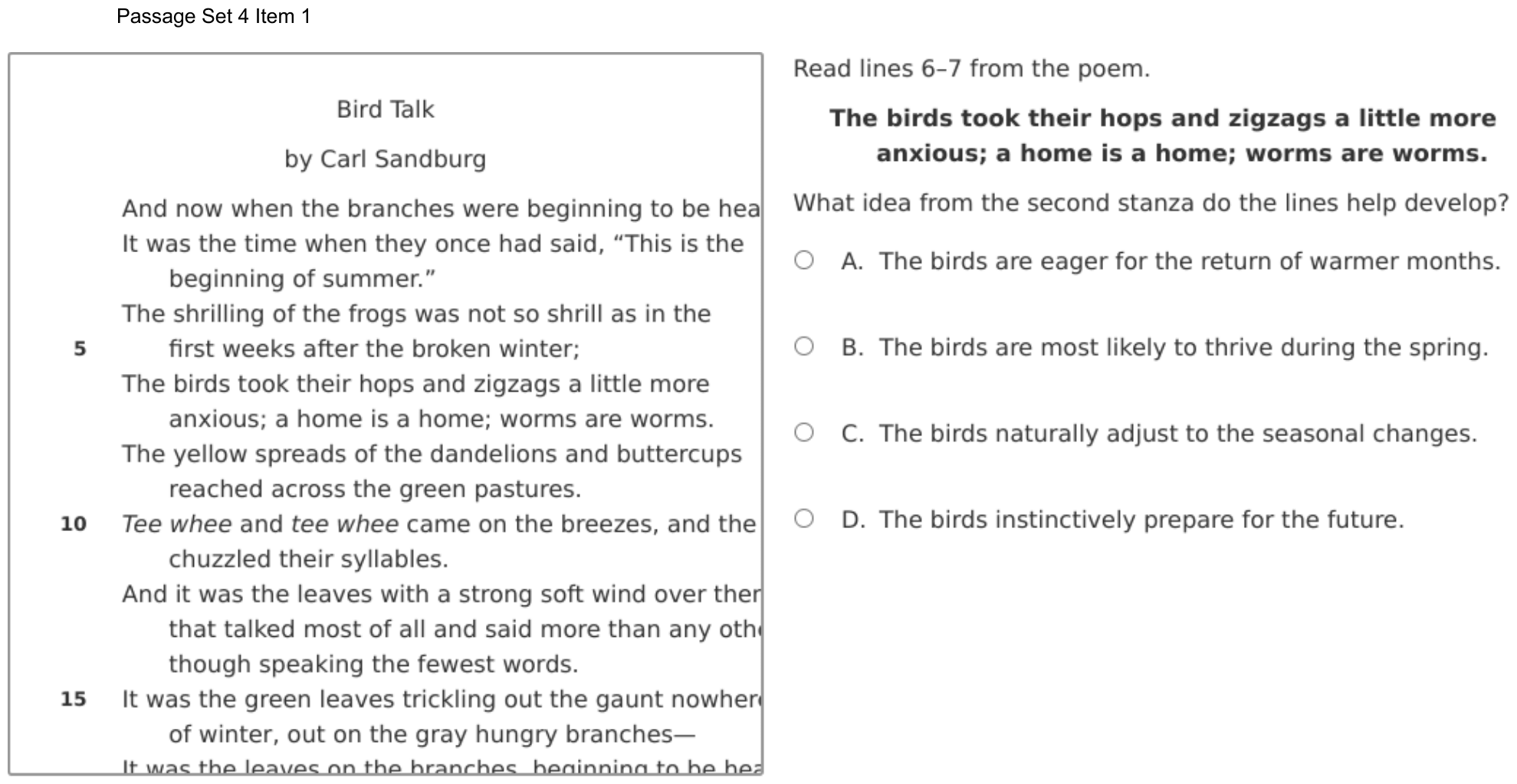
The passage “Bird Talk” as printed (page 32)
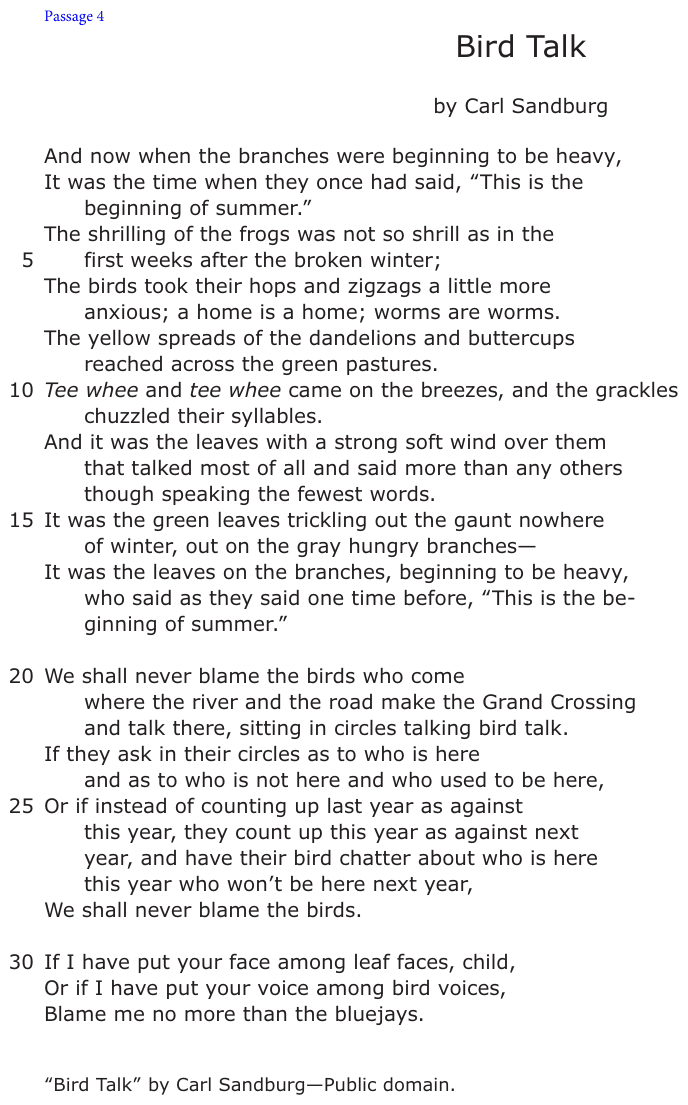
Question 82 of 120
2026 Practice Test C English, question 21Uses the passage above: “Bird Talk”.
Question
Read lines 12–14 from the poem.
And it was the leaves with a strong soft wind over them
that talked most of all and said more than any others
though speaking the fewest words.
What does the phrase “talked most of all” in line 13 convey?
- AIt establishes that the speaker thinks the sound of wind in the leaves is the best indication that the season is changing.
- BIt introduces the idea that the sound of the wind in the leaves remains constant throughout the seasons.
- CIt suggests that the speaker is overwhelmed by the sounds of nature that emerge as the season changes.
- DIt emphasizes that the sounds of nature enable the speaker to appreciate each season of the year.
Show the answer
Correct answer: A
This question asks for what a phrase reveals about the speaker’s perspective on the change in seasons.
A. CORRECT. The first stanza of the poem establishes the way different parts of the natural world, including both plants and animals, respond to the change in season. These lines reflect the way the wind in the leaves is the best indication of the seasonal change because it is the wind in the leaves that “talked most of all and said more than any others / though speaking the fewest words” (lines 13–14).
B. Incorrect. Although the sound of the wind is the most obvious sign of the seasonal change per the speaker, it is in response to the “ ‘beginning of summer’ ” (line 3) that the wind speaks through the leaves. The poem does not reveal that this figurative speech occurs throughout the seasons, only that it occurs during the transition to summer.
C. Incorrect. While the language used by the speaker indicates a deep appreciation for the natural phenomenon being witnessed, the language used does not indicate a feeling of being overwhelmed but rather a feeling of awareness.
D. Incorrect. Using the personification of the wind “speaking” (line 14) indicates an appreciation by the speaker for the power and volume of the wind’s voice, but only one instance of the wind’s speech, that which occurs at the “ ‘beginning of summer’ ” (line 3), is chronicled by the speaker in the poem.
Question analysis
Students interpret the personification in lines 12–14 of “Bird Talk,” where the leaves under a strong soft wind “talked most of all,” and decide what that phrase conveys. Because the leaves also speak “the fewest words,” the line seems to contradict itself, and its meaning depends on how it fits Sandburg’s first stanza about the start of summer.
- Grade level
- Grade 7 reading and task
- Compared with grade 7
- At grade 7 Explaining what a figurative phrase conveys about a speaker’s view is standard grade 7 work. The three lines are printed with the question, though the phrase still has to be read against the rest of the first stanza.
- Estimated difficulty
- Moderate: several steps, or a close reading with one strong distractor.
- Thinking it demands
- Depth of knowledge 2, skills and concepts · mainly understand
- What makes it hard
- Figurative or literary language moderate
- Reading between the lines moderate
- Evidence
- Answered from one paragraph or stanza
- Reading level
- Passage: 296 words (a poem; reading level not measured); question and choices: about grade 6, 119 words.
- Students, last 30 days
- Not enough answers yet to show (it takes 10).
Why it is hard, traps and wrong answers (shows the answer)
Why it is hard
The phrase ranks the leaves above the shrilling frogs and chattering birds as voices of the season, but it never says what they are best at, so students must supply the idea of a sign. The tempting wrong readings take the speaker’s pleasure in nature and stretch it to every season, or hear “talked most of all” as noise. The quiet words around the phrase, “strong soft wind” and “fewest words,” point to a calm sound that tells the most.
Figurative or literary language moderate Understanding the question
The leaves are personified, and the line seems to contradict itself: they “talked most of all and said more than any others / though speaking the fewest words.” (Graesser, Singer & Trabasso, 1994; Kintsch, 1998)
Reading between the lines moderate Working it out
Students must turn “said more than any others” into a judgment, that the leaves are the surest sign of summer, which lines 17–19 confirm when the leaves themselves announce “the beginning of summer.” (Graesser, Singer & Trabasso, 1994; Kintsch, 1998)
Strategy: Restate lines 12–14 in plain words, especially the contrast between saying more and speaking fewer words, then test each choice against the whole first stanza.
Traps
- Too broad or too strong: A choice overstates, generalizes, or uses absolute words the text does not support.
- Wrong tone or attitude: Misjudges the tone, attitude or point of view, such as reading admiration as criticism, or taking a character's or subject's feelings for the author's.
- Twists what the text says: Uses the text's topic and ideas but changes what it says: who did it, how much, when, or why.
The wrong answers, classified
B Twists what the text says (King et al., 2004)
Stretches “as they said one time before” into a sound heard all year, though the leaves have only just come out of “the gaunt nowhere / of winter.”
C Wrong tone or attitude (Graesser, Singer & Trabasso, 1994)
Hears “talked most of all” as a din that swamps the speaker, though the “strong soft wind” and “fewest words” describe a quiet sound noted calmly, with no sign of strain.
D Too broad or too strong (King et al., 2004)
Rightly senses the speaker’s pleasure in nature’s voices but widens it to “each season of the year,” though the poem watches only the turn to summer and singles out the leaves.
Working it out, step by step
Figure out what the question asks
This asks what a phrase conveys, or gets across. The phrase is “talked most of all” in line 13. Leaves can’t really talk. Giving a thing human actions, like talking, is called personification. You need to work out what the speaker means by saying the leaves talked the most.
Read lines 12–14
Lines 12–14 say “And it was the leaves with a strong soft wind over them / that talked most of all and said more than any others / though speaking the fewest words.” The others are the frogs and birds from earlier lines. The leaves “said more than any others,” yet they used “the fewest words.” So the quiet rustle of the leaves tells you more than all the frog and bird calls.
Find what the leaves say
The stanza ends with the leaves speaking. Lines 17–19 say it was “the leaves on the branches, beginning to be heavy,” who said “This is the beginning of summer.” So the leaves’ message is that the season has changed. The new leaves, rustling in the wind, are the clearest sign that summer has come.
Check each choice
- A fits. The leaves say the most about the season, so they are the best sign that it is changing.
- B does not fit. The leaves have just come out of “the gaunt nowhere / of winter.” Gaunt means thin and bare. The leaves do not rustle the same way all year.
- C does not fit. A “strong soft wind” and “the fewest words” describe a quiet sound. Nothing shows the speaker is overwhelmed, or swamped.
- D does not fit. The poem watches only one change, the start of summer, not each season.
Watch out: D is tempting because the speaker clearly enjoys nature’s sounds. But it stretches that to “each season of the year,” which the poem never covers.
Choose the answer
“Talked most of all” shows that the leaves tell the most about the change of season. So the answer is A, “It establishes that the speaker thinks the sound of wind in the leaves is the best indication that the season is changing.”
Why this answer and not the closest wrong one
D is the closest wrong choice. The speaker does seem to enjoy the sounds of nature. But the poem covers just one change, the turn to summer. And the phrase does more than show enjoyment. It ranks the leaves above the frogs and birds. They say the most about the change, so they are the best sign of it.
More questions like this
The original DOE question
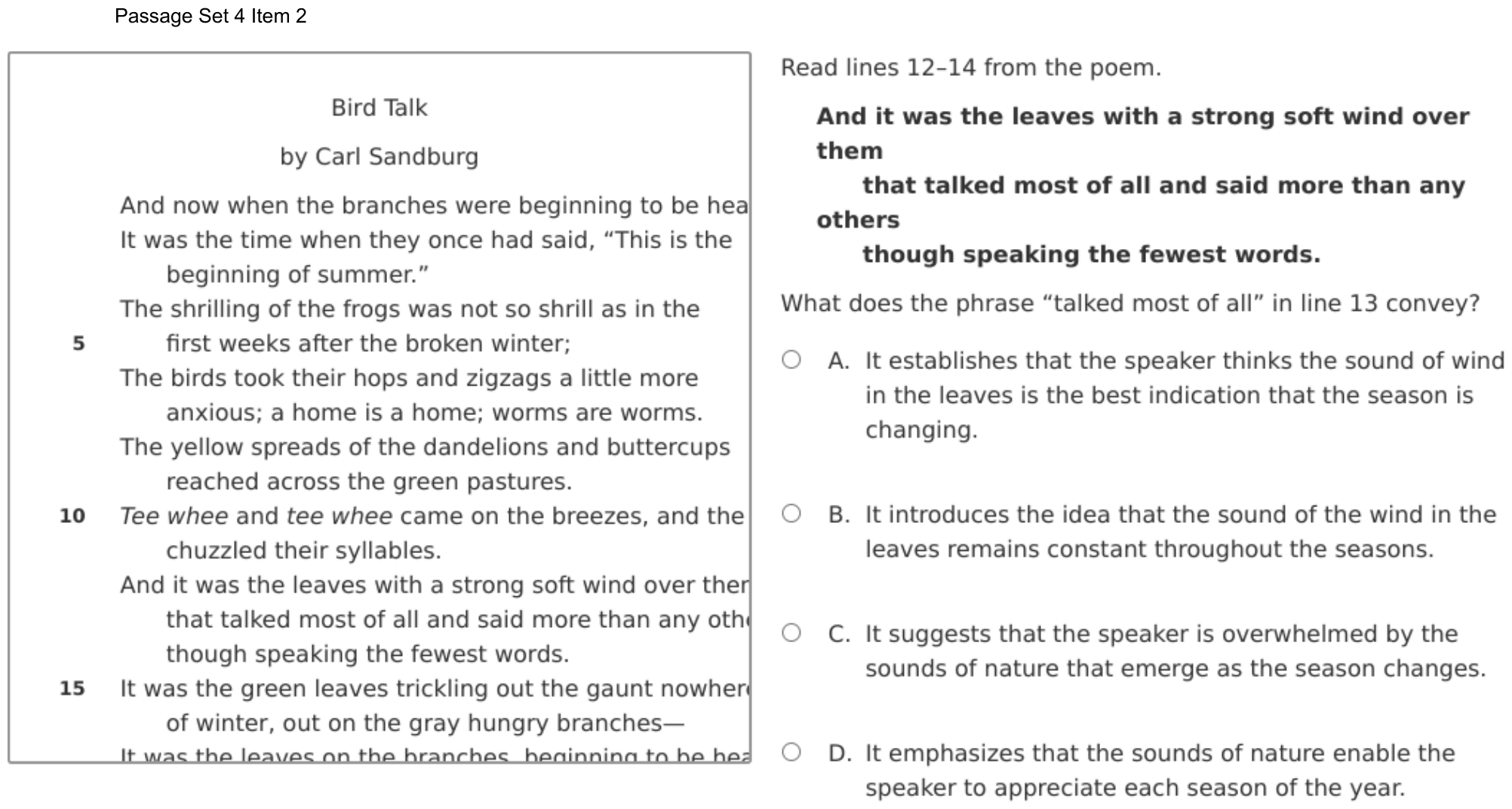
Question 83 of 120
2026 Practice Test C English, question 22Uses the passage above: “Bird Talk”.
Question
How does the repetition of “ ‘This is the beginning of summer’ ” in lines 2–3 and lines 18–19 contribute to the meaning of the poem?
- AIt suggests that the shift to summer occurs in the same way each year.
- BIt emphasizes the idea that living things are prepared for the change of season.
- CIt highlights the idea that the first signs of summer are surprising each year.
- DIt builds expectations about what the natural world looks like during a change of season.
Show the answer
Correct answer: A
The question asks how the repetition of a phrase contributes to the meaning of the poem in terms of conveying information about a cyclical event.
A. CORRECT. This phrase is used twice verbatim, in both cases to show the figurative words spoken by the branches (lines 2–3) and the leaves on the branches (lines 18–19). Repetition of this phrase conveys the idea that the transition to summer occurs in the same manner each subsequent year and thus evokes the same response from nature.
B. Incorrect. While living things—branches and leaves—both make identical figurative utterances, they do so not because they have prepared for such an event. Rather, these living things take the change in stride because of the sameness and expectedness of the seasonal shifts, which occur in the same way each time.
C. Incorrect. Even though the branches and leaves have been imbued by the speaker with some degree of consciousness in their figurative ability to speak, they are not surprised by the change in seasons. They say the same thing each year because the same thing occurs each year in the same way.
D. Incorrect. Certain lines of the poem do describe the natural world during the change of seasons, such as lines 8–9: “The yellow spreads of the dandelions and buttercups / reached across the green pastures.” However, this repeated phrase serves to evoke a sense of sameness and inevitability; it is not a phrase related to the physical appearance of the natural world, only the way the natural world responds to the seasonal change with simple acceptance for its sameness. The repeated lines do not hold any sort of expectation or anticipation for the coming of summer; they help relay observations made about the state of the season.
Question analysis
This poetry question asks how the repetition of “This is the beginning of summer,” said by the branches in lines 2–3 and by the leaves in lines 18–19 of Sandburg’s “Bird Talk,” contributes to the poem’s meaning. Students must judge what the repetition does, not only what the words say, and the four choices read the repeated line in quite different ways.
- Grade level
- Grade 7 reading and task
- Compared with grade 7
- At grade 7 Explaining what a repeated phrase adds to a poem is familiar grade 7 work. Both passages are pointed out by line number, so the task is to judge the effect of the repetition rather than to find it.
- Estimated difficulty
- Straightforward: two steps or one careful reading.
- Thinking it demands
- Depth of knowledge 2, skills and concepts · mainly analyze
- What makes it hard
- How, not what moderate
- Reading between the lines minor
- Evidence
- Answered from one paragraph or stanza
- Reading level
- Passage: 296 words (a poem; reading level not measured); question and choices: about grade 7, 79 words.
- Students, last 30 days
- Not enough answers yet to show (it takes 10).
Why it is hard, traps and wrong answers (shows the answer)
Why it is hard
Both quotations are pointed out, so the work is deciding what the echo adds. Students who know that repetition emphasizes may grab a choice that begins “emphasizes,” and those who hear the quoted words as a cry of discovery may pick surprise, even though that choice shares the key’s “each year.” Reading the lead-ins, “once had said” and “one time before,” settles it: the line is an old, expected announcement.
How, not what moderate Working it out
The question asks what repeating the line does for the poem, not what the line says, so students must judge an effect of structure: the same words open the first stanza and close it. (Anderson & Krathwohl, 2001)
Reading between the lines minor Working it out
The clue is in the lead-ins, “they once had said” in line 2 and “as they said one time before” in line 18, which present the announcement as words said at this point in earlier years. (Graesser, Singer & Trabasso, 1994; Kintsch, 1998)
Strategy: Reread each quoted passage together with the line that leads into it, then decide what the poet gains by having the branches and the leaves say the same words.
Traps
- Reads too much in: A reasonable-sounding conclusion that goes further than the text allows.
- Wrong tone or attitude: Misjudges the tone, attitude or point of view, such as reading admiration as criticism, or taking a character's or subject's feelings for the author's.
- Wrong purpose or structure: Names a purpose, structure or effect that the part does not serve, or describes what a part says when the question asks what it does.
The wrong answers, classified
B Reads too much in (Graesser, Singer & Trabasso, 1994)
Moves from the calm, repeated announcement to the claim that branches and leaves were ready for summer, but saying the same words again shows recurrence, not preparation.
C Wrong tone or attitude (Graesser, Singer & Trabasso, 1994)
Keeps the idea of “each year” but hears the quoted words as a cry of surprise, though “once had said” and “one time before” make them a familiar, expected announcement.
D Wrong purpose or structure (Anderson & Krathwohl, 2001)
Gives the repeated line the job of the stanza’s pictures, the dandelions and green pastures, though it names when summer begins and says nothing about how the land looks.
Working it out, step by step
Figure out what the question asks
This asks about repetition, which means using the same words more than once. The words “This is the beginning of summer” appear in lines 2–3. They come back in lines 18–19. You need to work out what saying them twice adds to the poem’s meaning.
Read the words that lead in
Look at the words just before each quotation. Line 2 says “It was the time when they once had said.” Line 18 says the leaves “said as they said one time before.” Both lead-ins point to the past. The branches and leaves have said these words before, at this same time in other years.
Work out what the repetition shows
The same words come back, just as summer itself comes back. Each year the branches get heavy, the leaves come out, and it is summer again. The change happens the same way every time. So the repeated line works like a yearly announcement that nobody finds strange. It shows that the shift to summer follows a familiar pattern.
Check each choice
- A fits. The repeated words show summer arriving the same way each year.
- B does not fit. Saying the words again shows that summer returns. It does not show that living things got ready for it.
- C does not fit. Something said “one time before” is familiar, not surprising.
- D does not fit. The line only names a time. Pictures like the yellow dandelions show how the land looks.
Watch out: C also says “each year,” so it can look right. But the quoted words are calm, like an old saying, not a cry of surprise.
Choose the answer
The repeated line is an old announcement, made again because summer comes again. So the answer is A, “It suggests that the shift to summer occurs in the same way each year.”
Why this answer and not the closest wrong one
C is the closest wrong choice, because it also points to something that happens each year. But C says the first signs of summer are a surprise. The lead-ins say the opposite. The branches “once had said” these words, and the leaves said them “one time before.” Words said many times before are expected. They show a pattern, not a surprise.
More questions like this
The original DOE question
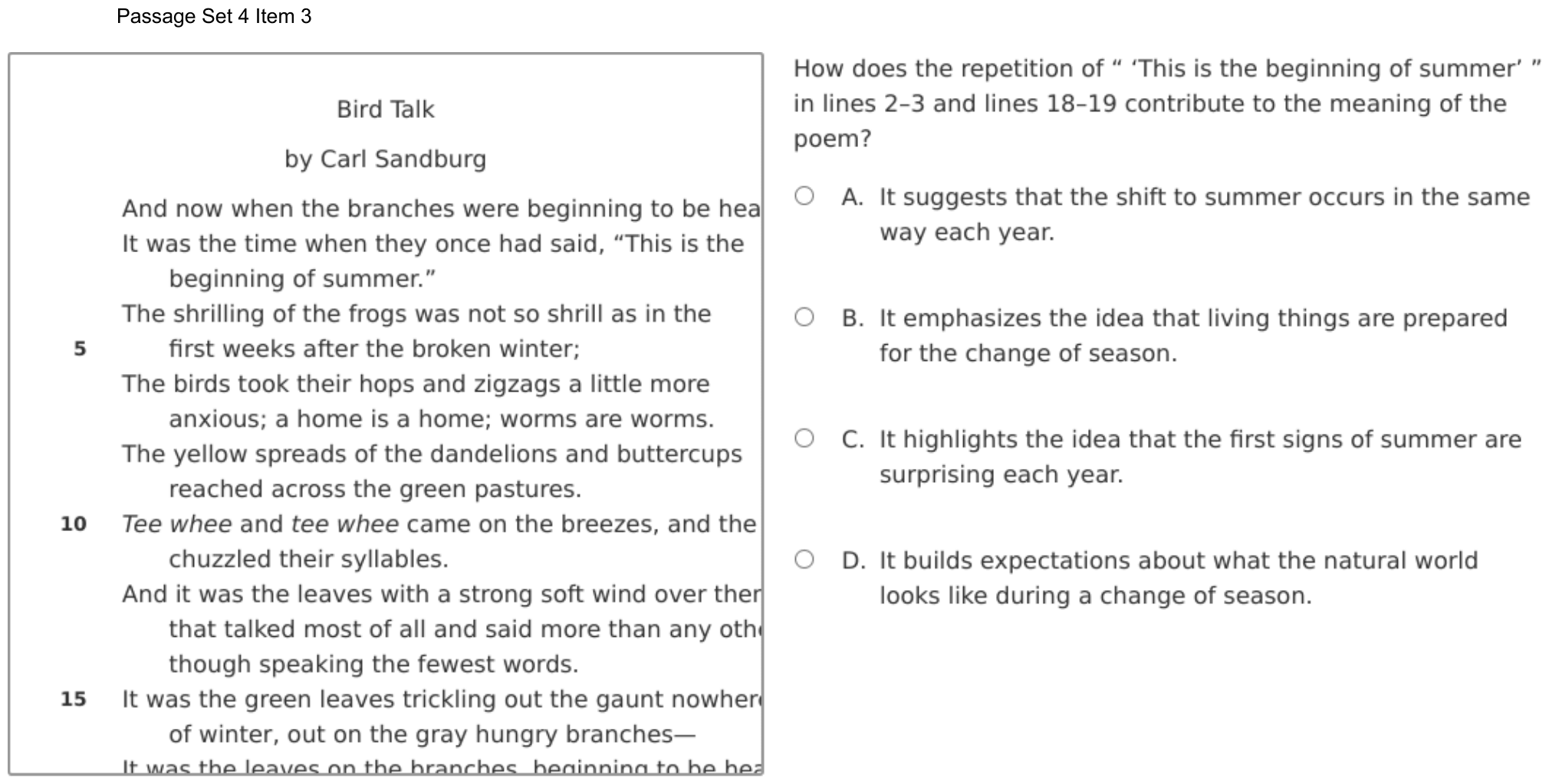
Question 84 of 120
2026 Practice Test C English, question 23Uses the passage above: “Bird Talk”.
Question
Which lines from the poem best contrast with the idea of winter’s scarcity and bleakness?
- A“The shrilling of the frogs was not so shrill as in the / first weeks after the broken winter;” (lines 4–5)
- B“The yellow spreads of the dandelions and buttercups / reached across the green pastures.” (lines 8–9)
- C“Tee whee and tee whee came on the breezes, and the grackles / chuzzled their syllables.” (lines 10–11)
- D“Or if instead of counting up last year as against / this year, they count up this year as against next” (lines 25–26)
Show the answer
Correct answer: B
The question asks for the identification of a description that contrasts with the scarcity and bleakness of winter.
A. Incorrect. These lines indicate that the frogs are first very excited about the shift from winter to spring, which causes them to make a loud “shrilling,” yet their sounds lessen after a time and grow weaker. As such, these lines contrast two periods of spring (early vs. later) and the response of the frogs to these two periods; the lines do not contrast the bleakness of winter with the abundance of spring or summer.
B. CORRECT. During winter, there is scarcity of plant life and a bleak landscape: trees lose their leaves, snow covers the ground, and nature appears dark and shuttered. In contrast, these lines reveal the bright “yellow spreads” of flowers and the verdant “green pastures” that are signs that winter has abated.
C. Incorrect. This description contrasts the sounds of “the breezes” of warmer air and the sounds made by grackles—a type of bird—rather than the bleakness and scarcity of winter and the abundance of the “ ‘beginning of summer’ ” (line 3).
D. Incorrect. These lines show the contrast between the two ways of looking at things in terms of past vs. present or present vs. future; in this instance, the lines reveal the way birds naturally expect and adapt to the passing of time and the change of seasons. The lines do not present a contrast between winter and spring.
Question analysis
This textual evidence question on Carl Sandburg’s poem “Bird Talk” asks which lines best contrast with the idea of winter’s scarcity and bleakness. Students compare four quotations about frogs, flowers, birdsong and the birds’ yearly counting, and the challenge is finding the one whose images most fully show the opposite of a bare, bleak season.
- Grade level
- Grade 7 reading and task
- Compared with grade 7
- At grade 7 Choosing lines that fit an idea is routine grade 7 evidence work. The twist is that students look for the opposite of an idea, winter’s scarcity and bleakness, rather than support for it, though the quoted images are concrete.
- Estimated difficulty
- Straightforward: two steps or one careful reading.
- Thinking it demands
- Depth of knowledge 2, skills and concepts · mainly evaluate
- What makes it hard
- Every choice must be checked minor
- Hard words minor
- Evidence
- Answered from one sentence or line
- Reading level
- Passage: 296 words (a poem; reading level not measured); question and choices: about grade 6, 85 words.
- Students, last 30 days
- Not enough answers yet to show (it takes 10).
Why it is hard, traps and wrong answers (shows the answer)
Why it is hard
The question turns the usual evidence task around: students picture a scarce, bleak winter and then look for its opposite. The line that names winter outright is a trap, since it only compares the frogs’ noise in two stretches of spring, and the grackles’ calls show life without plenty. The flowers spreading “across the green pastures” are the one image of abundance and color.
Every choice must be checked minor Choosing the answer
Every quotation carries some sign of the season, frogs, flowers, birdsong and the birds’ yearly count, so each must be tested for images of plenty and color set against a bare winter. (Embretson & Wetzel, 1987)
Hard words minor Understanding the question
The stem’s “scarcity” and “bleakness” define what to look for; a student unsure of them cannot tell that yellow and green spreading across pastures is their opposite. (Perfetti, 2007; Freedle & Kostin, 1993)
Strategy: First picture what a scarce, bleak winter looks like, then read each quotation for images that show the plain opposite of that picture.
Traps
- Word match: Repeats striking words or phrases from the text, so it looks supported, but its meaning does not fit the question.
- Supports only part of the claim: In a question about evidence: a line that backs one half of the claim but not the other, or a related point rather than the claim itself.
The wrong answers, classified
A Word match (Freedle & Kostin, 1993)
Is drawn by “the broken winter,” the only mention of winter among the choices, but the lines compare the frogs’ shrilling early and later in spring, not winter’s bareness with plenty.
C Supports only part of the claim (King et al., 2004; Thissen, Steinberg & Fitzpatrick, 1989)
Picks the birdsong, which does show life returning after a silent season, but the calls say nothing about scarcity giving way to plenty, as the spreading flowers in lines 8–9 do.
D Word match (Freedle & Kostin, 1993)
Takes “as against” for the contrast the question asks about, though these lines set one year against another in the birds’ talk and hold no image of winter or of growth.
Working it out, step by step
Figure out what the question asks
This asks you to find lines that show the opposite of winter. Scarcity means not having enough of something. Bleakness means looking bare, cold and gloomy. So picture winter: bare branches, no flowers, gray and brown fields. Then look for the lines that show plenty and bright color instead.
Read lines 8–9
Lines 8–9 say “The yellow spreads of the dandelions and buttercups / reached across the green pastures.” Dandelions and buttercups are small yellow flowers. Pastures are grassy fields. A spread is a wide area covered with something. Here, yellow flowers stretch across green fields. That is a picture of color everywhere and plenty of growth. It is the exact opposite of a bare, gray winter.
Check each choice
- A does not fit. It mentions “the broken winter,” but it only compares how shrill, or sharp and high, the frogs sounded at two times. Nothing in it shows plenty.
- B fits. Yellow flowers spread over green fields, full of color and life.
- C does not fit. The birdsong shows that life is back. But it gives no picture of plenty or color to set against a bare winter.
- D does not fit. These lines compare one year with another in the birds’ talk. There is no winter and no growth in them.
Watch out: A is the only choice that names winter, so it can seem to fit. But mentioning winter is not the same as contrasting with it.
Choose the answer
Only lines 8–9 show plenty and bright color, the opposite of a scarce, bleak winter. So the answer is B, lines 8–9: “The yellow spreads of the dandelions and buttercups / reached across the green pastures.”
Why this answer and not the closest wrong one
C is a close wrong choice, since birdsong is a sign that life is back. But the question asks for a contrast with scarcity, or not having enough. Sounds alone do not show plenty. Lines 8–9 show flowers spreading wide across green fields. That picture of color and plenty is the clearest opposite of a bare, gray winter.
More questions like this
The original DOE question
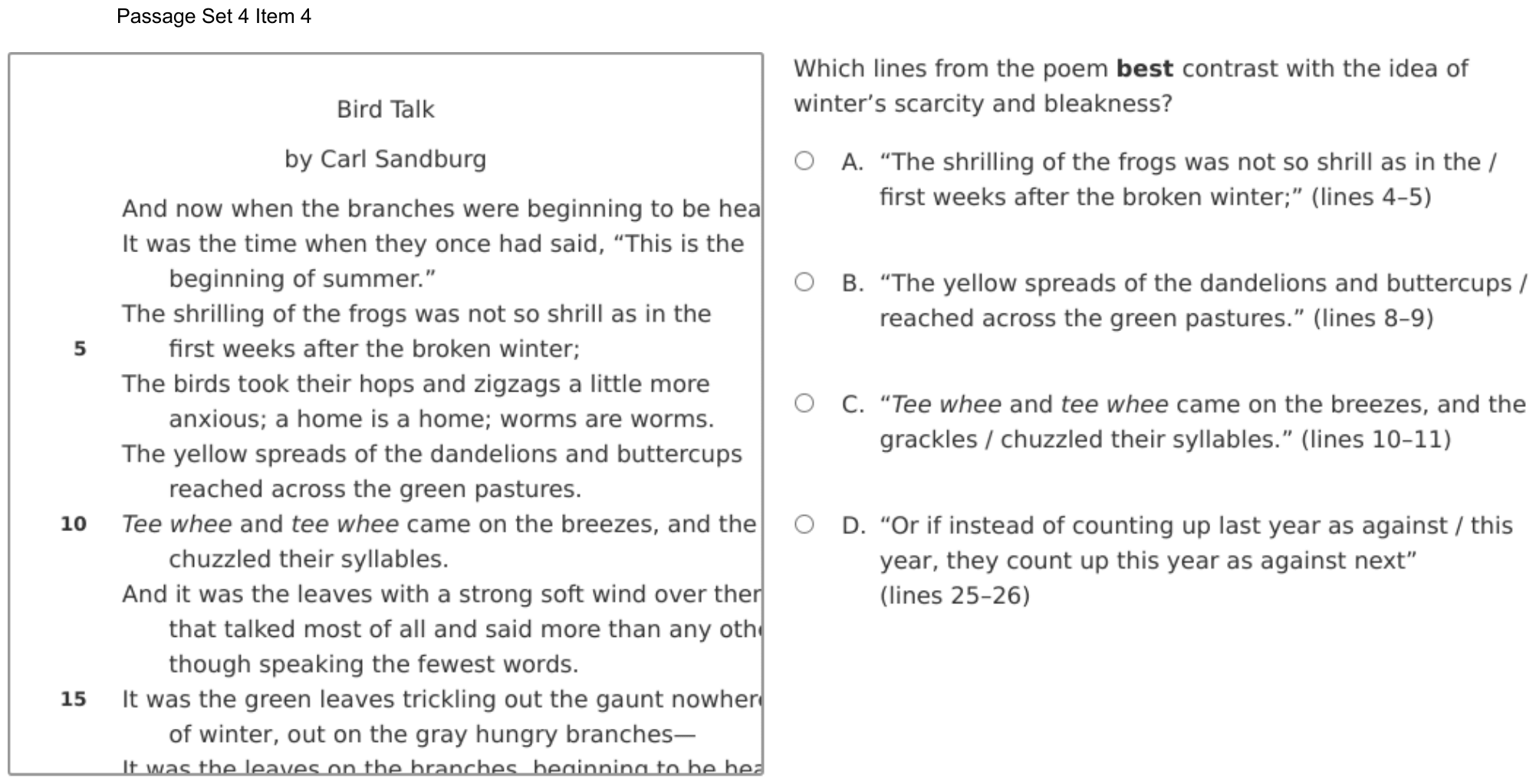
Question 85 of 120
2026 Practice Test C English, question 24Uses the passage above: “Bird Talk”.
Question
Throughout the poem, the poet conveys the speaker’s point of view by
- Agradually moving the speaker’s attention from one element of nature to another.
- Bproviding the speaker’s motivation for describing the landscape in great detail.
- Chighlighting the speaker’s emotional response as each season passes.
- Dshifting the speaker’s focus from external observations to personal reflection.
Show the answer
Correct answer: D
This question asks for an explanation of how the poet conveys the speaker’s point of view on the natural world and the change of seasons as presented in the poem.
A. Incorrect. Though in the first stanza the speaker describes various elements of nature such as branches, frogs, birds, flowers, and leaves, these elemental shifts are not precisely gradual and occur only in the first stanza. Further, the first stanza, though appreciative of the natural world, is primarily descriptive and does not develop the speaker’s perspective to the degree that other parts of the poem do.
B. Incorrect. While it may be inferred that the speaker describes the landscape to such a degree because it has revealed a seasonal shift, that this is indeed the speaker’s motivation is never explicitly conveyed by the poet.
C. Incorrect. Multiple seasons do not pass in the poem; only the shift to the “ ‘beginning of summer’ ” (line 3) occurs in an endless cycle. Further, the speaker does not reveal an emotional response; it is the responses of nature that the speaker describes.
D. CORRECT. The first stanza is the speaker’s observations of the natural world embracing a new season. In the second stanza, the speaker begins to reflect on how the natural world, as embodied by the birds, calmly accepts seasonal change in its perpetual sameness. The reflection continues in the third stanza, where it is revealed that the speaker has been addressing these observations to a child.
Question analysis
This point-of-view question asks how the poet of “Bird Talk” conveys the speaker’s point of view throughout the poem. Students must keep in mind the long opening description of early summer and the two shorter stanzas after it, and decide which description of the poet’s method holds from the first line to the last.
- Grade level
- Grade 8 reading and task
- Compared with grade 7
- Above grade 7 Grade 7 point-of-view questions often ask what a speaker thinks. This one asks how the poet conveys that view across all three stanzas of a long free-verse poem, and the choices name methods in general terms, closer to grade 8 work.
- Estimated difficulty
- Hard: combines ideas, needs a plan, and has more than one tempting wrong answer.
- Thinking it demands
- Depth of knowledge 3, strategic thinking · mainly analyze
- What makes it hard
- Evidence in several places moderate
- A very close wrong answer moderate
- How, not what moderate
- Figurative or literary language minor
- Evidence
- Answered from the whole text
- Reading level
- Passage: 296 words (a poem; reading level not measured); question and choices: about grade 10, 54 words.
- Students, last 30 days
- Not enough answers yet to show (it takes 10).
Why it is hard, traps and wrong answers (shows the answer)
Why it is hard
The first stanza takes up 19 of the poem’s 32 lines and moves steadily from branches to frogs, birds, flowers and leaves, so a choice that describes it alone feels right. The point of view shows only when the poem turns to “We” and then to “I” addressing a child, and that third stanza is three hard lines. Students must keep the whole poem’s course in mind and choose the method that holds from first line to last.
Evidence in several places moderate Working it out
The answer depends on all three stanzas at once: the long catalog of the season in lines 1–19, the shift to “We shall never blame the birds,” and the closing “If I have put your face … child.” (Kirsch & Mosenthal, 1990; Gorin & Embretson, 2006)
A very close wrong answer moderate Choosing the answer
The choice about moving from one element of nature to another and the key both describe a shift in the speaker’s attention; they differ in what shifts, nature to nature or the outside world to the speaker’s own thoughts. (Embretson & Wetzel, 1987; Gorin & Embretson, 2006; Ascalon et al., 2007)
How, not what moderate Working it out
The stem asks how the poet conveys a point of view, a method, so a choice must describe what the speaker does across the poem, not what the speaker sees. (Anderson & Krathwohl, 2001)
Figurative or literary language minor Understanding the question
The last stanza is cryptic, “Blame me no more than the bluejays,” and students who miss that the speaker is now talking about putting a child into the poem lose the move to reflection. (Graesser, Singer & Trabasso, 1994; Kintsch, 1998)
Strategy: Write one phrase for what the speaker attends to in each stanza, then keep only a choice that describes the whole sequence, not one stanza.
Traps
- Too narrow: A single detail offered as the central idea or a summary, or a summary that keeps minor details and leaves out an essential part.
- Reads too much in: A reasonable-sounding conclusion that goes further than the text allows.
- Twists what the text says: Uses the text's topic and ideas but changes what it says: who did it, how much, when, or why.
The wrong answers, classified
A Too narrow (King et al., 2004)
Describes the first stanza well, its walk from branches to frogs, birds, flowers and leaves, but misses the later turn to “We” and to the speaker’s own “I.”
B Reads too much in (Graesser, Singer & Trabasso, 1994)
Supplies a reason for all the description, perhaps from the closing words to a child, but the speaker never says why the landscape is described, and the reflection is not a motive.
C Twists what the text says (King et al., 2004)
Sees that the poem follows nature through a change of season but makes it many seasons and hands the creatures’ reactions, such as the birds’ anxious hops, to the speaker as feelings.
Working it out, step by step
Figure out what the question asks
This asks about point of view: how the speaker, the voice talking in the poem, sees things. It also asks how the poet shows that view across the whole poem. So look at what the speaker pays attention to in each of the three stanzas. A stanza is a group of lines set apart by a blank line.
Follow the speaker through the stanzas
- Stanza 1, lines 1–19: the speaker describes the world outside. There are branches, frogs, birds, flowers and leaves at the start of summer.
- Stanza 2, lines 20–29: the speaker starts to judge and think. “We shall never blame the birds.”
- Stanza 3, lines 30–32: the speaker says “I” and talks to a child: “If I have put your face among leaf faces, child.”
Name the change in focus
The poem starts with external observations, or things the speaker sees and hears outside. It ends with personal reflection, or the speaker’s own thoughts. In the last stanza, the speaker admits to putting a child’s face and voice into the poem. The speaker asks to be blamed “no more than the bluejays.” Since “We shall never blame the birds,” that means not at all. This move from looking outward to looking inward is how the speaker’s view comes through.
Check each choice
- A does not fit. Moving from branches to frogs to birds happens only in stanza 1. It misses the turn to “We” and “I.”
- B does not fit. The speaker never says why the landscape is described.
- C does not fit. Only one change of season happens, the start of summer. The anxious feelings belong to the birds, not the speaker.
- D fits. The speaker moves from describing nature to thinking about it.
Watch out: A describes stanza 1 very well. But the question says “Throughout the poem,” so the answer must cover all three stanzas.
Choose the answer
The speaker starts by watching nature and ends by thinking aloud to a child. So the answer is D, “shifting the speaker’s focus from external observations to personal reflection.”
Why this answer and not the closest wrong one
A is the closest wrong choice. Stanza 1 really does move from one part of nature to another. But that is only 19 of the 32 lines. In stanzas 2 and 3, the speaker turns to “We” and then “I,” and shares personal thoughts. Only D describes the speaker’s path from the first line to the last.
More questions like this
The original DOE question
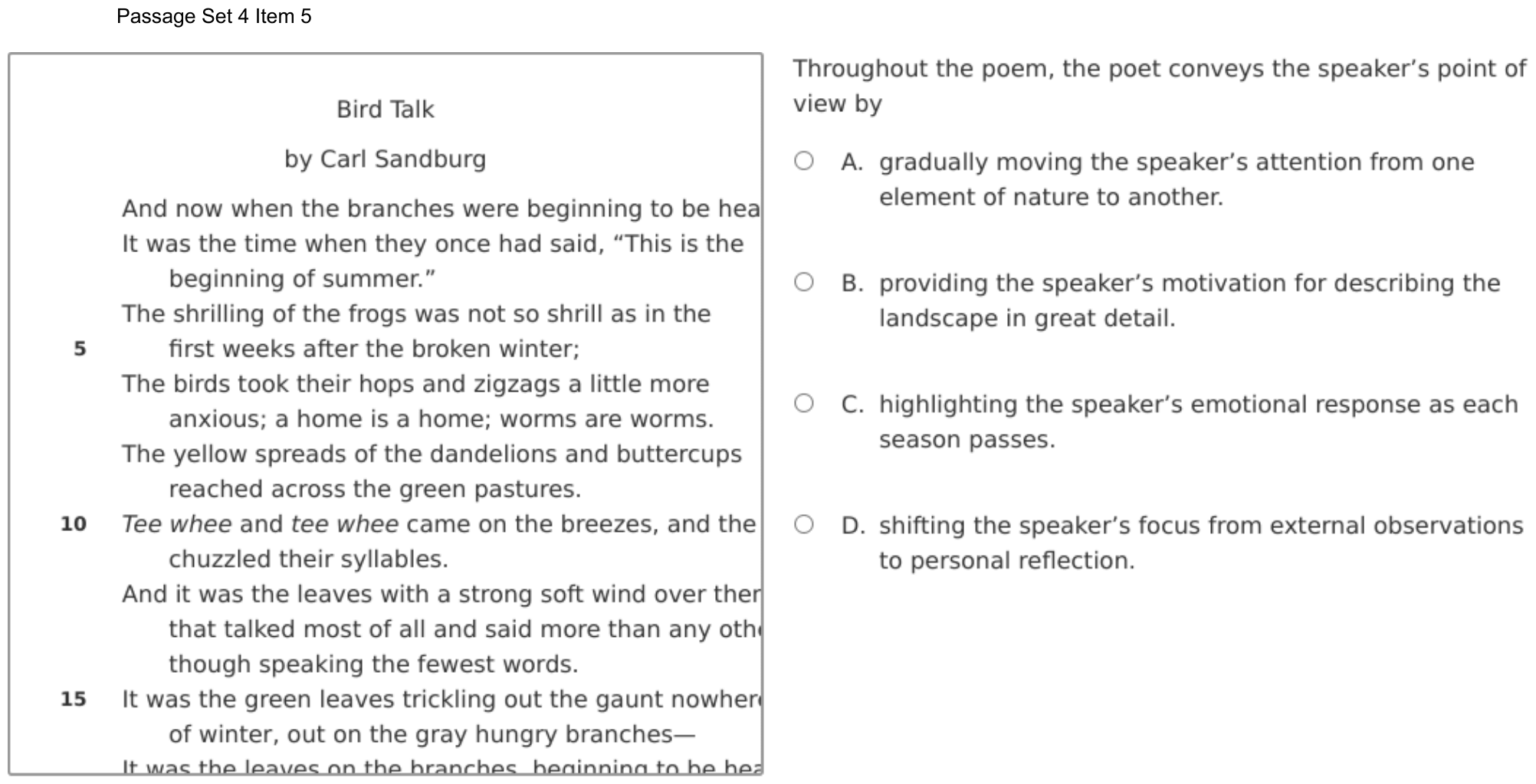
Question 86 of 120
2026 Practice Test C English, question 25Uses the passage above: “Bird Talk”.
Question
Over the course of the poem, a central idea is developed mainly through the speaker’s
- Asense of eager anticipation as winter ends.
- Bdescription of the changes in nature as the seasons transition.
- Cobservation of the birds’ behavior as summer begins.
- Dprediction of future alterations in the physical landscape.
Show the answer
Correct answer: B
The question asks how the central idea about the natural acceptance of change by nature is developed by the speaker of the poem.
A. Incorrect. The speaker is an observer of the changes in nature as propelled by the seasons and shows no personal eagerness for the end of winter. Further, even though nature rejoices at the end of winter as exemplified by “the shrilling of the frogs” (line 4), the speaker merely records this and does not share in this display.
B. CORRECT. The response of nature to the “beginning of summer” (line 3) is the primary focus of the poem as revealed by the speaker through vivid descriptions of the sights, sounds, movements, and attitudes of the natural world.
C. Incorrect. The second stanza of the poem begins a reflection on birds “sitting in circles talking bird talk” (line 22) and taking a sort of attendance of who is present, but this behavioral description is largely figurative and meant to illustrate a point about the way the birds adapt quickly to change, not to develop a central idea of the poem in terms of how nature responds generally.
D. Incorrect. Seasonal changes are inevitable and cyclical per the speaker, but the speaker does not predict future changes to the landscape as a method of developing the central idea. Rather, the speaker describes nature’s response to changes that have already occurred.
Question analysis
Students decide how the speaker of Carl Sandburg’s “Bird Talk” mainly develops a central idea of the poem. The question does not name the idea, so students must work it out across the poem’s three stanzas and then weigh four accounts of what the speaker does, each tied to a different part or feature of the poem.
- Grade level
- Grade 7 reading and task
- Compared with grade 7
- At grade 7 Tracing how a central idea develops is core grade 7 work. Here the idea is never stated, so students must first infer it from 32 lines of free verse and then judge what the speaker mainly does to build it.
- Estimated difficulty
- Moderate: several steps, or a close reading with one strong distractor.
- Thinking it demands
- Depth of knowledge 3, strategic thinking · mainly analyze
- What makes it hard
- A very close wrong answer moderate
- Reading between the lines moderate
- Evidence in several places minor
- Evidence
- Answered from the whole text
- Reading level
- Passage: 296 words (a poem; reading level not measured); question and choices: about grade 9, 48 words.
- Students, last 30 days
- Not enough answers yet to show (it takes 10).
Why it is hard, traps and wrong answers (shows the answer)
Why it is hard
The title “Bird Talk” and the whole second stanza push students toward the birds, and the key differs from that choice only in taking in all of nature. Two other choices credit the speaker with something the poem gives elsewhere: the eagerness belongs to the frogs and birds, and the only look ahead is the birds’ talk of next year. Weighing what the speaker does across all 32 lines points to the description of nature changing.
A very close wrong answer moderate Choosing the answer
The choice about the birds’ behavior as summer begins matches the key’s frame, the speaker watching nature at the turn of the season; it differs only in narrowing nature to birds. (Embretson & Wetzel, 1987; Gorin & Embretson, 2006; Ascalon et al., 2007)
Reading between the lines moderate Working it out
The central idea is never stated, so students must first work out that the poem is about nature meeting the year’s turn calmly, then judge which of the speaker’s acts builds it most. (Graesser, Singer & Trabasso, 1994; Kintsch, 1998)
Evidence in several places minor Working it out
Birds appear in lines 6–7, 10–11, 20–29 and 31–32, so the title and the second stanza make them look central until the branches, frogs, flowers and leaves are counted too. (Kirsch & Mosenthal, 1990; Gorin & Embretson, 2006)
Strategy: Put the poem’s central idea into a sentence of your own, then ask which choice describes something the speaker really does and does the most to build that idea.
Traps
- Too narrow: A single detail offered as the central idea or a summary, or a summary that keeps minor details and leaves out an essential part.
- Wrong tone or attitude: Misjudges the tone, attitude or point of view, such as reading admiration as criticism, or taking a character's or subject's feelings for the author's.
- Reads too much in: A reasonable-sounding conclusion that goes further than the text allows.
The wrong answers, classified
A Wrong tone or attitude (Graesser, Singer & Trabasso, 1994)
Gives the speaker the stir of the shrilling frogs and anxious birds, but the speaker records it calmly, and the poem opens after winter, at “the beginning of summer.”
C Too narrow (King et al., 2004)
Follows the title and the birds’ circles at the Grand Crossing, but birds are one thread in a poem that also tracks branches, frogs, dandelions and leaves into summer.
D Reads too much in (Graesser, Singer & Trabasso, 1994)
Builds a forecast from the birds counting “this year as against next / year,” but that talk concerns who will be gone, not the land, and the speaker predicts nothing.
Working it out, step by step
Figure out what the question asks
This asks how a central idea is mainly built. A central idea is a big point the whole poem makes. First, put that idea in your own words. Then ask what the speaker does most, across the whole poem, to build it.
Find the central idea
The poem shows nature at “the beginning of summer.” The branches grow heavy, the frogs quiet down, the flowers spread and the leaves come out. In stanza 2, the birds calmly count who has come and gone. A central idea is that nature moves through the seasons, and living things accept the change as natural.
See how the speaker builds it
Most of the poem is description. Stanza 1 fills 19 of the 32 lines with changes in nature. It shows “The yellow spreads of the dandelions and buttercups” and “the green leaves trickling out the gaunt nowhere / of winter.” Trickling out means coming out slowly, a little at a time. Gaunt means thin and bare. Detail by detail, the speaker shows the season turning. That description is the main way the idea is built.
Check each choice
- A does not fit. The frogs and birds are stirred up, but the speaker describes them calmly. The poem also starts after winter is over.
- B fits. The speaker describes nature changing as the seasons turn.
- C does not fit. Birds are only one part. The poem also covers branches, frogs, flowers and leaves.
- D does not fit. The speaker predicts nothing about the land. The birds’ talk of next year is about who will be gone.
Watch out: C is tempting because the poem is called “Bird Talk” and stanza 2 is all about birds. But the central idea is about all of nature.
Choose the answer
The speaker builds the idea mostly through details of nature changing as summer begins. So the answer is B, “description of the changes in nature as the seasons transition.”
Why this answer and not the closest wrong one
C is the closest wrong choice. It also has the speaker watching nature as summer begins. But it narrows nature to birds. The poem’s changes come from many living things: branches, frogs, dandelions, buttercups and leaves. Only B takes in all of them, so only B describes how the whole poem builds its idea.
More questions like this
The original DOE question
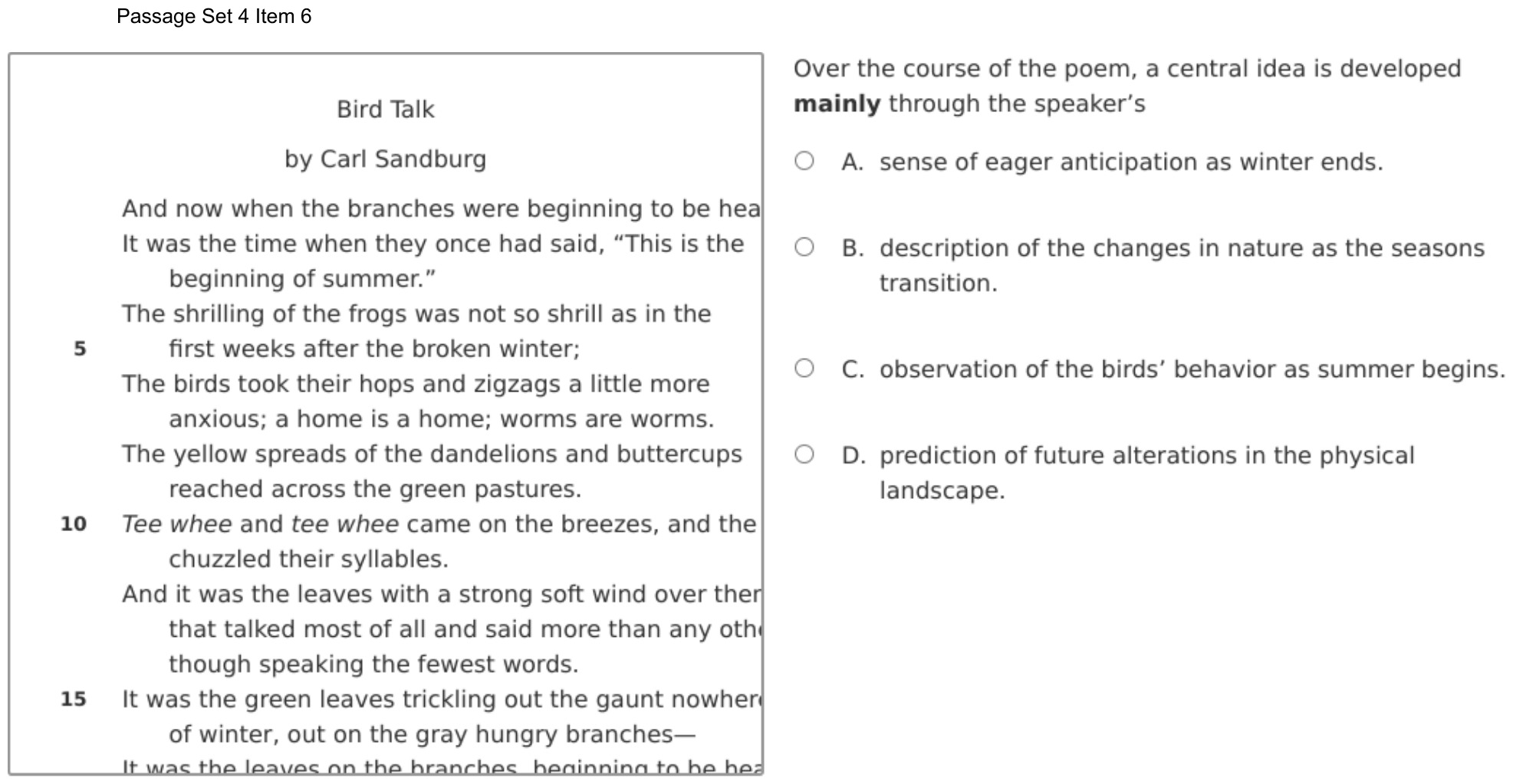
Question 87 of 120
2026 Practice Test C English, question 26Passage Serpent Mound
Serpent Mound
The Great Serpent Mound, located in Adams County, Ohio, is a human-made mound of earth that researchers believe was created between 300 B.C. and A.D. 1100 by an indigenous culture.
Ohio, 1846
Brush Creek stood low when the museum men came
with their measuring tapes and sketchbooks.
It was winter. Fringed with ice,
the creek doubled back on itself
as if it had forgotten something.
Pa was in Cincinnati, or else on his way home,
so Ma told me to lead the men
into the marshy low grounds. It being winter,
there was little underbrush to speak of—
in the summer there would have been
briars, poison ivy, biting flies. I listened
for the swish of a beaver’s heavy tail,
the chitter of a chickadee, or the cry of a hawk,
but the winter silence of the creek pressed
down on all of us like a weight.
The humps in the ground were all but
invisible until you were right up on them. The figure
was even less obvious: the sinuous body,
the tail coiled three times around,
and at the other end, the mouth wide open.
In the summer the creek bottom was crowded
with so much life that you could trip over
the ridges of earth before you saw
anything at all. In winter you could climb
a tree and get some idea of the whole thing:
the serpent’s body undulating, slithering
silently across the ancient
earth. At the mouth end, there was an oval mound
as if the snake were about to swallow an egg—
as snakes sometimes did in our rickety
henhouse—my Pa always said, or
as if swallowing the sun, one of the museum
men suggested, taking notes with his quill pen,
an old-style inkhorn slung at his side.
I liked that: swallowing the sun,
just the sort of thing a snake might do,
might want to do. When, later, I told my sister Ruth,
she disagreed. It is singing to the sun,
she insisted. That is why its mouth
is wide open. She said, “Sometimes I think
I hear it on summer nights. Not swallowing, singing.”
Question
How does the poem’s form contribute to the poem’s meaning?
- AThe use of one continuous stanza and the pattern of the lines mimic the long and winding shape of the mound.
- BThe uneven line lengths emphasize the variety of ways people interpret the meaning of the mound.
- CThe dashes throughout the poem highlight the speaker’s changing thoughts about the significance of the mound.
- DThe lack of a regular rhyme scheme and meter convey that the speaker struggles to comprehend the vastness of the mound.
Show the answer
Correct answer: A
The question asks how the poem’s form contributes to the poem’s meaning.
A. CORRECT. The poem is structured as one long stanza. The line lengths throughout the poem and the line indents (such as those in lines 7–10) create a visual effect so that the poem itself mimics the shape of the Serpent Mound.
B. Incorrect. The uneven line lengths in the poem do not indicate the different interpretations of the mound; separate stanzas or other stopping points would more effectively point to contrasting ideas.
C. Incorrect. The dashes in the poem lead to further explanation of a thought, not a change of thought.
D. Incorrect. The lack of regular rhyme and meter is intended to create a conversational tone rather than show the speaker’s struggle to grasp how large the mound is.
Question analysis
This question about poetic form asks how the form of “Serpent Mound,” a poem set in 1846 at the ancient earthwork in Adams County, Ohio, contributes to its meaning. Students must consider features such as the single stanza, the uneven lines, the dashes and the lack of rhyme, and decide which feature the poem actually puts to work, and how.
- NYS standards
- 7R5 structure and genre features
- Grade level
- Grade 7 reading and task
- Compared with grade 7
- At grade 7 Asking how a poem’s form adds to its meaning is a grade 7 standard. Each choice names a feature that is easy to check on the page and pairs it with a meaning that must also be tested, a typical demand.
- Estimated difficulty
- Hard: combines ideas, needs a plan, and has more than one tempting wrong answer.
- Thinking it demands
- Depth of knowledge 3, strategic thinking · mainly analyze
- What makes it hard
- How, not what major
- A very close wrong answer moderate
- Something you must already know minor
- Evidence
- Answered from the whole text
- Reading level
- Passage: 354 words (a poem; reading level not measured); question and choices: about grade 8, 84 words.
- Students, last 30 days
- Not enough answers yet to show (it takes 10).
Why it is hard, traps and wrong answers (shows the answer)
Why it is hard
Every choice names something really on the page, so the work is in the meaning each attaches. The strongest pull pairs the uneven lines with the poem’s real ending, three readings of the oval mound, and the free-verse choice can lean on line 25’s “some idea of the whole thing.” Seeing the key takes a step back from the words to the poem’s outline, which on the test means scrolling through all 41 lines.
How, not what major Working it out
This is a form question: students must see that the single stanza and the indents stepping right and back, as in lines 6–12, draw a winding body on the page, an effect of layout, not of words. (Anderson & Krathwohl, 2001)
A very close wrong answer moderate Choosing the answer
The choice about uneven line lengths names nearly the same feature as the key, the shape of the lines, but gives it another meaning: the mound’s many interpretations instead of its long, winding form. (Embretson & Wetzel, 1987; Gorin & Embretson, 2006; Ascalon et al., 2007)
Something you must already know minor Working it out
The choices assume “stanza,” “rhyme scheme” and “meter,” and the idea that a poem’s outline can picture its subject, which the poem never explains. (Anderson & Krathwohl, 2001)
Strategy: Test each choice in two steps: confirm that the feature it names is really in the poem, then ask whether the poem supports the meaning the choice attaches to it.
Traps
- Wrong purpose or structure: Names a purpose, structure or effect that the part does not serve, or describes what a part says when the question asks what it does.
- Reads too much in: A reasonable-sounding conclusion that goes further than the text allows.
The wrong answers, classified
B Wrong purpose or structure (Anderson & Krathwohl, 2001)
Pairs two real things, the uneven lines and the different readings of the mound at the end, but nothing ties the line lengths to those readings, which come only in lines 29–41.
C Wrong purpose or structure (Anderson & Krathwohl, 2001)
Spots the dashes in lines 9, 29 and 31, but each one leads into more detail on the thought before it, not into a change in what the speaker thinks of the mound.
D Reads too much in (Graesser, Singer & Trabasso, 1994)
Links free verse to line 25, where a climbed tree gives only “some idea of the whole thing,” but that is about seeing the shape, and the speaker never seems overwhelmed by it.
Working it out, step by step
Figure out what the question asks
This asks about form. Form is how a poem is built and how it looks on the page. It includes stanzas, which are groups of lines set apart by blank lines. It also includes line lengths, indents, rhyme and rhythm. An indent is space at the start of a line that pushes it to the right. You need the choice that ties a real feature of form to the poem’s meaning.
Look at the shape on the page
Don’t read the words yet. Just look. The poem is one long block of 41 lines with no blank lines. So it is one continuous stanza. Its lines do not all start at the left edge. Some are pushed in one step, some two, and some three. The steps go in and come back out, again and again.
Follow the lines in and out
Take lines 6–12. Line 6 starts one step in. Lines 7 and 8 start two steps in. Lines 9 and 10 start three steps in. Line 11 comes back to two steps, and line 12 is back at the left edge. The same swing out and back happens again in lines 19–27 and in lines 33–41. Look down the whole poem. Its left edge curves out and back like a snake winding down the page.
Connect the shape to the mound
The poem is about a giant earth mound shaped like a snake. Line 18 calls it “the sinuous body.” Sinuous means full of curves. Line 26 shows “the serpent’s body undulating, slithering.” Undulating means moving in waves. The one long stanza is like the snake’s long body. The lines curving in and out are like its winding shape. The poem looks like what it describes.
Check each choice
- A fits. The single stanza and the winding lines copy the mound’s long, curving shape.
- B does not fit. The lines are uneven. But the different ideas about the mound come only at the end, in lines 29–41. The line lengths are not tied to them.
- C does not fit. The dashes in lines 9, 29 and 31 lead into more detail. They do not show the speaker’s thoughts changing.
- D does not fit. The poem has no rhyme scheme, or pattern of rhymes, and no meter, or steady beat. But the speaker never struggles to grasp how big the mound is.
Watch out: B is tempting because both of its parts are true. But nothing links the line lengths to the different ideas about the mound.
Choose the answer
The poem’s one long stanza and its in-and-out lines draw a winding snake on the page. So the answer is A, “The use of one continuous stanza and the pattern of the lines mimic the long and winding shape of the mound.”
Why this answer and not the closest wrong one
B is the closest wrong choice. It also points to how the lines look, and the poem does give different ideas about the mound. But the uneven lines run through the whole poem, while those ideas come only at the end. The in-and-out pattern draws a shape, not a set of opinions. That shape is the mound’s long, winding body.
More questions like this
The original DOE question
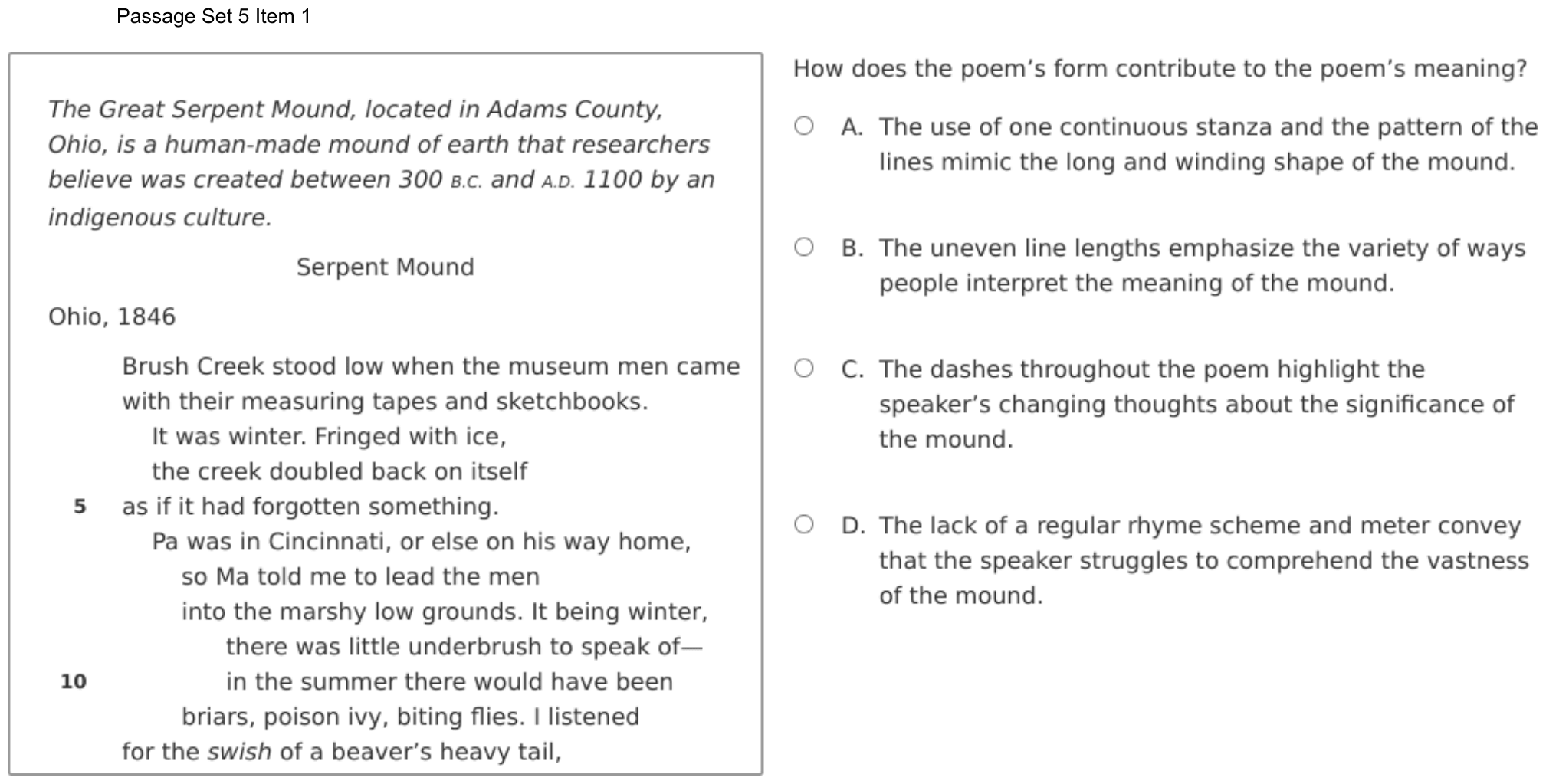
The passage “Serpent Mound” as printed (page 40)
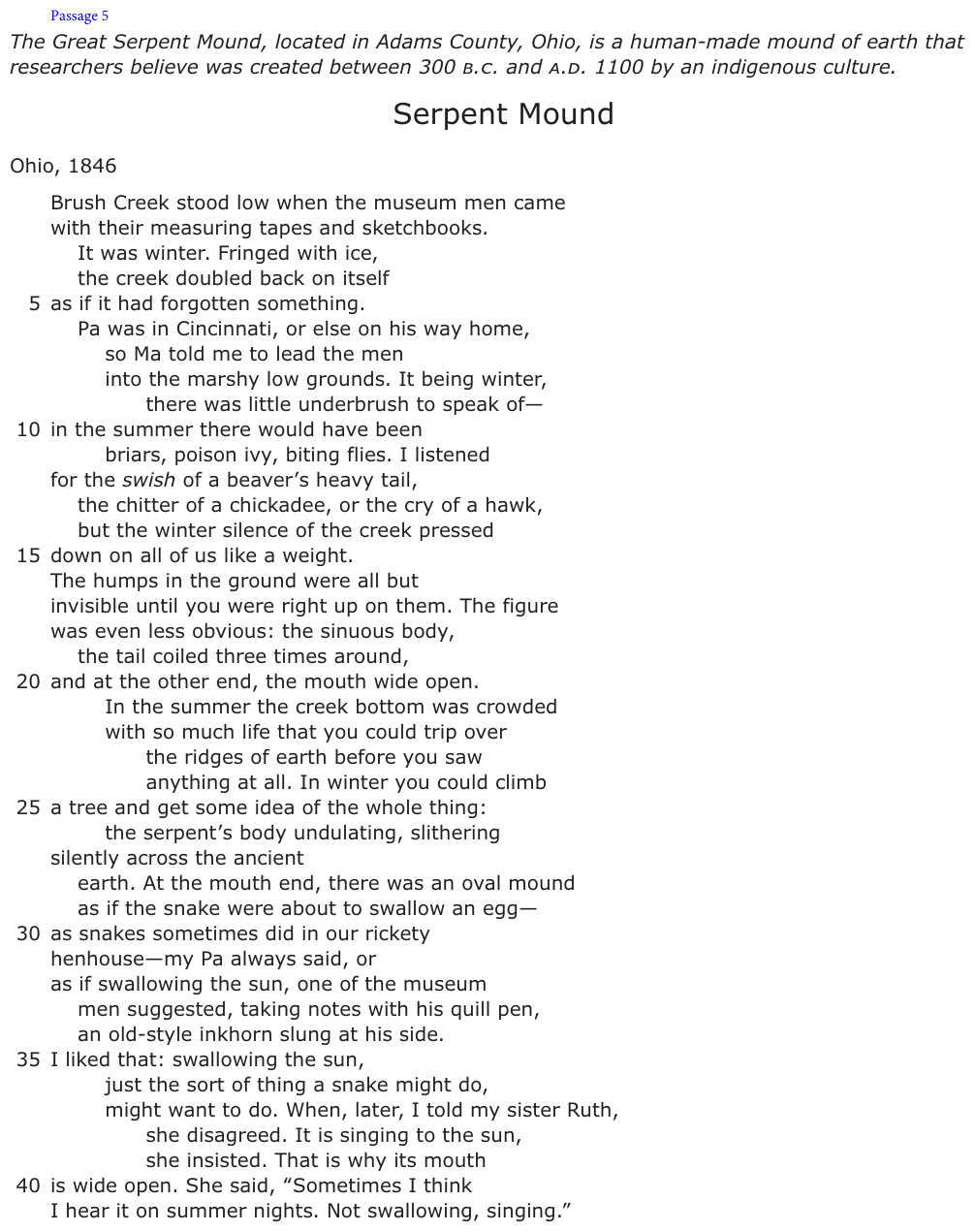
Question 88 of 120
2026 Practice Test C English, question 27Uses the passage above: “Serpent Mound”.
Question
Which lines reveal how the setting affects the speaker and the men from the museum?
- A“It being winter, / there was little underbrush to speak of—” (lines 8–9)
- B“but the winter silence of the creek pressed / down on all of us like a weight.” (lines 14–15)
- C“The humps in the ground were all but / invisible until you were right up on them.” (lines 16–17)
- D“In the summer the creek bottom was crowded / with so much life that you could trip” (lines 21–22)
Show the answer
Correct answer: B
The question asks which lines reveal how the setting affects the speaker and the men from the museum.
A. Incorrect. The words “being winter” (line 8) work to establish the setting, but lines 8 and 9 do not describe the effect the winter setting has on the speaker and the men.
B. CORRECT. The imagery in lines 14 and 15 describes how the winter silence makes the speaker and the men feel emotional heaviness: it “pressed / down on all of us like a weight.”
C. Incorrect. Although the words “the humps in the ground were all but / invisible” describe how the setting appears to the speaker and the men, lines 16 and 17 do not describe how the setting affects them.
D. Incorrect. Although lines 21 and 22 do describe the setting, the lines do not describe how the setting affects the speaker and the men. The lines describe the setting in the summer, which is before the men from the museum show up.
Question analysis
This evidence question on the poem “Serpent Mound” asks which lines reveal how the setting, a creek in the Ohio winter of 1846, affects the young speaker and the museum men. All four quotations come from the poem’s description of the creek and the land around the mound, in winter and in summer, so the four choices look much alike at first glance.
- Grade level
- Grade 7 reading and task
- Compared with grade 7
- At grade 7 A routine grade 7 evidence task: the four quotations are short, numbered and in plain modern language. What takes care is that all of them describe the setting, while the question asks about its effect on particular people.
- Estimated difficulty
- Straightforward: two steps or one careful reading.
- Thinking it demands
- Depth of knowledge 2, skills and concepts · mainly evaluate
- What makes it hard
- Every choice must be checked moderate
- Figurative or literary language minor
- Evidence
- Answered from one sentence or line
- Reading level
- Passage: 354 words (a poem; reading level not measured); question and choices: about grade 5, 77 words.
- Students, last 30 days
- Not enough answers yet to show (it takes 10).
Why it is hard, traps and wrong answers (shows the answer)
Why it is hard
Every quotation describes the setting, so a student who checks only for setting can defend almost any of them. The question turns on the people: only one quotation says what the place does to them, in the words “on all of us.” The summer lines tempt with someone tripping over the ridges, but they describe another season, not the winter day of the visit.
Every choice must be checked moderate Choosing the answer
All four quotations describe the creek and the land, so each must be asked whether it shows the place acting on the speaker and the men or only tells what the place is like. (Embretson & Wetzel, 1987)
Figurative or literary language minor Understanding the question
The answer is a simile, silence that “pressed / down on all of us like a weight,” and students must read the weight as a mood the winter quiet puts on the group. (Graesser, Singer & Trabasso, 1994; Kintsch, 1998)
Strategy: Paraphrase each quotation, then ask whether it shows the setting acting on the speaker and the museum men or only tells what the place is like.
Traps
- Supports only part of the claim: In a question about evidence: a line that backs one half of the claim but not the other, or a related point rather than the claim itself.
- True but not the answer: A choice says something accurate about the text that does not answer this question.
The wrong answers, classified
A Supports only part of the claim (King et al., 2004; Thissen, Steinberg & Fitzpatrick, 1989)
Treats the thin winter underbrush as an effect because it would make the walk easier, but lines 8–9 only describe the ground and say nothing of how anyone feels or acts.
C Supports only part of the claim (King et al., 2004; Thissen, Steinberg & Fitzpatrick, 1989)
Sees that the humps are hard to spot until “you were right up on them,” which involves a viewer, but the lines report how the land looks, not what it does to the group.
D True but not the answer (King et al., 2004; Embretson & Wetzel, 1987)
Matches “you could trip” to the word “affects,” but the lines describe the creek bottom in summer, not the winter day when the speaker leads the museum men.
Working it out, step by step
Figure out what the question asks
This asks for evidence about setting. Setting is where and when a story or poem takes place. Here it is a creek in Ohio, in winter. You need the lines that show how this place affects the speaker and the museum men. In other words, what does the place do to them or make them feel?
Read the lines that mention people
Lines 14–15 say “but the winter silence of the creek pressed / down on all of us like a weight.” The words “all of us” mean the speaker and the museum men together. This is a simile, a comparison using “like.” The quiet felt like something heavy pressing down on them. So the silent winter creek made the whole group feel heavy and gloomy.
Check each choice
- A does not fit. Lines 8–9 say there was little underbrush, or low bushes. That describes the ground, not how anyone felt.
- B fits. The silence “pressed / down on all of us,” so the place acts on the whole group.
- C does not fit. Lines 16–17 tell how hard the humps are to see. They describe the land, not its effect on the group.
- D does not fit. Lines 21–22 describe the creek in summer. The museum men came in winter.
Watch out: D says “you could trip,” which sounds like an effect on people. But it describes another season, not the day of the visit.
Choose the answer
Only lines 14–15 show the winter creek acting on the speaker and the men. So the answer is B, lines 14–15: “but the winter silence of the creek pressed / down on all of us like a weight.”
Why this answer and not the closest wrong one
C is a close wrong choice, because it has a person in it: the humps stay hidden “until you were right up on them.” But it only reports what the land looks like. B is different. The silence “pressed / down on all of us like a weight.” Only B shows the place changing how the speaker and the men feel.
More questions like this
The original DOE question
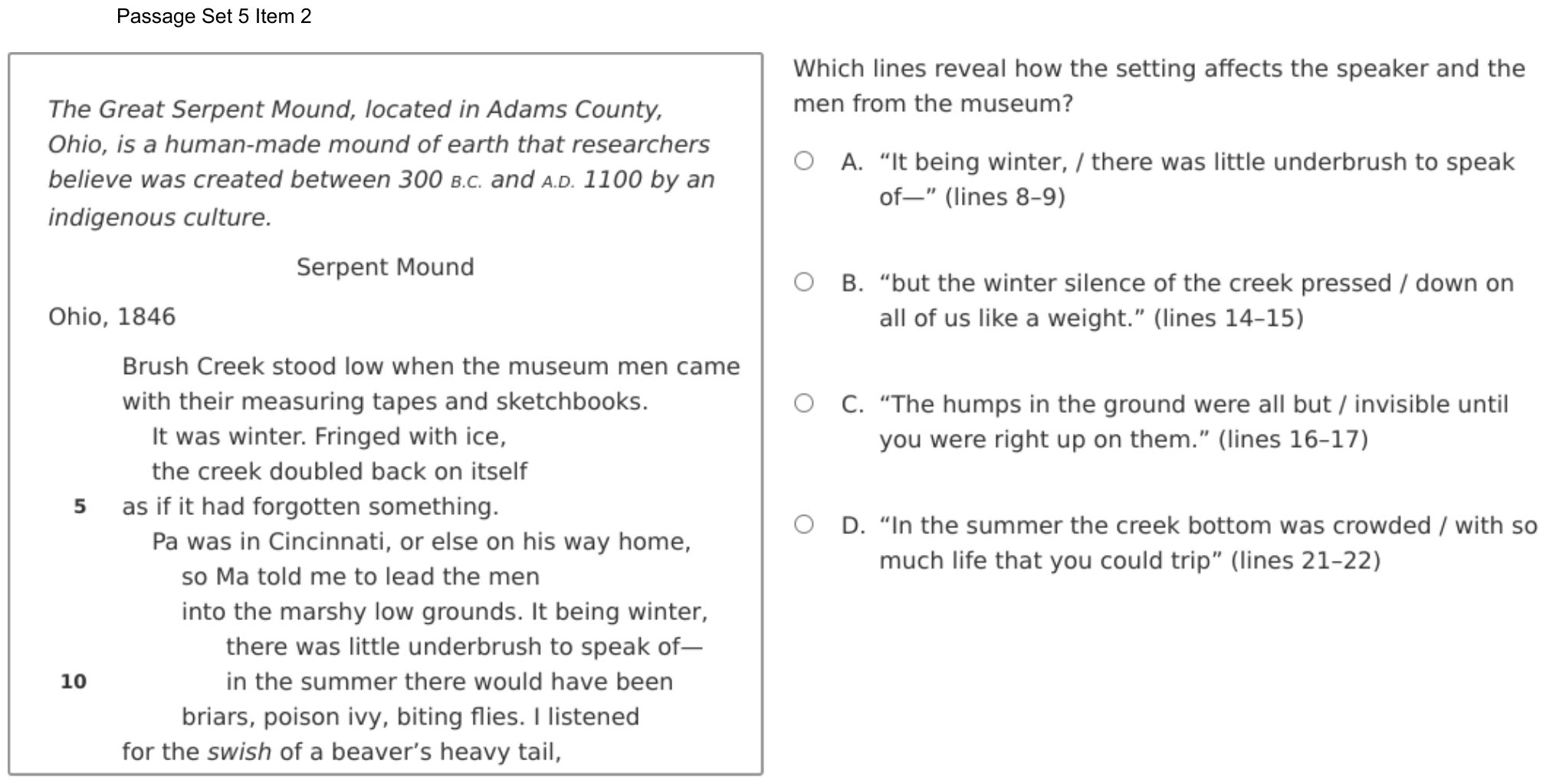
Question 89 of 120
2026 Practice Test C English, question 28Uses the passage above: “Serpent Mound”.
Question
Lines 1–2 contribute to the development of ideas in the poem by
- Asuggesting that the men are too busy with their work to talk to the speaker.
- Bhelping establish the reason for the men’s visit and purposeful behavior.
- Chinting that the men have hidden motives for studying the mound.
- Dindicating why the speaker is fascinated by the men and wants to help them.
Show the answer
Correct answer: B
The question asks how lines 1–2 contribute to the development of ideas in the poem.
A. Incorrect. The idea that the men are too busy with their work to talk to the speaker is not conveyed in the poem, and, in fact, one of the museum men discusses the oval mound with the speaker (“as if swallowing the sun, one of the museum / men suggested” [lines 32–33]).
B. CORRECT. The lines, with their mention of measuring tapes and sketchbooks, indicate that the reasons the museum men came were to measure the mound and to draw sketches of it.
C. Incorrect. There is little indication in the poem that the museum men have a hidden motive for studying the mound. Lines 1–2 present a straightforward description of the men and their equipment, which emphasizes the men’s academic interest in studying the mound.
D. Incorrect. While the speaker displays some curiosity about the work the museum men are doing (“one of the museum / men suggested, taking notes with his quill pen, / an old-style inkhorn slung at his side. / I liked that” [lines 32–35]), lines 1–2 focus on introducing the idea that the mound is a formation that is worth formal study and examination by experts.
Question analysis
This question asks how the opening lines of “Serpent Mound,” in which museum men arrive at a low winter creek with measuring tapes and sketchbooks, contribute to the development of ideas in the poem. The lines are short and plain, but the choices credit the men or the speaker with motives and feelings, and students must check each against the rest of the poem.
- Grade level
- Grade 6 reading and task
- Compared with grade 7
- Below grade 7 Below typical grade 7 demand: the two opening lines are short and concrete, and checking the choices takes one reading of the poem, much like grade 6 questions on how a single sentence fits into a text.
- Estimated difficulty
- Straightforward: two steps or one careful reading.
- Thinking it demands
- Depth of knowledge 2, skills and concepts · mainly analyze
- What makes it hard
- How, not what minor
- Evidence in several places minor
- Evidence
- Answered from one sentence or line
- Reading level
- Passage: 354 words (a poem; reading level not measured); question and choices: about grade 7, 62 words.
- Students, last 30 days
- Not enough answers yet to show (it takes 10).
Why it is hard, traps and wrong answers (shows the answer)
Why it is hard
The opening lines are short and concrete, and their tools, measuring tapes and sketchbooks, plainly say why the men came. The wrong choices each add something: men too busy to talk, a hidden motive, or a fascinated speaker, and the last borrows the speaker’s later delight in “swallowing the sun.” Checking each against the rest of the poem, rather than against first impressions of strangers arriving, is what the question rewards.
How, not what minor Working it out
The stem asks what lines 1–2 do in the poem, so students must see the measuring tapes and sketchbooks as setting up the visit’s purpose, not only as a description of the men. (Anderson & Krathwohl, 2001)
Evidence in several places minor Working it out
Ruling out two wrong choices takes later lines: a museum man offers the speaker an idea in lines 32–33, and the speaker leads the men in line 7 because Ma says to. (Kirsch & Mosenthal, 1990; Gorin & Embretson, 2006)
Strategy: Say in your own words what lines 1–2 tell you about the men, then reject any choice that depends on something the poem never shows.
Traps
- Reads too much in: A reasonable-sounding conclusion that goes further than the text allows.
- Wrong part of the text: A choice is true of another paragraph, stanza or speaker than the one asked about.
The wrong answers, classified
A Reads too much in (Graesser, Singer & Trabasso, 1994)
Pictures men absorbed in measuring who ignore the child, though nothing says so and one of them later suggests the mound looks “as if swallowing the sun.”
C Reads too much in (Graesser, Singer & Trabasso, 1994)
Reads a secret aim into the visit, but lines 1–2 show the men carrying measuring tools in the open, and the poem never hints at any other purpose.
D Wrong part of the text (Kirsch & Mosenthal, 1990)
Jumps to line 35, where the speaker likes a museum man’s phrase; in lines 1–2 the men have only arrived, and the speaker guides them because Ma says to.
Working it out, step by step
Figure out what the question asks
This asks what lines 1–2 do for the poem’s ideas. They are the poem’s first lines, so they set things up. You need to decide what they tell you about the museum men, and why that matters.
Read lines 1–2
Lines 1–2 say “Brush Creek stood low when the museum men came / with their measuring tapes and sketchbooks.” A measuring tape is for measuring lengths. A sketchbook is for drawing. So the men came to measure the mound and draw it. They have a job to do. Purposeful means acting with a clear goal. Their tools show that goal from the very start.
Check each choice
- A does not fit. Nothing says the men were too busy to talk. Later, one of them shares an idea: “as if swallowing the sun.”
- B fits. The tools show why the men came and that they came to work.
- C does not fit. The men carry their tools in plain view. The poem never hints at a hidden motive, or secret reason.
- D does not fit. The speaker leads the men because “Ma told me to lead the men.” The speaker’s liking for a man’s idea comes much later, in line 35.
Watch out: D borrows a feeling from later in the poem, “I liked that.” In lines 1–2, the men have only just arrived.
Choose the answer
Lines 1–2 use the men’s tools to show why they came and what they plan to do. So the answer is B, “helping establish the reason for the men’s visit and purposeful behavior.”
Why this answer and not the closest wrong one
D is the closest wrong choice. The speaker does later like a museum man’s phrase, “swallowing the sun.” But that comes in line 35. Lines 1–2 say nothing about the speaker’s feelings. They name only the men’s tools. Tapes and sketchbooks tell you why the men came: to measure and draw the mound.
More questions like this
The original DOE question
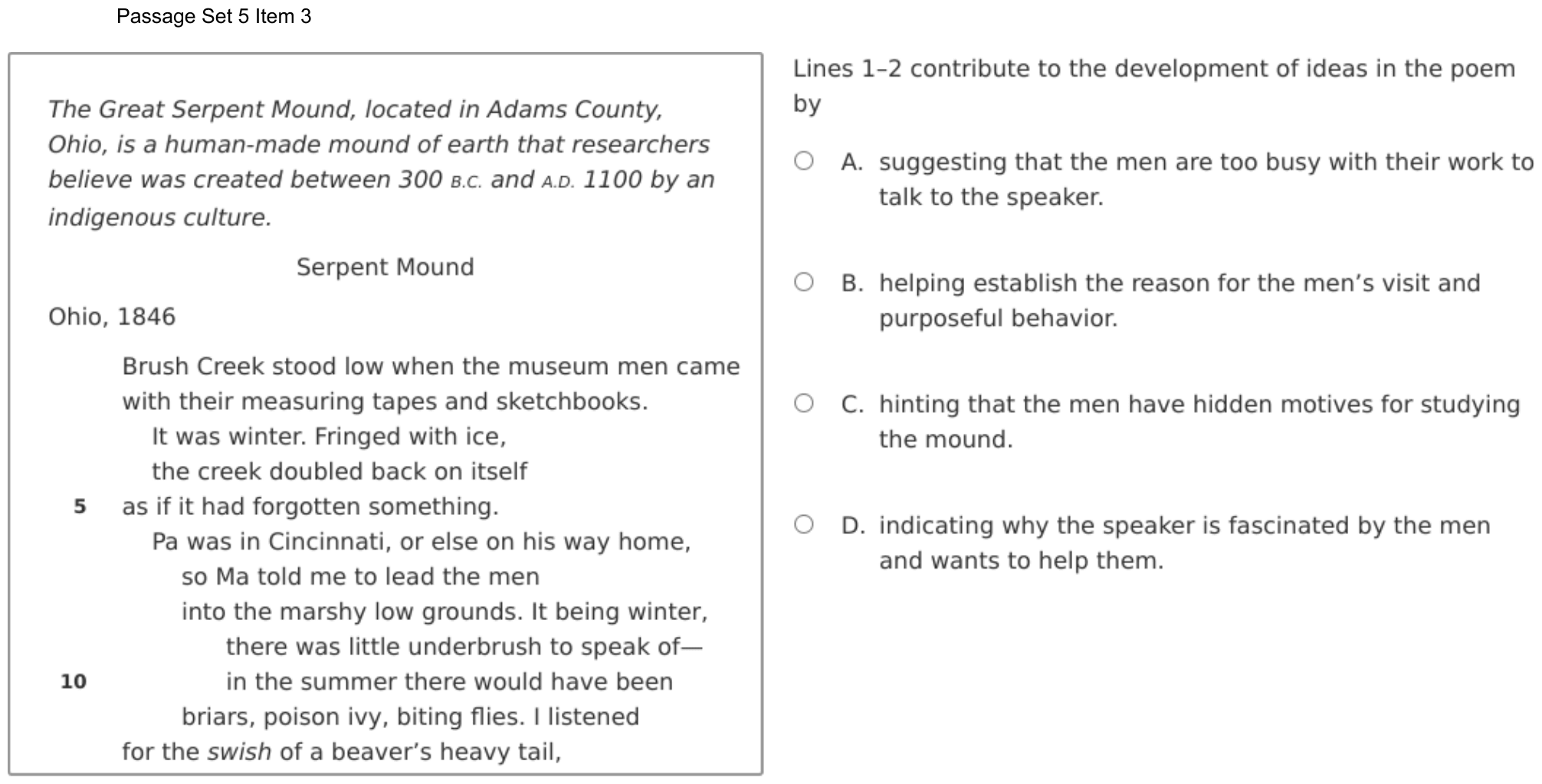
Question 90 of 120
2026 Practice Test C English, question 29Uses the passage above: “Serpent Mound”.
Question
Read line 28 from the poem.
At the mouth end, there was an oval mound
How does the line contribute to the development of ideas in the poem?
- AIt describes a feature of the mound that the men from the museum need to document.
- BIt introduces a comparison of the body of the mound with the head of the mound.
- CIt introduces a feature of the mound that has a different meaning to different people.
- DIt describes a part of the mound that is difficult to see from far away.
Show the answer
Correct answer: C
The question asks how line 28 contributes to the development of ideas in the poem.
A. Incorrect. Although the museum men are documenting the shape of the mound in line 33, lines 29–32 and 35–41 focus on what the oval mound represents as interpreted by the museum men, the speaker, and the speaker’s sister.
B. Incorrect. While the lines preceding line 28 describe the body of the snake in detail (“you could climb / a tree and get some idea of the whole thing: / the serpent’s body undulating, slithering / silently across the ancient / earth” [lines 24–28]), the purpose of line 28 is to begin the development of the ideas about the oval shape at the end of the mound: the serpent’s mouth.
C. CORRECT. Line 28 introduces the presence of the oval mound at the mouth of the snake. The meaning of this oval is of great interest to the museum men and the speaker. Line 28 leads to the idea that there is speculation about the oval mound (“as if the snake were about to swallow an egg” [line 29], “as if swallowing the sun” [line 32], and “It is singing to the sun” [line 38]).
D. Incorrect. The speaker does not say that the oval shape near the end of the mound is difficult to see. Earlier, the speaker says that the ridges of earth are difficult to see unless you are near them, but the speaker does not say this about the oval shape.
Question analysis
Students explain how line 28 of “Serpent Mound,” which introduces an oval mound at the serpent’s mouth end, contributes to the development of ideas in the poem. The line is a plain piece of description in a poem about museum men surveying the mound, so students must work out what part it plays in the poem as a whole.
- Grade level
- Grade 7 reading and task
- Compared with grade 7
- At grade 7 Explaining how one line contributes to a poem is standard grade 7 structure work. The line is a plain description, but its role depends on how it connects to the lines around it.
- Estimated difficulty
- Moderate: several steps, or a close reading with one strong distractor.
- Thinking it demands
- Depth of knowledge 2, skills and concepts · mainly analyze
- What makes it hard
- A very close wrong answer moderate
- How, not what moderate
- Evidence in several places minor
- Evidence
- Answered from one paragraph or stanza
- Reading level
- Passage: 354 words (a poem; reading level not measured); question and choices: about grade 5, 89 words.
- Students, last 30 days
- Not enough answers yet to show (it takes 10).
Why it is hard, traps and wrong answers (shows the answer)
Why it is hard
Because the museum men came to measure and sketch, a line naming a new feature looks like a note for their records, and that reading is the strong pull. Others see a comparison with the serpent’s body described just before, or carry over the earlier point about humps that are hard to see. The line’s job shows in what follows it: the oval is where Pa, a museum man and Ruth each see something different.
A very close wrong answer moderate Choosing the answer
The documenting choice and the key both say line 28 presents a feature of the mound; they differ in what follows, the men’s records or the egg, sun and singing readings in lines 29–41. (Embretson & Wetzel, 1987; Gorin & Embretson, 2006; Ascalon et al., 2007)
How, not what moderate Working it out
The line is plain description, so its role shows only in what it sets up: the oval becomes the egg, the swallowed sun and the open singing mouth that the rest of the poem weighs. (Anderson & Krathwohl, 2001)
Evidence in several places minor Working it out
The readings are spread over thirteen lines and three people, Pa in lines 29–31, a museum man in lines 32–33 and Ruth in lines 37–41, so students must gather them. (Kirsch & Mosenthal, 1990; Gorin & Embretson, 2006)
Strategy: Read line 28 together with the lines on either side of it, then test each choice against what those lines actually show.
Traps
- True but not the answer: A choice says something accurate about the text that does not answer this question.
- Wrong part of the text: A choice is true of another paragraph, stanza or speaker than the one asked about.
- Wrong purpose or structure: Names a purpose, structure or effect that the part does not serve, or describes what a part says when the question asks what it does.
The wrong answers, classified
A True but not the answer (King et al., 2004; Embretson & Wetzel, 1987)
Knows the men came “with their measuring tapes and sketchbooks,” so any new feature seems one to record, but the lines after 28 dwell on what the oval means, not on recording it.
B Wrong purpose or structure (Anderson & Krathwohl, 2001)
Notices that lines 24–28 describe the serpent’s body just before the oval appears, but line 28 moves on to the mouth end and never sets head and body side by side.
D Wrong part of the text (Kirsch & Mosenthal, 1990)
Carries over lines 16–17, where the humps are “all but / invisible” until you are close, to the oval mound, which the poem never calls hard to see.
Working it out, step by step
Figure out what the question asks
This asks how one line helps build the poem’s ideas. Line 28 is a plain description: “At the mouth end, there was an oval mound.” Oval means egg-shaped. To see the line’s job, look at what comes right after it.
Read what follows line 28
The next lines give three ideas about the oval mound.
- Pa always said it was “as if the snake were about to swallow an egg,” as snakes did in the family’s henhouse (lines 29–31).
- A museum man says “as if swallowing the sun” (line 32).
- Ruth says “It is singing to the sun” (line 38).
Name the line’s job
Line 28 brings in the oval mound. Then each person sees something different in it: an egg, the sun being swallowed, or a song. Each idea comes from that person’s own life. Pa thinks of his henhouse. Ruth thinks of what she seems to hear on summer nights. So the line sets up a feature that means different things to different people.
Check each choice
- A does not fit. The men did come to measure and sketch. But the lines after 28 are about what the oval means, not about recording it.
- B does not fit. Line 28 moves on from the body to the mouth. It never compares the two.
- C fits. The oval gets three different meanings from three people.
- D does not fit. Lines 16–17 say the humps are hard to see. The poem never says that about the oval.
Watch out: A is tempting because the men came “with their measuring tapes and sketchbooks.” But the poem spends its last 13 lines on meanings, not measurements.
Choose the answer
Line 28 brings in the oval mound that Pa, a museum man and Ruth each see in their own way. So the answer is C, “It introduces a feature of the mound that has a different meaning to different people.”
Why this answer and not the closest wrong one
A is the closest wrong choice. The museum men are there to document, or record, the mound, and one is taking notes. But the lines after 28 are not about notes. They give an egg, a swallowed sun and a singing snake. That is a feature with a different meaning to different people, just as C says.
More questions like this
The original DOE question
Question 91 of 120
2026 Practice Test C English, question 30Uses the passage above: “Serpent Mound”.
Question
What impact do the phrases “all but / invisible” and “even less obvious” in lines 16–18 have on the meaning of the poem?
- AThey indicate that viewing the full size and shape of the mound is difficult.
- BThey suggest that the location of the mound is unknown to most people.
- CThey imply that the speaker wants the location of the mound to remain a secret.
- DThey reveal that the speaker is unfamiliar with the significance of the mound.
Show the answer
Correct answer: A
The question asks what impact the phrases “all but / invisible” and “even less obvious” in lines 16–18 have on the meaning of the poem.
A. CORRECT. The words “all but / invisible” indicate that a person must be close to see the humps in the ground, while the phrase “even less obvious” indicates that a person must be far away to see the overall snake shape of the mound.
B. Incorrect. While the speaker has to lead the museum men to the mound because they did not know the exact location, the words in lines 16–18 are related to the difficulty in viewing the mound from the immediate surrounding area.
C. Incorrect. The speaker is willing to take the museum men out to study the mound, so there is no indication in the poem that the speaker wants the location of the mound to remain a secret. The words in lines 16–18 convey the idea that the mound is difficult to see.
D. Incorrect. While the speaker contemplates the significance of certain elements of the mound, the phrases in lines 16–18 relate to a viewer’s ability to see the physical shape of the mound, not its deeper meaning.
Question analysis
This word-meaning question asks what impact the phrases “all but / invisible” and “even less obvious” in lines 16–18 of “Serpent Mound” have on the poem’s meaning. Students must understand the idiom “all but” and then judge which of four claims about the mound and the speaker the two phrases actually support.
- Grade level
- Grade 6 reading and task
- Compared with grade 7
- Below grade 7 Below typical grade 7 demand: both phrases are quoted with their line numbers, in plain modern language, and one careful reading settles the question. The one hurdle is the idiom “all but,” which some readers take literally.
- Estimated difficulty
- Straightforward: two steps or one careful reading.
- Thinking it demands
- Depth of knowledge 2, skills and concepts · mainly understand
- What makes it hard
- Hard words moderate
- Reading between the lines minor
- Evidence
- Answered from one paragraph or stanza
- Reading level
- Passage: 354 words (a poem; reading level not measured); question and choices: about grade 7, 76 words.
- Students, last 30 days
- Not enough answers yet to show (it takes 10).
Why it is hard, traps and wrong answers (shows the answer)
Why it is hard
Both phrases are quoted with their lines, and the sentence that holds them goes on to list the body, the coiled tail and the open mouth, so its subject is what can be seen. The wrong choices slide from seeing to knowing: who knows where the mound is, who wants it hidden, and what it means. “Less obvious” is the slippery phrase, since obvious can also mean easy to understand.
Hard words moderate Understanding the question
“All but” is an idiom meaning almost, so “all but / invisible” means nearly unseen; a student who takes it as the opposite, plainly visible, loses the sense that the humps are hard to see. (Perfetti, 2007; Freedle & Kostin, 1993)
Reading between the lines minor Working it out
Students must keep both phrases about sight and connect them to lines 24–25, where only climbing a tree gives “some idea of the whole thing.” (Graesser, Singer & Trabasso, 1994; Kintsch, 1998)
Strategy: Put both phrases into plain words, starting with the idiom “all but,” then test each choice against what lines 16–25 actually describe.
Traps
- Twists what the text says: Uses the text's topic and ideas but changes what it says: who did it, how much, when, or why.
- Reads too much in: A reasonable-sounding conclusion that goes further than the text allows.
- Dictionary meaning, not meaning here: A common meaning of the word that does not fit its use in this text.
The wrong answers, classified
B Twists what the text says (King et al., 2004)
Turns “invisible” into “unknown,” helped by Ma sending the speaker to guide the men, but the phrases say how hard the mound is to see, not who knows where it is.
C Reads too much in (Graesser, Singer & Trabasso, 1994)
Finds a wish for secrecy in the hidden humps, though the speaker leads the museum men straight to the mound and never tries to keep it from anyone.
D Dictionary meaning, not meaning here (Perfetti, 2007)
Takes “less obvious” in its sense of harder to understand, but the sentence goes straight on to list the body, the coiled tail and the open mouth, so the word is about sight.
Working it out, step by step
Figure out what the question asks
This asks what two phrases add to the poem’s meaning. They are “all but / invisible” and “even less obvious,” in lines 16–18. Put each phrase in plain words first. Then see what they tell you about the mound.
Read lines 16–18
Lines 16–18 say “The humps in the ground were all but / invisible until you were right up on them. The figure / was even less obvious.” “All but” means almost. So the humps were almost invisible until you got very close. The figure is the whole snake shape. It was even harder to see than the humps. Here, obvious means easy to see.
Connect the phrases to later lines
The same sentence goes on to list what you would see: “the sinuous body, / the tail coiled three times around, / and at the other end, the mouth wide open.” So the phrases are about seeing the shape. Later, lines 24–25 say “In winter you could climb / a tree and get some idea of the whole thing.” Only from up high could you begin to see it. The mound is huge, low and hard to take in all at once.
Check each choice
- A fits. Both phrases show that seeing the whole mound is hard.
- B does not fit. The phrases are about how hard the mound is to see, not about who knows where it is.
- C does not fit. The speaker leads the museum men right to the mound. There is no wish to keep it secret.
- D does not fit. Here “less obvious” is about sight, not about understanding what the mound means.
Watch out: Obvious can also mean easy to understand. That reading leads to D. But the sentence goes straight on to list parts of the snake you can see.
Choose the answer
The phrases show how hard it is to see the mound’s full size and shape. So the answer is A, “They indicate that viewing the full size and shape of the mound is difficult.”
Why this answer and not the closest wrong one
B is a close wrong choice, because “invisible” can make you think nobody knows the mound is there. But the phrases describe looking, not knowing. The speaker knows exactly where the mound is. The problem is seeing it. The humps vanish until “you were right up on them,” and the whole shape shows only from a tree.
More questions like this
The original DOE question
Question 92 of 120
2026 Practice Test C English, question 31Uses the passage above: “Serpent Mound”.
Question
What impact do the words “swish,” “chitter,” and “cry” in lines 12–13 have in the poem?
- AThey illustrate how lively the mound’s surroundings are during the summer.
- BThey show how the mound disrupts natural life in the marsh.
- CThey indicate the variety of wildlife found in the area around the mound.
- DThey suggest that the speaker prefers the mound’s appearance in winter.
Show the answer
Correct answer: A
The question asks what impact the words “swish,” “chitter,” and “cry” in lines 12–13 have in the poem.
A. CORRECT. The words highlight the sounds of the animals that visit the mound in the summer: the “swish of a beaver’s heavy tail” (line 12), the “chitter of a chickadee” (line 13), and the “cry of a hawk” (line 13). These words help contrast the quiet stillness of the setting around the mound in the winter.
B. Incorrect. While the words in lines 12–13 convey the sounds certain animals make in the summer, the sounds of the animals that live near the mound are a natural part of life in the area, not a disruption.
C. Incorrect. The speaker is contrasting the sounds of the animals around the mound during the rest of the year with the silence of the winter months, not merely indicating the variety of wildlife.
D. Incorrect. The speaker expresses the idea that the mound is more visible in the winter because of the lack of brush (“It being winter, / there was little underbrush to speak of” [lines 8–9]). Then lines 12–13 describe sounds, not the appearance of the mound in winter.
Question analysis
This question about word choice asks what impact the sound words “swish,” “chitter” and “cry” in lines 12–13 of “Serpent Mound” have in the poem. They belong to a beaver, a chickadee and a hawk near the creek, and more than one choice sounds like a fair account of them, so students must read the surrounding lines closely.
- Grade level
- Grade 8 reading and task
- Compared with grade 7
- Above grade 7 Grade 7 students often explain what sensory words add to a description. These three words sit inside a long sentence that runs across several lines, so their effect has to be worked out from the lines around them, beyond typical grade 7 work.
- Estimated difficulty
- Hard: combines ideas, needs a plan, and has more than one tempting wrong answer.
- Thinking it demands
- Depth of knowledge 2, skills and concepts · mainly analyze
- What makes it hard
- A very close wrong answer major
- Reading between the lines moderate
- Complex sentences minor
- Evidence
- Answered from one paragraph or stanza
- Reading level
- Passage: 354 words (a poem; reading level not measured); question and choices: about grade 6, 61 words.
- Students, last 30 days
- Not enough answers yet to show (it takes 10).
Why it is hard, traps and wrong answers (shows the answer)
Why it is hard
Three vivid animal sounds invite the easy reading that the poem is showing off the creek’s wildlife, and that choice is true as far as it goes. The words matter because they are missing: the speaker listens for them, and “the winter silence” answers. Students must also accept that the key’s “during the summer” comes from the poem’s later picture of a crowded summer creek, not from lines 12–13 themselves.
A very close wrong answer major Choosing the answer
The variety choice is literally true, since a beaver, a chickadee and a hawk are three kinds of animal; it differs from the key in missing why the sounds are named, as a contrast with winter. (Embretson & Wetzel, 1987; Gorin & Embretson, 2006; Ascalon et al., 2007)
Reading between the lines moderate Working it out
The speaker listens for these sounds and does not hear them, so students must infer that they stand for the creek’s life in warmer months, which lines 21–22 call “crowded / with so much life.” (Graesser, Singer & Trabasso, 1994; Kintsch, 1998)
Complex sentences minor Understanding the question
The three words sit in one sentence that runs from “I listened” in line 11 to “like a weight” in line 15 and turns on “but,” so their point arrives only at its end. (Abedi & Lord, 2001; Freedle & Kostin, 1993; Messick, 1989)
Strategy: Read the full sentence that holds these words, from “I listened” in line 11 to the end of line 15, then decide what the three sound words add to the scene.
Traps
- True but not the answer: A choice says something accurate about the text that does not answer this question.
- Wrong part of the text: A choice is true of another paragraph, stanza or speaker than the one asked about.
The wrong answers, classified
B Twists what the text says (King et al., 2004)
Notices that the beaver, chickadee and hawk go unheard but blames the mound for the hush, though line 14 calls it “the winter silence of the creek.”
C True but not the answer (King et al., 2004; Embretson & Wetzel, 1987)
Rightly counts three different animals in lines 12–13, but the speaker listens for them in vain, so the point is their absence in winter, not the range of species.
D Wrong part of the text (Kirsch & Mosenthal, 1990)
Remembers from lines 8–9 and 24–25 that winter makes the mound easier to see, but lines 12–13 are about sounds and state no preference for either season.
Working it out, step by step
Figure out what the question asks
This asks what three sound words do in the poem. They are “swish,” “chitter” and “cry,” in lines 12–13. Read the whole sentence they sit in. It starts at “I listened” in line 11 and ends with “like a weight” in line 15.
Read the full sentence
Lines 11–15 say “I listened / for the swish of a beaver’s heavy tail, / the chitter of a chickadee, or the cry of a hawk, / but the winter silence of the creek pressed / down on all of us like a weight.” A chickadee is a small bird, and a chitter is its quick, chirping sound. The speaker listens for these sounds. But the word “but” tells you they never come. Only silence answers.
Work out why the sounds are named
A beaver, a chickadee and a hawk are signs of a creek full of life. The speaker hears none of them in winter. Later lines tell you when the creek is lively. Lines 21–22 say “In the summer the creek bottom was crowded / with so much life.” So the missing sounds remind you how lively the place is in summer. They also make the winter silence feel even emptier.
Check each choice
- A fits. The sounds stand for the busy life around the mound in the warm months.
- B does not fit. The quiet comes from the season: “the winter silence of the creek.” The mound does not cause it.
- C does not fit. There are three kinds of animals, but the point is that their sounds are missing.
- D does not fit. These lines are about sounds. The speaker says nothing about liking how the mound looks in winter.
Watch out: C is true as far as it goes. But it misses why the speaker names the sounds at all: to set them against the silence.
Choose the answer
The sounds the speaker listens for, and doesn’t hear, show how lively the creek is in summer. So the answer is A, “They illustrate how lively the mound’s surroundings are during the summer.”
Why this answer and not the closest wrong one
C is the closest wrong choice, because a beaver, a chickadee and a hawk really are three kinds of wildlife. But the speaker listens for them and hears nothing. The word “but” turns the sentence to “the winter silence.” The sounds matter because they are missing. They show the creek in its lively season, which line 21 names as summer.
More questions like this
The original DOE question
Question 93 of 120
2026 Practice Test C English, question 32Uses the passage above: “Serpent Mound”.
Question
How does the speaker’s interaction with Ruth in lines 37–41 convey a central idea of the poem?
- AIt suggests that the most accurate interpretations of the mound come from knowing the purpose of the mound.
- BIt emphasizes that there are multiple interpretations of the mound based on feelings and experiences.
- CIt reveals the benefit of considering different interpretations of the mound’s significance.
- DIt implies that scientific study of the mound’s purpose will affect what the mound symbolizes to people.
Show the answer
Correct answer: B
The question asks how the interaction between the speaker and Ruth in lines 37–41 conveys a central idea of the poem.
A. Incorrect. While there are many different interpretations of the mound’s meaning, there is no way to determine which of the interpretations is most accurate, and there is no way to know the mound’s true purpose.
B. CORRECT. The interaction references Ruth’s interpretation of the open-mouth shape as a serpent singing to the sun. This interpretation creates a joyful mood. The speaker contrasts this perspective with the idea that the mound is swallowing the sun, which creates a more aggressive feeling. These various interpretations of a physical shape arise out of what the individuals feel when they look at the mound.
C. Incorrect. The speaker does not describe any benefit to considering what different people imagine when they see the mound. Instead, the speaker is simply describing different interpretations.
D. Incorrect. Ruth’s interpretation of the mound’s shape is fanciful and symbolic. It is unlikely that scientific study would change the minds of people such as Ruth about the meaning of the mound.
Question analysis
This central idea question asks how the speaker’s conversation with a sister, Ruth, in lines 37–41 of “Serpent Mound” conveys a central idea of the poem. Ruth explains the serpent’s open mouth in her own way, and students must connect this short exchange to the rest of the poem before choosing among four claims about what it shows.
- Grade level
- Grade 7 reading and task
- Compared with grade 7
- At grade 7 Linking a short exchange between two characters to a poem’s central idea is standard grade 7 work. The language is plain, though the choices differ in what they claim the exchange shows, so each must be checked closely.
- Estimated difficulty
- Moderate: several steps, or a close reading with one strong distractor.
- Thinking it demands
- Depth of knowledge 2, skills and concepts · mainly analyze
- What makes it hard
- A very close wrong answer moderate
- Reading between the lines moderate
- Evidence in several places minor
- Evidence
- Answered from one paragraph or stanza
- Reading level
- Passage: 354 words (a poem; reading level not measured); question and choices: about grade 10, 78 words.
- Students, last 30 days
- Not enough answers yet to show (it takes 10).
Why it is hard, traps and wrong answers (shows the answer)
Why it is hard
Ruth’s “Not swallowing, singing” makes the disagreement plain, so most students see that the mound is read in more than one way. The difficulty is in what the choices add to that: a lesson about the benefit of differing views, a ranking of readings by the mound’s purpose, or a role for science. The poem only sets the readings side by side, each rooted in what its speaker has lived or felt.
A very close wrong answer moderate Choosing the answer
The choice about the benefit of considering different interpretations shares the key’s subject, several readings of the mound, and differs only in adding a lesson, that weighing them is worthwhile. (Embretson & Wetzel, 1987; Gorin & Embretson, 2006; Ascalon et al., 2007)
Reading between the lines moderate Working it out
The exchange is a plain disagreement, swallowing against singing, and students must infer the central idea it serves, that people see the mound through their own feelings and experiences. (Graesser, Singer & Trabasso, 1994; Kintsch, 1998)
Evidence in several places minor Working it out
Ruth’s reading answers earlier ones, Pa’s egg from the henhouse in lines 29–31 and the museum man’s sun in line 32, so her lines must be read against them. (Kirsch & Mosenthal, 1990; Gorin & Embretson, 2006)
Strategy: Sum up what Ruth says and how the speaker reacts, compare it with the earlier ideas about the oval mound, and pick the claim the poem shows rather than one it might only suggest.
Traps
- Reads too much in: A reasonable-sounding conclusion that goes further than the text allows.
- Outside knowledge: A choice is plausible in the real world but not supported by this text.
The wrong answers, classified
A Outside knowledge (King et al., 2004; Recht & Leslie, 1988)
Applies the sensible idea that knowing why something was built settles what it means, but the poem never ranks the readings or says anyone knows the mound’s purpose.
C Reads too much in (Graesser, Singer & Trabasso, 1994)
Rightly sees several readings of the mound, then adds a moral, that weighing them is helpful, which the poem never states; Ruth and the speaker simply disagree.
D Reads too much in (Graesser, Singer & Trabasso, 1994)
Connects the museum men’s measuring with the family’s readings at the end, but nobody suggests that study will change what the mound means to Ruth or anyone else.
Working it out, step by step
Figure out what the question asks
This asks how the talk between the speaker and Ruth, in lines 37–41, shows a central idea. A central idea is a big point the whole poem makes. Compare Ruth’s idea about the mound with the speaker’s, and with the ideas that come before.
Read the talk with Ruth
The speaker liked a museum man’s idea that the snake was “swallowing the sun.” But when the speaker told Ruth, “she disagreed. It is singing to the sun, / she insisted.” Ruth explains, “That is why its mouth / is wide open.” Then she says, “Sometimes I think / I hear it on summer nights. Not swallowing, singing.”
See where each idea comes from
Each person sees the same oval mound in a different way. Pa always said it was like a snake about to swallow an egg, as snakes did in the family’s henhouse. A museum man saw it swallowing the sun. Ruth hears it singing on summer nights. Each idea grows out of that person’s own feelings and experiences, or what they have lived through. That is a central idea: people see the mound in many ways.
Check each choice
- A does not fit. No one in the poem knows the mound’s purpose, and no idea is called the most accurate.
- B fits. Ruth and the speaker see the mound differently, each from what they feel and have lived.
- C does not fit. The poem never says that thinking about other ideas helps anyone. Ruth and the speaker just disagree.
- D does not fit. Nobody says the men’s study will change what the mound means to people.
Watch out: C starts out right, since there are different ideas. But it adds a lesson, a “benefit,” that the poem never gives.
Choose the answer
The disagreement shows more than one way to see the mound, each rooted in a person’s own feelings and experiences. So the answer is B, “It emphasizes that there are multiple interpretations of the mound based on feelings and experiences.”
Why this answer and not the closest wrong one
C is the closest wrong choice. It also says there are different ideas about the mound. But it claims there is a benefit, or gain, in thinking them over. The poem shows no one gaining anything. Ruth keeps her own idea, and the poem never says who is right. It simply sets the ideas side by side, each from a person’s own life.
More questions like this
The original DOE question
Question 94 of 120
2026 Practice Test C English, question 33Uses the passage above: “Serpent Mound”.
Question
The poet contrasts the speaker’s and Ruth’s points of view regarding the mound by using dialogue to
- Aimply that Ruth is worried that her interpretation of the mound will be seen as too abstract.
- Bindicate that Ruth hopes her interpretation of the mound will be shared by the men from the museum.
- Csuggest that Ruth wants the speaker to agree with her interpretation of the mound.
- Dshow that Ruth has already decided on her interpretation of the mound.
Show the answer
Correct answer: D
The question asks how the poet uses dialogue to contrast the points of view of the speaker and Ruth regarding the mound.
A. Incorrect. The interpretation Ruth offers of the mound as a snake singing is abstract, but Ruth does not seem concerned that it is an overly metaphorical or figurative interpretation. The dialogue serves to highlight that Ruth is firm in her belief.
B. Incorrect. There is no indication that the museum men are considering Ruth’s interpretation of the mound or that Ruth wants them to share her interpretation. Ruth’s interpretation is meant to convey an abstract idea, while the museum men would be looking for a firm academic explanation of the mound. Ruth is persistent in her belief, and the dialogue does not suggest that she is concerned with the museum men’s interpretation or findings.
C. Incorrect. Ruth merely states her interpretation and says that she thinks she hears the Serpent Mound singing sometimes. She does not seek to make the speaker agree with her.
D. CORRECT. Beginning in line 37, after the speaker suggests the mound is swallowing the sun, Ruth disagrees. The poet uses the word “insisted” in line 39 to show that Ruth firmly believes in her own interpretation of the mound.
Question analysis
This point-of-view question asks how the poet of “Serpent Mound” uses dialogue to contrast the speaker’s and Ruth’s views of the mound in the poem’s closing lines. Students must read Ruth’s few words closely, since each choice credits her with a different attitude toward her own interpretation.
- Grade level
- Grade 7 reading and task
- Compared with grade 7
- At grade 7 Analyzing how a writer contrasts two characters’ points of view is exactly what the grade 7 standard describes. The dialogue is only a few lines long, but each choice describes Ruth’s attitude in a different way.
- Estimated difficulty
- Moderate: several steps, or a close reading with one strong distractor.
- Thinking it demands
- Depth of knowledge 2, skills and concepts · mainly analyze
- What makes it hard
- A very close wrong answer moderate
- Reading between the lines moderate
- Evidence
- Answered from one paragraph or stanza
- Reading level
- Passage: 354 words (a poem; reading level not measured); question and choices: about grade 8, 78 words.
- Students, last 30 days
- Not enough answers yet to show (it takes 10).
Why it is hard, traps and wrong answers (shows the answer)
Why it is hard
The dialogue is only a few lines, and every choice is about Ruth’s attitude toward her own reading. “Insisted” is the hinge: it can sound like pressing someone to agree, but nothing follows that asks the speaker anything. The hedge “Sometimes I think” can also be misread as worry, though it introduces what she hears, not doubt about her view.
A very close wrong answer moderate Choosing the answer
The choice about Ruth wanting agreement and the key both rest on “she insisted”; they differ in whether insisting aims to win the speaker over or shows her mind is already made up. (Embretson & Wetzel, 1987; Gorin & Embretson, 2006; Ascalon et al., 2007)
Reading between the lines moderate Working it out
Ruth’s attitude is never named, so students must read it from “she disagreed,” “she insisted” and the clipped “Not swallowing, singing,” and from what she does not do: ask for agreement. (Graesser, Singer & Trabasso, 1994; Kintsch, 1998)
Strategy: Reread lines 37–41 and describe Ruth’s attitude in a few words of your own before looking at the choices, then pick the one the lines themselves show.
Traps
- Reads too much in: A reasonable-sounding conclusion that goes further than the text allows.
- Wrong tone or attitude: Misjudges the tone, attitude or point of view, such as reading admiration as criticism, or taking a character's or subject's feelings for the author's.
The wrong answers, classified
A Wrong tone or attitude (Graesser, Singer & Trabasso, 1994)
Hears doubt in “Sometimes I think / I hear it,” but that hedge is about a sound on summer nights, and “insisted” shows confidence, not worry about seeming too fanciful.
B Reads too much in (Graesser, Singer & Trabasso, 1994)
Brings the museum men into a talk they are not part of; Ruth speaks only to the speaker, later, and never mentions the men or their findings.
C Reads too much in (Graesser, Singer & Trabasso, 1994)
Reads “insisted” as an effort to win the speaker over, but Ruth only states her view and what she hears, and asks for no agreement.
Working it out, step by step
Figure out what the question asks
This asks what the poet shows by using dialogue, the words people say to each other. The speaker and Ruth have different points of view about the mound. You need to decide what Ruth’s words show about her attitude, or how she feels about her own idea.
Read the dialogue in lines 37–41
The speaker tells Ruth the idea of “swallowing the sun.” The poem says “she disagreed. It is singing to the sun, / she insisted. That is why its mouth / is wide open.” Then she says, “Sometimes I think / I hear it on summer nights. Not swallowing, singing.”
Look closely at the word insisted
To insist is to say something firmly and refuse to back down. Ruth doesn’t say “maybe.” She doesn’t ask what the speaker thinks. She ends with three short words: “Not swallowing, singing.” That sounds final. She has her own reason, too: what she hears on summer nights. Her mind was made up before this talk began.
Check each choice
- A does not fit. “Sometimes I think” is about a sound she hears. It is not worry that her idea is too abstract, or too far from real things.
- B does not fit. Ruth talks only to the speaker, later. She never mentions the museum men.
- C does not fit. Ruth states her view, but she never asks the speaker to agree.
- D fits. “Insisted” and her firm last words show that her mind is made up.
Watch out: “Insisted” can sound like pushing someone to agree, which leads to C. But nothing in her words asks for agreement.
Choose the answer
Ruth’s firm words show she is sure of her own idea. So the answer is D, “show that Ruth has already decided on her interpretation of the mound.”
Why this answer and not the closest wrong one
C is the closest wrong choice. Both C and D rest on the word “insisted.” But insisting can show that you are sure without trying to win anyone over. Ruth never asks whether the speaker agrees. She just states her view and what she hears. That shows her mind is already made up, which is what D says.
More questions like this
The original DOE question
Question 95 of 120
2026 Practice Test C English, question 34Passage Excerpt from “Growing Peppers on the ISS Is Just the Start of Space Farming”
Excerpt from “Growing Peppers on the ISS Is Just the Start of Space Farming”
by Melanie Canales
The author, Melanie Canales, is a first-generation Peruvian American farmer and beekeeper based in Virginia’s Shenandoah Valley, on lands of the indigenous Monacan and Manahoac tribes. Her work focuses on creating healthy relationships between people and their surrounding ecosystems.
Unburdened by the constraints of gravity, red and green peppers jut out at 45-degree angles inside the Advanced Plant Habitat (APH), a sort of space terrarium not much larger than a microwave. Four chile pepper plants stand effortlessly upright, despite the dozens of glossy fruits weighing them down. These plants have lived entirely in space; their leaves have never been chewed on by insects or rustled by a summer breeze, [and] their stems are unfamiliar with bending toward the sun’s arc across the sky. Scissors glint under the tank’s white and blue lights as astronaut Mark Vande Hei and his team snip the stems of those that are ready for harvest. The peppers whirl around their heads until the astronauts catch them and tape them against a board to photograph.
Back on Earth, the Plant Habitat-04 team of engineers and plant scientists are observing and conferring with the astronauts. Of the 26 peppers in this batch, only the 14 finest will stay on the International Space Station [ISS] for consumption. The rest will be wrapped in foil, sealed in a Ziploc bag, then frozen at a brisk −80 degrees, until they can come roaring back to Earth in the next cargo capsule to be studied later. Now, after a 137-day growth cycle, the astronauts remove the plants from the module and trash them. Project Plant Habitat-04 is complete. It’s taco night on the ISS.
Since 2014, NASA1 has experimented with growing lettuces, brassicas,2 and zinnias3 in space, an endeavor that relies on highly specialized technology over 50 years in the making. [Fall 2021’s] two successful pepper harvests . . . will provide data on the nutritional and psychological benefits of growing vegetables on-craft, as well as a crop’s ability to reliably produce long-term in microgravity. While controlled environmental agriculture is not new, the APH experiment represents an evolution in specialized growth habitats. It doesn’t aim to re-create Earth’s conditions, but to perfect each isolated variable of plant growth in the clinical environment of a spaceship.
“The Advanced Plant Habitat is the most complex plant growth system on orbit today,” says Lashelle Spencer, a plant scientist at NASA’s Kennedy Space Center. Its more than 180 sensors control and monitor temperature, humidity, and carbon dioxide. The astronauts can adjust the color and intensity of the light, and how much moisture the plants’ roots are getting. It waters itself.
It’s the day after Thanksgiving, and Spencer has been at Kennedy since 5 a.m. to facilitate the peppers’ final harvest. As part of the project team, she played a crucial role in preparing the seeds that were sent hurtling into space in June and guiding the astronauts through maintaining the plants in orbit. . . . Though astronauts can spend upwards of 100 days in space, their on-mission meals come dehydrated and pre-packaged; their vitamins and minerals are isolated in supplements, which lose nutritional value the longer they’re stored. Spencer’s goal is to create the conditions necessary for cultivating healthy plants in space, so those plants can sustain healthy astronauts on long-term missions. Astronaut food is great, she says—“especially the shrimp cocktail. But you’re missing that crunch. You’re missing that fresh pop of flavor, the green flavor that’s not there in that packaged food.”
The sensory experience of growing productive crops can also help mitigate4 the psychological effects of long-term space travel. . . . Spencer says the team cracked open the door of the APH every day to observe their vegetable companions with all the tenderness of home gardeners. When harvest day came, they batted their bounty around the ISS, taking selfies and delighting in watching the fruits pirouetting around the spacecraft. . . .
“We were thinking no heat, so that [the peppers] wouldn’t be dangerous, but maybe the astronauts need a little spice in their life,” says Paul Bosland, who along with his colleagues at the Chile Pepper Institute genetically engineered5 the NuMex Española Improved chile pepper seeds grown in Plant Habitat-04. . . .
Working with NASA, Bosland cultivated a variety that could accommodate both the nutritional needs of astronauts as well as the logistics of growing a plant in space. . . .
. . . The experiment is helping gather the data necessary to determine the nutritional content of crops grown in space, and therefore how many people they can feed, and for how long. Though much is still unknown, Spencer is certain of one thing that future astronauts will need to do: “I think in an optimal world, a scientist like me would say that they would be growing plants from day one. From the day they left to the day they came back, they would be growing them.”
From “Growing Peppers on the ISS Is Just the Start of Space Farming” by Melanie Canales from WIRED, December 21, 2021. Copyright © 2021 Condé Nast. All rights reserved.
1NASA: National Aeronautics and Space Administration
2brassicas: a large genus of herbs, such as broccoli and cabbage
3zinnias: a genus of herbs and low shrubs that have flowers at their heads
4mitigate: to make something less severe or harmful
5genetically engineered: combined parts of DNA from different plants to produce a new plant
Question
What is the best summary of the astronauts’ process for Project Plant Habitat-04?
- AAfter a 137-day growth cycle, the astronauts harvest the peppers while being observed and advised by plant scientists. The astronauts remove the peppers from the APH and photograph them before eating the most nutritious ones.
- BThe astronauts confer with plant scientists and engineers before selecting the 14 finest peppers to keep aboard the ISS for consumption. The remaining peppers are wrapped in foil and sent back to Kennedy Space Center to be studied.
- CWith the help of plant scientists, the astronauts carefully control and monitor the growing conditions in the APH, ultimately harvesting the peppers after a 137-day growth cycle. The astronauts choose 14 of the peppers for consumption and send the rest back to be studied.
- DAstronauts use specialized tools to plant and maintain genetically modified peppers aboard the ISS. After harvesting the fruit, the astronauts tape the peppers to a board to prevent them from floating around the module.
Show the answer
Correct answer: C
The question asks for the best summary of the astronauts’ process for Project Plant Habitat-04.
A. Incorrect. Although this summary mentions the pepper harvest and photographing and eating the peppers, it leaves out an important part of the process: the team’s preparation for growing the peppers and the return to Earth of some harvested peppers for study.
B. Incorrect. This summary includes the selection of some peppers for consumption and the return of some peppers for research; however, it omits important information about the previous steps required to develop the process for growing peppers.
C. CORRECT. This summary accurately and completely summarizes the astronauts’ process for Project Plant Habitat-04: collaborating with plant scientists, controlling the APH conditions, completing the 137-day growth cycle, harvesting the peppers, choosing 14 peppers to eat, and sending the remaining peppers back for study.
D. Incorrect. This summary focuses on information incidental to the process of growing peppers for Project Plant Habitat-04, mentioning the use of genetically modified peppers and the taping of harvested peppers to a board to keep them from floating, while omitting important steps such as the monitoring of growth and the selection of peppers for consumption and study.
Question analysis
This summary question asks which of four two-sentence summaries best captures the astronauts’ process for Project Plant Habitat-04, the chile pepper experiment aboard the International Space Station described in a WIRED article on space farming. Every choice repeats real details from the excerpt, so students must check each one for accuracy and for completeness instead of stopping at the first familiar fact.
- Grade level
- Grade 7 reading and task
- Compared with grade 7
- At grade 7 Summarizing a process is regular grade 7 work. These choices are long and two-part, and the steps are spread over several paragraphs of a technical article, but the excerpt tells the process in order, so the overall demand stays typical.
- Estimated difficulty
- Moderate: several steps, or a close reading with one strong distractor.
- Thinking it demands
- Depth of knowledge 2, skills and concepts · mainly understand
- What makes it hard
- Evidence in several places moderate
- A very close wrong answer moderate
- A lot to read minor
- Evidence
- Answered from several paragraphs or stanzas
- Reading level
- Passage: about grade 10, 890 words; question and choices: about grade 11, 162 words.
- Students, last 30 days
- Not enough answers yet to show (it takes 10).
Why it is hard, traps and wrong answers (shows the answer)
Why it is hard
Every summary is built from real details of the experiment, so the decision rests on completeness and accuracy rather than on recognition. Students who remember paragraph 2 best are drawn to the version that reports only the selection and the frozen peppers, while those who trust vivid details accept a meal of “the most nutritious” peppers or tape that stops them floating. The question rewards listing the stages, tending, harvesting, choosing and returning, before reading the choices.
Evidence in several places moderate Working it out
The process has to be pieced together out of order: the harvest opens paragraph 1, the 14 kept and the rest frozen come in paragraph 2, and the adjustable light and moisture only in paragraph 4. (Kirsch & Mosenthal, 1990; Gorin & Embretson, 2006)
A very close wrong answer moderate Choosing the answer
The summary about the 14 finest peppers and the frozen remainder is the key’s second sentence on its own; only the key adds the controlled growing conditions and the 137-day cycle before the harvest. (Embretson & Wetzel, 1987; Gorin & Embretson, 2006; Ascalon et al., 2007)
A lot to read minor Understanding the question
Each choice is two sentences of 34 to 44 words, so four summaries that mix accurate and inaccurate details must be read and compared one step at a time. (Kintsch, 1998; Gorin & Embretson, 2006; Freedle & Kostin, 1993)
Strategy: Before reading the choices, list in order what happens to the pepper plants across the opening paragraphs, then test each summary for details the excerpt does not support and for stages it leaves out.
Traps
- Too narrow: A single detail offered as the central idea or a summary, or a summary that keeps minor details and leaves out an essential part.
- Twists what the text says: Uses the text's topic and ideas but changes what it says: who did it, how much, when, or why.
The wrong answers, classified
A Too narrow (King et al., 2004)
Keeps the harvest, the photographs and the meal but drops the months of tending and the peppers sent back for study, and turns the “14 finest” into the most nutritious.
B Too narrow (King et al., 2004)
Reports paragraph 2 faithfully, the 14 finest kept for meals and the rest frozen for study, but covers only harvest day and leaves out the 137 days of growing before it.
D Twists what the text says (King et al., 2004)
Strings together side details, the engineered seeds and the board, and says the peppers were taped to stop them floating, though paragraph 1 says they were taped up to be photographed.
Working it out, step by step
Figure out what the question asks
This question asks for the best summary. A summary retells the main steps in order, in a few words. It leaves out small details. It must also be accurate, with no facts the article doesn’t give. Here you sum up what the astronauts did in Project Plant Habitat-04, from start to finish.
Find the steps in the article
The steps are spread over several paragraphs, and not in order.
- Growing: Spencer guided “the astronauts through maintaining the plants in orbit” (paragraph 5). The astronauts “can adjust the color and intensity of the light” (paragraph 4).
- Harvest: the crew snips the ripe peppers (paragraph 1) “after a 137-day growth cycle” (paragraph 2).
- Choosing: “only the 14 finest will stay” on the station “for consumption” (paragraph 2). Consumption means eating.
- Sending back: the rest are frozen and sent “back to Earth in the next cargo capsule to be studied later” (paragraph 2).
Put the process in plain words
So the whole process has four parts. First, the astronauts tend the plants for months, with help from scientists on Earth. Second, they harvest the peppers after 137 days. Third, they keep the 14 best peppers to eat. Fourth, they send the rest back to Earth to be studied. A good summary needs all four parts.
Check each choice
- A is wrong. It skips the months of growing and the peppers sent back. It also says they ate “the most nutritious ones,” but the article says “the 14 finest.”
- B is wrong. It covers only harvest day and leaves out the 137 days of growing. The article also never says the peppers go to Kennedy Space Center.
- C is right. It has all four parts: tending the plants with the scientists’ help, harvesting after 137 days, keeping 14, and sending the rest back.
- D is wrong. It strings together side details. The peppers were taped to a board “to photograph,” not to stop them floating.
Watch out: B closely repeats paragraph 2, so it feels right. But a summary of the process must include the growing, too.
Choose the answer
Only one summary covers the whole process, from tending the plants to sending peppers home. So the answer is C, “With the help of plant scientists, the astronauts carefully control and monitor the growing conditions in the APH, ultimately harvesting the peppers after a 137-day growth cycle. The astronauts choose 14 of the peppers for consumption and send the rest back to be studied.”
Why this answer and not the closest wrong one
B is the closest wrong answer. Its facts come from paragraph 2. But it starts on harvest day, so a reader would never learn that the astronauts tended the plants for 137 days. C keeps B’s ending and adds that growing stage. That makes C complete.
More questions like this
The original DOE question
The passage “Excerpt from “Growing Peppers on the ISS Is Just the Start of Space Farming”” as printed (pages 50–51)
Question 96 of 120
2026 Practice Test C English, question 35Uses the passage above: “Excerpt from “Growing Peppers on the ISS Is Just the Start of Space Farming””.
Question
Read this sentence from paragraph 5.
Though astronauts can spend upwards of 100 days in space, their on-mission meals come dehydrated and pre-packaged; their vitamins and minerals are isolated in supplements, which lose nutritional value the longer they’re stored.
The sentence contributes to the overall meaning of the excerpt by
- Aindicating that the attempt to grow crops aboard the ISS is an important endeavor.
- Bdescribing the health effects of spending a significant length of time in space.
- Crevealing why certain kinds of foods are more appealing in space than on Earth.
- Demphasizing the difficulty of preserving the nutrients in the crops grown in space.
Show the answer
Correct answer: A
The question asks how a sentence from paragraph 5 contributes to the overall meaning of the excerpt.
A. CORRECT. The sentence explains that astronauts’ current food supply consists of dehydrated foods along with vitamin and mineral supplements that lose nutritional value over time. These details support the idea that growing fresh crops in space, as described in the excerpt, is important for astronauts’ nutrition during long missions.
B. Incorrect. While the sentence mentions food and nutrients and astronauts spending “upwards of 100 days in space,” it does not describe the overall health effects of being in space for this long. Instead, the sentence focuses on the limitations of the food available to astronauts.
C. Incorrect. While the sentence does mention that astronauts eat packaged and dehydrated food while in space and that the food and supplements provided are limited in nutritional value, it does not mention the appeal of foods eaten in space compared with foods eaten on Earth.
D. Incorrect. The sentence explains that supplements can lose their nutritional value over time, but it does not mention whether crops grown in space might also lose nutrients.
Question analysis
This question quotes a sentence from paragraph 5 of the space-farming excerpt about the dehydrated, pre-packaged meals astronauts eat on missions of 100 days or more and the vitamin supplements that lose value in storage. Students explain how the sentence contributes to the overall meaning of the excerpt, which means looking past what it says to the job it does in the article.
- Grade level
- Grade 7 reading and task
- Compared with grade 7
- At grade 7 Explaining how one sentence adds to a text’s overall meaning is a core grade 7 skill. The quoted sentence is long but plainly worded, and the paragraph around it is easy to follow, so the task matches typical grade 7 reading.
- Estimated difficulty
- Straightforward: two steps or one careful reading.
- Thinking it demands
- Depth of knowledge 2, skills and concepts · mainly analyze
- What makes it hard
- How, not what moderate
- The right answer is reworded minor
- Reading between the lines minor
- Evidence
- Answered from one paragraph or stanza
- Reading level
- Passage: about grade 10, 890 words; question and choices: about grade 9, 102 words.
- Students, last 30 days
- Not enough answers yet to show (it takes 10).
Why it is hard, traps and wrong answers (shows the answer)
Why it is hard
The sentence is easy to understand but easy to misuse: its last clause about supplements losing value invites a choice about nutrients fading, and its “100 days” invites one about health. Students who ask what problem the sentence sets up, and notice that the next sentence answers it with Spencer’s goal, see that it explains why growing food in orbit matters.
How, not what moderate Working it out
The stem asks what the sentence does for the whole excerpt, so its facts about dehydrated meals and fading supplements matter only as the problem that crops grown aboard the ISS would solve. (Anderson & Krathwohl, 2001)
The right answer is reworded minor Choosing the answer
The key names none of the sentence’s facts, while the nutrient choice echoes “lose nutritional value the longer they’re stored” and so looks better supported by the quoted words. (Freedle & Kostin, 1993; Kirsch & Mosenthal, 1990)
Reading between the lines minor Working it out
The sentence never says why its facts matter; the reason appears only in the next one, Spencer’s goal of plants that “sustain healthy astronauts on long-term missions.” (Graesser, Singer & Trabasso, 1994; Kintsch, 1998)
Strategy: Put the sentence into your own words, note exactly what it says loses value, and then decide what role that fact plays in the excerpt as a whole, not just within the sentence.
Traps
- Twists what the text says: Uses the text's topic and ideas but changes what it says: who did it, how much, when, or why.
- Reads too much in: A reasonable-sounding conclusion that goes further than the text allows.
The wrong answers, classified
B Reads too much in (Graesser, Singer & Trabasso, 1994)
Reads “upwards of 100 days in space” and the talk of vitamins as a warning about astronauts’ health, though the sentence describes their food, not what a long mission does to the body.
C Twists what the text says (King et al., 2004)
Links “dehydrated and pre-packaged” to Spencer’s later longing for crunch and turns it into a comparison of how appealing food is in space and on Earth, which the sentence never makes.
D Twists what the text says (King et al., 2004)
Sees nutritional value fading in storage but moves the problem from the stored supplements, which the sentence names, to crops grown in space, which it never mentions.
Working it out, step by step
Figure out what the question asks
This question asks about the job one sentence does in the whole article. Don’t just restate the sentence. Ask why the author put it here. What bigger idea does it help explain?
Read the sentence closely
The sentence is in paragraph 5. It says astronauts can spend “upwards of 100 days in space.” Upwards of means more than. Their meals “come dehydrated and pre-packaged.” Dehydrated means dried out. Their vitamins and minerals come in pills called supplements. And those pills “lose nutritional value the longer they’re stored.” So they get less healthy the longer they sit.
See what comes right after it
The next sentence shows why this matters: “Spencer’s goal is to create the conditions necessary for cultivating healthy plants in space, so those plants can sustain healthy astronauts on long-term missions.” To sustain means to keep going. So the sentence sets up a problem. Food on long trips is dried, packaged and weak. Fresh crops grown in space would solve it. That makes the pepper project worth doing.
Check each choice
- A is right. The sentence shows the problem that fresh crops would fix. So it shows that growing crops on the ISS is important.
- B is wrong. It mentions “100 days,” but it tells about food, not what space does to the body.
- C is wrong. It never compares how food tastes in space and on Earth.
- D is wrong. The things that lose value are the stored supplements, not crops grown in space.
Watch out: D uses words close to the sentence’s own. But it moves the problem to the wrong thing.
Choose the answer
The sentence explains why fresh food grown in space matters. So the answer is A, “indicating that the attempt to grow crops aboard the ISS is an important endeavor.” An endeavor is a serious effort.
Why this answer and not the closest wrong one
D is the closest wrong answer, because the sentence does say that something loses value over time. But it is the supplements in storage that “lose nutritional value.” The sentence never says crops grown in space lose nutrients. Fresh crops are the fix, not the problem. That is why A fits.
More questions like this
The original DOE question
Question 97 of 120
2026 Practice Test C English, question 36Uses the passage above: “Excerpt from “Growing Peppers on the ISS Is Just the Start of Space Farming””.
Question
Which statement best explains why Lashelle Spencer is a relevant source of information for the excerpt?
- AShe works at NASA’s Kennedy Space Center.
- BShe is part of the APH project team.
- CShe is sensitive to the astronauts’ need for healthy food in space.
- DShe witnessed how astronauts aboard the APH responded when harvesting their food.
Show the answer
Correct answer: B
The question asks which statement best explains why Lashelle Spencer is a relevant source of information for the excerpt.
A. Incorrect. While paragraphs 4 and 5 do mention that Lashelle Spencer works at NASA’s Kennedy Space Center, that fact does not explain her direct expertise on growing plants in space.
B. CORRECT. In paragraph 4, Spencer is identified as a “plant scientist” at NASA, and paragraph 5 states that she is directly involved with the Advanced Plant Habitat as “part of the project team,” making her a relevant source of information for the excerpt’s discussion of growing plants in space.
C. Incorrect. Although the details in paragraph 5 do indicate that Spencer is interested in providing better food choices to astronauts, her empathy toward the astronauts’ needs does not make her a relevant source of information for the excerpt.
D. Incorrect. Paragraph 5 does mention that Spencer helped facilitate the harvest from the Kennedy Space Center, so she likely did witness the astronauts’ reactions as they harvested the peppers; however, this inference does not explain Spencer’s relevance as a source of information for the excerpt.
Question analysis
Why is Lashelle Spencer, the NASA plant scientist quoted throughout the article on growing peppers in space, a relevant source of information? This question asks students to judge what qualifies a person quoted in an informational text to speak on its subject. Several choices state facts about her, so students must decide which one actually explains her value as a source.
- Grade level
- Grade 7 reading and task
- Compared with grade 7
- At grade 7 Grade 7 readers often judge whether evidence is relevant, though asking why a quoted expert deserves trust is a less common form of the task. The facts about Spencer sit in two neighboring paragraphs, so the reading demand itself is typical.
- Estimated difficulty
- Moderate: several steps, or a close reading with one strong distractor.
- Thinking it demands
- Depth of knowledge 2, skills and concepts · mainly evaluate
- What makes it hard
- Every choice must be checked moderate
- Reading between the lines minor
- Evidence in several places minor
- Evidence
- Answered from several paragraphs or stanzas
- Reading level
- Passage: about grade 10, 890 words; question and choices: about grade 7, 55 words.
- Corrected from the DOE handbook
- A wrong paragraph number in the explanation was corrected.
- Students, last 30 days
- Not enough answers yet to show (it takes 10).
Why it is hard, traps and wrong answers (shows the answer)
Why it is hard
The pull of this question is that the first thing the excerpt says about Spencer, her job at NASA’s Kennedy Space Center, sounds like a credential. Paragraph 5 gives the stronger one: she helped prepare the seeds and guided the crew, so she knows this experiment firsthand. Students lose the point by stopping at the job title, or by treating her sympathy for the astronauts or a harvest she supposedly watched as expertise.
Every choice must be checked moderate Choosing the answer
Her Kennedy workplace, her concern for well-fed astronauts and her role on the project all come from paragraphs 4 and 5, so truth rules out little; each must be weighed as a qualification. (Embretson & Wetzel, 1987)
Reading between the lines minor Working it out
The excerpt never says why Spencer is quoted; a reader must connect “part of the project team” and “guiding the astronauts” to her firsthand knowledge of this particular experiment. (Graesser, Singer & Trabasso, 1994; Kintsch, 1998)
Evidence in several places minor Working it out
Spencer is introduced in paragraph 4 as a NASA plant scientist, but her place on the pepper project appears only in paragraph 5, after a sentence about Thanksgiving. (Kirsch & Mosenthal, 1990; Gorin & Embretson, 2006)
Strategy: Find every detail paragraphs 4 and 5 give about Spencer, then ask of each choice whether it explains why her statements about this experiment deserve a reader’s trust.
Traps
- True but not the answer: A choice says something accurate about the text that does not answer this question.
- Reads too much in: A reasonable-sounding conclusion that goes further than the text allows.
The wrong answers, classified
A True but not the answer (King et al., 2004; Embretson & Wetzel, 1987)
Takes her workplace, named when paragraph 4 introduces her, as the credential, though many people work at Kennedy; her role on the pepper project is what gives her firsthand knowledge.
C True but not the answer (King et al., 2004; Embretson & Wetzel, 1987)
Notices her goal of plants that “sustain healthy astronauts” and treats that caring attitude as expertise, though concern for the crew says nothing about what she knows of growing plants.
D Reads too much in (Graesser, Singer & Trabasso, 1994)
Assumes that facilitating the harvest from Kennedy, on Earth, means she watched the crew’s reactions, which the excerpt never says, and watching would not make her an expert anyway.
What was corrected from the DOE handbook, and why
- Explanation: The handbook’s explanation of Option A says “paragraphs 5 and 8 do mention that Lashelle Spencer works at NASA’s Kennedy Space Center.” Spencer is introduced in paragraph 4 as “a plant scientist at NASA’s Kennedy Space Center,” and paragraph 5 says she “has been at Kennedy since 5 a.m.” Paragraph 8 is about Paul Bosland and does not mention her. The site now says “paragraphs 4 and 5.”
Working it out, step by step
Figure out what the question asks
A source is a person whose words an article uses. A relevant source is one who really knows the topic. This question asks why Lashelle Spencer is worth quoting in an article about growing peppers in space. Several choices are true facts about her. You need the one that shows why she knows this subject.
Find what the article says about her
Paragraph 4 introduces her as “a plant scientist at NASA’s Kennedy Space Center.” Paragraph 5 says she “has been at Kennedy since 5 a.m. to facilitate the peppers’ final harvest.” To facilitate means to help make something happen. Then comes the key sentence: “As part of the project team, she played a crucial role in preparing the seeds that were sent hurtling into space in June and guiding the astronauts through maintaining the plants in orbit.”
Explain what that tells you
Spencer didn’t just watch this project from far away. She helped run it. She got the seeds ready. She coached the astronauts as they cared for the plants. So she has firsthand knowledge, meaning she learned it by doing it herself. That is what makes her a good source for this article.
Check each choice
- A is wrong. It is true, and paragraphs 4 and 5 both say it. But many people work at Kennedy. A job there doesn’t make someone an expert on growing plants in space.
- B is right. Being on the project team means she helped plan and guide this exact experiment.
- C is wrong. She does care about healthy food for astronauts. But caring is not the same as knowing.
- D is wrong. The article never says she watched how the crew reacted. Even if she did, watching a harvest wouldn’t make her an expert.
Watch out: A is the first fact you learn about her, so it feels like her main qualification. Paragraph 5 gives a stronger one.
Choose the answer
Spencer helped prepare and guide the pepper experiment herself. So the answer is B, “She is part of the APH project team.”
Why this answer and not the closest wrong one
A is the closest wrong answer. Working at NASA’s Kennedy Space Center sounds impressive, and it is true. But a job at a big space center doesn’t prove she knows this experiment. B does. Being on the project team means she prepared the seeds and guided the crew.
More questions like this
The original DOE question
Question 98 of 120
2026 Practice Test C English, question 37Uses the passage above: “Excerpt from “Growing Peppers on the ISS Is Just the Start of Space Farming””.
Question
How does the author support the claim in paragraph 4 that the APH is a complex plant growth system?
- Aby indicating how many sensors help control the variables of plant growth
- Bby detailing how the method of growing plants has been adapted to the conditions of space
- Cby explaining the steps required to package and return the plants to Earth
- Dby describing how NASA has spent years experimenting with plants grown in a controlled environment
Show the answer
Correct answer: A
The question asks how the author supports the claim in paragraph 4 that the APH is a complex plant growth system.
A. CORRECT. The author supports the claim that the APH is a complex plant growth system by stating that it has “more than 180 sensors” that control and monitor temperature, humidity, and carbon dioxide (paragraph 4). These details, along with the description of how astronauts can adjust light and moisture via these sensors, directly illustrate the system’s complexity.
B. Incorrect. Although paragraph 4 describes some of the APH’s features, such as monitoring “temperature, humidity, and carbon dioxide,” it does not focus on how the key elements of plant growing are adapted to space conditions. The details instead emphasize the number of sensors and the variety of variables they control.
C. Incorrect. Although paragraph 2 mentions packaging and returning plants to Earth, the process does not directly contribute to the complexity of the APH system of growing plants in space.
D. Incorrect. While paragraph 3 references NASA’s experimentation “with growing lettuces, brassicas, and zinnias in space” since 2014 and how it relied “on highly specialized technology,” there is no indication in the paragraph that the APH system existed during the same time period or that the experiments relied on the complexity of a similar system.
Question analysis
Paragraph 4 of the excerpt quotes a NASA scientist calling the Advanced Plant Habitat “the most complex plant growth system on orbit today.” This evidence question asks how the author supports that claim. Students must trace a claim to the evidence offered for it and tell that evidence apart from other true facts the article gives about the pepper project.
- Grade level
- Grade 7 reading and task
- Compared with grade 7
- At grade 7 Tracing how an author supports a stated claim is standard grade 7 work, and the stem names the paragraph where the claim appears. The technical vocabulary of the article adds some load, but the task itself is routine.
- Estimated difficulty
- Straightforward: two steps or one careful reading.
- Thinking it demands
- Depth of knowledge 2, skills and concepts · mainly analyze
- What makes it hard
- How, not what minor
- An unfamiliar subject minor
- Evidence
- Answered from one paragraph or stanza
- Reading level
- Passage: about grade 10, 890 words; question and choices: about grade 8, 74 words.
- Corrected from the DOE handbook
- A misquotation of the excerpt in the explanation was corrected.
- Students, last 30 days
- Not enough answers yet to show (it takes 10).
Why it is hard, traps and wrong answers (shows the answer)
Why it is hard
The claim and its support sit side by side in paragraph 4, so a student who rereads it finds the sensors at once. The wrong choices come from neighboring paragraphs: the habitat that does not copy Earth’s conditions, the frozen peppers and NASA’s work since 2014. Each is true of the article, so the question rewards matching the support to the claim’s own paragraph rather than to the article’s general themes.
How, not what minor Working it out
The stem asks how the claim is supported, so the answer is the evidence in the sentences right after the quotation, the “more than 180 sensors” and the controls they run. (Anderson & Krathwohl, 2001)
An unfamiliar subject minor Understanding the question
Paragraph 4 describes a growth chamber in technical terms, sensors for temperature, humidity and carbon dioxide, and adjustable light and moisture, which students must picture without having seen anything like it. (Recht & Leslie, 1988; Kintsch, 1998)
Strategy: Find the sentence in paragraph 4 that makes the claim, read the sentences right after it, and choose the description that matches what those sentences actually offer as support.
Traps
- Wrong part of the text: A choice is true of another paragraph, stanza or speaker than the one asked about.
- True but not the answer: A choice says something accurate about the text that does not answer this question.
The wrong answers, classified
B Wrong part of the text (Kirsch & Mosenthal, 1990)
Draws on paragraph 3’s point that the habitat perfects each variable instead of re-creating Earth’s conditions, but paragraph 4 supports its claim by counting sensors and controls, not by describing adaptation.
C Wrong part of the text (Kirsch & Mosenthal, 1990)
Recalls the foil, the sealed bag and the freezing at −80 degrees in paragraph 2, a procedure after the harvest that says nothing about how the habitat works.
D True but not the answer (King et al., 2004; Embretson & Wetzel, 1987)
Remembers that NASA’s work since 2014 relies on “highly specialized technology,” which sounds like complexity, but it is paragraph 3’s history of the program, not evidence about this habitat.
What was corrected from the DOE handbook, and why
- Explanation: The handbook’s explanation of Option D says NASA’s experimentation relied “on specialized technology.” Paragraph 3 says the endeavor “relies on highly specialized technology over 50 years in the making,” so the site now quotes “on highly specialized technology.”
Working it out, step by step
Figure out what the question asks
A claim is an idea the writer wants you to believe. Support is the proof given for it. Paragraph 4 claims the Advanced Plant Habitat (APH) is complex. Complex means it has many parts that work together. You need to find how the author backs that up.
Find the claim and what follows
Paragraph 4 opens with Spencer’s words: “The Advanced Plant Habitat is the most complex plant growth system on orbit today.” On orbit means circling Earth in space. The very next sentence gives the proof: “Its more than 180 sensors control and monitor temperature, humidity, and carbon dioxide.” Then the paragraph adds that the astronauts can change the light and the water.
Explain what the proof means
A sensor is a small device that measures something, like a thermometer. Humidity is how much water is in the air. To monitor means to keep checking. So the habitat has more than 180 measuring tools. They watch and control each condition the plants need. These conditions are called variables, things that can change, like heat and light. That big number of sensors shows how complex the habitat is.
Check each choice
- A is right. The author gives a number, “more than 180 sensors,” and says what they control.
- B is wrong. Paragraph 4 doesn’t explain how growing methods were changed for space. It counts sensors and lists what they control.
- C is wrong. Packing the peppers to send home is in paragraph 2. It says nothing about how the habitat works.
- D is wrong. Paragraph 3 says NASA’s work since 2014 relies “on highly specialized technology.” But that is the program’s history, not proof about this habitat.
Watch out: B sounds like it could describe a complex machine. But the proof sits right after the claim, and it is about sensors.
Choose the answer
The author shows the habitat is complex by counting its sensors and naming what they control. So the answer is A, “by indicating how many sensors help control the variables of plant growth.”
Why this answer and not the closest wrong one
B is the closest wrong answer. Paragraph 3 does say the habitat “doesn’t aim to re-create Earth’s conditions.” But the question asks how paragraph 4 supports its own claim. Paragraph 4 does it with a count of sensors and a list of what they control. That matches A.
More questions like this
The original DOE question
Question 99 of 120
2026 Practice Test C English, question 39Uses the passage above: “Excerpt from “Growing Peppers on the ISS Is Just the Start of Space Farming””.
Question
The description in paragraph 5 of Lashelle Spencer’s goal develops a central idea of the excerpt by
- Aillustrating that certain types of packaged foods available in space lack particular flavors.
- Bsupporting the notion that spending more than 100 days in space is detrimental to astronauts’ health.
- Coffering an example of how the limited selection of on-mission meals becomes less appealing over time.
- Dmaking an important point about the astronauts’ current reliance on supplements for vitamins and minerals.
Show the answer
Correct answer: D
The question asks how the description of Lashelle Spencer’s goal in paragraph 5 develops a central idea of the excerpt.
A. Incorrect. Although Spencer mentions how astronauts miss certain eating experiences like the “fresh pop” and “green flavor” not found in packaged and dehydrated food, a central idea of the excerpt is that there is a need to provide fresh, healthy foods for long missions, not that food flavor should be improved.
B. Incorrect. While the excerpt focuses on how spending more than 100 days in space affects nutrition, it does not discuss specific ways in which spending long periods of time in space is detrimental to the health of astronauts.
C. Incorrect. Although paragraph 5 states that astronauts “can spend upwards of 100 days in space,” the excerpt does not develop a central idea that existing meals in space become less appealing over time.
D. CORRECT. The paragraph explains that astronauts currently rely on supplements for vitamins and minerals, which lose their nutritional value over time. Spencer’s goal for growing plants in space is to “sustain healthy astronauts,” supporting a central idea that astronauts need more nutritionally valuable food to sustain them while in space for long periods of time.
Question analysis
Lashelle Spencer’s goal for growing plants in space is described in paragraph 5 of the WIRED excerpt, and this central-idea question asks how that description develops a central idea of the whole excerpt. Students must connect a single sentence about a scientist’s aim to the article’s larger point, and every choice draws on details from that same paragraph.
- Grade level
- Grade 8 reading and task
- Compared with grade 7
- Above grade 7 Grade 7 students trace how a central idea develops, usually through a plainly stated example. Here the goal’s connection to the central idea runs through the sentences around it, and the choices are abstract restatements, which asks more than typical grade 7 work.
- Estimated difficulty
- Hard: combines ideas, needs a plan, and has more than one tempting wrong answer.
- Thinking it demands
- Depth of knowledge 3, strategic thinking · mainly analyze
- What makes it hard
- Reading between the lines moderate
- Every choice must be checked moderate
- How, not what minor
- Evidence in several places minor
- Evidence
- Answered from several paragraphs or stanzas
- Reading level
- Passage: about grade 10, 890 words; question and choices: about grade 12, 75 words.
- Students, last 30 days
- Not enough answers yet to show (it takes 10).
Why it is hard, traps and wrong answers (shows the answer)
Why it is hard
Every choice draws on paragraph 5, and none mentions growing plants, which leaves students looking for the goal without finding it. The flavor quotation that follows the goal is the most memorable detail and the easiest wrong pick. The key works only through context: the goal answers the problem the previous sentence sets out, crews depending on supplements that weaken in storage, which is why it serves the article’s case for fresh food on long missions.
Reading between the lines moderate Working it out
Spencer’s goal names healthy plants and healthy astronauts but no supplements; its link to the key runs through the sentence before it, where vitamins sit in supplements that “lose nutritional value the longer they’re stored.” (Graesser, Singer & Trabasso, 1994; Kintsch, 1998)
Every choice must be checked moderate Choosing the answer
No choice restates the goal of growing plants itself, so none can be matched at a glance; each must be tested for whether it ties the goal to the excerpt’s concern with nutrition on long missions. (Embretson & Wetzel, 1987)
How, not what minor Working it out
The question asks how the description develops a central idea, its role in the article, so knowing what Spencer wants is only the first step toward the answer. (Anderson & Krathwohl, 2001)
Evidence in several places minor Working it out
The central idea must come from the whole excerpt: paragraph 3’s “nutritional and psychological benefits,” paragraph 8’s “nutritional needs of astronauts” and paragraph 9’s “nutritional content of crops.” (Kirsch & Mosenthal, 1990; Gorin & Embretson, 2006)
Strategy: State a central idea of the whole excerpt in your own words, reread Spencer’s goal with the sentences around it in paragraph 5, and pick the option that connects the goal to that central idea.
Traps
- Too narrow: A single detail offered as the central idea or a summary, or a summary that keeps minor details and leaves out an essential part.
- Twists what the text says: Uses the text's topic and ideas but changes what it says: who did it, how much, when, or why.
- Reads too much in: A reasonable-sounding conclusion that goes further than the text allows.
The wrong answers, classified
A Too narrow (King et al., 2004)
Settles on the most quotable detail nearby, the “fresh pop of flavor” missing from packaged food, a side remark about taste rather than the nutritional need behind her goal.
B Reads too much in (Graesser, Singer & Trabasso, 1994)
Stretches “upwards of 100 days in space” and “healthy astronauts” into a claim that long missions damage health, though the excerpt describes only food and supplements that lose value.
C Twists what the text says (King et al., 2004)
Blends supplements that lose value “the longer they’re stored” with the missing crunch into meals that grow less appealing over time, an idea paragraph 5 never states.
Working it out, step by step
Figure out what the question asks
A central idea is a main point the whole article keeps coming back to. This question asks how Spencer’s goal, in paragraph 5, helps build one of those main points. So first, find the goal. Then connect it to the big idea.
Find the goal and the sentence before
Paragraph 5 says: “Spencer’s goal is to create the conditions necessary for cultivating healthy plants in space, so those plants can sustain healthy astronauts on long-term missions.” Cultivating means growing. The sentence just before it shows why she has this goal. Astronauts’ “vitamins and minerals are isolated in supplements, which lose nutritional value the longer they’re stored.”
Connect the goal to the big idea
Today astronauts get vitamins from pills, called supplements. Those pills lose their health value as they sit. Spencer wants fresh plants grown in space to keep astronauts healthy instead. So her goal points to a problem: relying on weak pills. The article returns to food and health again and again. Paragraph 8 mentions “the nutritional needs of astronauts.” Nutritional means having to do with healthy food.
Check each choice
- A is wrong. The “fresh pop of flavor” line comes after the goal. It is about taste, a side point.
- B is wrong. The article never says long trips in space harm astronauts’ health.
- C is wrong. It is the stored supplements that lose value over time, not meals that get less tasty.
- D is right. The goal answers a problem: astronauts depend on supplements that weaken in storage. That ties to the article’s idea that astronauts need healthy fresh food on long trips.
Watch out: Spencer’s flavor quote is the most memorable line nearby, so A pulls hard. But her goal is about health, not taste.
Choose the answer
Spencer wants healthy plants because pills are not enough. So the answer is D, “making an important point about the astronauts’ current reliance on supplements for vitamins and minerals.” Reliance means depending on something.
Why this answer and not the closest wrong one
A is the closest wrong answer. Spencer really does miss the crunch and flavor of fresh food. But her goal is to “sustain healthy astronauts,” which is about health. Health is the big idea the article keeps returning to. D connects the goal to that idea through the supplements that lose value.
More questions like this
The original DOE question
Question 100 of 120
2026 Practice Test C English, question 41Uses the passage above: “Excerpt from “Growing Peppers on the ISS Is Just the Start of Space Farming””.
Question
How is the quotation from Lashelle Spencer at the end of paragraph 9 relevant to the discussion of the peppers referred to in paragraph 2?
- AThe quotation indicates that larger batches of peppers need to be grown during future missions and suggests a slight criticism of the astronauts discussed in paragraph 2 for not dedicating more of their time to growing peppers during their mission.
- BThe quotation explains why the 137-day growth cycle mentioned in paragraph 2 is necessary and provides a suggestion on how to grow more peppers during the same growth cycle in future missions.
- CThe quotation helps explain why some of the peppers discussed in paragraph 2 needed to be sent back to Earth and that increasing the overall number of peppers grown in space will be important in future missions.
- DThe quotation provides context for understanding why the peppers discussed in paragraph 2 must be sealed and frozen prior to their return to Earth and suggests how this method might be improved in upcoming missions.
Show the answer
Correct answer: C
The question asks how the quotation from Lashelle Spencer at the end of paragraph 9 is relevant to the discussion of the peppers referred to in paragraph 2.
A. Incorrect. The quotation from Spencer in paragraph 9 suggests that astronauts should spend more time on growing larger and more continuous batches of peppers during long missions, but it does not criticize astronauts for discarding plants and ending the experiment after the 137-day growth cycle.
B. Incorrect. While the quotation from Spencer in paragraph 9 stresses the value of spending more time growing plants in space, it does not provide specific details about the 137-day growth cycle or offer specific methods for producing more peppers within the same time frame.
C. CORRECT. The quotation from Spencer in paragraph 9 is relevant to the discussion of the peppers on the ISS in paragraph 2 because it emphasizes the importance of expanding plant-growing efforts on future space missions. Spencer suggests that rather than ending the experiment after the 137-day growth cycle, astronauts could continually replant and replenish their food supply from the beginning to the end of a long mission.
D. Incorrect. Although the quotation from Spencer in paragraph 9 conveys the importance of dedicating more time to growing plants in space, it does not explain why the peppers were sealed and frozen, nor does it suggest how this method for preserving them might be improved.
Question analysis
This question asks how Lashelle Spencer’s quotation at the end of the space-farming excerpt, her view of what future astronauts will need to do, relates to the account in paragraph 2 of how the pepper harvest was handled. Students must connect the article’s ending to its opening, and every choice is a long two-part statement whose halves have to be checked separately.
- Grade level
- Grade 8 reading and task
- Compared with grade 7
- Above grade 7 Grade 7 readers explain how parts of a text relate, usually neighboring ones. This item links the last paragraph to the second, and its four choices run about forty words each in two parts, so it asks more than typical grade 7 work.
- Estimated difficulty
- Hard: combines ideas, needs a plan, and has more than one tempting wrong answer.
- Thinking it demands
- Depth of knowledge 3, strategic thinking · mainly analyze
- What makes it hard
- Reading between the lines moderate
- A very close wrong answer moderate
- A lot to read moderate
- Evidence in several places minor
- Evidence
- Answered from several paragraphs or stanzas
- Reading level
- Passage: about grade 10, 890 words; question and choices: about grade 16, 163 words.
- Students, last 30 days
- Not enough answers yet to show (it takes 10).
Why it is hard, traps and wrong answers (shows the answer)
Why it is hard
Each choice has one half that sounds connected to the quotation, so students must test both halves of all four. The criticism choice is the hardest to reject, since it correctly hears a call for more growing and only then misreads Spencer’s tone. The key itself is not airtight: its first half leans on the sentence before the quotation, about gathering nutrition data, so the answer is best confirmed by ruling out the others.
Reading between the lines moderate Working it out
Spencer’s quotation never mentions paragraph 2; the link is that plants grown “from day one” to “the day they came back” contrast with one 137-day batch harvested and thrown away. (Graesser, Singer & Trabasso, 1994; Kintsch, 1998)
A very close wrong answer moderate Choosing the answer
The criticism choice shares the key’s call for more growing on future missions and differs in its other half, a slight criticism of the crew that Spencer’s hopeful “in an optimal world” never makes. (Embretson & Wetzel, 1987; Gorin & Embretson, 2006; Ascalon et al., 2007)
A lot to read moderate Understanding the question
The four choices run 32 to 40 words, and each joins two claims with “and,” so eight separate statements must be checked against the quotation and paragraph 2. (Kintsch, 1998; Gorin & Embretson, 2006; Freedle & Kostin, 1993)
Evidence in several places minor Working it out
The two parts to connect are the excerpt’s second paragraph and its last sentence, with six paragraphs on the habitat, Spencer and Bosland in between. (Kirsch & Mosenthal, 1990; Gorin & Embretson, 2006)
Strategy: Put Spencer’s closing quotation into your own words and recall how the pepper project ended in paragraph 2, then weigh both halves of every choice and keep the one the quotation and its paragraph best support.
Traps
- Half right: One half of a two-part choice is right and the other is not.
- Twists what the text says: Uses the text's topic and ideas but changes what it says: who did it, how much, when, or why.
The wrong answers, classified
A Half right (King et al., 2004; Thissen, Steinberg & Fitzpatrick, 1989)
Rightly hears a call for larger, continuous harvests in “from day one,” then adds a criticism of the crew, though Spencer describes an ideal and blames no one.
B Twists what the text says (King et al., 2004)
Connects the quotation to the 137-day cycle because both concern time, but Spencer neither explains why the cycle lasted that long nor suggests packing more peppers into it.
D Twists what the text says (King et al., 2004)
Ties the quotation to the foil, sealing and freezing in paragraph 2 and to improving that method, though Spencer’s improvement is growing plants all mission long, not storing peppers.
Working it out, step by step
Figure out what the question asks
This question links the end of the article to its beginning. Spencer speaks at the end of paragraph 9. Paragraph 2 tells what happened to the peppers. You need the choice that best explains how her words connect to those peppers. Each choice has two parts, and both must be true.
Recall the peppers in paragraph 2
Paragraph 2 says only “the 14 finest” peppers stay on the ISS to eat. The rest are frozen and sent “back to Earth in the next cargo capsule to be studied later.” Then, “after a 137-day growth cycle, the astronauts remove the plants from the module and trash them.” So the crew grew one batch, ate some, sent some home and threw the plants away.
Read the end of paragraph 9
Just before Spencer speaks, paragraph 9 says: “The experiment is helping gather the data necessary to determine the nutritional content of crops grown in space, and therefore how many people they can feed, and for how long.” Then Spencer says that in “an optimal world,” meaning the best possible world, astronauts “would be growing plants from day one.” She adds: “From the day they left to the day they came back, they would be growing them.”
Connect the two parts
The peppers sent home are studied. That gives the data paragraph 9 describes: how healthy space crops are and how many people they can feed. Spencer’s plan needs that data. You must know what a crop can feed before you plan meals for a whole trip. Her words also point to the future. Instead of one batch that ends in the trash, crews would grow plants all trip long. That means many more peppers.
Check each choice
- A is wrong. Spencer wants more growing, but she doesn’t criticize the crew. “In an optimal world” describes a hope, not a complaint.
- B is wrong. She never says why the cycle took 137 days. She doesn’t suggest squeezing more peppers into it, either.
- C is right. The returned peppers give the data, and growing “from day one” means more peppers in the future.
- D is wrong. She says nothing about freezing the peppers or a better way to store them.
Watch out: A gets the first half right. The criticism in its second half is what makes it wrong.
Choose the answer
Her words explain why some peppers went home to be studied and why more growing matters next time. So the answer is C, “The quotation helps explain why some of the peppers discussed in paragraph 2 needed to be sent back to Earth and that increasing the overall number of peppers grown in space will be important in future missions.”
Why this answer and not the closest wrong one
A is the closest wrong answer. Like C, it hears Spencer calling for more plants on future trips. But A also says she criticizes the astronauts. She doesn’t. She calmly describes a perfect world. C keeps the right half and adds a link the paragraph supports: the peppers sent home give the data.
More questions like this
The original DOE question
Question 101 of 120
2026 Practice Test C English, question 42Uses the passage above: “Excerpt from “Growing Peppers on the ISS Is Just the Start of Space Farming””.
Question
How is the discussion of the genetic engineering of the peppers consumed on the ISS (paragraphs 7–8) important to the excerpt as a whole?
- AIt provides a detail that helps the reader identify a particular variety of pepper consumed on the ISS.
- BIt indicates that the peppers eaten on the ISS resulted from a collaboration between scientists and astronauts.
- CIt allows the reader to understand how the peppers consumed on the ISS differ from most peppers grown on Earth.
- DIt suggests that the peppers consumed on the ISS are of a type that could be grown in natural conditions.
Show the answer
Correct answer: C
The question asks how the discussion of the genetic engineering of the peppers consumed on the ISS (paragraphs 7–8) is important to the excerpt as a whole.
A. Incorrect. Although paragraph 7 names the NuMex Española Improved chile pepper as the variety grown on the ISS, this detail is not further developed and does not play a significant role in the overall focus of the excerpt. The passage emphasizes the process and purpose of developing the pepper rather than the pepper itself.
B. Incorrect. While paragraph 7 notes that Paul Bosland collaborated with colleagues to develop the seeds for the experiment, this fact alone is not the reason why the discussion of genetic engineering is important to the excerpt. The key point is that the pepper variety in the experiment was specifically modified to meet the needs of both astronauts and space cultivation. Who participated in the development of the peppers is secondary.
C. CORRECT. Paragraph 7 explains how specialists selected a pepper variety and genetically engineered the seeds for the experiment, while paragraph 8 adds that the variety developed also needed to provide astronauts with proper nutrition and be capable of growing in space. These details are important to the excerpt as a whole because they illustrate how the peppers grown on the ISS differ from most peppers cultivated on Earth in both purpose and design.
D. Incorrect. The details about the genetic engineering of the pepper seeds highlight that the variety was modified to suit specific space-related requirements. However, the excerpt does not discuss whether this type of pepper could be grown in natural conditions on Earth or if doing so is even a goal. Instead, these paragraphs are important because they explain how the pepper was adapted to address astronauts’ nutritional needs and the constraints of space farming.
Question analysis
Paragraphs 7–8 of the ISS pepper excerpt explain that a scientist at the Chile Pepper Institute genetically engineered the seeds grown aboard the space station. This text-structure question asks why that discussion matters to the excerpt as a whole. Students must look past what the two paragraphs say to what they add to the article’s larger account of farming in space.
- Grade level
- Grade 7 reading and task
- Compared with grade 7
- At grade 7 Explaining how a section contributes to a whole text is standard grade 7 reading. The two paragraphs in question are short and the four choices are brief single sentences, so the demand matches ordinary grade 7 structure questions.
- Estimated difficulty
- Moderate: several steps, or a close reading with one strong distractor.
- Thinking it demands
- Depth of knowledge 2, skills and concepts · mainly analyze
- What makes it hard
- How, not what moderate
- Reading between the lines moderate
- Hard words minor
- Evidence
- Answered from several paragraphs or stanzas
- Reading level
- Passage: about grade 10, 890 words; question and choices: about grade 11, 98 words.
- Students, last 30 days
- Not enough answers yet to show (it takes 10).
Why it is hard, traps and wrong answers (shows the answer)
Why it is hard
The paragraphs are short, but the question asks what they add, not what they say, and the key states something the article leaves implicit. The trap is the collaboration choice: “Working with NASA” and Bosland’s colleagues suggest teamwork, and the excerpt as a whole does pair scientists with astronauts, but the peppers were developed on the ground. Students who instead pick the named variety have found a true detail without a purpose.
How, not what moderate Working it out
The stem asks why paragraphs 7–8 matter to the excerpt as a whole, so naming what they say, a variety bred at Bosland’s institute, is not enough; their contribution to the account must be stated. (Anderson & Krathwohl, 2001)
Reading between the lines moderate Working it out
The excerpt never says the space peppers differ from Earth peppers; that follows from a variety bred for “the nutritional needs of astronauts” and “the logistics of growing a plant in space.” (Graesser, Singer & Trabasso, 1994; Kintsch, 1998)
Hard words minor Understanding the question
Paragraph 8 turns on “cultivated,” “accommodate” and “logistics,” and paragraph 7 needs its footnote for “genetically engineered,” words a reader must decode to see why the variety is special. (Perfetti, 2007; Freedle & Kostin, 1993)
Strategy: Restate what paragraphs 7 and 8 say about how the pepper was developed and why, then ask what that information adds to the excerpt’s account of farming in space as a whole.
Traps
- True but not the answer: A choice says something accurate about the text that does not answer this question.
- Twists what the text says: Uses the text's topic and ideas but changes what it says: who did it, how much, when, or why.
- Outside knowledge: A choice is plausible in the real world but not supported by this text.
The wrong answers, classified
A True but not the answer (King et al., 2004; Embretson & Wetzel, 1987)
Notices that paragraph 7 names the NuMex Española Improved variety, a true detail, but naming it is not why the discussion of genetic engineering matters to the excerpt.
B Twists what the text says (King et al., 2004)
Reads “Working with NASA” as teamwork with the crew, though Bosland worked with his Chile Pepper Institute colleagues and the space agency; the astronauts only grew what he developed.
D Outside knowledge (King et al., 2004; Recht & Leslie, 1988)
Knows that chile peppers grow in ordinary fields and assumes this one could too, though paragraphs 7–8 present a variety designed for space and say nothing about natural conditions.
Working it out, step by step
Figure out what the question asks
This question asks why paragraphs 7 and 8 matter to the whole article. Those paragraphs tell how the peppers’ seeds were made. Don’t just repeat what they say. Ask what they add to the article’s story of farming in space.
Find what paragraphs 7 and 8 say
Paragraph 7 says Paul Bosland and his colleagues “genetically engineered the NuMex Española Improved chile pepper seeds grown in Plant Habitat-04.” The footnote explains that they “combined parts of DNA from different plants to produce a new plant.” Paragraph 8 says Bosland developed “a variety that could accommodate both the nutritional needs of astronauts as well as the logistics of growing a plant in space.”
Put it in plain words
A variety is one special kind of a plant. To accommodate means to meet the needs of. Logistics are the practical details of getting a job done. So this pepper was made for space. It had to feed astronauts well. It also had to grow in a small box in orbit. The scientists even chose how hot it would be: “maybe the astronauts need a little spice in their life.”
Check each choice
- A is wrong. The pepper’s name is a true detail. But knowing its name is not why these paragraphs matter.
- B is wrong. Bosland worked “with NASA” and his colleagues, not with the astronauts. The crew only grew the seeds he made.
- C is right. The paragraphs show that this pepper was designed for space. Most peppers on Earth were never made to meet astronauts’ needs or to grow in orbit.
- D is wrong. The paragraphs never say this pepper could grow in a normal field. They show it was made for space.
Watch out: “Working with NASA” can sound like teamwork with the crew. That is the trap in B.
Choose the answer
These paragraphs show that the space peppers were specially made, unlike ordinary peppers. So the answer is C, “It allows the reader to understand how the peppers consumed on the ISS differ from most peppers grown on Earth.”
Why this answer and not the closest wrong one
B is the closest wrong answer, since the article does show scientists and astronauts working together. But paragraphs 7 and 8 are about seeds made on the ground by Bosland’s team. What they add is that the pepper was designed for astronauts’ needs and for space. That is how it differs from most peppers, as C says.
More questions like this
The original DOE question
Question 102 of 120
2026 Practice Test C English, question 43Uses the passage above: “Excerpt from “Growing Peppers on the ISS Is Just the Start of Space Farming””.
Question
With which statement would the author most likely agree?
- ASome plants are better adapted for growing in space than on Earth, and focus should be placed on them.
- BAttempting to grow plants in space the same way they are grown on Earth would not result in success.
- CPlants grown in space provide better nutritional value than plants grown on Earth.
- DSuccessfully growing plants in space is a challenge, so more research must first be completed on plants grown on Earth.
Show the answer
Correct answer: B
The question asks which statement the author would most likely agree with.
A. Incorrect. Although paragraphs 7 and 8 discuss plants that have been genetically engineered to “accommodate . . . the logistics of growing a plant in space,” the passage does not indicate that the plants are better adapted for growing in space rather than on Earth. Thus, the author is not likely to agree with this statement.
B. CORRECT. In paragraph 3, the author points out that growing plants in space “relies on highly specialized technology over 50 years in the making,” and in paragraph 4, the author explains that the Advanced Plant Habitat requires specialized controls and adaptations for light, moisture, and temperature. The author’s acknowledgment of the special conditions required to grow plants in space indicates that she would agree that growing methods used on Earth are unlikely to succeed in space.
C. Incorrect. Although paragraph 8 mentions that pepper plants were genetically engineered to meet “the nutritional needs of astronauts,” the passage gives no indication that astronauts have greater nutritional needs in space than they do on Earth or that plants grown in space are engineered to provide better nutrition than their counterparts on Earth. Thus, the author would not be likely to agree with this sentence.
D. Incorrect. Although the discussion in paragraph 4 of the rigorously controlled conditions indicates that growing plants in space is, indeed, challenging, the article indicates in paragraph 3 that NASA has been experimenting with growing plants in space “since 2014.” Because plant-growing experiments have already been under way in space for a number of years, it is unlikely that NASA or the author would agree that additional experiments on earth are necessary.
Question analysis
This inference question asks which statement the author of the space-farming excerpt, a Virginia farmer writing for WIRED about NASA’s pepper experiment, would most likely agree with. The author never states her view outright, so students must infer it from the way she reports the experiment, and every choice touches on a topic the article raises.
- Grade level
- Grade 8 reading and task
- Compared with grade 7
- Above grade 7 Inferring which statement an author would accept is regular grade 7 work, but this author mostly reports facts and quotes scientists, so her own view has to be pieced together from several paragraphs of technical description, more than grade 7 usually asks.
- Estimated difficulty
- Hard: combines ideas, needs a plan, and has more than one tempting wrong answer.
- Thinking it demands
- Depth of knowledge 3, strategic thinking · mainly analyze
- What makes it hard
- Reading between the lines major
- Evidence in several places moderate
- The right answer is reworded minor
- Evidence
- Answered from several paragraphs or stanzas
- Reading level
- Passage: about grade 10, 890 words; question and choices: about grade 6, 80 words.
- Corrected from the DOE handbook
- A misquotation of the excerpt in the explanation was corrected.
- A grammatical error in the explanation was corrected.
- Students, last 30 days
- Not enough answers yet to show (it takes 10).
Why it is hard, traps and wrong answers (shows the answer)
Why it is hard
Because the article reports facts and quotes scientists, students must build the author’s view from her descriptions, and the key is a prediction she never makes outright. The half-right choice is the main trap: it begins with a view she does hold, that space farming is hard, then adds a demand for research on Earth that ignores NASA’s work in orbit since 2014. The other two turn the engineered variety and the nutrition theme into comparisons the article never draws.
Reading between the lines major Working it out
The author never states an opinion; her view must be drawn from how she describes the work, a habitat that “doesn’t aim to re-create Earth’s conditions” and technology “over 50 years in the making.” (Graesser, Singer & Trabasso, 1994; Kintsch, 1998)
Evidence in several places moderate Working it out
The support is in paragraph 3’s description of the habitat and paragraph 4’s sensors and controls, while the wrong choices draw on paragraph 8’s engineered variety and paragraph 5’s supplements. (Kirsch & Mosenthal, 1990; Gorin & Embretson, 2006)
The right answer is reworded minor Choosing the answer
The key’s “the same way they are grown on Earth would not result in success” restates paragraph 3 in new words, while wrong choices reuse “nutritional” and growing “in space.” (Freedle & Kostin, 1993; Kirsch & Mosenthal, 1990)
Strategy: Find the sentences where the author speaks in her own voice rather than quoting a scientist, then choose the statement those sentences support most directly, without adding claims the article never makes.
Traps
- Reads too much in: A reasonable-sounding conclusion that goes further than the text allows.
- Half right: One half of a two-part choice is right and the other is not.
- Twists what the text says: Uses the text's topic and ideas but changes what it says: who did it, how much, when, or why.
The wrong answers, classified
A Reads too much in (Graesser, Singer & Trabasso, 1994)
Takes paragraph 8’s variety, bred to suit the logistics of growing in space, and paragraph 1’s upright plants as proof that some plants grow better in space than on Earth.
C Twists what the text says (King et al., 2004)
Turns the contrast between fresh crops and supplements that lose value into a claim that space-grown plants beat Earth-grown ones, though the excerpt never compares the two.
D Half right (King et al., 2004; Thissen, Steinberg & Fitzpatrick, 1989)
Agrees that the complex habitat shows space farming is hard, then adds a need for more research on Earth first, though NASA has grown plants in space since 2014.
What was corrected from the DOE handbook, and why
- Explanation: The handbook’s explanation of Option A says the plants were genetically engineered “to accommodate the logistics of growing a plant in space.” Paragraph 8 says Bosland “cultivated a variety that could accommodate both the nutritional needs of astronauts as well as the logistics of growing a plant in space”: “to” is not in the excerpt, and eight words are left out without an ellipsis. The site now says genetically engineered to “accommodate . . . the logistics of growing a plant in space.”
- Explanation: The handbook’s explanation of Option B says “The author’s acknowledgment of the special conditions required to grow plants in space indicate that she would agree.” The subject is “acknowledgment,” so the site now says “indicates.”
Working it out, step by step
Figure out what the question asks
You need to figure out the author’s view. She never states it outright. She mostly reports facts and quotes scientists. So look at how she describes the work. Then pick the statement her own words support best, without adding ideas she never gives.
Find the author’s own words
In paragraph 3, the author says growing plants in space “relies on highly specialized technology over 50 years in the making.” She also says the habitat “doesn’t aim to re-create Earth’s conditions, but to perfect each isolated variable of plant growth in the clinical environment of a spaceship.” In paragraph 4, she adds that its “more than 180 sensors control and monitor temperature, humidity, and carbon dioxide.”
Explain what she means
Specialized means made for one special job. To re-create means to copy. A variable is one thing that can change, like light or heat. Clinical means very clean and controlled, like a hospital. So she is saying that space is not like a garden on Earth. Plants there need special tools that control every condition, one by one. Simply copying Earth’s way of growing would not be enough.
Check each choice
- A is wrong. Paragraphs 7 and 8 show a pepper bred to “accommodate” growing in space. But nothing says some plants grow better in space than on Earth.
- B is right. She stresses special technology and says the habitat doesn’t copy Earth. So Earth’s usual methods alone would fail.
- C is wrong. She never says space plants are healthier than Earth plants.
- D is wrong. She does show that growing in space is hard. But NASA has grown plants in space “since 2014.” Nothing says Earth research must come first.
Watch out: D starts with an idea she holds, that space farming is hard. Then it adds a demand she never makes.
Choose the answer
The author shows that space farming needs special tools, not Earth’s usual ways. So the answer is B, “Attempting to grow plants in space the same way they are grown on Earth would not result in success.”
Why this answer and not the closest wrong one
D is the closest wrong answer. Its first half fits the author: growing plants in space takes complex tools. But its second half says more research on Earth must come first. The article shows the opposite: NASA has grown plants in space for years. B sticks to what her words show.
More questions like this
The original DOE question
Question 103 of 120
2026 Practice Test C English, question 44Passage New York City and the Hudson Valley Brickmaking Industry
New York City and the Hudson Valley Brickmaking Industry
(1) Residents of New York City cannot help but notice that the buildings they are surrounded by are predominantly made of brick. (2) Indeed, one author described the bricks that make up some of New York City’s most recognizable landmarks, including the Empire State Building and the arches of the Brooklyn Bridge, as “an inescapable presence.” (3) Nearly 65 million people visit New York City every year to see these and other attractions. (4) Why was so much brick used in buildings constructed during the century before World War II? (5) The answer involves an explosion in New York City’s population that caused an increase in demand for bricks starting in the mid-1800s and lasting into the 1940s that affected the area more than 100 miles up the Hudson River Valley toward Albany. (6) When demand later declined, the industry would entirely disappear.
(7) New York City’s appetite for brick was fueled by surging population and demand for safer building materials. (8) The city’s population ballooned from about 313,000 people in 1840 to more than 7 million a century later. (9) Following large, destructive fires in the 1830s, the city had enacted laws requiring the use of fire-resistant materials. (10) Bricks turned out to be an inexpensive way for builders to quickly throw together a lot of structures while keeping building owners and safety inspectors happy.
(11) The brickmaking industry in the Hudson Valley skyrocketed. (12) At the industry’s peak, approximately 130 brick factories crammed themselves into a 120-mile stretch along the Hudson River. (13) These factories employed much of the region’s population. (14) Population growth in the Hudson River Valley after the mid-1800s was substantial, though percentage increases were smaller than those in New York City. (15) Even though the factories operated only during the summers, their production was immense. (16) Hudson Valley factories shipped over a billion bricks on barges down the river to New York City annually. (17) In fact, The New York Times declared, “It’s fairly safe to assume that any brick building constructed between 1800 and 1950 includes some form of sediment from the banks of the Hudson River.”
(18) History has proven, however, that boom times eventually end. (19) Shifting architectural trends halted not only the Hudson Valley’s brickmaking boom, but its entire industry. (20) Starting early in the twentieth century, architects and builders increasingly favored steel, glass, and concrete instead of brick. (21) By 1979, reduced demand for brick had driven every Hudson Valley brick factory out of business.
(22) The Hudson Valley’s brickmaking legacy lives on in the architecture of New York City. (23) Throughout the city, famous and ordinary buildings stand as evidence of the remarkable productivity achieved by the Valley’s brickmakers. (24) The brick buildings surrounding New Yorkers today serve as a reminder that, as one amateur brick historian put it, “The skyline of New York City used to be the landscape of the Hudson River Valley.”
Question
Which revision of sentence 10 would best maintain the style established in the passage?
- ABuilders turned to brick, which was an affordable material that met safety standards while satisfying the city’s large demand for buildings.
- BFiguring out that bricks were inexpensive, builders used tons of them to satisfy inspectors and the city’s desperate construction needs.
- CBuilders favored brick as a pleasingly economical way to meet significant construction demand while following municipal regulations.
- DOnce builders realized that low-cost brick was a law-abiding way to meet the city’s building needs, they hardly ever used any other materials.
Show the answer
Correct answer: A
The question asks for the revision of sentence 10 that would best maintain the style established in the passage.
A. CORRECT. This sentence maintains the style established in the passage because it uses clear, precise, and formal language. The phrases “affordable material” and “met safety standards” are accurate and appropriate to the historical and technical context. The word “satisfying” is a precise replacement for “keeping building owners . . . happy” from the original sentence, preserving both the meaning and the formal tone of the passage.
B. Incorrect. Although the sentence conveys the same basic ideas as the passage, the phrases “Figuring out” and “tons of them” are informal and inconsistent with the passage’s formal style. In addition, the word “desperate” introduces a subjective and emotional tone, whereas the passage maintains an objective, fact-based style.
C. Incorrect. Although this sentence incorporates some formal vocabulary, the phrase “pleasingly economical” introduces an opinion that is inconsistent with formal historical writing. The passage’s style avoids subjective language and focuses on precise, factual descriptions of events and conditions. The phrase “municipal regulations” is also more technical and at the same time less clear and precise than the style established in the passage.
D. Incorrect. This sentence does not maintain the passage’s formal style because the phrase “law-abiding way” is awkward and informal for a historical description, and the expression “hardly ever” is conversational. The passage uses precise, objective language when describing building practices and material choices, avoiding casual or conversational phrasing.
Question analysis
This style question asks which revision of sentence 10 of the passage “New York City and the Hudson Valley Brickmaking Industry” best keeps the passage’s style. The original says bricks let builders “quickly throw together a lot of structures” while keeping owners and inspectors “happy.” Students compare four rewrites for wording that sounds casual, emotional or out of place.
- Grade level
- Grade 7 reading and task
- Compared with grade 7
- At grade 7 Choosing wording that fits a passage’s formal style is regular grade 7 writing work. The four rewrites are single sentences on a familiar subject, but they differ in small word choices that must each be weighed, a typical grade 7 demand.
- Estimated difficulty
- Moderate: several steps, or a close reading with one strong distractor.
- Thinking it demands
- Depth of knowledge 2, skills and concepts · mainly evaluate
- What makes it hard
- A very close wrong answer moderate
- Every choice must be checked minor
- Something you must already know minor
- Evidence
- Answered from one sentence or line
- Reading level
- Passage: about grade 12, 465 words; question and choices: about grade 13, 94 words.
- Corrected from the DOE handbook
- A misquotation of the passage in the explanation was corrected.
- Students, last 30 days
- Not enough answers yet to show (it takes 10).
Why it is hard, traps and wrong answers (shows the answer)
Why it is hard
Sentence 10 is the passage’s most casual sentence, so the task is to raise its register without overshooting. Students who equate formality with long words fall for the rewrite with “pleasingly economical” and “municipal regulations,” which sounds official but adds an opinion. Others overlook the chatty “tons of them,” or miss that “hardly ever used any other materials” claims more than the original does. The plain, accurate key can look too ordinary to be best.
A very close wrong answer moderate Choosing the answer
The “pleasingly economical” rewrite carries the same three ideas as the key, low cost, heavy demand and the rules, in grander words; only its opinion word and the stiffer “municipal regulations” set it apart. (Embretson & Wetzel, 1987; Gorin & Embretson, 2006; Ascalon et al., 2007)
Every choice must be checked minor Choosing the answer
Each rewrite hides its off-key words among neutral ones, “tons of them” and “desperate,” “pleasingly,” “hardly ever,” so every phrase must be checked, not the overall sound. (Embretson & Wetzel, 1987)
Something you must already know minor Working it out
Students must already know what counts as formal written English, and the passage’s own lively verbs, “ballooned,” “skyrocketed” and “crammed themselves,” make its style harder to pin down. (Anderson & Krathwohl, 2001)
Strategy: Spot what makes sentence 10 sound casual, then check every phrase of each rewrite, not just its overall sound, for chatty, emotional or opinionated wording, and make sure the facts stay the same.
Traps
- Wordy, vague or informal: A revision is grammatical but wordy, imprecise or too casual for the passage.
- Changes the meaning: A revision is correct English but no longer says what the writer meant.
The wrong answers, classified
B Wordy, vague or informal (Connors & Lunsford, 1988)
Keeps the meaning but slips into casual talk, “Figuring out” and “tons of them,” and adds the emotional “desperate,” none of which fits the passage’s factual voice.
C Wordy, vague or informal (Connors & Lunsford, 1988)
Mistakes elevated words for good style: “municipal regulations” sounds official, but “pleasingly economical” injects an opinion and the wording is less clear than the passage’s plain statements.
D Changes the meaning (Connors & Lunsford, 1988)
Overlooks the conversational “hardly ever” and claims builders almost never used other materials, far more than sentence 10, which says only that brick was cheap, quick and acceptable to inspectors.
What was corrected from the DOE handbook, and why
- Explanation: The handbook’s explanation of Option A calls “satisfying” a replacement for “keeping owners happy” from the original sentence. Sentence 10 ends “while keeping building owners and safety inspectors happy,” so the site now quotes “keeping building owners . . . happy.”
Working it out, step by step
Figure out what the question asks
This question is about style, the way a passage sounds. You need a new version of sentence 10 that sounds like the rest of the passage. The passage is an informational article. It uses clear, serious, factual language. It has no slang or chatty phrases, and the writer doesn’t share feelings.
Spot the casual words in sentence 10
Sentence 10 says: “Bricks turned out to be an inexpensive way for builders to quickly throw together a lot of structures while keeping building owners and safety inspectors happy.” Three phrases sound like everyday talk: “throw together,” “a lot of,” and “keeping … happy.” Here is the rule with a made-up example. Casual: The kids threw together a ton of posters. Formal: The students quickly made many posters.
See how A keeps the meaning
Choice A says the same things in formal words. “Inexpensive” becomes “affordable material.” Keeping the safety inspectors happy becomes “met safety standards.” The word “satisfying” takes the place of keeping the building owners happy. And the many buildings become the city’s “large demand for buildings.” Nothing is added, and no feelings slip in.
Check each choice
- A is right. It is clear, exact and serious, like the rest of the passage.
- B is wrong. “Figuring out” and “tons of them” are chatty. “Desperate” adds strong feeling.
- C is wrong. “Pleasingly” gives the writer’s opinion. “Municipal regulations” is stiff and less clear than plain words like city rules.
- D is wrong. “Hardly ever” is chatty, and “law-abiding way” is awkward. It also claims builders almost never used other materials. Sentence 10 never says that.
Watch out: C uses long, official-sounding words, so it can seem the most formal. But formal writing still avoids opinions.
Choose the answer
Only one version sounds like the rest of the passage and keeps the meaning. So the answer is A, “Builders turned to brick, which was an affordable material that met safety standards while satisfying the city’s large demand for buildings.”
Why this answer and not the closest wrong one
C is the closest wrong answer. It carries the same three ideas as A: low cost, high demand and the rules. But “pleasingly economical” tells you how the writer feels about brick. The passage reports facts and doesn’t judge. A says the same things plainly and without an opinion.
More questions like this
The original DOE question
The passage “New York City and the Hudson Valley Brickmaking Industry” as printed (page 64)
Question 104 of 120
2026 Practice Test C English, question 46Uses the passage above: “New York City and the Hudson Valley Brickmaking Industry”.
Question
Which phrase should be added to the beginning of sentence 11 to provide the best transition from the ideas in sentence 10?
- AWhile adapting to new uses for brick,
- BBecause the building boom preferred brick,
- CAs a result of New York City’s building boom,
- DAlthough reliance on brick became the norm,
Show the answer
Correct answer: C
The question asks which phrase should be added to the beginning of sentence 11 to provide the best transition from the ideas in sentence 10.
A. Incorrect. The phrase “While adapting to new uses for brick” is not the best transition to place at the beginning of sentence 11 because it does not accurately describe the content of sentence 10. Although sentence 10 conveys that brick was a low-cost way for builders to adapt to two new demands—New York City’s need for a lot of new buildings and its recently changed fire-safety laws—neither sentence 10 nor any of the preceding sentences in the second paragraph (sentences 7–10) indicate that builders found any new ways to use bricks. The focus is on the amount of bricks used, rather than any changes in how the builders used them.
B. Incorrect. Although the phrase “Because the building boom preferred brick” accurately indicates a cause-and-effect relationship between builders using a lot of bricks and the skyrocketing brick production mentioned in sentence 11, it overstates the position of builders described in sentence 10. While sentence 10 says that builders found bricks to be a low-cost way of meeting several needs, it does not say that builders actually preferred to use bricks. In addition, the phrase is awkward and imprecise because a “building boom” cannot literally “prefer” something. Thus, this is not the best transition phrase to add to sentence 11.
C. CORRECT. The transition phrase “As a result of New York City’s building boom” clearly conveys the cause-and-effect relationship between sentence 10, which describes a trend among New York City’s builders to use a lot of bricks to “quickly throw together a lot of structures while keeping building owners and safety inspectors happy,” and sentence 11, which points out a result of the building trend: brickmaking skyrocketed in the nearby Hudson River Valley.
D. Incorrect. The word “although” in the transition phrase “Although reliance on brick became the norm,” incorrectly indicates an opposing relationship that does not exist between the ideas in sentences 10 and 11. Sentence 10 explains how using a lot of bricks helped New York City’s builders meet the demands of a building boom and new safety regulations. As sentence 16 details, many of the bricks made in the Hudson River Valley were shipped “down the river to New York City.” Thus, it is not logical that the skyrocketing growth of the brickmaking industry in the Hudson River Valley described in sentence 11 happened “although” or despite New York City builders using a lot of brick. Therefore, this transition is not the best one to place at the beginning of sentence 11.
Question analysis
This transition question asks which phrase should open sentence 11 of the brickmaking passage, where the third paragraph begins with the Hudson Valley industry that “skyrocketed,” to connect it with sentence 10 about how New York City’s builders used brick. Students must name the relationship between the two paragraphs, and more than one phrase sounds reasonable on a first reading.
- NYS standards
- 7W2d transitions in informative writing
- Grade level
- Grade 7 reading and task
- Compared with grade 7
- At grade 7 Choosing a transition that shows how ideas relate is standard grade 7 writing work. Here the link crosses from one paragraph to the next, and each phrase must be checked for the relationship it signals and for accurate wording, a typical grade 7 demand.
- Estimated difficulty
- Moderate: several steps, or a close reading with one strong distractor.
- Thinking it demands
- Depth of knowledge 2, skills and concepts · mainly evaluate
- What makes it hard
- How sentences fit together moderate
- A very close wrong answer moderate
- Evidence
- Answered from several paragraphs or stanzas
- Reading level
- Passage: about grade 12, 465 words; question and choices: about grade 5, 49 words.
- Students, last 30 days
- Not enough answers yet to show (it takes 10).
Why it is hard, traps and wrong answers (shows the answer)
Why it is hard
Most students sense that the Hudson Valley boom follows from New York City’s appetite for brick, which rules out the contrast of “Although” quickly. The real decision is between two phrases that both signal a cause: one names the building boom accurately, the other gives the boom a preference it cannot have and that sentence 10 never states. The question rewards checking a transition’s own words as well as the relationship it signals.
How sentences fit together moderate Working it out
The phrase must bridge two paragraphs: sentence 10 ends the account of New York City’s builders turning to brick, and sentence 11 opens with the Hudson Valley industry that “skyrocketed,” its result. (Halliday & Hasan, 1976)
A very close wrong answer moderate Choosing the answer
The “Because the building boom preferred brick” phrase signals the same cause and effect as the key; only its wording, a boom that “preferred” something, separates the two. (Embretson & Wetzel, 1987; Gorin & Embretson, 2006; Ascalon et al., 2007)
Strategy: Before reading the phrases, name how sentence 11 relates to sentences 7–10, then pick the phrase that signals that relationship and is also accurate and logical in its own words.
Traps
- Wrong transition: A connecting word or phrase that signals the wrong relationship, such as contrast where the idea continues.
- Changes the meaning: A revision is correct English but no longer says what the writer meant.
- Wordy, vague or informal: A revision is grammatical but wordy, imprecise or too casual for the passage.
The wrong answers, classified
A Changes the meaning (Connors & Lunsford, 1988)
Accepts an opener about “adapting to new uses for brick,” though sentence 10 describes builders using more brick, not new uses, and “While” hides the cause and effect.
B Wordy, vague or informal (Connors & Lunsford, 1988)
Sees the cause and effect correctly but accepts a phrase in which a building boom “preferred” brick, which is illogical and claims a preference sentence 10 never states.
D Wrong transition (Halliday & Hasan, 1976)
Likes “reliance on brick became the norm” as a summary of sentence 10, but “Although” signals a contrast where the Valley’s growth follows from that reliance.
Working it out, step by step
Figure out what the question asks
A transition is a word or phrase that shows how two ideas connect. You need one to start sentence 11. It must show how sentence 11 follows from sentence 10. It must also make sense in its own words.
Read sentences 10 and 11
Sentence 10 says bricks were a cheap way for builders “to quickly throw together a lot of structures.” That ends a paragraph about New York City’s huge demand for brick. Sentence 11 starts a new paragraph: “The brickmaking industry in the Hudson Valley skyrocketed.” Skyrocketed means it grew very fast.
Name the link between them
Why did the brick industry grow so fast? Because New York City was building so much with brick. So sentence 10 is the cause, and sentence 11 is the effect. Here is a made-up example: It rained all week. As a result, the river rose. You need a phrase that shows cause and effect, in accurate words.
Check each phrase
- A is wrong. The passage never mentions “new uses for brick.” Builders used more brick, not new kinds. “While” also hides the cause.
- B is wrong. It shows cause and effect, but a building boom can’t “prefer” anything. Only people can. And sentence 10 says brick was cheap, not that builders liked it best.
- C is right. “As a result of” shows cause and effect. A building boom, a time of very fast building, matches sentences 7–10.
- D is wrong. “Although” signals a contrast, a turn against the idea before. There is no contrast here.
Watch out: B gets the link right. Its words are what make it wrong.
Choose the answer
With the phrase in place, sentence 11 reads: As a result of New York City’s building boom, the brickmaking industry in the Hudson Valley skyrocketed. So the answer is C, “As a result of New York City’s building boom,”
Why this answer and not the closest wrong one
B is the closest wrong answer. Like C, it shows that the Valley’s growth was caused by the building boom. But it says the boom “preferred” brick, as if a boom could have opinions. Sentence 10 also never says brick was preferred. C names the cause in clear, accurate words.
More questions like this
The original DOE question
Question 105 of 120
2026 Practice Test C English, question 47Uses the passage above: “New York City and the Hudson Valley Brickmaking Industry”.
Question
Which sentence would best follow sentence 20 to support ideas in the fourth paragraph (sentences 18–21)?
- AAt first many people thought the new materials did not look as strong as brick, but eventually the public embraced the trend.
- BIncreasingly expensive shipping and labor costs also drove up the costs for brickmaking factories.
- CThe Flatiron building, completed in 1902, is a notable example of an early steel-framed building.
- DThe more that New York City builders chose to use these materials, the fewer bricks they bought.
Show the answer
Correct answer: D
The question asks which sentence would best follow sentence 20 to support ideas in the fourth paragraph (sentences 18–21).
A. Incorrect. Although the information in the sentence that consumers eventually “embraced the trend” of building with steel, glass, and concrete suggests that demand for those building materials likely increased, this detail does not clearly link increased use of steel, glass, and concrete to lower demand for brick. Therefore, this sentence would not be the best choice to follow sentence 20 to support the ideas in the fourth paragraph.
B. Incorrect. This sentence introduces a different cause of the decline of brickmaking—economic costs—rather than providing support or explanation for the idea that the shift to steel, glass, and concrete caused lower demand for brick. Thus, this sentence is not the best one to follow sentence 20.
C. Incorrect. Although this sentence adds detail related to sentence 20 by giving an example of steel use, it shifts focus toward a specific building rather than the overall trend in material preference. It does not help explain the link between a growing preference for steel, glass, and concrete and declining demand for brick. Therefore, this sentence would not best follow sentence 20 to support the ideas in the fourth paragraph.
D. CORRECT. This sentence supports the ideas in the fourth paragraph. It would best follow sentence 20 because it directly states the cause-and-effect relationship between builders’ preference for steel, glass, and concrete described in sentence 20 and the resulting decline in brick use detailed in sentence 21. It also supports the idea in sentence 19 that shifting architectural trends ended the entire Hudson Valley brickmaking industry.
Question analysis
This supporting-details question asks which sentence would best follow sentence 20 of the brickmaking passage. Sentence 20 sits in the fourth paragraph, which tells how a turn toward steel, glass and concrete ended the Hudson Valley brick industry. Each option is plausible and about building, so students must judge which one best supports the paragraph’s point at that spot.
- NYS standards
- 7W2b developing a topic
- Grade level
- Grade 7 reading and task
- Compared with grade 7
- At grade 7 Choosing a sentence that supports a paragraph’s point is regular grade 7 writing work. The paragraph is only four sentences long and the options are short, but each one relates to the topic, so the choice rests on a close judgment of relevance.
- Estimated difficulty
- Moderate: several steps, or a close reading with one strong distractor.
- Thinking it demands
- Depth of knowledge 2, skills and concepts · mainly evaluate
- What makes it hard
- How sentences fit together moderate
- Every choice must be checked minor
- Evidence
- Answered from one paragraph or stanza
- Reading level
- Passage: about grade 12, 465 words; question and choices: about grade 9, 81 words.
- Corrected from the DOE handbook
- An inaccurate statement in the explanation was corrected.
- Students, last 30 days
- Not enough answers yet to show (it takes 10).
Why it is hard, traps and wrong answers (shows the answer)
Why it is hard
The paragraph’s logic has a gap between a change in taste and the closing of the factories, and only one option fills it. The Flatiron example is the strongest lure because it follows naturally from steel in sentence 20, and the shipping-costs option tempts students who see that the paragraph explains a decline. Both are reasonable sentences; they fail because they do not link the new materials to fewer bricks.
How sentences fit together moderate Working it out
Sentence 20 says builders favored steel, glass and concrete; sentence 21 says reduced demand closed every factory. The missing step, that the new materials cut brick purchases, is what the added sentence must supply. (Halliday & Hasan, 1976)
Every choice must be checked minor Choosing the answer
All four options concern building materials or brickmaking, and three would be true and on topic somewhere in the passage, so each must be judged at this exact spot. (Embretson & Wetzel, 1987)
Strategy: Restate the point of sentences 18–21 in one sentence, then ask of each option whether it would help a reader see how that point follows from sentence 20, not just whether it is true and related.
Traps
- Off the point: Adds or keeps something that does not support the paragraph's or the passage's focus, or an introduction or conclusion that misses the main point.
The wrong answers, classified
A Off the point (Halliday & Hasan, 1976)
Follows the new materials into public taste, whether they looked as strong as brick, but never connects that shift to fewer bricks, the link the paragraph needs.
B Off the point (Halliday & Hasan, 1976)
Offers a believable second reason for the decline, rising shipping and labor costs, but the paragraph blames shifting architectural trends, and this sentence does nothing to explain them.
C Off the point (Halliday & Hasan, 1976)
Gives the Flatiron Building as an early steel-framed example, which suits sentence 20 alone, but turns to one landmark instead of showing how the new materials cut demand for brick.
What was corrected from the DOE handbook, and why
- Explanation: The handbook’s explanation of Option D ends “It also supports, with a detail about the closing of the last factory, the idea in sentence 18 that the entire Hudson Valley brickmaking industry was ended.” Option D (“The more that New York City builders chose to use these materials, the fewer bricks they bought.”) contains no detail about a factory closing; the closing of every factory is sentence 21, already in the passage. The idea that the entire industry ended is in sentence 19 (“Shifting architectural trends halted not only the Hudson Valley’s brickmaking boom, but its entire industry”); sentence 18 says only that “boom times eventually end.” The site now says “It also supports the idea in sentence 19 that shifting architectural trends ended the entire Hudson Valley brickmaking industry.” Option D is still the answer.
Working it out, step by step
Figure out what the question asks
You need a sentence to add right after sentence 20. It must support the main idea of the fourth paragraph, sentences 18–21. To support means to help explain or prove. So first find that main idea. Then find the gap after sentence 20.
Read sentences 19 to 21
Sentence 19 gives the main idea: “Shifting architectural trends halted not only the Hudson Valley’s brickmaking boom, but its entire industry.” Architectural trends are changes in how buildings are designed. Sentence 20 says builders “increasingly favored steel, glass, and concrete instead of brick.” Sentence 21 says “reduced demand for brick had driven every Hudson Valley brick factory out of business.”
Find the missing step
Sentence 20 is about builders liking new materials. Sentence 21 is about factories closing. A step is missing in between. Builders who used new materials bought fewer bricks. That is the link from sentence 20 to sentence 21. The new sentence should spell it out.
Check each choice
- A is wrong. It is about what people thought of the new materials. It never says fewer bricks were bought.
- B is wrong. It adds a different cause, rising costs. The paragraph blames changing building styles.
- C is wrong. The Flatiron Building is one example of steel. It doesn’t show how steel cut the demand for brick.
- D is right. “These materials” points back to steel, glass and concrete in sentence 20. It says that more of them meant fewer bricks, which leads straight into sentence 21.
Watch out: C fits sentence 20 nicely, since both are about steel. But one building doesn’t explain why the factories closed.
Choose the answer
D links the new building styles to fewer bricks, which explains why every factory closed. It also supports the idea in sentence 19 that changing trends ended the whole industry. So the answer is D, “The more that New York City builders chose to use these materials, the fewer bricks they bought.”
Why this answer and not the closest wrong one
C is the closest wrong answer. It follows sentence 20 smoothly, because the Flatiron Building is a steel building. But the paragraph needs to explain why the brick factories closed. Only D says that using more steel, glass and concrete meant buying fewer bricks. That is the missing link.
More questions like this
The original DOE question
Question 106 of 120
2026 Practice Test C English, question 49Question
Read these sentences.
(1) Jordan rehearsed his role for weeks.
(2) He delivered his lines with ease.
(3) His performance was met with a burst of applause from the audience.
What is the best way to combine the sentences to clarify the relationship between ideas?
- AThough Jordan had rehearsed his role for weeks, when he delivered his lines with ease, his performance was met with a burst of applause from the audience.
- BJordan had rehearsed his role for weeks, yet he delivered his lines with ease, so his performance was met with a burst of applause from the audience.
- CBecause Jordan had rehearsed his role for weeks, he delivered his lines with ease, and his performance was met with a burst of applause from the audience.
- DJordan had rehearsed his role for weeks, so he delivered his lines with ease, but his performance was met with a burst of applause from the audience.
Show the answer
Correct answer: C
The question asks for the best way to combine the sentences to clarify the relationship between ideas.
A. Incorrect. The conjunction “though” does not make sense with the rest of the sentence since Jordan likely received applause for his performance because he rehearsed, not in spite of rehearsing.
B. Incorrect. The conjunction “yet” is incongruous with the rest of the sentence because Jordan was successful at delivering his lines likely because he rehearsed, not in spite of rehearsing.
C. CORRECT. This combination of sentences clarifies the relationship among the ideas in a way that is logical. Jordan was able to deliver his lines with ease and receive applause from the audience because he had rehearsed. “Because” is the best choice for conveying the cause-and-effect relationship between rehearsing and a successful performance.
D. Incorrect. This combination of sentences correctly expresses the relationship between rehearsing and delivering lines with ease by linking the ideas with the word “so”; however, the word “but” incorrectly links the delivery of lines with applause, suggesting that the burst of applause from the audience was unexpected.
Question analysis
This sentence-combining question gives three short sentences about Jordan, who rehearsed his role for weeks, delivered his lines with ease and drew a burst of applause, and asks for the best way to join them. Every version keeps the same facts, so students must judge which connecting words show how rehearsing, performing and the audience’s response relate.
- Grade level
- Grade 7 reading and task
- Compared with grade 7
- At grade 7 Combining sentences with connecting words that show how ideas relate is a grade 7 language skill. The three sentences are short and describe an everyday event, and the versions differ only in their connecting words, so the demand is typical.
- Estimated difficulty
- Straightforward: two steps or one careful reading.
- Thinking it demands
- Depth of knowledge 2, skills and concepts · mainly evaluate
- What makes it hard
- Every choice must be checked moderate
- How sentences fit together minor
- Evidence
- Answered from one sentence or line
- Reading level
- Question and choices: about grade 7, 150 words.
- Students, last 30 days
- Not enough answers yet to show (it takes 10).
Why it is hard, traps and wrong answers (shows the answer)
Why it is hard
The three facts form a simple chain of causes, and most students see that rehearsal explains the easy delivery. Points are lost by checking only the first connector: one version starts with a correct “so” and then joins the applause with “but,” as if it were a surprise. Versions opening with “Though” or using “yet” fail on the first link, so they are easier to rule out.
Every choice must be checked moderate Choosing the answer
Every version runs 27 words and keeps the same three facts, differing only in its two connecting words, so a wrong one can hide at the end, as “but” does after a correct “so.” (Embretson & Wetzel, 1987)
How sentences fit together minor Working it out
Students must first see the chain the sentences imply, weeks of rehearsal causing an easy delivery and the easy delivery earning applause, before any connector can be judged. (Halliday & Hasan, 1976)
Strategy: Before reading the choices, decide how each sentence leads to the next, then check every connecting word in each version, since one wrong word anywhere makes the whole combined sentence wrong.
Traps
- Wrong transition: A connecting word or phrase that signals the wrong relationship, such as contrast where the idea continues.
The wrong answers, classified
A Wrong transition (Halliday & Hasan, 1976)
Opens with “Though,” which treats weeks of rehearsal as something that should have worked against Jordan, when practice is the reason his lines came easily.
B Wrong transition (Halliday & Hasan, 1976)
Gets the second link right with “so” but joins rehearsing and easy delivery with “yet,” as if delivering lines smoothly were surprising after weeks of practice.
D Wrong transition (Halliday & Hasan, 1976)
Joins rehearsal and easy delivery correctly with “so,” then adds the applause with “but,” as if a burst of applause after a smooth performance were unexpected.
Working it out, step by step
Figure out what the question asks
You need the best way to join three short sentences into one. The joined sentence must show how the ideas connect. All four choices keep the same facts. They differ only in their connecting words. So check every connecting word in each choice.
See how the three ideas connect
Sentence 1: “Jordan rehearsed his role for weeks.” To rehearse means to practice. Sentence 2: “He delivered his lines with ease.” With ease means easily. Sentence 3: the audience burst into applause. These ideas form a chain. Practice made his lines easy. A strong performance then earned the applause. Nothing here is surprising.
Learn what each connecting word signals
- Because and so show cause and effect: I studied, so I passed.
- Though, yet and but show a contrast, something surprising: I studied, but I still failed.
- And simply adds the next idea: I studied, and I passed.
Check each choice
- A is wrong. “Though” makes the practice sound like it should have hurt him.
- B is wrong. “Yet” makes his easy delivery sound surprising after weeks of practice.
- C is right. “Because” shows that practice caused his easy delivery. “And” adds the applause that followed.
- D is wrong. “So” is right, but “but” makes the applause sound unexpected.
Watch out: D starts well with “so.” The mistake hides in its second connecting word.
Choose the answer
Only one version shows that practice led to success, with no false surprise. So the answer is C, “Because Jordan had rehearsed his role for weeks, he delivered his lines with ease, and his performance was met with a burst of applause from the audience.”
Why this answer and not the closest wrong one
D is the closest wrong answer, since its first half uses “so” correctly. But “but” tells the reader the applause was a surprise. A smooth performance after weeks of practice should earn applause. C uses “because” and “and,” which show the real chain of events.
More questions like this
The original DOE question
Question 107 of 120
2026 Practice Test C Math, question 1Question
What is the prime factorization of 756?
- A
- B
- C
- D
Show the answer
Correct answer: D
Determine the prime factors of 756 using a factor tree:
The prime factors are 2, 2, 3, 3, 3, and 7, or , which can be expressed using exponents as .
Question analysis
This number question asks for the prime factorization of 756, written with exponents. Students break the number into prime factors, with a factor tree or repeated division, and match the result to one of four products. Every choice multiplies back to 756, so the real test is whether each factor shown is actually prime.
- Grade level
- Grade 6 content, by NYS standard
- Compared with grade 7
- Below grade 7 Factor trees and exponent notation are grade 6 skills, and 756 splits quickly by small divisors. What adds a little is that every choice multiplies out to 756, so checking the product alone settles nothing.
- Estimated difficulty
- Straightforward: two steps or one careful reading.
- Thinking it demands
- Depth of knowledge 1, recall and reproduction · mainly apply
- What makes it hard
- A very close wrong answer moderate
- Something you must already know minor
- Solution
- 3 steps
- Reading level
- Question and choices: about grade 11, 10 words.
- Students, last 30 days
- Not enough answers yet to show (it takes 10).
Why it is hard, traps and wrong answers (shows the answer)
Why it is hard
The factoring itself is quick: halving twice and dividing by 3 three times leaves 7. The question is built so that multiplying back proves nothing, since every choice equals 756, and three of them simply stop the factor tree at a composite number. Students who check only the product, or who take an odd factor such as 21 or 27 for a prime, pick a factorization that is unfinished.
A very close wrong answer moderate Choosing the answer
2² · 3² · 21 shares the right answer's 2² and differs only in 3² · 21 against 3³ · 7, and both equal 756, so neither an estimate nor a product check separates them. (Embretson & Wetzel, 1987; Gorin & Embretson, 2006; Ascalon et al., 2007)
Something you must already know minor Working it out
Students must know that a prime factorization may hold only primes, and must spot that 21, 9 and 27 are composite even though none of them is even. (Anderson & Krathwohl, 2001)
Strategy: Divide 756 by 2 while the result is even, then by 3 while it divides evenly, and keep going until every factor left is prime; then compare factor by factor, not by product.
Traps
- Stops one step early: A choice is a number from partway through the solution.
- Misunderstands the concept: A wrong belief about a concept: that percents can be added, that area grows like length, that averages can be averaged, that a bigger denominator means a bigger fraction.
The wrong answers, classified
A Stops one step early (King et al., 2004; Gierl et al., 2017)
Divides out 2 twice and 3 twice, then stops at 21, which is 3 × 7, so one composite factor remains in a product that still equals 756.
B Misunderstands the concept (Smith, diSessa & Roschelle, 1993; De Bock et al., 1998; Ni & Zhou, 2005)
Splits off a 3 and a 7 but keeps 9 as if it were prime, perhaps because it is odd, though 9 = 3 × 3.
C Stops one step early (King et al., 2004; Gierl et al., 2017)
Splits 756 into 4 × 189 and 189 into 7 × 27, then stops, not seeing that 27 is 3 × 3 × 3.
Worked solution, step by step
Formulas used
- Writing a repeated factor with an exponent
- a is the number being multiplied, called the base. n is the exponent, the small raised number. It tells how many times a appears in the product. So 2² means 2 × 2, and 3³ means 3 × 3 × 3. Exponents are a short way to write a factor that repeats.
Sort out the question
You need the prime factorization of 756. That means writing 756 as a product of prime numbers only. A product is the answer to a multiplication. A prime number has exactly two factors, 1 and itself. Examples are 2, 3, 5 and 7.
All four choices multiply to 756. So multiplying a choice back does not pick the answer. You must check that every factor is prime.
Divide by 2 while you can
A factor tree splits a number into two factors, again and again. Start with the smallest prime, 2. 756 is even, so 2 goes into it:
378 is even too:
189 is odd, so 2 does not go into it. You have pulled out two 2s.
Divide by 3 while you can
Add the digits of 189: . A number can be divided by 3 when its digits add up to a number that 3 goes into. 3 goes into 18, so it goes into 189:
7 is prime, so the tree stops. You have pulled out three 3s and one 7.
Write the factors with exponents
Collect every prime you pulled out:
Use the exponent rule. Two 2s make , and three 3s make . The choices use a raised dot, ·, for times. So 756 is .
Choose the answer
Watch out: each wrong choice is a factor tree that stopped too soon. A ends in 21, which is 3 × 7. B has 9, which is 3 × 3. C has 27, which is 3 × 3 × 3. Being odd does not make a number prime.
Only D uses primes alone. So the answer is D, .
Check your answer
Multiply your answer back: , and . Then look at each factor. 2, 3 and 7 are all prime. D passes both tests.
More questions like this
The original DOE question
Question 108 of 120
2026 Practice Test C Math, question 2Question
If , what is the value of m?
- A
- B
- C2
- D3
Show the answer
Correct answer: B
The quantity means the same as , so the equation can be rewritten:
Subtract 4 from both sides:
Multiply both sides of the equation by m:
Solve for m:
Simplify:
Question analysis
This equation question asks for the value of m when 8 divided by m, plus 4, equals 20. Students undo the addition, then work out what m must be for 8 divided by it to give the value left. Because m is the divisor rather than the number being divided, the last step needs care.
- Grade level
- Grade 7 content, by NYS standard
- Compared with grade 7
- At grade 7 Undoing an addition and then a division is typical two-step grade 7 equation work. The unknown sitting in a denominator is less common than px + q = r, which makes the last step easier to get backward.
- Estimated difficulty
- Straightforward: two steps or one careful reading.
- Thinking it demands
- Depth of knowledge 1, recall and reproduction · mainly apply
- What makes it hard
- Error-prone arithmetic moderate
- Something you must already know minor
- Solution
- 3 steps
- Reading level
- Question and choices: about grade 6, 10 words.
- Students, last 30 days
- Not enough answers yet to show (it takes 10).
Why it is hard, traps and wrong answers (shows the answer)
Why it is hard
Undoing the + 4 is routine, so nearly all the risk sits in the last step, where m divides 8 rather than being divided by it. Students who read 8 ÷ m = 16 as asking how many 8s make 16 answer 2, and substituting it back, 8 ÷ 2 + 4 = 8, shows at once that it fails. The right value makes 8 ÷ 1/2 = 16, a division that gives a larger number, which feels wrong but is correct.
Error-prone arithmetic moderate Working it out
The unknown is the divisor, so 8 ÷ m = 16 ends in m = 8 ÷ 16, a quotient less than 1; the familiar order, 16 ÷ 8, gives a whole number instead. (Brown & Burton, 1978; Junker & Sijtsma, 2001)
Something you must already know minor Working it out
Students must see that (8 ÷ m) is the fraction 8/m and that freeing m from a denominator means multiplying both sides by it, a move grade 7 equations rarely need. (Anderson & Krathwohl, 2001)
Strategy: Subtract 4 from both sides, multiply both sides by m so the unknown is no longer in a denominator, then divide; check by substituting your value back into the equation.
Traps
- Wrong operation: Adds instead of multiplying, divides the wrong way round, turns a ratio or rate upside down, or undoes a step in the wrong direction (subtracts what should be added back).
The wrong answers, classified
A Wrong operation (Hegarty, Mayer & Monk, 1995; King et al., 2004)
Adds 4 to 20 instead of subtracting it, so 8 ÷ m = 24 and m = 8/24, which simplifies to 1/3.
C Wrong operation (Hegarty, Mayer & Monk, 1995; King et al., 2004)
Gets 8 ÷ m = 16 correctly but then divides 16 by 8, putting the divisor and the dividend the wrong way round, so m comes out as 2.
D Wrong operation (Hegarty, Mayer & Monk, 1995; King et al., 2004)
Makes both mistakes, adding 4 to get 8 ÷ m = 24 and then dividing 24 by 8 instead of 8 by 24.
Worked solution, step by step
Formulas used
- Keeping an equation balanced
- a and b are the two sides of an equation, and c is any number. An equation is like a balanced scale. Subtract the same number from both sides, or multiply both sides by the same number, and it stays balanced. That is how you get the unknown by itself.
Sort out the question
The equation is . You need the value of m. Here m is the number you divide 8 by. In words: 8 divided by some number, plus 4, makes 20.
Undo the plus 4
A fraction bar means divide, so is the same as . Subtract 4 from both sides to undo the plus 4:
Now 8 divided by m equals 16.
Watch out: adding 4 instead gives 24 on the right. That leads to choice A, 1/3, or to D, 3.
Get m out of the bottom
m is on the bottom of the fraction. Multiply both sides by m to free it:
Now divide both sides by 16:
8 goes into both 8 and 16, so 8/16 simplifies to 1/2.
Choose the answer
Watch out: it is tempting to divide 16 by 8 and get 2, choice C. But ask yourself: 8 divided by what number makes 16? To get an answer bigger than 8, you must divide by a number less than 1.
So the answer is B, 1/2.
Check your answer
Put 1/2 back into the equation. How many halves are in 8? There are 16, so . Then . That matches the equation, so m = 1/2 is right.
More questions like this
The original DOE question
Question 109 of 120
2026 Practice Test C Math, question 3Question
What is the value of x in the equation shown above?
- A336
- B240
- C−240
- D−336
Show the answer
Correct answer: D
Simplify . First, subtract x from both sides of the equation. Then, divide both sides by 5.
Question analysis
This algebra question gives the equation 6x = x − 1,680, with x on both sides, and asks for the value of x. Students collect the x terms on one side and divide by the coefficient that remains. The choices pair two sizes with both signs, so every move across the equals sign has to keep its sign right.
- Grade level
- Grade 8 content, by NYS standard
- Compared with grade 7
- At grade 7 An unknown on both sides of the equals sign is a grade 8 topic, yet gathering the x terms here takes one subtraction and one division, the same work as a two-step grade 7 equation.
- Estimated difficulty
- Straightforward: two steps or one careful reading.
- Thinking it demands
- Depth of knowledge 1, recall and reproduction · mainly apply
- What makes it hard
- Error-prone arithmetic moderate
- A very close wrong answer moderate
- Solution
- 2 steps
- Reading level
- Question and choices: about grade 5, 12 words.
- Corrected from the DOE handbook
- A line of the explanation’s working, printed without its fraction bars and equals sign, was restored.
- Students, last 30 days
- Not enough answers yet to show (it takes 10).
Why it is hard, traps and wrong answers (shows the answer)
Why it is hard
Collecting the x terms takes one subtraction, and the only way the method goes wrong is moving x across the equals sign, which turns the 5 into a 7. The sign is the bigger hazard: 6x equals x minus a large number, so x must be negative, yet the division 1,680 ÷ 5 is done on positive numbers. Substituting −336 back gives −2,016 on each side, which confirms both the size and the sign.
Error-prone arithmetic moderate Working it out
Subtracting x from both sides leaves 5x = −1,680, and 1,680 ÷ 5 = 336 has to be worked out by hand while the negative sign is carried through to the result. (Brown & Burton, 1978; Junker & Sijtsma, 2001)
A very close wrong answer moderate Choosing the answer
The choices are two sizes, 336 and 240, each offered with both signs, so 336 and −336 are written the same except for the minus; only tracking the sign of 1,680 separates them. (Embretson & Wetzel, 1987; Gorin & Embretson, 2006; Ascalon et al., 2007)
Strategy: Subtract x from both sides so the unknown appears once, divide by the coefficient that is left, and substitute the result into both sides to check that they match.
Traps
- Negatives and direction: Arithmetic with negative numbers, the order of a subtraction, or direction on a number line. (Moving a term across the equals sign without changing its sign is a faulty procedure.)
- A faulty procedure: A systematic but wrong procedure: adding fractions straight across, applying an exponent to each term of a sum, dropping a sign when moving a term.
The wrong answers, classified
A Negatives and direction (Brown & Burton, 1978)
Reaches 5x = −1,680 correctly but drops the negative sign when dividing by 5, giving a positive 336 of the right size.
B A faulty procedure (Brown & Burton, 1978; Tatsuoka, 1983)
Moves x to the left without changing its sign, getting 7x, and also loses the minus on 1,680, so 1,680 ÷ 7 = 240.
C A faulty procedure (Brown & Burton, 1978; Tatsuoka, 1983)
Moves x to the left side without changing its sign, writing 6x + x = −1,680, so divides by 7 and gets −240.
What was corrected from the DOE handbook, and why
- Explanation: The DOE’s explanation page for this question is one of the pages replaced in the appendix, and on it the step between 5x = −1,680 and x = −336 shows only 5x over 5 and −1,680 over 5: the two fraction bars and the equals sign between them are missing, so the line is not an equation. The sentence above it says to divide both sides by 5, and the 2022–23 guide, which first printed this explanation, prints the step as 5x/5 = −1,680/5. The site shows 5x/5 = −1,680/5.
Worked solution, step by step
Formulas used
- Keeping an equation balanced
- a and b are the two sides of an equation, and c is any number (not 0 when you divide). An equation is like a balanced scale. Subtract the same thing from both sides, or divide both sides by the same number, and it stays balanced.
- Dividing a negative by a positive
- a and b are positive numbers, so −a is negative. Divide the sizes as usual. Then give the answer a minus sign, because a negative divided by a positive is negative.
Sort out the question
The equation is . You need the value of x. Here 6x means 6 times x. The unknown x is on both sides. So first gather it on one side.
Subtract x from both sides
Take x away from both sides. On the right, x − x is 0, so only −1,680 is left:
Six x’s take away one x leaves five x’s.
Watch out: moving x to the left without changing its sign gives 7x. Dividing by 7 then leads to choice C, −240, or B, 240.
Divide both sides by 5
5x means 5 times x. Divide both sides by 5 to undo it:
Find the size first. Split 1,680 into 1,500 + 180:
A negative divided by a positive is negative:
Choose the answer
Watch out: the minus sign is easy to drop. Positive 336 is choice A. Carry the sign of −1,680 all the way to the end.
So the answer is D, −336.
Check your answer
Put −336 into both sides. The left side is . The right side is . The two sides match, so x = −336 is right.
More questions like this
The original DOE question
Question 110 of 120
2026 Practice Test C Math, question 4Question
A person buys a used car with a down payment of $1,200 and makes monthly payments of $275 for 3 years. What is the total amount the person pays for the car?
- A$2,025
- B$9,900
- C$11,100
- D$13,500
Show the answer
Correct answer: C
Determine the total cost of the car by adding the down payment to the total monthly payments over 3 years.
There are 12 months in a year, so multiply (12 months/year × 3 years) to get a total of 36 months. Determine the total monthly payments by multiplying the monthly payment ($275) × the total number of months (36):
Determine the total cost of the car by adding the down payment ($1,200) to the total monthly payments ($9,900):
The total cost of the car is $11,100.
Question analysis
A used car is bought with a down payment of $1,200 followed by monthly payments of $275 for 3 years, and students find the total paid. The work is to count the payments, multiply, and add the down payment. Mixing up years and months, or forgetting the money paid up front, leads to the wrong totals among the choices.
- NYS standards
- Grade level
- Grade 6 content, by NYS standard
- Compared with grade 7
- Below grade 7 A total made of one payment up front plus equal monthly payments is a short whole-number calculation, simpler than grade 7 word problems with percents or negatives. The only conversion is from years to months.
- Estimated difficulty
- Routine: one familiar step, little to misread.
- Thinking it demands
- Depth of knowledge 2, skills and concepts · mainly apply
- What makes it hard
- Much to keep track of minor
- Error-prone arithmetic minor
- Solution
- 3 steps
- Reading level
- Question and choices: about grade 5, 29 words.
- Students, last 30 days
- Not enough answers yet to show (it takes 10).
Why it is hard, traps and wrong answers (shows the answer)
Why it is hard
The situation is familiar and the method direct, so this is one of the easier questions on the test. Points are lost in two places: turning 3 years into 36 payments, and remembering the money paid up front after the long multiplication. Each slip, like paying the down payment once a year, leads to a listed total, so checking that the answer holds exactly one $1,200 and 36 payments of $275 is worth the seconds.
Much to keep track of minor Working it out
The $1,200 down payment is paid once while the $275 repeats every month, so it has to be set aside while 36 payments are totaled and then added at the end. (Sweller, 1988; Carpenter, Just & Shell, 1990)
Error-prone arithmetic minor Working it out
The product 275 × 36 = 9,900 is a two-digit multiplication done by hand; splitting it as 275 × 4 = 1,100 and then 1,100 × 9 makes it quick and safe. (Brown & Burton, 1978; Junker & Sijtsma, 2001)
Strategy: Turn 3 years into a number of months, multiply the monthly payment by it, and add the down payment once at the end.
Traps
- Stops one step early: A choice is a number from partway through the solution.
- Units or scale: The answer is wanted in other units, or a rate or scale must be converted first.
- Misreads the question: Misses or misreads a condition or a word in the question: "at least", "each", "remaining", "not".
The wrong answers, classified
A Units or scale (King et al., 2004)
Multiplies the $275 by 3, the number of years, instead of by 36 months, then adds the $1,200 down payment: 825 + 1,200 = 2,025.
B Stops one step early (King et al., 2004; Gierl et al., 2017)
Finds the 36 monthly payments, 36 × $275 = $9,900, and stops without adding the $1,200 down payment made at the start.
D Misreads the question (Hegarty, Mayer & Monk, 1995)
Works out one year as $1,200 + 12 × $275 = $4,500 and multiplies by 3, so the down payment is paid three times instead of once.
Worked solution, step by step
Formulas used
- Changing years into months
- Each year has 12 months. Multiply the number of years by 12 to get the number of months. You need months here because a payment is made every month.
- Total cost with a down payment
- The down payment is money paid once, at the start. The monthly payment is paid every month. Multiply it by the number of months to get all the monthly payments. Then add the down payment only once, because it is paid only once.
Sort out the question
The person pays $1,200 once, at the start. This is the down payment. Then the person pays $275 every month for 3 years. You need the total amount paid for the car.
The payments come once a month, but the time is given in years. So change the years into months first.
Change 3 years into months
Use the months formula:
So the person makes 36 monthly payments.
Watch out: multiplying $275 by 3 counts only 3 payments. That leads to choice A, $2,025.
Add up the monthly payments
Multiply $275 by 36. A quick way is to split 36 into 4 × 9:
So the 36 payments add up to $9,900.
Watch out: stopping here gives choice B, $9,900. The down payment is still missing.
Add the down payment once
Use the total-cost formula:
The person pays $11,100 in all. Adding $1,200 for every year counts it three times. That gives choice D, $13,500.
So the answer is C, $11,100.
Check your answer
Estimate. $275 is a little less than $300, and . Add the $1,200: . The real total should be a little less than $12,000. $11,100 fits.
More questions like this
The original DOE question
Question 111 of 120
2026 Practice Test C Math, question 6Question
In the parallelogram above, what is the value of x?
- A36
- B18
- C6
- D5
Show the answer
Correct answer: A
In a parallelogram, any two adjacent angles are supplementary, so the sum of the two given angles is equal to 180°.
Write an equation showing that the sum of and is equal to 180°:
Solve for x:
Question analysis
A parallelogram is drawn with the two angles at the ends of its left side labeled 3x° and 2x°, and students find the value of x. It tests the angle facts of a parallelogram and solving a simple equation. Knowing what the two angles must add up to is the key fact, since the figure gives no other number.
- NYS standards
- Grade level
- Grade 8 content, by NYS standard
- Compared with grade 7
- At grade 7 The angle fact needed, about consecutive angles of a parallelogram, rests on grade 8 parallel-line reasoning. Once it is known, the work is one short equation, like a typical grade 7 problem about angle sums.
- Estimated difficulty
- Straightforward: two steps or one careful reading.
- Thinking it demands
- Depth of knowledge 2, skills and concepts · mainly apply
- What makes it hard
- Solution
- 2 steps
- Reading level
- Question and choices: about grade 7, 10 words.
- Students, last 30 days
- Not enough answers yet to show (it takes 10).
Why it is hard, traps and wrong answers (shows the answer)
Why it is hard
Once the angle fact is in place, 5x = 180 is a one-line equation, so the question tests recall more than computation. Students who use 90° for the pair land on half the right value, and the two smallest choices come only from combining the labels' 3 and 2. A sense check helps: x = 36 makes the angles 108° and 72°, one obtuse and one acute, just as the drawing shows.
Something you must already know moderate Working it out
The figure gives no number of degrees, only 3x° and 2x°, so everything rests on recalling that the two angles at the ends of one side of a parallelogram add to 180°. (Anderson & Krathwohl, 2001)
Reading a figure, table or graph minor Understanding the question
The marked angles sit at the upper and lower ends of the left side, consecutive rather than opposite, which is what makes them supplementary instead of equal. (Lesh, Post & Behr, 1987; Kirsch & Mosenthal, 1990)
Strategy: Decide what two angles that share a side of a parallelogram add up to, set 3x + 2x equal to that total, solve for x, and check that the two angles fit the figure.
Traps
- Wrong formula: Uses a related but wrong formula: perimeter for area, diameter for radius, area for volume, or a misremembered one.
- Stops one step early: A choice is a number from partway through the solution.
- Numbers taken from the question: Combines the numbers in the question without a model of the situation, or is simply a number that appears in the question.
The wrong answers, classified
B Wrong formula (King et al., 2004)
Uses 90° as the total of the two angles, the complementary total, so 5x = 90 gives 18, though consecutive angles of a parallelogram add to 180°.
C Numbers taken from the question (Hegarty, Mayer & Monk, 1995)
Multiplies the two coefficients from the labels, 3 × 2 = 6, without using any angle fact or writing an equation.
D Stops one step early (King et al., 2004; Gierl et al., 2017)
Combines 3x + 2x into 5x and gives the coefficient 5, stopping before dividing the 180° total by it.
Worked solution, step by step
Formulas used
- Neighboring angles of a parallelogram
- a and b are two angles of a parallelogram that share a side, like the top left and bottom left angles. They always add to 180°. Here is why. The four angles add to 360°, and opposite angles are equal. So each pair of neighbors is half of 360°.
Sort out the question
The figure is a parallelogram. That is a four-sided shape whose opposite sides are parallel, so they never meet. Two angles are marked: 3x° at the upper left and 2x° at the lower left. You need the value of x.
Write an equation for the angles
The two marked angles are at the two ends of the left side. So they are neighbors, not opposite angles. Use the rule that neighbors add to 180°:
Watch out: the total is 180°, not 90°. Using 90 gives 5x = 90 and x = 18, choice B.
Solve for x
Three x’s plus two x’s make five x’s:
Divide both sides by 5 to get x alone:
Watch out: stopping at 5, the number in front of x, gives choice D. Multiplying 3 × 2 = 6 gives choice C, but that uses no angle fact.
Choose the answer
The value of x is 36. It is a number, not the size of an angle. The angles themselves are 3 × 36 and 2 × 36 degrees.
So the answer is A, 36.
Check your answer
Find the two angles. The top one is degrees. The bottom one is degrees. They add to 180°. In the figure, the top angle is wide, more than 90°. The bottom one is narrow, less than 90°. That matches.
More questions like this
The original DOE question
Question 112 of 120
2026 Practice Test C Math, question 7Question
For what values of x is the above inequality true?
- A
- B
- C
- D
Show the answer
Correct answer: C
Divide to solve for x:
Rewriting with the x term first requires reversing the inequality symbol in order to keep the meaning “x is less than ”.
Question analysis
This inequality question asks which values of x make −12 > 6x true. Students solve a one-step inequality by dividing and then state the solution with x written first. A negative number on one side and the variable on the other make the direction of the symbol the main thing to get right.
- Grade level
- Grade 7 content, by NYS standard
- Compared with grade 7
- Below grade 7 Grade 7 inequalities usually take two steps, such as 3x + 4 > 19. This one needs a single division, and the care goes into reading the result correctly when the variable ends up on the right of the symbol.
- Estimated difficulty
- Straightforward: two steps or one careful reading.
- Thinking it demands
- Depth of knowledge 1, recall and reproduction · mainly apply
- What makes it hard
- A very close wrong answer moderate
- Something you must already know minor
- Solution
- 2 steps
- Reading level
- Question and choices: about grade 10, 15 words.
- Students, last 30 days
- Not enough answers yet to show (it takes 10).
Why it is hard, traps and wrong answers (shows the answer)
Why it is hard
One division finds the boundary, so the question is really about direction. Two things pull students the wrong way: the −12 on the left makes the inequality look like one that must be flipped, and the result −2 > x has x on the right, where it is easy to read backward. Testing x = −3, which gives −12 > −18, shows that values below −2 work.
A very close wrong answer moderate Choosing the answer
x < −2 and x > −2 share the boundary −2 and differ only in direction, so finding the right number settles nothing until the direction is read correctly. (Embretson & Wetzel, 1987; Gorin & Embretson, 2006; Ascalon et al., 2007)
Something you must already know minor Working it out
Students must know that the symbol flips only when both sides are multiplied or divided by a negative number, and that −2 > x says the same as x < −2. (Anderson & Krathwohl, 2001)
Strategy: Divide both sides by 6, asking whether you divided by a negative number, then rewrite the result with x on the left so that the symbol still opens toward the larger side.
Traps
- Negatives and direction: Arithmetic with negative numbers, the order of a subtraction, or direction on a number line. (Moving a term across the equals sign without changing its sign is a faulty procedure.)
- Wrong operation: Adds instead of multiplying, divides the wrong way round, turns a ratio or rate upside down, or undoes a step in the wrong direction (subtracts what should be added back).
The wrong answers, classified
A Wrong operation (Hegarty, Mayer & Monk, 1995; King et al., 2004)
Adds 6 to −12 instead of dividing by 6, getting −6, and also reverses the direction, so both the boundary and the symbol are wrong.
B Wrong operation (Hegarty, Mayer & Monk, 1995; King et al., 2004)
Undoes the 6 by adding it to −12 rather than dividing, as if 6x meant x − 6, getting −6 > x and so x < −6.
D Negatives and direction (Brown & Burton, 1978)
Finds −2 > x but flips the symbol because −12 is negative, or reads −2 > x as x > −2, though dividing by a positive 6 keeps the direction.
Worked solution, step by step
Formulas used
- Dividing both sides of an inequality
- a and b are the two sides of an inequality, and c is the number you divide by. If c is positive, the symbol stays the same. It flips only when you multiply or divide both sides by a negative number. Here c is 6, which is positive.
- Reading an inequality the other way
- a and b are any two numbers. Saying a is greater than b is the same as saying b is less than a. When you swap the two sides, turn the symbol around. Its point still aims at the smaller number.
Sort out the question
The inequality is . The symbol > means is greater than. So it says −12 is greater than 6 times x. You need every value of x that makes this true.
Divide both sides by 6
To get x alone, divide both sides by 6:
You divided by 6, which is positive. So the symbol does not flip.
Watch out: −12 is negative, but that does not matter. Only dividing by a negative number flips the symbol.
Put x first
says −2 is greater than x. That means x is less than −2. Swap the sides and turn the symbol around:
Watch out: keeping > when you swap the sides gives choice D, . That is the opposite meaning.
Choose the answer
Choices A and B use −6. That comes from adding 6 to −12 instead of dividing by 6. The right boundary is −2, and x is below it.
So the answer is C, .
Check your answer
Test a number below −2, such as −3. Then , and is true. Now test 0, which is above −2. Then , and is false. So only numbers below −2 work.
More questions like this
The original DOE question
Question 113 of 120
2026 Practice Test C Math, question 9Question
Maria rides her bicycle to school at a constant speed of 15 miles per hour. If the distance to school is 6 miles, how many minutes will it take Maria to get to school?
- A10
- B15
- C24
- D30
Show the answer
Correct answer: C
Maria’s rate of speed is given as 15 miles per hour. Since 1 hour is equivalent to 60 minutes, her rate of speed, in miles per minute, can be determined.
, or mile per minute.
Therefore, it takes Maria 4 minutes to ride 1 mile.
The distance to school is 6 miles, so it will take minutes to ride to school.
Question analysis
Maria bikes 6 miles to school at a constant 15 miles per hour, and students find how many minutes the ride takes. It tests using a rate to find a time and converting hours to minutes. With the speed given per hour and the question asking, in bold, for minutes, keeping track of units is the main hurdle.
- Grade level
- Grade 6 content, by NYS standard
- Compared with grade 7
- Below grade 7 Distance, speed and time with whole numbers is grade 6 rate work. The only extra demand is an answer in minutes when the speed is per hour, a conversion grade 7 students make routinely.
- Estimated difficulty
- Straightforward: two steps or one careful reading.
- Thinking it demands
- Depth of knowledge 2, skills and concepts · mainly apply
- What makes it hard
- Solution
- 2 steps
- Reading level
- Question and choices: about grade 6, 32 words.
- Students, last 30 days
- Not enough answers yet to show (it takes 10).
Why it is hard, traps and wrong answers (shows the answer)
Why it is hard
The numbers are small, but the speed is per hour and the answer is wanted in minutes, so students have to choose a route through the units. Finding the minutes per mile first, 4 at 15 miles an hour, turns the rest into a single multiplication. The wrong choices come from using a number in the stem as the answer, from mixing the 60 minutes with the 6 miles, or from rounding 0.4 hour to a half hour.
Something you must already know minor Working it out
Nothing on the page says that time is distance divided by speed or that an hour has 60 minutes, and the bold word minutes requires both. (Anderson & Krathwohl, 2001)
Error-prone arithmetic minor Working it out
6 ÷ 15 is less than 1, 0.4 hour, and turning it into minutes means 0.4 × 60; the cleaner route, 60 ÷ 15 = 4 minutes a mile, avoids decimals. (Brown & Burton, 1978; Junker & Sijtsma, 2001)
Strategy: Find how many minutes Maria needs to ride one mile at 15 miles per hour, then multiply by the number of miles to school.
Traps
- Numbers taken from the question: Combines the numbers in the question without a model of the situation, or is simply a number that appears in the question.
- Rounds too early: Rounds a value partway through, or rounds the wrong way, so the final answer drifts from the exact one.
The wrong answers, classified
A Numbers taken from the question (Hegarty, Mayer & Monk, 1995)
Divides the 60 minutes in an hour by the 6 miles, 60 ÷ 6 = 10, as if the ride took a full hour, and ignores the 15 mph speed.
B Numbers taken from the question (Hegarty, Mayer & Monk, 1995)
Takes the 15 in 15 miles per hour as the number of minutes, a number copied from the question without any calculation.
D Rounds too early (King et al., 2004)
Sees that 6 miles is a little under half of 15, rounds the time of 0.4 hour up to half an hour, and gives 30 minutes.
Worked solution, step by step
Formulas used
- Minutes for each mile
- Miles per hour tells how many miles you ride in one hour, which is 60 minutes. Sharing the 60 minutes evenly among those miles gives the minutes for each mile. This works when the speed stays the same the whole time.
- Distance, speed and time
- Distance is how far you go, here in miles. Speed is how far you go in one hour. Dividing the distance by the speed gives the time in hours.
Sort out the question
Maria rides at a constant speed of 15 miles per hour. Constant means it never changes. School is 6 miles away. You need the time in minutes, not hours. You must know that one hour has 60 minutes.
Find the minutes for one mile
15 miles per hour means Maria rides 15 miles in 60 minutes. Use the minutes-per-mile formula:
So each mile takes Maria 4 minutes.
Find the minutes for 6 miles
Each of the 6 miles takes 4 minutes:
So the ride takes 24 minutes.
Watch out: 15 is the speed, not a time, so choice B is a trap. And , choice A, ignores the speed.
Choose the answer
Another way is the time formula. , so the ride takes 0.4 of an hour. In minutes, that is .
Watch out: rounding 0.4 hour up to half an hour gives choice D, 30.
So the answer is C, 24.
Check your answer
Check with the speed. 24 minutes is of an hour. In a full hour Maria rides 15 miles. So in 2/5 of an hour she rides miles. That is exactly the distance to school.
More questions like this
The original DOE question
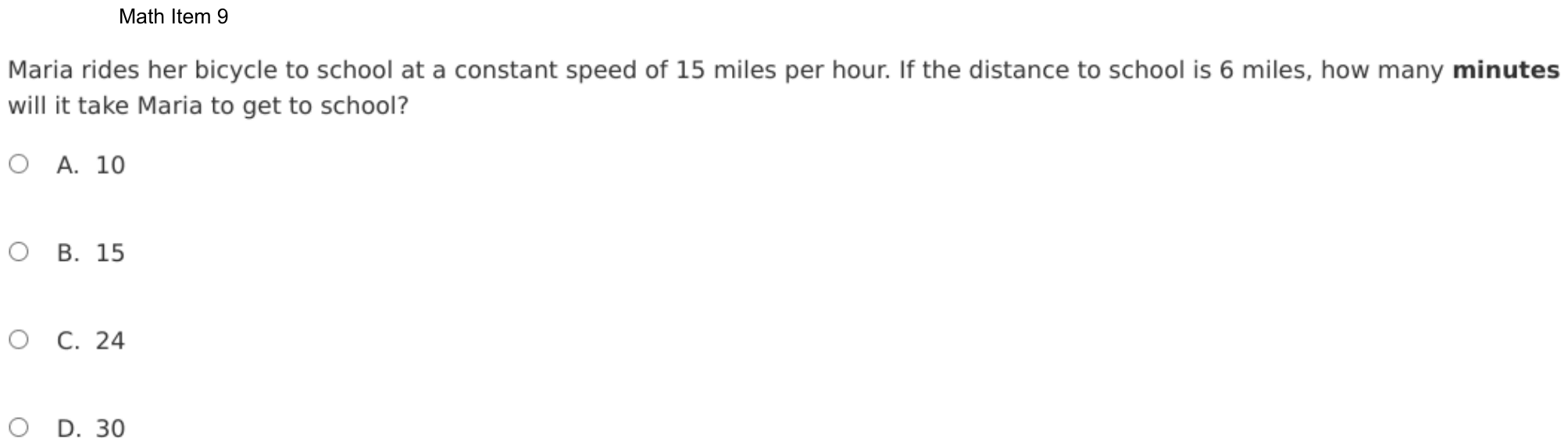
Question 114 of 120
2026 Practice Test C Math, question 10Question
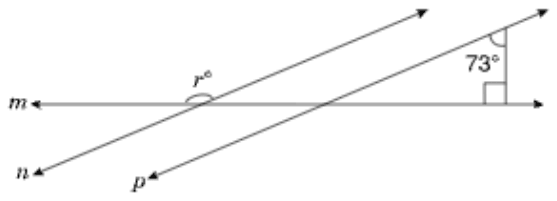
In the figure above, . Straight line m intersects both line n and line p. What is the value of r?
- A17
- B117
- C163
- D173
Show the answer
Correct answer: C
The triangle formed by line p, line m, and the line segment connecting the two contains a 73° angle, a right angle (90°), and a missing angle measuring x°. The sum of the interior angles of a triangle is 180°, so begin by finding the value of x:
Line m is a straight line, so it has a measure of 180°. The 17° angle from the triangle and the adjacent angle outside the triangle are supplementary, so they have a sum of 180°. Let s represent the measure of the adjacent angle outside the triangle. The value of s can be determined by subtracting:
Given that n and p are parallel lines and that they have been cut by a transversal, line m, then corresponding angles are congruent. Angles r and s are corresponding angles, so the value of r is congruent to the value of s, which is 163°.
Question analysis
Two parallel lines, n and p, cross a straight line m, and a segment drawn at a right angle to m forms a small triangle with lines m and p, where a 73° angle is marked. Students find the angle r at line n. It combines a triangle's angle sum, a straight angle and parallel lines, and the angle wanted sits away from the marked ones.
- NYS standards
- Grade level
- Grade 8 content, by NYS standard
- Compared with grade 7
- Above grade 7 Grade 7 angle problems use supplementary, vertical and adjacent angles. This one also needs the angle sum of a triangle and the angles formed by parallel lines and a transversal, grade 8 facts, chained across a busy figure.
- Estimated difficulty
- Hard: combines ideas, needs a plan, and has more than one tempting wrong answer.
- Thinking it demands
- Depth of knowledge 2, skills and concepts · mainly apply
- What makes it hard
- Reading a figure, table or graph moderate
- Combines ideas moderate
- Something you must already know minor
- Solution
- 3 steps
- Reading level
- Question and choices: about grade 3, 21 words.
- Students, last 30 days
- Not enough answers yet to show (it takes 10).
Why it is hard, traps and wrong answers (shows the answer)
Why it is hard
Each fact needs only a subtraction, but the student has to plan a route from the 73° angle at line p over to r at line n. The first number the route gives, the triangle's 17° angle, is listed, and it is the acute partner of r rather than r itself. The figure helps here: r is drawn plainly obtuse, and 163 is also 90 + 73, the triangle's exterior angle, which confirms it.
Reading a figure, table or graph moderate Understanding the question
The 73° sits between line p and the vertical segment, not between p and m, and r is the obtuse angle above m on the left of line n, far from every marked angle. (Lesh, Post & Behr, 1987; Kirsch & Mosenthal, 1990)
Combines ideas moderate Working it out
Three facts chain together: the triangle's angles sum to 180°, the angles along straight line m sum to 180°, and corresponding angles at the parallel lines n and p are equal. (Embretson, 1998; Daniel & Embretson, 2010)
Something you must already know minor Working it out
The angle pairs formed by a line crossing two parallel lines are a grade 8 topic, and the question uses them without naming them. (Anderson & Krathwohl, 2001)
Strategy: Find the third angle of the right triangle, use the straight line m to get the angle beside it, then carry that angle over to line n using the parallel lines.
Traps
- Stops one step early: A choice is a number from partway through the solution.
- An arithmetic slip: The right method with a plausible arithmetic error: a digit, a place value or a times-table fact.
The wrong answers, classified
A Stops one step early (King et al., 2004; Gierl et al., 2017)
Finds the triangle's third angle, 180 − 90 − 73 = 17, and stops, though r is the obtuse angle next to the 17° angle, not that angle itself.
B Little reason to choose it (Haladyna & Downing, 1993; Rodriguez, 2005)
No angle fact in the figure gives 117; even 180 − 73 is 107, so this choice mostly catches guesses at an obtuse angle.
D An arithmetic slip (Junker & Sijtsma, 2001)
Finds the 17° angle and subtracts it from 180 but borrows without reducing the 8, so 180 − 17 comes out as 173.
Worked solution, step by step
Formulas used
- Angles of a triangle
- a, b and c are the three angles inside any triangle. They always add up to 180°. If you know two of them, subtract their sum from 180° to find the third.
- Angles on a straight line
- a and b are two angles side by side on a straight line. Together they make a half turn, which is 180°. Use it to find the angle next to one you already know.
- Corresponding angles
- The symbol ∥ means is parallel to. When line m crosses two parallel lines, it makes the same angles at each crossing. Angles in the same position at the two crossings are called corresponding angles. They are equal.
Sort out the question
Lines n and p are parallel, and line m crosses both. Near line p, a straight-up segment meets line m. The small square shows a right angle, 90°. Line p, line m and that segment make a small triangle. Its top angle is 73°.
You need r, the wide angle where line n crosses line m.
Find the triangle’s third angle
The third angle is where line p crosses line m. Call it x. Use the triangle rule:
So that angle is 17°.
Watch out: this is not r. Stopping here gives choice A, 17.
Use the straight line m
The 17° angle sits above line m, on the right of line p. Beside it, on the left of line p, is a wide angle. Call it s. The two angles fill the straight line m, so they add to 180°:
So s is 163°.
Watch out: borrow carefully. 180 − 17 is 163, not 173, choice D.
Carry the angle to line n
Angle s is above line m and to the left of line p. Angle r is above line m and to the left of line n. They are in the same position, so they are corresponding angles. Since n and p are parallel:
So the answer is C, 163.
Check your answer
Look at the figure. Angle r is wider than a right angle, so it must be more than 90°. That rules out 17. Also, the narrow angle beside r, on the right of line n, matches the 17° angle at line p. And , as it should on a straight line.
More questions like this
The original DOE question
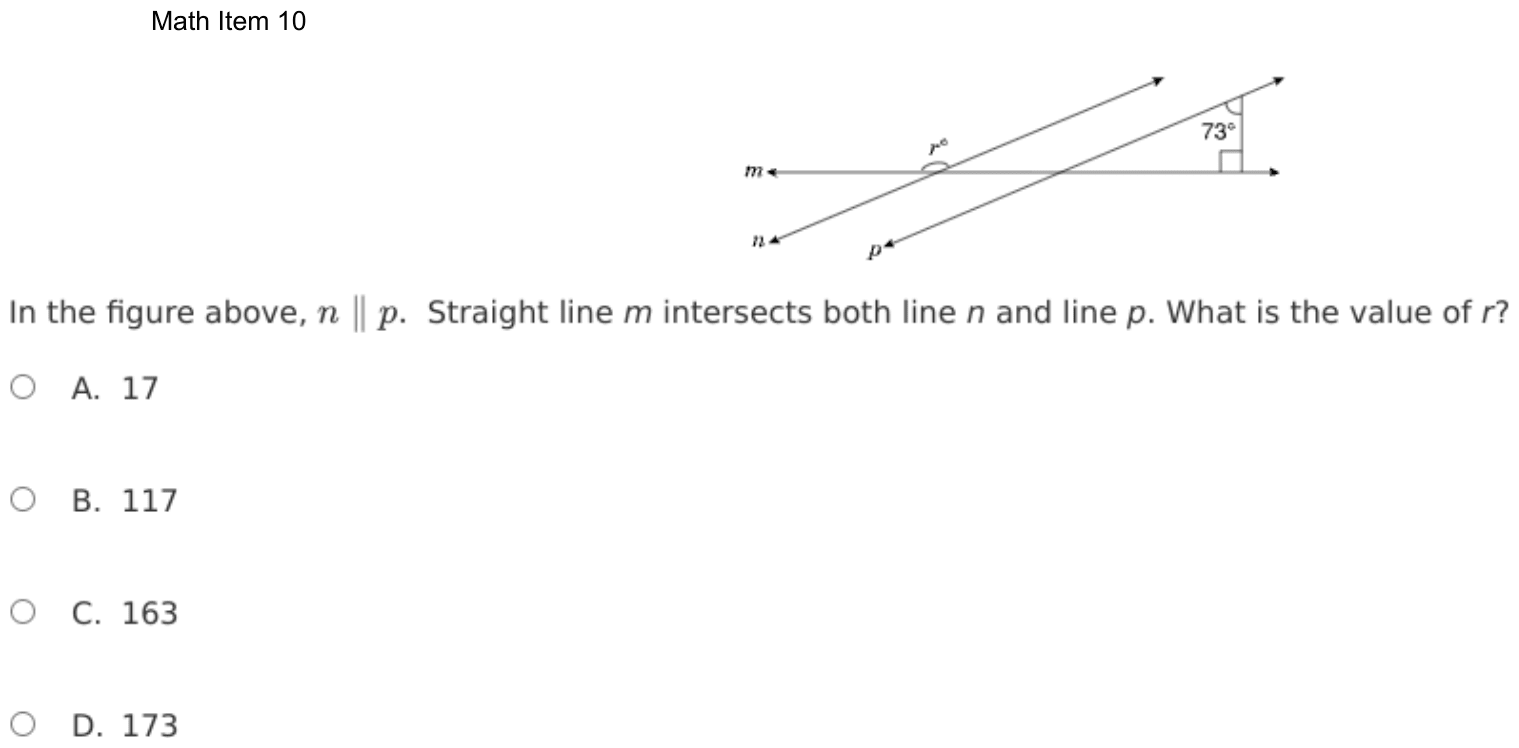
Question 115 of 120
2026 Practice Test C Math, question 11Question
Allison has 5 stamp albums with 576 stamps in each album. If she transfers her stamp collection to 6 albums, each holding 378 stamps, how many stamps will be left over?
- A198
- B612
- C620
- D632
Show the answer
Correct answer: B
Determine the total number of stamps in 5 albums holding 576 stamps:
Determine the total number of stamps in 6 albums holding 378 stamps:
Subtract 2,268 from 2,880 to find the number of stamps that will be left over:
Question analysis
Allison moves a stamp collection from 5 albums of 576 stamps into 6 albums that hold 378 each, and students find how many stamps are left over. It tests multiplying and subtracting large whole numbers in a word problem. The question gives no total, so the collection has to be counted before the new albums' capacity is taken away.
- Grade level
- Grade 7 content, by NYS standard
- Compared with grade 7
- Below grade 7 Whole-number multiplication and subtraction in a three-step word problem is easier than grade 7 work with fractions, decimals or negatives. Because the products are large, a slip or a rounded estimate easily gives another choice.
- Estimated difficulty
- Straightforward: two steps or one careful reading.
- Thinking it demands
- Depth of knowledge 2, skills and concepts · mainly apply
- What makes it hard
- A very close wrong answer moderate
- Error-prone arithmetic minor
- Solution
- 3 steps
- Reading level
- Question and choices: about grade 6, 27 words.
- Students, last 30 days
- Not enough answers yet to show (it takes 10).
Why it is hard, traps and wrong answers (shows the answer)
Why it is hard
The plan is clear from the stem: count the stamps, then take away what the six new albums hold, so the question tests careful arithmetic. Its choices punish the estimating that saves time elsewhere, since rounding either factor shifts the result by only a few tens, onto another listed number. Students who skip the album counts altogether and compare one album with one album find 198 waiting.
A very close wrong answer moderate Choosing the answer
612, 620 and 632 lie within 20 of one another, so rounding 576 and 378 to friendly numbers before multiplying lands on a wrong choice; only exact products separate them. (Embretson & Wetzel, 1987; Gorin & Embretson, 2006; Ascalon et al., 2007)
Error-prone arithmetic minor Working it out
Two products of three-digit numbers, 5 × 576 = 2,880 and 6 × 378 = 2,268, must be done by hand and then subtracted with regrouping. (Brown & Burton, 1978; Junker & Sijtsma, 2001)
Strategy: Multiply to find the total number of stamps, multiply again to find how many the six new albums hold, subtract, and check the last digit of each product.
Traps
- Rounds too early: Rounds a value partway through, or rounds the wrong way, so the final answer drifts from the exact one.
- Numbers taken from the question: Combines the numbers in the question without a model of the situation, or is simply a number that appears in the question.
The wrong answers, classified
A Numbers taken from the question (Hegarty, Mayer & Monk, 1995)
Subtracts 378 from 576, comparing one old album with one new album, and ignores that there are 5 old albums and 6 new ones.
C Rounds too early (King et al., 2004)
Rounds 576 to 580 and 378 to 380 before multiplying, so 2,900 − 2,280 = 620, an estimate rather than the exact number left over.
D Rounds too early (King et al., 2004)
Rounds only 576 up to 580, getting 2,900 stamps, then subtracts the exact 2,268, so the count comes out 20 too high.
Worked solution, step by step
Formulas used
- Total in equal groups
- Here the groups are albums. The amount in each group is how many stamps one album holds. When every group is the same size, multiplying is a fast way to add them all up.
Sort out the question
Allison has 5 albums with 576 stamps in each. She moves all her stamps into 6 new albums. Each new album holds 378 stamps. Some stamps will not fit. You need the number left over.
Count all her stamps
Use the equal-groups formula. Split 576 into 500 + 76 to make it easy:
Allison has 2,880 stamps.
Count what the new albums hold
Do the same for the 6 new albums. Split 378 into 300 + 78:
The new albums hold 2,268 stamps in all.
Subtract to find the leftovers
The stamps left over are the ones she has minus the ones that fit:
Watch out: , choice A, compares just one old album with one new one. Rounding to 580 and 380 first gives 620, choice C. Rounding only 576 gives 632, choice D. Use the exact numbers.
So the answer is B, 612.
Check your answer
Add the leftovers to the stamps that fit: . That is exactly the number Allison started with. So no stamps were lost or counted twice.
More questions like this
The original DOE question
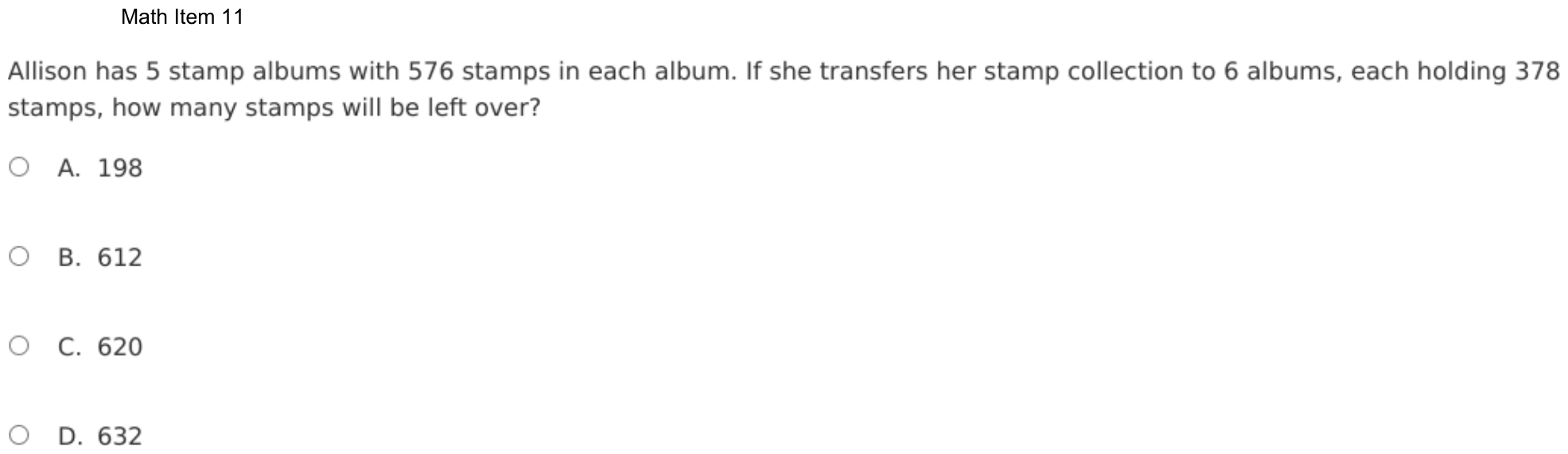
Question 116 of 120
2026 Practice Test C Math, question 13Question
Start with the number 135.28 and perform the following steps in order:
- Step 1: Multiply by 10.
- Step 2: Add 0.5 to the result of Step 1.
- Step 3: Drop the digits after the decimal point.
- Step 4: Divide by 10.
What is the result?
- A13.5
- B135
- C135.2
- D135.3
Show the answer
Correct answer: D
Begin by multiplying 135.28 by 10:
Add 0.5:
Drop the digits after the decimal point, so becomes .
Divide by 10:
Question analysis
Students start with 135.28 and carry out four listed steps: multiply by 10, add 0.5, drop the digits after the decimal point, and divide by 10. It tests place value and operations with decimals. Skipping a step, or doing two of them in the wrong order, changes the result, and the choices are built from those slips.
- NYS standards
- 6.NS.3 multi-digit decimal operations
- Grade level
- Grade 6 content, by NYS standard
- Compared with grade 7
- Below grade 7 Multiplying and dividing a decimal by 10 and adding 0.5 are grade 5 and 6 skills. The four steps are spelled out, so the demand is following them exactly and in order, not choosing a method.
- Estimated difficulty
- Straightforward: two steps or one careful reading.
- Thinking it demands
- Depth of knowledge 1, recall and reproduction · mainly apply
- What makes it hard
- A very close wrong answer moderate
- Many steps minor
- Error-prone arithmetic minor
- Solution
- 4 steps
- Reading level
- Question and choices: about grade 3, 36 words.
- Students, last 30 days
- Not enough answers yet to show (it takes 10).
Why it is hard, traps and wrong answers (shows the answer)
Why it is hard
The steps spell out how to round 135.28 to the nearest tenth, but nothing says so, and they have to be followed exactly. The decisive moment is step 2, where adding 0.5 pushes 1,352.8 past 1,353; skip it and the digits are simply cut, not rounded. Students who recognize the routine can check the result directly, since 135.28 lies closer to 135.3 than to 135.2.
A very close wrong answer moderate Choosing the answer
135.3 and 135.2 differ only in the tenths digit, and 135 shares their whole-number part, so a rough sense of the result's size rules out nothing. (Embretson & Wetzel, 1987; Gorin & Embretson, 2006; Ascalon et al., 2007)
Many steps minor Working it out
Four listed steps move the decimal point twice, and doing them in another order, or skipping one, still produces a believable number near 135. (Daniel & Embretson, 2010; Enright, Morley & Sheehan, 2002)
Error-prone arithmetic minor Working it out
Adding 0.5 to 1,352.8 carries into the ones place, since 8 tenths and 5 tenths make 1.3, which turns 1,352 into 1,353 before the decimals are dropped. (Brown & Burton, 1978; Junker & Sijtsma, 2001)
Strategy: Write down the number after each step instead of doing them in your head, and carry out the steps exactly in the order listed.
Traps
- Misreads the question: Misses or misreads a condition or a word in the question: "at least", "each", "remaining", "not".
- Rounds too early: Rounds a value partway through, or rounds the wrong way, so the final answer drifts from the exact one.
The wrong answers, classified
A Misreads the question (Hegarty, Mayer & Monk, 1995)
Skips step 1, so adds 0.5 to 135.28, drops the decimals to get 135, and then divides by 10 to reach 13.5.
B Misreads the question (Hegarty, Mayer & Monk, 1995)
Divides by 10 before dropping the digits after the decimal point, so 1,353.3 becomes 135.33 and then 135, doing steps 3 and 4 in reverse order.
C Rounds too early (King et al., 2004)
Leaves out step 2, or adds 0.5 without carrying, so 1,352 is kept and 135.2 results: 135.28 cut down instead of rounded up.
Worked solution, step by step
Formulas used
- Multiplying and dividing by 10
- a is any decimal number. Multiplying by 10 moves its decimal point one place to the right, so each digit is worth ten times as much. Dividing by 10 moves the point one place to the left. The two steps undo each other.
Sort out the question
You start with 135.28 and do four steps, in order. Write down the number after each step. Doing them in your head, or in another order, leads to a wrong choice. You need the number at the end.
Multiply by 10
Step 1. Multiplying by 10 moves the decimal point one place to the right:
The digits stay the same. Only the decimal point moves.
Add 0.5
Step 2. Line up the decimal points. 8 tenths plus 5 tenths is 13 tenths. That is 1 whole and 3 tenths, so carry the 1 into the ones place:
Watch out: skipping this step, or forgetting to carry, keeps 1,352. That leads to choice C, 135.2.
Drop the digits after the point
Step 3. Cut off the digits after the decimal point. Do not round. So 1,353.3 becomes 1,353.
Watch out: do step 3 before step 4. Dividing first gives 135.33. Dropping its decimals then gives 135, choice B.
Divide by 10
Step 4. Dividing by 10 moves the decimal point one place to the left:
Skipping step 1 gives 13.5, choice A. So the answer is D, 135.3.
Check your answer
These four steps are a recipe for rounding to the nearest tenth. 135.28 is between 135.2 and 135.3. Its hundredths digit is 8, which is 5 or more, so it rounds up to 135.3. The recipe and the rounding agree.
More questions like this
The original DOE question
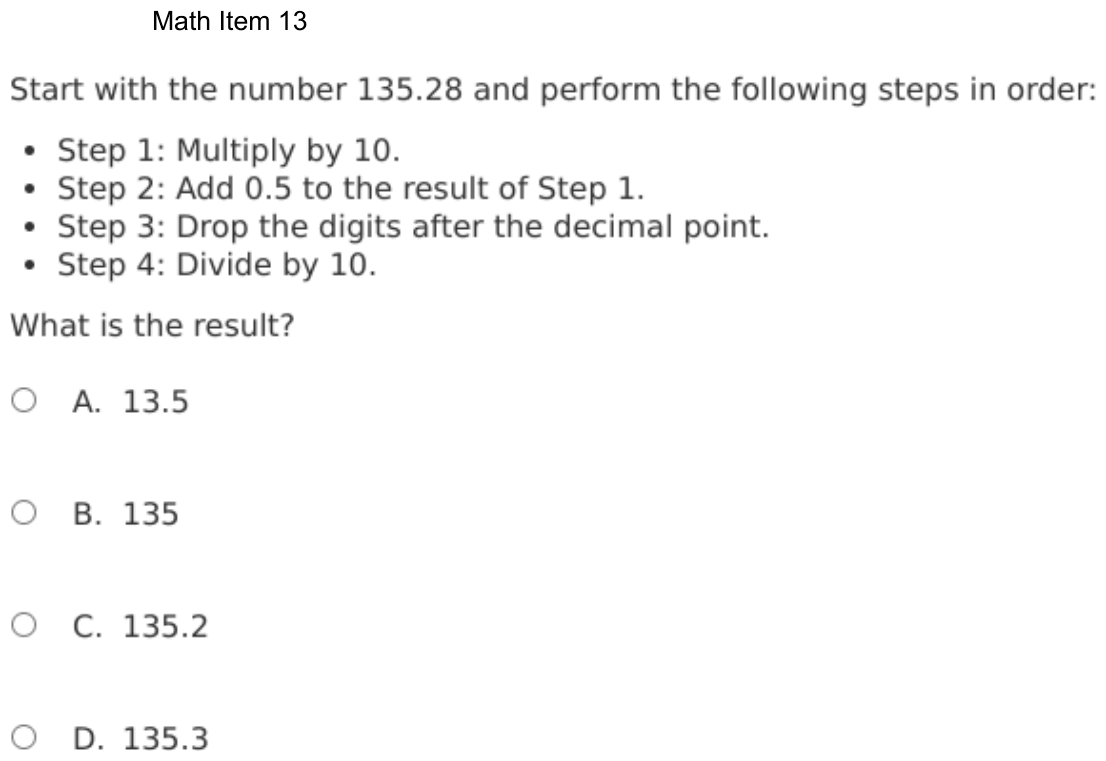
Question 117 of 120
2026 Practice Test C Math, question 14Question
If , what is the value of ?
- A−18
- B−6
- C−2
- D2
Show the answer
Correct answer: B
Substitute for each value of x in the expression:
minus
Evaluate the terms involving exponents:
minus
Evaluate the terms involving multiplication:
minus
Simplify the expression:
The absolute value of is 6, and the absolute value of is 12, so is the equivalent of subtracting 12 from 6:
Question analysis
This substitution question sets x = −2 in an expression that subtracts one absolute value from another: the first holds x, x squared and x cubed, the second x, 2x and 3x. Students evaluate the expression. It tests powers of negative numbers, absolute value and integer subtraction, and the signs of the square and the cube are where answers go wrong.
- NYS standards
- Grade level
- Grade 7 content, by NYS standard
- Compared with grade 7
- At grade 7 Substituting a negative number and taking absolute values is typical grade 7 sign practice. This expression puts a square and a cube of a negative inside one pair of bars and then subtracts two absolute values, so there are several places to slip.
- Estimated difficulty
- Moderate: several steps, or a close reading with one strong distractor.
- Thinking it demands
- Depth of knowledge 1, recall and reproduction · mainly apply
- What makes it hard
- Error-prone arithmetic moderate
- Many steps minor
- Solution
- 4 steps
- Reading level
- Question and choices: about grade 7, 8 words.
- Students, last 30 days
- Not enough answers yet to show (it takes 10).
Why it is hard, traps and wrong answers (shows the answer)
Why it is hard
Every step is routine, but the expression stacks sign decisions, and each wrong choice records a different one going wrong. The powers of −2 alternate in sign, which students who treat every power as positive, or the square as negative, miss. The last step catches students who know the rules: both absolute values are positive, yet 6 − 12 is still negative, so the answer keeps its minus sign.
Error-prone arithmetic moderate Working it out
With x = −2 the square is 4 but the cube is −8, so the first bars hold −2 + 4 − 8 = −6, and the sign changes from each term to the next. (Brown & Burton, 1978; Junker & Sijtsma, 2001)
Many steps minor Working it out
Six terms are substituted, two pairs of bars are simplified and made positive, and only then is 12 subtracted from 6, four stages that must come in a fixed order. (Daniel & Embretson, 2010; Enright, Morley & Sheehan, 2002)
Strategy: Work out each power of −2 separately, keeping its sign, add the terms inside each pair of bars, take both absolute values, and subtract only at the end.
Traps
- Negatives and direction: Arithmetic with negative numbers, the order of a subtraction, or direction on a number line. (Moving a term across the equals sign without changing its sign is a faulty procedure.)
- A faulty procedure: A systematic but wrong procedure: adding fractions straight across, applying an exponent to each term of a sum, dropping a sign when moving a term.
The wrong answers, classified
A A faulty procedure (Brown & Burton, 1978; Tatsuoka, 1983)
Simplifies both insides correctly but treats the first bars like parentheses, keeping −6, so −6 − 12 = −18.
C Negatives and direction (Brown & Burton, 1978)
Takes (−2)³ as positive 8, as if every power of a negative were positive, so the first bars hold −2 + 4 + 8 = 10, and 10 − 12 = −2.
D Negatives and direction (Brown & Burton, 1978)
Takes (−2)² as −4, so the first bars hold −2 − 4 − 8 = −14, and 14 − 12 = 2; dropping the minus from x throughout also gives 2.
Worked solution, step by step
Formulas used
- Absolute value
- a is any number. The bars mean absolute value: how far a is from 0 on the number line. A distance is never negative, so |−6| = 6 and |6| = 6. Work out what is inside the bars first, then take the absolute value.
- Powers of a negative number
- The small raised number is the exponent. It tells how many times −2 is multiplied by itself. Two negatives multiply to a positive. So an even number of negative factors gives a positive answer, and an odd number gives a negative one.
Sort out the question
You need the value of when x = −2. The bars | | mean absolute value. Work out each pair of bars on its own. Subtract only at the end.
Find the powers of −2
Put −2 in for x. Keep each negative sign:
The square is positive, but the cube is negative.
Watch out: taking as +8 makes the first bars hold 10. That leads to choice C, −2.
Work out the first bars
Add the three terms inside the first pair of bars:
−2 + 4 is 2, and 2 + (−8) is −6. The distance from −6 to 0 is 6.
Work out the second bars
Here 2x means 2 times x, so it is −4. And 3x is −6:
All three terms are negative, so they add to −12. Its absolute value is 12.
Subtract the second value
Now subtract the second value from the first:
Watch out: the bars make each part positive, but the difference can still be negative. Keeping −6 inside the first bars gives −6 − 12 = −18, choice A.
So the answer is B, −6.
Check your answer
Check the second bars a faster way. , and . That matches. Also, the second value, 12, is bigger than the first, 6. So the difference must be negative, as −6 is.
More questions like this
The original DOE question
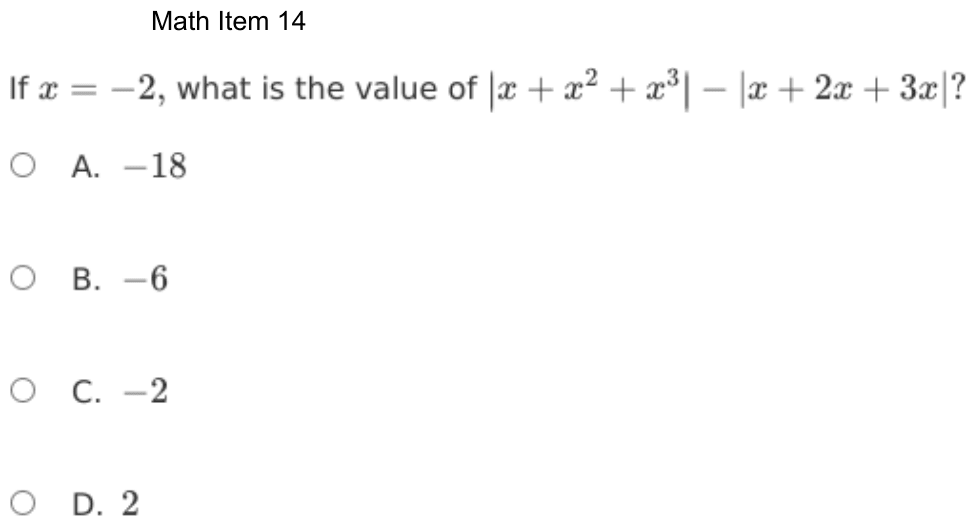
Question 118 of 120
2026 Practice Test C Math, question 16Question
- A−1
- B0
- C
- D1
Show the answer
Correct answer: B
Simplify the expression.
is the equivalent of subtracting 3 from 3, and is the equivalent of adding 3 to 3:
The zero property of division states that zero divided by any nonzero number equals zero, so .
Question analysis
This fraction has 3 plus negative 3 on top and 3 minus negative 3 on the bottom, and students find its value. It tests adding and subtracting negative numbers and dividing integers. The top and the bottom look almost alike, so each sign has to be read carefully before anything is divided.
- Grade level
- Grade 7 content, by NYS standard
- Compared with grade 7
- Below grade 7 Adding and subtracting a negative integer and dividing are grade 7 basics, and here the numbers are small. It is a short routine calculation, easier than typical grade 7 work, though the two signs invite a quick misreading.
- Estimated difficulty
- Routine: one familiar step, little to misread.
- Thinking it demands
- Depth of knowledge 1, recall and reproduction · mainly apply
- What makes it hard
- Error-prone arithmetic minor
- Solution
- 2 steps
- Reading level
- Question and choices: about grade 16+, 2 words.
- Corrected from the DOE handbook
- A grammatical error in the explanation was corrected.
- A rule stated too broadly in the explanation was corrected.
- Students, last 30 days
- Not enough answers yet to show (it takes 10).
Why it is hard, traps and wrong answers (shows the answer)
Why it is hard
The arithmetic is two one-step sign calculations and a division by 6. The danger is reading the top and the bottom as alike: they differ in a single sign, and treating them the same way gives 1 or −1. Students who rewrite 3 − (−3) as 3 + 3 and 3 + (−3) as 3 − 3 see 0 over 6 at once, and zero divided by a nonzero number is zero.
Error-prone arithmetic minor Working it out
The top adds −3 and the bottom subtracts −3, signs that look nearly the same but give 0 and 6, so each has to be rewritten before anything is divided. (Brown & Burton, 1978; Junker & Sijtsma, 2001)
Strategy: Simplify the top and the bottom separately, rewriting the subtraction of a negative as an addition, and only then divide the top by the bottom.
Traps
- Negatives and direction: Arithmetic with negative numbers, the order of a subtraction, or direction on a number line. (Moving a term across the equals sign without changing its sign is a faulty procedure.)
The wrong answers, classified
A Negatives and direction (Brown & Burton, 1978)
Adds the sizes on top and keeps the minus, taking 3 + (−3) as −6, so the fraction becomes −6/6 = −1.
C Little reason to choose it (Haladyna & Downing, 1993; Rodriguez, 2005)
No sign rule gives a top of 1, so 1/6 mostly draws students who find the bottom, 6, and are unsure what a top of 0 means.
D Negatives and direction (Brown & Burton, 1978)
Treats the top like the bottom, adding 3 and 3 in both places, so the fraction becomes 6/6 = 1.
What was corrected from the DOE handbook, and why
- Explanation: The DOE’s explanation says “3 − (−3) is equivalent of adding 3 to 3”, without the article that the same sentence uses in “3 + (−3) is the equivalent of subtracting 3 from 3”. The site now says “is the equivalent of adding 3 to 3”.
- Explanation: The DOE’s explanation says “The zero property of division states that zero divided by any number equals zero.” Zero divided by zero is undefined, not zero, so the rule holds only when the divisor is not zero. The site now says “zero divided by any nonzero number equals zero”. Here the divisor is 6, so 0/6 = 0, as before.
Worked solution, step by step
Formulas used
- Adding a negative
- a and b are numbers. Adding a negative is the same as subtracting. On a number line, adding −3 moves you 3 steps left, just like subtracting 3.
- Subtracting a negative
- a and b are numbers. Subtracting a negative is the same as adding. Taking away a debt of 3 dollars leaves you 3 dollars better off. On a number line, you move right.
- Zero divided by a number
- b is any number except 0. Zero split into b equal parts leaves 0 in each part. The rule needs b not to be 0, because dividing by 0 has no answer.
Sort out the question
The top of the fraction is , and the bottom is . A fraction bar means divide. Work out the top and the bottom separately first. Then divide the top by the bottom.
Work out the top
Adding −3 is the same as subtracting 3:
A number plus its opposite is always 0.
Watch out: do not add the 3s and keep the minus sign. That makes the top −6 and leads to choice A, −1.
Work out the bottom
Subtracting −3 is the same as adding 3:
Watch out: the top and bottom look alike, but they are not. Making both of them 6 gives 6/6 = 1, choice D.
Divide the top by the bottom
Now the fraction is 0 over 6. Zero divided by any number other than zero is zero:
A top of 0 does not make the fraction 1/6, choice C. So the answer is B, 0.
Check your answer
Check by multiplying. A division is right when the answer times the bottom gives the top. Here , which is the top. So 0/6 really is 0.
More questions like this
The original DOE question
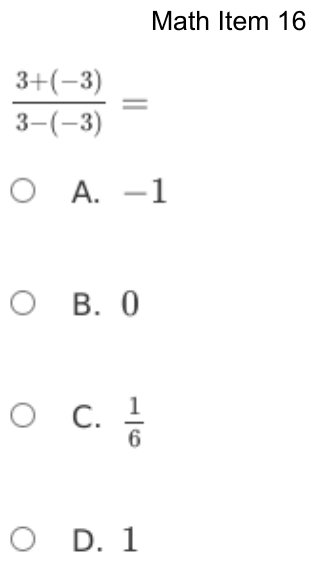
Question 119 of 120
2026 Practice Test C Math, question 17Question

What is the distance between the midpoints of and ?
- A unit
- B1 unit
- C units
- D2 units
Show the answer
Correct answer: A
begins at 1 and ends at 7. Determine the length of :
The midpoint of a line segment is located exactly halfway between the two endpoints. Since is 6 units in length, the two endpoints are 6 units apart. Determine the location of the midpoint, in relation to each endpoint, by dividing 6 by 2:
The location of the midpoint of is 3 units from either endpoint. Find the midpoint by either adding 3 to the location of M (1) or subtracting 3 from the location of N (7):
The midpoint of is located at 4.
begins at 3 and ends at 6. Determine the length of :
Since is 3 units in length, the two endpoints are 3 units apart. Determine the location of the midpoint, in relation to each endpoint, by dividing 3 by 2:
The location of the midpoint of is 1.5 units from either endpoint. Find the midpoint by either adding 1.5 to the location of R (3) or subtracting 1.5 from the location of S (6):
The midpoint of is located at 4.5.
Determine the distance between the two midpoints by subtracting:
0.5 is equivalent to , making the distance between the two midpoints unit.
Question analysis
A number line from 0 to 8 shows points M, R, S and N, and students find the distance between the midpoint of segment MN and the midpoint of segment RS. It tests locating points and finding distances on a number line. One segment sits inside the other, and several lengths in the figure can be mistaken for the distance wanted.
- Grade level
- Grade 7 content, by NYS standard
- Compared with grade 7
- At grade 7 Finding distances between points on a number line is grade 7 work, here with whole-number positions. Two midpoints must be located before their distance can be found, so the task takes three short steps rather than one.
- Estimated difficulty
- Straightforward: two steps or one careful reading.
- Thinking it demands
- Depth of knowledge 2, skills and concepts · mainly apply
- What makes it hard
- Reading a figure, table or graph minor
- Many steps minor
- Solution
- 3 steps
- Reading level
- Question and choices: about grade 8, 17 words.
- Students, last 30 days
- Not enough answers yet to show (it takes 10).
Why it is hard, traps and wrong answers (shows the answer)
Why it is hard
The positions are whole numbers, so the midpoints come from simple averages, (1 + 7) ÷ 2 and (3 + 6) ÷ 2. The difficulty is keeping several lengths apart: the half-lengths of the two segments, the gaps at their ends, and the distance actually asked for, half a unit. Marking both midpoints on the number line before subtracting makes the small gap visible.
Reading a figure, table or graph minor Understanding the question
Segment RS lies inside MN, from 3 to 6, and its midpoint, 4 1/2, falls between two ticks of the number line rather than on a labeled point. (Lesh, Post & Behr, 1987; Kirsch & Mosenthal, 1990)
Many steps minor Working it out
Two midpoints have to be found, at 4 and 4 1/2, before their distance is taken, and the half-length of RS met on the way, 1 1/2, is among the choices. (Daniel & Embretson, 2010; Enright, Morley & Sheehan, 2002)
Strategy: Find each midpoint as the average of its segment's two endpoints, then subtract the smaller midpoint from the larger one.
Traps
- Stops one step early: A choice is a number from partway through the solution.
- Answers a different question: A choice is right for another quantity: the other unknown, the rest instead of the part, the part instead of the whole.
The wrong answers, classified
B Stops one step early (King et al., 2004; Gierl et al., 2017)
Sees that RS starts 2 units in from M and ends 1 unit in from N, and takes the difference of those gaps, 1, without halving it.
C Answers a different question (King et al., 2004; Hegarty, Mayer & Monk, 1995)
Halves each segment, 3 units for MN and 1 1/2 for RS, and subtracts the half-lengths instead of comparing the midpoints' positions.
D Answers a different question (King et al., 2004; Hegarty, Mayer & Monk, 1995)
Gives the distance from M to R, 2 units, the gap between the left ends of the two segments, without locating any midpoint.
Worked solution, step by step
Formulas used
- Midpoint on a number line
- a and b are the numbers at the two ends of a segment. The midpoint is the point exactly halfway between them. Adding the ends and dividing by 2 finds their average, which is the middle.
- Distance on a number line
- The distance between two points on a number line is how many units apart they are. Subtract the smaller number from the larger one, so the distance is never negative.
Sort out the question
The number line shows M at 1, R at 3, S at 6 and N at 7. Segment MN goes from 1 to 7. Segment RS goes from 3 to 6. A midpoint is the point exactly halfway along a segment. You need the distance between the two midpoints.
Find the midpoint of MN
Use the midpoint formula with the ends 1 and 7:
The midpoint of MN is at 4, which is 3 units from each end.
Find the midpoint of RS
Use the same formula with the ends 3 and 6:
The midpoint of RS is at 4.5. That is halfway between the marks for 4 and 5, where no point is labeled.
Subtract the two midpoints
Use the distance formula:
0.5 is one half, so the midpoints are 1/2 unit apart.
Watch out: half of MN is 3, and half of RS is 1 1/2. Subtracting those gives 1 1/2, choice C. But they are half-lengths, not positions. And 2, choice D, is only the distance from M to R.
Choose the answer
The midpoints, 4 and 4.5, are close together because RS sits near the middle of MN. So the answer is A, 1/2 unit.
Check your answer
Find each midpoint another way: walk half the length from the left end. MN is units long, and . RS is units long, and . Same midpoints, 1/2 unit apart.
More questions like this
The original DOE question
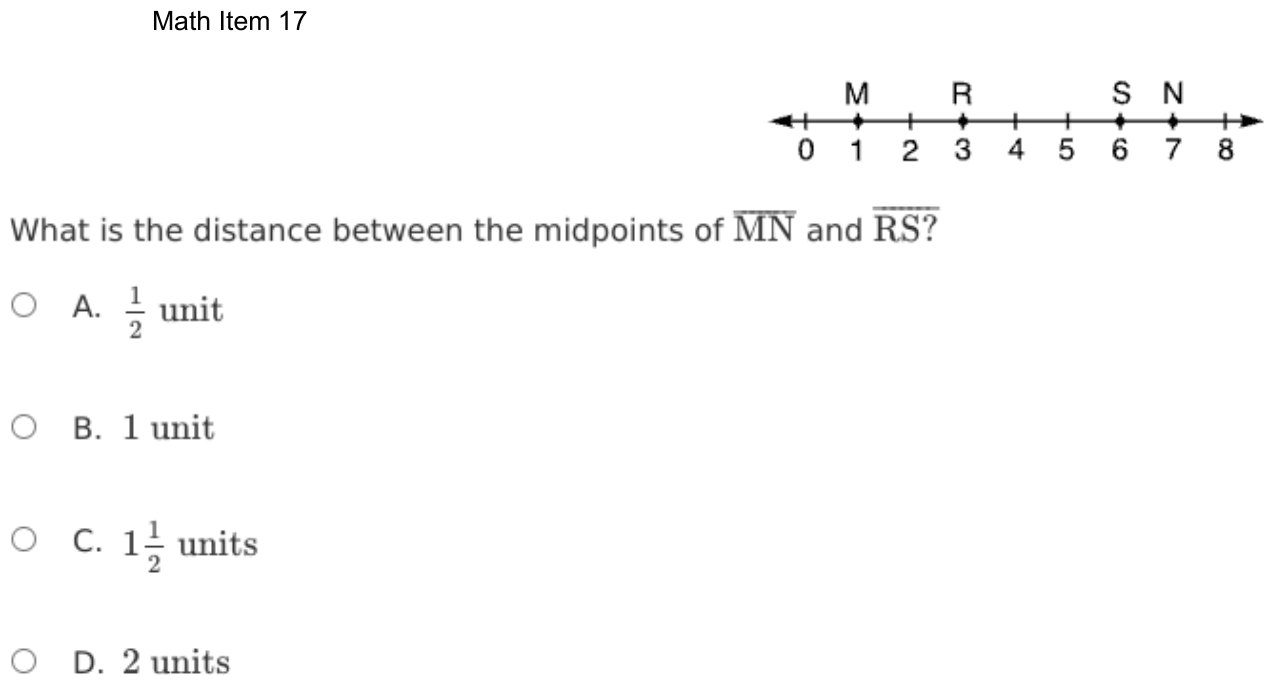
Question 120 of 120
2026 Practice Test C Math, question 18Question
I.
II.
III.
If s is a positive integer and t is a negative integer, which of the above expressions must be a positive number?
- AII only
- BI and II only
- CII and III only
- DI, II, and III
Show the answer
Correct answer: D
Each of the three expressions must be considered:
Expression I: , where s is a positive integer and t is a negative integer:
Subtracting a negative integer is the equivalent of adding a positive integer, so is equivalent to finding the value of , which must result in a positive number.
Expression II: , where s is a positive integer and t is a negative integer:
Squaring a negative integer results in a positive integer, so is equivalent to finding the value of , which must result in a positive number.
Expression III: , where s is a positive integer and t is a negative integer:
A negative exponent results in the reciprocal of the same exponential expression, so is equivalent to finding the value of , which must result in a positive number.
Therefore, Expressions I, II, and III must all result in a positive number.
Question analysis
Three expressions, s − t, s times t squared, and s to the power t, are listed, and students decide which must be positive when s is a positive integer and t is a negative integer. It tests sign rules for subtraction and multiplication and the meaning of a negative exponent. Each expression has to be judged for every possible pair, not just one example.
- NYS standards
- Grade level
- Grade 8 content, by NYS standard
- Compared with grade 7
- Above grade 7 Grade 7 students learn sign rules for subtracting and multiplying signed numbers. Here they reason about letters rather than numbers, decide what must always hold, and handle a negative exponent, a grade 8 idea.
- Estimated difficulty
- Hard: combines ideas, needs a plan, and has more than one tempting wrong answer.
- Thinking it demands
- Depth of knowledge 2, skills and concepts · mainly analyze
- What makes it hard
- Variables instead of numbers moderate
- Something you must already know moderate
- Every choice must be checked minor
- Solution
- 3 steps
- Reading level
- Question and choices: about grade 5, 42 words.
- Corrected from the DOE handbook
- Two steps of the explanation that treated t as a positive number were corrected.
- A punctuation error in the explanation was corrected.
- Students, last 30 days
- Not enough answers yet to show (it takes 10).
Why it is hard, traps and wrong answers (shows the answer)
Why it is hard
The three expressions test three different sign facts: subtracting a negative, squaring a negative, and raising to a negative power. The last is the trap, since a negative exponent seems to promise a negative result when it really gives a fraction, and that belief alone leads to a listed choice. Trying s = 2 and t = −3 gives 5, 18 and 1/8, all positive, and the rules show why no other pair can change that.
Variables instead of numbers moderate Understanding the question
No values are given for s and t, only their signs, and must means each expression has to be positive for every such pair, not just for one example. (Koedinger & Nathan, 2004; Enright, Morley & Sheehan, 2002)
Something you must already know moderate Working it out
Expression III needs the meaning of a negative exponent, s to the power t equals 1 over s to the power −t, a grade 8 rule the question does not state. (Anderson & Krathwohl, 2001)
Every choice must be checked minor Choosing the answer
Each of the three expressions is judged on its own and the choices combine the verdicts, so one wrong judgment anywhere points to a wrong combination. (Embretson & Wetzel, 1987)
Strategy: Try a pair such as s = 2 and t = −3 in each expression, then explain why its sign could or could not change for any other positive s and negative t.
Traps
- Misunderstands the concept: A wrong belief about a concept: that percents can be added, that area grows like length, that averages can be averaged, that a bigger denominator means a bigger fraction.
- Negatives and direction: Arithmetic with negative numbers, the order of a subtraction, or direction on a number line. (Moving a term across the equals sign without changing its sign is a faulty procedure.)
The wrong answers, classified
A Misunderstands the concept (Smith, diSessa & Roschelle, 1993; De Bock et al., 1998; Ni & Zhou, 2005)
Trusts only the squared expression, believing that subtracting t must make s smaller and that a negative exponent makes a negative number.
B Misunderstands the concept (Smith, diSessa & Roschelle, 1993; De Bock et al., 1998; Ni & Zhou, 2005)
Handles the subtraction and the square correctly but believes a negative exponent makes the result negative, though s to the power t is a positive fraction such as 1/8.
C Negatives and direction (Brown & Burton, 1978)
Reads s − t as taking a number away from s, so thinks it could be negative, missing that subtracting the negative t adds to s.
What was corrected from the DOE handbook, and why
- Explanation: The question makes t the negative integer, but two steps of the DOE’s explanation write the negative integer as −t, as if t were positive. For Expression I it says “s − (−t) is equivalent to finding the value of s + t, which must result in a positive number”: s − (−t) is not Expression I, and with the question’s t, s + t need not be positive (s = 1 and t = −2 give −1). For Expression III it says “s^(−t) is equivalent to finding the value of 1/s^t”, about s^(−t) rather than Expression III. The site now says that s − t is equivalent to s + (−t), and that s^t is equivalent to 1/s^(−t). Since t is negative, −t is a positive integer, so s + (−t) is the sum of two positive integers and 1/s^(−t) is the reciprocal of a positive integer: both positive, and the answer, I, II and III, is unchanged. The step for Expression II, s(−t)² = st², is true for any t and is unchanged.
- Explanation: The DOE’s explanation introduces Expression III as “s^t. where s is a positive integer and t is a negative integer”, with a period where Expressions I and II (and the 2022–23 guide, which first printed this explanation) have a comma. The site has the comma.
Worked solution, step by step
Formulas used
- Subtracting a number
- s and t are integers, and −t is the opposite of t. Subtracting a number is the same as adding its opposite. When t is negative, −t is positive. So subtracting t adds a positive amount.
- A negative exponent
- s is the base and t is the exponent. When t is negative, −t is positive. So a negative exponent means 1 over the base to a positive exponent. For example, 2 to the power −3 is 1 over 2³, which is 1/8.
Sort out the question
An integer is a whole number or its opposite, such as −2, 0 or 5. Here s is a positive integer, like 1, 2 or 3. And t is a negative integer, like −1, −2 or −3. Must means always. An expression counts only if it is positive for every such pair.
Try one pair of numbers
Try s = 2 and t = −3 in each expression:
- I:
- II:
- III:
All three are positive this time. Now see why that always happens.
Explain expression I
Use the rule for subtracting:
t is negative, so its opposite, −t, is positive. So s − t is a positive plus a positive. That is always positive.
Watch out: subtracting does not always make a number smaller. Subtracting a negative makes it bigger. Missing this leads to choice C.
Explain expression II
means t × t. A negative times a negative is positive, so is always positive. Then is a positive times a positive. That is always positive too.
Explain expression III
Use the rule for a negative exponent:
−t is a positive integer, so is a positive integer. So is 1 over a positive number. That is a positive fraction.
Watch out: a negative exponent does not make the answer negative. It makes a fraction. Thinking it does leads to choice B, I and II only.
Choose the answer
Each of the three expressions is positive for every positive s and negative t. None of them can ever be zero or negative.
So the answer is D, I, II, and III.
Check your answer
Try the values closest to 0: s = 1 and t = −1. I gives . II gives . III gives . All three are still positive.
More questions like this
The original DOE question