Passage Excerpt from “Growing Peppers on the ISS Is Just the Start of Space Farming”
Excerpt from “Growing Peppers on the ISS Is Just the Start of Space Farming”
by Melanie Canales
The author, Melanie Canales, is a first-generation Peruvian American farmer and beekeeper based in Virginia’s Shenandoah Valley, on lands of the indigenous Monacan and Manahoac tribes. Her work focuses on creating healthy relationships between people and their surrounding ecosystems.
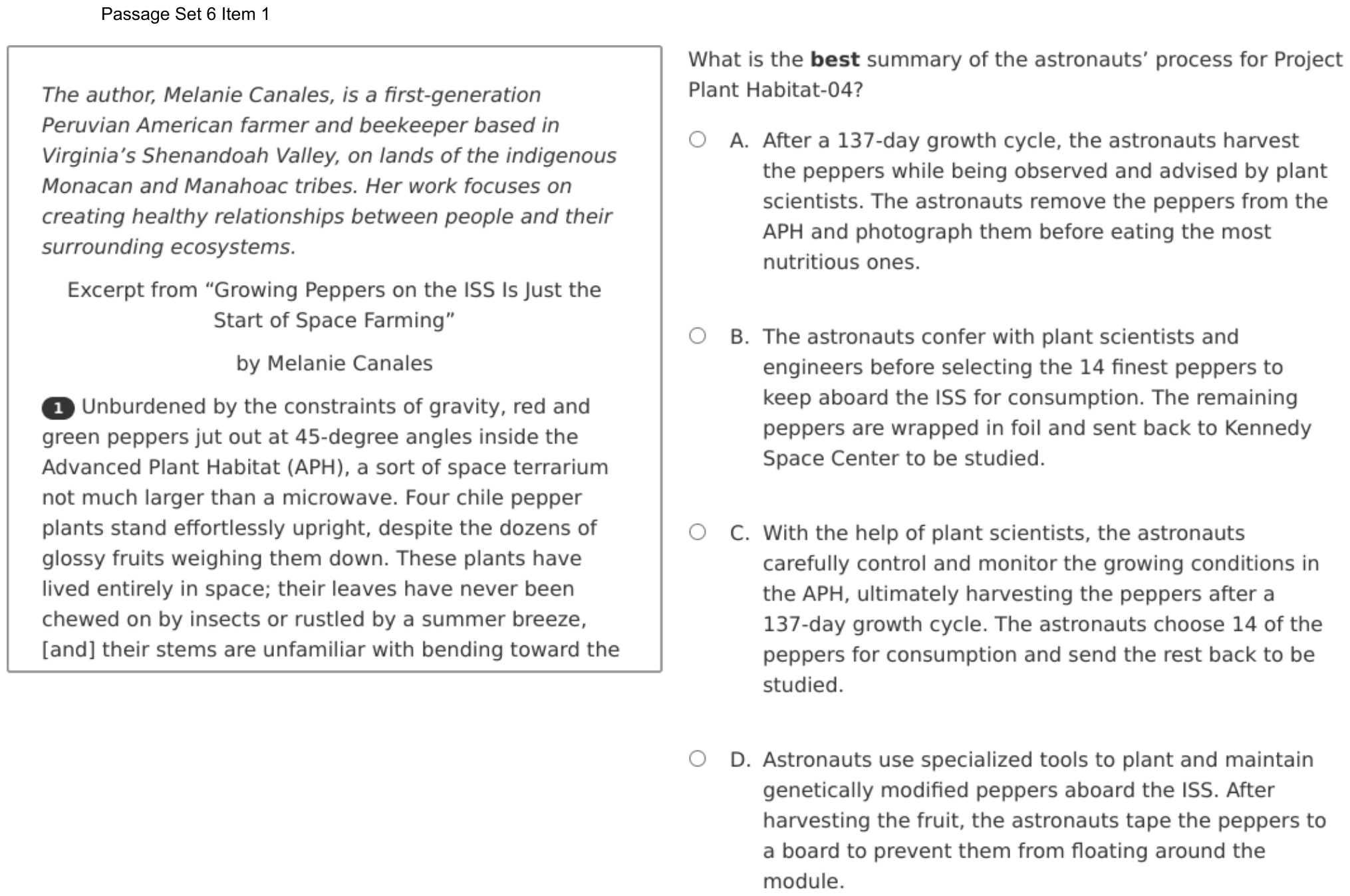
Unburdened by the constraints of gravity, red and green peppers jut out at 45-degree angles inside the Advanced Plant Habitat (APH), a sort of space terrarium not much larger than a microwave. Four chile pepper plants stand effortlessly upright, despite the dozens of glossy fruits weighing them down. These plants have lived entirely in space; their leaves have never been chewed on by insects or rustled by a summer breeze, [and] their stems are unfamiliar with bending toward the sun’s arc across the sky. Scissors glint under the tank’s white and blue lights as astronaut Mark Vande Hei and his team snip the stems of those that are ready for harvest. The peppers whirl around their heads until the astronauts catch them and tape them against a board to photograph.
Back on Earth, the Plant Habitat-04 team of engineers and plant scientists are observing and conferring with the astronauts. Of the 26 peppers in this batch, only the 14 finest will stay on the International Space Station [ISS] for consumption. The rest will be wrapped in foil, sealed in a Ziploc bag, then frozen at a brisk −80 degrees, until they can come roaring back to Earth in the next cargo capsule to be studied later. Now, after a 137-day growth cycle, the astronauts remove the plants from the module and trash them. Project Plant Habitat-04 is complete. It’s taco night on the ISS.
Since 2014, NASA1 has experimented with growing lettuces, brassicas,2 and zinnias3 in space, an endeavor that relies on highly specialized technology over 50 years in the making. [Fall 2021’s] two successful pepper harvests . . . will provide data on the nutritional and psychological benefits of growing vegetables on-craft, as well as a crop’s ability to reliably produce long-term in microgravity. While controlled environmental agriculture is not new, the APH experiment represents an evolution in specialized growth habitats. It doesn’t aim to re-create Earth’s conditions, but to perfect each isolated variable of plant growth in the clinical environment of a spaceship.
“The Advanced Plant Habitat is the most complex plant growth system on orbit today,” says Lashelle Spencer, a plant scientist at NASA’s Kennedy Space Center. Its more than 180 sensors control and monitor temperature, humidity, and carbon dioxide. The astronauts can adjust the color and intensity of the light, and how much moisture the plants’ roots are getting. It waters itself.
It’s the day after Thanksgiving, and Spencer has been at Kennedy since 5 a.m. to facilitate the peppers’ final harvest. As part of the project team, she played a crucial role in preparing the seeds that were sent hurtling into space in June and guiding the astronauts through maintaining the plants in orbit. . . . Though astronauts can spend upwards of 100 days in space, their on-mission meals come dehydrated and pre-packaged; their vitamins and minerals are isolated in supplements, which lose nutritional value the longer they’re stored. Spencer’s goal is to create the conditions necessary for cultivating healthy plants in space, so those plants can sustain healthy astronauts on long-term missions. Astronaut food is great, she says—“especially the shrimp cocktail. But you’re missing that crunch. You’re missing that fresh pop of flavor, the green flavor that’s not there in that packaged food.”
The sensory experience of growing productive crops can also help mitigate4 the psychological effects of long-term space travel. . . . Spencer says the team cracked open the door of the APH every day to observe their vegetable companions with all the tenderness of home gardeners. When harvest day came, they batted their bounty around the ISS, taking selfies and delighting in watching the fruits pirouetting around the spacecraft. . . .
“We were thinking no heat, so that [the peppers] wouldn’t be dangerous, but maybe the astronauts need a little spice in their life,” says Paul Bosland, who along with his colleagues at the Chile Pepper Institute genetically engineered5 the NuMex Española Improved chile pepper seeds grown in Plant Habitat-04. . . .
Working with NASA, Bosland cultivated a variety that could accommodate both the nutritional needs of astronauts as well as the logistics of growing a plant in space. . . .
. . . The experiment is helping gather the data necessary to determine the nutritional content of crops grown in space, and therefore how many people they can feed, and for how long. Though much is still unknown, Spencer is certain of one thing that future astronauts will need to do: “I think in an optimal world, a scientist like me would say that they would be growing plants from day one. From the day they left to the day they came back, they would be growing them.”
From “Growing Peppers on the ISS Is Just the Start of Space Farming” by Melanie Canales from WIRED, December 21, 2021. Copyright © 2021 Condé Nast. All rights reserved.
1NASA: National Aeronautics and Space Administration
2brassicas: a large genus of herbs, such as broccoli and cabbage
3zinnias: a genus of herbs and low shrubs that have flowers at their heads
4mitigate: to make something less severe or harmful
5genetically engineered: combined parts of DNA from different plants to produce a new plant
Question
What is the best summary of the astronauts’ process for Project Plant Habitat-04?
- AAfter a 137-day growth cycle, the astronauts harvest the peppers while being observed and advised by plant scientists. The astronauts remove the peppers from the APH and photograph them before eating the most nutritious ones.
- BThe astronauts confer with plant scientists and engineers before selecting the 14 finest peppers to keep aboard the ISS for consumption. The remaining peppers are wrapped in foil and sent back to Kennedy Space Center to be studied.
- CWith the help of plant scientists, the astronauts carefully control and monitor the growing conditions in the APH, ultimately harvesting the peppers after a 137-day growth cycle. The astronauts choose 14 of the peppers for consumption and send the rest back to be studied.
- DAstronauts use specialized tools to plant and maintain genetically modified peppers aboard the ISS. After harvesting the fruit, the astronauts tape the peppers to a board to prevent them from floating around the module.
Show the answer
Correct answer: C
The question asks for the best summary of the astronauts’ process for Project Plant Habitat-04.
A. Incorrect. Although this summary mentions the pepper harvest and photographing and eating the peppers, it leaves out an important part of the process: the team’s preparation for growing the peppers and the return to Earth of some harvested peppers for study.
B. Incorrect. This summary includes the selection of some peppers for consumption and the return of some peppers for research; however, it omits important information about the previous steps required to develop the process for growing peppers.
C. CORRECT. This summary accurately and completely summarizes the astronauts’ process for Project Plant Habitat-04: collaborating with plant scientists, controlling the APH conditions, completing the 137-day growth cycle, harvesting the peppers, choosing 14 peppers to eat, and sending the remaining peppers back for study.
D. Incorrect. This summary focuses on information incidental to the process of growing peppers for Project Plant Habitat-04, mentioning the use of genetically modified peppers and the taping of harvested peppers to a board to keep them from floating, while omitting important steps such as the monitoring of growth and the selection of peppers for consumption and study.
Question analysis
This summary question asks which of four two-sentence summaries best captures the astronauts’ process for Project Plant Habitat-04, the chile pepper experiment aboard the International Space Station described in a WIRED article on space farming. Every choice repeats real details from the excerpt, so students must check each one for accuracy and for completeness instead of stopping at the first familiar fact.
- Grade level
- Grade 7 reading and task
- Compared with grade 7
- At grade 7 Summarizing a process is regular grade 7 work. These choices are long and two-part, and the steps are spread over several paragraphs of a technical article, but the excerpt tells the process in order, so the overall demand stays typical.
- Estimated difficulty
- Moderate: several steps, or a close reading with one strong distractor.
- Thinking it demands
- Depth of knowledge 2, skills and concepts · mainly understand
- What makes it hard
- Evidence in several places moderate
- A very close wrong answer moderate
- A lot to read minor
- Evidence
- Answered from several paragraphs or stanzas
- Reading level
- Passage: about grade 10, 890 words; question and choices: about grade 11, 162 words.
- Students, last 30 days
- Not enough answers yet to show (it takes 10).
Why it is hard, traps and wrong answers (shows the answer)
Why it is hard
Every summary is built from real details of the experiment, so the decision rests on completeness and accuracy rather than on recognition. Students who remember paragraph 2 best are drawn to the version that reports only the selection and the frozen peppers, while those who trust vivid details accept a meal of “the most nutritious” peppers or tape that stops them floating. The question rewards listing the stages, tending, harvesting, choosing and returning, before reading the choices.
Evidence in several places moderate Working it out
The process has to be pieced together out of order: the harvest opens paragraph 1, the 14 kept and the rest frozen come in paragraph 2, and the adjustable light and moisture only in paragraph 4. (Kirsch & Mosenthal, 1990; Gorin & Embretson, 2006)
A very close wrong answer moderate Choosing the answer
The summary about the 14 finest peppers and the frozen remainder is the key’s second sentence on its own; only the key adds the controlled growing conditions and the 137-day cycle before the harvest. (Embretson & Wetzel, 1987; Gorin & Embretson, 2006; Ascalon et al., 2007)
A lot to read minor Understanding the question
Each choice is two sentences of 34 to 44 words, so four summaries that mix accurate and inaccurate details must be read and compared one step at a time. (Kintsch, 1998; Gorin & Embretson, 2006; Freedle & Kostin, 1993)
Strategy: Before reading the choices, list in order what happens to the pepper plants across the opening paragraphs, then test each summary for details the excerpt does not support and for stages it leaves out.
Traps
- Too narrow: A single detail offered as the central idea or a summary, or a summary that keeps minor details and leaves out an essential part.
- Twists what the text says: Uses the text's topic and ideas but changes what it says: who did it, how much, when, or why.
The wrong answers, classified
A Too narrow (King et al., 2004)
Keeps the harvest, the photographs and the meal but drops the months of tending and the peppers sent back for study, and turns the “14 finest” into the most nutritious.
B Too narrow (King et al., 2004)
Reports paragraph 2 faithfully, the 14 finest kept for meals and the rest frozen for study, but covers only harvest day and leaves out the 137 days of growing before it.
D Twists what the text says (King et al., 2004)
Strings together side details, the engineered seeds and the board, and says the peppers were taped to stop them floating, though paragraph 1 says they were taped up to be photographed.
Working it out, step by step
Figure out what the question asks
This question asks for the best summary. A summary retells the main steps in order, in a few words. It leaves out small details. It must also be accurate, with no facts the article doesn’t give. Here you sum up what the astronauts did in Project Plant Habitat-04, from start to finish.
Find the steps in the article
The steps are spread over several paragraphs, and not in order.
- Growing: Spencer guided “the astronauts through maintaining the plants in orbit” (paragraph 5). The astronauts “can adjust the color and intensity of the light” (paragraph 4).
- Harvest: the crew snips the ripe peppers (paragraph 1) “after a 137-day growth cycle” (paragraph 2).
- Choosing: “only the 14 finest will stay” on the station “for consumption” (paragraph 2). Consumption means eating.
- Sending back: the rest are frozen and sent “back to Earth in the next cargo capsule to be studied later” (paragraph 2).
Put the process in plain words
So the whole process has four parts. First, the astronauts tend the plants for months, with help from scientists on Earth. Second, they harvest the peppers after 137 days. Third, they keep the 14 best peppers to eat. Fourth, they send the rest back to Earth to be studied. A good summary needs all four parts.
Check each choice
- A is wrong. It skips the months of growing and the peppers sent back. It also says they ate “the most nutritious ones,” but the article says “the 14 finest.”
- B is wrong. It covers only harvest day and leaves out the 137 days of growing. The article also never says the peppers go to Kennedy Space Center.
- C is right. It has all four parts: tending the plants with the scientists’ help, harvesting after 137 days, keeping 14, and sending the rest back.
- D is wrong. It strings together side details. The peppers were taped to a board “to photograph,” not to stop them floating.
Watch out: B closely repeats paragraph 2, so it feels right. But a summary of the process must include the growing, too.
Choose the answer
Only one summary covers the whole process, from tending the plants to sending peppers home. So the answer is C, “With the help of plant scientists, the astronauts carefully control and monitor the growing conditions in the APH, ultimately harvesting the peppers after a 137-day growth cycle. The astronauts choose 14 of the peppers for consumption and send the rest back to be studied.”
Why this answer and not the closest wrong one
B is the closest wrong answer. Its facts come from paragraph 2. But it starts on harvest day, so a reader would never learn that the astronauts tended the plants for 137 days. C keeps B’s ending and adds that growing stage. That makes C complete.
More questions like this
The original DOE question
The passage “Excerpt from “Growing Peppers on the ISS Is Just the Start of Space Farming”” as printed (pages 50–51)