Passage Excerpt from A Voice in the Wilderness
Excerpt from A Voice in the Wilderness
by Grace Livingston Hill
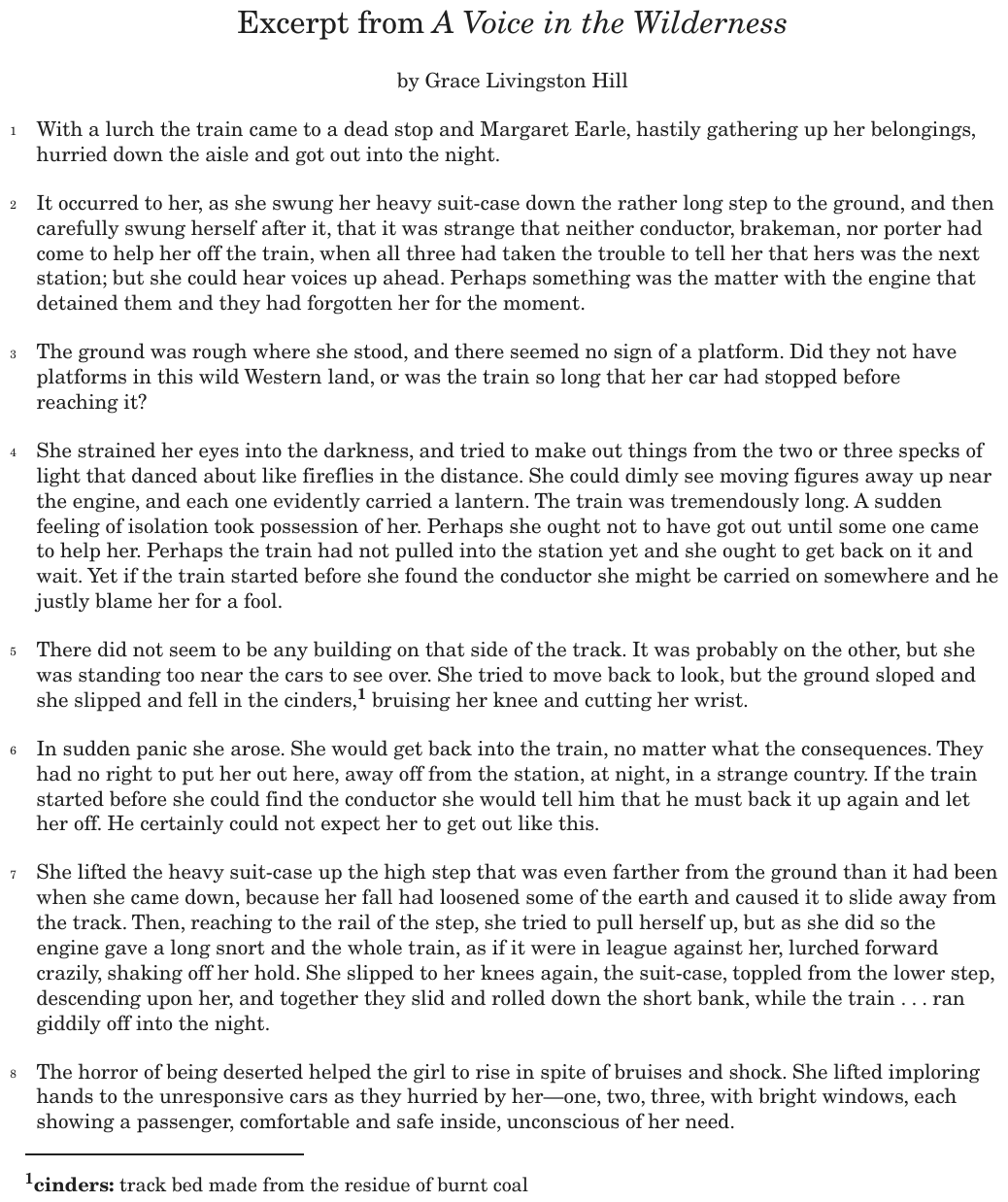
With a lurch the train came to a dead stop and Margaret Earle, hastily gathering up her belongings, hurried down the aisle and got out into the night.
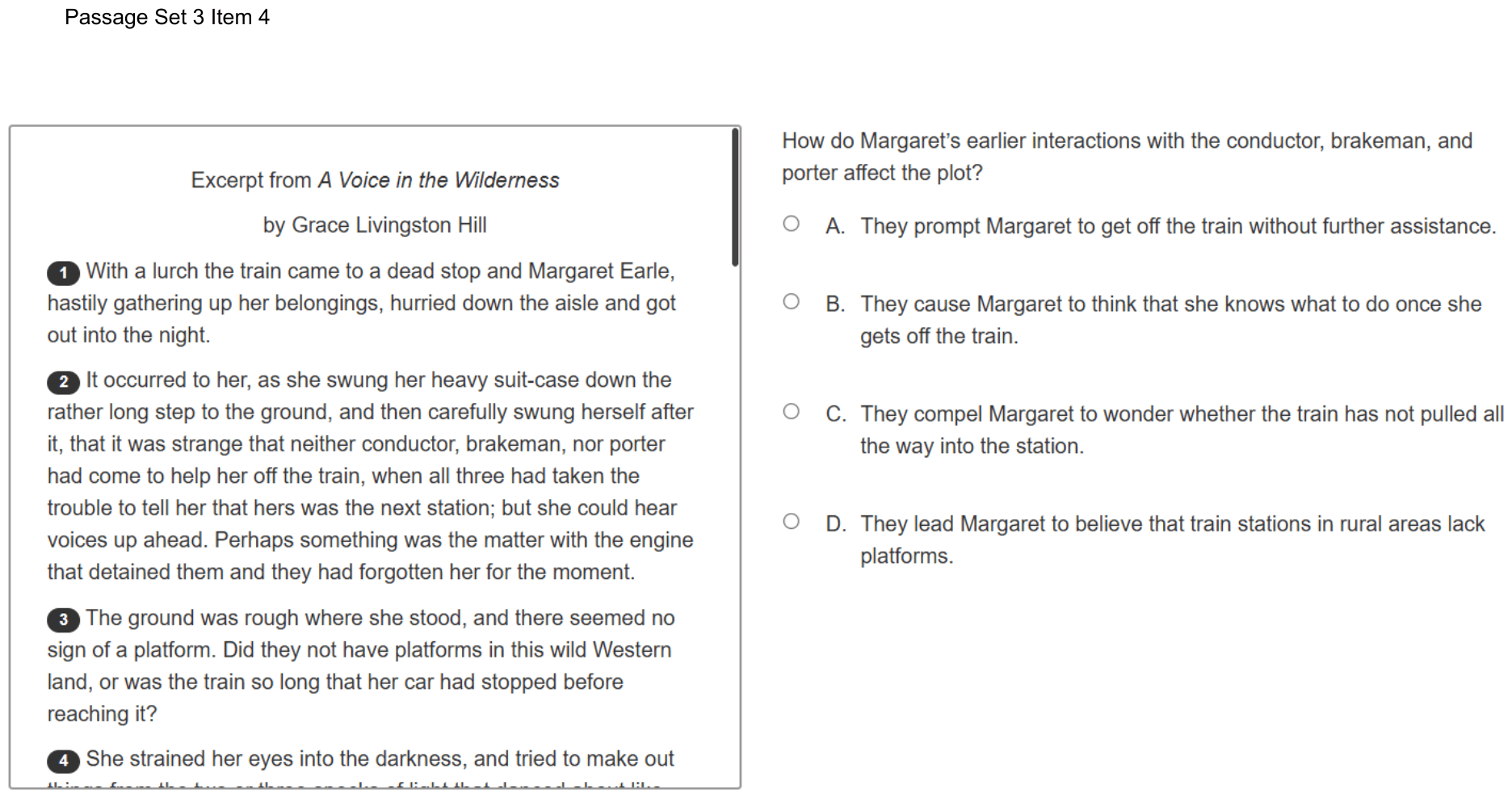
It occurred to her, as she swung her heavy suit-case down the rather long step to the ground, and then carefully swung herself after it, that it was strange that neither conductor, brakeman, nor porter had come to help her off the train, when all three had taken the trouble to tell her that hers was the next station; but she could hear voices up ahead. Perhaps something was the matter with the engine that detained them and they had forgotten her for the moment.
The ground was rough where she stood, and there seemed no sign of a platform. Did they not have platforms in this wild Western land, or was the train so long that her car had stopped before reaching it?
She strained her eyes into the darkness, and tried to make out things from the two or three specks of light that danced about like fireflies in the distance. She could dimly see moving figures away up near the engine, and each one evidently carried a lantern. The train was tremendously long. A sudden feeling of isolation took possession of her. Perhaps she ought not to have got out until some one came to help her. Perhaps the train had not pulled into the station yet and she ought to get back on it and wait. Yet if the train started before she found the conductor she might be carried on somewhere and he justly blame her for a fool.
There did not seem to be any building on that side of the track. It was probably on the other, but she was standing too near the cars to see over. She tried to move back to look, but the ground sloped and she slipped and fell in the cinders, bruising her knee and cutting her wrist.
In sudden panic she arose. She would get back into the train, no matter what the consequences. They had no right to put her out here, away off from the station, at night, in a strange country. If the train started before she could find the conductor she would tell him that he must back it up again and let her off. He certainly could not expect her to get out like this.
She lifted the heavy suit-case up the high step that was even farther from the ground than it had been when she came down, because her fall had loosened some of the earth and caused it to slide away from the track. Then, reaching to the rail of the step, she tried to pull herself up, but as she did so the engine gave a long snort and the whole train, as if it were in league against her, lurched forward crazily, shaking off her hold. She slipped to her knees again, the suit-case, toppled from the lower step, descending upon her, and together they slid and rolled down the short bank, while the train . . . ran giddily off into the night.
The horror of being deserted helped the girl to rise in spite of bruises and shock. She lifted imploring hands to the unresponsive cars as they hurried by her—one, two, three, with bright windows, each showing a passenger, comfortable and safe inside, unconscious of her need.
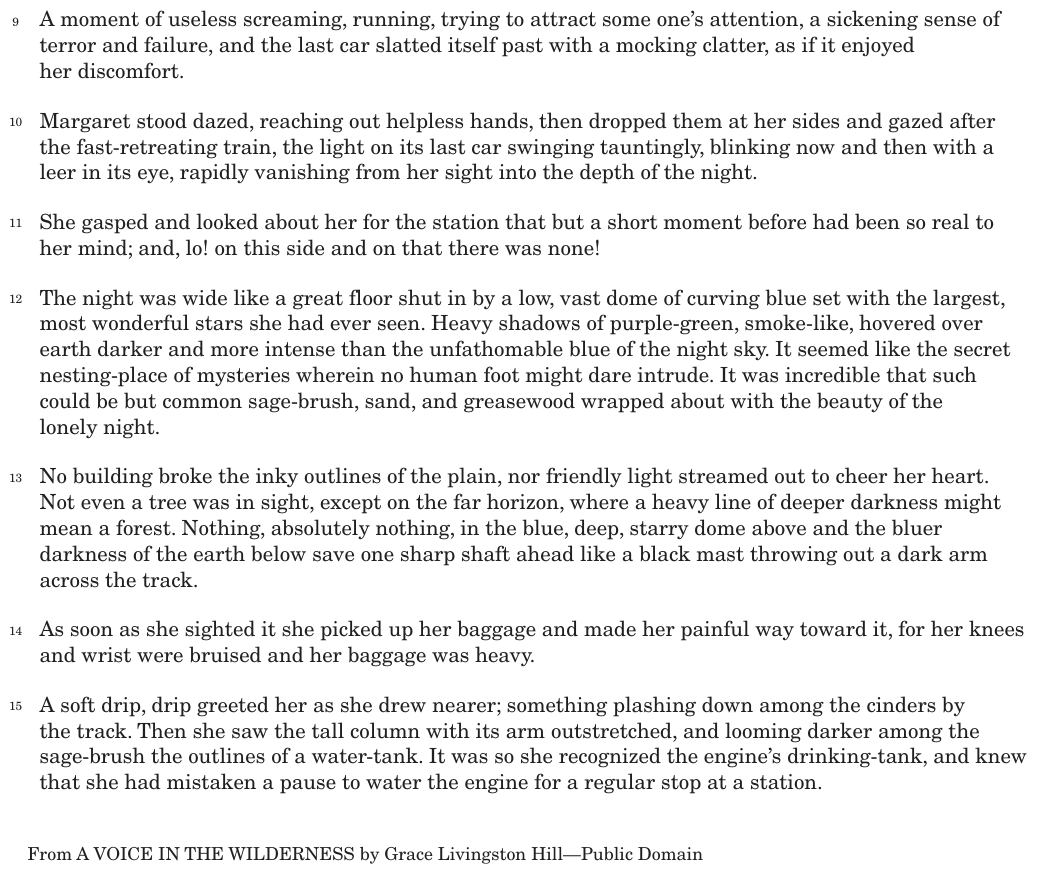
A moment of useless screaming, running, trying to attract some one’s attention, a sickening sense of terror and failure, and the last car slatted itself past with a mocking clatter, as if it enjoyed her discomfort.
Margaret stood dazed, reaching out helpless hands, then dropped them at her sides and gazed after the fast-retreating train, the light on its last car swinging tauntingly, blinking now and then with a leer in its eye, rapidly vanishing from her sight into the depth of the night.
She gasped and looked about her for the station that but a short moment before had been so real to her mind; and, lo! on this side and on that there was none!
The night was wide like a great floor shut in by a low, vast dome of curving blue set with the largest, most wonderful stars she had ever seen. Heavy shadows of purple-green, smoke-like, hovered over earth darker and more intense than the unfathomable blue of the night sky. It seemed like the secret nesting-place of mysteries wherein no human foot might dare intrude. It was incredible that such could be but common sage-brush, sand, and greasewood wrapped about with the beauty of the lonely night.
No building broke the inky outlines of the plain, nor friendly light streamed out to cheer her heart. Not even a tree was in sight, except on the far horizon, where a heavy line of deeper darkness might mean a forest. Nothing, absolutely nothing, in the blue, deep, starry dome above and the bluer darkness of the earth below save one sharp shaft ahead like a black mast throwing out a dark arm across the track.
As soon as she sighted it she picked up her baggage and made her painful way toward it, for her knees and wrist were bruised and her baggage was heavy.
A soft drip, drip greeted her as she drew nearer; something plashing down among the cinders by the track. Then she saw the tall column with its arm outstretched, and looming darker among the sage-brush the outlines of a water-tank. It was so she recognized the engine’s drinking-tank, and knew that she had mistaken a pause to water the engine for a regular stop at a station.
cinders: track bed made from the residue of burnt coal
From A VOICE IN THE WILDERNESS by Grace Livingston Hill—Public Domain
Question
How do Margaret’s earlier interactions with the conductor, brakeman, and porter affect the plot?
- AThey prompt Margaret to get off the train without further assistance.
- BThey cause Margaret to think that she knows what to do once she gets off the train.
- CThey compel Margaret to wonder whether the train has not pulled all the way into the station.
- DThey lead Margaret to believe that train stations in rural areas lack platforms.
Show the answer
Correct answer: A
The question asks how Margaret’s earlier interactions with the conductor, brakeman, and porter affect the plot.
A. CORRECT. Because the conductor, brakeman, and porter have all “taken the trouble to tell her that hers was the next station” (paragraph 2), Margaret assumes that the next time the train stops, she will have reached her station. This assumption causes Margaret to get off the train at the next stop without waiting for help or confirmation, but the stop turns out to be just “a pause to water the engine” (paragraph 15). This mistaken assumption creates the main problem that Margaret confronts in the passage.
B. Incorrect. Although Margaret’s earlier interactions with the three railroad employees cause her to think that she knows when to get off the train, it is clear from paragraph 4 that Margaret is deeply confused and does not know what to do once she has exited the train car. She muses uneasily, “Perhaps she ought not to have got out until some one came to help her. Perhaps the train had not pulled into the station yet and she ought to get back on it and wait” (paragraph 4).
C. Incorrect. Margaret wonders in paragraph 3 whether the train is “so long that her car had stopped before reaching [the station]” and speculates in paragraph 4 that “the train had not pulled into the station yet.” These thoughts reflect her assumption (based on her interactions with the three railroad employees) that the next stop is her station. However, Margaret’s speculation that the train has not fully pulled into the station does not significantly affect the plot.
D. Incorrect. Margaret wonders in paragraph 3 whether they “have platforms in this wild Western land” and is expecting to see a platform because her interactions with the three railroad employees have led her to believe that she has reached a station. However, it is unclear whether Margaret really believes that rural stations all lack platforms, and her speculation on this point is not further developed in the passage and does not affect the plot.
Question analysis
This plot question on A Voice in the Wilderness asks how Margaret’s earlier dealings with the conductor, brakeman and porter, mentioned only in passing in paragraph 2, affect what happens to her. Students must connect that brief remark to later events in the excerpt. Several choices describe things that do happen, so students must judge which one those conversations truly cause.
- Grade level
- Grade 8 reading and task
- Compared with grade 7
- Above grade 7 Grade 7 plot questions ask how story elements affect one another, usually through an event and its result. Here the cause is a clause inside a long sentence of century-old prose, and students must trace its effect across the excerpt rather than within one paragraph.
- Estimated difficulty
- Hard: combines ideas, needs a plan, and has more than one tempting wrong answer.
- Thinking it demands
- Depth of knowledge 3, strategic thinking · mainly analyze
- What makes it hard
- Evidence in several places moderate
- Reading between the lines moderate
- Complex sentences minor
- Evidence
- Answered from the whole text
- Reading level
- Passage: about grade 8, 981 words; question and choices: about grade 7, 72 words.
- Students, last 30 days
- Not enough answers yet to show (it takes 10).
Why it is hard, traps and wrong answers (shows the answer)
Why it is hard
The talks with the trainmen are mentioned once, in the middle of a long sentence, and the question asks students to see them as the start of the whole plot. Several choices describe thoughts Margaret really has right after she steps down, which makes them feel connected, but those thoughts change nothing. The point goes to students who trace cause to consequence: told her stop was next, she gets off alone at a water tank.
Evidence in several places moderate Working it out
The cause sits in paragraph 2, where all three men had told her “hers was the next station,” and the effect shows only in paragraph 15, when the stop proves to be a water tank. (Kirsch & Mosenthal, 1990; Gorin & Embretson, 2006)
Reading between the lines moderate Working it out
The excerpt never says the men’s words made her step off; students must infer that their assurance is why she left the train at the first stop without waiting for anyone. (Graesser, Singer & Trabasso, 1994; Kintsch, 1998)
Complex sentences minor Understanding the question
The interactions appear in a 66-word sentence in paragraph 2, tucked into a “when” clause after a run of commas, so they read as a passing detail rather than a cause. (Abedi & Lord, 2001; Freedle & Kostin, 1993; Messick, 1989)
Strategy: Reread paragraph 2 to find what the three men told Margaret, then trace how that information shapes the events that follow, and choose the effect that matters most to the plot.
Traps
- True but not the answer: A choice says something accurate about the text that does not answer this question.
- Twists what the text says: Uses the text's topic and ideas but changes what it says: who did it, how much, when, or why.
- Reads too much in: A reasonable-sounding conclusion that goes further than the text allows.
The wrong answers, classified
B Twists what the text says (King et al., 2004)
Rightly links the men’s words to her confidence about when to get off, but stretches it to knowing what to do afterward, when paragraph 4 shows her at a loss.
C True but not the answer (King et al., 2004; Embretson & Wetzel, 1987)
Names a real result of the men’s words, her guess in paragraphs 3 and 4 that the train has not yet reached the station, but that passing worry changes nothing in the plot.
D Reads too much in (Graesser, Singer & Trabasso, 1994)
Turns her puzzled question about platforms in “this wild Western land” into a firm belief about rural stations, an idea the excerpt never develops.
Working it out, step by step
Figure out what the question asks
This asks how something from earlier affects the plot. The plot is the chain of events in a story. What did the three train workers tell Margaret, and what did that cause?
Find what the workers told her
Paragraph 2 says it was strange that “neither conductor, brakeman, nor porter had come to help her off the train, when all three had taken the trouble to tell her that hers was the next station.” A conductor, a brakeman and a porter are all people who work on a train.
Trace what happened because of it
Three workers told her that her stop was next. So when the train stopped, she was sure she had arrived. She got off alone, without waiting for anyone to help. But in paragraph 15 she learns it was only “a pause to water the engine.” Their words set off the whole problem: she is left alone in the dark.
Check each choice
- A fits. Their words led her to get off by herself.
- B does not fit. They told her when to get off, not what to do next. In paragraph 4 she is lost: “Perhaps she ought not to have got out until some one came to help her.”
- C does not fit. She does wonder this, but the thought changes nothing in the story.
- D does not fit. She only asks a question about platforms. She never decides anything about country stations.
Choose the answer
The workers’ words made Margaret step off the train on her own at the wrong stop. So the answer is A.
Why this answer and not the closest wrong one
C is the closest wrong choice. The workers’ words do make her guess that the train has not reached the station yet. But that guess goes nowhere. What changes the story is that she gets off alone at a stop that is not a station. That is A.
More questions like this
The original DOE question
The passage “Excerpt from A Voice in the Wilderness” as printed (pages 128–129)