Passage Excerpt from “Growing Peppers on the ISS Is Just the Start of Space Farming”
Excerpt from “Growing Peppers on the ISS Is Just the Start of Space Farming”
by Melanie Canales
The author, Melanie Canales, is a first-generation Peruvian American farmer and beekeeper based in Virginia’s Shenandoah Valley, on lands of the indigenous Monacan and Manahoac tribes. Her work focuses on creating healthy relationships between people and their surrounding ecosystems.
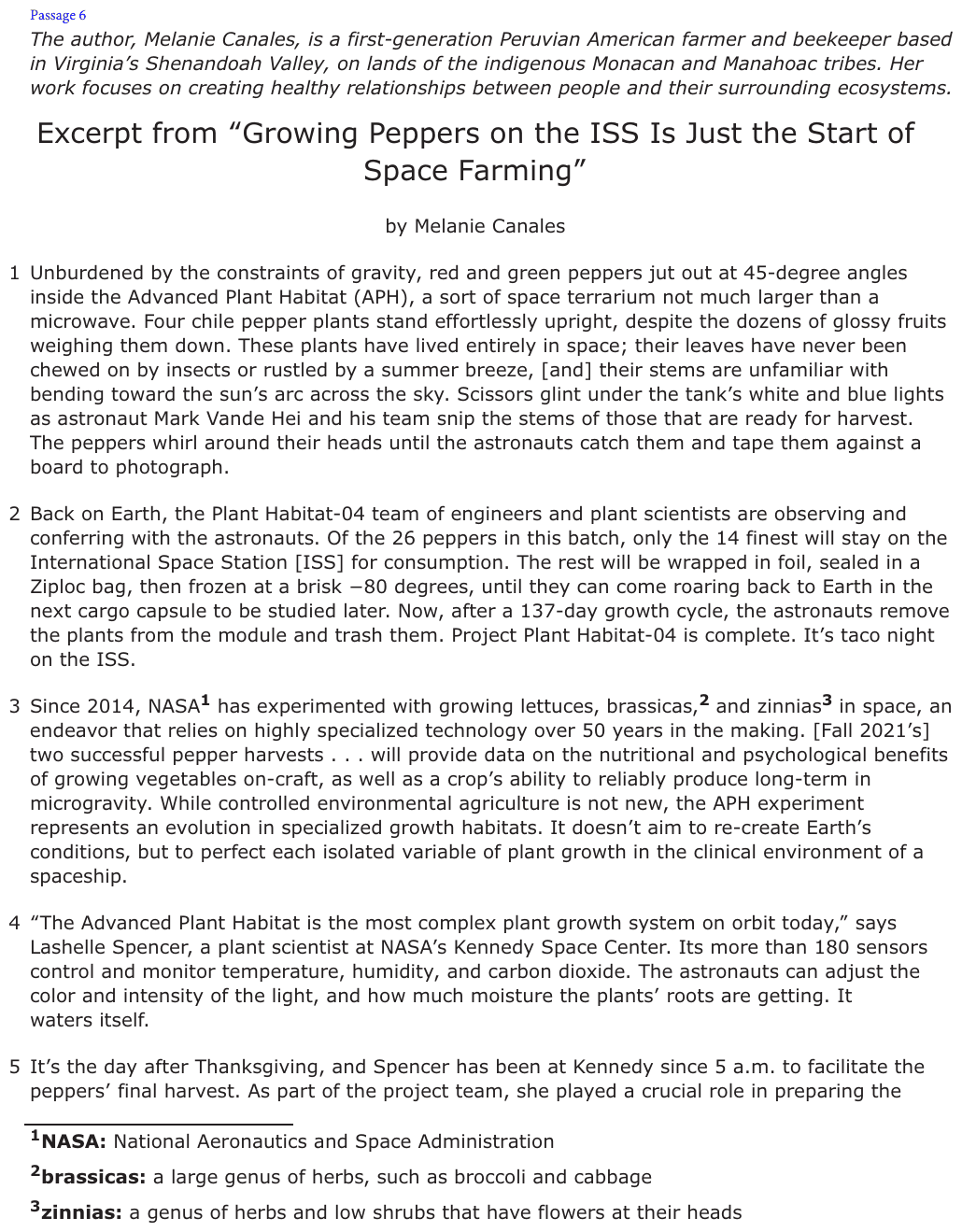
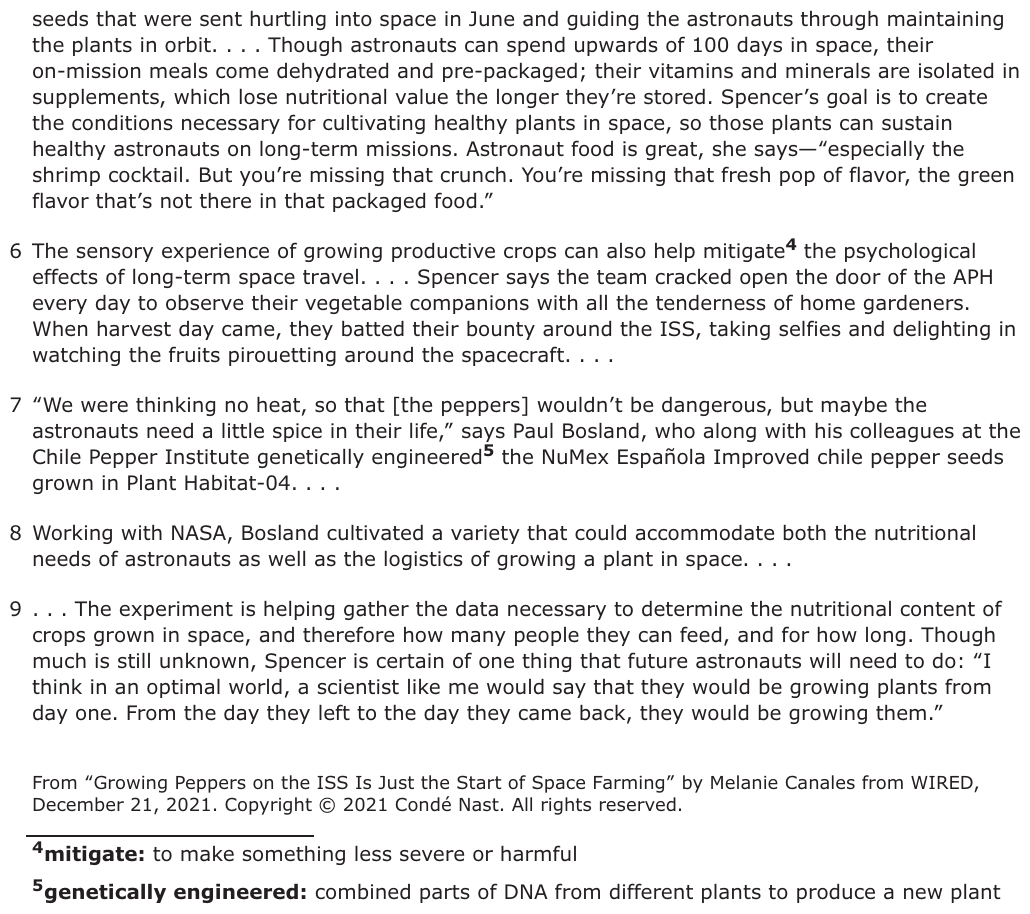
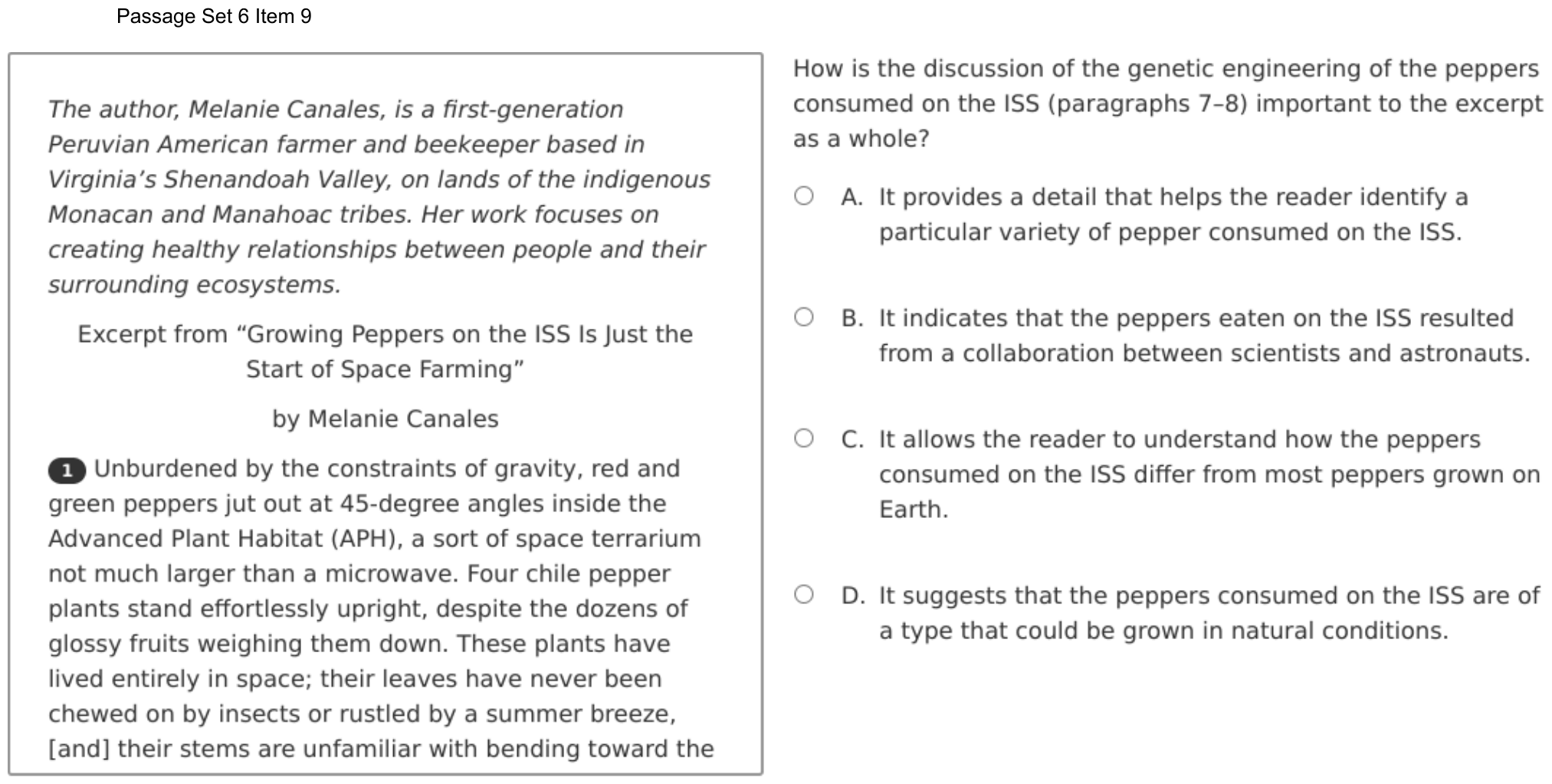
Unburdened by the constraints of gravity, red and green peppers jut out at 45-degree angles inside the Advanced Plant Habitat (APH), a sort of space terrarium not much larger than a microwave. Four chile pepper plants stand effortlessly upright, despite the dozens of glossy fruits weighing them down. These plants have lived entirely in space; their leaves have never been chewed on by insects or rustled by a summer breeze, [and] their stems are unfamiliar with bending toward the sun’s arc across the sky. Scissors glint under the tank’s white and blue lights as astronaut Mark Vande Hei and his team snip the stems of those that are ready for harvest. The peppers whirl around their heads until the astronauts catch them and tape them against a board to photograph.
Back on Earth, the Plant Habitat-04 team of engineers and plant scientists are observing and conferring with the astronauts. Of the 26 peppers in this batch, only the 14 finest will stay on the International Space Station [ISS] for consumption. The rest will be wrapped in foil, sealed in a Ziploc bag, then frozen at a brisk −80 degrees, until they can come roaring back to Earth in the next cargo capsule to be studied later. Now, after a 137-day growth cycle, the astronauts remove the plants from the module and trash them. Project Plant Habitat-04 is complete. It’s taco night on the ISS.
Since 2014, NASA1 has experimented with growing lettuces, brassicas,2 and zinnias3 in space, an endeavor that relies on highly specialized technology over 50 years in the making. [Fall 2021’s] two successful pepper harvests . . . will provide data on the nutritional and psychological benefits of growing vegetables on-craft, as well as a crop’s ability to reliably produce long-term in microgravity. While controlled environmental agriculture is not new, the APH experiment represents an evolution in specialized growth habitats. It doesn’t aim to re-create Earth’s conditions, but to perfect each isolated variable of plant growth in the clinical environment of a spaceship.
“The Advanced Plant Habitat is the most complex plant growth system on orbit today,” says Lashelle Spencer, a plant scientist at NASA’s Kennedy Space Center. Its more than 180 sensors control and monitor temperature, humidity, and carbon dioxide. The astronauts can adjust the color and intensity of the light, and how much moisture the plants’ roots are getting. It waters itself.
It’s the day after Thanksgiving, and Spencer has been at Kennedy since 5 a.m. to facilitate the peppers’ final harvest. As part of the project team, she played a crucial role in preparing the seeds that were sent hurtling into space in June and guiding the astronauts through maintaining the plants in orbit. . . . Though astronauts can spend upwards of 100 days in space, their on-mission meals come dehydrated and pre-packaged; their vitamins and minerals are isolated in supplements, which lose nutritional value the longer they’re stored. Spencer’s goal is to create the conditions necessary for cultivating healthy plants in space, so those plants can sustain healthy astronauts on long-term missions. Astronaut food is great, she says—“especially the shrimp cocktail. But you’re missing that crunch. You’re missing that fresh pop of flavor, the green flavor that’s not there in that packaged food.”
The sensory experience of growing productive crops can also help mitigate4 the psychological effects of long-term space travel. . . . Spencer says the team cracked open the door of the APH every day to observe their vegetable companions with all the tenderness of home gardeners. When harvest day came, they batted their bounty around the ISS, taking selfies and delighting in watching the fruits pirouetting around the spacecraft. . . .
“We were thinking no heat, so that [the peppers] wouldn’t be dangerous, but maybe the astronauts need a little spice in their life,” says Paul Bosland, who along with his colleagues at the Chile Pepper Institute genetically engineered5 the NuMex Española Improved chile pepper seeds grown in Plant Habitat-04. . . .
Working with NASA, Bosland cultivated a variety that could accommodate both the nutritional needs of astronauts as well as the logistics of growing a plant in space. . . .
. . . The experiment is helping gather the data necessary to determine the nutritional content of crops grown in space, and therefore how many people they can feed, and for how long. Though much is still unknown, Spencer is certain of one thing that future astronauts will need to do: “I think in an optimal world, a scientist like me would say that they would be growing plants from day one. From the day they left to the day they came back, they would be growing them.”
From “Growing Peppers on the ISS Is Just the Start of Space Farming” by Melanie Canales from WIRED, December 21, 2021. Copyright © 2021 Condé Nast. All rights reserved.
1NASA: National Aeronautics and Space Administration
2brassicas: a large genus of herbs, such as broccoli and cabbage
3zinnias: a genus of herbs and low shrubs that have flowers at their heads
4mitigate: to make something less severe or harmful
5genetically engineered: combined parts of DNA from different plants to produce a new plant
Question
How is the discussion of the genetic engineering of the peppers consumed on the ISS (paragraphs 7–8) important to the excerpt as a whole?
- AIt provides a detail that helps the reader identify a particular variety of pepper consumed on the ISS.
- BIt indicates that the peppers eaten on the ISS resulted from a collaboration between scientists and astronauts.
- CIt allows the reader to understand how the peppers consumed on the ISS differ from most peppers grown on Earth.
- DIt suggests that the peppers consumed on the ISS are of a type that could be grown in natural conditions.
Show the answer
Correct answer: C
The question asks how the discussion of the genetic engineering of the peppers consumed on the ISS (paragraphs 7–8) is important to the excerpt as a whole.
A. Incorrect. Although paragraph 7 names the NuMex Española Improved chile pepper as the variety grown on the ISS, this detail is not further developed and does not play a significant role in the overall focus of the excerpt. The passage emphasizes the process and purpose of developing the pepper rather than the pepper itself.
B. Incorrect. While paragraph 7 notes that Paul Bosland collaborated with colleagues to develop the seeds for the experiment, this fact alone is not the reason why the discussion of genetic engineering is important to the excerpt. The key point is that the pepper variety in the experiment was specifically modified to meet the needs of both astronauts and space cultivation. Who participated in the development of the peppers is secondary.
C. CORRECT. Paragraph 7 explains how specialists selected a pepper variety and genetically engineered the seeds for the experiment, while paragraph 8 adds that the variety developed also needed to provide astronauts with proper nutrition and be capable of growing in space. These details are important to the excerpt as a whole because they illustrate how the peppers grown on the ISS differ from most peppers cultivated on Earth in both purpose and design.
D. Incorrect. The details about the genetic engineering of the pepper seeds highlight that the variety was modified to suit specific space-related requirements. However, the excerpt does not discuss whether this type of pepper could be grown in natural conditions on Earth or if doing so is even a goal. Instead, these paragraphs are important because they explain how the pepper was adapted to address astronauts’ nutritional needs and the constraints of space farming.
Question analysis
Paragraphs 7–8 of the ISS pepper excerpt explain that a scientist at the Chile Pepper Institute genetically engineered the seeds grown aboard the space station. This text-structure question asks why that discussion matters to the excerpt as a whole. Students must look past what the two paragraphs say to what they add to the article’s larger account of farming in space.
- Grade level
- Grade 7 reading and task
- Compared with grade 7
- At grade 7 Explaining how a section contributes to a whole text is standard grade 7 reading. The two paragraphs in question are short and the four choices are brief single sentences, so the demand matches ordinary grade 7 structure questions.
- Estimated difficulty
- Moderate: several steps, or a close reading with one strong distractor.
- Thinking it demands
- Depth of knowledge 2, skills and concepts · mainly analyze
- What makes it hard
- How, not what moderate
- Reading between the lines moderate
- Hard words minor
- Evidence
- Answered from several paragraphs or stanzas
- Reading level
- Passage: about grade 10, 890 words; question and choices: about grade 11, 98 words.
- Students, last 30 days
- Not enough answers yet to show (it takes 10).
Why it is hard, traps and wrong answers (shows the answer)
Why it is hard
The paragraphs are short, but the question asks what they add, not what they say, and the key states something the article leaves implicit. The trap is the collaboration choice: “Working with NASA” and Bosland’s colleagues suggest teamwork, and the excerpt as a whole does pair scientists with astronauts, but the peppers were developed on the ground. Students who instead pick the named variety have found a true detail without a purpose.
How, not what moderate Working it out
The stem asks why paragraphs 7–8 matter to the excerpt as a whole, so naming what they say, a variety bred at Bosland’s institute, is not enough; their contribution to the account must be stated. (Anderson & Krathwohl, 2001)
Reading between the lines moderate Working it out
The excerpt never says the space peppers differ from Earth peppers; that follows from a variety bred for “the nutritional needs of astronauts” and “the logistics of growing a plant in space.” (Graesser, Singer & Trabasso, 1994; Kintsch, 1998)
Hard words minor Understanding the question
Paragraph 8 turns on “cultivated,” “accommodate” and “logistics,” and paragraph 7 needs its footnote for “genetically engineered,” words a reader must decode to see why the variety is special. (Perfetti, 2007; Freedle & Kostin, 1993)
Strategy: Restate what paragraphs 7 and 8 say about how the pepper was developed and why, then ask what that information adds to the excerpt’s account of farming in space as a whole.
Traps
- True but not the answer: A choice says something accurate about the text that does not answer this question.
- Twists what the text says: Uses the text's topic and ideas but changes what it says: who did it, how much, when, or why.
- Outside knowledge: A choice is plausible in the real world but not supported by this text.
The wrong answers, classified
A True but not the answer (King et al., 2004; Embretson & Wetzel, 1987)
Notices that paragraph 7 names the NuMex Española Improved variety, a true detail, but naming it is not why the discussion of genetic engineering matters to the excerpt.
B Twists what the text says (King et al., 2004)
Reads “Working with NASA” as teamwork with the crew, though Bosland worked with his Chile Pepper Institute colleagues and the space agency; the astronauts only grew what he developed.
D Outside knowledge (King et al., 2004; Recht & Leslie, 1988)
Knows that chile peppers grow in ordinary fields and assumes this one could too, though paragraphs 7–8 present a variety designed for space and say nothing about natural conditions.
Working it out, step by step
Figure out what the question asks
This question asks why paragraphs 7 and 8 matter to the whole article. Those paragraphs tell how the peppers’ seeds were made. Don’t just repeat what they say. Ask what they add to the article’s story of farming in space.
Find what paragraphs 7 and 8 say
Paragraph 7 says Paul Bosland and his colleagues “genetically engineered the NuMex Española Improved chile pepper seeds grown in Plant Habitat-04.” The footnote explains that they “combined parts of DNA from different plants to produce a new plant.” Paragraph 8 says Bosland developed “a variety that could accommodate both the nutritional needs of astronauts as well as the logistics of growing a plant in space.”
Put it in plain words
A variety is one special kind of a plant. To accommodate means to meet the needs of. Logistics are the practical details of getting a job done. So this pepper was made for space. It had to feed astronauts well. It also had to grow in a small box in orbit. The scientists even chose how hot it would be: “maybe the astronauts need a little spice in their life.”
Check each choice
- A is wrong. The pepper’s name is a true detail. But knowing its name is not why these paragraphs matter.
- B is wrong. Bosland worked “with NASA” and his colleagues, not with the astronauts. The crew only grew the seeds he made.
- C is right. The paragraphs show that this pepper was designed for space. Most peppers on Earth were never made to meet astronauts’ needs or to grow in orbit.
- D is wrong. The paragraphs never say this pepper could grow in a normal field. They show it was made for space.
Watch out: “Working with NASA” can sound like teamwork with the crew. That is the trap in B.
Choose the answer
These paragraphs show that the space peppers were specially made, unlike ordinary peppers. So the answer is C, “It allows the reader to understand how the peppers consumed on the ISS differ from most peppers grown on Earth.”
Why this answer and not the closest wrong one
B is the closest wrong answer, since the article does show scientists and astronauts working together. But paragraphs 7 and 8 are about seeds made on the ground by Bosland’s team. What they add is that the pepper was designed for astronauts’ needs and for space. That is how it differs from most peppers, as C says.
More questions like this
The original DOE question
The passage “Excerpt from “Growing Peppers on the ISS Is Just the Start of Space Farming”” as printed (pages 50–51)