Question
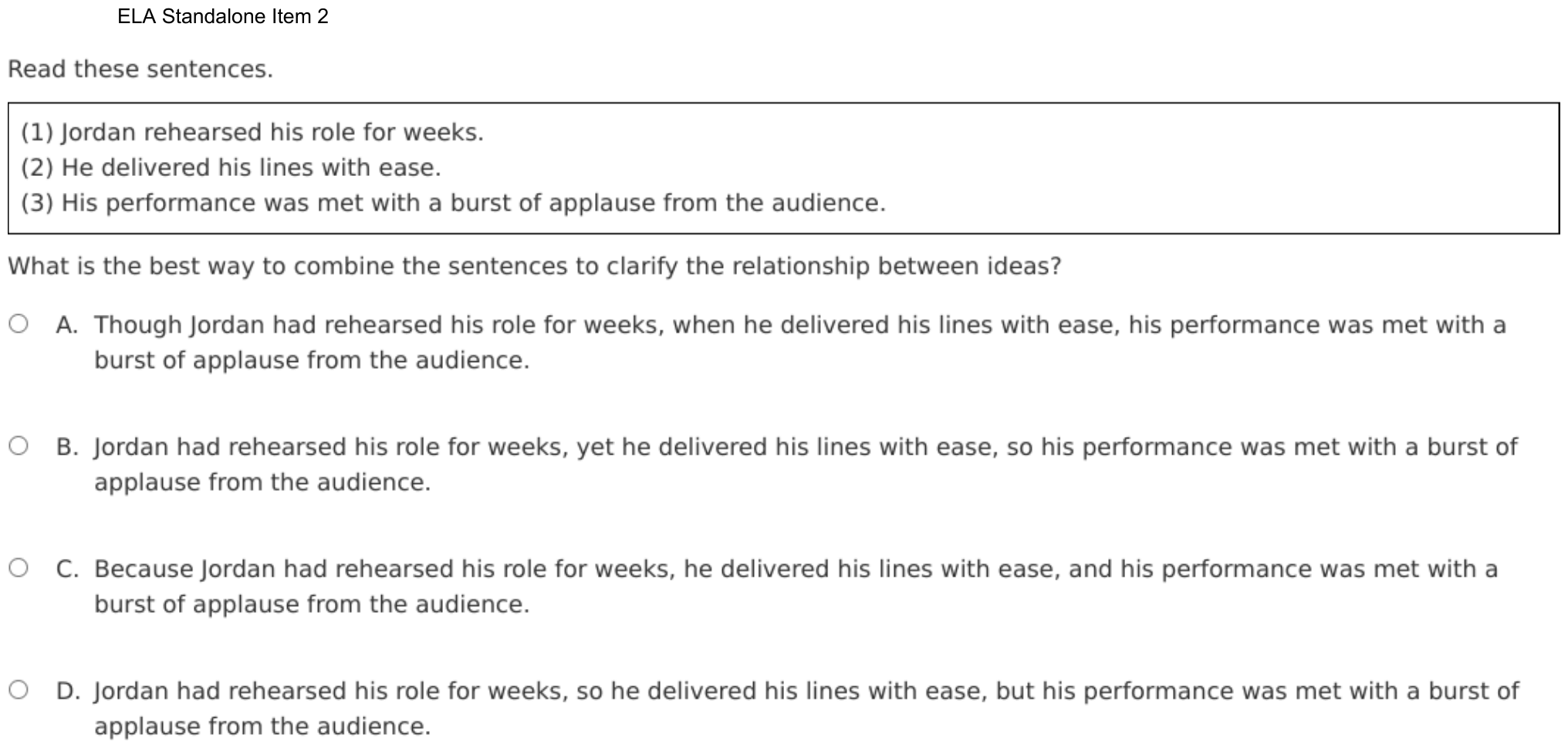
Read these sentences.
(1) Jordan rehearsed his role for weeks.
(2) He delivered his lines with ease.
(3) His performance was met with a burst of applause from the audience.
What is the best way to combine the sentences to clarify the relationship between ideas?
- AThough Jordan had rehearsed his role for weeks, when he delivered his lines with ease, his performance was met with a burst of applause from the audience.
- BJordan had rehearsed his role for weeks, yet he delivered his lines with ease, so his performance was met with a burst of applause from the audience.
- CBecause Jordan had rehearsed his role for weeks, he delivered his lines with ease, and his performance was met with a burst of applause from the audience.
- DJordan had rehearsed his role for weeks, so he delivered his lines with ease, but his performance was met with a burst of applause from the audience.
Show the answer
Correct answer: C
The question asks for the best way to combine the sentences to clarify the relationship between ideas.
A. Incorrect. The conjunction “though” does not make sense with the rest of the sentence since Jordan likely received applause for his performance because he rehearsed, not in spite of rehearsing.
B. Incorrect. The conjunction “yet” is incongruous with the rest of the sentence because Jordan was successful at delivering his lines likely because he rehearsed, not in spite of rehearsing.
C. CORRECT. This combination of sentences clarifies the relationship among the ideas in a way that is logical. Jordan was able to deliver his lines with ease and receive applause from the audience because he had rehearsed. “Because” is the best choice for conveying the cause-and-effect relationship between rehearsing and a successful performance.
D. Incorrect. This combination of sentences correctly expresses the relationship between rehearsing and delivering lines with ease by linking the ideas with the word “so”; however, the word “but” incorrectly links the delivery of lines with applause, suggesting that the burst of applause from the audience was unexpected.
Question analysis
This sentence-combining question gives three short sentences about Jordan, who rehearsed his role for weeks, delivered his lines with ease and drew a burst of applause, and asks for the best way to join them. Every version keeps the same facts, so students must judge which connecting words show how rehearsing, performing and the audience’s response relate.
- Grade level
- Grade 7 reading and task
- Compared with grade 7
- At grade 7 Combining sentences with connecting words that show how ideas relate is a grade 7 language skill. The three sentences are short and describe an everyday event, and the versions differ only in their connecting words, so the demand is typical.
- Estimated difficulty
- Straightforward: two steps or one careful reading.
- Thinking it demands
- Depth of knowledge 2, skills and concepts · mainly evaluate
- What makes it hard
- Every choice must be checked moderate
- How sentences fit together minor
- Evidence
- Answered from one sentence or line
- Reading level
- Question and choices: about grade 7, 150 words.
- Students, last 30 days
- Not enough answers yet to show (it takes 10).
Why it is hard, traps and wrong answers (shows the answer)
Why it is hard
The three facts form a simple chain of causes, and most students see that rehearsal explains the easy delivery. Points are lost by checking only the first connector: one version starts with a correct “so” and then joins the applause with “but,” as if it were a surprise. Versions opening with “Though” or using “yet” fail on the first link, so they are easier to rule out.
Every choice must be checked moderate Choosing the answer
Every version runs 27 words and keeps the same three facts, differing only in its two connecting words, so a wrong one can hide at the end, as “but” does after a correct “so.” (Embretson & Wetzel, 1987)
How sentences fit together minor Working it out
Students must first see the chain the sentences imply, weeks of rehearsal causing an easy delivery and the easy delivery earning applause, before any connector can be judged. (Halliday & Hasan, 1976)
Strategy: Before reading the choices, decide how each sentence leads to the next, then check every connecting word in each version, since one wrong word anywhere makes the whole combined sentence wrong.
Traps
- Wrong transition: A connecting word or phrase that signals the wrong relationship, such as contrast where the idea continues.
The wrong answers, classified
A Wrong transition (Halliday & Hasan, 1976)
Opens with “Though,” which treats weeks of rehearsal as something that should have worked against Jordan, when practice is the reason his lines came easily.
B Wrong transition (Halliday & Hasan, 1976)
Gets the second link right with “so” but joins rehearsing and easy delivery with “yet,” as if delivering lines smoothly were surprising after weeks of practice.
D Wrong transition (Halliday & Hasan, 1976)
Joins rehearsal and easy delivery correctly with “so,” then adds the applause with “but,” as if a burst of applause after a smooth performance were unexpected.
Working it out, step by step
Figure out what the question asks
You need the best way to join three short sentences into one. The joined sentence must show how the ideas connect. All four choices keep the same facts. They differ only in their connecting words. So check every connecting word in each choice.
See how the three ideas connect
Sentence 1: “Jordan rehearsed his role for weeks.” To rehearse means to practice. Sentence 2: “He delivered his lines with ease.” With ease means easily. Sentence 3: the audience burst into applause. These ideas form a chain. Practice made his lines easy. A strong performance then earned the applause. Nothing here is surprising.
Learn what each connecting word signals
- Because and so show cause and effect: I studied, so I passed.
- Though, yet and but show a contrast, something surprising: I studied, but I still failed.
- And simply adds the next idea: I studied, and I passed.
Check each choice
- A is wrong. “Though” makes the practice sound like it should have hurt him.
- B is wrong. “Yet” makes his easy delivery sound surprising after weeks of practice.
- C is right. “Because” shows that practice caused his easy delivery. “And” adds the applause that followed.
- D is wrong. “So” is right, but “but” makes the applause sound unexpected.
Watch out: D starts well with “so.” The mistake hides in its second connecting word.
Choose the answer
Only one version shows that practice led to success, with no false surprise. So the answer is C, “Because Jordan had rehearsed his role for weeks, he delivered his lines with ease, and his performance was met with a burst of applause from the audience.”
Why this answer and not the closest wrong one
D is the closest wrong answer, since its first half uses “so” correctly. But “but” tells the reader the applause was a surprise. A smooth performance after weeks of practice should earn applause. C uses “because” and “and,” which show the real chain of events.
More questions like this
The original DOE question