Reads too much in
This test has the first 120 of the 176 questions that match.
Question 1 of 120
2026 Practice Test A English, question 7Passage Snowy Mountains
Snowy Mountains
by John Gould Fletcher
Higher and still more high,
Palaces made for cloud,
Above the dingy city-roofs
Blue-white like angels with broad wings,
Pillars of the sky at rest
The mountains from the great plateau
Uprise.
But the world heeds them not;
They have been here now for too long a time.
The world makes war on them,
Tunnels their granite cliffs,
Splits down their shining sides,
Plasters their cliffs with soap-advertisements,
Destroys the lonely fragments of their peace.
Vaster and still more vast,
Peak after peak, pile after pile,
Wilderness still untamed,
To which the future is as was the past,
Barrier spread by Gods,
Sunning their shining foreheads,
Barrier broken down by those who do not need
The joy of time-resisting storm-worn stone,
The mountains swing along
The south horizon of the sky;
Welcoming with wide floors of blue-green ice
The mists that dance and drive before the sun.
“Snowy Mountains” by John Gould Fletcher—Public Domain
Question
Which quotations from the poem support the theme that nature’s unspoiled beauty is splendid, and which quotations support the theme that human creations detract from natural wonder?
Move each answer to the correct box.
Choose one answer in each row, then check. The DOE has not published how answers with several parts are scored; this site counts one right only when every part is right.
| Nature’s Unspoiled Beauty is Splendid | Human Creations Detract from Natural Wonder | |
|---|---|---|
| “Above the dingy city-roofs / Blue-white like angels with broad wings,” (lines 3–4) | ||
| “Pillars of the sky at rest / The mountains from the great plateau / Uprise.” (lines 5–7) | ||
| “Tunnels their granite cliffs, / Splits down their shining sides,” (lines 11–12) | ||
| “Wilderness still untamed, / To which the future is as was the past,” (lines 17–18) | ||
| “The south horizon of the sky; / Welcoming with wide floors of blue-green ice” (lines 24–25) |
Show the answer
Correct answer: “Above the dingy city-roofs / Blue-white like angels with broad wings,” (lines 3–4): Human Creations Detract from Natural Wonder; “Pillars of the sky at rest / The mountains from the great plateau / Uprise.” (lines 5–7): Nature’s Unspoiled Beauty is Splendid; “Tunnels their granite cliffs, / Splits down their shining sides,” (lines 11–12): Human Creations Detract from Natural Wonder; “Wilderness still untamed, / To which the future is as was the past,” (lines 17–18): Nature’s Unspoiled Beauty is Splendid; “The south horizon of the sky; / Welcoming with wide floors of blue-green ice” (lines 24–25): Nature’s Unspoiled Beauty is Splendid
The question identifies two themes and asks which quotations from the poem support each theme. Each quotation should be moved to one of the two boxes: “Nature’s Unspoiled Beauty is Splendid” or “Human Creations Detract from Natural Wonder.”
“Above the dingy city-roofs / Blue-white like angels with broad wings,” (lines 3–4)
This quotation supports the theme that human creations detract from natural wonder. The lines describe the city-roofs as “dingy,” suggesting that they mar the lovely background of the blue-white mountains, which are compared to angels, a simile that vividly conveys the wonder of nature. The description in the lines primarily serves to create a contrast between the city’s unsightly appearance and the beauty of the mountains, thereby providing support for the theme that human creations (i.e. the city) detract from natural wonder.
“Pillars of the sky at rest / The mountains from the great plateau / Uprise.” (lines 5–7)
This quotation supports the theme that nature’s unspoiled beauty is splendid. By describing the mountains as “pillars of the sky” that “uprise” dramatically from a large plateau, the lines primarily convey a sense of the mountains’ dramatic and impressive size. The description suggests that the mountains are holding up the sky, a powerful image of an unspoiled, natural landscape.
“Tunnels their granite cliffs, / Splits down their shining sides,” (lines 11–12)
The quotation supports the theme that human creations detract from natural wonder. The words “tunnels” and “splits” emphasize that human intervention in nature is destructive, breaking apart the “shining sides” of the mountain. These lines suggest that human creations—such as building a tunnel through a mountain—detract from natural wonder, diminishing its beauty and serenity.
“Wilderness still untamed, / To which the future is as was the past,” (lines 17–18)
The quotation supports the theme that nature’s unspoiled beauty is splendid by indicating that the natural mountainous landscape is both splendid and unspoiled (“wilderness still untamed”). The phrase “to which the future is as was the past” suggests that nature in its unspoiled state is timeless or eternal, further supporting the theme.
“The south horizon of the sky; / Welcoming with wide floors of blue-green ice” (lines 24–25)
The quotation supports the theme that nature’s unspoiled beauty is splendid. The reference to the “wide floors of blue-green ice” emphasizes that the landscape is beautiful, and the description in the lines conveys the grandiose splendor of nature, conveying an image of the “south horizon of the sky” majestically “welcoming” one’s eye, inviting appreciation of its unspoiled beauty.
Question analysis
This sorting question on the poem “Snowy Mountains” gives two themes, the splendor of unspoiled nature and the way human creations detract from natural wonder, and asks students to place five quotations under them. The quotations come from all three stanzas. Students make five separate judgments, and a line’s most vivid image is not always the best guide to where it belongs.
- Grade level
- Grade 7 reading and task
- Compared with grade 7
- At grade 7 Matching quotations to a stated theme is routine grade 7 evidence work, and both themes are given. The added demand is volume: five separate judgments on lines from all three stanzas of old-fashioned verse, each of which must land in the right box.
- Estimated difficulty
- Moderate: several steps, or a close reading with one strong distractor.
- Thinking it demands
- Depth of knowledge 2, skills and concepts · mainly analyze
- What makes it hard
- Much to keep track of moderate
- Reading between the lines moderate
- Figurative or literary language minor
- Evidence
- Answered from several paragraphs or stanzas
- Reading level
- Passage: 161 words (a poem; reading level not measured); question and choices: about grade 9, 34 words.
- Students, last 30 days
- Not enough answers yet to show (it takes 10).
Why it is hard, traps and wrong answers (shows the answer)
Why it is hard
Most tiles sort quickly once a student asks whether people appear in the lines. The first tile is the hard one: its angel simile is pure splendor, yet the “dingy city-roofs” beneath it set the city against the peaks, and only that contrast fits the second theme. The tunneling lines hide their human actor outside the tile. With five placements that must all be right, one hasty tile loses the question.
Much to keep track of moderate Working it out
Five tiles from all three stanzas go into two boxes and every placement must be right, so a student holds both themes in mind while judging each quotation on its own. (Sweller, 1988; Carpenter, Just & Shell, 1990)
Reading between the lines moderate Working it out
Two tiles name no person: in lines 3–4 the human presence is only the “dingy city-roofs,” and in lines 11–12 the subject, “The world,” sits back in line 10, outside the tile. (Graesser, Singer & Trabasso, 1994; Kintsch, 1998)
Figurative or literary language minor Understanding the question
The splendor is carried by images rather than statements, the mountains as “angels,” “Pillars of the sky” and “wide floors of blue-green ice,” which students must read as praise of untouched nature. (Graesser, Singer & Trabasso, 1994; Kintsch, 1998)
Strategy: Read each quotation to the end and ask whether it shows something people have made or done; then sort it by what the lines as a whole are about, not by one word.
Traps
- Supports only part of the claim: In a question about evidence: a line that backs one half of the claim but not the other, or a related point rather than the claim itself.
- Taking figurative language literally: A choice reads a figure of speech or image at face value.
- Word match: Repeats striking words or phrases from the text, so it looks supported, but its meaning does not fit the question.
The wrong answers, classified
1:A Supports only part of the claim (King et al., 2004; Thissen, Steinberg & Fitzpatrick, 1989)
Files the lines under splendor for the angel simile, which shows beauty but not beauty unspoiled; the “dingy city-roofs” put a human creation right beneath it.
2:B Taking figurative language literally (Graesser, Singer & Trabasso, 1994)
Takes “Pillars” as something people build, a human structure, when the metaphor makes the mountains themselves the columns that hold up the sky.
3:A Word match (Freedle & Kostin, 1993)
Is drawn by “granite cliffs” and “shining sides,” words of admiration, and misses that “Tunnels” and “Splits” are what “The world” of line 10 does to the mountains.
4:B Reads too much in (Graesser, Singer & Trabasso, 1994)
Reads “still untamed” as a sign that people are trying to tame the land, though the lines praise a wilderness that people have not changed and that time leaves as it was.
5:B Wrong part of the text (Kirsch & Mosenthal, 1990)
Remembers that the last stanza blames those who broke down the “Barrier” in lines 21–22 and carries that charge to lines 24–25, which only picture ice and sky.
Working it out, step by step
Figure out what the question asks
This is a sorting question. You get two themes. A theme is a big idea a poem keeps coming back to. The first theme says nature that people have not spoiled is splendid, which means grand and beautiful. The second says things people make detract from nature, which means they take away from its wonder. For each quotation, ask: does it show something people made or did?
Sort the lines about the city
Lines 3 and 4 say “Above the dingy city-roofs / Blue-white like angels with broad wings.” The angel picture is beautiful. But right under the mountains are “dingy city-roofs.” Dingy means dirty and dull. City roofs are something people built. The lines set the dirty city against the shining mountains. So this quotation shows a human creation taking away from nature’s wonder.
Sort the lines about the pillars
Lines 5 to 7 say “Pillars of the sky at rest / The mountains from the great plateau / Uprise.” Pillars are tall posts that hold something up. A plateau is a high, flat stretch of land. The mountains rise up like giant posts holding up the sky. No people appear here. This quotation shows how splendid untouched nature is.
Sort the lines about tunnels
Lines 11 and 12 say “Tunnels their granite cliffs, / Splits down their shining sides.” These lines do not say who does this. Look back at line 10: “The world makes war on them.” So “the world,” meaning people, cuts tunnels and splits the mountains. The cliffs shine, but people are breaking them. This quotation shows human creations hurting nature.
Sort the last two quotations
Lines 17 and 18 say “Wilderness still untamed, / To which the future is as was the past.” Untamed means not controlled or changed by people. The second line means the mountains will stay as they always were. Lines 24 and 25 say “The south horizon of the sky; / Welcoming with wide floors of blue-green ice.” That is a picture of sky and ice, with no people in it. Both praise unspoiled nature.
Place each quotation in its box
- Lines 3–4 (the city roofs): Human Creations Detract from Natural Wonder
- Lines 5–7 (the pillars): Nature’s Unspoiled Beauty is Splendid
- Lines 11–12 (the tunnels): Human Creations Detract from Natural Wonder
- Lines 17–18 (the wilderness): Nature’s Unspoiled Beauty is Splendid
- Lines 24–25 (the ice): Nature’s Unspoiled Beauty is Splendid
Drag each tile into its box. All five must be right to get the point.
Why this answer and not the closest wrong one
Lines 3 and 4 are the hardest tile. The angel image alone would fit the first box. But that box is about beauty that is unspoiled. These lines put the dingy city right under the shining peaks. The dirty roofs spoil the view, so the tile belongs in the second box.
More questions like this
The original DOE question
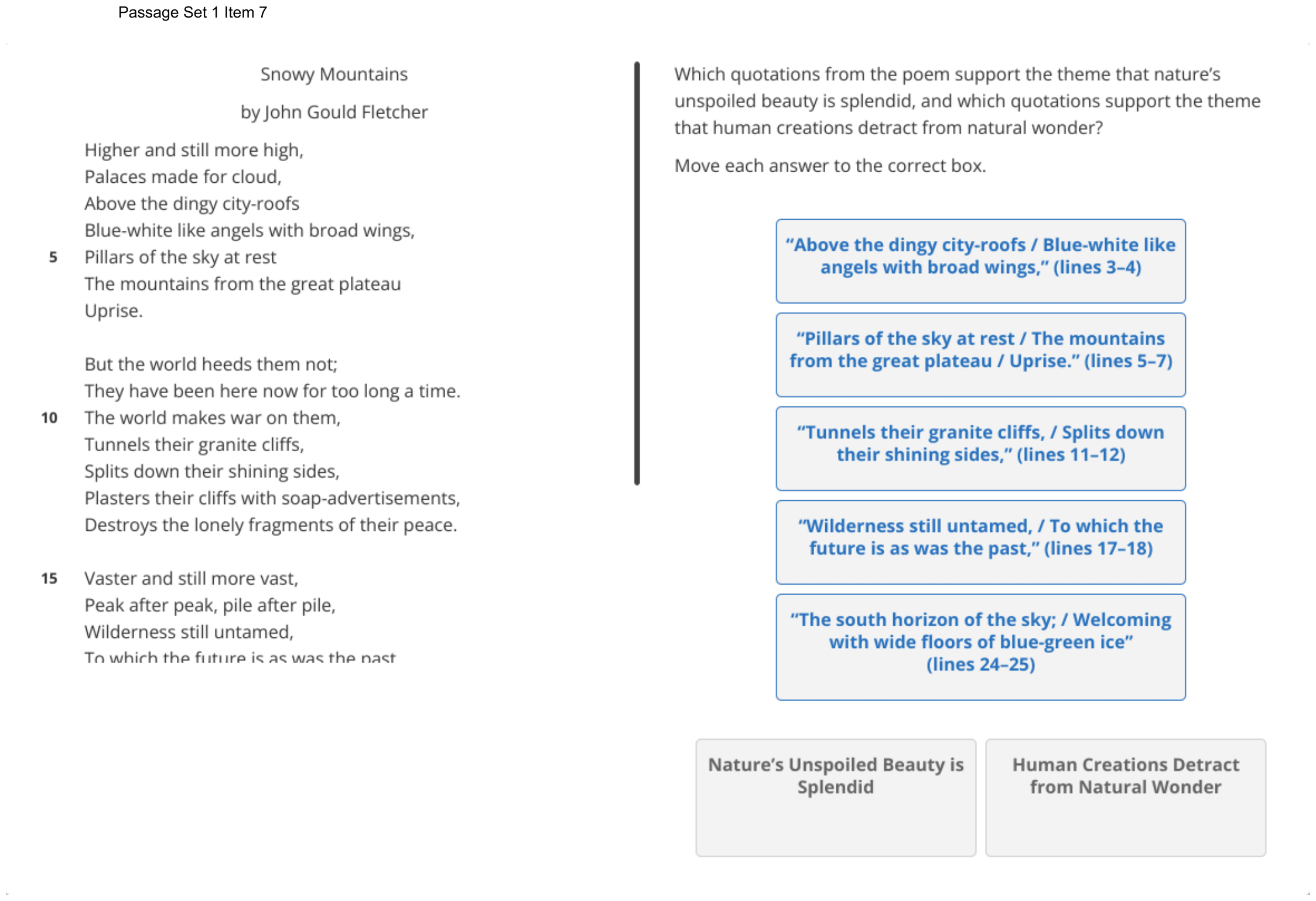
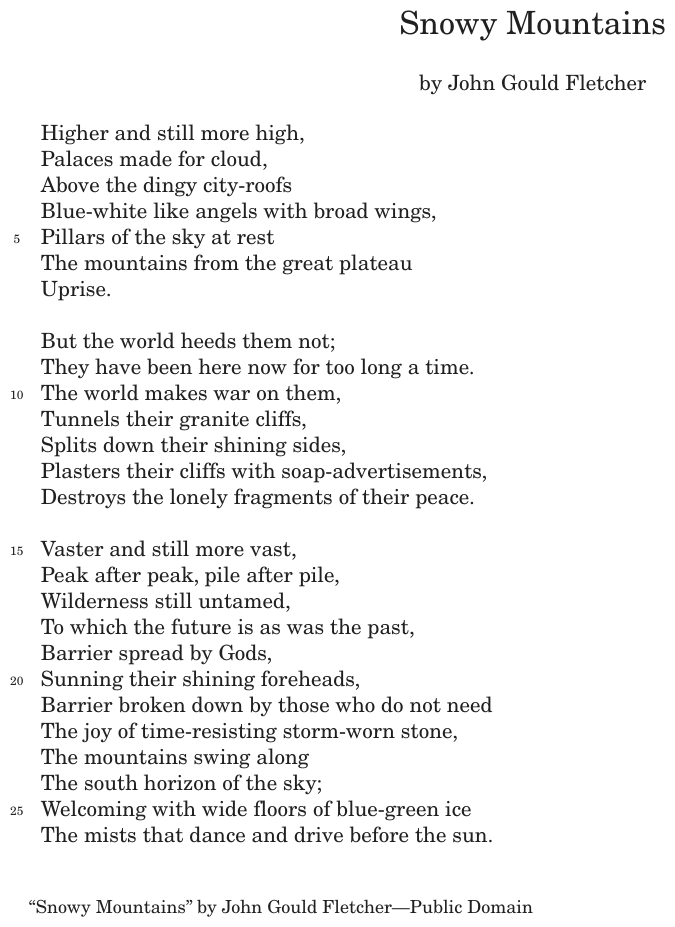
The passage “Snowy Mountains” as printed (page 142)
Question 2 of 120
2026 Practice Test A English, question 11Passage The Best Laid Plans of Ravens
The Best Laid Plans of Ravens
In Edgar Allan Poe’s poem “The Raven,” a raven visits a lonely man’s home and responds to the man’s pleading questions with only the word “nevermore.” The poem’s narrator interprets the word as a prediction of doom for his future. A talking, prophetic raven may seem to be the wild imaginings of the poet, but a new study published in the journal Science hints that one particular idea behind the poem might not be as far-fetched as it seems. For most of human history, people assumed that animals do not understand the passage of time in the same way people do. Some people believed that animals might remember events from the past and that instinct might drive them to make preparations in order to guarantee survival, but most people did not think that animals had the ability to plan. At Lund University in Sweden, researchers argue that ravens may be able to think ahead and even plan for the future.
It can be difficult to test an animal’s ability to plan because human observers must be certain they are not mistaking instinctual behavior for intentional planning. For example, many animals hoard food so that they will not run out later, but scientists who study animals would not call hoarding a decision to plan for the future. This action is merely instinctual. Cognitive scientists argue that in order for an animal’s behavior to qualify as preparing for the future, the animal must use specific decision-making skills to solve a problem.
To avoid mistaking instinctual behavior for evidence of decision-making, the Lund University researchers designed two experiments to test ravens’ ability to plan. Ravens belong to the corvid family, a group of birds known for their intelligence. A study in 2007 showed that corvids have the tendency to save only certain types of food, which suggests that they are planning for the future rather than acting on instinct. In order to investigate that theory, the researchers had to design experiments that would achieve results that could not be explained by an instinctual behavior of food hoarding. Therefore, the ravens were taught two behaviors that they do not normally perform in the wild.
For the first experiment, the researchers showed the birds how to use a small stone to open a box and get treats. Once the ravens learned the behavior, the researchers presented the birds with four stones. Only one stone was the right size to open the box. The birds learned to select that stone and set it aside until the researchers presented the box. The second experiment involved bartering. A researcher would trade the ravens a large treat for a bottle cap. Later, the researchers presented the ravens with a group of items, including small treats and the bottle cap. The ravens chose the bottle cap over the treats and waited for the original researcher to trade with them again so that they could get more treats. In both experiments, the ravens waited patiently for up to seventeen hours for the researcher to return.
The results of these experiments are exciting, but more evidence needs to be gathered before scientists can fully conclude that ravens can plan for the future. Some scientists argue that the ravens might be choosing the stone and bottle cap because the ravens have been trained to do so, not necessarily because the ravens are thinking ahead. Regardless, like other recent advances in animal science, these experiments show that ravens could be much smarter than first believed, and scientists now believe that ravens do actually think about their own future.
Question
How does paragraph 5 fit into the overall structure of the passage and contribute to the development of ideas?
- AIt introduces a problem with the results of the study at Lund University, suggesting that some scientists believe that further research will not lead to a clear answer.
- BIt summarizes the final steps of the study at Lund University, emphasizing the difficulties researchers had in differentiating between true planning and practiced actions.
- CIt provides a conclusion to the information about the Lund University study, indicating that some scientists think further research is needed in order to prove the idea.
- DIt lists the effects of the study at Lund University, implying that researchers should have designed experiments that better differentiated between planning and instinct.
Show the answer
Correct answer: C
The question asks how paragraph 5 fits into the overall structure of the passage and contributes to the development of ideas.
A. Incorrect. While paragraph 5 states that “more evidence needs to be gathered before scientists can fully conclude that ravens can plan for the future,” this statement suggests that more research is needed, not that the results of the Lund University study are problematic.
B. Incorrect. Paragraph 5 does not discuss steps of the study or emphasize difficulties in determining whether the behaviors shown in the study were planned or practiced; instead it simply suggests that more study is required to make such a determination.
C. CORRECT. Paragraph 5 notes that some doubt remains (“Some scientists argue that the ravens might be choosing the stone and bottle cap because the ravens have been trained to do so, not necessarily because the ravens are thinking ahead”) and that more experimentation is needed; the author concludes that there is reason to believe the originally stated theory that ravens are quite smart and can give thought to how future events may affect them.
D. Incorrect. Paragraph 5 does not list the effects of the study or criticize the experiment for not differentiating between planning and instinct. The paragraph explains why the results of the experiments are not conclusive and emphasizes that more research is needed.
Question analysis
This text-structure question asks how the last paragraph of the article “The Best Laid Plans of Ravens” fits into the passage and develops its ideas. Students must see what that paragraph does once the experiments have been described. Each long choice names a role and then adds a claim, so a choice can begin well and end wrong.
- Grade level
- Grade 7 reading and task
- Compared with grade 7
- At grade 7 Explaining the role of a final paragraph is regular grade 7 structure work. The choices are long, though, and each pairs a role with a claim about scientists’ views, so both halves must be checked against a paragraph that mixes doubt with enthusiasm.
- Estimated difficulty
- Moderate: several steps, or a close reading with one strong distractor.
- Thinking it demands
- Depth of knowledge 2, skills and concepts · mainly analyze
- What makes it hard
- A very close wrong answer moderate
- How, not what moderate
- A lot to read minor
- Evidence
- Answered from several paragraphs or stanzas
- Reading level
- Passage: about grade 11, 599 words; question and choices: about grade 15, 121 words.
- Students, last 30 days
- Not enough answers yet to show (it takes 10).
Why it is hard, traps and wrong answers (shows the answer)
Why it is hard
Paragraph 5 makes three moves, excitement, doubt and a hopeful conclusion, and each wrong choice builds on one of them and then goes too far. Students who notice the doubt but read past “before scientists can fully conclude” pick the claim that research will never settle the question. Summing up the paragraph before reading the choices, and then checking the second half of each, is what earns the point.
A very close wrong answer moderate Choosing the answer
The choice about a problem with the results matches the right one in its first half, a doubt raised in paragraph 5, and differs only in claiming that more research will not give a clear answer. (Embretson & Wetzel, 1987; Gorin & Embretson, 2006; Ascalon et al., 2007)
How, not what moderate Working it out
The question asks what paragraph 5 does in the article, closing the account of the Lund study, so students must name its role rather than repeat its caution about training. (Anderson & Krathwohl, 2001)
A lot to read minor Understanding the question
The choices run 24 to 28 words, and each pairs a role with a second claim about what scientists or researchers think or did, so both halves of every choice have to be checked. (Kintsch, 1998; Gorin & Embretson, 2006; Freedle & Kostin, 1993)
Strategy: Sum up paragraph 5 in one sentence of your own, then check both parts of each choice, the job it names and the idea it attributes to scientists, against that summary.
Traps
- Half right: One half of a two-part choice is right and the other is not.
- Twists what the text says: Uses the text's topic and ideas but changes what it says: who did it, how much, when, or why.
- Reads too much in: A reasonable-sounding conclusion that goes further than the text allows.
The wrong answers, classified
A Half right (King et al., 2004; Thissen, Steinberg & Fitzpatrick, 1989)
Rightly sees that paragraph 5 raises a doubt about the results, but adds that more research will not settle it, when the paragraph says more evidence is needed to reach a conclusion.
B Twists what the text says (King et al., 2004)
Turns the objection some scientists raise, that the birds may simply be trained, into the Lund researchers’ own struggle, though the paragraph describes no steps of the study.
D Reads too much in (Graesser, Singer & Trabasso, 1994)
Reads the call for more evidence as a verdict that the experiments were badly designed, though the author calls the results “exciting” and faults no one.
Working it out, step by step
Figure out what the question asks
This asks about structure: what job paragraph 5 does in the article. Each choice has two parts, a job and an idea about scientists. Both parts must be right.
See where paragraph 5 sits
Paragraphs 3 and 4 describe the Lund University experiments. Paragraph 5 is the last paragraph. It comes after the whole study has been described. So it is the place where the author sums up what the study means.
Read what paragraph 5 says
It opens: “The results of these experiments are exciting, but more evidence needs to be gathered before scientists can fully conclude that ravens can plan for the future.” Next, it says some scientists think the ravens may just be trained. Then it says “Regardless,” the experiments show ravens “could be much smarter than first believed.” Regardless means “even so.”
Put the paragraph in your words
Paragraph 5 wraps up the study. The results are exciting but not proven yet. More research is needed to be sure. A conclusion is the ending part that sums things up. So paragraph 5 is the conclusion to the study, and it says more evidence is needed.
Check each choice
- A does not fit. Paragraph 5 does raise a doubt. But it never says more research will fail to give a clear answer.
- B does not fit. Paragraph 5 describes no steps of the study.
- C fits. It wraps up the study and says more research is needed.
- D does not fit. It lists no effects and blames no one. The author calls the results “exciting.”
Choose the answer
Paragraph 5 ends the story of the study and calls for more evidence. So the answer is C.
Why this answer and not the closest wrong one
A is the closest wrong choice, because its first half is right: paragraph 5 raises a doubt. But A says more research will not lead to a clear answer. The paragraph says more evidence is needed “before scientists can fully conclude,” so research is the way to an answer. C says this.
More questions like this
The original DOE question
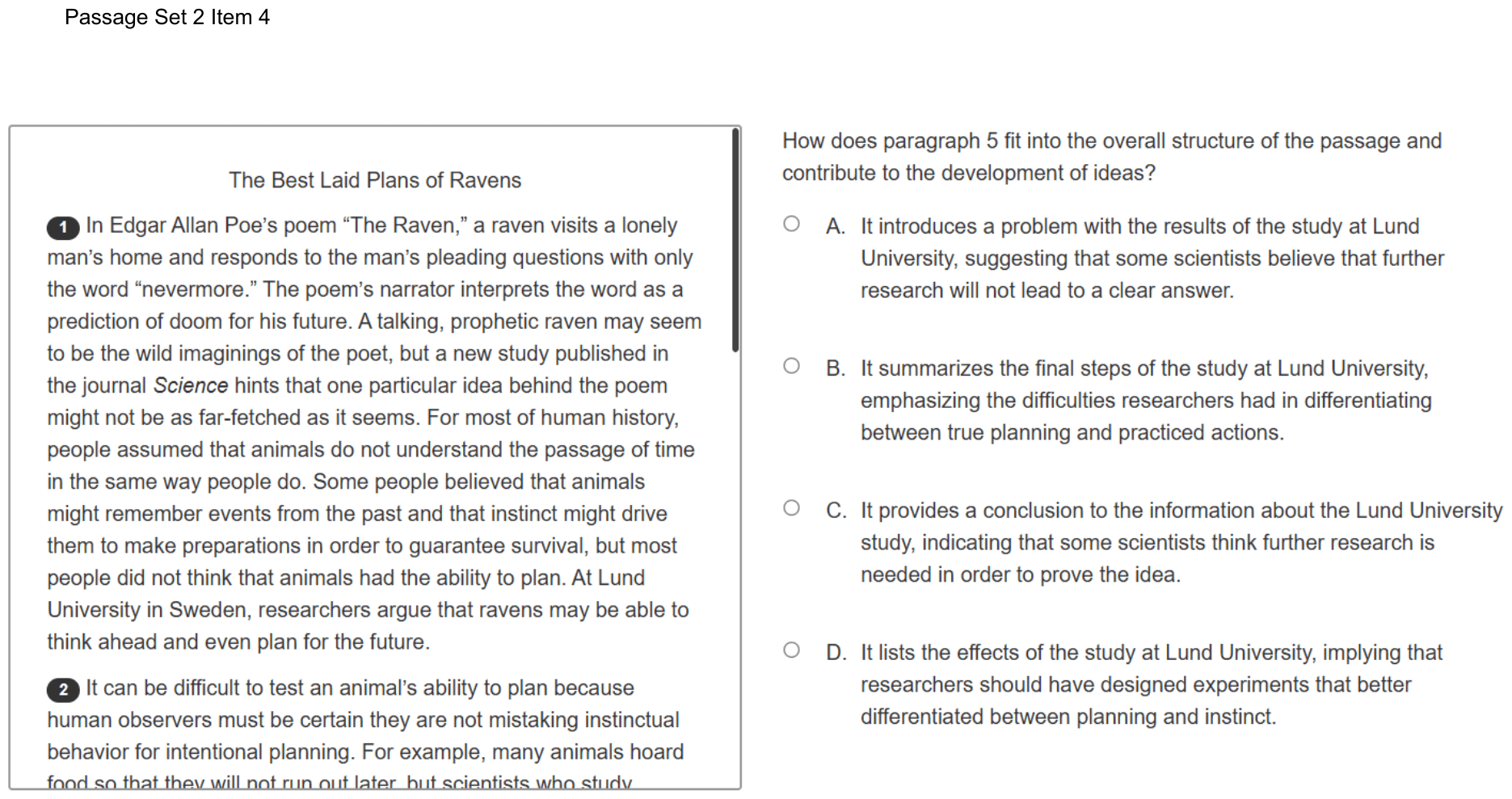
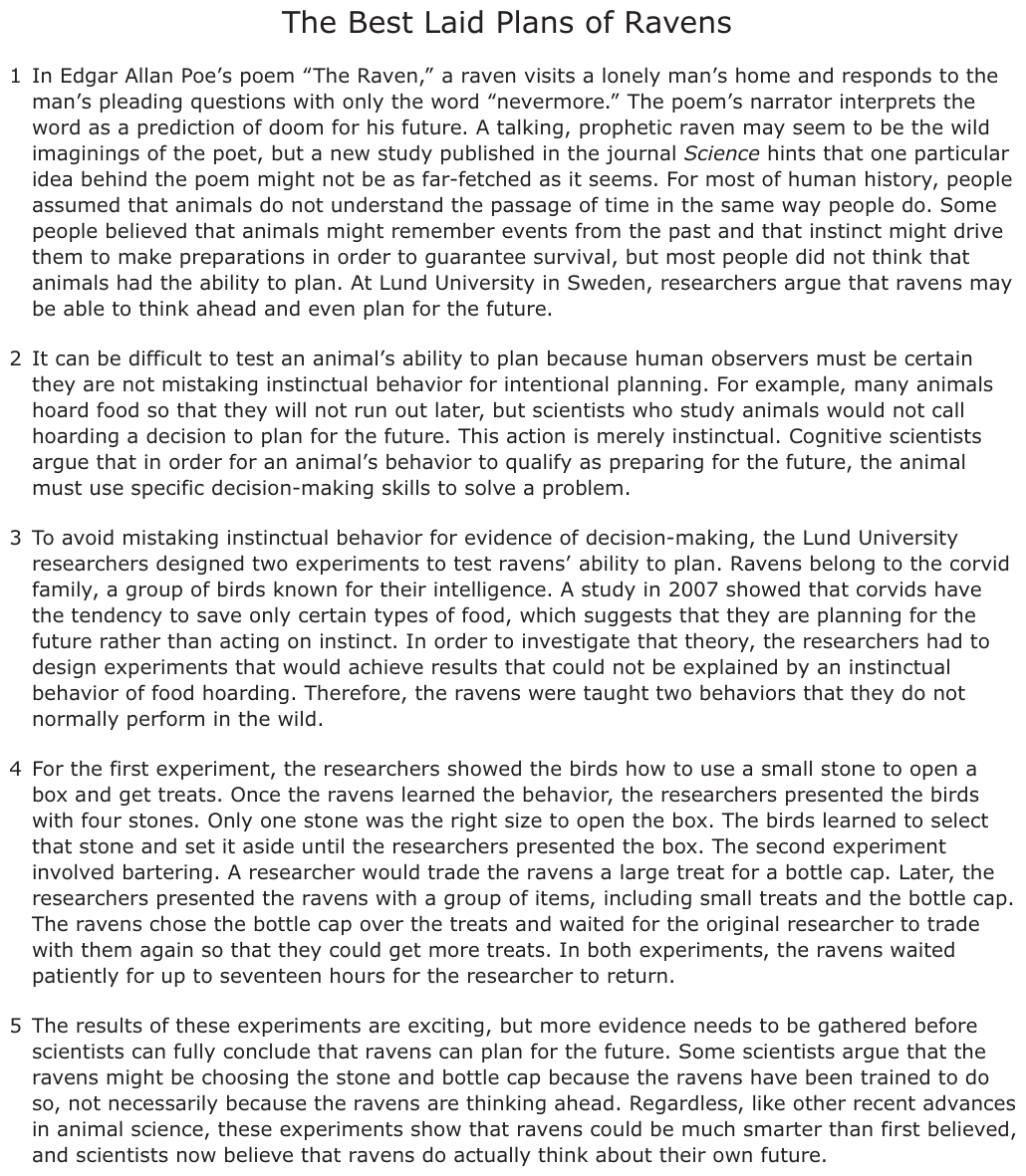
The passage “The Best Laid Plans of Ravens” as printed (page 12)
Question 3 of 120
2026 Practice Test A English, question 17Passage Excerpt from A Voice in the Wilderness
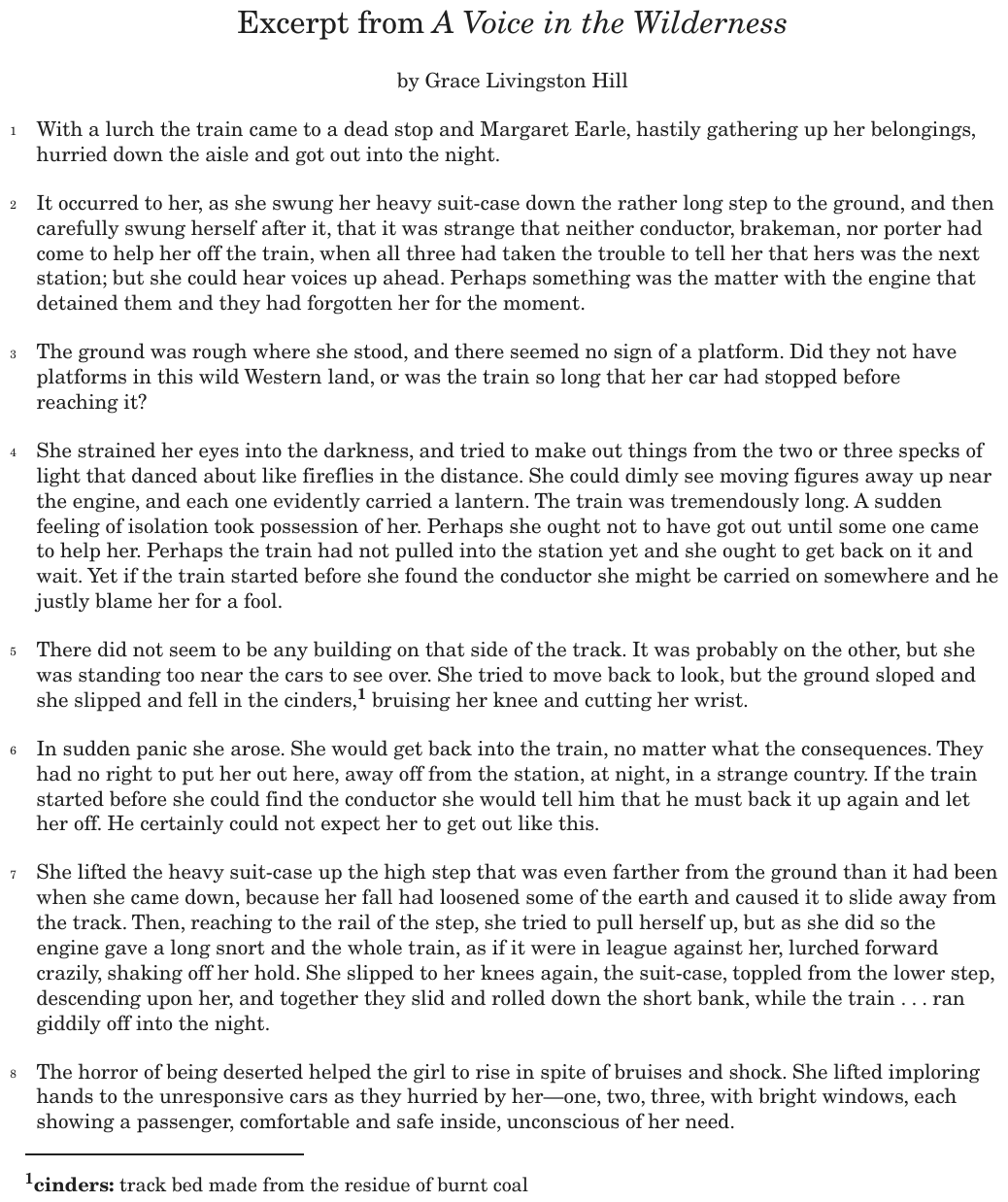
Excerpt from A Voice in the Wilderness
by Grace Livingston Hill
With a lurch the train came to a dead stop and Margaret Earle, hastily gathering up her belongings, hurried down the aisle and got out into the night.
It occurred to her, as she swung her heavy suit-case down the rather long step to the ground, and then carefully swung herself after it, that it was strange that neither conductor, brakeman, nor porter had come to help her off the train, when all three had taken the trouble to tell her that hers was the next station; but she could hear voices up ahead. Perhaps something was the matter with the engine that detained them and they had forgotten her for the moment.
The ground was rough where she stood, and there seemed no sign of a platform. Did they not have platforms in this wild Western land, or was the train so long that her car had stopped before reaching it?
She strained her eyes into the darkness, and tried to make out things from the two or three specks of light that danced about like fireflies in the distance. She could dimly see moving figures away up near the engine, and each one evidently carried a lantern. The train was tremendously long. A sudden feeling of isolation took possession of her. Perhaps she ought not to have got out until some one came to help her. Perhaps the train had not pulled into the station yet and she ought to get back on it and wait. Yet if the train started before she found the conductor she might be carried on somewhere and he justly blame her for a fool.
There did not seem to be any building on that side of the track. It was probably on the other, but she was standing too near the cars to see over. She tried to move back to look, but the ground sloped and she slipped and fell in the cinders, bruising her knee and cutting her wrist.
In sudden panic she arose. She would get back into the train, no matter what the consequences. They had no right to put her out here, away off from the station, at night, in a strange country. If the train started before she could find the conductor she would tell him that he must back it up again and let her off. He certainly could not expect her to get out like this.
She lifted the heavy suit-case up the high step that was even farther from the ground than it had been when she came down, because her fall had loosened some of the earth and caused it to slide away from the track. Then, reaching to the rail of the step, she tried to pull herself up, but as she did so the engine gave a long snort and the whole train, as if it were in league against her, lurched forward crazily, shaking off her hold. She slipped to her knees again, the suit-case, toppled from the lower step, descending upon her, and together they slid and rolled down the short bank, while the train . . . ran giddily off into the night.
The horror of being deserted helped the girl to rise in spite of bruises and shock. She lifted imploring hands to the unresponsive cars as they hurried by her—one, two, three, with bright windows, each showing a passenger, comfortable and safe inside, unconscious of her need.
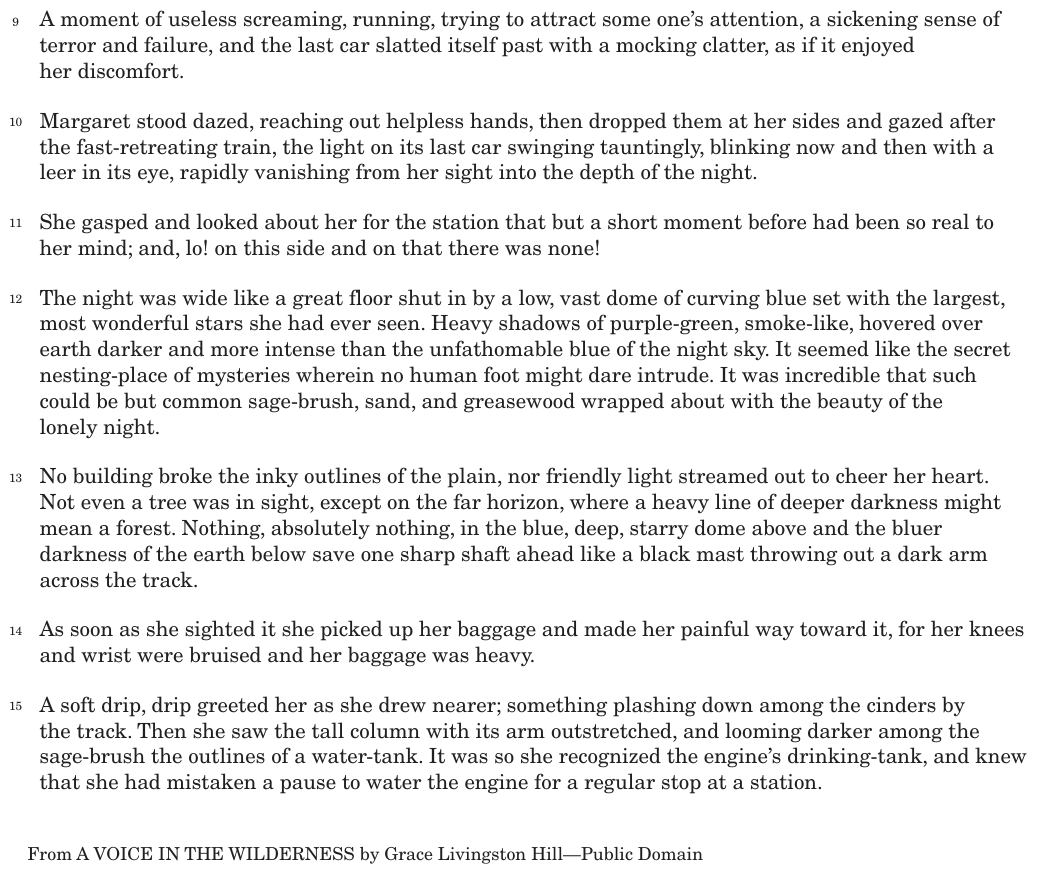
A moment of useless screaming, running, trying to attract some one’s attention, a sickening sense of terror and failure, and the last car slatted itself past with a mocking clatter, as if it enjoyed her discomfort.
Margaret stood dazed, reaching out helpless hands, then dropped them at her sides and gazed after the fast-retreating train, the light on its last car swinging tauntingly, blinking now and then with a leer in its eye, rapidly vanishing from her sight into the depth of the night.
She gasped and looked about her for the station that but a short moment before had been so real to her mind; and, lo! on this side and on that there was none!
The night was wide like a great floor shut in by a low, vast dome of curving blue set with the largest, most wonderful stars she had ever seen. Heavy shadows of purple-green, smoke-like, hovered over earth darker and more intense than the unfathomable blue of the night sky. It seemed like the secret nesting-place of mysteries wherein no human foot might dare intrude. It was incredible that such could be but common sage-brush, sand, and greasewood wrapped about with the beauty of the lonely night.
No building broke the inky outlines of the plain, nor friendly light streamed out to cheer her heart. Not even a tree was in sight, except on the far horizon, where a heavy line of deeper darkness might mean a forest. Nothing, absolutely nothing, in the blue, deep, starry dome above and the bluer darkness of the earth below save one sharp shaft ahead like a black mast throwing out a dark arm across the track.
As soon as she sighted it she picked up her baggage and made her painful way toward it, for her knees and wrist were bruised and her baggage was heavy.
A soft drip, drip greeted her as she drew nearer; something plashing down among the cinders by the track. Then she saw the tall column with its arm outstretched, and looming darker among the sage-brush the outlines of a water-tank. It was so she recognized the engine’s drinking-tank, and knew that she had mistaken a pause to water the engine for a regular stop at a station.
cinders: track bed made from the residue of burnt coal
From A VOICE IN THE WILDERNESS by Grace Livingston Hill—Public Domain
Question
How do Margaret’s earlier interactions with the conductor, brakeman, and porter affect the plot?
- AThey prompt Margaret to get off the train without further assistance.
- BThey cause Margaret to think that she knows what to do once she gets off the train.
- CThey compel Margaret to wonder whether the train has not pulled all the way into the station.
- DThey lead Margaret to believe that train stations in rural areas lack platforms.
Show the answer
Correct answer: A
The question asks how Margaret’s earlier interactions with the conductor, brakeman, and porter affect the plot.
A. CORRECT. Because the conductor, brakeman, and porter have all “taken the trouble to tell her that hers was the next station” (paragraph 2), Margaret assumes that the next time the train stops, she will have reached her station. This assumption causes Margaret to get off the train at the next stop without waiting for help or confirmation, but the stop turns out to be just “a pause to water the engine” (paragraph 15). This mistaken assumption creates the main problem that Margaret confronts in the passage.
B. Incorrect. Although Margaret’s earlier interactions with the three railroad employees cause her to think that she knows when to get off the train, it is clear from paragraph 4 that Margaret is deeply confused and does not know what to do once she has exited the train car. She muses uneasily, “Perhaps she ought not to have got out until some one came to help her. Perhaps the train had not pulled into the station yet and she ought to get back on it and wait” (paragraph 4).
C. Incorrect. Margaret wonders in paragraph 3 whether the train is “so long that her car had stopped before reaching [the station]” and speculates in paragraph 4 that “the train had not pulled into the station yet.” These thoughts reflect her assumption (based on her interactions with the three railroad employees) that the next stop is her station. However, Margaret’s speculation that the train has not fully pulled into the station does not significantly affect the plot.
D. Incorrect. Margaret wonders in paragraph 3 whether they “have platforms in this wild Western land” and is expecting to see a platform because her interactions with the three railroad employees have led her to believe that she has reached a station. However, it is unclear whether Margaret really believes that rural stations all lack platforms, and her speculation on this point is not further developed in the passage and does not affect the plot.
Question analysis
This plot question on A Voice in the Wilderness asks how Margaret’s earlier dealings with the conductor, brakeman and porter, mentioned only in passing in paragraph 2, affect what happens to her. Students must connect that brief remark to later events in the excerpt. Several choices describe things that do happen, so students must judge which one those conversations truly cause.
- Grade level
- Grade 8 reading and task
- Compared with grade 7
- Above grade 7 Grade 7 plot questions ask how story elements affect one another, usually through an event and its result. Here the cause is a clause inside a long sentence of century-old prose, and students must trace its effect across the excerpt rather than within one paragraph.
- Estimated difficulty
- Hard: combines ideas, needs a plan, and has more than one tempting wrong answer.
- Thinking it demands
- Depth of knowledge 3, strategic thinking · mainly analyze
- What makes it hard
- Evidence in several places moderate
- Reading between the lines moderate
- Complex sentences minor
- Evidence
- Answered from the whole text
- Reading level
- Passage: about grade 8, 981 words; question and choices: about grade 7, 72 words.
- Students, last 30 days
- Not enough answers yet to show (it takes 10).
Why it is hard, traps and wrong answers (shows the answer)
Why it is hard
The talks with the trainmen are mentioned once, in the middle of a long sentence, and the question asks students to see them as the start of the whole plot. Several choices describe thoughts Margaret really has right after she steps down, which makes them feel connected, but those thoughts change nothing. The point goes to students who trace cause to consequence: told her stop was next, she gets off alone at a water tank.
Evidence in several places moderate Working it out
The cause sits in paragraph 2, where all three men had told her “hers was the next station,” and the effect shows only in paragraph 15, when the stop proves to be a water tank. (Kirsch & Mosenthal, 1990; Gorin & Embretson, 2006)
Reading between the lines moderate Working it out
The excerpt never says the men’s words made her step off; students must infer that their assurance is why she left the train at the first stop without waiting for anyone. (Graesser, Singer & Trabasso, 1994; Kintsch, 1998)
Complex sentences minor Understanding the question
The interactions appear in a 66-word sentence in paragraph 2, tucked into a “when” clause after a run of commas, so they read as a passing detail rather than a cause. (Abedi & Lord, 2001; Freedle & Kostin, 1993; Messick, 1989)
Strategy: Reread paragraph 2 to find what the three men told Margaret, then trace how that information shapes the events that follow, and choose the effect that matters most to the plot.
Traps
- True but not the answer: A choice says something accurate about the text that does not answer this question.
- Twists what the text says: Uses the text's topic and ideas but changes what it says: who did it, how much, when, or why.
- Reads too much in: A reasonable-sounding conclusion that goes further than the text allows.
The wrong answers, classified
B Twists what the text says (King et al., 2004)
Rightly links the men’s words to her confidence about when to get off, but stretches it to knowing what to do afterward, when paragraph 4 shows her at a loss.
C True but not the answer (King et al., 2004; Embretson & Wetzel, 1987)
Names a real result of the men’s words, her guess in paragraphs 3 and 4 that the train has not yet reached the station, but that passing worry changes nothing in the plot.
D Reads too much in (Graesser, Singer & Trabasso, 1994)
Turns her puzzled question about platforms in “this wild Western land” into a firm belief about rural stations, an idea the excerpt never develops.
Working it out, step by step
Figure out what the question asks
This asks how something from earlier affects the plot. The plot is the chain of events in a story. What did the three train workers tell Margaret, and what did that cause?
Find what the workers told her
Paragraph 2 says it was strange that “neither conductor, brakeman, nor porter had come to help her off the train, when all three had taken the trouble to tell her that hers was the next station.” A conductor, a brakeman and a porter are all people who work on a train.
Trace what happened because of it
Three workers told her that her stop was next. So when the train stopped, she was sure she had arrived. She got off alone, without waiting for anyone to help. But in paragraph 15 she learns it was only “a pause to water the engine.” Their words set off the whole problem: she is left alone in the dark.
Check each choice
- A fits. Their words led her to get off by herself.
- B does not fit. They told her when to get off, not what to do next. In paragraph 4 she is lost: “Perhaps she ought not to have got out until some one came to help her.”
- C does not fit. She does wonder this, but the thought changes nothing in the story.
- D does not fit. She only asks a question about platforms. She never decides anything about country stations.
Choose the answer
The workers’ words made Margaret step off the train on her own at the wrong stop. So the answer is A.
Why this answer and not the closest wrong one
C is the closest wrong choice. The workers’ words do make her guess that the train has not reached the station yet. But that guess goes nowhere. What changes the story is that she gets off alone at a stop that is not a station. That is A.
More questions like this
The original DOE question
The passage “Excerpt from A Voice in the Wilderness” as printed (pages 128–129)
Question 4 of 120
2026 Practice Test A English, question 18Uses the passage above: “Excerpt from A Voice in the Wilderness”.
Question
How does Margaret’s experience in paragraph 9 emphasize a theme of the excerpt?
- AIt confirms Margaret’s understanding that she cannot rely on help from anyone else.
- BIt leads Margaret to realize that her desire to change her situation is impractical.
- CIt causes Margaret to believe that her own actions led to an unfavorable outcome.
- DIt reinforces Margaret’s frustration about her lack of control over her surroundings.
Show the answer
Correct answer: A
The question asks about the relationship between the theme and paragraph 9, where Margaret desperately tries to get someone on the train to notice her.
A. CORRECT. One important theme of this excerpt concerns Margaret’s willingness to take action to ensure that she reaches her destination. This determination, described in Option A, is why she gathers her belongings together without help, gets off the train without being assisted by employees, and then attempts to climb back on while the train employees are busy examining the engine.
B. Incorrect. While the narrator describes her screaming as useless, she does not feel that her efforts overall are useless, and she does not give up until paragraph 10.
C. Incorrect. While Margaret is feeling a sense of “failure” in paragraph 9, she does not condemn herself as the train moves away.
D. Incorrect. Margaret expresses “terror” in paragraph 9 over being unable to catch someone’s attention, not frustration about her lack of control over her surroundings.
Question analysis
This theme question asks how Margaret’s experience in paragraph 9 of A Voice in the Wilderness, as she screams and runs while the train pulls away, emphasizes a theme of the excerpt. It is a lightly reworded version of an earlier handbook question. Every choice describes a believable reaction to being left behind, so the answer depends on the excerpt’s larger pattern.
- Grade level
- Grade 8 reading and task
- Compared with grade 7
- Above grade 7 Typical grade 7 theme questions trace a given theme through a text. Here students must decide which theme one frantic paragraph supports, and all four choices describe reactions that fit the scene, so the decision draws on the whole excerpt.
- Estimated difficulty
- Among the hardest on the SHSAT: a non-obvious approach, heavy reading, or a well-hidden trap.
- Thinking it demands
- Depth of knowledge 3, strategic thinking · mainly analyze
- What makes it hard
- Reading between the lines major
- Evidence in several places moderate
- Evidence
- Answered from the whole text
- Reading level
- Passage: about grade 8, 981 words; question and choices: about grade 10, 65 words.
- Students, last 30 days
- Not enough answers yet to show (it takes 10).
Why it is hard, traps and wrong answers (shows the answer)
Why it is hard
Each choice names a feeling a stranded traveler might have, and two lean on the paragraph’s own words, “useless” and “failure,” so the paragraph alone cannot decide it. Paragraph 9 must be read as the last link in a chain of trainmen, passengers and a departing train that all leave her to herself. Students who judge from that one paragraph often decide she has given up, though she soon picks up her bags and walks toward the dark shaft by the track.
Reading between the lines major Working it out
The theme is never stated; it must be drawn from paragraph 9’s cries that no one answers and from the passengers “comfortable and safe inside, unconscious of her need” in paragraph 8. (Graesser, Singer & Trabasso, 1994; Kintsch, 1998)
Evidence in several places moderate Working it out
The pattern begins in paragraph 2, when no trainman helps her off, and runs through the train lurching away “as if it were in league against her” in paragraph 7. (Kirsch & Mosenthal, 1990; Gorin & Embretson, 2006)
Strategy: Sum up in a phrase what keeps happening to Margaret from the start of the excerpt to its end, then check which choice paragraph 9’s own words most clearly add to.
Traps
- Too broad or too strong: A choice overstates, generalizes, or uses absolute words the text does not support.
- Wrong tone or attitude: Misjudges the tone, attitude or point of view, such as reading admiration as criticism, or taking a character's or subject's feelings for the author's.
The wrong answers, classified
B Too broad or too strong (King et al., 2004)
Stretches the “useless screaming” of one moment into a judgment that changing her situation is impractical, though she soon gathers her bags and sets off toward the shaft ahead.
C Reads too much in (Graesser, Singer & Trabasso, 1994)
Turns the “sense of terror and failure” into self-blame, though Margaret never says that her own choice to step off the train caused her trouble.
D Wrong tone or attitude (Graesser, Singer & Trabasso, 1994)
Fits the indifferent train, but names frustration over control where paragraph 9 stresses terror at being ignored by everyone aboard.
Working it out, step by step
Figure out what the question asks
This asks about a theme: a big idea a story keeps coming back to. How does what happens in paragraph 9 point to a theme? The right choice should fit a pattern across the whole excerpt.
Read paragraph 9
Paragraph 9 describes “A moment of useless screaming, running, trying to attract some one’s attention, a sickening sense of terror and failure.” Margaret screams and runs, trying to get someone to notice her. No one does. The last car rolls past “as if it enjoyed her discomfort.”
Find the same thing earlier
This is not the first time. In paragraph 2, none of the workers “had come to help her off the train.” In paragraph 8, the passengers sit “comfortable and safe inside, unconscious of her need.” That means they don’t know she needs help. Paragraph 9 is one more time when nobody comes. She will have to count on herself.
Check each choice
- A fits. Her cries go unanswered, just as before. She cannot rely on anyone else.
- B does not fit. Impractical means not sensible or workable. Her screaming fails, but she never decides that trying to change things is pointless. In paragraph 14 she “picked up her baggage” and set off again.
- C does not fit. She feels “failure,” but she never blames herself.
- D does not fit. The paragraph shows terror at being ignored, not frustration about having no control over her surroundings.
Choose the answer
Paragraph 9 adds one more moment where no one helps Margaret. So the answer is A.
Why this answer and not the closest wrong one
B is the closest wrong choice, because paragraph 9 calls her screaming “useless.” But one failed moment does not mean she gives up. Soon she takes her bags and walks toward the tall dark shape ahead. What stays true from paragraph 2 to paragraph 9 is that no one helps her. That is A.
More questions like this
The original DOE question
Question 5 of 120
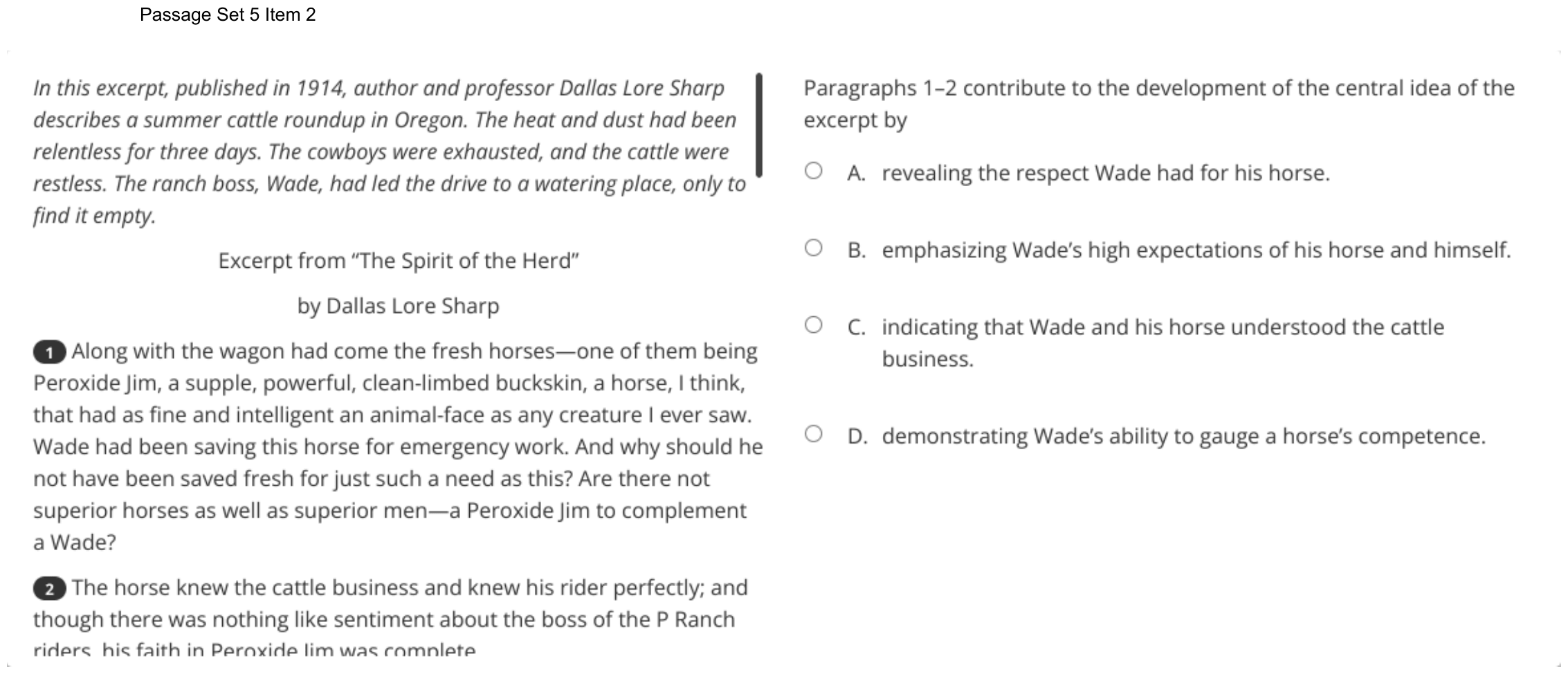
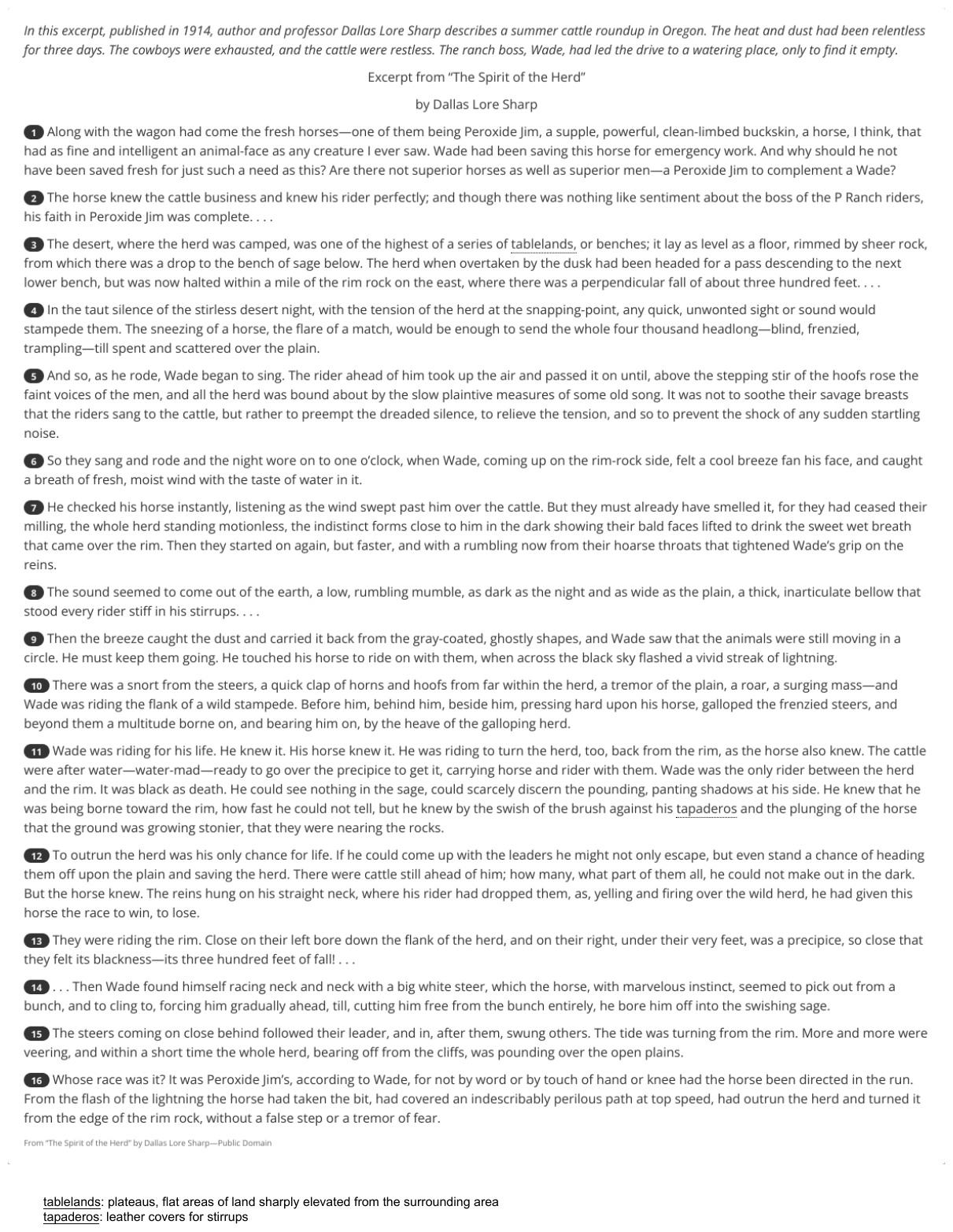
2026 Practice Test A English, question 30Passage Excerpt from “The Spirit of the Herd”
Excerpt from “The Spirit of the Herd”
by Dallas Lore Sharp
In this excerpt, published in 1914, author and professor Dallas Lore Sharp describes a summer cattle roundup in Oregon. The heat and dust had been relentless for three days. The cowboys were exhausted, and the cattle were restless. The ranch boss, Wade, had led the drive to a watering place, only to find it empty.
Along with the wagon had come the fresh horses—one of them being Peroxide Jim, a supple, powerful, clean-limbed buckskin, a horse, I think, that had as fine and intelligent an animal-face as any creature I ever saw. Wade had been saving this horse for emergency work. And why should he not have been saved fresh for just such a need as this? Are there not superior horses as well as superior men—a Peroxide Jim to complement a Wade?
The horse knew the cattle business and knew his rider perfectly; and though there was nothing like sentiment about the boss of the P Ranch riders, his faith in Peroxide Jim was complete. . . .
The desert, where the herd was camped, was one of the highest of a series of tablelands, or benches; it lay as level as a floor, rimmed by sheer rock, from which there was a drop to the bench of sage below. The herd when overtaken by the dusk had been headed for a pass descending to the next lower bench, but was now halted within a mile of the rim rock on the east, where there was a perpendicular fall of about three hundred feet. . . .
In the taut silence of the stirless desert night, with the tension of the herd at the snapping-point, any quick, unwonted sight or sound would stampede them. The sneezing of a horse, the flare of a match, would be enough to send the whole four thousand headlong—blind, frenzied, trampling—till spent and scattered over the plain.
And so, as he rode, Wade began to sing. The rider ahead of him took up the air and passed it on until, above the stepping stir of the hoofs rose the faint voices of the men, and all the herd was bound about by the slow plaintive measures of some old song. It was not to soothe their savage breasts that the riders sang to the cattle, but rather to preempt the dreaded silence, to relieve the tension, and so to prevent the shock of any sudden startling noise.
So they sang and rode and the night wore on to one o’clock, when Wade, coming up on the rim-rock side, felt a cool breeze fan his face, and caught a breath of fresh, moist wind with the taste of water in it.
He checked his horse instantly, listening as the wind swept past him over the cattle. But they must already have smelled it, for they had ceased their milling, the whole herd standing motionless, the indistinct forms close to him in the dark showing their bald faces lifted to drink the sweet wet breath that came over the rim. Then they started on again, but faster, and with a rumbling now from their hoarse throats that tightened Wade’s grip on the reins.
The sound seemed to come out of the earth, a low, rumbling mumble, as dark as the night and as wide as the plain, a thick, inarticulate bellow that stood every rider stiff in his stirrups. . . .
Then the breeze caught the dust and carried it back from the gray-coated, ghostly shapes, and Wade saw that the animals were still moving in a circle. He must keep them going. He touched his horse to ride on with them, when across the black sky flashed a vivid streak of lightning.
There was a snort from the steers, a quick clap of horns and hoofs from far within the herd, a tremor of the plain, a roar, a surging mass—and Wade was riding the flank of a wild stampede. Before him, behind him, beside him, pressing hard upon his horse, galloped the frenzied steers, and beyond them a multitude borne on, and bearing him on, by the heave of the galloping herd.
Wade was riding for his life. He knew it. His horse knew it. He was riding to turn the herd, too, back from the rim, as the horse also knew. The cattle were after water—water-mad—ready to go over the precipice to get it, carrying horse and rider with them. Wade was the only rider between the herd and the rim. It was black as death. He could see nothing in the sage, could scarcely discern the pounding, panting shadows at his side. He knew that he was being borne toward the rim, how fast he could not tell, but he knew by the swish of the brush against his tapaderos and the plunging of the horse that the ground was growing stonier, that they were nearing the rocks.
To outrun the herd was his only chance for life. If he could come up with the leaders he might not only escape, but even stand a chance of heading them off upon the plain and saving the herd. There were cattle still ahead of him; how many, what part of them all, he could not make out in the dark. But the horse knew. The reins hung on his straight neck, where his rider had dropped them, as, yelling and firing over the wild herd, he had given this horse the race to win, to lose.
They were riding the rim. Close on their left bore down the flank of the herd, and on their right, under their very feet, was a precipice, so close that they felt its blackness—its three hundred feet of fall! . . .
. . . Then Wade found himself racing neck and neck with a big white steer, which the horse, with marvelous instinct, seemed to pick out from a bunch, and to cling to, forcing him gradually ahead, till, cutting him free from the bunch entirely, he bore him off into the swishing sage.
The steers coming on close behind followed their leader, and in, after them, swung others. The tide was turning from the rim. More and more were veering, and within a short time the whole herd, bearing off from the cliffs, was pounding over the open plains.
Whose race was it? It was Peroxide Jim’s, according to Wade, for not by word or by touch of hand or knee had the horse been directed in the run. From the flash of the lightning the horse had taken the bit, had covered an indescribably perilous path at top speed, had outrun the herd and turned it from the edge of the rim rock, without a false step or a tremor of fear.
From “The Spirit of the Herd” by Dallas Lore Sharp—Public Domain
tablelands: plateaus, flat areas of land sharply elevated from the surrounding area
tapaderos: leather covers for stirrups
Question
Paragraphs 1–2 contribute to the development of the central idea of the excerpt by
- Arevealing the respect Wade had for his horse.
- Bemphasizing Wade’s high expectations of his horse and himself.
- Cindicating that Wade and his horse understood the cattle business.
- Ddemonstrating Wade’s ability to gauge a horse’s competence.
Show the answer
Correct answer: A
The question asks how paragraphs 1–2 contribute to the development of the central idea of the excerpt.
A. CORRECT. The description of Peroxide Jim in paragraph 1 indicates that the horse was a fine animal (“Along with the wagon had come the fresh horses—one of them being Peroxide Jim, a supple, powerful, clean-limbed buckskin, a horse, I think, that had as fine and intelligent an animal-face as any creature I ever saw” [paragraph 1]). The statement in paragraph 2 that Wade’s “faith in Peroxide Jim was complete” supports the central idea of the excerpt that Wade believed in Peroxide Jim’s abilities even before the horse turned the herd and saved the cattle.
B. Incorrect. Paragraphs 1–2 do not emphasize Wade’s high expectations for himself, nor are these expectations a central idea of the excerpt. The narrator expresses a high opinion of Wade’s abilities in his comparison of Peroxide Jim and Wade, referring to the horse as a “complement” (paragraph 1) for Wade; however, Wade showed complete trust in the horse’s ability to save the herd without his help, as evidenced by Wade dropping the reins to allow the horse to control the situation (paragraph 12).
C. Incorrect. The paragraphs refer to Peroxide Jim’s ability to handle cattle; in fact, paragraph 2 says that “the horse knew the cattle business.” It can be inferred that Wade had this knowledge as well, but this idea is not the focus of paragraphs 1–2 and is not the central idea of the excerpt.
D. Incorrect. Wade’s ability to judge a horse’s competence is not a central idea of the excerpt. The event described in the text is proof that Wade knew how to judge a horse’s ability: Wade trusted Peroxide Jim, and Peroxide Jim did not let him down. The option puts the focus on Wade and one of his strengths, when the central idea and focus of the excerpt is Peroxide Jim’s abilities and strengths, not Wade’s.
Question analysis
This central-idea question asks how the first two paragraphs of “The Spirit of the Herd,” which introduce the buckskin horse Peroxide Jim and the ranch boss Wade, contribute to the excerpt’s central idea. Students connect these opening details to the story of the stampede that follows. The narrator’s old-fashioned rhetorical questions can make the paragraphs’ point hard to pin down.
- Grade level
- Grade 8 reading and task
- Compared with grade 7
- At grade 7 Explaining how opening paragraphs build a central idea is typical grade 7 work. The two paragraphs are short, but the narrator’s rhetorical questions and old-fashioned phrasing must be decoded, and the central idea must come from the rest of the excerpt.
- Estimated difficulty
- Moderate: several steps, or a close reading with one strong distractor.
- Thinking it demands
- Depth of knowledge 2, skills and concepts · mainly analyze
- What makes it hard
- Reading between the lines moderate
- How, not what moderate
- Complex sentences minor
- Evidence
- Answered from several paragraphs or stanzas
- Reading level
- Passage: about grade 8, 1160 words; question and choices: about grade 9, 48 words.
- Students, last 30 days
- Not enough answers yet to show (it takes 10).
Why it is hard, traps and wrong answers (shows the answer)
Why it is hard
The opening paragraphs talk about both Wade and his horse, so every choice can find a foothold in them. The question turns on the excerpt as a whole, which ends by giving the race to Peroxide Jim, and only Wade’s regard for the horse points toward that ending. Students lose the point by picking a skill of Wade’s own, which his trust only implies, or by repeating “knew the cattle business,” a line said of the horse alone.
Reading between the lines moderate Working it out
Respect is never named; it must be read from Wade “saving this horse for emergency work” and from his “faith in Peroxide Jim” being “complete” in paragraph 2. (Graesser, Singer & Trabasso, 1994; Kintsch, 1998)
How, not what moderate Working it out
The question asks how two opening paragraphs serve the excerpt’s central idea, so students must know where the story ends, with the race credited to the horse, before judging them. (Anderson & Krathwohl, 2001)
Complex sentences minor Understanding the question
Paragraph 1 makes its point through two old-fashioned rhetorical questions, beginning “And why should he not” and “Are there not superior horses,” whose answers students must supply. (Abedi & Lord, 2001; Freedle & Kostin, 1993; Messick, 1989)
Strategy: Restate paragraphs 1 and 2 in plain words, decide what the excerpt as a whole is mainly about, and pick the option that links the two.
Traps
- Half right: One half of a two-part choice is right and the other is not.
- Word match: Repeats striking words or phrases from the text, so it looks supported, but its meaning does not fit the question.
- Reads too much in: A reasonable-sounding conclusion that goes further than the text allows.
The wrong answers, classified
B Half right (King et al., 2004; Thissen, Steinberg & Fitzpatrick, 1989)
Takes “superior horses as well as superior men” as Wade’s demands on both, but the paragraphs show only his trust in the horse, never his expectations of himself.
C Word match (Freedle & Kostin, 1993)
Repeats “knew the cattle business,” which paragraph 2 says of the horse alone, and treats that background detail as the point the excerpt builds toward.
D Reads too much in (Graesser, Singer & Trabasso, 1994)
Credits Wade with a talent for judging horses, which his trust implies, but the paragraphs show faith in one horse, and the excerpt’s focus is that horse’s deeds.
Working it out, step by step
Figure out what the question asks
This asks how paragraphs 1 and 2 help build the central idea. The central idea is the most important idea of the whole excerpt. So first find the central idea. Then see how the opening leads to it.
Find the central idea
The excerpt ends in paragraph 16: “Whose race was it? It was Peroxide Jim’s, according to Wade.” The horse saved the herd on his own, and Wade gives him the credit. The central idea is that Peroxide Jim is a remarkable horse who earns Wade’s trust.
Read paragraphs 1 and 2
Paragraph 1 says “Wade had been saving this horse for emergency work.” Paragraph 2 says “though there was nothing like sentiment about the boss of the P Ranch riders, his faith in Peroxide Jim was complete.”
Work out what they show
Sentiment means soft, tender feelings. Wade was a tough boss, not a soft one. Faith means trust. Even so, he trusted this horse completely. Saving the horse for the hardest jobs shows the same respect. The rest of the excerpt proves that respect was deserved.
Check each choice
- A fits. The paragraphs show how much Wade respected his horse.
- B does not fit. They never say what Wade expects of himself.
- C does not fit. “The horse knew the cattle business” is said about the horse, and it is only background.
- D does not fit. His trust may hint that he judges horses well. But the paragraphs show faith in one horse, and the excerpt is about what that horse does.
Choose the answer
The opening shows Wade’s respect, and the ending shows the horse deserved it. So the answer is A.
Why this answer and not the closest wrong one
D is the closest wrong choice. Wade’s trust does hint that he knows good horses. But paragraphs 1 and 2 show his faith in one horse, not a skill at judging horses. The excerpt is about that horse. Wade’s respect points straight to the end, where he gives the race to Peroxide Jim. That is A.
More questions like this
The original DOE question
The passage “Excerpt from “The Spirit of the Herd”” as printed (page 41)
Question 6 of 120
2026 Practice Test A English, question 32Uses the passage above: “Excerpt from “The Spirit of the Herd””.
Question
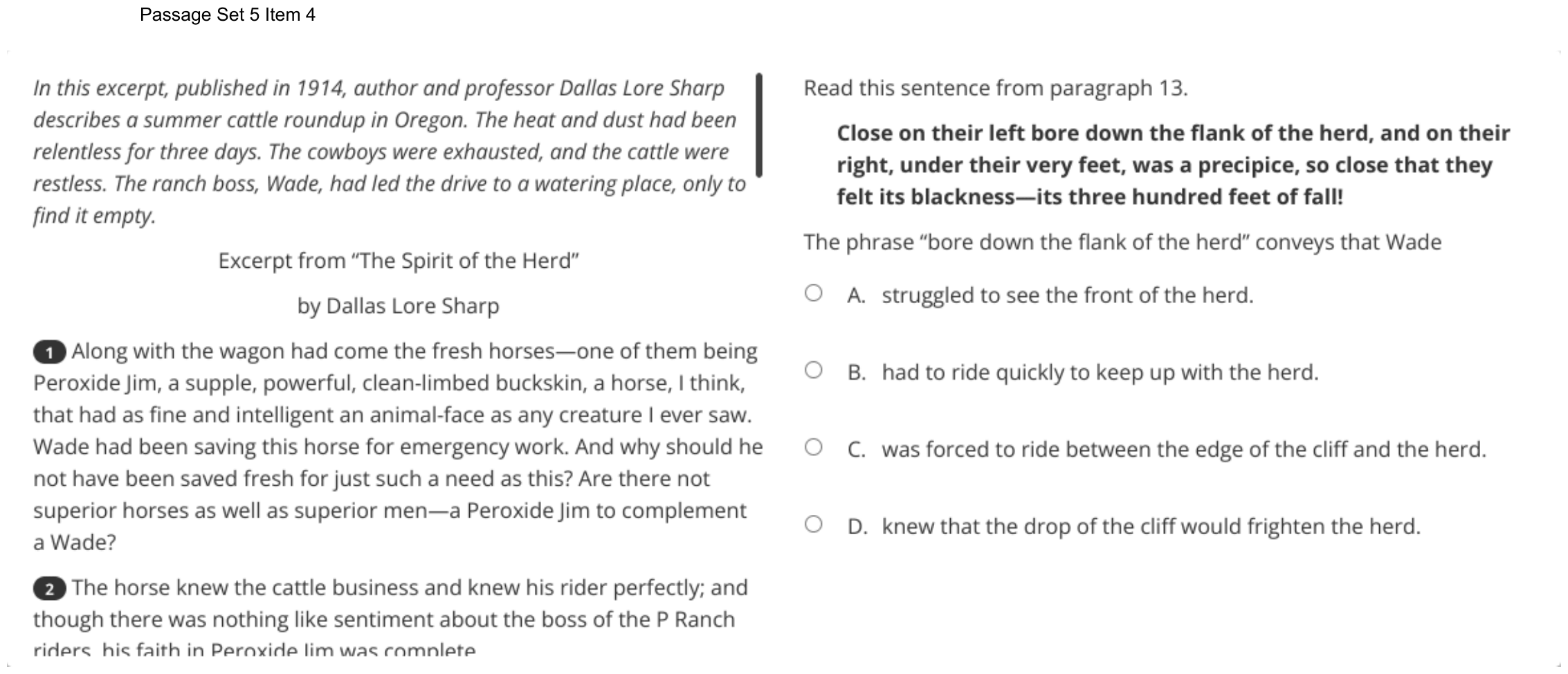
Read this sentence from paragraph 13.
Close on their left bore down the flank of the herd, and on their right, under their very feet, was a precipice, so close that they felt its blackness—its three hundred feet of fall!
The phrase “bore down the flank of the herd” conveys that Wade
- Astruggled to see the front of the herd.
- Bhad to ride quickly to keep up with the herd.
- Cwas forced to ride between the edge of the cliff and the herd.
- Dknew that the drop of the cliff would frighten the herd.
Show the answer
Correct answer: C
The question asks what the phrase “bore down the flank of the herd” (paragraph 13) conveys about Wade.
A. Incorrect. While Wade struggled to see the front of the herd, the words “bore down the flank of the herd” (paragraph 13) are meant to convey the intensity of the situation Wade was in, not the way the herd is blocking his vision.
B. Incorrect. The sentence from paragraph 13 states that the herd was “close on their left” and includes the phrase “bore down.” Both of these phrases indicate that Wade was trapped between the stampeding herd and the steep cliff. Wade and Peroxide Jim were struggling to reach the very front of the herd to turn it away from the edge.
C. CORRECT. The phrase “bore down the flank of the herd” from paragraph 13 conveys the overwhelming strength of the herd. The herd was forcing Wade toward the cliff. The wording in the quotation emphasizes the immediate danger of the situation and conveys the idea that Wade and Peroxide Jim were almost forced over the edge of the precipice by the stampeding herd.
D. Incorrect. The phrase “bore down the flank of the herd” (paragraph 13) does not indicate anything about the fear felt by the herd. The phrase is about Wade’s position between the edge of the stampeding herd and the drop-off. Wade was aware of the danger the herd was in if he and Peroxide Jim could not turn the cattle from the edge.
Question analysis
This vocabulary-in-context question quotes a sentence from paragraph 13 of “The Spirit of the Herd,” at the height of the stampede, and asks what the phrase “bore down the flank of the herd” conveys about Wade. Students need the meaning of “bore down” and “flank” as they are used here. Some choices describe real moments of the stampede, so students must stick to what this phrase shows.
- Grade level
- Grade 7 reading and task
- Compared with grade 7
- At grade 7 Working out a phrase’s meaning from its sentence is routine grade 7 work. The words “bore down” and “flank” are less common, but the full sentence is quoted with the question, so the task stays within one sentence.
- Estimated difficulty
- Straightforward: two steps or one careful reading.
- Thinking it demands
- Depth of knowledge 2, skills and concepts · mainly understand
- What makes it hard
- Complex sentences moderate
- Hard words minor
- Evidence
- Answered from one sentence or line
- Reading level
- Passage: about grade 8, 1160 words; question and choices: about grade 3, 94 words.
- Students, last 30 days
- Not enough answers yet to show (it takes 10).
Why it is hard, traps and wrong answers (shows the answer)
Why it is hard
Once the sentence is untangled, the herd pressing in on the left and the cliff on the right, the answer is a picture of Wade squeezed between them. The trouble is the word order and the phrase itself: students who read “bore down” as speed think about keeping pace, and those who recall the darkness of the paragraph before pick a detail this sentence never mentions.
Complex sentences moderate Understanding the question
The sentence is inverted: “the flank of the herd” is the subject of “bore down,” placed after its verb, so a quick reader may think Wade bore down along the herd instead. (Abedi & Lord, 2001; Freedle & Kostin, 1993; Messick, 1989)
Hard words minor Understanding the question
Both “flank,” the side of the herd, and “bore down,” pressed in hard, are uncommon in this sense, and the stem asks about exactly those words. (Perfetti, 2007; Freedle & Kostin, 1993)
Strategy: Read the whole quoted sentence rather than the phrase alone, picture the scene it describes, and pick what this sentence itself shows about Wade.
Traps
- Dictionary meaning, not meaning here: A common meaning of the word that does not fit its use in this text.
- Wrong part of the text: A choice is true of another paragraph, stanza or speaker than the one asked about.
- Reads too much in: A reasonable-sounding conclusion that goes further than the text allows.
The wrong answers, classified
A Wrong part of the text (Kirsch & Mosenthal, 1990)
Recalls from paragraph 12 that Wade could not tell how many cattle were ahead of him, which is true there, but this sentence says nothing about what he could see.
B Dictionary meaning, not meaning here (Perfetti, 2007)
Takes “bore down” in its sense of rushing forward and gives the speed to Wade, when in this sentence it is the herd’s flank pressing in on his left.
D Reads too much in (Graesser, Singer & Trabasso, 1994)
Assumes the cliff would scare the cattle, but they are “water-mad” and ready to go over the edge, and the phrase describes Wade’s position, not their fear.
Working it out, step by step
Figure out what the question asks
This asks what the phrase “bore down the flank of the herd” shows about Wade. To answer, read the whole sentence, not just the phrase.
Learn the hard words
A flank is the side of an animal or of a group. To bear down, here “bore down,” means to press in hard on something. A precipice is a cliff, a very steep drop.
Untangle the sentence
The sentence puts its words in an unusual order. In everyday order it would say: The flank of the herd bore down close on their left. So the side of the herd pushed in on Wade and his horse from the left. On the right, “under their very feet, was a precipice.”
Picture where Wade is
Wade is squeezed. Thousands of running cattle press in on one side. A 300-foot drop sits on the other side. He has no room to move away from either one. He is forced to ride in the narrow space between the herd and the cliff edge.
Check each choice
- A does not fit. Paragraph 12 says he could not tell how many cattle were ahead, but this sentence is about the sides.
- B does not fit. Here the herd does the bearing down, not Wade.
- C fits. He rides between the herd and the cliff.
- D does not fit. The cattle were “water-mad,” ready to go over the edge. Nothing says the cliff scared them.
Choose the answer
The phrase shows the herd pushing Wade toward the edge. So the answer is C.
Why this answer and not the closest wrong one
B is the closest wrong choice, because “bore down” can mean rushing forward fast. But in this sentence the herd does the bearing down, not Wade. The herd presses in from the left while the cliff waits on the right. That squeeze is what C describes.
More questions like this
The original DOE question
Question 7 of 120
2026 Practice Test A English, question 33Uses the passage above: “Excerpt from “The Spirit of the Herd””.
Question
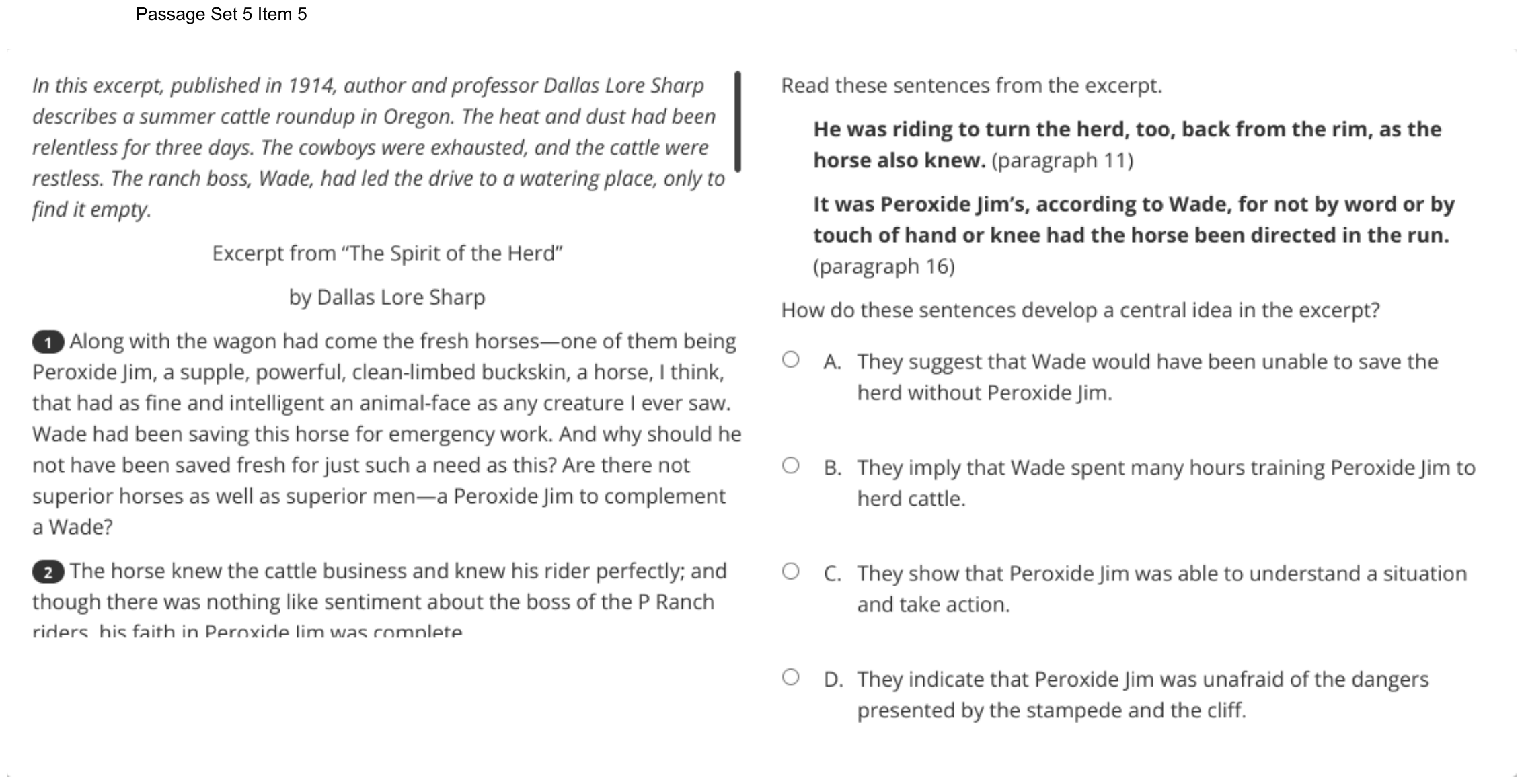
Read these sentences from the excerpt.
He was riding to turn the herd, too, back from the rim, as the horse also knew. (paragraph 11)
It was Peroxide Jim’s, according to Wade, for not by word or by touch of hand or knee had the horse been directed in the run. (paragraph 16)
How do these sentences develop a central idea in the excerpt?
- AThey suggest that Wade would have been unable to save the herd without Peroxide Jim.
- BThey imply that Wade spent many hours training Peroxide Jim to herd cattle.
- CThey show that Peroxide Jim was able to understand a situation and take action.
- DThey indicate that Peroxide Jim was unafraid of the dangers presented by the stampede and the cliff.
Show the answer
Correct answer: C
The question asks how the sentences from paragraph 11 and paragraph 16 develop a central idea in the excerpt.
A. Incorrect. While Peroxide Jim’s presence was critical to saving the herd, the details in paragraph 11 and paragraph 16 do not focus on this idea. The primary idea is that the horse was so intelligent and aware that he acted on his own.
B. Incorrect. The excerpt does not tell who trained Peroxide Jim. It can be inferred that Peroxide Jim had been well trained and was knowledgeable of working cattle; however, there is no indication that Wade was the person who trained Peroxide Jim, only that Wade knew of Peroxide Jim’s abilities, respected the skilled horse, and was “saving this horse for emergency work” (paragraph 1). Because the reader cannot infer from the excerpt that Wade was the trainer, this idea cannot be considered central to the excerpt.
C. CORRECT. Wade recognized that Peroxide Jim knew to turn the herd without any instruction from him. Throughout the excerpt, Wade exhibited confidence in his horse, Peroxide Jim. For example, the narrator says that Wade’s “faith in Peroxide Jim was complete” in paragraph 2. After Wade let go of the reins (paragraph 12), the horse took over, doing exactly what needed to be done to save Wade, the herd, and himself: “a big white steer, which the horse, with marvelous instinct, seemed to pick out from a bunch, and to cling to, forcing him gradually ahead, till, cutting him free from the bunch entirely, he bore him off into the swishing sage” (paragraph 14).
D. Incorrect. The sentence from paragraph 11 and the sentence from paragraph 16 show that Peroxide Jim acted skillfully and with the knowledge that the ride was dangerous (“Wade was riding for his life. He knew it. His horse knew it” [paragraph 11]). Neither sentence indicates whether Peroxide Jim was afraid. The excerpt does say, later in paragraph 16, that the horse turned the herd “without a false step or a tremor of fear,” but these two sentences focus on his awareness of the danger and his ability to act on his own, not on his lack of fear.
Question analysis
This question quotes two sentences from “The Spirit of the Herd,” one from the middle of the stampede and one from its end, and asks how together they develop a central idea of the excerpt. Students must see what the two sentences share and connect it to the story as a whole. Each choice sounds reasonable for this story, which makes the exact wording of the two sentences decisive.
- Grade level
- Grade 8 reading and task
- Compared with grade 7
- Above grade 7 Grade 7 central-idea questions usually ask about one paragraph or the whole text. Here students must find what two sentences five paragraphs apart have in common and link it to the excerpt’s central idea, among choices that all sound believable.
- Estimated difficulty
- Hard: combines ideas, needs a plan, and has more than one tempting wrong answer.
- Thinking it demands
- Depth of knowledge 3, strategic thinking · mainly analyze
- What makes it hard
- Reading between the lines moderate
- Complex sentences moderate
- Evidence in several places moderate
- Evidence
- Answered from several paragraphs or stanzas
- Reading level
- Passage: about grade 8, 1160 words; question and choices: about grade 6, 121 words.
- Corrected from the DOE handbook
- An inaccurate statement in the explanation was corrected.
- Students, last 30 days
- Not enough answers yet to show (it takes 10).
Why it is hard, traps and wrong answers (shows the answer)
Why it is hard
Each choice says something a reader could believe about this story, so the exact content of the two quoted sentences decides it. What they share is knowledge and independence: the horse knew the goal and ran the race undirected. Fearlessness is stated in the very next sentence of paragraph 16, which makes it easy to credit to these two, and the claim that Wade could not have managed alone sounds like a fair summary of the ending.
Reading between the lines moderate Working it out
Neither sentence says the horse understood; that has to be read from “as the horse also knew” and from the race being his because he was not directed “by word or by touch.” (Graesser, Singer & Trabasso, 1994; Kintsch, 1998)
Complex sentences moderate Understanding the question
The second sentence is an inverted negative passive, “not by word or by touch of hand or knee had the horse been directed,” and the first tucks its point into a trailing clause. (Abedi & Lord, 2001; Freedle & Kostin, 1993; Messick, 1989)
Evidence in several places moderate Working it out
The two sentences sit five paragraphs apart, and the detail that tempts students most, “without a false step or a tremor of fear,” follows the second one in paragraph 16. (Kirsch & Mosenthal, 1990; Gorin & Embretson, 2006)
Strategy: Note what the two quoted sentences have in common, then pick the option that states that shared point, making sure it comes from these sentences and not from elsewhere in the excerpt.
Traps
- Wrong part of the text: A choice is true of another paragraph, stanza or speaker than the one asked about.
- Reads too much in: A reasonable-sounding conclusion that goes further than the text allows.
- Outside knowledge: A choice is plausible in the real world but not supported by this text.
The wrong answers, classified
A Reads too much in (Graesser, Singer & Trabasso, 1994)
Goes a step past the sentences: the horse clearly mattered, but they stress what he knew and did on his own, not that Wade would have failed without him.
B Outside knowledge (King et al., 2004; Recht & Leslie, 1988)
Assumes a rider trains his own horse, a common idea, but the excerpt never says who trained Peroxide Jim, and these sentences stress what he did undirected.
D Wrong part of the text (Kirsch & Mosenthal, 1990)
Draws on “without a false step or a tremor of fear,” which comes after the quoted sentence in paragraph 16; the two sentences show his understanding, not his courage.
What was corrected from the DOE handbook, and why
- Explanation: The handbook’s explanation of Option D says “There is no indication that Peroxide Jim was not afraid; in fact, it is likely the awareness of the danger and the fear associated with that knowledge contributed to the horse’s motivation to turn the herd.” Paragraph 16 says the opposite: the horse turned the herd “without a false step or a tremor of fear” (the handbook’s explanation of question 29 cites these words as his mental toughness). The site now says that neither of the two quoted sentences indicates whether Peroxide Jim was afraid, which is still why Option D is wrong: they focus on his awareness of the danger and his ability to act on his own.
Working it out, step by step
Figure out what the question asks
This asks what two quoted sentences have in common and how they build a central idea, the main idea of the excerpt. Focus on what these two sentences say, not on other parts of the story.
Read the first sentence
Paragraph 11 says “He was riding to turn the herd, too, back from the rim, as the horse also knew.” To turn the herd is to make it change direction. The words “as the horse also knew” mean the horse understood the goal too.
Read the second sentence
Paragraph 16 says the race was the horse’s, “for not by word or by touch of hand or knee had the horse been directed in the run.” Directed means told where to go. Riders guide a horse with their voice, their hands on the reins and their knees. Wade did none of that. The horse ran the race on his own.
Put the two together
Both sentences show the same thing. The horse understood what was happening. Then he acted on his own, with no one telling him what to do. This builds the central idea that Peroxide Jim is a smart horse who saves the herd by himself.
Check each choice
- A does not fit. The sentences do not say whether Wade could have done it alone. They focus on what the horse knew and did.
- B does not fit. The excerpt never says who trained the horse.
- C fits. The horse understood the situation and took action.
- D does not fit. The horse was fearless, but neither quoted sentence says so.
Choose the answer
The two sentences show a horse that understood the danger and acted on his own. So the answer is C.
Why this answer and not the closest wrong one
D is the closest wrong choice, because the horse really was fearless. But that comes from a later sentence in paragraph 16: “without a false step or a tremor of fear.” The two quoted sentences say nothing about fear. They show that the horse knew the goal and acted with no one guiding him. That is C.
More questions like this
The original DOE question
Question 8 of 120
2026 Practice Test A English, question 36Passage Massachusetts: Lowell National Historical Park
Massachusetts: Lowell National Historical Park
During the first half of the 19th century, Lowell, Massachusetts, quickly transformed itself from a farm town to a bustling industrial city. In time, Lowell became a model of industry, gaining global recognition for its state-of-the-art technology, innovative canal and dam system, mill architecture, boardinghouses, churches, and ethnic neighborhoods. Young Yankee women, immigrant families, and European tourists all flocked to Lowell to find work at one of the many textile mills, or visit the industrious city that was becoming a popular tourist destination. As one Scottish traveler observed during his visit to America, “Niagara and Lowell are the two objects I will longest remember in my American journey, the one the glory of American scenery, the other of American industry.” Today, Lowell National Historical Park welcomes visitors to enjoy the sights of Lowell and learn about the history of one of America’s most significant industrial cities.
The Boston merchants who founded Lowell in 1821 and named it after Francis Cabot Lowell chose to locate the town along Massachusetts’s Merrimack River to take advantage of the kinetic energy offered by the Pawtucket waterfalls. Over six miles of canals powered the waterwheels of Lowell’s mills, whose massive five- and six-story brick buildings dominated the city’s landscape. . . . The most recognized of these buildings are the Lowell Manufacturing Company chartered in 1821, the Suffolk or Wannalancit Mill completed around the 1880s, the Boott Mill Company established in 1835, and the Boott Mill Boardinghouse that opened in 1838. By the 1850s, 40 textile mills employing over 10,000 workers stretched for about a mile along the river. . . .
The city’s female workforce was significant in the history of Lowell. From the early to mid-1800s, women left the constricted lifestyle of small rural towns and rural areas for independent industrial city life. Most were young single Yankee girls, who were tired of the limited opportunities offered by their domestic work. Women found that Lowell’s mills offered monthly wages for their services and provided them room and board. Although these women gained economic independence in Lowell, the mill boardinghouse keepers constantly supervised their social activities, for which they hardly had any time, considering their daily 12- to 14-hour work schedules. At the end of the day, the factory bell signaled the “mill girls” to return to their boardinghouses. They were expected to adhere to the strict code of conduct respecting curfew and attending church.
Yankee “mill girls” continued to dominate the Lowell workforce until the 1840s, when the city began to find it difficult to compete with the growing industrial development in other New England communities. As profits fell, the mill industry cut wages. These wage cuts, deteriorating working conditions, and long workdays led the “mill girls” to protest and organize strikes. When their demands went unheard, the women left Lowell, and immigrant groups replaced them in the workforce. Despite the low wages and unhealthy work conditions, immigrants were eager to find work.
The immigrants replacing the Yankee “mill girls” during the 1840s were predominantly Irish Catholics, who traveled to America during the Great Potato Famine. Although Lowell received an influx of Irish families during this time, the Irish were a part of the city’s history from its birth, and before the “mill girls” arrived, they built Lowell’s historic canals, mills, and boardinghouses. Initially, Lowell’s Protestant community was slow to welcome Irish immigrants, but the hostility between Yankee Protestants and Irish Catholics eventually disappeared. Irish immigrants dominated the industrial scene until the Civil War, when other immigrant groups began to work in the city mills.
Like the Irish, the French-Canadians, Greeks, Poles, Portuguese, Russian Jews, and Armenians who came to work in Lowell’s mills faced long work hours, low wages, and poor living conditions in the city’s crowded tenements. By the time Lowell’s industry declined, the city had become an ethnic melting pot, where each group claimed its own distinct neighborhood, like the Irish immigrants’ “New Dublin” or “Acre,” and the French-Canadians’ “Little Canada.” The city officially began to close down its mills in the 1920s and ’30s after Lowell’s outdated mills could no longer compete against the state-of-the-art cotton mills in other communities and working conditions continued to decline as Lowell’s companies stopped reinvesting in their mills. . . . Despite a brief resurgence during World War II, the city shut down its last surviving mill by the mid-1950s.
From “Massachusetts: Lowell National Historical Park”—Public Domain/National Park Service
Yankee: native to New England
Niagara: a town in northwestern New York State well known as the location of Niagara Falls, a series of waterfalls on the Canadian border
domestic work: household duties like cooking and cleaning
Question
Read this sentence from paragraph 1.
As one Scottish traveler observed during his visit to America, “Niagara and Lowell are the two objects I will longest remember in my American journey, the one the glory of American scenery, the other of American industry.”
The author most likely includes the quotation from the Scottish traveler in order to
- Asuggest that people around the world saw the direct contribution of nature and industry to the United States.
- Bcompare the natural and industrial attractions in the United States at that time.
- Cconvey the idea that the United States offered both natural and industrial attractions.
- Dimply that the natural resources in the United States contributed to the development of industry.
Show the answer
Correct answer: C
The question asks why the author most likely includes the quotation from the Scottish traveler in paragraph 1 of the passage.
A. Incorrect. While it is likely that people outside the United States recognized that both the natural landscape and the bustling industry were significant, the quotation from the Scottish traveler is meant to convey the variety of the types of attractions in the U.S., not to make a general statement about their contribution.
B. Incorrect. The Scottish traveler mentions both “American scenery” and “American industry” in the quotation, but the intent is to highlight that they are each points of interest. The quotation does not provide a comparison of the two attractions.
C. CORRECT. The quotation emphasizes the idea that the United States offers different attractions. The Scottish traveler highlights the two places in the United States that he will most remember: first, the beautiful natural formation of Niagara Falls (“ ‘the glory of American scenery’ ”) and second, the industrial city of Lowell (“ ‘the glory . . . of American industry’ ”).
D. Incorrect. The Scottish traveler mentions both “American scenery” and “American industry” in the quotation but does not imply that the natural resources contributed to the development of industry.
Question analysis
This reading question asks why the author of a National Park Service article about Lowell, Massachusetts, quotes a Scottish traveler who named Niagara and Lowell as the sights he would remember longest from his American journey. Students must work out the job a quotation does in an opening paragraph, and the traveler's compressed, old-fashioned wording has to be untangled first.
- NYS standards
- 7R5 structure and genre features
- Grade level
- Grade 7 reading and task
- Compared with grade 7
- At grade 7 Grade 7 readers regularly explain why an author includes a quotation. This one adds a sentence in older English built on a compressed “the one…, the other…” pattern, but it is a single sentence in a plainly organized opening paragraph, so the demand stays typical.
- Estimated difficulty
- Moderate: several steps, or a close reading with one strong distractor.
- Thinking it demands
- Depth of knowledge 2, skills and concepts · mainly analyze
- What makes it hard
- A very close wrong answer moderate
- How, not what moderate
- Complex sentences minor
- Evidence
- Answered from one sentence or line
- Reading level
- Passage: about grade 15, 764 words; question and choices: about grade 11, 115 words.
- Students, last 30 days
- Not enough answers yet to show (it takes 10).
Why it is hard, traps and wrong answers (shows the answer)
Why it is hard
Most of the work is translating the traveler's compressed remark into plain words: Niagara stands for American scenery, Lowell for American industry, and both are high points of his trip. Students who see the two placed side by side often take the pairing for a comparison, while others read more into it, a worldwide verdict or a link between waterfalls and mills. The question rewards stating only what the remark does in the paragraph, which is to set Lowell beside Niagara as a sight worth the journey.
A very close wrong answer moderate Choosing the answer
The comparison choice names the same pair as the key, Niagara's scenery and Lowell's industry; it differs only in the verb, “compare” instead of conveying that the country offered both kinds of attraction. (Embretson & Wetzel, 1987; Gorin & Embretson, 2006; Ascalon et al., 2007)
How, not what moderate Working it out
The stem asks why the author placed the traveler's remark in paragraph 1, so its job, backing the sentence before it about tourists visiting the industrious city, matters more than its content. (Anderson & Krathwohl, 2001)
Complex sentences minor Understanding the question
The 37-word sentence ends in the compressed, old-fashioned “the one the glory of American scenery, the other of American industry,” where the verb and the second “glory” are left out. (Abedi & Lord, 2001; Freedle & Kostin, 1993; Messick, 1989)
Strategy: Put the traveler's remark into plain modern words, reread the sentence before it about who came to Lowell, and pick the purpose that fits both without reading more into the remark than it says.
Traps
- Wrong purpose or structure: Names a purpose, structure or effect that the part does not serve, or describes what a part says when the question asks what it does.
- Reads too much in: A reasonable-sounding conclusion that goes further than the text allows.
- Too broad or too strong: A choice overstates, generalizes, or uses absolute words the text does not support.
The wrong answers, classified
A Too broad or too strong (King et al., 2004)
Stretches one Scottish visitor's memory into what “people around the world” saw, perhaps from the paragraph's “global recognition,” and adds a “direct contribution” that the remark never claims.
B Wrong purpose or structure (Anderson & Krathwohl, 2001)
Takes the remark's side-by-side pattern, “the one … the other,” for a comparison, though the traveler weighs neither against the other and simply names each as a highlight.
D Reads too much in (Graesser, Singer & Trabasso, 1994)
Connects Niagara's waterfalls to the Pawtucket falls that powered Lowell's mills in paragraph 2, a link between nature and industry that the traveler's remark never draws.
Working it out, step by step
Figure out what the question asks
This question asks about the author’s purpose. You need to say why the author put the Scottish traveler’s words into paragraph 1. Don’t just restate what he says. Ask what job his words do in the paragraph.
Find the quotation and its neighbor
The traveler’s words are in paragraph 1: “Niagara and Lowell are the two objects I will longest remember in my American journey.” He ends with “the one the glory of American scenery, the other of American industry.” Now look at the sentence just before it. It says European tourists came to “visit the industrious city that was becoming a popular tourist destination.”
Put his words in plain English
The old-fashioned ending leaves words out. “The one” means the first place he named, Niagara. “The other” means the second place, Lowell. Glory means the finest thing, the pride. Industry means factories and the work done in them. So he is saying: Niagara Falls is the best of America’s natural beauty, and Lowell is the best of its industry. Both are the sights he will remember longest.
Check each choice
- A is wrong. One visitor is not “people around the world.” He also never says nature or industry made a “direct contribution” to the country.
- B is wrong. He names the two places side by side, but he never weighs one against the other.
- C is right. He names a natural wonder and an industrial wonder as the two highlights of his trip. So America offered both kinds of attraction.
- D is wrong. He never says nature helped industry grow. The waterfalls that powered the mills come up in paragraph 2, not in his words.
Watch out: “The one” and “the other” set the two places side by side. That can feel like a comparison, which leads to B. But he praises both. He does not compare them.
Choose the answer
The author uses the quotation to show that America had two kinds of sights worth the trip: natural ones like Niagara and industrial ones like Lowell. So the answer is C.
Why this answer and not the closest wrong one
B is the closest wrong answer. It names the same pair, nature and industry. But to compare is to show how two things are alike or different. The traveler doesn’t do that. He simply names Niagara and Lowell as two highlights. C says just that: the country offered both kinds of attraction.
More questions like this
The original DOE question
The passage “Massachusetts: Lowell National Historical Park” as printed (page 50)
Question 9 of 120
2026 Practice Test A English, question 40Uses the passage above: “Massachusetts: Lowell National Historical Park”.
Question
Read this sentence from paragraph 5.
Although Lowell received an influx of Irish families during this time, the Irish were a part of the city’s history from its birth, and before the “mill girls” arrived, they built Lowell’s historic canals, mills, and boardinghouses.
How does this sentence contribute to the development of ideas in the passage?
- AIt implies that Lowell was founded by early Irish immigrants.
- BIt emphasizes the important role Irish immigrants played in Lowell’s history.
- CIt suggests that the new Irish immigrants were readily accepted into the community.
- DIt highlights the working relationship between the mill girls and the new Irish immigrants.
Show the answer
Correct answer: B
The question asks how the sentence in paragraph 5 contributes to the development of ideas in the passage.
A. Incorrect. The sentence from paragraph 5 does not imply that Lowell was founded by early Irish immigrants. The sentence explains how Irish immigrants had been settling in Lowell since the city was established and that they contributed to the construction of the city, which allowed it to become an industrial center several decades later.
B. CORRECT. The sentence from paragraph 5 shows that early Irish immigrants were critical to the success of Lowell as an industrial city. This information supports the development of the idea that the work of Irish immigrants and immigrants from other places is an important element in the historical significance of industry in Lowell.
C. Incorrect. The sentence from paragraph 5 does not suggest that new Irish immigrants were readily accepted into the community. Paragraph 5 states that “initially, Lowell’s Protestant community was slow to welcome Irish immigrants, but the hostility between Yankee Protestants and Irish Catholics eventually disappeared.”
D. Incorrect. The sentence from paragraph 5 does not highlight the relationship between the mill girls and the new Irish immigrants. Paragraph 4 explains how the mill girls left Lowell, and paragraph 5 states that the mill girls were replaced by “predominantly Irish Catholics, who traveled to America during the Great Potato Famine” but does not discuss a relationship between them.
Question analysis
This question quotes a sentence from paragraph 5 of the Lowell article about Irish families, who arrived in large numbers in the 1840s but had been part of the city since its birth. Students explain how the sentence contributes to the development of the passage's ideas, and because it packs several groups and periods into one line, they must keep straight who did what and when.
- Grade level
- Grade 7 reading and task
- Compared with grade 7
- At grade 7 Explaining how one sentence develops a passage's ideas is a core grade 7 skill. The sentence is long but its meaning is direct, and the text around it settles most of the choices, so the demand is typical.
- Estimated difficulty
- Straightforward: two steps or one careful reading.
- Thinking it demands
- Depth of knowledge 2, skills and concepts · mainly analyze
- What makes it hard
- Complex sentences minor
- Evidence in several places minor
- Evidence
- Answered from one paragraph or stanza
- Reading level
- Passage: about grade 15, 764 words; question and choices: about grade 10, 103 words.
- Students, last 30 days
- Not enough answers yet to show (it takes 10).
Why it is hard, traps and wrong answers (shows the answer)
Why it is hard
Once the long sentence is untangled, its point is plain: the Irish were in Lowell from the start and built its canals, mills and boardinghouses. The likeliest slip is reading “from its birth” as founding the city, which paragraph 2 credits to Boston merchants. The other wrong choices invent a welcome or a partnership that the surrounding sentences contradict or never mention, so a quick check of paragraph 5 settles them.
Complex sentences minor Understanding the question
The 37-word sentence moves through three times at once, the influx “during this time,” the city's birth and the years before the mill girls arrived, so who did what and when must be sorted out. (Abedi & Lord, 2001; Freedle & Kostin, 1993; Messick, 1989)
Evidence in several places minor Working it out
Ruling out the founding choice needs paragraph 2's “Boston merchants who founded Lowell,” and ruling out a warm welcome needs the next sentence's “slow to welcome Irish immigrants.” (Kirsch & Mosenthal, 1990; Gorin & Embretson, 2006)
Strategy: Put the quoted sentence into your own words, then check each choice against the sentences around it in paragraph 5 and against what earlier paragraphs say about the city's beginnings.
Traps
- Twists what the text says: Uses the text's topic and ideas but changes what it says: who did it, how much, when, or why.
- Reads too much in: A reasonable-sounding conclusion that goes further than the text allows.
The wrong answers, classified
A Twists what the text says (King et al., 2004)
Reads “part of the city's history from its birth” and building the canals as founding the city, though paragraph 2 says Boston merchants founded Lowell in 1821.
C Twists what the text says (King et al., 2004)
Remembers that the hostility toward Irish Catholics “eventually disappeared” and overlooks “Initially, … slow to welcome,” turning a gradual change into a ready acceptance.
D Reads too much in (Graesser, Singer & Trabasso, 1994)
Sees the Irish and the mill girls named in one sentence and assumes they worked side by side, a relationship the passage never describes; the Irish later replaced them.
Working it out, step by step
Figure out what the question asks
This structure question asks what one sentence adds to the passage’s ideas. First you need to understand the sentence. It is long and jumps between three times, so take it apart piece by piece.
Break the sentence into parts
The sentence is in paragraph 5. Here are its three parts:
- “Although Lowell received an influx of Irish families during this time”: an influx is a big wave of people arriving, and “this time” means the 1840s.
- “the Irish were a part of the city’s history from its birth”: its birth means the city’s very beginning.
- “they built Lowell’s historic canals, mills, and boardinghouses”: this happened before the mill girls came.
Say it in your own words
Put together, the sentence says: Many Irish families came in the 1840s, but the Irish had been in Lowell from the start. They built its canals, mills and boardinghouses. Without those canals and mills, there would be no industrial city. So the sentence shows how much the Irish mattered to Lowell’s story.
Check each choice
- A is wrong. Being there “from its birth” is not the same as founding the city. Paragraph 2 names the founders: “The Boston merchants who founded Lowell in 1821.”
- B is right. The Irish were there from the start and built the city’s mills and canals. That is an important role.
- C is wrong. The very next sentence says “Lowell’s Protestant community was slow to welcome Irish immigrants.” So they were not readily, or easily, accepted.
- D is wrong. The passage never says the Irish and the mill girls worked together. Later, the Irish replaced them.
Watch out: “From its birth” can sound like they started the city, which leads to A. Check paragraph 2 to see who founded Lowell.
Choose the answer
The sentence makes clear that the Irish helped build Lowell from its first days. So the answer is B.
Why this answer and not the closest wrong one
A is the closest wrong answer, because the sentence links the Irish to the city’s “birth.” But being part of a city from the start is different from founding it. Boston merchants founded Lowell. The Irish built its canals and mills. B fits, because it names that important role without stretching it.
More questions like this
The original DOE question
Question 10 of 120
2026 Practice Test B English, question 9Passage A Miracle Mile
A Miracle Mile
In the 1950s people compared running one mile in four minutes to scaling Mount Everest and nicknamed the feat a “dream mile.” Although such an accomplishment was considered humanly impossible, several elite runners aimed to break that supposedly impenetrable barrier. One of them was a twenty-five-year-old medical student named Roger Bannister.
Roger Bannister had tasted failure during the 1952 Olympics. There, he was favored to win the 1,500-meter competition, a distance slightly shorter than a mile, but he finished in a dismal fourth place instead. Bannister’s performance was a disappointment for him and his country, Great Britain. Determined to redeem himself, Bannister postponed his plans to retire from racing and focused on the ultimate prize—breaking the four-minute-mile barrier.
Bannister attacked the elusive milestone with a positive attitude and logical planning. The amateur athlete decided to use intensive interval training to develop endurance and speed. For these workouts, Bannister ran an interval of ten consecutive laps on a quarter-mile track, aiming for sixty seconds each lap. In between intervals, he let his body recover for two minutes.
By early 1954, Bannister had succeeded in lowering his quarter-mile pace to sixty-one seconds, but he had to shave off at least one more second in order to reach his target. Frustrated by the plateau he had reached, Bannister took a break from training and went mountain climbing for three days. The rest from running permitted his muscles to recuperate and left him feeling refreshed. When Bannister returned to the track, he completed ten quarter-mile-long intervals at fifty-nine seconds each. He finally felt prepared to attempt to break the world record.
As a member of the Amateur Athletic Association (AAA), Bannister joined the AAA team for a track meet against Oxford University. The event took place on a cinder track in Oxford on May 6, 1954. Bannister and his two AAA teammates, Chris Chataway and Chris Brasher, were close friends and frequent running partners. Chataway and Brasher agreed to help Bannister accomplish his goal by being his “rabbits.”
In track and field, rabbits are runners who enter the race solely to pace a teammate for a segment of the course. Typically, a runner settles in behind the rabbit and allows the rabbit to set an appropriate tempo. Additionally, by running behind the rabbit, the runner conserves about 15 percent of his or her effort. When the starting pistol fired, Brasher pounced into the lead, and Bannister followed behind his first rabbit.
Propelled by the excitement, Bannister lost his instinctive feel for his pace and shouted “Faster!” at Brasher. Brasher, however, remained composed and maintained his current steady but grueling pace, completing the first two laps in a desirable one minute and fifty-eight seconds. Then Chataway surged forward, leading Bannister at this same punishing rate for another lap and a half. At the beginning of the back straightaway of the track, Bannister bolted past Chataway. Bannister said, “I felt that the moment of a lifetime had come. There was no pain, only a great unity of movement and aim.” Bannister crossed the finish line in 3 minutes 59.4 seconds. The ecstatic crowd erupted the moment the timekeeper announced the word “three.”
Soon after Bannister’s achievement, four other athletes matched his performance. A new mindset had taken root among runners. Over the years, the record continued to fall. However, the current record, 3 minutes 43.13 seconds, has stood unbroken since 1999. Some question whether this record represents the limits of human ability. But perhaps there is another Bannister, an athlete who, with willpower and dedication, will accomplish the miraculous.
Question
Read these sentences from paragraph 7.
Bannister said, “I felt that the moment of a lifetime had come. There was no pain, only a great unity of movement and aim.”
The sentences contribute to the development of ideas in the passage by showing that Bannister
- Aknew that he was about to achieve the goal he had worked toward.
- Bwas no longer experiencing personal disappointment from his past failure in the Olympics.
- Cfelt grateful to his teammates for helping him take the lead.
- Dwas satisfied that his training had helped him perfect his running technique.
Show the answer
Correct answer: A
The question asks how the sentences from paragraph 7 contribute to the development of ideas in the passage.
A. CORRECT. The sentences from paragraph 7 show that toward the end of the race, Bannister knew that the goal of breaking the four-minute-mile barrier was within his grasp and that he had the focus necessary to achieve it. The sentence following Bannister’s quotation states that he did indeed meet his goal, crossing “the finish line in 3 minutes 59.4 seconds” (paragraph 7).
B. Incorrect. The feelings Bannister expressed in the sentences from paragraph 7 did not erase those feelings related to his loss at the 1952 Olympics, which were what drove him to the achievement he was about to make.
C. Incorrect. While the quotation states that Bannister felt “unity,” this pertains to his running, not to his work with the team. The sentences from paragraph 7 capture Bannister’s focus on his chance to break the barrier and what he was feeling at that moment.
D. Incorrect. The sentences from paragraph 7 express Bannister’s realization that he was on the verge of reaching a goal. The sentences show that in the seconds before crossing the finish line, Bannister was fully focused on the end goal and was not thinking about his training or his running technique.
Question analysis
This question quotes Roger Bannister’s own words from his famous race, “I felt that the moment of a lifetime had come,” and asks how they contribute to the development of ideas in “A Miracle Mile.” Students interpret an athlete’s description of a feeling and decide what it shows about him. Each choice links the quotation to a different part of his story.
- Grade level
- Grade 7 reading and task
- Compared with grade 7
- At grade 7 Explaining what a quoted sentence adds to a passage is everyday grade 7 work, and these two sentences are short. Their abstract phrase “a great unity of movement and aim” takes some interpreting, which keeps the demand typical rather than light.
- Estimated difficulty
- Moderate: several steps, or a close reading with one strong distractor.
- Thinking it demands
- Depth of knowledge 2, skills and concepts · mainly analyze
- What makes it hard
- Reading between the lines moderate
- Figurative or literary language minor
- Evidence
- Answered from one paragraph or stanza
- Reading level
- Passage: about grade 10, 587 words; question and choices: about grade 7, 93 words.
- Students, last 30 days
- Not enough answers yet to show (it takes 10).
Why it is hard, traps and wrong answers (shows the answer)
Why it is hard
Bannister’s words describe a feeling, and each choice explains it by a different part of his story. The right reading comes from where the quotation sits: on the back straight, seconds from the finish, so “the moment of a lifetime” is the record within reach. Students who take “unity of movement” as polished form, or “no pain” as the end of his Olympic hurt, tie the quotation to his training or his past instead of to this race.
Reading between the lines moderate Working it out
The quotation never names the record; students must link “the moment of a lifetime had come” to the four-minute goal and to the finish in 3 minutes 59.4 seconds reported right after it. (Graesser, Singer & Trabasso, 1994; Kintsch, 1998)
Figurative or literary language minor Understanding the question
“A great unity of movement and aim” is abstract, and “There was no pain” can be heard as emotional relief, so the words invite readings about technique, teamwork or old disappointment. (Graesser, Singer & Trabasso, 1994; Kintsch, 1998)
Strategy: Read the quotation together with the sentences around it in paragraph 7, put Bannister’s state of mind into your own words, and test each choice against what the quotation itself says.
Traps
- Wrong part of the text: A choice is true of another paragraph, stanza or speaker than the one asked about.
- Reads too much in: A reasonable-sounding conclusion that goes further than the text allows.
- Dictionary meaning, not meaning here: A common meaning of the word that does not fit its use in this text.
The wrong answers, classified
B Reads too much in (Graesser, Singer & Trabasso, 1994)
Hears “There was no pain” as the end of the hurt from his 1952 fourth place, but the pain meant is the strain of the race, and the quotation never looks back.
C Dictionary meaning, not meaning here (Perfetti, 2007)
Takes “unity” in its everyday sense of people pulling together and credits his rabbits, though the unity is of his own “movement and aim,” just after he passed Chataway to run alone.
D Wrong part of the text (Kirsch & Mosenthal, 1990)
Brings in the training of paragraphs 3 and 4 and reads “unity of movement” as perfected technique, but the quotation records a feeling during the race, not a verdict on his preparation.
Working it out, step by step
Figure out what the question asks
This asks what Bannister’s words show about him at that moment in the race. To answer, you need to know where the quotation comes. So read the sentences just before it and just after it.
Find where the quotation comes
Paragraph 7 tells the story of the race. Just before the quotation, “Bannister bolted past Chataway.” Bolted means ran off suddenly and fast. Chataway was his second rabbit, a teammate who set the pace. Now Bannister was in front, near the end. Just after the quotation, “Bannister crossed the finish line in 3 minutes 59.4 seconds.” That is under four minutes.
Put his words in your own words
He says “I felt that the moment of a lifetime had come.” The moment of a lifetime is the most important moment a person ever has. For Bannister, that was breaking the four-minute mile. “A great unity of movement and aim” means his body and his goal were working as one. He could feel that he was about to do it.
Check each choice
- A fits. He senses that his big goal is about to happen.
- B does not fit. “There was no pain” means he felt no strain in the race. He is not thinking back to 1952.
- C does not fit. The unity is of his own “movement and aim,” not of his team. He had just passed Chataway to run alone.
- D does not fit. The words describe a feeling during the race. They say nothing about his training or his technique, which means his way of running.
Watch out: D is tempting because “unity of movement” sounds like perfect running form. But Bannister is not judging his training here. He is feeling the big moment arrive.
Choose the answer
The quotation shows Bannister sensing that his goal was near, and the next sentence shows he reached it. So the answer is A, “knew that he was about to achieve the goal he had worked toward.”
Why this answer and not the closest wrong one
D is the closest wrong choice. His training did help him, and he was running well. But the quotation is about a feeling: “the moment of a lifetime had come.” It looks ahead to the finish, not back at his practice. A matches that feeling of a goal about to be reached.
More questions like this
The original DOE question
The passage “A Miracle Mile” as printed (page 13)
Question 11 of 120
2026 Practice Test B English, question 11Uses the passage above: “A Miracle Mile”.
Question
Which sentence from the passage indicates that Bannister nearly made a mistake that would have cost him the world record?
- A“By early 1954, Bannister had succeeded in lowering his quarter-mile pace to sixty-one seconds, but he had to shave off at least one more second in order to reach his target.” (paragraph 4)
- B“When the starting pistol fired, Brasher pounced into the lead, and Bannister followed behind his first rabbit.” (paragraph 6)
- C“Propelled by the excitement, Bannister lost his instinctive feel for his pace and shouted ‘Faster!’ at Brasher.” (paragraph 7)
- D“At the beginning of the back straightaway of the track, Bannister bolted past Chataway.” (paragraph 7)
Show the answer
Correct answer: C
The question asks which sentence indicates that Bannister nearly made a mistake that would have cost him the world record.
A. Incorrect. The sentence from paragraph 4 describes a challenge Bannister faced during his training period, when he used “intensive interval training to develop endurance and speed” (paragraph 3). Bannister ran laps on a “quarter-mile track” (paragraph 3) and was able to control his pace at this time—unlike during the actual race to break the record.
B. Incorrect. The sentence from paragraph 6 describes the start of the race and Brasher’s role as “first rabbit” for Bannister. Bannister was behind Brasher, following their plan for breaking the record.
C. CORRECT. If Bannister had begun running faster than the “steady but grueling pace” (paragraph 7) set by his “rabbit,” he would likely not have had enough energy to finish the race. As paragraph 6 notes, “the runner conserves about 15 percent of his or her effort” by allowing the rabbit to set the pace. Bannister had “lost his instinctive feel for his pace” (paragraph 7) in the excitement of the race. If he had given in to his impulse to run faster and bypassed the rabbit at that point in the race, it would have cost him energy, and, in turn, the record.
D. Incorrect. The sentence from paragraph 7 describes how Bannister leaped ahead of Chataway, his second “rabbit,” at the appropriate time in the effort to break the record. Chataway had “surged forward, leading Bannister at this same punishing rate for another lap and a half” (paragraph 7) before Bannister moved past him.
Question analysis
This textual evidence question asks which sentence from “A Miracle Mile” shows that Roger Bannister nearly made a mistake that could have cost him the world record. The passage never says outright that he slipped, so students must use what it explains about running a race to judge which moment was a real danger. The four choices span both his training and the race itself.
- Grade level
- Grade 7 reading and task
- Compared with grade 7
- At grade 7 Grade 7 evidence questions usually match a sentence to an idea the text states. This mistake is never named as one, so students must infer which moment put the record at risk, a typical grade 7 inference within a short, clear passage.
- Estimated difficulty
- Moderate: several steps, or a close reading with one strong distractor.
- Thinking it demands
- Depth of knowledge 2, skills and concepts · mainly evaluate
- What makes it hard
- Reading between the lines moderate
- Evidence in several places minor
- Every choice must be checked minor
- Evidence
- Answered from several paragraphs or stanzas
- Reading level
- Passage: about grade 10, 587 words; question and choices: about grade 11, 102 words.
- Students, last 30 days
- Not enough answers yet to show (it takes 10).
Why it is hard, traps and wrong answers (shows the answer)
Why it is hard
The near mistake is easy to miss because it never happens: Brasher ignores the shout, and the race goes on at the planned pace. Students must see that losing his feel for the pace put the record at risk, using what paragraph 6 explains about rabbits. The sudden surge past Chataway sounds rash and the training plateau sounds like a near failure, so students who look for drama or for falling short land on the wrong moment.
Reading between the lines moderate Working it out
The passage never calls the shout of “Faster!” a mistake; students must infer it from “lost his instinctive feel for his pace” and from Brasher’s refusal to change his steady pace. (Graesser, Singer & Trabasso, 1994; Kintsch, 1998)
Evidence in several places minor Working it out
Why running faster would have cost the record is explained a paragraph earlier, in paragraph 6, where following a rabbit saves a runner about 15 percent of his or her effort. (Kirsch & Mosenthal, 1990; Gorin & Embretson, 2006)
Every choice must be checked minor Choosing the answer
Each sentence shows a setback or a bold move, from the training plateau to the final surge, so each has to be judged against the idea of a near mistake. (Embretson & Wetzel, 1987)
Strategy: For each quoted sentence, ask whether it shows Bannister doing something that could have hurt his chances, and use what the passage explains about racing to judge how serious it was.
Traps
- Reads too much in: A reasonable-sounding conclusion that goes further than the text allows.
- Supports only part of the claim: In a question about evidence: a line that backs one half of the claim but not the other, or a related point rather than the claim itself.
- Outside knowledge: A choice is plausible in the real world but not supported by this text.
The wrong answers, classified
A Supports only part of the claim (King et al., 2004; Thissen, Steinberg & Fitzpatrick, 1989)
Takes the 1954 plateau, one second short of the target pace, as the near miss, but it was a setback in training that rest overcame, not a mistake.
B Outside knowledge (King et al., 2004; Recht & Leslie, 1988)
Assumes that trailing at the start is a racing error, but paragraph 6 explains that a runner behind a rabbit saves about 15 percent of his or her effort.
D Reads too much in (Graesser, Singer & Trabasso, 1994)
Reads “bolted” as a reckless burst, but Bannister passed Chataway only after his rabbits had paced him for three and a half laps, and the move won him the record.
Working it out, step by step
Figure out what the question asks
This asks for a sentence that shows a near mistake. That is something that almost went wrong. It would have cost Bannister the record. So look for a moment when he did something that could have ruined the race.
Learn how a rabbit helps
Paragraph 6 explains rabbits. They are teammates who run in front to set the speed. It says “Typically, a runner settles in behind the rabbit and allows the rabbit to set an appropriate tempo.” Tempo means speed. Also, “by running behind the rabbit, the runner conserves about 15 percent of his or her effort.” Conserves means saves.
Find the moment that went wrong
Paragraph 7 begins “Propelled by the excitement, Bannister lost his instinctive feel for his pace and shouted” at Brasher to go faster. He lost his natural sense of how fast to run. If Brasher had sped up, Bannister could have used up his energy too soon. But Brasher “remained composed,” which means calm. He kept the steady pace, and that saved the race.
Check each choice
- A does not fit. The training plateau was a setback, not a mistake. A rest fixed it.
- B does not fit. Following a rabbit was the plan. Paragraph 6 shows that it saves effort.
- C fits. Bannister wanted to go faster too early, which could have worn him out.
- D does not fit. Passing Chataway near the end was the right move. It won him the record.
Watch out: D is tempting because “bolted” sounds wild. But he waited until his rabbits had paced him for three and a half laps.
Choose the answer
Only C shows Bannister almost doing something that could have cost him the record. So the answer is C, “Propelled by the excitement, Bannister lost his instinctive feel for his pace and shouted ‘Faster!’ at Brasher.”
Why this answer and not the closest wrong one
D is the closest wrong choice, since bolting past Chataway was a bold, sudden move. But it came at the right time, and it led to the record. In C, Bannister lost his sense of pace and wanted to speed up too early. Only his rabbit’s calm saved him. That is a near mistake.
More questions like this
The original DOE question
Question 12 of 120
2026 Practice Test B English, question 14Passage Excerpt from In Search of the Unknown
Excerpt from In Search of the Unknown
by Robert W. Chambers
It was at that time the policy of the trustees and officers of the Zoological Gardens neither to employ collectors nor to send out expeditions in search of specimens. The society decided to depend upon voluntary contributions, and I was always busy, part of the day, in dictating answers to correspondents who wrote offering their services as hunters of big game, collectors of all sorts of fauna, trappers, snarers, and also to those who offered specimens for sale, usually at exorbitant rates.
To the proprietors of . . . mangy lynxes, moth-eaten coyotes, and dancing bears I returned courteous but uncompromising refusals—of course, first submitting all such letters, together with my replies, to Professor Farrago.
One day towards the end of May, however, just as I was leaving Bronx Park to return to town, Professor Lesard, of the reptilian department, called out to me that Professor Farrago wanted to see me a moment; so I . . . retraced my steps to the temporary, wooden building occupied by Professor Farrago, general superintendent of the Zoological Gardens. The professor, who was sitting at his desk before a pile of letters and replies submitted for approval by me, pushed his glasses down and looked over them at me with a whimsical smile that suggested amusement, impatience, annoyance, and perhaps a faint trace of apology.
“Now, here’s a letter,” he said, with a deliberate gesture towards a sheet of paper impaled on a file—“a letter that I suppose you remember.” He disengaged the sheet of paper and handed it to me.
“Oh yes,” I replied, with a shrug; “of course the man is mistaken—or—”
“Or what?” demanded Professor Farrago, tranquilly, wiping his glasses.
“—Or a liar,” I replied.
After a silence he leaned back in his chair and bade me read the letter to him again, and I did so with a contemptuous tolerance for the writer, who must have been either a very innocent victim or a very stupid swindler. I said as much to Professor Farrago, but, to my surprise, he appeared to waver.
“I suppose,” he said, with his near-sighted, embarrassed smile, “that nine hundred and ninety-nine men in a thousand would throw that letter aside and condemn the writer as a liar or a fool?”
“In my opinion,” said I, “he’s one or the other.”
“He isn’t—in mine,” said the professor, placidly.
“What!” I exclaimed. “Here is a man living all alone on a strip of rock and sand between the wilderness and the sea, who wants you to send somebody to take charge of a bird that doesn’t exist!”
“How do you know,” asked Professor Farrago, “that the bird in question does not exist?”
“It is generally accepted,” I replied, sarcastically, “that the great auk has been extinct for years. Therefore I may be pardoned for doubting that our correspondent possesses a pair of them alive.”
“Oh, you young fellows,” said the professor, smiling wearily, “you embark on a theory for destinations that don’t exist.”
He leaned back in his chair, his amused eyes searching space for the imagery that made him smile.
“Like swimming squirrels, you navigate with the help of Heaven and a stiff breeze, but you never land where you hope to—do you?”
Rather red in the face, I said: “Don’t you believe the great auk to be extinct?”
“Audubon saw the great auk.”
“Who has seen a single specimen since?”
“Nobody—except our correspondent here,” he replied, laughing.
I laughed, too, considering the interview at an end, but the professor went on, coolly:
“Whatever it is that our correspondent has—and I am daring to believe that it is the great auk itself—I want you to secure it for the society.”
When my astonishment subsided my first conscious sentiment was one of pity. Clearly, Professor Farrago was on the verge of dotage—ah, what a loss to the world!
I believe now that Professor Farrago perfectly interpreted my thoughts, but he betrayed neither resentment nor impatience. I drew a chair up beside his desk—there was nothing to do but to obey, and this fool’s errand was none of my conceiving.
Together we made out a list of articles necessary for me and itemized the expenses I might incur, and I set a date for my return, allowing no margin for a successful termination to the expedition.
“Never mind that,” said the professor. “What I want you to do is to get those birds here safely. Now, how many men will you take?”
“None,” I replied, bluntly; “it’s a useless expense, unless there is something to bring back. If there is I’ll wire you, you may be sure.”
“Very well,” said Professor Farrago, good-humoredly, “you shall have all the assistance you may require. Can you leave to-night?”
The old gentleman was certainly prompt. I nodded, half-sulkily, aware of his amusement.
“So,” I said, picking up my hat, “I am to start north to find a place called Black Harbor, where there is a man named Halyard who possesses, among other household utensils, two extinct great auks—”
We were both laughing by this time. I asked him why on earth he credited the assertion of a man he had never before heard of.
“I suppose,” he replied, with the same half-apologetic, half-humorous smile, “it is instinct. I feel, somehow, that this man Halyard has got an auk—perhaps two. I can’t get away from the idea that we are on the eve of acquiring the rarest of living creatures. It’s odd for a scientist to talk as I do; doubtless you’re shocked—admit it, now!”
But I was not shocked; on the contrary, I was conscious that the same strange hope that Professor Farrago cherished was beginning, in spite of me, to stir my pulses, too.
“If he has—” I began, then stopped.
The professor and I looked hard at each other in silence.
“Go on,” he said, encouragingly.
But I had nothing more to say, for the prospect of beholding with my own eyes a living specimen of the great auk produced a series of conflicting emotions within me which rendered speech profanely superfluous.
From IN SEARCH OF THE UNKNOWN by Robert W. Chambers—Public Domain
Audubon: John James Audubon, an ornithologist and artist who created scientific illustrations of birds
dotage: a loss of reasoning brought about by old age
Question
Read paragraph 2 from the excerpt.
To the proprietors of . . . mangy lynxes, moth-eaten coyotes, and dancing bears I returned courteous but uncompromising refusals—of course, first submitting all such letters, together with my replies, to Professor Farrago.
This paragraph helps develop the plot by establishing that the narrator
- Adislikes writing refusal letters for the animals offered to the zoological society.
- Battempts to predict what the professor would say in the refusal letters.
- Cbelieves that many of the animals offered are not acceptable for the zoological society.
- Dresents the professor’s insistence on reviewing the refusal letters.
Show the answer
Correct answer: C
The question asks how paragraph 2 helps develop the plot.
A. Incorrect. As paragraph 1 indicates, writing such letters is one of the main parts of the narrator’s job (“and I was always busy, part of the day, in dictating answers to correspondents”), and he shows no indication of disliking this work. The letters are to inform people whether the zoo will accept their animals.
B. Incorrect. Paragraph 2 indicates that the narrator offers his letters to the professor merely for official approval. At the start of the excerpt, the narrator is confident in his reply and does not anticipate that his response will differ from that of the professor, so he has no need to “predict what the professor would say.”
C. CORRECT. The phrase “uncompromising refusals” in paragraph 2 indicates the confidence that the narrator initially has in his belief that the animals described in the letters are not of value to the society. This confidence is badly shaken as the plot unfolds, as when Professor Farrago states that “ ‘I am daring to believe that it is the great auk itself’ ” (paragraph 23). The narrator’s transition from an attitude of dismissive doubt to one of budding hopefulness is a major part of the plot (“But I was not shocked; on the contrary, I was conscious that the same strange hope that Professor Farrago cherished was beginning, in spite of me, to stir my pulses, too” [paragraph 34]).
D. Incorrect. The narrator does not resent the professor’s review of the letters; instead, the phrase “of course” in paragraph 2 shows that he expects to submit the letters to the professor as part of his job.
Question analysis
In this plot question on an excerpt from Robert W. Chambers’s novel In Search of the Unknown, students read paragraph 2, in which a zoo employee describes answering people who offer animals for sale. The question asks what the paragraph establishes about the narrator. Its old-fashioned vocabulary and its long, dash-broken sentence make the narrator’s attitude harder to pin down.
- Grade level
- Grade 7 reading and task
- Compared with grade 7
- At grade 7 Explaining how one paragraph develops a plot is regular grade 7 work, and this one is quoted in full. Its early-1900s wording, with words such as “proprietors” and “uncompromising,” adds some load but no unusual reasoning.
- Estimated difficulty
- Straightforward: two steps or one careful reading.
- Thinking it demands
- Depth of knowledge 2, skills and concepts · mainly analyze
- What makes it hard
- Hard words moderate
- Complex sentences minor
- The right answer is reworded minor
- Evidence
- Answered from one paragraph or stanza
- Reading level
- Passage: about grade 9, 1066 words; question and choices: about grade 11, 94 words.
- Students, last 30 days
- Not enough answers yet to show (it takes 10).
Why it is hard, traps and wrong answers (shows the answer)
Why it is hard
The paragraph’s attitude sits in its adjectives: lynxes that are “mangy,” coyotes that are “moth-eaten” and refusals that are “uncompromising.” Students who read that scorn as the narrator’s mood about his job, or who hear grumbling in “of course,” choose a feeling about the work instead of a judgment of the animals. The plot point is that the narrator starts out sure the offers are worthless, the confidence the great auk letter is about to test.
Hard words moderate Understanding the question
“Proprietors,” “uncompromising,” “mangy” and “moth-eaten” carry the meaning: the owners of shabby animals get firm refusals, and a student who misses these words cannot tell what the narrator thinks of the offers. (Perfetti, 2007; Freedle & Kostin, 1993)
Complex sentences minor Understanding the question
The paragraph is one inverted sentence that opens with “To the proprietors of,” reaches “I returned” only midway and ends with a dash clause about the professor’s review. (Abedi & Lord, 2001; Freedle & Kostin, 1993; Messick, 1989)
The right answer is reworded minor Choosing the answer
Three wrong choices repeat the paragraph’s “refusals” and “letters,” while the right one restates the scorn for the animals as a judgment that they do not suit the society. (Freedle & Kostin, 1993; Kirsch & Mosenthal, 1990)
Strategy: Paraphrase paragraph 2 in plain modern words, noting what each descriptive word reveals about the narrator, then keep only a choice those words actually support.
Traps
- Twists what the text says: Uses the text's topic and ideas but changes what it says: who did it, how much, when, or why.
- Wrong tone or attitude: Misjudges the tone, attitude or point of view, such as reading admiration as criticism, or taking a character's or subject's feelings for the author's.
- Reads too much in: A reasonable-sounding conclusion that goes further than the text allows.
The wrong answers, classified
A Twists what the text says (King et al., 2004)
Moves the scorn of “mangy” and “moth-eaten” from the animals to the task, though the refusals are “courteous” and paragraph 1 presents answering letters as routine daily work.
B Reads too much in (Graesser, Singer & Trabasso, 1994)
Builds a guessing game from his sending each reply to Professor Farrago, though he expects his refusals simply to be approved and nothing shows him second-guessing the professor.
D Wrong tone or attitude (Graesser, Singer & Trabasso, 1994)
Hears irritation in the dash and “of course,” but the phrase marks the review as routine, and his clash with the professor begins only with the great auk letter.
Working it out, step by step
Figure out what the question asks
This asks what paragraph 2 tells you about the narrator, the person telling the story. It also asks how that sets up the plot, the chain of events in a story. The paragraph is one long, old-fashioned sentence. So put it in plain words first.
Put paragraph 2 in plain words
Proprietors are owners. People wrote offering animals to the zoo. The narrator lists some: “mangy lynxes, moth-eaten coyotes, and dancing bears.” Mangy means with patchy, sick-looking fur. Moth-eaten means old and worn out. He sent the owners “courteous but uncompromising refusals.” Courteous means polite. Uncompromising means firm, with no chance of changing his mind.
Decide what it shows about him
The words “mangy” and “moth-eaten” show what he thinks of the animals. To him, they are shabby and not good enough for the zoo. He turns them all down. This sets up the plot. When the letter about the great auk comes, he is ready to reject it too. That is where the story’s conflict begins.
Check each choice
- A does not fit. His refusals are polite, and paragraph 1 shows that answering letters is his everyday job. Nothing says he dislikes it.
- B does not fit. He sends his replies to the professor to be approved. He is not guessing what the professor would say.
- C fits. He judges that the animals offered are not good enough.
- D does not fit. “Of course” shows that the review is normal. He does not resent it, or feel bitter about it.
Watch out: A is tempting because the narrator sounds scornful. But his scorn is for the animals, not for the job.
Choose the answer
Paragraph 2 shows the narrator turning down animals he thinks are unfit. So the answer is C, “believes that many of the animals offered are not acceptable for the zoological society.”
Why this answer and not the closest wrong one
A is the closest wrong choice. The narrator’s words do sound scornful. But the scorn is aimed at the animals, “mangy” and “moth-eaten,” not at the job of writing letters. His refusals are even “courteous.” C names his real judgment: these animals are not right for the zoo.
More questions like this
The original DOE question
The passage “Excerpt from In Search of the Unknown” as printed (page 21)
Question 13 of 120
2026 Practice Test B English, question 15Uses the passage above: “Excerpt from In Search of the Unknown”.
Question
Read this sentence from paragraph 3.
The professor, who was sitting at his desk before a pile of letters and replies submitted for approval by me, pushed his glasses down and looked over them at me with a whimsical smile that suggested amusement, impatience, annoyance, and perhaps a faint trace of apology.
What does the phrase “a faint trace of apology” convey about the professor?
- AIt indicates that the professor feels bad that he has to call the narrator to his office after work.
- BIt shows that the professor is hesitant to share his opinions with the narrator.
- CIt implies that the professor is uncomfortable criticizing the narrator’s work.
- DIt suggests that the professor knows that the conversation will be frustrating for the narrator.
Show the answer
Correct answer: D
The question asks what the phrase “a faint trace of apology” in paragraph 3 conveys about the professor.
A. Incorrect. The fact that the narrator had intended to leave the office for the day is not the source of the professor’s faintly apologetic manner, which is instead caused by the professor’s understanding that their conversation about the letter and the expedition is likely to cause an argument (“with a whimsical smile that suggested amusement, impatience, annoyance” [paragraph 3]). In paragraph 29, the professor asks the narrator if he can leave on an expedition that same evening, which indicates that the professor does not feel bad about taking up the narrator’s time after work.
B. Incorrect. The paragraphs that follow the sentence from paragraph 3 show the professor sharing his opinions without pause, even when his opinion of the narrator is unflattering (“ ‘Like swimming squirrels, you navigate with the help of Heaven and a stiff breeze, but you never land where you hope to—do you?’ ” [paragraph 17]).
C. Incorrect. The professor knows that the narrator will push back regarding the letter, but the professor is not uncomfortable challenging the narrator. Professor Farrago seems perfectly at ease and comfortable as he begins the discussion with the narrator.
D. CORRECT. The professor is both amused and annoyed by the narrator’s dismissal of the possibility that great auks still exist, and the professor knows that the narrator is likely to react negatively to being sent on what the narrator considers a “fool’s errand” (paragraph 25).
Question analysis
This question focuses on a single phrase in the excerpt from Robert W. Chambers’s In Search of the Unknown: as the professor looks up from a pile of letters, his whimsical smile shows “a faint trace of apology.” Students must work out what that hint of apology says about him. The phrase is brief and old-fashioned, and several explanations for it seem natural.
- Grade level
- Grade 8 reading and task
- Compared with grade 7
- Above grade 7 Grade 7 students often infer a character’s feelings from a description. Here the phrase ends a 46-word sentence of early-1900s prose, follows three other moods, and has to be interpreted from the scene as a whole, beyond typical grade 7 work.
- Estimated difficulty
- Among the hardest on the SHSAT: a non-obvious approach, heavy reading, or a well-hidden trap.
- Thinking it demands
- Depth of knowledge 3, strategic thinking · mainly analyze
- What makes it hard
- Reading between the lines major
- A very close wrong answer moderate
- Evidence in several places moderate
- Complex sentences minor
- Evidence
- Answered from several paragraphs or stanzas
- Reading level
- Passage: about grade 9, 1066 words; question and choices: about grade 10, 123 words.
- Students, last 30 days
- Not enough answers yet to show (it takes 10).
Why it is hard, traps and wrong answers (shows the answer)
Why it is hard
The phrase comes before a word of the conversation is spoken, so the reason for the apology lies ahead in the text. Two natural guesses compete with it: the professor has called the narrator back just as he was leaving, and he is about to question one of the narrator’s replies. Only a reader who follows the scene to the narrator’s scorn for the letter and the errand sees that the professor, at ease throughout, is sorry for what he is about to put the narrator through.
Reading between the lines major Working it out
Nothing explains the apology; students must reason from the talk that follows, in which the professor sends the narrator after birds the narrator believes extinct, that the professor expects resistance. (Graesser, Singer & Trabasso, 1994; Kintsch, 1998)
A very close wrong answer moderate Choosing the answer
The choice about criticizing the narrator’s work and the right one both tie the apology to the coming talk about a letter; one places discomfort in the professor, the other frustration in the narrator. (Embretson & Wetzel, 1987; Gorin & Embretson, 2006; Ascalon et al., 2007)
Evidence in several places moderate Working it out
What the professor anticipates appears only later: the narrator’s scorn for the letter in paragraphs 5–14 and his view of the trip as a “fool’s errand” in paragraph 25. (Kirsch & Mosenthal, 1990; Gorin & Embretson, 2006)
Complex sentences minor Understanding the question
The phrase closes a 46-word sentence, after a clause about the pile of letters and a run of three other moods, “amusement, impatience, annoyance.” (Abedi & Lord, 2001; Freedle & Kostin, 1993; Messick, 1989)
Strategy: Read the full sentence and then the conversation it opens, and test each choice against how the professor actually speaks and acts in that conversation.
Traps
- Reads too much in: A reasonable-sounding conclusion that goes further than the text allows.
- Half right: One half of a two-part choice is right and the other is not.
- Twists what the text says: Uses the text's topic and ideas but changes what it says: who did it, how much, when, or why.
The wrong answers, classified
A Reads too much in (Graesser, Singer & Trabasso, 1994)
Ties the apology to the timing, since Professor Lesard stopped the narrator as he was leaving Bronx Park, but the professor later asks him to leave on the trip that same night.
B Twists what the text says (King et al., 2004)
Reads the apology, and the “embarrassed smile” of paragraph 9, as reluctance to speak, though the professor states his belief in the letter plainly and even teases the narrator.
C Half right (King et al., 2004; Thissen, Steinberg & Fitzpatrick, 1989)
Rightly senses that the professor is about to challenge the narrator’s reply to a letter, but he does it “placidly” and “coolly,” with no sign of discomfort.
Working it out, step by step
Figure out what the question asks
This asks what one phrase shows about the professor: “a faint trace of apology.” Faint means slight, and a trace is a small sign. So his smile looks a little bit sorry. Why would he feel sorry? You find out from the talk that follows.
Read the whole sentence
Paragraph 3 says the professor looked at the narrator “with a whimsical smile that suggested amusement, impatience, annoyance, and perhaps a faint trace of apology.” Whimsical means playful. He is amused by the narrator and a bit annoyed with him. Then he picks up a letter the narrator has already turned down.
See what the professor is about to do
The professor is about to defend that letter. Then he sends the narrator after the birds in it. The narrator thinks the birds are extinct, or all dead. In paragraph 25 he calls the trip “this fool’s errand,” a pointless job. The professor seems to know the narrator will hate this. That is why his smile looks a little sorry.
Check each choice
- A does not fit. He later asks, “Can you leave to-night?” (paragraph 29). He is not sorry about taking the narrator’s time.
- B does not fit. He shares his opinion plainly: “He isn’t—in mine” (paragraph 11).
- C does not fit. He does challenge the narrator, but calmly. He speaks “placidly” and “coolly,” with no sign of being uneasy.
- D fits. He knows the talk will annoy the narrator.
Watch out: C is tempting because the professor is about to disagree with the narrator. But nothing shows that he is uncomfortable about it.
Choose the answer
The slight apology shows that the professor expects the narrator to be frustrated. So the answer is D, “It suggests that the professor knows that the conversation will be frustrating for the narrator.”
Why this answer and not the closest wrong one
C is the closest wrong choice. Both C and D link the apology to the talk about the letter. But C puts the bad feeling in the professor, as if he were nervous. He is not. He speaks “placidly,” which means calmly. D puts the bad feeling in the narrator, and the narrator does get upset.
More questions like this
The original DOE question
Question 14 of 120
2026 Practice Test B English, question 20Uses the passage above: “Excerpt from In Search of the Unknown”.
Question
How does paragraph 34 help develop the plot of the excerpt?
- AIt shows that the narrator is beginning to consider the possibility of finding the great auks.
- BIt demonstrates that the narrator is struggling to understand why the professor thinks the great auks exist.
- CIt establishes that the narrator is willing to let the professor overrule him about the great auks.
- DIt emphasizes that the narrator feels a sense of urgency to complete the expedition to locate the great auks.
Show the answer
Correct answer: A
The question asks how paragraph 34 helps develop the plot of the excerpt.
A. CORRECT. Despite his initial disbelief, the narrator admits in paragraph 34 that he is starting to feel the “same strange hope” the professor feels, which is to find the great auks (paragraph 33).
B. Incorrect. While the narrator does make an effort in paragraphs 11–22 to understand the professor’s thinking, paragraph 34 reveals that the narrator has been affected by the professor’s “strange hope” for the auks and is beginning to share this hope “in spite of” himself.
C. Incorrect. The narrator describes a feeling of hope in paragraph 34 that would not be present if he had simply been overruled by the professor and did not share any of the professor’s belief in the possibility that the auks exist. In addition, it was established before paragraph 34 that the narrator was willing to be overruled (“I drew a chair up beside his desk—there was nothing to do but to obey, and this fool’s errand was none of my conceiving” [paragraph 25]).
D. Incorrect. The narrator does not express a sense of urgency in paragraph 34 to complete the expedition. Instead, he expresses hope that the great auks might really exist.
Question analysis
This plot question on In Search of the Unknown asks how paragraph 34, a single long sentence near the end of the excerpt, helps develop the story of the narrator’s assignment to bring back two great auks. Students must put its formal phrasing into plain words and connect it to the conversation that comes before it.
- Grade level
- Grade 7 reading and task
- Compared with grade 7
- At grade 7 Explaining how a paragraph moves a plot forward is regular grade 7 work, and paragraph 34 is a single sentence. Its formal wording, such as “in spite of me” and “stir my pulses,” has to be put into plain words first.
- Estimated difficulty
- Straightforward: two steps or one careful reading.
- Thinking it demands
- Depth of knowledge 2, skills and concepts · mainly analyze
- What makes it hard
- Complex sentences minor
- Figurative or literary language minor
- Evidence
- Answered from one paragraph or stanza
- Reading level
- Passage: about grade 9, 1066 words; question and choices: about grade 10, 79 words.
- Students, last 30 days
- Not enough answers yet to show (it takes 10).
Why it is hard, traps and wrong answers (shows the answer)
Why it is hard
Put into plain words, the paragraph has the narrator admitting that the professor’s hope is starting to take hold of him, which is the turn the question asks about. The losses come from reading it through earlier scenes: his obedience in paragraph 25 makes giving way to the professor look like the point, and the word “strange” makes puzzlement look likely. The paragraph records a change in what he believes, not in what he does.
Complex sentences minor Understanding the question
Paragraph 34 is one 31-word sentence that turns on “on the contrary” and breaks its main clause with “in spite of me,” so its point, a hope beginning to stir, arrives late. (Abedi & Lord, 2001; Freedle & Kostin, 1993; Messick, 1989)
Figurative or literary language minor Understanding the question
“To stir my pulses” means to excite, and a student who reads it as a racing heart may take it for haste to leave rather than hope that the birds exist. (Graesser, Singer & Trabasso, 1994; Kintsch, 1998)
Strategy: Restate paragraph 34 in plain modern words, then test each choice against what this paragraph itself says about the narrator.
Traps
- Wrong part of the text: A choice is true of another paragraph, stanza or speaker than the one asked about.
- Reads too much in: A reasonable-sounding conclusion that goes further than the text allows.
- Twists what the text says: Uses the text's topic and ideas but changes what it says: who did it, how much, when, or why.
The wrong answers, classified
B Twists what the text says (King et al., 2004)
Takes “the same strange hope” as the narrator puzzling over the professor’s belief, though the sentence says that hope is now stirring in the narrator himself.
C Wrong part of the text (Kirsch & Mosenthal, 1990)
Brings in paragraph 25, where the narrator draws up a chair because he must obey, but paragraph 34 shows him starting to share the hope, not yielding to an order.
D Reads too much in (Graesser, Singer & Trabasso, 1994)
Reads stirring pulses as eagerness to finish the trip quickly, though the excitement is about the chance that the birds exist, and the paragraph says nothing of speed.
Working it out, step by step
Figure out what the question asks
This asks how paragraph 34 moves the story forward. Read that paragraph closely. Then decide what has changed for the narrator.
Read paragraph 34 closely
Paragraph 34 says “But I was not shocked; on the contrary, I was conscious that the same strange hope that Professor Farrago cherished was beginning, in spite of me, to stir my pulses, too.” On the contrary means the opposite is true. Cherished means held dear. To stir his pulses means to make his heart beat faster with excitement.
Put it in your own words
The professor hopes the great auks are real. Now the narrator feels that same hope starting in himself. “In spite of me” means he did not want to feel it, but he does. Before, he called the letter writer a liar or a fool. Now he is starting to think the birds might really be found.
Check each choice
- A fits. He begins to hope that the birds could be found.
- B does not fit. He is not puzzling over the professor’s belief. He is starting to share it.
- C does not fit. Giving in to the professor came earlier, in paragraph 25: “there was nothing to do but to obey.” Paragraph 34 is about hope, not obeying.
- D does not fit. Nothing in the paragraph is about hurrying.
Watch out: D is tempting because a racing pulse can sound like rushing. But the excitement is about the birds, not about speed.
Choose the answer
Paragraph 34 shows the narrator’s doubt starting to turn into hope. So the answer is A, “It shows that the narrator is beginning to consider the possibility of finding the great auks.”
Why this answer and not the closest wrong one
C is the closest wrong choice. The narrator did agree to obey the professor. But that happened in paragraph 25, and he was not happy about it. In paragraph 34, something new happens. He feels “the same strange hope” as the professor. A names that change.
More questions like this
The original DOE question
Question 15 of 120
2026 Practice Test B English, question 21Uses the passage above: “Excerpt from In Search of the Unknown”.
Question
Which sentence best demonstrates the professional relationship between the narrator and the professor?
- A“He disengaged the sheet of paper and handed it to me.” (paragraph 4)
- B“Clearly, Professor Farrago was on the verge of dotage—ah, what a loss to the world!” (paragraph 24)
- C“I drew a chair up beside his desk—there was nothing to do but to obey, and this fool’s errand was none of my conceiving.” (paragraph 25)
- D“ ‘Very well,’ said Professor Farrago, good-humoredly, ‘you shall have all the assistance you may require.’ ” (paragraph 29)
Show the answer
Correct answer: C
The question asks which sentence best demonstrates the professional relationship between the narrator and the professor.
A. Incorrect. Although the professor’s handing of the paper to the narrator indicates that they are beginning to discuss the letter about the great auk, the sentence from paragraph 4 does not convey the relationship between a subordinate employee (the narrator) and a superior (the professor).
B. Incorrect. The sentence from paragraph 24 presents the narrator’s immediate internal reaction to the professor’s words. The sentence emphasizes that the professor’s belief in the great auk’s existence is so outrageous that the narrator initially thinks the professor is starting to lose touch with reality. This is a momentary reaction to the professor’s words, not a demonstration of the professional relationship between the two.
C. CORRECT. The sentence from paragraph 25 reveals that while the narrator disagrees with the professor (“this fool’s errand was none of my conceiving”), he obeys because he works for the professor (“there was nothing to do but to obey”).
D. Incorrect. The professor’s good-humored offer of assistance in the sentence from paragraph 29 does not best demonstrate the underlying employer-employee relationship between the professor and the narrator. The narrator has to go on the expedition because the professor, his boss, told him to.
Question analysis
This textual evidence question on In Search of the Unknown asks which sentence best demonstrates the professional relationship between the narrator, who answers letters for a zoological society, and Professor Farrago. The four quotations come from different points in their conversation about a letter. Several show the two men dealing with each other, so students must weigh which one shows the relationship most clearly.
- Grade level
- Grade 7 reading and task
- Compared with grade 7
- At grade 7 Picking the sentence that best shows a relationship between characters is typical grade 7 evidence work. The four quotations are short and labeled, and the main step is deciding what a professional relationship would look like in this scene.
- Estimated difficulty
- Moderate: several steps, or a close reading with one strong distractor.
- Thinking it demands
- Depth of knowledge 2, skills and concepts · mainly evaluate
- What makes it hard
- Reading between the lines moderate
- Every choice must be checked minor
- Hard words minor
- Evidence
- Answered from several paragraphs or stanzas
- Reading level
- Passage: about grade 9, 1066 words; question and choices: about grade 10, 84 words.
- Students, last 30 days
- Not enough answers yet to show (it takes 10).
Why it is hard, traps and wrong answers (shows the answer)
Why it is hard
Several quotations show the two men interacting, and the professor’s offer of “all the assistance you may require” even shows him controlling the society’s resources. The best evidence is the sentence in which the employee’s position is plain: he disagrees, yet he must obey. Students who read “professional” loosely as anything that happens at work pick the handing over of the letter, and those who look only at the professor’s authority stop at his offer of help.
Reading between the lines moderate Working it out
Students must first decide what a professional relationship looks like here, a superior and an employee bound to carry out his orders, before they can see it in “nothing to do but to obey.” (Graesser, Singer & Trabasso, 1994; Kintsch, 1998)
Every choice must be checked minor Choosing the answer
All four sentences show the two men dealing with each other, from handing over a letter to granting help, so each must be weighed for what it shows about rank. (Embretson & Wetzel, 1987)
Hard words minor Understanding the question
The right sentence ends “this fool’s errand was none of my conceiving,” old-fashioned wording for saying the pointless trip was not his idea, which shows the disagreement that makes his obedience telling. (Perfetti, 2007; Freedle & Kostin, 1993)
Strategy: Decide first what a professional relationship between these two men involves, then ask of each quotation whether it shows that relationship or only a passing moment between them.
Traps
- Supports only part of the claim: In a question about evidence: a line that backs one half of the claim but not the other, or a related point rather than the claim itself.
- True but not the answer: A choice says something accurate about the text that does not answer this question.
- Reads too much in: A reasonable-sounding conclusion that goes further than the text allows.
The wrong answers, classified
A Reads too much in (Graesser, Singer & Trabasso, 1994)
Treats the handing over of a letter as a boss giving an order, though the gesture only opens their discussion and shows nothing about who must answer to whom.
B True but not the answer (King et al., 2004; Embretson & Wetzel, 1987)
Chooses the narrator’s private verdict that the professor is near “dotage,” an accurate view of his thoughts in paragraph 24 but a passing reaction, not a sign of their working roles.
D Supports only part of the claim (King et al., 2004; Thissen, Steinberg & Fitzpatrick, 1989)
Sees the professor granting help as a superior’s power, which is partly right, but the sentence shows his good humor more than the narrator’s duty to follow orders.
Working it out, step by step
Figure out what the question asks
This asks for the sentence that best shows their professional relationship. That means how they relate at work: who is the boss, and who must follow orders. Paragraph 3 calls Professor Farrago the “general superintendent of the Zoological Gardens.” He is the man in charge. The narrator sends him letters for approval.
Look for a sign of boss and worker
Paragraph 25 says “I drew a chair up beside his desk—there was nothing to do but to obey, and this fool’s errand was none of my conceiving.” To obey means to do what you are told. A fool’s errand is a pointless task. “None of my conceiving” means it was not his idea.
Put it in your own words
The narrator thinks the trip is silly. Still, he must do it, because the professor is his boss. A worker who disagrees but follows orders anyway shows a work relationship clearly. That is what this sentence does.
Check each choice
- A does not fit. Handing over a letter starts their talk. It shows nothing about who is in charge.
- B does not fit. It is the narrator’s private thought that the professor is losing his reason in old age. It is a passing reaction.
- C fits. The narrator must obey even though he disagrees.
- D does not fit. It shows the professor in a good mood. It does not show the narrator’s duty to follow orders.
Watch out: D is tempting because a boss is the one who offers help. But the sentence mostly shows his good humor.
Choose the answer
Only C shows the narrator following an order he does not agree with. So the answer is C, “I drew a chair up beside his desk—there was nothing to do but to obey, and this fool’s errand was none of my conceiving.”
Why this answer and not the closest wrong one
D is the closest wrong choice. The professor does have the power to offer “all the assistance you may require.” But that sentence mainly shows him being friendly. C shows the heart of the work relationship. The narrator thinks the job is foolish, yet he has “nothing to do but to obey.”
More questions like this
The original DOE question
Question 16 of 120
2026 Practice Test B English, question 23Passage Looking for the Smallest Spark of Everything
Looking for the Smallest Spark of Everything
Located underground near Geneva, Switzerland, the Large Hadron Collider (LHC) helps scientists study and understand how the smallest particles of matter interact with one another. The LHC propels atomic particle beams along a 17-mile-long ring.
There are the things the world is made of,
things we can see and feel, and then
there are the things even smaller, things that seem
to exist only when we are looking right at them.
So beneath the level of molecules are atoms,
and beneath the level of atoms, we find
protons, electrons, neutrons; and beneath that—
what, exactly? Because we are talking about
everything here: your fingernail,
the candy at the back of your mouth,
the coffee your teacher drank this morning,
your little sister, and the stuffed dog
she used to carry around with her everywhere.
And everywhere.
Everything and everywhere
are made up of the same stuff, whatever
it is. How do we find it? We can listen for it
in the wavelengths from deep space,
talking back to us from unimaginable
distances. Or we can build long,
deep circular tunnels beneath the surface
of this Earth and race particles
(like racing cars, only very tiny cars
flashing along at close to the speed of light)
until everything we think we know
bangs against everything else we know.
And there, in the explosion, in the darkness,
briefly incandescent, they appear:
the quarks, the leptons, and the bosons;
the baryons and the mesons. Their names
sound like dinosaurs or maybe bands
playing terrible music in someone’s garage.
The one thing we know for sure
is that they spin. This is how gravity
enters our world, how our world is held
both together and apart, what keeps
together the pencil in your hand right now
as well as separate from, say,
Jupiter. They spin, and it is only down there
in the darkness—in the vast garage
where physicists jot down
what they can, whatever seems most real—
that they let us perceive their wild dancing,
combusting to the music they make.
Question
Read lines 5–8 from the poem.
So beneath the level of molecules are atoms,
and beneath the level of atoms, we find
protons, electrons, neutrons; and beneath that—
what, exactly?
The lines help develop a central idea of the poem by revealing the speaker’s
- Ainterest in determining how the parts of matter work together.
- Bcuriosity about what makes up matter.
- Cdesire to prove that particles make up matter.
- Dquestions about what tools are needed to study matter.
Show the answer
Correct answer: B
The question asks what lines 5–8 reveal about the speaker to help develop a central idea of the poem.
A. Incorrect. In lines 5–8, the speaker is demonstrating knowledge about the structure of matter, not demonstrating interest in how matter’s parts work together; for example, “beneath the level of molecules are atoms, / and beneath the level of atoms, we find / protons, electrons, neutrons” (lines 5–7).
B. CORRECT. Lines 5–8 show the connection between the particles by using the words “beneath the level” repeatedly. The progression of particles of matter, from atoms to subatomic particles, “protons, electrons, neutrons” (line 7), ends with a question. By asking, “what, exactly?” (line 8), the speaker questions the mysteries that are still unsolved about the nature of matter, which is a central idea of the poem.
C. Incorrect. The speaker expresses curiosity in line 8 (“what, exactly?”) but does not use language in lines 5–8 that expresses a desire to prove a point. The poem does not show any conflict, either from within or from other scientists, about the concept that particles make up matter.
D. Incorrect. While the poem is about the Large Hadron Collider, which, according to the introductory text before the poem, is a tool that “helps scientists study and understand how the smallest particles of matter interact with one another,” lines 5–8 do not suggest the use of tools but rather question what comes after the “protons, electrons, neutrons” (line 7).
Question analysis
This question on the poem “Looking for the Smallest Spark of Everything,” about the Large Hadron Collider, quotes lines 5–8, which move from molecules down to atoms and smaller particles. Students decide what the lines reveal about the speaker and how that develops a central idea of the poem. The choices name related attitudes toward matter and science, so precise reading matters.
- Grade level
- Grade 6 reading and task
- Compared with grade 7
- Below grade 7 Below typical grade 7 demand: the four lines are quoted in the question and use everyday words, so a single step of interpretation links them to the speaker’s attitude and to the poem’s larger subject.
- Estimated difficulty
- Straightforward: two steps or one careful reading.
- Thinking it demands
- Depth of knowledge 2, skills and concepts · mainly analyze
- What makes it hard
- Evidence
- Answered from one paragraph or stanza
- Reading level
- Passage: 346 words (a poem; reading level not measured); question and choices: about grade 7, 76 words.
- Students, last 30 days
- Not enough answers yet to show (it takes 10).
Why it is hard, traps and wrong answers (shows the answer)
Why it is hard
The lines move down level by level, molecules, atoms, protons, and then stop at a question, so the speaker’s curiosity is close to the surface. The choice about how the parts work together comes nearest to the right one, helped by the head-note, which says the collider studies how particles “interact.” Students who notice that the lines list what lies beneath what, and never how things interact, settle on curiosity about what matter is made of.
Reading between the lines minor Working it out
The speaker never names a feeling; the curiosity shows in the dash and the question “what, exactly?” that cut off a confident list of layers. (Graesser, Singer & Trabasso, 1994; Kintsch, 1998)
A very close wrong answer minor Choosing the answer
The choice about how the parts of matter work together and the right one both give the speaker an interest in matter; they part on its object, how parts interact or what matter is made of. (Embretson & Wetzel, 1987; Gorin & Embretson, 2006; Ascalon et al., 2007)
Strategy: Read lines 5–8 as one sentence, describe in a word or two what the speaker is doing in them, and pick the choice that matches those exact lines.
Traps
- Twists what the text says: Uses the text's topic and ideas but changes what it says: who did it, how much, when, or why.
- Wrong part of the text: A choice is true of another paragraph, stanza or speaker than the one asked about.
- Reads too much in: A reasonable-sounding conclusion that goes further than the text allows.
The wrong answers, classified
A Twists what the text says (King et al., 2004)
Keeps the speaker’s interest in matter but shifts it from what lies beneath atoms to how parts interact, the subject the head-note gives the collider, not these lines.
C Reads too much in (Graesser, Singer & Trabasso, 1994)
Reads the confident list of layers as a case being argued, though the speaker treats them as known and ends on a question, seeking rather than proving.
D Wrong part of the text (Kirsch & Mosenthal, 1990)
Jumps ahead to stanza 3, where the speaker asks “How do we find it?” and describes tunnels, but lines 5–8 say nothing about tools or ways of studying matter.
Working it out, step by step
Figure out what the question asks
This asks what lines 5–8 show about the speaker, the voice talking in the poem. It also asks how that fits a central idea, a main point of the whole poem. Decide what the speaker is doing in these lines.
Read lines 5–8
The lines say “So beneath the level of molecules are atoms, / and beneath the level of atoms, we find / protons, electrons, neutrons; and beneath that— / what, exactly?” Matter is the stuff everything is made of. A molecule is a tiny group of atoms joined together. Protons, electrons and neutrons are the even tinier parts of an atom.
See what the speaker is doing
The speaker goes down layer by layer: molecules, then atoms, then the parts of atoms. Then the list stops with a dash and a question: “what, exactly?” The speaker does not know what lies beneath, and wants to know. That is curiosity. The whole poem keeps asking what everything is made of.
Check each choice
- A does not fit. The lines ask what is underneath, not how the parts work together.
- B fits. The speaker wonders what matter is made of at its smallest.
- C does not fit. The speaker is not trying to prove a point. The lines end with a question.
- D does not fit. Ways to search, like tunnels, come later, in lines 17–22. Lines 5–8 do not mention them.
Watch out: A is tempting because the note before the poem says scientists study how particles “interact,” or act on one another. But lines 5–8 are only about what lies beneath.
Choose the answer
The question “what, exactly?” shows a speaker who wants to know what matter is made of. So the answer is B, “curiosity about what makes up matter.”
Why this answer and not the closest wrong one
A is the closest wrong choice, since it also shows interest in matter. But A is about how the parts work together. Lines 5–8 never talk about that. They go down layer by layer and end with “what, exactly?” That question asks what matter is made of, so B fits.
More questions like this
The original DOE question
The passage “Looking for the Smallest Spark of Everything” as printed (pages 32–33)
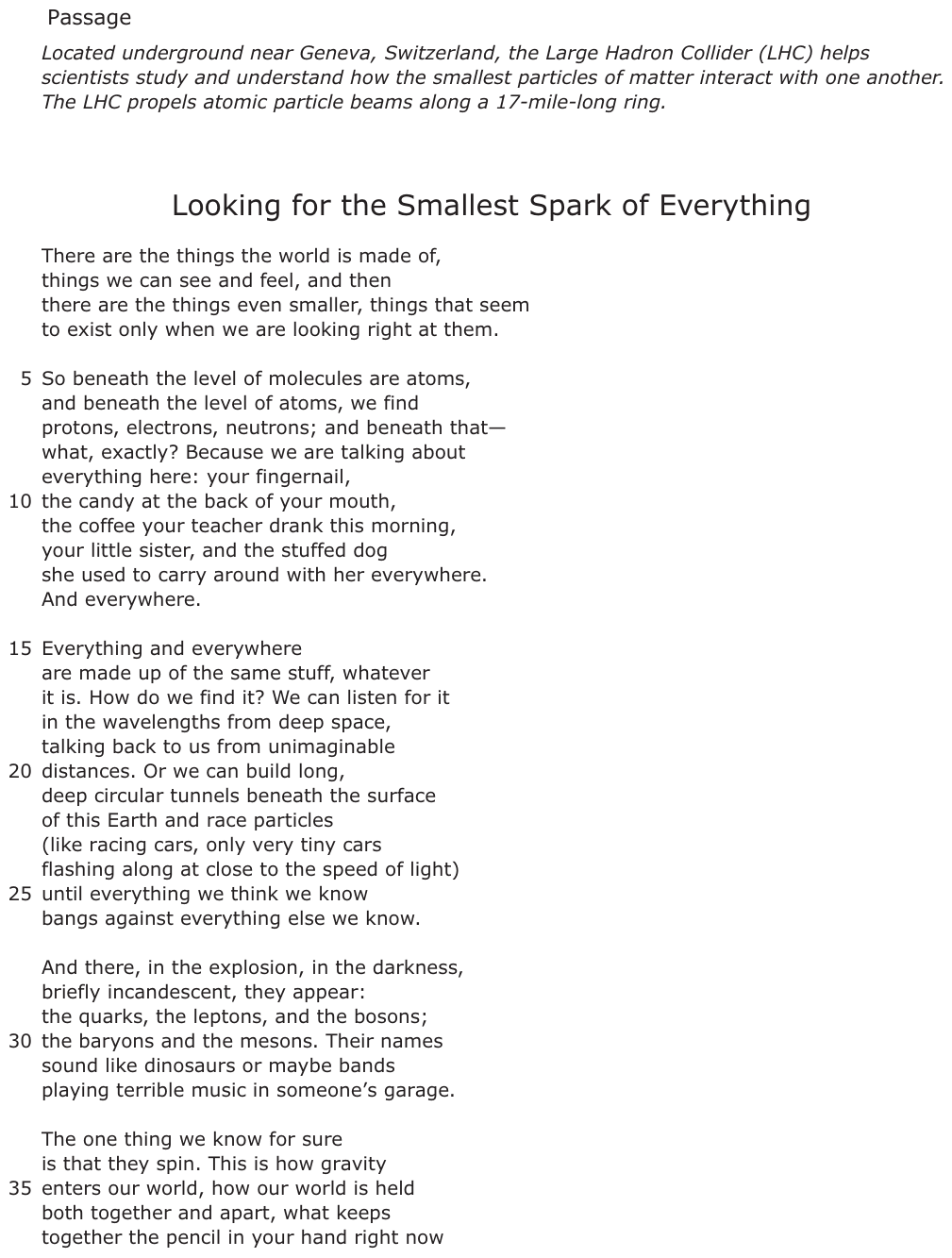
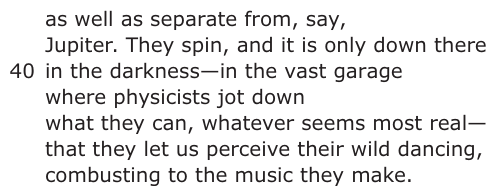
Question 17 of 120
2026 Practice Test B English, question 25Uses the passage above: “Looking for the Smallest Spark of Everything”.
Question
Read lines 27–28 from the poem.
And there, in the explosion, in the darkness,
briefly incandescent, they appear:
The imagery in the lines reveals that the speaker
- Aenvies the physicists who research colliding particles.
- Bhas personally observed colliding particles.
- Cadmires the powerful reactions that occur when particles collide.
- Dhas a simplistic understanding of how particles collide.
Show the answer
Correct answer: C
The question asks what the imagery in lines 27–28 reveals about the speaker.
A. Incorrect. The physicists mentioned in the fifth stanza (lines 33–44) are described as mere observers: they “jot down / what they can” (lines 41–42). In lines 27–28, the speaker is focused on the reaction between the colliding particles, not on the physicists who study them.
B. Incorrect. The speaker describes the particle collision in detail, but the text does not imply that the speaker has personally witnessed a collision. The speaker implies that his or her understanding of the collision is based on the experiences of the physicists observing the phenomenon (“They spin, and it is only down there / in the darkness—in the vast garage / where physicists jot down / what they can, whatever seems most real— / that they let us perceive their wild dancing” [lines 39–43]).
C. CORRECT. The word “explosion” and the phrase “briefly incandescent” create a picture of rapid changes and short bursts of bright light, revealing how powerful the new particles are. The language the speaker uses is positive, revealing that the speaker admires the power of the reaction and stands in awe of the new particles.
D. Incorrect. The poem reveals the speaker’s deep knowledge about subatomic particles. For example, the speaker is able to name the new particles discovered—“the quarks, the leptons, and the bosons; / the baryons and the mesons” (lines 29–30)—and is able to use imagery to create a powerful picture that reveals the complexity of a scientific process that humans have never been able to see.
Question analysis
This imagery question asks what lines 27–28 of “Looking for the Smallest Spark of Everything” reveal about the poem’s speaker, as particles appear “briefly incandescent” in an explosion inside a particle collider. Students must infer what a vivid image says about the person describing it. The word “incandescent” may be unfamiliar, and the choices are about very different things.
- Grade level
- Grade 8 reading and task
- Compared with grade 7
- Above grade 7 Grade 7 students infer a speaker’s attitude from imagery, but these two lines turn on the uncommon word “incandescent,” state nothing about the speaker outright, and the choices range over the speaker’s knowledge, experience and feelings, which is harder than typical grade 7 work.
- Estimated difficulty
- Hard: combines ideas, needs a plan, and has more than one tempting wrong answer.
- Thinking it demands
- Depth of knowledge 2, skills and concepts · mainly analyze
- What makes it hard
- Reading between the lines major
- Hard words moderate
- Figurative or literary language minor
- Evidence
- Answered from one paragraph or stanza
- Reading level
- Passage: 346 words (a poem; reading level not measured); question and choices: about grade 9, 55 words.
- Students, last 30 days
- Not enough answers yet to show (it takes 10).
Why it is hard, traps and wrong answers (shows the answer)
Why it is hard
Nothing in the two lines names a feeling, so students must judge the speaker’s attitude from the image alone, and its key word is uncommon. The vividness is itself a trap: a scene described this sharply can seem to be one the speaker watched, though the poem says the particles are perceived only through the physicists’ work. The choices range over envy, experience, admiration and understanding, so each must be tested against the lines rather than against an overall impression.
Reading between the lines major Working it out
The lines describe particles, not the speaker, and contain no word of feeling; admiration has to be inferred from the drama of “the explosion” and the glow of “briefly incandescent.” (Graesser, Singer & Trabasso, 1994; Kintsch, 1998)
Hard words moderate Understanding the question
“Incandescent,” glowing with heat and light, is the word that makes the image dazzling, and a student who does not know it sees only an explosion in the dark. (Perfetti, 2007; Freedle & Kostin, 1993)
Figurative or literary language minor Understanding the question
The two lines are pure imagery, a burst of light in darkness as the particles “appear,” and the question asks what that picture reveals about the person painting it. (Graesser, Singer & Trabasso, 1994; Kintsch, 1998)
Strategy: Picture the scene in lines 27–28, including what “incandescent” means, decide what the description suggests about the speaker, and test each choice against these two lines.
Traps
- Taking figurative language literally: A choice reads a figure of speech or image at face value.
- Reads too much in: A reasonable-sounding conclusion that goes further than the text allows.
The wrong answers, classified
A Reads too much in (Graesser, Singer & Trabasso, 1994)
Reasons that someone so drawn to the scene must envy the physicists who study it, though the physicists appear only in lines 39–44 and nothing in the poem hints at envy.
B Taking figurative language literally (Graesser, Singer & Trabasso, 1994)
Takes the vivid scene of particles that “appear” in a glow as something the speaker witnessed, though lines 39–43 place that sight “down there,” where physicists record what they can.
D Reads too much in (Graesser, Singer & Trabasso, 1994)
Treats the poem’s playful comparisons, racing cars and garage bands, as a sign of shallow knowledge, though the next lines have the speaker naming quarks, leptons, bosons, baryons and mesons.
Working it out, step by step
Figure out what the question asks
This asks what the imagery in lines 27–28 shows about the speaker. Imagery is language that helps you see, hear or feel a scene. The lines describe particles, not the speaker. So you must infer, or figure out from clues, how the speaker feels.
Read lines 27–28
The lines say “And there, in the explosion, in the darkness, / briefly incandescent, they appear:” Briefly means for a short time. Incandescent means glowing with heat and light. So picture a burst of bright light flashing in the dark. The particles have just crashed into each other, or collided. In that flash, the tiny particles appear.
Decide how the speaker feels
The words are bold and bright: “explosion,” “incandescent,” “appear.” The speaker makes the moment sound dramatic and amazing. People describe something this way when they are in awe of it. So the speaker admires, or looks up to, the power of the crash.
Check each choice
- A does not fit. Physicists come up only later, in line 41. Nothing shows envy, or wanting what they have.
- B does not fit. Nothing says the speaker was there. Lines 39–42 place the sight “down there,” where “physicists jot down / what they can.”
- C fits. The glowing burst in the dark shows the speaker’s wonder.
- D does not fit. Right after, the speaker names quarks, leptons, bosons, baryons and mesons. That is not a simple understanding.
Watch out: B is tempting because the scene is so vivid. But a writer can picture something without seeing it in person.
Choose the answer
The bright, explosive picture shows a speaker who is amazed by the crash. So the answer is C, “admires the powerful reactions that occur when particles collide.”
Why this answer and not the closest wrong one
B is the closest wrong choice, because the scene feels like an eyewitness report. But the lines never say the speaker was in the tunnel. What they do show is a feeling. Words like “explosion” and “briefly incandescent” make the moment thrilling. That is admiration, so C fits.
More questions like this
The original DOE question
Question 18 of 120
2026 Practice Test B English, question 26Uses the passage above: “Looking for the Smallest Spark of Everything”.
Question
Read lines 30–32 from the poem.
Their names
sound like dinosaurs or maybe bands
playing terrible music in someone’s garage.
The speaker refers to familiar objects and events in the lines most likely to
- Aexplain confusing information in simple terms to help the reader understand more about the topic.
- Bdemonstrate how scientific ideas can be explained by describing situations that many people are familiar with.
- Cemphasize that the process being used to research particles is still in the early stages of development.
- Dsuggest that the scientific language used to describe particles seems silly by making a humorous comparison.
Show the answer
Correct answer: D
The question asks why the speaker refers to familiar objects and events in lines 30–32.
A. Incorrect. In lines 30–32, the speaker only gives an opinion about what the names sound like and does not simplify confusing information about how these newly discovered particles function or exist.
B. Incorrect. In lines 30–32, the speaker is only describing what the names of the particles sound like: “dinosaurs or maybe bands” (line 31). These descriptions illustrate the speaker’s opinion but do not explain specific scientific ideas.
C. Incorrect. In lines 30–32, the mention of the names of the particles sounding like “dinosaurs or maybe bands” (line 31) reveals the speaker’s opinion about the names but does not explain the process of researching the particles.
D. CORRECT. The phrase “their names” (line 30) refers to the scientific names of the particles: “the quarks, the leptons, and the bosons; / the baryons and the mesons” (lines 29–30). In lines 30–32, the speaker expresses the opinion that these scientific terms sound nonsensical, much like the strange scientific names of dinosaurs or silly band names.
Question analysis
In “Looking for the Smallest Spark of Everything,” the speaker says the names of particles sound like dinosaurs or bands playing in someone’s garage. This question asks why the speaker refers to such familiar things in lines 30–32. Students must read the comparison’s tone and purpose, and the choices offer several reasons poets compare science with everyday life.
- Grade level
- Grade 7 reading and task
- Compared with grade 7
- At grade 7 Explaining why a speaker includes a comparison is typical grade 7 work on word choice and tone. The three lines are quoted and their images are everyday ones, but the choices state purposes that differ in subtle ways.
- Estimated difficulty
- Moderate: several steps, or a close reading with one strong distractor.
- Thinking it demands
- Depth of knowledge 2, skills and concepts · mainly analyze
- What makes it hard
- How, not what moderate
- Figurative or literary language moderate
- Reading between the lines minor
- Evidence
- Answered from one paragraph or stanza
- Reading level
- Passage: 346 words (a poem; reading level not measured); question and choices: about grade 10, 97 words.
- Students, last 30 days
- Not enough answers yet to show (it takes 10).
Why it is hard, traps and wrong answers (shows the answer)
Why it is hard
Two choices give the textbook reason for an everyday comparison, to make hard science easier, and they draw students who answer from what comparisons usually do. These lines explain nothing; they say how the particles’ names sound, and “terrible music in someone’s garage” is a joke at the expense of the jargon. Students who trace “Their names” back to the list before it and hear the teasing tone reach the right purpose.
How, not what moderate Working it out
The question asks why the speaker makes the comparison, and two choices offer the usual reason for likening science to everyday things, making it easier to grasp, which these lines do not do. (Anderson & Krathwohl, 2001)
Figurative or literary language moderate Understanding the question
The humor has to be heard: names that sound like dinosaurs or like bands “playing terrible music in someone’s garage” are being teased, which signals a joke, not an explanation. (Graesser, Singer & Trabasso, 1994; Kintsch, 1998)
Reading between the lines minor Working it out
“Their names” points back to the list in lines 29–30, quarks, leptons, bosons, baryons and mesons, and students must see that the lines judge those words, not the particles. (Graesser, Singer & Trabasso, 1994; Kintsch, 1998)
Strategy: Find what “Their names” refers to in the lines just before, then ask what the comparison says about those names and in what tone, and match the purpose to both.
Traps
- Wrong purpose or structure: Names a purpose, structure or effect that the part does not serve, or describes what a part says when the question asks what it does.
- Too broad or too strong: A choice overstates, generalizes, or uses absolute words the text does not support.
- Reads too much in: A reasonable-sounding conclusion that goes further than the text allows.
The wrong answers, classified
A Wrong purpose or structure (Anderson & Krathwohl, 2001)
Assumes that comparing science with familiar things is meant to simplify it, but these lines explain nothing about particles; they only say what the names sound like.
B Too broad or too strong (King et al., 2004)
Turns three lines into a general claim about teaching science through familiar situations, though no scientific idea is described here, only the sound of some names.
C Reads too much in (Graesser, Singer & Trabasso, 1994)
Hears “someone’s garage” as an amateur workshop and concludes that particle research is just beginning, a meaning the lines, which tease the names, never suggest.
Working it out, step by step
Figure out what the question asks
This asks why the speaker compares the particles’ names to familiar things. Familiar means well known from everyday life. First find what “Their names” points to. Then decide what the comparison says about those names, and in what tone.
Find what their names means
Lines 29–30 list the particles: “the quarks, the leptons, and the bosons; / the baryons and the mesons.” Then the speaker says “Their names / sound like dinosaurs or maybe bands / playing terrible music in someone’s garage.” So “their names” means these science words.
Hear the joke
Dinosaurs have long, strange names. A garage band is a group of beginners who practice in a garage. Their music is often loud and bad. The speaker is teasing the science words. They sound odd and a little silly. This is a humorous, or funny, comparison.
Check each choice
- A does not fit. The lines explain nothing about particles. They only say how the names sound.
- B does not fit. No science idea is explained here.
- C does not fit. “Garage” is part of the band joke. It does not say the research is new.
- D fits. The joke makes the science names sound silly.
Watch out: A is tempting because comparisons to everyday things often make science easier. But these lines make fun of names. They do not explain anything.
Choose the answer
The speaker compares the particle names to dinosaurs and bad garage bands to poke fun at them. So the answer is D, “suggest that the scientific language used to describe particles seems silly by making a humorous comparison.”
Why this answer and not the closest wrong one
A is the closest wrong choice. Writers often compare science to everyday things to make it simpler. But ask what these lines explain. Nothing about how particles work is made clearer. The lines only say the names sound like “bands / playing terrible music.” That is a joke about the words, so D fits.
More questions like this
The original DOE question
Question 19 of 120
2026 Practice Test B English, question 27Uses the passage above: “Looking for the Smallest Spark of Everything”.
Question
Read lines 36–39 from the poem.
both together and apart, what keeps
together the pencil in your hand right now
as well as separate from, say,
Jupiter.
The poet includes these lines most likely to emphasize that
- Ait is important for physicists to continue their research about particles.
- Bthese particles have a powerful effect on everything.
- Cthe discoveries about particles provide little information.
- Dthe study of particles and the study of objects in space are similar.
Show the answer
Correct answer: B
The question asks for the most likely reason the poet includes lines 36–39 in the poem.
A. Incorrect. While the poem implies that the research is important, lines 36–39 do not point to a need for more research. Instead, the lines explain the power of the particles in the universe.
B. CORRECT. The particles that are “Everything and everywhere” (line 15) make up the objects mentioned in lines 36–39: a “pencil in your hand” and the planet “Jupiter.” Even though these objects are different from each other and extremely far apart in the universe, they are made up of and affected by these particles. The “powerful effect” is that the particles keep the objects “both together and apart” (line 36).
C. Incorrect. While the physicists can only “jot down / what they can, whatever seems most real” (lines 41–42), the discoveries about particles are ongoing and informative. The speaker shares that the particles are “everything and everywhere” (line 15) and that they “spin” (line 34), and that “this is how gravity / enters our world” (lines 34–35).
D. Incorrect. The speaker states that particles keep together objects in space, such as Jupiter, as well as objects on Earth, such as “the pencil in your hand right now” (line 37). However, in lines 36–39, the speaker is not comparing the study of subatomic particles with the study of objects in space (astronomy); the speaker is implying that because particles are “everything and everywhere” (line 15), the study of particles affects our understanding of everything in the universe, regardless of location.
Question analysis
This question asks why the poet of “Looking for the Smallest Spark of Everything” includes lines 36–39, about what keeps a pencil in your hand together and separate from the planet Jupiter. The quoted lines begin partway through a sentence, so students must read the lines before them to see what the sentence is about before judging the poet’s purpose.
- Grade level
- Grade 7 reading and task
- Compared with grade 7
- At grade 7 Explaining why a poet includes certain lines is typical grade 7 work. The quoted lines start partway through a sentence, so students must read lines 33–35 to see what the sentence is about, an extra step but not an unusual one.
- Estimated difficulty
- Moderate: several steps, or a close reading with one strong distractor.
- Thinking it demands
- Depth of knowledge 2, skills and concepts · mainly analyze
- What makes it hard
- Complex sentences moderate
- Reading between the lines minor
- Evidence
- Answered from one paragraph or stanza
- Reading level
- Passage: 346 words (a poem; reading level not measured); question and choices: about grade 8, 75 words.
- Corrected from the DOE handbook
- The explanation of C reversed cause and effect in the poem; one word was changed.
- Students, last 30 days
- Not enough answers yet to show (it takes 10).
Why it is hard, traps and wrong answers (shows the answer)
Why it is hard
The quoted lines are the tail of a sentence, and without its start they read like a list of objects. Students who go back to lines 33–35 see that the spin of the particles is what holds things “together and apart,” and the pencil and Jupiter show how far that reaches. Those who read the fragment alone fasten on Jupiter and think of astronomy, while those who read on to the physicists who “jot down / what they can” may decide that little is known.
Complex sentences moderate Understanding the question
The quoted lines begin mid-sentence with “both together and apart, what keeps,” so students must read back to lines 33–35 to learn that the subject is the particles’ spin, “how gravity / enters our world.” (Abedi & Lord, 2001; Freedle & Kostin, 1993; Messick, 1989)
Reading between the lines minor Working it out
The lines never say “everything”; students must see that a pencil in your hand and a distant planet stand for things near and small and things far and huge, so the effect reaches all matter. (Graesser, Singer & Trabasso, 1994; Kintsch, 1998)
Strategy: Read lines 33–39 as one sentence, work out what the subject of “what keeps” is, and then ask what point the two examples in lines 37–39 are meant to make.
Traps
- Twists what the text says: Uses the text's topic and ideas but changes what it says: who did it, how much, when, or why.
- Wrong part of the text: A choice is true of another paragraph, stanza or speaker than the one asked about.
- Reads too much in: A reasonable-sounding conclusion that goes further than the text allows.
The wrong answers, classified
A Reads too much in (Graesser, Singer & Trabasso, 1994)
Assumes the lines push for more research, a common message in writing about science, but they state what the particles do, not what physicists should go on doing.
C Wrong part of the text (Kirsch & Mosenthal, 1990)
Draws on “The one thing we know for sure” in line 33 and the physicists who “jot down / what they can” in lines 41–42, but lines 36–39 state confidently what the particles do.
D Twists what the text says (King et al., 2004)
Sees a planet next to a pencil and builds a comparison between particle physics and astronomy, though the lines show one force acting on both objects, not two fields of study.
What was corrected from the DOE handbook, and why
- Explanation: Rejecting C, the handbook's explanation says the particles “spin” “because ‘this is how gravity / enters our world’”. The poem says it the other way round: “The one thing we know for sure / is that they spin. This is how gravity / enters our world”, so the spinning is how gravity enters. It now says the particles “spin”, and that “this is how gravity / enters our world”. The answer, B, is unchanged.
Working it out, step by step
Figure out what the question asks
This asks why the poet includes lines 36–39. The lines start in the middle of a sentence. So read the whole sentence, from line 33, to see what it is about.
Read lines 33–39 as one sentence
Lines 33–34 say “The one thing we know for sure / is that they spin.” “They” means the tiny particles. Then the poem goes on: “This is how gravity / enters our world, how our world is held / both together and apart, what keeps / together the pencil in your hand right now / as well as separate from, say, / Jupiter.”
Work out what it means
“This” points back to the spinning. The spinning is how gravity comes into our world. Gravity is the pull that draws things toward each other. So the particles’ spin holds a pencil together and keeps it apart from Jupiter. A pencil is small and close. Jupiter is a huge planet, far away. Together they stand for everything.
Check each choice
- A does not fit. The lines say what particles do. They do not say physicists must keep working.
- B fits. The particles affect everything, from a pencil to a planet.
- C does not fit. These lines state facts with confidence. The physicists who “jot down / what they can” come later, in lines 41–42.
- D does not fit. The pencil and Jupiter are things the particles affect. They are not two subjects of study being compared.
Watch out: D is tempting because Jupiter is in space. But the lines show one force acting on both objects, not two kinds of science.
Choose the answer
A small pencil and a giant planet show that the particles’ effect reaches everything. So the answer is B, “these particles have a powerful effect on everything.”
Why this answer and not the closest wrong one
D is the closest wrong choice, since it also notices Jupiter. But D is about studying particles and studying space. The lines are not about study. They say the spin is “what keeps / together the pencil in your hand” and keeps it apart from Jupiter. Small and near, huge and far: that means everything, so B fits.
More questions like this
The original DOE question
Question 20 of 120
2026 Practice Test B English, question 28Uses the passage above: “Looking for the Smallest Spark of Everything”.
Question
Read lines 39–44 from the poem.
They spin, and it is only down there
in the darkness—in the vast garage
where physicists jot down
what they can, whatever seems most real—
that they let us perceive their wild dancing,
combusting to the music they make.
The lines reveal the speaker’s
- Afrustration with the research facilities physicists use.
- Bbelief that physicists are frantically working toward a new discovery.
- Cinterest in physicists and their study of particles.
- Dcertainty that physicists are working in secrecy.
Show the answer
Correct answer: C
The question asks what lines 39–44 reveal about the speaker.
A. Incorrect. While the discoveries are made “in the darkness” (line 40), the imagery conveys the speaker’s positive tone through descriptions like “perceive their wild dancing” (line 43) and “combusting to the music they make” (line 44), not frustration.
B. Incorrect. In lines 39–44, the imagery of energetic movement (“They spin,” “their wild dancing,” and “combusting to the music they make”) is used to describe the particles, not the physicists.
C. CORRECT. The speaker uses the phrases “only down there” (line 39), “physicists jot down … whatever seems most real” (lines 41–42), and “they let us perceive” (line 43) to convey that the physicists have a rare role in studying the mysteries of the universe and that the speaker appreciates and is interested in their work.
D. Incorrect. While the description of the experiments occurring “in the darkness” (line 40) may create a sense of secrecy, the secrets that the darkness refers to are the mysteries of subatomic particles, not the work processes that the physicists use.
Question analysis
The final six lines of “Looking for the Smallest Spark of Everything” describe particles spinning in the darkness of a “vast garage” where physicists work. This question asks what those lines reveal about the speaker. The long sentence is broken by dashes and mixes images of the particles with images of the scientists, so students must sort out which words describe which.
- Grade level
- Grade 8 reading and task
- Compared with grade 7
- Above grade 7 Grade 7 students infer a speaker’s attitude, usually from a clear statement. These six lines form one sentence broken by dashes, students must keep track of who does what, and the attitude is never stated, so the task is above typical grade 7 work.
- Estimated difficulty
- Hard: combines ideas, needs a plan, and has more than one tempting wrong answer.
- Thinking it demands
- Depth of knowledge 2, skills and concepts · mainly analyze
- What makes it hard
- Complex sentences major
- Figurative or literary language moderate
- Reading between the lines moderate
- Evidence
- Answered from one paragraph or stanza
- Reading level
- Passage: 346 words (a poem; reading level not measured); question and choices: about grade 8, 82 words.
- Students, last 30 days
- Not enough answers yet to show (it takes 10).
Why it is hard, traps and wrong answers (shows the answer)
Why it is hard
The sentence is the hardest part: the physicists appear in a clause set off by dashes, and the two uses of “they” around them refer to different subjects. Students who attach “wild dancing” to the physicists see frantic work, and those who stop at “in the darkness” see secrecy. The right choice is mild and general, so it is easy to pass over, yet it fits because the speaker lingers on the scene with evident fascination and nothing in the lines expresses frustration or certainty.
Complex sentences major Understanding the question
Lines 39–44 are one sentence broken by a dash clause, and its two uses of “they” point different ways: “what they can” means the physicists, “they let us perceive” the spinning particles. (Abedi & Lord, 2001; Freedle & Kostin, 1993; Messick, 1989)
Figurative or literary language moderate Understanding the question
The particles’ “wild dancing,” “combusting to the music they make,” and the lab as “the vast garage” are images whose tone, delight rather than complaint, students must judge. (Graesser, Singer & Trabasso, 1994; Kintsch, 1998)
Reading between the lines moderate Working it out
No line states the speaker’s attitude; interest has to be read from how closely the speaker follows the work of physicists who “jot down / what they can, whatever seems most real.” (Graesser, Singer & Trabasso, 1994; Kintsch, 1998)
Strategy: Untangle the sentence in lines 39–44 by finding who spins, who jots things down and who lets us perceive, then decide what the description reveals about how the speaker regards the scene.
Traps
- Twists what the text says: Uses the text's topic and ideas but changes what it says: who did it, how much, when, or why.
- Wrong tone or attitude: Misjudges the tone, attitude or point of view, such as reading admiration as criticism, or taking a character's or subject's feelings for the author's.
- Reads too much in: A reasonable-sounding conclusion that goes further than the text allows.
The wrong answers, classified
A Wrong tone or attitude (Graesser, Singer & Trabasso, 1994)
Links “the vast garage” to the garage bands’ “terrible music” of line 32 and hears a complaint, though the lines end on the delighted image of “wild dancing.”
B Twists what the text says (King et al., 2004)
Gives the particles’ “wild dancing” and “combusting” to the physicists, misled by the pronouns around them, though the physicists only “jot down / what they can.”
D Reads too much in (Graesser, Singer & Trabasso, 1994)
Reads “only down there / in the darkness” as a sign of hidden work, though the darkness belongs to the underground tunnel, and nothing in the lines suggests secrecy.
Working it out, step by step
Figure out what the question asks
This asks what lines 39–44 show about the speaker. The lines are one long sentence. It uses the word “they” for two different groups. So first sort out who is doing what.
Sort out who does what
- “They spin” means the particles spin.
- “physicists jot down / what they can” means the physicists write down what they can. Here “they” is the physicists.
- “they let us perceive their wild dancing” means the particles let us see their dance. Perceive means notice or see. Here “they” is the particles again.
Put the sentence in plain words
The part between the dashes describes the place. It is the huge tunnel, “the vast garage,” where physicists take notes. Without that part, the sentence says this: only down there do the particles let us see their wild dance. Combusting means bursting into flame. It is a lively, joyful picture.
Decide what it shows about the speaker
The speaker brings the physicists into the scene and shows their careful work. They write down “whatever seems most real.” The speaker also shows that all of us see the particles only through this research. The speaker cares about the physicists and what they study. That is interest.
Check each choice
- A does not fit. “The vast garage” is playful, and the lines end in delight. There is no complaint.
- B does not fit. The wild motion belongs to the particles. The physicists only “jot down / what they can.”
- C fits. The speaker follows the physicists’ work and the particles they study.
- D does not fit. It is dark because the tunnel is underground. Nothing suggests the work is secret.
Watch out: B is tempting because the lines sound frantic, or wild and rushed. But “they let us perceive” means the particles, so the dancing is theirs, not the physicists’.
Choose the answer
The lines show the speaker paying close attention to physicists and the particles they study. So the answer is C, “interest in physicists and their study of particles.”
Why this answer and not the closest wrong one
B is the closest wrong choice. The words “wild dancing” and “combusting” do sound frantic. But they describe the particles. In “they let us perceive,” “they” means the particles. The physicists just “jot down / what they can.” So the lines do not show physicists rushing. They show the speaker’s interest, which is C.
More questions like this
The original DOE question
Question 21 of 120
2026 Practice Test B English, question 31Passage Using Fire to Keep a Prairie Healthy
Using Fire to Keep a Prairie Healthy
Inside the 40,000-acre Joseph H. Williams Tallgrass Prairie Preserve in northern Oklahoma, herds of bison roam on the scenic land that is home to hundreds of different species of plants and animals. While one of the greatest threats to the prairie is wildfire, the use of controlled fires is actually an effective way to protect this idyllic landscape.
Fires that are started by lightning or other natural circumstances are inevitable, and the results can be disastrous. However, hundreds of years ago the American Indian people who inhabited the Great Plains area between Minnesota and Texas realized that these fires could also be helpful. The bison in the area seemed to prefer grazing on tender new grass on the recently burned land rather than on grass in the unburned areas. The American Indian people began to deliberately burn areas of land for bison to graze on, which enticed the herds away from the people’s crops.
Today conservationists at the Tallgrass Prairie Preserve and farmers in the Great Plains continue to use controlled burns for land management. Intentionally burning a portion of land can dramatically improve the quality of the vegetation that regrows there. The fires burn away weedy undergrowth and help limit the overcrowding of shrubs and trees in the burn area, creating less competition for water and nutrients. Additionally, the process of burning excess plant matter adds nitrogen, an essential element for plant growth, to the soil.
One common target of controlled burns at the preserve and the surrounding area is the invasive red cedar tree. A single red cedar tree can consume up to 40 gallons of water per day, taking this vital resource away from other plant life. These tall trees also cast shade that prevents sunlight from reaching the plants beneath them. The fast-growing red cedar trees tend to crowd out prairie grasses, the primary food source for wild and domestic animals that make the prairie their home. An imbalance in one component of the prairie’s ecosystem affects the entire web of life. Controlled burns help maintain this ecosystem’s delicate balance.
Of course, these controlled fires are intended to burn only a portion of an area. A total burn, which is a risk with an uncontrolled wildfire, would destroy all wildlife as well as the crops farmers plant for income. The key to using controlled fires is knowing which areas of land to burn and when. Conservation experts at the preserve employ the “patch-burn” approach, meaning they rotate which portion of land is burned each year. They study the land to find out which areas would most benefit from being burned, and then they arrange about a dozen burns over one-third of the land. This patch burning contains the fire within a specific area and allows animals in the burn area to safely relocate. The following year, conservationists will burn a different section of the preserve, while the land burned the previous year regrows healthier than before.
Researchers have tracked and studied the variety of plant species and animals that live on the preserve, and their studies show that the patch-burn approach has restored biodiversity to the area by promoting the growth of species that were at risk of being crowded out. The patch-burn system is so successful that the conservationists at the preserve provide training to prairie farmers about conducting controlled burns on their own land. Burning land to make it healthy may seem counterintuitive, but strategic controlled fires have helped the prairie sustain life for hundreds of years and, with careful management, will continue to do so.
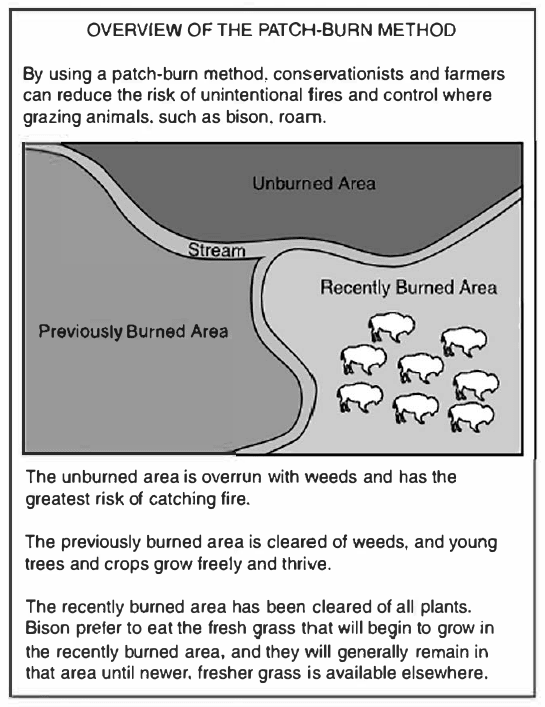
Question
Read this sentence from paragraph 6.
The patch-burn system is so successful that the conservationists at the preserve provide training to prairie farmers about conducting controlled burns on their own land.
The author includes this sentence to show that
- Athe conservationists are better qualified to lead preservation efforts than farmers are.
- Bthe conservationists are eager to involve others in the preservation of the prairie.
- Cthe conservationists’ efforts will restore the original beauty and biodiversity of the region.
- Dthe conservationists’ training program should serve as a model for other conservation organizations.
Show the answer
Correct answer: B
The question asks what the author intends to show by using the second sentence in paragraph 6 in the passage.
A. Incorrect. Although the author refers to the conservationists as “experts” in paragraph 5 and states that conservationists “provide training to prairie farmers” (paragraph 6), the second sentence in paragraph 6 does not imply that the conservationists are better qualified to lead preservation efforts than farmers are. Instead, the sentence shows that conservationists believe that prairie farmers are capable of performing the controlled burns that contribute to overall conservation efforts.
B. CORRECT. The conservationists are eager to involve others in the preservation of the prairie, because “studies show that the patch-burn approach has restored biodiversity to the area by promoting the growth of species that were at risk of being crowded out” and that the process has “helped the prairie sustain life for hundreds of years” (paragraph 6). The second sentence in paragraph 6 describes how conservationists are sharing their knowledge about preservation techniques with people who live on the prairie.
C. Incorrect. Although the author points out in paragraph 6 that “studies show that the patch-burn approach has restored biodiversity to the area by promoting the growth of species that were at risk of being crowded out,” the idea that controlled burns may help restore the original biodiversity of the prairie is not the focus of the second sentence in paragraph 6, which notes only that conservationists are providing training to farmers about controlled burns.
D. Incorrect. The author mentions in paragraph 6 that the patch-burn system has been “successful” and suggests in the last sentence of the paragraph that the use of controlled burns will continue to benefit the prairie ecosystem. These details imply that this system will continue to be used and may even become more widespread. However, the second sentence in paragraph 6 merely describes a patch-burn training program that already exists and does not suggest that this program should serve as a model for other organizations.
Question analysis
This question quotes a sentence from the last paragraph of the prairie article, about the preserve's conservationists training farmers to run controlled burns on their own land, and asks why the author includes it. Students must work out what this one sentence contributes, and because every choice sounds like something a successful program might show, the test is whether the sentence itself supports it.
- NYS standards
- 7R5 structure and genre features
- Grade level
- Grade 7 reading and task
- Compared with grade 7
- At grade 7 Explaining why an author includes a sentence is everyday grade 7 work. The sentence is short and plainly worded, and the choices stay close to the passage's ideas, so each must be measured against what the sentence itself says.
- Estimated difficulty
- Moderate: several steps, or a close reading with one strong distractor.
- Thinking it demands
- Depth of knowledge 2, skills and concepts · mainly analyze
- What makes it hard
- How, not what moderate
- Reading between the lines moderate
- Evidence
- Answered from one sentence or line
- Reading level
- Passage: about grade 11, 598 words; question and choices: about grade 11, 89 words.
- Students, last 30 days
- Not enough answers yet to show (it takes 10).
Why it is hard, traps and wrong answers (shows the answer)
Why it is hard
Every choice reads something into one plain sentence, so the decision is how far the sentence lets a reader go. Teaching farmers to burn their own land shows a wish to spread the work, which the right choice calls eagerness to involve others. The wrong choices go further: to a ranking of experts over farmers, to restoring the region’s original beauty, or to a model for other organizations, none of which the sentence states.
How, not what moderate Working it out
The stem asks why the author includes the training sentence, so students must say what it adds after the studies of restored biodiversity, not merely restate that farmers are trained. (Anderson & Krathwohl, 2001)
Reading between the lines moderate Working it out
Nothing in the sentence calls the conservationists “eager”; that has to be read from their choosing to teach their method to farmers so that it spreads beyond the preserve. (Graesser, Singer & Trabasso, 1994; Kintsch, 1998)
Strategy: Restate the sentence in your own words, then ask what it adds to the paragraph's account of the patch-burn system's success, rejecting any choice that claims more than the sentence says.
Traps
- Reads too much in: A reasonable-sounding conclusion that goes further than the text allows.
- Wrong part of the text: A choice is true of another paragraph, stanza or speaker than the one asked about.
- Too broad or too strong: A choice overstates, generalizes, or uses absolute words the text does not support.
The wrong answers, classified
A Reads too much in (Graesser, Singer & Trabasso, 1994)
Reads experts training farmers as a ranking of who should lead, though the sentence shows trust that farmers can run burns themselves, not a claim of superior qualifications.
C Wrong part of the text (Kirsch & Mosenthal, 1990)
Draws on the sentence before, where studies show “the patch-burn approach has restored biodiversity,” and adds “original beauty,” though the training sentence itself is about sharing the method.
D Too broad or too strong (King et al., 2004)
Takes “so successful” as an endorsement and stretches one preserve’s training of local farmers into a model that other conservation organizations should follow, a recommendation the author never makes.
Working it out, step by step
Figure out what the question asks
This question asks why the author put one sentence in the passage. The sentence says the patch-burn system works so well that the preserve’s experts train farmers. You need to decide what that sentence shows, and no more.
Read the sentence closely
The sentence says “the conservationists at the preserve provide training to prairie farmers about conducting controlled burns on their own land.” Conservationists are people who work to protect nature. Conducting means carrying out. So the experts teach farmers to do the burns themselves.
Decide what it shows
Why would experts teach their method to others? Because they want more people to help. Their method works, so they share it. Then the burns can happen on farms too, not only at the preserve. That shows they want others to join in protecting the prairie. Preservation means keeping something safe and healthy.
Check each choice
- A is wrong. Teaching farmers shows trust that farmers can do it. It doesn’t say experts should lead instead of farmers.
- B is right. Training farmers brings more people into caring for the prairie.
- C is wrong. Restored biodiversity comes from the sentence before. Biodiversity means many kinds of living things. This sentence is about sharing the method.
- D is wrong. The author never says other groups should copy this program.
Watch out: The words “so successful” make D sound right. But the sentence only says the preserve trains local farmers. It doesn’t call the program a model for others.
Choose the answer
The experts share their method so farmers can help too. So the answer is B: “the conservationists are eager to involve others in the preservation of the prairie.”
Why this answer and not the closest wrong one
D is the closest wrong answer, because “so successful” sounds like high praise. But D adds an idea the sentence never states: that other groups should copy the program. B stays with what the sentence shows, experts teaching farmers so they can help.
More questions like this
The original DOE question
The passage “Using Fire to Keep a Prairie Healthy” as printed (page 41)
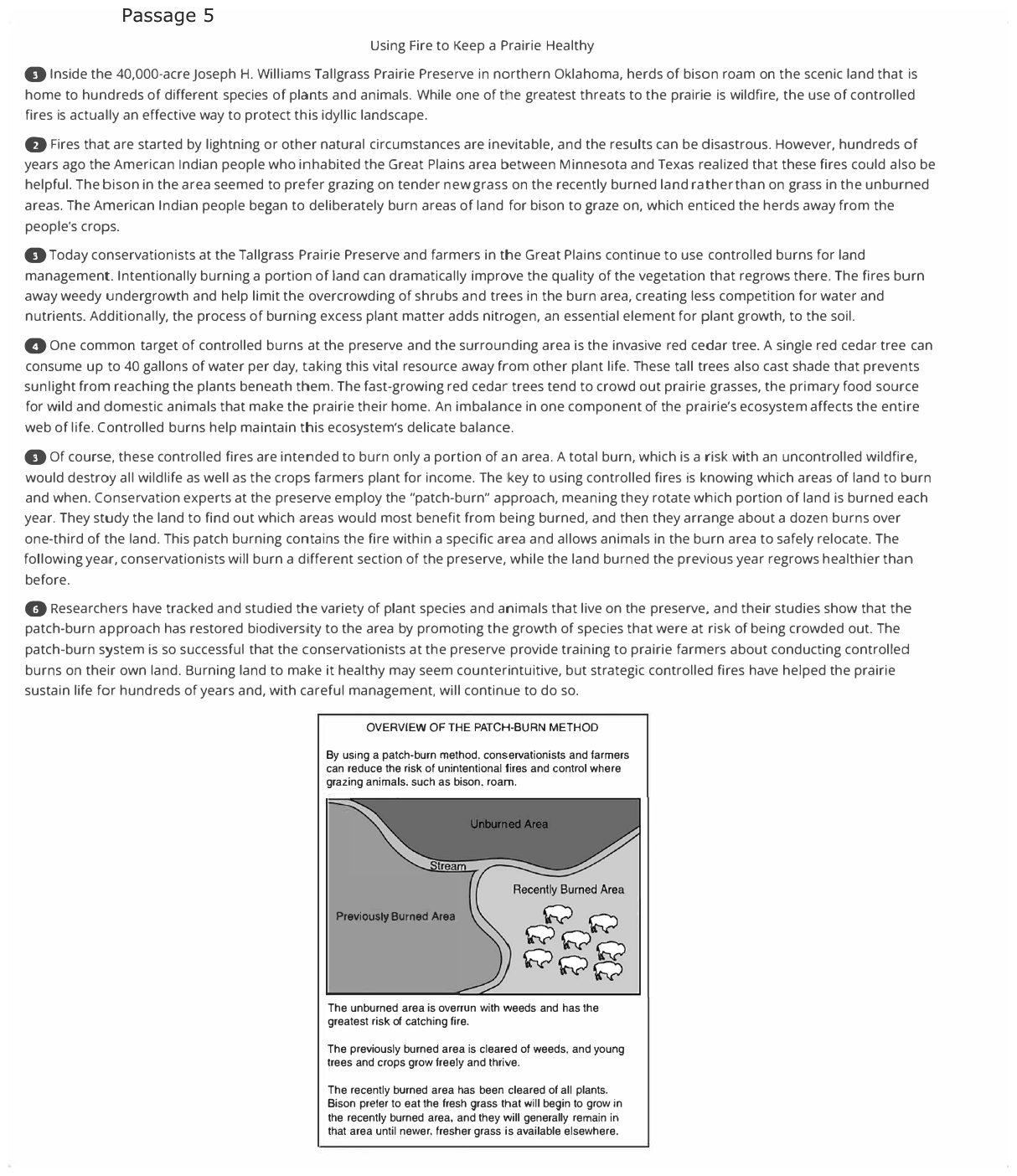
Question 22 of 120
2026 Practice Test B English, question 35Uses the passage above: “Using Fire to Keep a Prairie Healthy”.
Question
How do the diagram and its text provide additional support for the topic presented in the passage?
- Aby depicting how the landscape in a given area changes as the patch-burn method is applied
- Bby indicating that patch-burn fires are best suited for use in areas with certain features
- Cby revealing that the patch-burn method is used primarily on uninhabited areas of land
- Dby comparing the size of the area burned by the patch-burn method with that of unburned areas
Show the answer
Correct answer: A
The question asks how the diagram and its text provide additional support for the topic presented in the passage.
A. CORRECT. The text of the diagram states that “by using a patch-burn method, conservationists and farmers can reduce the risk of unintentional fires and control where grazing animals, such as bison, roam.” By showing the pattern of controlled burns and the resulting bison migration in a given area, the diagram depicts how the landscape changes as the patch-burn method is applied.
B. Incorrect. Although the text mentions areas “where grazing animals, such as bison, roam,” the diagram does not depict distinctive features of the land such as trees or brush and therefore does not indicate that patch-burn fires are best suited for use in areas with certain features.
C. Incorrect. While the text mentions “grazing animals, such as bison” and the diagram shows the bison grazing in only one area, the diagram and its text do not indicate that the patch-burn method is used on uninhabited land.
D. Incorrect. While the areas of land depicted in the diagram do indicate that the sizes of the areas differ, the text provided does not compare the sizes of the areas burned by the patch-burn method with those of unburned areas or indicate that this factor is important in reducing the risk of uncontrolled fires or controlling “where grazing animals, such as bison, roam.”
Question analysis
This question asks how a diagram titled “Overview of the Patch-Burn Method,” printed with the article on controlled burns at an Oklahoma prairie preserve, supports the passage's topic. The diagram shows a stretch of land divided into three areas, each with a caption, so students must take in what the picture and its text show together and tie that to the article.
- Grade level
- Grade 7 reading and task
- Compared with grade 7
- At grade 7 Explaining how a graphic adds to a text is a grade 7 skill. This diagram is simple and clearly labeled, but students must take in its three areas and captions together and match them to an abstract description, a typical demand.
- Estimated difficulty
- Moderate: several steps, or a close reading with one strong distractor.
- Thinking it demands
- Depth of knowledge 2, skills and concepts · mainly analyze
- What makes it hard
- Reading a figure, table or graph moderate
- Reading between the lines moderate
- How, not what minor
- Evidence
- Answered from the whole text
- Reading level
- Passage: about grade 11, 598 words; question and choices: about grade 9, 79 words.
- Students, last 30 days
- Not enough answers yet to show (it takes 10).
Why it is hard, traps and wrong answers (shows the answer)
Why it is hard
The diagram shows three areas side by side, and the key insight is that they are one piece of land at three moments in the patch-burn cycle. Students who read it only as a map look for spatial claims instead, about land features, people or the sizes of the areas. The caption calling the unburned area “overrun with weeds” is the likeliest snare, since it sounds like advice on which land to burn.
Reading a figure, table or graph moderate Understanding the question
The diagram’s meaning is split among a map of three shaded areas, an introduction and three captions, which must be read together to see what the picture adds to the passage. (Lesh, Post & Behr, 1987; Kirsch & Mosenthal, 1990)
Reading between the lines moderate Working it out
Nothing in the diagram mentions the passing of time; students must infer that the unburned, recently burned and previously burned areas are stages the same land passes through as the burns rotate. (Graesser, Singer & Trabasso, 1994; Kintsch, 1998)
How, not what minor Working it out
The stem asks how the diagram supports the passage, a question of function, so describing what is drawn is not enough; it must be tied to the yearly rotation of paragraph 5. (Anderson & Krathwohl, 2001)
Strategy: Read the diagram's title, introduction and three captions before the choices, sum up in one sentence what the diagram shows, and check each choice against something you can actually point to in it.
Traps
- Reads too much in: A reasonable-sounding conclusion that goes further than the text allows.
- True but not the answer: A choice says something accurate about the text that does not answer this question.
The wrong answers, classified
B Reads too much in (Graesser, Singer & Trabasso, 1994)
Reads the caption calling the unburned area “overrun with weeds” as advice on which land suits a burn, though the captions describe each stage, not features that make land suitable.
C Reads too much in (Graesser, Singer & Trabasso, 1994)
Sees no houses or people on the map and decides patch burns are kept to empty land, though bison graze there and a caption mentions crops growing.
D True but not the answer (King et al., 2004; Embretson & Wetzel, 1987)
Notices that the three shaded areas differ in size, which is true of the drawing, but no caption compares them, and size is not what the diagram explains.
Working it out, step by step
Figure out what the question asks
This question asks how the diagram helps the passage. A diagram is a drawing that explains how something works. You need to say what it adds, not just what it shows. So read its title, its short introduction and its three captions. Captions are the short notes under a picture.
Read the diagram
The title, printed in capital letters, is “Overview of the Patch-Burn Method.” The drawing shows one stretch of land. A stream splits it into three areas, labeled “Unburned Area,” “Recently Burned Area” and “Previously Burned Area.” A herd of bison stands in the recently burned area.
Read the three captions
- The unburned area “is overrun with weeds and has the greatest risk of catching fire.”
- The recently burned area “has been cleared of all plants.” Bison come to eat the fresh grass that grows there.
- The previously burned area “is cleared of weeds, and young trees and crops grow freely and thrive.”
These are three stages the same land goes through: weedy, burned, then healthy. Paragraph 5 says the experts burn a different section each year, while “the land burned the previous year regrows healthier than before.”
Check each choice
- A is right. The diagram shows land changing from weedy, to burned, to healthy as the method is used.
- B is wrong. The captions describe each stage. They don’t say some kinds of land suit burning best.
- C is wrong. Bison live in the drawing, and a caption mentions crops. Uninhabited means with no one living there, and nothing says that.
- D is wrong. The areas are different sizes in the drawing. But no caption compares sizes.
Watch out: B is tempting because “overrun with weeds” sounds like a reason to burn. But that caption describes the first stage. It is not a rule for choosing land.
Choose the answer
Depicting means showing in a picture. So the answer is A: “by depicting how the landscape in a given area changes as the patch-burn method is applied.”
Why this answer and not the closest wrong one
B is the closest wrong answer, because the weedy unburned area does sound like land that needs a fire. But the diagram gives no rules for picking land. It shows one piece of land changing, stage by stage, as the burns rotate. That is what A says.
More questions like this
The original DOE question
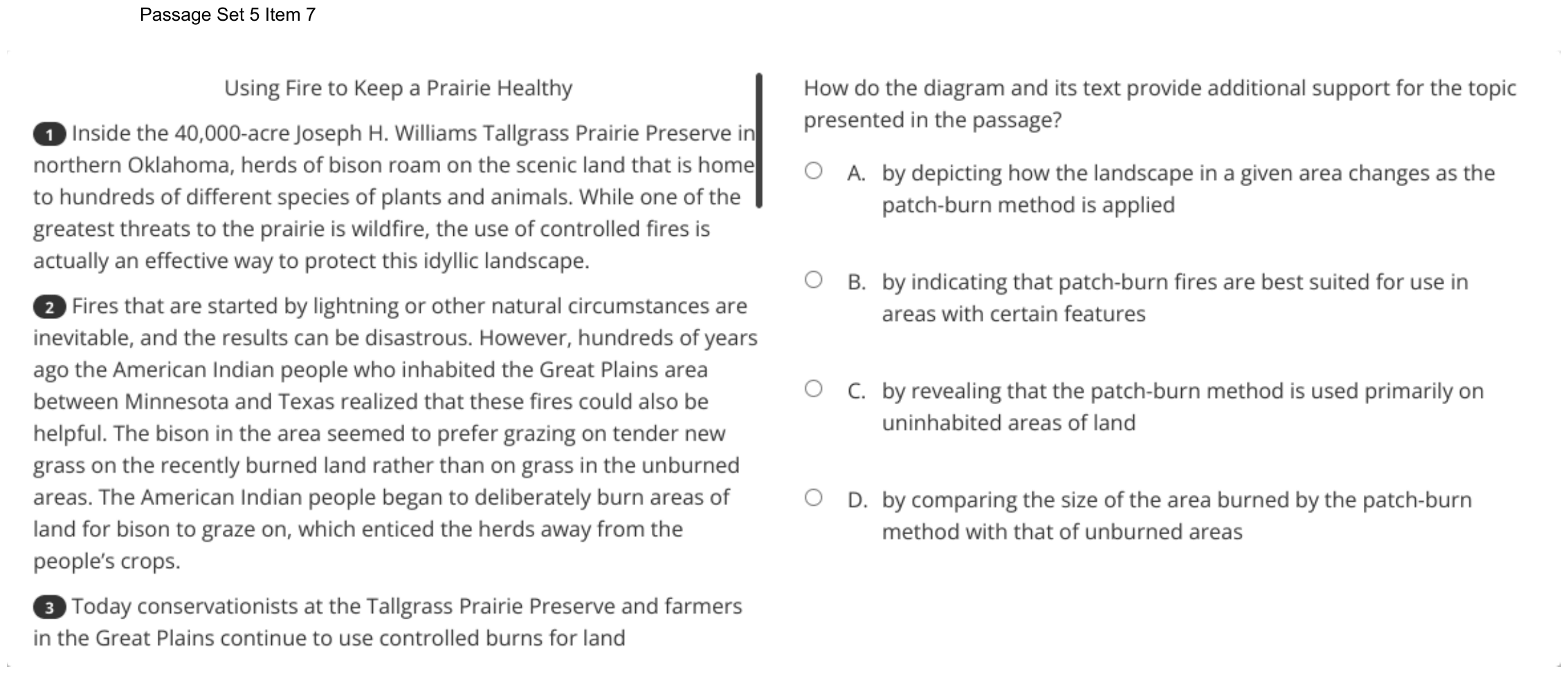
Question 23 of 120
2026 Practice Test B English, question 36Passage Letter from Brooklyn
Letter from Brooklyn
by Jacob Scheier
I can already see how this will end.
How I will grow tired of the bridge’s
steep incline, and the absent-minded tourists
wandering into the bicycle path.
The weather will turn cold.
But that all happens later.
For now it is the early edge of fall,
leaves green still while the air narrows,
is slightly crisp, almost grazing
the hair of my arm like a passing stranger,
as though the air has been forced into intimacy
by the brevity of daylight.
But when it starts darkening at 4,
this closeness, I know, will be a felt distance,
like someone drawing your attention
to their lack of intimacy.
These days I am still walking at a cathedral pace
beneath the branches bending across avenues,
brownstones like rows of lived-in chapels,
like a pop-up picture book I could have had as a child,
but didn’t. How Brooklyn makes me nostalgic
for the moment I am walking inside of.
These late afternoons filled
with a loneliness that makes me feel
distinctly myself, and an awareness
of how rare that is.
“Letter from Brooklyn” from LETTER FROM BROOKLYN: POEMS by Jacob Scheier, published by ECW Press. Copyright © 2013 by Jacob Scheier All rights reserved.
brevity: briefness
cathedral: meditative
chapels: private places of prayer or worship
nostalgic: yearning for the past
Question
How does the structure of the poem affect the poem’s meaning?
- AThe lack of a rhyming pattern suggests that the beauty of each passing day is unique.
- BThe lengths of the sentences represent the complexity of the thoughts being represented.
- CThe use of complete sentences implies the speaker’s appreciation for the clear beginning and ending of each season.
- DThe single long stanza reflects the continuous flow of the speaker’s thoughts.
Show the answer
Correct answer: D
The question asks how the structure of the poem affects its meaning.
A. Incorrect. Though the poem lacks a rhyming pattern, such a structure is not related to the uniqueness of the passing days. The speaker is savoring “the early edge of fall” (line 7) and describes walks taken on “these days” (line 17), but the beauty the speaker appreciates is attributed to the fall season rather than to a unique day. Further, the poem is primarily concerned with broad seasonal shifts, not the passing of each day, and the absence of rhyme does not suggest that each day is unique in its beauty.
B. Incorrect. The poem includes both long sentences (such as the one in lines 7–12) and short sentences (such as those in lines 5 and 6). However, the sentence lengths are not connected with the complexity of the ideas expressed.
C. Incorrect. A complete sentence serves to present the beginning and the end of a single thought, but the poem is not primarily concerned with the speaker’s thoughts on the “clear beginning and ending of each season.” Though it contrasts the speaker’s feelings and experiences during different seasons, the poem does not present descriptions focused specifically on the beginnings or ends of these seasons.
D. CORRECT. Unlike poems that are broken into stanzas reflecting unified groups of thoughts, this poem is one long stanza. This structure serves to emphasize the uninterrupted flow of the speaker’s thoughts from time to time and experience to experience without a clear break between any specific thoughts.
Question analysis
This poetry question asks how the structure of Jacob Scheier's “Letter from Brooklyn,” a poem about walking through the city in early fall, affects its meaning. Students must look at how the poem is built, its sentences, line breaks, stanzas and lack of rhyme, and decide which feature really shapes what the poem says.
- NYS standards
- 7R5 structure and genre features
- Grade level
- Grade 7 reading and task
- Compared with grade 7
- At grade 7 Grade 7 standards ask how a poem's form shapes its meaning. Here each choice names a feature of form that students must first confirm in the poem and then link to its meaning, a typical grade 7 poetry task on a short poem.
- Estimated difficulty
- Moderate: several steps, or a close reading with one strong distractor.
- Thinking it demands
- Depth of knowledge 2, skills and concepts · mainly analyze
- What makes it hard
- How, not what moderate
- Every choice must be checked moderate
- Something you must already know minor
- Evidence
- Answered from the whole text
- Reading level
- Passage: 217 words (a poem; reading level not measured); question and choices: about grade 8, 70 words.
- Students, last 30 days
- Not enough answers yet to show (it takes 10).
Why it is hard, traps and wrong answers (shows the answer)
Why it is hard
Checking whether a feature exists rules out little here, since the poem is unrhymed, its sentences vary widely and it has one stanza. The decision rests on which feature matches what the speaker does: thoughts move from future to present to memory without a break. The strongest pull ties the lack of rhyme to the uniqueness of each day, which sounds like the poem’s theme of rare moments but is not something rhyme or its absence can show.
How, not what moderate Working it out
The question is about form, so students must ask what the single unbroken stanza does: it carries the speaker from the coming cold back to the present walk without a pause. (Anderson & Krathwohl, 2001)
Every choice must be checked moderate Choosing the answer
Three choices name features the poem really has, no rhyme, sentences from five words to six lines, and one stanza, so the meaning each feature is given is what separates them. (Embretson & Wetzel, 1987)
Something you must already know minor Working it out
Students must know what a stanza and a rhyming pattern are, and that a poem without stanza breaks has no white space marking separate groups of thought. (Anderson & Krathwohl, 2001)
Strategy: For each choice, first check that the poem really has the feature named, then ask whether that feature fits what the speaker is doing throughout the poem, not just in one line.
Traps
- Wrong purpose or structure: Names a purpose, structure or effect that the part does not serve, or describes what a part says when the question asks what it does.
- Reads too much in: A reasonable-sounding conclusion that goes further than the text allows.
The wrong answers, classified
A Reads too much in (Graesser, Singer & Trabasso, 1994)
Applies the habit of finding meaning in free verse, linking the missing rhyme to each day’s unique beauty, which echoes “how rare that is” but follows from nothing in the form.
B Wrong purpose or structure (Anderson & Krathwohl, 2001)
Rightly sees sentences ranging from five words to six lines, but gives their length a job, matching complex thoughts, that the poem never connects to it.
C Wrong purpose or structure (Anderson & Krathwohl, 2001)
Assumes complete sentences marking each season’s clear start and end, though the last four lines are a fragment and the poem follows fall’s gradual early turn.
Working it out, step by step
Figure out what the question asks
This question asks how the poem’s structure shapes its meaning. Structure means how the poem is built: its stanzas, its sentences and its rhyme. A stanza is a group of lines set apart by a blank line. It is like a paragraph in a poem.
Look at how the poem is built
The poem has 26 lines and no blank lines, so it is one long stanza. The lines don’t rhyme. The sentences have many lengths. Line 5, “The weather will turn cold,” is short. The sentence in lines 7–12 runs six lines.
Follow the speaker’s thoughts
The speaker is the voice talking in the poem. Line 1 jumps ahead: “I can already see how this will end.” Line 6 comes back: “But that all happens later.” Then the speaker describes the fall air, then the walk, then a lonely feeling. One thought slides into the next with no stop. One unbroken stanza matches that steady flow.
Check each choice
- A is wrong. The poem has no rhyme. But missing rhyme can’t show that each day’s beauty is unique, or one of a kind.
- B is wrong. The sentences do vary in length. But the poem doesn’t link long sentences to hard thoughts.
- C is wrong. The poem isn’t about each season’s clear start and end. It describes fall just starting to turn.
- D is right. The single stanza matches thoughts that flow on with no breaks.
Watch out: Three choices name real features of the poem. So don’t stop at Is this true? Ask whether that feature really creates the meaning the choice gives it.
Choose the answer
Continuous means going on without stopping. So the answer is D: “The single long stanza reflects the continuous flow of the speaker’s thoughts.”
Why this answer and not the closest wrong one
A is the closest wrong answer, because the poem does praise a rare moment. But rhyme, or no rhyme, can’t show that each day is unique. One long stanza can show thoughts flowing without a stop. That is how the speaker thinks, from line 1 to line 26.
More questions like this
The original DOE question
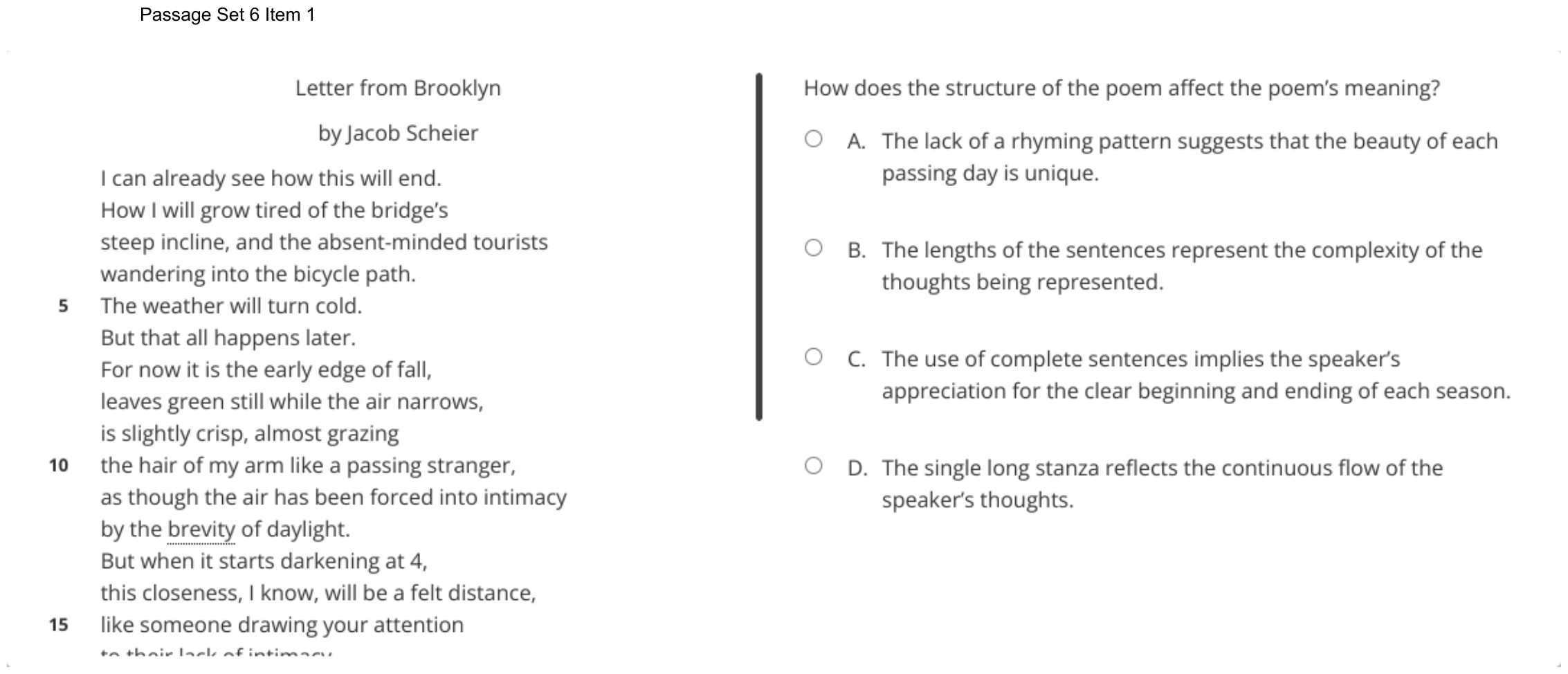
The passage “Letter from Brooklyn” as printed (page 50)
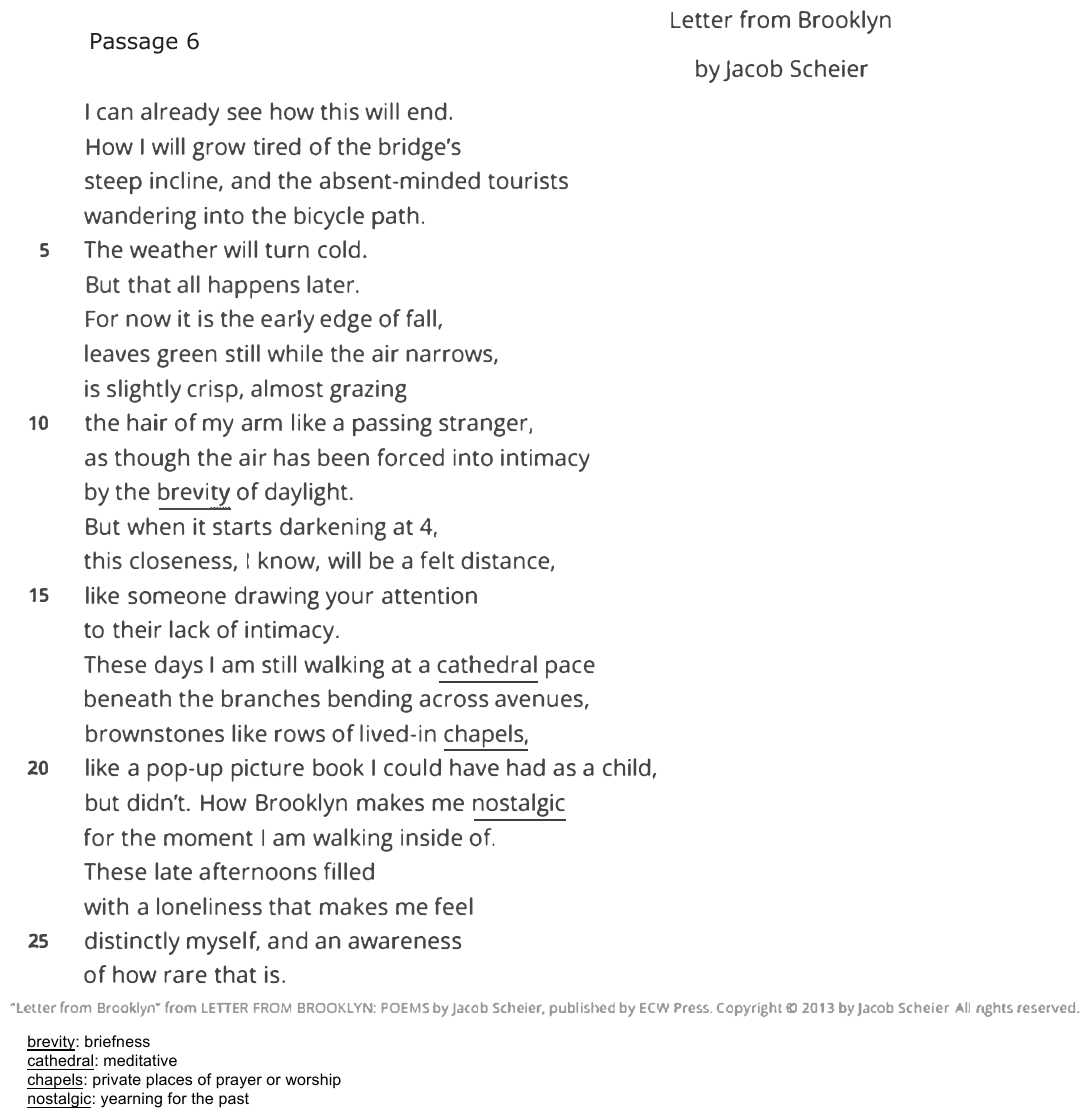
Question 24 of 120
2026 Practice Test B English, question 38Uses the passage above: “Letter from Brooklyn”.
Question
Read lines 5–6 from the poem.
The weather will turn cold.
But that all happens later.
How do the lines develop a central theme of the poem?
- AThey highlight a contrast between the different seasons.
- BThey show the sequence of the changes that are expected to occur.
- CThey warn about a problem that requires thoughtful preparation.
- DThey emphasize the importance of valuing the present.
Show the answer
Correct answer: D
The question asks how lines 5–6 develop a central theme of the poem.
A. Incorrect. In this poem, the speaker describes the impressions of one day in one season: “For now it is the early edge of fall, / leaves green still while the air narrows, / is slightly crisp” (lines 7–9). Despite the reference in line 5 to the eventual arrival of cold weather, lines 5–6 primarily emphasize the speaker’s wish to stay focused on the present moment. A contrast between seasons is not a central theme of the poem.
B. Incorrect. The words “The weather will turn cold” in line 5 refer to one change that is expected to occur, but lines 5–6 do not show a sequence of changes. The line that follows returns to the present: “For now . . .” (line 7).
C. Incorrect. Although the statement that the weather “will turn cold” in line 5 could be construed as a warning, there is no support in lines 5–6 for the idea that some problems require thoughtful preparation. The speaker is reflecting on a fleeting experience, not preparing to solve a problem.
D. CORRECT. Immediately after the line “The weather will turn cold” (line 5), the speaker returns to the current moment: “But that all happens later” (line 6). These lines help develop a central theme by emphasizing the speaker’s choice to value and focus on the present moment. The “But” at the start of line 6 shows the speaker pulling back from the future and refocusing on the present, thus emphasizing the importance of savoring “the moment I am walking inside of” (line 22).
Question analysis
This theme question quotes two short lines from early in “Letter from Brooklyn,” where the speaker says the weather will turn cold, and asks how they develop a central theme of the poem. Students must work out what the pair of lines does at that point and connect it to the whole poem, since each choice describes something two lines about the future could plausibly do.
- Grade level
- Grade 7 reading and task
- Compared with grade 7
- At grade 7 Explaining how particular lines develop a poem's theme is core grade 7 work. These two lines are short and plainly worded, so the demand lies in relating them to the theme of the whole poem, which is typical.
- Estimated difficulty
- Moderate: several steps, or a close reading with one strong distractor.
- Thinking it demands
- Depth of knowledge 2, skills and concepts · mainly analyze
- What makes it hard
- Reading between the lines moderate
- How, not what moderate
- Evidence
- Answered from one paragraph or stanza
- Reading level
- Passage: 217 words (a poem; reading level not measured); question and choices: about grade 5, 63 words.
- Students, last 30 days
- Not enough answers yet to show (it takes 10).
Why it is hard, traps and wrong answers (shows the answer)
Why it is hard
Two short, plain lines carry a theme only when read with their neighbors: the speaker forecasts cold, then dismisses it with “But that all happens later” and returns to “For now.” Students who read line 5 alone take the pair as a forecast and look for contrast, sequence or warning. The tempting contrast choice has some truth, since “But” does mark a turn, yet the turn is from future to present, not from one season to another.
Reading between the lines moderate Working it out
Line 6 never says the present matters; students infer it from “But” pulling back from the forecast and from “For now” in line 7 turning to the early fall around the speaker. (Graesser, Singer & Trabasso, 1994; Kintsch, 1998)
How, not what moderate Working it out
The stem asks how two lines develop a theme, so students must see their job, setting the future aside, rather than their content, a prediction of cold weather. (Anderson & Krathwohl, 2001)
Strategy: Read the lines just before and after lines 5–6, decide what the speaker does with the thought of cold weather, and connect that to what the poem as a whole keeps returning to.
Traps
- Wrong purpose or structure: Names a purpose, structure or effect that the part does not serve, or describes what a part says when the question asks what it does.
- Wrong part of the text: A choice is true of another paragraph, stanza or speaker than the one asked about.
- Reads too much in: A reasonable-sounding conclusion that goes further than the text allows.
The wrong answers, classified
A Wrong purpose or structure (Anderson & Krathwohl, 2001)
Sees cold weather set against early fall and hears contrast in “But,” yet the turn in line 6 is from later to now, and the poem never weighs one season against another.
B Wrong part of the text (Kirsch & Mosenthal, 1990)
Takes the opening forecast, tiring of the bridge and the tourists and then the cold, as a sequence, though lines 5–6 name one change and then set it aside.
C Reads too much in (Graesser, Singer & Trabasso, 1994)
Treats the coming cold as a problem to plan for, though the speaker makes no preparations and simply dismisses the future with “But that all happens later.”
Working it out, step by step
Figure out what the question asks
This question asks how lines 5–6 help build a theme. A theme is a big message about life that a poem keeps coming back to. So ask what these two lines do in the poem. Then link that to the whole poem.
Read the lines in place
Lines 1–5 look ahead. The speaker will grow tired of the bridge and the tourists, and “The weather will turn cold.” Then line 6 says, “But that all happens later.” Line 7 begins “For now it is the early edge of fall.” So the speaker thinks of the future, then pushes it aside.
Put it in your own words
“But” marks a turn. The speaker turns from later back to now. It is like saying, Sure, winter is coming, but it isn’t here yet. Then the poem spends many lines enjoying the fall walk. Line 22 speaks of “the moment I am walking inside of.” So lines 5–6 help show a big idea: enjoy the present while you have it.
Check each choice
- A is wrong. The turn is from later to now, not from one season to another. The poem doesn’t compare seasons.
- B is wrong. Lines 5–6 name one change, cold weather, and then set it aside. That is not a sequence, or series of steps.
- C is wrong. The speaker doesn’t get ready for the cold. The speaker simply says it “happens later.”
- D is right. The lines push the future aside so the speaker can enjoy the present.
Watch out: A is tempting because “But” signals a contrast. Ask what is being contrasted. It is later and now, not two seasons.
Choose the answer
Valuing means treating something as precious. So the answer is D: “They emphasize the importance of valuing the present.”
Why this answer and not the closest wrong one
A is the closest wrong answer, because line 6 does turn with “But.” Yet the turn moves from the future back to “For now.” The poem never weighs one season against another. It keeps coming back to the present moment, which is what D says.
More questions like this
The original DOE question
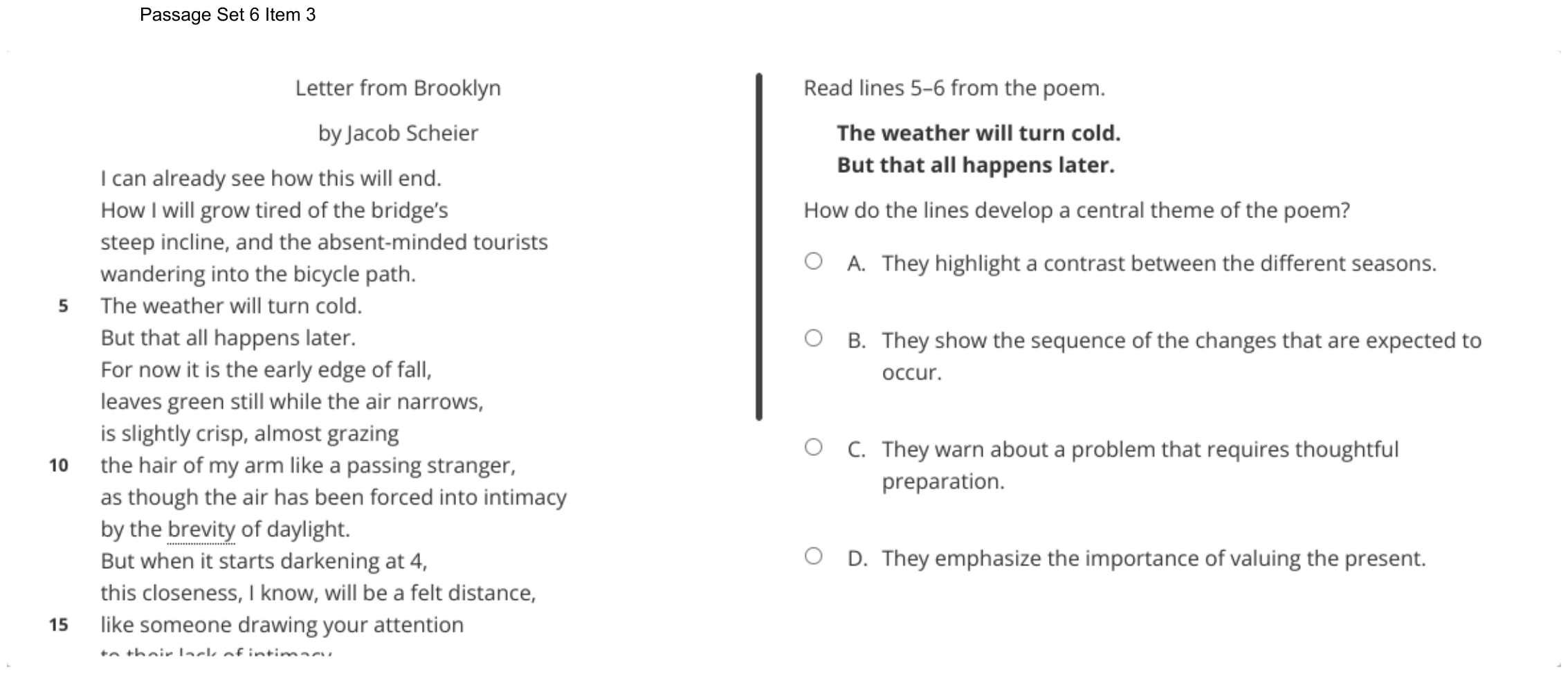
Question 25 of 120
2026 Practice Test B English, question 39Uses the passage above: “Letter from Brooklyn”.
Question
Read lines 7–9 from the poem.
For now it is the early edge of fall,
leaves green still while the air narrows,
is slightly crisp,
The word choice in the lines helps convey the speaker’s belief that
- Athe beauty of the current season should still be appreciated.
- Bthe changes in the weather signify the end of the most pleasant season.
- Cthe transition from one season to another happens swiftly and without warning.
- Dthe change in the weather is so subtle that people rarely observe or feel it.
Show the answer
Correct answer: A
The question asks what belief of the speaker is conveyed by the word choice in lines 7–9 of the poem.
A. CORRECT. Words and phrases in these lines, such as “leaves green still” and “slightly crisp,” have a positive connotation, indicating that the speaker believes in appreciating this season while it still lasts.
B. Incorrect. Although imagery such as “leaves green still” and “slightly crisp” in these lines suggests that the speaker enjoys the season, the speaker never indicates that the present season is the most pleasant of all seasons.
C. Incorrect. The phrases “the early edge of fall” and “the air narrows” in these lines imply that the season is just beginning to change, but there is no indication from these phrases that the changes will be swift and without warning. In fact, the narrowing of the air could be a warning of a greater, more gradual change in weather.
D. Incorrect. The speaker experiences the change in weather as subtle: “the air narrows, / is slightly crisp.” However, the speaker does not refer to the viewpoints of others. The entire viewpoint in the poem is personal and introspective, as represented by the use of the pronoun “I” throughout.
Question analysis
This word-choice question quotes three lines from “Letter from Brooklyn” describing the early edge of fall, when the leaves are still green and the air is slightly crisp. Students must work out what the connotations of these words reveal about the speaker's belief, and several choices mix an accurate reading of the lines with a claim they do not support.
- Grade level
- Grade 7 reading and task
- Compared with grade 7
- At grade 7 Explaining how word choice conveys a speaker's feelings is everyday grade 7 work. These three lines are short and concrete, but their meaning rests on the connotations of a few small words, which matches a typical grade 7 task.
- Estimated difficulty
- Moderate: several steps, or a close reading with one strong distractor.
- Thinking it demands
- Depth of knowledge 2, skills and concepts · mainly understand
- What makes it hard
- Figurative or literary language moderate
- Reading between the lines minor
- Evidence
- Answered from one sentence or line
- Reading level
- Passage: 217 words (a poem; reading level not measured); question and choices: about grade 5, 86 words.
- Students, last 30 days
- Not enough answers yet to show (it takes 10).
Why it is hard, traps and wrong answers (shows the answer)
Why it is hard
The three lines are short, and every choice builds on something real in them: a change in the weather, a season ending, subtlety. What separates the answer is the time words, “For now,” “early edge” and “still,” which say that something good is present and passing. Students lose the point by stretching a reasonable sense of loss into a claim about the best season, or by turning the speaker’s private notice into what other people miss.
Figurative or literary language moderate Understanding the question
The belief lies in connotation: “early edge of fall” and “leaves green still” mark a season only starting to turn, and “the air narrows” describes the change through an image. (Graesser, Singer & Trabasso, 1994; Kintsch, 1998)
Reading between the lines minor Working it out
“For now” at the start of line 7 signals that the moment will pass, and students must infer that the speaker values it for that reason, since no line states the belief. (Graesser, Singer & Trabasso, 1994; Kintsch, 1998)
Strategy: Mark the words in lines 7–9 that describe time and the feel of the air, decide whether each sounds positive, negative or neutral, then choose the belief that fits those connotations and nothing more.
Traps
- Half right: One half of a two-part choice is right and the other is not.
- Reads too much in: A reasonable-sounding conclusion that goes further than the text allows.
- Twists what the text says: Uses the text's topic and ideas but changes what it says: who did it, how much, when, or why.
The wrong answers, classified
B Reads too much in (Graesser, Singer & Trabasso, 1994)
Senses loss in a turning season, which the poem does suggest, but claims the speaker sees this as ending “the most pleasant season,” a ranking the lines never make.
C Twists what the text says (King et al., 2004)
Reads “the air narrows” as a sudden shift, though “early edge” and “slightly crisp” describe a season only beginning to turn, gradually and with clear signs.
D Half right (King et al., 2004; Thissen, Steinberg & Fitzpatrick, 1989)
Rightly hears the change as subtle in “slightly crisp,” but adds that people rarely notice it, though the lines record the speaker feeling it on the hair of an arm.
Working it out, step by step
Figure out what the question asks
This question is about word choice. The exact words a poet picks can show feelings. You need the belief that lines 7–9 show. So look at what each word suggests, not only what it means.
Mark the time words
The lines say “For now it is the early edge of fall, / leaves green still while the air narrows, / is slightly crisp.” Notice the time words. “For now” means this won’t last. “Early edge” means fall has just begun. “Still” means the leaves have not changed color yet.
Hear what the words suggest
“Slightly crisp” means a little cool and fresh. It sounds pleasant, not harsh. When the air “narrows,” it seems to tighten and grow cooler. So the speaker enjoys this moment. The time words show the speaker knows it will pass. Put together, they say: this lovely early fall is still here, so enjoy it now.
Check each choice
- A is right. “Still” and “For now” show the season is still here to enjoy.
- B is wrong. The speaker never calls this the most pleasant season. Nothing ranks the seasons.
- C is wrong. “Early edge” and “slightly” describe a slow, gentle change, not a sudden one.
- D is wrong. The change is subtle, or hard to notice. But the speaker feels it on “the hair of my arm.” The lines say nothing about other people.
Watch out: D starts out right, because the change is gentle. But it adds a claim about other people that the lines never make.
Choose the answer
The words show a pleasant season that is still here, for now. So the answer is A: “the beauty of the current season should still be appreciated.”
Why this answer and not the closest wrong one
B is the closest wrong answer, because the poem does hint that something good is ending. But the lines never call fall the best season. They say only that this pleasant time is here “for now.” That fits A: enjoy the season while it lasts.
More questions like this
The original DOE question
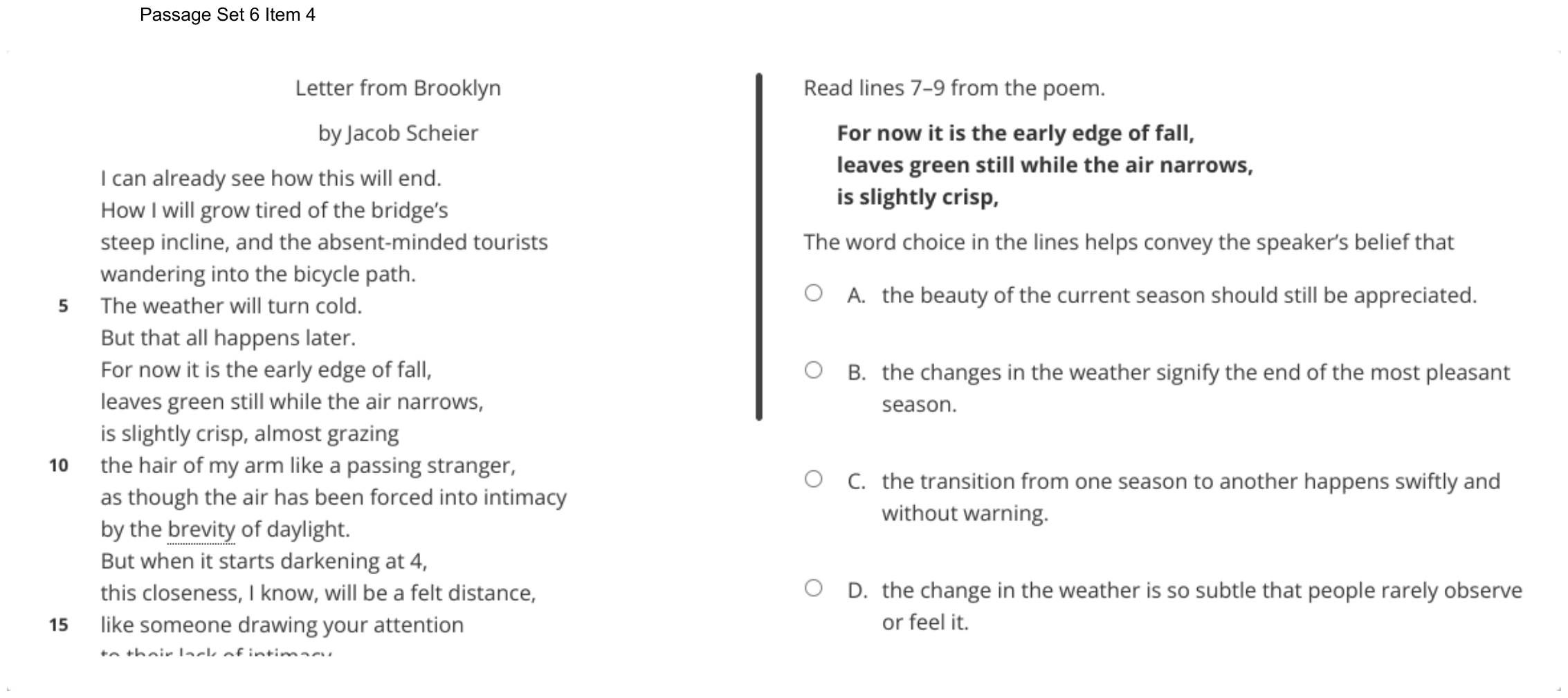
Question 26 of 120
2026 Practice Test B English, question 41Uses the passage above: “Letter from Brooklyn”.
Question
Read these lines from the poem.
I can already see how this will end. (line 1)
How Brooklyn makes me nostalgic
for the moment I am walking inside of. (lines 21–22)
The lines develop a central idea of the poem by
- Asuggesting the speaker’s desire to find a way to break free from the repetitive pattern of daily life.
- Brevealing the speaker’s feelings of disappointment over the predictable change in season.
- Cemphasizing the speaker’s awareness of the future significance of the present moment in the setting.
- Dshowing the speaker’s anticipation of specific emotions caused by an intimate knowledge of the setting.
Show the answer
Correct answer: C
The question asks how line 1 and lines 21–22 develop a central idea of the poem.
A. Incorrect. Although these lines suggest that life is governed by repetitive patterns, such as the change of seasons, they do not suggest that the speaker wishes to break free from these natural cycles of change, and a desire for freedom is not a central idea of the poem.
B. Incorrect. Although the speaker acknowledges that colder weather will inevitably bring disappointment, the speaker does not suggest in these lines that the predictability of changing weather is itself disappointing. Rather, the speaker recognizes the value of enjoying the present moment.
C. CORRECT. These lines connect the present warmer weather with the future colder weather and develop the central idea that the present “moment I am walking inside of” must be embraced because the speaker will be “nostalgic” for it in the future.
D. Incorrect. In these lines, the speaker is aware that specific emotions will occur in the future, during cold weather, but this awareness is only part of the more complex central idea of the poem, which is that current emotions and feelings must be recognized, experienced, and appreciated.
Question analysis
This central-idea question pairs the first line of “Letter from Brooklyn” with lines 21–22, where Brooklyn makes the speaker nostalgic “for the moment I am walking inside of,” and asks how they develop a central idea of the poem. Students must link excerpts from opposite ends of the poem, untangle a paradoxical image and choose among four abstract statements.
- Grade level
- Grade 8 reading and task
- Compared with grade 7
- Above grade 7 Grade 7 students analyze how lines develop a central idea. Here two excerpts twenty lines apart must be read together, one of them built on a paradox, and the four choices are long and abstract, well beyond typical grade 7 work.
- Estimated difficulty
- Among the hardest on the SHSAT: a non-obvious approach, heavy reading, or a well-hidden trap.
- Thinking it demands
- Depth of knowledge 3, strategic thinking · mainly analyze
- What makes it hard
- Figurative or literary language major
- A very close wrong answer moderate
- Evidence in several places moderate
- Evidence
- Answered from several paragraphs or stanzas
- Reading level
- Passage: 217 words (a poem; reading level not measured); question and choices: about grade 7, 99 words.
- Students, last 30 days
- Not enough answers yet to show (it takes 10).
Why it is hard, traps and wrong answers (shows the answer)
Why it is hard
This is among the hardest questions in the set because the two excerpts must be joined through a paradox and then matched to four long, abstract statements. Line 1 foresees an ending; lines 21–22 miss a moment while it is still happening, so both look at now from the future. Students who see only the foresight pick the choice about anticipated emotions, while those who hear gloom in “how this will end” settle on disappointment or a wish to escape.
Figurative or literary language major Understanding the question
Lines 21–22 are a paradox: “nostalgic,” glossed as yearning for the past, is aimed at “the moment I am walking inside of,” so the speaker already feels the present as a future memory. (Graesser, Singer & Trabasso, 1994; Kintsch, 1998)
A very close wrong answer moderate Choosing the answer
The choice about anticipating “specific emotions” shares the key’s link between future and present; it differs by tracing those feelings to knowing the setting well, which neither excerpt says. (Embretson & Wetzel, 1987; Gorin & Embretson, 2006; Ascalon et al., 2007)
Evidence in several places moderate Working it out
The excerpts are the poem’s first line and lines 21–22, twenty lines apart, and what joins them, the speaker looking ahead at the present, shows only when they are read side by side. (Kirsch & Mosenthal, 1990; Gorin & Embretson, 2006)
Strategy: Paraphrase each excerpt on its own, using the glossary's meaning of “nostalgic,” then decide what the first line and the last two share and match that to a choice.
Traps
- Half right: One half of a two-part choice is right and the other is not.
- Wrong tone or attitude: Misjudges the tone, attitude or point of view, such as reading admiration as criticism, or taking a character's or subject's feelings for the author's.
- Reads too much in: A reasonable-sounding conclusion that goes further than the text allows.
The wrong answers, classified
A Reads too much in (Graesser, Singer & Trabasso, 1994)
Links “how this will end” and growing tired of the bridge to a dull routine and imagines a wish to escape it, which the poem never expresses.
B Wrong tone or attitude (Graesser, Singer & Trabasso, 1994)
Hears resignation in “I can already see how this will end” and reads it as disappointment with the seasons, missing that the speaker treasures the present walk.
D Half right (King et al., 2004; Thissen, Steinberg & Fitzpatrick, 1989)
Rightly sees the speaker foreseeing feelings in line 1, but traces them to an “intimate knowledge of the setting,” while lines 21–22 long for the present moment itself.
Working it out, step by step
Figure out what the question asks
This question gives two pieces of the poem: line 1 and lines 21–22. You need the central idea they build together. A central idea is the main point the poem keeps working toward. Read each piece alone first, then join them.
Read line 1
Line 1 says “I can already see how this will end.” The speaker looks ahead. Lines 2–5 then list what will come: growing tired of the bridge, and the cold. So the speaker already pictures the future while living in the present.
Read lines 21–22
The lines say “How Brooklyn makes me nostalgic / for the moment I am walking inside of.” The glossary says nostalgic means “yearning for the past.” Yearning means longing. But the speaker longs for now, a moment still happening. That is a paradox, an idea that seems impossible but makes sense. The speaker knows this walk will be a precious memory.
Join the two pieces
Both pieces look at the present from the future. In line 1, the speaker sees the end coming. In lines 21–22, the speaker already misses the walk. So the speaker knows this present moment will matter later. Significance means importance.
Check each choice
- A is wrong. The speaker never wants to break free from daily routine.
- B is wrong. Line 1 can sound gloomy. But the speaker isn’t upset with the seasons. The speaker treasures the walk.
- C is right. The speaker sees that this moment in Brooklyn will be precious later.
- D is wrong. The speaker does foresee feelings. But neither piece says they come from knowing the place well.
Watch out: D gets the looking-ahead part of line 1 right. But lines 21–22 long for the moment itself, not for feelings caused by knowing the city.
Choose the answer
So the answer is C: “emphasizing the speaker’s awareness of the future significance of the present moment in the setting.”
Why this answer and not the closest wrong one
D is the closest wrong answer, because line 1 does show the speaker foreseeing feelings. But D says they come from an “intimate knowledge of the setting.” Neither piece says that. Lines 21–22 miss the moment while it is still happening. C captures that: the present will matter in the future.
More questions like this
The original DOE question
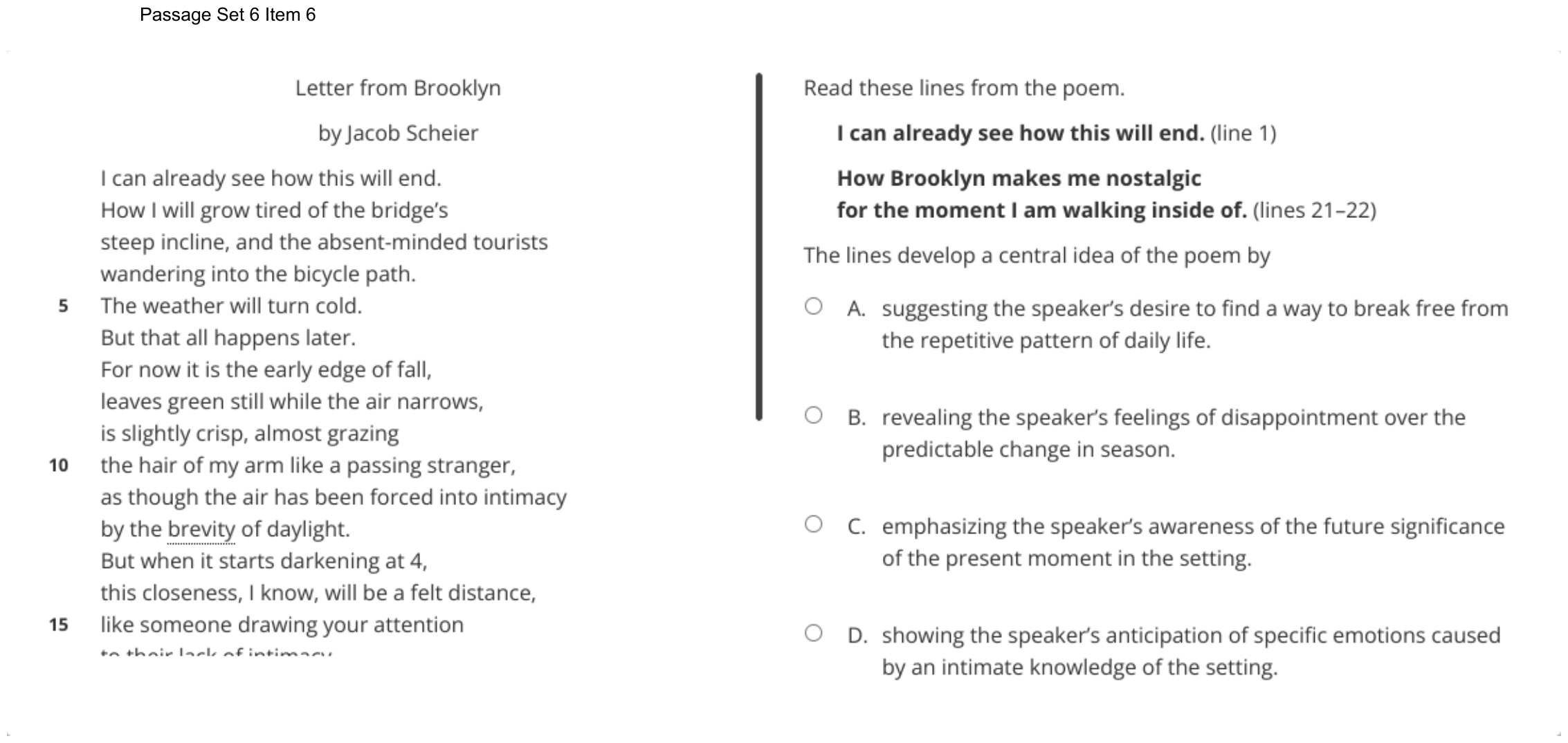
Question 27 of 120
2026 Practice Test C English, question 20Passage Bird Talk
Bird Talk
by Carl Sandburg
And now when the branches were beginning to be heavy,
It was the time when they once had said, “This is the
beginning of summer.”
The shrilling of the frogs was not so shrill as in the
first weeks after the broken winter;
The birds took their hops and zigzags a little more
anxious; a home is a home; worms are worms.
The yellow spreads of the dandelions and buttercups
reached across the green pastures.
Tee whee and tee whee came on the breezes, and the grackles
chuzzled their syllables.
And it was the leaves with a strong soft wind over them
that talked most of all and said more than any others
though speaking the fewest words.
It was the green leaves trickling out the gaunt nowhere
of winter, out on the gray hungry branches—
It was the leaves on the branches, beginning to be heavy,
who said as they said one time before, “This is the be-
ginning of summer.”
We shall never blame the birds who come
where the river and the road make the Grand Crossing
and talk there, sitting in circles talking bird talk.
If they ask in their circles as to who is here
and as to who is not here and who used to be here,
Or if instead of counting up last year as against
this year, they count up this year as against next
year, and have their bird chatter about who is here
this year who won’t be here next year,
We shall never blame the birds.
If I have put your face among leaf faces, child,
Or if I have put your voice among bird voices,
Blame me no more than the bluejays.
“Bird Talk” by Carl Sandburg—Public domain.
Question
Read lines 6–7 from the poem.
The birds took their hops and zigzags a little more
anxious; a home is a home; worms are worms.
What idea from the second stanza do the lines help develop?
- AThe birds are eager for the return of warmer months.
- BThe birds are most likely to thrive during the spring.
- CThe birds naturally adjust to the seasonal changes.
- DThe birds instinctively prepare for the future.
Show the answer
Correct answer: C
The question asks how lines 6–7 from the poem develop an idea from the second stanza.
A. Incorrect. In lines 2–3, the tree branches exclaim that “ ‘This is the / beginning of summer,’ ” and the birds respond by taking “their hops and zigzags a little more / anxious” (lines 6–7); however, the birds’ eager reaction to the return of warmer weather is not referenced in the second stanza of the poem, which is more about the nature of birds generally than the changing of the seasons.
B. Incorrect. Birds are more likely to thrive in warmer weather as evidenced by some birds’ migration to a warmer climate during winter, and the creatures in the first stanza are responding to the “ ‘beginning of summer’ ” (line 3) in their own way, such as the birds who are taking “their hops and zigzags a little more / anxious” (lines 6–7). However, the thriving of birds during a particular season is not the focus of the second stanza; rather, it is focused on the general nature of birds.
C. CORRECT. The birds are taking “their hops and zigzags a little more / anxious” (lines 6–7) in light of warmer weather, but they are not making a big to-do of the change because “a home is a home; worms are worms” (line 7) any time of the year. Such a natural adjustment to seasonal changes is reflected in the second stanza, where the birds “count up this year as against next / year” (lines 26–27) because they are well accustomed to the cyclical nature of things.
D. Incorrect. Although the birds’ actions of “hops and zigzags” (line 6) may indicate some sort of preparation, these actions are not preparation but rather the internalized cognizance of the change that has occurred with little conscious thought. As revealed in the second stanza, birds do not ponder much about past or future but rather adapt naturally as things change.
Question analysis
This question on Carl Sandburg’s poem “Bird Talk” quotes lines 6–7, where the birds hop and zigzag “a little more anxious,” and asks which idea from the second stanza they help develop. Students must link two compressed lines in the first stanza to a later stanza about birds gathered at the Grand Crossing, and every choice sounds like a fair claim about birds.
- Grade level
- Grade 8 reading and task
- Compared with grade 7
- Above grade 7 Typical grade 7 poetry questions ask what one line or stanza shows on its own. Here two compressed lines from the first stanza must be tied to an idea the second stanza never states, in Sandburg’s loose, unusual phrasing.
- Estimated difficulty
- Among the hardest on the SHSAT: a non-obvious approach, heavy reading, or a well-hidden trap.
- Thinking it demands
- Depth of knowledge 3, strategic thinking · mainly analyze
- What makes it hard
- Reading between the lines major
- A very close wrong answer moderate
- Evidence in several places moderate
- Figurative or literary language moderate
- Evidence
- Answered from several paragraphs or stanzas
- Reading level
- Passage: 296 words (a poem; reading level not measured); question and choices: about grade 5, 70 words.
- Students, last 30 days
- Not enough answers yet to show (it takes 10).
Why it is hard, traps and wrong answers (shows the answer)
Why it is hard
The stem runs in an unusual direction: two lines from the first stanza must help develop an idea that only the second stanza holds, and the poem never states it. Students who read “next year” as planning are drawn to preparation, a choice built on the key’s own frame, while others answer from the first stanza’s summer or from what they know about birds. The question rewards hearing the birds’ roll call of who is gone as the same matter-of-fact acceptance as “worms are worms.”
Reading between the lines major Working it out
Neither stanza states the shared idea: students must hear calm acceptance in “a home is a home; worms are worms” and in birds tallying “who won’t be here next year,” then call it adjusting to change. (Graesser, Singer & Trabasso, 1994; Kintsch, 1998)
A very close wrong answer moderate Choosing the answer
The choice about instinctive preparation shares the key’s shape, birds acting by nature as time passes; it differs only in what the birds do, prepare for the future rather than adjust to the seasons. (Embretson & Wetzel, 1987; Gorin & Embretson, 2006; Ascalon et al., 2007)
Evidence in several places moderate Working it out
Lines 6–7 sit in the first stanza and the idea lives in the second, lines 20–29, so students must carry two lines across the poem and match them to the gathering at the Grand Crossing. (Kirsch & Mosenthal, 1990; Gorin & Embretson, 2006)
Figurative or literary language moderate Understanding the question
“A home is a home; worms are worms” says nothing on its surface; its meaning, a shrug that life goes on as it always has, has to be read from the repetition. (Graesser, Singer & Trabasso, 1994; Kintsch, 1998)
Strategy: Paraphrase the second stanza first: what are the birds doing and saying at the Grand Crossing? Then reread lines 6–7 and ask which idea about birds both passages share.
Traps
- Reads too much in: A reasonable-sounding conclusion that goes further than the text allows.
- Wrong part of the text: A choice is true of another paragraph, stanza or speaker than the one asked about.
- Outside knowledge: A choice is plausible in the real world but not supported by this text.
The wrong answers, classified
A Wrong part of the text (Kirsch & Mosenthal, 1990)
Hears “a little more anxious” as eagerness for the summer announced in lines 2–3, an idea of the first stanza, while the second stanza never mentions weather or warmth.
B Outside knowledge (King et al., 2004; Recht & Leslie, 1988)
Brings in the real fact that birds do well in warm weather, which neither lines 6–7 nor the birds’ talk of who is gone says, and the poem’s season is summer, not spring.
D Reads too much in (Graesser, Singer & Trabasso, 1994)
Sees nest-building in “a home is a home” and planning in counting “this year as against next / year,” but the birds only note who will be missing and make no preparations.
Working it out, step by step
Figure out what the question asks
This question points in an unusual direction. Lines 6–7 are in the first stanza. A stanza is a group of lines set apart by a blank line. But the idea you need is in the second stanza, lines 20–29. The question asks which idea in stanza 2 these earlier lines also help build. So find the idea in stanza 2 first. Then see how lines 6–7 support it.
Find the idea in stanza 2
In stanza 2, birds sit “in circles talking bird talk.” They ask “who is here / and as to who is not here and who used to be here.” They also talk about “who is here / this year who won’t be here next year.” The birds simply count the changes. They are not upset by them. The speaker says, “We shall never blame the birds.” The idea: birds take the changes that time brings as a normal part of life.
Read lines 6–7 closely
Lines 6–7 say “The birds took their hops and zigzags a little more / anxious; a home is a home; worms are worms.” As summer comes, the birds hop about a little more nervously and busily. That is a small change. Then the speaker shrugs: “a home is a home; worms are worms.” Life goes on as it always does. The birds change a little and carry on, with no fuss.
See what the two parts share
Both parts show birds meeting change calmly. In lines 6–7, the season turns, and the birds adjust a little. To adjust is to change a little to fit something new. In stanza 2, the birds note who has come and gone, and life goes on. So lines 6–7 help build stanza 2’s idea: birds naturally adjust to the changing seasons.
Check each choice
- A does not fit. Stanza 2 never mentions warm weather or being eager for it.
- B does not fit. Nothing in the poem says birds do best in spring. The poem’s season is the start of summer.
- C fits. Both parts show birds taking seasonal change calmly, as a matter of course.
- D does not fit. The birds talk about next year, but they make no plans for it.
Watch out: D is tempting because “a home is a home” can sound like nest building. But the birds only count who will be missing. They do not get ready for anything.
Choose the answer
Lines 6–7 and stanza 2 both show birds accepting change as natural. So the answer is C, “The birds naturally adjust to the seasonal changes.”
Why this answer and not the closest wrong one
D is the closest wrong choice. Like C, it says birds act by nature as time passes. But D says they prepare, or get ready. In stanza 2, the birds talk about next year only to count who “won’t be here next year.” In lines 6–7, they hop about and carry on. They adjust to change. They do not plan for it.
More questions like this
The original DOE question
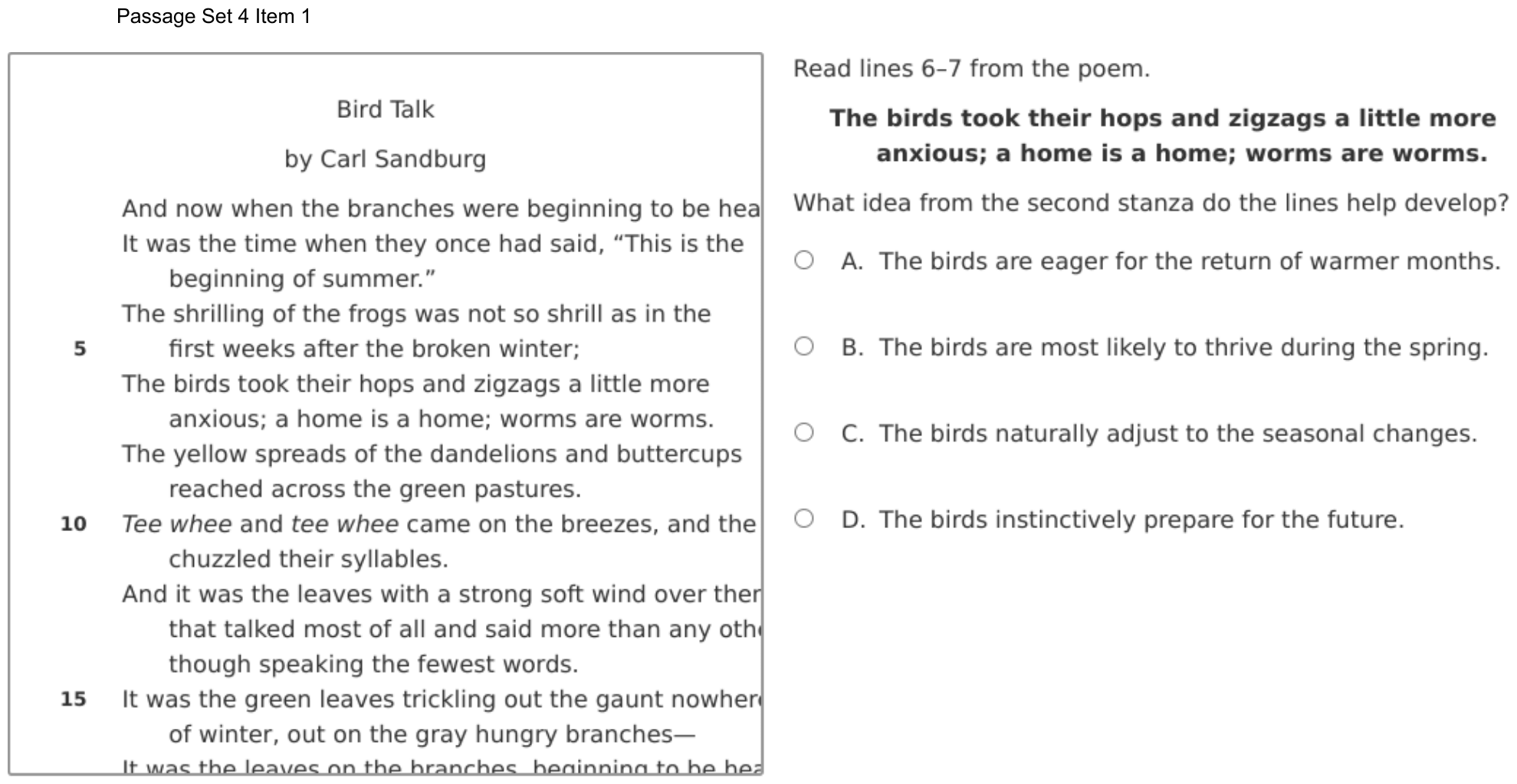
The passage “Bird Talk” as printed (page 32)
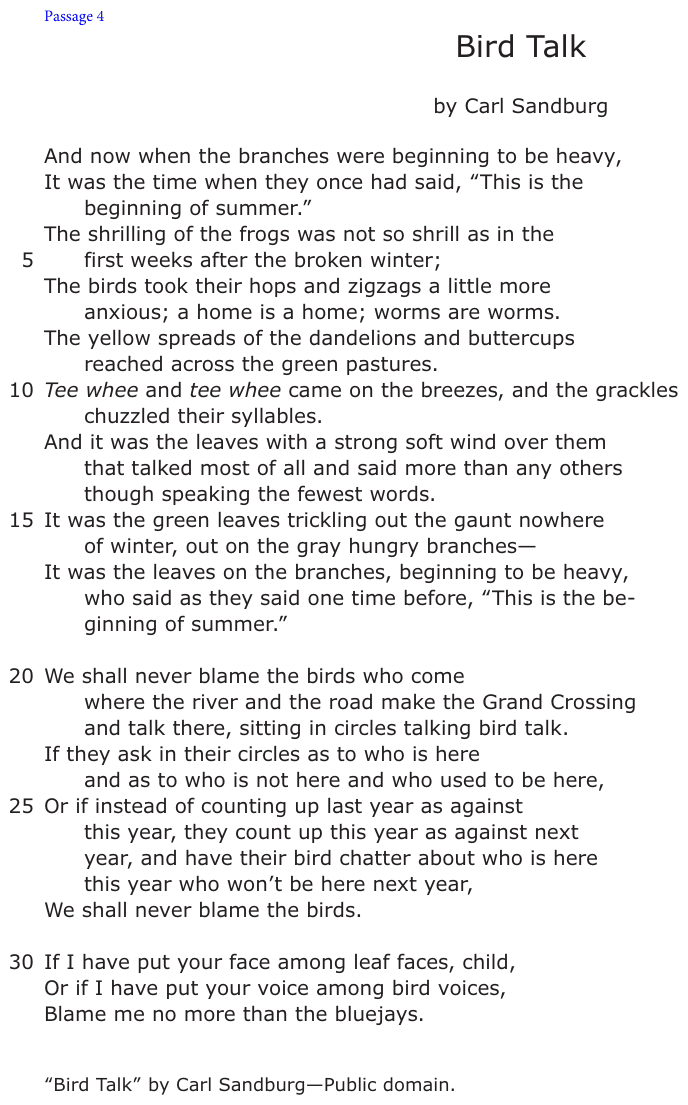
Question 28 of 120
2026 Practice Test C English, question 22Uses the passage above: “Bird Talk”.
Question
How does the repetition of “ ‘This is the beginning of summer’ ” in lines 2–3 and lines 18–19 contribute to the meaning of the poem?
- AIt suggests that the shift to summer occurs in the same way each year.
- BIt emphasizes the idea that living things are prepared for the change of season.
- CIt highlights the idea that the first signs of summer are surprising each year.
- DIt builds expectations about what the natural world looks like during a change of season.
Show the answer
Correct answer: A
The question asks how the repetition of a phrase contributes to the meaning of the poem in terms of conveying information about a cyclical event.
A. CORRECT. This phrase is used twice verbatim, in both cases to show the figurative words spoken by the branches (lines 2–3) and the leaves on the branches (lines 18–19). Repetition of this phrase conveys the idea that the transition to summer occurs in the same manner each subsequent year and thus evokes the same response from nature.
B. Incorrect. While living things—branches and leaves—both make identical figurative utterances, they do so not because they have prepared for such an event. Rather, these living things take the change in stride because of the sameness and expectedness of the seasonal shifts, which occur in the same way each time.
C. Incorrect. Even though the branches and leaves have been imbued by the speaker with some degree of consciousness in their figurative ability to speak, they are not surprised by the change in seasons. They say the same thing each year because the same thing occurs each year in the same way.
D. Incorrect. Certain lines of the poem do describe the natural world during the change of seasons, such as lines 8–9: “The yellow spreads of the dandelions and buttercups / reached across the green pastures.” However, this repeated phrase serves to evoke a sense of sameness and inevitability; it is not a phrase related to the physical appearance of the natural world, only the way the natural world responds to the seasonal change with simple acceptance for its sameness. The repeated lines do not hold any sort of expectation or anticipation for the coming of summer; they help relay observations made about the state of the season.
Question analysis
This poetry question asks how the repetition of “This is the beginning of summer,” said by the branches in lines 2–3 and by the leaves in lines 18–19 of Sandburg’s “Bird Talk,” contributes to the poem’s meaning. Students must judge what the repetition does, not only what the words say, and the four choices read the repeated line in quite different ways.
- Grade level
- Grade 7 reading and task
- Compared with grade 7
- At grade 7 Explaining what a repeated phrase adds to a poem is familiar grade 7 work. Both passages are pointed out by line number, so the task is to judge the effect of the repetition rather than to find it.
- Estimated difficulty
- Straightforward: two steps or one careful reading.
- Thinking it demands
- Depth of knowledge 2, skills and concepts · mainly analyze
- What makes it hard
- How, not what moderate
- Reading between the lines minor
- Evidence
- Answered from one paragraph or stanza
- Reading level
- Passage: 296 words (a poem; reading level not measured); question and choices: about grade 7, 79 words.
- Students, last 30 days
- Not enough answers yet to show (it takes 10).
Why it is hard, traps and wrong answers (shows the answer)
Why it is hard
Both quotations are pointed out, so the work is deciding what the echo adds. Students who know that repetition emphasizes may grab a choice that begins “emphasizes,” and those who hear the quoted words as a cry of discovery may pick surprise, even though that choice shares the key’s “each year.” Reading the lead-ins, “once had said” and “one time before,” settles it: the line is an old, expected announcement.
How, not what moderate Working it out
The question asks what repeating the line does for the poem, not what the line says, so students must judge an effect of structure: the same words open the first stanza and close it. (Anderson & Krathwohl, 2001)
Reading between the lines minor Working it out
The clue is in the lead-ins, “they once had said” in line 2 and “as they said one time before” in line 18, which present the announcement as words said at this point in earlier years. (Graesser, Singer & Trabasso, 1994; Kintsch, 1998)
Strategy: Reread each quoted passage together with the line that leads into it, then decide what the poet gains by having the branches and the leaves say the same words.
Traps
- Reads too much in: A reasonable-sounding conclusion that goes further than the text allows.
- Wrong tone or attitude: Misjudges the tone, attitude or point of view, such as reading admiration as criticism, or taking a character's or subject's feelings for the author's.
- Wrong purpose or structure: Names a purpose, structure or effect that the part does not serve, or describes what a part says when the question asks what it does.
The wrong answers, classified
B Reads too much in (Graesser, Singer & Trabasso, 1994)
Moves from the calm, repeated announcement to the claim that branches and leaves were ready for summer, but saying the same words again shows recurrence, not preparation.
C Wrong tone or attitude (Graesser, Singer & Trabasso, 1994)
Keeps the idea of “each year” but hears the quoted words as a cry of surprise, though “once had said” and “one time before” make them a familiar, expected announcement.
D Wrong purpose or structure (Anderson & Krathwohl, 2001)
Gives the repeated line the job of the stanza’s pictures, the dandelions and green pastures, though it names when summer begins and says nothing about how the land looks.
Working it out, step by step
Figure out what the question asks
This asks about repetition, which means using the same words more than once. The words “This is the beginning of summer” appear in lines 2–3. They come back in lines 18–19. You need to work out what saying them twice adds to the poem’s meaning.
Read the words that lead in
Look at the words just before each quotation. Line 2 says “It was the time when they once had said.” Line 18 says the leaves “said as they said one time before.” Both lead-ins point to the past. The branches and leaves have said these words before, at this same time in other years.
Work out what the repetition shows
The same words come back, just as summer itself comes back. Each year the branches get heavy, the leaves come out, and it is summer again. The change happens the same way every time. So the repeated line works like a yearly announcement that nobody finds strange. It shows that the shift to summer follows a familiar pattern.
Check each choice
- A fits. The repeated words show summer arriving the same way each year.
- B does not fit. Saying the words again shows that summer returns. It does not show that living things got ready for it.
- C does not fit. Something said “one time before” is familiar, not surprising.
- D does not fit. The line only names a time. Pictures like the yellow dandelions show how the land looks.
Watch out: C also says “each year,” so it can look right. But the quoted words are calm, like an old saying, not a cry of surprise.
Choose the answer
The repeated line is an old announcement, made again because summer comes again. So the answer is A, “It suggests that the shift to summer occurs in the same way each year.”
Why this answer and not the closest wrong one
C is the closest wrong choice, because it also points to something that happens each year. But C says the first signs of summer are a surprise. The lead-ins say the opposite. The branches “once had said” these words, and the leaves said them “one time before.” Words said many times before are expected. They show a pattern, not a surprise.
More questions like this
The original DOE question
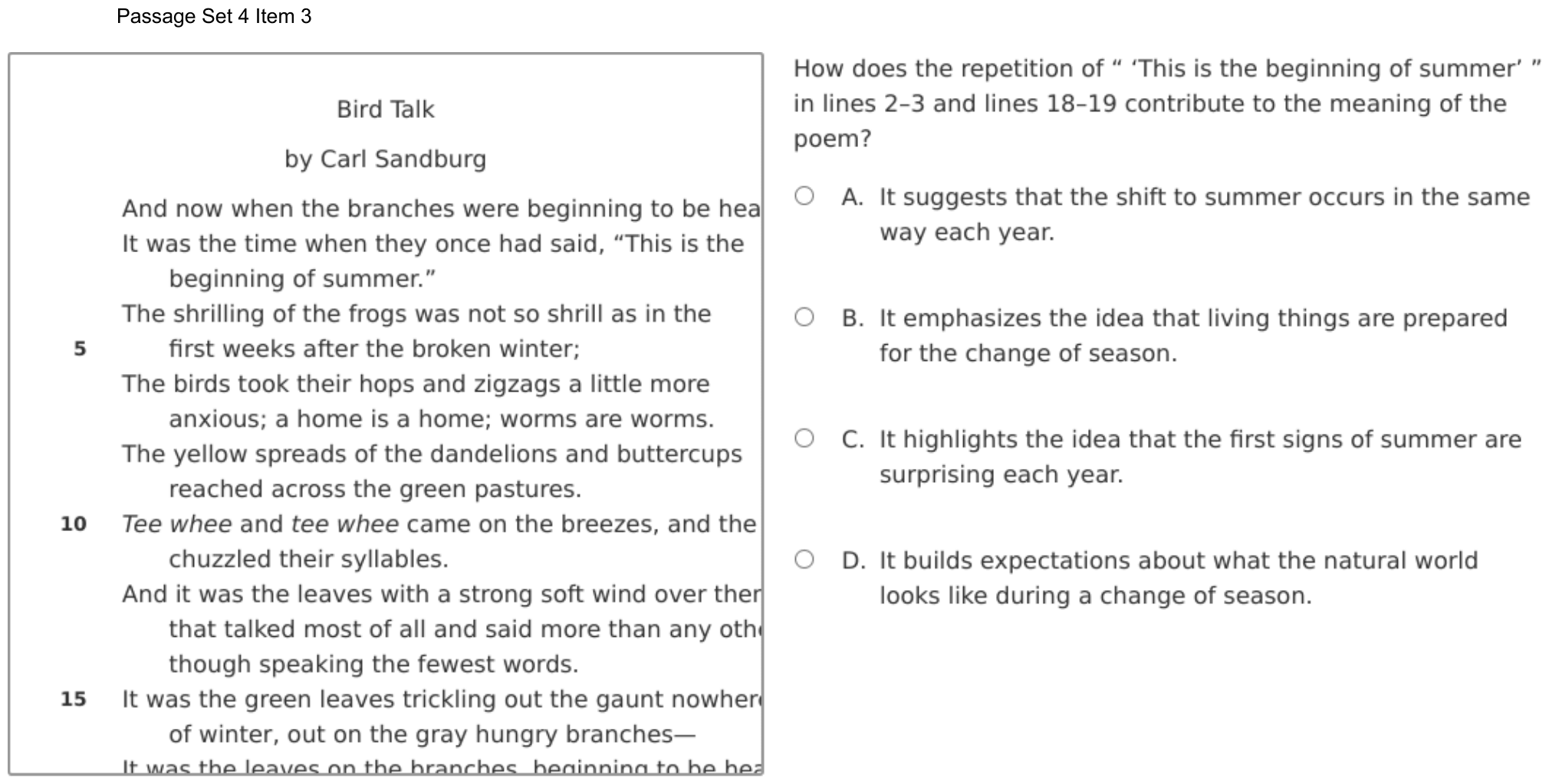
Question 29 of 120
2026 Practice Test C English, question 24Uses the passage above: “Bird Talk”.
Question
Throughout the poem, the poet conveys the speaker’s point of view by
- Agradually moving the speaker’s attention from one element of nature to another.
- Bproviding the speaker’s motivation for describing the landscape in great detail.
- Chighlighting the speaker’s emotional response as each season passes.
- Dshifting the speaker’s focus from external observations to personal reflection.
Show the answer
Correct answer: D
This question asks for an explanation of how the poet conveys the speaker’s point of view on the natural world and the change of seasons as presented in the poem.
A. Incorrect. Though in the first stanza the speaker describes various elements of nature such as branches, frogs, birds, flowers, and leaves, these elemental shifts are not precisely gradual and occur only in the first stanza. Further, the first stanza, though appreciative of the natural world, is primarily descriptive and does not develop the speaker’s perspective to the degree that other parts of the poem do.
B. Incorrect. While it may be inferred that the speaker describes the landscape to such a degree because it has revealed a seasonal shift, that this is indeed the speaker’s motivation is never explicitly conveyed by the poet.
C. Incorrect. Multiple seasons do not pass in the poem; only the shift to the “ ‘beginning of summer’ ” (line 3) occurs in an endless cycle. Further, the speaker does not reveal an emotional response; it is the responses of nature that the speaker describes.
D. CORRECT. The first stanza is the speaker’s observations of the natural world embracing a new season. In the second stanza, the speaker begins to reflect on how the natural world, as embodied by the birds, calmly accepts seasonal change in its perpetual sameness. The reflection continues in the third stanza, where it is revealed that the speaker has been addressing these observations to a child.
Question analysis
This point-of-view question asks how the poet of “Bird Talk” conveys the speaker’s point of view throughout the poem. Students must keep in mind the long opening description of early summer and the two shorter stanzas after it, and decide which description of the poet’s method holds from the first line to the last.
- Grade level
- Grade 8 reading and task
- Compared with grade 7
- Above grade 7 Grade 7 point-of-view questions often ask what a speaker thinks. This one asks how the poet conveys that view across all three stanzas of a long free-verse poem, and the choices name methods in general terms, closer to grade 8 work.
- Estimated difficulty
- Hard: combines ideas, needs a plan, and has more than one tempting wrong answer.
- Thinking it demands
- Depth of knowledge 3, strategic thinking · mainly analyze
- What makes it hard
- Evidence in several places moderate
- A very close wrong answer moderate
- How, not what moderate
- Figurative or literary language minor
- Evidence
- Answered from the whole text
- Reading level
- Passage: 296 words (a poem; reading level not measured); question and choices: about grade 10, 54 words.
- Students, last 30 days
- Not enough answers yet to show (it takes 10).
Why it is hard, traps and wrong answers (shows the answer)
Why it is hard
The first stanza takes up 19 of the poem’s 32 lines and moves steadily from branches to frogs, birds, flowers and leaves, so a choice that describes it alone feels right. The point of view shows only when the poem turns to “We” and then to “I” addressing a child, and that third stanza is three hard lines. Students must keep the whole poem’s course in mind and choose the method that holds from first line to last.
Evidence in several places moderate Working it out
The answer depends on all three stanzas at once: the long catalog of the season in lines 1–19, the shift to “We shall never blame the birds,” and the closing “If I have put your face … child.” (Kirsch & Mosenthal, 1990; Gorin & Embretson, 2006)
A very close wrong answer moderate Choosing the answer
The choice about moving from one element of nature to another and the key both describe a shift in the speaker’s attention; they differ in what shifts, nature to nature or the outside world to the speaker’s own thoughts. (Embretson & Wetzel, 1987; Gorin & Embretson, 2006; Ascalon et al., 2007)
How, not what moderate Working it out
The stem asks how the poet conveys a point of view, a method, so a choice must describe what the speaker does across the poem, not what the speaker sees. (Anderson & Krathwohl, 2001)
Figurative or literary language minor Understanding the question
The last stanza is cryptic, “Blame me no more than the bluejays,” and students who miss that the speaker is now talking about putting a child into the poem lose the move to reflection. (Graesser, Singer & Trabasso, 1994; Kintsch, 1998)
Strategy: Write one phrase for what the speaker attends to in each stanza, then keep only a choice that describes the whole sequence, not one stanza.
Traps
- Too narrow: A single detail offered as the central idea or a summary, or a summary that keeps minor details and leaves out an essential part.
- Reads too much in: A reasonable-sounding conclusion that goes further than the text allows.
- Twists what the text says: Uses the text's topic and ideas but changes what it says: who did it, how much, when, or why.
The wrong answers, classified
A Too narrow (King et al., 2004)
Describes the first stanza well, its walk from branches to frogs, birds, flowers and leaves, but misses the later turn to “We” and to the speaker’s own “I.”
B Reads too much in (Graesser, Singer & Trabasso, 1994)
Supplies a reason for all the description, perhaps from the closing words to a child, but the speaker never says why the landscape is described, and the reflection is not a motive.
C Twists what the text says (King et al., 2004)
Sees that the poem follows nature through a change of season but makes it many seasons and hands the creatures’ reactions, such as the birds’ anxious hops, to the speaker as feelings.
Working it out, step by step
Figure out what the question asks
This asks about point of view: how the speaker, the voice talking in the poem, sees things. It also asks how the poet shows that view across the whole poem. So look at what the speaker pays attention to in each of the three stanzas. A stanza is a group of lines set apart by a blank line.
Follow the speaker through the stanzas
- Stanza 1, lines 1–19: the speaker describes the world outside. There are branches, frogs, birds, flowers and leaves at the start of summer.
- Stanza 2, lines 20–29: the speaker starts to judge and think. “We shall never blame the birds.”
- Stanza 3, lines 30–32: the speaker says “I” and talks to a child: “If I have put your face among leaf faces, child.”
Name the change in focus
The poem starts with external observations, or things the speaker sees and hears outside. It ends with personal reflection, or the speaker’s own thoughts. In the last stanza, the speaker admits to putting a child’s face and voice into the poem. The speaker asks to be blamed “no more than the bluejays.” Since “We shall never blame the birds,” that means not at all. This move from looking outward to looking inward is how the speaker’s view comes through.
Check each choice
- A does not fit. Moving from branches to frogs to birds happens only in stanza 1. It misses the turn to “We” and “I.”
- B does not fit. The speaker never says why the landscape is described.
- C does not fit. Only one change of season happens, the start of summer. The anxious feelings belong to the birds, not the speaker.
- D fits. The speaker moves from describing nature to thinking about it.
Watch out: A describes stanza 1 very well. But the question says “Throughout the poem,” so the answer must cover all three stanzas.
Choose the answer
The speaker starts by watching nature and ends by thinking aloud to a child. So the answer is D, “shifting the speaker’s focus from external observations to personal reflection.”
Why this answer and not the closest wrong one
A is the closest wrong choice. Stanza 1 really does move from one part of nature to another. But that is only 19 of the 32 lines. In stanzas 2 and 3, the speaker turns to “We” and then “I,” and shares personal thoughts. Only D describes the speaker’s path from the first line to the last.
More questions like this
The original DOE question
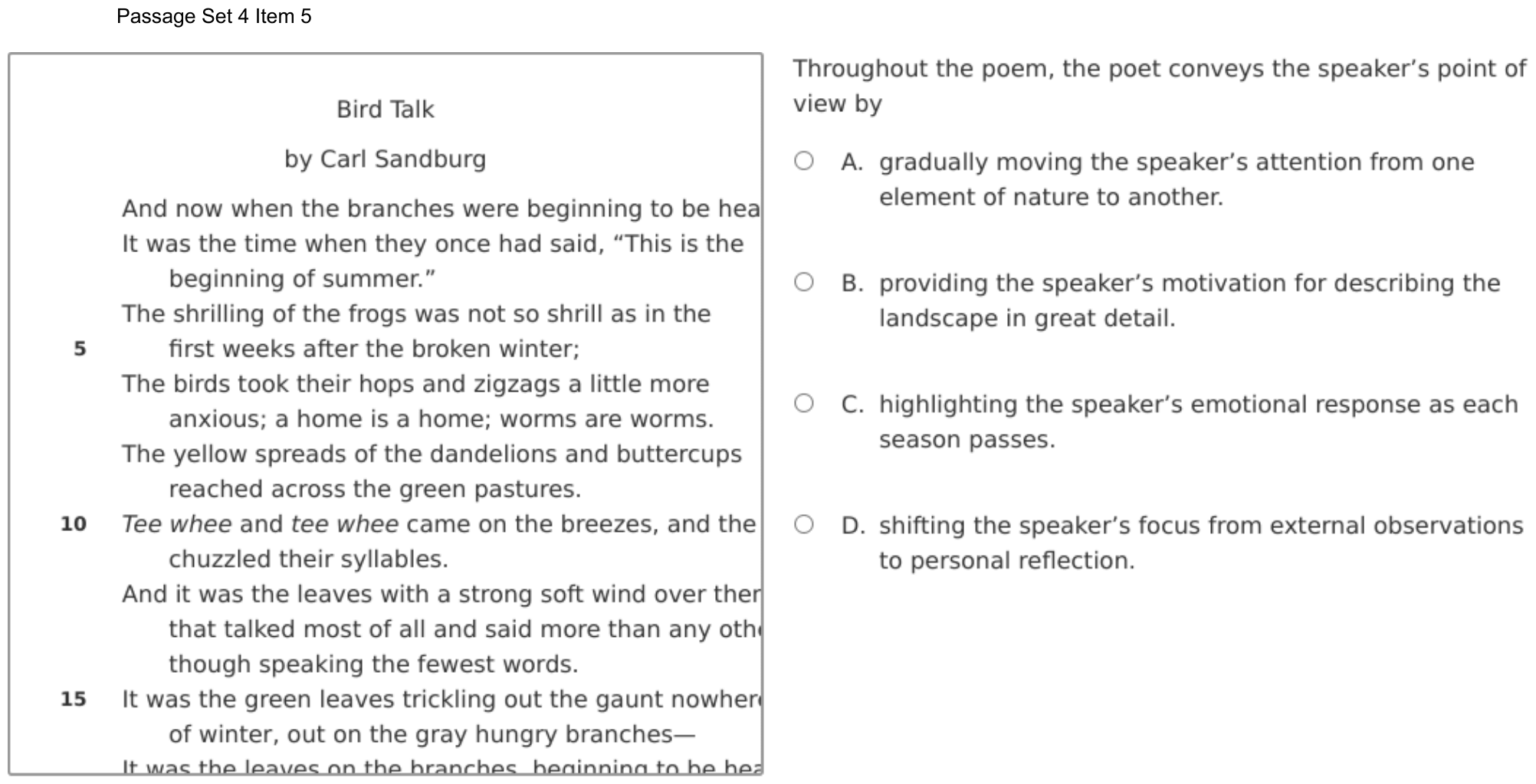
Question 30 of 120
2026 Practice Test C English, question 25Uses the passage above: “Bird Talk”.
Question
Over the course of the poem, a central idea is developed mainly through the speaker’s
- Asense of eager anticipation as winter ends.
- Bdescription of the changes in nature as the seasons transition.
- Cobservation of the birds’ behavior as summer begins.
- Dprediction of future alterations in the physical landscape.
Show the answer
Correct answer: B
The question asks how the central idea about the natural acceptance of change by nature is developed by the speaker of the poem.
A. Incorrect. The speaker is an observer of the changes in nature as propelled by the seasons and shows no personal eagerness for the end of winter. Further, even though nature rejoices at the end of winter as exemplified by “the shrilling of the frogs” (line 4), the speaker merely records this and does not share in this display.
B. CORRECT. The response of nature to the “beginning of summer” (line 3) is the primary focus of the poem as revealed by the speaker through vivid descriptions of the sights, sounds, movements, and attitudes of the natural world.
C. Incorrect. The second stanza of the poem begins a reflection on birds “sitting in circles talking bird talk” (line 22) and taking a sort of attendance of who is present, but this behavioral description is largely figurative and meant to illustrate a point about the way the birds adapt quickly to change, not to develop a central idea of the poem in terms of how nature responds generally.
D. Incorrect. Seasonal changes are inevitable and cyclical per the speaker, but the speaker does not predict future changes to the landscape as a method of developing the central idea. Rather, the speaker describes nature’s response to changes that have already occurred.
Question analysis
Students decide how the speaker of Carl Sandburg’s “Bird Talk” mainly develops a central idea of the poem. The question does not name the idea, so students must work it out across the poem’s three stanzas and then weigh four accounts of what the speaker does, each tied to a different part or feature of the poem.
- Grade level
- Grade 7 reading and task
- Compared with grade 7
- At grade 7 Tracing how a central idea develops is core grade 7 work. Here the idea is never stated, so students must first infer it from 32 lines of free verse and then judge what the speaker mainly does to build it.
- Estimated difficulty
- Moderate: several steps, or a close reading with one strong distractor.
- Thinking it demands
- Depth of knowledge 3, strategic thinking · mainly analyze
- What makes it hard
- A very close wrong answer moderate
- Reading between the lines moderate
- Evidence in several places minor
- Evidence
- Answered from the whole text
- Reading level
- Passage: 296 words (a poem; reading level not measured); question and choices: about grade 9, 48 words.
- Students, last 30 days
- Not enough answers yet to show (it takes 10).
Why it is hard, traps and wrong answers (shows the answer)
Why it is hard
The title “Bird Talk” and the whole second stanza push students toward the birds, and the key differs from that choice only in taking in all of nature. Two other choices credit the speaker with something the poem gives elsewhere: the eagerness belongs to the frogs and birds, and the only look ahead is the birds’ talk of next year. Weighing what the speaker does across all 32 lines points to the description of nature changing.
A very close wrong answer moderate Choosing the answer
The choice about the birds’ behavior as summer begins matches the key’s frame, the speaker watching nature at the turn of the season; it differs only in narrowing nature to birds. (Embretson & Wetzel, 1987; Gorin & Embretson, 2006; Ascalon et al., 2007)
Reading between the lines moderate Working it out
The central idea is never stated, so students must first work out that the poem is about nature meeting the year’s turn calmly, then judge which of the speaker’s acts builds it most. (Graesser, Singer & Trabasso, 1994; Kintsch, 1998)
Evidence in several places minor Working it out
Birds appear in lines 6–7, 10–11, 20–29 and 31–32, so the title and the second stanza make them look central until the branches, frogs, flowers and leaves are counted too. (Kirsch & Mosenthal, 1990; Gorin & Embretson, 2006)
Strategy: Put the poem’s central idea into a sentence of your own, then ask which choice describes something the speaker really does and does the most to build that idea.
Traps
- Too narrow: A single detail offered as the central idea or a summary, or a summary that keeps minor details and leaves out an essential part.
- Wrong tone or attitude: Misjudges the tone, attitude or point of view, such as reading admiration as criticism, or taking a character's or subject's feelings for the author's.
- Reads too much in: A reasonable-sounding conclusion that goes further than the text allows.
The wrong answers, classified
A Wrong tone or attitude (Graesser, Singer & Trabasso, 1994)
Gives the speaker the stir of the shrilling frogs and anxious birds, but the speaker records it calmly, and the poem opens after winter, at “the beginning of summer.”
C Too narrow (King et al., 2004)
Follows the title and the birds’ circles at the Grand Crossing, but birds are one thread in a poem that also tracks branches, frogs, dandelions and leaves into summer.
D Reads too much in (Graesser, Singer & Trabasso, 1994)
Builds a forecast from the birds counting “this year as against next / year,” but that talk concerns who will be gone, not the land, and the speaker predicts nothing.
Working it out, step by step
Figure out what the question asks
This asks how a central idea is mainly built. A central idea is a big point the whole poem makes. First, put that idea in your own words. Then ask what the speaker does most, across the whole poem, to build it.
Find the central idea
The poem shows nature at “the beginning of summer.” The branches grow heavy, the frogs quiet down, the flowers spread and the leaves come out. In stanza 2, the birds calmly count who has come and gone. A central idea is that nature moves through the seasons, and living things accept the change as natural.
See how the speaker builds it
Most of the poem is description. Stanza 1 fills 19 of the 32 lines with changes in nature. It shows “The yellow spreads of the dandelions and buttercups” and “the green leaves trickling out the gaunt nowhere / of winter.” Trickling out means coming out slowly, a little at a time. Gaunt means thin and bare. Detail by detail, the speaker shows the season turning. That description is the main way the idea is built.
Check each choice
- A does not fit. The frogs and birds are stirred up, but the speaker describes them calmly. The poem also starts after winter is over.
- B fits. The speaker describes nature changing as the seasons turn.
- C does not fit. Birds are only one part. The poem also covers branches, frogs, flowers and leaves.
- D does not fit. The speaker predicts nothing about the land. The birds’ talk of next year is about who will be gone.
Watch out: C is tempting because the poem is called “Bird Talk” and stanza 2 is all about birds. But the central idea is about all of nature.
Choose the answer
The speaker builds the idea mostly through details of nature changing as summer begins. So the answer is B, “description of the changes in nature as the seasons transition.”
Why this answer and not the closest wrong one
C is the closest wrong choice. It also has the speaker watching nature as summer begins. But it narrows nature to birds. The poem’s changes come from many living things: branches, frogs, dandelions, buttercups and leaves. Only B takes in all of them, so only B describes how the whole poem builds its idea.
More questions like this
The original DOE question
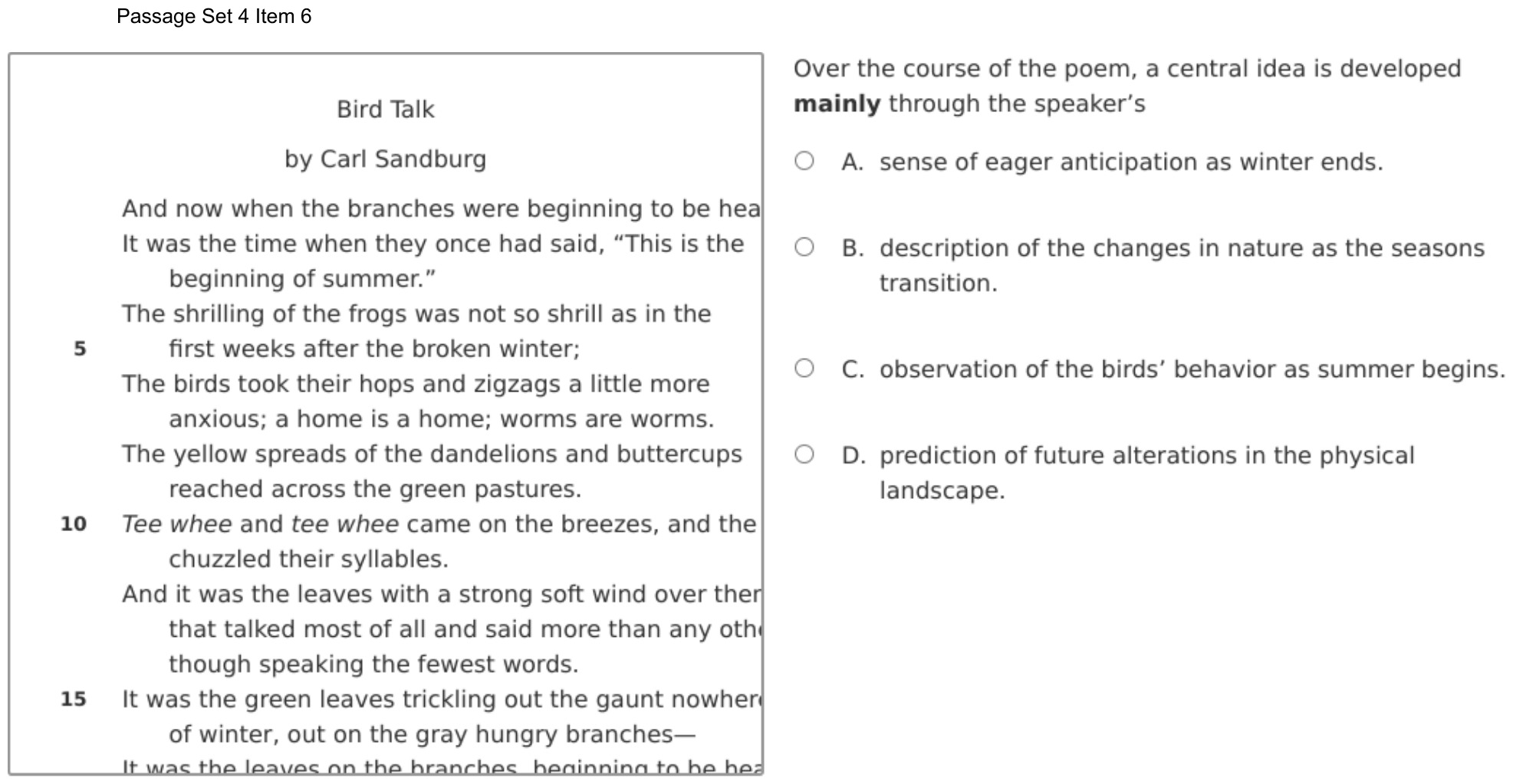
Question 31 of 120
2026 Practice Test C English, question 26Passage Serpent Mound
Serpent Mound
The Great Serpent Mound, located in Adams County, Ohio, is a human-made mound of earth that researchers believe was created between 300 B.C. and A.D. 1100 by an indigenous culture.
Ohio, 1846
Brush Creek stood low when the museum men came
with their measuring tapes and sketchbooks.
It was winter. Fringed with ice,
the creek doubled back on itself
as if it had forgotten something.
Pa was in Cincinnati, or else on his way home,
so Ma told me to lead the men
into the marshy low grounds. It being winter,
there was little underbrush to speak of—
in the summer there would have been
briars, poison ivy, biting flies. I listened
for the swish of a beaver’s heavy tail,
the chitter of a chickadee, or the cry of a hawk,
but the winter silence of the creek pressed
down on all of us like a weight.
The humps in the ground were all but
invisible until you were right up on them. The figure
was even less obvious: the sinuous body,
the tail coiled three times around,
and at the other end, the mouth wide open.
In the summer the creek bottom was crowded
with so much life that you could trip over
the ridges of earth before you saw
anything at all. In winter you could climb
a tree and get some idea of the whole thing:
the serpent’s body undulating, slithering
silently across the ancient
earth. At the mouth end, there was an oval mound
as if the snake were about to swallow an egg—
as snakes sometimes did in our rickety
henhouse—my Pa always said, or
as if swallowing the sun, one of the museum
men suggested, taking notes with his quill pen,
an old-style inkhorn slung at his side.
I liked that: swallowing the sun,
just the sort of thing a snake might do,
might want to do. When, later, I told my sister Ruth,
she disagreed. It is singing to the sun,
she insisted. That is why its mouth
is wide open. She said, “Sometimes I think
I hear it on summer nights. Not swallowing, singing.”
Question
How does the poem’s form contribute to the poem’s meaning?
- AThe use of one continuous stanza and the pattern of the lines mimic the long and winding shape of the mound.
- BThe uneven line lengths emphasize the variety of ways people interpret the meaning of the mound.
- CThe dashes throughout the poem highlight the speaker’s changing thoughts about the significance of the mound.
- DThe lack of a regular rhyme scheme and meter convey that the speaker struggles to comprehend the vastness of the mound.
Show the answer
Correct answer: A
The question asks how the poem’s form contributes to the poem’s meaning.
A. CORRECT. The poem is structured as one long stanza. The line lengths throughout the poem and the line indents (such as those in lines 7–10) create a visual effect so that the poem itself mimics the shape of the Serpent Mound.
B. Incorrect. The uneven line lengths in the poem do not indicate the different interpretations of the mound; separate stanzas or other stopping points would more effectively point to contrasting ideas.
C. Incorrect. The dashes in the poem lead to further explanation of a thought, not a change of thought.
D. Incorrect. The lack of regular rhyme and meter is intended to create a conversational tone rather than show the speaker’s struggle to grasp how large the mound is.
Question analysis
This question about poetic form asks how the form of “Serpent Mound,” a poem set in 1846 at the ancient earthwork in Adams County, Ohio, contributes to its meaning. Students must consider features such as the single stanza, the uneven lines, the dashes and the lack of rhyme, and decide which feature the poem actually puts to work, and how.
- NYS standards
- 7R5 structure and genre features
- Grade level
- Grade 7 reading and task
- Compared with grade 7
- At grade 7 Asking how a poem’s form adds to its meaning is a grade 7 standard. Each choice names a feature that is easy to check on the page and pairs it with a meaning that must also be tested, a typical demand.
- Estimated difficulty
- Hard: combines ideas, needs a plan, and has more than one tempting wrong answer.
- Thinking it demands
- Depth of knowledge 3, strategic thinking · mainly analyze
- What makes it hard
- How, not what major
- A very close wrong answer moderate
- Something you must already know minor
- Evidence
- Answered from the whole text
- Reading level
- Passage: 354 words (a poem; reading level not measured); question and choices: about grade 8, 84 words.
- Students, last 30 days
- Not enough answers yet to show (it takes 10).
Why it is hard, traps and wrong answers (shows the answer)
Why it is hard
Every choice names something really on the page, so the work is in the meaning each attaches. The strongest pull pairs the uneven lines with the poem’s real ending, three readings of the oval mound, and the free-verse choice can lean on line 25’s “some idea of the whole thing.” Seeing the key takes a step back from the words to the poem’s outline, which on the test means scrolling through all 41 lines.
How, not what major Working it out
This is a form question: students must see that the single stanza and the indents stepping right and back, as in lines 6–12, draw a winding body on the page, an effect of layout, not of words. (Anderson & Krathwohl, 2001)
A very close wrong answer moderate Choosing the answer
The choice about uneven line lengths names nearly the same feature as the key, the shape of the lines, but gives it another meaning: the mound’s many interpretations instead of its long, winding form. (Embretson & Wetzel, 1987; Gorin & Embretson, 2006; Ascalon et al., 2007)
Something you must already know minor Working it out
The choices assume “stanza,” “rhyme scheme” and “meter,” and the idea that a poem’s outline can picture its subject, which the poem never explains. (Anderson & Krathwohl, 2001)
Strategy: Test each choice in two steps: confirm that the feature it names is really in the poem, then ask whether the poem supports the meaning the choice attaches to it.
Traps
- Wrong purpose or structure: Names a purpose, structure or effect that the part does not serve, or describes what a part says when the question asks what it does.
- Reads too much in: A reasonable-sounding conclusion that goes further than the text allows.
The wrong answers, classified
B Wrong purpose or structure (Anderson & Krathwohl, 2001)
Pairs two real things, the uneven lines and the different readings of the mound at the end, but nothing ties the line lengths to those readings, which come only in lines 29–41.
C Wrong purpose or structure (Anderson & Krathwohl, 2001)
Spots the dashes in lines 9, 29 and 31, but each one leads into more detail on the thought before it, not into a change in what the speaker thinks of the mound.
D Reads too much in (Graesser, Singer & Trabasso, 1994)
Links free verse to line 25, where a climbed tree gives only “some idea of the whole thing,” but that is about seeing the shape, and the speaker never seems overwhelmed by it.
Working it out, step by step
Figure out what the question asks
This asks about form. Form is how a poem is built and how it looks on the page. It includes stanzas, which are groups of lines set apart by blank lines. It also includes line lengths, indents, rhyme and rhythm. An indent is space at the start of a line that pushes it to the right. You need the choice that ties a real feature of form to the poem’s meaning.
Look at the shape on the page
Don’t read the words yet. Just look. The poem is one long block of 41 lines with no blank lines. So it is one continuous stanza. Its lines do not all start at the left edge. Some are pushed in one step, some two, and some three. The steps go in and come back out, again and again.
Follow the lines in and out
Take lines 6–12. Line 6 starts one step in. Lines 7 and 8 start two steps in. Lines 9 and 10 start three steps in. Line 11 comes back to two steps, and line 12 is back at the left edge. The same swing out and back happens again in lines 19–27 and in lines 33–41. Look down the whole poem. Its left edge curves out and back like a snake winding down the page.
Connect the shape to the mound
The poem is about a giant earth mound shaped like a snake. Line 18 calls it “the sinuous body.” Sinuous means full of curves. Line 26 shows “the serpent’s body undulating, slithering.” Undulating means moving in waves. The one long stanza is like the snake’s long body. The lines curving in and out are like its winding shape. The poem looks like what it describes.
Check each choice
- A fits. The single stanza and the winding lines copy the mound’s long, curving shape.
- B does not fit. The lines are uneven. But the different ideas about the mound come only at the end, in lines 29–41. The line lengths are not tied to them.
- C does not fit. The dashes in lines 9, 29 and 31 lead into more detail. They do not show the speaker’s thoughts changing.
- D does not fit. The poem has no rhyme scheme, or pattern of rhymes, and no meter, or steady beat. But the speaker never struggles to grasp how big the mound is.
Watch out: B is tempting because both of its parts are true. But nothing links the line lengths to the different ideas about the mound.
Choose the answer
The poem’s one long stanza and its in-and-out lines draw a winding snake on the page. So the answer is A, “The use of one continuous stanza and the pattern of the lines mimic the long and winding shape of the mound.”
Why this answer and not the closest wrong one
B is the closest wrong choice. It also points to how the lines look, and the poem does give different ideas about the mound. But the uneven lines run through the whole poem, while those ideas come only at the end. The in-and-out pattern draws a shape, not a set of opinions. That shape is the mound’s long, winding body.
More questions like this
The original DOE question
The passage “Serpent Mound” as printed (page 40)
Question 32 of 120
2026 Practice Test C English, question 28Uses the passage above: “Serpent Mound”.
Question
Lines 1–2 contribute to the development of ideas in the poem by
- Asuggesting that the men are too busy with their work to talk to the speaker.
- Bhelping establish the reason for the men’s visit and purposeful behavior.
- Chinting that the men have hidden motives for studying the mound.
- Dindicating why the speaker is fascinated by the men and wants to help them.
Show the answer
Correct answer: B
The question asks how lines 1–2 contribute to the development of ideas in the poem.
A. Incorrect. The idea that the men are too busy with their work to talk to the speaker is not conveyed in the poem, and, in fact, one of the museum men discusses the oval mound with the speaker (“as if swallowing the sun, one of the museum / men suggested” [lines 32–33]).
B. CORRECT. The lines, with their mention of measuring tapes and sketchbooks, indicate that the reasons the museum men came were to measure the mound and to draw sketches of it.
C. Incorrect. There is little indication in the poem that the museum men have a hidden motive for studying the mound. Lines 1–2 present a straightforward description of the men and their equipment, which emphasizes the men’s academic interest in studying the mound.
D. Incorrect. While the speaker displays some curiosity about the work the museum men are doing (“one of the museum / men suggested, taking notes with his quill pen, / an old-style inkhorn slung at his side. / I liked that” [lines 32–35]), lines 1–2 focus on introducing the idea that the mound is a formation that is worth formal study and examination by experts.
Question analysis
This question asks how the opening lines of “Serpent Mound,” in which museum men arrive at a low winter creek with measuring tapes and sketchbooks, contribute to the development of ideas in the poem. The lines are short and plain, but the choices credit the men or the speaker with motives and feelings, and students must check each against the rest of the poem.
- Grade level
- Grade 6 reading and task
- Compared with grade 7
- Below grade 7 Below typical grade 7 demand: the two opening lines are short and concrete, and checking the choices takes one reading of the poem, much like grade 6 questions on how a single sentence fits into a text.
- Estimated difficulty
- Straightforward: two steps or one careful reading.
- Thinking it demands
- Depth of knowledge 2, skills and concepts · mainly analyze
- What makes it hard
- How, not what minor
- Evidence in several places minor
- Evidence
- Answered from one sentence or line
- Reading level
- Passage: 354 words (a poem; reading level not measured); question and choices: about grade 7, 62 words.
- Students, last 30 days
- Not enough answers yet to show (it takes 10).
Why it is hard, traps and wrong answers (shows the answer)
Why it is hard
The opening lines are short and concrete, and their tools, measuring tapes and sketchbooks, plainly say why the men came. The wrong choices each add something: men too busy to talk, a hidden motive, or a fascinated speaker, and the last borrows the speaker’s later delight in “swallowing the sun.” Checking each against the rest of the poem, rather than against first impressions of strangers arriving, is what the question rewards.
How, not what minor Working it out
The stem asks what lines 1–2 do in the poem, so students must see the measuring tapes and sketchbooks as setting up the visit’s purpose, not only as a description of the men. (Anderson & Krathwohl, 2001)
Evidence in several places minor Working it out
Ruling out two wrong choices takes later lines: a museum man offers the speaker an idea in lines 32–33, and the speaker leads the men in line 7 because Ma says to. (Kirsch & Mosenthal, 1990; Gorin & Embretson, 2006)
Strategy: Say in your own words what lines 1–2 tell you about the men, then reject any choice that depends on something the poem never shows.
Traps
- Reads too much in: A reasonable-sounding conclusion that goes further than the text allows.
- Wrong part of the text: A choice is true of another paragraph, stanza or speaker than the one asked about.
The wrong answers, classified
A Reads too much in (Graesser, Singer & Trabasso, 1994)
Pictures men absorbed in measuring who ignore the child, though nothing says so and one of them later suggests the mound looks “as if swallowing the sun.”
C Reads too much in (Graesser, Singer & Trabasso, 1994)
Reads a secret aim into the visit, but lines 1–2 show the men carrying measuring tools in the open, and the poem never hints at any other purpose.
D Wrong part of the text (Kirsch & Mosenthal, 1990)
Jumps to line 35, where the speaker likes a museum man’s phrase; in lines 1–2 the men have only arrived, and the speaker guides them because Ma says to.
Working it out, step by step
Figure out what the question asks
This asks what lines 1–2 do for the poem’s ideas. They are the poem’s first lines, so they set things up. You need to decide what they tell you about the museum men, and why that matters.
Read lines 1–2
Lines 1–2 say “Brush Creek stood low when the museum men came / with their measuring tapes and sketchbooks.” A measuring tape is for measuring lengths. A sketchbook is for drawing. So the men came to measure the mound and draw it. They have a job to do. Purposeful means acting with a clear goal. Their tools show that goal from the very start.
Check each choice
- A does not fit. Nothing says the men were too busy to talk. Later, one of them shares an idea: “as if swallowing the sun.”
- B fits. The tools show why the men came and that they came to work.
- C does not fit. The men carry their tools in plain view. The poem never hints at a hidden motive, or secret reason.
- D does not fit. The speaker leads the men because “Ma told me to lead the men.” The speaker’s liking for a man’s idea comes much later, in line 35.
Watch out: D borrows a feeling from later in the poem, “I liked that.” In lines 1–2, the men have only just arrived.
Choose the answer
Lines 1–2 use the men’s tools to show why they came and what they plan to do. So the answer is B, “helping establish the reason for the men’s visit and purposeful behavior.”
Why this answer and not the closest wrong one
D is the closest wrong choice. The speaker does later like a museum man’s phrase, “swallowing the sun.” But that comes in line 35. Lines 1–2 say nothing about the speaker’s feelings. They name only the men’s tools. Tapes and sketchbooks tell you why the men came: to measure and draw the mound.
More questions like this
The original DOE question
Question 33 of 120
2026 Practice Test C English, question 30Uses the passage above: “Serpent Mound”.
Question
What impact do the phrases “all but / invisible” and “even less obvious” in lines 16–18 have on the meaning of the poem?
- AThey indicate that viewing the full size and shape of the mound is difficult.
- BThey suggest that the location of the mound is unknown to most people.
- CThey imply that the speaker wants the location of the mound to remain a secret.
- DThey reveal that the speaker is unfamiliar with the significance of the mound.
Show the answer
Correct answer: A
The question asks what impact the phrases “all but / invisible” and “even less obvious” in lines 16–18 have on the meaning of the poem.
A. CORRECT. The words “all but / invisible” indicate that a person must be close to see the humps in the ground, while the phrase “even less obvious” indicates that a person must be far away to see the overall snake shape of the mound.
B. Incorrect. While the speaker has to lead the museum men to the mound because they did not know the exact location, the words in lines 16–18 are related to the difficulty in viewing the mound from the immediate surrounding area.
C. Incorrect. The speaker is willing to take the museum men out to study the mound, so there is no indication in the poem that the speaker wants the location of the mound to remain a secret. The words in lines 16–18 convey the idea that the mound is difficult to see.
D. Incorrect. While the speaker contemplates the significance of certain elements of the mound, the phrases in lines 16–18 relate to a viewer’s ability to see the physical shape of the mound, not its deeper meaning.
Question analysis
This word-meaning question asks what impact the phrases “all but / invisible” and “even less obvious” in lines 16–18 of “Serpent Mound” have on the poem’s meaning. Students must understand the idiom “all but” and then judge which of four claims about the mound and the speaker the two phrases actually support.
- Grade level
- Grade 6 reading and task
- Compared with grade 7
- Below grade 7 Below typical grade 7 demand: both phrases are quoted with their line numbers, in plain modern language, and one careful reading settles the question. The one hurdle is the idiom “all but,” which some readers take literally.
- Estimated difficulty
- Straightforward: two steps or one careful reading.
- Thinking it demands
- Depth of knowledge 2, skills and concepts · mainly understand
- What makes it hard
- Hard words moderate
- Reading between the lines minor
- Evidence
- Answered from one paragraph or stanza
- Reading level
- Passage: 354 words (a poem; reading level not measured); question and choices: about grade 7, 76 words.
- Students, last 30 days
- Not enough answers yet to show (it takes 10).
Why it is hard, traps and wrong answers (shows the answer)
Why it is hard
Both phrases are quoted with their lines, and the sentence that holds them goes on to list the body, the coiled tail and the open mouth, so its subject is what can be seen. The wrong choices slide from seeing to knowing: who knows where the mound is, who wants it hidden, and what it means. “Less obvious” is the slippery phrase, since obvious can also mean easy to understand.
Hard words moderate Understanding the question
“All but” is an idiom meaning almost, so “all but / invisible” means nearly unseen; a student who takes it as the opposite, plainly visible, loses the sense that the humps are hard to see. (Perfetti, 2007; Freedle & Kostin, 1993)
Reading between the lines minor Working it out
Students must keep both phrases about sight and connect them to lines 24–25, where only climbing a tree gives “some idea of the whole thing.” (Graesser, Singer & Trabasso, 1994; Kintsch, 1998)
Strategy: Put both phrases into plain words, starting with the idiom “all but,” then test each choice against what lines 16–25 actually describe.
Traps
- Twists what the text says: Uses the text's topic and ideas but changes what it says: who did it, how much, when, or why.
- Reads too much in: A reasonable-sounding conclusion that goes further than the text allows.
- Dictionary meaning, not meaning here: A common meaning of the word that does not fit its use in this text.
The wrong answers, classified
B Twists what the text says (King et al., 2004)
Turns “invisible” into “unknown,” helped by Ma sending the speaker to guide the men, but the phrases say how hard the mound is to see, not who knows where it is.
C Reads too much in (Graesser, Singer & Trabasso, 1994)
Finds a wish for secrecy in the hidden humps, though the speaker leads the museum men straight to the mound and never tries to keep it from anyone.
D Dictionary meaning, not meaning here (Perfetti, 2007)
Takes “less obvious” in its sense of harder to understand, but the sentence goes straight on to list the body, the coiled tail and the open mouth, so the word is about sight.
Working it out, step by step
Figure out what the question asks
This asks what two phrases add to the poem’s meaning. They are “all but / invisible” and “even less obvious,” in lines 16–18. Put each phrase in plain words first. Then see what they tell you about the mound.
Read lines 16–18
Lines 16–18 say “The humps in the ground were all but / invisible until you were right up on them. The figure / was even less obvious.” “All but” means almost. So the humps were almost invisible until you got very close. The figure is the whole snake shape. It was even harder to see than the humps. Here, obvious means easy to see.
Connect the phrases to later lines
The same sentence goes on to list what you would see: “the sinuous body, / the tail coiled three times around, / and at the other end, the mouth wide open.” So the phrases are about seeing the shape. Later, lines 24–25 say “In winter you could climb / a tree and get some idea of the whole thing.” Only from up high could you begin to see it. The mound is huge, low and hard to take in all at once.
Check each choice
- A fits. Both phrases show that seeing the whole mound is hard.
- B does not fit. The phrases are about how hard the mound is to see, not about who knows where it is.
- C does not fit. The speaker leads the museum men right to the mound. There is no wish to keep it secret.
- D does not fit. Here “less obvious” is about sight, not about understanding what the mound means.
Watch out: Obvious can also mean easy to understand. That reading leads to D. But the sentence goes straight on to list parts of the snake you can see.
Choose the answer
The phrases show how hard it is to see the mound’s full size and shape. So the answer is A, “They indicate that viewing the full size and shape of the mound is difficult.”
Why this answer and not the closest wrong one
B is a close wrong choice, because “invisible” can make you think nobody knows the mound is there. But the phrases describe looking, not knowing. The speaker knows exactly where the mound is. The problem is seeing it. The humps vanish until “you were right up on them,” and the whole shape shows only from a tree.
More questions like this
The original DOE question
Question 34 of 120
2026 Practice Test C English, question 32Uses the passage above: “Serpent Mound”.
Question
How does the speaker’s interaction with Ruth in lines 37–41 convey a central idea of the poem?
- AIt suggests that the most accurate interpretations of the mound come from knowing the purpose of the mound.
- BIt emphasizes that there are multiple interpretations of the mound based on feelings and experiences.
- CIt reveals the benefit of considering different interpretations of the mound’s significance.
- DIt implies that scientific study of the mound’s purpose will affect what the mound symbolizes to people.
Show the answer
Correct answer: B
The question asks how the interaction between the speaker and Ruth in lines 37–41 conveys a central idea of the poem.
A. Incorrect. While there are many different interpretations of the mound’s meaning, there is no way to determine which of the interpretations is most accurate, and there is no way to know the mound’s true purpose.
B. CORRECT. The interaction references Ruth’s interpretation of the open-mouth shape as a serpent singing to the sun. This interpretation creates a joyful mood. The speaker contrasts this perspective with the idea that the mound is swallowing the sun, which creates a more aggressive feeling. These various interpretations of a physical shape arise out of what the individuals feel when they look at the mound.
C. Incorrect. The speaker does not describe any benefit to considering what different people imagine when they see the mound. Instead, the speaker is simply describing different interpretations.
D. Incorrect. Ruth’s interpretation of the mound’s shape is fanciful and symbolic. It is unlikely that scientific study would change the minds of people such as Ruth about the meaning of the mound.
Question analysis
This central idea question asks how the speaker’s conversation with a sister, Ruth, in lines 37–41 of “Serpent Mound” conveys a central idea of the poem. Ruth explains the serpent’s open mouth in her own way, and students must connect this short exchange to the rest of the poem before choosing among four claims about what it shows.
- Grade level
- Grade 7 reading and task
- Compared with grade 7
- At grade 7 Linking a short exchange between two characters to a poem’s central idea is standard grade 7 work. The language is plain, though the choices differ in what they claim the exchange shows, so each must be checked closely.
- Estimated difficulty
- Moderate: several steps, or a close reading with one strong distractor.
- Thinking it demands
- Depth of knowledge 2, skills and concepts · mainly analyze
- What makes it hard
- A very close wrong answer moderate
- Reading between the lines moderate
- Evidence in several places minor
- Evidence
- Answered from one paragraph or stanza
- Reading level
- Passage: 354 words (a poem; reading level not measured); question and choices: about grade 10, 78 words.
- Students, last 30 days
- Not enough answers yet to show (it takes 10).
Why it is hard, traps and wrong answers (shows the answer)
Why it is hard
Ruth’s “Not swallowing, singing” makes the disagreement plain, so most students see that the mound is read in more than one way. The difficulty is in what the choices add to that: a lesson about the benefit of differing views, a ranking of readings by the mound’s purpose, or a role for science. The poem only sets the readings side by side, each rooted in what its speaker has lived or felt.
A very close wrong answer moderate Choosing the answer
The choice about the benefit of considering different interpretations shares the key’s subject, several readings of the mound, and differs only in adding a lesson, that weighing them is worthwhile. (Embretson & Wetzel, 1987; Gorin & Embretson, 2006; Ascalon et al., 2007)
Reading between the lines moderate Working it out
The exchange is a plain disagreement, swallowing against singing, and students must infer the central idea it serves, that people see the mound through their own feelings and experiences. (Graesser, Singer & Trabasso, 1994; Kintsch, 1998)
Evidence in several places minor Working it out
Ruth’s reading answers earlier ones, Pa’s egg from the henhouse in lines 29–31 and the museum man’s sun in line 32, so her lines must be read against them. (Kirsch & Mosenthal, 1990; Gorin & Embretson, 2006)
Strategy: Sum up what Ruth says and how the speaker reacts, compare it with the earlier ideas about the oval mound, and pick the claim the poem shows rather than one it might only suggest.
Traps
- Reads too much in: A reasonable-sounding conclusion that goes further than the text allows.
- Outside knowledge: A choice is plausible in the real world but not supported by this text.
The wrong answers, classified
A Outside knowledge (King et al., 2004; Recht & Leslie, 1988)
Applies the sensible idea that knowing why something was built settles what it means, but the poem never ranks the readings or says anyone knows the mound’s purpose.
C Reads too much in (Graesser, Singer & Trabasso, 1994)
Rightly sees several readings of the mound, then adds a moral, that weighing them is helpful, which the poem never states; Ruth and the speaker simply disagree.
D Reads too much in (Graesser, Singer & Trabasso, 1994)
Connects the museum men’s measuring with the family’s readings at the end, but nobody suggests that study will change what the mound means to Ruth or anyone else.
Working it out, step by step
Figure out what the question asks
This asks how the talk between the speaker and Ruth, in lines 37–41, shows a central idea. A central idea is a big point the whole poem makes. Compare Ruth’s idea about the mound with the speaker’s, and with the ideas that come before.
Read the talk with Ruth
The speaker liked a museum man’s idea that the snake was “swallowing the sun.” But when the speaker told Ruth, “she disagreed. It is singing to the sun, / she insisted.” Ruth explains, “That is why its mouth / is wide open.” Then she says, “Sometimes I think / I hear it on summer nights. Not swallowing, singing.”
See where each idea comes from
Each person sees the same oval mound in a different way. Pa always said it was like a snake about to swallow an egg, as snakes did in the family’s henhouse. A museum man saw it swallowing the sun. Ruth hears it singing on summer nights. Each idea grows out of that person’s own feelings and experiences, or what they have lived through. That is a central idea: people see the mound in many ways.
Check each choice
- A does not fit. No one in the poem knows the mound’s purpose, and no idea is called the most accurate.
- B fits. Ruth and the speaker see the mound differently, each from what they feel and have lived.
- C does not fit. The poem never says that thinking about other ideas helps anyone. Ruth and the speaker just disagree.
- D does not fit. Nobody says the men’s study will change what the mound means to people.
Watch out: C starts out right, since there are different ideas. But it adds a lesson, a “benefit,” that the poem never gives.
Choose the answer
The disagreement shows more than one way to see the mound, each rooted in a person’s own feelings and experiences. So the answer is B, “It emphasizes that there are multiple interpretations of the mound based on feelings and experiences.”
Why this answer and not the closest wrong one
C is the closest wrong choice. It also says there are different ideas about the mound. But it claims there is a benefit, or gain, in thinking them over. The poem shows no one gaining anything. Ruth keeps her own idea, and the poem never says who is right. It simply sets the ideas side by side, each from a person’s own life.
More questions like this
The original DOE question
Question 35 of 120
2026 Practice Test C English, question 33Uses the passage above: “Serpent Mound”.
Question
The poet contrasts the speaker’s and Ruth’s points of view regarding the mound by using dialogue to
- Aimply that Ruth is worried that her interpretation of the mound will be seen as too abstract.
- Bindicate that Ruth hopes her interpretation of the mound will be shared by the men from the museum.
- Csuggest that Ruth wants the speaker to agree with her interpretation of the mound.
- Dshow that Ruth has already decided on her interpretation of the mound.
Show the answer
Correct answer: D
The question asks how the poet uses dialogue to contrast the points of view of the speaker and Ruth regarding the mound.
A. Incorrect. The interpretation Ruth offers of the mound as a snake singing is abstract, but Ruth does not seem concerned that it is an overly metaphorical or figurative interpretation. The dialogue serves to highlight that Ruth is firm in her belief.
B. Incorrect. There is no indication that the museum men are considering Ruth’s interpretation of the mound or that Ruth wants them to share her interpretation. Ruth’s interpretation is meant to convey an abstract idea, while the museum men would be looking for a firm academic explanation of the mound. Ruth is persistent in her belief, and the dialogue does not suggest that she is concerned with the museum men’s interpretation or findings.
C. Incorrect. Ruth merely states her interpretation and says that she thinks she hears the Serpent Mound singing sometimes. She does not seek to make the speaker agree with her.
D. CORRECT. Beginning in line 37, after the speaker suggests the mound is swallowing the sun, Ruth disagrees. The poet uses the word “insisted” in line 39 to show that Ruth firmly believes in her own interpretation of the mound.
Question analysis
This point-of-view question asks how the poet of “Serpent Mound” uses dialogue to contrast the speaker’s and Ruth’s views of the mound in the poem’s closing lines. Students must read Ruth’s few words closely, since each choice credits her with a different attitude toward her own interpretation.
- Grade level
- Grade 7 reading and task
- Compared with grade 7
- At grade 7 Analyzing how a writer contrasts two characters’ points of view is exactly what the grade 7 standard describes. The dialogue is only a few lines long, but each choice describes Ruth’s attitude in a different way.
- Estimated difficulty
- Moderate: several steps, or a close reading with one strong distractor.
- Thinking it demands
- Depth of knowledge 2, skills and concepts · mainly analyze
- What makes it hard
- A very close wrong answer moderate
- Reading between the lines moderate
- Evidence
- Answered from one paragraph or stanza
- Reading level
- Passage: 354 words (a poem; reading level not measured); question and choices: about grade 8, 78 words.
- Students, last 30 days
- Not enough answers yet to show (it takes 10).
Why it is hard, traps and wrong answers (shows the answer)
Why it is hard
The dialogue is only a few lines, and every choice is about Ruth’s attitude toward her own reading. “Insisted” is the hinge: it can sound like pressing someone to agree, but nothing follows that asks the speaker anything. The hedge “Sometimes I think” can also be misread as worry, though it introduces what she hears, not doubt about her view.
A very close wrong answer moderate Choosing the answer
The choice about Ruth wanting agreement and the key both rest on “she insisted”; they differ in whether insisting aims to win the speaker over or shows her mind is already made up. (Embretson & Wetzel, 1987; Gorin & Embretson, 2006; Ascalon et al., 2007)
Reading between the lines moderate Working it out
Ruth’s attitude is never named, so students must read it from “she disagreed,” “she insisted” and the clipped “Not swallowing, singing,” and from what she does not do: ask for agreement. (Graesser, Singer & Trabasso, 1994; Kintsch, 1998)
Strategy: Reread lines 37–41 and describe Ruth’s attitude in a few words of your own before looking at the choices, then pick the one the lines themselves show.
Traps
- Reads too much in: A reasonable-sounding conclusion that goes further than the text allows.
- Wrong tone or attitude: Misjudges the tone, attitude or point of view, such as reading admiration as criticism, or taking a character's or subject's feelings for the author's.
The wrong answers, classified
A Wrong tone or attitude (Graesser, Singer & Trabasso, 1994)
Hears doubt in “Sometimes I think / I hear it,” but that hedge is about a sound on summer nights, and “insisted” shows confidence, not worry about seeming too fanciful.
B Reads too much in (Graesser, Singer & Trabasso, 1994)
Brings the museum men into a talk they are not part of; Ruth speaks only to the speaker, later, and never mentions the men or their findings.
C Reads too much in (Graesser, Singer & Trabasso, 1994)
Reads “insisted” as an effort to win the speaker over, but Ruth only states her view and what she hears, and asks for no agreement.
Working it out, step by step
Figure out what the question asks
This asks what the poet shows by using dialogue, the words people say to each other. The speaker and Ruth have different points of view about the mound. You need to decide what Ruth’s words show about her attitude, or how she feels about her own idea.
Read the dialogue in lines 37–41
The speaker tells Ruth the idea of “swallowing the sun.” The poem says “she disagreed. It is singing to the sun, / she insisted. That is why its mouth / is wide open.” Then she says, “Sometimes I think / I hear it on summer nights. Not swallowing, singing.”
Look closely at the word insisted
To insist is to say something firmly and refuse to back down. Ruth doesn’t say “maybe.” She doesn’t ask what the speaker thinks. She ends with three short words: “Not swallowing, singing.” That sounds final. She has her own reason, too: what she hears on summer nights. Her mind was made up before this talk began.
Check each choice
- A does not fit. “Sometimes I think” is about a sound she hears. It is not worry that her idea is too abstract, or too far from real things.
- B does not fit. Ruth talks only to the speaker, later. She never mentions the museum men.
- C does not fit. Ruth states her view, but she never asks the speaker to agree.
- D fits. “Insisted” and her firm last words show that her mind is made up.
Watch out: “Insisted” can sound like pushing someone to agree, which leads to C. But nothing in her words asks for agreement.
Choose the answer
Ruth’s firm words show she is sure of her own idea. So the answer is D, “show that Ruth has already decided on her interpretation of the mound.”
Why this answer and not the closest wrong one
C is the closest wrong choice. Both C and D rest on the word “insisted.” But insisting can show that you are sure without trying to win anyone over. Ruth never asks whether the speaker agrees. She just states her view and what she hears. That shows her mind is already made up, which is what D says.
More questions like this
The original DOE question
Question 36 of 120
2026 Practice Test C English, question 35Passage Excerpt from “Growing Peppers on the ISS Is Just the Start of Space Farming”
Excerpt from “Growing Peppers on the ISS Is Just the Start of Space Farming”
by Melanie Canales
The author, Melanie Canales, is a first-generation Peruvian American farmer and beekeeper based in Virginia’s Shenandoah Valley, on lands of the indigenous Monacan and Manahoac tribes. Her work focuses on creating healthy relationships between people and their surrounding ecosystems.
Unburdened by the constraints of gravity, red and green peppers jut out at 45-degree angles inside the Advanced Plant Habitat (APH), a sort of space terrarium not much larger than a microwave. Four chile pepper plants stand effortlessly upright, despite the dozens of glossy fruits weighing them down. These plants have lived entirely in space; their leaves have never been chewed on by insects or rustled by a summer breeze, [and] their stems are unfamiliar with bending toward the sun’s arc across the sky. Scissors glint under the tank’s white and blue lights as astronaut Mark Vande Hei and his team snip the stems of those that are ready for harvest. The peppers whirl around their heads until the astronauts catch them and tape them against a board to photograph.
Back on Earth, the Plant Habitat-04 team of engineers and plant scientists are observing and conferring with the astronauts. Of the 26 peppers in this batch, only the 14 finest will stay on the International Space Station [ISS] for consumption. The rest will be wrapped in foil, sealed in a Ziploc bag, then frozen at a brisk −80 degrees, until they can come roaring back to Earth in the next cargo capsule to be studied later. Now, after a 137-day growth cycle, the astronauts remove the plants from the module and trash them. Project Plant Habitat-04 is complete. It’s taco night on the ISS.
Since 2014, NASA1 has experimented with growing lettuces, brassicas,2 and zinnias3 in space, an endeavor that relies on highly specialized technology over 50 years in the making. [Fall 2021’s] two successful pepper harvests . . . will provide data on the nutritional and psychological benefits of growing vegetables on-craft, as well as a crop’s ability to reliably produce long-term in microgravity. While controlled environmental agriculture is not new, the APH experiment represents an evolution in specialized growth habitats. It doesn’t aim to re-create Earth’s conditions, but to perfect each isolated variable of plant growth in the clinical environment of a spaceship.
“The Advanced Plant Habitat is the most complex plant growth system on orbit today,” says Lashelle Spencer, a plant scientist at NASA’s Kennedy Space Center. Its more than 180 sensors control and monitor temperature, humidity, and carbon dioxide. The astronauts can adjust the color and intensity of the light, and how much moisture the plants’ roots are getting. It waters itself.
It’s the day after Thanksgiving, and Spencer has been at Kennedy since 5 a.m. to facilitate the peppers’ final harvest. As part of the project team, she played a crucial role in preparing the seeds that were sent hurtling into space in June and guiding the astronauts through maintaining the plants in orbit. . . . Though astronauts can spend upwards of 100 days in space, their on-mission meals come dehydrated and pre-packaged; their vitamins and minerals are isolated in supplements, which lose nutritional value the longer they’re stored. Spencer’s goal is to create the conditions necessary for cultivating healthy plants in space, so those plants can sustain healthy astronauts on long-term missions. Astronaut food is great, she says—“especially the shrimp cocktail. But you’re missing that crunch. You’re missing that fresh pop of flavor, the green flavor that’s not there in that packaged food.”
The sensory experience of growing productive crops can also help mitigate4 the psychological effects of long-term space travel. . . . Spencer says the team cracked open the door of the APH every day to observe their vegetable companions with all the tenderness of home gardeners. When harvest day came, they batted their bounty around the ISS, taking selfies and delighting in watching the fruits pirouetting around the spacecraft. . . .
“We were thinking no heat, so that [the peppers] wouldn’t be dangerous, but maybe the astronauts need a little spice in their life,” says Paul Bosland, who along with his colleagues at the Chile Pepper Institute genetically engineered5 the NuMex Española Improved chile pepper seeds grown in Plant Habitat-04. . . .
Working with NASA, Bosland cultivated a variety that could accommodate both the nutritional needs of astronauts as well as the logistics of growing a plant in space. . . .
. . . The experiment is helping gather the data necessary to determine the nutritional content of crops grown in space, and therefore how many people they can feed, and for how long. Though much is still unknown, Spencer is certain of one thing that future astronauts will need to do: “I think in an optimal world, a scientist like me would say that they would be growing plants from day one. From the day they left to the day they came back, they would be growing them.”
From “Growing Peppers on the ISS Is Just the Start of Space Farming” by Melanie Canales from WIRED, December 21, 2021. Copyright © 2021 Condé Nast. All rights reserved.
1NASA: National Aeronautics and Space Administration
2brassicas: a large genus of herbs, such as broccoli and cabbage
3zinnias: a genus of herbs and low shrubs that have flowers at their heads
4mitigate: to make something less severe or harmful
5genetically engineered: combined parts of DNA from different plants to produce a new plant
Question
Read this sentence from paragraph 5.
Though astronauts can spend upwards of 100 days in space, their on-mission meals come dehydrated and pre-packaged; their vitamins and minerals are isolated in supplements, which lose nutritional value the longer they’re stored.
The sentence contributes to the overall meaning of the excerpt by
- Aindicating that the attempt to grow crops aboard the ISS is an important endeavor.
- Bdescribing the health effects of spending a significant length of time in space.
- Crevealing why certain kinds of foods are more appealing in space than on Earth.
- Demphasizing the difficulty of preserving the nutrients in the crops grown in space.
Show the answer
Correct answer: A
The question asks how a sentence from paragraph 5 contributes to the overall meaning of the excerpt.
A. CORRECT. The sentence explains that astronauts’ current food supply consists of dehydrated foods along with vitamin and mineral supplements that lose nutritional value over time. These details support the idea that growing fresh crops in space, as described in the excerpt, is important for astronauts’ nutrition during long missions.
B. Incorrect. While the sentence mentions food and nutrients and astronauts spending “upwards of 100 days in space,” it does not describe the overall health effects of being in space for this long. Instead, the sentence focuses on the limitations of the food available to astronauts.
C. Incorrect. While the sentence does mention that astronauts eat packaged and dehydrated food while in space and that the food and supplements provided are limited in nutritional value, it does not mention the appeal of foods eaten in space compared with foods eaten on Earth.
D. Incorrect. The sentence explains that supplements can lose their nutritional value over time, but it does not mention whether crops grown in space might also lose nutrients.
Question analysis
This question quotes a sentence from paragraph 5 of the space-farming excerpt about the dehydrated, pre-packaged meals astronauts eat on missions of 100 days or more and the vitamin supplements that lose value in storage. Students explain how the sentence contributes to the overall meaning of the excerpt, which means looking past what it says to the job it does in the article.
- Grade level
- Grade 7 reading and task
- Compared with grade 7
- At grade 7 Explaining how one sentence adds to a text’s overall meaning is a core grade 7 skill. The quoted sentence is long but plainly worded, and the paragraph around it is easy to follow, so the task matches typical grade 7 reading.
- Estimated difficulty
- Straightforward: two steps or one careful reading.
- Thinking it demands
- Depth of knowledge 2, skills and concepts · mainly analyze
- What makes it hard
- How, not what moderate
- The right answer is reworded minor
- Reading between the lines minor
- Evidence
- Answered from one paragraph or stanza
- Reading level
- Passage: about grade 10, 890 words; question and choices: about grade 9, 102 words.
- Students, last 30 days
- Not enough answers yet to show (it takes 10).
Why it is hard, traps and wrong answers (shows the answer)
Why it is hard
The sentence is easy to understand but easy to misuse: its last clause about supplements losing value invites a choice about nutrients fading, and its “100 days” invites one about health. Students who ask what problem the sentence sets up, and notice that the next sentence answers it with Spencer’s goal, see that it explains why growing food in orbit matters.
How, not what moderate Working it out
The stem asks what the sentence does for the whole excerpt, so its facts about dehydrated meals and fading supplements matter only as the problem that crops grown aboard the ISS would solve. (Anderson & Krathwohl, 2001)
The right answer is reworded minor Choosing the answer
The key names none of the sentence’s facts, while the nutrient choice echoes “lose nutritional value the longer they’re stored” and so looks better supported by the quoted words. (Freedle & Kostin, 1993; Kirsch & Mosenthal, 1990)
Reading between the lines minor Working it out
The sentence never says why its facts matter; the reason appears only in the next one, Spencer’s goal of plants that “sustain healthy astronauts on long-term missions.” (Graesser, Singer & Trabasso, 1994; Kintsch, 1998)
Strategy: Put the sentence into your own words, note exactly what it says loses value, and then decide what role that fact plays in the excerpt as a whole, not just within the sentence.
Traps
- Twists what the text says: Uses the text's topic and ideas but changes what it says: who did it, how much, when, or why.
- Reads too much in: A reasonable-sounding conclusion that goes further than the text allows.
The wrong answers, classified
B Reads too much in (Graesser, Singer & Trabasso, 1994)
Reads “upwards of 100 days in space” and the talk of vitamins as a warning about astronauts’ health, though the sentence describes their food, not what a long mission does to the body.
C Twists what the text says (King et al., 2004)
Links “dehydrated and pre-packaged” to Spencer’s later longing for crunch and turns it into a comparison of how appealing food is in space and on Earth, which the sentence never makes.
D Twists what the text says (King et al., 2004)
Sees nutritional value fading in storage but moves the problem from the stored supplements, which the sentence names, to crops grown in space, which it never mentions.
Working it out, step by step
Figure out what the question asks
This question asks about the job one sentence does in the whole article. Don’t just restate the sentence. Ask why the author put it here. What bigger idea does it help explain?
Read the sentence closely
The sentence is in paragraph 5. It says astronauts can spend “upwards of 100 days in space.” Upwards of means more than. Their meals “come dehydrated and pre-packaged.” Dehydrated means dried out. Their vitamins and minerals come in pills called supplements. And those pills “lose nutritional value the longer they’re stored.” So they get less healthy the longer they sit.
See what comes right after it
The next sentence shows why this matters: “Spencer’s goal is to create the conditions necessary for cultivating healthy plants in space, so those plants can sustain healthy astronauts on long-term missions.” To sustain means to keep going. So the sentence sets up a problem. Food on long trips is dried, packaged and weak. Fresh crops grown in space would solve it. That makes the pepper project worth doing.
Check each choice
- A is right. The sentence shows the problem that fresh crops would fix. So it shows that growing crops on the ISS is important.
- B is wrong. It mentions “100 days,” but it tells about food, not what space does to the body.
- C is wrong. It never compares how food tastes in space and on Earth.
- D is wrong. The things that lose value are the stored supplements, not crops grown in space.
Watch out: D uses words close to the sentence’s own. But it moves the problem to the wrong thing.
Choose the answer
The sentence explains why fresh food grown in space matters. So the answer is A, “indicating that the attempt to grow crops aboard the ISS is an important endeavor.” An endeavor is a serious effort.
Why this answer and not the closest wrong one
D is the closest wrong answer, because the sentence does say that something loses value over time. But it is the supplements in storage that “lose nutritional value.” The sentence never says crops grown in space lose nutrients. Fresh crops are the fix, not the problem. That is why A fits.
More questions like this
The original DOE question
The passage “Excerpt from “Growing Peppers on the ISS Is Just the Start of Space Farming”” as printed (pages 50–51)
Question 37 of 120
2026 Practice Test C English, question 36Uses the passage above: “Excerpt from “Growing Peppers on the ISS Is Just the Start of Space Farming””.
Question
Which statement best explains why Lashelle Spencer is a relevant source of information for the excerpt?
- AShe works at NASA’s Kennedy Space Center.
- BShe is part of the APH project team.
- CShe is sensitive to the astronauts’ need for healthy food in space.
- DShe witnessed how astronauts aboard the APH responded when harvesting their food.
Show the answer
Correct answer: B
The question asks which statement best explains why Lashelle Spencer is a relevant source of information for the excerpt.
A. Incorrect. While paragraphs 4 and 5 do mention that Lashelle Spencer works at NASA’s Kennedy Space Center, that fact does not explain her direct expertise on growing plants in space.
B. CORRECT. In paragraph 4, Spencer is identified as a “plant scientist” at NASA, and paragraph 5 states that she is directly involved with the Advanced Plant Habitat as “part of the project team,” making her a relevant source of information for the excerpt’s discussion of growing plants in space.
C. Incorrect. Although the details in paragraph 5 do indicate that Spencer is interested in providing better food choices to astronauts, her empathy toward the astronauts’ needs does not make her a relevant source of information for the excerpt.
D. Incorrect. Paragraph 5 does mention that Spencer helped facilitate the harvest from the Kennedy Space Center, so she likely did witness the astronauts’ reactions as they harvested the peppers; however, this inference does not explain Spencer’s relevance as a source of information for the excerpt.
Question analysis
Why is Lashelle Spencer, the NASA plant scientist quoted throughout the article on growing peppers in space, a relevant source of information? This question asks students to judge what qualifies a person quoted in an informational text to speak on its subject. Several choices state facts about her, so students must decide which one actually explains her value as a source.
- Grade level
- Grade 7 reading and task
- Compared with grade 7
- At grade 7 Grade 7 readers often judge whether evidence is relevant, though asking why a quoted expert deserves trust is a less common form of the task. The facts about Spencer sit in two neighboring paragraphs, so the reading demand itself is typical.
- Estimated difficulty
- Moderate: several steps, or a close reading with one strong distractor.
- Thinking it demands
- Depth of knowledge 2, skills and concepts · mainly evaluate
- What makes it hard
- Every choice must be checked moderate
- Reading between the lines minor
- Evidence in several places minor
- Evidence
- Answered from several paragraphs or stanzas
- Reading level
- Passage: about grade 10, 890 words; question and choices: about grade 7, 55 words.
- Corrected from the DOE handbook
- A wrong paragraph number in the explanation was corrected.
- Students, last 30 days
- Not enough answers yet to show (it takes 10).
Why it is hard, traps and wrong answers (shows the answer)
Why it is hard
The pull of this question is that the first thing the excerpt says about Spencer, her job at NASA’s Kennedy Space Center, sounds like a credential. Paragraph 5 gives the stronger one: she helped prepare the seeds and guided the crew, so she knows this experiment firsthand. Students lose the point by stopping at the job title, or by treating her sympathy for the astronauts or a harvest she supposedly watched as expertise.
Every choice must be checked moderate Choosing the answer
Her Kennedy workplace, her concern for well-fed astronauts and her role on the project all come from paragraphs 4 and 5, so truth rules out little; each must be weighed as a qualification. (Embretson & Wetzel, 1987)
Reading between the lines minor Working it out
The excerpt never says why Spencer is quoted; a reader must connect “part of the project team” and “guiding the astronauts” to her firsthand knowledge of this particular experiment. (Graesser, Singer & Trabasso, 1994; Kintsch, 1998)
Evidence in several places minor Working it out
Spencer is introduced in paragraph 4 as a NASA plant scientist, but her place on the pepper project appears only in paragraph 5, after a sentence about Thanksgiving. (Kirsch & Mosenthal, 1990; Gorin & Embretson, 2006)
Strategy: Find every detail paragraphs 4 and 5 give about Spencer, then ask of each choice whether it explains why her statements about this experiment deserve a reader’s trust.
Traps
- True but not the answer: A choice says something accurate about the text that does not answer this question.
- Reads too much in: A reasonable-sounding conclusion that goes further than the text allows.
The wrong answers, classified
A True but not the answer (King et al., 2004; Embretson & Wetzel, 1987)
Takes her workplace, named when paragraph 4 introduces her, as the credential, though many people work at Kennedy; her role on the pepper project is what gives her firsthand knowledge.
C True but not the answer (King et al., 2004; Embretson & Wetzel, 1987)
Notices her goal of plants that “sustain healthy astronauts” and treats that caring attitude as expertise, though concern for the crew says nothing about what she knows of growing plants.
D Reads too much in (Graesser, Singer & Trabasso, 1994)
Assumes that facilitating the harvest from Kennedy, on Earth, means she watched the crew’s reactions, which the excerpt never says, and watching would not make her an expert anyway.
What was corrected from the DOE handbook, and why
- Explanation: The handbook’s explanation of Option A says “paragraphs 5 and 8 do mention that Lashelle Spencer works at NASA’s Kennedy Space Center.” Spencer is introduced in paragraph 4 as “a plant scientist at NASA’s Kennedy Space Center,” and paragraph 5 says she “has been at Kennedy since 5 a.m.” Paragraph 8 is about Paul Bosland and does not mention her. The site now says “paragraphs 4 and 5.”
Working it out, step by step
Figure out what the question asks
A source is a person whose words an article uses. A relevant source is one who really knows the topic. This question asks why Lashelle Spencer is worth quoting in an article about growing peppers in space. Several choices are true facts about her. You need the one that shows why she knows this subject.
Find what the article says about her
Paragraph 4 introduces her as “a plant scientist at NASA’s Kennedy Space Center.” Paragraph 5 says she “has been at Kennedy since 5 a.m. to facilitate the peppers’ final harvest.” To facilitate means to help make something happen. Then comes the key sentence: “As part of the project team, she played a crucial role in preparing the seeds that were sent hurtling into space in June and guiding the astronauts through maintaining the plants in orbit.”
Explain what that tells you
Spencer didn’t just watch this project from far away. She helped run it. She got the seeds ready. She coached the astronauts as they cared for the plants. So she has firsthand knowledge, meaning she learned it by doing it herself. That is what makes her a good source for this article.
Check each choice
- A is wrong. It is true, and paragraphs 4 and 5 both say it. But many people work at Kennedy. A job there doesn’t make someone an expert on growing plants in space.
- B is right. Being on the project team means she helped plan and guide this exact experiment.
- C is wrong. She does care about healthy food for astronauts. But caring is not the same as knowing.
- D is wrong. The article never says she watched how the crew reacted. Even if she did, watching a harvest wouldn’t make her an expert.
Watch out: A is the first fact you learn about her, so it feels like her main qualification. Paragraph 5 gives a stronger one.
Choose the answer
Spencer helped prepare and guide the pepper experiment herself. So the answer is B, “She is part of the APH project team.”
Why this answer and not the closest wrong one
A is the closest wrong answer. Working at NASA’s Kennedy Space Center sounds impressive, and it is true. But a job at a big space center doesn’t prove she knows this experiment. B does. Being on the project team means she prepared the seeds and guided the crew.
More questions like this
The original DOE question
Question 38 of 120
2026 Practice Test C English, question 38Uses the passage above: “Excerpt from “Growing Peppers on the ISS Is Just the Start of Space Farming””.
Question
Which two sentences in paragraphs 5–9 best support the idea that the astronauts working in space enjoyed participating in the food-growing experiment?
Select the two correct answers.
On the test you click the words in the text; here, choose them below. The DOE has not published how answers with several parts are scored; this site counts one right only when every part is right.
- ABut you’re missing that crunch. You’re missing that fresh pop of flavor, the green flavor that’s not there in that packaged food.”
- BSpencer says the team cracked open the door of the APH every day to observe their vegetable companions with all the tenderness of home gardeners.
- CWhen harvest day came, they batted their bounty around the ISS, taking selfies and delighting in watching the fruits pirouetting around the spacecraft.
- D“We were thinking no heat, so that [the peppers] wouldn’t be dangerous, but maybe the astronauts need a little spice in their life,” says Paul Bosland
- E“I think in an optimal world, a scientist like me would say that they would be growing plants from day one.
Show the answer
Correct answer: B and C
The question asks which two sentences in paragraphs 5–9 best support the idea that the astronauts working in space enjoyed participating in the food-growing experiment.
Incorrect. Choice 1. “But you’re missing that crunch. You’re missing that fresh pop of flavor, the green flavor that’s not there in that packaged food” is incorrect because it illustrates an opinion on fresh foods of Lashelle Spencer, a plant scientist at NASA’s Kennedy Space Center. Although astronauts are likely to enjoy fresh food, the statement does not describe the enjoyment of the astronauts participating in the experiment.
CORRECT. Choice 2. “Spencer says the team cracked open the door of the APH every day to observe their vegetable companions with all the tenderness of home gardeners” is a correct response. The details about the attitude of the astronauts toward the plants and their desire to observe them every day support the idea that they enjoyed participating in the experiment.
CORRECT. Choice 3. “When harvest day came, they batted their bounty around the ISS, taking selfies and delighting in watching the fruits pirouetting around the spacecraft” is a correct response. That the astronauts were taking selfies with the peppers and “delighting in watching the fruits pirouetting around the spacecraft” suggests that the astronauts enjoyed being part of the experiment.
Incorrect. Choice 4. “ ‘We were thinking no heat, so that [the peppers] wouldn’t be dangerous, but maybe the astronauts need a little spice in their life,’ says Paul Bosland” is incorrect because the quotation only gives information about the variables taken into account in the selection of peppers by a scientist at the Chile Pepper Institute. Although the observation suggests that the spicy heat of peppers might be enjoyed by astronauts in space, the sentence does not address the attitude of the astronauts toward the experiment.
Incorrect. Choice 5. “ ‘I think in an optimal world, a scientist like me would say that they would be growing plants from day one’ ” is incorrect because it emphasizes the opinion of Lashelle Spencer, a plant scientist at NASA’s Kennedy Space Center, regarding the growth of plants in space. Although she suggests growing plants is a good idea, the quotation does not support the idea that the astronauts enjoyed participating in the experiment.
Question analysis
This select-two evidence question asks which two sentences in paragraphs 5–9 of the space-farming excerpt best show that the astronauts enjoyed taking part in the pepper-growing experiment. On the test students click two of five sentences highlighted in the passage, and credit comes only when both picks are right. Each sentence mentions food, peppers or plants, so each must be checked against the idea itself.
- NYS standards
- 7R1 textual evidence and inferences
- Grade level
- Grade 7 reading and task
- Compared with grade 7
- At grade 7 Choosing evidence for an idea is everyday grade 7 work. This item asks for two sentences out of five and gives credit only for a fully right pair, but the sentences come from a few neighboring paragraphs and the idea to support is concrete.
- Estimated difficulty
- Straightforward: two steps or one careful reading.
- Thinking it demands
- Depth of knowledge 2, skills and concepts · mainly evaluate
- What makes it hard
- Reading between the lines moderate
- Every choice must be checked minor
- Figurative or literary language minor
- Evidence
- Answered from several paragraphs or stanzas
- Reading level
- Passage: about grade 10, 890 words; question and choices: about grade 9, 143 words.
- Students, last 30 days
- Not enough answers yet to show (it takes 10).
Why it is hard, traps and wrong answers (shows the answer)
Why it is hard
The harvest-day sentence, with its selfies and delight, is the easy pick. The second takes more care, because “the team” that opened the habitat every day seems at first to be Spencer’s team on Earth, and both picks must be right for credit. Students who look for the word “astronauts” or a cheerful phrase are pulled to Bosland’s “a little spice in their life” or to Spencer’s longing for crunch, which report the views of the scientists.
Reading between the lines moderate Working it out
The second right sentence says “the team” opened the habitat’s door, right after paragraph 5 called Spencer “part of the project team,” so students must see that only the crew aboard could do it. (Graesser, Singer & Trabasso, 1994; Kintsch, 1998)
Every choice must be checked minor Choosing the answer
All five sentences mention food, peppers or plants, and credit needs both picks, so each must be traced to its speaker: Spencer, the crew or Bosland. (Embretson & Wetzel, 1987)
Figurative or literary language minor Understanding the question
The enjoyment is shown in images rather than stated: “vegetable companions,” “the tenderness of home gardeners” and fruits “pirouetting around the spacecraft.” (Graesser, Singer & Trabasso, 1994; Kintsch, 1998)
Strategy: Read each of the five sentences in its paragraph and work out whose actions or opinions it reports, then keep the two that show both parts of the idea: astronauts in space, and their enjoyment.
Traps
- Supports only part of the claim: In a question about evidence: a line that backs one half of the claim but not the other, or a related point rather than the claim itself.
- Word match: Repeats striking words or phrases from the text, so it looks supported, but its meaning does not fit the question.
- Reads too much in: A reasonable-sounding conclusion that goes further than the text allows.
The wrong answers, classified
A Supports only part of the claim (King et al., 2004; Thissen, Steinberg & Fitzpatrick, 1989)
Hears a love of fresh food in “missing that crunch,” but these are Spencer’s words about packaged meals, a related point rather than a sign the crew enjoyed the experiment.
D Word match (Freedle & Kostin, 1993)
Is drawn by “a little spice in their life,” which sounds like fun and names the astronauts, though it is Bosland explaining a choice about the peppers’ heat.
E Reads too much in (Graesser, Singer & Trabasso, 1994)
Reasons that Spencer would not urge growing plants “from day one” unless crews loved it, though she gives her own view as a scientist and says nothing about their feelings.
B Twists what the text says (King et al., 2004)
Left out by students who take “the team” to be Spencer’s project team on Earth, though only the crew aboard the station could open the habitat’s door every day.
Working it out, step by step
Figure out what the question asks
You need two sentences from paragraphs 5–9 that show the astronauts enjoyed the experiment. Each one must do two things. It must be about the astronauts in space, not the scientists on Earth. And it must show they liked the work. On the test you click two sentences in the passage. Here, you choose two of the five choices. Both must be right.
Find who each sentence is about
- A is Spencer, a scientist on Earth, talking about packaged food.
- B says “the team” opened the habitat every day.
- C says “they” played with the peppers on harvest day.
- D is Paul Bosland, the scientist who made the seeds, talking about spice.
- E is Spencer again, giving her own opinion.
So only B and C could be about the astronauts. But who is “the team” in B?
Work out who the team is
Paragraph 5 calls Spencer “part of the project team,” and she works on Earth. So the team in paragraph 6 might seem to be the scientists. But look at what the team did. They “cracked open the door of the APH every day.” The APH is a plant box on the space station, so only the crew could open it. The next sentence says they batted the peppers “around the ISS,” so they were on board. Paragraph 1 also calls the crew Mark Vande Hei’s “team.” “Spencer says” only means she is telling us what they did.
See how they show enjoyment
In B, the team checked on “their vegetable companions with all the tenderness of home gardeners.” Companions are friends. Tenderness is gentle, loving care. They treated the plants almost like pets. In C, the same team “batted their bounty around the ISS, taking selfies.” Bounty means a big harvest. They were “delighting,” or taking great joy, in watching the peppers spin like dancers.
Rule out the other three
- A is wrong. Spencer is saying packaged food lacks crunch. That is her view of the food, not the crew enjoying the work.
- D is wrong. “A little spice in their life” sounds fun. But it is Bosland explaining why the peppers have some heat.
- E is wrong. Spencer says crews should grow plants “from day one.” That is a scientist’s advice, not the crew’s feelings.
Watch out: D names the astronauts and sounds cheerful. But the speaker is a scientist on Earth.
Choose the answers
Both sentences show the crew in space caring for and playing with their plants. So the answers are B and C: B, “Spencer says the team cracked open the door of the APH every day to observe their vegetable companions with all the tenderness of home gardeners.” And C, “When harvest day came, they batted their bounty around the ISS, taking selfies and delighting in watching the fruits pirouetting around the spacecraft.”
Why this answer and not the closest wrong one
The hard part is B. It says “the team,” and Spencer was on a team too. But only the crew on the station could open the habitat every day, so B is about the astronauts. D sounds fun, but Bosland is a scientist explaining spice. It says nothing about how the crew felt.
More questions like this
The original DOE question
Question 39 of 120
2026 Practice Test C English, question 39Uses the passage above: “Excerpt from “Growing Peppers on the ISS Is Just the Start of Space Farming””.
Question
The description in paragraph 5 of Lashelle Spencer’s goal develops a central idea of the excerpt by
- Aillustrating that certain types of packaged foods available in space lack particular flavors.
- Bsupporting the notion that spending more than 100 days in space is detrimental to astronauts’ health.
- Coffering an example of how the limited selection of on-mission meals becomes less appealing over time.
- Dmaking an important point about the astronauts’ current reliance on supplements for vitamins and minerals.
Show the answer
Correct answer: D
The question asks how the description of Lashelle Spencer’s goal in paragraph 5 develops a central idea of the excerpt.
A. Incorrect. Although Spencer mentions how astronauts miss certain eating experiences like the “fresh pop” and “green flavor” not found in packaged and dehydrated food, a central idea of the excerpt is that there is a need to provide fresh, healthy foods for long missions, not that food flavor should be improved.
B. Incorrect. While the excerpt focuses on how spending more than 100 days in space affects nutrition, it does not discuss specific ways in which spending long periods of time in space is detrimental to the health of astronauts.
C. Incorrect. Although paragraph 5 states that astronauts “can spend upwards of 100 days in space,” the excerpt does not develop a central idea that existing meals in space become less appealing over time.
D. CORRECT. The paragraph explains that astronauts currently rely on supplements for vitamins and minerals, which lose their nutritional value over time. Spencer’s goal for growing plants in space is to “sustain healthy astronauts,” supporting a central idea that astronauts need more nutritionally valuable food to sustain them while in space for long periods of time.
Question analysis
Lashelle Spencer’s goal for growing plants in space is described in paragraph 5 of the WIRED excerpt, and this central-idea question asks how that description develops a central idea of the whole excerpt. Students must connect a single sentence about a scientist’s aim to the article’s larger point, and every choice draws on details from that same paragraph.
- Grade level
- Grade 8 reading and task
- Compared with grade 7
- Above grade 7 Grade 7 students trace how a central idea develops, usually through a plainly stated example. Here the goal’s connection to the central idea runs through the sentences around it, and the choices are abstract restatements, which asks more than typical grade 7 work.
- Estimated difficulty
- Hard: combines ideas, needs a plan, and has more than one tempting wrong answer.
- Thinking it demands
- Depth of knowledge 3, strategic thinking · mainly analyze
- What makes it hard
- Reading between the lines moderate
- Every choice must be checked moderate
- How, not what minor
- Evidence in several places minor
- Evidence
- Answered from several paragraphs or stanzas
- Reading level
- Passage: about grade 10, 890 words; question and choices: about grade 12, 75 words.
- Students, last 30 days
- Not enough answers yet to show (it takes 10).
Why it is hard, traps and wrong answers (shows the answer)
Why it is hard
Every choice draws on paragraph 5, and none mentions growing plants, which leaves students looking for the goal without finding it. The flavor quotation that follows the goal is the most memorable detail and the easiest wrong pick. The key works only through context: the goal answers the problem the previous sentence sets out, crews depending on supplements that weaken in storage, which is why it serves the article’s case for fresh food on long missions.
Reading between the lines moderate Working it out
Spencer’s goal names healthy plants and healthy astronauts but no supplements; its link to the key runs through the sentence before it, where vitamins sit in supplements that “lose nutritional value the longer they’re stored.” (Graesser, Singer & Trabasso, 1994; Kintsch, 1998)
Every choice must be checked moderate Choosing the answer
No choice restates the goal of growing plants itself, so none can be matched at a glance; each must be tested for whether it ties the goal to the excerpt’s concern with nutrition on long missions. (Embretson & Wetzel, 1987)
How, not what minor Working it out
The question asks how the description develops a central idea, its role in the article, so knowing what Spencer wants is only the first step toward the answer. (Anderson & Krathwohl, 2001)
Evidence in several places minor Working it out
The central idea must come from the whole excerpt: paragraph 3’s “nutritional and psychological benefits,” paragraph 8’s “nutritional needs of astronauts” and paragraph 9’s “nutritional content of crops.” (Kirsch & Mosenthal, 1990; Gorin & Embretson, 2006)
Strategy: State a central idea of the whole excerpt in your own words, reread Spencer’s goal with the sentences around it in paragraph 5, and pick the option that connects the goal to that central idea.
Traps
- Too narrow: A single detail offered as the central idea or a summary, or a summary that keeps minor details and leaves out an essential part.
- Twists what the text says: Uses the text's topic and ideas but changes what it says: who did it, how much, when, or why.
- Reads too much in: A reasonable-sounding conclusion that goes further than the text allows.
The wrong answers, classified
A Too narrow (King et al., 2004)
Settles on the most quotable detail nearby, the “fresh pop of flavor” missing from packaged food, a side remark about taste rather than the nutritional need behind her goal.
B Reads too much in (Graesser, Singer & Trabasso, 1994)
Stretches “upwards of 100 days in space” and “healthy astronauts” into a claim that long missions damage health, though the excerpt describes only food and supplements that lose value.
C Twists what the text says (King et al., 2004)
Blends supplements that lose value “the longer they’re stored” with the missing crunch into meals that grow less appealing over time, an idea paragraph 5 never states.
Working it out, step by step
Figure out what the question asks
A central idea is a main point the whole article keeps coming back to. This question asks how Spencer’s goal, in paragraph 5, helps build one of those main points. So first, find the goal. Then connect it to the big idea.
Find the goal and the sentence before
Paragraph 5 says: “Spencer’s goal is to create the conditions necessary for cultivating healthy plants in space, so those plants can sustain healthy astronauts on long-term missions.” Cultivating means growing. The sentence just before it shows why she has this goal. Astronauts’ “vitamins and minerals are isolated in supplements, which lose nutritional value the longer they’re stored.”
Connect the goal to the big idea
Today astronauts get vitamins from pills, called supplements. Those pills lose their health value as they sit. Spencer wants fresh plants grown in space to keep astronauts healthy instead. So her goal points to a problem: relying on weak pills. The article returns to food and health again and again. Paragraph 8 mentions “the nutritional needs of astronauts.” Nutritional means having to do with healthy food.
Check each choice
- A is wrong. The “fresh pop of flavor” line comes after the goal. It is about taste, a side point.
- B is wrong. The article never says long trips in space harm astronauts’ health.
- C is wrong. It is the stored supplements that lose value over time, not meals that get less tasty.
- D is right. The goal answers a problem: astronauts depend on supplements that weaken in storage. That ties to the article’s idea that astronauts need healthy fresh food on long trips.
Watch out: Spencer’s flavor quote is the most memorable line nearby, so A pulls hard. But her goal is about health, not taste.
Choose the answer
Spencer wants healthy plants because pills are not enough. So the answer is D, “making an important point about the astronauts’ current reliance on supplements for vitamins and minerals.” Reliance means depending on something.
Why this answer and not the closest wrong one
A is the closest wrong answer. Spencer really does miss the crunch and flavor of fresh food. But her goal is to “sustain healthy astronauts,” which is about health. Health is the big idea the article keeps returning to. D connects the goal to that idea through the supplements that lose value.
More questions like this
The original DOE question
Question 40 of 120
2026 Practice Test C English, question 43Uses the passage above: “Excerpt from “Growing Peppers on the ISS Is Just the Start of Space Farming””.
Question
With which statement would the author most likely agree?
- ASome plants are better adapted for growing in space than on Earth, and focus should be placed on them.
- BAttempting to grow plants in space the same way they are grown on Earth would not result in success.
- CPlants grown in space provide better nutritional value than plants grown on Earth.
- DSuccessfully growing plants in space is a challenge, so more research must first be completed on plants grown on Earth.
Show the answer
Correct answer: B
The question asks which statement the author would most likely agree with.
A. Incorrect. Although paragraphs 7 and 8 discuss plants that have been genetically engineered to “accommodate . . . the logistics of growing a plant in space,” the passage does not indicate that the plants are better adapted for growing in space rather than on Earth. Thus, the author is not likely to agree with this statement.
B. CORRECT. In paragraph 3, the author points out that growing plants in space “relies on highly specialized technology over 50 years in the making,” and in paragraph 4, the author explains that the Advanced Plant Habitat requires specialized controls and adaptations for light, moisture, and temperature. The author’s acknowledgment of the special conditions required to grow plants in space indicates that she would agree that growing methods used on Earth are unlikely to succeed in space.
C. Incorrect. Although paragraph 8 mentions that pepper plants were genetically engineered to meet “the nutritional needs of astronauts,” the passage gives no indication that astronauts have greater nutritional needs in space than they do on Earth or that plants grown in space are engineered to provide better nutrition than their counterparts on Earth. Thus, the author would not be likely to agree with this sentence.
D. Incorrect. Although the discussion in paragraph 4 of the rigorously controlled conditions indicates that growing plants in space is, indeed, challenging, the article indicates in paragraph 3 that NASA has been experimenting with growing plants in space “since 2014.” Because plant-growing experiments have already been under way in space for a number of years, it is unlikely that NASA or the author would agree that additional experiments on earth are necessary.
Question analysis
This inference question asks which statement the author of the space-farming excerpt, a Virginia farmer writing for WIRED about NASA’s pepper experiment, would most likely agree with. The author never states her view outright, so students must infer it from the way she reports the experiment, and every choice touches on a topic the article raises.
- Grade level
- Grade 8 reading and task
- Compared with grade 7
- Above grade 7 Inferring which statement an author would accept is regular grade 7 work, but this author mostly reports facts and quotes scientists, so her own view has to be pieced together from several paragraphs of technical description, more than grade 7 usually asks.
- Estimated difficulty
- Hard: combines ideas, needs a plan, and has more than one tempting wrong answer.
- Thinking it demands
- Depth of knowledge 3, strategic thinking · mainly analyze
- What makes it hard
- Reading between the lines major
- Evidence in several places moderate
- The right answer is reworded minor
- Evidence
- Answered from several paragraphs or stanzas
- Reading level
- Passage: about grade 10, 890 words; question and choices: about grade 6, 80 words.
- Corrected from the DOE handbook
- A misquotation of the excerpt in the explanation was corrected.
- A grammatical error in the explanation was corrected.
- Students, last 30 days
- Not enough answers yet to show (it takes 10).
Why it is hard, traps and wrong answers (shows the answer)
Why it is hard
Because the article reports facts and quotes scientists, students must build the author’s view from her descriptions, and the key is a prediction she never makes outright. The half-right choice is the main trap: it begins with a view she does hold, that space farming is hard, then adds a demand for research on Earth that ignores NASA’s work in orbit since 2014. The other two turn the engineered variety and the nutrition theme into comparisons the article never draws.
Reading between the lines major Working it out
The author never states an opinion; her view must be drawn from how she describes the work, a habitat that “doesn’t aim to re-create Earth’s conditions” and technology “over 50 years in the making.” (Graesser, Singer & Trabasso, 1994; Kintsch, 1998)
Evidence in several places moderate Working it out
The support is in paragraph 3’s description of the habitat and paragraph 4’s sensors and controls, while the wrong choices draw on paragraph 8’s engineered variety and paragraph 5’s supplements. (Kirsch & Mosenthal, 1990; Gorin & Embretson, 2006)
The right answer is reworded minor Choosing the answer
The key’s “the same way they are grown on Earth would not result in success” restates paragraph 3 in new words, while wrong choices reuse “nutritional” and growing “in space.” (Freedle & Kostin, 1993; Kirsch & Mosenthal, 1990)
Strategy: Find the sentences where the author speaks in her own voice rather than quoting a scientist, then choose the statement those sentences support most directly, without adding claims the article never makes.
Traps
- Reads too much in: A reasonable-sounding conclusion that goes further than the text allows.
- Half right: One half of a two-part choice is right and the other is not.
- Twists what the text says: Uses the text's topic and ideas but changes what it says: who did it, how much, when, or why.
The wrong answers, classified
A Reads too much in (Graesser, Singer & Trabasso, 1994)
Takes paragraph 8’s variety, bred to suit the logistics of growing in space, and paragraph 1’s upright plants as proof that some plants grow better in space than on Earth.
C Twists what the text says (King et al., 2004)
Turns the contrast between fresh crops and supplements that lose value into a claim that space-grown plants beat Earth-grown ones, though the excerpt never compares the two.
D Half right (King et al., 2004; Thissen, Steinberg & Fitzpatrick, 1989)
Agrees that the complex habitat shows space farming is hard, then adds a need for more research on Earth first, though NASA has grown plants in space since 2014.
What was corrected from the DOE handbook, and why
- Explanation: The handbook’s explanation of Option A says the plants were genetically engineered “to accommodate the logistics of growing a plant in space.” Paragraph 8 says Bosland “cultivated a variety that could accommodate both the nutritional needs of astronauts as well as the logistics of growing a plant in space”: “to” is not in the excerpt, and eight words are left out without an ellipsis. The site now says genetically engineered to “accommodate . . . the logistics of growing a plant in space.”
- Explanation: The handbook’s explanation of Option B says “The author’s acknowledgment of the special conditions required to grow plants in space indicate that she would agree.” The subject is “acknowledgment,” so the site now says “indicates.”
Working it out, step by step
Figure out what the question asks
You need to figure out the author’s view. She never states it outright. She mostly reports facts and quotes scientists. So look at how she describes the work. Then pick the statement her own words support best, without adding ideas she never gives.
Find the author’s own words
In paragraph 3, the author says growing plants in space “relies on highly specialized technology over 50 years in the making.” She also says the habitat “doesn’t aim to re-create Earth’s conditions, but to perfect each isolated variable of plant growth in the clinical environment of a spaceship.” In paragraph 4, she adds that its “more than 180 sensors control and monitor temperature, humidity, and carbon dioxide.”
Explain what she means
Specialized means made for one special job. To re-create means to copy. A variable is one thing that can change, like light or heat. Clinical means very clean and controlled, like a hospital. So she is saying that space is not like a garden on Earth. Plants there need special tools that control every condition, one by one. Simply copying Earth’s way of growing would not be enough.
Check each choice
- A is wrong. Paragraphs 7 and 8 show a pepper bred to “accommodate” growing in space. But nothing says some plants grow better in space than on Earth.
- B is right. She stresses special technology and says the habitat doesn’t copy Earth. So Earth’s usual methods alone would fail.
- C is wrong. She never says space plants are healthier than Earth plants.
- D is wrong. She does show that growing in space is hard. But NASA has grown plants in space “since 2014.” Nothing says Earth research must come first.
Watch out: D starts with an idea she holds, that space farming is hard. Then it adds a demand she never makes.
Choose the answer
The author shows that space farming needs special tools, not Earth’s usual ways. So the answer is B, “Attempting to grow plants in space the same way they are grown on Earth would not result in success.”
Why this answer and not the closest wrong one
D is the closest wrong answer. Its first half fits the author: growing plants in space takes complex tools. But its second half says more research on Earth must come first. The article shows the opposite: NASA has grown plants in space for years. B sticks to what her words show.
More questions like this
The original DOE question
Question 41 of 120
2026 Practice Test D English, question 2Passage A Memory Revolution
A Memory Revolution
A high school senior logs on to a computer at the library to double-check the application due date listed on a college admissions website. Nearby, a librarian helps a group of biology students use a database to search for recent studies about mammals. In the past few decades, the Internet has become an integral component of daily life for many people. The seemingly limitless power of search engines made the Internet search extremely common, and today people increasingly rely on the Internet’s vast accumulation of sources to access all types of information. Scientists are beginning to examine how this reliance is modifying the strategies people use to store and prioritize information in their mind.
A Dependable and Valuable Asset
Psychologist Benjamin Storm from the University of California, Santa Cruz, and researchers Sean Stone and Aaron Benjamin devised an experiment to study students’ tendency to depend on the Internet for facts. To begin, the scientists divided sixty participants into multiple groups, including an “Internet” group and a “memory” group, and placed them in front of computers. The Internet group was required to use the search engine Google to answer eight challenging trivia questions. In contrast, participants in the memory group were permitted to use only their personal knowledge to answer the questions. In the second round, the researchers administered notably easier questions. This time, they allowed each group the option of using Google as they answered. Their results showed that 83 percent of the Internet group continued to consult Google in the second round, while only 63 percent of the memory group chose to do so.
People’s growing inclination to rely on the Internet in order to retrieve information, particularly facts and figures, is called cognitive offloading. Canadian researcher Evan F. Risko and British researcher Sam Gilbert, who have written extensively about the topic, say a similar process has been taking place for centuries. In the past, people used resources like encyclopedias to assist their memories; however, today the Internet, serving as a vast extended memory, allows people to digitally access and retrieve much larger volumes of information. Consequently, people’s minds are free for other cognitive feats, such as connecting data, learning new information, or solving problems.
Filing Information Away
The use of the Internet also appears to be modifying the strategies people use to store information in their mind. Researchers Betsy Sparrow from Columbia University, Jenny Liu from the University of Wisconsin-Madison, and Daniel Wegner from Harvard University conducted several studies to discover how people efficiently manage their information intake.
To begin, the researchers examined how people evaluate which information deserves their effort to remember. For this experiment, participants read forty trivia facts, such as “An ostrich’s eye is bigger than its brain,” and typed the statements into a computer file. Half the participants had been previously told the file would be saved, while half believed it would be erased. Next, the participants wrote down every fact they could recall. Those who believed the information would be erased and no longer available could recall 40 percent more facts than those who thought the information would be saved.
In another experiment, the same researchers tested the ability of study participants to remember where to access information. For this trial, participants read and typed trivia statements, which they saved in folders with generic names such as “Facts” and “Items.” After spending ten minutes writing down all the facts they could recall from memory, participants were asked which folder contained a particular fact based on a keyword. For example, “Which folder has the fact about ostriches?” Overall, participants recalled the information’s location more often than the content itself, correctly identifying 49 percent of the folders for specific facts while remembering only 23 percent of the actual trivia. The researchers concluded that our memory is adapting to the Internet age by prioritizing where to locate information even when the specific details are forgotten. According to Sparrow, the Internet has become an important form of transactive memory, an external source of the recollections and associative networks that constitute memory.
As the Internet’s resources continue to expand our “external” memory, some question whether the process may cause people to depend too heavily on technology. However, Steven Pinker, a professor of psychology at Harvard University, says, “Knowledge is increasing exponentially; human brainpower and waking hours are not. Fortunately, the Internet and information technologies are helping us manage, search and retrieve our collective intellectual output at different scales, from Twitter and previews to e-books and online encyclopedias. Far from making us stupid, these technologies are the only things that will keep us smart.”
Question
How do the details about the experiment described in paragraph 5 convey a central idea of the passage?
- AThey suggest that the act of repeating information by typing it on a keyboard may improve a person’s memory.
- BThey explain that a person will forget information faster if the information is considered unimportant.
- CThey indicate that a person may start to forget details when the amount of information becomes overwhelming.
- DThey suggest that memory is affected by whether a person expects to have access to the information in the future.
Show the answer
Correct answer: D
The question asks how the details of the experiment described in paragraph 5 convey a central idea of the passage.
A. Incorrect. Although paragraph 5 states that participants read the trivia facts and then “typed the statements into a computer file,” it does not explain the impact of repetition on memory, nor does this convey a central idea of the passage.
B. Incorrect. Paragraph 5 acknowledges that people evaluate which information is important enough to remember, but it does not describe the rate at which people forget unimportant information. According to the paragraph, information is considered less important to remember if a person believes that he or she will be able to retrieve that information easily in the future. This does not mean the information is unimportant but rather that it is readily available for future access.
C. Incorrect. Paragraph 5 specifies the number of trivia facts that study participants were given to read (forty), but it does not describe the amount of information as a factor in the participants’ memory performance. According to the paragraph, it was not the amount of information but rather the expectation of future availability that affected how much information participants were able to recall.
D. CORRECT. A central idea of the passage is that the way the human memory stores information is changing because of the Internet. The details of the experiment support this idea by indicating that study participants remembered different amounts of information based on whether they “thought the information would be saved” (paragraph 5). Those who “believed the information would be erased and no longer available” (paragraph 5) remembered 40 percent more than those who expected to be able to access the information again in a saved computer file. Therefore, paragraph 5 conveys the central idea that the expectation of future access to information is a key element in “how people evaluate which information deserves their effort to remember.”
Question analysis
Paragraph 5 of “A Memory Revolution” describes an experiment in which people typed forty trivia facts, such as one about an ostrich’s eye, into a computer file and then wrote down all they could recall. This central-idea question asks how the experiment’s details convey a central idea of the passage. Each choice offers a different lesson about memory, so the experiment’s actual result must decide.
- Grade level
- Grade 7 reading and task
- Compared with grade 7
- At grade 7 Explaining what an experiment’s results show is common grade 7 reading. The experiment in paragraph 5 is told in plain words and its result is a single comparison, so the main demand is restating that result as an idea.
- Estimated difficulty
- Straightforward: two steps or one careful reading.
- Thinking it demands
- Depth of knowledge 2, skills and concepts · mainly understand
- What makes it hard
- Evidence
- Answered from one paragraph or stanza
- Reading level
- Passage: about grade 14, 763 words; question and choices: about grade 12, 88 words.
- Students, last 30 days
- Not enough answers yet to show (it takes 10).
Why it is hard, traps and wrong answers (shows the answer)
Why it is hard
The experiment is short and its result fits in one sentence, so most students find the idea once they ask what differed between the two groups. The trap is the paragraph’s framing, “which information deserves their effort to remember,” which invites talk of important and unimportant facts and leads to the choice about forgetting. Others reach for what they know about studying, such as writing things down, instead of the one condition the researchers changed.
Reading between the lines minor Working it out
Paragraph 5 never names the cause; students must see that both groups read and typed the same forty facts, so only what they were told about the file can explain the 40 percent gap. (Graesser, Singer & Trabasso, 1994; Kintsch, 1998)
A very close wrong answer minor Choosing the answer
The choice about forgetting unimportant information shares the key’s idea that how people regard information affects memory; it differs in the reason, importance rather than expected access, and adds a speed nobody measured. (Embretson & Wetzel, 1987; Gorin & Embretson, 2006; Ascalon et al., 2007)
Strategy: Restate the experiment in paragraph 5 and its result in one sentence of your own, then reject any choice that rests on something the experiment did not set up or measure.
Traps
- Twists what the text says: Uses the text's topic and ideas but changes what it says: who did it, how much, when, or why.
- Outside knowledge: A choice is plausible in the real world but not supported by this text.
- Reads too much in: A reasonable-sounding conclusion that goes further than the text allows.
The wrong answers, classified
A Outside knowledge (King et al., 2004; Recht & Leslie, 1988)
Brings in the study tip that writing facts down helps memory, but both groups typed the same statements, so typing cannot explain why one group recalled 40 percent more.
B Twists what the text says (King et al., 2004)
Starts from “which information deserves their effort to remember” and calls the saved facts unimportant, though they were only expected to stay available, and no speed of forgetting was measured.
C Reads too much in (Graesser, Singer & Trabasso, 1994)
Takes forty trivia facts for an overload that made people forget, though both groups read the same forty, so the amount cannot explain the difference between them.
Working it out, step by step
Figure out what the question asks
This is a central idea question. It asks what the experiment in paragraph 5 shows. It also asks how that result supports a main point of the article. The article’s main point is that the Internet is changing how people remember.
Find the experiment in paragraph 5
In paragraph 5, participants, the people in the study, “read forty trivia facts” and “typed the statements into a computer file.” Then: “Half the participants had been previously told the file would be saved, while half believed it would be erased.” The result: “Those who believed the information would be erased and no longer available could recall 40 percent more facts than those who thought the information would be saved.”
Work out what the result means
Both groups read the same forty facts. Both typed them the same way. Only one thing was different: what each group expected to happen to the file. People who thought the facts would be gone remembered more. People who thought the facts would be saved remembered less. So your memory depends on whether you expect to look the facts up later. This fits the article’s point. When people know they can find facts again, they work less to remember them.
Check each choice
- A does not fit. Both groups typed the facts, so typing cannot explain why one group remembered more.
- B does not fit. Nobody called the saved facts unimportant. They were just expected to stay available. The study also never measured how fast people forget.
- C does not fit. Both groups read forty facts, so the amount was the same for everyone.
- D fits. What people expected about later access changed how much they remembered.
Watch out: B is tempting because the paragraph talks about “which information deserves their effort to remember.” But the saved facts were not judged unimportant. They were judged easy to find later.
Choose the answer
The only difference between the groups was whether they expected the file to be saved. So the answer is D, “They suggest that memory is affected by whether a person expects to have access to the information in the future.”
Why this answer and not the closest wrong one
B is the closest wrong choice. Like D, it says that how people see information affects memory. But B gives the wrong reason and adds a speed of forgetting. The study never tested importance or speed. The one thing it changed was whether people expected to see the facts again. That is exactly what D says.
More questions like this
The original DOE question
The passage “A Memory Revolution” as printed (pages 3–4)
Question 42 of 120
2026 Practice Test D English, question 3Uses the passage above: “A Memory Revolution”.
Question
Read this sentence from paragraph 7.
As the Internet’s resources continue to expand our “external” memory, some question whether the process may cause people to depend too heavily on technology.
How does the sentence contribute to the structure and development of ideas in the passage?
- AIt presents a claim about the risks of relying on the Internet that prompted the research described in paragraphs 2 and 6.
- BIt contrasts a disadvantage of relying on the Internet with the benefits of Internet use that are described in paragraphs 2 and 6.
- CIt signals a shift from a neutral viewpoint in paragraphs 2 and 6 to a presentation of an argument and a counterargument.
- DIt introduces a counterargument and marks a transition from an optimistic tone in paragraphs 2 and 6 to a cautious tone as the counterargument is developed.
Show the answer
Correct answer: C
The question asks how the sentence from paragraph 7 contributes to the structure and development of ideas in the passage.
A. Incorrect. Although the studies showed, in part, that reliance on the Internet is increasing (“participants recalled the information’s location more often than the content itself” [paragraph 6]), the studies were not conducted in order to determine the risks of Internet use. The claim in the sentence did not prompt the research described in paragraphs 2 and 6.
B. Incorrect. While the sentence in paragraph 7 poses a question about the disadvantages of relying on the Internet, paragraphs 2 and 6 present the study data on Internet use and memory in a neutral tone (“correctly identifying 49 percent of the folders for specific facts while remembering only 23 percent of the actual trivia” [paragraph 6]). Neither study describes the availability of information on the Internet as an advantage or a disadvantage.
C. CORRECT. Paragraphs 2 and 6 describe the results of experiments related to the Internet’s effect on memory without commenting on the advantages or disadvantages of relying on that technology, and the sentence in paragraph 7 presents a questioning viewpoint that moves away from the neutral perspective of the broader passage. The opinion in the sentence is directly argued against in the three sentences that follow it, which present an extended quote from Steven Pinker, a psychology professor at Harvard University. Pinker refutes the idea expressed by the sentence, stating that “knowledge is increasing exponentially; human brainpower and waking hours are not.” He adds that technologies such as the Internet “are the only things that will keep us smart.”
D. Incorrect. Although the sentence in paragraph 7 expresses caution about the possible effects of the Internet on memory, the passage does not shift from an optimistic tone to a cautious tone. Actually, paragraph 6 provides the data on Internet use and memory in a neutral tone. The argument expressed by the sentence is also not elaborated on in the sentences that follow, but is immediately argued against by Steven Pinker, a professor of psychology. The last sentence of paragraph 7 in fact refutes the culled sentence: “ ‘Far from making us stupid, these technologies are the only things that will keep us smart.’ ”
Question analysis
This text-structure question quotes the sentence that opens the last paragraph of “A Memory Revolution,” where some people question whether the Internet may make us depend too heavily on technology. Students decide how it contributes to the structure and development of ideas in the article. Every choice also describes the experiments in paragraphs 2 and 6, so students must judge how the article presents them and what follows.
- Grade level
- Grade 8 reading and task
- Compared with grade 7
- Above grade 7 Grade 7 structure questions often ask what one sentence does in its paragraph. This one asks how a sentence turns the whole article, and every choice also characterizes paragraphs 2 and 6, closer to grade 8 work on opposing viewpoints.
- Estimated difficulty
- Hard: combines ideas, needs a plan, and has more than one tempting wrong answer.
- Thinking it demands
- Depth of knowledge 3, strategic thinking · mainly analyze
- What makes it hard
- How, not what moderate
- A very close wrong answer moderate
- Evidence in several places moderate
- Hard words minor
- Evidence
- Answered from several paragraphs or stanzas
- Reading level
- Passage: about grade 14, 763 words; question and choices: about grade 12, 129 words.
- Students, last 30 days
- Not enough answers yet to show (it takes 10).
Why it is hard, traps and wrong answers (shows the answer)
Why it is hard
The quoted sentence is the article’s only worried note, and the question asks what it does there. Students must judge two things at once: how the earlier studies sound, plain numbers such as 49 and 23 percent with no verdict, and what follows, Pinker’s “However” and a confident rebuttal. The near miss rightly calls the sentence an opposing view but hears the studies as cheerful and expects caution to follow, so only students who read on to the end of paragraph 7 can rule it out.
How, not what moderate Working it out
The stem asks what the sentence does in the article, and its job is a turn: from studies reported without judgment to a worry that Pinker’s quotation rebuts in the same paragraph. (Anderson & Krathwohl, 2001)
A very close wrong answer moderate Choosing the answer
The choice about a counterargument and a cautious tone shares the key’s frame, a shift away from paragraphs 2 and 6 toward opposing views; it differs in calling those paragraphs optimistic and the ending cautious. (Embretson & Wetzel, 1987; Gorin & Embretson, 2006; Ascalon et al., 2007)
Evidence in several places moderate Working it out
Every choice also characterizes paragraphs 2 and 6, so students must recall how the Google study and the folder study were reported, as percentages with no praise or blame, before judging the sentence. (Kirsch & Mosenthal, 1990; Gorin & Embretson, 2006)
Hard words minor Understanding the question
The choices judge structure in abstract words, “neutral viewpoint,” “counterargument,” “optimistic tone” and “cautious tone,” which students must match to how the article actually sounds. (Perfetti, 2007; Freedle & Kostin, 1993)
Strategy: Describe in a word or two how paragraphs 2 and 6 present their studies and what the rest of paragraph 7 does with the quoted sentence’s idea, then test both halves of every choice.
Traps
- Wrong tone or attitude: Misjudges the tone, attitude or point of view, such as reading admiration as criticism, or taking a character's or subject's feelings for the author's.
- Wrong part of the text: A choice is true of another paragraph, stanza or speaker than the one asked about.
- Reads too much in: A reasonable-sounding conclusion that goes further than the text allows.
The wrong answers, classified
A Reads too much in (Graesser, Singer & Trabasso, 1994)
Assumes the worry about depending on technology launched the research, though it appears only after the studies, and paragraph 2 says its experiment set out to study a “tendency to depend on the Internet.”
B Wrong part of the text (Kirsch & Mosenthal, 1990)
Credits paragraphs 2 and 6 with benefits found elsewhere, the freed-up minds of paragraph 3 under the heading “A Dependable and Valuable Asset,” though the two studies report results without calling them good.
D Wrong tone or attitude (Graesser, Singer & Trabasso, 1994)
Rightly sees an opposing view raised but hears the studies as optimistic and the ending as cautious, when Pinker’s quotation answers the worry at once and closes on “keep us smart.”
Working it out, step by step
Figure out what the question asks
This is a structure question. Structure is how the parts of an article fit together. The question asks what the sentence does at the start of paragraph 7. Each choice also describes paragraphs 2 and 6. So you must check two things: how those paragraphs sound, and what comes after the sentence.
Look at paragraphs 2 and 6
Paragraph 2 reports that “83 percent of the Internet group continued to consult Google in the second round, while only 63 percent of the memory group chose to do so.” Paragraph 6 reports “correctly identifying 49 percent of the folders for specific facts while remembering only 23 percent of the actual trivia.” These paragraphs give numbers. They do not say the results are good or bad. Writing that takes no side like this is called neutral.
Read the sentence and what follows
The sentence says “some question whether the process may cause people to depend too heavily on technology.” That is a worry, an argument against relying on the Internet. The very next word is “However.” Then Steven Pinker answers the worry. He ends, “Far from making us stupid, these technologies are the only things that will keep us smart.” An answer to an argument is called a counterargument. So the article moves from neutral reports to an argument and a counterargument.
Check each choice
- A does not fit. The worry comes after the studies. Nothing says it caused the research.
- B does not fit. Paragraphs 2 and 6 do not describe benefits. They only report numbers.
- C fits. The sentence shifts from neutral reports to an argument, and Pinker’s answer follows.
- D does not fit. Paragraphs 2 and 6 are not optimistic, or hopeful. And the end is not cautious. Pinker answers the worry with confidence.
Watch out: D is tempting because the sentence does raise an opposing view. But D gets both tones wrong.
Choose the answer
The sentence turns the article from plain reports to a debate. So the answer is C, “It signals a shift from a neutral viewpoint in paragraphs 2 and 6 to a presentation of an argument and a counterargument.”
Why this answer and not the closest wrong one
D is the closest wrong choice. Both C and D see the sentence bringing in an opposing view. But D calls paragraphs 2 and 6 optimistic, when they only give percentages. D also says a cautious tone follows. Instead, Pinker rejects the worry and ends with “keep us smart.” Only C describes both sides of the turn correctly.
More questions like this
The original DOE question
Question 43 of 120
2026 Practice Test D English, question 4Uses the passage above: “A Memory Revolution”.
Question
The study described in paragraph 6 influenced researchers’ ideas about memory in the digital age by
- Ahighlighting instances when organizing detailed information made it easier to remember.
- Bconfirming that keywords can be remembered more easily than large amounts of information.
- Cidentifying a shift in focus from remembering specific information to knowing where to find it.
- Demphasizing that remembering a basic idea is more important than storing detailed information.
Show the answer
Correct answer: C
The question asks how the study described in paragraph 6 influenced researchers’ ideas about memory in the digital age.
A. Incorrect. The study required participants to organize information into folders, but the results suggest that organizing the information did not make the information easier to remember; instead, participants remembered the folder in which to find the information but forgot the information itself.
B. Incorrect. Although the participants in the study were given a keyword, such as “ostrich,” when asked to remember “which folder contained a particular fact,” the study was significant for researchers because it demonstrated that “our memory is adapting to the Internet age by prioritizing where to locate information even when the specific details are forgotten” (paragraph 6). The study confirmed that participants were remembering where the information was stored, because they were able to provide the name of the folder where the information was stored.
C. CORRECT. The study in paragraph 6 demonstrated that participants were better able to recall where to find certain information than to recall the information itself. This influenced researchers’ ideas about memory in the digital age: “Overall, participants recalled the information’s location more often than the content itself, correctly identifying 49 percent of the folders for specific facts while remembering only 23 percent of the actual trivia” (paragraph 6).
D. Incorrect. The study did not examine the relative importance of remembering basic information or storing detailed information. It examined the effect of the Internet on the information that people remember and concluded that human memory “is adapting to the Internet age by prioritizing where to locate information” (paragraph 6).
Question analysis
This development-of-ideas question on “A Memory Revolution” asks how the folder experiment in paragraph 6, where participants saved trivia statements in folders named “Facts” and “Items” and were later quizzed, influenced researchers’ ideas about memory in the digital age. Students must understand what the experiment measured and what the researchers made of it, while the choices echo its keywords, folders and details.
- Grade level
- Grade 7 reading and task
- Compared with grade 7
- At grade 7 Explaining how a study shaped researchers’ thinking is typical grade 7 work with informational texts. The researchers state their conclusion in paragraph 6, which shortens the search, though the paragraph’s percentages and terms such as “transactive memory” need care.
- Estimated difficulty
- Straightforward: two steps or one careful reading.
- Thinking it demands
- Depth of knowledge 2, skills and concepts · mainly understand
- What makes it hard
- A very close wrong answer minor
- Much to keep track of minor
- Evidence
- Answered from one paragraph or stanza
- Reading level
- Passage: about grade 14, 763 words; question and choices: about grade 13, 67 words.
- Corrected from the DOE handbook
- A mislabeled term in the explanation was corrected.
- Students, last 30 days
- Not enough answers yet to show (it takes 10).
Why it is hard, traps and wrong answers (shows the answer)
Why it is hard
The researchers state their conclusion in paragraph 6, that memory is “prioritizing where to locate information even when the specific details are forgotten,” so the question mostly rewards recognizing it in new words. The risk lies in the experiment’s moving parts: a student who mixes up the folder, the fact and the keyword can believe that filing helped recall or that keywords were the finding. The closest wrong choice keeps the downgrading of detail and swaps a basic idea in for location.
A very close wrong answer minor Choosing the answer
The choice about a basic idea mirrors the key’s first half, detailed information losing out; it differs only in what wins, a basic idea instead of knowing where the information is kept. (Embretson & Wetzel, 1987; Gorin & Embretson, 2006; Ascalon et al., 2007)
Much to keep track of minor Working it out
Paragraph 6 juggles three things a participant might recall, the fact, its folder and the keyword cue, plus two percentages, so students must keep straight that 49 percent is folders and 23 percent is trivia. (Sweller, 1988; Carpenter, Just & Shell, 1990)
Strategy: Locate the researchers’ own conclusion in paragraph 6, restate it in plain words, and choose the option that matches it, not one that borrows a word from the description of the experiment.
Traps
- Reads too much in: A reasonable-sounding conclusion that goes further than the text allows.
- Word match: Repeats striking words or phrases from the text, so it looks supported, but its meaning does not fit the question.
- Twists what the text says: Uses the text's topic and ideas but changes what it says: who did it, how much, when, or why.
The wrong answers, classified
A Reads too much in (Graesser, Singer & Trabasso, 1994)
Assumes filing the facts in folders must have helped people remember them, though participants recalled only 23 percent of the trivia while naming the right folder 49 percent of the time.
B Word match (Freedle & Kostin, 1993)
Seizes on “keyword” in paragraph 6, but the keyword was only the cue in the question put to participants; what they remembered best was a folder with a generic name such as “Facts.”
D Twists what the text says (King et al., 2004)
Reads “prioritizing” as a ranking of what matters and turns knowing where a fact is kept into remembering a basic idea, though participants recalled locations, not the gist of the facts.
What was corrected from the DOE handbook, and why
- Explanation: The DOE’s explanation of Option B ends by saying that participants “were able to provide the name of the folder (keyword) where the information was stored.” In paragraph 6 the keyword is the cue the participants were given (the same explanation begins “the participants in the study were given a keyword, such as ‘ostrich’”); the folders had generic names such as “Facts” and “Items.” Calling the folder name a keyword makes the sentence seem to support Option B (“keywords can be remembered more easily”), the option it is rejecting. The site drops “(keyword).”
Working it out, step by step
Figure out what the question asks
This asks what the study in paragraph 6 taught the researchers about memory today. The researchers state their own conclusion in the paragraph. Find it, put it in plain words, and match it to a choice.
Follow the steps of the study
Participants typed trivia facts and saved them in folders. The folders had plain names, such as “Facts” and “Items.” Later each person got a keyword, a hint word, in a question like “Which folder has the fact about ostriches?” The result: “participants recalled the information’s location more often than the content itself, correctly identifying 49 percent of the folders for specific facts while remembering only 23 percent of the actual trivia.”
Read the researchers’ conclusion
Paragraph 6 says “our memory is adapting to the Internet age by prioritizing where to locate information even when the specific details are forgotten.” To prioritize is to put first. So people now put first knowing where a fact is kept. They may forget the fact itself. That is a shift in focus, a change in what memory pays attention to.
Check each choice
- A does not fit. Filing the facts in folders did not help people remember them. They recalled only 23 percent of the facts.
- B does not fit. The keyword, like “ostriches,” was only the hint in the question. What people remembered was the folder, such as “Facts.”
- C fits. Memory shifted from the facts themselves to where to find them.
- D does not fit. People remembered locations, not a basic idea of each fact.
Watch out: D is tempting because “prioritizing” sounds like deciding what matters most. But the study ranked nothing. It found that people recalled where facts were, not what they said.
Choose the answer
The study showed people remembering where facts were kept better than the facts. So the answer is C, “identifying a shift in focus from remembering specific information to knowing where to find it.”
Why this answer and not the closest wrong one
D is the closest wrong choice. Like C, it says detailed facts lose out. But it says a basic idea wins instead. In the study, what won was location: 49 percent of the folders against 23 percent of the facts. C names location, so C matches the researchers’ own conclusion.
More questions like this
The original DOE question
Question 44 of 120
2026 Practice Test D English, question 5Uses the passage above: “A Memory Revolution”.
Question
How does the diagram provide additional support for the topic presented in the passage?
- AIt reveals why human brains must adapt to obtaining information from the Internet as opposed to other sources.
- BIt indicates how people can use the Internet to help improve their long-term recollection of information.
- CIt shows how study participants’ brains distinguished between important and unimportant details.
- DIt depicts the idea that repetition and rehearsal are necessary to recall information when tools such as search engines are unavailable.
Show the answer
Correct answer: D
The question asks how the diagram provides additional support for the topic presented in the passage.
A. Incorrect. While the diagram indicates that the human brain has the ability to maintain different types of memory, the diagram does not show the need for the brain to adapt to obtaining information from the Internet rather than from other sources.
B. Incorrect. The diagram enhances the reader’s understanding of how long-term memories are formed, but it does not provide details about how the Internet can be used to improve long-term recollection of information.
C. Incorrect. The diagram provides an understanding of how details that are important to people can become stored because of an effort made to recall them. However, the diagram does not show how people decide which information is important and which is not.
D. CORRECT. The diagram depicts the connections that the human brain maintains between the different forms of memory. It also illustrates the idea that repetition and rehearsal are important steps in creating memories, as unrehearsed information will be forgotten. This supports the passage by highlighting the idea that access to search engines and other tools leads people to skip rehearsal and repetition steps that create memories, because people know that the information is readily accessible.
Question analysis
This question pairs “A Memory Revolution” with its flow diagram, “How Memory Works,” which follows new information from sensory memory through short-term and long-term memory, and asks how the diagram supports the topic of the passage. Students must read the diagram’s boxes, arrows and notes and relate them to an article about the Internet that never refers to the diagram, so the connection has to be worked out.
- Grade level
- Grade 8 reading and task
- Compared with grade 7
- Above grade 7 Grade 7 students regularly connect a diagram to a text. This flow diagram of memory never mentions the Internet, so students must build the bridge to the article’s studies themselves, and every choice claims something the diagram alone cannot show.
- Estimated difficulty
- Hard: combines ideas, needs a plan, and has more than one tempting wrong answer.
- Thinking it demands
- Depth of knowledge 3, strategic thinking · mainly analyze
- What makes it hard
- Combines ideas moderate
- Reading a figure, table or graph moderate
- Every choice must be checked minor
- Evidence
- Answered from the whole text
- Reading level
- Passage: about grade 14, 763 words; question and choices: about grade 12, 81 words.
- Students, last 30 days
- Not enough answers yet to show (it takes 10).
Why it is hard, traps and wrong answers (shows the answer)
Why it is hard
The diagram is a general model of memory, and every choice, even the right one, goes beyond it by bringing in the Internet, search engines or the study participants. The way through is to ask which choice rests on something the diagram really shows, and only one names its rehearsal loop and the forgetting of unrehearsed information. The strongest pull uses the diagram’s long-term memory and retrieval but claims the Internet improves recollection, the opposite of what paragraph 5’s experiment found.
Combines ideas moderate Working it out
The diagram never mentions the Internet and the article never mentions the diagram, so students must join its rehearsal loop to paragraph 5’s finding that people who expected the facts to be saved remembered fewer. (Embretson, 1998; Daniel & Embretson, 2010)
Reading a figure, table or graph moderate Understanding the question
Students must follow the arrows from “Attention” into short-term memory and find the “Rehearsal” loop beside “Information is maintained through repetition,” with “Unrehearsed information is forgotten” on the other side. (Lesh, Post & Behr, 1987; Kirsch & Mosenthal, 1990)
Every choice must be checked minor Choosing the answer
Three choices tie the diagram to the Internet, adaptation or the study participants, and even the key mentions search engines, so each claim must be held against the boxes and arrows actually drawn. (Embretson & Wetzel, 1987)
Strategy: Trace the diagram’s arrows from new information to long-term memory and say what each label shows, then ask which choice links that process to the studies without crediting the diagram with ideas it never shows.
Traps
- Reads too much in: A reasonable-sounding conclusion that goes further than the text allows.
- Wrong part of the text: A choice is true of another paragraph, stanza or speaker than the one asked about.
- Twists what the text says: Uses the text's topic and ideas but changes what it says: who did it, how much, when, or why.
The wrong answers, classified
A Reads too much in (Graesser, Singer & Trabasso, 1994)
Credits the diagram with the article’s claim that memory is “adapting to the Internet age” and adds a “must,” though its boxes and arrows show memory in general and never mention the Internet.
B Twists what the text says (King et al., 2004)
Joins the diagram’s long-term memory and retrieval arrow to the Internet as outside memory, though paragraph 5 found that people who expected the facts to be saved recalled fewer of them.
C Wrong part of the text (Kirsch & Mosenthal, 1990)
Reads the “Attention” arrow and the forgotten unrehearsed information as a picture of paragraph 5’s experiment, though the diagram shows no participants and nothing about judging what is important.
Working it out, step by step
Figure out what the question asks
This asks how the diagram supports the article. The diagram is the flow chart called “HOW MEMORY WORKS” at the end of the passage. It never mentions the Internet. So you must find what it shows, then link that to the article.
Follow the arrows in the diagram
Start at the top. An arrow labeled “New Information” goes into the box “Sensory Memory.” The “Attention” arrow leads to “Short-Term Memory.” From there, two things can happen. On the left, a loop labeled “Rehearsal” sits beside the note “Information is maintained through repetition.” On the right, a note says “Unrehearsed information is forgotten.” A “Storage” arrow leads down to “Long-Term Memory,” and a “Retrieval” arrow leads back up.
Explain what the diagram means
To rehearse information is to repeat it, the way you practice lines for a play. To maintain something is to keep it. So the diagram says that information you repeat stays with you. Information you don’t repeat is lost. Repeating takes effort.
Link the diagram to the passage
Paragraph 5 describes people who typed forty facts. Some thought the file would be saved. Others thought it would be erased. Those who thought it would be erased “could recall 40 percent more facts.” They knew they could not look the facts up later. So they made the effort to remember. The diagram shows that effort: rehearsal. When search engines are at hand, people may skip it.
Check each choice
- A does not fit. The diagram never mentions the Internet. It does not say brains must adapt.
- B does not fit. The diagram shows nothing about using the Internet. Paragraph 5 even found that people remembered less when they expected the facts to be saved.
- C does not fit. The diagram shows memory in general. It shows no study participants and no sorting of important facts.
- D fits. The “Rehearsal” loop shows that repeating information keeps it. Without a tool to look things up, that repeating is what lets you recall.
Watch out: B is tempting because the diagram has “Long-Term Memory” and “Retrieval,” and the article calls the Internet an outside memory. But the diagram is about the brain, not the Internet.
Choose the answer
The diagram shows rehearsal keeping information and unrehearsed information being forgotten. That explains why people who can’t look facts up must work to remember them. So the answer is D, “It depicts the idea that repetition and rehearsal are necessary to recall information when tools such as search engines are unavailable.”
Why this answer and not the closest wrong one
B is the closest wrong choice. It uses the diagram’s “Long-Term Memory” and “Retrieval” labels. But the diagram never shows the Internet improving recall. The passage says the opposite: expecting the facts to be saved made people remember fewer. D rests on what the diagram really shows, the “Rehearsal” loop and the note “Unrehearsed information is forgotten.”
More questions like this
The original DOE question
Question 45 of 120
2026 Practice Test D English, question 7Uses the passage above: “A Memory Revolution”.
Question
The effect of the Internet on a person’s memory is illustrated in the passage through the presentation of studies that
- Aexamine how the use of search engines changes the way people evaluate and store information for future access.
- Bhighlight the difference between the capacity of the Internet and the ability of the human brain to locate information.
- Ccompare the type of information that can be obtained from the Internet with the type of information that is stored in the human brain.
- Demphasize the ease of obtaining information through search engines rather than remembering it without assistance.
Show the answer
Correct answer: A
The question asks how the studies presented in the passage are used to illustrate the effect of the Internet on a person’s memory.
A. CORRECT. The study described in paragraph 5 examined the effect of computer use on the way people evaluate information, specifically “which information deserves their effort to remember,” and determined that “those who believed the information would be erased and no longer available could recall 40 percent more facts than those who thought the information would be saved.” The study described in paragraph 2 established that the use of Internet search engines increases the “inclination to rely on the Internet in order to retrieve information” (paragraph 3), and the study in paragraph 6 examined how this reliance on technology affects the way people store information: “Overall, participants recalled the information’s location more often than the content itself.”
B. Incorrect. Although a difference in the ability of the human brain and the capacity of the Internet to locate information might seem evident, the studies cited in the passage did not examine the ability or the capacity of either. The studies did not measure what the human brain is capable of but rather how memory is affected by the use of the Internet.
C. Incorrect. While the studies explored the Internet’s effect on the way information is stored in human memory, the type of information was not described or compared. Instead, the studies indicated that location is the main difference between the information stored in the Internet and the information stored in human memory, noting that the Internet has become “an external source of the recollections and associative networks that constitute memory” (paragraph 6).
D. Incorrect. Although it is increasingly common to use the Internet to obtain information (paragraph 2) rather than try to memorize information (paragraph 5), the studies did not examine the difficulty or ease of obtaining/recalling information using either method.
Question analysis
This evidence question asks how the studies described in “A Memory Revolution” illustrate the Internet’s effect on a person’s memory. Students must recall three experiments, one with trivia questions and Google, one with trivia typed into a computer file, and one with named folders, and decide what they examine together. Each choice sounds like a fair claim about the Internet and the brain.
- Grade level
- Grade 8 reading and task
- Compared with grade 7
- At grade 7 Summing up what a text’s evidence shows is everyday grade 7 work. Here the evidence is three studies spread over paragraphs 2, 5 and 6, which adds recall, but each one is described in plain terms.
- Estimated difficulty
- Moderate: several steps, or a close reading with one strong distractor.
- Thinking it demands
- Depth of knowledge 2, skills and concepts · mainly understand
- What makes it hard
- Evidence in several places moderate
- Reading between the lines minor
- Every choice must be checked minor
- Evidence
- Answered from several paragraphs or stanzas
- Reading level
- Passage: about grade 14, 763 words; question and choices: about grade 12, 96 words.
- Students, last 30 days
- Not enough answers yet to show (it takes 10).
Why it is hard, traps and wrong answers (shows the answer)
Why it is hard
The question asks what the article’s studies show together, so a student needs a one-line summary of three experiments before reading the choices. The key is slightly loose, since only the first study uses a search engine, which can make a careful reader hesitate. The strongest pull comes from paragraph 2, where most people turned to Google even for easy questions; it sounds like proof that searching is easier, but no study weighed the effort of looking up against remembering.
Evidence in several places moderate Working it out
The three studies sit in paragraphs 2, 5 and 6, and the key gathers them: turning to Google even for easy questions, recalling less from a saved file, and remembering folders better than facts. (Kirsch & Mosenthal, 1990; Gorin & Embretson, 2006)
Reading between the lines minor Working it out
No sentence says what the studies share; students must abstract it, that expecting later access changes what people bother to store, from experiments built on Google, a computer file and named folders. (Graesser, Singer & Trabasso, 1994; Kintsch, 1998)
Every choice must be checked minor Choosing the answer
Each wrong choice names something the studies might plausibly have measured, the Internet’s capacity, kinds of information or ease of searching, and only a check of the three experiments shows that none did. (Embretson & Wetzel, 1987)
Strategy: Sum up in a phrase what the studies in paragraphs 2, 5 and 6 each tested, then pick the option that describes what they examined rather than a point made elsewhere in the article.
Traps
- Reads too much in: A reasonable-sounding conclusion that goes further than the text allows.
- Twists what the text says: Uses the text's topic and ideas but changes what it says: who did it, how much, when, or why.
- Wrong part of the text: A choice is true of another paragraph, stanza or speaker than the one asked about.
The wrong answers, classified
B Wrong part of the text (Kirsch & Mosenthal, 1990)
Borrows paragraph 3’s “much larger volumes of information” and Pinker’s remark about “human brainpower,” points made outside the studies, which never measured what the Internet or the brain can hold.
C Twists what the text says (King et al., 2004)
Turns paragraph 6’s gap between recalling where a fact was kept and recalling the fact itself into a comparison of kinds of information, though no study sorted facts by type.
D Reads too much in (Graesser, Singer & Trabasso, 1994)
Reads paragraph 2’s finding that 83 percent of the Internet group kept using Google as proof that searching is easier, though no study compared the effort of searching with remembering.
Working it out, step by step
Figure out what the question asks
This asks what the studies in the article have in common. How do they show the Internet’s effect on memory? There are three studies, in paragraphs 2, 5 and 6. Sum up each one in a few words. Then find the choice that fits all three.
Sum up the three studies
- Paragraph 2: People who had used Google kept using it, even for easy questions. In fact, “83 percent of the Internet group continued to consult Google in the second round.”
- Paragraph 5: People who thought a file of facts would be erased remembered more. They decided which facts deserved “their effort to remember.”
- Paragraph 6: People remembered where facts were kept better than the facts themselves.
Find what the studies share
Each study looks at how people treat information when a computer or search engine can hold it for them. People decide what is worth the effort to remember. Judging the value of something like this is called evaluating. People also change what they store in their minds, such as where a fact is instead of the fact. That is the effect on memory.
Check each choice
- A fits. The studies show people judging what to remember and storing where to find it.
- B does not fit. No study measured how much the Internet can hold or what the brain can do.
- C does not fit. No study sorted information into types.
- D does not fit. No study compared how easy it is to search and to remember.
Watch out: D is tempting because most people in paragraph 2 kept using Google. That might seem to show searching is easier. But the study never measured ease. It only counted who used Google.
Choose the answer
Only one choice describes what the studies actually tested. So the answer is A, “examine how the use of search engines changes the way people evaluate and store information for future access.”
Why this answer and not the closest wrong one
D is the closest wrong choice. It sounds like a fair reason people use Google. But none of the studies timed or rated the effort of searching or remembering. They tested what people chose to remember and what they stored. A describes that. Only the first study used a search engine, but the other two show the same pattern with a computer file and folders.
More questions like this
The original DOE question
Question 46 of 120
2026 Practice Test D English, question 8Passage Excerpt from “How We Made the First Flight”
Excerpt from “How We Made the First Flight”
by Orville Wright
In 1903 brothers Wilbur and Orville Wright conducted experiments related to flying machines. These experiments would eventually lead to air travel becoming a reliable form of transportation.
During the night of December 16, 1903, a strong cold wind blew from the north. When we arose on the morning of the 17th, the puddles of water, which had been standing about camp since the recent rains, were covered with ice. The wind had a velocity of 10 to 12 meters per second (22 to 27 miles an hour). We thought it would die down before long, and so remained indoors the early part of the morning. But when ten o’clock arrived, and the wind was as brisk as ever, we decided that we had better get the machine out and attempt a flight. We hung out the signal for the men of the Life Saving Station.1 We thought that by facing the flyer into a strong wind, there ought to be no trouble in launching it from the level ground about camp. We realized the difficulties of flying in so high a wind, but estimated that the added dangers in flight would be partly compensated for by the slower speed in landing.
Final Preparations
We laid the track on a smooth stretch of ground about one hundred feet north of the new building. The biting cold wind made work difficult, and we had to warm up frequently in our living room, where we had a good fire in an improvised stove made of a large carbide2 can. By the time all was ready, J. T. Daniels, W. S. Dough and A. D. Etheridge, members of the Kill Devil3 Life Saving Station; W. C. Brinkley of Manteo, and Johnny Moore, a boy from Nags Head,4 had arrived.
We had a “Richard” hand anemometer with which we measured the velocity of the wind. Measurements made just before starting the first flight showed velocities of 11 to 12 meters per second, or 24 to 27 miles per hour. . . .
Audacity—and Calculation
Wilbur having used his turn in the unsuccessful attempt on the 14th, the right to the first trial now belonged to me. After running the motor a few minutes to heat it up, I released the wire that held the machine to the track, and the machine started forward in the wind. Wilbur ran at the side of the machine, holding the wing to balance it on the track. Unlike the start on the 14th, made in a calm, the machine, facing a 27-mile wind, started very slowly. Wilbur was able to stay with it till it lifted from the track after a forty-foot run. One of the Life Saving men snapped the camera for us, taking a picture just as the machine had reached the end of the track and had risen to a height of about two feet. The slow forward speed of the machine over the ground is clearly shown in the picture by Wilbur’s attitude. He stayed along beside the machine without any effort.
Flight
The course of the flight up and down was exceedingly erratic, partly due to the irregularity of the air, and partly to lack of experience in handling this machine. The control of the front rudder was difficult on account of its being balanced too near the center. This gave it a tendency to turn itself when started; so that it turned too far on one side and then too far on the other. As a result the machine would rise suddenly to about ten feet, and then as suddenly dart for the ground. A sudden dart when a little over a hundred feet from the end of the track, or a little over 120 feet from the point at which it rose into the air, ended the flight. As the velocity of the wind was over 35 feet per second and the speed of the machine over the ground against this wind ten feet per second, the speed of the machine relative to the air was over 45 feet per second, and the length of the flight was equivalent to a flight of 540 feet made in calm air. This flight lasted only 12 seconds, but it was nevertheless the first in the history of the world in which a machine carrying a man had raised itself by its own power into the air in full flight, had sailed forward without reduction of speed and had finally landed at a point as high as that from which it started.
From “How We Made the First Flight” by Orville Wright—Public Domain/Federal Aviation Administration
1Life Saving Station: one of the rescue stations along the Atlantic coastline that provided assistance to mariners in distress
2carbide: a very hard material composed of carbon and other heavy metals
3Kill Devil: the town of Kill Devil Hills in eastern North Carolina
4Nags Head: a town in eastern North Carolina
Question
How does paragraph 1 introduce the idea that the Wright brothers knew that their flight attempt was risky?
- Athrough the mention of a signal to notify lifesaving experts that the flight attempt was about to begin
- Bby providing specific details about the speed of the wind and the Wright brothers’ response to the windy conditions
- Cby suggesting that a slower landing would be necessary at the end of the flight in order to maintain safety
- Dthrough the indication that the Wright brothers waited indoors for most of the morning because of the poor weather
Show the answer
Correct answer: A
The question asks how paragraph 1 introduces the idea that the Wright brothers knew that their flight attempt was risky.
A. CORRECT. Paragraph 1 describes the Wright brothers hanging out “the signal” to notify the lifesaving crew to stand by as they attempted flight; the need for lifesaving experts to be available in case of an accident introduces the idea that the attempted flight might crash.
B. Incorrect. The specifics on the speed of the wind by themselves do not emphasize the danger of the flight. While the brothers admitted that the strong wind posed certain risks, they also noted that the windy conditions might make landing safer (“estimated that the added dangers in flight would be partly compensated for by the slower speed in landing” [paragraph 1]).
C. Incorrect. A slower landing was expected as a result of the windy conditions, but it was not part of a plan to increase the safety of the flight.
D. Incorrect. While the Wright brothers’ initial decision to wait to see whether the wind would die down does suggest they were concerned about the safety of the flight, the explanation of their decision to proceed with the flight shows that they expected one benefit from the poor weather: “the slower speed in landing” (paragraph 1).
Question analysis
This question on Orville Wright’s account “How We Made the First Flight” asks how the opening paragraph, which describes a cold, windy December morning at the brothers’ camp, introduces the idea that the Wright brothers knew their flight attempt was risky. Students must judge which of four details from the paragraph does that work, and the paragraph mentions both dangers and reasons for confidence.
- Grade level
- Grade 8 reading and task
- Compared with grade 7
- Above grade 7 Finding how a paragraph introduces an idea is grade 7 work, but this paragraph is long and old-fashioned, every choice points to something it mentions, and students must decide which detail most clearly signals that the brothers saw a risk.
- Estimated difficulty
- Hard: combines ideas, needs a plan, and has more than one tempting wrong answer.
- Thinking it demands
- Depth of knowledge 3, strategic thinking · mainly evaluate
- What makes it hard
- Reading between the lines moderate
- Every choice must be checked moderate
- Complex sentences minor
- Evidence
- Answered from one paragraph or stanza
- Reading level
- Passage: about grade 7, 816 words; question and choices: about grade 10, 93 words.
- Students, last 30 days
- Not enough answers yet to show (it takes 10).
Why it is hard, traps and wrong answers (shows the answer)
Why it is hard
Paragraph 1 states the danger outright only in its last sentence, and that sentence then weighs it against a gentler landing, so the choice built on the brothers’ response to the wind is the strongest pull. The key rests on a quieter detail whose meaning comes from a footnote: men from a rescue station were signaled before the attempt. Students must decide which detail shows the brothers preparing for trouble, not just noticing the weather, and that test is narrower than most expect.
Reading between the lines moderate Working it out
The key never says danger: students must connect “the signal for the men of the Life Saving Station” to footnote 1, rescue stations for “mariners in distress,” and see that summoning rescuers means expecting trouble. (Graesser, Singer & Trabasso, 1994; Kintsch, 1998)
Every choice must be checked moderate Choosing the answer
All four details come from paragraph 1, and its plainest admission of danger, “We realized the difficulties of flying in so high a wind,” sits inside a wrong choice, so each detail must be weighed for what it shows. (Embretson & Wetzel, 1987)
Complex sentences minor Understanding the question
The paragraph’s last sentence sets danger against benefit, “the added dangers in flight would be partly compensated for by the slower speed in landing,” and students must untangle it to see the brothers playing the risk down. (Abedi & Lord, 2001; Freedle & Kostin, 1993; Messick, 1989)
Strategy: Locate each of the four details in paragraph 1, reread the sentence it sits in, and ask what that detail on its own reveals about what the brothers feared could go wrong.
Traps
- Supports only part of the claim: In a question about evidence: a line that backs one half of the claim but not the other, or a related point rather than the claim itself.
- Twists what the text says: Uses the text's topic and ideas but changes what it says: who did it, how much, when, or why.
The wrong answers, classified
B Supports only part of the claim (King et al., 2004; Thissen, Steinberg & Fitzpatrick, 1989)
Seizes on the wind speeds and “We realized the difficulties of flying in so high a wind,” but the response the paragraph describes is a calculation that a slower landing would offset the danger.
C Twists what the text says (King et al., 2004)
Turns the slower landing, a side effect of facing a strong wind, into a safety step the brothers needed, when the paragraph counts it as a partial offset to the added danger.
D Reads too much in (Graesser, Singer & Trabasso, 1994)
Reads the wait for calmer air as fear and stretches “the early part of the morning” into most of it, though at ten o’clock they decided to fly in the same brisk wind.
Working it out, step by step
Figure out what the question asks
This asks how paragraph 1 first shows that the Wright brothers knew their flight was risky. Risky means it could end badly. All four choices name details from paragraph 1. Your job is to find the detail that shows them getting ready for trouble.
Find the signal in paragraph 1
Paragraph 1 says “We hung out the signal for the men of the Life Saving Station.” The small number 1 after “Station” points to footnote 1 at the end of the excerpt. Read it. A Life Saving Station was “one of the rescue stations along the Atlantic coastline that provided assistance to mariners in distress.” Mariners are sailors. Distress means danger or trouble.
Work out what the signal means
The brothers called rescue workers before they tried to fly. People call rescuers only when someone might get hurt. So the signal shows the brothers knew the flight could go wrong. They wanted help close by in case of a crash.
Check each choice
- A fits. Signaling rescuers shows the brothers planned for trouble.
- B does not fit. The wind speeds are only numbers. The brothers’ response was to fly anyway, thinking “there ought to be no trouble in launching.”
- C does not fit. The slower landing was a side effect of the wind. They counted it as a plus, not as a safety step they needed.
- D does not fit. They stayed inside only “the early part of the morning,” hoping the wind would die down. Then they went out in the same wind.
Watch out: B is tempting because the paragraph says “We realized the difficulties of flying in so high a wind.” But that same sentence weighs those dangers against a slower landing. It plays the risk down.
Choose the answer
The call to the rescue station is the detail that shows the brothers preparing for danger. So the answer is A, “through the mention of a signal to notify lifesaving experts that the flight attempt was about to begin.”
Why this answer and not the closest wrong one
B is the closest wrong choice. The paragraph does admit the wind made flying harder. But the brothers then argue the danger down: a slower landing would partly make up for it. A shows them acting on the risk. They called in rescuers before they flew. You only do that if you think something could go wrong.
More questions like this
The original DOE question
The passage “Excerpt from “How We Made the First Flight”” as printed (pages 13–14)
Question 47 of 120
2026 Practice Test D English, question 9Uses the passage above: “Excerpt from “How We Made the First Flight””.
Question
Read this sentence from paragraph 4.
Wilbur having used his turn in the unsuccessful attempt on the 14th, the right to the first trial now belonged to me.
The sentence contributes to the development of ideas in the excerpt by
- Ademonstrating the challenge of the extreme winter conditions during the flight.
- Brevealing how many tries it took for Wilbur Wright to finally get the machine to take flight.
- Cdemonstrating that both Orville and Wilbur Wright were eager to pilot what could potentially be the first flight.
- Dsuggesting a sense that both brothers felt confident they would soon succeed in completing the first flight.
Show the answer
Correct answer: C
The question asks how the sentence from paragraph 4 contributes to the development of ideas in the excerpt.
A. Incorrect. The sentence from paragraph 4 does not refer to the challenge of the winter conditions during the flight attempt.
B. Incorrect. While the sentence from paragraph 4 specifically references a previous flight several days earlier, it does not state how many attempts came before Wilbur’s attempt on December 14.
C. CORRECT. The sentence from paragraph 4 indicates that the Wright brothers had agreed to take turns attempting to achieve the first flight, which suggests their eagerness to each be the first to successfully fly the machine.
D. Incorrect. Orville’s trial came about simply because the brothers took turns, which would suggest that there was no greater likelihood of success or reason to be more confident at that moment than there had been for previous attempts.
Question analysis
This question quotes the sentence that opens the “Audacity—and Calculation” section of Orville Wright’s account, in which he explains that the first trial on December 17 was his because Wilbur had used his turn on the 14th. Students decide how the sentence contributes to the development of ideas in the excerpt. Several choices bring in other parts of the story, so students must stay with what this one sentence shows.
- Grade level
- Grade 8 reading and task
- Compared with grade 7
- At grade 7 Explaining what one quoted sentence adds is routine grade 7 work. This sentence is short but opens with an old-fashioned “Wilbur having used his turn” construction, and its point about the brothers is implied rather than stated.
- Estimated difficulty
- Moderate: several steps, or a close reading with one strong distractor.
- Thinking it demands
- Depth of knowledge 2, skills and concepts · mainly analyze
- What makes it hard
- A very close wrong answer moderate
- Reading between the lines moderate
- Complex sentences minor
- Evidence
- Answered from one sentence or line
- Reading level
- Passage: about grade 7, 816 words; question and choices: about grade 8, 102 words.
- Students, last 30 days
- Not enough answers yet to show (it takes 10).
Why it is hard, traps and wrong answers (shows the answer)
Why it is hard
The sentence is about whose turn it is, and the question asks what that arrangement says about the brothers. A quick reader may lose the subject in the opening phrase and think Wilbur is still trying, or may carry the cold of earlier paragraphs into a sentence that never mentions it. The harder call is between eagerness and confidence: the heading “Audacity—and Calculation” makes confidence sound right, but a failed attempt three days earlier gives no reason for it.
A very close wrong answer moderate Choosing the answer
The choice about confidence matches the key’s frame, both brothers feeling something about the first flight; it differs in one word, confident instead of eager, and only eagerness follows from taking turns. (Embretson & Wetzel, 1987; Gorin & Embretson, 2006; Ascalon et al., 2007)
Reading between the lines moderate Working it out
The sentence names no feeling; eagerness has to be read from the turn-taking itself, the brothers alternating for “the right to the first trial,” a chance each wanted to be his. (Graesser, Singer & Trabasso, 1994; Kintsch, 1998)
Complex sentences minor Understanding the question
The sentence opens with an absolute phrase, “Wilbur having used his turn in the unsuccessful attempt on the 14th,” whose subject is not the subject of the main clause, so a reader can lose track of who flies. (Abedi & Lord, 2001; Freedle & Kostin, 1993; Messick, 1989)
Strategy: Untangle the sentence first: say who used a turn, when, and who goes next. Then ask what the arrangement it describes suggests about the two brothers, and test each choice against that.
Traps
- Reads too much in: A reasonable-sounding conclusion that goes further than the text allows.
- Twists what the text says: Uses the text's topic and ideas but changes what it says: who did it, how much, when, or why.
- Wrong part of the text: A choice is true of another paragraph, stanza or speaker than the one asked about.
The wrong answers, classified
A Wrong part of the text (Kirsch & Mosenthal, 1990)
Carries the frozen puddles and “biting cold wind” of paragraphs 1 and 2 into this sentence, which says nothing about the weather and is only about whose turn it was.
B Twists what the text says (King et al., 2004)
Loses the subject of the opening phrase and has Wilbur keep trying until he flies, though the sentence mentions one failed attempt and gives this trial to Orville.
D Reads too much in (Graesser, Singer & Trabasso, 1994)
Reads “the right to the first trial” and the heading “Audacity—and Calculation” as confidence, but taking turns says nothing about their odds, and the attempt on the 14th had failed.
Working it out, step by step
Figure out what the question asks
This asks what one sentence adds to the excerpt. The sentence is short, but it starts in an old-fashioned way. First untangle who did what. Then ask what the sentence tells you about the two brothers.
Untangle the sentence
The sentence is “Wilbur having used his turn in the unsuccessful attempt on the 14th, the right to the first trial now belonged to me.” The first part gives a reason. In plain words: Wilbur already had his turn on the 14th. Unsuccessful means it failed. The second part says: so now it is my turn. The “me” is Orville, who wrote the excerpt. A trial here is a try.
Ask what taking turns shows
The brothers took turns trying to fly. Each one had a “right” to a turn. You take turns when both people want the same chance. Each brother wanted to be the pilot. This could be the first flight in history, so both were eager. Eager means they really wanted it.
Check each choice
- A does not fit. The sentence says nothing about the cold or the wind.
- B does not fit. It mentions only one failed try by Wilbur. And this trial was Orville’s, not Wilbur’s.
- C fits. Taking turns shows that each brother wanted to fly the machine.
- D does not fit. Nothing in the sentence shows confidence. The last try had failed, and it was simply Orville’s turn.
Watch out: D is tempting because the section heading is “Audacity—and Calculation.” Audacity means boldness. But taking turns shows eagerness, not a belief that they would succeed.
Choose the answer
The turn-taking shows that both brothers wanted to fly. So the answer is C, “demonstrating that both Orville and Wilbur Wright were eager to pilot what could potentially be the first flight.”
Why this answer and not the closest wrong one
D is the closest wrong choice. Both C and D describe how the brothers felt about the first flight. But the sentence gives no reason to feel sure of success. It even mentions “the unsuccessful attempt on the 14th.” What it does show is that each brother wanted his own turn. That is eagerness, so C fits better.
More questions like this
The original DOE question
Question 48 of 120
2026 Practice Test D English, question 10Uses the passage above: “Excerpt from “How We Made the First Flight””.
Question
The photograph mentioned in paragraph 4 is significant because it
- Adocuments that the machine rose into the air as soon as the tethering wire was released.
- Bprovides proof of the critical moment the machine took flight.
- Cdocuments that the wind reduced the speed of the plane at the start of the flight.
- Dprovides proof that the pilot had to gradually increase the height of the plane in the air.
Show the answer
Correct answer: B
The question asks why the photograph mentioned in paragraph 4 is significant.
A. Incorrect. According to paragraph 4, the photograph was not taken immediately after the tethering wire was released but rather after an intervening period during which “Wilbur ran at the side of the machine, holding the wing to balance it on the track.” The picture was not taken until “the machine had reached the end of the track,” which occurred after a “forty-foot run” (paragraph 4).
B. CORRECT. The photograph mentioned in paragraph 4 is significant because it provides proof that the machine did, in fact, take flight: “One of the Life Saving men snapped the camera for us, taking a picture just as the machine had reached the end of the track and had risen to a height of about two feet. The slow forward speed of the machine over the ground is clearly shown in the picture by Wilbur’s attitude. He stayed along beside the machine without any effort.”
C. Incorrect. The photograph mentioned in paragraph 4 is described as showing the plane moving forward through the air at a height of two feet, but while the effect of the wind may be visible, it is not why the photo is significant. Instead, the photograph provides proof that the plane is, in fact, moving through the air (“One of the Life Saving men snapped the camera for us, taking a picture just as the machine had reached the end of the track and had risen to a height of about two feet. The slow forward speed of the machine over the ground is clearly shown in the picture by Wilbur’s attitude”).
D. Incorrect. Although the plane is shown at a height of two feet in the photograph mentioned in paragraph 4, the picture documents only one moment of the plane’s flight and does not provide proof that the pilot had to gradually increase the height of the plane in the air.
Question analysis
This question on Orville Wright’s account of the first airplane flight asks why the photograph mentioned in paragraph 4, taken by one of the Life Saving men, is significant. The photograph itself is not printed with the excerpt, so students must work from Orville’s description of the moment it was taken. Several choices describe the machine’s movement, so each must be checked against that description.
- Grade level
- Grade 8 reading and task
- Compared with grade 7
- Above grade 7 Grade 7 readers often explain why a detail matters. This photograph is not printed, so students must picture it from Orville’s description, which uses “attitude” in an old sense meaning posture, and then judge why the picture mattered.
- Estimated difficulty
- Hard: combines ideas, needs a plan, and has more than one tempting wrong answer.
- Thinking it demands
- Depth of knowledge 2, skills and concepts · mainly analyze
- What makes it hard
- Reading between the lines moderate
- The right answer is reworded moderate
- Hard words minor
- Evidence
- Answered from one paragraph or stanza
- Reading level
- Passage: about grade 7, 816 words; question and choices: about grade 7, 68 words.
- Students, last 30 days
- Not enough answers yet to show (it takes 10).
Why it is hard, traps and wrong answers (shows the answer)
Why it is hard
The photograph is not printed, so students work from three sentences of description, and the last two tell what Orville thinks the picture shows: the machine’s slow speed, visible in Wilbur’s easy pace. That stated detail is the strongest lure. The question asks for significance instead, which the excerpt leaves unstated; students must link the moment captured, the machine just off the track at the end of its run, to paragraph 5’s closing claim that this was the first such flight in history.
Reading between the lines moderate Working it out
Orville never says why the picture matters; students must notice it was taken “just as the machine had reached the end of the track and had risen to a height of about two feet,” the instant of lift-off. (Graesser, Singer & Trabasso, 1994; Kintsch, 1998)
The right answer is reworded moderate Choosing the answer
The key’s “critical moment the machine took flight” appears nowhere, while the wrong choices echo the paragraph’s released wire, the slow speed Orville says the picture shows, and the “height of about two feet.” (Freedle & Kostin, 1993; Kirsch & Mosenthal, 1990)
Hard words minor Understanding the question
Orville says the slow speed shows “by Wilbur’s attitude,” using attitude in an old sense, Wilbur’s posture as he keeps pace, which students must decode to follow the description of the picture. (Perfetti, 2007; Freedle & Kostin, 1993)
Strategy: Reread the three sentences about the picture in paragraph 4, note when it was taken and what Orville says it shows, then weigh which choice explains why such a picture would matter.
Traps
- True but not the answer: A choice says something accurate about the text that does not answer this question.
- Twists what the text says: Uses the text's topic and ideas but changes what it says: who did it, how much, when, or why.
- Reads too much in: A reasonable-sounding conclusion that goes further than the text allows.
The wrong answers, classified
A Twists what the text says (King et al., 2004)
Collapses the release of the wire and the lift-off into one moment, skipping Wilbur’s run beside the machine; it rose only after a forty-foot run, when the picture was taken.
C True but not the answer (King et al., 2004; Embretson & Wetzel, 1987)
Takes Orville’s own remark that the picture shows “the slow forward speed of the machine” as its significance, but that is a detail in the picture, not why a picture of this moment matters.
D Reads too much in (Graesser, Singer & Trabasso, 1994)
Treats the two-foot height as one step in a steady climb, though a single picture catches one instant and paragraph 5 describes sudden rises to ten feet and darts toward the ground.
Working it out, step by step
Figure out what the question asks
This asks why the photograph in paragraph 4 matters. The photograph is not printed with the excerpt. You have to picture it from Orville’s words. Find when it was taken. Then ask why a picture of that moment would be important.
Read the description of the photograph
Paragraph 4 says “One of the Life Saving men snapped the camera for us, taking a picture just as the machine had reached the end of the track and had risen to a height of about two feet.” The next sentences say “The slow forward speed of the machine over the ground is clearly shown in the picture by Wilbur’s attitude. He stayed along beside the machine without any effort.”
Work out what the picture shows
The machine had just left the track and was two feet in the air. So the picture caught the moment it lifted off. Here “attitude” means the way Wilbur held his body. He kept up with the machine easily, so it was moving slowly. Paragraph 5 says this flight was “the first in the history of the world” of its kind. A photo of that lift-off is proof that it really happened.
Check each choice
- A does not fit. The machine did not rise at once. It lifted “after a forty-foot run.”
- B fits. The picture caught the moment the machine first took flight.
- C does not fit. The picture does show the slow speed. But that is a detail in the photo, not why the photo matters.
- D does not fit. One picture shows one moment. It cannot show a steady climb. In fact, paragraph 5 says the machine rose and dropped suddenly.
Watch out: C is tempting because Orville himself says the slow speed is “clearly shown in the picture.” But the question asks why the picture is significant, which means important.
Choose the answer
The photo captured the very moment the first flight began. So the answer is B, “provides proof of the critical moment the machine took flight.”
Why this answer and not the closest wrong one
C is the closest wrong choice. Orville does say the picture shows the machine’s slow speed. But slow speed is not what makes this photo special. It was taken just as the machine “had risen to a height of about two feet” at the end of the track. That is proof of the first moment of flight, as B says.
More questions like this
The original DOE question
Question 49 of 120
2026 Practice Test D English, question 14Uses the passage above: “Excerpt from “How We Made the First Flight””.
Question
The use of chronological structure contributes to the development of ideas in the excerpt by
- Aoutlining the actions that the Wright brothers took to prepare for and successfully complete the first flight.
- Bidentifying the primary factors that allowed the Wright brothers to overcome obstacles and achieve the first flight.
- Cshowing how the Wright brothers applied lessons learned from their previous flight attempts to accomplish the first flight.
- Ddemonstrating how the Wright brothers analyzed the impact of wind velocity to identify the ideal conditions for the first flight.
Show the answer
Correct answer: A
The question asks how the use of chronological structure contributes to the development of ideas in the excerpt.
A. CORRECT. Through the chronological structure, Orville addresses all stages of the flight in a way that builds from flight concerns and preparations for takeoff to his experiences during the flight and his successful landing.
B. Incorrect. While obstacles are presented within the excerpt, the chronological structure emphasizes the events that ended in the successful achievement of flight on that day rather than how the Wright brothers overcame obstacles.
C. Incorrect. The chronological structure of the excerpt does not show that the Wright brothers applied lessons learned from their previous attempts at flight; instead, the structure describes Orville’s December 17 attempt.
D. Incorrect. While Orville’s narrative certainly shows a strong need to analyze wind speed, this idea is not conveyed through the chronological structure of the excerpt. Additionally, the description of the first flight on December 17 indicates that it did not take place in ideal conditions (“We realized the difficulties of flying in so high a wind” [paragraph 1] and “The course of the flight up and down was exceedingly erratic, partly due to the irregularity of the air” [paragraph 5]).
Question analysis
This text-structure question asks how the chronological structure of Orville Wright’s “How We Made the First Flight,” an account that begins on the night of December 16, 1903, contributes to the development of ideas in the excerpt. Students must see what telling events in time order does for the account. Each choice names a purpose that could suit a story of the first airplane flight.
- Grade level
- Grade 7 reading and task
- Compared with grade 7
- Below grade 7 Grade 7 structure questions often ask how a less obvious pattern, such as problem and solution, shapes ideas. This excerpt is plainly told in time order, with dates and section headings, so recognizing what that order does is a lighter task.
- Estimated difficulty
- Straightforward: two steps or one careful reading.
- Thinking it demands
- Depth of knowledge 2, skills and concepts · mainly analyze
- What makes it hard
- How, not what minor
- A very close wrong answer minor
- Evidence
- Answered from the whole text
- Reading level
- Passage: about grade 7, 816 words; question and choices: about grade 11, 87 words.
- Students, last 30 days
- Not enough answers yet to show (it takes 10).
Why it is hard, traps and wrong answers (shows the answer)
Why it is hard
The excerpt is plainly chronological, with a date in its first sentence and headings that move from “Final Preparations” to “Flight,” so the structure is easy to recognize. The difficulty is in saying what that order does. The strongest pull sounds like the excerpt’s central idea, success over obstacles, but ranking the causes of success is analysis, not sequence, and the other choices invent lessons from the failed attempt on the 14th or a search for ideal winds.
How, not what minor Working it out
The question asks what telling events in time order does, and the excerpt moves from the night of December 16 through laying the track and the launch to the flight, so the structure’s job is to trace those steps. (Anderson & Krathwohl, 2001)
A very close wrong answer minor Choosing the answer
The choice about the primary factors shares the key’s ending, achieving the first flight; it differs in its first half, an analysis of what made success possible, which a time order does not set out. (Embretson & Wetzel, 1987; Gorin & Embretson, 2006; Ascalon et al., 2007)
Strategy: Skim the section headings and the first sentence of each paragraph to see how the excerpt moves through time, then test each choice against what a time order can do.
Traps
- Wrong purpose or structure: Names a purpose, structure or effect that the part does not serve, or describes what a part says when the question asks what it does.
- Twists what the text says: Uses the text's topic and ideas but changes what it says: who did it, how much, when, or why.
- Reads too much in: A reasonable-sounding conclusion that goes further than the text allows.
The wrong answers, classified
B Wrong purpose or structure (Anderson & Krathwohl, 2001)
Expects the structure to explain why the flight succeeded, a fair summary of the excerpt’s message, but time order tells events as they happened and never ranks which factors mattered most.
C Reads too much in (Graesser, Singer & Trabasso, 1994)
Builds on the failed attempt of the 14th and assumes the brothers learned from it, though the excerpt only contrasts that calm start with this windy one.
D Twists what the text says (King et al., 2004)
Recalls the anemometer readings and the risk estimate and turns them into a search for ideal conditions, though the brothers flew in a wind whose difficulties and added dangers they admitted.
Working it out, step by step
Figure out what the question asks
This is a structure question. Chronological structure means telling events in time order, from first to last. The question asks what that order does for the excerpt. So first check how the excerpt moves through time.
Trace the order of events
Look at the section headings and the start of each paragraph.
- Paragraph 1 starts “During the night of December 16, 1903.” The brothers decide to fly.
- Under “Final Preparations,” they lay the track and measure the wind.
- Under “Audacity—and Calculation,” Orville takes off.
- Under “Flight,” the machine flies and lands.
Say what the time order does
The story moves step by step. It goes from getting ready, to taking off, to flying, to landing. Each step leads to the next. By the end, you have followed everything the brothers did to make the first flight happen. The last sentence says the machine “had finally landed at a point as high as that from which it started.”
Check each choice
- A fits. Time order lays out what the brothers did to prepare and then to fly.
- B does not fit. Primary factors are the main causes. Time order tells events as they happen. It does not rank which causes mattered most.
- C does not fit. The excerpt mentions the failed try on the 14th. But it never says what they learned from it.
- D does not fit. They did not wait for ideal, or perfect, conditions. They flew in a strong wind and knew its dangers.
Watch out: B is tempting because the excerpt does show success over problems. But naming the main causes of success is a different job from telling events in order.
Choose the answer
The time order walks you through the preparations, the takeoff and the flight. So the answer is A, “outlining the actions that the Wright brothers took to prepare for and successfully complete the first flight.”
Why this answer and not the closest wrong one
B is the closest wrong choice. The excerpt does show the brothers succeeding despite problems. But time order cannot explain which factors mattered most. It just tells events in the order they happened. That is what A says: the time order outlines the actions, from getting ready to completing the flight.
More questions like this
The original DOE question
Question 50 of 120
2026 Practice Test D English, question 17Passage Wolves of the Sea
Wolves of the Sea
The cool and misty landscape of the Great Bear Rainforest can be found along the coast of British Columbia, Canada, and its nearby islands, from Vancouver Island to the Alaskan border. Within this protected area, wolves roam the forests, islands, and beaches. When biologist Chris Darimont began to study these wolves, he wanted to confer with local First Nations groups, as aboriginal Canadians are known, in order to learn what they knew about these wolves. He spoke with Chester Starr, an elder of the Heiltsuk Nation that has occupied the Great Bear Rainforest for thousands of years. What Starr had to say about the wolves changed Darimont’s perception of the animals.
Starr asked Darimont which wolves he and his team were going to study—the timber wolves (mainland wolves) or the coastal wolves on the islands. The question took Darimont by surprise. Biologists had always believed that the wolves that are sometimes spotted swimming between islands and eating salmon are the same wolves that live on the mainland. Darimont was intrigued by Starr’s classification of the wolves as two different groups. At first, he was hesitant to accept the idea. The distances between the mainland and the islands are small, less than a mile. Why would the wolves on the islands be any different from the wolves on the mainland? To find out, Darimont and his research team studied the wolves on the islands and in the densely forested territory of the Great Bear Rainforest for ten years.
Throughout the study, Darimont recorded several significant, observable differences between the “sea wolves,” as they are nicknamed, and the mainland wolves. Compared with the mainland wolves, the sea wolves are smaller in size and are strong swimmers. In 1996 sea wolves were spotted on an island nearly eight miles from any other land formation. While mainland wolves almost exclusively eat meat, such as deer and elk, and teach their young to hunt for land animals, sea wolves get as much as 90 percent of their nutrition from the sea and teach their young to dig for clams and to catch fish. Sea wolves regularly swim between islands and have been known to sneak up on a seal sunning itself on a rock and make a leaping attack from the water. Some salmon-eating mainland wolves come and go from the islands with the fish-spawning season, but the sea wolves are full-time island residents. Darimont suspects that some sea wolves live their entire life on the islands.
The sea wolves displayed not only physical and behavioral differences but also genetic variations from the mainland wolves. After collecting and analyzing the DNA in 800 samples of gray fur and wolf waste, researchers could produce hard biological evidence that sea wolves had genetic markers that made them distinct from the mainland wolves. A genetic marker is a variation in a DNA sequence that can be used to identify individuals or a species because it is passed down to offspring. Darimont hypothesizes that a change in habitat led to the eventual genetic differences between sea wolves and mainland wolves. Many years ago, loss of habitat and food sources forced some mainland wolves out to the islands. They learned to eat everything from kelp and fish eggs to the remains of sea creatures that washed up on the beach. Wolves living on the islands and mainland wolves became more isolated and rarely mated with each other. Over time the two types of wolves became more distinct.
It turned out that Chester Starr was right all along. “It sounded totally bizarre at first,” admits Darimont, “that there could be two versions of the species.” But he now realizes that this skepticism “definitely reflected my ignorance of indigenous knowledge at the time.” Learning to trust the wisdom of the Heiltsuk people opened Darimont up to knowledge accumulated over millennia and positioned him so that he could gather new scientific evidence about one of British Columbia’s most elusive species, the sea wolf.
Question
Read this sentence from paragraph 4.
After collecting and analyzing the DNA in 800 samples of gray fur and wolf waste, researchers could produce hard biological evidence that sea wolves had genetic markers that made them distinct from the mainland wolves.
The phrase “hard biological evidence” conveys that the goal of the research team was to
- Adevelop a procedure in order to ensure their study yielded plentiful data about the wolves.
- Bseek definitive scientific proof of the number of wolf species present in the area of the study.
- Cconduct a study to evaluate multiple theories about the diets of different wolf species.
- Ddiscover if the new data would provide information different from that of previous studies.
Show the answer
Correct answer: B
The question asks what the phrase “hard biological evidence” in the sentence from paragraph 4 conveys about the goal of the research team.
A. Incorrect. Although the research team followed a labor-intensive procedure, the phrase “hard biological evidence” refers to the product of their scientific research (the genetic markers revealed within the DNA samples), not the process by which they collected it. Their goal was not to develop a procedure for data collection but to determine precisely how many species of wolf were present in the area.
B. CORRECT. The research team wanted to prove or disprove the theory that two separate groups of wolves were present in the area, an idea that was already supported by the observations of scientists and local indigenous people. The phrase “hard biological evidence” conveys that the scientists wanted to bolster their observations of the wolves with concrete scientific data about the wolves’ biological makeup. The goal of the researchers was to use the data to prove how many species of wolf were present in the area of the study.
C. Incorrect. The research team gathered extensive data during their study (“After collecting and analyzing the DNA in 800 samples of gray fur and wolf waste” [paragraph 4]), and their goal in doing so was to evaluate a single theory about the wolves: that the wolves had evolved into two separate and genetically distinct species. The research team did not conduct the study in order to evaluate multiple theories about the diets of the wolves.
D. Incorrect. The phrase “hard biological evidence” does not suggest that the research team was hoping to discover if the new data would provide information that was different from previous studies. In fact, the goal of the research team was to use the genetic data to supplement their initial sources of information about the wolves and their own observations from the field.
Question analysis
This word-in-context question quotes a sentence from paragraph 4 of “Wolves of the Sea” about DNA taken from 800 samples of gray fur and wolf waste, and asks what the phrase “hard biological evidence” shows about the research team’s goal. Students must work out what the phrase says about the evidence and then turn that into a statement of purpose, choosing among four plausible aims for a study.
- Grade level
- Grade 8 reading and task
- Compared with grade 7
- Above grade 7 Grade 7 students regularly interpret a phrase in context. Here the phrase must be turned into a claim about the team’s purpose, which the passage never states outright, and the four choices are abstract research goals that each sound reasonable.
- Estimated difficulty
- Hard: combines ideas, needs a plan, and has more than one tempting wrong answer.
- Thinking it demands
- Depth of knowledge 2, skills and concepts · mainly understand
- What makes it hard
- Reading between the lines moderate
- Hard words moderate
- Evidence in several places minor
- Evidence
- Answered from several paragraphs or stanzas
- Reading level
- Passage: about grade 10, 662 words; question and choices: about grade 10, 114 words.
- Students, last 30 days
- Not enough answers yet to show (it takes 10).
Why it is hard, traps and wrong answers (shows the answer)
Why it is hard
The question asks for a purpose, but the phrase it quotes describes a result, so students have to reason from the kind of evidence produced to what the team wanted it for. Readers who take “hard” as difficult drift toward a goal about procedure, and those who remember that biologists had long thought the wolves were one group are drawn to a goal of overturning earlier studies. The key’s “number of wolf species” is looser than the passage’s “two versions of the species,” which can make careful readers hesitate.
Reading between the lines moderate Working it out
The passage never states the team’s goal, so students must work back from “hard biological evidence” to the question paragraph 2 set up: whether island and mainland wolves are really two groups. (Graesser, Singer & Trabasso, 1994; Kintsch, 1998)
Hard words moderate Understanding the question
“Hard” here means solid and conclusive, as in hard evidence, not difficult; students who know only the everyday sense connect it to the labor of analyzing 800 samples of fur and waste. (Perfetti, 2007; Freedle & Kostin, 1993)
Evidence in several places minor Working it out
The goal the phrase points to lies two paragraphs back, in Starr’s two-group question and Darimont’s ten-year study “to find out,” not in the sentence the stem quotes. (Kirsch & Mosenthal, 1990; Gorin & Embretson, 2006)
Strategy: Replace “hard” with a word that fits evidence produced by DNA analysis, then ask what the team wanted that kind of evidence for, recalling the question Darimont set out to answer.
Traps
- Dictionary meaning, not meaning here: A common meaning of the word that does not fit its use in this text.
- Reads too much in: A reasonable-sounding conclusion that goes further than the text allows.
- Wrong part of the text: A choice is true of another paragraph, stanza or speaker than the one asked about.
The wrong answers, classified
A Dictionary meaning, not meaning here (Perfetti, 2007)
Reads “hard” as difficult and ties it to the labor of analyzing 800 samples, so takes the goal to be a thorough procedure rather than conclusive proof.
C Wrong part of the text (Kirsch & Mosenthal, 1990)
Brings in the diet differences of paragraph 3, clams, fish and seals, as theories under test, though the DNA work in paragraph 4 asked whether two groups exist.
D Reads too much in (Graesser, Singer & Trabasso, 1994)
Knows that biologists “had always believed” the wolves were one group and assumes the team set out to contradict earlier studies, which the phrase about solid proof does not suggest.
Working it out, step by step
Figure out what the question asks
This asks what a phrase shows about the team’s goal. A goal is what you are trying to get. The phrase names the kind of evidence the team got. Work back from that to what they wanted it for.
Read the sentence with the phrase
In paragraph 4, the team studied “800 samples of gray fur and wolf waste.” Then they “could produce hard biological evidence that sea wolves had genetic markers that made them distinct from the mainland wolves.” A genetic marker is a small difference in the DNA that parents pass to their young. Distinct means clearly different.
Work out what “hard” means
Here “hard” does not mean difficult. Hard evidence is solid proof that is tough to argue with. Biological means it comes from living things and their bodies. So the team wanted firm proof from the wolves’ own bodies.
Connect the proof to the question
What did they want to prove? Go back to paragraph 2. Starr said there were two groups of wolves. Darimont was unsure. “To find out,” his team studied the wolves. The DNA gave a firm answer: the sea wolves really are a separate group. So the goal was solid proof of how many groups of wolves live there.
Check each choice
- A is wrong. It reads “hard” as hard work. The phrase is about how firm the proof is, not about a procedure.
- B is right. Definitive means final and settled. The team wanted settled proof of how many groups of wolves live there. B says “species,” which goes further than the passage. Darimont speaks only of “two versions of the species.”
- C is wrong. Diets come up in paragraph 3. The DNA work tested whether there were two groups.
- D is wrong. The phrase says nothing about earlier studies.
Watch out: D is tempting because biologists “had always believed” the wolves were one group. But “hard” evidence is about firm proof, not about beating old studies.
Choose the answer
“Hard biological evidence” shows the team wanted firm, scientific proof. So the answer is B, “seek definitive scientific proof of the number of wolf species present in the area of the study.”
Why this answer and not the closest wrong one
D is the closest wrong answer. Biologists had thought the wolves were one group, so D can seem to fit. But the phrase “hard biological evidence” is about how firm the proof is. It says nothing about earlier studies. B matches that: the team wanted settled proof of how many groups there were.
More questions like this
The original DOE question
The passage “Wolves of the Sea” as printed (pages 23–24)

Question 51 of 120
2026 Practice Test D English, question 18Uses the passage above: “Wolves of the Sea”.
Question
The author uses the word “admits” in paragraph 5 most likely to
- Anote that Darimont’s genetic research verified a theory based solely on field observations.
- Bimply that Darimont’s study was disappointing because the conclusion that he reached was not original.
- Cemphasize that Darimont’s study ultimately confirmed an idea that he had initially doubted.
- Dhighlight that Darimont’s results led him to draw a conclusion from his research that his team did not agree with.
Show the answer
Correct answer: C
The question asks for the most likely reason why the author uses the word “admits” in paragraph 5.
A. Incorrect. The word “admits” highlights the surprising difference between Darimont’s initial idea and the conclusion he ultimately drew from the results of the study. Though Darimont’s genetic research did, in fact, verify the field observations of the wolves, this does not explain the author’s use of the word “admits” in paragraph 5.
B. Incorrect. The conclusion that Darimont reached was actually quite original, since biologists widely believed the two separate groups of wolves to be one (“Biologists had always believed that the wolves that are sometimes spotted swimming between islands and eating salmon are the same wolves that live on the mainland” [paragraph 2]). The author uses the word “admits” in paragraph 5 to emphasize how unexpected Darimont found the conclusion to be (“The distances between the mainland and the islands are small, less than a mile. Why would the wolves on the islands be any different from the wolves on the mainland?” [paragraph 2]), not to indicate that the study was a disappointment.
C. CORRECT. The use of “admits” emphasizes that Darimont found the idea of two species of wolves “ ‘totally bizarre at first’ ” (paragraph 5) but ultimately proved it to be correct. Paragraph 2 suggests that Darimont, like other scientists, “had always believed that the wolves that are sometimes spotted swimming between islands and eating salmon are the same wolves that live on the mainland.” Therefore, the results of the study were likely to strike biologists as bizarre, and the use of the word “admits” in paragraph 5 highlights Darimont’s shift from doubt to confirmation.
D. Incorrect. Darimont’s team conducted the research that helped him confirm Starr’s idea and draw the conclusion that the wolves were separate species (“After collecting and analyzing the DNA in 800 samples of gray fur and wolf waste, researchers could produce hard biological evidence that sea wolves had genetic markers that made them distinct from the mainland wolves” [paragraph 4]). However, the opinions of Darimont’s research team are not described in the passage, and the word “admits” does not indicate that they disagreed with his conclusion.
Question analysis
This word-choice question asks why the author of “Wolves of the Sea” uses the verb “admits” to introduce Darimont’s own comment in paragraph 5, the passage’s last paragraph. Students must weigh what this one verb adds to the quotation, beyond simply reporting speech, and test four explanations that each make a claim about Darimont’s study.
- Grade level
- Grade 7 reading and task
- Compared with grade 7
- At grade 7 Explaining why an author picked one word is typical grade 7 work. “Admits” is a familiar verb and the quotation it introduces is short, though students must look beyond that one sentence to judge what the verb conveys.
- Estimated difficulty
- Moderate: several steps, or a close reading with one strong distractor.
- Thinking it demands
- Depth of knowledge 2, skills and concepts · mainly analyze
- What makes it hard
- How, not what moderate
- A very close wrong answer moderate
- Evidence
- Answered from several paragraphs or stanzas
- Reading level
- Passage: about grade 10, 662 words; question and choices: about grade 11, 72 words.
- Corrected from the DOE handbook
- A stray comma in the explanation was removed.
- Students, last 30 days
- Not enough answers yet to show (it takes 10).
Why it is hard, traps and wrong answers (shows the answer)
Why it is hard
Two choices describe what the study did, and both are accurate, so truth alone does not settle the question; the stem asks what one verb adds. Students who remember that the DNA backed up what had been observed can stop there without asking why Darimont would need to admit anything. The other two choices read the concession in “admits” as disappointment or as a dispute with the team, neither of which the passage describes.
How, not what moderate Working it out
The stem asks why the author chose “admits” over a neutral verb like “says,” so students must hear the verb’s sense of conceding an earlier mistake and link it to Darimont’s “totally bizarre” first reaction. (Anderson & Krathwohl, 2001)
A very close wrong answer moderate Choosing the answer
The verification choice and the key both say the study confirmed an earlier idea; only the key adds that Darimont had doubted it, which is the part “admits” actually conveys. (Embretson & Wetzel, 1987; Gorin & Embretson, 2006; Ascalon et al., 2007)
Strategy: Compare “admits” with a neutral verb such as “says,” decide what extra meaning it carries, and then check which choice that meaning explains, rather than which choice is simply true of the study.
Traps
- True but not the answer: A choice says something accurate about the text that does not answer this question.
- Wrong tone or attitude: Misjudges the tone, attitude or point of view, such as reading admiration as criticism, or taking a character's or subject's feelings for the author's.
- Reads too much in: A reasonable-sounding conclusion that goes further than the text allows.
The wrong answers, classified
A True but not the answer (King et al., 2004; Embretson & Wetzel, 1987)
Chooses a fact the passage supports, that the DNA work backed up what had been observed, but that says nothing about why Darimont “admits” his first reaction.
B Wrong tone or attitude (Graesser, Singer & Trabasso, 1994)
Hears “admits” as a reluctant confession that the study let him down, perhaps because Starr knew first, though the finding was new to biologists and Darimont sounds grateful.
D Reads too much in (Graesser, Singer & Trabasso, 1994)
Takes “admits” as giving way in an argument and imagines a team that rejected the conclusion, though the passage never reports what Darimont’s team thought.
What was corrected from the DOE handbook, and why
- Explanation: In its explanation of Option B, the DOE ends the quotation from paragraph 2 with a comma before the citation: “…the same wolves that live on the mainland,” [paragraph 2]. Nothing follows in the sentence, and the passage has a period there, so the site drops the comma.
Working it out, step by step
Figure out what the question asks
This asks why the author chose one word, “admits.” The author could have written says. So ask what extra meaning “admits” adds.
Find the word in paragraph 5
Paragraph 5 opens, “It turned out that Chester Starr was right all along.” Next comes “It sounded totally bizarre at first,” admits Darimont, “that there could be two versions of the species.” Bizarre means very strange. He now sees that this “skepticism” showed his “ignorance of indigenous knowledge at the time.” Skepticism means doubt. Indigenous means belonging to the people who first lived in a place.
Work out what “admits” means
To admit something is to say it is true, even if you would rather not. People often admit a mistake. So “admits” tells you Darimont first doubted Starr’s idea and now owns up to it. Back in paragraph 2, he “was hesitant to accept the idea.” Then his study proved that same idea right.
Check each choice
- A is wrong. The DNA work did back up what people had seen. But that fact does not explain why Darimont has to admit anything.
- B is wrong. Nothing says Darimont was let down. He sounds thankful for what he learned.
- C is right. “Admits” shows a change from doubt to agreement. His study confirmed, or proved true, an idea he once found strange.
- D is wrong. The passage never says what his team thought. No one argues with him.
Watch out: A is true about the study, so it is tempting. But the question asks what the word “admits” does, not what the study found.
Choose the answer
“Admits” stresses that Darimont once doubted Starr’s idea but came to see it was right. So the answer is C, “emphasize that Darimont’s study ultimately confirmed an idea that he had initially doubted.”
Why this answer and not the closest wrong one
A is the closest wrong answer. Like C, it says the study confirmed an earlier idea. But A leaves out the doubt. You only admit something you once got wrong or pushed away. C includes that change, from finding the idea “totally bizarre” to accepting it. That change is what “admits” adds.
More questions like this
The original DOE question
Question 52 of 120
2026 Practice Test D English, question 22Passage Ode to Fireworks
Ode to Fireworks
In autumn my mother drove us to the edge of the field
where the fair was set up year after year:
the carousel, the bumper cars, the long, low sheds
filled with prizewinning animals.
We—my sister, my cousin, and I—were ready for bed,
already in our pajamas. This was a treat we waited
all year for. We waited in the darkness
for the first low, dull thwumps, like someone
beating an old, filthy rug hung on a wash line.
Then we counted the seconds between the lightning
and thunder, as we also used to do, until the sky
lit up: red, blue, green, gold. In my mind’s eye
I can still see the straggly, ancient oak whose branches
reached up past the exhibition halls, silhouetted
against the spectrum of stars that cascaded behind it.
It was one thing to look up into the sky
and imagine yourself in it or to make out pictures
among the clouds, which my sister liked to do.
No, I would tell her, that cloud
does not look like an elephant, a hat, an umbrella.
But it was another thing to see
the sky at night written upon
with those jewels. (We lived in the country:
night was night.) All around us, crickets
stridulated in the stubble of what had been
somebody’s cornfield, their song rising and falling.
You could smell winter on the air’s edge.
Now, in the city, when the sky dips into shadow
at New Year’s or on the Fourth of July, I find myself
craning my neck upward at odd moments.
The city sky is always lit up. This is where we live now,
and it is how we live now, awash in light
of every hue. Everything is a constant celebration:
picking up washing at the cleaner’s or stopping by
the corner market for a loaf of heavy bread.
And the music around me is the music of people,
their voices rising and falling in a hundred languages.
But beneath the yellowish glow deep in the sky
of all our city lights pelting out into the universe,
I remember the feel of the pickup truck bumping
across the ridged field, as I kept waiting for those
childhood bursts, watching as they escorted us home.
Question
Read lines 22–23 from the poem.
the sky at night written upon
with those jewels.
What does the word choice in these lines convey about the speaker?
- AThe speaker values material possessions.
- BThe speaker imagines that the fireworks are magical.
- CThe speaker believes that the country setting is distinctive.
- DThe speaker cherishes the memory of seeing fireworks as a child.
Show the answer
Correct answer: D
The question asks what the word choice in lines 22–23 of the poem conveys about the speaker.
A. Incorrect. The word “jewels” is used figuratively to indicate the sentimental value that the experience of watching the fireworks holds for the speaker. There is no indication in the poem that the speaker values material possessions.
B. Incorrect. The use of the word “jewels” highlights the importance of the memory in the speaker’s mind. The imagery in the words “written upon” expresses the way the bright streaks of light curve and fly across the night sky, not that the speaker views the fireworks display as magical.
C. Incorrect. The speaker describes the elements of the fireworks display that stand out most clearly. The view of the bright, colorful fireworks streaking across the sky is distinct, but it is not unique to the country setting.
D. CORRECT. The word “jewels” creates a picture of watching shining and sparkling explosions in the night sky and suggests that this experience holds sentimental and emotional value for the speaker. The speaker cherishes the memory of the experience.
Question analysis
This question quotes lines 22–23 of “Ode to Fireworks,” in which the night sky is “written upon / with those jewels,” and asks what this word choice conveys about the speaker. Students must move from a striking metaphor for fireworks to what it reveals about the person describing them, and every choice names a different value or belief.
- Grade level
- Grade 7 reading and task
- Compared with grade 7
- At grade 7 Reading a speaker’s feelings through connotation is standard grade 7 work. The two lines are short and quoted, but the metaphor is compressed and the choices name abstract attitudes, so one careful inference is needed, as in typical grade 7 poetry.
- Estimated difficulty
- Moderate: several steps, or a close reading with one strong distractor.
- Thinking it demands
- Depth of knowledge 2, skills and concepts · mainly analyze
- What makes it hard
- Figurative or literary language moderate
- Reading between the lines moderate
- Evidence
- Answered from several paragraphs or stanzas
- Reading level
- Passage: 379 words (a poem; reading level not measured); question and choices: about grade 6, 59 words.
- Students, last 30 days
- Not enough answers yet to show (it takes 10).
Why it is hard, traps and wrong answers (shows the answer)
Why it is hard
The quoted lines are short, but the answer depends on what “jewels” suggests about the speaker, so students must move from an image to an attitude. The strongest pull comes from the words right after, where the speaker stresses that night in the country was truly dark, a real point but one about the setting, not about the jewel image. Students who take the gems literally or as magic stop at the surface of the metaphor instead of asking why someone would call a memory precious.
Figurative or literary language moderate Understanding the question
Lines 22–23 turn fireworks into “jewels” and the sky into a page “written upon,” a metaphor whose meaning lies in what jewels are worth to a person, not in what they are. (Graesser, Singer & Trabasso, 1994; Kintsch, 1998)
Reading between the lines moderate Working it out
The lines name no feeling; that the speaker cherishes the memory must be inferred from calling the fireworks “jewels” and from the speaker still craning upward for them years later in the city. (Graesser, Singer & Trabasso, 1994; Kintsch, 1998)
Strategy: Ask what “jewels” suggests beyond its literal meaning, picture the sky “written upon,” and then pick the attitude that fits both these lines and the poem as a whole.
Traps
- Wrong part of the text: A choice is true of another paragraph, stanza or speaker than the one asked about.
- Reads too much in: A reasonable-sounding conclusion that goes further than the text allows.
- Taking figurative language literally: A choice reads a figure of speech or image at face value.
The wrong answers, classified
A Taking figurative language literally (Graesser, Singer & Trabasso, 1994)
Takes “jewels” at face value, as valuable possessions, though the word describes fireworks in the sky and nothing in the poem is about owning things.
B Reads too much in (Graesser, Singer & Trabasso, 1994)
Sees the sky being “written upon” with gems as a fantasy and calls it magic, though the speaker describes real fireworks watched from a field with family.
C Wrong part of the text (Kirsch & Mosenthal, 1990)
Is drawn by the parenthesis that follows, “We lived in the country,” which does stress the setting, but the jewel image itself says nothing about the country.
Working it out, step by step
Figure out what the question asks
This asks what a word choice shows about the speaker. The speaker is the “I” who tells the poem. Look past what the words say. Ask what feeling they show.
Find the lines
In stanza 2, the speaker says “it was another thing to see / the sky at night written upon / with those jewels.” A stanza is a group of lines in a poem, like a paragraph. The jewels are the fireworks. The sky is like a page they write on.
Think about what jewels mean
Calling fireworks jewels is a metaphor: a comparison without “like” or “as.” Jewels are rare, bright and precious. People keep them safe and treasure them. So the word shows how much the sight meant to the speaker. Even now, in the city, the speaker says “I find myself / craning my neck upward at odd moments.” Craning means stretching your neck to look.
Check each choice
- A is wrong. The jewels are fireworks, not things the speaker owns.
- B is wrong. The speaker watched real fireworks from a field with family. Nothing calls them magic.
- C is wrong. The next words, “We lived in the country,” do stress the setting. But the jewel image itself is about how precious the sight was.
- D is right. To cherish is to treasure and hold dear. Jewels are treasures.
Watch out: C is tempting because the country comes up right after the jewels. Keep your eyes on lines 22–23 themselves.
Choose the answer
Calling the fireworks jewels shows a treasured childhood memory. So the answer is D, “The speaker cherishes the memory of seeing fireworks as a child.”
Why this answer and not the closest wrong one
C is the closest wrong answer. The poem does say they lived in the country, where night was truly dark. But that is the next thought, not the jewel image. Jewels are treasures. They show how much the speaker valued the sight. D says just that: the speaker treasures the memory.
More questions like this
The original DOE question
The passage “Ode to Fireworks” as printed (page 32)
Question 53 of 120
2026 Practice Test D English, question 23Uses the passage above: “Ode to Fireworks”.
Question
The use of italics on the word “night” in line 24 is most likely intended to emphasize the
- Asense of mystery in the darkness.
- Bsense of absolute darkness.
- Cspeaker’s fear of night.
- Dspeaker’s certainty about that night.
Show the answer
Correct answer: B
The question asks what the use of italics on the word “night” in line 24 is most likely intended to emphasize.
A. Incorrect. The purpose of italicizing the word “night” is not to convey mystery. While the speaker refers to not knowing the exact location where the firework viewing took place (“in the stubble of what had been / somebody’s cornfield” [lines 25–26]), the emphasis on “night” is meant to highlight the darkness and contrast the bright light from the fireworks soaring across the sky.
B. CORRECT. The italics are intended to place emphasis on one key aspect of nighttime—total darkness. The speaker is making a point that night in the country was truly dark, unlike the night the speaker currently experiences in a city, where light emitted from buildings and vehicles prevents complete darkness.
C. Incorrect. The tone in the second stanza is positive, showing admiration for the beauty visible in true darkness rather than fear: “But it was another thing to see / the sky at night written upon / with those jewels” (lines 21–23).
D. Incorrect. The speaker is talking about the general experience of watching fireworks on several occasions, not focusing on the events of a specific night. The use of italics on the word “night” emphasizes the speaker’s memory of the persistent darkness.
Question analysis
In “Ode to Fireworks,” the word “night” is printed in italics in line 24, inside the speaker’s aside about living in the country. This craft question asks what the italics are most likely meant to emphasize, so students must think about what stressing one ordinary word does and choose among moods and meanings the word could carry.
- Grade level
- Grade 7 reading and task
- Compared with grade 7
- At grade 7 Grade 7 students explain how word choice shapes meaning; here the device is italics on one everyday word, which is studied less often. The surrounding lines are plain, so a single careful inference settles it, a typical grade 7 demand.
- Estimated difficulty
- Moderate: several steps, or a close reading with one strong distractor.
- Thinking it demands
- Depth of knowledge 2, skills and concepts · mainly analyze
- What makes it hard
- How, not what moderate
- A very close wrong answer moderate
- Evidence in several places minor
- Evidence
- Answered from one paragraph or stanza
- Reading level
- Passage: 379 words (a poem; reading level not measured); question and choices: about grade 5, 36 words.
- Students, last 30 days
- Not enough answers yet to show (it takes 10).
Why it is hard, traps and wrong answers (shows the answer)
Why it is hard
One plain word in a parenthesis carries the question, and its meaning comes from the stress, not the dictionary. Darkness is easy to see; the harder step is choosing what the italics add to it, and mystery is a familiar partner for darkness that the stanza never develops. Students who read on to the brightly lit city of the third stanza see that the speaker is insisting on how complete the country dark was.
How, not what moderate Working it out
The stem asks what italics do, not what a word means, so students must hear the stress in “night was night” as insisting that the country night was fully dark, as night should be. (Anderson & Krathwohl, 2001)
A very close wrong answer moderate Choosing the answer
The mystery choice and the key both tie the italics to darkness; they differ only in what the darkness carries, a sense of mystery or its sheer completeness. (Embretson & Wetzel, 1987; Gorin & Embretson, 2006; Ascalon et al., 2007)
Evidence in several places minor Working it out
The point of the stress becomes clear from the third stanza, where “The city sky is always lit up” and the speaker now lives “awash in light / of every hue.” (Kirsch & Mosenthal, 1990; Gorin & Embretson, 2006)
Strategy: Read line 24 aloud, stressing “night” as the italics do, and ask what the speaker insists on about nights in the country; then check whether the rest of the poem backs that reading.
Traps
- Reads too much in: A reasonable-sounding conclusion that goes further than the text allows.
- Wrong tone or attitude: Misjudges the tone, attitude or point of view, such as reading admiration as criticism, or taking a character's or subject's feelings for the author's.
- Wrong purpose or structure: Names a purpose, structure or effect that the part does not serve, or describes what a part says when the question asks what it does.
The wrong answers, classified
A Reads too much in (Graesser, Singer & Trabasso, 1994)
Links darkness with mystery, a common pairing, but nothing in the stanza is hidden or puzzling; the stress falls on how dark the country night was.
C Wrong tone or attitude (Graesser, Singer & Trabasso, 1994)
Assumes a child out in the dark must be afraid, but the stanza is full of wonder, with “jewels” in the sky and crickets singing, and shows no fear.
D Wrong purpose or structure (Anderson & Krathwohl, 2001)
Knows italics can mark insistence but reads “night” as one particular evening, though the speaker means country nights in general, at a fair held “year after year.”
Working it out, step by step
Figure out what the question asks
This asks why one word is in italics. Italics are slanted letters. Writers use them to stress a word, the way you would say it louder. So ask what the speaker insists on.
Read the line aloud
Lines 23–24 say “(We lived in the country: / night was night.)” Read it aloud and lean on the second “night.” It means night was really night. It was as dark as night should be, with no city lights.
Use the rest of the poem
Stanza 3 shows the opposite. “The city sky is always lit up.” The speaker now lives “awash in light / of every hue.” Awash means flooded. A hue is a color. So the italics stress how completely dark the country night was. That darkness made the fireworks stand out.
Check each choice
- A is wrong. Darkness can feel mysterious. But nothing in the stanza is hidden or puzzling.
- B is right. Absolute means total. The italics stress that the dark was total.
- C is wrong. The speaker shows wonder, not fear. The sky is full of “jewels.”
- D is wrong. “That night” would mean one evening. The speaker means country nights in general, at a fair held “year after year.”
Watch out: A pairs darkness with mystery, which feels natural. But the speaker stresses how dark it was, not that it felt strange.
Choose the answer
The italics insist that country nights were fully dark. So the answer is B, “sense of absolute darkness.”
Why this answer and not the closest wrong one
A is the closest wrong answer, since both A and B link the italics to darkness. But the stanza never treats the night as strange or secret. The bright city sky in stanza 3 shows what the stress is for: country nights were completely dark. That is B.
More questions like this
The original DOE question
Question 54 of 120
2026 Practice Test D English, question 24Uses the passage above: “Ode to Fireworks”.
Question
What is the purpose of the repeated words “rising and falling” in lines 26 and 37?
- Ato create a distinction between solitude and meaningful interaction
- Bto demonstrate a connection between the speaker’s past and present
- Cto emphasize the speaker’s attention to the surrounding sounds
- Dto compare the fireworks to common sights and sounds
Show the answer
Correct answer: B
The question asks what the purpose is of the repeated words “rising and falling” in lines 26 and 37.
A. Incorrect. These lines do not provide insight into the speaker’s interactions or feelings of solitude. The speaker mentions the emptiness of the country and the crowds in the city, but these repeated words are meant to draw a connection between the locations rather than show differences between them.
B. CORRECT. The first mention of these words occurs during a recollection of the speaker’s past, and the second takes place during a description of the speaker’s present. The speaker looks to the connections between the country setting (“All around us, crickets / stridulated in the stubble of what had been / somebody’s cornfield, their song rising and falling” [lines 24–26]) and the city setting (“And the music around me is the music of people, / their voices rising and falling in a hundred languages” [lines 36–37]) as a source of comfort.
C. Incorrect. Even though the lines call out specific sounds, the purpose of the repetition of the words in the two parts of the poem is to show how the speaker connects the two settings. The “rising and falling” of the sounds is one detail the speaker highlights.
D. Incorrect. The repetition of the words “rising and falling” is used to compare the different locations in the speaker’s life, not to compare fireworks to the sounds of crickets in the country or to the sounds of people moving and talking in the city.
Question analysis
The phrase “rising and falling” appears twice in “Ode to Fireworks,” in line 26 for the crickets’ song and in line 37 for people’s voices. This question asks for the purpose of repeating it, so students must compare the two places where it appears and decide what the echo does for the poem as a whole.
- Grade level
- Grade 7 reading and task
- Compared with grade 7
- At grade 7 Grade 7 students analyze how a poem’s structure develops its meaning. The repeated words are easy to spot, but they sit eleven lines apart in different stanzas, and the four purposes offered each sound possible, a typical grade 7 structure task.
- Estimated difficulty
- Moderate: several steps, or a close reading with one strong distractor.
- Thinking it demands
- Depth of knowledge 2, skills and concepts · mainly analyze
- What makes it hard
- How, not what moderate
- Evidence in several places moderate
- Evidence
- Answered from several paragraphs or stanzas
- Reading level
- Passage: 379 words (a poem; reading level not measured); question and choices: about grade 8, 51 words.
- Corrected from the DOE handbook
- The DOE printed this question’s explanation after a different question; the site matches the question with its own explanation.
- Students, last 30 days
- Not enough answers yet to show (it takes 10).
Why it is hard, traps and wrong answers (shows the answer)
Why it is hard
The repeated words are easy to find; the work is seeing that they sit on either side of the poem’s turn from childhood memory to city life. The strongest pull is the accurate observation that both lines describe sounds, which tells what the lines say rather than why the poet repeats them. The country and city are contrasted elsewhere in the poem, so a choice built on a contrast also tempts, though repeating the same words joins the two scenes instead of separating them.
How, not what moderate Working it out
The stem asks for the purpose of a repetition, so it is not enough to see that both lines describe sounds; students must say what echoing “rising and falling” does for the poem. (Anderson & Krathwohl, 2001)
Evidence in several places moderate Working it out
The two uses sit eleven lines apart in different stanzas, the crickets’ song in the remembered country field and city voices “in a hundred languages” in the present, and must be read together. (Kirsch & Mosenthal, 1990; Gorin & Embretson, 2006)
Strategy: Reread the lines around each use of “rising and falling,” describe each scene in a phrase, and ask what echoing the same words in both scenes accomplishes for the poem.
Traps
- Wrong purpose or structure: Names a purpose, structure or effect that the part does not serve, or describes what a part says when the question asks what it does.
- Reads too much in: A reasonable-sounding conclusion that goes further than the text allows.
- Twists what the text says: Uses the text's topic and ideas but changes what it says: who did it, how much, when, or why.
The wrong answers, classified
A Reads too much in (Graesser, Singer & Trabasso, 1994)
Reads solitude into the country scene and company into the city, though the speaker watched with a mother, sister and cousin, and the repeated words link the scenes.
C Wrong purpose or structure (Anderson & Krathwohl, 2001)
Notices that both lines describe sounds, the crickets’ song and people’s voices, which is true, but that is what the lines say, not why the words are repeated.
D Twists what the text says (King et al., 2004)
Assumes the repetition must refer to the fireworks of the title, though “rising and falling” describes crickets and voices and compares neither one to fireworks.
What was corrected from the DOE handbook, and why
- Explanation: In the DOE’s explanations appendix, the explanation printed after this question belongs to question 25 (“how the memory in lines 41–42 affects the speaker”) and marks D correct, and this question’s explanation (“what the purpose is of the repeated words ‘rising and falling’ in lines 26 and 37”) is printed after question 25, marking B correct. Read page by page, the appendix gives this question the answer D. The site gives the question the explanation that restates it, and the answer follows that explanation: B, because the words join the crickets’ song of the speaker’s country childhood (line 26) to the voices of the city in the present (line 37).
Working it out, step by step
Figure out what the question asks
This asks about purpose: why the poet repeats the words “rising and falling.” Don’t just say what the lines describe. Ask what repeating the same words does for the poem.
Find both uses
The first is in line 26, in the country of the speaker’s childhood. Crickets “stridulated in the stubble of what had been / somebody’s cornfield, their song rising and falling.” To stridulate is to chirp by rubbing body parts together. The second is in line 37, in the city today: “their voices rising and falling in a hundred languages.”
See what the repeat does
The two uses sit on either side of the poem’s big turn. Stanza 2 is the past in the country. Stanza 3 is the present in the city. The crickets’ song then and people’s voices now rise and fall alike. Using the same words in both places links the two times. So the repeat ties the speaker’s past to the present.
Check each choice
- A is wrong. Solitude means being alone. But the speaker was with family in the country. And the repeat joins the scenes. It does not set them apart.
- B is right. The same words join a childhood scene to a scene from now.
- C is wrong. Both lines do describe sounds. But that is what the lines say, not why the words repeat.
- D is wrong. The words describe crickets and voices. Neither is compared to fireworks.
Watch out: C is true, which makes it tempting. But a purpose question asks why, not what.
Choose the answer
The repeated words link the country past to the city present. So the answer is B, “to demonstrate a connection between the speaker’s past and present.”
Why this answer and not the closest wrong one
C is the closest wrong answer. It is true that both lines describe sounds the speaker hears. But the question asks for the purpose. The crickets belong to the speaker’s past, and the voices to the present. Repeating “rising and falling” joins the two times. That connection is B.
More questions like this
The original DOE question
Question 55 of 120
2026 Practice Test D English, question 26Uses the passage above: “Ode to Fireworks”.
Question
The fireworks in the poem represent the speaker’s
- Awish to return to a simpler way of living.
- Bbittersweet feelings about leaving the past behind.
- Chigh expectations for everyday life.
- Dreflections on past interactions with relatives.
Show the answer
Correct answer: B
The question asks what the fireworks in the poem represent about the speaker.
A. Incorrect. While the speaker misses elements of the past, the speaker is also positive about the present, with comparisons to a “constant celebration” (line 33) and descriptions of “the music of people” (line 36). The speaker does not indicate a desire to return to a simpler way of living.
B. CORRECT. The speaker misses the experience of watching the fireworks display with family and friends but understands that time has progressed and that life is now different. The lines “This was a treat we waited / all year for” (lines 6–7) highlight the significance of the memory of waiting for and watching the fireworks. In the speaker’s present, the lines “I remember the feel of the pickup truck bumping / across the ridged field” (lines 40–41) emphasize the key details from the experience that stand out in the speaker’s mind when something in the current environment reminds the speaker of the past.
C. Incorrect. While the speaker does share details about the present and the tone is generally positive, the fireworks do not suggest that the speaker has high expectations for how everyday life should be. The third stanza (lines 28–42) describes the speaker’s daily life in the city, but the speaker does not form expectations from these everyday moments.
D. Incorrect. While the speaker does mention discussing cloud shapes with a family member in lines 19–20, the fireworks serve as a more general reminder of the speaker’s past life. Viewing the bright lights of the city makes the speaker recall memories of the speaker’s past and the feelings of anticipation before the fireworks show.
Question analysis
This question about symbolism asks what the fireworks represent in “Ode to Fireworks,” a 42-line poem in which an adult speaker remembers watching fireworks at a country fair as a child. Students must weigh all three stanzas to decide what the central image stands for, and the choices name abstract feelings and wishes that are close to one another.
- Grade level
- Grade 8 reading and task
- Compared with grade 7
- Above grade 7 Grade 7 students interpret symbols, usually where the text makes their meaning fairly clear. Here they must hold a 42-line poem in mind and choose among four abstract feelings, two of them very close, which goes beyond typical grade 7 work.
- Estimated difficulty
- Hard: combines ideas, needs a plan, and has more than one tempting wrong answer.
- Thinking it demands
- Depth of knowledge 3, strategic thinking · mainly analyze
- What makes it hard
- Figurative or literary language moderate
- A very close wrong answer moderate
- Evidence in several places moderate
- Evidence
- Answered from the whole text
- Reading level
- Passage: 379 words (a poem; reading level not measured); question and choices: about grade 8, 35 words.
- Corrected from the DOE handbook
- The explanation of C misdescribed the third stanza; one sentence was corrected.
- Students, last 30 days
- Not enough answers yet to show (it takes 10).
Why it is hard, traps and wrong answers (shows the answer)
Why it is hard
This symbol question asks students to hold the whole 42-line poem in mind and weigh two feelings at once: the speaker misses the fireworks of childhood but speaks warmly of city life. Readers who notice only the longing choose a wish to go back, and readers who fix on one detail choose the relatives or the city’s “constant celebration.” The key’s “bittersweet” is the one word that holds both halves, which is why it is easy to pass over for a choice that states only one.
Figurative or literary language moderate Understanding the question
The fireworks are never explained; they are “jewels” in stanza 2 and the “childhood bursts” that “escorted us home” in stanza 3, so their meaning as a symbol must be built from images. (Graesser, Singer & Trabasso, 1994; Kintsch, 1998)
A very close wrong answer moderate Choosing the answer
The wish-to-return choice and the key both read the fireworks as feelings about the past; they differ in whether the speaker wants that past back or has accepted leaving it. (Embretson & Wetzel, 1987; Gorin & Embretson, 2006; Ascalon et al., 2007)
Evidence in several places moderate Working it out
The answer needs all three stanzas: the treat “we waited / all year for,” the dark country night, and the city stanza’s “This is where we live now,” which shows acceptance beside longing. (Kirsch & Mosenthal, 1990; Gorin & Embretson, 2006)
Strategy: Note how the speaker describes the fireworks in each stanza and how the speaker feels about the present in the last one, then choose the feeling that fits all three stanzas, not only the first.
Traps
- Reads too much in: A reasonable-sounding conclusion that goes further than the text allows.
- Word match: Repeats striking words or phrases from the text, so it looks supported, but its meaning does not fit the question.
- Too narrow: A single detail offered as the central idea or a summary, or a summary that keeps minor details and leaves out an essential part.
The wrong answers, classified
A Reads too much in (Graesser, Singer & Trabasso, 1994)
Takes the poem’s fond memories of the country as a wish to go back, though the speaker accepts “where we live now” and never asks to return.
C Word match (Freedle & Kostin, 1993)
Links the fireworks to line 33’s “Everything is a constant celebration,” then turns that into high expectations for daily life, which the poem never mentions.
D Too narrow (King et al., 2004)
Fixes on the mother, sister and cousin of the first stanza, real details, but the fireworks stand for a whole period of the speaker’s life, not time with relatives.
What was corrected from the DOE handbook, and why
- Explanation: Rejecting C, the handbook's explanation calls the third stanza (lines 28–42) “the speaker’s imaginings” and “fantasies”. The stanza describes the speaker's real life in the city now: “This is where we live now”, picking up washing at the cleaner's, stopping by the corner market. It now says the stanza describes the speaker's daily life in the city. The answer, B, is unchanged.
Working it out, step by step
Figure out what the question asks
This asks what the fireworks represent, or stand for. A thing in a poem that stands for a bigger idea is called a symbol. Look at the fireworks in all three stanzas. Then see how the speaker feels about the past and the present.
Look at the past
Stanza 1 shows how special the fireworks were: “This was a treat we waited / all year for.” Stanza 2 calls them “jewels.” In stanza 3 the speaker still remembers them: “I remember the feel of the pickup truck bumping / across the ridged field.” So the speaker misses that time.
Look at the present
The speaker also accepts city life: “This is where we live now, / and it is how we live now.” The city is “a constant celebration,” full of “the music of people.” So the speaker is not unhappy now. The speaker misses the past but has moved on. That feeling is bittersweet: happy and sad at the same time.
Check each choice
- A is wrong. The speaker never says they want to go back to the country.
- B is right. The fireworks stand for a loved past the speaker has left behind. The feeling is both warm and sad.
- C is wrong. The “constant celebration” describes city life. Nothing shows high expectations.
- D is wrong. Relatives appear in stanza 1. But the fireworks stand for a whole time of life, not just time with family.
Watch out: A notices only the longing. It misses that the speaker accepts “where we live now.”
Choose the answer
The fireworks hold both the joy of the past and the sadness of leaving it. So the answer is B, “bittersweet feelings about leaving the past behind.”
Why this answer and not the closest wrong one
A is the closest wrong answer. Both A and B are about feelings for the past. But A says the speaker wants to return, and the poem never says that. The speaker calls the city “a constant celebration” and accepts “where we live now.” Missing the past while accepting the present is bittersweet. That is B.
More questions like this
The original DOE question
Question 56 of 120
2025 Practice Test A English, question 10Passage Excerpt from “Scribe Like an Egyptian”
Excerpt from “Scribe Like an Egyptian”
by Hilary Wilson
In ancient Egypt, literacy was the key to success. However, contrary to popular belief, not all Egyptian scribes understood hieroglyphs. Many relied instead on the simpler hieratic script for the multitude of everyday documents generated by the Egyptian bureaucracy.
Hieroglyphs—“the Words of God”—compose a writing system with more than 1,000 distinct characters, the meanings of which were lost for 1,500 years before they were deciphered by Jean-François Champollion in 1822. Including both ideograms (which convey a whole word or idea, either concrete or abstract, in a single sign) and phonograms (representing either an alphabetic sound or a group of consonants), [the writing system] was used in formal inscriptions on tomb and temple walls as well as on elaborate funerary papyri. For everyday purposes, however, scribes used a shorthand version of the hieroglyphic script known as hieratic, which was quicker to write and more economical of space. The two writings existed side by side for at least 2,500 years.
Scraps of ancient hieratic writing, mostly penned by student scribes on limestone flakes called ostraca, suggest that no matter how humble his origins, an educated Egyptian could achieve almost anything. Horemheb (d.1292 B.C.) is a good example. Born of middle-ranking parents, his scribal training led to an army career. From Scribe of Recruits, during the reign of Akhenaten (1353–1336 B.C.), Horemheb rose through the military ranks and, by the rule of Tutankhamun (1332–1323 B.C.), he was commander in chief of the Egyptian forces. As a close adviser of the young Pharaoh, Horemheb was appointed “Deputy of the King throughout the Two Lands,” and might have expected to succeed to the throne should the king die childless. He had to wait a few years, but eventually Horemheb achieved the pinnacle of his career by becoming the last king of the 18th Dynasty, making his mark by instituting dramatic reforms to the organisation of the army, the judiciary and administration in general. The lasting success of these changes owed much to his scribal background. . . .
But education was not available to all. Government departments and major temples supported schools, where boys commenced their training at six or seven, sometimes earlier. To these boarding establishments . . . family or household servants delivered the students’ food and drink rations daily for several years, during which time the student was not contributing to the family’s income. Boys from poorer families could only hope to be educated with support from a wealthier relative or patron, or through apprenticeship to an older scribe, perhaps the local clerk or land agent, who would teach them the basics of the scribe’s craft. This limited the scope for employment but such “on the job” training allowed apprentices to help out at home while learning. . . .
Scribal education began with the elementary principles of the hieratic script. The lowliest scribes, who trained for just five or six years, probably learned only the rudiments of the hieroglyphic script. Students were set exemplar documents and extracts from popular texts to copy, to practice their hieratic handwriting on basic-format letters, reports and contracts, while absorbing the good advice contained in the texts. Surviving examples of copy-work sometimes include tutors’ corrections added in red. Some significant Egyptian literary works survive almost exclusively from student copies.
A schoolboy “dictionary” of hieroglyphs with their hieratic equivalents shows that a knowledge of more than 450 signs was required for everyday writing purposes. Lessons in record-keeping and filing and labelling enabled any half-competent scribe to perform that most essential of all scribal functions: the making and updating of lists. For professions such as those of government official, priest or lawyer, a scribe would train for several more years, increasing his vocabulary to perhaps a thousand or more signs. Those with the best handwriting or drawing skills might follow the craft of creating beautifully illustrated copies of funerary texts, commonly called Books of the Dead. Others could become draughtsmen, artists or architects. Doctors compiled their own collections of medication recipes, treatments and associated incantations, many copied from texts found in the House of Life, the temple library. Lawyers had to be familiar with the corpus of civil and religious laws and precedents found in the official records, which were administered by archivists. Egypt’s bureaucratic society depended on the skills of an army of scribes of all ranks from filing clerk to tax assessor. For young Egyptians, “be a scribe” was the best of career advice.
From “Scribe Like an Egyptian” by Hilary Wilson from HISTORY TODAY, August 8, 2019. Copyright © 2019 by History Today Ltd. Company.
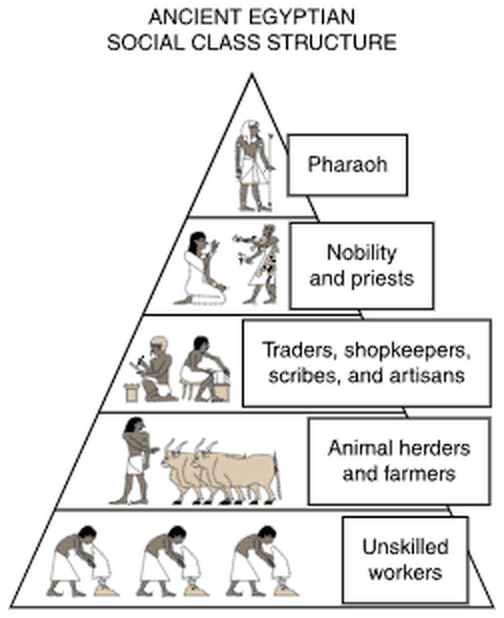
bureaucracy: an administrative staff of government officials
funerary papyri: a sheet or scroll of papyrus containing religious images and hieroglyphs meant to help the deceased be reborn in the afterlife
rudiments: basics
schoolboy: slang that refers to materials used during the course of receiving an education
draughtsmen: people who draw plans of machinery or structures
corpus: a collection of writings
Question
Read this sentence from paragraph 2.
Including both ideograms (which convey a whole word or idea, either concrete or abstract, in a single sign) and phonograms (representing either an alphabetic sound or a group of consonants), [the writing system] was used in formal inscriptions on tomb and temple walls as well as on elaborate funerary papyri.
The author’s purpose for including the sentence is to
- Aexplain that hieroglyphs were reserved for royal and religious purposes.
- Bdemonstrate the methods experts use to interpret hieroglyphs.
- Cclarify the significance of hieroglyphs in language and literature.
- Ddescribe the basic features of hieroglyphs and how they were typically used.
Show the answer
Correct answer: D
The question asks for an explanation of the author’s purpose for including a sentence in paragraph 2 that describes the two types of hieroglyphs and the main uses of this particular writing system.
A. Incorrect. The sentence explains that hieroglyphs were used for formal inscriptions, but it does not suggest that these inscriptions were limited to royal and religious contexts.
B. Incorrect. The sentence describes the two basic types of hieroglyphs, ideograms and phonograms, but it does not address how experts interpret the ancient writing system. A sentence earlier in the paragraph explains that the hieroglyphs were deciphered by Champollion, but it does not explain how he deciphered them.
C. Incorrect. Although the sentence explains that the hieroglyphs were typically used for formal inscriptions, it does not provide an explanation of the significance or importance of hieroglyphs in the Egyptian language.
D. CORRECT. The sentence explains that hieroglyphs included both phonograms and ideograms that were used in formal inscriptions and funeral papyri; therefore, this sentence achieves the purpose of describing the basic features of hieroglyphs as conveying either words and ideas or sounds, in addition to explaining the common uses for the writing system.
Question analysis
This author’s-purpose question quotes a long, technical sentence from paragraph 2 of “Scribe Like an Egyptian” about the ancient Egyptian hieroglyphic writing system, and asks why the author includes it. Students must make sense of its specialist vocabulary before they can say what the sentence contributes to the paragraph and to the article.
- Grade level
- Grade 8 reading and task
- Compared with grade 7
- At grade 7 Explaining why an author includes a sentence is regular grade 7 work. This one is long, with definitions in parentheses and a bracketed insert, but it is quoted in full, so the task stays within one sentence.
- Estimated difficulty
- Straightforward: two steps or one careful reading.
- Thinking it demands
- Depth of knowledge 2, skills and concepts · mainly analyze
- What makes it hard
- Complex sentences moderate
- Hard words minor
- How, not what minor
- Evidence
- Answered from one sentence or line
- Reading level
- Passage: about grade 12, 810 words; question and choices: about grade 11, 103 words.
- Students, last 30 days
- Not enough answers yet to show (it takes 10).
Why it is hard, traps and wrong answers (shows the answer)
Why it is hard
Once the parentheses are set aside, the sentence says two simple things: what kinds of signs hieroglyphs were, and where they appeared. The wrong purposes each go one step beyond that, turning tombs and temples into an exclusive royal and religious use, borrowing Champollion’s deciphering from the sentence before, or claiming a significance the sentence never weighs. Students who untangle the syntax first find the matching purpose quickly.
Complex sentences moderate Understanding the question
The quoted sentence runs fifty words, two parenthetical definitions come before the verb, and its subject, the bracketed “[the writing system],” appears only after thirty words of description. (Abedi & Lord, 2001; Freedle & Kostin, 1993; Messick, 1989)
Hard words minor Understanding the question
“Ideograms,” “phonograms” and “funerary papyri” are specialist terms; the parentheses define the first two, but students who stall on them may not reach the sentence’s plain point about where the signs were used. (Perfetti, 2007; Freedle & Kostin, 1993)
How, not what minor Working it out
The stem asks why the author includes the sentence, so students must match the job it does in paragraph 2 to a purpose, and only one purpose stays within what the sentence actually covers. (Anderson & Krathwohl, 2001)
Strategy: Restate the quoted sentence in plain words, setting the parentheses aside at first, then choose the purpose that fits everything the sentence says and nothing more.
Traps
- Reads too much in: A reasonable-sounding conclusion that goes further than the text allows.
- Wrong part of the text: A choice is true of another paragraph, stanza or speaker than the one asked about.
- Wrong purpose or structure: Names a purpose, structure or effect that the part does not serve, or describes what a part says when the question asks what it does.
The wrong answers, classified
A Reads too much in (Graesser, Singer & Trabasso, 1994)
Reads “formal inscriptions on tomb and temple walls” and “funerary papyri” as royal and religious only, though the sentence names where hieroglyphs usually appeared, not a rule reserving them.
B Wrong part of the text (Kirsch & Mosenthal, 1990)
Remembers that Champollion deciphered the signs, which the sentence before reports, and takes this sentence for an account of how experts read them, though it never mentions interpreting.
C Wrong purpose or structure (Anderson & Krathwohl, 2001)
Chooses an important-sounding purpose, the significance of hieroglyphs in language and literature, though the sentence never says why the script mattered or mentions any literature.
Working it out, step by step
Figure out what the question asks
This asks why the author put this sentence in paragraph 2. In other words, what job does the sentence do? First work out what the sentence says. Then pick the purpose that matches all of it and adds nothing extra.
Untangle the long sentence
The sentence is long, so set the parentheses aside at first. The main part says the writing system “was used in formal inscriptions on tomb and temple walls as well as on elaborate funerary papyri.” An inscription is writing carved or painted on something. Funerary means having to do with burials. Papyri are scrolls made from papyrus, a kind of early paper.
Read the parentheses
Now add back the two kinds of signs. Ideograms “convey a whole word or idea” in one sign. Phonograms stand for “either an alphabetic sound or a group of consonants.” Consonants are letter sounds like b, t and m. So one kind of hieroglyph shows a meaning, and the other shows a sound.
Sum up the sentence’s job
Put the two parts together. The sentence tells what hieroglyphs were made of: signs for ideas and signs for sounds. It also tells where people usually used them: on tombs, temples and burial scrolls. So its job is to describe what hieroglyphs were like and how they were used.
Check each choice
- A does not fit. The sentence says where hieroglyphs usually appeared. It never says they were reserved, or kept only, for kings and religion.
- B does not fit. The sentence before it says Champollion figured out the signs. This sentence never says how experts read them.
- C does not fit. The sentence never says why hieroglyphs mattered, and it never mentions literature.
- D fits. It names both parts: the basic features and the usual uses.
Watch out: Tombs and temples sound royal and religious, so A tempts. But “used in” is not the same as “reserved for.”
Choose the answer
The sentence describes the two kinds of signs and where they were usually used. So the answer is D.
Why this answer and not the closest wrong one
A is the closest wrong choice. Tombs and temples do suggest kings and religion. But the sentence only lists where hieroglyphs were used. It never says they were kept for those uses alone. D matches everything the sentence says and adds nothing it doesn’t.
More questions like this
The original DOE question
The passage “Excerpt from “Scribe Like an Egyptian”” as shown on the test
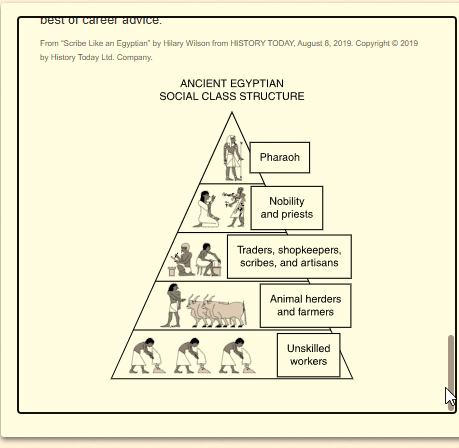
Question 57 of 120
2025 Practice Test A English, question 12Uses the passage above: “Excerpt from “Scribe Like an Egyptian””.
Question
Which claim is best supported by the information presented in paragraphs 3 and 4?
- AEducation was difficult for the common citizens of Egypt to obtain.
- BOnce students began studying to become scribes, their future held more possibilities.
- CIf someone wanted to become a scribe, support from outside sources such as the government or a temple was necessary.
- DBecoming a successful scribe required a student’s family to sacrifice time and money in order to ensure the best education.
Show the answer
Correct answer: B
The question asks for the claim that is best supported by the details in paragraphs 3 and 4.
A. Incorrect. While paragraph 4 does explain that boys from poorer families had more challenges in receiving an education, the paragraph also provides examples of obtaining a patron or getting an apprenticeship as ways that these aspiring scribes could attain an education. Furthermore, the details in paragraph 3 do not provide any support for the claim that “common citizens” had difficulty getting an education because that paragraph focuses on the example of one person who was able to become a king as a result of his background as a scribe.
B. CORRECT. In paragraph 3, the author provides an example of a person who used his skills as a scribe to rise through the ranks of society by describing the achievements of Horemheb to support the idea that “no matter how humble his origins, an educated Egyptian could achieve almost anything.” The author continues in paragraph 4 to explain that with the proper support, some young Egyptians could become educated, thereby opening more opportunities for themselves.
C. Incorrect. Paragraph 4 explains that schools were supported by the government and religious institutions, but it also explains that apprenticeships were a method of learning the craft of the scribe. As the paragraph indicates, boys could also be helped in their education by support from “a wealthier relative or patron.”
D. Incorrect. In paragraph 4, the author details the sacrifices that families made to keep their sons at the schools, while boys from poorer families could only hope for a patron or an apprenticeship. Paragraph 4 also explains that apprentices could help out at home while learning, so the sacrifice of time and money was not required of every family.
Question analysis
This inference question asks which claim is best supported by paragraphs 3 and 4 of “Scribe Like an Egyptian,” which tell the story of the scribe Horemheb and describe who could get a scribal education in ancient Egypt. Students must weigh each claim against both paragraphs together, and several claims echo a single sentence closely enough to look supported.
- Grade level
- Grade 8 reading and task
- Compared with grade 7
- Above grade 7 Choosing the claim a passage best supports is core grade 7 work. Here the claim must fit two paragraphs that do different jobs, one telling a single man’s story and one explaining access to schooling, and some choices fit only part of that.
- Estimated difficulty
- Hard: combines ideas, needs a plan, and has more than one tempting wrong answer.
- Thinking it demands
- Depth of knowledge 3, strategic thinking · mainly evaluate
- What makes it hard
- Evidence in several places moderate
- The right answer is reworded moderate
- Reading between the lines minor
- Evidence
- Answered from several paragraphs or stanzas
- Reading level
- Passage: about grade 12, 810 words; question and choices: about grade 10, 75 words.
- Corrected from the DOE handbook
- A misdescription of the passage in the explanation of one wrong answer was corrected.
- Students, last 30 days
- Not enough answers yet to show (it takes 10).
Why it is hard, traps and wrong answers (shows the answer)
Why it is hard
The trap is a claim that paragraph 4 seems to state almost word for word, which makes it feel safer than the right one. But the question asks for support from both paragraphs, and Horemheb’s story points the other way, toward what schooling made possible. The two other wrong claims harden paragraph 4’s details into rules, a necessary sponsor or a required family sacrifice, so words like “necessary” and “required” are the ones to test.
Evidence in several places moderate Working it out
The claim must fit two paragraphs that do different work: paragraph 3 follows Horemheb from army scribe to king, and paragraph 4 explains who could pay for schooling and what the alternatives were. (Kirsch & Mosenthal, 1990; Gorin & Embretson, 2006)
The right answer is reworded moderate Choosing the answer
The right claim restates paragraph 3’s “an educated Egyptian could achieve almost anything” in new words, while the most tempting wrong one nearly copies paragraph 4’s opening, “education was not available to all.” (Freedle & Kostin, 1993; Kirsch & Mosenthal, 1990)
Reading between the lines minor Working it out
Students must connect Horemheb’s rise with paragraph 4’s account of who got schooling to see that both paragraphs are about education opening doors, a link the author leaves implicit. (Graesser, Singer & Trabasso, 1994; Kintsch, 1998)
Strategy: Sum up paragraph 3 and paragraph 4 in a sentence each, then test every claim against both summaries, watching for words that make a claim stronger than the text.
Traps
- Too narrow: A single detail offered as the central idea or a summary, or a summary that keeps minor details and leaves out an essential part.
- Too broad or too strong: A choice overstates, generalizes, or uses absolute words the text does not support.
- Reads too much in: A reasonable-sounding conclusion that goes further than the text allows.
The wrong answers, classified
A Too narrow (King et al., 2004)
Rests on paragraph 4’s opening, “education was not available to all,” and ignores paragraph 3, whose Horemheb shows an educated man rising from modest origins to the throne.
C Too broad or too strong (King et al., 2004)
Makes the government and temple schools of paragraph 4 “necessary,” overlooking its other routes: help from “a wealthier relative or patron,” or apprenticeship to a working scribe.
D Reads too much in (Graesser, Singer & Trabasso, 1994)
Turns the rations and lost income that some families bore in paragraph 4 into a requirement for every successful scribe, and adds “the best education,” which the paragraph never mentions.
What was corrected from the DOE handbook, and why
- Explanation: The DOE’s explanation of D said paragraph 4 details sacrifices “necessary for some poorer families,” and that paragraph 3’s Horemheb, born of middle-ranking parents, shows the sacrifice was not required of all families. In paragraph 4 the rations and lost income are those of families whose sons were at the schools; poorer boys could only hope for a patron or an apprenticeship; and paragraph 3 says nothing about what Horemheb’s family gave up. The explanation now says so: D is wrong because apprentices could help out at home while learning, so not every family made the sacrifice.
Working it out, step by step
Figure out what the question asks
This asks which claim is best supported by paragraphs 3 and 4 together. A claim is a statement that someone says is true. The right claim must fit both paragraphs. Watch for strong words, like “necessary,” that go further than the text.
Sum up paragraph 3
Paragraph 3 tells about Horemheb. His parents were middle-ranking, not rich or powerful. His training as a scribe led to a job in the army. He rose to lead the army, then to serve the young king, and in the end he became king himself. The author uses him to show that “no matter how humble his origins, an educated Egyptian could achieve almost anything.” Humble origins means an ordinary family background.
Sum up paragraph 4
Paragraph 4 opens by saying that not everyone could get an education. Government offices and big temples ran schools. Families sent food and drink for years, while the boy earned nothing for them. Poorer boys could hope for help from “a wealthier relative or patron.” A patron is someone who pays for another person’s training. Or they could learn on the job from a working scribe. That path led to fewer jobs.
Put the two paragraphs together
Both paragraphs are about what schooling could do for a boy. Paragraph 3 shows a man rising all the way to king because he trained as a scribe. Paragraph 4 shows that, with the right support, boys could get that schooling. It even notes that the on-the-job path led to fewer jobs. So education opened doors. That is what choice B says.
Check each choice
- A does not fit. It matches only the start of paragraph 4. Paragraph 4 also gives ways in for poorer boys, and paragraph 3 shows a man from an ordinary family rising to the top.
- B fits. Both paragraphs show schooling leading to more possibilities.
- C does not fit. A government or temple school was not “necessary.” A relative, a patron or an apprenticeship could also work.
- D does not fit. Apprentices could help out at home while they learned, so not every family gave up time and money. And the paragraphs never mention “the best education.”
Choose the answer
The claim that fits both paragraphs is that schooling gave a boy more possibilities. So the answer is B.
Why this answer and not the closest wrong one
A is the closest wrong choice, because paragraph 4 begins by saying not everyone could get an education. But the question asks about paragraphs 3 and 4. Paragraph 3 tells of a scribe from an ordinary family who became king. Paragraph 4 shows ways around the cost. Both point to what education made possible, which is B.
More questions like this
The original DOE question
Question 58 of 120
2025 Practice Test A English, question 13Uses the passage above: “Excerpt from “Scribe Like an Egyptian””.
Question
Hieratic script was particularly valuable in a bureaucratic government because
- Ausing hieratic script was an efficient way for scribes to produce large amounts of documentation.
- Bmany members of the general public could comprehend information that was written in hieratic script.
- Cknowledge of hieratic script prepared scribes to serve their society in increasingly challenging roles.
- Dpeople from different professional backgrounds could easily communicate with one another in hieratic script.
Show the answer
Correct answer: A
The question asks why hieratic script was especially valuable in a bureaucratic government.
A. CORRECT. Hieratic script is described in paragraph 1 as being simpler for the “multitude of everyday documents” generated by the government and as “quicker to write and more economical of space” in paragraph 2. The logical conclusion based on these details is that hieratic script was more efficient for the large amounts of documentation produced by the government.
B. Incorrect. In paragraph 4, the author explains that “education was not available to all,” suggesting that only people who were educated could read and write. The excerpt as a whole does not provide sufficient information to indicate what portion of the general public would be able to comprehend material written in hieratic script.
C. Incorrect. The idea that becoming a scribe could lead to taking different positions in society is addressed in paragraphs 3, 4, and 6. However, the use of hieratic script in the fields of medicine, law, or religion does not necessarily explain the value of the script for the bureaucratic government referenced in the question.
D. Incorrect. Although different professions such as doctors and lawyers used hieratic script, the author uses these professions as examples of different job opportunities for scribes in paragraph 6. There is no discussion in the excerpt about different professions communicating with each other, and these professions were not necessarily part of the bureaucratic government.
Question analysis
This inference question on “Scribe Like an Egyptian” asks why hieratic, one of the two scripts of ancient Egypt, was especially valuable to a bureaucratic government. The article never gives the reason in a single sentence, so students must connect what it says about Egypt’s bureaucracy with what it says about the script itself. Each choice offers a reasonable-sounding benefit.
- Grade level
- Grade 7 reading and task
- Compared with grade 7
- At grade 7 Drawing a conclusion from two neighboring paragraphs is typical grade 7 inference work. The word “bureaucratic” and the article’s formal style add some load, but the details needed are close together and plainly stated.
- Estimated difficulty
- Straightforward: two steps or one careful reading.
- Thinking it demands
- Depth of knowledge 2, skills and concepts · mainly understand
- What makes it hard
- Evidence in several places minor
- Hard words minor
- Reading between the lines minor
- Evidence
- Answered from several paragraphs or stanzas
- Reading level
- Passage: about grade 12, 810 words; question and choices: about grade 13, 68 words.
- Students, last 30 days
- Not enough answers yet to show (it takes 10).
Why it is hard, traps and wrong answers (shows the answer)
Why it is hard
The two facts that answer the question sit a few lines apart in the first two paragraphs, so the work is mostly connecting them. The wrong reasons all sound like advantages a simpler script might bring, public readability, career preparation, communication across professions, and each rests on a guess or on the excerpt’s talk of scribal careers rather than on what it says hieratic was used for. Students who return to the description of hieratic itself avoid them.
Evidence in several places minor Working it out
The reason is split between paragraph 1, where hieratic serves the “multitude of everyday documents,” and paragraph 2, where it is “quicker to write and more economical of space.” (Kirsch & Mosenthal, 1990; Gorin & Embretson, 2006)
Hard words minor Understanding the question
The stem turns on “bureaucratic,” a word students must connect to a government that runs on paperwork; without it, the link to large amounts of documentation is hard to see. (Perfetti, 2007; Freedle & Kostin, 1993)
Reading between the lines minor Working it out
No sentence says why hieratic helped the government; students must combine speed and compactness with the sheer volume of records to reach efficiency. (Graesser, Singer & Trabasso, 1994; Kintsch, 1998)
Strategy: Find the sentences that describe hieratic script and what it was used for, then pick the choice those sentences support rather than one that only sounds like an advantage.
Traps
- Reads too much in: A reasonable-sounding conclusion that goes further than the text allows.
- True but not the answer: A choice says something accurate about the text that does not answer this question.
- Outside knowledge: A choice is plausible in the real world but not supported by this text.
The wrong answers, classified
B Reads too much in (Graesser, Singer & Trabasso, 1994)
Reasons that a simpler script must have been readable by ordinary people, though paragraph 4 says “education was not available to all” and the excerpt never says the public read hieratic.
C True but not the answer (King et al., 2004; Embretson & Wetzel, 1987)
Recalls the careers in paragraphs 3 and 6 that schooling opened to scribes, which is true of the excerpt but explains a scribe’s prospects, not why the government valued hieratic.
D Outside knowledge (King et al., 2004; Recht & Leslie, 1988)
Imagines hieratic as a shared language linking doctors, lawyers and officials, a sensible-sounding benefit the excerpt never raises; paragraph 6 names those professions only as careers for scribes.
Working it out, step by step
Figure out what the question asks
This asks why hieratic script was so useful to a bureaucratic government. A bureaucracy is a government run by many officials, with lots of paperwork. Hieratic is the quick, simple form of Egyptian writing. Look for what the article says about hieratic and what it was used for.
Find the evidence in paragraphs 1 and 2
Paragraph 1 says many scribes used hieratic for the “multitude of everyday documents” that the government produced. Multitude means a huge number. Paragraph 2 says hieratic was “quicker to write and more economical of space.” Economical of space means it took up less room on the page.
Connect the two facts
Put the facts together. The government made a huge number of papers. Hieratic was fast to write and used less space. So scribes could turn out lots of papers quickly. Getting a lot done with little time and effort is called being efficient.
Check each choice
- A fits. Hieratic let scribes make large amounts of paperwork quickly.
- B does not fit. Paragraph 4 says “education was not available to all.” The article never says ordinary people could read hieratic.
- C does not fit. Training did lead to careers, but that explains a scribe’s chances, not why the government valued the script.
- D does not fit. Paragraph 6 lists jobs like doctor and lawyer as careers for scribes. It never says those workers wrote to each other in hieratic.
Watch out: B sounds sensible, since a simpler script seems easier for anyone to read. But that is a guess, not something the article says.
Choose the answer
Hieratic was fast and compact, and the government needed a huge number of documents. So the answer is A.
Why this answer and not the closest wrong one
B is the closest wrong choice, because a simpler script does sound easier to read. But the article says only some Egyptians got an education. It never says the public could read hieratic. A rests on two facts the article states: the government made a “multitude of everyday documents,” and hieratic was quicker to write.
More questions like this
The original DOE question
Question 59 of 120
2025 Practice Test A English, question 15Uses the passage above: “Excerpt from “Scribe Like an Egyptian””.
Question
Based on the excerpt, which statement would the author most strongly agree with?
- ABoys in Egypt were encouraged to enter the same profession as older male relatives.
- BKnowledge of hieroglyphs was helpful to Egyptians who were interested in becoming scribes.
- CHieratic script was more practical to ancient Egyptians than hieroglyphs were.
- DBoys in Egypt who studied for only a few years were unlikely to find employment as scribes.
Show the answer
Correct answer: C
The question asks for a statement with which the author would most strongly agree.
A. Incorrect. The author only addresses boys who entered the profession of scribes. While the author does address the role of the family in supporting a boy’s education or securing an apprenticeship, the author does not provide any discussion to support the idea that boys were only encouraged to follow the professions of their male relatives.
B. Incorrect. The author explains that communication using hieroglyphs was not widely practiced in everyday correspondence and that hieratic script was the more popular form of writing. While being able to read and use hieroglyphs would have been helpful, it was not common for citizens to use this formal form of communication. In addition, scribes were trained to learn hieroglyphs and hieratic script as part of their education, so prior ability to read or compose hieroglyphs was not a requirement.
C. CORRECT. As described in paragraph 2, hieratic script was more efficient and economical than hieroglyphs. Because this script was used for “everyday purposes,” it was the more practical of the scripts as hieroglyphs were reserved for “formal inscriptions.”
D. Incorrect. In paragraph 6, the author indicates that “any half-competent scribe” could become employed in making and updating lists. While the paragraph later indicates that scribes would need to study several more years to be employed in a wider range of professions, there is no indication that employment as a scribe would be unavailable to a boy who studied for only a few years.
Question analysis
This point-of-view question asks which statement the author of “Scribe Like an Egyptian” would most strongly agree with. The four statements deal with family careers, knowledge of hieroglyphs, Egypt’s two scripts and the length of training, so students must test each one against the article and separate what the author says from what merely sounds likely.
- Grade level
- Grade 8 reading and task
- Compared with grade 7
- At grade 7 Inferring which statement an author would accept is typical grade 7 work. The four statements draw on different parts of a dense article, and some sound sensible without being backed by it, so each must be checked carefully.
- Estimated difficulty
- Moderate: several steps, or a close reading with one strong distractor.
- Thinking it demands
- Depth of knowledge 2, skills and concepts · mainly analyze
- What makes it hard
- Every choice must be checked moderate
- Reading between the lines moderate
- Evidence
- Answered from several paragraphs or stanzas
- Reading level
- Passage: about grade 12, 810 words; question and choices: about grade 9, 68 words.
- Students, last 30 days
- Not enough answers yet to show (it takes 10).
Why it is hard, traps and wrong answers (shows the answer)
Why it is hard
The right statement is a comparison the author never makes in so many words, while the statement about hieroglyphs sounds like something any author on scribes would accept. The question rewards asking which statement the excerpt itself backs most firmly, and paragraph 2’s contrast between everyday and formal writing does that directly. The two statements about boys rest on assumptions, sons following relatives and short training leaving boys jobless, that the excerpt never makes and partly contradicts.
Every choice must be checked moderate Choosing the answer
The four statements cover four topics, family careers, hieroglyphs, the two scripts and length of training, so each has to be traced to its own paragraph before they can be compared. (Embretson & Wetzel, 1987)
Reading between the lines moderate Working it out
The author never ranks the scripts; “more practical” has to be drawn from paragraph 2, where hieratic is for “everyday purposes” and quicker to write, while hieroglyphs go on “formal inscriptions.” (Graesser, Singer & Trabasso, 1994; Kintsch, 1998)
Strategy: For each statement, find the paragraph that deals with its topic and decide whether the author says it, implies it or never addresses it; keep the one with the firmest support.
Traps
- Reads too much in: A reasonable-sounding conclusion that goes further than the text allows.
- Twists what the text says: Uses the text's topic and ideas but changes what it says: who did it, how much, when, or why.
- Outside knowledge: A choice is plausible in the real world but not supported by this text.
The wrong answers, classified
A Outside knowledge (King et al., 2004; Recht & Leslie, 1988)
Applies the familiar idea that sons follow their fathers’ trades, perhaps prompted by paragraph 4’s “wealthier relative,” though the excerpt never says boys were steered toward relatives’ professions.
B Twists what the text says (King et al., 2004)
Builds on paragraph 6, where more signs led to better posts, but shifts the benefit to the time before training, though boys learned the signs at school starting at six or seven.
D Reads too much in (Graesser, Singer & Trabasso, 1994)
Infers from paragraph 6’s extra years for officials, priests and lawyers that short training meant no job, though “any half-competent scribe” could keep lists and the least-trained scribes studied only five or six years.
Working it out, step by step
Figure out what the question asks
This asks which statement the author would most strongly agree with. The author may not say it in the same words, but the excerpt must clearly back it. The four choices cover four topics, so find the paragraph for each one.
Find what the author says about the scripts
Paragraph 1 says many scribes used the simpler hieratic script for everyday papers. Paragraph 2 says hieroglyphs went on “formal inscriptions,” such as tomb and temple walls. Hieratic was used for “everyday purposes.” It was faster to write and took less space. Formal means used for special, serious occasions.
Work out what that means
Practical means useful for real, everyday needs. The author shows hieratic doing the daily work, such as letters, reports and contracts. Hieroglyphs were kept for special uses. So the author would agree that hieratic was more practical than hieroglyphs. The author never uses the words “more practical,” but the facts point there.
Check each choice
- A does not fit. The excerpt never says boys were pushed into a relative’s job.
- B does not fit. Boys learned the signs at school, starting at six or seven. The excerpt never says knowing hieroglyphs beforehand helped. Paragraph 1 even says not all scribes understood them.
- C fits. Hieratic was quicker, smaller and used for everyday work.
- D does not fit. Paragraph 6 says “any half-competent scribe” could keep lists. Half-competent means only partly skilled. The lowest scribes studied only five or six years and still worked.
Watch out: B sounds like something any author would accept. But the excerpt does not back it.
Choose the answer
The excerpt shows hieratic doing the everyday work, faster and in less space. So the answer is C.
Why this answer and not the closest wrong one
B is the closest wrong choice. Knowing hieroglyphs sounds helpful for a future scribe. But boys learned their signs at school, and paragraph 1 says not all scribes understood hieroglyphs at all. C rests on paragraph 2, where hieratic is quicker to write and used for “everyday purposes.”
More questions like this
The original DOE question
Question 60 of 120
2025 Practice Test A English, question 16Passage Excerpt from Winter Wheat
Excerpt from Winter Wheat
by Mildred Walker
Ellen, the narrator, is preparing to leave her parents and the family farm for college the next day.
I love Dad’s way of talking that makes him seem different from other ranchers. He’s lived here twenty-three years, but he still says “back East where I come from.” He’s the one who gets excited when I do about spring coming or a serial running in the magazine we’re both reading, but it’s what Mom says that I depend on. When Mom used to say “Don’t worry” about my pet chicken or dog or new calf, it always got well. Dad is always talking of going some place, not now, but next year, maybe. Mom seems to think of nothing farther away than today or perhaps yesterday or tomorrow morning.
Mom folded the ironing board and put it inside their bedroom that was just off the kitchen. She carried in the freshly ironed clothes. Dad went back to his paper. When Mom came back she took beans from the cupboard to soak for tomorrow. Dad always said Mom could make all the dishes he’d had back in Vermont as well as though she were a New Englander herself, instead of a Russian. All of a sudden, I realized that tomorrow when those beans would be ready to eat I’d be going away. It gave me a funny feeling.
“I’ll be taking the train tomorrow night,” I said aloud, more to hear it myself.
“We can drive you into town in the afternoon,” Dad said, dropping his paper on the floor.
“There’s no need to go to town; she can catch the train at Gotham just as well. We haven’t nothing to take us into town for,” Mom said.
“Well, we don’t have to decide tonight,” Dad said, but I knew he wanted to go into Clark City. It wouldn’t be so flat as just seeing me go off on the train from Gotham. My going away was hard on both of them; they were so different—and I was part of them both. It made me uncomfortable to think of leaving them.
While I was getting ready for bed in my room that’s off the front room, I saw how it would be if I left from town. We’d go in right after dinner and go around to the stores, Dad going one way and Mom and I another. Dad would probably have his hair cut at the barbershop and stop in the bank and meet someone he knew to talk to. Then we’d meet at the big store on the corner and go to the cafeteria for supper. The train stops ten minutes or so at the station in town and there are other people and excitement and you have time to wave from the platform and then again from your window by your seat. We went to the station in Clark City to see the Goodals off when they went back to Iowa.
If I left from Gotham, we’d just drive down in the truck and wait till the train came. It only stops long enough for you to get on and you hardly have time to taste the flavor of going away.
I sat on the bed in my pyjamas with my arms around my knees. I couldn’t keep from thinking of that time Dad went back East. I tried to, and then I just sat still and looked straight at it. Sometimes that’s better than working so hard to keep from looking at what’s in your mind.
Dad went all the way back to Vermont. . . . It was in November and it was already dark when the train came through Gotham. Even now, I could feel how cold and dark it was. I held Mom’s hand. Dad was so dressed-up he seemed strange. . . . We stood there without saying anything until Dad told Mom to remember to call Mr. Bardich, our neighbor, if the cow didn’t calve tomorrow.
“I’ll manage,” Mom snapped back.
“I wish you could go, Anna,” Dad said to Mom, “and we could take Ellen.” . . .
“Good-by, Anna Petrovna,” he said, looking at Mom. I had never heard him call her by two names before.
“Good-by,” Mom said, standing still, without smiling.
Then he was gone and the crossroads were darker than ever. The train light shone on the high window in the top of the grain elevator for a moment and then that too was dark. We got into our old Ford and Mom drove back to the house. My throat ached all the way. The name Dad had called Mom kept saying itself in my ears: “Anna Petrovna, Anna Petrovna.” . . .
Our house seemed lonely when we came back to it. It seemed to be hiding under the coulee. I went with Mom to put the truck in the barn that was bigger than the house. I think Mom was prouder of our barn than the house, anyway. We walked back to look at the cow that was going to calve. She was just a big light blob in the dark, waiting. I had thought she was exciting this morning, but now she seemed sad, too.
The wind blew when we walked across the open space to the house and I couldn’t help shivering with the cold. Inside the house it was warm, but empty.
“Bring your nightgown in here and I heat you some milk,” Mom said.
I drank the milk sitting on a stool in front of the stove. It tasted good, but the lonely ache in my throat was still there. I picked up my clothes and hung them neatly behind the stove and put my cup on the sink board. Mom was fixing oatmeal for tomorrow morning.
“Good night, Mom,” I said almost timidly, standing beside her. She seemed wrapped around in a kind of strangeness. Then she turned around and drew me to her. The front of her dress was warm from the stove. I felt the comfortable heat through my gown. She laid her hand against my face and it felt rough and hard but firm. I dared ask her something I wanted to know.
“Mom, was that really your name—what Dad called you?”
Her voice sounded surprised. “Why, Yeléna, you know that; Anna Petrovna. You know I am born in Russia, in Seletskoe.”
“Yes, but I didn’t know your other name,” I said.
“Anna Petrovna Webb.” She pronounced it slowly. “Once I think what a funny name Ben Webb is!” She laughed. Her laugh was warm and low like our kitchen, and comfortable. The house seemed natural and right again. . . .
But now that I am grown, I feel the wall of strangeness between them, more than when I was a child. I wondered how they would get along without me.
From WINTER WHEAT by Mildred Walker, published by University of Nebraska Press. Copyright © 1944 by Harcourt, Brace and Company, Inc. Copyright renewed 1971 by Mildred Walker. All rights reserved.
serial: story published in short segments at regular intervals
coulee: small gulch or ravine
Question
Which sentence from the excerpt supports the idea that Ellen understands what her father is really thinking, and which sentence supports the idea that Ellen and her father share similar interests?
Move the correct answer to each box.
Supports the idea that Ellen understands what her father is really thinking
Supports the idea that Ellen and her father share similar interests
On the test you drag tiles into the boxes; here, choose each box’s tile from its menu. Each tile can be used once. The DOE has not published how answers with several parts are scored; this site counts one right only when every part is right.
Show the answer
Correct answer: blank 1: “Well, we don’t have to decide tonight,” Dad said, but I knew he wanted to go into Clark City.” (paragraph 6); blank 2: “He’s the one who gets excited when I do about spring coming or a serial running in the magazine we’re both reading” (paragraph 1)
The question asks for the identification of one sentence that supports the idea that Ellen understands what her father is really thinking, and one sentence that supports the idea that Ellen and her father share similar interests.
A. Incorrect. (“I love Dad’s way of talking that makes him seem different from other ranchers.” [paragraph 1]) This sentence from paragraph 1 presents a unique quality that Ellen loves about her father, but it does not provide evidence for the idea that Ellen and her father share similar interests or that Ellen understands what her father is really thinking.
B. CORRECT. (“He’s the one who gets excited when I do about spring coming or a serial running in the magazine we’re both reading” [paragraph 1]) This sentence from paragraph 1 shows that Ellen and her father both get excited about the coming of spring and share an enthusiasm for reading magazine serials (stories published in serial installments). Thus, it provides clear evidence for the idea that Ellen and her father share similar interests.
C. CORRECT. (“ ‘Well, we don’t have to decide tonight,’ Dad said, but I knew he wanted to go into Clark City.” [paragraph 6]) This sentence from paragraph 6 provides evidence that Ellen and her father share the same unspoken wish to go to Clark City rather than for Ellen to catch the train at Gotham, as suggested in paragraph 5 by Ellen’s mother. This quotation reveals that Ellen understands the true preference that her father is not expressing aloud, thereby providing evidence for the idea that Ellen understands what her father is really thinking.
D. Incorrect. (“We’d go in right after dinner and go around to the stores, Dad going one way and Mom and I another.” [paragraph 7]) Although this sentence from paragraph 7 indicates that Ellen can predict how her father would behave in a particular scenario, it does not show that Ellen understands what her father is really thinking, nor does it provide evidence for the idea that Ellen and her father share similar interests.
Question analysis
This evidence question on an excerpt from Mildred Walker’s 1944 novel Winter Wheat asks for one quotation showing that Ellen understands what her father is really thinking and another showing that the two share interests. On the test students drag two of four sentence tiles into labeled boxes, so each quotation’s exact wording decides where it belongs, if anywhere.
- Grade level
- Grade 7 reading and task
- Compared with grade 7
- At grade 7 Matching quotations to ideas about a character is grade 7 evidence work, and the novel’s language is plain. Placing two of four tiles, with credit only when both are right, adds a step, and every tile mentions Ellen’s father.
- Estimated difficulty
- Moderate: several steps, or a close reading with one strong distractor.
- Thinking it demands
- Depth of knowledge 2, skills and concepts · mainly evaluate
- What makes it hard
- Much to keep track of moderate
- Reading between the lines minor
- Evidence
- Answered from several paragraphs or stanzas
- Reading level
- Passage: about grade 4, 1179 words; question and choices: about grade 9, 61 words.
- Corrected from the DOE handbook
- A repeated word in the explanation was corrected.
- Students, last 30 days
- Not enough answers yet to show (it takes 10).
Why it is hard, traps and wrong answers (shows the answer)
Why it is hard
Each box has a tile that matches it closely, so the question is less about finding evidence than about not being drawn by the near misses. Ellen’s detailed picture of the town trip in paragraph 7 shows she knows her father’s habits, which can pass for knowing his mind, and the tiles about shared excitement and a shared wish can each seem to fit the other box. Because credit needs both placements, one doubtful tile costs the whole question.
Much to keep track of moderate Working it out
Two boxes must both be right, and all four tiles mention Dad, so each tile has to be held against two different ideas before the two that fit neither can be set aside. (Sweller, 1988; Carpenter, Just & Shell, 1990)
Reading between the lines minor Working it out
The first box turns on the gap between what Dad says and what Ellen knows: “Dad said, but I knew he wanted” marks a wish he does not speak aloud. (Graesser, Singer & Trabasso, 1994; Kintsch, 1998)
Strategy: Treat the boxes as two separate evidence questions: restate each idea in your own words, then test all four tiles against it before placing one, since two tiles fit neither box.
Traps
- Supports only part of the claim: In a question about evidence: a line that backs one half of the claim but not the other, or a related point rather than the claim itself.
- Reads too much in: A reasonable-sounding conclusion that goes further than the text allows.
The wrong answers, classified
DB Reads too much in (Graesser, Singer & Trabasso, 1994)
Puts the town-trip tile in the first box because Ellen can foresee how Dad will spend the afternoon in town, though foreseeing his errands is not knowing an unspoken wish.
BC Supports only part of the claim (King et al., 2004; Thissen, Steinberg & Fitzpatrick, 1989)
Swaps the right tiles, reading Dad’s excitement, which he shows openly, as a hidden thought Ellen grasps, and their one shared wish for Clark City as a shared interest.
CA True but not the answer (King et al., 2004; Embretson & Wetzel, 1987)
Fills the first box correctly but puts Ellen’s love of Dad’s way of talking in the second, though admiring how he speaks is her feeling, not an interest they share.
What was corrected from the DOE handbook, and why
- Explanation: The DOE’s explanation of Option D says the sentence does not “provide evidence for the idea that that Ellen and her father share similar interests,” with “that” printed twice. The site prints it once.
Working it out, step by step
Figure out what the question asks
This question has two boxes, and each needs a different idea. Box 1: Ellen knows what Dad is really thinking, even when he doesn’t say it. Box 2: Ellen and Dad like the same things. On the test you drag a tile into each box. On this site you pick each box’s tile from a menu. Two tiles are left over.
Find a hidden thought for box 1
In paragraph 5, Mom says Ellen can catch the train at Gotham, the nearby stop. Then paragraph 6 says “ ‘Well, we don’t have to decide tonight,’ Dad said, but I knew he wanted to go into Clark City.” Dad’s words put off the choice. But Ellen knows his real wish, the trip into town. The word “but” marks the gap between what he says and what she knows.
Find a shared interest for box 2
Paragraph 1 says Dad is “the one who gets excited when I do about spring coming or a serial running in the magazine we’re both reading.” A serial is a story printed in parts, one part in each issue of a magazine. Ellen and Dad look forward to spring together, and they read the same story. Those are shared interests.
Rule out the other two tiles
- “I love Dad’s way of talking that makes him seem different from other ranchers.” (paragraph 1) This is Ellen’s feeling about how Dad talks. It is not a hidden thought, and it is not an interest they share.
- “We’d go in right after dinner and go around to the stores, Dad going one way and Mom and I another.” (paragraph 7) Ellen pictures how a trip to town would go. Knowing Dad’s habits is not knowing his unspoken wish. And here they split up.
Watch out: Don’t swap the two right tiles. Dad shows his excitement openly, so it is not a hidden thought.
Fill in both boxes
- Box 1, Ellen understands what her father is really thinking: “Well, we don’t have to decide tonight,” Dad said, but I knew he wanted to go into Clark City.” (paragraph 6)
- Box 2, Ellen and her father share similar interests: “He’s the one who gets excited when I do about spring coming or a serial running in the magazine we’re both reading” (paragraph 1)
Both boxes must be right to get the point.
Why this answer and not the closest wrong one
The town-trip tile is the closest wrong choice for box 1. In paragraph 7, Ellen can picture just what Dad would do in town. But that shows she knows his habits. In paragraph 6, Dad says one thing, and Ellen knows he wants another. That is knowing what he is really thinking.
More questions like this
The original DOE question
The passage “Excerpt from Winter Wheat” as shown on the test
Question 61 of 120
2025 Practice Test A English, question 17Uses the passage above: “Excerpt from Winter Wheat”.
Question
Read these sentences from paragraph 2.
Dad always said Mom could make all the dishes he’d had back in Vermont as well as though she were a New Englander herself, instead of a Russian. All of a sudden, I realized that tomorrow when those beans would be ready to eat I’d be going away. It gave me a funny feeling.
The sentences help develop a theme of the excerpt by
- Asuggesting that life presents people with many challenges.
- Bimplying that the stress of major life events can cause confusion.
- Cdemonstrating that moving on from the familiar is a common human experience.
- Demphasizing the idea that people can easily learn the routines of being part of a new culture.
Show the answer
Correct answer: C
The question asks how the sentences in paragraph 2 help develop a theme of the excerpt.
A. Incorrect. Although the sentences from paragraph 2 describe Ellen’s “funny feeling” upon realizing that she will no longer be home when the beans that her mother is making are ready to eat, the details do not show that life presents many challenges. Additionally, the theme that life presents people with many challenges is not a theme found in the excerpt.
B. Incorrect. The sentences from paragraph 2 state that Ellen has “a funny feeling” while awaiting a major life event, but they do not indicate that she is confused or stressed. The details in the sentences convey a sense of wistfulness, but the theme that the stress of major life events causes confusion is not found in the excerpt.
C. CORRECT. The sentences from paragraph 2 show that Ellen’s mother has moved on from the familiar and left her childhood home behind, just as Ellen is about to do. This information links the experiences of parent and child and helps develop the theme that moving beyond the familiar is a common human experience.
D. Incorrect. Although the sentences from paragraph 2 show that Ellen’s mother has learned to cook New England food very well (“as though she were a New Englander herself”), they do not provide information about how easy or difficult it was for Ellen’s mother to learn a new way of cooking. The theme that people can easily learn the routines of a new culture is not a theme found in the excerpt.
Question analysis
This theme question quotes three sentences from paragraph 2 of the Winter Wheat excerpt, about Mom’s cooking and Ellen’s sudden realization that she is leaving, and asks how they help develop a theme. Students must connect a small kitchen moment to an idea that runs through the whole excerpt, choosing among theme statements that range from narrow to very general.
- Grade level
- Grade 8 reading and task
- Compared with grade 7
- Above grade 7 Explaining how details develop a theme is a grade 7 standard. These sentences never state the idea, so students must infer it from a remark about Mom’s cooking and Ellen’s passing feeling, then link it to the whole excerpt, more than typical grade 7 work.
- Estimated difficulty
- Hard: combines ideas, needs a plan, and has more than one tempting wrong answer.
- Thinking it demands
- Depth of knowledge 3, strategic thinking · mainly analyze
- What makes it hard
- Reading between the lines major
- Evidence in several places moderate
- How, not what minor
- Evidence
- Answered from the whole text
- Reading level
- Passage: about grade 4, 1179 words; question and choices: about grade 7, 117 words.
- Students, last 30 days
- Not enough answers yet to show (it takes 10).
Why it is hard, traps and wrong answers (shows the answer)
Why it is hard
The quoted sentences seem to be about cooking and a passing mood, and the link to a theme hides in where the parents come from. Students who miss that Dad and Mom both left homes far away read the passage as being about Mom’s skill or Ellen’s nerves, and pick a theme built on one of those. The vague choice about life’s challenges catches students who sense that leaving is hard but cannot pin the theme to these details.
Reading between the lines major Working it out
The theme is never stated: students must notice that “back in Vermont” and “instead of a Russian” mean both parents left their first homes, just as Ellen realizes she will be “going away.” (Graesser, Singer & Trabasso, 1994; Kintsch, 1998)
Evidence in several places moderate Working it out
A theme of the excerpt must hold beyond paragraph 2, so the choice has to be checked against Dad’s trip back East in the flashback and Mom’s Russian name in paragraph 22. (Kirsch & Mosenthal, 1990; Gorin & Embretson, 2006)
How, not what minor Working it out
The stem asks how the sentences develop a theme, so a remark about cooking has to be read for what it reveals about the parents’ pasts, not for its subject. (Anderson & Krathwohl, 2001)
Strategy: Note what each quoted sentence tells you about the person in it, then pick the theme that these details and the rest of the excerpt both support.
Traps
- Reads too much in: A reasonable-sounding conclusion that goes further than the text allows.
- Too broad or too strong: A choice overstates, generalizes, or uses absolute words the text does not support.
- Wrong tone or attitude: Misjudges the tone, attitude or point of view, such as reading admiration as criticism, or taking a character's or subject's feelings for the author's.
The wrong answers, classified
A Too broad or too strong (King et al., 2004)
Chooses a theme loose enough to fit almost any story; the sentences show the parents’ pasts and a sudden realization, not a series of challenges.
B Wrong tone or attitude (Graesser, Singer & Trabasso, 1994)
Hears stress and confusion in Ellen’s “funny feeling,” though the sentences suggest a quiet, wistful realization, and nothing in the excerpt shows her confused about leaving.
D Reads too much in (Graesser, Singer & Trabasso, 1994)
Seizes on Mom cooking “as though she were a New Englander herself” and adds that adapting was easy, which the sentence never says; it praises her skill, not the ease of learning.
Working it out, step by step
Figure out what the question asks
This asks how three sentences from paragraph 2 help build a theme. A theme is a big idea about life that a story keeps showing. Look at what each sentence tells you about the people in it, not just at its subject, cooking.
Read the sentence about Mom and Dad
The first sentence says “Dad always said Mom could make all the dishes he’d had back in Vermont as well as though she were a New Englander herself, instead of a Russian.” Vermont is a state far to the east, in New England. Dad grew up there. Mom came from Russia. So both parents left the places where they grew up.
Read the sentences about Ellen
The next sentences say “All of a sudden, I realized that tomorrow when those beans would be ready to eat I’d be going away. It gave me a funny feeling.” The beans are soaking for tomorrow’s meal. Ellen sees that she won’t be home to eat them. She is about to leave her own home, just as her parents once left theirs.
Find the theme
Put the two parts together. Dad left Vermont, Mom left Russia, and now Ellen is leaving the farm. Each of them moves on from a familiar place. So the sentences show that leaving what you know is something many people go through. Ellen’s “funny feeling” is wistful, a quiet sadness, like missing home before you go.
Check each choice
- A does not fit. It is so broad it could fit almost any story. These sentences show leaving home, not many challenges.
- B does not fit. Ellen’s feeling is quiet and wistful. Nothing shows her stressed or confused.
- C fits. Parents and daughter all move on from a familiar home.
- D does not fit. Dad praises Mom’s cooking, but the sentence never says learning it was easy.
Choose the answer
The sentences link Ellen’s leaving to her parents’ own leaving long ago. So the answer is C.
Why this answer and not the closest wrong one
B is the closest wrong choice, because a “funny feeling” before a big change could sound like stress. But Ellen is not mixed up or panicked. She simply realizes she will be gone tomorrow. The sentences tie that moment to her parents’ moves from Vermont and Russia. That shared experience of leaving is C.
More questions like this
The original DOE question
Question 62 of 120
2025 Practice Test A English, question 18Uses the passage above: “Excerpt from Winter Wheat”.
Question
Read this sentence from paragraph 3.
“I’ll be taking the train tomorrow night,” I said aloud, more to hear it myself.
This remark contributes to the conflict in the excerpt by
- Arevealing Dad’s reasons for wanting to drive to the city.
- Bcausing tension between Mom and Dad.
- Cleading Ellen to distance herself from both Mom and Dad.
- Dshowing Mom’s reluctance to plan that far in advance.
Show the answer
Correct answer: B
The question asks how the sentence from paragraph 3 contributes to the conflict in the excerpt.
A. Incorrect. Although Ellen’s father does want to drive to the city, this sentence does not reveal his reasons for wanting to do so. Ellen’s father’s wish to drive to the city is important to the conflict of the excerpt not because of his underlying reasons but because his wish differs from Ellen’s mother’s wish to take Ellen to the train at Gotham—a difference of opinion that introduces tension between the parents.
B. CORRECT. The sentence causes Ellen’s parents to propose competing options for taking her to the train, and the resulting conversation recalls fraught memories of an earlier leave-taking in the family. The disagreement between Ellen’s mother and father over where to take Ellen to catch the train heightens the tension between them. Because the primary conflict of the excerpt is Ellen’s anxiety about the effect her leaving will have on the relationship between her parents, this remark contributes to the conflict by bringing her parents’ disagreement into view.
C. Incorrect. Although Ellen will put physical distance between herself and her parents on the following day, the remark she makes does not lead her to emotionally distance herself from her parents. Moreover, the emotional distance between Ellen and her parents is not the primary source of conflict in the excerpt.
D. Incorrect. While paragraph 1 states that Ellen’s mother “seems to think of nothing farther away than today or perhaps yesterday or tomorrow morning,” the sentence in paragraph 3 does not show any reluctance to plan far in advance. Moreover, planning for the future is not a source of conflict in the excerpt.
Question analysis
This plot question quotes Ellen’s remark in paragraph 3 of the Winter Wheat excerpt, said aloud mostly so she can hear it herself, and asks how it contributes to the excerpt’s conflict. Students must first work out what the conflict is, since the story has no fight or villain, and then follow what the remark leads to.
- Grade level
- Grade 8 reading and task
- Compared with grade 7
- At grade 7 Analyzing how a line of dialogue drives a plot matches the grade 8 wording of the standard. The remark is short and plain, though, and what it sets off plays out in the next few paragraphs, which keeps the demand typical.
- Estimated difficulty
- Moderate: several steps, or a close reading with one strong distractor.
- Thinking it demands
- Depth of knowledge 2, skills and concepts · mainly analyze
- What makes it hard
- Reading between the lines moderate
- Evidence in several places moderate
- How, not what minor
- Evidence
- Answered from several paragraphs or stanzas
- Reading level
- Passage: about grade 4, 1179 words; question and choices: about grade 5, 65 words.
- Students, last 30 days
- Not enough answers yet to show (it takes 10).
Why it is hard, traps and wrong answers (shows the answer)
Why it is hard
The remark itself is plain, and neither parent raises a voice in reply, so the tension it causes is easy to miss. Students who do not see that the excerpt’s real problem is Ellen’s worry about her parents look for a more visible effect, such as Dad’s wish to drive her or Mom’s habit of thinking no farther than tomorrow. The question rewards reading the remark together with the quiet exchange it starts in paragraphs 4 to 6.
Reading between the lines moderate Working it out
The excerpt never names its conflict; students must infer from paragraph 6 and the closing paragraph that Ellen worries about her very different parents getting along once she leaves. (Graesser, Singer & Trabasso, 1994; Kintsch, 1998)
Evidence in several places moderate Working it out
The remark’s effect unfolds over the next three paragraphs: Dad offers to drive into town, Mom says the Gotham train will do, and Dad puts off the decision. (Kirsch & Mosenthal, 1990; Gorin & Embretson, 2006)
How, not what minor Working it out
The question asks what the remark does for the plot, not what it says; a plain statement of travel plans matters only for the disagreement it sets off. (Anderson & Krathwohl, 2001)
Strategy: Name the excerpt’s central problem in your own words first, then reread the remark with the paragraphs right after it and pick the choice that shows how the remark feeds that problem.
Traps
- Twists what the text says: Uses the text's topic and ideas but changes what it says: who did it, how much, when, or why.
- Wrong part of the text: A choice is true of another paragraph, stanza or speaker than the one asked about.
- Reads too much in: A reasonable-sounding conclusion that goes further than the text allows.
The wrong answers, classified
A Twists what the text says (King et al., 2004)
Sees that the remark prompts Dad’s offer to drive Ellen into town but credits it with revealing his reasons, which neither the remark nor his offer gives; Ellen guesses one later.
C Reads too much in (Graesser, Singer & Trabasso, 1994)
Turns Ellen’s coming departure into an emotional withdrawal, though after speaking she grows no more distant; she worries about her parents and, in the flashback, clings to Mom.
D Wrong part of the text (Kirsch & Mosenthal, 1990)
Recalls paragraph 1’s comment that Mom thinks no farther ahead than tomorrow morning, but the remark shows nothing of the kind: Mom answers it at once with a plan of her own.
Working it out, step by step
Figure out what the question asks
This asks how Ellen’s remark adds to the conflict, the main problem in the story. The remark itself is plain. It just says when she will leave. So look at what happens right after she says it.
Name the story’s conflict
In paragraph 6, Ellen says her going away was hard on both parents. They were very different, and she was part of them both. In paragraph 25, she says she feels a distance between them. She wonders how they will get along without her. So the conflict is Ellen’s worry about her two very different parents once she is gone.
See what the remark sets off
Right after Ellen speaks, her parents disagree. In paragraph 4, Dad offers to drive her into town. In paragraph 5, Mom says there is no need, because Ellen can catch the train at Gotham. In paragraph 6, Dad puts off the choice, though Ellen knows he wants to go to town. Neither parent shouts, but they want different things.
Connect the remark to the conflict
Ellen’s simple remark brings her parents’ differences into the open. Their quiet disagreement shows the tension between them. Tension is a tight, uneasy feeling between people. That tension is just what worries Ellen about leaving. So the remark feeds the conflict by causing tension between Mom and Dad.
Check each choice
- A does not fit. Dad offers to drive, but no one explains why he wants to.
- B fits. The remark leads straight to the parents’ disagreement.
- C does not fit. Ellen doesn’t pull away from her parents. She worries about them.
- D does not fit. Paragraph 1 says Mom doesn’t think far ahead. But here Mom answers at once with a plan of her own.
Watch out: D borrows a detail from paragraph 1. The remark itself shows nothing of the kind.
Choose the answer
The remark starts a quiet disagreement about how Ellen will leave. So the answer is B.
Why this answer and not the closest wrong one
A is the closest wrong choice, because the remark does lead to Dad’s offer to drive. But Dad never gives his reasons. What matters is that Mom wants something else. Their different wishes show the tension between them, and that tension is what Ellen worries about. That is B.
More questions like this
The original DOE question
Question 63 of 120
2025 Practice Test A English, question 19Uses the passage above: “Excerpt from Winter Wheat”.
Question
Read this sentence from paragraph 9.
I tried to, and then I just sat still and looked straight at it.
How does the phrase “looked straight at it” contribute to the meaning of the excerpt?
- AIt shows that Ellen is willing to deal with a problem directly instead of ignoring it.
- BIt suggests that Ellen studies all parts of an issue and not just its surface.
- CIt illustrates that Ellen examines both sides of an argument.
- DIt implies that Ellen is eager to seek wisdom from past experiences.
Show the answer
Correct answer: A
The question asks how the phrase “looked straight at it” in paragraph 9 contributes to the meaning of the excerpt.
A. CORRECT. The phrase shows Ellen deciding to directly confront the memory even though she initially wanted to ignore it (“I couldn’t keep from thinking of that time Dad went back East. I tried to” [paragraph 9]). Though the memory is emotionally fraught for Ellen, the phrase “looked straight at it” shows that she is willing to face problems—such as a painful family memory—head-on.
B. Incorrect. The phrase in paragraph 9 does not show Ellen studying all parts of an issue but rather forcing herself to focus on something she would have preferred not to think about.
C. Incorrect. In looking “straight at” the memory, Ellen is not considering both sides of an argument. Instead, she is making herself think about an uncomfortable memory that she had been trying to avoid revisiting. The phrase indicates that she is finally willing to directly confront an unsettling recollection.
D. Incorrect. Given the detail in paragraph 9 that Ellen initially attempted to keep from thinking about her father’s trip to Vermont, the phrase “looked straight at it” indicates a willingness, but not an eagerness, to seek wisdom from reflecting on past experiences.
Question analysis
This word-meaning question quotes a sentence from paragraph 9 of the Winter Wheat excerpt, where Ellen sits on her bed the night before she leaves home, and asks how the phrase “looked straight at it” contributes to the excerpt’s meaning. Students must work out what “it” refers to and read the phrase figuratively, using the sentences around it.
- Grade level
- Grade 7 reading and task
- Compared with grade 7
- At grade 7 Interpreting a figurative phrase in context is routine grade 7 work. The phrase is short and quoted with its sentence, but its meaning depends on the sentence before it, so students cannot judge it from the quotation alone.
- Estimated difficulty
- Straightforward: two steps or one careful reading.
- Thinking it demands
- Depth of knowledge 2, skills and concepts · mainly understand
- What makes it hard
- Figurative or literary language moderate
- Reading between the lines minor
- Evidence
- Answered from one paragraph or stanza
- Reading level
- Passage: about grade 4, 1179 words; question and choices: about grade 6, 87 words.
- Students, last 30 days
- Not enough answers yet to show (it takes 10).
Why it is hard, traps and wrong answers (shows the answer)
Why it is hard
Once “it” is traced to the memory of Dad’s leaving, the phrase reads naturally as facing something hard, and the sentence that follows it in paragraph 9 says as much. The wrong choices make the act more intellectual than it is, studying every part or weighing two sides, or make Ellen eager when she has just tried not to think about it. Students who read the phrase only by itself are likeliest to slip.
Figurative or literary language moderate Understanding the question
Nothing is literally looked at: “it” is a memory, so “looked straight at it” means facing the painful thought of Dad’s trip back East instead of pushing it away. (Graesser, Singer & Trabasso, 1994; Kintsch, 1998)
Reading between the lines minor Working it out
What “it” refers to, and what “I tried to” leaves out, both sit in the sentence before, “I couldn’t keep from thinking of that time Dad went back East.” (Graesser, Singer & Trabasso, 1994; Kintsch, 1998)
Strategy: Reread the sentence before the quoted one to find what “it” is, picture what looking straight at that would mean, and test each choice against the whole of paragraph 9.
Traps
- Reads too much in: A reasonable-sounding conclusion that goes further than the text allows.
- Half right: One half of a two-part choice is right and the other is not.
- Twists what the text says: Uses the text's topic and ideas but changes what it says: who did it, how much, when, or why.
The wrong answers, classified
B Reads too much in (Graesser, Singer & Trabasso, 1994)
Reads “looked straight at it” as close study of an issue from every angle, but Ellen is making herself face a memory she tried to avoid, not analyzing its parts.
C Twists what the text says (King et al., 2004)
Keeps the idea of looking at something carefully but turns it into weighing both sides of an argument, though Ellen sits alone with a memory and no one is arguing.
D Half right (King et al., 2004; Thissen, Steinberg & Fitzpatrick, 1989)
Rightly sees Ellen turning back to a past experience but calls her eager to learn from it, though paragraph 9 shows she first tried hard not to think of it.
Working it out, step by step
Figure out what the question asks
This asks what the phrase “looked straight at it” adds to the meaning of the excerpt. First you need to know what “it” is. Then picture what looking straight at that thing would mean.
Find what “it” means
Paragraph 9 says “I couldn’t keep from thinking of that time Dad went back East. I tried to.” So “it” is a memory of the night Dad left on a trip. “I tried to” means Ellen tried not to think about it. The memory is painful, so she tried to push it away.
Picture the phrase
Ellen can’t look at a memory with her eyes. So “looked straight at it” is a figure of speech, words that mean more than they literally say. It means she stopped running from the memory and faced it. The next sentence in paragraph 9 agrees. It says facing a thought is sometimes better than working hard to avoid it.
Check each choice
- A fits. Ellen faces a hard memory instead of ignoring it.
- B does not fit. She is not studying every part of an issue. She is making herself think about one painful memory.
- C does not fit. No one is arguing, so there are no two sides to weigh.
- D does not fit. Ellen first tried hard not to think about the memory, so she isn’t eager.
Watch out: D is half right, since Ellen does turn to the past. But eager means wanting to do something, and at first she didn’t want to.
Choose the answer
The phrase shows Ellen choosing to face a painful memory head-on. So the answer is A.
Why this answer and not the closest wrong one
D is the closest wrong choice, because Ellen does think about a past experience. But paragraph 9 says she first tried to keep from thinking about it. Only then did she sit still and face it. She is willing, not eager. That makes A the better fit: she deals with the problem directly.
More questions like this
The original DOE question
Question 64 of 120
2025 Practice Test A English, question 22Uses the passage above: “Excerpt from Winter Wheat”.
Question
The flashback in paragraphs 10–24 affects the plot by
- Ashowing that the departure of one member of the family makes extra work for those left on the farm.
- Bshowing that the bond within the family persists even when its members are apart.
- Cexplaining why Ellen fears that leaving her parents will be too difficult.
- Dillustrating the close connection Ellen has with both of her parents.
Show the answer
Correct answer: D
The question asks how the flashback in paragraphs 10–24 affects the plot of the excerpt.
A. Incorrect. The flashback does not show that Ellen and her mother faced extra work as a result of the father’s trip to Vermont. Although paragraph 19 describes Ellen’s mother making oatmeal for the next day’s breakfast, this task was not extra work.
B. Incorrect. Although the flashback highlights Ellen’s fondness for each of her parents, it describes her father’s initial departure only and does not show what happened to the familial bond while he is away.
C. Incorrect. Although Ellen describes the memory of her father’s departure as something she wanted to avoid thinking about, she does not fear that it will be too difficult to leave her parents. Instead, she is concerned about what will happen to her parents’ relationship when she is no longer there.
D. CORRECT. The flashback illustrates the close connection that Ellen has with her parents by describing her sadness over the departure of her father (“My throat ached all the way” [paragraph 15]) and presenting a moment of comfort and reassurance between Ellen and her mother (“She laid her hand against my face and it felt rough and hard but firm” [paragraph 20]).
Question analysis
This text-structure question asks how the long flashback in paragraphs 10–24 of the Winter Wheat excerpt, Ellen’s memory of the night her father left by train for Vermont, affects the plot. Students must hold fifteen paragraphs in mind, see why the narrator recalls that night just before her own departure, and choose among several believable effects.
- Grade level
- Grade 8 reading and task
- Compared with grade 7
- Above grade 7 Grade 7 students study how a flashback shapes a story. This one runs through most of the excerpt, so students must sum up a long stretch of narrative and then tell apart choices that are close in meaning, more than typical grade 7 work.
- Estimated difficulty
- Among the hardest on the SHSAT: a non-obvious approach, heavy reading, or a well-hidden trap.
- Thinking it demands
- Depth of knowledge 3, strategic thinking · mainly analyze
- What makes it hard
- Evidence in several places major
- A very close wrong answer moderate
- How, not what moderate
- Evidence
- Answered from the whole text
- Reading level
- Passage: about grade 4, 1179 words; question and choices: about grade 7, 64 words.
- Students, last 30 days
- Not enough answers yet to show (it takes 10).
Why it is hard, traps and wrong answers (shows the answer)
Why it is hard
The flashback is most of the excerpt, and it carries several things at once: grief at Dad’s leaving, the parents’ stiffness with each other, Mom’s comfort, the mystery of her Russian name. The two strongest wrong choices sound like plot effects, a bond lasting through absence or a fear of leaving, while the key describes a relationship, so students looking for an event to point to may pass it by. Students must sum up the whole memory and test each choice against what it actually shows.
Evidence in several places major Working it out
The support for “both of her parents” lies in two separate stretches of a fifteen-paragraph flashback: Ellen’s aching throat after Dad’s train leaves in paragraph 15, and Mom’s hand on her face in paragraph 20. (Kirsch & Mosenthal, 1990; Gorin & Embretson, 2006)
A very close wrong answer moderate Choosing the answer
The choice about the family bond persisting while members are apart shares the right one’s subject, family closeness, and differs in one claim, that the bond lasts through a separation the flashback never follows. (Embretson & Wetzel, 1987; Gorin & Embretson, 2006; Ascalon et al., 2007)
How, not what moderate Working it out
The stem asks how the flashback affects the plot, yet the keyed effect is about character, so students must accept that the memory works by showing Ellen’s ties to each parent before she leaves. (Anderson & Krathwohl, 2001)
Strategy: Summarize what happens in the flashback and how Ellen feels at each stage, then compare it with the present-day scenes before and after it and decide what the memory adds.
Traps
- Twists what the text says: Uses the text's topic and ideas but changes what it says: who did it, how much, when, or why.
- Reads too much in: A reasonable-sounding conclusion that goes further than the text allows.
- Outside knowledge: A choice is plausible in the real world but not supported by this text.
The wrong answers, classified
A Outside knowledge (King et al., 2004; Recht & Leslie, 1988)
Assumes a farmer’s absence must mean more chores, perhaps from Dad’s reminder about the cow and Mom’s “I’ll manage,” though the flashback never shows Ellen and Mom burdened with extra work.
B Reads too much in (Graesser, Singer & Trabasso, 1994)
Sees the warmth between Ellen and her parents and stretches it into a bond that lasts through a long separation, though the memory ends the night Dad leaves.
C Twists what the text says (King et al., 2004)
Ties the flashback to Ellen’s unease about leaving but misplaces the worry: what troubles her is how her parents will manage without her, not whether leaving will be too hard.
Working it out, step by step
Figure out what the question asks
This asks how the flashback in paragraphs 10–24 affects the story. A flashback is a scene from the past that interrupts the present. Here Ellen, about to leave for college, remembers the night Dad left for Vermont years ago. Sum up what the memory shows, then test each choice.
Sum up the flashback
Ellen and Mom see Dad off at the train in the cold dark. On the drive home, Ellen says “My throat ached all the way.” At home, Mom comforts her: “She laid her hand against my face and it felt rough and hard but firm.” Later, Mom laughs warmly about her name, and the house feels right again.
See what the memory shows
An aching throat is the tight, sore feeling you get when you hold back tears. That shows how much Ellen loves her father. Mom’s firm hand and warm laugh show how close Ellen is to her mother. So the flashback shows Ellen’s strong tie to both parents.
Check each choice
- A does not fit. The flashback never shows Ellen and Mom with extra farm work.
- B does not fit. The memory ends the night Dad leaves. It never shows the family while he is away.
- C does not fit. Ellen’s worry is about how her parents will get along without her, not about whether leaving will be too hard.
- D fits. It shows Ellen’s love for Dad and her closeness to Mom.
Watch out: B also talks about family closeness. But it says the bond lasts through time apart, which the flashback never shows.
Choose the answer
The flashback shows how close Ellen is to her father and to her mother. So the answer is D.
Why this answer and not the closest wrong one
B is the closest wrong choice, because it also describes a strong family bond. But B says the bond lasts while family members are apart. The flashback stops on the night Dad leaves, so it never shows that. It does show Ellen grieving for Dad and comforted by Mom. That is D.
More questions like this
The original DOE question
Question 65 of 120
2025 Practice Test B English, question 15Passage A Miracle Mile
A Miracle Mile
In the 1950s people compared running one mile in four minutes to scaling Mount Everest and nicknamed the feat a “dream mile.” Although such an accomplishment was considered humanly impossible, several elite runners aimed to break that supposedly impenetrable barrier. One of them was a twenty-five-year-old medical student named Roger Bannister.
Roger Bannister had tasted failure during the 1952 Olympics. There, he was favored to win the 1,500-meter competition, a distance slightly shorter than a mile, but he finished in a dismal fourth place instead. Bannister’s performance was a disappointment for him and his country, Great Britain. Determined to redeem himself, Bannister postponed his plans to retire from racing and focused on the ultimate prize—breaking the four-minute-mile barrier.
Bannister attacked the elusive milestone with a positive attitude and logical planning. The amateur athlete decided to use intensive interval training to develop endurance and speed. For these workouts, Bannister ran an interval of ten consecutive laps on a quarter-mile track, aiming for sixty seconds each lap. In between intervals, he let his body recover for two minutes.
By early 1954, Bannister had succeeded in lowering his quarter-mile pace to sixty-one seconds, but he had to shave off at least one more second in order to reach his target. Frustrated by the plateau he had reached, Bannister took a break from training and went mountain climbing for three days. The rest from running permitted his muscles to recuperate and left him feeling refreshed. When Bannister returned to the track, he completed ten quarter-mile-long intervals at fifty-nine seconds each. He finally felt prepared to attempt to break the world record.
As a member of the Amateur Athletic Association (AAA), Bannister joined the AAA team for a track meet against Oxford University. The event took place on a cinder track in Oxford on May 6, 1954. Bannister and his two AAA teammates, Chris Chataway and Chris Brasher, were close friends and frequent running partners. Chataway and Brasher agreed to help Bannister accomplish his goal by being his “rabbits.”
In track and field, rabbits are runners who enter the race solely to pace a teammate for a segment of the course. Typically, a runner settles in behind the rabbit and allows the rabbit to set an appropriate tempo. Additionally, by running behind the rabbit, the runner conserves about 15 percent of his or her effort. When the starting pistol fired, Brasher pounced into the lead, and Bannister followed behind his first rabbit.
Propelled by the excitement, Bannister lost his instinctive feel for his pace and shouted “Faster!” at Brasher. Brasher, however, remained composed and maintained his current steady but grueling pace, completing the first two laps in a desirable one minute and fifty-eight seconds. Then Chataway surged forward, leading Bannister at this same punishing rate for another lap and a half. At the beginning of the back straightaway of the track, Bannister bolted past Chataway. Bannister said, “I felt that the moment of a lifetime had come. There was no pain, only a great unity of movement and aim.” Bannister crossed the finish line in 3 minutes 59.4 seconds. The ecstatic crowd erupted the moment the timekeeper announced the word “three.”
Soon after Bannister’s achievement, four other athletes matched his performance. A new mindset had taken root among runners. Over the years, the record continued to fall. However, the current record, 3 minutes 43.13 seconds, has stood unbroken since 1999. Some question whether this record represents the limits of human ability. But perhaps there is another Bannister, an athlete who, with willpower and dedication, will accomplish the miraculous.
Question
How does the author’s use of chronological structure contribute to the development of ideas in the passage?
- AIt presents the increasing physical effects of Bannister’s training methods as he prepared to break the four-minute-mile barrier.
- BIt shows the increase in Bannister’s confidence in his ability to break the four-minute-mile barrier.
- CIt emphasizes the key events in Bannister’s life that inspired him to break the four-minute-mile barrier.
- DIt highlights the progression of Bannister’s training and details about his successful attempt to break the four-minute-mile barrier.
Show the answer
Correct answer: D
The question asks how the author’s use of chronological structure contributes to the development of ideas in the passage.
A. Incorrect. While paragraph 4 mentions the “plateau” Bannister dealt with and the break that “permitted his muscles to recuperate,” the chronological structure of the passage focuses mainly on the progression of Bannister’s process over time.
B. Incorrect. Even though the passage suggests that Bannister’s ability to break the four-minute-mile barrier improved and that he felt “prepared to attempt to break the world record” (paragraph 4), the chronological structure of the passage primarily serves to show how Bannister’s progress over time led to his success.
C. Incorrect. The chronological structure of the passage begins with an acknowledgment that Bannister was inspired to break the four-minute-mile barrier by his loss at the 1952 Olympics (paragraph 2); however, the overall organization of the passage highlights his dedicated efforts over time to break the four-minute-mile barrier.
D. CORRECT. The chronological structure of the passage follows the progression of Bannister’s training from his loss at the 1952 Olympics to the race where he ran the first sub-four-minute mile on May 6, 1954 (paragraph 5).
Question analysis
This text-structure question asks how the chronological structure of “A Miracle Mile,” an article about Roger Bannister’s attempt to run a mile in under four minutes, contributes to the development of its ideas. The article moves from the 1950s to the present day, and each choice names a thread a reader might trace through it, so students must decide which one the time order really follows.
- Grade level
- Grade 7 reading and task
- Compared with grade 7
- Below grade 7 Grade 7 students analyze how an author organizes a text. Here the stem names the structure, and the article moves through dated events in plain prose, so seeing what the order brings out is lighter than most grade 7 structure questions.
- Estimated difficulty
- Straightforward: two steps or one careful reading.
- Thinking it demands
- Depth of knowledge 2, skills and concepts · mainly analyze
- What makes it hard
- How, not what minor
- Every choice must be checked minor
- Evidence in several places minor
- Evidence
- Answered from the whole text
- Reading level
- Passage: about grade 10, 587 words; question and choices: about grade 13, 84 words.
- Students, last 30 days
- Not enough answers yet to show (it takes 10).
Why it is hard, traps and wrong answers (shows the answer)
Why it is hard
The article tells Bannister’s story in order, and the right choice simply names what that order follows: training that improves, then the race itself. Each wrong choice picks a thread the text touches without tracing, a confidence present from the start, a physical toll mentioned once, an inspiration that comes only from 1952. Students who sum up each paragraph in a few words see that only the training and the race run all the way through.
How, not what minor Working it out
The stem names the structure and asks what it does, so students must say which thread the time order follows from the 1952 Olympics to May 6, 1954, not retell the events. (Anderson & Krathwohl, 2001)
Every choice must be checked minor Choosing the answer
Each wrong thread has a foothold: “a positive attitude” and “finally felt prepared” for confidence, muscles that needed to “recuperate” for physical effects, and the 1952 loss for inspiration. (Embretson & Wetzel, 1987)
Evidence in several places minor Working it out
A thread counts only if it runs from paragraph 2 to paragraph 7, so it must cover both the training of paragraphs 3 and 4 and the race told in paragraphs 5 to 7. (Kirsch & Mosenthal, 1990; Gorin & Embretson, 2006)
Strategy: Note in a few words what each paragraph covers, in order, then choose the description that matches what the whole sequence follows rather than one detail along the way.
Traps
- Twists what the text says: Uses the text's topic and ideas but changes what it says: who did it, how much, when, or why.
- Reads too much in: A reasonable-sounding conclusion that goes further than the text allows.
- Too narrow: A single detail offered as the central idea or a summary, or a summary that keeps minor details and leaves out an essential part.
The wrong answers, classified
A Twists what the text says (King et al., 2004)
Recalls the plateau and the muscles that needed to “recuperate” in paragraph 4, but the article tracks lap times falling from sixty-one to fifty-nine seconds, not a physical toll that grows.
B Reads too much in (Graesser, Singer & Trabasso, 1994)
Follows Bannister from “Frustrated by the plateau” to “finally felt prepared” and “the moment of a lifetime,” but he began with “a positive attitude,” and the order traces training, not confidence.
C Too narrow (King et al., 2004)
Starts from the 1952 Olympic loss that left him “Determined to redeem himself,” but that single event belongs to paragraph 2, and the later paragraphs follow training and a race, not further inspirations.
Working it out, step by step
Figure out what the question asks
This is a structure question. Chronological structure means telling events in time order, from first to last. The question asks what that order helps the passage show. So sum up each paragraph in a few words. Then see which thread runs through all of them.
Sum up each paragraph in order
- Paragraph 1: In the 1950s, a four-minute mile seemed impossible.
- Paragraph 2: Bannister loses at the 1952 Olympics and sets his goal.
- Paragraph 3: He makes a training plan.
- Paragraph 4: By early 1954, his laps get faster.
- Paragraph 5: A race is set for May 6, 1954. Two teammates will set his pace.
- Paragraphs 6–7: The race is run. He finishes in 3 minutes 59.4 seconds.
- Paragraph 8: Other runners match him, and over the years the record is lowered.
See what the order follows
Most of the passage follows two things. First, his training improves step by step. The track is a quarter mile, so four laps make a mile. Sixty seconds a lap would be exactly four minutes. He goes from sixty-one seconds a lap to fifty-nine, so the goal comes within reach. Second, the passage gives details of the race. It is set up in paragraph 5 and run in paragraphs 6 and 7. Progression means step-by-step progress.
Check each choice
- A does not fit. His body comes up only now and then, as when a rest “permitted his muscles to recuperate” in paragraph 4. Recuperate means recover. The passage never tracks effects that grow, and A leaves out the race.
- B does not fit. He had “a positive attitude” from the start, in paragraph 3. The order follows what he did, not how sure he felt.
- C does not fit. Only one event inspired him, the 1952 loss in paragraph 2. After that come training and the race.
- D fits. The order traces his training and then the record-breaking race.
Watch out: B is tempting because he “finally felt prepared” in paragraph 4. But that is one moment, not the thread of the whole passage.
Choose the answer
The time order follows Bannister’s training as it improves, then the race where he broke the barrier. So the answer is D, “It highlights the progression of Bannister’s training and details about his successful attempt to break the four-minute-mile barrier.”
Why this answer and not the closest wrong one
B is the closest wrong choice. Bannister does end up ready, and he “finally felt prepared” in paragraph 4. But he began with “a positive attitude,” so his confidence does not build from low to high. The paragraphs follow his training and then the race itself. Only D names both.
More questions like this
The original DOE question
The passage “A Miracle Mile” as printed (page 13)
Question 66 of 120
2025 Practice Test B English, question 44Passage Letter from Brooklyn
Letter from Brooklyn
by Jacob Scheier
I can already see how this will end.
How I will grow tired of the bridge’s
steep incline, and the absent-minded tourists
wandering into the bicycle path.
The weather will turn cold.
But that all happens later.
For now it is the early edge of fall,
leaves green still while the air narrows,
is slightly crisp, almost grazing
the hair of my arm like a passing stranger,
as though the air has been forced into intimacy
by the brevity of daylight.
But when it starts darkening at 4,
this closeness, I know, will be a felt distance,
like someone drawing your attention
to their lack of intimacy.
These days I am still walking at a cathedral pace
beneath the branches bending across avenues,
brownstones like rows of lived-in chapels,
like a pop-up picture book I could have had as a child,
but didn’t. How Brooklyn makes me nostalgic
for the moment I am walking inside of.
These late afternoons filled
with a loneliness that makes me feel
distinctly myself, and an awareness
of how rare that is.
“Letter from Brooklyn” from LETTER FROM BROOKLYN: POEMS by Jacob Scheier, published by ECW Press. Copyright © 2013 by Jacob Scheier All rights reserved.
brevity: briefness
cathedral: meditative
chapels: private places of prayer or worship
nostalgic: yearning for the past
Question
The details in lines 9–12 convey a central idea of the poem by
- Ashowing that the cool weather makes the speaker reflect more deeply on life.
- Bsuggesting that the speaker feels uncomfortable with what the coming weather signifies.
- Cimplying that the sensations the speaker experiences during the fall season are fleeting.
- Dsuggesting that the thought of fall approaching increases the loneliness the speaker feels.
Show the answer
Correct answer: C
The question asks how lines 9–12 convey a central idea of the poem.
A. Incorrect. Although the speaker discusses the very beginning of cool weather in these lines, the speaker does not reflect on life in these lines.
B. Incorrect. Although the description in these lines likens the movement of crisp air to “a passing stranger,” that comparison does not have a negative connotation in this context; it does not suggest that the speaker is uncomfortable. Rather, it is used to describe the subtle physical sensation of cool air on the speaker’s arm.
C. CORRECT. By using a description of the crisp air as “a passing stranger” and the daylight as being brief, these lines express the poem’s central idea that the joy of early fall is temporary or fleeting.
D. Incorrect. Although the speaker acknowledges the coming fall in these lines, there is no mention of loneliness. The speaker reveals a loneliness in lines 23–26 but gives no hint of that feeling in lines 9–12. Further, this loneliness is not a central idea of the poem.
Question analysis
This central-idea question on Jacob Scheier’s poem “Letter from Brooklyn” asks how lines 9–12, where the crisp early-fall air grazes the speaker’s arm, convey a central idea of the poem. Students must interpret a simile and a personification packed into four short lines and connect what they suggest to the poem as a whole, while each choice names a different feeling or idea.
- Grade level
- Grade 8 reading and task
- Compared with grade 7
- Above grade 7 Grade 7 students explain how particular lines develop a central idea. These four lines make their point only through a simile and a personification about air and daylight, and linking them to the whole poem takes more interpretation than typical grade 7 work.
- Estimated difficulty
- Hard: combines ideas, needs a plan, and has more than one tempting wrong answer.
- Thinking it demands
- Depth of knowledge 2, skills and concepts · mainly analyze
- What makes it hard
- Figurative or literary language major
- Reading between the lines moderate
- The right answer is reworded minor
- Evidence
- Answered from one paragraph or stanza
- Reading level
- Passage: 217 words (a poem; reading level not measured); question and choices: about grade 8, 63 words.
- Students, last 30 days
- Not enough answers yet to show (it takes 10).
Why it is hard, traps and wrong answers (shows the answer)
Why it is hard
The four lines describe a sensation, cool air almost grazing an arm, and the central idea sits in two small words, “passing” and “brevity.” The strongest pull hears the stranger and the air “forced into intimacy” as unwelcome, borrowing the unease the poem saves for the darkening of lines 13–16. Other choices bring in moods from elsewhere, the meditative walk and the loneliness of the last lines, so students must judge only what lines 9–12 themselves suggest.
Figurative or literary language major Understanding the question
The lines never say the moment is short: the air almost grazes the speaker’s arm “like a passing stranger” and is “forced into intimacy / by the brevity of daylight,” so “passing” and “brevity” carry the idea. (Graesser, Singer & Trabasso, 1994; Kintsch, 1998)
Reading between the lines moderate Working it out
Students must tie the brief touch and the short days to a central idea the poem never states, that early fall is slipping away, framed by “For now” in line 7 and “But when it starts darkening” in line 13. (Graesser, Singer & Trabasso, 1994; Kintsch, 1998)
The right answer is reworded minor Choosing the answer
The right choice says “fleeting” where the lines say “passing” and “brevity,” while a wrong choice borrows the poem’s own word “loneliness” from line 24, which makes it look supported. (Freedle & Kostin, 1993; Kirsch & Mosenthal, 1990)
Strategy: Paraphrase lines 9–12 in plain words, checking the glossary for unfamiliar words, then decide what the comparison suggests about the speaker’s experience and test each choice against these four lines.
Traps
- Wrong part of the text: A choice is true of another paragraph, stanza or speaker than the one asked about.
- Wrong tone or attitude: Misjudges the tone, attitude or point of view, such as reading admiration as criticism, or taking a character's or subject's feelings for the author's.
- Reads too much in: A reasonable-sounding conclusion that goes further than the text allows.
The wrong answers, classified
A Reads too much in (Graesser, Singer & Trabasso, 1994)
Senses that the poem is meditative and credits the cool air with prompting deep thought, though lines 9–12 record a light, passing touch on the arm, not reflections on life.
B Wrong tone or attitude (Graesser, Singer & Trabasso, 1994)
Hears something unwelcome in “a passing stranger” and in air “forced into intimacy,” though the touch is light and the closeness enjoyed; unease arrives only with the darkening of lines 13–16.
D Wrong part of the text (Kirsch & Mosenthal, 1990)
Brings the “loneliness” of lines 23–26 into lines that never mention it, and even there it makes the speaker feel “distinctly myself,” not lonelier as fall approaches.
Working it out, step by step
Figure out what the question asks
This asks how lines 9–12 help build a central idea. A central idea is a main point the poem keeps coming back to. First work out what the four lines say. Then see how they connect to the rest of the poem. Test each choice against these four lines.
Read lines 9–12
The sentence is about the air, named in line 8. Lines 9–12 say it “is slightly crisp, almost grazing / the hair of my arm like a passing stranger, / as though the air has been forced into intimacy / by the brevity of daylight.” Crisp means cool and fresh. Grazing here means lightly touching. Intimacy means closeness. The glossary says brevity means “briefness.”
Work out the comparisons
“Like a passing stranger” is a simile, a comparison that uses like or as. A stranger who passes you on the street is there for a moment, then gone. So the cool air touches the speaker lightly and briefly. The next lines treat the air like a person pushed into closeness by the short daylight. Giving human feelings to something that isn’t human is called personification. Both “passing” and “brevity” point to the same thing: this feeling won’t last.
Connect the lines to the poem
The rest of the poem agrees. Line 7 begins “For now it is the early edge of fall.” Lines 13–14 look ahead: “But when it starts darkening at 4,” this closeness “will be a felt distance.” Lines 21–22 say Brooklyn makes the speaker “nostalgic / for the moment I am walking inside of.” So a central idea is that this early-fall moment is precious and passes quickly. Fleeting means lasting only a short time.
Check each choice
- A does not fit. These lines describe a touch on the skin, not thoughts about life.
- B does not fit. The touch is light, and the speaker enjoys the closeness now. The worry comes later, in lines 13–16.
- C fits. “Passing” and “brevity” show that the feelings of early fall won’t last.
- D does not fit. Lines 9–12 never mention loneliness, which comes in line 24. And line 7 says fall has already begun.
Watch out: B is tempting because “stranger” and “forced into intimacy” can sound unpleasant. But the stranger only passes by, and the touch is light.
Choose the answer
The brief touch and the short daylight show that this early-fall moment slips away fast. Sensations are feelings you get through your senses, like touch. So the answer is C, “implying that the sensations the speaker experiences during the fall season are fleeting.”
Why this answer and not the closest wrong one
B is the closest wrong choice, because “forced” and “stranger” can sound unpleasant. But line 14 calls this feeling “this closeness,” and losing it is what will feel bad. So the closeness is welcome now. What lines 9–12 stress is how brief it is, which is C.
More questions like this
The original DOE question
The passage “Letter from Brooklyn” as printed (page 50)
Question 67 of 120
2025 Practice Test B English, question 48Uses the passage above: “Letter from Brooklyn”.
Question
The poet develops the speaker’s point of view by
- Aproviding details about the speaker’s longing to be in a different place.
- Bshowing the speaker’s sense of unease about the passing seasons.
- Cincluding details about the speaker’s hope that life will remain unchanged.
- Dshowing the speaker’s desire to treasure and appreciate the changes taking place.
Show the answer
Correct answer: D
The question asks how the poet develops the speaker’s point of view.
A. Incorrect. The speaker concedes that at some point, Brooklyn will become tiresome (lines 2–4). However, the bulk of the poem reveals the speaker’s appreciation for experiencing Brooklyn, not a desire to be in some other place.
B. Incorrect. Cold weather is inevitable, and the speaker is well aware of this future shift as well as the change in attitude it will bring. Nevertheless, the speaker does not focus on this future but rather embraces the current season, describing it in vivid detail.
C. Incorrect. The speaker is not hopeful that life will remain unchanged. Rather, the speaker accepts and appreciates the seasonal changes that occur.
D. CORRECT. The speaker’s point of view is largely positive and appreciative of the shift in seasons. This point of view is developed by language that shows a close connection between the speaker and the setting. For example, the speaker uses words such as “intimacy” (line 11) and “closeness” (line 14) and the description of the “pop-up picture book” (line 20). Finally, the conclusion emphasizes the point of view: “These late afternoons filled / with a loneliness that makes me feel / distinctly myself, and an awareness / of how rare that is” (lines 23–26).
Question analysis
This point-of-view question asks how the poet develops the speaker’s point of view in “Letter from Brooklyn,” in which the speaker walks through the city at the start of fall knowing that colder, darker days lie ahead. The speaker’s thoughts move between the present and the future, so students must weigh the whole poem, and each choice names a different attitude.
- Grade level
- Grade 8 reading and task
- Compared with grade 7
- Above grade 7 Typical grade 7 point-of-view questions focus on one passage or stanza. This one asks for the speaker’s attitude across a whole poem of shifting moods, and several choices rest on real lines, so judging the overall view takes more than typical grade 7 work.
- Estimated difficulty
- Hard: combines ideas, needs a plan, and has more than one tempting wrong answer.
- Thinking it demands
- Depth of knowledge 3, strategic thinking · mainly analyze
- What makes it hard
- Evidence in several places moderate
- Reading between the lines moderate
- Every choice must be checked minor
- Evidence
- Answered from the whole text
- Reading level
- Passage: 217 words (a poem; reading level not measured); question and choices: about grade 7, 54 words.
- Students, last 30 days
- Not enough answers yet to show (it takes 10).
Why it is hard, traps and wrong answers (shows the answer)
Why it is hard
The poem opens by predicting its own end and returns to the coming dark in lines 13–16, so a reader who weighs those lines heavily finds unease, and the speaker does feel some. But the speaker turns back to the present each time, with “But that all happens later” and “These days I am still walking,” and the closing lines call the moment rare. The point of view is a wish to savor what is passing, and only a choice that fits the whole poem, not its most anxious lines, matches it.
Evidence in several places moderate Working it out
The point of view has to hold from line 1 to line 26 while the poem swings between the future, tiring of the bridge and darkening at 4, and the present walk under the branches. (Kirsch & Mosenthal, 1990; Gorin & Embretson, 2006)
Reading between the lines moderate Working it out
No line names the speaker’s attitude; it has to be drawn from “For now,” the walk “at a cathedral pace,” the nostalgia “for the moment I am walking inside of” and “how rare that is.” (Graesser, Singer & Trabasso, 1994; Kintsch, 1998)
Every choice must be checked minor Choosing the answer
Three wrong choices rest on real lines, tiring of the bridge’s “steep incline,” the “felt distance” of line 14 and the nostalgia of lines 21–22, so each must be weighed against the whole poem. (Embretson & Wetzel, 1987)
Strategy: Sum up in one sentence how the speaker feels about the present walk and about the season ahead, then pick the choice that holds true from the first line to the last.
Traps
- Wrong tone or attitude: Misjudges the tone, attitude or point of view, such as reading admiration as criticism, or taking a character's or subject's feelings for the author's.
- Reads too much in: A reasonable-sounding conclusion that goes further than the text allows.
- Twists what the text says: Uses the text's topic and ideas but changes what it says: who did it, how much, when, or why.
The wrong answers, classified
A Twists what the text says (King et al., 2004)
Turns the forecast that the speaker “will grow tired” of the bridge and the tourists into a present longing to be elsewhere, though the rest of the poem savors Brooklyn’s streets.
B Wrong tone or attitude (Graesser, Singer & Trabasso, 1994)
Fixes on the coming cold and the “felt distance” of lines 13–16, real notes of unease, and takes them for the whole view, though “But that all happens later” sets the future aside.
C Reads too much in (Graesser, Singer & Trabasso, 1994)
Reads nostalgia “for the moment I am walking inside of” as a wish that nothing change, though the speaker opens by accepting “how this will end” and treasures the moment because it passes.
Working it out, step by step
Figure out what the question asks
This asks about point of view: how the speaker, the voice talking in the poem, feels about what is happening. The question is about the whole poem, not a few lines. So follow the speaker’s feelings from line 1 to line 26. The right choice must fit all of it.
Follow the speaker’s thoughts
The poem moves back and forth in time. Lines 1–5 look ahead: “I can already see how this will end.” The speaker will tire of the bridge, and “The weather will turn cold.” Line 6 turns back: “But that all happens later.” Lines 7–12 describe the cool air of early fall. Lines 13–16 look ahead again, to days that get dark at 4 o’clock. Line 17 returns to now: “These days I am still walking at a cathedral pace.”
See how the speaker treats now
The glossary says cathedral means “meditative,” or calm and thoughtful. The speaker walks slowly to take everything in. Brownstones look “like a pop-up picture book.” Lines 21–22 say “How Brooklyn makes me nostalgic / for the moment I am walking inside of.” Nostalgic means “yearning for the past.” Yet the speaker longs for right now. In the last lines, even the loneliness of late afternoon is welcome. It makes the speaker feel “distinctly myself,” and aware “of how rare that is.”
Put the point of view in words
The speaker knows this season will end. That is why each moment matters. The speaker notices the first signs of fall, like the crisp air, and savors them. To treasure something is to value it highly. So the speaker wants to treasure and appreciate the changes happening now.
Check each choice
- A does not fit. Lines 2–4 say the speaker will tire of the bridge someday. But the speaker enjoys Brooklyn now and never wishes to be elsewhere.
- B does not fit. Lines 13–16 show some unease about the dark days ahead. But each time, the speaker turns back to the present.
- C does not fit. The speaker knows from line 1 that this will end, and treasures the moment because it will pass.
- D fits. The speaker savors the early-fall walk while it lasts.
Watch out: B rests on real lines: the closeness the speaker feels now “will be a felt distance” (line 14). But that is one part of the poem, not the whole view.
Choose the answer
The speaker knows the season will change and holds on to each moment of it. So the answer is D, “showing the speaker’s desire to treasure and appreciate the changes taking place.”
Why this answer and not the closest wrong one
B is the closest wrong choice, because lines 13–16 do show unease. But each time the poem looks ahead, the speaker turns back to now: “But that all happens later” and “These days I am still walking.” The poem ends by calling the moment rare. The main feeling is a wish to treasure the present, which is D.
More questions like this
The original DOE question
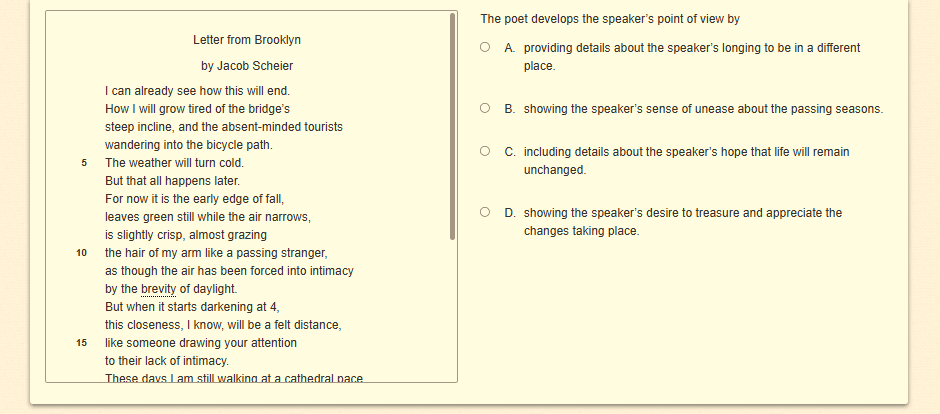
Question 68 of 120
2024 Test A English, question 11Passage Excerpt from “Impressions of an Indian Childhood”
Excerpt from “Impressions of an Indian Childhood”
by Zitkala-Sa
Zitkala-Sa (Gertrude Simmons Bonnin) was a Native American writer, musician, teacher, and political activist who was raised on the Yankton Sioux Reservation in South Dakota. In 1900 she published “Impressions of an Indian Childhood” (the term Indian was commonly used at the time to refer to Native American people) to expose readers to what life is like on a reservation.
Soon after breakfast Mother sometimes began her beadwork. On a bright, clear day, she pulled out the wooden pegs that pinned the skirt of our wigwam1 to the ground, and rolled the canvas part way up on its frame of slender poles. Then the cool morning breezes swept freely through our dwelling, now and then wafting the perfume of sweet grasses from newly burnt prairie.
Untying the long tasseled strings that bound a small brown buckskin2 bag, my mother spread upon a mat beside her bunches of colored beads, just as an artist arranges the paints upon his palette. On a lapboard she smoothed out a double sheet of soft white buckskin; and drawing from a beaded case that hung on the left of her wide belt a long, narrow blade, she trimmed the buckskin into shape. Often she worked upon small moccasins for her small daughter. Then I became intensely interested in her designing. With a proud, beaming face, I watched her work. In [my] imagination, I saw myself walking in a new pair of snugly fitting moccasins. I felt the envious eyes of my playmates upon the pretty red beads decorating my feet.
Close beside my mother I sat on a rug, with a scrap of buckskin in one hand and an awl in the other. This was the beginning of my practical observation lessons in the art of beadwork. From a skein3 of finely twisted threads of silvery sinews my mother pulled out a single one. With an awl she pierced the buckskin, and skillfully threaded it with the white sinew. Picking up the tiny beads one by one, she strung them with the point of her thread, always twisting it carefully after every stitch.
It took many trials before I learned how to knot my sinew thread on the point of my finger, as I saw her do. Then the next difficulty was in keeping my thread stiffly twisted, so that I could easily string my beads upon it. My mother required of me original designs for my lessons in beading. At first I frequently ensnared many a sunny hour into working a long design. Soon I learned from self-inflicted punishment to refrain from drawing complex patterns, for I had to finish whatever I began.
After some experience I usually drew easy and simple crosses and squares. These were some of the set forms. My original designs were not always symmetrical nor sufficiently characteristic, two faults with which my mother had little patience. The quietness of her oversight made me feel strongly responsible and dependent upon my own judgment. She treated me as a dignified little individual as long as I was on my good behavior; and how humiliated I was when some boldness of mine drew forth a rebuke from her!
In the choice of colors she left me to my own taste. I was pleased with an outline of yellow upon a background of dark blue, or a combination of red and myrtle-green. There was another of red with a bluish-gray that was more conventionally used. When I became a little familiar with designing and the various pleasing combinations of color, a harder lesson was given me. It was the sewing on, instead of beads, some tinted porcupine quills, moistened and flattened between the nails of the thumb and forefinger. My mother cut off the prickly ends and burned them at once in the centre fire. These sharp points were poisonous, and worked into the flesh wherever they lodged. For this reason, my mother said, I should not do much alone in quills until I was as tall as my cousin Warca-Ziwin.
Always after these confining lessons I was wild with surplus spirits, and found joyous relief in running loose in the open again. Many a summer afternoon a party of four or five of my playmates roamed over the hills with me. We each carried a light sharpened rod about four feet long, with which we pried up certain sweet roots. When we had eaten all the choice roots we chanced upon, we shouldered our rods and strayed off into patches of a stalky plant under whose yellow blossoms we found little crystal drops of gum. Drop by drop we gathered this nature’s rock-candy, until each of us could boast of a lump the size of a small bird’s egg. Soon satiated with its woody flavor, we tossed away our gum, to return again to the sweet roots.
From “Impressions of an Indian Childhood” by Zitkala-Sa—Public Domain
A BRIEF HISTORY OF BEADWORK IN SOUTH DAKOTA
| Date | Event |
|---|---|
| 1500s | The Dakota use beads made from bones, shells, stones, and animal teeth. European traders bring glass beads to North America. |
| Late 1600s | The Dakota begin trading with the French in Minnesota. |
| 1830s | The Dakota begin using glass beads in clothing, artwork, and decorations in place of Native-made beads. |
| 1862–1865 | The Dakota are expelled from their homelands in Minnesota as a result of the U.S.-Dakota War. |
| 1900s–1920s | The Dakota create items to sell outside their community. |
Source: MNopedia
1wigwam: hut with an arched framework of poles covered with bark, mats, or animal hides
2buckskin: leather made from the skin of a male deer
3skein: coiled length of yarn or other thread loosely wound on a reel
Question
The author’s use of sequence in paragraphs 1 and 2 contributes to the development of ideas in the excerpt by
- Alisting the many steps that are involved in the process of beading in order to explain its difficulty and complexity.
- Bconveying the importance of following the steps of the beading process in a precise order to work most efficiently.
- Cemphasizing the time required to fully prepare for and execute the many large and small tasks in the activity of beading.
- Ddetailing each step in preparation for beading in order to highlight the author’s enthusiasm for the work.
Show the answer
Correct answer: D
The question asks how the author’s use of sequence in paragraphs 1 and 2 contributes to the development of ideas in the excerpt.
A. Incorrect. In paragraph 2, the author does list the steps her mother takes in preparation to do beadwork, such as “untying the long tasseled strings” of the bag of beads, spreading the beads beside her on a mat, and using “a long, narrow blade” to trim the buckskin into shape. However, the language used to describe this sequence does not indicate that preparing to work with beads is difficult or complex.
B. Incorrect. Although the author’s description of untying the bag of beads, spreading the beads upon a mat, smoothing out a sheet of buckskin, and trimming the buckskin into shape in paragraph 2 indicates that the mother follows a certain routine, it does not place any emphasis on working most efficiently by following the steps of the beading process in a precise order.
C. Incorrect. In paragraph 2, the author describes her mother “untying the long tasseled strings that bound a small brown buckskin bag,” “spread[ing] upon a mat beside her bunches of colored beads,” “smooth[ing] out a double sheet of soft white buckskin; and drawing from a beaded case that hung on the left of her wide belt a long, narrow blade” to trim the buckskin. Although these descriptions do outline the steps in her process for creating beadwork, they do not emphasize the time required to do so, since the author does not mention in the excerpt how long it took her mother to fully prepare for and complete the large and small tasks in the activity of beading.
D. CORRECT. In paragraph 1, the author describes how the morning begins with her mother rolling up the canvas of the wigwam and allowing the breeze to come in. In paragraph 2, the author uses sensory language and precise sequencing to describe the way her mother prepares the beading materials by untying “the long tasseled strings that bound a small brown buckskin bag,” spreading the “bunches of colored beads” beside her, and smoothing out “a double sheet of soft white buckskin.” This combination of sequence and sensory language highlights the author’s enthusiasm for beadwork by emphasizing that the author pays close attention to her mother’s preparations.
Question analysis
This reading question asks how the step-by-step description of a mother preparing her beadwork, in the opening paragraphs of Zitkala-Sa's memoir, contributes to the excerpt's ideas. Every choice agrees that steps are listed, so students must judge which purpose the text actually supports and resist reasons that only sound likely for a craft.
- Grade level
- Grade 8 reading and task
- Compared with grade 7
- Above grade 7 Grade 7 structure questions usually ask what a paragraph adds to a topic. This one asks what an ordered description achieves, in dense 1900 prose where the purpose is never stated outright, which goes beyond typical grade 7 work.
- Estimated difficulty
- Hard: combines ideas, needs a plan, and has more than one tempting wrong answer.
- Thinking it demands
- Depth of knowledge 3, strategic thinking · mainly analyze
- What makes it hard
- How, not what major
- A very close wrong answer moderate
- Reading between the lines moderate
- Complex sentences minor
- Evidence
- Answered from several paragraphs or stanzas
- Reading level
- Passage: about grade 8, 946 words; question and choices: about grade 11, 95 words.
- Corrected from the DOE handbook
- A misquotation of the excerpt in the explanation was corrected.
- Students, last 30 days
- Not enough answers yet to show (it takes 10).
Why it is hard, traps and wrong answers (shows the answer)
Why it is hard
All four choices agree that the paragraphs lay out steps, so the question turns entirely on purpose, and three of the purposes sound like natural reasons to describe a craft. Nothing in paragraphs 1 and 2 calls the work hard, slow or a matter of efficiency; what they do show is a child following every move and becoming intensely interested. Students who look for the narrator's own reaction find the purpose, while those who reason from the steps alone drift to difficulty or time.
How, not what major Working it out
The stem asks what the ordered account of untying the bag, spreading the beads, and smoothing and trimming the buckskin does for the excerpt, a purpose the author never states. (Anderson & Krathwohl, 2001)
A very close wrong answer moderate Choosing the answer
The difficulty choice shares the right one's frame, steps laid out in order to show something, and differs only in what they show: how hard beading is, or how eagerly the girl watched. (Embretson & Wetzel, 1987; Gorin & Embretson, 2006; Ascalon et al., 2007)
Reading between the lines moderate Working it out
The enthusiasm has to be pieced together from the close attention to each step and from “intensely interested” and “a proud, beaming face” in paragraph 2. (Graesser, Singer & Trabasso, 1994; Kintsch, 1998)
Complex sentences minor Understanding the question
Paragraph 2 uses literary word order, as in “my mother spread upon a mat beside her bunches of colored beads,” which slows the reading of the very steps in question. (Abedi & Lord, 2001; Freedle & Kostin, 1993; Messick, 1989)
Strategy: For each choice, look in paragraphs 1 and 2 for words that would prove its purpose; a purpose that no sentence states or shows can be ruled out.
Traps
- Half right: One half of a two-part choice is right and the other is not.
- Wrong purpose or structure: Names a purpose, structure or effect that the part does not serve, or describes what a part says when the question asks what it does.
- Reads too much in: A reasonable-sounding conclusion that goes further than the text allows.
The wrong answers, classified
A Half right (King et al., 2004; Thissen, Steinberg & Fitzpatrick, 1989)
Rightly sees that paragraph 2 lists many preparation steps, then decides the list must show that beading is difficult and complex, which nothing in these paragraphs says.
B Wrong purpose or structure (Anderson & Krathwohl, 2001)
Reads the sequence as instructions about doing the steps in a precise order for efficiency, a purpose a watching child's memories never suggest.
C Reads too much in (Graesser, Singer & Trabasso, 1994)
Reasons that so many steps must take a long time, perhaps recalling the “many a sunny hour” of paragraph 4, but paragraphs 1 and 2 never mention time.
What was corrected from the DOE handbook, and why
- Explanation: In rejecting choice C, the handbook quotes paragraph 2 as “spread[ing them] upon a mat beside her bunches of colored beads.” In the excerpt, the bunches of colored beads are what the mother spreads (“my mother spread upon a mat beside her bunches of colored beads”). The inserted “them” refers to nothing and turns the beads into a place. The quotation now reads “spread[ing] upon a mat beside her bunches of colored beads,” which is how the handbook itself reads the sentence in its reason for rejecting choice A (“spreading the beads beside her on a mat”).
Working it out, step by step
Figure out what the question asks
Sequence means the order in which things happen. Paragraphs 1 and 2 tell the steps of a morning in order. The question asks why the author tells them step by step. What does that careful order help show?
List the steps
In paragraphs 1 and 2, the mother:
- rolls up the side of the wigwam to let in the breeze,
- unties a bag made of buckskin (soft deer leather),
- spreads her beads on a mat,
- smooths out a sheet of buckskin, and
- trims it into shape with a blade.
Find the author’s reaction
Right after the steps, the author tells how she felt. “Then I became intensely interested in her designing. With a proud, beaming face, I watched her work.” Intensely means very strongly. A beaming face has a big, happy smile. She noticed every little step because she was so excited. The details show her enthusiasm, or eager interest.
Check each choice
- A is wrong. The steps are listed, but nothing says beading is hard or complex.
- B is wrong. Nothing says the steps must go in a set order to save effort.
- C is wrong. Paragraphs 1 and 2 never say how long anything takes.
- D is right. The careful details show how closely the girl watched, with eager interest.
Watch out: A is tempting because there are many steps. But many steps don’t prove a task is hard. The author never calls it difficult.
Choose the answer
The step-by-step order shows a child following every move her mother makes. So the answer is D.
Why this answer and not the closest wrong one
A is the closest wrong answer. Like D, it says the steps are listed to show something. But no word in paragraphs 1 and 2 calls beading hard. The author does say she was “intensely interested” and had “a proud, beaming face.” That shows enthusiasm, so D fits better.
More questions like this
The original DOE question
The passage “Excerpt from “Impressions of an Indian Childhood”” as printed (pages 42–43)
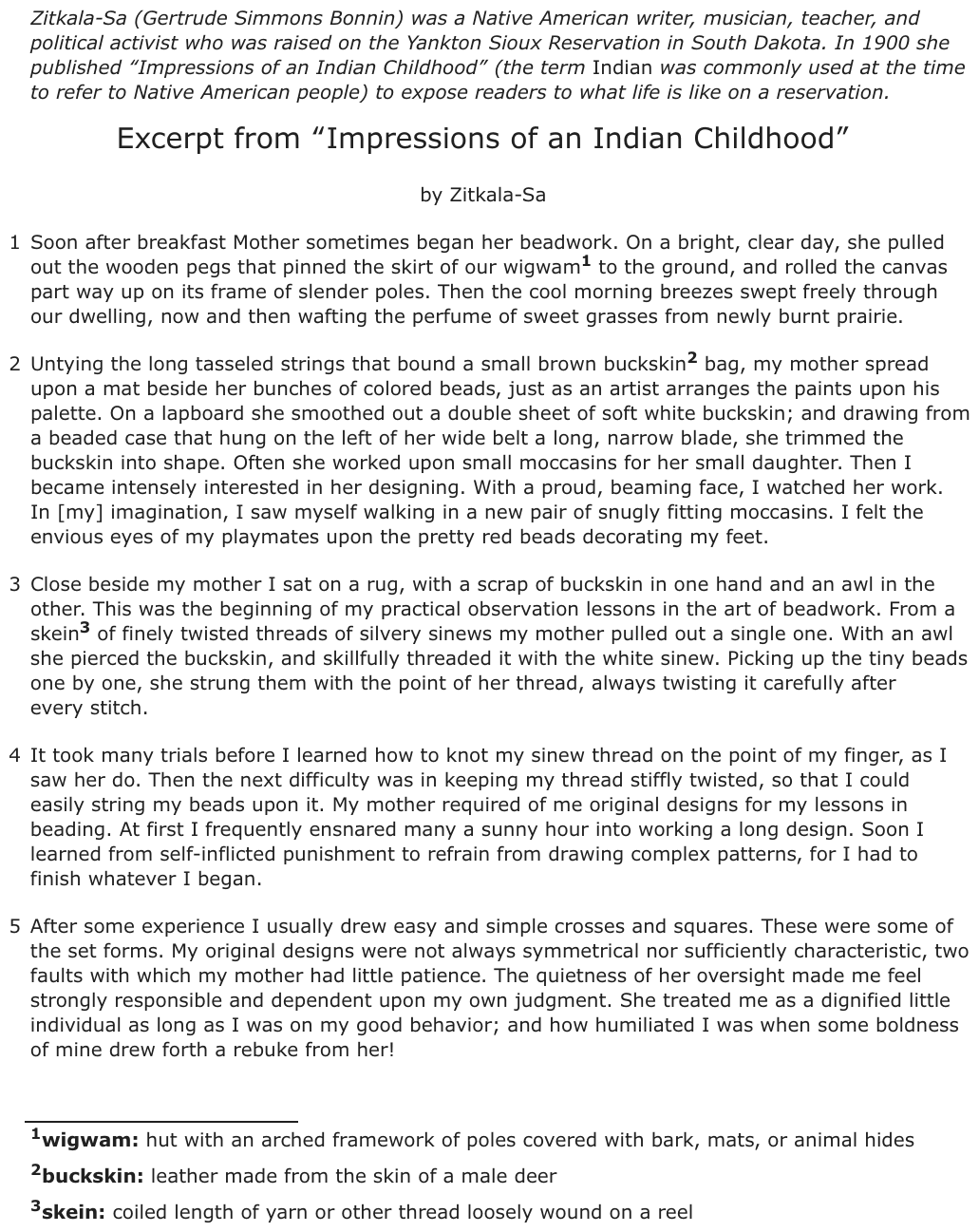
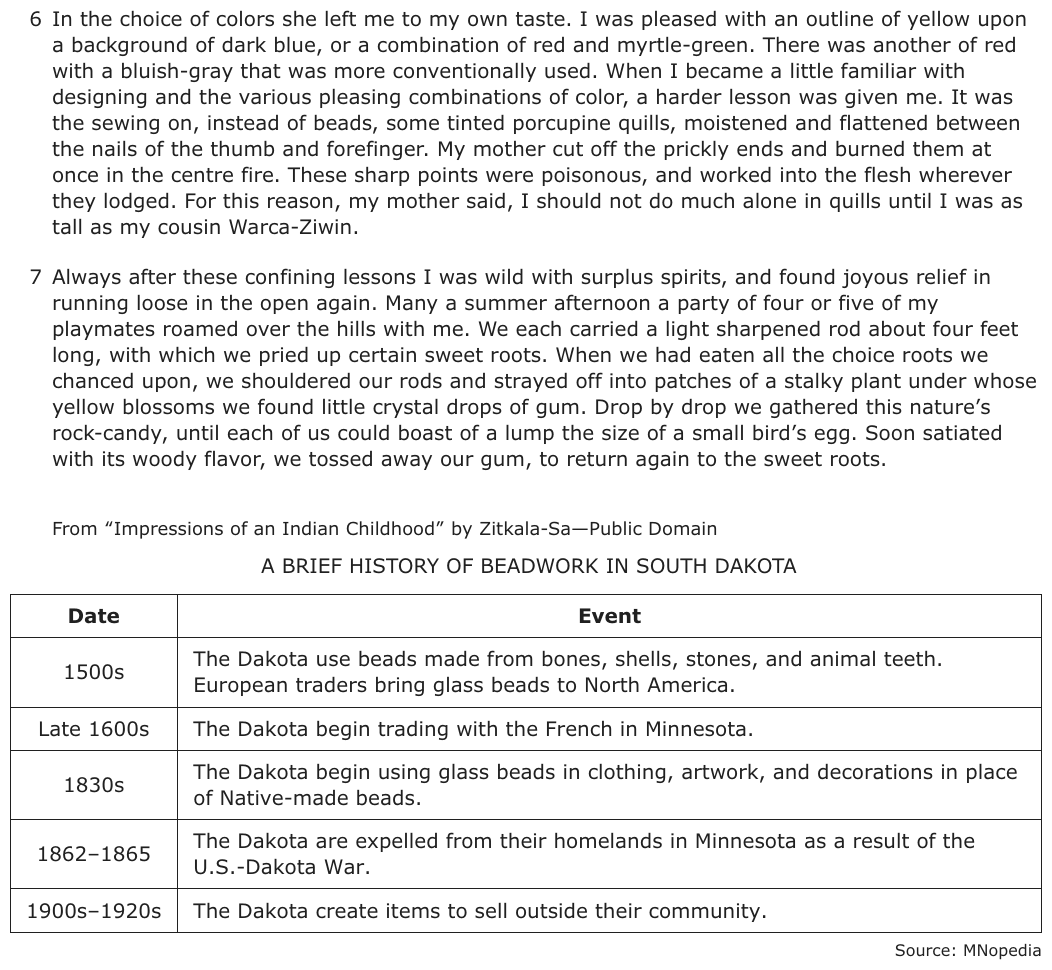
Question 69 of 120
2024 Test A English, question 18Uses the passage above: “Excerpt from “Impressions of an Indian Childhood””.
Question
The table after paragraph 7 expands on a central idea in the excerpt because it shows that
- Athe craft the author was learning was a tradition that endured through many generations and changes.
- Bthe author’s family incorporated traditional materials into their craft as a way of resisting the influence from European traders.
- Cthe uniqueness of the cultural tradition that the author learned as a child was eventually recognized in Europe.
- Dthe author was able to incorporate color into her craftwork as a result of trade with other peoples.
Show the answer
Correct answer: A
The question asks how the table after paragraph 7 expands on a central idea in the excerpt.
A. CORRECT. The table provides the chronology from the 1500s, when the Dakota created beadwork using “beads made from bones, shells, stones, and animal teeth,” to the 1830s, when the Dakota began “using glass beads,” and the 1900s, when they created items to “sell outside their community.” Thus, the table helps expand on a central idea by showing that the craft the author was learning is a tradition that has endured through many generations.
B. Incorrect. Although the table shows that the Dakota used “beads made from bones, shells, stones, and animal teeth” in the 1500s and that by the 1830s began “using glass beads in clothing, artwork, and decorations in place of Native-made beads,” it does not provide any information about the type of materials used by the author’s family.
C. Incorrect. While the information included in the table states that “European traders [brought] glass beads to North America” in the 1500s and that by the 1920s the Dakota created “items to sell outside their community,” there is no mention of whether the uniqueness of Dakota beadwork was recognized in Europe.
D. Incorrect. The table indicates that by the late 1600s the Dakota began trading with French traders from Europe who brought glass beads to the Americas and that by the 1830s the Dakota were “using glass beads in clothing, artwork, and decorations in place of Native-made beads.” However, the table provides no information about whether this work incorporated color. Therefore, the table does not show that the author was able to incorporate color into her craftwork as a result of trade with other peoples.
Question analysis
This reading question asks how a table titled A Brief History of Beadwork in South Dakota, printed after Zitkala-Sa's excerpt, expands on one of its central ideas. Students must read a short timeline of beads, trade and war and connect it to a girl learning beadwork, while avoiding choices that sound historically likely but go beyond the table.
- Grade level
- Grade 7 reading and task
- Compared with grade 7
- At grade 7 Connecting a table to a text's central idea is grade 7 work. The table is short and plainly worded, and linking a people's history to one girl's lessons is a typical grade 7 step.
- Estimated difficulty
- Moderate: several steps, or a close reading with one strong distractor.
- Thinking it demands
- Depth of knowledge 3, strategic thinking · mainly analyze
- What makes it hard
- Reading a figure, table or graph moderate
- Combines ideas moderate
- Reading between the lines minor
- Evidence
- Answered from several paragraphs or stanzas
- Reading level
- Passage: about grade 8, 946 words; question and choices: about grade 11, 87 words.
- Corrected from the DOE handbook
- A date in the explanation was corrected to match the table.
- Students, last 30 days
- Not enough answers yet to show (it takes 10).
Why it is hard, traps and wrong answers (shows the answer)
Why it is hard
The table holds plenty of tempting raw material: European traders, glass beads, sales outside the community. Wrong answers build unsupported stories out of it, about resistance, European recognition or the arrival of color, and the last is the hardest to resist because the excerpt is full of colored beads. Students who sum up the table in one phrase, a craft carried on through centuries of change, can check each choice against what the rows actually say.
Reading a figure, table or graph moderate Understanding the question
The table runs from the 1500s to the 1920s, and its point appears only when the five rows are read as a timeline: new beads, trade, war and expulsion, yet the beadwork goes on. (Lesh, Post & Behr, 1987; Kirsch & Mosenthal, 1990)
Combines ideas moderate Working it out
Students must join the table's history of the Dakota to one girl's lessons in paragraphs 3–6 and see that the craft she learns belongs to that long line. (Embretson, 1998; Daniel & Embretson, 2010)
Reading between the lines minor Working it out
Endurance is never stated; it has to be drawn from a beadwork history that spans four centuries, from bone and shell beads to items made for sale, through every change between. (Graesser, Singer & Trabasso, 1994; Kintsch, 1998)
Strategy: Read the table from top to bottom and say in a few words what it shows over time, then pick the choice that fits that pattern and also connects to the excerpt.
Traps
- Reads too much in: A reasonable-sounding conclusion that goes further than the text allows.
- Outside knowledge: A choice is plausible in the real world but not supported by this text.
- Twists what the text says: Uses the text's topic and ideas but changes what it says: who did it, how much, when, or why.
The wrong answers, classified
B Twists what the text says (King et al., 2004)
Imagines the family holding to traditional materials to resist traders, though the 1830s row shows the Dakota taking up glass beads in place of Native-made ones.
C Reads too much in (Graesser, Singer & Trabasso, 1994)
Joins the European traders of the first row to the sales outside the community in the last and concludes that Europe recognized the craft, which no row states.
D Outside knowledge (King et al., 2004; Recht & Leslie, 1988)
Links the excerpt's colored beads to the glass beads traders brought and assumes trade supplied the color, but the table never mentions color, so that link comes from outside it.
What was corrected from the DOE handbook, and why
- Explanation: In rejecting choice D, the handbook says that “by 1830” the Dakota were using glass beads in clothing, artwork and decorations. The table places that change in the 1830s (“The Dakota begin using glass beads …”), and the handbook’s own reason for rejecting choice B says “by the 1830s.” The explanation now reads “by the 1830s.”
Working it out, step by step
Figure out what the question asks
The excerpt ends with a table, a chart of facts in rows. You need to see how the table adds to a central idea of the excerpt. A central idea is an important message.
Read the table as a timeline
- 1500s: the Dakota make beads from bones, shells, stones and teeth.
- Late 1600s: they begin trading with the French.
- 1830s: they use glass beads “in place of Native-made beads.”
- 1862–1865: a war forces them out of their homelands.
- 1900s–1920s: they make items to sell outside their community.
Find the pattern
The beads change. Trade begins. A war drives the people from their land. But through all of it, the beadwork goes on for hundreds of years. The girl in the excerpt is learning this same craft from her mother. So the table shows her craft is a tradition, a custom passed down through many generations.
Check each choice
- A is right. The craft lasted through many changes over hundreds of years.
- B is wrong. The table shows the Dakota took up glass beads, not that they resisted traders.
- C is wrong. No row says Europe ever praised the craft.
- D is wrong. The table never mentions color.
Watch out: D is tempting because the excerpt is full of colored beads, and traders brought glass beads. But the link to color is a guess. The table doesn’t say it.
Choose the answer
The table shows beadwork lasting through centuries of change, just like the craft the girl learns. So the answer is A.
Why this answer and not the closest wrong one
D is the closest wrong answer. Traders did bring glass beads, and the girl’s beads are colorful. But no row of the table says trade gave the Dakota color. Nothing ties it to the author’s own work either. A sums up what the rows actually show: a craft that went on through change.
More questions like this
The original DOE question
Question 70 of 120
2024 Test A English, question 20Passage At Dusk
At Dusk
by Natasha Trethewey
At first I think she is calling a child,
my neighbor, leaning through her doorway
at dusk, street lamps just starting to hum
the backdrop of evening. Then I hear
the high-pitched wheedling1 we send out
to animals who know only sound, not
the meanings of our words—here here—
nor how they sometimes fall short.
In another yard, beyond my neighbor’s
sight, the cat lifts her ears, turns first
toward the voice, then back
to the constellation of fireflies flickering
near her head. It’s as if she can’t decide
whether to leap over the low hedge,
the neat row of flowers, and bound
onto the porch, into the steady circle
of light, or stay where she is: luminous
possibility—all that would keep her
away from home—flitting before her.
I listen as my neighbor’s voice trails off.
She’s given up calling for now, left me
to imagine her inside the house waiting,
perhaps in a chair in front of the TV,
or walking around, doing small tasks;
left me to wonder that I too might lift
my voice, sure of someone out there,
send it over the lines stitching here
to there, certain the sounds I make
are enough to call someone home.
“At Dusk” from NATIVE GUARD by Natasha Trethewey, published by Houghton Mifflin Company. Copyright © 2006 by Natasha Trethewey. All rights reserved.
1wheedling: speaking in a flattering manner
Question
The isolation of the words “—here here—” in line 7 contributes to the meaning of the poem mainly by
- Ademonstrating how people try to communicate in familiar ways but are still sometimes misunderstood.
- Bshowing how people can feel desperate to connect with others but give up quickly when their first attempts are ignored.
- Cusing the unspoken bond between the neighbor and her cat to highlight the understanding people have with their pets.
- Dillustrating the use of a simple expression to call home those who are loved and missed.
Show the answer
Correct answer: D
The question asks how the isolation of the words “—here here—” in line 7 mainly contributes to the meaning of the poem.
A. Incorrect. The words “—here here—” do interrupt the speaker’s observation in lines 7–8 that “our words . . . / . . . sometimes fall short.” However, in lines 5–7, the speaker observes that the neighbor accompanies her words with a “high-pitched wheedling” that people “send out” because they are aware that animals “know only sound, not / the meanings of our words,” indicating that the neighbor does not actually expect her words to be understood. The description of the cat’s response in lines 10–11 (“the cat lifts her ears, turns first / toward the voice, then back”) does not suggest that the neighbor’s message is misunderstood but rather suggests that the cat prefers not to respond to it.
B. Incorrect. In lines 20–21, the “neighbor’s voice trails off,” and she does give up calling the cat. However, rather than any desperation to connect, the neighbor’s use of a “high-pitched wheedling” (line 5) simply indicates her understanding that the cat, like other animals, understands “only sound, not / the meanings of our words” (lines 6–7) such as “here here.” Furthermore, the neighbor does not give up quickly. In lines 21–22, the speaker says the neighbor has “given up calling for now” but is still “waiting” for the cat.
C. Incorrect. In lines 4–7, the speaker describes the neighbor calling to the cat with a “high-pitched wheedling.” The sound may indicate a bond between the neighbor and the cat because the neighbor does understand that animals “know only sound, not / the meanings of our words” (lines 6–7). However, the use of the words “here here” in line 7 does not indicate that bond, because they are used as an example of the type of words that animals do not understand.
D. CORRECT. The speaker’s initial thought in line 1 that the neighbor is calling a child, rather than a cat, suggests that the neighbor loves and misses the cat. Lines 4–7 then present the speaker’s observation that the neighbor uses a “high-pitched wheedling,” to emphasize the simple words of her call, “—here here—.” The idea that the words are an example of a simple expression used to call home a missed loved one is reinforced in lines 25–29, when the speaker is “left . . . to wonder” whether the speaker, too, “might lift / [his or her] voice” and be able “to call someone home.”
Question analysis
This reading question asks how setting off the words here here with dashes in line 7 adds to the meaning of At Dusk, Natasha Trethewey's poem about a neighbor calling her cat at nightfall. Students must work out what two plain, isolated words contribute to the whole poem, choosing among four readings about how people and animals communicate and connect.
- Grade level
- Grade 8 reading and task
- Compared with grade 7
- Above grade 7 Grade 7 students explain how a line adds to a poem, but here the feature is a tiny typographic choice, and its meaning has to be built from the whole poem rather than nearby lines, which goes beyond typical grade 7 work.
- Estimated difficulty
- Among the hardest on the SHSAT: a non-obvious approach, heavy reading, or a well-hidden trap.
- Thinking it demands
- Depth of knowledge 3, strategic thinking · mainly analyze
- What makes it hard
- A very close wrong answer major
- Evidence in several places moderate
- How, not what moderate
- Evidence
- Answered from the whole text
- Reading level
- Passage: 236 words (a poem; reading level not measured); question and choices: about grade 9, 87 words.
- Corrected from the DOE handbook
- A grammar slip in the explanation was corrected.
- Students, last 30 days
- Not enough answers yet to show (it takes 10).
Why it is hard, traps and wrong answers (shows the answer)
Why it is hard
The words sit inside a sentence about animals not knowing the meanings of our words and about words that “sometimes fall short,” so the nearest lines point toward miscommunication. The poem's frame points elsewhere: it opens with a call that sounds like a parent's, ends with the speaker hoping a voice can “call someone home,” and even repeats “here” in line 27. Students who read only around line 7 choose the misunderstanding; those who connect the isolated call to the first and last lines see what it is for.
A very close wrong answer major Choosing the answer
The misunderstanding choice and the right one agree that “here here” is a familiar way of calling; they part only on what it shows, failed communication or a call home to someone missed. (Embretson & Wetzel, 1987; Gorin & Embretson, 2006; Ascalon et al., 2007)
Evidence in several places moderate Working it out
The right reading rests on lines far from line 7: the speaker's first guess that a child is being called, and the last line's wish “to call someone home.” (Kirsch & Mosenthal, 1990; Gorin & Embretson, 2006)
How, not what moderate Working it out
The question asks what setting two words apart with dashes and italics does for the poem, a typographic choice whose purpose the poem never explains. (Anderson & Krathwohl, 2001)
Strategy: Ask what the two words are meant to do and whom they are aimed at, then keep the choice that the poem's other lines confirm.
Traps
- Wrong purpose or structure: Names a purpose, structure or effect that the part does not serve, or describes what a part says when the question asks what it does.
- Twists what the text says: Uses the text's topic and ideas but changes what it says: who did it, how much, when, or why.
- Reads too much in: A reasonable-sounding conclusion that goes further than the text allows.
The wrong answers, classified
A Wrong purpose or structure (Anderson & Krathwohl, 2001)
Reads the words through line 8's “sometimes fall short” as failed communication, but the cat does hear and turn toward the call, and the ending hopes such sounds can bring someone home.
B Twists what the text says (King et al., 2004)
Sees the neighbor stop calling and calls her desperate and quick to quit, though she has given up only “for now” and is still waiting inside.
C Reads too much in (Graesser, Singer & Trabasso, 1994)
Assumes an owner and a pet share a silent understanding, but “here here” is spoken aloud, and the poem offers it as words animals cannot follow.
What was corrected from the DOE handbook, and why
- Explanation: In rejecting choice C, the handbook reads “the use of the words “here here” in line 7 do not indicate that bond.” It now reads “does not,” to agree with “use.”
Working it out, step by step
Figure out what the question asks
In line 7 the words here here are set apart by dashes and slanted letters (italics). The question asks what this does for the poem’s meaning. Think about what the words are for and who they are aimed at.
Look at line 7
Line 7 reads “the meanings of our words—here here—.” These are the words the neighbor calls to her cat. Setting them apart lets you hear them, as if spoken aloud. They are simple words that mean “come here.” Lines 6–7 say animals know “only sound, not / the meanings of our words.”
Connect to the start and end
In line 1 the speaker first thinks the neighbor “is calling a child.” So the call sounds like a parent calling someone they love. The poem ends with the hope that a voice can be “enough to call someone home” (line 29). So here here is a simple call to bring a loved one home.
Check each choice
- A is wrong. The cat isn’t confused. She “lifts her ears” and turns “toward the voice.” She just doesn’t come yet.
- B is wrong. The neighbor isn’t shown as desperate. She stops only “for now,” and the speaker pictures her waiting inside.
- C is wrong. Here here is spoken out loud. The poem treats it as words animals don’t understand, not a silent bond.
- D is right. It is a simple call to someone loved and missed.
Watch out: Line 8 says words “sometimes fall short,” which points toward A. But read the first and last lines too.
Choose the answer
The two words stand for the simple call people use to bring loved ones home. So the answer is D.
Why this answer and not the closest wrong one
A is the closest wrong answer, because line 8 says our words “sometimes fall short.” But the cat does hear the call and turn toward it. And the poem ends by hoping the sounds “are enough to call someone home.” D links the two words to that wish, and to the first guess that a child is being called.
More questions like this
The original DOE question
The passage “At Dusk” as printed (page 48)
Question 71 of 120
2024 Test A English, question 22Uses the passage above: “At Dusk”.
Question
The phrases “luminous possibility” and “all that would keep her / away from home” (lines 17–19) affect the poem by
- Ahighlighting the cat’s lack of concern for the neighbor.
- Bimplying that the speaker finds the cat’s current situation interesting.
- Csuggesting that the cat is compelled by its sense of wonder to remain outdoors.
- Dindicating that the speaker supports the cat’s decision to ignore the neighbor.
Show the answer
Correct answer: C
The question asks how the phrases “luminous possibility” and “all that would keep her / away from home” (lines 17–19) affect the poem.
A. Incorrect. In lines 20–21, the neighbor’s voice “trails off,” and the speaker states that “she’s given up calling for now,” which could be interpreted as a lack of concern. However, these lines describe the neighbor rather than the cat. The phrases from lines 17–19 are used to explain that what keeps the cat from returning home is the allure of “luminous possibility.” The use of the phrase “all that would keep her” suggests that the cat would likely return home to the security of “the steady circle / of light” (lines 16–17) if not for the possibilities offered by the night, implying that the cat usually prefers to be at home with the neighbor. The phrases do not highlight a lack of concern for the neighbor on the part of the cat.
B. Incorrect. While the phrase “luminous possibility” does convey a high degree of interest, it is used to describe why being outside at night appeals to the cat. It does not describe the speaker’s interest in the cat. The speaker observes the cat as it tries to decide between returning home and staying out and then concludes that it is only “luminous / possibility . . . that would keep [the cat] / away from home.”
C. CORRECT. The phrases are used to explain that the cat, though tempted to return home, is also tempted or compelled by “luminous possibility” to remain outdoors. The phrases convey a sense of wonder about what the night may offer, and it is the powerful effect of this sense of wonder (“all that would keep her / away from home”) that ultimately tempts the cat to remain outdoors rather than return to the comforts of home.
D. Incorrect. Lines 17–19 present the speaker’s observations about the cat as it tries to decide whether to stay where it is or return home. The speaker explains that it is only “luminous possibility” that can convince the cat to stay rather than return to the comforts of home. While the speaker then imagines the neighbor indoors, there is no indication that the speaker supports the cat’s decision. The speaker merely notes that the neighbor stops calling to the cat “for now” (line 21), and then the speaker reflects on the possible results of calling someone home.
Question analysis
This reading question asks how the phrases luminous possibility and all that would keep her away from home, which describe what surrounds a cat in a nearby yard, affect the poem At Dusk. Students must interpret abstract, figurative wording and work out whose feelings it conveys: the cat's, the neighbor's or the speaker's.
- Grade level
- Grade 8 reading and task
- Compared with grade 7
- At grade 7 Explaining how word choice affects a poem is grade 7 work. These phrases are abstract and broken across lines, which adds some challenge, but the lines around them are concrete, so the task stays within typical grade 7 demand.
- Estimated difficulty
- Moderate: several steps, or a close reading with one strong distractor.
- Thinking it demands
- Depth of knowledge 2, skills and concepts · mainly analyze
- What makes it hard
- Figurative or literary language moderate
- Reading between the lines minor
- Complex sentences minor
- Evidence
- Answered from one paragraph or stanza
- Reading level
- Passage: 236 words (a poem; reading level not measured); question and choices: about grade 8, 63 words.
- Students, last 30 days
- Not enough answers yet to show (it takes 10).
Why it is hard, traps and wrong answers (shows the answer)
Why it is hard
The phrases belong to the speaker but describe what tempts the cat, and the choices exploit that by offering the speaker's interest or approval, or the cat's indifference to its owner. The words “all that would keep her / away from home” imply that home still pulls at the cat, so only an attraction strong enough to hold her outside fits. Students who first settle whose experience the phrases describe can rule out most choices at once.
Figurative or literary language moderate Understanding the question
“Luminous possibility” is abstract, an unnamed promise glowing in the dusk, and students must see it as what draws the cat, the counterweight to “the steady circle / of light” at home. (Graesser, Singer & Trabasso, 1994; Kintsch, 1998)
Reading between the lines minor Working it out
The phrases are the speaker's words about the cat, so students must work out that they convey the cat's pull, not the speaker's opinion or the neighbor's feelings. (Graesser, Singer & Trabasso, 1994; Kintsch, 1998)
Complex sentences minor Understanding the question
The phrases are broken across lines 17–19 and set off by dashes, so “flitting before her” is separated from “possibility” by the inserted “all that would keep her / away from home.” (Abedi & Lord, 2001; Freedle & Kostin, 1993; Messick, 1989)
Strategy: Decide first who or what the phrases describe, then keep only choices about that same subject and check that the phrases themselves show what each one claims.
Traps
- Wrong tone or attitude: Misjudges the tone, attitude or point of view, such as reading admiration as criticism, or taking a character's or subject's feelings for the author's.
- Reads too much in: A reasonable-sounding conclusion that goes further than the text allows.
The wrong answers, classified
A Reads too much in (Graesser, Singer & Trabasso, 1994)
Reads the cat's staying out as indifference to its owner, though “all that would keep her / away from home” implies home would win without the night's attractions.
B Wrong tone or attitude (Graesser, Singer & Trabasso, 1994)
Notices that “luminous possibility” is the speaker's lyrical phrase and takes it as the speaker's own interest, when it describes the wonder drawing the cat.
D Reads too much in (Graesser, Singer & Trabasso, 1994)
Assumes that describing the night so warmly means the speaker approves of the cat ignoring the neighbor, an opinion the poem never states.
Working it out, step by step
Figure out what the question asks
You need to know what two phrases do in the poem. First decide who they describe. Here they describe the cat and what pulls at her.
Find the phrases in lines 17–19
The cat could go home, “or stay where she is: luminous / possibility—all that would keep her / away from home—flitting before her.”
Work out what the words mean
“Luminous” means glowing with light. “Possibility” means what might happen. “Flitting” means darting quickly about, like the fireflies near her head. So the glowing night is full of exciting chances. It is everything that “would keep her / away from home.” That sense of wonder is what holds the cat outside.
Check each choice
- A is wrong. “All that would keep her / away from home” means home pulls at her too. She isn’t uncaring.
- B is wrong. The phrases describe what draws the cat, not how the speaker feels.
- C is right. The night’s glow and wonder tempt the cat to stay out. “Compelled” means strongly pulled.
- D is wrong. The speaker never says the cat is right to stay out.
Watch out: B is tempting because “luminous possibility” is the speaker’s own beautiful wording. But the speaker uses it to show what the cat sees.
Choose the answer
The phrases show a wonder strong enough to hold the cat outdoors. So the answer is C.
Why this answer and not the closest wrong one
B is the closest wrong answer. The speaker does choose these glowing words. But they describe the night that is “flitting before her,” the cat. They explain what keeps her “away from home.” C fits, because the phrases show the cat drawn by wonder to stay outside.
More questions like this
The original DOE question
Question 72 of 120
2024 Test A English, question 23Uses the passage above: “At Dusk”.
Question
Read lines 11–13 from the poem.
toward the voice, then back
to the constellation of fireflies flickering
near her head
Which idea from the poem does the imagery in these lines help convey?
- AThe cat lacks a preference for going in or staying out.
- BThe cat is eager to see what will happen next.
- CThe cat wants to understand the unpredictable behavior of the fireflies.
- DThe cat is fascinated by the natural world and finds the indoors unremarkable.
Show the answer
Correct answer: D
The question asks which idea the imagery in lines 11–13 helps convey.
A. Incorrect. Line 13 includes the speaker’s observation that the cat seems “as if she can’t decide” whether to stay outside or go to the neighbor. However, the imagery of the “constellation of fireflies flickering” in line 12 suggests that the cat does have a preference for exploring the more exciting “luminous / possibility” (lines 17–18) of the outdoors.
B. Incorrect. The imagery in lines 10–11 of the cat turning “first / toward the voice, then back” might seem to suggest that the cat is eagerly watching both the neighbor and the fireflies to see what will happen next. However, line 13, in which the cat seems “as if she can’t decide,” indicates that what will happen next is actually under the cat’s control.
C. Incorrect. The imagery in lines 12–13 of the “fireflies flickering / near her head” does indicate the fireflies’ unpredictable behavior. However, the imagery in lines 10–11 of the cat turning “first / toward the voice, then back” establishes that the cat’s attention is split between the fireflies and the “high-pitched wheedling” (line 5) of the neighbor’s voice, rather than being fully captured by wanting to understand the fireflies.
D. CORRECT. The imagery in line 12 of “the constellation of fireflies flickering” suggests that the outdoors holds fascinating attractions, an idea supported by the description in lines 17–18 of the cat’s current location outdoors as one filled with “luminous / possibility.” The imagery in lines 10–11 of the cat turning “first / toward the voice, then back” indicates that the cat has considered but rejected the option of returning indoors, and the description in lines 16–17 of the indoors as offering only a “steady circle / of light” suggests that the indoors seems unremarkable to the cat in comparison to the outdoors.
Question analysis
This reading question quotes three lines from At Dusk in which a cat turns from a calling voice back to fireflies flickering near her head, and asks which idea the imagery helps convey. Students must interpret a visual image in light of the lines around it and judge how far the poem supports each reading of the cat's attention.
- Grade level
- Grade 8 reading and task
- Compared with grade 7
- Above grade 7 Grade 7 students explain what imagery conveys, but this image is brief and the four ideas offered for it differ in subtle ways, so ruling them out takes closer reading than typical grade 7 work.
- Estimated difficulty
- Hard: combines ideas, needs a plan, and has more than one tempting wrong answer.
- Thinking it demands
- Depth of knowledge 3, strategic thinking · mainly analyze
- What makes it hard
- Reading between the lines major
- Figurative or literary language moderate
- Evidence in several places minor
- Evidence
- Answered from one paragraph or stanza
- Reading level
- Passage: 236 words (a poem; reading level not measured); question and choices: about grade 6, 77 words.
- Students, last 30 days
- Not enough answers yet to show (it takes 10).
Why it is hard, traps and wrong answers (shows the answer)
Why it is hard
The answer is the best available rather than a perfect one: its first half is plain in the image of the cat turning back to the fireflies, while its second half rests on the comparison with a steady porch light. Meanwhile the very next words say she “can't decide,” which makes indifference look like the safe reading. The question rewards seeing that being torn is not the same as having no preference, since the image shows which way she turns.
Reading between the lines major Working it out
The quoted lines never mention the indoors, so the claim that the cat finds it unremarkable has to be drawn from the contrast with “the steady circle / of light” in lines 16–17. (Graesser, Singer & Trabasso, 1994; Kintsch, 1998)
Figurative or literary language moderate Understanding the question
“The constellation of fireflies flickering” turns insects into a field of stars beside the cat's head, and that image of wonder is what students are asked to interpret. (Graesser, Singer & Trabasso, 1994; Kintsch, 1998)
Evidence in several places minor Working it out
The words right after the quotation say “It's as if she can't decide,” and the evidence that tips the balance sits in lines 16–19, outside the three lines quoted. (Kirsch & Mosenthal, 1990; Gorin & Embretson, 2006)
Strategy: Picture the cat's movements in these three lines, then test each choice against the words of lines 10–19 and drop any idea the image does not actually show.
Traps
- Twists what the text says: Uses the text's topic and ideas but changes what it says: who did it, how much, when, or why.
- Reads too much in: A reasonable-sounding conclusion that goes further than the text allows.
- Word match: Repeats striking words or phrases from the text, so it looks supported, but its meaning does not fit the question.
The wrong answers, classified
A Twists what the text says (King et al., 2004)
Takes “as if she can't decide” in line 13 to mean the cat has no preference, but being torn means feeling two pulls, and these lines show her turning back to the fireflies.
B Reads too much in (Graesser, Singer & Trabasso, 1994)
Reads the cat's turning back and forth as eager waiting for what will happen, though the lines show attention divided between two pulls, not suspense.
C Word match (Freedle & Kostin, 1993)
Repeats the fireflies' flickering from the image and invents a wish to understand their behavior, when the lines show fascination with the lights, not curiosity about insects.
Working it out, step by step
Figure out what the question asks
Imagery is language that helps you see, hear or feel a scene. You need the idea that the images in lines 11–13 help show.
Picture lines 10–13
The cat “turns first / toward the voice, then back / to the constellation of fireflies flickering / near her head.” A constellation is a group of stars that forms a picture. So the fireflies are like little stars blinking around her. She hears the call, but she turns back to them.
Compare outdoors and indoors
Outside, the night sparkles like stars. Lines 17–18 call it “luminous / possibility,” full of glowing chances. Home is “the steady circle / of light” on the porch (lines 16–17). Steady means it does not change. Next to the flickering stars, that light is plain. Unremarkable means not special.
Check each choice
- A is wrong. The cat “can’t decide,” but that means she feels two pulls. The image shows her turning back to the fireflies.
- B is wrong. She is not waiting for something to happen. Her attention is split between two pulls.
- C is wrong. She is drawn to the fireflies’ glow, not trying to figure out how they act.
- D is right. She is fascinated by the night, and the porch light is plain next to it.
Watch out: A is tempting because of line 13. But being torn is not the same as having no preference.
Choose the answer
The poem never says the cat has made up her mind. But the images make the night magical and home ordinary. That fits D best. So the answer is D.
Why this answer and not the closest wrong one
A is the closest wrong answer, since the next words say “It’s as if she can’t decide.” But a cat with no preference would not care either way. This cat turns back to the fireflies, which shows a strong pull. D fits that pull, and the plain “steady circle / of light” shows why home seems less special.
More questions like this
The original DOE question
Question 73 of 120
2024 Test A English, question 24Uses the passage above: “At Dusk”.
Question
How does the setting affect the events of the poem?
- AIt enables the speaker to regularly overhear the neighbor calling for her cat at dusk.
- BIt allows the speaker to observe the neighbor quietly without interacting with her.
- CIt shows how living in close proximity helps the speaker feel connected to the neighbor.
- DIt shows how feeling isolated causes the speaker to imagine interactions with the neighbor.
Show the answer
Correct answer: B
The question asks how the setting affects the events discussed in the poem.
A. Incorrect. In line 2, the speaker refers to the woman calling for her cat as “my neighbor,” which clearly suggests that the speaker lives next door to the woman. However, although the two live next door to each other, line 1 suggests that perhaps the speaker does not regularly overhear the neighbor because the speaker initially thinks that the neighbor is “calling a child” and only later realizes the neighbor is calling to a cat. Although the setting places the speaker and the neighbor in close proximity, the poem does not indicate the frequency or regularity with which the speaker overhears the neighbor.
B. CORRECT. In the first four lines, the speaker observes the actions of the neighbor as the neighbor leans out to call for the cat at dusk. Despite the speaker’s observation of the neighbor, there is no indication that the neighbor notices the speaker. The reader can conclude that because of the time of day and the speaker being in the house next door, the speaker can observe the neighbor without being observed by her or having to interact with her.
C. Incorrect. The setting of the poem is a neighborhood at nightfall, as indicated by “at dusk” in line 3, the reference to “another yard” in line 9, and the flickering fireflies in line 12. However, while the speaker is close enough to the neighbor to overhear her calling to the cat, there is no indication that the speaker feels connected to the neighbor. Instead, the speaker expresses curiosity about the neighbor after the neighbor goes inside, and the speaker is “left . . . / to imagine her inside the house waiting” (lines 21–22). The fact the speaker initially thought that the neighbor was calling a child indicates that the speaker is not familiar with the neighbor and her habits, and there is no indication that the speaker feels connected to the neighbor.
D. Incorrect. In lines 22–24, the speaker imagines what the neighbor may be doing while the neighbor is waiting inside for the cat to return, but the speaker is imagining the neighbor’s solitary experience after the neighbor has momentarily “given up” on calling to the cat (line 21). The speaker does not imagine personally interacting with the neighbor but rather briefly imagines what the neighbor is doing at home while the cat is away.
Question analysis
This reading question asks how the setting of At Dusk, a neighborhood at nightfall where a woman leans from her doorway to call her cat, affects the events of the poem. Because so little happens, students must infer the setting's role from small details, and several choices sound reasonable without being supported by the poem.
- Grade level
- Grade 8 reading and task
- Compared with grade 7
- Above grade 7 Grade 7 students analyze how setting shapes events, usually in a story with a clear plot. This poem has almost no action, so the student must reason from a handful of details about place and time, which is harder than typical grade 7 work.
- Estimated difficulty
- Hard: combines ideas, needs a plan, and has more than one tempting wrong answer.
- Thinking it demands
- Depth of knowledge 3, strategic thinking · mainly analyze
- What makes it hard
- A very close wrong answer major
- Reading between the lines moderate
- Evidence
- Answered from the whole text
- Reading level
- Passage: 236 words (a poem; reading level not measured); question and choices: about grade 8, 67 words.
- Students, last 30 days
- Not enough answers yet to show (it takes 10).
Why it is hard, traps and wrong answers (shows the answer)
Why it is hard
Little happens in this poem, so the setting's role must be built from small details: a neighbor at her doorway at dusk, a cat in another yard, a speaker who hears and watches but never speaks. The strongest wrong answer is right about overhearing and wrong only in claiming it happens regularly, which the speaker's first mistaken guess argues against. The other choices supply a feeling of closeness or of isolation that the poem never states.
A very close wrong answer major Choosing the answer
The overhearing choice describes what the setting allows almost as well as the right one and fails on a single word, “regularly,” since the poem records one evening and the speaker first mistakes the call. (Embretson & Wetzel, 1987; Gorin & Embretson, 2006; Ascalon et al., 2007)
Reading between the lines moderate Working it out
The setting's effect is never stated; it has to be inferred from the speaker hearing and watching from nearby while the neighbor, “leaning through her doorway,” never seems to notice anyone. (Graesser, Singer & Trabasso, 1994; Kintsch, 1998)
Strategy: Picture the scene from the speaker's position, then check each choice word by word against the poem and reject any that claims something the poem never states.
Traps
- Too broad or too strong: A choice overstates, generalizes, or uses absolute words the text does not support.
- Reads too much in: A reasonable-sounding conclusion that goes further than the text allows.
- Twists what the text says: Uses the text's topic and ideas but changes what it says: who did it, how much, when, or why.
The wrong answers, classified
A Too broad or too strong (King et al., 2004)
Rightly sees that living next door lets the speaker overhear the call, but “regularly” is unsupported, and the first guess about a child suggests the call is unfamiliar.
C Reads too much in (Graesser, Singer & Trabasso, 1994)
Connects living close by with the poem's interest in connection and the speaker's “I too,” but the speaker never claims to feel close to the neighbor.
D Twists what the text says (King et al., 2004)
Notices the speaker picturing the neighbor indoors and calls it imagined interaction, but the speaker pictures her alone, waiting or doing small tasks, and never mentions feeling isolated.
Working it out, step by step
Figure out what the question asks
The setting is where and when a story or poem takes place. You need to see how the setting shapes what happens in the poem.
Picture the setting
It is “dusk” (line 3), the dim time just after sunset. The neighbor is “leaning through her doorway” (line 2). The cat is “In another yard” (line 9). The speaker is close enough to hear and watch it all. But the speaker never speaks to the neighbor. Nothing shows the neighbor notices the speaker.
Work out the effect
Living next door puts the speaker close by. In the fading light, the speaker can watch quietly. So the speaker sees the neighbor and the cat without joining in. The whole poem is what the speaker sees, hears and imagines from there.
Check each choice
- A is wrong. The word “regularly” is the problem. The poem shows one evening.
- B is right. The speaker watches from nearby and never talks with the neighbor.
- C is wrong. The speaker never says they feel close to the neighbor.
- D is wrong. The poem never says the speaker feels lonely. The speaker pictures the neighbor alone inside, not the two of them talking.
Watch out: A is almost right, since living nearby does let the speaker overhear. One word makes it wrong.
Choose the answer
The setting lets the speaker watch quietly from close by. So the answer is B.
Why this answer and not the closest wrong one
A is the closest wrong answer. Living next door does let the speaker hear the call. But nothing says it happens often. The poem tells about one evening. At first the speaker even thinks a child is being called. B fits what the poem shows: the speaker watches without ever talking to the neighbor.
More questions like this
The original DOE question

Question 74 of 120
2024 Test A English, question 27Passage Champion of the Channel
Champion of the Channel
In 1926 an editor at the London Daily News predicted that Gertrude Ederle, an American swimmer with eighteen world records and three Olympic medals, would fail in her attempt to swim across the English Channel. He claimed that “even the most uncompromising champion of the rights and capacities of women must admit that in contests of physical skill, speed and endurance they must remain forever the weaker sex.” Yet, at only nineteen years old, Ederle not only became the first woman to accomplish this feat, she also broke the men’s record by two hours. Gertrude Ederle’s triumphant swim across the English Channel was a testimony to her determination, innovative spirit, and passion for swimming.
Crossing the English Channel is a daunting task for any swimmer. At its narrowest point, the channel measures twenty-one miles across. Its icy waters hover around sixty degrees Fahrenheit, and its unruly tides and currents toss swimmers about like bobbing corks. Stinging jellyfish, seaweed, and floating debris from shipwrecks and lost cargoes present added hazards.
For decades the channel’s perils have defeated countless swimmers. Ederle, too, failed in her first attempt to cross the channel in 1925. Just six miles short of finishing, she became ill, and her coach had to haul her out of the water. Undeterred, Ederle decided to try again. Ederle knew that if she did not complete the challenge this time, she might never get the opportunity to set this record, because a rival female swimmer was preparing to make her second attempt at the crossing as well.
To prepare for the marathon swim, Ederle found ways to improve her equipment. She and her sister Meg discovered that melted candle wax perfectly sealed goggle edges, effectively waterproofing Ederle’s goggles against hammering waves. The sisters also designed a two-piece silk swimsuit for Ederle. During her first channel-crossing attempt she had worn a standard one-piece swimsuit that, after the lengthy hours of swimming across the channel, had stretched out, filling with water and creating drag, making an already challenging task almost insurmountable. Unlike the cumbersome typical bathing suit, this silk invention weighed little and allowed for easy movement.
On August 6, 1926, Ederle waded into the channel near Cape Gris-Nez, France. At first she shivered in the bone-chilling water even though she had covered her body in eight layers of grease for insulation. Her limbs felt stiff. Her strokes were irregular. Driving forward, she fought to clear her mind and find what she called her “sphere,” a place where the sea became her only companion and the shrieks of gulls and the humming of boat engines faded away. Using a new overhand stroke called the American crawl, Ederle eventually settled into a steady pace, briskly breaking through waves.
Throughout Ederle’s swim, two tugboats accompanied her. One carried newspaper reporters who wired dispatches of her progress to shore. The other, displaying a sign that read “This way, ole kid!” with an arrow pointing forward, transported her coach, family, and friends. Her coach played songs, such as “Yes, We Have No Bananas,” on a phonograph so that Ederle could time her strokes to the rhythm. Using a net, her coach also passed her baby bottles of broth for nourishment.
For hours Ederle swam, dodging debris with an amused smile. However, as she neared the English shore, a sudden fierce storm erupted. The tides and waves forced Ederle backward, and she fought the stubborn swells for several hours. The salty water caused her tongue to swell and inflamed her ears. Yet Ederle felt indescribably happy as she churned through the sea. Finally, as she neared the English shore, the storm abated, and the tide turned. No longer fighting against her, the sea pushed her toward the shore and victory.
After fourteen hours and thirty-one minutes, Ederle, on wobbly legs, stepped onto the English shore. The waiting crowd roared, honked their automobile horns, blasted their tugboat whistles, and set off flares that flashed in the sky. Ederle had swum into history.
When Ederle returned to New York, she received a parade, where thousands of people shouted “Trudy!” Not only were everyday American citizens proud of Ederle, but she also inspired them to be more active. Over the next few years, more than 60,000 people credited her with motivating them to earn their American Red Cross swimming certificates. Gertrude Ederle’s accomplishment proved to the world that with determination and passion, it was possible for a person to achieve his or her goals.
SOLO SWIMS ACROSS THE ENGLISH CHANNEL
|
Earliest Speed Records |
||
| Year | Swimmer | Time |
| 1875 | Matthew Webb (M) | 21 hours, 45 minutes |
| 1923 | Enrico Tiraboschi (M) | 16 hours, 33 minutes |
| 1926 | Gertrude Ederle (F) | 14 hours, 31 minutes |
| 1926 | Arnst Vierkotter (M) | 12 hours, 38 minutes |
| Current Speed Records | ||
| Year | Swimmer | Time |
| 2012 | Trent Grimsey (M) | 6 hours, 55 minutes |
| 2006 | Yvetta Hlavacova (F) | 7 hours, 25 minutes |
Question
Read this sentence from paragraph 4.
During her first channel-crossing attempt she had worn a standard one-piece swimsuit that, after the lengthy hours of swimming across the channel, had stretched out, filling with water and creating drag, making an already challenging task almost insurmountable.
The word “insurmountable” is used to highlight
- Ahow the bathing suit made it impossible for Ederle to make it across the channel.
- Bhow Ederle and her sister decided to improve Ederle’s swimming equipment in a creative way.
- Cthat the flaws in Ederle’s bathing suit made a difficult task even more complicated.
- Dthat the swimming equipment Ederle used needed to be custom made for her attempt.
Show the answer
Correct answer: C
The question asks about the effect of the word “insurmountable,” which means “incapable of being overcome,” in paragraph 4.
A. Incorrect. Ederle did not complete her first swim because she became ill (“Just six miles short of finishing, she became ill, and her coach had to haul her out of the water.” [paragraph 3]), not because the suit made it impossible for Ederle to complete her swim.
B. Incorrect. The author uses the word “insurmountable” to draw attention to the increased difficulty caused by the suit, not to draw attention to the sisters’ creativity in solving the problem.
C. CORRECT. The suit Ederle wore during her first attempt to swim the channel “stretched out, filling with water and creating drag” (paragraph 4), which likely contributed to her failed attempt to swim across the channel.
D. Incorrect. The passage does not address whether the original suit was custom made, simply that the suit created additional difficulties for Ederle in a situation that was already difficult.
Question analysis
This vocabulary-in-context question quotes a sentence about the stretched-out swimsuit Gertrude Ederle wore on her first attempt to swim the English Channel and asks what the word insurmountable is used to highlight. Students must decide what point the word stresses in this sentence rather than simply define it, and the choices range from the old suit's effects to the sisters' new equipment.
- Grade level
- Grade 7 reading and task
- Compared with grade 7
- At grade 7 Explaining what a strong word emphasizes in context is standard grade 7 vocabulary work. The sentence is printed in the question, which saves a search, but it is long, with several phrases stacked between the swimsuit and the key word.
- Estimated difficulty
- Moderate: several steps, or a close reading with one strong distractor.
- Thinking it demands
- Depth of knowledge 2, skills and concepts · mainly analyze
- What makes it hard
- Hard words moderate
- A very close wrong answer moderate
- Complex sentences minor
- Evidence
- Answered from one sentence or line
- Reading level
- Passage: about grade 9, 790 words; question and choices: about grade 10, 108 words.
- Students, last 30 days
- Not enough answers yet to show (it takes 10).
Why it is hard, traps and wrong answers (shows the answer)
Why it is hard
The phrase to weigh is “an already challenging task almost insurmountable”, and two small words carry it: “already” says the swim was hard to begin with, and “almost” stops short of impossible. Students who know only the dictionary meaning blame the suit for a failure that paragraph 3 pins on illness. Those who look past the sentence to the sisters' new gear answer a different question, about the fix rather than the problem the word stresses.
Hard words moderate Understanding the question
The question hinges on “insurmountable”, impossible to overcome, which is softened by the “almost” in front of it and set against the “already challenging task” it describes. (Perfetti, 2007; Freedle & Kostin, 1993)
A very close wrong answer moderate Choosing the answer
The right choice and the one saying the suit made the crossing impossible both blame the old suit; they differ only in degree, which is exactly what “almost” decides. (Embretson & Wetzel, 1987; Gorin & Embretson, 2006; Ascalon et al., 2007)
Complex sentences minor Understanding the question
The stem prints all 38 words of the sentence, but between the swimsuit and “insurmountable” come an inserted time phrase, the verb “had stretched out” and two “-ing” phrases, so the link is easy to lose. (Abedi & Lord, 2001; Freedle & Kostin, 1993; Messick, 1989)
Strategy: Say in your own words what the quoted sentence claims about the old swimsuit, then choose the statement that restates that claim, checking each choice against the sentence word by word.
Traps
- Dictionary meaning, not meaning here: A common meaning of the word that does not fit its use in this text.
- Wrong purpose or structure: Names a purpose, structure or effect that the part does not serve, or describes what a part says when the question asks what it does.
- Reads too much in: A reasonable-sounding conclusion that goes further than the text allows.
The wrong answers, classified
A Dictionary meaning, not meaning here (Perfetti, 2007)
Gives “insurmountable” its full dictionary force and drops “almost”, so the suit seems to have made the crossing impossible, though paragraph 3 says she stopped in 1925 because she became ill.
B Wrong purpose or structure (Anderson & Krathwohl, 2001)
Describes what the paragraph goes on to do, the sisters' creative silk suit and waxed goggles, when the quoted sentence and its key word dwell on the old suit's flaws.
D Reads too much in (Graesser, Singer & Trabasso, 1994)
Reasons that because a standard suit failed, her gear had to be custom made, a conclusion the passage never draws and the word does not point toward.
Working it out, step by step
Figure out the word’s job
This question asks why the author chose one word, “insurmountable,” in paragraph 4. First you need to know what the word means. Then you can see which idea it helps the sentence stress.
Break the word into parts
To surmount something is to get over it or on top of it, the way a climber gets to the top of a cliff. The start in- means not, and the end -able means can be. So something insurmountable cannot be gotten over. It is too hard to beat.
Read the words around it
The old suit “had stretched out, filling with water and creating drag.” Drag is a force that pulls back on you and slows you down. This made “an already challenging task almost insurmountable.” Two small words matter a lot. Already tells you the swim was hard even before the suit caused trouble. Almost tells you it came close to impossible, but not all the way.
Decide what the word stresses
Put together, the phrase stresses how much worse the old suit made things. A task that was hard to begin with became even harder. The word does not say the suit by itself made the swim impossible.
Check each choice
- C fits: the suit’s flaws made “a difficult task even more complicated,” just like “already challenging” plus “almost insurmountable.”
- A is wrong because it drops “almost,” and paragraph 3 says her first try ended when she “became ill.”
- B is wrong because the sisters’ clever new gear comes in other sentences, while this word is about the problem.
- D is wrong because the passage never says her gear had to be custom made.
Watch out: A uses the word’s dictionary meaning. Always read the small words around a key word.
Choose the answer
The word shows how the old suit turned a hard swim into a nearly hopeless one. So the answer is C.
Why this answer and not the closest wrong one
A comes closest, since “insurmountable” alone does mean impossible. But the author wrote “almost” in front of it. And paragraph 3 says illness, not the suit, ended her first try. C keeps the exact amount the sentence gives: a hard task made even harder.
More questions like this
The original DOE question
The passage “Champion of the Channel” as printed (pages 56–57)
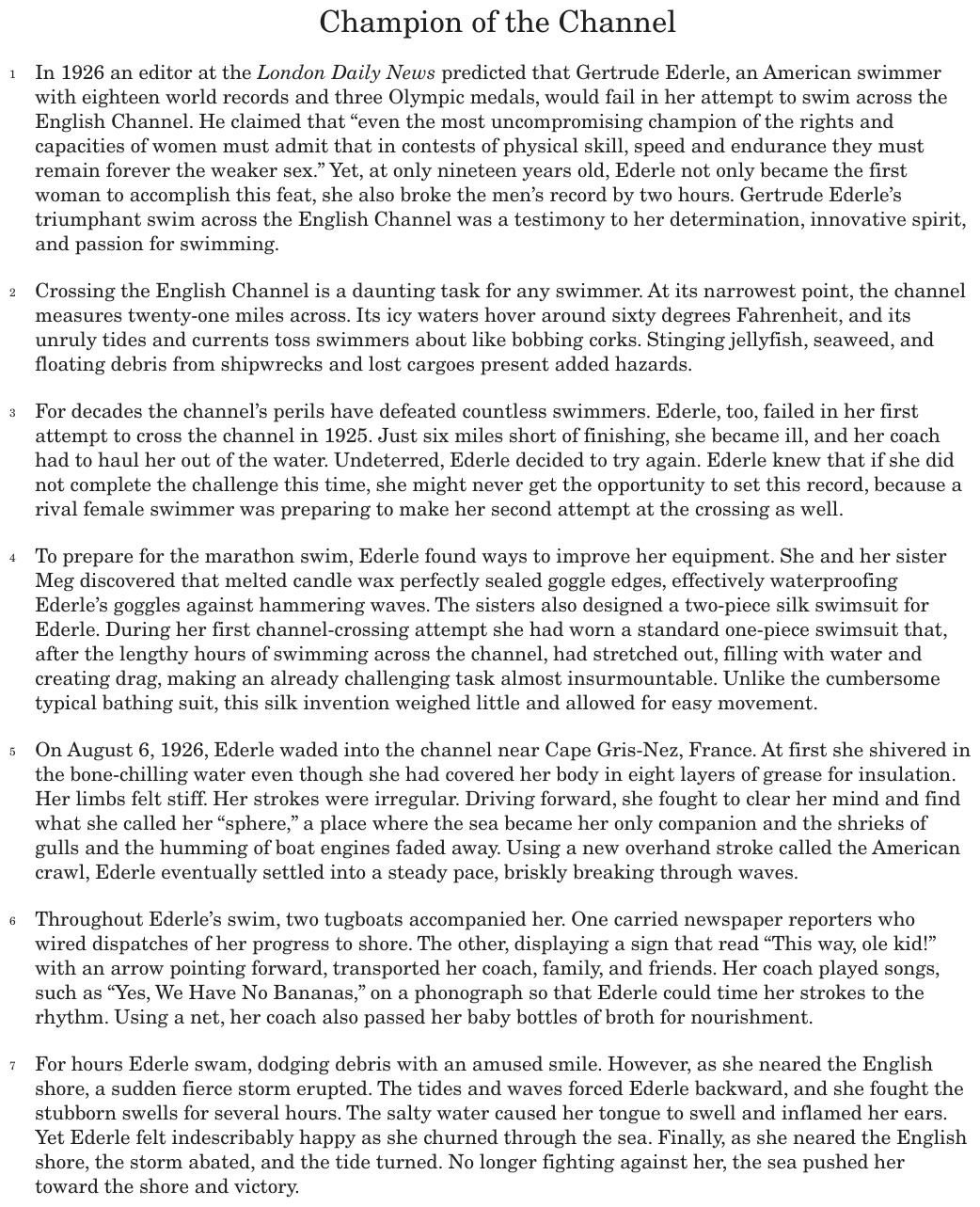
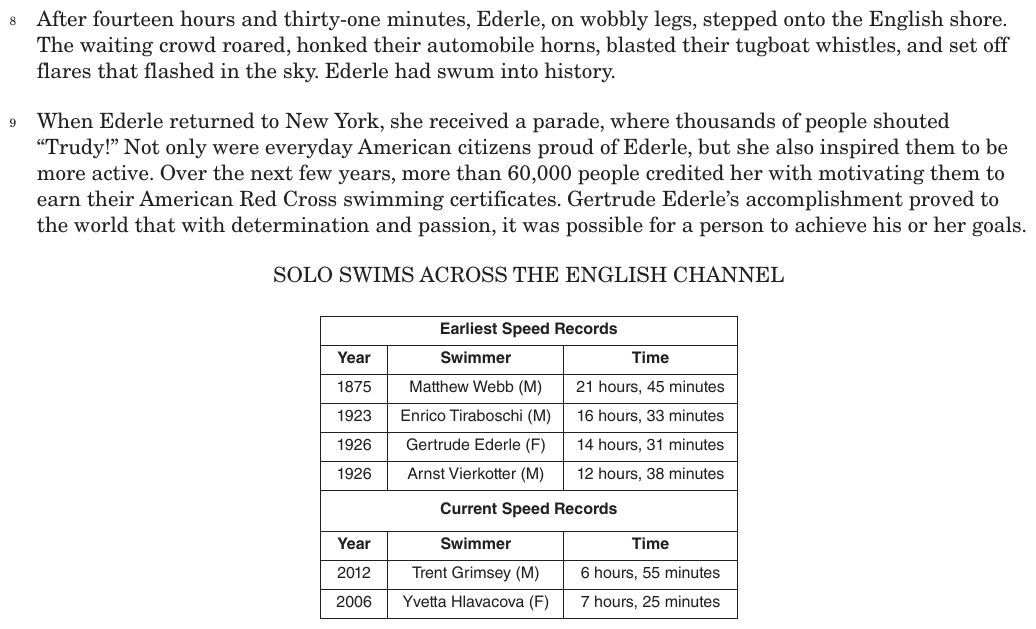
Question 75 of 120
2024 Test A English, question 29Uses the passage above: “Champion of the Channel”.
Question
Which sentence best supports the idea that Ederle succeeded in swimming across the channel because of her innovative approach to the challenge?
- A“Yet, at only nineteen years old, Ederle not only became the first woman to accomplish this feat, she also broke the men’s record by two hours.” (paragraph 1)
- B“At first she shivered in the bone-chilling water even though she had covered her body in eight layers of grease for insulation.” (paragraph 5)
- C“Using a new overhand stroke called the American crawl, Ederle eventually settled into a steady pace, briskly breaking through waves.” (paragraph 5)
- D“The other [tugboat], displaying a sign that read ‘This way, ole kid!’ with an arrow pointing forward, transported her coach, family, and friends.” (paragraph 6)
Show the answer
Correct answer: C
The question asks for the best support for the idea that Ederle’s swim across the channel was successful because of her innovative approach to the challenge.
A. Incorrect. The sentence from paragraph 1 shows that Ederle’s performance was groundbreaking but not necessarily innovative.
B. Incorrect. The layers of grease mentioned in the sentence from paragraph 5 primarily served to insulate Ederle (keep her warm) by helping her maintain her body temperature in the cold water; neither the sentence in paragraph 5 nor the surrounding text evidence establishes that this was an innovative practice. Furthermore, the sentence does not show that she succeeded as a result of this approach.
C. CORRECT. The sentence from paragraph 5 explains that Ederle employed a newly developed, or innovative, type of stroke that allowed her to maintain her pace through the rough water.
D. Incorrect. The tugboat carrying Ederle’s supporters referenced in the sentence from paragraph 6 likely provided encouragement during Ederle’s swim, but the sentence does not show that this approach was innovative or that it enabled Ederle’s success.
Question analysis
In this textual-evidence question, students look for the sentence that best backs up a claim about Gertrude Ederle's English Channel swim: that an innovative approach is what made her succeed. The quotations come from four different moments in her story, so each must be checked for something genuinely new and for a real effect on the outcome.
- NYS standards
- 7R1 textual evidence and inferences
- Grade level
- Grade 7 reading and task
- Compared with grade 7
- At grade 7 Finding the sentence that backs a claim is the standard grade 7 evidence task, set here at a typical level: four short quotations labeled by paragraph and a claim with two parts, what was new and what it achieved.
- Estimated difficulty
- Straightforward: two steps or one careful reading.
- Thinking it demands
- Depth of knowledge 2, skills and concepts · mainly evaluate
- What makes it hard
- Evidence
- Answered from several paragraphs or stanzas
- Reading level
- Passage: about grade 9, 790 words; question and choices: about grade 12, 117 words.
- Students, last 30 days
- Not enough answers yet to show (it takes 10).
Why it is hard, traps and wrong answers (shows the answer)
Why it is hard
The claim joins two ideas, an innovative approach and the success it produced, and only one quotation carries both. The record-breaking sentence proves success with no method, the grease is a technique the passage never calls new and that did not stop her shivering, and the tugboat sign shows her supporters, not her approach. The adjective “new” before the American crawl is the clue that settles it.
Every choice must be checked minor Choosing the answer
Each quotation describes a real moment of the crossing, so each has to clear two tests: a method that was new, and a method that moved her toward the English shore. (Embretson & Wetzel, 1987)
Reading between the lines minor Working it out
Even the right sentence never says the crawl won the swim; the student must take “settled into a steady pace, briskly breaking through waves” as what carried her across. (Graesser, Singer & Trabasso, 1994; Kintsch, 1998)
Strategy: Test each quotation twice: does it describe a method that was new or original, and does it show that method helping her finish? Keep only a sentence that passes both tests.
Traps
- Reads too much in: A reasonable-sounding conclusion that goes further than the text allows.
- Supports only part of the claim: In a question about evidence: a line that backs one half of the claim but not the other, or a related point rather than the claim itself.
The wrong answers, classified
A Supports only part of the claim (King et al., 2004; Thissen, Steinberg & Fitzpatrick, 1989)
Chooses the passage's headline result, first woman across and two hours under the men's record, which proves the success half of the claim but shows no new method behind it.
B Reads too much in (Graesser, Singer & Trabasso, 1994)
Treats eight layers of grease as an innovation, though the passage never calls it new and the sentence says she shivered anyway, so it shows neither originality nor success.
D Reads too much in (Graesser, Singer & Trabasso, 1994)
Reads the cheerful “This way, ole kid!” sign as a clever new idea, but the sentence only says who rode in the second tugboat and links nothing to how she swam.
Working it out, step by step
Break the idea into two parts
This asks you to find evidence. Innovative means new and original, a fresh way to do something. The idea has two parts. Ederle used a new approach, and that approach helped her succeed. The best sentence must show both.
Look for something new
Only one choice uses the word “new.” Choice C says she used “a new overhand stroke called the American crawl” (paragraph 5). A stroke is the way you move your arms to pull through the water. So this is a new method.
See whether it helped her
The same sentence says she “settled into a steady pace, briskly breaking through waves.” Briskly means quickly and with energy. A steady, quick pace moved her forward through the rough water. So the new stroke helped her succeed.
Check each choice
- C fits: it shows a new stroke and the steady pace it gave her.
- A is wrong because it proves she succeeded but shows no new method.
- B is wrong because the passage never calls the grease new, and she still “shivered in the bone-chilling water.”
- D is wrong because the sign on the tugboat cheered her on but was not a new way of swimming.
Watch out: B may sound clever, since the grease was meant to keep her warm. But it shows neither something new nor a reason she won.
Choose the answer
Only C shows a new method that helped Ederle get across. So the answer is C.
Why this answer and not the closest wrong one
B is the strongest pull, since grease to keep warm sounds like a smart trick. Yet the passage never presents the grease as new, and it did not stop her shivering. C names a method the passage calls “new” and shows it paying off in a steady, quick pace.
More questions like this
The original DOE question
Question 76 of 120
2024 Test A English, question 34Uses the passage above: “Champion of the Channel”.
Question
The table builds on the information in the passage mainly by
- Aemphasizing that people have continued to swim across the channel and have significantly improved the speed record.
- Bsuggesting that Ederle inspired many women to swim across the channel to attempt to break the current speed record.
- Crevealing that other women competed with Ederle to set a record time for swimming across the English Channel.
- Dproviding a comparison between the earliest channel-swimming records and the current record times.
Show the answer
Correct answer: A
The question asks how the table mainly builds on the information in the passage.
A. CORRECT. The table supports the information in the passage by showing that people have continued to swim the channel and have significantly improved on past records. The information in the table about records set by those who came after Ederle builds on the idea that “Gertrude Ederle’s accomplishment proved to the world that with determination and passion, it was possible for a person to achieve his or her goals” (paragraph 9).
B. Incorrect. Even though paragraph 9 states that Ederle “inspired [everyday American citizens] to be more active” and the table presents the time for the current female record holder, there is no indication in the passage or in the table that the subsequent female record holders were inspired to swim across the channel by Ederle.
C. Incorrect. Although paragraph 3 mentions that Ederle had a female rival and the table includes the speed record of another female swimmer, the passage does not provide information about other female swimmers competing with Ederle to set the channel-swim record.
D. Incorrect. Although paragraph 1 mentions that Ederle “broke the men’s record by two hours” and the table allows for comparisons between the earliest speed records and those of the present day, the passage mentions no channel-swim records set after Ederle’s swim, so it says nothing about current record times. The table allows for comparison, but this aspect of the table does not build on the information presented in the passage.
Question analysis
This question asks how a table of English Channel speed records, from Matthew Webb's 1875 crossing to a 2012 record, builds on the passage about Gertrude Ederle. Students must read times from two eras and decide what the table adds to the text, while the choices mix accurate observations about the table with claims neither source supports.
- Grade level
- Grade 8 reading and task
- Compared with grade 7
- Above grade 7 Relating a table to a passage is within grade 7 standards, but here the student must compare records from two eras, connect them to ideas in the text and choose among closely worded statements, well above typical grade 7 demand.
- Estimated difficulty
- Among the hardest on the SHSAT: a non-obvious approach, heavy reading, or a well-hidden trap.
- Thinking it demands
- Depth of knowledge 3, strategic thinking · mainly analyze
- What makes it hard
- A very close wrong answer major
- Reading a figure, table or graph moderate
- How, not what moderate
- Evidence
- Answered from the whole text
- Reading level
- Passage: about grade 9, 790 words; question and choices: about grade 11, 78 words.
- Corrected from the DOE handbook
- A self-contradictory statement in the explanation was corrected.
- Students, last 30 days
- Not enough answers yet to show (it takes 10).
Why it is hard, traps and wrong answers (shows the answer)
Why it is hard
This is one of the hardest questions on the test because a wrong choice describes the table exactly, in its own words. The passage stops with Ederle's 1926 record, and what the table adds is the rest of the story: swimmers kept crossing, and the record fell to under seven hours. Students who describe what the table contains, rather than what it tells a reader who has finished the passage, lose the point.
A very close wrong answer major Choosing the answer
The comparison choice repeats the table's own headings, “Earliest Speed Records” and “Current Speed Records”, and is literally true; only the stem's “builds on the information in the passage” and “mainly” separate it from the choice about the falling record. (Embretson & Wetzel, 1987; Gorin & Embretson, 2006; Ascalon et al., 2007)
Reading a figure, table or graph moderate Understanding the question
The student must compare times across the table's two sections, from Webb's 21 hours 45 minutes in 1875 and Ederle's 14 hours 31 minutes to Grimsey's 6 hours 55 minutes in 2012. (Lesh, Post & Behr, 1987; Kirsch & Mosenthal, 1990)
How, not what moderate Working it out
The question asks what the table adds to a passage that ends in 1926, so the student must say what its later rows extend, not what its layout holds. (Anderson & Krathwohl, 2001)
Strategy: Read both sections of the table and say what it adds to Ederle's story, then keep only a choice that the table shows and that connects to an idea the passage itself develops.
Traps
- Wrong purpose or structure: Names a purpose, structure or effect that the part does not serve, or describes what a part says when the question asks what it does.
- Reads too much in: A reasonable-sounding conclusion that goes further than the text allows.
- Twists what the text says: Uses the text's topic and ideas but changes what it says: who did it, how much, when, or why.
The wrong answers, classified
B Reads too much in (Graesser, Singer & Trabasso, 1994)
Assumes Ederle inspired many women to chase the record, but the table lists one later woman, Yvetta Hlavacova in 2006, and nothing links her or anyone else to Ederle.
C Twists what the text says (King et al., 2004)
Joins the rival female swimmer of paragraph 3 to Hlavacova's 2006 time, inventing a contest among women in Ederle's day that neither the table nor the passage shows.
D Wrong purpose or structure (Anderson & Krathwohl, 2001)
Describes the table's layout, earliest records beside current ones, which is accurate, but stops at what it contains instead of saying what the comparison adds to Ederle's story.
What was corrected from the DOE handbook, and why
- Explanation: In rejecting choice D, the handbook notes that paragraph 1 says Ederle “broke the men’s record by two hours,” and then says “there is no mention in the passage of past, present, or future channel-swim records.” Paragraph 1 does mention a past record: the one Ederle broke. What the passage never mentions is a record set after hers, which is what the table’s “Current Speed Records” add. The explanation now says the passage mentions no channel-swim records set after Ederle’s swim, so it says nothing about current record times. The reason for rejecting D is otherwise unchanged.
Working it out, step by step
Understand the question
To build on something means to add to it. So this asks what the table adds to what the passage already tells you. Don’t just describe what is in the table. Ask what a reader learns from it after finishing the passage.
Read the table’s two parts
The table has two parts, “Earliest Speed Records” and “Current Speed Records.” These rows matter most:
Year Swimmer Time 1875 Matthew Webb 21 hours, 45 minutes 1926 Gertrude Ederle 14 hours, 31 minutes 2012 Trent Grimsey 6 hours, 55 minutes Compare the times
Ederle swam for 14 hours and 31 minutes. Half of her time would be about 7 hours and 15 minutes. Grimsey’s 2012 time, 6 hours and 55 minutes, is even faster than that. So people kept swimming the channel after 1926, and the record got much faster.
See what the passage leaves out
The passage does mention one record. In paragraph 1, Ederle “broke the men’s record by two hours.” But the passage stops in 1926. It never tells of any record set after her swim. The table adds that later part of the story: swimmers kept crossing, and the record kept falling.
Check each choice
- A fits: people kept crossing and “significantly improved the speed record,” and significantly means by a lot.
- B is wrong because nothing links any later woman to Ederle, and the table lists only one later woman.
- C is wrong because Ederle is the only woman of her time in the table, and Hlavacova swam 80 years later, in 2006.
- D is wrong because it only names what the table holds, not what the comparison adds to Ederle’s story.
Watch out: D uses the table’s own headings, so it sounds right. But the question asks what the table adds, not how it is laid out.
Choose the answer
The table carries the story past 1926 and shows the record falling far below Ederle’s time. So the answer is A.
Why this answer and not the closest wrong one
D comes closest, because the table really does set the earliest and current records side by side. But D stops at describing the table. A says what that comparison shows a reader who has finished the passage: the record kept falling, from Ederle’s 14 hours and 31 minutes to under 7 hours.
More questions like this
The original DOE question
Question 77 of 120
2024 Test A English, question 37Passage 5 Reasons Physical Books Might Be Better Than E-Books
5 Reasons Physical Books Might Be Better Than E-Books
by Shaunacy Ferro
Though e-book1 readers have become a more common sight around town, traditional books still have their evangelists.2 According to The New York Times, e-book sales have been falling in 2015. Print definitely isn’t dead. In fact, according to some research, it may actually be a better choice for some readers. While scientists are still trying to tease out exactly how digital reading affects us differently, here are five ways e-books might be inferior to their dead-tree cousins.
E-books can reduce reading comprehension.
In a study of middle schoolers, West Chester University researchers found that students who read on iPads3 had lower reading comprehension than when they read traditional printed books. They discovered that the kids sometimes skipped text in favor of interactive features in the e-books, suggesting that certain multimedia in children’s e-books can be detrimental to the practice of reading itself. However, the researchers noted that some interactive features in e-books are designed to enhance comprehension, and that those might be more helpful than game-type interactive graphics.
Young kids can get distracted by e-books.
Similar results were found by a small study by the Joan Ganz Cooney Center that consisted of 32 kids reading e-books and print books with their parents. It found that “enhanced” e-books might be distracting. Kids who read enhanced e-books—ones with interactive, multimedia experiences—were more engaged with them physically, but in the end they remembered fewer narrative details than those who read print books or basic e-books.
You remember less about a book’s timeline.
Another study of adults also found that e-books can be hard to absorb. The researchers asked 25 people to read a 28-page story on a Kindle4 and 25 to read the story in paperback, then asked the readers to put 14 events from the story in chronological order. Those who read the story on a Kindle performed worse on the chronology test than the book readers, though they performed about the same as print readers in other tests. Earlier research by the same scholars, from Stavanger University in Norway, found that Norwegian 10th graders also remembered more about texts if they read them in print rather than on a computer screen.
They’re not great as textbooks.
While e-book textbooks are often cheaper (and easier to carry) than traditional door-stop5 textbooks, college students often don’t prefer them. In some surveys of college kids, the majority of students have reported preferring print books. However, a 2012 study from the UK’s National Literacy Trust of kids ages 8 to 16 found that more than 50 percent of children reported preferring screen reading.
They’re tiring.
Staring at a lit screen can be tiring for the eyes and the brain. A 2005 study from Sweden found that reading digitally required a higher cognitive workload than reading on paper. Furthermore, staring at LED6 screens at night can disrupt sleep patterns. A 2014 Harvard study found that people who used e-readers with LED screens at night slept worse and were more tired the next day. So, if you’re going to go for an e-book, go for one without the backlight.
The take-away message? If you’re really trying to absorb material, you might want to go for a physical book. And if you’re going to be up all night studying, turn off the backlight.
However, all this may not mean that reading on a Kindle is really going to melt your brain. For instance, reading an e-book on a computer is a much different experience than reading on a Kindle, which is specifically designed for consuming books. So, too, is playing with an interactive e-book on an iPad, compared to using a simpler e-book device that only presents the text, with no opportunities to click away into digital distractions.
And some studies have found that part of the difference between the way people absorb information from e-books versus paper might be due to approaching e-books differently—in one test, participants didn’t regulate their study time with digital books like they did with paper texts, leading to worse performances. It’s possible that our expectations of e-book reading—as well as the different designs of the digital reading experience on a computer or iPad or Kindle—might affect how we approach the text and how much effort we put into studying them. As generations of e-book readers evolve, and people become more accustomed to the idea of sitting down with a digital textbook, these factors could change—for better or for worse.
“5 Reasons Physical Books Might Be Better Than E-Books” by Shaunacy Ferro from MENTAL FLOSS, October 2, 2015. Copyright © 2015 Mental Floss, Inc.
1e-book: an electronic book, a publication made available digitally for reading on a computer or other device
2evangelists: advocates or supporters
3iPads: tablet computers
4Kindle: device for reading e-books
5door-stop: a reference to the idea that some textbooks are large and heavy enough to hold a door open
6LED: Light-emitting diode; LEDs are often used as a backlight for electronic devices such as smart phones and tablets.
Question
Which sentence from the passage suggests that people in the future will likely choose e-books over print books?
- A“They discovered that the kids sometimes skipped text in favor of interactive features in the e-books, suggesting that certain multimedia in children’s e-books can be detrimental to the practice of reading itself.” (paragraph 2)
- B“However, the researchers noted that some interactive features in e-books are designed to enhance comprehension, and that those might be more helpful than game-type interactive graphics.” (paragraph 2)
- C“Kids who read enhanced e-books—ones with interactive, multimedia experiences—were more engaged with them physically, but in the end they remembered fewer narrative details than those who read print books or basic e-books.” (paragraph 3)
- D“However, a 2012 study from the UK’s National Literacy Trust of kids ages 8 to 16 found that more than 50 percent of children reported preferring screen reading.” (paragraph 5)
Show the answer
Correct answer: D
The question asks which sentence from the passage suggests that people in the future will likely choose e-books over print books.
A. Incorrect. While this sentence from paragraph 2 implies high engagement with the interactive features of e-books, it does not provide explicit evidence indicating that engagement with e-books is a reason for choosing them over print books.
B. Incorrect. While this sentence from paragraph 2 highlights some of the benefits of e-books, such as the potential to “enhance comprehension,” those benefits are not explicitly linked to readers choosing e-books over print books.
C. Incorrect. This sentence from paragraph 3 provides evidence that shows both benefits and drawbacks of reading e-books, including higher engagement but a decreased ability to recall details. Therefore, the sentence does not clarify why readers would choose e-books over print books.
D. CORRECT. In this sentence from paragraph 5, the author cites a 2012 study that found that over 50 percent of 8- to 16-year-olds “reported preferring screen reading.” Since this specific age group will one day influence the future of reading and the results of the study point to a significant percentage preferring screen reading, this sentence provides compelling evidence for what readers will prefer in the future.
Question analysis
Based on a magazine article about e-books and printed books, this question asks which quoted sentence suggests that people in the future will likely choose e-books over print. Students must reason from a present-day research finding to a likely future, while each quoted sentence reports research on children and e-books.
- NYS standards
- 7R1 textual evidence and inferences
- Grade level
- Grade 7 reading and task
- Compared with grade 7
- At grade 7 Drawing a logical inference from a quoted finding is typical grade 7 evidence work. The sentences are printed in the choices, so the reading load is light, but the student must still reason from a study's results to readers' future choices.
- Estimated difficulty
- Straightforward: two steps or one careful reading.
- Thinking it demands
- Depth of knowledge 2, skills and concepts · mainly evaluate
- What makes it hard
- Reading between the lines moderate
- A lot to read minor
- Evidence
- Answered from one sentence or line
- Reading level
- Passage: about grade 10, 829 words; question and choices: about grade 15, 138 words.
- Students, last 30 days
- Not enough answers yet to show (it takes 10).
Why it is hard, traps and wrong answers (shows the answer)
Why it is hard
The question asks for a prediction, but the article only reports studies of the present, so the student has to decide what kind of finding could point to the future. Preference is the link: what children choose now hints at what readers will choose later. Sentences about engagement and well-designed features sound favorable to e-books, yet they describe how e-books work, not whether anyone prefers them.
Reading between the lines moderate Working it out
No sentence mentions the future; the student must see that children of 8 to 16 who prefer screens today are tomorrow's readers, a step the article leaves unstated. (Graesser, Singer & Trabasso, 1994; Kintsch, 1998)
A lot to read minor Understanding the question
Each choice is a full quoted sentence of 26 to 34 words, three of them packed with study details, so comparing the four takes more reading than the short stem suggests. (Kintsch, 1998; Gorin & Embretson, 2006; Freedle & Kostin, 1993)
Strategy: Decide what kind of evidence could predict what people will choose later, then check each sentence for that kind of evidence instead of general praise or criticism of e-books.
Traps
- Reads too much in: A reasonable-sounding conclusion that goes further than the text allows.
- Supports only part of the claim: In a question about evidence: a line that backs one half of the claim but not the other, or a related point rather than the claim itself.
The wrong answers, classified
A Reads too much in (Graesser, Singer & Trabasso, 1994)
Reads kids skipping text “in favor of interactive features” as a liking that will win readers, though the sentence presents the habit as “detrimental” to reading.
B Supports only part of the claim (King et al., 2004; Thissen, Steinberg & Fitzpatrick, 1989)
Takes features “designed to enhance comprehension” as a sign e-books will win out, but the sentence is about what some features might do, not what readers choose.
C Reads too much in (Graesser, Singer & Trabasso, 1994)
Treats children being “more engaged with them physically” as a lasting preference, ignoring that they remembered fewer details and that the study measured engagement and recall, not preference.
Working it out, step by step
Understand the prediction
This asks for evidence that points to the future. But the article reports only studies of the past and present. So you need a clue about today that hints at what readers will choose later.
Think about what predicts a choice
What people will choose later depends on what they like now. So look for a sentence about preference, which means the thing a person likes better. It helps if those people are young, because young readers are the readers of the future.
Find the preference sentence
Choice D quotes a 2012 study of “kids ages 8 to 16.” It found that “more than 50 percent of children reported preferring screen reading.” So more than half of these young readers already like screens better. As they grow up, many of them may keep choosing e-books.
Check each choice
- D fits: young readers already prefer screens, which hints at the future.
- A is wrong because skipping text is called “detrimental,” or harmful, and it shows no one choosing e-books.
- B is wrong because it tells what some features might do, not what readers like.
- C is wrong because the study measured how much kids remembered, not which books they liked.
Watch out: B and C sound good for e-books. But neither one says what readers choose.
Choose the answer
Only D tells what young readers prefer, which points to later choices. So the answer is D.
Why this answer and not the closest wrong one
B comes closest, since features “designed to enhance comprehension” sound like a reason e-books might win. But the sentence only says what some features are meant to do. It says nothing about what readers choose. D reports what more than half of young readers already prefer, and that hints at the future.
More questions like this
The original DOE question
The passage “5 Reasons Physical Books Might Be Better Than E-Books” as printed (pages 58–59)
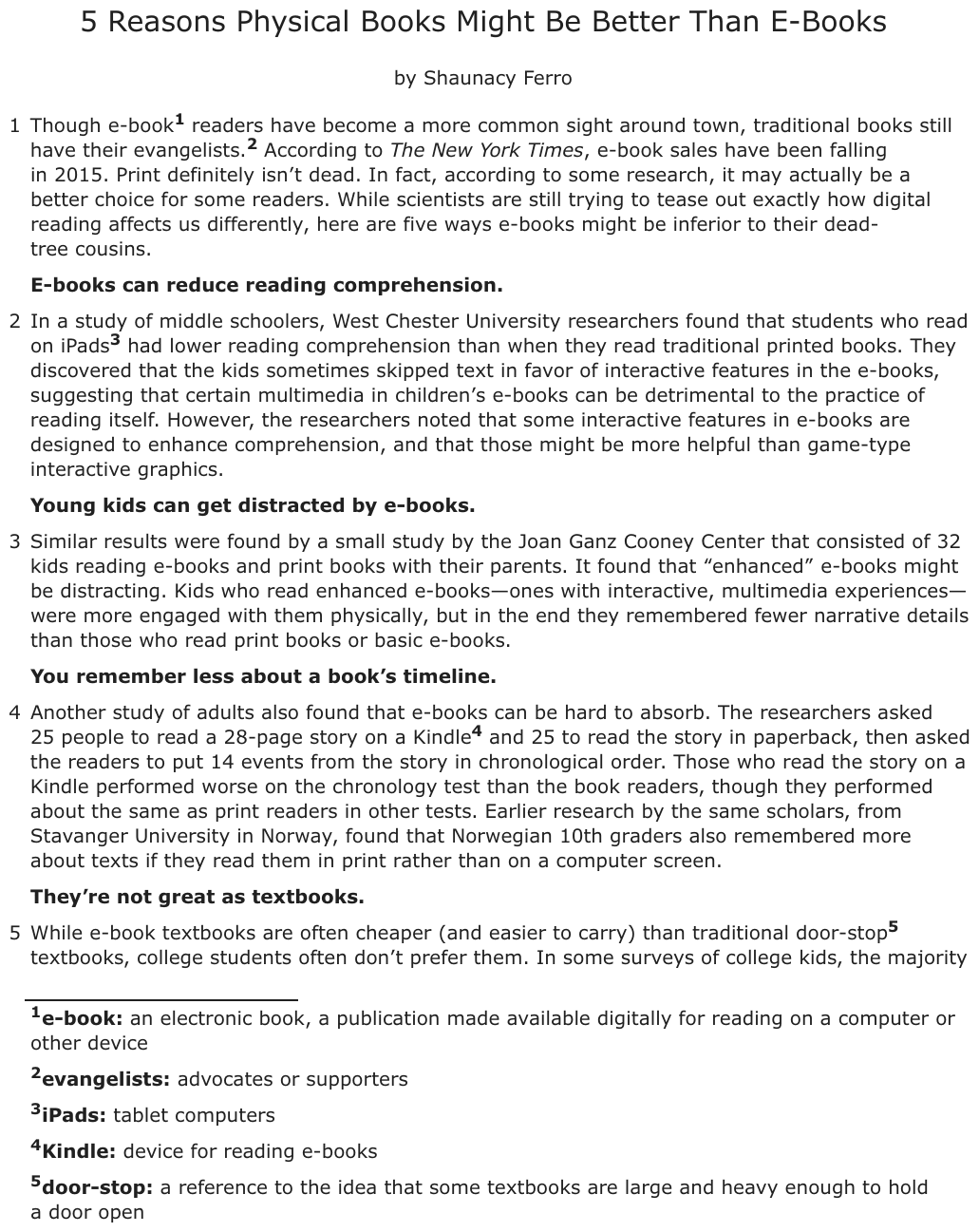
Question 78 of 120
2024 Test A English, question 40Uses the passage above: “5 Reasons Physical Books Might Be Better Than E-Books”.
Question
The studies described in paragraph 6 are important to the author’s observations in paragraphs 7 and 8 because the findings
- Ashow that the author has personal opinions to share beyond the ideas included in the studies.
- Bgive the author the opportunity to reach practical conclusions about reading that are based on scientific evidence.
- Chighlight the author’s statement that digital reading experiences vary based on the individual and the device.
- Dsupport the author’s inference that more studies on more types of devices are needed.
Show the answer
Correct answer: B
The question asks how the findings from the studies described in paragraph 6 are important to the author’s observations in paragraphs 7 and 8.
A. Incorrect. The evidence from the studies mentioned in paragraph 6 is not substantially supported by the personal opinions the author shares in paragraph 7 (“And if you’re going to be up all night studying, turn off the backlight”) or in paragraph 8 (“melt your brain” and “digital distractions”).
B. CORRECT. In paragraph 6, the author cites studies from 2005 and 2014 that found that LED screens can “disrupt sleep patterns” and that “people who used e-readers with LED screens at night slept worse and were more tired the next day.” Then, in paragraph 7, the author suggests that “if you’re going to be up all night studying, turn off the backlight,” and in paragraph 8, the author explains some differences between reading e-books on various devices. This information is not based on a personal opinion; instead, it is based on practical conclusions drawn from scientific evidence.
C. Incorrect. In paragraph 6, the author cites a 2005 study in which researchers found that “reading digitally required a higher cognitive workload than reading on paper.” Then, in paragraph 8, the author concludes that “reading an e-book on a computer is a much different experience than reading on a Kindle, which is specifically designed for consuming books.” Although the findings in paragraph 6 are important, they do not highlight the information presented by the author that digital reading experiences vary based on the reader and the device.
D. Incorrect. The author states in paragraph 8 that “reading an e-book on a computer is a much different experience than reading on a Kindle” and mentions how the same thing is true for “an interactive e-book on an iPad” compared with an e-book on “a simpler e-book device.” Readers may conclude that this statement is meant to indicate the author’s belief that more studies on more types of devices are needed. However, the author does not state or imply this belief in the passage.
Question analysis
This question asks why the studies on screen fatigue and sleep in paragraph 6 of an article about e-books matter to the observations the author makes in the next two paragraphs. Students must trace the connection between the research and the later paragraphs, and each choice describes that link in abstract terms that are easy to confuse.
- Grade level
- Grade 8 reading and task
- Compared with grade 7
- Above grade 7 Tracing how evidence leads to an author's conclusions is grade 7 argument work, but this item spans three paragraphs, and the four explanations of the link are abstract and close in wording, more demanding than typical grade 7 work.
- Estimated difficulty
- Hard: combines ideas, needs a plan, and has more than one tempting wrong answer.
- Thinking it demands
- Depth of knowledge 3, strategic thinking · mainly analyze
- What makes it hard
- How, not what major
- Evidence in several places moderate
- The right answer is reworded minor
- Evidence
- Answered from several paragraphs or stanzas
- Reading level
- Passage: about grade 10, 829 words; question and choices: about grade 11, 80 words.
- Students, last 30 days
- Not enough answers yet to show (it takes 10).
Why it is hard, traps and wrong answers (shows the answer)
Why it is hard
Every choice describes a link between evidence and commentary, so the student has to know both what paragraph 6 found and what paragraphs 7 and 8 do with it. The tempting wrong answer borrows paragraph 8's real point that devices differ and wrongly credits the sleep and workload studies with it. Seeing that the backlight advice comes straight from the Harvard study is what makes the general wording of the right choice convincing.
How, not what major Working it out
The question asks how paragraph 6's findings function for the paragraphs after them, a relationship between evidence and conclusion, so knowing what the sleep and workload studies found is only the first step. (Anderson & Krathwohl, 2001)
Evidence in several places moderate Working it out
The links run across three paragraphs: the Harvard backlight finding becomes “turn off the backlight” in paragraph 7, and the tired brain returns as “melt your brain” in paragraph 8. (Kirsch & Mosenthal, 1990; Gorin & Embretson, 2006)
The right answer is reworded minor Choosing the answer
The right choice names no study, screen or device, speaking only of “practical conclusions” and “scientific evidence”, while two wrong choices echo paragraph 8's talk of devices. (Freedle & Kostin, 1993; Kirsch & Mosenthal, 1990)
Strategy: Note what the paragraph 6 studies found, then find the sentences in paragraphs 7 and 8 that draw on those findings and describe what the author does with them.
Traps
- Half right: One half of a two-part choice is right and the other is not.
- Reads too much in: A reasonable-sounding conclusion that goes further than the text allows.
- Wrong purpose or structure: Names a purpose, structure or effect that the part does not serve, or describes what a part says when the question asks what it does.
The wrong answers, classified
A Wrong purpose or structure (Anderson & Krathwohl, 2001)
Treats the casual phrases of paragraphs 7 and 8, such as “melt your brain”, as opinions beyond the research, when the advice there grows directly out of the studies.
C Half right (King et al., 2004; Thissen, Steinberg & Fitzpatrick, 1989)
Gets paragraph 8's point about devices right but adds variation by individual, which paragraphs 7 and 8 never mention, and the studies in paragraph 6 compare screens with paper, not readers.
D Reads too much in (Graesser, Singer & Trabasso, 1994)
Infers from paragraph 8's device comparisons that the author wants more research on more devices, a sensible thought that the passage never states.
Working it out, step by step
Understand the link asked about
This asks how evidence connects to the author’s comments. First see what the studies in paragraph 6 found. Then see what the author does with those findings in paragraphs 7 and 8.
Read the studies in paragraph 6
A 2005 study found that “reading digitally required a higher cognitive workload.” Cognitive workload means how hard your brain has to work. A 2014 study found that people who read on lit screens at night “slept worse and were more tired the next day.”
See how the author uses them
In paragraph 7 the author advises, “if you’re going to be up all night studying, turn off the backlight.” That tip comes straight from the sleep study. Paragraph 8 then warns you not to take the findings too far. It says they “may not mean that reading on a Kindle is really going to melt your brain.” Both are practical, real-life conclusions drawn from science.
Check each choice
- B fits: the studies let the author reach “practical conclusions” based on “scientific evidence.”
- A is wrong because the advice in paragraphs 7 and 8 grows out of the studies, not out of opinions beyond them.
- C is wrong because nothing says reading changes from person to person, and the studies compare screens with paper.
- D is wrong because the author never says more studies are needed.
Watch out: C is half right. Paragraph 8 does say devices differ, but the part about each person is never stated.
Choose the answer
The findings in paragraph 6 lead straight to the author’s practical advice. So the answer is B.
Why this answer and not the closest wrong one
C comes closest, because paragraph 8 does say a computer and a Kindle feel different. But the studies in paragraph 6 compare screens with paper, and no one says reading changes from person to person. B fits the clear link: a sleep study turned into the advice to turn off the backlight.
More questions like this
The original DOE question
Question 79 of 120
2024 Test A English, question 43Passage Excerpt from The Highest Tide
Excerpt from The Highest Tide
by Jim Lynch
The narrator’s summer job is collecting marine specimens in Puget Sound, Washington. In this excerpt, he is looking for specimens in the mudflats before daybreak. Mudflats, or flats, are coastal landforms created when sediment and silt from tides are deposited as the tides recede.
I rounded the oyster beds, to the far side. . . . It was low tide by then, and I saw the water hesitating at its apex, neither leaving nor returning, patiently waiting for the gravitational gears to shift. Dozens of anxious clams started squirting in unison like they did whenever vibrating grains of sand warned them predators were approaching. I stopped and waited with them, to actually see the moment when the tide started returning with its invisible buffet of plankton for the clams, oysters, mussels and other filter feeders. It was right then, ankle deep in the Sound, feet numbing, eyes relaxed, that I saw the nudibranch.1
In all my time on the flats I’d never seen one before. I’d read about them, sure. I’d handled them at aquariums but never in the wild, and I’d never even seen a photo of one this stunning. It was just three inches long but with dozens of fluorescent, orange-tipped hornlike plumes jutting from the back of its see-through body that appeared to be lit from within.
Nudibranchs are often called the butterflies of the sea, but even that understates their dazzle. Almost everything else in the northern Pacific is dressed to blend with pale surroundings. Nudibranchs don’t bother, in part because they taste so lousy they don’t need camouflage to survive. But also, I decided right then, because their beauty is so startling it earns them a free pass, the same way everyday life brakes for peacocks, parade floats. . . .
The dark mudflats loomed like wet, flattened dunes stretching deep into Skookumchuck Bay in front of our house. From a distance, they looked too barren to support sea life. Up close, they still did, unless you knew where to find the hearty clams, worms and tiny creatures that flourish in mud. . . . I’m not sure why I decided to take a look. It was still an hour before sunrise, and I knew exactly what the bars2 looked like in the moonlight, but for some reason, I couldn’t resist.
I heard it long before I saw it. It was an exhale, a release of sorts, and I instantly wondered if a whale was stranded again. We had a young minke3 stuck out there two summers prior, and it made similar noises until the tide rose high enough for rescuers to help free it. . . . I looked for a hulking silhouette but couldn’t find one. I waited, but there were no more sounds. Still, I went toward what I thought I’d heard, avoiding stepping into the mud until I had to. I knew the flats well enough to know I could get stuck just about anywhere. The general rule was you didn’t venture out past the shells and gravel with an incoming tide. I sank up to my knees twice, and numbing water filled my boots.
. . . I kept stepping toward the one sound I’d heard, a growing part of me hoping I’d find nothing at all. When I stopped to rest and yank up my socks, my headlamp crossed it. My first thought? A giant octopus.
Puget Sound has some of the biggest octopi in the world. They often balloon to a hundred pounds. Even the great Jacques Cousteau4 himself came to study them. But when I saw the long tubular shape of its upper body and the tangle of tentacles below it, I knew it was more than an octopus. I came closer, within fifty feet, close enough to see its large cylindrical siphon5 quiver. I couldn’t tell if it was making any sounds at that point, because it was impossible to hear anything over the blood in my ears. . . .
The creature’s body came to a triangular point above narrow fins that lay flat on the mud like wings, but it was hard to be sure exactly where it all began or ended, or how long its tentacles truly were, because I was afraid to pry my eyes off its jumble of arms for more than half a second. I didn’t know whether I was within reach, and its arms were as big around as my ankle and lined with suckers the size of half-dollars. If they even twitched I would have run. So, I was looking at it and not looking at it while my heart spangled my vision. I saw fragments, pieces, and tried to fuse them in my mind but couldn’t be certain of the whole. I knew what it had to be, but I wouldn’t allow myself to even think the two words. Then I gradually realized the dark shiny disc in the middle of the rubbery mass was too perfectly round to be mud or a reflection.
It was too late to smother my scream. Its eye was the size of a hubcap.6
From THE HIGHEST TIDE by Jim Lynch. Copyright © 2005 by Jim Lynch. Used by permission of Bloomsbury USA. All rights reserved.
1nudibranch: type of sea slug
2bars: sandbars
3minke: species of small whale
4Jacques Cousteau: renowned French oceanographer
5siphon: tube-like organ that is used for drawing in or removing fluids
6hubcap: removable cap over the end of a wheel axle
Question
In paragraph 3, the phrase “the butterflies of the sea” conveys the idea that
- Anudibranchs do not have to work as hard as other animals to survive in the ocean.
- Bnudibranchs have colorful features that make them stand out.
- Cnudibranchs are delicate and have trouble adapting to their environment.
- Dnudibranchs are rare and difficult to find in the ocean.
Show the answer
Correct answer: B
The question asks what idea the phrase “the butterflies of the sea” in paragraph 3 conveys.
A. Incorrect. While the narrator does say that they “taste so lousy they don’t need camouflage to survive” (paragraph 3), the phrase explains that their bright appearance poses no threat to their lives.
B. CORRECT. The narrator describes the vibrant colors of the nudibranch in paragraph 2. Then in paragraph 3, the narrator says that “their beauty is so startling.” The nudibranchs are colorful and unique, just as many butterflies are.
C. Incorrect. The narrator describes the distinct appearance of the nudibranch but does not suggest that nudibranchs struggle to adapt to their environment because of this trait.
D. Incorrect. In paragraph 2, the narrator states, “I’d handled them at aquariums but never in the wild, and I’d never even seen a photo of one this stunning.” Although this suggests that the narrator has rarely encountered a nudibranch in the wild, it does not suggest that they are rare in the wild in general.
Question analysis
This figurative-language question asks what the phrase “the butterflies of the sea” conveys about nudibranchs, the sea slugs the narrator spots on a Puget Sound mudflat in an excerpt from the novel The Highest Tide. Students must use the description around the phrase to decide which quality of butterflies the comparison points to.
- Grade level
- Grade 7 reading and task
- Compared with grade 7
- At grade 7 Interpreting a figurative comparison from context is standard grade 7 language work. The description around the phrase is vivid and close at hand, so the demand is typical, even though the creature itself may be unfamiliar.
- Estimated difficulty
- Straightforward: two steps or one careful reading.
- Thinking it demands
- Depth of knowledge 2, skills and concepts · mainly understand
- What makes it hard
- Figurative or literary language moderate
- An unfamiliar subject minor
- Evidence
- Answered from one paragraph or stanza
- Reading level
- Passage: about grade 6, 902 words; question and choices: about grade 7, 58 words.
- Students, last 30 days
- Not enough answers yet to show (it takes 10).
Why it is hard, traps and wrong answers (shows the answer)
Why it is hard
The nickname is explained in the same sentence, where the narrator says even it “understates their dazzle”, so the question is mostly a matter of reading on a few words. The trap is reading on too far: the next sentences explain why nudibranchs can afford to be showy, a different point. Students who bring their own idea of butterflies as fragile, or who turn the narrator's first sighting into rarity, drift away from what he stresses.
Figurative or literary language moderate Understanding the question
The comparison's point is supplied by the clause right after it, “even that understates their dazzle”, and by paragraph 2's fluorescent, orange-tipped plumes, not by anything butterflies are usually known for. (Graesser, Singer & Trabasso, 1994; Kintsch, 1998)
An unfamiliar subject minor Understanding the question
Few students have seen a nudibranch, footnoted only as a type of sea slug, so the picture of it must be built entirely from paragraph 2's description. (Recht & Leslie, 1988; Kintsch, 1998)
Strategy: Read the phrase with the sentence it sits in and the description of the nudibranch just before it, then decide which quality of butterflies the comparison is pointing to.
Traps
- True but not the answer: A choice says something accurate about the text that does not answer this question.
- Outside knowledge: A choice is plausible in the real world but not supported by this text.
- Reads too much in: A reasonable-sounding conclusion that goes further than the text allows.
The wrong answers, classified
A True but not the answer (King et al., 2004; Embretson & Wetzel, 1987)
Draws on the next sentences, which say nudibranchs taste too lousy to need camouflage, a real point about their survival but not what the butterfly comparison conveys.
C Outside knowledge (King et al., 2004; Recht & Leslie, 1988)
Brings in the familiar idea that butterflies are delicate, which the passage never uses; nothing suggests nudibranchs struggle to adapt, and the comparison is about their dazzle.
D Reads too much in (Graesser, Singer & Trabasso, 1994)
Turns the narrator never having seen one in the wild into a claim that nudibranchs are rare, which reflects his experience, not the meaning of the nickname.
Working it out, step by step
Spot the comparison
This asks about figurative language, words that compare two things to make a point. In paragraph 3, nudibranchs are called “the butterflies of the sea.” You need to decide which quality of butterflies the comparison points to.
Read the rest of the sentence
The sentence goes on: “but even that understates their dazzle.” To understate means to say less than the full truth. Dazzle means bright, eye-catching beauty. So the narrator means nudibranchs are even more dazzling than butterflies.
Look back at paragraph 2
Paragraph 2 describes the one he found. It had “dozens of fluorescent, orange-tipped hornlike plumes.” Fluorescent means glowing with bright color. Plumes are feathery tufts. Its body even seemed “to be lit from within.” Like a butterfly, it is bright and colorful, and it stands out.
Check each choice
- B fits: “colorful features that make them stand out” matches the glowing plumes and the dazzle.
- A is wrong because their bad taste explains how they survive, not what the butterfly phrase means.
- C is wrong because the passage never says nudibranchs are delicate or struggle to fit in.
- D is wrong because the narrator never seeing one in the wild is his own experience, not proof they are rare.
Watch out: A uses real details from the same paragraph. But they answer a different question: why nudibranchs can afford to be showy.
Choose the answer
The butterfly comparison points to the nudibranch’s bright, eye-catching colors. So the answer is B.
Why this answer and not the closest wrong one
A comes closest, since the same paragraph says nudibranchs “don’t need camouflage to survive.” But that explains why they can afford to be bright. The butterfly phrase itself is about their beauty, which even the nickname “understates.” B names that beauty: colorful features that stand out.
More questions like this
The original DOE question

The passage “Excerpt from The Highest Tide” as printed (pages 64–65)
Question 80 of 120
2024 Test A English, question 46Uses the passage above: “Excerpt from The Highest Tide”.
Question
How does the setting affect the plot of the excerpt?
- AThe darkness of the mudflats before sunrise causes the narrator to pay close attention to his surroundings.
- BThe rugged terrain of the mudflats makes it more difficult for the narrator to do his job.
- CThe slow return of the tide along the mudflats forces the narrator to be patient during his journey.
- DThe barren appearance of the mudflats creates a sense of mystery that unsettles the narrator.
Show the answer
Correct answer: A
The question asks how the setting affects the plot of the excerpt.
A. CORRECT. In paragraph 4, the narrator says that it is an hour before sunrise. It is difficult to see because the mudflats are dark, so the narrator, while familiar with the terrain of the mudflats, is cautious.
B. Incorrect. While the terrain of the mudflats is challenging because of the “wet, flattened dunes” (paragraph 4), the narrator is familiar with the terrain and moves carefully. In addition, the excerpt focuses on the narrator’s curiosity and enjoyment as he explores the mudflats, not on his work collecting specimens.
C. Incorrect. In paragraph 1, the narrator watches the water “hesitating at its apex” and “patiently waiting for the gravitational gears to shift.” This illustrates that the narrator is already familiar with the changes in his surroundings, that the tide is slow to move in, and that he can move carefully through the mudflats without the threat of rising water.
D. Incorrect. While the narrator is on the mudflats for the entire excerpt, the phrase “eyes relaxed” in paragraph 1 indicates that the narrator feels comfortable there. The narrator does not show fear until paragraph 6, when a growing fear about the unknown creature arises.
Question analysis
Set on the mudflats of Puget Sound before daybreak, this excerpt from the novel The Highest Tide is the basis for a question about how setting affects plot. Students must link features of the place and time to what the narrator does across the whole excerpt, and each choice pairs a real feature of the setting with an effect that may or may not be in the text.
- Grade level
- Grade 8 reading and task
- Compared with grade 7
- Above grade 7 Analyzing how setting shapes plot is a grade 7 literary standard, but the excerpt never states the link: the effect must be inferred from scattered details, and every choice names a genuine feature of the flats, which is beyond typical work.
- Estimated difficulty
- Hard: combines ideas, needs a plan, and has more than one tempting wrong answer.
- Thinking it demands
- Depth of knowledge 3, strategic thinking · mainly analyze
- What makes it hard
- Reading between the lines major
- The right answer is reworded moderate
- Evidence in several places moderate
- Evidence
- Answered from the whole text
- Reading level
- Passage: about grade 6, 902 words; question and choices: about grade 8, 77 words.
- Corrected from the DOE handbook
- A statement in the explanation that contradicted the excerpt’s introduction was corrected.
- Students, last 30 days
- Not enough answers yet to show (it takes 10).
Why it is hard, traps and wrong answers (shows the answer)
Why it is hard
Every choice names a real feature of the mudflats, so the question turns on which feature the excerpt actually shows shaping events. The darkness never gets a sentence of its own; it is felt in a sound heard before anything is seen, a silhouette that cannot be found and a headlamp beam. The barren look of the flats is the strongest pull, because the scene is eerie, but the narrator knows life hides in the mud and his unease comes from the creature.
Reading between the lines major Working it out
The excerpt never says the darkness changes anything; the effect must be assembled from the hour before sunrise, the sound heard “long before I saw it”, the missing silhouette and the headlamp that finally finds the creature. (Graesser, Singer & Trabasso, 1994; Kintsch, 1998)
The right answer is reworded moderate Choosing the answer
The right choice uses no words from the text, while the wrong ones echo it: the “barren” look of the flats, the water “patiently waiting”, the narrator's summer job. (Freedle & Kostin, 1993; Kirsch & Mosenthal, 1990)
Evidence in several places moderate Working it out
The darkness is established in paragraph 4 and felt in paragraphs 5, 6 and 8, so no single passage shows the setting at work. (Kirsch & Mosenthal, 1990; Gorin & Embretson, 2006)
Strategy: Collect the details of time, place and conditions across the excerpt, then for each choice ask whether the text shows that feature of the setting actually changing what the narrator does.
Traps
- Twists what the text says: Uses the text's topic and ideas but changes what it says: who did it, how much, when, or why.
- Reads too much in: A reasonable-sounding conclusion that goes further than the text allows.
The wrong answers, classified
B Reads too much in (Graesser, Singer & Trabasso, 1994)
Combines the introduction's specimen job with his sinking to his knees to infer a harder workday, though the excerpt follows a strange sound and never shows his work suffering.
C Twists what the text says (King et al., 2004)
Borrows paragraph 1's water “patiently waiting” at low tide and has the tide force the narrator to wait, when he chose to stop and watch it turn.
D Twists what the text says (King et al., 2004)
Joins the flats' barren look from a distance to his later fear, but he knows life hides in the mud, and what unsettles him is the creature, not the landscape.
What was corrected from the DOE handbook, and why
- Explanation: In rejecting choice B, the handbook says “the excerpt shows that the narrator explores the mudflats for curiosity and enjoyment, not work.” But the introduction says the narrator’s summer job is collecting marine specimens and that “in this excerpt, he is looking for specimens in the mudflats before daybreak.” The explanation now says the excerpt focuses on his curiosity and enjoyment as he explores the mudflats, not on his work collecting specimens. That keeps the handbook’s point (the excerpt is not about the terrain making his job harder) without contradicting the introduction.
Working it out, step by step
Know what setting and plot mean
The setting is where and when a story happens. The plot is the chain of events. This asks which part of the setting changes what happens or what the narrator does.
Find the time of day
Paragraph 4 says, “It was still an hour before sunrise.” The narrator is out on the mudflats in the dark. The only light comes from the moon and his headlamp.
See how the dark shapes events
Because it is dark, he must rely on sounds and small clues. He says, “I heard it long before I saw it.” He looks for “a hulking silhouette,” a dark outline, but can’t find one. He spots the creature only when “my headlamp crossed it.” Then he stares hard, trying to make out its shape. The darkness keeps him alert and watching closely.
Check each choice
- A fits: the dark makes him pay close attention to everything around him.
- B is wrong because the excerpt follows a strange sound and never shows the ground making his job harder.
- C is wrong because in paragraph 1 he chooses to stop and watch the tide, and nothing forces him.
- D is wrong because he knows life hides in the mud, and what scares him is the creature.
Watch out: D feels right because the scene is eerie. But the flats’ empty look never troubles him.
Choose the answer
The darkness before sunrise is what keeps the narrator listening and looking so carefully. So the answer is A.
Why this answer and not the closest wrong one
D comes closest, because the dark flats do feel spooky. But the narrator says they only look “too barren to support sea life” from far away, and he knows better. His fear comes from the creature. The darkness, though, shapes every step: he hears before he sees and must watch closely.
More questions like this
The original DOE question
Question 81 of 120
2024 Test A English, question 47Uses the passage above: “Excerpt from The Highest Tide”.
Question
Which sentence from paragraph 5 supports the idea that the narrator is taking a risk?
- A“It was an exhale, a release of sorts, and I instantly wondered if a whale was stranded again.”
- B“I looked for a hulking silhouette but couldn’t find one.”
- C“I waited, but there were no more sounds.”
- D“I knew the flats well enough to know I could get stuck just about anywhere.”
Show the answer
Correct answer: D
The question asks which sentence from paragraph 5 supports the idea that the narrator is taking a risk.
A. Incorrect. In this sentence, the narrator is describing the exhale of a creature and his concern that the sound might be coming from a whale in danger. At no point does the narrator suggest that this is a dangerous situation.
B. Incorrect. This sentence describes a “hulking silhouette” because the narrator is searching for a whale that might be stranded. This expression refers to the size of the whale and not to any danger the narrator might face.
C. Incorrect. The narrator’s words “no more sounds” are used to illustrate his listening for what may be a whale. At this point, the narrator is still concerned about the possibility that a whale may be stranded, not the possibility of being in danger.
D. CORRECT. The idea that the narrator could become stuck in the mud of the flats means that the surroundings pose some danger or difficulty.
Question analysis
Students choose which sentence from one tense paragraph of The Highest Tide shows that the narrator is taking a risk as he follows a strange sound across the mudflats. In this evidence question, all four sentences come from the same scene, so students must tell real danger to the narrator apart from a mood of suspense.
- NYS standards
- 7R1 textual evidence and inferences
- Grade level
- Grade 6 reading and task
- Compared with grade 7
- Below grade 7 Choosing the sentence that supports an idea is a grade 6 and 7 skill. Here all four choices come from one paragraph and only the idea of danger needs matching, a lighter task than typical grade 7 evidence work.
- Estimated difficulty
- Routine: one familiar step, little to misread.
- Thinking it demands
- Depth of knowledge 2, skills and concepts · mainly evaluate
- What makes it hard
- Evidence
- Answered from one paragraph or stanza
- Reading level
- Passage: about grade 6, 902 words; question and choices: about grade 5, 65 words.
- Students, last 30 days
- Not enough answers yet to show (it takes 10).
Why it is hard, traps and wrong answers (shows the answer)
Why it is hard
Only one of the four sentences mentions anything that could happen to the narrator himself, so this is among the easiest questions on the test. The other three build suspense, a strange exhale, a missing silhouette, a silence, and a student who confuses suspense with danger may pick one. Asking who is at risk in each sentence settles it at once.
Reading between the lines minor Working it out
The right sentence states only what the narrator knows, that he could get stuck; it shows a risk because the sentences around it have him walking out onto the mud anyway. (Graesser, Singer & Trabasso, 1994; Kintsch, 1998)
Strategy: Decide what taking a risk would mean for the narrator in this place, then test each sentence for a danger to him rather than a feeling of suspense.
Traps
- Supports only part of the claim: In a question about evidence: a line that backs one half of the claim but not the other, or a related point rather than the claim itself.
- Word match: Repeats striking words or phrases from the text, so it looks supported, but its meaning does not fit the question.
The wrong answers, classified
A Supports only part of the claim (King et al., 2004; Thissen, Steinberg & Fitzpatrick, 1989)
Senses danger in a possibly stranded whale, but the danger would be the whale's, and the sentence shows the narrator only wondering, not exposing himself to anything.
B Word match (Freedle & Kostin, 1993)
Hears menace in “hulking silhouette”, but the phrase describes the size of the whale he expected, and failing to find one puts him in no danger.
C Reads too much in (Graesser, Singer & Trabasso, 1994)
Reads the silence after the sound as ominous, but waiting and listening is a pause in his search, not something that puts him at risk.
Working it out, step by step
Know what the question asks
This asks you to find evidence. Taking a risk means doing something that could hurt you. So look for a sentence that shows a danger to the narrator himself.
Think about the danger on the flats
Mudflats are soft and wet. A person can sink into the mud and get stuck as the water rises. Paragraph 5 even gives a rule: “The general rule was you didn’t venture out past the shells and gravel with an incoming tide.”
Find the sentence about danger
Choice D says, “I knew the flats well enough to know I could get stuck just about anywhere.” So the narrator knows he could get stuck. Yet he keeps walking out toward the sound. That means he is taking a risk.
Check each choice
- D fits: getting stuck is a danger to him, and he goes on anyway.
- A is wrong because a stranded whale would be in danger, not the narrator.
- B is wrong because “hulking silhouette,” a huge dark shape, describes the whale he expected, not a threat.
- C is wrong because waiting in silence builds suspense but puts him in no danger.
Watch out: A, B and C create a spooky mood. But a spooky mood is not the same as a risk.
Choose the answer
Only one sentence names something that could happen to the narrator himself. So the answer is D.
Why this answer and not the closest wrong one
A comes closest, because a stranded whale sounds serious. But the danger in that sentence belongs to the whale. Only D names something that could happen to the narrator: getting stuck in the mud.
More questions like this
The original DOE question
Question 82 of 120
2024 Test A English, question 48Uses the passage above: “Excerpt from The Highest Tide”.
Question
Read this sentence from paragraph 6.
I kept stepping toward the one sound I’d heard, a growing part of me hoping I’d find nothing at all.
How do the narrator’s actions develop a central idea of the excerpt?
- AThe narrator’s concern about the origin of the noise shows dedication to helping preserve sea life in the mudflats.
- BThe narrator’s curiosity about the sea life in the mudflats outweighs any fear about the situation.
- CThe narrator’s knowledge about a variety of sea life encourages a search for more specimens to study.
- DThe narrator’s eagerness about new specimens of sea life outweighs the reality that the area is an unlikely place to find them.
Show the answer
Correct answer: B
The question asks how the narrator’s actions, as described in the sentence from paragraph 6, develop a central idea of the excerpt.
A. Incorrect. The sentence highlights the narrator’s concern about sea life and the creatures living within the flats. However, these ideas do not develop what is being described in the excerpt.
B. CORRECT. The narrator “kept stepping toward the one sound,” indicating a sense of curiosity. However, the words “a growing part of me hoping I’d find nothing” suggest a rising fear or concern. Ultimately, the narrator’s curiosity outweighs his growing fear and is a central idea in the excerpt, as shown by the fact that the narrator does not run away when finally encountering the creature.
C. Incorrect. While the narrator’s descriptions of the nudibranch and other sea life demonstrate a knowledge of these creatures, as well as a desire to discover more in the mudflats, the knowledge the narrator exhibits is not what is being illustrated in the excerpt.
D. Incorrect. The excerpt does describe the narrator’s enjoyment at seeing a nudibranch in paragraph 2, and in paragraph 4, the narrator clearly states that there is an abundance of life in the seemingly barren mudflats, including “hearty clams, worms and tiny creatures that flourish in mud.” However, the sentence demonstrates the narrator’s curiosity in spite of fear, not an eagerness about or fascination with the mudflats.
Question analysis
This central-idea question quotes a sentence in which the narrator keeps walking toward a mysterious sound while part of him hopes to find nothing, and asks how his actions develop a central idea of the excerpt. Students must read the mixed feelings packed into one sentence and connect them to the larger story of his walk on the flats.
- Grade level
- Grade 7 reading and task
- Compared with grade 7
- At grade 7 Connecting a character's actions to a central idea is grade 7 work. The quoted sentence states both the action and the feeling, so the task is typical, though the four choices are long and each names a different motive.
- Estimated difficulty
- Moderate: several steps, or a close reading with one strong distractor.
- Thinking it demands
- Depth of knowledge 2, skills and concepts · mainly analyze
- What makes it hard
- Reading between the lines moderate
- Evidence in several places minor
- Evidence
- Answered from several paragraphs or stanzas
- Reading level
- Passage: about grade 6, 902 words; question and choices: about grade 9, 111 words.
- Students, last 30 days
- Not enough answers yet to show (it takes 10).
Why it is hard, traps and wrong answers (shows the answer)
Why it is hard
The quoted sentence holds both halves of the answer, an action and a wish that pulls against it, but neither is named. The wrong choices each supply a motive the sentence does not show, a rescue, a hunt for specimens, an eagerness for new finds, and two of them borrow real details from elsewhere in the excerpt. Students who split the sentence into what he does and what he hopes avoid all three.
Reading between the lines moderate Working it out
The sentence names neither feeling: curiosity must be read from “kept stepping toward the one sound” and fear from “a growing part of me hoping I'd find nothing at all”. (Graesser, Singer & Trabasso, 1994; Kintsch, 1998)
Evidence in several places minor Working it out
To count as a central idea, the pull between curiosity and fear has to recur, from “I couldn't resist” in paragraph 4 to “If they even twitched I would have run” in paragraph 8. (Kirsch & Mosenthal, 1990; Gorin & Embretson, 2006)
Strategy: Split the quoted sentence into what the narrator does and what part of him feels, then ask which motive behind those actions runs through the rest of the excerpt.
Traps
- Reads too much in: A reasonable-sounding conclusion that goes further than the text allows.
- Twists what the text says: Uses the text's topic and ideas but changes what it says: who did it, how much, when, or why.
The wrong answers, classified
A Reads too much in (Graesser, Singer & Trabasso, 1994)
Links the sound to the minke freed two summers before and assumes a mission to help sea life, but the sentence shows him pressing on while hoping to find nothing.
C Twists what the text says (King et al., 2004)
Draws on his specimen job and his knowledge of nudibranchs to turn this moment into a hunt for specimens, when he is following one strange sound with mixed feelings.
D Twists what the text says (King et al., 2004)
Copies the right answer's pattern of one force outweighing another, but pits eagerness for specimens against an “unlikely place” that paragraph 4 says only looks barren from a distance.
Working it out, step by step
Know what the question asks
This asks how the narrator’s actions build a central idea, a main point that runs through the whole excerpt. Start by splitting the sentence into what he does and what he feels.
Split the sentence in two
What he does: “I kept stepping toward the one sound I’d heard.” He keeps moving forward. What he feels: “a growing part of me hoping I’d find nothing at all.” Part of him is afraid of what he might find, and that fear is growing.
Weigh the two feelings
He is scared, but he keeps going anyway. So his curiosity, his wish to know, is stronger than his fear. This pull runs through the excerpt. In paragraph 4 he “couldn’t resist” going out. In paragraph 8 he stays and stares at the creature, though he admits, “If they even twitched I would have run.”
Check each choice
- B fits: his curiosity “outweighs any fear,” since his steps forward win out over his wish to find nothing.
- A is wrong because nothing shows he wants to protect sea life, and he even hopes to find nothing.
- C is wrong because he is following one strange sound, not hunting for specimens to study.
- D is wrong because paragraph 4 says the flats only look empty from far away.
Watch out: D copies B’s pattern of one thing outweighing another. But its details don’t match the excerpt.
Choose the answer
The narrator’s steps show curiosity winning out over a growing fear. So the answer is B.
Why this answer and not the closest wrong one
A comes closest, because two summers earlier a stranded whale had needed help. But in this sentence the narrator hopes to find nothing at all. Someone set on a rescue would not hope that. B explains both halves: he is afraid, yet his curiosity keeps him walking.
More questions like this
The original DOE question
Question 83 of 120
2024 Test A English, question 55Passage Excerpt from “It’s Time to Stop Thinking That All Non-Native Species Are Evil”
Excerpt from “It’s Time to Stop Thinking That All Non-Native Species Are Evil”
by Emma Marris
The author of this opinion article attended a symposium, or conference, in Missoula, Montana, at which biologists and other scientists discussed species of plants and animals that are not native to the areas in which they live.
Invasive species are scary. It was ecologist Charles Elton, back in the 1950s, who introduced the militaristic “invasion” metaphor to describe exotic plants and animals—but there’s no question some can be extremely destructive.
The brown tree snake has eaten a dozen kinds of forest birds in Guam to extinction; zebra mussels clog pipes around the Great Lakes; the common house cat turns out to be, in Australia, a mercilessly effective killer of cute, fluffy marsupials like the bilby and the numbat.
As scientists have sounded the alarm about these pests, the public has gotten the message. Citizen groups rip out non-native plants. Native gardens have become increasingly popular, both as ways to celebrate the unique flora of each region and as tiny hot spots of diversity. Native trees provide food for native bugs, which feed native birds. Food chains developed over thousands of years of co-evolution unfold in our backyards. . . .
So we’ve learned, scientists and laypeople alike, that native species are good and non-natives are bad.
Julian Olden, a biologist at the University of Washington, Seattle, who co-organized the symposium, recently polled nearly 2,000 ecologists. Among his findings: a substantial number of them said they would immediately eradicate a hypothetical non-native forest plant, even if it were shown to have no effect on the forest. Olden calls this the “guilty even when proven innocent” approach.
That kind of approach is not very useful on a rapidly changing planet.
Exotics Are Everywhere
Climate change is making it harder even to decide who the invaders are.
How, scientists at the symposium wondered, do you define “native” on a warming planet, when plants and animals are already moving toward the poles or up mountainsides in search of climate conditions they can tolerate? Should we consider them “invasive” in their new homes? Regardless of what we label them, conservationists will be reluctant to remove them from their new environs—to do so would stymie1 their chances of adapting to the warmer future we’re creating.
And then there are the non-natives that we actually like. Most domestic crops are exotic in most of the places they’re grown, but there are even wild exotics that “do good,” forming useful relationships with native species.
Edwin Grosholz of the University of California, Davis, told the recent symposium about one such relationship. On beaches in his state, non-native spartina grass has become important habitat for the endangered California clapper rail, a plump shorebird with a downward curving bill more at home on land than in the air. A project to rip out and poison the spartina—which grows in dense swaths that exclude many other shorebirds—saw clapper rail numbers go tumbling downward.
There are other examples like that. The endangered southwestern willow flycatcher nests in “invasive” tamarisk shrubs. Many native (and beautiful) Hawaiian flowers are now pollinated by the Japanese white-eye bird—because the native pollinators have been driven extinct by other non-native species.
Should we impose further risk on already endangered natives by severing these relationships? Or should we admire the resilience of nature and let such “well-behaved” exotics stay? . . .
Leave them alone, more and more conservationists are arguing, and stop focusing obsessively on categorizing species as native or non-native. Mark Davis, an ecologist at Macalester College in St. Paul, Minnesota, once considered himself an “invasion biologist”—but not anymore. “I am actively trying to get the field to retire the invader narrative,” he said in Missoula.
A Good Thing, Not the Only Thing
After all, nativeness is just one environmental value, and arguably not as important as preventing extinctions and preserving biodiversity. In some cases we can best serve biodiversity by leaving the non-natives alone or even—brace yourself, now—introducing them on purpose.
This is the thinking behind, for example, installing the Aldabra tortoise on the islands of Mauritius. The islands lost their own large tortoises, and the fruiting plants that formerly had their seeds moved around by these fruit-loving reptiles have been on the decline. A tortoise that’s related to the island’s large tortoises—a non-native from the Seychelles in the Indian Ocean that was intentionally introduced in 2004—is now handling some of that work.
Most of the time, for the time being, conserving species still means focusing on supporting them in their historical habitats, planting natives and removing non-natives. We can and should do that in places where it is feasible and important to us.
From “It’s Time to Stop Thinking That All Non-Native Species Are Evil” by Emma Marris from NATIONAL GEOGRAPHIC MAGAZINE, July 24, 2014. Copyright © 2014 by National Geographic Society.
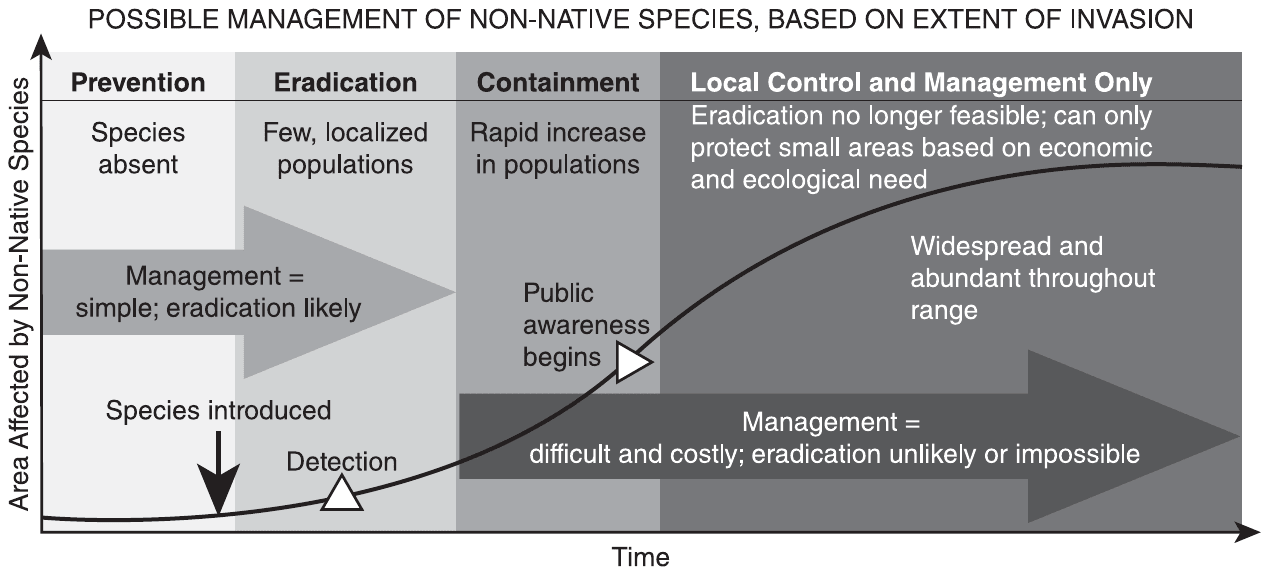
1stymie: hinder or interfere with
Question
The details in the section “A Good Thing, Not the Only Thing” convey a central idea of the excerpt by suggesting that
- Asome non-native species can replace native species that are unable to survive on their own.
- Bdecisions about whether to keep non-native species should be considered on an individual basis.
- Cthe scientists who study rapidly changing ecosystems agree that non-native species enhance biodiversity.
- Da natural habitat that is healthy should be able to support a blend of native and non-native species.
Show the answer
Correct answer: B
The question asks how the details in the section “A Good Thing, Not the Only Thing” convey a central idea of the excerpt.
A. Incorrect. While paragraph 15 does discuss introducing non-native Aldabra tortoises to replace native tortoises that no longer exist, the real point of this section is to show that non-native species can sometimes help support native species that still exist but are struggling. In this case, the Aldabra tortoises are now moving seeds around for the fruiting plants on the islands where the tortoises have been introduced.
B. CORRECT. This section discusses situations in which non-native species should be kept (as in the example of the Aldabra tortoises in paragraph 15) but also asserts that “most of the time . . . conserving species still means focusing on supporting them in their historical habitats, planting natives and removing non-natives” (paragraph 16). This section makes the point that the issue of non-natives needs to be considered on a case-by-case basis.
C. Incorrect. This section does not claim that non-native species always or even usually enhance biodiversity; rather, it states that “in some cases we can best serve biodiversity by leaving the non-natives alone or even—brace yourself, now—introducing them on purpose” (paragraph 14), later adding that “most of the time . . . conserving species still means focusing on supporting them in their historical habitats, planting natives and removing non-natives” (paragraph 16).
D. Incorrect. While the section happens to give a good example of a habitat that supports both native and non-native species (the islands of Mauritius), it never suggests that being able to do so is a defining characteristic of healthy habitats.
Question analysis
This central-idea question asks how the details in the final section of an article on non-native species, titled “A Good Thing, Not the Only Thing,” convey a central idea of the excerpt. Students must sum up the section as a whole, including its example of a tortoise brought to the islands of Mauritius, and match it to the article's larger argument.
- Grade level
- Grade 8 reading and task
- Compared with grade 7
- Above grade 7 Explaining how a section conveys a central idea is grade 7 work, but this section mixes an argument, an example and a closing paragraph, and the choices differ in how far they generalize from it, which demands more than typical.
- Estimated difficulty
- Hard: combines ideas, needs a plan, and has more than one tempting wrong answer.
- Thinking it demands
- Depth of knowledge 3, strategic thinking · mainly understand
- What makes it hard
- The right answer is reworded moderate
- Evidence in several places moderate
- Evidence
- Answered from several paragraphs or stanzas
- Reading level
- Passage: about grade 11, 815 words; question and choices: about grade 11, 82 words.
- Students, last 30 days
- Not enough answers yet to show (it takes 10).
Why it is hard, traps and wrong answers (shows the answer)
Why it is hard
The section's most memorable content is an example, the Aldabra tortoise doing the work of the islands' lost tortoises, and a choice built on it is the strongest pull. The central idea sits instead in the qualifiers at the start and end of the section: some cases favor non-natives, most still call for removing them. Students who summarize all three paragraphs in a sentence, including the last, arrive at the case-by-case reading.
The right answer is reworded moderate Choosing the answer
The right choice's “on an individual basis” appears nowhere in the section, while the wrong choices echo it: a non-native standing in for natives, “biodiversity”, natives alongside non-natives. (Freedle & Kostin, 1993; Kirsch & Mosenthal, 1990)
Evidence in several places moderate Working it out
The case-by-case idea comes only from joining paragraph 14's “In some cases” to paragraph 16's “Most of the time” and “where it is feasible and important to us”. (Kirsch & Mosenthal, 1990; Gorin & Embretson, 2006)
Strategy: Sum up the section's three paragraphs in one sentence of your own, including its example and its final paragraph, then compare that sentence with each choice.
Traps
- Too narrow: A single detail offered as the central idea or a summary, or a summary that keeps minor details and leaves out an essential part.
- Too broad or too strong: A choice overstates, generalizes, or uses absolute words the text does not support.
- Reads too much in: A reasonable-sounding conclusion that goes further than the text allows.
The wrong answers, classified
A Too narrow (King et al., 2004)
Builds on the Aldabra tortoise standing in for Mauritius's lost tortoises, a single example, and misses the closing point that most conservation still means removing non-natives.
C Too broad or too strong (King et al., 2004)
Turns “In some cases” into a consensus that non-natives enhance biodiversity, though the section limits the claim and the article shows ecologists divided over it.
D Reads too much in (Graesser, Singer & Trabasso, 1994)
Draws a rule about healthy habitats from the Mauritius example, though the section never defines a healthy habitat or says it should hold a mix of species.
Working it out, step by step
Know what the question asks
A section is a part of an article under its own heading. This one runs from paragraph 14 to paragraph 16. You need to sum up the whole section, including its last paragraph. Then match that summary to a central idea.
Read paragraph 14
It says that “in some cases” we help nature most “by leaving the non-natives alone.” We might even bring them in “on purpose.” The words “in some cases” are the key. They mean sometimes, not always.
Read the example and the ending
Paragraph 15 gives an example. A non-native tortoise was brought to Mauritius to spread the seeds of fruiting plants. Then paragraph 16 says that “most of the time,” saving species still means “planting natives and removing non-natives.” We should do that “where it is feasible and important to us.” Feasible means possible.
Put the section together
Sometimes it is best to keep a non-native species. Most of the time it is best to remove it. So each case has to be judged on its own. That is what “on an individual basis” means.
Check each choice
- B fits: deciding case by case matches both “in some cases” and “most of the time.”
- A is wrong because the tortoise is one example, and the section ends by saying removal is still the usual choice.
- C is wrong because the section never says scientists agree, and “in some cases” is far from always.
- D is wrong because the section never says what a healthy habitat should hold.
Watch out: A is built on the section’s most memorable detail. But the main idea comes from the words that limit the claim.
Choose the answer
The section says to keep non-natives in some cases and remove them in others. So the answer is B.
Why this answer and not the closest wrong one
A comes closest, because the Aldabra tortoise really does take over work the lost tortoises once did. But that is one case. The section ends by saying that most of the time we still remove non-natives. B covers both sides: some cases call for keeping them, and others call for removing them.
More questions like this
The original DOE question
The passage “Excerpt from “It’s Time to Stop Thinking That All Non-Native Species Are Evil”” as printed (pages 68–70)
Question 84 of 120
2024 Test A English, question 57Uses the passage above: “Excerpt from “It’s Time to Stop Thinking That All Non-Native Species Are Evil””.
Question
How does the chart provide additional support for a central idea of the excerpt?
- Aby implying that the public becomes aware of non-native species only after removal is impossible
- Bby showing that the complete removal of non-native species is usually not achievable after a certain period of time
- Cby demonstrating why non-native species can be destructive if they are not removed from an area immediately
- Dby explaining how some conservation groups have approached the removal of non-native species
Show the answer
Correct answer: B
The question asks how the chart provides additional support for a central idea of the excerpt.
A. Incorrect. The chart indicates that the public tends to become aware of non-native species once eradication is “unlikely or impossible,” not strictly impossible. Furthermore, this idea is not a central idea of the excerpt.
B. CORRECT. The chart strongly suggests that once “rapid increase in populations” of non-native species has occurred, eradication will be “unlikely or impossible.”
C. Incorrect. While the chart does show that non-native species can eventually be impossible to eradicate, it never addresses the issue of how the non-native species might be destructive to their new environments.
D. Incorrect. The chart shows how non-native species become harder and harder to remove as their population grows but does not explain how any conservation groups have approached their removal.
Question analysis
This question asks how a chart titled “Possible Management of Non-Native Species, Based on Extent of Invasion” supports a central idea of an article arguing that not all non-native species are harmful. Students must read the chart's stages, labels and curve, then decide which statement the chart actually shows and which also fits the article's argument.
- Grade level
- Grade 8 reading and task
- Compared with grade 7
- At grade 7 Grade 7 students connect graphics to a text, but this chart packs four stages, two arrows, a curve and several labels into one figure, and its pattern must be linked to an argument made in words, demanding but within upper grade 7.
- Estimated difficulty
- Moderate: several steps, or a close reading with one strong distractor.
- Thinking it demands
- Depth of knowledge 2, skills and concepts · mainly analyze
- What makes it hard
- Reading a figure, table or graph moderate
- A very close wrong answer moderate
- Combines ideas minor
- Evidence
- Answered from the whole text
- Reading level
- Passage: about grade 11, 815 words; question and choices: about grade 12, 78 words.
- Students, last 30 days
- Not enough answers yet to show (it takes 10).
Why it is hard, traps and wrong answers (shows the answer)
Why it is hard
The chart is easy to read in outline, simple management on the left and costly, likely failed eradication on the right, and the right choice restates that contrast. The pull comes from the “Public awareness begins” marker, placed at the border of the stage where eradication is no longer feasible, which makes a statement about public awareness look like a faithful reading. It is nearly faithful, but it describes one marker, not a central idea the article develops.
Reading a figure, table or graph moderate Understanding the question
The chart packs four shaded stages, two arrows, an S-shaped curve and three markers into one figure, and its message lies in the arrows: eradication “likely” early, “unlikely or impossible” later. (Lesh, Post & Behr, 1987; Kirsch & Mosenthal, 1990)
A very close wrong answer moderate Choosing the answer
The right choice and the public-awareness choice both read the late stages where removal fails; the awareness marker even sits on the border of “Eradication no longer feasible”, so only centrality separates them. (Embretson & Wetzel, 1987; Gorin & Embretson, 2006; Ascalon et al., 2007)
Combines ideas minor Working it out
The chart's pattern has to be matched to the article's argument that nativeness is one value among several and that removal makes sense only where “feasible and important to us”. (Embretson, 1998; Daniel & Embretson, 2010)
Strategy: Read the chart's title, axes and stage labels, say in one sentence what it shows happening over time, then ask which part of the article's argument that pattern supports.
Traps
- Too narrow: A single detail offered as the central idea or a summary, or a summary that keeps minor details and leaves out an essential part.
- Reads too much in: A reasonable-sounding conclusion that goes further than the text allows.
- Wrong part of the text: A choice is true of another paragraph, stanza or speaker than the one asked about.
The wrong answers, classified
A Too narrow (King et al., 2004)
Reads the “Public awareness begins” marker, which sits where eradication becomes unlikely or impossible, as the chart's point, though it is one label and public awareness is not a central idea.
C Reads too much in (Graesser, Singer & Trabasso, 1994)
Takes the rising curve of area affected as proof of damage, but the chart tracks spread and the difficulty of removal, never harm, and the article questions removing non-natives on reflex.
D Wrong part of the text (Kirsch & Mosenthal, 1990)
Credits the chart with the citizen groups of paragraph 3 and the spartina project of paragraph 10, but it shows general stages of possible management, not any group's actual approach.
Working it out, step by step
Know what the question asks
This asks how the chart supports a central idea, a main point of the article. First read the chart and say in your own words what it shows. Then link that to the article’s argument.
Read the chart from left to right
Time moves from left to right. The curve shows how much area a non-native species covers. Eradication means wiping a species out completely. Early on, the arrow says management is “simple” and eradication is “likely.” Then the species spreads fast. From there on, management is “difficult and costly,” and eradication is “unlikely or impossible.” In the last stage it is “no longer feasible,” or no longer possible.
Link the chart to the article
The article argues that we shouldn’t treat every non-native species the same way. Paragraph 16 says we should remove non-natives “in places where it is feasible and important to us.” The chart shows when removal is possible: mostly early, before the species spreads. After that, wiping it out usually can’t be done.
Check each choice
- B fits: complete removal is usually not possible after a certain time, which is the chart’s main message.
- A is wrong because the “Public awareness begins” marker is one small label, and the article never discusses when the public notices.
- C is wrong because the chart shows how far a species spreads, not how much damage it does.
- D is wrong because the chart shows general stages, not what any real group has done.
Watch out: A reads the marker correctly, since it does sit late, where removal is already hard. But it picks a detail, not the chart’s main point.
Choose the answer
The chart shows that removal works only early, which backs up the article’s argument. So the answer is B.
Why this answer and not the closest wrong one
A comes closest, since the chart does place “Public awareness begins” late, when removal is already hard. But that is one small marker, and the article never says when the public first notices a species. B states the chart’s main message, that removal works only early. That backs up the article’s point that removing non-natives isn’t always possible.
More questions like this
The original DOE question
Question 85 of 120
2024 Test B English, question 17Passage Excerpt from “How Exercise Could Help You Learn a New Language”
Excerpt from “How Exercise Could Help You Learn a New Language”
by Gretchen Reynolds
Many scientists suspect that exercise alters the biology of the brain in ways that make it more malleable and receptive to new information, a process that scientists refer to as plasticity.
But many questions have remained unanswered about movement and learning, including whether exercise is most beneficial before, during or after instruction and how much and what types of exercise might be best.
So for a new study, which was published recently in PLOS One, researchers in China and Italy decided to home in on language learning and the adult brain.
Language learning is interesting. As young children, almost all of us picked up our first language easily. We didn’t have to be formally taught; we simply absorbed words and concepts.
But by early adulthood, the brain generally begins to lose some of its innate language capability. It displays less plasticity in areas of the brain related to language. As a result, for most of us, it becomes harder to learn a second language after childhood.
To see what effects exercise might have on this process, the researchers first recruited 40 college-age Chinese men and women who were trying to learn English. The students had some facility with this second language but were far from proficient.
The researchers then divided the students into two groups. Those in one group would continue to learn English as they had before, primarily while seated in rote vocabulary-memorization sessions.
The others would supplement these sessions with exercise.
Specifically, the students would ride exercise bikes at a gentle pace (about 60 percent of their maximum aerobic capacity) beginning 20 minutes before the start of the lessons and continuing throughout the 15 minutes or so of instruction.
Both groups learned their new vocabulary by watching words projected onto large screens, together with comparable pictures, such as “apple” and a Red Delicious. They were shown 40 words per session, with the sequence repeated several times.
Afterward, the students all rested briefly and then completed a vocabulary quiz, using computer keys to note as quickly as possible whether a word was with its correct picture. They also responded to sentences using the new words, marking whether the sentences were accurate or, in the case of “The apple is a dentist,” nonsensical. Most linguists1 feel that understanding sentences shows greater mastery of a new language than does simple vocabulary improvement.
The students completed eight vocabulary sessions over the course of two months.
And at the end of each lesson, the students who had ridden bikes performed better on the subsequent vocabulary tests than did the students who sat still.
They also became more proficient at recognizing proper sentences than the sedentary students, although that difference did not emerge until after several weeks of instruction.
Perhaps most interesting, the gains in vocabulary and comprehension lingered longest for the cyclists. When the researchers asked the students to return to the lab for a final round of testing a month after the lessons—without practicing in the meantime—the cyclists remembered words and understood them in sentences more accurately than did the students who had not moved.
“The results suggest that physical activity during learning improves that learning,” says Simone Sulpizio, a professor of psychology and linguistics at the University Vita-Salute San Raffaele in Milan, Italy, and a study co-author.
These improvements extend beyond simply aiding in memorization, she added. The exercise also deepened language learners’ grasp of how to use their newly acquired words.
This study involved college students performing relatively light exercise, though, and cannot tell us whether other people completing other types of exercise would achieve the same results.
It also offers no clues about what is occurring inside the brain that might be contributing to the benefits of the exercise. But many past studies have shown that exercise prompts the release of multiple neurochemicals in the brain that increase the number of new brain cells and the connections between neurons, Dr. Sulpizio says. These effects improve the brain’s plasticity and augment the ability to learn.
From a real-world standpoint, the study’s implications might seem at first to be impractical. Few classrooms are equipped with stationary bicycles. But specialized equipment is probably unnecessary, Dr. Sulpizio says.
“We are not suggesting that schools or teachers buy lots of bicycles,” she says. “A simpler take-home message may be that instruction should be flanked by physical activity.”
From “How Exercise Could Help You Learn a New Language” by Gretchen Reynolds from THE NEW YORK TIMES, August 16, 2017. Copyright © 2017 The New York Times Company.
1linguists: scientists who study language
Question
Read this sentence from paragraph 6.
To see what effects exercise might have on this process, the researchers first recruited 40 college-age Chinese men and women who were trying to learn English.
Which statement describes the function of the sentence in the overall structure of the excerpt?
- AIt indicates a shift from describing the results of the study to describing the process.
- BIt introduces the aspect of the research that was most critical to determining the results.
- CIt marks the change from explaining why the study was conducted to explaining how the study was conducted.
- DIt shows how questions were raised that could be addressed in further research.
Show the answer
Correct answer: C
The question asks how the first sentence from paragraph 6 functions in the overall structure of the excerpt.
A. Incorrect. While paragraph 6 begins to describe how the study was carried out, the results of the study have not been discussed in previous paragraphs.
B. Incorrect. The population used for the study is an important detail that helps describe who participated in the study, as well as an ideal situation (college-age people trying to learn a new language), but this is not critical information used to determine the results.
C. CORRECT. While paragraphs 4 and 5 address why the study focuses on adult language learning, the first sentence of paragraph 6 begins to give details about how the study was conducted, including describing the population being studied: “40 college-age Chinese men and women who were trying to learn English.”
D. Incorrect. The sentence from paragraph 6 does not include examples or discuss questions for further research; it simply introduces the subjects recruited for the study.
Question analysis
This question quotes the sentence in which researchers recruit 40 college-age Chinese students learning English, and asks what job that sentence does in the structure of the article on exercise and language learning. Students must keep track of what the article has covered by that point and what it turns to next, then judge four descriptions that each name a shift or a purpose.
- NYS standards
- 7R5 structure and genre features
- Grade level
- Grade 7 reading and task
- Compared with grade 7
- At grade 7 Naming the job a sentence does in an article’s structure is standard grade 7 work. The sentence opens with a clear signal phrase, and students need only recall what the paragraphs before and after it cover.
- Estimated difficulty
- Straightforward: two steps or one careful reading.
- Thinking it demands
- Depth of knowledge 2, skills and concepts · mainly analyze
- What makes it hard
- How, not what moderate
- A very close wrong answer minor
- Evidence
- Answered from several paragraphs or stanzas
- Reading level
- Passage: about grade 11, 764 words; question and choices: about grade 8, 106 words.
- Students, last 30 days
- Not enough answers yet to show (it takes 10).
Why it is hard, traps and wrong answers (shows the answer)
Why it is hard
The sentence announces its own job with “To see what effects exercise might have on this process,” which points back to the reasons for the study and forward to its method. The main risk is misplacing the results: paragraphs 4 and 5 report facts about how brains learn language, which can pass for findings, but the study’s results come only in paragraphs 13 to 15. Students who outline the article’s order before reading the choices find this quick.
How, not what moderate Working it out
The question asks what the sentence does in the excerpt’s plan, so students must see that paragraphs 1–5 explain why the study was done and that “To see what effects” opens the account of its method. (Anderson & Krathwohl, 2001)
A very close wrong answer minor Choosing the answer
The right choice and the one about a shift “from describing the results” both say the sentence turns to how the study was run; they differ only in what they say came before it. (Embretson & Wetzel, 1987; Gorin & Embretson, 2006; Ascalon et al., 2007)
Strategy: Note what paragraphs 1 through 5 mainly do and what paragraphs 7 through 12 mainly do. The quoted sentence sits between them, so describe the shift it makes.
Traps
- Reversed relationship: Cause and effect, or the order of events, turned around.
- Wrong part of the text: A choice is true of another paragraph, stanza or speaker than the one asked about.
- Reads too much in: A reasonable-sounding conclusion that goes further than the text allows.
The wrong answers, classified
A Reversed relationship (King et al., 2004)
Rightly sees the turn to the study’s process but puts the results first, perhaps taking paragraph 5’s facts about the adult brain as findings, though results come in paragraphs 13–15.
B Reads too much in (Graesser, Singer & Trabasso, 1994)
Rightly notes that the sentence introduces who took part, then calls the 40 college-age learners the most critical factor in the results, a judgment the excerpt never makes.
D Wrong part of the text (Kirsch & Mosenthal, 1990)
Fits the open questions of paragraph 2 and the limits in paragraphs 18 and 19, not this sentence, which simply names the students recruited.
Working it out, step by step
Figure out what the question asks
This asks what job one sentence does in the article’s plan. The sentence begins paragraph 6: “To see what effects exercise might have on this process.” To answer, look at what comes before it and what comes after it.
See what comes before the sentence
Paragraphs 1 to 5 explain why the study was done. Paragraph 2 says “many questions have remained unanswered about movement and learning.” Paragraph 5 says adult brains lose some of their skill with language. The words “this process” in the sentence point back to that. These paragraphs give reasons. They give no results yet.
See what comes after the sentence
The sentence says the researchers “first recruited” students. To recruit means to sign people up. After that, paragraphs 7 to 12 tell how the study worked. The students were split into two groups. One group rode bikes. Everyone took quizzes. The results come later, in paragraphs 13 to 15. So the sentence is where the article turns from why to how.
Check each choice
- C fits. It marks the change from why the study was done to how it was done.
- A says the article turns away from the results. But no results come before this sentence.
- B says this was the most important part of the study. The article never says that.
- D is about questions for later research. Those come up in paragraphs 18 and 19, not here.
Watch out: A is tempting because it also says the sentence turns to the process. Check its first half too.
Pick the answer
The method is the way the study was carried out. This sentence ends the reasons and starts the method. So the answer is C.
Why this answer and not the closest wrong one
A is the closest wrong answer. Like C, it says the sentence starts describing how the study was done. But A says the article was describing results before this. It wasn’t. The results, such as the cyclists doing better on quizzes, come in paragraphs 13 to 15.
More questions like this
The original DOE question
The passage “Excerpt from “How Exercise Could Help You Learn a New Language”” as printed (pages 171–172)
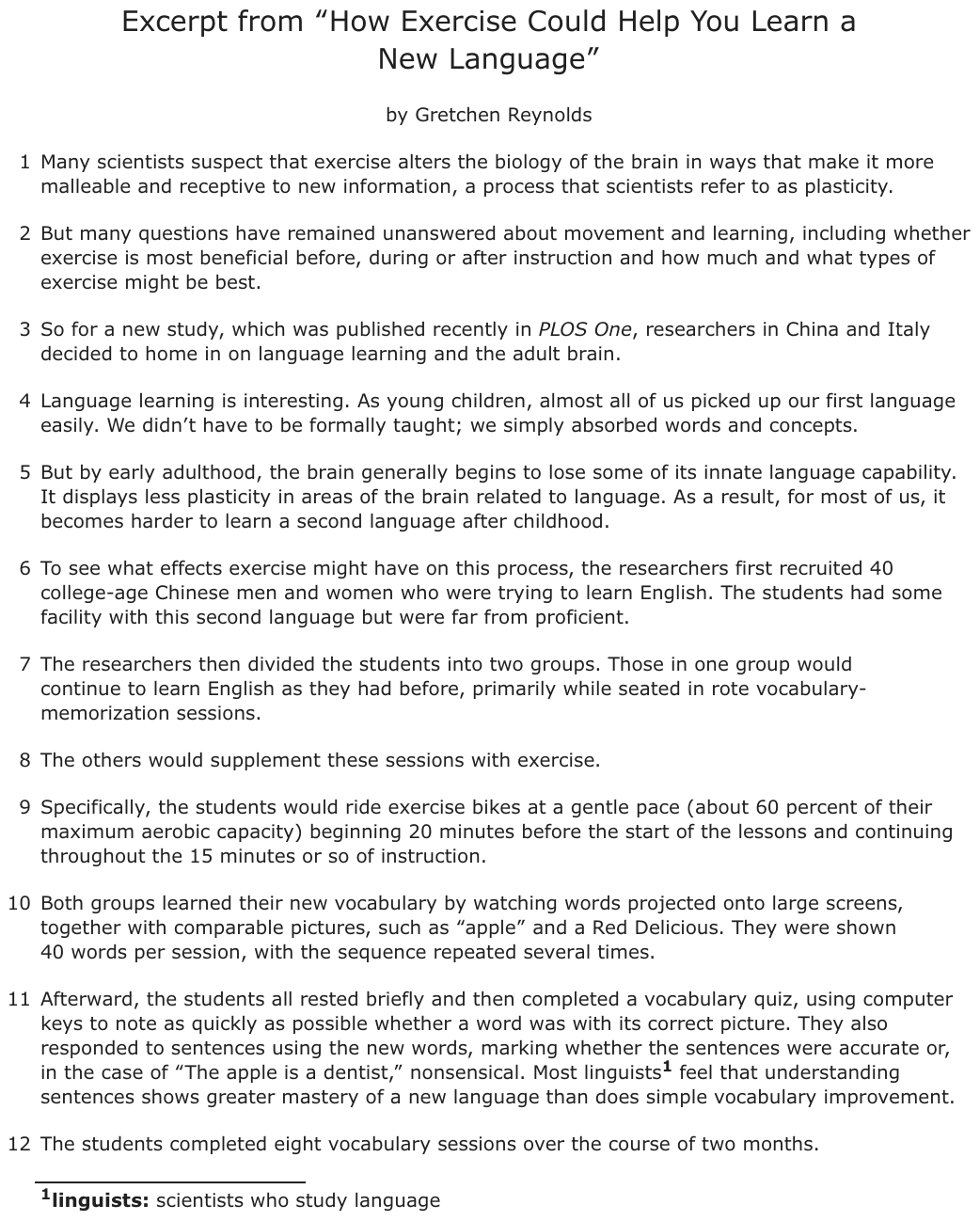
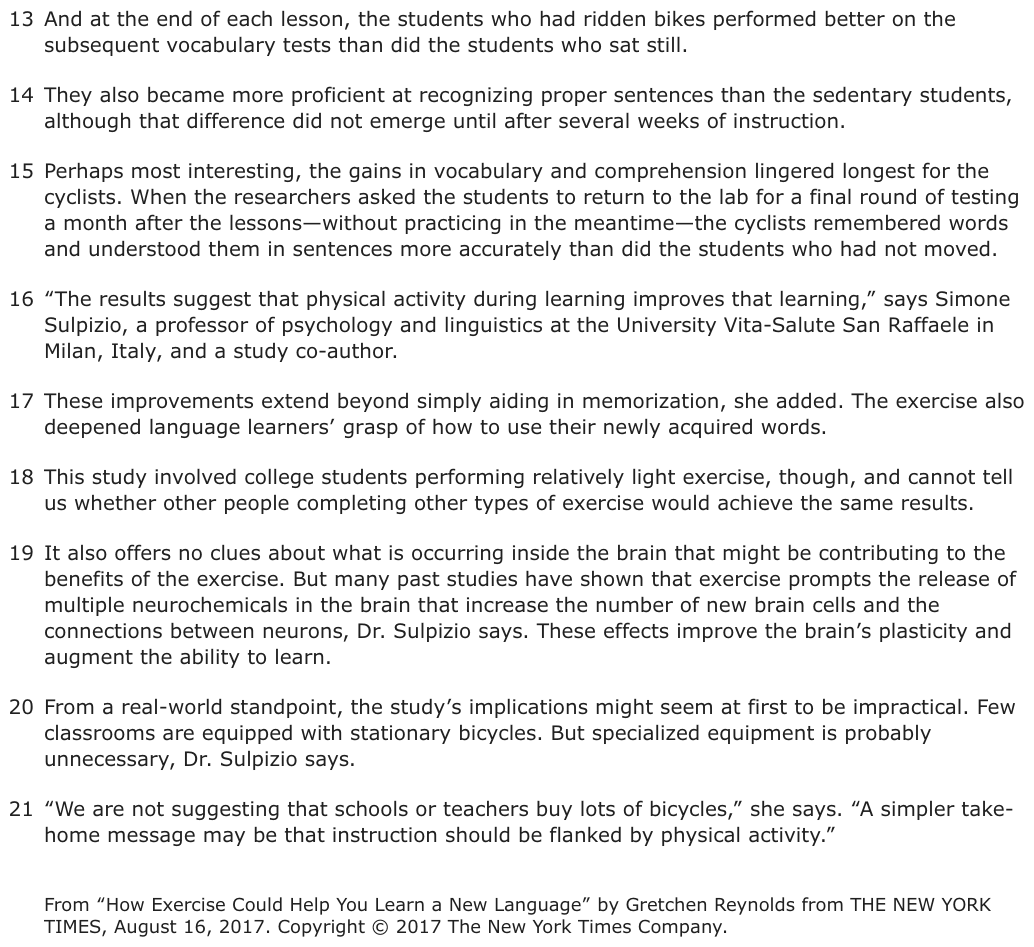
Question 86 of 120
2024 Test B English, question 21Uses the passage above: “Excerpt from “How Exercise Could Help You Learn a New Language””.
Question
Paragraph 18 shows that the author’s perspective toward the study described in the excerpt is that
- Athough the study allowed some conclusions to be drawn, these conclusions are limited.
- Bwhile the study focused on moderate exercise, it would have been better to focus on difficult exercise.
- Cwhile the study was performed appropriately, it is doubtful the results can be duplicated.
- Dthough the study was about learning language, its conclusions can be applied to learning in general.
Show the answer
Correct answer: A
The question asks what paragraph 18 reveals about the author’s perspective toward the study in the excerpt.
A. CORRECT. As paragraph 18 says, the study cannot address “whether other people completing other types of exercise would achieve the same results” as college students riding bikes.
B. Incorrect. While paragraph 18 mentions that the students performed “relatively light exercise,” it never suggests that more rigorous exercise should have been studied, only that it is still unknown what the impact on language learning would be for other populations doing other types of exercise.
C. Incorrect. Paragraph 18 points out only that the study’s results cannot be generalized to other populations performing other types of exercise and never speculates on whether the study’s results could be duplicated.
D. Incorrect. Far from claiming that the study’s results could be applied more broadly to learning in general, paragraph 18 points out the ways in which the study’s results cannot be applied more broadly.
Question analysis
This author’s perspective question asks what paragraph 18 of the article on exercise and language learning shows about how the author views the study. The paragraph is a single sentence, so the difficulty lies in the four choices, each of which pairs a fair-sounding statement about the study with a judgment that must be checked against the paragraph.
- Grade level
- Grade 7 reading and task
- Compared with grade 7
- At grade 7 Identifying how an author judges a study is grade 7 work on author’s position. Paragraph 18 is a single plain sentence, but the choices make fine distinctions about what research can and cannot show, which keeps the task at grade level.
- Estimated difficulty
- Moderate: several steps, or a close reading with one strong distractor.
- Thinking it demands
- Depth of knowledge 2, skills and concepts · mainly analyze
- What makes it hard
- A very close wrong answer moderate
- Reading between the lines minor
- Evidence
- Answered from one paragraph or stanza
- Reading level
- Passage: about grade 11, 764 words; question and choices: about grade 10, 75 words.
- Students, last 30 days
- Not enough answers yet to show (it takes 10).
Why it is hard, traps and wrong answers (shows the answer)
Why it is hard
Paragraph 18 is a single plain sentence, but its “though” marks a turn from reporting the study to limiting it. Every choice frames the author’s view as a concession followed by a doubt or a hope, so students must test the second half against what the sentence says cannot be known. Confusing results that may not apply to other people with results that may not be repeatable is the main trap.
A very close wrong answer moderate Choosing the answer
The right choice and the one about duplicating the results both grant the study something and then cast doubt; they differ only in the doubt, about applying the results to others or about repeating the study. (Embretson & Wetzel, 1987; Gorin & Embretson, 2006; Ascalon et al., 2007)
Reading between the lines minor Working it out
Paragraph 18 states a fact, that the study “cannot tell us whether other people completing other types of exercise would achieve the same results,” and the author’s judgment must be read from it. (Graesser, Singer & Trabasso, 1994; Kintsch, 1998)
Strategy: Restate paragraph 18 in your own words before looking at the choices, then pick the choice that says the same thing, checking each word of it against the paragraph.
Traps
- Twists what the text says: Uses the text's topic and ideas but changes what it says: who did it, how much, when, or why.
- Reads too much in: A reasonable-sounding conclusion that goes further than the text allows.
- Too broad or too strong: A choice overstates, generalizes, or uses absolute words the text does not support.
The wrong answers, classified
B Reads too much in (Graesser, Singer & Trabasso, 1994)
Reads “relatively light exercise” as a complaint and invents a wish for harder exercise, when the author only notes that other kinds remain untested.
C Twists what the text says (King et al., 2004)
Rightly hears doubt in paragraph 18 but changes its object: the author questions whether the results apply to other people and exercise, not whether the study could be repeated.
D Too broad or too strong (King et al., 2004)
Echoes the upbeat take-home message of paragraphs 16 and 21 and stretches the findings to all learning, the opposite of paragraph 18’s caution.
Working it out, step by step
Figure out what the question asks
This asks how the author feels about the study, based on paragraph 18. The author’s perspective is the author’s point of view. Paragraph 18 is just one sentence, so read it closely.
Read paragraph 18
It says: “This study involved college students performing relatively light exercise, though, and cannot tell us whether other people completing other types of exercise would achieve the same results.” The word though signals a turn. Up to now, the author has reported good results. Here the author points out a limit.
Put it in your own words
The study tested only one kind of person doing one kind of exercise. So we know what happened to college students on bikes. We don’t know if older people, or people who run or swim, would get the same results. The study tells us something, but not everything. Its conclusions are limited, which means they only go so far.
Check each choice
- A fits. The study gave some answers, but they are limited.
- B says the study should have used hard exercise. The author never wishes for that. “Relatively light” is just a fact about the study.
- C says the results may not be duplicated, which means done again with the same results. The author doubts something else: whether the results apply to other people and exercise.
- D says the results apply to all learning. Paragraph 18 says the opposite.
Pick the answer
Watch out: C sounds doubtful, just like paragraph 18. But it doubts the wrong thing. So the answer is A.
Why this answer and not the closest wrong one
C is the closest wrong answer, because paragraph 18 does raise a doubt. But the doubt is not about repeating the study. It is about whether “other people completing other types of exercise would achieve the same results.” That means the conclusions are limited, which is A.
More questions like this
The original DOE question
Question 87 of 120
2024 Test B English, question 23Passage Excerpt from Do Them No Harm!
Excerpt from Do Them No Harm!
by Zoa L. Swayne
This narrative is about the Nez Perce, an American Indian tribe, in what is now northern Idaho. The tribe is preparing for a gathering before the coming winter.
In the moon of Ta-Yum, the hottest days of summer, when salmon spawn in the little streams and huckleberries ripen in the high mountains, people from many villages of the Chopunnish Nation gathered in the Oyaip Prairie for the work and festivities of their annual camas1 harvest.
From far and near The People came. . . .
Should a stranger enter their homeland and ask, “Where are you from?” the reply was always, “We are Nee-mee-poo, The People who live here in this place.”
It was a time of Lawtiwa-mah-ton—a time of being friends together—when The People came for this last chance to enjoy being together before the Cold Moons kept them close to their fires. The visiting and trading, the foot racing and horse racing, and the gambling and stick games would be remembered and talked about long after they had forgotten the drudgery of digging and roasting camas, picking berries, or drying meat and fish. Lawtiwa-mah-ton! It was good to be friends together.
As was their custom since wahk-kee-ma, a time far back beyond the memory of man, they set up their camps in the same locations their parents and grandparents had occupied before them. Red Bear’s people, from Kamiah, made their camp near the trail that came out of the mountains. Their neighbors in Kamiah Valley, The People from Tee-e-lap-a-lo, had their camp close by. Across the wide meadow, by the great roasting pits, the camps of the Te-wap-poo and Ask-kah-poo were located. The tepees and ish-nash, brush shelters, of other groups nestled in their accustomed areas in and among the pines in such numbers that they encircled the entire meadow land.
Red Bear’s people had traveled all summer with neighboring bands, gathering and preparing roots, picking and drying berries, drying and smoking meat and fish for their winter food supply. Now they were at the Oyaip camp. The women worked hard to dig and cure as many bags of roots as they could during the warm, sunny days, for the sharp night air brought warnings that WARM was going and COLD was coming.
Everyone helped in some way. Most of the men fished or hunted for meat. While many of the women dug and roasted camas, other women and older children picked and dried berries.
And the younger children played. They played at hunting. They played with the babies. They played with their horses and puppies. They learned how to live through their play.
This sun, happiness, peace, and quiet blessed the Red Bear camp. All were busy with their daily tasks, until sudden cries came from the children playing by the trail.
“People coming! People coming! People coming on the trail from the high mountains!” they called as they ran to their elders, who looked sharply at the figures of approaching horsemen.
Were they friends or enemies? Did they bring good news or bad?
“Who can it be? What brings them here?” were the questions in every mind.
“Could they be the four hunters who had gone to Buffalo Country two summers past? Would they have news of the families who had gone long ago to Buffalo Country and never returned?”
It was customary for a hunting party to be gone for more than one season.
“Looks like hunters,” the older men agreed. “Looks like they had good hunting. Maybe our four hunters. [They have] been gone many moons.”
“Looks like five people—not four,” others observed.
Excitement grew as the riders came close enough to be recognized.
“A-a-a-a-a, they are our four hunters! But who is the fifth person?” they asked.
“Looks like a woman. Who is she?”
The hunters rode up to the welcoming crowd, proud to show off the loads of meat, hides, and other trophies of their hunt. They paraded around the encampment for all to see how strong their Hunting Power had been—what great hunters they, themselves, were.
Red Bear’s people rejoiced at their hunters’ success. Good hunters brought good to everybody. The meat meant plenty of food and the hides meant soft-tanned robes to give comfort through the Cold Moons. But it was the sight of the frail figure of the woman that aroused their curiosity. Who was she? Where had she come from? . . .
“Belongs to Red Bear people. Gone then come back,” the hunters said, as they dismounted and unloaded their packs. . . .
Now they could see! She was the daughter of the family gone so long ago! The girl-child who had left came back now—a grown woman.
“Wat-ku-ese!” the women cried. “Gone-from-Home-then-Come-Back. Wat-ku-ese!” And Wat-ku-ese was her name from that time on.
Gentle arms lifted Wat-ku-ese from her horse. The women brought her food and made a place for her to rest. For many suns they cared for her until she became stronger.
One evening Wat-ku-ese told her story for all to hear.
From DO THEM NO HARM!: Lewis and Clark Among the Nez Perce by Zoa L. Swayne. Published by Caxton Press. Copyright © 1990 by Zoa L. Swayne. Orofino, Idaho and Legacy House, Inc. Orofino, Idaho. All rights reserved.
1camas: a wild, edible plant
Question
Paragraph 1 contributes to the setting of the excerpt by establishing that
- Athe story’s location is a plentiful place that allows The People to enjoy a comfortable gathering.
- Bthe events in the story occurred in the past and are being remembered by The People.
- Cthe camp in the story is changing and that the changes are causing problems for The People.
- Dthe story’s plot begins as The People are observing their land and what it offers them.
Show the answer
Correct answer: A
The question asks how paragraph 1 contributes to the setting of the excerpt.
A. CORRECT. Paragraph 1 describes summer “when salmon spawn,” “huckleberries ripen,” and The People gather for “their annual camas harvest.” These descriptions show the abundance of food in the place where the excerpt occurs.
B. Incorrect. Although the setting refers to past events, the narration is not by The People. In addition, the voice narrating the excerpt is not an element of the setting.
C. Incorrect. Nothing in paragraph 1 suggests that the camp is changing in any way. The People gather annually in this place. In addition, the language used to describe the setting does not suggest any problems.
D. Incorrect. The People are not making observations about the setting in paragraph 1. They are described as performing actions, such as gathering “for the work and festivities of their annual . . . harvest.”
Question analysis
This setting question asks what the opening paragraph of Zoa L. Swayne’s narrative Do Them No Harm! establishes about the time and place of the Nez Perce camas harvest. The paragraph is one long sentence crowded with unfamiliar names, so students must look past them to the details and decide what kind of place and season they describe.
- Grade level
- Grade 6 reading and task
- Compared with grade 7
- Below grade 7 Seeing how an opening paragraph sets the scene matches the grade 6 standard, which names setting directly. The paragraph is one long sentence with unfamiliar Nez Perce names, but its details are concrete and the task is a single inference.
- Estimated difficulty
- Straightforward: two steps or one careful reading.
- Thinking it demands
- Depth of knowledge 2, skills and concepts · mainly analyze
- What makes it hard
- Reading between the lines moderate
- Complex sentences minor
- Evidence
- Answered from one paragraph or stanza
- Reading level
- Passage: about grade 5, 885 words; question and choices: about grade 8, 76 words.
- Students, last 30 days
- Not enough answers yet to show (it takes 10).
Why it is hard, traps and wrong answers (shows the answer)
Why it is hard
The paragraph is crowded with names, but its details are concrete: fish, berries, a harvest, festivities. Students who add them up see abundance and a happy gathering; those who look past them reach for ideas about who tells the story or about changes to come. The choice about The People observing their land is the subtle one, because the land’s gifts are there but no one in the paragraph is watching them.
Reading between the lines moderate Working it out
Paragraph 1 never calls the place plentiful; that has to be inferred from salmon that “spawn in the little streams,” huckleberries that “ripen,” and many villages gathering for the camas harvest. (Graesser, Singer & Trabasso, 1994; Kintsch, 1998)
Complex sentences minor Understanding the question
Paragraph 1 is a single sentence that opens with “In the moon of Ta-Yum,” a second time phrase and a “when” clause, so its subject, “people from many villages,” arrives only halfway through. (Abedi & Lord, 2001; Freedle & Kostin, 1993; Messick, 1989)
Strategy: Underline every detail in paragraph 1 about time, place and activity, then decide what overall impression of the setting they create before reading the choices.
Traps
- Half right: One half of a two-part choice is right and the other is not.
- Twists what the text says: Uses the text's topic and ideas but changes what it says: who did it, how much, when, or why.
- Reads too much in: A reasonable-sounding conclusion that goes further than the text allows.
The wrong answers, classified
B Half right (King et al., 2004; Thissen, Steinberg & Fitzpatrick, 1989)
Rightly notes that the story is set in the past, then adds that The People are remembering it, though an outside narrator tells the story.
C Reads too much in (Graesser, Singer & Trabasso, 1994)
Senses change in the coming cold of later paragraphs and reads trouble into the opening, though paragraph 1 describes a yearly gathering with no hint of problems.
D Twists what the text says (King et al., 2004)
Sees what the land offers, salmon, berries and camas, but has The People surveying it, when paragraph 1 shows them gathering to work and celebrate, not observing.
Working it out, step by step
Figure out what the question asks
The setting of a story is where and when it takes place. This asks what paragraph 1 tells you about the setting. The paragraph is one long sentence with many new names. Look past the names to the details.
Find the details
Paragraph 1 says it is “the hottest days of summer.” It is a time “when salmon spawn in the little streams and huckleberries ripen in the high mountains.” To spawn means to lay eggs. To ripen means to get ready to eat. People from many villages come to the Oyaip Prairie “for the work and festivities” of their yearly harvest. Festivities are celebrations.
Decide what the details show
Fish, berries and a harvest all mean food. So this is a place with plenty to eat. Many villages come together to work and to celebrate. So it is a happy gathering, too. The paragraph shows a rich, friendly place.
Check each choice
- A fits: a plentiful place where The People gather in comfort. Plentiful means having a lot.
- B: the story does happen in the past. But a narrator tells it. A narrator is the voice telling the story. The People are not remembering it.
- C: nothing in paragraph 1 is changing or causing problems. The gathering happens every year.
- D: The People are not studying the land. They have come to work and celebrate.
Watch out: D mentions what the land offers, which is in paragraph 1. But no one in the paragraph is watching the land.
Pick the answer
Paragraph 1 sets up a place full of food and good company. So the answer is A.
Why this answer and not the closest wrong one
D is a close wrong answer, because the land’s gifts, fish, berries and camas, are all in paragraph 1. But D says The People are observing the land. They are not. They have come “for the work and festivities” of the harvest. A sums up what the details show: plenty of food and a happy gathering.
More questions like this
The original DOE question
The passage “Excerpt from Do Them No Harm!” as printed (pages 177–178)
Question 88 of 120
2024 Test B English, question 26Uses the passage above: “Excerpt from Do Them No Harm!”.
Question
In paragraph 8, the author repeats the word “played” most likely to
- Aemphasize how much the adults enjoy observing the children.
- Bshow how everyone finds a way to enjoy being at the gathering.
- Cindicate the variety of activities available at the gathering.
- Dcharacterize the manner in which the children master the work of adults.
Show the answer
Correct answer: D
The question asks what is the most likely reason that the author repeats the word “played” in paragraph 8.
A. Incorrect. Paragraph 7 describes the different tasks that the adults were doing at this time. They were not watching the children play, because they were busy working.
B. Incorrect. While everyone enjoys being at the gathering, the word “played” does not describe the activities of the adults. As described in paragraph 7, the adults are working together at various tasks.
C. Incorrect. The word “played” is used before phrases describing what the children did. It is not used to list activities available for all at the gathering.
D. CORRECT. The word “played” appears before different activities that the children did, such as pretending to hunt, take care of the babies, and take care of the animals. They played by pretending to do adult activities. The last sentence states that the children “learned how to live through their play.”
Question analysis
This word-choice question asks why the author repeats the word “played” in a short paragraph about the younger children at the Nez Perce camp. Students must see what the repetition builds toward and match it to answer choices written in more abstract, formal wording than the simple paragraph itself.
- Grade level
- Grade 7 reading and task
- Compared with grade 7
- At grade 7 Explaining why an author repeats a word is common grade 7 work on word choice. The paragraph is five short sentences, but the choices are worded abstractly, so students must translate the paragraph’s point into the test’s more formal language.
- Estimated difficulty
- Moderate: several steps, or a close reading with one strong distractor.
- Thinking it demands
- Depth of knowledge 2, skills and concepts · mainly analyze
- What makes it hard
- How, not what moderate
- Reading between the lines moderate
- The right answer is reworded minor
- Evidence
- Answered from one paragraph or stanza
- Reading level
- Passage: about grade 5, 885 words; question and choices: about grade 9, 53 words.
- Students, last 30 days
- Not enough answers yet to show (it takes 10).
Why it is hard, traps and wrong answers (shows the answer)
Why it is hard
The paragraph is five short sentences, and the repetition is obvious; the challenge is saying what it adds up to. Students who stop at the repeated word see a list of games and settle on variety, while those who read to the final sentence find that the play is practice for adult life. The abstract wording of the right choice has to be matched to that plain final sentence.
How, not what moderate Working it out
The stem asks why “played” is repeated four times, so students must name the effect of the pattern, which the closing sentence, “They learned how to live through their play,” spells out. (Anderson & Krathwohl, 2001)
Reading between the lines moderate Working it out
Playing at hunting, with babies and with horses copies grown-up work, as the hunters of paragraph 7 show, and students must see that likeness to connect the play with learning adult tasks. (Graesser, Singer & Trabasso, 1994; Kintsch, 1998)
The right answer is reworded minor Choosing the answer
The right choice uses none of paragraph 8’s words, while one wrong choice borrows “enjoy being” together from paragraph 4 and another names the “gathering.” (Freedle & Kostin, 1993; Kirsch & Mosenthal, 1990)
Strategy: Read paragraph 8 to the end and ask what the string of “played” sentences adds up to, then match that idea to a choice even if the wording differs.
Traps
- Wrong purpose or structure: Names a purpose, structure or effect that the part does not serve, or describes what a part says when the question asks what it does.
- Too broad or too strong: A choice overstates, generalizes, or uses absolute words the text does not support.
- Reads too much in: A reasonable-sounding conclusion that goes further than the text allows.
The wrong answers, classified
A Reads too much in (Graesser, Singer & Trabasso, 1994)
Imagines adults happily watching the children, though paragraph 7 shows the adults busy fishing, hunting, digging and drying food.
B Too broad or too strong (King et al., 2004)
Stretches the children’s play to everyone at the gathering, though the adults in paragraph 7 are working, so the repetition describes only the children.
C Wrong purpose or structure (Anderson & Krathwohl, 2001)
Notices that each “played” introduces a different activity and takes the point to be variety, missing the last sentence about learning to live through play.
Working it out, step by step
Figure out what the question asks
The author uses the word “played” over and over in paragraph 8. Repeating a word is a way to make a point. You need to figure out what point the repetition makes.
Read paragraph 8
Paragraph 8 says: “And the younger children played. They played at hunting. They played with the babies. They played with their horses and puppies. They learned how to live through their play.” The last sentence tells you where the list was going.
See what the play has in common
The children “played at hunting,” which means they pretended to hunt. Caring for babies and horses is grown-up work, too. In paragraph 7, the adults hunt, fish and gather food. So the children copy adult work when they play. The last line says “They learned how to live through their play.” Their games are practice for grown-up life.
Check each choice
- D fits. The repeated word shows how the children learn adult work by playing. To master something means to learn to do it well.
- A: the adults aren’t watching. Paragraph 7 shows them busy working.
- B: only the children play. The adults are working.
- C: the play does vary, but variety isn’t the point. The last sentence is.
Pick the answer
Watch out: C is tempting because each “played” leads to a new activity. But the paragraph builds to learning, not to variety. So the answer is D.
Why this answer and not the closest wrong one
C is the closest wrong answer, because hunting, babies and horses are different kinds of play. But the paragraph doesn’t stop at the list. It ends with “They learned how to live through their play.” Each kind of play copies adult work, so D explains why the word is repeated.
More questions like this
The original DOE question
Question 89 of 120
2024 Test B English, question 29Uses the passage above: “Excerpt from Do Them No Harm!”.
Question
Which quotation from the excerpt best supports the idea that The People feel a connection to members of their group in spite of distance?
- A“As was their custom since wahk-kee-ma, a time far back beyond the memory of man, they set up their camps in the same locations their parents and grandparents had occupied before them.” (paragraph 5)
- B“ ‘Would they have news of the families who had gone long ago to Buffalo Country and never returned?’ ” (paragraph 13)
- C“ ‘Looks like hunters,’ the older men agreed. ‘Looks like they had good hunting.’ ” (paragraph 15)
- D“But it was the sight of the frail figure of the woman that aroused their curiosity.” (paragraph 21)
Show the answer
Correct answer: B
The question asks which quotation from the excerpt best supports the idea that The People feel a connection to members of their group in spite of distance.
A. Incorrect. This quotation describes the fact that The People always set up their camps in the same places their parents and grandparents used before them. This quotation highlights the customs The People continue from their ancestors, but it does not focus on their present personal connections.
B. CORRECT. This quotation alludes to The People’s eagerness to hear about the families who had traveled away from their group. This eagerness shows that they still feel a connection to these families, even though they are far apart.
C. Incorrect. This quotation describes The People’s analysis of the visitors—that they may be hunters. It does not show a connection to the visitors.
D. Incorrect. This quotation shows that The People are curious about a stranger who has come into their camp. It does not show closeness to distant members of the group.
Question analysis
This textual evidence question asks which quotation from the Nez Perce narrative best supports the idea that The People feel connected to members of their group even when those members are far away. The quotations come from across the excerpt, so students must make sure the one they choose fits both parts of that idea.
- Grade level
- Grade 7 reading and task
- Compared with grade 7
- At grade 7 Choosing the quotation that supports an idea is everyday grade 7 work. Here the idea joins two conditions, connection and distance, and the quotations come from across the excerpt, which keeps the demand at a solid grade 7 level.
- Estimated difficulty
- Moderate: several steps, or a close reading with one strong distractor.
- Thinking it demands
- Depth of knowledge 2, skills and concepts · mainly evaluate
- What makes it hard
- Reading between the lines moderate
- Every choice must be checked minor
- Evidence
- Answered from several paragraphs or stanzas
- Reading level
- Passage: about grade 5, 885 words; question and choices: about grade 9, 107 words.
- Corrected from the DOE handbook
- The explanation described one wrong choice's quotation inaccurately; that sentence was corrected.
- Students, last 30 days
- Not enough answers yet to show (it takes 10).
Why it is hard, traps and wrong answers (shows the answer)
Why it is hard
The idea joins two conditions, connection and distance, and the quotations satisfy them unevenly. The camp-location line shows a strong tie, but to ancestors across time rather than to members far away, and the line about the woman involves a returning member before anyone knows she is one. The right line is easy to pass over because it is a question, yet asking after families long gone shows they still matter.
Reading between the lines moderate Working it out
The right quotation is a question, not a statement of feeling; students must infer that asking for news of families “gone long ago” shows a bond that distance has not broken. (Graesser, Singer & Trabasso, 1994; Kintsch, 1998)
Every choice must be checked minor Choosing the answer
Each quotation has to pass two tests, a bond with group members and members who are far away, and the camp-location line passes only the first. (Embretson & Wetzel, 1987)
Strategy: Test each quotation against both parts of the idea: does it show a bond with group members, and does that bond reach people who are far away?
Traps
- Supports only part of the claim: In a question about evidence: a line that backs one half of the claim but not the other, or a related point rather than the claim itself.
- Reads too much in: A reasonable-sounding conclusion that goes further than the text allows.
The wrong answers, classified
A Supports only part of the claim (King et al., 2004; Thissen, Steinberg & Fitzpatrick, 1989)
Sees a bond in camping where parents and grandparents camped, but that ties The People to ancestors across time, not to members far away.
C Supports only part of the claim (King et al., 2004; Thissen, Steinberg & Fitzpatrick, 1989)
Remembers that the older men go on to say “Maybe our four hunters,” but the quoted words only judge the hunt and show no feeling for absent members.
D Reads too much in (Graesser, Singer & Trabasso, 1994)
Knows the woman turns out to be a lost member, but at this point no one knows who she is, so the curiosity is about a stranger, not a bond.
What was corrected from the DOE handbook, and why
- Explanation: Choice A quotes paragraph 5: The People “set up their camps in the same locations their parents and grandparents had occupied before them.” The handbook's explanation says the quotation describes them returning “to perform the same traditional tasks and enjoy the same festivities as their ancestors,” which the sentence doesn't say. The explanation now describes the quotation as it is. The reason A is wrong is unchanged: it shows a custom kept from their ancestors, not a connection to members who are far away. The answer, B, is unchanged.
Working it out, step by step
Figure out what the question asks
You need the quotation that best shows The People feel close to group members who are far away. The idea has two parts: a connection, and distance. The right quotation must show both.
Test each quotation on both parts
- A (paragraph 5): they camp where “their parents and grandparents” camped. That is a connection, but to people from the past, not to people far away.
- B (paragraph 13): “Would they have news of the families who had gone long ago to Buffalo Country and never returned?” These families are far away and long gone. The People still want news of them.
- C (paragraph 15): the men only guess that the riders are hunters who had a good hunt. They show no feeling for anyone.
- D (paragraph 21): The People are curious about the woman. They don’t know yet that she is one of them.
See why B shows a connection
You only ask for news about people you care about. The families left “long ago.” They went to Buffalo Country, far from the camp. Yet The People still wonder about them. So time and distance have not broken the bond.
Pick the answer
Watch out: A shows a strong bond too, so it is tempting. But it ties The People to their parents and grandparents, across time. It is not about members who are far away. So the answer is B.
Why this answer and not the closest wrong one
A is the closest wrong answer, because camping where parents and grandparents camped shows a strong tie. But that tie stretches across years, not across distance. B is about families who went far away “long ago,” and The People still want news of them. Only B passes both tests.
More questions like this
The original DOE question
Question 90 of 120
2024 Test B English, question 30Uses the passage above: “Excerpt from Do Them No Harm!”.
Question
Read these sentences from paragraph 22.
“Belongs to Red Bear people. Gone then come back.”
How does this statement affect the villagers in the excerpt?
- AIt increases their concern about why the woman is in their camp.
- BIt makes them hopeful that more lost members will return before the winter.
- CIt causes shock, leading them to grieve for the loss of the woman and her family.
- DIt inspires amazement, making them want to reconnect with their returned family member.
Show the answer
Correct answer: D
The question asks how the statement from paragraph 22 affects the villagers in the excerpt.
A. Incorrect. In paragraph 21, the villagers question who the woman is and from where she has come, but they are merely curious about her and not necessarily concerned, as there is no indication in paragraph 22 that she might be a threat.
B. Incorrect. This statement reveals that the woman is a member of the Red Bear people who has returned, and in paragraph 15 there is a reference to four hunters who have been gone a long time. However, this statement serves only to satisfy the villagers’ curiosity about who this woman is; it does not make the villagers hopeful that other people will also return.
C. Incorrect. Though paragraph 23 reveals that the villagers are somewhat surprised because the girl has grown into a woman, paragraph 24 suggests they are excited to receive her. There is no reason given in paragraph 22 for them to grieve for her loss, since she has returned.
D. CORRECT. The hunters’ words from paragraph 22 amaze the villagers, who do not at first recognize the woman. Once they know she is one of their own, they are eager to interact with her, as revealed in paragraphs 24 and 25, where they give her a new name and care for her.
Question analysis
This question quotes the hunters’ brief words about the frail woman who rides into camp with them, “Belongs to Red Bear people. Gone then come back,” and asks how the statement affects the villagers. Students must follow the scene that comes next and judge the villagers’ feelings from what they shout and do, since the excerpt never names those feelings directly.
- Grade level
- Grade 7 reading and task
- Compared with grade 7
- At grade 7 Explaining how a line of dialogue affects characters is grade 7 story analysis. The hunters’ words are short and the response follows at once, so the main demand is inferring the villagers’ state of mind, a routine grade 7 step.
- Estimated difficulty
- Straightforward: two steps or one careful reading.
- Thinking it demands
- Depth of knowledge 2, skills and concepts · mainly analyze
- What makes it hard
- Reading between the lines moderate
- Evidence
- Answered from several paragraphs or stanzas
- Reading level
- Passage: about grade 5, 885 words; question and choices: about grade 6, 78 words.
- Students, last 30 days
- Not enough answers yet to show (it takes 10).
Why it is hard, traps and wrong answers (shows the answer)
Why it is hard
The hunters’ words answer the question the crowd has been asking, who the woman is, and what follows is recognition and welcome. Students who carry over an earlier mood, worry about strangers or sadness at a long absence, misread the moment. The hopeful-sounding choice about more members returning goes one step past the text, which shows joy over this return and nothing about others.
Reading between the lines moderate Working it out
The villagers’ reaction is never named; it is shown in paragraphs 23–25, where “Now they could see!”, the women cry out her new name and gentle arms lift her from her horse. (Graesser, Singer & Trabasso, 1994; Kintsch, 1998)
Strategy: Read the paragraphs right after the hunters speak and note what the villagers say and do. Then choose the reaction those words and actions show.
Traps
- Wrong tone or attitude: Misjudges the tone, attitude or point of view, such as reading admiration as criticism, or taking a character's or subject's feelings for the author's.
- Reads too much in: A reasonable-sounding conclusion that goes further than the text allows.
The wrong answers, classified
A Wrong tone or attitude (Graesser, Singer & Trabasso, 1994)
Carries over the worry of paragraph 11, friends or enemies, though by now the hunters vouch for the woman and the statement removes any reason for concern.
B Reads too much in (Graesser, Singer & Trabasso, 1994)
Connects the return to paragraph 13’s wish for news of families who never came back, then assumes hope that others will follow, which the excerpt never shows.
C Wrong tone or attitude (Graesser, Singer & Trabasso, 1994)
Rightly senses surprise but reads it as grief, prompted by the woman’s frail figure and long absence, though the women cry out her new name and care for her.
Working it out, step by step
Figure out what the question asks
The hunters say: “Belongs to Red Bear people. Gone then come back.” This asks how those words affect the villagers. The story doesn’t name their feelings. So look at what they say and do next.
See what happens next
- Paragraph 23: “Now they could see! She was the daughter of the family gone so long ago!”
- Paragraph 24: the women cry out “Wat-ku-ese!” This becomes her new name.
- Paragraph 25: “Gentle arms lifted Wat-ku-ese from her horse.” The women bring her food and care for her.
Name the feelings
The exclamation points in paragraph 23 show surprise and wonder. A little girl has come back as a grown woman, and they can hardly believe it. That is amazement. Then they give her a name, feed her and care for her. They want to bring her back into the family. That is reconnecting, or becoming close again.
Check each choice
- D fits: amazement, then wanting to reconnect.
- A: the hunters say she belongs to the Red Bear people. That ends any worry.
- B: nothing says they hope others will return before winter.
- C: they are surprised, but they don’t grieve, or feel deep sadness. They cheer and care for her.
Watch out: C is tempting because she is frail and was gone a long time. But the women’s actions are happy and gentle.
Pick the answer
The villagers are amazed, and they rush to welcome her back home. So the answer is D.
Why this answer and not the closest wrong one
C is the closest wrong answer, because the news is a shock and the woman is frail. But nobody mourns. The women shout her new name, and “Gentle arms lifted Wat-ku-ese from her horse.” Those are signs of joy and care. That matches D, amazement and a wish to reconnect.
More questions like this
The original DOE question
Question 91 of 120
2024 Test B English, question 36Passage Invention of the Telegraph
Samuel Morse, an American inventor, is credited with creating the electronic telegraph, a communication device that allows users to send messages using a system of short and long pulses that represent letters, numbers, and punctuation. In 1843 the United States Congress passed the Telegraph Bill, which provided Morse with the funds to build an electric telegraph system.
Invention of the Telegraph
Earlier Signal Systems
Long before Samuel F. B. Morse electrically transmitted his famous message “What hath God wrought?” from Washington to Baltimore on May 24, 1844, there were signaling systems that enabled people to communicate over distances. Most were visual or “semaphore” systems using flags or lights. In the eighteenth century, such systems used an observer who would decipher a signal from a high tower on a distant hill and then send it on to the next station. The young American republic wanted just such a system along its entire Atlantic coast and offered a prize of $30,000 for a workable proposal. The framers of this legislation had no way of knowing that when they used the word “telegraph” to refer to this visual semaphore system, they would be offered an entirely new and revolutionary means of communication—electricity.
The Growth of an Idea
The idea of using electricity to communicate over distance is said to have occurred to Morse during a conversation aboard ship when he was returning from Europe in 1832. Michael Faraday’s recently invented electromagnet was much discussed by the ship’s passengers, and when Morse came to understand how it worked, he speculated that it might be possible to send a coded message over a wire. While a student at Yale College years before, he had written his parents a letter about how interesting he found the lectures on electricity. Despite what he had learned at Yale, Morse found when he began to develop his idea that he had little real understanding of the nature of electricity, and after sporadic attempts to work with batteries, magnets, and wires, he finally turned for help to a colleague at the University of the City of New York, Leonard D. Gale.
Gale was a professor of chemistry and familiar with the electrical work of Princeton’s Joseph Henry, a true pioneer in the new field. Well before Morse had his shipboard idea about a telegraph, Henry rang a bell at a distance by opening and closing an electric circuit. In 1831, he had published an article, of which Morse was unaware, that contained details suggesting the idea of an electric telegraph. Gale’s help and his knowledge of this article proved crucial to Morse’s telegraph system because Gale not only pointed out flaws in the system but showed Morse how he could regularly boost the strength of a signal and overcome the distance problems he had encountered by using a relay system Henry had invented. Henry’s experiments, Gale’s assistance, and, soon after, hiring the young technician Alfred Vail were keys to Morse’s success.
Obstacles and Opportunities
By December 1837, Morse had enough confidence in his new system to apply for the federal government’s appropriation, and during the next year he conducted demonstrations of his telegraph both in New York and Washington.
However, when the economic disaster known as the Panic of 1837 took hold of the nation and caused a long depression, Morse was forced to wait for better times. It was during this period that Morse visited Europe again and tried not only to secure patent protection overseas but to examine competing telegraph systems in England. . . .
By 1843, the country was beginning to recover economically, and Morse again asked Congress for the $30,000 that would allow him to build a telegraph line from Washington to Baltimore, forty miles away. The House of Representatives eventually passed the bill containing the Morse appropriation, and the Senate approved it in the final hours of that Congress’s last session. With President Tyler’s signature, Morse received the cash he needed and began to carry out plans for an underground telegraph line.
Realizing a Great Invention
Morse had hired the ingenious construction engineer Ezra Cornell to lay the pipe carrying the wire, and although Cornell did his job superbly, one of Morse’s partners, Congressman F. O. J. Smith, had purchased wire with defective insulation. Too much time had been wasted laying bad wire, and with the project on a rigid deadline, something had to be done quickly. Cornell suggested that the fastest and cheapest way of connecting Washington and Baltimore was to string wires overhead on trees and poles. The desperate Morse gave the go-ahead, and the line was completed in time for the dramatic and spectacularly successful link between the Supreme Court chamber of the Capitol building and the railroad station in Baltimore.
Soon, as overhead wires connected cities up and down the Atlantic coast, the dots-and-dashes method that recorded messages on a long moving strip of paper was replaced by the operator’s ability to interpret the code in real time. . . . Telegraph lines soon extended westward, and within Morse’s own lifetime they connected the continents of Europe and America.
“Invention of the Telegraph”—Public Domain/Library of Congress
legislation: Telegraph Bill
dots-and-dashes method: the short and long pulses of Morse code that are sent and received by telegraph operators
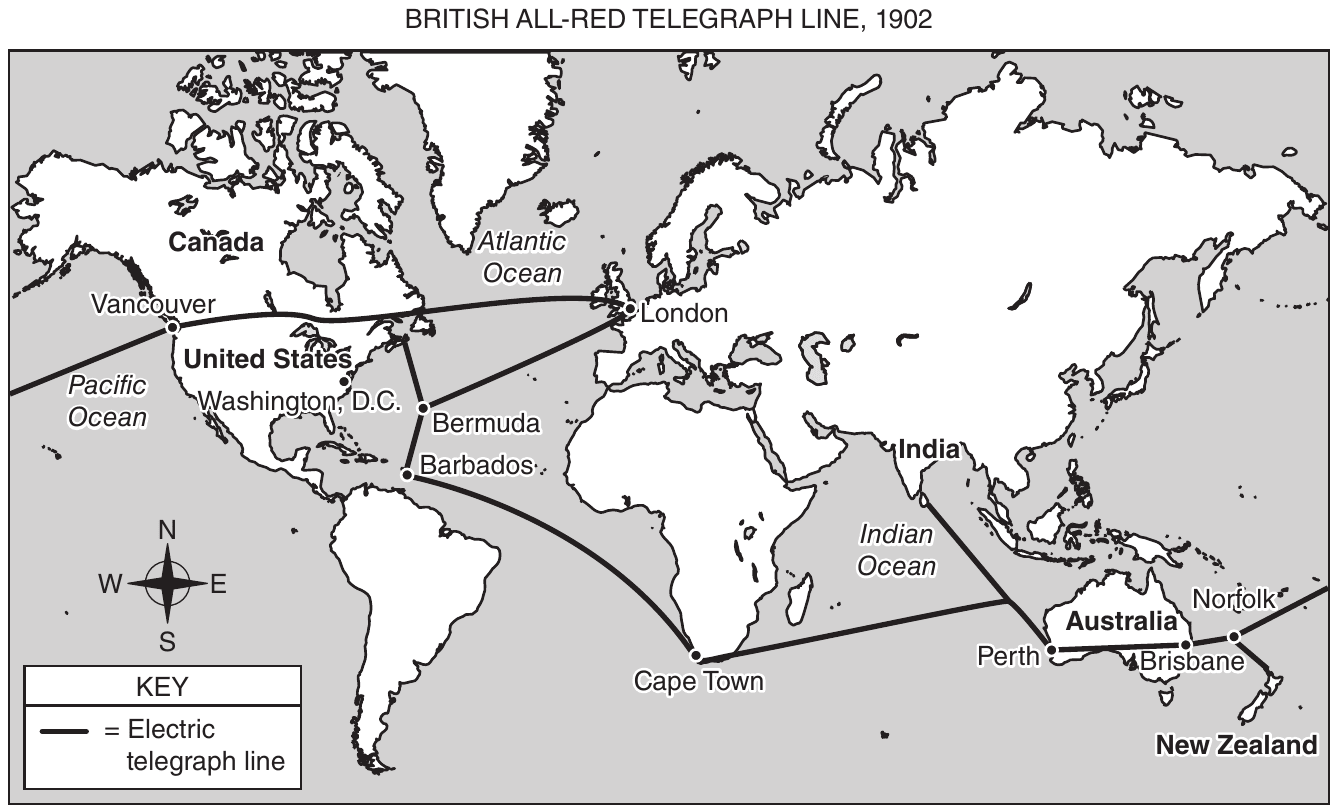
The first transatlantic electric telegraph message was sent in 1858, and by 1902 the British All-Red Line connected most of the world.
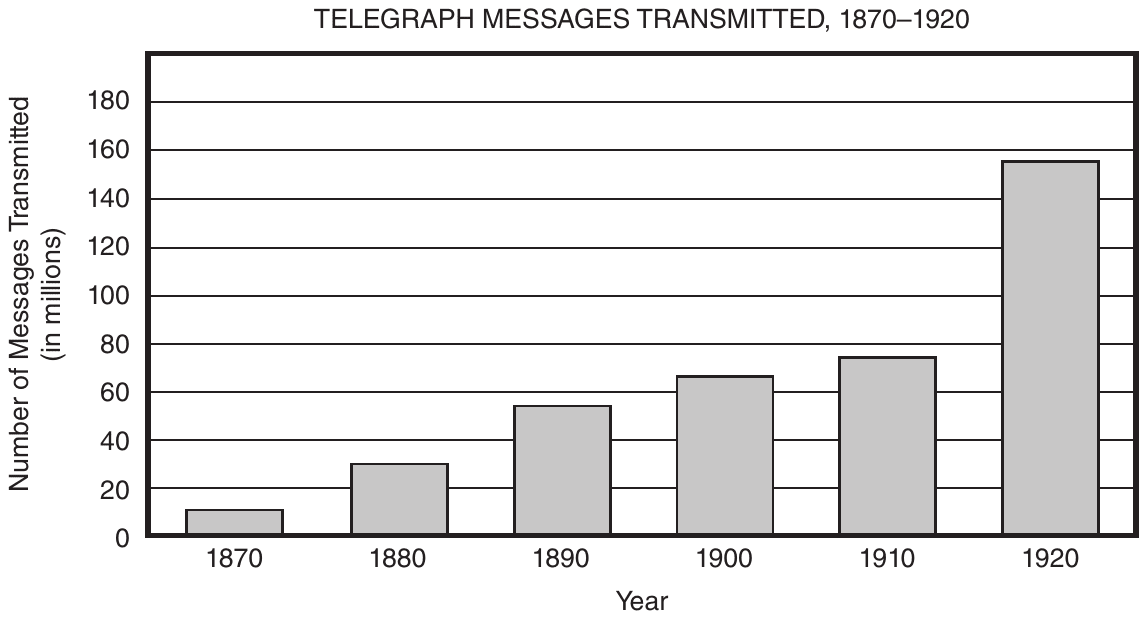
Source: U.S. Bureau of the Census. Historical Statistics of the United States, Colonial Times to 1970, Bicentennial Edition, Part 2. Washington, D.C., 1975.
Question
Read this sentence from paragraph 7.
The desperate Morse gave the go-ahead, and the line was completed in time for the dramatic and spectacularly successful link between the Supreme Court chamber of the Capitol building and the railroad station in Baltimore.
The words “dramatic” and “spectacularly” in the sentence convey a
- Asense of relief and fulfillment that the line was finished.
- Bsense of wonder and celebration that the telegraph line was accomplished.
- Cfeeling of excitement about the future possibilities of the telegraph.
- Dfeeling of confidence about being able to continue the work.
Show the answer
Correct answer: B
The question asks what the words “dramatic” and “spectacularly” convey in the sentence from paragraph 7.
A. Incorrect. While there may have been some feelings of relief and fulfillment when the lines were finished, the passage instead focuses on the wonder and joy that Morse and Cornell felt after overcoming setbacks and completing the construction of the telegraph system.
B. CORRECT. Morse and Cornell rushed to post the wires overhead, and the “rigid deadline” (paragraph 7) was successfully met. The words have a positive and victorious tone that is consistent with the feeling of wonder that it worked and of celebration that the construction was completed.
C. Incorrect. The passage does not share whether Morse or Cornell considered the future possibilities of the telegraph; it shares only that the finished product was “dramatic,” implying it was amazing to see.
D. Incorrect. While the passage later discusses the expansion of overhead wires “up and down the Atlantic coast” and how they “connected the continents of Europe and America” (paragraph 8), there is no evidence shared in the passage that Morse planned to continue his work with electricity.
Question analysis
Students judge the connotation of two words, “dramatic” and “spectacularly,” in the sentence from “Invention of the Telegraph” that describes the completion of Samuel Morse’s first telegraph link from Washington to Baltimore. Because the same sentence calls Morse “desperate” and says the line was finished just in time, several feelings seem to fit the moment, and the choices name four of them.
- Grade level
- Grade 7 reading and task
- Compared with grade 7
- At grade 7 Judging what two adjectives convey is standard grade 7 word-choice work, and the sentence is printed with the question. The challenge is that all four choices name believable feelings, so students must separate the words’ own connotations from the situation around them.
- Estimated difficulty
- Moderate: several steps, or a close reading with one strong distractor.
- Thinking it demands
- Depth of knowledge 2, skills and concepts · mainly understand
- What makes it hard
- A very close wrong answer moderate
- Reading between the lines moderate
- Every choice must be checked minor
- Evidence
- Answered from one sentence or line
- Reading level
- Passage: about grade 11, 910 words; question and choices: about grade 10, 91 words.
- Students, last 30 days
- Not enough answers yet to show (it takes 10).
Why it is hard, traps and wrong answers (shows the answer)
Why it is hard
The quoted sentence offers two tempting sources for the answer besides the two words the stem names: Morse is “desperate,” and the line is finished “in time.” Students who read the situation rather than the words choose relief, and those who think ahead to paragraph 8’s spreading wires choose excitement about the future. The question rewards asking what “dramatic” and “spectacularly” say about the link itself, an event that impressed and was celebrated.
A very close wrong answer moderate Choosing the answer
The relief choice is built like the key, a pair of feelings about the finished line; only the feelings differ, and “dramatic” and “spectacularly” point to wonder at a public success, not release from worry. (Embretson & Wetzel, 1987; Gorin & Embretson, 2006; Ascalon et al., 2007)
Reading between the lines moderate Working it out
Neither word names an emotion: “dramatic” and “spectacularly” describe the link itself, so the feeling they carry has to be inferred from their sense of an impressive public show. (Graesser, Singer & Trabasso, 1994; Kintsch, 1998)
Every choice must be checked minor Choosing the answer
All four choices name a positive feeling that suits a race against a “rigid deadline,” so tone alone rules none of them out. (Embretson & Wetzel, 1987)
Strategy: Before reading the choices, picture something you would call dramatic and spectacularly successful, and name the feeling those words give it; then find the choice closest to that feeling.
Traps
- Wrong tone or attitude: Misjudges the tone, attitude or point of view, such as reading admiration as criticism, or taking a character's or subject's feelings for the author's.
- Wrong part of the text: A choice is true of another paragraph, stanza or speaker than the one asked about.
The wrong answers, classified
A Wrong tone or attitude (Graesser, Singer & Trabasso, 1994)
Takes what Morse probably felt, relief after a “desperate” scramble to beat the deadline, for what the author’s two words convey, which is admiration for a striking success.
C Wrong part of the text (Kirsch & Mosenthal, 1990)
Brings in paragraph 8, where wires spread along the coast and across the ocean, but this sentence is about the first finished link and says nothing of what might follow.
D Reads too much in (Graesser, Singer & Trabasso, 1994)
Assumes success would leave Morse confident about pressing on, but the sentence never looks past the finished line, and the two words describe the event, not his plans.
Working it out, step by step
Figure out what the question asks
This question is about connotation, the feeling a word carries beyond its dictionary meaning. It names two words, “dramatic” and “spectacularly.” Your job is to name the feeling those two words give the sentence. Other words in the sentence should not decide your answer.
See what is happening in paragraph 7
Just before this sentence, Morse’s team lost time laying wire that turned out to be faulty. The job was also “on a rigid deadline” with no time to spare. Cornell had a quick fix: to “string wires overhead on trees and poles” instead. Morse agreed, and the line was done in time. The sentence describes the moment the first link worked, from the Capitol in Washington to the train station in Baltimore.
Work out what the two words suggest
A dramatic event grabs your attention, the way the high point of a movie does. Spectacularly comes from spectacle, a grand sight that makes people stop and stare. So the author is saying the link was more than finished. It was a thrilling public success. Words like these make a reader marvel at what was done and want to cheer.
Check each choice
- A does not fit. Morse was “desperate,” so he may have felt relief. But that feeling comes from the word “desperate,” not from the two words the question asks about.
- B fits. Wonder matches an amazing sight, and celebration matches a great success.
- C does not fit. This sentence is only about the finished link. Wires spreading to other places come later, in paragraph 8.
- D does not fit. The two words describe the event itself. They tell nothing about Morse’s plans for more work.
Choose the answer
The words “dramatic” and “spectacularly” make the first telegraph link sound like a thrilling show. So the answer is B, a “sense of wonder and celebration that the telegraph line was accomplished.”
Why this answer and not the closest wrong one
A is the closest trap, since it also names two good feelings about the finished line. But relief is the quiet feeling you get when worry ends. The words “dramatic” and “spectacularly” are loud and showy. They make the link sound like something to gasp at and cheer for, and that is wonder and celebration.
More questions like this
The original DOE question
The passage “Invention of the Telegraph” as printed (pages 146–148)
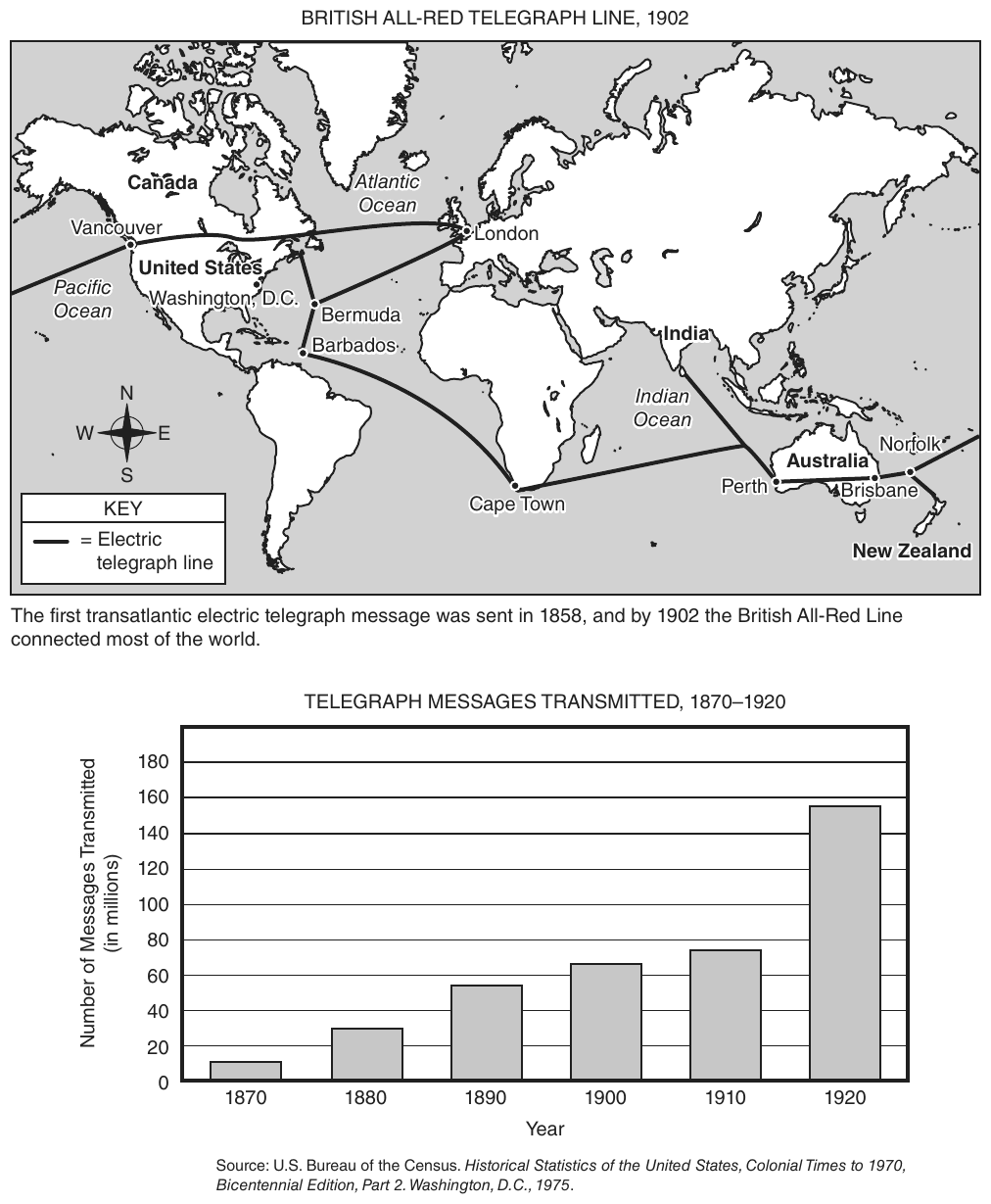
Question 92 of 120
2024 Test B English, question 40Uses the passage above: “Invention of the Telegraph”.
Question
How does the map provide additional support for a central idea of the passage?
- Aby demonstrating that Morse’s telegraph system greatly exceeded the limitations of previous long-distance communication systems
- Bby indicating that Morse was lacking foresight by seeking a patent only in North America
- Cby proving that Gale’s advice helped Morse extend the telegraph’s range much farther than first thought possible
- Dby showing that the Morse telegraph had a surprisingly immense influence across the world
Show the answer
Correct answer: A
The question asks how the map provides additional support for a central idea of the passage.
A. CORRECT. The map shows the telegraph line crossing continents in 1902, just forty-four years after the first transatlantic message was sent in 1858. This is a much greater distance than the first line Morse built between “the Supreme Court chamber of the Capitol building and the railroad station in Baltimore” (paragraph 7).
B. Incorrect. The map shows the distance the line covers; it does not indicate Morse’s lack of foresight in seeking patents only in North America.
C. Incorrect. While Gale’s advice was crucial to Morse’s success, the map shows the physical line stretching across continents many years later, after their initial work.
D. Incorrect. While it can be inferred that the telegraph had influence across the world, the amount of influence cannot be determined.
Question analysis
This question pairs “Invention of the Telegraph” with a map of the British All-Red Telegraph Line in 1902 and asks how the map adds support for a central idea of the passage. Students must read a world map with a key and a caption, connect what it shows to the story of Samuel Morse’s invention, and sort through four claims about the map that vary in how far they go.
- Grade level
- Grade 8 reading and task
- Compared with grade 7
- Above grade 7 Linking a graphic to a text is familiar grade 7 work. Here students must pin down a central idea of the passage and work out how a 1902 world map, made decades after Morse’s first line, bears on it, a step beyond typical demand.
- Estimated difficulty
- Hard: combines ideas, needs a plan, and has more than one tempting wrong answer.
- Thinking it demands
- Depth of knowledge 3, strategic thinking · mainly analyze
- What makes it hard
- A very close wrong answer major
- Evidence in several places moderate
- Reading a figure, table or graph moderate
- Evidence
- Answered from the whole text
- Reading level
- Passage: about grade 11, 910 words; question and choices: about grade 11, 75 words.
- Corrected from the DOE handbook
- An inaccurate detail in the explanation was corrected.
- Students, last 30 days
- Not enough answers yet to show (it takes 10).
Why it is hard, traps and wrong answers (shows the answer)
Why it is hard
Lines on a map can prove how far the telegraph reached, and the question turns on how much more than that each choice claims. The key depends on a link back to paragraph 1, where a message went only as far as the next hilltop tower, read many minutes before the map. The influence choice skips that link and states the map’s message in bigger terms, so students who do not ask what a map of routes can show are drawn to it.
A very close wrong answer major Choosing the answer
The influence choice, a telegraph with “a surprisingly immense influence across the world,” sounds like a fair reading of lines circling the globe; it differs from the key in claiming impact and surprise rather than reach beyond earlier systems. (Embretson & Wetzel, 1987; Gorin & Embretson, 2006; Ascalon et al., 2007)
Evidence in several places moderate Working it out
The earlier systems the key measures against are in paragraph 1, towers on distant hills passing flag and light signals from station to station, far from the map at the end of the passage. (Kirsch & Mosenthal, 1990; Gorin & Embretson, 2006)
Reading a figure, table or graph moderate Understanding the question
The map shows a 1902 British line from London to Canada and Vancouver, south through Bermuda and Barbados to Cape Town, and on to India, Australia and New Zealand, with Washington left unconnected. (Lesh, Post & Behr, 1987; Kirsch & Mosenthal, 1990)
Strategy: Look at what the map and its caption actually show, sum up a central idea of the passage in your own words, and keep only a choice that both of them back up.
Traps
- Too broad or too strong: A choice overstates, generalizes, or uses absolute words the text does not support.
- Reads too much in: A reasonable-sounding conclusion that goes further than the text allows.
The wrong answers, classified
B Twists what the text says (King et al., 2004)
Reads the unconnected Washington dot as a patenting mistake of Morse’s, though a map of lines shows nothing about patents and paragraph 5 has him seeking protection overseas.
C Reads too much in (Graesser, Singer & Trabasso, 1994)
Remembers that Gale’s relay advice solved Morse’s “distance problems,” but a 1902 map that names no inventors cannot prove what that advice made possible decades earlier.
D Too broad or too strong (King et al., 2004)
Turns the map’s reach into a claim about impact, though routes on a map show where messages could travel, not how much the world changed or that anyone was surprised.
What was corrected from the DOE handbook, and why
- Explanation: The handbook says the 1902 line came “forty-four years after the first message was sent in 1858.” The first telegraph message was Morse’s in 1844 (paragraph 1); 1858 is the year of the first transatlantic message, as the map’s caption says. The site now says “the first transatlantic message.”
Working it out, step by step
Figure out what the question asks
This question asks how a graphic adds to the passage. You need two things. First, what does the map really show? Second, which central idea, a main point the whole passage builds, does it back up?
Read the map and its caption
This map is a picture of one British network of telegraph wires, as it stood in 1902. In its key, a thick black line stands for an electric telegraph line. From London, a line crosses the Atlantic Ocean and Canada to Vancouver. Other lines reach Bermuda, Barbados, Cape Town, India, Australia and New Zealand. According to the caption, by 1902 this network “connected most of the world.”
Recall the older ways of signaling
Next, compare that with paragraph 1. Before electricity, people signaled with flags or lights. An observer would “decipher a signal from a high tower on a distant hill and then send it on to the next station.” So a message could only jump as far as a person could see. Even Morse’s first line, in paragraph 6, reached Baltimore, just “forty miles away.”
Connect the map to that idea
The caption says the first message across the Atlantic was sent in 1858. Only 44 years later, in 1902, lines crossed several oceans and linked much of the globe. Paragraph 8 adds that telegraph lines “connected the continents of Europe and America” before Morse died. So the map supports a central idea: electric telegraph lines went far beyond the reach of older signal systems.
Check each choice
- A fits. Lines that span oceans go far past the limits of hilltop towers.
- B does not fit. A map of lines shows nothing about patents. Also, paragraph 5 says Morse sought patent protection in Europe, too.
- C does not fit. The map names no inventors, so it cannot prove what Gale’s advice did decades before.
- D does not fit. The map shows where lines went, not how much they changed the world, and nothing on it shows surprise.
Choose the answer
The map shows telegraph lines reaching around the globe, far past what flags and towers could do. So the answer is A.
Why this answer and not the closest wrong one
D is the closest trap, because lines around the world seem to prove a huge effect. But a map of routes shows only how far messages could travel. It cannot measure influence, and it cannot show that anyone was surprised. A sticks to what a map of lines can prove: the telegraph reached much farther than earlier systems.
More questions like this
The original DOE question
Question 93 of 120
2024 Test B English, question 44Passage Snowy Mountains
Snowy Mountains
by John Gould Fletcher
Higher and still more high,
Palaces made for cloud,
Above the dingy city-roofs
Blue-white like angels with broad wings,
Pillars of the sky at rest
The mountains from the great plateau
Uprise.
But the world heeds them not;
They have been here now for too long a time.
The world makes war on them,
Tunnels their granite cliffs,
Splits down their shining sides,
Plasters their cliffs with soap-advertisements,
Destroys the lonely fragments of their peace.
Vaster and still more vast,
Peak after peak, pile after pile,
Wilderness still untamed,
To which the future is as was the past,
Barrier spread by Gods,
Sunning their shining foreheads,
Barrier broken down by those who do not need
The joy of time-resisting storm-worn stone,
The mountains swing along
The south horizon of the sky;
Welcoming with wide floors of blue-green ice
The mists that dance and drive before the sun.
“Snowy Mountains” by John Gould Fletcher—Public Domain
Question
Which line from the poem best supports the idea that people have sacrificed priceless natural beauty in order to make a profit?
- A“Above the dingy city-roofs” (line 3)
- B“The world makes war on them,” (line 10)
- C“Tunnels their granite cliffs,” (line 11)
- D“Plasters their cliffs with soap-advertisements,” (line 13)
Show the answer
Correct answer: D
The question asks for the line from the poem that best supports the idea that people have sacrificed natural beauty for profit.
A. Incorrect. While city roofs may spoil the natural beauty, they do not directly symbolize financial gain or profit in line 3.
B. Incorrect. Although making a profit might have been the root cause of the damage that was done to the mountains, making war on the mountains is not a direct message about profit or financial gain in line 10.
C. Incorrect. Although tunneling through the mountains affects the natural beauty of the mountains, it does not directly symbolize financial gain or profit in line 11.
D. CORRECT. Advertisements are often used as a means to gain a profit, as implied by the soap advertisements in line 13. Additionally, the word “Plasters,” in line 13, communicates a negative connotation for the use of advertisements on the priceless natural beauty of the mountains.
Question analysis
In this textual evidence question on John Gould Fletcher’s poem “Snowy Mountains,” students pick the line that best backs the claim that people traded priceless natural beauty for profit. Most of the quoted lines show damage of some kind, so the deciding question is which one also shows why the damage was done.
- NYS standards
- 7R1 textual evidence and inferences
- Grade level
- Grade 7 reading and task
- Compared with grade 7
- At grade 7 Matching a claim to a quoted line is standard grade 7 evidence work, and these four lines are short and numbered. The images are concrete, so little inference is needed once the claim is read carefully.
- Estimated difficulty
- Straightforward: two steps or one careful reading.
- Thinking it demands
- Depth of knowledge 2, skills and concepts · mainly evaluate
- What makes it hard
- Every choice must be checked moderate
- Reading between the lines minor
- Evidence
- Answered from one sentence or line
- Reading level
- Passage: 161 words (a poem; reading level not measured); question and choices: about grade 6, 45 words.
- Students, last 30 days
- Not enough answers yet to show (it takes 10).
Why it is hard, traps and wrong answers (shows the answer)
Why it is hard
Three of the four quoted lines show damage to the mountains, which meets the first half of the claim and makes the question a test of the second half. Students who look only for harm tend to settle on the loudest image of attack, “makes war on them.” The one line that contains a product for sale is the only one showing beauty traded for money, and once that is seen the choice is quick.
Every choice must be checked moderate Choosing the answer
Lines 10, 11 and 13 all show people harming the mountains, so each must be held against the claim’s second half, making a profit, which only one of them carries. (Embretson & Wetzel, 1987)
Reading between the lines minor Working it out
No line names money; profit has to be read from “soap-advertisements,” which exist to sell a product, while “Plasters” supplies the spoiling of the cliffs’ beauty. (Graesser, Singer & Trabasso, 1994; Kintsch, 1998)
Strategy: Underline the two things the claim needs, harm to the mountains’ beauty and a money motive, then read each quoted line and cross out any that shows only one of them.
Traps
- Supports only part of the claim: In a question about evidence: a line that backs one half of the claim but not the other, or a related point rather than the claim itself.
- Outside knowledge: A choice is plausible in the real world but not supported by this text.
The wrong answers, classified
A Reads too much in (Graesser, Singer & Trabasso, 1994)
Connects “dingy city-roofs” with industry and money-making, but line 3 only places the city below the peaks and shows neither profit nor harm done to them.
B Supports only part of the claim (King et al., 2004; Thissen, Steinberg & Fitzpatrick, 1989)
Chooses the stanza’s fiercest line, but “makes war on them” shows attack in general with no motive, so it backs the lost beauty without the profit.
C Outside knowledge (King et al., 2004; Recht & Leslie, 1988)
Brings in a real-world reason, tunnels dug for railways or mines that earn money, though line 11 itself shows only the cliffs being cut, with no sign of gain.
Working it out, step by step
Figure out what the question asks
This asks for evidence: the line that best supports an idea. Notice that the idea makes two claims. People have spoiled the mountains’ beauty, and they did it to make money, or a profit. The best line must show both parts, not just one.
Read the four lines in the poem
Choice A, “Above the dingy city-roofs,” comes from the first stanza, where the poem praises the peaks. Dingy means grimy and gloomy. The other three choices come from the second stanza, where people attack the mountains. In order, they are “The world makes war on them” (line 10), “Tunnels their granite cliffs” (line 11) and “Plasters their cliffs with soap-advertisements” (line 13).
Test each line for harm and money
An advertisement is a sign that tries to get you to buy something. Soap ads are there to sell soap, so they are about profit. To plaster something is to cover it thickly and messily, like paste on a wall. Picture the bright cliffs smeared with ugly signs, all to sell a product.
Line Harms the mountains? Shows money? 3 No No 10 Yes No 11 Yes No 13 Yes Yes Check each choice
- A does not fit. Line 3 only places the dirty city below the peaks. It shows no harm to the mountains and no money.
- B does not fit. The words “makes war” show an attack, but not the reason for it.
- C does not fit. Tunnels do damage the cliffs. You may know that tunnels are dug for trains or mines, but the line itself never mentions money.
- D fits. It shows the beauty spoiled and a product being sold.
Choose the answer
Only line 13 shows both the harm and the money behind it. So the answer is D, line 13.
Why this answer and not the closest wrong one
B is the strongest trap, because “makes war” is the fiercest image of harm in the poem. But the idea also needs a reason: making a profit. War on the mountains could happen for any reason. Only the soap ads show something being sold, so only D backs up both parts of the idea.
More questions like this
The original DOE question
The passage “Snowy Mountains” as printed (page 142)
Question 94 of 120
2024 Test B English, question 49Uses the passage above: “Snowy Mountains”.
Question
Read lines 23–26 from the poem.
The mountains swing along
The south horizon of the sky;
Welcoming with wide floors of blue-green ice
The mists that dance and drive before the sun.
The personification in these concluding lines of the poem suggests that the mountains are
- Agracious hosts who are untroubled by the actions of people.
- Bunaware of their coming destruction.
- Clively entertainers who are amused by the everyday concerns of people.
- Dtoo proud to reveal their pain.
Show the answer
Correct answer: A
The question asks what the personification in the concluding lines of the poem suggests about the mountains.
A. CORRECT. Line 25’s use of the word “Welcoming” suggests that the mountains are kind hosts. Lines 23 and 26, with language such as “The mountains swing along” and “The mists that dance and drive before the sun,” imply the carefree nature of the mountains as they resist the destructive work of humanity.
B. Incorrect. The personification in the lines conveys a sense of optimism and endurance, with no language to suggest coming destruction.
C. Incorrect. Although the lines mention that “the mountains swing along” (line 23) and “the mists . . . dance” (line 26), the personification is used to describe the mountains’ perseverance, rather than to suggest that the mountains are amused by the concerns of others.
D. Incorrect. Although the second stanza develops the idea that the mountains have been mistreated by humans, which might be a source of pain, the concluding lines emphasize the joy and perseverance of the mountains as they “swing along” (line 23) despite significant adversity.
Question analysis
Students interpret the personification in the closing lines of “Snowy Mountains,” lines 23–26, and decide what it suggests about the mountains on the south horizon. They need to see which human actions the poet gives the mountains and what kind of character those actions create, and then choose among four quite different personalities.
- Grade level
- Grade 7 reading and task
- Compared with grade 7
- At grade 7 Grade 7 readers routinely interpret personification, and here the four lines are printed with the question. The images are concrete and the choices give the mountains clearly different roles and moods, so careful matching settles it.
- Estimated difficulty
- Straightforward: two steps or one careful reading.
- Thinking it demands
- Depth of knowledge 2, skills and concepts · mainly understand
- What makes it hard
- Figurative or literary language moderate
- Complex sentences minor
- Evidence
- Answered from one sentence or line
- Reading level
- Passage: 161 words (a poem; reading level not measured); question and choices: about grade 6, 77 words.
- Students, last 30 days
- Not enough answers yet to show (it takes 10).
Why it is hard, traps and wrong answers (shows the answer)
Why it is hard
The closing lines are calm and generous, and the task is to turn their personification into a character. Students who give the mists’ dancing to the mountains see performers, but the performer choice also has the mountains amused by people’s concerns, which nothing here supports, so a careful reader rejects it. The remaining losses come from carrying the second stanza’s damage into lines that show only ease and welcome.
Figurative or literary language moderate Understanding the question
The human traits must be sorted by who has them: the mountains “swing along” and are “Welcoming,” while the mists are the ones that “dance and drive before the sun.” (Graesser, Singer & Trabasso, 1994; Kintsch, 1998)
Complex sentences minor Understanding the question
In “Welcoming with wide floors of blue-green ice / The mists,” the object of “Welcoming” comes after a long phrase and a line break, so who welcomes whom is easy to lose. (Abedi & Lord, 2001; Freedle & Kostin, 1993; Messick, 1989)
Strategy: Underline each verb or describing word in lines 23–26 that gives the mountains a human trait, then check every choice against all of them.
Traps
- Twists what the text says: Uses the text's topic and ideas but changes what it says: who did it, how much, when, or why.
- Reads too much in: A reasonable-sounding conclusion that goes further than the text allows.
The wrong answers, classified
B Reads too much in (Graesser, Singer & Trabasso, 1994)
Takes the mountains’ carefree swinging as ignorance and adds the earlier stanzas’ damage to it, but these four lines are serene and hint at no destruction to come.
C Twists what the text says (King et al., 2004)
Gives the mists’ dancing to the mountains and so makes them performers, then adds amusement at people’s concerns, though here the mountains only swing along and welcome the mists.
D Wrong tone or attitude (Graesser, Singer & Trabasso, 1994)
Imagines a brave face hiding the wounds of the second stanza, but the lines show the mountains at ease and welcoming, with no sign of pride or pain.
Working it out, step by step
Figure out what the question asks
This asks about personification. That is when a writer describes a thing as if it were a person, with human actions or moods. You need to decide what kind of character the mountains seem to be in lines 23 to 26.
Find who does each action
The four lines are one sentence. In line 23, “The mountains swing along” the edge of the sky. Line 25 shows them “Welcoming with wide floors of blue-green ice.” The guests arrive in line 26: “The mists that dance and drive before the sun.” The mountains do two things here, swing along and welcome. The dancing belongs to the mists.
Decide what the actions suggest
Welcoming guests is what a host does. A host invites others in and makes them comfortable. Gracious means warm and polite. To swing along is to move in a relaxed, easy way. The second stanza was full of harm, yet here the mountains seem calm. They are untroubled, or not worried or upset.
Check each choice
- A fits. The mountains welcome the mists like gracious hosts, and they move at ease.
- B does not fit. Nothing in these lines hints at harm to come. The mood is calm and bright.
- C does not fit. Line 26 gives the dancing to the mists. And nothing shows the mountains laughing at people’s daily worries.
- D does not fit. There is no sign of pride or hidden pain. The mountains seem relaxed and open.
Choose the answer
Like kind hosts, the mountains greet their guests and stay calm. So the answer is A.
Why this answer and not the closest wrong one
C may tempt you, because swinging and dancing both sound lively. But check who dances: line 26 gives the dancing to the mists. The mountains are the ones “Welcoming” them, so they are hosts, not entertainers. C also says the mountains are amused by people, and these lines never show that.
More questions like this
The original DOE question
Question 95 of 120
2024 Test B English, question 52Passage Excerpt from “The Past and the Future of the Earth’s Oldest Trees”
Excerpt from “The Past and the Future of the Earth’s Oldest Trees”
by Alex Ross
About forty-five hundred years ago, not long after the completion of the Great Pyramid at Giza, a seed of Pinus longaeva, the Great Basin bristlecone pine, landed on a steep slope in what are now known as the White Mountains, in eastern California. The seed may have travelled there on a gust of wind, its flight aided by a winglike attachment to the nut. Or it could have been planted by a bird known as the Clark’s nutcracker, which likes to hide pine seeds in caches; nutcrackers have phenomenal spatial1 memory and can recall thousands of such caches. This seed, however, lay undisturbed. On a moist day in fall, or in the wake of melting snows in spring, a seedling appeared above ground—a stubby one-inch stem with a tuft of bright-green shoots.
Most seedlings die within a year; the mortality rate is more than ninety-nine percent. The survivors are sometimes seen growing in the shadow of a fallen tree. The landscape of the Ancient Bristlecone Pine Forest, as this area of the White Mountains is called, is littered with fragments of dead trees—trunks, limbs, roots, and smaller chunks. Pinus longaeva grows exclusively in subalpine regions of the Great Basin, which stretches from the eastern slopes of the Sierra Nevada to the Wasatch Range, in Utah. Conditions are generally too arid for the dead wood to rot; instead, it erodes, sanded down like rock. The remnants may harbor nutrients and fungi that help new trees grow. Bristlecones rise from the bones of their ancestors—a city within a cemetery.
Coast redwoods and giant sequoias, California’s gargantuan world-record-holding trees, can grow fifty feet or more in their first twenty years. Bristlecones rise agonizingly slowly. After four or five years, the seedling on the steep slope would have been just a few inches higher, sprouting needles in place of the embryonic shoots. The needles are a deep green, tough, resinous, and closely bunched in groups of five. On a mature tree, they live for fifty years or more. Decades may have passed before the tree was human height, and decades more before it resembled a conventional pine. Bristlecone saplings grow straight up, with relatively sparse foliage, looking like undernourished Christmas trees. After a few hundred years—by which time the Old Kingdom of Egypt had fallen—it was probably forty or fifty feet in height.
Many tree species live for hundreds of years. A smaller but not inconsiderable number, including the sequoias and certain yews, oaks, cypresses, and junipers, survive for thousands. Once a bristlecone has established itself in the unforgiving conditions of the White Mountains, it can last almost indefinitely. The trees tend to grow some distance from one another, so fires almost never destroy an entire stand. Because only a few other plant species can handle the dry, cold climate, the bristlecones face little competition. Unlike most plants, they tolerate dolomite soil, which is composed of a chalky type of limestone that is heavily alkaline and low in nutrients. As for insect threats, bristlecone wood is so dense that mountain-pine beetles and other pests can rarely burrow their way into it.
Empires rose and fell; wars raged; . . . and the tree from 2500 B.C. continued its implacable slow-motion existence, adding about two-hundredths of an inch to the diameter of its trunk each year. Minute changes in the tree-ring record make bristlecones an exceptionally useful source of data about changing conditions on Earth. When rains are heavier than normal, the rings widen. When volcanic eruptions cause global cooling, frost rings make the anomaly2 visible. . . .
As the millennia go by, bristlecones become contorted and wraithlike.3 The main stem, or leader, dies back. Entire branches, even the trunk itself, become fossils. At first glance, the tree may look dead. Such is the case of the forty-five-hundred-year-old tree that clings to life near the tourist path that now runs through the Ancient Bristlecone Pine Forest. Spears of dead wood jut into the air. The trunk is a marbled hulk stripped of bark, like driftwood thrown from a vanished ocean. A ribbon of live bark runs up one side, funneling water and nutrients to clumps of green needles high above. All told, the tree is an unprepossessing specimen; most people march past it without giving it a second glance. . . .
. . . No two super-elderly trees look alike, to the point where they have acquired the characteristics of individuals. Trees are prone to anthropomorphism; we project our dreams and our anxieties onto them. Bristlecones have been called elders, sentinels, sages. The possibility that climate change will cause their extinction has inspired a spate4 of alarmed news stories, although tree scientists tend to discount the idea that the bristlecones are in immediate danger. They have survived any number of catastrophes in the past; they may survive humanity.
From “The Past and the Future of the Earth’s Oldest Trees” by Alex Ross from THE NEW YORKER, January 20, 2020. Copyright © 2020 by Condé Nast. All rights reserved.
1spatial: relating to physical space
2anomaly: oddity
3wraithlike: ghostly
4spate: sudden abundance
Question
Read this sentence from paragraph 5.
Empires rose and fell; wars raged; . . . and the tree from 2500 B.C. continued its implacable slow-motion existence, adding about two-hundredths of an inch to the diameter of its trunk each year.
The sentence contributes to the development of ideas in the excerpt by
- Aemphasizing the bristlecone pine’s precise growth pattern.
- Bsuggesting that things that seem well established face threats.
- Cdescribing the pace of the life cycle of the bristlecone pine.
- Dexplaining the reason for the bristlecone pine’s longevity.
Show the answer
Correct answer: C
The question asks how the first sentence of paragraph 5 contributes to the development of ideas in the excerpt.
A. Incorrect. While “two-hundredths of an inch” is a reference to the bristlecone pine’s growth pattern, the point of the reference—and of the entire sentence—is to emphasize the incredibly slow pace of the pine’s life cycle.
B. Incorrect. While “wars raged” is a threat that empires face, the point of mentioning wars and the rise and fall of empires is to emphasize the bristlecone pine’s slow-paced life cycle by contrasting its slowness with the big, dramatic changes taking place in human history during that life cycle.
C. CORRECT. Making reference to huge changes in human history such as the rise and fall of empires and the raging of wars provides a sharp contrast to the incredibly slow growth of the bristlecone pine.
D. Incorrect. This sentence describes how slowly the bristlecone pine grows in contrast to how dramatically human history changes in the same time span but never explains the reasons for the pine’s longevity.
Question analysis
This text structure question quotes a sentence from paragraph 5 of Alex Ross’s excerpt on bristlecone pines, the one that begins “Empires rose and fell; wars raged.” Students must explain how the sentence contributes to the development of ideas, and the choices offer four plausible readings of its purpose.
- Grade level
- Grade 8 reading and task
- Compared with grade 7
- At grade 7 Grade 7 students regularly explain how a sentence develops an idea. This sentence adds demanding vocabulary such as “implacable” and mixes human history with a botanical detail, but it is printed with the question, so the overall demand stays typical.
- Estimated difficulty
- Moderate: several steps, or a close reading with one strong distractor.
- Thinking it demands
- Depth of knowledge 2, skills and concepts · mainly analyze
- What makes it hard
- How, not what moderate
- Hard words minor
- Evidence
- Answered from one sentence or line
- Reading level
- Passage: about grade 8, 851 words; question and choices: about grade 7, 83 words.
- Students, last 30 days
- Not enough answers yet to show (it takes 10).
Why it is hard, traps and wrong answers (shows the answer)
Why it is hard
The sentence sets the rise and fall of empires beside a tree that adds a sliver of trunk each year, and its job is the contrast between those two speeds. Students who stop at the opening clauses read a warning about threats, and those who know the excerpt is about age expect the sentence to explain that age. Holding the whole sentence together shows that it describes how slowly the tree lives.
How, not what moderate Working it out
Students must work out why an article about a tree mentions empires and wars: the human upheavals are a fast-moving backdrop that makes the tree’s “slow-motion existence” look slower still. (Anderson & Krathwohl, 2001)
Hard words minor Understanding the question
“Implacable,” meaning relentless and unstoppable, describes the tree’s steady life, and students who do not know it lose part of the contrast the sentence builds. (Perfetti, 2007; Freedle & Kostin, 1993)
Strategy: Ask why an article about a tree mentions empires and wars at all, and what the sentence’s last clause adds; then pick the purpose the whole sentence serves.
Traps
- Reads too much in: A reasonable-sounding conclusion that goes further than the text allows.
- Wrong purpose or structure: Names a purpose, structure or effect that the part does not serve, or describes what a part says when the question asks what it does.
- Twists what the text says: Uses the text's topic and ideas but changes what it says: who did it, how much, when, or why.
The wrong answers, classified
A Twists what the text says (King et al., 2004)
Takes the figure “about two-hundredths of an inch” as a sign of precision, though “about” makes it approximate and the number is there to show how little the trunk grows.
B Wrong purpose or structure (Anderson & Krathwohl, 2001)
Treats the falling empires and raging wars as the sentence’s point, a warning that established things are threatened, when they serve as a backdrop of rapid change.
D Reads too much in (Graesser, Singer & Trabasso, 1994)
Joins the tree’s slow growth to its great age and concludes that the sentence explains its longevity, but it only shows the tree outlasting history; paragraph 4 gives the reasons.
Working it out, step by step
Figure out what the question asks
This asks about the job of one sentence, the first one in paragraph 5. You need to decide what it adds to the excerpt’s ideas. Look at both halves of the sentence, the part about people and the part about the tree.
Look at both halves of the sentence
The first half is about human history: “Empires rose and fell; wars raged.” These are huge, fast changes. The second half is about the tree. It “continued its implacable slow-motion existence.” It added “about two-hundredths of an inch to the diameter of its trunk each year.”
Work out what the sentence shows
Implacable means steady and impossible to stop. Slow-motion means extremely slow. Diameter is the distance straight across the trunk. Two-hundredths of an inch is a tiny amount. While whole empires came and went, the tree barely grew. This contrast, a side-by-side difference, makes the tree’s pace of life seem even slower.
Check each choice
- A does not fit. The amount is “about” two-hundredths of an inch, so it is not exact. The number is there to show how little the tree grows.
- B does not fit. Empires and wars are a background of fast change, not a warning about threats.
- C fits. The sentence shows how slowly the tree lives and grows.
- D does not fit. The sentence shows the tree outlasting history but never says why it lives so long. Paragraph 4 gives those reasons.
Choose the answer
The sentence sets fast human history beside the tree’s tiny yearly growth. So the answer is C.
Why this answer and not the closest wrong one
D is tempting, because the sentence does show a very old tree. But showing that something lasts is not the same as explaining why. The sentence gives no cause. It only sets fast human change beside slow growth, and that describes the pace of the tree’s life, as C says.
More questions like this
The original DOE question
The passage “Excerpt from “The Past and the Future of the Earth’s Oldest Trees”” as printed (pages 193–194)
Question 96 of 120
2024 Test B English, question 53Uses the passage above: “Excerpt from “The Past and the Future of the Earth’s Oldest Trees””.
Question
Which claim is best supported by the details in paragraph 5 about the bristlecone pine’s tree-ring record?
- AThe bristlecone pine must be protected from extinction so that there is a record of changing Earth conditions.
- BThe structure of the bristlecone pine allows scientists to predict changing Earth conditions over time.
- CThe slow growth process of the bristlecone pine allows it to survive in spite of changing Earth conditions.
- DThe bristlecone pine can be used to gather information on changing Earth conditions because of its long life.
Show the answer
Correct answer: D
The question asks which claim is best supported by the details about the bristlecone pine tree’s ring record presented in paragraph 5.
A. Incorrect. In paragraph 5, the author explains that the bristlecone pine is “an exceptionally useful source of data about changing conditions on Earth,” and this suggests that the information presented by the trees is particularly valuable and important. However, while the paragraph explains that the data provided by the trees are important, it does not address the need to protect the trees from any threat of extinction. The only reference to the trees’ extinction is in paragraph 7, when the author addresses the “possibility that climate change will cause their extinction” but then explains that “scientists tend to discount the idea that the bristlecones are in immediate danger.”
B. Incorrect. Paragraph 5 describes “minute changes in the tree-ring record” that make bristlecone pines “an exceptionally useful source of data about changing conditions on Earth,” and examples of those changing conditions are described in the present tense: “When rains are heavier than normal, the rings widen.” However, the term “record” indicates that the tree rings are already formed by the time scientists study them. The trees provide information about the past, which is emphasized by the description at the beginning of paragraph 5 of historic events one tree lived through. The excerpt contains no information about whether scientists can use the climate patterns of the past as evidenced by tree rings to make predictions about the future.
C. Incorrect. Paragraph 5 describes the “slow-motion existence” of the bristlecone pine and provides examples of the record of “changing conditions on Earth” reflected in the rings of the trees. However, although the paragraph makes it clear that the trees have been able to survive these changing conditions, the paragraph does not indicate that the slow growth of the trees, each of which adds only “about two-hundredths of an inch to the diameter of its trunk each year,” is the key to their survival. Instead, paragraph 4 lists other reasons why an established bristlecone pine “can last almost indefinitely,” including distance between individual trees; tolerance for cold, dry conditions and dolomite soil; and wood that is resistant to insects.
D. CORRECT. Paragraph 5 emphasizes the longevity of the bristlecone pine by discussing its “implacable slow-motion existence” and how this makes the trees a valuable source of information for scientists. The author explains that “minute changes in the tree-ring record make bristlecones an exceptionally useful source of data about changing conditions on Earth.” A tree that has been alive since 2500 B.C., like the one in paragraph 5, can provide a long record of the changing climate.
Question analysis
Students decide which claim is best supported by the details about tree rings in paragraph 5 of an article on the ancient bristlecone pines of California’s White Mountains. Every choice links the trees to changing conditions on Earth, so the challenge is noticing which claim stays within what the paragraph actually says.
- Grade level
- Grade 7 reading and task
- Compared with grade 7
- At grade 7 Choosing the claim a paragraph supports is core grade 7 inference work, and paragraph 5 is only four sentences long. The demand is typical: one careful reading of those sentences, plus attention to the exact wording of each claim.
- Estimated difficulty
- Moderate: several steps, or a close reading with one strong distractor.
- Thinking it demands
- Depth of knowledge 2, skills and concepts · mainly understand
- What makes it hard
- A very close wrong answer moderate
- Reading between the lines moderate
- Every choice must be checked minor
- Evidence
- Answered from one paragraph or stanza
- Reading level
- Passage: about grade 8, 851 words; question and choices: about grade 9, 85 words.
- Corrected from the DOE handbook
- An inaccurate detail in the explanation was corrected.
- Students, last 30 days
- Not enough answers yet to show (it takes 10).
Why it is hard, traps and wrong answers (shows the answer)
Why it is hard
All four claims tie the bristlecone to changing conditions on Earth, so the paragraph’s topic cannot separate them; only what the paragraph supports can. Two claims go a step past it, one turning a record of the past into a tool for prediction and the other making slow growth the cause of survival. The right claim also goes slightly beyond the words, but only by linking the ring record to the tree’s forty-five centuries.
A very close wrong answer moderate Choosing the answer
The predicting choice shares the key’s frame, the tree giving scientists knowledge of “changing conditions on Earth”; they part on direction, since a ring “record” shows past conditions and forecasts nothing. (Embretson & Wetzel, 1987; Gorin & Embretson, 2006; Ascalon et al., 2007)
Reading between the lines moderate Working it out
Paragraph 5 credits the rings’ “minute changes,” not the tree’s age, so the key’s “because of its long life” has to be inferred from a tree that has been growing since 2500 B.C. (Graesser, Singer & Trabasso, 1994; Kintsch, 1998)
Every choice must be checked minor Choosing the answer
Every claim mentions changing conditions on Earth, so none can be dropped as off topic; each must be tested against what the four sentences of paragraph 5 actually say. (Embretson & Wetzel, 1987)
Strategy: Restate in your own words what paragraph 5 says the tree rings record, then ask of each claim whether those four sentences alone would let you say it.
Traps
- Twists what the text says: Uses the text's topic and ideas but changes what it says: who did it, how much, when, or why.
- Reads too much in: A reasonable-sounding conclusion that goes further than the text allows.
- Outside knowledge: A choice is plausible in the real world but not supported by this text.
The wrong answers, classified
A Outside knowledge (King et al., 2004; Recht & Leslie, 1988)
Turns the value of the ring data into a familiar conservation argument, but paragraph 5 calls for no protection, and paragraph 7 says scientists doubt the trees are in immediate danger.
B Twists what the text says (King et al., 2004)
Reads the present-tense examples, rings that widen when rains are heavy, as a way to forecast, but a tree-ring record shows conditions already past and predicts nothing.
C Reads too much in (Graesser, Singer & Trabasso, 1994)
Links the “slow-motion existence” to the tree’s survival as cause and effect, a connection paragraph 5 never makes, and leaves out the tree-ring record the question asks about.
What was corrected from the DOE handbook, and why
- Explanation: In explaining why Option C is wrong, the handbook says paragraph 4 lists “bark that is resistant to insects.” Paragraph 4 says that bristlecone wood “is so dense that mountain-pine beetles and other pests can rarely burrow their way into it”; it says nothing about the bark. The site now says “wood that is resistant to insects.”
Working it out, step by step
Figure out what the question asks
This asks which claim is best supported by paragraph 5’s details about tree rings. A tree ring is the layer of wood a tree adds each year. You need the claim those details really back up, without adding ideas the paragraph never gives.
Find the tree-ring details
Paragraph 5 says, “Minute changes in the tree-ring record make bristlecones an exceptionally useful source of data about changing conditions on Earth.” Then it gives examples. “When rains are heavier than normal, the rings widen.” When volcanoes cool the planet, “frost rings” show it. The same paragraph describes a tree that has been growing since 2500 B.C.
Explain what the details mean
Minute (said my-NOOT) means tiny. Data means facts and measurements. Each year adds a ring, so the rings work like a diary of conditions on Earth. A tree alive since 2500 B.C. holds about 4,500 years of these yearly entries. Its long life is what makes its record so long and so useful.
Check each choice
- A does not fit. Paragraph 5 never says the tree must be protected. Paragraph 7 even says scientists doubt it is in immediate danger.
- B does not fit. A record shows what already happened. Nothing says the rings can predict the future.
- C does not fit. Paragraph 5 never says slow growth keeps the tree alive. Paragraph 4 gives the reasons, such as wood too dense for insects. C also leaves out the rings.
- D fits. A tree that lives for thousands of years keeps a ring record of changing conditions over all that time.
Choose the answer
The rings record changes on Earth, and the tree’s great age makes that record long. So the answer is D.
Why this answer and not the closest wrong one
B comes nearest to the right answer. Like D, it says the tree gives scientists facts about changing conditions on Earth. But the rings are a “record,” and a record tells about the past, not the future. D stays with what the paragraph supports: a long-lived tree holds a long record of change.
More questions like this
The original DOE question
Question 97 of 120
2024 Test B English, question 55Uses the passage above: “Excerpt from “The Past and the Future of the Earth’s Oldest Trees””.
Question
The details in paragraph 7 convey a central idea of the excerpt by suggesting that
- Athe success of the bristlecone pine lies in its ability to resist climate change.
- Bthe uncommon appearance of the bristlecone pine is related to its ability to survive.
- Cthe attachment that humans have to the bristlecone pine is understandable.
- Dthe longevity of the bristlecone pine continues to encourage experts.
Show the answer
Correct answer: D
The question asks which central idea of the excerpt is supported by the details in paragraph 7.
A. Incorrect. While paragraph 7 mentions the pines’ ability to survive climate change, the central idea is about the trees’ longevity. Surviving climate change is a part of the pines’ longevity, but just surviving climate change does not fully encompass the central idea of the excerpt.
B. Incorrect. Although the paragraph mentions that the “super-elderly trees” are each unique in appearance, their appearance does not directly connect to their ability to survive. The details in paragraph 7 emphasize the durability and longevity of the trees.
C. Incorrect. While the beginning of paragraph 7 expresses the idea that each bristlecone pine appears to be a unique individual and supports the idea that humans relate to the pines, the paragraph expresses a stronger central idea in the last two sentences about the pines’ survival.
D. CORRECT. The longevity of bristlecone pines is a central idea of the excerpt. Experts are encouraged that bristlecone pines have survived many catastrophes, and the details in the second half of paragraph 7 draw direct attention to the trees’ longevity.
Question analysis
Students explain how the details in paragraph 7, the closing paragraph of Alex Ross’s excerpt on bristlecone pines, convey a central idea of the whole piece. The paragraph moves from people seeing old trees as individuals to alarmed news stories and the views of tree scientists, so students must decide which thread ties to the excerpt’s main idea.
- Grade level
- Grade 8 reading and task
- Compared with grade 7
- Above grade 7 Grade 7 central idea questions often ask what a passage is mostly about. Here students must connect one closing paragraph that touches several topics to an idea of the whole excerpt, reading its details for what they imply as well as what they say.
- Estimated difficulty
- Hard: combines ideas, needs a plan, and has more than one tempting wrong answer.
- Thinking it demands
- Depth of knowledge 3, strategic thinking · mainly understand
- What makes it hard
- Reading between the lines major
- The right answer is reworded moderate
- Evidence in several places minor
- Evidence
- Answered from the whole text
- Reading level
- Passage: about grade 8, 851 words; question and choices: about grade 10, 63 words.
- Students, last 30 days
- Not enough answers yet to show (it takes 10).
Why it is hard, traps and wrong answers (shows the answer)
Why it is hard
Paragraph 7 moves through several topics, trees that look like individuals, people projecting feelings onto them, alarmed news and calm scientists, and only its last two sentences connect to the excerpt’s main idea. The strongest lure states a true point about human attachment that the paragraph does make, while the key has to be inferred from the scientists’ calm and the trees’ record of survival. Naming the central idea first, the trees’ extraordinary age, shows which thread of the paragraph serves it.
Reading between the lines major Working it out
Nothing in paragraph 7 says experts are encouraged; it has to be read from “tree scientists tend to discount the idea that the bristlecones are in immediate danger,” set against the “alarmed news stories.” (Graesser, Singer & Trabasso, 1994; Kintsch, 1998)
The right answer is reworded moderate Choosing the answer
The key speaks of “longevity” and of experts being encouraged, words the paragraph never uses, while two wrong choices repeat its “climate change” and “survive” and so look better anchored. (Freedle & Kostin, 1993; Kirsch & Mosenthal, 1990)
Evidence in several places minor Working it out
Recognizing longevity as a central idea draws on the whole excerpt: the tree from the time of the Great Pyramid in paragraph 1, its endurance in paragraph 4 and its ring record in paragraph 5. (Kirsch & Mosenthal, 1990; Gorin & Embretson, 2006)
Strategy: Name the central idea of the whole excerpt first, then reread paragraph 7 and find the sentences that connect to it.
Traps
- True but not the answer: A choice says something accurate about the text that does not answer this question.
- Twists what the text says: Uses the text's topic and ideas but changes what it says: who did it, how much, when, or why.
- Reads too much in: A reasonable-sounding conclusion that goes further than the text allows.
The wrong answers, classified
A Twists what the text says (King et al., 2004)
Joins the paragraph’s mention of climate change to the trees’ survival and makes resisting it the secret of their success, but the paragraph only reports fears and gives no such cause.
B Reads too much in (Graesser, Singer & Trabasso, 1994)
Links the remark that no two old trees look alike to their survival, a connection paragraph 7 never draws; the detail shows only that they seem like individuals.
C True but not the answer (King et al., 2004; Embretson & Wetzel, 1987)
Relies on the paragraph’s real remarks about people calling the trees elders, sentinels and sages, but that human attachment is a side point, not a central idea of the excerpt.
Working it out, step by step
Figure out what the question asks
This asks how paragraph 7 connects to a central idea, a main point of the whole excerpt. So first name that idea. Then find which details in paragraph 7 point to it.
Name the excerpt’s central idea
The excerpt follows a tree that has lived about 4,500 years. Paragraph 1 starts its story near the time of the Great Pyramid. A settled bristlecone “can last almost indefinitely” (paragraph 4). Paragraph 5 shows a tree living on while empires “rose and fell.” So a central idea is the bristlecone’s amazing longevity, or long life.
Find the matching details in paragraph 7
Paragraph 7 first says people treat the old trees almost like persons. Then it turns to climate change. News stories sound alarmed, “although tree scientists tend to discount the idea that the bristlecones are in immediate danger.” To discount an idea is to doubt it. The last sentence gives the reason: “They have survived any number of catastrophes in the past; they may survive humanity.”
Explain what the details suggest
A catastrophe is a terrible disaster. The trees have lived through so many disasters that scientists are not very worried. In other words, the trees’ long record of survival gives the experts hope. That ties paragraph 7 to the central idea of longevity.
Check each choice
- A does not fit. Climate change comes up only as a fear in the news. The paragraph never says the trees succeed by resisting it.
- B does not fit. Paragraph 7 says no two old trees look alike, but it never links their looks to their survival.
- C does not fit. People do call the trees “elders, sentinels, sages,” but that feeling is a side point, not a central idea.
- D fits. Experts take comfort from how long the trees have survived.
Choose the answer
Paragraph 7 ends on the trees’ long survival and the experts’ calm about their future. So the answer is D.
Why this answer and not the closest wrong one
C is the strongest trap, because paragraph 7 really does say people feel close to the trees. But the question asks for a central idea of the whole excerpt. Long life runs through every paragraph, and the last two sentences of paragraph 7 tie into it. That is why D fits better.
More questions like this
The original DOE question

Question 98 of 120
2023 Test A English, question 48Passage Excerpt from Winter Wheat
Excerpt from Winter Wheat
by Mildred Walker
Ellen, the narrator, is preparing to leave her parents and the family farm for college the next day.
I love Dad’s way of talking that makes him seem different from other ranchers. He’s lived here twenty-three years, but he still says “back East where I come from.” He’s the one who gets excited when I do about spring coming or a serial running in the magazine we’re both reading, but it’s what Mom says that I depend on. When Mom used to say “Don’t worry” about my pet chicken or dog or new calf, it always got well. Dad is always talking of going some place, not now, but next year, maybe. Mom seems to think of nothing farther away than today or perhaps yesterday or tomorrow morning.
Mom folded the ironing board and put it inside their bedroom that was just off the kitchen. She carried in the freshly ironed clothes. Dad went back to his paper. When Mom came back she took beans from the cupboard to soak for tomorrow. Dad always said Mom could make all the dishes he’d had back in Vermont as well as though she were a New Englander herself, instead of a Russian. All of a sudden, I realized that tomorrow when those beans would be ready to eat I’d be going away. It gave me a funny feeling.
“I’ll be taking the train tomorrow night,” I said aloud, more to hear it myself.
“We can drive you into town in the afternoon,” Dad said, dropping his paper on the floor.
“There’s no need to go to town; she can catch the train at Gotham just as well. We haven’t nothing to take us into town for,” Mom said.
“Well, we don’t have to decide tonight,” Dad said, but I knew he wanted to go into Clark City. It wouldn’t be so flat as just seeing me go off on the train from Gotham. My going away was hard on both of them; they were so different—and I was part of them both. It made me uncomfortable to think of leaving them.
While I was getting ready for bed in my room that’s off the front room, I saw how it would be if I left from town. We’d go in right after dinner and go around to the stores, Dad going one way and Mom and I another. Dad would probably have his hair cut at the barbershop and stop in the bank and meet someone he knew to talk to. Then we’d meet at the big store on the corner and go to the cafeteria for supper. The train stops ten minutes or so at the station in town and there are other people and excitement and you have time to wave from the platform and then again from your window by your seat. We went to the station in Clark City to see the Goodals off when they went back to Iowa.
If I left from Gotham, we’d just drive down in the truck and wait till the train came. It only stops long enough for you to get on and you hardly have time to taste the flavor of going away.
I sat on the bed in my pyjamas with my arms around my knees. I couldn’t keep from thinking of that time Dad went back East. I tried to, and then I just sat still and looked straight at it. Sometimes that’s better than working so hard to keep from looking at what’s in your mind.
Dad went all the way back to Vermont. . . . It was in November and it was already dark when the train came through Gotham. Even now, I could feel how cold and dark it was. I held Mom’s hand. Dad was so dressed-up he seemed strange. . . . We stood there without saying anything until Dad told Mom to remember to call Mr. Bardich, our neighbor, if the cow didn’t calve tomorrow.
“I’ll manage,” Mom snapped back.
“I wish you could go, Anna,” Dad said to Mom, “and we could take Ellen.” . . .
“Good-by, Anna Petrovna,” he said, looking at Mom. I had never heard him call her by two names before.
“Good-by,” Mom said, standing still, without smiling.
Then he was gone and the crossroads were darker than ever. The train light shone on the high window in the top of the grain elevator for a moment and then that too was dark. We got into our old Ford and Mom drove back to the house. My throat ached all the way. The name Dad had called Mom kept saying itself in my ears: “Anna Petrovna, Anna Petrovna.” . . .
Our house seemed lonely when we came back to it. It seemed to be hiding under the coulee. I went with Mom to put the truck in the barn that was bigger than the house. I think Mom was prouder of our barn than the house, anyway. We walked back to look at the cow that was going to calve. She was just a big light blob in the dark, waiting. I had thought she was exciting this morning, but now she seemed sad, too.
The wind blew when we walked across the open space to the house and I couldn’t help shivering with the cold. Inside the house it was warm, but empty.
“Bring your nightgown in here and I heat you some milk,” Mom said.
I drank the milk sitting on a stool in front of the stove. It tasted good, but the lonely ache in my throat was still there. I picked up my clothes and hung them neatly behind the stove and put my cup on the sink board. Mom was fixing oatmeal for tomorrow morning.
“Good night, Mom,” I said almost timidly, standing beside her. She seemed wrapped around in a kind of strangeness. Then she turned around and drew me to her. The front of her dress was warm from the stove. I felt the comfortable heat through my gown. She laid her hand against my face and it felt rough and hard but firm. I dared ask her something I wanted to know.
“Mom, was that really your name—what Dad called you?”
Her voice sounded surprised. “Why, Yeléna, you know that; Anna Petrovna. You know I am born in Russia, in Seletskoe.”
“Yes, but I didn’t know your other name,” I said.
“Anna Petrovna Webb.” She pronounced it slowly. “Once I think what a funny name Ben Webb is!” She laughed. Her laugh was warm and low like our kitchen, and comfortable. The house seemed natural and right again. . . .
But now that I am grown, I feel the wall of strangeness between them, more than when I was a child. I wondered how they would get along without me.
From WINTER WHEAT by Mildred Walker, published by University of Nebraska Press. Copyright © 1944 by Harcourt, Brace and Company, Inc. Copyright renewed 1971 by Mildred Walker. All rights reserved.
serial: story published in short segments at regular intervals
coulee: small gulch or ravine
Question
Which sentence from the excerpt provides evidence that Ellen has a lot in common with her father?
- A“He’s the one who gets excited when I do about spring coming or a serial running in the magazine we’re both reading. . . .” (paragraph 1)
- B“ ‘We can drive you into town in the afternoon,’ Dad said, dropping his paper on the floor.” (paragraph 4)
- C“ ‘Well, we don’t have to decide tonight,’ Dad said, but I knew he wanted to go into Clark City.” (paragraph 6)
- D“I wondered how they would get along without me.” (paragraph 25)
Show the answer
Correct answer: A
The question asks which sentence from the excerpt provides evidence that Ellen has a lot in common with her father.
A. CORRECT. This sentence from paragraph 1 shows that Ellen and her father both get excited about the coming of spring and share an interest in reading magazine serials (stories published in serial installments). The sentence implies that Ellen and her father have shared likes and interests, and therefore, it provides clear evidence that they have a lot in common.
B. Incorrect. While this sentence from paragraph 4 highlights the warm relationship between Ellen and her father and shows that he would like to take her to the train station in town, it does not provide clear evidence that they share a lot in common.
C. Incorrect. Although this sentence from paragraph 6 implies that Ellen understands her father well enough to intuit his preference to go to the train station in town (“but I knew he wanted to go into Clark City”), their closeness is not clear evidence that Ellen and her father have a lot in common.
D. Incorrect. While this sentence from paragraph 25 shows Ellen’s concern about the effect that her leaving the farm will have on her parents, it does not provide clear evidence that Ellen and her father have a lot in common.
Question analysis
This evidence question on an excerpt from Mildred Walker’s novel Winter Wheat, in which Ellen gets ready to leave her parents’ farm for college, asks which sentence shows that Ellen has a lot in common with her father. The four quotations, from paragraphs 1, 4, 6 and 25, all involve Ellen and her family, so each must be checked for what it really shows.
- Grade level
- Grade 7 reading and task
- Compared with grade 7
- At grade 7 Finding the sentence that supports an idea about a character is standard grade 7 evidence work. The novel’s language is plain and the idea concrete, but every quotation involves Ellen’s family, so each must be read in its paragraph before it is judged.
- Estimated difficulty
- Straightforward: two steps or one careful reading.
- Thinking it demands
- Depth of knowledge 2, skills and concepts · mainly evaluate
- What makes it hard
- Evidence
- Answered from several paragraphs or stanzas
- Reading level
- Passage: about grade 4, 1179 words; question and choices: about grade 7, 88 words.
- Students, last 30 days
- Not enough answers yet to show (it takes 10).
Why it is hard, traps and wrong answers (shows the answer)
Why it is hard
The question asks for likeness, not affection, and three of the quotations show Ellen’s ties to her family in other ways: her father offers to drive her into town, she knows a wish he does not voice, and she wonders how her parents will manage once she is gone. Only one sentence shows father and daughter reacting the same way to the same things, the coming of spring and a magazine story. Students who read “a lot in common” as “close” are drawn to the line where Ellen reads his mind.
Every choice must be checked minor Choosing the answer
Every quotation involves Ellen and her parents, and three show a bond of another kind, an offer of a ride, a guessed wish, a worry about leaving, so each must be tested for shared tastes rather than care. (Embretson & Wetzel, 1987)
Reading between the lines minor Working it out
The right sentence neither names Dad nor says “in common”: students must trace “He’s” back to Dad earlier in paragraph 1 and hear shared interests in “when I do” and “we’re both reading.” (Graesser, Singer & Trabasso, 1994; Kintsch, 1998)
Strategy: Decide what having a lot in common would mean for two people, then reread each quotation in its paragraph and ask whether it shows that or some other side of how Ellen and her father relate.
Traps
- Reads too much in: A reasonable-sounding conclusion that goes further than the text allows.
- Supports only part of the claim: In a question about evidence: a line that backs one half of the claim but not the other, or a related point rather than the claim itself.
- True but not the answer: A choice says something accurate about the text that does not answer this question.
The wrong answers, classified
B Reads too much in (Graesser, Singer & Trabasso, 1994)
Takes Dad’s quick offer to drive Ellen into town, made as he drops his paper, as a sign that the two are alike, but it shows his care for her, not tastes they share.
C Supports only part of the claim (King et al., 2004; Thissen, Steinberg & Fitzpatrick, 1989)
Sees Ellen reading Dad’s unspoken wish to go into Clark City, a send-off she also prefers, but one shared preference shows that she understands him, not that they have a lot in common.
D True but not the answer (King et al., 2004; Embretson & Wetzel, 1987)
Picks Ellen’s closing worry about how her parents will manage without her, a true picture of her concern, but it covers both parents and shows nothing she shares with Dad.
Working it out, step by step
Figure out what the question asks
This is an evidence question. You need the sentence that shows Ellen has “a lot in common” with her father. Two people have a lot in common when they like the same things and share the same interests. Being close, or caring about each other, is not the same thing. Keep that difference in mind.
Look at the sentence in paragraph 1
In paragraph 1, Ellen is telling about her dad, so “He’s” means Dad. She says he “gets excited when I do about spring coming or a serial running in the magazine we’re both reading.” A serial is a story printed in parts, with a new part in each issue of a magazine.
Work out what it means
The words “when I do” mean Dad gets excited at the same times Ellen does. They both look forward to spring. They both read the same magazine story and enjoy it. Those are two interests they share. In the same paragraph, Ellen compares her parents. Dad is the one who shares her excitement. Mom is the one whose words she counts on.
Check each choice
- A is right. It names two things that excite both of them: spring and a magazine story.
- B is wrong. In paragraph 4, Dad quickly offers to drive Ellen into town for her train. That shows he cares, not that they like the same things.
- C is wrong. In paragraph 6, Ellen says, “but I knew he wanted to go into Clark City.” She understands him well. But knowing what someone wants is not sharing his interests.
- D is wrong. In paragraph 25, “they” means Mom and Dad. Ellen worries about both. That is not something she shares with Dad.
Watch out: C is tempting because it shows Ellen and Dad are close. But being close is not having a lot in common.
Choose the answer
Only A shows Ellen and her dad getting excited about the same things: spring and a story they both read. So the answer is A.
Why this answer and not the closest wrong one
C is the closest wrong answer. It shows that Ellen can tell what her dad wants without his saying it. That proves they are close. But the question asks what they have in common. A names two shared interests: spring coming and a serial “we’re both reading.”
More questions like this
The original DOE question
The passage “Excerpt from Winter Wheat” as shown on the test
Question 99 of 120
2023 Test B English, question 10Passage Excerpt from “The Food Business Incubator”
Excerpt from “The Food Business Incubator”
by Mandalit Del Barco
“La Cocina” means “the kitchen” in Spanish. It’s also the name of a business incubator1 based in San Francisco’s Mission District. Since it began in 2005, it’s been helping local food entrepreneurs, many of whom are low-income immigrant women, develop their small businesses.
Over the years, many of its alumni have found success: more than 50 chefs in its program have become self-sufficient business owners, and many of them have opened their own brick-and-mortar restaurants. Two alumnae of its culinary program . . . were even recognized as semi-finalists for prestigious James Beard awards.2
A new cookbook, We Are La Cocina: Recipes in Pursuit of the American Dream, tells some of their stories.
Executive director Caleb Zigas says the nonprofit La Cocina grew out of two grassroots economic development organizations3 who found many people cooking at their homes and selling food on the streets. The vendors needed an affordable commercial kitchen space and technical assistance in order for their businesses to be legally viable. La Cocina provided just such a space, in addition to helping them develop business plans, pull city permits and more.
Zigas says as many as eight businesses can work in the kitchen space at La Cocina at any one time. Some can prep for a farmers’ market sale, corporate catering gigs or weddings, while others might be making and packaging their food products.
“It’s just an incredible and exciting range of techniques, flavors, perspectives, age, language. And that’s a really beautiful thing,” he says. . . .
Twice a year, La Cocina hosts “F&B: Voices from the Kitchen,” a storytelling project where their chefs can tell their own stories, as they do in the new cookbook. Some of the chefs will be on tour to promote the book, whose proceeds will go to support La Cocina entrepreneurs.
NPR4 caught up with . . . La Cocina chefs, who shared their stories:
Mariko Grady, Aedan Fermented Foods
At La Cocina, you can often hear Mariko Grady singing or humming as she prepares miso, koji, and amasake. Her fermented products come in four different flavors, including mushroom and chicken, to be used in soups and sauces. She originally brought the fermenting rice and barley koji seeds from Japan, where she had a 30-year career as a singer and dancer with the prestigious modern theatrical dance group she founded, Pappa Tarahumara. They performed around the world, and 16 years ago, had a one-night show in San Francisco. The man who would become her husband was in the audience. She soon joined him in San Francisco, often returning to Tokyo to rehearse. But after the earthquake and tsunami hit Japan in 2011, her company disbanded. . . . Grady focused on nourishing her family and creating a line of fermented products that she sells online, at local Bay Area stores and at the Ferry Plaza Farmers Market. She began at La Cocina in 2012 and named her business after her son, Aedan. (Written in Kanji characters, the name means “wisdom” and “handed down from generation to generation.”) . . . Her fermented products are “also full of wisdom about how to relate to nature and how to create a healthy life,” she says. . . .
Shani Jones, Peaches Patties
Shani Jones is a native San Franciscan. Her father was born in New Orleans, her mother, in Jamaica. She says their home was always filled with a variety of spices and dishes like jerk chicken and Jamaican patties—savory pastries filled with beef or chicken. Jones says she learned to cook from her mother, whose nickname was Peaches. After returning from college in Atlanta, Jones worked on her doctorate in organizational leadership and management while driving a Lyft5 car. She often told passengers about her idea of opening a catering company with her mom’s recipes. They steered her to La Cocina, where she developed her own business, named after her mother. Five years later, she caters and runs a kiosk6 at a small food cooperative in Bernal Heights, where some of her handmade patties have an Ethiopian twist, “because my husband is Ethiopian.” Jones has big aspirations for Peaches Patties: “The ultimate goal,” she says, “is to be the patty kingpin7 of the West Coast.”
From “The Food Business Incubator That Helps Immigrant Women Pursue The American Dream” by Mandalit Del Barco from WEEKEND EDITION SUNDAY, June 19, 2019. Copyright © 2019 NPR.
QUALIFICATIONS FOR LA COCINA APPLICANTS
| Level of Income | La Cocina considers assets and access to opportunity when screening applicants. La Cocina’s mission is to support entrepreneurs who face barriers to becoming successful in the food industry. Applicants must be classified as low- or very-low-income earners according to the Housing and Urban Development (HUD) Guidelines for San Francisco. |
|---|---|
| Business Plan | Applicants must have a business plan that is ready to be put into action. La Cocina will help applicants refine an existing business plan. Applicants without a business plan should contact one of La Cocina’s partner organizations for guidance in developing one. |
| Viable Product | The applicant’s food must not only be delicious but also stand out. For a business to make a profit, there also has to be a market for the food. |
| Entrepreneurial Work Ethic | La Cocina is excited to work with entrepreneurs who are motivated and passionate about growing their business. Succeeding in the food industry requires a lot of heart and hard work. |
| Community Spirit | The 30+ entrepreneurs who share La Cocina’s kitchen are from many different backgrounds. La Cocina values the community it has created and expects each entrepreneur to be active in bringing the spirit of La Cocina to the wider world. In order to succeed in the La Cocina kitchen, accepted applicants must be flexible and willing to work closely with others. |
Source: La Cocina
1business incubator: company that helps new and startup companies develop by providing services such as management training and office space
2James Beard awards: an award named after American cook and author James Beard, considered one of the highest honors in the culinary industry
3economic development organizations: organizations whose mission is to promote economic improvement within a specific geographical area
4NPR: National Public Radio, a nonprofit media organization that produces and distributes news and cultural programming
5Lyft: ride-sharing company where people use their own cars to provide rides to customers
6kiosk: cart or small structure with one or more open sides that is used to vend merchandise or services
7kingpin: the leader in a group or undertaking
Question
Read this sentence from paragraph 2.
Two alumnae of its culinary program . . . were even recognized as semi-finalists for prestigious James Beard awards.
The words “recognized” and “prestigious” in the sentence convey that La Cocina
- Amakes an effort to identify chefs who have a strong entrepreneurial work ethic.
- Bhas the ability to mentor chefs to reach the highest levels of achievement in their craft.
- Cis focused on establishing local food entrepreneurs as celebrated professionals in their industry.
- Dis dedicated to assisting chefs in developing new and innovative products.
Show the answer
Correct answer: B
The question asks what the words “recognized” and “prestigious” convey about La Cocina.
A. Incorrect. While later information indicates that La Cocina bases its choices on the work ethic of entrepreneurs as well as their financial needs, the use of the words “recognized” and “prestigious” in the context of the sentence is not related to the work ethic of the chefs.
B. CORRECT. The fact that alumni of the La Cocina program have received recognition as semi-finalists for prestigious awards shows that La Cocina has helped members of its program achieve at the highest level.
C. Incorrect. As paragraph 1 indicates, La Cocina focuses on helping local food entrepreneurs develop their small businesses. While some participants in the program have earned official recognition, La Cocina is not primarily focused on establishing entrepreneurs as celebrated professionals.
D. Incorrect. La Cocina assists chefs with the development of their small businesses, not necessarily with their development of specific products.
Question analysis
This word-choice question quotes a sentence from paragraph 2 of “The Food Business Incubator,” an NPR article about La Cocina, a San Francisco program for food entrepreneurs: two alumnae of its culinary program were recognized as semi-finalists for prestigious James Beard awards. Students decide what the words “recognized” and “prestigious” convey about La Cocina itself, and several choices sound like fair praise for any cooking program.
- Grade level
- Grade 7 reading and task
- Compared with grade 7
- Above grade 7 Judging the connotation of two words is regular grade 7 work, and the sentence is printed with the question. Here students must then turn the words’ praise of two chefs into a claim about the organization, choosing between close statements, which goes beyond typical demand.
- Estimated difficulty
- Hard: combines ideas, needs a plan, and has more than one tempting wrong answer.
- Thinking it demands
- Depth of knowledge 2, skills and concepts · mainly analyze
- What makes it hard
- Reading between the lines moderate
- A very close wrong answer moderate
- The right answer is reworded minor
- Evidence
- Answered from one paragraph or stanza
- Reading level
- Passage: about grade 10, 1057 words; question and choices: about grade 10, 86 words.
- Students, last 30 days
- Not enough answers yet to show (it takes 10).
Why it is hard, traps and wrong answers (shows the answer)
Why it is hard
The two words are plainly positive, so the challenge is not their tone but what they say about the organization rather than the two chefs. Students must decide whether an honor reached by alumnae shows a capability of La Cocina or a goal it pursues, and the excerpt’s own statement of its focus, helping entrepreneurs develop small businesses, rules out the goal. The other choices attach the words to the table’s work-ethic and product rows, which the sentence never touches.
Reading between the lines moderate Working it out
The sentence praises two alumnae, not La Cocina; students must reason that if former members became semi-finalists for “prestigious” awards, the program that trained them can bring chefs to the top of their field. (Graesser, Singer & Trabasso, 1994; Kintsch, 1998)
A very close wrong answer moderate Choosing the answer
The choice about celebrated professionals and the right one both read the awards as chefs reaching the top; they differ in whether that shows what La Cocina can do or what it is focused on. (Embretson & Wetzel, 1987; Gorin & Embretson, 2006; Ascalon et al., 2007)
The right answer is reworded minor Choosing the answer
The right choice uses words the excerpt never does, “mentor” and “highest levels of achievement,” while wrong ones borrow its own: the table’s “entrepreneurial work ethic,” paragraph 1’s “local food entrepreneurs,” paragraph 5’s “food products.” (Freedle & Kostin, 1993; Kirsch & Mosenthal, 1990)
Strategy: Say what the two words add to the plain fact that two former members reached an awards list, then test each choice against paragraph 1’s account of what La Cocina actually sets out to do.
Traps
- Reads too much in: A reasonable-sounding conclusion that goes further than the text allows.
- Dictionary meaning, not meaning here: A common meaning of the word that does not fit its use in this text.
- Twists what the text says: Uses the text's topic and ideas but changes what it says: who did it, how much, when, or why.
The wrong answers, classified
A Dictionary meaning, not meaning here (Perfetti, 2007)
Reads “recognized” in its everyday sense of “identified” and links it to the table’s work-ethic row, but here it means honored, and the James Beard awards did the honoring.
C Reads too much in (Graesser, Singer & Trabasso, 1994)
Sees the awards as fame and concludes that making chefs celebrated is La Cocina’s aim, but paragraph 1 says its focus is helping entrepreneurs develop their small businesses.
D Twists what the text says (King et al., 2004)
Keeps the idea that La Cocina assists chefs but shifts the help to inventing products, recalling the table’s food that must “stand out,” though the sentence is about honors, not products.
Working it out, step by step
Figure out what the question asks
This question is about word choice. Two words, “recognized” and “prestigious,” add meaning to a sentence. You must decide what they show about La Cocina, the program itself, not just about two of its chefs.
Look at the sentence in paragraph 2
Paragraph 2 says that two alumnae of the program “were even recognized as semi-finalists for prestigious James Beard awards.” Alumnae are women who once took part in a program. Here, recognized means honored. Prestigious means highly respected. Footnote 2 says these awards are “considered one of the highest honors in the culinary industry.” Culinary means having to do with cooking.
Work out what the words show
Two women trained by La Cocina came close to one of the top prizes in cooking. That says something about the program that taught them. It can bring its chefs near the very top of their field. The small word “even” adds pride. It tells you this honor is something special.
Check each choice
- A is wrong. Here “recognized” does not mean picked out by La Cocina. The award judges did the honoring. Work ethic never comes up.
- B is right. To mentor means to guide and teach. A craft is a skill, like cooking. The honors show La Cocina can guide chefs to great heights in their craft.
- C is wrong. Fame is not what La Cocina aims for. Paragraph 1 says it helps cooks “develop their small businesses.”
- D is wrong. The sentence is about honors for chefs. It says nothing about inventing new products.
Watch out: C is tempting, since awards do make chefs celebrated, or famous. But C claims fame is La Cocina’s focus, and the excerpt never says so.
Choose the answer
The two words show that La Cocina can help the chefs it trains rise near the top of their craft. So the answer is B.
Why this answer and not the closest wrong one
C comes nearest to being right. It reads the honor as La Cocina’s main goal. B reads it as proof of what La Cocina can do. Paragraph 1 names the real goal, building small businesses. So the award shows a strength of the program, not its purpose.
More questions like this
The original DOE question
The passage “Excerpt from “The Food Business Incubator”” as printed (pages 158–160)
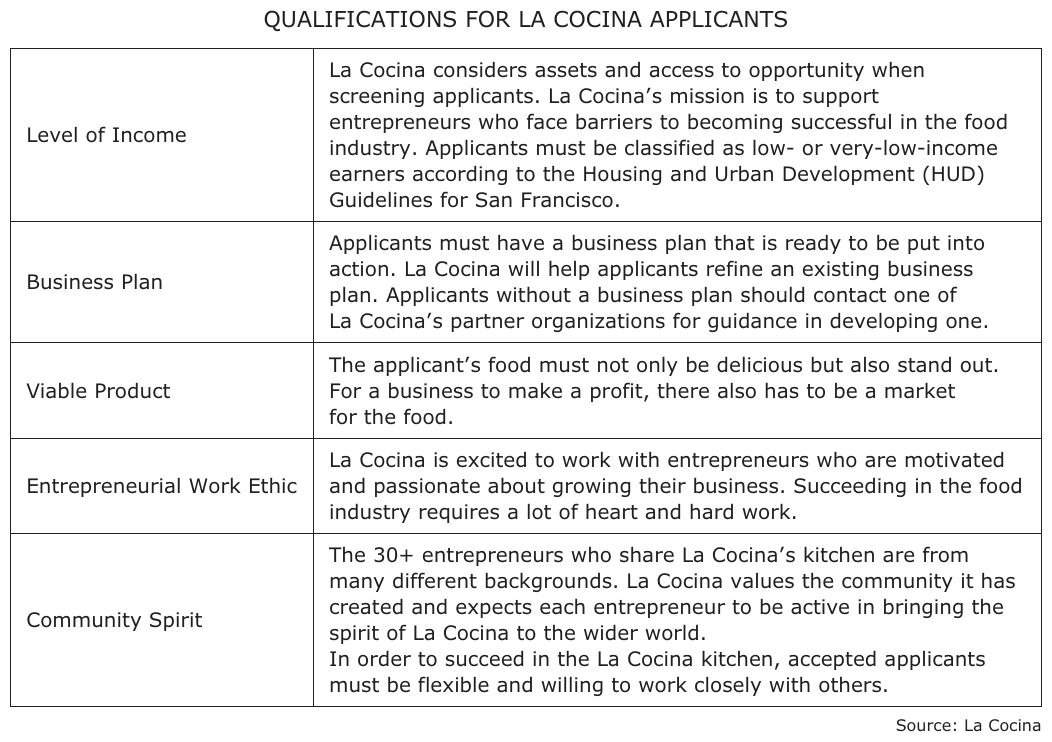
Question 100 of 120
2023 Test B English, question 13Uses the passage above: “Excerpt from “The Food Business Incubator””.
Question
The description of Mariko Grady’s background in paragraph 9 contributes to a central idea in the excerpt by
- Ademonstrating what people are looking for when they come to La Cocina.
- Bexplaining why La Cocina is the best option for people starting out in the food business.
- Cshowing how La Cocina can help people find success in the food business even though they have a background in something different.
- Dconfirming that La Cocina was originally established for small business owners who are looking to expand their services.
Show the answer
Correct answer: C
The question asks how the description of Mariko Grady’s background in paragraph 9 contributes to a central idea in the excerpt.
A. Incorrect. The paragraph about Mariko Grady describes her earlier success in the field of theatrical dance and how she later started her own small cooking business. It does not describe what she was looking for when she came to La Cocina.
B. Incorrect. The excerpt does not argue that La Cocina is the best option for people starting out in the food business, and the description in paragraph 9 does not support that idea.
C. CORRECT. The detailed background story of Mariko Grady describes that Grady started a small food business after working as “a singer and dancer with the prestigious modern theatrical dance group she founded” and then, after that ended, created a fermented food product line. This information contributes to a central idea in the excerpt that many of the people working with La Cocina, like Grady, “needed an affordable commercial kitchen space and technical assistance in order for their businesses to be legally viable. La Cocina provided just such a space, in addition to helping them develop business plans, pull city permits and more” (paragraph 4).
D. Incorrect. While Mariko Grady is now a food business owner that La Cocina has helped since 2012, Grady’s story does more to illustrate how people from non-business backgrounds can receive special support from La Cocina in order to do more with their business.
Question analysis
This central-idea question turns to paragraph 9 of the La Cocina article, the profile of Mariko Grady, who makes miso, koji and other fermented foods for her company, Aedan Fermented Foods. It asks how the description of her background contributes to a central idea of the excerpt, so students must sum up a long life story and decide what it illustrates about the incubator.
- Grade level
- Grade 7 reading and task
- Compared with grade 7
- At grade 7 Connecting one person’s story to a central idea is regular grade 7 reading work. Paragraph 9 is long and packed with names, places and Japanese food words, but the four choices differ clearly once the story is summed up.
- Estimated difficulty
- Straightforward: two steps or one careful reading.
- Thinking it demands
- Depth of knowledge 2, skills and concepts · mainly analyze
- What makes it hard
- A lot to read moderate
- Reading between the lines minor
- Evidence
- Answered from one paragraph or stanza
- Reading level
- Passage: about grade 10, 1057 words; question and choices: about grade 11, 85 words.
- Students, last 30 days
- Not enough answers yet to show (it takes 10).
Why it is hard, traps and wrong answers (shows the answer)
Why it is hard
Grady’s profile is a life story, and the question asks what it shows about La Cocina, which the paragraph mentions only at its start and in one dated sentence. Students who sum it up as a dancer turned food maker find the answer quickly. Those who skim may pick a choice that sounds like a fair lesson about the program, such as what newcomers seek or why it was founded, without checking that the paragraph shows it.
A lot to read moderate Understanding the question
Paragraph 9 runs about 215 words and packs in miso, koji and amasake, a 30-year stage career, a husband met at a show, the 2011 tsunami and the meaning of “Aedan,” so its point must be sifted from many facts. (Kintsch, 1998; Gorin & Embretson, 2006; Freedle & Kostin, 1993)
Reading between the lines minor Working it out
The paragraph never says that La Cocina helped someone from another field succeed; students must set Grady’s career as “a singer and dancer” beside the business she built after joining in 2012 and draw that conclusion. (Graesser, Singer & Trabasso, 1994; Kintsch, 1998)
Strategy: Sum up paragraph 9 in a sentence of your own, then test each choice twice: does Grady’s story actually show it, and does the rest of the excerpt treat it as a central idea?
Traps
- Too broad or too strong: A choice overstates, generalizes, or uses absolute words the text does not support.
- Reads too much in: A reasonable-sounding conclusion that goes further than the text allows.
- Twists what the text says: Uses the text's topic and ideas but changes what it says: who did it, how much, when, or why.
The wrong answers, classified
A Reads too much in (Graesser, Singer & Trabasso, 1994)
Assumes that a profile of one member reveals what everyone hopes to find at La Cocina, but paragraph 9 tells Grady’s past and her products, never what she was seeking when she joined.
B Too broad or too strong (King et al., 2004)
Inflates one success story into a ranking, though the excerpt never compares La Cocina with any other path into the food business, so “the best option” goes beyond it.
D Twists what the text says (King et al., 2004)
Echoes paragraph 1’s help for small businesses but makes Grady’s story proof of La Cocina’s founding purpose, though paragraph 4 traces it to home cooks and street vendors who needed kitchen space.
Working it out, step by step
Decide what to look for
Paragraph 9 tells the life story of Mariko Grady. You need to decide what her story adds to a central idea, a big idea of the whole excerpt. First, sum up her story in one sentence. Then see what it shows about La Cocina.
Pick out the key facts
Paragraph 9 is long, so look for the main facts. In Japan, Grady had “a 30-year career as a singer and dancer.” After the 2011 earthquake and tsunami, her dance company broke up. Then she began making fermented foods, like miso. These foods are left to change slowly, with help from tiny living things. “She began at La Cocina in 2012.” Now she sells her products “online, at local Bay Area stores and at the Ferry Plaza Farmers Market.”
Sum up her story
Here is her story in one sentence: Grady was a singer and dancer for 30 years, then built a food business with La Cocina’s help. Food was not her first career. Yet she now sells a whole line of products. Her story is one example of a central idea: La Cocina helps people grow food businesses.
Check each choice
- A is wrong. The paragraph never says what Grady hoped to find when she joined.
- B is wrong. The excerpt never compares La Cocina with other programs, so it can’t call it “the best option.”
- C is right. Grady came from dance, a very different field, and she found success in food.
- D is wrong. Paragraph 4 explains how La Cocina began: groups found home cooks and street sellers who needed a kitchen. Grady’s story says nothing about that start.
Watch out: A sounds like a fair lesson. But check that the paragraph actually shows it, and this one does not.
Choose the answer
Grady’s story shows someone from a whole different career succeeding in food with La Cocina behind her. So the answer is C.
Why this answer and not the closest wrong one
A is the closest wrong answer, because one member’s story can seem to show what all members want. But paragraph 9 tells Grady’s past and her products, not her hopes. C matches what the paragraph does show: a dancer who built a food business.
More questions like this
The original DOE question
Question 101 of 120
2023 Test B English, question 14Uses the passage above: “Excerpt from “The Food Business Incubator””.
Question
Which statement would the author most likely agree with?
- AThe publicity efforts La Cocina engages in will help its business design spread to other cities.
- BThe variety of exciting food available in San Francisco is due to the work of La Cocina.
- CLa Cocina offers a method that will guarantee business ownership for qualified entrepreneurs.
- DLa Cocina does admirable work in supporting the efforts of ambitious cooks who may have few resources.
Show the answer
Correct answer: D
The question asks with which statement the author would most likely agree.
A. Incorrect. The author does not suggest at any point that La Cocina would like to expand its work and mission to other cities.
B. Incorrect. While the author describes some of the work of talented chefs from La Cocina, at no point does the author imply that the many food choices that exist in San Francisco are because of La Cocina.
C. Incorrect. While the author does describe how La Cocina can help entrepreneurs find success, at no point does the author suggest that La Cocina can guarantee success.
D. CORRECT. The descriptions of the income requirements as well as the information that some of the chefs are James Beard award semi-finalists and others have achieved success with their businesses all help show that the author admires the work of La Cocina in helping chefs who have few resources.
Question analysis
This point-of-view question asks which statement the author of the NPR article about La Cocina, a San Francisco nonprofit that helps food entrepreneurs, would most likely agree with. The author reports facts and profiles two chefs rather than giving opinions outright, so students must infer the author’s attitude from what the article chooses to report and test each statement against it.
- Grade level
- Grade 7 reading and task
- Compared with grade 7
- At grade 7 Inferring which statement an author would accept is typical grade 7 point-of-view work. This reporter lets facts and two chefs’ stories carry the view, but each statement can be checked directly against the article, which keeps the demand ordinary.
- Estimated difficulty
- Straightforward: two steps or one careful reading.
- Thinking it demands
- Depth of knowledge 3, strategic thinking · mainly analyze
- What makes it hard
- Reading between the lines moderate
- Evidence in several places minor
- The right answer is reworded minor
- Evidence
- Answered from the whole text
- Reading level
- Passage: about grade 10, 1057 words; question and choices: about grade 11, 72 words.
- Corrected from the DOE handbook
- An inaccurate detail in the explanation was corrected.
- Students, last 30 days
- Not enough answers yet to show (it takes 10).
Why it is hard, traps and wrong answers (shows the answer)
Why it is hard
Because the author reports rather than argues, students must build the author’s attitude from the facts chosen, then test four statements that all speak well of La Cocina. Three of them claim more than the article does: that it will spread to other cities, that it accounts for the city’s food, that it guarantees ownership. The right statement is the modest one, and students drawn to bigger praise lose the point.
Reading between the lines moderate Working it out
The reporter never states an opinion; admiration has to be read from what the article chooses to include: the income rule, the 50-plus self-sufficient owners, the James Beard semi-finalists and two chefs’ stories. (Graesser, Singer & Trabasso, 1994; Kintsch, 1998)
Evidence in several places minor Working it out
Support for the author’s view is scattered from paragraph 1’s low-income immigrant women through paragraph 2’s successes to the table’s Level of Income row, so no single passage settles it. (Kirsch & Mosenthal, 1990; Gorin & Embretson, 2006)
The right answer is reworded minor Choosing the answer
The right statement speaks of “ambitious cooks” with “few resources,” words the article never uses, while wrong ones echo its own “exciting” and “San Francisco” or the table’s talk of qualifications. (Freedle & Kostin, 1993; Kirsch & Mosenthal, 1990)
Strategy: Ask what the article’s choice of facts and stories shows about how the author regards La Cocina, then measure each statement against that view and against what the article actually reports.
Traps
- Too broad or too strong: A choice overstates, generalizes, or uses absolute words the text does not support.
- Reads too much in: A reasonable-sounding conclusion that goes further than the text allows.
- Twists what the text says: Uses the text's topic and ideas but changes what it says: who did it, how much, when, or why.
The wrong answers, classified
A Reads too much in (Graesser, Singer & Trabasso, 1994)
Takes the chefs’ book tour and the twice-yearly storytelling events as a growth plan, but the article reports promotion of a cookbook, not any intention to take La Cocina’s model to other cities.
B Twists what the text says (King et al., 2004)
Stretches the “exciting range” of flavors inside La Cocina’s kitchen into the cause of all the food variety in San Francisco, a link the author never makes.
C Too broad or too strong (King et al., 2004)
Builds on the more than 50 chefs who became self-sufficient owners and the table’s qualifications, but “guarantee” overstates, since the author reports successes, not a promise to every qualified applicant.
What was corrected from the DOE handbook, and why
- Explanation: The handbook’s explanation of Option D says that “some of the chefs are James Beard award recipients.” The excerpt never says any chef won the award: paragraph 2 says two alumnae “were even recognized as semi-finalists for prestigious James Beard awards.” The site now says “some of the chefs are James Beard award semi-finalists.” The answer is unchanged.
Working it out, step by step
Think about the author’s view
This asks about the author’s point of view, or how the author feels about the topic. The author is a reporter who mostly gives facts. So you have to read the author’s feelings from the facts the author chose to include.
Gather the clues
- Paragraph 1: La Cocina helps cooks, “many of whom are low-income immigrant women.” Low-income means earning little money.
- Paragraph 2: “more than 50 chefs in its program have become self-sufficient business owners.” Self-sufficient means able to support themselves.
- Paragraph 2 also says two alumnae “were even recognized as semi-finalists” for top cooking awards. Semi-finalists reach the round before the final. They did not win.
- Paragraph 10: Shani Jones hopes “to be the patty kingpin of the West Coast.” A kingpin is the leader of a group.
Work out the author’s opinion
Put the clues together. The cooks often start with little money. Many of them dream big, like Jones. La Cocina helps them, and many succeed. The word “even” shows the author is impressed. So the author admires La Cocina’s work. Admirable means deserving praise. Ambitious means wanting to achieve a lot.
Check each choice
- A is wrong. Some chefs will tour to promote a cookbook. That is not a plan to bring La Cocina to other cities.
- B is wrong. The author never says La Cocina is the reason San Francisco has so many kinds of food.
- C is wrong. To guarantee means to promise for sure. The author reports successes but promises nothing.
- D is right. It matches the clues: cooks with little money, big dreams and praise for the help they get.
Watch out: A is tempting because a book tour does spread the word. But spreading the word is not opening in new cities.
Choose the answer
The author would agree that La Cocina deserves praise for helping driven cooks who have little money. So the answer is D.
Why this answer and not the closest wrong one
A is the most tempting wrong choice. The chefs’ book tour and storytelling events do share La Cocina’s story. But the article never mentions taking its model to other cities. D claims only what the article supports, so it is the better choice.
More questions like this
The original DOE question
Question 102 of 120
2023 Test B English, question 32Passage Excerpt from “How We Made the First Flight”
Excerpt from “How We Made the First Flight”
by Orville Wright
In 1903 brothers Wilbur and Orville Wright conducted experiments related to flying machines. These experiments would eventually lead to air travel becoming a reliable form of transportation.
During the night of December 16, 1903, a strong cold wind blew from the north. When we arose on the morning of the 17th, the puddles of water, which had been standing about camp since the recent rains, were covered with ice. The wind had a velocity of 10 to 12 meters per second (22 to 27 miles an hour). We thought it would die down before long, and so remained indoors the early part of the morning. But when ten o’clock arrived, and the wind was as brisk as ever, we decided that we had better get the machine out and attempt a flight. We hung out the signal for the men of the Life Saving Station.1 We thought that by facing the flyer into a strong wind, there ought to be no trouble in launching it from the level ground about camp. We realized the difficulties of flying in so high a wind, but estimated that the added dangers in flight would be partly compensated for by the slower speed in landing.
Final Preparations
We laid the track on a smooth stretch of ground about one hundred feet north of the new building. The biting cold wind made work difficult, and we had to warm up frequently in our living room, where we had a good fire in an improvised stove made of a large carbide2 can. By the time all was ready, J. T. Daniels, W. S. Dough and A. D. Etheridge, members of the Kill Devil3 Life Saving Station; W. C. Brinkley of Manteo, and Johnny Moore, a boy from Nags Head,4 had arrived.
We had a “Richard” hand anemometer with which we measured the velocity of the wind. Measurements made just before starting the first flight showed velocities of 11 to 12 meters per second, or 24 to 27 miles per hour. . . .
Audacity—and Calculation
Wilbur having used his turn in the unsuccessful attempt on the 14th, the right to the first trial now belonged to me. After running the motor a few minutes to heat it up, I released the wire that held the machine to the track, and the machine started forward in the wind. Wilbur ran at the side of the machine, holding the wing to balance it on the track. Unlike the start on the 14th, made in a calm, the machine, facing a 27-mile wind, started very slowly. Wilbur was able to stay with it till it lifted from the track after a forty-foot run. One of the Life Saving men snapped the camera for us, taking a picture just as the machine had reached the end of the track and had risen to a height of about two feet. The slow forward speed of the machine over the ground is clearly shown in the picture by Wilbur’s attitude. He stayed along beside the machine without any effort.
Flight
The course of the flight up and down was exceedingly erratic, partly due to the irregularity of the air, and partly to lack of experience in handling this machine. The control of the front rudder was difficult on account of its being balanced too near the center. This gave it a tendency to turn itself when started; so that it turned too far on one side and then too far on the other. As a result the machine would rise suddenly to about ten feet, and then as suddenly dart for the ground. A sudden dart when a little over a hundred feet from the end of the track, or a little over 120 feet from the point at which it rose into the air, ended the flight. As the velocity of the wind was over 35 feet per second and the speed of the machine over the ground against this wind ten feet per second, the speed of the machine relative to the air was over 45 feet per second, and the length of the flight was equivalent to a flight of 540 feet made in calm air. This flight lasted only 12 seconds, but it was nevertheless the first in the history of the world in which a machine carrying a man had raised itself by its own power into the air in full flight, had sailed forward without reduction of speed and had finally landed at a point as high as that from which it started.
From “How We Made the First Flight” by Orville Wright—Public Domain/Federal Aviation Administration
1Life Saving Station: one of the rescue stations along the Atlantic coastline that provided assistance to mariners in distress
2carbide: a very hard material composed of carbon and other heavy metals
3Kill Devil: the town of Kill Devil Hills in eastern North Carolina
4Nags Head: a town in eastern North Carolina
Question
Read this sentence from paragraph 5.
A sudden dart when a little over a hundred feet from the end of the track, or a little over 120 feet from the point at which it rose into the air, ended the flight.
How does the sentence contribute to the paragraph?
- AIt details the need for the pilot to have quick reflexes while flying the machine.
- BIt presents the idea that the difficulty of operating the machine shortened the flight.
- CIt describes the shift in wind speed that made flying nearly impossible.
- DIt provides an overview of the flight’s progression from takeoff to landing.
Show the answer
Correct answer: B
The question asks how the sentence contributes to paragraph 5.
A. Incorrect. The sentence focuses on the “sudden dart” of the plane, which ended the flight. According to the paragraph, this sudden dart was caused by the difficulty of controlling the front rudder “on account of its being balanced too near the center.” The sentence does not detail the need for the pilot to have quick reflexes.
B. CORRECT. The sentence presents the idea that the difficulty of operating the machine brought the flight to a quicker end than it might otherwise have had. According to paragraph 5, “control of the front rudder was difficult on account of its being balanced too near the center. This gave it a tendency to turn itself when started.” These sentences show that one such “dart” shortened the flight.
C. Incorrect. Although it describes the abrupt end of the flight, the sentence does not describe the shift in wind speed. The word “dart” refers instead to a change in the height, or altitude, of the machine.
D. Incorrect. Although it includes the detail that the flight ended “a little over 120 feet from the point at which it rose into the air,” the sentence does not provide an overview of the entire flight’s progression. The sentence from paragraph 5 omits the flight’s takeoff and only describes its rather abrupt ending.
Question analysis
This question on “How We Made the First Flight,” Orville Wright’s account of the first airplane flight in 1903, quotes the sentence from paragraph 5 reporting that a sudden dart ended the flight a little over 120 feet from where the machine rose into the air. Students must decide what the sentence contributes to the paragraph, which also traces the machine’s erratic course and its speed against the wind.
- Grade level
- Grade 8 reading and task
- Compared with grade 7
- At grade 7 Explaining what one sentence adds to its paragraph is regular grade 7 work. This sentence is long, measured in feet and written in early twentieth-century prose, and its role becomes clear only within the paragraph, which keeps the task typical but careful.
- Estimated difficulty
- Moderate: several steps, or a close reading with one strong distractor.
- Thinking it demands
- Depth of knowledge 2, skills and concepts · mainly analyze
- What makes it hard
- How, not what moderate
- Complex sentences minor
- Reading between the lines minor
- Evidence
- Answered from one paragraph or stanza
- Reading level
- Passage: about grade 7, 816 words; question and choices: about grade 7, 100 words.
- Students, last 30 days
- Not enough answers yet to show (it takes 10).
Why it is hard, traps and wrong answers (shows the answer)
Why it is hard
Read alone, the sentence is just a report of where the flight stopped, so its contribution has to come from the paragraph around it. The two distances, from the end of the track and from the point of liftoff, make it look like a start-to-finish summary, which is the strongest pull. Students who reread the sentences about the badly balanced rudder see that the dart ending the flight was one of those control problems, so the sentence shows the flight cut short by them.
How, not what moderate Working it out
The question asks what the sentence does in paragraph 5, and its role shows only beside the sentences before it: the rudder balanced “too near the center,” its tendency to turn itself, and the darts toward the ground. (Anderson & Krathwohl, 2001)
Complex sentences minor Understanding the question
The sentence’s subject, “A sudden dart,” and its verb, “ended,” are 29 words apart, separated by two distance phrases joined by “or,” so a reader can lose sight of the main statement. (Abedi & Lord, 2001; Freedle & Kostin, 1993; Messick, 1989)
Reading between the lines minor Working it out
The sentence names no cause; students must infer from “As a result the machine would rise suddenly … and then as suddenly dart for the ground” that this dart came from the hard-to-control rudder. (Graesser, Singer & Trabasso, 1994; Kintsch, 1998)
Strategy: Reread the sentences on either side of the quoted one, say in your own words what this sentence adds to them, and reject any choice that claims details the sentence does not contain.
Traps
- Reads too much in: A reasonable-sounding conclusion that goes further than the text allows.
- Wrong purpose or structure: Names a purpose, structure or effect that the part does not serve, or describes what a part says when the question asks what it does.
- Twists what the text says: Uses the text's topic and ideas but changes what it says: who did it, how much, when, or why.
The wrong answers, classified
A Reads too much in (Graesser, Singer & Trabasso, 1994)
Reasons from the erratic course and the “lack of experience” that piloting needed quick reflexes, but the sentence reports only how the flight ended and says nothing about the pilot’s reactions.
C Twists what the text says (King et al., 2004)
Connects the dart with the “irregularity of the air” and the wind figures that follow, but the dart was the machine diving toward the ground, and the sentence mentions no wind.
D Wrong purpose or structure (Anderson & Krathwohl, 2001)
Sees the end of the track and the point of liftoff named in the sentence and takes it for an overview of the whole flight, though both serve only to locate where it ended.
Working it out, step by step
Figure out what the question asks
This asks what one sentence does for its paragraph. The sentence says a “sudden dart” ended the flight. To see its job, read the sentences just before it.
Read the sentences before it
Paragraph 5 explains why the flight was hard to control. “The control of the front rudder was difficult on account of its being balanced too near the center.” A rudder is a flat part that swings to steer. Because it was badly balanced, it turned too far one way, then too far the other. “As a result the machine would rise suddenly to about ten feet, and then as suddenly dart for the ground.”
Work out what the sentence adds
Here, a dart is a quick dive toward the ground. The sentence says one of these dives, a little over 120 feet from where the machine took off, “ended the flight.” So the dart was not just bad luck. It came from the steering problem just described. The sentence shows the result: the hard-to-control machine cut its own flight short.
Check each choice
- A is wrong. Reflexes are quick, automatic reactions. The sentence never mentions the pilot or how fast he reacts.
- B is right. The dart came from the hard steering, and it ended the flight early.
- C is wrong. The sentence says nothing about wind. The dart was the machine diving, not the wind changing.
- D is wrong. The sentence tells only how the flight ended. The two distances just show where it stopped.
Watch out: D is tempting because the sentence names both the end of the track and the point where the machine “rose into the air.” But those places only measure where the flight ended.
Choose the answer
The sentence shows that the machine’s steering problem brought the flight to a quick end. So the answer is B.
Why this answer and not the closest wrong one
D is the closest wrong answer, since the sentence gives two distances that seem to cover the whole flight. But it skips the takeoff and the time in the air. B explains why the sentence matters in paragraph 5: it shows the result of the hard-to-control rudder.
More questions like this
The original DOE question
The passage “Excerpt from “How We Made the First Flight”” as printed (pages 13–14)
Question 103 of 120
2023 Test B English, question 36Passage Cross-Purposes
Cross-Purposes
What I am is built: concrete and steel.
I defy gravity. I am what every athlete
wants: to remain at the apex of the leap,
up in the air. And yet I am useful, too:
cars, trucks, people, even trains
make their way across my broad back.
Swallows and ospreys nest in my trusses.
What I am is motion. I am water, and I am older
than anything else you know. No human
built me. I am gravity’s best friend; I pool
and flow wherever gravity takes me.
I am the blood flowing in the runner’s chest,
and I catch everything: from the hills,
the mountains. It all washes down through me.
What you are is an accident,
what happens to rain when rain gives in
to Earth’s gravitational pull.
You are some tears dribbling from a mountain’s
eye, running down the pavements
of small towns, into the cities, to the sea.
You are the path of least resistance.
What I am is power. You, of course,
have none: you are a static lump, an artifact
slowly decaying. But my regal flow
nourishes grasses, permits empires to rise.
Those who made you will break you,
in time, replacing you with yet another
clumsy structure. I have seen. I know.
“Clumsy”? Being rebuilt makes me
a friend of time, does it not? And it means
that I have siblings—those “clumsy” structures,
my sisters and brothers.
We stitch across the rip you make.
We are steel thread to the human needle.
We bind you up. We sew you.
And I sow into you; in every cranny
of your superstructure my vapors cling.
They bring out your softness, your rust.
Boast your best, and boast better yet.
I am listening to the bright hum
of the wind in your wires. Because I am,
above all else, patient. I will wait for you.
ospreys: large birds
Question
How does the similar construction of line 1 and line 8 contribute to the meaning of the poem?
- AIt introduces the intended permanence of the structure and the ever-changing fluidity of the water.
- BIt shows that the structure can bridge the gap caused by the water.
- CIt suggests that the inflexible structure has more limitations than the adaptable water does.
- DIt contrasts the stability of the structure with the instability of the water.
Show the answer
Correct answer: A
The question asks how the similarity in the construction of lines 1 and 8 contributes to the meaning of the poem.
A. CORRECT. In line 1, the first speaker asserts, “What I am is built: concrete and steel,” and in line 8 the second speaker states, “What I am is motion. I am water, and I am older.” The similarity in the construction of these lines contributes to the meaning of the poem by establishing each speaker’s defining feature.
B. Incorrect. The focus of the lines is defining the speakers’ individuality, not how one speaker resolves a problem created by the other.
C. Incorrect. The structure is not stating in line 1 that it is limited because it was built to stand in place; on the contrary, the structure is stating that this sense of purpose and permanence is its strength.
D. Incorrect. Although in these lines the first speaker asserts “I am . . . built: concrete and steel” (line 1) and the second speaker asserts “I am . . . motion” (line 8), the construction of these lines does not contrast the stability and instability of the speakers. Rather, each speaker highlights its own features.
Question analysis
In “Cross-Purposes,” a poem in which a human-made structure and a body of water take turns speaking, line 1 and line 8 open the first two stanzas with the same words, “What I am is.” This question asks how that similar construction contributes to the poem’s meaning, and several choices describe the two speakers in nearly the same terms, so every word counts.
- Grade level
- Grade 8 reading and task
- Compared with grade 7
- Above grade 7 A typical grade 7 poetry question asks what a repeated phrase emphasizes. This one asks what two parallel lines from personified speakers set up, and the choices turn on abstract words with fine shades of meaning, which goes beyond grade 7 work.
- Estimated difficulty
- Among the hardest on the SHSAT: a non-obvious approach, heavy reading, or a well-hidden trap.
- Thinking it demands
- Depth of knowledge 3, strategic thinking · mainly analyze
- What makes it hard
- A very close wrong answer major
- How, not what moderate
- Figurative or literary language moderate
- Hard words minor
- Evidence
- Answered from several paragraphs or stanzas
- Reading level
- Passage: 316 words (a poem; reading level not measured); question and choices: about grade 9, 71 words.
- Students, last 30 days
- Not enough answers yet to show (it takes 10).
Why it is hard, traps and wrong answers (shows the answer)
Why it is hard
Students who notice that both lines begin “What I am is” usually see the opposition between something built and something moving, and then face two choices that state it in near-synonyms. The deciding question is whether either speaker is being judged, and lines 1 and 8 only declare, each speaker naming its nature with pride. Words like “instability,” “limitations” and “bridge the gap” bring in criticism or later stanzas, so every word of a choice has to be weighed against the two lines alone.
A very close wrong answer major Choosing the answer
The right choice and the one about stability both set the built structure against moving water; they part only on “instability,” which turns the water’s motion into a weakness the proud water never admits. (Embretson & Wetzel, 1987; Gorin & Embretson, 2006; Ascalon et al., 2007)
How, not what moderate Working it out
The stem asks what the shared opening “What I am is” contributes, so students must see that it gives each speaker a matching self-definition, “built” in line 1 and “motion” in line 8. (Anderson & Krathwohl, 2001)
Figurative or literary language moderate Understanding the question
The structure never says it is a bridge; students must infer that from “concrete and steel” and the traffic crossing its “broad back,” then read both personified speakers’ boasts as self-portraits to compare. (Graesser, Singer & Trabasso, 1994; Kintsch, 1998)
Hard words minor Understanding the question
The choices turn on abstract words the poem never uses, “permanence,” “fluidity,” “instability,” “inflexible” and “adaptable,” and their shades of judgment decide the question. (Perfetti, 2007; Freedle & Kostin, 1993)
Strategy: Set line 1 beside line 8 and name, in a word of your own, what each speaker says it is; then test every word of each choice against those two lines alone.
Traps
- Half right: One half of a two-part choice is right and the other is not.
- Reads too much in: A reasonable-sounding conclusion that goes further than the text allows.
- Wrong part of the text: A choice is true of another paragraph, stanza or speaker than the one asked about.
The wrong answers, classified
B Wrong part of the text (Kirsch & Mosenthal, 1990)
Jumps ahead to the fifth stanza’s “We stitch across the rip you make,” but lines 1 and 8 only introduce the two speakers, and neither mentions a gap or crossing it.
C Reads too much in (Graesser, Singer & Trabasso, 1994)
Accepts the fair labels “inflexible” and “adaptable” and draws a verdict from them, that the structure is more limited, which the water argues later but lines 1 and 8 never state.
D Half right (King et al., 2004; Thissen, Steinberg & Fitzpatrick, 1989)
Gets the structure’s stability right, but “instability” makes the water’s motion a flaw, while line 8 offers motion as the water’s defining strength, followed by its claim to be older than anything.
Working it out, step by step
Figure out what the question asks
This is about the poem’s structure, or how it is put together. Lines 1 and 8 are built the same way. You need to see what that matching pattern adds to the poem’s meaning.
Set the two lines side by side
Line 1: “What I am is built: concrete and steel.”
Line 8: “What I am is motion. I am water, and I am older”Both lines begin with the same four words: “What I am is.” Line 1 opens the first stanza, and line 8 opens the second. (A stanza is a group of lines, like a paragraph in a poem.) So each speaker begins by naming what it is.
Name what each speaker is
The first speaker is a structure, most likely a bridge, since traffic and trains “make their way across my broad back.” It is “built” of concrete and steel, so it is meant to stand for many years. The second speaker is water. It is “motion,” always flowing and changing shape. The matching lines introduce the two speakers side by side: one made to last, one always moving.
Check each choice
- A is right. Permanence means lasting without change. Fluidity means flowing easily. These words fit “built” and “motion.”
- B is wrong. A gap first shows up in line 33: “We stitch across the rip you make.” Lines 1 and 8 say nothing about it.
- C is wrong. Inflexible means unable to bend. Adaptable means able to change. But lines 1 and 8 never call either speaker more limited. In line 2, the structure even brags, “I defy gravity.”
- D is wrong. Instability means being shaky or likely to fail. It turns the water’s motion into a flaw. Yet the water boasts that it is “older / than anything else you know.”
Watch out: D sets up the same pairing as A. The one word that sinks it is “instability.”
Choose the answer
The matching openings introduce a structure built to last and water that never stops moving. So the answer is A.
Why this answer and not the closest wrong one
D is the closest wrong answer. It also pairs the steady structure with the moving water. But “instability” suggests the water is weak or can’t be trusted. The water is proud of its motion. A describes both speakers the way they see themselves.
More questions like this
The original DOE question

The passage “Cross-Purposes” as printed (pages 72–73)
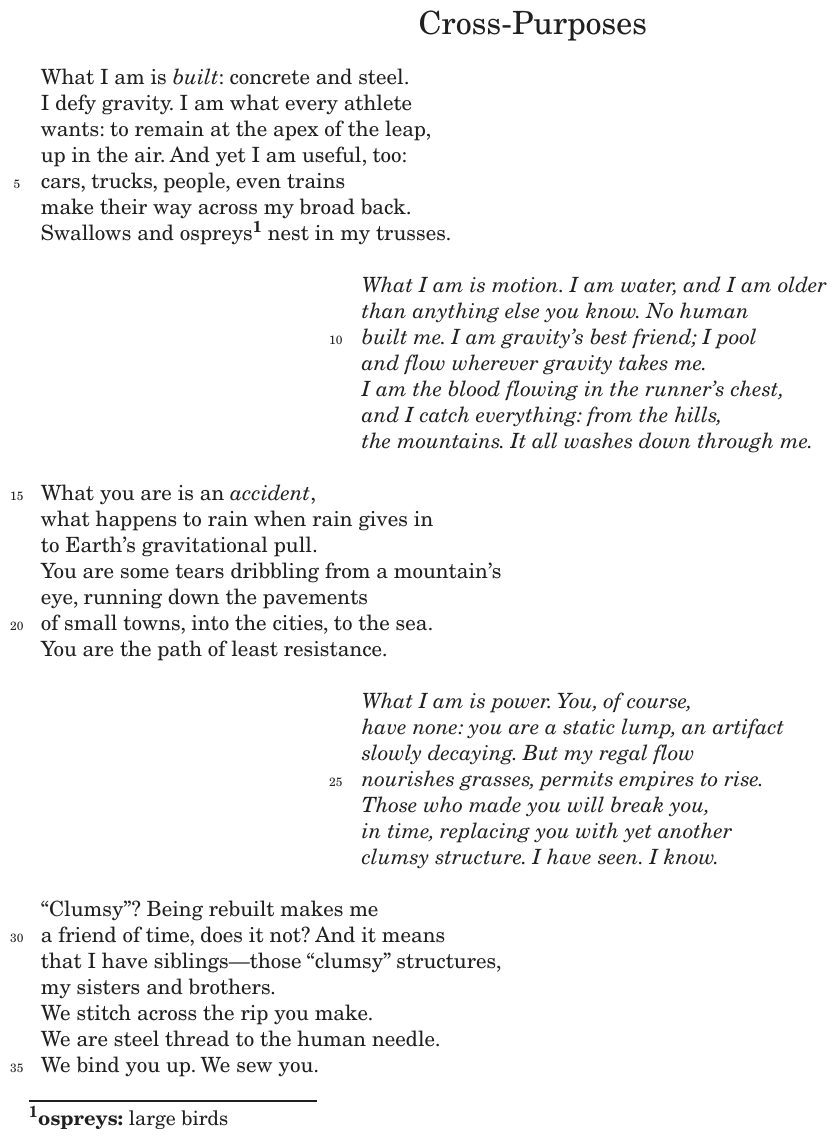
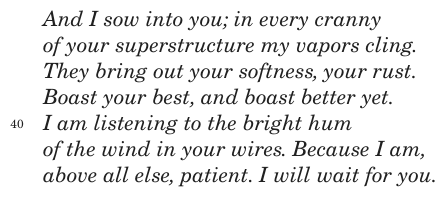
Question 104 of 120
2023 Test B English, question 38Uses the passage above: “Cross-Purposes”.
Question
The use of the words “siblings” and “my sisters and brothers” in lines 31–32 conveys the idea that the
- Aforms water can take are less diverse than the types of structures that exist.
- Bnumber of human-made structures is rapidly increasing.
- Cwater passes under many similar-looking structures as it flows.
- Dstructure is powerful because it is one of many.
Show the answer
Correct answer: D
The question asks which idea the use of the words “siblings” and “my sisters and brothers” in lines 31–32 conveys in the poem.
A. Incorrect. Although in line 29 the structure refers to itself as “being rebuilt” or taking on new forms, this idea is expressed to reinforce the idea that the structure’s presence is eternal (“a friend of time,” line 30). The use of the words “siblings” and “my sisters and brothers” in lines 31–32 does suggest that a variety of structures exist, but no comparison is drawn to suggest that the varieties of structures are more diverse than the forms of water.
B. Incorrect. While the use of the words “siblings” and “my sisters and brothers” in lines 31–32 conveys the idea that structures can be replicated by being built, it does not convey the idea that the number of human-made structures is rapidly increasing.
C. Incorrect. Although in line 33 the structure states, “We stitch across the rip you make,” suggesting that water passes under structures, the use of the words “siblings” and “my sisters and brothers” in lines 31–32 does not convey the idea that the structures that the water passes under are similar-looking.
D. CORRECT. The use of the words “siblings” and “my sisters and brothers” in lines 31–32 conveys the idea that the structure is powerful because it is one of many and because these structures “stitch across the rip” (line 33) that water makes.
Question analysis
This figurative-language question asks what idea the structure in “Cross-Purposes” conveys when it calls other structures its “siblings” and “my sisters and brothers” in lines 31–32. The words come in the fifth stanza, where the structure takes up the water’s word “clumsy,” so students must decide what this family language adds to the structure’s side of the exchange.
- Grade level
- Grade 7 reading and task
- Compared with grade 7
- At grade 7 Interpreting a metaphor in a poem is standard grade 7 work, and the family words themselves are simple. Students must still decide what the comparison means coming from a personified structure in the middle of an argument, a typical grade 7 step.
- Estimated difficulty
- Moderate: several steps, or a close reading with one strong distractor.
- Thinking it demands
- Depth of knowledge 2, skills and concepts · mainly analyze
- What makes it hard
- Figurative or literary language moderate
- Reading between the lines moderate
- A very close wrong answer minor
- Evidence
- Answered from one paragraph or stanza
- Reading level
- Passage: 316 words (a poem; reading level not measured); question and choices: about grade 7, 57 words.
- Students, last 30 days
- Not enough answers yet to show (it takes 10).
Why it is hard, traps and wrong answers (shows the answer)
Why it is hard
The family words answer the water’s taunt in the stanza before, that the structure’s makers will replace it with “yet another clumsy structure,” and the structure turns replacement into kinship. Students who read lines 31–32 alone may stop at the picture of a family, and the strongest wrong choice reads that family as look-alikes. The point arrives only in the next lines, where the structures act as one to bind the water, which makes their number a source of strength.
Figurative or literary language moderate Understanding the question
The structure calls other structures “siblings” and “my sisters and brothers,” a family metaphor followed at once by a sewing one, “We stitch across the rip you make,” so two figures must be read together. (Graesser, Singer & Trabasso, 1994; Kintsch, 1998)
Reading between the lines moderate Working it out
Nothing in lines 31–32 says the structure is powerful; students must infer it from the switch to “We” in the lines that follow, where the many structures together “bind” and “sew” the water. (Graesser, Singer & Trabasso, 1994; Kintsch, 1998)
A very close wrong answer minor Choosing the answer
The choice about similar-looking structures shares the right one’s idea of many structures; it differs in what their number means, a matter of looks rather than strength. (Embretson & Wetzel, 1987; Gorin & Embretson, 2006; Ascalon et al., 2007)
Strategy: Reread the whole fifth stanza, not just lines 31–32, and say what the structure is arguing there; then choose the idea that the family words add to that argument.
Traps
- Taking figurative language literally: A choice reads a figure of speech or image at face value.
- Reads too much in: A reasonable-sounding conclusion that goes further than the text allows.
- Twists what the text says: Uses the text's topic and ideas but changes what it says: who did it, how much, when, or why.
The wrong answers, classified
A Reads too much in (Graesser, Singer & Trabasso, 1994)
Notes that rebuilding and siblings imply many kinds of structures but adds a comparison with the forms water takes, which the fifth stanza never draws.
B Twists what the text says (King et al., 2004)
Takes rebuilding and a whole family of siblings as a sign that structures are multiplying fast, though rebuilding replaces one structure with another over time and adds none.
C Taking figurative language literally (Graesser, Singer & Trabasso, 1994)
Reads “siblings” as structures that resemble one another, as real siblings might, and adds the water flowing under them from line 33, but the family words stress kinship and number, not looks.
Working it out, step by step
Figure out what the question asks
This asks about figurative language, words that mean more than their plain meaning. In lines 31–32 the structure calls other structures “siblings” and “my sisters and brothers.” You need to decide what idea those family words give.
Read what the water said first
The family words answer an insult. In lines 26–28 the water says, “Those who made you will break you, / in time, replacing you with yet another / clumsy structure.” Clumsy means awkward and poorly made. The water means the structure won’t last.
Read the structure’s reply
In lines 29–32, the structure turns the insult around. Being rebuilt makes it “a friend of time.” It has “siblings,” other structures, which it calls “my sisters and brothers.” Then, in lines 33–35, it switches from “I” to “We.” It says, “We stitch across the rip you make.” It adds, “We bind you up. We sew you.” To stitch is to sew. The rip is the gap water cuts through the land.
Work out the idea
A family is a group that sticks together. Working as one, the many structures “bind” the water, like thread holding cloth. One bridge may be replaced, but the family goes on. So being one of many is what makes the structure strong.
Check each choice
- A is wrong. The lines never compare kinds of structures with forms of water.
- B is wrong. Being rebuilt swaps one structure for another. It doesn’t mean their number is growing fast.
- C is wrong. Real siblings may look alike, but that isn’t the point here. The family words show the structures are many and connected.
- D is right. The “We” lines show the many structures acting together, which gives them power.
Watch out: C is tempting if you picture siblings who look alike. Read on to line 35 to see what the family does.
Choose the answer
The family words show the structure gets its strength from being one of many. So the answer is D.
Why this answer and not the closest wrong one
C is the closest wrong answer. It also sees many structures, and in line 33 they do cross the water. But C makes the family words about looks. Lines 33–35 make them about strength: “We bind you up.” That is why D fits better.
More questions like this
The original DOE question
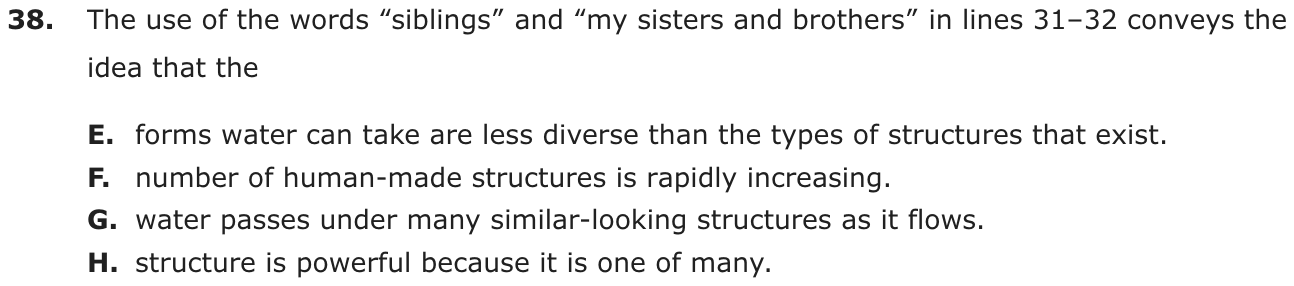
Question 105 of 120
2022 Test A English, question 30Passage Excerpt from Do Them No Harm!
Excerpt from Do Them No Harm!
by Zoa L. Swayne
This narrative is about the Nez Perce, an American Indian tribe, in what is now northern Idaho. The tribe is preparing for a gathering before the coming winter.
In the moon of Ta-Yum, the hottest days of summer, when salmon spawn in the little streams and huckleberries ripen in the high mountains, people from many villages of the Chopunnish Nation gathered in the Oyaip Prairie for the work and festivities of their annual camas1 harvest.
From far and near The People came. . . .
Should a stranger enter their homeland and ask, “Where are you from?” the reply was always, “We are Nee-mee-poo, The People who live here in this place.”
It was a time of Lawtiwa-mah-ton—a time of being friends together—when The People came for this last chance to enjoy being together before the Cold Moons kept them close to their fires. The visiting and trading, the foot racing and horse racing, and the gambling and stick games would be remembered and talked about long after they had forgotten the drudgery of digging and roasting camas, picking berries, or drying meat and fish. Lawtiwa-mah-ton! It was good to be friends together.
As was their custom since wahk-kee-ma, a time far back beyond the memory of man, they set up their camps in the same locations their parents and grandparents had occupied before them. Red Bear’s people, from Kamiah, made their camp near the trail that came out of the mountains. Their neighbors in Kamiah Valley, The People from Tee-e-lap-a-lo, had their camp close by. Across the wide meadow, by the great roasting pits, the camps of the Te-wap-poo and Ask-kah-poo were located. The tepees and ish-nash, brush shelters, of other groups nestled in their accustomed areas in and among the pines in such numbers that they encircled the entire meadow land.
Red Bear’s people had traveled all summer with neighboring bands, gathering and preparing roots, picking and drying berries, drying and smoking meat and fish for their winter food supply. Now they were at the Oyaip camp. The women worked hard to dig and cure as many bags of roots as they could during the warm, sunny days, for the sharp night air brought warnings that WARM was going and COLD was coming.
Everyone helped in some way. Most of the men fished or hunted for meat. While many of the women dug and roasted camas, other women and older children picked and dried berries.
And the younger children played. They played at hunting. They played with the babies. They played with their horses and puppies. They learned how to live through their play.
This sun, happiness, peace, and quiet blessed the Red Bear camp. All were busy with their daily tasks, until sudden cries came from the children playing by the trail.
“People coming! People coming! People coming on the trail from the high mountains!” they called as they ran to their elders, who looked sharply at the figures of approaching horsemen.
Were they friends or enemies? Did they bring good news or bad?
“Who can it be? What brings them here?” were the questions in every mind.
“Could they be the four hunters who had gone to Buffalo Country two summers past? Would they have news of the families who had gone long ago to Buffalo Country and never returned?”
It was customary for a hunting party to be gone for more than one season.
“Looks like hunters,” the older men agreed. “Looks like they had good hunting. Maybe our four hunters. [They have] been gone many moons.”
“Looks like five people—not four,” others observed.
Excitement grew as the riders came close enough to be recognized.
“A-a-a-a-a, they are our four hunters! But who is the fifth person?” they asked.
“Looks like a woman. Who is she?”
The hunters rode up to the welcoming crowd, proud to show off the loads of meat, hides, and other trophies of their hunt. They paraded around the encampment for all to see how strong their Hunting Power had been—what great hunters they, themselves, were.
Red Bear’s people rejoiced at their hunters’ success. Good hunters brought good to everybody. The meat meant plenty of food and the hides meant soft-tanned robes to give comfort through the Cold Moons. But it was the sight of the frail figure of the woman that aroused their curiosity. Who was she? Where had she come from? . . .
“Belongs to Red Bear people. Gone then come back,” the hunters said, as they dismounted and unloaded their packs. . . .
Now they could see! She was the daughter of the family gone so long ago! The girl-child who had left came back now—a grown woman.
“Wat-ku-ese!” the women cried. “Gone-from-Home-then-Come-Back. Wat-ku-ese!” And Wat-ku-ese was her name from that time on.
Gentle arms lifted Wat-ku-ese from her horse. The women brought her food and made a place for her to rest. For many suns they cared for her until she became stronger.
One evening Wat-ku-ese told her story for all to hear.
From DO THEM NO HARM!: Lewis and Clark Among the Nez Perce by Zoa L. Swayne. Published by Caxton Press. Copyright © 1990 by Zoa L. Swayne. Orofino, Idaho and Legacy House, Inc. Orofino, Idaho. All rights reserved.
1camas: a wild, edible plant
Question
Which quotation from the excerpt best supports the idea that The People maintain a connection to members of their group in spite of distance?
- A“As was their custom since wahk-kee-ma, a time far back beyond the memory of man, they set up their camps in the same locations their parents and grandparents had occupied before them.” (paragraph 5)
- B“ ‘Would they have news of the families who had gone long ago to Buffalo Country and never returned?’ ” (paragraph 13)
- C“ ‘Looks like hunters,’ the older men agreed. ‘Looks like they had good hunting.’ ” (paragraph 15)
- D“But it was the sight of the frail figure of the woman that aroused their curiosity.” (paragraph 21)
Show the answer
Correct answer: B
The question asks which quotation from the excerpt best supports the idea that The People maintain a connection to members of their group in spite of distance.
A. Incorrect. This quotation describes the fact that The People always set up their camps in the same places their parents and grandparents used before them. This quotation highlights the customs The People continue from their ancestors, but it does not focus on their present personal connections.
B. CORRECT. This quotation alludes to The People’s eagerness to hear about the families who had traveled away from their group. This eagerness shows that they still feel a connection to these families, even though they are far apart.
C. Incorrect. This quotation describes The People’s analysis of the visitors—that they may be hunters. It does not show a connection to the visitors.
D. Incorrect. This quotation shows that The People are curious about a stranger who has come into their camp. It does not show closeness to distant members of the group.
Question analysis
This textual evidence question on the excerpt from Do Them No Harm!, set at a Nez Perce camp during the yearly camas harvest, asks which quotation best supports the idea that The People maintain a connection to members of their group in spite of distance. The quotations come from four different paragraphs, and each must be checked against both halves of that idea.
- Grade level
- Grade 7 reading and task
- Compared with grade 7
- At grade 7 Matching a quotation to an idea is routine grade 7 evidence work. This idea has two parts, keeping up ties and being far apart, and the four lines come from different points in the story, a standard grade 7 demand.
- Estimated difficulty
- Moderate: several steps, or a close reading with one strong distractor.
- Thinking it demands
- Depth of knowledge 2, skills and concepts · mainly evaluate
- What makes it hard
- Reading between the lines moderate
- Every choice must be checked minor
- Evidence
- Answered from several paragraphs or stanzas
- Reading level
- Passage: about grade 5, 885 words; question and choices: about grade 9, 107 words.
- Corrected from the DOE handbook
- The explanation described one wrong choice’s quotation inaccurately; that sentence was corrected.
- Students, last 30 days
- Not enough answers yet to show (it takes 10).
Why it is hard, traps and wrong answers (shows the answer)
Why it is hard
The idea pairs connection with distance, and the strongest-sounding line covers only one of them: camping where parents and grandparents camped keeps a tie across generations, not across miles. The line about the frail woman tempts readers who know she turns out to be a lost daughter, though no one knows it yet. The answer is easy to overlook because it is phrased as a hopeful question, yet asking after families long gone is exactly how the connection is kept.
Reading between the lines moderate Working it out
The right quotation is a question the villagers ask, not a statement of their bond; students must see that wanting news of families “gone long ago” is a way of keeping that bond alive. (Graesser, Singer & Trabasso, 1994; Kintsch, 1998)
Every choice must be checked minor Choosing the answer
Each line must pass two tests, a tie to members of the group and members who are far away; the camp-site line from paragraph 5 passes the first test and fails the second. (Embretson & Wetzel, 1987)
Strategy: Split the idea into its two parts, an ongoing tie to group members and members who are far away, then read each quotation in its paragraph and keep only one that shows both.
Traps
- Supports only part of the claim: In a question about evidence: a line that backs one half of the claim but not the other, or a related point rather than the claim itself.
- Reads too much in: A reasonable-sounding conclusion that goes further than the text allows.
The wrong answers, classified
A Supports only part of the claim (King et al., 2004; Thissen, Steinberg & Fitzpatrick, 1989)
Takes camping where parents and grandparents once camped as a lasting bond, but it links The People to ancestors across time, not to living members far away.
C Supports only part of the claim (King et al., 2004; Thissen, Steinberg & Fitzpatrick, 1989)
Connects these riders to the absent hunters the older men name a moment later, but the quoted words only judge the hunt and show no tie to anyone far away.
D Reads too much in (Graesser, Singer & Trabasso, 1994)
Reads ahead to the woman being a daughter who left long ago, but at this line she is still a stranger, and curiosity about a stranger keeps up no connection.
What was corrected from the DOE handbook, and why
- Explanation: Choice A quotes paragraph 5: The People “set up their camps in the same locations their parents and grandparents had occupied before them.” The handbook’s explanation says the quotation describes them returning “to perform the same traditional tasks and enjoy the same festivities as their ancestors,” which the sentence doesn’t say. The explanation now describes the quotation as it is. The reason A is wrong is unchanged: it shows a custom kept from their ancestors, not a connection to members who are far away. The answer, B, is unchanged. The site made the same correction to this explanation as printed in the 2024–2025 guide (2024 Test B English, question 29).
Working it out, step by step
Figure out what the question asks
This asks for evidence: the quotation that best supports an idea. The idea has two parts. The People keep a connection, or bond, with members of their group. And those members are far away. The right quotation must show both parts. One part alone is not enough.
Read paragraph 13 in its place
In paragraphs 10 to 12, the children shout that riders are coming down the mountain trail. Everyone wonders who they are. Paragraph 13 gives their hopes: “Could they be the four hunters who had gone to Buffalo Country two summers past? Would they have news of the families who had gone long ago to Buffalo Country and never returned?”
Work out what the question shows
Some families left the group “long ago.” They went far away to Buffalo Country and never came home. Yet The People still hope for news of them. You only ask about people you still care about. So the bond holds across the miles and the years. Later, paragraph 23 shows that the woman riding with the hunters is “the daughter of the family gone so long ago!” The People welcome her and care for her.
Check each choice
- A (paragraph 5) does not fit. The People set up camp where “their parents and grandparents” camped before them. That is a custom from their ancestors, the family members who lived long ago. It is not a bond with members who are far away now.
- B (paragraph 13) fits. The People want news of families who left long ago and went far away.
- C (paragraph 15) does not fit. The older men only guess that the riders are hunters who had a good hunt.
- D (paragraph 21) does not fit. The People are curious about a stranger. At this point, no one knows she belongs to the group.
Choose the answer
Watch out: A is the most tempting, since camping where your grandparents camped is a strong tie. But that tie reaches back in time, not out across distance. Only B shows both parts of the idea. So the answer is B.
Why this answer and not the closest wrong one
A is the closest wrong answer. It shows The People keeping an old custom from their ancestors. But it says nothing about group members who live far away now. B is about families who went to Buffalo Country and never returned. The People still want news of them, so the bond lasts in spite of distance.
More questions like this
The original DOE question
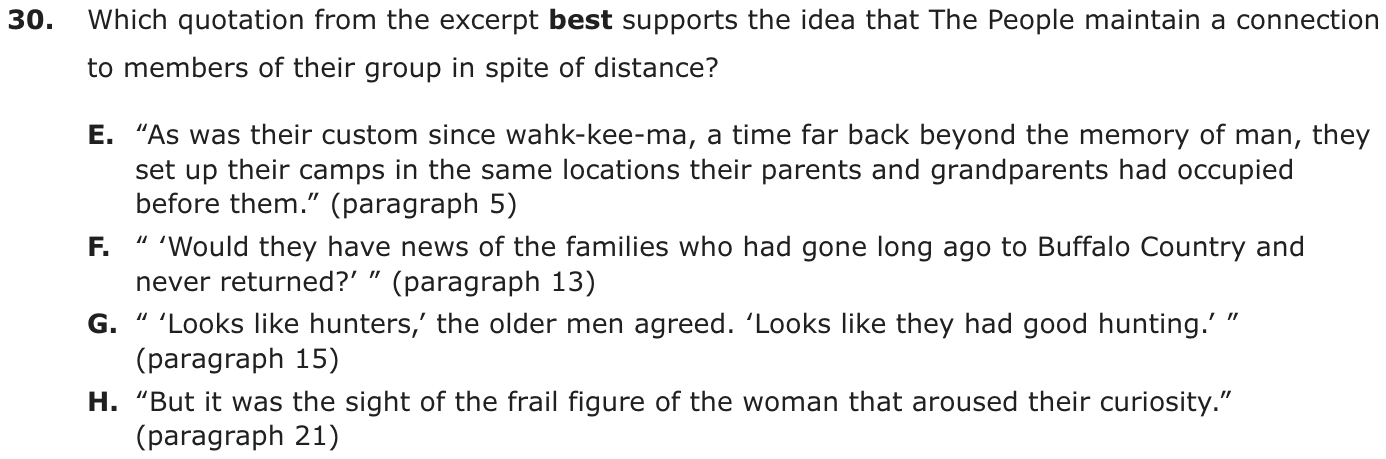
The passage “Excerpt from Do Them No Harm!” as printed (pages 177–178)
Question 106 of 120
2022 Test A English, question 48Passage Bird Talk
Bird Talk
by Carl Sandburg
And now when the branches were beginning to be heavy,
It was the time when they once had said, “This is the
beginning of summer.”
The shrilling of the frogs was not so shrill as in the
first weeks after the broken winter;
The birds took their hops and zigzags a little more
anxious; a home is a home; worms are worms.
The yellow spreads of the dandelions and buttercups
reached across the green pastures.
Tee whee and tee whee came on the breezes, and the grackles
chuzzled their syllables.
And it was the leaves with a strong soft wind over them
that talked most of all and said more than any others
though speaking the fewest words.
It was the green leaves trickling out the gaunt nowhere
of winter, out on the gray hungry branches—
It was the leaves on the branches, beginning to be heavy,
who said as they said one time before, “This is the be-
ginning of summer.”
We shall never blame the birds who come
where the river and the road make the Grand Crossing
and talk there, sitting in circles talking bird talk.
If they ask in their circles as to who is here
and as to who is not here and who used to be here,
Or if instead of counting up last year as against
this year, they count up this year as against next
year, and have their bird chatter about who is here
this year who won’t be here next year,
We shall never blame the birds.
If I have put your face among leaf faces, child,
Or if I have put your voice among bird voices,
Blame me no more than the bluejays.
“Bird Talk” by Carl Sandburg—Public domain.
Question
How do lines 23–28 contribute to a central idea of the poem?
- AThey suggest that the speaker is aware of what has been lost in the winter.
- BThey imply that the birds sing the most in the summer.
- CThey reveal that the birds are subject to the cycles of nature.
- DThey emphasize that the speaker enjoys observing nature.
Show the answer
Correct answer: C
This question asks how the description of the “bird talk” contributes to the central idea of the poem.
A. Incorrect. The birds’ conversations may center around “who is here” and “who is not here and who used to be here” (lines 23–24), but the lines do not convey that the speaker feels a sense of loss, only that the birds have such figurative conversations in a direct way.
B. Incorrect. Though the birds are described by the speaker as “talking bird talk” (line 22), it is not suggested that this talk occurs more frequently in one season versus another, only that it occurs year after year because birds encounter seasonal changes as a constant.
C. CORRECT. In these lines, the birds gather, and some birds are not present but “used to be here” (line 24). These birds have likely succumbed to another of nature’s cycles: death, which affects all living things.
D. Incorrect. Though the description in these lines is a vivid one and includes anthropomorphism in the birds asking about “who is here” (line 23) and “counting up last year as against / this year” (lines 25–26), it gives no indication of the speaker’s level of enjoyment in observing nature.
Question analysis
This poetry question points to lines 23–28 of Carl Sandburg’s “Bird Talk,” where birds sitting in circles talk over who is here, who is not here and who won’t be here next year, and asks how those lines contribute to a central idea of the poem. Students must untangle Sandburg’s long, loosely joined lines and connect the birds’ chatter to the rest of the poem.
- Grade level
- Grade 8 reading and task
- Compared with grade 7
- Above grade 7 Grade 7 students often explain what a stanza adds to a poem. Here six lines of loosely punctuated free verse must first be decoded and then tied to a central idea the question leaves unnamed, more than typical grade 7 poetry work.
- Estimated difficulty
- Hard: combines ideas, needs a plan, and has more than one tempting wrong answer.
- Thinking it demands
- Depth of knowledge 3, strategic thinking · mainly analyze
- What makes it hard
- Reading between the lines major
- Complex sentences moderate
- Figurative or literary language minor
- How, not what minor
- Evidence
- Answered from several paragraphs or stanzas
- Reading level
- Passage: 296 words (a poem; reading level not measured); question and choices: about grade 5, 57 words.
- Corrected from the DOE handbook
- The explanation said a quoted phrase was in the lines the question asks about, though it comes just before them; that sentence was corrected.
- Students, last 30 days
- Not enough answers yet to show (it takes 10).
Why it is hard, traps and wrong answers (shows the answer)
Why it is hard
The lines are hard to untangle, and the meaning that matters, that some birds have died or gone and others will by next year, is only implied. Students who catch the sense of loss can still go wrong by handing it to the speaker and tying it to the first stanza’s winter, while others fall back on safe statements about enjoying nature or summer birdsong. The question rewards reading the birds’ count of last year, this year and next year as a cycle that repeats.
Reading between the lines major Working it out
The lines never name death or the seasons; students must work out that birds “who used to be here” and birds “who won’t be here next year” stand for losses that come round year after year. (Graesser, Singer & Trabasso, 1994; Kintsch, 1998)
Complex sentences moderate Understanding the question
Lines 23–28 are one unfinished sentence of stacked “if” clauses, “as to who is here / and as to who is not here,” with a count of “this year as against next” broken across two lines. (Abedi & Lord, 2001; Freedle & Kostin, 1993; Messick, 1989)
Figurative or literary language minor Understanding the question
The birds are pictured as a meeting that will “ask in their circles” and keep a yearly tally, so the census has to be read as the speaker’s playful image of what nature does. (Graesser, Singer & Trabasso, 1994; Kintsch, 1998)
How, not what minor Working it out
The stem asks what the lines add to “a central idea” without naming one, so students must first decide which idea of the poem the birds’ tally serves. (Anderson & Krathwohl, 2001)
Strategy: Put lines 23–28 into plain words, noting who is talking and what they keep track of, then ask what that adds to the poem as a whole before you look at the choices.
Traps
- Twists what the text says: Uses the text's topic and ideas but changes what it says: who did it, how much, when, or why.
- Wrong part of the text: A choice is true of another paragraph, stanza or speaker than the one asked about.
- Reads too much in: A reasonable-sounding conclusion that goes further than the text allows.
The wrong answers, classified
A Twists what the text says (King et al., 2004)
Rightly hears loss in “who used to be here,” but gives that awareness to the speaker and pins it on winter, though the birds keep the count and look ahead to next year too.
B Reads too much in (Graesser, Singer & Trabasso, 1994)
Hears “bird chatter” as song and joins it to the poem’s summer setting, but the lines compare who is present from year to year, not how much birds sing in each season.
D Wrong part of the text (Kirsch & Mosenthal, 1990)
Remembers the first stanza’s pleasure in dandelions, buttercups and talking leaves, but lines 23–28 are given over to the birds’ count and show nothing of the speaker’s enjoyment.
What was corrected from the DOE handbook, and why
- Explanation: The question asks about lines 23–28. The DOE’s explanation of Option B begins “Though the birds are described in these lines by the speaker as ‘talking bird talk’ (line 22).” That phrase is in line 22, just before the lines the question asks about, as the explanation’s own line number shows. The site drops “in these lines,” so the sentence now says that the speaker describes the birds as “talking bird talk” (line 22). The reason Option B is wrong is unchanged: the poem does not suggest that the birds talk more in one season than in another. The answer, C, is unchanged.
Working it out, step by step
Figure out what the question asks
This asks what lines 23–28 add to a central idea of the poem. A central idea is a big message the whole poem gets across. So you need to do two things. First, put the six lines into plain words. Then see how they connect to the rest of the poem.
Read lines 20 to 29
Lines 20–22 show birds that “talk there, sitting in circles talking bird talk.” Lines 23–24 say they ask “as to who is here / and as to who is not here and who used to be here.” Lines 25–28 say they count “this year as against next / year.” They talk “about who is here / this year who won’t be here next year.” Line 29 ends: “We shall never blame the birds.”
Put the lines in plain words
The birds are pictured like people at a meeting, taking a count. Some birds from last year are missing. They may have died or flown off. And some birds here now won’t be back next year. This happens again every year. Some birds arrive and some are lost. A pattern that repeats like this is called a cycle. The seasons are a cycle too.
Connect the lines to the poem
The first stanza (group of lines) shows a pattern that repeats too. Winter is over, and the leaves say again that summer is beginning. Line 18 says they spoke “as they said one time before.” So a central idea is that nature moves in cycles that come back again and again. Lines 23–28 show that the birds’ lives follow those cycles too. To be “subject to” something is to be ruled by it.
Check each choice
- A does not fit. The birds keep the count, not the speaker (the voice talking in the poem). The lines never mention winter, and they look ahead to next year too.
- B does not fit. Line 22 calls it “talking bird talk,” but lines 23–28 never compare seasons or say when birds sing most.
- C fits. Birds come and go year after year, as part of nature’s cycles.
- D does not fit. These lines are about the birds’ count. They show nothing about whether the speaker enjoys watching.
Choose the answer
Watch out: A is the most tempting, because “who used to be here” does hint at loss. But the birds are the ones counting, and the count goes on every year. The lines show a cycle, not one sad winter. So the answer is C.
Why this answer and not the closest wrong one
A is the closest wrong answer, because the lines do hint at loss. But it is the birds who count who is missing, not the speaker. The lines also look ahead to next year instead of back at winter. That yearly count of who comes and who goes shows birds living by nature’s cycles, which is C.
More questions like this
The original DOE question
The passage “Bird Talk” as printed (page 32)
Question 107 of 120
2022 Test B English, question 11Passage Excerpt from “The World Has an E-Waste Problem”
Excerpt from “The World Has an E-Waste Problem”
by Alana Semuels
As a tech-hungry nation . . . gets ready to upgrade to the next generation of lightning-fast 5G devices, there is a surprising environmental cost to be reckoned with: a fresh mountain of obsolete1 gadgets. About 6 million pounds of discarded electronics are already processed monthly at recycling giant ERI’s Fresno plant. Pallets2 of once beloved but now outdated devices . . . arrive here daily. Workers with hammers hack at the bulkiest devices, while others remove dangerous components like lithium-ion batteries. The scene is like a twisted . . . movie, with doomed gadgets riding an unrelenting conveyor belt into a machine that shreds them into piles of copper, aluminum and steel.
“In our society, we always have to have the new, best product,” said Aaron Blum, the co-founder and chief operating officer of ERI, on a tour of the facility. Americans spent $71 billion on telephone and communication equipment in 2017, nearly five times what they spent in 2010 even when adjusted for inflation, according to the Bureau of Economic Analysis. . . . When we buy something new, we get rid of what’s old. That cycle of consumption has made electronics waste the world’s fastest-growing solid-waste stream.
That stream is expected to turn into a torrent3 as the world upgrades to 5G, the next big step in wireless technology. 5G promises faster speeds and other benefits. But experts say it will also result in a dramatic increase in e-waste, as millions of smartphones, modems and other gadgets incompatible with 5G networks are made obsolete. “I don’t think people understand the magnitude of the transition,” says ERI co-founder and executive chairman John Shegerian. “This is bigger than the change of black-and-white to color, bigger than analog to digital, by many multitudes.”
. . . Less than a quarter of all U.S. electronic waste is recycled, according to a United Nations estimate. The rest is incinerated or ends up in landfills. That’s bad news, as e-waste can contain harmful materials like mercury and beryllium that pose environmental risks.
Part of the problem is regulatory. Only 19 states have laws banning electronics from the regular trash. In states without such rules, like Nevada, electronics often end up in garbage and recycling bins, said Jeremy Walters, a community-relations manager for waste collector Republic Services. Environmental concerns aside, compacting flammable lithium-ion batteries with paper recycling can be dangerous; recycling centers have reported an uptick in fires.
Even when e-waste rules exist, it’s left up to consumers to handle their old devices properly. But recycling them can be a pain. Rather than just drop a used phone in a bin outside their homes, lots of people have to take their electronics to a store, which may pay them for it but could also charge them to get rid of it. Many consumers, paralyzed by the hassle or put off by the expense, simply throw their devices into the trash or stash them in a drawer, hoping they’ll just disappear. “We don’t necessarily have the measures to make sure people aren’t throwing it away,” Walters said.
One solution is to make electronics last as long as they once did. At ERI’s facility, Shegerian showed TIME [magazine] dozens of televisions from the 1970s and 1980s that stopped working only recently. Yet instead, technology companies are speeding the pace of obsolescence. Most smartphone batteries can’t be easily replaced when they stop holding a charge, new laptops don’t accept old cables, and software companies push upgrades that won’t run on old devices. “Our products today don’t last as long as they used to, and it’s a strategy by manufacturers to force us into shorter and shorter upgrade cycles,” said Kyle Wiens, the founder of iFixit, which publishes do-it-yourself repair guides. . . .
Some environmental groups say multibillion-dollar companies . . . should pick up the cost of recycling the devices they sell. Lawmakers in parts of Europe and Canada and in some U.S. states have passed so-called Extended Producer Responsibility (EPR) laws, which require manufacturers to establish and fund systems to recycle or collect obsolete products. . . .
. . . Some companies are increasing their recycling efforts on their own, whether for the economic benefit or the public relations boost.
From “The World Has an E-Waste Problem” by Alana Semuels from TIME Magazine, June 3, 2019. Copyright © 2019 TIME USA, LLC.
Electronics such as smartphones, computers, cameras, and large appliances contain toxins like lead, chromium, zinc, nickel, mercury, beryllium, and cadmium. These substances are bioaccumulative, which means that they accumulate over time in living organisms.
1obsolete: outdated and no longer useful
2Pallets: wooden platforms used to store or transport materials in a warehouse
3torrent: an outpouring
Question
Read this sentence from paragraph 1.
The scene is like a twisted . . . movie, with doomed gadgets riding an unrelenting conveyor belt into a machine that shreds them into piles of copper, aluminum and steel.
The words “twisted,” “doomed,” and “unrelenting” most affect the sentence by
- Aemphasizing that discarded devices are condemned to an unfortunate fate.
- Bexpressing a sense of desperation about the amount of waste from discarded devices.
- Cimplying that discarded devices are often disposed of in an inappropriate manner.
- Dsuggesting a feeling of doubt about solving the problem of discarded devices.
Show the answer
Correct answer: A
The question asks about the effect of the words “twisted,” “doomed,” and “unrelenting” on the last sentence of paragraph 1.
A. CORRECT. Paragraph 1 first describes the problem of discarded devices in terms of the scope of the problem (“about 6 million pounds . . . processed monthly”). The author then elaborates on the problem with a vivid description of the actual process; it is unfortunate that this process is necessary because, even though they are relatively new, these devices are no longer useful. These particular words emphasize the process of a once-useful device becoming a part of a “twisted . . . movie,” and “doomed” to be recycled by going through an “unrelenting” or never-ending conveyor belt.
B. Incorrect. In the excerpt, the author does express concern about the amount of waste from discarded devices, but this particular sentence is about what happens to the devices and the perspective that one has while watching the devices as they are being processed. In this description, the once-beloved devices have been destroyed, with only some useful parts being retained.
C. Incorrect. Although there is an indication in paragraphs 4–6 that some obsolete devices are disposed of inappropriately, this description is of an appropriate disposal—a recycling center developed specifically for these types of devices.
D. Incorrect. At this juncture in the excerpt, the author has not yet mentioned solving the problem of discarded devices; rather, the author is describing what happens to discarded devices that are appropriately recycled.
Question analysis
This word-choice question quotes the last sentence of the opening paragraph of “The World Has an E-Waste Problem,” in which old gadgets ride a conveyor belt into a shredder at a recycling plant. Students decide how the words “twisted,” “doomed” and “unrelenting” most affect the sentence. Each choice reads something negative into the words, so their connotations have to be matched to what this sentence describes.
- Grade level
- Grade 7 reading and task
- Compared with grade 7
- At grade 7 Explaining how word choices shape a sentence’s meaning and tone is everyday grade 7 work. The three words are quoted and sit in one sentence, though it comes from adult magazine prose and its comparison has a word cut by an ellipsis.
- Estimated difficulty
- Straightforward: two steps or one careful reading.
- Thinking it demands
- Depth of knowledge 2, skills and concepts · mainly analyze
- What makes it hard
- Figurative or literary language moderate
- Hard words minor
- Evidence
- Answered from one sentence or line
- Reading level
- Passage: about grade 10, 760 words; question and choices: about grade 8, 91 words.
- Students, last 30 days
- Not enough answers yet to show (it takes 10).
Why it is hard, traps and wrong answers (shows the answer)
Why it is hard
The three words share one job: they cast once-loved gadgets as victims on a one-way ride to the shredder. Each wrong choice keeps the gloom but points it somewhere else, at the amount of waste, at improper dumping, or at the chances of fixing the problem. Students who ask what the words describe in this one sentence, rather than what the article worries about overall, settle on the gadgets’ fate quickly.
Figurative or literary language moderate Understanding the question
The sentence likens the plant to “a twisted . . . movie,” with a word cut by the ellipsis, and the effect lives in connotation: “doomed” and “unrelenting” turn gadgets on a conveyor belt into victims bound for a shredder. (Graesser, Singer & Trabasso, 1994; Kintsch, 1998)
Hard words minor Understanding the question
“Unrelenting” has to be known as never letting up, and the right choice restates “doomed” as “condemned to an unfortunate fate,” so the match is one of meaning, not of sound. (Perfetti, 2007; Freedle & Kostin, 1993)
Strategy: Ask what the three words describe in this one sentence and what feeling they share, then check each choice against the sentence itself rather than against the article as a whole.
Traps
- Wrong tone or attitude: Misjudges the tone, attitude or point of view, such as reading admiration as criticism, or taking a character's or subject's feelings for the author's.
- Wrong part of the text: A choice is true of another paragraph, stanza or speaker than the one asked about.
- Reads too much in: A reasonable-sounding conclusion that goes further than the text allows.
The wrong answers, classified
B Wrong tone or attitude (Graesser, Singer & Trabasso, 1994)
Hears despair in the grim words and ties “unrelenting” to the six million pounds a month, but the sentence follows the gadgets’ fate on the belt and voices no desperation about volume.
C Wrong part of the text (Kirsch & Mosenthal, 1990)
Takes “twisted” as a sign of wrongdoing and recalls the trash and landfills of paragraphs 4–6, though this scene is a recycling plant, the proper place for old devices.
D Reads too much in (Graesser, Singer & Trabasso, 1994)
Hears hopelessness in “doomed” and stretches it to the whole e-waste problem, though the sentence never turns to solutions, which the excerpt reaches only in paragraph 7.
Working it out, step by step
Find what the question asks
This is a word-choice question. Three words in one sentence work as a team: “twisted,” “doomed” and “unrelenting.” You need to find the feeling they create and what they describe. Stay inside this one sentence, not the whole article.
Read the last sentence of paragraph 1
Paragraph 1 ends: “The scene is like a twisted . . . movie, with doomed gadgets riding an unrelenting conveyor belt into a machine that shreds them into piles of copper, aluminum and steel.” The dots (. . .) mean some words were left out. A conveyor belt is a moving belt that carries things along, like the one at a grocery checkout. The “scene” is the recycling plant.
Work out each word
Each word adds something dark.
- Twisted means strange in a creepy way. A twisted movie is a dark one.
- Doomed means sure to meet a bad end, with no escape.
- Unrelenting means it never stops or slows down.
Put together, the gadgets sound like movie characters on a one-way ride. The belt keeps moving, and the shredder waits at the end.
Test the four choices
- A fits. “Condemned to an unfortunate fate” means sentenced to a bad ending. That is just what “doomed” says.
- B does not fit. The amount of waste, 6 million pounds a month, comes earlier. This sentence follows the gadgets, and no one sounds desperate.
- C does not fit. This is a recycling plant, the right place for old devices. Trash and landfills come later, in paragraphs 4–6.
- D does not fit. The sentence says nothing about fixing the problem. Solutions first come up in paragraph 7.
Pick the answer
Watch out: B is tempting because the words sound gloomy, and the plant handles a lot of waste. But gloom is not desperation, which means feeling out of hope. These words make you feel sorry for the gadgets themselves. So the answer is A.
Why this answer and not the closest wrong one
B is the closest wrong choice. The paragraph does show a huge pile of waste. But “doomed” and “unrelenting” point at what happens to each gadget: it rides the belt to the shredder and can’t get off. That is a sad fate, which is A, not a worry about how much waste there is.
More questions like this
The original DOE question
The passage “Excerpt from “The World Has an E-Waste Problem”” as printed (pages 164–166)
Question 108 of 120
2022 Test B English, question 13Uses the passage above: “Excerpt from “The World Has an E-Waste Problem””.
Question
Which sentence from the excerpt suggests that electronic devices are purposely designed to be disposed of after a short time?
- A“ ‘In our society, we always have to have the new, best product,’ said Aaron Blum, the co-founder and chief operating officer of ERI, on a tour of the facility.” (paragraph 2)
- B“Even when e-waste rules exist, it’s left up to consumers to handle their old devices properly.” (paragraph 6)
- C“Most smartphone batteries can’t be easily replaced when they stop holding a charge, new laptops don’t accept old cables, and software companies push upgrades that won’t run on old devices.” (paragraph 7)
- D“Some environmental groups say multibillion-dollar companies . . . should pick up the cost of recycling the devices they sell.” (paragraph 8)
Show the answer
Correct answer: C
This question asks for the best support from the excerpt for the idea that electronic devices are purposely designed to be disposed of after a short time.
A. Incorrect. This statement actually contradicts the notion that it is the manufacturers who are at fault for designing products to only last a short while, as it suggests that the desire for upgrading electronic devices comes directly from consumers themselves.
B. Incorrect. Though this explains a problem that occurs after the devices have already been upgraded, it provides no support for the idea that these devices are intentionally designed to become obsolete quickly.
C. CORRECT. This explains the techniques manufacturers of these devices implement to make the devices unusable after a short time. They cannot easily be repaired; they cannot be integrated with legacy components, and older devices are unable to run with new software.
D. Incorrect. This sentence explains that some people feel that these companies should accept responsibility for creating such short-lived devices, but it does not directly indicate that they intentionally make devices to become useless after only a short time.
Question analysis
This textual evidence question on “The World Has an E-Waste Problem” asks which quoted sentence suggests that electronic devices are purposely designed to be thrown away after a short time. The four sentences come from paragraphs 2, 6, 7 and 8, and each relates to the e-waste problem, so students must tell evidence for this exact claim apart from related points.
- NYS standards
- 7R1 textual evidence and inferences
- Grade level
- Grade 7 reading and task
- Compared with grade 7
- At grade 7 Choosing the sentence that best supports a stated idea is standard grade 7 evidence work. The four sentences are quoted with their paragraph numbers, so the search is short, though each one has to be weighed in its paragraph.
- Estimated difficulty
- Straightforward: two steps or one careful reading.
- Thinking it demands
- Depth of knowledge 2, skills and concepts · mainly evaluate
- What makes it hard
- Evidence
- Answered from one paragraph or stanza
- Reading level
- Passage: about grade 10, 760 words; question and choices: about grade 11, 116 words.
- Students, last 30 days
- Not enough answers yet to show (it takes 10).
Why it is hard, traps and wrong answers (shows the answer)
Why it is hard
The claim has two parts, that devices are built to be short-lived and that this is deliberate, and only one sentence speaks to how they are built. Blum’s remark is the strong pull because it explains why devices are replaced quickly, yet it puts the cause in buyers’ appetite for the newest model. Reading paragraph 7 around its quoted sentence settles the deliberate part, since the next sentence calls it a manufacturers’ strategy.
Reading between the lines minor Working it out
The keyed sentence lists batteries that can’t be replaced, cables that don’t fit and upgrades that won’t run, but never calls them deliberate; the intent comes from “speeding the pace of obsolescence” and Wiens’s “it’s a strategy.” (Graesser, Singer & Trabasso, 1994; Kintsch, 1998)
Every choice must be checked minor Choosing the answer
All four quoted sentences concern old devices and come from four different paragraphs, so each has to be tested for design and intent, not just for being about e-waste. (Embretson & Wetzel, 1987)
Strategy: Restate the claim in your own words, then read each quoted sentence in its paragraph and ask whether it supports that exact claim or only a related point about e-waste.
Traps
- Supports only part of the claim: In a question about evidence: a line that backs one half of the claim but not the other, or a related point rather than the claim itself.
- Reads too much in: A reasonable-sounding conclusion that goes further than the text allows.
- True but not the answer: A choice says something accurate about the text that does not answer this question.
The wrong answers, classified
A Supports only part of the claim (King et al., 2004; Thissen, Steinberg & Fitzpatrick, 1989)
Sees that Blum’s “we always have to have the new, best product” explains quick replacement, but it blames buyers’ wants and says nothing about how devices are designed.
B True but not the answer (King et al., 2004; Embretson & Wetzel, 1987)
Picks a sentence about who must handle old devices under e-waste rules, which concerns disposal after a device is replaced, not anything built into it to cut its life short.
D Reads too much in (Graesser, Singer & Trabasso, 1994)
Reasons that companies asked to pay for recycling must be making short-lived devices on purpose, though the sentence reports a demand from environmental groups and says nothing about design.
Working it out, step by step
Restate the idea to support
This asks for evidence, a sentence that backs up an idea. The idea has two parts. Devices are designed, or built, to be thrown out soon. And this is done on purpose. So the right sentence must be about how devices are made.
Find the sentence about design
Paragraph 7 says, “Most smartphone batteries can’t be easily replaced when they stop holding a charge, new laptops don’t accept old cables, and software companies push upgrades that won’t run on old devices.” Each part is something built into a product. Each one makes an old device stop being useful, so you have to buy a new one.
Find the clue that it is planned
The sentence just before says technology companies “are speeding the pace of obsolescence.” Obsolescence is the process of going out of date and becoming useless. Speeding it means making it happen sooner. Right after, Kyle Wiens calls it “a strategy by manufacturers to force us into shorter and shorter upgrade cycles.” A strategy is a plan, so it is done on purpose.
Check every quoted sentence
- A does not fit. Blum says buyers always want the newest thing. That blames what people want, not how devices are built.
- B does not fit. It is about who must handle old devices. That happens after a device has been replaced.
- C fits. It names three ways products are built to wear out fast.
- D does not fit. It says who should pay for recycling. It never mentions how long devices last or how they are made.
Give the answer
Watch out: A is tempting because it explains why devices get replaced so quickly. But it puts the cause on buyers, not on the companies that build the products. So the answer is C.
Why this answer and not the closest wrong one
Blum’s sentence, A, is the strongest pull. It does explain why people swap devices so often. But the idea you need is about design. Only C describes the products themselves: batteries you can’t replace, cables that won’t fit, software that won’t run. Paragraph 7 then calls this a plan by manufacturers.
More questions like this
The original DOE question
Question 109 of 120
2022 Test B English, question 14Uses the passage above: “Excerpt from “The World Has an E-Waste Problem””.
Question
The details in paragraphs 4–5 develop a central idea of the excerpt mainly by suggesting that
- Athe toxic components of e-waste make waste collectors reluctant to process electronic devices.
- Bcommunities across the nation have taken different approaches to the management of e-waste.
- Cincreased amounts of e-waste will further intensify a problem that is already inadequately addressed.
- Dthe methods that are used for disposing of non-electronic waste are inefficient for e-waste.
Show the answer
Correct answer: C
The question asks how paragraphs 4–5 develop a central idea of the excerpt.
A. Incorrect. Though “e-waste can contain harmful materials like mercury and beryllium” (paragraph 4) and recycling it “can be dangerous” (paragraph 5), the reluctance of recyclers to take e-waste is not a central idea of the excerpt. The excerpt indicates that some recycling companies, like ERI, take electronics and process many of them.
B. Incorrect. It is true that “only 19 states” have laws about not putting old electronics in the trash (paragraph 5), but these paragraphs do not discuss any other approaches that certain communities across the country have tried to implement.
C. CORRECT. These paragraphs highlight problems that already exist and that have been made worse by increasing amounts of e-waste: too much e-waste that is “incinerated or ends up in landfills” and the environmental problems this creates (paragraph 4), as well as the fact that “electronics often end up in garbage and recycling bins” even though they do not belong there (paragraph 5). This develops the central idea in that increasing e-waste is yet another human-made environmental problem that adds layers to the existing problems with too much trash and environmental degradation.
D. Incorrect. There is some indication in these paragraphs that disposing of e-waste creates new and specific problems. However, this is not one of the central ideas of the excerpt, as the problem is more complex than this and involves the design of these devices as well as people’s lack of knowledge and willingness to dispose of these devices appropriately.
Question analysis
This central-idea question asks how the details in paragraphs 4–5 of “The World Has an E-Waste Problem,” with figures on recycling, harmful materials such as mercury and beryllium, and state laws on electronics in the trash, develop a central idea of the excerpt. Each choice builds on a real detail from these paragraphs, so students must see what the details add up to.
- Grade level
- Grade 8 reading and task
- Compared with grade 7
- Above grade 7 Tracing how two paragraphs develop a central idea is grade 7 work, but this dense magazine prose packs statistics, toxic metals and state laws into a few lines, and the idea must be inferred and linked to the rest of the excerpt.
- Estimated difficulty
- Hard: combines ideas, needs a plan, and has more than one tempting wrong answer.
- Thinking it demands
- Depth of knowledge 3, strategic thinking · mainly analyze
- What makes it hard
- Reading between the lines moderate
- Evidence in several places moderate
- A lot to read minor
- Evidence
- Answered from several paragraphs or stanzas
- Reading level
- Passage: about grade 10, 760 words; question and choices: about grade 13, 69 words.
- Students, last 30 days
- Not enough answers yet to show (it takes 10).
Why it is hard, traps and wrong answers (shows the answer)
Why it is hard
Every choice grows from something really in paragraphs 4 and 5, so none can be ruled out by a quick scan. The strongest pull comes from paragraph 5’s warning about compacting lithium-ion batteries with paper recycling, which makes a point about ordinary disposal methods sound well supported, though the excerpt calls them dangerous, not inefficient. The right choice is the only one that adds the paragraphs up and connects them to the growth in e-waste described just before.
Reading between the lines moderate Working it out
Neither paragraph says the problem will get worse or is poorly handled in so many words; that comes from joining the low recycling rate and the patchy state laws to the coming “torrent” of discarded devices. (Graesser, Singer & Trabasso, 1994; Kintsch, 1998)
Evidence in several places moderate Working it out
“Increased amounts” point back to paragraph 3’s 5G upgrade, so paragraphs 4–5 must be read with the one before them and with the excerpt’s central idea, not as a pair on their own. (Kirsch & Mosenthal, 1990; Gorin & Embretson, 2006)
A lot to read minor Understanding the question
Two short paragraphs pack in a UN estimate, mercury and beryllium, 19 states, Nevada, a Republic Services manager and battery fires, and each wrong choice builds on one of these facts. (Kintsch, 1998; Gorin & Embretson, 2006; Freedle & Kostin, 1993)
Strategy: Restate what paragraphs 4 and 5 show together in one sentence, then pick the choice that those paragraphs support and that also runs through the whole excerpt, not one detail inside them.
Traps
- Too narrow: A single detail offered as the central idea or a summary, or a summary that keeps minor details and leaves out an essential part.
- Reads too much in: A reasonable-sounding conclusion that goes further than the text allows.
- Twists what the text says: Uses the text's topic and ideas but changes what it says: who did it, how much, when, or why.
The wrong answers, classified
A Reads too much in (Graesser, Singer & Trabasso, 1994)
Joins the harmful metals of paragraph 4 to the fires of paragraph 5 and concludes that collectors shy away from e-waste, though ERI processes about 6 million pounds a month.
B Too narrow (King et al., 2004)
Builds on the 19 states with trash bans and states like Nevada without them, a single detail of paragraph 5 rather than the idea the two paragraphs develop together.
D Twists what the text says (King et al., 2004)
Turns the danger of compacting lithium-ion batteries with paper recycling, and the risks of landfills and incinerators, into a claim about inefficiency, a point the excerpt never makes.
Working it out, step by step
Understand the question
This asks what paragraphs 4 and 5 add to a central idea. A central idea is a big point the whole excerpt makes. Here, it is that e-waste is a growing problem. So read the two paragraphs together, and ask what they show about that problem.
Read paragraph 4
Paragraph 4 says, “Less than a quarter of all U.S. electronic waste is recycled.” A quarter is one out of four parts. “The rest is incinerated or ends up in landfills.” Incinerated means burned. A landfill is a huge dump where trash is buried. That is risky, because e-waste can hold harmful metals like mercury and beryllium.
Read paragraph 5
Paragraph 5 opens, “Part of the problem is regulatory.” That means it is about rules and laws. Only 19 states ban electronics from the regular trash. In other states, old electronics often go into garbage and recycling bins. Batteries crushed with paper can even start fires.
Add the two paragraphs up
Together, these paragraphs show a problem that is already handled poorly. Most e-waste is not recycled, and many states have no rules. Now recall paragraph 3. It says the stream of e-waste will become a “torrent,” an outpouring, as people switch to 5G. More waste will make a badly handled problem worse.
Weigh each choice
- A does not fit. Nothing says collectors refuse e-waste. ERI processes millions of pounds of it every month.
- B does not fit. The only difference named is whether a state has a trash ban. That one detail is not what the two paragraphs build together.
- C fits. More e-waste will deepen a problem that is not being handled well now.
- D does not fit. The excerpt calls burning, burying and crushing harmful or dangerous. It never calls them inefficient, meaning they waste time or effort.
Settle on the answer
Watch out: D is tempting because paragraph 5 warns about batteries in paper recycling. But that warning is about danger, not about wasted effort. So the answer is C.
Why this answer and not the closest wrong one
D is the closest wrong choice, since paragraph 5 does show ordinary trash methods going wrong for e-waste. But the problem it names is fire and harm. C is the only choice that adds up both paragraphs: little recycling and few rules, with much more waste on the way.
More questions like this
The original DOE question
Question 110 of 120
2022 Test B English, question 15Uses the passage above: “Excerpt from “The World Has an E-Waste Problem””.
Question
What is the role of paragraphs 7–9 in the organization of the excerpt?
- AThey emphasize the contrast between successful and unsuccessful efforts to regulate electronic waste.
- BThey suggest that the electronic devices that were manufactured in the past created less pollution.
- CThey imply that manufacturers are willing to comply with regulations that protect the environment.
- DThey shift the focus from a discussion of individual behavior to a discussion of corporate responsibility.
Show the answer
Correct answer: D
The question asks about the role of paragraphs 7–9 in the overall organization of the excerpt.
A. Incorrect. These paragraphs make proposals for new efforts to regulate electronic waste, such as producing devices that last longer and having device-producing companies pay to have the devices recycled; however, no claims are made about these efforts being successful.
B. Incorrect. Paragraph 7 does suggest that today’s devices do not “last as long as they once did,” but it does not indicate that in the past electronic devices led to less pollution. Presumably, technology related to electronics recycling has improved in recent years.
C. Incorrect. While it is true that paragraphs 8 and 9 suggest that electronics manufacturers, who are part of the problem, will also need to be part of the solution, there is no call for regulations in these paragraphs, as it was previously established in paragraph 5 that such regulations do not yet widely exist.
D. CORRECT. Paragraph 6 references consumers who may be “paralyzed by the hassle or put off by the expense” and thus do not recycle their devices correctly. Paragraphs 7–9 then shift the focus from individual consumer behaviors to the responsibility of the manufacturers of these devices, who might take action either by making their devices “last as long as they once did” (paragraph 7) or by making efforts to “recycle or collect obsolete products” (paragraph 8).
Question analysis
This organization question asks what role paragraphs 7–9 play in the structure of “The World Has an E-Waste Problem.” The closing paragraphs cover longer-lasting electronics, recycling laws in Europe, Canada and some states, and companies’ own recycling efforts, so students must see how they fit with the paragraphs before them and describe their job in the excerpt rather than their details.
- Grade level
- Grade 8 reading and task
- Compared with grade 7
- Above grade 7 Grade 7 students describe how a section fits a text’s organization, but this question covers three paragraphs at once, its choices are worded in abstract terms, and judging the section’s role means keeping the earlier paragraphs in mind.
- Estimated difficulty
- Hard: combines ideas, needs a plan, and has more than one tempting wrong answer.
- Thinking it demands
- Depth of knowledge 3, strategic thinking · mainly analyze
- What makes it hard
- How, not what moderate
- Evidence in several places moderate
- The right answer is reworded minor
- Evidence
- Answered from several paragraphs or stanzas
- Reading level
- Passage: about grade 10, 760 words; question and choices: about grade 13, 70 words.
- Students, last 30 days
- Not enough answers yet to show (it takes 10).
Why it is hard, traps and wrong answers (shows the answer)
Why it is hard
The three paragraphs make different points, longer-lasting devices, producers paying for recycling and companies acting on their own, and the thread joining them is who bears the responsibility. That thread shows only against paragraph 6, which leaves old devices to consumers, so students who look at paragraphs 7–9 alone tend to pick a choice that fits one of them. The choice about manufacturers complying with regulations draws most, because paragraphs 8 and 9 do talk about manufacturers, laws and recycling.
How, not what moderate Working it out
The stem asks for the job paragraphs 7–9 do in the excerpt’s organization, so a summary of long-lived televisions, EPR laws and voluntary recycling is not enough; their role shows only against what came before. (Anderson & Krathwohl, 2001)
Evidence in several places moderate Working it out
The shift starts from paragraph 6, where consumers “paralyzed by the hassle” toss devices in the trash, so a role that fits paragraphs 7, 8 and 9 must also be set against that paragraph. (Kirsch & Mosenthal, 1990; Gorin & Embretson, 2006)
The right answer is reworded minor Choosing the answer
The right choice turns paragraph 6’s hassled consumers into “individual behavior,” a label students must supply themselves, while a wrong choice repeats paragraph 8’s manufacturers and laws and so looks better grounded. (Freedle & Kostin, 1993; Kirsch & Mosenthal, 1990)
Strategy: Sum up paragraphs 7, 8 and 9 in a phrase each and compare them with the paragraphs that come before, then pick the role that fits all three paragraphs, not just one.
Traps
- Wrong purpose or structure: Names a purpose, structure or effect that the part does not serve, or describes what a part says when the question asks what it does.
- Twists what the text says: Uses the text's topic and ideas but changes what it says: who did it, how much, when, or why.
- Reads too much in: A reasonable-sounding conclusion that goes further than the text allows.
The wrong answers, classified
A Wrong purpose or structure (Anderson & Krathwohl, 2001)
Sets paragraph 8’s EPR laws beside paragraph 5’s 19 states and sees a contrast of working and failing regulation, a structure the excerpt never builds and a success it never claims.
B Twists what the text says (King et al., 2004)
Takes the 1970s and 1980s televisions that worked until recently and turns their long life into less pollution, a claim paragraph 7 never makes, while ignoring paragraphs 8 and 9.
C Reads too much in (Graesser, Singer & Trabasso, 1994)
Reads paragraph 9’s companies recycling “on their own” as willingness to obey paragraph 8’s laws, though they act for profit or publicity and paragraph 7 shows them speeding obsolescence.
Working it out, step by step
Know what the question asks
This asks about structure: the job paragraphs 7–9 do in the excerpt. To see a job like this, compare the paragraphs with what comes just before them. Ask whose actions each part is about.
Look back at paragraph 6
Paragraph 6 is about consumers, the people who buy and use devices. It says it is “left up to consumers” to get rid of old devices the right way. Many of them are “paralyzed by the hassle or put off by the expense.” So paragraph 6 is about what single people do.
Sum up paragraphs 7, 8 and 9
- Paragraph 7: companies build devices that wear out sooner, and the founder of a repair-guide company says it is on purpose.
- Paragraph 8: some groups say companies should pay for recycling. Some places have laws that make manufacturers set up recycling systems.
- Paragraph 9: some companies are recycling more “on their own.”
All three paragraphs are about companies. Corporate means having to do with companies.
Spot the shift in focus
Up to paragraph 6, the excerpt asks what people do with old devices. From paragraph 7 on, it asks what companies do and should do. Responsibility means the duty to deal with a problem. The last three paragraphs move that duty onto the businesses that make the devices.
Test each choice
- A does not fit. Paragraph 8 says some laws were passed. It never says they worked, and no failed rules are set beside them.
- B does not fit. Old TVs lasted longer, but paragraph 7 never says they caused less pollution. B also skips paragraphs 8 and 9.
- C does not fit. Paragraph 7 shows companies cutting devices’ lives short. The laws in paragraph 8 “require” action, which says nothing about willingness. In paragraph 9, companies recycle for money or good publicity.
- D fits. The focus moves from what buyers do to what companies owe.
Choose the answer
Watch out: C is tempting because paragraphs 8 and 9 mention laws and companies that recycle. But no paragraph shows companies agreeing to follow rules. So the answer is D.
Why this answer and not the closest wrong one
C pulls hardest of the three wrong choices. It names the right group, manufacturers. But it claims they are willing to obey environmental rules, and the excerpt never shows that. D fits all three paragraphs at once. Each one turns from single buyers to the companies that make and sell the devices.
More questions like this
The original DOE question
Question 111 of 120
2022 Test B English, question 16Uses the passage above: “Excerpt from “The World Has an E-Waste Problem””.
Question
The idea that e-waste regulations can be ineffective is conveyed in the excerpt through
- Aa statistic indicating that only a few states have chosen to adopt e-waste regulations.
- Ban observation about typical consumer behavior in response to e-waste regulations.
- Can acknowledgment that electronics stores sometimes profit from e-waste regulations.
- Da comment that manufacturers are making an effort to recycle even without e-waste regulations.
Show the answer
Correct answer: B
The question asks how a point about the ineffectiveness of e-waste regulations is conveyed in the excerpt.
A. Incorrect. Paragraph 5 indicates that “only 19 states have laws banning electronics from the regular trash,” but this statistic does not reveal how effective or ineffective these regulations are.
B. CORRECT. Paragraph 6 explains that “even when e-waste rules exist,” it is possible consumers will not follow them, because they have to return their electronics to a store and could be charged. Because it is such a “hassle,” they will “simply throw their devices into the trash or stash them in a drawer, hoping they’ll just disappear” (paragraph 6).
C. Incorrect. While stores may charge people “to get rid of” old devices (paragraph 6), the fee will simply cover expenses incurred by the store to properly dispose of the devices. Stores could actually succeed in getting some devices recycled appropriately, but overall, the excerpt states that consumers’ frustration over the process means most are discarded improperly (paragraph 6).
D. Incorrect. Paragraph 9 explains that “some companies are increasing their recycling efforts on their own,” but this does not mean that regulations are ineffective, only that some manufacturers are taking action even without regulations.
Question analysis
This evidence question on “The World Has an E-Waste Problem” asks how the article gets across the idea that e-waste regulations can be ineffective. The choices describe kinds of support, a statistic, an observation, an acknowledgment and a comment, so students must find the detail each one refers to and judge what that detail really shows about the rules.
- Grade level
- Grade 7 reading and task
- Compared with grade 7
- At grade 7 Matching an idea to the evidence for it is regular grade 7 work, but these choices describe evidence in general terms, so students must locate each detail across several paragraphs and judge what it shows about regulations.
- Estimated difficulty
- Moderate: several steps, or a close reading with one strong distractor.
- Thinking it demands
- Depth of knowledge 2, skills and concepts · mainly evaluate
- What makes it hard
- Evidence in several places moderate
- Reading between the lines minor
- The right answer is reworded minor
- Evidence
- Answered from one paragraph or stanza
- Reading level
- Passage: about grade 10, 760 words; question and choices: about grade 13, 63 words.
- Students, last 30 days
- Not enough answers yet to show (it takes 10).
Why it is hard, traps and wrong answers (shows the answer)
Why it is hard
The idea to support is narrow: rules that exist but do not work. The statistic about 19 states is the main trap, because paragraph 5 opens “Part of the problem is regulatory,” and few rules can feel the same as weak rules. Students who separate how many states have rules from whether the rules change behavior land on paragraph 6, where people living under rules still throw devices away.
Evidence in several places moderate Working it out
The choices name kinds of evidence, not places, so each must be traced: the 19 states to paragraph 5, the consumers and the stores to paragraph 6, the voluntary recycling to paragraph 9. (Kirsch & Mosenthal, 1990; Gorin & Embretson, 2006)
Reading between the lines minor Working it out
No sentence says the rules fail; students must connect “Even when e-waste rules exist” with consumers who “simply throw their devices into the trash” and Walters’s admission that nothing stops them. (Graesser, Singer & Trabasso, 1994; Kintsch, 1998)
The right answer is reworded minor Choosing the answer
The right choice calls paragraph 6 “an observation about typical consumer behavior,” while two wrong ones restate “Only 19 states” and companies recycling “on their own” almost word for word. (Freedle & Kostin, 1993; Kirsch & Mosenthal, 1990)
Strategy: Find the passage detail behind each choice, then ask whether it shows regulations failing to work, rather than something else about regulations or about e-waste.
Traps
- Supports only part of the claim: In a question about evidence: a line that backs one half of the claim but not the other, or a related point rather than the claim itself.
- True but not the answer: A choice says something accurate about the text that does not answer this question.
- Reads too much in: A reasonable-sounding conclusion that goes further than the text allows.
The wrong answers, classified
A Supports only part of the claim (King et al., 2004; Thissen, Steinberg & Fitzpatrick, 1989)
Reads “Only 19 states” under “Part of the problem is regulatory” as proof that the rules fail, but the figure shows how few states have rules, not how well they work.
C Reads too much in (Graesser, Singer & Trabasso, 1994)
Takes paragraph 6’s store that “could also charge them to get rid of it” as stores profiting from the rules, a gain the excerpt never mentions.
D True but not the answer (King et al., 2004; Embretson & Wetzel, 1987)
Recalls companies recycling “on their own” in paragraph 9, an accurate detail that mentions regulation, but voluntary effort says nothing about whether existing rules work.
Working it out, step by step
Pin down the idea
This asks how the excerpt shows that e-waste rules can be ineffective. Ineffective means not working. So you need evidence about rules that exist but still don’t do their job. Having too few rules is a different problem.
Trace each choice to a paragraph
Each choice names a kind of detail, not a place. So first find where each one comes from.
- A: the 19 states, in paragraph 5.
- B: what consumers do, in paragraph 6.
- C: the stores that take old devices, also in paragraph 6.
- D: companies recycling without being told to, in paragraph 9.
Read paragraph 6 closely
Paragraph 6 begins, “Even when e-waste rules exist.” So it is about places that have rules. Recycling there still takes work. Many people “simply throw their devices into the trash or stash them in a drawer, hoping they’ll just disappear.” Jeremy Walters adds, “We don’t necessarily have the measures to make sure people aren’t throwing it away.” The rules are there, but people get around them.
Check the choices
- A does not fit. “Only 19 states” tells how many states have rules. It does not tell how well those rules work.
- B fits. It describes what people usually do, even under the rules.
- C does not fit. A store “could also charge them to get rid of it.” The excerpt never says stores make a profit. The fee is just one reason people skip recycling.
- D does not fit. Companies acting by choice is a real detail. But it says nothing about whether existing rules work.
Name the answer
Watch out: A is tempting because paragraph 5 starts, “Part of the problem is regulatory.” But few rules is not the same as weak rules. So the answer is B.
Why this answer and not the closest wrong one
A is the closest wrong choice, since the 19 states do point to a problem with rules. But that problem is how many states have them. B shows rules failing where they already exist. People who live under them still toss devices in the trash, and little stops them.
More questions like this
The original DOE question
Question 112 of 120
2022 Test B English, question 17Uses the passage above: “Excerpt from “The World Has an E-Waste Problem””.
Question
How does the diagram after paragraph 9 most support the claim made in paragraph 4?
- AThe diagram suggests that people send large amounts of recyclable e-waste to landfills.
- BThe diagram emphasizes that toxic chemicals in e-waste can easily spread from landfills.
- CThe diagram implies that most landfills are poorly designed to accommodate e-waste.
- DThe diagram shows that water sources near landfills are endangered by e-waste.
Show the answer
Correct answer: B
The question asks how the diagram after paragraph 9 supports the claim in paragraph 4 about environmental risks from e-waste.
A. Incorrect. The diagram includes an image of people as well as an “unlined landfill,” but it contains no information about the volume of e-waste that people place in the landfill. Rather, it seeks to show how waste in landfills impacts the environment in a broader sense through “air emissions” and “groundwater” contamination.
B. CORRECT. The diagram shows that toxic chemicals that are placed into an “unlined landfill” can produce “air emissions” that may affect rain and trees. These toxic chemicals may also seep into the soil and then, eventually, into the “groundwater” and “surface water.”
C. Incorrect. While it is true that the landfill in the diagram is labeled an “unlined landfill,” which presumably would allow more pollutants to seep into the soil, no claim is made in paragraph 4 about landfill design.
D. Incorrect. The diagram shows that water sources near landfills are at risk of pollution by the toxic chemicals in electronic devices, but water is only part of what it shows: the chemicals also spread through the air to the rain and the trees, so this option covers only part of the environmental risk in the diagram.
Question analysis
This question pairs a diagram with a paragraph in “The World Has an E-Waste Problem.” Students decide how the diagram after paragraph 9, titled “Environmental Impacts of Persistent Bioaccumulative Toxic Chemicals in Electronic Devices,” best supports the claim in paragraph 4 about recycling rates and harmful materials such as mercury. The choices mix what the paragraph states, what the diagram pictures and what it only hints at.
- NYS standards
- Grade level
- Grade 8 reading and task
- Compared with grade 7
- Above grade 7 Connecting a diagram to a claim in the text is grade 7 work, but this diagram has many labels and arrows, its key word “bioaccumulative” is explained only in a caption, and the claim it supports sits five paragraphs earlier.
- Estimated difficulty
- Among the hardest on the SHSAT: a non-obvious approach, heavy reading, or a well-hidden trap.
- Thinking it demands
- Depth of knowledge 3, strategic thinking · mainly analyze
- What makes it hard
- Reading a figure, table or graph major
- A very close wrong answer moderate
- Evidence in several places moderate
- Hard words minor
- Evidence
- Answered from several paragraphs or stanzas
- Reading level
- Passage: about grade 10, 760 words; question and choices: about grade 9, 63 words.
- Corrected from the DOE handbook
- An inaccurate statement about the diagram in the explanation was corrected.
- Students, last 30 days
- Not enough answers yet to show (it takes 10).
Why it is hard, traps and wrong answers (shows the answer)
Why it is hard
Two choices describe what the diagram really shows, and the question turns on which matches paragraph 4’s broad point that harmful materials in e-waste “pose environmental risks.” Water is the easiest route to trace, with arrows into groundwater and two ponds, so the narrower choice feels complete; the arrows rising to air emissions, rain and a tree show the spread goes further. The other two choices pull students who answer from paragraph 4’s statistics or from the single word “Unlined.”
Reading a figure, table or graph major Understanding the question
The support is carried by arrows, not sentences: up from the unlined landfill to air emissions, rain and a tree, down through the soil to groundwater, and on toward people, a deer and a pond with fish. (Lesh, Post & Behr, 1987; Kirsch & Mosenthal, 1990)
A very close wrong answer moderate Choosing the answer
The choice about water sources is true of the diagram, which shows groundwater and two ponds at risk, and differs from the right one only in leaving out the spread through the air. (Embretson & Wetzel, 1987; Gorin & Embretson, 2006; Ascalon et al., 2007)
Evidence in several places moderate Working it out
The claim is in paragraph 4, about mercury and beryllium in landfilled e-waste, while the diagram comes after paragraph 9, so the two have to be brought together across the whole excerpt. (Kirsch & Mosenthal, 1990; Gorin & Embretson, 2006)
Hard words minor Understanding the question
The title’s “Persistent Bioaccumulative Toxic Chemicals” is explained only by the caption below it, which says the toxins build up in living things, and the link to e-waste depends on reading it. (Perfetti, 2007; Freedle & Kostin, 1993)
Strategy: State the claim in paragraph 4 in your own words, read the diagram’s title, labels, arrows and caption, and then test each choice against both, keeping one that the paragraph and the diagram both support.
Traps
- Too narrow: A single detail offered as the central idea or a summary, or a summary that keeps minor details and leaves out an essential part.
- Wrong part of the text: A choice is true of another paragraph, stanza or speaker than the one asked about.
- Reads too much in: A reasonable-sounding conclusion that goes further than the text allows.
The wrong answers, classified
A Wrong part of the text (Kirsch & Mosenthal, 1990)
Matches paragraph 4’s statement that most e-waste is incinerated or landfilled, but the diagram shows nothing about how much waste people discard or whether it could have been recycled.
C Reads too much in (Graesser, Singer & Trabasso, 1994)
Builds on the single label “Unlined landfill” and concludes that most landfills are badly designed, though the diagram shows one landfill and paragraph 4 says nothing about design.
D Too narrow (King et al., 2004)
Traces the arrows into groundwater and the two ponds, which the diagram does show at risk, but leaves out the air emissions that carry the chemicals to rain and a tree.
What was corrected from the DOE handbook, and why
- Explanation: The handbook rejects Option D because the diagram shows water at risk of pollution “by anything in the landfill” and “makes no mention of e-waste in particular.” But the diagram is titled “Environmental Impacts of Persistent Bioaccumulative Toxic Chemicals in Electronic Devices,” and its caption says that electronics such as smartphones, computers, cameras and large appliances contain toxins like lead and mercury; the correct answer itself depends on the diagram being about the chemicals in e-waste. What makes D weaker is that it covers only water, while the diagram also shows the chemicals spreading through the air to the rain and the trees. The site now says so. The answer, B, is unchanged.
Working it out, step by step
Sort out the question
This asks how a diagram supports a claim. A claim is something the author says is true. The claim is in paragraph 4. The diagram comes after paragraph 9. Your job is to link the two.
Read the claim in paragraph 4
Paragraph 4 says most U.S. e-waste is burned or buried. Then it warns that “e-waste can contain harmful materials like mercury and beryllium that pose environmental risks.” To pose a risk means to put something in danger. So the claim is that the poisons in e-waste can harm the world around us.
Read the title and the caption
The title is “ENVIRONMENTAL IMPACTS OF PERSISTENT BIOACCUMULATIVE TOXIC CHEMICALS IN ELECTRONIC DEVICES.” Toxic means poisonous. Persistent means they last a long time. The caption under the diagram says phones and computers hold toxins such as lead and mercury. These build up over time in living things. That is what “bioaccumulative” means. So the diagram is about the poisons in e-waste.
Follow the arrows
Start at the box labeled “Unlined landfill.” Unlined means it has no layer at the bottom to hold the waste in.
- One arrow rises to “Air emissions,” then on to the rain cloud and a tree.
- Arrows point down through the soil to the groundwater, the water under the ground.
- Another leads to a wastewater plant and then a pond with a fish.
- Groundwater flows into a second pond, and an arrow points up toward people and a deer.
The poisons travel in many directions.
Test each choice
- A does not fit. The diagram shows no amounts and doesn’t say which waste could be recycled.
- B fits. The arrows show the chemicals spreading from the landfill by air, soil and water.
- C does not fit. It shows one unlined landfill, not most landfills. Paragraph 4 says nothing about how landfills are built.
- D is only partly right. Water is at risk, but the diagram also shows poisons moving through the air to rain and a tree.
Choose the answer
Watch out: D is tempting, because the water arrows are the easiest to follow, and they are real. But D leaves out the air. Paragraph 4 warns of risks to the whole environment, and B covers every path. So the answer is B.
Why this answer and not the closest wrong one
D is the closest wrong choice, because the groundwater and both ponds really are at risk. But that is only part of the picture. The arrow up to “Air emissions” carries the chemicals to rain and trees as well. B says the poisons spread easily from landfills, and that matches every arrow.
More questions like this
The original DOE question

Question 113 of 120
2022 Test B English, question 25Passage Going Solar in China
Going Solar in China
In the Anhui province of China, 166,000 floating solar panels are strung together atop the rippling surface of a lake. It is the largest solar-power farm in the world, an immense blanket of renewable energy strong enough to power 15,000 homes.
The floating solar-power farm, which harvests the sun’s rays for power, was first conceived by the Sungrow Power Supply Company after heavy rains flooded a collapsed coal mine and created a lake. Sang Dajie, a former coal miner from the area, is now an electrician for the farm, which occupies the original mine site where he used to work. Now, instead of working under the dangerous conditions at the mine, he spends his days maintaining the solar panels on the water. “The coal mine,” says Dajie, “was very hot and the air was bad. . . . But here I feel safe. The new energy is safe.” People in China rely primarily on the burning of coal in massive power plants to create electricity. While the burning of fossil fuels, like coal, is a reliable source of energy, the process releases massive amounts of carbon dioxide into the atmosphere, creating air pollution and harming Earth. Solar power, on the other hand, is clean and safe for the environment.
Solar panels are typically placed on rooftops or in open fields, but experts in China determined that the newly formed lake was a great spot for the solar-power farm. Solar-power farms over water are efficient because the water keeps the panels cool. A water-based solar-power farm can potentially generate more power than one based on land. Additionally, with the solar-power farm on the lake, the land in the surrounding area remains available for farming, which is another source of income for Anhui residents.
Originally, China displayed minimal interest in solar energy. The use of solar energy was limited primarily to rural areas that had no access to a power grid. Without access to other means of electricity, people in these areas used solar panels as an alternative to lighting candles and kerosene lamps. China began to manufacture solar panels for other countries in the late 1990s when the German government offered its people financial incentives for installing solar panels. The heightened demand for solar panels was instantaneous, and Chinese businesses were quick to seize the opportunity. Soon the governments of Spain and Italy also offered incentives for using solar technology, and Chinese manufacturers were ready for the increased demand.
Between 2008 and 2013, China improved its manufacturing technology and processes so much that it effectively lowered the worldwide cost of using solar energy by 80 percent, further increasing demand. However, a point came when Chinese manufacturers had become so efficient at producing solar-power equipment that they outpaced the demand. The manufacturers were producing two solar panels for every one solar panel they sold. In order to make manufacturing a profitable industry again, the Chinese government offered its own financial incentives to Chinese citizens for using solar energy. Now, projects like the floating solar-power farm are putting those surplus panels to use, in addition to providing jobs and cleaner energy.
A second solar-power farm has already been constructed near the massive one in Anhui as part of a government initiative to build more low-emission power plants. The goal is to meet 20 percent of the country’s energy needs with renewable, clean energy sources by the year 2030.
As Sang Dajie puts it, “I’m glad we are reusing this area to create a better future.” China’s dedication to increasing its production of renewable energy through solar power demonstrates that patience, time, and flexibility can result in transformation.
Question
The phrases “166,000 floating solar panels are strung together atop the rippling surface of a lake” and “an immense blanket of renewable energy” in paragraph 1 convey that the solar-power farm
- Aproduces the maximum amount of energy possible for its size.
- Bmeets and exceeds the energy needs of the area.
- Cblends in with the surrounding landscape.
- Dproduces a large amount of energy and is in an unusual location.
Show the answer
Correct answer: D
The question asks for an explanation of the effect of two phrases in paragraph 1 that describe the solar panels on the lake.
A. Incorrect. The phrases describe the size of the solar panels, but they do not provide any information about the amount of energy that the solar panels produce in relation to the size of the solar farm.
B. Incorrect. Despite the descriptions of the size of the solar-power farm, the phrases quoted do not indicate how much power is produced by the farm or how much energy is required by the surrounding area.
C. Incorrect. The description of the floating solar panels on the “rippling surface of a lake” provides a sense of the landscape, but it does not necessarily suggest that the solar panels blend into the landscape.
D. CORRECT. The number of solar panels suggests that the solar farm produces a great deal of energy, and the description of the solar panels floating on the lake shows that the solar farm is in a unique or unusual location.
Question analysis
This word-choice question quotes two phrases from the first paragraph of “Going Solar in China,” an article about a solar-power farm in China’s Anhui province. Students decide what the description of 166,000 panels on a lake and “an immense blanket of renewable energy” conveys about the farm. The language is vivid but plain, so each choice must be checked against what the phrases actually say.
- Grade level
- Grade 6 reading and task
- Compared with grade 7
- Below grade 7 Interpreting the effect of descriptive phrases is grade 6 and 7 work. Both phrases are quoted from one short opening paragraph in everyday words, so one careful reading is enough, lighter than most grade 7 word-choice tasks.
- Estimated difficulty
- Straightforward: two steps or one careful reading.
- Thinking it demands
- Depth of knowledge 2, skills and concepts · mainly understand
- What makes it hard
- Evidence
- Answered from one paragraph or stanza
- Reading level
- Passage: about grade 13, 598 words; question and choices: about grade 9, 66 words.
- Students, last 30 days
- Not enough answers yet to show (it takes 10).
Why it is hard, traps and wrong answers (shows the answer)
Why it is hard
The right choice has two parts, and each phrase supplies one: the count of panels and the “immense blanket” give the amount of energy, the lake gives the setting. Students who catch only the energy part look for a choice about output and find two that overstate it, one claiming the most possible and one claiming more than the area needs. Checking that both phrases are accounted for leaves the only choice that pairs the energy with the farm’s place on the water.
Reading between the lines minor Working it out
Neither phrase says the location is unusual; that has to be read from panels floating “atop the rippling surface of a lake,” where paragraph 3 says panels usually sit on rooftops or in open fields. (Graesser, Singer & Trabasso, 1994; Kintsch, 1998)
Figurative or literary language minor Understanding the question
“An immense blanket of renewable energy” is a metaphor for size and coverage, and students must take from it a large amount of energy, not a smooth covering or a measure of efficiency. (Graesser, Singer & Trabasso, 1994; Kintsch, 1998)
Strategy: Decide what a reader learns about the farm from each quoted phrase, then test each choice by finding the exact words in the phrases that would support it.
Traps
- Too broad or too strong: A choice overstates, generalizes, or uses absolute words the text does not support.
- Reads too much in: A reasonable-sounding conclusion that goes further than the text allows.
- Taking figurative language literally: A choice reads a figure of speech or image at face value.
The wrong answers, classified
A Too broad or too strong (King et al., 2004)
Gets the sense of large output from “immense” and pushes it to the most energy possible for the farm’s size, an efficiency claim the phrases never make.
B Reads too much in (Graesser, Singer & Trabasso, 1994)
Reads on to “strong enough to power 15,000 homes” and concludes the farm meets and exceeds the area’s needs, though the passage never says what the area needs.
C Taking figurative language literally (Graesser, Singer & Trabasso, 1994)
Pictures a blanket lying flat on the “rippling surface” and takes the panels as blending into the lake, when the image stresses how much they cover.
Working it out, step by step
Figure out the task
This asks what two phrases from paragraph 1 tell you about the solar-power farm. A solar-power farm is a large group of solar panels that turn sunlight into electricity. Each phrase gives you a clue. The right answer must use both clues.
Read the first phrase
The first phrase is “166,000 floating solar panels are strung together atop the rippling surface of a lake.” Atop means on top of. Strung together means joined, like beads on a string. Rippling means moving in small waves. The panels are not on land. They float on water.
Read the second phrase
The second phrase calls the farm “an immense blanket of renewable energy.” Immense means huge. Renewable energy comes from a source that does not run out, like sunlight. Comparing the farm to a blanket shows it spread across the lake. So this phrase is about size and the energy it gives.
Put the two clues together
The huge number of panels and the word “immense” point to a lot of energy. The lake points to an unusual place. Paragraph 3 backs this up. It says panels are “typically placed on rooftops or in open fields.” Typically means usually. A lake is not the usual spot.
Test the four choices
- A does not fit. The phrases show size. They don’t compare the farm’s power with the most it could make.
- B does not fit. The article never says how much energy the area needs, so you can’t tell if the farm goes beyond it.
- C does not fit. A blanket covers things, but nothing says the panels blend in or are hard to notice.
- D fits. It names both clues: lots of energy and a spot on the water.
Pick the answer
Watch out: A and B both catch the idea of lots of energy, but each claims more than the phrases say. Only D also uses the lake. So the answer is D.
Why this answer and not the closest wrong one
B comes closest, because the sentence ends by saying the farm could power 15,000 homes. But that number doesn’t tell you what the area needs. D sticks to what the phrases show: a huge farm that makes a lot of energy, floating on a lake instead of sitting on land.
More questions like this
The original DOE question
The passage “Going Solar in China” as printed (page 174)

Question 114 of 120
2022 Test B English, question 26Uses the passage above: “Going Solar in China”.
Question
The author includes the statements from Dajie in paragraphs 2 and 7 most likely to
- Aprove that the solar-energy industry benefits the economy of China by providing jobs.
- Bprovide the reasons why traditional energy sources are being replaced with solar-power farms.
- Chighlight how replacing fossil fuels with solar energy offers more than just financial benefits.
- Dargue that additional solar-power farms should be built in the Anhui province.
Show the answer
Correct answer: C
The question asks for the author’s purpose in including statements from Dajie in paragraphs 2 and 7.
A. Incorrect. In paragraph 2, the author explains that Dajie previously had a job in a coal mine, and his statement compares the two jobs. The paragraph does not focus on jobs as a major benefit of the solar-energy industry.
B. Incorrect. In paragraph 2, the author explains why the solar farm was built in this particular location by detailing how the coal mine was flooded and a lake was created. This particular event does not provide an explanation of why coal is being replaced by solar energy, and the conditions in the mine described by Dajie in paragraph 2 were not a factor in the switch from coal to solar power.
C. CORRECT. The description of the working conditions in the mine that Dajie provides in paragraph 2 shows that improved working conditions are a benefit of the change from coal to solar power. In paragraph 7, Dajie’s statement suggests that the change is a better use for the land and also that it will “create a better future.” These statements address the benefits of solar power that are not related to economics.
D. Incorrect. Dajie’s statement that the coal mine was hot and dangerous is used to emphasize the difference between the two power sources, but it is not used to suggest that more solar farms should be built. Although, in paragraph 7, Dajie expresses gratitude about the solar farm and its role in creating “a better future,” he does not explicitly call for creating more farms in the province.
Question analysis
Sang Dajie, a former coal miner who now works as an electrician at a floating solar-power farm, is quoted twice in “Going Solar in China.” This author’s purpose question asks why the article includes his statements in paragraphs 2 and 7. Students must decide what his words add to the article, while choices that give familiar reasons for quoting a worker compete for attention.
- Grade level
- Grade 7 reading and task
- Compared with grade 7
- At grade 7 Explaining why an author includes a person’s words is typical grade 7 work. The two quotations are short and plain, but they sit five paragraphs apart, and the purpose has to be inferred from both together.
- Estimated difficulty
- Moderate: several steps, or a close reading with one strong distractor.
- Thinking it demands
- Depth of knowledge 2, skills and concepts · mainly analyze
- What makes it hard
- How, not what moderate
- A very close wrong answer minor
- Evidence in several places minor
- Evidence
- Answered from several paragraphs or stanzas
- Reading level
- Passage: about grade 13, 598 words; question and choices: about grade 11, 65 words.
- Students, last 30 days
- Not enough answers yet to show (it takes 10).
Why it is hard, traps and wrong answers (shows the answer)
Why it is hard
Dajie is introduced as a former miner who now works at the farm, so the obvious reason to quote a worker, to show that solar power creates jobs, is the main trap. His own words never mention pay or employment: he talks about heat, bad air, feeling safe and a better future. Students who read what he says, not who he is, find the purpose that both quotations share.
How, not what moderate Working it out
The stem asks why the author quotes Dajie, so students must see what his words add, the hot, bad air of the mine against “here I feel safe,” rather than what the paragraphs around them report. (Anderson & Krathwohl, 2001)
A very close wrong answer minor Choosing the answer
The jobs choice and the right one both name a benefit of solar power; they differ only in its kind, wages from a new job or the safety and “better future” Dajie actually describes. (Embretson & Wetzel, 1987; Gorin & Embretson, 2006; Ascalon et al., 2007)
Evidence in several places minor Working it out
The two quotations sit five paragraphs apart, in paragraph 2 and paragraph 7, and the purpose has to fit both, a comparison of workplaces and a hope for a better future. (Kirsch & Mosenthal, 1990; Gorin & Embretson, 2006)
Strategy: Reread both of Dajie’s statements, note what each one is about, and pick the purpose that fits both quotations rather than only the facts around them.
Traps
- True but not the answer: A choice says something accurate about the text that does not answer this question.
- Twists what the text says: Uses the text's topic and ideas but changes what it says: who did it, how much, when, or why.
- Reads too much in: A reasonable-sounding conclusion that goes further than the text allows.
The wrong answers, classified
A True but not the answer (King et al., 2004; Embretson & Wetzel, 1987)
Notices that Dajie moved from the mine to a job at the farm, and the article does mention jobs, but his words are about safety and the future, not employment.
B Twists what the text says (King et al., 2004)
Turns Dajie’s comparison of a hot mine with bad air and a safe farm into the reasons China is replacing coal, though his words describe two workplaces, not national policy.
D Reads too much in (Graesser, Singer & Trabasso, 1994)
Hears “create a better future” as a call to build more farms in Anhui, though the second farm is reported in paragraph 6 and Dajie never urges more construction.
Working it out, step by step
Read the question closely
This asks why the author quotes Dajie, a former coal miner who now works at the solar farm. The question is about the author’s purpose, or reason. Look at what Dajie actually says in paragraphs 2 and 7, not just at who he is.
Read Dajie’s words in paragraph 2
In paragraph 2, Dajie compares his old job with his new one. “The coal mine,” he says, “was very hot and the air was bad.” Then he adds, “But here I feel safe. The new energy is safe.” His point is that the solar farm is a safer, healthier place to work.
Read his words in paragraph 7
In paragraph 7, Dajie says, “I’m glad we are reusing this area to create a better future.” The land that once held a dangerous mine now makes clean power. He sees the change as good for the years ahead.
Find what both quotes share
Neither quote mentions money, pay or jobs. Both are about other gains: safety, better working conditions and a better future. Financial means having to do with money. So the author uses Dajie to show that solar power brings good things beyond money.
Check each choice
- A does not fit. Dajie has a job at the farm, but his words never present work as a benefit or mention China’s economy.
- B does not fit. He compares two workplaces. He doesn’t explain why the country is switching from coal.
- C fits. Both quotes show benefits beyond money.
- D does not fit. He never asks for more farms. The second farm is reported by the author, in paragraph 6.
Settle on the answer
Watch out: A is tempting because Dajie went from miner to electrician, which sounds like a story about jobs. But pay attention to what he says, not to what he does. So the answer is C.
Why this answer and not the closest wrong one
A is the closest wrong choice. Dajie’s new job is real, and the article mentions jobs later. But the author picked his words about heat, bad air, feeling safe and a better future. None of them is about money. That is why C, benefits beyond money, fits better.
More questions like this
The original DOE question

Question 115 of 120
2022 Test B English, question 28Uses the passage above: “Going Solar in China”.
Question
Which statement best describes how the chronological structure of paragraphs 4–5 contributes to the development of ideas in the article?
- AIt reveals how China’s businesses lowered the cost of solar energy over time for other countries.
- BIt depicts how China’s government helped the Chinese solar-energy industry respond to growth in the international demand for solar energy.
- CIt reveals how China’s position on using solar energy changed because of a surplus supply of solar panels.
- DIt depicts how China’s solar-energy industry improved the manufacturing of solar panels in order to increase revenue.
Show the answer
Correct answer: C
The question asks for an explanation of how the structure of paragraphs 4–5 contributes to the development of ideas.
A. Incorrect. While paragraph 5 does explain that the cost of solar panels declined as manufacturers increased production to meet demand, the chronological structure does not specifically detail how the businesses lowered the cost of solar energy over time.
B. Incorrect. While paragraph 5 states that “In order to make manufacturing a profitable industry again, the Chinese government offered its own financial incentives to Chinese citizens for using solar energy,” this occurred only after there was a surplus of solar panels in China. Overall, the article does not explain or detail any role the Chinese government played in responding to the international demand discussed at the end of paragraph 4.
C. CORRECT. The author uses a chronological structure to show how Chinese businesses responded to the growing demand for solar power after first being uninterested in it. The author goes on to explain how the Chinese government took an interest in solar power and began promoting it to help Chinese businesses. This shows a change over time in the Chinese approach to solar power.
D. Incorrect. Although the paragraphs do suggest that the manufacturers improved their efficiency to meet demand, the chronological structure does not specifically show how the manufacturers changed and improved their processes.
Question analysis
This text-structure question asks how the chronological order of paragraphs 4–5 in “Going Solar in China” develops the article’s ideas. The paragraphs move through rural solar use, sales to European countries, a period of cheaper manufacturing and new government incentives. Each choice names something that really happens in them, so students must decide which change the time order is built to show.
- Grade level
- Grade 8 reading and task
- Compared with grade 7
- Above grade 7 Grade 7 students analyze how a structure organizes a text, but here two dense paragraphs of economic history must be traced cause by cause, and the choices differ on who acted and why, which goes beyond typical grade 7 work.
- Estimated difficulty
- Hard: combines ideas, needs a plan, and has more than one tempting wrong answer.
- Thinking it demands
- Depth of knowledge 3, strategic thinking · mainly analyze
- What makes it hard
- Much to keep track of moderate
- The right answer is reworded moderate
- How, not what minor
- Evidence
- Answered from several paragraphs or stanzas
- Reading level
- Passage: about grade 13, 598 words; question and choices: about grade 14, 90 words.
- Corrected from the DOE handbook
- A statement in the explanation that the article contradicts was corrected.
- Students, last 30 days
- Not enough answers yet to show (it takes 10).
Why it is hard, traps and wrong answers (shows the answer)
Why it is hard
Each wrong choice names something that really happens in paragraphs 4–5: costs fall, the government steps in, manufacturing improves. What the time order shows is a turn in China’s own stance, from little interest in using solar power to paying its citizens to use it once factories made two panels for every one sold. The strongest pull runs two stages together, giving the government a part in answering European demand that the article gives only to businesses.
Much to keep track of moderate Working it out
Four actors pass through paragraphs 4–5, Chinese businesses, three European governments, Chinese manufacturers and the Chinese government, and students must keep track of who acted, in which order and for what reason. (Sweller, 1988; Carpenter, Just & Shell, 1990)
The right answer is reworded moderate Choosing the answer
The right choice sums up “minimal interest” early in paragraph 4 and the government’s incentives late in paragraph 5 as a changed “position,” while wrong choices repeat “lowered the … cost,” “improved” manufacturing and “demand.” (Freedle & Kostin, 1993; Kirsch & Mosenthal, 1990)
How, not what minor Working it out
The stem names the structure and asks what it does, so students must say what the time order traces from the late 1990s to the surplus, not retell the events it contains. (Anderson & Krathwohl, 2001)
Strategy: List the events of paragraphs 4–5 in order, noting who acts at each step and why, then choose the description whose actors, order and causes all match your list.
Traps
- Too narrow: A single detail offered as the central idea or a summary, or a summary that keeps minor details and leaves out an essential part.
- Twists what the text says: Uses the text's topic and ideas but changes what it says: who did it, how much, when, or why.
- Reads too much in: A reasonable-sounding conclusion that goes further than the text allows.
The wrong answers, classified
A Too narrow (King et al., 2004)
Fixes on the 80 percent drop in the worldwide cost of using solar energy, one result reported in paragraph 5, rather than the change the whole sequence traces.
B Twists what the text says (King et al., 2004)
Credits the government with helping industry meet foreign demand, though businesses answered Germany, Spain and Italy on their own and the government acted only later, when panels went unsold.
D Reads too much in (Graesser, Singer & Trabasso, 1994)
Reads a revenue motive into the improvements of 2008 to 2013, though the passage gives none and says they cut costs until factories made more panels than they sold.
What was corrected from the DOE handbook, and why
- Explanation: The handbook rejects Option B by saying that “the article does not explain or detail the Chinese government’s role in the solar-energy industry, specifically the government’s response to the international demand discussed at the end of paragraph 4.” The article does describe the government’s role: paragraph 5 says it offered financial incentives to Chinese citizens for using solar energy (the explanation quotes that sentence just before), and paragraph 6 describes a government initiative to build more low-emission power plants. What the article never describes is any government response to the international demand in paragraph 4. The site now says “the article does not explain or detail any role the Chinese government played in responding to the international demand discussed at the end of paragraph 4.” The answer, C, is unchanged.
Working it out, step by step
Work out what is asked
This asks about chronological structure. That means telling events in time order, from first to last. You need to see what that order shows across paragraphs 4 and 5. So list the events, and note who acts in each one.
List the events in order
- At first, “China displayed minimal interest in solar energy.” Minimal means very little.
- Late 1990s: Germany offers its people incentives, rewards like money, for installing panels. Chinese businesses start making panels for other countries.
- Spain and Italy do the same, and Chinese makers keep up.
- 2008 to 2013: China gets much better at making panels, and solar energy gets cheaper.
- Makers produce two panels for every one they sell. A surplus is an amount left over.
- The Chinese government pays its own citizens to use solar energy.
See what changed
Compare the first event with the last one. At the start, China cared little about using solar power at home. By the end, its government was offering rewards to get people to use it. What caused the turn? Too many unsold panels. The government stepped in “to make manufacturing a profitable industry again.”
Check each choice
- A does not fit. Lower costs are one event in the list, not what the whole order shows.
- B does not fit. Businesses met the demand from Europe on their own. The government acted only later, after the surplus, and it aimed at buyers at home.
- C fits. China moved from little interest to backing solar power, because of the surplus.
- D does not fit. The article never says why makers improved. In fact, they ended up making more than they could sell.
Give the answer
Watch out: B is tempting because the government does play a part, and paragraph 6 shows another plan of its own. But the article never says it helped businesses answer the demand from other countries. So the answer is C.
Why this answer and not the closest wrong one
B is the closest wrong choice because it mixes two steps of the story. Demand from Germany, Spain and Italy came first, and businesses answered it. The government entered later, when panels piled up unsold. C follows the real order: a surplus led China to change its stand on using solar power.
More questions like this
The original DOE question
Question 116 of 120
2022 Test B English, question 30Uses the passage above: “Going Solar in China”.
Question
China’s role in the increase of solar-energy use around the world is illustrated in the article mainly through the inclusion of
- Ainformation about where Chinese businesses sold solar panels and other materials for solar-power farms.
- Bexplanations of how solar-power use in China demonstrated that solar power could replace other energy sources.
- Cdetails about how the Chinese government encouraged its citizens to use solar energy.
- Dfacts indicating that Chinese manufacturing processes helped make solar power more affordable.
Show the answer
Correct answer: D
The question asks how the article illustrates China’s role in the growth of global solar-energy use.
A. Incorrect. In paragraphs 4 and 5, the author explains that Chinese businesses manufactured solar panels to meet demand from European countries; however, the paragraph does not specify that those countries used the panels in solar-power farms.
B. Incorrect. Although paragraph 4 does explain the early use of solar power in China, the paragraph only explains the developing Chinese business of making solar panels. It does not suggest that solar-power use in China, as opposed to solar-power use in other countries, demonstrated that solar power could replace other energy sources.
C. Incorrect. In paragraph 5, the author explains how the Chinese government offered incentives for its own citizens to promote solar energy, but this action served only to increase solar-power use in China. No connection is made between the incentives offered to Chinese citizens and the global increase in solar-power use.
D. CORRECT. Paragraphs 4 and 5 explain how growing demand for solar power encouraged China to improve manufacturing; this “lowered the worldwide cost of using solar energy by 80 percent” (paragraph 5). The affordability of solar energy contributed greatly to the increased global use of that energy source.
Question analysis
This evidence question on “Going Solar in China” asks what the article mainly uses to illustrate China’s role in the growth of solar-energy use around the world. The choices name four kinds of information about China and solar power, so students must check each against paragraphs 4 and 5 and against the question’s worldwide focus.
- Grade level
- Grade 7 reading and task
- Compared with grade 7
- At grade 7 Identifying how a text illustrates an idea is common grade 7 evidence work. The relevant facts sit in two neighboring paragraphs in plain prose, and each choice is a general description that must be traced back to the text.
- Estimated difficulty
- Moderate: several steps, or a close reading with one strong distractor.
- Thinking it demands
- Depth of knowledge 2, skills and concepts · mainly evaluate
- What makes it hard
- Every choice must be checked moderate
- Evidence in several places minor
- Reading between the lines minor
- Evidence
- Answered from several paragraphs or stanzas
- Reading level
- Passage: about grade 13, 598 words; question and choices: about grade 13, 76 words.
- Students, last 30 days
- Not enough answers yet to show (it takes 10).
Why it is hard, traps and wrong answers (shows the answer)
Why it is hard
The question turns on three words in the stem, “around the world,” and the most tempting wrong choice fails only that test: the government’s incentives are real but aimed at Chinese citizens. The sales to European countries are harder to set aside, since supplying them is a kind of role, but the article never says where panels were sold or mentions other materials. The one detail with a worldwide reach is the 80 percent fall in cost.
Every choice must be checked moderate Choosing the answer
Three of the four kinds of information are in the article, European demand in paragraph 4 and the 80 percent cut and citizen incentives in paragraph 5, so each must be tested against “around the world.” (Embretson & Wetzel, 1987)
Evidence in several places minor Working it out
The details sit in different paragraphs, rural panels and European incentives in paragraph 4, cheaper manufacturing and incentives at home in paragraph 5, and must be sorted by where they had their effect. (Kirsch & Mosenthal, 1990; Gorin & Embretson, 2006)
Reading between the lines minor Working it out
The article states the 80 percent cut and adds “further increasing demand,” and students must see that cheaper solar power everywhere is China’s part in the worldwide growth. (Graesser, Singer & Trabasso, 1994; Kintsch, 1998)
Strategy: Note that the question is about solar-energy use around the world, then find the detail each choice describes and ask whether it shows China affecting that worldwide use.
Traps
- True but not the answer: A choice says something accurate about the text that does not answer this question.
- Twists what the text says: Uses the text's topic and ideas but changes what it says: who did it, how much, when, or why.
- Reads too much in: A reasonable-sounding conclusion that goes further than the text allows.
The wrong answers, classified
A Twists what the text says (King et al., 2004)
Recalls Chinese firms making panels when Germany, Spain and Italy offered incentives, but the article never lists where they sold, mentions other materials or says the panels went to solar farms.
B Reads too much in (Graesser, Singer & Trabasso, 1994)
Treats rural Chinese panels used instead of candles and kerosene lamps as proof to the world that solar can replace other sources, a lesson paragraph 4 never draws.
C True but not the answer (King et al., 2004; Embretson & Wetzel, 1987)
Chooses the government’s incentives, which paragraph 5 does describe, but they were offered to Chinese citizens and raised solar use inside China, not around the world.
Working it out, step by step
See what the question asks
This asks how the article shows China’s part in the rise of solar power “around the world.” Those three words are the key. The right detail must show China changing solar use in many countries, not just inside China.
Find the worldwide detail
Paragraph 5 says that between 2008 and 2013, China improved how it made solar equipment. It did this so well “that it effectively lowered the worldwide cost of using solar energy by 80 percent, further increasing demand.” Demand is how much people want to buy something.
Work out what 80 percent means
A drop of 80 percent means the cost fell to one fifth of what it was. Something that cost $100 would now cost about $20. When solar power gets that cheap, more people everywhere can pay for it. Affordable means cheap enough to buy. So China’s better factories helped solar power spread across the globe.
Check every choice
- A does not fit. Paragraph 4 says China made panels for other countries. But it never mentions “other materials for solar-power farms,” and the demand there grew from those countries’ own incentives.
- B does not fit. Rural areas used panels instead of candles and kerosene lamps. The article never says this taught the world anything.
- C does not fit. The government’s rewards went to Chinese citizens, so they raised solar use inside China only.
- D fits. Cheaper manufacturing made solar power more affordable everywhere.
Name the answer
Watch out: C is tempting because paragraph 5 really does describe those rewards. But they were for people in China. That fails the test of “around the world.” So the answer is D.
Why this answer and not the closest wrong one
C is the closest wrong choice, since the incentives are a real detail in the article. But they reached only Chinese citizens. D is about a change felt everywhere: China made solar energy far cheaper to use worldwide. That is how China helped solar use grow in other countries.
More questions like this
The original DOE question
Question 117 of 120
2022 Test B English, question 32Uses the passage above: “Going Solar in China”.
Question
How do the details in paragraph 4 about Germany, Spain, and Italy contribute to a central idea of the article?
- AThey indicate why businesses in China worked to become proficient producers of solar panels.
- BThey emphasize the global need for solar power as a source of renewable energy.
- CThey reveal that European countries were competing to see which country could reach its renewable-energy goals first.
- DThey suggest that other countries viewed China as a model for constructing solar-power farms in unlikely places.
Show the answer
Correct answer: A
The question asks how the details about other countries in paragraph 4 help develop a central idea of the article.
A. CORRECT. The different countries are mentioned in paragraph 4 to explain how the actions of these countries increased the demand for solar panels. As a result, Chinese businesses increased their production and then improved their production methods to become more efficient to meet the demand.
B. Incorrect. The author explains that the governments of these countries offered incentives for people to use solar power, but the actions of these countries do not show a global need for solar power.
C. Incorrect. The discussion of the European countries focuses on the actions taken by the governments to encourage the growth of solar power in their own countries, but it does not suggest that the countries were competing with one another.
D. Incorrect. Although China created a solar-power farm in an unusual place, there is no information provided about how solar-power farms were constructed in other countries.
Question analysis
Paragraph 4 of “Going Solar in China” mentions that Germany, Spain and Italy offered incentives for using solar power. This central-idea question asks how those details about three European countries contribute to a central idea of the article. Students must work out what job these foreign details do in an article about China, and every choice offers a plausible-sounding role.
- Grade level
- Grade 7 reading and task
- Compared with grade 7
- At grade 7 Explaining how details contribute to a central idea is grade 7 work. The three countries appear in two plain sentences, and the rest of the article that they connect to is close by, so the demand is typical for grade 7.
- Estimated difficulty
- Moderate: several steps, or a close reading with one strong distractor.
- Thinking it demands
- Depth of knowledge 2, skills and concepts · mainly analyze
- What makes it hard
- Reading between the lines moderate
- How, not what minor
- The right answer is reworded minor
- Evidence
- Answered from several paragraphs or stanzas
- Reading level
- Passage: about grade 13, 598 words; question and choices: about grade 11, 81 words.
- Students, last 30 days
- Not enough answers yet to show (it takes 10).
Why it is hard, traps and wrong answers (shows the answer)
Why it is hard
The European countries appear in two plain sentences, but their purpose is left unstated. The strongest wrong choice widens three governments’ incentives into a global need, which sounds like the kind of point an article on renewable energy would make. Students who ask what happened in China because of those incentives, a demand that Chinese businesses rushed to supply, find the role the details play.
Reading between the lines moderate Working it out
Paragraph 4 never says why it names the three countries; students must connect the German incentives and the “heightened demand” to Chinese businesses that “were quick to seize the opportunity” and were “ready” for Spain and Italy. (Graesser, Singer & Trabasso, 1994; Kintsch, 1998)
How, not what minor Working it out
The question asks what job three European countries do in an article about China, so their incentives must be read as a cause in China’s story, not as news about Europe. (Anderson & Krathwohl, 2001)
The right answer is reworded minor Choosing the answer
The right choice’s “proficient producers” sums up businesses that seized an opportunity and later improved their processes, while the strongest wrong choice repeats the article’s own “renewable energy.” (Freedle & Kostin, 1993; Kirsch & Mosenthal, 1990)
Strategy: Reread paragraph 4, note what the sentences about Germany, Spain and Italy are doing there, and keep only the choice whose claim you can point to in the text.
Traps
- Too broad or too strong: A choice overstates, generalizes, or uses absolute words the text does not support.
- Reads too much in: A reasonable-sounding conclusion that goes further than the text allows.
- Wrong part of the text: A choice is true of another paragraph, stanza or speaker than the one asked about.
The wrong answers, classified
B Too broad or too strong (King et al., 2004)
Stretches three governments’ incentives into a global need for solar power, though the paragraph describes demand those incentives created in Europe, not a need felt worldwide.
C Reads too much in (Graesser, Singer & Trabasso, 1994)
Reads “Soon the governments of Spain and Italy also offered incentives” as a race between countries, though nothing suggests rivalry or any European renewable-energy goals.
D Wrong part of the text (Kirsch & Mosenthal, 1990)
Borrows the floating farm from the article’s opening, though paragraph 4 never mentions solar farms abroad, and China followed Europe’s lead rather than serving as its model.
Working it out, step by step
Read the question carefully
This asks why an article about China names three European countries. You need the job these details do in the article. Ask what happened in China because of them.
Read the details in paragraph 4
The German government offered its people incentives for installing solar panels. The article says, “The heightened demand for solar panels was instantaneous, and Chinese businesses were quick to seize the opportunity.” Heightened means raised. Instantaneous means right away. Later, Spain and Italy offered incentives too, and “Chinese manufacturers were ready for the increased demand.”
Explain what the details do
The European countries wanted lots of panels. That gave Chinese businesses a chance to sell, so they worked at making panels well. Paragraph 5 shows how well: they improved their methods until costs fell sharply. Proficient means skilled. So the three countries explain why China became a skilled panel maker.
Test each choice
- A fits. Demand from these countries is the reason Chinese businesses worked to get good at making panels.
- B does not fit. Three governments’ rewards made demand in Europe. The paragraph says nothing about a need all over the globe.
- C does not fit. “Soon” just tells the order. Nothing hints at a race or at goals.
- D does not fit. Paragraph 4 never mentions solar farms in other countries, and China followed Europe’s lead, not the reverse.
Give the answer
Watch out: B is tempting because it sounds like a big idea about renewable energy. But the paragraph shows demand in three countries, not a world in need. So the answer is A.
Why this answer and not the closest wrong one
B is the most tempting wrong choice. It sounds like a fair summary of countries wanting solar power. But the details do a job inside China’s story. Europe’s demand gave Chinese businesses an opening, and they rushed to fill it. That explains how they became skilled producers, which is A.
More questions like this
The original DOE question
Question 118 of 120
2022 Test B English, question 43Passage Looking for the Smallest Spark of Everything
Looking for the Smallest Spark of Everything
Located underground near Geneva, Switzerland, the Large Hadron Collider (LHC) helps scientists study and understand how the smallest particles of matter interact with one another. The LHC propels atomic particle beams along a 17-mile-long ring.
There are the things the world is made of,
things we can see and feel, and then
there are the things even smaller, things that seem
to exist only when we are looking right at them.
So beneath the level of molecules are atoms,
and beneath the level of atoms, we find
protons, electrons, neutrons; and beneath that—
what, exactly? Because we are talking about
everything here: your fingernail,
the candy at the back of your mouth,
the coffee your teacher drank this morning,
your little sister, and the stuffed dog
she used to carry around with her everywhere.
And everywhere.
Everything and everywhere
are made up of the same stuff, whatever
it is. How do we find it? We can listen for it
in the wavelengths from deep space,
talking back to us from unimaginable
distances. Or we can build long,
deep circular tunnels beneath the surface
of this Earth and race particles
(like racing cars, only very tiny cars
flashing along at close to the speed of light)
until everything we think we know
bangs against everything else we know.
And there, in the explosion, in the darkness,
briefly incandescent, they appear:
the quarks, the leptons, and the bosons;
the baryons and the mesons. Their names
sound like dinosaurs or maybe bands
playing terrible music in someone’s garage.
The one thing we know for sure
is that they spin. This is how gravity
enters our world, how our world is held
both together and apart, what keeps
together the pencil in your hand right now
as well as separate from, say,
Jupiter. They spin, and it is only down there
in the darkness—in the vast garage
where physicists jot down
what they can, whatever seems most real—
that they let us perceive their wild dancing,
combusting to the music they make.
Question
Read lines 25–26 from the poem.
until everything we think we know
bangs against everything else we know.
The lines help develop a central idea in the poem by suggesting that
- Acreative methods for researching particles are frequently being invented.
- Bongoing research continues to add to our knowledge of particles.
- Cour understanding of particles is limited by the equipment available to study them.
- Dcompeting theories about particles provoke scientific debate.
Show the answer
Correct answer: B
The question asks how lines 25–26 help develop a central idea in the poem.
A. Incorrect. Lines 25–26 illustrate the collision of old and new information about particles, but they do not describe “creative methods” that are currently being invented to research subatomic particles.
B. CORRECT. The lines “until everything we think we know / bangs against everything else we know” (lines 25–26) are about how the old knowledge about particles interacts with newfound knowledge.
C. Incorrect. While lines 20–22 describe the Large Hadron Collider as “long, / deep circular tunnels beneath the surface / of this Earth” where scientists “race particles,” lines 25–26 refer to the collision of old and new ideas about particles, not the limitations of the Large Hadron Collider.
D. Incorrect. Lines 25–26 focus on what “we think we know” about subatomic particles and how new discoveries challenge “everything else we know.” However, the challenge is not a result of scientists debating one another but rather what the Large Hadron Collider reveals about particles.
Question analysis
Lines 25–26 of the poem “Looking for the Smallest Spark of Everything” end a long sentence about racing particles through underground tunnels: “until everything we think we know / bangs against everything else we know.” This question asks what central idea the lines help develop. Students must interpret a figurative collision, and several choices offer reasonable-sounding ideas about how science works.
- Grade level
- Grade 8 reading and task
- Compared with grade 7
- Above grade 7 Grade 7 students interpret figurative lines and connect them to a central idea, but these two lines play on the collisions in a particle accelerator, state nothing directly, and end a seven-line sentence, above typical grade 7 work.
- Estimated difficulty
- Hard: combines ideas, needs a plan, and has more than one tempting wrong answer.
- Thinking it demands
- Depth of knowledge 3, strategic thinking · mainly analyze
- What makes it hard
- Figurative or literary language major
- Reading between the lines moderate
- Complex sentences minor
- Evidence
- Answered from one paragraph or stanza
- Reading level
- Passage: 346 words (a poem; reading level not measured); question and choices: about grade 9, 69 words.
- Corrected from the DOE handbook
- A missing period in the explanation was restored.
- Students, last 30 days
- Not enough answers yet to show (it takes 10).
Why it is hard, traps and wrong answers (shows the answer)
Why it is hard
The lines use the collider’s own action, a crash, as a picture of what the research does to knowledge, and nothing in them says plainly what that is. The strongest pull reads the crash as people clashing, rival theories in a debate, which turns the image into a quarrel the poem never describes. Students who follow the sentence into the next stanza, where new particles appear in the explosion, see that the collisions add to what we know.
Figurative or literary language major Understanding the question
“Bangs against” moves the collision from the particles racing in the tunnel to “everything we think we know,” so the lines must be read as a picture of knowledge being tested, not of machines. (Graesser, Singer & Trabasso, 1994; Kintsch, 1998)
Reading between the lines moderate Working it out
What the collision does to knowledge is never stated; it follows from “until,” which makes the crash the goal of the work, and from the next stanza, where the quarks and leptons “appear.” (Graesser, Singer & Trabasso, 1994; Kintsch, 1998)
Complex sentences minor Understanding the question
Lines 25–26 close a seven-line sentence that starts at “Or we can build long,” runs through a parenthesis about racing cars, and only then reaches its “until” clause. (Abedi & Lord, 2001; Freedle & Kostin, 1993; Messick, 1989)
Strategy: Read lines 20–26 as one sentence, decide what is literally colliding in the tunnels, then ask what the poet suggests is happening to “everything we think we know.”
Traps
- Reads too much in: A reasonable-sounding conclusion that goes further than the text allows.
- Wrong part of the text: A choice is true of another paragraph, stanza or speaker than the one asked about.
- Outside knowledge: A choice is plausible in the real world but not supported by this text.
The wrong answers, classified
A Wrong part of the text (Kirsch & Mosenthal, 1990)
Recalls the two ways of searching in lines 17–22, deep-space wavelengths and underground tunnels, though lines 25–26 describe what the collisions do to knowledge, not methods being invented.
C Outside knowledge (King et al., 2004; Recht & Leslie, 1988)
Draws on the familiar idea that science is held back by its tools, though the poem presents the long, deep tunnels as a way of finding out, not a limit.
D Reads too much in (Graesser, Singer & Trabasso, 1994)
Reads knowledge banging against knowledge as rival theories argued over by scientists, though the lines echo the particles’ collisions and no debate or competing camps appear in the poem.
What was corrected from the DOE handbook, and why
- Explanation: The handbook’s explanation of Option B ends “…are about how the old knowledge about particles interacts with newfound knowledge” with no closing period. The site adds the period.
Working it out, step by step
Make sense of the question
This asks what lines 25–26 add to a central idea of the poem. The lines use a picture, not plain facts. So first see what is really happening in the lines before them. Then ask what the picture means.
Read the whole sentence
Lines 25–26 end a long sentence that starts in line 20: “Or we can build long, / deep circular tunnels beneath the surface / of this Earth and race particles.” The racing goes on “until everything we think we know / bangs against everything else we know.” In the real machine, particles speed around and smash into each other.
Work out the picture
The poet swaps the particles for “everything we think we know.” So it is our knowledge that crashes. Picture old ideas being tested against new findings. The word “until” shows the crash is the goal of the racing. The next stanza shows the result. In the explosion, tiny particles “appear,” and the poet names them. Each crash teaches scientists more.
Check each choice
- A does not fit. The ways of searching come earlier, in lines 17–22. Nothing says new methods are often invented.
- B fits. The research keeps going, and each crash adds to what we know about particles.
- C does not fit. The tunnels are shown as a way to find things out, not as a limit.
- D does not fit. The banging stands for particles colliding. No scientists argue, and no sides compete.
Give the answer
Watch out: D is tempting, because things banging together can sound like people clashing in a debate, an argument between sides. But the poem never shows anyone arguing. So the answer is B.
Why this answer and not the closest wrong one
D is the closest wrong choice, since “bangs against” can sound like an argument. But the crash copies what the particles do in the tunnel. Right after it, particles appear in the explosion. The lines picture knowledge growing as the experiments go on, which is B, not a fight between theories.
More questions like this
The original DOE question
The passage “Looking for the Smallest Spark of Everything” as printed (pages 32–33)
Question 119 of 120
2022 Test B English, question 47Uses the passage above: “Looking for the Smallest Spark of Everything”.
Question
The last stanza (lines 33–44) concludes the poem by emphasizing which central idea?
- AThe exciting work that physicists conduct provides information about fundamental aspects of the universe.
- BThe unusual work of physicists is carried out in unconventional locations and in special conditions.
- CPhysicists are learning about the unpredictable behavior of particles that break up matter in the universe.
- DPhysicists enthusiastically share the discoveries their research yields because most people can relate to their findings.
Show the answer
Correct answer: A
The question asks which central idea is emphasized in the last stanza (lines 33–44).
A. CORRECT. Throughout the poem, the speaker describes how everything in our universe and in our everyday lives is made up of these tiny particles. The last stanza allows us to picture the scientists working “in the darkness” (line 40), jotting down notes. Phrases like “wild dancing” (line 43) and “combusting to the music” (line 44) describe the activity of the particles and communicate the idea that the findings are exciting.
B. Incorrect. While the Large Hadron Collider is in an unconventional location that is important in the poem, it is the only location described in the poem: “it is only down there / in the darkness—in the vast garage” (lines 39–40). While the darkness is a special condition, the poem does not describe other conditions where the same type of research is being carried out. The poem does mention that “we can listen for it / in the wavelengths from deep space, / talking back to us from unimaginable / distances” (lines 17–20), but this description implies the use of a tool (a satellite), not a location.
C. Incorrect. The last stanza states that “The one thing we know for sure / is that they spin” (lines 33–34). This detail is one aspect of the particles’ behavior that is known; therefore, the particles are not completely unpredictable. In addition, the poem never describes the particles breaking up matter in the universe; the poem describes only their movements and collisions.
D. Incorrect. While the “physicists jot down / what they can, whatever seems most real” (lines 41–42), the research they share with the world is complicated and difficult to understand, making it unlikely that their findings are relatable to most people.
Question analysis
This central-idea question asks which idea the last stanza of “Looking for the Smallest Spark of Everything” (lines 33–44) emphasizes as it concludes the poem. The stanza moves from the particles’ spin and gravity to a pencil and Jupiter, then to physicists in an underground “vast garage,” so students must follow long, winding sentences and decide what the ending stresses.
- Grade level
- Grade 7 reading and task
- Compared with grade 7
- At grade 7 Identifying the central idea a closing stanza emphasizes is grade 7 work. This twelve-line stanza mixes physics with images of dancing and music in long sentences, but each choice can be tested against it directly, a typical grade 7 demand.
- Estimated difficulty
- Moderate: several steps, or a close reading with one strong distractor.
- Thinking it demands
- Depth of knowledge 2, skills and concepts · mainly analyze
- What makes it hard
- Complex sentences moderate
- Figurative or literary language moderate
- A very close wrong answer minor
- Evidence
- Answered from one paragraph or stanza
- Reading level
- Passage: 346 words (a poem; reading level not measured); question and choices: about grade 13, 73 words.
- Students, last 30 days
- Not enough answers yet to show (it takes 10).
Why it is hard, traps and wrong answers (shows the answer)
Why it is hard
The stanza joins two ideas: what the particles do for the whole world, holding a pencil together and apart from Jupiter, and the excitement of glimpsing them. The wrong choices each seize a vivid piece: the dark garage becomes the point, the wild dancing becomes unpredictable destruction, the pencil becomes findings people can relate to. Students who ask what the stanza says the research reveals, and how it sounds, pair the importance with the excitement.
Complex sentences moderate Understanding the question
The stanza’s second sentence runs from “This is how gravity” through three clauses to “Jupiter,” and its last builds to “it is only down there … that they let us perceive,” broken by a clause between dashes. (Abedi & Lord, 2001; Freedle & Kostin, 1993; Messick, 1989)
Figurative or literary language moderate Understanding the question
The particles’ “wild dancing,” “combusting to the music they make,” and the lab as “the vast garage” have to be read for excitement and wonder, not as reports of chaos or of a strange workplace. (Graesser, Singer & Trabasso, 1994; Kintsch, 1998)
A very close wrong answer minor Choosing the answer
The choice about physicists learning how particles behave mirrors the right one, physicists gaining knowledge of the universe, and parts from it only on what is learned, unpredictable particles breaking matter up. (Embretson & Wetzel, 1987; Gorin & Embretson, 2006; Ascalon et al., 2007)
Strategy: Paraphrase the last stanza sentence by sentence, ask which idea it shares with the rest of the poem, and check every part of each choice against the lines.
Traps
- Twists what the text says: Uses the text's topic and ideas but changes what it says: who did it, how much, when, or why.
- Too narrow: A single detail offered as the central idea or a summary, or a summary that keeps minor details and leaves out an essential part.
- Reads too much in: A reasonable-sounding conclusion that goes further than the text allows.
The wrong answers, classified
B Too narrow (King et al., 2004)
Fixes on the setting, “down there / in the darkness” of “the vast garage,” and makes the unusual workplace the central idea, though the stanza stresses what the physicists perceive there.
C Twists what the text says (King et al., 2004)
Turns the “wild dancing” and “combusting” into unpredictable behavior that breaks matter up, though the one sure thing is that the particles spin, which holds things together and keeps them separate.
D Reads too much in (Graesser, Singer & Trabasso, 1994)
Links “the pencil in your hand” to findings people can relate to and imagines physicists eagerly sharing them, though the stanza shows them only jotting down what they can.
Working it out, step by step
Find what the question wants
This asks which central idea the last stanza stresses as the poem ends. A central idea is a main message of the whole poem. The stanza is lines 33–44. Put it in plain words a piece at a time. Then see which choice matches all of it.
Read lines 33–39
The stanza opens, “The one thing we know for sure / is that they spin.” “They” are the tiny particles. Their spin is “how gravity / enters our world.” Gravity is the pull that keeps your feet on the ground. The spin keeps “the pencil in your hand” in one piece. It also keeps it separate from the planet Jupiter. So these particles shape how the whole universe works.
Read lines 39–44
We can see the particles only “down there / in the darkness,” in the huge underground lab the poet calls “the vast garage.” There, physicists, scientists who study matter and energy, “jot down / what they can.” The particles show “their wild dancing, / combusting to the music they make.” Combusting means bursting into flame. These images are lively and thrilling.
Put the stanza in one sentence
The stanza joins two ideas. The particles explain basic facts about the universe, such as gravity and why things hold together. And the physicists who study them get to glimpse something exciting. Fundamental means basic, at the root of everything. So the stanza stresses exciting work that reveals fundamental parts of the universe.
Check each choice
- A fits. It joins the exciting work with what the work reveals about the universe.
- B does not fit. The dark lab is just the setting. Most of the stanza is about what spin does and how thrilling the sight is.
- C does not fit. The one sure fact is that particles spin. “Apart” in line 36 means kept separate, like the pencil and Jupiter, not broken into pieces.
- D does not fit. The physicists only take notes. The stanza never shows them sharing findings or says most people relate to them.
Settle on the answer
Watch out: C is tempting because “wild dancing” and “combusting” sound out of control. But those words show excitement, not particles breaking matter apart. So the answer is A.
Why this answer and not the closest wrong one
C is the closest wrong choice, because the particles do seem wild. But the stanza begins with what is known for sure: they spin, and that spin holds our world together and apart. C turns a thrilling dance into destruction. A keeps both parts of the stanza: exciting research that shows how the universe is put together.
More questions like this
The original DOE question
Question 120 of 120
2021 Test A English, question 10Passage The Best Laid Plans of Ravens
The Best Laid Plans of Ravens
In Edgar Allan Poe’s poem “The Raven,” a raven visits a lonely man’s home and responds to the man’s pleading questions with only the word “nevermore.” The poem’s narrator interprets the word as a prediction of doom for his future. A talking, prophetic raven may seem to be the wild imaginings of the poet, but a new study published in the journal Science hints that one particular idea behind the poem might not be as far-fetched as it seems. For most of human history, people assumed that animals do not understand the passage of time in the same way people do. Some people believed that animals might remember events from the past and that instinct might drive them to make preparations in order to guarantee survival, but most people did not think that animals had the ability to plan. At Lund University in Sweden, researchers argue that ravens may be able to think ahead and even plan for the future.
It can be difficult to test an animal’s ability to plan because human observers must be certain they are not mistaking instinctual behavior for intentional planning. For example, many animals hoard food so that they will not run out later, but scientists who study animals would not call hoarding a decision to plan for the future. This action is merely instinctual. Cognitive scientists argue that in order for an animal’s behavior to qualify as preparing for the future, the animal must use specific decision-making skills to solve a problem.
To avoid mistaking instinctual behavior for evidence of decision-making, the Lund University researchers designed two experiments to test ravens’ ability to plan. Ravens belong to the corvid family, a group of birds known for their intelligence. A study in 2007 showed that corvids have the tendency to save only certain types of food, which suggests that they are planning for the future rather than acting on instinct. In order to investigate that theory, the researchers had to design experiments that would achieve results that could not be explained by an instinctual behavior of food hoarding. Therefore, the ravens were taught two behaviors that they do not normally perform in the wild.
For the first experiment, the researchers showed the birds how to use a small stone to open a box and get treats. Once the ravens learned the behavior, the researchers presented the birds with four stones. Only one stone was the right size to open the box. The birds learned to select that stone and set it aside until the researchers presented the box. The second experiment involved bartering. A researcher would trade the ravens a large treat for a bottle cap. Later, the researchers presented the ravens with a group of items, including small treats and the bottle cap. The ravens chose the bottle cap over the treats and waited for the original researcher to trade with them again so that they could get more treats. In both experiments, the ravens waited patiently for up to seventeen hours for the researcher to return.
The results of these experiments are exciting, but more evidence needs to be gathered before scientists can fully conclude that ravens can plan for the future. Some scientists argue that the ravens might be choosing the stone and bottle cap because the ravens have been trained to do so, not necessarily because the ravens are thinking ahead. Regardless, like other recent advances in animal science, these experiments show that ravens could be much smarter than first believed, and scientists now believe that ravens do actually think about their own future.
Question
How does paragraph 1 introduce the ideas that ravens may perceive time and plan for the future?
- AIt mentions a poem that considers whether a raven can see the future and then discusses why people have traditionally doubted that ravens have the ability to plan.
- BIt references a poem about a raven that seems to have insight into the future and then mentions new information that suggests ravens have the ability to plan.
- CIt mentions a poem that led people to believe that ravens are aware of the future and then explains that this belief prompted scientists to study ravens’ ability to plan.
- DIt references a poem about a raven that predicts the future and then describes the importance of differentiating ravens’ instincts from their ability to plan.
Show the answer
Correct answer: B
The question asks how paragraph 1 introduces the ideas that ravens may perceive time and plan for the future.
A. Incorrect. In the poem referenced in paragraph 1, the narrator does not consider whether a raven can see the future but believes it is actually happening. Additionally, the discussion in paragraph 1 is about how people have historically doubted animals’ ability to plan, not about why people have doubted this ability in ravens specifically.
B. CORRECT. Edgar Allan Poe’s poem features a raven that speaks in a prophetic way. Since prophecies are a prediction of the future, the statement suggests that the raven has a sense of time. This reference is then tied to a modern study where “researchers argue that ravens may be able to think ahead and even plan for the future” (paragraph 1).
C. Incorrect. Although the idea of a raven being aware of the future in the poem is tied to a study that “hints that one particular idea behind the poem might not be as far-fetched as it seems” (paragraph 1), this connection does not prove that the poem is what prompted scientists to conduct such a study.
D. Incorrect. Paragraph 1 introduces the idea “that ravens may be able to think ahead and even plan for the future” but does not explain in detail the importance of differentiating between whether ravens act on instinct or have the ability to plan.
Question analysis
This text-structure question on “The Best Laid Plans of Ravens” asks how the article’s first paragraph introduces the ideas that ravens may sense time and plan for the future. The paragraph opens with Edgar Allan Poe’s poem “The Raven,” and every choice pairs a description of the poem with a claim about what the paragraph does next, so each half has to be checked on its own.
- Grade level
- Grade 7 reading and task
- Compared with grade 7
- At grade 7 Explaining how an opening paragraph introduces a text’s ideas is regular grade 7 structure work. Each choice here makes two claims, one about the poem and one about what follows it, so both must be checked against a single dense paragraph.
- Estimated difficulty
- Moderate: several steps, or a close reading with one strong distractor.
- Thinking it demands
- Depth of knowledge 2, skills and concepts · mainly analyze
- What makes it hard
- How, not what moderate
- Every choice must be checked moderate
- A lot to read minor
- Evidence
- Answered from one paragraph or stanza
- Reading level
- Passage: about grade 11, 599 words; question and choices: about grade 13, 127 words.
- Students, last 30 days
- Not enough answers yet to show (it takes 10).
Why it is hard, traps and wrong answers (shows the answer)
Why it is hard
Every choice describes the paragraph as a poem followed by something else, so the question turns on what comes after Poe. The middle of the paragraph, about what people long believed of animals, is the part students most often promote to the main move, though it says what people assumed, not why, and concerns animals in general. The paragraph joins the poem to the study only by saying the study “hints” that Poe’s idea is not far-fetched, and reading that as cause and effect is the other way to lose the point.
How, not what moderate Working it out
The stem asks how paragraph 1 is built, not what it says, so students must trace the move from Poe’s prophetic raven to the Lund study, with the sentences about old beliefs in between. (Anderson & Krathwohl, 2001)
Every choice must be checked moderate Choosing the answer
All four choices open with Poe’s poem and then name a second move, so the poem half barely separates them and the second half of each must be tested against the paragraph. (Embretson & Wetzel, 1987)
A lot to read minor Understanding the question
The choices run 25 to 30 words each, and paragraph 1 packs a poem, a new study, centuries of human assumptions and a Swedish university into six sentences. (Kintsch, 1998; Gorin & Embretson, 2006; Freedle & Kostin, 1993)
Strategy: Label what each sentence of paragraph 1 does, then test both halves of every choice against those labels, and reject a choice if either half describes something the paragraph does not do.
Traps
- Wrong part of the text: A choice is true of another paragraph, stanza or speaker than the one asked about.
- Twists what the text says: Uses the text's topic and ideas but changes what it says: who did it, how much, when, or why.
- Reads too much in: A reasonable-sounding conclusion that goes further than the text allows.
The wrong answers, classified
A Twists what the text says (King et al., 2004)
Builds on the paragraph’s middle, where people long assumed animals could not plan, but the paragraph never says why, speaks of animals in general, and Poe’s narrator takes the word as prophecy.
C Reads too much in (Graesser, Singer & Trabasso, 1994)
Turns the link between Poe and the study into cause and effect, though people had long assumed animals do not grasp the passage of time, and nothing says the poem sent scientists to study ravens.
D Wrong part of the text (Kirsch & Mosenthal, 1990)
Notices that paragraph 1 mentions instinct in passing and credits it with paragraph 2’s point, that observers must be sure they are not mistaking instinct for planning.
Working it out, step by step
Figure out what the question asks
This is a structure question. It asks how paragraph 1 is built, not just what it says. Every choice starts with the poem. So the second half of each choice is the part to check. Ask what the paragraph does right after the poem.
Find what the paragraph says about the poem
Paragraph 1 begins with a poem called “The Raven.” In it, a raven answers a lonely man with one word. The man hears that word “as a prediction of doom for his future.” Doom means something terrible that is going to happen. The paragraph then calls the bird a “talking, prophetic raven.” Prophetic means able to tell the future. So the raven seems to know what is coming.
Find what comes after the poem
Next the paragraph says that “a new study published in the journal Science hints that one particular idea behind the poem might not be as far-fetched as it seems.” Far-fetched means hard to believe. The last sentence names that idea: “researchers argue that ravens may be able to think ahead and even plan for the future.” So the paragraph moves from an old poem to new research about planning.
Check each choice
- A does not fit. The man does not wonder if the raven sees the future. He takes its word as a prediction.
- B fits. The raven in the poem seems to see the future. Then the paragraph reports a new study that says ravens may plan.
- C does not fit. The paragraph never says the poem made scientists start the study.
- D does not fit. Telling instinct apart from planning is the topic of paragraph 2. Instinct is behavior an animal is born with.
Watch out: A is tempting because the paragraph does say people doubted that animals could plan. But it never says why. It also talks about animals in general, not ravens.
Choose the answer
The paragraph starts with a raven that seems to know the future. Then it brings in new research that says ravens may plan. So the answer is B.
Why this answer and not the closest wrong one
A is the closest wrong choice. Both A and B begin with the poem. But A says the paragraph explains why people doubted that ravens could plan. The paragraph only says what people “assumed” about animals in general. Its real turn is to the new study and what the researchers argue. That is the second half of B.
More questions like this
The original DOE question
The passage “The Best Laid Plans of Ravens” as printed (page 12)