Passage Looking for the Smallest Spark of Everything
Looking for the Smallest Spark of Everything
Located underground near Geneva, Switzerland, the Large Hadron Collider (LHC) helps scientists study and understand how the smallest particles of matter interact with one another. The LHC propels atomic particle beams along a 17-mile-long ring.
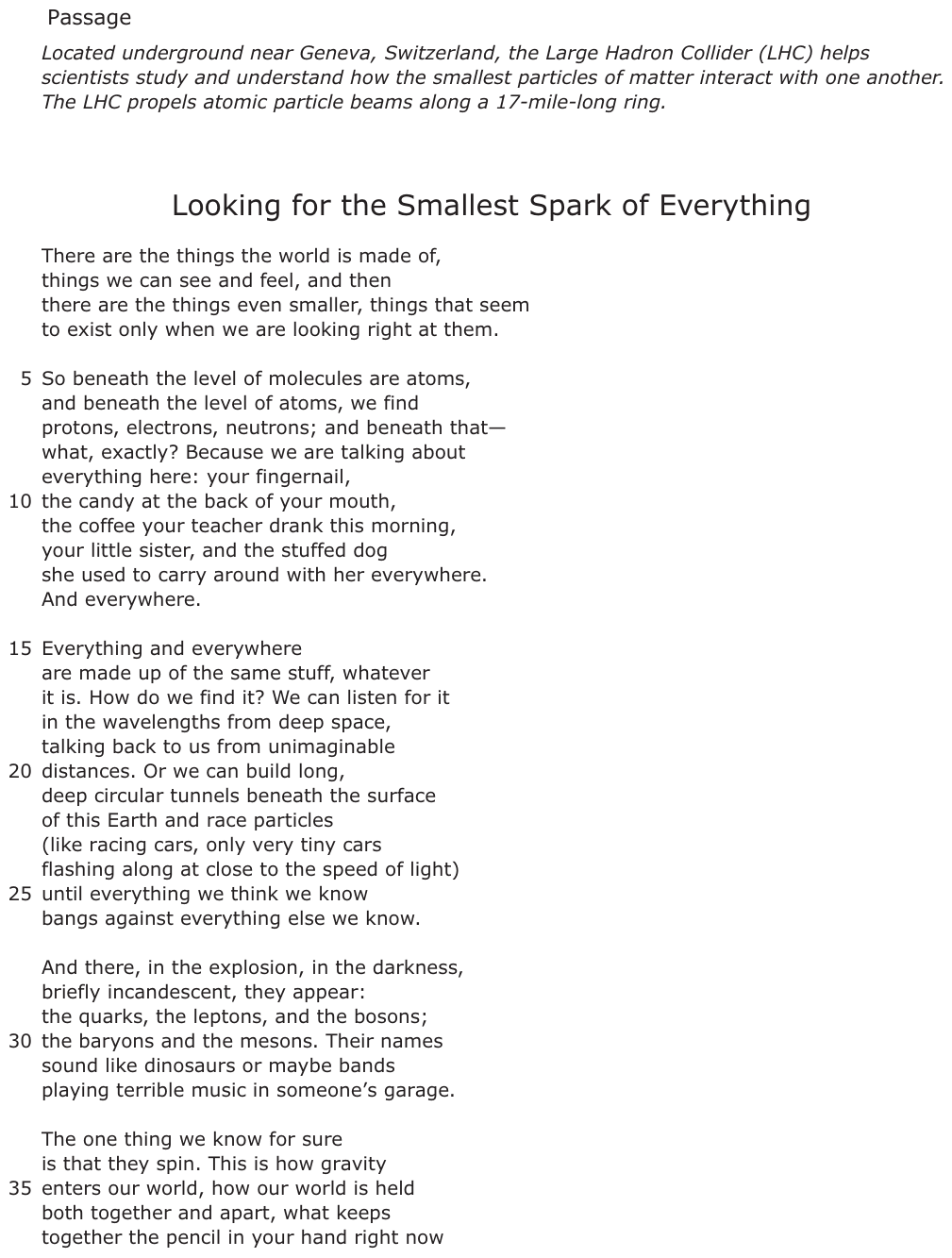
There are the things the world is made of,
things we can see and feel, and then
there are the things even smaller, things that seem
to exist only when we are looking right at them.
So beneath the level of molecules are atoms,
and beneath the level of atoms, we find
protons, electrons, neutrons; and beneath that—
what, exactly? Because we are talking about
everything here: your fingernail,
the candy at the back of your mouth,
the coffee your teacher drank this morning,
your little sister, and the stuffed dog
she used to carry around with her everywhere.
And everywhere.
Everything and everywhere
are made up of the same stuff, whatever
it is. How do we find it? We can listen for it
in the wavelengths from deep space,
talking back to us from unimaginable
distances. Or we can build long,
deep circular tunnels beneath the surface
of this Earth and race particles
(like racing cars, only very tiny cars
flashing along at close to the speed of light)
until everything we think we know
bangs against everything else we know.
And there, in the explosion, in the darkness,
briefly incandescent, they appear:
the quarks, the leptons, and the bosons;
the baryons and the mesons. Their names
sound like dinosaurs or maybe bands
playing terrible music in someone’s garage.
The one thing we know for sure
is that they spin. This is how gravity
enters our world, how our world is held
both together and apart, what keeps
together the pencil in your hand right now
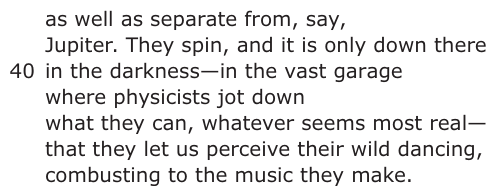
as well as separate from, say,
Jupiter. They spin, and it is only down there
in the darkness—in the vast garage
where physicists jot down
what they can, whatever seems most real—
that they let us perceive their wild dancing,
combusting to the music they make.
Question
The last stanza (lines 33–44) concludes the poem by emphasizing which central idea?
- AThe exciting work that physicists conduct provides information about fundamental aspects of the universe.
- BThe unusual work of physicists is carried out in unconventional locations and in special conditions.
- CPhysicists are learning about the unpredictable behavior of particles that break up matter in the universe.
- DPhysicists enthusiastically share the discoveries their research yields because most people can relate to their findings.
Show the answer
Correct answer: A
The question asks which central idea is emphasized in the last stanza (lines 33–44).
A. CORRECT. Throughout the poem, the speaker describes how everything in our universe and in our everyday lives is made up of these tiny particles. The last stanza allows us to picture the scientists working “in the darkness” (line 40), jotting down notes. Phrases like “wild dancing” (line 43) and “combusting to the music” (line 44) describe the activity of the particles and communicate the idea that the findings are exciting.
B. Incorrect. While the Large Hadron Collider is in an unconventional location that is important in the poem, it is the only location described in the poem: “it is only down there / in the darkness—in the vast garage” (lines 39–40). While the darkness is a special condition, the poem does not describe other conditions where the same type of research is being carried out. The poem does mention that “we can listen for it / in the wavelengths from deep space, / talking back to us from unimaginable / distances” (lines 17–20), but this description implies the use of a tool (a satellite), not a location.
C. Incorrect. The last stanza states that “The one thing we know for sure / is that they spin” (lines 33–34). This detail is one aspect of the particles’ behavior that is known; therefore, the particles are not completely unpredictable. In addition, the poem never describes the particles breaking up matter in the universe; the poem describes only their movements and collisions.
D. Incorrect. While the “physicists jot down / what they can, whatever seems most real” (lines 41–42), the research they share with the world is complicated and difficult to understand, making it unlikely that their findings are relatable to most people.
Question analysis
This central-idea question asks which idea the last stanza of “Looking for the Smallest Spark of Everything” (lines 33–44) emphasizes as it concludes the poem. The stanza moves from the particles’ spin and gravity to a pencil and Jupiter, then to physicists in an underground “vast garage,” so students must follow long, winding sentences and decide what the ending stresses.
- Grade level
- Grade 7 reading and task
- Compared with grade 7
- At grade 7 Identifying the central idea a closing stanza emphasizes is grade 7 work. This twelve-line stanza mixes physics with images of dancing and music in long sentences, but each choice can be tested against it directly, a typical grade 7 demand.
- Estimated difficulty
- Moderate: several steps, or a close reading with one strong distractor.
- Thinking it demands
- Depth of knowledge 2, skills and concepts · mainly analyze
- What makes it hard
- Complex sentences moderate
- Figurative or literary language moderate
- A very close wrong answer minor
- Evidence
- Answered from one paragraph or stanza
- Reading level
- Passage: 346 words (a poem; reading level not measured); question and choices: about grade 13, 73 words.
- Students, last 30 days
- Not enough answers yet to show (it takes 10).
Why it is hard, traps and wrong answers (shows the answer)
Why it is hard
The stanza joins two ideas: what the particles do for the whole world, holding a pencil together and apart from Jupiter, and the excitement of glimpsing them. The wrong choices each seize a vivid piece: the dark garage becomes the point, the wild dancing becomes unpredictable destruction, the pencil becomes findings people can relate to. Students who ask what the stanza says the research reveals, and how it sounds, pair the importance with the excitement.
Complex sentences moderate Understanding the question
The stanza’s second sentence runs from “This is how gravity” through three clauses to “Jupiter,” and its last builds to “it is only down there … that they let us perceive,” broken by a clause between dashes. (Abedi & Lord, 2001; Freedle & Kostin, 1993; Messick, 1989)
Figurative or literary language moderate Understanding the question
The particles’ “wild dancing,” “combusting to the music they make,” and the lab as “the vast garage” have to be read for excitement and wonder, not as reports of chaos or of a strange workplace. (Graesser, Singer & Trabasso, 1994; Kintsch, 1998)
A very close wrong answer minor Choosing the answer
The choice about physicists learning how particles behave mirrors the right one, physicists gaining knowledge of the universe, and parts from it only on what is learned, unpredictable particles breaking matter up. (Embretson & Wetzel, 1987; Gorin & Embretson, 2006; Ascalon et al., 2007)
Strategy: Paraphrase the last stanza sentence by sentence, ask which idea it shares with the rest of the poem, and check every part of each choice against the lines.
Traps
- Twists what the text says: Uses the text's topic and ideas but changes what it says: who did it, how much, when, or why.
- Too narrow: A single detail offered as the central idea or a summary, or a summary that keeps minor details and leaves out an essential part.
- Reads too much in: A reasonable-sounding conclusion that goes further than the text allows.
The wrong answers, classified
B Too narrow (King et al., 2004)
Fixes on the setting, “down there / in the darkness” of “the vast garage,” and makes the unusual workplace the central idea, though the stanza stresses what the physicists perceive there.
C Twists what the text says (King et al., 2004)
Turns the “wild dancing” and “combusting” into unpredictable behavior that breaks matter up, though the one sure thing is that the particles spin, which holds things together and keeps them separate.
D Reads too much in (Graesser, Singer & Trabasso, 1994)
Links “the pencil in your hand” to findings people can relate to and imagines physicists eagerly sharing them, though the stanza shows them only jotting down what they can.
Working it out, step by step
Find what the question wants
This asks which central idea the last stanza stresses as the poem ends. A central idea is a main message of the whole poem. The stanza is lines 33–44. Put it in plain words a piece at a time. Then see which choice matches all of it.
Read lines 33–39
The stanza opens, “The one thing we know for sure / is that they spin.” “They” are the tiny particles. Their spin is “how gravity / enters our world.” Gravity is the pull that keeps your feet on the ground. The spin keeps “the pencil in your hand” in one piece. It also keeps it separate from the planet Jupiter. So these particles shape how the whole universe works.
Read lines 39–44
We can see the particles only “down there / in the darkness,” in the huge underground lab the poet calls “the vast garage.” There, physicists, scientists who study matter and energy, “jot down / what they can.” The particles show “their wild dancing, / combusting to the music they make.” Combusting means bursting into flame. These images are lively and thrilling.
Put the stanza in one sentence
The stanza joins two ideas. The particles explain basic facts about the universe, such as gravity and why things hold together. And the physicists who study them get to glimpse something exciting. Fundamental means basic, at the root of everything. So the stanza stresses exciting work that reveals fundamental parts of the universe.
Check each choice
- A fits. It joins the exciting work with what the work reveals about the universe.
- B does not fit. The dark lab is just the setting. Most of the stanza is about what spin does and how thrilling the sight is.
- C does not fit. The one sure fact is that particles spin. “Apart” in line 36 means kept separate, like the pencil and Jupiter, not broken into pieces.
- D does not fit. The physicists only take notes. The stanza never shows them sharing findings or says most people relate to them.
Settle on the answer
Watch out: C is tempting because “wild dancing” and “combusting” sound out of control. But those words show excitement, not particles breaking matter apart. So the answer is A.
Why this answer and not the closest wrong one
C is the closest wrong choice, because the particles do seem wild. But the stanza begins with what is known for sure: they spin, and that spin holds our world together and apart. C turns a thrilling dance into destruction. A keeps both parts of the stanza: exciting research that shows how the universe is put together.
More questions like this
The original DOE question
The passage “Looking for the Smallest Spark of Everything” as printed (pages 32–33)