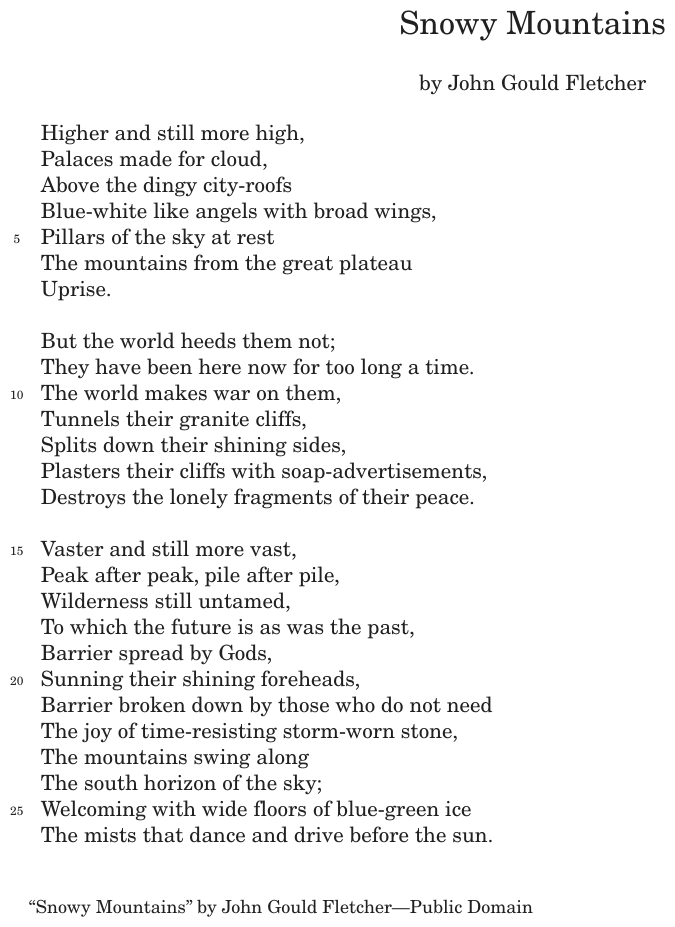
Passage Snowy Mountains
Snowy Mountains
by John Gould Fletcher
Higher and still more high,
Palaces made for cloud,
Above the dingy city-roofs
Blue-white like angels with broad wings,
Pillars of the sky at rest
The mountains from the great plateau
Uprise.
But the world heeds them not;
They have been here now for too long a time.
The world makes war on them,
Tunnels their granite cliffs,
Splits down their shining sides,
Plasters their cliffs with soap-advertisements,
Destroys the lonely fragments of their peace.
Vaster and still more vast,
Peak after peak, pile after pile,
Wilderness still untamed,
To which the future is as was the past,
Barrier spread by Gods,
Sunning their shining foreheads,
Barrier broken down by those who do not need
The joy of time-resisting storm-worn stone,
The mountains swing along
The south horizon of the sky;
Welcoming with wide floors of blue-green ice
The mists that dance and drive before the sun.
“Snowy Mountains” by John Gould Fletcher—Public Domain
Question
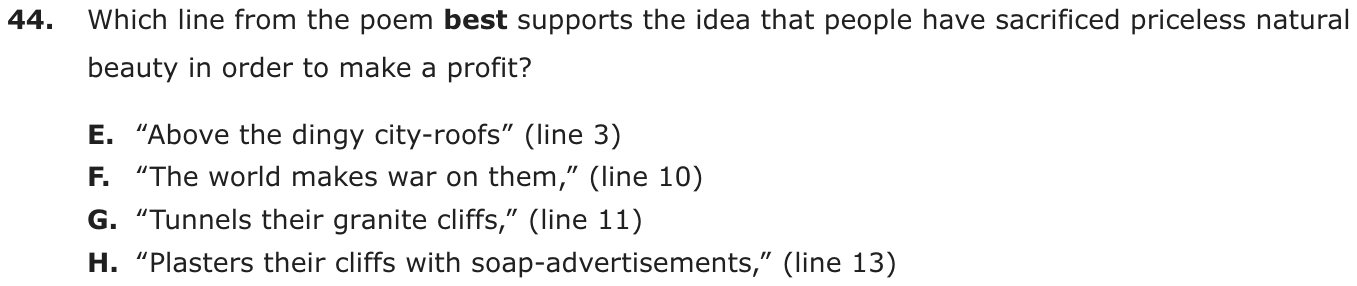
Which line from the poem best supports the idea that people have sacrificed priceless natural beauty in order to make a profit?
- A“Above the dingy city-roofs” (line 3)
- B“The world makes war on them,” (line 10)
- C“Tunnels their granite cliffs,” (line 11)
- D“Plasters their cliffs with soap-advertisements,” (line 13)
Show the answer
Correct answer: D
The question asks for the line from the poem that best supports the idea that people have sacrificed natural beauty for profit.
A. Incorrect. While city roofs may spoil the natural beauty, they do not directly symbolize financial gain or profit in line 3.
B. Incorrect. Although making a profit might have been the root cause of the damage that was done to the mountains, making war on the mountains is not a direct message about profit or financial gain in line 10.
C. Incorrect. Although tunneling through the mountains affects the natural beauty of the mountains, it does not directly symbolize financial gain or profit in line 11.
D. CORRECT. Advertisements are often used as a means to gain a profit, as implied by the soap advertisements in line 13. Additionally, the word “Plasters,” in line 13, communicates a negative connotation for the use of advertisements on the priceless natural beauty of the mountains.
Question analysis
In this textual evidence question on John Gould Fletcher’s poem “Snowy Mountains,” students pick the line that best backs the claim that people traded priceless natural beauty for profit. Most of the quoted lines show damage of some kind, so the deciding question is which one also shows why the damage was done.
- NYS standards
- 7R1 textual evidence and inferences
- Grade level
- Grade 7 reading and task
- Compared with grade 7
- At grade 7 Matching a claim to a quoted line is standard grade 7 evidence work, and these four lines are short and numbered. The images are concrete, so little inference is needed once the claim is read carefully.
- Estimated difficulty
- Straightforward: two steps or one careful reading.
- Thinking it demands
- Depth of knowledge 2, skills and concepts · mainly evaluate
- What makes it hard
- Every choice must be checked moderate
- Reading between the lines minor
- Evidence
- Answered from one sentence or line
- Reading level
- Passage: 161 words (a poem; reading level not measured); question and choices: about grade 6, 45 words.
- Students, last 30 days
- Not enough answers yet to show (it takes 10).
Why it is hard, traps and wrong answers (shows the answer)
Why it is hard
Three of the four quoted lines show damage to the mountains, which meets the first half of the claim and makes the question a test of the second half. Students who look only for harm tend to settle on the loudest image of attack, “makes war on them.” The one line that contains a product for sale is the only one showing beauty traded for money, and once that is seen the choice is quick.
Every choice must be checked moderate Choosing the answer
Lines 10, 11 and 13 all show people harming the mountains, so each must be held against the claim’s second half, making a profit, which only one of them carries. (Embretson & Wetzel, 1987)
Reading between the lines minor Working it out
No line names money; profit has to be read from “soap-advertisements,” which exist to sell a product, while “Plasters” supplies the spoiling of the cliffs’ beauty. (Graesser, Singer & Trabasso, 1994; Kintsch, 1998)
Strategy: Underline the two things the claim needs, harm to the mountains’ beauty and a money motive, then read each quoted line and cross out any that shows only one of them.
Traps
- Supports only part of the claim: In a question about evidence: a line that backs one half of the claim but not the other, or a related point rather than the claim itself.
- Outside knowledge: A choice is plausible in the real world but not supported by this text.
The wrong answers, classified
A Reads too much in (Graesser, Singer & Trabasso, 1994)
Connects “dingy city-roofs” with industry and money-making, but line 3 only places the city below the peaks and shows neither profit nor harm done to them.
B Supports only part of the claim (King et al., 2004; Thissen, Steinberg & Fitzpatrick, 1989)
Chooses the stanza’s fiercest line, but “makes war on them” shows attack in general with no motive, so it backs the lost beauty without the profit.
C Outside knowledge (King et al., 2004; Recht & Leslie, 1988)
Brings in a real-world reason, tunnels dug for railways or mines that earn money, though line 11 itself shows only the cliffs being cut, with no sign of gain.
Working it out, step by step
Figure out what the question asks
This asks for evidence: the line that best supports an idea. Notice that the idea makes two claims. People have spoiled the mountains’ beauty, and they did it to make money, or a profit. The best line must show both parts, not just one.
Read the four lines in the poem
Choice A, “Above the dingy city-roofs,” comes from the first stanza, where the poem praises the peaks. Dingy means grimy and gloomy. The other three choices come from the second stanza, where people attack the mountains. In order, they are “The world makes war on them” (line 10), “Tunnels their granite cliffs” (line 11) and “Plasters their cliffs with soap-advertisements” (line 13).
Test each line for harm and money
An advertisement is a sign that tries to get you to buy something. Soap ads are there to sell soap, so they are about profit. To plaster something is to cover it thickly and messily, like paste on a wall. Picture the bright cliffs smeared with ugly signs, all to sell a product.
Line Harms the mountains? Shows money? 3 No No 10 Yes No 11 Yes No 13 Yes Yes Check each choice
- A does not fit. Line 3 only places the dirty city below the peaks. It shows no harm to the mountains and no money.
- B does not fit. The words “makes war” show an attack, but not the reason for it.
- C does not fit. Tunnels do damage the cliffs. You may know that tunnels are dug for trains or mines, but the line itself never mentions money.
- D fits. It shows the beauty spoiled and a product being sold.
Choose the answer
Only line 13 shows both the harm and the money behind it. So the answer is D, line 13.
Why this answer and not the closest wrong one
B is the strongest trap, because “makes war” is the fiercest image of harm in the poem. But the idea also needs a reason: making a profit. War on the mountains could happen for any reason. Only the soap ads show something being sold, so only D backs up both parts of the idea.
More questions like this
The original DOE question
The passage “Snowy Mountains” as printed (page 142)