Passage Snowy Mountains
Snowy Mountains
by John Gould Fletcher
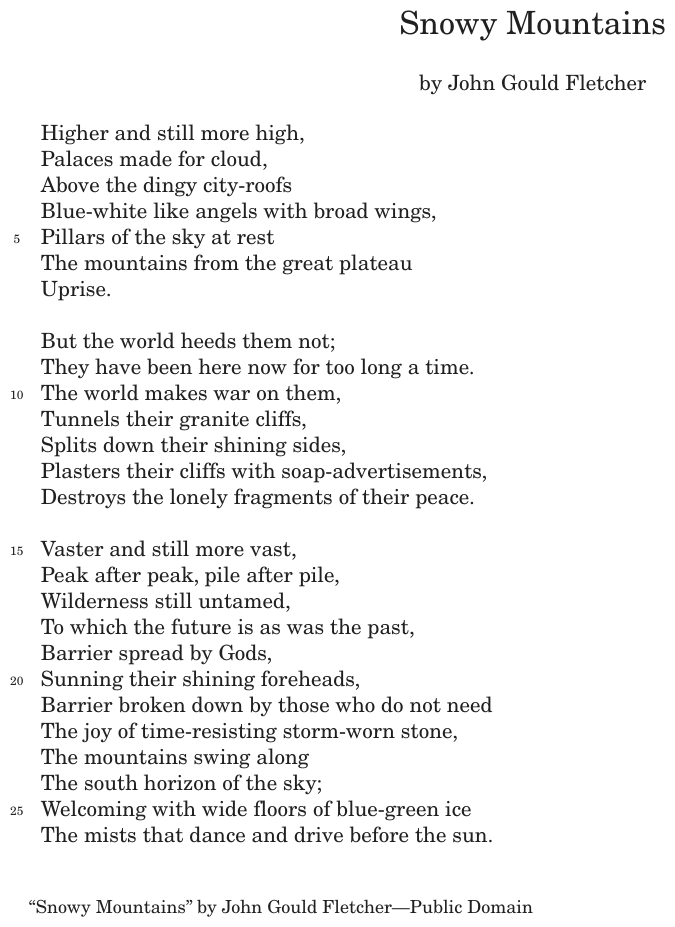
Higher and still more high,
Palaces made for cloud,
Above the dingy city-roofs
Blue-white like angels with broad wings,
Pillars of the sky at rest
The mountains from the great plateau
Uprise.
But the world heeds them not;
They have been here now for too long a time.
The world makes war on them,
Tunnels their granite cliffs,
Splits down their shining sides,
Plasters their cliffs with soap-advertisements,
Destroys the lonely fragments of their peace.
Vaster and still more vast,
Peak after peak, pile after pile,
Wilderness still untamed,
To which the future is as was the past,
Barrier spread by Gods,
Sunning their shining foreheads,
Barrier broken down by those who do not need
The joy of time-resisting storm-worn stone,
The mountains swing along
The south horizon of the sky;
Welcoming with wide floors of blue-green ice
The mists that dance and drive before the sun.
“Snowy Mountains” by John Gould Fletcher—Public Domain
Question
How does the poet develop the speaker’s point of view in the second stanza (lines 8–14)?
- Aby describing images of the mountains’ awe-inspiring size and strength
- Bby illustrating the differences among the various ways humans can affect the natural environment
- Cby criticizing society for taking careless, harmful courses of action against nature
- Dby demonstrating how the mountains and the people are able to benefit from each other
Show the answer
Correct answer: C
The question asks how the poet develops the speaker’s point of view in the second stanza.
A. Incorrect. The speaker’s descriptions of the mountains’ awe-inspiring size and strength mainly occur in the first and third stanzas, while in the second stanza, the speaker focuses on humanity and its negative effect on the mountains.
B. Incorrect. The wording of the second stanza—“makes war” (line 10), “Splits down their shining sides” (line 12), and “Destroys the lonely fragments” (line 14)—communicates the speaker’s position that people’s main impact on the mountains is destructive; the wording does not illustrate different ways people impact the natural environment.
C. CORRECT. In the second stanza, the speaker criticizes the destructive actions of “the world” (lines 8 and 10) against the mountains—actions such as tunneling “their granite cliffs” (line 11) and destroying “the lonely fragments of their peace” (line 14).
D. Incorrect. In the second stanza, the speaker does not describe a positive relationship between the mountains and the people.
Question analysis
This point-of-view question on the poem “Snowy Mountains” asks how the poet develops the speaker’s outlook in the second stanza, lines 8–14. Students must read the stanza on its own, decide what attitude its images and verbs express, and then find the choice that names both that attitude and the way it comes across.
- Grade level
- Grade 6 reading and task
- Compared with grade 7
- Below grade 7 Below typical grade 7 demand. Grade 7 point-of-view questions often require weighing subtle or shifting attitudes; this stanza is seven short lines with one consistent stance, carried by strong action words, so it suits grade 6.
- Estimated difficulty
- Straightforward: two steps or one careful reading.
- Thinking it demands
- Depth of knowledge 2, skills and concepts · mainly analyze
- What makes it hard
- How, not what moderate
- Figurative or literary language minor
- Evidence
- Answered from one paragraph or stanza
- Reading level
- Passage: 161 words (a poem; reading level not measured); question and choices: about grade 10, 66 words.
- Students, last 30 days
- Not enough answers yet to show (it takes 10).
Why it is hard, traps and wrong answers (shows the answer)
Why it is hard
The speaker’s anger in lines 8–14 is plain, and most students sense that the stanza blames people. Points are lost to choices that describe the poem’s admiration of the peaks, which belongs to the stanzas around this one, or that list the stanza’s actions without their hostility. Staying inside the seven lines and reading the attitude in verbs such as “makes war” and “Destroys” settles it quickly.
How, not what moderate Working it out
The stem asks how the viewpoint is built, and the answer lies in what the world does in lines 10–14: it “makes war,” “Tunnels,” “Splits,” “Plasters” and “Destroys.” (Anderson & Krathwohl, 2001)
Figurative or literary language minor Understanding the question
The stanza personifies the mountains as victims, ignored and robbed of “the lonely fragments of their peace,” so the criticism of people comes through sympathy for the peaks. (Graesser, Singer & Trabasso, 1994; Kintsch, 1998)
Strategy: Read lines 8–14 by themselves and put the speaker’s attitude into a few words of your own before looking at the choices.
Traps
- Twists what the text says: Uses the text's topic and ideas but changes what it says: who did it, how much, when, or why.
- Wrong part of the text: A choice is true of another paragraph, stanza or speaker than the one asked about.
The wrong answers, classified
A Wrong part of the text (Kirsch & Mosenthal, 1990)
Describes the first and third stanzas, which marvel at the peaks’ height and vastness; in lines 8–14 the “granite cliffs” and “shining sides” appear only as things being damaged.
B Twists what the text says (King et al., 2004)
Sees that the stanza names several human actions, tunneling, splitting and plastering, but they are all blows in one “war,” not different kinds of effect laid side by side.
D Wrong tone or attitude (Graesser, Singer & Trabasso, 1994)
Reads tunnels and advertisements as people putting the mountains to use, a kind of exchange, and misses the hostility of “The world makes war on them.”
Working it out, step by step
Figure out what the question asks
This asks about point of view. That is how the speaker, the voice talking in the poem, feels about the subject. It also asks how the poet shows that feeling. Look only at the second stanza, lines 8 to 14.
Read the second stanza closely
The stanza opens with “But the world heeds them not” (line 8). To heed something is to pay attention to it. Then “the world” starts to act. It “makes war on them,” “Tunnels their granite cliffs,” and “Splits down their shining sides.” It covers them with ads. Finally, in line 14, it “Destroys the lonely fragments of their peace.”
Decide what the speaker thinks
Here “the world” means people in general. People ignore the mountains, yet keep hurting them. Each action is an attack: making war, tunneling, splitting, plastering, destroying. The speaker is clearly on the mountains’ side. By listing these acts, the speaker blames people for being careless and harmful. Blaming someone for what they do wrong is called criticism.
Check each choice
- A does not fit. Size and strength fill the first and third stanzas, as in “Higher and still more high” and “Vaster and still more vast.” In lines 8 to 14, the mountains are only victims.
- B does not fit. The stanza lists several acts, but it does not compare them. They are all part of one “war.”
- C fits. The stanza blames society for ignoring and harming the mountains.
- D does not fit. The stanza shows no give-and-take. People only harm the mountains, and the mountains get nothing back.
Choose the answer
The speaker’s view comes through a list of careless, harmful acts that the poem plainly condemns. So the answer is C.
Why this answer and not the closest wrong one
B is the closest wrong choice, because the stanza really does name several ways people affect the mountains. But the speaker is not studying how they differ. Each one is another blow in the same attack, and the speaker is upset by all of them. C names that anger as criticism, which is what the stanza does.
More questions like this
The original DOE question
The passage “Snowy Mountains” as printed (page 142)