Also in 2024 Test B English, question 46; 2026 Practice Test A English, question 2; 2025 Practice Test A English, question 2.
Passage Snowy Mountains
Snowy Mountains
by John Gould Fletcher
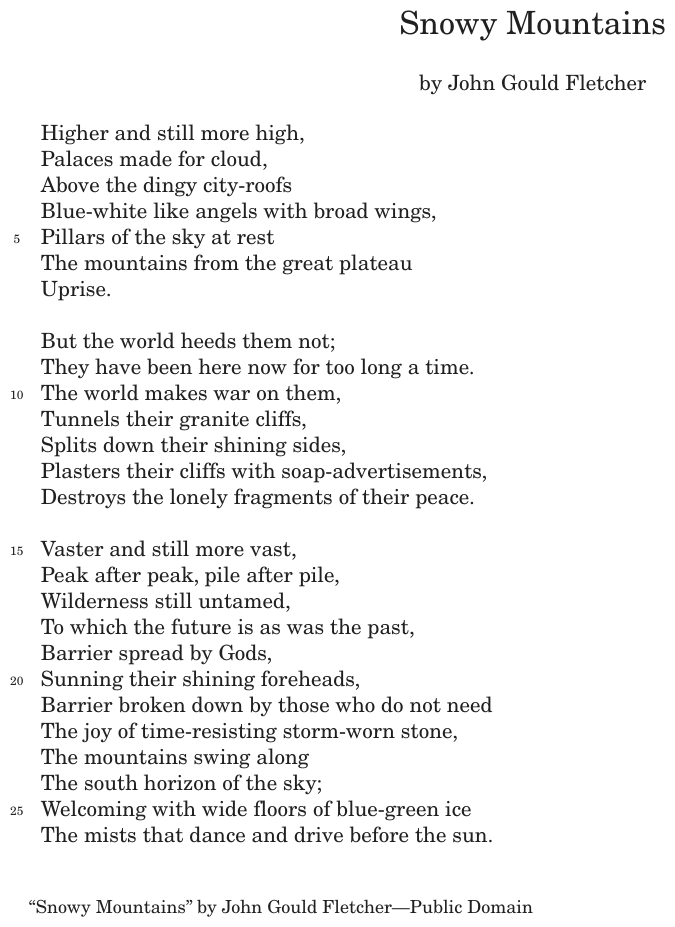
Higher and still more high,
Palaces made for cloud,
Above the dingy city-roofs
Blue-white like angels with broad wings,
Pillars of the sky at rest
The mountains from the great plateau
Uprise.
But the world heeds them not;
They have been here now for too long a time.
The world makes war on them,
Tunnels their granite cliffs,
Splits down their shining sides,
Plasters their cliffs with soap-advertisements,
Destroys the lonely fragments of their peace.
Vaster and still more vast,
Peak after peak, pile after pile,
Wilderness still untamed,
To which the future is as was the past,
Barrier spread by Gods,
Sunning their shining foreheads,
Barrier broken down by those who do not need
The joy of time-resisting storm-worn stone,
The mountains swing along
The south horizon of the sky;
Welcoming with wide floors of blue-green ice
The mists that dance and drive before the sun.
“Snowy Mountains” by John Gould Fletcher—Public Domain
Question
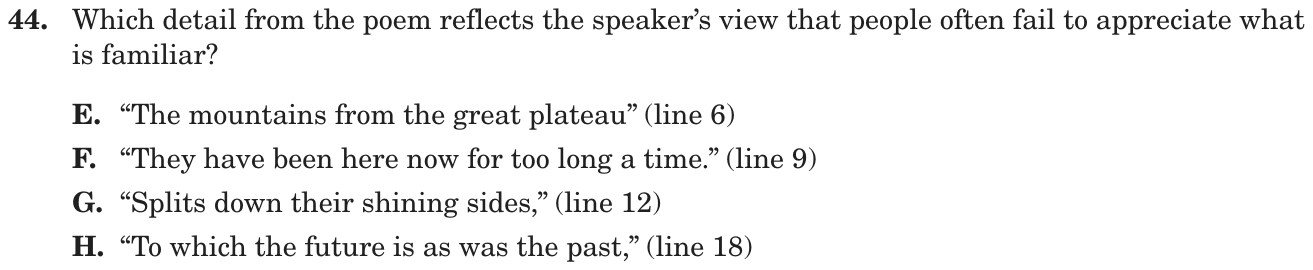
Which detail from the poem reflects the speaker’s view that people often fail to appreciate what is familiar?
- A“The mountains from the great plateau” (line 6)
- B“They have been here now for too long a time.” (line 9)
- C“Splits down their shining sides,” (line 12)
- D“To which the future is as was the past,” (line 18)
Show the answer
Correct answer: B
The question asks for the detail from the poem that reflects the speaker’s view that people often fail to appreciate that which is familiar.
Line 9 (Option B) most directly supports this idea by implying that the mountains have been here for so long that people are accustomed to seeing them and no longer appreciate their beauty and value, making Option B the correct response.
Option A is incorrect because line 6 describes the mountains’ location, rather than their longevity or familiarity.
Option C is incorrect because, in line 12, the mention of harm that has been done to the mountains does not connect to a sense of overfamiliarity.
Option D is incorrect because, although line 18 alludes to the longevity of the mountains, it does not connect the longevity with a sense of overfamiliarity or the failure of people to appreciate the mountains’ worth.
Question analysis
Students pick the detail from the poem “Snowy Mountains” that reflects the speaker’s view that people often fail to appreciate what is familiar. The idea is never stated outright, so students must read each quoted line in its context and decide which one implies both familiarity and a loss of appreciation.
- Grade level
- Grade 7 reading and task
- Compared with grade 7
- At grade 7 Evidence questions like this are typical grade 7 work, but the support here is implied rather than stated, which adds an inference step beyond simple matching of words.
- Estimated difficulty
- Moderate: several steps, or a close reading with one strong distractor.
- Thinking it demands
- Depth of knowledge 2, skills and concepts · mainly evaluate
- What makes it hard
- Reading between the lines moderate
- Every choice must be checked minor
- Evidence
- Answered from one sentence or line
- Reading level
- Passage: 161 words (a poem; reading level not measured); question and choices: about grade 3, 52 words.
- Students, last 30 days
- Not enough answers yet to show (it takes 10).
Why it is hard, traps and wrong answers (shows the answer)
Why it is hard
The claim joins two ideas, long familiarity and failing to appreciate, and the right line shows them only together with the line before it. Students who match the idea of time pick the line about the future and the past, and those who match neglect pick a line of damage. Reading line 9 as the explanation for line 8 is the key move.
Reading between the lines moderate Working it out
The line never says “familiar”; its meaning comes from its place right after “But the world heeds them not,” where being here “too long” reads as the reason for that neglect. (Graesser, Singer & Trabasso, 1994; Kintsch, 1998)
Every choice must be checked minor Choosing the answer
Each quoted line has to be read in its stanza, because out of context lines 9 and 18 both sound like statements about time. (Embretson & Wetzel, 1987)
Strategy: Restate the claim as “people stop valuing something because they are used to it,” then check each quoted line within its stanza for a reason people might stop noticing the mountains.
Traps
- Supports only part of the claim: In a question about evidence: a line that backs one half of the claim but not the other, or a related point rather than the claim itself.
The wrong answers, classified
A Little reason to choose it (Haladyna & Downing, 1993; Rodriguez, 2005)
Line 6 only places the mountains above “the great plateau” and touches neither familiarity nor appreciation, so it mainly draws students who are guessing.
C Supports only part of the claim (King et al., 2004; Thissen, Steinberg & Fitzpatrick, 1989)
Shows people harming the mountains, which fits the speaker’s complaint that they are not valued, but “Splits down their shining sides” gives no sign that familiarity is the cause.
D Supports only part of the claim (King et al., 2004; Thissen, Steinberg & Fitzpatrick, 1989)
Notices that line 18 stresses how long the mountains endure, but it describes their permanence, not people growing used to them and ceasing to value them.
Working it out, step by step
Figure out what the question asks
This asks for a line that shows one of the speaker’s views: people often fail to appreciate what is familiar. Familiar means something you know well and see all the time. To appreciate is to value something. So the line must show people no longer valuing the mountains because they are used to them.
Read each line in its place
Line 9 says, “They have been here now for too long a time.” Read it with line 8 just before it: “But the world heeds them not.” “Heeds” means pays attention to. So the world ignores the mountains. Line 9 gives the reason. They have been around so long that people are used to them.
Explain what line 9 means
The mountains have not done anything wrong by being old. The words “too long” show how people feel about them. Something you see every day starts to seem plain. You stop noticing it. That is exactly the idea in the question: people stop valuing what is familiar.
Check each choice
- A is wrong. Line 6 only tells where the mountains are, above “the great plateau.”
- B fits. It explains that people ignore the mountains because they have seen them for so long.
- C is wrong. Line 12 shows harm, but it does not say familiarity is the cause.
- D is wrong. Line 18 means the mountains do not change over time. It is about how long they last, not about people getting used to them.
Choose the answer
Line 9 explains why the world ignores the mountains: people are too used to them. So the answer is B, “They have been here now for too long a time.”
Why this answer and not the closest wrong one
D is the closest trap, since lines 9 and 18 both talk about time. But line 18 praises the mountains for lasting. Line 9 follows “the world heeds them not” and explains it. Only line 9 links long familiarity to people not caring.
More questions like this
The original DOE question
The passage “Snowy Mountains” as printed (page 142)