Passage Snowy Mountains
Snowy Mountains
by John Gould Fletcher
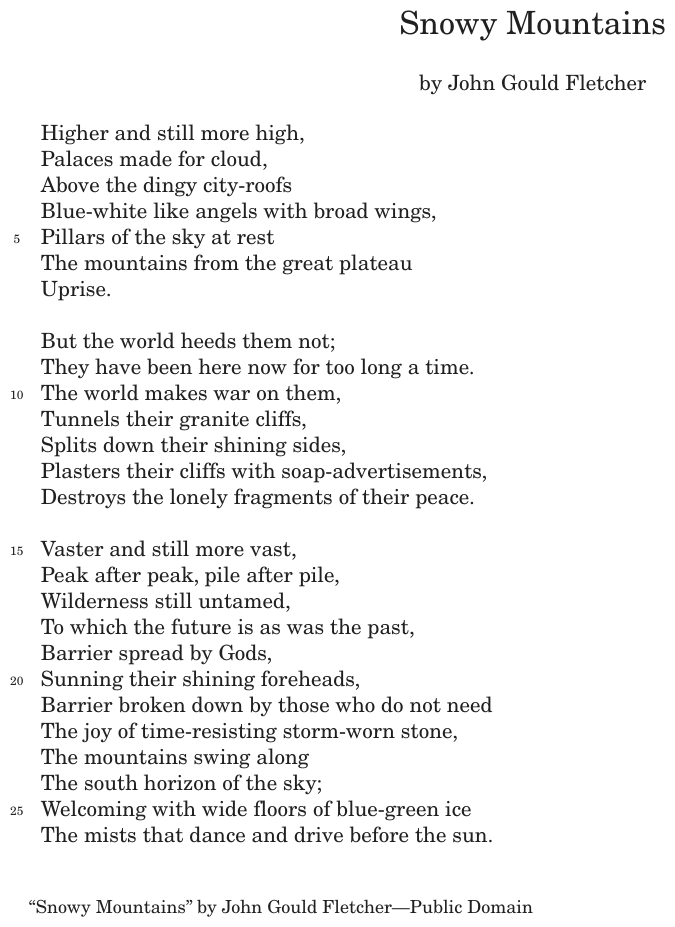
Higher and still more high,
Palaces made for cloud,
Above the dingy city-roofs
Blue-white like angels with broad wings,
Pillars of the sky at rest
The mountains from the great plateau
Uprise.
But the world heeds them not;
They have been here now for too long a time.
The world makes war on them,
Tunnels their granite cliffs,
Splits down their shining sides,
Plasters their cliffs with soap-advertisements,
Destroys the lonely fragments of their peace.
Vaster and still more vast,
Peak after peak, pile after pile,
Wilderness still untamed,
To which the future is as was the past,
Barrier spread by Gods,
Sunning their shining foreheads,
Barrier broken down by those who do not need
The joy of time-resisting storm-worn stone,
The mountains swing along
The south horizon of the sky;
Welcoming with wide floors of blue-green ice
The mists that dance and drive before the sun.
“Snowy Mountains” by John Gould Fletcher—Public Domain
Question
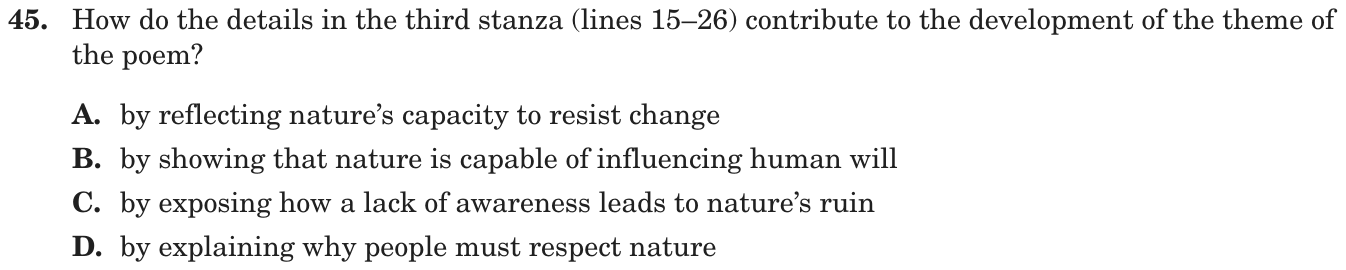
How do the details in the third stanza (lines 15–26) contribute to the development of the theme of the poem?
- Aby reflecting nature’s capacity to resist change
- Bby showing that nature is capable of influencing human will
- Cby exposing how a lack of awareness leads to nature’s ruin
- Dby explaining why people must respect nature
Show the answer
Correct answer: A
The question asks how the details in the third stanza contribute to the development of the theme of the poem. In the third stanza, phrases such as “Wilderness still untamed” (line 17), “time-resisting storm-worn stone” (line 22), and “The mountains swing along” (line 23) convey the message that in spite of the destruction described in the second stanza, the mountains manage to maintain their wild magnificence. This message is communicated in Option A.
Option B is incorrect because, while the phrase “Barrier broken down” (line 21) conveys the idea that people can have some effect on the natural landscape, it does not convey how nature affects people.
Option C is incorrect because the phrase “those who do not need” (line 21) implies a choice to damage nature and not a lack of awareness or understanding.
Option D is incorrect because the third stanza is not a call to humanity to respect the mountains but a description of the untamed, welcoming mountains and the joy they provide for those who appreciate them.
Question analysis
This theme question asks how the details in the third stanza of “Snowy Mountains” contribute to the poem’s message. The stanza piles up images of peaks, gods, ice and mist alongside a line about a barrier broken down, so students must weigh all of its details and decide which idea about nature and people they add up to.
- Grade level
- Grade 8 reading and task
- Compared with grade 7
- Above grade 7 Grade 7 students trace how a theme develops, but this stanza is one long, layered sentence that mixes praise with loss, and the choices offer different, believable messages about nature, which makes it closer to grade 8 work.
- Estimated difficulty
- Hard: combines ideas, needs a plan, and has more than one tempting wrong answer.
- Thinking it demands
- Depth of knowledge 3, strategic thinking · mainly analyze
- What makes it hard
- Complex sentences moderate
- Figurative or literary language moderate
- Evidence in several places moderate
- Evidence
- Answered from one paragraph or stanza
- Reading level
- Passage: 161 words (a poem; reading level not measured); question and choices: about grade 7, 54 words.
- Corrected from the DOE handbook
- A misquotation of the poem in the explanation was corrected.
- Students, last 30 days
- Not enough answers yet to show (it takes 10).
Why it is hard, traps and wrong answers (shows the answer)
Why it is hard
The third stanza holds both endurance and damage, and the question asks which one its details mostly build. Students who fix on the broken barrier choose ruin, which the poem’s second stanza seems to confirm, while those who count the stanza’s details find untamed wilderness, time-resisting stone and mountains swinging along the horizon. The long, inverted sentence makes that count slow, which is why the question is hard.
Complex sentences moderate Understanding the question
Lines 15–26 form one sentence in which a string of descriptive phrases precedes the subject, “The mountains,” in line 23, so the stanza’s overall point is hard to hold together. (Abedi & Lord, 2001; Freedle & Kostin, 1993; Messick, 1989)
Figurative or literary language moderate Understanding the question
The mountains are given “shining foreheads,” said to be “spread by Gods,” and shown to “swing along” and welcome mists, and these personifications carry the stanza’s message of endurance. (Graesser, Singer & Trabasso, 1994; Kintsch, 1998)
Evidence in several places moderate Working it out
The theme has to be built from details scattered through twelve lines, “Wilderness still untamed,” “the future is as was the past,” “time-resisting storm-worn stone,” and weighed against the one line of damage. (Kirsch & Mosenthal, 1990; Gorin & Embretson, 2006)
Strategy: List what the third stanza says about the mountains and what it says about people, then pick the choice that fits most of those details, not just one line.
Traps
- Too narrow: A single detail offered as the central idea or a summary, or a summary that keeps minor details and leaves out an essential part.
- Outside knowledge: A choice is plausible in the real world but not supported by this text.
- Reversed relationship: Cause and effect, or the order of events, turned around.
The wrong answers, classified
B Reversed relationship (King et al., 2004)
Reverses who acts on whom: the stanza shows people breaking down the barrier and the mountains enduring, with no sign that nature shapes what people want.
C Too narrow (King et al., 2004)
Builds on line 21’s “Barrier broken down,” a single line of damage among many lines of endurance, and so mistakes one detail for the stanza’s contribution.
D Outside knowledge (King et al., 2004; Recht & Leslie, 1988)
States a familiar environmental lesson, that people must respect nature, but the stanza describes the mountains and never argues or explains what people should do.
What was corrected from the DOE handbook, and why
- Explanation: The handbook quotes line 21 as “those who do not heed.” The line reads “Barrier broken down by those who do not need,” so the site now quotes “those who do not need.”
Working it out, step by step
Figure out what the question asks
This asks what the third stanza, lines 15 to 26, adds to the poem’s theme, or big message. You need to look at all the details in those twelve lines and see what most of them say. Don’t build your answer on just one line.
Collect the stanza’s details
The stanza calls the mountains a “Wilderness still untamed” in line 17. Line 18 says “the future is as was the past,” so they do not change. Line 22 speaks of “time-resisting storm-worn stone.” Line 23 says “The mountains swing along.” Only line 21 shows harm: “Barrier broken down.”
Explain what the details add up to
“Untamed” means still wild and not controlled by people. “Time-resisting” means holding out against time. “Storm-worn” means worn by storms but still standing. Even after the harm in stanza 2, the mountains are still wild. They still swing along the edge of the sky. So the stanza shows that nature can resist change. Capacity means ability.
Check each choice
- A fits. Most details show the mountains lasting and staying wild.
- B is wrong. It flips who acts. People act on the mountains. The mountains do not change what people want.
- C is wrong. Line 21 shows some damage, but it is one line. The rest of the stanza shows the mountains enduring, not ruined.
- D is wrong. The stanza describes the mountains. It never tells people what they must do.
Choose the answer
Most of the third stanza shows the mountains staying wild and strong over time. So the answer is A, “by reflecting nature’s capacity to resist change.”
Why this answer and not the closest wrong one
C is the strongest trap, because stanza 2 really is about harm. But this question is about stanza 3. Count its details. Untamed wilderness, an unchanging future, time-resisting stone and mountains swinging along all show endurance. Only one line shows damage, so A fits the stanza as a whole.
More questions like this
The original DOE question
The passage “Snowy Mountains” as printed (page 142)