Also in 2024 Test B English, question 43; 2026 Practice Test A English, question 3; 2025 Practice Test A English, question 3.
Passage Snowy Mountains
Snowy Mountains
by John Gould Fletcher
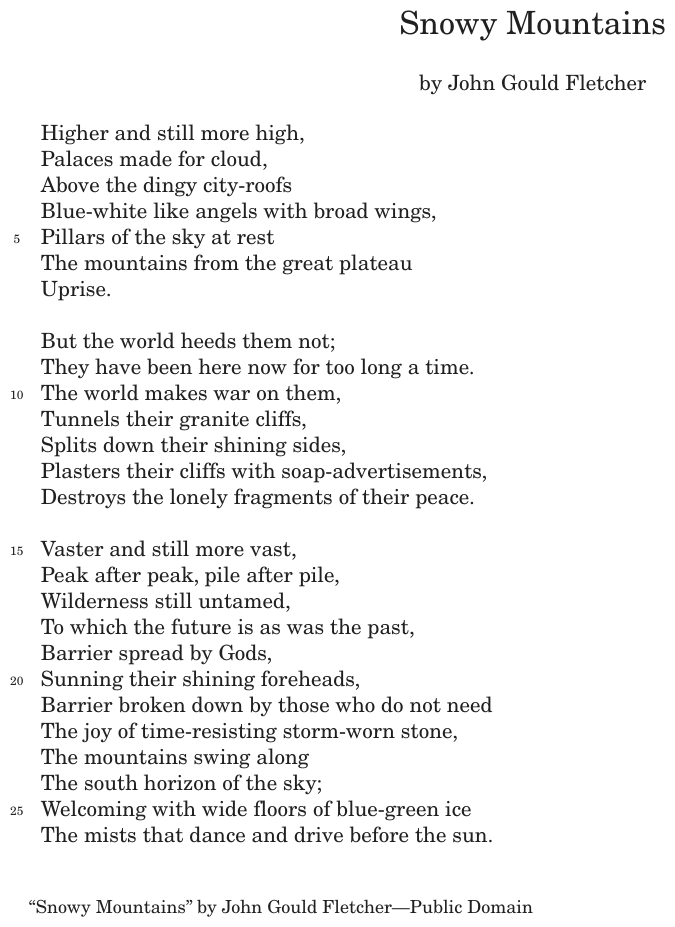
Higher and still more high,
Palaces made for cloud,
Above the dingy city-roofs
Blue-white like angels with broad wings,
Pillars of the sky at rest
The mountains from the great plateau
Uprise.
But the world heeds them not;
They have been here now for too long a time.
The world makes war on them,
Tunnels their granite cliffs,
Splits down their shining sides,
Plasters their cliffs with soap-advertisements,
Destroys the lonely fragments of their peace.
Vaster and still more vast,
Peak after peak, pile after pile,
Wilderness still untamed,
To which the future is as was the past,
Barrier spread by Gods,
Sunning their shining foreheads,
Barrier broken down by those who do not need
The joy of time-resisting storm-worn stone,
The mountains swing along
The south horizon of the sky;
Welcoming with wide floors of blue-green ice
The mists that dance and drive before the sun.
“Snowy Mountains” by John Gould Fletcher—Public Domain
Question
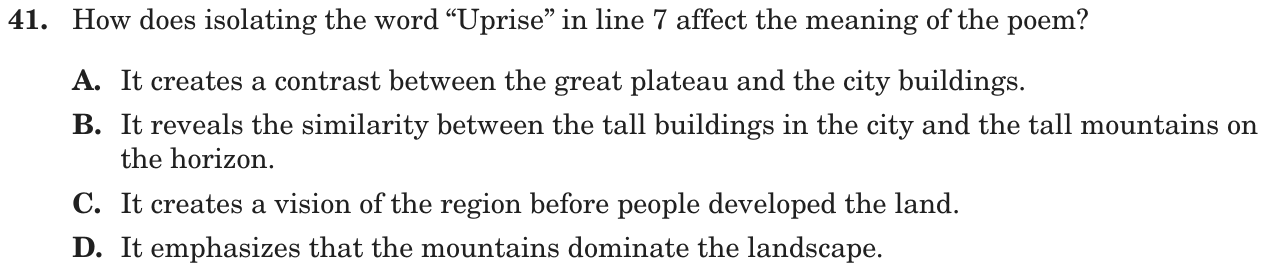
How does isolating the word “Uprise” in line 7 affect the meaning of the poem?
- AIt creates a contrast between the great plateau and the city buildings.
- BIt reveals the similarity between the tall buildings in the city and the tall mountains on the horizon.
- CIt creates a vision of the region before people developed the land.
- DIt emphasizes that the mountains dominate the landscape.
Show the answer
Correct answer: D
The question asks how the isolation of the word affects the meaning of the poem. The isolation of the word “Uprise” powerfully emphasizes the first stanza’s description of the magnificent mountains standing tall above the land below, as expressed in Option D.
Option A is incorrect because the word describes the mountains and, therefore, does not create a contrast between the plateau and the city buildings, but rather between the mountains and the plateau.
Option B is incorrect because the word contrasts the mountains with the plateau; it does not compare the mountains to the buildings in the city.
Option C is incorrect because the first stanza describes the already developed land over which the mountains rise.
Question analysis
In “Snowy Mountains,” the opening stanza builds a long sentence about the mountains and saves its verb, “Uprise,” for a line of its own. This poetry structure question asks how isolating that single word affects the poem’s meaning, so students need to think about how a line break shapes what the reader notices, as well as about what the stanza describes.
- Grade level
- Grade 8 reading and task
- Compared with grade 7
- At grade 7 Grade 7 poetry questions often ask about word choice; this one asks about a structural choice, a one-word line, which is less familiar, though the stanza’s images make the intended effect fairly easy to sense.
- Estimated difficulty
- Moderate: several steps, or a close reading with one strong distractor.
- Thinking it demands
- Depth of knowledge 2, skills and concepts · mainly analyze
- What makes it hard
- Complex sentences moderate
- How, not what moderate
- Evidence
- Answered from one paragraph or stanza
- Reading level
- Passage: 161 words (a poem; reading level not measured); question and choices: about grade 8, 64 words.
- Students, last 30 days
- Not enough answers yet to show (it takes 10).
Why it is hard, traps and wrong answers (shows the answer)
Why it is hard
Students who see that “Uprise” is the verb the whole stanza has been building toward recognize the effect quickly: the mountains rise over everything else in the picture. Those who treat the word as one more image look for a comparison instead and find several, because the stanza is full of buildings, roofs and a plateau. The real test is sorting which contrast belongs to the mountains.
Complex sentences moderate Understanding the question
The stanza is one long sentence that withholds its subject until line 6 and its verb until line 7, so “Uprise” lands as the payoff of five lines of images. (Abedi & Lord, 2001; Freedle & Kostin, 1993; Messick, 1989)
How, not what moderate Working it out
The question asks about a line break, a structural choice, rather than a word’s meaning, and students must judge what setting one verb on its own line makes the reader notice. (Anderson & Krathwohl, 2001)
Strategy: Read the stanza aloud and notice where the long sentence finally reaches its verb, then ask what ending on that single word makes the reader see.
Traps
- Taking figurative language literally: A choice reads a figure of speech or image at face value.
- Half right: One half of a two-part choice is right and the other is not.
The wrong answers, classified
A Half right (King et al., 2004; Thissen, Steinberg & Fitzpatrick, 1989)
Rightly senses a contrast in the stanza but pairs the wrong things: “Uprise” sets the mountains against the land below them, not the plateau against the city’s buildings.
B Twists what the text says (King et al., 2004)
Notices that the mountains are compared to “Palaces” and “Pillars,” but those grand buildings are set against the “dingy city-roofs,” so the stanza contrasts mountains and city rather than likening them.
C Taking figurative language literally (Graesser, Singer & Trabasso, 1994)
Takes “Uprise” at face value, as mountains pushing up out of the plateau long ago, but line 3’s “dingy city-roofs” place the scene in a land already built on.
Working it out, step by step
Figure out what the question asks
This asks about a choice the poet made in how the poem looks. Line 7 is only one word: “Uprise.” You need to say what setting that word alone on its line does to the meaning.
Find the sentence the word ends
The whole first stanza is one long sentence. Lines 1 to 5 are a string of pictures: palaces, angels, pillars. The subject, “The mountains from the great plateau,” does not come until line 6. Line 7 then gives the verb, or action word, which is “Uprise.” A plateau is a wide area of high, flat land.
Think about the effect
“Uprise” means rise up. The reader waits six lines for this action. Then it stands by itself, like the mountains standing alone over the land. The short line makes you stop and picture them rising above everything, even “the dingy city-roofs.” So the mountains dominate the scene. To dominate is to tower over and be the main thing you notice.
Check each choice
- A is wrong. “Uprise” is about the mountains rising. It does not set the plateau against the city buildings.
- B is wrong. The stanza does not show the city and the mountains as alike. The city roofs are “dingy,” while the mountains are like palaces.
- C is wrong. Line 3 already shows a city, so this is not the land before people.
- D fits. The lone word makes the mountains tower over the whole picture.
Choose the answer
Ending the long sentence on one lone word makes the mountains stand out over everything. So the answer is D, “It emphasizes that the mountains dominate the landscape.”
Why this answer and not the closest wrong one
A is the closest trap, because the stanza does contain a contrast. But it is between the mountains and everything below them. “Uprise” is the mountains’ own action, so its effect must be about the mountains. Only D keeps the focus there.
More questions like this
The original DOE question
The passage “Snowy Mountains” as printed (page 142)