Passage Going Solar in China
Going Solar in China
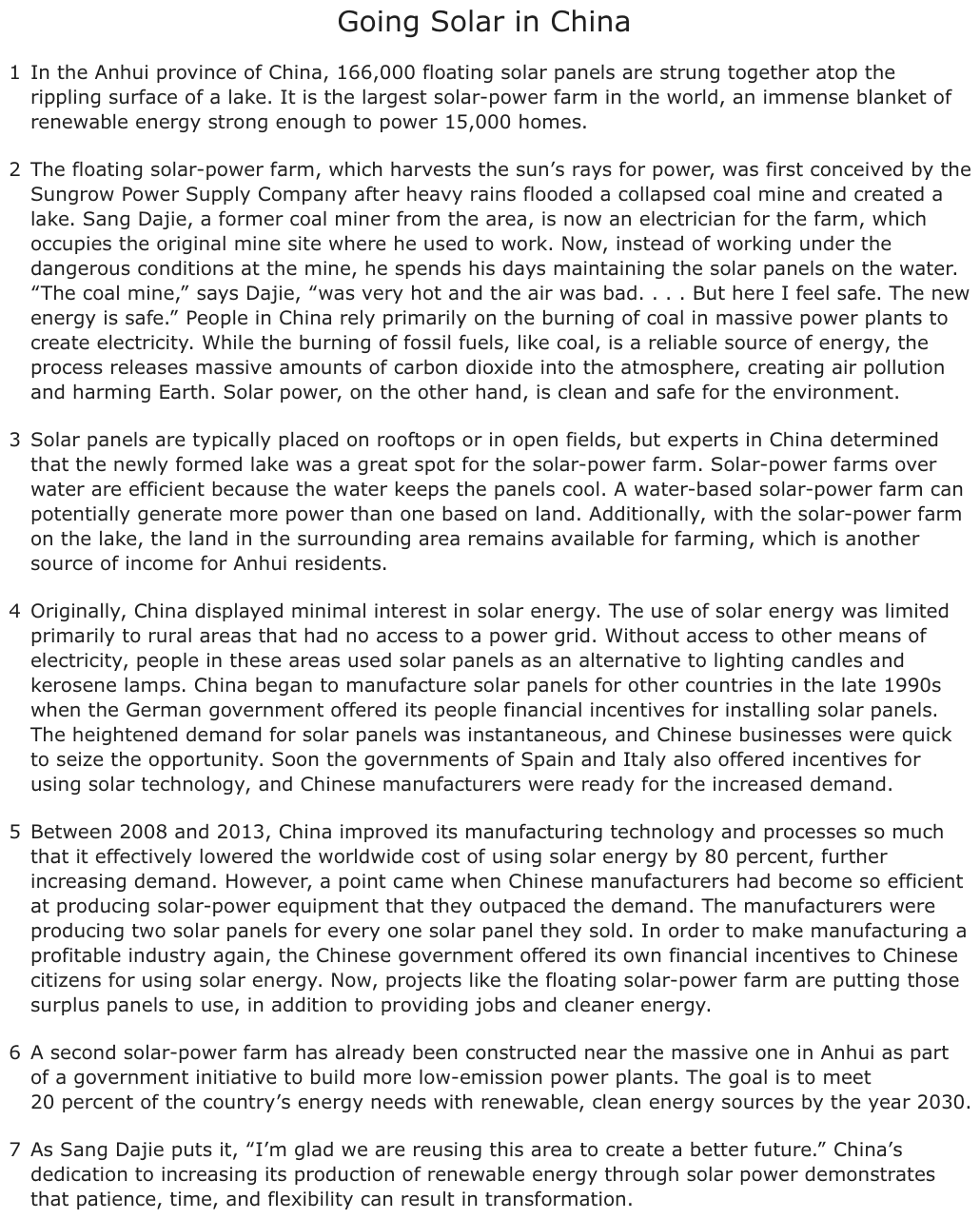
In the Anhui province of China, 166,000 floating solar panels are strung together atop the rippling surface of a lake. It is the largest solar-power farm in the world, an immense blanket of renewable energy strong enough to power 15,000 homes.
The floating solar-power farm, which harvests the sun’s rays for power, was first conceived by the Sungrow Power Supply Company after heavy rains flooded a collapsed coal mine and created a lake. Sang Dajie, a former coal miner from the area, is now an electrician for the farm, which occupies the original mine site where he used to work. Now, instead of working under the dangerous conditions at the mine, he spends his days maintaining the solar panels on the water. “The coal mine,” says Dajie, “was very hot and the air was bad. . . . But here I feel safe. The new energy is safe.” People in China rely primarily on the burning of coal in massive power plants to create electricity. While the burning of fossil fuels, like coal, is a reliable source of energy, the process releases massive amounts of carbon dioxide into the atmosphere, creating air pollution and harming Earth. Solar power, on the other hand, is clean and safe for the environment.
Solar panels are typically placed on rooftops or in open fields, but experts in China determined that the newly formed lake was a great spot for the solar-power farm. Solar-power farms over water are efficient because the water keeps the panels cool. A water-based solar-power farm can potentially generate more power than one based on land. Additionally, with the solar-power farm on the lake, the land in the surrounding area remains available for farming, which is another source of income for Anhui residents.
Originally, China displayed minimal interest in solar energy. The use of solar energy was limited primarily to rural areas that had no access to a power grid. Without access to other means of electricity, people in these areas used solar panels as an alternative to lighting candles and kerosene lamps. China began to manufacture solar panels for other countries in the late 1990s when the German government offered its people financial incentives for installing solar panels. The heightened demand for solar panels was instantaneous, and Chinese businesses were quick to seize the opportunity. Soon the governments of Spain and Italy also offered incentives for using solar technology, and Chinese manufacturers were ready for the increased demand.
Between 2008 and 2013, China improved its manufacturing technology and processes so much that it effectively lowered the worldwide cost of using solar energy by 80 percent, further increasing demand. However, a point came when Chinese manufacturers had become so efficient at producing solar-power equipment that they outpaced the demand. The manufacturers were producing two solar panels for every one solar panel they sold. In order to make manufacturing a profitable industry again, the Chinese government offered its own financial incentives to Chinese citizens for using solar energy. Now, projects like the floating solar-power farm are putting those surplus panels to use, in addition to providing jobs and cleaner energy.
A second solar-power farm has already been constructed near the massive one in Anhui as part of a government initiative to build more low-emission power plants. The goal is to meet 20 percent of the country’s energy needs with renewable, clean energy sources by the year 2030.
As Sang Dajie puts it, “I’m glad we are reusing this area to create a better future.” China’s dedication to increasing its production of renewable energy through solar power demonstrates that patience, time, and flexibility can result in transformation.
Question
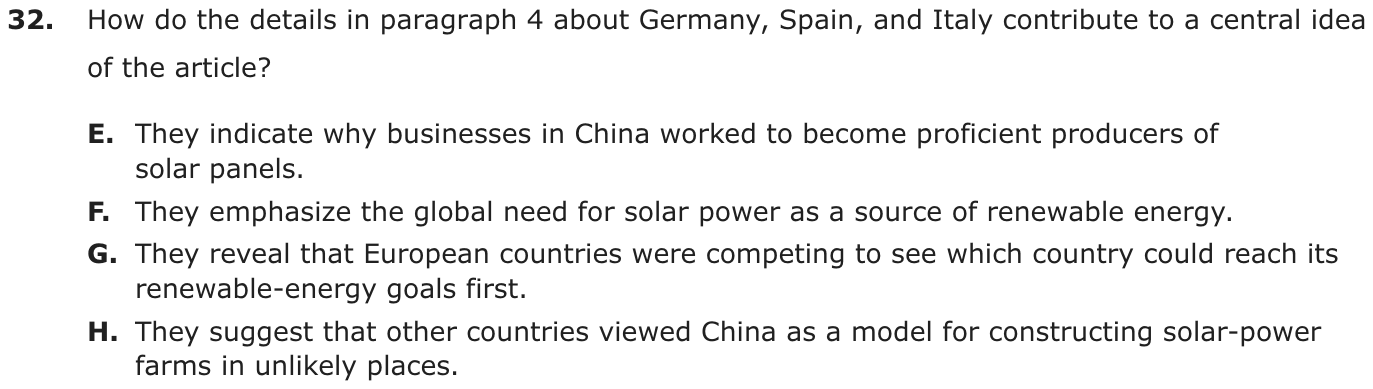
How do the details in paragraph 4 about Germany, Spain, and Italy contribute to a central idea of the article?
- AThey indicate why businesses in China worked to become proficient producers of solar panels.
- BThey emphasize the global need for solar power as a source of renewable energy.
- CThey reveal that European countries were competing to see which country could reach its renewable-energy goals first.
- DThey suggest that other countries viewed China as a model for constructing solar-power farms in unlikely places.
Show the answer
Correct answer: A
The question asks how the details about other countries in paragraph 4 help develop a central idea of the article.
A. CORRECT. The different countries are mentioned in paragraph 4 to explain how the actions of these countries increased the demand for solar panels. As a result, Chinese businesses increased their production and then improved their production methods to become more efficient to meet the demand.
B. Incorrect. The author explains that the governments of these countries offered incentives for people to use solar power, but the actions of these countries do not show a global need for solar power.
C. Incorrect. The discussion of the European countries focuses on the actions taken by the governments to encourage the growth of solar power in their own countries, but it does not suggest that the countries were competing with one another.
D. Incorrect. Although China created a solar-power farm in an unusual place, there is no information provided about how solar-power farms were constructed in other countries.
Question analysis
Paragraph 4 of “Going Solar in China” mentions that Germany, Spain and Italy offered incentives for using solar power. This central-idea question asks how those details about three European countries contribute to a central idea of the article. Students must work out what job these foreign details do in an article about China, and every choice offers a plausible-sounding role.
- Grade level
- Grade 7 reading and task
- Compared with grade 7
- At grade 7 Explaining how details contribute to a central idea is grade 7 work. The three countries appear in two plain sentences, and the rest of the article that they connect to is close by, so the demand is typical for grade 7.
- Estimated difficulty
- Moderate: several steps, or a close reading with one strong distractor.
- Thinking it demands
- Depth of knowledge 2, skills and concepts · mainly analyze
- What makes it hard
- Reading between the lines moderate
- How, not what minor
- The right answer is reworded minor
- Evidence
- Answered from several paragraphs or stanzas
- Reading level
- Passage: about grade 13, 598 words; question and choices: about grade 11, 81 words.
- Students, last 30 days
- Not enough answers yet to show (it takes 10).
Why it is hard, traps and wrong answers (shows the answer)
Why it is hard
The European countries appear in two plain sentences, but their purpose is left unstated. The strongest wrong choice widens three governments’ incentives into a global need, which sounds like the kind of point an article on renewable energy would make. Students who ask what happened in China because of those incentives, a demand that Chinese businesses rushed to supply, find the role the details play.
Reading between the lines moderate Working it out
Paragraph 4 never says why it names the three countries; students must connect the German incentives and the “heightened demand” to Chinese businesses that “were quick to seize the opportunity” and were “ready” for Spain and Italy. (Graesser, Singer & Trabasso, 1994; Kintsch, 1998)
How, not what minor Working it out
The question asks what job three European countries do in an article about China, so their incentives must be read as a cause in China’s story, not as news about Europe. (Anderson & Krathwohl, 2001)
The right answer is reworded minor Choosing the answer
The right choice’s “proficient producers” sums up businesses that seized an opportunity and later improved their processes, while the strongest wrong choice repeats the article’s own “renewable energy.” (Freedle & Kostin, 1993; Kirsch & Mosenthal, 1990)
Strategy: Reread paragraph 4, note what the sentences about Germany, Spain and Italy are doing there, and keep only the choice whose claim you can point to in the text.
Traps
- Too broad or too strong: A choice overstates, generalizes, or uses absolute words the text does not support.
- Reads too much in: A reasonable-sounding conclusion that goes further than the text allows.
- Wrong part of the text: A choice is true of another paragraph, stanza or speaker than the one asked about.
The wrong answers, classified
B Too broad or too strong (King et al., 2004)
Stretches three governments’ incentives into a global need for solar power, though the paragraph describes demand those incentives created in Europe, not a need felt worldwide.
C Reads too much in (Graesser, Singer & Trabasso, 1994)
Reads “Soon the governments of Spain and Italy also offered incentives” as a race between countries, though nothing suggests rivalry or any European renewable-energy goals.
D Wrong part of the text (Kirsch & Mosenthal, 1990)
Borrows the floating farm from the article’s opening, though paragraph 4 never mentions solar farms abroad, and China followed Europe’s lead rather than serving as its model.
Working it out, step by step
Read the question carefully
This asks why an article about China names three European countries. You need the job these details do in the article. Ask what happened in China because of them.
Read the details in paragraph 4
The German government offered its people incentives for installing solar panels. The article says, “The heightened demand for solar panels was instantaneous, and Chinese businesses were quick to seize the opportunity.” Heightened means raised. Instantaneous means right away. Later, Spain and Italy offered incentives too, and “Chinese manufacturers were ready for the increased demand.”
Explain what the details do
The European countries wanted lots of panels. That gave Chinese businesses a chance to sell, so they worked at making panels well. Paragraph 5 shows how well: they improved their methods until costs fell sharply. Proficient means skilled. So the three countries explain why China became a skilled panel maker.
Test each choice
- A fits. Demand from these countries is the reason Chinese businesses worked to get good at making panels.
- B does not fit. Three governments’ rewards made demand in Europe. The paragraph says nothing about a need all over the globe.
- C does not fit. “Soon” just tells the order. Nothing hints at a race or at goals.
- D does not fit. Paragraph 4 never mentions solar farms in other countries, and China followed Europe’s lead, not the reverse.
Give the answer
Watch out: B is tempting because it sounds like a big idea about renewable energy. But the paragraph shows demand in three countries, not a world in need. So the answer is A.
Why this answer and not the closest wrong one
B is the most tempting wrong choice. It sounds like a fair summary of countries wanting solar power. But the details do a job inside China’s story. Europe’s demand gave Chinese businesses an opening, and they rushed to fill it. That explains how they became skilled producers, which is A.
More questions like this
The original DOE question
The passage “Going Solar in China” as printed (page 174)