Passage Excerpt from “How Exercise Could Help You Learn a New Language”
Excerpt from “How Exercise Could Help You Learn a New Language”
by Gretchen Reynolds
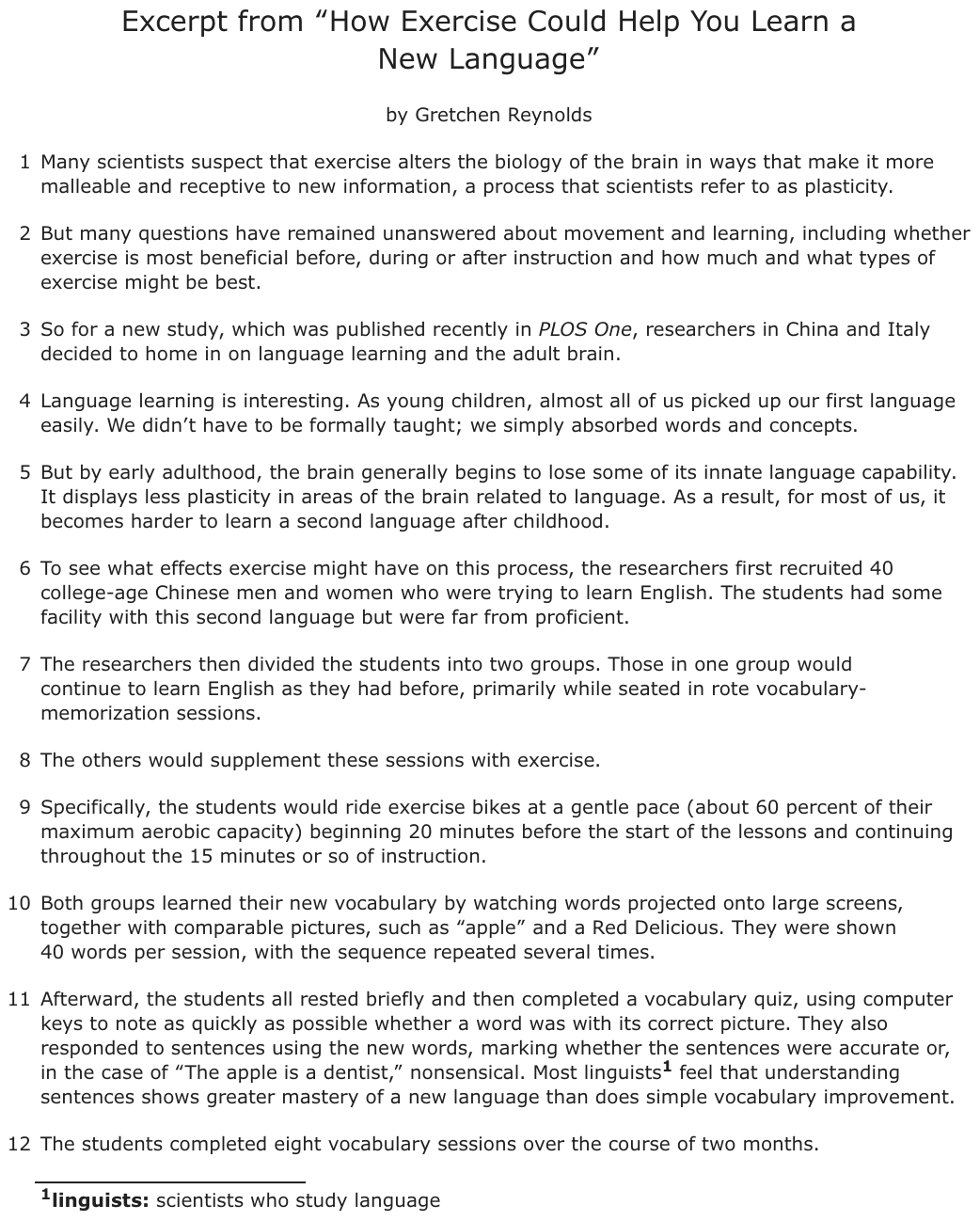
Many scientists suspect that exercise alters the biology of the brain in ways that make it more malleable and receptive to new information, a process that scientists refer to as plasticity.
But many questions have remained unanswered about movement and learning, including whether exercise is most beneficial before, during or after instruction and how much and what types of exercise might be best.
So for a new study, which was published recently in PLOS One, researchers in China and Italy decided to home in on language learning and the adult brain.
Language learning is interesting. As young children, almost all of us picked up our first language easily. We didn’t have to be formally taught; we simply absorbed words and concepts.
But by early adulthood, the brain generally begins to lose some of its innate language capability. It displays less plasticity in areas of the brain related to language. As a result, for most of us, it becomes harder to learn a second language after childhood.
To see what effects exercise might have on this process, the researchers first recruited 40 college-age Chinese men and women who were trying to learn English. The students had some facility with this second language but were far from proficient.
The researchers then divided the students into two groups. Those in one group would continue to learn English as they had before, primarily while seated in rote vocabulary-memorization sessions.
The others would supplement these sessions with exercise.
Specifically, the students would ride exercise bikes at a gentle pace (about 60 percent of their maximum aerobic capacity) beginning 20 minutes before the start of the lessons and continuing throughout the 15 minutes or so of instruction.
Both groups learned their new vocabulary by watching words projected onto large screens, together with comparable pictures, such as “apple” and a Red Delicious. They were shown 40 words per session, with the sequence repeated several times.
Afterward, the students all rested briefly and then completed a vocabulary quiz, using computer keys to note as quickly as possible whether a word was with its correct picture. They also responded to sentences using the new words, marking whether the sentences were accurate or, in the case of “The apple is a dentist,” nonsensical. Most linguists1 feel that understanding sentences shows greater mastery of a new language than does simple vocabulary improvement.
The students completed eight vocabulary sessions over the course of two months.
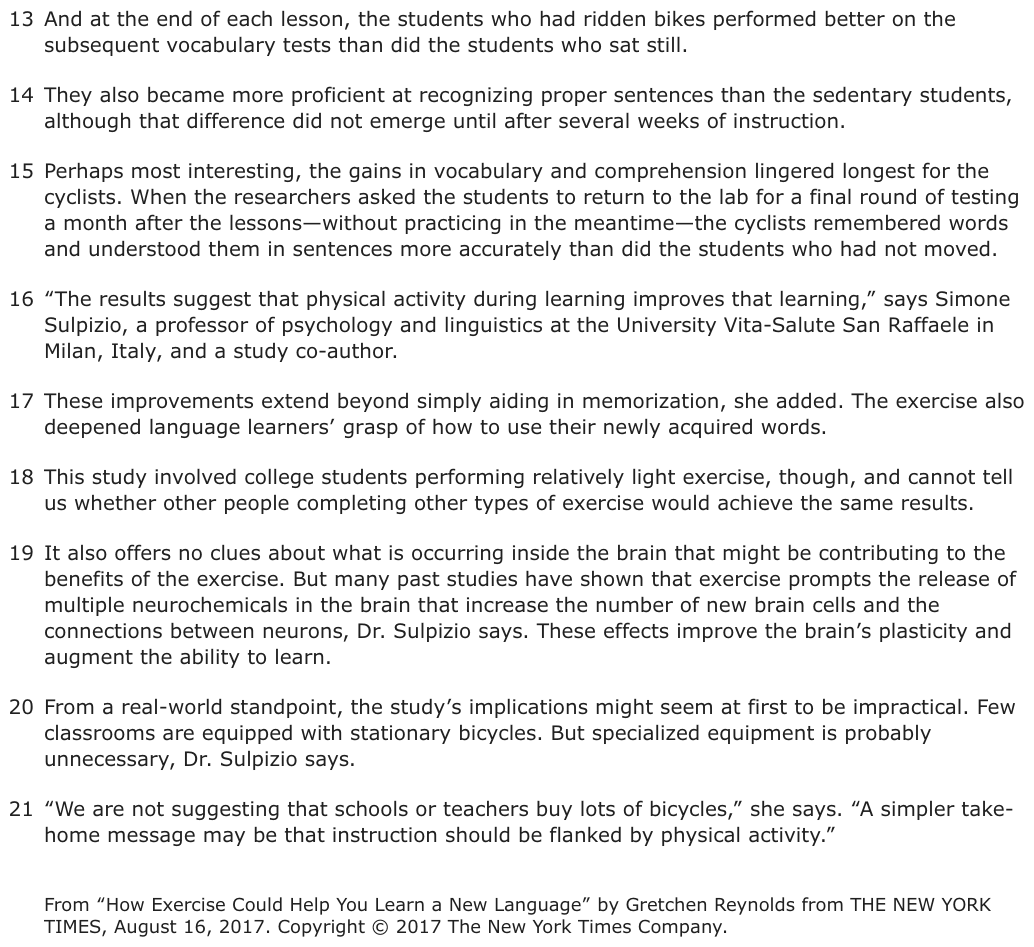
And at the end of each lesson, the students who had ridden bikes performed better on the subsequent vocabulary tests than did the students who sat still.
They also became more proficient at recognizing proper sentences than the sedentary students, although that difference did not emerge until after several weeks of instruction.
Perhaps most interesting, the gains in vocabulary and comprehension lingered longest for the cyclists. When the researchers asked the students to return to the lab for a final round of testing a month after the lessons—without practicing in the meantime—the cyclists remembered words and understood them in sentences more accurately than did the students who had not moved.
“The results suggest that physical activity during learning improves that learning,” says Simone Sulpizio, a professor of psychology and linguistics at the University Vita-Salute San Raffaele in Milan, Italy, and a study co-author.
These improvements extend beyond simply aiding in memorization, she added. The exercise also deepened language learners’ grasp of how to use their newly acquired words.
This study involved college students performing relatively light exercise, though, and cannot tell us whether other people completing other types of exercise would achieve the same results.
It also offers no clues about what is occurring inside the brain that might be contributing to the benefits of the exercise. But many past studies have shown that exercise prompts the release of multiple neurochemicals in the brain that increase the number of new brain cells and the connections between neurons, Dr. Sulpizio says. These effects improve the brain’s plasticity and augment the ability to learn.
From a real-world standpoint, the study’s implications might seem at first to be impractical. Few classrooms are equipped with stationary bicycles. But specialized equipment is probably unnecessary, Dr. Sulpizio says.
“We are not suggesting that schools or teachers buy lots of bicycles,” she says. “A simpler take-home message may be that instruction should be flanked by physical activity.”
From “How Exercise Could Help You Learn a New Language” by Gretchen Reynolds from THE NEW YORK TIMES, August 16, 2017. Copyright © 2017 The New York Times Company.
1linguists: scientists who study language
Question
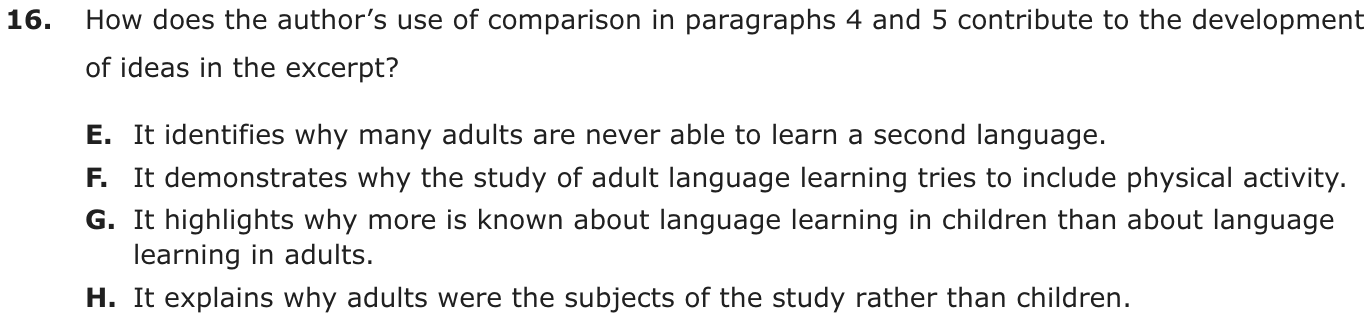
How does the author’s use of comparison in paragraphs 4 and 5 contribute to the development of ideas in the excerpt?
- AIt identifies why many adults are never able to learn a second language.
- BIt demonstrates why the study of adult language learning tries to include physical activity.
- CIt highlights why more is known about language learning in children than about language learning in adults.
- DIt explains why adults were the subjects of the study rather than children.
Show the answer
Correct answer: D
The question asks how the author’s use of comparison in paragraphs 4 and 5 contributes to the development of ideas in the excerpt.
A. Incorrect. Paragraph 5 does not claim that adults are never able to learn a second language, only that “it becomes harder to learn a second language after childhood.”
B. Incorrect. The issue of physical activity is never addressed in these paragraphs. They compare the relative ease with which children and adults learn languages.
C. Incorrect. Paragraph 4 does not claim that more is known about language learning in children; in fact, it says that children simply absorb language easily and does not attempt to explain how.
D. CORRECT. Because adult brains lose the “innate language capability” of children and have less plasticity when it comes to language learning, the study chose to focus on adults and how exercise might help them learn new languages.
Question analysis
This text structure question asks how the comparison in paragraphs 4 and 5 of Gretchen Reynolds’s article about exercise and learning a new language moves the article forward. Students must connect what those paragraphs say about children’s and adults’ language learning to the study that follows, and judge four explanations of why the comparison matters.
- Grade level
- Grade 7 reading and task
- Compared with grade 7
- At grade 7 Explaining how a section fits into an article is grade 7 work. Here students must link a comparison of children and adults to the study described later, and the article never states that link outright, which keeps it a solid grade 7 task.
- Estimated difficulty
- Moderate: several steps, or a close reading with one strong distractor.
- Thinking it demands
- Depth of knowledge 3, strategic thinking · mainly analyze
- What makes it hard
- Reading between the lines moderate
- How, not what moderate
- Evidence
- Answered from several paragraphs or stanzas
- Reading level
- Passage: about grade 11, 764 words; question and choices: about grade 10, 76 words.
- Students, last 30 days
- Not enough answers yet to show (it takes 10).
Why it is hard, traps and wrong answers (shows the answer)
Why it is hard
Paragraphs 4 and 5 are easy to summarize, children pick up a language easily and adults do not, but the question asks what that contrast sets up. Students who connect it to the article’s opening, about exercise and plasticity, decide it explains the exercise, while paragraph 6 shows it explains the choice of subjects. Reading the sentence right after the comparison, which recruits college-age learners to study “this process,” is the decisive step.
Reading between the lines moderate Working it out
The article never says why the study used adults; the reader must join paragraph 5’s point that adult brains lose plasticity for language to paragraph 3’s “adult brain” and paragraph 6’s “this process.” (Graesser, Singer & Trabasso, 1994; Kintsch, 1998)
How, not what moderate Working it out
The stem asks what the comparison of children and adults does in the excerpt, so a fair summary of paragraphs 4 and 5 is not enough; its job in setting up the study must be named. (Anderson & Krathwohl, 2001)
Strategy: Sum up what paragraphs 4 and 5 compare, then read the paragraphs just before and after them and ask what that comparison sets up for the rest of the article.
Traps
- Too broad or too strong: A choice overstates, generalizes, or uses absolute words the text does not support.
- Wrong part of the text: A choice is true of another paragraph, stanza or speaker than the one asked about.
- Twists what the text says: Uses the text's topic and ideas but changes what it says: who did it, how much, when, or why.
The wrong answers, classified
A Too broad or too strong (King et al., 2004)
Turns paragraph 5’s point that a second language “becomes harder” to learn after childhood into the absolute claim that many adults are never able to learn one.
B Wrong part of the text (Kirsch & Mosenthal, 1990)
Links paragraph 5’s lost plasticity to the exercise idea of paragraph 1, but the reason for adding exercise comes from paragraphs 1 and 2; paragraphs 4 and 5 never mention it.
C Twists what the text says (King et al., 2004)
Reads the contrast between children and adults as a claim about how much scientists know, though paragraph 4 says only that children absorb language without being taught.
Working it out, step by step
Figure out what the question asks
This asks why the author compares two things in paragraphs 4 and 5. A comparison shows how two things are alike or different. You need to say what this comparison does for the rest of the article. So find what is compared. Then see what comes next.
Find the comparison
Paragraph 4 is about children: “As young children, almost all of us picked up our first language easily.” Paragraph 5 is about adults: “by early adulthood, the brain generally begins to lose some of its innate language capability.” Innate means something you are born with. Then it says “it becomes harder to learn a second language after childhood.” So children learn languages easily, and adults find it harder.
See what the comparison sets up
In paragraph 3, “language learning and the adult brain” is named as the study’s focus. Right after the comparison, paragraph 6 says: “To see what effects exercise might have on this process, the researchers first recruited 40 college-age Chinese men and women.” This process means the way adults lose some of that easy learning. So the comparison explains why the study used adults. Adults are the ones who need the help.
Check each choice
- D fits. Adults lose some of their skill with language, so the study tested adults.
- A says adults are “never able” to learn. Paragraph 5 only says it “becomes harder.”
- B brings in exercise. But paragraphs 4 and 5 never mention exercise.
- C says scientists know more about children. Paragraph 4 says nothing about what scientists know.
Watch out: B is tempting because the whole article is about exercise. But the reason to try exercise comes from paragraphs 1 and 2, not from this comparison.
Pick the answer
The comparison shows that adults struggle with new languages more than children do. That is why the researchers studied adults. So the answer is D.
Why this answer and not the closest wrong one
B is the closest wrong answer, because exercise is the study’s big idea. But paragraphs 4 and 5 compare only children and adults. They never mention exercise. Their job is to show why adults, not children, were the people studied. That is D.
More questions like this
The original DOE question
The passage “Excerpt from “How Exercise Could Help You Learn a New Language”” as printed (pages 171–172)