Passage Looking for the Smallest Spark of Everything
Looking for the Smallest Spark of Everything
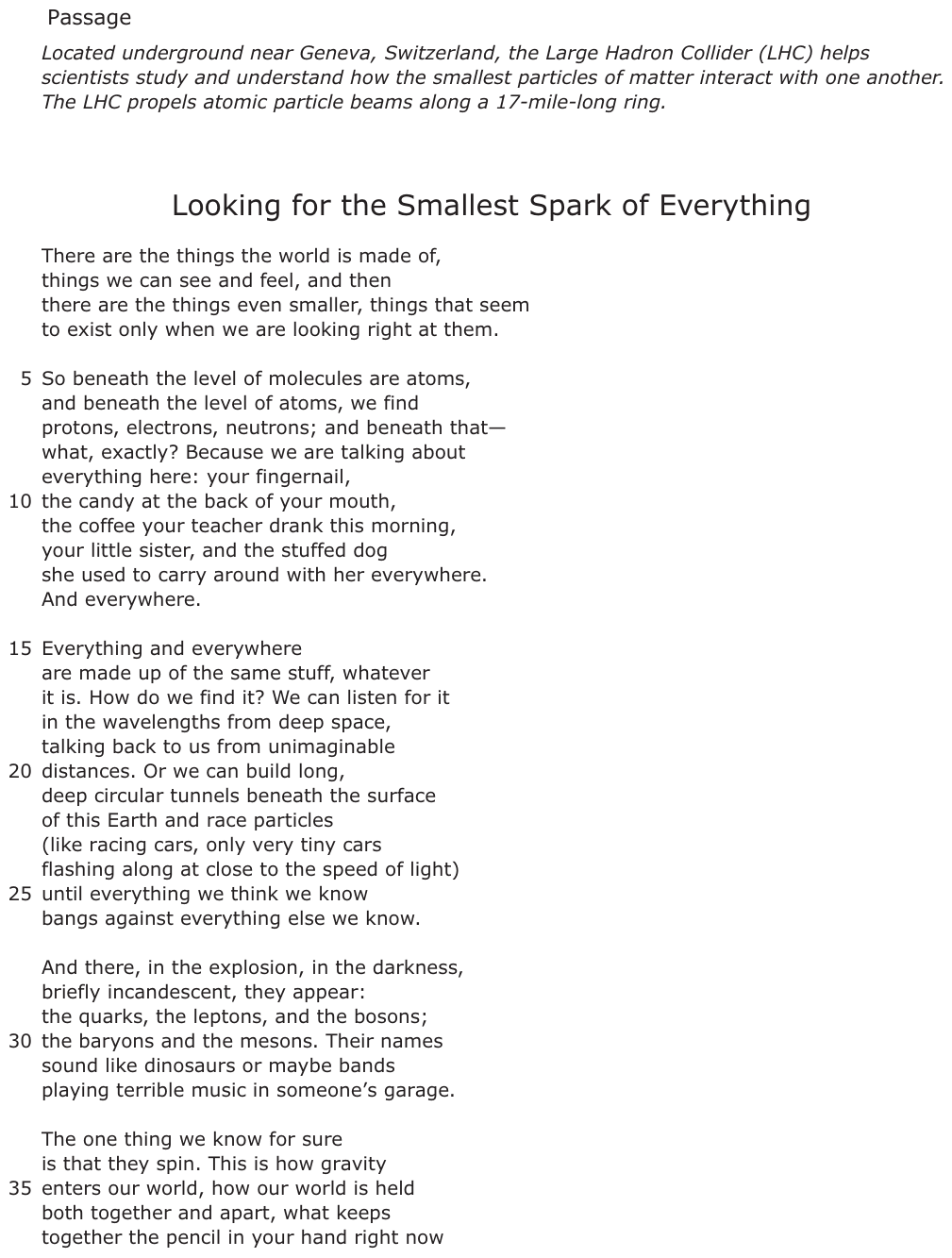
Located underground near Geneva, Switzerland, the Large Hadron Collider (LHC) helps scientists study and understand how the smallest particles of matter interact with one another. The LHC propels atomic particle beams along a 17-mile-long ring.
There are the things the world is made of,
things we can see and feel, and then
there are the things even smaller, things that seem
to exist only when we are looking right at them.
So beneath the level of molecules are atoms,
and beneath the level of atoms, we find
protons, electrons, neutrons; and beneath that—
what, exactly? Because we are talking about
everything here: your fingernail,
the candy at the back of your mouth,
the coffee your teacher drank this morning,
your little sister, and the stuffed dog
she used to carry around with her everywhere.
And everywhere.
Everything and everywhere
are made up of the same stuff, whatever
it is. How do we find it? We can listen for it
in the wavelengths from deep space,
talking back to us from unimaginable
distances. Or we can build long,
deep circular tunnels beneath the surface
of this Earth and race particles
(like racing cars, only very tiny cars
flashing along at close to the speed of light)
until everything we think we know
bangs against everything else we know.
And there, in the explosion, in the darkness,
briefly incandescent, they appear:
the quarks, the leptons, and the bosons;
the baryons and the mesons. Their names
sound like dinosaurs or maybe bands
playing terrible music in someone’s garage.
The one thing we know for sure
is that they spin. This is how gravity
enters our world, how our world is held
both together and apart, what keeps
together the pencil in your hand right now
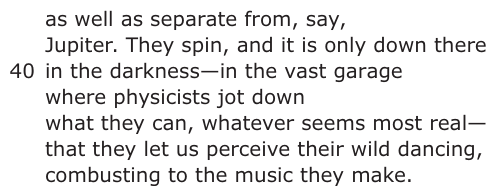
as well as separate from, say,
Jupiter. They spin, and it is only down there
in the darkness—in the vast garage
where physicists jot down
what they can, whatever seems most real—
that they let us perceive their wild dancing,
combusting to the music they make.
Question
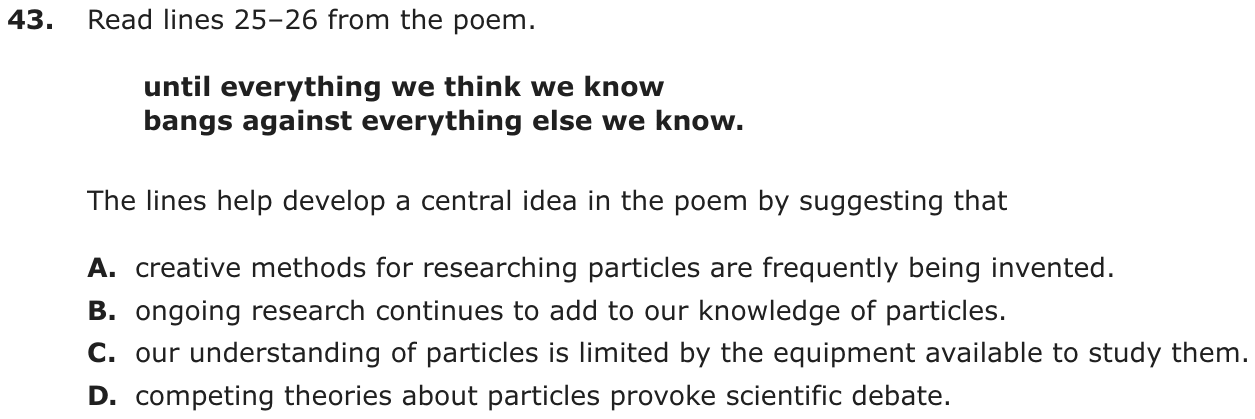
Read lines 25–26 from the poem.
until everything we think we know
bangs against everything else we know.
The lines help develop a central idea in the poem by suggesting that
- Acreative methods for researching particles are frequently being invented.
- Bongoing research continues to add to our knowledge of particles.
- Cour understanding of particles is limited by the equipment available to study them.
- Dcompeting theories about particles provoke scientific debate.
Show the answer
Correct answer: B
The question asks how lines 25–26 help develop a central idea in the poem.
A. Incorrect. Lines 25–26 illustrate the collision of old and new information about particles, but they do not describe “creative methods” that are currently being invented to research subatomic particles.
B. CORRECT. The lines “until everything we think we know / bangs against everything else we know” (lines 25–26) are about how the old knowledge about particles interacts with newfound knowledge.
C. Incorrect. While lines 20–22 describe the Large Hadron Collider as “long, / deep circular tunnels beneath the surface / of this Earth” where scientists “race particles,” lines 25–26 refer to the collision of old and new ideas about particles, not the limitations of the Large Hadron Collider.
D. Incorrect. Lines 25–26 focus on what “we think we know” about subatomic particles and how new discoveries challenge “everything else we know.” However, the challenge is not a result of scientists debating one another but rather what the Large Hadron Collider reveals about particles.
Question analysis
Lines 25–26 of the poem “Looking for the Smallest Spark of Everything” end a long sentence about racing particles through underground tunnels: “until everything we think we know / bangs against everything else we know.” This question asks what central idea the lines help develop. Students must interpret a figurative collision, and several choices offer reasonable-sounding ideas about how science works.
- Grade level
- Grade 8 reading and task
- Compared with grade 7
- Above grade 7 Grade 7 students interpret figurative lines and connect them to a central idea, but these two lines play on the collisions in a particle accelerator, state nothing directly, and end a seven-line sentence, above typical grade 7 work.
- Estimated difficulty
- Hard: combines ideas, needs a plan, and has more than one tempting wrong answer.
- Thinking it demands
- Depth of knowledge 3, strategic thinking · mainly analyze
- What makes it hard
- Figurative or literary language major
- Reading between the lines moderate
- Complex sentences minor
- Evidence
- Answered from one paragraph or stanza
- Reading level
- Passage: 346 words (a poem; reading level not measured); question and choices: about grade 9, 69 words.
- Corrected from the DOE handbook
- A missing period in the explanation was restored.
- Students, last 30 days
- Not enough answers yet to show (it takes 10).
Why it is hard, traps and wrong answers (shows the answer)
Why it is hard
The lines use the collider’s own action, a crash, as a picture of what the research does to knowledge, and nothing in them says plainly what that is. The strongest pull reads the crash as people clashing, rival theories in a debate, which turns the image into a quarrel the poem never describes. Students who follow the sentence into the next stanza, where new particles appear in the explosion, see that the collisions add to what we know.
Figurative or literary language major Understanding the question
“Bangs against” moves the collision from the particles racing in the tunnel to “everything we think we know,” so the lines must be read as a picture of knowledge being tested, not of machines. (Graesser, Singer & Trabasso, 1994; Kintsch, 1998)
Reading between the lines moderate Working it out
What the collision does to knowledge is never stated; it follows from “until,” which makes the crash the goal of the work, and from the next stanza, where the quarks and leptons “appear.” (Graesser, Singer & Trabasso, 1994; Kintsch, 1998)
Complex sentences minor Understanding the question
Lines 25–26 close a seven-line sentence that starts at “Or we can build long,” runs through a parenthesis about racing cars, and only then reaches its “until” clause. (Abedi & Lord, 2001; Freedle & Kostin, 1993; Messick, 1989)
Strategy: Read lines 20–26 as one sentence, decide what is literally colliding in the tunnels, then ask what the poet suggests is happening to “everything we think we know.”
Traps
- Reads too much in: A reasonable-sounding conclusion that goes further than the text allows.
- Wrong part of the text: A choice is true of another paragraph, stanza or speaker than the one asked about.
- Outside knowledge: A choice is plausible in the real world but not supported by this text.
The wrong answers, classified
A Wrong part of the text (Kirsch & Mosenthal, 1990)
Recalls the two ways of searching in lines 17–22, deep-space wavelengths and underground tunnels, though lines 25–26 describe what the collisions do to knowledge, not methods being invented.
C Outside knowledge (King et al., 2004; Recht & Leslie, 1988)
Draws on the familiar idea that science is held back by its tools, though the poem presents the long, deep tunnels as a way of finding out, not a limit.
D Reads too much in (Graesser, Singer & Trabasso, 1994)
Reads knowledge banging against knowledge as rival theories argued over by scientists, though the lines echo the particles’ collisions and no debate or competing camps appear in the poem.
What was corrected from the DOE handbook, and why
- Explanation: The handbook’s explanation of Option B ends “…are about how the old knowledge about particles interacts with newfound knowledge” with no closing period. The site adds the period.
Working it out, step by step
Make sense of the question
This asks what lines 25–26 add to a central idea of the poem. The lines use a picture, not plain facts. So first see what is really happening in the lines before them. Then ask what the picture means.
Read the whole sentence
Lines 25–26 end a long sentence that starts in line 20: “Or we can build long, / deep circular tunnels beneath the surface / of this Earth and race particles.” The racing goes on “until everything we think we know / bangs against everything else we know.” In the real machine, particles speed around and smash into each other.
Work out the picture
The poet swaps the particles for “everything we think we know.” So it is our knowledge that crashes. Picture old ideas being tested against new findings. The word “until” shows the crash is the goal of the racing. The next stanza shows the result. In the explosion, tiny particles “appear,” and the poet names them. Each crash teaches scientists more.
Check each choice
- A does not fit. The ways of searching come earlier, in lines 17–22. Nothing says new methods are often invented.
- B fits. The research keeps going, and each crash adds to what we know about particles.
- C does not fit. The tunnels are shown as a way to find things out, not as a limit.
- D does not fit. The banging stands for particles colliding. No scientists argue, and no sides compete.
Give the answer
Watch out: D is tempting, because things banging together can sound like people clashing in a debate, an argument between sides. But the poem never shows anyone arguing. So the answer is B.
Why this answer and not the closest wrong one
D is the closest wrong choice, since “bangs against” can sound like an argument. But the crash copies what the particles do in the tunnel. Right after it, particles appear in the explosion. The lines picture knowledge growing as the experiments go on, which is B, not a fight between theories.
More questions like this
The original DOE question
The passage “Looking for the Smallest Spark of Everything” as printed (pages 32–33)