Passage Wolves of the Sea
Wolves of the Sea
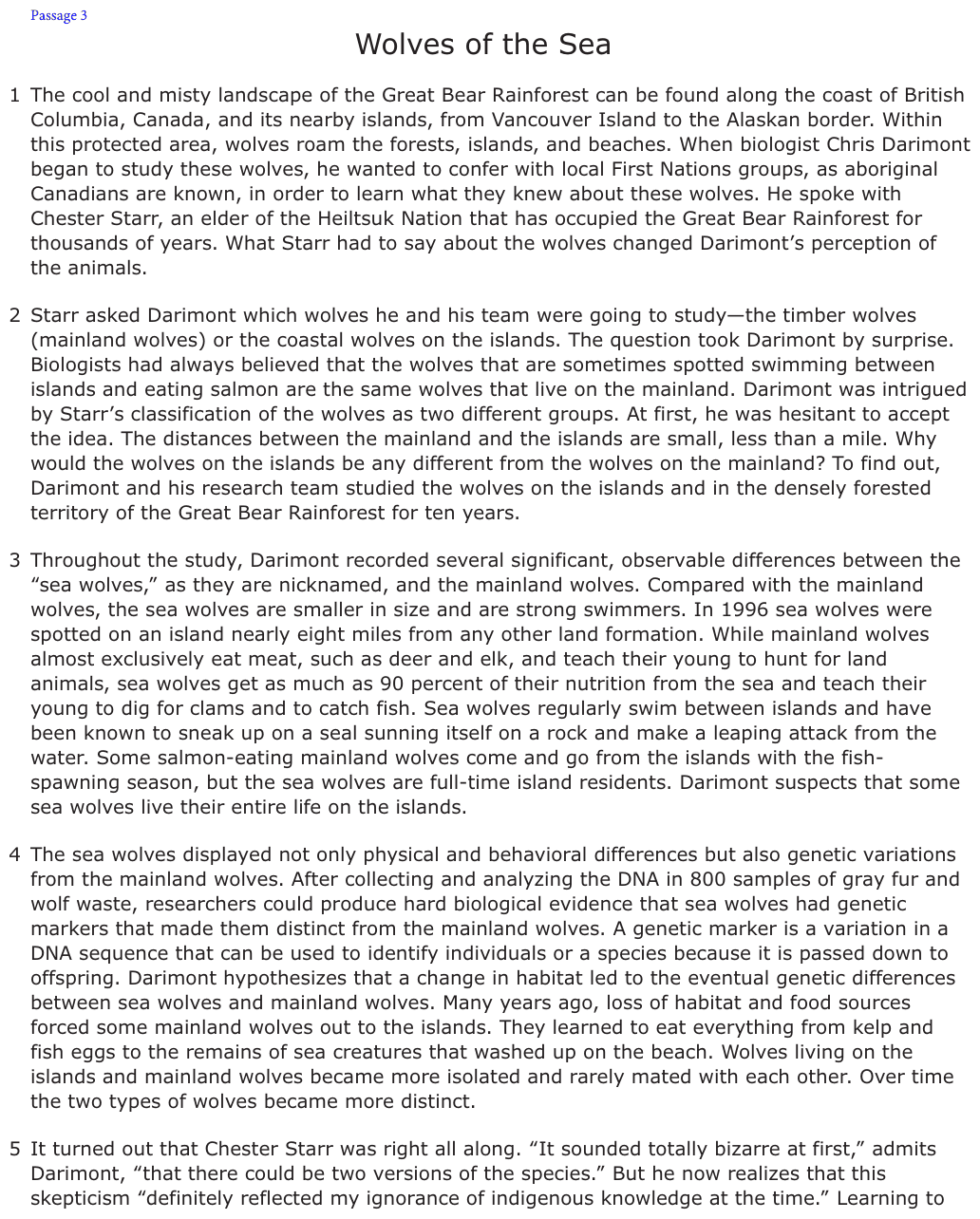
The cool and misty landscape of the Great Bear Rainforest can be found along the coast of British Columbia, Canada, and its nearby islands, from Vancouver Island to the Alaskan border. Within this protected area, wolves roam the forests, islands, and beaches. When biologist Chris Darimont began to study these wolves, he wanted to confer with local First Nations groups, as aboriginal Canadians are known, in order to learn what they knew about these wolves. He spoke with Chester Starr, an elder of the Heiltsuk Nation that has occupied the Great Bear Rainforest for thousands of years. What Starr had to say about the wolves changed Darimont’s perception of the animals.
Starr asked Darimont which wolves he and his team were going to study—the timber wolves (mainland wolves) or the coastal wolves on the islands. The question took Darimont by surprise. Biologists had always believed that the wolves that are sometimes spotted swimming between islands and eating salmon are the same wolves that live on the mainland. Darimont was intrigued by Starr’s classification of the wolves as two different groups. At first, he was hesitant to accept the idea. The distances between the mainland and the islands are small, less than a mile. Why would the wolves on the islands be any different from the wolves on the mainland? To find out, Darimont and his research team studied the wolves on the islands and in the densely forested territory of the Great Bear Rainforest for ten years.
Throughout the study, Darimont recorded several significant, observable differences between the “sea wolves,” as they are nicknamed, and the mainland wolves. Compared with the mainland wolves, the sea wolves are smaller in size and are strong swimmers. In 1996 sea wolves were spotted on an island nearly eight miles from any other land formation. While mainland wolves almost exclusively eat meat, such as deer and elk, and teach their young to hunt for land animals, sea wolves get as much as 90 percent of their nutrition from the sea and teach their young to dig for clams and to catch fish. Sea wolves regularly swim between islands and have been known to sneak up on a seal sunning itself on a rock and make a leaping attack from the water. Some salmon-eating mainland wolves come and go from the islands with the fish-spawning season, but the sea wolves are full-time island residents. Darimont suspects that some sea wolves live their entire life on the islands.
The sea wolves displayed not only physical and behavioral differences but also genetic variations from the mainland wolves. After collecting and analyzing the DNA in 800 samples of gray fur and wolf waste, researchers could produce hard biological evidence that sea wolves had genetic markers that made them distinct from the mainland wolves. A genetic marker is a variation in a DNA sequence that can be used to identify individuals or a species because it is passed down to offspring. Darimont hypothesizes that a change in habitat led to the eventual genetic differences between sea wolves and mainland wolves. Many years ago, loss of habitat and food sources forced some mainland wolves out to the islands. They learned to eat everything from kelp and fish eggs to the remains of sea creatures that washed up on the beach. Wolves living on the islands and mainland wolves became more isolated and rarely mated with each other. Over time the two types of wolves became more distinct.
It turned out that Chester Starr was right all along. “It sounded totally bizarre at first,” admits Darimont, “that there could be two versions of the species.” But he now realizes that this skepticism “definitely reflected my ignorance of indigenous knowledge at the time.” Learning to trust the wisdom of the Heiltsuk people opened Darimont up to knowledge accumulated over millennia and positioned him so that he could gather new scientific evidence about one of British Columbia’s most elusive species, the sea wolf.
Question
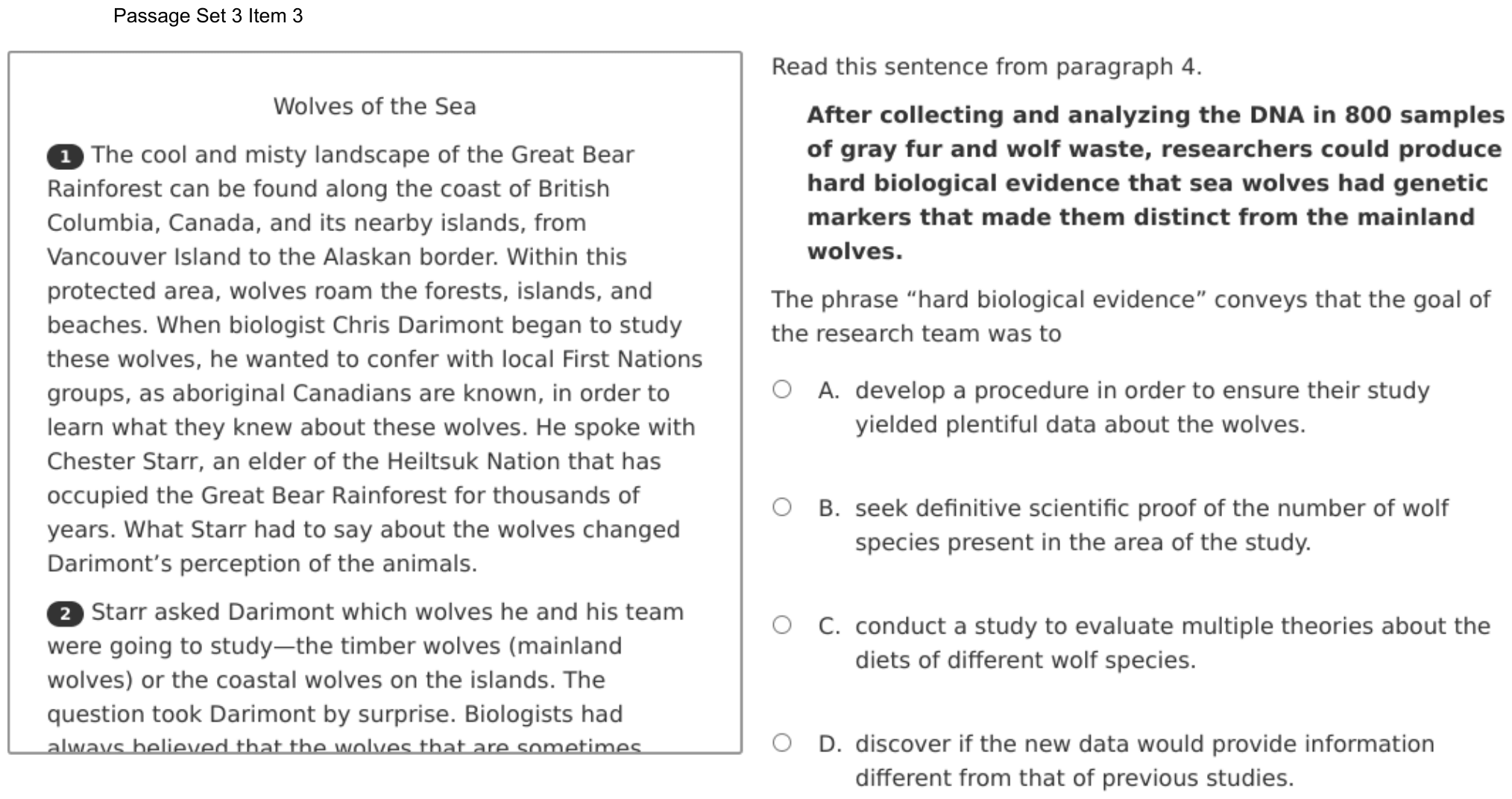
Read this sentence from paragraph 4.
After collecting and analyzing the DNA in 800 samples of gray fur and wolf waste, researchers could produce hard biological evidence that sea wolves had genetic markers that made them distinct from the mainland wolves.
The phrase “hard biological evidence” conveys that the goal of the research team was to
- Adevelop a procedure in order to ensure their study yielded plentiful data about the wolves.
- Bseek definitive scientific proof of the number of wolf species present in the area of the study.
- Cconduct a study to evaluate multiple theories about the diets of different wolf species.
- Ddiscover if the new data would provide information different from that of previous studies.
Show the answer
Correct answer: B
The question asks what the phrase “hard biological evidence” in the sentence from paragraph 4 conveys about the goal of the research team.
A. Incorrect. Although the research team followed a labor-intensive procedure, the phrase “hard biological evidence” refers to the product of their scientific research (the genetic markers revealed within the DNA samples), not the process by which they collected it. Their goal was not to develop a procedure for data collection but to determine precisely how many species of wolf were present in the area.
B. CORRECT. The research team wanted to prove or disprove the theory that two separate groups of wolves were present in the area, an idea that was already supported by the observations of scientists and local indigenous people. The phrase “hard biological evidence” conveys that the scientists wanted to bolster their observations of the wolves with concrete scientific data about the wolves’ biological makeup. The goal of the researchers was to use the data to prove how many species of wolf were present in the area of the study.
C. Incorrect. The research team gathered extensive data during their study (“After collecting and analyzing the DNA in 800 samples of gray fur and wolf waste” [paragraph 4]), and their goal in doing so was to evaluate a single theory about the wolves: that the wolves had evolved into two separate and genetically distinct species. The research team did not conduct the study in order to evaluate multiple theories about the diets of the wolves.
D. Incorrect. The phrase “hard biological evidence” does not suggest that the research team was hoping to discover if the new data would provide information that was different from previous studies. In fact, the goal of the research team was to use the genetic data to supplement their initial sources of information about the wolves and their own observations from the field.
Question analysis
This word-in-context question quotes a sentence from paragraph 4 of “Wolves of the Sea” about DNA taken from 800 samples of gray fur and wolf waste, and asks what the phrase “hard biological evidence” shows about the research team’s goal. Students must work out what the phrase says about the evidence and then turn that into a statement of purpose, choosing among four plausible aims for a study.
- Grade level
- Grade 8 reading and task
- Compared with grade 7
- Above grade 7 Grade 7 students regularly interpret a phrase in context. Here the phrase must be turned into a claim about the team’s purpose, which the passage never states outright, and the four choices are abstract research goals that each sound reasonable.
- Estimated difficulty
- Hard: combines ideas, needs a plan, and has more than one tempting wrong answer.
- Thinking it demands
- Depth of knowledge 2, skills and concepts · mainly understand
- What makes it hard
- Reading between the lines moderate
- Hard words moderate
- Evidence in several places minor
- Evidence
- Answered from several paragraphs or stanzas
- Reading level
- Passage: about grade 10, 662 words; question and choices: about grade 10, 114 words.
- Students, last 30 days
- Not enough answers yet to show (it takes 10).
Why it is hard, traps and wrong answers (shows the answer)
Why it is hard
The question asks for a purpose, but the phrase it quotes describes a result, so students have to reason from the kind of evidence produced to what the team wanted it for. Readers who take “hard” as difficult drift toward a goal about procedure, and those who remember that biologists had long thought the wolves were one group are drawn to a goal of overturning earlier studies. The key’s “number of wolf species” is looser than the passage’s “two versions of the species,” which can make careful readers hesitate.
Reading between the lines moderate Working it out
The passage never states the team’s goal, so students must work back from “hard biological evidence” to the question paragraph 2 set up: whether island and mainland wolves are really two groups. (Graesser, Singer & Trabasso, 1994; Kintsch, 1998)
Hard words moderate Understanding the question
“Hard” here means solid and conclusive, as in hard evidence, not difficult; students who know only the everyday sense connect it to the labor of analyzing 800 samples of fur and waste. (Perfetti, 2007; Freedle & Kostin, 1993)
Evidence in several places minor Working it out
The goal the phrase points to lies two paragraphs back, in Starr’s two-group question and Darimont’s ten-year study “to find out,” not in the sentence the stem quotes. (Kirsch & Mosenthal, 1990; Gorin & Embretson, 2006)
Strategy: Replace “hard” with a word that fits evidence produced by DNA analysis, then ask what the team wanted that kind of evidence for, recalling the question Darimont set out to answer.
Traps
- Dictionary meaning, not meaning here: A common meaning of the word that does not fit its use in this text.
- Reads too much in: A reasonable-sounding conclusion that goes further than the text allows.
- Wrong part of the text: A choice is true of another paragraph, stanza or speaker than the one asked about.
The wrong answers, classified
A Dictionary meaning, not meaning here (Perfetti, 2007)
Reads “hard” as difficult and ties it to the labor of analyzing 800 samples, so takes the goal to be a thorough procedure rather than conclusive proof.
C Wrong part of the text (Kirsch & Mosenthal, 1990)
Brings in the diet differences of paragraph 3, clams, fish and seals, as theories under test, though the DNA work in paragraph 4 asked whether two groups exist.
D Reads too much in (Graesser, Singer & Trabasso, 1994)
Knows that biologists “had always believed” the wolves were one group and assumes the team set out to contradict earlier studies, which the phrase about solid proof does not suggest.
Working it out, step by step
Figure out what the question asks
This asks what a phrase shows about the team’s goal. A goal is what you are trying to get. The phrase names the kind of evidence the team got. Work back from that to what they wanted it for.
Read the sentence with the phrase
In paragraph 4, the team studied “800 samples of gray fur and wolf waste.” Then they “could produce hard biological evidence that sea wolves had genetic markers that made them distinct from the mainland wolves.” A genetic marker is a small difference in the DNA that parents pass to their young. Distinct means clearly different.
Work out what “hard” means
Here “hard” does not mean difficult. Hard evidence is solid proof that is tough to argue with. Biological means it comes from living things and their bodies. So the team wanted firm proof from the wolves’ own bodies.
Connect the proof to the question
What did they want to prove? Go back to paragraph 2. Starr said there were two groups of wolves. Darimont was unsure. “To find out,” his team studied the wolves. The DNA gave a firm answer: the sea wolves really are a separate group. So the goal was solid proof of how many groups of wolves live there.
Check each choice
- A is wrong. It reads “hard” as hard work. The phrase is about how firm the proof is, not about a procedure.
- B is right. Definitive means final and settled. The team wanted settled proof of how many groups of wolves live there. B says “species,” which goes further than the passage. Darimont speaks only of “two versions of the species.”
- C is wrong. Diets come up in paragraph 3. The DNA work tested whether there were two groups.
- D is wrong. The phrase says nothing about earlier studies.
Watch out: D is tempting because biologists “had always believed” the wolves were one group. But “hard” evidence is about firm proof, not about beating old studies.
Choose the answer
“Hard biological evidence” shows the team wanted firm, scientific proof. So the answer is B, “seek definitive scientific proof of the number of wolf species present in the area of the study.”
Why this answer and not the closest wrong one
D is the closest wrong answer. Biologists had thought the wolves were one group, so D can seem to fit. But the phrase “hard biological evidence” is about how firm the proof is. It says nothing about earlier studies. B matches that: the team wanted settled proof of how many groups there were.
More questions like this
The original DOE question
The passage “Wolves of the Sea” as printed (pages 23–24)