Passage Excerpt from “The World Has an E-Waste Problem”
Excerpt from “The World Has an E-Waste Problem”
by Alana Semuels
As a tech-hungry nation . . . gets ready to upgrade to the next generation of lightning-fast 5G devices, there is a surprising environmental cost to be reckoned with: a fresh mountain of obsolete1 gadgets. About 6 million pounds of discarded electronics are already processed monthly at recycling giant ERI’s Fresno plant. Pallets2 of once beloved but now outdated devices . . . arrive here daily. Workers with hammers hack at the bulkiest devices, while others remove dangerous components like lithium-ion batteries. The scene is like a twisted . . . movie, with doomed gadgets riding an unrelenting conveyor belt into a machine that shreds them into piles of copper, aluminum and steel.
“In our society, we always have to have the new, best product,” said Aaron Blum, the co-founder and chief operating officer of ERI, on a tour of the facility. Americans spent $71 billion on telephone and communication equipment in 2017, nearly five times what they spent in 2010 even when adjusted for inflation, according to the Bureau of Economic Analysis. . . . When we buy something new, we get rid of what’s old. That cycle of consumption has made electronics waste the world’s fastest-growing solid-waste stream.
That stream is expected to turn into a torrent3 as the world upgrades to 5G, the next big step in wireless technology. 5G promises faster speeds and other benefits. But experts say it will also result in a dramatic increase in e-waste, as millions of smartphones, modems and other gadgets incompatible with 5G networks are made obsolete. “I don’t think people understand the magnitude of the transition,” says ERI co-founder and executive chairman John Shegerian. “This is bigger than the change of black-and-white to color, bigger than analog to digital, by many multitudes.”
. . . Less than a quarter of all U.S. electronic waste is recycled, according to a United Nations estimate. The rest is incinerated or ends up in landfills. That’s bad news, as e-waste can contain harmful materials like mercury and beryllium that pose environmental risks.
Part of the problem is regulatory. Only 19 states have laws banning electronics from the regular trash. In states without such rules, like Nevada, electronics often end up in garbage and recycling bins, said Jeremy Walters, a community-relations manager for waste collector Republic Services. Environmental concerns aside, compacting flammable lithium-ion batteries with paper recycling can be dangerous; recycling centers have reported an uptick in fires.
Even when e-waste rules exist, it’s left up to consumers to handle their old devices properly. But recycling them can be a pain. Rather than just drop a used phone in a bin outside their homes, lots of people have to take their electronics to a store, which may pay them for it but could also charge them to get rid of it. Many consumers, paralyzed by the hassle or put off by the expense, simply throw their devices into the trash or stash them in a drawer, hoping they’ll just disappear. “We don’t necessarily have the measures to make sure people aren’t throwing it away,” Walters said.
One solution is to make electronics last as long as they once did. At ERI’s facility, Shegerian showed TIME [magazine] dozens of televisions from the 1970s and 1980s that stopped working only recently. Yet instead, technology companies are speeding the pace of obsolescence. Most smartphone batteries can’t be easily replaced when they stop holding a charge, new laptops don’t accept old cables, and software companies push upgrades that won’t run on old devices. “Our products today don’t last as long as they used to, and it’s a strategy by manufacturers to force us into shorter and shorter upgrade cycles,” said Kyle Wiens, the founder of iFixit, which publishes do-it-yourself repair guides. . . .
Some environmental groups say multibillion-dollar companies . . . should pick up the cost of recycling the devices they sell. Lawmakers in parts of Europe and Canada and in some U.S. states have passed so-called Extended Producer Responsibility (EPR) laws, which require manufacturers to establish and fund systems to recycle or collect obsolete products. . . .
. . . Some companies are increasing their recycling efforts on their own, whether for the economic benefit or the public relations boost.
From “The World Has an E-Waste Problem” by Alana Semuels from TIME Magazine, June 3, 2019. Copyright © 2019 TIME USA, LLC.
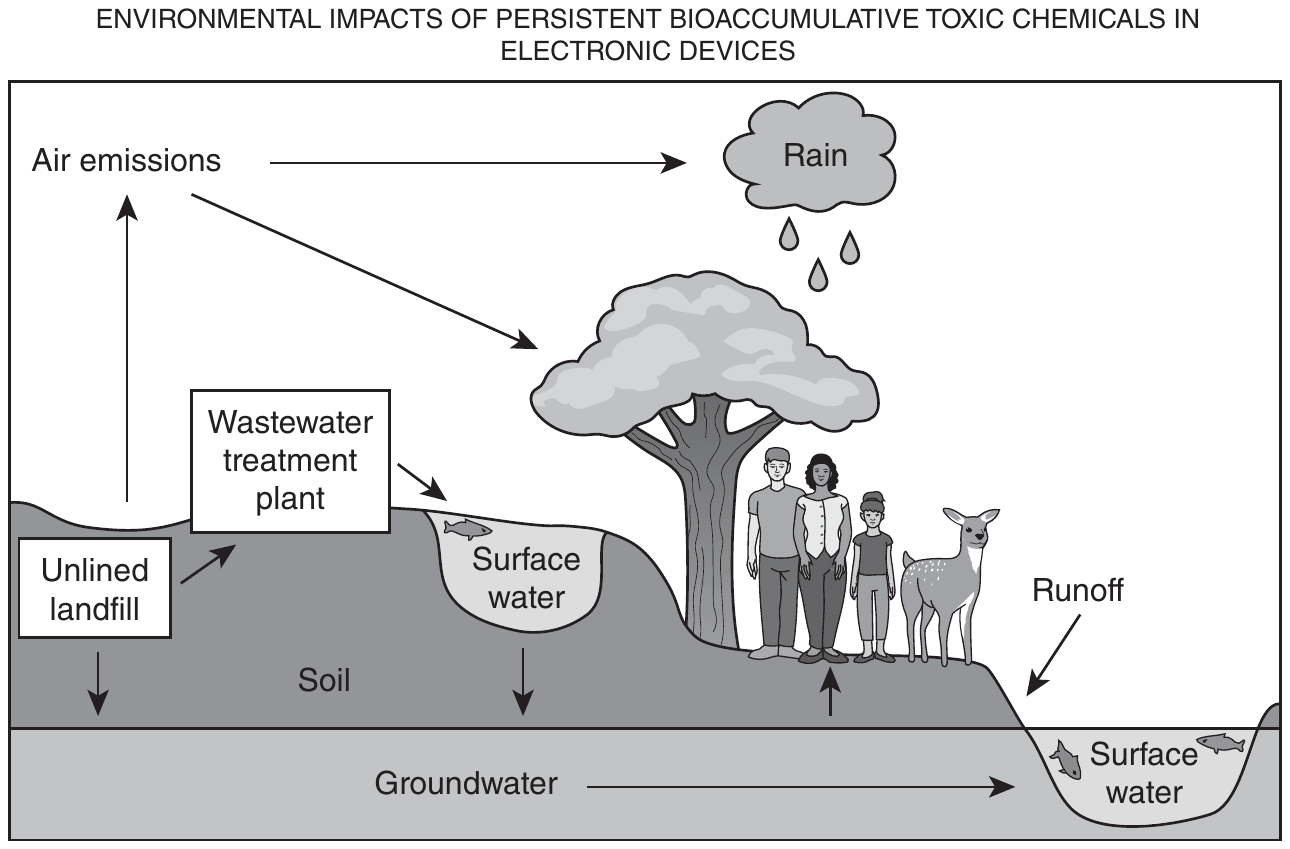
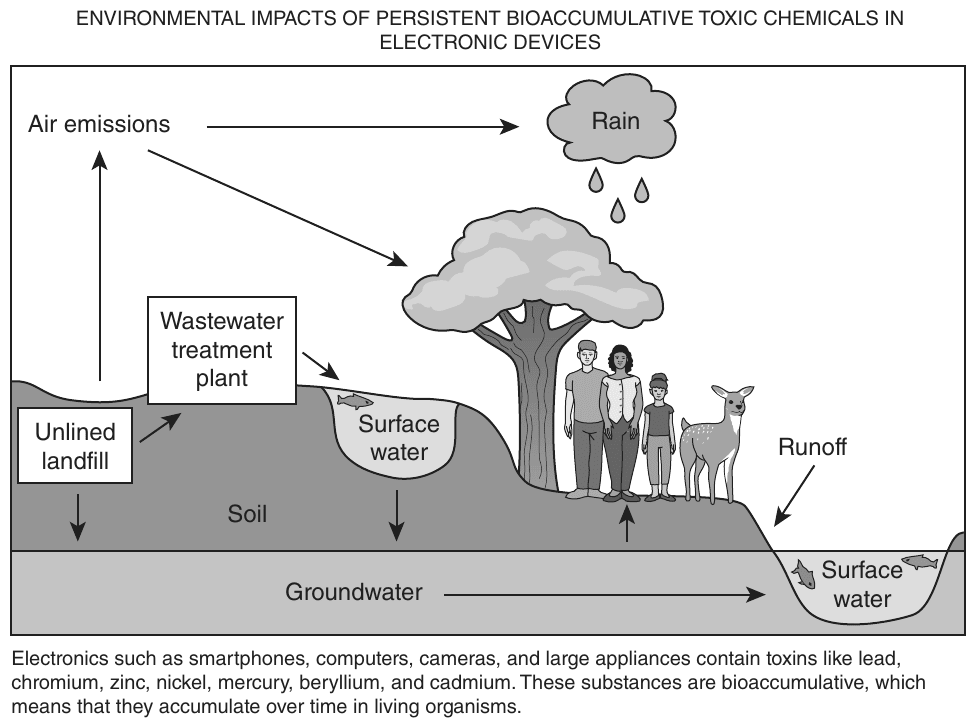
Electronics such as smartphones, computers, cameras, and large appliances contain toxins like lead, chromium, zinc, nickel, mercury, beryllium, and cadmium. These substances are bioaccumulative, which means that they accumulate over time in living organisms.
1obsolete: outdated and no longer useful
2Pallets: wooden platforms used to store or transport materials in a warehouse
3torrent: an outpouring
Question
Which sentence from the excerpt suggests that electronic devices are purposely designed to be disposed of after a short time?
- A“ ‘In our society, we always have to have the new, best product,’ said Aaron Blum, the co-founder and chief operating officer of ERI, on a tour of the facility.” (paragraph 2)
- B“Even when e-waste rules exist, it’s left up to consumers to handle their old devices properly.” (paragraph 6)
- C“Most smartphone batteries can’t be easily replaced when they stop holding a charge, new laptops don’t accept old cables, and software companies push upgrades that won’t run on old devices.” (paragraph 7)
- D“Some environmental groups say multibillion-dollar companies . . . should pick up the cost of recycling the devices they sell.” (paragraph 8)
Show the answer
Correct answer: C
This question asks for the best support from the excerpt for the idea that electronic devices are purposely designed to be disposed of after a short time.
A. Incorrect. This statement actually contradicts the notion that it is the manufacturers who are at fault for designing products to only last a short while, as it suggests that the desire for upgrading electronic devices comes directly from consumers themselves.
B. Incorrect. Though this explains a problem that occurs after the devices have already been upgraded, it provides no support for the idea that these devices are intentionally designed to become obsolete quickly.
C. CORRECT. This explains the techniques manufacturers of these devices implement to make the devices unusable after a short time. They cannot easily be repaired; they cannot be integrated with legacy components, and older devices are unable to run with new software.
D. Incorrect. This sentence explains that some people feel that these companies should accept responsibility for creating such short-lived devices, but it does not directly indicate that they intentionally make devices to become useless after only a short time.
Question analysis
This textual evidence question on “The World Has an E-Waste Problem” asks which quoted sentence suggests that electronic devices are purposely designed to be thrown away after a short time. The four sentences come from paragraphs 2, 6, 7 and 8, and each relates to the e-waste problem, so students must tell evidence for this exact claim apart from related points.
- NYS standards
- 7R1 textual evidence and inferences
- Grade level
- Grade 7 reading and task
- Compared with grade 7
- At grade 7 Choosing the sentence that best supports a stated idea is standard grade 7 evidence work. The four sentences are quoted with their paragraph numbers, so the search is short, though each one has to be weighed in its paragraph.
- Estimated difficulty
- Straightforward: two steps or one careful reading.
- Thinking it demands
- Depth of knowledge 2, skills and concepts · mainly evaluate
- What makes it hard
- Evidence
- Answered from one paragraph or stanza
- Reading level
- Passage: about grade 10, 760 words; question and choices: about grade 11, 116 words.
- Students, last 30 days
- Not enough answers yet to show (it takes 10).
Why it is hard, traps and wrong answers (shows the answer)
Why it is hard
The claim has two parts, that devices are built to be short-lived and that this is deliberate, and only one sentence speaks to how they are built. Blum’s remark is the strong pull because it explains why devices are replaced quickly, yet it puts the cause in buyers’ appetite for the newest model. Reading paragraph 7 around its quoted sentence settles the deliberate part, since the next sentence calls it a manufacturers’ strategy.
Reading between the lines minor Working it out
The keyed sentence lists batteries that can’t be replaced, cables that don’t fit and upgrades that won’t run, but never calls them deliberate; the intent comes from “speeding the pace of obsolescence” and Wiens’s “it’s a strategy.” (Graesser, Singer & Trabasso, 1994; Kintsch, 1998)
Every choice must be checked minor Choosing the answer
All four quoted sentences concern old devices and come from four different paragraphs, so each has to be tested for design and intent, not just for being about e-waste. (Embretson & Wetzel, 1987)
Strategy: Restate the claim in your own words, then read each quoted sentence in its paragraph and ask whether it supports that exact claim or only a related point about e-waste.
Traps
- Supports only part of the claim: In a question about evidence: a line that backs one half of the claim but not the other, or a related point rather than the claim itself.
- Reads too much in: A reasonable-sounding conclusion that goes further than the text allows.
- True but not the answer: A choice says something accurate about the text that does not answer this question.
The wrong answers, classified
A Supports only part of the claim (King et al., 2004; Thissen, Steinberg & Fitzpatrick, 1989)
Sees that Blum’s “we always have to have the new, best product” explains quick replacement, but it blames buyers’ wants and says nothing about how devices are designed.
B True but not the answer (King et al., 2004; Embretson & Wetzel, 1987)
Picks a sentence about who must handle old devices under e-waste rules, which concerns disposal after a device is replaced, not anything built into it to cut its life short.
D Reads too much in (Graesser, Singer & Trabasso, 1994)
Reasons that companies asked to pay for recycling must be making short-lived devices on purpose, though the sentence reports a demand from environmental groups and says nothing about design.
Working it out, step by step
Restate the idea to support
This asks for evidence, a sentence that backs up an idea. The idea has two parts. Devices are designed, or built, to be thrown out soon. And this is done on purpose. So the right sentence must be about how devices are made.
Find the sentence about design
Paragraph 7 says, “Most smartphone batteries can’t be easily replaced when they stop holding a charge, new laptops don’t accept old cables, and software companies push upgrades that won’t run on old devices.” Each part is something built into a product. Each one makes an old device stop being useful, so you have to buy a new one.
Find the clue that it is planned
The sentence just before says technology companies “are speeding the pace of obsolescence.” Obsolescence is the process of going out of date and becoming useless. Speeding it means making it happen sooner. Right after, Kyle Wiens calls it “a strategy by manufacturers to force us into shorter and shorter upgrade cycles.” A strategy is a plan, so it is done on purpose.
Check every quoted sentence
- A does not fit. Blum says buyers always want the newest thing. That blames what people want, not how devices are built.
- B does not fit. It is about who must handle old devices. That happens after a device has been replaced.
- C fits. It names three ways products are built to wear out fast.
- D does not fit. It says who should pay for recycling. It never mentions how long devices last or how they are made.
Give the answer
Watch out: A is tempting because it explains why devices get replaced so quickly. But it puts the cause on buyers, not on the companies that build the products. So the answer is C.
Why this answer and not the closest wrong one
Blum’s sentence, A, is the strongest pull. It does explain why people swap devices so often. But the idea you need is about design. Only C describes the products themselves: batteries you can’t replace, cables that won’t fit, software that won’t run. Paragraph 7 then calls this a plan by manufacturers.
More questions like this
The original DOE question
The passage “Excerpt from “The World Has an E-Waste Problem”” as printed (pages 164–166)