Passage Bird Talk
Bird Talk
by Carl Sandburg
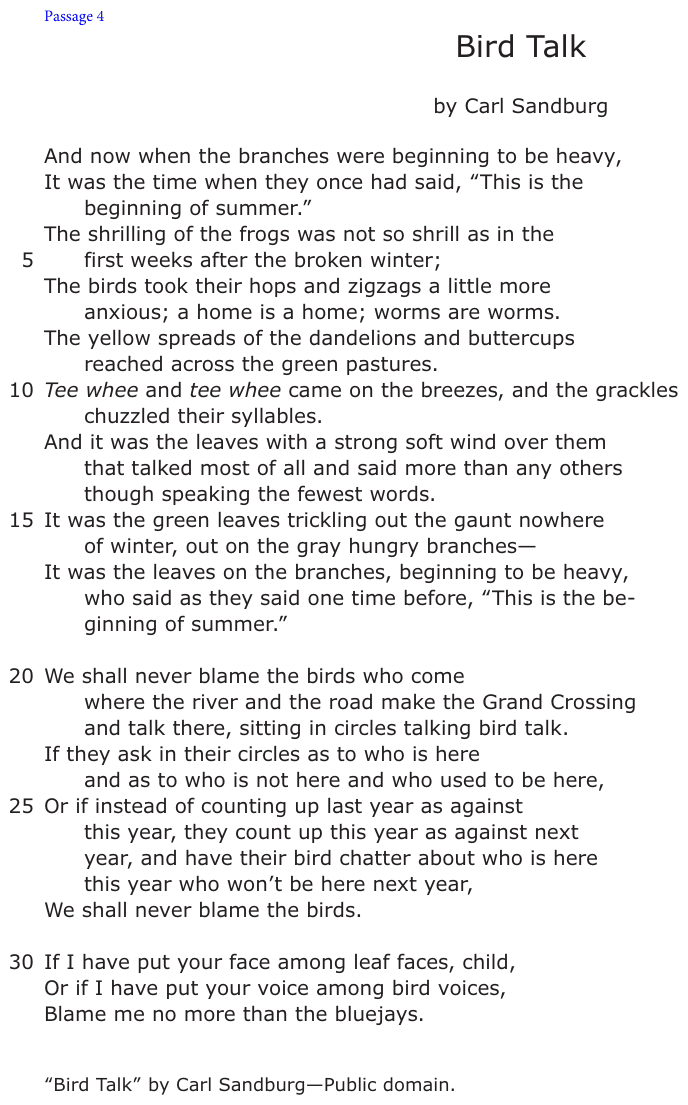
And now when the branches were beginning to be heavy,
It was the time when they once had said, “This is the
beginning of summer.”
The shrilling of the frogs was not so shrill as in the
first weeks after the broken winter;
The birds took their hops and zigzags a little more
anxious; a home is a home; worms are worms.
The yellow spreads of the dandelions and buttercups
reached across the green pastures.
Tee whee and tee whee came on the breezes, and the grackles
chuzzled their syllables.
And it was the leaves with a strong soft wind over them
that talked most of all and said more than any others
though speaking the fewest words.
It was the green leaves trickling out the gaunt nowhere
of winter, out on the gray hungry branches—
It was the leaves on the branches, beginning to be heavy,
who said as they said one time before, “This is the be-
ginning of summer.”
We shall never blame the birds who come
where the river and the road make the Grand Crossing
and talk there, sitting in circles talking bird talk.
If they ask in their circles as to who is here
and as to who is not here and who used to be here,
Or if instead of counting up last year as against
this year, they count up this year as against next
year, and have their bird chatter about who is here
this year who won’t be here next year,
We shall never blame the birds.
If I have put your face among leaf faces, child,
Or if I have put your voice among bird voices,
Blame me no more than the bluejays.
“Bird Talk” by Carl Sandburg—Public domain.
Question
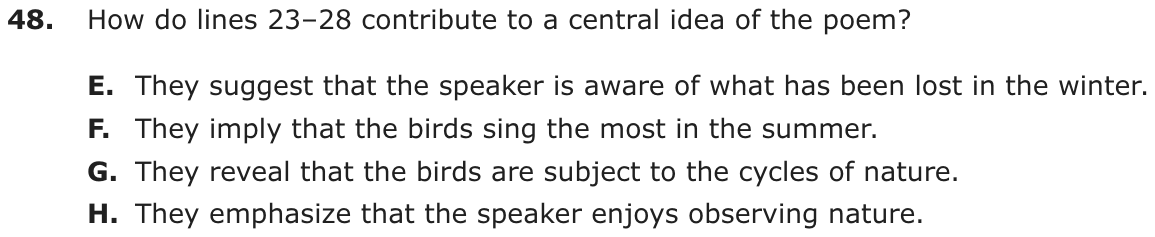
How do lines 23–28 contribute to a central idea of the poem?
- AThey suggest that the speaker is aware of what has been lost in the winter.
- BThey imply that the birds sing the most in the summer.
- CThey reveal that the birds are subject to the cycles of nature.
- DThey emphasize that the speaker enjoys observing nature.
Show the answer
Correct answer: C
This question asks how the description of the “bird talk” contributes to the central idea of the poem.
A. Incorrect. The birds’ conversations may center around “who is here” and “who is not here and who used to be here” (lines 23–24), but the lines do not convey that the speaker feels a sense of loss, only that the birds have such figurative conversations in a direct way.
B. Incorrect. Though the birds are described by the speaker as “talking bird talk” (line 22), it is not suggested that this talk occurs more frequently in one season versus another, only that it occurs year after year because birds encounter seasonal changes as a constant.
C. CORRECT. In these lines, the birds gather, and some birds are not present but “used to be here” (line 24). These birds have likely succumbed to another of nature’s cycles: death, which affects all living things.
D. Incorrect. Though the description in these lines is a vivid one and includes anthropomorphism in the birds asking about “who is here” (line 23) and “counting up last year as against / this year” (lines 25–26), it gives no indication of the speaker’s level of enjoyment in observing nature.
Question analysis
This poetry question points to lines 23–28 of Carl Sandburg’s “Bird Talk,” where birds sitting in circles talk over who is here, who is not here and who won’t be here next year, and asks how those lines contribute to a central idea of the poem. Students must untangle Sandburg’s long, loosely joined lines and connect the birds’ chatter to the rest of the poem.
- Grade level
- Grade 8 reading and task
- Compared with grade 7
- Above grade 7 Grade 7 students often explain what a stanza adds to a poem. Here six lines of loosely punctuated free verse must first be decoded and then tied to a central idea the question leaves unnamed, more than typical grade 7 poetry work.
- Estimated difficulty
- Hard: combines ideas, needs a plan, and has more than one tempting wrong answer.
- Thinking it demands
- Depth of knowledge 3, strategic thinking · mainly analyze
- What makes it hard
- Reading between the lines major
- Complex sentences moderate
- Figurative or literary language minor
- How, not what minor
- Evidence
- Answered from several paragraphs or stanzas
- Reading level
- Passage: 296 words (a poem; reading level not measured); question and choices: about grade 5, 57 words.
- Corrected from the DOE handbook
- The explanation said a quoted phrase was in the lines the question asks about, though it comes just before them; that sentence was corrected.
- Students, last 30 days
- Not enough answers yet to show (it takes 10).
Why it is hard, traps and wrong answers (shows the answer)
Why it is hard
The lines are hard to untangle, and the meaning that matters, that some birds have died or gone and others will by next year, is only implied. Students who catch the sense of loss can still go wrong by handing it to the speaker and tying it to the first stanza’s winter, while others fall back on safe statements about enjoying nature or summer birdsong. The question rewards reading the birds’ count of last year, this year and next year as a cycle that repeats.
Reading between the lines major Working it out
The lines never name death or the seasons; students must work out that birds “who used to be here” and birds “who won’t be here next year” stand for losses that come round year after year. (Graesser, Singer & Trabasso, 1994; Kintsch, 1998)
Complex sentences moderate Understanding the question
Lines 23–28 are one unfinished sentence of stacked “if” clauses, “as to who is here / and as to who is not here,” with a count of “this year as against next” broken across two lines. (Abedi & Lord, 2001; Freedle & Kostin, 1993; Messick, 1989)
Figurative or literary language minor Understanding the question
The birds are pictured as a meeting that will “ask in their circles” and keep a yearly tally, so the census has to be read as the speaker’s playful image of what nature does. (Graesser, Singer & Trabasso, 1994; Kintsch, 1998)
How, not what minor Working it out
The stem asks what the lines add to “a central idea” without naming one, so students must first decide which idea of the poem the birds’ tally serves. (Anderson & Krathwohl, 2001)
Strategy: Put lines 23–28 into plain words, noting who is talking and what they keep track of, then ask what that adds to the poem as a whole before you look at the choices.
Traps
- Twists what the text says: Uses the text's topic and ideas but changes what it says: who did it, how much, when, or why.
- Wrong part of the text: A choice is true of another paragraph, stanza or speaker than the one asked about.
- Reads too much in: A reasonable-sounding conclusion that goes further than the text allows.
The wrong answers, classified
A Twists what the text says (King et al., 2004)
Rightly hears loss in “who used to be here,” but gives that awareness to the speaker and pins it on winter, though the birds keep the count and look ahead to next year too.
B Reads too much in (Graesser, Singer & Trabasso, 1994)
Hears “bird chatter” as song and joins it to the poem’s summer setting, but the lines compare who is present from year to year, not how much birds sing in each season.
D Wrong part of the text (Kirsch & Mosenthal, 1990)
Remembers the first stanza’s pleasure in dandelions, buttercups and talking leaves, but lines 23–28 are given over to the birds’ count and show nothing of the speaker’s enjoyment.
What was corrected from the DOE handbook, and why
- Explanation: The question asks about lines 23–28. The DOE’s explanation of Option B begins “Though the birds are described in these lines by the speaker as ‘talking bird talk’ (line 22).” That phrase is in line 22, just before the lines the question asks about, as the explanation’s own line number shows. The site drops “in these lines,” so the sentence now says that the speaker describes the birds as “talking bird talk” (line 22). The reason Option B is wrong is unchanged: the poem does not suggest that the birds talk more in one season than in another. The answer, C, is unchanged.
Working it out, step by step
Figure out what the question asks
This asks what lines 23–28 add to a central idea of the poem. A central idea is a big message the whole poem gets across. So you need to do two things. First, put the six lines into plain words. Then see how they connect to the rest of the poem.
Read lines 20 to 29
Lines 20–22 show birds that “talk there, sitting in circles talking bird talk.” Lines 23–24 say they ask “as to who is here / and as to who is not here and who used to be here.” Lines 25–28 say they count “this year as against next / year.” They talk “about who is here / this year who won’t be here next year.” Line 29 ends: “We shall never blame the birds.”
Put the lines in plain words
The birds are pictured like people at a meeting, taking a count. Some birds from last year are missing. They may have died or flown off. And some birds here now won’t be back next year. This happens again every year. Some birds arrive and some are lost. A pattern that repeats like this is called a cycle. The seasons are a cycle too.
Connect the lines to the poem
The first stanza (group of lines) shows a pattern that repeats too. Winter is over, and the leaves say again that summer is beginning. Line 18 says they spoke “as they said one time before.” So a central idea is that nature moves in cycles that come back again and again. Lines 23–28 show that the birds’ lives follow those cycles too. To be “subject to” something is to be ruled by it.
Check each choice
- A does not fit. The birds keep the count, not the speaker (the voice talking in the poem). The lines never mention winter, and they look ahead to next year too.
- B does not fit. Line 22 calls it “talking bird talk,” but lines 23–28 never compare seasons or say when birds sing most.
- C fits. Birds come and go year after year, as part of nature’s cycles.
- D does not fit. These lines are about the birds’ count. They show nothing about whether the speaker enjoys watching.
Choose the answer
Watch out: A is the most tempting, because “who used to be here” does hint at loss. But the birds are the ones counting, and the count goes on every year. The lines show a cycle, not one sad winter. So the answer is C.
Why this answer and not the closest wrong one
A is the closest wrong answer, because the lines do hint at loss. But it is the birds who count who is missing, not the speaker. The lines also look ahead to next year instead of back at winter. That yearly count of who comes and who goes shows birds living by nature’s cycles, which is C.
More questions like this
The original DOE question
The passage “Bird Talk” as printed (page 32)