Passage A Memory Revolution
A Memory Revolution
A high school senior logs on to a computer at the library to double-check the application due date listed on a college admissions website. Nearby, a librarian helps a group of biology students use a database to search for recent studies about mammals. In the past few decades, the Internet has become an integral component of daily life for many people. The seemingly limitless power of search engines made the Internet search extremely common, and today people increasingly rely on the Internet’s vast accumulation of sources to access all types of information. Scientists are beginning to examine how this reliance is modifying the strategies people use to store and prioritize information in their mind.
A Dependable and Valuable Asset
Psychologist Benjamin Storm from the University of California, Santa Cruz, and researchers Sean Stone and Aaron Benjamin devised an experiment to study students’ tendency to depend on the Internet for facts. To begin, the scientists divided sixty participants into multiple groups, including an “Internet” group and a “memory” group, and placed them in front of computers. The Internet group was required to use the search engine Google to answer eight challenging trivia questions. In contrast, participants in the memory group were permitted to use only their personal knowledge to answer the questions. In the second round, the researchers administered notably easier questions. This time, they allowed each group the option of using Google as they answered. Their results showed that 83 percent of the Internet group continued to consult Google in the second round, while only 63 percent of the memory group chose to do so.
People’s growing inclination to rely on the Internet in order to retrieve information, particularly facts and figures, is called cognitive offloading. Canadian researcher Evan F. Risko and British researcher Sam Gilbert, who have written extensively about the topic, say a similar process has been taking place for centuries. In the past, people used resources like encyclopedias to assist their memories; however, today the Internet, serving as a vast extended memory, allows people to digitally access and retrieve much larger volumes of information. Consequently, people’s minds are free for other cognitive feats, such as connecting data, learning new information, or solving problems.
Filing Information Away
The use of the Internet also appears to be modifying the strategies people use to store information in their mind. Researchers Betsy Sparrow from Columbia University, Jenny Liu from the University of Wisconsin-Madison, and Daniel Wegner from Harvard University conducted several studies to discover how people efficiently manage their information intake.
To begin, the researchers examined how people evaluate which information deserves their effort to remember. For this experiment, participants read forty trivia facts, such as “An ostrich’s eye is bigger than its brain,” and typed the statements into a computer file. Half the participants had been previously told the file would be saved, while half believed it would be erased. Next, the participants wrote down every fact they could recall. Those who believed the information would be erased and no longer available could recall 40 percent more facts than those who thought the information would be saved.
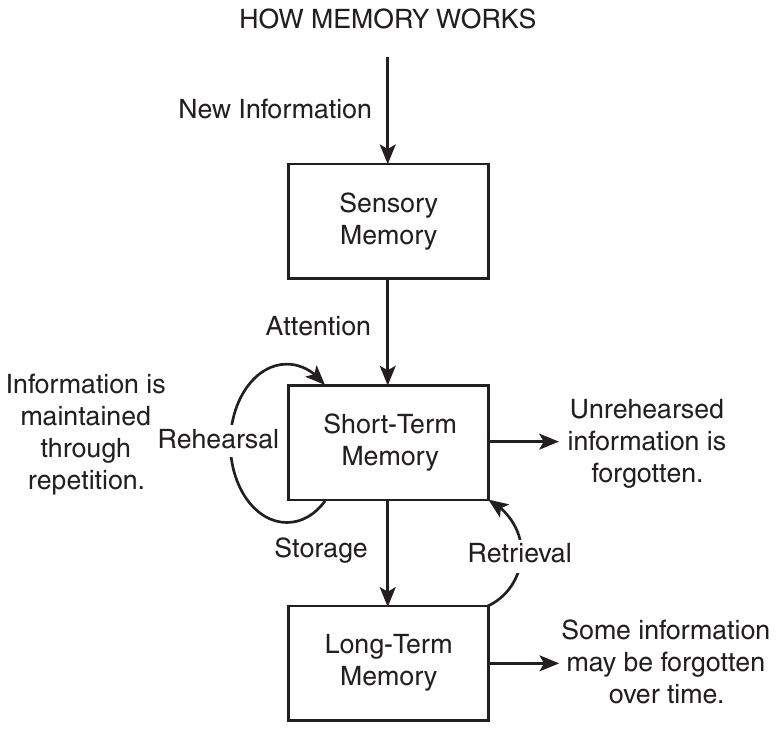
In another experiment, the same researchers tested the ability of study participants to remember where to access information. For this trial, participants read and typed trivia statements, which they saved in folders with generic names such as “Facts” and “Items.” After spending ten minutes writing down all the facts they could recall from memory, participants were asked which folder contained a particular fact based on a keyword. For example, “Which folder has the fact about ostriches?” Overall, participants recalled the information’s location more often than the content itself, correctly identifying 49 percent of the folders for specific facts while remembering only 23 percent of the actual trivia. The researchers concluded that our memory is adapting to the Internet age by prioritizing where to locate information even when the specific details are forgotten. According to Sparrow, the Internet has become an important form of transactive memory, an external source of the recollections and associative networks that constitute memory.
As the Internet’s resources continue to expand our “external” memory, some question whether the process may cause people to depend too heavily on technology. However, Steven Pinker, a professor of psychology at Harvard University, says, “Knowledge is increasing exponentially; human brainpower and waking hours are not. Fortunately, the Internet and information technologies are helping us manage, search and retrieve our collective intellectual output at different scales, from Twitter and previews to e-books and online encyclopedias. Far from making us stupid, these technologies are the only things that will keep us smart.”
Question
The effect of the Internet on a person’s memory is illustrated in the passage through the presentation of studies that
- Aexamine how the use of search engines changes the way people evaluate and store information for future access.
- Bhighlight the difference between the capacity of the Internet and the ability of the human brain to locate information.
- Ccompare the type of information that can be obtained from the Internet with the type of information that is stored in the human brain.
- Demphasize the ease of obtaining information through search engines rather than remembering it without assistance.
Show the answer
Correct answer: A
The question asks how the studies presented in the passage are used to illustrate the effect of the Internet on a person’s memory.
A. CORRECT. The study described in paragraph 5 examined the effect of computer use on the way people evaluate information, specifically “which information deserves their effort to remember,” and determined that “those who believed the information would be erased and no longer available could recall 40 percent more facts than those who thought the information would be saved.” The study described in paragraph 2 established that the use of Internet search engines increases the “inclination to rely on the Internet in order to retrieve information” (paragraph 3), and the study in paragraph 6 examined how this reliance on technology affects the way people store information: “Overall, participants recalled the information’s location more often than the content itself.”
B. Incorrect. Although a difference in the ability of the human brain and the capacity of the Internet to locate information might seem evident, the studies cited in the passage did not examine the ability or the capacity of either. The studies did not measure what the human brain is capable of but rather how memory is affected by the use of the Internet.
C. Incorrect. While the studies explored the Internet’s effect on the way information is stored in human memory, the type of information was not described or compared. Instead, the studies indicated that location is the main difference between the information stored in the Internet and the information stored in human memory, noting that the Internet has become “an external source of the recollections and associative networks that constitute memory” (paragraph 6).
D. Incorrect. Although it is increasingly common to use the Internet to obtain information (paragraph 2) rather than try to memorize information (paragraph 5), the studies did not examine the difficulty or ease of obtaining/recalling information using either method.
Question analysis
This evidence question asks how the studies described in “A Memory Revolution” illustrate the Internet’s effect on a person’s memory. Students must recall three experiments, one with trivia questions and Google, one with trivia typed into a computer file, and one with named folders, and decide what they examine together. Each choice sounds like a fair claim about the Internet and the brain.
- Grade level
- Grade 8 reading and task
- Compared with grade 7
- At grade 7 Summing up what a text’s evidence shows is everyday grade 7 work. Here the evidence is three studies spread over paragraphs 2, 5 and 6, which adds recall, but each one is described in plain terms.
- Estimated difficulty
- Moderate: several steps, or a close reading with one strong distractor.
- Thinking it demands
- Depth of knowledge 2, skills and concepts · mainly understand
- What makes it hard
- Evidence in several places moderate
- Reading between the lines minor
- Every choice must be checked minor
- Evidence
- Answered from several paragraphs or stanzas
- Reading level
- Passage: about grade 14, 763 words; question and choices: about grade 12, 96 words.
- Students, last 30 days
- Not enough answers yet to show (it takes 10).
Why it is hard, traps and wrong answers (shows the answer)
Why it is hard
The question asks what the article’s studies show together, so a student needs a one-line summary of three experiments before reading the choices. The key is slightly loose, since only the first study uses a search engine, which can make a careful reader hesitate. The strongest pull comes from paragraph 2, where most people turned to Google even for easy questions; it sounds like proof that searching is easier, but no study weighed the effort of looking up against remembering.
Evidence in several places moderate Working it out
The three studies sit in paragraphs 2, 5 and 6, and the key gathers them: turning to Google even for easy questions, recalling less from a saved file, and remembering folders better than facts. (Kirsch & Mosenthal, 1990; Gorin & Embretson, 2006)
Reading between the lines minor Working it out
No sentence says what the studies share; students must abstract it, that expecting later access changes what people bother to store, from experiments built on Google, a computer file and named folders. (Graesser, Singer & Trabasso, 1994; Kintsch, 1998)
Every choice must be checked minor Choosing the answer
Each wrong choice names something the studies might plausibly have measured, the Internet’s capacity, kinds of information or ease of searching, and only a check of the three experiments shows that none did. (Embretson & Wetzel, 1987)
Strategy: Sum up in a phrase what the studies in paragraphs 2, 5 and 6 each tested, then pick the option that describes what they examined rather than a point made elsewhere in the article.
Traps
- Reads too much in: A reasonable-sounding conclusion that goes further than the text allows.
- Twists what the text says: Uses the text's topic and ideas but changes what it says: who did it, how much, when, or why.
- Wrong part of the text: A choice is true of another paragraph, stanza or speaker than the one asked about.
The wrong answers, classified
B Wrong part of the text (Kirsch & Mosenthal, 1990)
Borrows paragraph 3’s “much larger volumes of information” and Pinker’s remark about “human brainpower,” points made outside the studies, which never measured what the Internet or the brain can hold.
C Twists what the text says (King et al., 2004)
Turns paragraph 6’s gap between recalling where a fact was kept and recalling the fact itself into a comparison of kinds of information, though no study sorted facts by type.
D Reads too much in (Graesser, Singer & Trabasso, 1994)
Reads paragraph 2’s finding that 83 percent of the Internet group kept using Google as proof that searching is easier, though no study compared the effort of searching with remembering.
Working it out, step by step
Figure out what the question asks
This asks what the studies in the article have in common. How do they show the Internet’s effect on memory? There are three studies, in paragraphs 2, 5 and 6. Sum up each one in a few words. Then find the choice that fits all three.
Sum up the three studies
- Paragraph 2: People who had used Google kept using it, even for easy questions. In fact, “83 percent of the Internet group continued to consult Google in the second round.”
- Paragraph 5: People who thought a file of facts would be erased remembered more. They decided which facts deserved “their effort to remember.”
- Paragraph 6: People remembered where facts were kept better than the facts themselves.
Find what the studies share
Each study looks at how people treat information when a computer or search engine can hold it for them. People decide what is worth the effort to remember. Judging the value of something like this is called evaluating. People also change what they store in their minds, such as where a fact is instead of the fact. That is the effect on memory.
Check each choice
- A fits. The studies show people judging what to remember and storing where to find it.
- B does not fit. No study measured how much the Internet can hold or what the brain can do.
- C does not fit. No study sorted information into types.
- D does not fit. No study compared how easy it is to search and to remember.
Watch out: D is tempting because most people in paragraph 2 kept using Google. That might seem to show searching is easier. But the study never measured ease. It only counted who used Google.
Choose the answer
Only one choice describes what the studies actually tested. So the answer is A, “examine how the use of search engines changes the way people evaluate and store information for future access.”
Why this answer and not the closest wrong one
D is the closest wrong choice. It sounds like a fair reason people use Google. But none of the studies timed or rated the effort of searching or remembering. They tested what people chose to remember and what they stored. A describes that. Only the first study used a search engine, but the other two show the same pattern with a computer file and folders.
More questions like this
The original DOE question
The passage “A Memory Revolution” as printed (pages 3–4)