Fractions and decimals
Question 1 of 63
2026 Practice Test A Math, question 50Question
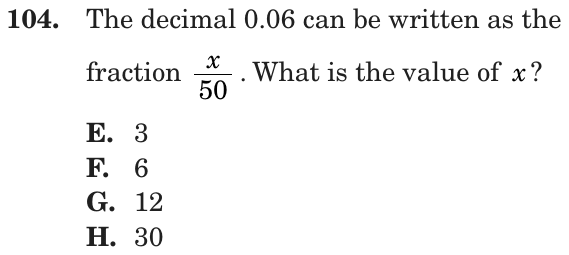
Let , , and . Determine the value of .
Enter your fractional answer in the space provided. Enter only your fraction.
On the test you build the answer on an on-screen keypad; here, type it. Use ^ for a power, sqrt( ) or √ for a root, pi for π, and <= or >= for ≤ and ≥.
Show the answer
Correct answer: 7/5
Solution:
Substitute , , and in : .
Then simplify the complex fraction by multiplying the complex fraction by a form of 1, : .
Simplify after multiplying by a form of 1: .
Then simplify again and add the two fractions: .
Question analysis
This substitution question gives values for b, c and d and asks for the value of an expression made of a fraction divided by a fraction, plus another fraction. Students substitute, simplify the complex fraction and add, then type the result. Dividing fractions in the stacked form is the main hurdle, and the item wants a fraction, not a decimal.
- NYS standards
- Grade level
- Grade 7 content, by NYS standard
- Compared with grade 7
- At grade 7 Grade 7 students evaluate expressions and divide and add fractions. A fraction stacked over another fraction looks unfamiliar and there are no choices to check, but with these values the work is three short steps.
- Estimated difficulty
- Moderate: several steps, or a close reading with one strong distractor.
- Thinking it demands
- Depth of knowledge 1, recall and reproduction · mainly apply
- What makes it hard
- Error-prone arithmetic moderate
- Something you must already know minor
- An answer in an unexpected form minor
- Solution
- 3 steps
- Reading level
- Question and choices: about grade 9, 22 words.
- Students, last 30 days
- Not enough answers yet to show (it takes 10).
Why it is hard, traps and wrong answers (shows the answer)
Why it is hard
Once the values are in, the work is one fraction division and one addition, but the division is printed as a fraction over a fraction, in small type. Multiplying the two fractions, or flipping the top one, gives a sum in fifteenths that looks as finished as the right one. Noticing that the 4s cancel, so the stacked part is simply 3/5, turns the last step into adding fifths.
Error-prone arithmetic moderate Working it out
Dividing 4/5 by 4/3 means multiplying by 3/4, giving 3/5, which is then added to 4/5; multiplying straight across or flipping the top fraction instead both lead to fifteenths. (Brown & Burton, 1978; Junker & Sijtsma, 2001)
Something you must already know minor Working it out
Nothing on the page says that a fraction over a fraction is a division, or that dividing by 4/3 means multiplying by its reciprocal, and the stacked form is rare in grade 7 work. (Anderson & Krathwohl, 2001)
An answer in an unexpected form minor Choosing the answer
The value is typed into a fraction box with no choices to check against, and the item asks for a fraction, so the equal decimal 1.4 is not accepted. (Enright, Morley & Sheehan, 2002)
Strategy: Substitute the values, rewrite the stacked fraction as the top fraction times the reciprocal of the bottom one, where the 4s cancel, then add the last fraction and leave the result as a fraction.
Traps
- Wrong operation: Adds instead of multiplying, divides the wrong way round, turns a ratio or rate upside down, or undoes a step in the wrong direction (subtracts what should be added back).
- A faulty procedure: A systematic but wrong procedure: adding fractions straight across, applying an exponent to each term of a sum, dropping a sign when moving a term.
- Misreads the question: Misses or misreads a condition or a word in the question: "at least", "each", "remaining", "not".
The wrong answers, classified
28/15 Wrong operation (Hegarty, Mayer & Monk, 1995; King et al., 2004)
Multiplies 4/5 by 4/3 instead of dividing, getting 16/15, then adds 4/5, or 12/15, to reach 28/15.
37/15 A faulty procedure (Brown & Burton, 1978; Tatsuoka, 1983)
Flips the top fraction instead of the bottom one, so the stacked part becomes 5/4 × 4/3 = 5/3, and 5/3 + 4/5 = 37/15.
1.4 Misreads the question (Hegarty, Mayer & Monk, 1995)
Finds the right value but works in decimals, 0.6 + 0.8 = 1.4, and enters that, though the item asks for a fraction.
Worked solution, step by step
Formulas used
- Dividing fractions
- a, b, c and d are numbers that are not zero. To divide by a fraction, multiply by its reciprocal, the fraction flipped upside down. Flip only the fraction you divide by. It works because a fraction times its reciprocal is 1, so the reciprocal undoes the fraction, just as dividing does.
- Adding fractions with the same bottom
- d is the denominator, the bottom number, which tells the size of each piece. a and b are the numerators, the top numbers, which count the pieces. When the pieces are the same size, add the tops and keep the bottom.
Sort out the question
You know , and . You need the value of:
The first part is a fraction on top of a fraction. A fraction bar means divide, so this part is . The answer must be typed as a fraction.
Put in the numbers
Replace each letter with its value. Look closely: the bottom fraction has b under the c, not d.
So the expression becomes:
Divide the two fractions
Use the rule for dividing fractions. The reciprocal of 4/3 is 3/4. To multiply fractions, multiply the tops and multiply the bottoms:
To simplify 12/20, divide its top and bottom by 4.
Watch out: flip only the bottom fraction. Multiplying without flipping gives 16/15 and a total of 28/15. Flipping the top one gives 5/3 and a total of 37/15.
Add the last fraction
Both fractions are now fifths, so add the tops and keep the bottom:
The value is 7/5.
Enter it as a fraction
The item asks for a fraction. 7/5 equals the decimal 1.4, but 1.4 is not accepted. On the test, the answer box already holds a fraction template, a small box over a small box. Type 7 in the top box. Then click the bottom box and type 5. On this site, type 7/5.
So you would enter 7/5.
Check your answer
Check with decimals. , and 4/3 is about 1.33. Then is about 0.6, which is 3/5. Last, , and 1.4 is the same as 7/5.
More questions like this
The original DOE question
Question 2 of 63
2026 Practice Test C Math, question 8Question
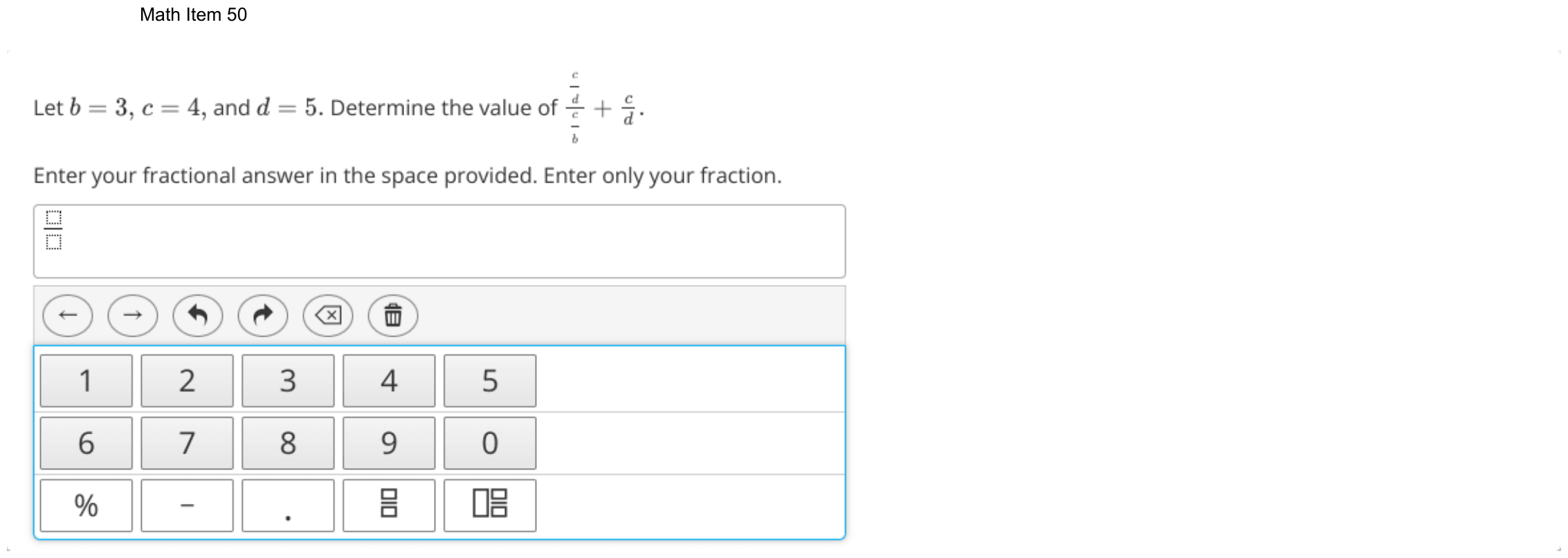
Jordan is helping plan snacks for a school dance. He knows that 0.75 of the students voted for pizza, and he wants to record the same amount using a fraction.
Which fractions are equivalent to the decimal 0.75?
Select the four correct answers.
Choose every answer that is correct, then check. The DOE has not published how answers with several parts are scored; this site counts one right only when every part is right.
- A
- B
- C
- D
- E
- F
Show the answer
Correct answer: A, B, C, and E
Check each fraction to determine whether it is equal to 0.75 when simplified or converted to a decimal.
This is the most common fraction equal to 0.75.
Simplifies to 3/4, because 15 and 20 can both be divided by 5.
This is a direct match to 0.75 when written as a decimal.
, which is less than 0.75.
Simplifies to because both 6 and 8 can be divided by 2.
, which is more than 0.75.
Question analysis
Jordan wants to record 0.75 of the students' pizza votes as a fraction, and students select the four fractions, out of six, that equal 0.75. It tests converting between decimals and fractions and recognizing equivalent fractions. Each choice has to be checked by its value, not by how its numbers look.
- NYS standards
- 7.NS.2d fractions to decimals by long division
- Grade level
- Grade 7 content, by NYS standard
- Compared with grade 7
- Below grade 7 Matching fractions to a decimal such as 0.75 builds on grade 4 to 6 work, and the denominators here divide easily. The added demand is the format: four of the six must be chosen, and one wrong or missing pick loses the item.
- Estimated difficulty
- Straightforward: two steps or one careful reading.
- Thinking it demands
- Depth of knowledge 1, recall and reproduction · mainly apply
- What makes it hard
- Every choice must be checked moderate
- A very close wrong answer minor
- Much to keep track of minor
- Solution
- 2 steps
- Reading level
- Question and choices: about grade 5, 47 words.
- Students, last 30 days
- Not enough answers yet to show (it takes 10).
Why it is hard, traps and wrong answers (shows the answer)
Why it is hard
Three of the four right fractions, 3/4, 75/100 and 6/8, are familiar forms of 0.75, so the item comes down to the fourth. Students who stop after the familiar ones must decide between 15/20, which needs dividing by 5 to recognize, and 8/10, which sits close to 0.75 on a number line. Dividing each numerator by its denominator, or scaling 3/4 up by 5, settles it.
Every choice must be checked moderate Choosing the answer
Six fractions with six different denominators have to be tested one by one, by dividing or by simplifying, since 15/20 and 8/10 cannot be judged by how they look. (Embretson & Wetzel, 1987)
A very close wrong answer minor Choosing the answer
8/10 is 0.8, only 0.05 above 0.75, and it follows 6/8 by adding 2 to the top and the bottom, so it looks like one more member of the family. (Embretson & Wetzel, 1987; Gorin & Embretson, 2006; Ascalon et al., 2007)
Much to keep track of minor Working it out
Four of the six must be chosen and all four must be right for the item to count, so each verdict has to be kept while the remaining fractions are tested. (Sweller, 1988; Carpenter, Just & Shell, 1990)
Strategy: Turn each choice into a decimal by dividing its numerator by its denominator, or reduce it to lowest terms, and keep only the ones whose value is exactly the decimal given.
Traps
- Misunderstands the concept: A wrong belief about a concept: that percents can be added, that area grows like length, that averages can be averaged, that a bigger denominator means a bigger fraction.
The wrong answers, classified
D Little reason to choose it (Haladyna & Downing, 1993; Rodriguez, 2005)
No usual working links 2/5 to 0.75, since 2 ÷ 5 = 0.4, so it mostly catches students filling the fourth slot by guessing.
F Misunderstands the concept (Smith, diSessa & Roschelle, 1993; De Bock et al., 1998; Ni & Zhou, 2005)
Builds 8/10 from 6/8 by adding 2 to the top and the bottom, as if equal additions kept a fraction's value, or accepts 0.8 as close enough.
Worked solution, step by step
Formulas used
- Changing a fraction to a decimal
- a is the numerator, the top. b is the denominator, the bottom. A fraction bar means divide. So dividing the top by the bottom gives the fraction’s value as a decimal.
- Equivalent fractions
- a is the top and b is the bottom. n is a number that goes evenly into both. Dividing the top and the bottom by the same number gives an equal fraction. Equivalent fractions name the same amount in different ways.
Sort out the question
Six fractions are given, A to F. You need the four that equal the decimal 0.75. Equivalent means equal in value. Test every choice, because some fractions look alike but are not equal.
Write 0.75 as a fraction
0.75 means 75 hundredths:
So choice C works. Now simplify it. 25 goes into both 75 and 100:
So choice A, 3/4, works too.
Test choices B and E
Simplify each one to see if it becomes 3/4:
- B: 5 goes into 15 and 20. . It works.
- E: 2 goes into 6 and 8. . It works.
Test choices D and F
Divide the top by the bottom:
- D: . That is less than 0.75.
- F: . That is more than 0.75.
Watch out: F looks like 6/8 with 2 added to the top and the bottom. Adding the same number to both changes the value. Only multiplying or dividing both keeps it.
Name the four answers
A, B, C and E all equal 0.75. On the test, you check the box beside each of them. On this site, you choose all four, then check your answer.
So the answers are A, B, C and E.
Check your answer
Turn each answer into a decimal. , , and all give 0.75. Exactly four choices passed, and the question asks for four. So none were missed.
More questions like this
The original DOE question
Question 3 of 63
2026 Practice Test C Math, question 13Question
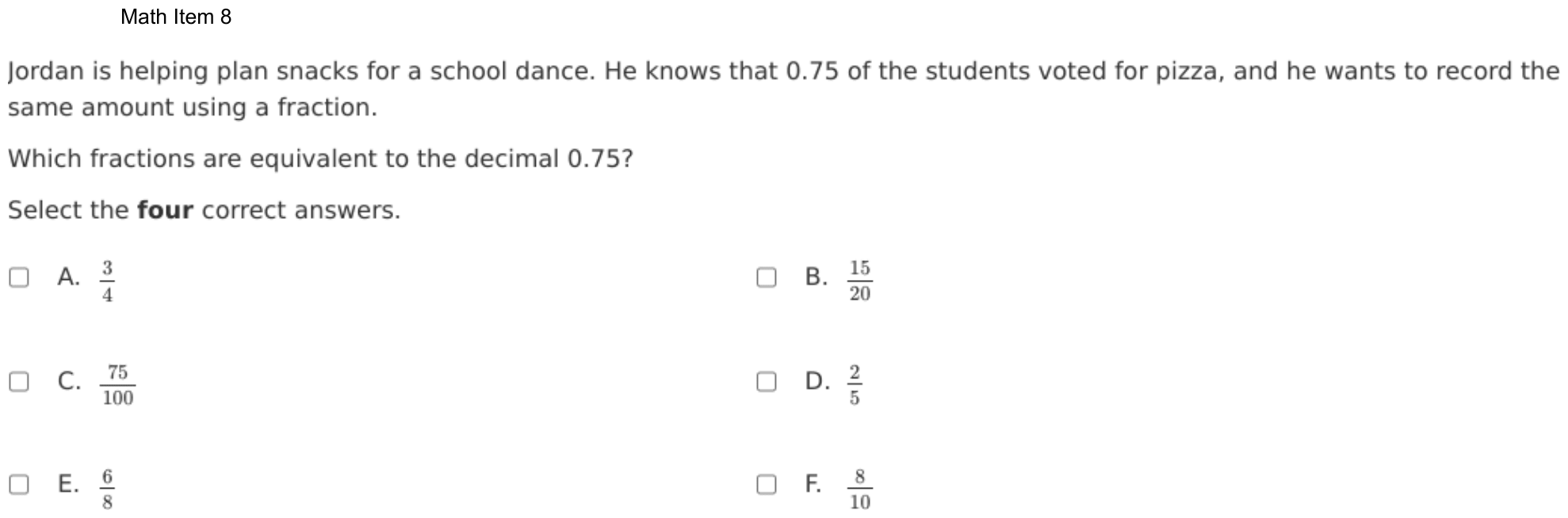
Start with the number 135.28 and perform the following steps in order:
- Step 1: Multiply by 10.
- Step 2: Add 0.5 to the result of Step 1.
- Step 3: Drop the digits after the decimal point.
- Step 4: Divide by 10.
What is the result?
- A13.5
- B135
- C135.2
- D135.3
Show the answer
Correct answer: D
Begin by multiplying 135.28 by 10:
Add 0.5:
Drop the digits after the decimal point, so becomes .
Divide by 10:
Question analysis
Students start with 135.28 and carry out four listed steps: multiply by 10, add 0.5, drop the digits after the decimal point, and divide by 10. It tests place value and operations with decimals. Skipping a step, or doing two of them in the wrong order, changes the result, and the choices are built from those slips.
- NYS standards
- 6.NS.3 multi-digit decimal operations
- Grade level
- Grade 6 content, by NYS standard
- Compared with grade 7
- Below grade 7 Multiplying and dividing a decimal by 10 and adding 0.5 are grade 5 and 6 skills. The four steps are spelled out, so the demand is following them exactly and in order, not choosing a method.
- Estimated difficulty
- Straightforward: two steps or one careful reading.
- Thinking it demands
- Depth of knowledge 1, recall and reproduction · mainly apply
- What makes it hard
- A very close wrong answer moderate
- Many steps minor
- Error-prone arithmetic minor
- Solution
- 4 steps
- Reading level
- Question and choices: about grade 3, 36 words.
- Students, last 30 days
- Not enough answers yet to show (it takes 10).
Why it is hard, traps and wrong answers (shows the answer)
Why it is hard
The steps spell out how to round 135.28 to the nearest tenth, but nothing says so, and they have to be followed exactly. The decisive moment is step 2, where adding 0.5 pushes 1,352.8 past 1,353; skip it and the digits are simply cut, not rounded. Students who recognize the routine can check the result directly, since 135.28 lies closer to 135.3 than to 135.2.
A very close wrong answer moderate Choosing the answer
135.3 and 135.2 differ only in the tenths digit, and 135 shares their whole-number part, so a rough sense of the result's size rules out nothing. (Embretson & Wetzel, 1987; Gorin & Embretson, 2006; Ascalon et al., 2007)
Many steps minor Working it out
Four listed steps move the decimal point twice, and doing them in another order, or skipping one, still produces a believable number near 135. (Daniel & Embretson, 2010; Enright, Morley & Sheehan, 2002)
Error-prone arithmetic minor Working it out
Adding 0.5 to 1,352.8 carries into the ones place, since 8 tenths and 5 tenths make 1.3, which turns 1,352 into 1,353 before the decimals are dropped. (Brown & Burton, 1978; Junker & Sijtsma, 2001)
Strategy: Write down the number after each step instead of doing them in your head, and carry out the steps exactly in the order listed.
Traps
- Misreads the question: Misses or misreads a condition or a word in the question: "at least", "each", "remaining", "not".
- Rounds too early: Rounds a value partway through, or rounds the wrong way, so the final answer drifts from the exact one.
The wrong answers, classified
A Misreads the question (Hegarty, Mayer & Monk, 1995)
Skips step 1, so adds 0.5 to 135.28, drops the decimals to get 135, and then divides by 10 to reach 13.5.
B Misreads the question (Hegarty, Mayer & Monk, 1995)
Divides by 10 before dropping the digits after the decimal point, so 1,353.3 becomes 135.33 and then 135, doing steps 3 and 4 in reverse order.
C Rounds too early (King et al., 2004)
Leaves out step 2, or adds 0.5 without carrying, so 1,352 is kept and 135.2 results: 135.28 cut down instead of rounded up.
Worked solution, step by step
Formulas used
- Multiplying and dividing by 10
- a is any decimal number. Multiplying by 10 moves its decimal point one place to the right, so each digit is worth ten times as much. Dividing by 10 moves the point one place to the left. The two steps undo each other.
Sort out the question
You start with 135.28 and do four steps, in order. Write down the number after each step. Doing them in your head, or in another order, leads to a wrong choice. You need the number at the end.
Multiply by 10
Step 1. Multiplying by 10 moves the decimal point one place to the right:
The digits stay the same. Only the decimal point moves.
Add 0.5
Step 2. Line up the decimal points. 8 tenths plus 5 tenths is 13 tenths. That is 1 whole and 3 tenths, so carry the 1 into the ones place:
Watch out: skipping this step, or forgetting to carry, keeps 1,352. That leads to choice C, 135.2.
Drop the digits after the point
Step 3. Cut off the digits after the decimal point. Do not round. So 1,353.3 becomes 1,353.
Watch out: do step 3 before step 4. Dividing first gives 135.33. Dropping its decimals then gives 135, choice B.
Divide by 10
Step 4. Dividing by 10 moves the decimal point one place to the left:
Skipping step 1 gives 13.5, choice A. So the answer is D, 135.3.
Check your answer
These four steps are a recipe for rounding to the nearest tenth. 135.28 is between 135.2 and 135.3. Its hundredths digit is 8, which is 5 or more, so it rounds up to 135.3. The recipe and the rounding agree.
More questions like this
The original DOE question
Question 4 of 63
2026 Practice Test C Math, question 19Question
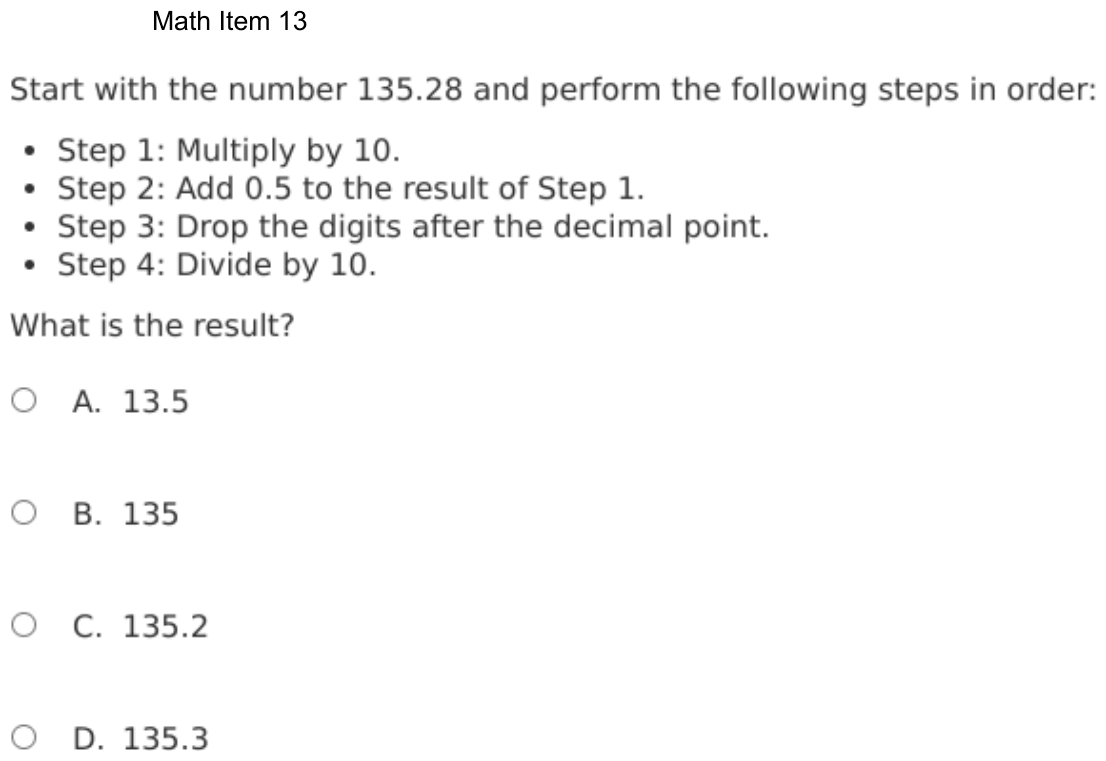
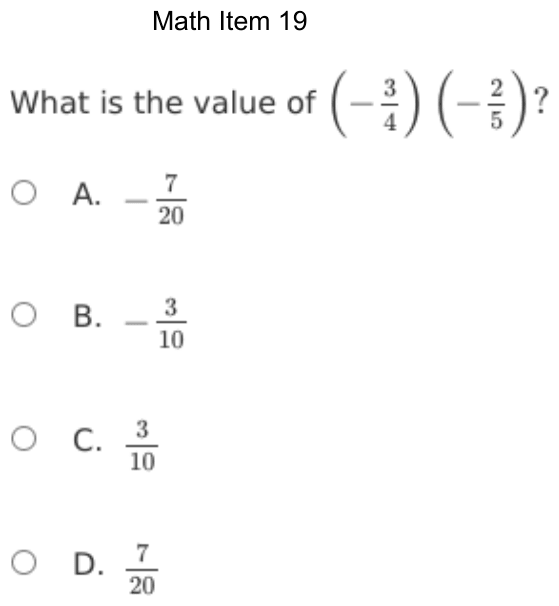
What is the value of ?
- A
- B
- C
- D
Show the answer
Correct answer: C
Evaluate the expression by multiplying the terms in the numerator and the terms in the denominator. The product of two negative values is positive:
Simplify the result:
Question analysis
This question asks for the product of negative three fourths and negative two fifths. Students multiply the fractions, settle the sign of the result, and simplify. The choices mix positive and negative answers with results from other operations, so both the sign and the operation have to be right.
- Grade level
- Grade 7 content, by NYS standard
- Compared with grade 7
- At grade 7 Multiplying two negative fractions is a standard grade 7 exercise, done here in one product and one simplification. It matches typical classroom work, with the sign rule and lowest terms as the only points of care.
- Estimated difficulty
- Routine: one familiar step, little to misread.
- Thinking it demands
- Depth of knowledge 1, recall and reproduction · mainly apply
- What makes it hard
- A very close wrong answer minor
- Error-prone arithmetic minor
- Solution
- 2 steps
- Reading level
- Question and choices: about grade 10, 10 words.
- Students, last 30 days
- Not enough answers yet to show (it takes 10).
Why it is hard, traps and wrong answers (shows the answer)
Why it is hard
This is a single product of two fractions, and most students finish it quickly. The choices are built around two decisions, the sign of the product and the operation itself: two of them come from subtracting the fractions, and one keeps a minus sign that two negative factors cancel. Settling the sign first, positive, rules out half of the choices before any multiplying.
A very close wrong answer minor Choosing the answer
3/10 and −3/10 are identical except for the sign, so the size alone does not separate them; only the rule for multiplying two negatives does. (Embretson & Wetzel, 1987; Gorin & Embretson, 2006; Ascalon et al., 2007)
Error-prone arithmetic minor Working it out
Two negative fractions are multiplied, 3 × 2 over 4 × 5, and the product 6/20 has to be reduced to 3/10 before it matches a choice. (Brown & Burton, 1978; Junker & Sijtsma, 2001)
Strategy: Decide the sign of the product first, then multiply the numerators and the denominators and reduce the fraction to lowest terms.
Traps
- Negatives and direction: Arithmetic with negative numbers, the order of a subtraction, or direction on a number line. (Moving a term across the equals sign without changing its sign is a faulty procedure.)
- Wrong operation: Adds instead of multiplying, divides the wrong way round, turns a ratio or rate upside down, or undoes a step in the wrong direction (subtracts what should be added back).
The wrong answers, classified
A Wrong operation (Hegarty, Mayer & Monk, 1995; King et al., 2004)
Subtracts the fractions instead of multiplying them, −3/4 − (−2/5) = −15/20 + 8/20, which gives −7/20.
B Negatives and direction (Brown & Burton, 1978)
Multiplies the sizes correctly, 3/4 × 2/5 = 6/20 = 3/10, but keeps a minus sign, though two negative factors give a positive product.
D Wrong operation (Hegarty, Mayer & Monk, 1995; King et al., 2004)
Drops both signs and subtracts the sizes, 3/4 − 2/5 = 15/20 − 8/20 = 7/20, instead of multiplying the fractions.
Worked solution, step by step
Formulas used
- Multiplying fractions
- a and c are the tops (numerators). b and d are the bottoms (denominators). Multiply the tops together and the bottoms together. You do not need a common denominator to multiply. That is only for adding and subtracting.
- Multiplying two negatives
- a and b are positive numbers, so −a and −b are negative. A negative times a negative is positive. So when both factors are negative, the minus signs cancel.
Sort out the question
The two fractions sit side by side in parentheses, with nothing between them. That means multiply. Both fractions are negative. You need their product, the answer to the multiplication.
Decide the sign first
A negative times a negative is positive. So the answer will be positive. That rules out choices A and B.
Watch out: choice B, −3/10, has the right size but the wrong sign. The two minus signs cancel.
Multiply tops and bottoms
Now multiply the sizes. Multiply the tops, then the bottoms:
Watch out: do not find a common denominator. That is for adding and subtracting. Subtracting the fractions gives 7/20 or −7/20, choices D and A.
Simplify the fraction
2 goes into both 6 and 20. Divide the top and the bottom by 2:
The product is positive 3/10. So the answer is C, 3/10.
Check your answer
Use decimals. 3/4 is 0.75 and 2/5 is 0.4. Then , which is 3/10. Two negatives give a positive, so the product is positive 3/10.
More questions like this
The original DOE question
Question 5 of 63
2026 Practice Test C Math, question 25Question
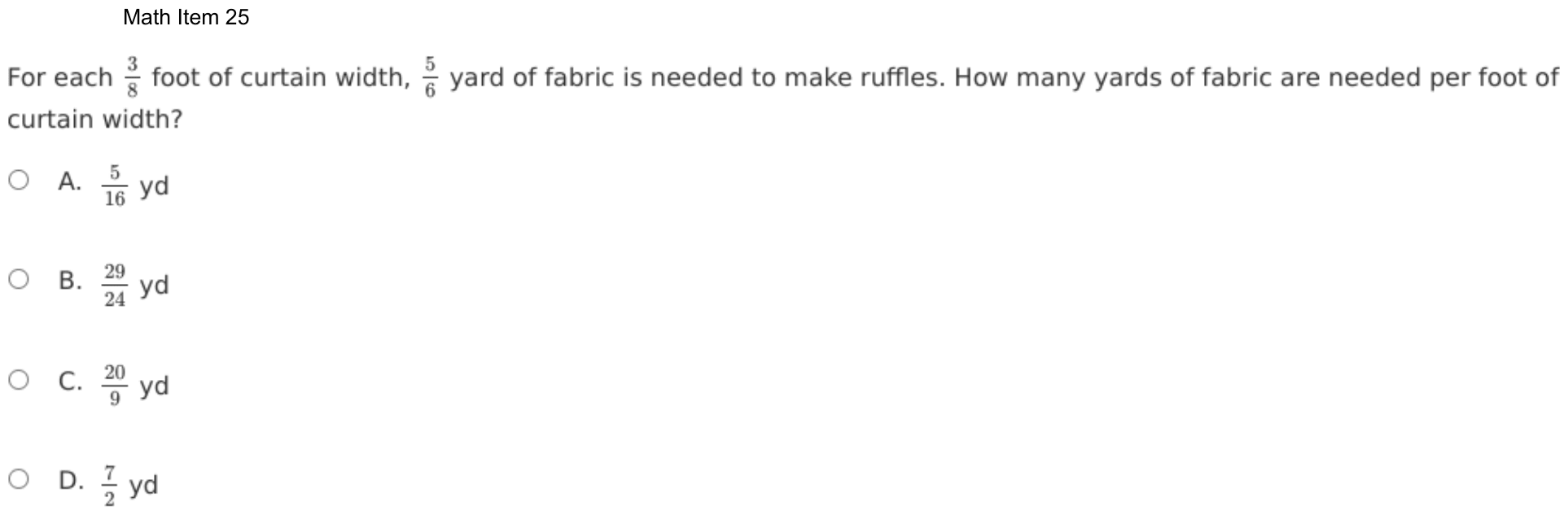
For each foot of curtain width, yard of fabric is needed to make ruffles. How many yards of fabric are needed per foot of curtain width?
- A yd
- B yd
- C yd
- D yd
Show the answer
Correct answer: C
It takes yard of fabric to make foot of curtain width.
To find the ratio of 1 foot of curtain width to foot of curtain width , divide.
So the amount of fabric needed for 1 foot of curtain width is times the amount needed for foot of curtain width.
The amount of fabric needed for 1 foot of curtain width is yards.
Question analysis
Making ruffles takes 5/6 yard of fabric for every 3/8 foot of curtain width, and students find how many yards of fabric one foot of curtain width needs. It tests finding a unit rate when both quantities are fractions. The two units differ, and choosing whether to multiply, divide or add the fractions is the crucial decision.
- Grade level
- Grade 7 content, by NYS standard
- Compared with grade 7
- At grade 7 Computing a unit rate from a ratio of two fractions is the grade 7 rate standard itself. Two units, feet and yards, and an unfamiliar sewing setting make it harder to see which fraction divides which.
- Estimated difficulty
- Moderate: several steps, or a close reading with one strong distractor.
- Thinking it demands
- Depth of knowledge 2, skills and concepts · mainly apply
- What makes it hard
- Turning words into math moderate
- Error-prone arithmetic minor
- Solution
- 2 steps
- Reading level
- Question and choices: about grade 5, 36 words.
- Students, last 30 days
- Not enough answers yet to show (it takes 10).
Why it is hard, traps and wrong answers (shows the answer)
Why it is hard
Two fractions and two units, feet and yards, leave students to decide whether to multiply, divide or add, and each wrong choice records one of those decisions. A sense check rules out the most tempting one before any arithmetic: a whole foot is more than 3/8 foot, so it needs more than 5/6 yard, yet multiplying gives only 5/16. Dividing the yards by the feet then picks out the answer among the rest.
Turning words into math moderate Understanding the question
“For each 3/8 foot of curtain width, 5/6 yard of fabric” gives the rate as a pair of fractions, and “per foot” means dividing the yards by the feet. (Hegarty, Mayer & Monk, 1995; Koedinger & Nathan, 2004)
Error-prone arithmetic minor Working it out
Dividing by 3/8 means multiplying by 8/3, and the product 40/18 has to be reduced to 20/9, an improper fraction rather than a whole number. (Brown & Burton, 1978; Junker & Sijtsma, 2001)
Strategy: Divide the yards of fabric by the feet of curtain width, since a rate per foot puts feet in the denominator, then simplify the fraction.
Traps
- Wrong operation: Adds instead of multiplying, divides the wrong way round, turns a ratio or rate upside down, or undoes a step in the wrong direction (subtracts what should be added back).
The wrong answers, classified
A Wrong operation (Hegarty, Mayer & Monk, 1995; King et al., 2004)
Multiplies 5/6 by 3/8 instead of dividing, getting 15/48 = 5/16, so a whole foot seems to need less fabric than 3/8 foot.
B Wrong operation (Hegarty, Mayer & Monk, 1995; King et al., 2004)
Adds 5/6 and 3/8 over a common denominator, 20/24 + 9/24 = 29/24, combining yards with feet instead of forming a rate.
D Wrong operation (Hegarty, Mayer & Monk, 1995; King et al., 2004)
Finds that a foot is 8/3 times 3/8 foot, then adds 8/3 and 5/6 instead of multiplying them: 16/6 + 5/6 = 21/6 = 7/2.
Worked solution, step by step
Formulas used
- Unit rate
- A unit rate tells how much for exactly 1 of something. Here it is yards of fabric for 1 foot of curtain. Per foot means for each foot, so feet go on the bottom. Divide the yards by the feet.
- Dividing by a fraction
- a is any number, and b/c is a fraction. Dividing by a fraction is the same as multiplying by its reciprocal, the fraction flipped upside down. It works because b/c fits into 1 exactly c/b times.
Sort out the question
For every 3/8 foot of curtain width, you need 5/6 yard of fabric. You need the yards of fabric for 1 whole foot. That is a unit rate, an amount for exactly 1 foot.
3/8 foot is less than a whole foot. So a whole foot needs more than 5/6 yard.
Set up the division
Per foot means divide the yards by the feet:
Watch out: multiplying 5/6 by 3/8 gives 5/16, choice A. That is less fabric for more curtain, which makes no sense. Adding them gives 29/24, choice B, but you can’t add yards and feet.
Multiply by the reciprocal
Flip 3/8 to get 8/3, and multiply:
The 8/3 says a whole foot is 8/3 times as long as 3/8 foot. So it needs 8/3 times as much fabric.
Watch out: adding 8/3 and 5/6 gives 7/2, choice D. Multiply them instead.
Simplify the fraction
2 goes into both 40 and 18:
So 1 foot of curtain width needs 20/9 yards of fabric, a little more than 2 yards. So the answer is C, 20/9 yd.
Check your answer
Multiply back. 3/8 foot should need 3/8 of the fabric for a whole foot: yard. That is the amount the question gives. Also, 20/9 is more than 5/6, as it should be.
More questions like this
The original DOE question
Question 6 of 63
2026 Practice Test D Math, question 4Question
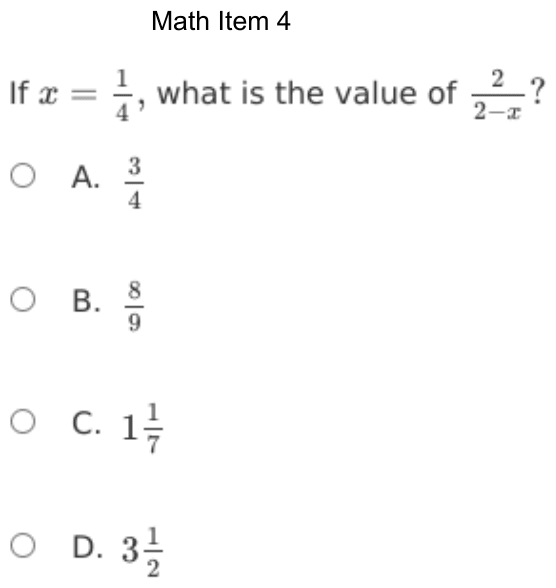
If , what is the value of ?
- A
- B
- C
- D
Show the answer
Correct answer: C
The first step is to substitute the value for x into the expression to get .
Then, evaluate the denominator and finally divide the numerator by the denominator.
Question analysis
This substitution question sets x equal to one fourth and asks for the value of 2 divided by (2 − x). Students substitute, subtract a fraction from a whole number, and divide by the result. The expression is a stacked fraction, so treating the whole denominator as one quantity and dividing rather than multiplying are where students slip.
- NYS standards
- Grade level
- Grade 6 content, by NYS standard
- Compared with grade 7
- Below grade 7 Substituting a value and dividing by a fraction are grade 6 skills, and here they take three short steps with friendly numbers. The stacked fraction asks for care, but the demand is below typical grade 7 work with signed rational numbers.
- Estimated difficulty
- Straightforward: two steps or one careful reading.
- Thinking it demands
- Depth of knowledge 1, recall and reproduction · mainly apply
- What makes it hard
- Error-prone arithmetic moderate
- An answer in an unexpected form minor
- Solution
- 3 steps
- Reading level
- Question and choices: about grade 10, 12 words.
- Students, last 30 days
- Not enough answers yet to show (it takes 10).
Why it is hard, traps and wrong answers (shows the answer)
Why it is hard
Substitution is one step, so the question is about handling a fraction inside a fraction. The bar over 2 − x groups the whole denominator, and the division by 7/4 must flip it; both errors lead to listed choices. A size check helps: 2 − 1/4 is a little less than 2, so the value must be a little more than 1, which rules out every wrong choice.
Error-prone arithmetic moderate Working it out
The denominator 2 − 1/4 has to become 7/4 before anything is divided, and dividing 2 by 7/4 means multiplying by 4/7; multiplying by 7/4 instead is the usual slip. (Brown & Burton, 1978; Junker & Sijtsma, 2001)
An answer in an unexpected form minor Choosing the answer
The work ends at the improper fraction 8/7, but the choices show it only as a mixed number, listed among 3/4, 8/9 and 3 1/2. (Enright, Morley & Sheehan, 2002)
Strategy: Simplify the denominator to a single fraction first, then divide 2 by that fraction by multiplying by its reciprocal; treating the fraction bar as a grouping symbol avoids the common slip.
Traps
- Wrong operation: Adds instead of multiplying, divides the wrong way round, turns a ratio or rate upside down, or undoes a step in the wrong direction (subtracts what should be added back).
- Order of operations: Working left to right, or distributing a minus sign wrongly, gives a choice.
- Negatives and direction: Arithmetic with negative numbers, the order of a subtraction, or direction on a number line. (Moving a term across the equals sign without changing its sign is a faulty procedure.)
The wrong answers, classified
A Order of operations (Brown & Burton, 1978)
Lets the fraction bar cover only the first 2, working 2/2 − 1/4 = 1 − 1/4 = 3/4 instead of dividing 2 by the whole denominator.
B Negatives and direction (Brown & Burton, 1978)
Adds 1/4 to 2 instead of subtracting it, so the denominator becomes 9/4, and 2 ÷ 9/4 = 8/9.
D Wrong operation (Hegarty, Mayer & Monk, 1995; King et al., 2004)
Finds the denominator 7/4 correctly but multiplies 2 by it instead of dividing, 2 × 7/4 = 14/4 = 3 1/2.
Worked solution, step by step
Formulas used
- Dividing by a fraction
- a is any number, and b/c is a fraction. To divide by a fraction, multiply by its reciprocal (the fraction flipped upside down). It works because dividing asks how many copies of b/c fit into a.
- Changing an improper fraction to a mixed number
- Use it when the top, a, is bigger than the bottom, b. q is how many whole times b fits into a. r is the remainder, what is left over. For 8/7, the 7 fits once with 1 left, so 8/7 = 1 1/7.
Sort out the question
You know . You need the value of 2 divided by (2 − x). A fraction bar means divide. It also groups, so you work out the whole bottom, 2 − x, before you divide.
Work out the bottom
Put in 1/4 for x. To subtract, write 2 as fourths, since 2 = 8/4:
The bottom is 7/4.
Watch out: the sign is minus. Adding 1/4 gives 9/4 and then 8/9, choice B.
Divide 2 by 7/4
Now the problem is 2 ÷ 7/4. Use the rule for dividing by a fraction. Flip 7/4 to get 4/7, then multiply:
Watch out: multiplying by 7/4 instead of 4/7 gives 14/4 = 3 1/2, choice D.
Write it as a mixed number
The choices use mixed numbers. 7 fits into 8 once, with 1 left over:
Watch out: the fraction bar covers all of 2 − 1/4. Working 2/2 = 1 first and then taking away 1/4 gives 3/4, choice A.
So the answer is C, .
Check your answer
Estimate. The bottom, 1 3/4, is a bit less than 2. So 2 divided by it should be a bit more than 1, and 1 1/7 fits. Also check by multiplying: 7/4 × 8/7 = 56/28 = 2. That is the top, so the division is right.
More questions like this
The original DOE question
Question 7 of 63
2026 Practice Test D Math, question 14Question
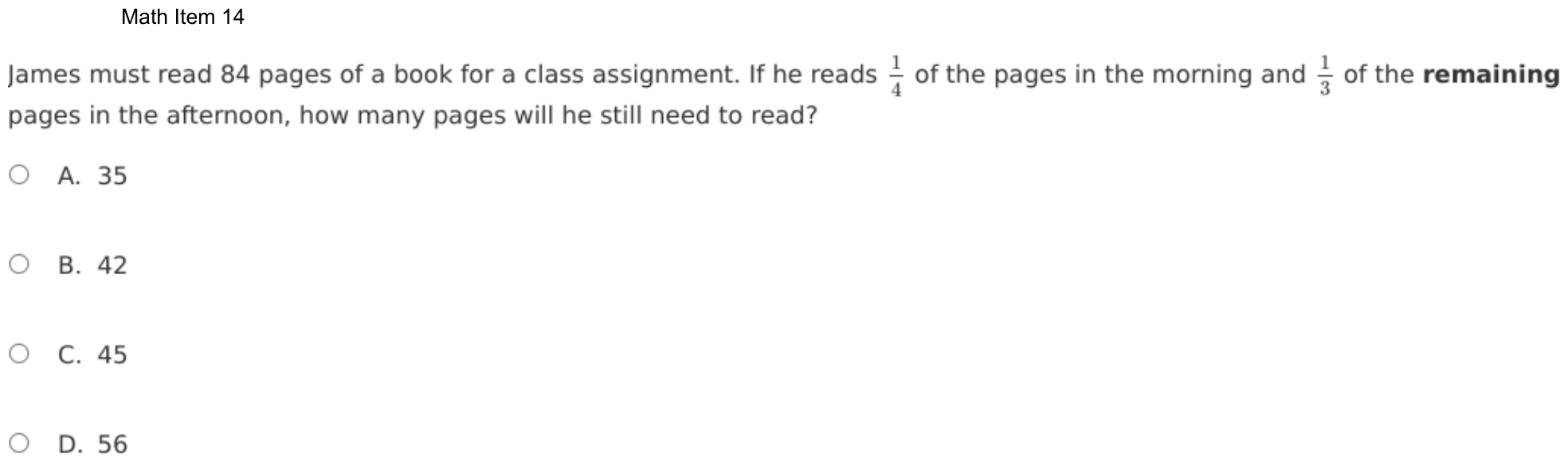
James must read 84 pages of a book for a class assignment. If he reads of the pages in the morning and of the remaining pages in the afternoon, how many pages will he still need to read?
- A35
- B42
- C45
- D56
Show the answer
Correct answer: B
Pages read in the morning:
Pages remaining after the morning:
Pages read in the afternoon:
Pages he still needs to read:
Question analysis
James must read 84 pages for a class assignment: 1/4 of them in the morning, then 1/3 of the remaining pages in the afternoon. Students find how many pages he still has left to read. It tests finding a fraction of a quantity in stages, and the bold word remaining decides which amount the second fraction is taken of.
- Grade level
- Grade 7 content, by NYS standard
- Compared with grade 7
- At grade 7 Taking fractions of a quantity in stages is typical grade 7 work. The numbers divide evenly and the bold word flags the trap, so the four short steps match routine grade 7 demand.
- Estimated difficulty
- Straightforward: two steps or one careful reading.
- Thinking it demands
- Depth of knowledge 2, skills and concepts · mainly apply
- What makes it hard
- Many steps moderate
- Turning words into math minor
- Solution
- 4 steps
- Reading level
- Question and choices: about grade 7, 39 words.
- Students, last 30 days
- Not enough answers yet to show (it takes 10).
Why it is hard, traps and wrong answers (shows the answer)
Why it is hard
Each step is simple, but the second fraction has a different whole from the first. Students who take 1/3 of the full 84 pages get a tidy 28 and a listed answer, despite the bold word that warns against it. Here the pages read and the pages left both come to 42, so confusing those two quantities costs nothing, and checking that 21 + 21 + 42 = 84 confirms the work.
Many steps moderate Working it out
Four operations in order, a quarter of 84, a subtraction, a third of the 63 left, and a second subtraction, each feed the next, so a slip early carries through. (Daniel & Embretson, 2010; Enright, Morley & Sheehan, 2002)
Turning words into math minor Understanding the question
The bold “remaining” moves the base of the second fraction from all 84 pages to the 63 left after the morning, and “still need to read” asks for what is left, not what was read. (Hegarty, Mayer & Monk, 1995; Koedinger & Nathan, 2004)
Strategy: Work in order: find the morning's pages, subtract to get what remains, take 1/3 of that remainder, and subtract again; a quick bar sketch of the 84 pages helps.
Traps
- Misreads the question: Misses or misreads a condition or a word in the question: "at least", "each", "remaining", "not".
The wrong answers, classified
A Misreads the question (Hegarty, Mayer & Monk, 1995)
Takes 1/3 of all 84 pages for the afternoon, 28, instead of 1/3 of the 63 remaining, so 84 − 21 − 28 = 35.
C Little reason to choose it (Haladyna & Downing, 1993; Rodriguez, 2005)
No common working gives 45; it is not a fraction or a difference of any page count in the problem, so it mostly draws guesses near 42.
D Misreads the question (Hegarty, Mayer & Monk, 1995)
Takes the afternoon's third from all 84 pages and subtracts only that, 84 − 28 = 56, overlooking the 21 pages already read in the morning.
Worked solution, step by step
Formulas used
- A fraction of a number
- n is the whole amount, and a/b is the fraction you take. The word of means multiply. When the top, a, is 1, this is just n divided by b. For example, 1/4 of 84 is 84 ÷ 4.
Sort out the question
James has 84 pages to read. In the morning he reads 1/4 of all the pages. In the afternoon he reads 1/3 of the remaining pages, the ones still left after the morning. You need the number of pages he still has to read after that.
Find the morning pages
Take 1/4 of 84:
He reads 21 pages in the morning. That leaves:
63 pages are left after the morning.
Find the afternoon pages
The afternoon fraction is 1/3 of the 63 pages left, not of all 84:
He reads 21 pages in the afternoon.
Watch out: taking 1/3 of all 84 pages gives 28. Then 84 − 21 − 28 = 35, choice A. The bold word remaining tells you to use 63.
Find the pages still to read
Take the afternoon pages away from the 63 pages left after the morning:
He still needs to read 42 pages.
Watch out: subtract both readings, morning and afternoon. Taking only 28 from 84 gives 56, choice D.
So the answer is B, 42.
Check your answer
Add up all the parts: 21 pages in the morning, 21 in the afternoon and 42 still to read. 21 + 21 + 42 = 84, the whole assignment. Another way: after he reads 1/3 of the 63 pages, 2/3 of them are left, and 2/3 of 63 is 42.
More questions like this
The original DOE question
Question 8 of 63
2026 Practice Test D Math, question 15Question
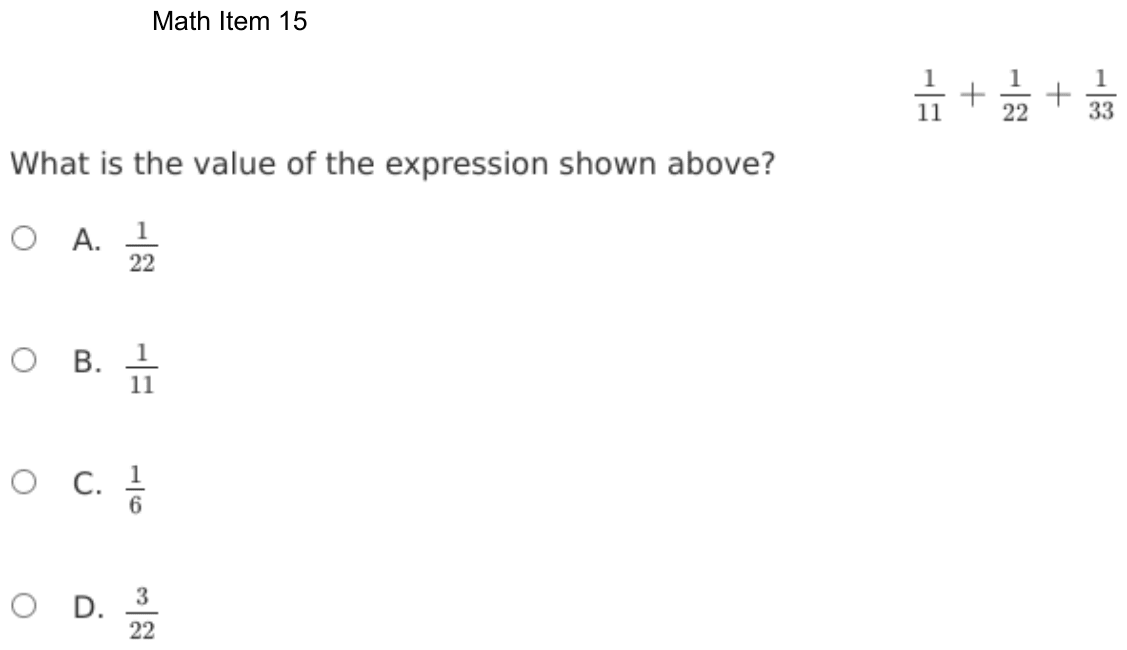
What is the value of the expression shown above?
- A
- B
- C
- D
Show the answer
Correct answer: C
To add fractions, find a common denominator and rename the fractions using the common denominator. The least common denominator for 11, 22, and 33 is 66. After adding the fractions, the final fraction can be reduced to lowest terms.
Question analysis
This fractions question asks for the value of 1/11 + 1/22 + 1/33. Students find a common denominator for three fractions, rename each one, add and simplify. The denominators are all multiples of 11, and adding the tops and bottoms straight across, or forgetting to rename a numerator, leads to tempting wrong choices.
- Grade level
- Grade 7 content, by NYS standard
- Compared with grade 7
- Below grade 7 Adding fractions with unlike denominators is taught before grade 7. Finding a common denominator for three related numbers and simplifying is short, routine work, lighter than typical grade 7 problems with signed rational numbers.
- Estimated difficulty
- Straightforward: two steps or one careful reading.
- Thinking it demands
- Depth of knowledge 1, recall and reproduction · mainly apply
- What makes it hard
- Error-prone arithmetic moderate
- An answer in an unexpected form minor
- Solution
- 3 steps
- Reading level
- Question and choices: about grade 9, 14 words.
- Students, last 30 days
- Not enough answers yet to show (it takes 10).
Why it is hard, traps and wrong answers (shows the answer)
Why it is hard
The question checks whether students rename fractions before adding, and each wrong choice comes from a shortcut that skips that step or stops early. Seeing that 22 and 33 are multiples of 11 points to 66 as the common denominator. A size check helps too: the sum must be more than 1/11, its largest term, which rules out two of the wrong choices at once.
Error-prone arithmetic moderate Working it out
Three unlike denominators must be renamed over 66, not over the product of all three, and the numerators 6, 3 and 2 have to be found one by one before adding. (Brown & Burton, 1978; Junker & Sijtsma, 2001)
An answer in an unexpected form minor Choosing the answer
The sum comes out as 11/66, which must be reduced to match a choice; its simplest form has a denominator, 6, unlike any in the expression. (Enright, Morley & Sheehan, 2002)
Strategy: Notice that 22 and 33 are multiples of 11, rename all three fractions over their least common multiple, add the numerators, and simplify the result.
Traps
- A faulty procedure: A systematic but wrong procedure: adding fractions straight across, applying an exponent to each term of a sum, dropping a sign when moving a term.
- Stops one step early: A choice is a number from partway through the solution.
The wrong answers, classified
A A faulty procedure (Brown & Burton, 1978; Tatsuoka, 1983)
Adds the numerators and the denominators straight across, 3 over 11 + 22 + 33 = 66, and simplifies 3/66 to 1/22.
B A faulty procedure (Brown & Burton, 1978; Tatsuoka, 1983)
Puts the three 1s over the largest denominator, 33, without renaming the other two fractions, so 3/33 simplifies to 1/11.
D Stops one step early (King et al., 2004; Gierl et al., 2017)
Adds the first two fractions correctly, 2/22 + 1/22 = 3/22, and stops before adding the third fraction, 1/33.
Worked solution, step by step
Formulas used
- Equivalent fractions
- a/b is a fraction, and n is any number except 0. Multiplying the top and the bottom by the same n gives an equal fraction. It works because n/n is 1, and multiplying by 1 changes nothing. Use it to give fractions the same bottom.
- Adding fractions with the same denominator
- d is the denominator, the bottom number, which tells the size of each piece. a, b and c are the numerators, the top numbers, which count the pieces. When the pieces are the same size, add the tops and keep the bottom.
Sort out the question
You need to add three fractions: 1/11, 1/22 and 1/33. Their denominators (bottom numbers) are all different. You can only add fractions when the pieces are the same size. So first give all three the same denominator.
Find a common denominator
A common denominator is a number that 11, 22 and 33 all divide into. Notice that 22 = 2 × 11 and 33 = 3 × 11. So the smallest number that all three divide into is:
Rename each fraction
Multiply the top and bottom of each fraction by the number that makes the bottom 66:
Add the tops
Now every piece is a sixty-sixth. Add the tops and keep the bottom:
Watch out: never add the bottoms. Adding straight across gives 3/66 = 1/22, choice A. Putting the three 1s over 33 gives 3/33 = 1/11, choice B.
Simplify the fraction
To simplify, divide the top and bottom by a number that goes into both. Here 11 goes into 11 and into 66:
Watch out: add all three fractions. Stopping after the first two gives 3/22, choice D.
So the answer is C, .
Check your answer
Estimate with decimals. 1/11 is about 0.091, 1/22 is about 0.045 and 1/33 is about 0.030. They add to about 0.166. And 1/6 is 0.1666…, a match. The other choices are all 0.136 or less.
More questions like this
The original DOE question
Question 9 of 63
2026 Practice Test D Math, question 18Question
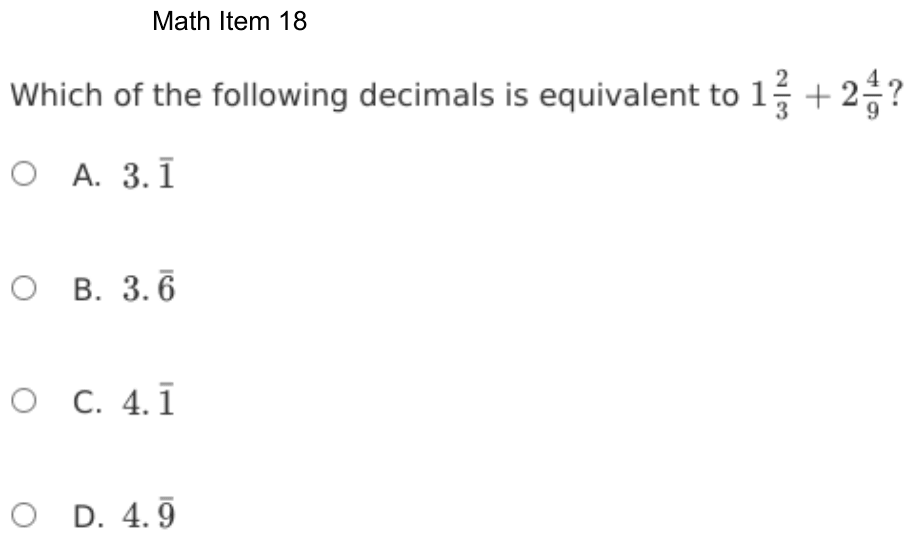
Which of the following decimals is equivalent to ?
- A
- B
- C
- D
Show the answer
Correct answer: C
First, add the mixed numbers. Then, convert the fraction to a decimal.
Question analysis
This question asks which repeating decimal equals the sum of the mixed numbers 1 2/3 and 2 4/9. Students rename the fractions with a common denominator, add, and convert the fraction part to a decimal with a bar over its repeating digit. The choices differ in both the whole number and the repeating digit, so each step has to be right.
- NYS standards
- Grade level
- Grade 7 content, by NYS standard
- Compared with grade 7
- At grade 7 Adding mixed numbers and writing a fraction as a repeating decimal are standard grade 7 skills. This combines them in three short steps; renaming a fraction and reading the bar notation are the only places that need care.
- Estimated difficulty
- Straightforward: two steps or one careful reading.
- Thinking it demands
- Depth of knowledge 1, recall and reproduction · mainly apply
- What makes it hard
- Error-prone arithmetic moderate
- An answer in an unexpected form minor
- Solution
- 3 steps
- Reading level
- Question and choices: about grade 13, 13 words.
- Students, last 30 days
- Not enough answers yet to show (it takes 10).
Why it is hard, traps and wrong answers (shows the answer)
Why it is hard
Two fraction moves and one conversion stand between the sum and the choices. The carry is the main hazard: 10/9 has to become 1 1/9, and students who keep only the 1/9 land on a choice with the wrong whole number. Estimating first, about 1.7 + 2.4 = 4.1, rules out both choices that begin with 3 and the one that equals 5.
Error-prone arithmetic moderate Working it out
Adding 2/3 and 4/9 needs 2/3 renamed as 6/9, and the sum 10/9 is more than 1, so a whole must be carried into the 3 before converting. (Brown & Burton, 1978; Junker & Sijtsma, 2001)
An answer in an unexpected form minor Choosing the answer
The choices are repeating decimals with bars, so a mixed number in ninths has to be recognized as a digit repeating forever; knowing that ninths repeat their numerator makes the match quick. (Enright, Morley & Sheehan, 2002)
Strategy: Rename 2/3 as ninths, add the whole numbers and the fractions separately, regroup any fraction of 9/9 or more as a whole, then divide the leftover numerator by 9.
Traps
- A faulty procedure: A systematic but wrong procedure: adding fractions straight across, applying an exponent to each term of a sum, dropping a sign when moving a term.
- Answer in another form: The right answer is written differently from the way you worked it out.
The wrong answers, classified
A An arithmetic slip (Junker & Sijtsma, 2001)
Adds the fractions to 10/9 but keeps only the 1/9 left over, forgetting to carry the whole 1 into the 3, so the sum becomes 3 1/9.
B A faulty procedure (Brown & Burton, 1978; Tatsuoka, 1983)
Adds the numerators 2 and 4 over 9 without renaming 2/3 as 6/9, so gets 3 6/9, which is 3.666…
D A faulty procedure (Brown & Burton, 1978; Tatsuoka, 1983)
Reaches 4 1/9 but repeats the denominator's 9 instead of the numerator's 1, as if one ninth were 0.999… rather than 0.111…
Worked solution, step by step
Formulas used
- Equivalent fractions
- a/b is a fraction, and n is any number except 0. Multiplying the top and the bottom by the same n gives an equal fraction, because n/n is 1. Use it to give two fractions the same bottom before you add them.
- Ninths as repeating decimals
- 1 divided by 9 is 0.111…, with 1s that go on forever. The bar over a digit means that digit repeats forever. Ninths from 1/9 to 8/9 repeat their top digit, so 4/9 is 0.444… and 2/9 is 0.222…
Sort out the question
You need to add two mixed numbers, 1 2/3 and 2 4/9. A mixed number is a whole number plus a fraction. Then write the sum as a decimal. The choices are repeating decimals, where the bar over a digit means it repeats forever.
Rename two thirds as ninths
The fractions 2/3 and 4/9 have different bottoms. Since 3 × 3 = 9, multiply the top and bottom of 2/3 by 3:
So 1 2/3 is the same as 1 6/9.
Watch out: adding the tops 2 and 4 over 9 without renaming gives 3 6/9, choice B.
Add the mixed numbers
Add the whole numbers, then add the fractions:
10/9 is more than 1. It is 9/9 plus 1/9, or 1 1/9. Carry the 1 into the whole number:
Watch out: forgetting to carry the 1 gives 3 1/9, choice A.
Change it to a decimal
One ninth is 0.111…, with the 1 repeating forever. So:
Watch out: ninths repeat the top digit, not the 9. Choice D, 4.999…, does not match 4 1/9.
So the answer is C, .
Check your answer
Use rough decimals. 1 2/3 is about 1.667, and 2 4/9 is about 2.444. Their sum is about 4.111. That matches 4.111… and rules out both choices that start with 3. And 4.999… is almost 5, which is too big.
More questions like this
The original DOE question
Question 10 of 63
2026 Practice Test D Math, question 21Question
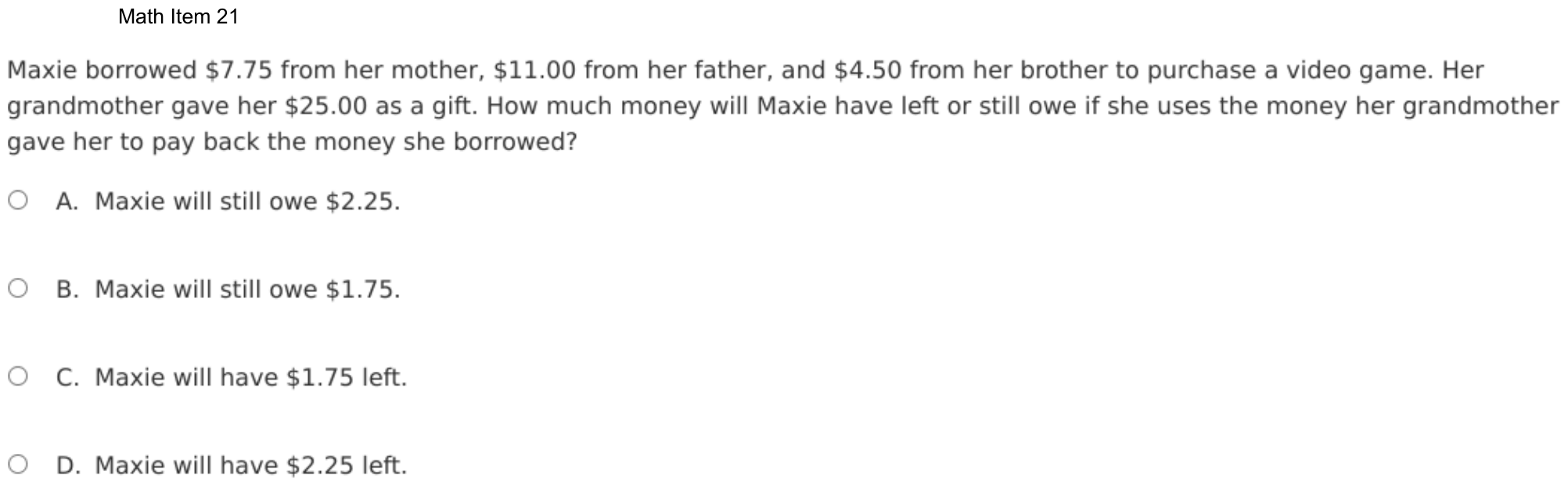
Maxie borrowed $7.75 from her mother, $11.00 from her father, and $4.50 from her brother to purchase a video game. Her grandmother gave her $25.00 as a gift. How much money will Maxie have left or still owe if she uses the money her grandmother gave her to pay back the money she borrowed?
- AMaxie will still owe $2.25.
- BMaxie will still owe $1.75.
- CMaxie will have $1.75 left.
- DMaxie will have $2.25 left.
Show the answer
Correct answer: C
First, determine the total amount Maxie borrowed, in dollars:
Then use subtraction to determine the difference between the amount her grandmother gave her and the amount she borrowed:
The difference is positive, which means that Maxie will still have $1.75 left from the amount her grandmother gave her.
Question analysis
Maxie borrowed money from her mother, father and brother to buy a video game, then received $25.00 from her grandmother to pay them back. Students decide how much money she will have left over or still owe. It tests adding and subtracting decimals with money, and the choices also test which way the difference goes.
- Grade level
- Grade 6 content, by NYS standard
- Compared with grade 7
- Below grade 7 Adding and subtracting money amounts is grade 6 decimal work. Here it takes one sum and one difference, and the only further demand is deciding whether the result is money left or money owed, well below typical grade 7 tasks.
- Estimated difficulty
- Routine: one familiar step, little to misread.
- Thinking it demands
- Depth of knowledge 2, skills and concepts · mainly apply
- What makes it hard
- Error-prone arithmetic minor
- Turning words into math minor
- Solution
- 2 steps
- Reading level
- Question and choices: about grade 4, 66 words.
- Students, last 30 days
- Not enough answers yet to show (it takes 10).
Why it is hard, traps and wrong answers (shows the answer)
Why it is hard
Few students miss this one, since it needs only one addition and one subtraction with money. The choices come in pairs, so the right amount must also be matched with the right outcome. Lining up the decimal points, and asking whether $25.00 is more or less than the $23.25 borrowed, settles both the amount and whether Maxie owes or keeps money.
Error-prone arithmetic minor Working it out
The loans add to $23.25, and subtracting that from $25.00 means borrowing across two zeros, a classic place for a digit to go wrong. (Brown & Burton, 1978; Junker & Sijtsma, 2001)
Turning words into math minor Understanding the question
Each amount appears twice among the choices, once as money left and once as money owed, so the result must also be read for direction by asking which is larger, the gift or the loans. (Hegarty, Mayer & Monk, 1995; Koedinger & Nathan, 2004)
Strategy: Add the three amounts borrowed, compare the total with the $25.00 gift, and decide from which is larger whether Maxie ends up with money left or still owes some.
Traps
- Negatives and direction: Arithmetic with negative numbers, the order of a subtraction, or direction on a number line. (Moving a term across the equals sign without changing its sign is a faulty procedure.)
- A faulty procedure: A systematic but wrong procedure: adding fractions straight across, applying an exponent to each term of a sum, dropping a sign when moving a term.
The wrong answers, classified
A Little reason to choose it (Haladyna & Downing, 1993; Rodriguez, 2005)
Needs two errors at once, a wrong difference such as $2.25 and the reversed outcome, so no single line of working reaches it and it mostly draws guesses.
B Negatives and direction (Brown & Burton, 1978)
Finds the $1.75 difference correctly but reverses its meaning, as if the $25.00 gift fell short of the $23.25 borrowed instead of covering it.
D A faulty procedure (Brown & Burton, 1978; Tatsuoka, 1983)
Subtracts $23.25 from $25.00 column by column, taking the smaller digit from the larger instead of borrowing, so 5 − 0 and 2 − 0 give $2.25.
Worked solution, step by step
Formulas used
- Money left over
- Money she has is the $25.00 gift. Money she owes is the total she borrowed. If the result is positive, she has that much left. If it were negative, she would still owe that much. Comparing the two amounts first tells you which.
Sort out the question
Maxie borrowed from three people: $7.75, $11.00 and $4.50. Her grandmother gave her $25.00. She uses the $25.00 to pay everyone back. You need to know if money is left over or if she still owes some, and how much.
Add up what she borrowed
Line up the decimal points and add:
She owes $23.25 in all. That is the amount she must pay back.
Compare the gift with the debt
The gift, $25.00, is more than the $23.25 she owes. So she can pay everyone back and still have money left. She will not owe anything.
Watch out: once you find $1.75, keep its meaning straight. Saying she still owes $1.75, choice B, gets the direction backwards.
Subtract to find what is left
Take the debt away from the gift:
You need to regroup (borrow) across the zeros. Think of $25.00 as 24 dollars and 100 cents. Then 100 − 25 = 75 cents, and 24 − 23 = 1 dollar.
Watch out: taking the smaller digit from the larger one in each column gives $2.25, choice D.
So the answer is C: Maxie will have $1.75 left.
Check your answer
Add back. The $23.25 she pays plus the $1.75 she keeps is 23.25 + 1.75 = 25.00. That is the whole gift, so the subtraction is right.
More questions like this
The original DOE question
Question 11 of 63
2026 Practice Test D Math, question 22Question
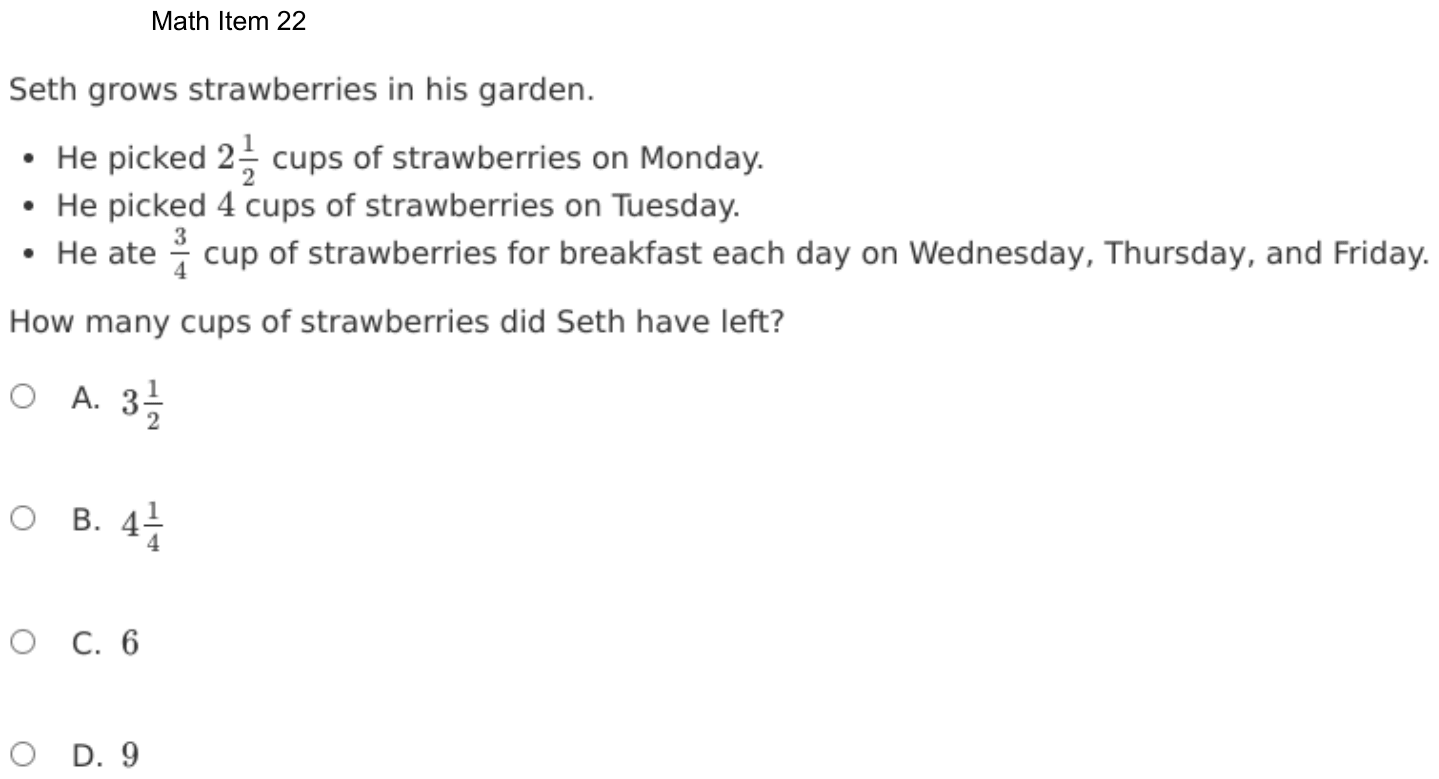
Seth grows strawberries in his garden.
- He picked cups of strawberries on Monday.
- He picked 4 cups of strawberries on Tuesday.
- He ate cup of strawberries for breakfast each day on Wednesday, Thursday, and Friday.
How many cups of strawberries did Seth have left?
- A
- B
- C6
- D9
Show the answer
Correct answer: B
When Seth picks strawberries, the value represents a positive number, and when he eats the strawberries, the value represents a negative number. Write an expression and then evaluate the expression, where the negative value is multiplied by 3 because he ate the same amount on 3 different days.
If the multiplication is confusing, evaluate the expression below which represents the sum for the 5 days with each day listed separately.
Question analysis
Seth picked strawberries on Monday and Tuesday, in amounts given as a mixed number and a whole number, then ate the same fraction of a cup at breakfast on three days. Students find how many cups he has left. It tests adding, multiplying and subtracting fractions in a short word problem, and the eaten amount repeats each day.
- Grade level
- Grade 7 content, by NYS standard
- Compared with grade 7
- Below grade 7 Adding mixed numbers and multiplying a fraction by a whole number are skills from before grade 7. The three steps are short and the numbers friendly, so the demand is below typical grade 7 work with signed rational numbers.
- Estimated difficulty
- Straightforward: two steps or one careful reading.
- Thinking it demands
- Depth of knowledge 2, skills and concepts · mainly apply
- What makes it hard
- Error-prone arithmetic moderate
- Turning words into math minor
- Solution
- 3 steps
- Reading level
- Question and choices: about grade 6, 47 words.
- Students, last 30 days
- Not enough answers yet to show (it takes 10).
Why it is hard, traps and wrong answers (shows the answer)
Why it is hard
The bulleted list lays out the story day by day, so setting up the problem is easy; the points are lost in the fractions. The number of breakfast days, 3, sits right beside the 3/4 cup, and subtracting 3 cups instead of three quarters of a cup each day is the tempting shortcut. Writing every amount in fourths, 26/4 picked and 9/4 eaten, makes the last step a whole-number subtraction.
Error-prone arithmetic moderate Working it out
Three breakfasts of 3/4 cup make 9/4 = 2 1/4 cups, and taking that from 6 1/2 means renaming the half as 2/4, two fraction steps where a slip is easy. (Brown & Burton, 1978; Junker & Sijtsma, 2001)
Turning words into math minor Understanding the question
Picking adds and eating subtracts, and “each day on Wednesday, Thursday, and Friday” means the 3/4 cup counts three times, not once. (Hegarty, Mayer & Monk, 1995; Koedinger & Nathan, 2004)
Strategy: Add the two amounts picked, multiply the breakfast amount by the number of days, and subtract that from the total; writing every amount in fourths keeps the arithmetic simple.
Traps
- Numbers taken from the question: Combines the numbers in the question without a model of the situation, or is simply a number that appears in the question.
- Wrong operation: Adds instead of multiplying, divides the wrong way round, turns a ratio or rate upside down, or undoes a step in the wrong direction (subtracts what should be added back).
The wrong answers, classified
A Numbers taken from the question (Hegarty, Mayer & Monk, 1995)
Subtracts 3 cups, the number of breakfast days, instead of 3 × 3/4 = 2 1/4 cups, so 6 1/2 − 3 = 3 1/2.
C Little reason to choose it (Haladyna & Downing, 1993; Rodriguez, 2005)
No common working gives exactly 6; it is near the 6 1/2 cups picked and mostly catches students who drop the fractions or guess.
D Wrong operation (Hegarty, Mayer & Monk, 1995; King et al., 2004)
Adds the 2 1/4 cups eaten to the 6 1/2 cups picked instead of subtracting, 8 3/4 cups, and takes the nearest choice, 9.
Worked solution, step by step
Formulas used
- Total of a repeated amount
- Use it when the same amount happens again and again. Here Seth eats 3/4 cup on each of 3 days, so the number of times is 3 and the amount each time is 3/4 cup.
- A whole number times a fraction
- n is a whole number, and a/b is a fraction. Multiply the whole number by the top only, and keep the bottom. It works because n groups of a pieces make n × a pieces, and each piece is still size 1/b.
Sort out the question
Seth picked 2 1/2 cups on Monday and 4 cups on Tuesday. Then he ate 3/4 cup each day on Wednesday, Thursday and Friday. That is 3 days of eating. Picking adds strawberries, and eating takes them away. You need the number of cups he has left.
Add what he picked
Add the two days of picking:
He picked 6 1/2 cups in all, before he ate any.
Find how much he ate
He ate 3/4 cup on each of 3 days. Multiply:
To change 9/4 to a mixed number, note that 4 fits into 9 twice, with 1 left over. He ate 2 1/4 cups.
Watch out: he ate 3/4 cup three times, not 3 cups. Subtracting 3 gives 3 1/2, choice A.
Take away what he ate
Write the half as fourths, so both fractions have the same bottom: 1/2 = 2/4. Then subtract the wholes and the fourths:
Watch out: eating takes away. Adding the 2 1/4 cups gives 8 3/4, and the nearest choice is 9, choice D.
So the answer is B, cups.
Check your answer
Use decimals. 2.5 + 4 = 6.5 cups picked. 3 × 0.75 = 2.25 cups eaten. Then 6.5 − 2.25 = 4.25 cups, which is 4 1/4.
More questions like this
The original DOE question
Question 12 of 63
2026 Practice Test D Math, question 24Question
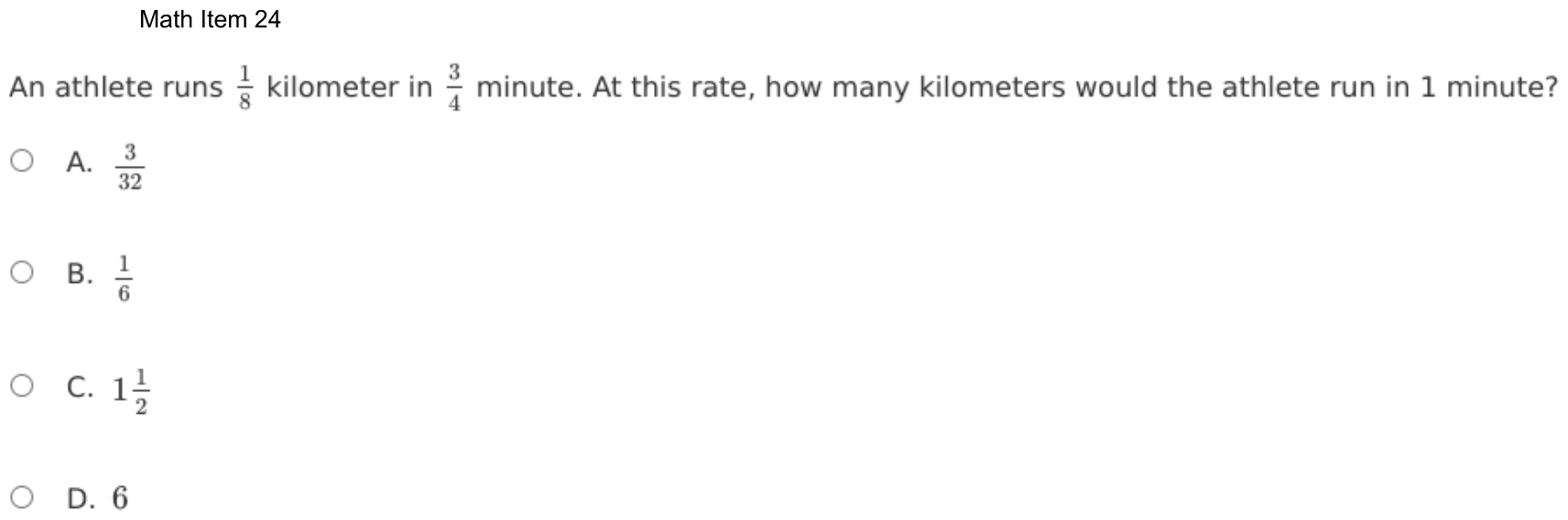
An athlete runs kilometer in minute. At this rate, how many kilometers would the athlete run in 1 minute?
- A
- B
- C
- D6
Show the answer
Correct answer: B
To determine the number of kilometers in 1 minute, find the unit rate in kilometers per minute: .
To evaluate the fraction, use the reciprocal when dividing to get kilometer per 1 minute.
Question analysis
An athlete runs 1/8 kilometer in 3/4 minute, and students find how many kilometers the athlete would run in 1 minute at the same rate. It tests unit rates with fractions. Both the distance and the time are fractions, so deciding which one to divide by which is the main challenge.
- Grade level
- Grade 7 content, by NYS standard
- Compared with grade 7
- At grade 7 Computing a unit rate from a ratio of fractions is the grade 7 standard itself, and this is a standard example: one fraction divided by another in two short steps, with the order of division the only real decision.
- Estimated difficulty
- Straightforward: two steps or one careful reading.
- Thinking it demands
- Depth of knowledge 2, skills and concepts · mainly apply
- What makes it hard
- Error-prone arithmetic moderate
- Turning words into math minor
- Solution
- 2 steps
- Reading level
- Question and choices: about grade 9, 23 words.
- Students, last 30 days
- Not enough answers yet to show (it takes 10).
Why it is hard, traps and wrong answers (shows the answer)
Why it is hard
The question is a unit rate with fractions, and its wrong choices are the other ways to combine 1/8 and 3/4. Since 1 minute is only a third longer than 3/4 minute, the distance must be only a third more than 1/8 kilometer, which rules out the product and both large choices at once. Dividing with the units written in, kilometers over minutes, keeps the order right.
Error-prone arithmetic moderate Working it out
The rate is a fraction divided by a fraction, 1/8 ÷ 3/4, and only the 3/4 may be flipped; multiplying straight across or dividing the other way round both give listed choices. (Brown & Burton, 1978; Junker & Sijtsma, 2001)
Turning words into math minor Understanding the question
Kilometers in 1 minute means kilometers per minute, so the 1/8 goes on top even though the time, 3/4, is the larger number. (Hegarty, Mayer & Monk, 1995; Koedinger & Nathan, 2004)
Strategy: Divide the distance by the time, kilometers over minutes, by multiplying 1/8 by the reciprocal of 3/4, and check that the units of the result are kilometers per minute.
Traps
- Wrong operation: Adds instead of multiplying, divides the wrong way round, turns a ratio or rate upside down, or undoes a step in the wrong direction (subtracts what should be added back).
The wrong answers, classified
A Wrong operation (Hegarty, Mayer & Monk, 1995; King et al., 2004)
Multiplies 1/8 by 3/4 instead of dividing, getting 3/32, which is less than the 1/8 kilometer already run in under a minute.
C Wrong operation (Hegarty, Mayer & Monk, 1995; King et al., 2004)
Splits the 3/4 minute into quarters but multiplies 1/8 by 3 instead of dividing, then multiplies by 4 for a full minute, giving 12/8 = 1 1/2.
D Wrong operation (Hegarty, Mayer & Monk, 1995; King et al., 2004)
Divides 3/4 by 1/8, minutes by kilometers, which gives 6 minutes per kilometer, the rate turned upside down.
Worked solution, step by step
Formulas used
- Unit rate
- A unit rate tells how much happens in 1 unit of time. Here the distance is in kilometers and the time is in minutes, so the rate is kilometers per minute. You divide because you are sharing the distance equally over the minutes.
- Dividing fractions
- a, b, c and d are numbers that are not zero. To divide by a fraction, multiply by its reciprocal (the fraction flipped upside down). Flip only the second fraction, the one you divide by.
Sort out the question
The athlete runs 1/8 kilometer in 3/4 minute, which is less than a full minute. You need how far the athlete runs in 1 whole minute at the same speed. That is the unit rate, in kilometers per minute.
Set up the division
Kilometers per minute means kilometers divided by minutes. So the distance comes first and the time second:
Watch out: dividing the other way, 3/4 ÷ 1/8, gives 6. That is minutes per kilometer, the rate turned upside down, choice D.
Divide the fractions
Flip 3/4 to get 4/3, then multiply. Multiply the tops and multiply the bottoms:
Simplify by dividing the top and bottom by 4:
Watch out: multiplying 1/8 × 3/4 without flipping gives 3/32, choice A.
Make sense of the answer
In 1 minute, the athlete runs 1/6 kilometer. That is a bit more than 1/8 kilometer, which makes sense. A full minute is a bit longer than 3/4 minute, so the athlete goes a bit farther. Choice C, 1 1/2 kilometers, would be 12 times as far in barely more time.
So the answer is B, kilometer.
Check your answer
Work in quarter minutes. In 3 quarter minutes, the athlete runs 1/8 km. So in 1 quarter minute, the athlete runs 1/8 ÷ 3 = 1/24 km. A full minute has 4 quarters: 4 × 1/24 = 4/24 = 1/6 km.
More questions like this
The original DOE question
Question 13 of 63
2026 Practice Test D Math, question 30Question
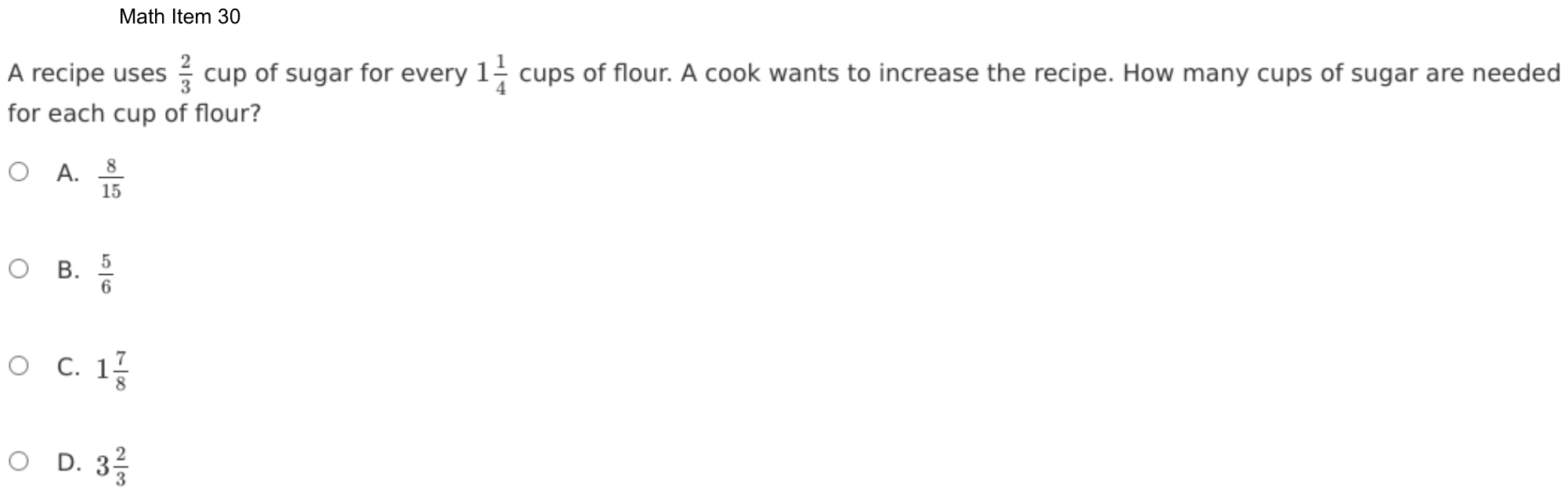
A recipe uses cup of sugar for every cups of flour. A cook wants to increase the recipe. How many cups of sugar are needed for each cup of flour?
- A
- B
- C
- D
Show the answer
Correct answer: A
To find the cups of sugar for each cup of flour, find the unit rate using this ratio:
Then, convert the denominator to an improper fraction and divide to find the cups of sugar per cup of flour.
Question analysis
A recipe uses 2/3 cup of sugar for every 1 1/4 cups of flour, and this unit rate question asks how many cups of sugar go with each cup of flour. Students divide one fraction by a mixed number. Deciding which amount to divide by which, and converting the mixed number first, are where mistakes creep in.
- Grade level
- Grade 7 content, by NYS standard
- Compared with grade 7
- At grade 7 Computing a unit rate from a ratio of fractions is exactly the grade 7 standard. This one divides by a mixed number, and the cook's plan to enlarge the recipe adds wording without adding any numbers to use.
- Estimated difficulty
- Moderate: several steps, or a close reading with one strong distractor.
- Thinking it demands
- Depth of knowledge 2, skills and concepts · mainly apply
- What makes it hard
- Error-prone arithmetic moderate
- Turning words into math minor
- Solution
- 2 steps
- Reading level
- Question and choices: about grade 5, 36 words.
- Students, last 30 days
- Not enough answers yet to show (it takes 10).
Why it is hard, traps and wrong answers (shows the answer)
Why it is hard
The work is a single fraction division, but it involves a mixed number and an awkward result. Students unsure of the rule multiply the two amounts or divide them the other way round, and each gives a tidy listed fraction. A size check settles it: 1 1/4 cups of flour take only 2/3 cup of sugar, so one cup of flour needs less than 2/3 cup, which leaves a single choice.
Error-prone arithmetic moderate Working it out
The divisor is the mixed number 1 1/4, which must become 5/4 before dividing; then 2/3 × 4/5 gives 8/15, a fraction that does not simplify and looks unfinished. (Brown & Burton, 1978; Junker & Sijtsma, 2001)
Turning words into math minor Understanding the question
The phrase “for each cup of flour” puts flour in the denominator, sugar ÷ flour, and the sentence about increasing the recipe adds nothing to the calculation. (Hegarty, Mayer & Monk, 1995; Koedinger & Nathan, 2004)
Strategy: Write the sugar over the flour, change 1 1/4 to an improper fraction, and divide by multiplying by its reciprocal, keeping sugar on top because the question asks for sugar per cup of flour.
Traps
- Wrong operation: Adds instead of multiplying, divides the wrong way round, turns a ratio or rate upside down, or undoes a step in the wrong direction (subtracts what should be added back).
- A faulty procedure: A systematic but wrong procedure: adding fractions straight across, applying an exponent to each term of a sum, dropping a sign when moving a term.
The wrong answers, classified
B Wrong operation (Hegarty, Mayer & Monk, 1995; King et al., 2004)
Multiplies 2/3 by 5/4 instead of dividing, getting 10/12 = 5/6, more sugar for one cup of flour than the recipe uses for 1 1/4 cups.
C Wrong operation (Hegarty, Mayer & Monk, 1995; King et al., 2004)
Divides the flour by the sugar, 5/4 ÷ 2/3 = 15/8 = 1 7/8, which is cups of flour for each cup of sugar, the rate upside down.
D A faulty procedure (Brown & Burton, 1978; Tatsuoka, 1983)
Splits the mixed number apart, dividing 2/3 by only the 1/4 to get 2 2/3, then adding the whole 1 to make 3 2/3.
Worked solution, step by step
Formulas used
- Unit rate
- A unit rate tells how much of one thing goes with 1 of another. Here it is the cups of sugar for 1 cup of flour. The amount you want goes on top. The amount you want to make 1 goes on the bottom.
- Mixed number to fraction
- w is the whole number, and n/d is the fraction part. Multiply the whole number by the bottom, add the top, and keep the bottom. It works because each whole holds d pieces of size 1/d.
- Dividing fractions
- a, b, c and d are numbers that are not zero. To divide by a fraction, multiply by its reciprocal, the fraction flipped upside down. Flip only the fraction you divide by.
Sort out the question
The recipe uses cup of sugar for every cups of flour. You need the cups of sugar for each 1 cup of flour. The part about making more of the recipe gives no numbers, so you can set it aside.
Set up the unit rate
You want sugar for each cup of flour. So sugar goes on top and flour goes on the bottom:
Watch out: dividing the other way, flour by sugar, gives . That is cups of flour for each cup of sugar, choice C.
Change the mixed number
You cannot divide by a mixed number directly. Change it to a fraction first. Each whole has 4 fourths:
Divide the fractions
Multiply by the reciprocal of 5/4, which is 4/5. Multiply the tops and multiply the bottoms:
The fraction 8/15 cannot be simplified, since 8 and 15 share no factor but 1.
Watch out: multiplying without flipping gives , choice B.
So the answer is A, .
Check your answer
More than 1 cup of flour takes only 2/3 cup of sugar. So 1 cup of flour needs a bit less than 2/3. Since , the answer 8/15 is a bit less. Also, , which brings back the recipe.
More questions like this
The original DOE question
Question 14 of 63
2026 Practice Test D Math, question 42Question
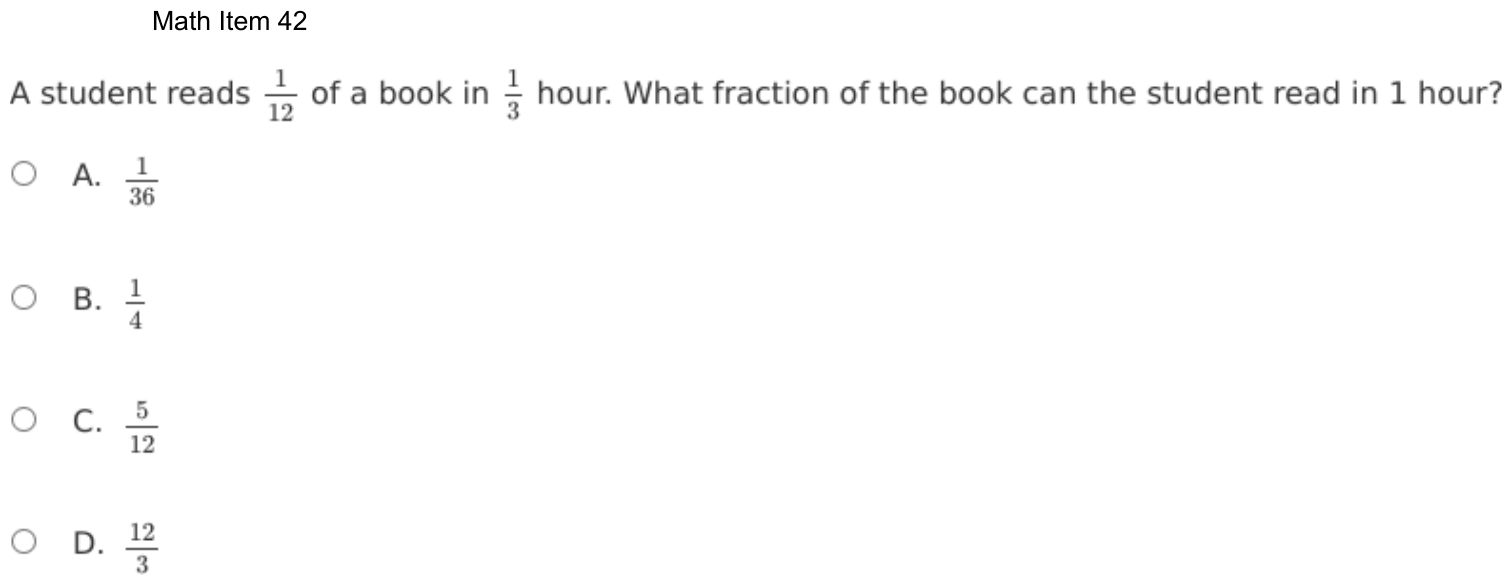
A student reads of a book in hour. What fraction of the book can the student read in 1 hour?
- A
- B
- C
- D
Show the answer
Correct answer: B
To find the fraction of the book the student can read in 1 hour, find the unit rate per hour. First, set up the ratio.
Then use division to find the unit rate.
Another way to solve the problem is to set up the ratio and then multiply both the numerator and denominator by 3, since hour times 3 equals 1 hour.
Question analysis
A student reads 1/12 of a book in 1/3 of an hour, and this rate question asks what fraction of the book the student can read in a whole hour. It tests finding a unit rate when both amounts are fractions. Deciding whether to multiply or divide, and which fraction goes on top, decides the result.
- Grade level
- Grade 7 content, by NYS standard
- Compared with grade 7
- At grade 7 Computing a unit rate from a ratio of fractions is the grade 7 standard itself. This is a short example with unit fractions, where scaling the time up to a whole hour is as quick as dividing.
- Estimated difficulty
- Straightforward: two steps or one careful reading.
- Thinking it demands
- Depth of knowledge 2, skills and concepts · mainly apply
- What makes it hard
- Error-prone arithmetic minor
- Turning words into math minor
- Solution
- 2 steps
- Reading level
- Question and choices: about grade 5, 25 words.
- Students, last 30 days
- Not enough answers yet to show (it takes 10).
Why it is hard, traps and wrong answers (shows the answer)
Why it is hard
Thinking in thirds of an hour makes this quick: an hour holds three of them, so the student reads three twelfths of the book. Students who reach for a fraction rule instead must choose between multiplying and dividing, and between two orders of division. A sense check rules out two wrong choices at once: a whole hour must cover more than 1/12 of the book, and no more than the whole book.
Error-prone arithmetic minor Working it out
Both amounts are unit fractions, and 1/12 ÷ 1/3 means multiplying by 3, which gives 3/12 that still has to be simplified to match a choice. (Brown & Burton, 1978; Junker & Sijtsma, 2001)
Turning words into math minor Understanding the question
The phrase “fraction of the book … in 1 hour” asks for book per hour, so the fraction of the book is divided by the time, not the other way round. (Hegarty, Mayer & Monk, 1995; Koedinger & Nathan, 2004)
Strategy: Ask how many thirds of an hour make 1 hour, then scale the fraction of the book by the same factor; or divide the fraction of the book by the time.
Traps
- Wrong operation: Adds instead of multiplying, divides the wrong way round, turns a ratio or rate upside down, or undoes a step in the wrong direction (subtracts what should be added back).
- Numbers taken from the question: Combines the numbers in the question without a model of the situation, or is simply a number that appears in the question.
The wrong answers, classified
A Wrong operation (Hegarty, Mayer & Monk, 1995; King et al., 2004)
Multiplies 1/12 by 1/3 instead of dividing, getting 1/36, which would mean reading less of the book in an hour than in a third of one.
C Numbers taken from the question (Hegarty, Mayer & Monk, 1995)
Adds the two fractions, 1/12 + 4/12 = 5/12, combining an amount of the book with an amount of time as if they were alike.
D Wrong operation (Hegarty, Mayer & Monk, 1995; King et al., 2004)
Divides the time by the amount read, 1/3 ÷ 1/12 = 12/3, which is hours per book, the rate turned upside down.
Worked solution, step by step
Formulas used
- Unit rate
- A unit rate tells how much happens in 1 unit, here 1 hour. Put the part of the book on top and the time on the bottom. Dividing finds the part of the book for one whole hour.
- Dividing fractions
- a, b, c and d are numbers that are not zero. To divide by a fraction, multiply by its reciprocal, the fraction flipped upside down. Flip only the fraction you divide by.
Sort out the question
The student reads of a book in of an hour. You need the part of the book read in 1 whole hour. That is a unit rate.
Scale up to one hour
One hour holds three thirds of an hour. So in 1 hour the student reads 3 times as much:
To simplify 3/12, divide the top and bottom by 3. The student reads 1/4 of the book in 1 hour.
Check with the unit rate
Divide the part of the book by the time. Multiply by the reciprocal of 1/3, which is 3/1:
Both ways give 1/4.
Avoid the wrong operations
Watch out: multiplying gives , choice A. That is less than 1/12. But in a full hour, the student must read more than in a third of an hour. Dividing the time by the book gives 12/3, choice D. That is 4 whole books.
So the answer is B, .
Check your answer
If the student reads 1/4 of the book each hour, the whole book takes 4 hours. In 1/3 of an hour, the student reads of the book. That matches the question.
More questions like this
The original DOE question
Question 15 of 63
2024 Test A Math, question 3Question
A juice mixture contains gallon of apple juice and gallon of cranberry juice. How many gallons of apple juice per gallon of cranberry juice does the mixture contain? (Express your answer as a decimal.)
Grid-in question: work out the answer and enter it as a number.
Show the answer
Correct answer: 2.5
Set up a proportion to solve:
Question analysis
This ratio grid-in describes a juice mixture with a fraction of a gallon of apple juice and a smaller fraction of a gallon of cranberry juice. Students find the unit rate, gallons of apple juice per gallon of cranberry juice, by dividing one fraction by the other and writing it as a decimal. Dividing in the wrong order is the main risk.
- Grade level
- Grade 7 content, by NYS standard
- Compared with grade 7
- At grade 7 Computing a unit rate from a ratio of two fractions is exactly the grade 7 standard, and this is a textbook example of it. The only added demands are dividing in the right order and answering as a decimal.
- Estimated difficulty
- Moderate: several steps, or a close reading with one strong distractor.
- Thinking it demands
- Depth of knowledge 2, skills and concepts · mainly apply
- What makes it hard
- Turning words into math moderate
- Error-prone arithmetic moderate
- An answer in an unexpected form minor
- Solution
- 2 steps
- Reading level
- Question and choices: about grade 8, 36 words.
- Students, last 30 days
- Not enough answers yet to show (it takes 10).
Why it is hard, traps and wrong answers (shows the answer)
Why it is hard
The method is one division of fractions, but the question tests whether the division runs the right way. The word per tells which juice goes on top, and a student who divides the smaller amount by the larger gets a tidy decimal for the reverse rate. A sense check helps: the mixture holds more apple juice than cranberry, so the rate must be greater than 1.
Turning words into math moderate Understanding the question
The phrase "gallons of apple juice per gallon of cranberry juice" fixes the order: apple's 3/16 goes on top and cranberry's 3/40 below, though the two fractions invite either order. (Hegarty, Mayer & Monk, 1995; Koedinger & Nathan, 2004)
Error-prone arithmetic moderate Working it out
Dividing 3/16 by 3/40 means multiplying by 40/3; the 3s cancel to leave 40/16, which still has to be reduced and written as a decimal. (Brown & Burton, 1978; Junker & Sijtsma, 2001)
An answer in an unexpected form minor Choosing the answer
The answer must be gridded as a decimal, and with no choices shown, the upside-down 0.4 gives no sign that it answers the reverse question. (Enright, Morley & Sheehan, 2002)
Strategy: Put the apple juice over the cranberry juice and divide the fractions by multiplying by the reciprocal; the matching 3s cancel, leaving a simple fraction to turn into a decimal.
Traps
- Wrong operation: Adds instead of multiplying, divides the wrong way round, turns a ratio or rate upside down, or undoes a step in the wrong direction (subtracts what should be added back).
The wrong answers, classified
0.4 Wrong operation (Hegarty, Mayer & Monk, 1995; King et al., 2004)
Divides cranberry by apple, 3/40 ÷ 3/16 = 16/40 = 0.4, giving gallons of cranberry per gallon of apple, the rate turned upside down.
0.014 Wrong operation (Hegarty, Mayer & Monk, 1995; King et al., 2004)
Multiplies the two amounts instead of dividing them, 3/16 × 3/40 = 9/640 ≈ 0.014, as if comparing the juices called for a product.
Worked solution, step by step
Formulas used
- Unit rate
- r is the rate: how much of one thing there is for each 1 of another. a is the amount of the first thing. b is the amount of the second thing, the one named after the word per. Dividing shares a out evenly over each 1 of b.
- Dividing by a fraction
- a/b and c/d are fractions, and b, c and d are not zero. To divide by a fraction, multiply by its reciprocal, the fraction flipped upside down. It works because flipping a fraction gives the number that undoes it.
Sort out the question
The mix has gallon of apple juice and gallon of cranberry juice. You need the “gallons of apple juice per gallon of cranberry juice”. Per means for each. So the question asks: for each 1 gallon of cranberry juice, how many gallons of apple juice are there? The answer must be a decimal.
Set up the division
To find an amount for each 1 gallon, divide. Apple juice goes first, because it comes before per. Cranberry juice comes second.
Watch out: do not flip the order. Cranberry divided by apple gives 0.4. That is gallons of cranberry juice for each gallon of apple juice, the reverse question.
Multiply by the reciprocal
To divide by , multiply by its reciprocal, .
The 3 on top and the 3 on the bottom cancel, since . Watch out: do not just multiply the two amounts. That gives , about 0.014, which is far too small.
Change the fraction to a decimal
Make simpler by dividing the top and bottom by 8. Then divide.
There are 2.5 gallons of apple juice for each gallon of cranberry juice. So you would grid 2.5.
Check your answer
Both fractions have 3 on top. The one with the smaller bottom, , is bigger. So there is more apple juice than cranberry juice, and the answer must be more than 1. That rules out 0.4. Also, and , which is .
More questions like this
The original DOE question
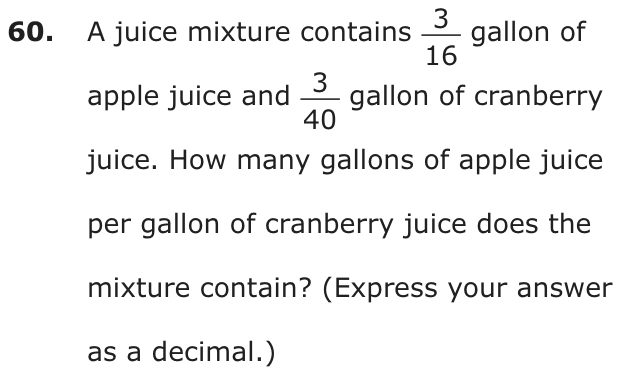
Question 16 of 63
2024 Test A Math, question 4Question
Mr. Chan’s lawn grows inches every 2 weeks. He mows his lawn every 2 weeks and cuts off the top inches of lawn. If Mr. Chan’s lawn was 4 inches tall at the beginning of the season, how many inches tall, in decimal form, is Mr. Chan’s lawn after 8 weeks?
Grid-in question: work out the answer and enter it as a number.
Show the answer
Correct answer: 5.5
The lawn grows inches every 2 weeks. Find the total number of inches it grows in 8 weeks.
The lawn was 4 inches tall at the beginning of the season.
Mr. Chan mows his lawn every 2 weeks and cuts off the top inches. Find the total number of inches that are cut off in 8 weeks.
The height after 8 weeks is the total number of inches grown minus the total number of inches cut off.
Question analysis
This multistep word problem follows Mr. Chan's lawn over 8 weeks: it grows a mixed number of inches every 2 weeks, and he mows a mixed number of inches off on the same schedule. Students combine the growth, the cuts and the starting height and give the final height as a decimal. Leaving out one of those three pieces is the usual error.
- Grade level
- Grade 7 content, by NYS standard
- Compared with grade 7
- At grade 7 Grade 7 students solve multi-step problems with mixed numbers and convert between fractions and decimals. This one strings four such steps together, including counting the 2-week periods, which is typical grade 7 work done carefully.
- Estimated difficulty
- Moderate: several steps, or a close reading with one strong distractor.
- Thinking it demands
- Depth of knowledge 2, skills and concepts · mainly apply
- What makes it hard
- Many steps moderate
- Error-prone arithmetic moderate
- Turning words into math minor
- An answer in an unexpected form minor
- Solution
- 4 steps
- Reading level
- Question and choices: about grade 3, 49 words.
- Corrected from the DOE handbook
- A misspelled name in the explanation was corrected.
- Students, last 30 days
- Not enough answers yet to show (it takes 10).
Why it is hard, traps and wrong answers (shows the answer)
Why it is hard
No single step is hard, but three parts must all reach the final height: the starting 4 inches, four rounds of growth and four rounds of mowing. Leaving out any one of them gives a clean decimal that can be gridded without a second thought. Working one 2-week period at a time, in which the lawn gains 3/8 inch net, keeps the bookkeeping short.
Many steps moderate Working it out
Four pieces have to be combined: count the four 2-week periods in 8 weeks, total the growth, total the mowing, and start from the lawn's first 4 inches. (Daniel & Embretson, 2010; Enright, Morley & Sheehan, 2002)
Error-prone arithmetic moderate Working it out
The amounts are mixed numbers with unlike denominators, 2 1/8 and 1 3/4, which must be multiplied by 4 or subtracted and then gridded as a decimal. (Brown & Burton, 1978; Junker & Sijtsma, 2001)
Turning words into math minor Understanding the question
The phrase "every 2 weeks" governs both the growing and the mowing, so 8 weeks means four rounds of each, not eight. (Hegarty, Mayer & Monk, 1995; Koedinger & Nathan, 2004)
An answer in an unexpected form minor Choosing the answer
As a grid-in it gives no choices, so a height that leaves out the starting 4 inches, or leaves out the mowing, looks as finished as the right one. (Enright, Morley & Sheehan, 2002)
Strategy: Find the net change for one 2-week period by subtracting the cut from the growth, multiply by the number of such periods in 8 weeks, and add the starting height.
Traps
- Stops one step early: A choice is a number from partway through the solution.
- Misreads the question: Misses or misreads a condition or a word in the question: "at least", "each", "remaining", "not".
The wrong answers, classified
1.5 Stops one step early (King et al., 2004; Gierl et al., 2017)
Finds the net gain of 3/8 inch per period and multiplies by the 4 periods, 1.5 inches, but stops before adding the lawn's starting height of 4 inches.
12.5 Stops one step early (King et al., 2004; Gierl et al., 2017)
Adds four periods of growth, 8.5 inches, to the starting 4 inches and stops there, never subtracting the 1 3/4 inches cut at each of the four mowings.
7 Misreads the question (Hegarty, Mayer & Monk, 1995)
Applies the net gain of 3/8 inch to each of the 8 weeks instead of each 2-week period, 8 × 3/8 = 3, then adds the starting 4.
What was corrected from the DOE handbook, and why
- Explanation: The handbook’s explanation says “Mr. Chen mows his lawn every 2 weeks.” The question calls him Mr. Chan throughout, so the site now reads “Mr. Chan.”
Worked solution, step by step
Formulas used
- Mixed number to decimal
- A mixed number has a whole part, a, and a fraction part, b over c. To write it as a decimal, divide b by c to get the fraction part as a decimal. Then add the whole part. For example, one and a half is 1 + 0.5 = 1.5.
- Repeated amount
- n is how many times something happens. a is the amount each time. Adding the same amount n times is the same as multiplying it by n.
Sort out the question
The lawn starts at 4 inches tall. Every 2 weeks it grows inches. Every 2 weeks Mr. Chan also cuts off inches. You need the height after 8 weeks, as a decimal. Three things matter: the start, the growing and the cutting.
Count the 2-week periods
Both the growing and the cutting happen every 2 weeks. So count how many 2-week periods fit in 8 weeks.
There are 4 periods. The lawn grows 4 times and is cut 4 times. Watch out: do not count 8 rounds, one for each week. That leads to the wrong answer 7.
Change the mixed numbers to decimals
The answer must be a decimal, so change both amounts now.
Each period, the lawn grows 2.125 inches and loses 1.75 inches.
Add up the growing
The lawn grows 2.125 inches, 4 times.
It grows 8.5 inches in all. Add the starting height of 4 inches.
Without mowing, the lawn would be 12.5 inches tall. Watch out: do not forget the starting 4 inches. Leaving them out leads to 1.5.
Add up the cutting
Mr. Chan cuts off 1.75 inches, 4 times.
He cuts off 7 inches in all.
Subtract the cutting
The lawn is 5.5 inches tall after 8 weeks. Watch out: 12.5 is not the answer. It leaves out the mowing. So you would grid 5.5.
Check your answer
Work one period at a time. Each period the lawn gains inch. In 4 periods that is inches. Add the starting 4 inches: . Same answer.
More questions like this
The original DOE question
Question 17 of 63
2024 Test A Math, question 11Question
Jar 1 and Jar 2 each contain cup of water. If of the water in Jar 1 is poured into Jar 2, how much water is now in Jar 2?
- A cup
- B cup
- C cup
- D cup
Show the answer
Correct answer: C
Jar 1 starts with cup of water. If of its water is poured into Jar 2, then the amount of water added to Jar 2 is cup.
Jar 2 starts with cup of water. If cup of water is added to it, then the amount of water now in Jar 2 is cup.
Question analysis
A fraction word problem about two jars that each hold half a cup of water; a quarter of the water in the first jar is poured into the second. Students find how much water the second jar now holds. Reading exactly what the quarter is a quarter of is the detail that matters.
- NYS standards
- 7.NS.3 four operations with rational numbers
- Grade level
- Grade 7 content, by NYS standard
- Compared with grade 7
- Below grade 7 Multiplying and adding positive fractions is review by grade 7, and the problem takes two short steps. It is easier than typical grade 7 work with negative numbers or longer rational-number problems, apart from careful reading.
- Estimated difficulty
- Straightforward: two steps or one careful reading.
- Thinking it demands
- Depth of knowledge 2, skills and concepts · mainly apply
- What makes it hard
- Turning words into math moderate
- Error-prone arithmetic minor
- Solution
- 2 steps
- Reading level
- Question and choices: about grade 4, 35 words.
- Students, last 30 days
- Not enough answers yet to show (it takes 10).
Why it is hard, traps and wrong answers (shows the answer)
Why it is hard
The numbers are friendly halves, quarters and eighths, and the work is two steps. The question turns on one phrase: the quarter is a fraction of Jar 1's water, not a measured quarter cup, and reading it the second way gives a choice that looks right. Students who also remember that Jar 2 already held water finish correctly.
Turning words into math moderate Understanding the question
The phrase "1/4 of the water in Jar 1" means a quarter of Jar 1's half cup, an eighth of a cup, not a quarter cup; the word of calls for multiplying. (Hegarty, Mayer & Monk, 1995; Koedinger & Nathan, 2004)
Error-prone arithmetic minor Working it out
Adding the 1/8 cup to Jar 2's 1/2 cup needs the common denominator 8, so 1/2 becomes 4/8 before the sum. (Brown & Burton, 1978; Junker & Sijtsma, 2001)
Strategy: Find the amount poured by taking one quarter of Jar 1's half cup, then add that amount to the half cup already in Jar 2.
Traps
- Stops one step early: A choice is a number from partway through the solution.
- Misreads the question: Misses or misreads a condition or a word in the question: "at least", "each", "remaining", "not".
The wrong answers, classified
A Stops one step early (King et al., 2004; Gierl et al., 2017)
Finds the amount poured, 1/4 of 1/2 cup = 1/8 cup, and stops there instead of adding it to the half cup already in Jar 2.
B Numbers taken from the question (Hegarty, Mayer & Monk, 1995)
Picks the fraction 1/4 straight from the question, as if the share poured were the amount of water now in Jar 2.
D Misreads the question (Hegarty, Mayer & Monk, 1995)
Reads 1/4 of the water as 1/4 cup and adds it to Jar 2's half cup, 1/2 + 1/4 = 3/4.
Worked solution, step by step
Formulas used
- Fraction of an amount
- N is the whole amount, and a over b is the part of it you want. In math, the word of means multiply. For example, half of 10 is one half times 10, which is 5.
- Multiplying fractions
- a and c are the tops, and b and d are the bottoms. Multiply the tops together and the bottoms together. Taking a part of a part makes the pieces smaller, so the bottom gets bigger.
- Adding fractions with the same bottom
- a and b are the tops, and d is the shared bottom, called the denominator. If the bottoms match, add the tops and keep the bottom. If they do not match, rewrite one fraction first.
Sort out the question
Each jar starts with cup of water. You pour “ of the water in Jar 1” into Jar 2. You need how much water is in Jar 2 after that, in cups.
Find how much water is poured
Jar 1 has cup. You pour of it. Of means multiply.
You pour cup. Watch out: a quarter of the water is not a quarter cup. It is a quarter of a half cup. Adding cup gives cup, choice D.
Make the bottoms match
Now add the poured water to the cup already in Jar 2. The bottoms are 2 and 8, so rewrite the half with 8 on the bottom. Multiply its top and bottom by 4.
Add the water in Jar 2
Jar 2 now holds cup. Watch out: cup is only the water poured in. Stopping there gives choice A. So the answer is C, cup.
Check your answer
Jar 2 started with a half cup and got a little more. So it should hold just over a half cup, and is. Also, the water in both jars still adds up to 1 cup: Jar 1 has cup left, and .
More questions like this
The original DOE question
Question 18 of 63
2024 Test A Math, question 12Question
If n is a whole number, and 0.01 is between and , what is the value of n?
- A0
- B1
- C2
- D99
Show the answer
Correct answer: D
, which is between and .
Therefore, and .
Question analysis
A number sense question: 0.01 lies between 1 over n and 1 over n + 2, where n is a whole number, and students find n. It tests comparing a decimal with unit fractions and knowing how a fraction changes as its denominator grows. The unusual form, with n in two denominators, is what slows students down.
- Grade level
- Grade 6 content, by NYS standard
- Compared with grade 7
- At grade 7 Grade 7 students compare fractions and decimals routinely, but not with an unknown in the denominators. The comparison is simple once 0.01 is written as a fraction; the unfamiliar setup is the main demand.
- Estimated difficulty
- Straightforward: two steps or one careful reading.
- Thinking it demands
- Depth of knowledge 2, skills and concepts · mainly apply
- What makes it hard
- Variables instead of numbers moderate
- Something you must already know minor
- Solution
- 2 steps
- Reading level
- Question and choices: about grade 9, 18 words.
- Students, last 30 days
- Not enough answers yet to show (it takes 10).
Why it is hard, traps and wrong answers (shows the answer)
Why it is hard
The setup looks unfamiliar, with n in two denominators, but one rewrite makes it routine: 0.01 is 1/100, so the two denominators must sit on either side of 100. The three small choices fail a quick check, since every fraction from 1/1 to 1/4 is far above 0.01, and 0 cannot be a denominator at all. Students who test the choices instead of rewriting the decimal spend a little longer but reach the same place.
Variables instead of numbers moderate Understanding the question
The unknown sits in two denominators, n and n + 2, so students must reason about which unit fractions lie on either side of 0.01 rather than solve an equation. (Koedinger & Nathan, 2004; Enright, Morley & Sheehan, 2002)
Something you must already know minor Working it out
Two facts are assumed: 0.01 equals 1/100, and a unit fraction shrinks as its denominator grows, so 1/99 is just above 0.01 and 1/101 just below. (Anderson & Krathwohl, 2001)
Strategy: Rewrite 0.01 as a unit fraction, recall that a larger denominator gives a smaller fraction, and test each choice in both 1/n and 1/(n + 2).
Traps
- Misunderstands the concept: A wrong belief about a concept: that percents can be added, that area grows like length, that averages can be averaged, that a bigger denominator means a bigger fraction.
- Numbers taken from the question: Combines the numbers in the question without a model of the situation, or is simply a number that appears in the question.
The wrong answers, classified
A Misunderstands the concept (Smith, diSessa & Roschelle, 1993; De Bock et al., 1998; Ni & Zhou, 2005)
Treats 1/0 as 0, so 0.01 seems to lie between 0 and 1/2; but division by zero is undefined, so n cannot be 0.
B Numbers taken from the question (Hegarty, Mayer & Monk, 1995)
Takes the 1 from 0.01 or from 1/n as the value of n, without checking that 0.01 is far below both 1 and 1/3.
C Numbers taken from the question (Hegarty, Mayer & Monk, 1995)
Takes the 2 from n + 2, or the two decimal places of 0.01, without testing 1/2 and 1/4, which are both far above 0.01.
Worked solution, step by step
Formulas used
- Comparing unit fractions
- A unit fraction has 1 on top, like one fifth. a and b are positive whole numbers on the bottom. A bigger bottom cuts the whole into more pieces, so each piece is smaller. So the fraction with the bigger bottom is the smaller number.
Sort out the question
n is a whole number: 0, 1, 2, 3 and so on. The number 0.01 is between and . Between means one fraction is bigger than 0.01 and the other is smaller. You need the value of n.
Write 0.01 as a fraction
0.01 means one hundredth.
Now all three numbers are fractions with 1 on top. That makes them easy to compare.
Find fractions on each side
With 1 on top, a bigger bottom makes a smaller fraction.
So is a little more than , and is a little less.
The bottoms 99 and 101 are 2 apart, just like n and n + 2.
Match the fractions to n
The smaller bottom is n, and the larger bottom is n + 2.
Both fit. Watch out: small choices do not work. For n = 1, the fractions are 1 and . Both are far bigger than 0.01. For n = 0, is not a number, because you can’t divide by zero. So the answer is D, 99.
Check your answer
Write the fractions as decimals. , a bit more than 0.01. , a bit less. The sign ≈ means about. So 0.01 sits right between them.
More questions like this
The original DOE question
Question 19 of 63
2024 Test A Math, question 30Question
The reciprocal of is added to the reciprocal of 3. What is the reciprocal of this sum?
- A
- B
- C
- D
Show the answer
Correct answer: A
The reciprocal of is added to the reciprocal of 3.
The reciprocal of this sum is .
Question analysis
This fractions question asks for the reciprocal of a sum: the reciprocal of one fourth is added to the reciprocal of 3, and students must flip the total. It tests knowing what a reciprocal is and adding a whole number to a fraction. Keeping the three flips in the right order, without skipping one, is what makes it tricky.
- NYS standards
- 6.NS.1 dividing fractions by fractions
- Grade level
- Grade 6 content, by NYS standard
- Compared with grade 7
- At grade 7 Grade 7 students use reciprocals when dividing fractions, usually one at a time. This item chains three reciprocals around one addition, with positive numbers only, so the demand is following the wording in order rather than new content.
- Estimated difficulty
- Straightforward: two steps or one careful reading.
- Thinking it demands
- Depth of knowledge 2, skills and concepts · mainly apply
- What makes it hard
- Turning words into math moderate
- Error-prone arithmetic minor
- Solution
- 3 steps
- Reading level
- Question and choices: about grade 8, 21 words.
- Students, last 30 days
- Not enough answers yet to show (it takes 10).
Why it is hard, traps and wrong answers (shows the answer)
Why it is hard
Each step is easy, so the question is about order: flip each number, add, then flip the total. The common failures are flipping at the wrong moment, term by term instead of the whole sum, and adding a whole number to a fraction straight across. Writing the full expression 1 ÷ (4 + 1/3) before doing any arithmetic keeps the three reciprocals in their places.
Turning words into math moderate Understanding the question
The two sentences hold three reciprocals and a sum, which must become 1 ÷ (4 + 1/3) before any arithmetic; "this sum" means flipping the total, not each part. (Hegarty, Mayer & Monk, 1995; Koedinger & Nathan, 2004)
Error-prone arithmetic minor Working it out
Adding 4 and 1/3 means writing 4 as 12/3 to get 13/3, a whole number plus a fraction, where adding tops and bottoms gives 5/4 instead. (Brown & Burton, 1978; Junker & Sijtsma, 2001)
Strategy: Work in the order of the words: flip each number to get its reciprocal, add the two using a common denominator, and then flip that sum.
Traps
- A faulty procedure: A systematic but wrong procedure: adding fractions straight across, applying an exponent to each term of a sum, dropping a sign when moving a term.
- Wrong operation: Adds instead of multiplying, divides the wrong way round, turns a ratio or rate upside down, or undoes a step in the wrong direction (subtracts what should be added back).
The wrong answers, classified
B Wrong operation (Hegarty, Mayer & Monk, 1995; King et al., 2004)
Multiplies the two reciprocals instead of adding them, 4 × 1/3 = 4/3, then flips that product to 3/4.
C A faulty procedure (Brown & Burton, 1978; Tatsuoka, 1983)
Adds 4/1 and 1/3 straight across, numerators and denominators, getting 5/4, then flips it to 4/5.
D A faulty procedure (Brown & Burton, 1978; Tatsuoka, 1983)
Flips each term of 4 + 1/3 instead of the whole sum, as if the reciprocal of a sum were the sum of reciprocals: 1/4 + 3 = 13/4.
Worked solution, step by step
Formulas used
- Reciprocal
- a is the top of a fraction and b is the bottom. The reciprocal is the fraction flipped upside down. A whole number such as 3 is the fraction 3 over 1, so its reciprocal is 1 over 3. A number times its reciprocal always makes 1.
- Adding fractions with the same bottom
- c is the shared bottom number, called the denominator. a and b are the tops, called numerators. When the pieces are the same size, you just add how many pieces you have. The size of the pieces, c, stays the same.
Sort out the wording
The question has three reciprocals in it. A reciprocal is a fraction flipped upside down. Do the jobs in the order of the words:
- Flip .
- Flip 3.
- Add the two results to get the sum.
- Flip that sum.
The last flip gives the answer.
Flip each number
Flip to get , which is 4. The number 3 is the same as , so its reciprocal is .
Add the two reciprocals
You need . To add, both numbers need the same bottom. So write 4 in thirds. One whole is 3 thirds, so 4 wholes are 12 thirds.
The sum is . Watch out: don’t add the tops and the bottoms straight across. That gives , which flips to , choice C.
Flip the sum
Watch out: flip the whole sum, not each part. Flipping 4 and one at a time takes you back to , choice D.So the answer is A, .
Check your answer
A number times its reciprocal is 1. Test it: . Also estimate. The sum is a bit more than 4, so its reciprocal should be a bit less than . is about 0.23, just under 0.25.
More questions like this
The original DOE question
Question 20 of 63
2024 Test A Math, question 32Question
INGREDIENTS FOR 4 SERVINGS OF OATMEAL
| Ingredient | Cups |
|---|---|
| Oats | |
| Water |
The table shows the cups of ingredients used to make 4 servings of oatmeal. What is the unit rate for cups of oats per cup of water?
- A
- B
- C
- D
Show the answer
Correct answer: B
The unit rate for cups of oats per cup of water can be found by dividing the number of cups of oats by the number of cups of water:
The denominator can be rewritten as .
The quotient can be rewritten as:
Therefore, the unit rate for cups of oats per cup of water is .
Question analysis
This unit rate question uses a recipe table for 4 servings of oatmeal, with 2/3 cup of oats and 3 1/4 cups of water, and asks for cups of oats per cup of water. Students divide one fraction by another, including a mixed number. Deciding which quantity goes on top, and whether the number of servings matters, is the tricky part.
- Grade level
- Grade 7 content, by NYS standard
- Compared with grade 7
- At grade 7 Unit rates from fractions, such as 1/2 mile in 1/4 hour, are exactly grade 7 work. This one adds a mixed number, a fraction divided by a fraction, and a table titled for 4 servings, so students must decide which numbers the rate uses.
- Estimated difficulty
- Moderate: several steps, or a close reading with one strong distractor.
- Thinking it demands
- Depth of knowledge 2, skills and concepts · mainly apply
- What makes it hard
- Error-prone arithmetic moderate
- Turning words into math moderate
- Reading a figure, table or graph minor
- Solution
- 3 steps
- Reading level
- Question and choices: about grade 6, 40 words.
- Students, last 30 days
- Not enough answers yet to show (it takes 10).
Why it is hard, traps and wrong answers (shows the answer)
Why it is hard
The question rewards reading the rate's wording exactly and then carrying out a fraction division without slips. The 4 servings in the title is the hook: dividing by 4 gives a per-serving amount that sounds like a unit rate and is listed. Students who write oats over water as one fraction, convert the mixed number and multiply by the reciprocal finish in a few lines.
Error-prone arithmetic moderate Working it out
The rate is a fraction over a mixed number, 2/3 ÷ 3 1/4, so 3 1/4 must become 13/4 and the division a multiplication by 4/13. (Brown & Burton, 1978; Junker & Sijtsma, 2001)
Turning words into math moderate Understanding the question
In "cups of oats per cup of water" the quantity before "per" goes on top; reading the phrase loosely puts water over oats or brings in servings. (Hegarty, Mayer & Monk, 1995; Koedinger & Nathan, 2004)
Reading a figure, table or graph minor Understanding the question
The table's title, "for 4 servings", supplies the only other number on the page, and it plays no part in a rate of oats to water. (Lesh, Post & Behr, 1987; Kirsch & Mosenthal, 1990)
Strategy: Write the rate as cups of oats over cups of water, change the mixed number to an improper fraction, and divide by multiplying by its reciprocal.
Traps
- Information you don't need: The question gives numbers or facts that play no part in the answer.
- Answers a different question: A choice is right for another quantity: the other unknown, the rest instead of the part, the part instead of the whole.
- Wrong operation: Adds instead of multiplying, divides the wrong way round, turns a ratio or rate upside down, or undoes a step in the wrong direction (subtracts what should be added back).
The wrong answers, classified
A Answers a different question (King et al., 2004; Hegarty, Mayer & Monk, 1995)
Divides the 2/3 cup of oats by the 4 servings, 2/3 ÷ 4 = 1/6, giving oats per serving instead of oats per cup of water.
C Answers a different question (King et al., 2004; Hegarty, Mayer & Monk, 1995)
Divides the 3 1/4 cups of water by the 4 servings, 13/4 ÷ 4 = 13/16, leaving the oats out altogether.
D Wrong operation (Hegarty, Mayer & Monk, 1995; King et al., 2004)
Turns the rate upside down, water over oats, and also drops the 3 of 2/3, dividing 13/4 by 2 to get 13/8.
Worked solution, step by step
Formulas used
- Unit rate
- A unit rate tells how much of the first amount goes with 1 of the second amount. The word per means for each. The amount named before per goes on top, and the amount after it goes on the bottom.
- Mixed number to fraction
- a is the whole number part, b is the top of the fraction, and c is the bottom. Each whole holds c pieces, so a wholes hold a times c pieces. Then add the b extra pieces.
- Dividing by a fraction
- a over b is the number you divide. c over d is the number you divide by. To divide by a fraction, multiply by its reciprocal, the fraction flipped upside down. This works because dividing by a number undoes multiplying by it.
Sort out the question
The table shows cup of oats and cups of water. You need the unit rate for “cups of oats per cup of water.” That is how many cups of oats go with 1 cup of water.
Watch out: the 4 servings play no part here. Dividing the oats by 4 servings gives cup for each serving, choice A.Set up the rate
Oats comes before per, so oats goes on top. Water goes on the bottom.
Watch out: water over oats flips the rate. That gives a number bigger than 1, like choice D.Change the mixed number
A mixed number is a whole number plus a fraction. Change to a fraction so you can divide.
So 3 and one quarter cups is 13 quarters of a cup.
Divide by multiplying
To divide by , multiply by its reciprocal, .
No whole number bigger than 1 divides both 8 and 39, so the fraction can’t be made simpler. The rate is cup of oats per cup of water.
So the answer is B, .
Check your answer
There is much more water than oats. So the oats for 1 cup of water should be small, and is about 0.2. Also multiply back: . That is the cups of oats in the table.
More questions like this
The original DOE question
Question 21 of 63
2024 Test A Math, question 33Question
If , what is the value of x?
- A
- B
- C
- D
Show the answer
Correct answer: D
Rewrite with equivalent fractions that have like denominators.
Multiply both sides of the equation by 10.
Question analysis
This equation has fractions on both sides: the coefficient of x is 3/5 minus 1/2, and the right side is 1/4 plus 2/3. Students simplify each side using common denominators, then solve for x. Each step is routine, but four fraction operations in a row leave many places to slip, especially when undoing the coefficient.
- Grade level
- Grade 7 content, by NYS standard
- Compared with grade 7
- At grade 7 Grade 7 students solve equations such as (2/3)x = 4/5 with fractional coefficients. Here both sides must first be simplified over unlike denominators, so four fraction operations come before x is found: on level, but long.
- Estimated difficulty
- Moderate: several steps, or a close reading with one strong distractor.
- Thinking it demands
- Depth of knowledge 1, recall and reproduction · mainly apply
- What makes it hard
- Error-prone arithmetic moderate
- Many steps moderate
- Solution
- 4 steps
- Reading level
- Question and choices: about grade 8, 12 words.
- Corrected from the DOE handbook
- A minus sign printed in place of an equals sign in the explanation was corrected.
- Students, last 30 days
- Not enough answers yet to show (it takes 10).
Why it is hard, traps and wrong answers (shows the answer)
Why it is hard
Nothing here is new, but the question strings together four fraction operations, and the last one runs against habit. Having found that one tenth of x is 11/12, students must multiply by 10; multiplying by 1/10 instead gives a tiny listed value. The size of the answer is a useful check: if a tenth of x is almost 1, then x must be almost 10.
Error-prone arithmetic moderate Working it out
Both sides need common denominators, tenths on the left and twelfths on the right, and the coefficient comes out as 1/10, a fraction to divide by. (Brown & Burton, 1978; Junker & Sijtsma, 2001)
Many steps moderate Working it out
Four operations come before x appears: 3/5 − 1/2, then 1/4 + 2/3, then 11/12 divided by 1/10, then reducing 110/12 to 55/6. (Daniel & Embretson, 2010; Enright, Morley & Sheehan, 2002)
Strategy: Simplify the parentheses on the left and the sum on the right over common denominators, then undo the coefficient by multiplying both sides by its reciprocal.
Traps
- Wrong operation: Adds instead of multiplying, divides the wrong way round, turns a ratio or rate upside down, or undoes a step in the wrong direction (subtracts what should be added back).
- A faulty procedure: A systematic but wrong procedure: adding fractions straight across, applying an exponent to each term of a sum, dropping a sign when moving a term.
The wrong answers, classified
A Wrong operation (Hegarty, Mayer & Monk, 1995; King et al., 2004)
Simplifies both sides correctly but multiplies 11/12 by 1/10 instead of dividing by it, getting 11/120.
B A faulty procedure (Brown & Burton, 1978; Tatsuoka, 1983)
Combines each pair straight across, 3/5 − 1/2 as 2/3 and 1/4 + 2/3 as 3/7, then multiplies them: 2/3 × 3/7 = 2/7.
C Wrong operation (Hegarty, Mayer & Monk, 1995; King et al., 2004)
Adds 3/5 and 1/2 instead of subtracting, so the coefficient is 11/10 and x = 11/12 ÷ 11/10 = 5/6.
What was corrected from the DOE handbook, and why
- Explanation: The handbook writes “(1/10)x − 11/12”, an expression, where the working needs the equation (1/10)x = 11/12: the line before is (6/10 − 5/10)x = 3/12 + 8/12, and the next step multiplies both sides of the equation by 10. The site now reads (1/10)x = 11/12, which gives x = 110/12 = 55/6.
Worked solution, step by step
Formulas used
- Equivalent fractions
- a is the top of a fraction and b is the bottom. n is any number except 0. Multiplying the top and bottom by the same number gives an equal fraction, cut into smaller pieces. Use it to give two fractions the same bottom before you add or subtract.
- Keeping an equation balanced
- a and b are the two sides of an equation, and n is any number. An equation is like a balanced scale. If you multiply both sides by the same number, it stays balanced. Use it to undo a number that multiplies x.
Sort out the equation
An equation says two things are equal. On the left, the subtraction in the parentheses multiplies x. On the right is a sum. You need the value of x. First make each side as simple as you can. Then get x by itself.
Simplify the left side
To subtract, the fractions need the same bottom. Both 5 and 2 go into 10, so use tenths.
Watch out: this is a minus sign. Adding instead gives , and that leads to , choice C.Simplify the right side
Both 4 and 3 go into 12, so use twelfths.
Now the equation is much simpler:
Get x by itself
x is multiplied by . To undo that, multiply both sides by 10. That is the reciprocal of , the fraction flipped upside down.
Watch out: multiplying by does not undo anything. It gives , choice A.Simplify the fraction
Both 110 and 12 are even, so divide the top and the bottom by 2.
So the answer is D, .
Check your answer
Put back in for x. . That matches the right side. Also estimate. A tenth of x is almost 1, so x should be almost 10. is about 9.2.
More questions like this
The original DOE question
Question 22 of 63
2024 Test A Math, question 43Question
- A0.005
- B0.648
- C20
- D200
Show the answer
Correct answer: D
Question analysis
This decimal division question asks for 3.6 divided by 0.018, with no context. Students rewrite the division so the divisor is a whole number and then divide. Because the divisor has three decimal places, moving the decimal point the right number of places in both numbers is where students go wrong.
- NYS standards
- 6.NS.3 multi-digit decimal operations
- Grade level
- Grade 6 content, by NYS standard
- Compared with grade 7
- Below grade 7 Dividing multi-digit decimals is a grade 6 fluency standard, and this is a single division with no context. It is easier than typical grade 7 work, though shifting three decimal places invites a place-value slip.
- Estimated difficulty
- Straightforward: two steps or one careful reading.
- Thinking it demands
- Depth of knowledge 1, recall and reproduction · mainly apply
- What makes it hard
- Error-prone arithmetic moderate
- Solution
- 2 steps
- Reading level
- Question and choices: about grade 16+, 1 words.
- Students, last 30 days
- Not enough answers yet to show (it takes 10).
Why it is hard, traps and wrong answers (shows the answer)
Why it is hard
This is a single division, and the only real hazard is the decimal point. Shifting it three places in the divisor but only two in the dividend gives a listed answer ten times too small. An estimate settles it: 0.018 is about 0.02, and 3.6 ÷ 0.02 = 180, so the answer must be in the hundreds.
Error-prone arithmetic moderate Working it out
The divisor 0.018 has three decimal places, so both numbers must be multiplied by 1,000, turning 3.6 into 3,600, not 360, before dividing by 18. (Brown & Burton, 1978; Junker & Sijtsma, 2001)
Strategy: Multiply both numbers by 1,000 so the divisor becomes a whole number, then divide; estimate first by asking roughly how many 0.02s fit into 3.6.
Traps
- An arithmetic slip: The right method with a plausible arithmetic error: a digit, a place value or a times-table fact.
- Wrong operation: Adds instead of multiplying, divides the wrong way round, turns a ratio or rate upside down, or undoes a step in the wrong direction (subtracts what should be added back).
The wrong answers, classified
A Wrong operation (Hegarty, Mayer & Monk, 1995; King et al., 2004)
Divides the wrong way round, 0.018 ÷ 3.6 = 0.005, putting the smaller number on top as if division always shrinks.
B Wrong operation (Hegarty, Mayer & Monk, 1995; King et al., 2004)
Multiplies instead of dividing, 36 × 18 = 648, and misplaces the decimal point too, since 3.6 × 0.018 is really 0.0648.
C An arithmetic slip (Junker & Sijtsma, 2001)
Moves the decimal point two places instead of three, dividing 360 by 18 to get 20, a result ten times too small.
Worked solution, step by step
Formulas used
- Scaling a division
- a is the number being divided, and b is the number you divide by. n is any number except 0. Multiplying both numbers by the same n keeps the answer the same, just like an equal fraction. Use it to turn a decimal you divide by into a whole number.
Sort out the problem
You need . The number you divide by, 0.018, has three decimal places. That means three digits after the decimal point. Dividing by a decimal is hard, so first turn 0.018 into a whole number.
Multiply both numbers by 1,000
Multiplying by 1,000 moves the decimal point 3 places to the right. Do it to both numbers, so the answer does not change.
Watch out: 3.6 has only one decimal place, so fill in zeros: 3.6 becomes 3,600. Moving its point only two places gives , choice C.Divide the whole numbers
This works because , so . Watch out: divide 3.6 by 0.018, not the other way around. Dividing 0.018 by 3.6 gives 0.005, choice A.
So the answer is D, 200.
Check your answer
Multiply back: . Also estimate. 0.018 is close to 0.02, and . The answer should be near that, and 200 is. Dividing by a number less than 1 gives a bigger answer, so 200 makes sense.
More questions like this
The original DOE question
Question 23 of 63
2024 Test A Math, question 45Question
Misha wants to use ribbon to make 2 straps for a backpack. The ribbon costs $5.00 a yard. If each strap requires yards of ribbon, how much will Misha pay for the ribbon (not including tax)?
- A$4.00
- B$6.25
- C$11.25
- D$12.50
Show the answer
Correct answer: D
Each strap requires yards of ribbon, and ribbon costs $5.00 a yard.
, so the ribbon for each strap costs $6.25.
Misha wants to make 2 straps.
, so the cost of the ribbon for 2 straps is $12.50.
Question analysis
Misha needs ribbon for 2 backpack straps, each using 1 1/4 yards, and ribbon costs $5.00 a yard. This cost word problem asks how much she will pay for the ribbon before tax. Students multiply a mixed number by a price per yard and by the number of straps; it is short, but both the mixed number and the two straps need care.
- Grade level
- Grade 6 content, by NYS standard
- Compared with grade 7
- Below grade 7 Multiplying a mixed number by a whole number and finding a total cost are grade 5 and 6 skills. With two short steps and friendly numbers, this is easier than typical grade 7 problems with percents or negatives.
- Estimated difficulty
- Routine: one familiar step, little to misread.
- Thinking it demands
- Depth of knowledge 2, skills and concepts · mainly apply
- What makes it hard
- Error-prone arithmetic minor
- Much to keep track of minor
- Solution
- 2 steps
- Reading level
- Question and choices: about grade 5, 35 words.
- Students, last 30 days
- Not enough answers yet to show (it takes 10).
Why it is hard, traps and wrong answers (shows the answer)
Why it is hard
The question is short and the numbers are friendly; points are lost by stopping at one strap or by mishandling the mixed number. Pricing a single strap gives a listed choice, as does doubling only the whole-number part of 1 1/4. Finding the total ribbon first, 2 1/2 yards, before multiplying by the price keeps both errors away.
Error-prone arithmetic minor Working it out
The length per strap is a mixed number, 1 1/4 yards, so the arithmetic is easiest as 2 × 1.25 = 2.5 yards, then 2.5 × $5.00. (Brown & Burton, 1978; Junker & Sijtsma, 2001)
Much to keep track of minor Working it out
The number of straps comes in the first sentence and the length of each in the last, so the 2 has to be carried through to the cost. (Sweller, 1988; Carpenter, Just & Shell, 1990)
Strategy: Find the total ribbon first by doubling the length for one strap, then multiply the yards by $5.00; writing 1 1/4 as 1.25 keeps the arithmetic simple.
Traps
- Stops one step early: A choice is a number from partway through the solution.
- A faulty procedure: A systematic but wrong procedure: adding fractions straight across, applying an exponent to each term of a sum, dropping a sign when moving a term.
- Wrong operation: Adds instead of multiplying, divides the wrong way round, turns a ratio or rate upside down, or undoes a step in the wrong direction (subtracts what should be added back).
The wrong answers, classified
A Wrong operation (Hegarty, Mayer & Monk, 1995; King et al., 2004)
Divides the price by the length, $5.00 ÷ 1.25 = 4, instead of multiplying yards by dollars per yard.
B Stops one step early (King et al., 2004; Gierl et al., 2017)
Prices the ribbon for one strap, 1 1/4 × $5.00 = $6.25, and forgets that Misha is making 2 straps.
C A faulty procedure (Brown & Burton, 1978; Tatsuoka, 1983)
Doubles only the whole-number part of 1 1/4, getting 2 1/4 yards instead of 2 1/2, and pays 2.25 × $5.00 = $11.25.
Worked solution, step by step
Formulas used
- Cost
- Price per unit is the cost of one unit, here $5.00 for one yard. Number of units is how many you buy, here yards of ribbon. Multiply them to get the total before tax.
Sort out the question
Misha makes 2 straps. Each strap needs yards of ribbon. A yard is a length of 3 feet. Ribbon costs $5.00 a yard. You need the total cost for both straps, with no tax.
Find the total ribbon
First change the mixed number to a decimal. One quarter is 0.25, so is 1.25. Then double it for 2 straps.
Misha needs 2.5 yards of ribbon. Watch out: double the whole mixed number, the 1 and the quarter. Doubling only the 1 gives yards and $11.25, choice C.
Find the cost
The ribbon costs $12.50. Watch out: this is for both straps. One strap’s ribbon costs $6.25, choice B. Don’t stop there.
So the answer is D, $12.50.
Check your answer
Estimate. Each strap needs a bit more than 1 yard, so both need a bit more than 2 yards. Two yards cost $10, so the answer should be a bit more than $10. $12.50 fits. Also, 2 yards cost $10 and the extra half yard costs $2.50, which makes $12.50.
More questions like this
The original DOE question
Question 24 of 63
2024 Test A Math, question 49Question
Carolyn walked 3 miles from her house to the library and then miles farther to the grocery store. Returning home by the same route, she walked miles before stopping at a friend’s house. How many miles did Carolyn have left to walk home?
- A
- B
- C
- D
Show the answer
Correct answer: A
The distance from Carolyn’s house to the grocery store is miles.
Carolyn walked miles back, so she still had miles left to walk home.
So Carolyn had miles left to walk home.
Question analysis
Carolyn walks 3 miles from home to the library and 2 1/2 miles more to the grocery store, then heads back the same way and stops at a friend's house after 1 2/3 miles. This fractions word problem asks how far she still has to walk home. Students add and subtract mixed numbers, and the subtraction needs regrouping across unlike denominators.
- Grade level
- Grade 7 content, by NYS standard
- Compared with grade 7
- At grade 7 Grade 7 students solve multi-step word problems with mixed numbers. This one has only positive numbers, but it needs a clear picture of the route and a subtraction that requires regrouping across unlike denominators.
- Estimated difficulty
- Moderate: several steps, or a close reading with one strong distractor.
- Thinking it demands
- Depth of knowledge 2, skills and concepts · mainly apply
- What makes it hard
- Error-prone arithmetic moderate
- A very close wrong answer moderate
- Turning words into math minor
- Solution
- 3 steps
- Reading level
- Question and choices: about grade 6, 48 words.
- Students, last 30 days
- Not enough answers yet to show (it takes 10).
Why it is hard, traps and wrong answers (shows the answer)
Why it is hard
The story needs a quick sketch, but the real test is one mixed-number subtraction in which the second fraction is larger than the first. Many students subtract the fractions the easy way round, which gives a choice close to the right one. Converting both numbers to sixths, 33/6 − 10/6, sidesteps the regrouping, and adding the result to 1 2/3 to get back 5 1/2 is a quick check.
Error-prone arithmetic moderate Working it out
The subtraction 5 1/2 − 1 2/3 needs sixths, 5 3/6 − 1 4/6, and the fraction on top is the smaller one, so a whole must be regrouped. (Brown & Burton, 1978; Junker & Sijtsma, 2001)
A very close wrong answer moderate Choosing the answer
Subtracting the fraction parts the wrong way round gives 4 1/6, only 1/3 away from the answer, so a rough estimate cannot tell the two apart. (Embretson & Wetzel, 1987; Gorin & Embretson, 2006; Ascalon et al., 2007)
Turning words into math minor Understanding the question
The route has to be pictured: the walk back starts at the grocery store, 5 1/2 miles from home, not at the library. (Hegarty, Mayer & Monk, 1995; Koedinger & Nathan, 2004)
Strategy: Sketch the route as a line from home to the library to the store, find the total distance out, then subtract the distance already walked back, using sixths.
Traps
- A faulty procedure: A systematic but wrong procedure: adding fractions straight across, applying an exponent to each term of a sum, dropping a sign when moving a term.
- Answers a different question: A choice is right for another quantity: the other unknown, the rest instead of the part, the part instead of the whole.
The wrong answers, classified
B A faulty procedure (Brown & Burton, 1978; Tatsuoka, 1983)
Subtracts the whole numbers, 5 − 1 = 4, then the fractions the easy way round, 2/3 − 1/2 = 1/6, giving 4 1/6.
C Answers a different question (King et al., 2004; Hegarty, Mayer & Monk, 1995)
On the store-to-library stretch, uses the 1 2/3 miles already walked instead of the 5/6 mile left, then adds the 3 miles home.
D Answers a different question (King et al., 2004; Hegarty, Mayer & Monk, 1995)
Adds all three distances, 3 + 2 1/2 + 1 2/3 = 7 1/6, which is how far she has walked so far, not how far is left.
Worked solution, step by step
Formulas used
- Mixed number to fraction
- a is the whole number part, b is the top of the fraction, and c is the bottom. Each whole holds c pieces, so a wholes hold a times c pieces. Then add the b extra pieces.
- Equivalent fractions
- a is the top of a fraction and b is the bottom. n is any number except 0. Multiplying the top and bottom by the same number gives an equal fraction, cut into smaller pieces. Use it to give two fractions the same bottom before you add or subtract.
- Subtracting fractions with the same bottom
- c is the shared bottom number. a and b are the tops. When the pieces are the same size, you just take away how many pieces you have. The size of the pieces, c, stays the same.
Picture the route
Draw a line: home, then the library, then the store. Home to the library is 3 miles. The library to the store is miles more. Carolyn walks back the same way. After miles she stops at a friend’s house. You need the miles still left to get home.
Find the distance from home to the store
The store is miles from home. She starts back from the store, so this is the full trip home. Watch out: adding all three distances gives , choice D. That is how far she has walked, not how far is left.
Change to improper fractions
The miles left are . An improper fraction has a top bigger than its bottom. Change each mixed number to one.
Use sixths for both
To subtract, the fractions need the same bottom. 2 and 3 both go into 6, so change both to sixths.
Subtract and simplify
23 sixths is 3 wholes (18 sixths) and 5 sixths more. So . Watch out: is less than . Subtracting the fraction parts the wrong way round gives , choice B.
So the answer is A, miles.
Check your answer
Add back: . That is the full distance from the store to home. Also estimate: 5.5 minus about 1.7 is about 3.8, and is about 3.83.
More questions like this
The original DOE question
Question 25 of 63
2024 Test A Math, question 50Question
A child grows inches in of a year. What would be his yearly growth rate in inches per year?
- A
- B
- C
- D
Show the answer
Correct answer: C
Set up a proportion to solve.
Question analysis
A child grows 1 1/4 inches in one third of a year, and this unit rate question asks for his growth rate in inches per year. Students divide a mixed number by a fraction, or scale the growth up to a whole year. Choosing between multiplying and dividing, and handling the whole mixed number, are where the wrong rates come from.
- Grade level
- Grade 7 content, by NYS standard
- Compared with grade 7
- At grade 7 Computing a unit rate from a ratio of fractions is the grade 7 standard itself, and this is a typical example: one mixed number over one unit fraction, in two short steps with no extra information.
- Estimated difficulty
- Straightforward: two steps or one careful reading.
- Thinking it demands
- Depth of knowledge 2, skills and concepts · mainly apply
- What makes it hard
- Error-prone arithmetic minor
- A very close wrong answer minor
- Solution
- 2 steps
- Reading level
- Question and choices: about grade 4, 25 words.
- Students, last 30 days
- Not enough answers yet to show (it takes 10).
Why it is hard, traps and wrong answers (shows the answer)
Why it is hard
The idea is simple: three thirds make a year, so the yearly growth is three times the growth in a third. Errors come from the mixed number, where students triple the 1 and leave the 1/4 alone, and from multiplying by 1/3 instead of dividing, which shrinks the rate. A sense check helps, since a yearly rate must be larger than the 1 1/4 inches grown in a third of a year.
Error-prone arithmetic minor Working it out
Dividing 1 1/4 by 1/3 means multiplying by 3, and the mixed number must be multiplied whole, as 5/4 × 3 = 15/4, not just its 1. (Brown & Burton, 1978; Junker & Sijtsma, 2001)
A very close wrong answer minor Choosing the answer
Multiplying only the whole part gives 3 1/4, which differs from the answer only in the fraction's numerator, so a rough size check cannot rule it out. (Embretson & Wetzel, 1987; Gorin & Embretson, 2006; Ascalon et al., 2007)
Strategy: Divide the growth by the time, writing 1 1/4 as 5/4 and dividing by 1/3 as multiplying by 3; or ask how much he grows in three such periods.
Traps
- Wrong operation: Adds instead of multiplying, divides the wrong way round, turns a ratio or rate upside down, or undoes a step in the wrong direction (subtracts what should be added back).
- A faulty procedure: A systematic but wrong procedure: adding fractions straight across, applying an exponent to each term of a sum, dropping a sign when moving a term.
The wrong answers, classified
A Wrong operation (Hegarty, Mayer & Monk, 1995; King et al., 2004)
Multiplies 5/4 by 1/3 instead of dividing by it, getting 5/12, a yearly rate smaller than the growth in a third of a year.
B A faulty procedure (Brown & Burton, 1978; Tatsuoka, 1983)
Triples only the whole-number part of 1 1/4, writing 3 × 1 1/4 as 3 1/4 and leaving the 1/4 unchanged.
D Wrong operation (Hegarty, Mayer & Monk, 1995; King et al., 2004)
Adds 3 to 1 1/4 instead of multiplying it by 3, getting 4 1/4.
Worked solution, step by step
Formulas used
- Rate
- The amount is how much something changed, here inches grown. The time is how long it took, here part of a year. Dividing tells how much it changes in 1 unit of time, here 1 whole year.
- Mixed number to fraction
- a is the whole number part, b is the top of the fraction, and c is the bottom. Each whole holds c pieces, so a wholes hold a times c pieces. Then add the b extra pieces.
- Dividing by a fraction
- a over b is the number you divide. c over d is the number you divide by. To divide by a fraction, multiply by its reciprocal, the fraction flipped upside down. This works because dividing by a number undoes multiplying by it.
Sort out the question
The child grows inches in of a year. You need his growth rate in inches per year. That is how much he would grow in 1 whole year at the same speed. A year has 3 thirds, so the answer should be bigger than .
Set up the rate
Divide the growth by the time to get the inches for 1 whole year.
Change the mixed number to a fraction first.
Divide by multiplying
To divide by a fraction, multiply by its reciprocal, the fraction flipped upside down. The reciprocal of is 3.
Watch out: multiplying by instead gives , choice A. That is less than he grew in a third of a year.Change back to a mixed number
15 quarters is 3 wholes (12 quarters) and 3 quarters more.
He grows inches per year. Watch out: triple all of , not just the 1. Tripling only the whole number gives , choice B.
So the answer is C, .
Check your answer
Think of the year as 3 thirds. He grows inches in each third. Add them: . The wholes make 3, and the quarters make . That is inches, the same answer.
More questions like this
The original DOE question
Question 26 of 63
2024 Test A Math, question 51Question
- A−0.33
- B−0.27
- C0
- D0.33
Show the answer
Correct answer: B
Question analysis
This decimal question asks for the value of 3 times 0.01 minus 3 times 0.1. Students multiply each decimal by 3 and subtract, keeping the order of the subtraction as written. The two decimals look alike, so place value and the sign of the result both need care.
- Grade level
- Grade 7 content, by NYS standard
- Compared with grade 7
- At grade 7 Grade 7 students subtract rational numbers and get negative results. This short computation adds place-value care, since 0.01 and 0.1 look alike, but it is a routine two-step grade 7 exercise.
- Estimated difficulty
- Straightforward: two steps or one careful reading.
- Thinking it demands
- Depth of knowledge 1, recall and reproduction · mainly apply
- What makes it hard
- Error-prone arithmetic moderate
- A very close wrong answer minor
- Solution
- 2 steps
- Reading level
- Question and choices: about grade 16+, 1 words.
- Students, last 30 days
- Not enough answers yet to show (it takes 10).
Why it is hard, traps and wrong answers (shows the answer)
Why it is hard
Two quick multiplications leave 0.03 − 0.3, a subtraction whose result is negative. The usual errors are adding the two products, with or without a minus sign, and treating 0.01 and 0.1 as the same number. Rewriting the subtraction as −(0.3 − 0.03) keeps the place values lined up and makes the sign plain.
Error-prone arithmetic moderate Working it out
The products 0.03 and 0.3 have their digits in different places, and taking the larger from the smaller crosses zero, so both alignment and sign need care. (Brown & Burton, 1978; Junker & Sijtsma, 2001)
A very close wrong answer minor Choosing the answer
The choice −0.33 has the right sign and is only 0.06 from the answer, so a sense that the result is a little below zero cannot separate them. (Embretson & Wetzel, 1987; Gorin & Embretson, 2006; Ascalon et al., 2007)
Strategy: Multiply each decimal by 3, then subtract with the place values lined up; or factor out the 3 and compute 3 times (0.01 − 0.1).
Traps
- Negatives and direction: Arithmetic with negative numbers, the order of a subtraction, or direction on a number line. (Moving a term across the equals sign without changing its sign is a faulty procedure.)
- Wrong operation: Adds instead of multiplying, divides the wrong way round, turns a ratio or rate upside down, or undoes a step in the wrong direction (subtracts what should be added back).
The wrong answers, classified
A Negatives and direction (Brown & Burton, 1978)
Sees the result must be negative but adds the sizes, −(0.03 + 0.3) = −0.33, instead of subtracting 0.03 from 0.3.
C Misunderstands the concept (Smith, diSessa & Roschelle, 1993; De Bock et al., 1998; Ni & Zhou, 2005)
Treats 0.01 and 0.1 as equal, since each shows a single 1 after the point, so the two products cancel to 0.
D Wrong operation (Hegarty, Mayer & Monk, 1995; King et al., 2004)
Adds the products, 0.03 + 0.3 = 0.33, instead of subtracting the second from the first.
Worked solution, step by step
Formulas used
- Subtracting a bigger number
- a and b are numbers, and b is the bigger one. When you take a bigger number away from a smaller one, the answer is negative. Its size is the gap between them, b minus a. So subtract the other way, then put a minus sign in front.
Sort out the problem
3(0.01) means 3 times 0.01. A number right next to parentheses means multiply. Then subtract 3 times 0.1. Note that 0.01 is one hundredth, and 0.1 is one tenth. They are not equal. Watch out: treating them as equal makes the two parts cancel to 0, choice C.
Multiply each part
So the problem is . Write 0.3 as 0.30 so both have two decimal places. Now you can see that 0.30 is bigger than 0.03.
Subtract the bigger number
You take a bigger number from a smaller one, so the answer is negative.
Watch out: find the gap between the numbers. Don’t add them. Adding gives 0.33, choice D, or −0.33, choice A.So the answer is B, −0.27.
Check your answer
Pull out the 3 first: . Same answer. Also think of a number line. Start at 0.03, just right of 0. Move 0.30 to the left. You land a little left of 0, at −0.27.
More questions like this
The original DOE question
Question 27 of 63
2024 Test A Math, question 52Question
What is the value of ?
- A
- B
- C
- D
Show the answer
Correct answer: B
Rewrite the mixed numbers so that they all have equivalent denominators.
Subtracting a negative is the same as adding.
Group the whole numbers together and the fractions together.
Question analysis
This signed-number question asks for the value of 10 1/2 plus negative 5 1/3 minus negative 2 3/4. It tests adding and subtracting negative mixed numbers with unlike denominators. Turning each sign combination into a plain addition or subtraction, and then working in twelfths, is where students most often go wrong.
- Grade level
- Grade 7 content, by NYS standard
- Compared with grade 7
- At grade 7 Adding and subtracting negative mixed numbers is central grade 7 work. This three-term expression is typical in length, but it needs a common denominator of 12 and two different sign rules: adding a negative and subtracting one.
- Estimated difficulty
- Moderate: several steps, or a close reading with one strong distractor.
- Thinking it demands
- Depth of knowledge 1, recall and reproduction · mainly apply
- What makes it hard
- Error-prone arithmetic moderate
- Many steps minor
- Solution
- 4 steps
- Reading level
- Question and choices: about grade 10, 10 words.
- Students, last 30 days
- Not enough answers yet to show (it takes 10).
Why it is hard, traps and wrong answers (shows the answer)
Why it is hard
The expression is short, but it packs both sign rules for negative numbers into one line, and each misapplication has its own choice. Subtracting a negative is the rule most often broken, and the result is a reasonable-looking mixed number. Estimating with decimals, 10.5 − 5.3 + 2.8 is about 8, separates the answer from every wrong choice.
Error-prone arithmetic moderate Working it out
Two different sign rules meet: adding −5 1/3 means subtracting 5 1/3, while subtracting −2 3/4 means adding 2 3/4, and mixing them up gives a listed value. (Brown & Burton, 1978; Junker & Sijtsma, 2001)
Many steps minor Working it out
After the signs, halves, thirds and quarters become twelfths, and the wholes, 10 − 5 + 2, are combined apart from the fractions, 6/12 − 4/12 + 9/12. (Daniel & Embretson, 2010; Enright, Morley & Sheehan, 2002)
Strategy: Rewrite adding a negative as subtraction and subtracting a negative as addition, convert the fractions to twelfths, then combine the whole numbers and the fractions separately.
Traps
- Negatives and direction: Arithmetic with negative numbers, the order of a subtraction, or direction on a number line. (Moving a term across the equals sign without changing its sign is a faulty procedure.)
The wrong answers, classified
A Negatives and direction (Brown & Burton, 1978)
Handles the added negative but treats subtracting −2 3/4 as subtracting 2 3/4, so 5 1/6 − 2 3/4 = 2 5/12.
C Negatives and direction (Brown & Burton, 1978)
Drops the negative signs inside the parentheses and keeps the operations, 10 1/2 + 5 1/3 − 2 3/4 = 13 1/12.
D Negatives and direction (Brown & Burton, 1978)
Ignores every sign and adds all three mixed numbers, 10 1/2 + 5 1/3 + 2 3/4 = 18 7/12.
Worked solution, step by step
Formulas used
- Adding and subtracting negatives
- a is any number, and b is a positive number, so −b is negative. Adding a negative moves you left on the number line, just like subtracting. Subtracting a negative is like taking away a debt, so you end up with more. It is the same as adding.
- Equivalent fractions
- a is the top of a fraction and b is the bottom. n is any number except 0. Multiplying the top and bottom by the same number gives an equal fraction, cut into smaller pieces. Use it to give two fractions the same bottom before you add or subtract.
Sort out the expression
You need . There are three mixed numbers, and two of them are negative. A mixed number is a whole number plus a fraction. Plan: fix the signs, give the fractions the same bottom, then work with the whole numbers and the fractions one group at a time.
Fix the signs
Adding means subtracting . Subtracting means adding .
Watch out: subtracting a negative is adding. Subtracting instead gives , choice A. Dropping the minus signs gives C or D.Use twelfths for the fractions
The bottoms are 2, 3 and 4. All three go into 12, so change each fraction to twelfths.
Now the problem is .
Combine whole numbers, then fractions
Work with the whole numbers and the fractions one group at a time. Keep each sign.
The fraction part is less than 1, so just put them together: .
So the answer is B, .
Check your answer
Estimate with decimals. is about 7.92. And is also about 7.92, since is almost 1. They match.
More questions like this
The original DOE question
Question 28 of 63
2024 Test B Math, question 10Question
- A
- B
- C
- D
Show the answer
Correct answer: B
Question analysis
A fractions question asks for 4 2/3 divided by 2 1/2, with mixed numbers on both sides of the division sign. Students convert to improper fractions, multiply by the reciprocal and simplify. Mixed numbers invite shortcuts, so every step has to follow the rule for dividing fractions.
- NYS standards
- 6.NS.1 dividing fractions by fractions
- Grade level
- Grade 6 content, by NYS standard
- Compared with grade 7
- Below grade 7 Dividing fractions is a grade 6 standard, and this is one division with small mixed numbers. Grade 7 work usually adds negative numbers or a word problem around it, so this sits below grade 7.
- Estimated difficulty
- Straightforward: two steps or one careful reading.
- Thinking it demands
- Depth of knowledge 1, recall and reproduction · mainly apply
- What makes it hard
- Error-prone arithmetic moderate
- An answer in an unexpected form minor
- Solution
- 3 steps
- Reading level
- Question and choices: about grade 16+, 5 words.
- Students, last 30 days
- Not enough answers yet to show (it takes 10).
Why it is hard, traps and wrong answers (shows the answer)
Why it is hard
Dividing mixed numbers has a fixed procedure, and every wrong choice is a shortcut that skips part of it. Estimating first helps: 4 2/3 is a little less than twice 2 1/2, so the quotient is a little under 2, which already rules out 15/28 and 3 1/3. The remaining near miss, 2 1/3, comes from dividing by the whole number 2 alone.
Error-prone arithmetic moderate Working it out
Both mixed numbers must become improper fractions, 14/3 and 5/2, before the second is flipped, and 14/3 × 2/5 = 28/15 leaves an improper fraction to deal with. (Brown & Burton, 1978; Junker & Sijtsma, 2001)
An answer in an unexpected form minor Choosing the answer
The choices are written as mixed numbers and one proper fraction, so 28/15 has to be converted to a mixed number before it can be matched. (Enright, Morley & Sheehan, 2002)
Strategy: Rewrite both mixed numbers as improper fractions, multiply the first by the reciprocal of the second, then simplify and turn the improper fraction back into a mixed number.
Traps
- A faulty procedure: A systematic but wrong procedure: adding fractions straight across, applying an exponent to each term of a sum, dropping a sign when moving a term.
The wrong answers, classified
A A faulty procedure (Brown & Burton, 1978; Tatsuoka, 1983)
Flips the first fraction instead of the second, computing 3/14 × 5/2 = 15/28, which is 2 1/2 divided by 4 2/3.
C A faulty procedure (Brown & Burton, 1978; Tatsuoka, 1983)
Divides 4 2/3 by the whole number 2 and drops the 1/2 of the divisor, so 14/3 ÷ 2 = 7/3, or 2 1/3.
D A faulty procedure (Brown & Burton, 1978; Tatsuoka, 1983)
Divides the whole parts and the fraction parts separately, 4 ÷ 2 = 2 and 2/3 ÷ 1/2 = 4/3, then adds them to get 3 1/3.
Worked solution, step by step
Formulas used
- Mixed number to fraction
- a is the whole number, and b over c is the fraction part. Multiply the whole number by c to turn the wholes into pieces. Then add the b extra pieces. The bottom number stays c.
- Dividing fractions
- a over b is the number you divide. c over d is the number you divide by. To divide by a fraction, multiply by its reciprocal, the fraction flipped upside down. Only the second fraction flips.
Sort out the problem
You need to divide by . Both are mixed numbers, a whole number and a fraction together. Mixed numbers are hard to divide as they are. So first change each one into an improper fraction. That is a fraction whose top is bigger than its bottom.
Change the mixed numbers
Watch out: do not divide the whole parts and the fraction parts on their own. Doing and , then adding, gives , choice D.Flip the second fraction and multiply
Multiply the tops, , and the bottoms, . Watch out: flip only the second fraction. Flipping the first one gives , choice A.
Change back to a mixed number
The choices are mixed numbers, so change 28/15 back. 15 goes into 28 one time, with 13 left over.
Watch out: dividing by just 2 and dropping the one half gives , choice C.So the answer is B, .
Check your answer
Estimate. is about 4.7, and is 2.5. Two groups of 2.5 make 5, so the answer is a bit less than 2. is about 1.9, which fits. Or multiply back: .
More questions like this
The original DOE question
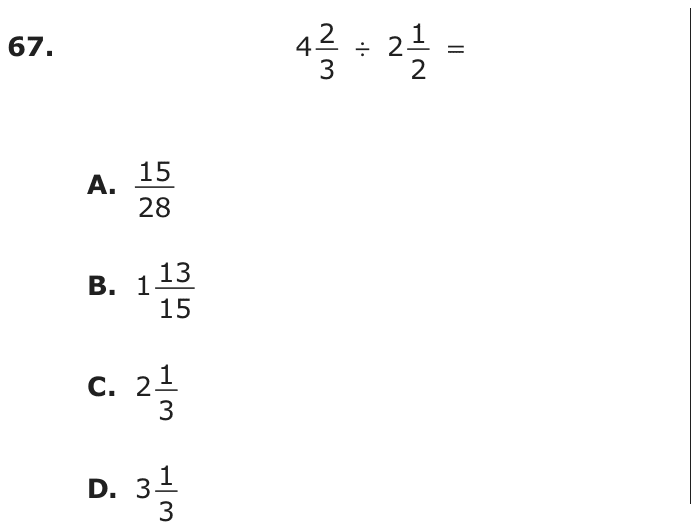
Question 29 of 63
2024 Test B Math, question 12Question
Lena is building a fence. She will need to dig holes to help support the posts that hold up the fence. The holes need to have a depth of feet below the ground. Each post is 10 feet long. What is the height of the part of the post that is above the ground?
- A feet
- B feet
- C10 feet
- D feet
Show the answer
Correct answer: A
The posts are each 10 feet long, and feet of each post is below the ground, so the height of the part of the posts that is above the ground is the difference between the two amounts:
Question analysis
A fence-building word problem: each post is 10 feet long, and 3 1/3 feet of it goes into a hole in the ground. Students find how much of the post stands above ground by subtracting a mixed number from a whole number. Regrouping the whole number into thirds is the step that trips students up.
- NYS standards
- 7.NS.3 four operations with rational numbers
- Grade level
- Grade 7 content, by NYS standard
- Compared with grade 7
- Below grade 7 Subtracting a mixed number from a whole number is fraction work from before grade 7, set here in a one-step story. It asks much less than grade 7 problems, which add negative numbers or several steps.
- Estimated difficulty
- Routine: one familiar step, little to misread.
- Thinking it demands
- Depth of knowledge 2, skills and concepts · mainly apply
- What makes it hard
- Error-prone arithmetic minor
- Solution
- 1 step
- Reading level
- Question and choices: about grade 2, 61 words.
- Students, last 30 days
- Not enough answers yet to show (it takes 10).
Why it is hard, traps and wrong answers (shows the answer)
Why it is hard
The situation is plain, a post partly buried in a hole, and the subtraction 10 − 3 1/3 is the whole task. The only real trap is the regrouping, since there are no thirds to take the 1/3 from until one foot is split into three. Checking that the two parts of the post add back to 10 feet catches the slip.
Error-prone arithmetic minor Working it out
Taking 3 1/3 from the whole number 10 requires regrouping 10 as 9 3/3, the step where students subtract the whole numbers and simply carry the 1/3 along. (Brown & Burton, 1978; Junker & Sijtsma, 2001)
Strategy: Subtract the buried part from the whole post, rewriting 10 as 9 and 3/3, or as 30/3, so that the thirds can be taken away.
Traps
- A faulty procedure: A systematic but wrong procedure: adding fractions straight across, applying an exponent to each term of a sum, dropping a sign when moving a term.
- Wrong operation: Adds instead of multiplying, divides the wrong way round, turns a ratio or rate upside down, or undoes a step in the wrong direction (subtracts what should be added back).
- Answers a different question: A choice is right for another quantity: the other unknown, the rest instead of the part, the part instead of the whole.
The wrong answers, classified
B A faulty procedure (Brown & Burton, 1978; Tatsuoka, 1983)
Subtracts the whole numbers, 10 − 3 = 7, then carries the 1/3 along instead of taking it away too, getting 7 1/3.
C Answers a different question (King et al., 2004; Hegarty, Mayer & Monk, 1995)
Gives the post's full 10-foot length, the whole post instead of the part above ground, overlooking the 3 1/3 feet sunk in the hole.
D Wrong operation (Hegarty, Mayer & Monk, 1995; King et al., 2004)
Adds the depth of the hole to the length of the post, 10 + 3 1/3, as if digging the hole made the post taller.
Worked solution, step by step
Formulas used
- Parts of a whole
- The whole is the full length of the post. Below is the part in the hole, and above is the part you can see. The two parts add up to the whole, so subtract to find one part.
- One whole in thirds
- One whole can be cut into 3 equal thirds. So 1 is the same as 3 over 3. Use this when you need to take thirds away from a whole number.
Sort out the question
Each post is 10 feet long. Part of it goes into a hole feet deep. The rest sticks up above the ground. You need the height of the part above the ground.
Decide to subtract
The part below and the part above make up the whole post. So take the part below away from the whole.
Watch out: do not add. , choice D, makes the post longer than it is.Turn one whole into thirds
The 10 has no thirds to take 1/3 from. So take 1 whole from the 10 and cut it into 3 thirds.
Now there are thirds to subtract from.
Subtract wholes and thirds
Subtract the whole numbers, then the thirds.
That is and . Watch out: the one third must be taken away too. Doing 10 − 3 = 7 and then keeping the one third gives , choice B.
So the answer is A, feet.
Check your answer
Add the two parts back together: . That is the whole post. Also, the answer must be less than 10 feet, since part of the post is under the ground.
More questions like this
The original DOE question
Question 30 of 63
2024 Test B Math, question 21Question
Which number shown above is the greatest?
- A
- B
- C
- D
Show the answer
Correct answer: A
All the numbers are negative, so they are all less than zero. Consider the absolute value of each number and where it falls on a number line. The negative number closest to 0 will be the greatest.
The negative number with the greatest absolute value is −49, so it has the least value.
The negative number with the next greatest absolute value is −1, so it would fall next in order from least to greatest.
Compare the absolute values of and .
Therefore, the numbers listed from least to greatest are:
So the number is the greatest.
Question analysis
Four negative numbers are listed: negative 1/49, negative 49, negative 1/7 and negative 1. Students decide which of them is the greatest. Comparing negative fractions with negative whole numbers tests whether students order numbers by their position on the number line or by their size without the sign.
- Grade level
- Grade 6 content, by NYS standard
- Compared with grade 7
- Below grade 7 Ordering positive and negative rational numbers on a number line is grade 6 content in New York. This is a one-step comparison of four numbers, lighter than typical grade 7 work with signed numbers.
- Estimated difficulty
- Straightforward: two steps or one careful reading.
- Thinking it demands
- Depth of knowledge 1, recall and reproduction · mainly apply
- What makes it hard
- A very close wrong answer moderate
- Something you must already know minor
- Solution
- 2 steps
- Reading level
- Question and choices: about grade 10, 12 words.
- Students, last 30 days
- Not enough answers yet to show (it takes 10).
Why it is hard, traps and wrong answers (shows the answer)
Why it is hard
With no arithmetic to do, the question tests how firmly students picture negative numbers on a line. Comparing sizes without the sign picks the number farthest from 0, and comparing the two fractions by habit picks the wrong one of the pair. Placing all four as points left of 0, with −1 between −49 and the fractions, makes the order plain.
A very close wrong answer moderate Choosing the answer
−1/49 and −1/7 differ only in the denominator, and for negative numbers the larger denominator gives the greater value, the reverse of what their sizes suggest. (Embretson & Wetzel, 1987; Gorin & Embretson, 2006; Ascalon et al., 2007)
Something you must already know minor Working it out
Students must bring the number-line fact that a negative number's value falls as its distance from 0 grows, so −49 is the least of the four, not the greatest. (Anderson & Krathwohl, 2001)
Strategy: Picture each number's place on the number line: among negative numbers, the one closest to 0 is the greatest, so compare their distances from 0.
Traps
- Negatives and direction: Arithmetic with negative numbers, the order of a subtraction, or direction on a number line. (Moving a term across the equals sign without changing its sign is a faulty procedure.)
- Misunderstands the concept: A wrong belief about a concept: that percents can be added, that area grows like length, that averages can be averaged, that a bigger denominator means a bigger fraction.
The wrong answers, classified
B Negatives and direction (Brown & Burton, 1978)
Picks the number with the largest digits, 49, judging its size without the minus sign that puts it farthest below 0.
C Negatives and direction (Brown & Burton, 1978)
Knows 1/7 is greater than 1/49 and keeps that order for the negatives, missing that the order reverses on the left of 0.
D Misunderstands the concept (Smith, diSessa & Roschelle, 1993; De Bock et al., 1998; Ni & Zhou, 2005)
Places −1/7 and −1/49 below −1, as if dividing a negative number made it more negative, so −1 looks like the greatest.
Worked solution, step by step
Formulas used
- Comparing negative numbers
- a and b are positive numbers. Putting a minus sign on both flips their order. The one with the smaller size is closer to 0, so it is greater. For example, 2 is less than 5, but −2 is greater than −5.
Sort out the question
All four numbers are negative, which means less than 0. You need the greatest one, the one with the highest value. On a number line, greater numbers are farther to the right.
Think about distance from 0
For negative numbers, the one closest to 0 is the greatest. The size of a number without its sign is its absolute value. It is the number’s distance from 0. So look for the smallest size.
Compare the sizes
The sizes are 1/49, 49, 1/7 and 1. Both 1/49 and 1/7 have 1 on top. Cutting 1 into 49 pieces gives much smaller pieces than cutting it into 7. So 1/49 is less than 1/7.
So 1/49 is the smallest size. That puts closest to 0.
Put the numbers in order
Flip the order of the sizes to order the negative numbers, from least to greatest.
Watch out: −49 has the biggest digits, but it is the least, so choice B is wrong. Watch out: 1/7 is more than 1/49, but −1/7 is less than −1/49. So choice C is wrong.So the answer is A, .
Check your answer
Change the fractions to decimals: and . Think of money you owe. Owing 2 cents is better than owing 14 cents, $1 or $49. So −1/49 is the greatest.
More questions like this
The original DOE question
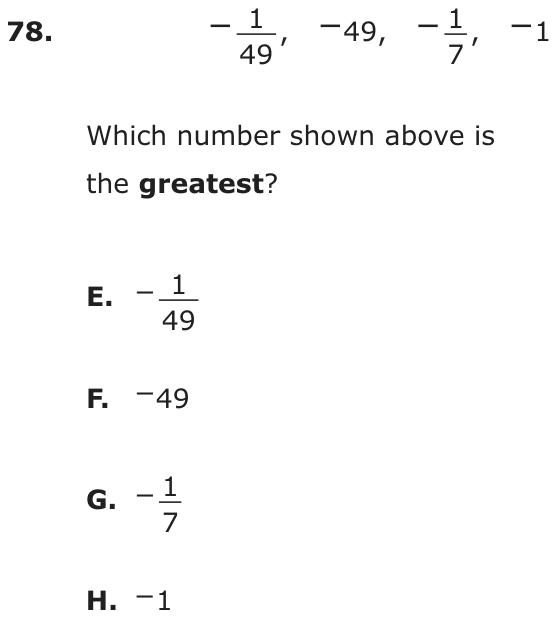
Question 31 of 63
2024 Test B Math, question 22Question
What decimal is equivalent to ?
- A
- B
- C
- D
Show the answer
Correct answer: C
Calculate the decimal equivalent of :
Question analysis
A fractions and decimals question asks which decimal equals negative 13/11. The choices differ in which digits repeat and how the repetition is marked. Students divide 13 by 11, spot the block of digits that repeats, and read the bar notation carefully.
- NYS standards
- 7.NS.2d fractions to decimals by long division
- Grade level
- Grade 7 content, by NYS standard
- Compared with grade 7
- At grade 7 Converting a fraction to a repeating decimal by long division is a named grade 7 skill. This is one short division, typical of grade 7 work, with care needed only in reading the bar notation.
- Estimated difficulty
- Straightforward: two steps or one careful reading.
- Thinking it demands
- Depth of knowledge 1, recall and reproduction · mainly apply
- What makes it hard
- A very close wrong answer moderate
- Something you must already know minor
- Error-prone arithmetic minor
- Solution
- 2 steps
- Reading level
- Question and choices: about grade 15, 10 words.
- Students, last 30 days
- Not enough answers yet to show (it takes 10).
Why it is hard, traps and wrong answers (shows the answer)
Why it is hard
Dividing 13 by 11 is quick; the question is really about reading and writing repeating decimals. Three choices differ only in where the bar goes, so students who know the digits run 1.1818… can still pick the wrong bar. Writing out each barred choice for a few digits and comparing it with the quotient is a fast, sure check.
A very close wrong answer moderate Choosing the answer
The bars over 18 and over 81 cover the same two digits, so only checking which digit comes right after the decimal point, 1 before 8, tells them apart. (Embretson & Wetzel, 1987; Gorin & Embretson, 2006; Ascalon et al., 2007)
Something you must already know minor Working it out
Reading bar notation is assumed: the bar marks exactly the block of digits that repeats, and the whole-number 1 never belongs under it. (Anderson & Krathwohl, 2001)
Error-prone arithmetic minor Working it out
The long division 13 ÷ 11 has to run until the remainder 2 comes back, which is where the repeating pair is confirmed. (Brown & Burton, 1978; Junker & Sijtsma, 2001)
Strategy: Do the long division of 13 by 11 until a remainder comes back, note which digits repeat from that point, and match that block to the bar in each choice.
Traps
- A faulty procedure: A systematic but wrong procedure: adding fractions straight across, applying an exponent to each term of a sum, dropping a sign when moving a term.
- Rounds too early: Rounds a value partway through, or rounds the wrong way, so the final answer drifts from the exact one.
- Answer in another form: The right answer is written differently from the way you worked it out.
The wrong answers, classified
A Rounds too early (King et al., 2004)
Stops the division after two decimal places and treats −1.18 as exact, missing that the digits 1 and 8 go on repeating.
B A faulty procedure (Brown & Burton, 1978; Tatsuoka, 1983)
Counts the whole-number 1 into the block, seeing 1, 18, 18 … as 118 repeating, and bars 118, which means −1.118118… rather than −1.1818….
D A faulty procedure (Brown & Burton, 1978; Tatsuoka, 1983)
Bars 81, the pair in the wrong order, which gives −1.8181…, equal to −1 9/11 rather than the −1 2/11 that −13/11 is.
Worked solution, step by step
Formulas used
- Fraction as division
- a is the top number, the numerator. b is the bottom number, the denominator. A fraction bar means divide. To turn a fraction into a decimal, divide the top by the bottom.
- Bar for repeating digits
- The bar sits over the digits that repeat forever, in the order they repeat. The dots mean the pattern goes on and on. Digits that are not under the bar show up only once.
Sort out the question
You need the decimal equal to . The fraction is negative, so the decimal will be negative too. Work with first. Then put the minus sign back.
Divide 13 by 11
Use long division for .
- 11 goes into 13 once, with 2 left over. Write 1 and a decimal point.
- Bring down a 0 to make 20. 11 goes into 20 once, with 9 left over. Write 1.
- Bring down a 0 to make 90. 11 goes into 90 eight times, with 2 left over. Write 8.
So far you have 1.18.
Spot the repeating pattern
The remainder (the amount left over) is 2 again. That is where you were after the first step. So the same digits come back: 1, 8, 1, 8, and so on forever.
Watch out: −1.18, choice A, stops too soon. The digits never end.Write it with a bar
A bar goes over only the digits that repeat. Here 18 repeats, starting right after the decimal point. The whole number 1 does not repeat, so it is not under the bar. Put the minus sign back.
Watch out: a bar over 81, choice D, means −1.8181…. A bar over 118, choice B, means −1.118118….So the answer is C, .
Check your answer
Multiply back: . That is almost exactly 13, and more 18s bring it even closer. Also, 13/11 is a bit more than 1, so a decimal between 1 and 2 makes sense.
More questions like this
The original DOE question
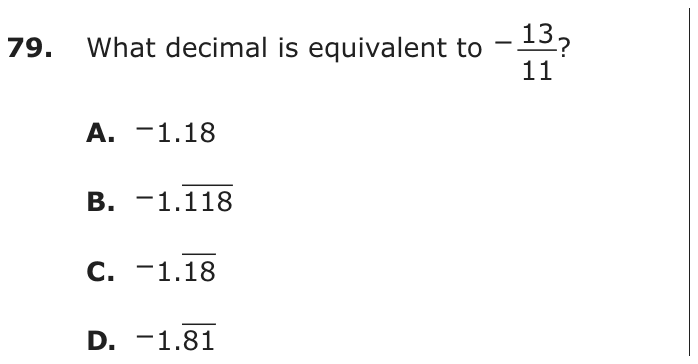
Question 32 of 63
2024 Test B Math, question 23Question
Each loaf of bread a baker makes requires ounce of salt. How many loaves can be made if 40 ounces of salt are used?
- A8
- B20
- C45
- D200
Show the answer
Correct answer: D
Each loaf of bread requires ounce of salt. Therefore, the baker can make 5 loaves of bread with 1 ounce of salt. Multiply to find the number of loaves that can be made with 40 ounces of salt:
Question analysis
A baking word problem: each loaf of bread needs 1/5 ounce of salt, and the baker uses 40 ounces. Students find how many loaves that much salt makes, working with a whole number and a unit fraction. Deciding whether to multiply or divide is the whole question.
- NYS standards
- 6.NS.1 dividing fractions by fractions
- Grade level
- Grade 6 content, by NYS standard
- Compared with grade 7
- Below grade 7 Dividing a whole number by a fraction in a word problem is a grade 6 standard. This takes one step with a unit fraction, simpler than typical grade 7 rational number problems.
- Estimated difficulty
- Routine: one familiar step, little to misread.
- Thinking it demands
- Depth of knowledge 2, skills and concepts · mainly apply
- What makes it hard
- Turning words into math minor
- Solution
- 1 step
- Reading level
- Question and choices: about grade 3, 24 words.
- Students, last 30 days
- Not enough answers yet to show (it takes 10).
Why it is hard, traps and wrong answers (shows the answer)
Why it is hard
The only decision is whether to multiply or divide, and thinking about one ounce first settles it: one ounce holds five fifths, so it makes five loaves. Students who multiply 40 by 1/5 get a small number, but a tiny amount of salt per loaf should give many loaves, not few. That reasonableness check leaves a single choice.
Turning words into math minor Understanding the question
“How many loaves” from 40 ounces at 1/5 ounce each asks how many fifths fit in 40, a division that many students turn into multiplying by 1/5. (Hegarty, Mayer & Monk, 1995; Koedinger & Nathan, 2004)
Strategy: Work out how many loaves one ounce of salt makes, then scale up to 40 ounces; dividing 40 by 1/5 gives the same count.
Traps
- Wrong operation: Adds instead of multiplying, divides the wrong way round, turns a ratio or rate upside down, or undoes a step in the wrong direction (subtracts what should be added back).
- An arithmetic slip: The right method with a plausible arithmetic error: a digit, a place value or a times-table fact.
- Numbers taken from the question: Combines the numbers in the question without a model of the situation, or is simply a number that appears in the question.
The wrong answers, classified
A Wrong operation (Hegarty, Mayer & Monk, 1995; King et al., 2004)
Multiplies 40 by 1/5 instead of dividing, finding a fifth of the salt rather than how many fifths of an ounce it holds.
B An arithmetic slip (Junker & Sijtsma, 2001)
Knows to multiply 40 by 5 but drops a zero, writing the product as 20 instead of 200.
C Numbers taken from the question (Hegarty, Mayer & Monk, 1995)
Adds the 5 from 1/5 to the 40 ounces, combining the numbers in the problem without a model of the situation.
Worked solution, step by step
Formulas used
- Number of equal groups
- Total is the whole amount you have. Size of one group is how much each one uses. Dividing tells how many groups fit into the total. Here one group is the salt for one loaf.
- Dividing by a unit fraction
- a is any number. 1 over n is a unit fraction, a fraction with 1 on top. Dividing by it asks how many nths fit into a. Each whole holds n of them, so you multiply by n.
Sort out what you know
Each loaf uses ounce of salt. The baker uses 40 ounces of salt. You need how many loaves that makes. That means how many fifths of an ounce fit into 40 ounces.
Decide to divide
You are splitting the salt into equal groups of 1/5 ounce. Each group makes one loaf. So divide the total salt by the salt for one loaf.
Watch out: do not multiply by 1/5. , choice A, is a fifth of the salt, not a number of loaves.Divide by the fraction
Each ounce holds 5 fifths, so 1 ounce makes 5 loaves. Dividing by 1/5 is the same as multiplying by 5.
The salt makes 200 loaves. Watch out: keep both zeros. 20, choice B, drops one.
So the answer is D, 200.
Check your answer
Multiply back. 200 loaves at ounce each use ounces. That is all the salt. Also, each loaf uses less than 1 ounce, so there should be more loaves than ounces. 200 is more than 40.
More questions like this
The original DOE question
Question 33 of 63
2024 Test B Math, question 24Question
What is the value of ?
- A
- B
- C
- D
Show the answer
Correct answer: D
First, subtract to simplify.
Follow the process for dividing fractions:
Question analysis
A fractions question: find the value of a quotient whose top is 1 5/7 minus 1 6/7 and whose bottom is 3 4/7 minus 3 6/7. Students subtract mixed numbers that share a denominator and then divide one difference by the other. Keeping track of positive and negative signs through both steps is the main hurdle.
- Grade level
- Grade 7 content, by NYS standard
- Compared with grade 7
- At grade 7 Grade 7 students subtract and divide rational numbers, including negatives, and use the sign rules for quotients. This item chains three such operations with easy sevenths, a typical grade 7 exercise.
- Estimated difficulty
- Moderate: several steps, or a close reading with one strong distractor.
- Thinking it demands
- Depth of knowledge 1, recall and reproduction · mainly apply
- What makes it hard
- Error-prone arithmetic moderate
- Many steps minor
- Solution
- 3 steps
- Reading level
- Question and choices: about grade 10, 10 words.
- Students, last 30 days
- Not enough answers yet to show (it takes 10).
Why it is hard, traps and wrong answers (shows the answer)
Why it is hard
The mixed numbers look heavy, but the whole parts cancel and only sevenths remain. What decides the question is sign handling: each difference is negative, and one negative divided by another is positive. Students who stop after the top, subtract instead of divide, or keep a minus sign each find their result among the choices.
Error-prone arithmetic moderate Working it out
Both differences are negative, 1 5/7 − 1 6/7 = −1/7 and 3 4/7 − 3 6/7 = −2/7, and dividing them needs both the sign rule and a reciprocal. (Brown & Burton, 1978; Junker & Sijtsma, 2001)
Many steps minor Working it out
Two subtractions must be finished before the division, and a sign lost in either one carries into the final quotient. (Daniel & Embretson, 2010; Enright, Morley & Sheehan, 2002)
Strategy: Work out the top and the bottom separately, writing each difference as a signed fraction in sevenths, then divide by multiplying the top by the reciprocal of the bottom and apply the sign rule.
Traps
- Negatives and direction: Arithmetic with negative numbers, the order of a subtraction, or direction on a number line. (Moving a term across the equals sign without changing its sign is a faulty procedure.)
- Stops one step early: A choice is a number from partway through the solution.
- Wrong operation: Adds instead of multiplying, divides the wrong way round, turns a ratio or rate upside down, or undoes a step in the wrong direction (subtracts what should be added back).
The wrong answers, classified
A Negatives and direction (Brown & Burton, 1978)
Finds −1/7 and −2/7 correctly but keeps a negative sign when dividing, forgetting that a negative divided by a negative is positive.
B Stops one step early (King et al., 2004; Gierl et al., 2017)
Works out the top, 1 5/7 − 1 6/7 = −1/7, and stops there without dividing it by the bottom difference.
C Wrong operation (Hegarty, Mayer & Monk, 1995; King et al., 2004)
Subtracts the bottom difference from the top one, −1/7 − (−2/7) = 1/7, instead of dividing the two.
Worked solution, step by step
Formulas used
- Dividing fractions
- a over b is the number you divide. c over d is the number you divide by. To divide by a fraction, multiply by its reciprocal, the fraction flipped upside down. Only the second fraction flips.
- Dividing two negative numbers
- a and b are positive numbers, and b is not zero. A negative number divided by a negative number gives a positive answer. The two minus signs cancel. Multiplying two negatives works the same way.
Sort out the problem
The long fraction bar means divide. So you need the top difference divided by the bottom difference. A difference is the answer to a subtraction. Work out the top and the bottom first, then divide.
Work out the top
Both numbers on top have the same whole number, 1. So the wholes cancel, and you only need . You take away more than you have, so the answer is negative.
Work out the bottom
Both numbers on the bottom have the whole number 3, so those cancel too.
Watch out: do not stop after the top. , choice B, is only part of the problem.Divide the top by the bottom
Both results are negative. The two minus signs cancel.
Now flip the second fraction and multiply.
Avoid the traps and answer
Watch out: keeping a minus sign gives , choice A. Subtracting the bottom from the top, instead of dividing, gives , choice C.So the answer is D, .
Check your answer
Think in sevenths. The top is −1 seventh and the bottom is −2 sevenths. That is like . Or multiply back: , which is the top.
More questions like this
The original DOE question
Question 34 of 63
2024 Test B Math, question 42Question
Jevon earns per year on the money in his savings account. Which expression is not another way to write ?
- A
- B
- C
- D
Show the answer
Correct answer: A
Rewrite the percent as a decimal:
So the correct answer must not equal 0.005:
Option A
Option B
Option C
Option D
All answer options except Option A equal 0.005. Therefore, Option A is the correct answer.
Question analysis
Jevon's savings account earns one-half percent a year, and students must find the expression that is not another way to write one-half percent. It tests converting a percent less than 1 into fractions and decimals. Reading the word not carefully, and evaluating each stacked or unfamiliar fraction correctly, are what make it tricky.
- Grade level
- Grade 7 content, by NYS standard
- Compared with grade 7
- At grade 7 Converting between percents, fractions and decimals is grade 6 and 7 work. A percent smaller than 1 is less familiar, and the question asks which form is not equal, so all four must be checked, which keeps it at typical grade 7 demand.
- Estimated difficulty
- Moderate: several steps, or a close reading with one strong distractor.
- Thinking it demands
- Depth of knowledge 1, recall and reproduction · mainly apply
- What makes it hard
- A question in the negative moderate
- Every choice must be checked moderate
- Error-prone arithmetic minor
- Solution
- 3 steps
- Reading level
- Question and choices: about grade 7, 25 words.
- Students, last 30 days
- Not enough answers yet to show (it takes 10).
Why it is hard, traps and wrong answers (shows the answer)
Why it is hard
Every expression is built from the same idea, so the question tests whether students can convert a percent smaller than 1 without losing track of decimal places. The odd one out, 0.005 over 100, looks like a correct form, because 0.005 is one-half percent and dividing by 100 seems to turn it into a percent. Converting one-half percent to 0.005 once and comparing each expression with it beats reasoning about each form.
A question in the negative moderate Understanding the question
The bold word not asks for the one expression unequal to one-half percent, so the three expressions that check out are exactly the ones to reject. (Haladyna, Downing & Rodriguez, 2002)
Every choice must be checked moderate Choosing the answer
Three of the four forms are equal, so each has to be converted to a decimal and compared with 0.005 before the odd one out can be named. (Embretson & Wetzel, 1987)
Error-prone arithmetic minor Working it out
One-half percent is 0.5 with the point moved two places, 0.005, and dividing that by 100 moves it two more places, to 0.00005. (Brown & Burton, 1978; Junker & Sijtsma, 2001)
Strategy: Write one-half percent as a single decimal by dividing one half by 100, then evaluate each expression as a decimal and compare it with that value.
Traps
- NOT, LEAST or EXCEPT: The question asks for the exception, the least, or what is not true.
- Answer in another form: The right answer is written differently from the way you worked it out.
The wrong answers, classified
B Misreads the question (Hegarty, Mayer & Monk, 1995)
Misses the bold not and picks the expression that equals one-half percent most plainly, one half over 100, the literal meaning of percent.
C Misunderstands the concept (Smith, diSessa & Roschelle, 1993; De Bock et al., 1998; Ni & Zhou, 2005)
Believes a percent must be written over 100, so 5 over 1,000 looks like a different number, though both equal 0.005.
D An arithmetic slip (Junker & Sijtsma, 2001)
Divides 1 by 200 and misplaces the decimal point, getting 0.05 instead of 0.005, so 1/200 seems not to equal one-half percent.
Worked solution, step by step
Formulas used
- Percent as a fraction
- p is any number. The % sign means out of 100. So p percent is p divided by 100. Dividing by 100 moves the decimal point two places to the left.
Sort out the question
The question asks which expression is not equal to . So three choices are equal to it, and one is different. You need the odd one out.
Write the percent as a decimal
One half is 0.5. A percent means out of 100, so divide by 100.
So is 0.005. It is half of one percent, a very small amount.
Test each choice
Turn each choice into a decimal. Then compare it with 0.005.
Choice Work it out Equal to 0.005? A No B Yes C Yes D Yes Pick the one that is different
Choice A divides by 100 twice. The 0.005 was already divided by 100 once. Dividing again makes it 100 times too small.
Watch out: Choice B is the plainest way to write : one half over 100. Picking it means missing the word “not.” Also, 1 ÷ 200 is 0.005, not 0.05, so D is equal too.
So the answer is A, .
Check your answer
Use fractions instead. Half of one hundredth is , which is choice D. And simplifies to too. Only A is a different amount.
More questions like this
The original DOE question
Question 35 of 63
2023 Test A Math, question 7Question
In one week, inches of rain fell on Monday, inches fell on Tuesday, and inch fell on Wednesday. How many inches of rain fell during those three days?
- A
- B
- C
- D
Show the answer
Correct answer: A
To solve, add the three given fractions:
The common denominator is 24:
Question analysis
A rainfall word problem gives the inches of rain on Monday, Tuesday and Wednesday as two mixed numbers and a fraction, and asks for the total over the three days. Students add fractions with unlike denominators. Finding a common denominator for fourths, thirds and eighths, and regrouping the fractional part into wholes, is where errors come in.
- NYS standards
- Grade level
- Grade 7 content, by NYS standard
- Compared with grade 7
- Below grade 7 Adding fractions and mixed numbers with unlike denominators is taught before grade 7, and this is a direct word problem. It takes more care than a typical exercise only because three different denominators must be rewritten over a common one.
- Estimated difficulty
- Straightforward: two steps or one careful reading.
- Thinking it demands
- Depth of knowledge 2, skills and concepts · mainly apply
- What makes it hard
- Error-prone arithmetic moderate
- Many steps minor
- Solution
- 3 steps
- Reading level
- Question and choices: about grade 5, 35 words.
- Students, last 30 days
- Not enough answers yet to show (it takes 10).
Why it is hard, traps and wrong answers (shows the answer)
Why it is hard
The setup is plain addition, so the difficulty is all in the fractions. Students who know to rename over a common denominator rarely miss it, while those who add the fraction parts straight across, or put the numerators over 24 without scaling them, reach choices with a whole part of 3. Since 1 3/4 + 2 2/3 alone is more than 4, any total below 4 can be ruled out at a glance.
Error-prone arithmetic moderate Working it out
The fractional parts have denominators 4, 3 and 8, so they must be renamed as 18, 16 and 21 twenty-fourths, and their sum, 55/24, regrouped as 2 7/24 before the wholes are added. (Brown & Burton, 1978; Junker & Sijtsma, 2001)
Many steps minor Working it out
Renaming, adding the numerators, regrouping the improper fraction and adding the whole numbers are four separate moves, and losing the 2 carried from 55/24 drops the total by two inches. (Daniel & Embretson, 2010; Enright, Morley & Sheehan, 2002)
Strategy: Rewrite the three fractional parts over a common denominator of 24, add the whole numbers and the fractions separately, and regroup any extra twenty-fourths as a whole.
Traps
- A faulty procedure: A systematic but wrong procedure: adding fractions straight across, applying an exponent to each term of a sum, dropping a sign when moving a term.
The wrong answers, classified
B Little reason to choose it (Haladyna & Downing, 1993; Rodriguez, 2005)
No single renaming mistake gives 49 twenty-fourths; this choice sits exactly 1/4 below the right total, so it mostly catches guesses near it.
C A faulty procedure (Brown & Burton, 1978; Tatsuoka, 1983)
Adds the whole numbers to get 3, then adds the fractions straight across, (3 + 2 + 7)/(4 + 3 + 8) = 12/15 = 4/5.
D A faulty procedure (Brown & Burton, 1978; Tatsuoka, 1983)
Finds the common denominator 24 but adds the numerators without renaming them, (3 + 2 + 7)/24 = 1/2, and adds that to the wholes, 3.
Worked solution, step by step
Formulas used
- Equivalent fractions
- a over b is a fraction, and k is any whole number except 0. Multiplying the top and the bottom by the same number gives an equal fraction. You cut each piece into k smaller pieces. So you have k times as many pieces, each k times smaller.
- Adding fractions with the same bottom
- d is the denominator, the bottom number. It tells the size of the pieces. a, b and c are the numerators, the top numbers. They count the pieces. When the pieces are the same size, add the counts. The bottom stays the same.
- Fraction to mixed number
- a over b is a fraction whose top is bigger than its bottom. q is the quotient, how many whole times b fits into a. r is the remainder, what is left over. The leftover stays over the same bottom number.
Sort out the question
Rain fell on three days: inches, inches and inch. You need the total rain, in inches. So add the three amounts. Add the whole numbers and the fractions separately. The whole numbers are 1 and 2, so they add to 3 inches.
Find a common denominator
The fractions have denominators, or bottom numbers, 4, 3 and 8. You can only add pieces of the same size. So find the smallest number that 4, 3 and 8 all divide into. Count by 8s: 8, 16, 24. 24 works, since 24 = 4 × 6 and 24 = 3 × 8. So use 24ths.
Rename each fraction in 24ths
Multiply the top and the bottom by the same number.
Watch out: change the tops too. Keeping 3, 2 and 7 over 24 gives and a total of , choice D.
Add the fractions
Now the pieces are the same size, so add the tops.
That is more than 1 whole. 24 goes into 55 twice, with 7 left over.
Watch out: never add the bottoms. Adding straight across gives and a total of , choice C.
Put the parts together
Add the 3 whole inches from before.
So the answer is A, inches.
Check your answer
Use decimals. is 1.75, is about 2.67, and is 0.875. They add to about 5.29. And is about 0.29. So fits, and is too small.
More questions like this
The original DOE question
Question 36 of 63
2023 Test A Math, question 16Question
Between which two consecutive integers is the fraction ?
- A2 and 3
- B3 and 4
- C4 and 5
- D5 and 6
Show the answer
Correct answer: C
First, convert to a mixed number: . The two consecutive integers on either side of are 4 and 5.
Question analysis
This question asks between which two consecutive whole numbers the fraction 29/7 lies. Students divide to turn the improper fraction into a mixed number, or compare it with nearby multiples of 7. It is a quick check of number sense with fractions, where a remainder must be read correctly.
- Grade level
- Grade 6 content, by NYS standard
- Compared with grade 7
- Below grade 7 Changing an improper fraction to a mixed number and placing it between whole numbers is review well before grade 7. This takes one division with a small divisor and nothing more.
- Estimated difficulty
- Routine: one familiar step, little to misread.
- Thinking it demands
- Depth of knowledge 1, recall and reproduction · mainly apply
- What makes it hard
- Solution
- 2 steps
- Reading level
- Question and choices: about grade 5, 13 words.
- Students, last 30 days
- Not enough answers yet to show (it takes 10).
Why it is hard, traps and wrong answers (shows the answer)
Why it is hard
Dividing 29 by 7 gives 4 with a remainder of 1, so the fraction is 4 1/7 and lies just past 4. The one decision is which side of 4 the remainder puts it on, and a positive remainder always moves the value up. Writing the mixed number before looking at the choices makes the pair obvious.
A very close wrong answer minor Choosing the answer
The pairs 3 and 4 and 4 and 5 both contain 4, so knowing that 29/7 is about 4 is not enough; only the remainder, 29 − 28 = 1, puts it above 4. (Embretson & Wetzel, 1987; Gorin & Embretson, 2006; Ascalon et al., 2007)
Strategy: Find the largest multiple of 7 that is not more than 29, write the fraction as a mixed number, and read off the whole numbers on each side.
Traps
- Counting the ends: Inclusive or exclusive ends, fence posts, consecutive numbers: an answer that is one too many or too few, or an endpoint drawn open where it belongs closed (or the reverse).
The wrong answers, classified
A Little reason to choose it (Haladyna & Downing, 1993; Rodriguez, 2005)
No division of 29 by 7 lands below 3, since 7 × 3 = 21 is far short of 29; only misreading 29/7 as 2.9 gets there, so it mostly catches guesses.
B Counting the ends (Brown & Burton, 1978)
Finds the whole-number part, 4, but takes it as the upper end of the pair, as if 29/7 fell just short of 4 instead of just past it.
D Little reason to choose it (Haladyna & Downing, 1993; Rodriguez, 2005)
Nothing puts 29/7 above 5, since 7 × 5 = 35 is more than 29; even rounding 4 1/7 up gives 5 as the upper end, so it mostly catches guesses.
Worked solution, step by step
Formulas used
- Fraction to mixed number
- a over b is a fraction whose top is bigger than its bottom. q is the quotient, how many whole times b fits into a. r is the remainder, what is left over. The leftover stays over the same bottom number.
Sort out the question
Consecutive integers are whole numbers that come one right after the other, like 4 and 5. You need the two that falls between. So find the whole number just below it and the one just above it.
Divide 29 by 7
A fraction bar means divide. How many 7s fit in 29?
28 is the biggest multiple of 7 that is not more than 29. A multiple of 7 is 7 times a whole number. Then . So 29 ÷ 7 is 4 with 1 left over.
Write it as a mixed number
is a little more than 4 and less than 5. Watch out: it is just past 4, not just short of it. So 4 is the lower number of the pair. Picking 3 and 4 is choice B. So the answer is C, 4 and 5.
Check your answer
Multiply each end by 7. and . The top of the fraction, 29, is between 28 and 35. So is between 4 and 5. As a decimal it is about 4.14.
More questions like this
The original DOE question
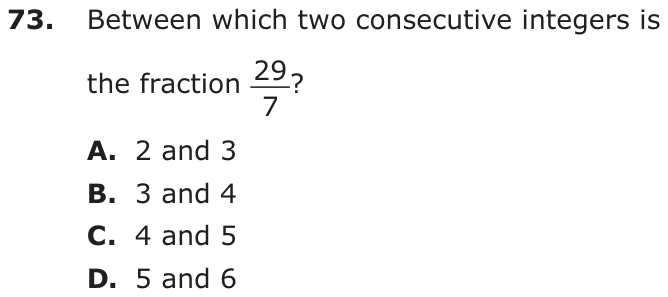
Question 37 of 63
2023 Test A Math, question 23Question
If a person chooses a number at random from the set above, what is the probability that the number is less than 0.005?
- A
- B
- C
- D
Show the answer
Correct answer: C
Three of the five numbers listed (0.001, 0.0001, and 0.00001) are less than 0.005. So, the probability of a person selecting a number less than 0.005 is .
Question analysis
A set holds five decimals, from one tenth down to one hundred-thousandth, and one number is chosen at random. Students find the probability that the number is less than 0.005. Comparing decimals with many zeros is the real task here, along with putting the count over the right total.
- Grade level
- Grade 6 content, by NYS standard
- Compared with grade 7
- Below grade 7 Probability with equally likely outcomes is grade 6 content in New York, and this needs one comparison per number and one fraction. The only real demand is comparing decimals with many zeros correctly.
- Estimated difficulty
- Straightforward: two steps or one careful reading.
- Thinking it demands
- Depth of knowledge 2, skills and concepts · mainly apply
- What makes it hard
- Error-prone arithmetic moderate
- Something you must already know minor
- Solution
- 2 steps
- Reading level
- Question and choices: about grade 6, 27 words.
- Students, last 30 days
- Not enough answers yet to show (it takes 10).
Why it is hard, traps and wrong answers (shows the answer)
Why it is hard
Each number in the set is a tenth of the one before, so only the three smallest fall below 0.005, which lies between 0.01 and 0.001. Students lose the point either by counting the numbers above 0.005 instead of below it or by writing the count over the wrong total. Lining the decimals up with the same number of places makes every comparison easy.
Error-prone arithmetic moderate Working it out
0.005 has to be compared with decimals from 0.1 down to 0.00001; written to five places, 0.00500 against 0.01000 and 0.00100, the order becomes a comparison of whole numbers. (Brown & Burton, 1978; Junker & Sijtsma, 2001)
Something you must already know minor Working it out
The probability is the count of numbers below 0.005 over all 5 numbers in the set; the stem leaves that part-to-whole rule to the student. (Anderson & Krathwohl, 2001)
Strategy: Write each number with five decimal places, compare it with 0.00500, count those that are smaller, and divide by the five numbers in the set.
Traps
- Answers a different question: A choice is right for another quantity: the other unknown, the rest instead of the part, the part instead of the whole.
- Misunderstands the concept: A wrong belief about a concept: that percents can be added, that area grows like length, that averages can be averaged, that a bigger denominator means a bigger fraction.
The wrong answers, classified
A Answers a different question (King et al., 2004; Hegarty, Mayer & Monk, 1995)
Gives 1/5, the chance of picking any one particular number from the set, without counting how many of the five are below 0.005.
B Answers a different question (King et al., 2004; Hegarty, Mayer & Monk, 1995)
Counts the 2 numbers greater than 0.005, 0.1 and 0.01, instead of those less than it, finding the chance of the opposite event.
D Misunderstands the concept (Smith, diSessa & Roschelle, 1993; De Bock et al., 1998; Ni & Zhou, 2005)
Writes a part-to-part ratio, the 2 numbers above 0.005 over the 3 below it, instead of dividing by all 5 numbers in the set.
Worked solution, step by step
Formulas used
- Probability
- P is the probability, the chance that something happens. Possible results are all the results that are equally likely. Wanted results are the ones you are looking for. The chance is the fraction of all the results that you want.
- Adding zeros to a decimal
- Zeros added to the right end of a decimal don’t change its value. One tenth is the same as ten hundredths. Giving every number the same number of decimal places lets you compare them like whole numbers.
Sort out the question
The set has five numbers. A person picks one at random, so each number has the same chance. You need the probability, or chance, that the number picked is less than 0.005.
Give every number five decimal places
Decimals are easier to compare with the same number of places. Add zeros to the end of each.
Number With five places 0.1 0.10000 0.01 0.01000 0.001 0.00100 0.0001 0.00010 0.00001 0.00001 0.005 0.00500 Count the numbers below 0.005
Compare each number with 0.00500 like whole numbers: 10000, 1000, 100, 10 and 1 against 500. Two numbers are bigger: 0.1 and 0.01. Three are smaller: 0.001, 0.0001 and 0.00001. Watch out: 0.01 has fewer digits than 0.005, but it is bigger. Counting the 2 bigger numbers gives , choice B.
Write the probability
Watch out: divide by all 5 numbers in the set. Comparing the 2 bigger numbers with the 3 smaller ones gives , choice D. So the answer is C, .
Check your answer
The numbers below 0.005 and the numbers above it make up the whole set: 3 + 2 = 5. So the two chances, and , add up to 1, as they should.
More questions like this
The original DOE question
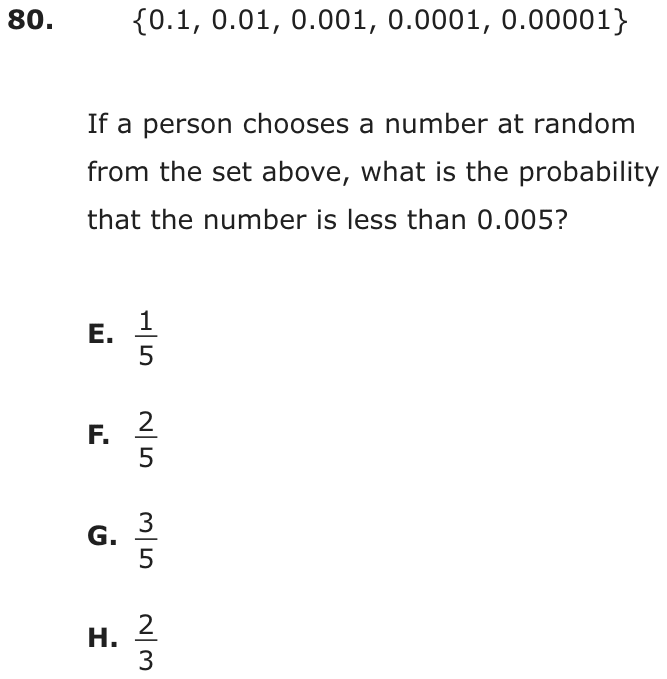
Question 38 of 63
2023 Test A Math, question 26Question
Which statement must be true if x is a whole number greater than or equal to 1?
- A
- B
- C
- D
Show the answer
Correct answer: A
Let , and substitute that value for x in each inequality to determine which one is correct:
Option A:
. This is true.
Option B:
. This is false.
Option C:
, or . This is false.
Option D:
, or . This is false.
Option A is the only true inequality.
Question analysis
This question asks which of four inequalities must be true when x is a whole number of at least 1. The inequalities compare fractions with denominators x + 1 and x + 2, or their difference. Students reason about how the size of a fraction changes as its denominator grows, and must be sure a statement holds for every allowed value.
- Grade level
- Grade 6 content, by NYS standard
- Compared with grade 7
- At grade 7 Comparing fractions is familiar, but these fractions have variable denominators and the question asks what must be true for every whole number from 1 up. That abstraction makes it as demanding as typical grade 7 work, though the arithmetic is light.
- Estimated difficulty
- Moderate: several steps, or a close reading with one strong distractor.
- Thinking it demands
- Depth of knowledge 2, skills and concepts · mainly analyze
- What makes it hard
- Variables instead of numbers moderate
- Every choice must be checked moderate
- Error-prone arithmetic minor
- Solution
- 2 steps
- Reading level
- Question and choices: about grade 6, 20 words.
- Students, last 30 days
- Not enough answers yet to show (it takes 10).
Why it is hard, traps and wrong answers (shows the answer)
Why it is hard
Choosing a small value, such as x = 1 or 2, and testing every statement settles this quickly, because three of the four fail for any value tried. The trap is the belief that a bigger denominator makes a bigger fraction, which turns the true comparison around. Students unsure of fraction subtraction lose time on the two difference statements, though both differences are tiny, never more than 1/6.
Variables instead of numbers moderate Understanding the question
All four statements are about the unknown x, and the bold must means each has to hold for every whole number from 1 up, not just for a single test value. (Koedinger & Nathan, 2004; Enright, Morley & Sheehan, 2002)
Every choice must be checked moderate Choosing the answer
The statements are four separate inequalities, two comparisons and two differences, so each has to be tested; one counterexample is enough to rule a statement out. (Embretson & Wetzel, 1987)
Error-prone arithmetic minor Working it out
Testing the differences means subtracting unlike fractions, such as 1/3 − 1/4 = 1/12 when x = 2, and comparing the result with 1 and with 1/x. (Brown & Burton, 1978; Junker & Sijtsma, 2001)
Strategy: Substitute a small whole number such as 1 or 2 for x in all four statements, rule out any that fail, and confirm the survivor by thinking about larger denominators.
Traps
- Misunderstands the concept: A wrong belief about a concept: that percents can be added, that area grows like length, that averages can be averaged, that a bigger denominator means a bigger fraction.
- A faulty procedure: A systematic but wrong procedure: adding fractions straight across, applying an exponent to each term of a sum, dropping a sign when moving a term.
The wrong answers, classified
B Misunderstands the concept (Smith, diSessa & Roschelle, 1993; De Bock et al., 1998; Ni & Zhou, 2005)
Believes a bigger denominator makes a bigger fraction, so 1/(x + 2) seems larger than 1/(x + 1), the comparison turned around.
C Little reason to choose it (Haladyna & Downing, 1993; Rodriguez, 2005)
Both fractions are at most 1/2, so their difference can never exceed 1, and no common working makes it do so; this choice mostly draws guesses.
D A faulty procedure (Brown & Burton, 1978; Tatsuoka, 1983)
Subtracts over a common denominator but keeps only the numerator, (x + 2) − (x + 1) = 1, so the difference looks like 1, larger than 1/x once x is 2.
Worked solution, step by step
Formulas used
- Comparing unit fractions
- a and b are positive numbers, and b is bigger. One over a means one whole cut into a equal pieces. Cutting the same whole into more pieces makes each piece smaller. So the fraction with the bigger bottom is smaller.
- Subtracting fractions
- a and b are the bottoms of the two fractions. Rewrite both fractions over the common bottom a × b. Then subtract the tops. The bottom stays a × b.
Sort out the question
x is a whole number that is 1 or more, so x can be 1, 2, 3 and so on. You need the statement that must be true. That means it is true for every such x. One x that makes a statement false rules it out.
Test x = 1 in each statement
With x = 1, x + 1 is 2 and x + 2 is 3.
- A: . True.
- B: . False.
- C: , which is not more than 1. False.
- D: is not more than . False.
Only A is true when x = 1. So B, C and D are out.
Make sure A is always true
Must means A has to work for every x, not just 1. In and , both tops are 1. The bottom x + 2 is always 1 more than x + 1. Cutting a whole into more pieces makes each piece smaller. So A is always true. Watch out: a bigger bottom makes a smaller fraction, not a bigger one. Thinking the other way gives choice B.
See why C and D always fail
Use the subtracting rule with a = x + 1 and b = x + 2.
The bottom is at least 2 × 3 = 6, so the difference is at most . That is less than 1. Its bottom is also bigger than x, so it is less than . Watch out: keep the bottom when you subtract. Keeping only the top, 1, leads to choice D. So the answer is A.
Check your answer
Try a bigger number, x = 9. A tenth of a pizza is more than an eleventh, so . The difference, , is tiny. It is less than 1 and less than . A still holds, and C and D still fail.
More questions like this
The original DOE question
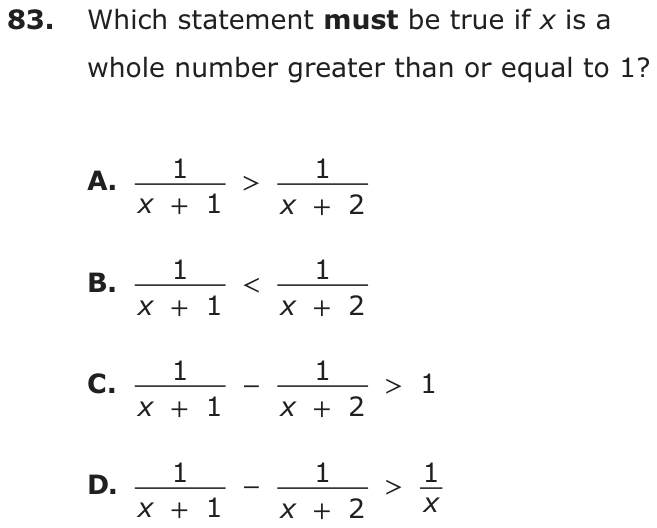
Question 39 of 63
2023 Test A Math, question 41Question
Yesterday Sarah read 15% of her entire book. Today she read another 17% of the entire book. In lowest terms, what fraction of the book is left for her to read?
- A
- B
- C
- D
Show the answer
Correct answer: C
So far, Sarah has read of the entire book. That means she has left to read.
Question analysis
This percent word problem says Sarah read 15% of her book yesterday and 17% today, and asks what fraction of the book she still has to read, in lowest terms. Students combine percents of the same whole, find the part remaining, and convert a percent to a simplified fraction. Rounding, or giving the part already read, leads to wrong choices.
- Grade level
- Grade 7 content, by NYS standard
- Compared with grade 7
- Below grade 7 Grade 7 percent work often takes a percent of a percent or finds a percent change. Here both percents are of the same whole book, so they combine directly; the rest is a subtraction and simplifying a fraction, lighter than typical.
- Estimated difficulty
- Straightforward: two steps or one careful reading.
- Thinking it demands
- Depth of knowledge 2, skills and concepts · mainly apply
- What makes it hard
- Solution
- 3 steps
- Reading level
- Question and choices: about grade 5, 33 words.
- Corrected from the DOE handbook
- Missing percent signs in the explanation were restored.
- Students, last 30 days
- Not enough answers yet to show (it takes 10).
Why it is hard, traps and wrong answers (shows the answer)
Why it is hard
The percent work is a sum and a subtraction from 100, so the question mostly tests the last step, writing 68% as a fraction in lowest terms. Students who round to 30% read and 70% left to get a friendlier fraction land on a listed choice, as do those who give the part read. Dividing 68 and 100 by their common factor 4 keeps the answer exact.
Turning words into math minor Understanding the question
Both percents are “of the entire book,” so they simply add to 32%, and “left for her to read” asks for the rest, 100% − 32%, not the part already read. (Hegarty, Mayer & Monk, 1995; Koedinger & Nathan, 2004)
An answer in an unexpected form minor Choosing the answer
The result has to be written as a fraction in lowest terms, so 68/100 must be divided by 4 to reach a form that appears among the choices. (Enright, Morley & Sheehan, 2002)
Strategy: Add the two percents, since both are of the whole book, subtract the total from 100%, then write the result over 100 and simplify it fully.
Traps
- Rounds too early: Rounds a value partway through, or rounds the wrong way, so the final answer drifts from the exact one.
- Answers a different question: A choice is right for another quantity: the other unknown, the rest instead of the part, the part instead of the whole.
The wrong answers, classified
A Little reason to choose it (Haladyna & Downing, 1993; Rodriguez, 2005)
No sum or difference of 15% and 17% gives 28%, so 7/25 mostly draws students who match the right fraction's 25 without checking the numerator.
B Answers a different question (King et al., 2004; Hegarty, Mayer & Monk, 1995)
Gives the part already read rather than the part left, and rounds that 32% to 30% to write it as 3/10.
D Rounds too early (King et al., 2004)
Finds that 68% is left but rounds it to 70% to make an easier fraction, giving 7/10 instead of simplifying 68/100 exactly.
What was corrected from the DOE handbook, and why
- Explanation: The handbook writes “So far, Sarah has read 15 + 17 = 32 of the entire book. That means she has 100 − 32 = 68 left to read.” (p. 143, question 98), with no percent signs, so 32 and 68 read as amounts of the book (pages, say) that the question never gives. The question gives 15% and 17%, and the handbook’s next line begins “68% =”, so the site now reads 15% + 17% = 32% and 100% − 32% = 68%. The answer, 17/25, is unchanged.
Worked solution, step by step
Formulas used
- Percent as a fraction
- p is the percent. Percent means “out of 100,” so p percent is p hundredths. For example, 50% is 50 out of 100, which is one half.
- Simplifying a fraction
- a is the top number, b is the bottom, and n is a number that divides both evenly. Dividing the top and bottom by the same number keeps the value the same. A fraction is in lowest terms when no number bigger than 1 divides both.
Sort out the question
Sarah read 15% of her book yesterday and 17% today. Both are percents of the whole book. You need the part still left to read, as a fraction in lowest terms. That means a fraction that can’t be simplified any more.
Find how much she has read
Both percents are of the same whole book, so you can add them. She has read 32% of it.
Find how much is left
The whole book is 100%.
Watch out: 32% is the part she has read, not the part left. Rounding 32% to 30% gives , choice B.
Write 68% as a fraction
This fraction is not in lowest terms yet, because 68 and 100 are both even.
Write it in lowest terms
The number 4 divides both 68 and 100 evenly.
Watch out: don’t round 68% to 70%. That gives , choice D. So the answer is C, .
Check your answer
Turn the answer back into a percent: , which is 68%. Then 68% + 32% = 100%, the whole book. Also, 17 and 25 share no factor except 1, so the fraction is in lowest terms.
More questions like this
The original DOE question
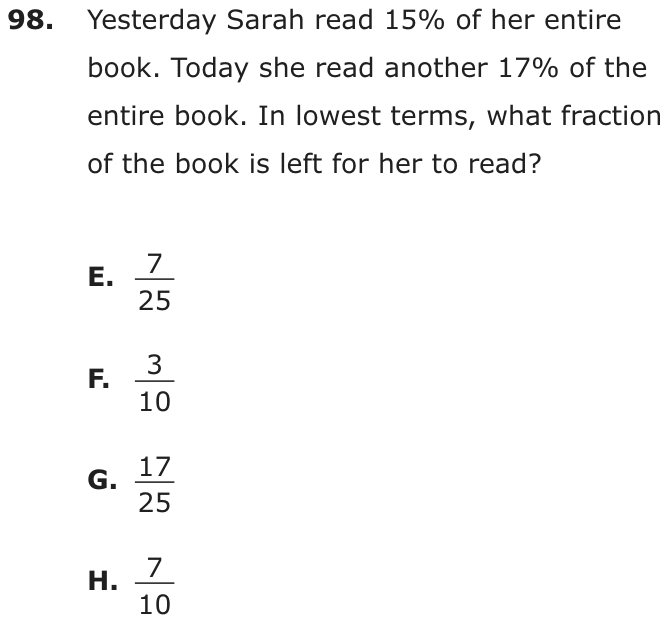
Question 40 of 63
2023 Test A Math, question 56Question

If all possible values of x are indicated by the shaded part of the number line above, which number line best shows all possible values of ?
- A

- B

- C

- D

Show the answer
Correct answer: D
The shaded region goes from to . So, the possible values of would be between the reciprocal of and the reciprocal of , which are 2 and , respectively. Find the number line in the answer options that has a shaded region that ranges from to 2, which is option D.
Question analysis
This number line question shades all possible values of x from one half to three halves and asks which number line shows all possible values of 1/x. Students find reciprocals of fractions and work out how a whole range of values changes. Keeping track of what happens to each end of the range, and placing fractions accurately on the line, makes it tricky.
- NYS standards
- Grade level
- Grade 6 content, by NYS standard
- Compared with grade 7
- Above grade 7 Reciprocals of single fractions are grade 6 work. Applying them to every value in a shaded range at once, and working out where the new range begins and ends, is reasoning about a whole set of numbers that grade 7 classes rarely practice.
- Estimated difficulty
- Hard: combines ideas, needs a plan, and has more than one tempting wrong answer.
- Thinking it demands
- Depth of knowledge 2, skills and concepts · mainly apply
- What makes it hard
- Reading a figure, table or graph moderate
- A very close wrong answer moderate
- Variables instead of numbers minor
- Solution
- 3 steps
- Reading level
- Question and choices: about grade 12, 27 words.
- Students, last 30 days
- Not enough answers yet to show (it takes 10).
Why it is hard, traps and wrong answers (shows the answer)
Why it is hard
Few students have flipped an interval before, so the question rewards testing its two ends and noticing that the order reverses. The harder part comes at the end: 2/3 falls between the tick marks, and a graph ending at the nearby 1/2 tick looks right at a glance. Students who believe a reciprocal is always at least 1, or who shift the interval instead of flipping it, reach the other graphs.
Reading a figure, table or graph moderate Understanding the question
The shaded segment's ends sit on unlabeled half-unit ticks, 1/2 and 3/2, and each choice must be read the same way, with 2/3 falling between ticks rather than on one. (Lesh, Post & Behr, 1987; Kirsch & Mosenthal, 1990)
A very close wrong answer moderate Choosing the answer
The graph from 1/2 to 2 matches the right graph's right end and differs at the left end by only a sixth of a unit, 1/2 against 2/3. (Embretson & Wetzel, 1987; Gorin & Embretson, 2006; Ascalon et al., 2007)
Variables instead of numbers minor Understanding the question
The question asks about 1/x for every x in a range, so a whole interval must be transformed, and its ends swap: the smallest x gives the largest 1/x. (Koedinger & Nathan, 2004; Enright, Morley & Sheehan, 2002)
Strategy: Take the reciprocal of each end of the shaded part, ask whether a bigger x gives a bigger or a smaller 1/x, and look for the graph whose endpoints are exactly those values.
Traps
- Misreads the figure: Reads a value, label or tick spacing in a figure, table or graph wrongly.
- Misunderstands the concept: A wrong belief about a concept: that percents can be added, that area grows like length, that averages can be averaged, that a bigger denominator means a bigger fraction.
- Wrong operation: Adds instead of multiplying, divides the wrong way round, turns a ratio or rate upside down, or undoes a step in the wrong direction (subtracts what should be added back).
The wrong answers, classified
A Wrong operation (Hegarty, Mayer & Monk, 1995; King et al., 2004)
Adds 1 to each endpoint instead of taking reciprocals, sliding the shaded part from 1/2–3/2 one unit right, to 3/2–5/2.
B Misunderstands the concept (Smith, diSessa & Roschelle, 1993; De Bock et al., 1998; Ni & Zhou, 2005)
Gets 2 from 1/2 but assumes a reciprocal cannot be less than 1, as flipping a proper fraction suggests, so it starts the shading at 1 instead of 2/3.
C Misreads the figure (Lesh, Post & Behr, 1987; Kirsch & Mosenthal, 1990)
Finds the reciprocals 2/3 and 2 but places 2/3 at the half-unit tick, 1/2, though 2/3 lies a third of the way from that tick toward 1.
Worked solution, step by step
Formulas used
- Reciprocal
- a and b are the top and bottom of a fraction. The reciprocal flips the fraction upside down. The number 1 over x is the reciprocal of x. A number times its reciprocal always makes 1.
Sort out the question
x can be any number in the shaded part of the first number line. You need the number line that shows every possible value of , the reciprocal of x. The reciprocal is the number flipped upside down, like for 2.
Read the shaded part
The ticks come every half unit. The shading starts at the tick halfway between 0 and 1, which is . It ends halfway between 1 and 2, which is , or . Both dots are filled in, so both ends count.
Find the reciprocals of the ends
Flip each end of the shaded part.
So the ends of the new shading are 2 and .
Notice that the ends swap
When x gets bigger, gets smaller. So the smallest x, , gives the biggest value, 2. The biggest x, , gives the smallest, . So runs from to 2, ends included.
Find the matching number line
lies between the half tick and 1, a third of the way from to 1. Line D starts there and ends at 2. Watch out: line C starts at the half tick, , not at . Line B starts at 1.
So the answer is D, the line shaded from to 2.
Check your answer
Test a value in the middle. x = 1 is shaded, and . On line D, 1 is shaded too. Test an end: , so really is the reciprocal of .
More questions like this
The original DOE question
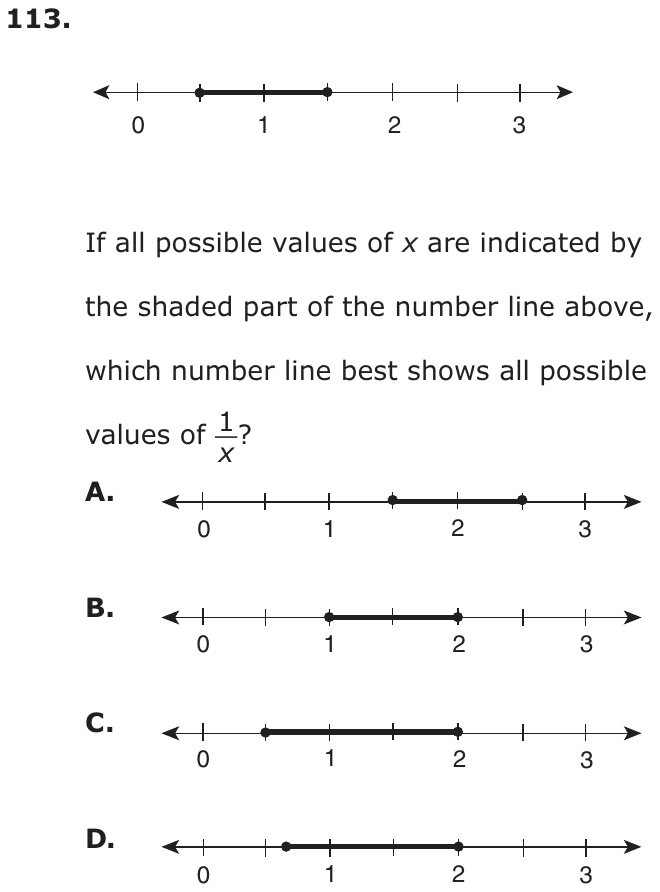
Question 41 of 63
2023 Test B Math, question 5Question
Solve the equation for x:
Grid-in question: work out the answer and enter it as a number.
Show the answer
Correct answer: 7
Question analysis
This equation puts x in a fraction with (21)(14) on top and (49)(48) below, set equal to the decimal 0.875. The grid-in asks for the value of x. Students do best to cancel common factors before multiplying anything out, and it helps to know the fraction that 0.875 equals.
- NYS standards
- Grade level
- Grade 7 content, by NYS standard
- Compared with grade 7
- At grade 7 Seventh graders solve equations like ax = b, usually with a simple coefficient. Here the coefficient is a product of four numbers that is best cancelled first, and a decimal has to be matched with a fraction.
- Estimated difficulty
- Moderate: several steps, or a close reading with one strong distractor.
- Thinking it demands
- Depth of knowledge 1, recall and reproduction · mainly apply
- What makes it hard
- Error-prone arithmetic moderate
- No obvious method minor
- An answer in an unexpected form minor
- Solution
- 3 steps
- Reading level
- Question and choices: about grade 5, 6 words.
- Students, last 30 days
- Not enough answers yet to show (it takes 10).
Why it is hard, traps and wrong answers (shows the answer)
Why it is hard
This is a one-unknown equation dressed in large numbers, and the work is in reducing them without slipping. Students who cancel early find that the whole coefficient is one eighth and that 0.875 is seven eighths, which makes the last step mental. Those who multiply out face a four-digit product and a decimal division, and with nothing to check against, an early slip goes unnoticed.
Error-prone arithmetic moderate Working it out
Multiplied out, the coefficient is 294 over 2,352 and the right side is the decimal 0.875; both invite slips unless 21/49 and 14/48 are cancelled first. (Brown & Burton, 1978; Junker & Sijtsma, 2001)
No obvious method minor Working it out
The quick route pairs 21 with 49 and 14 with 48 before multiplying, so that 3/7 × 7/24 collapses to 1/8; the layout of the fraction does not suggest that pairing. (Schoenfeld, 1985)
An answer in an unexpected form minor Choosing the answer
The result is entered with no choices, so a coefficient’s denominator or a quotient taken the wrong way looks as complete as the right value. (Enright, Morley & Sheehan, 2002)
Strategy: Cancel before multiplying: reduce 21 over 49 and 14 over 48, multiply the simplified fractions, then undo that coefficient, writing 0.875 as a fraction if it helps.
Traps
- Stops one step early: A choice is a number from partway through the solution.
- Wrong operation: Adds instead of multiplying, divides the wrong way round, turns a ratio or rate upside down, or undoes a step in the wrong direction (subtracts what should be added back).
- An arithmetic slip: The right method with a plausible arithmetic error: a digit, a place value or a times-table fact.
The wrong answers, classified
8 Stops one step early (King et al., 2004; Gierl et al., 2017)
Simplifies the coefficient correctly to 1/8 but enters the 8 from its denominator, never multiplying it by 0.875.
0.109375 Wrong operation (Hegarty, Mayer & Monk, 1995; King et al., 2004)
Divides 0.875 by 8 instead of multiplying, undoing the coefficient 1/8 the wrong way, so x comes out as 0.109375.
3.5 An arithmetic slip (Junker & Sijtsma, 2001)
Slips in reducing 14/48, taking it as 7/12 instead of 7/24, so the coefficient becomes 1/4 and x = 0.875 × 4 = 3.5.
Worked solution, step by step
Formulas used
- Multiplying fractions
- a and c are the tops, or numerators. b and d are the bottoms, or denominators. Multiply the tops together and the bottoms together. It also works backward: you can split one fraction into two smaller ones. That lets you simplify before the numbers get big.
Sort out the question
You need the value of x. On top, 21, 14 and x are multiplied. The bottom is 49 times 48. The right side is 0.875.
Multiplying 49 by 48 makes a big number. It is easier to simplify first.
Split the fraction into two
Use the rule for multiplying fractions backward. Pair 21 with 49, and 14 with 48.
Now the equation says these two fractions times x equal 0.875.
Simplify each fraction
To simplify, divide the top and bottom by the same number. Both 21 and 49 divide by 7. Both 14 and 48 divide by 2.
Watch out: 48 ÷ 2 is 24, not 12. Writing leads to 3.5.
Multiply the simple fractions
The 7 on top and the 7 on the bottom cancel, since 7 ÷ 7 = 1. Then divide 3 and 24 by 3 to get . So the equation becomes:
Solve for x
One eighth of x is 0.875. To undo dividing by 8, multiply both sides by 8.
Watch out: 8 is not the answer, and don’t divide 0.875 by 8. So you would grid 7.
Check your answer
0.875 is the same as . One eighth of 7 is , so x = 7 works. You can also multiply it all out: and . Then .
More questions like this
The original DOE question
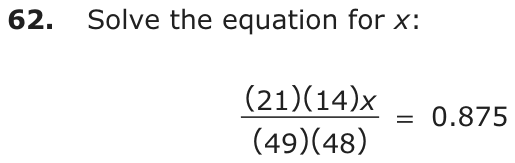
Question 42 of 63
2023 Test B Math, question 6Question
What is the value of ?
- A
- B
- C
- D
Show the answer
Correct answer: C
The first step is to rewrite the problem replacing all subtraction with adding the opposite:
Then, rewrite all the fractions using a common denominator of 12, which is the least common multiple of the fractions’ denominators, 4, 3, and 2:
Next, combine the positive numbers and, finally, add the negative number to the sum by subtracting the number with the least absolute value from the number with the greatest absolute value and using the sign of the number with the greatest absolute value:
Question analysis
What is 3 1/4 − 1 2/3 − (−4 1/2)? This question on rational-number arithmetic combines mixed numbers with denominators of 4, 3 and 2 and ends by subtracting a negative number. Students must turn that last subtraction into an addition and find a common denominator before combining.
- Grade level
- Grade 7 content, by NYS standard
- Compared with grade 7
- At grade 7 Subtracting negative mixed numbers is core grade 7 content. This expression is typical in length, but it needs a common denominator of 12 and careful handling of the rule for subtracting a negative.
- Estimated difficulty
- Moderate: several steps, or a close reading with one strong distractor.
- Thinking it demands
- Depth of knowledge 1, recall and reproduction · mainly apply
- What makes it hard
- Error-prone arithmetic moderate
- Many steps minor
- Solution
- 4 steps
- Reading level
- Question and choices: about grade 10, 10 words.
- Students, last 30 days
- Not enough answers yet to show (it takes 10).
Why it is hard, traps and wrong answers (shows the answer)
Why it is hard
The expression is short, but it mixes a subtraction that stays a subtraction with one that becomes an addition, and that difference is what most wrong answers miss. The fractions add a second load, since twelfths are needed before anything combines. Estimating first, 3 − 1.7 + 4.5 is about 6, shows the result is positive, which rules out both negative values.
Error-prone arithmetic moderate Working it out
Three mixed numbers with denominators 4, 3 and 2 must become twelfths, and the last term, −(−4 1/2), changes sign while the middle subtraction does not. (Brown & Burton, 1978; Junker & Sijtsma, 2001)
Many steps minor Working it out
Rewriting the double negative, renaming each fraction, adding 3 1/4 and 4 1/2, then taking away 1 2/3 are four steps, each able to carry a slip forward. (Daniel & Embretson, 2010; Enright, Morley & Sheehan, 2002)
Strategy: Change subtracting −4 1/2 into adding 4 1/2, rename every fraction in twelfths, add the two positive numbers, then take away 1 2/3.
Traps
- Negatives and direction: Arithmetic with negative numbers, the order of a subtraction, or direction on a number line. (Moving a term across the equals sign without changing its sign is a faulty procedure.)
The wrong answers, classified
A Little reason to choose it (Haladyna & Downing, 1993; Rodriguez, 2005)
No single error gives −3 1/12; it needs subtracting 4 1/2 and also miswriting 3 1/4 as 3 1/12, two errors at once, so it mostly draws guesses.
B Negatives and direction (Brown & Burton, 1978)
Treats subtracting −4 1/2 as subtracting 4 1/2, so 3 1/4 − 1 2/3 − 4 1/2 = −2 11/12.
D Negatives and direction (Brown & Burton, 1978)
Drops both minus signs and adds the three mixed numbers, 3 1/4 + 1 2/3 + 4 1/2 = 9 5/12, as if every operation were addition.
Worked solution, step by step
Formulas used
- Subtracting a negative number
- a and b stand for any numbers. Taking away a negative number is the same as adding its opposite, the same number with the other sign. Think of it this way: taking away a debt leaves you richer.
- Equivalent fractions
- a is the top and b is the bottom of a fraction. Multiplying both by the same number n does not change its value. Use it to give fractions the same bottom number, so you can add or subtract them.
Sort out the question
You need the value of . Each number is a mixed number, a whole number plus a fraction. There are two subtractions. The second one takes away a negative number.
Change the double negative
Use the rule for subtracting a negative. Taking away is the same as adding .
The first minus sign stays as it is. Watch out: if you subtract instead, you get , choice B.
Give the fractions one denominator
The denominator is the bottom number of a fraction. Here they are 4, 3 and 2. The smallest number all three divide into is 12. So change each fraction to twelfths.
The problem is now:
Add the two positive numbers
You may add and subtract in any order, as long as each number keeps its sign. Add the two positive numbers first.
That is 3 + 4 = 7 wholes and 3 + 6 = 9 twelfths.
Take away the last number
That is 7 − 1 = 6 wholes and 9 − 8 = 1 twelfth. So the answer is C, .
Check your answer
Estimate with decimals: . And is about 6.08 too. The answer must be positive, so A and B are out. Choice D comes from adding all three numbers.
More questions like this
The original DOE question
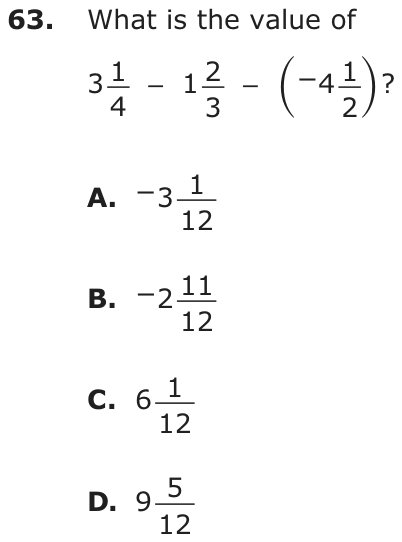
Question 43 of 63
2023 Test B Math, question 9Question
Bryan completed a 100-meter race in 11.74 seconds. Luis completed the same race in 11.69 seconds. What was the difference between their times, expressed as a fraction of a second?
- A
- B
- C
- D
Show the answer
Correct answer: A
First, subtract Luis’s time from Bryan’s time: .
Then, convert to a fraction:
.
Question analysis
Bryan ran a 100-meter race in 11.74 seconds and Luis ran the same race in 11.69 seconds. Students find the difference between their times and express it as a fraction of a second. It tests subtracting decimals and rewriting a decimal as a fraction in lowest terms.
- NYS standards
- 6.NS.3 multi-digit decimal operations
- Grade level
- Grade 6 content, by NYS standard
- Compared with grade 7
- Below grade 7 Subtracting decimals and writing a decimal as a fraction are skills from before grade 7. The two times are close, so the subtraction is quick, and the only care needed is with place value and simplifying.
- Estimated difficulty
- Routine: one familiar step, little to misread.
- Thinking it demands
- Depth of knowledge 2, skills and concepts · mainly apply
- What makes it hard
- Solution
- 2 steps
- Reading level
- Question and choices: about grade 5, 32 words.
- Students, last 30 days
- Not enough answers yet to show (it takes 10).
Why it is hard, traps and wrong answers (shows the answer)
Why it is hard
Two quick skills settle this question: lining up the decimals to subtract, and naming the result as a fraction in lowest terms. The two times differ only in their last two digits, so the subtraction is short, but it needs a borrow that some students skip. The fraction step is where a decimal’s digit gets mistaken for a denominator.
Error-prone arithmetic minor Working it out
Subtracting 11.69 from 11.74 needs a borrow in the hundredths, 14 − 9, after which the tenths cancel to 0, the step where place value goes wrong. (Brown & Burton, 1978; Junker & Sijtsma, 2001)
Something you must already know minor Working it out
The difference, 0.05, must be read as five hundredths and reduced as a fraction; the question gives no help with converting a decimal. (Anderson & Krathwohl, 2001)
Strategy: Line up the decimal points, subtract, write the difference as a number of hundredths over 100, and reduce the fraction.
Traps
- A faulty procedure: A systematic but wrong procedure: adding fractions straight across, applying an exponent to each term of a sum, dropping a sign when moving a term.
- Misunderstands the concept: A wrong belief about a concept: that percents can be added, that area grows like length, that averages can be averaged, that a bigger denominator means a bigger fraction.
The wrong answers, classified
B An arithmetic slip (Junker & Sijtsma, 2001)
Looks only at the tenths, 11.7 − 11.6 = 0.1, dropping the hundredths, a place-value slip that doubles the true gap.
C A faulty procedure (Brown & Burton, 1978; Tatsuoka, 1983)
Subtracts the smaller digit from the larger in each place, 9 − 4 = 5 and 7 − 6 = 1, getting 0.15, which is 3/20.
D Misunderstands the concept (Smith, diSessa & Roschelle, 1993; De Bock et al., 1998; Ni & Zhou, 2005)
Gets 0.05 but reads its digit 5 as a denominator, writing 1/5, instead of five hundredths, 5/100.
Worked solution, step by step
Formulas used
- Decimals as hundredths
- The second place after the decimal point is the hundredths place. So a decimal with two places counts hundredths, and you can write its digits over 100. For example, 0.37 is 37/100. Then simplify by dividing the top and bottom by the same number.
Sort out the question
Bryan ran the race in 11.74 seconds. Luis ran it in 11.69 seconds. The difference is how much longer one time is than the other. You need it as a fraction of a second.
Subtract the two times
Subtract the smaller time from the larger one. Line up the decimal points.
In the hundredths place, 4 is less than 9. So regroup: trade 1 tenth for 10 hundredths. Then 14 − 9 = 5 hundredths. The tenths are now 6 − 6 = 0.
Watch out: don’t just take the smaller digit from the larger one in each place. That gives 0.15, which is , choice C.
Write the difference as a fraction
The 5 is in the hundredths place, so 0.05 is 5 hundredths.
Now simplify. Divide the top and bottom by 5.
Give the answer
Watch out: 0.05 is not . One fifth is 0.2, which is four times as big. So the answer is A, .
Check your answer
Turn back into a decimal: . Then add it to Luis’s time: . That is Bryan’s time, so the difference is right.
More questions like this
The original DOE question
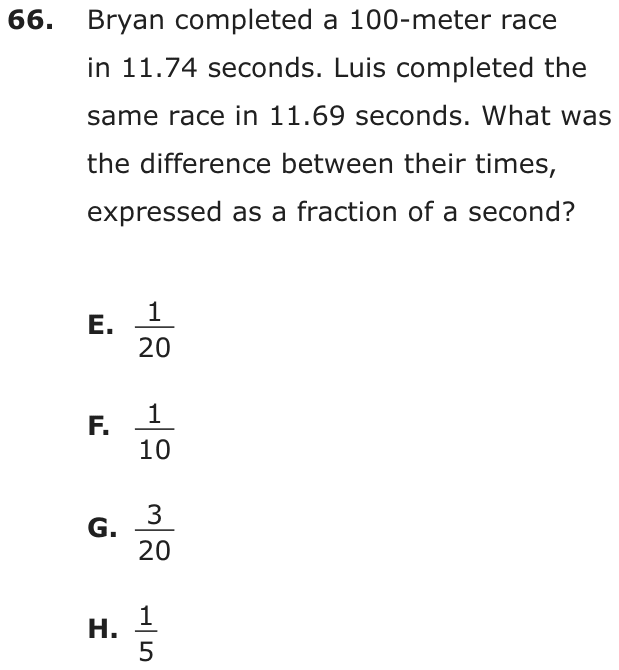
Question 44 of 63
2023 Test B Math, question 11Question
What is the value of n expressed as a fraction?
- A
- B
- C
- D
Show the answer
Correct answer: B
Question analysis
The number n equals 0.13 plus 207/100, and students must write n as a single fraction. This question mixes a decimal with a fraction in hundredths. Converting both to the same form, adding, and reducing to lowest terms are the steps, and the four fractions offered look quite different at first glance.
- NYS standards
- 6.NS.3 multi-digit decimal operations
- Grade level
- Grade 6 content, by NYS standard
- Compared with grade 7
- Below grade 7 Converting decimals to fractions and simplifying are skills taught before grade 7. Both numbers here are in hundredths, so the addition is immediate and only the final reduction takes thought.
- Estimated difficulty
- Routine: one familiar step, little to misread.
- Thinking it demands
- Depth of knowledge 1, recall and reproduction · mainly apply
- What makes it hard
- Solution
- 2 steps
- Reading level
- Question and choices: about grade 7, 15 words.
- Students, last 30 days
- Not enough answers yet to show (it takes 10).
Why it is hard, traps and wrong answers (shows the answer)
Why it is hard
Converting 0.13 to hundredths makes this a single addition, 13 + 207 = 220 hundredths, so the question tests little beyond reducing a fraction. Two of the wrong choices sit close to 2.2 but come from no common working, and the third only echoes the digits of 0.13. A student who checks each choice as a decimal finds only one equal to 2.2.
An answer in an unexpected form minor Choosing the answer
The sum comes out as 220/100 or 2.2, but the choices are in lowest terms, so it must be reduced, or each choice converted, before anything matches. (Enright, Morley & Sheehan, 2002)
Error-prone arithmetic minor Working it out
One term is a decimal and the other a fraction; writing 0.13 as 13/100 puts both in hundredths, and a misplaced digit there changes the sum. (Brown & Burton, 1978; Junker & Sijtsma, 2001)
Strategy: Write 0.13 as 13/100 so both terms are in hundredths, add the numerators, then divide the top and bottom by their greatest common factor.
Traps
- Answer in another form: The right answer is written differently from the way you worked it out.
- Numbers taken from the question: Combines the numbers in the question without a model of the situation, or is simply a number that appears in the question.
The wrong answers, classified
A Numbers taken from the question (Hegarty, Mayer & Monk, 1995)
Echoes the digits of 0.13, reading it as the fraction 1/3, and ignores the 207/100 altogether.
C Little reason to choose it (Haladyna & Downing, 1993; Rodriguez, 2005)
No common working gives 9/4, which is 2.25; adding 13 and 207 hundredths gives 2.2, so this mostly draws guesses near the sum.
D Little reason to choose it (Haladyna & Downing, 1993; Rodriguez, 2005)
Nothing leads to 23/10 except 13 + 207 coming out as 230, a slip with no reason behind it, so it mostly catches guesses.
Worked solution, step by step
Formulas used
- Decimals as hundredths
- The second place after the decimal point is the hundredths place. So a decimal with two places counts hundredths. Write its digits over 100. For example, 0.47 is 47/100.
- Adding fractions with the same bottom
- a and b are the tops. c is the shared bottom, the denominator. When the bottoms match, the pieces are the same size. So add the tops and keep the bottom.
Sort out the question
n equals 0.13 plus . One part is a decimal and one is a fraction. You need n as a fraction. The choices are in lowest terms, which means they can’t be simplified any more.
Write the decimal as a fraction
The 3 in 0.13 is in the hundredths place. So 0.13 is 13 hundredths.
Now both numbers are in hundredths. Watch out: 0.13 is not . That only copies the digits, choice A.
Add the hundredths
Use the rule for adding fractions. The bottoms match, so add the tops and keep the 100 on the bottom.
Simplify the fraction
is not a choice, so simplify it. Find the greatest number that divides both 220 and 100. That is 20.
So the answer is B, .
Check your answer
Change both to decimals. . And . They match. Choices C and D are close, but and .
More questions like this
The original DOE question
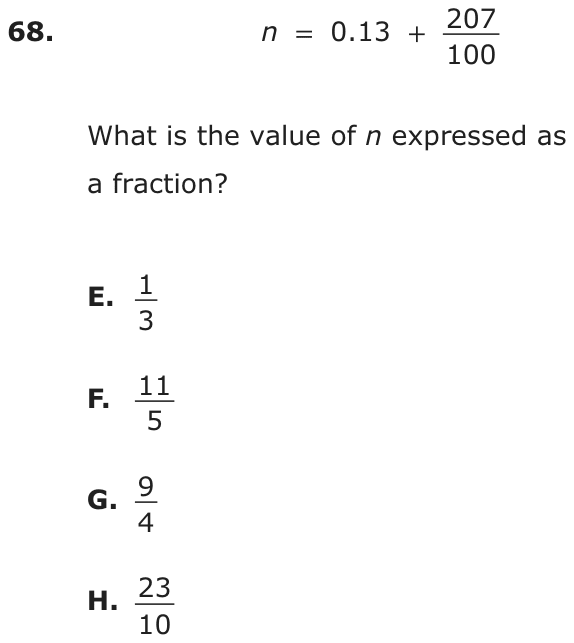
Question 45 of 63
2023 Test B Math, question 32Question

On the number line above, how many units longer is than ?
- A
- B
- C
- D3
Show the answer
Correct answer: B
First, find the lengths of the given segments:
Then, find the difference:
Question analysis
A number line shows three points labeled with mixed numbers and a whole number, and students find how many units longer one segment is than another. It tests subtracting mixed numbers with unlike denominators to find distances. Regrouping when the fraction being subtracted is the larger one is where most errors happen.
- Grade level
- Grade 7 content, by NYS standard
- Compared with grade 7
- At grade 7 Finding distances between points on a number line is grade 7 work. Here the points are mixed numbers with different denominators, so finding two distances and their difference makes it a typical but careful grade 7 task.
- Estimated difficulty
- Straightforward: two steps or one careful reading.
- Thinking it demands
- Depth of knowledge 2, skills and concepts · mainly apply
- What makes it hard
- Error-prone arithmetic moderate
- Reading a figure, table or graph minor
- Solution
- 3 steps
- Reading level
- Question and choices: about grade 9, 16 words.
- Students, last 30 days
- Not enough answers yet to show (it takes 10).
Why it is hard, traps and wrong answers (shows the answer)
Why it is hard
This is three subtractions, so most errors are in the fractions rather than the plan. Taking 1 1/3 from a whole number such as 3 tempts students to subtract only the whole parts and keep the 1/3, which reverses which segment looks longer. Rewriting every coordinate in sixths, 8/6, 18/6 and 31/6, turns the work into whole-number subtraction of numerators.
Error-prone arithmetic moderate Working it out
Both lengths subtract mixed numbers with different denominators, 5 1/6 − 3 and 3 − 1 1/3, and the second needs regrouping before the two results are compared in sixths. (Brown & Burton, 1978; Junker & Sijtsma, 2001)
Reading a figure, table or graph minor Understanding the question
The three coordinates come from the labels under P, Q and R, and the segments QR and PQ must each be measured from Q at 3, the point they share. (Lesh, Post & Behr, 1987; Kirsch & Mosenthal, 1990)
Strategy: Find each length by subtracting the left endpoint from the right one, writing the mixed numbers in sixths, then subtract the shorter length from the longer.
Traps
- A faulty procedure: A systematic but wrong procedure: adding fractions straight across, applying an exponent to each term of a sum, dropping a sign when moving a term.
- Numbers taken from the question: Combines the numbers in the question without a model of the situation, or is simply a number that appears in the question.
The wrong answers, classified
A A faulty procedure (Brown & Burton, 1978; Tatsuoka, 1983)
Subtracts only the whole numbers in 3 − 1 1/3 and keeps the 1/3, giving PQ as 2 1/3, then compares it with 2 1/6 and gets 1/6.
C Little reason to choose it (Haladyna & Downing, 1993; Rodriguez, 2005)
No common working gives 2/3; it is only the fraction part of PQ’s length, 1 2/3, so it mostly draws guesses.
D Numbers taken from the question (Hegarty, Mayer & Monk, 1995)
Picks 3, the coordinate of point Q, a number read off the line rather than a difference between two lengths.
Worked solution, step by step
Formulas used
- Length on a number line
- The length of a segment is the distance between its two end points. Subtract the number on the left from the number on the right. Subtracting tells how many units you move to get from one point to the other.
- Mixed number to improper fraction
- a is the whole number part. b over c is the fraction part, with b on top and c on the bottom. Each whole holds c parts, so a wholes hold a × c parts. Then add the b extra parts. An improper fraction has a top bigger than its bottom.
Read the number line
Point P is at . Point Q is at 3. Point R is at .
The bar over QR means segment QR, the piece of the line from Q to R. You need how much longer QR is than PQ. So find both lengths, then subtract.
Find the length of QR
R is on the right, and Q is on the left. Use the length rule.
QR is units long.
Find the length of PQ
Q is on the right, and P is on the left.
Take it in two parts. First, 3 − 1 = 2. Then take away the extra . That gives . So PQ is units long.
Watch out: Don’t just do 3 − 1 and keep the . That gives , which is too long. It leads to choice A.
Write both lengths in sixths
The fractions have different bottoms, 6 and 3. Change both lengths to sixths so you can subtract. Use the mixed number rule.
Subtract the lengths
Take the shorter length away from the longer one.
QR is unit longer than PQ.
So the answer is B, .
Check your answer
Write every point in sixths. P is , Q is and R is . QR is 31 − 18 = 13 sixths. PQ is 18 − 8 = 10 sixths. The difference is 3 sixths, which is one half.
More questions like this
The original DOE question
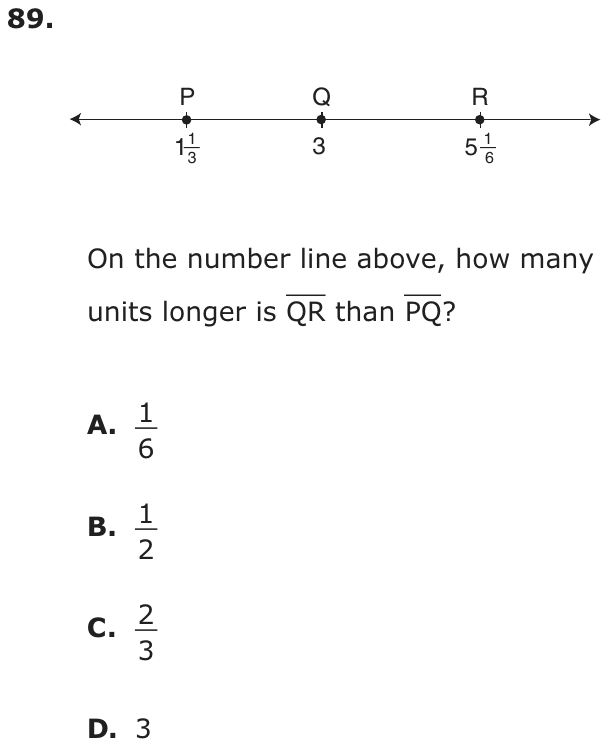
Question 46 of 63
2023 Test B Math, question 45Question
The Barnes family and the Ramirez family each have a pizza of equal size. The first pizza is cut into 18 equal slices, and the second pizza is cut into 15 equal slices. If the Barnes family eats 11 slices from the first pizza, what is the greatest number of whole slices from the second pizza that the Ramirez family can eat without eating a greater percentage of a pizza than the Barnes family ate?
- A6
- B7
- C8
- D9
Show the answer
Correct answer: D
The fraction of the pizza that the Barnes family eats is . Let x represent the number of slices of pizza that the Ramirez family eats. Then the fraction of the pizza that the Ramirez family eats is . Write an inequality and solve for x:
So, the greatest number of whole slices of pizza the Ramirez family can eat is 9.
Question analysis
Two pizzas of the same size are cut into 18 and 15 equal slices, and one family eats 11 slices of the first. Students find the most whole slices of the second pizza the other family can eat without eating a larger share. It tests comparing fractions with different denominators and rounding to a whole number in the right direction.
- Grade level
- Grade 7 content, by NYS standard
- Compared with grade 7
- Above grade 7 Grade 7 inequality problems usually ask for the greatest whole number that fits a budget. This one wraps that idea in a long stem about shares of two pizzas sliced differently, with several conditions to keep straight at once.
- Estimated difficulty
- Hard: combines ideas, needs a plan, and has more than one tempting wrong answer.
- Thinking it demands
- Depth of knowledge 2, skills and concepts · mainly apply
- What makes it hard
- Complex sentences moderate
- Turning words into math moderate
- Error-prone arithmetic minor
- Solution
- 3 steps
- Reading level
- Question and choices: about grade 11, 72 words.
- Students, last 30 days
- Not enough answers yet to show (it takes 10).
Why it is hard, traps and wrong answers (shows the answer)
Why it is hard
The math is one inequality between fractions, but the long final sentence hides it, so students who skim fall back on comparing slice counts. Reasoning that the second pizza has 3 fewer slices, so the Ramirez family should eat 3 fewer, is the strongest pull. Comparing 11/18 with x/15, or turning 11/18 into about 61% and taking 61% of 15, keeps the comparison about shares of a pizza.
Complex sentences moderate Understanding the question
The question is one 42-word sentence ending in a nested condition, “without eating a greater percentage of a pizza than the Barnes family ate”, a reading hurdle rather than more math. (Abedi & Lord, 2001; Freedle & Kostin, 1993; Messick, 1989)
Turning words into math moderate Understanding the question
The limit of no “greater percentage of a pizza” must become the inequality x/15 ≤ 11/18, comparing fractions of two pizzas cut into different numbers of slices, not slice counts. (Hegarty, Mayer & Monk, 1995; Koedinger & Nathan, 2004)
Error-prone arithmetic minor Working it out
Solving gives x ≤ 11 × 15 ÷ 18 = 165/18, a division by 18 that leaves 9 1/6, which must then be cut back to whole slices. (Brown & Burton, 1978; Junker & Sijtsma, 2001)
Strategy: Write the Barnes family's share as a fraction of their pizza, then find the largest whole number of fifteenths that does not exceed it, by cross-multiplying or by converting to decimals.
Traps
- Misunderstands the concept: A wrong belief about a concept: that percents can be added, that area grows like length, that averages can be averaged, that a bigger denominator means a bigger fraction.
- Answers a different question: A choice is right for another quantity: the other unknown, the rest instead of the part, the part instead of the whole.
The wrong answers, classified
A Answers a different question (King et al., 2004; Hegarty, Mayer & Monk, 1995)
Finds that 9 slices is the limit but gives the slices left on the second pizza, 15 − 9 = 6, answering a different question.
B Numbers taken from the question (Hegarty, Mayer & Monk, 1995)
Subtracts the stem’s numbers, 18 − 11 = 7, the slices left on the Barnes family’s pizza, without comparing shares of the two pizzas.
C Misunderstands the concept (Smith, diSessa & Roschelle, 1993; De Bock et al., 1998; Ni & Zhou, 2005)
Reasons that the second pizza has 3 fewer slices, so the Ramirez family should eat 3 fewer, 11 − 3 = 8, comparing by subtraction instead of by fractions.
Worked solution, step by step
Formulas used
- Fraction of a pizza
- The top counts the slices eaten. The bottom counts all the equal slices the pizza was cut into. The fraction tells how much of the whole pizza was eaten. Use fractions to compare pizzas cut into different numbers of slices.
Sort out the question
The two pizzas are the same size. The Barnes pizza has 18 slices, and they eat 11. The Ramirez pizza has 15 slices, so its slices are bigger. You need the most whole slices the Ramirez family can eat without eating a bigger share of their pizza.
Find the Barnes family’s share
Their share is the slices they ate out of all the slices in their pizza. Use the fraction formula.
The Barnes family ate of their pizza.
Write an inequality
Let x be the number of Ramirez slices. Their share is . It must be no more than the Barnes share. The sign ≤ means less than or equal to.
Solve for x
Multiply both sides by 15 to get x by itself.
Now divide. 18 goes into 165 nine times, since 18 × 9 = 162. There are 3 left over.
Pick the whole number
x must be a whole number no bigger than . So the most is 9 slices. 10 slices would be too many.
Watch out: The Ramirez pizza has 3 fewer slices, but that does not mean they eat 3 fewer. Their slices are bigger. Eating 11 − 3 = 8 slices is choice C, which is not the most they can eat.
So the answer is D, 9.
Check your answer
Use decimals. The Barnes share is . Nine Ramirez slices are , just under it. Ten slices are , too much. So 9 is the most.
More questions like this
The original DOE question
Question 47 of 63
2023 Test B Math, question 51Question
A number, n, is divided by 25. If the quotient is 10 with a remainder of 5, what is the quotient expressed as a decimal?
- A10.20
- B10.25
- C10.50
- D10.75
Show the answer
Correct answer: A
A quotient of 10 with a remainder of 5 means the quotient is
Question analysis
A number is divided by 25, giving a quotient of 10 with a remainder of 5, and students write the quotient as a decimal. It tests what a remainder means and how it becomes part of a decimal quotient. Connecting the remainder to the decimal part of the answer is the key idea.
- Grade level
- Grade 6 content, by NYS standard
- Compared with grade 7
- Below grade 7 Division with remainders and decimal quotients are grade 6 skills. This takes two short steps, with no word problem to translate, though students must know what a remainder means once a quotient is written as a decimal.
- Estimated difficulty
- Straightforward: two steps or one careful reading.
- Thinking it demands
- Depth of knowledge 1, recall and reproduction · mainly apply
- What makes it hard
- Something you must already know moderate
- Solution
- 2 steps
- Reading level
- Question and choices: about grade 5, 22 words.
- Students, last 30 days
- Not enough answers yet to show (it takes 10).
Why it is hard, traps and wrong answers (shows the answer)
Why it is hard
The question checks one idea: a remainder is a fraction of the divisor, not a string of digits to place after the point. Students who write the remainder 5 as tenths, or set the divisor 25 after the point, land on listed choices. Rebuilding n = 25 × 10 + 5 = 255 and dividing by 25 confirms the decimal.
Something you must already know moderate Working it out
A remainder of 5 means 5 out of the 25 needed for another whole, so it becomes 5/25 = 0.2, a link between remainders and decimals the question assumes. (Anderson & Krathwohl, 2001)
Strategy: Rebuild n from the quotient and the remainder, then divide it by 25 to a decimal; or write the remainder as a fraction of the divisor.
Traps
- Misunderstands the concept: A wrong belief about a concept: that percents can be added, that area grows like length, that averages can be averaged, that a bigger denominator means a bigger fraction.
- Numbers taken from the question: Combines the numbers in the question without a model of the situation, or is simply a number that appears in the question.
The wrong answers, classified
B Numbers taken from the question (Hegarty, Mayer & Monk, 1995)
Writes the divisor, 25, after the decimal point, setting the stem’s numbers 10 and 25 side by side instead of turning the remainder into a fraction.
C Misunderstands the concept (Smith, diSessa & Roschelle, 1993; De Bock et al., 1998; Ni & Zhou, 2005)
Writes the remainder 5 as the tenths digit, 10.5, believing a remainder becomes the digits after the decimal point.
D Little reason to choose it (Haladyna & Downing, 1993; Rodriguez, 2005)
No common working gives 10.75; it treats the remainder as three quarters of the divisor, which nothing in the stem suggests, so it mostly draws guesses.
Worked solution, step by step
Formulas used
- Quotient with a remainder
- d is the divisor, the number you divide by. q is the whole-number part of the quotient, the answer to the division. r is the remainder, what is left over. The leftover still has to be divided by d, so it becomes the fraction r over d.
Sort out the words
n is divided by 25. So 25 is the divisor, the number you divide by. The quotient is the answer to a division. Here it is 10 with a remainder of 5. The remainder is the amount left over. You need the exact quotient as a decimal.
Turn the remainder into a fraction
The 5 left over still has to be divided by 25. So it becomes the fraction . Use the formula.
Change the fraction to a decimal
Simplify first. Divide the top and bottom by 5. Then write the fraction in hundredths.
So the quotient is 10 + 0.20 = 10.20.
Give the answer
Watch out: A remainder is not the digits after the decimal point. Writing the 5 after the point gives 10.50, choice C. Writing the 25 after it gives 10.25, choice B.
So the answer is A, 10.20.
Check your answer
Rebuild n. Ten 25s plus the 5 left over is . Now divide: . That matches 10.20.
More questions like this
The original DOE question
Question 48 of 63
2023 Test B Math, question 55Question
What is the value of the expression above, written as an improper fraction?
- A
- B
- C
- D
Show the answer
Correct answer: D
| Set x equal to the repeating decimal. | |
| Multiply both sides by 10. | |
| Subtract 10x and x. | |
| Apply the multiplicative inverse property; divide both sides by 9. | |
Question analysis
Two repeating decimals are subtracted, and students write the difference as an improper fraction. It tests subtracting repeating decimals and converting a repeating decimal into a fraction, a grade 8 skill. The repeating part has to be handled exactly, so a careful method matters more than speed.
- NYS standards
- Grade level
- Grade 8 content, by NYS standard
- Compared with grade 7
- Above grade 7 Grade 7 students change fractions into repeating decimals by long division. Going the other way, from a repeating decimal to a fraction, is grade 8 work, though the subtraction that comes first here is simple.
- Estimated difficulty
- Moderate: several steps, or a close reading with one strong distractor.
- Thinking it demands
- Depth of knowledge 1, recall and reproduction · mainly apply
- What makes it hard
- A very close wrong answer moderate
- Something you must already know moderate
- Solution
- 3 steps
- Reading level
- Question and choices: about grade 9, 18 words.
- Students, last 30 days
- Not enough answers yet to show (it takes 10).
Why it is hard, traps and wrong answers (shows the answer)
Why it is hard
The subtraction is easy, since the repeating digits line up and give 2.222…; the conversion is the test. Every choice sits within a few hundredths of the answer, so rounding or estimating cannot separate them, and the exact 2.22 of 111/50 is the strongest pull. Students who know that 0.222… is 2/9 can write 2 2/9 = 20/9 directly.
A very close wrong answer moderate Choosing the answer
All four choices lie between 2.18 and 2.23: 111/50 is exactly 2.22 and 224/101 is about 2.218, so only 20/9 equals the repeating 2.222… exactly. (Embretson & Wetzel, 1987; Gorin & Embretson, 2006; Ascalon et al., 2007)
Something you must already know moderate Working it out
Turning 2.222… into a fraction, by setting x equal to it and subtracting x from 10x, is grade 8 work that the question does not explain. (Anderson & Krathwohl, 2001)
Strategy: Subtract the decimals digit by digit to see which digits repeat, then turn that repeating decimal into a fraction, or divide each choice's numerator by its denominator and compare.
Traps
- A faulty procedure: A systematic but wrong procedure: adding fractions straight across, applying an exponent to each term of a sum, dropping a sign when moving a term.
- Rounds too early: Rounds a value partway through, or rounds the wrong way, so the final answer drifts from the exact one.
The wrong answers, classified
A A faulty procedure (Brown & Burton, 1978; Tatsuoka, 1983)
Sets x = 2.222… but adds 10x and x instead of subtracting, then drops the repeating part as if it had cancelled, so 11x = 22 + 2 = 24.
B A faulty procedure (Brown & Burton, 1978; Tatsuoka, 1983)
Multiplies by 100 for two-digit blocks, then adds x instead of subtracting it and drops the repeating part, so 101x = 222 + 2 = 224.
C Rounds too early (King et al., 2004)
Drops the repeating bar and treats the difference as exactly 2.22, which is 222/100 = 111/50, slightly less than the true repeating value.
Worked solution, step by step
Formulas used
- Repeating decimal to fraction
- x is the repeating decimal. Multiplying by 10 moves the decimal point one place to the right. The endless repeating digits still line up after the point. So when you subtract x from 10x, they cancel, and only whole numbers are left.
Sort out the bars
A bar over digits means they repeat forever. So means 6.343434… and means 4.121212… with no end. You need the difference as an improper fraction. That is a fraction whose top is bigger than its bottom.
Subtract the decimals
Line up the digits. Each block of 34 minus 12 gives 22. The whole numbers give 6 − 4 = 2.
The difference is 2.222…, with the 2 repeating forever. You can write it .
Name the decimal x
Let x be the repeating decimal. Then multiply both sides by 10. This moves the decimal point one place to the right.
Subtract to remove the repeats
Subtract the first line from the second. The repeating 2s after the point match up, so they cancel.
Divide to find x
Divide both sides by 9.
Watch out: is exactly 2.22, which stops. The real difference never stops. That trap is choice C. Every choice is close to 2.2, so estimating won’t help.
So the answer is D, .
Check your answer
Divide 20 by 9. 9 goes into 20 two times, with 2 left over. Each next step leaves 2 again, so you get 2.222… forever. That matches the difference. Choice A, , is 2.1818… instead.
More questions like this
The original DOE question
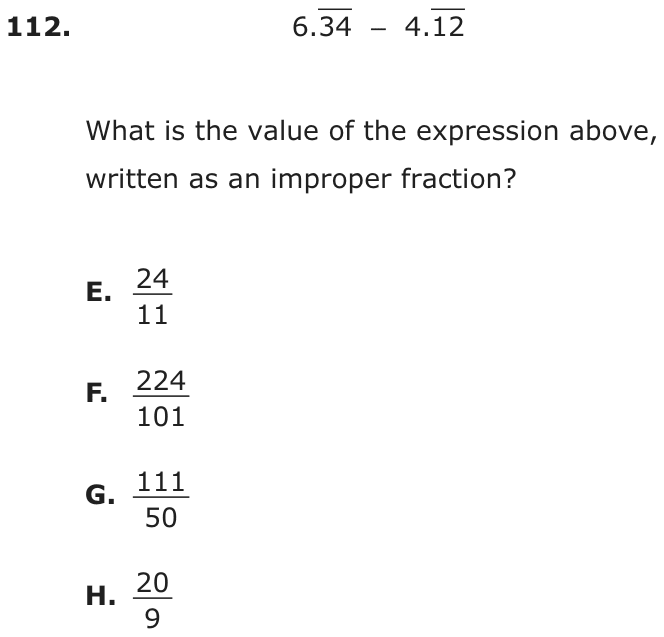
Question 49 of 63
2022 Test A Math, question 24Question
- A1.62
- B16.2
- C162
- D1,620
Show the answer
Correct answer: C
Since the greatest number of decimal places is 2 (hundredths), multiply both terms by 100, and then divide:
Question analysis
This question asks students to divide 12.96 by 0.08, a decimal division with no story around it. It tests dividing multi-digit decimals with the standard algorithm. The choices differ only in where the decimal point falls, so moving the point the same number of places in both numbers is the whole challenge.
- NYS standards
- 6.NS.3 multi-digit decimal operations
- Grade level
- Grade 6 content, by NYS standard
- Compared with grade 7
- Below grade 7 Dividing multi-digit decimals is grade 6 fluency that grade 7 work builds on rather than teaches. The division comes out exactly, so the real demand is placing the decimal point correctly, a single routine skill.
- Estimated difficulty
- Straightforward: two steps or one careful reading.
- Thinking it demands
- Depth of knowledge 1, recall and reproduction · mainly apply
- What makes it hard
- Error-prone arithmetic moderate
- Solution
- 2 steps
- Reading level
- Question and choices: about grade 16+, 1 words.
- Students, last 30 days
- Not enough answers yet to show (it takes 10).
Why it is hard, traps and wrong answers (shows the answer)
Why it is hard
Every choice uses the digits 1, 6 and 2, so the question tests only where the decimal point goes. Dividing by a number less than one gives a result larger than 12.96, which feels wrong to students who expect division to shrink a number. Estimating first, 12.96 ÷ 0.08 is about 13 × 12.5, puts the result in the low hundreds and rules out the other three at once.
Error-prone arithmetic moderate Working it out
The divisor 0.08 has two decimal places, so both numbers must be multiplied by 100, turning the problem into 1,296 ÷ 8, and the quotient comes out larger than 12.96. (Brown & Burton, 1978; Junker & Sijtsma, 2001)
Strategy: Multiply the dividend and the divisor by the same power of 10 so that the divisor becomes a whole number, then carry out the long division.
Traps
- An arithmetic slip: The right method with a plausible arithmetic error: a digit, a place value or a times-table fact.
The wrong answers, classified
A An arithmetic slip (Junker & Sijtsma, 2001)
Divides 12.96 by 8, leaving out the decimal point in the divisor 0.08, so the quotient, 1.62, is 100 times too small.
B An arithmetic slip (Junker & Sijtsma, 2001)
Moves the decimal point one place instead of two, in effect dividing 12.96 by 0.8, so the quotient, 16.2, is ten times too small.
D An arithmetic slip (Junker & Sijtsma, 2001)
Shifts the decimal point three places in 12.96 but only two in 0.08, dividing 12,960 by 8, so the quotient is ten times too big.
Worked solution, step by step
Formulas used
- Dividing by a decimal
- a is the number being divided. b is the divisor, the number you divide by. Multiplying both by the same number, like 100, does not change the answer. Use 100 when the divisor has two decimal places, so it becomes a whole number.
Sort out the question
You need . The divisor, the number you divide by, is 0.08. It has two decimal places. Dividing by a decimal is hard, so make the divisor a whole number first. All four choices use the digits 1, 6 and 2. So the real question is where the decimal point goes.
Make the divisor a whole number
Multiply both numbers by 100. This moves each decimal point two places to the right.
The new problem has the same answer. Watch out: move both points the same number of places. Moving the point three places in 12.96 but two in 0.08 gives 1,620, choice D.
Divide by 8
Split 1,296 into parts that 8 divides easily.
Watch out: ignoring the point in 0.08 means dividing 12.96 by 8. That gives 1.62, choice A. Moving the point only one place gives 16.2, choice B. So the answer is C, 162.
Check your answer
Multiply back: . That matches. Also, 0.08 is less than 1. Dividing by a number less than 1 makes the answer bigger. And , which is far too big.
More questions like this
The original DOE question
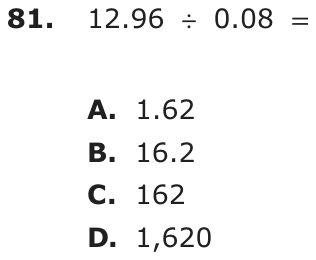
Question 50 of 63
2022 Test B Math, question 3Question
Kelly had 7.3 grams of sugar. She used 2.7 grams in her coffee. How many grams of sugar does she have left?
Grid-in question: work out the answer and enter it as a number.
Show the answer
Correct answer: 4.6
Subtract the number of grams of sugar Kelly used in her coffee from the original amount she had.
Question analysis
Kelly has 7.3 grams of sugar and uses 2.7 grams of it in her coffee. This short grid-in word problem asks how many grams she has left. It tests subtracting decimals, and because the tenths digit being taken away is the larger one, the subtraction needs regrouping.
- NYS standards
- 6.NS.3 multi-digit decimal operations
- Grade level
- Grade 6 content, by NYS standard
- Compared with grade 7
- Below grade 7 Subtracting decimals is grade 6 fluency work, and this needs one subtraction in a short, familiar setting. Grade 7 problems usually bring in negative numbers or several steps; the only care here is regrouping in the tenths.
- Estimated difficulty
- Routine: one familiar step, little to misread.
- Thinking it demands
- Depth of knowledge 2, skills and concepts · mainly apply
- What makes it hard
- Solution
- 1 step
- Reading level
- Question and choices: about grade 2, 20 words.
- Students, last 30 days
- Not enough answers yet to show (it takes 10).
Why it is hard, traps and wrong answers (shows the answer)
Why it is hard
One subtraction in a two-sentence story, so the only real risk is the regrouping in the tenths column. Students who skip the borrow, or who borrow and forget to reduce the ones, still produce a tidy decimal, and nothing on the page flags it. Adding the result back to the 2.7 grams used should return the 7.3 grams Kelly started with.
Error-prone arithmetic minor Working it out
The 7 tenths being taken away is more than the 3 tenths in 7.3, so one of the 7 wholes must be regrouped as ten tenths before 13 − 7 = 6. (Brown & Burton, 1978; Junker & Sijtsma, 2001)
An answer in an unexpected form minor Choosing the answer
The difference is gridded with no choices to compare, so a regrouping slip that gives 5.4 or 5.6 looks just as finished as the right amount. (Enright, Morley & Sheehan, 2002)
Strategy: Line up the decimal points and subtract the grams used from the grams Kelly started with, regrouping one whole as ten tenths when the tenths column needs it.
Traps
- A faulty procedure: A systematic but wrong procedure: adding fractions straight across, applying an exponent to each term of a sum, dropping a sign when moving a term.
- An arithmetic slip: The right method with a plausible arithmetic error: a digit, a place value or a times-table fact.
- Wrong operation: Adds instead of multiplying, divides the wrong way round, turns a ratio or rate upside down, or undoes a step in the wrong direction (subtracts what should be added back).
The wrong answers, classified
5.4 A faulty procedure (Brown & Burton, 1978; Tatsuoka, 1983)
Subtracts the smaller digit from the larger in each column, 7 − 3 = 4 tenths and 7 − 2 = 5 ones, instead of regrouping a whole as ten tenths.
5.6 An arithmetic slip (Junker & Sijtsma, 2001)
Regroups to get 13 − 7 = 6 tenths but forgets to reduce the ones after borrowing, so the ones digit stays 7 − 2 = 5.
10 Wrong operation (Hegarty, Mayer & Monk, 1995; King et al., 2004)
Adds the two amounts, 7.3 + 2.7 = 10, instead of taking the sugar used in the coffee away from the 7.3 grams Kelly had.
Worked solution, step by step
Formulas used
- Amount left
- Start is the amount you had at first. Used is the amount taken away. Left is what remains. Taking part of an amount away is subtraction, so you subtract the amount used from the start.
Sort out the question
Kelly started with 7.3 grams of sugar. She used 2.7 grams in her coffee. You need the grams she has left.
Left means what remains after some is taken away. So subtract the amount used from the amount she started with.
Regroup to subtract the tenths
Line up the decimal points, so tenths sit over tenths. A tenth is one of ten equal parts of a whole. Start with the tenths. You can’t take 7 tenths from 3 tenths. So break 1 of the 7 wholes into 10 tenths. Now you have 6 wholes and 13 tenths.
That leaves 6 tenths.
Watch out: taking the smaller digit from the bigger one, 7 − 3, skips the regrouping. It gives 5.4, which is wrong.
Subtract the whole grams
After regrouping, the wholes column has 6, not 7.
That leaves 4 wholes. Put the decimal point back: 4 wholes and 6 tenths is 4.6 grams.
Watch out: forgetting to change the 7 to a 6 gives 5.6. Adding instead of subtracting gives 10. So you would grid 4.6.
Check your answer
Add back the sugar she used: . That is the amount Kelly started with, so 4.6 grams is right. An estimate agrees too: about 7 − 3 = 4 grams.
More questions like this
The original DOE question
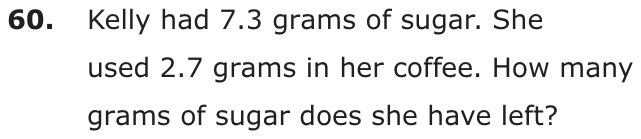
Question 51 of 63
2022 Test B Math, question 21Question
The decimal 0.4 can be written as the fraction . What is the value of x?
- A0.016
- B0.16
- C10
- D16
Show the answer
Correct answer: C
First, convert the decimal 0.4, which is read as four-tenths, to the fraction , and then set up a proportion to solve for x using cross products.
Or, reduce the fraction to before setting up the proportion and then use proportional reasoning.
Therefore, .
Question analysis
This question asks students to write the decimal 0.4 as an equivalent fraction whose denominator is 25 and to choose the missing numerator. It tests converting between decimals and fractions. Tenths do not turn into twenty-fifths in one obvious step, so the numerator has to be scaled with care, in the same way as the denominator.
- Grade level
- Grade 6 content, by NYS standard
- Compared with grade 7
- Below grade 7 Rewriting a decimal as an equivalent fraction is upper elementary and grade 6 work. It is one conversion with no context, and the friendly denominator keeps it well below the demand of typical grade 7 problems.
- Estimated difficulty
- Routine: one familiar step, little to misread.
- Thinking it demands
- Depth of knowledge 1, recall and reproduction · mainly apply
- What makes it hard
- Error-prone arithmetic minor
- Solution
- 2 steps
- Reading level
- Question and choices: about grade 5, 15 words.
- Students, last 30 days
- Not enough answers yet to show (it takes 10).
Why it is hard, traps and wrong answers (shows the answer)
Why it is hard
A single conversion: 0.4 is 4/10, or 2/5, and 2/5 renamed over 25 is 10/25. The only risk is the direction of the step, since x/25 = 0.4 means multiplying 0.4 by 25, and dividing instead leads to the small decimals among the choices. Any choice can be checked by dividing it by 25, and only one gives back 0.4.
Error-prone arithmetic minor Working it out
Four tenths has to be renamed in twenty-fifths, and 10 does not divide 25, so the numerator is reached through 2/5 = 10/25 or by multiplying 0.4 by 25. (Brown & Burton, 1978; Junker & Sijtsma, 2001)
Strategy: Write the decimal as a fraction in tenths, simplify it, then multiply the numerator and denominator by the same number until the denominator is 25.
Traps
- Wrong operation: Adds instead of multiplying, divides the wrong way round, turns a ratio or rate upside down, or undoes a step in the wrong direction (subtracts what should be added back).
The wrong answers, classified
A Wrong operation (Hegarty, Mayer & Monk, 1995; King et al., 2004)
Divides 0.4 by 25 instead of multiplying, undoing the division by 25 with another division, which gives 0.016.
B Wrong operation (Hegarty, Mayer & Monk, 1995; King et al., 2004)
Divides by 25 instead of multiplying and also drops the decimal point of 0.4, so 4 ÷ 25 = 0.16, ten times 0.016.
D Little reason to choose it (Haladyna & Downing, 1993; Rodriguez, 2005)
No single mistake gives 16; it is 4 ÷ 25 = 0.16 with the decimal point moved two places, a chain with no reason behind it, so it mostly draws guesses.
Worked solution, step by step
Formulas used
- Equal fractions
- a is the top number of the fraction, and b is the bottom number. n is any number except 0. Multiplying the top and the bottom by the same number gives an equal fraction. It is like cutting every piece into n smaller pieces.
Sort out the question
You need a fraction with 25 on the bottom that equals 0.4. Its top is x. So you need the x that makes the same amount as 0.4.
Write the decimal as a fraction
0.4 is read four tenths, so it is 4 over 10. Simplify it by dividing the top and the bottom by 2.
Rename the fraction over 25
To turn the bottom 5 into 25, multiply it by 5. Do the same to the top, so the fraction keeps its value.
So x = 10.
Give the answer
Another way: x/25 = 0.4 means x divided by 25 is 0.4. Undo the division by multiplying: .
Watch out: dividing 0.4 by 25 instead gives 0.016, choice A. Dropping the decimal point as well gives 0.16, choice B. So the answer is C, 10.
Check your answer
Divide the answer by 25 and see if you get 0.4. , because 25 × 0.4 = 10. It works. Choice D fails: 16 ÷ 25 = 0.64, not 0.4.
More questions like this
The original DOE question
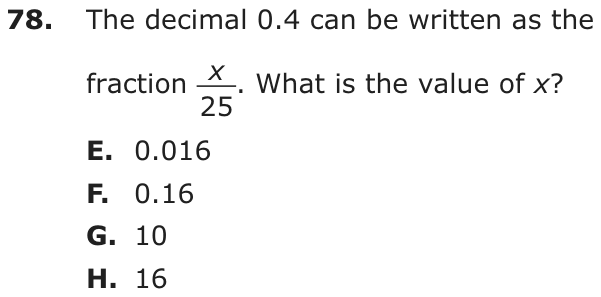
Question 52 of 63
2022 Test B Math, question 26Question
- A
- B
- C
- D
Show the answer
Correct answer: D
First, simplify the numerator and the denominator separately.
To simplify the numerator, multiply the last two fractions and then subtract from the first fraction.
To simplify the denominator, divide the last two fractions and then add to the first fraction.
Finally, divide the numerator by the denominator.
Question analysis
This fraction arithmetic question gives a complex fraction: a numerator with a subtraction and a multiplication over a denominator with an addition and a division, all with fractions. Students choose its value. It tests order of operations and the four operations with fractions, and working left to right instead of following the order of operations leads to a wrong result.
- NYS standards
- Grade level
- Grade 7 content, by NYS standard
- Compared with grade 7
- Above grade 7 Grade 7 students compute with fractions, usually two or three operations at a time. This expression needs five, in an order set by the rules rather than read left to right, so it is longer and more trap-prone than typical work.
- Estimated difficulty
- Moderate: several steps, or a close reading with one strong distractor.
- Thinking it demands
- Depth of knowledge 1, recall and reproduction · mainly apply
- What makes it hard
- Many steps moderate
- Error-prone arithmetic moderate
- Something you must already know minor
- Solution
- 5 steps
- Reading level
- Question and choices: about grade 16+, 5 words.
- Students, last 30 days
- Not enough answers yet to show (it takes 10).
Why it is hard, traps and wrong answers (shows the answer)
Why it is hard
Nothing here is beyond grade 7, but the expression stacks five fraction operations, and the top and the bottom each hide an order-of-operations decision. Working left to right in the numerator alone gives a negative value, and doing so in both parts gives an even stranger fraction; both are listed. The sign is a quick check: 4/15 is less than 2/3, so the numerator is positive, and so is the value.
Many steps moderate Working it out
The numerator and the denominator are each simplified on their own, to 2/5 and 2, before the final division, so five operations stand between the expression and its value. (Daniel & Embretson, 2010; Enright, Morley & Sheehan, 2002)
Error-prone arithmetic moderate Working it out
Every step is fraction work: 2/3 − 4/15 needs fifteenths, 1/4 ÷ 3/4 needs the divisor flipped, and the last step, 2/5 ÷ 2, is easily turned into 2/5 × 2. (Brown & Burton, 1978; Junker & Sijtsma, 2001)
Something you must already know minor Working it out
No parentheses inside the numerator or the denominator show the order, so students must know to multiply before subtracting and to divide before adding. (Anderson & Krathwohl, 2001)
Strategy: Simplify the numerator and the denominator separately, doing the multiplication and the division before the subtraction and the addition, then divide the two results.
Traps
- Order of operations: Working left to right, or distributing a minus sign wrongly, gives a choice.
The wrong answers, classified
A Order of operations (Brown & Burton, 1978)
Works left to right in both parts, (2/3 − 4/5) × 1/3 = −2/45 over (5/3 + 1/4) ÷ 3/4 = 23/9, and −2/45 ÷ 23/9 = −2/115.
B Order of operations (Brown & Burton, 1978)
Subtracts before multiplying in the numerator, (2/3 − 4/5) × 1/3 = −2/45, but handles the denominator correctly, so −2/45 ÷ 2 = −1/45.
C Little reason to choose it (Haladyna & Downing, 1993; Rodriguez, 2005)
No common working gives 2/9: it is positive like the answer, but no single order or fraction slip reaches it, so it mostly draws guesses between the two positive choices.
Worked solution, step by step
Formulas used
- Order of operations
- When no parentheses show the order, multiply and divide first. Then add and subtract. Everyone follows the same order, so an expression has only one value.
- Multiplying fractions
- a and c are the top numbers, and b and d are the bottom numbers. Multiply top times top and bottom times bottom.
- Dividing fractions
- To divide by a fraction, multiply by its reciprocal, the fraction flipped upside down. The reciprocal of c/d is d/c. It works because c/d times d/c is 1. So multiplying by d/c undoes c/d, just as dividing by c/d does.
Sort out the question
The big fraction bar means divide: the top part divided by the bottom part. Work out the top and the bottom on their own. Then divide.
Inside each part, no parentheses show the order. So follow the order of operations.
Multiply first in the top
The top is . Multiply before you subtract.
Watch out: subtracting first, 2/3 − 4/5, makes the top negative. That leads to −1/45, choice B. Working left to right in the bottom as well gives −2/115, choice A.
Subtract to finish the top
To subtract, the bottoms must match. Change 2/3 to fifteenths by multiplying its top and bottom by 5.
To simplify 6/15, divide its top and bottom by 3. The top part is 2/5.
Divide first in the bottom
The bottom is . Divide before you add. Flip 3/4 and multiply.
To simplify 4/12, divide its top and bottom by 4.
Add to finish the bottom
The bottoms already match, so add the tops and keep the bottom.
Six thirds make 2 wholes. The bottom part is 2.
Divide the top by the bottom
Now divide 2/5 by 2. Flip 2, which is 2/1, to get 1/2.
Dividing by 2 is the same as taking half, and half of 2/5 is 1/5. So the answer is D, .
Check your answer
Look at the signs. 4/15 is less than 2/3, so the top is positive. The bottom is positive too. So the answer must be positive, which rules out A and B. Then multiply back: , the top. It matches.
More questions like this
The original DOE question
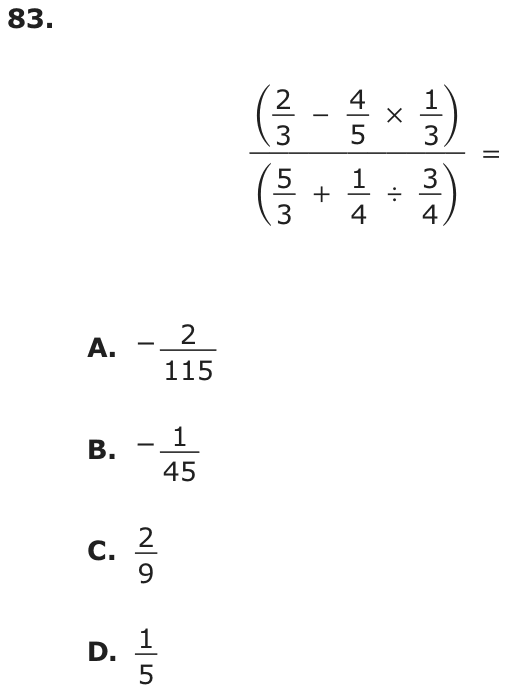
Question 53 of 63
2020 Test B Math, question 18Question
A seller at an Internet site reports that 99.7% of his sales have resulted in satisfied customers. Based on the report, what fraction of the sales have resulted in unsatisfied customers?
- A
- B
- C
- D
Show the answer
Correct answer: B
Since 100% means all customers,
Rewrite the percent as a decimal.
Now rewrite the decimal as a fraction.
Question analysis
An online seller reports that 99.7% of his sales ended with satisfied customers, and students must find what fraction of the sales left customers unsatisfied. The question combines finding the remaining part of a whole with turning a percent that contains a decimal into a fraction, and keeping track of what the fraction is out of is where errors creep in.
- Grade level
- Grade 6 content, by NYS standard
- Compared with grade 7
- Below grade 7 Finding the rest of a whole and writing a percent as a fraction are grade 6 skills. The decimal inside the percent is the only twist, and the work takes a few quick steps, below typical grade 7 demand.
- Estimated difficulty
- Straightforward: two steps or one careful reading.
- Thinking it demands
- Depth of knowledge 2, skills and concepts · mainly apply
- What makes it hard
- A very close wrong answer moderate
- Error-prone arithmetic minor
- Combines ideas minor
- Solution
- 3 steps
- Reading level
- Question and choices: about grade 8, 34 words.
- Students, last 30 days
- Not enough answers yet to show (it takes 10).
Why it is hard, traps and wrong answers (shows the answer)
Why it is hard
The subtraction is easy; the care goes into what the fraction is out of. A student who pictures 997 satisfied sales for every 3 unsatisfied ones writes 3/997, which compares the two groups instead of the unsatisfied with all sales, and it sits beside the key in both form and size. Turning 0.3% into a fraction also tests decimal place value, since 0.3 means three tenths, not one third.
A very close wrong answer moderate Choosing the answer
Two choices share the numerator 3, and 3/1,000 and 3/997 are almost equal, so estimating cannot separate them; only knowing that the fraction is out of all sales does. (Embretson & Wetzel, 1987; Gorin & Embretson, 2006; Ascalon et al., 2007)
Error-prone arithmetic minor Working it out
The percent holds a decimal, 0.3%, which becomes 0.003 only after dividing by 100, and 0.3 itself is easily taken for one third. (Brown & Burton, 1978; Junker & Sijtsma, 2001)
Combines ideas minor Working it out
Two ideas meet: the unsatisfied share is what is left of 100% after 99.7%, and that percent must then be rewritten as a fraction of the whole. (Embretson, 1998; Daniel & Embretson, 2010)
Strategy: Subtract the satisfied percent from 100% to find the unsatisfied percent, write it as a decimal by dividing by 100, and turn that decimal into a fraction by its place value.
Traps
- Misunderstands the concept: A wrong belief about a concept: that percents can be added, that area grows like length, that averages can be averaged, that a bigger denominator means a bigger fraction.
The wrong answers, classified
A Little reason to choose it (Haladyna & Downing, 1993; Rodriguez, 2005)
No working with 99.7% gives 1/997; it sets a 1 over the digits of 99.7, so it mostly attracts students who are guessing.
C Misunderstands the concept (Smith, diSessa & Roschelle, 1993; De Bock et al., 1998; Ni & Zhou, 2005)
Compares the 3 unsatisfied with the 997 satisfied in every 1,000 sales, a part-to-part ratio, instead of comparing the 3 unsatisfied with all 1,000.
D Misunderstands the concept (Smith, diSessa & Roschelle, 1993; De Bock et al., 1998; Ni & Zhou, 2005)
Treats 0.3 as one third, so 0.3% becomes a third of a percent, 1/300, though 0.3 is three tenths and the share is 3/1,000.
Worked solution, step by step
Formulas used
- Parts of a whole
- 100% stands for all of the sales. Satisfied and unsatisfied are the percents of sales of each kind. Every sale is one kind or the other, so the two percents add up to 100%. The unsatisfied part is whatever is left over.
- Changing a percent to a decimal
- p is the number in front of the percent sign. Percent means out of 100, so p% is p hundredths. Dividing by 100 moves the decimal point two places to the left.
Sort out the question
The seller says 99.7% of his sales left customers satisfied, or happy. You need the fraction of sales that left customers unsatisfied. A fraction of the sales means a part out of all the sales.
Find the unsatisfied percent
Every sale is either satisfied or unsatisfied. So subtract the satisfied part from the whole.
So 0.3% of the sales left customers unsatisfied.
Change the percent to a decimal
Watch out: 0.3 is three tenths, not one third. Treating 0.3% as a third of a percent gives , choice D.
Write the decimal as a fraction
Say 0.003 out loud: three thousandths. The 3 sits in the thousandths place, three places after the decimal point. So it means 3 out of 1,000.
Pick the answer
Watch out: picture 1,000 sales. Then 997 are satisfied and 3 are not. The fraction compares the unsatisfied sales with the satisfied ones. That is choice C. The question wants unsatisfied out of all 1,000 sales.
So the answer is B, .
Check your answer
Turn the answer back into a percent. , which is 0.3%. Now add the satisfied part: . Together they make all the sales, so the answer fits.
More questions like this
The original DOE question
Question 54 of 63
2019 Test B Math, question 6Question
Two glasses can hold the same amount of liquid. Glass A is filled, and Glass B is filled. If the liquid in Glass B is poured into Glass A, what fraction of Glass A will then be filled?
- A
- B
- C
- D
Show the answer
Correct answer: A
Add the fractions to find the answer:
Question analysis
Two glasses of the same size hold liquid: one is half full and the other a third full. When the second is poured into the first, students find what fraction of the first glass is filled. The fraction word problem tests adding fractions with different denominators, and the care lies in finding a common denominator before adding.
- NYS standards
- 7.NS.3 four operations with rational numbers
- Grade level
- Grade 7 content, by NYS standard
- Compared with grade 7
- Below grade 7 Adding two unlike fractions in a word problem is grade 7 rational-number work at its simplest, with halves and thirds. Typical grade 7 problems use mixed numbers, negative values or several steps.
- Estimated difficulty
- Routine: one familiar step, little to misread.
- Thinking it demands
- Depth of knowledge 2, skills and concepts · mainly apply
- What makes it hard
- Error-prone arithmetic minor
- Turning words into math minor
- Solution
- 2 steps
- Reading level
- Question and choices: about grade 3, 44 words.
- Students, last 30 days
- Not enough answers yet to show (it takes 10).
Why it is hard, traps and wrong answers (shows the answer)
Why it is hard
The question is a single sum of unlike fractions dressed as pouring, and halves and thirds are among the friendliest denominators. A quick sense check carries most of the weight: the result must exceed the 1/2 already in Glass A and stay below a full glass. Only one wrong choice comes from a real fraction error, adding the denominators, and it fails that check; the other two match no working.
Error-prone arithmetic minor Working it out
Halves and thirds cannot be added as written; both must become sixths, 3/6 and 2/6, and combining numerators or denominators straight across gives less than the half already in Glass A. (Brown & Burton, 1978; Junker & Sijtsma, 2001)
Turning words into math minor Understanding the question
The opening sentence, that both glasses hold the same amount, is what makes 1/2 and 1/3 fractions of the same whole, so pouring one into the other is a sum. (Hegarty, Mayer & Monk, 1995; Koedinger & Nathan, 2004)
Strategy: Because the two glasses are the same size, both fractions refer to the same whole, so the amount in Glass A is just their sum; check that it stays under one full glass.
Traps
- A faulty procedure: A systematic but wrong procedure: adding fractions straight across, applying an exponent to each term of a sum, dropping a sign when moving a term.
The wrong answers, classified
B Little reason to choose it (Haladyna & Downing, 1993; Rodriguez, 2005)
No sum of 1/2 and 1/3 gives 4/5; it lies between half full and full, so it draws students who estimate rather than add.
C Little reason to choose it (Haladyna & Downing, 1993; Rodriguez, 2005)
Matches no fraction rule: it would need the poured third to count as a quarter, 1/2 + 1/4, and nothing in the stem suggests that, so it mostly catches guesses.
D A faulty procedure (Brown & Burton, 1978; Tatsuoka, 1983)
Adds the denominators, 2 + 3 = 5, and keeps a numerator of 1, so 1/5, less than the half glass Glass A already held.
Worked solution, step by step
Formulas used
- Equivalent fractions
- a is the top number, the numerator. b is the bottom number, the denominator. k is any whole number except 0. Multiplying the top and bottom by the same number gives an equal fraction. The pieces get smaller, but you get more of them.
- Adding fractions with the same denominator
- n is the denominator. It tells how many equal parts make one whole. a and b are the numerators, how many of those parts you have. Parts of the same size can be added, so add the tops and keep the bottom.
Sort out the question
The two glasses can hold the same amount, so they are the same size. Glass A is full. Glass B is full. Glass B is poured into Glass A. You need how full Glass A is then. Both fractions are parts of the same whole, one glass. That means you add them.
Give both fractions the same denominator
The denominator is the bottom number. You can’t add halves and thirds as they are, because the pieces are different sizes. Find a number that 2 and 3 both go into. The smallest is 6, so change both fractions to sixths.
Add the sixths
Now the pieces are the same size. Add the tops and keep the bottom.
Glass A is now five sixths full.
Watch out: don’t add the bottoms. Adding 2 and 3 to get one fifth is choice D. One fifth is less than the half Glass A already had, so it can’t be right.
So the answer is A, .
Check your answer
Estimate. Glass A starts half full. Adding more makes it more than half full. A third is less than a half, so the total is less than two halves, one full glass. Five sixths is more than one half and less than 1, so it fits.
More questions like this
The original DOE question
Question 55 of 63
2019 Test B Math, question 10Question
A recipe uses teaspoon of salt and teaspoons of sugar. What is the ratio of salt to sugar in this recipe?
- A
- B
- C
- D
Show the answer
Correct answer: B
Question analysis
A recipe calls for 1/4 teaspoon of salt and 2 1/2 teaspoons of sugar, and students write the ratio of salt to sugar in whole numbers. It tests ratios whose terms are a fraction and a mixed number. Both terms have to be rescaled together, and the mixed number is where slips creep in.
- Grade level
- Grade 7 content, by NYS standard
- Compared with grade 7
- At grade 7 Ratios of fractions are grade 7 content, and this one is routine: convert a single mixed number, then scale both terms up to whole numbers. It asks for no further use of the ratio.
- Estimated difficulty
- Straightforward: two steps or one careful reading.
- Thinking it demands
- Depth of knowledge 2, skills and concepts · mainly apply
- What makes it hard
- Error-prone arithmetic moderate
- An answer in an unexpected form minor
- Solution
- 2 steps
- Reading level
- Question and choices: about grade 6, 27 words.
- Students, last 30 days
- Not enough answers yet to show (it takes 10).
Why it is hard, traps and wrong answers (shows the answer)
Why it is hard
A ratio of a fraction to a mixed number is unfamiliar enough that students reach for shortcuts, and each shortcut has a choice waiting. Pairing numerators after converting, or reading the salt's 1/4 as a ratio by itself, never compares the two amounts properly. Scaling both terms by the same factor, 4, or asking how many quarter teaspoons fit into 2 1/2 teaspoons, keeps the comparison intact.
Error-prone arithmetic moderate Working it out
The sugar is a mixed number, so 2 1/2 must become 5/2, and both terms must then be multiplied by 4, or 5/2 divided by 1/4, without dropping a denominator. (Brown & Burton, 1978; Junker & Sijtsma, 2001)
An answer in an unexpected form minor Choosing the answer
The recipe gives a fraction and a mixed number, but every choice is a whole-number ratio, so 1/4 : 2 1/2 has to be recognized in its scaled form. (Enright, Morley & Sheehan, 2002)
Strategy: Change 2 1/2 to 5/2, then divide the salt amount by the sugar amount; the quotient, written as a fraction with numerator 1, gives the ratio directly.
Traps
- A faulty procedure: A systematic but wrong procedure: adding fractions straight across, applying an exponent to each term of a sum, dropping a sign when moving a term.
- Numbers taken from the question: Combines the numbers in the question without a model of the situation, or is simply a number that appears in the question.
- An arithmetic slip: The right method with a plausible arithmetic error: a digit, a place value or a times-table fact.
The wrong answers, classified
A An arithmetic slip (Junker & Sijtsma, 2001)
Multiplies both terms by 4 but takes 4 × 5/2 as 20, multiplying the numerator and forgetting to divide by the 2.
C A faulty procedure (Brown & Burton, 1978; Tatsuoka, 1983)
Rewrites 2 1/2 as 5/2 and pairs the numerators, 1 : 5, as if 1/4 and 5/2 shared a denominator.
D Numbers taken from the question (Hegarty, Mayer & Monk, 1995)
Reads the 1/4 teaspoon of salt as the ratio 1 : 4 itself, never bringing the 2 1/2 teaspoons of sugar into the comparison.
Worked solution, step by step
Formulas used
- Changing a mixed number to a fraction
- A mixed number is a whole number plus a fraction. Multiply the whole number by the bottom number to count the halves in the wholes. Then add the top number, and keep the same bottom. Two wholes are 4 halves, so 2 and a half is 5 halves.
- Equivalent ratios
- a and b are the two amounts in a ratio, in order. k is any number except 0. Multiplying both amounts by the same number keeps the comparison the same. Use it to turn the fractions in a ratio into whole numbers.
Sort out the question
The recipe uses teaspoon of salt and teaspoons of sugar. A ratio compares two amounts. “Salt to sugar” means salt first, then sugar. Every choice is a ratio of whole numbers. So you need to turn the two amounts into whole numbers that compare the same way.
Change the mixed number to a fraction
A mixed number is hard to work with. Write the sugar as a fraction.
So the ratio of salt to sugar is .
Multiply both parts by 4
Multiply both parts by the same number to clear the fractions. Use 4, because both bottom numbers, 4 and 2, go into 4.
For the sugar, , and then .
Watch out: forgetting to divide by 2 gives 1 : 20, choice A. Pairing the top numbers, 1 : 5, choice C, compares quarters with halves. And 1 : 4, choice D, is only the salt amount. It leaves out the sugar.
So the answer is B, 1 : 10.
Check your answer
Think in quarter teaspoons. The salt is 1 quarter teaspoon. One teaspoon is 4 quarters, so the sugar is quarter teaspoons. That is 1 quarter of salt for every 10 quarters of sugar, or 1 : 10.
More questions like this
The original DOE question
Question 56 of 63
2019 Test B Math, question 48Question
What number is halfway between and on a number line?
- A
- B
- C
- D
Show the answer
Correct answer: D
First, subtract the two fractions:
Then, divide the difference by 2 to find half the distance between the two fractions:
Finally, add the distance to the first point to find the halfway point:
Question analysis
This number line question asks for the number exactly halfway between the fractions 1/20 and 1/10. It tests finding the midpoint of two rational numbers when their denominators differ. Both fractions are small and close together, so a slip in combining them is easy to make.
- Grade level
- Grade 7 content, by NYS standard
- Compared with grade 7
- At grade 7 Locating a point between two rational numbers on a number line is grade 6 and 7 work. Here the endpoints are small fractions with related denominators, so once they share a denominator the task is quick, matching typical grade 7 practice.
- Estimated difficulty
- Straightforward: two steps or one careful reading.
- Thinking it demands
- Depth of knowledge 1, recall and reproduction · mainly apply
- What makes it hard
- Solution
- 3 steps
- Reading level
- Question and choices: about grade 9, 16 words.
- Students, last 30 days
- Not enough answers yet to show (it takes 10).
Why it is hard, traps and wrong answers (shows the answer)
Why it is hard
The method is short once the midpoint is seen as an average, but small fractions with different denominators invite the straight-across habit. Adding numerators and denominators separately gives 2/30, and halving that either way lands on a listed choice outside the two endpoints. Checking that the answer sits between 0.05 and 0.1, which 0.075 does, rules out every wrong choice.
Error-prone arithmetic minor Working it out
The fractions 1/20 and 1/10 have different denominators, so 1/10 must become 2/20 before adding, and halving 3/20 then needs a denominator of 40. (Brown & Burton, 1978; Junker & Sijtsma, 2001)
Something you must already know minor Working it out
The stem does not say that the point halfway between two numbers is their mean; students must bring that, or the idea of adding half the gap to the smaller number. (Anderson & Krathwohl, 2001)
Strategy: Find the average of the two fractions: rewrite them with a common denominator, add them, and divide the sum by 2.
Traps
- A faulty procedure: A systematic but wrong procedure: adding fractions straight across, applying an exponent to each term of a sum, dropping a sign when moving a term.
The wrong answers, classified
A Little reason to choose it (Haladyna & Downing, 1993; Rodriguez, 2005)
No midpoint working gives 1/5, which lies beyond 1/10 and so outside the two endpoints; it only continues the doubling from 1/20 to 1/10.
B A faulty procedure (Brown & Burton, 1978; Tatsuoka, 1983)
Adds straight across, 1/20 + 1/10 = 2/30, then halves the denominator instead of the fraction, which doubles the value to 2/15.
C A faulty procedure (Brown & Burton, 1978; Tatsuoka, 1983)
Knows to average but adds straight across first, 1/20 + 1/10 = 2/30, so half of that sum is 1/30, smaller than both endpoints.
Worked solution, step by step
Formulas used
- Equivalent fractions
- a is the top number and b is the bottom number, the denominator. k is any whole number except 0. Multiplying the top and bottom by the same number gives an equal fraction. Use it to give two fractions the same denominator so you can add them.
- Midpoint on a number line
- a and b are the numbers at the two ends. The midpoint is the number exactly halfway between them. Adding the ends and dividing by 2 finds their mean, or average, which sits in the middle.
Sort out the question
You need the number exactly halfway between and on a number line. That number is the midpoint. It is the same distance from both ends. Notice that one tenth is the bigger number, because tenths are bigger pieces than twentieths.
Give both fractions the same denominator
The denominator is the bottom number. To add fractions, they need the same one. 20 is a multiple of 10, so use 20.
Now the two ends are and .
Average the two ends
Use the midpoint formula. First add the ends. Then divide by 2.
Dividing by 2 is the same as multiplying by . Multiply the tops and the bottoms.
Watch out: don’t add straight across, top plus top and bottom plus bottom. That gives . Halving it gives , choice C, which is less than both ends. Halving only the bottom gives , choice B, which is past both ends. Choice A, , is also past one tenth.
So the answer is D, .
Check your answer
Write both ends in fortieths: and . Halfway between 2 and 4 is 3, so halfway between the ends is three fortieths. As decimals, 0.075 sits right between 0.05 and 0.1.
More questions like this
The original DOE question
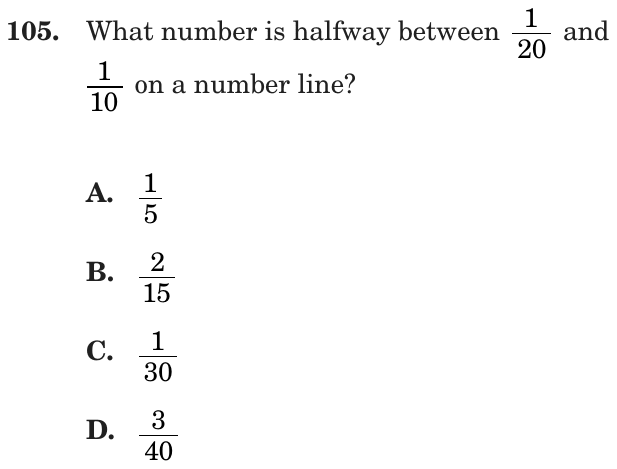
Question 57 of 63
2018 Test A Math, question 28Question
What is the value of the expression shown above?
- A
- B
- C
- D
Show the answer
Correct answer: D
Convert all the fractions to a common denominator (10):
Question analysis
A fractions question: add four mixed numbers whose fractions have denominators of 5, 10, 5 and 2. Students rewrite the fractions over a common denominator, add the whole numbers and the fractions, regroup any extra whole, and simplify. Regrouping and lowest terms both matter, since the choices differ in exactly those places.
- NYS standards
- Grade level
- Grade 7 content, by NYS standard
- Compared with grade 7
- Below grade 7 Adding mixed numbers with unlike denominators is grade 5 content. With four terms and a regrouping step it takes care, but it asks less than typical grade 7 work with negative rational numbers.
- Estimated difficulty
- Straightforward: two steps or one careful reading.
- Thinking it demands
- Depth of knowledge 1, recall and reproduction · mainly apply
- What makes it hard
- Error-prone arithmetic moderate
- A very close wrong answer moderate
- An answer in an unexpected form minor
- Solution
- 3 steps
- Reading level
- Question and choices: about grade 9, 14 words.
- Students, last 30 days
- Not enough answers yet to show (it takes 10).
Why it is hard, traps and wrong answers (shows the answer)
Why it is hard
The numbers are friendly: every fraction converts to tenths, and the whole parts add to 14. The risk is in the bookkeeping, either forgetting to carry the extra whole from the fractions or adding numerators over a made-up denominator. Converting to decimals, 2.2 + 3.3 + 4.4 + 5.5, is a fast check that avoids both.
Error-prone arithmetic moderate Working it out
Four mixed numbers with denominators 5, 10, 5 and 2 must be rewritten as tenths, 2 + 3 + 4 + 5 tenths, and the 14/10 regrouped into a whole and a fraction. (Brown & Burton, 1978; Junker & Sijtsma, 2001)
A very close wrong answer moderate Choosing the answer
15 2/5 and 14 2/5 are written alike and share the fraction 2/5; only the whole carried from 14/10 separates them, so a missed carry is invisible at a glance. (Embretson & Wetzel, 1987; Gorin & Embretson, 2006; Ascalon et al., 2007)
An answer in an unexpected form minor Choosing the answer
The fractions total 1 4/10, but every choice is in lowest terms, so the 4/10 has to be reduced to 2/5 before it matches. (Enright, Morley & Sheehan, 2002)
Strategy: Convert each mixed number to a decimal, since these fractions all convert exactly, add them, and turn the decimal part back into a fraction in lowest terms.
Traps
- Answer in another form: The right answer is written differently from the way you worked it out.
The wrong answers, classified
A A faulty procedure (Brown & Burton, 1978; Tatsuoka, 1983)
Adds the numerators straight across, 1 + 3 + 2 + 1 = 7, and puts them over 20, a common denominator (10 × 2), without rescaling them, so nothing carries.
B An arithmetic slip (Junker & Sijtsma, 2001)
Adds the fractions to 14/10 but keeps only the 4/10 = 2/5 left over, forgetting to carry the whole 1 into 14.
C Little reason to choose it (Haladyna & Downing, 1993; Rodriguez, 2005)
Pairs a correct carry into 15 with the 7/20 from adding numerators, two steps no single line of working combines; it mostly catches guesses.
Worked solution, step by step
Formulas used
- Equal fractions
- a is the top number, called the numerator. b is the bottom number, called the denominator. n is any whole number except zero. Multiplying the top and bottom by the same n gives an equal fraction. Use it to give fractions the same denominator so you can add them.
Sort out the question
You need to add four mixed numbers. A mixed number is a whole number plus a fraction, like . The fractions have different denominators, or bottom numbers: 5, 10, 5 and 2. To add fractions, they need the same denominator.
Add the whole numbers
Add the whole numbers first. You will add the fractions on their own after that.
The whole numbers make 14.
Rewrite each fraction in tenths
Use 10 as the denominator, since 5 and 2 both go into 10.
is already in tenths. Watch out: when you change a bottom number, change the top too. Adding the old tops, 1 + 3 + 2 + 1 = 7, and putting them over 20 gives 7/20. That is in choices A and C.
Add the fractions
14 tenths is more than 1 whole. Ten tenths make 1, so 14 tenths is 1 whole and 4 tenths.
To simplify 4/10, divide the top and bottom by 2.
Put it all together
Add the 14 wholes to the sum of the fractions.
Watch out: carry the extra whole into the 14. Missing it gives , choice B. So the answer is D, .
Check your answer
Change each mixed number to a decimal: . The 0.4 is 4 tenths, which is 2/5. So the sum is .
More questions like this
The original DOE question
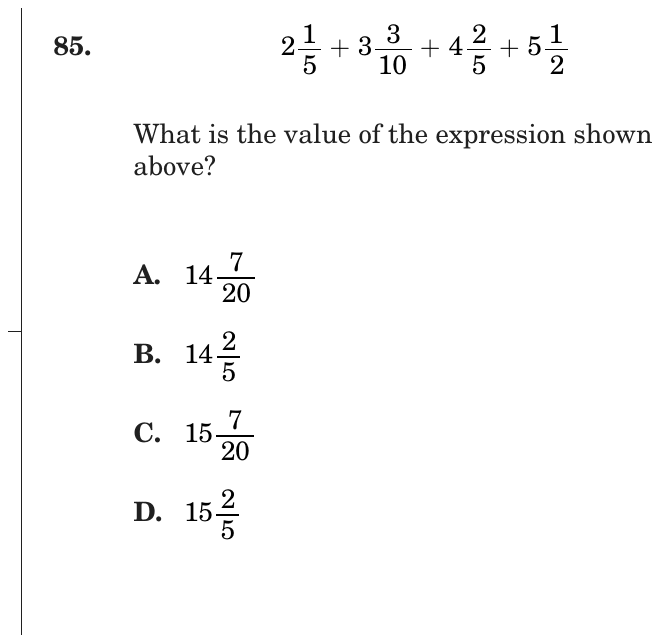
Question 58 of 63
2018 Test A Math, question 36Question
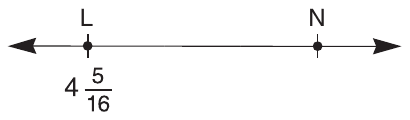
On the number line above, LN = . Point M (not shown) is located between point L and point N. Which value below is a possible value for M?
- A4.26
- B4.31
- C4.35
- D4.58
Show the answer
Correct answer: C
Since , point is located at
.
So must be between point , , and point , . Point can also be written as 4.3125, and point can be written as 4.4375. The only option given that lies between those two points is 4.35.
Question analysis
This number line question says the distance from point L to point N is one eighth and asks which decimal could be the position of a point M between them. Students take L's position, a mixed number in sixteenths, find N, and compare with decimal choices. Converting sixteenths to decimals precisely is the tricky part.
- NYS standards
- Grade level
- Grade 7 content, by NYS standard
- Compared with grade 7
- At grade 7 Grade 7 students convert fractions to decimals and compare them. This item needs an exact conversion of sixteenths and a comparison to the thousandths, where rounding too early can mislead, but it stays within grade 7 content.
- Estimated difficulty
- Moderate: several steps, or a close reading with one strong distractor.
- Thinking it demands
- Depth of knowledge 2, skills and concepts · mainly apply
- What makes it hard
- Error-prone arithmetic moderate
- A very close wrong answer moderate
- Reading a figure, table or graph minor
- Solution
- 3 steps
- Reading level
- Question and choices: about grade 5, 28 words.
- Students, last 30 days
- Not enough answers yet to show (it takes 10).
Why it is hard, traps and wrong answers (shows the answer)
Why it is hard
The interval from L to N is only an eighth wide, and three of the four choices crowd near it, so precision decides the question. Students comfortable working in sixteenths can avoid decimals until the end, since 4.35 lies between 4 5/16 and 4 7/16. Those who convert loosely, or who misread a mixed number as a decimal, are pulled to a neighboring choice.
Error-prone arithmetic moderate Working it out
Converting 4 5/16 to 4.3125 and N to 4.4375 needs four decimal places, while the choices stop at hundredths, so early rounding blurs the left boundary. (Brown & Burton, 1978; Junker & Sijtsma, 2001)
A very close wrong answer moderate Choosing the answer
The choices 4.31 and 4.35 both lie within 0.04 of L, so estimating cannot separate them; only the exact 4.3125 shows 4.31 just outside the interval and 4.35 inside. (Embretson & Wetzel, 1987; Gorin & Embretson, 2006; Ascalon et al., 2007)
Reading a figure, table or graph minor Understanding the question
L's value appears only on the number line, and the picture shows N to the right of L, which fixes which way the one-eighth gap runs. (Lesh, Post & Behr, 1987; Kirsch & Mosenthal, 1990)
Strategy: Add one eighth, or two sixteenths, to L's position to locate N, convert both endpoints to four-place decimals, and keep only a choice strictly between them.
Traps
- Rounds too early: Rounds a value partway through, or rounds the wrong way, so the final answer drifts from the exact one.
- Answer in another form: The right answer is written differently from the way you worked it out.
- A faulty procedure: A systematic but wrong procedure: adding fractions straight across, applying an exponent to each term of a sum, dropping a sign when moving a term.
The wrong answers, classified
A Negatives and direction (Brown & Burton, 1978)
Measures the one-eighth gap to the left of L, giving 4.1875 to 4.3125, an interval that contains 4.26 but contradicts the figure.
B Rounds too early (King et al., 2004)
Rounds L's 4.3125 to 4.31 and treats 4.31 as inside the interval, missing that it lies slightly to the left of L.
D A faulty procedure (Brown & Burton, 1978; Tatsuoka, 1983)
Writes 4 5/16 as 4.516 by placing the fraction's digits after the decimal point, so N becomes about 4.641 and 4.58 appears to fit.
Worked solution, step by step
Formulas used
- Equal fractions
- a is the top number (numerator) and b is the bottom number (denominator). Multiplying both by the same number k gives an equal fraction. It is like cutting each piece into k smaller pieces. Use it to give fractions the same bottom before you add or subtract.
- Fraction to decimal
- A fraction bar means divide. a is the top number and b is the bottom number. Dividing the top by the bottom turns the fraction into a decimal. Then you can compare it with decimal choices.
Sort out what you know
Point L is at . Point N is to the right of L. The distance from L to N, called LN, is .
Point M is somewhere between L and N. You need a choice that fits between them. The choices are decimals, so you will change the fractions into decimals.
Find where N is
N is to the right of L, so add. First give a bottom of 16, to match L:
Watch out: N is to the right of L in the figure. Going left instead gives a gap that holds 4.26, choice A.
Change both points to decimals
Divide the top of each fraction by the bottom:
So L is at 4.3125 and N is at 4.4375.
Test each choice
M must be bigger than 4.3125 and smaller than 4.4375.
- 4.26 is smaller than 4.3125. It is left of L.
- 4.31 is 4.3100, just smaller than 4.3125. It is a hair left of L.
- 4.35 is between them. It fits.
- 4.58 is bigger than 4.4375. It is right of N.
Watch out: if you round L to 4.31, choice B seems to fit. Keep all four decimal places. So the answer is C, 4.35.
Check your answer
Subtract to be sure. 4.35 − 4.3125 = 0.0375, which is more than 0, so 4.35 is right of L. 4.4375 − 4.35 = 0.0875, which is also more than 0, so 4.35 is left of N. It sits between them.
More questions like this
The original DOE question
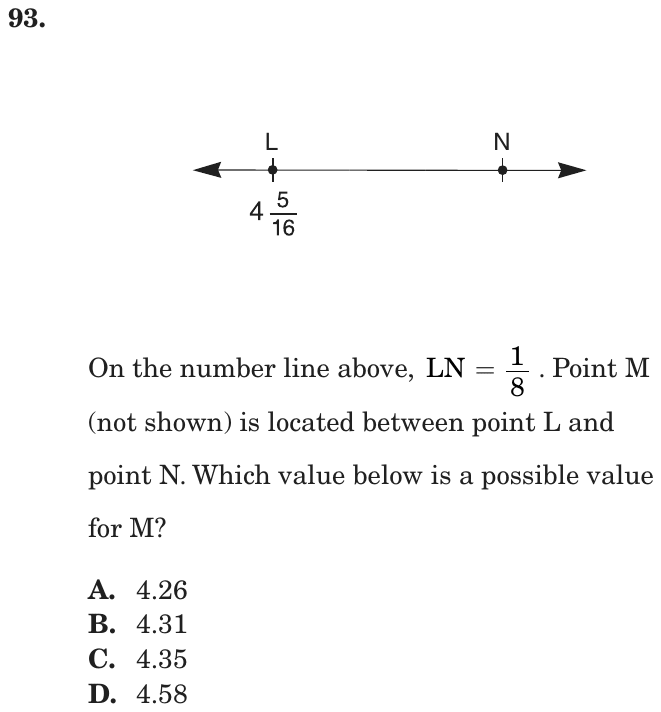
Question 59 of 63
2018 Test A Math, question 54Question
On the number line above, , , and . What is the position of point ?
- A
- B
- C
- D
Show the answer
Correct answer: C
First, use to find the location of :
Now, use to find the location of :
Finally, use to find the location of :
Question analysis
This number line question gives the lengths JK, JM and LM as mixed numbers and asks for the position of point L. Students must chain three distance steps, moving left from K to J, right to M and back to L, with fractions in eighths and a negative position. Losing track of where K sits is the main danger.
- Grade level
- Grade 7 content, by NYS standard
- Compared with grade 7
- Above grade 7 Grade 7 students add and subtract rational numbers and find distances on a number line one at a time. This item chains three such steps with mixed numbers and a negative position, more than typical grade 7 work demands.
- Estimated difficulty
- Among the hardest on the SHSAT: a non-obvious approach, heavy reading, or a well-hidden trap.
- Thinking it demands
- Depth of knowledge 2, skills and concepts · mainly apply
- What makes it hard
- A very close wrong answer major
- Error-prone arithmetic moderate
- Reading a figure, table or graph moderate
- Many steps minor
- Solution
- 4 steps
- Reading level
- Question and choices: about grade 9, 20 words.
- Students, last 30 days
- Not enough answers yet to show (it takes 10).
Why it is hard, traps and wrong answers (shows the answer)
Why it is hard
Every number is a mixed fraction, one position is negative, and the figure's even spacing hides how long KL really is. The distance route, KL = 9 3/4 − 3 1/2 − 1 1/8, avoids the negative entirely but ends one step short of a position unless K's 3/8 is added back. That last step is the one most students skip, which is why the question sits at the top of the scale.
A very close wrong answer major Choosing the answer
The choices 5 1/8, 5 1/4 and 5 1/2 lie within 3/8 of one another, so no estimate separates them; only exact eighths and adding K's 3/8 pick out the right one. (Embretson & Wetzel, 1987; Gorin & Embretson, 2006; Ascalon et al., 2007)
Error-prone arithmetic moderate Working it out
Every step mixes halves, quarters and eighths, and placing J means 3/8 − 3 1/2 = −3 1/8, a subtraction that crosses zero. (Brown & Burton, 1978; Junker & Sijtsma, 2001)
Reading a figure, table or graph moderate Understanding the question
Only K is labeled, and the points are drawn evenly spaced although KL is over four times LM, so the picture gives no help with sizes. (Lesh, Post & Behr, 1987; Kirsch & Mosenthal, 1990)
Many steps minor Working it out
Three linked moves, K to J, J to M and M back to L, each depend on the last, so an early slip carries through. (Daniel & Embretson, 2010; Enright, Morley & Sheehan, 2002)
Strategy: Start from K's labeled position, subtract JK to place J, add JM to place M, then subtract LM, keeping every fraction in eighths.
Traps
- Answers a different question: A choice is right for another quantity: the other unknown, the rest instead of the part, the part instead of the whole.
- Stops one step early: A choice is a number from partway through the solution.
The wrong answers, classified
A Stops one step early (King et al., 2004; Gierl et al., 2017)
Finds KL = 9 3/4 − 3 1/2 − 1 1/8 = 5 1/8 and stops one step short, never adding K's position of 3/8.
B An arithmetic slip (Junker & Sijtsma, 2001)
Rewrites 9 3/4 as 9 4/8 instead of 9 6/8, so M lands at 6 3/8 and L at 6 3/8 − 1 1/8 = 5 1/4.
D Answers a different question (King et al., 2004; Hegarty, Mayer & Monk, 1995)
Finds KM = 9 3/4 − 3 1/2 = 6 1/4, the distance from K to M, and gives it without moving back 1 1/8 to L.
Worked solution, step by step
Formulas used
- Distance on a number line
- d is the distance between two points. b is the point on the right and a is the point on the left. Subtracting left from right always gives a positive distance. It works even when a is negative.
- Equal fractions
- a is the top number (numerator) and b is the bottom number (denominator). Multiplying both by the same number k gives an equal fraction. It is like cutting each piece into k smaller pieces. Use it to give fractions the same bottom before you add or subtract.
Sort out what you know
Only K has a value: . JK means the distance from J to K. You know JK = , JM = and LM = .
You need the position of L, the number where L sits. The points are drawn evenly spaced, but the distances are not equal. So use the numbers, not the picture.
Write the fractions in eighths
The fractions use halves, fourths and eighths. Give them all a bottom of 8:
Watch out: is , not . That slip leads to choice B.
Find the distance from K to M
JM is JK and KM put together. So take JK away from JM:
KM is , or . Watch out: this is a distance, not where L sits. Choice D stops here.
Find the distance from K to L
KM is KL and LM put together. So take LM away:
KL is . Watch out: this is still a distance. Choice A stops here.
Find the position of L
L is to the right of K, and K is at . Add:
So the answer is C, .
Check your answer
Place every point. J is left of K, at . M is right of J, at . L is left of M, at , which is . Same answer.
More questions like this
The original DOE question
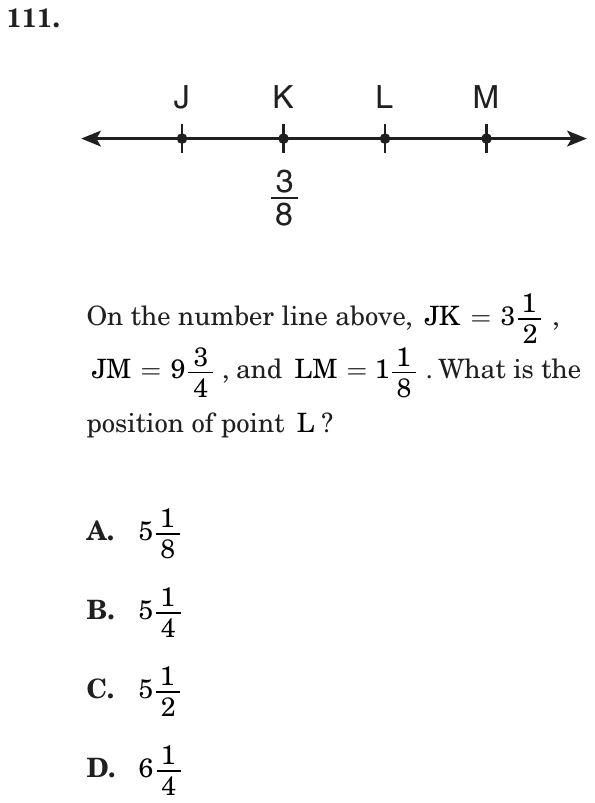
Question 60 of 63
2018 Test B Math, question 23Question
On the number line above, . What is the position of point ?
- A
- B
- C
- D
Show the answer
Correct answer: B
To find , subtract and set it equal to the length:
Question analysis
This number line question gives the distance between points M and N as a mixed number and asks for the position of M. Students subtract fractions with unlike denominators, moving past zero into negative numbers. Direction along the line and the sign of the result are where it gets tricky.
- Grade level
- Grade 7 content, by NYS standard
- Compared with grade 7
- At grade 7 Grade 7 students find distances on a number line as the absolute value of a difference. Doing it with mixed numbers that have unlike denominators, and crossing zero, is a typical and slightly demanding grade 7 task.
- Estimated difficulty
- Moderate: several steps, or a close reading with one strong distractor.
- Thinking it demands
- Depth of knowledge 2, skills and concepts · mainly apply
- What makes it hard
- Reading a figure, table or graph moderate
- Error-prone arithmetic moderate
- A very close wrong answer moderate
- Solution
- 3 steps
- Reading level
- Question and choices: about grade 8, 17 words.
- Students, last 30 days
- Not enough answers yet to show (it takes 10).
Why it is hard, traps and wrong answers (shows the answer)
Why it is hard
The distance is given and one endpoint is known, so the question is really about direction and sign. Because the drawing shows no zero, students must reason that moving 5 5/6 to the left from 1 1/3 carries M past zero. The choices pair each size with each sign, so getting the size right is only half the work; the sign decides between two choices.
Reading a figure, table or graph moderate Understanding the question
The number line labels only N, at 1 1/3, and shows no zero, so students must see from the picture that M lies left of N and work out whether it passes zero. (Lesh, Post & Behr, 1987; Kirsch & Mosenthal, 1990)
Error-prone arithmetic moderate Working it out
The subtraction 1 1/3 − 5 5/6 mixes unlike denominators and crosses zero: in sixths it is 8/6 − 35/6 = −27/6, which then reduces to a mixed number. (Brown & Burton, 1978; Junker & Sijtsma, 2001)
A very close wrong answer moderate Choosing the answer
4 1/2 and −4 1/2 are written the same except for the sign; only noticing that M lies left of N, so below 1 1/3, separates them. (Embretson & Wetzel, 1987; Gorin & Embretson, 2006; Ascalon et al., 2007)
Strategy: Read N's coordinate from the number line, convert everything to sixths, and move the given distance from N toward M's side of the line.
Traps
- Negatives and direction: Arithmetic with negative numbers, the order of a subtraction, or direction on a number line. (Moving a term across the equals sign without changing its sign is a faulty procedure.)
The wrong answers, classified
A Negatives and direction (Brown & Burton, 1978)
Adds the length to N's coordinate, 1 1/3 + 5 5/6 = 7 1/6, and makes it negative because M is on the left.
C Negatives and direction (Brown & Burton, 1978)
Computes 5 5/6 − 1 1/3, the right size, but keeps it positive, which would put M to the right of N.
D Numbers taken from the question (Hegarty, Mayer & Monk, 1995)
Adds the two numbers in the question, 1 1/3 + 5 5/6, placing M to the right of N against the figure.
Worked solution, step by step
Formulas used
- Distance on a number line
- On a number line, numbers grow as you move right. The distance between two points is the larger number minus the smaller one. That is the right point minus the left point, so a distance is never negative.
- Mixed number to fraction
- a is the whole number part, b is the top of the fraction, and c is the bottom. Each whole holds c pieces, so a wholes hold a times c pieces. Then add the b extra pieces.
Read the number line
Point N is at . Point M is to the left of N. MN means the distance from M to N, and it is .
You need the number at point M.
Decide which way to move
On a number line, numbers get smaller as you move left. M is left of N, so N is the right point.
So M is what you get when you take the distance away from N.
The distance is bigger than , so you will pass 0. M will be negative.
Change both numbers to sixths
To subtract, the fractions need the same bottom number. Use sixths, since 3 goes into 6. Change each mixed number to an improper fraction, a fraction whose top is bigger than its bottom.
Subtract and simplify
27 sixths is 4 wholes (24 sixths) and 3 sixths more. And . So M is .
Watch out: without the minus sign is choice C. That point would be to the right of N, not the left.
So the answer is B, .
Check your answer
Find the distance from your M to N. From to 0 is , or . From 0 to N is . Together, . That matches MN.
More questions like this
The original DOE question
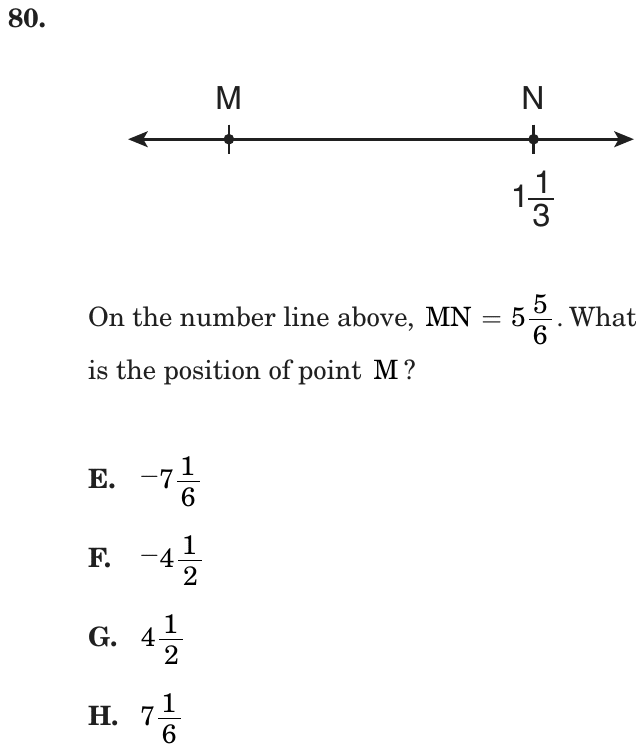
Question 61 of 63
2018 Test B Math, question 26Question
A cylindrical oil drum can hold 4,320 liters when it is completely full. Currently, the drum is full of oil. How many kiloliters of oil need to be added in order to fill the drum completely?
- A1.44
- B2.88
- C4.32
- D14.10
Show the answer
Correct answer: B
Find the number of liters that need to be added. Since of the oil drum is full, of the drum remains empty:
Use the conversion 1 kL = 1,000 L to find the number of kL:
Question analysis
This fractions and unit conversion problem describes a cylindrical oil drum that holds 4,320 liters when full and is now one third full, and asks how many kiloliters must be added to fill it. Students find the empty fraction, multiply and convert liters to kiloliters. Answering for the right part of the drum, in the right unit, is the challenge.
- Grade level
- Grade 7 content, by NYS standard
- Compared with grade 7
- At grade 7 Taking a fraction of a quantity and converting metric units are both familiar from grades 5 and 6. Together they make a three-step problem at about the level of routine grade 7 work.
- Estimated difficulty
- Moderate: several steps, or a close reading with one strong distractor.
- Thinking it demands
- Depth of knowledge 2, skills and concepts · mainly apply
- What makes it hard
- Turning words into math moderate
- Something you must already know minor
- Solution
- 3 steps
- Reading level
- Question and choices: about grade 7, 36 words.
- Students, last 30 days
- Not enough answers yet to show (it takes 10).
Why it is hard, traps and wrong answers (shows the answer)
Why it is hard
The arithmetic is short, but the question describes the drum one way and asks about it another. Students who multiply by the fraction they are given find the oil already in the drum, and that result, converted to kiloliters, is a choice. Since no choice is in liters, students who forget to convert are warned before they answer.
Turning words into math moderate Understanding the question
The stem gives how full the drum is, 1/3, but asks how much must be added, so students must switch to the empty 2/3 before multiplying by 4,320. (Hegarty, Mayer & Monk, 1995; Koedinger & Nathan, 2004)
Something you must already know minor Working it out
The bold word “kiloliters” calls for the conversion 1 kiloliter = 1,000 liters, which the question does not give. (Anderson & Krathwohl, 2001)
Strategy: Work out what fraction of the drum is still empty, take that fraction of 4,320 liters, and divide by 1,000 to change liters to kiloliters.
Traps
- Answers a different question: A choice is right for another quantity: the other unknown, the rest instead of the part, the part instead of the whole.
The wrong answers, classified
A Answers a different question (King et al., 2004; Hegarty, Mayer & Monk, 1995)
Multiplies 4,320 by the given 1/3, finding the oil already in the drum instead of the amount still needed.
C Answers a different question (King et al., 2004; Hegarty, Mayer & Monk, 1995)
Converts the full capacity of 4,320 liters to kiloliters without taking away the third of the drum that is already full.
D Little reason to choose it (Haladyna & Downing, 1993; Rodriguez, 2005)
No conversion of 1,440, 2,880 or 4,320 liters gives 14.10; it is over three times the full drum's capacity, so only guessers choose it.
Worked solution, step by step
Formulas used
- Fraction of an amount
- n is the whole amount, here the full drum. The fraction a over b tells what share of it you want. Multiply to find that share. For example, 2/3 of 9 is 6.
- Liters to kiloliters
- Kilo means 1,000, so 1 kiloliter holds 1,000 liters. To change liters into kiloliters, divide by 1,000. That moves the decimal point 3 places to the left.
Sort out the question
The full drum holds 4,320 liters. It is now full. You need how much oil to add to fill it.
The answer must be in kiloliters, not liters.
Find the empty fraction
The drum is full. The rest is empty, and that is the part you must fill.
Watch out: of 4,320 is 1,440 liters. That is the oil already in the drum. It leads to choice A.
Find the liters to add
Take two thirds of the full drum.
One third of 4,320 is 1,440, and two thirds is double that. You need to add 2,880 liters.
Change liters to kiloliters
You need 2.88 kiloliters.
Watch out: 4.32 is the whole drum in kiloliters. Choice C forgets that part of the drum is already full.
So the answer is B, 2.88.
Check your answer
Add the oil already in the drum to the oil you add: kiloliters. That is 4,320 liters, the full drum. It checks out.
More questions like this
The original DOE question
Question 62 of 63
2018 Test B Math, question 44Question
The hash marks on the number line above are evenly spaced. What is the coordinate of point ?
- A
- B
- C
- D
Show the answer
Correct answer: C
There are 5 sections between M and T. To find the length of one of these sections, find the distance between M and T and divide by 5:
R is 3 sections away from M, so add:
R is located at .
Question analysis
Students find the fraction at point R on a number line with evenly spaced hash marks, where M is at −1/4 and T is at 5/8. It tests fraction arithmetic with negative numbers. Working out the size of one gap and counting gaps from M to R takes several careful steps.
- NYS standards
- Grade level
- Grade 7 content, by NYS standard
- Compared with grade 7
- Above grade 7 Grade 7 students place fractions and negatives on number lines, but here they must subtract a negative fraction, divide by five, and then add back. Four fraction steps with unlike denominators make it harder than typical classwork.
- Estimated difficulty
- Hard: combines ideas, needs a plan, and has more than one tempting wrong answer.
- Thinking it demands
- Depth of knowledge 2, skills and concepts · mainly apply
- What makes it hard
- Error-prone arithmetic major
- Reading a figure, table or graph moderate
- Solution
- 4 steps
- Reading level
- Question and choices: about grade 6, 22 words.
- Students, last 30 days
- Not enough answers yet to show (it takes 10).
Why it is hard, traps and wrong answers (shows the answer)
Why it is hard
Fractions, a negative starting point and a count of spaces all have to come out right together. Students lose points by counting tick marks instead of spaces, by subtracting −1/4 as if it were positive, or by measuring R from 0 instead of from M. Converting both labels to fortieths first, −10/40 and 25/40, makes each gap a whole number of fortieths.
Error-prone arithmetic major Working it out
The gap length needs 5/8 − (−1/4) = 7/8, then 7/8 ÷ 5 = 7/40, then −10/40 + 21/40: negatives and three different denominators meet in one problem. (Brown & Burton, 1978; Junker & Sijtsma, 2001)
Reading a figure, table or graph moderate Understanding the question
The hash marks have to be counted as spaces: five from M to T, with R three spaces past M, while the unlabeled marks outside M and T play no part. (Lesh, Post & Behr, 1987; Kirsch & Mosenthal, 1990)
Strategy: Find the distance from M to T by subtracting their coordinates, divide it by the number of equal gaps, then step from M toward T by the right number of gaps.
Traps
- Stops one step early: A choice is a number from partway through the solution.
- Negatives and direction: Arithmetic with negative numbers, the order of a subtraction, or direction on a number line. (Moving a term across the equals sign without changing its sign is a faulty procedure.)
The wrong answers, classified
A Stops one step early (King et al., 2004; Gierl et al., 2017)
Finds the length of one gap, 7/8 ÷ 5 = 7/40, and gives it as R's coordinate without stepping from M.
B Negatives and direction (Brown & Burton, 1978)
Subtracts as 5/8 − 1/4 = 3/8 instead of adding, gets gaps of 3/40, and counts three gaps from 0.
D Stops one step early (King et al., 2004; Gierl et al., 2017)
Multiplies the 7/40 gap by 3 to get the distance from M to R, then forgets to add it to M's −1/4.
Worked solution, step by step
Formulas used
- Distance on a number line
- The right number is the point farther to the right on the number line. The left number is the other point. Subtracting tells how many units apart they are. Taking the left from the right keeps the answer positive.
- Dividing a fraction by a whole number
- a over b is the fraction, and c is the whole number you divide by. Splitting a fraction into c equal parts makes each part c times smaller. So you multiply the bottom number, b, by c.
Read the number line
M is at and T is at . The hash marks are evenly spaced, so every space is the same length. Count the spaces. From M to T there are 5 spaces. From M to R there are 3 spaces. You need the number at point R.
Find the distance from M to T
Use the distance formula. First write in eighths, as .
Taking away a negative is the same as adding. M and T are apart.
Find the length of one space
The 5 spaces are equal, so divide by 5.
Each space is long.
Watch out: this is the length of one space, not where R is. Stopping here gives choice A.
Step from M to R
R is 3 spaces to the right of M.
Now add that to M. Write as .
Watch out: is how far R is from M, not where R is. Choosing it gives choice D.
Give the answer
Point R is at , a little to the right of 0. So the answer is C, .
Check your answer
Go backward from T instead. T is 2 spaces past R, and . So R is at . Both ways give the same point.
More questions like this
The original DOE question
Question 63 of 63
2018 Test B Math, question 47Question
The decimal 0.06 can be written as the fraction . What is the value of ?
- A3
- B6
- C12
- D30
Show the answer
Correct answer: A
Simplify the fraction to find the answer:
Question analysis
This question asks students to rewrite the decimal 0.06 as an equivalent fraction with a denominator of 50 and give the missing numerator. It tests converting between decimals and fractions. The step that trips students up is moving from hundredths to fiftieths, which means scaling the numerator in the right direction.
- NYS standards
- 6.NS.3 multi-digit decimal operations
- Grade level
- Grade 6 content, by NYS standard
- Compared with grade 7
- Below grade 7 Converting a decimal to an equivalent fraction is upper elementary and grade 6 work. This is a single routine conversion with no context and no traps beyond a place-value slip, well below grade 7 demand.
- Estimated difficulty
- Routine: one familiar step, little to misread.
- Thinking it demands
- Depth of knowledge 1, recall and reproduction · mainly apply
- What makes it hard
- Error-prone arithmetic minor
- Solution
- 2 steps
- Reading level
- Question and choices: about grade 6, 15 words.
- Students, last 30 days
- Not enough answers yet to show (it takes 10).
Why it is hard, traps and wrong answers (shows the answer)
Why it is hard
A one-idea question: write 0.06 as a fraction and rename it with a denominator of 50. The only real risk is keeping the 6 when the denominator changes, or scaling the numerator in the wrong direction. Checking that 3 ÷ 50 really gives 0.06 settles it.
Error-prone arithmetic minor Working it out
The decimal is in hundredths but the target denominator is 50, so the numerator has to be halved along with the denominator rather than kept as 6. (Brown & Burton, 1978; Junker & Sijtsma, 2001)
Strategy: Write the decimal as a fraction over 100, then find the equivalent fraction over 50 by dividing numerator and denominator by the same number.
Traps
- Stops one step early: A choice is a number from partway through the solution.
The wrong answers, classified
B Stops one step early (King et al., 2004; Gierl et al., 2017)
Writes 0.06 as 6/100 and keeps 6 as the numerator even though the denominator has changed from 100 to 50.
C Wrong operation (Hegarty, Mayer & Monk, 1995; King et al., 2004)
Doubles the 6 instead of halving it, scaling the numerator up while the denominator goes down from 100 to 50.
D An arithmetic slip (Junker & Sijtsma, 2001)
Reads 0.06 as 0.6 and multiplies by 50, a decimal-place slip that makes the numerator ten times too large.
Worked solution, step by step
Formulas used
- Equivalent fractions
- a is the top number and b is the bottom number. k is any number that divides both. Dividing the top and bottom by the same number keeps the value the same. Use it to give a fraction a new bottom number.
Sort out the question
You need to write 0.06 as a fraction with 50 on the bottom. The top number of that fraction is . You need to find .
Write the decimal as a fraction
0.06 has two digits after the decimal point. That means it counts hundredths. So 0.06 is six hundredths.
Change the bottom to 50
To turn 100 into 50, divide by 2. The rule for equivalent fractions says to do the same to the top.
So .
Watch out: the 6 must change too. Keeping the 6 gives choice B. Doubling it to 12 gives choice C.
Give the answer
The fraction is the same amount as 0.06, and its top number is 3. So the answer is A, 3.
Check your answer
Divide to turn the fraction back into a decimal: . You can also multiply: . Both match. Choice D, 30, comes from reading 0.06 as 0.6.
More questions like this
The original DOE question