Question
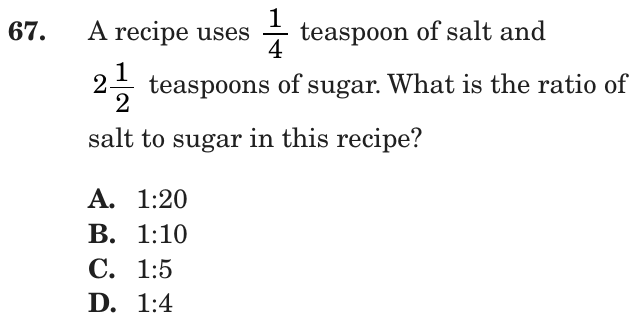
A recipe uses teaspoon of salt and teaspoons of sugar. What is the ratio of salt to sugar in this recipe?
- A
- B
- C
- D
Show the answer
Correct answer: B
Question analysis
A recipe calls for 1/4 teaspoon of salt and 2 1/2 teaspoons of sugar, and students write the ratio of salt to sugar in whole numbers. It tests ratios whose terms are a fraction and a mixed number. Both terms have to be rescaled together, and the mixed number is where slips creep in.
- Grade level
- Grade 7 content, by NYS standard
- Compared with grade 7
- At grade 7 Ratios of fractions are grade 7 content, and this one is routine: convert a single mixed number, then scale both terms up to whole numbers. It asks for no further use of the ratio.
- Estimated difficulty
- Straightforward: two steps or one careful reading.
- Thinking it demands
- Depth of knowledge 2, skills and concepts · mainly apply
- What makes it hard
- Error-prone arithmetic moderate
- An answer in an unexpected form minor
- Solution
- 2 steps
- Reading level
- Question and choices: about grade 6, 27 words.
- Students, last 30 days
- Not enough answers yet to show (it takes 10).
Why it is hard, traps and wrong answers (shows the answer)
Why it is hard
A ratio of a fraction to a mixed number is unfamiliar enough that students reach for shortcuts, and each shortcut has a choice waiting. Pairing numerators after converting, or reading the salt's 1/4 as a ratio by itself, never compares the two amounts properly. Scaling both terms by the same factor, 4, or asking how many quarter teaspoons fit into 2 1/2 teaspoons, keeps the comparison intact.
Error-prone arithmetic moderate Working it out
The sugar is a mixed number, so 2 1/2 must become 5/2, and both terms must then be multiplied by 4, or 5/2 divided by 1/4, without dropping a denominator. (Brown & Burton, 1978; Junker & Sijtsma, 2001)
An answer in an unexpected form minor Choosing the answer
The recipe gives a fraction and a mixed number, but every choice is a whole-number ratio, so 1/4 : 2 1/2 has to be recognized in its scaled form. (Enright, Morley & Sheehan, 2002)
Strategy: Change 2 1/2 to 5/2, then divide the salt amount by the sugar amount; the quotient, written as a fraction with numerator 1, gives the ratio directly.
Traps
- A faulty procedure: A systematic but wrong procedure: adding fractions straight across, applying an exponent to each term of a sum, dropping a sign when moving a term.
- Numbers taken from the question: Combines the numbers in the question without a model of the situation, or is simply a number that appears in the question.
- An arithmetic slip: The right method with a plausible arithmetic error: a digit, a place value or a times-table fact.
The wrong answers, classified
A An arithmetic slip (Junker & Sijtsma, 2001)
Multiplies both terms by 4 but takes 4 × 5/2 as 20, multiplying the numerator and forgetting to divide by the 2.
C A faulty procedure (Brown & Burton, 1978; Tatsuoka, 1983)
Rewrites 2 1/2 as 5/2 and pairs the numerators, 1 : 5, as if 1/4 and 5/2 shared a denominator.
D Numbers taken from the question (Hegarty, Mayer & Monk, 1995)
Reads the 1/4 teaspoon of salt as the ratio 1 : 4 itself, never bringing the 2 1/2 teaspoons of sugar into the comparison.
Worked solution, step by step
Formulas used
- Changing a mixed number to a fraction
- A mixed number is a whole number plus a fraction. Multiply the whole number by the bottom number to count the halves in the wholes. Then add the top number, and keep the same bottom. Two wholes are 4 halves, so 2 and a half is 5 halves.
- Equivalent ratios
- a and b are the two amounts in a ratio, in order. k is any number except 0. Multiplying both amounts by the same number keeps the comparison the same. Use it to turn the fractions in a ratio into whole numbers.
Sort out the question
The recipe uses teaspoon of salt and teaspoons of sugar. A ratio compares two amounts. “Salt to sugar” means salt first, then sugar. Every choice is a ratio of whole numbers. So you need to turn the two amounts into whole numbers that compare the same way.
Change the mixed number to a fraction
A mixed number is hard to work with. Write the sugar as a fraction.
So the ratio of salt to sugar is .
Multiply both parts by 4
Multiply both parts by the same number to clear the fractions. Use 4, because both bottom numbers, 4 and 2, go into 4.
For the sugar, , and then .
Watch out: forgetting to divide by 2 gives 1 : 20, choice A. Pairing the top numbers, 1 : 5, choice C, compares quarters with halves. And 1 : 4, choice D, is only the salt amount. It leaves out the sugar.
So the answer is B, 1 : 10.
Check your answer
Think in quarter teaspoons. The salt is 1 quarter teaspoon. One teaspoon is 4 quarters, so the sugar is quarter teaspoons. That is 1 quarter of salt for every 10 quarters of sugar, or 1 : 10.
More questions like this
The original DOE question