Question
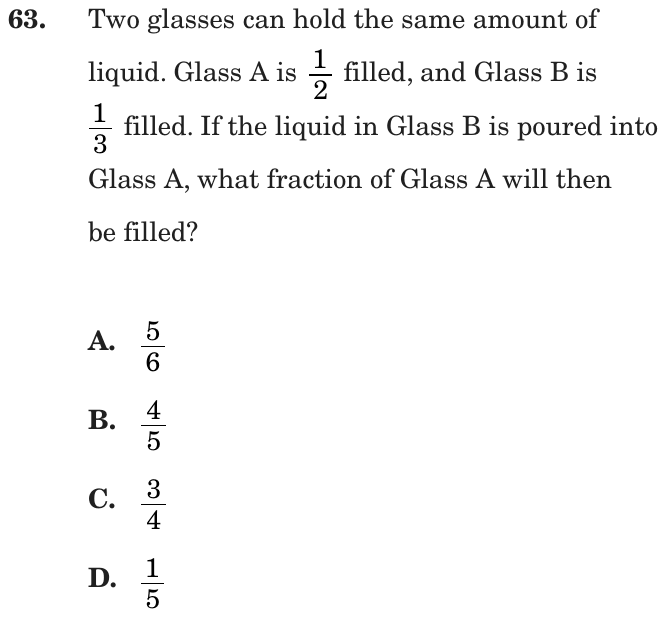
Two glasses can hold the same amount of liquid. Glass A is filled, and Glass B is filled. If the liquid in Glass B is poured into Glass A, what fraction of Glass A will then be filled?
- A
- B
- C
- D
Show the answer
Correct answer: A
Add the fractions to find the answer:
Question analysis
Two glasses of the same size hold liquid: one is half full and the other a third full. When the second is poured into the first, students find what fraction of the first glass is filled. The fraction word problem tests adding fractions with different denominators, and the care lies in finding a common denominator before adding.
- NYS standards
- 7.NS.3 four operations with rational numbers
- Grade level
- Grade 7 content, by NYS standard
- Compared with grade 7
- Below grade 7 Adding two unlike fractions in a word problem is grade 7 rational-number work at its simplest, with halves and thirds. Typical grade 7 problems use mixed numbers, negative values or several steps.
- Estimated difficulty
- Routine: one familiar step, little to misread.
- Thinking it demands
- Depth of knowledge 2, skills and concepts · mainly apply
- What makes it hard
- Error-prone arithmetic minor
- Turning words into math minor
- Solution
- 2 steps
- Reading level
- Question and choices: about grade 3, 44 words.
- Students, last 30 days
- Not enough answers yet to show (it takes 10).
Why it is hard, traps and wrong answers (shows the answer)
Why it is hard
The question is a single sum of unlike fractions dressed as pouring, and halves and thirds are among the friendliest denominators. A quick sense check carries most of the weight: the result must exceed the 1/2 already in Glass A and stay below a full glass. Only one wrong choice comes from a real fraction error, adding the denominators, and it fails that check; the other two match no working.
Error-prone arithmetic minor Working it out
Halves and thirds cannot be added as written; both must become sixths, 3/6 and 2/6, and combining numerators or denominators straight across gives less than the half already in Glass A. (Brown & Burton, 1978; Junker & Sijtsma, 2001)
Turning words into math minor Understanding the question
The opening sentence, that both glasses hold the same amount, is what makes 1/2 and 1/3 fractions of the same whole, so pouring one into the other is a sum. (Hegarty, Mayer & Monk, 1995; Koedinger & Nathan, 2004)
Strategy: Because the two glasses are the same size, both fractions refer to the same whole, so the amount in Glass A is just their sum; check that it stays under one full glass.
Traps
- A faulty procedure: A systematic but wrong procedure: adding fractions straight across, applying an exponent to each term of a sum, dropping a sign when moving a term.
The wrong answers, classified
B Little reason to choose it (Haladyna & Downing, 1993; Rodriguez, 2005)
No sum of 1/2 and 1/3 gives 4/5; it lies between half full and full, so it draws students who estimate rather than add.
C Little reason to choose it (Haladyna & Downing, 1993; Rodriguez, 2005)
Matches no fraction rule: it would need the poured third to count as a quarter, 1/2 + 1/4, and nothing in the stem suggests that, so it mostly catches guesses.
D A faulty procedure (Brown & Burton, 1978; Tatsuoka, 1983)
Adds the denominators, 2 + 3 = 5, and keeps a numerator of 1, so 1/5, less than the half glass Glass A already held.
Worked solution, step by step
Formulas used
- Equivalent fractions
- a is the top number, the numerator. b is the bottom number, the denominator. k is any whole number except 0. Multiplying the top and bottom by the same number gives an equal fraction. The pieces get smaller, but you get more of them.
- Adding fractions with the same denominator
- n is the denominator. It tells how many equal parts make one whole. a and b are the numerators, how many of those parts you have. Parts of the same size can be added, so add the tops and keep the bottom.
Sort out the question
The two glasses can hold the same amount, so they are the same size. Glass A is full. Glass B is full. Glass B is poured into Glass A. You need how full Glass A is then. Both fractions are parts of the same whole, one glass. That means you add them.
Give both fractions the same denominator
The denominator is the bottom number. You can’t add halves and thirds as they are, because the pieces are different sizes. Find a number that 2 and 3 both go into. The smallest is 6, so change both fractions to sixths.
Add the sixths
Now the pieces are the same size. Add the tops and keep the bottom.
Glass A is now five sixths full.
Watch out: don’t add the bottoms. Adding 2 and 3 to get one fifth is choice D. One fifth is less than the half Glass A already had, so it can’t be right.
So the answer is A, .
Check your answer
Estimate. Glass A starts half full. Adding more makes it more than half full. A third is less than a half, so the total is less than two halves, one full glass. Five sixths is more than one half and less than 1, so it fits.
More questions like this
The original DOE question