Also in 2025 Practice Test B Math, question 26.
Question
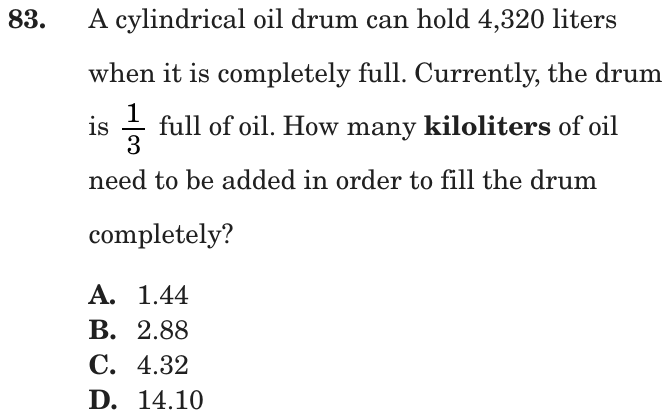
A cylindrical oil drum can hold 4,320 liters when it is completely full. Currently, the drum is full of oil. How many kiloliters of oil need to be added in order to fill the drum completely?
- A1.44
- B2.88
- C4.32
- D14.10
Show the answer
Correct answer: B
Find the number of liters that need to be added. Since of the oil drum is full, of the drum remains empty:
Use the conversion 1 kL = 1,000 L to find the number of kL:
Question analysis
This fractions and unit conversion problem describes a cylindrical oil drum that holds 4,320 liters when full and is now one third full, and asks how many kiloliters must be added to fill it. Students find the empty fraction, multiply and convert liters to kiloliters. Answering for the right part of the drum, in the right unit, is the challenge.
- Grade level
- Grade 7 content, by NYS standard
- Compared with grade 7
- At grade 7 Taking a fraction of a quantity and converting metric units are both familiar from grades 5 and 6. Together they make a three-step problem at about the level of routine grade 7 work.
- Estimated difficulty
- Moderate: several steps, or a close reading with one strong distractor.
- Thinking it demands
- Depth of knowledge 2, skills and concepts · mainly apply
- What makes it hard
- Turning words into math moderate
- Something you must already know minor
- Solution
- 3 steps
- Reading level
- Question and choices: about grade 7, 36 words.
- Students, last 30 days
- Not enough answers yet to show (it takes 10).
Why it is hard, traps and wrong answers (shows the answer)
Why it is hard
The arithmetic is short, but the question describes the drum one way and asks about it another. Students who multiply by the fraction they are given find the oil already in the drum, and that result, converted to kiloliters, is a choice. Since no choice is in liters, students who forget to convert are warned before they answer.
Turning words into math moderate Understanding the question
The stem gives how full the drum is, 1/3, but asks how much must be added, so students must switch to the empty 2/3 before multiplying by 4,320. (Hegarty, Mayer & Monk, 1995; Koedinger & Nathan, 2004)
Something you must already know minor Working it out
The bold word “kiloliters” calls for the conversion 1 kiloliter = 1,000 liters, which the question does not give. (Anderson & Krathwohl, 2001)
Strategy: Work out what fraction of the drum is still empty, take that fraction of 4,320 liters, and divide by 1,000 to change liters to kiloliters.
Traps
- Answers a different question: A choice is right for another quantity: the other unknown, the rest instead of the part, the part instead of the whole.
The wrong answers, classified
A Answers a different question (King et al., 2004; Hegarty, Mayer & Monk, 1995)
Multiplies 4,320 by the given 1/3, finding the oil already in the drum instead of the amount still needed.
C Answers a different question (King et al., 2004; Hegarty, Mayer & Monk, 1995)
Converts the full capacity of 4,320 liters to kiloliters without taking away the third of the drum that is already full.
D Little reason to choose it (Haladyna & Downing, 1993; Rodriguez, 2005)
No conversion of 1,440, 2,880 or 4,320 liters gives 14.10; it is over three times the full drum's capacity, so only guessers choose it.
Worked solution, step by step
Formulas used
- Fraction of an amount
- n is the whole amount, here the full drum. The fraction a over b tells what share of it you want. Multiply to find that share. For example, 2/3 of 9 is 6.
- Liters to kiloliters
- Kilo means 1,000, so 1 kiloliter holds 1,000 liters. To change liters into kiloliters, divide by 1,000. That moves the decimal point 3 places to the left.
Sort out the question
The full drum holds 4,320 liters. It is now full. You need how much oil to add to fill it.
The answer must be in kiloliters, not liters.
Find the empty fraction
The drum is full. The rest is empty, and that is the part you must fill.
Watch out: of 4,320 is 1,440 liters. That is the oil already in the drum. It leads to choice A.
Find the liters to add
Take two thirds of the full drum.
One third of 4,320 is 1,440, and two thirds is double that. You need to add 2,880 liters.
Change liters to kiloliters
You need 2.88 kiloliters.
Watch out: 4.32 is the whole drum in kiloliters. Choice C forgets that part of the drum is already full.
So the answer is B, 2.88.
Check your answer
Add the oil already in the drum to the oil you add: kiloliters. That is 4,320 liters, the full drum. It checks out.
More questions like this
The original DOE question