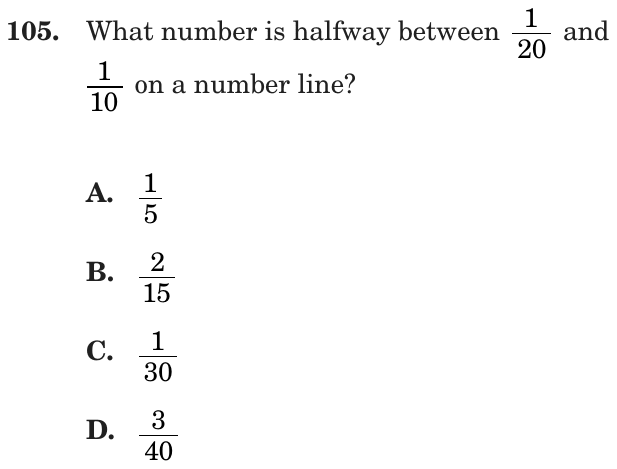
Question
What number is halfway between and on a number line?
- A
- B
- C
- D
Show the answer
Correct answer: D
First, subtract the two fractions:
Then, divide the difference by 2 to find half the distance between the two fractions:
Finally, add the distance to the first point to find the halfway point:
Question analysis
This number line question asks for the number exactly halfway between the fractions 1/20 and 1/10. It tests finding the midpoint of two rational numbers when their denominators differ. Both fractions are small and close together, so a slip in combining them is easy to make.
- Grade level
- Grade 7 content, by NYS standard
- Compared with grade 7
- At grade 7 Locating a point between two rational numbers on a number line is grade 6 and 7 work. Here the endpoints are small fractions with related denominators, so once they share a denominator the task is quick, matching typical grade 7 practice.
- Estimated difficulty
- Straightforward: two steps or one careful reading.
- Thinking it demands
- Depth of knowledge 1, recall and reproduction · mainly apply
- What makes it hard
- Solution
- 3 steps
- Reading level
- Question and choices: about grade 9, 16 words.
- Students, last 30 days
- Not enough answers yet to show (it takes 10).
Why it is hard, traps and wrong answers (shows the answer)
Why it is hard
The method is short once the midpoint is seen as an average, but small fractions with different denominators invite the straight-across habit. Adding numerators and denominators separately gives 2/30, and halving that either way lands on a listed choice outside the two endpoints. Checking that the answer sits between 0.05 and 0.1, which 0.075 does, rules out every wrong choice.
Error-prone arithmetic minor Working it out
The fractions 1/20 and 1/10 have different denominators, so 1/10 must become 2/20 before adding, and halving 3/20 then needs a denominator of 40. (Brown & Burton, 1978; Junker & Sijtsma, 2001)
Something you must already know minor Working it out
The stem does not say that the point halfway between two numbers is their mean; students must bring that, or the idea of adding half the gap to the smaller number. (Anderson & Krathwohl, 2001)
Strategy: Find the average of the two fractions: rewrite them with a common denominator, add them, and divide the sum by 2.
Traps
- A faulty procedure: A systematic but wrong procedure: adding fractions straight across, applying an exponent to each term of a sum, dropping a sign when moving a term.
The wrong answers, classified
A Little reason to choose it (Haladyna & Downing, 1993; Rodriguez, 2005)
No midpoint working gives 1/5, which lies beyond 1/10 and so outside the two endpoints; it only continues the doubling from 1/20 to 1/10.
B A faulty procedure (Brown & Burton, 1978; Tatsuoka, 1983)
Adds straight across, 1/20 + 1/10 = 2/30, then halves the denominator instead of the fraction, which doubles the value to 2/15.
C A faulty procedure (Brown & Burton, 1978; Tatsuoka, 1983)
Knows to average but adds straight across first, 1/20 + 1/10 = 2/30, so half of that sum is 1/30, smaller than both endpoints.
Worked solution, step by step
Formulas used
- Equivalent fractions
- a is the top number and b is the bottom number, the denominator. k is any whole number except 0. Multiplying the top and bottom by the same number gives an equal fraction. Use it to give two fractions the same denominator so you can add them.
- Midpoint on a number line
- a and b are the numbers at the two ends. The midpoint is the number exactly halfway between them. Adding the ends and dividing by 2 finds their mean, or average, which sits in the middle.
Sort out the question
You need the number exactly halfway between and on a number line. That number is the midpoint. It is the same distance from both ends. Notice that one tenth is the bigger number, because tenths are bigger pieces than twentieths.
Give both fractions the same denominator
The denominator is the bottom number. To add fractions, they need the same one. 20 is a multiple of 10, so use 20.
Now the two ends are and .
Average the two ends
Use the midpoint formula. First add the ends. Then divide by 2.
Dividing by 2 is the same as multiplying by . Multiply the tops and the bottoms.
Watch out: don’t add straight across, top plus top and bottom plus bottom. That gives . Halving it gives , choice C, which is less than both ends. Halving only the bottom gives , choice B, which is past both ends. Choice A, , is also past one tenth.
So the answer is D, .
Check your answer
Write both ends in fortieths: and . Halfway between 2 and 4 is 3, so halfway between the ends is three fortieths. As decimals, 0.075 sits right between 0.05 and 0.1.
More questions like this
The original DOE question