Question
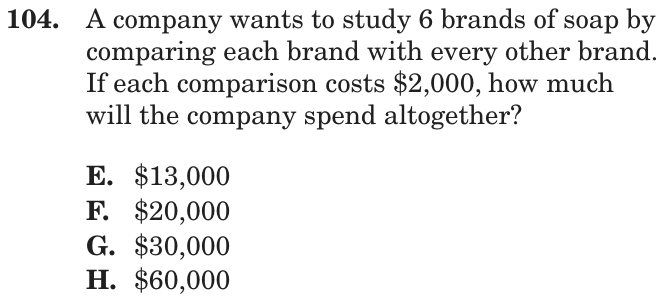
A company wants to study 6 brands of soap by comparing each brand with every other brand. If each comparison costs $2,000, how much will the company spend altogether?
- A$13,000
- B$20,000
- C$30,000
- D$60,000
Show the answer
Correct answer: C
First, find the number of comparisons. Let A, B, C, D, E, and F represent the 6 brands of soap. Then the comparisons are AB, AC, AD, AE, AF, BC, BD, BE, BF, CD, CE, CF, DE, DF, and EF. So, there are 15 comparisons. Multiply to find the total cost:
Question analysis
A company will compare each of 6 soap brands with every other brand, at $2,000 per comparison, and students find the total cost. This counting question tests listing combinations of two and then using the count. With six brands, the list is long enough that a pair is easily missed or counted twice.
- NYS standards
- 7.SP.8b sample spaces for compound events
- Grade level
- Grade 7 content, by NYS standard
- Compared with grade 7
- At grade 7 Grade 7 students count outcomes with organized lists. Counting every pair among six brands is that skill, with the extra demand that each pair be counted once whichever brand comes first, followed by one multiplication.
- Estimated difficulty
- Moderate: several steps, or a close reading with one strong distractor.
- Thinking it demands
- Depth of knowledge 2, skills and concepts · mainly apply
- What makes it hard
- Turning words into math moderate
- Much to keep track of minor
- Solution
- 3 steps
- Reading level
- Question and choices: about grade 9, 27 words.
- Students, last 30 days
- Not enough answers yet to show (it takes 10).
Why it is hard, traps and wrong answers (shows the answer)
Why it is hard
The cost step is trivial, so the question is about counting comparisons. The multiplication 6 × 5 feels natural but counts every pair twice, and a listing that starts one short, with 4 partners for the first brand, gives the count for five brands. Halving 6 × 5, or adding 5 + 4 + 3 + 2 + 1, gives 15 comparisons, and multiplying by $2,000 is the last, easy step.
Turning words into math moderate Understanding the question
“Comparing each brand with every other brand” counts each pair once, since comparing A with B is the same study as comparing B with A, so the count is half of 6 × 5. (Hegarty, Mayer & Monk, 1995; Koedinger & Nathan, 2004)
Much to keep track of minor Working it out
A systematic list, the first brand with 5 others, the second with 4 new ones, and so on, has to be kept going to 5 + 4 + 3 + 2 + 1 without losing a row. (Sweller, 1988; Carpenter, Just & Shell, 1990)
Strategy: Count the pairs systematically: the first brand pairs with each of the other five, the second with each of the four after it, and so on; then multiply by $2,000.
Traps
- Overlapping groups: Things in two groups at once are counted twice, or not subtracted.
- Counting the ends: Inclusive or exclusive ends, fence posts, consecutive numbers: an answer that is one too many or too few, or an endpoint drawn open where it belongs closed (or the reverse).
The wrong answers, classified
A Little reason to choose it (Haladyna & Downing, 1993; Rodriguez, 2005)
No count of comparisons gives $13,000, which would mean six and a half studies; it matches no listing of the brands and mostly catches guesses.
B Counting the ends (Brown & Burton, 1978)
Lists the pairs as 4 + 3 + 2 + 1 = 10, starting one partner short for the first brand, which counts the pairs among five brands instead of six.
D Overlapping groups (King et al., 2004)
Counts 6 × 5 = 30 ordered comparisons, treating a brand against another and the same pair in reverse as two separate studies.
Worked solution, step by step
Formulas used
- Number of pairs in a group
- n is the number of things in the group, here soap brands. Each one can be paired with the n − 1 others. Multiplying counts every pair twice, once from each side, so you divide by 2.
- Total cost
- When every item costs the same, multiply how many items there are by the cost of one. Here every comparison costs the same amount, $2,000.
Sort out the question
There are 6 brands of soap. Each brand is compared with every other brand, one pair at a time. Each comparison costs $2,000. You need the total cost, so first count the comparisons. Comparing brand A with brand B is the same study as comparing B with A. It counts once.
List the pairs in order
Call the brands A, B, C, D, E and F. Pair A with each brand after it. Then do the same for B, and so on. Never pair a brand with one before it, so no pair is counted twice.
Brand New pairs Count A AB, AC, AD, AE, AF 5 B BC, BD, BE, BF 4 C CD, CE, CF 3 D DE, DF 2 E EF 1 Count the comparisons
Add the counts.
There are 15 comparisons. The pairs formula agrees. Each of the 6 brands pairs with 5 others, but that counts each pair twice.
Watch out: counts AB and BA as two comparisons. That leads to $60,000, choice D. Giving brand A only 4 partners counts 10 pairs, which leads to $20,000, choice B.
Find the total cost
Each of the 15 comparisons costs $2,000.
The company will spend $30,000. So the answer is C, $30,000.
Check your answer
Test the counting on a group small enough to picture. With 3 brands, the pairs are AB, AC and BC, which is 3 pairs. The formula gives . It works. Also, , the number of comparisons.
More questions like this
The original DOE question