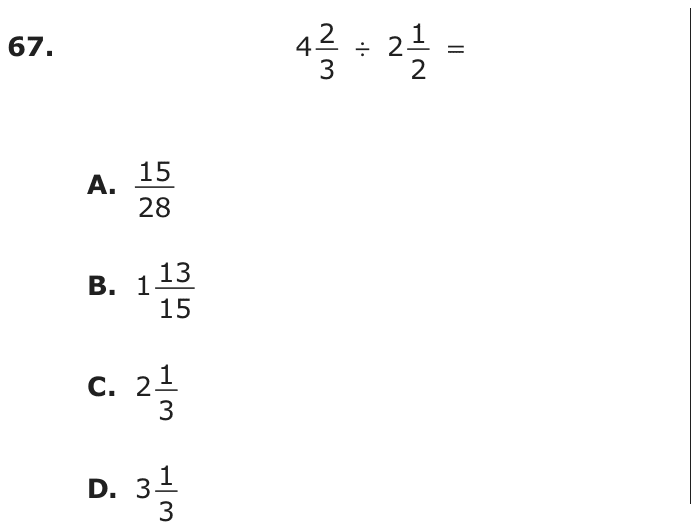
Question
- A
- B
- C
- D
Show the answer
Correct answer: B
Question analysis
A fractions question asks for 4 2/3 divided by 2 1/2, with mixed numbers on both sides of the division sign. Students convert to improper fractions, multiply by the reciprocal and simplify. Mixed numbers invite shortcuts, so every step has to follow the rule for dividing fractions.
- NYS standards
- 6.NS.1 dividing fractions by fractions
- Grade level
- Grade 6 content, by NYS standard
- Compared with grade 7
- Below grade 7 Dividing fractions is a grade 6 standard, and this is one division with small mixed numbers. Grade 7 work usually adds negative numbers or a word problem around it, so this sits below grade 7.
- Estimated difficulty
- Straightforward: two steps or one careful reading.
- Thinking it demands
- Depth of knowledge 1, recall and reproduction · mainly apply
- What makes it hard
- Error-prone arithmetic moderate
- An answer in an unexpected form minor
- Solution
- 3 steps
- Reading level
- Question and choices: about grade 16+, 5 words.
- Students, last 30 days
- Not enough answers yet to show (it takes 10).
Why it is hard, traps and wrong answers (shows the answer)
Why it is hard
Dividing mixed numbers has a fixed procedure, and every wrong choice is a shortcut that skips part of it. Estimating first helps: 4 2/3 is a little less than twice 2 1/2, so the quotient is a little under 2, which already rules out 15/28 and 3 1/3. The remaining near miss, 2 1/3, comes from dividing by the whole number 2 alone.
Error-prone arithmetic moderate Working it out
Both mixed numbers must become improper fractions, 14/3 and 5/2, before the second is flipped, and 14/3 × 2/5 = 28/15 leaves an improper fraction to deal with. (Brown & Burton, 1978; Junker & Sijtsma, 2001)
An answer in an unexpected form minor Choosing the answer
The choices are written as mixed numbers and one proper fraction, so 28/15 has to be converted to a mixed number before it can be matched. (Enright, Morley & Sheehan, 2002)
Strategy: Rewrite both mixed numbers as improper fractions, multiply the first by the reciprocal of the second, then simplify and turn the improper fraction back into a mixed number.
Traps
- A faulty procedure: A systematic but wrong procedure: adding fractions straight across, applying an exponent to each term of a sum, dropping a sign when moving a term.
The wrong answers, classified
A A faulty procedure (Brown & Burton, 1978; Tatsuoka, 1983)
Flips the first fraction instead of the second, computing 3/14 × 5/2 = 15/28, which is 2 1/2 divided by 4 2/3.
C A faulty procedure (Brown & Burton, 1978; Tatsuoka, 1983)
Divides 4 2/3 by the whole number 2 and drops the 1/2 of the divisor, so 14/3 ÷ 2 = 7/3, or 2 1/3.
D A faulty procedure (Brown & Burton, 1978; Tatsuoka, 1983)
Divides the whole parts and the fraction parts separately, 4 ÷ 2 = 2 and 2/3 ÷ 1/2 = 4/3, then adds them to get 3 1/3.
Worked solution, step by step
Formulas used
- Mixed number to fraction
- a is the whole number, and b over c is the fraction part. Multiply the whole number by c to turn the wholes into pieces. Then add the b extra pieces. The bottom number stays c.
- Dividing fractions
- a over b is the number you divide. c over d is the number you divide by. To divide by a fraction, multiply by its reciprocal, the fraction flipped upside down. Only the second fraction flips.
Sort out the problem
You need to divide by . Both are mixed numbers, a whole number and a fraction together. Mixed numbers are hard to divide as they are. So first change each one into an improper fraction. That is a fraction whose top is bigger than its bottom.
Change the mixed numbers
Watch out: do not divide the whole parts and the fraction parts on their own. Doing and , then adding, gives , choice D.Flip the second fraction and multiply
Multiply the tops, , and the bottoms, . Watch out: flip only the second fraction. Flipping the first one gives , choice A.
Change back to a mixed number
The choices are mixed numbers, so change 28/15 back. 15 goes into 28 one time, with 13 left over.
Watch out: dividing by just 2 and dropping the one half gives , choice C.So the answer is B, .
Check your answer
Estimate. is about 4.7, and is 2.5. Two groups of 2.5 make 5, so the answer is a bit less than 2. is about 1.9, which fits. Or multiply back: .
More questions like this
The original DOE question