Question
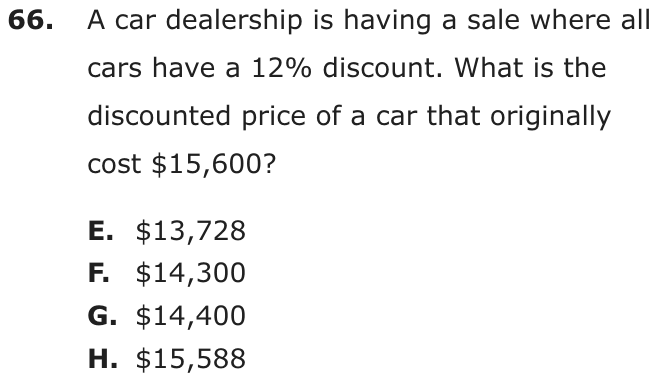
A car dealership is having a sale where all cars have a 12% discount. What is the discounted price of a car that originally cost $15,600?
- A$13,728
- B$14,300
- C$14,400
- D$15,588
Show the answer
Correct answer: A
Question analysis
A percent word problem about a car sale: every car is 12% off, and one car originally cost $15,600. Students find the sale price of that car. The discount has to be worked out as a dollar amount and then taken off, with care over the decimal point in 12%.
- Grade level
- Grade 7 content, by NYS standard
- Compared with grade 7
- At grade 7 Discounts are one of the percent applications in grade 7, and this is a routine two-step example with whole-dollar amounts. It matches typical grade 7 work, with no reverse percent or second change.
- Estimated difficulty
- Routine: one familiar step, little to misread.
- Thinking it demands
- Depth of knowledge 2, skills and concepts · mainly apply
- What makes it hard
- Error-prone arithmetic minor
- Turning words into math minor
- Solution
- 2 steps
- Reading level
- Question and choices: about grade 6, 24 words.
- Students, last 30 days
- Not enough answers yet to show (it takes 10).
Why it is hard, traps and wrong answers (shows the answer)
Why it is hard
This is a standard two-step discount, and a quick estimate does most of the work: 10% of $15,600 is $1,560, so 12% is a little under $1,900, and only one choice sits about that far below the price. The wrong choices take off $1,300, $1,200 or just $12, so the question mainly catches students unsure what 12% of a price means.
Error-prone arithmetic minor Working it out
Finding 12% of $15,600 by hand, 0.12 × 15,600 = 1,872, means placing a decimal point in a product of large numbers. (Brown & Burton, 1978; Junker & Sijtsma, 2001)
Turning words into math minor Understanding the question
The phrase “discounted price” asks for what the buyer pays, so the $1,872 discount has to be taken off the price rather than reported. (Hegarty, Mayer & Monk, 1995; Koedinger & Nathan, 2004)
Strategy: Write 12% as 0.12 and multiply by the original price to get the discount, then subtract it; or multiply the price by 0.88 in one step.
Traps
- Misunderstands the concept: A wrong belief about a concept: that percents can be added, that area grows like length, that averages can be averaged, that a bigger denominator means a bigger fraction.
The wrong answers, classified
B Misunderstands the concept (Smith, diSessa & Roschelle, 1993; De Bock et al., 1998; Ni & Zhou, 2005)
Divides the price by 12, as if 12% meant one twelfth, and subtracts the $1,300 that gives instead of $1,872.
C Little reason to choose it (Haladyna & Downing, 1993; Rodriguez, 2005)
No common working gives $14,400; the $1,200 it takes off is 12% of $10,000, not of $15,600, so it mostly catches guesses.
D Misunderstands the concept (Smith, diSessa & Roschelle, 1993; De Bock et al., 1998; Ni & Zhou, 2005)
Subtracts $12 from the price, treating the 12 in 12% as a number of dollars instead of 12 hundredths of the price.
Worked solution, step by step
Formulas used
- Percent of a number
- W is the whole amount, here the first price. p is the percent, and x is the part you want. Percent means out of 100, so p percent is the fraction p over 100. Multiplying the whole by that fraction gives the part.
- Sale price
- The first price is what the car cost before the sale. The discount is the amount taken off. The sale price is what the buyer pays, so you subtract.
Sort out the question
The car first cost $15,600. A discount is an amount taken off the price. Here it is 12% of the price. You need the discounted price, the amount the buyer pays after the discount.
Find 12% of the price
Break it into easy parts. 10% is . 1% is , so 2% is .
The discount is $1,872. Watch out: 12% does not mean $12. Taking off $12 gives $15,588, choice D.
Take the discount off
The buyer pays $13,728. Watch out: 12% is not one twelfth. Dividing by 12 takes off only $1,300 and gives $14,300, choice B.
So the answer is A, $13,728.
Check your answer
After a 12% discount, the buyer pays 88% of the price, because . Then . That matches. Also, $13,728 is less than $15,600, as a sale price should be.
More questions like this
The original DOE question