Question
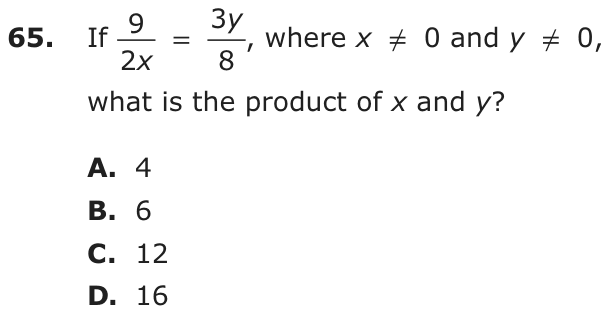
If , where and , what is the product of x and y?
- A4
- B6
- C12
- D16
Show the answer
Correct answer: C
Question analysis
An algebra question gives a proportion with x in one denominator and y in one numerator, 9 over 2x equal to 3y over 8, and asks for the product of x and y. Neither variable can be found on its own, so students must clear the fractions and treat the product as a single quantity.
- Grade level
- Grade 8 content, by NYS standard
- Compared with grade 7
- Above grade 7 Grade 7 students cross-multiply numeric proportions to find one unknown. Here two variables sit in the proportion and the question wants their product, a literal-equation idea from grade 8 that many grade 7 students have not met.
- Estimated difficulty
- Moderate: several steps, or a close reading with one strong distractor.
- Thinking it demands
- Depth of knowledge 2, skills and concepts · mainly apply
- What makes it hard
- No obvious method moderate
- Variables instead of numbers minor
- Solution
- 3 steps
- Reading level
- Question and choices: about grade 8, 14 words.
- Students, last 30 days
- Not enough answers yet to show (it takes 10).
Why it is hard, traps and wrong answers (shows the answer)
Why it is hard
The question looks harder than it is, because it asks for a product rather than for x or y. Cross-multiplying turns the proportion into 72 = 6xy, and dividing by 6 finishes it, so the only real hurdle is trusting that xy can be solved for as one quantity. The wrong choices come from grabbing numbers along the way, not from a nearly complete solution.
No obvious method moderate Working it out
Neither x nor y can be found alone, so students must see that cross-multiplying gives 72 = 6xy, where the product xy appears as one block to solve for. (Schoenfeld, 1985)
Variables instead of numbers minor Understanding the question
Both unknowns stay letters and only their product is asked for, so there is no value of x or y to check a result against. (Koedinger & Nathan, 2004; Enright, Morley & Sheehan, 2002)
Strategy: Cross-multiply to clear both fractions, collect the numbers on one side and x and y together on the other, then divide so that only the product is left.
Traps
- Numbers taken from the question: Combines the numbers in the question without a model of the situation, or is simply a number that appears in the question.
- Answers a different question: A choice is right for another quantity: the other unknown, the rest instead of the part, the part instead of the whole.
The wrong answers, classified
A Answers a different question (King et al., 2004; Hegarty, Mayer & Monk, 1995)
Matches the denominators, 2x = 8, to get x = 4 and gives the value of x instead of the product of x and y.
B Numbers taken from the question (Hegarty, Mayer & Monk, 1995)
Takes the 6 in 72 = 6xy, the product of the coefficients 2 and 3, as the answer without dividing 72 by it.
D Numbers taken from the question (Hegarty, Mayer & Monk, 1995)
Multiplies the 2 and the 8 from the two denominators, combining numbers in the equation instead of cross-multiplying.
Worked solution, step by step
Formulas used
- Cross-multiplying
- a, b, c and d are numbers or letters, and b and d are not zero. When two fractions are equal, multiply each top by the other bottom. The two products are equal. It works because it is the same as multiplying both sides by b and by d.
Sort out the question
The equation says that two fractions are equal:
Here 2x means 2 times x, and 3y means 3 times y. You need the product of x and y. A product is the answer to a multiplication. So you need , written xy. You do not need x or y alone.
Cross-multiply the fractions
An equation without fractions is easier to work with. So cross-multiply.
Watch out: do not just set the bottoms equal. Writing 2x = 8 gives x = 4, choice A. That is x, not the product.Multiply out both sides
On the left, . On the right, multiply the numbers and keep the letters together.
So the equation is now:
The xy is the product you want, all in one piece.
Divide both sides by 6
xy is being multiplied by 6. To undo that, divide both sides by 6.
Watch out: 6 is just the number in front of xy. Choosing it gives B.So the answer is C, 12.
Check your answer
Pick x = 4. Then y must be 3, so that xy = 12. Left side: . Right side: . The two sides match, so a product of 12 works.
More questions like this
The original DOE question