Question
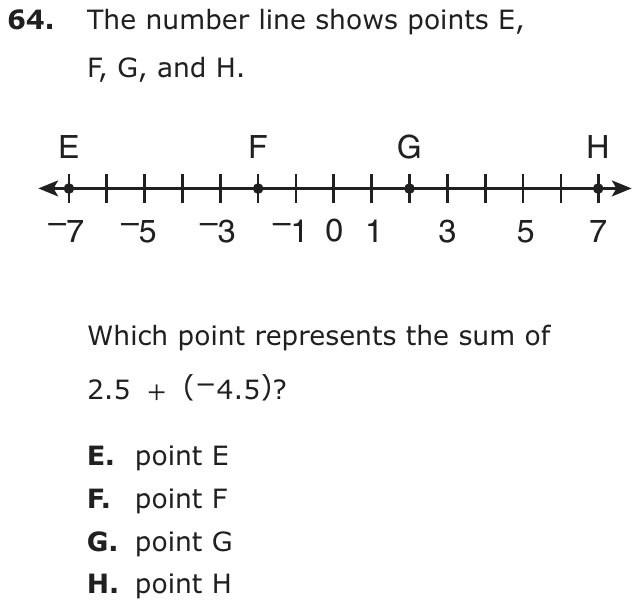
The number line shows points E, F, G, and H.
Which point represents the sum of ?
- Apoint E
- Bpoint F
- Cpoint G
- Dpoint H
Show the answer
Correct answer: B
Find the sum of :
Point F is located at −2.
Question analysis
A number line question with points E, F, G and H marked on a line labeled from −7 to 7. Students add 2.5 and negative 4.5 and find which point shows the sum. It tests adding a positive and a negative decimal, then reading positions on a line whose labels skip some integers.
- Grade level
- Grade 7 content, by NYS standard
- Compared with grade 7
- At grade 7 Adding rational numbers with different signs and showing the sum on a number line is exactly the grade 7 standard. This is one routine sum with simple decimals, a typical classroom exercise.
- Estimated difficulty
- Routine: one familiar step, little to misread.
- Thinking it demands
- Depth of knowledge 1, recall and reproduction · mainly apply
- What makes it hard
- Solution
- 2 steps
- Reading level
- Question and choices: about grade 1, 25 words.
- Students, last 30 days
- Not enough answers yet to show (it takes 10).
Why it is hard, traps and wrong answers (shows the answer)
Why it is hard
This is a one-line sum followed by a lookup, and most students finish quickly. The four points are placed so that each common sign mistake lands on one of them: −7, 2 and 7 all come from mishandling the negative. Picturing the sum as a move of 4.5 units to the left from 2.5 shows both the size and the direction at once.
Error-prone arithmetic minor Working it out
Adding −4.5 to 2.5 means taking 4.5 away from 2.5, and the larger size of −4.5 makes the sum negative, a sign rule that is easy to apply backwards. (Brown & Burton, 1978; Junker & Sijtsma, 2001)
Reading a figure, table or graph minor Understanding the question
Only 0 and the odd numbers are labeled, so point F sits at an unlabeled tick between −3 and −1 and must be found by counting. (Lesh, Post & Behr, 1987; Kirsch & Mosenthal, 1990)
Strategy: Rewrite adding −4.5 as subtracting 4.5, work out the sum, then find it on the line by counting tick marks from a labeled number, one tick per integer.
Traps
- Negatives and direction: Arithmetic with negative numbers, the order of a subtraction, or direction on a number line. (Moving a term across the equals sign without changing its sign is a faulty procedure.)
The wrong answers, classified
A Negatives and direction (Brown & Burton, 1978)
Adds the sizes 2.5 and 4.5 and makes the total negative, treating both numbers as negative, which lands on −7 at point E.
C Negatives and direction (Brown & Burton, 1978)
Subtracts 2.5 from 4.5 to get the right size, 2, but keeps it positive, missing that the negative number has the larger size.
D Negatives and direction (Brown & Burton, 1978)
Ignores the negative sign on 4.5 and adds the two numbers, 2.5 + 4.5 = 7, landing on point H at the far right.
Worked solution, step by step
Formulas used
- Adding a negative number
- a is any number, and −b is a negative number. Adding a negative number is the same as subtracting its size. On a number line, it means moving b steps to the left.
Sort out the question
You need to find . Then find that sum (the answer to the addition) on the number line.
The number line has a tick at every whole number from −7 to 7. Only 0 and the odd numbers have labels.
Turn the addition into subtraction
You are taking 4.5 away from 2.5. You take away more than you have, so the answer will be negative.
Do the subtraction
The two sizes differ by 2, because . The larger size, 4.5, belongs to the negative number. So the sum is negative.
Watch out: the answer is −2, not 2. Point G is at 2.Find −2 on the line
−2 has no label. It is the tick between −3 and −1. Point F sits on that tick.
Watch out: adding 2.5 + 4.5 = 7 lands on point H. Making both numbers negative gives −7, point E.So the answer is B, point F.
Check your answer
Start at 2.5 on the number line and move 4.5 steps to the left. The first 2.5 steps take you to 0. You still have 2 steps to go. Two more steps left of 0 lands on −2, which is point F.
More questions like this
The original DOE question