Also in 2026 Practice Test B Math, question 21; 2025 Practice Test B Math, question 23.
Question
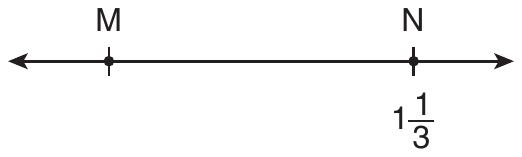
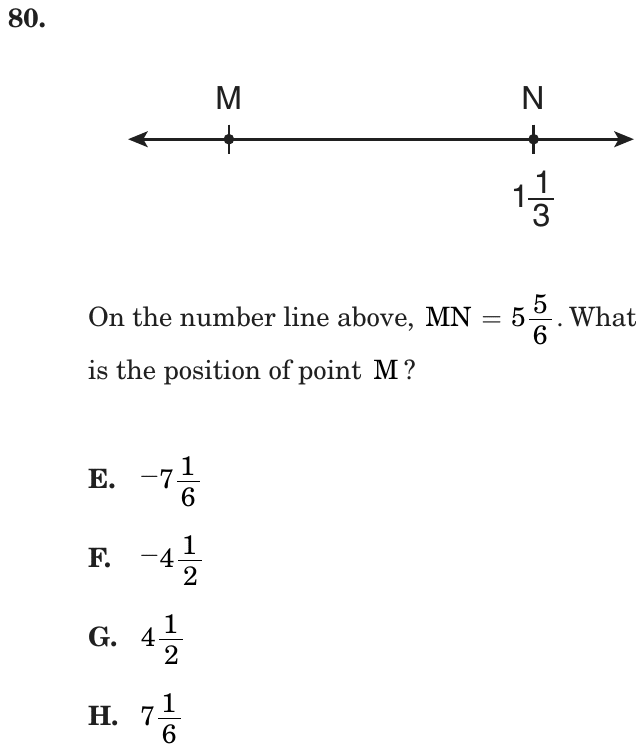
On the number line above, . What is the position of point ?
- A
- B
- C
- D
Show the answer
Correct answer: B
To find , subtract and set it equal to the length:
Question analysis
This number line question gives the distance between points M and N as a mixed number and asks for the position of M. Students subtract fractions with unlike denominators, moving past zero into negative numbers. Direction along the line and the sign of the result are where it gets tricky.
- Grade level
- Grade 7 content, by NYS standard
- Compared with grade 7
- At grade 7 Grade 7 students find distances on a number line as the absolute value of a difference. Doing it with mixed numbers that have unlike denominators, and crossing zero, is a typical and slightly demanding grade 7 task.
- Estimated difficulty
- Moderate: several steps, or a close reading with one strong distractor.
- Thinking it demands
- Depth of knowledge 2, skills and concepts · mainly apply
- What makes it hard
- Reading a figure, table or graph moderate
- Error-prone arithmetic moderate
- A very close wrong answer moderate
- Solution
- 3 steps
- Reading level
- Question and choices: about grade 8, 17 words.
- Students, last 30 days
- Not enough answers yet to show (it takes 10).
Why it is hard, traps and wrong answers (shows the answer)
Why it is hard
The distance is given and one endpoint is known, so the question is really about direction and sign. Because the drawing shows no zero, students must reason that moving 5 5/6 to the left from 1 1/3 carries M past zero. The choices pair each size with each sign, so getting the size right is only half the work; the sign decides between two choices.
Reading a figure, table or graph moderate Understanding the question
The number line labels only N, at 1 1/3, and shows no zero, so students must see from the picture that M lies left of N and work out whether it passes zero. (Lesh, Post & Behr, 1987; Kirsch & Mosenthal, 1990)
Error-prone arithmetic moderate Working it out
The subtraction 1 1/3 − 5 5/6 mixes unlike denominators and crosses zero: in sixths it is 8/6 − 35/6 = −27/6, which then reduces to a mixed number. (Brown & Burton, 1978; Junker & Sijtsma, 2001)
A very close wrong answer moderate Choosing the answer
4 1/2 and −4 1/2 are written the same except for the sign; only noticing that M lies left of N, so below 1 1/3, separates them. (Embretson & Wetzel, 1987; Gorin & Embretson, 2006; Ascalon et al., 2007)
Strategy: Read N's coordinate from the number line, convert everything to sixths, and move the given distance from N toward M's side of the line.
Traps
- Negatives and direction: Arithmetic with negative numbers, the order of a subtraction, or direction on a number line. (Moving a term across the equals sign without changing its sign is a faulty procedure.)
The wrong answers, classified
A Negatives and direction (Brown & Burton, 1978)
Adds the length to N's coordinate, 1 1/3 + 5 5/6 = 7 1/6, and makes it negative because M is on the left.
C Negatives and direction (Brown & Burton, 1978)
Computes 5 5/6 − 1 1/3, the right size, but keeps it positive, which would put M to the right of N.
D Numbers taken from the question (Hegarty, Mayer & Monk, 1995)
Adds the two numbers in the question, 1 1/3 + 5 5/6, placing M to the right of N against the figure.
Worked solution, step by step
Formulas used
- Distance on a number line
- On a number line, numbers grow as you move right. The distance between two points is the larger number minus the smaller one. That is the right point minus the left point, so a distance is never negative.
- Mixed number to fraction
- a is the whole number part, b is the top of the fraction, and c is the bottom. Each whole holds c pieces, so a wholes hold a times c pieces. Then add the b extra pieces.
Read the number line
Point N is at . Point M is to the left of N. MN means the distance from M to N, and it is .
You need the number at point M.
Decide which way to move
On a number line, numbers get smaller as you move left. M is left of N, so N is the right point.
So M is what you get when you take the distance away from N.
The distance is bigger than , so you will pass 0. M will be negative.
Change both numbers to sixths
To subtract, the fractions need the same bottom number. Use sixths, since 3 goes into 6. Change each mixed number to an improper fraction, a fraction whose top is bigger than its bottom.
Subtract and simplify
27 sixths is 4 wholes (24 sixths) and 3 sixths more. And . So M is .
Watch out: without the minus sign is choice C. That point would be to the right of N, not the left.
So the answer is B, .
Check your answer
Find the distance from your M to N. From to 0 is , or . From 0 to N is . Together, . That matches MN.
More questions like this
The original DOE question