Also in 2026 Practice Test B Math, question 20; 2025 Practice Test B Math, question 22.
Question
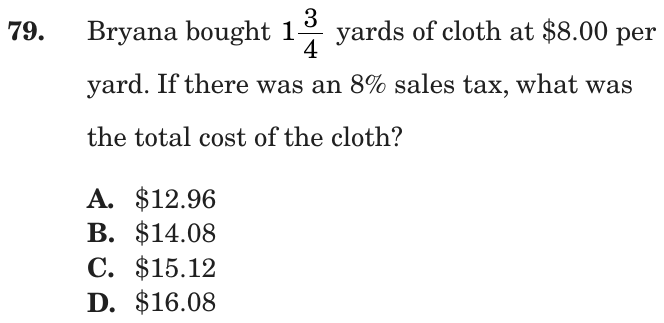
Bryana bought yards of cloth at $8.00 per yard. If there was an 8% sales tax, what was the total cost of the cloth?
- A$12.96
- B$14.08
- C$15.12
- D$16.08
Show the answer
Correct answer: C
Calculate the cost of the cloth before tax:
Now find the tax for $14 worth of cloth:
Finally, add the cost of the fabric and the tax:
$14 + $1.12 = $15.12
Question analysis
This percent word problem has Bryana buy 1 3/4 yards of cloth at $8.00 a yard and pay 8% sales tax. Students multiply a mixed number by a price, find the tax and add it to get the total cost. Handling the mixed number and taking the tax as a percent of the price both need care.
- NYS standards
- Grade level
- Grade 7 content, by NYS standard
- Compared with grade 7
- At grade 7 Sales tax on a purchase is a standard grade 7 percent problem. This one adds a mixed-number multiplication first, but the numbers are friendly and the steps are routine for grade 7.
- Estimated difficulty
- Straightforward: two steps or one careful reading.
- Thinking it demands
- Depth of knowledge 2, skills and concepts · mainly apply
- What makes it hard
- Error-prone arithmetic moderate
- Many steps minor
- Solution
- 3 steps
- Reading level
- Question and choices: about grade 3, 23 words.
- Students, last 30 days
- Not enough answers yet to show (it takes 10).
Why it is hard, traps and wrong answers (shows the answer)
Why it is hard
The method is standard for a sales-tax question, so the work lies in the number handling. Converting 1 3/4 yards correctly and taking 8% of the cost, rather than adding 8 cents, are the two places students slip. The choices punish each slip but not stopping early, since neither $14 nor $1.12 appears, which helps students who check their result against the list.
Error-prone arithmetic moderate Working it out
Two number forms meet: the mixed number 1 3/4 times $8 must become $14, and 8% of $14 must become $1.12, a decimal with two places. (Brown & Burton, 1978; Junker & Sijtsma, 2001)
Many steps minor Working it out
The steps, price before tax, then tax, then total, must be done in order, and stopping after any of them gives a number that is not among the choices. (Daniel & Embretson, 2010; Enright, Morley & Sheehan, 2002)
Strategy: Turn 1 3/4 into 7/4 or 1.75 and multiply by $8, then multiply that cost by 1.08 to include the tax in one step.
The wrong answers, classified
A An arithmetic slip (Junker & Sijtsma, 2001)
Multiplies $8 by 1.5 instead of 1.75, pricing the cloth at $12, then adds the 8% tax correctly to reach $12.96.
B Misunderstands the concept (Smith, diSessa & Roschelle, 1993; De Bock et al., 1998; Ni & Zhou, 2005)
Prices the cloth correctly at $14 but adds 8 cents, treating 8% as $0.08 instead of 8 hundredths of the price.
D Little reason to choose it (Haladyna & Downing, 1993; Rodriguez, 2005)
Needs two unrelated errors, rounding 1 3/4 yards up to 2 for $16 and then adding 8 cents instead of 8%, so few students land here.
Worked solution, step by step
Formulas used
- Cost
- Price per unit is the cost of one unit, here $8 for one yard. Number of units is how many you buy, here yards of cloth. Multiply them to get the total before tax.
- Sales tax
- The tax rate is the percent, here 8. Percent means out of 100, so 8% is 8/100, or 0.08. The price is the cost before tax. The tax is added on top of the price.
Write down what you know
Bryana bought yards of cloth. Each yard costs $8.00. There is an 8% sales tax. Sales tax is an extra amount added to the price.
You need the total cost, with the tax.
Find the cost before tax
First change the mixed number to a fraction. A mixed number is a whole number plus a fraction. is the same as , because 1 whole is 4 quarters.
The cloth costs $14 before tax.
Watch out: is 1.75, not 1.5. Using 1.5 gives $12.96, choice A.
Find the tax
The tax is $1.12.
Watch out: 8% of $14 is not 8 cents. Adding only $0.08 gives $14.08, choice B.
Add the tax to the price
The total is the price before tax plus the tax.
The total is $15.12.
So the answer is C, $15.12.
Check your answer
Estimate. 10% of $14 is $1.40, so 8% is a little less, about $1.10. Then $14 plus about $1.10 is about $15.10. Only $15.12 is that close.
More questions like this
The original DOE question