2024 Test A Math
Question 1 of 57
2024 Test A Math, question 1Question
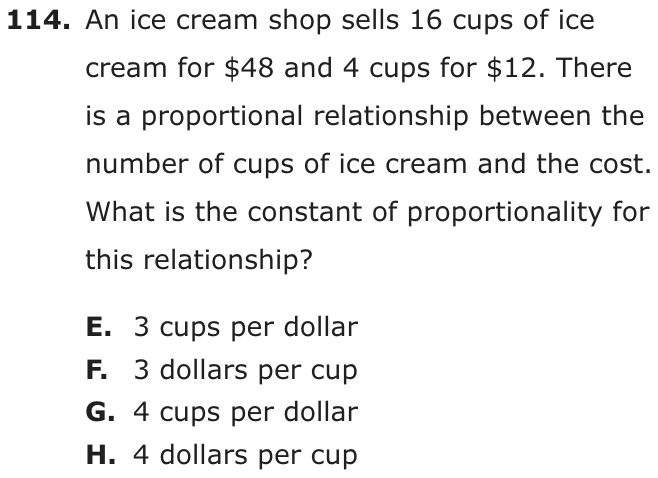
Simplify:
Grid-in question: work out the answer and enter it as a number.
Show the answer
Correct answer: -0.4
Subtracting a negative number is the same as adding a positive number. Rewrite the expression to simplify:
Question analysis
This grid-in asks students to simplify a short expression that mixes negative and positive decimals and ends by subtracting a negative number. It tests adding and subtracting rational numbers in order. The double negative, and keeping track of the sign of the final result, are where errors creep in.
- Grade level
- Grade 7 content, by NYS standard
- Compared with grade 7
- At grade 7 Adding and subtracting negative decimals is core grade 7 content, and this is a routine three-term version. It matches a typical classroom exercise; the only extra demand is gridding a signed decimal correctly.
- Estimated difficulty
- Straightforward: two steps or one careful reading.
- Thinking it demands
- Depth of knowledge 1, recall and reproduction · mainly apply
- What makes it hard
- Error-prone arithmetic moderate
- An answer in an unexpected form minor
- Solution
- 2 steps
- Reading level
- Question and choices: about grade 16+, 2 words.
- Students, last 30 days
- Not enough answers yet to show (it takes 10).
Why it is hard, traps and wrong answers (shows the answer)
Why it is hard
This is a three-term expression with small decimals, so the method is never in doubt; the points are lost on signs. The double negative at the end is the classic place to slip; the other is the result itself, which sits just below zero and is easy to grid without its minus sign. Grouping the positive terms first, 2.3 + 1.1, and comparing that sum with 3.8 settles both the size and the sign.
Error-prone arithmetic moderate Working it out
The last term, − (−1.1), has to turn into + 1.1, and the total then crosses zero, since 2.3 + 1.1 = 3.4 falls just short of the 3.8 below zero. (Brown & Burton, 1978; Junker & Sijtsma, 2001)
An answer in an unexpected form minor Choosing the answer
As a grid-in it shows no choices, so a double negative read as a single one, or a result gridded without its minus sign, gets no warning from the page. (Enright, Morley & Sheehan, 2002)
Strategy: Rewrite subtracting −1.1 as adding 1.1, combine the two positive decimals first, then compare their total with 3.8 to decide the sign and size.
Traps
- Negatives and direction: Arithmetic with negative numbers, the order of a subtraction, or direction on a number line. (Moving a term across the equals sign without changing its sign is a faulty procedure.)
The wrong answers, classified
-2.6 Negatives and direction (Brown & Burton, 1978)
Treats subtracting −1.1 as subtracting 1.1, so it works out −3.8 + 2.3 − 1.1 = −1.5 − 1.1 and moves further below zero.
0.4 Negatives and direction (Brown & Burton, 1978)
Rewrites the double negative correctly and finds the gap 3.8 − 3.4 = 0.4, but drops the minus sign that the larger negative term gives the result.
Worked solution, step by step
Formulas used
- Subtracting a negative number
- a is any number, and b is a positive number, so −b is negative. Taking away a negative number is the same as adding the positive number. Think of money: if someone takes away a debt of b dollars, you are b dollars better off.
- Adding a negative and a positive
- a and b are positive numbers, and a is the larger one. A negative and a positive partly cancel out. So find the difference of their sizes, a − b. The result keeps the sign of the number farther from zero, which here is the negative one.
Sort out the expression
You need to simplify . Simplify means work it out to one number. Two of the numbers are negative: −3.8 and −1.1. One is positive: 2.3. The tricky part is at the end. It says minus negative 1.1. The answer can be negative, so keep track of every sign.
Change minus a negative to plus
Taking away a negative is the same as adding a positive. Use the rule with b = 1.1.
Now only one negative number is left. Watch out: do not just subtract 1.1. That gives , which is wrong.
Add the two positive numbers
Group the positive numbers first. This makes the rest of the work short.
Now the problem is . One number is negative and one is positive.
Combine the negative and the positive
They partly cancel. Use the rule with a = 3.8 and b = 3.4.
The negative number, 3.8, is farther from zero than 3.4 is. So the result is negative. Watch out: keep the minus sign. Dropping it gives 0.4, which is wrong. So you would grid -0.4, with the minus sign in its own column.
Check your answer
Use a number line. Start at −3.8. Adding 2.3 moves you right, to −1.5. Subtracting −1.1 also moves you right, by 1.1, to −0.4. You end just to the left of zero. So a small negative answer makes sense.
More questions like this
The original DOE question
Question 2 of 57
2024 Test A Math, question 2Question
Angle M and angle R are supplementary. The measure of angle R is 5 times the measure of angle M. What is the measure of angle R, in degrees?
Grid-in question: work out the answer and enter it as a number.
Show the answer
Correct answer: 150
Angle M and angle R are supplementary, so the sum of the angles is 180°.
Let m equal the measure of angle M, and let r equal the measure of angle R.
The measure of angle R is 5 times the measure of angle M.
Therefore, the measure of angle R is 150°.
Question analysis
A geometry grid-in about two supplementary angles, where one angle is five times the size of the other. Students must recall what supplementary means, write an equation linking the two angles, and solve it. The question asks for the larger angle, so stopping at the smaller one is the usual slip.
- Grade level
- Grade 7 content, by NYS standard
- Compared with grade 7
- At grade 7 Grade 7 students regularly write and solve simple equations for unknown angles using supplementary and complementary facts. This is a two-step version of exactly that task, with whole numbers and no figure to read.
- Estimated difficulty
- Straightforward: two steps or one careful reading.
- Thinking it demands
- Depth of knowledge 2, skills and concepts · mainly apply
- What makes it hard
- Solution
- 3 steps
- Reading level
- Question and choices: about grade 5, 28 words.
- Students, last 30 days
- Not enough answers yet to show (it takes 10).
Why it is hard, traps and wrong answers (shows the answer)
Why it is hard
Once supplementary is read as a 180° total, the problem is a one-variable equation with whole numbers. Students lose the point in two ways: by stopping at the smaller angle, which the equation produces first, or by using 90° for the total. Checking that the gridded angle is the larger of the pair, and that the two angles add to 180°, catches both.
Something you must already know moderate Working it out
The stem never says what supplementary means; the 180° total has to be recalled, and a student who confuses it with complementary's 90° halves every angle. (Anderson & Krathwohl, 2001)
Turning words into math minor Understanding the question
The sentence "The measure of angle R is 5 times the measure of angle M" has to become R = 5M, so the 180° splits into six equal parts, not five. (Hegarty, Mayer & Monk, 1995; Koedinger & Nathan, 2004)
An answer in an unexpected form minor Choosing the answer
As a grid-in there is nothing to compare against, so gridding angle M's 30°, the first value the equation gives, looks just as finished as angle R. (Enright, Morley & Sheehan, 2002)
Strategy: Call angle M one part and angle R five parts; together the six parts make the supplementary total, so find one part and then multiply for angle R.
Traps
- Answers a different question: A choice is right for another quantity: the other unknown, the rest instead of the part, the part instead of the whole.
- Wrong formula: Uses a related but wrong formula: perimeter for area, diameter for radius, area for volume, or a misremembered one.
The wrong answers, classified
30 Answers a different question (King et al., 2004; Hegarty, Mayer & Monk, 1995)
Solves 6m = 180 correctly for angle M, 30°, and grids it instead of multiplying by 5 to get angle R, the angle the question asks for.
75 Wrong formula (King et al., 2004)
Uses 90° for supplementary, the complementary total, so 6m = 90 gives m = 15 and angle R = 75, half its real size.
36 Numbers taken from the question (Hegarty, Mayer & Monk, 1995)
Divides 180 by the 5 in the stem, combining the two numbers without an equation that gives angle M its own share of the 180°.
Worked solution, step by step
Formulas used
- Supplementary angles
- M and R are the sizes of two angles, in degrees. Supplementary means the two angles add up to 180 degrees. Put side by side, they make a straight line. Do not mix this up with complementary, which means a total of 90 degrees.
Sort out the question
Two angles, M and R, are supplementary. Angle R is 5 times as big as angle M. You need the measure of angle R, in degrees. Measure means its size. Notice that the question asks for R, not M.
Write the facts as equations
Supplementary angles add up to 180°.
The sentence “The measure of angle R is 5 times the measure of angle M” becomes this:
Watch out: supplementary means 180°, not 90°. Using 90° gives R = 75, which is wrong.
Find angle M
Put in place of R. Then the equation has only one unknown, M.
Think of 6 equal parts. M is 1 part and R is 5 parts. So angle M is 30°.
Find angle R
Angle R is 5 times angle M.
Angle R is 150°. Watch out: do not stop at M. Gridding 30 gives the wrong angle. So you would grid 150.
Check your answer
Add the two angles: . So they are supplementary. Also, , so R really is 5 times M. Both facts in the question check out.
More questions like this
The original DOE question
Question 3 of 57
2024 Test A Math, question 3Question
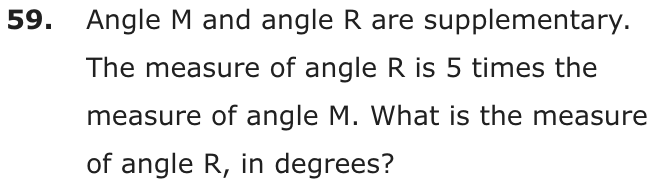
A juice mixture contains gallon of apple juice and gallon of cranberry juice. How many gallons of apple juice per gallon of cranberry juice does the mixture contain? (Express your answer as a decimal.)
Grid-in question: work out the answer and enter it as a number.
Show the answer
Correct answer: 2.5
Set up a proportion to solve:
Question analysis
This ratio grid-in describes a juice mixture with a fraction of a gallon of apple juice and a smaller fraction of a gallon of cranberry juice. Students find the unit rate, gallons of apple juice per gallon of cranberry juice, by dividing one fraction by the other and writing it as a decimal. Dividing in the wrong order is the main risk.
- Grade level
- Grade 7 content, by NYS standard
- Compared with grade 7
- At grade 7 Computing a unit rate from a ratio of two fractions is exactly the grade 7 standard, and this is a textbook example of it. The only added demands are dividing in the right order and answering as a decimal.
- Estimated difficulty
- Moderate: several steps, or a close reading with one strong distractor.
- Thinking it demands
- Depth of knowledge 2, skills and concepts · mainly apply
- What makes it hard
- Turning words into math moderate
- Error-prone arithmetic moderate
- An answer in an unexpected form minor
- Solution
- 2 steps
- Reading level
- Question and choices: about grade 8, 36 words.
- Students, last 30 days
- Not enough answers yet to show (it takes 10).
Why it is hard, traps and wrong answers (shows the answer)
Why it is hard
The method is one division of fractions, but the question tests whether the division runs the right way. The word per tells which juice goes on top, and a student who divides the smaller amount by the larger gets a tidy decimal for the reverse rate. A sense check helps: the mixture holds more apple juice than cranberry, so the rate must be greater than 1.
Turning words into math moderate Understanding the question
The phrase "gallons of apple juice per gallon of cranberry juice" fixes the order: apple's 3/16 goes on top and cranberry's 3/40 below, though the two fractions invite either order. (Hegarty, Mayer & Monk, 1995; Koedinger & Nathan, 2004)
Error-prone arithmetic moderate Working it out
Dividing 3/16 by 3/40 means multiplying by 40/3; the 3s cancel to leave 40/16, which still has to be reduced and written as a decimal. (Brown & Burton, 1978; Junker & Sijtsma, 2001)
An answer in an unexpected form minor Choosing the answer
The answer must be gridded as a decimal, and with no choices shown, the upside-down 0.4 gives no sign that it answers the reverse question. (Enright, Morley & Sheehan, 2002)
Strategy: Put the apple juice over the cranberry juice and divide the fractions by multiplying by the reciprocal; the matching 3s cancel, leaving a simple fraction to turn into a decimal.
Traps
- Wrong operation: Adds instead of multiplying, divides the wrong way round, turns a ratio or rate upside down, or undoes a step in the wrong direction (subtracts what should be added back).
The wrong answers, classified
0.4 Wrong operation (Hegarty, Mayer & Monk, 1995; King et al., 2004)
Divides cranberry by apple, 3/40 ÷ 3/16 = 16/40 = 0.4, giving gallons of cranberry per gallon of apple, the rate turned upside down.
0.014 Wrong operation (Hegarty, Mayer & Monk, 1995; King et al., 2004)
Multiplies the two amounts instead of dividing them, 3/16 × 3/40 = 9/640 ≈ 0.014, as if comparing the juices called for a product.
Worked solution, step by step
Formulas used
- Unit rate
- r is the rate: how much of one thing there is for each 1 of another. a is the amount of the first thing. b is the amount of the second thing, the one named after the word per. Dividing shares a out evenly over each 1 of b.
- Dividing by a fraction
- a/b and c/d are fractions, and b, c and d are not zero. To divide by a fraction, multiply by its reciprocal, the fraction flipped upside down. It works because flipping a fraction gives the number that undoes it.
Sort out the question
The mix has gallon of apple juice and gallon of cranberry juice. You need the “gallons of apple juice per gallon of cranberry juice”. Per means for each. So the question asks: for each 1 gallon of cranberry juice, how many gallons of apple juice are there? The answer must be a decimal.
Set up the division
To find an amount for each 1 gallon, divide. Apple juice goes first, because it comes before per. Cranberry juice comes second.
Watch out: do not flip the order. Cranberry divided by apple gives 0.4. That is gallons of cranberry juice for each gallon of apple juice, the reverse question.
Multiply by the reciprocal
To divide by , multiply by its reciprocal, .
The 3 on top and the 3 on the bottom cancel, since . Watch out: do not just multiply the two amounts. That gives , about 0.014, which is far too small.
Change the fraction to a decimal
Make simpler by dividing the top and bottom by 8. Then divide.
There are 2.5 gallons of apple juice for each gallon of cranberry juice. So you would grid 2.5.
Check your answer
Both fractions have 3 on top. The one with the smaller bottom, , is bigger. So there is more apple juice than cranberry juice, and the answer must be more than 1. That rules out 0.4. Also, and , which is .
More questions like this
The original DOE question
Question 4 of 57
2024 Test A Math, question 4Question
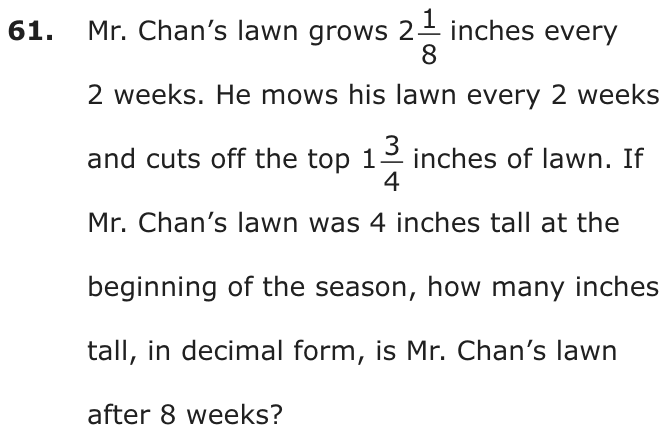
Mr. Chan’s lawn grows inches every 2 weeks. He mows his lawn every 2 weeks and cuts off the top inches of lawn. If Mr. Chan’s lawn was 4 inches tall at the beginning of the season, how many inches tall, in decimal form, is Mr. Chan’s lawn after 8 weeks?
Grid-in question: work out the answer and enter it as a number.
Show the answer
Correct answer: 5.5
The lawn grows inches every 2 weeks. Find the total number of inches it grows in 8 weeks.
The lawn was 4 inches tall at the beginning of the season.
Mr. Chan mows his lawn every 2 weeks and cuts off the top inches. Find the total number of inches that are cut off in 8 weeks.
The height after 8 weeks is the total number of inches grown minus the total number of inches cut off.
Question analysis
This multistep word problem follows Mr. Chan's lawn over 8 weeks: it grows a mixed number of inches every 2 weeks, and he mows a mixed number of inches off on the same schedule. Students combine the growth, the cuts and the starting height and give the final height as a decimal. Leaving out one of those three pieces is the usual error.
- Grade level
- Grade 7 content, by NYS standard
- Compared with grade 7
- At grade 7 Grade 7 students solve multi-step problems with mixed numbers and convert between fractions and decimals. This one strings four such steps together, including counting the 2-week periods, which is typical grade 7 work done carefully.
- Estimated difficulty
- Moderate: several steps, or a close reading with one strong distractor.
- Thinking it demands
- Depth of knowledge 2, skills and concepts · mainly apply
- What makes it hard
- Many steps moderate
- Error-prone arithmetic moderate
- Turning words into math minor
- An answer in an unexpected form minor
- Solution
- 4 steps
- Reading level
- Question and choices: about grade 3, 49 words.
- Corrected from the DOE handbook
- A misspelled name in the explanation was corrected.
- Students, last 30 days
- Not enough answers yet to show (it takes 10).
Why it is hard, traps and wrong answers (shows the answer)
Why it is hard
No single step is hard, but three parts must all reach the final height: the starting 4 inches, four rounds of growth and four rounds of mowing. Leaving out any one of them gives a clean decimal that can be gridded without a second thought. Working one 2-week period at a time, in which the lawn gains 3/8 inch net, keeps the bookkeeping short.
Many steps moderate Working it out
Four pieces have to be combined: count the four 2-week periods in 8 weeks, total the growth, total the mowing, and start from the lawn's first 4 inches. (Daniel & Embretson, 2010; Enright, Morley & Sheehan, 2002)
Error-prone arithmetic moderate Working it out
The amounts are mixed numbers with unlike denominators, 2 1/8 and 1 3/4, which must be multiplied by 4 or subtracted and then gridded as a decimal. (Brown & Burton, 1978; Junker & Sijtsma, 2001)
Turning words into math minor Understanding the question
The phrase "every 2 weeks" governs both the growing and the mowing, so 8 weeks means four rounds of each, not eight. (Hegarty, Mayer & Monk, 1995; Koedinger & Nathan, 2004)
An answer in an unexpected form minor Choosing the answer
As a grid-in it gives no choices, so a height that leaves out the starting 4 inches, or leaves out the mowing, looks as finished as the right one. (Enright, Morley & Sheehan, 2002)
Strategy: Find the net change for one 2-week period by subtracting the cut from the growth, multiply by the number of such periods in 8 weeks, and add the starting height.
Traps
- Stops one step early: A choice is a number from partway through the solution.
- Misreads the question: Misses or misreads a condition or a word in the question: "at least", "each", "remaining", "not".
The wrong answers, classified
1.5 Stops one step early (King et al., 2004; Gierl et al., 2017)
Finds the net gain of 3/8 inch per period and multiplies by the 4 periods, 1.5 inches, but stops before adding the lawn's starting height of 4 inches.
12.5 Stops one step early (King et al., 2004; Gierl et al., 2017)
Adds four periods of growth, 8.5 inches, to the starting 4 inches and stops there, never subtracting the 1 3/4 inches cut at each of the four mowings.
7 Misreads the question (Hegarty, Mayer & Monk, 1995)
Applies the net gain of 3/8 inch to each of the 8 weeks instead of each 2-week period, 8 × 3/8 = 3, then adds the starting 4.
What was corrected from the DOE handbook, and why
- Explanation: The handbook’s explanation says “Mr. Chen mows his lawn every 2 weeks.” The question calls him Mr. Chan throughout, so the site now reads “Mr. Chan.”
Worked solution, step by step
Formulas used
- Mixed number to decimal
- A mixed number has a whole part, a, and a fraction part, b over c. To write it as a decimal, divide b by c to get the fraction part as a decimal. Then add the whole part. For example, one and a half is 1 + 0.5 = 1.5.
- Repeated amount
- n is how many times something happens. a is the amount each time. Adding the same amount n times is the same as multiplying it by n.
Sort out the question
The lawn starts at 4 inches tall. Every 2 weeks it grows inches. Every 2 weeks Mr. Chan also cuts off inches. You need the height after 8 weeks, as a decimal. Three things matter: the start, the growing and the cutting.
Count the 2-week periods
Both the growing and the cutting happen every 2 weeks. So count how many 2-week periods fit in 8 weeks.
There are 4 periods. The lawn grows 4 times and is cut 4 times. Watch out: do not count 8 rounds, one for each week. That leads to the wrong answer 7.
Change the mixed numbers to decimals
The answer must be a decimal, so change both amounts now.
Each period, the lawn grows 2.125 inches and loses 1.75 inches.
Add up the growing
The lawn grows 2.125 inches, 4 times.
It grows 8.5 inches in all. Add the starting height of 4 inches.
Without mowing, the lawn would be 12.5 inches tall. Watch out: do not forget the starting 4 inches. Leaving them out leads to 1.5.
Add up the cutting
Mr. Chan cuts off 1.75 inches, 4 times.
He cuts off 7 inches in all.
Subtract the cutting
The lawn is 5.5 inches tall after 8 weeks. Watch out: 12.5 is not the answer. It leaves out the mowing. So you would grid 5.5.
Check your answer
Work one period at a time. Each period the lawn gains inch. In 4 periods that is inches. Add the starting 4 inches: . Same answer.
More questions like this
The original DOE question
Question 5 of 57
2024 Test A Math, question 5Question
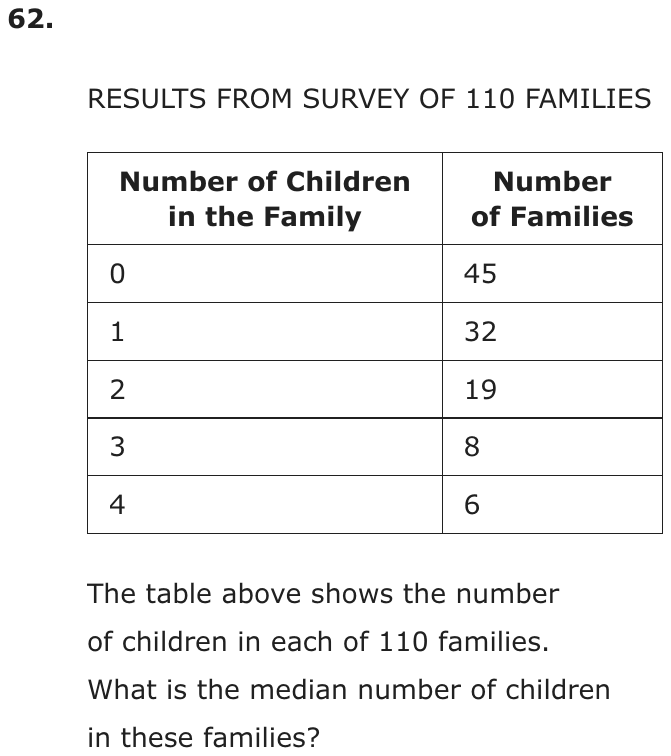
RESULTS FROM SURVEY OF 110 FAMILIES
| Number of Children in the Family | Number of Families |
|---|---|
| 0 | 45 |
| 1 | 32 |
| 2 | 19 |
| 3 | 8 |
| 4 | 6 |
The table above shows the number of children in each of 110 families. What is the median number of children in these families?
Grid-in question: work out the answer and enter it as a number.
Show the answer
Correct answer: 1
Since 110 families were surveyed, the median will have 55 values less than or equal to it, and 55 values greater than or equal to it.
If the values in the table were listed in order, they would look like this:
The first row of the table indicates that 45 families had 0 children.
The second row of the table indicates that 32 families had 1 child.
So 77 families had either 0 children or 1 child, and 45 families had 0 children.
Since 55 is between 45 and 77, the median must be a value in the second row of the table.
So the median is 1.
Question analysis
This statistics grid-in gives a frequency table from a survey of 110 families, showing how many families have each number of children from none to four. Students find the median number of children per family. The table lists counts rather than the 110 data values themselves, so locating the middle value takes a running total of the families.
- Grade level
- Grade 6 content, by NYS standard
- Compared with grade 7
- Above grade 7 Grade 7 median problems usually list a dozen or so values. Here 110 values are hidden in a frequency table, so students must reason about positions with a running count, a less familiar and more error-prone task.
- Estimated difficulty
- Hard: combines ideas, needs a plan, and has more than one tempting wrong answer.
- Thinking it demands
- Depth of knowledge 2, skills and concepts · mainly apply
- What makes it hard
- Reading a figure, table or graph major
- No obvious method moderate
- An answer in an unexpected form minor
- Solution
- 3 steps
- Reading level
- Question and choices: about grade 7, 35 words.
- Students, last 30 days
- Not enough answers yet to show (it takes 10).
Why it is hard, traps and wrong answers (shows the answer)
Why it is hard
Students know a median as the middle of a list, but here the list is never written out. Treating the table's columns as the data gives quick, confident answers, 2 from the middle of the children column or 19 from the middle of the family counts, and neither can be checked against choices. The question rewards counting positions: 45 families have no children, so the 55th and 56th families both fall among the 32 with one child.
Reading a figure, table or graph major Understanding the question
The table hides 110 data values in five rows: the 0 to 4 column lists the possible values, and 45, 32, 19, 8 and 6 say how many families have each. (Lesh, Post & Behr, 1987; Kirsch & Mosenthal, 1990)
No obvious method moderate Working it out
The median of 110 values lies between the 55th and 56th; finding them takes a running count of families, 45 and then 77, a method seldom practiced with tables. (Schoenfeld, 1985)
An answer in an unexpected form minor Choosing the answer
As a grid-in there are no choices to compare, so a student who takes the middle row's 2 has nothing on the page to suggest it is wrong. (Enright, Morley & Sheehan, 2002)
Strategy: With 110 values the median sits between the 55th and 56th; add the family counts row by row until the running total passes 55, and read that row's number of children.
Traps
- Misunderstands the concept: A wrong belief about a concept: that percents can be added, that area grows like length, that averages can be averaged, that a bigger denominator means a bigger fraction.
- Answers a different question: A choice is right for another quantity: the other unknown, the rest instead of the part, the part instead of the whole.
The wrong answers, classified
2 Misunderstands the concept (Smith, diSessa & Roschelle, 1993; De Bock et al., 1998; Ni & Zhou, 2005)
Takes the middle entry of the children column, 0 to 4, ignoring that each number of children belongs to a different number of families.
19 Answers a different question (King et al., 2004; Hegarty, Mayer & Monk, 1995)
Finds the median of the Number of Families column, 6, 8, 19, 32 and 45, a middle family count rather than a number of children.
1.07 Answers a different question (King et al., 2004; Hegarty, Mayer & Monk, 1995)
Computes the mean instead, 118 children among 110 families, about 1.07, a different measure of center from the median asked for.
Worked solution, step by step
Formulas used
- Spot of the median
- The median is the middle value when all the values are put in order. n is how many values there are. This gives the spot of the middle value, with the same number of values before and after it. If it ends in a half, the median is halfway between the two values on either side.
Sort out the table
The table covers 110 families. The left column is a number of children. The right column says how many families have that many children. For example, 45 families have 0 children. You need the median number of children. The median is the middle value when all the values are in order.
Picture the values in order
Think of a list with one number for each family: how many children it has. The list has 45 zeros, then 32 ones, then 19 twos, then 8 threes, then 6 fours. It is already in order, from least to most.
There are 110 values. Watch out: the median is not the middle row, 2. Each row stands for a different number of families.
Find the middle spot
Use the median rule with n = 110.
The middle is halfway between the 55th and 56th values. So you need those two values in the list.
Count down the list
Keep a running total of families, row by row. The zeros fill spots 1 to 45. Now add the 32 families with 1 child.
So the ones fill spots 46 to 77. Spot 55 and spot 56 are both in that range. So both values are 1.
Give the median
The 55th and 56th values are both 1. Halfway between 1 and 1 is 1. So the median is 1 child. Watch out: the median is a number of children, not of families. Gridding 19, from the families column, is wrong. So is the mean, or average, which is about 1.07. So you would grid 1.
Check your answer
Half of 110 is 55. Families with 0 children: 45, which is less than half. So the median is not 0. Families with 0 or 1 child: 77, which is more than half. So the median is not more than 1. It must be 1.
More questions like this
The original DOE question
Question 6 of 57
2024 Test A Math, question 6Question
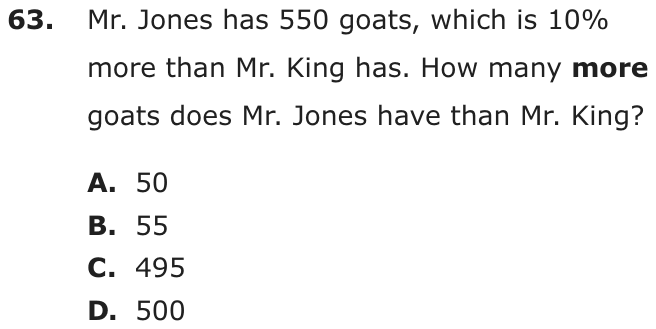
Mr. Jones has 550 goats, which is 10% more than Mr. King has. How many more goats does Mr. Jones have than Mr. King?
- A50
- B55
- C495
- D500
Show the answer
Correct answer: A
First, set up a proportion to determine x, the number of goats Mr. King has.
Then solve the proportion for x.
Finally, determine the difference between the number of goats Mr. Jones has, 550, and the number of goats Mr. King has, 500.
Mr. Jones has 50 more goats than Mr. King.
Question analysis
A percent word problem: Mr. Jones has 550 goats, which is 10% more than Mr. King has, and students find how many more goats Mr. Jones has. It asks students to work with a percent increase when only the larger amount is known. The tricky part is deciding which amount the 10% is taken of.
- Grade level
- Grade 7 content, by NYS standard
- Compared with grade 7
- Above grade 7 Grade 7 students usually find a percent increase from a known original amount. This runs the task backward: the increased amount is given, and the original must be recovered before the difference can be found, a step many do not expect.
- Estimated difficulty
- Hard: combines ideas, needs a plan, and has more than one tempting wrong answer.
- Thinking it demands
- Depth of knowledge 2, skills and concepts · mainly apply
- What makes it hard
- Turning words into math major
- A very close wrong answer moderate
- Solution
- 2 steps
- Reading level
- Question and choices: about grade 1, 22 words.
- Students, last 30 days
- Not enough answers yet to show (it takes 10).
Why it is hard, traps and wrong answers (shows the answer)
Why it is hard
The arithmetic is one division and one subtraction, so the question is really about the base of a percent. The sentence gives the bigger number and calls it 10% more, and the reflex is to take 10% of the number on the page. That shortcut lands on a listed choice five goats from the answer. Students who find King's herd first, 550 ÷ 1.1, still have to remember that the question wants the difference, not the herd.
Turning words into math major Understanding the question
The clause "which is 10% more than" makes King's unknown herd the base of the 10%, so 550 is 110% of his number rather than the amount the 10% is taken of. (Hegarty, Mayer & Monk, 1995; Koedinger & Nathan, 2004)
A very close wrong answer moderate Choosing the answer
The choices 50 and 55 are only 5 goats apart, and both are 10% of a herd; only taking the percent of King's 500 rather than of 550 separates them. (Embretson & Wetzel, 1987; Gorin & Embretson, 2006; Ascalon et al., 2007)
Strategy: Mr. Jones's 550 is 110% of Mr. King's number, so divide 550 by 1.10 to find Mr. King's goats, then subtract that from 550.
Traps
- Percent of the wrong amount: Finding the whole from a part, or a percent change measured from the wrong starting amount.
- Stops one step early: A choice is a number from partway through the solution.
The wrong answers, classified
B Percent of the wrong amount (Parker & Leinhardt, 1995)
Takes 10% of 550, measuring the increase from Jones's herd instead of from King's smaller herd, which is the amount the 10% is based on.
C Percent of the wrong amount (Parker & Leinhardt, 1995)
Takes 10% off 550 to get King's herd, 550 − 55 = 495, using the wrong base, then gives that herd instead of the difference.
D Stops one step early (King et al., 2004; Gierl et al., 2017)
Finds King's herd correctly, 550 ÷ 1.1 = 500, then stops there instead of subtracting it from 550 to get how many more.
Worked solution, step by step
Formulas used
- Percent increase
- The original is the amount you start from, the one the percent is taken of. p is the percent of increase. The new amount is all of the original, which is 100%, plus p% more. For 10% more, you multiply by 1.10.
Sort out the question
Mr. Jones has 550 goats. That is “10% more than Mr. King has”. You need how many more goats Mr. Jones has than Mr. King. That is the difference between the two herds, not the size of a herd.
Decide what the 10% is of
The words “10% more than Mr. King” mean the 10% is a part of Mr. King’s herd. So Mr. King’s herd is the original. Mr. Jones has all of Mr. King’s goats, 100%, plus 10% more. That is 110% of Mr. King’s herd. Watch out: do not take 10% of 550. That gives 55, choice B. It uses the wrong herd. Taking those 55 away from 550 gives 495, choice C, which is also wrong.
Find Mr. King’s herd
Call Mr. King’s number of goats K. Use the percent increase formula with p = 10. The new amount is 550.
Mr. King has 500 goats. Watch out: 500 is Mr. King’s herd, choice D. It is not the difference.
Find the difference
Mr. Jones has 50 more goats than Mr. King. So the answer is A, 50.
Check your answer
Check the 10%. 10% of 500 is , and , Mr. Jones’s herd. So 550 really is 10% more than 500. If King had 495, then 10% more would be about 545, not 550.
More questions like this
The original DOE question
Question 7 of 57
2024 Test A Math, question 7Question
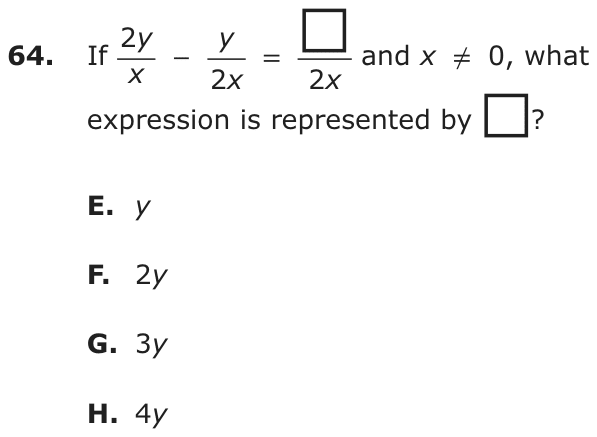
If and , what expression is represented by ?
- A
- B
- C
- D
Show the answer
Correct answer: C
Use properties of equations to determine the missing expression:
The missing expression is .
Question analysis
An algebra question with fractions: two fractions with x and 2x in their denominators are subtracted, and students find the numerator that makes the difference equal a fraction over 2x. It tests rewriting a fraction over a common denominator when the denominators contain a variable. Adjusting only part of a fraction is the common mistake.
- NYS standards
- Grade level
- Grade 7 content, by NYS standard
- Compared with grade 7
- At grade 7 Grade 7 students subtract fractions with unlike denominators and combine like terms, but rarely see a variable in a denominator. The steps are the same two as with numbers, so the demand is typical once the form is familiar.
- Estimated difficulty
- Straightforward: two steps or one careful reading.
- Thinking it demands
- Depth of knowledge 1, recall and reproduction · mainly apply
- What makes it hard
- Variables instead of numbers moderate
- Error-prone arithmetic minor
- Solution
- 2 steps
- Reading level
- Question and choices: about grade 13, 14 words.
- Students, last 30 days
- Not enough answers yet to show (it takes 10).
Why it is hard, traps and wrong answers (shows the answer)
Why it is hard
This is subtraction of fractions with unlike denominators, written with letters. The box over 2x shows the target denominator, which helps, but each wrong choice matches a familiar fraction error: subtracting the tops before matching the bottoms, or rewriting the first fraction and stopping. Students who rewrite 2y/x as 4y/2x and then subtract y from the new numerator finish in seconds.
Variables instead of numbers moderate Understanding the question
The denominators are x and 2x, so the common denominator is built with a letter, and there is no number to check unless students substitute values such as x = 1 and y = 2. (Koedinger & Nathan, 2004; Enright, Morley & Sheehan, 2002)
Error-prone arithmetic minor Working it out
Only the first fraction changes: 2y/x becomes 4y/2x with top and bottom both doubled, while y/2x already has the denominator the box sits over. (Brown & Burton, 1978; Junker & Sijtsma, 2001)
Strategy: Rewrite the first fraction over 2x by multiplying its top and bottom by 2, then subtract the numerators, which now share a denominator.
Traps
- A faulty procedure: A systematic but wrong procedure: adding fractions straight across, applying an exponent to each term of a sum, dropping a sign when moving a term.
- Stops one step early: A choice is a number from partway through the solution.
The wrong answers, classified
A A faulty procedure (Brown & Burton, 1978; Tatsuoka, 1983)
Subtracts the numerators straight away, 2y − y = y, and puts the result over 2x as if the two fractions already shared a denominator.
B A faulty procedure (Brown & Burton, 1978; Tatsuoka, 1983)
Subtracts the numerators over x, (2y − y)/x = y/x, then doubles top and bottom to reach the denominator 2x, giving 2y/2x.
D Stops one step early (King et al., 2004; Gierl et al., 2017)
Rewrites 2y/x as 4y/2x correctly to match the box's denominator, then stops before subtracting the y of the second fraction.
Worked solution, step by step
Formulas used
- Equivalent fractions
- a is the top of the fraction, b is the bottom, and k is any number except zero. Multiplying the top and bottom by the same number does not change the value. It is like multiplying by k over k, which is 1.
- Subtracting fractions with the same bottom
- a and b are the tops, and d is the shared bottom, called the denominator. When two fractions have the same bottom, their pieces are the same size. So subtract the tops and keep the bottom.
Sort out the question
The box, , stands for a missing expression. An expression is a math phrase made of numbers and letters, like 5y. You need what goes in the box to make the two sides equal. means x is not zero, so no fraction divides by zero.
Pick a shared bottom
You can only subtract fractions when their bottoms match. The bottoms here are x and 2x. The box sits over 2x, so use 2x for both. The second fraction, , already has it.
Rewrite the first fraction over 2x
To turn x into 2x, multiply by 2. Multiply the top by 2 as well, so the value stays the same.
Watch out: this is only the first fraction. Stopping here and choosing 4y gives choice D.
Subtract the tops
4y take away y is like 4 apples take away 1 apple. That leaves 3y. Watch out: do not subtract the tops, 2y − y, before the bottoms match. That gives y, choice A.
Match the box
The left side equals . The right side is . The bottoms are the same, so the tops must be equal. The box is 3y. So the answer is C, .
Check your answer
Try numbers. Let x = 1 and y = 2. The left side is . With 3y in the box, the right side is . Both sides are 3, so 3y works.
More questions like this
The original DOE question
Question 8 of 57
2024 Test A Math, question 8Question
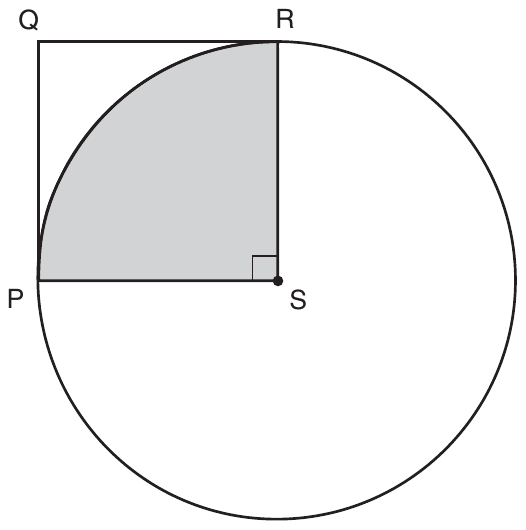
In the figure above, PQRS is a square. Point S is the center of the circle, and points P and R are on the circle. If the area of the square is 4 square centimeters, what is the area, in square centimeters, of the shaded quarter of the circle?
- A
- B
- C
- D
Show the answer
Correct answer: B
The area of square PQRS is 4 square centimeters. So
Sides PS and RS are each a radius of the circle. So the radius of the circle is 2 cm.
The shaded region is of the circle. The area of a circle is . So the area of the shaded region, in square centimeters, is
Question analysis
A geometry question with a figure: square PQRS has one corner at the center of a circle, and the quarter of the circle inside the square is shaded. Given the area of the square, students find the area of the shaded quarter circle. The key is connecting the square's side to the circle's radius.
- Grade level
- Grade 7 content, by NYS standard
- Compared with grade 7
- At grade 7 Circle area is grade 7 content, and this question adds only one linking step from the square's area to the radius. Typical grade 7 circle work gives the radius directly; here it takes one short extra inference.
- Estimated difficulty
- Straightforward: two steps or one careful reading.
- Thinking it demands
- Depth of knowledge 2, skills and concepts · mainly apply
- What makes it hard
- Reading a figure, table or graph moderate
- Something you must already know minor
- Combines ideas minor
- Solution
- 3 steps
- Reading level
- Question and choices: about grade 4, 52 words.
- Students, last 30 days
- Not enough answers yet to show (it takes 10).
Why it is hard, traps and wrong answers (shows the answer)
Why it is hard
The question chains three short facts: from the square's area to its side, from the side to the radius, and from the whole circle to a quarter of it. None is hard, but each wrong choice marks a broken link, most often the whole circle's area, which looks like a finished answer. Pointing to S as the center before computing anything settles the radius.
Reading a figure, table or graph moderate Understanding the question
The radius is never labeled: students must see that S is both a corner of the square and the circle's center, so sides PS and RS are radii. (Lesh, Post & Behr, 1987; Kirsch & Mosenthal, 1990)
Something you must already know minor Working it out
Neither the circle area formula, π times the radius squared, nor the step from a square's area to its side length is given. (Anderson & Krathwohl, 2001)
Combines ideas minor Working it out
Square and circle are linked in one chain: the area 4 gives a side of 2, the side is the radius, and the shaded part is a quarter of π × 2². (Embretson, 1998; Daniel & Embretson, 2010)
Strategy: Take the square root of the square's area to get its side, which is also the radius, then take one quarter of pi times the radius squared.
Traps
- Wrong formula: Uses a related but wrong formula: perimeter for area, diameter for radius, area for volume, or a misremembered one.
- Stops one step early: A choice is a number from partway through the solution.
- A formula you must know: Needs a formula the test does not give: area, circumference, volume, probability rules.
The wrong answers, classified
A Wrong formula (King et al., 2004)
Halves the square's side as if it were a diameter, so it uses a radius of 1, and one quarter of π × 1² gives π/4.
C Wrong formula (King et al., 2004)
Misremembers the circle's area as 2πr², blending it with the circumference 2πr, so one quarter of 2π × 2² gives 2π.
D Stops one step early (King et al., 2004; Gierl et al., 2017)
Finds the whole circle's area, π × 2² = 4π, and stops before taking the quarter that is shaded.
Worked solution, step by step
Formulas used
- Area of a square
- A is the area, the space inside. s is the length of one side, and s² means s × s. All four sides of a square are equal, so its area is side times side.
- Area of a circle
- A is the area of the whole circle. r is the radius: the distance from the center to the edge. π, called pi, is a number a little more than 3, about 3.14. Multiply π by r × r. This works for every circle.
Sort out the figure
PQRS is a square with an area of 4 sq cm. Point S is the center of the circle. Points P and R are on the circle. The shaded part is a quarter of the circle, inside the square. You need the shaded area, in square centimeters. The answer will have π in it.
Find the side of the square
Use the square formula. The area is 4, so find the number that times itself gives 4.
Each side is 2 cm long, because .
See that the side is the radius
Side SP goes from the center, S, to point P on the circle. So SP is a radius. So is side SR. The radius is 2 cm. Watch out: the side is a radius, not a diameter, the full width of the circle. Using a radius of 1 leads to , choice A.
Find the area of the whole circle
The whole circle has an area of 4π sq cm. Watch out: this is the whole circle. Stopping here gives choice D.
Take one quarter
The shaded part is one quarter of the circle, so take one quarter of 4π.
The shaded area is π sq cm. So the answer is B, .
Check your answer
π is about 3.14, so the shaded part is about 3.14 sq cm. The whole square is 4 sq cm. In the figure, the shaded part fills most of the square, but not all. So a bit less than 4 makes sense. The choice 4π is about 12.6, far too big.
More questions like this
The original DOE question
Question 9 of 57
2024 Test A Math, question 9Question
A list of consecutive integers begins with m and ends with n. If , how many integers are in the list?
- A2
- B33
- C66
- D67
Show the answer
Correct answer: D
Consider the case where .
The list of integers from 1 to 67 contains 67 numbers.
Question analysis
A number question about a list of consecutive integers that starts at m and ends at n, where n minus m is 66. Students decide how many integers the list contains. The tricky part is relating the difference between the two ends to the number of integers in the list.
- Grade level
- Grade 7 content, by NYS standard
- Compared with grade 7
- At grade 7 Consecutive integers and differences are familiar grade 7 ideas, and the arithmetic is trivial. What keeps this at grade 7 rather than below it is the counting trap, which needs a moment of careful reasoning.
- Estimated difficulty
- Moderate: several steps, or a close reading with one strong distractor.
- Thinking it demands
- Depth of knowledge 2, skills and concepts · mainly apply
- What makes it hard
- A very close wrong answer moderate
- Variables instead of numbers moderate
- Solution
- 2 steps
- Reading level
- Question and choices: about grade 7, 21 words.
- Students, last 30 days
- Not enough answers yet to show (it takes 10).
Why it is hard, traps and wrong answers (shows the answer)
Why it is hard
The arithmetic is trivial, so the question tests one idea: the number of integers from m to n is one more than their difference, because both ends belong to the list. The stem supplies 66 ready-made, and taking it as the count is the natural first reaction. A five-number list, 1 to 5, whose ends differ by 4, shows the extra one in seconds.
A very close wrong answer moderate Choosing the answer
The choices 66 and 67 differ by one, and 66 is the difference the stem hands over; only counting both ends of the list separates them. (Embretson & Wetzel, 1987; Gorin & Embretson, 2006; Ascalon et al., 2007)
Variables instead of numbers moderate Understanding the question
The list is given only by its ends, m and n, so the count has to be reasoned out in general, or checked on a small list such as 1 through 5. (Koedinger & Nathan, 2004; Enright, Morley & Sheehan, 2002)
Strategy: Try a small list you can count, such as 1 through 5, and compare its count with the difference between its first and last numbers.
Traps
- Counting the ends: Inclusive or exclusive ends, fence posts, consecutive numbers: an answer that is one too many or too few, or an endpoint drawn open where it belongs closed (or the reverse).
The wrong answers, classified
A Little reason to choose it (Haladyna & Downing, 1993; Rodriguez, 2005)
No common working counts only the two named ends, m and n, in a list said to hold consecutive integers, so 2 mostly draws guesses.
B Misunderstands the concept (Smith, diSessa & Roschelle, 1993; De Bock et al., 1998; Ni & Zhou, 2005)
Halves 66, as if consecutive integers went up by 2 like consecutive odd or even numbers, so the list held only every other integer.
C Counting the ends (Brown & Burton, 1978)
Takes the difference of the ends as the count, forgetting that a list from m to n includes both m and n.
Worked solution, step by step
Formulas used
- Counting consecutive integers
- m is the first number in the list and n is the last. n − m counts the steps from each number to the next. A list always has one more number than it has steps, so you add 1. This works for any list that goes up by 1.
Sort out the question
Integers are whole numbers and their negatives, like −2, 0 and 5. Consecutive integers come one after another, going up by 1, like 4, 5, 6. The list starts at m and ends at n. The difference is 66. You need how many integers are in the list.
Try a small list
Letters are hard to count, so try a list you can count: 1, 2, 3, 4, 5. Here m = 1 and n = 5.
But the list has 5 numbers, not 4. The difference counts the steps: 1 to 2, 2 to 3, 3 to 4 and 4 to 5. Both ends are in the list, so there is one more number than steps.
Use the counting rule
Watch out: 66 is the difference, not the count. Choosing 66, choice C, leaves out one end of the list. Also, consecutive integers go up by 1, not 2, so halving 66 to get 33 is wrong. So the answer is D, 67.
Check your answer
Try m = 1. Then . The list 1, 2, 3, and so on up to 67, plainly has 67 numbers. Any other start gives the same count, because the list just slides along.
More questions like this
The original DOE question
Question 10 of 57
2024 Test A Math, question 10Question
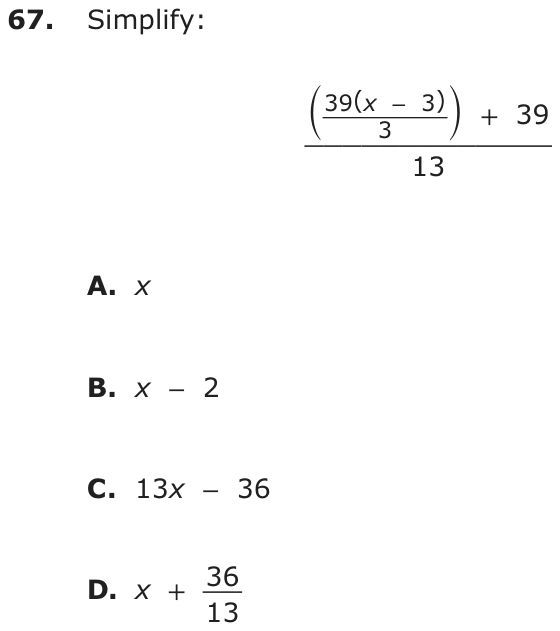
Simplify:
- A
- B
- C
- D
Show the answer
Correct answer: A
Divide the first 39 by 3.
Distribute 13 through .
In the numerator, the terms −39 and 39 cancel out.
Finally, divide the numerator and denominator by 13 to get x.
Question analysis
An algebra question that asks students to simplify a stacked fraction: 39 times (x − 3) over 3, plus 39, all divided by 13. It tests dividing, distributing and combining like terms in the right order. The nested fraction bars make it easy to divide only some of the terms or to distribute to only one.
- NYS standards
- Grade level
- Grade 7 content, by NYS standard
- Compared with grade 7
- At grade 7 Grade 7 students expand and simplify linear expressions such as 13(x − 3) + 39. This wraps that work inside two fraction bars, which adds reading load and chances to misstep but no new mathematics.
- Estimated difficulty
- Straightforward: two steps or one careful reading.
- Thinking it demands
- Depth of knowledge 1, recall and reproduction · mainly apply
- What makes it hard
- Error-prone arithmetic moderate
- Many steps minor
- Solution
- 3 steps
- Reading level
- Question and choices: about grade 16+, 6 words.
- Students, last 30 days
- Not enough answers yet to show (it takes 10).
Why it is hard, traps and wrong answers (shows the answer)
Why it is hard
The expression looks heavier than it is: every number is a multiple of 13, and the constants cancel to leave a single term. What makes it risky is scope, knowing which terms each fraction bar and each multiplier covers. Each wrong choice comes from stretching or shrinking that scope by one term, so working outward from the innermost parentheses, one line per step, is the safe way.
Error-prone arithmetic moderate Working it out
Two fraction bars are nested: 39 ÷ 3 applies only to the first term, the 13 must reach both x and −3, and only then does the whole numerator divide by 13. (Brown & Burton, 1978; Junker & Sijtsma, 2001)
Many steps minor Working it out
Four moves come in a fixed order, divide 39 by 3, distribute 13, cancel −39 with +39, divide by 13, and each is a chance to apply a step to the wrong terms. (Daniel & Embretson, 2010; Enright, Morley & Sheehan, 2002)
Strategy: Work from the inside out: divide 39 by 3, distribute through the parentheses, combine the constants in the numerator, and only then divide everything by 13.
Traps
- A faulty procedure: A systematic but wrong procedure: adding fractions straight across, applying an exponent to each term of a sum, dropping a sign when moving a term.
- Order of operations: Working left to right, or distributing a minus sign wrongly, gives a choice.
The wrong answers, classified
B Order of operations (Brown & Burton, 1978)
Reads the inner fraction bar as covering the added 39 too, so the numerator becomes 13(x − 3) + 13 = 13x − 26, and dividing by 13 gives x − 2.
C Order of operations (Brown & Burton, 1978)
Divides only the last 39 by 13, leaving 13(x − 3) + 3 = 13x − 36, as if the outer fraction bar covered a single term.
D A faulty procedure (Brown & Burton, 1978; Tatsuoka, 1983)
Distributes the 13 to x but not to −3, so the numerator becomes 13x − 3 + 39 = 13x + 36, and dividing by 13 leaves a fraction.
Worked solution, step by step
Formulas used
- Distributive property
- a is the number outside the parentheses. b and c are the terms inside. Multiply a by each term inside, and keep the minus sign between them. It works because a groups of (b − c) are a groups of b, take away a groups of c.
Sort out the expression
You need to simplify the big fraction, which means write it in its shortest form. It has a small fraction inside its top. The top is , and the bottom is 13. Work from the inside out, one step at a time.
Divide the first 39 by 3
The small fraction bar is only under . So divide just that 39 by 3.
Now the top is . Watch out: the small bar does not reach the added 39. Dividing that 39 by 3 as well leads to , choice B.
Multiply out the parentheses
Watch out: multiply the 3 by 13 too, not just the x. Leaving −3 as it is leads to choice D.
Combine the plain numbers on top
−39 and 39 add up to 0, so they cancel. The top is now just 13x, which means 13 times x.
Divide by the bottom
Now divide the whole top by 13. Dividing by 13 undoes times 13.
Watch out: the long bar is under the whole top. Dividing only the last 39 by 13 gives , choice C. So the answer is A, .
Check your answer
Try x = 5. Then and . Next, and . Last, . You get back 5, the same as x. So x is right.
More questions like this
The original DOE question
Question 11 of 57
2024 Test A Math, question 11Question
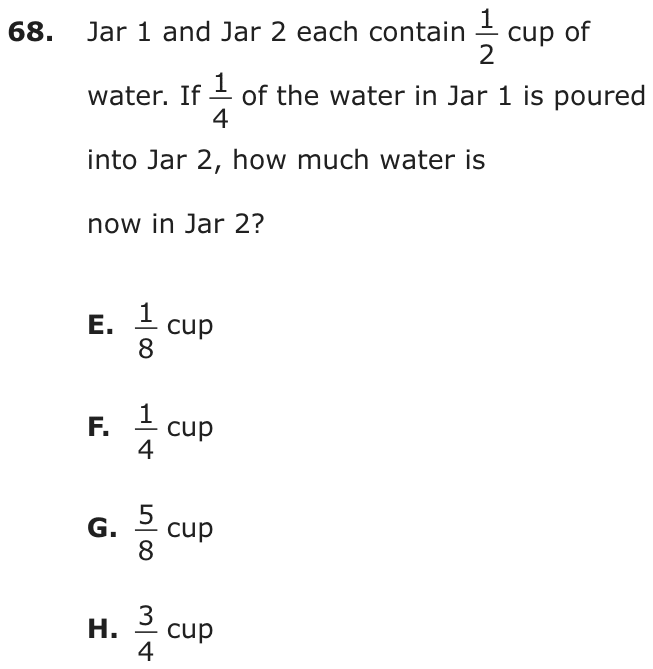
Jar 1 and Jar 2 each contain cup of water. If of the water in Jar 1 is poured into Jar 2, how much water is now in Jar 2?
- A cup
- B cup
- C cup
- D cup
Show the answer
Correct answer: C
Jar 1 starts with cup of water. If of its water is poured into Jar 2, then the amount of water added to Jar 2 is cup.
Jar 2 starts with cup of water. If cup of water is added to it, then the amount of water now in Jar 2 is cup.
Question analysis
A fraction word problem about two jars that each hold half a cup of water; a quarter of the water in the first jar is poured into the second. Students find how much water the second jar now holds. Reading exactly what the quarter is a quarter of is the detail that matters.
- NYS standards
- 7.NS.3 four operations with rational numbers
- Grade level
- Grade 7 content, by NYS standard
- Compared with grade 7
- Below grade 7 Multiplying and adding positive fractions is review by grade 7, and the problem takes two short steps. It is easier than typical grade 7 work with negative numbers or longer rational-number problems, apart from careful reading.
- Estimated difficulty
- Straightforward: two steps or one careful reading.
- Thinking it demands
- Depth of knowledge 2, skills and concepts · mainly apply
- What makes it hard
- Turning words into math moderate
- Error-prone arithmetic minor
- Solution
- 2 steps
- Reading level
- Question and choices: about grade 4, 35 words.
- Students, last 30 days
- Not enough answers yet to show (it takes 10).
Why it is hard, traps and wrong answers (shows the answer)
Why it is hard
The numbers are friendly halves, quarters and eighths, and the work is two steps. The question turns on one phrase: the quarter is a fraction of Jar 1's water, not a measured quarter cup, and reading it the second way gives a choice that looks right. Students who also remember that Jar 2 already held water finish correctly.
Turning words into math moderate Understanding the question
The phrase "1/4 of the water in Jar 1" means a quarter of Jar 1's half cup, an eighth of a cup, not a quarter cup; the word of calls for multiplying. (Hegarty, Mayer & Monk, 1995; Koedinger & Nathan, 2004)
Error-prone arithmetic minor Working it out
Adding the 1/8 cup to Jar 2's 1/2 cup needs the common denominator 8, so 1/2 becomes 4/8 before the sum. (Brown & Burton, 1978; Junker & Sijtsma, 2001)
Strategy: Find the amount poured by taking one quarter of Jar 1's half cup, then add that amount to the half cup already in Jar 2.
Traps
- Stops one step early: A choice is a number from partway through the solution.
- Misreads the question: Misses or misreads a condition or a word in the question: "at least", "each", "remaining", "not".
The wrong answers, classified
A Stops one step early (King et al., 2004; Gierl et al., 2017)
Finds the amount poured, 1/4 of 1/2 cup = 1/8 cup, and stops there instead of adding it to the half cup already in Jar 2.
B Numbers taken from the question (Hegarty, Mayer & Monk, 1995)
Picks the fraction 1/4 straight from the question, as if the share poured were the amount of water now in Jar 2.
D Misreads the question (Hegarty, Mayer & Monk, 1995)
Reads 1/4 of the water as 1/4 cup and adds it to Jar 2's half cup, 1/2 + 1/4 = 3/4.
Worked solution, step by step
Formulas used
- Fraction of an amount
- N is the whole amount, and a over b is the part of it you want. In math, the word of means multiply. For example, half of 10 is one half times 10, which is 5.
- Multiplying fractions
- a and c are the tops, and b and d are the bottoms. Multiply the tops together and the bottoms together. Taking a part of a part makes the pieces smaller, so the bottom gets bigger.
- Adding fractions with the same bottom
- a and b are the tops, and d is the shared bottom, called the denominator. If the bottoms match, add the tops and keep the bottom. If they do not match, rewrite one fraction first.
Sort out the question
Each jar starts with cup of water. You pour “ of the water in Jar 1” into Jar 2. You need how much water is in Jar 2 after that, in cups.
Find how much water is poured
Jar 1 has cup. You pour of it. Of means multiply.
You pour cup. Watch out: a quarter of the water is not a quarter cup. It is a quarter of a half cup. Adding cup gives cup, choice D.
Make the bottoms match
Now add the poured water to the cup already in Jar 2. The bottoms are 2 and 8, so rewrite the half with 8 on the bottom. Multiply its top and bottom by 4.
Add the water in Jar 2
Jar 2 now holds cup. Watch out: cup is only the water poured in. Stopping there gives choice A. So the answer is C, cup.
Check your answer
Jar 2 started with a half cup and got a little more. So it should hold just over a half cup, and is. Also, the water in both jars still adds up to 1 cup: Jar 1 has cup left, and .
More questions like this
The original DOE question
Question 12 of 57
2024 Test A Math, question 12Question
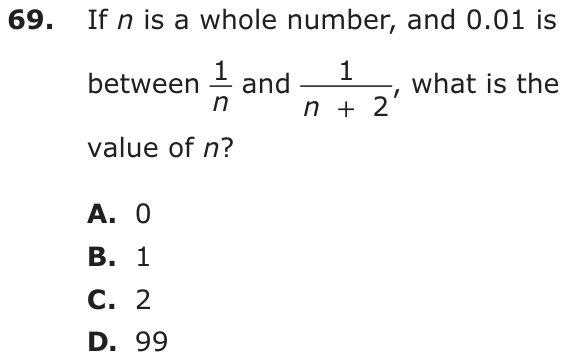
If n is a whole number, and 0.01 is between and , what is the value of n?
- A0
- B1
- C2
- D99
Show the answer
Correct answer: D
, which is between and .
Therefore, and .
Question analysis
A number sense question: 0.01 lies between 1 over n and 1 over n + 2, where n is a whole number, and students find n. It tests comparing a decimal with unit fractions and knowing how a fraction changes as its denominator grows. The unusual form, with n in two denominators, is what slows students down.
- Grade level
- Grade 6 content, by NYS standard
- Compared with grade 7
- At grade 7 Grade 7 students compare fractions and decimals routinely, but not with an unknown in the denominators. The comparison is simple once 0.01 is written as a fraction; the unfamiliar setup is the main demand.
- Estimated difficulty
- Straightforward: two steps or one careful reading.
- Thinking it demands
- Depth of knowledge 2, skills and concepts · mainly apply
- What makes it hard
- Variables instead of numbers moderate
- Something you must already know minor
- Solution
- 2 steps
- Reading level
- Question and choices: about grade 9, 18 words.
- Students, last 30 days
- Not enough answers yet to show (it takes 10).
Why it is hard, traps and wrong answers (shows the answer)
Why it is hard
The setup looks unfamiliar, with n in two denominators, but one rewrite makes it routine: 0.01 is 1/100, so the two denominators must sit on either side of 100. The three small choices fail a quick check, since every fraction from 1/1 to 1/4 is far above 0.01, and 0 cannot be a denominator at all. Students who test the choices instead of rewriting the decimal spend a little longer but reach the same place.
Variables instead of numbers moderate Understanding the question
The unknown sits in two denominators, n and n + 2, so students must reason about which unit fractions lie on either side of 0.01 rather than solve an equation. (Koedinger & Nathan, 2004; Enright, Morley & Sheehan, 2002)
Something you must already know minor Working it out
Two facts are assumed: 0.01 equals 1/100, and a unit fraction shrinks as its denominator grows, so 1/99 is just above 0.01 and 1/101 just below. (Anderson & Krathwohl, 2001)
Strategy: Rewrite 0.01 as a unit fraction, recall that a larger denominator gives a smaller fraction, and test each choice in both 1/n and 1/(n + 2).
Traps
- Misunderstands the concept: A wrong belief about a concept: that percents can be added, that area grows like length, that averages can be averaged, that a bigger denominator means a bigger fraction.
- Numbers taken from the question: Combines the numbers in the question without a model of the situation, or is simply a number that appears in the question.
The wrong answers, classified
A Misunderstands the concept (Smith, diSessa & Roschelle, 1993; De Bock et al., 1998; Ni & Zhou, 2005)
Treats 1/0 as 0, so 0.01 seems to lie between 0 and 1/2; but division by zero is undefined, so n cannot be 0.
B Numbers taken from the question (Hegarty, Mayer & Monk, 1995)
Takes the 1 from 0.01 or from 1/n as the value of n, without checking that 0.01 is far below both 1 and 1/3.
C Numbers taken from the question (Hegarty, Mayer & Monk, 1995)
Takes the 2 from n + 2, or the two decimal places of 0.01, without testing 1/2 and 1/4, which are both far above 0.01.
Worked solution, step by step
Formulas used
- Comparing unit fractions
- A unit fraction has 1 on top, like one fifth. a and b are positive whole numbers on the bottom. A bigger bottom cuts the whole into more pieces, so each piece is smaller. So the fraction with the bigger bottom is the smaller number.
Sort out the question
n is a whole number: 0, 1, 2, 3 and so on. The number 0.01 is between and . Between means one fraction is bigger than 0.01 and the other is smaller. You need the value of n.
Write 0.01 as a fraction
0.01 means one hundredth.
Now all three numbers are fractions with 1 on top. That makes them easy to compare.
Find fractions on each side
With 1 on top, a bigger bottom makes a smaller fraction.
So is a little more than , and is a little less.
The bottoms 99 and 101 are 2 apart, just like n and n + 2.
Match the fractions to n
The smaller bottom is n, and the larger bottom is n + 2.
Both fit. Watch out: small choices do not work. For n = 1, the fractions are 1 and . Both are far bigger than 0.01. For n = 0, is not a number, because you can’t divide by zero. So the answer is D, 99.
Check your answer
Write the fractions as decimals. , a bit more than 0.01. , a bit less. The sign ≈ means about. So 0.01 sits right between them.
More questions like this
The original DOE question
Question 13 of 57
2024 Test A Math, question 13Question
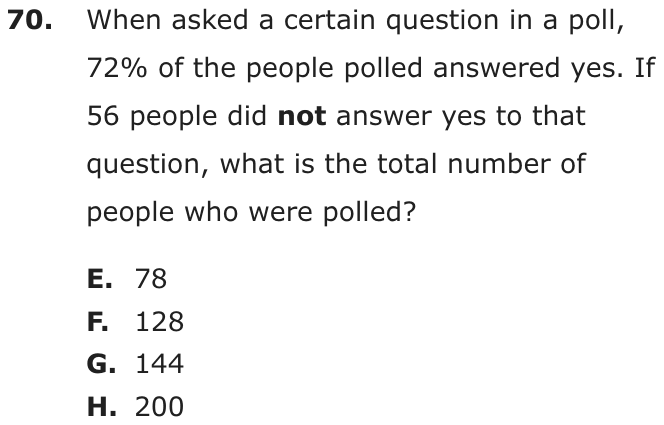
When asked a certain question in a poll, 72% of the people polled answered yes. If 56 people did not answer yes to that question, what is the total number of people who were polled?
- A78
- B128
- C144
- D200
Show the answer
Correct answer: D
72% of the people polled answered yes, so 28% of the people did not answer yes.
Therefore, 56 people is 28% of the total, x.
Question analysis
A percent word problem about a poll: 72% of the people answered yes, and 56 people did not. Students find the total number of people polled. They must first match the 56 people with the right percent and then find the whole from a part, which is where the main slip happens.
- Grade level
- Grade 7 content, by NYS standard
- Compared with grade 7
- At grade 7 Finding a whole from a part and a percent is grade 6 and 7 work. This adds one short step, finding the complementary percent first, which makes it a standard grade 7 multistep percent problem.
- Estimated difficulty
- Moderate: several steps, or a close reading with one strong distractor.
- Thinking it demands
- Depth of knowledge 2, skills and concepts · mainly apply
- What makes it hard
- Turning words into math moderate
- Error-prone arithmetic minor
- Solution
- 2 steps
- Reading level
- Question and choices: about grade 6, 33 words.
- Students, last 30 days
- Not enough answers yet to show (it takes 10).
Why it is hard, traps and wrong answers (shows the answer)
Why it is hard
The only percent printed is 72 and the only count is 56, so the first instinct is to pair them, even though the bold not says they describe different groups. Once 56 is matched with the 28% who did not say yes, a single division finds the total. The listed wrong answers come from that mismatch, from adding the two numbers, and from stopping at the yes count.
Turning words into math moderate Understanding the question
The 56 people are the ones who did not answer yes, so they match 100% − 72% = 28%, not the 72% printed in the sentence before them. (Hegarty, Mayer & Monk, 1995; Koedinger & Nathan, 2004)
Error-prone arithmetic minor Working it out
Finding the total means 56 ÷ 0.28, a division by a decimal; scaling 28% up to 100% at 2 people per percent avoids it. (Brown & Burton, 1978; Junker & Sijtsma, 2001)
Strategy: Subtract 72% from 100% to find the percent who did not answer yes, then find the total that makes 56 equal to that percent.
Traps
- Misreads the question: Misses or misreads a condition or a word in the question: "at least", "each", "remaining", "not".
- Answers a different question: A choice is right for another quantity: the other unknown, the rest instead of the part, the part instead of the whole.
- Misunderstands the concept: A wrong belief about a concept: that percents can be added, that area grows like length, that averages can be averaged, that a bigger denominator means a bigger fraction.
The wrong answers, classified
A Misreads the question (Hegarty, Mayer & Monk, 1995)
Overlooks the bold not and pairs the 56 people with the 72% who said yes: 56 ÷ 0.72 ≈ 77.8, rounded to 78.
B Misunderstands the concept (Smith, diSessa & Roschelle, 1993; De Bock et al., 1998; Ni & Zhou, 2005)
Reads the 72% as a fixed 72 people and adds the 56 who did not say yes, 72 + 56 = 128, instead of treating 72% as a share of the unknown total.
C Answers a different question (King et al., 2004; Hegarty, Mayer & Monk, 1995)
Gets 2 people per percent from 56 ÷ 28 but multiplies by 72 instead of 100, finding the 144 who answered yes rather than everyone polled.
Worked solution, step by step
Formulas used
- Percent of a whole
- The whole is the total amount, here everyone polled. p is the percent. The part is the amount that p percent stands for. Percent means out of 100, so p% is p hundredths of the whole.
Sort out the question
In a poll, 72% of the people answered yes. 56 people did not answer yes. You need the total number of people polled. Notice the bold word not. The 56 people are the ones who did not say yes.
Find the percent who did not say yes
Everyone polled makes 100%. Take away the 72% who said yes.
So 28% did not answer yes. That is the group of 56 people. Watch out: do not match the 56 people with 72%. That leads to about 78, choice A.
Set up the percent equation
Call the total number of people T. The 56 people are 28% of T.
Solve for the total
First find how many people make 1%. Divide 56 people by 28.
So each 1% is 2 people. All 100% is 100 times that.
Watch out: do not multiply 2 by 72. That gives 144, the people who said yes, choice C. So the answer is D, 200.
Check your answer
Find 28% of 200: . That matches the people who did not say yes. Also, 72% of 200 is 144 people who said yes, and , everyone.
More questions like this
The original DOE question
Question 14 of 57
2024 Test A Math, question 14Question
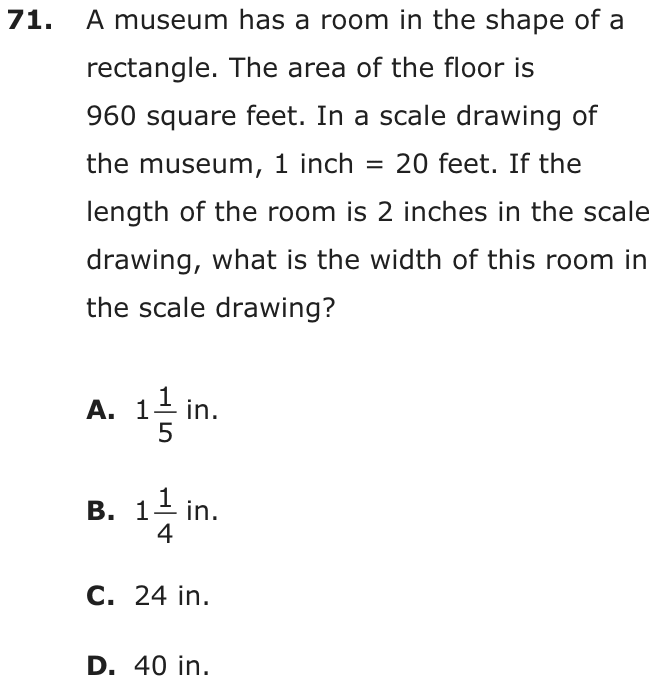
A museum has a room in the shape of a rectangle. The area of the floor is 960 square feet. In a scale drawing of the museum, 1 inch = 20 feet. If the length of the room is 2 inches in the scale drawing, what is the width of this room in the scale drawing?
- A in.
- B in.
- C24 in.
- D40 in.
Show the answer
Correct answer: A
The scale is 1 inch = 20 feet, and the length in the scale drawing is 2 inches, so the actual length is 40 feet.
The actual width is 24 feet.
Let x equal the width of the scale drawing, in inches.
Question analysis
A scale drawing problem: a museum room has a floor area of 960 square feet, the drawing's scale is 1 inch to 20 feet, and the room is 2 inches long in the drawing. Students find the room's width in the drawing. They must move between drawing inches and real feet, and back again, without mixing them.
- Grade level
- Grade 7 content, by NYS standard
- Compared with grade 7
- At grade 7 Scale drawings are grade 7 content, and grade 7 tasks usually convert one length. This one converts to real size, uses the area to find a second side, and converts back: three steps with a units trap.
- Estimated difficulty
- Moderate: several steps, or a close reading with one strong distractor.
- Thinking it demands
- Depth of knowledge 2, skills and concepts · mainly apply
- What makes it hard
- Combines ideas moderate
- Much to keep track of minor
- Solution
- 3 steps
- Reading level
- Question and choices: about grade 2, 57 words.
- Students, last 30 days
- Not enough answers yet to show (it takes 10).
Why it is hard, traps and wrong answers (shows the answer)
Why it is hard
Scale questions usually convert one length; this one needs a round trip, from the drawing to the real room and back. The real width of 24 feet appears partway through and is a choice, so students who lose track of units stop there. The last conversion, 24/20, then has to be written as a mixed number, and its fraction part is where a hurried student slips.
Combines ideas moderate Working it out
The 960 square feet is a real-world area, so the scale cannot be applied to it directly; the length must go to feet, the width come from the area, and then return to inches. (Embretson, 1998; Daniel & Embretson, 2010)
Much to keep track of minor Working it out
Four lengths in two units are in play, 2 inches, 40 feet, 24 feet and the width on the drawing, and each must stay labeled with its unit. (Sweller, 1988; Carpenter, Just & Shell, 1990)
Strategy: Convert the 2-inch length to real feet, divide the area by it to get the real width, then use the scale to change that width back to inches.
Traps
- Units or scale: The answer is wanted in other units, or a rate or scale must be converted first.
- Answers a different question: A choice is right for another quantity: the other unknown, the rest instead of the part, the part instead of the whole.
The wrong answers, classified
B An arithmetic slip (Junker & Sijtsma, 2001)
Gets the real width of 24 feet and divides by 20 correctly, but writes the remainder 4/20 as 1/4 instead of 1/5.
C Units or scale (King et al., 2004)
Finds the room's real width, 960 ÷ 40 = 24 feet, and gives it as the drawing's width without converting back at 1 inch per 20 feet.
D Answers a different question (King et al., 2004; Hegarty, Mayer & Monk, 1995)
Converts the 2-inch length to the real 40 feet and gives that number, answering for the length instead of the width and in the wrong units.
Worked solution, step by step
Formulas used
- Area of a rectangle
- A is the area, the space the floor covers. l is the length and w is the width. The floor is like rows of 1-foot squares, with w rows and l squares in each row. So you multiply.
- Using the scale
- The scale says 1 inch on the drawing stands for 20 feet in the real room. The drawing length is in inches, and the real length is in feet. To go back from feet to inches, divide by 20.
Sort out the question
The real room is a rectangle with a floor area of 960 square feet. On the drawing, 1 inch stands for 20 feet. The room is 2 inches long on the drawing. You need its width on the drawing, in inches. The area is in real feet, so you must switch between the drawing and the room.
Find the real length
The real room is 40 feet long. Watch out: 40 is the real length, not the width on the drawing. Choosing 40 in., choice D, is wrong.
Find the real width
Use the area of the rectangle. You know the area and the length.
The real room is 24 feet wide. Watch out: this width is in real feet. Choosing 24 in., choice C, skips changing it back to the drawing.
Change the width to the drawing
Every 20 feet is 1 inch on the drawing. So undo the scale: divide the real width by 20.
To simplify , divide the top and bottom by 4. Watch out: it is , not , so choice B is wrong. So the answer is A, in.
Check your answer
Go the other way. On the drawing, the room is 2 inches by inches. In real feet that is 40 by 24, since . And square feet, the real area.
More questions like this
The original DOE question
Question 15 of 57
2024 Test A Math, question 15Question
A program on a computer randomly generates a sequence of whole numbers from 1 to 9, inclusive. If the computer generates a sequence of 300 numbers, what is the best prediction of the number of odd numbers in the sequence?
- A120
- B133
- C150
- D167
Show the answer
Correct answer: D
There are five odd numbers in the range 1 through 9: 1, 3, 5, 7, and 9.
So the proportion of odd numbers in the range 1 through 9 is .
The expected number of odd values in the sequence from the computer program is
So the best prediction for the number of odd numbers in the sequence is 167.
Question analysis
A probability question: a computer randomly generates 300 whole numbers from 1 to 9, and students predict how many will be odd. It asks students to find the probability of an odd number and use it to predict a count. Counting carefully which of the nine numbers are odd, and rounding the prediction sensibly, are the points to watch.
- Grade level
- Grade 6 content, by NYS standard
- Compared with grade 7
- At grade 7 Using a probability to predict how often an event happens is grade 6 and 7 work. This takes two short steps plus a rounding decision, about the demand of a typical grade 7 probability task.
- Estimated difficulty
- Straightforward: two steps or one careful reading.
- Thinking it demands
- Depth of knowledge 2, skills and concepts · mainly apply
- What makes it hard
- Solution
- 3 steps
- Reading level
- Question and choices: about grade 11, 37 words.
- Students, last 30 days
- Not enough answers yet to show (it takes 10).
Why it is hard, traps and wrong answers (shows the answer)
Why it is hard
The method is short, a probability times 300, so the question is decided by the probability. Odd and even feel like an even split, and half of 300 is a listed choice, but the numbers 1 to 9 hold five odd and four even. Listing the nine numbers before computing removes the trap, and the result, about 167, then needs only rounding.
Turning words into math minor Understanding the question
The phrase "whole numbers from 1 to 9, inclusive" means nine equally likely values, five of them odd, so the chance of odd is 5/9, not the one half that odd and even suggest. (Hegarty, Mayer & Monk, 1995; Koedinger & Nathan, 2004)
Something you must already know minor Working it out
The stem never says that an expected count is the probability times the number of trials, here 5/9 of the 300 numbers generated. (Anderson & Krathwohl, 2001)
Error-prone arithmetic minor Working it out
The product 300 × 5/9 is 166.67, not a whole number, so the prediction has to be rounded to the nearest whole number. (Brown & Burton, 1978; Junker & Sijtsma, 2001)
Strategy: Count the odd numbers from 1 to 9, write the probability as that count over 9, and multiply by 300, rounding to the nearest whole number.
Traps
- Misunderstands the concept: A wrong belief about a concept: that percents can be added, that area grows like length, that averages can be averaged, that a bigger denominator means a bigger fraction.
- Answers a different question: A choice is right for another quantity: the other unknown, the rest instead of the part, the part instead of the whole.
The wrong answers, classified
A Little reason to choose it (Haladyna & Downing, 1993; Rodriguez, 2005)
No count of the nine numbers gives 120, which is 40% of 300; reaching it takes two errors at once, so it mostly attracts guesses.
B Answers a different question (King et al., 2004; Hegarty, Mayer & Monk, 1995)
Counts the four even numbers instead of the five odd ones and predicts 4/9 of 300, about 133.
C Misunderstands the concept (Smith, diSessa & Roschelle, 1993; De Bock et al., 1998; Ni & Zhou, 2005)
Assumes odd and even numbers are equally likely and takes half of 300, ignoring that 1 to 9 holds one more odd number than even.
Worked solution, step by step
Formulas used
- Probability
- P is the probability, the chance that something happens. Possible results are all the results that are equally likely. Wanted results are the ones you are looking for. The chance is the fraction of the results that you want.
- Expected count
- E is the expected count, your best guess of how many times something will happen. P is its probability, and n is the number of tries. If something happens 5 times out of 9, it should happen about 5 ninths of the time in many tries.
Sort out the question
The computer picks whole numbers from 1 to 9. Inclusive means 1 and 9 count too. Randomly means each number has the same chance. It picks 300 numbers. You need the best guess of how many of them are odd.
Count the odd numbers
An odd number does not split evenly by 2. From 1 to 9, the odd numbers are 1, 3, 5, 7 and 9. That is 5 of the 9 numbers. The even ones, 2, 4, 6 and 8, are only 4. Watch out: odd and even are not equally likely here, since there is one more odd number. Taking half of 300 gives 150, choice C.
Find the chance of odd
Each number the computer picks has a 5 in 9 chance of being odd. Watch out: do not use the 4 even numbers. That gives about 133, choice B.
Multiply by the 300 numbers
The sign ≈ means about. You can’t have part of a number, so round to the nearest whole number. 166.7 is closer to 167 than to 166. So the answer is D, 167.
Check your answer
The odd numbers are a bit more than half of the nine. So the answer should be a bit more than half of 300, which is 150. Only 167 is a bit more than 150. Also, 167 odd plus about 133 even makes 300.
More questions like this
The original DOE question
Question 16 of 57
2024 Test A Math, question 16Question
A truck rental company charges a one-time fee of $40 plus $1 per mile driven. Dalia rented a truck and used a coupon for 20% off the total rental cost. After the coupon was applied, she spent a total of $60. How many miles did she drive?
- A8
- B20
- C32
- D35
Show the answer
Correct answer: D
Let m equal the miles driven during Dalia’s rental. The total cost, c, can be expressed as an equation.
Dalia spent a total of $60, which included a 20% off coupon. Find the cost before the coupon by dividing the final cost ($60) by the percentage paid (80%):
Use $75 as the total cost to find m.
Dalia drove 35 miles.
Question analysis
A multistep word problem about a truck rental that costs a $40 fee plus $1 per mile, with a 20% off coupon applied to the total. Given that Dalia paid $60 after the coupon, students find how many miles she drove. Undoing the discount correctly before removing the fixed fee is the hard part.
- Grade level
- Grade 7 content, by NYS standard
- Compared with grade 7
- Above grade 7 Grade 7 students solve two-step equations and work with discounts, usually separately. This combines them and makes students undo a 20% discount starting from the price paid, a reversal many grade 7 students have not practised.
- Estimated difficulty
- Hard: combines ideas, needs a plan, and has more than one tempting wrong answer.
- Thinking it demands
- Depth of knowledge 2, skills and concepts · mainly apply
- What makes it hard
- Turning words into math moderate
- Combines ideas moderate
- A very close wrong answer moderate
- Solution
- 3 steps
- Reading level
- Question and choices: about grade 5, 43 words.
- Students, last 30 days
- Not enough answers yet to show (it takes 10).
Why it is hard, traps and wrong answers (shows the answer)
Why it is hard
Two ordinary skills, undoing a discount and solving a two-step equation, are stacked, and the first runs in reverse. The natural way to undo 20% off is to add 20% back, which gives $72 instead of $75 and a choice three miles from the answer. Students who check by applying the coupon to the full cost of 40 + 35 = 75 dollars see at once that 80% of it is 60.
Turning words into math moderate Understanding the question
The sentence "After the coupon was applied, she spent a total of $60" makes 60 the price after 20% off, so it is 80% of the full cost, 40 + m. (Hegarty, Mayer & Monk, 1995; Koedinger & Nathan, 2004)
Combines ideas moderate Working it out
A percent discount has to be undone before the fee-plus-mileage equation can be solved: 60 ÷ 0.8 = 75, then 75 − 40 = 35 miles. (Embretson, 1998; Daniel & Embretson, 2010)
A very close wrong answer moderate Choosing the answer
The choices 32 and 35 are three miles apart, too close to tell apart by estimate; only dividing 60 by 0.8, rather than adding 20% of 60, separates them. (Embretson & Wetzel, 1987; Gorin & Embretson, 2006; Ascalon et al., 2007)
Strategy: Since $60 is 80% of the full cost, divide 60 by 0.80 to find the cost before the coupon, then subtract the $40 fee to get the miles.
Traps
- Percent of the wrong amount: Finding the whole from a part, or a percent change measured from the wrong starting amount.
- Misreads the question: Misses or misreads a condition or a word in the question: "at least", "each", "remaining", "not".
The wrong answers, classified
A Wrong operation (Hegarty, Mayer & Monk, 1995; King et al., 2004)
Takes 20% off the $60 again, 60 × 0.8 = 48, instead of undoing the discount, then subtracts the $40 fee to get 8 miles.
B Misreads the question (Hegarty, Mayer & Monk, 1995)
Ignores the coupon and treats the $60 as the full cost, so it subtracts the $40 fee and gets 20 miles.
C Percent of the wrong amount (Parker & Leinhardt, 1995)
Undoes the coupon by adding 20% of $60 to get $72, though the 20% was taken of the larger pre-coupon cost, then subtracts the $40 fee.
Worked solution, step by step
Formulas used
- Rental cost
- c is the full cost in dollars, before any coupon. 40 is the one-time fee, paid once no matter how far you drive. m is the number of miles, and each mile costs 1 dollar.
- Price after a discount
- The full cost is the price before the discount. p is the percent taken off. You pay what is left: 100% minus p%. For 20% off you pay 80%, so you multiply by 0.80.
Sort out the question
The truck costs a $40 fee, plus $1 for each mile. Dalia’s coupon took 20% off the total. After the coupon, she paid $60. You need how many miles she drove. The $60 is the price after the discount, not the full cost.
Write what she paid
20% off means she paid what was left of the full cost.
As a decimal, 80% is 0.80.
Undo the discount
To undo times 0.80, divide by 0.80. Move the decimal point one place in both numbers to make it easier.
The full cost was $75. Watch out: the 20% was taken off the full cost, not off $60. Adding 20% of $60 gives $72 and leads to 32 miles, choice C. Taking 20% off $60 again leads to 8 miles, choice A.
Find the miles
She drove 35 miles. Watch out: do not skip the coupon. Using $60 as the full cost gives 20 miles, choice B. So the answer is D, 35.
Check your answer
Go forward. 35 miles cost $35. Add the $40 fee to get $75. The coupon takes off 20% of $75, which is dollars. Then . That is exactly what she paid.
More questions like this
The original DOE question
Question 17 of 57
2024 Test A Math, question 17Question
The probability of drawing a red candy at random from a bag of 25 candies is . After 5 red candies are removed from the bag, what is the probability of randomly drawing a red candy from the bag?
- A0
- B
- C
- D
Show the answer
Correct answer: D
Start with a proportion to determine the total number of red candies in the bag:
There are currently 10 red candies out of 25 candies in the bag. After 5 red candies are removed, there would be 5 red candies left in the bag and 20 total candies.
The probability of randomly drawing a red candy would then be .
Question analysis
A probability question about a bag of 25 candies in which the chance of drawing red is 2/5; then 5 red candies are taken out. Students find the new probability of drawing a red candy. They must work out how many red candies there were, then rebuild the fraction from the counts left in the bag.
- Grade level
- Grade 6 content, by NYS standard
- Compared with grade 7
- At grade 7 Simple probability as a fraction of outcomes is grade 6 and 7 content. This adds a step back from the probability to a count and an update after removal, which is typical grade 7 multi-step work.
- Estimated difficulty
- Moderate: several steps, or a close reading with one strong distractor.
- Thinking it demands
- Depth of knowledge 2, skills and concepts · mainly apply
- What makes it hard
- Turning words into math moderate
- Many steps minor
- Solution
- 3 steps
- Reading level
- Question and choices: about grade 7, 40 words.
- Students, last 30 days
- Not enough answers yet to show (it takes 10).
Why it is hard, traps and wrong answers (shows the answer)
Why it is hard
The question gives a probability, not a count, so the first job is to rebuild the bag: 10 red candies among 25. Removing candies changes two numbers at once, and the strongest wrong choice comes from updating the red count while leaving the total at 25. A student who writes both new counts before forming the fraction avoids it.
Turning words into math moderate Understanding the question
The probability 2/5 has to be turned into a count, 10 red of 25, and "after 5 red candies are removed" lowers both the red count and the bag's total. (Hegarty, Mayer & Monk, 1995; Koedinger & Nathan, 2004)
Many steps minor Working it out
Three steps follow in order: 2/5 of 25 = 10, then 5 red among 20 candies left, then 5/20 reduced to lowest terms. (Daniel & Embretson, 2010; Enright, Morley & Sheehan, 2002)
Strategy: Use 2/5 of 25 to find the number of red candies, subtract 5 from both the red count and the total, and write the new fraction in lowest terms.
Traps
- Misreads the question: Misses or misreads a condition or a word in the question: "at least", "each", "remaining", "not".
The wrong answers, classified
A An arithmetic slip (Junker & Sijtsma, 2001)
Takes 2/5 of 25 as 25 ÷ 5 = 5, forgetting to multiply by 2, so removing 5 red candies seems to leave none.
B Little reason to choose it (Haladyna & Downing, 1993; Rodriguez, 2005)
No working gives 1/10, which would need 2 red candies among the 20 left; it mostly draws students who are guessing.
C Misreads the question (Hegarty, Mayer & Monk, 1995)
Subtracts the 5 removed candies from the 10 red ones but keeps 25 as the total, finding 5/25 = 1/5, though the bag now holds 20.
Worked solution, step by step
Formulas used
- Probability
- P is the probability, the chance of drawing a red candy. Red candies is how many red ones are in the bag. All candies is how many candies are in the bag in all. Each candy is equally likely, so the chance is the fraction of the bag that is red.
Sort out the question
The bag has 25 candies. The chance of drawing red is . Then 5 red candies are taken out. You need the new chance of drawing red. Taking out candies changes both the red count and the total.
Find the number of red candies
A chance of means 2 out of every 5 candies are red. Call the red count r.
There are 10 red candies. Watch out: do not stop at . You must also multiply by 2. Thinking there are 5 red candies leads to 0, choice A.
Take out the 5 red candies
Now 5 of the 20 candies are red. Watch out: the total goes down too. Keeping 25 gives , choice C.
Find the new probability
To simplify, divide the top and bottom by 5. So the answer is D, .
Check your answer
At first, is 40% of the bag. Taking out only red candies should lower the chance. is 25%, which is lower but not zero. That makes sense, because 5 red candies are still in the bag.
More questions like this
The original DOE question
Question 18 of 57
2024 Test A Math, question 18Question
Each number in a sequence is formed by doubling the previous number and then adding 1. If the 9th number in the sequence is 63, what is the 10th number minus the 7th number?
- A96
- B111
- C112
- D127
Show the answer
Correct answer: C
First, write an equation based on the rule described in the item. Let x be the previous number in the sequence and y be the number in the sequence. The ninth number in the sequence is 63.
Determine the 10th number in the sequence, y, by making and solving:
Determine the 8th number in the sequence, x, by making and solving:
Subtract one from both sides of the equation.
Determine the 7th number in the sequence, x, by making and solving:
Subtract the 7th number in the sequence from the 10th number:
The difference is 112.
Question analysis
A sequence question: each number is found by doubling the one before it and adding 1, and the 9th number is 63. Students find the 10th number minus the 7th. That means running the rule forward once and backward twice, while keeping track of which position each number holds.
- Grade level
- Grade 7 content, by NYS standard
- Compared with grade 7
- Above grade 7 Grade 7 students solve two-step equations but rarely have to run a rule backward through a sequence. This mixes forward and backward steps with position counting, so it asks for more planning than a typical grade 7 task.
- Estimated difficulty
- Hard: combines ideas, needs a plan, and has more than one tempting wrong answer.
- Thinking it demands
- Depth of knowledge 2, skills and concepts · mainly apply
- What makes it hard
- No obvious method moderate
- Many steps moderate
- Much to keep track of minor
- Solution
- 4 steps
- Reading level
- Question and choices: about grade 7, 32 words.
- Corrected from the DOE handbook
- A misplaced parenthesis in the explanation’s working was corrected.
- Students, last 30 days
- Not enough answers yet to show (it takes 10).
Why it is hard, traps and wrong answers (shows the answer)
Why it is hard
Applying the rule forward is routine; running it backward is not, and the question needs both. Students must also count positions carefully, since the 9th number is given and the 7th is two steps back, not one. Each listed wrong answer stops or slips at a different stage, so writing the four numbers in a row, 15, 31, 63 and 127, before subtracting is the reliable way.
No obvious method moderate Working it out
The rule is stated only forward, double and add 1, but the 7th and 8th numbers come before the given 9th, so the rule must be undone: subtract 1, then halve. (Schoenfeld, 1985)
Many steps moderate Working it out
One forward step reaches the 10th number, 127, two backward steps reach the 8th and 7th, 31 and 15, and a final subtraction finishes. (Daniel & Embretson, 2010; Enright, Morley & Sheehan, 2002)
Much to keep track of minor Working it out
Four positions and their values, 7th to 10th, have to be kept straight, and the 8th number is easy to mistake for the 7th. (Sweller, 1988; Carpenter, Just & Shell, 1990)
Strategy: Apply the rule to 63 to get the 10th number; to go back a position, subtract 1 and halve, doing it twice to reach the 7th; then subtract.
Traps
- Counting the ends: Inclusive or exclusive ends, fence posts, consecutive numbers: an answer that is one too many or too few, or an endpoint drawn open where it belongs closed (or the reverse).
- Stops one step early: A choice is a number from partway through the solution.
The wrong answers, classified
A Counting the ends (Brown & Burton, 1978)
Steps back only once from the 9th number and subtracts the 8th, 127 − 31 = 96, one position short of the 7th.
B Misreads the question (Hegarty, Mayer & Monk, 1995)
Doubles 63 to 126 but forgets to add 1 on that step, then subtracts the correct 7th number: 126 − 15 = 111.
D Stops one step early (King et al., 2004; Gierl et al., 2017)
Finds the 10th number, 2 × 63 + 1 = 127, and stops without subtracting the 7th number from it.
What was corrected from the DOE handbook, and why
- Explanation: Finding the 7th number, the handbook writes “2x + (1 − 1 = 31 − 1)”, with the closing parenthesis after the whole equation, so the line reads as an equation inside an expression (and 1 − 1 = 31 − 1 is false). The site now reads 2x + (1 − 1) = 31 − 1, the same step the handbook writes correctly for the 8th number (2x + (1 − 1) = 63 − 1). It leads to 2x = 30 and x = 15 as before.
Worked solution, step by step
Formulas used
- The sequence rule
- A sequence is a list of numbers that follows a rule. x is a number in the list, and y is the next number. To get the next number, double x and then add 1.
- Going back one number
- y is a number in the list, and x is the one just before it. To go back, undo the rule in reverse order. The rule doubles and then adds 1. So first subtract 1, then divide by 2.
Sort out the question
Each number is “formed by doubling the previous number and then adding 1”. Previous means the one just before. The 9th number is 63. You need the 10th number minus the 7th number. So you go forward one number and back two numbers.
Find the 10th number
Use the rule with x = 63.
The 10th number is 127. Watch out: remember to add 1. Doubling only gives 126 and leads to 111, choice B.
Plan how to go back
The 7th number comes before the 9th, so you must undo the rule. The rule doubled, then added 1. Undo the last step first: subtract 1. Then undo the doubling: divide by 2.
Find the 8th number
The 8th number is 31. Watch out: 31 is the 8th number, not the 7th. Using it gives , choice A.
Find the 7th number
Step back once more, from the 8th number. Use the same rule with y = 31.
The 7th number is 15.
Subtract the 7th from the 10th
Watch out: 127 alone is choice D. You still have to subtract the 7th number. So the answer is C, 112.
Check your answer
Go forward from 15 using the rule. , then , then . You land on 63 as the 9th number, so the list is right. And .
More questions like this
The original DOE question
Question 19 of 57
2024 Test A Math, question 19Question
8.9, 8.2, 8.5, 9.0, 8.4, 8.6, 8.8
At a skating championship, there are seven judges who each award a score for each skater’s performance. The highest and lowest scores given to each skater are discarded, and the mean of the remaining scores is then calculated and reported as the skater’s final score. What is the final score for the skater who received the scores shown above from the judges?
- A8.60
- B8.62
- C8.64
- D8.70
Show the answer
Correct answer: C
The highest and lowest scores are discarded: 8.2 and 9.0.
To find the mean, add the remaining scores and then divide that sum by the total number of remaining scores.
Question analysis
A statistics question about a skating championship with seven judges: the highest and lowest of a skater's seven scores are dropped, and the rest are averaged. Students apply that rule to the listed scores, decimals close together. Following the dropping rule exactly and adding the decimals carefully both matter, since the choices are very close.
- Grade level
- Grade 6 content, by NYS standard
- Compared with grade 7
- Below grade 7 Finding a mean is grade 6 content, and this adds only a rule about which scores to drop. Grade 7 statistics usually compares whole data sets, so this is easier, though the close choices demand exact decimal arithmetic.
- Estimated difficulty
- Straightforward: two steps or one careful reading.
- Thinking it demands
- Depth of knowledge 2, skills and concepts · mainly apply
- What makes it hard
- A very close wrong answer moderate
- Error-prone arithmetic minor
- Turning words into math minor
- Solution
- 3 steps
- Reading level
- Question and choices: about grade 9, 62 words.
- Students, last 30 days
- Not enough answers yet to show (it takes 10).
Why it is hard, traps and wrong answers (shows the answer)
Why it is hard
The arithmetic is short, but the choices are spaced so closely that a small slip or a skipped rule lands on a neighbor. Averaging all seven scores, or picking the middle score, gives values within a few hundredths of the answer. The question rewards following the stated rule exactly and adding the five remaining scores with care.
A very close wrong answer moderate Choosing the answer
The choices 8.60, 8.62 and 8.64 lie within 0.04 of one another, so no estimate separates them; only the exact sum of the five kept scores, 43.2, does. (Embretson & Wetzel, 1987; Gorin & Embretson, 2006; Ascalon et al., 2007)
Error-prone arithmetic minor Working it out
Five one-decimal scores must be added and divided by 5; subtracting 8 from each first leaves 0.9, 0.5, 0.4, 0.6 and 0.8, which are easier to add. (Brown & Burton, 1978; Junker & Sijtsma, 2001)
Turning words into math minor Understanding the question
The scoring rule takes two sentences to state: discard the single highest and the single lowest score, then average the five that remain. (Hegarty, Mayer & Monk, 1995; Koedinger & Nathan, 2004)
Strategy: Cross out the single highest and the single lowest score, add the five that remain, and divide that sum by 5.
Traps
- Misreads the question: Misses or misreads a condition or a word in the question: "at least", "each", "remaining", "not".
- Answers a different question: A choice is right for another quantity: the other unknown, the rest instead of the part, the part instead of the whole.
The wrong answers, classified
A Answers a different question (King et al., 2004; Hegarty, Mayer & Monk, 1995)
Gives the median, the middle score 8.6, instead of the mean of the five scores left after the highest and lowest are dropped.
B Misreads the question (Hegarty, Mayer & Monk, 1995)
Averages all seven scores without discarding any, 60.4 ÷ 7 = 8.628…, and takes 8.62, the nearest choice to that mean.
D Misreads the question (Hegarty, Mayer & Monk, 1995)
Drops only the lowest score, 8.2, and averages the other six, (60.4 − 8.2) ÷ 6 = 8.7, keeping the top score of 9.0.
Worked solution, step by step
Formulas used
- Mean, or average
- The mean is the average. The sum is what you get when you add all the scores. Divide it by how many scores you added. It shares the total out evenly, as if every score were the same.
Sort out the rule
Seven judges gave the seven scores shown. The rule has two parts. First, throw out the highest score and the lowest score. Then find the mean of the scores that are left. The mean is the average. That is the final score you need.
Cross out the highest and lowest
The highest score is 9.0. The lowest is 8.2. Cross both out. Five scores are left: 8.9, 8.5, 8.4, 8.6 and 8.8. Watch out: drop both. Dropping only 8.2 gives 8.70, choice D. Keeping all seven gives about 8.63, which is closest to 8.62, choice B.
Add the five scores
A shortcut: each score is 8 plus a bit. The bits are 0.9, 0.5, 0.4, 0.6 and 0.8, and they add to 3.2. Five 8s make 40, and .
Divide by the number of scores
Watch out: do not just take the middle score, 8.6. That is the median, choice A. The question asks for the mean. So the answer is C, 8.64.
Check your answer
Multiply back: , the sum. Also, the mean should sit between the lowest kept score, 8.4, and the highest kept score, 8.9. 8.64 does.
More questions like this
The original DOE question
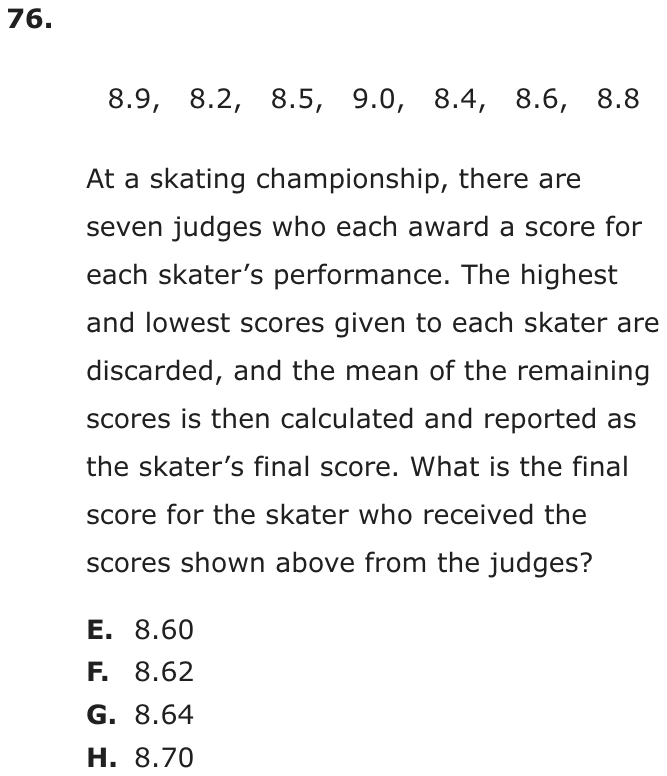
Question 20 of 57
2024 Test A Math, question 20Question
A piece of wood that is feet long is cut into 2 pieces of different lengths. The shorter piece has a length of x feet. Which inequality expresses all possible values of x?
- A
- B
- C
- D
Show the answer
Correct answer: A
The original piece of wood is feet long.
The shorter piece is x feet long, and it must be less than half the length of the original piece of wood.
Since half of is , it follows that .
The shorter piece of wood cannot be 0 feet long, so it follows that .
This gives the compound inequality .
Question analysis
An inequality question: a piece of wood 4½ feet long is cut into two pieces of different lengths, and the shorter piece is x feet long. Students choose the inequality that gives every possible value of x. They must turn each condition in the words into a boundary and decide whether each end of the range is included.
- Grade level
- Grade 7 content, by NYS standard
- Compared with grade 7
- Above grade 7 Grade 7 students solve and graph simple inequalities. Writing a compound inequality from a description, where the words decide whether each end is strict, is less familiar and calls for careful reading of every condition.
- Estimated difficulty
- Moderate: several steps, or a close reading with one strong distractor.
- Thinking it demands
- Depth of knowledge 2, skills and concepts · mainly analyze
- What makes it hard
- Turning words into math moderate
- A very close wrong answer moderate
- Variables instead of numbers minor
- Solution
- 2 steps
- Reading level
- Question and choices: about grade 5, 37 words.
- Students, last 30 days
- Not enough answers yet to show (it takes 10).
Why it is hard, traps and wrong answers (shows the answer)
Why it is hard
Halving 4 1/2 feet is the only computation; the rest is deciding whether each end of the range can actually happen. A shorter piece of 2 1/4 feet would make the two pieces equal, and a piece of 0 feet is no piece at all, so both ends are excluded. Students who find the right bounds but never test the ends are drawn to the version with the inclusive symbols.
Turning words into math moderate Understanding the question
Two phrases set the two ends: "cut into 2 pieces" means x is more than 0, and "of different lengths" with "the shorter piece" means x is less than half of 4 1/2. (Hegarty, Mayer & Monk, 1995; Koedinger & Nathan, 2004)
A very close wrong answer moderate Choosing the answer
The inequalities 0 < x < 2 1/4 and 0 ≤ x ≤ 2 1/4 share both bounds and differ only in their symbols; only checking whether each end can happen separates them. (Embretson & Wetzel, 1987; Gorin & Embretson, 2006; Ascalon et al., 2007)
Variables instead of numbers minor Understanding the question
The question asks for every possible length of the shorter piece, a range rather than one length, so students must picture the cut moving along the board. (Koedinger & Nathan, 2004; Enright, Morley & Sheehan, 2002)
Strategy: Picture cutting the board in different places, find the largest and smallest values the shorter piece could take, and check whether each boundary value is actually possible.
Traps
- Counting the ends: Inclusive or exclusive ends, fence posts, consecutive numbers: an answer that is one too many or too few, or an endpoint drawn open where it belongs closed (or the reverse).
- Misreads the question: Misses or misreads a condition or a word in the question: "at least", "each", "remaining", "not".
- Answers a different question: A choice is right for another quantity: the other unknown, the rest instead of the part, the part instead of the whole.
The wrong answers, classified
B Counting the ends (Brown & Burton, 1978)
Finds the right bounds but includes both ends, allowing a piece of 0 feet or two equal halves, though the stem says 2 pieces of different lengths.
C Misreads the question (Hegarty, Mayer & Monk, 1995)
Ignores that x is the shorter piece and allows any length up to the whole 4 1/2-foot board.
D Answers a different question (King et al., 2004; Hegarty, Mayer & Monk, 1995)
Describes the longer piece, whose length lies between half the board and the whole board, instead of the shorter piece the stem calls x.
Worked solution, step by step
Formulas used
- Two pieces make the whole board
- x is the length of the shorter piece, and L is the length of the longer piece, both in feet. Together they make the whole board. Since x is smaller than L, x must be less than half of the board.
- Inequality signs
- a < b says a is less than b. a ≤ b says a is less than or equal to b, so a can also equal b. A chain like 0 < x < 5 means x is more than 0 and less than 5.
Sort out the question
A board is feet long. It is cut into 2 pieces of different lengths. The shorter piece is x feet long. You need an inequality for every possible value of x. An inequality uses signs like <, less than, to show a range of numbers.
Find the top end for x
If you cut exactly in the middle, each piece is half the board.
But the pieces have different lengths, so the cut is not in the middle. The shorter piece must be less than half.
Find the bottom end for x
The shorter piece can be very small, like 0.1 foot. But it can’t be 0 feet. Then nothing would be cut off, and there would not be 2 pieces.
Put the two ends together
This says x is more than 0 and less than . Watch out: choice B uses ≤, which allows x = 0 or . Neither can happen. Choice C lets x be more than half, so it would not be the shorter piece. Choice D describes the longer piece. So the answer is A, .
Check your answer
Test values. Cut off 1 foot: the pieces are 1 foot and feet. The shorter one is 1, and 1 is between 0 and . If x were 3, the other piece would be feet, so x would not be the shorter one. Choice A leaves 3 out, as it should.
More questions like this
The original DOE question
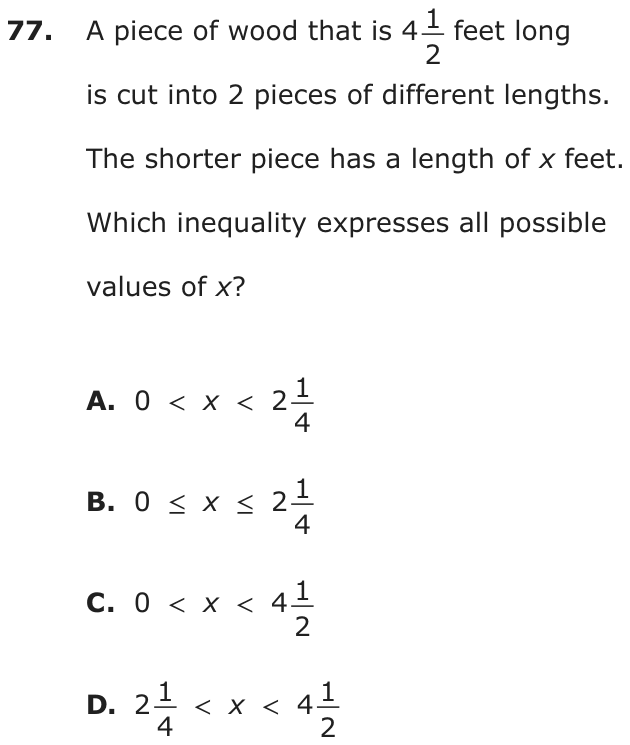
Question 21 of 57
2024 Test A Math, question 21Question
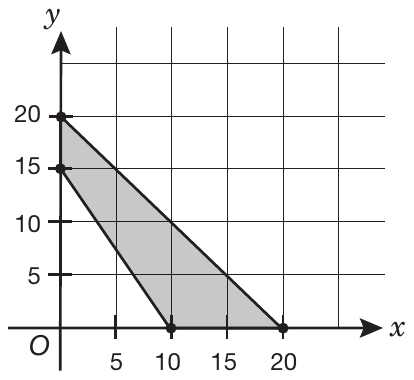
What is the area, in square units, of the shaded region shown in the figure above?
- A75
- B125
- C150
- D200
Show the answer
Correct answer: B
The area of the shaded region, in square units, is the area of the triangle created by the shaded and unshaded regions minus the area of the triangle created by the unshaded region.
The area of the triangle created by the shaded and unshaded regions is 200 square units.
The area of the triangle created by the unshaded region is 75 square units.
Subtract to find the area of the shaded region.
Question analysis
A coordinate geometry question: two line segments cross a grid, one from (0, 20) to (20, 0) and one from (0, 15) to (10, 0), and the region between them is shaded. Students find the shaded area. The shape is not a standard figure, so they need to see it as one triangle with another removed.
- Grade level
- Grade 6 content, by NYS standard
- Compared with grade 7
- At grade 7 Area of triangles is grade 6 content; finding a composite area by subtraction is the kind of task grade 7 students meet regularly. Points on the axes make every length easy to read.
- Estimated difficulty
- Straightforward: two steps or one careful reading.
- Thinking it demands
- Depth of knowledge 2, skills and concepts · mainly apply
- What makes it hard
- Reading a figure, table or graph moderate
- No obvious method minor
- Something you must already know minor
- Solution
- 3 steps
- Reading level
- Question and choices: about grade 6, 16 words.
- Students, last 30 days
- Not enough answers yet to show (it takes 10).
Why it is hard, traps and wrong answers (shows the answer)
Why it is hard
The shaded shape has no name, so the question is about seeing it as a difference of two right triangles whose legs lie on the axes. Once that is seen, both areas are one-line calculations. The wrong choices come from stopping after either triangle or from pairing a base from one segment with a height from the other.
Reading a figure, table or graph moderate Understanding the question
All four lengths come from where the two segments meet the axes, at 20 and 15 on the y-axis and at 10 and 20 on the x-axis, read against grid lines 5 units apart. (Lesh, Post & Behr, 1987; Kirsch & Mosenthal, 1990)
No obvious method minor Working it out
The shaded region is a four-sided shape with no formula of its own; it has to be seen as the large triangle with the small one removed. (Schoenfeld, 1985)
Something you must already know minor Working it out
The area of a triangle, one half of base times height, is assumed and not given. (Anderson & Krathwohl, 2001)
Strategy: Find the area of the large right triangle under the outer segment and subtract the area of the smaller triangle under the inner segment, reading the legs from the axes.
Traps
- Stops one step early: A choice is a number from partway through the solution.
- Answers a different question: A choice is right for another quantity: the other unknown, the rest instead of the part, the part instead of the whole.
- Misreads the figure: Reads a value, label or tick spacing in a figure, table or graph wrongly.
The wrong answers, classified
A Answers a different question (King et al., 2004; Hegarty, Mayer & Monk, 1995)
Finds the area of the small unshaded triangle, 1/2 × 10 × 15 = 75, and gives that region instead of the shaded one.
C Misreads the figure (Lesh, Post & Behr, 1987; Kirsch & Mosenthal, 1990)
Pairs the outer segment's x-intercept, 20, with the inner segment's y-intercept, 15, as if they bounded one triangle: 1/2 × 20 × 15 = 150.
D Stops one step early (King et al., 2004; Gierl et al., 2017)
Finds the area of the large triangle, 1/2 × 20 × 20 = 200, and stops before subtracting the unshaded triangle inside it.
Worked solution, step by step
Formulas used
- Area of a triangle
- A is the area. b is the base, the side the triangle sits on. h is the height: the straight-up distance from the base to the top corner, at a right angle to the base. You take half because a triangle is half of a rectangle with the same base and height.
Sort out the figure
The grid lines are 5 units apart. Two slanted segments run from the y-axis down to the x-axis. The outer one goes from 20 on the y-axis to 20 on the x-axis. The inner one goes from 15 on the y-axis to 10 on the x-axis. The shaded region is the strip between them. You need its area, in square units.
See the shape as two triangles
The shaded region has four sides, and it has no simple formula. But look at the big triangle under the outer segment, with its corner at O. It is the shaded strip plus the small white triangle. So the shaded area is the big triangle minus the small one.
Find the area of the big triangle
The big triangle has a right angle at O. Its base runs along the x-axis from 0 to 20, so it is 20 units. Its height runs up the y-axis from 0 to 20, so it is 20 units.
Watch out: this is the whole big triangle. Stopping here gives 200, choice D.
Find the area of the small triangle
The small triangle also has its right angle at O. Its base is 10 units, from 0 to 10 on the x-axis. Its height is 15 units, from 0 to 15 on the y-axis.
Watch out: 75 is the white triangle, choice A, not the shaded part. Also, pair the base and height of the same triangle. Mixing 20 and 15 gives 150, choice C.
Subtract to find the shaded area
Take the small white triangle away from the big triangle.
The shaded area is 125 square units. So the answer is B, 125.
Check your answer
In the figure, the shaded strip looks bigger than the white triangle. So the shaded area should be more than half of the big triangle, which is . 125 is more than 100. And , the whole big triangle.
More questions like this
The original DOE question
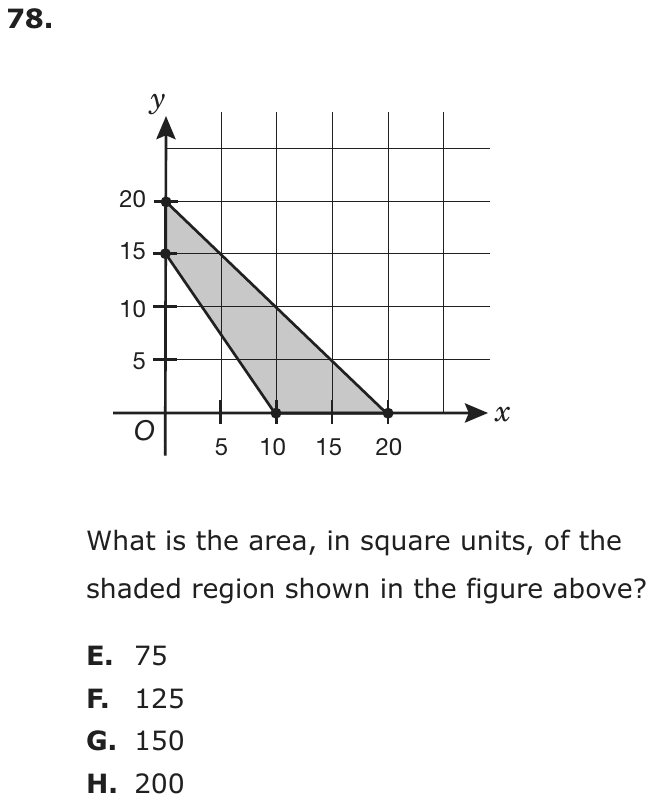
Question 22 of 57
2024 Test A Math, question 22Question
Yesterday in Centerville, the highest Fahrenheit temperature, F, was 86°, and the lowest was 68°. What was the difference between these temperatures, in degrees Celsius, C?
- A10.0° C
- B15.0° C
- C20.0° C
- D32.4° C
Show the answer
Correct answer: A
The highest temperature was 86° F.
Subtract 32 from both sides of the equation:
Multiply both sides of the equation by :
The lowest temperature was 68° F.
The difference, in degrees Celsius, is 30 minus 20.
Question analysis
A formula question: given F = 9/5 C + 32 and a day's high and low of 86 and 68 degrees Fahrenheit, students find the difference between the two temperatures in degrees Celsius. It tests solving a two-step equation with a fraction coefficient. Answering with the difference, in the right scale, is what to watch.
- Grade level
- Grade 7 content, by NYS standard
- Compared with grade 7
- At grade 7 Solving equations of the form px + q = r with fraction coefficients is grade 7 work. Doing it twice and comparing the results is a typical multistep grade 7 task, with extra care over which scale the answer is in.
- Estimated difficulty
- Moderate: several steps, or a close reading with one strong distractor.
- Thinking it demands
- Depth of knowledge 2, skills and concepts · mainly apply
- What makes it hard
- Many steps moderate
- Error-prone arithmetic minor
- Solution
- 4 steps
- Reading level
- Question and choices: about grade 7, 29 words.
- Corrected from the DOE handbook
- A stray term in the explanation’s working was removed.
- Students, last 30 days
- Not enough answers yet to show (it takes 10).
Why it is hard, traps and wrong answers (shows the answer)
Why it is hard
The formula is written to give Fahrenheit from Celsius, and the question runs it the other way, twice. Plugging 86 and 68 straight into the right-hand side is the tempting misuse, and it produces a listed choice. A shortcut avoids most of the work: the 18-degree Fahrenheit gap times 5/9 is the Celsius gap, because the 32 cancels when two readings are subtracted.
Many steps moderate Working it out
Each Fahrenheit reading needs its own two-step solve, subtracting 32 and multiplying by 5/9, and then the two Celsius values must be subtracted. (Daniel & Embretson, 2010; Enright, Morley & Sheehan, 2002)
Error-prone arithmetic minor Working it out
Multiplying 54 and 36 by 5/9 is easy only if the division by 9 comes first; multiplying by 5 first leaves 270/9 and 180/9 to reduce. (Brown & Burton, 1978; Junker & Sijtsma, 2001)
Strategy: Solve the formula for C at 86° and at 68° by subtracting 32 and multiplying by 5/9, then subtract; or convert the 18-degree gap directly with 5/9.
Traps
- Wrong operation: Adds instead of multiplying, divides the wrong way round, turns a ratio or rate upside down, or undoes a step in the wrong direction (subtracts what should be added back).
- Answers a different question: A choice is right for another quantity: the other unknown, the rest instead of the part, the part instead of the whole.
The wrong answers, classified
B Little reason to choose it (Haladyna & Downing, 1993; Rodriguez, 2005)
No conversion route gives 15; the gap is 18 × 5/9 by any method, so 15 needs a slip such as 54 ÷ 9 = 7, and it mostly draws guesses.
C Answers a different question (King et al., 2004; Hegarty, Mayer & Monk, 1995)
Converts the low reading, 68°F, to 20°C and gives that temperature instead of the difference between the two readings.
D Wrong operation (Hegarty, Mayer & Monk, 1995; King et al., 2004)
Converts in the wrong direction, multiplying the 18-degree gap by 9/5 instead of 5/9, the same as putting 86 and 68 in for C.
What was corrected from the DOE handbook, and why
- Explanation: After “Subtract 32 from both sides of the equation,” the handbook writes “86 − 32 = (9/5)C = 32”. The extra “= 32” would mean (9/5)C = 32, which is false: 86 − 32 = 54, and the next line is 54 = (9/5)C. The site now reads 86 − 32 = (9/5)C, as the handbook writes the same step for 68°.
Worked solution, step by step
Formulas used
- Changing Celsius to Fahrenheit
- F is a temperature in degrees Fahrenheit. C is the same temperature in degrees Celsius. Multiply the Celsius number by 9 fifths, then add 32. To go the other way, undo each step: subtract 32, then multiply by 5 ninths.
Sort out the question
Fahrenheit and Celsius are two ways to measure temperature. The formula changes Celsius, C, into Fahrenheit, F. Yesterday’s high was 86° F and the low was 68° F. You need the difference between them in degrees Celsius. So change each one to Celsius, then subtract.
Undo the + 32 for the high
Put 86 in for F. Then subtract 32 from both sides. That keeps the equation balanced.
Solve for the high in Celsius
To undo times , multiply both sides by . That is its reciprocal, the fraction flipped upside down.
Dividing 54 by 9 first gives 6, which keeps the numbers small. The high was 30° C.
Change the low to Celsius
Do the same with 68.
The low was 20° C. Watch out: 20° C is the low, not the difference. That is choice C.
Subtract to find the difference
The difference is 10 degrees Celsius. Watch out: do not multiply the 18-degree Fahrenheit gap by . That goes the wrong way and gives 32.4, choice D. So the answer is A, 10.0° C.
Check your answer
A shortcut: the gap in Fahrenheit is degrees. The + 32 moves both temperatures the same, so it does not change the gap. Multiply the gap by : . Same answer.
More questions like this
The original DOE question
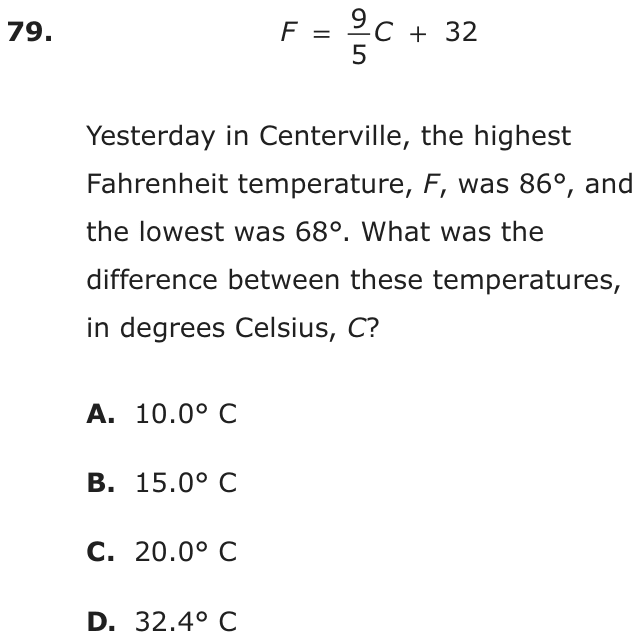
Question 23 of 57
2024 Test A Math, question 23Question
Let x be an odd number. In terms of x, what is the sum of the two even numbers closest to x?
- A
- B
- C
- D
Show the answer
Correct answer: B
If x is odd, then the two even numbers closest to x are and . Find the sum of these two expressions:
Question analysis
An algebra question about odd and even numbers: x is odd, and students write the sum of the two even numbers closest to x in terms of x. It tests representing neighboring integers with expressions and adding them. Deciding exactly which even numbers are closest to an odd number is where errors start.
- NYS standards
- Grade level
- Grade 7 content, by NYS standard
- Compared with grade 7
- At grade 7 Grade 7 students write and combine linear expressions; here the expressions describe neighboring integers, a familiar idea from consecutive-integer problems. Two short steps and a quick number check put it at typical grade 7 demand.
- Estimated difficulty
- Straightforward: two steps or one careful reading.
- Thinking it demands
- Depth of knowledge 2, skills and concepts · mainly apply
- What makes it hard
- Variables instead of numbers moderate
- Turning words into math minor
- Solution
- 2 steps
- Reading level
- Question and choices: about grade 3, 26 words.
- Students, last 30 days
- Not enough answers yet to show (it takes 10).
Why it is hard, traps and wrong answers (shows the answer)
Why it is hard
The algebra is a single addition, so the work is in naming the right two numbers. An odd x sits between two even numbers, one step away on each side, and the minus one and plus one cancel. Wrong choices come from picking both neighbors below x, from treating x as even, or from giving the middle of the pair; a test value catches each of them.
Variables instead of numbers moderate Understanding the question
Here x stands for any odd number, so the two even neighbors must be written as x − 1 and x + 1; trying x = 7, with neighbors 6 and 8, makes it concrete. (Koedinger & Nathan, 2004; Enright, Morley & Sheehan, 2002)
Turning words into math minor Understanding the question
The phrase "the two even numbers closest to x" means one just below and one just above x, not two in a row on the same side. (Hegarty, Mayer & Monk, 1995; Koedinger & Nathan, 2004)
Strategy: Substitute a real odd number such as 7 for x, find its two closest even numbers and their sum, then see which expression gives that sum.
Traps
- Misreads the question: Misses or misreads a condition or a word in the question: "at least", "each", "remaining", "not".
- Answers a different question: A choice is right for another quantity: the other unknown, the rest instead of the part, the part instead of the whole.
The wrong answers, classified
A Answers a different question (King et al., 2004; Hegarty, Mayer & Monk, 1995)
Finds the number midway between the two even neighbors, x itself, which is their mean rather than their sum.
C Misreads the question (Hegarty, Mayer & Monk, 1995)
Treats x as if it were even and adds it to the even number below it, x + (x − 2), ignoring that x is odd.
D Misreads the question (Hegarty, Mayer & Monk, 1995)
Takes the two even numbers just below x, x − 1 and x − 3, instead of the closest one on each side.
Worked solution, step by step
Formulas used
- Neighbors of a number
- x is any whole number. The number just below it is x − 1, and the number just above it is x + 1. Whole numbers take turns being odd and even. So if x is odd, both of its neighbors are even.
- Combining like terms
- Like terms have the same letter, such as x and 2x. To add them, add the numbers in front. x by itself means 1x, so x + x is 2x, which is two x’s.
Sort out the question
x is an odd number. You need the sum of the two even numbers closest to x. Sum means the result of adding. In terms of x means write the answer using the letter x.
Try a real number first
Pick an odd number, like 7. The even numbers closest to 7 are 6 and 8, one on each side.
Notice that 14 is .
Write the neighbors with x
Odd and even numbers take turns. So both numbers right next to an odd x are even.
For x = 7, these are 6 and 8. Watch out: take one even number below x and one above. Using two even numbers below x, and , gives , choice D.
Add the two neighbors
The −1 and the +1 cancel, and . Watch out: x is the number in the middle, not the sum, so choice A is wrong. So the answer is B, .
Check your answer
Try another odd number, 11. Its even neighbors are 10 and 12, and . The answer 2x gives . They match.
More questions like this
The original DOE question
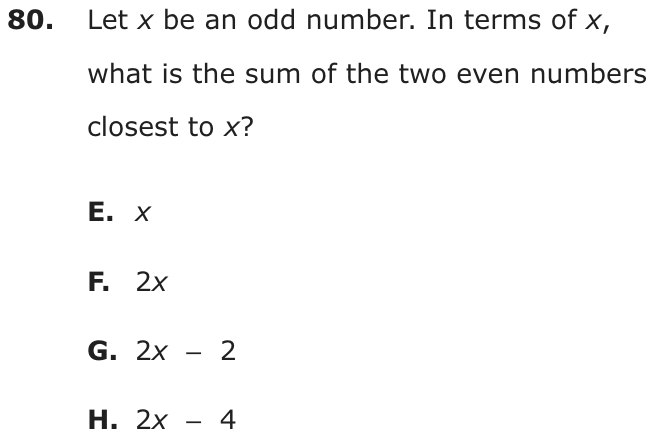
Question 24 of 57
2024 Test A Math, question 24Question
In 1991, the total public debt of the United States was about $3,600,000,000,000. In that year, there were about 250,000,000 people in the United States. Which amount is the best estimate of the public debt per person for that year?
- A$1,440
- B$14,400
- C$144,000
- D$14,400,000,000
Show the answer
Correct answer: B
The question asks for the amount of the public debt per person, so divide the total public debt by the number of people.
The amount of the public debt per person was about $14,400.
Question analysis
An estimation question with very large numbers: the 1991 United States public debt of about 3.6 trillion dollars and a population of about 250 million. Students find the debt per person. The choices differ by powers of ten, so cancelling zeros and keeping track of place value is the whole challenge.
- Grade level
- Grade 6 content, by NYS standard
- Compared with grade 7
- Below grade 7 Dividing large whole numbers and using place value are grade 5 and 6 skills. Grade 7 work goes further with rational numbers; this asks only for one careful division, with counting zeros as the main risk.
- Estimated difficulty
- Straightforward: two steps or one careful reading.
- Thinking it demands
- Depth of knowledge 2, skills and concepts · mainly apply
- What makes it hard
- Error-prone arithmetic moderate
- A very close wrong answer minor
- Solution
- 2 steps
- Reading level
- Question and choices: about grade 5, 37 words.
- Corrected from the DOE handbook
- A misprinted number in the explanation was corrected.
- Students, last 30 days
- Not enough answers yet to show (it takes 10).
Why it is hard, traps and wrong answers (shows the answer)
Why it is hard
The division itself is easy once the zeros are handled, and the question is built to punish miscounting them. Three choices carry the same digits, 144, at different sizes, so a student who loses or gains one zero still finds a match. A quick estimate in powers of ten, 3.6 trillion over a quarter of a billion, confirms that the answer is in the tens of thousands.
Error-prone arithmetic moderate Working it out
The debt has 13 digits and the population 9; cancelling seven zeros from each leaves 360,000 ÷ 25, and losing or adding one zero shifts the answer tenfold. (Brown & Burton, 1978; Junker & Sijtsma, 2001)
A very close wrong answer minor Choosing the answer
Three choices share the digits 144 and differ only by powers of ten, so getting the digits right does not settle it; only exact place value does. (Embretson & Wetzel, 1987; Gorin & Embretson, 2006; Ascalon et al., 2007)
Strategy: Cancel the same number of zeros from the debt and the population, then divide the smaller numbers that remain; check the size by estimating with powers of ten.
Traps
- An arithmetic slip: The right method with a plausible arithmetic error: a digit, a place value or a times-table fact.
- A faulty procedure: A systematic but wrong procedure: adding fractions straight across, applying an exponent to each term of a sum, dropping a sign when moving a term.
The wrong answers, classified
A An arithmetic slip (Junker & Sijtsma, 2001)
Cancels one zero too many while dividing and ends with $1,440, a per-person amount ten times too small.
C An arithmetic slip (Junker & Sijtsma, 2001)
Cancels one zero too few from the debt and ends with $144,000, a per-person amount ten times too large.
D A faulty procedure (Brown & Burton, 1978; Tatsuoka, 1983)
Divides the debt by 250 alone, dropping the six zeros that follow 250 in the population without removing any from the debt.
What was corrected from the DOE handbook, and why
- Explanation: The handbook’s first division writes the debt as “3,6000,000,000,000”, with an extra zero. The question gives $3,600,000,000,000, and the handbook’s next line (where the zeros are cancelled) uses 3,600,000,000,000, so the site now reads 3,600,000,000,000 ÷ 250,000,000. The answer, $14,400, is unchanged.
Worked solution, step by step
Formulas used
- Amount per person
- The total is the whole amount, here the debt in dollars. Dividing by the number of people shares it out equally. The result is how much goes with each one person.
- Canceling zeros
- a and b are any numbers, and b is not zero. Dividing the top and bottom of a fraction by 10 does not change its value. So you can cross off a zero at the end of the top and one at the end of the bottom, as a pair.
Sort out the question
The debt was about $3,600,000,000,000, which is 3.6 trillion dollars. There were about 250,000,000 people, which is 250 million. You need the debt per person. Per person means the amount for each one person.
Set up the division
Share the debt equally by dividing it by the number of people. The debt goes on top, and the people go on the bottom.
Cancel zeros in pairs
Count the zeros at the end of each number. The debt ends in 11 zeros. The population ends in 7. Cross off 7 zeros from each. Each pair you cross off divides the top and bottom by 10.
Watch out: cross off the same number from each. One too many from the debt gives $1,440, choice A. One too few gives $144,000, choice C.
Divide what is left
Dividing by 25 is the same as dividing by 100 and then multiplying by 4. That is because 4 groups of 25 make 100.
The debt was about $14,400 per person. Watch out: choice D divides by 250 only and forgets the zeros after it. So the answer is B, $14,400.
Check your answer
Multiply back. First, . Then put back the 7 zeros you crossed off: 3,600,000,000,000. That is the debt, so $14,400 is right.
More questions like this
The original DOE question
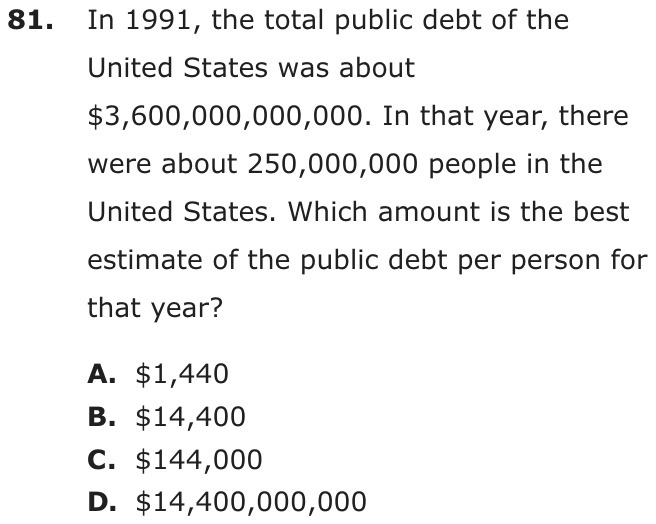
Question 25 of 57
2024 Test A Math, question 25Question
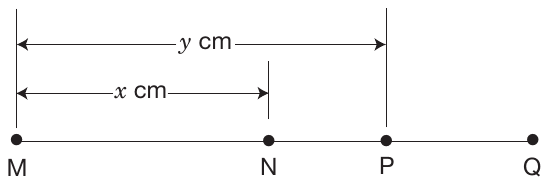
In the figure above, N is the midpoint of . Which segment has length centimeters?
- A
- B
- C
- D
Show the answer
Correct answer: A
These facts are given:
- N is the midpoint of .
- has a length of x centimeters.
- has a length of y centimeters.
Use the first two facts to determine that has a length of centimeters. So can be represented by , which is .
Question analysis
A geometry and algebra question with a labeled figure: points M, N, P and Q lie on a line, MN is x cm, MP is y cm, and N is the midpoint of MQ. Students find which segment has length 2x − y. They must turn the midpoint fact into an expression and read a difference of lengths on the figure.
- NYS standards
- Grade level
- Grade 7 content, by NYS standard
- Compared with grade 7
- Above grade 7 Grade 7 students evaluate and rewrite expressions but rarely read one as a length on a figure. Combining the midpoint idea from geometry with a difference of expressions, and no numbers, makes this more abstract than typical grade 7 work.
- Estimated difficulty
- Moderate: several steps, or a close reading with one strong distractor.
- Thinking it demands
- Depth of knowledge 2, skills and concepts · mainly analyze
- What makes it hard
- Variables instead of numbers moderate
- Reading a figure, table or graph moderate
- Solution
- 2 steps
- Reading level
- Question and choices: about grade 9, 20 words.
- Students, last 30 days
- Not enough answers yet to show (it takes 10).
Why it is hard, traps and wrong answers (shows the answer)
Why it is hard
The question reverses the usual task: instead of finding a length, students match an expression to a segment. The midpoint fact turns into MQ = 2x, and taking away the y of MP leaves the piece from P to Q. The wrong choices reward stopping at 2x, reading only the labeled arrows, or matching the letter y; picking x = 5 and y = 7 lets students check with numbers.
Variables instead of numbers moderate Understanding the question
Every length is a letter: MN is x, MP is y, and the target is the expression 2x − y, so the matching segment cannot be found by measuring. (Koedinger & Nathan, 2004; Enright, Morley & Sheehan, 2002)
Reading a figure, table or graph moderate Understanding the question
The figure marks only MN and MP with arrows; the length of MQ comes from the stem's midpoint fact, not from the drawing, and has to be written as 2x. (Lesh, Post & Behr, 1987; Kirsch & Mosenthal, 1990)
Strategy: Use the midpoint to write the length of the whole segment in terms of x, or pick sample values for x and y, then see which segment's length matches 2x − y.
Traps
- Stops one step early: A choice is a number from partway through the solution.
- Misreads the question: Misses or misreads a condition or a word in the question: "at least", "each", "remaining", "not".
The wrong answers, classified
B Misreads the question (Hegarty, Mayer & Monk, 1995)
Leaves out the midpoint fact, so the only difference it can read from the arrows is NP = y − x, which it takes for 2x − y.
C Stops one step early (King et al., 2004; Gierl et al., 2017)
Uses the midpoint to find that MQ is 2x centimeters and picks that segment, stopping before subtracting the y of MP.
D Numbers taken from the question (Hegarty, Mayer & Monk, 1995)
Sees y in the expression and picks MP, the segment labeled y, without working out the rest of 2x − y.
Worked solution, step by step
Formulas used
- Midpoint
- N is the midpoint of segment MQ, the point exactly in the middle. MN is the half from M to N, and MQ is the whole segment. The whole is two equal halves, so it is 2 times MN.
- Adding segments
- When points lie in order on a line, the short segments add up to the long one. MP runs from M to P, and PQ runs from P to Q. Put end to end, they make MQ.
Sort out the figure
Points M, N, P and Q lie in that order on a line. Segment MN is x cm long, and segment MP is y cm long. N is the midpoint of , the point exactly halfway from M to Q. You need the segment that is cm long.
Find the length of MQ
MN is half of MQ, so MQ is twice as long.
MQ is 2x cm long. Watch out: 2x is only part of the expression. Stopping here gives MQ, choice C.
Take MP away from MQ
Subtracting y from 2x means taking MP away from MQ. MP covers the part from M to P. What is left of MQ is the piece from P to Q.
So PQ is cm long. Watch out: do not pick MP just because y appears. MP is y, choice D. NP is , choice B. So the answer is A, .
Check your answer
Try numbers. Say x = 5, so MN = 5 and MQ = 10. Say y = 7, so MP = 7. Then PQ is . And . They match. NP would be , which does not.
More questions like this
The original DOE question
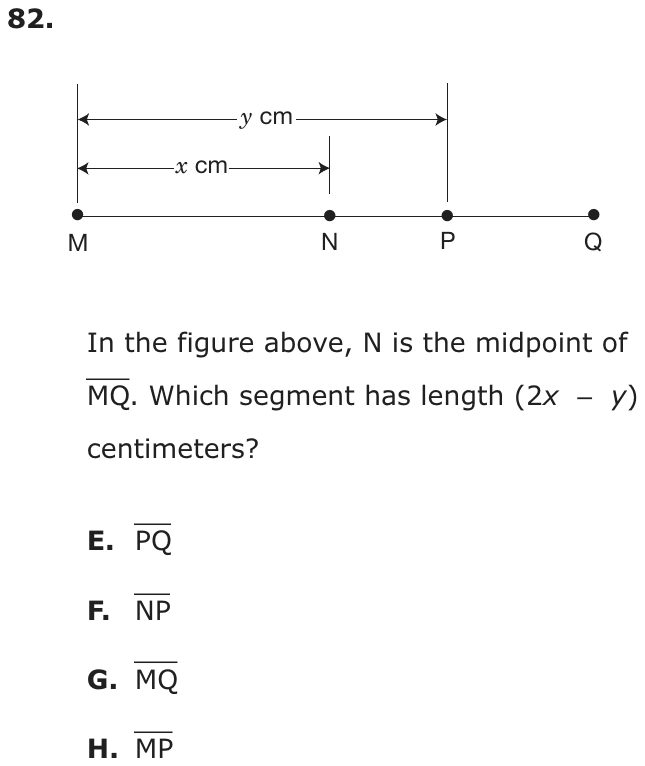
Question 26 of 57
2024 Test A Math, question 26Question
What is the area of the parallelogram shown above?
- A750 sq ft
- B600 sq ft
- C500 sq ft
- D300 sq ft
Show the answer
Correct answer: B
To find the area of a parallelogram, multiply the length of a side by the altitude for that side.
One property of parallelograms is that opposite sides are the same length.
So the bottom side of the parallelogram is 30 feet long and has an altitude of 20 feet.
Therefore, the area of the parallelogram, in square feet, is .
Question analysis
A geometry question with a figure: a parallelogram is labeled with a 30-foot top side, a 25-foot slanted side and a 20-foot height drawn at a right angle. Students find its area. The figure gives one length that is not needed, so students must pick the base and height that belong together.
- NYS standards
- 6.G.1 area of polygons
- Grade level
- Grade 6 content, by NYS standard
- Compared with grade 7
- Below grade 7 Area of a parallelogram is grade 6 content, and this is a one-step use of the formula. It is easier than typical grade 7 area work, which involves composite figures, circles or scale drawings.
- Estimated difficulty
- Routine: one familiar step, little to misread.
- Thinking it demands
- Depth of knowledge 1, recall and reproduction · mainly apply
- What makes it hard
- Solution
- 1 step
- Reading level
- Question and choices: about grade 2, 17 words.
- Students, last 30 days
- Not enough answers yet to show (it takes 10).
Why it is hard, traps and wrong answers (shows the answer)
Why it is hard
This is a one-step formula question with whole numbers, made slightly harder by one length too many. A student who multiplies the two side lengths, as for a rectangle, or brings in a triangle's one half, finds a listed choice. Matching the base to the height marked with a right angle is all it takes.
Reading a figure, table or graph minor Understanding the question
The figure labels three lengths, but only the 30-foot side and the 20-foot height drawn at a right angle to it belong together; the slanted 25-foot side is extra. (Lesh, Post & Behr, 1987; Kirsch & Mosenthal, 1990)
Something you must already know minor Working it out
The parallelogram area formula, base times height, is not given, and its height must be the perpendicular distance, not the slanted side. (Anderson & Krathwohl, 2001)
Strategy: Use base times height, where the height is the perpendicular distance between the two parallel sides chosen as bases.
Traps
- Wrong formula: Uses a related but wrong formula: perimeter for area, diameter for radius, area for volume, or a misremembered one.
- Information you don't need: The question gives numbers or facts that play no part in the answer.
The wrong answers, classified
A Wrong formula (King et al., 2004)
Multiplies the two side lengths, 30 × 25 = 750, as if a parallelogram's area were side times side like a rectangle's.
C Misreads the figure (Lesh, Post & Behr, 1987; Kirsch & Mosenthal, 1990)
Pairs the 20-foot height with the slanted 25-foot side, 25 × 20 = 500, though the height is drawn at a right angle to the 30-foot sides.
D Wrong formula (King et al., 2004)
Uses the triangle formula, 1/2 × 30 × 20 = 300, halving the base times the height.
Worked solution, step by step
Formulas used
- Area of a parallelogram
- A is the area. b is the base, one of the two parallel sides. h is the height: the straight distance between the two parallel sides, at a right angle to the base. It works because you can cut a triangle off one end, move it to the other end and make a rectangle.
Sort out the figure
A parallelogram is a four-sided shape whose opposite sides are parallel. Parallel means they never meet. The figure shows three lengths. The top side is 30 ft. The slanted left side is 25 ft. The arrow from top to bottom is 20 ft, and the small square shows a right angle. You need the area, in square feet.
Choose the base and height
The height must make a right angle with the base. The 20 ft arrow meets the bottom side at a right angle. Opposite sides of a parallelogram are equal, so the bottom side is 30 ft too. So the base is 30 ft and the height is 20 ft. Watch out: the slanted 25 ft side is not needed. Using gives choice C.
Find the area
The area is 600 sq ft. Watch out: do not multiply the two sides, . That is choice A. Do not take half either, which is for triangles and gives 300, choice D. So the answer is B, 600 sq ft.
Check your answer
Picture cutting the triangle off the left end and sliding it to the right end. The shape becomes a rectangle 30 ft long and 20 ft tall, with an area of 600 sq ft. 750 is too big, because the shape is only 20 ft tall, not 25 ft.
More questions like this
The original DOE question
Question 27 of 57
2024 Test A Math, question 27Question
On Wednesday, a baker produced 100 more loaves of bread than were produced on Tuesday. On Thursday, the baker produced 50 fewer loaves than were produced on Tuesday. If the total number of loaves produced on all three days was 230, how many loaves were produced on Wednesday?
- A60
- B80
- C120
- D160
Show the answer
Correct answer: D
Let t represent the number of loaves of bread produced on Tuesday.
First, determine the number of loaves of bread produced on Tuesday, t, using the number of loaves produced on Wednesday, , the number produced on Thursday, , and the total number produced on these three days, 230:
Next, determine the number of loaves of bread produced on Wednesday, , when :
The number of loaves of bread produced on Wednesday is 160.
Question analysis
A word problem about a baker's bread over three days: Wednesday's output is 100 loaves more than Tuesday's, Thursday's is 50 fewer than Tuesday's, and the total is 230. Students find the number of loaves made on Wednesday. Writing every day in terms of Tuesday, and answering for the right day, are the keys.
- Grade level
- Grade 7 content, by NYS standard
- Compared with grade 7
- At grade 7 Writing and solving an equation of the form px + q = r from a word problem is a core grade 7 standard. This is a typical three-step version, with one negative adjustment and an extra step after solving.
- Estimated difficulty
- Straightforward: two steps or one careful reading.
- Thinking it demands
- Depth of knowledge 2, skills and concepts · mainly apply
- What makes it hard
- Turning words into math moderate
- Much to keep track of minor
- Solution
- 3 steps
- Reading level
- Question and choices: about grade 7, 45 words.
- Corrected from the DOE handbook
- A misplaced parenthesis in the explanation’s working was corrected.
- Students, last 30 days
- Not enough answers yet to show (it takes 10).
Why it is hard, traps and wrong answers (shows the answer)
Why it is hard
Writing all three days in terms of Tuesday turns the story into 3t + 50 = 230, a routine equation. The trap comes after it is solved: the value found is Tuesday's, and it is a listed choice. Students who label t as Tuesday from the start, and reread the question before choosing, add the 100 loaves and are done.
Turning words into math moderate Understanding the question
Both comparisons are made with Tuesday, 100 more loaves on Wednesday and 50 fewer on Thursday, so the three days become t, t + 100 and t − 50. (Hegarty, Mayer & Monk, 1995; Koedinger & Nathan, 2004)
Much to keep track of minor Working it out
The equation's unknown is Tuesday's count, while the question asks for Wednesday's, so one more step remains after the equation is solved. (Sweller, 1988; Carpenter, Just & Shell, 1990)
Strategy: Let t be Tuesday's loaves, write Wednesday and Thursday in terms of t, set the sum equal to 230, solve for t, and add 100.
Traps
- Answers a different question: A choice is right for another quantity: the other unknown, the rest instead of the part, the part instead of the whole.
- Numbers taken from the question: Combines the numbers in the question without a model of the situation, or is simply a number that appears in the question.
The wrong answers, classified
A Answers a different question (King et al., 2004; Hegarty, Mayer & Monk, 1995)
Solves 3t + 50 = 230 for Tuesday's loaves, t = 60, and gives that instead of Wednesday's t + 100.
B Numbers taken from the question (Hegarty, Mayer & Monk, 1995)
Subtracts both 100 and 50 from the total, 230 − 100 − 50 = 80, combining the numbers without writing each day in terms of Tuesday.
C Misreads the question (Hegarty, Mayer & Monk, 1995)
Finds Tuesday's 60, then gets Wednesday by subtraction, 230 − 60 − 50, taking Thursday as 50 loaves instead of 60 − 50 = 10.
What was corrected from the DOE handbook, and why
- Explanation: The handbook writes “3t + (50 − 50 = 230 − 50)”, with the closing parenthesis after the whole equation, so the line reads as an equation inside an expression (and 50 − 50 = 230 − 50 is false). The site now reads 3t + (50 − 50) = 230 − 50: subtract 50 from both sides, giving 3t = 180 as before.
Worked solution, step by step
Formulas used
- Keeping an equation balanced
- a and b are the two sides of an equation, and c is any number. An equation is like a balanced scale. If you subtract the same thing from both sides, it stays balanced. The same is true if you divide both sides by the same number that is not zero.
Sort out the question
The baker made bread on Tuesday, Wednesday and Thursday. Wednesday had 100 more loaves than Tuesday. Thursday had 50 fewer loaves than Tuesday. All three days add up to 230 loaves. You need the number of loaves made on Wednesday.
Write each day using Tuesday
Both other days are compared with Tuesday. So call Tuesday’s loaves t.
Day Loaves Tuesday Wednesday Thursday 100 more means add 100. 50 fewer means subtract 50.
Write the equation and combine
Group the t’s together and the plain numbers together. Three t’s make 3t, and .
Watch out: do not just subtract 100 and 50 from 230. That gives 80, choice B, and skips writing each day with t.
Solve for Tuesday
Subtract 50 from both sides. Then divide both sides by 3.
Tuesday had 60 loaves. Watch out: 60 is Tuesday, choice A. The question asks about Wednesday.
Find Wednesday’s loaves
Wednesday had 100 more loaves than Tuesday, so add 100 to t.
Wednesday had 160 loaves. So the answer is D, 160.
Check your answer
Find all three days. Tuesday is 60, Wednesday is 160, and Thursday is . Add them: . That is the total in the question, so 160 is right.
More questions like this
The original DOE question
Question 28 of 57
2024 Test A Math, question 28Question
QUIZ SCORES IN
MRS. ARCH’S CLASS
| Quiz Score | Number of Students |
|---|---|
| 60 | 9 |
| 70 | 7 |
| 80 | 4 |
| 90 | 5 |
| 100 | 3 |
In the table above, what is the mean quiz score?
- A60
- B70
- C75
- D80
Show the answer
Correct answer: C
First, find the total number of students who took the quiz.
Multiply each quiz score by the number of students who received that score. Add those products together to find the total number of points scored.
To find the mean quiz score, divide the total number of points by the number of students who took the quiz.
Question analysis
A frequency table question: the table lists five quiz scores from 60 to 100 and how many students in Mrs. Arch's class earned each. Students find the mean quiz score for the whole class. Each score has to count once for every student who earned it, and the class size has to be added up from the table.
- Grade level
- Grade 6 content, by NYS standard
- Compared with grade 7
- At grade 7 A mean from a frequency table is grade 6 content in a three-step form that grade 7 students meet regularly. Five rows of products make it slightly longer than a typical exercise, but the arithmetic is friendly.
- Estimated difficulty
- Moderate: several steps, or a close reading with one strong distractor.
- Thinking it demands
- Depth of knowledge 2, skills and concepts · mainly apply
- What makes it hard
- Reading a figure, table or graph moderate
- Many steps minor
- Error-prone arithmetic minor
- Solution
- 3 steps
- Reading level
- Question and choices: about grade 2, 19 words.
- Students, last 30 days
- Not enough answers yet to show (it takes 10).
Why it is hard, traps and wrong answers (shows the answer)
Why it is hard
The table invites a shortcut: average the five scores in the first column and get a round number that is a choice. That ignores the fact that more students earned the low scores than the high ones, which pulls the true mean down. Weighting each score by its count is a five-row calculation with friendly numbers, and the other choices catch students who confuse the mean with the most common or the middle score.
Reading a figure, table or graph moderate Understanding the question
Each row of the table stands for several students, 9 with 60, 7 with 70 and so on, so a score counts once per student and the class size, 28, must be added up. (Lesh, Post & Behr, 1987; Kirsch & Mosenthal, 1990)
Many steps minor Working it out
Five products, 540, 490, 320, 450 and 300, must be found and added to 2,100 before dividing by the 28 students. (Daniel & Embretson, 2010; Enright, Morley & Sheehan, 2002)
Error-prone arithmetic minor Working it out
The last step, 2,100 ÷ 28, is not a familiar fact; noticing that 28 × 75 = 2,100, or testing the choices, keeps it quick. (Brown & Burton, 1978; Junker & Sijtsma, 2001)
Strategy: Multiply each score by its number of students, add the products for the total points, add the student counts, and divide the points by the students.
Traps
- Misunderstands the concept: A wrong belief about a concept: that percents can be added, that area grows like length, that averages can be averaged, that a bigger denominator means a bigger fraction.
- Answers a different question: A choice is right for another quantity: the other unknown, the rest instead of the part, the part instead of the whole.
The wrong answers, classified
A Answers a different question (King et al., 2004; Hegarty, Mayer & Monk, 1995)
Picks the score that the most students earned, 60, the mode of the class, instead of computing the mean.
B Answers a different question (King et al., 2004; Hegarty, Mayer & Monk, 1995)
Finds the median instead: in the ordered list of 28 scores, the 14th and 15th are both 70.
D Misunderstands the concept (Smith, diSessa & Roschelle, 1993; De Bock et al., 1998; Ni & Zhou, 2005)
Averages the five listed scores, (60 + 70 + 80 + 90 + 100) ÷ 5 = 80, without weighting each by its number of students.
Worked solution, step by step
Formulas used
- Mean from a table
- The mean is the average score. Total points is every student’s score added up. Each score in the table counts once for every student who got it. Number of students is how many took the quiz.
Sort out the table
The left column lists quiz scores. The right column says how many students got each score. For example, 9 students scored 60. You need the mean quiz score, which is the average.
Count the students
28 students took the quiz. So there are 28 scores in all, not just 5.
Find the total points
Each score counts once for each student who got it. So multiply each score by its number of students.
Score Students Points 60 9 70 7 80 4 90 5 100 3 The class scored 2,100 points in all.
Divide to find the mean
To divide, try . That leaves , and . So the mean is . Watch out: do not just average the five scores in the table. That gives 80, choice D. Also, 70 is the median and 60 is the most common score, choices B and A. So the answer is C, 75.
Check your answer
More students scored low, 60 or 70, than high. So the mean should be below 80, the middle of the listed scores. 75 is below 80. Also, , the total points.
More questions like this
The original DOE question
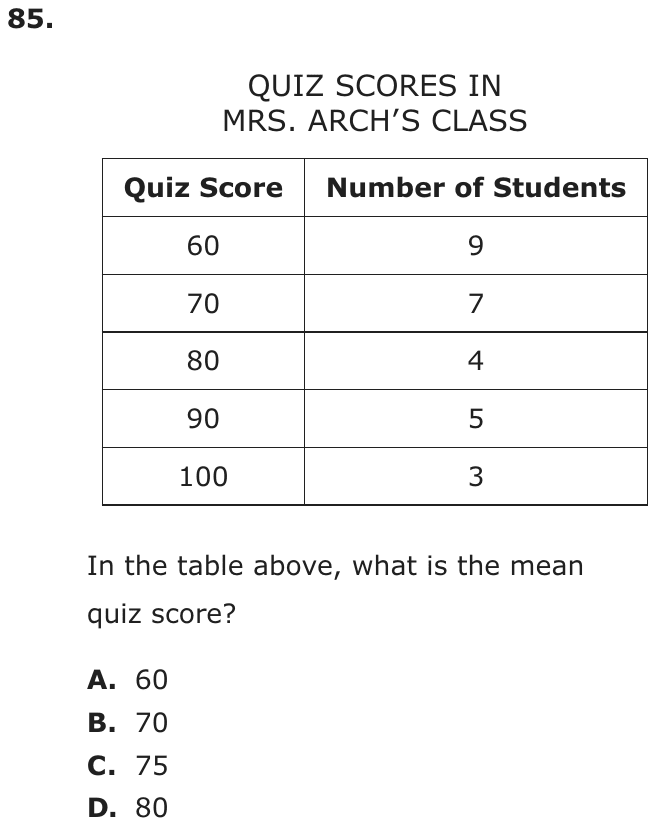
Question 29 of 57
2024 Test A Math, question 29Question
Which graph represents the solution to the inequality ?
- A

- B

- C

- D

Show the answer
Correct answer: A
Use the properties of equations to solve the inequality for x.
Subtract 4 from both sides of the inequality.
The graph of will have a point at −1 and will include all values that are greater than, or to the right of, −1. The greater than or equal sign is used, which indicates that the solution includes −1. So the point at −1 will be solid. Option A is the correct answer.
Question analysis
This inequality question asks which number line graph shows the solution set of x + 4 ≥ 3. Students solve a one-step inequality by undoing the addition, then match the result to a graph. All four graphs use a solid dot and an arrow pointing right, so the whole question rests on where the shaded ray begins.
- Grade level
- Grade 7 content, by NYS standard
- Compared with grade 7
- Below grade 7 Grade 7 inequality work is usually two-step, such as 3x − 5 ≥ 10, and asks students to choose an open or closed dot and a direction. This one needs a single subtraction, and all four graphs share a closed dot and a rightward arrow.
- Estimated difficulty
- Routine: one familiar step, little to misread.
- Thinking it demands
- Depth of knowledge 1, recall and reproduction · mainly apply
- What makes it hard
- Solution
- 2 steps
- Reading level
- Question and choices: about grade 13, 9 words.
- Students, last 30 days
- Not enough answers yet to show (it takes 10).
Why it is hard, traps and wrong answers (shows the answer)
Why it is hard
Solving takes a single subtraction, and the graphs differ only in where the solid dot sits, so the question comes down to 3 − 4. Students who lose the negative sign land on the graph that starts at 1, while those who never isolate x pick a graph that starts at a number printed in the inequality. Testing 0, which satisfies 0 + 4 ≥ 3, shows that the shading must include 0.
Reading a figure, table or graph minor Understanding the question
All four graphs share a closed dot and a rightward arrow, so the only thing to read is where the dot sits, against tick labels printed with raised minus signs. (Lesh, Post & Behr, 1987; Kirsch & Mosenthal, 1990)
Error-prone arithmetic minor Working it out
Undoing the + 4 means computing 3 − 4, the one step that crosses zero; a dropped minus sign moves the dot from −1 to 1. (Brown & Burton, 1978; Junker & Sijtsma, 2001)
Strategy: Subtract 4 from both sides to get x alone, then find the graph whose solid dot sits at that number; test one shaded value in the original inequality to confirm.
Traps
- Negatives and direction: Arithmetic with negative numbers, the order of a subtraction, or direction on a number line. (Moving a term across the equals sign without changing its sign is a faulty procedure.)
- Numbers taken from the question: Combines the numbers in the question without a model of the situation, or is simply a number that appears in the question.
The wrong answers, classified
B Negatives and direction (Brown & Burton, 1978)
Computes 4 − 3 instead of 3 − 4, or drops the minus sign of −1, and starts the shaded ray at positive 1.
C Numbers taken from the question (Hegarty, Mayer & Monk, 1995)
Starts the ray at 3, the number on the right side of the inequality, as if x ≥ 3, without subtracting the 4.
D Numbers taken from the question (Hegarty, Mayer & Monk, 1995)
Starts the ray at 4, the number added to x, reading it off the inequality instead of solving for x.
Worked solution, step by step
Formulas used
- Keeping an inequality balanced
- a and b are the two sides of an inequality, and c is any number. The sign ≥ stands for greater than or equal to. Taking the same number away from both sides keeps the comparison true, like taking the same weight off both pans of a scale. Use it to get x by itself.
Sort out the question
An inequality is a math sentence that compares two amounts. The sign means is greater than or equal to. So says that x plus 4 is 3 or more.
You need the graph that shows every number x that makes this true. All four graphs have a solid dot and an arrow to the right. Only the place where the dot sits is different.
Get x by itself
Right now 4 is added to x. To undo adding 4, subtract 4 from both sides.
So x is −1 or any number greater than −1. Watch out: 3 − 4 is −1, not 1. Dropping the minus sign puts the dot at 1, choice B. Putting the dot at 3 or 4 means you read a number off the inequality without solving. That leads to C or D.
Match the solution to a graph
On a number line, greater numbers are to the right. So the shading starts at −1 and goes right. The arrow shows that it keeps going.
The dot is solid, or filled in, because of the or equal to part. A solid dot means −1 itself is a solution, a number that makes the inequality true.
Graph A has a solid dot at −1 and is shaded to the right. So the answer is A, the graph with a solid dot at −1.
Check your answer
Test a number from the shaded part, such as 0. , and 4 is more than 3. Now test the dot: , and 3 is equal to 3, so −1 works. A number left of the dot, −2, gives . That is less than 3, so −2 should not be shaded, and it isn’t.
More questions like this
The original DOE question
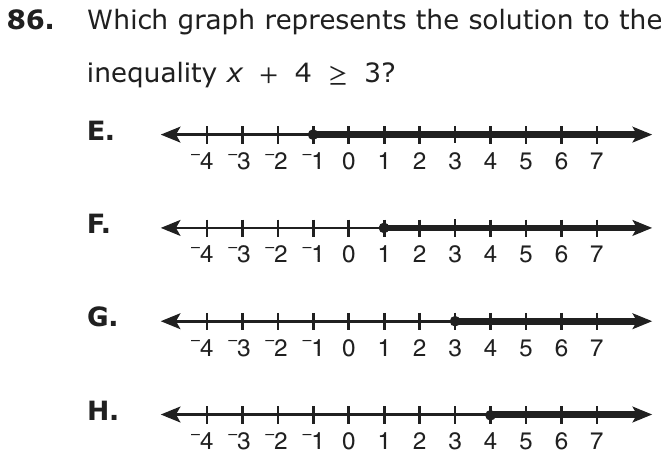
Question 30 of 57
2024 Test A Math, question 30Question
The reciprocal of is added to the reciprocal of 3. What is the reciprocal of this sum?
- A
- B
- C
- D
Show the answer
Correct answer: A
The reciprocal of is added to the reciprocal of 3.
The reciprocal of this sum is .
Question analysis
This fractions question asks for the reciprocal of a sum: the reciprocal of one fourth is added to the reciprocal of 3, and students must flip the total. It tests knowing what a reciprocal is and adding a whole number to a fraction. Keeping the three flips in the right order, without skipping one, is what makes it tricky.
- NYS standards
- 6.NS.1 dividing fractions by fractions
- Grade level
- Grade 6 content, by NYS standard
- Compared with grade 7
- At grade 7 Grade 7 students use reciprocals when dividing fractions, usually one at a time. This item chains three reciprocals around one addition, with positive numbers only, so the demand is following the wording in order rather than new content.
- Estimated difficulty
- Straightforward: two steps or one careful reading.
- Thinking it demands
- Depth of knowledge 2, skills and concepts · mainly apply
- What makes it hard
- Turning words into math moderate
- Error-prone arithmetic minor
- Solution
- 3 steps
- Reading level
- Question and choices: about grade 8, 21 words.
- Students, last 30 days
- Not enough answers yet to show (it takes 10).
Why it is hard, traps and wrong answers (shows the answer)
Why it is hard
Each step is easy, so the question is about order: flip each number, add, then flip the total. The common failures are flipping at the wrong moment, term by term instead of the whole sum, and adding a whole number to a fraction straight across. Writing the full expression 1 ÷ (4 + 1/3) before doing any arithmetic keeps the three reciprocals in their places.
Turning words into math moderate Understanding the question
The two sentences hold three reciprocals and a sum, which must become 1 ÷ (4 + 1/3) before any arithmetic; "this sum" means flipping the total, not each part. (Hegarty, Mayer & Monk, 1995; Koedinger & Nathan, 2004)
Error-prone arithmetic minor Working it out
Adding 4 and 1/3 means writing 4 as 12/3 to get 13/3, a whole number plus a fraction, where adding tops and bottoms gives 5/4 instead. (Brown & Burton, 1978; Junker & Sijtsma, 2001)
Strategy: Work in the order of the words: flip each number to get its reciprocal, add the two using a common denominator, and then flip that sum.
Traps
- A faulty procedure: A systematic but wrong procedure: adding fractions straight across, applying an exponent to each term of a sum, dropping a sign when moving a term.
- Wrong operation: Adds instead of multiplying, divides the wrong way round, turns a ratio or rate upside down, or undoes a step in the wrong direction (subtracts what should be added back).
The wrong answers, classified
B Wrong operation (Hegarty, Mayer & Monk, 1995; King et al., 2004)
Multiplies the two reciprocals instead of adding them, 4 × 1/3 = 4/3, then flips that product to 3/4.
C A faulty procedure (Brown & Burton, 1978; Tatsuoka, 1983)
Adds 4/1 and 1/3 straight across, numerators and denominators, getting 5/4, then flips it to 4/5.
D A faulty procedure (Brown & Burton, 1978; Tatsuoka, 1983)
Flips each term of 4 + 1/3 instead of the whole sum, as if the reciprocal of a sum were the sum of reciprocals: 1/4 + 3 = 13/4.
Worked solution, step by step
Formulas used
- Reciprocal
- a is the top of a fraction and b is the bottom. The reciprocal is the fraction flipped upside down. A whole number such as 3 is the fraction 3 over 1, so its reciprocal is 1 over 3. A number times its reciprocal always makes 1.
- Adding fractions with the same bottom
- c is the shared bottom number, called the denominator. a and b are the tops, called numerators. When the pieces are the same size, you just add how many pieces you have. The size of the pieces, c, stays the same.
Sort out the wording
The question has three reciprocals in it. A reciprocal is a fraction flipped upside down. Do the jobs in the order of the words:
- Flip .
- Flip 3.
- Add the two results to get the sum.
- Flip that sum.
The last flip gives the answer.
Flip each number
Flip to get , which is 4. The number 3 is the same as , so its reciprocal is .
Add the two reciprocals
You need . To add, both numbers need the same bottom. So write 4 in thirds. One whole is 3 thirds, so 4 wholes are 12 thirds.
The sum is . Watch out: don’t add the tops and the bottoms straight across. That gives , which flips to , choice C.
Flip the sum
Watch out: flip the whole sum, not each part. Flipping 4 and one at a time takes you back to , choice D.So the answer is A, .
Check your answer
A number times its reciprocal is 1. Test it: . Also estimate. The sum is a bit more than 4, so its reciprocal should be a bit less than . is about 0.23, just under 0.25.
More questions like this
The original DOE question
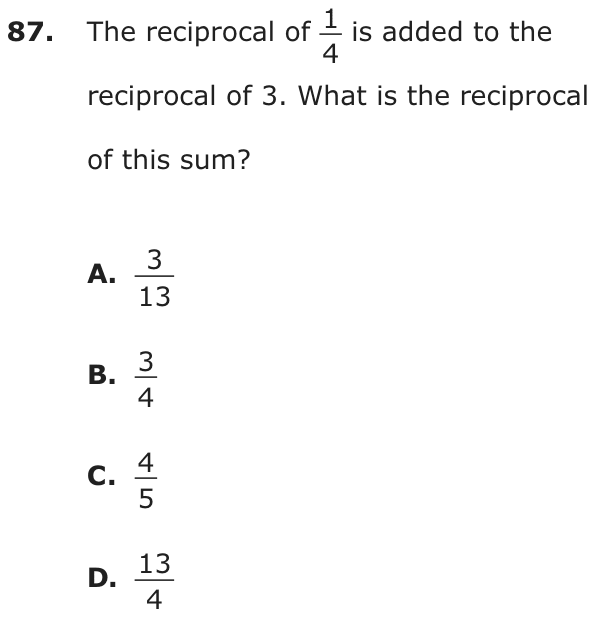
Question 31 of 57
2024 Test A Math, question 31Question
Nura made a square poster with a side length of 13 inches. Latrice made a square poster with a side length of 15 inches. What is the difference, in square inches, between the area of Latrice’s poster and the area of Nura’s poster?
- A56
- B8
- C4
- D2
Show the answer
Correct answer: A
Nura’s poster is square, so all the side lengths are 13 inches. The area, in square inches, is
Latrice’s poster is square, so all the side lengths are 15 inches.
Subtract to determine the difference between the areas.
The difference, in square inches, is 56.
Question analysis
This area word problem compares two square posters, one 13 inches on a side and one 15 inches on a side, and asks for the difference between their areas in square inches. Students square each side length and subtract. Working with the difference in the sides, or with perimeters, instead of the areas is the easy mistake.
- Grade level
- Grade 6 content, by NYS standard
- Compared with grade 7
- Below grade 7 Area of a square is elementary content, and squaring 13 and 15 is grade 6 exponent work. Typical grade 7 area problems involve circles, composite shapes or scale drawings; this one has two familiar areas and a subtraction.
- Estimated difficulty
- Straightforward: two steps or one careful reading.
- Thinking it demands
- Depth of knowledge 2, skills and concepts · mainly apply
- What makes it hard
- Solution
- 3 steps
- Reading level
- Question and choices: about grade 5, 41 words.
- Students, last 30 days
- Not enough answers yet to show (it takes 10).
Why it is hard, traps and wrong answers (shows the answer)
Why it is hard
The method is short, but the question invites a shortcut: the sides differ by 2, so it feels as if the areas should differ by 2 squared. Two choices reward working with the side lengths and one rewards perimeters. Squaring each side before subtracting avoids all three, and a sketch of the 13-inch square inside the 15-inch one shows the gap is an L-shaped strip, far more than 4 square inches.
Something you must already know minor Working it out
The area of a square, side times side, is not given; students must square 13 and 15 themselves rather than work with the side lengths. (Anderson & Krathwohl, 2001)
Error-prone arithmetic minor Working it out
Squaring 13 and 15 by hand gives 169 and 225, and the subtraction 225 − 169 needs a borrow, where an arithmetic slip creeps in. (Brown & Burton, 1978; Junker & Sijtsma, 2001)
Strategy: Find each poster's area by squaring its side length, then subtract the smaller area from the larger; work with the areas, not the side lengths.
Traps
- Wrong formula: Uses a related but wrong formula: perimeter for area, diameter for radius, area for volume, or a misremembered one.
- A faulty procedure: A systematic but wrong procedure: adding fractions straight across, applying an exponent to each term of a sum, dropping a sign when moving a term.
- Answers a different question: A choice is right for another quantity: the other unknown, the rest instead of the part, the part instead of the whole.
The wrong answers, classified
B Wrong formula (King et al., 2004)
Compares perimeters instead of areas, 4 × 15 − 4 × 13 = 60 − 52 = 8, a difference in inches, not square inches.
C A faulty procedure (Brown & Burton, 1978; Tatsuoka, 1983)
Subtracts the sides first and squares the difference, (15 − 13)² = 4, as if 15² − 13² equaled (15 − 13)².
D Answers a different question (King et al., 2004; Hegarty, Mayer & Monk, 1995)
Gives the difference in side lengths, 15 − 13 = 2, a length rather than a difference in area.
Worked solution, step by step
Formulas used
- Area of a square
- A is the area, the flat space inside the shape. s is the length of one side. All four sides of a square are equal, so the area is side times side. The small 2 means squared, or times itself. Area is measured in square units, here square inches.
Write down what you know
Nura’s poster is a square with sides of 13 inches. Latrice’s poster is a square with sides of 15 inches. You need the difference between their areas, in square inches. The difference is how much bigger one area is than the other. So find each area, then subtract.
Find the area of Nura’s poster
Use the area formula with the side of 13 inches.
Nura’s poster has an area of 169 square inches.
Find the area of Latrice’s poster
Use the same formula with the side of 15 inches.
Latrice’s poster has an area of 225 square inches.
Subtract the two areas
Take the smaller area away from the larger one.
The difference is 56 square inches.
Watch out: don’t subtract the sides first and then square. , choice C, is not the same as . The side difference, 2 inches, is choice D, a length. Comparing perimeters, the distance around, gives 8, choice B.So the answer is A, 56 square inches.
Check your answer
Picture Nura’s poster laid in a corner of Latrice’s. The extra part is an L-shaped strip 2 inches wide. One arm is 15 by 2 and the other is 13 by 2. , so the strip is 56 square inches. That matches.
More questions like this
The original DOE question
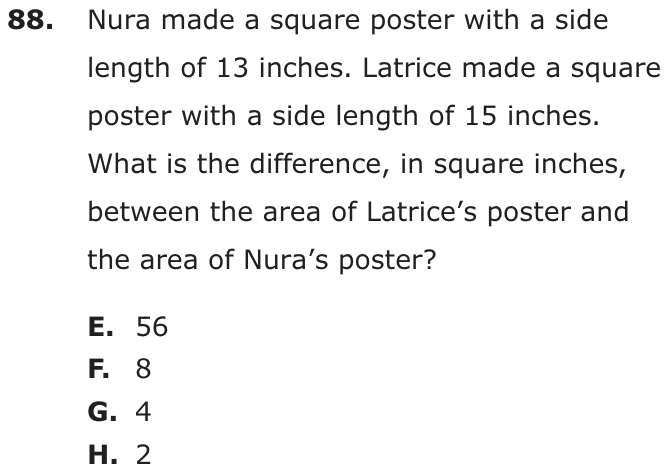
Question 32 of 57
2024 Test A Math, question 32Question
INGREDIENTS FOR 4 SERVINGS OF OATMEAL
| Ingredient | Cups |
|---|---|
| Oats | |
| Water |
The table shows the cups of ingredients used to make 4 servings of oatmeal. What is the unit rate for cups of oats per cup of water?
- A
- B
- C
- D
Show the answer
Correct answer: B
The unit rate for cups of oats per cup of water can be found by dividing the number of cups of oats by the number of cups of water:
The denominator can be rewritten as .
The quotient can be rewritten as:
Therefore, the unit rate for cups of oats per cup of water is .
Question analysis
This unit rate question uses a recipe table for 4 servings of oatmeal, with 2/3 cup of oats and 3 1/4 cups of water, and asks for cups of oats per cup of water. Students divide one fraction by another, including a mixed number. Deciding which quantity goes on top, and whether the number of servings matters, is the tricky part.
- Grade level
- Grade 7 content, by NYS standard
- Compared with grade 7
- At grade 7 Unit rates from fractions, such as 1/2 mile in 1/4 hour, are exactly grade 7 work. This one adds a mixed number, a fraction divided by a fraction, and a table titled for 4 servings, so students must decide which numbers the rate uses.
- Estimated difficulty
- Moderate: several steps, or a close reading with one strong distractor.
- Thinking it demands
- Depth of knowledge 2, skills and concepts · mainly apply
- What makes it hard
- Error-prone arithmetic moderate
- Turning words into math moderate
- Reading a figure, table or graph minor
- Solution
- 3 steps
- Reading level
- Question and choices: about grade 6, 40 words.
- Students, last 30 days
- Not enough answers yet to show (it takes 10).
Why it is hard, traps and wrong answers (shows the answer)
Why it is hard
The question rewards reading the rate's wording exactly and then carrying out a fraction division without slips. The 4 servings in the title is the hook: dividing by 4 gives a per-serving amount that sounds like a unit rate and is listed. Students who write oats over water as one fraction, convert the mixed number and multiply by the reciprocal finish in a few lines.
Error-prone arithmetic moderate Working it out
The rate is a fraction over a mixed number, 2/3 ÷ 3 1/4, so 3 1/4 must become 13/4 and the division a multiplication by 4/13. (Brown & Burton, 1978; Junker & Sijtsma, 2001)
Turning words into math moderate Understanding the question
In "cups of oats per cup of water" the quantity before "per" goes on top; reading the phrase loosely puts water over oats or brings in servings. (Hegarty, Mayer & Monk, 1995; Koedinger & Nathan, 2004)
Reading a figure, table or graph minor Understanding the question
The table's title, "for 4 servings", supplies the only other number on the page, and it plays no part in a rate of oats to water. (Lesh, Post & Behr, 1987; Kirsch & Mosenthal, 1990)
Strategy: Write the rate as cups of oats over cups of water, change the mixed number to an improper fraction, and divide by multiplying by its reciprocal.
Traps
- Information you don't need: The question gives numbers or facts that play no part in the answer.
- Answers a different question: A choice is right for another quantity: the other unknown, the rest instead of the part, the part instead of the whole.
- Wrong operation: Adds instead of multiplying, divides the wrong way round, turns a ratio or rate upside down, or undoes a step in the wrong direction (subtracts what should be added back).
The wrong answers, classified
A Answers a different question (King et al., 2004; Hegarty, Mayer & Monk, 1995)
Divides the 2/3 cup of oats by the 4 servings, 2/3 ÷ 4 = 1/6, giving oats per serving instead of oats per cup of water.
C Answers a different question (King et al., 2004; Hegarty, Mayer & Monk, 1995)
Divides the 3 1/4 cups of water by the 4 servings, 13/4 ÷ 4 = 13/16, leaving the oats out altogether.
D Wrong operation (Hegarty, Mayer & Monk, 1995; King et al., 2004)
Turns the rate upside down, water over oats, and also drops the 3 of 2/3, dividing 13/4 by 2 to get 13/8.
Worked solution, step by step
Formulas used
- Unit rate
- A unit rate tells how much of the first amount goes with 1 of the second amount. The word per means for each. The amount named before per goes on top, and the amount after it goes on the bottom.
- Mixed number to fraction
- a is the whole number part, b is the top of the fraction, and c is the bottom. Each whole holds c pieces, so a wholes hold a times c pieces. Then add the b extra pieces.
- Dividing by a fraction
- a over b is the number you divide. c over d is the number you divide by. To divide by a fraction, multiply by its reciprocal, the fraction flipped upside down. This works because dividing by a number undoes multiplying by it.
Sort out the question
The table shows cup of oats and cups of water. You need the unit rate for “cups of oats per cup of water.” That is how many cups of oats go with 1 cup of water.
Watch out: the 4 servings play no part here. Dividing the oats by 4 servings gives cup for each serving, choice A.Set up the rate
Oats comes before per, so oats goes on top. Water goes on the bottom.
Watch out: water over oats flips the rate. That gives a number bigger than 1, like choice D.Change the mixed number
A mixed number is a whole number plus a fraction. Change to a fraction so you can divide.
So 3 and one quarter cups is 13 quarters of a cup.
Divide by multiplying
To divide by , multiply by its reciprocal, .
No whole number bigger than 1 divides both 8 and 39, so the fraction can’t be made simpler. The rate is cup of oats per cup of water.
So the answer is B, .
Check your answer
There is much more water than oats. So the oats for 1 cup of water should be small, and is about 0.2. Also multiply back: . That is the cups of oats in the table.
More questions like this
The original DOE question
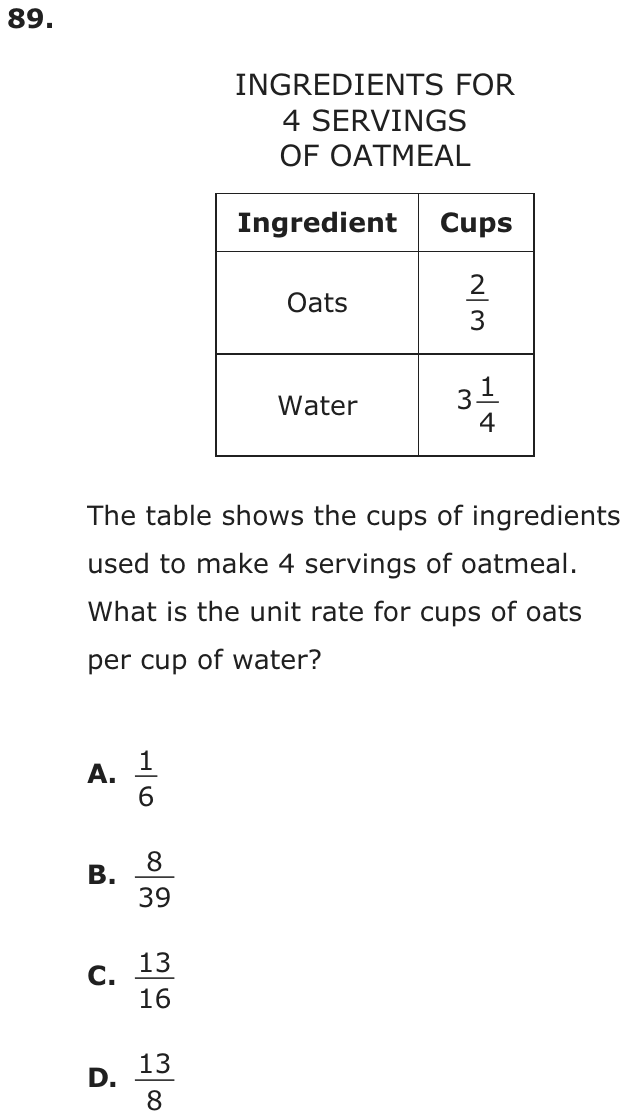
Question 33 of 57
2024 Test A Math, question 33Question
If , what is the value of x?
- A
- B
- C
- D
Show the answer
Correct answer: D
Rewrite with equivalent fractions that have like denominators.
Multiply both sides of the equation by 10.
Question analysis
This equation has fractions on both sides: the coefficient of x is 3/5 minus 1/2, and the right side is 1/4 plus 2/3. Students simplify each side using common denominators, then solve for x. Each step is routine, but four fraction operations in a row leave many places to slip, especially when undoing the coefficient.
- Grade level
- Grade 7 content, by NYS standard
- Compared with grade 7
- At grade 7 Grade 7 students solve equations such as (2/3)x = 4/5 with fractional coefficients. Here both sides must first be simplified over unlike denominators, so four fraction operations come before x is found: on level, but long.
- Estimated difficulty
- Moderate: several steps, or a close reading with one strong distractor.
- Thinking it demands
- Depth of knowledge 1, recall and reproduction · mainly apply
- What makes it hard
- Error-prone arithmetic moderate
- Many steps moderate
- Solution
- 4 steps
- Reading level
- Question and choices: about grade 8, 12 words.
- Corrected from the DOE handbook
- A minus sign printed in place of an equals sign in the explanation was corrected.
- Students, last 30 days
- Not enough answers yet to show (it takes 10).
Why it is hard, traps and wrong answers (shows the answer)
Why it is hard
Nothing here is new, but the question strings together four fraction operations, and the last one runs against habit. Having found that one tenth of x is 11/12, students must multiply by 10; multiplying by 1/10 instead gives a tiny listed value. The size of the answer is a useful check: if a tenth of x is almost 1, then x must be almost 10.
Error-prone arithmetic moderate Working it out
Both sides need common denominators, tenths on the left and twelfths on the right, and the coefficient comes out as 1/10, a fraction to divide by. (Brown & Burton, 1978; Junker & Sijtsma, 2001)
Many steps moderate Working it out
Four operations come before x appears: 3/5 − 1/2, then 1/4 + 2/3, then 11/12 divided by 1/10, then reducing 110/12 to 55/6. (Daniel & Embretson, 2010; Enright, Morley & Sheehan, 2002)
Strategy: Simplify the parentheses on the left and the sum on the right over common denominators, then undo the coefficient by multiplying both sides by its reciprocal.
Traps
- Wrong operation: Adds instead of multiplying, divides the wrong way round, turns a ratio or rate upside down, or undoes a step in the wrong direction (subtracts what should be added back).
- A faulty procedure: A systematic but wrong procedure: adding fractions straight across, applying an exponent to each term of a sum, dropping a sign when moving a term.
The wrong answers, classified
A Wrong operation (Hegarty, Mayer & Monk, 1995; King et al., 2004)
Simplifies both sides correctly but multiplies 11/12 by 1/10 instead of dividing by it, getting 11/120.
B A faulty procedure (Brown & Burton, 1978; Tatsuoka, 1983)
Combines each pair straight across, 3/5 − 1/2 as 2/3 and 1/4 + 2/3 as 3/7, then multiplies them: 2/3 × 3/7 = 2/7.
C Wrong operation (Hegarty, Mayer & Monk, 1995; King et al., 2004)
Adds 3/5 and 1/2 instead of subtracting, so the coefficient is 11/10 and x = 11/12 ÷ 11/10 = 5/6.
What was corrected from the DOE handbook, and why
- Explanation: The handbook writes “(1/10)x − 11/12”, an expression, where the working needs the equation (1/10)x = 11/12: the line before is (6/10 − 5/10)x = 3/12 + 8/12, and the next step multiplies both sides of the equation by 10. The site now reads (1/10)x = 11/12, which gives x = 110/12 = 55/6.
Worked solution, step by step
Formulas used
- Equivalent fractions
- a is the top of a fraction and b is the bottom. n is any number except 0. Multiplying the top and bottom by the same number gives an equal fraction, cut into smaller pieces. Use it to give two fractions the same bottom before you add or subtract.
- Keeping an equation balanced
- a and b are the two sides of an equation, and n is any number. An equation is like a balanced scale. If you multiply both sides by the same number, it stays balanced. Use it to undo a number that multiplies x.
Sort out the equation
An equation says two things are equal. On the left, the subtraction in the parentheses multiplies x. On the right is a sum. You need the value of x. First make each side as simple as you can. Then get x by itself.
Simplify the left side
To subtract, the fractions need the same bottom. Both 5 and 2 go into 10, so use tenths.
Watch out: this is a minus sign. Adding instead gives , and that leads to , choice C.Simplify the right side
Both 4 and 3 go into 12, so use twelfths.
Now the equation is much simpler:
Get x by itself
x is multiplied by . To undo that, multiply both sides by 10. That is the reciprocal of , the fraction flipped upside down.
Watch out: multiplying by does not undo anything. It gives , choice A.Simplify the fraction
Both 110 and 12 are even, so divide the top and the bottom by 2.
So the answer is D, .
Check your answer
Put back in for x. . That matches the right side. Also estimate. A tenth of x is almost 1, so x should be almost 10. is about 9.2.
More questions like this
The original DOE question
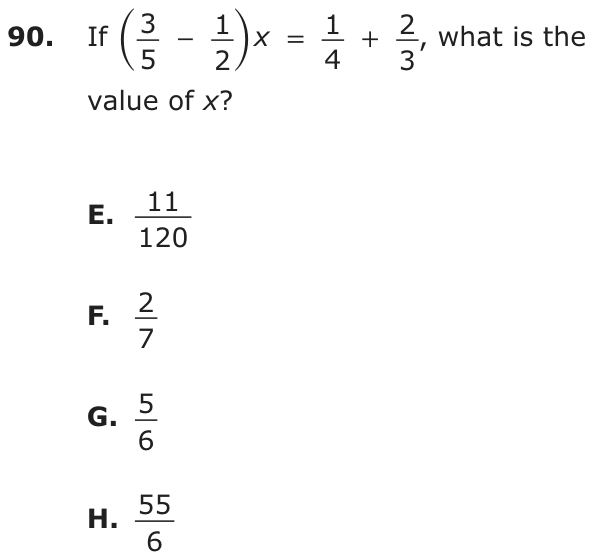
Question 34 of 57
2024 Test A Math, question 34Question
In a certain state, the sales tax rate increased from 7.0% to 7.5%. What was the increase in the sales tax on a $200 item?
- A$1
- B$10
- C$14
- D$15
Show the answer
Correct answer: A
The increase in sales tax percentage is
0.5% of $200 is
Question analysis
This percent word problem says a state's sales tax rate rose from 7.0% to 7.5% and asks how much more tax is charged on a $200 item. Students find the change in the rate and apply it to the price, or compute both taxes and compare. Converting a fraction of a percent to a decimal is where errors creep in.
- Grade level
- Grade 7 content, by NYS standard
- Compared with grade 7
- At grade 7 Sales tax is a standard grade 7 percent topic, usually finding the tax or the total on one price. This one compares two tax rates whose difference is a fraction of a percent, where placing the decimal point is the main hazard.
- Estimated difficulty
- Straightforward: two steps or one careful reading.
- Thinking it demands
- Depth of knowledge 2, skills and concepts · mainly apply
- What makes it hard
- Error-prone arithmetic moderate
- Turning words into math minor
- Solution
- 2 steps
- Reading level
- Question and choices: about grade 4, 22 words.
- Corrected from the DOE handbook
- A dash printed in place of a minus sign in the explanation was corrected.
- Students, last 30 days
- Not enough answers yet to show (it takes 10).
Why it is hard, traps and wrong answers (shows the answer)
Why it is hard
The arithmetic is tiny once 0.5% is written correctly, so the question turns on the decimal point. A percent below 1 is unfamiliar, and moving the point one place instead of two gives a choice ten times too large. Students can sidestep it by finding both taxes, $14 and $15, and subtracting, though either tax on its own is also a listed choice.
Error-prone arithmetic moderate Working it out
The change in rate is half of one percent, and writing 0.5% as a decimal moves the point two places, to 0.005; one place gives 0.05 and a tenfold error. (Brown & Burton, 1978; Junker & Sijtsma, 2001)
Turning words into math minor Understanding the question
The question asks for "the increase in the sales tax", a difference in dollars, while the stem's first sentence is about the two rates themselves. (Hegarty, Mayer & Monk, 1995; Koedinger & Nathan, 2004)
Strategy: Subtract the old rate from the new rate, then take that percent of $200, writing it as a decimal carefully; or find both taxes and subtract.
Traps
- Answers a different question: A choice is right for another quantity: the other unknown, the rest instead of the part, the part instead of the whole.
- An arithmetic slip: The right method with a plausible arithmetic error: a digit, a place value or a times-table fact.
The wrong answers, classified
B An arithmetic slip (Junker & Sijtsma, 2001)
Writes 0.5% as 0.05 instead of 0.005, so 0.05 × 200 = 10, a decimal-place slip that makes the increase ten times too large.
C Answers a different question (King et al., 2004; Hegarty, Mayer & Monk, 1995)
Finds the tax at the old rate, 7% of $200 = $14, and gives that instead of how much the tax went up.
D Stops one step early (King et al., 2004; Gierl et al., 2017)
Finds the tax at the new rate, 7.5% of $200 = $15, and stops before subtracting the $14 charged at the old rate.
What was corrected from the DOE handbook, and why
- Explanation: The handbook writes the subtraction with an em dash, “7.5% — 7.0% = 0.5%”. The site uses a minus sign: 7.5% − 7.0% = 0.5%. Nothing else changes; 0.5% of $200 is $1.
Worked solution, step by step
Formulas used
- Percent of a number
- p is the percent. Percent means out of 100, so p percent is p over 100. The whole is the amount you take the percent of, here the $200 price. The part is the result. To write a percent as a decimal, move the decimal point two places left.
Sort out the question
Sales tax is extra money added to a price. The tax rate went from 7.0% to 7.5%. The item costs $200. You need “the increase in the sales tax” in dollars. That is how much more tax you pay now.
Watch out: the tax at the old rate is $14, choice C. The tax at the new rate is $15, choice D. Neither one is the increase.Find how much the rate went up
Subtract the old rate from the new rate.
The rate went up 0.5%. That is half of one percent.
Find 0.5% of $200
The extra tax is 0.5% of the price. Use the percent formula with p = 0.5 and the whole = 200.
The tax goes up by $1. Watch out: 0.5% is 0.005, not 0.05. Moving the point only one place gives $10, choice B.
So the answer is A, $1.
Check your answer
Find both taxes and subtract. Old tax: , so $14. New tax: , so $15. The difference is , or $1. Both ways give the same answer.
More questions like this
The original DOE question
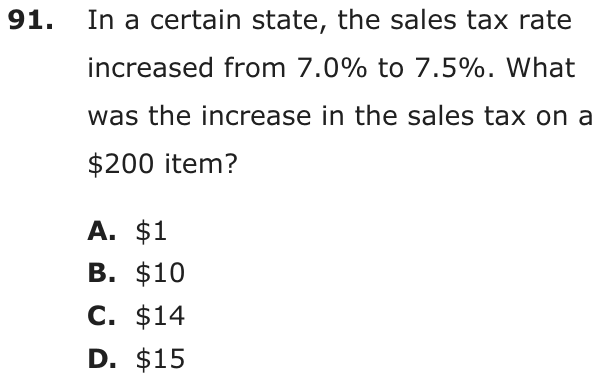
Question 35 of 57
2024 Test A Math, question 35Question
Evaluate:
- A−30
- B−18
- C18
- D44
Show the answer
Correct answer: B
Simplify negatives inside the first absolute value brackets.
Simplify the first absolute value.
Calculate the absolute values.
Perform the final subtraction.
Question analysis
This integer question asks students to evaluate an expression with two absolute values: the first holds four positive and negative numbers, and the second is the absolute value of 24. It tests subtracting negative numbers and understanding absolute value. Subtracting a negative number and handling each pair of bars separately are where most slips happen.
- Grade level
- Grade 7 content, by NYS standard
- Compared with grade 7
- At grade 7 Grade 7 students add and subtract integers and know absolute value as distance from zero. This expression puts four signed terms inside one pair of bars and subtracts a second absolute value, a typical but sign-heavy grade 7 exercise.
- Estimated difficulty
- Moderate: several steps, or a close reading with one strong distractor.
- Thinking it demands
- Depth of knowledge 1, recall and reproduction · mainly apply
- What makes it hard
- Error-prone arithmetic moderate
- A very close wrong answer moderate
- Many steps minor
- Solution
- 4 steps
- Reading level
- Question and choices: about grade 16+, 2 words.
- Students, last 30 days
- Not enough answers yet to show (it takes 10).
Why it is hard, traps and wrong answers (shows the answer)
Why it is hard
Every step is routine, but the question stacks sign decisions, and one slip anywhere produces a clean wrong number. The last step is the subtle one: each pair of bars gives a positive number, but 6 minus 24 is still negative. Students who believe bars guarantee a positive result flip that subtraction, and the choices offer the flipped number beside the right one.
Error-prone arithmetic moderate Working it out
The first bars hold four signed terms, and two must be rewritten, + (−17) as − 17 and − (−31) as + 31, before they combine to −6. (Brown & Burton, 1978; Junker & Sijtsma, 2001)
A very close wrong answer moderate Choosing the answer
The answer, −18, and the choice 18 differ only in sign, so estimating cannot separate them; only doing the last step as 6 − 24 does. (Embretson & Wetzel, 1987; Gorin & Embretson, 2006; Ascalon et al., 2007)
Many steps minor Working it out
Each pair of bars is simplified inside and made positive before the outer subtraction, so three separate jobs must be done in the right order. (Daniel & Embretson, 2010; Enright, Morley & Sheehan, 2002)
Strategy: Rewrite each subtraction of a negative as addition, combine the four numbers inside the first bars, take both absolute values, and only then do the final subtraction.
Traps
- Negatives and direction: Arithmetic with negative numbers, the order of a subtraction, or direction on a number line. (Moving a term across the equals sign without changing its sign is a faulty procedure.)
- Misunderstands the concept: A wrong belief about a concept: that percents can be added, that area grows like length, that averages can be averaged, that a bigger denominator means a bigger fraction.
The wrong answers, classified
A A faulty procedure (Brown & Burton, 1978; Tatsuoka, 1983)
Simplifies the inside to −6 but treats the bars like parentheses, keeping −6, so −6 − 24 = −30.
C Misunderstands the concept (Smith, diSessa & Roschelle, 1993; De Bock et al., 1998; Ni & Zhou, 2005)
Assumes an expression made of absolute values cannot be negative, so subtracts 6 from 24 instead of 24 from 6.
D Negatives and direction (Brown & Burton, 1978)
Reads − (−31) as − 31, so the inside becomes −8 − 12 − 17 − 31 = −68, and 68 − 24 = 44.
Worked solution, step by step
Formulas used
- Adding and subtracting negatives
- a is any number, and b is a positive number, so −b is negative. Adding a negative moves you left on the number line, just like subtracting. Subtracting a negative is like taking away a debt, so you end up with more. It is the same as adding.
- Absolute value
- The bars around a number mean absolute value. a is any number. Its absolute value is how far a is from 0 on the number line. A distance is never negative, so the absolute value of −6 is 6.
Sort out the expression
The expression has two absolute values. The bars mean the distance from 0, so what comes out of them is never negative. Work in this order. First simplify inside the first bars. Then take both absolute values. Last, do the subtraction between them.
Rewrite the signs inside
Two signs inside the first bars are tricky. Adding −17 is the same as subtracting 17. Subtracting −31 is the same as adding 31.
Watch out: minus negative 31 is plus 31. Treating it as minus 31 makes the inside −68. That leads to 44, choice D.Combine the four numbers
Go from left to right, one number at a time.
The inside of the first bars is −6.
Take the absolute values
Now the expression is . Watch out: the bars turn −6 into 6. Keeping −6 gives , choice A.
Do the last subtraction
You take 24 away from 6. Taking a bigger number from a smaller one gives a negative answer. Watch out: absolute values are never negative, but this answer can be. Doing instead gives 18, choice C.
So the answer is B, −18.
Check your answer
Check the inside a new way. The positive part is 31. The negative parts add to . Since , the inside is right. Then, on a number line, start at 6 and move 24 to the left. Six steps reach 0, and 18 more land on −18.
More questions like this
The original DOE question
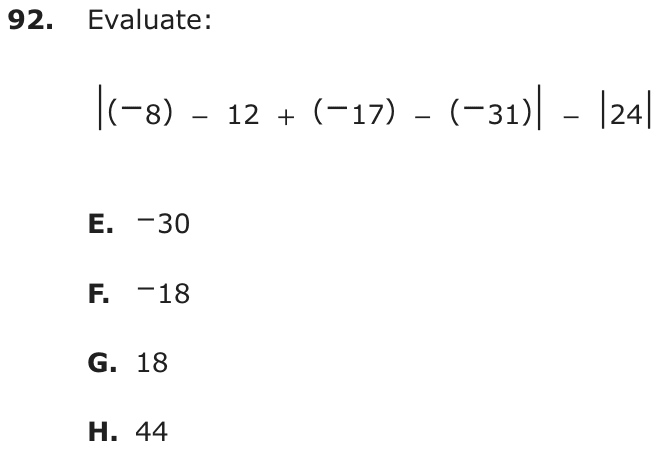
Question 36 of 57
2024 Test A Math, question 36Question
CELL PHONE SALES BY COLOR
| Color | Percentage of Cell Phones Sold |
|---|---|
| White | |
| Black | 30 |
| Blue | |
| Red | |
| Total | 100 |
The table above shows cell phone sales by color. What percentage of the cell phones sold were blue?
- A18%
- B20%
- C22%
- D28%
Show the answer
Correct answer: B
First, use the information given in the table and properties of equations to determine the value of k:
Then, determine the percentage of cell phones sold that were blue by finding the value of the expression (given in the table), when :
The percentage of cell phones sold that were blue is 20%.
Question analysis
A table of cell phone sales by color gives each color's percentage as an expression in k, such as 8k for white and 30 − 2k for blue, with a total of 100. Students write and solve an equation for k, then find the percentage for blue. Combining terms with a negative coefficient, and remembering that k itself is not the answer, both need care.
- Grade level
- Grade 7 content, by NYS standard
- Compared with grade 7
- At grade 7 Grade 7 students solve two-step equations that are written out for them. Here the equation must be built from a table whose percentages total 100, with like terms to combine, and the value found must then be substituted back.
- Estimated difficulty
- Moderate: several steps, or a close reading with one strong distractor.
- Thinking it demands
- Depth of knowledge 2, skills and concepts · mainly apply
- What makes it hard
- Many steps moderate
- Reading a figure, table or graph minor
- Error-prone arithmetic minor
- Solution
- 4 steps
- Reading level
- Question and choices: about grade 4, 36 words.
- Students, last 30 days
- Not enough answers yet to show (it takes 10).
Why it is hard, traps and wrong answers (shows the answer)
Why it is hard
The question hides an equation in a table, and the key insight is that the four percentages must add to 100. After that the algebra is routine, and no listed choice rewards stopping early, since neither k nor any other color's percentage appears. The wrong choices sit near the answer or use the blue expression with k ignored, so students who cannot set up the equation are left guessing.
Many steps moderate Working it out
The answer needs a chain: add the four expressions, set the sum to 100, collect 8k − 2k + k into 7k, solve for k, then substitute into 30 − 2k. (Daniel & Embretson, 2010; Enright, Morley & Sheehan, 2002)
Reading a figure, table or graph minor Understanding the question
No equation is printed; the table's Total row of 100 is what turns the four percentages written in k into one equation to solve. (Lesh, Post & Behr, 1987; Kirsch & Mosenthal, 1990)
Error-prone arithmetic minor Working it out
Collecting like terms includes the negative coefficient in the blue row, −2k, and the constants 30, 30 and 5 have to be gathered too. (Brown & Burton, 1978; Junker & Sijtsma, 2001)
Strategy: Add the four color expressions and set the sum equal to 100, combine like terms to solve for k, then substitute k into the blue row's expression.
Traps
- Numbers taken from the question: Combines the numbers in the question without a model of the situation, or is simply a number that appears in the question.
The wrong answers, classified
A Little reason to choose it (Haladyna & Downing, 1993; Rodriguez, 2005)
No common slip gives k = 6 from 7k + 65 = 100, the value 18% would need; it sits 2 points below the answer and mostly draws guesses.
C Little reason to choose it (Haladyna & Downing, 1993; Rodriguez, 2005)
No usual error in collecting terms or solving yields k = 4, which 22% requires, so this near neighbor of the answer mostly attracts guessers.
D Numbers taken from the question (Hegarty, Mayer & Monk, 1995)
Never solves for k and reads the blue entry 30 − 2k as 30 − 2, as if k were 1, giving 28.
Worked solution, step by step
Formulas used
- Combining like terms
- k is the unknown number. a and b are the numbers in front of k, called coefficients. Terms with the same letter are called like terms. You can add their coefficients, because a groups of k plus b groups of k make a + b groups of k.
- Keeping an equation balanced
- a and b are the two sides of an equation, and c is any number (not 0 when you divide). An equation is like a balanced scale. Doing the same thing to both sides keeps it balanced. Use it to undo each step and get k alone.
Sort out the table
The table gives the percent of phones sold in each color. Some entries use k, a letter that stands for an unknown number. 8k means 8 times k. You need the percent that were blue, . To find it, you first need k.
Write an equation for the total
Every phone sold is one of the four colors. So the four percents add up to the total, 100, as the last row of the table shows.
Combine like terms
Terms with k in them are called like terms, so they can be combined. Group the k terms together and the plain numbers together. A k on its own means 1k.
So the equation becomes . Watch out: the blue row takes away 2k. Keep its minus sign, or the k terms will be wrong.
Solve for k
Undo the adding first, then the multiplying.
So k is 5. But k is not the answer. You still need the blue row.
Find the blue percent
Put 5 in for k in the blue row.
So 20% of the phones sold were blue. Watch out: 2k means 2 times k, not 2. Reading as gives 28%, choice D.
So the answer is B, 20%.
Check your answer
Put k = 5 into every row. White: . Black: 30. Blue: 20. Red: . Now add them: . The total matches the table, so k = 5 is right.
More questions like this
The original DOE question
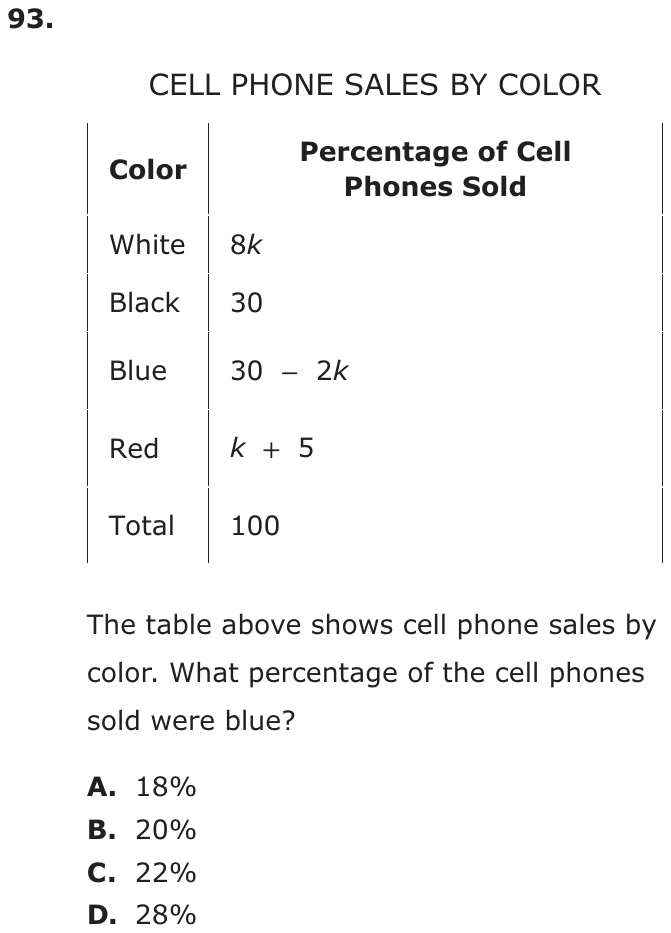
Question 37 of 57
2024 Test A Math, question 37Question
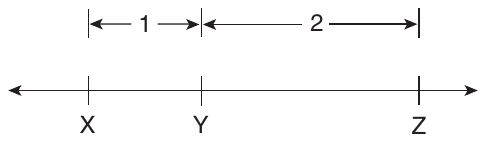
On the number line above, the distance between X and Y is 1 unit, and the distance between Y and Z is 2 units. What is the distance, in units, between Y and the midpoint of X and Z?
- A
- B1
- C
- D3
Show the answer
Correct answer: A
First, find the distance between X and Z by adding the distance between X and Y to the distance between Y and Z.
Since the distance between X and Z is 3, the midpoint between X and Z is units from X.
The midpoint between X and Z is units from X, and the distance between X and Y is 1. The distance between Y and the midpoint of X and Z is .
Question analysis
This number line question shows points X, Y and Z, with 1 unit from X to Y and 2 units from Y to Z, and asks how far Y is from the midpoint of X and Z. Students find the length of XZ, locate its midpoint, and compare it with Y. Each step produces a tempting number, so stopping early is the usual mistake.
- Grade level
- Grade 7 content, by NYS standard
- Compared with grade 7
- Below grade 7 Grade 7 number line problems usually involve negative numbers and fractions as coordinates. This one has no coordinates, only two whole-number distances, and needs three short steps: a total length, a midpoint and a difference.
- Estimated difficulty
- Straightforward: two steps or one careful reading.
- Thinking it demands
- Depth of knowledge 2, skills and concepts · mainly apply
- What makes it hard
- Reading a figure, table or graph minor
- Many steps minor
- Solution
- 3 steps
- Reading level
- Question and choices: about grade 5, 39 words.
- Corrected from the DOE handbook
- An imprecise statement about the midpoint in the explanation was corrected.
- Students, last 30 days
- Not enough answers yet to show (it takes 10).
Why it is hard, traps and wrong answers (shows the answer)
Why it is hard
The arithmetic is light, but every intermediate result is waiting among the choices, so the risk is stopping before the last subtraction. Students also have to keep two midpoints apart: the one asked about lies between X and Z, not halfway along the 2-unit stretch from Y. Marking X at 0 and the midpoint at 1.5 on the drawing makes the half-unit gap visible.
Reading a figure, table or graph minor Understanding the question
The number line has no coordinates, only dimension arrows labeled 1 and 2, so students must assign positions themselves, such as X at 0, Y at 1 and Z at 3. (Lesh, Post & Behr, 1987; Kirsch & Mosenthal, 1990)
Many steps minor Working it out
Three short results come in sequence, the length XZ, the midpoint's distance from X, then its distance from Y, and each is also a listed choice. (Daniel & Embretson, 2010; Enright, Morley & Sheehan, 2002)
Strategy: Place X at 0 so that Y and Z get positions from the given distances, find the midpoint of X and Z as half their distance, then compare it with Y's position.
Traps
- Stops one step early: A choice is a number from partway through the solution.
- Answers a different question: A choice is right for another quantity: the other unknown, the rest instead of the part, the part instead of the whole.
The wrong answers, classified
B Answers a different question (King et al., 2004; Hegarty, Mayer & Monk, 1995)
Halves the 2-unit segment from Y to Z, the midpoint of the wrong pair of points, which is 1 unit from Y; it also matches the labeled XY.
C Stops one step early (King et al., 2004; Gierl et al., 2017)
Finds that the midpoint is 1 1/2 units from X and stops before subtracting the 1 unit between X and Y.
D Answers a different question (King et al., 2004; Hegarty, Mayer & Monk, 1995)
Adds the two labeled distances, 1 + 2 = 3, and gives the whole length XZ rather than any distance to the midpoint.
What was corrected from the DOE handbook, and why
- Explanation: The handbook says “the midpoint between X and Z is 1½” (twice). A midpoint is a point, and this number line has no numbers on it, so the 1½ is the midpoint’s distance from X (half of XZ = 3). Both sentences now say the midpoint is “1½ units from X.” The rest is unchanged: Y is 1 unit from X, so the distance between Y and the midpoint is 1½ − 1 = ½.
Worked solution, step by step
Formulas used
- Adding lengths on a line
- X, Y and Z are points on one line, with Y between X and Z. XY and YZ are the lengths of the two short pieces. XZ is the length of the whole. The two pieces join end to end to make the whole.
- Midpoint of a segment
- A segment is the straight piece of a line between two points, its ends. The midpoint is the point exactly halfway between the ends. It splits the segment into two equal halves. So it is half the length away from each end.
Sort out the picture
The points go X, then Y, then Z, from left to right. X to Y is 1 unit, and Y to Z is 2 units. You need the midpoint of X and Z, the point halfway between them. Then you need how far Y is from that midpoint. The line has no numbers, so measure everything from X.
Find the length from X to Z
X to Z is 3 units. Watch out: 3 is the whole length, choice D. It is not a distance to the midpoint.
Place the midpoint
The midpoint of X and Z is half of 3 units from X.
So the midpoint is units to the right of X. Watch out: this is its distance from X, not from Y. Stopping here gives choice C.
Measure from Y to the midpoint
Y is 1 unit to the right of X. The midpoint is units to the right of X. Subtract to find the gap between them.
Watch out: use the midpoint of X and Z, not of Y and Z. Halving the 2 units from Y to Z gives 1, choice B.So the answer is A, unit.
Check your answer
Give each point a number, with X at 0. Then Y is at 1 and Z is at 3. Halfway between 0 and 3 is . From Y at 1 to is . This fits the picture too: Y sits a little left of the middle of XZ.
More questions like this
The original DOE question
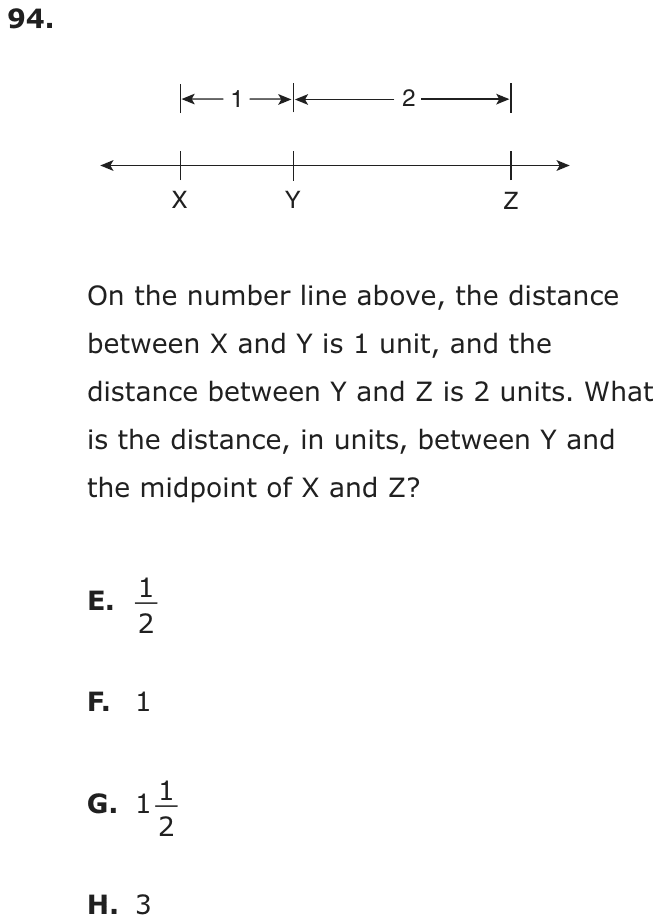
Question 38 of 57
2024 Test A Math, question 38Question
By what percent did the price of a cup of coffee increase if its price was increased from $1.25 to $1.35?
- A7%
- B8%
- C10%
- D12%
Show the answer
Correct answer: B
Subtract to determine the amount of the increase.
Divide the increase by the original price.
Multiply the quotient by 100 to express the decimal answer as a percent.
Question analysis
This percent increase question gives the price of a cup of coffee before and after a raise, from $1.25 to $1.35, and asks by what percent the price went up. Students find the change in price and compare it with a price. Deciding which price to compare the change with is the tricky part.
- Grade level
- Grade 7 content, by NYS standard
- Compared with grade 7
- At grade 7 Percent increase is grade 7 content, and this is a standard case with two prices. What makes it harder than routine is deciding which price the change is measured against and dividing small decimals accurately.
- Estimated difficulty
- Moderate: several steps, or a close reading with one strong distractor.
- Thinking it demands
- Depth of knowledge 2, skills and concepts · mainly apply
- What makes it hard
- A very close wrong answer moderate
- Error-prone arithmetic moderate
- Solution
- 3 steps
- Reading level
- Question and choices: about grade 6, 19 words.
- Students, last 30 days
- Not enough answers yet to show (it takes 10).
Why it is hard, traps and wrong answers (shows the answer)
Why it is hard
Most students see that the price rose by 10 cents; the question is what to compare that with. Percent change is measured from the original amount, and dividing by the new price gives a number close enough to the answer that rounding hides the mistake. Reading the 10 cents directly as 10 percent is the other quick trap, since 10 cents is only 10 percent of a dollar.
A very close wrong answer moderate Choosing the answer
Dividing the 10-cent rise by either price gives a single-digit percent, 8% from $1.25 and about 7.4% from $1.35, so only the choice of base separates the two listed answers. (Embretson & Wetzel, 1987; Gorin & Embretson, 2006; Ascalon et al., 2007)
Error-prone arithmetic moderate Working it out
Without a calculator, 0.10 ÷ 1.25 is a division by a decimal; rewriting it in cents as 10/125, which simplifies to 8/100, is the clean way through. (Brown & Burton, 1978; Junker & Sijtsma, 2001)
Strategy: Subtract to get the increase, then divide it by the price before the raise and multiply by 100; working in cents keeps the decimals out of the way.
Traps
- Percent of the wrong amount: Finding the whole from a part, or a percent change measured from the wrong starting amount.
- Misunderstands the concept: A wrong belief about a concept: that percents can be added, that area grows like length, that averages can be averaged, that a bigger denominator means a bigger fraction.
- Wrong operation: Adds instead of multiplying, divides the wrong way round, turns a ratio or rate upside down, or undoes a step in the wrong direction (subtracts what should be added back).
The wrong answers, classified
A Percent of the wrong amount (Parker & Leinhardt, 1995)
Divides the 10-cent increase by the new price, $1.35, measuring from the wrong amount; 0.10 ÷ 1.35 is about 7.4%, so 7%.
C Misunderstands the concept (Smith, diSessa & Roschelle, 1993; De Bock et al., 1998; Ni & Zhou, 2005)
Reads the 10-cent increase as 10 percent, as if every percent change were a percent of one dollar rather than of the $1.25 price.
D Wrong operation (Hegarty, Mayer & Monk, 1995; King et al., 2004)
Divides the wrong way round, $1.25 ÷ $0.10 = 12.5, and takes the nearest choice, 12%.
Worked solution, step by step
Formulas used
- Percent increase
- New is the price after the change, and original is the price before it. The top is the amount of the increase. Dividing by the original compares the increase with where you started. Multiplying by 100 turns that decimal into a percent.
Sort out the question
The coffee cost $1.25 before. That is the original price. Now it costs $1.35, the new price. You need the percent increase. That compares how much the price went up with the original price.
Find the amount of the increase
The price went up $0.10, or 10 cents. Watch out: 10 cents is not 10%. It would be 10% only if the price started at $1.00. That mistake gives choice C.
Divide by the original price
Dividing by a decimal is easier in cents: 10 cents out of 125 cents. Divide the top and bottom by 5. Then multiply both by 4 to get hundredths.
Change to a percent
The price went up 8%. Watch out: divide by the original price, $1.25, not the new one. Dividing by $1.35 gives about 7.4%, which rounds to choice A.
So the answer is B, 8%.
Check your answer
Work forward from the answer. 8% of $1.25 is , or 10 cents. Then . That is the new price, so 8% is right.
More questions like this
The original DOE question
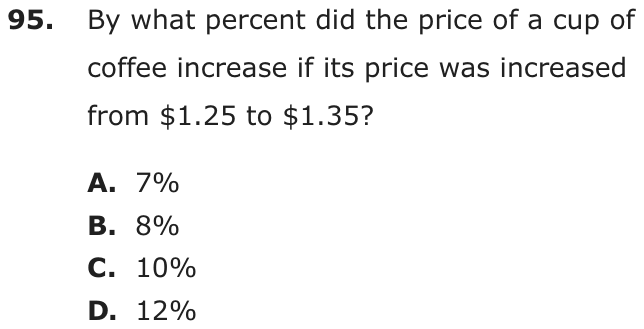
Question 39 of 57
2024 Test A Math, question 39Question
Raquel is cutting out pieces of cardboard to make a pyramid. She will use a square piece for the base and identical triangular pieces for the sides. The figure above shows the dimensions of the triangle for each side. What will be the total surface area, in square inches, of the pyramid, including the square base?
- A280
- B295
- C340
- D360
Show the answer
Correct answer: C
Surface area is found by calculating the area of each side, including the base, and adding them all together.
The base of the pyramid measures 10 inches on each side, so the area of the base is
Each triangular face has a base of 10 inches and a height of 12 inches, so the area of each face is
There are 4 triangular faces (because the square base has 4 edges, each of which will have a triangular face). So the total surface area of the pyramid is the sum of the areas of 4 triangles and 1 square.
So the total surface area is 340 square inches.
Question analysis
This surface area word problem shows one triangular face, with sides of 13 inches, a base of 10 inches and a height of 12 inches, that Raquel will use to build a cardboard pyramid with a square base. Students find the total area of the base and all the triangular sides. Picturing the solid and choosing the right measurements from the figure are the tricky parts.
- Grade level
- Grade 7 content, by NYS standard
- Compared with grade 7
- Above grade 7 Grade 7 students find the surface area of a pyramid from a drawn net or solid. Here only one triangular face is shown, so students must picture the whole pyramid, count its faces, and choose which labeled length belongs in the area formula.
- Estimated difficulty
- Hard: combines ideas, needs a plan, and has more than one tempting wrong answer.
- Thinking it demands
- Depth of knowledge 2, skills and concepts · mainly apply
- What makes it hard
- Reading a figure, table or graph moderate
- Combines ideas moderate
- Something you must already know minor
- Solution
- 4 steps
- Reading level
- Question and choices: about grade 6, 56 words.
- Corrected from the DOE handbook
- A wrong unit in the explanation was corrected.
- Students, last 30 days
- Not enough answers yet to show (it takes 10).
Why it is hard, traps and wrong answers (shows the answer)
Why it is hard
Students have to build the pyramid in their heads from one flat triangle, then choose the right measurement from three labels. The 13-inch sides look like the natural height, and using them gives a listed total; picturing a pyramid with three sloping faces gives another. Sketching the square base with a triangle on each edge, and marking 12 as the height, settles both the face count and the formula.
Reading a figure, table or graph moderate Understanding the question
The figure gives one triangle with three length labels, 13, 13 and 10, and puts its height, 12, on a separate arrow beside it, where it is easy to overlook. (Lesh, Post & Behr, 1987; Kirsch & Mosenthal, 1990)
Combines ideas moderate Working it out
The solid is never drawn: students must see that the square's side equals the triangle's 10-inch base, count four triangles, and add triangle and square areas. (Embretson, 1998; Daniel & Embretson, 2010)
Something you must already know minor Working it out
A triangle's area uses its perpendicular height, not a slanted side, and a pyramid on a square base has four triangular faces; neither fact is given. (Anderson & Krathwohl, 2001)
Strategy: Sketch the pyramid: a square base whose side is the triangle's base, and one triangular face on each side of the square. Find each area with the matching formula, then add them all.
Traps
- Misreads the figure: Reads a value, label or tick spacing in a figure, table or graph wrongly.
- Information you don't need: The question gives numbers or facts that play no part in the answer.
- Misunderstands the concept: A wrong belief about a concept: that percents can be added, that area grows like length, that averages can be averaged, that a bigger denominator means a bigger fraction.
The wrong answers, classified
A Misunderstands the concept (Smith, diSessa & Roschelle, 1993; De Bock et al., 1998; Ni & Zhou, 2005)
Counts only three triangular faces, as if the pyramid had a triangular base, so 3 × 60 + 100 = 280.
B Misunderstands the concept (Smith, diSessa & Roschelle, 1993; De Bock et al., 1998; Ni & Zhou, 2005)
Counts three faces and also uses the 13-inch side as each triangle's height: 3 × 65 + 100 = 295.
D Misreads the figure (Lesh, Post & Behr, 1987; Kirsch & Mosenthal, 1990)
Takes the 13-inch slanted side as each triangle's height instead of the 12-inch arrow beside it, so 4 × 65 + 100 = 360.
What was corrected from the DOE handbook, and why
- Explanation: The handbook ends “So the total surface area is 340 square feet.” The triangle’s dimensions are in inches and the question asks for square inches, so the site now reads “340 square inches.”
Worked solution, step by step
Formulas used
- Area of a triangle
- A is the area. b is the base, the side the triangle sits on. h is the height: the straight-up distance from the base to the top corner, at a right angle to the base. You take half because a triangle is half of a rectangle with the same base and height.
- Area of a square
- A is the area and s is the length of one side. All four sides of a square are equal, so the area is side times side.
- Surface area
- A face is one flat side of a solid shape. The surface area is the total area of the outside. Picture unfolding the solid into flat pieces. Then add up the area of every piece.
Sort out the question
Raquel’s pyramid has a square base. Each side is a triangle like the one in the figure. The triangle’s base is 10 in. Its two slanted sides are 13 in. Its height, the arrow beside it, is 12 in. You need the total surface area, including the square base, in square inches.
Picture the pyramid
Surface area is the total area of all the flat sides, called faces. Each triangle stands on one edge of the square. So each edge of the square is 10 inches, the same as the triangle’s base. A square has 4 edges, so the pyramid has 4 triangles.
Here that is 4 triangles plus 1 square. Watch out: counting only 3 triangles gives 280, choice A.
Find the area of one triangle
Each triangle is 60 square inches. Watch out: the height is 12 in., the straight-up arrow. It is not 13 in., the slanted side. Using 13 gives 65 for each triangle and 360 in all, choice D.
Find the area of the base
The base is a square with sides of 10 inches, the same as each triangle’s base.
The square base is 100 square inches.
Add all five faces
The four triangles and the square together cover 340 square inches.
So the answer is C, 340 square inches.
Check your answer
Each triangle is half of a 10 by 12 rectangle, which has an area of 120. So two triangles make 120, and four make 240. Add the base: . The units fit too: inches times inches gives square inches.
More questions like this
The original DOE question
Question 40 of 57
2024 Test A Math, question 40Question
The price of a sandwich was raised from $6.25 to $6.75. What was the percent increase in the price?
- A5%
- B8%
- C7%
- D50%
Show the answer
Correct answer: B
Use the percent increase expression to find the answer:
Question analysis
A sandwich's price went up from $6.25 to $6.75, and this percent change question asks for the percent increase in the price. Students divide the 50-cent increase by one of the prices and write the result as a percent. Picking which price is the base, and doing the decimal division accurately, decide whether the answer comes out right.
- Grade level
- Grade 7 content, by NYS standard
- Compared with grade 7
- At grade 7 Finding a percent increase is a core grade 7 skill, and this is the plain version with no context beyond two prices. Its demand lies in measuring the change against the correct price and dividing by $6.25 without a calculator.
- Estimated difficulty
- Moderate: several steps, or a close reading with one strong distractor.
- Thinking it demands
- Depth of knowledge 2, skills and concepts · mainly apply
- What makes it hard
- A very close wrong answer moderate
- Error-prone arithmetic moderate
- Solution
- 3 steps
- Reading level
- Question and choices: about grade 2, 17 words.
- Students, last 30 days
- Not enough answers yet to show (it takes 10).
Why it is hard, traps and wrong answers (shows the answer)
Why it is hard
The 50-cent rise is easy to find; the percent depends on what it is compared with. Dividing by the new price, $6.75, gives a value that rounds to a listed choice one point below the answer, and reading 50 cents as 50 percent gives another. The choices are printed out of order, 8% before 7%, so students should read each one rather than scan the list.
A very close wrong answer moderate Choosing the answer
Measured against $6.75 the 50-cent rise is about 7.4%, and against $6.25 it is 8%; both are listed side by side, so only the right base separates them. (Embretson & Wetzel, 1987; Gorin & Embretson, 2006; Ascalon et al., 2007)
Error-prone arithmetic moderate Working it out
The division 0.50 ÷ 6.25 is easiest as 50/625, which reduces to 2/25 and then to 8/100; a three-digit decimal divisor invites a slip. (Brown & Burton, 1978; Junker & Sijtsma, 2001)
Strategy: Put the 50-cent change over the original price, 0.50 over 6.25, then scale the fraction to hundredths or divide to read off the percent.
Traps
- Percent of the wrong amount: Finding the whole from a part, or a percent change measured from the wrong starting amount.
- Misunderstands the concept: A wrong belief about a concept: that percents can be added, that area grows like length, that averages can be averaged, that a bigger denominator means a bigger fraction.
The wrong answers, classified
A Little reason to choose it (Haladyna & Downing, 1993; Rodriguez, 2005)
No common working gives 5%: dividing the 50-cent rise by either price does not come near it, so it mostly draws guesses.
C Percent of the wrong amount (Parker & Leinhardt, 1995)
Divides the 50-cent increase by the new price, $6.75, instead of the original, which gives about 7.4%, so 7%.
D Misunderstands the concept (Smith, diSessa & Roschelle, 1993; De Bock et al., 1998; Ni & Zhou, 2005)
Reads the 50-cent increase as 50 percent, treating cents as a percent of one dollar rather than of the $6.25 price.
Worked solution, step by step
Formulas used
- Percent increase
- New is the price after the change, and original is the price before it. The top is the amount of the increase. Dividing by the original compares the increase with where you started. Multiplying by 100 turns that decimal into a percent.
Sort out the question
The sandwich cost $6.25 before. That is the original price. Now it costs $6.75, the new price. You need the percent increase. That compares the increase with the original price. Note that the choices are not in order: C, 7%, comes after B, 8%.
Find the amount of the increase
The price went up $0.50, or 50 cents. Watch out: 50 cents is not 50%. It would be 50% only if the price started at $1.00. That mistake gives choice D.
Divide by the original price
In cents, this is 50 out of 625. Divide the top and bottom by 25. Then multiply both by 4 to get hundredths.
Change to a percent
The price went up 8%. Watch out: divide by the original price, $6.25, not the new one. Dividing by $6.75 gives about 7.4%, which is choice C.
So the answer is B, 8%.
Check your answer
Work forward from the answer. 8% of $6.25 is , or 50 cents. Then . That is the new price, so 8% is right.
More questions like this
The original DOE question
Question 41 of 57
2024 Test A Math, question 41Question
Terrell played 5 computer games and earned a mean score of 8 points per game. If his mean score for the first 4 games was 7 points per game, how many points was his score in the fifth game?
- A9
- B11
- C12
- D14
Show the answer
Correct answer: C
If the mean number of points for the first four games is 7, the total number of points earned in those games is 28.
If the mean number of points for all five games is 8, the total number of points earned is 40.
To find the number of points in the fifth game, find the difference between 40 and 28.
Question analysis
This mean, or average, word problem says Terrell averaged 8 points over 5 computer games and 7 points over the first 4, and asks for his score in the fifth game. Students turn each average into a total and compare the totals. Combining the two averages directly, without going through totals, is the tempting shortcut that fails.
- Grade level
- Grade 6 content, by NYS standard
- Compared with grade 7
- At grade 7 Computing a mean is grade 6 content. Working backward from two means to the totals they stand for, then to one missing score, is a common grade 7 test task, and it comes with a tempting shortcut.
- Estimated difficulty
- Moderate: several steps, or a close reading with one strong distractor.
- Thinking it demands
- Depth of knowledge 2, skills and concepts · mainly apply
- What makes it hard
- Turning words into math moderate
- Something you must already know minor
- Solution
- 3 steps
- Reading level
- Question and choices: about grade 4, 35 words.
- Students, last 30 days
- Not enough answers yet to show (it takes 10).
Why it is hard, traps and wrong answers (shows the answer)
Why it is hard
The question rewards turning both means into totals, 40 points for five games and 28 for four, after which one subtraction finishes it. Averaging 7 with the unknown score is a quick shortcut that gives a listed choice, but it weighs four games as one. Checking that 28 plus the answer, divided by 5, gives 8 catches that error and the near miss next to the answer.
Turning words into math moderate Understanding the question
Each mean has to become a total before the fifth game can be found: "a mean score of 8 points per game" over 5 games means 40 points in all. (Hegarty, Mayer & Monk, 1995; Koedinger & Nathan, 2004)
Something you must already know minor Working it out
Students must know that a total is the mean times the number of games, and that means over different numbers of games cannot simply be averaged. (Anderson & Krathwohl, 2001)
Strategy: Turn each mean into a total by multiplying by its number of games, then subtract the four-game total from the five-game total.
Traps
- Misunderstands the concept: A wrong belief about a concept: that percents can be added, that area grows like length, that averages can be averaged, that a bigger denominator means a bigger fraction.
The wrong answers, classified
A Misunderstands the concept (Smith, diSessa & Roschelle, 1993; De Bock et al., 1998; Ni & Zhou, 2005)
Averages the four-game mean with the fifth score, (7 + x) ÷ 2 = 8, so x = 9, as if the first four games counted once.
B Counting the ends (Brown & Burton, 1978)
Sees the fifth game must lift the mean 1 point above 7 but spreads that over only 4 games, 7 + 4 = 11, instead of all 5.
D Little reason to choose it (Haladyna & Downing, 1993; Rodriguez, 2005)
No common working gives 14, which is twice the four-game mean and matches no total or difference, so it mostly draws guesses.
Worked solution, step by step
Formulas used
- Total from a mean
- The mean, or average, is what each game would score if the total were shared out equally. So the total is the mean times the number of games. Use it to turn each mean back into a total. Totals can be subtracted, but means over different numbers of games can’t.
Sort out the question
Terrell played 5 games. His mean score for all 5 was 8 points per game. His mean for the first 4 games was 7 points per game. The mean, or average, is the total split equally among the games. You need his score in game 5.
Find the total for all 5 games
Turn the mean for all 5 games into a total. Multiply the mean by the number of games.
He scored 40 points in all 5 games together.
Find the total for the first 4 games
Use the same formula with the mean of 7 and 4 games.
He scored 28 points in the first 4 games.
Subtract to find game 5
The 40 points include the first 4 games and game 5. Take away the first 4 games to leave game 5.
He scored 12 points in game 5. Watch out: don’t average 7 and the fifth score as if they were two games. That gives 9, choice A. The 7 stands for 4 games, not 1. Watch out: adding 4 to 7 gives 11, choice B. Each of the first 4 games was 1 point below 8. So game 5 needs 8 plus 4 more points.
So the answer is C, 12 points.
Check your answer
Try scores of 7, 7, 7, 7 and 12. They add up to , and . That is the mean for all 5 games, so 12 is right.
More questions like this
The original DOE question
Question 42 of 57
2024 Test A Math, question 42Question
Lian bought enough oranges to fill 4 bags. Each bag contains 8 oranges. The total cost was $11.52. At that rate, how much would Lian pay for 42 oranges?
- A$17.28
- B$15.12
- C$15.02
- D$12.52
Show the answer
Correct answer: B
First, find the amount, in dollars, that Lian paid for each orange. There are 4 bags with 8 oranges each.
Divide the total cost by the total number of oranges to get the cost per orange:
Multiply to find the cost of 42 oranges:
Question analysis
This rate word problem says Lian paid $11.52 for 4 bags of 8 oranges each and asks how much 42 oranges would cost at the same rate. Students find the price of one orange and multiply. Since 42 oranges is not a whole number of bags, working by the bag instead of by the orange invites mistakes.
- Grade level
- Grade 6 content, by NYS standard
- Compared with grade 7
- Below grade 7 Finding a unit price and scaling it up is grade 6 rate work. The decimals are multi-digit, but the plan is routine, with less to manage than grade 7 problems built on percents or negative numbers.
- Estimated difficulty
- Straightforward: two steps or one careful reading.
- Thinking it demands
- Depth of knowledge 2, skills and concepts · mainly apply
- What makes it hard
- Error-prone arithmetic moderate
- A very close wrong answer minor
- Solution
- 3 steps
- Reading level
- Question and choices: about grade 2, 25 words.
- Students, last 30 days
- Not enough answers yet to show (it takes 10).
Why it is hard, traps and wrong answers (shows the answer)
Why it is hard
The plan is familiar, total oranges, price per orange, then the new cost, so the work lies in the decimals. Because 42 oranges is five bags and two oranges, students who price by the bag either round up to six bags or must handle the leftover. Estimating, since 42 is about a third more than 32, gives roughly $15 and rules out the far choices but not the near one.
Error-prone arithmetic moderate Working it out
Two decimal operations are done by hand: 11.52 ÷ 32 = 0.36 for one orange, then 0.36 × 42 = 15.12, where a dropped carry is easy. (Brown & Burton, 1978; Junker & Sijtsma, 2001)
A very close wrong answer minor Choosing the answer
The choices $15.12 and $15.02 differ by 10 cents, so a rough estimate of about $15 cannot choose between them; only the exact product can. (Embretson & Wetzel, 1987; Gorin & Embretson, 2006; Ascalon et al., 2007)
Strategy: Multiply to find how many oranges were bought, divide the total cost by that number to get the price of one orange, then multiply by 42.
Traps
- Misreads the question: Misses or misreads a condition or a word in the question: "at least", "each", "remaining", "not".
- An arithmetic slip: The right method with a plausible arithmetic error: a digit, a place value or a times-table fact.
The wrong answers, classified
A Misreads the question (Hegarty, Mayer & Monk, 1995)
Prices whole bags, rounding 42 oranges up to 6 bags of 8, and pays 6 × $2.88 = $17.28, missing that "at that rate" means per orange.
C An arithmetic slip (Junker & Sijtsma, 2001)
Uses the right method but slips one digit in multiplying 0.36 by 42, a tens-place error that lands 10 cents short of the total.
D Little reason to choose it (Haladyna & Downing, 1993; Rodriguez, 2005)
No common working gives $12.52, exactly one dollar more than $11.52; no price per orange or per bag leads there, so it mostly draws guesses.
Worked solution, step by step
Formulas used
- Unit price
- The unit price is what one item costs. Divide the total cost by how many items you got. It works because the total is shared equally among the items.
- Cost
- The unit price is the cost of one item, here one orange. Multiply it by how many items you buy to get the total cost. This works when every item costs the same.
Sort out the question
Lian bought 4 bags with 8 oranges in each bag. She paid $11.52 in all. You need the cost of 42 oranges. “At that rate” means each orange costs the same as before. So find the price of one orange first.
Count the oranges
Each of the 4 bags holds 8 oranges, so multiply to find how many she bought.
Lian bought 32 oranges for $11.52.
Find the price of one orange
This is easier in cents: . So one orange costs $0.36, or 36 cents.
Find the cost of 42 oranges
Break 42 into 40 and 2 to make it easier.
The 42 oranges cost $15.12.
Avoid the traps and answer
Watch out: $15.02, choice C, is only 10 cents away. Multiply and add with care. Watch out: Lian pays for each orange, not for full bags. Buying 6 whole bags would cost $17.28, choice A.So the answer is B, $15.12.
Check your answer
42 oranges is 10 more than 32. Those 10 oranges cost $3.60, since . Then . Same answer, so $15.12 is right.
More questions like this
The original DOE question
Question 43 of 57
2024 Test A Math, question 43Question
- A0.005
- B0.648
- C20
- D200
Show the answer
Correct answer: D
Question analysis
This decimal division question asks for 3.6 divided by 0.018, with no context. Students rewrite the division so the divisor is a whole number and then divide. Because the divisor has three decimal places, moving the decimal point the right number of places in both numbers is where students go wrong.
- NYS standards
- 6.NS.3 multi-digit decimal operations
- Grade level
- Grade 6 content, by NYS standard
- Compared with grade 7
- Below grade 7 Dividing multi-digit decimals is a grade 6 fluency standard, and this is a single division with no context. It is easier than typical grade 7 work, though shifting three decimal places invites a place-value slip.
- Estimated difficulty
- Straightforward: two steps or one careful reading.
- Thinking it demands
- Depth of knowledge 1, recall and reproduction · mainly apply
- What makes it hard
- Error-prone arithmetic moderate
- Solution
- 2 steps
- Reading level
- Question and choices: about grade 16+, 1 words.
- Students, last 30 days
- Not enough answers yet to show (it takes 10).
Why it is hard, traps and wrong answers (shows the answer)
Why it is hard
This is a single division, and the only real hazard is the decimal point. Shifting it three places in the divisor but only two in the dividend gives a listed answer ten times too small. An estimate settles it: 0.018 is about 0.02, and 3.6 ÷ 0.02 = 180, so the answer must be in the hundreds.
Error-prone arithmetic moderate Working it out
The divisor 0.018 has three decimal places, so both numbers must be multiplied by 1,000, turning 3.6 into 3,600, not 360, before dividing by 18. (Brown & Burton, 1978; Junker & Sijtsma, 2001)
Strategy: Multiply both numbers by 1,000 so the divisor becomes a whole number, then divide; estimate first by asking roughly how many 0.02s fit into 3.6.
Traps
- An arithmetic slip: The right method with a plausible arithmetic error: a digit, a place value or a times-table fact.
- Wrong operation: Adds instead of multiplying, divides the wrong way round, turns a ratio or rate upside down, or undoes a step in the wrong direction (subtracts what should be added back).
The wrong answers, classified
A Wrong operation (Hegarty, Mayer & Monk, 1995; King et al., 2004)
Divides the wrong way round, 0.018 ÷ 3.6 = 0.005, putting the smaller number on top as if division always shrinks.
B Wrong operation (Hegarty, Mayer & Monk, 1995; King et al., 2004)
Multiplies instead of dividing, 36 × 18 = 648, and misplaces the decimal point too, since 3.6 × 0.018 is really 0.0648.
C An arithmetic slip (Junker & Sijtsma, 2001)
Moves the decimal point two places instead of three, dividing 360 by 18 to get 20, a result ten times too small.
Worked solution, step by step
Formulas used
- Scaling a division
- a is the number being divided, and b is the number you divide by. n is any number except 0. Multiplying both numbers by the same n keeps the answer the same, just like an equal fraction. Use it to turn a decimal you divide by into a whole number.
Sort out the problem
You need . The number you divide by, 0.018, has three decimal places. That means three digits after the decimal point. Dividing by a decimal is hard, so first turn 0.018 into a whole number.
Multiply both numbers by 1,000
Multiplying by 1,000 moves the decimal point 3 places to the right. Do it to both numbers, so the answer does not change.
Watch out: 3.6 has only one decimal place, so fill in zeros: 3.6 becomes 3,600. Moving its point only two places gives , choice C.Divide the whole numbers
This works because , so . Watch out: divide 3.6 by 0.018, not the other way around. Dividing 0.018 by 3.6 gives 0.005, choice A.
So the answer is D, 200.
Check your answer
Multiply back: . Also estimate. 0.018 is close to 0.02, and . The answer should be near that, and 200 is. Dividing by a number less than 1 gives a bigger answer, so 200 makes sense.
More questions like this
The original DOE question
Question 44 of 57
2024 Test A Math, question 44Question
A tank with a 500-gallon capacity currently contains 75 gallons of water. Additional water is poured into this tank at a rate of 5 gallons per minute. After 45 minutes of adding water, what percentage of the tank’s total capacity will be filled? (Assume that there is no loss of water from the tank.)
- A45%
- B55%
- C60%
- D70%
Show the answer
Correct answer: C
If 5 gallons of water is added to the tank per minute for 45 minutes, then gallons is added to the tank.
The tank started with 75 gallons of water in it. After the 45 minutes, it contains gallons, assuming no loss of water.
The tank has a capacity of 500 gallons, and .
Rewrite decimal 0.6 as a percentage:
Question analysis
A 500-gallon tank holds 75 gallons, and water flows in at 5 gallons per minute for 45 minutes. This rate and percent word problem asks what percentage of the tank's capacity will then be filled. Students find the water added, the new amount in the tank and its percent of 500, keeping track of every quantity of water.
- Grade level
- Grade 7 content, by NYS standard
- Compared with grade 7
- At grade 7 Grade 7 students solve multistep rate and percent problems. This one combines a pouring rate, a starting amount and a percent of capacity in three short steps with friendly numbers, which matches typical grade 7 work.
- Estimated difficulty
- Straightforward: two steps or one careful reading.
- Thinking it demands
- Depth of knowledge 2, skills and concepts · mainly apply
- What makes it hard
- Much to keep track of minor
- Many steps minor
- Solution
- 3 steps
- Reading level
- Question and choices: about grade 8, 51 words.
- Students, last 30 days
- Not enough answers yet to show (it takes 10).
Why it is hard, traps and wrong answers (shows the answer)
Why it is hard
The numbers are friendly, so the question tests whether students track every quantity of water. Forgetting the 75 gallons that were there from the start is the costly slip, because the share of the tank that was poured in is itself a listed choice. A quick check, that 300 gallons is more than half of 500 but well under three quarters, confirms the answer.
Much to keep track of minor Working it out
The 75 gallons already in the tank, given in the first sentence, must be held aside through the rate calculation and added back before dividing. (Sweller, 1988; Carpenter, Just & Shell, 1990)
Many steps minor Working it out
The chain runs from 5 gallons a minute for 45 minutes to 225 gallons, then to 300 gallons in the tank, then to 300 out of 500 as a percent. (Daniel & Embretson, 2010; Enright, Morley & Sheehan, 2002)
Strategy: Multiply the rate by the time to get the water added, account for the water already in the tank, and divide the total by the 500-gallon capacity.
Traps
- Stops one step early: A choice is a number from partway through the solution.
- Answers a different question: A choice is right for another quantity: the other unknown, the rest instead of the part, the part instead of the whole.
The wrong answers, classified
A Stops one step early (King et al., 2004; Gierl et al., 2017)
Finds that the 225 gallons poured in fill 45% of the tank and stops before adding the 15% filled by the 75 gallons already there.
B Answers a different question (King et al., 2004; Hegarty, Mayer & Monk, 1995)
Leaves out the starting 75 gallons and gives the share still empty after pouring, (500 − 225) ÷ 500 = 55%, instead of the share filled.
D Little reason to choose it (Haladyna & Downing, 1993; Rodriguez, 2005)
No common working gives 70%, which would need 350 gallons, as if water flowed for 55 minutes; it mostly draws guesses.
Worked solution, step by step
Formulas used
- Amount from a rate
- The rate is how much water goes in each minute, here 5 gallons. The time is how many minutes it runs. Multiply them to get the amount added. It works because the same amount goes in every minute.
- Percent of a whole
- The part is the amount you have, and the whole is the full amount. Dividing gives what fraction of the whole you have. Multiplying by 100 turns it into a percent, which means out of 100.
Sort out the question
The tank holds at most 500 gallons. That is its capacity. It already has 75 gallons in it. Water is added at 5 gallons per minute for 45 minutes. You need the percent of the tank that will be full.
Find the water added
The same amount of water goes in every minute, so multiply the rate by the time.
So 225 gallons are poured in during the 45 minutes.
Find the total water in the tank
Add the water that was already there.
The tank holds 300 gallons after 45 minutes. Watch out: don’t forget the first 75 gallons. The 225 gallons alone fill 45% of the tank, choice A.
Find the percent full
The tank is 60% full. Watch out: find the part that is full, not the part that is empty. Choice B, 55%, is the empty part if you also forget the first 75 gallons.
So the answer is C, 60%.
Check your answer
10% of 500 gallons is 50 gallons. The tank has 300 gallons, which is 6 groups of 50. So it is 60% full. Also, 300 gallons is less than 500, so the tank never overflows.
More questions like this
The original DOE question
Question 45 of 57
2024 Test A Math, question 45Question
Misha wants to use ribbon to make 2 straps for a backpack. The ribbon costs $5.00 a yard. If each strap requires yards of ribbon, how much will Misha pay for the ribbon (not including tax)?
- A$4.00
- B$6.25
- C$11.25
- D$12.50
Show the answer
Correct answer: D
Each strap requires yards of ribbon, and ribbon costs $5.00 a yard.
, so the ribbon for each strap costs $6.25.
Misha wants to make 2 straps.
, so the cost of the ribbon for 2 straps is $12.50.
Question analysis
Misha needs ribbon for 2 backpack straps, each using 1 1/4 yards, and ribbon costs $5.00 a yard. This cost word problem asks how much she will pay for the ribbon before tax. Students multiply a mixed number by a price per yard and by the number of straps; it is short, but both the mixed number and the two straps need care.
- Grade level
- Grade 6 content, by NYS standard
- Compared with grade 7
- Below grade 7 Multiplying a mixed number by a whole number and finding a total cost are grade 5 and 6 skills. With two short steps and friendly numbers, this is easier than typical grade 7 problems with percents or negatives.
- Estimated difficulty
- Routine: one familiar step, little to misread.
- Thinking it demands
- Depth of knowledge 2, skills and concepts · mainly apply
- What makes it hard
- Error-prone arithmetic minor
- Much to keep track of minor
- Solution
- 2 steps
- Reading level
- Question and choices: about grade 5, 35 words.
- Students, last 30 days
- Not enough answers yet to show (it takes 10).
Why it is hard, traps and wrong answers (shows the answer)
Why it is hard
The question is short and the numbers are friendly; points are lost by stopping at one strap or by mishandling the mixed number. Pricing a single strap gives a listed choice, as does doubling only the whole-number part of 1 1/4. Finding the total ribbon first, 2 1/2 yards, before multiplying by the price keeps both errors away.
Error-prone arithmetic minor Working it out
The length per strap is a mixed number, 1 1/4 yards, so the arithmetic is easiest as 2 × 1.25 = 2.5 yards, then 2.5 × $5.00. (Brown & Burton, 1978; Junker & Sijtsma, 2001)
Much to keep track of minor Working it out
The number of straps comes in the first sentence and the length of each in the last, so the 2 has to be carried through to the cost. (Sweller, 1988; Carpenter, Just & Shell, 1990)
Strategy: Find the total ribbon first by doubling the length for one strap, then multiply the yards by $5.00; writing 1 1/4 as 1.25 keeps the arithmetic simple.
Traps
- Stops one step early: A choice is a number from partway through the solution.
- A faulty procedure: A systematic but wrong procedure: adding fractions straight across, applying an exponent to each term of a sum, dropping a sign when moving a term.
- Wrong operation: Adds instead of multiplying, divides the wrong way round, turns a ratio or rate upside down, or undoes a step in the wrong direction (subtracts what should be added back).
The wrong answers, classified
A Wrong operation (Hegarty, Mayer & Monk, 1995; King et al., 2004)
Divides the price by the length, $5.00 ÷ 1.25 = 4, instead of multiplying yards by dollars per yard.
B Stops one step early (King et al., 2004; Gierl et al., 2017)
Prices the ribbon for one strap, 1 1/4 × $5.00 = $6.25, and forgets that Misha is making 2 straps.
C A faulty procedure (Brown & Burton, 1978; Tatsuoka, 1983)
Doubles only the whole-number part of 1 1/4, getting 2 1/4 yards instead of 2 1/2, and pays 2.25 × $5.00 = $11.25.
Worked solution, step by step
Formulas used
- Cost
- Price per unit is the cost of one unit, here $5.00 for one yard. Number of units is how many you buy, here yards of ribbon. Multiply them to get the total before tax.
Sort out the question
Misha makes 2 straps. Each strap needs yards of ribbon. A yard is a length of 3 feet. Ribbon costs $5.00 a yard. You need the total cost for both straps, with no tax.
Find the total ribbon
First change the mixed number to a decimal. One quarter is 0.25, so is 1.25. Then double it for 2 straps.
Misha needs 2.5 yards of ribbon. Watch out: double the whole mixed number, the 1 and the quarter. Doubling only the 1 gives yards and $11.25, choice C.
Find the cost
The ribbon costs $12.50. Watch out: this is for both straps. One strap’s ribbon costs $6.25, choice B. Don’t stop there.
So the answer is D, $12.50.
Check your answer
Estimate. Each strap needs a bit more than 1 yard, so both need a bit more than 2 yards. Two yards cost $10, so the answer should be a bit more than $10. $12.50 fits. Also, 2 yards cost $10 and the extra half yard costs $2.50, which makes $12.50.
More questions like this
The original DOE question
Question 46 of 57
2024 Test A Math, question 46Question
A graph shows the proportional relationship between the number of test questions a student gets correct, x, and the student’s test score, y. The ordered pair is on the graph. What does the y-coordinate of the ordered pair represent in this relationship?
- AThe test will last hours.
- BEach test question is worth points.
- CAn average student can answer 5 questions in 4 minutes.
- DA student who answers 5 questions correctly will earn 4 points.
Show the answer
Correct answer: B
The graph represents a proportional relationship, which means the y-intercept of the graph is (0, 0).
This means that the point represents the unit rate for this situation.
In this situation, x represents the number of questions answered correctly, and y represents the number of points received.
Therefore, for each question answered correctly, the student receives , or , points.
Question analysis
A proportional relationship links the number of test questions a student gets right, x, to the test score, y, and the point (1, 5/4) lies on its graph. Students decide what the y-coordinate of that point means in the situation. The choices reuse the numbers 5, 4 and 1 1/4 in different ways, so the meaning of each coordinate must be kept straight.
- Grade level
- Grade 7 content, by NYS standard
- Compared with grade 7
- At grade 7 Explaining what a point on the graph of a proportional relationship means is named in the grade 7 standards. This item is a direct case, with the graph described in words rather than drawn and only one point to interpret.
- Estimated difficulty
- Straightforward: two steps or one careful reading.
- Thinking it demands
- Depth of knowledge 2, skills and concepts · mainly understand
- What makes it hard
- Solution
- 2 steps
- Reading level
- Question and choices: about grade 7, 73 words.
- Students, last 30 days
- Not enough answers yet to show (it takes 10).
Why it is hard, traps and wrong answers (shows the answer)
Why it is hard
The question checks one idea: when x is 1, the y-coordinate is the score for one correct answer, the unit rate. The pitfall is reading 5/4 as two separate numbers, 5 and 4, and attaching them to questions and points the wrong way round. Ruling out the choices about hours and minutes is quick, since the relationship never mentions time.
Variables instead of numbers minor Understanding the question
No graph is drawn: the relationship and the point (1, 5/4) exist only in words, so students must say for themselves that x counts correct answers and y counts points. (Koedinger & Nathan, 2004; Enright, Morley & Sheehan, 2002)
An answer in an unexpected form minor Choosing the answer
The point gives 5/4, but two choices write it as 1 1/4 and two split it into 5 and 4, so the right reading must be recognized in another form. (Enright, Morley & Sheehan, 2002)
Strategy: Say in words what x and y stand for, then read the ordered pair as a sentence: when x has the first value, y has the second.
Traps
- Wrong operation: Adds instead of multiplying, divides the wrong way round, turns a ratio or rate upside down, or undoes a step in the wrong direction (subtracts what should be added back).
- Numbers taken from the question: Combines the numbers in the question without a model of the situation, or is simply a number that appears in the question.
The wrong answers, classified
A Numbers taken from the question (Hegarty, Mayer & Monk, 1995)
Attaches 1 1/4 to hours of testing, matching the number while ignoring that y measures the test score, not time.
C Numbers taken from the question (Hegarty, Mayer & Monk, 1995)
Reads 5/4 as 5 questions in 4 minutes, using the numbers 5 and 4 with units that the relationship never measures.
D Wrong operation (Hegarty, Mayer & Monk, 1995; King et al., 2004)
Reads 5/4 as 5 correct answers for 4 points, turning the rate upside down; the point means 1 correct answer earns 5/4 points.
Worked solution, step by step
Formulas used
- Proportional relationship
- x and y are two amounts that change together, here right answers and the test score. k is the constant of proportionality: how much y goes with 1 of x. In a proportional relationship, y is always the same number times x. So when x is 1, y equals k.
Sort out the question
x is the number of questions a student gets right. y is the student’s test score, in points. An ordered pair such as lists x first and y second. The y-coordinate is the second number, . You need what that number means.
Read the point as a sentence
In the point, x is 1 and y is . Put those into words: a student who gets 1 question right scores points.
Use the proportional rule
The relationship is proportional. So the score is always the same number times the questions right.
So k is . Every right answer adds the same points. That makes the points for each question.
Write it as a mixed number
A mixed number is a whole number plus a fraction. Four quarters make 1 whole, so five quarters are 1 whole and 1 quarter.
Each question right is worth points.
Match the choices
Choice B says each question is worth points. That matches. Watch out: choice D splits into 5 and 4. But 5 right answers earn points, not 4. Choices A and C talk about time, which this relationship does not measure.
So the answer is B, each test question is worth points.
Check your answer
Try another point. A student with 4 right answers scores points. That fits B, since four questions at points each make 5 points. It does not fit D, which says 5 questions earn 4 points.
More questions like this
The original DOE question
Question 47 of 57
2024 Test A Math, question 47Question
In a survey of 200 adults in the town of Waskegon, 45 reported reading the online version of the Waskegon Bulletin the previous day. If 25,000 adults live in Waskegon, which number is the best estimate of the number of adults who read the online version of the Waskegon Bulletin the previous day?
- A5,600
- B9,000
- C11,300
- D24,800
Show the answer
Correct answer: A
In the survey, 45 out of 200 adults reported reading the online version of the Waskegon Bulletin, and there are 25,000 adults living in Waskegon. Set up a proportion to find the number of adults who read the online version.
Rounded to the nearest 100, this number is 5,600.
Question analysis
In a survey of 200 adults in Waskegon, 45 said they read the online Waskegon Bulletin the day before, and the town has 25,000 adults. This sampling question asks for the best estimate of how many adults in town read it. Students scale the sample's rate up to the population with a proportion and round.
- Grade level
- Grade 6 content, by NYS standard
- Compared with grade 7
- At grade 7 Using a sample to estimate a count for a whole population is typical grade 7 statistics and ratio work. This version takes one proportion with large numbers and a rounding step, about the usual grade 7 demand.
- Estimated difficulty
- Straightforward: two steps or one careful reading.
- Thinking it demands
- Depth of knowledge 2, skills and concepts · mainly apply
- What makes it hard
- Turning words into math minor
- Error-prone arithmetic minor
- Solution
- 3 steps
- Reading level
- Question and choices: about grade 13, 50 words.
- Students, last 30 days
- Not enough answers yet to show (it takes 10).
Why it is hard, traps and wrong answers (shows the answer)
Why it is hard
The idea is a single proportion, and the choices are far apart, so a reasonable estimate is enough. The main trap is treating 45 out of 200 as 45 percent, which doubles the estimate; the other wrong choices combine the survey numbers without a proportion. Noting that 45 is a bit under a quarter of 200, so the town figure must be a bit under a quarter of 25,000, confirms the choice.
Turning words into math minor Understanding the question
The survey's 45 out of 200 is a rate to scale up to the town's 25,000 adults, a fraction of the sample rather than a percent. (Hegarty, Mayer & Monk, 1995; Koedinger & Nathan, 2004)
Error-prone arithmetic minor Working it out
The scale factor 25,000 ÷ 200 = 125 and the product 45 × 125 = 5,625 involve large numbers, and the result must then be rounded to the nearest hundred. (Brown & Burton, 1978; Junker & Sijtsma, 2001)
Strategy: Set the survey's fraction, 45 out of 200, equal to the unknown number out of 25,000, then scale up: 25,000 is 125 times 200.
Traps
- Numbers taken from the question: Combines the numbers in the question without a model of the situation, or is simply a number that appears in the question.
- Misunderstands the concept: A wrong belief about a concept: that percents can be added, that area grows like length, that averages can be averaged, that a bigger denominator means a bigger fraction.
The wrong answers, classified
B Numbers taken from the question (Hegarty, Mayer & Monk, 1995)
Multiplies the two survey numbers, 45 × 200 = 9,000, combining numbers from the question without setting up a proportion.
C Misunderstands the concept (Smith, diSessa & Roschelle, 1993; De Bock et al., 1998; Ni & Zhou, 2005)
Treats 45 out of 200 as 45 percent, as if 100 adults were surveyed: 0.45 × 25,000 = 11,250, about 11,300.
D Numbers taken from the question (Hegarty, Mayer & Monk, 1995)
Subtracts the 200 surveyed adults from the 25,000 in town, giving the number of adults who were not surveyed.
Worked solution, step by step
Formulas used
- Proportion
- A proportion says two ratios are equal. A ratio compares two numbers by dividing. Here a out of b in the survey matches c out of d in the whole town. Use it when a small group stands for a bigger group.
Sort out the question
A survey asked 200 adults, and 45 of them read the online paper. The town has 25,000 adults. You need a good estimate of how many adults in the whole town read it. Assume the town is like the survey. Then the same fraction of adults read it.
Set up a proportion
A proportion says two fractions are equal. Let x be the number of readers in the town. The fraction of readers is the same in both groups.
Watch out: multiplying 45 by 200 gives 9,000, choice B. That mixes the numbers without a plan.Find the scale factor
The scale factor is how many times bigger the town is than the survey group.
The town is 125 times as big. So multiply the top, 45, by 125 too.
Scale up the readers
Break 125 into 100 and 25.
About 5,625 adults read it. Watch out: 45 out of 200 is not 45%. A percent is out of 100. Using 45% gives about 11,300, choice C.
Round to the nearest hundred
The choices are rounded, since this is an estimate. 5,625 is between 5,600 and 5,700. Its last two digits, 25, are less than 50, so round down to 5,600.
So the answer is A, 5,600.
Check your answer
45 out of 200 is a bit less than 50 out of 200, which is one fourth. One fourth of 25,000 is 6,250. So the answer should be a bit less than 6,250. 5,600 fits, and the other choices are all much bigger.
More questions like this
The original DOE question
Question 48 of 57
2024 Test A Math, question 48Question
A hiker plans on hiking 17 miles in 3 days. Which equation describes the relationship between the number of days hiked, x, and the number of miles traveled, y?
- A
- B
- C
- D
Show the answer
Correct answer: C
There is a proportional relationship between the number of miles traveled, y, and the number of days hiked, x.
So the equation describes the relationship.
Question analysis
A hiker plans to cover 17 miles in 3 days, and this proportional relationship question asks for the equation linking days hiked, x, to miles traveled, y. Students find the constant rate and write it as an equation of the form y = kx. Putting the right quantity on top of the rate is the main decision.
- Grade level
- Grade 7 content, by NYS standard
- Compared with grade 7
- At grade 7 Writing an equation y = kx for a proportional relationship is a core grade 7 skill, and this is the textbook form. The only extra demand is keeping the rate's direction straight: miles per day or days per mile.
- Estimated difficulty
- Straightforward: two steps or one careful reading.
- Thinking it demands
- Depth of knowledge 2, skills and concepts · mainly apply
- What makes it hard
- A very close wrong answer moderate
- Turning words into math minor
- Solution
- 2 steps
- Reading level
- Question and choices: about grade 7, 31 words.
- Students, last 30 days
- Not enough answers yet to show (it takes 10).
Why it is hard, traps and wrong answers (shows the answer)
Why it is hard
Writing y = kx is routine, so the question rests on putting the right number on top of the rate. Two choices use one number from the stem with no division at all, and one inverts the rate. Substituting x = 3 into each equation is the fastest check, since only one of them gives y = 17.
A very close wrong answer moderate Choosing the answer
The coefficients 17/3 and 3/17 use the same two numbers, one the other inverted, so only checking that 3 days gives 17 miles separates the two equations. (Embretson & Wetzel, 1987; Gorin & Embretson, 2006; Ascalon et al., 2007)
Turning words into math minor Understanding the question
With x as days and y as miles, "17 miles in 3 days" becomes miles per day, 17 ÷ 3, the number that multiplies x. (Hegarty, Mayer & Monk, 1995; Koedinger & Nathan, 2004)
Strategy: Find the constant of proportionality as miles per day, since y is miles and x is days, then write y equals that constant times x; check with x = 3.
Traps
- Wrong operation: Adds instead of multiplying, divides the wrong way round, turns a ratio or rate upside down, or undoes a step in the wrong direction (subtracts what should be added back).
- Numbers taken from the question: Combines the numbers in the question without a model of the situation, or is simply a number that appears in the question.
The wrong answers, classified
A Wrong operation (Hegarty, Mayer & Monk, 1995; King et al., 2004)
Divides days by miles, 3/17, the number of days per mile, turning the rate upside down.
B Numbers taken from the question (Hegarty, Mayer & Monk, 1995)
Uses the 3 days as the rate, writing y = 3x, a number from the question with no division.
D Numbers taken from the question (Hegarty, Mayer & Monk, 1995)
Uses the 17 total miles as if they were covered in one day, writing y = 17x without dividing by the 3 days.
Worked solution, step by step
Formulas used
- Constant of proportionality
- x and y are two amounts that change together. k is the constant of proportionality: how much y goes with 1 of x. In a proportional relationship, y divided by x gives the same k every time.
- Proportional relationship
- kx means k times x. In a proportional relationship, y is always k times x. Here x is the number of days and y is the miles. k is the miles for each day. Use it to write the equation once you know k.
Sort out the question
The hiker plans 17 miles in 3 days. x is the number of days, and y is the number of miles. You need an equation that links them. Assume the hiker goes the same distance each day. Then y is always the same number times x.
Find the miles for each day
That number is the constant of proportionality, k. It is miles divided by days.
That is miles each day. Watch out: miles go on top, because y is miles. is days per mile, upside down. That is choice A.
Write the equation
Watch out: 17 is the miles for all 3 days, not for 1 day. So , choice D, is too fast. And , choice B, uses the days as the rate.So the answer is C, .
Check your answer
Put in x = 3, for 3 days: . That is 17 miles, which matches the plan. Try choice A the same way: . That is less than 1 mile, far too short.
More questions like this
The original DOE question
Question 49 of 57
2024 Test A Math, question 49Question
Carolyn walked 3 miles from her house to the library and then miles farther to the grocery store. Returning home by the same route, she walked miles before stopping at a friend’s house. How many miles did Carolyn have left to walk home?
- A
- B
- C
- D
Show the answer
Correct answer: A
The distance from Carolyn’s house to the grocery store is miles.
Carolyn walked miles back, so she still had miles left to walk home.
So Carolyn had miles left to walk home.
Question analysis
Carolyn walks 3 miles from home to the library and 2 1/2 miles more to the grocery store, then heads back the same way and stops at a friend's house after 1 2/3 miles. This fractions word problem asks how far she still has to walk home. Students add and subtract mixed numbers, and the subtraction needs regrouping across unlike denominators.
- Grade level
- Grade 7 content, by NYS standard
- Compared with grade 7
- At grade 7 Grade 7 students solve multi-step word problems with mixed numbers. This one has only positive numbers, but it needs a clear picture of the route and a subtraction that requires regrouping across unlike denominators.
- Estimated difficulty
- Moderate: several steps, or a close reading with one strong distractor.
- Thinking it demands
- Depth of knowledge 2, skills and concepts · mainly apply
- What makes it hard
- Error-prone arithmetic moderate
- A very close wrong answer moderate
- Turning words into math minor
- Solution
- 3 steps
- Reading level
- Question and choices: about grade 6, 48 words.
- Students, last 30 days
- Not enough answers yet to show (it takes 10).
Why it is hard, traps and wrong answers (shows the answer)
Why it is hard
The story needs a quick sketch, but the real test is one mixed-number subtraction in which the second fraction is larger than the first. Many students subtract the fractions the easy way round, which gives a choice close to the right one. Converting both numbers to sixths, 33/6 − 10/6, sidesteps the regrouping, and adding the result to 1 2/3 to get back 5 1/2 is a quick check.
Error-prone arithmetic moderate Working it out
The subtraction 5 1/2 − 1 2/3 needs sixths, 5 3/6 − 1 4/6, and the fraction on top is the smaller one, so a whole must be regrouped. (Brown & Burton, 1978; Junker & Sijtsma, 2001)
A very close wrong answer moderate Choosing the answer
Subtracting the fraction parts the wrong way round gives 4 1/6, only 1/3 away from the answer, so a rough estimate cannot tell the two apart. (Embretson & Wetzel, 1987; Gorin & Embretson, 2006; Ascalon et al., 2007)
Turning words into math minor Understanding the question
The route has to be pictured: the walk back starts at the grocery store, 5 1/2 miles from home, not at the library. (Hegarty, Mayer & Monk, 1995; Koedinger & Nathan, 2004)
Strategy: Sketch the route as a line from home to the library to the store, find the total distance out, then subtract the distance already walked back, using sixths.
Traps
- A faulty procedure: A systematic but wrong procedure: adding fractions straight across, applying an exponent to each term of a sum, dropping a sign when moving a term.
- Answers a different question: A choice is right for another quantity: the other unknown, the rest instead of the part, the part instead of the whole.
The wrong answers, classified
B A faulty procedure (Brown & Burton, 1978; Tatsuoka, 1983)
Subtracts the whole numbers, 5 − 1 = 4, then the fractions the easy way round, 2/3 − 1/2 = 1/6, giving 4 1/6.
C Answers a different question (King et al., 2004; Hegarty, Mayer & Monk, 1995)
On the store-to-library stretch, uses the 1 2/3 miles already walked instead of the 5/6 mile left, then adds the 3 miles home.
D Answers a different question (King et al., 2004; Hegarty, Mayer & Monk, 1995)
Adds all three distances, 3 + 2 1/2 + 1 2/3 = 7 1/6, which is how far she has walked so far, not how far is left.
Worked solution, step by step
Formulas used
- Mixed number to fraction
- a is the whole number part, b is the top of the fraction, and c is the bottom. Each whole holds c pieces, so a wholes hold a times c pieces. Then add the b extra pieces.
- Equivalent fractions
- a is the top of a fraction and b is the bottom. n is any number except 0. Multiplying the top and bottom by the same number gives an equal fraction, cut into smaller pieces. Use it to give two fractions the same bottom before you add or subtract.
- Subtracting fractions with the same bottom
- c is the shared bottom number. a and b are the tops. When the pieces are the same size, you just take away how many pieces you have. The size of the pieces, c, stays the same.
Picture the route
Draw a line: home, then the library, then the store. Home to the library is 3 miles. The library to the store is miles more. Carolyn walks back the same way. After miles she stops at a friend’s house. You need the miles still left to get home.
Find the distance from home to the store
The store is miles from home. She starts back from the store, so this is the full trip home. Watch out: adding all three distances gives , choice D. That is how far she has walked, not how far is left.
Change to improper fractions
The miles left are . An improper fraction has a top bigger than its bottom. Change each mixed number to one.
Use sixths for both
To subtract, the fractions need the same bottom. 2 and 3 both go into 6, so change both to sixths.
Subtract and simplify
23 sixths is 3 wholes (18 sixths) and 5 sixths more. So . Watch out: is less than . Subtracting the fraction parts the wrong way round gives , choice B.
So the answer is A, miles.
Check your answer
Add back: . That is the full distance from the store to home. Also estimate: 5.5 minus about 1.7 is about 3.8, and is about 3.83.
More questions like this
The original DOE question
Question 50 of 57
2024 Test A Math, question 50Question
A child grows inches in of a year. What would be his yearly growth rate in inches per year?
- A
- B
- C
- D
Show the answer
Correct answer: C
Set up a proportion to solve.
Question analysis
A child grows 1 1/4 inches in one third of a year, and this unit rate question asks for his growth rate in inches per year. Students divide a mixed number by a fraction, or scale the growth up to a whole year. Choosing between multiplying and dividing, and handling the whole mixed number, are where the wrong rates come from.
- Grade level
- Grade 7 content, by NYS standard
- Compared with grade 7
- At grade 7 Computing a unit rate from a ratio of fractions is the grade 7 standard itself, and this is a typical example: one mixed number over one unit fraction, in two short steps with no extra information.
- Estimated difficulty
- Straightforward: two steps or one careful reading.
- Thinking it demands
- Depth of knowledge 2, skills and concepts · mainly apply
- What makes it hard
- Error-prone arithmetic minor
- A very close wrong answer minor
- Solution
- 2 steps
- Reading level
- Question and choices: about grade 4, 25 words.
- Students, last 30 days
- Not enough answers yet to show (it takes 10).
Why it is hard, traps and wrong answers (shows the answer)
Why it is hard
The idea is simple: three thirds make a year, so the yearly growth is three times the growth in a third. Errors come from the mixed number, where students triple the 1 and leave the 1/4 alone, and from multiplying by 1/3 instead of dividing, which shrinks the rate. A sense check helps, since a yearly rate must be larger than the 1 1/4 inches grown in a third of a year.
Error-prone arithmetic minor Working it out
Dividing 1 1/4 by 1/3 means multiplying by 3, and the mixed number must be multiplied whole, as 5/4 × 3 = 15/4, not just its 1. (Brown & Burton, 1978; Junker & Sijtsma, 2001)
A very close wrong answer minor Choosing the answer
Multiplying only the whole part gives 3 1/4, which differs from the answer only in the fraction's numerator, so a rough size check cannot rule it out. (Embretson & Wetzel, 1987; Gorin & Embretson, 2006; Ascalon et al., 2007)
Strategy: Divide the growth by the time, writing 1 1/4 as 5/4 and dividing by 1/3 as multiplying by 3; or ask how much he grows in three such periods.
Traps
- Wrong operation: Adds instead of multiplying, divides the wrong way round, turns a ratio or rate upside down, or undoes a step in the wrong direction (subtracts what should be added back).
- A faulty procedure: A systematic but wrong procedure: adding fractions straight across, applying an exponent to each term of a sum, dropping a sign when moving a term.
The wrong answers, classified
A Wrong operation (Hegarty, Mayer & Monk, 1995; King et al., 2004)
Multiplies 5/4 by 1/3 instead of dividing by it, getting 5/12, a yearly rate smaller than the growth in a third of a year.
B A faulty procedure (Brown & Burton, 1978; Tatsuoka, 1983)
Triples only the whole-number part of 1 1/4, writing 3 × 1 1/4 as 3 1/4 and leaving the 1/4 unchanged.
D Wrong operation (Hegarty, Mayer & Monk, 1995; King et al., 2004)
Adds 3 to 1 1/4 instead of multiplying it by 3, getting 4 1/4.
Worked solution, step by step
Formulas used
- Rate
- The amount is how much something changed, here inches grown. The time is how long it took, here part of a year. Dividing tells how much it changes in 1 unit of time, here 1 whole year.
- Mixed number to fraction
- a is the whole number part, b is the top of the fraction, and c is the bottom. Each whole holds c pieces, so a wholes hold a times c pieces. Then add the b extra pieces.
- Dividing by a fraction
- a over b is the number you divide. c over d is the number you divide by. To divide by a fraction, multiply by its reciprocal, the fraction flipped upside down. This works because dividing by a number undoes multiplying by it.
Sort out the question
The child grows inches in of a year. You need his growth rate in inches per year. That is how much he would grow in 1 whole year at the same speed. A year has 3 thirds, so the answer should be bigger than .
Set up the rate
Divide the growth by the time to get the inches for 1 whole year.
Change the mixed number to a fraction first.
Divide by multiplying
To divide by a fraction, multiply by its reciprocal, the fraction flipped upside down. The reciprocal of is 3.
Watch out: multiplying by instead gives , choice A. That is less than he grew in a third of a year.Change back to a mixed number
15 quarters is 3 wholes (12 quarters) and 3 quarters more.
He grows inches per year. Watch out: triple all of , not just the 1. Tripling only the whole number gives , choice B.
So the answer is C, .
Check your answer
Think of the year as 3 thirds. He grows inches in each third. Add them: . The wholes make 3, and the quarters make . That is inches, the same answer.
More questions like this
The original DOE question
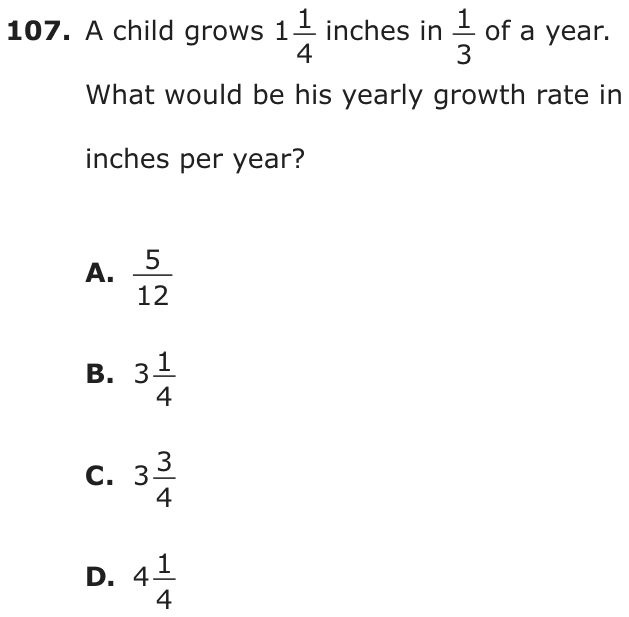
Question 51 of 57
2024 Test A Math, question 51Question
- A−0.33
- B−0.27
- C0
- D0.33
Show the answer
Correct answer: B
Question analysis
This decimal question asks for the value of 3 times 0.01 minus 3 times 0.1. Students multiply each decimal by 3 and subtract, keeping the order of the subtraction as written. The two decimals look alike, so place value and the sign of the result both need care.
- Grade level
- Grade 7 content, by NYS standard
- Compared with grade 7
- At grade 7 Grade 7 students subtract rational numbers and get negative results. This short computation adds place-value care, since 0.01 and 0.1 look alike, but it is a routine two-step grade 7 exercise.
- Estimated difficulty
- Straightforward: two steps or one careful reading.
- Thinking it demands
- Depth of knowledge 1, recall and reproduction · mainly apply
- What makes it hard
- Error-prone arithmetic moderate
- A very close wrong answer minor
- Solution
- 2 steps
- Reading level
- Question and choices: about grade 16+, 1 words.
- Students, last 30 days
- Not enough answers yet to show (it takes 10).
Why it is hard, traps and wrong answers (shows the answer)
Why it is hard
Two quick multiplications leave 0.03 − 0.3, a subtraction whose result is negative. The usual errors are adding the two products, with or without a minus sign, and treating 0.01 and 0.1 as the same number. Rewriting the subtraction as −(0.3 − 0.03) keeps the place values lined up and makes the sign plain.
Error-prone arithmetic moderate Working it out
The products 0.03 and 0.3 have their digits in different places, and taking the larger from the smaller crosses zero, so both alignment and sign need care. (Brown & Burton, 1978; Junker & Sijtsma, 2001)
A very close wrong answer minor Choosing the answer
The choice −0.33 has the right sign and is only 0.06 from the answer, so a sense that the result is a little below zero cannot separate them. (Embretson & Wetzel, 1987; Gorin & Embretson, 2006; Ascalon et al., 2007)
Strategy: Multiply each decimal by 3, then subtract with the place values lined up; or factor out the 3 and compute 3 times (0.01 − 0.1).
Traps
- Negatives and direction: Arithmetic with negative numbers, the order of a subtraction, or direction on a number line. (Moving a term across the equals sign without changing its sign is a faulty procedure.)
- Wrong operation: Adds instead of multiplying, divides the wrong way round, turns a ratio or rate upside down, or undoes a step in the wrong direction (subtracts what should be added back).
The wrong answers, classified
A Negatives and direction (Brown & Burton, 1978)
Sees the result must be negative but adds the sizes, −(0.03 + 0.3) = −0.33, instead of subtracting 0.03 from 0.3.
C Misunderstands the concept (Smith, diSessa & Roschelle, 1993; De Bock et al., 1998; Ni & Zhou, 2005)
Treats 0.01 and 0.1 as equal, since each shows a single 1 after the point, so the two products cancel to 0.
D Wrong operation (Hegarty, Mayer & Monk, 1995; King et al., 2004)
Adds the products, 0.03 + 0.3 = 0.33, instead of subtracting the second from the first.
Worked solution, step by step
Formulas used
- Subtracting a bigger number
- a and b are numbers, and b is the bigger one. When you take a bigger number away from a smaller one, the answer is negative. Its size is the gap between them, b minus a. So subtract the other way, then put a minus sign in front.
Sort out the problem
3(0.01) means 3 times 0.01. A number right next to parentheses means multiply. Then subtract 3 times 0.1. Note that 0.01 is one hundredth, and 0.1 is one tenth. They are not equal. Watch out: treating them as equal makes the two parts cancel to 0, choice C.
Multiply each part
So the problem is . Write 0.3 as 0.30 so both have two decimal places. Now you can see that 0.30 is bigger than 0.03.
Subtract the bigger number
You take a bigger number from a smaller one, so the answer is negative.
Watch out: find the gap between the numbers. Don’t add them. Adding gives 0.33, choice D, or −0.33, choice A.So the answer is B, −0.27.
Check your answer
Pull out the 3 first: . Same answer. Also think of a number line. Start at 0.03, just right of 0. Move 0.30 to the left. You land a little left of 0, at −0.27.
More questions like this
The original DOE question
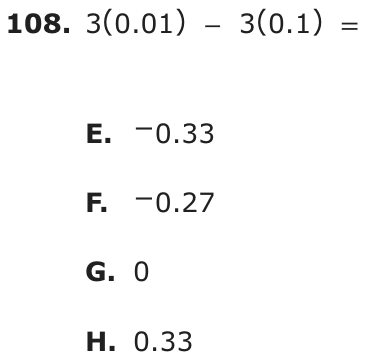
Question 52 of 57
2024 Test A Math, question 52Question
What is the value of ?
- A
- B
- C
- D
Show the answer
Correct answer: B
Rewrite the mixed numbers so that they all have equivalent denominators.
Subtracting a negative is the same as adding.
Group the whole numbers together and the fractions together.
Question analysis
This signed-number question asks for the value of 10 1/2 plus negative 5 1/3 minus negative 2 3/4. It tests adding and subtracting negative mixed numbers with unlike denominators. Turning each sign combination into a plain addition or subtraction, and then working in twelfths, is where students most often go wrong.
- Grade level
- Grade 7 content, by NYS standard
- Compared with grade 7
- At grade 7 Adding and subtracting negative mixed numbers is central grade 7 work. This three-term expression is typical in length, but it needs a common denominator of 12 and two different sign rules: adding a negative and subtracting one.
- Estimated difficulty
- Moderate: several steps, or a close reading with one strong distractor.
- Thinking it demands
- Depth of knowledge 1, recall and reproduction · mainly apply
- What makes it hard
- Error-prone arithmetic moderate
- Many steps minor
- Solution
- 4 steps
- Reading level
- Question and choices: about grade 10, 10 words.
- Students, last 30 days
- Not enough answers yet to show (it takes 10).
Why it is hard, traps and wrong answers (shows the answer)
Why it is hard
The expression is short, but it packs both sign rules for negative numbers into one line, and each misapplication has its own choice. Subtracting a negative is the rule most often broken, and the result is a reasonable-looking mixed number. Estimating with decimals, 10.5 − 5.3 + 2.8 is about 8, separates the answer from every wrong choice.
Error-prone arithmetic moderate Working it out
Two different sign rules meet: adding −5 1/3 means subtracting 5 1/3, while subtracting −2 3/4 means adding 2 3/4, and mixing them up gives a listed value. (Brown & Burton, 1978; Junker & Sijtsma, 2001)
Many steps minor Working it out
After the signs, halves, thirds and quarters become twelfths, and the wholes, 10 − 5 + 2, are combined apart from the fractions, 6/12 − 4/12 + 9/12. (Daniel & Embretson, 2010; Enright, Morley & Sheehan, 2002)
Strategy: Rewrite adding a negative as subtraction and subtracting a negative as addition, convert the fractions to twelfths, then combine the whole numbers and the fractions separately.
Traps
- Negatives and direction: Arithmetic with negative numbers, the order of a subtraction, or direction on a number line. (Moving a term across the equals sign without changing its sign is a faulty procedure.)
The wrong answers, classified
A Negatives and direction (Brown & Burton, 1978)
Handles the added negative but treats subtracting −2 3/4 as subtracting 2 3/4, so 5 1/6 − 2 3/4 = 2 5/12.
C Negatives and direction (Brown & Burton, 1978)
Drops the negative signs inside the parentheses and keeps the operations, 10 1/2 + 5 1/3 − 2 3/4 = 13 1/12.
D Negatives and direction (Brown & Burton, 1978)
Ignores every sign and adds all three mixed numbers, 10 1/2 + 5 1/3 + 2 3/4 = 18 7/12.
Worked solution, step by step
Formulas used
- Adding and subtracting negatives
- a is any number, and b is a positive number, so −b is negative. Adding a negative moves you left on the number line, just like subtracting. Subtracting a negative is like taking away a debt, so you end up with more. It is the same as adding.
- Equivalent fractions
- a is the top of a fraction and b is the bottom. n is any number except 0. Multiplying the top and bottom by the same number gives an equal fraction, cut into smaller pieces. Use it to give two fractions the same bottom before you add or subtract.
Sort out the expression
You need . There are three mixed numbers, and two of them are negative. A mixed number is a whole number plus a fraction. Plan: fix the signs, give the fractions the same bottom, then work with the whole numbers and the fractions one group at a time.
Fix the signs
Adding means subtracting . Subtracting means adding .
Watch out: subtracting a negative is adding. Subtracting instead gives , choice A. Dropping the minus signs gives C or D.Use twelfths for the fractions
The bottoms are 2, 3 and 4. All three go into 12, so change each fraction to twelfths.
Now the problem is .
Combine whole numbers, then fractions
Work with the whole numbers and the fractions one group at a time. Keep each sign.
The fraction part is less than 1, so just put them together: .
So the answer is B, .
Check your answer
Estimate with decimals. is about 7.92. And is also about 7.92, since is almost 1. They match.
More questions like this
The original DOE question
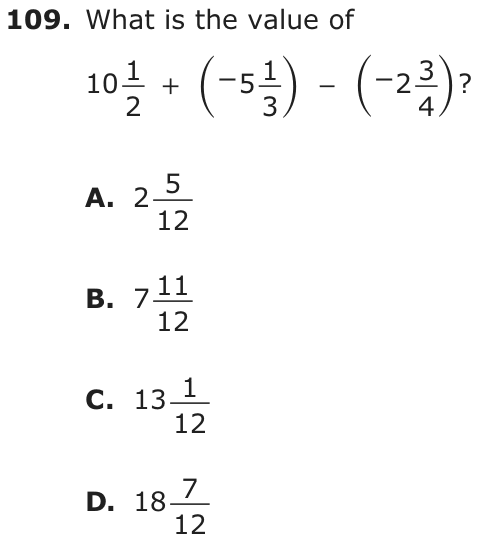
Question 53 of 57
2024 Test A Math, question 53Question
Carlos has $350 in a savings account that earns 5% simple interest each year. How much will he have in the account after 1 year, if there is no money withdrawn?
- A$17.50
- B$175.00
- C$367.50
- D$525.00
Show the answer
Correct answer: C
Find 5% of 350.
Question analysis
Carlos has $350 in a savings account earning 5% simple interest a year, and this interest question asks how much will be in the account after 1 year with no withdrawals. Students find 5 percent of the balance and use it. Reading whether the question wants the interest or the account's new balance matters most.
- Grade level
- Grade 7 content, by NYS standard
- Compared with grade 7
- Below grade 7 Simple interest is a grade 7 percent topic, but one year of interest is just 5 percent of the balance added on. Typical grade 7 problems run for several years or ask for the rate, so this is lighter.
- Estimated difficulty
- Routine: one familiar step, little to misread.
- Thinking it demands
- Depth of knowledge 2, skills and concepts · mainly apply
- What makes it hard
- Solution
- 2 steps
- Reading level
- Question and choices: about grade 6, 28 words.
- Students, last 30 days
- Not enough answers yet to show (it takes 10).
Why it is hard, traps and wrong answers (shows the answer)
Why it is hard
This is a one-year interest question with friendly numbers, so most students who know what interest is will finish it. The two ways to lose the point are stopping at the interest, which is listed, and writing 5% as 0.5, which gives a listed interest and a listed balance of its own. A sensible balance is only a little more than $350, which rules out every wrong choice.
Something you must already know minor Working it out
Simple interest for one year is the rate times the balance, 5% of $350, added to what is already there; the stem does not spell this out. (Anderson & Krathwohl, 2001)
Error-prone arithmetic minor Working it out
Writing 5% as 0.05, not 0.5, is the one place-value decision, and 0.05 × 350 = 17.5 must then be read as $17.50. (Brown & Burton, 1978; Junker & Sijtsma, 2001)
Strategy: Find 5 percent of $350 by multiplying by 0.05, then decide whether the question wants the interest alone or the amount in the account.
Traps
- Stops one step early: A choice is a number from partway through the solution.
- An arithmetic slip: The right method with a plausible arithmetic error: a digit, a place value or a times-table fact.
The wrong answers, classified
A Stops one step early (King et al., 2004; Gierl et al., 2017)
Finds the interest, 0.05 × $350 = $17.50, and stops without adding it to the $350 already in the account.
B An arithmetic slip (Junker & Sijtsma, 2001)
Writes 5% as 0.5 instead of 0.05, a decimal slip that makes the interest $175.00, and then also stops at the interest.
D An arithmetic slip (Junker & Sijtsma, 2001)
Writes 5% as 0.5, so the interest comes out as $175.00, and adds it to the $350 to reach $525.00.
Worked solution, step by step
Formulas used
- Simple interest
- I is the interest, the extra money the bank pays you. P is the principal, the money you put in. r is the yearly rate as a decimal. t is the time in years. Simple means you earn interest only on the money you started with.
Sort out the question
Carlos starts with $350. The account earns 5% simple interest each year. Interest is extra money the bank adds to your account. You need the total in the account after 1 year. That is the $350 plus the interest.
Change the percent to a decimal
Percent means out of 100, so 5% is 5 out of 100.
Watch out: 5% is 0.05, not 0.5. Using 0.5 makes the interest $175, which leads to B or D.Find the interest
Put in P = 350, r = 0.05 and t = 1 year.
The interest for one year is $17.50. That is the money added to the account.
Add the interest to the savings
After 1 year, Carlos has $367.50. Watch out: $17.50 is only the interest, choice A. The question asks how much is in the account.
So the answer is C, $367.50.
Check your answer
10% of $350 is $35. 5% is half of that, $17.50, so the interest is right. The total should be a little more than $350, since 5% is small. $367.50 fits. $525.00 would mean the account grew by half.
More questions like this
The original DOE question
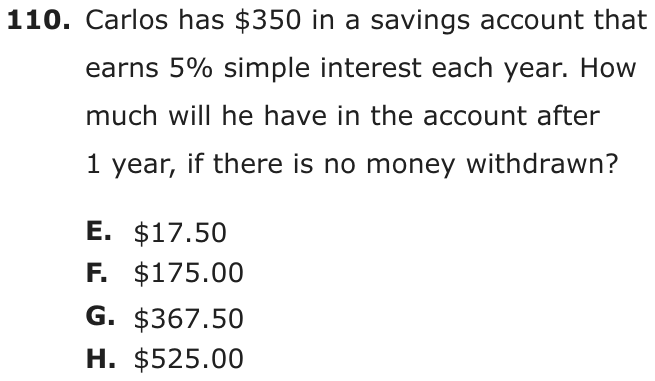
Question 54 of 57
2024 Test A Math, question 54Question
The probability of an event occurring is 0.05. What is the chance that the event will occur?
- Alikely
- Bunlikely
- Cimpossible
- Dneither likely nor unlikely
Show the answer
Correct answer: B
The probability of the event is 0.05, which equals 5%, which is less than 50%.
Option A:
An event that is likely has a probability over 50%.
Option B:
An event that is unlikely has a probability less than 50% but greater than 0%.
Option C:
An event that is impossible has a 0% probability.
Option D:
An event that is neither likely nor unlikely has a 50% probability.
Question analysis
This probability question gives an event a probability of 0.05 and asks how likely the event is to occur, described in words. Students place the decimal on the scale from 0, impossible, to 1, certain. Reading the place value of the decimal correctly is the only real hurdle.
- NYS standards
- 6.SP.6 probability from 0 to 1
- Grade level
- Grade 6 content, by NYS standard
- Compared with grade 7
- Below grade 7 Describing in words how likely an event is from its probability between 0 and 1 is a grade 6 standard. This is one quick judgment with no computation, well below grade 7 probability work with compound events.
- Estimated difficulty
- Routine: one familiar step, little to misread.
- Thinking it demands
- Depth of knowledge 1, recall and reproduction · mainly understand
- What makes it hard
- Solution
- 1 step
- Reading level
- Question and choices: about grade 10, 23 words.
- Students, last 30 days
- Not enough answers yet to show (it takes 10).
Why it is hard, traps and wrong answers (shows the answer)
Why it is hard
One judgment answers the question: 0.05 is a small probability, but it is not zero. The two tempting errors are treating a small chance as no chance at all and misreading 0.05 as 0.5, an even chance. Writing the probability as 5% or as 1 in 20 makes its size plain.
Something you must already know minor Working it out
The probability scale, 0 for impossible, 1/2 for an even chance and 1 for certain, is assumed, and 0.05 has to be placed near its low end. (Anderson & Krathwohl, 2001)
Strategy: Picture the probability scale from 0 to 1, with 0 for impossible, 1/2 for an even chance and 1 for certain, and see where 0.05 falls.
Traps
- Misunderstands the concept: A wrong belief about a concept: that percents can be added, that area grows like length, that averages can be averaged, that a bigger denominator means a bigger fraction.
- An arithmetic slip: The right method with a plausible arithmetic error: a digit, a place value or a times-table fact.
The wrong answers, classified
A Little reason to choose it (Haladyna & Downing, 1993; Rodriguez, 2005)
No common reading makes 0.05 likely, which would need a probability above one half, so it mostly draws guesses.
C Misunderstands the concept (Smith, diSessa & Roschelle, 1993; De Bock et al., 1998; Ni & Zhou, 2005)
Treats a probability close to 0 as exactly 0, as if an event with a 1 in 20 chance could never happen.
D An arithmetic slip (Junker & Sijtsma, 2001)
Reads 0.05 as 0.5, a place-value slip, which would mean an even chance of happening or not.
Worked solution, step by step
Formulas used
- Probability scale
- P is the probability of an event, a number that tells how likely it is to happen. It is always from 0 to 1. 0 means impossible, and 1 means certain. One half, or 0.5, means an even chance. The closer P is to 0, the less likely the event.
Sort out the question
Probability is a number that tells how likely an event is. An event is something that might happen. Here the probability is 0.05. You need the word that best describes that chance.
Change 0.05 to a percent
So 0.05 is 5 out of 100, or 5%. That is the same as 1 chance in 20. Watch out: 0.05 is not 0.5. A probability of 0.5 would be an even chance, choice D.
Place it on the scale
Probability Chance 0 impossible more than 0, less than 0.5 unlikely 0.5 neither likely nor unlikely more than 0.5, less than 1 likely 1 certain 0.05 is more than 0 but much less than 0.5. So the event is unlikely.
Rule out the other choices
Watch out: a small chance is still a chance. 0.05 is more than 0, so the event can happen. It is not impossible, choice C. Likely, choice A, would need more than 0.5.So the answer is B, unlikely.
Check your answer
Picture 20 tries. With a 5% chance, the event would happen about once, since 5% of 20 is 1. It would not happen about 19 times. That is rare but possible, so unlikely fits.
More questions like this
The original DOE question
Question 55 of 57
2024 Test A Math, question 55Question
The table below shows the number of cups of red paint and blue paint used to make a purple paint mixture.
PURPLE PAINT
| Cups of Red Paint | Cups of Blue Paint |
|---|---|
| 1 | 1.5 |
| 4 | 6 |
| 11 | y |
Based on the relationship between the number of cups of red paint and the number of cups of blue paint, what is the value of y?
- A10.5
- B13
- C16.5
- D24
Show the answer
Correct answer: C
Divide the number of cups of blue paint by the number of cups of red paint to find the constant of proportionality.
Multiply to find the value of y.
Question analysis
A table gives cups of red and blue paint for a purple mixture: 1 and 1.5, 4 and 6, and 11 and an unknown y. This ratio table question asks for y based on the relationship between the two colors. The tricky part is noticing whether the relationship works by multiplying or by adding.
- Grade level
- Grade 7 content, by NYS standard
- Compared with grade 7
- Below grade 7 Finding a constant of proportionality from a table is grade 7 work, but here one row already pairs 1 cup of red with its cups of blue, so a single multiplication finishes it, lighter than typical grade 7 tasks.
- Estimated difficulty
- Routine: one familiar step, little to misread.
- Thinking it demands
- Depth of knowledge 2, skills and concepts · mainly apply
- What makes it hard
- Solution
- 2 steps
- Reading level
- Question and choices: about grade 4, 57 words.
- Students, last 30 days
- Not enough answers yet to show (it takes 10).
Why it is hard, traps and wrong answers (shows the answer)
Why it is hard
The relationship is multiplicative, 1.5 cups of blue for every cup of red, and one multiplication finishes the question. The trap is additive thinking: red grows by 7 cups from the second row to the third, and adding the same 7 to the blue column gives a listed answer. Testing a rule on every row exposes the additive one, since blue is 0.5 more than red in the first row but 2 more in the second.
Reading a figure, table or graph minor Understanding the question
The table's first row, 1 cup of red to 1.5 cups of blue, hands over the constant of proportionality; the other two rows only confirm it. (Lesh, Post & Behr, 1987; Kirsch & Mosenthal, 1990)
Strategy: Use the row with 1 cup of red paint to read the cups of blue per cup of red, multiply that rate by 11, and check the rate against the row with 4 cups.
Traps
- Misunderstands the concept: A wrong belief about a concept: that percents can be added, that area grows like length, that averages can be averaged, that a bigger denominator means a bigger fraction.
- Stops one step early: A choice is a number from partway through the solution.
The wrong answers, classified
A Stops one step early (King et al., 2004; Gierl et al., 2017)
Scales only the jump from 4 to 11 cups of red, 7 × 1.5 = 10.5, and forgets to add the 6 cups of blue already there.
B Misunderstands the concept (Smith, diSessa & Roschelle, 1993; De Bock et al., 1998; Ni & Zhou, 2005)
Thinks additively: red goes up 7 cups from 4 to 11, so adds the same 7 to the 6 cups of blue, getting 13.
D Numbers taken from the question (Hegarty, Mayer & Monk, 1995)
Multiplies the two numbers in the second row, 4 × 6 = 24, without finding how the two columns are related.
Worked solution, step by step
Formulas used
- Constant of proportionality
- x and y are two amounts that change together. k is the constant of proportionality: how much y goes with 1 of x. In a proportional relationship, y divided by x gives the same k every time.
- Proportional relationship
- x is the cups of red paint, and y is the cups of blue paint. k is the cups of blue for each cup of red. In a proportional relationship, y is always k times x. Use it to find y for any amount of red.
Sort out the table
The table shows cups of red and blue paint for the same purple. 1 cup of red goes with 1.5 cups of blue. 4 cups of red go with 6 cups of blue. You need y, the cups of blue for 11 cups of red. The same color means the paints mix at the same rate in every row.
Find the blue for each cup of red
Both rows give 1.5. So there are always 1.5 cups of blue for each cup of red. This number is the constant of proportionality.
Use the rate for 11 cups
Think of it as 11 cups plus half of 11 cups: . So y is 16.5 cups of blue.
Avoid the traps and answer
Watch out: red goes up 7 cups from 4 to 11. Adding the same 7 cups to the 6 cups of blue gives 13, choice B. Paint mixes by multiplying, not by adding. Watch out: , choice A, is only the extra blue for the 7 extra cups of red.So the answer is C, 16.5.
Check your answer
Divide to check: . That matches the other rows. Also, every row has more blue than red, so y must be more than 11. That rules out 10.5.
More questions like this
The original DOE question
Question 56 of 57
2024 Test A Math, question 56Question

On the number line above, what is the distance, in units, between the midpoint of and the midpoint of ?
- A3
- B4
- C5
- D6
Show the answer
Correct answer: C
To find the midpoint of a segment, subtract the value on the left from the value on the right and then divide by 2. Then add the result to the value on the left of the segment.
Find the midpoint of :
Find the midpoint of :
The distance between −1 and 4 on the number line is 5 units.
Question analysis
A number line marks points P, Q and R at labeled integer positions, with P to the left of zero. This midpoint and distance question asks how far apart the midpoints of segments PQ and QR are. Students locate both midpoints and then measure the distance between them, which takes care with negative positions.
- Grade level
- Grade 7 content, by NYS standard
- Compared with grade 7
- At grade 7 Grade 7 students measure distances on a number line as the difference of two positions, including across zero. Here two midpoints must be located first, but all three points sit on labeled integers, which keeps it at grade 7 level.
- Estimated difficulty
- Straightforward: two steps or one careful reading.
- Thinking it demands
- Depth of knowledge 2, skills and concepts · mainly apply
- What makes it hard
- Error-prone arithmetic minor
- Many steps minor
- Solution
- 3 steps
- Reading level
- Question and choices: about grade 11, 21 words.
- Corrected from the DOE handbook
- A reversed instruction in the explanation was corrected.
- Students, last 30 days
- Not enough answers yet to show (it takes 10).
Why it is hard, traps and wrong answers (shows the answer)
Why it is hard
The points sit on labeled integers, so the midpoints can be found by counting, and the question is mostly about finishing carefully. Dropping the negative in 4 − (−1), stopping at the second midpoint, and counting tick marks instead of spaces each give a listed choice. Marking −1 and 4 on the figure and counting the unit spaces between them confirms the distance.
Error-prone arithmetic minor Working it out
P sits at −3, so the midpoint of PQ is (−3 + 1) ÷ 2 = −1, and the final distance, 4 − (−1), subtracts a negative number. (Brown & Burton, 1978; Junker & Sijtsma, 2001)
Many steps minor Working it out
Three results come in sequence, the midpoint of PQ, the midpoint of QR, then the gap between them, and the second of them, 4, is itself a listed choice. (Daniel & Embretson, 2010; Enright, Morley & Sheehan, 2002)
Strategy: Read the positions of P, Q and R, average each pair of endpoints to place the two midpoints, then subtract the left midpoint from the right one.
Traps
- Negatives and direction: Arithmetic with negative numbers, the order of a subtraction, or direction on a number line. (Moving a term across the equals sign without changing its sign is a faulty procedure.)
- Stops one step early: A choice is a number from partway through the solution.
- Counting the ends: Inclusive or exclusive ends, fence posts, consecutive numbers: an answer that is one too many or too few, or an endpoint drawn open where it belongs closed (or the reverse).
The wrong answers, classified
A Negatives and direction (Brown & Burton, 1978)
Finds the midpoints −1 and 4 but computes the gap as 4 − 1 = 3, dropping the negative sign instead of finding 4 − (−1).
B Stops one step early (King et al., 2004; Gierl et al., 2017)
Finds the midpoint of QR at 4 and gives its position as the answer, stopping before measuring from the other midpoint at −1.
D Counting the ends (Brown & Burton, 1978)
Counts the six tick marks from −1 to 4 inclusive rather than the five unit spaces between them.
What was corrected from the DOE handbook, and why
- Explanation: The handbook’s rule says to “subtract the value on the right from the value on the left and then divide by 2,” but its own working does the opposite: 1 − (−3) = 4 for PQ and 7 − 1 = 6 for QR, the right value minus the left. Following the rule as printed gives (−3 − 1) ÷ 2 = −2 and (1 − 7) ÷ 2 = −3, which would put the midpoints at −5 and −2, outside the segments, and lead to a distance of 3, a wrong choice. The site now says “subtract the value on the left from the value on the right.” The midpoints, −1 and 4, and the distance between them, 5 units, are unchanged.
Worked solution, step by step
Formulas used
- Midpoint on a number line
- The left end and right end are the numbers at the two ends of a segment. Right end minus left end is the segment’s length. The midpoint is halfway, so it is half the length to the right of the left end.
- Distance on a number line
- On a number line, numbers grow as you move right. The distance between two points is the larger number minus the smaller one. That is the right point minus the left point, so a distance is never negative.
Read the number line
P is at −3, Q is at 1 and R is at 7. A bar over two letters, such as , means the segment between them. A segment is the straight piece of line between two points. You need the midpoint of each segment, the point exactly halfway between its ends. Then you need the distance between those two midpoints.
Find the midpoint of PQ
The left end is −3 and the right end is 1.
So the midpoint of PQ is at −1. Note that is , which is 4.
Find the midpoint of QR
The left end is 1 and the right end is 7.
So the midpoint of QR is at 4. Watch out: 4 is where a midpoint is, not the answer. Stopping here gives choice B.
Measure between the midpoints
Watch out: keep the minus sign on −1. Using gives choice A. Also count the spaces, not the tick marks. From −1 to 4 there are 5 spaces but 6 marks, and 6 is choice D.So the answer is C, 5 units.
Check your answer
Each midpoint should sit in the middle of its segment. −1 is 2 units from both −3 and 1. 4 is 3 units from both 1 and 7. There is also a shortcut. The gap between the midpoints is half of PR: .
More questions like this
The original DOE question
Question 57 of 57
2024 Test A Math, question 57Question
An ice cream shop sells 16 cups of ice cream for $48 and 4 cups for $12. There is a proportional relationship between the number of cups of ice cream and the cost. What is the constant of proportionality for this relationship?
- A3 cups per dollar
- B3 dollars per cup
- C4 cups per dollar
- D4 dollars per cup
Show the answer
Correct answer: B
There is a proportional relationship between the cost and the number of cups of ice cream.
Divide the cost by the number of cups of ice cream to find the constant of proportionality.
The constant is the cost per cup, 3 dollars.
Question analysis
An ice cream shop sells 16 cups for $48 and 4 cups for $12, and the cost is proportional to the number of cups. This proportional relationship question asks for the constant of proportionality, with its units. The choices pair two numbers with two kinds of units, so the units of the rate matter as much as the number.
- Grade level
- Grade 7 content, by NYS standard
- Compared with grade 7
- Below grade 7 Grade 7 students find constants of proportionality in tables, graphs and equations. Here one division gives the number, as in grade 6 unit pricing, and the real demand is attaching the right units to it.
- Estimated difficulty
- Straightforward: two steps or one careful reading.
- Thinking it demands
- Depth of knowledge 2, skills and concepts · mainly apply
- What makes it hard
- A very close wrong answer moderate
- Something you must already know minor
- Solution
- 2 steps
- Reading level
- Question and choices: about grade 4, 50 words.
- Students, last 30 days
- Not enough answers yet to show (it takes 10).
Why it is hard, traps and wrong answers (shows the answer)
Why it is hard
One division gives the number, so the question is really about units. The cost depends on the number of cups, and dividing $48 by 16 cups gives the dollars for each cup; reversing the label describes a shop where one dollar buys three cups. The second offer, 4 cups for $12, is a built-in check that the rate stays the same.
A very close wrong answer moderate Choosing the answer
Two choices carry the number 3, "3 cups per dollar" and "3 dollars per cup", so finding 48 ÷ 16 is not enough; the units decide. (Embretson & Wetzel, 1987; Gorin & Embretson, 2006; Ascalon et al., 2007)
Something you must already know minor Working it out
Students must know that dividing dollars by cups gives dollars per cup: a quotient's units read as the top quantity per the bottom one. (Anderson & Krathwohl, 2001)
Strategy: Divide one quantity by the other for one offer, check that the other offer gives the same quotient, and label it with the numerator's units per the denominator's units.
Traps
- Wrong operation: Adds instead of multiplying, divides the wrong way round, turns a ratio or rate upside down, or undoes a step in the wrong direction (subtracts what should be added back).
- Numbers taken from the question: Combines the numbers in the question without a model of the situation, or is simply a number that appears in the question.
The wrong answers, classified
A Wrong operation (Hegarty, Mayer & Monk, 1995; King et al., 2004)
Gets 3 from 48 ÷ 16 but labels it cups per dollar, turning the rate upside down; at these prices a dollar buys only 1/3 of a cup.
C Numbers taken from the question (Hegarty, Mayer & Monk, 1995)
Divides the two cup amounts, 16 ÷ 4 = 4, and attaches cups per dollar, a ratio of like quantities given made-up units.
D Numbers taken from the question (Hegarty, Mayer & Monk, 1995)
Divides the two costs, $48 ÷ $12 = 4, or the two cup counts, and calls the result dollars per cup.
Worked solution, step by step
Formulas used
- Constant of proportionality
- In a proportional relationship, y is always the same number, k, times x. Here x is the number of cups and y is the cost in dollars. So k is y divided by x. Its units are the top’s units per the bottom’s units: dollars per cup.
Sort out the question
16 cups cost $48, and 4 cups cost $12. The cost is proportional to the cups. That means the cost is always the same number times the number of cups. That number is the constant of proportionality. You need it with the right units.
Divide cost by cups
For each offer, divide the cost in dollars by the number of cups.
Both offers give 3. So the constant is 3.
Name the units
Dollars are on top and cups are on the bottom. So the units are dollars per cup. 3 dollars per cup means each cup costs $3. Watch out: two choices use 3. Choice A, 3 cups per dollar, flips the rate. Then 16 cups would cost only about $5, not $48.
Avoid the traps and answer
Watch out: dividing two costs, , or two cup counts, , gives 4. That compares like amounts, so it is not a cost for each cup. It leads to choice C or D.So the answer is B, 3 dollars per cup.
Check your answer
Multiply back. At 3 dollars per cup, 16 cups cost , which is $48. And 4 cups cost , which is $12. Both match the shop’s prices.
More questions like this
The original DOE question