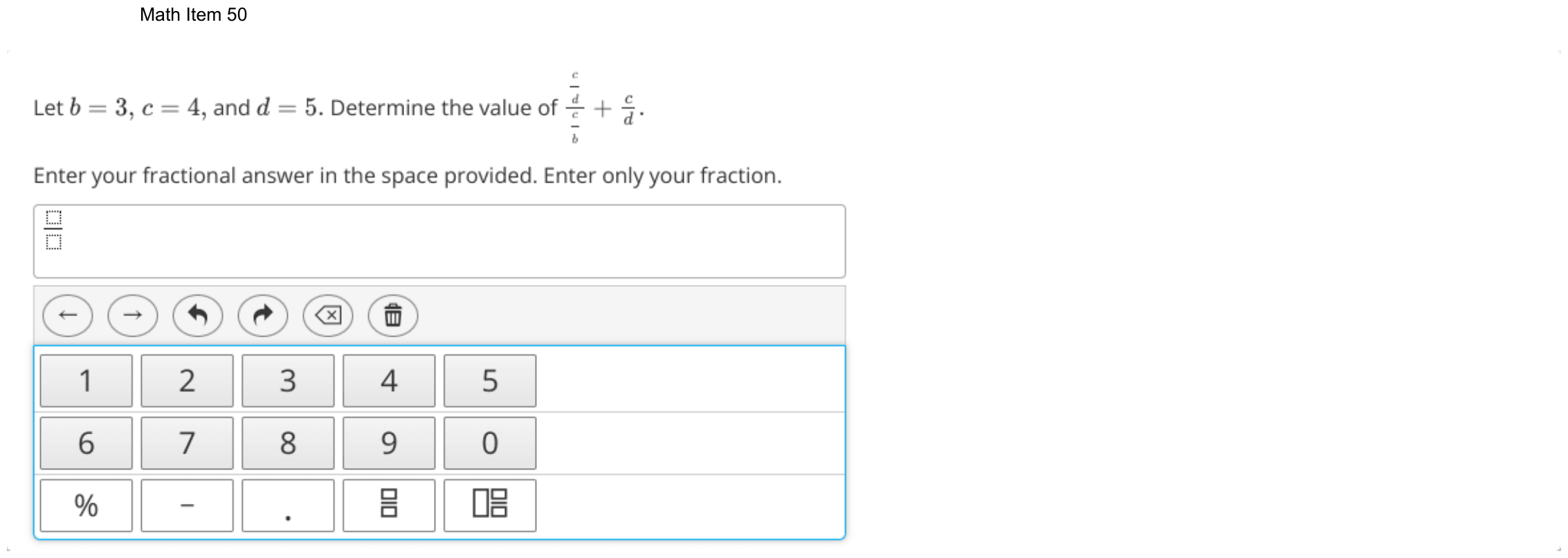
2025 Practice Test A Math
Question 1 of 57
2025 Practice Test A Math, question 1Question
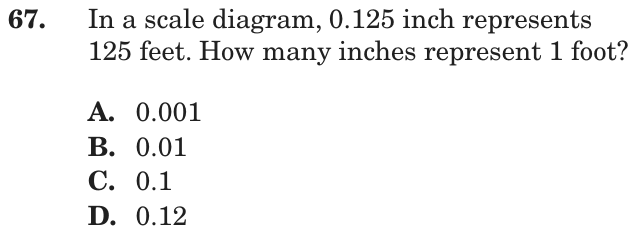
In a scale diagram, inch represents feet. How many inches represent foot?
- A
- B
- C
- D
Show the answer
Correct answer: A
Let be the number of inches representing 1 foot. Set up a proportion and solve for :
in.
Question analysis
This scale drawing question uses decimals: on a diagram, 0.125 inch stands for 125 feet. Students find how many inches represent just 1 foot, which is the unit rate of the scale. Dividing a decimal by a large whole number makes the decimal point easy to misplace.
- Grade level
- Grade 7 content, by NYS standard
- Compared with grade 7
- At grade 7 Scale drawings and unit rates are core grade 7 topics, and this is a single division. The demand matches typical grade 7 work, with decimal place value as the only real hurdle.
- Estimated difficulty
- Straightforward: two steps or one careful reading.
- Thinking it demands
- Depth of knowledge 2, skills and concepts · mainly apply
- What makes it hard
- Error-prone arithmetic moderate
- A very close wrong answer moderate
- Solution
- 1 step
- Reading level
- Question and choices: about grade 11, 19 words.
- Students, last 30 days
- Not enough answers yet to show (it takes 10).
Why it is hard, traps and wrong answers (shows the answer)
Why it is hard
A single division settles this question, and the choices are built to punish a misplaced decimal point, since three of them are each a power of ten apart. Students who see that 0.125 is one-thousandth of 125 can answer at once; students who divide by hand often lose a zero. Multiplying the chosen answer back by 125 is a quick check.
Error-prone arithmetic moderate Working it out
The one step is 0.125 ÷ 125, a decimal divided by a large whole number, where the place of the decimal point decides between 0.001, 0.01 and 0.1. (Brown & Burton, 1978; Junker & Sijtsma, 2001)
A very close wrong answer moderate Choosing the answer
0.001 and 0.01 look almost the same, differing by one zero after the decimal point; only exact placement of the point in 0.125 ÷ 125 separates them. (Embretson & Wetzel, 1987; Gorin & Embretson, 2006; Ascalon et al., 2007)
Strategy: Divide the inches by the feet to get inches per foot, then check by multiplying your result by 125 to see whether you get back 0.125.
Traps
- Units or scale: The answer is wanted in other units, or a rate or scale must be converted first.
The wrong answers, classified
B An arithmetic slip (Junker & Sijtsma, 2001)
Divides 0.125 by 125 but loses one zero in placing the decimal point, giving 0.01, ten times too large.
C A faulty procedure (Brown & Burton, 1978; Tatsuoka, 1983)
Sees that 125 ÷ 125 = 1 and puts the 1 in the tenths place, where 0.125 begins, instead of the thousandths place.
D Units or scale (King et al., 2004)
Treats the 0.125 inch as if it already stood for 1 foot, never dividing by the 125 feet it represents, and picks the choice closest to it.
Worked solution, step by step
Formulas used
- Unit rate
- r is the unit rate, the amount that goes with just 1 unit. a is the first amount, here 0.125 inch. b is the matching second amount, here 125 feet. Dividing shares the inches out equally, one share for each foot.
Sort out the scale
A scale diagram is a drawing where small lengths stand for real lengths. Here 0.125 inch on the drawing stands for 125 real feet. You need how many inches stand for just 1 foot. That is a unit rate, an amount for 1 unit.
Set up the division
Divide the inches by the feet. That splits the 0.125 inch into 125 equal shares, one for each foot.
Divide carefully
Write 0.125 as a fraction. It is 125 thousandths.
Now divide by 125. Split 125 thousandths into 125 shares, and each share is 1 thousandth.
So 1 foot is shown by 0.001 inch.
Match the decimal places
0.001 has the 1 in the third place after the decimal point. That place is thousandths. Watch out: 0.01 and 0.1 put the decimal point in the wrong place. They are choices B and C, and each is too big. So the answer is A, 0.001.
Check your answer
Multiply back. inch, which matches the scale. Choice B would give inches. That is ten times too long.
More questions like this
The original DOE question
Question 2 of 57
2025 Practice Test A Math, question 2Question
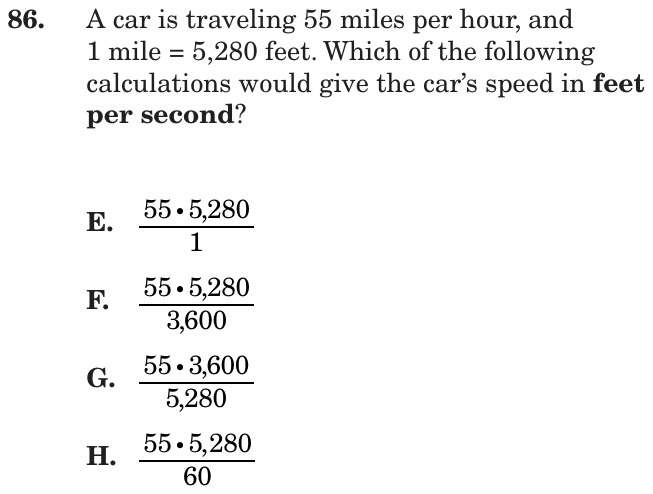
A car is traveling 55 miles per hour, and 1 mile = 5,280 feet. Which of the following calculations would give the car’s speed in feet per second?
- A
- B
- C
- D
Show the answer
Correct answer: B
Divide the rate by the number of seconds in an hour. (Since there are 60 minutes in an hour and 60 seconds in a minute, multiply 60 × 60 = 3,600 seconds in an hour):
miles per second
Multiply by the number of feet in a mile (5,280):
feet per second
Question analysis
This unit conversion question gives a car's speed of 55 miles per hour and asks which calculation expresses it in feet per second. Students have to change miles to feet and hours to seconds in one expression. The tricky part is converting both units at once and keeping each conversion factor on the correct side of the fraction bar.
- Grade level
- Grade 6 content, by NYS standard
- Compared with grade 7
- At grade 7 Grade 7 students usually convert one unit at a time, such as feet to inches. This item converts both parts of a rate at once, miles per hour into feet per second, and asks students to recognize the right setup.
- Estimated difficulty
- Straightforward: two steps or one careful reading.
- Thinking it demands
- Depth of knowledge 2, skills and concepts · mainly apply
- What makes it hard
- A very close wrong answer moderate
- Something you must already know minor
- Solution
- 2 steps
- Reading level
- Question and choices: about grade 6, 28 words.
- Students, last 30 days
- Not enough answers yet to show (it takes 10).
Why it is hard, traps and wrong answers (shows the answer)
Why it is hard
Nothing has to be calculated; the work is judging which setup turns miles per hour into feet per second. Students who convert only part of the way find a choice waiting, whether they stop at feet per hour or go from hours to minutes instead of seconds. Tracking which unit each factor cancels, rather than computing, is what the question rewards.
A very close wrong answer moderate Choosing the answer
The answer, 55 · 5,280/3,600, and the choice 55 · 5,280/60 are written identically except for the denominator, so only knowing that an hour has 3,600 seconds, not 60, separates them. (Embretson & Wetzel, 1987; Gorin & Embretson, 2006; Ascalon et al., 2007)
Something you must already know minor Working it out
The stem gives 5,280 feet per mile but not the 3,600 seconds in an hour, which students must build from 60 × 60 themselves. (Anderson & Krathwohl, 2001)
Strategy: Write the speed as 55 miles over 1 hour and multiply by unit fractions such as 5,280 feet over 1 mile, checking that miles and hours cancel and only feet per second remain.
Traps
- Units or scale: The answer is wanted in other units, or a rate or scale must be converted first.
- Stops one step early: A choice is a number from partway through the solution.
The wrong answers, classified
A Stops one step early (King et al., 2004; Gierl et al., 2017)
Converts miles to feet with 55 × 5,280 but never changes hours to seconds, leaving the speed in feet per hour.
C Wrong operation (Hegarty, Mayer & Monk, 1995; King et al., 2004)
Turns both conversion factors upside down, multiplying by 3,600 and dividing by 5,280, so miles and hours never cancel.
D Units or scale (King et al., 2004)
Divides by 60, converting hours to minutes and stopping there, which gives the speed in feet per minute rather than feet per second.
Worked solution, step by step
Formulas used
- Speed
- r is the speed, or rate. d is the distance traveled. t is the time it took. Speed tells how far something goes in one unit of time, so you divide the distance by the time.
Sort out what you know
The car goes 55 miles in 1 hour. One mile is 5,280 feet. You need the speed in feet per second. That means how many feet the car goes in 1 second.
The choices are setups, not numbers. So you only need to pick the right setup. You do not have to work out the final number.
Change the miles to feet
Each mile is 5,280 feet. So 55 miles is 55 groups of 5,280 feet. Multiply to get the distance in feet:
That is how many feet the car goes in 1 hour. Watch out: if you stop here, you have feet per hour, not feet per second. That is choice A.
Change the hour to seconds
The question gives you miles to feet. It does not give you hours to seconds, so you build that yourself. An hour has 60 minutes, and each minute has 60 seconds:
So 1 hour is 3,600 seconds. Watch out: 60 is the number of minutes in an hour, not seconds. Dividing by 60 gives feet per minute. That is choice D.
Divide the distance by the time
Use the speed formula. The distance is 55 × 5,280 feet. The time is 3,600 seconds:
Feet on top and seconds on the bottom give feet per second. Watch out: choice C turns both changes upside down, so the miles and hours never cancel. So the answer is B, .
Check your answer
Estimate. 55 × 5,280 is about 290,000 feet in an hour. Divide by 3,600 seconds and you get about 80 feet each second. A car on a highway covering 80 feet in one second sounds right.
More questions like this
The original DOE question
Question 3 of 57
2025 Practice Test A Math, question 3Question
For what value of is ?
Fill-in question: work out the answer and type it as a number.
Show the answer
Correct answer: -4
Question analysis
A one-line algebra grid-in: find the value of w that makes 4w equal to 2w minus 8. Students solve a linear equation with the variable on both sides by collecting the w terms and dividing. Errors come from handling the subtraction sign or stopping before w stands alone.
- Grade level
- Grade 8 content, by NYS standard
- Compared with grade 7
- At grade 7 Equations with the variable on both sides are formally a grade 8 topic, but this one takes two short steps with whole numbers. It asks about as much as a typical grade 7 two-step equation.
- Estimated difficulty
- Routine: one familiar step, little to misread.
- Thinking it demands
- Depth of knowledge 1, recall and reproduction · mainly apply
- What makes it hard
- Solution
- 2 steps
- Reading level
- Question and choices: about grade 7, 7 words.
- Students, last 30 days
- Not enough answers yet to show (it takes 10).
Why it is hard, traps and wrong answers (shows the answer)
Why it is hard
One of the easiest questions on the test: collect the w terms on one side and divide. Errors come from carelessness rather than method, such as dropping the negative sign or gridding −8 after the first step because it already looks like a finished answer. Substituting the result back into both sides of the equation takes seconds and catches both.
Error-prone arithmetic minor Working it out
The only constant is −8, so the answer is negative; dividing −8 by the coefficient 2 is the step where the sign is most often lost. (Brown & Burton, 1978; Junker & Sijtsma, 2001)
An answer in an unexpected form minor Choosing the answer
The grid-in needs the negative sign filled in its own column, and there are no choices to show that the answer lies below zero. (Enright, Morley & Sheehan, 2002)
Strategy: Subtract 2w from both sides so the variable appears only once, divide by the remaining coefficient, and check by substituting into both sides.
Traps
- Negatives and direction: Arithmetic with negative numbers, the order of a subtraction, or direction on a number line. (Moving a term across the equals sign without changing its sign is a faulty procedure.)
- Stops one step early: A choice is a number from partway through the solution.
The wrong answers, classified
4 Negatives and direction (Brown & Burton, 1978)
Gets 2w = −8 correctly but drops the sign when dividing by 2, gridding 4 instead of a negative value.
-8 Stops one step early (King et al., 2004; Gierl et al., 2017)
Subtracts 2w from both sides to reach 2w = −8 and grids −8 without dividing by the coefficient 2.
Worked solution, step by step
Formulas used
- Keeping an equation balanced
- a and b are the two sides of an equation, and c is any number or term. An equation is like a balanced scale. If you subtract the same thing from both sides, it stays balanced. The same is true if you add the same thing, or divide both sides by the same number that is not zero.
Sort out the equation
An equation says two things are equal. You need the value of w that makes equal to . Here 4w means 4 times w, and 2w means 2 times w. The answer may be a negative number, so keep track of the signs.
Get w on one side
w is on both sides. Subtract 2w from both sides. Then w is only on the left, and the equation stays balanced.
Now 2 times w is −8.
Divide both sides by 2
To undo times 2, divide both sides by 2. A negative number divided by a positive number is negative.
Watch out: keep the minus sign. Dropping it gives 4. Also, don’t stop at and grid −8. So you would grid -4, with the minus sign in its own column.
Check your answer
Put −4 back in for w. Left side: . Right side: . Both sides are −16, so −4 works.
More questions like this
The original DOE question

Question 4 of 57
2025 Practice Test A Math, question 4Question
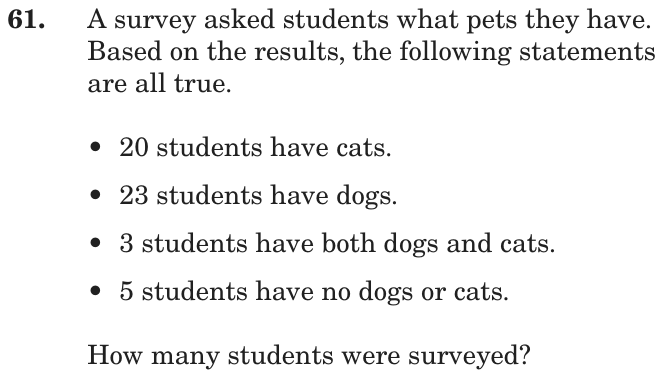
A survey asked students what pets they have. Based on the results, the following statements are all true.
- 20 students have cats.
- 23 students have dogs.
- 3 students have both dogs and cats.
- 5 students have no dogs or cats.
How many students were surveyed?
Fill-in question: work out the answer and type it as a number.
Show the answer
Correct answer: 45
Let x = number of students with only cats as pets.
Let y = number of students with only dogs as pets.
Calculate x and y using the given information:
There are 20 students who have cats, and of those 20 students, 3 have both cats and dogs.
Thus,
There are 23 students who have dogs, and of those 23 students, 3 have both cats and dogs.
Thus,
To find the total number of students surveyed, add the number of students who only have cats (x), the number of students who only have dogs (y), the number of students who have both (3), and the number of students who have neither (5):
Question analysis
A grid-in counting question about a survey of students' pets: some have cats, some dogs, some both, and some neither. Students find how many were surveyed by sorting everyone into groups without counting anyone twice. The students who own both pets are the trap in this classic Venn diagram problem.
- NYS standards
- 7.SP.8b sample spaces for compound events
- Grade level
- Grade 7 content, by NYS standard
- Compared with grade 7
- At grade 7 Grade 7 classes organize outcomes in lists and tables, but overlapping groups like these are rarely taught directly. The arithmetic is simple whole-number addition and subtraction; the demand lies in spotting the double count.
- Estimated difficulty
- Moderate: several steps, or a close reading with one strong distractor.
- Thinking it demands
- Depth of knowledge 2, skills and concepts · mainly apply
- What makes it hard
- Turning words into math moderate
- Much to keep track of minor
- An answer in an unexpected form minor
- Solution
- 3 steps
- Reading level
- Question and choices: about grade 3, 41 words.
- Students, last 30 days
- Not enough answers yet to show (it takes 10).
Why it is hard, traps and wrong answers (shows the answer)
Why it is hard
The arithmetic is small; the trap is in the wording. Because each bullet reads like a separate group, students tend to add the numbers as listed and count the students with both pets twice. A Venn diagram with the overlap filled in first solves the problem, and the remaining risk is forgetting that students with no pets were surveyed too.
Turning words into math moderate Understanding the question
The statement "20 students have cats" already includes the 3 who have both pets, and so does "23 students have dogs", which the separate bulleted list hides. (Hegarty, Mayer & Monk, 1995; Koedinger & Nathan, 2004)
Much to keep track of minor Working it out
Four facts, two overlapping groups, their overlap and an outside group of 5 with neither pet, all have to be placed before anything is added. (Sweller, 1988; Carpenter, Just & Shell, 1990)
An answer in an unexpected form minor Choosing the answer
As a grid-in it gives no choices, so a total that counts the 3 twice or leaves out the 5 looks just as finished as the right one. (Enright, Morley & Sheehan, 2002)
Strategy: Draw two overlapping circles: put the both-pets group in the middle, subtract it from each pet total to fill the outer parts, then add every region and the students with neither.
Traps
- Overlapping groups: Things in two groups at once are counted twice, or not subtracted.
The wrong answers, classified
48 Overlapping groups (King et al., 2004)
Adds 20 + 23 + 5 = 48, counting the 3 students with both pets once among the cat owners and again among the dog owners.
40 Answers a different question (King et al., 2004; Hegarty, Mayer & Monk, 1995)
Removes the overlap correctly, 20 + 23 − 3 = 40, but counts only the pet owners, leaving out the 5 surveyed students with no dogs or cats.
51 Numbers taken from the question (Hegarty, Mayer & Monk, 1995)
Adds all four numbers in the list, 20 + 23 + 3 + 5 = 51, treating the both-pets group as an extra group of students.
Worked solution, step by step
Formulas used
- Counting two groups that overlap
- T is the total number of students. C is the number with cats, and D is the number with dogs. B is the number with both pets, and N is the number with neither. Students with both are counted in C and again in D, so you subtract B once. Then add N.
Sort out the four facts
You need the number of students who were surveyed. Here is what you know:
- 20 students have cats.
- 23 students have dogs.
- 3 students have both dogs and cats.
- 5 students have no dogs or cats.
The tricky part: the 3 students with both pets are already inside the 20 and inside the 23.
Split the pet owners into groups
Picture two circles that overlap, one for cats and one for dogs. The overlap holds the 3 students with both pets. Take them out of each pet total to find who has only one kind of pet.
So 17 students have only cats.
So 20 students have only dogs.
Add every group once
Now every student is in exactly one group.
Group Students Only cats 17 Only dogs 20 Both pets 3 Neither pet 5 The formula gives the same total.
Avoid the traps and answer
Watch out: adding counts the 3 students with both pets twice. That gives 48. Watch out: the 5 students with no pets were surveyed too. Leaving them out gives 40. Adding all four numbers in the list gives 51, which is also wrong. So you would grid 45.
Check your answer
Check each fact against your groups. Cat owners: . Dog owners: . Both: 3. Neither: 5. Every fact matches, so 45 students were surveyed.
More questions like this
The original DOE question
Question 5 of 57
2025 Practice Test A Math, question 5Question
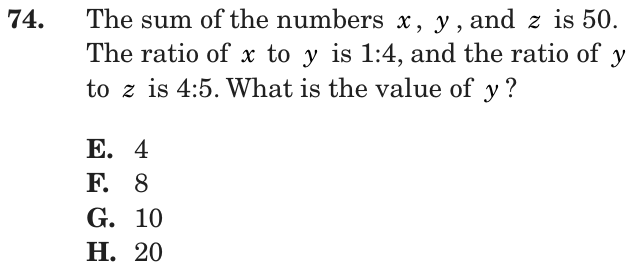
The sum of the numbers x, y, and z is 50. The ratio of x to y is 1:4, and the ratio of y to z is 4:5. What is the value of y ?
- A4
- B8
- C10
- D20
Show the answer
Correct answer: D
Since both ratios have in common, solve for and in terms of in both equations. Using , solve for in terms of .
Using the ratio , solve for in terms of :
The question states . Substitute from the two equations above and solve for .
Question analysis
A ratio problem with three unknowns: x, y and z add to 50, x to y is 1 to 4, and y to z is 4 to 5. Students merge the two ratios into one three-part ratio and use the sum to find y. The step that is easy to skip is turning ratio parts into actual values.
- Grade level
- Grade 7 content, by NYS standard
- Compared with grade 7
- At grade 7 Grade 7 ratio problems usually involve one ratio. Here two ratios share a term and must be merged before the total is used, though the shared term already matches, which keeps it near typical grade 7 work.
- Estimated difficulty
- Moderate: several steps, or a close reading with one strong distractor.
- Thinking it demands
- Depth of knowledge 2, skills and concepts · mainly apply
- What makes it hard
- No obvious method moderate
- Variables instead of numbers minor
- Many steps minor
- Solution
- 3 steps
- Reading level
- Question and choices: about grade 2, 31 words.
- Students, last 30 days
- Not enough answers yet to show (it takes 10).
Why it is hard, traps and wrong answers (shows the answer)
Why it is hard
The question rewards noticing that y has the same term in both ratios, which turns two ratios into one three-part ratio in a single move. Students who miss this often write x and z in terms of y, as the explanation does, which works but is slower. The wrong choices are numbers taken from the ratios themselves, so a student who never scales up to the total of 50 finds an answer waiting.
No obvious method moderate Working it out
The two ratios have to be merged into one, x : y : z = 1 : 4 : 5, which works only because y is 4 in both; nothing in the wording says to combine them. (Schoenfeld, 1985)
Variables instead of numbers minor Understanding the question
x, y and z are given only through two ratios and their sum of 50, so there is no actual count to anchor the work until the parts are scaled. (Koedinger & Nathan, 2004; Enright, Morley & Sheehan, 2002)
Many steps minor Working it out
Adding the parts, dividing 50 by their total and scaling y's 4 parts are three steps, and the count of parts after the first step is itself a listed choice. (Daniel & Embretson, 2010; Enright, Morley & Sheehan, 2002)
Strategy: Since y is 4 in both ratios, write x : y : z as one combined ratio, find the value of one part from the total of 50, and scale up.
Traps
- Numbers taken from the question: Combines the numbers in the question without a model of the situation, or is simply a number that appears in the question.
- Answers a different question: A choice is right for another quantity: the other unknown, the rest instead of the part, the part instead of the whole.
The wrong answers, classified
A Numbers taken from the question (Hegarty, Mayer & Monk, 1995)
Takes y's term in the ratios, 4, as y's actual value, never using the sum of 50.
B Numbers taken from the question (Hegarty, Mayer & Monk, 1995)
Adds the two 4s that stand for y in the two ratios, 4 + 4 = 8, treating ratio terms as amounts.
C Answers a different question (King et al., 2004; Hegarty, Mayer & Monk, 1995)
Combines the ratios into 1 : 4 : 5 and gives the total number of parts, 1 + 4 + 5 = 10, instead of y's share of the 50.
Worked solution, step by step
Formulas used
- Sharing a total in a ratio
- In a ratio like 3:2, the amounts are made of equal-sized parts. Add the numbers in the ratio to count the parts. Divide the total by that count to get the size of one part. Then multiply by how many parts each amount has.
Sort out the question
The three numbers x, y and z add up to 50. The ratio of x to y is 1:4. The ratio of y to z is 4:5. A ratio compares sizes. You need the actual value of y.
Join the two ratios
y is 4 in both ratios. So the two ratios use the same size parts, and you can join them into one.
This means x is 1 part, y is 4 parts, and z is 5 parts.
Count the parts
There are 10 parts in all. Watch out: 10 is the number of parts, not the value of y. Picking it is choice C.
Find the size of one part
Use the sharing formula. The 10 parts share the total of 50.
Each part is worth 5.
Find y
y is 4 parts.
Watch out: the 4 in the ratio counts parts. It is not the value of y. Picking 4 is choice A. So the answer is D, 20.
Check your answer
Find all three: x = 5, y = 20, z = 25. They add up: . x to y is 5 to 20, which is 1:4. y to z is 20 to 25, which is 4:5. Everything fits.
More questions like this
The original DOE question
Question 6 of 57
2025 Practice Test A Math, question 6Question
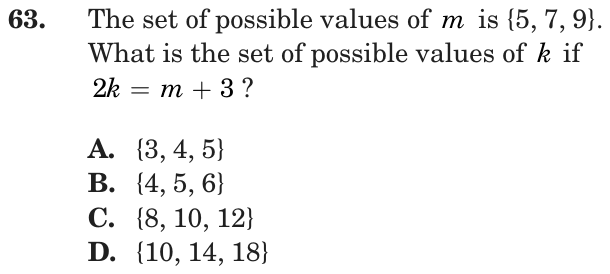
The set of possible values of is . What is the set of possible values of if ?
- A
- B
- C
- D
Show the answer
Correct answer: B
so
Substitute each value of m to find the values of k:
The set k is { 4, 5, 6}.
Question analysis
An algebra question about substitution: m can be 5, 7 or 9, and an equation links k to m. Students find every possible value of k by substituting each value of m and solving. The curly-brace set notation can look unfamiliar, and each value has to be carried all the way through the solve.
- Grade level
- Grade 6 content, by NYS standard
- Compared with grade 7
- At grade 7 Each substitution leads to a one-step grade 6 equation, easier than a typical grade 7 two-step problem. What adds demand is doing it three times and reading the answer as a set of values, which grade 7 rarely uses.
- Estimated difficulty
- Straightforward: two steps or one careful reading.
- Thinking it demands
- Depth of knowledge 1, recall and reproduction · mainly apply
- What makes it hard
- Solution
- 2 steps
- Reading level
- Question and choices: about grade 9, 24 words.
- Students, last 30 days
- Not enough answers yet to show (it takes 10).
Why it is hard, traps and wrong answers (shows the answer)
Why it is hard
The equation is simple, and the main hazard is stopping one step short: m + 3 gives 8, 10 and 12, a listed choice even though those are values of 2k. Checking a single value of m is the other risk, since k = 4 and k = 5 both appear in the first two sets. Students who substitute all three values and halve each result finish quickly.
Variables instead of numbers minor Understanding the question
There is no single unknown: m stands for the set {5, 7, 9}, and the answer is the matching set for k, so the equation has to be applied to three values. (Koedinger & Nathan, 2004; Enright, Morley & Sheehan, 2002)
Strategy: Rewrite the equation so k equals m plus 3, all divided by 2, then evaluate it for each of the three values of m.
Traps
- Stops one step early: A choice is a number from partway through the solution.
The wrong answers, classified
A Checks only one number (Schoenfeld, 1985)
Checks only m = 5, gets k = 4, and takes the first set containing 4; m = 9, giving k = 6, would rule it out.
C Stops one step early (King et al., 2004; Gierl et al., 2017)
Adds 3 to each value of m to get 8, 10 and 12, which are the values of 2k, and forgets to divide by 2.
D Wrong operation (Hegarty, Mayer & Monk, 1995; King et al., 2004)
Doubles each value of m to get 10, 14 and 18, moving the 2 onto m instead of dividing by it, and drops the + 3.
Worked solution, step by step
Formulas used
- Getting k by itself
- k and m are the letters from the equation 2k = m + 3. The fraction bar means divide. If 2 times k equals m + 3, then k is half of m + 3. You get this by dividing both sides of the equation by 2.
Sort out the question
The letter m can be 5, 7 or 9. The curly braces { } show a set, which is a list of numbers. The equation links k to m. You need every value k can have, one for each value of m.
Get k by itself
2k means 2 times k. To undo times 2, divide both sides by 2. Doing the same thing to both sides keeps the equation true.
Try each value of m
Put each value of m into the formula. Add 3 first, then divide by 2.
Watch out: 8, 10 and 12 are the values of m + 3, which equal 2k, not k. Stopping before you divide by 2 gives choice C.
Pick the matching set
The values of k are 4, 5 and 6. Watch out: try all three values of m. If you only try m = 5, you get k = 4, and choice A has a 4 too. So the answer is B, {4, 5, 6}.
Check your answer
Put each k back into the equation. . . . All three work, so the set is right.
More questions like this
The original DOE question
Question 7 of 57
2025 Practice Test A Math, question 7Question
- A
- B
- C
- D
Show the answer
Correct answer: A
Question analysis
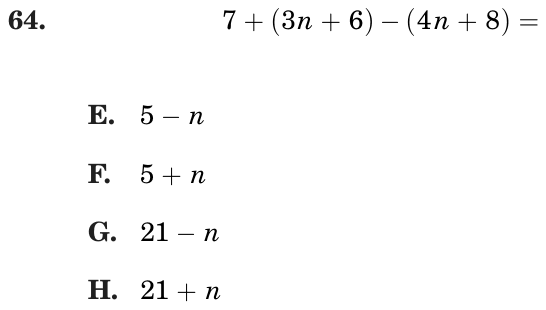
An expression question: simplify a sum and difference of two linear expressions in n. Students remove the parentheses, subtract every term inside the second group, and combine like terms. The minus sign in front of the second parentheses is the trap, since it has to change the sign of both terms inside.
- NYS standards
- Grade level
- Grade 7 content, by NYS standard
- Compared with grade 7
- At grade 7 Simplifying linear expressions with a subtracted group is standard grade 7 work. This is a typical textbook exercise in length, with the usual sign trap and no extra steps or real-world context.
- Estimated difficulty
- Straightforward: two steps or one careful reading.
- Thinking it demands
- Depth of knowledge 1, recall and reproduction · mainly apply
- What makes it hard
- Error-prone arithmetic moderate
- A very close wrong answer moderate
- Solution
- 2 steps
- Reading level
- Question and choices: about grade 16+, 5 words.
- Corrected from the DOE handbook
- The handbook’s answer key for this question was corrected.
- Students, last 30 days
- Not enough answers yet to show (it takes 10).
Why it is hard, traps and wrong answers (shows the answer)
Why it is hard
There are only five terms, but two signs decide the answer: the minus in front of the second parentheses and the sign left after 3n − 4n. Each wrong choice comes from one or both of those sign decisions, so all of them look plausible, and checking needs care rather than time. Even the DOE handbook keyed the version with the wrong sign on n.
Error-prone arithmetic moderate Working it out
The minus sign before (4n + 8) has to reach both terms, making −4n and −8, and 3n − 4n leaves a negative n term. (Brown & Burton, 1978; Junker & Sijtsma, 2001)
A very close wrong answer moderate Choosing the answer
5 − n and 5 + n are written alike and share the constant 5; only the sign of the n term, from 3n − 4n, separates them, and the DOE handbook's own key picked the wrong one. (Embretson & Wetzel, 1987; Gorin & Embretson, 2006; Ascalon et al., 2007)
Strategy: Rewrite the subtraction as adding the opposite of each term in the second parentheses, then group the constants and the n terms separately.
Traps
- Order of operations: Working left to right, or distributing a minus sign wrongly, gives a choice.
- Negatives and direction: Arithmetic with negative numbers, the order of a subtraction, or direction on a number line. (Moving a term across the equals sign without changing its sign is a faulty procedure.)
The wrong answers, classified
B Negatives and direction (Brown & Burton, 1978)
Gets the constants right, 7 + 6 − 8 = 5, but writes 3n − 4n as +n, subtracting the smaller coefficient from the larger and keeping a plus sign.
C Order of operations (Brown & Burton, 1978)
Applies the minus sign to 4n but not to 8, so the constants become 7 + 6 + 8 = 21 while the n term comes out right.
D Order of operations (Brown & Burton, 1978)
Makes both mistakes: adds the 8 instead of subtracting it, for 21, and also writes 3n − 4n as +n.
What was corrected from the DOE handbook, and why
- Answer key: The handbook (its question 64) keys this question as F, which is 5 + n (choice B here), in its answer key and in the heading of its explanation. Its own working gives 7 + 3n + 6 − 4n − 8 = 5 − n, which is the handbook’s choice E and choice A here, and that is correct. The key here is A.
Worked solution, step by step
Formulas used
- Subtracting a group in parentheses
- a and b are the terms inside the parentheses. A term is a number, a letter, or a number times a letter. The minus sign in front means you subtract the whole group. So you subtract every term inside, not just the first one.
- Combining like terms
- n stands for an unknown number, and 3n means 3 times n. Like terms have the same letter part, like 3n and 4n. To combine them, add or subtract the numbers in front and keep the letter. Plain numbers combine only with plain numbers.
Sort out the question
You need to simplify the expression, which means write it in a shorter form. An expression is a math phrase made of numbers, letters and signs. Here n stands for an unknown number. Find the choice that matches the short form.
Remove the parentheses
The first group has a plus sign in front. Adding a group changes nothing, so is just . The second group has a minus sign in front. You must subtract both terms inside it.
Watch out: the minus reaches the 8 too. Adding the 8 instead gives 21 for the plain numbers. That leads to choice C or D.
Combine the plain numbers
Group the numbers without a letter. Work them out from left to right.
The plain numbers make 5.
Combine the n terms
You have 3 n’s, and you take away 4 n’s. The numbers in front give 3 − 4 = −1. So you are left with −1n, which is written −n.
Watch out: it is easy to write +n here. That gives 5 + n, choice B.
Put the two parts together
Join the number part and the n part. Adding a negative is the same as subtracting.
So the answer is A, 5 − n.
Check your answer
Pick any number for n and test it. Try n = 1. The original: . Choice A: . They match. Choice B gives , which does not.
More questions like this
The original DOE question
Question 8 of 57
2025 Practice Test A Math, question 8Question
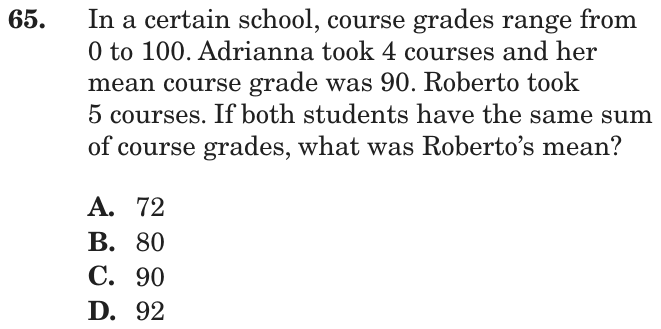
In a certain school, course grades range from 0 to 100. Adrianna took 4 courses and her mean course grade was 90. Roberto took 5 courses. If both students have the same sum of course grades, what was Roberto’s mean?
- A72
- B80
- C90
- D92
Show the answer
Correct answer: A
The sum of Adrianna’s course grades equals 4 times the mean (average) of her grades:
90 × 4 = 360
Roberto has the same sum (360) as Adrianna. Find the mean of his course grades:
360 ÷ 5 = 72
Question analysis
This averages word problem compares two students' course grades. One student's number of courses and mean grade are given, and a second student has the same total over a different number of courses. Students work back from a mean to a sum, then find a new mean, while the stated grade range plays no part.
- Grade level
- Grade 6 content, by NYS standard
- Compared with grade 7
- Below grade 7 Finding a mean is grade 6 content, and this needs only the step back from a mean to a total and one division. Typical grade 7 statistics work compares two data sets, which asks more.
- Estimated difficulty
- Straightforward: two steps or one careful reading.
- Thinking it demands
- Depth of knowledge 2, skills and concepts · mainly apply
- What makes it hard
- Turning words into math moderate
- Something you must already know minor
- Solution
- 2 steps
- Reading level
- Question and choices: about grade 2, 35 words.
- Students, last 30 days
- Not enough answers yet to show (it takes 10).
Why it is hard, traps and wrong answers (shows the answer)
Why it is hard
The question turns on one idea, that a mean times the number of items gives the total, and the numbers are easy. Students who skim "the same sum" as "the same mean" carry Adrianna's 90 straight across, and the 0-to-100 range in the first sentence offers a second number to misuse. Converting to the shared total of 360 first makes the rest a single division.
Turning words into math moderate Understanding the question
"Both students have the same sum of course grades" is the bridge: Adrianna's mean of 90 must be turned into a total, 4 × 90, before it says anything about Roberto. (Hegarty, Mayer & Monk, 1995; Koedinger & Nathan, 2004)
Something you must already know minor Working it out
The link between a mean and a total, sum = mean × number of courses, is not given and has to be used in both directions. (Anderson & Krathwohl, 2001)
Strategy: Multiply the first student's mean by her number of courses to get the shared total, then divide that total by Roberto's number of courses.
Traps
- Misunderstands the concept: A wrong belief about a concept: that percents can be added, that area grows like length, that averages can be averaged, that a bigger denominator means a bigger fraction.
- Information you don't need: The question gives numbers or facts that play no part in the answer.
The wrong answers, classified
B Numbers taken from the question (Hegarty, Mayer & Monk, 1995)
Uses 100, the top of the grade range, in place of Adrianna's mean of 90: 4 × 100 = 400, and 400 ÷ 5 = 80.
C Misunderstands the concept (Smith, diSessa & Roschelle, 1993; De Bock et al., 1998; Ni & Zhou, 2005)
Assumes an equal sum means an equal mean and gives Adrianna's 90, ignoring that Roberto's 360 points are spread over 5 courses, not 4.
D Numbers taken from the question (Hegarty, Mayer & Monk, 1995)
Adds a fifth grade of 100, the top of the stated range, to Adrianna's total: (360 + 100) ÷ 5 = 92.
Worked solution, step by step
Formulas used
- Mean (average)
- M is the mean, also called the average. S is the sum, all the values added together. n is how many values there are. Dividing shares the total out equally, so the mean is what each value would be if they were all the same.
- Sum from the mean
- This is the mean formula turned around. S is the sum, M is the mean, and n is how many values there are. If n values were each equal to the mean, they would add up to M times n. That is the same as the real sum.
Sort out the question
Adrianna took 4 courses, and her mean grade was 90. The mean is the average. Roberto took 5 courses. The key fact is that both have “the same sum of course grades”. The sum is all the grades added together. You need Roberto’s mean. The 0 to 100 range is not needed.
Find Adrianna’s total
You know her mean and her number of courses. Use the sum formula.
Her grades add up to 360 points.
Find Roberto’s mean
Roberto’s grades also add up to 360 points. But he spreads them over 5 courses. Use the mean formula.
His mean is 72.
Avoid the traps and answer
Watch out: the same sum does not mean the same mean. Roberto has more courses sharing the points, so his mean is lower. Choosing 90 is choice C. Watch out: don’t use 100, the top grade, in place of 90. That leads to 80, choice B. So the answer is A, 72.
Check your answer
More courses share the same 360 points, so Roberto’s mean must be lower than 90. 72 is lower. Multiply back: , which matches Adrianna’s total.
More questions like this
The original DOE question
Question 9 of 57
2025 Practice Test A Math, question 9Question
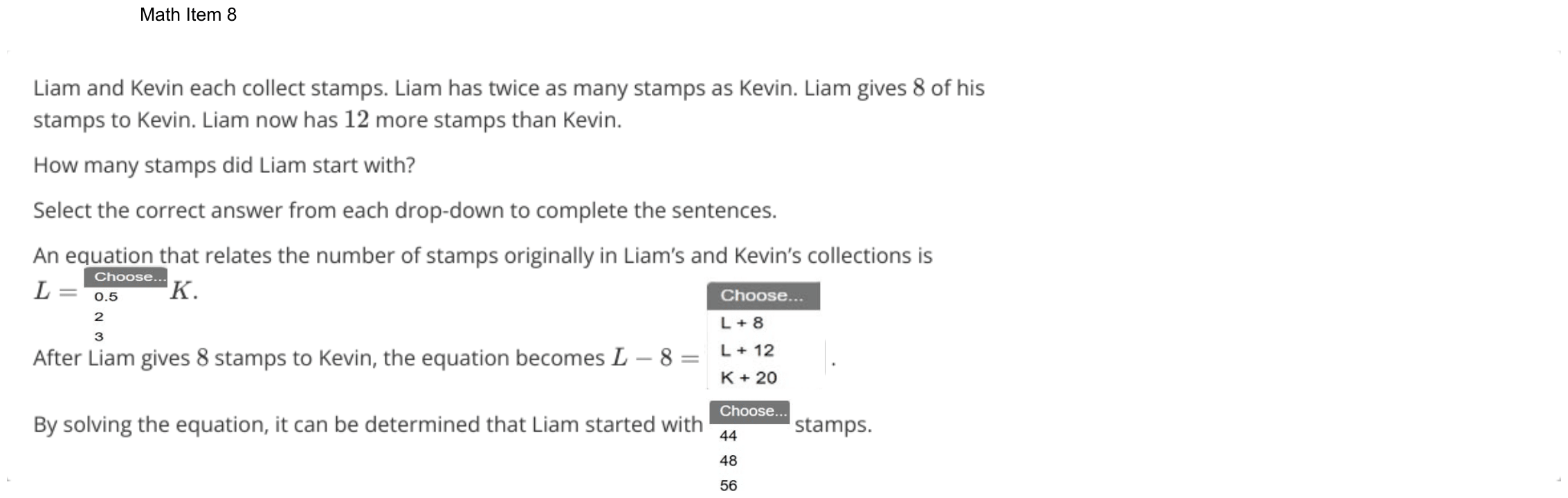
Liam and Kevin each collect stamps. Liam has twice as many stamps as Kevin. Liam gives 8 of his stamps to Kevin. Liam now has 12 more stamps than Kevin.
How many stamps did Liam start with?
Select the correct answer from each drop-down to complete the sentences.
An equation that relates the number of stamps originally in Liam’s and Kevin’s collections is .
After Liam gives 8 stamps to Kevin, the equation becomes .
By solving the equation, it can be determined that Liam started with stamps.
Choose an answer from each menu, then check. The DOE has not published how answers with several parts are scored; this site counts one right only when every part is right.
Show the answer
Correct answer: blank 1: 2; blank 2: K + 20; blank 3: 56
Liam originally has twice as many stamps as Kevin, so the equation is .
After Liam gives 8 stamps to Kevin, the equation becomes , which simplifies to .
Substitute into the equation: .
Solve for K:
Substitute to find L: .
So, Liam started with 56 stamps.
Question analysis
This word problem about two stamp collections is answered with three drop-down menus: an equation for the starting counts, an equation for after Liam gives Kevin 8 stamps, and the number Liam started with. Students turn "twice as many" and "12 more" into algebra and solve. Tracking both boys' counts before and after the gift is the tricky part, and every menu must be right.
- Grade level
- Grade 8 content, by NYS standard
- Compared with grade 7
- Above grade 7 Grade 7 students solve one equation in one unknown. The menus lay out the equations, but the problem still ties two unknowns together before and after a gift, a grade 8 system, and all three menus must be right.
- Estimated difficulty
- Moderate: several steps, or a close reading with one strong distractor.
- Thinking it demands
- Depth of knowledge 2, skills and concepts · mainly apply
- What makes it hard
- Turning words into math moderate
- Much to keep track of moderate
- Solution
- 4 steps
- Reading level
- Question and choices: about grade 5, 86 words.
- Students, last 30 days
- Not enough answers yet to show (it takes 10).
Why it is hard, traps and wrong answers (shows the answer)
Why it is hard
The menus do much of the setting up, since each sentence already shows the shape of its equation. The second menu is the hard one: the 8 stamps leave Liam and join Kevin before the gap of 12 is measured. Solving gives Kevin's 28 first, and K + 20 then equals 48, Liam's count after the gift, which waits on the last menu beside his starting 56. Testing each starting count against the story is a quick check on the last menu.
Turning words into math moderate Understanding the question
The gift changes both counts, so "Liam now has 12 more stamps than Kevin" compares Liam's L − 8 with Kevin's K + 8, and the second menu's K + 20 holds a 20 that appears nowhere in the stem. (Hegarty, Mayer & Monk, 1995; Koedinger & Nathan, 2004)
Much to keep track of moderate Working it out
Each boy has a count before and after the gift, four numbers in all, and all three menus must be right; the last asks for Liam's start, not the 48 he has after giving 8 away. (Sweller, 1988; Carpenter, Just & Shell, 1990)
Strategy: Let K be Kevin's starting count, write each boy's count after the gift in terms of K, and set Liam's 12 above Kevin's; testing each number in the last menu is a fast check.
Traps
- Answers a different question: A choice is right for another quantity: the other unknown, the rest instead of the part, the part instead of the whole.
- Follows a key word: Picks the operation from a single word rather than the situation: "removed" so subtract, "of" so multiply, "more" so add, when the situation needs something else.
- Equation written backwards: Writes a comparison the wrong way round, word for word: "six times as many students as professors" as 6S = P. The bigger quantity gets the bigger number.
The wrong answers, classified
BCB Answers a different question (King et al., 2004; Hegarty, Mayer & Monk, 1995)
Sets up both equations and solves for Kevin's 28, then takes the value of K + 20, 48, which is Liam's count after the gift, not at the start.
BBC Follows a key word (Hegarty, Mayer & Monk, 1995)
Follows the words "12 more" to L + 12, adding 12 to Liam's own count instead of Kevin's, then finds 56 by testing the three counts against the story.
ACC Equation written backwards (Clement, Lochhead & Monk, 1981)
Writes "twice as many stamps as Kevin" backwards, as 2L = K, and picks 0.5, giving Liam half of Kevin's stamps, while the other two menus are right.
Worked solution, step by step
Formulas used
- Twice as many as
- L is the number of stamps Liam starts with, and K is the number Kevin starts with. Twice as many means 2 times as many, so Liam’s count is 2 times Kevin’s. Because L and 2K are equal, you can put 2K in place of L in any equation.
- Doing the same to both sides
- a and b are the two sides of an equation, and c is any number or term. An equation is like a balanced scale. Add the same thing to both sides, or take the same thing away from both, and the scale stays level. This is how you move a term to the other side.
Sort out the question
Let L be Liam’s stamps at the start and K be Kevin’s. You know three facts:
- Liam has twice as many stamps as Kevin.
- Liam gives 8 of his stamps to Kevin.
- After that, Liam has 12 more stamps than Kevin.
The first menu finishes the starting equation. The second finishes the equation after the gift. The third is Liam’s count at the start.
Fill in the first menu
Twice as many means 2 times as many. Liam has twice as many as Kevin, so:
Pick 2 in the first menu.
Watch out: the 0.5 in the menu turns the fact around. would give Liam half as many as Kevin. Liam has more, so his count must be the bigger one.
Write both counts after the gift
The gift changes both counts. Liam loses 8 stamps, and Kevin gains those same 8.
- Liam now has stamps.
- Kevin now has stamps.
Liam has 12 more than Kevin. So Liam’s count equals Kevin’s count plus 12:
Pick K + 20 in the second menu.
Watch out: the 12 goes on Kevin’s count, not Liam’s. Picking L + 12 adds it to the wrong boy.
Solve for K
Now use the first equation. Since , put 2K in place of L:
Subtract K from both sides. Then add 8 to both sides. Each move keeps the scale level.
Kevin started with 28 stamps.
Find Liam’s starting count
Liam started with twice as many as Kevin:
Liam started with 56 stamps.
Watch out: is Liam’s count after the gift. The menu offers 48, but the question asks about the start.
So the menus read 2, K + 20 and 56.
Check your answer
At the start, Liam has 56 stamps and Kevin has 28, and 56 is twice 28. After the gift, Liam has 48 and Kevin has 36. , so Liam has 12 more. Every fact fits.
More questions like this
The original DOE question
Question 10 of 57
2025 Practice Test A Math, question 10Question
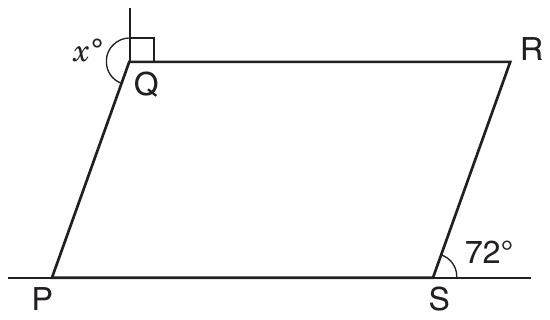
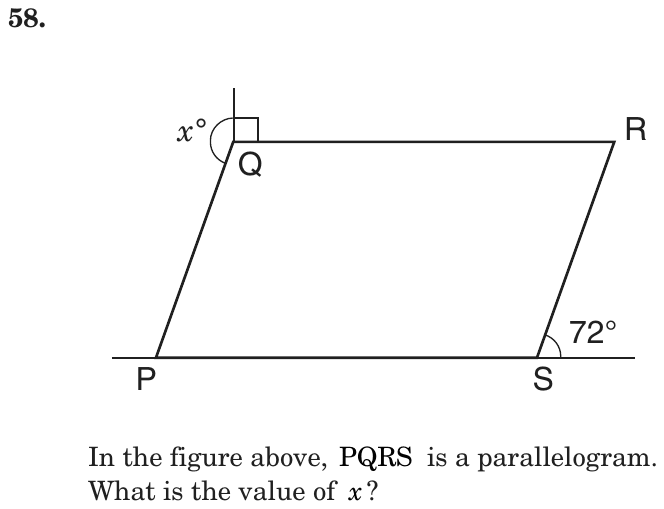
In the figure above, PQRS is a parallelogram. What is the value of ?
Fill-in question: work out the answer and type it as a number.
Show the answer
Correct answer: 162
First, find the measure of angle PQR. The measure of angle PQR is equal to the measure of angle PSR.
m∠PSR = 180 − 72 = 108.
So, the measure of angle PQR is also 108.
108 + 90 + x = 360
198 + x = 360
x = 162
Question analysis
A grid-in geometry question about angles around a parallelogram PQRS. A 72° angle sits outside corner S on the extended base, and at corner Q a right angle and the unknown angle x complete the turn around the point. Students chain three angle facts, and the angle asked for lies outside the shape, not inside it.
- NYS standards
- Grade level
- Grade 8 content, by NYS standard
- Compared with grade 7
- Above grade 7 Grade 7 angle work usually applies one or two facts, such as supplementary or vertical angles, to find an angle. This chains three, and needs the equal opposite angles of a parallelogram, which rest on grade 8 parallel-line facts.
- Estimated difficulty
- Hard: combines ideas, needs a plan, and has more than one tempting wrong answer.
- Thinking it demands
- Depth of knowledge 2, skills and concepts · mainly apply
- What makes it hard
- Reading a figure, table or graph major
- Combines ideas moderate
- An answer in an unexpected form minor
- Solution
- 3 steps
- Reading level
- Question and choices: about grade 7, 14 words.
- Students, last 30 days
- Not enough answers yet to show (it takes 10).
Why it is hard, traps and wrong answers (shows the answer)
Why it is hard
The arithmetic is two subtractions; the difficulty is seeing which angles the marks refer to. Students lose points by treating the 72° as the parallelogram's own angle at S, or by stopping at angle PQR, the most natural number to grid. The question rewards tracing a route from S to Q before computing anything, and checking at the end that x is the angle outside the shape that the arc marks.
Reading a figure, table or graph major Understanding the question
The 72° is marked outside the parallelogram, between side SR and the base extended past S, and x sits outside corner Q, between QP and a vertical ray that meets QR at a right-angle mark. (Lesh, Post & Behr, 1987; Kirsch & Mosenthal, 1990)
Combines ideas moderate Working it out
Three angle facts have to be chained: a straight line gives the angle inside S, opposite angles of a parallelogram carry it to Q, and the angles around Q make a full 360° turn. (Embretson, 1998; Daniel & Embretson, 2010)
An answer in an unexpected form minor Choosing the answer
As a grid-in there are no choices to check against, so a student who stops at angle PQR, inside the parallelogram, gets no signal that the job is unfinished. (Enright, Morley & Sheehan, 2002)
Strategy: Use the straight line at S to find the parallelogram's angle there, carry it to the opposite corner Q, then take that angle and the right angle away from 360.
Traps
- Stops one step early: A choice is a number from partway through the solution.
The wrong answers, classified
108 Stops one step early (King et al., 2004; Gierl et al., 2017)
Finds angle PSR = 180 − 72 = 108 and carries it to angle PQR, then grids that interior angle instead of the angle x outside it.
198 Misreads the figure (Lesh, Post & Behr, 1987; Kirsch & Mosenthal, 1990)
Reads the 72° as the parallelogram's interior angle at S, so takes angle PQR as 72 and grids 360 − 90 − 72 = 198.
252 Misreads the figure (Lesh, Post & Behr, 1987; Kirsch & Mosenthal, 1990)
Overlooks the right-angle mark at Q and subtracts only the 108° angle PQR from 360, giving 252.
Worked solution, step by step
Formulas used
- Angles on a straight line
- a and b are two angles side by side on a straight line. Together they make a half turn, so they always add up to 180 degrees. Use it when an angle you need shares a straight line with an angle you know.
- Opposite angles of a parallelogram
- The symbol ∠ means angle. ∠PQR is the angle at corner Q, between sides QP and QR. ∠PSR is the angle at the opposite corner, S. In a parallelogram, opposite corners always have equal angles, because the shape leans the same way at both.
- Angles around a point
- a, b and c are angles that fit around one point with no gaps and no overlaps. Going all the way around is a full turn, which is 360 degrees. So the angles add up to 360.
Sort out what the figure shows
PQRS is a parallelogram. That is a four-sided shape whose opposite sides are parallel, which means they never meet. You need the value of x, in degrees.
Look closely at the marks. The 72° angle is outside the shape, at S. It sits between side SR and the base line, which keeps going past S. At Q, a vertical line meets side QR. The small square means a right angle, 90°. The angle x is outside the shape too. It runs from that vertical line around to side QP.
Find the angle inside corner S
Angle PSR is the shape’s own angle at S. It sits right next to the 72° angle, on the same straight base line. So the two angles add up to 180°.
So angle PSR is 108°. Watch out: 72° is not the inside angle at S. Using 72 as the inside angle leads to the wrong answer 198.
Carry the angle over to Q
Corners Q and S are opposite each other. In a parallelogram, opposite angles are equal. So angle PQR matches angle PSR.
So angle PQR is 108°. Watch out: this is not x. Angle PQR is inside the shape, and x is outside it. Stopping here and gridding 108 is the most common mistake.
Add the angles around Q
Three angles fill the space all the way around point Q. They are the right angle (90°), angle PQR (108°) and x. Together they make a full turn.
Watch out: don’t skip the right angle at Q. Leaving out the 90 gives 252.
Solve for x
Subtract 198 from 360 to find what is left for x.
So x is 162°. So you would grid 162.
Check your answer
Add the three angles at Q: . That is a full turn. Also, the arc for x is wider than a right angle but not as wide as a straight line. So x should be between 90° and 180°, and 162° is.
More questions like this
The original DOE question
Question 11 of 57
2025 Practice Test A Math, question 11Question
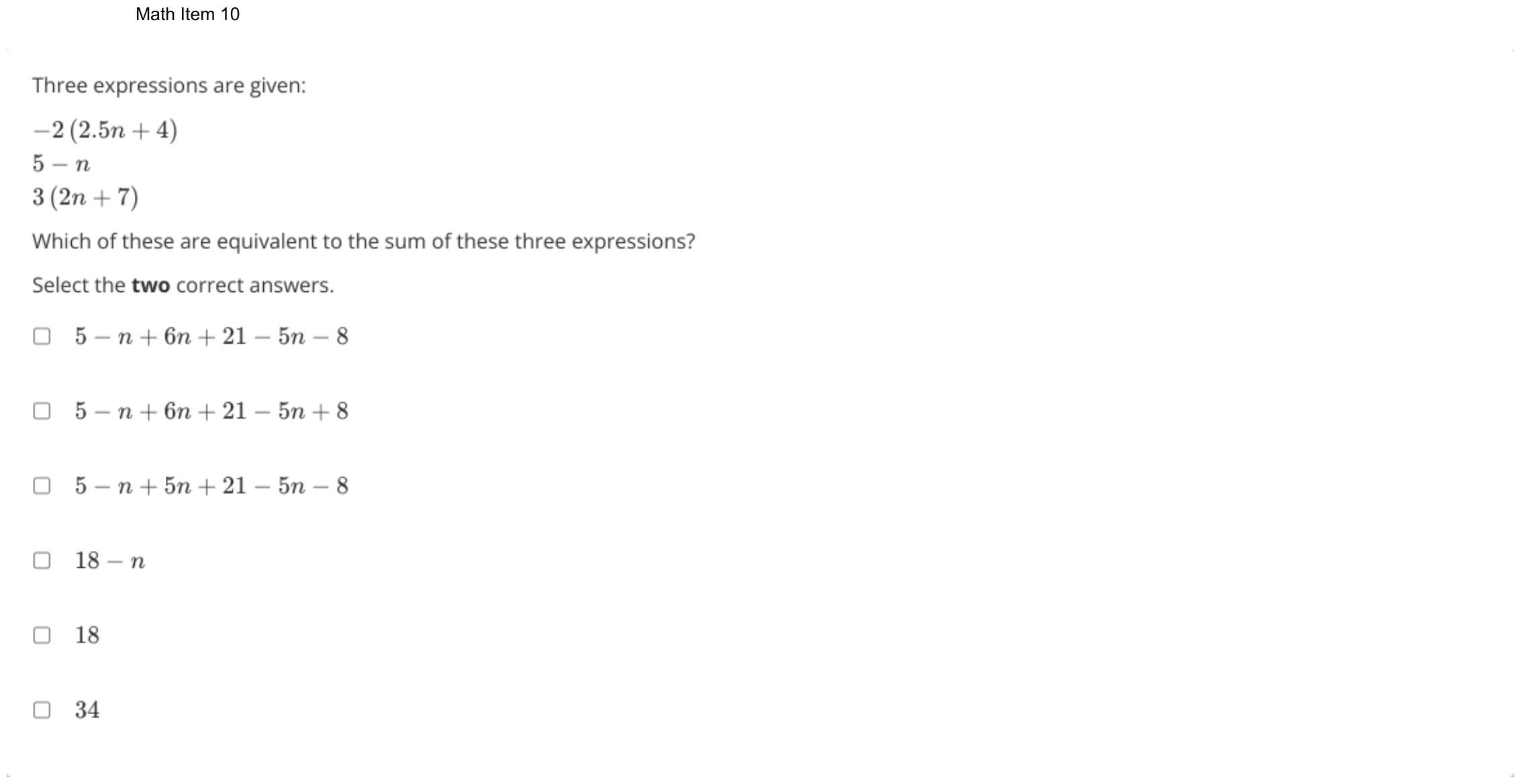
Three expressions are given:
Which of these are equivalent to the sum of these three expressions?
Select the two correct answers.
Choose every answer that is correct, then check. The DOE has not published how answers with several parts are scored; this site counts one right only when every part is right.
- A
- B
- C
- D
- E18
- F34
Show the answer
Correct answer: A and E
Add the three expressions: .
Distribute 3 and −2: .
Combine the variable terms and combine the constants: .
Question analysis
This algebra question gives three expressions, one with a decimal coefficient and a negative factor, and asks which two of six choices are equivalent to their sum. It tests distributing, combining like terms and recognizing equivalent expressions. Signs from the negative factor are easy to lose, and several choices are built from exactly those slips.
- NYS standards
- Grade level
- Grade 7 content, by NYS standard
- Compared with grade 7
- At grade 7 Expanding and combining linear expressions with a negative factor and a decimal coefficient is standard grade 7 work. Choosing the two equivalent ones out of six, where each common slip appears as a choice, takes more care than one simplification.
- Estimated difficulty
- Moderate: several steps, or a close reading with one strong distractor.
- Thinking it demands
- Depth of knowledge 1, recall and reproduction · mainly apply
- What makes it hard
- Error-prone arithmetic moderate
- A very close wrong answer moderate
- Many steps minor
- An answer in an unexpected form minor
- Solution
- 4 steps
- Reading level
- Question and choices: about grade 8, 28 words.
- Students, last 30 days
- Not enough answers yet to show (it takes 10).
Why it is hard, traps and wrong answers (shows the answer)
Why it is hard
The six choices form three consistent pairs, each an expansion with its simplified total: the right pair, a pair built on a sign slip with −2 × 4 that totals 34, and a pair built on 3 × 2n read as 5n that totals 18 − n. A student who makes either slip finds two choices that agree with each other and seem to confirm the work. The question rewards one careful simplification and the confidence to accept a sum with no n left.
Error-prone arithmetic moderate Working it out
The first expression puts a negative factor in front of a decimal term: −2 times 2.5n is −5n, and the −2 must reach the 4 as well, giving −8, not +8. (Brown & Burton, 1978; Junker & Sijtsma, 2001)
A very close wrong answer moderate Choosing the answer
The first two expansions are identical except for their last sign, − 8 against + 8, and the third differs from the first only in 5n for 6n, so only a term-by-term check separates them. (Embretson & Wetzel, 1987; Gorin & Embretson, 2006; Ascalon et al., 2007)
Many steps minor Working it out
Two distributions come first, then the n terms and the constants are collected separately, and six choices are compared with the result; both right ones must be picked to score. (Daniel & Embretson, 2010; Enright, Morley & Sheehan, 2002)
An answer in an unexpected form minor Choosing the answer
One right answer is the expansion before any terms are combined and the other is the plain number 18, which has to be accepted as equal to a sum in which every expression held n. (Enright, Morley & Sheehan, 2002)
Strategy: Distribute each factor across its parentheses, keeping the sign with every product, then combine the n terms and the constants separately and test each of the six choices against the result.
Traps
- Order of operations: Working left to right, or distributing a minus sign wrongly, gives a choice.
- Misunderstands the concept: A wrong belief about a concept: that percents can be added, that area grows like length, that averages can be averaged, that a bigger denominator means a bigger fraction.
- Answer in another form: The right answer is written differently from the way you worked it out.
The wrong answers, classified
B Order of operations (Brown & Burton, 1978)
Gives the minus of −2 to 2.5n but not to 4, expanding −2(2.5n + 4) as −5n + 8 instead of −5n − 8, so this expansion totals 34.
C Wrong operation (Hegarty, Mayer & Monk, 1995; King et al., 2004)
Expands 3(2n + 7) as 5n + 21, adding 3 and 2 instead of multiplying them, so the n terms no longer cancel and leave −n.
D Misunderstands the concept (Smith, diSessa & Roschelle, 1993; De Bock et al., 1998; Ni & Zhou, 2005)
Expects a sum of expressions in n to keep an n term, so it doubts the plain 18 and takes 18 − n, which the 5n expansion also simplifies to.
F Order of operations (Brown & Burton, 1978)
Takes −2 × 4 as +8, so the constants add to 5 + 21 + 8 = 34 while −n + 6n − 5n still cancels, leaving no n term.
Worked solution, step by step
Formulas used
- The distributive property
- a is the number in front of the parentheses, and b and c are the terms inside. You multiply a by every term inside, not only the first one. If a is negative, its minus sign goes into every product. It works because a groups of b + c is a groups of b plus a groups of c.
- Multiplying signed numbers
- a and b are positive numbers, so −a is negative. A negative number times a positive number is negative. Use it whenever a minus sign sits in front of the parentheses: −2 times 4 is −8, not 8.
- Combining like terms
- Like terms have the same letter part, such as 6n and −5n. a and b are their coefficients, the numbers in front of n. Add the coefficients and keep the n. Constants, the plain numbers, combine only with other constants.
Sort out the question
An expression is a math phrase made of numbers, letters and signs, with no equal sign. The sum of the three expressions means you add all of them:
You need the two choices that are equivalent to this sum. Equivalent means equal for every value of n. Some choices show the sum before it is simplified. Others show the result.
Distribute the 3
To distribute means to multiply the number outside the parentheses by each term inside.
Watch out: 3 times 2n is 6n. Adding 3 and 2 instead gives 5n. That slip leads to choice C, and then to 18 − n, choice D.
Distribute the −2
Now multiply −2 by both terms. A negative times a positive is negative, so both products are negative.
Watch out: the −2 multiplies the 4 too. Writing +8 instead of −8 leads to choice B. That sum works out to 34, choice F.
Write the whole sum
Put the three pieces together, starting with 5 − n:
This matches choice A exactly, term by term. So A is one of the answers.
Combine like terms
Gather the n terms first. Remember that −n means −1 times n.
Then gather the constants:
The n terms cancel out, so the whole sum is just 18.
Watch out: a sum with no n left is fine. Keeping an extra −n leads to choice D.
Pick the two answers
Choice A is the sum before you combine like terms. Choice E, 18, is the sum after you combine them. Both equal the sum for every value of n. So the answers are A and E.
Check your answer
Try a value, such as n = 2, in each expression. . . . The sum is , which matches E. Choice D would give 18 − 2 = 16 instead.
More questions like this
The original DOE question
Question 12 of 57
2025 Practice Test A Math, question 12Question
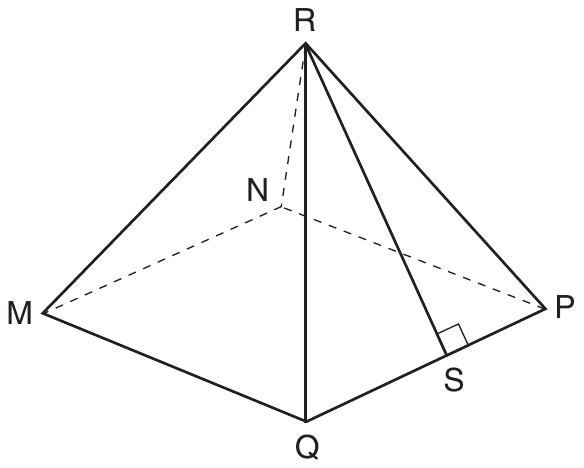
In the pyramid above, each triangular face has the same area, and the base MNPQ is a square that measures 8 centimeters on each side. If the length of = 6 centimeters, what is the surface area of the pyramid excluding the base?
- A48 sq cm
- B96 sq cm
- C128 sq cm
- D160 sq cm
Show the answer
Correct answer: B
Line segment is the altitude, or height, of triangle QRP. The length of is 8 cm. Use that information to find the area of triangle QRP:
sq cm.
There are 4 congruent triangles in the pyramid, so the surface area is
4 × 24 = 96 sq cm
Question analysis
A geometry question about the surface area of a square pyramid, leaving out its base. The base edges are 8 cm and segment RS, the height of one triangular face drawn from the top to a base edge, is 6 cm. Students find one face's area and multiply by the number of faces, reading excluding the base carefully.
- Grade level
- Grade 7 content, by NYS standard
- Compared with grade 7
- At grade 7 Surface area of a right pyramid from its faces is named in the grade 7 standards, and this is a direct two-step case. It matches typical grade 7 work, though the drawing's slant height must be read correctly.
- Estimated difficulty
- Moderate: several steps, or a close reading with one strong distractor.
- Thinking it demands
- Depth of knowledge 2, skills and concepts · mainly apply
- What makes it hard
- Solution
- 2 steps
- Reading level
- Question and choices: about grade 5, 49 words.
- Students, last 30 days
- Not enough answers yet to show (it takes 10).
Why it is hard, traps and wrong answers (shows the answer)
Why it is hard
Once RS is read as the height of a face, the computation is short: one triangle, then four of them. Points go to the figure and to one word. Students who count only the faces drawn in front, or who include the square base, reach listed choices, and the bold "excluding" is all that separates the lateral area from the total. The statement that every face has the same area is what makes multiplying by four valid.
Reading a figure, table or graph moderate Understanding the question
The drawing shows two lateral faces in front and two behind dashed edges, and RS, with its right-angle mark at S, is the height of face QRP, not of the pyramid. (Lesh, Post & Behr, 1987; Kirsch & Mosenthal, 1990)
Something you must already know minor Working it out
The triangle area formula, one half times base times height, and the fact that a square pyramid has four lateral faces are both assumed, not given. (Anderson & Krathwohl, 2001)
Strategy: Find the area of one triangular face with one half times base times height, using RS as the height, then multiply by the four congruent faces.
Traps
- Misreads the question: Misses or misreads a condition or a word in the question: "at least", "each", "remaining", "not".
- A formula you must know: Needs a formula the test does not give: area, circumference, volume, probability rules.
The wrong answers, classified
A Misreads the figure (Lesh, Post & Behr, 1987; Kirsch & Mosenthal, 1990)
Finds one face as ½ × 8 × 6 = 24 but counts only the two faces drawn in front, 2 × 24 = 48, missing the two hidden ones.
C Numbers taken from the question (Hegarty, Mayer & Monk, 1995)
Uses only the 8 cm edge, as both base and height of each face, 4 × ½ × 8 × 8 = 128, and never uses RS.
D Misreads the question (Hegarty, Mayer & Monk, 1995)
Finds the four faces, 96 sq cm, then adds the 8 × 8 = 64 sq cm base that the question says to exclude.
Worked solution, step by step
Formulas used
- Area of a triangle
- A is the area. b is the base, the side the triangle sits on. h is the height: the straight-up distance from the base to the top corner, at a right angle to the base. You take half because a triangle is half of a rectangle with the same base and height.
Sort out the pyramid
The pyramid sits on a square base, MNPQ. Each side of the square is 8 cm. Four triangle faces rise from the base and meet at the top point, R. Every face has the same area. Segment RS is 6 cm. You need the area of the four faces, “excluding the base”. Excluding means leaving it out.
See what RS measures
RS runs from R down face QRP to point S on edge QP. The small square at S marks a right angle. So RS is the height of triangle QRP. The base of that triangle is QP, one side of the square, so it is 8 cm.
Find the area of one face
Use the triangle formula with base 8 cm and height 6 cm.
One face has an area of 24 sq cm.
Add the four faces
All four faces are the same, so multiply by 4.
Watch out: only two faces are drawn in front. The other two hide behind the dashed lines. Counting just two faces gives 48, choice A. Watch out: don’t add the base, . That gives 160, choice D. So the answer is B, 96 sq cm.
Check your answer
Each face fits inside an 8 by 6 rectangle, with an area of 48 sq cm. The triangle is half of that, 24 sq cm, and four faces make 96 sq cm. That is less than 160, which would include the base.
More questions like this
The original DOE question
Question 13 of 57
2025 Practice Test A Math, question 13Question
The perimeter of a rectangle is 510 centimeters. The ratio of the length to the width is 3:2. What are the dimensions of this rectangle?
- A150 cm by 105 cm
- B153 cm by 102 cm
- C158 cm by 97 cm
- D165 cm by 90 cm
Show the answer
Correct answer: B
Let = the width and = the length.
Draw the rectangle to help visualize.
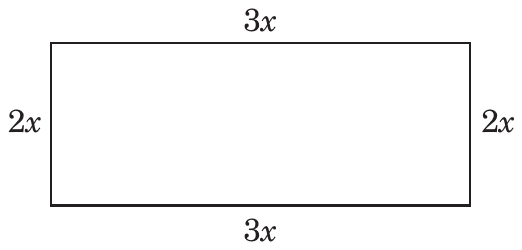
Since 2 times width + 2 times length = perimeter, we get
cm and cm
Question analysis
A rectangle word problem that combines perimeter with a ratio: the perimeter is 510 centimeters and the length and width are in the ratio 3 to 2. Students find the rectangle's dimensions. Every choice has the correct perimeter, so only the ratio separates them.
- Grade level
- Grade 7 content, by NYS standard
- Compared with grade 7
- At grade 7 Perimeter and ratio are each familiar from grades 6 and 7, and combining them with a five-part split is a typical grade 7 multistep ratio problem. It asks about the same as classroom work.
- Estimated difficulty
- Moderate: several steps, or a close reading with one strong distractor.
- Thinking it demands
- Depth of knowledge 2, skills and concepts · mainly apply
- What makes it hard
- A very close wrong answer moderate
- Turning words into math minor
- Solution
- 3 steps
- Reading level
- Question and choices: about grade 3, 35 words.
- Students, last 30 days
- Not enough answers yet to show (it takes 10).
Why it is hard, traps and wrong answers (shows the answer)
Why it is hard
The question is built so that the perimeter, the easier condition, rules nothing out: every choice adds to 255. A student who tests the choices against 510 alone will accept whichever comes first, and the first is 150 by 105. Solving with ratio parts, or checking each pair's ratio, avoids that; 3:2 means the length is exactly one and a half times the width.
A very close wrong answer moderate Choosing the answer
153 by 102 and 150 by 105 differ by just 3 cm in each side and give the same 510 cm perimeter; only the ratio, exactly 3:2 against 10:7, separates them. (Embretson & Wetzel, 1987; Gorin & Embretson, 2006; Ascalon et al., 2007)
Turning words into math minor Understanding the question
"The ratio of the length to the width is 3:2" has to become 3 parts and 2 parts of the half-perimeter, 255, not of the full 510. (Hegarty, Mayer & Monk, 1995; Koedinger & Nathan, 2004)
Strategy: Halve the perimeter to get length plus width, split that sum into 5 equal parts, and give the length 3 parts and the width 2.
Traps
- Misreads the question: Misses or misreads a condition or a word in the question: "at least", "each", "remaining", "not".
The wrong answers, classified
A Misreads the question (Hegarty, Mayer & Monk, 1995)
Checks only the perimeter, 2 × (150 + 105) = 510, and accepts the first pair that fits; 150 to 105 is 10:7, not 3:2.
C Misreads the question (Hegarty, Mayer & Monk, 1995)
Confirms that 158 + 97 = 255, half the perimeter, but never tests the ratio; 1.5 × 97 is 145.5, not 158.
D Misreads the question (Hegarty, Mayer & Monk, 1995)
Matches the perimeter, since 165 + 90 = 255, but a 3:2 rectangle 90 cm wide would be 135 cm long, not 165.
Worked solution, step by step
Formulas used
- Perimeter of a rectangle
- P is the perimeter, the distance all the way around the shape. l is the length and w is the width. A rectangle has two lengths and two widths. So you add one length and one width, then double it.
- Sharing a total in a ratio
- In a ratio like 3:2, the amounts are made of equal-sized parts. Add the numbers in the ratio to count the parts. Divide the total by that count to get the size of one part. Then multiply by how many parts each amount has.
Sort out the question
The perimeter of the rectangle is 510 cm. The perimeter is the distance all the way around. The ratio of length to width is 3:2. That means the length is 3 equal parts, and the width is 2 of the same parts. You need the length and the width.
Find length plus width
The perimeter counts each side twice, once for each matching side. So halve it to get one length plus one width.
Length plus width is 255 cm.
Find the size of one part
Length and width together are parts. Share the 255 cm equally among them.
Each part is 51 cm.
Find the length and width
The length is 3 parts and the width is 2 parts.
The length is 153 cm and the width is 102 cm.
Check the ratio, then answer
Watch out: every choice has a perimeter of 510 cm. For example, too. So checking only the perimeter can trick you into choice A. The ratio decides it. 153 is exactly 1.5 times 102, but 150 is not 1.5 times 105. So the answer is B, 153 cm by 102 cm.
Check your answer
Check both facts. Perimeter: . Ratio: and , so 153 to 102 is 3:2.
More questions like this
The original DOE question
Question 14 of 57
2025 Practice Test A Math, question 14Question
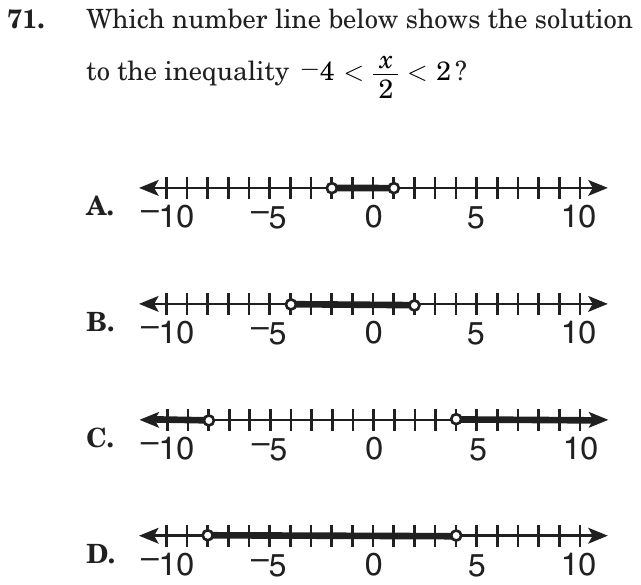
Which number line below shows the solution to the inequality ?
- A

- B

- C

- D

Show the answer
Correct answer: D
Multiply each term by 2 to eliminate the fraction, and isolate :
Therefore, must be between −8 and 4.
Question analysis
An inequality question: choose the number line that shows the solution of a compound inequality in which x divided by 2 lies between −4 and 2. Students undo the division in every part and match the graph's endpoints and shading. The four number lines differ in their endpoints and in which part of the line is shaded.
- Grade level
- Grade 7 content, by NYS standard
- Compared with grade 7
- At grade 7 Grade 7 students solve two-step inequalities and graph them on a number line. This compound inequality needs only one operation applied to all three parts at once, so it matches typical grade 7 work.
- Estimated difficulty
- Straightforward: two steps or one careful reading.
- Thinking it demands
- Depth of knowledge 1, recall and reproduction · mainly apply
- What makes it hard
- Reading a figure, table or graph moderate
- Error-prone arithmetic minor
- Solution
- 2 steps
- Reading level
- Question and choices: about grade 11, 11 words.
- Students, last 30 days
- Not enough answers yet to show (it takes 10).
Why it is hard, traps and wrong answers (shows the answer)
Why it is hard
Solving takes one step, multiplying through by 2, so most of the work is matching the result to a picture. The choices pair each common slip with a graph: the bounds left as written, the bounds halved, and the right bounds shaded on the wrong side. Reading the open circles against the labeled ticks at −5 and 5 settles it.
Reading a figure, table or graph moderate Understanding the question
The four number lines are labeled only at −10, −5, 0, 5 and 10, so open circles at −8 and 4, or at −4 and 2, have to be located by counting ticks. (Lesh, Post & Behr, 1987; Kirsch & Mosenthal, 1990)
Error-prone arithmetic minor Working it out
All three parts of −4 < x/2 < 2 must be multiplied by 2, and the negative bound −4 becomes −8; halving instead gives −2. (Brown & Burton, 1978; Junker & Sijtsma, 2001)
Strategy: Multiply all three parts of the inequality by 2 to isolate x, then pick the graph whose open circles and shading match the new bounds.
Traps
- Stops one step early: A choice is a number from partway through the solution.
- Negatives and direction: Arithmetic with negative numbers, the order of a subtraction, or direction on a number line. (Moving a term across the equals sign without changing its sign is a faulty procedure.)
The wrong answers, classified
A Wrong operation (Hegarty, Mayer & Monk, 1995; King et al., 2004)
Divides each part of the inequality by 2 instead of multiplying, getting −2 < x < 1, so the open circles land at −2 and 1.
B Stops one step early (King et al., 2004; Gierl et al., 2017)
Graphs −4 and 2 as the bounds of x, stopping before the step of multiplying through by 2 to clear the fraction x/2.
C Negatives and direction (Brown & Burton, 1978)
Finds −8 and 4 correctly but shades the two rays outside them, as if x had to be less than −8 or greater than 4.
Worked solution, step by step
Formulas used
- Multiplying an inequality by a positive number
- a and b are numbers, and the less-than sign means the left side is smaller. If you multiply both sides by the same positive number, like 2, the smaller side stays smaller. So the sign keeps pointing the same way. A negative number would flip it, but 2 is positive.
Sort out the inequality
An inequality compares two amounts that may not be equal. The sign means less than. Here means x divided by 2. The inequality says x divided by 2 is between −4 and 2. You need the values of x itself. Then you pick the number line that shows them.
Multiply all three parts by 2
To undo dividing by 2, multiply by 2. Multiply all three parts, so the whole statement stays true.
Watch out: multiply, don’t divide. Dividing gives −2 and 1, choice A. Leaving the ends at −4 and 2 is choice B.
Read what the answer means
x is greater than −8 and less than 4. So x is any number between −8 and 4. x cannot equal −8 or 4 exactly. On a number line, that means open circles at −8 and 4, with the part between them shaded.
Find the matching number line
The number lines are labeled only at −10, −5, 0, 5 and 10. Count the tick marks. −8 is 3 ticks left of −5, and 4 is 1 tick left of 5. Watch out: choice C has circles at −8 and 4 but shades the parts outside them. So the answer is D.
Check your answer
Test a number from the shaded part, like 0. , and 0 is between −4 and 2. Now test 6, which is outside. , and 3 is not less than 2. So only the part between −8 and 4 works.
More questions like this
The original DOE question
Question 15 of 57
2025 Practice Test A Math, question 15Question
The sum of two consecutive integers is −15. If 1 is added to the smaller integer and 2 is subtracted from the larger integer, what is the product of the two resulting integers?
Fill-in question: work out the answer and type it as a number.
Show the answer
Correct answer: 63
If x is the smaller consecutive integer, then
is the larger consecutive integer. Use their sum (−15) to find x:
The two consecutive integers are −8 and −7. One is added to the smaller integer:
and 2 is subtracted from the larger integer:
Find the product:
Question analysis
A grid-in problem about two consecutive integers whose sum is −15. Students find the two integers, add 1 to the smaller and subtract 2 from the larger, then multiply the results. Deciding which negative integer is the smaller one, and keeping signs straight through every step, are what make it tricky.
- Grade level
- Grade 7 content, by NYS standard
- Compared with grade 7
- Above grade 7 A typical grade 7 task solves one two-step equation or multiplies signed numbers. This links both: set up a consecutive-integer equation, solve it with negatives, adjust each integer, and multiply, with no choices to check against.
- Estimated difficulty
- Hard: combines ideas, needs a plan, and has more than one tempting wrong answer.
- Thinking it demands
- Depth of knowledge 2, skills and concepts · mainly apply
- What makes it hard
- Error-prone arithmetic moderate
- Turning words into math moderate
- Many steps moderate
- Solution
- 4 steps
- Reading level
- Question and choices: about grade 9, 30 words.
- Students, last 30 days
- Not enough answers yet to show (it takes 10).
Why it is hard, traps and wrong answers (shows the answer)
Why it is hard
Every step is routine, yet the question collects most of the ways students lose points with negatives. The crucial judgment is which of −8 and −7 is the smaller; a student who picks −7 still produces a tidy, wrong product. Gridding the product of the original pair, or giving a negative product, are the other usual losses. Writing each intermediate pair down, rather than holding them in mind, protects against all three.
Error-prone arithmetic moderate Working it out
Every number in play is negative: −8 and −7, then −7 and −9, and a product of two negatives that must come out positive. (Brown & Burton, 1978; Junker & Sijtsma, 2001)
Turning words into math moderate Understanding the question
"1 is added to the smaller integer and 2 is subtracted from the larger" depends on knowing that −8, not −7, is the smaller, since it lies farther below zero. (Hegarty, Mayer & Monk, 1995; Koedinger & Nathan, 2004)
Many steps moderate Working it out
Four linked steps: set up x + (x + 1) = −15, solve for x, adjust each integer, then multiply; an error early in the chain carries through to the product. (Daniel & Embretson, 2010; Enright, Morley & Sheehan, 2002)
Strategy: Halve the sum to see which two integers sit on either side of it, remember that the smaller negative is farther from zero, then adjust each and multiply.
Traps
- Negatives and direction: Arithmetic with negative numbers, the order of a subtraction, or direction on a number line. (Moving a term across the equals sign without changing its sign is a faulty procedure.)
- Misreads the question: Misses or misreads a condition or a word in the question: "at least", "each", "remaining", "not".
The wrong answers, classified
60 Negatives and direction (Brown & Burton, 1978)
Takes −7 as the smaller integer because 7 is less than 8, so adjusts to −7 + 1 = −6 and −8 − 2 = −10, and multiplies to 60.
56 Misreads the question (Hegarty, Mayer & Monk, 1995)
Finds −8 and −7 and multiplies them to get 56, skipping the sentence that adds 1 to one integer and subtracts 2 from the other.
-63 Negatives and direction (Brown & Burton, 1978)
Finds the adjusted integers −7 and −9 correctly but gives their product a negative sign, gridding −63.
Worked solution, step by step
Formulas used
- Consecutive integers
- Integers are whole numbers and their opposites, like −2, −1, 0, 1 and 2. Consecutive integers come one right after another. If n is the smaller one, the next one is n + 1, because each step up the number line adds 1.
- Multiplying two negative numbers
- a and b are positive numbers, so −a and −b are negative. When you multiply two negative numbers, the answer is positive. The two minus signs cancel out.
Sort out the question
Two consecutive integers add up to −15. Integers are whole numbers and their negatives. Consecutive means one comes right after the other, like 4 and 5. You need to do three things:
- Find the two integers.
- Add 1 to the smaller one. Subtract 2 from the larger one.
- Find the product of the two new numbers. The product is the answer when you multiply.
Find the two integers
Call the smaller integer n. Then the larger one is n + 1. Their sum is −15.
Subtract 1 from both sides. Then divide both sides by 2.
So the integers are −8 and −7.
Decide which one is smaller
On a number line, −8 is to the left of −7. Numbers to the left are smaller. So −8 is the smaller integer, and −7 is the larger one. Watch out: 8 is bigger than 7, but −8 is smaller than −7. Mixing them up gives −6 and −10, and the wrong answer 60.
Change each integer
Add 1 to the smaller integer.
Subtract 2 from the larger integer.
The two new numbers are −7 and −9.
Multiply the new numbers
Both numbers are negative, so their product is positive.
Watch out: the answer is not −63, because two negatives make a positive. Also, don’t multiply the first pair, −8 and −7. That gives 56 and skips the changes. So you would grid 63.
Check your answer
Check the pair: , and they are one apart. Half of −15 is −7.5, and −8 and −7 sit on either side of it. Then , and the sign is positive.
More questions like this
The original DOE question
Question 16 of 57
2025 Practice Test A Math, question 16Question
A box of colored pencils contains exactly 6 red pencils. The probability of choosing a red pencil from the box is . How many of the pencils in the box are not red?
- A5
- B15
- C21
- D30
Show the answer
Correct answer: B
Let be the total number of colored pencils in the box. Set up a proportion to find :
If there are 6 red pencils, then the number of pencils that are not red is
21 − 6 = 15.
Question analysis
A probability word problem: a box holds exactly 6 red pencils, and the chance of drawing a red one is 2/7. Students work backward from the probability to the number of pencils in the box, then answer the question actually asked, which is about the pencils that are not red.
- Grade level
- Grade 6 content, by NYS standard
- Compared with grade 7
- At grade 7 Simple probability is grade 6 content in New York. Reversing it to find a total is a step beyond plugging counts into a fraction, which puts this at about the level of typical grade 7 work.
- Estimated difficulty
- Straightforward: two steps or one careful reading.
- Thinking it demands
- Depth of knowledge 2, skills and concepts · mainly apply
- What makes it hard
- Turning words into math moderate
- Something you must already know minor
- Solution
- 2 steps
- Reading level
- Question and choices: about grade 6, 32 words.
- Corrected from the DOE handbook
- A spelling mistake in the explanation was corrected.
- Students, last 30 days
- Not enough answers yet to show (it takes 10).
Why it is hard, traps and wrong answers (shows the answer)
Why it is hard
Students have to treat a probability as a ratio and scale it up: 6 red pencils is three times the 2 in 2/7. The common loss is choosing the total number of pencils, which appears naturally halfway through the work and is a listed choice. Reading the 7 as a pencil count, or scaling by 6 instead of 3, leads to the other wrong answers.
Turning words into math moderate Understanding the question
"The probability of choosing a red pencil from the box is 2/7" has to become a part-to-whole ratio: 2 of every 7 pencils are red, so the 6 red pencils are 2 parts. (Hegarty, Mayer & Monk, 1995; Koedinger & Nathan, 2004)
Something you must already know minor Working it out
The question assumes students know that a probability is favorable outcomes over all outcomes, here used in reverse to find the total from the red count. (Anderson & Krathwohl, 2001)
Strategy: Since 2 parts out of 7 are red, find how many pencils one part stands for, then count the parts that are not red.
Traps
- Stops one step early: A choice is a number from partway through the solution.
The wrong answers, classified
A Numbers taken from the question (Hegarty, Mayer & Monk, 1995)
Reads 2/7 as 2 red pencils among exactly 7 and takes 7 − 2 = 5, ignoring the stated 6 red pencils.
C Stops one step early (King et al., 2004; Gierl et al., 2017)
Solves 2/7 = 6/x to get 21 pencils in all and stops before subtracting the 6 red ones that the bold not excludes.
D A faulty procedure (Brown & Burton, 1978; Tatsuoka, 1983)
Treats the 6 red pencils as one share of the 7 instead of two, so each share is 6 and the 5 non-red shares make 30.
What was corrected from the DOE handbook, and why
- Explanation: The handbook says “the number of pencils that are not read is 21 − 6 = 15”. “read” now reads “red”.
Worked solution, step by step
Formulas used
- Probability
- P is the probability, the chance that something happens. Favorable is the number of ways to get what you want, here a red pencil. Total is the number of all possible picks, here every pencil in the box. It works when every pick is equally likely.
Sort out the question
A probability is a number that tells how likely something is. The box has exactly 6 red pencils. The chance of picking a red one is . You need the number of pencils that are not red.
Read the probability as parts
means 2 out of every 7 pencils are red. Picture the box split into 7 equal parts. Red pencils fill 2 of the parts. The other 5 parts are not red. Watch out: the box does not hold just 7 pencils. It has 6 red ones alone. Taking is choice A.
Find the size of one part
The 6 red pencils fill 2 parts. Divide to find one part.
Each part is 3 pencils. So the whole box has pencils.
Check with the probability formula
Put the counts into the formula to make sure.
Divide the top and bottom of 6/21 by 3 to get 2/7. It matches.
Count the pencils that are not red
That is the same as 5 parts of 3 pencils each. Watch out: 21 is all the pencils, choice C. The question asks only for the ones that are not red. So the answer is B, 15.
Check your answer
Red and not red should make the whole box: . Red is less likely than not red, since 2/7 is less than half. 6 red against 15 not red fits that.
More questions like this
The original DOE question
Question 17 of 57
2025 Practice Test A Math, question 17Question
1 dollar = 7 lorgs
1 dollar = 0.5 dalt
Kevin has 140 lorgs and 16 dalts. If he exchanges the lorgs and dalts for dollars according to the rates above, how many dollars will he receive?
- A$28
- B$52
- C$182
- D$282
Show the answer
Correct answer: B
Use proportions to make the conversions:
Lorgs to dollars:
Dalts to dollars:
Total dollars = 20 + 32 = $52
Question analysis
A unit conversion word problem with made-up currencies, lorgs and dalts, each with an exchange rate to dollars. Students convert two amounts into dollars and add them. One rate is a decimal less than 1, which makes it easy to multiply where dividing is needed.
- Grade level
- Grade 6 content, by NYS standard
- Compared with grade 7
- At grade 7 Converting units with ratio reasoning is grade 6 content. Two conversions and a sum make it typical grade 7 work, with the decimal rate as the step most likely to trip students up.
- Estimated difficulty
- Moderate: several steps, or a close reading with one strong distractor.
- Thinking it demands
- Depth of knowledge 2, skills and concepts · mainly apply
- What makes it hard
- Turning words into math moderate
- Error-prone arithmetic minor
- Solution
- 3 steps
- Reading level
- Question and choices: about grade 4, 29 words.
- Students, last 30 days
- Not enough answers yet to show (it takes 10).
Why it is hard, traps and wrong answers (shows the answer)
Why it is hard
The two conversions look alike but run in different directions in students' minds: 140 lorgs at 7 per dollar is plainly a division, while 0.5 dalt per dollar looks like a price. Most wrong answers come from the dalts. The safest approach is to ask how many dollars one coin is worth, a seventh of a dollar for a lorg and 2 dollars for a dalt, before multiplying.
Turning words into math moderate Understanding the question
"1 dollar = 0.5 dalt" means a dalt is worth 2 dollars, but read word by word it suggests a dalt is half a dollar, inviting multiplication by 0.5. (Hegarty, Mayer & Monk, 1995; Koedinger & Nathan, 2004)
Error-prone arithmetic minor Working it out
Dividing 16 by 0.5 means dividing by a decimal less than 1, which makes the result larger, a step many students do the other way by habit. (Brown & Burton, 1978; Junker & Sijtsma, 2001)
Strategy: Read each rate as coins per dollar, divide each coin amount by its own rate, and only then add the two dollar amounts.
Traps
- Wrong operation: Adds instead of multiplying, divides the wrong way round, turns a ratio or rate upside down, or undoes a step in the wrong direction (subtracts what should be added back).
- Units or scale: The answer is wanted in other units, or a rate or scale must be converted first.
The wrong answers, classified
A Wrong operation (Hegarty, Mayer & Monk, 1995; King et al., 2004)
Converts the lorgs correctly, 140 ÷ 7 = 20, but multiplies the dalts by the rate, 16 × 0.5 = 8, and adds to get $28.
C Numbers taken from the question (Hegarty, Mayer & Monk, 1995)
Multiplies each coin amount by the other coin's rate, 140 × 0.5 + 16 × 7 = 70 + 112 = 182, combining the numbers without a model.
D Units or scale (King et al., 2004)
Divides each amount by the other coin's rate, 140 ÷ 0.5 = 280 and 16 ÷ 7 ≈ 2.3, and rounds the total to $282.
Worked solution, step by step
Formulas used
- Changing coins into dollars
- d is the number of dollars. c is how many coins you have. r is the rate: how many of those coins make 1 dollar. Each dollar uses up r coins, so dividing tells how many dollars the coins fill.
Sort out the rates
The rates tell how many coins make 1 dollar. 1 dollar = 7 lorgs. 1 dollar = 0.5 dalt, which is half a dalt. Kevin has 140 lorgs and 16 dalts. You need how many dollars he gets for all of them.
Change the lorgs to dollars
It takes 7 lorgs to make 1 dollar. So divide the lorgs by 7.
The lorgs are worth 20 dollars.
Think about what a dalt is worth
Half a dalt makes 1 dollar. So a whole dalt makes 2 dollars. A dalt is worth more than a dollar, not less. Watch out: don’t read the rate as a dalt being worth half a dollar. That leads to and a total of $28, choice A.
Change the dalts to dollars
Use the same formula, with a rate of 0.5 dalt for each dollar.
Dividing by one half is the same as multiplying by 2, so this is . The dalts are worth 32 dollars.
Add the two amounts
Add the dollars from the lorgs and the dollars from the dalts.
Kevin gets 52 dollars. So the answer is B, $52.
Check your answer
Work backward. 20 dollars trade for lorgs. 32 dollars trade for dalts. Both match what Kevin has, so $52 is right.
More questions like this
The original DOE question
Question 18 of 57
2025 Practice Test A Math, question 18Question
What is the area of the shaded region in the graph above?
- A0.25 square unit
- B0.5 square unit
- C1 square unit
- D1.5 square units
Show the answer
Correct answer: B
The shaded region is a right triangle. Each leg is 1 unit in length.
So the area is
or 0.5 sq unit
Question analysis
A coordinate grid question: find the area of a shaded right triangle with corners at the origin, (1, 0) and (1, 1), under a diagonal line. Students read the base and height from the grid and apply the triangle area formula. The figure does most of the work; the task is recalling the formula correctly.
- Grade level
- Grade 6 content, by NYS standard
- Compared with grade 7
- Below grade 7 Finding a triangle's area from a grid is grade 6 work, and this takes one step with whole-unit legs. It is easier than typical grade 7 area problems, which use composite figures or scale drawings.
- Estimated difficulty
- Routine: one familiar step, little to misread.
- Thinking it demands
- Depth of knowledge 1, recall and reproduction · mainly apply
- What makes it hard
- Solution
- 1 step
- Reading level
- Question and choices: about grade 2, 20 words.
- Students, last 30 days
- Not enough answers yet to show (it takes 10).
Why it is hard, traps and wrong answers (shows the answer)
Why it is hard
This is a quick formula question with legs of 1. The main risk is the one-half in the triangle formula: leaving it out gives the area of the whole grid square, which is a listed choice. Seeing that the diagonal cuts the unit square exactly in half gives a check that needs no formula at all.
Reading a figure, table or graph minor Understanding the question
The legs of the shaded triangle, from O to (1, 0) and up to (1, 1), are read off the grid lines; the line running on to (2, 2) is not part of the region. (Lesh, Post & Behr, 1987; Kirsch & Mosenthal, 1990)
Something you must already know minor Working it out
The triangle area formula, one half times base times height, is needed and not given; the shaded triangle is half of one grid square. (Anderson & Krathwohl, 2001)
Strategy: Read the two legs straight off the grid, then apply the triangle area formula, base times height divided by two.
Traps
- A formula you must know: Needs a formula the test does not give: area, circumference, volume, probability rules.
The wrong answers, classified
A Misreads the figure (Lesh, Post & Behr, 1987; Kirsch & Mosenthal, 1990)
Judges the shaded triangle by eye as a quarter of the 1-by-1 grid square instead of the half that the diagonal from O to (1, 1) cuts off.
C Wrong formula (King et al., 2004)
Multiplies base by height, 1 × 1 = 1, and leaves out the one-half, giving the whole unit square instead of the triangle.
D Little reason to choose it (Haladyna & Downing, 1993; Rodriguez, 2005)
No common working gives 1.5, which is more than the whole grid square around the shaded triangle; it mostly draws guesses.
Worked solution, step by step
Formulas used
- Area of a triangle
- A is the area. b is the base, the side the triangle sits on. h is the height: the straight-up distance from the base to the top corner, at a right angle to the base. You take half because a triangle is half of a rectangle with the same base and height.
Sort out the shaded region
The shaded region is a triangle. Its corners are O, the point (1, 0) and the point (1, 1). O is the origin, the point (0, 0) where the axes meet. The line keeps going up to (2, 2), but only the small triangle is shaded. You need its area in square units.
Read the base and height
The base lies along the x-axis, from O to 1. So the base is 1 unit. The height goes straight up from (1, 0) to (1, 1). So the height is 1 unit too. The base and height meet at a right angle, as the grid lines show.
Use the triangle formula
The area is 0.5 square unit. Watch out: don’t forget the one half. is the whole grid square, choice C. So the answer is B, 0.5 square unit.
Check your answer
The grid square from 0 to 1 has an area of 1 square unit. The slanted line cuts it corner to corner into two equal triangles. The shaded one is half the square, so 0.5 square unit.
More questions like this
The original DOE question
Question 19 of 57
2025 Practice Test A Math, question 19Question
Consider this expression:
Create an equivalent expression.
Move the correct answer to each box. Not all answers will be used.
|| − ||
On the test you drag tiles into the boxes; here, choose each box’s tile from its menu. Each tile can be used once. The DOE has not published how answers with several parts are scored; this site counts one right only when every part is right.
Show the answer
Correct answer: blank 1: 1; blank 2: −5
To create an expression equivalent to :
Step 1: Simplify the first absolute value term.
Simplify the second absolute value term.
Therefore the equivalent expression is
.
Question analysis
This absolute value question shows an expression with two pairs of bars and asks students to build an equivalent one by placing number tiles in two boxes. It tests subtracting negative integers and understanding what absolute value bars do. Not every tile is used, and several tiles match the results of common sign mistakes.
- Grade level
- Grade 7 content, by NYS standard
- Compared with grade 7
- At grade 7 Simplifying signed integers inside absolute value bars, including subtracting a negative, is core grade 7 work. This asks only for the values inside the bars, not the final number, but one sign slip leads straight to a wrong tile.
- Estimated difficulty
- Straightforward: two steps or one careful reading.
- Thinking it demands
- Depth of knowledge 1, recall and reproduction · mainly apply
- What makes it hard
- Error-prone arithmetic moderate
- Many steps minor
- An answer in an unexpected form minor
- Solution
- 3 steps
- Reading level
- Question and choices: about grade 6, 21 words.
- Students, last 30 days
- Not enough answers yet to show (it takes 10).
Why it is hard, traps and wrong answers (shows the answer)
Why it is hard
Every move here involves a sign, and the tiles are built from the usual misreadings of absolute value: 11 for making each number positive before combining, 17 for erasing every minus sign. A slip on − (−3) gives −5 for the first pair, but the second pair needs the only −5 tile, so that slip leaves a box with no tile to fit. Students who simplify each inside completely, and leave the bars untouched, finish quickly.
Error-prone arithmetic moderate Working it out
Inside the first bars, subtracting −3 must become adding 3, so −8 + 3 = −5, and adding 6 then crosses zero to reach 1; reading − (−3) as − 3 gives −5 instead. (Brown & Burton, 1978; Junker & Sijtsma, 2001)
Many steps minor Working it out
Two pairs of bars are simplified separately, and both boxes need the right tile, kept in the original order, before the answer is right. (Daniel & Embretson, 2010; Enright, Morley & Sheehan, 2002)
An answer in an unexpected form minor Choosing the answer
Each box takes what is left inside a pair of bars, not its absolute value, so the second box needs the tile −5 rather than a 5, and the expression's value, −4, is never entered. (Enright, Morley & Sheehan, 2002)
Strategy: Rewrite subtracting −3 as adding 3, then simplify the inside of each pair of bars separately, left to right; each box replaces the inside of one pair, in the same order.
Traps
- A faulty procedure: A systematic but wrong procedure: adding fractions straight across, applying an exponent to each term of a sum, dropping a sign when moving a term.
- Misunderstands the concept: A wrong belief about a concept: that percents can be added, that area grows like length, that averages can be averaged, that a bigger denominator means a bigger fraction.
- Negatives and direction: Arithmetic with negative numbers, the order of a subtraction, or direction on a number line. (Moving a term across the equals sign without changing its sign is a faulty procedure.)
The wrong answers, classified
EC A faulty procedure (Brown & Burton, 1978; Tatsuoka, 1983)
Takes the absolute value of each number before combining, so the first bars become 8 − 3 + 6 = 11; the same rule still gives 6 − 11 = −5 in the second.
BC Misunderstands the concept (Smith, diSessa & Roschelle, 1993; De Bock et al., 1998; Ni & Zhou, 2005)
Believes absolute value bars make everything inside positive, so it drops every minus sign and adds 8 + 3 + 6 = 17, then works the short pair 6 − 11 normally.
CA Negatives and direction (Brown & Burton, 1978)
Simplifies both insides correctly but places −5 first and 1 second, reversing the subtraction so the expression equals 5 − 1 = 4 instead of 1 − 5 = −4.
Worked solution, step by step
Formulas used
- Subtracting a negative number
- a is any number, and b is a positive number, so −b is negative. Subtracting a negative number is the same as adding its opposite, the same number with the other sign. Think of money: taking away a debt of $3 leaves you $3 richer.
- Absolute value
- The bars around a number stand for its absolute value. a is any number. The absolute value is how far a is from 0 on a number line, so it is never negative. Both |5| and |−5| equal 5. Always simplify inside the bars first.
Sort out the question
The expression has two pairs of absolute value bars. The new expression keeps both pairs, with a box inside each one:
Each box gets the number you reach when you simplify inside that pair of bars. The bars stay, so you do not take the absolute value yet. Some tiles are not used.
Simplify inside the first bars
Inside the first bars is . Subtracting −3 is the same as adding 3. Work from left to right:
The first box gets the tile 1.
Watch out: the bars do not make each number positive before you combine. Changing −8 and −3 to 8 and 3 first gives 8 − 3 + 6 = 11. Dropping every minus sign gives 8 + 3 + 6 = 17. Both are tiles, and both are wrong.
Simplify inside the second bars
Inside the second bars is . You take a bigger number from a smaller one, so the result is negative:
The second box gets the tile −5.
Watch out: do not change −5 to 5. The bars are still there in the new expression, so the box holds what is inside them.
Keep the boxes in order
The first bars came first, so 1 goes in the first box and −5 in the second. The new expression has the same value as the old one:
Swapping the tiles gives , which is not equal. So the boxes get 1 and −5, making |1| − |−5|.
On the test, you drag each tile into its box. On this site, you choose it from the box’s menu.
Check your answer
Use a number line for the first pair. Start at −8 and move 3 to the right to reach −5. Then move 6 more to the right to reach 1. For the second pair, start at 6 and move 11 to the left. You land on −5. Both boxes check out.
More questions like this
The original DOE question
Question 20 of 57
2025 Practice Test A Math, question 20Question
Mrs. Cranston bought five bottles of water for $0.90 each and 8 pounds of meat. She paid a total of $26.90 for these items, not including tax. What was the price per pound of the meat?
- A$2.80
- B$3.25
- C$14.40
- D$22.40
Show the answer
Correct answer: A
Let be the price per pound for the meat. Set up an equation to show what Mrs. Cranston spent:
The price per pound for the meat is $2.80.
Question analysis
This money word problem has a shopper buying five bottles of water at a set price plus 8 pounds of meat, for a known total. Students write and solve a two-step equation to find the price per pound of the meat. The decimals call for care, and the question wants a price per pound rather than a total.
- Grade level
- Grade 7 content, by NYS standard
- Compared with grade 7
- At grade 7 Word problems that lead to an equation like px + q = r are the core of grade 7 algebra. This is a standard example with money decimals and no extra twist.
- Estimated difficulty
- Straightforward: two steps or one careful reading.
- Thinking it demands
- Depth of knowledge 2, skills and concepts · mainly apply
- What makes it hard
- Turning words into math minor
- Error-prone arithmetic minor
- Solution
- 3 steps
- Reading level
- Question and choices: about grade 2, 33 words.
- Students, last 30 days
- Not enough answers yet to show (it takes 10).
Why it is hard, traps and wrong answers (shows the answer)
Why it is hard
This is a two-step money problem: take away the water, then divide by the pounds. The listed wrong answers come from doing one of those steps wrongly or not at all, especially stopping at the total cost of the meat, which looks like a finished dollar amount. Checking that 8 pounds at the chosen price plus $4.50 makes $26.90 confirms the answer.
Turning words into math minor Understanding the question
"five bottles of water for $0.90 each" has to become 5 × 0.90 before the total is split, and the unknown is a price per pound, not the meat's total cost. (Hegarty, Mayer & Monk, 1995; Koedinger & Nathan, 2004)
Error-prone arithmetic minor Working it out
Every amount is a decimal of dollars, so 26.90 − 4.50 and 22.40 ÷ 8 must be lined up and worked carefully without a calculator. (Brown & Burton, 1978; Junker & Sijtsma, 2001)
Strategy: Subtract the cost of all five bottles from the total, then divide what is left by the 8 pounds of meat.
Traps
- Stops one step early: A choice is a number from partway through the solution.
The wrong answers, classified
B Misreads the question (Hegarty, Mayer & Monk, 1995)
Misses the word each and subtracts one bottle's $0.90, then divides: (26.90 − 0.90) ÷ 8 = 3.25.
C Wrong operation (Hegarty, Mayer & Monk, 1995; King et al., 2004)
Finds the $22.40 spent on meat and subtracts the 8 pounds from it instead of dividing, getting 14.40.
D Stops one step early (King et al., 2004; Gierl et al., 2017)
Subtracts the five bottles from the total, 26.90 − 4.50 = 22.40, and stops at the meat's total cost without dividing by 8 pounds.
Worked solution, step by step
Formulas used
- Total cost
- C is the total cost. p is the price of one item, or of one pound. q is the quantity, how many items or pounds you buy. Each one costs p, so q of them cost p times q.
Sort out the question
Mrs. Cranston bought five bottles of water “for $0.90 each”. She also bought 8 pounds of meat. Everything cost $26.90 in all. You need the price per pound of the meat, the cost of just 1 pound.
Find the cost of the water
Each bottle costs $0.90, and there are 5 bottles. Use the cost formula.
The water cost $4.50. Watch out: each means every bottle costs $0.90. Taking away just one $0.90 leads to $3.25, choice B.
Find the cost of the meat
Take the water away from the total. What is left paid for the meat.
All 8 pounds of meat cost $22.40. Watch out: this is the cost of all the meat, not of one pound. Stopping here gives choice D.
Find the price per pound
Use the cost formula again. Now C is 22.40 and q is 8 pounds. Divide to find p.
Each pound costs $2.80. So the answer is A, $2.80.
Check your answer
Put it all back together. Meat: . Water: 4.50. Total: . That is exactly what she paid.
More questions like this
The original DOE question
Question 21 of 57
2025 Practice Test A Math, question 21Question
In a sample of 10 cards, 4 are red and 6 are blue. If 2 cards are selected at random from the sample, one at a time without replacement, what is the probability that both cards are not blue?
- A
- B
- C
- D
Show the answer
Correct answer: A
The probability that both cards are not blue is the same as the probability that both cards are red. There are 4 red cards out of the 10, so the probability of the first card being red is
Now there are 9 cards left, and 3 of those are red, so the probability of the second card being red is
Multiply the two probabilities to find the probability that both cards are red (not blue):
Question analysis
This probability question draws 2 cards, one at a time and without replacement, from 10 cards: 4 red and 6 blue. Students find the chance that neither card drawn is blue. The second draw has one fewer card, and the word not changes which color to count.
- NYS standards
- Grade level
- Grade 7 content, by NYS standard
- Compared with grade 7
- Above grade 7 Grade 7 compound probability is usually found with a list or tree of equally likely outcomes. Dependent draws without replacement, plus a negative phrasing to translate, go beyond that typical work.
- Estimated difficulty
- Hard: combines ideas, needs a plan, and has more than one tempting wrong answer.
- Thinking it demands
- Depth of knowledge 2, skills and concepts · mainly apply
- What makes it hard
- Something you must already know moderate
- A very close wrong answer moderate
- Turning words into math minor
- An answer in an unexpected form minor
- Solution
- 3 steps
- Reading level
- Question and choices: about grade 5, 39 words.
- Students, last 30 days
- Not enough answers yet to show (it takes 10).
Why it is hard, traps and wrong answers (shows the answer)
Why it is hard
Two ideas stack here: restating not blue as red, and changing the second draw's numbers after a card is removed. Students who know to multiply but forget the removal reach a listed choice, and so do students who compute both blue. Writing the second fraction explicitly as 3 red out of 9 cards, before multiplying, is what separates right from nearly right.
Something you must already know moderate Working it out
Multiplying the first draw's chance by the second draw's, with the second adjusted for the card already taken, is a rule the test assumes and does not give. (Anderson & Krathwohl, 2001)
A very close wrong answer moderate Choosing the answer
2/15 and 4/25 are about 0.13 and 0.16, too close to tell apart by estimate; only the second draw's fraction, 3 red of 9 cards rather than 4 of 10, separates them. (Embretson & Wetzel, 1987; Gorin & Embretson, 2006; Ascalon et al., 2007)
Turning words into math minor Understanding the question
"Both cards are not blue" has to be restated as both cards red, and the bold not also invites computing the chance that both are blue. (Hegarty, Mayer & Monk, 1995; Koedinger & Nathan, 2004)
An answer in an unexpected form minor Choosing the answer
The product comes out as 12/90, and it has to be reduced to lowest terms before it matches any of the listed fractions. (Enright, Morley & Sheehan, 2002)
Strategy: Restate not blue as red, then multiply the chance of red on the first draw by the chance of red on the second, with one card fewer.
Traps
- Without replacement: In a second pick there is one fewer item, which changes the probability.
- Misreads the question: Misses or misreads a condition or a word in the question: "at least", "each", "remaining", "not".
The wrong answers, classified
B Without replacement (Fischbein & Schnarch, 1997)
Multiplies 4/10 × 4/10 = 16/100 = 4/25, as if the first red card were put back before the second draw.
C Little reason to choose it (Haladyna & Downing, 1993; Rodriguez, 2005)
No standard working gives 3/10: it is not the chance of red or of blue on one draw or on two, so it mostly catches guesses.
D Misreads the question (Hegarty, Mayer & Monk, 1995)
Computes the chance that both cards are blue, 6/10 × 5/9 = 30/90 = 1/3, missing the bold word not.
Worked solution, step by step
Formulas used
- Probability
- P is the probability, the chance that something happens. Favorable is the number of ways to get what you want, here a red card. Total is the number of all possible picks, here all the cards you can pick from. It works when every pick is equally likely.
- Two events in a row
- A is the first event and B is the second. P( ) means the probability of what is inside. The chance that both happen is the first chance times the second. For the second chance, count only what is left after the first event.
Sort out the question
There are 10 cards: 4 red and 6 blue. You pick 2 cards “one at a time without replacement”. That means the first card is not put back. “Both cards are not blue” means both are red, since red is the only other color. You need the probability, or chance, of that.
Find the chance the first card is red
4 of the 10 cards are red. Each card is equally likely to be picked. Use the probability formula.
Find the chance the second card is red
One red card is gone now, and it is not put back. So 9 cards are left, and 3 of them are red.
Watch out: using 4/10 again acts as if the card went back. That gives 4/25, choice B.
Multiply the two chances
Both cards must be red. So multiply the first chance by the second. To multiply fractions, multiply the tops, then multiply the bottoms.
Simplify the fraction
None of the choices is 12/90, so simplify it. Divide the top and the bottom by 6, the biggest number that goes into both.
Watch out: the chance that both are blue is , choice D. The question says not blue. So the answer is A, .
Check your answer
Count the ways. There are ways to pick two cards in order. Red then red has ways. That gives 12/90, or 2/15. The answer is small, which makes sense, because there are fewer red cards than blue ones.
More questions like this
The original DOE question
Question 22 of 57
2025 Practice Test A Math, question 22Question
1 sind = 4 lorgs
2 plunks = 5 dalts
5 sinds = 2 harps
1 plunk = 3 harps
A nation has five types of coins: sinds, dalts, lorgs, harps, and plunks. The relationship between the coins is shown above. Which coin is most valuable?
- Asind
- Bdalt
- Charp
- Dplunk
Show the answer
Correct answer: D
1 sind = 4 lorgs,
so 1 sind > 1 lorg.
2 harps = 5 sinds,
so 1 harp > 1 sind.
1 plunk = 3 harps,
so 1 plunk > 1 harp,
meaning that 1 plunk > 1 sind and 1 lorg.
2 plunks = 5 dalts,
so 1 plunk > 1 dalt.
Therefore, the plunk is the most valuable.
Question analysis
This reasoning question invents a money system: four exchange rates link five made-up coins. Students compare the coins step by step to find which one is worth the most. The rates run in different directions, so it is easy to misjudge which side of an equation holds the more valuable coin.
- Grade level
- Grade 6 content, by NYS standard
- Compared with grade 7
- At grade 7 Grade 6 and 7 ratio work converts between two units at a time. Chaining four invented rates and comparing values with no common unit given is less familiar, though the arithmetic stays simple.
- Estimated difficulty
- Moderate: several steps, or a close reading with one strong distractor.
- Thinking it demands
- Depth of knowledge 2, skills and concepts · mainly analyze
- What makes it hard
- Turning words into math moderate
- Much to keep track of moderate
- No obvious method minor
- Solution
- 3 steps
- Reading level
- Question and choices: about grade 1, 38 words.
- Students, last 30 days
- Not enough answers yet to show (it takes 10).
Why it is hard, traps and wrong answers (shows the answer)
Why it is hard
There is little arithmetic, but the relationships have to be read the right way round and chained. Students who think a larger count means a more valuable coin rank the coins backward, and students who stop after one or two links pick a coin that beats only its neighbor. Writing each coin's worth in lorgs, 4 for a sind, 10 for a harp, 12 for a dalt and 30 for a plunk, makes the ranking plain.
Turning words into math moderate Understanding the question
In "2 plunks = 5 dalts" the coin with the larger count is worth less, the reverse of what the bigger number suggests, and the same holds in all four equations. (Hegarty, Mayer & Monk, 1995; Koedinger & Nathan, 2004)
Much to keep track of moderate Working it out
Five coins and four exchange rates have to be linked into one ranking; dalts connect only through plunks, and lorgs only through sinds. (Sweller, 1988; Carpenter, Just & Shell, 1990)
No obvious method minor Working it out
Nothing says how to compare coins that never appear in the same equation; converting every coin to lorgs, or chaining inequalities, has to be chosen. (Schoenfeld, 1985)
Strategy: Rewrite every coin in terms of lorgs, which only ever appear as the smaller unit, following the rates one link at a time, then compare.
Traps
- Equation written backwards: Writes a comparison the wrong way round, word for word: "six times as many students as professors" as 6S = P. The bigger quantity gets the bigger number.
- Stops one step early: A choice is a number from partway through the solution.
The wrong answers, classified
A Equation written backwards (Clement, Lochhead & Monk, 1981)
Reads every equation backward, giving more value to the coin with the larger count, so 5 sinds = 2 harps puts sinds above harps and 1 plunk = 3 harps puts harps above plunks.
B Equation written backwards (Clement, Lochhead & Monk, 1981)
Reads 2 plunks = 5 dalts backward, giving the bigger value to the coin with the bigger count, so the dalt seems to outrank the plunk.
C Stops one step early (King et al., 2004; Gierl et al., 2017)
Sees from 5 sinds = 2 harps that a harp beats a sind and stops, missing the last line, 1 plunk = 3 harps.
Worked solution, step by step
Formulas used
- Value of a group of coins
- V is what a group of coins is worth. n is the number of coins, and v is what one coin is worth. Here every value is counted in lorgs, the smallest coin. Using one unit for all the coins lets you compare them.
Sort out the question
There are five coins and four trading rules. You need the coin that is worth the most. Read each rule carefully. In 2 plunks = 5 dalts, it takes more dalts to match. So each dalt is worth less than a plunk. More coins on one side means each of those coins is worth less.
Pick one coin to measure with
Measure every coin in lorgs, the way you might measure every length in inches. The first rule says 1 sind = 4 lorgs. So one sind is worth 4 lorgs.
Find a harp’s value in lorgs
The rule 5 sinds = 2 harps links harps to sinds. First find what 5 sinds are worth.
So 2 harps are worth 20 lorgs, and 1 harp is worth half of that.
One harp is worth 10 lorgs.
Find a plunk’s value in lorgs
The rule 1 plunk = 3 harps says a plunk is worth 3 harps.
One plunk is worth 30 lorgs.
Find a dalt’s value in lorgs
The rule 2 plunks = 5 dalts links dalts to plunks. Two plunks are worth lorgs. So 5 dalts are worth 60 lorgs too.
One dalt is worth 12 lorgs.
Compare all five coins
Coin Value in lorgs lorg 1 sind 4 harp 10 dalt 12 plunk 30 Watch out: 5 dalts trade for only 2 plunks, so a dalt is worth less. Reading that rule backward leads to choice B. Watch out: the harp beats the sind, but the plunk beats the harp. Stopping early gives choice C. So the answer is D, plunk.
Check your answer
Test each rule with the lorg values. 2 plunks = 60 lorgs, and 5 dalts = 60 lorgs. 5 sinds = 20 lorgs, and 2 harps = 20 lorgs. 1 plunk = 30 lorgs, and 3 harps = 30 lorgs. Every rule balances.
More questions like this
The original DOE question
Question 23 of 57
2025 Practice Test A Math, question 23Question
The faculty of a certain four-year college consists of 179 teachers. There are 663 first-year students. The student-to-faculty ratio for the entire college is 15 to 1. What is the total number of second-, third-, and fourth-year students?
- A1,989
- B2,022
- C2,652
- D2,685
Show the answer
Correct answer: B
Let be the number of second-, third-, and fourth-year students.
Then the total number of students in the college is
Set up a proportion and solve for :
Question analysis
A ratio word problem about a four-year college with 179 teachers, 663 first-year students and a student-to-faculty ratio of 15 to 1. Students use the ratio to find the total number of students, then remove the first-year class. The phrase four-year invites the wrong assumption that every year is the same size.
- Grade level
- Grade 7 content, by NYS standard
- Compared with grade 7
- At grade 7 Using a ratio to find a total and then subtracting a part is a standard two-step grade 7 ratio problem. The three-digit multiplication and the four-year detail add little beyond typical classwork.
- Estimated difficulty
- Moderate: several steps, or a close reading with one strong distractor.
- Thinking it demands
- Depth of knowledge 2, skills and concepts · mainly apply
- What makes it hard
- Turning words into math moderate
- Error-prone arithmetic minor
- Solution
- 2 steps
- Reading level
- Question and choices: about grade 7, 34 words.
- Students, last 30 days
- Not enough answers yet to show (it takes 10).
Why it is hard, traps and wrong answers (shows the answer)
Why it is hard
The question hinges on what the ratio describes: the whole college, not one class of students. Students who see that multiply, subtract and are done; those who stop at the total, or assume each year matches the 663 first-years, find their number listed. Because the choices come in close pairs, a careless multiplication can also land on a wrong one.
Turning words into math moderate Understanding the question
"The student-to-faculty ratio for the entire college is 15 to 1" covers students in all four years, so 15 × 179 is every student, and the 663 first-years must come out. (Hegarty, Mayer & Monk, 1995; Koedinger & Nathan, 2004)
Error-prone arithmetic minor Working it out
179 × 15 and the subtraction of 663 are multi-digit computations by hand, and the choices come in pairs only 33 apart. (Brown & Burton, 1978; Junker & Sijtsma, 2001)
Strategy: Multiply the 179 faculty by 15 to get the number of all students, then subtract the 663 first-year students to leave the other three years.
Traps
- Stops one step early: A choice is a number from partway through the solution.
The wrong answers, classified
A Numbers taken from the question (Hegarty, Mayer & Monk, 1995)
Ignores the ratio and assumes each of the other three years also has 663 students, 663 × 3 = 1,989.
C Numbers taken from the question (Hegarty, Mayer & Monk, 1995)
Assumes all four years have 663 students and multiplies 663 × 4 = 2,652, which also counts the first-year class the question leaves out.
D Stops one step early (King et al., 2004; Gierl et al., 2017)
Multiplies 179 × 15 = 2,685 to get every student in the college and stops before subtracting the 663 first-year students.
Worked solution, step by step
Formulas used
- Using a ratio to find an amount
- s is the number of students, and f is the number of faculty, the teachers. A ratio of 15 to 1 means 15 students for every 1 teacher. So each teacher goes with 15 students, and you multiply the teachers by 15.
Sort out the question
The faculty means the teachers. The college has 179 of them. The ratio of students to faculty is 15 to 1 “for the entire college”. So there are 15 students for every teacher, counting all four years. 663 students are first-years. You need the second-, third- and fourth-year students together.
Find every student in the college
Multiply the teachers by 15.
Break it into easy pieces: and .
There are 2,685 students in all four years.
Take away the first-years
That leaves 2,022 second-, third- and fourth-year students. Watch out: 2,685 still includes the first-years. Stopping there gives choice D. Watch out: don’t assume each year has 663 students. That leads to 1,989, choice A. So the answer is B, 2,022.
Check your answer
Add back: students. Then . That is 15 students for each teacher, the ratio in the question.
More questions like this
The original DOE question
Question 24 of 57
2025 Practice Test A Math, question 24Question
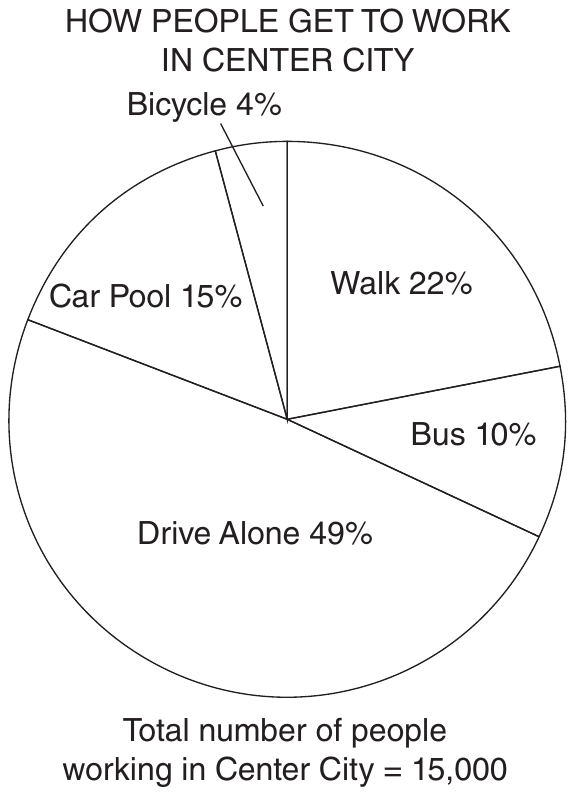
How many more people in Center City walk to work than ride their bicycle to work?
- A2,500
- B2,700
- C2,800
- D3,000
Show the answer
Correct answer: B
According to the chart, 22% of people walk to work and 4% ride a bicycle. Subtract to find the percentage of how many more people walk than bicycle:
22% − 4% = 18%
To find the exact number of people, multiply 18% (0.18) by the number of people working in Center City (15,000):
Question analysis
This circle graph question shows how the 15,000 people working in Center City get to work, with 22% walking and 4% riding a bicycle. Students find how many more people walk than bike by combining a percent difference with a percent of a total. The choices are close together, so estimating is risky.
- Grade level
- Grade 6 content, by NYS standard
- Compared with grade 7
- Below grade 7 Reading a circle graph and taking a percent of a total are grade 6 skills. With only two short steps and friendly numbers, this is easier than typical grade 7 multistep percent work.
- Estimated difficulty
- Straightforward: two steps or one careful reading.
- Thinking it demands
- Depth of knowledge 2, skills and concepts · mainly apply
- What makes it hard
- A very close wrong answer moderate
- Reading a figure, table or graph minor
- Error-prone arithmetic minor
- Solution
- 2 steps
- Reading level
- Question and choices: about grade 7, 16 words.
- Students, last 30 days
- Not enough answers yet to show (it takes 10).
Why it is hard, traps and wrong answers (shows the answer)
Why it is hard
The method is short: subtract the percents first, or find both groups and subtract, and both reach the same number. What makes the question less safe than it looks is the tight spread of choices, all within 500 of each other, so rounding 18% or slipping on one product lands on a wrong answer. Subtracting the percents first leaves one multiplication to get right instead of two.
A very close wrong answer moderate Choosing the answer
2,700 sits only 100 from 2,800 and 300 from 3,000, so estimating 18% of 15,000 as about a fifth cannot pick it; only the exact product does. (Embretson & Wetzel, 1987; Gorin & Embretson, 2006; Ascalon et al., 2007)
Reading a figure, table or graph minor Understanding the question
The Walk 22% and Bicycle 4% labels must be picked out of five sectors, and the 15,000 total sits in a caption below the circle graph. (Lesh, Post & Behr, 1987; Kirsch & Mosenthal, 1990)
Error-prone arithmetic minor Working it out
The percent gap has to become a count, 0.18 × 15,000, a decimal times a five-digit number worked by hand without a calculator. (Brown & Burton, 1978; Junker & Sijtsma, 2001)
Strategy: Subtract the two percents first, then take that single percent of 15,000, instead of finding each group and subtracting.
The wrong answers, classified
A Little reason to choose it (Haladyna & Downing, 1993; Rodriguez, 2005)
No common working gives 2,500, which is 1/6 of 15,000 and matches no sector or difference of sectors; it mostly catches estimates.
C An arithmetic slip (Junker & Sijtsma, 2001)
Takes 4% of 15,000 as 500 instead of 600 and subtracts it from the 3,300 walkers, getting 2,800.
D Rounds too early (King et al., 2004)
Rounds the 18-point gap up to 20% to make the multiplication easy and takes 20% of 15,000, which is 3,000.
Worked solution, step by step
Formulas used
- Percent of a number
- W is the whole amount. p is the percent, and x is the part you want. Percent means out of 100, so p percent is the fraction p over 100. Multiplying the whole by that fraction gives the part.
Sort out the circle graph
A circle graph shows how a whole splits into parts. This one shows how 15,000 workers get to work. Walk is 22%. Bicycle is 4%. You need how many more people walk than ride a bicycle.
Subtract the percents first
Both percents are parts of the same 15,000 people. So you can subtract the percents first. Then you only need one multiplication.
The difference is 18% of all the workers.
Find 18% of 15,000
First find 1% by dividing by 100. Then multiply by 18.
That is 2,700 people.
Avoid rounding and answer
Watch out: don’t round 18% up to 20% to make it easy. 20% of 15,000 is 3,000, choice D. The choices are close together, so you need the exact number. So the answer is B, 2,700.
Check your answer
Find each group, then subtract. Walkers: 22% of 15,000 is 3,300. Bike riders: 4% of 15,000 is 600. . You get the same answer.
More questions like this
The original DOE question
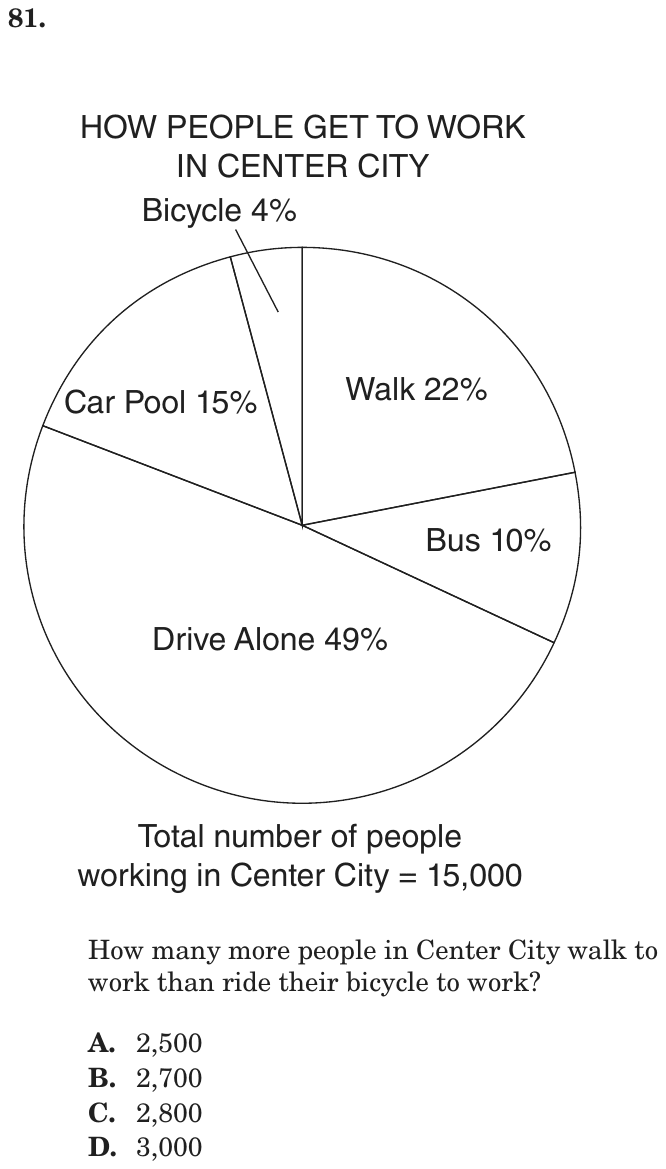
Question 25 of 57
2025 Practice Test A Math, question 25Question
Which of the following numbers has factors that include the smallest factor (other than 1) of 91?
- A30
- B35
- C39
- D44
Show the answer
Correct answer: B
To find the smallest factor of 91, list the factors:
1, 7, 13, and 91
The smallest factor (other than 1) is 7.
Of the options listed (30, 35, 39, and 44), only 35 is a multiple of 7.
Question analysis
A number properties question about factors: students find the smallest factor of 91 other than 1, then pick the number that shares it. Because 91 looks like a prime number, many students skip the factoring, and the choices include numbers built from factors that 91 might seem to have.
- NYS standards
- 6.NS.4 common factors and multiples
- Grade level
- Grade 6 content, by NYS standard
- Compared with grade 7
- Below grade 7 Factors and divisibility are grade 4 to 6 skills, and this takes two quick checks. It is easier than typical grade 7 work, though recognizing that 91 is not prime catches many students.
- Estimated difficulty
- Moderate: several steps, or a close reading with one strong distractor.
- Thinking it demands
- Depth of knowledge 2, skills and concepts · mainly apply
- What makes it hard
- Complex sentences moderate
- Something you must already know moderate
- Solution
- 2 steps
- Reading level
- Question and choices: about grade 8, 15 words.
- Students, last 30 days
- Not enough answers yet to show (it takes 10).
Why it is hard, traps and wrong answers (shows the answer)
Why it is hard
The question tests a grade 6 skill inside a hard-to-parse sentence. Once the stem is unpacked, the work is finding the smallest prime factor of 91 and checking the choices for it. Students lose points in two ways: 91 looks prime or divisible by 3, so they guess at its factors, or they find 13 before 7 and accept the choice that shares it.
Complex sentences moderate Understanding the question
The stem nests three ideas, "has factors that include the smallest factor (other than 1) of 91", so it has to be unpacked before any math; this is reading difficulty, not number difficulty. (Abedi & Lord, 2001; Freedle & Kostin, 1993; Messick, 1989)
Something you must already know moderate Working it out
Students must find that 91 = 7 × 13, and 91 is a number many students wrongly take to be prime or a multiple of 3. (Anderson & Krathwohl, 2001)
Strategy: Test 91 against the small primes in order, starting with 2, until one divides it evenly, then check which choice is a multiple of that prime.
Traps
- Misreads the question: Misses or misreads a condition or a word in the question: "at least", "each", "remaining", "not".
The wrong answers, classified
A An arithmetic slip (Junker & Sijtsma, 2001)
Wrongly takes 91 as a multiple of 3, as 90 is, and picks 30, which 3 divides; in fact 91 ÷ 3 is not a whole number.
C Misreads the question (Hegarty, Mayer & Monk, 1995)
Factors 91 as 7 × 13 but matches 39 = 3 × 13, which shares the larger factor, overlooking the word smallest.
D Little reason to choose it (Haladyna & Downing, 1993; Rodriguez, 2005)
Neither of its prime factors, 2 and 11, divides 91, an odd number, so no common working leads to 44; it mostly draws guesses.
Worked solution, step by step
Formulas used
- What a factor is
- a, b and c are whole numbers. If b = a × c, then a and c are factors of b. That means a divides b evenly, with no remainder. Every whole number has 1 and itself as factors.
Unpack the long sentence
A factor of a number divides it evenly, with nothing left over. For example, 3 is a factor of 12, because . The question has two steps. First, find “the smallest factor (other than 1) of 91”. Then find the choice that also has that factor.
Test small numbers on 91
Try dividing 91 by 2, 3, 5 and so on, until one works.
- 2: no. 91 is odd. That also rules out 4 and 6, which are even.
- 3: no. A number is a multiple of 3 only if its digits add to a multiple of 3. Here 9 + 1 = 10, which is not.
- 5: no. 91 does not end in 0 or 5.
- 7: yes!
So 7 is the smallest factor of 91 other than 1.
Avoid the 3 trap
Watch out: 91 is close to 90, and 3 goes into 90. But is 30 with 1 left over. So 3 is not a factor of 91. That trap leads to 30, choice A.
Check each choice for 7
Now look for a multiple of 7 among the choices.
- 30: no. and .
- 35: yes. .
- 39: no. .
- 44: no. .
Watch out: 39 shares 13 with 91, but 13 is the larger factor, not the smallest. That is choice C. So the answer is B, 35.
Check your answer
Multiply to be sure: and . So 7 goes into both numbers evenly. No number from 2 to 6 goes into 91, so 7 really is the smallest.
More questions like this
The original DOE question
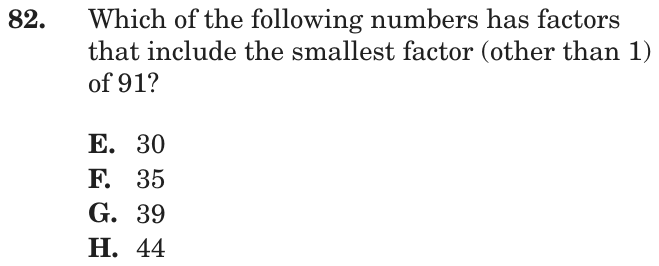
Question 26 of 57
2025 Practice Test A Math, question 26Question
In a scale drawing of a triangular banner, one side measures 16 centimeters and the other two sides each measure 12 centimeters. On the actual banner, these two sides each measure 36 feet. What is the length of the remaining side of the actual banner?
- A16 ft
- B32 ft
- C40 ft
- D48 ft
Show the answer
Correct answer: D
Let be the remaining side of the actual banner.
Set up a proportion:
ft
Question analysis
A scale drawing word problem about a triangular banner: the drawing's sides are 16 cm, 12 cm and 12 cm, and the two equal sides are 36 feet on the real banner. Students find the actual length of the remaining side. The key is using a scale factor, not adding the difference between lengths.
- Grade level
- Grade 7 content, by NYS standard
- Compared with grade 7
- At grade 7 Scale drawings are a named grade 7 topic, and this is a direct one-factor problem. It matches typical grade 7 work; the only pull away is reasoning by differences instead of by multiplication.
- Estimated difficulty
- Straightforward: two steps or one careful reading.
- Thinking it demands
- Depth of knowledge 2, skills and concepts · mainly apply
- What makes it hard
- Turning words into math minor
- Solution
- 2 steps
- Reading level
- Question and choices: about grade 4, 46 words.
- Students, last 30 days
- Not enough answers yet to show (it takes 10).
Why it is hard, traps and wrong answers (shows the answer)
Why it is hard
A scale drawing multiplies every length by the same factor, here 3 feet per centimeter, and the question checks whether students use that factor or a difference. The 16 cm side is 4 cm longer than the others, and adding 4 to 36 feels natural but treats the scale as an addition. Students who find the factor from the matching sides first have one multiplication left.
Turning words into math minor Understanding the question
"These two sides each measure 36 feet" refers back to the 12 cm sides, so the scale pairs 12 cm with 36 ft, centimeters on the drawing against feet on the banner. (Hegarty, Mayer & Monk, 1995; Koedinger & Nathan, 2004)
Strategy: Find the scale from the matching sides, feet per centimeter, then multiply the 16 cm side by that same factor.
Traps
- Misunderstands the concept: A wrong belief about a concept: that percents can be added, that area grows like length, that averages can be averaged, that a bigger denominator means a bigger fraction.
- Units or scale: The answer is wanted in other units, or a rate or scale must be converted first.
The wrong answers, classified
A Units or scale (King et al., 2004)
Copies the 16 cm from the drawing as 16 feet, without applying the scale that turns each centimeter into 3 feet.
B Misunderstands the concept (Smith, diSessa & Roschelle, 1993; De Bock et al., 1998; Ni & Zhou, 2005)
Reasons with differences instead of a scale factor and also subtracts, 36 − 4 = 32, though the 16 cm side is the longest.
C Misunderstands the concept (Smith, diSessa & Roschelle, 1993; De Bock et al., 1998; Ni & Zhou, 2005)
Adds the 4 cm difference between 16 and 12 to the 36 feet, keeping a constant difference instead of a constant ratio.
Worked solution, step by step
Formulas used
- Scale factor
- k is the scale factor: how many real units match 1 unit on the drawing. Divide a real length by its matching length on the drawing to find it. Every length on the drawing gets multiplied by the same k. That keeps the real shape the same as the drawing.
Sort out the question
A scale drawing is a smaller copy with the same shape. The drawing is a triangle with sides of 16 cm, 12 cm and 12 cm. On the real banner, the two 12 cm sides are 36 feet each. You need the real length of the 16 cm side.
Find the scale factor
Use the matching sides: 12 cm on the drawing is 36 feet on the banner.
So every 1 cm on the drawing stands for 3 feet on the banner.
Scale up the third side
Multiply the 16 cm side by the same scale factor.
The third side is 48 feet. Watch out: a scale multiplies lengths. It does not add to them. 16 is 4 more than 12, but adding 4 to 36 gives 40, choice C. So the answer is D, 48 ft.
Check your answer
The 16 cm side is the longest side on the drawing. So it must be the longest on the banner too, longer than 36 feet. 48 fits. Also, , the same scale as .
More questions like this
The original DOE question
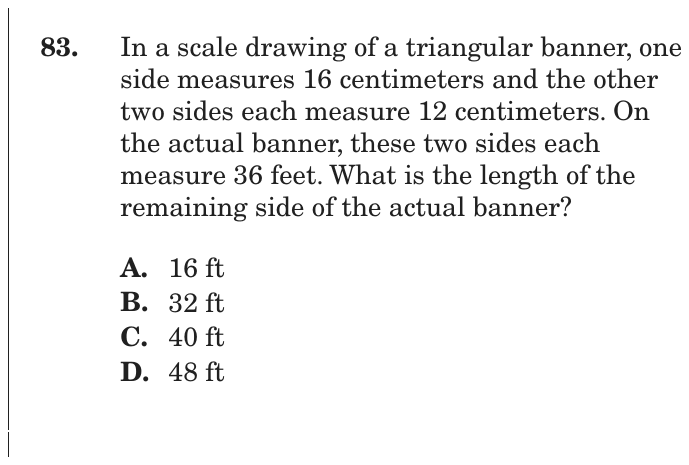
Question 27 of 57
2025 Practice Test A Math, question 27Question
SCORES ON MATH QUIZ
| Score | Number of Students |
| 85 | 4 |
| 75 | 4 |
| 65 | 2 |
What is the mean score of the 10 students in the table above?
- A22.5
- B75
- C77
- D85
Show the answer
Correct answer: C
For each row, multiply the number of students by the score. Then add those together and divide by the total number of students to find the mean (average) of the 10 students.
Question analysis
This statistics question gives a frequency table of quiz scores: three scores and how many of the 10 students earned each. Students find the mean score of all 10 students. Each score has to count as many times as students earned it, which is easy to overlook when only three scores are listed.
- Grade level
- Grade 6 content, by NYS standard
- Compared with grade 7
- Below grade 7 Computing a mean is grade 6 work, and this weighted version from a table takes two short steps. It is a little easier than typical grade 7 statistics, which compares whole data sets.
- Estimated difficulty
- Straightforward: two steps or one careful reading.
- Thinking it demands
- Depth of knowledge 2, skills and concepts · mainly apply
- What makes it hard
- A very close wrong answer moderate
- Reading a figure, table or graph minor
- Solution
- 2 steps
- Reading level
- Question and choices: about grade 2, 20 words.
- Students, last 30 days
- Not enough answers yet to show (it takes 10).
Why it is hard, traps and wrong answers (shows the answer)
Why it is hard
The procedure is routine once students see that the table lists counts, not separate students. The tempting shortcut is to average the three scores in the first column, which gives a listed choice close to the right one. Multiplying each score by its count, then dividing by 10, takes well under a minute.
A very close wrong answer moderate Choosing the answer
77 and 75 are only 2 points apart, so a rough sense of the middle score cannot choose between them; only weighting each score by its 4, 4 or 2 students does. (Embretson & Wetzel, 1987; Gorin & Embretson, 2006; Ascalon et al., 2007)
Reading a figure, table or graph minor Understanding the question
The table pairs each score with a number of students, so the 10 students are 4, 4 and 2, and each score must be weighted by its count. (Lesh, Post & Behr, 1987; Kirsch & Mosenthal, 1990)
Strategy: Multiply each score by its number of students, add the three products, and divide by the 10 students.
Traps
- Misunderstands the concept: A wrong belief about a concept: that percents can be added, that area grows like length, that averages can be averaged, that a bigger denominator means a bigger fraction.
The wrong answers, classified
A Numbers taken from the question (Hegarty, Mayer & Monk, 1995)
Adds the three scores, 85 + 75 + 65 = 225, and divides by the 10 students, an average lower than every score in the table.
B Misunderstands the concept (Smith, diSessa & Roschelle, 1993; De Bock et al., 1998; Ni & Zhou, 2005)
Averages the three listed scores, (85 + 75 + 65) ÷ 3 = 75, ignoring that 4, 4 and 2 students earned them.
D Numbers taken from the question (Hegarty, Mayer & Monk, 1995)
Picks the top score, which 4 students earned, instead of computing a mean of all 10 scores.
Worked solution, step by step
Formulas used
- Mean (average)
- M is the mean, also called the average. S is the sum, all the values added together. n is how many values there are. Dividing shares the total out equally, so the mean is what each value would be if they were all the same.
Sort out the table
The table lists 3 scores and how many students got each one. 4 students scored 85. 4 students scored 75. 2 students scored 65. That is students. You need the mean, or average, of all 10 scores.
Find the sum of all 10 scores
Each score counts once for every student who got it. So multiply each score by its number of students.
Add the three results.
All 10 scores add up to 770 points.
Divide by the number of students
Watch out: averaging just the three scores gives , choice B. That acts as if only one student got each score. So the answer is C, 77.
Check your answer
More students scored 85 than 65. So the mean should be a little above the middle score, 75. 77 fits. A mean must also be between the lowest and highest scores, 65 and 85. That rules out 22.5.
More questions like this
The original DOE question
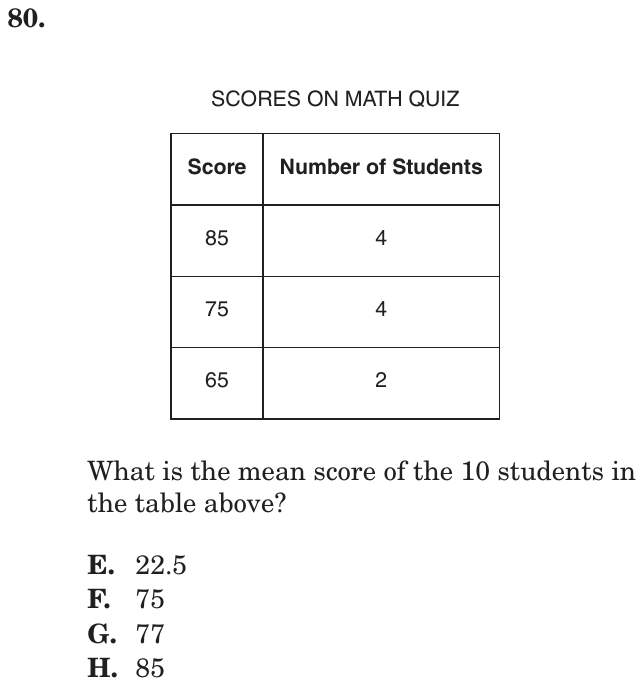
Question 28 of 57
2025 Practice Test A Math, question 28Question
The least of 5 consecutive integers is , and the greatest is . What is the value of in terms of ?
- A
- B
- C
- D
Show the answer
Correct answer: C
The first integer is , so the second is , the third is , then , and finally .
Since is the fifth and greatest of the integers,
Substitute for and simplify:
Question analysis
This algebra question about five consecutive integers calls the least one l and the greatest g, then asks for (l + g)/2 written in terms of l. Students must express g using l and simplify a fraction that contains a variable. Counting how far the fifth integer is from the first is where many students slip.
- NYS standards
- Grade level
- Grade 7 content, by NYS standard
- Compared with grade 7
- At grade 7 Grade 7 students combine like terms in expressions such as 3(x + 4) − x. This item first asks them to build the expression from a description of consecutive integers, then simplify it, with only letters to work with.
- Estimated difficulty
- Moderate: several steps, or a close reading with one strong distractor.
- Thinking it demands
- Depth of knowledge 2, skills and concepts · mainly apply
- What makes it hard
- Variables instead of numbers moderate
- Turning words into math minor
- Every choice must be checked minor
- Solution
- 3 steps
- Reading level
- Question and choices: about grade 8, 26 words.
- Students, last 30 days
- Not enough answers yet to show (it takes 10).
Why it is hard, traps and wrong answers (shows the answer)
Why it is hard
The algebra is short once g is written as l + 4, so most errors come from the fence-post count or from testing numbers carelessly. The wrong choices in front of the answer are exactly the ones a single test value cannot rule out, which punishes students who stop at the first match. Using two test values, or simplifying (2l + 4)/2 directly, avoids both traps.
Variables instead of numbers moderate Understanding the question
Every expression is in l, so the simplification of (l + l + 4)/2 has to be done with letters and cannot be checked against a single number. (Koedinger & Nathan, 2004; Enright, Morley & Sheehan, 2002)
Turning words into math minor Understanding the question
The description "the least of 5 consecutive integers is l, and the greatest is g" must become g = l + 4, four steps up, not five. (Hegarty, Mayer & Monk, 1995; Koedinger & Nathan, 2004)
Every choice must be checked minor Choosing the answer
A single test value fits two choices: l = 1 makes 3l and l + 2 both 3, and l = 2 makes 2l and l + 2 both 4. (Embretson & Wetzel, 1987)
Strategy: Write the integers as l, l + 1, and so on up to the fifth, substitute for g and simplify; then test two different starting values, since one value can match a wrong choice by coincidence.
Traps
- Counting the ends: Inclusive or exclusive ends, fence posts, consecutive numbers: an answer that is one too many or too few, or an endpoint drawn open where it belongs closed (or the reverse).
The wrong answers, classified
A Checks only one number (Schoenfeld, 1985)
Tests only l = 2, where 2 through 6 give (2 + 6)/2 = 4, and takes 2l, the first choice that also equals 4.
B Checks only one number (Schoenfeld, 1985)
Tests only l = 1, where 1 through 5 give (1 + 5)/2 = 3, and stops at 3l, which matches before l + 2 is checked.
D Counting the ends (Brown & Burton, 1978)
Writes the greatest integer as l + 5, counting five steps for five integers, then halves only the 2l in (2l + 5)/2, leaving l + 5.
Worked solution, step by step
Formulas used
- Greatest of 5 consecutive integers
- l is the least (smallest) integer and g is the greatest. Consecutive integers go up by 1 each time. Five integers have only 4 jumps from the first to the last, so you add 4, not 5.
- Dividing a sum
- a and b are the two parts of the top, and c is the number you divide by. To divide a sum, divide each part. You must divide every part of the top, not just one.
Sort out the words
Integers are whole numbers, like −2, 0 and 7. Consecutive integers come one right after another, like 8, 9, 10. There are 5 of them here.
The smallest is called l and the biggest is called g. You must write using only the letter l.
Write all five integers
Each integer is 1 more than the one before:
The fifth one is the greatest, so g = l + 4. Watch out: five integers have only four jumps between them. Writing g = l + 5 leads to choice D.
Put l + 4 in place of g
Swap g for l + 4 in the fraction:
Here l + l is 2l, which means 2 times l.
Split the fraction
Divide each part of the top by 2:
So the answer is C, .
Check your answer
Test two starting numbers. If l = 1, the integers are 1 to 5, and (1 + 5) ÷ 2 = 3, which is 1 + 2. If l = 10, they are 10 to 14, and (10 + 14) ÷ 2 = 12, which is 10 + 2. Use two tests, because l = 1 also makes 3l equal 3, choice B.
More questions like this
The original DOE question
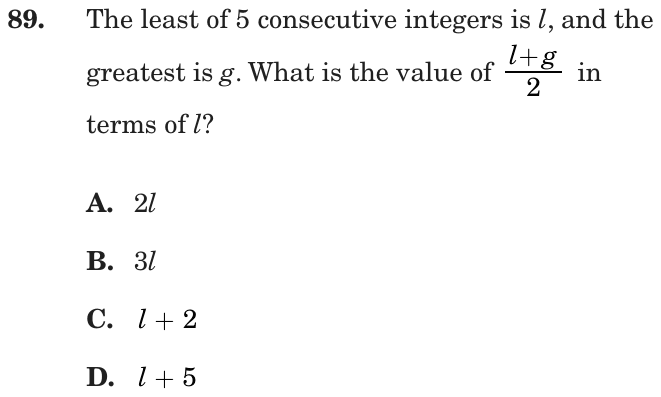
Question 29 of 57
2025 Practice Test A Math, question 29Question
The owner of a tree farm plants pine trees and oak trees in a ratio of . How many oak trees are planted if 264 pine trees are planted?
Fill-in question: work out the answer and type it as a number.
Show the answer
Correct answer: 99
Let be the number of oak trees when 264 pine trees are planted. Set up a proportion and solve for :
Question analysis
A ratio word problem about a tree farm that plants pine and oak trees in a fixed ratio of 8 to 3. Given how many pine trees are planted, students find the matching number of oak trees and grid it in. The main risk is pairing each number with the wrong kind of tree.
- Grade level
- Grade 6 content, by NYS standard
- Compared with grade 7
- Below grade 7 This is a one-ratio proportion with whole numbers, the kind of problem grade 6 students solve with equivalent ratios. A typical grade 7 task adds rates with fractions or a multistep percent; this has neither.
- Estimated difficulty
- Routine: one familiar step, little to misread.
- Thinking it demands
- Depth of knowledge 2, skills and concepts · mainly apply
- What makes it hard
- Solution
- 2 steps
- Reading level
- Question and choices: about grade 4, 28 words.
- Corrected from the DOE handbook
- An arithmetic slip in the explanation was corrected.
- Students, last 30 days
- Not enough answers yet to show (it takes 10).
Why it is hard, traps and wrong answers (shows the answer)
Why it is hard
This is a one-ratio scaling problem with friendly numbers: 264 splits into 8 equal parts of 33. The only real risk is matching 264 to the wrong term of 8:3, and a quick sense check catches it, since oak trees are the smaller group and must number fewer than 264. Students who grid the one-part value or the total of both kinds of tree have answered a question that was not asked.
Turning words into math minor Understanding the question
The ratio 8:3 lists pine first, so the 264 pine trees match the 8 and the oak count matches the 3; reading the terms in the other order flips the setup. (Hegarty, Mayer & Monk, 1995; Koedinger & Nathan, 2004)
An answer in an unexpected form minor Choosing the answer
As a grid-in it offers no choices, so an upside-down proportion that gives 704 oak trees, far more than the 264 pines, has to be caught by the student's own check. (Enright, Morley & Sheehan, 2002)
Strategy: Divide the number of pine trees by the pine part of the ratio to get the size of one part, then multiply by the oak part.
Traps
- Answers a different question: A choice is right for another quantity: the other unknown, the rest instead of the part, the part instead of the whole.
- Stops one step early: A choice is a number from partway through the solution.
The wrong answers, classified
704 Wrong operation (Hegarty, Mayer & Monk, 1995; King et al., 2004)
Turns the ratio upside down, treating the 264 pines as 3 parts: 264 ÷ 3 = 88, then 88 × 8 = 704.
33 Stops one step early (King et al., 2004; Gierl et al., 2017)
Divides 264 by 8 to get the size of one part, 33 trees, and stops before multiplying by the 3 parts that are oak.
363 Answers a different question (King et al., 2004; Hegarty, Mayer & Monk, 1995)
Finds the 99 oak trees correctly and then adds the 264 pines, gridding the total number of trees planted.
What was corrected from the DOE handbook, and why
- Explanation: The handbook goes from x/264 = 3/8 to “8x = 762”. Cross-multiplying gives 8x = 3 × 264 = 792, so that line now reads 8x = 792. The handbook’s final answer, x = 99, was already right (792 ÷ 8 = 99).
Worked solution, step by step
Formulas used
- Equal ratios
- a and b are the two numbers in a ratio, written as a fraction. n is any number you choose, except zero. Multiplying both numbers by the same n gives an equal ratio. This is how you scale a small ratio up to real counts.
Sort out the ratio
A ratio compares two amounts. Here the ratio of pine trees to oak trees is 8:3. Pine comes first, so pine goes with the 8. Oak goes with the 3. So for every 8 pine trees, there are 3 oak trees.
The farm planted 264 pine trees. You need the number of oak trees.
Find the size of one part
Think of the trees in equal groups, called parts. Pine trees fill 8 parts, and oak trees fill 3 parts. The 264 pine trees are the 8 parts, so divide by 8.
Each part is 33 trees. Watch out: 33 is one part, not the number of oak trees. Don’t stop here.
Find the number of oak trees
Oak trees fill 3 parts. Multiply the part size by 3.
You can see the same thing with equal ratios. Multiply both numbers of 8:3 by 33.
So 264 pine trees go with 99 oak trees.
Avoid the traps and answer
Watch out: if you match 264 to the 3 instead of the 8, you flip the ratio. That gives 704 oak trees. Watch out: the question asks only for oak trees. Adding the 264 pines gives 363. So you would grid 99.
Check your answer
The ratio 8:3 says there are fewer oak trees than pine trees. 99 is less than 264, so that fits. Also, divide both counts by 33: and . That gives back 8:3.
More questions like this
The original DOE question

Question 30 of 57
2025 Practice Test A Math, question 30Question
Today, Tien’s age is of Jordan’s age. In 2 years, Tien’s age will be of Jordan’s age. How old is Jordan today?
- A4 years old
- B6 years old
- C12 years old
- D16 years old
Show the answer
Correct answer: D
First, set up an equation to express Tien’s age () and Jordan’s age () today:
Two years from now, Tien’s age will be , and Jordan’s age will be .
Set up an equation about the relationship between Tien’s age and Jordan’s age in two years:
Solve the above equation for :
Now set the two equations equal to each other and solve for :
Question analysis
This age word problem says Tien is one fourth of Jordan's age today and will be one third of Jordan's age in two years, then asks for Jordan's current age. Students must turn two fractional relationships into equations and solve them together. Both people age by the same two years, and it is easy to solve for the wrong person.
- NYS standards
- Grade level
- Grade 8 content, by NYS standard
- Compared with grade 7
- Above grade 7 Grade 7 equations have one unknown on one side, like 3x + 5 = 20. This one links two unknown ages with fractional coefficients and leads to a variable on both sides, which is grade 8 algebra.
- Estimated difficulty
- Hard: combines ideas, needs a plan, and has more than one tempting wrong answer.
- Thinking it demands
- Depth of knowledge 2, skills and concepts · mainly apply
- What makes it hard
- Turning words into math major
- Error-prone arithmetic moderate
- Solution
- 4 steps
- Reading level
- Question and choices: about grade 1, 31 words.
- Students, last 30 days
- Not enough answers yet to show (it takes 10).
Why it is hard, traps and wrong answers (shows the answer)
Why it is hard
The difficulty is in the setup: two fractional relationships at two different times, with both people aging. Once the equations are right, the algebra is short, but it ends with two ages and only one is asked for. Testing the choices against both conditions is a reliable alternative that avoids the algebra entirely.
Turning words into math major Understanding the question
The second sentence must become T + 2 = (J + 2)/3; writing J/3, or forgetting that Jordan also ages two years, breaks the equation. (Hegarty, Mayer & Monk, 1995; Koedinger & Nathan, 2004)
Error-prone arithmetic moderate Working it out
Substituting J/4 for T leaves J/4 + 2 = (J + 2)/3, an equation with fractions on both sides that must be cleared, usually by multiplying by 12. (Brown & Burton, 1978; Junker & Sijtsma, 2001)
Strategy: Let Jordan's age be J, write Tien's age as J/4, and set J/4 + 2 equal to one third of (J + 2); or test each choice against both conditions.
Traps
- Answers a different question: A choice is right for another quantity: the other unknown, the rest instead of the part, the part instead of the whole.
The wrong answers, classified
A Answers a different question (King et al., 2004; Hegarty, Mayer & Monk, 1995)
Solves the equations correctly but reports Tien's age today, 4, which is one fourth of Jordan's 16, instead of Jordan's age.
B Answers a different question (King et al., 2004; Hegarty, Mayer & Monk, 1995)
Gives Tien's age two years from now, 4 + 2 = 6, answering for the wrong person and the wrong time.
C Numbers taken from the question (Hegarty, Mayer & Monk, 1995)
Picks 12 because it is a multiple of both 4 and 3, but then Tien would be 3 and later 5, not a third of 14.
Worked solution, step by step
Formulas used
- Distributive property
- a, b and c are any numbers. To multiply a sum by a number, multiply each part of the sum, then add. It works because a groups of (b + c) is the same as a groups of b plus a groups of c.
Sort out what you know
Today, Tien’s age is of Jordan’s age. That means Jordan is 4 times as old as Tien.
In 2 years, both of them will be 2 years older. Then Tien’s age will be of Jordan’s. So Jordan will be 3 times as old as Tien. You need Jordan’s age today.
Name the ages with a letter
Let t stand for Tien’s age today. Jordan is 4 times as old, so his age is 4t, which means 4 times t. Add 2 years to each age:
Person Today In 2 years Tien Jordan Watch out: Jordan gets 2 years older too. Do not forget to add 2 to his age.
Write an equation for later
In 2 years, Jordan’s age will be 3 times Tien’s age. Write that as an equation:
Use the distributive property on the right side. Multiply both t and 2 by 3:
Solve for Tien’s age
Take 3t away from both sides. Doing the same thing to both sides keeps them equal:
Now take 2 away from both sides:
So Tien is 4 years old today. Watch out: 4 is Tien’s age, not Jordan’s. Choice A, 4 years old, is a trap.
Find Jordan’s age
Jordan is 4 times as old as Tien:
So the answer is D, 16 years old.
Check your answer
Put 16 back into the story. Today, Tien is 16 ÷ 4 = 4. In 2 years, Tien is 6 and Jordan is 18. Is 6 one third of 18? Yes, because 18 ÷ 3 = 6. Choice C fails: Tien would be 3, then 5, and 5 is not a third of 14.
More questions like this
The original DOE question
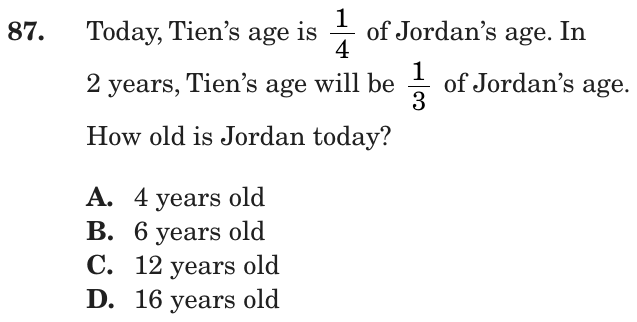
Question 31 of 57
2025 Practice Test A Math, question 31Question
Complete the steps to show one way to solve the equation for x.
Move the correct answer to each box. Each answer may be used more than once. Not all answers will be used.
On the test you drag tiles into the boxes; here, choose each box’s tile from its menu. A tile can be used more than once. The DOE has not published how answers with several parts are scored; this site counts one right only when every part is right.
Show the answer
Correct answer: blank 1: −4; blank 2: 28; blank 3: −56
Solution:
Answer for second equation: −4
Answer for third equation: 28
Answer for fourth equation: −56
Distribute the −0.5 on the right side of the equation: .
Add 4 to both sides of the equation to eliminate the −4 on the right side: .
Divide both sides by −0.5: .
Question analysis
Students complete a step-by-step solution of the equation 24 = −0.5(x + 8) by dragging number tiles into three boxes: one after distributing, one after collecting the constants, and one for x. It tests solving a two-step linear equation with a negative decimal. Tiles may be reused, and many come in positive and negative pairs, so every sign counts.
- Grade level
- Grade 7 content, by NYS standard
- Compared with grade 7
- At grade 7 Solving equations of the form p(x + q) = r with rational numbers is named in the grade 7 standards. Here the steps are laid out, but the negative decimal factor forces a sign decision at every one of the three boxes.
- Estimated difficulty
- Moderate: several steps, or a close reading with one strong distractor.
- Thinking it demands
- Depth of knowledge 1, recall and reproduction · mainly apply
- What makes it hard
- Error-prone arithmetic moderate
- A very close wrong answer minor
- Many steps minor
- An answer in an unexpected form minor
- Solution
- 3 steps
- Reading level
- Question and choices: about grade 3, 39 words.
- Students, last 30 days
- Not enough answers yet to show (it takes 10).
Why it is hard, traps and wrong answers (shows the answer)
Why it is hard
The layout settles the method, so the question comes down to one sign at each box. The printed plus before the first box nudges students toward the positive 4, and the pool then supplies every number that follows from it, down to −40. Students who distribute correctly can still lose the item at the last box by dividing 28 by 0.5. Substituting −56 back, −0.5 × (−48) = 24, confirms the final box.
Error-prone arithmetic moderate Working it out
Two of the three boxes turn on a negative decimal: −0.5 times 8 must give −4, and dividing 28 by −0.5 means multiplying by −2, which doubles the size and makes it negative. (Brown & Burton, 1978; Junker & Sijtsma, 2001)
A very close wrong answer minor Choosing the answer
The pool pairs −4 with 4, −40 with 40 and −56 with 56, so a box filled with the right size and the wrong sign looks just as finished; estimating cannot separate −56 from 56. (Embretson & Wetzel, 1987; Gorin & Embretson, 2006; Ascalon et al., 2007)
Many steps minor Working it out
The three boxes form a chain and all three must be right, so a slip in the first carries through; the pool even holds the whole wrong chain 4, 20 and −40. (Daniel & Embretson, 2010; Enright, Morley & Sheehan, 2002)
An answer in an unexpected form minor Choosing the answer
The second line prints a plus sign before its box, so the distributed −0.5x − 4 must be written as −0.5x + (−4), with the negative tile in the box. (Enright, Morley & Sheehan, 2002)
Strategy: Multiply −0.5 by both x and 8, undo the constant term by doing the opposite operation to both sides, then divide by −0.5, which is the same as multiplying by −2.
Traps
- Order of operations: Working left to right, or distributing a minus sign wrongly, gives a choice.
- Negatives and direction: Arithmetic with negative numbers, the order of a subtraction, or direction on a number line. (Moving a term across the equals sign without changing its sign is a faulty procedure.)
- A faulty procedure: A systematic but wrong procedure: adding fractions straight across, applying an exponent to each term of a sum, dropping a sign when moving a term.
The wrong answers, classified
DEB Order of operations (Brown & Burton, 1978)
Gives the minus of −0.5 to x but not to 8, writing −0.5x + 4, then correctly reaches 20 = −0.5x and x = −40 from that wrong start.
CFH Negatives and direction (Brown & Burton, 1978)
Distributes and adds 4 correctly to reach 28 = −0.5x, then divides 28 by 0.5 instead of −0.5, dropping the negative and entering 56.
CEB A faulty procedure (Brown & Burton, 1978; Tatsuoka, 1983)
Distributes correctly to −4 but moves it to the left side without changing its sign, so 24 − 4 = 20, and 20 ÷ (−0.5) = −40.
Worked solution, step by step
Formulas used
- The distributive property
- a is the number in front of the parentheses, and b and c are the terms inside. Multiply a by each term inside. If a is negative, the minus sign goes into every product. It works because a groups of b + c is the same as a groups of b plus a groups of c.
- Signs when you multiply or divide
- A negative number times a positive number gives a negative result. A negative times a negative gives a positive result. The same rules hold when you divide. Use them at every step where a negative number appears.
- Doing the same to both sides
- a and b are the two sides of an equation, and c is any number (not zero when you divide). An equation is like a balanced scale. Doing the same thing to both sides keeps it level. That is how you get x by itself.
Sort out the question
You solve by filling three boxes:
- Box 1 comes after , once the parentheses are gone.
- Box 2 is the number equal to .
- Box 3 is the value of x.
A tile can be used more than once, and some tiles are not used.
Distribute the −0.5
Multiply −0.5 by each term inside the parentheses. A negative times a positive is negative:
So . The line already shows a plus sign, so box 1 gets −4.
Watch out: the −0.5 multiplies the 8 too. Writing 4 instead starts a wrong chain: 4, then 20, then −40. Every number in that chain is a tile.
Add 4 to both sides
You want −0.5x alone on one side, and the −4 is in the way. Adding 4 undoes subtracting 4, so add 4 to both sides:
Box 2 gets 28.
Watch out: taking 4 away from 24 instead gives 20, another tile.
Divide both sides by −0.5
Now x is multiplied by −0.5. Dividing undoes multiplying, so divide both sides by −0.5:
Dividing by 0.5 is the same as multiplying by 2, since every whole holds two halves. A positive divided by a negative is negative. So .
Watch out: dropping the minus sign gives 56, which is also a tile.
Name the three tiles
From top to bottom, the finished steps read:
So the boxes get −4, 28 and −56, in that order. On the test, you drag each tile into its box. On this site, you choose it from the box’s menu.
Check your answer
Put back into the first equation. . Then , since a negative times a negative is positive. That gives 24, the left side, so −56 is right.
More questions like this
The original DOE question
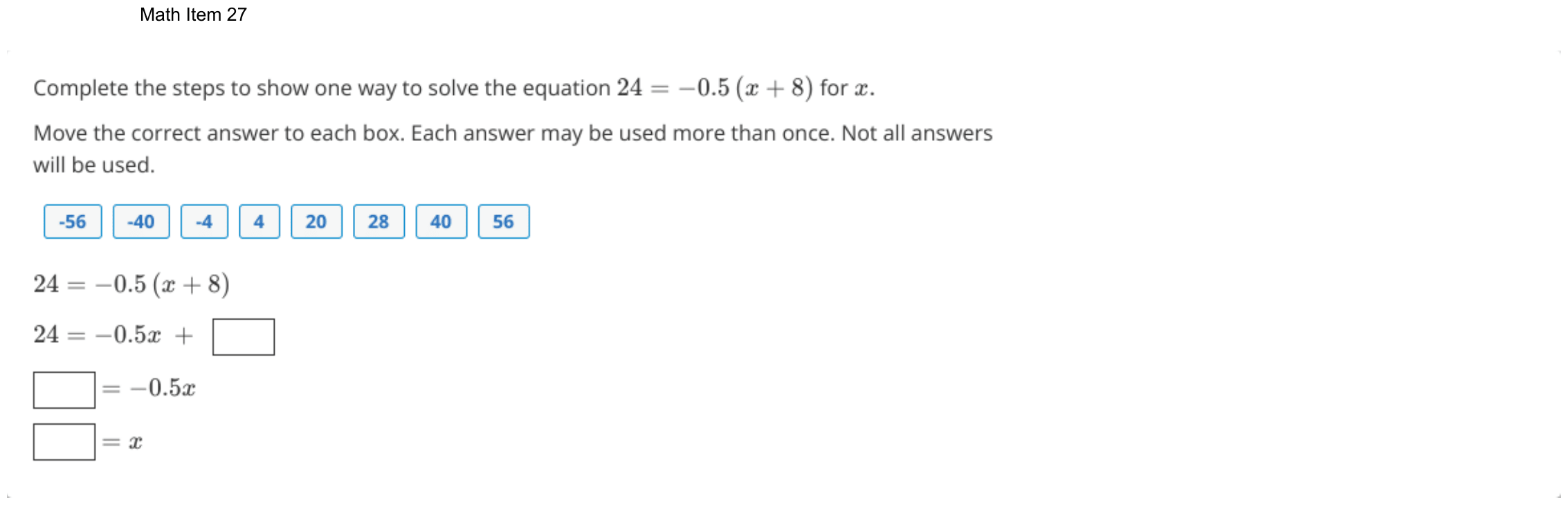
Question 32 of 57
2025 Practice Test A Math, question 32Question
What is the value of the expression shown above?
- A
- B
- C
- D
Show the answer
Correct answer: D
Convert all the fractions to a common denominator (10):
Question analysis
A fractions question: add four mixed numbers whose fractions have denominators of 5, 10, 5 and 2. Students rewrite the fractions over a common denominator, add the whole numbers and the fractions, regroup any extra whole, and simplify. Regrouping and lowest terms both matter, since the choices differ in exactly those places.
- NYS standards
- Grade level
- Grade 7 content, by NYS standard
- Compared with grade 7
- Below grade 7 Adding mixed numbers with unlike denominators is grade 5 content. With four terms and a regrouping step it takes care, but it asks less than typical grade 7 work with negative rational numbers.
- Estimated difficulty
- Straightforward: two steps or one careful reading.
- Thinking it demands
- Depth of knowledge 1, recall and reproduction · mainly apply
- What makes it hard
- Error-prone arithmetic moderate
- A very close wrong answer moderate
- An answer in an unexpected form minor
- Solution
- 3 steps
- Reading level
- Question and choices: about grade 9, 14 words.
- Students, last 30 days
- Not enough answers yet to show (it takes 10).
Why it is hard, traps and wrong answers (shows the answer)
Why it is hard
The numbers are friendly: every fraction converts to tenths, and the whole parts add to 14. The risk is in the bookkeeping, either forgetting to carry the extra whole from the fractions or adding numerators over a made-up denominator. Converting to decimals, 2.2 + 3.3 + 4.4 + 5.5, is a fast check that avoids both.
Error-prone arithmetic moderate Working it out
Four mixed numbers with denominators 5, 10, 5 and 2 must be rewritten as tenths, 2 + 3 + 4 + 5 tenths, and the 14/10 regrouped into a whole and a fraction. (Brown & Burton, 1978; Junker & Sijtsma, 2001)
A very close wrong answer moderate Choosing the answer
15 2/5 and 14 2/5 are written alike and share the fraction 2/5; only the whole carried from 14/10 separates them, so a missed carry is invisible at a glance. (Embretson & Wetzel, 1987; Gorin & Embretson, 2006; Ascalon et al., 2007)
An answer in an unexpected form minor Choosing the answer
The fractions total 1 4/10, but every choice is in lowest terms, so the 4/10 has to be reduced to 2/5 before it matches. (Enright, Morley & Sheehan, 2002)
Strategy: Convert each mixed number to a decimal, since these fractions all convert exactly, add them, and turn the decimal part back into a fraction in lowest terms.
Traps
- Answer in another form: The right answer is written differently from the way you worked it out.
The wrong answers, classified
A A faulty procedure (Brown & Burton, 1978; Tatsuoka, 1983)
Adds the numerators straight across, 1 + 3 + 2 + 1 = 7, and puts them over 20, a common denominator (10 × 2), without rescaling them, so nothing carries.
B An arithmetic slip (Junker & Sijtsma, 2001)
Adds the fractions to 14/10 but keeps only the 4/10 = 2/5 left over, forgetting to carry the whole 1 into 14.
C Little reason to choose it (Haladyna & Downing, 1993; Rodriguez, 2005)
Pairs a correct carry into 15 with the 7/20 from adding numerators, two steps no single line of working combines; it mostly catches guesses.
Worked solution, step by step
Formulas used
- Equal fractions
- a is the top number, called the numerator. b is the bottom number, called the denominator. n is any whole number except zero. Multiplying the top and bottom by the same n gives an equal fraction. Use it to give fractions the same denominator so you can add them.
Sort out the question
You need to add four mixed numbers. A mixed number is a whole number plus a fraction, like . The fractions have different denominators, or bottom numbers: 5, 10, 5 and 2. To add fractions, they need the same denominator.
Add the whole numbers
Add the whole numbers first. You will add the fractions on their own after that.
The whole numbers make 14.
Rewrite each fraction in tenths
Use 10 as the denominator, since 5 and 2 both go into 10.
is already in tenths. Watch out: when you change a bottom number, change the top too. Adding the old tops, 1 + 3 + 2 + 1 = 7, and putting them over 20 gives 7/20. That is in choices A and C.
Add the fractions
14 tenths is more than 1 whole. Ten tenths make 1, so 14 tenths is 1 whole and 4 tenths.
To simplify 4/10, divide the top and bottom by 2.
Put it all together
Add the 14 wholes to the sum of the fractions.
Watch out: carry the extra whole into the 14. Missing it gives , choice B. So the answer is D, .
Check your answer
Change each mixed number to a decimal: . The 0.4 is 4 tenths, which is 2/5. So the sum is .
More questions like this
The original DOE question
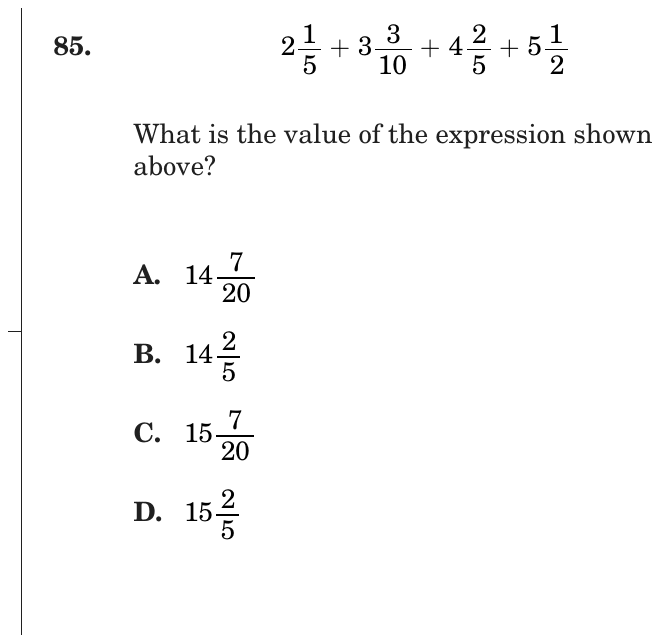
Question 33 of 57
2025 Practice Test A Math, question 33Question
An unmarked straight stick will be laid end over end to measure a distance of exactly 72 feet. The same stick will be used in the same way to measure a distance of exactly 30 feet. What is the length of the longest possible stick that can be used for both measurements?
- A3 ft
- B4 ft
- C6 ft
- D8 ft
Show the answer
Correct answer: C
The length of the stick must be the greatest common factor of 72 and 30.
The factors of 30 are
1, 2, 3, 5, 6, 10, 15, and 30.
Of those, only 1, 2, 3, and 6 are also factors of 72. The greatest of these is 6.
Question analysis
This word problem asks for the longest stick that can be laid end over end to measure exactly 72 feet and exactly 30 feet. Students must recognize that the stick's length has to divide both distances evenly, so the task is finding a greatest common factor. The story wording hides the factor idea.
- NYS standards
- 6.NS.4 common factors and multiples
- Grade level
- Grade 6 content, by NYS standard
- Compared with grade 7
- Below grade 7 Finding a greatest common factor is a sixth-grade skill, and the arithmetic is light. The question is a little less routine than a bare factor problem only because students must see that the story calls for one.
- Estimated difficulty
- Straightforward: two steps or one careful reading.
- Thinking it demands
- Depth of knowledge 2, skills and concepts · mainly apply
- What makes it hard
- No obvious method moderate
- Hard words minor
- Solution
- 2 steps
- Reading level
- Question and choices: about grade 3, 54 words.
- Students, last 30 days
- Not enough answers yet to show (it takes 10).
Why it is hard, traps and wrong answers (shows the answer)
Why it is hard
Once the story is recognized as a greatest common factor problem, the arithmetic is light and the choices can simply be tested. The trap is checking only one of the two distances, because the longest choice works for 72 feet but not for 30. A student who lists the factors of 30 first, the smaller number, sees the answer quickly.
No obvious method moderate Working it out
Nothing in the stick story says "common factor"; students must see that laying the stick a whole number of times along 72 and 30 feet means it divides both. (Schoenfeld, 1985)
Hard words minor Understanding the question
The phrases "unmarked straight stick" and "laid end over end" are unusual wording for a math item; they describe whole-stick lengths, a reading hurdle rather than more math. (Perfetti, 2007; Freedle & Kostin, 1993)
Strategy: Translate 'measures both distances exactly' into 'divides both numbers evenly', list the factors of the smaller number, 30, and take the largest that also divides 72.
Traps
- Misreads the question: Misses or misreads a condition or a word in the question: "at least", "each", "remaining", "not".
- Answers a different question: A choice is right for another quantity: the other unknown, the rest instead of the part, the part instead of the whole.
The wrong answers, classified
A Answers a different question (King et al., 2004; Hegarty, Mayer & Monk, 1995)
Finds a length that divides both 72 and 30, 3 feet, but not the longest one, missing that 6 also divides both.
B Misreads the question (Hegarty, Mayer & Monk, 1995)
Checks only that 4 divides 72, giving 18 sticks, and misses that 30 feet would take 7.5 sticks.
D Misreads the question (Hegarty, Mayer & Monk, 1995)
Takes the longest choice that divides 72 evenly, nine 8-foot lengths, without checking that 30 feet is not a whole number of 8-foot sticks.
Worked solution, step by step
Formulas used
- Number of sticks
- d is the distance to measure. s is the length of the stick. n is how many times you lay the stick down. For an exact measure, n must be a whole number. So s must divide d evenly.
Sort out the story
You lay a stick down again and again, end to end, like taking steps. The stick has no marks, so you can only count whole stick lengths.
It must fit exactly into 72 feet and exactly into 30 feet. You need the longest stick that does both.
Turn it into factors
Fitting exactly means no piece is left over. So the stick length must divide 72 evenly and divide 30 evenly.
A number that divides both is a common factor. You want the greatest common factor: the biggest number that divides both.
List the factors of 30
Start with the smaller number, 30, since its list is shorter. Its factors are 1, 2, 3, 5, 6, 10, 15 and 30.
Now test them on 72, starting from the biggest. 30, 15, 10 and 5 leave a remainder. But 6 works:
So 6 is the greatest common factor.
Check the other choices
Watch out: 8 feet fits 72 feet, 9 times. But 30 ÷ 8 = 3.75, not a whole number, so choice D fails. Choice B fails too, since 30 ÷ 4 = 7.5. A 3-foot stick works, but it is not the longest, so choice A is wrong.
So the answer is C, 6 ft.
Check your answer
Use the stick. A 6-foot stick goes down 12 times for 72 feet, since 12 × 6 = 72. It goes down 5 times for 30 feet, since 5 × 6 = 30. Both counts are whole numbers, so 6 feet works.
More questions like this
The original DOE question
Question 34 of 57
2025 Practice Test A Math, question 34Question
There are 6 different cookies on a plate. Aiden will choose 2 of these cookies to pack in his lunch. How many different pairs of 2 cookies can he choose from the 6?
- A12
- B15
- C30
- D36
Show the answer
Correct answer: B
Create a list of the possible pairs. Let the cookies be named A, B, C, D, E, and F.
AB, AC, AD, AE, AF
BC, BD, BE, BF
CD, CE, CF
DE, DF
EF
There are a total of 15 possible pairs of cookies that Aiden can choose.
Question analysis
This counting question asks how many different pairs of cookies Aiden can choose from six different cookies on a plate. Students must count combinations, where taking the same two cookies in a different order is not a new pair. The challenge is that the order of picking does not matter, so each pair must be counted once.
- NYS standards
- 7.SP.8b sample spaces for compound events
- Grade level
- Grade 7 content, by NYS standard
- Compared with grade 7
- At grade 7 Grade 7 students list the outcomes of compound events with organized lists and tree diagrams. Counting pairs is close to that work, but students must notice that the order of choosing does not matter.
- Estimated difficulty
- Moderate: several steps, or a close reading with one strong distractor.
- Thinking it demands
- Depth of knowledge 2, skills and concepts · mainly apply
- What makes it hard
- Much to keep track of moderate
- Solution
- 2 steps
- Reading level
- Question and choices: about grade 4, 29 words.
- Students, last 30 days
- Not enough answers yet to show (it takes 10).
Why it is hard, traps and wrong answers (shows the answer)
Why it is hard
Students who know the multiplication principle are the most at risk, because it counts each pair twice. The question rewards noticing that a pair has no order, either by listing systematically or by halving 6 × 5. The list of 15 pairs takes under a minute, so there is no time pressure to justify a shortcut.
Much to keep track of moderate Working it out
Listing all pairs by hand means tracking which have been written so none is repeated or skipped, which an organized list such as AB to AF handles. (Sweller, 1988; Carpenter, Just & Shell, 1990)
Strategy: Name the cookies with letters and list the pairs systematically: the first cookie with every later one, then the second with every later one, and so on.
Traps
- Overlapping groups: Things in two groups at once are counted twice, or not subtracted.
- Without replacement: In a second pick there is one fewer item, which changes the probability.
The wrong answers, classified
A Numbers taken from the question (Hegarty, Mayer & Monk, 1995)
Multiplies the 6 cookies by the 2 being chosen, a product of the stem's numbers that does not count any pairs.
C Overlapping groups (King et al., 2004)
Counts ordered picks, 6 choices then 5, so every pair such as AB and BA is counted twice, giving 30 instead of half that.
D Without replacement (Fischbein & Schnarch, 1997)
Uses 6 × 6, as if the first cookie went back on the plate, which counts order and also allows the same cookie twice.
Worked solution, step by step
Formulas used
- Number of pairs
- n is how many things you choose from. Each of the n things can pair with the n − 1 others. That counts every pair twice, once from each side, so you divide by 2.
Sort out the question
There are 6 different cookies. Aiden picks 2 of them. A pair is just two cookies together.
Order does not matter. Picking cookie 1 then cookie 2 gives the same pair as cookie 2 then cookie 1. You need to count the different pairs.
List the pairs in order
Number the cookies 1 to 6. Pair cookie 1 with every cookie after it. Then pair cookie 2 with every cookie after it, and so on. Only pairing with later numbers stops you from listing a pair twice.
Start with Pairs How many 1 1-2, 1-3, 1-4, 1-5, 1-6 5 2 2-3, 2-4, 2-5, 2-6 4 3 3-4, 3-5, 3-6 3 4 4-5, 4-6 2 5 5-6 1 Add up the pairs
Each row has one fewer pair than the row above it. That is because one fewer cookie comes after it. Add the last column of the table:
There are 15 different pairs.
Check with the pairs formula
Put n = 6 into the formula:
Watch out: 6 × 5 = 30 counts each pair twice, once for each order. Stopping there gives choice C. And 6 × 6 = 36, choice D, lets Aiden pick the same cookie twice. So the answer is B, 15.
Check your answer
Think of handshakes. Each of 6 people shakes hands with the 5 others. That looks like 30 handshakes, but each handshake has two people in it, so it was counted twice. 30 ÷ 2 = 15, which matches the list.
More questions like this
The original DOE question
Question 35 of 57
2025 Practice Test A Math, question 35Question
For a presentation, Deion can create 5 slides in 20 minutes, working at a constant rate. Kyra can create 3 slides in 10 minutes, working at her own constant rate. What is the total number of slides the two of them can create in one hour?
- A16
- B30
- C33
- D55
Show the answer
Correct answer: C
Set up proportions to figure out how many slides Deion and Kyra can create in 1 hour:
Deion
Deion can create 15 slides in 1 hour.
Kyra
Kyra can create 18 slides in 1 hour.
Add Deion and Kyra to figure out how many slides they can create together in 1 hour:
15 + 18 = 33.
Question analysis
This rate word problem says how many slides Deion makes in 20 minutes and Kyra makes in 10 minutes, then asks how many slides they make together in one hour. Students must scale each person's rate to an hour before combining. Because their time periods differ, the two rates cannot simply be added as given.
- NYS standards
- 6.RP.3b unit rate problems
- Grade level
- Grade 6 content, by NYS standard
- Compared with grade 7
- At grade 7 Grade 7 rate problems often ask for a single unit rate. This one needs two rates over different time periods, each scaled to an hour and then combined, which is typical grade 7 work built on grade 6 content.
- Estimated difficulty
- Straightforward: two steps or one careful reading.
- Thinking it demands
- Depth of knowledge 2, skills and concepts · mainly apply
- What makes it hard
- Much to keep track of moderate
- Many steps minor
- A very close wrong answer minor
- Solution
- 3 steps
- Reading level
- Question and choices: about grade 5, 42 words.
- Students, last 30 days
- Not enough answers yet to show (it takes 10).
Why it is hard, traps and wrong answers (shows the answer)
Why it is hard
The arithmetic is easy once each person is scaled to an hour on their own; the trouble is the urge to combine first. Adding the slides and the minutes into one rate treats two different rates like fractions added across the top and bottom, and it gives a listed answer. Keeping the two workers separate until the last step avoids every trap.
Much to keep track of moderate Working it out
Deion's rate is given per 20 minutes and Kyra's per 10, so each needs its own scale factor to an hour, 3 and 6, before the totals can be added. (Sweller, 1988; Carpenter, Just & Shell, 1990)
Many steps minor Working it out
Two scalings and an addition: 5 × 3 = 15 for Deion, 3 × 6 = 18 for Kyra, then the sum, each a simple step. (Daniel & Embretson, 2010; Enright, Morley & Sheehan, 2002)
A very close wrong answer minor Choosing the answer
The choices 33 and 30 differ by only 3 slides, so a rough sense of the total cannot separate them; only scaling Kyra's own rate to 18 an hour, not 15, does. (Embretson & Wetzel, 1987; Gorin & Embretson, 2006; Ascalon et al., 2007)
Strategy: Find how many 20-minute blocks and how many 10-minute blocks fit in 60 minutes, scale each person's slides by that number, and then add the two totals.
Traps
- A faulty procedure: A systematic but wrong procedure: adding fractions straight across, applying an exponent to each term of a sum, dropping a sign when moving a term.
- Units or scale: The answer is wanted in other units, or a rate or scale must be converted first.
The wrong answers, classified
A A faulty procedure (Brown & Burton, 1978; Tatsuoka, 1983)
Adds the rates straight across, 5 + 3 slides in 20 + 10 minutes, then doubles 8 slides per 30 minutes to get 16 in an hour.
B Misreads the question (Hegarty, Mayer & Monk, 1995)
Finds Deion's 15 slides an hour and doubles it for the two of them, missing that Kyra works at her own, faster rate.
D Units or scale (King et al., 2004)
Adds the per-minute rates, 0.25 + 0.3 = 0.55 slides, then scales by 100 instead of 60 minutes, getting 55.
Worked solution, step by step
Formulas used
- Amount of work
- a is the amount of work done, here slides. r is the rate: how much gets done in one block of time. t is the number of those blocks. Use it when someone works at a steady speed.
Sort out what you know
Deion makes 5 slides every 20 minutes. Kyra makes 3 slides every 10 minutes. Each works at a constant rate, which means a steady speed that does not change.
One hour is 60 minutes. You need how many slides they make together in 60 minutes.
Find Deion’s slides in an hour
Deion’s rate is 5 slides per 20-minute block. An hour holds 3 of those blocks, since 60 ÷ 20 = 3:
Deion makes 15 slides in an hour.
Find Kyra’s slides in an hour
Kyra’s rate is 3 slides per 10-minute block. An hour holds 6 of those blocks, since 60 ÷ 10 = 6:
Kyra makes 18 slides in an hour. Watch out: Kyra has her own rate. Doubling Deion’s 15 to get 30, choice B, treats her as if she worked at his speed.
Add the two amounts
Together they make 33 slides. Watch out: do not add the slides and the minutes first. Mixing 5 + 3 slides with 20 + 10 minutes blends two different rates and leads to choice A, 16.
So the answer is C, 33.
Check your answer
Compare per minute. Deion makes 5 ÷ 20 = 0.25 slide a minute, and Kyra makes 3 ÷ 10 = 0.3. Together that is 0.55 slide a minute. Times 60 minutes gives 33. Choice D, 55, comes from multiplying by 100 instead of 60.
More questions like this
The original DOE question
Question 36 of 57
2025 Practice Test A Math, question 36Question
On the number line above, LN = . Point M (not shown) is located between point L and point N. Which value below is a possible value for M?
- A4.26
- B4.31
- C4.35
- D4.58
Show the answer
Correct answer: C
Since , point is located at
.
So must be between point , , and point , . Point can also be written as 4.3125, and point can be written as 4.4375. The only option given that lies between those two points is 4.35.
Question analysis
This number line question says the distance from point L to point N is one eighth and asks which decimal could be the position of a point M between them. Students take L's position, a mixed number in sixteenths, find N, and compare with decimal choices. Converting sixteenths to decimals precisely is the tricky part.
- NYS standards
- Grade level
- Grade 7 content, by NYS standard
- Compared with grade 7
- At grade 7 Grade 7 students convert fractions to decimals and compare them. This item needs an exact conversion of sixteenths and a comparison to the thousandths, where rounding too early can mislead, but it stays within grade 7 content.
- Estimated difficulty
- Moderate: several steps, or a close reading with one strong distractor.
- Thinking it demands
- Depth of knowledge 2, skills and concepts · mainly apply
- What makes it hard
- Error-prone arithmetic moderate
- A very close wrong answer moderate
- Reading a figure, table or graph minor
- Solution
- 3 steps
- Reading level
- Question and choices: about grade 5, 28 words.
- Students, last 30 days
- Not enough answers yet to show (it takes 10).
Why it is hard, traps and wrong answers (shows the answer)
Why it is hard
The interval from L to N is only an eighth wide, and three of the four choices crowd near it, so precision decides the question. Students comfortable working in sixteenths can avoid decimals until the end, since 4.35 lies between 4 5/16 and 4 7/16. Those who convert loosely, or who misread a mixed number as a decimal, are pulled to a neighboring choice.
Error-prone arithmetic moderate Working it out
Converting 4 5/16 to 4.3125 and N to 4.4375 needs four decimal places, while the choices stop at hundredths, so early rounding blurs the left boundary. (Brown & Burton, 1978; Junker & Sijtsma, 2001)
A very close wrong answer moderate Choosing the answer
The choices 4.31 and 4.35 both lie within 0.04 of L, so estimating cannot separate them; only the exact 4.3125 shows 4.31 just outside the interval and 4.35 inside. (Embretson & Wetzel, 1987; Gorin & Embretson, 2006; Ascalon et al., 2007)
Reading a figure, table or graph minor Understanding the question
L's value appears only on the number line, and the picture shows N to the right of L, which fixes which way the one-eighth gap runs. (Lesh, Post & Behr, 1987; Kirsch & Mosenthal, 1990)
Strategy: Add one eighth, or two sixteenths, to L's position to locate N, convert both endpoints to four-place decimals, and keep only a choice strictly between them.
Traps
- Rounds too early: Rounds a value partway through, or rounds the wrong way, so the final answer drifts from the exact one.
- Answer in another form: The right answer is written differently from the way you worked it out.
- A faulty procedure: A systematic but wrong procedure: adding fractions straight across, applying an exponent to each term of a sum, dropping a sign when moving a term.
The wrong answers, classified
A Negatives and direction (Brown & Burton, 1978)
Measures the one-eighth gap to the left of L, giving 4.1875 to 4.3125, an interval that contains 4.26 but contradicts the figure.
B Rounds too early (King et al., 2004)
Rounds L's 4.3125 to 4.31 and treats 4.31 as inside the interval, missing that it lies slightly to the left of L.
D A faulty procedure (Brown & Burton, 1978; Tatsuoka, 1983)
Writes 4 5/16 as 4.516 by placing the fraction's digits after the decimal point, so N becomes about 4.641 and 4.58 appears to fit.
Worked solution, step by step
Formulas used
- Equal fractions
- a is the top number (numerator) and b is the bottom number (denominator). Multiplying both by the same number k gives an equal fraction. It is like cutting each piece into k smaller pieces. Use it to give fractions the same bottom before you add or subtract.
- Fraction to decimal
- A fraction bar means divide. a is the top number and b is the bottom number. Dividing the top by the bottom turns the fraction into a decimal. Then you can compare it with decimal choices.
Sort out what you know
Point L is at . Point N is to the right of L. The distance from L to N, called LN, is .
Point M is somewhere between L and N. You need a choice that fits between them. The choices are decimals, so you will change the fractions into decimals.
Find where N is
N is to the right of L, so add. First give a bottom of 16, to match L:
Watch out: N is to the right of L in the figure. Going left instead gives a gap that holds 4.26, choice A.
Change both points to decimals
Divide the top of each fraction by the bottom:
So L is at 4.3125 and N is at 4.4375.
Test each choice
M must be bigger than 4.3125 and smaller than 4.4375.
- 4.26 is smaller than 4.3125. It is left of L.
- 4.31 is 4.3100, just smaller than 4.3125. It is a hair left of L.
- 4.35 is between them. It fits.
- 4.58 is bigger than 4.4375. It is right of N.
Watch out: if you round L to 4.31, choice B seems to fit. Keep all four decimal places. So the answer is C, 4.35.
Check your answer
Subtract to be sure. 4.35 − 4.3125 = 0.0375, which is more than 0, so 4.35 is right of L. 4.4375 − 4.35 = 0.0875, which is also more than 0, so 4.35 is left of N. It sits between them.
More questions like this
The original DOE question
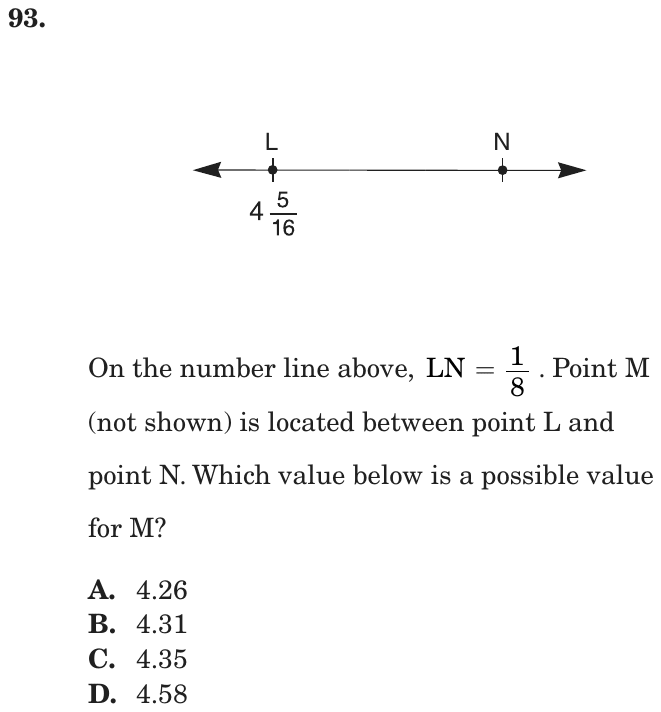
Question 37 of 57
2025 Practice Test A Math, question 37Question
What is the value of x in the equation ?
Enter your answer in the space provided. Enter only your answer.
On the test you build the answer on an on-screen keypad; here, type it. Use ^ for a power, sqrt( ) or √ for a root, pi for π, and <= or >= for ≤ and ≥.
Show the answer
Correct answer: x = -13/3
Solution:
Start with .
Subtract from both sides to move all terms involving x to one side.
Combine like terms.
Divide both sides by −3 to solve for x.
Question analysis
This equation question asks for the value of x when 6x equals 9x plus 13, typed into a box after "x =". Students solve a linear equation with the variable on both sides by gathering the x terms and dividing. With no answer choices to check against, keeping the sign of each moved term is the main challenge.
- Grade level
- Grade 8 content, by NYS standard
- Compared with grade 7
- At grade 7 The variable appears on both sides, a grade 8 topic, yet collecting it takes one subtraction and one division, much like a grade 7 two-step equation. The typed answer, with no choices to compare, adds some risk.
- Estimated difficulty
- Straightforward: two steps or one careful reading.
- Thinking it demands
- Depth of knowledge 1, recall and reproduction · mainly apply
- What makes it hard
- Error-prone arithmetic moderate
- An answer in an unexpected form minor
- Solution
- 2 steps
- Reading level
- Question and choices: about grade 5, 21 words.
- Students, last 30 days
- Not enough answers yet to show (it takes 10).
Why it is hard, traps and wrong answers (shows the answer)
Why it is hard
Two moves solve the equation, so the method is not in doubt; the points are lost in the result. Subtracting 6x instead, which gives 0 = 3x + 13, works as well but moves the sign onto the 13, and either route ends in a division that must keep the negative. The answer is not a whole number, which unsettles students who expect one, and a switch to decimals leads to a rounded entry that is not exact.
Error-prone arithmetic moderate Working it out
Collecting the x terms gives 6x − 9x = −3x, a negative coefficient, and 13 ÷ (−3) is a negative fraction that does not come out whole, so both the sign and the fraction must survive. (Brown & Burton, 1978; Junker & Sijtsma, 2001)
An answer in an unexpected form minor Choosing the answer
The answer is typed after the printed x =, with no choices to compare, and its decimal form, −4.333…, repeats forever, so only a fraction or mixed number is exact. (Enright, Morley & Sheehan, 2002)
Strategy: Subtract 9x from both sides so that x appears once, divide both sides by the coefficient left on x, and check by substituting the result into both sides of the original equation.
Traps
- Negatives and direction: Arithmetic with negative numbers, the order of a subtraction, or direction on a number line. (Moving a term across the equals sign without changing its sign is a faulty procedure.)
- Wrong operation: Adds instead of multiplying, divides the wrong way round, turns a ratio or rate upside down, or undoes a step in the wrong direction (subtracts what should be added back).
- Rounds too early: Rounds a value partway through, or rounds the wrong way, so the final answer drifts from the exact one.
The wrong answers, classified
13/3 Negatives and direction (Brown & Burton, 1978)
Reaches −3x = 13 correctly but drops the negative when dividing 13 by −3, entering a positive 13/3.
-4.33 Rounds too early (King et al., 2004)
Solves correctly but turns −13/3 into a decimal and rounds it to −4.33, which is close to the exact value but not equal to it.
-3/13 Wrong operation (Hegarty, Mayer & Monk, 1995; King et al., 2004)
Gets to −3x = 13 but divides the wrong way round, putting the coefficient −3 over the constant 13 instead of 13 over −3.
Worked solution, step by step
Formulas used
- Doing the same to both sides
- a and b are the two sides of an equation, and c is any number or term (not zero when you divide). Taking the same thing away from both sides, or dividing both by the same number, keeps the sides equal. That is how you get x by itself.
- Dividing by a negative number
- a and b are positive numbers, so −b is negative. A positive number divided by a negative number is negative. You can write the minus sign in front of the whole fraction.
- Changing a fraction to a mixed number
- Use this when the top of a fraction is bigger than the bottom. Divide a by b. q is the number of whole times b fits into a. r is the remainder, what is left over. The remainder goes on top of the leftover fraction.
Sort out the question
You need the value of x that makes true. The letter x appears on both sides, so first gather the x terms on one side. There are no choices to check against, so work carefully.
Move the x terms to one side
Subtract 9x from both sides. This clears the x term off the right side:
Since 6 − 9 = −3, the left side is −3 times x.
Divide both sides by −3
x is multiplied by −3, so divide both sides by −3:
A positive divided by a negative is negative, so x is negative.
Watch out: dropping the minus sign gives 13/3, which is wrong. Also, the number you divide by goes on the bottom. Writing −3/13 turns the fraction upside down.
Write it as a mixed number
A mixed number is a whole number with a fraction, like 4 1/3. Divide 13 by 3. The 3 fits 4 times, with 1 left over.
So .
Watch out: as a decimal, −13/3 is −4.333…, and the 3s never end. Rounding to −4.33 is close, but it is not exact. Keep the fraction.
Enter the answer
The box already shows x =, so you enter only the number. On the test, press the minus key first. Then press the fraction key, a small box over a small box. Type 13 in the top box and 3 in the bottom box. On this site, type −13/3 or −4 1/3.
So the finished answer reads x = −13/3. You type only the −13/3, which is the same as −4 1/3.
Check your answer
Put into both sides. The left side is . The right side is . Both sides equal −26, so the answer is right.
More questions like this
The original DOE question
Question 38 of 57
2025 Practice Test A Math, question 38Question
Ryan must read 150 pages for school this weekend. It took him 30 minutes to read the first 20 pages. At this rate, how much additional time will it take him to finish the reading?
- A
- B
- C
- D
Show the answer
Correct answer: B
Ryan has 130 pages left to read (150 − 20). He read 20 pages in 30 minutes, which means he read at a rate of 40 pages per 1 hour. To find out how much longer it will take him to finish the assignment, divide the total number of pages remaining (130) by the number of pages he is able to read per hour (40):
Question analysis
This reading-rate word problem says Ryan read 20 of his 150 pages in 30 minutes and asks how much additional time he needs to finish at that rate. Students must find the pages left, use the rate, and convert minutes to hours. The word 'additional' is easy to overlook.
- Grade level
- Grade 6 content, by NYS standard
- Compared with grade 7
- At grade 7 Unit rate problems like this are grade 6 content and common in grade 7. It adds a subtraction step and a conversion to hours, and the word 'additional' must be read closely, which keeps it at grade 7 level.
- Estimated difficulty
- Moderate: several steps, or a close reading with one strong distractor.
- Thinking it demands
- Depth of knowledge 2, skills and concepts · mainly apply
- What makes it hard
- Many steps moderate
- A very close wrong answer moderate
- An answer in an unexpected form minor
- Solution
- 3 steps
- Reading level
- Question and choices: about grade 3, 36 words.
- Students, last 30 days
- Not enough answers yet to show (it takes 10).
Why it is hard, traps and wrong answers (shows the answer)
Why it is hard
The bold word "additional" carries the question, and missing it costs the point even when the rate work is perfect. The rate itself mixes pages, minutes and hours, so students who skip writing units drift into answers that count half-hour blocks or minutes as hours. Subtracting the pages already read before anything else keeps the work on the right quantity.
Many steps moderate Working it out
The solution chains four moves: subtract the 20 pages read, double 20 pages per half hour to 40 per hour, divide 130 by 40, and write the result in hours. (Daniel & Embretson, 2010; Enright, Morley & Sheehan, 2002)
A very close wrong answer moderate Choosing the answer
The choices 3 1/4 and 3 3/4 hours differ by exactly the half hour already spent on the first 20 pages, so only subtracting those pages first separates them. (Embretson & Wetzel, 1987; Gorin & Embretson, 2006; Ascalon et al., 2007)
An answer in an unexpected form minor Choosing the answer
A student who works in minutes gets 195 minutes and must convert it to the mixed number 3 1/4 hours to find it among the choices. (Enright, Morley & Sheehan, 2002)
Strategy: Subtract the pages already read, work out how many pages he reads per hour, and divide the remaining pages by that hourly rate.
Traps
- Answers a different question: A choice is right for another quantity: the other unknown, the rest instead of the part, the part instead of the whole.
- Units or scale: The answer is wanted in other units, or a rate or scale must be converted first.
The wrong answers, classified
A Units or scale (King et al., 2004)
Divides the 130 remaining pages by 60, treating the rate as one page a minute, which gives 2 1/6 hours.
C Answers a different question (King et al., 2004; Hegarty, Mayer & Monk, 1995)
Times all 150 pages at 40 pages an hour, ignoring the bold "additional", and gets the whole assignment's 3 3/4 hours instead of the time left.
D Units or scale (King et al., 2004)
Divides 150 pages by 20 to get 7.5 blocks of reading and reports them as hours, though each 20-page block takes half an hour.
Worked solution, step by step
Formulas used
- Time from a rate
- t is the time needed. p is the number of pages to read. r is the rate: the pages read in one hour. Dividing tells you how many hours of reading the pages need.
Sort out what you know
Ryan must read 150 pages in all. He read the first 20 pages in 30 minutes. The word additional is in bold. It means extra time, after the 30 minutes he already spent.
So you need the time for the pages he has not read yet.
Find the pages left
He still has 130 pages to read. Watch out: timing all 150 pages gives hours, which is choice C. That counts pages he already read.
Find his rate per hour
The choices are in hours, so find how many pages he reads in an hour. 30 minutes is half an hour. In a full hour he reads twice as much:
His rate is 40 pages per hour.
Divide the pages by the rate
Dividing tells you how many hours the 130 pages take at 40 pages an hour:
It will take more hours. So the answer is B, hr.
Check your answer
Work in minutes. 130 pages is 6.5 groups of 20 pages. Each group takes 30 minutes, so 6.5 × 30 = 195 minutes. That is 3 hours and 15 minutes. And 15 minutes is a quarter of an hour, so it matches.
More questions like this
The original DOE question
Question 39 of 57
2025 Practice Test A Math, question 39Question
Suppose , , and , and do not equal 0. What is in terms of , and ?
- A
- B
- C
- D
Show the answer
Correct answer: C
It is easier to rewrite
as
since they are both fractions.
Question analysis
This algebra question defines M and N as fractions built from the letters w, x, y and z, and asks for M divided by N in terms of those letters. Students must divide one fraction by another using only variables. Without numbers to check against, it is easy to multiply instead of divide or flip the wrong fraction.
- Grade level
- Grade 7 content, by NYS standard
- Compared with grade 7
- At grade 7 Grade 7 students divide numeric fractions such as 2/3 ÷ 4/5. This item applies the same rule with four letters instead of numbers, which adds abstraction but no new steps.
- Estimated difficulty
- Straightforward: two steps or one careful reading.
- Thinking it demands
- Depth of knowledge 1, recall and reproduction · mainly apply
- What makes it hard
- Variables instead of numbers moderate
- A very close wrong answer moderate
- Solution
- 2 steps
- Reading level
- Question and choices: about grade 10, 23 words.
- Students, last 30 days
- Not enough answers yet to show (it takes 10).
Why it is hard, traps and wrong answers (shows the answer)
Why it is hard
This is fraction division in disguise, and students who recognize M/N as M ÷ N need one rule. The difficulty is that every choice is built from the same four letters, so a wrong rule still produces something that looks like a reasonable answer. Substituting small numbers, such as w = 1, x = 2, y = 3 and z = 4, checks the result in seconds.
Variables instead of numbers moderate Understanding the question
All four letters stand for unknown nonzero numbers, so dividing w/x by y/z must be done symbolically, with no value to check the result against. (Koedinger & Nathan, 2004; Enright, Morley & Sheehan, 2002)
A very close wrong answer moderate Choosing the answer
All four choices arrange w, x, y and z as one fraction, and xy/wz is wz/xy turned over, so only carrying out the division in the right order tells them apart. (Embretson & Wetzel, 1987; Gorin & Embretson, 2006; Ascalon et al., 2007)
Strategy: Rewrite M/N as M ÷ N, then multiply by the reciprocal of the second fraction; substituting small numbers for the letters checks the result.
Traps
- A faulty procedure: A systematic but wrong procedure: adding fractions straight across, applying an exponent to each term of a sum, dropping a sign when moving a term.
- Wrong operation: Adds instead of multiplying, divides the wrong way round, turns a ratio or rate upside down, or undoes a step in the wrong direction (subtracts what should be added back).
The wrong answers, classified
A Numbers taken from the question (Hegarty, Mayer & Monk, 1995)
Stacks M's letters over N's letters, writing wx over yz, without carrying out any fraction division.
B Wrong operation (Hegarty, Mayer & Monk, 1995; King et al., 2004)
Multiplies M by N straight across, top times top and bottom times bottom, instead of dividing.
D A faulty procedure (Brown & Burton, 1978; Tatsuoka, 1983)
Flips the first fraction instead of the second, computing x/w × y/z, which gives N divided by M.
Worked solution, step by step
Formulas used
- Dividing fractions
- a, b, c and d are numbers that are not 0. To divide by a fraction, multiply by its reciprocal (the fraction flipped upside down). It works because dividing by a number is the same as multiplying by 1 over that number.
- Multiplying fractions
- a and c are the tops and b and d are the bottoms. Multiply the tops together and the bottoms together. Use it after you flip the second fraction.
Sort out what you know
M is the fraction w over x. N is the fraction y over z. The letters stand for numbers that are not 0.
The fraction bar in means M divided by N. So you must divide one fraction by another.
Write it as a division
Rewrite the big fraction as a division. Then put in the fractions for M and N. This lets you use the rule for dividing fractions:
Flip the second fraction
Use the rule for dividing fractions. Keep the first fraction. Flip only the second one, and change divide to multiply:
Watch out: flipping the first fraction instead gives choice D, which is N ÷ M. Multiplying without flipping at all gives choice B.
Multiply across
Multiply the tops and the bottoms:
Here wz means w times z. So the answer is C, .
Check your answer
Try small numbers. Let w = 1, x = 2, y = 3 and z = 4. Then M = 1/2 and N = 3/4. So M ÷ N = 1/2 × 4/3 = 4/6. Choice C gives (1 × 4) ÷ (2 × 3) = 4/6 too. They match.
More questions like this
The original DOE question
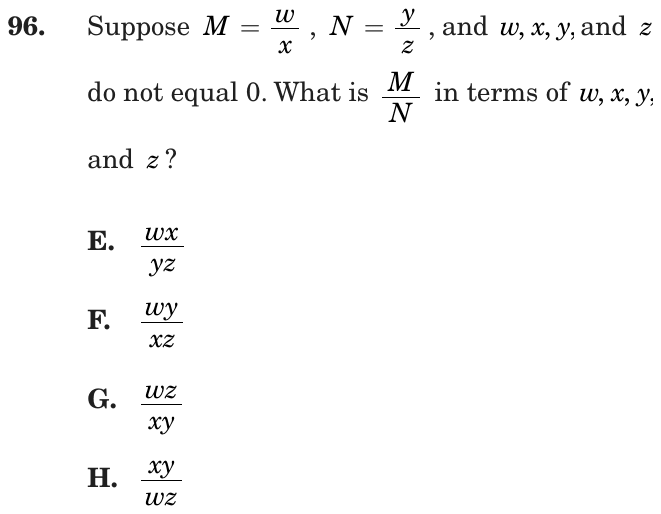
Question 40 of 57
2025 Practice Test A Math, question 40Question
In the set of consecutive integers from 12 to 30, inclusive, there are four integers that are multiples of both 2 and 3. How many integers in this set are multiples of neither 2 nor 3?
- A5
- B6
- C13
- D15
Show the answer
Correct answer: B
The question asks for integers from 12 to 30 that are not divisible by 2 or 3. The set of consecutive integers is
{12, 13, 14, 15, 16, 17, 18, 19, 20, 21, 22, 23, 24, 25, 26, 27, 28, 29, 30}
Since all even numbers are divisible by 2, eliminate all even numbers, leaving the odd numbers in the set:
{13, 15, 17, 19, 21, 23, 25, 27, 29}
Eliminate those integers that are multiples of 3 (15, 21, and 27). The remaining integers are:
{13, 17, 19, 23, 25, 29}
Therefore, there are 6 numbers in the set that are multiples of neither 2 nor 3.
Question analysis
This number properties question takes the integers from 12 to 30, inclusive, and asks how many are multiples of neither 2 nor 3. Students must count the whole set, remove multiples of 2 and of 3 without removing any number twice, and count what remains. Inclusive endpoints and the overlap make it easy to miscount.
- NYS standards
- 6.NS.4 common factors and multiples
- Grade level
- Grade 6 content, by NYS standard
- Compared with grade 7
- Above grade 7 Multiples are sixth-grade content, but grade 7 problems rarely ask students to count a set under two overlapping conditions. The inclusive range and the numbers that are multiples of both make this longer and trickier than usual.
- Estimated difficulty
- Hard: combines ideas, needs a plan, and has more than one tempting wrong answer.
- Thinking it demands
- Depth of knowledge 2, skills and concepts · mainly apply
- What makes it hard
- Much to keep track of moderate
- A very close wrong answer moderate
- Solution
- 3 steps
- Reading level
- Question and choices: about grade 9, 30 words.
- Students, last 30 days
- Not enough answers yet to show (it takes 10).
Why it is hard, traps and wrong answers (shows the answer)
Why it is hard
The question gives the overlap, four multiples of both 2 and 3, which invites a subtraction method with three places to go wrong: the count of the set, the overlap, and the final complement. Each of those errors has its own choice. Listing the 19 numbers and crossing out evens and then odd multiples of 3 is slower to describe but faster and safer to do.
Much to keep track of moderate Working it out
Each of the 19 integers must be checked against two conditions, and the four multiples of 6 meet both, so they must be removed once, not twice. (Sweller, 1988; Carpenter, Just & Shell, 1990)
A very close wrong answer moderate Choosing the answer
The choices 5 and 6 differ by one, the result of counting 30 − 12 = 18 integers instead of 19, so only counting the inclusive set exactly separates them. (Embretson & Wetzel, 1987; Gorin & Embretson, 2006; Ascalon et al., 2007)
Strategy: Cross out every even number first, then cross out the odd multiples of 3 that remain, and count the survivors; listing all nineteen numbers is quick enough.
Traps
- Answers a different question: A choice is right for another quantity: the other unknown, the rest instead of the part, the part instead of the whole.
- Counting the ends: Inclusive or exclusive ends, fence posts, consecutive numbers: an answer that is one too many or too few, or an endpoint drawn open where it belongs closed (or the reverse).
The wrong answers, classified
A Counting the ends (Brown & Burton, 1978)
Counts 30 − 12 = 18 integers instead of 19, then subtracts the 13 multiples of 2 or 3 and gets 5.
C Answers a different question (King et al., 2004; Hegarty, Mayer & Monk, 1995)
Counts the integers that are multiples of 2 or 3, the 13 to be crossed out, and gives that count instead of the 6 left over.
D Misreads the question (Hegarty, Mayer & Monk, 1995)
Subtracts only the four multiples of both 2 and 3 from the 19 integers, reading "neither 2 nor 3" as "not both 2 and 3".
Worked solution, step by step
Formulas used
- Counting whole numbers in a list
- a is the first number and b is the last. n is how many whole numbers there are, counting both ends. You add 1 because subtracting counts the gaps, and there is one more number than gaps.
Sort out the question
The set is every integer (whole number) from 12 to 30. “Inclusive” means 12 and 30 are both in.
A multiple of 2 is an even number. A multiple of 3 is a number in the 3 times table. You need the numbers that are neither: not even, and not in the 3 times table.
Count the numbers in the set
There are 19 integers. Watch out: 30 − 12 = 18 forgets one end. That slip leads to choice A, 5.
Cross out the even numbers
Every even number is a multiple of 2, so remove them all. The odd numbers are left:
13, 15, 17, 19, 21, 23, 25, 27, 29
That is 9 numbers.
Cross out the multiples of 3
Check each odd number for 3. A quick test: add its digits. If the sum is in the 3 times table, so is the number. That removes 15, 21 and 27. These are left:
13, 17, 19, 23, 25, 29
Watch out: only 12, 18, 24 and 30 are multiples of both. Removing just those gives 19 − 4 = 15, choice D. “Neither” means you remove every multiple of 2 and every multiple of 3.
Count what is left
Six numbers are left. Watch out: 13 is how many you crossed out, choice C. The question asks for the ones left. So the answer is B, 6.
Check your answer
Count another way. Of the 19 numbers, 10 are even. Of the 9 odd ones, 3 are multiples of 3. So 10 + 3 = 13 are crossed out, and 19 − 13 = 6 are left. Same answer.
More questions like this
The original DOE question
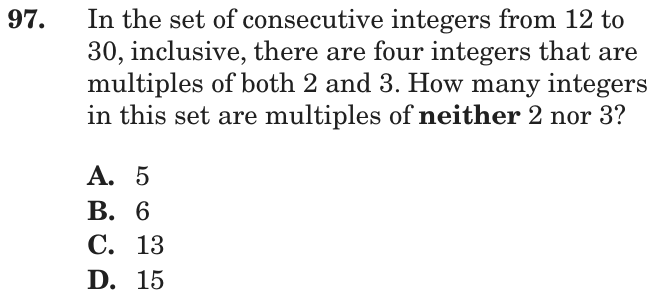
Question 41 of 57
2025 Practice Test A Math, question 41Question
If is a positive even number, how many odd numbers are in the range from up to and including ?
- A2
- B3
- C4
- D5
Show the answer
Correct answer: B
Since is even, then must be odd.
Thus and are also odd.
So there are a total of 3 numbers in this range that are odd.
Question analysis
This number properties question says 3n is a positive even number and asks how many odd numbers lie from 3n up to and including 3n + 5. Students must decide which integers in that span are odd. The coefficient in 3n is a distraction; only the fact that 3n is even matters.
- Grade level
- Grade 6 content, by NYS standard
- Compared with grade 7
- At grade 7 Grade 7 students work with expressions like 3n + 5 but rarely reason about whether they are even or odd. The idea is simple once the integers are written out, so the demand is about typical for grade 7.
- Estimated difficulty
- Straightforward: two steps or one careful reading.
- Thinking it demands
- Depth of knowledge 2, skills and concepts · mainly apply
- What makes it hard
- Variables instead of numbers moderate
- Something you must already know minor
- A very close wrong answer minor
- Solution
- 2 steps
- Reading level
- Question and choices: about grade 12, 22 words.
- Students, last 30 days
- Not enough answers yet to show (it takes 10).
Why it is hard, traps and wrong answers (shows the answer)
Why it is hard
Writing the six integers from 3n to 3n + 5 and marking them even, odd, even, odd, even, odd answers the question in seconds. The traps come from not writing them: dropping the last one, which "up to and including" keeps in, or reading the 5 in 3n + 5 as a count. Picking any even value for 3n, such as 6, makes the check concrete.
Variables instead of numbers moderate Understanding the question
No value of n is given, so students must reason about parity: since 3n is even, 3n + 1, 3n + 3 and 3n + 5 are the odd ones. (Koedinger & Nathan, 2004; Enright, Morley & Sheehan, 2002)
Something you must already know minor Working it out
The parity rules, even plus odd is odd and even plus even is even, are assumed; the coefficient 3 is a distraction once 3n is said to be even. (Anderson & Krathwohl, 2001)
A very close wrong answer minor Choosing the answer
The choices 2, 3, 4 and 5 are consecutive counts, so 2 and 3 cannot be told apart by sizing up; only checking whether 3n + 5 is inside the range separates them. (Embretson & Wetzel, 1987; Gorin & Embretson, 2006; Ascalon et al., 2007)
Strategy: Write out every integer from 3n to 3n + 5, mark 3n as even, alternate even and odd from there, and count the odd ones.
Traps
- Counting the ends: Inclusive or exclusive ends, fence posts, consecutive numbers: an answer that is one too many or too few, or an endpoint drawn open where it belongs closed (or the reverse).
The wrong answers, classified
A Counting the ends (Brown & Burton, 1978)
Leaves out 3n + 5, stopping before the last number although "up to and including" keeps it, and counts only 3n + 1 and 3n + 3.
C Misunderstands the concept (Smith, diSessa & Roschelle, 1993; De Bock et al., 1998; Ni & Zhou, 2005)
Counts 3n itself as odd because its coefficient 3 is odd, ignoring the stem's statement that 3n is even, and adds it to the three.
D Numbers taken from the question (Hegarty, Mayer & Monk, 1995)
Takes the 5 in 3n + 5 as the count, subtracting the ends instead of listing the six integers and picking out the odd ones.
Worked solution, step by step
Formulas used
- Even plus odd
- An even number splits into pairs. An odd number has one left over. Adding them keeps that one left over, so the sum is odd. So adding 1, 3 or 5 to an even number gives an odd number.
- Even plus even
- Two numbers that each split into pairs still split into pairs when you add them. So adding 2 or 4 to an even number gives an even number.
Sort out what you know
You are told that 3n is even. You do not need to know n itself. You need to count the odd numbers from 3n to 3n + 5.
“Up to and including” means 3n + 5 counts too.
List all the numbers
Go up by 1 each time, from 3n to 3n + 5. That gives six numbers:
Mark each as even or odd
3n is even. Adding 1, 3 or 5 makes it odd. Adding 2 or 4 keeps it even.
Number Even or odd even odd even odd even odd Watch out: 3n is even because the question says so. The 3 being odd does not matter. Counting 3n as odd gives choice C, 4.
Count the odd numbers
The odd ones are 3n + 1, 3n + 3 and 3n + 5. That is 3 numbers.
Watch out: leaving out 3n + 5 gives 2, choice A. It is the last number, and it is included. So the answer is B, 3.
Check your answer
Try a real number. If n = 2, then 3n = 6, which is even. The numbers from 6 to 11 are 6, 7, 8, 9, 10 and 11. The odd ones are 7, 9 and 11. That is 3.
More questions like this
The original DOE question
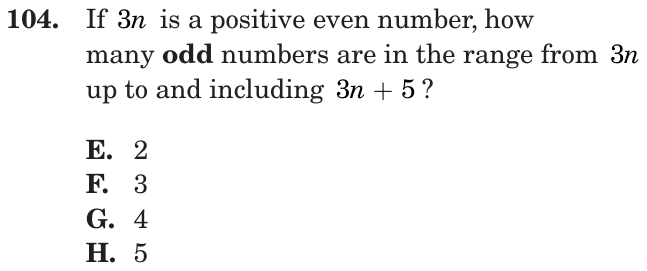
Question 42 of 57
2025 Practice Test A Math, question 42Question
When a student buys 4 notebooks, the total cost is $12. Each notebook costs the same amount. Select each point on the graph that best represents y, the total cost of x notebooks.
Select all the correct answers.
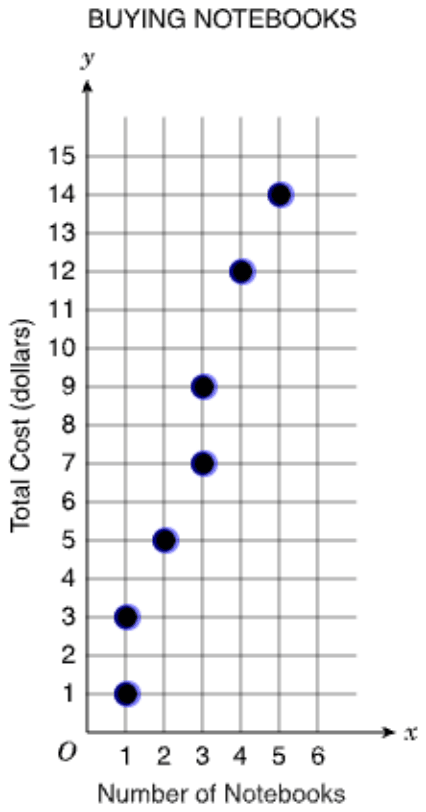
On the test you click the points in the figure; here, choose them below. The DOE has not published how answers with several parts are scored; this site counts one right only when every part is right.
- A(1, 1)
- B(1, 3)
- C(2, 5)
- D(3, 7)
- E(3, 9)
- F(4, 12)
- G(5, 14)
Show the answer
Correct answer: B, E, and F
Solution:
There are three correct points: (1, 3), (3, 9), and (4, 12).
Find the cost per notebook: .
The equation of the line is , where y is the total cost of x notebooks.
Check each point by plugging the x-value into the equation . If the y-value from the equation matches the y-value of the point, then the point is on the line .
Check all seven points:
(1, 1) y-values do not match; incorrect point
(1, 3) y-values match; CORRECT point
(2, 5) y-values do not match; incorrect point
(3, 7) y-values do not match; incorrect point
(3, 9) y-values match; CORRECT point
(4, 12) y-values match; CORRECT point
(5, 14) y-values do not match; incorrect point
Question analysis
A graph titled Buying Notebooks shows seven points, and students select every point that fits the total cost of buying notebooks, given the cost of a few notebooks and that each costs the same. It tests finding a unit rate and recognizing points of a proportional relationship. Some points line up in tempting patterns, and the item does not say how many to select.
- NYS standards
- Grade level
- Grade 7 content, by NYS standard
- Compared with grade 7
- At grade 7 Finding a unit rate and deciding which points fit a proportional relationship are grade 7 skills, and the arithmetic here is easy. What adds demand is testing all seven points with no count given, since one miss or extra pick loses the item.
- Estimated difficulty
- Straightforward: two steps or one careful reading.
- Thinking it demands
- Depth of knowledge 2, skills and concepts · mainly apply
- What makes it hard
- Solution
- 2 steps
- Reading level
- Question and choices: about grade 5, 36 words.
- Students, last 30 days
- Not enough answers yet to show (it takes 10).
Why it is hard, traps and wrong answers (shows the answer)
Why it is hard
Finding the price is one division, 12 ÷ 4 = 3, so the question is really about checking: each chosen dot must fit y = 3x exactly, and the item does not say how many do. The graph punishes judging by eye, since a straight row of dots climbs from (1, 3) at $2 a notebook and two dots sit a single gridline off the true line. Multiplying each x by 3 and reading each y from the axis, not from the pattern, settles all seven.
Every choice must be checked moderate Choosing the answer
Seven dots must each be tested against $3 a notebook, and the item never says how many fit; one missed point or one extra loses the whole item, so no dot can be skipped. (Embretson & Wetzel, 1987)
Reading a figure, table or graph minor Understanding the question
The graph stacks two dots above 1 notebook and two above 3, and each total cost has to be read off a grid ruled at every dollar up to 15. (Lesh, Post & Behr, 1987; Kirsch & Mosenthal, 1990)
A very close wrong answer minor Choosing the answer
(5, 14) sits one gridline below (5, 15), where 5 notebooks at $3 would be, and (2, 5) sits one below (2, 6), so judging by the line's direction cannot rule either out. (Embretson & Wetzel, 1987; Gorin & Embretson, 2006; Ascalon et al., 2007)
Strategy: Work out the cost of one notebook from the total given in the question, then multiply each point's x-coordinate by that price and keep only the points whose y-coordinate matches exactly.
Traps
- Misunderstands the concept: A wrong belief about a concept: that percents can be added, that area grows like length, that averages can be averaged, that a bigger denominator means a bigger fraction.
- Misreads the figure: Reads a value, label or tick spacing in a figure, table or graph wrongly.
The wrong answers, classified
A Little reason to choose it (Haladyna & Downing, 1993; Rodriguez, 2005)
No working from 4 notebooks for $12 makes one notebook cost $1, so this lowest dot mostly catches guesses, such as taking the dot nearest the origin as a start.
C Misunderstands the concept (Smith, diSessa & Roschelle, 1993; De Bock et al., 1998; Ni & Zhou, 2005)
Takes the straight row (1, 3), (2, 5), (3, 7) as the graph because its dots line up, though it climbs $2 a notebook and would meet the y-axis at $1, not the origin.
D Misunderstands the concept (Smith, diSessa & Roschelle, 1993; De Bock et al., 1998; Ni & Zhou, 2005)
Prefers the lower of the two dots above 3 notebooks because it continues the evenly spaced row from (1, 3) and (2, 5), instead of checking that 3 notebooks cost $9.
G Misreads the figure (Lesh, Post & Behr, 1987; Kirsch & Mosenthal, 1990)
Finds that 5 notebooks cost 5 × $3 = $15, then reads the dot above 5 as sitting on the top gridline, 15, when it is one line lower, at 14.
Worked solution, step by step
Formulas used
- Unit price
- The unit price is what one item costs. Divide the total cost by the number of items bought. This works because every notebook costs the same, so the total splits into equal parts.
- A proportional relationship
- y is the total cost in dollars, and x is the number of notebooks. k is the price of one notebook, the number you always multiply by. A point fits only if its y is exactly k times its x. The graph is a straight line through (0, 0).
Sort out the question
Four notebooks cost $12, and each one costs the same. On the graph, x is the number of notebooks, and y is the total cost in dollars. The graph shows seven points. You must select every point that fits. The question does not say how many fit, so test all seven.
Find the price of one notebook
Split the $12 equally among the 4 notebooks:
Each notebook costs $3. So the total cost is 3 times the number of notebooks:
Test each point
For each point, multiply its x by 3. Keep the point only if the result equals its y.
Choice Point 3 × x Fits? A (1, 1) 3 No B (1, 3) 3 Yes C (2, 5) 6 No D (3, 7) 9 No E (3, 9) 9 Yes F (4, 12) 12 Yes G (5, 14) 15 No Watch for look-alike points
Watch out: the dots (1, 3), (2, 5) and (3, 7) sit in a neat straight row. But that row climbs $2 per notebook, not $3. Lining up is not enough: (2, 5) and (3, 7), choices C and D, do not fit.
Watch out: 5 notebooks cost dollars. The dot above 5 sits one gridline lower, at 14. Read the y-axis carefully, and you will skip choice G.
Name the points
Three points fit: (1, 3), (3, 9) and (4, 12). On the test, you click each of these dots on the graph. On this site, you check their boxes. So the answers are B, E and F.
Check your answer
All three points fit : , and . They also line up with (0, 0), since 0 notebooks cost $0. And (4, 12) is the fact the question gave you.
More questions like this
The original DOE question
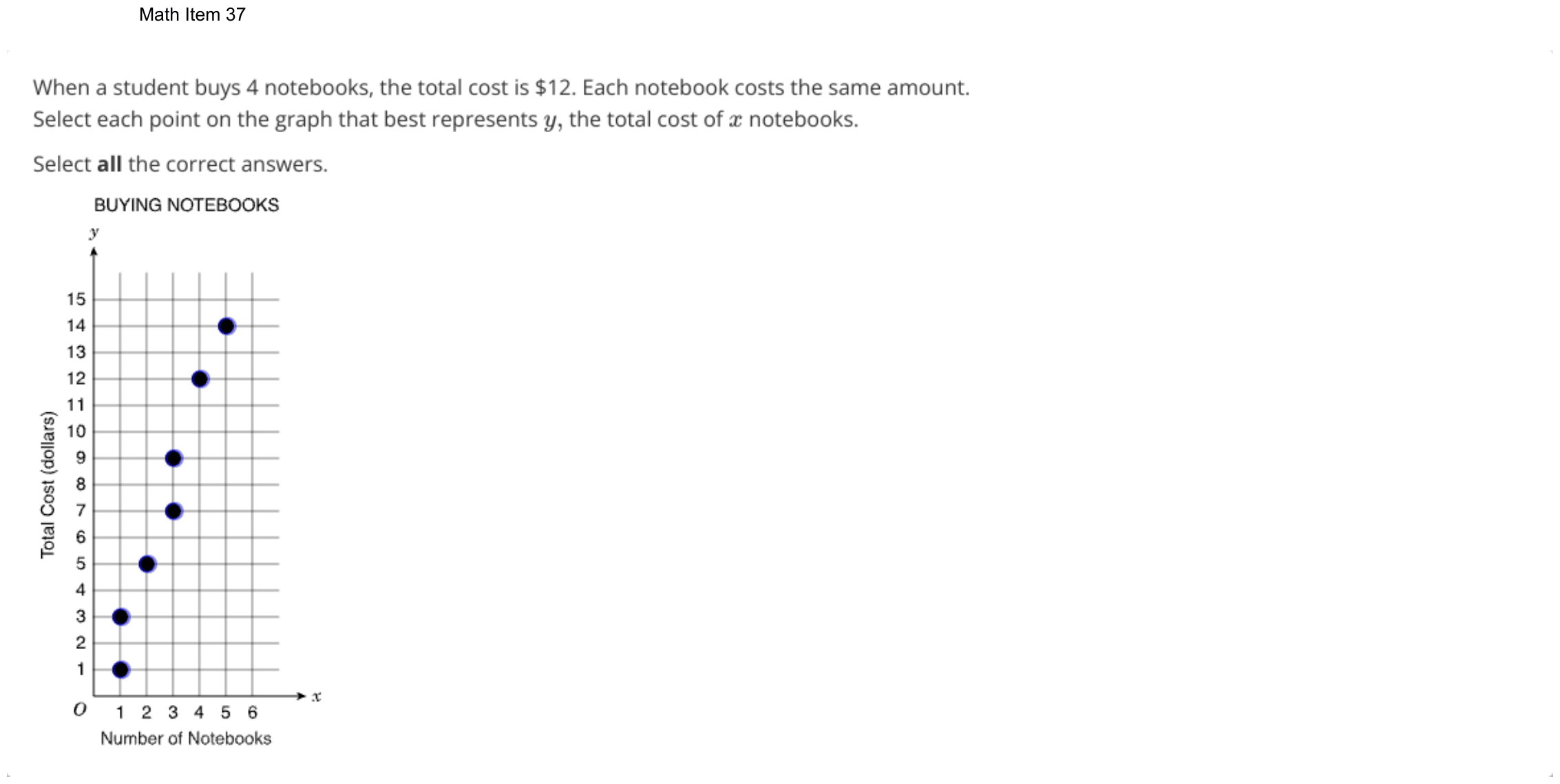
Question 43 of 57
2025 Practice Test A Math, question 43Question
In the equation above, , and are positive numbers. Which of these is equal to ?
- A
- B
- C
- D
Show the answer
Correct answer: D
Solve the equation for :
Question analysis
This algebra question gives the proportion w/x = y/z, with all four letters positive, and asks which expression equals z. Students must solve the equation for one letter in terms of the others. With only letters on the page, it is easy to multiply when you should divide or to stop one step early.
- Grade level
- Grade 8 content, by NYS standard
- Compared with grade 7
- Above grade 7 Grade 7 students cross-multiply numeric proportions such as 3/4 = 9/x. Solving a proportion made only of letters for one of them is a literal equation, a grade 8 algebra skill, though it takes just two steps.
- Estimated difficulty
- Straightforward: two steps or one careful reading.
- Thinking it demands
- Depth of knowledge 1, recall and reproduction · mainly apply
- What makes it hard
- Variables instead of numbers moderate
- A very close wrong answer moderate
- Solution
- 2 steps
- Reading level
- Question and choices: about grade 10, 22 words.
- Students, last 30 days
- Not enough answers yet to show (it takes 10).
Why it is hard, traps and wrong answers (shows the answer)
Why it is hard
The method, cross-multiply and divide, is the same one students use on numeric proportions, but letters hide whether each step went the right way. The two most attractive wrong choices are both one step from the answer: one never divides, and the other divides upside down. A quick check with 2/3 = 4/6, where z = 6, settles it.
Variables instead of numbers moderate Understanding the question
The proportion has only letters, so cross-multiplying to wz = xy and dividing by w must be done without numbers to show whether w goes on top or bottom. (Koedinger & Nathan, 2004; Enright, Morley & Sheehan, 2002)
A very close wrong answer moderate Choosing the answer
The choices w/(xy) and xy/w use the same three letters with the fraction turned over, so only dividing in the right direction after wz = xy separates them. (Embretson & Wetzel, 1987; Gorin & Embretson, 2006; Ascalon et al., 2007)
Strategy: Cross-multiply to clear both fractions, then divide both sides by whatever multiplies z; check with a true proportion such as 2/3 = 4/6.
Traps
- Wrong operation: Adds instead of multiplying, divides the wrong way round, turns a ratio or rate upside down, or undoes a step in the wrong direction (subtracts what should be added back).
- Stops one step early: A choice is a number from partway through the solution.
The wrong answers, classified
A Numbers taken from the question (Hegarty, Mayer & Monk, 1995)
Matches z with x because both sit in a denominator, picking a letter from the equation without solving for z.
B Stops one step early (King et al., 2004; Gierl et al., 2017)
Cross-multiplies to wz = xy but stops there, giving xy without dividing both sides by w.
C Wrong operation (Hegarty, Mayer & Monk, 1995; King et al., 2004)
Cross-multiplies correctly but divides the wrong way round, putting w over xy instead of xy over w.
Worked solution, step by step
Formulas used
- Cross-multiplying
- a, b, c and d are numbers that are not 0. When two fractions are equal, each top times the other bottom gives the same answer. It works because you multiply both sides by both bottoms, which clears the fractions.
Sort out what you need
The equation says w over x equals y over z. All four letters are positive numbers. You need to get z alone on one side. Then the other side shows what z equals.
Cross-multiply the fractions
Multiply each top by the other fraction’s bottom:
So wz = xy, and z is no longer on the bottom. Watch out: stopping here and picking xy gives choice B. z is not alone yet.
Get z alone
z is being multiplied by w. To undo that, divide both sides by w. Doing the same to both sides keeps them equal:
Watch out: dividing the wrong way round gives w over xy, choice C. So the answer is D, .
Check your answer
Use a true pair of equal fractions: 2/3 = 4/6. So w = 2, x = 3, y = 4 and z = 6. Choice D gives 3 × 4 ÷ 2 = 6, which is z. Choice C gives 2 ÷ 12, which is not 6.
More questions like this
The original DOE question
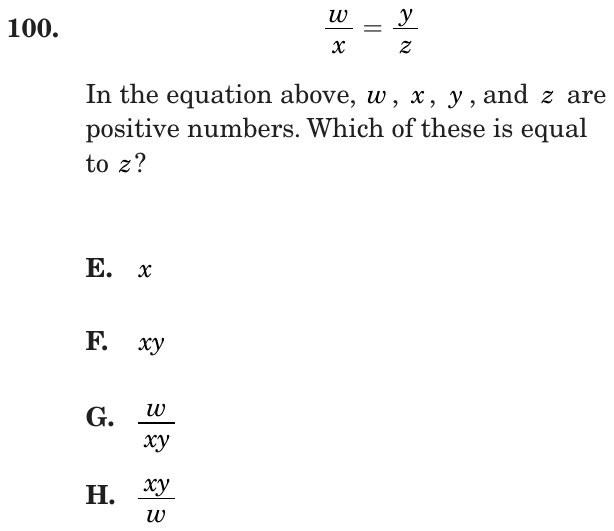
Question 44 of 57
2025 Practice Test A Math, question 44Question

On the number line above, points , , , and are integers, and . What is the value of ?
- A8
- B11
- C12
- D18
Show the answer
Correct answer: C
Convert the ratios into fractions of . Use the sum of the ratios for the denominator.
The part of that is is the sum of those fractions:
Find the length of :
The value of is .
Question analysis
This number line question places integer points W, X, Y and Z on a line and gives the ratio of the segments WX, XY and YZ as 4 to 2 to 3. Students find the whole length from W to Z, split it by the ratio, and add the parts that make up WY. Mixing up a part with the whole is the main risk.
- Grade level
- Grade 7 content, by NYS standard
- Compared with grade 7
- Above grade 7 Grade 7 students find distances on a number line and use part-to-whole ratios, usually separately. This item joins them: a negative endpoint, a three-term ratio and a choice of which segments to combine.
- Estimated difficulty
- Hard: combines ideas, needs a plan, and has more than one tempting wrong answer.
- Thinking it demands
- Depth of knowledge 2, skills and concepts · mainly apply
- What makes it hard
- Combines ideas moderate
- Reading a figure, table or graph moderate
- Many steps minor
- Solution
- 3 steps
- Reading level
- Question and choices: about grade 10, 21 words.
- Corrected from the DOE handbook
- Equations in the explanation that mixed up a fraction of a length with the length itself were corrected.
- Students, last 30 days
- Not enough answers yet to show (it takes 10).
Why it is hard, traps and wrong answers (shows the answer)
Why it is hard
Each step is routine, but the question keeps asking for a different piece of the line: the whole WZ, the part WX, and finally WY, which is two parts added together. Two of the wrong choices are exactly those other pieces. Students who mark the actual positions, X at −2 and Y at 2, can check the ratio before answering.
Combines ideas moderate Working it out
A three-part ratio, 4:2:3, must be applied to a length found from a negative endpoint, 8 − (−10) = 18, joining ratio and number-line distance. (Embretson, 1998; Daniel & Embretson, 2010)
Reading a figure, table or graph moderate Understanding the question
Only W at −10 and Z at 8 are labeled, and the drawing is not to scale: Y is drawn nearer 5 than 2, so reading WY from the picture fails. (Lesh, Post & Behr, 1987; Kirsch & Mosenthal, 1990)
Many steps minor Working it out
Find WZ, split it into 9 equal parts of 2, then add the 4 parts of WX and the 2 parts of XY. (Daniel & Embretson, 2010; Enright, Morley & Sheehan, 2002)
Strategy: Find the length WZ from the endpoints on the number line, divide it by the total number of ratio parts, and multiply by the parts from W to Y.
Traps
- Stops one step early: A choice is a number from partway through the solution.
- Answers a different question: A choice is right for another quantity: the other unknown, the rest instead of the part, the part instead of the whole.
- Counting the ends: Inclusive or exclusive ends, fence posts, consecutive numbers: an answer that is one too many or too few, or an endpoint drawn open where it belongs closed (or the reverse).
The wrong answers, classified
A Stops one step early (King et al., 2004; Gierl et al., 2017)
Finds WX, 4/9 of 18 = 8, and stops without adding XY's 4 to reach Y; 8 also matches Z's label.
B Counting the ends (Brown & Burton, 1978)
Places Y at 2 but counts the integers strictly between −10 and 2, which are −9 through 1, getting 11 instead of the distance 12.
D Answers a different question (King et al., 2004; Hegarty, Mayer & Monk, 1995)
Gives the whole length WZ, 8 − (−10) = 18, instead of the part from W to Y.
What was corrected from the DOE handbook, and why
- Explanation: The handbook writes WX = 4/9, XY = 2/9 and WY = 2/3, and then says “The value of WY is 2/3(18) = 12”. Those fractions are parts of WZ, not the lengths themselves (WX is 8 and WY is 12), so WY cannot be both 2/3 and 12. The lines now read WX = 4/9 WZ, XY = 2/9 WZ and WY = 2/3 WZ. The method and the answer are unchanged.
Worked solution, step by step
Formulas used
- Distance on a number line
- d is the distance between two points. b is the point on the right and a is the point on the left. Subtracting left from right always gives a positive distance. It works even when a is negative.
- Size of one part of a ratio
- u is the size of one part. L is the whole length being shared. p is the total number of parts, found by adding the numbers in the ratio. Every part is the same size, so you share the length equally.
Sort out what you know
W is at −10 and Z is at 8. X and Y are between them. The ratio 4:2:3 means WX is 4 parts, XY is 2 parts and YZ is 3 parts. All the parts are the same size.
You need the length WY, from W to Y. The drawing is not exact, so use the numbers, not the picture.
Find the whole length WZ
WZ is 18 units long. Subtracting a negative number is the same as adding.
Find the size of one part
Add the ratio numbers to get the number of parts:
Share the 18 units equally among 9 parts:
Each part is 2 units long.
Find WY
WY is WX and XY together, so it has 4 + 2 = 6 parts:
Watch out: WX alone is 4 × 2 = 8, which is choice A. And 18 is the whole line, choice D. So the answer is C, 12.
Check your answer
Place the points. W is at −10. X is 8 units to the right, at −2. Y is 4 more, at 2. Z is 6 more, at 8, which matches its label. And the distance from −10 to 2 is 2 − (−10) = 12.
More questions like this
The original DOE question
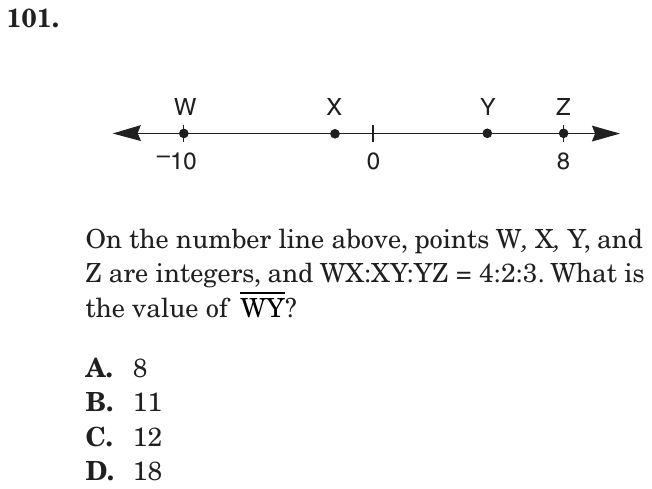
Question 45 of 57
2025 Practice Test A Math, question 45Question
A metal square used in an electronic device must have a thickness of 0.02 inch, with an allowable error of 1 percent. What is the greatest allowable thickness of the metal square?
- A0.0002 in.
- B0.02 in.
- C0.0202 in.
- D0.03 in.
Show the answer
Correct answer: C
Find 1% of 0.02:
The greatest allowable thickness would be
inch.
Question analysis
This percent question says a metal square must be 0.02 inch thick with an allowable error of 1 percent, and asks for the greatest allowable thickness. Students must find 1 percent of a small decimal and add it to the target thickness. Keeping track of decimal places is what makes it tricky.
- Grade level
- Grade 7 content, by NYS standard
- Compared with grade 7
- At grade 7 Percent error and tolerance problems appear in grade 7, so the idea is on level. The demand comes from taking a percent of a tiny decimal and adding the result, where a slipped decimal place is easy to miss.
- Estimated difficulty
- Moderate: several steps, or a close reading with one strong distractor.
- Thinking it demands
- Depth of knowledge 2, skills and concepts · mainly apply
- What makes it hard
- Error-prone arithmetic moderate
- Turning words into math moderate
- A very close wrong answer minor
- Solution
- 2 steps
- Reading level
- Question and choices: about grade 4, 34 words.
- Students, last 30 days
- Not enough answers yet to show (it takes 10).
Why it is hard, traps and wrong answers (shows the answer)
Why it is hard
The idea of tolerance is simple, but the numbers are tiny, and the question turns on what the 1 percent is a percent of. Students who read it as 0.01 inch land on a choice that looks sensible, and those who find the error correctly may stop before adding it. Writing 0.02 × 1.01 in one step avoids both.
Error-prone arithmetic moderate Working it out
One percent of 0.02 is 0.0002, two more decimal places, and adding it to 0.02 needs the places lined up to get 0.0202. (Brown & Burton, 1978; Junker & Sijtsma, 2001)
Turning words into math moderate Understanding the question
The phrase "allowable error of 1 percent" must be read as 1 percent of 0.02 inch, added for the greatest thickness, not 1 percent as a fixed 0.01 inch. (Hegarty, Mayer & Monk, 1995; Koedinger & Nathan, 2004)
A very close wrong answer minor Choosing the answer
The choices 0.0202, 0.02 and 0.0002 are built from the same digits, and the first two differ by only 1 percent, so only careful counting of decimal places tells them apart. (Embretson & Wetzel, 1987; Gorin & Embretson, 2006; Ascalon et al., 2007)
Strategy: Find 1 percent of 0.02 by dividing by 100, counting decimal places carefully, then add that error to 0.02 to get the upper limit.
Traps
- Stops one step early: A choice is a number from partway through the solution.
- Misunderstands the concept: A wrong belief about a concept: that percents can be added, that area grows like length, that averages can be averaged, that a bigger denominator means a bigger fraction.
The wrong answers, classified
A Stops one step early (King et al., 2004; Gierl et al., 2017)
Finds the allowable error, 1 percent of 0.02 = 0.0002 inch, and stops without adding it to the target thickness.
B Numbers taken from the question (Hegarty, Mayer & Monk, 1995)
Gives the target thickness from the stem, 0.02 inch, ignoring that the allowed error permits a slightly thicker square.
D Misunderstands the concept (Smith, diSessa & Roschelle, 1993; De Bock et al., 1998; Ni & Zhou, 2005)
Treats 1 percent as 0.01 inch, a percent of 1 inch rather than of 0.02 inch, and adds it to get 0.03.
Worked solution, step by step
Formulas used
- Percent of a number
- x is the part you want. p is the percent. n is the whole amount. Percent means out of 100, so p percent of a number is p hundredths of it.
Sort out what you know
The square should be 0.02 inch thick. An allowable error of 1 percent means it may be off by up to 1 percent of 0.02 inch. It may be that much thinner or thicker.
You need the greatest allowed thickness, so look at the thicker side.
Find 1 percent of 0.02
Dividing by 100 moves the decimal point two places to the left. So the error is 0.0002 inch.
Watch out: 1 percent here is not 0.01 inch. It is 1 percent of 0.02 inch. Adding 0.01 gives 0.03, which is choice D.
Add the error to the thickness
The thickest square is the right size plus the error. Line up the decimal points:
Watch out: 0.0002 is only the error, choice A. You must add it to 0.02. So the answer is C, 0.0202 in.
Check your answer
0.0202 is just a tiny bit more than 0.02, which makes sense for a small error. Check it: 0.0202 − 0.02 = 0.0002. And 0.0002 ÷ 0.02 = 0.01, which is 1 percent.
More questions like this
The original DOE question
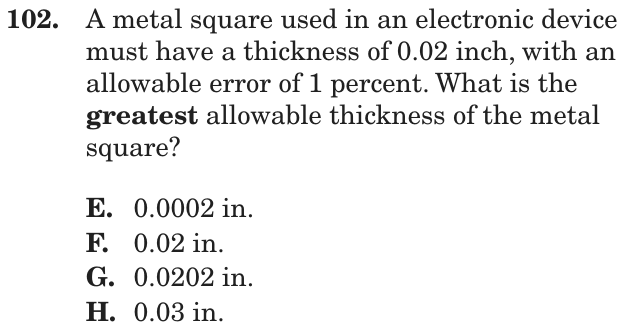
Question 46 of 57
2025 Practice Test A Math, question 46Question
SCORES ON BIOLOGY TEST
| Section | Lowest Score | Range |
| I | 65 | 28 |
| II | 62 | 25 |
| III | 67 | 22 |
Mr. Blake’s biology class is divided into three sections. The same test was given to each section. The table above shows both the lowest score and the range of scores on this test for each section. What is the overall range of all scores in all three sections?
- A25
- B27
- C28
- D31
Show the answer
Correct answer: D
First, calculate the highest score for each section by adding the lowest score to the range:
Section I: 65 + 28 = 93
Section II: 62 + 25 = 87
Section III: 67 + 22 = 89
The overall highest score is 93, and the overall lowest score is 62. Thus the overall range is 93 − 62 = 31.
Question analysis
This statistics question uses a table of the lowest score and the range for three sections of a biology class and asks for the range of all the scores combined. Students must rebuild each section's highest score from its lowest score and range, then compare across sections. Reversing the usual range calculation is the tricky part.
- Grade level
- Grade 6 content, by NYS standard
- Compared with grade 7
- At grade 7 Grade 7 students compute a range from a list of data. Here they must work backward from range to the highest score in each section and then combine three groups, one step beyond routine.
- Estimated difficulty
- Moderate: several steps, or a close reading with one strong distractor.
- Thinking it demands
- Depth of knowledge 2, skills and concepts · mainly apply
- What makes it hard
- No obvious method moderate
- A very close wrong answer moderate
- Much to keep track of minor
- Solution
- 3 steps
- Reading level
- Question and choices: about grade 2, 59 words.
- Students, last 30 days
- Not enough answers yet to show (it takes 10).
Why it is hard, traps and wrong answers (shows the answer)
Why it is hard
Range is usually computed from a list, so working backward from it is the unfamiliar part. The key fact, that the overall lowest and highest scores come from different sections, is invisible until all three highest scores are written down. Every wrong choice comes from skipping that step and reasoning with the ranges as given.
No obvious method moderate Working it out
The table gives each section's lowest score and range but no highest score, so students must reverse the range formula, high = low + range, before comparing sections. (Schoenfeld, 1985)
A very close wrong answer moderate Choosing the answer
The choices 28 and 27 sit within 4 of 31, so a sense of the spread cannot separate them; only rebuilding the highest scores, which puts the top at 93, does. (Embretson & Wetzel, 1987; Gorin & Embretson, 2006; Ascalon et al., 2007)
Much to keep track of minor Working it out
The overall lowest, 62, comes from Section II and the overall highest, 93, from Section I, so values from two rows must be combined. (Sweller, 1988; Carpenter, Just & Shell, 1990)
Strategy: Add each section's range to its lowest score to get its highest score, then subtract the lowest of all scores from the highest of all scores.
Traps
- Answers a different question: A choice is right for another quantity: the other unknown, the rest instead of the part, the part instead of the whole.
The wrong answers, classified
A Misunderstands the concept (Smith, diSessa & Roschelle, 1993; De Bock et al., 1998; Ni & Zhou, 2005)
Averages the three section ranges, (28 + 25 + 22) ÷ 3 = 25, as if the overall range were a typical section's range.
B Answers a different question (King et al., 2004; Hegarty, Mayer & Monk, 1995)
Leaves Section I out, taking the top score as Section III's 67 + 22 = 89, which gives the range of Sections II and III only.
C Answers a different question (King et al., 2004; Hegarty, Mayer & Monk, 1995)
Takes Section I's range, 28, the largest in the table, giving one section's spread instead of the spread across all three.
Worked solution, step by step
Formulas used
- Range
- R is the range, the spread of the scores. H is the highest score and L is the lowest score. The range tells how far apart the top and bottom scores are. If you know L and R, then H = L + R.
Sort out what you know
The table gives each section’s lowest score and its range. The range is the highest score minus the lowest score.
The bold overall means one range for all three sections together. For that you need the highest and lowest scores of all.
Find each section’s highest score
Turn the range formula around: highest = lowest + range.
Section Lowest Range Highest I 65 28 65 + 28 = 93 II 62 25 62 + 25 = 87 III 67 22 67 + 22 = 89 Pick the overall highest and lowest
The highest score of all is 93, from Section I. The lowest score of all is 62, from Section II. They come from different sections, and that is fine.
Subtract to find the range
Watch out: 28 is just Section I’s range, choice C. Averaging the three ranges gives 25, choice A. Neither covers all the scores at once.
So the answer is D, 31.
Check your answer
The overall range must be at least as big as each section’s range, because it covers all their scores. 31 is bigger than 28, 25 and 22, so it is reasonable. Also, 62 + 31 = 93, the top score.
More questions like this
The original DOE question
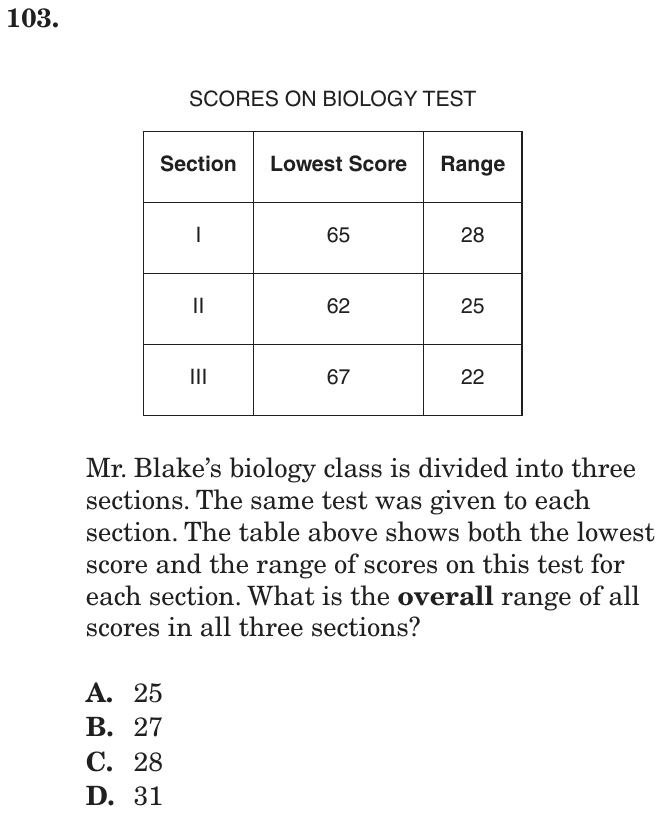
Question 47 of 57
2025 Practice Test A Math, question 47Question
The graph above shows the number of schools per city for five small cities. Cities M and N each have 500 students per school. City P has 400 students per school. Cities Q and R each have 700 students per school. Which of the five cities has the greatest number of students?
- ACity M
- BCity P
- CCity Q
- DCity R
Show the answer
Correct answer: C
Take each city’s number of schools and multiply by the number of students. It is not necessary to calculate all 5 of these.
Cities M and N have the same number of students per school, so just calculate the number of students in City M because it has more schools than City N.
The same goes for Q and R — only Q needs to be calculated because it has more schools than R.
M= 8 × 500 = 4,000
P = 9 × 400 = 3,600
Q = 6 × 700 = 4,200
City Q has the greatest number of students.
Question analysis
This graph question shows the number of schools in each of five small cities and gives the number of students per school for each city. Students multiply schools by students per school to compare the total number of students. Comparing only the bars, or only the rates, can mislead.
- Grade level
- Grade 6 content, by NYS standard
- Compared with grade 7
- Below grade 7 Reading a bar graph and multiplying is familiar from grade 6. Grade 7 data tasks often add percents or compare distributions; this one needs only a few whole-number products, so it is easier than typical grade 7 work.
- Estimated difficulty
- Straightforward: two steps or one careful reading.
- Thinking it demands
- Depth of knowledge 2, skills and concepts · mainly apply
- What makes it hard
- A very close wrong answer moderate
- Much to keep track of minor
- Reading a figure, table or graph minor
- Solution
- 3 steps
- Reading level
- Question and choices: about grade 2, 57 words.
- Corrected from the DOE handbook
- A misstatement in the explanation was corrected.
- Students, last 30 days
- Not enough answers yet to show (it takes 10).
Why it is hard, traps and wrong answers (shows the answer)
Why it is hard
Neither the tallest bar nor the highest rate wins, which is the point of the question: total students depend on both. The explanation's shortcut, comparing only M, P and Q because N and R each share a rate with a taller bar, cuts the work to three products. The top two totals are close, so the products must actually be computed rather than estimated.
A very close wrong answer moderate Choosing the answer
City M's 4,000 students and City Q's 4,200 differ by only 200, so judging from bar heights and rates cannot separate them; only computing 8 × 500 and 6 × 700 does. (Embretson & Wetzel, 1987; Gorin & Embretson, 2006; Ascalon et al., 2007)
Much to keep track of minor Working it out
The rates come in three groups in the stem, 500 for M and N, 400 for P, 700 for Q and R, and each must be matched to its bar. (Sweller, 1988; Carpenter, Just & Shell, 1990)
Reading a figure, table or graph minor Understanding the question
The number of schools comes only from the bar heights, read against gridlines from 0 to 10; all five bars end exactly on a gridline. (Lesh, Post & Behr, 1987; Kirsch & Mosenthal, 1990)
Strategy: For each city, multiply the number of schools read from the graph by its students per school and compare the products; cities that share a rate need only their school counts compared.
Traps
- Stops one step early: A choice is a number from partway through the solution.
- Answers a different question: A choice is right for another quantity: the other unknown, the rest instead of the part, the part instead of the whole.
The wrong answers, classified
A Stops one step early (King et al., 2004; Gierl et al., 2017)
Computes M's 8 × 500 = 4,000 and P's 9 × 400 = 3,600 and stops, never working out Q's 6 × 700 = 4,200.
B Answers a different question (King et al., 2004; Hegarty, Mayer & Monk, 1995)
Picks the tallest bar, P's nine schools, which answers which city has the most schools rather than the most students.
D Numbers taken from the question (Hegarty, Mayer & Monk, 1995)
Picks a city with the stem's highest rate, 700 students per school, without noticing that R has only 4 schools to Q's 6.
What was corrected from the DOE handbook, and why
- Explanation: The handbook says “Cities M and N have the same number of students”. They have the same number of students per school (500), not the same total: M has 8 × 500 = 4,000 and N has 5 × 500 = 2,500, which is why only City M, with more schools, needs to be calculated. The sentence now says “the same number of students per school”.
Worked solution, step by step
Formulas used
- Total students in a city
- S is the total number of students in a city. n is the number of schools, read from the bar. s is the number of students in each school. You multiply because every school in that city has the same number of students.
Read the graph
The bar graph shows how many schools each city has. Read the top of each bar against the numbers on the left. M has 8, N has 5, P has 9, Q has 6 and R has 4.
The question gives the students per school. You need the city with the most students in all.
Multiply for each city
Use the formula for each city:
City Schools Students per school Total students M 8 500 4,000 N 5 500 2,500 P 9 400 3,600 Q 6 700 4,200 R 4 700 2,800 Compare the totals
The biggest total is 4,200, for City Q.
Watch out: City P has the tallest bar, but that means the most schools, not the most students. That leads to choice B. City M’s 4,000 is close, so do not stop before you work out Q. That is choice A.
So the answer is C, City Q.
Check your answer
A shortcut: M and N both have 500 per school, and M has more schools, so M beats N. Q and R both have 700, and Q beats R. So only M, P and Q matter: 4,000, 3,600 and 4,200. Q still wins.
More questions like this
The original DOE question
Question 48 of 57
2025 Practice Test A Math, question 48Question
In the infinitely repeating decimal above, 7 is the first digit in the repeating pattern. What is the 391st digit?
- A0
- B3
- C6
- D7
Show the answer
Correct answer: D
There are 6 digits in the repeating decimal (769230), so 7 would be the first, seventh, thirteenth digit and so on.
To find the 391st digit, divide 391 by 6.
391 ÷ 6 = 65 R1
Since the remainder is 1, that means the 391st digit is the same as the 1st digit, which is 7.
Question analysis
This repeating decimal question shows the six-digit repeating pattern of 10/13 and asks for the 391st digit after the decimal point. Students must use the length of the repeating block and division with a remainder to find the position within the cycle. Matching the remainder to the right digit is where students slip.
- Grade level
- Grade 7 content, by NYS standard
- Compared with grade 7
- Above grade 7 Seventh graders learn that fractions have repeating decimals. Using the length of the repeating block and a remainder to find a digit hundreds of places away is a pattern-reasoning step beyond typical seventh-grade classwork.
- Estimated difficulty
- Hard: combines ideas, needs a plan, and has more than one tempting wrong answer.
- Thinking it demands
- Depth of knowledge 2, skills and concepts · mainly apply
- What makes it hard
- No obvious method moderate
- Solution
- 2 steps
- Reading level
- Question and choices: about grade 8, 20 words.
- Students, last 30 days
- Not enough answers yet to show (it takes 10).
Why it is hard, traps and wrong answers (shows the answer)
Why it is hard
Once the cycle length is used, the arithmetic is a single division, 391 ÷ 6 = 65 remainder 1. The difficulty is turning the remainder into a position: remainder 1 is the first digit of a new block, not the last digit of the previous one or the second of the new one. Checking the rule on small positions, the 1st and 7th digits are both 7, removes the doubt.
No obvious method moderate Working it out
Nothing in the stem mentions division; students must see that the six-digit block 769230 repeats, so position 391 depends only on the remainder of 391 divided by 6. (Schoenfeld, 1985)
Strategy: Divide 391 by the length of the repeating block and look only at the remainder; a remainder of r points to the r-th digit of the block.
Traps
- Counting the ends: Inclusive or exclusive ends, fence posts, consecutive numbers: an answer that is one too many or too few, or an endpoint drawn open where it belongs closed (or the reverse).
The wrong answers, classified
A Counting the ends (Brown & Burton, 1978)
Sees that 65 blocks fill 390 places and lands on the 390th digit, the 0 that ends a block, one place short.
B A faulty procedure (Brown & Burton, 1978; Tatsuoka, 1983)
Uses the quotient 65 instead of the remainder, takes its last digit 5, and reads the fifth digit of 769230, which is 3.
C Counting the ends (Brown & Burton, 1978)
Treats the remainder 1 as one step past the block's first digit, moving from 7 to the second digit, 6.
Worked solution, step by step
Formulas used
- Division with a remainder
- n is the number you divide. d is what you divide by. q is the quotient, the number of whole groups. r is the remainder, what is left over. Here it tells how many full blocks of digits fit, and where you land after them.
Sort out what you know
The bar over 769230 means those six digits repeat forever: 769230769230 and so on. The 7 is digit number 1. You need digit number 391.
Spot the pattern
The block 769230 has 6 digits, so the pattern starts over every 6 digits. Digit 1 is 7, and so are digits 7, 13, 19 and so on. Each full block ends with a 0, at digits 6, 12, 18 and so on.
Divide 391 by 6
Find how many full blocks fit into 391 digits, and what is left:
So 65 full blocks use up 6 × 65 = 390 digits. The remainder is 1. That means digit 391 is the 1st digit of the next block.
Read the digit
The 1st digit of the block is 7. Watch out: digit 390 is the last digit of a full block, which is 0. That is choice A. Digit 391 is one step past it, so it starts a new block.
So the answer is D, 7.
Check your answer
Test the idea on a small number. Digit 7: 7 = 6 × 1 + 1, so the remainder is 1 and the digit should be 7. Write it out: 7692307. The 7th digit is indeed 7. The rule works.
More questions like this
The original DOE question
Question 49 of 57
2025 Practice Test A Math, question 49Question
Graph the solution set for the inequality .
Select a ray. Then, move the endpoint of the ray to the correct position on the number line.
On the test you draw the ray on the number line; here, choose its endpoint, whether the endpoint is closed or open, and its direction. The DOE has not published how answers with several parts are scored; this site counts one right only when every part is right.
Show the answer
Correct answer: a ray with a closed endpoint at 1, pointing right
Solution:

Solve the inequality for x, then graph the solution on the number line:
Add 5 to both sides of the inequality:
Divide both sides by 2:
Rewrite the inequality with x on the left side:
The graph of is a closed ray (solid point) beginning at 1 and extending to the right on the number line.
Question analysis
Students graph the solution set of a two-step inequality on a number line by choosing a ray: where it starts, whether its endpoint is open or closed, and which way it points. It tests solving a linear inequality and reading its solution. The variable sits on the right of the inequality symbol, so reading the result the right way round is part of the challenge.
- Grade level
- Grade 7 content, by NYS standard
- Compared with grade 7
- At grade 7 Solving a two-step inequality and graphing its solution set is a named grade 7 skill. This one puts the variable on the right of the symbol and asks students to build the graph themselves rather than pick it from four.
- Estimated difficulty
- Moderate: several steps, or a close reading with one strong distractor.
- Thinking it demands
- Depth of knowledge 1, recall and reproduction · mainly apply
- What makes it hard
- Reading a figure, table or graph moderate
- Many steps minor
- An answer in an unexpected form minor
- Solution
- 3 steps
- Reading level
- Question and choices: about grade 6, 26 words.
- Students, last 30 days
- Not enough answers yet to show (it takes 10).
Why it is hard, traps and wrong answers (shows the answer)
Why it is hard
Solving takes two routine moves; the points are lost in turning 1 ≤ x into a picture. Because x sits on the right, the symbol seems to point left, and a student who shades the way it points draws the values below 1, which all fail. The dot must also be solid, since x = 1 makes both sides −3. Testing x = 2, where 2x − 5 = −1 and −3 ≤ −1 holds, confirms the direction.
Reading a figure, table or graph moderate Understanding the question
The solution comes out as 1 ≤ x, with x on the right, so the ≤ sign points away from the shaded side; it has to be read as x ≥ 1 before the ray is drawn. (Lesh, Post & Behr, 1987; Kirsch & Mosenthal, 1990)
Many steps minor Working it out
Two solving moves, adding 5 and then halving, come before three graph choices, the endpoint, a solid dot and a direction, and a mistake in any of the five loses the item. (Daniel & Embretson, 2010; Enright, Morley & Sheehan, 2002)
An answer in an unexpected form minor Choosing the answer
The ray is built, by picking one of four ray shapes and dragging its endpoint, rather than chosen from four finished graphs, so nothing on screen flags a ray that starts at the right number but points the wrong way. (Enright, Morley & Sheehan, 2002)
Strategy: Undo the subtraction and then the multiplication on both sides, rewrite the result with x first, decide whether the endpoint is included, and test one value on your ray in the original inequality.
Traps
- Negatives and direction: Arithmetic with negative numbers, the order of a subtraction, or direction on a number line. (Moving a term across the equals sign without changing its sign is a faulty procedure.)
- Counting the ends: Inclusive or exclusive ends, fence posts, consecutive numbers: an answer that is one too many or too few, or an endpoint drawn open where it belongs closed (or the reverse).
- A faulty procedure: A systematic but wrong procedure: adding fractions straight across, applying an exponent to each term of a sum, dropping a sign when moving a term.
The wrong answers, classified
1|closed|left Negatives and direction (Brown & Burton, 1978)
Solves to 1 ≤ x but shades the way the ≤ symbol points, a rule that holds only with x on the left, so the ray covers x ≤ 1.
1|open|right Counting the ends (Brown & Burton, 1978)
Finds the right endpoint and direction but draws an open dot, leaving out 1 itself, though the "or equal to" in ≤ includes it.
-4|closed|right A faulty procedure (Brown & Burton, 1978; Tatsuoka, 1983)
Moves the −5 to the left side without changing its sign, writing −3 − 5 = −8 ≤ 2x, so the ray starts at −4.
Worked solution, step by step
Formulas used
- Doing the same to both sides
- a and b are the two sides of an inequality, and c is any number. Adding the same number to both sides keeps the inequality true. So does dividing both sides by the same positive number. Dividing by a negative number would flip the symbol, but that does not happen here.
- Turning an inequality around
- a and b are any two numbers or terms. You may swap the two sides if you also turn the symbol around. The pointed end of the symbol always faces the smaller side. So 1 ≤ x and x ≥ 1 say the same thing.
Sort out the question
The symbol ≤ means is less than or equal to. The solution set is every value of x that makes true. You show it as a ray. A ray is a dot, called the endpoint, with an arrow going one way forever. You need three things: where the dot goes, whether it is closed or open, and which way the ray points.
Add 5 to both sides
The right side is 2x − 5. Adding 5 undoes subtracting 5, so add 5 to both sides:
Watch out: taking 5 away from −3 instead gives −8 ≤ 2x. That wrong move puts the dot at −4.
Divide both sides by 2
Now x is multiplied by 2, so divide both sides by 2. You divide by a positive number, so the symbol stays the same:
Read it with x first
says 1 is less than or equal to x. So x is 1 or any number bigger than 1. With x first, that is:
Bigger numbers are to the right on a number line, so the ray points right.
Watch out: in 1 ≤ x, the symbol seems to point left. Do not follow it. A ray pointing left from 1 shows numbers that do not work.
Choose a closed dot
The words or equal to mean 1 itself is a solution. Check it: , and −3 ≤ −3 is true. So the dot at 1 is closed, which means filled in. An open dot, an empty circle, leaves the endpoint out. Use it only for < or >.
Watch out: an open dot at 1 would leave out a number that works.
Draw the ray
On the test, choose the ray with a filled dot and an arrow pointing right. Then drag its dot to 1. On this site, choose 1 for the endpoint, then closed (filled dot) and pointing right.
So the answer is a closed dot at 1, with the ray pointing right.
Check your answer
Test a number on your ray, such as 3. , and −3 ≤ 1 is true. Now test a number off the ray, such as 0. , and −3 ≤ −5 is false. So the ray points the right way.
More questions like this
The original DOE question
Question 50 of 57
2025 Practice Test A Math, question 50Question
- A101
- B200
- C301
- D341
Show the answer
Correct answer: D
Question analysis
This order of operations question asks students to evaluate 100(2 + 0.1)² − 100, an expression with a decimal, a square and a subtraction. Students must add inside the parentheses first, square the result, multiply by 100, and then subtract. Squaring the two parts of the sum separately is the trap.
- Grade level
- Grade 6 content, by NYS standard
- Compared with grade 7
- Below grade 7 Evaluating an expression with an exponent and decimals in the correct order is grade 6 content. This is a short routine calculation, so it asks less than typical grade 7 work with negative numbers and multi-step equations.
- Estimated difficulty
- Straightforward: two steps or one careful reading.
- Thinking it demands
- Depth of knowledge 1, recall and reproduction · mainly apply
- What makes it hard
- A very close wrong answer moderate
- Error-prone arithmetic minor
- Solution
- 3 steps
- Reading level
- Question and choices: about grade 16+, 1 words.
- Students, last 30 days
- Not enough answers yet to show (it takes 10).
Why it is hard, traps and wrong answers (shows the answer)
Why it is hard
This is a direct order-of-operations calculation with no word problem around it, so the only real risk is the square of a sum. Students who apply the exponent to each part, or only to the 0.1, find a listed answer waiting. Adding inside the parentheses before squaring, and then squaring 2.1 exactly, is the whole task.
A very close wrong answer moderate Choosing the answer
The choices 301 and 341 differ by 40, and squaring 2.1 roughly as 4 lands nearer 301; only the exact square, 4.41, separates them. (Embretson & Wetzel, 1987; Gorin & Embretson, 2006; Ascalon et al., 2007)
Error-prone arithmetic minor Working it out
Squaring 2.1 by hand to get 4.41 puts two decimal places in the product, an easy place to misplace the point. (Brown & Burton, 1978; Junker & Sijtsma, 2001)
Strategy: Add inside the parentheses to get a single decimal, square it carefully, then multiply by 100 and subtract 100, following the order of operations.
Traps
- A faulty procedure: A systematic but wrong procedure: adding fractions straight across, applying an exponent to each term of a sum, dropping a sign when moving a term.
- Order of operations: Working left to right, or distributing a minus sign wrongly, gives a choice.
The wrong answers, classified
A Order of operations (Brown & Burton, 1978)
Squares only the 0.1, as if the parentheses were not there, so 100 × 2.01 − 100 gives 101.
B Little reason to choose it (Haladyna & Downing, 1993; Rodriguez, 2005)
No single slip gives 200; it requires (2 + 0.1)² to come out as 3, so it mostly catches guesses.
C A faulty procedure (Brown & Burton, 1978; Tatsuoka, 1983)
Squares each term of the sum separately, 4 + 0.01 = 4.01, instead of squaring 2.1, so 100 × 4.01 − 100 gives 301.
Worked solution, step by step
Formulas used
- Order of operations
- This is the agreed order for doing math steps. Work inside parentheses first, then exponents, then multiply and divide, then add and subtract. Everyone follows it, so a problem has only one answer.
- Squaring a number
- a is any number. The small 2, called an exponent, means multiply the number by itself. So 2.1 squared means 2.1 times 2.1.
Sort out the problem
You need to work out . The 100 right next to the parentheses means 100 times. Follow the order of operations, one step at a time.
Add inside the parentheses
Parentheses come first in the order of operations. So add the numbers inside them:
Now the problem is:
Square 2.1
Work out 21 × 21 = 441, then put in two decimal places, one for each 2.1.
Watch out: do not square the 2 and the 0.1 one at a time. That gives 4 + 0.01 = 4.01, which is wrong. It leads to 301, choice C.
Multiply, then subtract
The exponent is done, so multiply next. Multiplying by 100 moves the decimal point two places to the right. Subtracting comes last:
So the answer is D, 341.
Check your answer
Estimate. 2.1 is a bit more than 2, so its square is a bit more than 4. 100 times that is a bit more than 400. Take away 100 and you get a bit more than 300. 341 fits. Choices A and B are too small.
More questions like this
The original DOE question
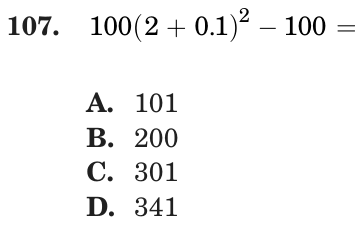
Question 51 of 57
2025 Practice Test A Math, question 51Question
A sports store has a container of handballs: 4 blue, 5 red, 8 yellow, 9 white, and 11 green. If one ball is picked from the container at random, what is the probability that it will be yellow?
- A
- B
- C
- D
Show the answer
Correct answer: C
The total number of handballs in the container is
Since there are 8 yellow handballs, the probability of selecting a yellow handball is
Question analysis
This probability question describes a container of handballs in five colors and asks the chance that one ball picked at random is yellow. Students must add all the balls to get the total and compare the yellow count to it. Using the wrong total, such as only the balls that are not yellow, is the easy mistake.
- NYS standards
- 6.SP.8a uniform probability models
- Grade level
- Grade 6 content, by NYS standard
- Compared with grade 7
- Below grade 7 Finding the probability of a single event as favorable outcomes over total outcomes is grade 6 content. This item takes one addition and one fraction, so it is easier than typical grade 7 compound probability work.
- Estimated difficulty
- Routine: one familiar step, little to misread.
- Thinking it demands
- Depth of knowledge 2, skills and concepts · mainly apply
- What makes it hard
- Solution
- 2 steps
- Reading level
- Question and choices: about grade 5, 37 words.
- Students, last 30 days
- Not enough answers yet to show (it takes 10).
Why it is hard, traps and wrong answers (shows the answer)
Why it is hard
This is a one-event probability: add the five colors to get 37 balls and put the 8 yellow ones over that total. The only real decision is the denominator, and the wrong choices offer the non-yellow count, the yellow count, and a numerator of 1. Students who say "favorable over total" to themselves avoid all three.
A very close wrong answer minor Choosing the answer
The choices 8/37 and 8/29 share the numerator 8 and differ only in the denominator, all 37 balls against the 29 that are not yellow. (Embretson & Wetzel, 1987; Gorin & Embretson, 2006; Ascalon et al., 2007)
Strategy: Add up every ball in the container to get the total number of outcomes, then put the number of yellow balls over that total.
Traps
- Misunderstands the concept: A wrong belief about a concept: that percents can be added, that area grows like length, that averages can be averaged, that a bigger denominator means a bigger fraction.
- Answers a different question: A choice is right for another quantity: the other unknown, the rest instead of the part, the part instead of the whole.
The wrong answers, classified
A Answers a different question (King et al., 2004; Hegarty, Mayer & Monk, 1995)
Finds the 37 balls correctly but puts 1 on top, giving the chance of picking one particular ball rather than any yellow one.
B Numbers taken from the question (Hegarty, Mayer & Monk, 1995)
Puts 1 over the 8 yellow balls, a fraction built from the yellow count alone that ignores the other 29 balls.
D Misunderstands the concept (Smith, diSessa & Roschelle, 1993; De Bock et al., 1998; Ni & Zhou, 2005)
Compares the 8 yellow balls with the 29 that are not yellow, a part-to-part ratio, instead of with all 37 balls.
Worked solution, step by step
Formulas used
- Probability
- P is the probability, the chance that something happens. f is the number of favorable outcomes, the ones you want. t is the total number of outcomes. It works when every outcome is equally likely, like picking one item at random.
Sort out what you know
The container has 4 blue, 5 red, 8 yellow, 9 white and 11 green balls. One ball is picked at random, so every ball has the same chance. You need the chance it is yellow.
Count all the balls
Add up every color, because any ball could be picked:
There are 37 balls in all. That is the total number of outcomes.
Put yellow over the total
8 of the balls are yellow. Those are the favorable outcomes:
Watch out: compares yellow with the 29 balls that are not yellow. Probability compares the part with all the balls, so choice D is wrong. So the answer is C, .
Check your answer
8 out of 37 is about 0.22, a little more than 1 in 5. That makes sense, since yellow is a fair share of the balls. Choice A, 1/37, is the chance of picking one certain ball, not any yellow one.
More questions like this
The original DOE question
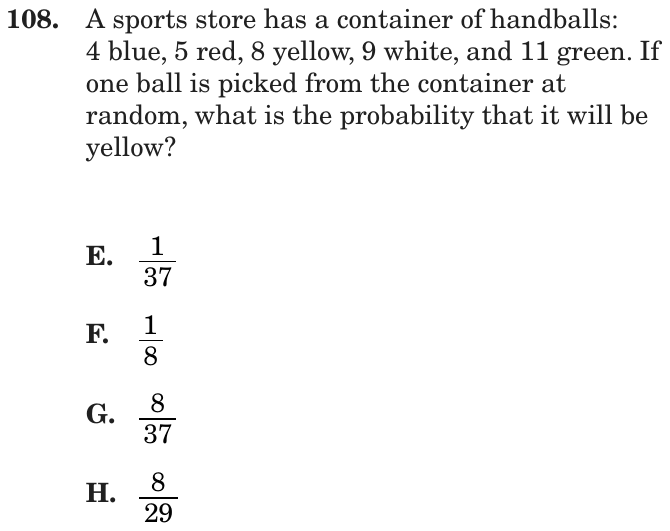
Question 52 of 57
2025 Practice Test A Math, question 52Question
Each week, Leon has fixed expenses of $1,250 at his furniture shop. It costs him $150 to make a chair in his shop, and he sells each chair for $275. What is Leon’s profit if he makes and sells 25 chairs in 1 week?
- A$1,875
- B$2,500
- C$3,125
- D$4,375
Show the answer
Correct answer: A
Each chair costs Leon $150 to make, and he sells the chair for $275.
His profit is found by subtracting the cost from the price:
$275 − $150 = $125 per chair
If Leon makes and sells 25 chairs in a week, his initial profit is
25 × $125 = $3,125
However, Leon has additional fixed expenses of $1,250 per week, so this cost must also be subtracted to arrive at the profit. His final profit is
$3,125 − $1,250 = $1,875
Question analysis
This profit word problem gives Leon's weekly fixed expenses at his furniture shop, the cost to make each chair and its selling price, then asks his profit for 25 chairs in one week. Students must find the profit on each chair, multiply, and account for the fixed expenses. Forgetting the fixed expenses, or adding them, are the main slips.
- NYS standards
- Grade level
- Grade 7 content, by NYS standard
- Compared with grade 7
- At grade 7 Multi-step money problems are standard grade 7 work. This one has three whole-number steps and a familiar profit idea, so it matches typical grade 7 demand, with the fixed cost as the detail to remember.
- Estimated difficulty
- Moderate: several steps, or a close reading with one strong distractor.
- Thinking it demands
- Depth of knowledge 2, skills and concepts · mainly apply
- What makes it hard
- Much to keep track of moderate
- Something you must already know minor
- Solution
- 3 steps
- Reading level
- Question and choices: about grade 3, 39 words.
- Students, last 30 days
- Not enough answers yet to show (it takes 10).
Why it is hard, traps and wrong answers (shows the answer)
Why it is hard
The arithmetic is whole-number and friendly, so the question is about bookkeeping: which amounts are income, which are costs, and which happen once a week. The fixed expenses are named first in the stem and are easy to forget by the time the per-chair profit is multiplied. A final check that revenue minus all costs, 6,875 − 3,750 − 1,250, gives the same result confirms it.
Much to keep track of moderate Working it out
Three dollar amounts play different roles, a weekly fixed expense, a cost per chair and a price per chair, and each must enter the profit with the right sign. (Sweller, 1988; Carpenter, Just & Shell, 1990)
Something you must already know minor Working it out
The bold "profit" is not defined; students must know it means money taken in minus every cost, including costs that do not depend on the number of chairs. (Anderson & Krathwohl, 2001)
Strategy: Subtract the cost from the price to get the profit per chair, multiply by the number of chairs, then subtract the week's fixed expenses.
Traps
- Stops one step early: A choice is a number from partway through the solution.
- Wrong operation: Adds instead of multiplying, divides the wrong way round, turns a ratio or rate upside down, or undoes a step in the wrong direction (subtracts what should be added back).
The wrong answers, classified
B Numbers taken from the question (Hegarty, Mayer & Monk, 1995)
Multiplies the $150 cost by 25 chairs and subtracts the $1,250, treating the cost of making a chair as money earned.
C Stops one step early (King et al., 2004; Gierl et al., 2017)
Finds the profit on 25 chairs at $125 each, $3,125, and stops before subtracting the $1,250 fixed expenses.
D Wrong operation (Hegarty, Mayer & Monk, 1995; King et al., 2004)
Adds the $1,250 fixed expenses to the $3,125 chair profit instead of subtracting them, treating an expense as income.
Worked solution, step by step
Formulas used
- Profit
- P is the profit, the money Leon keeps. I is the income, the money he takes in from sales. C is the total cost: every dollar he spends, including fixed expenses. Profit is what is left after all costs are paid.
Sort out what you know
Leon pays $1,250 each week no matter what. These are fixed expenses, like rent. Each chair costs $150 to make, and he sells each one for $275.
He makes and sells 25 chairs. Profit is the money left after paying all the costs.
Find the profit on one chair
Each chair sells for $275 but costs $150 to make. Subtract to see what he keeps:
He keeps $125 on each chair he sells.
Find the profit on 25 chairs
The chairs bring in $3,125 more than they cost to make. Watch out: $3,125 is choice C, but it is not the final profit. The fixed expenses still have to be paid.
Subtract the fixed expenses
Watch out: the $1,250 is money spent, so subtract it. Adding it gives $4,375, choice D. So the answer is A, $1,875.
Check your answer
Work it the long way. Sales: 25 × $275 = $6,875. Costs: 25 × $150 = $3,750, plus $1,250, which makes $5,000. Profit: $6,875 − $5,000 = $1,875. Same answer.
More questions like this
The original DOE question
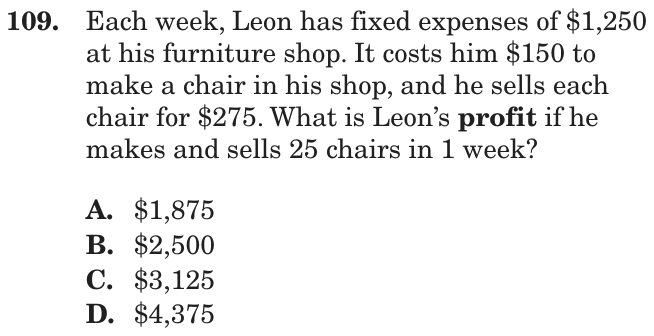
Question 53 of 57
2025 Practice Test A Math, question 53Question
Using the approximation 2.54 centimeters = 1 inch, how many centimeters are in 4 feet 7 inches?
- A21.65
- B119.38
- C121.92
- D139.70
Show the answer
Correct answer: D
Convert 4 ft 7 in. to inches. Since 12 in. = 1 ft :
4(12) + 7 = 55 inches
Multiply that by the conversion
2.54 cm = 1 in.
55 × 2.54 = 139.70 cm
Question analysis
This unit conversion question uses 2.54 centimeters per inch and asks how many centimeters are in 4 feet 7 inches. Students must first turn feet and inches into inches alone, then multiply by the conversion factor. Mixing feet and inches into a single number is the easy slip.
- Grade level
- Grade 6 content, by NYS standard
- Compared with grade 7
- Below grade 7 Converting measurement units with a given factor is grade 6 content. This item takes two short steps and one decimal multiplication, so it asks a little less than typical grade 7 work, though the mixed units need care.
- Estimated difficulty
- Straightforward: two steps or one careful reading.
- Thinking it demands
- Depth of knowledge 1, recall and reproduction · mainly apply
- What makes it hard
- Solution
- 2 steps
- Reading level
- Question and choices: about grade 13, 12 words.
- Corrected from the DOE handbook
- A missing decimal point in the explanation was restored.
- Students, last 30 days
- Not enough answers yet to show (it takes 10).
Why it is hard, traps and wrong answers (shows the answer)
Why it is hard
The conversion factor is given and the multiplication is mechanical, so the question rests on the mixed measurement. Feet and inches are not a decimal system, and treating 4 feet 7 inches as 47, or dropping the 7, both lead to listed answers. A rough estimate, 55 inches × 2.5 ≈ 137, points straight to the right choice.
Something you must already know minor Working it out
The stem gives centimeters per inch but not inches per foot; students must supply 12 to turn 4 feet into 48 inches. (Anderson & Krathwohl, 2001)
Strategy: Change 4 feet to inches using 12 inches per foot, add the extra 7 inches, then multiply the total number of inches by 2.54.
Traps
- Units or scale: The answer is wanted in other units, or a rate or scale must be converted first.
- Answers a different question: A choice is right for another quantity: the other unknown, the rest instead of the part, the part instead of the whole.
The wrong answers, classified
A Wrong operation (Hegarty, Mayer & Monk, 1995; King et al., 2004)
Divides 55 inches by 2.54 instead of multiplying, converting in the wrong direction and getting fewer centimeters than inches.
B Units or scale (King et al., 2004)
Reads 4 feet 7 inches as 47 inches, as if feet were tens of inches, then multiplies 47 × 2.54 = 119.38.
C Answers a different question (King et al., 2004; Hegarty, Mayer & Monk, 1995)
Converts the 4 feet to 48 inches and multiplies by 2.54, getting 121.92, but leaves out the extra 7 inches.
What was corrected from the DOE handbook, and why
- Explanation: The handbook writes the conversion as “254 cm = 1 in.”, dropping the decimal point. The question gives 2.54 centimeters = 1 inch and the handbook’s next line multiplies by 2.54, so it now reads 2.54 cm = 1 in.
Worked solution, step by step
Formulas used
- Feet to inches
- i is the number of inches and f is the number of feet. Each foot has 12 inches, so you multiply the feet by 12.
- Inches to centimeters
- c is the number of centimeters and i is the number of inches. Each inch is about 2.54 centimeters, so you multiply. A centimeter is smaller than an inch, so you get a bigger number.
Sort out what you know
The length is 4 feet 7 inches. That means 4 feet plus 7 more inches. You know 1 inch is about 2.54 centimeters.
So change everything to inches first, then to centimeters. The question does not say that 1 foot is 12 inches. You have to know it.
Change the length to inches
4 feet is 48 inches. Now add the extra 7 inches:
The length is 55 inches. Watch out: 4 feet 7 inches is not 47 inches. Using 47 gives choice B. Leaving out the 7 inches gives 121.92, choice C.
Change inches to centimeters
To multiply in your head, split 55 into 50 and 5: 127 + 12.7 = 139.7.
Watch out: multiply, do not divide. Dividing 55 by 2.54 gives 21.65, choice A. So the answer is D, 139.70.
Check your answer
A centimeter is smaller than an inch. So the number of centimeters must be bigger than 55. About 2.5 × 55 is 137.5, close to 139.70. Choice A, 21.65, is smaller than 55, so it cannot be right.
More questions like this
The original DOE question
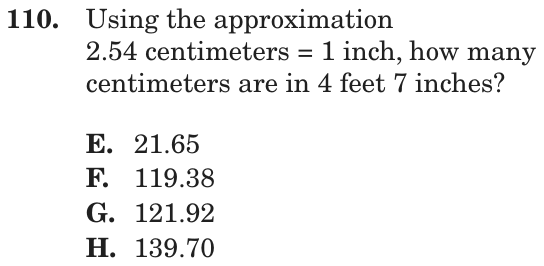
Question 54 of 57
2025 Practice Test A Math, question 54Question
On the number line above, , , and . What is the position of point ?
- A
- B
- C
- D
Show the answer
Correct answer: C
First, use to find the location of :
Now, use to find the location of :
Finally, use to find the location of :
Question analysis
This number line question gives the lengths JK, JM and LM as mixed numbers and asks for the position of point L. Students must chain three distance steps, moving left from K to J, right to M and back to L, with fractions in eighths and a negative position. Losing track of where K sits is the main danger.
- Grade level
- Grade 7 content, by NYS standard
- Compared with grade 7
- Above grade 7 Grade 7 students add and subtract rational numbers and find distances on a number line one at a time. This item chains three such steps with mixed numbers and a negative position, more than typical grade 7 work demands.
- Estimated difficulty
- Among the hardest on the SHSAT: a non-obvious approach, heavy reading, or a well-hidden trap.
- Thinking it demands
- Depth of knowledge 2, skills and concepts · mainly apply
- What makes it hard
- A very close wrong answer major
- Error-prone arithmetic moderate
- Reading a figure, table or graph moderate
- Many steps minor
- Solution
- 4 steps
- Reading level
- Question and choices: about grade 9, 20 words.
- Students, last 30 days
- Not enough answers yet to show (it takes 10).
Why it is hard, traps and wrong answers (shows the answer)
Why it is hard
Every number is a mixed fraction, one position is negative, and the figure's even spacing hides how long KL really is. The distance route, KL = 9 3/4 − 3 1/2 − 1 1/8, avoids the negative entirely but ends one step short of a position unless K's 3/8 is added back. That last step is the one most students skip, which is why the question sits at the top of the scale.
A very close wrong answer major Choosing the answer
The choices 5 1/8, 5 1/4 and 5 1/2 lie within 3/8 of one another, so no estimate separates them; only exact eighths and adding K's 3/8 pick out the right one. (Embretson & Wetzel, 1987; Gorin & Embretson, 2006; Ascalon et al., 2007)
Error-prone arithmetic moderate Working it out
Every step mixes halves, quarters and eighths, and placing J means 3/8 − 3 1/2 = −3 1/8, a subtraction that crosses zero. (Brown & Burton, 1978; Junker & Sijtsma, 2001)
Reading a figure, table or graph moderate Understanding the question
Only K is labeled, and the points are drawn evenly spaced although KL is over four times LM, so the picture gives no help with sizes. (Lesh, Post & Behr, 1987; Kirsch & Mosenthal, 1990)
Many steps minor Working it out
Three linked moves, K to J, J to M and M back to L, each depend on the last, so an early slip carries through. (Daniel & Embretson, 2010; Enright, Morley & Sheehan, 2002)
Strategy: Start from K's labeled position, subtract JK to place J, add JM to place M, then subtract LM, keeping every fraction in eighths.
Traps
- Answers a different question: A choice is right for another quantity: the other unknown, the rest instead of the part, the part instead of the whole.
- Stops one step early: A choice is a number from partway through the solution.
The wrong answers, classified
A Stops one step early (King et al., 2004; Gierl et al., 2017)
Finds KL = 9 3/4 − 3 1/2 − 1 1/8 = 5 1/8 and stops one step short, never adding K's position of 3/8.
B An arithmetic slip (Junker & Sijtsma, 2001)
Rewrites 9 3/4 as 9 4/8 instead of 9 6/8, so M lands at 6 3/8 and L at 6 3/8 − 1 1/8 = 5 1/4.
D Answers a different question (King et al., 2004; Hegarty, Mayer & Monk, 1995)
Finds KM = 9 3/4 − 3 1/2 = 6 1/4, the distance from K to M, and gives it without moving back 1 1/8 to L.
Worked solution, step by step
Formulas used
- Distance on a number line
- d is the distance between two points. b is the point on the right and a is the point on the left. Subtracting left from right always gives a positive distance. It works even when a is negative.
- Equal fractions
- a is the top number (numerator) and b is the bottom number (denominator). Multiplying both by the same number k gives an equal fraction. It is like cutting each piece into k smaller pieces. Use it to give fractions the same bottom before you add or subtract.
Sort out what you know
Only K has a value: . JK means the distance from J to K. You know JK = , JM = and LM = .
You need the position of L, the number where L sits. The points are drawn evenly spaced, but the distances are not equal. So use the numbers, not the picture.
Write the fractions in eighths
The fractions use halves, fourths and eighths. Give them all a bottom of 8:
Watch out: is , not . That slip leads to choice B.
Find the distance from K to M
JM is JK and KM put together. So take JK away from JM:
KM is , or . Watch out: this is a distance, not where L sits. Choice D stops here.
Find the distance from K to L
KM is KL and LM put together. So take LM away:
KL is . Watch out: this is still a distance. Choice A stops here.
Find the position of L
L is to the right of K, and K is at . Add:
So the answer is C, .
Check your answer
Place every point. J is left of K, at . M is right of J, at . L is left of M, at , which is . Same answer.
More questions like this
The original DOE question
Question 55 of 57
2025 Practice Test A Math, question 55Question
If , what is in terms of ?
- A
- B
- C
- D
Show the answer
Correct answer: C
Question analysis
This algebra question gives the linear equation 4x − 3y = 12 and asks for x in terms of y. Students must isolate the x term and then divide to solve for x. With two variables and a negative coefficient, small sign and division slips each lead to a different wrong choice.
- NYS standards
- Grade level
- Grade 8 content, by NYS standard
- Compared with grade 7
- Above grade 7 Grade 7 students solve one-variable equations like 4x − 3 = 12. Rearranging an equation with two variables to express one in terms of the other is grade 8 algebra, with sign and division slips to avoid.
- Estimated difficulty
- Moderate: several steps, or a close reading with one strong distractor.
- Thinking it demands
- Depth of knowledge 1, recall and reproduction · mainly apply
- What makes it hard
- Variables instead of numbers moderate
- A very close wrong answer moderate
- Error-prone arithmetic minor
- Solution
- 2 steps
- Reading level
- Question and choices: about grade 10, 13 words.
- Students, last 30 days
- Not enough answers yet to show (it takes 10).
Why it is hard, traps and wrong answers (shows the answer)
Why it is hard
The solution is two moves, add 3y to both sides and divide everything by 4, yet each move has a classic slip attached. The four choices are the four combinations of getting the sign right or wrong and dividing the 12 or not, so every partial mistake has a home. Checking one point that satisfies the original equation catches any of them.
Variables instead of numbers moderate Understanding the question
With two variables there is no number to check against unless students invent one; the point x = 6, y = 4 satisfies the equation and separates the choices. (Koedinger & Nathan, 2004; Enright, Morley & Sheehan, 2002)
A very close wrong answer moderate Choosing the answer
The choices x = 3/4 y + 3 and x = −3/4 y + 3 are identical except for the sign of the y term, which only correctly moving −3y across the equals sign settles. (Embretson & Wetzel, 1987; Gorin & Embretson, 2006; Ascalon et al., 2007)
Error-prone arithmetic minor Working it out
Dividing 12 + 3y by 4 must reach both terms, and the negative coefficient −3 has to change sign when it moves, two slips in a short line. (Brown & Burton, 1978; Junker & Sijtsma, 2001)
Strategy: Move the y term to the right side, watching its sign, so only the x term remains on the left, then divide the entire right side, term by term, by 4.
Traps
- A faulty procedure: A systematic but wrong procedure: adding fractions straight across, applying an exponent to each term of a sum, dropping a sign when moving a term.
The wrong answers, classified
A A faulty procedure (Brown & Burton, 1978; Tatsuoka, 1983)
Moves 3y correctly but divides only the y term by 4, leaving the constant 12 undivided.
B A faulty procedure (Brown & Burton, 1978; Tatsuoka, 1983)
Keeps the minus sign on the 3y term when moving it and also leaves the 12 undivided, two errors at once.
D A faulty procedure (Brown & Burton, 1978; Tatsuoka, 1983)
Divides every term by 4 correctly but keeps the minus on 3y, as if a term kept its sign when moved across.
Worked solution, step by step
Formulas used
- Keeping an equation balanced
- a and b are the two sides of an equation, and c is any number. An equation is like a balance. If you do the same thing to both sides, such as adding 3y or dividing by 4, they stay equal.
- Dividing a sum
- a and b are the two parts of the top, and c is the number you divide by. To divide a sum, divide each part. It works because sharing a + b into c groups shares a and b each into c groups.
Sort out what you need
The question asks for x in terms of y. That means get x alone on one side. The other side may have y and numbers, but no x. Start with .
Move the y term
The 3y is being subtracted on the left. Add 3y to both sides to clear it:
Watch out: the term was minus 3y. Adding 3y to both sides makes it plus 3y on the right. Keeping the minus sign leads to choice D.
Divide both sides by 4
x is being multiplied by 4. Divide both sides by 4 to undo it:
Split the fraction
Divide each part of the top by 4:
Watch out: the 12 must be divided by 4 too. Leaving it as 12 gives choice A. The choices put the y term first. So the answer is C, .
Check your answer
Pick y = 4. Choice C gives x = 3 + 3 = 6. Put x = 6 and y = 4 into the start: 4 × 6 − 3 × 4 = 24 − 12 = 12. It works. Choice D gives x = 0, and 4 × 0 − 12 = −12, not 12.
More questions like this
The original DOE question
Question 56 of 57
2025 Practice Test A Math, question 56Question
SERVINGS OF FRUITS AND VEGETABLES
| Number of Servings of Fruits and Vegetables | Number of Students |
| 0 | 5 |
| 1 | 7 |
| 2 | 3 |
| 3 | 4 |
| 4 | 0 |
| 5 | 1 |
There are 20 students in a class. The frequency table above shows the number of students in this class who ate 0, 1, 2, 3, 4, or 5 servings of fruits and vegetables yesterday. What is the mean number of servings of fruits and vegetables eaten yesterday per student in this class?
- A
- B
- C
- D
Show the answer
Correct answer: A
First, determine the total number of servings of fruits and vegetables that the students ate by multiplying the number of servings by the number of students in each row of the table.
Then add that column to get the total number of servings:
| Number of Servings of Fruits and Vegetables | Number of Students | Number of Servings × Number of Students |
| 0 | 5 | 0 |
| 1 | 7 | 7 |
| 2 | 3 | 6 |
| 3 | 4 | 12 |
| 4 | 0 | 0 |
| 5 | 1 | 5 |
Total: 30
Calculate the mean by dividing the total number of servings of fruits and vegetables by the total number of students:
Question analysis
This statistics question uses a frequency table showing how many of 20 students ate 0, 1, 2, 3, 4 or 5 servings of fruits and vegetables, and asks for the mean servings per student. Students must weight each serving amount by its number of students, add, and divide. Averaging the wrong column of the table is the common mistake.
- NYS standards
- 6.SP.5c range, center, and overall pattern
- Grade level
- Grade 6 content, by NYS standard
- Compared with grade 7
- At grade 7 Finding a mean is grade 6 content; doing it from a frequency table, where each value must be weighted by its count, is the multi-step version grade 7 students meet regularly.
- Estimated difficulty
- Moderate: several steps, or a close reading with one strong distractor.
- Thinking it demands
- Depth of knowledge 2, skills and concepts · mainly apply
- What makes it hard
- Reading a figure, table or graph moderate
- Many steps minor
- Solution
- 3 steps
- Reading level
- Question and choices: about grade 7, 64 words.
- Students, last 30 days
- Not enough answers yet to show (it takes 10).
Why it is hard, traps and wrong answers (shows the answer)
Why it is hard
The answer is smaller than every wrong choice, which surprises students who average the table's columns directly. The question rewards seeing that each row stands for several students, so the total servings come from weighting each value by its count. The stem's reminder that there are 20 students points to the right divisor.
Reading a figure, table or graph moderate Understanding the question
The frequency table has a value column and a count column; the mean needs each value multiplied by its count, so the two columns play different roles. (Lesh, Post & Behr, 1987; Kirsch & Mosenthal, 1990)
Many steps minor Working it out
Six products, 0, 7, 6, 12, 0 and 5, must be found and added to 30 before dividing by the 20 students. (Daniel & Embretson, 2010; Enright, Morley & Sheehan, 2002)
Strategy: Multiply each serving amount by its number of students, add those products to get the total servings, then divide by the 20 students.
Traps
- Answers a different question: A choice is right for another quantity: the other unknown, the rest instead of the part, the part instead of the whole.
The wrong answers, classified
B Misunderstands the concept (Smith, diSessa & Roschelle, 1993; De Bock et al., 1998; Ni & Zhou, 2005)
Averages the serving amounts 1 through 5 listed in the table, (1 + 2 + 3 + 4 + 5) ÷ 5 = 3, without weighting by the students.
C Answers a different question (King et al., 2004; Hegarty, Mayer & Monk, 1995)
Averages the Number of Students column, 20 students over 6 rows, finding the mean count per row instead of the servings per student.
D Numbers taken from the question (Hegarty, Mayer & Monk, 1995)
Divides the 20 students by 5, the largest serving amount, combining two numbers from the page without a model of the mean.
Worked solution, step by step
Formulas used
- Mean
- m is the mean, or average. S is the sum of all the values, here the total servings eaten. n is the number of values, here the number of students. The mean shares the total equally, as if every student ate the same amount.
Sort out the table
This is a frequency table. Each row says how many students ate a certain number of servings. For example, the second row says 7 students ate 1 serving each.
There are 20 students. You need the mean, or average, number of servings per student.
Find the servings in each row
In each row, multiply the servings by the number of students:
Servings Students Servings × Students 0 5 0 1 7 7 2 3 6 3 4 12 4 0 0 5 1 5 Add up all the servings
The class ate 30 servings in all. The students add up to 20, as the question says: 5 + 7 + 3 + 4 + 0 + 1 = 20.
Divide by the number of students
Watch out: do not just average the serving numbers 1 to 5. That gives 3, choice B, and ignores how many students ate each amount. Dividing 20 students by 6 rows gives choice C.
So the answer is A, .
Check your answer
12 of the 20 students ate 0 or 1 serving. Only 5 ate 3 or more. So the mean should be small, between 1 and 2. fits. Choices B, C and D are all 3 or more, which is too big.
More questions like this
The original DOE question
Question 57 of 57
2025 Practice Test A Math, question 57Question
Let , , and . Determine the value of .
Enter your fractional answer in the space provided. Enter only your fraction.
On the test you build the answer on an on-screen keypad; here, type it. Use ^ for a power, sqrt( ) or √ for a root, pi for π, and <= or >= for ≤ and ≥.
Show the answer
Correct answer: 7/5
Solution:
Substitute , , and in : .
Then simplify the complex fraction by multiplying the complex fraction by a form of 1, : .
Simplify after multiplying by a form of 1: .
Then simplify again and add the two fractions: .
Question analysis
This substitution question gives values for b, c and d and asks for the value of an expression made of a fraction divided by a fraction, plus another fraction. Students substitute, simplify the complex fraction and add, then type the result. Dividing fractions in the stacked form is the main hurdle, and the item wants a fraction, not a decimal.
- NYS standards
- Grade level
- Grade 7 content, by NYS standard
- Compared with grade 7
- At grade 7 Grade 7 students evaluate expressions and divide and add fractions. A fraction stacked over another fraction looks unfamiliar and there are no choices to check, but with these values the work is three short steps.
- Estimated difficulty
- Moderate: several steps, or a close reading with one strong distractor.
- Thinking it demands
- Depth of knowledge 1, recall and reproduction · mainly apply
- What makes it hard
- Error-prone arithmetic moderate
- Something you must already know minor
- An answer in an unexpected form minor
- Solution
- 3 steps
- Reading level
- Question and choices: about grade 9, 22 words.
- Students, last 30 days
- Not enough answers yet to show (it takes 10).
Why it is hard, traps and wrong answers (shows the answer)
Why it is hard
Once the values are in, the work is one fraction division and one addition, but the division is printed as a fraction over a fraction, in small type. Multiplying the two fractions, or flipping the top one, gives a sum in fifteenths that looks as finished as the right one. Noticing that the 4s cancel, so the stacked part is simply 3/5, turns the last step into adding fifths.
Error-prone arithmetic moderate Working it out
Dividing 4/5 by 4/3 means multiplying by 3/4, giving 3/5, which is then added to 4/5; multiplying straight across or flipping the top fraction instead both lead to fifteenths. (Brown & Burton, 1978; Junker & Sijtsma, 2001)
Something you must already know minor Working it out
Nothing on the page says that a fraction over a fraction is a division, or that dividing by 4/3 means multiplying by its reciprocal, and the stacked form is rare in grade 7 work. (Anderson & Krathwohl, 2001)
An answer in an unexpected form minor Choosing the answer
The value is typed into a fraction box with no choices to check against, and the item asks for a fraction, so the equal decimal 1.4 is not accepted. (Enright, Morley & Sheehan, 2002)
Strategy: Substitute the values, rewrite the stacked fraction as the top fraction times the reciprocal of the bottom one, where the 4s cancel, then add the last fraction and leave the result as a fraction.
Traps
- Wrong operation: Adds instead of multiplying, divides the wrong way round, turns a ratio or rate upside down, or undoes a step in the wrong direction (subtracts what should be added back).
- A faulty procedure: A systematic but wrong procedure: adding fractions straight across, applying an exponent to each term of a sum, dropping a sign when moving a term.
- Misreads the question: Misses or misreads a condition or a word in the question: "at least", "each", "remaining", "not".
The wrong answers, classified
28/15 Wrong operation (Hegarty, Mayer & Monk, 1995; King et al., 2004)
Multiplies 4/5 by 4/3 instead of dividing, getting 16/15, then adds 4/5, or 12/15, to reach 28/15.
37/15 A faulty procedure (Brown & Burton, 1978; Tatsuoka, 1983)
Flips the top fraction instead of the bottom one, so the stacked part becomes 5/4 × 4/3 = 5/3, and 5/3 + 4/5 = 37/15.
1.4 Misreads the question (Hegarty, Mayer & Monk, 1995)
Finds the right value but works in decimals, 0.6 + 0.8 = 1.4, and enters that, though the item asks for a fraction.
Worked solution, step by step
Formulas used
- Dividing fractions
- a, b, c and d are numbers that are not zero. To divide by a fraction, multiply by its reciprocal, the fraction flipped upside down. Flip only the fraction you divide by. It works because a fraction times its reciprocal is 1, so the reciprocal undoes the fraction, just as dividing does.
- Adding fractions with the same bottom
- d is the denominator, the bottom number, which tells the size of each piece. a and b are the numerators, the top numbers, which count the pieces. When the pieces are the same size, add the tops and keep the bottom.
Sort out the question
You know , and . You need the value of:
The first part is a fraction on top of a fraction. A fraction bar means divide, so this part is . The answer must be typed as a fraction.
Put in the numbers
Replace each letter with its value. Look closely: the bottom fraction has b under the c, not d.
So the expression becomes:
Divide the two fractions
Use the rule for dividing fractions. The reciprocal of 4/3 is 3/4. To multiply fractions, multiply the tops and multiply the bottoms:
To simplify 12/20, divide its top and bottom by 4.
Watch out: flip only the bottom fraction. Multiplying without flipping gives 16/15 and a total of 28/15. Flipping the top one gives 5/3 and a total of 37/15.
Add the last fraction
Both fractions are now fifths, so add the tops and keep the bottom:
The value is 7/5.
Enter it as a fraction
The item asks for a fraction. 7/5 equals the decimal 1.4, but 1.4 is not accepted. On the test, the answer box already holds a fraction template, a small box over a small box. Type 7 in the top box. Then click the bottom box and type 5. On this site, type 7/5.
So you would enter 7/5.
Check your answer
Check with decimals. , and 4/3 is about 1.33. Then is about 0.6, which is 3/5. Last, , and 1.4 is the same as 7/5.
More questions like this
The original DOE question