Percents
Question 1 of 48
2026 Practice Test B Math, question 24Question
A chemical decays in such a way that the amount left at the end of each week is 20% less than the amount at the beginning of that same week. What percentage of the original amount is left after two weeks?
- A40%
- B60%
- C64%
- D80%
Show the answer
Correct answer: C
Let x be the original amount of the chemical. It loses 20% after each week, which means 80% of the chemical remains at the end of each week. End of first week:
At the end of the second week, 80% of the amount left at the end of the first week remains.
End of second week: or 64%
Question analysis
A chemical loses 20% of the amount present at the start of each week, and students find what percentage of the original amount is left after two weeks. It tests applying a percent decrease more than once. The question turns on which amount each week's loss is measured against.
- NYS standards
- 7.RP.3 multistep ratio and percent problems
- Grade level
- Grade 7 content, by NYS standard
- Compared with grade 7
- Above grade 7 A typical grade 7 percent task applies one increase or decrease to one amount. This one applies a weekly decrease twice in a row, an early form of exponential decay that goes beyond typical grade 7 work.
- Estimated difficulty
- Hard: combines ideas, needs a plan, and has more than one tempting wrong answer.
- Thinking it demands
- Depth of knowledge 2, skills and concepts · mainly apply
- What makes it hard
- A very close wrong answer major
- Turning words into math moderate
- Variables instead of numbers minor
- Solution
- 2 steps
- Reading level
- Question and choices: about grade 8, 40 words.
- Students, last 30 days
- Not enough answers yet to show (it takes 10).
Why it is hard, traps and wrong answers (shows the answer)
Why it is hard
Two equal decreases in a row feel like one decrease of twice the size, and that is the trap: 20% and 20% suggest 40% gone. The stem states the rule, each loss measured from that week’s start, in one quick phrase. Working week by week from 100 shows the second loss is 16, not 20, which separates the answer from the choice four points away, while stopping after one week or reporting the loss costs the point more simply.
A very close wrong answer major Choosing the answer
The choices 60% and 64% sit four percentage points apart, so a rough estimate cannot choose between them; only seeing that the second 20% is taken from 80, not 100, does. (Embretson & Wetzel, 1987; Gorin & Embretson, 2006; Ascalon et al., 2007)
Turning words into math moderate Understanding the question
The phrase “the amount at the beginning of that same week” sets each week’s base, so the second week’s 20% is measured from what was left after the first week. (Hegarty, Mayer & Monk, 1995; Koedinger & Nathan, 2004)
Variables instead of numbers minor Understanding the question
No starting amount is given, so students must pick one, such as 100 grams, or work with a percent of a percent, 0.8 × 0.8. (Koedinger & Nathan, 2004; Enright, Morley & Sheehan, 2002)
Strategy: Use a starting amount of 100 so that percents become units, find what remains after the first week, then apply the same 20% loss to that remainder.
Traps
- Percent of the wrong amount: Finding the whole from a part, or a percent change measured from the wrong starting amount.
- Stops one step early: A choice is a number from partway through the solution.
- Answers a different question: A choice is right for another quantity: the other unknown, the rest instead of the part, the part instead of the whole.
The wrong answers, classified
A Answers a different question (King et al., 2004; Hegarty, Mayer & Monk, 1995)
Adds the weekly losses, 20% + 20% = 40%, and gives that figure, which describes the amount lost rather than the percentage still left.
B Percent of the wrong amount (Parker & Leinhardt, 1995)
Subtracts 20% of the original amount twice, 100 − 20 − 20 = 60, though the second week’s 20% comes from the 80% left, not the starting amount.
D Stops one step early (King et al., 2004; Gierl et al., 2017)
Finds that 80% remains after the first week and stops, never taking the second week’s 20% from that remainder.
Worked solution, step by step
Formulas used
- Percent of an amount
- p is the percent, and amount is the whole you take the percent of. Percent means out of 100, so 20% is 20/100. Multiply to find the part. Be sure the amount is the right whole. Here, each week uses the amount at the start of that week.
- Percent left after a loss
- The whole amount is 100%. If 20% goes away, the rest stays. So 80% of each week’s starting amount is left at the end of that week. Keeping 80% is the same as multiplying by 0.8.
Sort out the question
Each week the chemical loses 20% of what it has. The key words are “the amount at the beginning of that same week.” So each week’s 20% comes from that week’s starting amount. No amount is given. You need the percent of the original amount that is left after two weeks.
Pick an easy starting amount
Pretend the chemical starts at 100 grams. With 100, the number of grams left is the same as the percent left. Any starting amount gives the same percent, so choose the easiest one.
Work out the first week
Use the percent formula. The first week starts with 100 grams:
The chemical loses 20 grams, so grams are left. That is 80% after one week.
Watch out: 80% is only the first week. Stopping here gives choice D.
Work out the second week
The second week starts with 80 grams, not 100. So take 20% of 80:
This time the chemical loses only 16 grams, so grams are left.
Watch out: taking away 20 grams again uses the original amount. That gives 60%, choice B. Choice A, 40%, adds the two losses. But the question asks what is left, and only 36% was lost.
Read the answer as a percent
Week Start (grams) Loss (grams) Left (grams) 1 100 20 80 2 80 16 64 Another way: each week keeps 80%, or 0.8, of its start. Two weeks gives , which is 64%.
64 grams out of the original 100 grams is 64%. So the answer is C, 64%.
Check your answer
Think about the size of the second loss. The second week starts with less, so it loses less than 20 grams. That means more than 60% is left. It does lose something, so less than 80% is left. Of the four choices, only 64% is between 60% and 80%.
More questions like this
The original DOE question
Question 2 of 48
2026 Practice Test C Math, question 30Question
Out of 2,000 high school seniors, 191 were enrolled in the Honor Society. What percentage of the entire group of 2,000 seniors were in the Honor Society?
- A0.955%
- B1.91%
- C9.55%
- D19.1%
Show the answer
Correct answer: C
The fraction represents the 191 high school seniors out of 2,000 enrolled in the Honor Society.
To determine the percentage, convert the fraction to a decimal. Then, rewrite the decimal as a percentage.
Question analysis
Out of 2,000 high school seniors, 191 belong to the Honor Society, and students find what percent of the whole group that is. It tests writing a part of a whole as a percent. Several choices share the same digits, so the decimal point has to be placed with care when the fraction becomes a percent.
- Grade level
- Grade 6 content, by NYS standard
- Compared with grade 7
- Below grade 7 Writing a part of a whole as a percent is grade 6 work, done here with one division and one conversion. The awkward numbers, 191 out of 2,000, make placing the decimal point the only real demand.
- Estimated difficulty
- Straightforward: two steps or one careful reading.
- Thinking it demands
- Depth of knowledge 1, recall and reproduction · mainly apply
- What makes it hard
- Error-prone arithmetic moderate
- Solution
- 2 steps
- Reading level
- Question and choices: about grade 7, 24 words.
- Students, last 30 days
- Not enough answers yet to show (it takes 10).
Why it is hard, traps and wrong answers (shows the answer)
Why it is hard
The method is a single fraction, 191 over 2,000, so the question tests decimal places. The four choices share the digits 955 or 191 and differ only in where the point falls, which means a slip of one place still finds a choice waiting. A rough check settles it: 191 is a little under 200, and 200 is 10% of 2,000, so the share must be a little under 10%.
Error-prone arithmetic moderate Working it out
Dividing 191 by 2,000 gives 0.0955, with a zero right after the decimal point, and writing it as a percent moves the point two more places; each move is a chance to land one place off. (Brown & Burton, 1978; Junker & Sijtsma, 2001)
Strategy: Write the Honor Society members as a fraction of all 2,000 seniors, divide, and move the decimal point two places to the right to turn the decimal into a percent.
Traps
- An arithmetic slip: The right method with a plausible arithmetic error: a digit, a place value or a times-table fact.
- Misunderstands the concept: A wrong belief about a concept: that percents can be added, that area grows like length, that averages can be averaged, that a bigger denominator means a bigger fraction.
The wrong answers, classified
A An arithmetic slip (Junker & Sijtsma, 2001)
Finds 0.0955 but moves the decimal point only one place when writing the percent, giving 0.955%, ten times too small.
B Misunderstands the concept (Smith, diSessa & Roschelle, 1993; De Bock et al., 1998; Ni & Zhou, 2005)
Divides 191 by 100, as if a percent were always out of 100, and never uses the 2,000 seniors, so 191 ÷ 100 = 1.91 becomes 1.91%.
D An arithmetic slip (Junker & Sijtsma, 2001)
Divides 191 by 1,000 instead of 2,000, dropping the 2 while moving the decimal point, so 0.191 becomes 19.1%, twice the true share.
Worked solution, step by step
Formulas used
- Percent of a whole
- The part is the smaller group you care about. The whole is the entire group. The fraction tells what share of the whole the part is. Multiplying by 100 turns that share into a percent, which means out of 100.
Sort out the question
There are 2,000 seniors in all. Of them, 191 are in the Honor Society. You need the percent of all 2,000 seniors who are in it.
So 191 is the part, and 2,000 is the whole.
Write the share as a fraction
Put the part over the whole:
This fraction says 191 out of every 2,000 seniors. Next, turn it into a decimal by dividing.
Divide to get a decimal
Dividing by 2,000 is the same as dividing by 2 and then by 1,000:
Dividing by 1,000 moves the decimal point 3 places to the left. So the share is 0.0955.
Change the decimal to a percent
Multiply by 100. That moves the decimal point 2 places to the right:
So the share is 9.55%.
Watch out: moving the point only 1 place gives 0.955%, choice A. Dividing by 1,000 instead of 2,000 gives 19.1%, choice D. Dividing 191 by 100 gives 1.91%, choice B.
Give the answer
The 191 Honor Society members are 9.55% of all 2,000 seniors. That is a little less than one tenth of them.
So the answer is C, 9.55%.
Check your answer
Estimate. 191 is a little less than 200. And 200 out of 2,000 is one tenth, which is 10%. So the answer should be a little less than 10%. Only 9.55% fits.
More questions like this
The original DOE question
Question 3 of 48
2026 Practice Test C Math, question 31Question
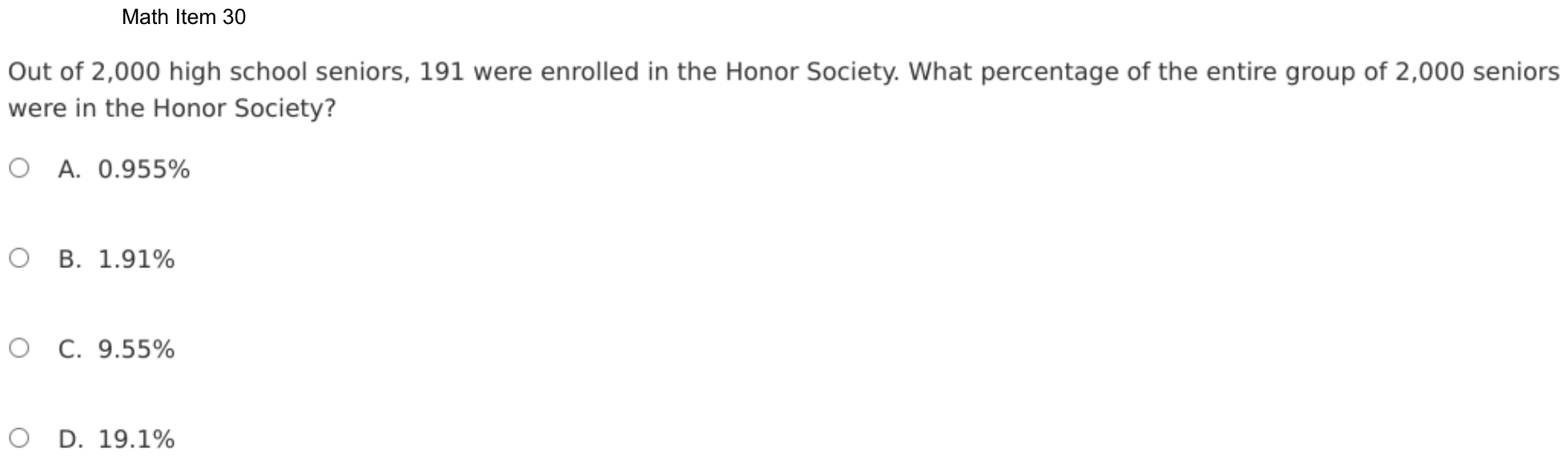
NUMBER OF VISITORS
TO BROOKSIDE ZOO
| Male | Female | |
|---|---|---|
| Children | 360 | 340 |
| Adults | 210 | 290 |
The table above shows the number of people who visited Brookside Zoo in one day. The largest of the four groups made up what percentage of all visitors on that day?
- A30%
- B28%
- C24%
- D17%
Show the answer
Correct answer: A
First, determine the total number of visitors.
The largest group is 360 (Male Children).
Find the percent that represents .
Question analysis
A two-way table counts one day's visitors to Brookside Zoo by age, children or adults, and by male or female. Students find what percent of all visitors the largest of the four groups made up. They must total every cell first, then make sure the count they divide is really the largest one.
- NYS standards
- 6.RP.3c percent as a rate per 100
- Grade level
- Grade 6 content, by NYS standard
- Compared with grade 7
- Below grade 7 Finding what percent one count is of a total is grade 6 work. A two-way table adds two quick steps, totaling the four groups and spotting the largest, but the numbers divide evenly, so it stays below grade 7 demand.
- Estimated difficulty
- Straightforward: two steps or one careful reading.
- Thinking it demands
- Depth of knowledge 1, recall and reproduction · mainly apply
- What makes it hard
- Reading a figure, table or graph minor
- Many steps minor
- Solution
- 3 steps
- Reading level
- Question and choices: about grade 5, 39 words.
- Students, last 30 days
- Not enough answers yet to show (it takes 10).
Why it is hard, traps and wrong answers (shows the answer)
Why it is hard
The arithmetic is friendly, since 360 over 1,200 reduces to 3 over 10, so the work is in reading the table. Two of its cells are close, 340 just below 360, and every wrong choice is the share of one of the other groups. Adding all four counts first, and circling the largest before dividing, keeps the right cell in play.
Reading a figure, table or graph minor Understanding the question
The two-way table gives four separate counts and no totals, so the 1,200 visitors must be added up from the cells and the largest group picked out of a grid. (Lesh, Post & Behr, 1987; Kirsch & Mosenthal, 1990)
Many steps minor Working it out
Three short steps run in order: total the four cells, pick the largest, and divide; using the wrong cell in the last step still gives a believable percent. (Daniel & Embretson, 2010; Enright, Morley & Sheehan, 2002)
Strategy: Add all four cells for the day's total, pick the biggest single cell, and divide it by the total; simplifying the fraction before dividing keeps the arithmetic short.
Traps
- Misreads the question: Misses or misreads a condition or a word in the question: "at least", "each", "remaining", "not".
- Answers a different question: A choice is right for another quantity: the other unknown, the rest instead of the part, the part instead of the whole.
- Misreads the figure: Reads a value, label or tick spacing in a figure, table or graph wrongly.
The wrong answers, classified
B Misreads the figure (Lesh, Post & Behr, 1987; Kirsch & Mosenthal, 1990)
Takes 340, the female children, as the largest cell, misjudging it against the 360 male children beside it, so 340 ÷ 1,200 ≈ 28%.
C Answers a different question (King et al., 2004; Hegarty, Mayer & Monk, 1995)
Answers for the larger adult group, the 290 female adults, as if the question were about adults, so 290 ÷ 1,200 ≈ 24%.
D Misreads the question (Hegarty, Mayer & Monk, 1995)
Reads largest as smallest and uses the 210 male adults, so 210 ÷ 1,200 = 17.5%, and takes the nearest choice.
Worked solution, step by step
Formulas used
- Percent of a whole
- The part is the one group you care about. The whole is everyone. The fraction tells what share of everyone the group is. Multiplying by 100 turns that share into a percent, which means out of 100.
Sort out the question
The table splits one day’s visitors into four groups:
Male Female Children 360 340 Adults 210 290 You need the largest group as a percent of all the visitors. The table gives no total, so you must find it.
Add up all the visitors
Add all four groups to get the whole:
So 1,200 people visited the zoo that day.
Find the largest group
Compare the four numbers. The biggest is 360, the male children.
Watch out: 340 is close to 360, but it is smaller. Using 340 gives about 28%, choice B. Using the 290 female adults gives about 24%, choice C. And 210 is the smallest group, which gives 17.5%, near choice D.
Find the percent
Put the part over the whole. Then simplify by dividing the top and bottom by 120:
Now multiply by 100 to get a percent:
So the male children made up 30% of the visitors.
Give the answer
The largest group, 360 male children, is 30% of all 1,200 visitors.
So the answer is A, 30%.
Check your answer
Work backward. 30% of 1,200 is , the male children. Also, with four groups an even split would be 25% each. The largest group should be a bit more than 25%, and 30% is.
More questions like this
The original DOE question
Question 4 of 48
2026 Practice Test C Math, question 44Question
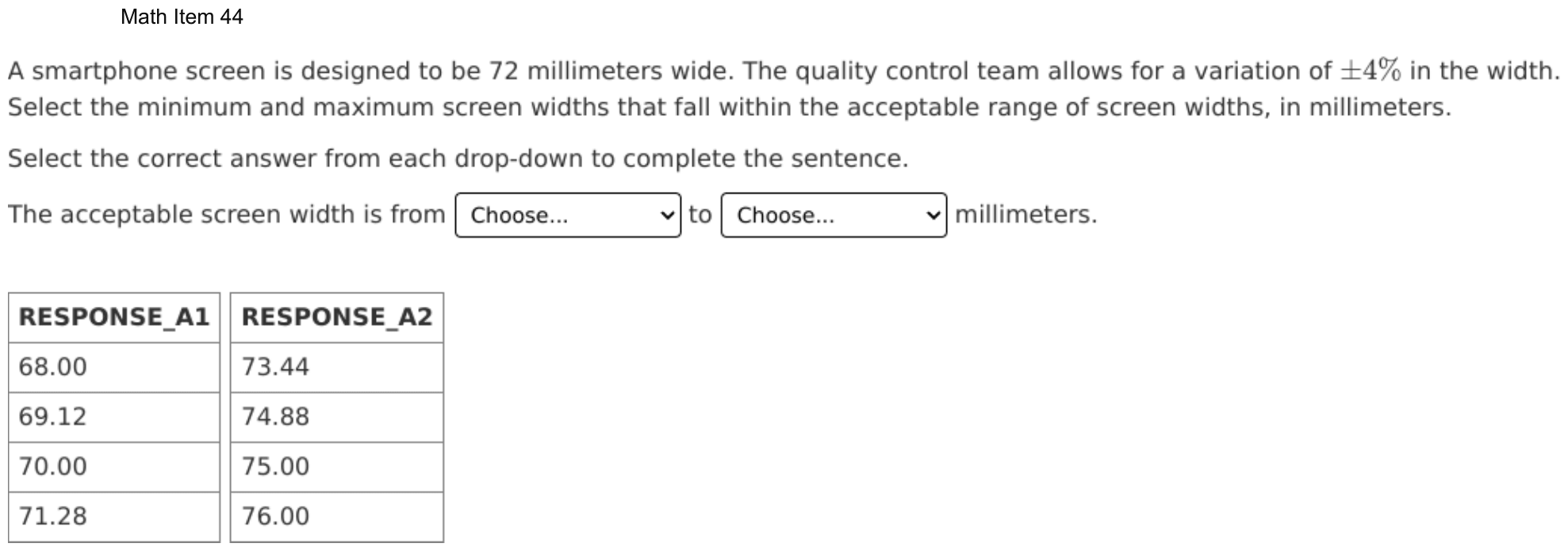
A smartphone screen is designed to be 72 millimeters wide. The quality control team allows for a variation of in the width. Select the minimum and maximum screen widths that fall within the acceptable range of screen widths, in millimeters.
Select the correct answer from each drop-down to complete the sentence.
The acceptable screen width is from to millimeters.
Choose an answer from each menu, then check. The DOE has not published how answers with several parts are scored; this site counts one right only when every part is right.
Show the answer
Correct answer: blank 1: 69.12; blank 2: 74.88
A variation of in the width means that the width of the smartphone can be from 4% less than the standard of 72 mm to 4% greater than 72 mm.
The least allowed measure is
The greatest allowed measure is
Therefore, the allowable range is from 69.12 mm to 74.88 mm in width.
Question analysis
A smartphone screen is designed to be 72 millimeters wide, and quality control allows a variation of plus or minus 4%. Students choose the minimum and maximum acceptable widths from two drop-down menus. It tests finding a percent of a quantity, and the 4% has to be turned into millimeters before it is added or subtracted.
- Grade level
- Grade 7 content, by NYS standard
- Compared with grade 7
- At grade 7 Finding a percent of a number and adding or subtracting it is grade 7 percent work. The ± sign, the decimal result and two linked menus, which must both be right, add a little to the usual demand.
- Estimated difficulty
- Moderate: several steps, or a close reading with one strong distractor.
- Thinking it demands
- Depth of knowledge 2, skills and concepts · mainly apply
- What makes it hard
- Error-prone arithmetic moderate
- Turning words into math minor
- A very close wrong answer minor
- Many steps minor
- Solution
- 3 steps
- Reading level
- Question and choices: about grade 8, 59 words.
- Students, last 30 days
- Not enough answers yet to show (it takes 10).
Why it is hard, traps and wrong answers (shows the answer)
Why it is hard
The question rewards turning the percent into millimeters before doing anything else. Students who treat ±4% as ±4 millimeters find the two whole-number options at either end of the menus, 68.00 and 76.00, which look like a natural pair. Those who compute 2.88 correctly can still lose the item on the maximum by rounding to 3 and picking 75.00. Multiplying 72 by 0.96 and by 1.04 is a quick double-check.
Error-prone arithmetic moderate Working it out
Four percent of 72 is 0.04 × 72 = 2.88, a decimal product, and taking it from 72 means borrowing across the decimal point to reach 69.12. (Brown & Burton, 1978; Junker & Sijtsma, 2001)
Turning words into math minor Understanding the question
The phrase “a variation of ±4% in the width” has to become 4% of 72 millimeters, a length of 2.88 mm, before anything is added or subtracted. (Hegarty, Mayer & Monk, 1995; Koedinger & Nathan, 2004)
A very close wrong answer minor Choosing the answer
The second menu lists 75.00 just 0.12 above 74.88, so a rounded estimate of 72 + 3 lands on the wrong option, and estimating cannot separate the two. (Embretson & Wetzel, 1987; Gorin & Embretson, 2006; Ascalon et al., 2007)
Many steps minor Working it out
Both menus must be right to score, so the minimum and the maximum each need their own subtraction or addition after the shared percent is found. (Daniel & Embretson, 2010; Enright, Morley & Sheehan, 2002)
Strategy: Find 4% of the 72-millimeter design width first, then subtract that amount for the minimum and add it for the maximum, before looking at the menus.
Traps
- Misunderstands the concept: A wrong belief about a concept: that percents can be added, that area grows like length, that averages can be averaged, that a bigger denominator means a bigger fraction.
- Rounds too early: Rounds a value partway through, or rounds the wrong way, so the final answer drifts from the exact one.
The wrong answers, classified
AD Misunderstands the concept (Smith, diSessa & Roschelle, 1993; De Bock et al., 1998; Ni & Zhou, 2005)
Reads ±4% as ±4 millimeters, so the widths run from 72 − 4 = 68.00 to 72 + 4 = 76.00.
BC Rounds too early (King et al., 2004)
Finds the 69.12 minimum, then estimates the maximum by rounding the 2.88 change up to 3, so 72 + 3 = 75.00 is picked over 74.88.
Worked solution, step by step
Formulas used
- Percent of a number
- The percent is how many out of 100. Dividing it by 100 turns it into a decimal, so 4% becomes 0.04. The whole is the amount you take the percent of. The part is the amount that the percent stands for.
Sort out the question
The screen is designed to be 72 millimeters (mm) wide. The sign ±4% means plus or minus 4%. So a screen may be up to 4% narrower or up to 4% wider than 72 mm.
You need the minimum, the smallest allowed width, and the maximum, the largest. You pick each one from a drop-down menu.
Find 4% of 72 mm
Use the percent formula. 4% is :
So the width may change by up to 2.88 mm either way.
Watch out: 4% is not 4 mm. Taking 4 away and adding 4 gives 68.00 and 76.00. Both are in the menus, and both are wrong.
Find the minimum width
Take the change away from the design width:
The narrowest allowed screen is 69.12 mm wide.
Find the maximum width
Add the change to the design width:
The widest allowed screen is 74.88 mm wide.
Watch out: rounding 2.88 up to 3 gives 75.00. That is in the second menu too, but it is too wide.
Choose from each menu
Open the first drop-down menu and choose 69.12. Open the second one and choose 74.88.
So the sentence reads: the acceptable screen width is from 69.12 to 74.88 millimeters.
Check your answer
Use multipliers. A screen 4% narrower keeps 96% of the width: . A screen 4% wider is 104% of it: . Both match. Also, both ends are the same 2.88 mm away from 72.
More questions like this
The original DOE question
Question 5 of 48
2026 Practice Test C Math, question 45Question
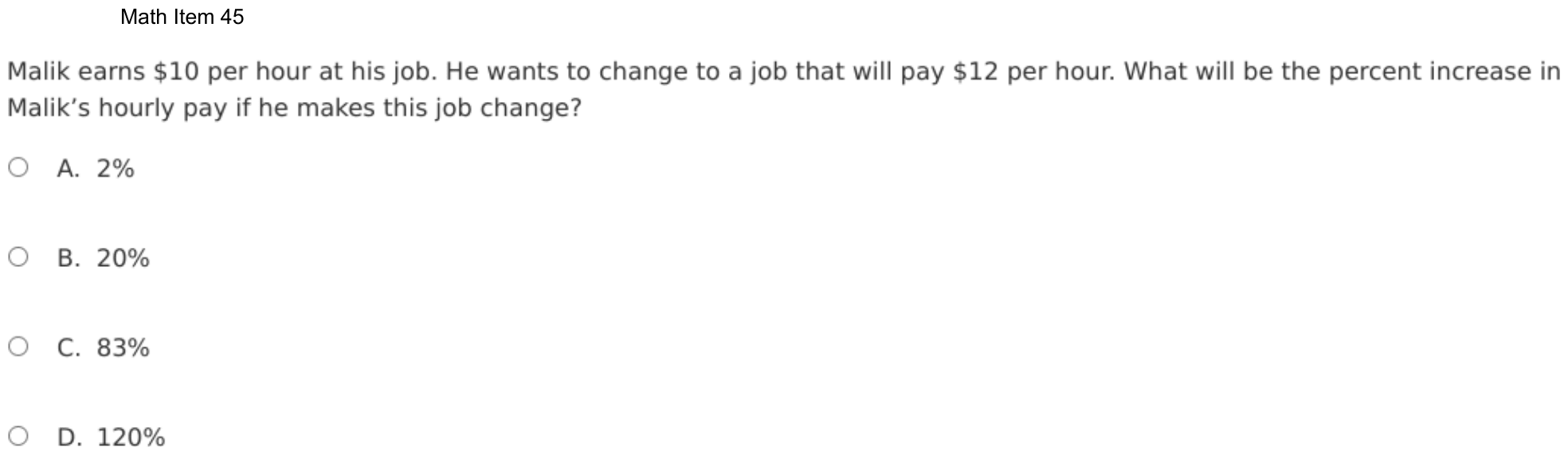
Malik earns $10 per hour at his job. He wants to change to a job that will pay $12 per hour. What will be the percent increase in Malik’s hourly pay if he makes this job change?
- A2%
- B20%
- C83%
- D120%
Show the answer
Correct answer: B
Subtract to determine the amount of increase in Malik’s hourly pay if he changes jobs.
Divide the increase amount by the original hourly pay rate.
Multiply the quotient by 100 to express the decimal amount as a percentage.
Question analysis
Malik earns $10 an hour and wants to switch to a job that pays $12 an hour. Students find the percent increase in his hourly pay. It tests finding a percent change. The numbers are easy, so the challenge is knowing which amounts to compare and how to turn that comparison into a percent.
- NYS standards
- 7.RP.3 multistep ratio and percent problems
- Grade level
- Grade 7 content, by NYS standard
- Compared with grade 7
- At grade 7 Percent increase is grade 7 content, and this case uses whole-dollar wages that make the arithmetic easy. The demand is comparing the change with the right amount rather than reporting the change itself or a ratio of the wages.
- Estimated difficulty
- Straightforward: two steps or one careful reading.
- Thinking it demands
- Depth of knowledge 2, skills and concepts · mainly apply
- What makes it hard
- Solution
- 2 steps
- Reading level
- Question and choices: about grade 2, 35 words.
- Students, last 30 days
- Not enough answers yet to show (it takes 10).
Why it is hard, traps and wrong answers (shows the answer)
Why it is hard
The numbers could hardly be friendlier, a $2 raise on $10, so the question checks what to divide by what. Dividing $12 by $10 gives 1.2, the new pay as a percent of the old, and stopping there is tempting because the division feels like the whole job. Reading the $2 itself as 2% is the other quick error, since dollars of change are not percent of change.
Something you must already know minor Working it out
The rule for percent change, the change divided by the starting amount, is not given, and each wrong choice comes from a different comparison of the $10 and the $12. (Anderson & Krathwohl, 2001)
Turning words into math minor Understanding the question
“Percent increase in Malik’s hourly pay” has to be read as the $2 rise measured against the $10 he earns now, not as the new wage compared with the old. (Hegarty, Mayer & Monk, 1995; Koedinger & Nathan, 2004)
Strategy: Find how many dollars the hourly pay goes up, then divide that change by the pay Malik earns now and write the result as a percent.
Traps
- Answers a different question: A choice is right for another quantity: the other unknown, the rest instead of the part, the part instead of the whole.
- Misunderstands the concept: A wrong belief about a concept: that percents can be added, that area grows like length, that averages can be averaged, that a bigger denominator means a bigger fraction.
- Wrong operation: Adds instead of multiplying, divides the wrong way round, turns a ratio or rate upside down, or undoes a step in the wrong direction (subtracts what should be added back).
The wrong answers, classified
A Misunderstands the concept (Smith, diSessa & Roschelle, 1993; De Bock et al., 1998; Ni & Zhou, 2005)
Finds the $2 increase and reads it as 2%, as if a change in dollars were a percent, without dividing it by the original $10.
C Wrong operation (Hegarty, Mayer & Monk, 1995; King et al., 2004)
Divides the old pay by the new, 10 ÷ 12 ≈ 0.83, turning the ratio of the wages upside down and reporting 83%.
D Answers a different question (King et al., 2004; Hegarty, Mayer & Monk, 1995)
Divides the new pay by the old, 12 ÷ 10 = 1.2, which gives the new wage as a percent of the old, not the increase.
Worked solution, step by step
Formulas used
- Percent increase
- The original is the amount before the change. The new amount is the amount after it. The top is how much it went up. Dividing by the original compares the change with where you started. Multiplying by 100 makes it a percent.
Sort out the question
Malik earns $10 an hour now. The new job pays $12 an hour. You need the percent increase.
That means: how much does his pay go up, compared with what he earns now? So $10 is the original amount, and $12 is the new amount.
Find the increase in dollars
Subtract the old pay from the new pay:
His pay goes up by $2 an hour.
Watch out: $2 is an amount of money, not a percent. Calling it 2% gives choice A.
Compare the increase with the original
Use the percent increase formula. Divide the $2 by the original $10, then multiply by 100:
So the pay goes up by 20%.
Watch out: is 120%, choice D. That is the new pay as a percent of the old, not the increase. And is about 83%, choice C, which is upside down.
Give the answer
The $2 raise is 20% of Malik’s current pay.
So the answer is B, 20%.
Check your answer
Work forward. 20% of $10 is dollars. Add that to $10, and you get $12, the new pay. It works. Note that 120% is the new pay compared with the old pay, which is the same as a 20% increase.
More questions like this
The original DOE question
Question 6 of 48
2026 Practice Test D Math, question 19Question
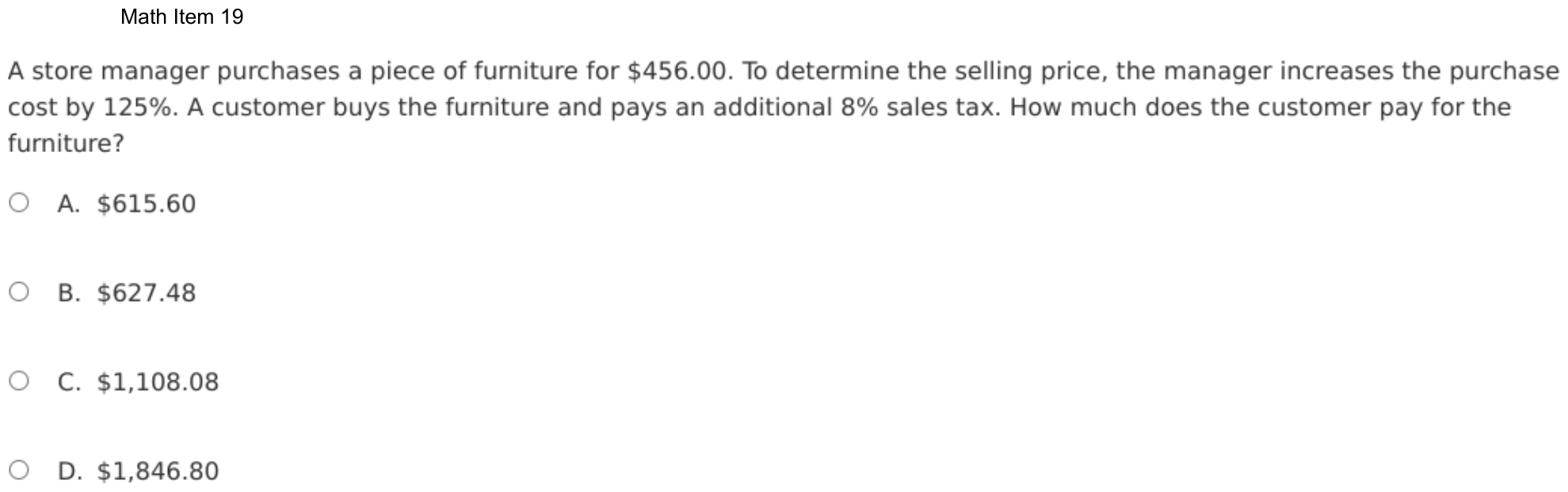
A store manager purchases a piece of furniture for $456.00. To determine the selling price, the manager increases the purchase cost by 125%. A customer buys the furniture and pays an additional 8% sales tax. How much does the customer pay for the furniture?
- A$615.60
- B$627.48
- C$1,108.08
- D$1,846.80
Show the answer
Correct answer: C
Given a purchase price of $456.00, the 125% increase in price is calculated as:
The selling price equals the purchase price plus the increase, or:
The sales tax on the selling price is:
The customer pays the selling price plus the sales tax:
Question analysis
A store manager buys a piece of furniture for $456.00 and raises the price by 125% to set the selling price, and the customer also pays 8% sales tax. Students find the total the customer pays. It tests percent increase and sales tax in sequence, and reading an increase of more than 100% correctly is the main challenge.
- NYS standards
- Grade level
- Grade 7 content, by NYS standard
- Compared with grade 7
- Above grade 7 Grade 7 students find markups and sales tax, usually with increases under 100%. An increase of more than 100% is unusual and easy to misread, and two percent changes must be applied in order, which goes beyond routine grade 7 work.
- Estimated difficulty
- Hard: combines ideas, needs a plan, and has more than one tempting wrong answer.
- Thinking it demands
- Depth of knowledge 2, skills and concepts · mainly apply
- What makes it hard
- Turning words into math moderate
- Many steps moderate
- Error-prone arithmetic minor
- Solution
- 4 steps
- Reading level
- Question and choices: about grade 7, 41 words.
- Students, last 30 days
- Not enough answers yet to show (it takes 10).
Why it is hard, traps and wrong answers (shows the answer)
Why it is hard
A percent above 100 is unusual in grade 7 work, and it is the center of the question: the markup more than doubles the price. Students who treat “by 125%” as “125% of” still find a listed answer after adding tax, and so do students who add $125. A rough check helps: the selling price must be more than twice $456, about $1,000, and the tax adds less than a tenth of that.
Turning words into math moderate Understanding the question
“Increases the purchase cost by 125%” adds 125% of $456 to the $456 itself, a multiplier of 2.25; reading it as 125% of the cost leaves the original price out. (Hegarty, Mayer & Monk, 1995; Koedinger & Nathan, 2004)
Many steps moderate Working it out
Four steps in a row, the increase, the selling price, the tax and the total, each depend on the one before, and two of them are easy to merge or skip. (Daniel & Embretson, 2010; Enright, Morley & Sheehan, 2002)
Error-prone arithmetic minor Working it out
Taking 8% of $1,026 means multiplying by 0.08, and a decimal point one place off, 0.8, makes the tax ten times too large. (Brown & Burton, 1978; Junker & Sijtsma, 2001)
Strategy: Turn each percent change into a multiplier, remembering that an increase by a percent is added to the original amount, apply the markup and then the tax, and estimate to check the size.
Traps
- Stops one step early: A choice is a number from partway through the solution.
- Misunderstands the concept: A wrong belief about a concept: that percents can be added, that area grows like length, that averages can be averaged, that a bigger denominator means a bigger fraction.
- An arithmetic slip: The right method with a plausible arithmetic error: a digit, a place value or a times-table fact.
The wrong answers, classified
A Stops one step early (King et al., 2004; Gierl et al., 2017)
Finds the increase, 125% of $456 = $570, and uses it as the selling price without adding back the $456 cost, then adds 8% tax.
B Misunderstands the concept (Smith, diSessa & Roschelle, 1993; De Bock et al., 1998; Ni & Zhou, 2005)
Reads the 125% increase as $125, a fixed amount, so the selling price is $581, and then adds 8% tax correctly to reach $627.48.
D An arithmetic slip (Junker & Sijtsma, 2001)
Finds the $1,026 selling price correctly but writes 8% as 0.8, adding $820.80 in tax instead of $82.08.
Worked solution, step by step
Formulas used
- Percent of a number
- n is the starting amount, and p is the percent. Percent means out of 100, so 125% is 125/100 = 1.25 and 8% is 8/100 = 0.08. Multiply n by that decimal to find the part.
- Price after an increase
- The old price is what you start with. The increase is the amount added on. To increase by a percent, find that percent of the old price, then add it to the old price. Sales tax is added the same way.
Sort out the question
The manager pays $456.00 for the furniture. The selling price is that cost increased by 125%. The customer then pays 8% sales tax on top. Sales tax is an extra charge, a percent of the price. You need the total the customer pays.
Find the increase
Find 125% of $456. As a decimal, 125% is 1.25, which is 1 and a quarter. A quarter of 456 is 114:
The increase is $570.
Find the selling price
Increases by means the increase is added to the cost:
The selling price is $1,026.
Watch out: $570 is only the increase. Using it as the price gives $615.60, choice A. And 125% is a percent, not $125. Adding $125 leads to $627.48, choice B.
Find the sales tax
As a decimal, 8% is 0.08. Find 8% of the selling price:
The tax is $82.08.
Watch out: 8% is 0.08, not 0.8. Using 0.8 makes the tax ten times too big and gives $1,846.80, choice D.
Add the tax to the price
The customer pays the selling price plus the tax:
So the answer is C, $1,108.08.
Check your answer
Estimate. The price more than doubles: $456 plus $570 is about $1,000. Tax of 8% adds about $80. So the total should be a bit over $1,080, and only $1,108.08 is close. Or multiply in one go: 456 × 2.25 × 1.08 = 1,108.08.
More questions like this
The original DOE question
Question 7 of 48
2026 Practice Test D Math, question 33Question
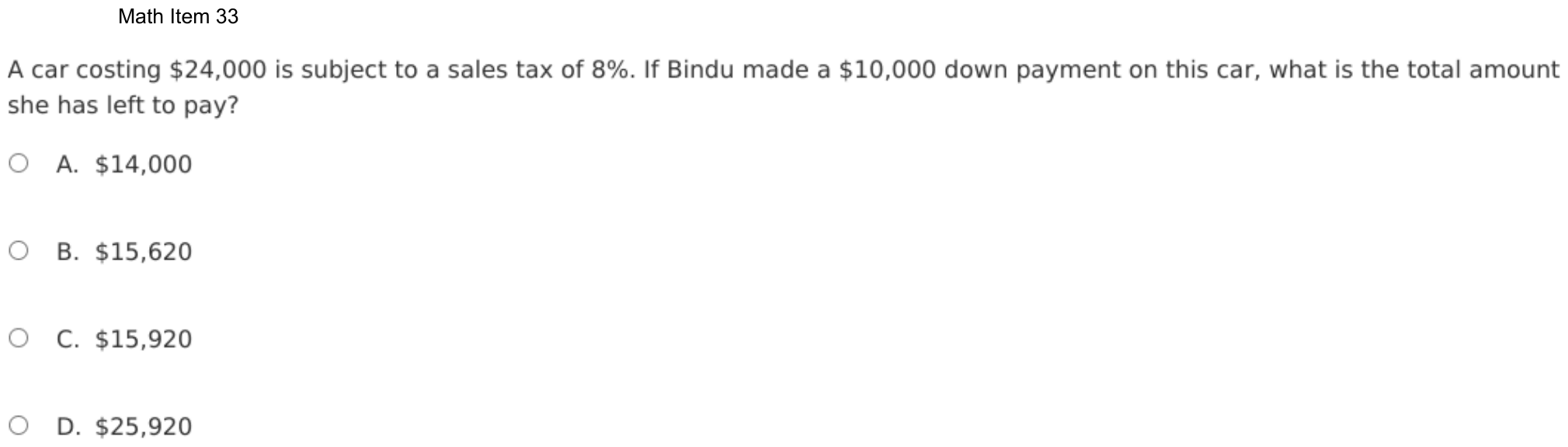
A car costing $24,000 is subject to a sales tax of 8%. If Bindu made a $10,000 down payment on this car, what is the total amount she has left to pay?
- A$14,000
- B$15,620
- C$15,920
- D$25,920
Show the answer
Correct answer: C
First, find the sales tax. Then, add the sales tax to the cost of the car. Finally, subtract the down payment to find out how much she has left to pay.
Question analysis
Bindu buys a $24,000 car with an 8% sales tax and makes a $10,000 down payment, and students find how much she still has to pay. This percent word problem combines finding a tax, adding it to the price and subtracting a payment. Every step must be done in order, since leaving one out gives an amount that looks just as reasonable.
- NYS standards
- Grade level
- Grade 7 content, by NYS standard
- Compared with grade 7
- At grade 7 Adding sales tax to a price is a standard grade 7 percent task. This one also subtracts a down payment at the end, three routine steps with round numbers, much like a typical classroom problem.
- Estimated difficulty
- Straightforward: two steps or one careful reading.
- Thinking it demands
- Depth of knowledge 2, skills and concepts · mainly apply
- What makes it hard
- Many steps minor
- Error-prone arithmetic minor
- Solution
- 3 steps
- Reading level
- Question and choices: about grade 5, 29 words.
- Students, last 30 days
- Not enough answers yet to show (it takes 10).
Why it is hard, traps and wrong answers (shows the answer)
Why it is hard
The method is the standard one for tax on a purchase, so the question checks order and completeness. Forgetting the tax or forgetting the down payment each produces an amount as reasonable-looking as the answer, and a careless 8 × 24 produces one just $300 below it. Multiplying the price by 1.08 in one step, which gives $25,920, is a second route that catches a slip in the tax.
Many steps minor Working it out
Three operations come in a fixed order, 8% of $24,000, then adding the tax, then subtracting the $10,000, and leaving out the first or the last gives a listed choice. (Daniel & Embretson, 2010; Enright, Morley & Sheehan, 2002)
Error-prone arithmetic minor Working it out
Finding 8% of $24,000 comes down to 8 × 24 = 192 with two zeros added, and a lost carry in that product turns $1,920 into $1,620. (Brown & Burton, 1978; Junker & Sijtsma, 2001)
Strategy: Find 8% of the price and add it, or multiply the price by 1.08, to get the full cost with tax, then subtract what Bindu has already paid.
Traps
- Stops one step early: A choice is a number from partway through the solution.
- Misreads the question: Misses or misreads a condition or a word in the question: "at least", "each", "remaining", "not".
The wrong answers, classified
A Misreads the question (Hegarty, Mayer & Monk, 1995)
Subtracts the $10,000 down payment from the $24,000 price and never adds the 8% sales tax, so the tax is simply left out.
B An arithmetic slip (Junker & Sijtsma, 2001)
Drops the carried 3 when multiplying 8 × 24, so the tax comes out $1,620 instead of $1,920 and the balance $300 too low.
D Stops one step early (King et al., 2004; Gierl et al., 2017)
Adds the $1,920 tax to the price correctly but stops at $25,920, the full cost, forgetting to subtract the $10,000 Bindu already paid.
Worked solution, step by step
Formulas used
- Percent of a number
- Percent means out of 100. So 8% is 8/100, or 0.08. To find a percent of a number, change the percent to a decimal and multiply it by the whole.
- Amount left to pay
- The price plus the tax is the full cost. A down payment is money paid at the start. Subtract it, because that part is already paid.
Sort out the question
You know:
- The car costs $24,000.
- The sales tax is 8%. Sales tax is extra money added to a price.
- Bindu paid $10,000 at the start. That is the down payment.
You need the amount Bindu still has to pay. Work in order: tax, then full cost, then subtract.
Find the sales tax
Change 8% to the decimal 0.08. Multiply it by the price:
A quick way: 1% of 24,000 is 240, so 8% is . The tax is $1,920.
Watch out: in 8 × 24 you carry a 3 from 8 × 4 = 32. Dropping it gives 162, so the tax looks like $1,620. That leads to $15,620, choice B.
Find the full cost
Add the tax to the price:
The car costs $25,920 with tax.
Watch out: this is not the answer yet. Stopping here gives $25,920, choice D. Bindu already paid part of it.
Subtract the down payment
Bindu already paid $10,000. Take it away:
She has $15,920 left to pay.
Watch out: leaving out the tax gives , choice A.
So the answer is C, $15,920.
Check your answer
Use a shortcut for the full cost. The price plus 8% more is 108% of the price, or 1.08 times it: . Then . Same answer.
More questions like this
The original DOE question
Question 8 of 48
2026 Practice Test D Math, question 36Question
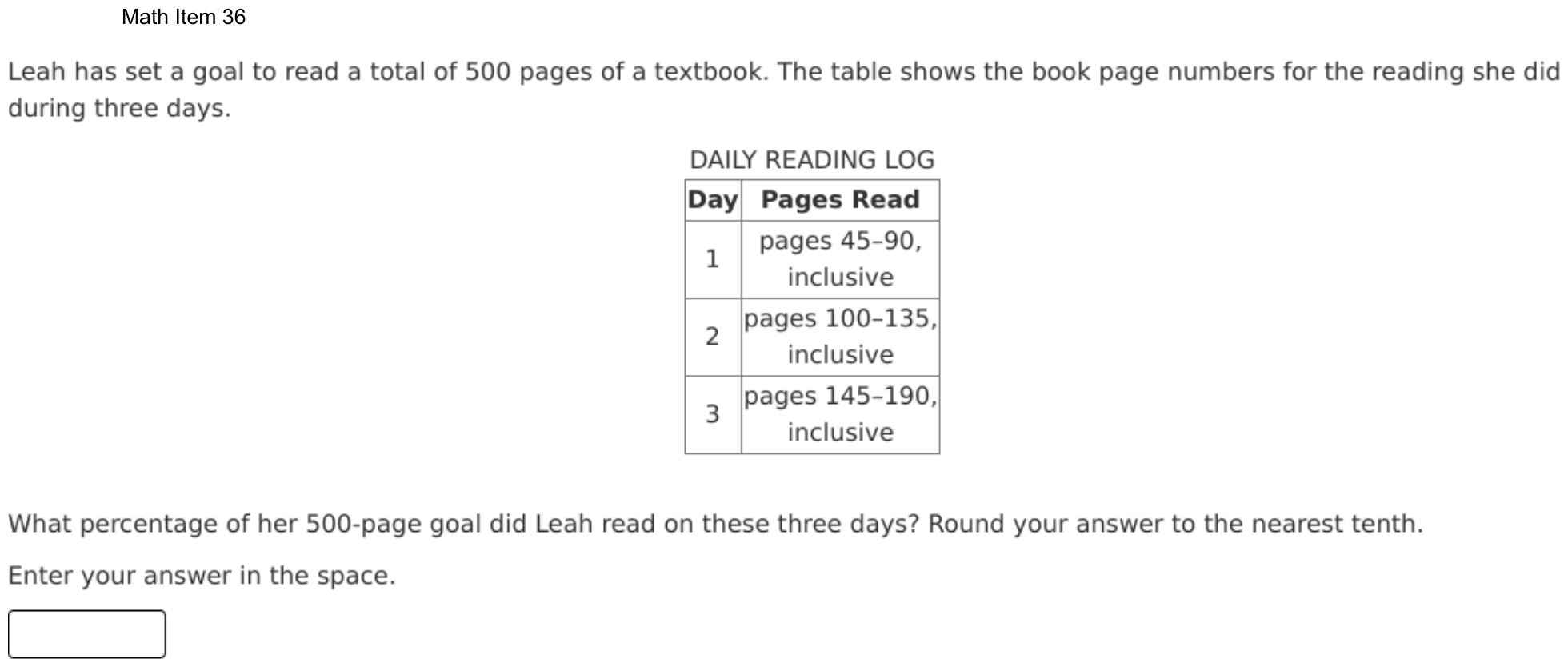
Leah has set a goal to read a total of 500 pages of a textbook. The table shows the book page numbers for the reading she did during three days.
DAILY READING LOG
| Day | Pages Read |
|---|---|
| 1 | pages 45–90, inclusive |
| 2 | pages 100–135, inclusive |
| 3 | pages 145–190, inclusive |
What percentage of her 500-page goal did Leah read on these three days? Round your answer to the nearest tenth.
Enter your answer in the space.
Fill-in question: work out the answer and type it as a number.
Show the answer
Correct answer: 25.6%
First, determine the number of pages read each day. Since the pages per assignment are inclusive, subtract the first page from the last page assigned and then add 1 to determine the pages read for each day.
Day 1: pages
Day 2: pages
Day 3: pages
Leah read a total of 128 pages, since .
To determine the percent, express 128 pages out of 500 pages as a fraction.
Question analysis
Leah's daily reading log lists three ranges of textbook pages, each marked inclusive, and her goal is 500 pages. This percent question asks what percentage of the goal she read over the three days, rounded to the nearest tenth and typed in. Counting the pages in each inclusive range correctly is the tricky step before the percent.
- Grade level
- Grade 7 content, by NYS standard
- Compared with grade 7
- Above grade 7 Finding what percent one number is of another is grade 6 and 7 work. This adds three inclusive page ranges to count, which takes more care than subtracting, then a rounding step, all typed with no choices to check against.
- Estimated difficulty
- Hard: combines ideas, needs a plan, and has more than one tempting wrong answer.
- Thinking it demands
- Depth of knowledge 2, skills and concepts · mainly apply
- What makes it hard
- Something you must already know moderate
- Many steps moderate
- An answer in an unexpected form minor
- Solution
- 4 steps
- Reading level
- Question and choices: about grade 3, 66 words.
- Students, last 30 days
- Not enough answers yet to show (it takes 10).
Why it is hard, traps and wrong answers (shows the answer)
Why it is hard
Counting pages in a range is the whole difficulty; the percent at the end is routine once the total is right. Subtracting first from last feels natural, and here it even rewards the student with a round 25%, so nothing looks wrong. Checking the rule on a tiny range, pages 1 to 3, which is 3 pages and not 2, fixes the count, and the instruction to round to the nearest tenth hints that the answer is not a whole number.
Something you must already know moderate Working it out
Every row says inclusive, but nothing says that pages 45 to 90 hold 90 − 45 + 1 = 46 pages; subtracting alone loses one page on each of the three days. (Anderson & Krathwohl, 2001)
Many steps moderate Working it out
Three page counts, a sum, a division by 500 and a change to a percent come in sequence, and a one-page error in each count carries through to the end. (Daniel & Embretson, 2010; Enright, Morley & Sheehan, 2002)
An answer in an unexpected form minor Choosing the answer
The answer is typed with no choices, and the miscounted total, 125 pages, gives a tidy 25% that looks more finished than the right value with its tenth. (Enright, Morley & Sheehan, 2002)
Strategy: Count each day's pages carefully, testing your method on a short range such as pages 1–3, add the three days, divide by 500, and write the result as a percent to the nearest tenth.
Traps
- Counting the ends: Inclusive or exclusive ends, fence posts, consecutive numbers: an answer that is one too many or too few, or an endpoint drawn open where it belongs closed (or the reverse).
- Stops one step early: A choice is a number from partway through the solution.
- Misreads the question: Misses or misreads a condition or a word in the question: "at least", "each", "remaining", "not".
The wrong answers, classified
25 Counting the ends (Brown & Burton, 1978)
Subtracts the first page from the last for each day, 45 + 35 + 45 = 125 pages, forgetting that an inclusive range counts both end pages, so 125 ÷ 500 = 25%.
0.256 Stops one step early (King et al., 2004; Gierl et al., 2017)
Counts the 128 pages and divides by 500 correctly, then enters the decimal 0.256, one step short of multiplying by 100 to make a percent.
26 Misreads the question (Hegarty, Mayer & Monk, 1995)
Finds 25.6% correctly but rounds it to the nearest whole percent, overlooking the instruction to round to the nearest tenth.
Worked solution, step by step
Formulas used
- Counting pages in an inclusive range
- Inclusive means the first and last pages are both read. Subtracting counts the steps from the first page to the last. That misses one page, so add 1. Test it: pages 1 to 3 are 3 pages, and 3 − 1 + 1 = 3.
- Percent of a total
- The part is the amount you have, here the pages read. The whole is the amount you compare with, here the 500-page goal. Dividing gives a decimal. Multiplying by 100 turns it into a percent, a number out of 100.
Sort out the question
Leah’s goal is 500 pages. The log shows three days:
- Day 1: pages 45 to 90
- Day 2: pages 100 to 135
- Day 3: pages 145 to 190
Each range is inclusive. You need the percent of 500 pages she read, rounded to the nearest tenth.
Count the pages each day
Use the rule for an inclusive range: last page minus first page, plus 1.
Watch out: subtracting alone gives 45, 35 and 45 pages. That is 125 pages, which is exactly 25%. A round answer like that can hide the mistake.
Add the three days
Add the pages from all three days to get her total:
Leah read 128 pages in all. This is the part you compare with the goal.
Change to a percent
Divide the pages read by the goal, then multiply by 100:
Leah read 25.6% of her goal. That already ends in tenths, so no rounding is needed.
Watch out: 0.256 is a decimal, not a percent. And 26 rounds to a whole number, not to the nearest tenth.
Enter the answer
The box has no % sign, but the question asks for a percentage, so the number in the box is the percent. Type it with its decimal point. Typing 25.6% also counts on this site. So you would enter 25.6.
Check your answer
Estimate. 10% of 500 pages is 50 pages. 128 pages is a bit more than 2 × 50 = 100, so the answer is between 20% and 30%. Then check exactly: pages. It matches.
More questions like this
The original DOE question
Question 9 of 48
2026 Practice Test D Math, question 50Question
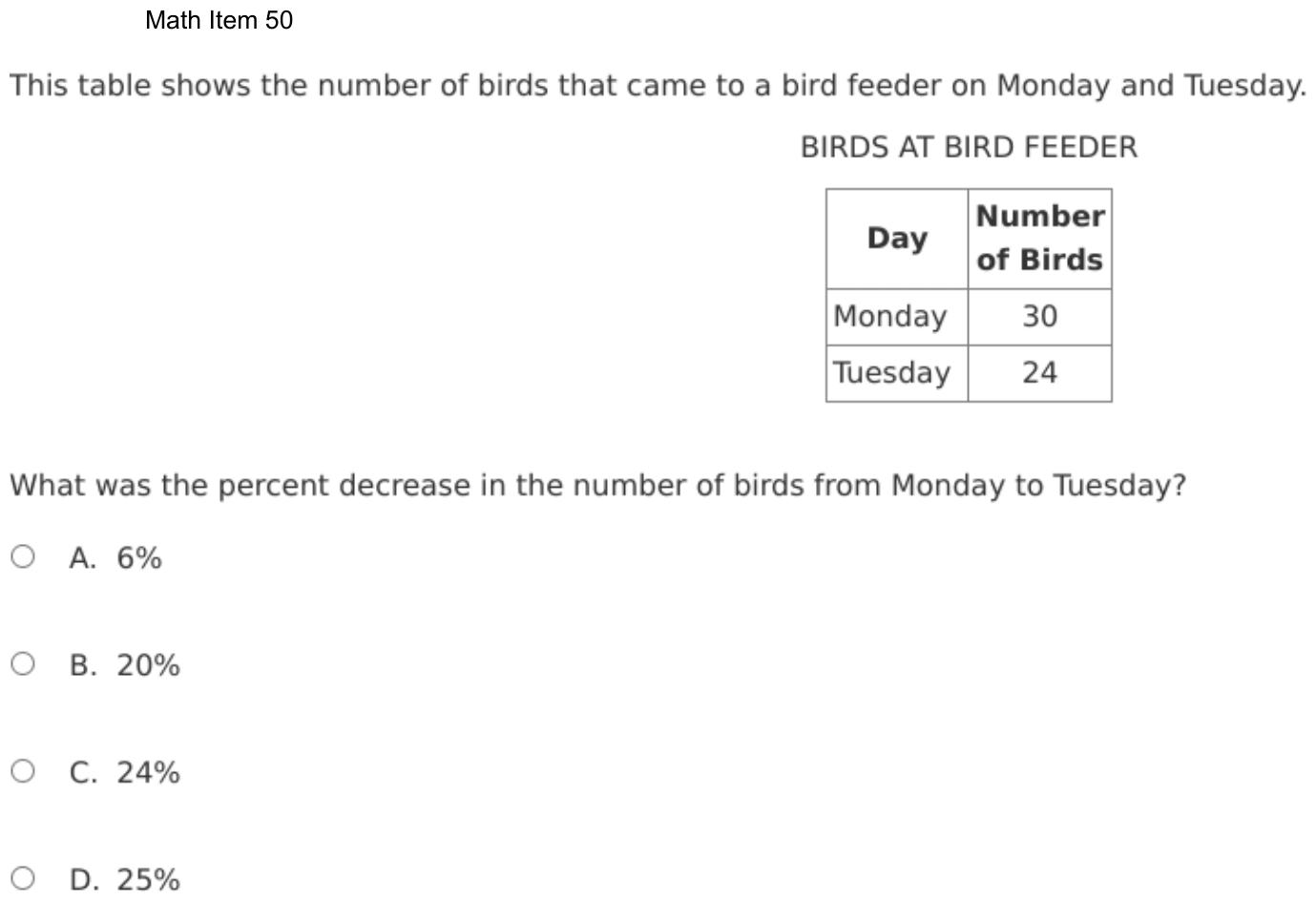
This table shows the number of birds that came to a bird feeder on Monday and Tuesday.
BIRDS AT BIRD FEEDER
| Day | Number of Birds |
|---|---|
| Monday | 30 |
| Tuesday | 24 |
What was the percent decrease in the number of birds from Monday to Tuesday?
- A6%
- B20%
- C24%
- D25%
Show the answer
Correct answer: B
To determine the percent decrease from Monday to Tuesday, first calculate the decrease in the number of birds at the feeder.
The difference in the number of birds at the feeder divided by the number of birds on Monday will yield the percent decrease from Monday to Tuesday.
0.20 represents 20%.
There was a 20% decrease from Monday to Tuesday.
Question analysis
A table shows that 30 birds came to a bird feeder on Monday and 24 on Tuesday. This percent change question asks for the percent decrease from Monday to Tuesday. Students find the change and compare it with one day's count, and choosing the right day as the base decides the result.
- NYS standards
- 7.RP.3 multistep ratio and percent problems
- Grade level
- Grade 7 content, by NYS standard
- Compared with grade 7
- At grade 7 Percent decrease is core grade 7 work, and this is a plain example: one subtraction and one division with friendly numbers. The only real demand is measuring the change against the right day's count.
- Estimated difficulty
- Straightforward: two steps or one careful reading.
- Thinking it demands
- Depth of knowledge 2, skills and concepts · mainly apply
- What makes it hard
- Solution
- 2 steps
- Reading level
- Question and choices: about grade 3, 40 words.
- Students, last 30 days
- Not enough answers yet to show (it takes 10).
Why it is hard, traps and wrong answers (shows the answer)
Why it is hard
The subtraction is trivial, so the question is about the base. Both counts sit in the table, and dividing by the later one gives an equally neat percent that is easy to accept. Saying “a decrease from Monday” and putting Monday’s 30 under the change avoids it, and checking that 20% of 30 is 6 confirms the result.
A very close wrong answer minor Choosing the answer
Dividing the drop of 6 by Monday’s 30 gives 20% and by Tuesday’s 24 gives 25%, two round, listed percents only 5 points apart, so only the choice of base separates them. (Embretson & Wetzel, 1987; Gorin & Embretson, 2006; Ascalon et al., 2007)
Something you must already know minor Working it out
Students must know that a percent decrease is the change divided by the starting amount, here Monday’s count, a rule the question does not state. (Anderson & Krathwohl, 2001)
Strategy: Subtract to find how many fewer birds came on Tuesday, divide by Monday's count, the starting amount, and change the fraction to a percent.
Traps
- Percent of the wrong amount: Finding the whole from a part, or a percent change measured from the wrong starting amount.
- Misunderstands the concept: A wrong belief about a concept: that percents can be added, that area grows like length, that averages can be averaged, that a bigger denominator means a bigger fraction.
- Numbers taken from the question: Combines the numbers in the question without a model of the situation, or is simply a number that appears in the question.
The wrong answers, classified
A Misunderstands the concept (Smith, diSessa & Roschelle, 1993; De Bock et al., 1998; Ni & Zhou, 2005)
Finds the decrease of 6 birds and reads it as 6 percent, as if the count had dropped from 100 rather than from 30.
C Numbers taken from the question (Hegarty, Mayer & Monk, 1995)
Reads Tuesday’s 24 birds as a percent, taking a number straight from the table without working out the change at all.
D Percent of the wrong amount (Parker & Leinhardt, 1995)
Divides the decrease of 6 by Tuesday’s 24 birds instead of Monday’s 30, measuring the change from the later day: 6/24 = 25%.
Worked solution, step by step
Formulas used
- Percent decrease
- Old is the starting amount, here Monday’s count. New is the later amount, Tuesday’s count. The top is how much it dropped. You divide by the starting amount because a change is measured from where you started.
Sort out the question
The table shows 30 birds on Monday and 24 birds on Tuesday. You need the percent decrease from Monday to Tuesday. From Monday means Monday is the starting amount.
Find the drop
Subtract Tuesday’s count from Monday’s:
There were 6 fewer birds.
Watch out: 6 is a number of birds, not a percent. Calling it 6% leads to choice A.
Compare the drop with Monday
Use the formula. Divide the drop by Monday’s count, then multiply by 100:
The number of birds went down by 20%.
Watch out: dividing by Tuesday’s 24 gives , or 25%, choice D. Measure the change from the starting day. Choice C, 24%, just copies a number from the table.
So the answer is B, 20%.
Check your answer
Take 20% of Monday’s count: . Then , which is Tuesday’s count. The answer checks out.
More questions like this
The original DOE question
Question 10 of 48
2024 Test A Math, question 6Question
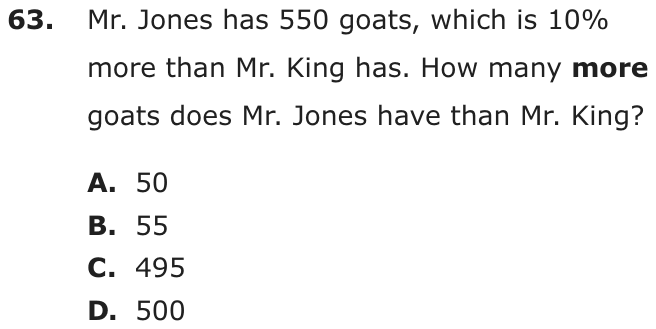
Mr. Jones has 550 goats, which is 10% more than Mr. King has. How many more goats does Mr. Jones have than Mr. King?
- A50
- B55
- C495
- D500
Show the answer
Correct answer: A
First, set up a proportion to determine x, the number of goats Mr. King has.
Then solve the proportion for x.
Finally, determine the difference between the number of goats Mr. Jones has, 550, and the number of goats Mr. King has, 500.
Mr. Jones has 50 more goats than Mr. King.
Question analysis
A percent word problem: Mr. Jones has 550 goats, which is 10% more than Mr. King has, and students find how many more goats Mr. Jones has. It asks students to work with a percent increase when only the larger amount is known. The tricky part is deciding which amount the 10% is taken of.
- Grade level
- Grade 7 content, by NYS standard
- Compared with grade 7
- Above grade 7 Grade 7 students usually find a percent increase from a known original amount. This runs the task backward: the increased amount is given, and the original must be recovered before the difference can be found, a step many do not expect.
- Estimated difficulty
- Hard: combines ideas, needs a plan, and has more than one tempting wrong answer.
- Thinking it demands
- Depth of knowledge 2, skills and concepts · mainly apply
- What makes it hard
- Turning words into math major
- A very close wrong answer moderate
- Solution
- 2 steps
- Reading level
- Question and choices: about grade 1, 22 words.
- Students, last 30 days
- Not enough answers yet to show (it takes 10).
Why it is hard, traps and wrong answers (shows the answer)
Why it is hard
The arithmetic is one division and one subtraction, so the question is really about the base of a percent. The sentence gives the bigger number and calls it 10% more, and the reflex is to take 10% of the number on the page. That shortcut lands on a listed choice five goats from the answer. Students who find King's herd first, 550 ÷ 1.1, still have to remember that the question wants the difference, not the herd.
Turning words into math major Understanding the question
The clause "which is 10% more than" makes King's unknown herd the base of the 10%, so 550 is 110% of his number rather than the amount the 10% is taken of. (Hegarty, Mayer & Monk, 1995; Koedinger & Nathan, 2004)
A very close wrong answer moderate Choosing the answer
The choices 50 and 55 are only 5 goats apart, and both are 10% of a herd; only taking the percent of King's 500 rather than of 550 separates them. (Embretson & Wetzel, 1987; Gorin & Embretson, 2006; Ascalon et al., 2007)
Strategy: Mr. Jones's 550 is 110% of Mr. King's number, so divide 550 by 1.10 to find Mr. King's goats, then subtract that from 550.
Traps
- Percent of the wrong amount: Finding the whole from a part, or a percent change measured from the wrong starting amount.
- Stops one step early: A choice is a number from partway through the solution.
The wrong answers, classified
B Percent of the wrong amount (Parker & Leinhardt, 1995)
Takes 10% of 550, measuring the increase from Jones's herd instead of from King's smaller herd, which is the amount the 10% is based on.
C Percent of the wrong amount (Parker & Leinhardt, 1995)
Takes 10% off 550 to get King's herd, 550 − 55 = 495, using the wrong base, then gives that herd instead of the difference.
D Stops one step early (King et al., 2004; Gierl et al., 2017)
Finds King's herd correctly, 550 ÷ 1.1 = 500, then stops there instead of subtracting it from 550 to get how many more.
Worked solution, step by step
Formulas used
- Percent increase
- The original is the amount you start from, the one the percent is taken of. p is the percent of increase. The new amount is all of the original, which is 100%, plus p% more. For 10% more, you multiply by 1.10.
Sort out the question
Mr. Jones has 550 goats. That is “10% more than Mr. King has”. You need how many more goats Mr. Jones has than Mr. King. That is the difference between the two herds, not the size of a herd.
Decide what the 10% is of
The words “10% more than Mr. King” mean the 10% is a part of Mr. King’s herd. So Mr. King’s herd is the original. Mr. Jones has all of Mr. King’s goats, 100%, plus 10% more. That is 110% of Mr. King’s herd. Watch out: do not take 10% of 550. That gives 55, choice B. It uses the wrong herd. Taking those 55 away from 550 gives 495, choice C, which is also wrong.
Find Mr. King’s herd
Call Mr. King’s number of goats K. Use the percent increase formula with p = 10. The new amount is 550.
Mr. King has 500 goats. Watch out: 500 is Mr. King’s herd, choice D. It is not the difference.
Find the difference
Mr. Jones has 50 more goats than Mr. King. So the answer is A, 50.
Check your answer
Check the 10%. 10% of 500 is , and , Mr. Jones’s herd. So 550 really is 10% more than 500. If King had 495, then 10% more would be about 545, not 550.
More questions like this
The original DOE question
Question 11 of 48
2024 Test A Math, question 13Question
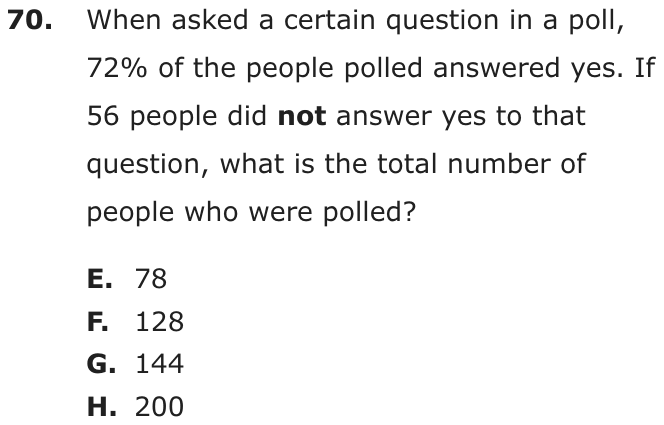
When asked a certain question in a poll, 72% of the people polled answered yes. If 56 people did not answer yes to that question, what is the total number of people who were polled?
- A78
- B128
- C144
- D200
Show the answer
Correct answer: D
72% of the people polled answered yes, so 28% of the people did not answer yes.
Therefore, 56 people is 28% of the total, x.
Question analysis
A percent word problem about a poll: 72% of the people answered yes, and 56 people did not. Students find the total number of people polled. They must first match the 56 people with the right percent and then find the whole from a part, which is where the main slip happens.
- Grade level
- Grade 7 content, by NYS standard
- Compared with grade 7
- At grade 7 Finding a whole from a part and a percent is grade 6 and 7 work. This adds one short step, finding the complementary percent first, which makes it a standard grade 7 multistep percent problem.
- Estimated difficulty
- Moderate: several steps, or a close reading with one strong distractor.
- Thinking it demands
- Depth of knowledge 2, skills and concepts · mainly apply
- What makes it hard
- Turning words into math moderate
- Error-prone arithmetic minor
- Solution
- 2 steps
- Reading level
- Question and choices: about grade 6, 33 words.
- Students, last 30 days
- Not enough answers yet to show (it takes 10).
Why it is hard, traps and wrong answers (shows the answer)
Why it is hard
The only percent printed is 72 and the only count is 56, so the first instinct is to pair them, even though the bold not says they describe different groups. Once 56 is matched with the 28% who did not say yes, a single division finds the total. The listed wrong answers come from that mismatch, from adding the two numbers, and from stopping at the yes count.
Turning words into math moderate Understanding the question
The 56 people are the ones who did not answer yes, so they match 100% − 72% = 28%, not the 72% printed in the sentence before them. (Hegarty, Mayer & Monk, 1995; Koedinger & Nathan, 2004)
Error-prone arithmetic minor Working it out
Finding the total means 56 ÷ 0.28, a division by a decimal; scaling 28% up to 100% at 2 people per percent avoids it. (Brown & Burton, 1978; Junker & Sijtsma, 2001)
Strategy: Subtract 72% from 100% to find the percent who did not answer yes, then find the total that makes 56 equal to that percent.
Traps
- Misreads the question: Misses or misreads a condition or a word in the question: "at least", "each", "remaining", "not".
- Answers a different question: A choice is right for another quantity: the other unknown, the rest instead of the part, the part instead of the whole.
- Misunderstands the concept: A wrong belief about a concept: that percents can be added, that area grows like length, that averages can be averaged, that a bigger denominator means a bigger fraction.
The wrong answers, classified
A Misreads the question (Hegarty, Mayer & Monk, 1995)
Overlooks the bold not and pairs the 56 people with the 72% who said yes: 56 ÷ 0.72 ≈ 77.8, rounded to 78.
B Misunderstands the concept (Smith, diSessa & Roschelle, 1993; De Bock et al., 1998; Ni & Zhou, 2005)
Reads the 72% as a fixed 72 people and adds the 56 who did not say yes, 72 + 56 = 128, instead of treating 72% as a share of the unknown total.
C Answers a different question (King et al., 2004; Hegarty, Mayer & Monk, 1995)
Gets 2 people per percent from 56 ÷ 28 but multiplies by 72 instead of 100, finding the 144 who answered yes rather than everyone polled.
Worked solution, step by step
Formulas used
- Percent of a whole
- The whole is the total amount, here everyone polled. p is the percent. The part is the amount that p percent stands for. Percent means out of 100, so p% is p hundredths of the whole.
Sort out the question
In a poll, 72% of the people answered yes. 56 people did not answer yes. You need the total number of people polled. Notice the bold word not. The 56 people are the ones who did not say yes.
Find the percent who did not say yes
Everyone polled makes 100%. Take away the 72% who said yes.
So 28% did not answer yes. That is the group of 56 people. Watch out: do not match the 56 people with 72%. That leads to about 78, choice A.
Set up the percent equation
Call the total number of people T. The 56 people are 28% of T.
Solve for the total
First find how many people make 1%. Divide 56 people by 28.
So each 1% is 2 people. All 100% is 100 times that.
Watch out: do not multiply 2 by 72. That gives 144, the people who said yes, choice C. So the answer is D, 200.
Check your answer
Find 28% of 200: . That matches the people who did not say yes. Also, 72% of 200 is 144 people who said yes, and , everyone.
More questions like this
The original DOE question
Question 12 of 48
2024 Test A Math, question 16Question
A truck rental company charges a one-time fee of $40 plus $1 per mile driven. Dalia rented a truck and used a coupon for 20% off the total rental cost. After the coupon was applied, she spent a total of $60. How many miles did she drive?
- A8
- B20
- C32
- D35
Show the answer
Correct answer: D
Let m equal the miles driven during Dalia’s rental. The total cost, c, can be expressed as an equation.
Dalia spent a total of $60, which included a 20% off coupon. Find the cost before the coupon by dividing the final cost ($60) by the percentage paid (80%):
Use $75 as the total cost to find m.
Dalia drove 35 miles.
Question analysis
A multistep word problem about a truck rental that costs a $40 fee plus $1 per mile, with a 20% off coupon applied to the total. Given that Dalia paid $60 after the coupon, students find how many miles she drove. Undoing the discount correctly before removing the fixed fee is the hard part.
- Grade level
- Grade 7 content, by NYS standard
- Compared with grade 7
- Above grade 7 Grade 7 students solve two-step equations and work with discounts, usually separately. This combines them and makes students undo a 20% discount starting from the price paid, a reversal many grade 7 students have not practised.
- Estimated difficulty
- Hard: combines ideas, needs a plan, and has more than one tempting wrong answer.
- Thinking it demands
- Depth of knowledge 2, skills and concepts · mainly apply
- What makes it hard
- Turning words into math moderate
- Combines ideas moderate
- A very close wrong answer moderate
- Solution
- 3 steps
- Reading level
- Question and choices: about grade 5, 43 words.
- Students, last 30 days
- Not enough answers yet to show (it takes 10).
Why it is hard, traps and wrong answers (shows the answer)
Why it is hard
Two ordinary skills, undoing a discount and solving a two-step equation, are stacked, and the first runs in reverse. The natural way to undo 20% off is to add 20% back, which gives $72 instead of $75 and a choice three miles from the answer. Students who check by applying the coupon to the full cost of 40 + 35 = 75 dollars see at once that 80% of it is 60.
Turning words into math moderate Understanding the question
The sentence "After the coupon was applied, she spent a total of $60" makes 60 the price after 20% off, so it is 80% of the full cost, 40 + m. (Hegarty, Mayer & Monk, 1995; Koedinger & Nathan, 2004)
Combines ideas moderate Working it out
A percent discount has to be undone before the fee-plus-mileage equation can be solved: 60 ÷ 0.8 = 75, then 75 − 40 = 35 miles. (Embretson, 1998; Daniel & Embretson, 2010)
A very close wrong answer moderate Choosing the answer
The choices 32 and 35 are three miles apart, too close to tell apart by estimate; only dividing 60 by 0.8, rather than adding 20% of 60, separates them. (Embretson & Wetzel, 1987; Gorin & Embretson, 2006; Ascalon et al., 2007)
Strategy: Since $60 is 80% of the full cost, divide 60 by 0.80 to find the cost before the coupon, then subtract the $40 fee to get the miles.
Traps
- Percent of the wrong amount: Finding the whole from a part, or a percent change measured from the wrong starting amount.
- Misreads the question: Misses or misreads a condition or a word in the question: "at least", "each", "remaining", "not".
The wrong answers, classified
A Wrong operation (Hegarty, Mayer & Monk, 1995; King et al., 2004)
Takes 20% off the $60 again, 60 × 0.8 = 48, instead of undoing the discount, then subtracts the $40 fee to get 8 miles.
B Misreads the question (Hegarty, Mayer & Monk, 1995)
Ignores the coupon and treats the $60 as the full cost, so it subtracts the $40 fee and gets 20 miles.
C Percent of the wrong amount (Parker & Leinhardt, 1995)
Undoes the coupon by adding 20% of $60 to get $72, though the 20% was taken of the larger pre-coupon cost, then subtracts the $40 fee.
Worked solution, step by step
Formulas used
- Rental cost
- c is the full cost in dollars, before any coupon. 40 is the one-time fee, paid once no matter how far you drive. m is the number of miles, and each mile costs 1 dollar.
- Price after a discount
- The full cost is the price before the discount. p is the percent taken off. You pay what is left: 100% minus p%. For 20% off you pay 80%, so you multiply by 0.80.
Sort out the question
The truck costs a $40 fee, plus $1 for each mile. Dalia’s coupon took 20% off the total. After the coupon, she paid $60. You need how many miles she drove. The $60 is the price after the discount, not the full cost.
Write what she paid
20% off means she paid what was left of the full cost.
As a decimal, 80% is 0.80.
Undo the discount
To undo times 0.80, divide by 0.80. Move the decimal point one place in both numbers to make it easier.
The full cost was $75. Watch out: the 20% was taken off the full cost, not off $60. Adding 20% of $60 gives $72 and leads to 32 miles, choice C. Taking 20% off $60 again leads to 8 miles, choice A.
Find the miles
She drove 35 miles. Watch out: do not skip the coupon. Using $60 as the full cost gives 20 miles, choice B. So the answer is D, 35.
Check your answer
Go forward. 35 miles cost $35. Add the $40 fee to get $75. The coupon takes off 20% of $75, which is dollars. Then . That is exactly what she paid.
More questions like this
The original DOE question
Question 13 of 48
2024 Test A Math, question 34Question
In a certain state, the sales tax rate increased from 7.0% to 7.5%. What was the increase in the sales tax on a $200 item?
- A$1
- B$10
- C$14
- D$15
Show the answer
Correct answer: A
The increase in sales tax percentage is
0.5% of $200 is
Question analysis
This percent word problem says a state's sales tax rate rose from 7.0% to 7.5% and asks how much more tax is charged on a $200 item. Students find the change in the rate and apply it to the price, or compute both taxes and compare. Converting a fraction of a percent to a decimal is where errors creep in.
- Grade level
- Grade 7 content, by NYS standard
- Compared with grade 7
- At grade 7 Sales tax is a standard grade 7 percent topic, usually finding the tax or the total on one price. This one compares two tax rates whose difference is a fraction of a percent, where placing the decimal point is the main hazard.
- Estimated difficulty
- Straightforward: two steps or one careful reading.
- Thinking it demands
- Depth of knowledge 2, skills and concepts · mainly apply
- What makes it hard
- Error-prone arithmetic moderate
- Turning words into math minor
- Solution
- 2 steps
- Reading level
- Question and choices: about grade 4, 22 words.
- Corrected from the DOE handbook
- A dash printed in place of a minus sign in the explanation was corrected.
- Students, last 30 days
- Not enough answers yet to show (it takes 10).
Why it is hard, traps and wrong answers (shows the answer)
Why it is hard
The arithmetic is tiny once 0.5% is written correctly, so the question turns on the decimal point. A percent below 1 is unfamiliar, and moving the point one place instead of two gives a choice ten times too large. Students can sidestep it by finding both taxes, $14 and $15, and subtracting, though either tax on its own is also a listed choice.
Error-prone arithmetic moderate Working it out
The change in rate is half of one percent, and writing 0.5% as a decimal moves the point two places, to 0.005; one place gives 0.05 and a tenfold error. (Brown & Burton, 1978; Junker & Sijtsma, 2001)
Turning words into math minor Understanding the question
The question asks for "the increase in the sales tax", a difference in dollars, while the stem's first sentence is about the two rates themselves. (Hegarty, Mayer & Monk, 1995; Koedinger & Nathan, 2004)
Strategy: Subtract the old rate from the new rate, then take that percent of $200, writing it as a decimal carefully; or find both taxes and subtract.
Traps
- Answers a different question: A choice is right for another quantity: the other unknown, the rest instead of the part, the part instead of the whole.
- An arithmetic slip: The right method with a plausible arithmetic error: a digit, a place value or a times-table fact.
The wrong answers, classified
B An arithmetic slip (Junker & Sijtsma, 2001)
Writes 0.5% as 0.05 instead of 0.005, so 0.05 × 200 = 10, a decimal-place slip that makes the increase ten times too large.
C Answers a different question (King et al., 2004; Hegarty, Mayer & Monk, 1995)
Finds the tax at the old rate, 7% of $200 = $14, and gives that instead of how much the tax went up.
D Stops one step early (King et al., 2004; Gierl et al., 2017)
Finds the tax at the new rate, 7.5% of $200 = $15, and stops before subtracting the $14 charged at the old rate.
What was corrected from the DOE handbook, and why
- Explanation: The handbook writes the subtraction with an em dash, “7.5% — 7.0% = 0.5%”. The site uses a minus sign: 7.5% − 7.0% = 0.5%. Nothing else changes; 0.5% of $200 is $1.
Worked solution, step by step
Formulas used
- Percent of a number
- p is the percent. Percent means out of 100, so p percent is p over 100. The whole is the amount you take the percent of, here the $200 price. The part is the result. To write a percent as a decimal, move the decimal point two places left.
Sort out the question
Sales tax is extra money added to a price. The tax rate went from 7.0% to 7.5%. The item costs $200. You need “the increase in the sales tax” in dollars. That is how much more tax you pay now.
Watch out: the tax at the old rate is $14, choice C. The tax at the new rate is $15, choice D. Neither one is the increase.Find how much the rate went up
Subtract the old rate from the new rate.
The rate went up 0.5%. That is half of one percent.
Find 0.5% of $200
The extra tax is 0.5% of the price. Use the percent formula with p = 0.5 and the whole = 200.
The tax goes up by $1. Watch out: 0.5% is 0.005, not 0.05. Moving the point only one place gives $10, choice B.
So the answer is A, $1.
Check your answer
Find both taxes and subtract. Old tax: , so $14. New tax: , so $15. The difference is , or $1. Both ways give the same answer.
More questions like this
The original DOE question
Question 14 of 48
2024 Test A Math, question 38Question
By what percent did the price of a cup of coffee increase if its price was increased from $1.25 to $1.35?
- A7%
- B8%
- C10%
- D12%
Show the answer
Correct answer: B
Subtract to determine the amount of the increase.
Divide the increase by the original price.
Multiply the quotient by 100 to express the decimal answer as a percent.
Question analysis
This percent increase question gives the price of a cup of coffee before and after a raise, from $1.25 to $1.35, and asks by what percent the price went up. Students find the change in price and compare it with a price. Deciding which price to compare the change with is the tricky part.
- Grade level
- Grade 7 content, by NYS standard
- Compared with grade 7
- At grade 7 Percent increase is grade 7 content, and this is a standard case with two prices. What makes it harder than routine is deciding which price the change is measured against and dividing small decimals accurately.
- Estimated difficulty
- Moderate: several steps, or a close reading with one strong distractor.
- Thinking it demands
- Depth of knowledge 2, skills and concepts · mainly apply
- What makes it hard
- A very close wrong answer moderate
- Error-prone arithmetic moderate
- Solution
- 3 steps
- Reading level
- Question and choices: about grade 6, 19 words.
- Students, last 30 days
- Not enough answers yet to show (it takes 10).
Why it is hard, traps and wrong answers (shows the answer)
Why it is hard
Most students see that the price rose by 10 cents; the question is what to compare that with. Percent change is measured from the original amount, and dividing by the new price gives a number close enough to the answer that rounding hides the mistake. Reading the 10 cents directly as 10 percent is the other quick trap, since 10 cents is only 10 percent of a dollar.
A very close wrong answer moderate Choosing the answer
Dividing the 10-cent rise by either price gives a single-digit percent, 8% from $1.25 and about 7.4% from $1.35, so only the choice of base separates the two listed answers. (Embretson & Wetzel, 1987; Gorin & Embretson, 2006; Ascalon et al., 2007)
Error-prone arithmetic moderate Working it out
Without a calculator, 0.10 ÷ 1.25 is a division by a decimal; rewriting it in cents as 10/125, which simplifies to 8/100, is the clean way through. (Brown & Burton, 1978; Junker & Sijtsma, 2001)
Strategy: Subtract to get the increase, then divide it by the price before the raise and multiply by 100; working in cents keeps the decimals out of the way.
Traps
- Percent of the wrong amount: Finding the whole from a part, or a percent change measured from the wrong starting amount.
- Misunderstands the concept: A wrong belief about a concept: that percents can be added, that area grows like length, that averages can be averaged, that a bigger denominator means a bigger fraction.
- Wrong operation: Adds instead of multiplying, divides the wrong way round, turns a ratio or rate upside down, or undoes a step in the wrong direction (subtracts what should be added back).
The wrong answers, classified
A Percent of the wrong amount (Parker & Leinhardt, 1995)
Divides the 10-cent increase by the new price, $1.35, measuring from the wrong amount; 0.10 ÷ 1.35 is about 7.4%, so 7%.
C Misunderstands the concept (Smith, diSessa & Roschelle, 1993; De Bock et al., 1998; Ni & Zhou, 2005)
Reads the 10-cent increase as 10 percent, as if every percent change were a percent of one dollar rather than of the $1.25 price.
D Wrong operation (Hegarty, Mayer & Monk, 1995; King et al., 2004)
Divides the wrong way round, $1.25 ÷ $0.10 = 12.5, and takes the nearest choice, 12%.
Worked solution, step by step
Formulas used
- Percent increase
- New is the price after the change, and original is the price before it. The top is the amount of the increase. Dividing by the original compares the increase with where you started. Multiplying by 100 turns that decimal into a percent.
Sort out the question
The coffee cost $1.25 before. That is the original price. Now it costs $1.35, the new price. You need the percent increase. That compares how much the price went up with the original price.
Find the amount of the increase
The price went up $0.10, or 10 cents. Watch out: 10 cents is not 10%. It would be 10% only if the price started at $1.00. That mistake gives choice C.
Divide by the original price
Dividing by a decimal is easier in cents: 10 cents out of 125 cents. Divide the top and bottom by 5. Then multiply both by 4 to get hundredths.
Change to a percent
The price went up 8%. Watch out: divide by the original price, $1.25, not the new one. Dividing by $1.35 gives about 7.4%, which rounds to choice A.
So the answer is B, 8%.
Check your answer
Work forward from the answer. 8% of $1.25 is , or 10 cents. Then . That is the new price, so 8% is right.
More questions like this
The original DOE question
Question 15 of 48
2024 Test A Math, question 40Question
The price of a sandwich was raised from $6.25 to $6.75. What was the percent increase in the price?
- A5%
- B8%
- C7%
- D50%
Show the answer
Correct answer: B
Use the percent increase expression to find the answer:
Question analysis
A sandwich's price went up from $6.25 to $6.75, and this percent change question asks for the percent increase in the price. Students divide the 50-cent increase by one of the prices and write the result as a percent. Picking which price is the base, and doing the decimal division accurately, decide whether the answer comes out right.
- Grade level
- Grade 7 content, by NYS standard
- Compared with grade 7
- At grade 7 Finding a percent increase is a core grade 7 skill, and this is the plain version with no context beyond two prices. Its demand lies in measuring the change against the correct price and dividing by $6.25 without a calculator.
- Estimated difficulty
- Moderate: several steps, or a close reading with one strong distractor.
- Thinking it demands
- Depth of knowledge 2, skills and concepts · mainly apply
- What makes it hard
- A very close wrong answer moderate
- Error-prone arithmetic moderate
- Solution
- 3 steps
- Reading level
- Question and choices: about grade 2, 17 words.
- Students, last 30 days
- Not enough answers yet to show (it takes 10).
Why it is hard, traps and wrong answers (shows the answer)
Why it is hard
The 50-cent rise is easy to find; the percent depends on what it is compared with. Dividing by the new price, $6.75, gives a value that rounds to a listed choice one point below the answer, and reading 50 cents as 50 percent gives another. The choices are printed out of order, 8% before 7%, so students should read each one rather than scan the list.
A very close wrong answer moderate Choosing the answer
Measured against $6.75 the 50-cent rise is about 7.4%, and against $6.25 it is 8%; both are listed side by side, so only the right base separates them. (Embretson & Wetzel, 1987; Gorin & Embretson, 2006; Ascalon et al., 2007)
Error-prone arithmetic moderate Working it out
The division 0.50 ÷ 6.25 is easiest as 50/625, which reduces to 2/25 and then to 8/100; a three-digit decimal divisor invites a slip. (Brown & Burton, 1978; Junker & Sijtsma, 2001)
Strategy: Put the 50-cent change over the original price, 0.50 over 6.25, then scale the fraction to hundredths or divide to read off the percent.
Traps
- Percent of the wrong amount: Finding the whole from a part, or a percent change measured from the wrong starting amount.
- Misunderstands the concept: A wrong belief about a concept: that percents can be added, that area grows like length, that averages can be averaged, that a bigger denominator means a bigger fraction.
The wrong answers, classified
A Little reason to choose it (Haladyna & Downing, 1993; Rodriguez, 2005)
No common working gives 5%: dividing the 50-cent rise by either price does not come near it, so it mostly draws guesses.
C Percent of the wrong amount (Parker & Leinhardt, 1995)
Divides the 50-cent increase by the new price, $6.75, instead of the original, which gives about 7.4%, so 7%.
D Misunderstands the concept (Smith, diSessa & Roschelle, 1993; De Bock et al., 1998; Ni & Zhou, 2005)
Reads the 50-cent increase as 50 percent, treating cents as a percent of one dollar rather than of the $6.25 price.
Worked solution, step by step
Formulas used
- Percent increase
- New is the price after the change, and original is the price before it. The top is the amount of the increase. Dividing by the original compares the increase with where you started. Multiplying by 100 turns that decimal into a percent.
Sort out the question
The sandwich cost $6.25 before. That is the original price. Now it costs $6.75, the new price. You need the percent increase. That compares the increase with the original price. Note that the choices are not in order: C, 7%, comes after B, 8%.
Find the amount of the increase
The price went up $0.50, or 50 cents. Watch out: 50 cents is not 50%. It would be 50% only if the price started at $1.00. That mistake gives choice D.
Divide by the original price
In cents, this is 50 out of 625. Divide the top and bottom by 25. Then multiply both by 4 to get hundredths.
Change to a percent
The price went up 8%. Watch out: divide by the original price, $6.25, not the new one. Dividing by $6.75 gives about 7.4%, which is choice C.
So the answer is B, 8%.
Check your answer
Work forward from the answer. 8% of $6.25 is , or 50 cents. Then . That is the new price, so 8% is right.
More questions like this
The original DOE question
Question 16 of 48
2024 Test A Math, question 44Question
A tank with a 500-gallon capacity currently contains 75 gallons of water. Additional water is poured into this tank at a rate of 5 gallons per minute. After 45 minutes of adding water, what percentage of the tank’s total capacity will be filled? (Assume that there is no loss of water from the tank.)
- A45%
- B55%
- C60%
- D70%
Show the answer
Correct answer: C
If 5 gallons of water is added to the tank per minute for 45 minutes, then gallons is added to the tank.
The tank started with 75 gallons of water in it. After the 45 minutes, it contains gallons, assuming no loss of water.
The tank has a capacity of 500 gallons, and .
Rewrite decimal 0.6 as a percentage:
Question analysis
A 500-gallon tank holds 75 gallons, and water flows in at 5 gallons per minute for 45 minutes. This rate and percent word problem asks what percentage of the tank's capacity will then be filled. Students find the water added, the new amount in the tank and its percent of 500, keeping track of every quantity of water.
- Grade level
- Grade 7 content, by NYS standard
- Compared with grade 7
- At grade 7 Grade 7 students solve multistep rate and percent problems. This one combines a pouring rate, a starting amount and a percent of capacity in three short steps with friendly numbers, which matches typical grade 7 work.
- Estimated difficulty
- Straightforward: two steps or one careful reading.
- Thinking it demands
- Depth of knowledge 2, skills and concepts · mainly apply
- What makes it hard
- Much to keep track of minor
- Many steps minor
- Solution
- 3 steps
- Reading level
- Question and choices: about grade 8, 51 words.
- Students, last 30 days
- Not enough answers yet to show (it takes 10).
Why it is hard, traps and wrong answers (shows the answer)
Why it is hard
The numbers are friendly, so the question tests whether students track every quantity of water. Forgetting the 75 gallons that were there from the start is the costly slip, because the share of the tank that was poured in is itself a listed choice. A quick check, that 300 gallons is more than half of 500 but well under three quarters, confirms the answer.
Much to keep track of minor Working it out
The 75 gallons already in the tank, given in the first sentence, must be held aside through the rate calculation and added back before dividing. (Sweller, 1988; Carpenter, Just & Shell, 1990)
Many steps minor Working it out
The chain runs from 5 gallons a minute for 45 minutes to 225 gallons, then to 300 gallons in the tank, then to 300 out of 500 as a percent. (Daniel & Embretson, 2010; Enright, Morley & Sheehan, 2002)
Strategy: Multiply the rate by the time to get the water added, account for the water already in the tank, and divide the total by the 500-gallon capacity.
Traps
- Stops one step early: A choice is a number from partway through the solution.
- Answers a different question: A choice is right for another quantity: the other unknown, the rest instead of the part, the part instead of the whole.
The wrong answers, classified
A Stops one step early (King et al., 2004; Gierl et al., 2017)
Finds that the 225 gallons poured in fill 45% of the tank and stops before adding the 15% filled by the 75 gallons already there.
B Answers a different question (King et al., 2004; Hegarty, Mayer & Monk, 1995)
Leaves out the starting 75 gallons and gives the share still empty after pouring, (500 − 225) ÷ 500 = 55%, instead of the share filled.
D Little reason to choose it (Haladyna & Downing, 1993; Rodriguez, 2005)
No common working gives 70%, which would need 350 gallons, as if water flowed for 55 minutes; it mostly draws guesses.
Worked solution, step by step
Formulas used
- Amount from a rate
- The rate is how much water goes in each minute, here 5 gallons. The time is how many minutes it runs. Multiply them to get the amount added. It works because the same amount goes in every minute.
- Percent of a whole
- The part is the amount you have, and the whole is the full amount. Dividing gives what fraction of the whole you have. Multiplying by 100 turns it into a percent, which means out of 100.
Sort out the question
The tank holds at most 500 gallons. That is its capacity. It already has 75 gallons in it. Water is added at 5 gallons per minute for 45 minutes. You need the percent of the tank that will be full.
Find the water added
The same amount of water goes in every minute, so multiply the rate by the time.
So 225 gallons are poured in during the 45 minutes.
Find the total water in the tank
Add the water that was already there.
The tank holds 300 gallons after 45 minutes. Watch out: don’t forget the first 75 gallons. The 225 gallons alone fill 45% of the tank, choice A.
Find the percent full
The tank is 60% full. Watch out: find the part that is full, not the part that is empty. Choice B, 55%, is the empty part if you also forget the first 75 gallons.
So the answer is C, 60%.
Check your answer
10% of 500 gallons is 50 gallons. The tank has 300 gallons, which is 6 groups of 50. So it is 60% full. Also, 300 gallons is less than 500, so the tank never overflows.
More questions like this
The original DOE question
Question 17 of 48
2024 Test A Math, question 53Question
Carlos has $350 in a savings account that earns 5% simple interest each year. How much will he have in the account after 1 year, if there is no money withdrawn?
- A$17.50
- B$175.00
- C$367.50
- D$525.00
Show the answer
Correct answer: C
Find 5% of 350.
Question analysis
Carlos has $350 in a savings account earning 5% simple interest a year, and this interest question asks how much will be in the account after 1 year with no withdrawals. Students find 5 percent of the balance and use it. Reading whether the question wants the interest or the account's new balance matters most.
- Grade level
- Grade 7 content, by NYS standard
- Compared with grade 7
- Below grade 7 Simple interest is a grade 7 percent topic, but one year of interest is just 5 percent of the balance added on. Typical grade 7 problems run for several years or ask for the rate, so this is lighter.
- Estimated difficulty
- Routine: one familiar step, little to misread.
- Thinking it demands
- Depth of knowledge 2, skills and concepts · mainly apply
- What makes it hard
- Solution
- 2 steps
- Reading level
- Question and choices: about grade 6, 28 words.
- Students, last 30 days
- Not enough answers yet to show (it takes 10).
Why it is hard, traps and wrong answers (shows the answer)
Why it is hard
This is a one-year interest question with friendly numbers, so most students who know what interest is will finish it. The two ways to lose the point are stopping at the interest, which is listed, and writing 5% as 0.5, which gives a listed interest and a listed balance of its own. A sensible balance is only a little more than $350, which rules out every wrong choice.
Something you must already know minor Working it out
Simple interest for one year is the rate times the balance, 5% of $350, added to what is already there; the stem does not spell this out. (Anderson & Krathwohl, 2001)
Error-prone arithmetic minor Working it out
Writing 5% as 0.05, not 0.5, is the one place-value decision, and 0.05 × 350 = 17.5 must then be read as $17.50. (Brown & Burton, 1978; Junker & Sijtsma, 2001)
Strategy: Find 5 percent of $350 by multiplying by 0.05, then decide whether the question wants the interest alone or the amount in the account.
Traps
- Stops one step early: A choice is a number from partway through the solution.
- An arithmetic slip: The right method with a plausible arithmetic error: a digit, a place value or a times-table fact.
The wrong answers, classified
A Stops one step early (King et al., 2004; Gierl et al., 2017)
Finds the interest, 0.05 × $350 = $17.50, and stops without adding it to the $350 already in the account.
B An arithmetic slip (Junker & Sijtsma, 2001)
Writes 5% as 0.5 instead of 0.05, a decimal slip that makes the interest $175.00, and then also stops at the interest.
D An arithmetic slip (Junker & Sijtsma, 2001)
Writes 5% as 0.5, so the interest comes out as $175.00, and adds it to the $350 to reach $525.00.
Worked solution, step by step
Formulas used
- Simple interest
- I is the interest, the extra money the bank pays you. P is the principal, the money you put in. r is the yearly rate as a decimal. t is the time in years. Simple means you earn interest only on the money you started with.
Sort out the question
Carlos starts with $350. The account earns 5% simple interest each year. Interest is extra money the bank adds to your account. You need the total in the account after 1 year. That is the $350 plus the interest.
Change the percent to a decimal
Percent means out of 100, so 5% is 5 out of 100.
Watch out: 5% is 0.05, not 0.5. Using 0.5 makes the interest $175, which leads to B or D.Find the interest
Put in P = 350, r = 0.05 and t = 1 year.
The interest for one year is $17.50. That is the money added to the account.
Add the interest to the savings
After 1 year, Carlos has $367.50. Watch out: $17.50 is only the interest, choice A. The question asks how much is in the account.
So the answer is C, $367.50.
Check your answer
10% of $350 is $35. 5% is half of that, $17.50, so the interest is right. The total should be a little more than $350, since 5% is small. $367.50 fits. $525.00 would mean the account grew by half.
More questions like this
The original DOE question
Question 18 of 48
2024 Test B Math, question 9Question
A car dealership is having a sale where all cars have a 12% discount. What is the discounted price of a car that originally cost $15,600?
- A$13,728
- B$14,300
- C$14,400
- D$15,588
Show the answer
Correct answer: A
Question analysis
A percent word problem about a car sale: every car is 12% off, and one car originally cost $15,600. Students find the sale price of that car. The discount has to be worked out as a dollar amount and then taken off, with care over the decimal point in 12%.
- Grade level
- Grade 7 content, by NYS standard
- Compared with grade 7
- At grade 7 Discounts are one of the percent applications in grade 7, and this is a routine two-step example with whole-dollar amounts. It matches typical grade 7 work, with no reverse percent or second change.
- Estimated difficulty
- Routine: one familiar step, little to misread.
- Thinking it demands
- Depth of knowledge 2, skills and concepts · mainly apply
- What makes it hard
- Error-prone arithmetic minor
- Turning words into math minor
- Solution
- 2 steps
- Reading level
- Question and choices: about grade 6, 24 words.
- Students, last 30 days
- Not enough answers yet to show (it takes 10).
Why it is hard, traps and wrong answers (shows the answer)
Why it is hard
This is a standard two-step discount, and a quick estimate does most of the work: 10% of $15,600 is $1,560, so 12% is a little under $1,900, and only one choice sits about that far below the price. The wrong choices take off $1,300, $1,200 or just $12, so the question mainly catches students unsure what 12% of a price means.
Error-prone arithmetic minor Working it out
Finding 12% of $15,600 by hand, 0.12 × 15,600 = 1,872, means placing a decimal point in a product of large numbers. (Brown & Burton, 1978; Junker & Sijtsma, 2001)
Turning words into math minor Understanding the question
The phrase “discounted price” asks for what the buyer pays, so the $1,872 discount has to be taken off the price rather than reported. (Hegarty, Mayer & Monk, 1995; Koedinger & Nathan, 2004)
Strategy: Write 12% as 0.12 and multiply by the original price to get the discount, then subtract it; or multiply the price by 0.88 in one step.
Traps
- Misunderstands the concept: A wrong belief about a concept: that percents can be added, that area grows like length, that averages can be averaged, that a bigger denominator means a bigger fraction.
The wrong answers, classified
B Misunderstands the concept (Smith, diSessa & Roschelle, 1993; De Bock et al., 1998; Ni & Zhou, 2005)
Divides the price by 12, as if 12% meant one twelfth, and subtracts the $1,300 that gives instead of $1,872.
C Little reason to choose it (Haladyna & Downing, 1993; Rodriguez, 2005)
No common working gives $14,400; the $1,200 it takes off is 12% of $10,000, not of $15,600, so it mostly catches guesses.
D Misunderstands the concept (Smith, diSessa & Roschelle, 1993; De Bock et al., 1998; Ni & Zhou, 2005)
Subtracts $12 from the price, treating the 12 in 12% as a number of dollars instead of 12 hundredths of the price.
Worked solution, step by step
Formulas used
- Percent of a number
- W is the whole amount, here the first price. p is the percent, and x is the part you want. Percent means out of 100, so p percent is the fraction p over 100. Multiplying the whole by that fraction gives the part.
- Sale price
- The first price is what the car cost before the sale. The discount is the amount taken off. The sale price is what the buyer pays, so you subtract.
Sort out the question
The car first cost $15,600. A discount is an amount taken off the price. Here it is 12% of the price. You need the discounted price, the amount the buyer pays after the discount.
Find 12% of the price
Break it into easy parts. 10% is . 1% is , so 2% is .
The discount is $1,872. Watch out: 12% does not mean $12. Taking off $12 gives $15,588, choice D.
Take the discount off
The buyer pays $13,728. Watch out: 12% is not one twelfth. Dividing by 12 takes off only $1,300 and gives $14,300, choice B.
So the answer is A, $13,728.
Check your answer
After a 12% discount, the buyer pays 88% of the price, because . Then . That matches. Also, $13,728 is less than $15,600, as a sale price should be.
More questions like this
The original DOE question
Question 19 of 48
2024 Test B Math, question 14Question
Karen reads at the rate of 60 pages per day. Martina reads 25% more pages per day than Karen. If the two students begin 1,500-page reading assignments on the same day, how many days sooner will Martina complete the assignment than Karen?
- A4
- B5
- C7
- D15
Show the answer
Correct answer: B
First, determine the rate at which Martina reads, in pages per day, using the rate at which Karen reads, 60 pages per day.
Next, determine the number of days it will take each person to complete the 1,500-page reading assignment.
Karen:
Martina:
Finally, determine the difference between the two numbers of days.
So Martina will complete the assignment 5 days sooner than Karen.
Question analysis
A reading-rate word problem: Karen reads 60 pages a day, and Martina reads 25% more pages a day. Both start a 1,500-page assignment on the same day, and students find how many days sooner Martina finishes. It combines a percent increase with rates and times, and asks for a difference in days.
- Grade level
- Grade 7 content, by NYS standard
- Compared with grade 7
- Above grade 7 Grade 7 percent problems usually stop after one increase or decrease. This one turns the percent into a new rate, finds two finishing times and compares them, four steps that go beyond a typical grade 7 task.
- Estimated difficulty
- Hard: combines ideas, needs a plan, and has more than one tempting wrong answer.
- Thinking it demands
- Depth of knowledge 2, skills and concepts · mainly apply
- What makes it hard
- Many steps moderate
- Combines ideas moderate
- Turning words into math minor
- Solution
- 4 steps
- Reading level
- Question and choices: about grade 6, 40 words.
- Students, last 30 days
- Not enough answers yet to show (it takes 10).
Why it is hard, traps and wrong answers (shows the answer)
Why it is hard
Each step is easy on its own; the difficulty is in carrying the chain to the end. Three of the choices are numbers a student meets or makes along the way: the extra pages per day, a quotient of two rates, or a rate built on 25 pages instead of 25%. Writing both finishing times down before subtracting keeps the target, a number of days, in view.
Many steps moderate Working it out
Four operations chain together: 25% of 60, Martina's 75 pages, the two finishing times 1,500 ÷ 60 and 1,500 ÷ 75, and finally their difference. (Daniel & Embretson, 2010; Enright, Morley & Sheehan, 2002)
Combines ideas moderate Working it out
A percent increase in a daily rate has to be turned into a change in days, and 25% more pages a day does not mean 25% fewer days. (Embretson, 1998; Daniel & Embretson, 2010)
Turning words into math minor Understanding the question
“25% more pages per day than Karen” makes Martina's rate 1.25 × 60, and “how many days sooner” asks for a difference of two times, not of two rates. (Hegarty, Mayer & Monk, 1995; Koedinger & Nathan, 2004)
Strategy: Increase 60 by 25% to get Martina's daily pages, divide 1,500 by each girl's daily rate to get her number of days, then subtract the two numbers of days.
Traps
- Stops one step early: A choice is a number from partway through the solution.
- Misunderstands the concept: A wrong belief about a concept: that percents can be added, that area grows like length, that averages can be averaged, that a bigger denominator means a bigger fraction.
- Numbers taken from the question: Combines the numbers in the question without a model of the situation, or is simply a number that appears in the question.
The wrong answers, classified
A Numbers taken from the question (Hegarty, Mayer & Monk, 1995)
Divides Karen's 60 pages a day by Martina's 15 extra pages a day, combining two rates without finding how long either girl takes.
C Misunderstands the concept (Smith, diSessa & Roschelle, 1993; De Bock et al., 1998; Ni & Zhou, 2005)
Adds 25 pages instead of 25%, giving Martina 85 pages a day, so she needs 1,500 ÷ 85 ≈ 17.6, or 18 days, and 25 − 18 = 7.
D Stops one step early (King et al., 2004; Gierl et al., 2017)
Finds that Martina reads 25% of 60 = 15 more pages each day and stops there, giving a number of pages instead of days.
Worked solution, step by step
Formulas used
- Percent increase
- Old is the starting amount, and p is the percent it grows by. First find p percent of the old amount. That is the extra. Then add the extra to the old amount to get the new amount.
- Time from a rate
- Total pages is the whole assignment. Pages per day is how fast someone reads. Dividing tells how many days of reading fit into the whole job.
Sort out what you know
Karen reads 60 pages per day. Martina reads 25% more pages per day than Karen. Each girl must read 1,500 pages. You need how many days sooner Martina finishes. That is the difference between their numbers of days.
Find Martina’s pages per day
25% more means Karen’s 60 pages plus 25% of 60.
Martina reads 75 pages per day. Watch out: 15 is extra pages, not days. Stopping here gives 15, choice D. Adding 25 pages instead of 25% gives 85 pages and leads to 7, choice C.
Find each girl’s number of days
Divide the whole assignment by each girl’s pages per day.
Karen needs 25 days, and Martina needs 20 days.
Subtract the days
“How many days sooner” asks for the difference.
Martina finishes 5 days sooner. Watch out: dividing 60 by 15 mixes two rates and gives 4, choice A.
So the answer is B, 5.
Check your answer
Multiply back. Karen: pages. Martina: pages. Both read all 1,500 pages, and 25 days is 5 days more than 20 days.
More questions like this
The original DOE question
Question 20 of 48
2024 Test B Math, question 16Question
A company with 200 employees grew in size by 25% between 2005 and 2010. The company grew again by 10% between 2010 and 2015. What was the total number of employees in 2015?
- A235
- B260
- C270
- D275
Show the answer
Correct answer: D
First, determine the number of employees in 2010:
So the number of employees in 2010 is .
Next, determine the number of employees in 2015:
So the total number of employees in 2015 is .
Question analysis
A percent change word problem: a company of 200 employees grows by 25% from 2005 to 2010 and then by another 10% from 2010 to 2015. Students find the number of employees in 2015. Two percent changes in a row are the tricky part, since each percent must be taken of the right amount.
- Grade level
- Grade 7 content, by NYS standard
- Compared with grade 7
- At grade 7 Percent increase is a grade 7 topic, and two increases in a row are a common grade 7 multistep problem. The numbers are friendly, so the demand matches typical grade 7 work.
- Estimated difficulty
- Moderate: several steps, or a close reading with one strong distractor.
- Thinking it demands
- Depth of knowledge 2, skills and concepts · mainly apply
- What makes it hard
- A very close wrong answer moderate
- Turning words into math moderate
- Many steps minor
- Solution
- 4 steps
- Reading level
- Question and choices: about grade 5, 25 words.
- Students, last 30 days
- Not enough answers yet to show (it takes 10).
Why it is hard, traps and wrong answers (shows the answer)
Why it is hard
Each increase alone is easy, and the whole question is about the base of the second one. Adding the percents into a single 35% feels like a shortcut and lands five employees short, a gap estimation cannot reveal. Working period by period, or multiplying 200 by 1.25 and then by 1.1, keeps each percent attached to the right amount.
A very close wrong answer moderate Choosing the answer
270 and 275 employees are five apart, too close to separate by estimate; only taking the second 10% of 250 rather than of 200 decides between them. (Embretson & Wetzel, 1987; Gorin & Embretson, 2006; Ascalon et al., 2007)
Turning words into math moderate Understanding the question
“Grew again by 10%” refers to the company's size in 2010, so the base for the second percent is the new 250 employees, not the original 200. (Hegarty, Mayer & Monk, 1995; Koedinger & Nathan, 2004)
Many steps minor Working it out
Two percent increases make four operations, a percent and an addition for each period, and the second period starts from the first one's result. (Daniel & Embretson, 2010; Enright, Morley & Sheehan, 2002)
Strategy: Work one period at a time: find the 2010 total by increasing 200 by 25%, then increase that new total by 10%.
Traps
- Percent of the wrong amount: Finding the whole from a part, or a percent change measured from the wrong starting amount.
- Misunderstands the concept: A wrong belief about a concept: that percents can be added, that area grows like length, that averages can be averaged, that a bigger denominator means a bigger fraction.
The wrong answers, classified
A Misunderstands the concept (Smith, diSessa & Roschelle, 1993; De Bock et al., 1998; Ni & Zhou, 2005)
Adds the two percents to the employee count as if they were numbers of people, 200 + 25 + 10 = 235.
B Misunderstands the concept (Smith, diSessa & Roschelle, 1993; De Bock et al., 1998; Ni & Zhou, 2005)
Finds the 250 employees in 2010 correctly, then adds 10 employees instead of 10% of 250, treating the second percent as a head count.
C Percent of the wrong amount (Parker & Leinhardt, 1995)
Takes both increases from the original 200, 50 + 20 = 70 more, missing that the second 10% applies to the 250 employees of 2010.
Worked solution, step by step
Formulas used
- Percent increase
- Old is the starting amount, and p is the percent it grows by. First find p percent of the old amount. That is the extra. Then add the extra to the old amount to get the new amount.
Sort out what you know
The company has 200 employees at the start, in 2005. From 2005 to 2010 it grows by 25%. From 2010 to 2015 it grows again, by 10%. You need the number of employees in 2015.
Find the number in 2010
In 2010 there were 250 employees. Watch out: 25% does not mean 25 people. Adding 25 people and then 10 people gives 235, choice A.
Grow from the new number
The second increase starts in 2010. So take 10% of 250, not 10% of 200.
In 2015 there were 275 employees.
Avoid the traps and answer
Watch out: taking both percents of the first 200 gives , choice C. That misses the growth of the 50 new workers. Adding 10 people instead of 10% gives 260, choice B.So the answer is D, 275.
Check your answer
Growing by 25% is the same as multiplying by 1.25. Growing by 10% is the same as multiplying by 1.1. . The answer should also be a bit more than 270, since the second 10% is taken of a bigger number.
More questions like this
The original DOE question
Question 21 of 48
2024 Test B Math, question 33Question
If , what is the sum of x and 10% of ?
- A−4.4
- B−3.6
- C0.4
- D4.4
Show the answer
Correct answer: B
First, determine 10% of .
Then determine the sum of x and 10% of .
The sum is −3.6.
Question analysis
With x equal to a negative number, students find the sum of x and 10 percent of the absolute value of x. It tests absolute value, a simple percent and adding numbers with different signs. The tricky part is keeping track of which term is negative and which is not.
- NYS standards
- Grade level
- Grade 7 content, by NYS standard
- Compared with grade 7
- At grade 7 Grade 7 students add positive and negative decimals and find simple percents. This joins those skills with an absolute value in two short steps, so it matches typical practice, with the sign of each term as the main hazard.
- Estimated difficulty
- Straightforward: two steps or one careful reading.
- Thinking it demands
- Depth of knowledge 1, recall and reproduction · mainly apply
- What makes it hard
- Error-prone arithmetic moderate
- Something you must already know minor
- Solution
- 2 steps
- Reading level
- Question and choices: about grade 5, 11 words.
- Students, last 30 days
- Not enough answers yet to show (it takes 10).
Why it is hard, traps and wrong answers (shows the answer)
Why it is hard
The question is short, but it asks students to treat the same number two ways: x keeps its negative sign while |x| drops it. Each wrong choice gets the sign wrong in one place, by taking 10% of −4, by making both terms positive, or by stopping at the positive 0.4. Writing the two terms separately, −4 and +0.4, before adding prevents each slip.
Error-prone arithmetic moderate Working it out
The sum mixes a negative integer with a positive decimal, −4 + 0.4, and the result has to keep the negative sign while moving 0.4 toward zero. (Brown & Burton, 1978; Junker & Sijtsma, 2001)
Something you must already know minor Working it out
Students must know that |−4| = 4, so the 10% is taken of a positive number even though x itself is negative. (Anderson & Krathwohl, 2001)
Strategy: Evaluate the absolute value first, take 10 percent of that positive number, and then add the result to x itself, keeping x's negative sign.
Traps
- Negatives and direction: Arithmetic with negative numbers, the order of a subtraction, or direction on a number line. (Moving a term across the equals sign without changing its sign is a faulty procedure.)
- Stops one step early: A choice is a number from partway through the solution.
The wrong answers, classified
A Negatives and direction (Brown & Burton, 1978)
Takes 10% of x instead of |x|, getting −0.4, and adds it to −4 to reach −4.4, overlooking the absolute value bars.
C Stops one step early (King et al., 2004; Gierl et al., 2017)
Finds 10% of |x| = 0.4 correctly and stops there, without adding x as the word sum requires.
D Negatives and direction (Brown & Burton, 1978)
Uses 4 for x as well as for |x|, so adds 4 + 0.4 = 4.4 and loses the negative sign of x itself.
Worked solution, step by step
Formulas used
- Absolute value
- The two bars mean absolute value. a is any number. Its absolute value is how far it is from 0 on the number line. A distance is never negative, so |−4| = 4.
- Percent of a number
- The whole is the amount the percent is taken of. The percent tells how many out of every 100. The part is the piece you get. Use it to find a percent of any number.
Sort out the question
You know that x = −4. You need the sum of two things: x itself, and 10% of |x|. A sum means you add.
The bars around x mean absolute value. So the 10% is taken of |x|, not of x.
Find the absolute value
−4 is 4 steps from 0 on the number line. So its absolute value is 4. An absolute value is never negative.
Take 10 percent of it
So 10% of |x| is 0.4.
Watch out: If you take 10% of x instead, you get −0.4. Then −4 + (−0.4) = −4.4, choice A. The bars make the number positive first.
Add x and the result
Now add x, which is still −4. Its own minus sign stays.
Start at −4 on the number line. Move 0.4 to the right, toward 0. You land on −3.6.
Watch out: Stopping at 0.4 gives choice C. Using 4 in place of x gives 4.4, choice D.
So the answer is B, −3.6.
Check your answer
Adding a small positive number should move −4 a little toward 0. The answer −3.6 is just to the right of −4, so that fits. Also, , the amount you added.
More questions like this
The original DOE question
Question 22 of 48
2024 Test B Math, question 35Question
The high temperature on Monday was x° F. On Tuesday, the high temperature was 84° F, which was a 5% increase from Monday’s high temperature. On Wednesday, the high temperature was 10% lower than it was on Monday. How much lower was the high temperature on Wednesday than the high temperature on Monday?
- A4.0° F
- B8.0° F
- C8.4° F
- D8.8° F
Show the answer
Correct answer: B
The temperature on Tuesday was 84° F, which was 5% higher than the temperature on Monday.
This can be represented by the equation .
Dividing both sides of this equation by 1.05 gives .
Therefore, the temperature on Monday was 80° F.
Since the temperature on Wednesday was 10% lower than the temperature on Monday, the difference between the two temperatures would equal .
Question analysis
Tuesday's high temperature is given along with its percent increase over Monday's, and Wednesday's high is a percent below Monday's. Students find how many degrees cooler Wednesday was than Monday. It tests percent increase and decrease, and the difficulty is working back to Monday, the base for both percents, rather than starting from Tuesday's number.
- Grade level
- Grade 7 content, by NYS standard
- Compared with grade 7
- Above grade 7 Grade 7 percent problems usually apply a percent to a known amount. Here Monday's temperature must first be recovered from a percent increase and then a second percent applied to it, a reverse step most grade 7 students find unfamiliar.
- Estimated difficulty
- Moderate: several steps, or a close reading with one strong distractor.
- Thinking it demands
- Depth of knowledge 2, skills and concepts · mainly apply
- What makes it hard
- Turning words into math moderate
- A very close wrong answer moderate
- Much to keep track of minor
- Solution
- 3 steps
- Reading level
- Question and choices: about grade 5, 54 words.
- Students, last 30 days
- Not enough answers yet to show (it takes 10).
Why it is hard, traps and wrong answers (shows the answer)
Why it is hard
The question turns on noticing that both percents are measured from Monday, a temperature the stem never states. Students who take 10% of the only temperature given, 84, land on a listed choice just 0.4 degree off. Working back from 84 is forgiving: the exact 84 ÷ 1.05 = 80 and even the rougher 84 × 0.95 = 79.8 lead to the same choice, so the real test is not skipping Monday.
Turning words into math moderate Understanding the question
"84° F, which was a 5% increase from Monday’s high temperature" makes 84 the result of the increase, so Monday comes from solving 1.05x = 84, not from 5% of 84. (Hegarty, Mayer & Monk, 1995; Koedinger & Nathan, 2004)
A very close wrong answer moderate Choosing the answer
The choices 8.0, 8.4 and 8.8 lie within a degree of each other, so only the base of the 10%, Monday's 80 rather than Tuesday's 84, separates them. (Embretson & Wetzel, 1987; Gorin & Embretson, 2006; Ascalon et al., 2007)
Much to keep track of minor Working it out
Three days and two percents have to be kept apart: the 5% compares Tuesday with Monday, and the 10% compares Wednesday with Monday. (Sweller, 1988; Carpenter, Just & Shell, 1990)
Strategy: Let Monday's temperature be x, write Tuesday's 84 degrees as 1.05 times x and solve, then take 10 percent of Monday's value.
Traps
- Percent of the wrong amount: Finding the whole from a part, or a percent change measured from the wrong starting amount.
- Answers a different question: A choice is right for another quantity: the other unknown, the rest instead of the part, the part instead of the whole.
- Wrong operation: Adds instead of multiplying, divides the wrong way round, turns a ratio or rate upside down, or undoes a step in the wrong direction (subtracts what should be added back).
The wrong answers, classified
A Answers a different question (King et al., 2004; Hegarty, Mayer & Monk, 1995)
Finds Monday's 80° F and then gives the 4-degree rise from Monday to Tuesday, 84 − 80, instead of Wednesday's 10% drop.
C Percent of the wrong amount (Parker & Leinhardt, 1995)
Takes 10% of Tuesday's 84° F, getting 8.4, instead of first working back to Monday's temperature, the base for Wednesday's drop.
D Wrong operation (Hegarty, Mayer & Monk, 1995; King et al., 2004)
Undoes Tuesday's increase in the wrong direction, adding 5% to 84 to get 88.2° F for Monday, then takes 10% of it, about 8.8.
Worked solution, step by step
Formulas used
- Percent increase
- old is the starting amount. p is the percent it goes up. new is the amount after. The 1 keeps all of the old amount, and p over 100 adds the extra part. So a 5% rise means multiply by 1.05.
- Percent of a number
- The whole is the amount the percent is taken of. The percent tells how many out of every 100. The part is the piece you get, here a number of degrees.
Sort out the question
Monday’s high is unknown. Call it x degrees. Tuesday’s high was 84°F, which is 5% more than Monday. Wednesday’s high was 10% less than Monday.
You need how many degrees lower Wednesday was than Monday. Both percents compare with Monday. So find Monday first.
Write an equation for Tuesday
Tuesday is Monday plus 5% of Monday. That is 105% of Monday. Use the percent increase formula with p = 5.
Solve for Monday
Divide both sides by 1.05 to undo the multiplying.
Monday’s high was 80°F. Watch out: 84 is the result of the increase, not the start. Adding 5% to 84 gives about 88.2°F. Then 10% of that is about 8.8, choice D.
Find Wednesday’s drop
Wednesday was 10% lower than Monday. So the drop is 10% of Monday’s 80°F.
Wednesday was 8 degrees lower. Watch out: Taking 10% of Tuesday’s 84 gives 8.4, choice C. The 10% is of Monday’s high. Also, 84 − 80 = 4, choice A, is Tuesday’s rise, not Wednesday’s drop.
So the answer is B, 8.0°F.
Check your answer
Work forward from 80°F. 5% of 80 is 4, and 80 + 4 = 84. That matches Tuesday. Then 80 − 8 = 72, so Wednesday’s high was 72°F. That is 8 degrees below Monday.
More questions like this
The original DOE question
Question 23 of 48
2024 Test B Math, question 42Question
Jevon earns per year on the money in his savings account. Which expression is not another way to write ?
- A
- B
- C
- D
Show the answer
Correct answer: A
Rewrite the percent as a decimal:
So the correct answer must not equal 0.005:
Option A
Option B
Option C
Option D
All answer options except Option A equal 0.005. Therefore, Option A is the correct answer.
Question analysis
Jevon's savings account earns one-half percent a year, and students must find the expression that is not another way to write one-half percent. It tests converting a percent less than 1 into fractions and decimals. Reading the word not carefully, and evaluating each stacked or unfamiliar fraction correctly, are what make it tricky.
- Grade level
- Grade 7 content, by NYS standard
- Compared with grade 7
- At grade 7 Converting between percents, fractions and decimals is grade 6 and 7 work. A percent smaller than 1 is less familiar, and the question asks which form is not equal, so all four must be checked, which keeps it at typical grade 7 demand.
- Estimated difficulty
- Moderate: several steps, or a close reading with one strong distractor.
- Thinking it demands
- Depth of knowledge 1, recall and reproduction · mainly apply
- What makes it hard
- A question in the negative moderate
- Every choice must be checked moderate
- Error-prone arithmetic minor
- Solution
- 3 steps
- Reading level
- Question and choices: about grade 7, 25 words.
- Students, last 30 days
- Not enough answers yet to show (it takes 10).
Why it is hard, traps and wrong answers (shows the answer)
Why it is hard
Every expression is built from the same idea, so the question tests whether students can convert a percent smaller than 1 without losing track of decimal places. The odd one out, 0.005 over 100, looks like a correct form, because 0.005 is one-half percent and dividing by 100 seems to turn it into a percent. Converting one-half percent to 0.005 once and comparing each expression with it beats reasoning about each form.
A question in the negative moderate Understanding the question
The bold word not asks for the one expression unequal to one-half percent, so the three expressions that check out are exactly the ones to reject. (Haladyna, Downing & Rodriguez, 2002)
Every choice must be checked moderate Choosing the answer
Three of the four forms are equal, so each has to be converted to a decimal and compared with 0.005 before the odd one out can be named. (Embretson & Wetzel, 1987)
Error-prone arithmetic minor Working it out
One-half percent is 0.5 with the point moved two places, 0.005, and dividing that by 100 moves it two more places, to 0.00005. (Brown & Burton, 1978; Junker & Sijtsma, 2001)
Strategy: Write one-half percent as a single decimal by dividing one half by 100, then evaluate each expression as a decimal and compare it with that value.
Traps
- NOT, LEAST or EXCEPT: The question asks for the exception, the least, or what is not true.
- Answer in another form: The right answer is written differently from the way you worked it out.
The wrong answers, classified
B Misreads the question (Hegarty, Mayer & Monk, 1995)
Misses the bold not and picks the expression that equals one-half percent most plainly, one half over 100, the literal meaning of percent.
C Misunderstands the concept (Smith, diSessa & Roschelle, 1993; De Bock et al., 1998; Ni & Zhou, 2005)
Believes a percent must be written over 100, so 5 over 1,000 looks like a different number, though both equal 0.005.
D An arithmetic slip (Junker & Sijtsma, 2001)
Divides 1 by 200 and misplaces the decimal point, getting 0.05 instead of 0.005, so 1/200 seems not to equal one-half percent.
Worked solution, step by step
Formulas used
- Percent as a fraction
- p is any number. The % sign means out of 100. So p percent is p divided by 100. Dividing by 100 moves the decimal point two places to the left.
Sort out the question
The question asks which expression is not equal to . So three choices are equal to it, and one is different. You need the odd one out.
Write the percent as a decimal
One half is 0.5. A percent means out of 100, so divide by 100.
So is 0.005. It is half of one percent, a very small amount.
Test each choice
Turn each choice into a decimal. Then compare it with 0.005.
Choice Work it out Equal to 0.005? A No B Yes C Yes D Yes Pick the one that is different
Choice A divides by 100 twice. The 0.005 was already divided by 100 once. Dividing again makes it 100 times too small.
Watch out: Choice B is the plainest way to write : one half over 100. Picking it means missing the word “not.” Also, 1 ÷ 200 is 0.005, not 0.05, so D is equal too.
So the answer is A, .
Check your answer
Use fractions instead. Half of one hundredth is , which is choice D. And simplifies to too. Only A is a different amount.
More questions like this
The original DOE question
Question 24 of 48
2024 Test B Math, question 43Question
A community garden had 50 members in 2001. In each of the next three years, the number of members increased by 40% over the number of members from the previous year. How many members were there in 2004? (Round to the nearest whole number.)
- A70
- B98
- C110
- D137
Show the answer
Correct answer: D
To find out how many members there were in 2002, calculate 40% of 50 and then add it to 50.
To find out how many members there were in 2003, calculate 40% of 70 and then add it to 70.
To find out how many members there were in 2004, calculate 40% of 98 and then add it to 98.
The result is 39.2, which is rounded to 39 to keep members to the nearest whole number.
Question analysis
A community garden has 50 members in 2001, and membership grows by 40 percent each year over the year before. Students find the number of members in 2004, rounded to a whole number. It tests repeated percent increase, where each of the three rounds of growth must start from the previous year's total.
- NYS standards
- 7.RP.3 multistep ratio and percent problems
- Grade level
- Grade 7 content, by NYS standard
- Compared with grade 7
- At grade 7 Percent increase is grade 7 content, and each step here is a routine one. Repeating it three times, each time on the new total, adds length and bookkeeping but no new idea, so it matches grade 7 demand.
- Estimated difficulty
- Moderate: several steps, or a close reading with one strong distractor.
- Thinking it demands
- Depth of knowledge 2, skills and concepts · mainly apply
- What makes it hard
- Many steps moderate
- Turning words into math minor
- Error-prone arithmetic minor
- Solution
- 3 steps
- Reading level
- Question and choices: about grade 5, 40 words.
- Students, last 30 days
- Not enough answers yet to show (it takes 10).
Why it is hard, traps and wrong answers (shows the answer)
Why it is hard
Compound growth is the whole question: each year's 40% is taken of a larger number, so the increases grow from 20 to 28 to about 39. Students who add 20 three times treat the growth as simple, and those who lose count of the years stop at an earlier total that is also listed. Multiplying by 1.4 three times, or checking that the third increase is the largest, separates the right count from the rest.
Many steps moderate Working it out
Three yearly increases have to be applied in turn, 50 to 70 to 98 to 137.2, each taking 40% of the new total rather than of the original 50. (Daniel & Embretson, 2010; Enright, Morley & Sheehan, 2002)
Turning words into math minor Understanding the question
The phrase "increased by 40% over the number of members from the previous year" sets a new base each year, the wording that separates compound from simple growth. (Hegarty, Mayer & Monk, 1995; Koedinger & Nathan, 2004)
Error-prone arithmetic minor Working it out
The third year's 40% of 98 is 39.2, the first decimal in the chain, and the rounding instruction applies only to the final count. (Brown & Burton, 1978; Junker & Sijtsma, 2001)
Strategy: Multiply the membership by 1.4 once for each year from 2002 through 2004, carrying the unrounded value forward, and round only at the end.
Traps
- Stops one step early: A choice is a number from partway through the solution.
- Misunderstands the concept: A wrong belief about a concept: that percents can be added, that area grows like length, that averages can be averaged, that a bigger denominator means a bigger fraction.
The wrong answers, classified
A Stops one step early (King et al., 2004; Gierl et al., 2017)
Applies the 40% increase once, 50 + 20 = 70, which is the 2002 membership, and stops two years short of 2004.
B Stops one step early (King et al., 2004; Gierl et al., 2017)
Applies two increases, reaching 98 members in 2003, and stops one year short of the 2004 total the question asks for.
C Misunderstands the concept (Smith, diSessa & Roschelle, 1993; De Bock et al., 1998; Ni & Zhou, 2005)
Adds 40% of the original 50, that is 20, in each of the three years, 50 + 60 = 110, instead of 40% of the previous year's total.
Worked solution, step by step
Formulas used
- Percent increase
- old is last year’s number of members. p is the percent increase, here 40. new is this year’s number. You add p percent of the old amount to the old amount. Each year, the new number becomes next year’s old number.
Sort out the question
In 2001 the garden had 50 members. In each of the next three years, 2002, 2003 and 2004, the members grew by 40%.
The 40% is of last year’s members, so the base changes every year. You need the number for 2004, rounded to the nearest whole number.
Find the members in 2002
40% of 50 is 20. Add it to 50.
There were 70 members in 2002.
Find the members in 2003
Now 70 is the old number. Take 40% of 70, not of 50.
There were 98 members in 2003.
Find the members in 2004
Now 98 is the old number.
Round to the nearest whole number. 137.2 is closer to 137 than to 138, so there were 137 members.
Watch out: Adding 20 members every year uses 40% of 50 each time. That gives 110, choice C. Stopping after one or two years gives 70 or 98, choices A and B.
So the answer is D, 137.
Check your answer
A 40% rise is the same as multiplying by 1.4. So , which rounds to 137. It matches.
More questions like this
The original DOE question
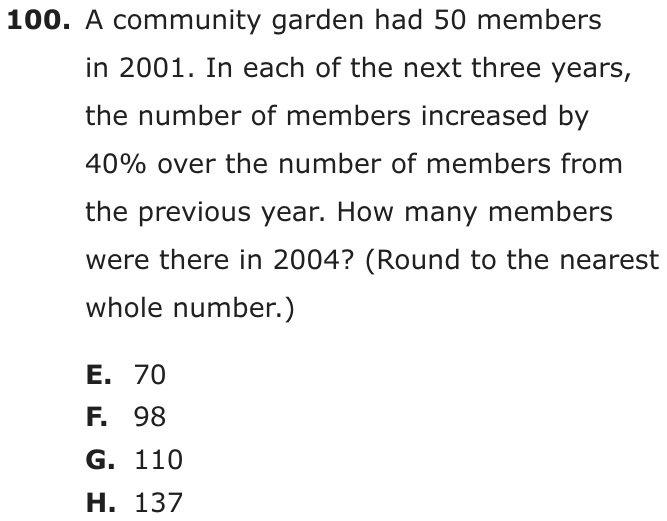
Question 25 of 48
2024 Test B Math, question 56Question
A rectangular field had a length of 80 meters and a width of 50 meters. The field was recently enlarged, with the length increased by 15% and the width increased by 10 meters. By what percentage was the area of the field increased?
- A26.5%
- B35%
- C38%
- D42.5%
Show the answer
Correct answer: C
The original area of the field was 4,000 square meters.
When the field was enlarged, the length increased by 15%, so the new length is 92 meters.
The width increased by 10 meters, so the new width is 60 meters.
The new area of the field is 5,520 square meters.
The percent increase is found by finding the difference between the two areas and dividing the increase by the original area.
Question analysis
A rectangular field 80 meters long and 50 meters wide has its length increased by 15 percent and its width by 10 meters. Students find the percent by which the field's area grew. It tests percent increase with rectangle area, and the tricky part is that one side changes by a percent and the other by a fixed length.
- Grade level
- Grade 7 content, by NYS standard
- Compared with grade 7
- Above grade 7 Grade 7 percent problems usually apply one percent change to one quantity. This changes a length by a percent and a width by a fixed amount, then asks for the percent change in area, a five-step chain with two kinds of change.
- Estimated difficulty
- Hard: combines ideas, needs a plan, and has more than one tempting wrong answer.
- Thinking it demands
- Depth of knowledge 2, skills and concepts · mainly apply
- What makes it hard
- Combines ideas moderate
- Many steps moderate
- A very close wrong answer minor
- Solution
- 5 steps
- Reading level
- Question and choices: about grade 6, 39 words.
- Students, last 30 days
- Not enough answers yet to show (it takes 10).
Why it is hard, traps and wrong answers (shows the answer)
Why it is hard
Each step is ordinary, but the two changes are stated in different units, one a percent and one in meters, which tempts students to force them into the same form. Adding the two percents is the most natural shortcut and lands close to the right value, because it misses only the small extra area where both changes overlap. Computing the old and new areas directly is slower but leaves nothing to chance.
Combines ideas moderate Working it out
Percent change has to be combined with area: the length grows by a percent and the width by meters, and the question asks for the percent change of their product. (Embretson, 1998; Daniel & Embretson, 2010)
Many steps moderate Working it out
Five computations are chained: the new length 92, the new width 60, the areas 4,000 and 5,520, and the increase 1,520 as a share of 4,000. (Daniel & Embretson, 2010; Enright, Morley & Sheehan, 2002)
A very close wrong answer minor Choosing the answer
The 35% from adding 15% and 20% sits only 3 points below 38%, so a rough estimate of the new area cannot rule it out. (Embretson & Wetzel, 1987; Gorin & Embretson, 2006; Ascalon et al., 2007)
Strategy: Compute the new length and the new width, find the old and new areas, and divide the increase in area by the original area.
Traps
- Misunderstands the concept: A wrong belief about a concept: that percents can be added, that area grows like length, that averages can be averaged, that a bigger denominator means a bigger fraction.
- Units or scale: The answer is wanted in other units, or a rate or scale must be converted first.
The wrong answers, classified
A Units or scale (King et al., 2004)
Treats the 10-meter widening as a 10% increase, so multiplies 1.15 × 1.10 = 1.265 and reports a 26.5% rise.
B Misunderstands the concept (Smith, diSessa & Roschelle, 1993; De Bock et al., 1998; Ni & Zhou, 2005)
Adds the length's 15% to the width's 20% increase, as if percent increases in two dimensions simply add, missing the 3% where they overlap.
D Units or scale (King et al., 2004)
Treats the 15% as 15 meters, making the field 95 by 60 meters, an area of 5,700 square meters and a 42.5% increase.
Worked solution, step by step
Formulas used
- Area of a rectangle
- A is the area, the flat space inside. l is the length and w is the width. Multiplying counts how many unit squares fit, row by row.
- Percent increase
- old is the starting amount, and new is the amount after. new − old is how much it grew. Dividing by old compares the growth with the start. Multiplying by 100 turns that into a percent.
Sort out the question
The field was 80 meters long and 50 meters wide. The length grew by 15%, a percent. The width grew by 10 meters, a number of meters. These are two different kinds of increase.
You need the percent by which the area grew.
Find the old area
You need the old area to compare with the new one.
The old field covered 4,000 square meters.
Find the new length and width
15% of 80 is . So the new length is meters.
The new width is meters.
Watch out: 10 meters is not 10%. Treating it as 10% leads to 26.5%, choice A. Treating 15% as 15 meters leads to 42.5%, choice D.
Find the new area
Multiply the new length by the new width.
The new field covers 5,520 square meters. That is square meters more.
Find the percent increase
The area grew by 38%. Watch out: The width grew by 20%, since 10 is 20% of 50. Adding 15% + 20% = 35% gives choice B. That misses the extra corner piece where both new strips meet.
So the answer is C, 38%.
Check your answer
Use growth factors. The length is multiplied by 1.15. The width goes from 50 to 60, so it is multiplied by 1.2. The area is multiplied by , which is 38% more.
More questions like this
The original DOE question
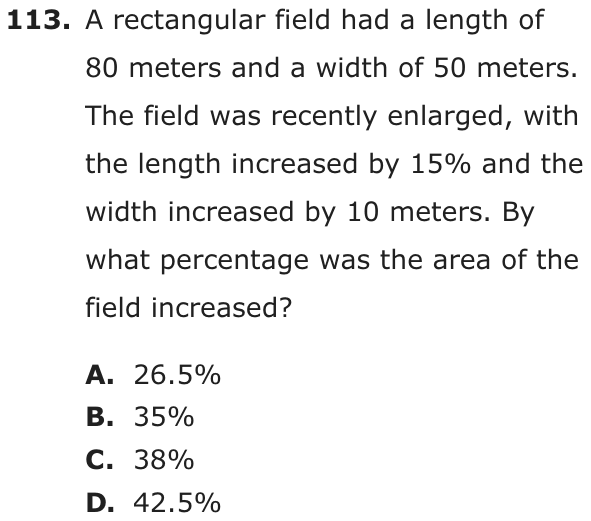
Question 26 of 48
2023 Test A Math, question 1Question
Ms. Li opened a retirement account with a deposit of $2,500. This account earns 4% simple interest annually. How many years will it take her to earn $500 on her $2,500 deposit?
Grid-in question: work out the answer and enter it as a number.
Show the answer
Correct answer: 5
Simple interest (y) is calculated by multiplying the initial deposit (p), the interest rate (r), and time (t):
Question analysis
Ms. Li deposits $2,500 in a retirement account that pays 4% simple interest each year, and this grid-in asks how many years it takes to earn $500 in interest. Students find one year's interest and work out how many years are needed. It turns the usual simple interest question around, asking for the time rather than the interest.
- Grade level
- Grade 7 content, by NYS standard
- Compared with grade 7
- At grade 7 Simple interest is a grade 7 percent application, usually asked as how much interest builds up over a given time. This one gives the interest and asks for the time, a short reverse step with friendly numbers.
- Estimated difficulty
- Straightforward: two steps or one careful reading.
- Thinking it demands
- Depth of knowledge 2, skills and concepts · mainly apply
- What makes it hard
- Solution
- 2 steps
- Reading level
- Question and choices: about grade 6, 28 words.
- Students, last 30 days
- Not enough answers yet to show (it takes 10).
Why it is hard, traps and wrong answers (shows the answer)
Why it is hard
Once one year's interest is known, $100, the rest is counting how many years make $500, so the arithmetic is light. The question turns the usual simple interest problem around, giving the interest and asking for the time, and that reversal is where students stall or grid a percent instead of a number of years. Writing 4% as 0.04, not 0.4, keeps the yearly interest from coming out ten times too big.
Something you must already know minor Working it out
The stem says 4% simple interest annually but never says that each year adds the same 4% of the $2,500 deposit, $100, so the yearly amount has to come from memory. (Anderson & Krathwohl, 2001)
Turning words into math minor Understanding the question
The question gives the interest, $500, and asks for the time, so the familiar formula runs backward: 2,500 × 0.04 × t = 500 has to be solved for t. (Hegarty, Mayer & Monk, 1995; Koedinger & Nathan, 2004)
An answer in an unexpected form minor Choosing the answer
As a grid-in it shows no choices, so 20, the interest as a percent of the deposit, can be gridded with nothing on the page to say it is not a number of years. (Enright, Morley & Sheehan, 2002)
Strategy: Work out one year's interest as 4% of $2,500, then find how many of those yearly amounts add up to the $500 of interest.
Traps
- Stops one step early: A choice is a number from partway through the solution.
- A formula you must know: Needs a formula the test does not give: area, circumference, volume, probability rules.
The wrong answers, classified
20 Stops one step early (King et al., 2004; Gierl et al., 2017)
Finds that the $500 of interest is 20% of the $2,500 deposit and grids 20, stopping before dividing by the 4% earned each year.
0.5 An arithmetic slip (Junker & Sijtsma, 2001)
Writes 4% as 0.4 instead of 0.04, so one year's interest looks like $1,000 and the $500 seems to take only half a year.
125 Numbers taken from the question (Hegarty, Mayer & Monk, 1995)
Divides the $500 of interest by the 4 in 4%, combining two numbers from the stem without first finding 4% of the deposit.
Worked solution, step by step
Formulas used
- Simple interest
- I is the interest, the extra money the account pays you. P is the deposit, the money you put in. r is the yearly rate as a decimal. t is the time in years. Simple means each year’s interest is figured on the deposit only, so every year adds the same amount.
- Percent to decimal
- p is the percent. Percent means out of 100. So divide by 100 to write it as a decimal. For example, 4% is 4 ÷ 100, which is 0.04.
Sort out the question
Ms. Li puts $2,500 into an account. This first amount is called the deposit. Each year the account pays 4% simple interest. Interest is extra money the bank pays you for keeping your money there. You need the number of years it takes to earn $500 of interest. The answer is a number of years, not dollars and not a percent.
Find one year’s interest
First write 4% as a decimal. 4% means 4 out of 100.
Now use the formula for 1 year, so t = 1.
The account earns $100 each year. Watch out: 4% is 0.04, not 0.4. Using 0.4 makes one year’s interest $1,000, and you would grid 0.5 years.
Find how many years make $500
Simple interest adds the same $100 every year. So the time t must make the interest $500.
It takes 5 years. Watch out: $500 is 20% of $2,500. But 20 is a percent, not a number of years. Don’t grid 20. So you would grid 5.
Check your answer
Count up one year at a time: $100, $200, $300, $400, $500. That is 5 years. Or put t = 5 back into the formula: . That matches the $500 in the question.
More questions like this
The original DOE question
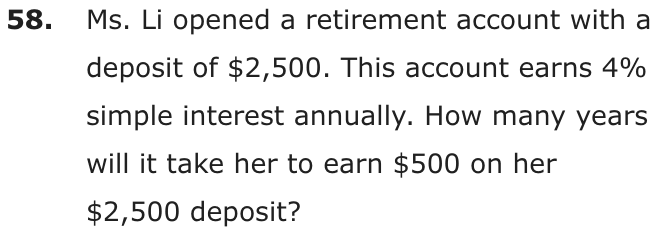
Question 27 of 48
2023 Test A Math, question 8Question
Jamel works at a computer store. He is paid an hourly rate plus a 15% commission on all computer products he sells. Last week, Jamel was paid $802.50 for working 30 hours and selling $1,250.00 worth of computer products. What is Jamel’s hourly rate?
- A$20.50/hr
- B$26.75/hr
- C$33.00/hr
- D$37.65/hr
Show the answer
Correct answer: A
First, determine the amount of Jamel’s weekly pay that is from commission:
Next, subtract Jamel’s commission amount from his weekly pay:
Last, divide the result by 30 hours to find Jamel’s hourly rate:
Question analysis
Jamel earns an hourly wage plus a 15% commission on his sales, and one week he is paid $802.50 for 30 hours of work and $1,250 in sales. Students find his hourly rate. The question mixes a percent with a rate, and the commission has to be taken out of the total pay before dividing by the hours.
- Grade level
- Grade 7 content, by NYS standard
- Compared with grade 7
- At grade 7 Commission is one of the percent applications named in the grade 7 standards, and the remaining work is a two-step equation with decimals. That matches a typical grade 7 multistep problem, with the order of the steps as the main demand.
- Estimated difficulty
- Moderate: several steps, or a close reading with one strong distractor.
- Thinking it demands
- Depth of knowledge 2, skills and concepts · mainly apply
- What makes it hard
- Turning words into math moderate
- Many steps moderate
- Error-prone arithmetic minor
- Solution
- 3 steps
- Reading level
- Question and choices: about grade 3, 44 words.
- Students, last 30 days
- Not enough answers yet to show (it takes 10).
Why it is hard, traps and wrong answers (shows the answer)
Why it is hard
Jamel's pay has two parts, and the question asks for only one of them, so the commission has to be removed before dividing by the hours. Students who divide the whole $802.50 by 30 get a believable hourly figure that still contains the commission. Checking the answer against the story, 30 × $20.50 + $187.50 = $802.50, confirms both parts.
Turning words into math moderate Understanding the question
The phrase "paid an hourly rate plus a 15% commission on all computer products he sells" makes $802.50 the sum of two parts, 30 hours of pay and 15% of $1,250. (Hegarty, Mayer & Monk, 1995; Koedinger & Nathan, 2004)
Many steps moderate Working it out
Three operations in order: 15% of $1,250 is $187.50, $802.50 − $187.50 = $615.00, and $615.00 ÷ 30 = $20.50; dividing before subtracting gives a listed choice. (Daniel & Embretson, 2010; Enright, Morley & Sheehan, 2002)
Error-prone arithmetic minor Working it out
Every amount carries cents, and 15% of $1,250 and $615 ÷ 30 are worked by hand, so a misplaced decimal point shifts the hourly rate. (Brown & Burton, 1978; Junker & Sijtsma, 2001)
Strategy: Take 15% of the $1,250 in sales to find the commission, remove that from the week's pay, and divide what is left by the 30 hours worked.
Traps
- Answers a different question: A choice is right for another quantity: the other unknown, the rest instead of the part, the part instead of the whole.
- Follows a key word: Picks the operation from a single word rather than the situation: "removed" so subtract, "of" so multiply, "more" so add, when the situation needs something else.
- Misreads the question: Misses or misreads a condition or a word in the question: "at least", "each", "remaining", "not".
The wrong answers, classified
B Answers a different question (King et al., 2004; Hegarty, Mayer & Monk, 1995)
Divides the whole $802.50 by 30 hours, which gives Jamel's average pay per hour with the commission included, not his hourly rate.
C Follows a key word (Hegarty, Mayer & Monk, 1995)
Follows the word plus and adds the $187.50 commission to the $802.50 instead of removing it, so (802.50 + 187.50) ÷ 30 = $33.00.
D Misreads the question (Hegarty, Mayer & Monk, 1995)
Swaps the two dollar amounts, taking 15% of the $802.50 pay and subtracting it from the $1,250 of sales: (1,250 − 120.38) ÷ 30 ≈ $37.65.
Worked solution, step by step
Formulas used
- Percent of a number
- p is the percent. The whole is the amount you take the percent of. The part is the result. Percent means out of 100. So 15% is 15 out of every 100, or 0.15.
- Pay with commission
- The rate is the money Jamel earns for each hour. Hours is how long he worked. The commission is extra money that is a percent of what he sells. His pay is these two amounts added together.
Sort out the question
Jamel’s pay has two parts. One part is an hourly rate, the money he earns for each hour. The other part is a commission. A commission is extra pay that is a percent of what he sells. He worked 30 hours and sold $1,250.00 of products. In all he got $802.50. You need his hourly rate.
Find the commission
His commission is 15% of what he sold. 15% means 15 out of 100, or 0.15.
His commission was $187.50. Watch out: take 15% of the $1,250 he sold, not of his $802.50 pay. Mixing them up leads to $37.65, choice D.
Take the commission out of his pay
The rest of his pay came from his hours.
He earned $615.00 for 30 hours of work. Watch out: the word plus does not mean add here. Adding the $187.50 to $802.50 counts the commission twice. That leads to $33.00, choice C.
Divide by the hours he worked
Share the $615.00 equally over the 30 hours.
Watch out: don’t divide all $802.50 by 30. That gives $26.75, choice B. That amount still includes the commission. So the answer is A, $20.50 per hour.
Check your answer
Work forward from the answer. 30 hours at $20.50 is dollars. Add the commission: . That is exactly Jamel’s pay for the week.
More questions like this
The original DOE question
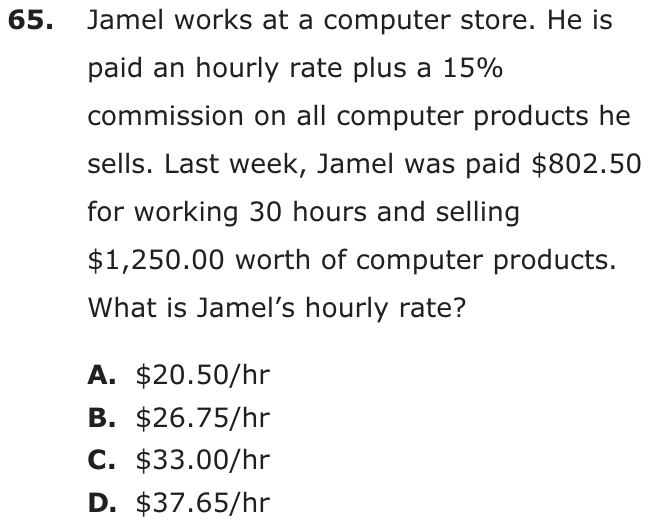
Question 28 of 48
2023 Test A Math, question 17Question
A customer wants to buy a pair of hiking boots.
- The original price of the boots is $85.75.
- The store is offering a 15% discount on all boot purchases.
- The customer has a coupon for an additional 25% off the sale price.
- The tax rate is 8.5%.
What is the final cost of the boots, including the tax, to the nearest cent?
- A$55.82
- B$59.08
- C$59.32
- D$63.17
Show the answer
Correct answer: C
First, determine the sale price after the 15% discount is applied.
Since the customer is saving 15%, this means they are paying 85% , so multiply the original price by 85% (0.85) to find the discounted price:
Next, find the price after the 25% coupon has been applied:
Since the customer is saving 25% off the sale price, this means they are paying 75% , so multiply the price found in the first step by 75% (0.75) to find the second discounted price:
Last, find the final cost after an 8.5% tax is added to the second discounted price.
Since the customer is paying 8.5% tax, this means they are paying 108.5% , so multiply the second discounted price by 108.5% (1.085) to find the final cost:
Question analysis
A pair of hiking boots costs $85.75, goes on sale at 15% off, gets an extra 25% off with a coupon, and is then taxed at 8.5%. Students find the final cost to the nearest cent. Each percent applies to the price left after the step before, so the discounts cannot simply be added, and the decimals call for careful multiplication.
- NYS standards
- Grade level
- Grade 7 content, by NYS standard
- Compared with grade 7
- Above grade 7 A discount followed by sales tax is standard grade 7 percent work. This item stacks two discounts and a tax, with cents to keep at every stage, so it takes about twice the steps and decimal multiplication of a typical problem.
- Estimated difficulty
- Hard: combines ideas, needs a plan, and has more than one tempting wrong answer.
- Thinking it demands
- Depth of knowledge 2, skills and concepts · mainly apply
- What makes it hard
- Error-prone arithmetic major
- Turning words into math moderate
- Slow to do carefully moderate
- Solution
- 3 steps
- Reading level
- Question and choices: about grade 4, 58 words.
- Students, last 30 days
- Not enough answers yet to show (it takes 10).
Why it is hard, traps and wrong answers (shows the answer)
Why it is hard
The question tests whether students treat successive percents as successive multipliers, and then holds them to three long multiplications. Adding the 15% and 25% into one discount is the tempting shortcut, and a tax read as a dollar amount is the other. The key rounds to the cent at each stage, as a register would; carried exactly, the result is $59.31, so the nearest choice, $59.32, still stands.
Error-prone arithmetic major Working it out
Three products of cents and decimals are worked by hand: 85.75 × 0.85 = 72.8875, then 72.89 × 0.75 = 54.6675, then 54.67 × 1.085 ≈ 59.32, each rounded to the cent. (Brown & Burton, 1978; Junker & Sijtsma, 2001)
Turning words into math moderate Understanding the question
The phrase "an additional 25% off the sale price" means 25% of the already discounted $72.89, not of the $85.75 original, so the two discounts multiply rather than add. (Hegarty, Mayer & Monk, 1995; Koedinger & Nathan, 2004)
Slow to do carefully moderate Choosing the answer
A reliable method needs three long decimal multiplications without a calculator, well past the minute and a half a question allows, which tempts students to combine the percents. (Lu & Sireci, 2007)
Strategy: Multiply by 0.85 for the sale, by 0.75 for the coupon on the sale price, and by 1.085 for the tax, rounding to the cent at each stage as a register would.
Traps
- Percent of the wrong amount: Finding the whole from a part, or a percent change measured from the wrong starting amount.
- Misunderstands the concept: A wrong belief about a concept: that percents can be added, that area grows like length, that averages can be averaged, that a bigger denominator means a bigger fraction.
The wrong answers, classified
A Percent of the wrong amount (Parker & Leinhardt, 1995)
Takes the 25% coupon off the original $85.75 instead of the sale price, so the discounts add to 40%: 85.75 × 0.60 × 1.085 ≈ $55.82.
B Little reason to choose it (Haladyna & Downing, 1993; Rodriguez, 2005)
No common working gives $59.08; it sits 24 cents below the right total and matches no discount or tax mistake, so it mostly catches guesses.
D Misunderstands the concept (Smith, diSessa & Roschelle, 1993; De Bock et al., 1998; Ni & Zhou, 2005)
Applies both discounts correctly, reaching $54.67, but adds $8.50 as the tax, reading 8.5% as a dollar amount instead of a percent of the price.
Worked solution, step by step
Formulas used
- Price after a discount
- p is the percent off. A discount is money taken off the price. If you save p percent, you pay the rest, 100 − p percent. For 15% off you pay 85%, so multiply by 0.85.
- Price with tax
- The price is the cost before tax. t is the tax rate, a percent. Tax is extra money added on top. You pay the whole price, 100%, plus t percent more. So for 8.5% tax you multiply by 1.085.
Sort out the question
The boots cost $85.75 at first. The store takes 15% off. Then a coupon takes 25% off the sale price. The sale price is the price after the first discount. Then 8.5% tax is added. You need the final cost to the nearest cent. A cent is $0.01, the second place after the decimal point.
Take off the 15% discount
You save 15%, so you pay 85%. That is 0.85 of the price.
A price can’t have part of a cent, so round to two decimal places. The third digit is 7, which is 5 or more, so round up.
The sign ≈ means about. The sale price is $72.89.
Take 25% off the sale price
The coupon takes 25% off $72.89, so you pay 75% of it.
The price is now $54.67. Watch out: take the coupon off the sale price, not the first price. Adding 15% and 25% to get 40% off $85.75 leads to $55.82, choice A.
Add the 8.5% tax
You pay the price plus 8.5% more, which is 108.5% of it.
Watch out: 8.5% is a percent of the price, not $8.50. Adding $8.50 gives $63.17, choice D.
See why rounding each time matters
A store rounds to the cent after each step, as you just did. The test’s answer is worked the same way. Keep every digit and round only at the end, and you get this:
That is $59.31, which is not a choice. The first two roundings each went up by a tiny part of a cent. That was just enough to push the total from $59.31 to $59.32. So here, round at each step, as a store would. So the answer is C, $59.32.
Check your answer
Check the tax a second way. 8.5% of $54.67 is , about $4.65. Then . Also estimate: two discounts leave a bit less than two-thirds of $86, near $55. Tax adds under $5, so about $59 or $60 makes sense.
More questions like this
The original DOE question
Question 29 of 48
2023 Test A Math, question 18Question
Sheila is saving money for her summer vacation. She starts the summer with a balance of $90.00 and plans to save 15% of her earnings each week. She earns the same amount each week. After 12 weeks, Sheila has saved a total of $472.59. How much money does Sheila earn each week?
- A$212.55
- B$262.55
- C$302.55
- D$312.55
Show the answer
Correct answer: A
Let x be the amount that Sheila needs to earn each week.
First, subtract 90 from both sides:
Last, divide both sides by 1.8:
Question analysis
Sheila starts the summer with $90 and saves 15% of what she earns each week, earning the same amount every week, and after 12 weeks she has $472.59. Students find her weekly earnings. They must write an equation that separates the starting balance from the savings and then work with a percent and long decimals.
- Grade level
- Grade 7 content, by NYS standard
- Compared with grade 7
- At grade 7 Writing and solving an equation of the form px + q = r from a word problem is core grade 7 work. Here the coefficient combines a percent with 12 weeks, and the decimals are long, which adds steps but no new idea.
- Estimated difficulty
- Moderate: several steps, or a close reading with one strong distractor.
- Thinking it demands
- Depth of knowledge 2, skills and concepts · mainly apply
- What makes it hard
- Turning words into math moderate
- Error-prone arithmetic moderate
- Many steps minor
- Solution
- 3 steps
- Reading level
- Question and choices: about grade 4, 48 words.
- Students, last 30 days
- Not enough answers yet to show (it takes 10).
Why it is hard, traps and wrong answers (shows the answer)
Why it is hard
The story has three layers, a starting balance, a weekly saving rate and a 12-week total, and the unknown sits under the percent. Students lose the point by forgetting the $90 was already there, or by moving it the wrong way. Testing a choice is a dependable alternative: 15% of $212.55 is about $31.88, and 12 of those plus $90 gives $472.59.
Turning words into math moderate Understanding the question
The total of $472.59 includes the $90.00 she started with, and only 15% of each week's pay is saved, so the equation is 90 + 12 × 0.15x = 472.59. (Hegarty, Mayer & Monk, 1995; Koedinger & Nathan, 2004)
Error-prone arithmetic moderate Working it out
Dividing $382.59 by 1.8 by hand means shifting the decimal point to get 3,825.9 ÷ 18, which comes out to exactly $212.55 only if every digit is placed correctly. (Brown & Burton, 1978; Junker & Sijtsma, 2001)
Many steps minor Working it out
Subtract the $90, then divide by 12 weeks and by 0.15, or by their product 1.8; doing the division before the subtraction gives a listed choice. (Daniel & Embretson, 2010; Enright, Morley & Sheehan, 2002)
Strategy: Subtract the starting $90 from the final total, then divide by 12 weeks and by 0.15, or test each choice by taking 15% of it, multiplying by 12 and adding $90.
Traps
- Misreads the question: Misses or misreads a condition or a word in the question: "at least", "each", "remaining", "not".
- Wrong operation: Adds instead of multiplying, divides the wrong way round, turns a ratio or rate upside down, or undoes a step in the wrong direction (subtracts what should be added back).
The wrong answers, classified
B Misreads the question (Hegarty, Mayer & Monk, 1995)
Overlooks the $90 she started with, treating the whole $472.59 as savings from earnings, and divides it by 1.8 to get $262.55.
C Little reason to choose it (Haladyna & Downing, 1993; Rodriguez, 2005)
No setup of the savings gives $302.55, the right weekly pay plus the $90 starting balance, a sum with no meaning here, so it mostly catches guesses.
D Wrong operation (Hegarty, Mayer & Monk, 1995; King et al., 2004)
Adds the $90 to $472.59 instead of subtracting it, so the savings from earnings look like $562.59, and dividing by 1.8 gives $312.55.
Worked solution, step by step
Formulas used
- Percent of a number
- p is the percent. The whole is the amount you take the percent of. The part is the result. Percent means out of 100. So 15% is 15 out of every 100, or 0.15.
- Savings over time
- The start is the money she had at the beginning. Weekly savings is what she adds each week. Weeks is how many weeks pass. Each week adds the same amount, so multiply. Then add what she started with.
Sort out the question
Sheila starts with $90.00. Each week she earns the same amount and saves 15% of it. After 12 weeks she has $472.59 in all. That total includes the $90 she started with. You need how much she earns each week, not how much she saves.
Write an equation
Call her weekly earnings x. She saves 15% of x each week. That is .
Take away the starting $90
Only the money added during the 12 weeks came from her pay. Subtract 90 from both sides.
She saved $382.59 from her pay. Watch out: subtract the $90, don’t add it. Adding leads to $312.55, choice D. Forgetting the $90 leads to $262.55, choice B.
Combine the numbers next to x
Each week she saves 0.15 of one week’s pay. Over 12 weeks, that adds up to 1.8 times one week’s pay.
Divide by 1.8
Divide both sides by 1.8. First move the decimal point one place right in both numbers. Then you divide by the whole number 18.
Sheila earns $212.55 each week. So the answer is A, $212.55.
Check your answer
Work forward. 12 weeks of saving 15% is 1.8 weeks of pay: . Add the $90 she started with: . That is the total in the question.
More questions like this
The original DOE question
Question 30 of 48
2023 Test A Math, question 21Question
A soccer coach purchased 15 pairs of cleats for team members and spent a total of $805.95, including tax. If the tax rate is 8%, what is the price of each pair of cleats before tax?
- A$49.43
- B$49.75
- C$53.73
- D$58.03
Show the answer
Correct answer: B
Since the total cost of $805.95 includes an 8% tax, this means that the cost of 15 pairs of cleats before tax was multiplied by 1.08 to find the total cost of the cleats including the tax. So, first, use division to find the cost of the 15 pairs of cleats before tax:
Then, divide that quotient by 15 to find the price of 1 pair of cleats:
Question analysis
A soccer coach pays $805.95, tax included, for 15 pairs of cleats, and the tax rate is 8%. Students find the price of one pair before tax. The total already includes the tax, so students must work backward from a percent increase, and a common shortcut lands very close to the right price.
- Grade level
- Grade 7 content, by NYS standard
- Compared with grade 7
- Above grade 7 Typical grade 7 tax problems add tax to a price. This one works backward from a total that already includes the tax, a reverse percent step many students find unfamiliar, and then shares the cost among 15 pairs.
- Estimated difficulty
- Hard: combines ideas, needs a plan, and has more than one tempting wrong answer.
- Thinking it demands
- Depth of knowledge 2, skills and concepts · mainly apply
- What makes it hard
- Turning words into math moderate
- A very close wrong answer moderate
- Error-prone arithmetic moderate
- Solution
- 2 steps
- Reading level
- Question and choices: about grade 5, 33 words.
- Corrected from the DOE handbook
- A repeated word in the question was corrected.
- Students, last 30 days
- Not enough answers yet to show (it takes 10).
Why it is hard, traps and wrong answers (shows the answer)
Why it is hard
Removing a tax is harder than adding one, because the 8% was taken of an amount the problem never states. Taking 8% off the $805.95 total feels natural and lands within 32 cents of the answer, which is why this question is hard. A quick check exposes it: 15 pairs at $49.75 cost $746.25, and adding 8% of that gives exactly $805.95.
Turning words into math moderate Understanding the question
The phrase "spent a total of $805.95, including tax" makes $805.95 equal to 108% of the pre-tax cost, so the tax is removed by dividing by 1.08, not by taking 8% off. (Hegarty, Mayer & Monk, 1995; Koedinger & Nathan, 2004)
A very close wrong answer moderate Choosing the answer
$49.43 and $49.75 are 32 cents apart, and taking 8% off the total lands on the lower one; no estimate separates them, only dividing by 1.08. (Embretson & Wetzel, 1987; Gorin & Embretson, 2006; Ascalon et al., 2007)
Error-prone arithmetic moderate Working it out
805.95 ÷ 1.08 = 746.25 and 746.25 ÷ 15 = 49.75 are long decimal divisions by hand; dividing by 15 first, to 53.73, and then by 1.08 is no easier. (Brown & Burton, 1978; Junker & Sijtsma, 2001)
Strategy: Treat the total as 108% of the pre-tax cost: divide $805.95 by 1.08, then divide by 15 pairs, and check by adding 8% back.
Traps
- Percent of the wrong amount: Finding the whole from a part, or a percent change measured from the wrong starting amount.
- Answers a different question: A choice is right for another quantity: the other unknown, the rest instead of the part, the part instead of the whole.
- Wrong operation: Adds instead of multiplying, divides the wrong way round, turns a ratio or rate upside down, or undoes a step in the wrong direction (subtracts what should be added back).
The wrong answers, classified
A Percent of the wrong amount (Parker & Leinhardt, 1995)
Takes 8% of the $805.95 total and subtracts it, 805.95 × 0.92 ÷ 15 ≈ $49.43, though the tax was 8% of the smaller pre-tax cost.
C Answers a different question (King et al., 2004; Hegarty, Mayer & Monk, 1995)
Divides the $805.95 total by 15 pairs without removing the tax, which gives the price of a pair with tax rather than before it.
D Wrong operation (Hegarty, Mayer & Monk, 1995; King et al., 2004)
Divides the total by 15 and then multiplies by 1.08 instead of dividing, adding the tax a second time: 53.73 × 1.08 ≈ $58.03.
What was corrected from the DOE handbook, and why
- Stem: The handbook’s question reads “what is the the price of each pair of cleats before tax?”, with “the” printed twice (p. 80, question 78). The site now reads “what is the price of each pair of cleats before tax?”
Worked solution, step by step
Formulas used
- Price with tax
- The price is the cost before tax. t is the tax rate, a percent. Tax is extra money added on top. You pay the whole price, 100%, plus t percent more. So for 8% tax you multiply by 1.08.
- Undoing a multiplication
- a is the unknown, b is the number it was multiplied by, and c is the result. Dividing by b undoes multiplying by b. Use it to work backward to the amount before tax.
Sort out the question
The coach bought 15 pairs of cleats, which are sports shoes. He paid $805.95 in all, and that includes 8% tax. Tax is extra money added to the price. You need the price of one pair before tax.
Write the total with tax
The tax is 8% of the cost before tax. So the coach paid 100% + 8% = 108% of that cost. 108% is 1.08. Call the pre-tax cost of all 15 pairs c.
Divide to remove the tax
To undo multiplying by 1.08, divide by 1.08. Move both decimal points two places right first.
All 15 pairs cost $746.25 before tax. Watch out: don’t take 8% of $805.95 and subtract it. The tax was 8% of the smaller pre-tax cost. That way leads to $49.43, choice A.
Find the price of one pair
All 15 pairs cost the same, so share the cost equally.
Watch out: dividing $805.95 by 15 without removing the tax gives $53.73, choice C. That price still includes the tax. So the answer is B, $49.75.
Check your answer
Work forward. 15 pairs at $49.75 cost dollars. The tax is dollars. Then , the total in the question.
More questions like this
The original DOE question
Question 31 of 48
2023 Test A Math, question 36Question
Josef and Mai divided some stamps between themselves. Josef got 60% of the stamps. If Josef received 500 more stamps than Mai, how many stamps did Josef receive?
- A300
- B800
- C1,500
- D2,500
Show the answer
Correct answer: C
Let j be the number of stamps Josef has. Then Mai has stamps. The total number of stamps is . Since Josef has 60% of the stamps, set up an equation to solve for j:
| Cross multiply. | |
| Apply the distributive property; multiply the 60 by and 500. | |
| Apply the additive inverse property; subtract from both sides of the equation. | |
| Apply the multiplicative inverse property; divide both sides of the equation by −20. | |
Question analysis
This percent word problem says Josef and Mai split some stamps, Josef got 60% of them, and he received 500 more than Mai; it asks how many stamps Josef received. Students must connect a difference in counts to a difference in percents. Stopping at the total, or taking a percent of 500, gives tempting wrong answers.
- Grade level
- Grade 7 content, by NYS standard
- Compared with grade 7
- Above grade 7 Grade 7 percent problems usually give the whole and ask for a part. Here neither share nor the total is known; students must link the 500-stamp gap to the gap between two percents before finding the total and then Josef's part.
- Estimated difficulty
- Hard: combines ideas, needs a plan, and has more than one tempting wrong answer.
- Thinking it demands
- Depth of knowledge 2, skills and concepts · mainly apply
- What makes it hard
- Turning words into math moderate
- No obvious method moderate
- Many steps minor
- Solution
- 3 steps
- Reading level
- Question and choices: about grade 4, 26 words.
- Students, last 30 days
- Not enough answers yet to show (it takes 10).
Why it is hard, traps and wrong answers (shows the answer)
Why it is hard
The arithmetic is easy once the 500 is seen as the gap between two percents of one total; seeing that is the hard part. The tempting move is to apply the 60% to the only number given, the 500, which treats a difference as a whole. Students who do find the total must still take Josef's share of it, since the total waits among the choices. Checking that 1,500 and 1,000 differ by 500 confirms the answer.
Turning words into math moderate Understanding the question
The stem describes one split in two ways, Josef's 60% of the total and his 500-stamp lead over Mai, and the link, that the lead is 60% − 40% = 20% of the total, is never stated. (Hegarty, Mayer & Monk, 1995; Koedinger & Nathan, 2004)
No obvious method moderate Working it out
No equation is suggested: the quick route treats the 500 as 20 percentage points and scales up to 100%, while the handbook's route, j over 2j − 500, needs cross-multiplying and a negative coefficient. (Schoenfeld, 1985)
Many steps minor Working it out
Even the short route takes three moves, the 20% gap, the 2,500 total and Josef's 60% of it, and the total is itself a listed choice. (Daniel & Embretson, 2010; Enright, Morley & Sheehan, 2002)
Strategy: If Josef has 60%, Mai has the other 40%, so the 500-stamp difference is a known percent of the total; use it to find the total, then take Josef's share.
Traps
- Stops one step early: A choice is a number from partway through the solution.
- Percent of the wrong amount: Finding the whole from a part, or a percent change measured from the wrong starting amount.
- Numbers taken from the question: Combines the numbers in the question without a model of the situation, or is simply a number that appears in the question.
The wrong answers, classified
A Percent of the wrong amount (Parker & Leinhardt, 1995)
Takes 60% of 500, applying the percent to the difference between the two shares as if the 500 stamps were the whole collection.
B Numbers taken from the question (Hegarty, Mayer & Monk, 1995)
Takes 60% of 500 to get 300 and then adds the 500 extra stamps, combining the stem's numbers without a model of the two shares.
D Stops one step early (King et al., 2004; Gierl et al., 2017)
Sees that the 500-stamp gap is 20% of the total, finds the total of 2,500, and stops before taking Josef's 60% of it.
Worked solution, step by step
Formulas used
- Percent of a number
- p is the percent. The whole is the total amount, and the part is the piece you want. Percent means “out of 100,” so 60% is 60 out of every 100. Use it to find a part, or work backward to find the whole.
Sort out the question
Josef and Mai split some stamps. Josef got 60% of them. He also got 500 more stamps than Mai. You need how many stamps Josef got. You don’t know the total yet, so find it first.
Find Mai’s percent
All the stamps make 100%. Josef has 60%, so Mai has the rest.
Mai has 40% of the stamps.
Find what the 500 stamps are
Josef’s extra 500 stamps are the gap between his share and Mai’s share.
So 500 stamps are 20% of all the stamps.
Find the total number of stamps
There are 2,500 stamps in all. Watch out: that is everyone’s stamps, choice D. Don’t stop here.
Find Josef’s share
Watch out: taking 60% of 500 gives 300, choice A. The 500 is the gap between them, not the total. So the answer is C, 1,500 stamps.
Check your answer
Mai gets 40% of 2,500, which is 1,000 stamps. Josef’s 1,500 minus Mai’s 1,000 is 500, just as the question says. And 1,500 + 1,000 = 2,500, the whole amount.
More questions like this
The original DOE question
Question 32 of 48
2023 Test A Math, question 41Question
Yesterday Sarah read 15% of her entire book. Today she read another 17% of the entire book. In lowest terms, what fraction of the book is left for her to read?
- A
- B
- C
- D
Show the answer
Correct answer: C
So far, Sarah has read of the entire book. That means she has left to read.
Question analysis
This percent word problem says Sarah read 15% of her book yesterday and 17% today, and asks what fraction of the book she still has to read, in lowest terms. Students combine percents of the same whole, find the part remaining, and convert a percent to a simplified fraction. Rounding, or giving the part already read, leads to wrong choices.
- Grade level
- Grade 7 content, by NYS standard
- Compared with grade 7
- Below grade 7 Grade 7 percent work often takes a percent of a percent or finds a percent change. Here both percents are of the same whole book, so they combine directly; the rest is a subtraction and simplifying a fraction, lighter than typical.
- Estimated difficulty
- Straightforward: two steps or one careful reading.
- Thinking it demands
- Depth of knowledge 2, skills and concepts · mainly apply
- What makes it hard
- Solution
- 3 steps
- Reading level
- Question and choices: about grade 5, 33 words.
- Corrected from the DOE handbook
- Missing percent signs in the explanation were restored.
- Students, last 30 days
- Not enough answers yet to show (it takes 10).
Why it is hard, traps and wrong answers (shows the answer)
Why it is hard
The percent work is a sum and a subtraction from 100, so the question mostly tests the last step, writing 68% as a fraction in lowest terms. Students who round to 30% read and 70% left to get a friendlier fraction land on a listed choice, as do those who give the part read. Dividing 68 and 100 by their common factor 4 keeps the answer exact.
Turning words into math minor Understanding the question
Both percents are “of the entire book,” so they simply add to 32%, and “left for her to read” asks for the rest, 100% − 32%, not the part already read. (Hegarty, Mayer & Monk, 1995; Koedinger & Nathan, 2004)
An answer in an unexpected form minor Choosing the answer
The result has to be written as a fraction in lowest terms, so 68/100 must be divided by 4 to reach a form that appears among the choices. (Enright, Morley & Sheehan, 2002)
Strategy: Add the two percents, since both are of the whole book, subtract the total from 100%, then write the result over 100 and simplify it fully.
Traps
- Rounds too early: Rounds a value partway through, or rounds the wrong way, so the final answer drifts from the exact one.
- Answers a different question: A choice is right for another quantity: the other unknown, the rest instead of the part, the part instead of the whole.
The wrong answers, classified
A Little reason to choose it (Haladyna & Downing, 1993; Rodriguez, 2005)
No sum or difference of 15% and 17% gives 28%, so 7/25 mostly draws students who match the right fraction's 25 without checking the numerator.
B Answers a different question (King et al., 2004; Hegarty, Mayer & Monk, 1995)
Gives the part already read rather than the part left, and rounds that 32% to 30% to write it as 3/10.
D Rounds too early (King et al., 2004)
Finds that 68% is left but rounds it to 70% to make an easier fraction, giving 7/10 instead of simplifying 68/100 exactly.
What was corrected from the DOE handbook, and why
- Explanation: The handbook writes “So far, Sarah has read 15 + 17 = 32 of the entire book. That means she has 100 − 32 = 68 left to read.” (p. 143, question 98), with no percent signs, so 32 and 68 read as amounts of the book (pages, say) that the question never gives. The question gives 15% and 17%, and the handbook’s next line begins “68% =”, so the site now reads 15% + 17% = 32% and 100% − 32% = 68%. The answer, 17/25, is unchanged.
Worked solution, step by step
Formulas used
- Percent as a fraction
- p is the percent. Percent means “out of 100,” so p percent is p hundredths. For example, 50% is 50 out of 100, which is one half.
- Simplifying a fraction
- a is the top number, b is the bottom, and n is a number that divides both evenly. Dividing the top and bottom by the same number keeps the value the same. A fraction is in lowest terms when no number bigger than 1 divides both.
Sort out the question
Sarah read 15% of her book yesterday and 17% today. Both are percents of the whole book. You need the part still left to read, as a fraction in lowest terms. That means a fraction that can’t be simplified any more.
Find how much she has read
Both percents are of the same whole book, so you can add them. She has read 32% of it.
Find how much is left
The whole book is 100%.
Watch out: 32% is the part she has read, not the part left. Rounding 32% to 30% gives , choice B.
Write 68% as a fraction
This fraction is not in lowest terms yet, because 68 and 100 are both even.
Write it in lowest terms
The number 4 divides both 68 and 100 evenly.
Watch out: don’t round 68% to 70%. That gives , choice D. So the answer is C, .
Check your answer
Turn the answer back into a percent: , which is 68%. Then 68% + 32% = 100%, the whole book. Also, 17 and 25 share no factor except 1, so the fraction is in lowest terms.
More questions like this
The original DOE question
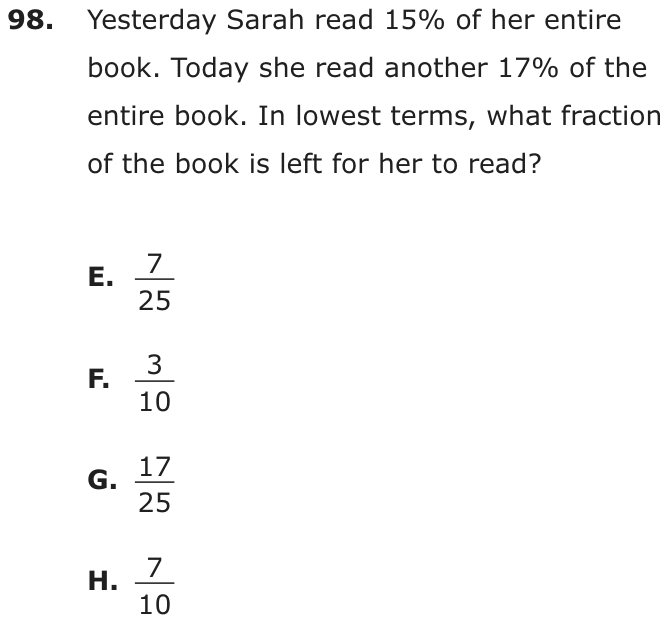
Question 33 of 48
2023 Test A Math, question 47Question
Which percentage is closest in value to 0.0099?
- A0%
- B0.1%
- C1%
- D100%
Show the answer
Correct answer: C
Since 0.0099 is equal to 0.99%, the answer option closest to that value is 1%.
Question analysis
This percent question asks which of four percentages is closest in value to the decimal 0.0099. Students convert a small decimal to a percent by multiplying by 100, then compare it with choices that differ by factors of ten. Moving the decimal point the wrong number of places, or reading the digits 99 as a percent, leads to wrong answers.
- NYS standards
- 6.RP.3c percent as a rate per 100
- Grade level
- Grade 6 content, by NYS standard
- Compared with grade 7
- Below grade 7 Converting a decimal to a percent is grade 6 work. This decimal has two zeros before its first digit, so the point must move carefully, but it is a single conversion followed by picking the nearest choice, below typical grade 7 demand.
- Estimated difficulty
- Straightforward: two steps or one careful reading.
- Thinking it demands
- Depth of knowledge 1, recall and reproduction · mainly apply
- What makes it hard
- Solution
- 2 steps
- Reading level
- Question and choices: about grade 6, 7 words.
- Students, last 30 days
- Not enough answers yet to show (it takes 10).
Why it is hard, traps and wrong answers (shows the answer)
Why it is hard
One conversion answers the question, and the choices are spaced by powers of ten, so the work is all in the decimal places. A decimal this small looks like nothing, and students who forget to multiply by 100 see it as nearly 0%. Others move the point the wrong number of places or read the digits 99 as a percent. Seeing that 0.01 is exactly 1% puts 0.0099 just below it.
Error-prone arithmetic minor Working it out
The decimal 0.0099 has two zeros before its digits, so moving the point two places gives 0.99, and miscounting the places lands on 0.1% or 99%. (Brown & Burton, 1978; Junker & Sijtsma, 2001)
Something you must already know minor Working it out
Students must know that a percent is a number of hundredths, so 0.0099 is multiplied by 100 to become 0.99%, a rule the question takes for granted. (Anderson & Krathwohl, 2001)
Strategy: Multiply the decimal by 100 to write it as a percent, moving the point two places to the right, then choose the percent nearest to that value.
Traps
- Misunderstands the concept: A wrong belief about a concept: that percents can be added, that area grows like length, that averages can be averaged, that a bigger denominator means a bigger fraction.
- An arithmetic slip: The right method with a plausible arithmetic error: a digit, a place value or a times-table fact.
- Numbers taken from the question: Combines the numbers in the question without a model of the situation, or is simply a number that appears in the question.
The wrong answers, classified
A Misunderstands the concept (Smith, diSessa & Roschelle, 1993; De Bock et al., 1998; Ni & Zhou, 2005)
Reads 0.0099 as if it were already a percent, 0.0099%, which is nearest 0%, never multiplying by 100 to change the decimal into a percent.
B An arithmetic slip (Junker & Sijtsma, 2001)
Moves the decimal point one place instead of two, turning 0.0099 into about 0.1, and writes that as 0.1%, ten times too small.
D Numbers taken from the question (Hegarty, Mayer & Monk, 1995)
Sees the digits 99, thinks of 99 percent, and picks the nearest choice, ignoring the zeros that make 0.0099 less than one hundredth.
Worked solution, step by step
Formulas used
- Decimal to percent
- A percent is a number of hundredths. To change a decimal into a percent, multiply by 100. That moves the decimal point two places to the right. For example, 0.25 × 100 = 25, so 0.25 is 25%.
Sort out the question
The number 0.0099 is a decimal, but the choices are percents. To compare them, change 0.0099 into a percent first. Then find the choice nearest to it.
Change the decimal to a percent
So 0.0099 is 0.99%. The decimal point moved two places to the right. Watch out: 0.0099 is not already a percent. Reading it as 0.0099% points to 0%, choice A.
Find the nearest choice
Find how far 0.99% is from each choice.
Choice Distance from 0.99% A, 0% 0.99 B, 0.1% 0.89 C, 1% 0.01 D, 100% 99.01 Watch out: moving the point only one place gives about 0.1, choice B. So the answer is C, 1%.
Check your answer
Work the other way. 1% is 1 out of 100, or 0.01. And 0.0099 is just a tiny bit less than 0.0100. So 0.0099 is very close to 1%, just a little less.
More questions like this
The original DOE question
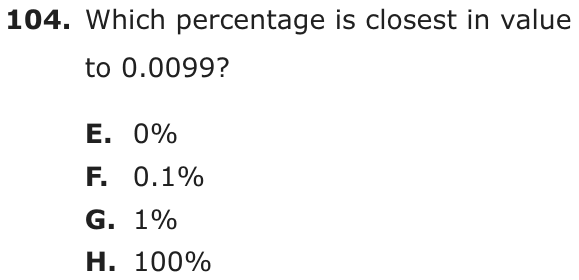
Question 34 of 48
2023 Test B Math, question 4Question
Mr. Smith opened a retirement account with a deposit of $900. This account earns 5% simple interest annually. How many years will it take for his $900 deposit to earn $360 interest?
Grid-in question: work out the answer and enter it as a number.
Show the answer
Correct answer: 8
Calculate simple interest (y) by multiplying the initial deposit (p) by the interest rate (r) by the number of years (t):
Question analysis
Mr. Smith deposits $900 in a retirement account that earns 5% simple interest each year. This grid-in asks how many years it takes for the deposit to earn $360 in interest. Students find one year's interest and then how many years add up to the total, and the percent must become the right decimal.
- Grade level
- Grade 7 content, by NYS standard
- Compared with grade 7
- At grade 7 Simple interest is grade 7 percent work, and a typical problem asks for the interest earned over a given time. This one runs the formula backward to find the time, one extra step, with friendly numbers.
- Estimated difficulty
- Straightforward: two steps or one careful reading.
- Thinking it demands
- Depth of knowledge 2, skills and concepts · mainly apply
- What makes it hard
- Solution
- 2 steps
- Reading level
- Question and choices: about grade 7, 28 words.
- Students, last 30 days
- Not enough answers yet to show (it takes 10).
Why it is hard, traps and wrong answers (shows the answer)
Why it is hard
The numbers are friendly once one year’s interest is found, so most of the difficulty is setting up the right relationship. Students who divide $360 by 5 treat the rate as a dollar amount, and students who compare $360 with $900 stop at a percent. Multiplying back, eight years of $45, confirms the $360.
Something you must already know minor Working it out
Simple interest is the deposit times the rate times the years; the stem does not give this rule, and it must be known to see that each year adds the same $45. (Anderson & Krathwohl, 2001)
Turning words into math minor Understanding the question
The question gives the total interest, $360, and asks for the time, so the usual interest calculation has to be run backward, as 45t = 360. (Hegarty, Mayer & Monk, 1995; Koedinger & Nathan, 2004)
Error-prone arithmetic minor Working it out
Writing 5% as 0.05, not 0.5 or 0.005, is the one place-value decision, and a slip there changes the yearly interest by a power of ten. (Brown & Burton, 1978; Junker & Sijtsma, 2001)
Strategy: Work out the interest for one year, 5 percent of $900, then divide the $360 target by that yearly amount.
Traps
- Stops one step early: A choice is a number from partway through the solution.
- Misunderstands the concept: A wrong belief about a concept: that percents can be added, that area grows like length, that averages can be averaged, that a bigger denominator means a bigger fraction.
- An arithmetic slip: The right method with a plausible arithmetic error: a digit, a place value or a times-table fact.
The wrong answers, classified
40 Stops one step early (King et al., 2004; Gierl et al., 2017)
Finds that $360 is 40 percent of the $900 deposit and enters 40, stopping before dividing by the 5 percent earned each year.
72 Misunderstands the concept (Smith, diSessa & Roschelle, 1993; De Bock et al., 1998; Ni & Zhou, 2005)
Reads 5% as $5 a year, a fixed amount instead of a share of the $900, and divides 360 by 5.
80 An arithmetic slip (Junker & Sijtsma, 2001)
Writes 5% as 0.005, so a year’s interest seems to be $4.50, and 360 ÷ 4.5 = 80 years.
Worked solution, step by step
Formulas used
- Simple interest
- I is the interest, the money the account earns. P is the deposit you start with. r is the yearly rate, written as a decimal. t is the number of years. With simple interest, every year earns the same amount, because it is always based on the first deposit.
Sort out the question
Mr. Smith puts $900 into an account. It earns 5% simple interest each year. Interest is extra money the bank pays you for keeping your money there. You need the number of years until the interest adds up to $360.
Write 5% as a decimal
Percent means “out of 100.” So 5% is 5 out of 100.
Watch out: 5% is not 0.5 or 0.005. Using 0.005 makes a year’s interest $4.50, and that leads to 80 years.
Find the interest for one year
Each year the account earns 5% of $900.
So it earns $45 every year. Watch out: 5% is not $5 a year. Dividing 360 by 5 gives 72, which is wrong.
Use the formula to find the years
Put the numbers into the formula. I is 360, P is 900 and r is 0.05.
To undo “times 45,” divide both sides by 45.
Give the answer
It takes 8 years. Watch out: $360 is 40% of $900. Gridding 40 stops too soon, because each year adds only 5%. So you would grid 8.
Check your answer
Add up the interest year by year. $45 a year for 8 years is dollars. Also, 8 years at 5% a year is 40%, and 40% of $900 is $360.
More questions like this
The original DOE question
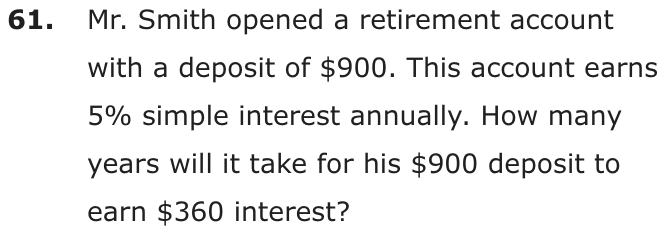
Question 35 of 48
2023 Test B Math, question 23Question
FRUIT SOLD
AT STORE XYZ
| Fruit | Number Sold |
|---|---|
| Apples | 8 |
| Bananas | 6 |
| Cherries | 12 |
| Oranges | 6 |
| Peaches | ? |
| Total | 50 |
Peaches made up what percentage of the total number of pieces of fruit sold at Store XYZ, according to the table above?
- A18%
- B28%
- C36%
- D64%
Show the answer
Correct answer: C
First, find the number of peaches sold:
Then, find the percentage:
Question analysis
A table lists the fruit sold at Store XYZ, apples, bananas, cherries and oranges, with the number of peaches shown as a question mark and a total of 50. Students find what percentage of the fruit sold were peaches. They first work out the missing count, then turn it into a percent of the total.
- NYS standards
- 6.RP.3c percent as a rate per 100
- Grade level
- Grade 6 content, by NYS standard
- Compared with grade 7
- Below grade 7 Finding a missing value and writing a part as a percent of a whole are grade 6 skills. With a total of 50, the percent step is quick, so the task is lighter than typical grade 7 percent problems.
- Estimated difficulty
- Straightforward: two steps or one careful reading.
- Thinking it demands
- Depth of knowledge 2, skills and concepts · mainly apply
- What makes it hard
- Reading a figure, table or graph minor
- Many steps minor
- Solution
- 3 steps
- Reading level
- Question and choices: about grade 4, 34 words.
- Students, last 30 days
- Not enough answers yet to show (it takes 10).
Why it is hard, traps and wrong answers (shows the answer)
Why it is hard
The total of 50 makes the percent step easy, since each piece of fruit is 2 percent, but the question first hides the count it needs. Students who find the 18 peaches and stop, or who give the share of the four listed fruits, reach listed choices. Checking that the peaches’ percent and the other fruits’ percent add to 100 confirms the answer.
Reading a figure, table or graph minor Understanding the question
The table gives four counts, a question mark for peaches and a total of 50, so the missing count must be found by subtraction before any percent. (Lesh, Post & Behr, 1987; Kirsch & Mosenthal, 1990)
Many steps minor Working it out
Adding 8, 6, 12 and 6, subtracting from 50, and turning 18 out of 50 into a percent are three steps, and the count of 18 is itself a listed percent. (Daniel & Embretson, 2010; Enright, Morley & Sheehan, 2002)
Strategy: Add the four known counts, subtract from 50 to get the peaches, then double that count, since each piece out of 50 is 2 percent.
Traps
- Stops one step early: A choice is a number from partway through the solution.
- Answers a different question: A choice is right for another quantity: the other unknown, the rest instead of the part, the part instead of the whole.
The wrong answers, classified
A Stops one step early (King et al., 2004; Gierl et al., 2017)
Finds the 18 peaches but gives that count as the percent, forgetting to compare it with the total of 50 pieces.
B Little reason to choose it (Haladyna & Downing, 1993; Rodriguez, 2005)
No common working gives 28%, which would need 14 peaches; it takes a slip such as 36 for 8 + 6 + 12 + 6, so it mostly draws guesses.
D Answers a different question (King et al., 2004; Hegarty, Mayer & Monk, 1995)
Finds the share of the other four fruits, 32 of 50 or 64 percent, instead of the share of the peaches.
Worked solution, step by step
Formulas used
- Percent of a total
- The part is the amount you are asking about, here the peaches. The whole is the total, here all 50 pieces of fruit. Dividing gives the fraction of the whole. Multiplying by 100 turns it into a percent, which means out of 100.
Sort out the question
The table shows how many of each fruit Store XYZ sold. The number of peaches is missing, shown by a question mark. The total is 50 pieces of fruit. You need the percent of the total that were peaches.
Add the fruits you know
Apples, bananas, cherries and oranges add up to 32 pieces of fruit. That is every fruit except the peaches.
Find the number of peaches
The peaches are whatever is left of the 50.
So 18 peaches were sold. Watch out: 18 is a count, not a percent. Choosing 18% is choice A.
Turn the count into a percent
Peaches were 36% of the fruit sold. Watch out: 32 out of 50 is 64%, choice D. That is the other four fruits, not the peaches. So the answer is C, 36%.
Check your answer
Out of 50 pieces, each piece is 2% of the total, because . So 18 peaches are percent. Also, 36% for peaches plus 64% for the rest makes 100%.
More questions like this
The original DOE question
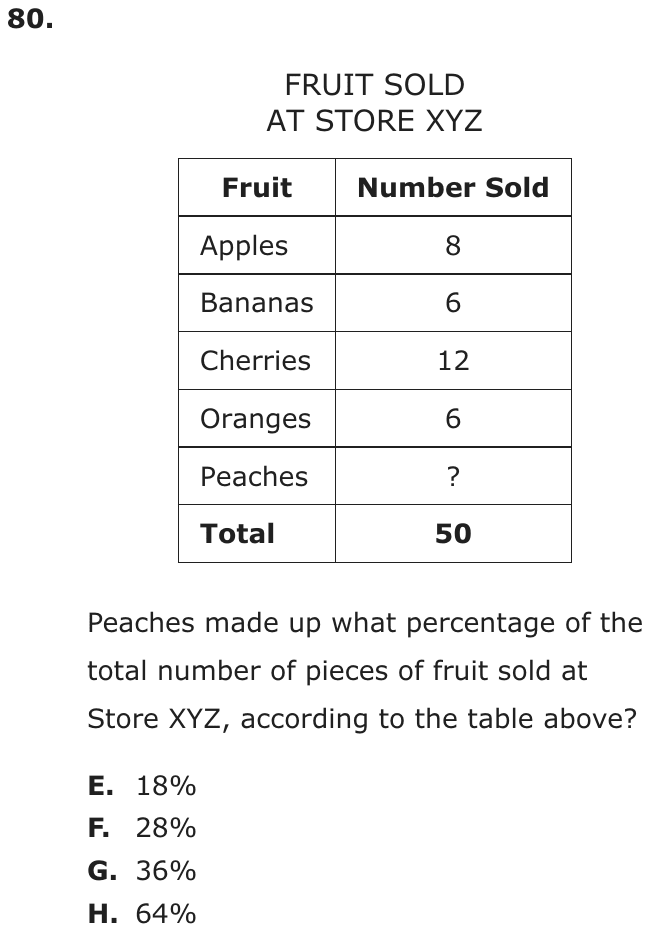
Question 36 of 48
2023 Test B Math, question 33Question

The distance from W to X is 70% of the distance from W to Y. If the distance from X to Y is 15 miles, what is the distance, in miles, from W to X?
- A10.5
- B35
- C45
- D50
Show the answer
Correct answer: B
Since the distance from W to X is 70% of the distance from W to Y, the distance from X to Y is 30% of the distance from W to Y. Let d represent the distance from W to Y. Then 15 miles is 30% of d.
So, the distance from W to X, in miles, is .
Question analysis
A percent question with a line segment: point X lies between W and Y, the distance from W to X is 70% of the whole, and the distance from X to Y is 15 miles. Students find the distance from W to X. Matching the 15 miles to the right percent before finding the whole is the step students most often skip.
- Grade level
- Grade 7 content, by NYS standard
- Compared with grade 7
- At grade 7 Grade 7 percent problems often give a part and its percent and ask for the whole. This one gives the distance for the part the percent does not describe and asks for the other part, so the whole has to be found on the way.
- Estimated difficulty
- Moderate: several steps, or a close reading with one strong distractor.
- Thinking it demands
- Depth of knowledge 2, skills and concepts · mainly apply
- What makes it hard
- Turning words into math moderate
- Many steps minor
- Solution
- 3 steps
- Reading level
- Question and choices: about grade 5, 33 words.
- Students, last 30 days
- Not enough answers yet to show (it takes 10).
Why it is hard, traps and wrong answers (shows the answer)
Why it is hard
The percent and the given distance describe different pieces of the road, which is the whole difficulty. Students who apply the 70% straight to the 15 miles get a small number fast, and students who solve correctly for the whole of WY must still remember to take XY away. Checking that 35 is 70% of 50 confirms the answer and catches both slips.
Turning words into math moderate Understanding the question
The 70% describes WX, but the 15 miles given is XY, so the sentence has to be recast as “XY is 30% of WY” before the 15 miles can be used. (Hegarty, Mayer & Monk, 1995; Koedinger & Nathan, 2004)
Many steps minor Working it out
Finding the complement, 30%, then the whole, 15 ÷ 0.30 = 50, then the part, 50 − 15, gives three results, and the middle one is itself a choice. (Daniel & Embretson, 2010; Enright, Morley & Sheehan, 2002)
Strategy: Work out what percent of WY the 15-mile stretch from X to Y must be, use it to find the whole of WY, then find the part from W to X.
Traps
- Stops one step early: A choice is a number from partway through the solution.
- Percent of the wrong amount: Finding the whole from a part, or a percent change measured from the wrong starting amount.
The wrong answers, classified
A Percent of the wrong amount (Parker & Leinhardt, 1995)
Takes 70% of the 15 miles, 0.7 × 15 = 10.5, applying the percent to XY instead of to the whole distance from W to Y.
C Little reason to choose it (Haladyna & Downing, 1993; Rodriguez, 2005)
No common working gives 45; it would make XY a quarter of WY instead of 30%, so it mostly draws guesses.
D Stops one step early (King et al., 2004; Gierl et al., 2017)
Finds the whole distance from W to Y, 15 ÷ 0.30 = 50 miles, and stops before subtracting the 15 miles from X to Y.
Worked solution, step by step
Formulas used
- Percent of a number
- The whole is the full amount. The part is a piece of it. The percent tells how many hundredths of the whole the part is. For example, 30% means 30 out of every 100, or 0.30. Use it whenever a percent describes a piece of a whole.
Sort out the distances
Point X sits between W and Y. So the trip from W to Y has two pieces: W to X, then X to Y.
W to X is 70% of the whole distance from W to Y. X to Y is 15 miles. You need the distance from W to X, in miles.
Find the percent for X to Y
The whole distance from W to Y is 100%. W to X uses 70% of it. The rest is X to Y.
So the 15 miles from X to Y is 30% of the whole distance.
Find the whole distance
Let d be the distance from W to Y. Use the percent formula. The part is 15, and the percent is 30.
Divide both sides by 0.30 to get d by itself.
The distance from W to Y is 50 miles.
Find the distance from W to X
Take the 15 miles from X to Y away from the whole.
W to X is 35 miles.
Watch out: 50 miles is the whole distance from W to Y, choice D. You still have to subtract. Also, the 70% is of the whole distance, not of the 15 miles. Taking 70% of 15 gives 10.5, choice A.
So the answer is B, 35 miles.
Check your answer
Is 35 really 70% of 50? . Yes. And 35 + 15 = 50, the whole distance. The figure also shows X closer to Y. So W to X should be longer than 15 miles, and it is.
More questions like this
The original DOE question
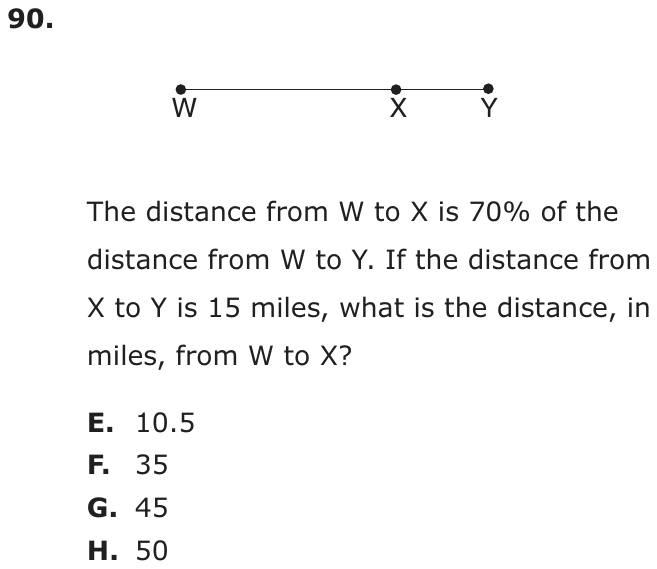
Question 37 of 48
2023 Test B Math, question 39Question
In a certain competition, 1 person finished in first place, 5 people tied for second place, 10 people tied for third place, and the other 4,984 people did not place. What percentage of the people in the competition placed first, second, or third altogether?
- A0.0032%
- B0.032%
- C0.32%
- D3.2%
Show the answer
Correct answer: C
The total number of people who participated in the competition was . The total number who placed first, second, or third was .
Question analysis
A percent question about a competition with 1 first-place finisher, 5 tied for second, 10 tied for third and 4,984 who did not place. Students find what percentage of everyone placed. All four choices use the same digits, so the challenge is placing the decimal point when a decimal becomes a percent.
- Grade level
- Grade 6 content, by NYS standard
- Compared with grade 7
- At grade 7 Writing part of a whole as a percent is grade 6 content. This one first totals four groups, then turns a fraction of a large total into a percent, where a slip of one place value is easy to make.
- Estimated difficulty
- Moderate: several steps, or a close reading with one strong distractor.
- Thinking it demands
- Depth of knowledge 2, skills and concepts · mainly apply
- What makes it hard
- Error-prone arithmetic moderate
- Many steps minor
- Solution
- 3 steps
- Reading level
- Question and choices: about grade 10, 40 words.
- Students, last 30 days
- Not enough answers yet to show (it takes 10).
Why it is hard, traps and wrong answers (shows the answer)
Why it is hard
The method is short, so the question tests decimal places. All four choices share the digits 32 and differ only in where the point falls, so a slip of one place, or forgetting to multiply by 100, still finds a choice waiting. A rough check helps: 16 is a bit more than 15, and 15 of 5,000 is 0.3%, so the answer must sit just above 0.3%.
Error-prone arithmetic moderate Working it out
16 ÷ 5,000 = 0.0032 has two zeros after the decimal point, and writing it as a percent moves the point two more places; each move can land one place off. (Brown & Burton, 1978; Junker & Sijtsma, 2001)
Many steps minor Working it out
The total of 5,000 is not given; it has to be built from 1 + 5 + 10 + 4,984 before the 16 people who placed can be compared with it. (Daniel & Embretson, 2010; Enright, Morley & Sheehan, 2002)
Strategy: Add the people who placed and the people who did not to get the total, write the placers as a fraction of it, then change that fraction to a decimal and multiply by 100.
Traps
- Misunderstands the concept: A wrong belief about a concept: that percents can be added, that area grows like length, that averages can be averaged, that a bigger denominator means a bigger fraction.
- An arithmetic slip: The right method with a plausible arithmetic error: a digit, a place value or a times-table fact.
The wrong answers, classified
A Misunderstands the concept (Smith, diSessa & Roschelle, 1993; De Bock et al., 1998; Ni & Zhou, 2005)
Finds 16 ÷ 5,000 = 0.0032 and adds a percent sign without multiplying by 100, as if a decimal were already a percent.
B An arithmetic slip (Junker & Sijtsma, 2001)
Finds 0.0032 but moves the decimal point only one place when writing the percent, giving 0.032%, ten times too small.
D An arithmetic slip (Junker & Sijtsma, 2001)
Divides 16 by 500 instead of 5,000, dropping a zero, or moves the point three places, giving 3.2%, ten times too large.
Worked solution, step by step
Formulas used
- Percent of a whole
- The part is the group you care about. The whole is everyone. The fraction tells what share of the whole the part is. Multiplying by 100 turns that share into a percent, which means out of 100.
Sort out the groups
Some people placed: 1 in first, 5 in second and 10 in third. The other 4,984 people did not place. You need the percent of all the people who placed.
Count the people who placed
These are the people who finished first, second or third. Add them.
So 16 people placed.
Count everyone
The whole is everyone in the competition: the people who placed plus the people who did not.
So 5,000 people took part. Notice that 4,984 is not the whole. It leaves out the 16 who placed.
Turn the share into a percent
Use the percent formula.
First divide: . Then multiply by 100. That moves the decimal point two places to the right.
So 0.32% of the people placed.
Avoid the decimal traps
Watch out: 0.0032 is not a percent yet. Putting a % sign on it gives choice A, which is 100 times too small. Moving the point only one place gives choice B. Moving it three places gives choice D.
So the answer is C, 0.32%.
Check your answer
Estimate. 1% of 5,000 is 50. The 16 people are about a third of 50. So the answer should be about a third of 1%, or about 0.3%. Choice C, 0.32%, fits.
More questions like this
The original DOE question
Question 38 of 48
2023 Test B Math, question 41Question
The height of a tree in 2013 is 300% of the height it was in 2003. By what percentage did its height increase over this ten-year period?
- A
- B100%
- C200%
- D300%
Show the answer
Correct answer: C
Let h represent the height of the tree in 2003. Then the height of the tree in 2013 is . Calculate the percent increase:
Question analysis
A percent question about a tree whose height in 2013 is 300% of its height in 2003. Students find the percent increase over the ten years. No heights are given, so the key is telling the difference between a percent of an amount and a percent change.
- Grade level
- Grade 7 content, by NYS standard
- Compared with grade 7
- Above grade 7 Grade 7 percent-increase problems give two amounts to compare. This gives only a percent of the earlier height and no heights at all, so students must work out what that percent means for the change with nothing concrete to calculate with.
- Estimated difficulty
- Hard: combines ideas, needs a plan, and has more than one tempting wrong answer.
- Thinking it demands
- Depth of knowledge 2, skills and concepts · mainly apply
- What makes it hard
- Turning words into math moderate
- Variables instead of numbers moderate
- Something you must already know minor
- Solution
- 2 steps
- Reading level
- Question and choices: about grade 3, 25 words.
- Students, last 30 days
- Not enough answers yet to show (it takes 10).
Why it is hard, traps and wrong answers (shows the answer)
Why it is hard
The stem hands students a percent and asks for a different percent, and the given 300% looks like a finished answer. The real step is separating “300% of” from “increased by”: a height that triples has grown by twice its original size. Picking a 2003 height of 100 units makes it concrete, since 300 − 100 = 200 units of growth on a base of 100.
Turning words into math moderate Understanding the question
“300% of the height it was in 2003” describes the new height, three times the old, not the increase; the question then asks for the change, which is a different percent. (Hegarty, Mayer & Monk, 1995; Koedinger & Nathan, 2004)
Variables instead of numbers moderate Understanding the question
No heights are given, only a percent, so students must invent a height such as 100 units or work with h and 3h to measure the change. (Koedinger & Nathan, 2004; Enright, Morley & Sheehan, 2002)
Something you must already know minor Working it out
A percent increase divides the change by the starting amount, (3h − h) ÷ h, a rule the question assumes without stating. (Anderson & Krathwohl, 2001)
Strategy: Call the 2003 height 100 units, find the 2013 height from the percent given, then divide the change by the 2003 height and write the result as a percent.
Traps
- Answers a different question: A choice is right for another quantity: the other unknown, the rest instead of the part, the part instead of the whole.
- Wrong operation: Adds instead of multiplying, divides the wrong way round, turns a ratio or rate upside down, or undoes a step in the wrong direction (subtracts what should be added back).
The wrong answers, classified
A Wrong operation (Hegarty, Mayer & Monk, 1995; King et al., 2004)
Divides the 2003 height by the 2013 height, h ÷ 3h = 1/3, turning the comparison upside down and reporting 33 1/3%.
B Little reason to choose it (Haladyna & Downing, 1993; Rodriguez, 2005)
No common working gives 100%, which would mean the height only doubled; it echoes the 100% that the 2003 height stands for, so it mostly draws guesses.
D Answers a different question (King et al., 2004; Hegarty, Mayer & Monk, 1995)
Reads “300% of” as an increase of 300%, giving the 2013 height as a percent of the 2003 height instead of the percent increase.
Worked solution, step by step
Formulas used
- Percent increase
- Original is the starting amount. New is the amount after the change. New minus original is how much it grew. Dividing by the original compares the growth with the start. Multiplying by 100 turns that into a percent.
Sort out the wording
The 2013 height is 300% of the 2003 height. That means it is 3 times the 2003 height. You need the percent increase. That is how much the tree grew, compared with its 2003 height.
Pick an easy height
The question gives no real height, so choose one. Say the tree was 100 feet tall in 2003. Then the 2013 height is 300% of 100 feet.
In 2013, the tree was 300 feet tall.
Find how much it grew
The growth is how much taller the tree got. Subtract the old height from the new one.
The tree grew 200 feet in ten years.
Find the percent increase
Use the formula. The original height is the 2003 height.
The height went up by 200%.
Watch out: 300% compares the new height with the old one. It is not the increase. That trap is choice D. Dividing the old height by the new one gives , choice A.
So the answer is C, 200%.
Check your answer
Think about doubling. A tree that doubles adds 100% of its height. A tree that triples adds 200% of its height. So 100 feet plus 200% of 100 feet is 100 + 200 = 300 feet. That is 300% of 100 feet.
More questions like this
The original DOE question
Question 39 of 48
2018 Test A Math, question 11Question
PEOPLE PER VEHICLE AT CHECKPOINT
| Number of People in Vehicle | Percent of Vehicles |
| 1 | 40% |
| 2 | 35% |
| 3 | 15% |
| 4 | 7% |
| 5 or more | 3% |
A researcher recorded the number of people in each vehicle that passed through a checkpoint. The table above shows the percent distribution for the 420 vehicles that passed through the checkpoint yesterday morning. How many of the 420 vehicles contained at least 3 people?
- A42
- B63
- C105
- D315
Show the answer
Correct answer: C
First, add the percentage of cars containing 3 people, 4 people, and 5 or more people:
15% + 7% + 3% = 25%
Thus, 25% of the cars contained at least 3 people, so use that to calculate the number of cars:
420 × 0.25 = 105 cars.
Question analysis
A data table question with percents: a table gives the percent of 420 vehicles carrying 1, 2, 3, 4, or 5 or more people. Students find how many vehicles held at least 3 people by adding the right rows and taking that percent of 420. Reading at least correctly decides which rows count.
- Grade level
- Grade 6 content, by NYS standard
- Compared with grade 7
- At grade 7 Taking a percent of a number is grade 6 work, and grade 7 adds multistep percent problems. This two-step table problem sits at that level, with the phrase at least as the careful-reading point.
- Estimated difficulty
- Moderate: several steps, or a close reading with one strong distractor.
- Thinking it demands
- Depth of knowledge 2, skills and concepts · mainly apply
- What makes it hard
- Turning words into math moderate
- Reading a figure, table or graph moderate
- Solution
- 2 steps
- Reading level
- Question and choices: about grade 7, 56 words.
- Students, last 30 days
- Not enough answers yet to show (it takes 10).
Why it is hard, traps and wrong answers (shows the answer)
Why it is hard
The arithmetic is easy, since 25% of 420 is a quarter of it; the points are lost on the phrase "at least 3". Each common misreading, more than 3, exactly 3 or fewer than 3, gives a listed choice, so a wrong reading never leads to a dead end. Adding the percents before converting saves time and avoids three separate multiplications.
Turning words into math moderate Understanding the question
The bold "at least 3" has to become the rows for 3, 4 and "5 or more", taking in both the 3-person row and the open-ended last row. (Hegarty, Mayer & Monk, 1995; Koedinger & Nathan, 2004)
Reading a figure, table or graph moderate Understanding the question
The table gives percents, not counts, so the rows have to be added as percents and then taken of the 420 vehicles named only in the text below the table. (Lesh, Post & Behr, 1987; Kirsch & Mosenthal, 1990)
Strategy: Add the percents for every row that meets the condition first, then take that single percent of 420 instead of working row by row.
Traps
- Counting the ends: Inclusive or exclusive ends, fence posts, consecutive numbers: an answer that is one too many or too few, or an endpoint drawn open where it belongs closed (or the reverse).
- Answers a different question: A choice is right for another quantity: the other unknown, the rest instead of the part, the part instead of the whole.
The wrong answers, classified
A Counting the ends (Brown & Burton, 1978)
Reads at least 3 as more than 3 and leaves out the 3-person row, adding only 7% + 3% = 10%, and 10% of 420 is 42.
B Misreads the question (Hegarty, Mayer & Monk, 1995)
Matches the 3 in the question to the row for exactly 3 people, 15% of 420 = 63, missing the 4-person and 5-or-more rows.
D Answers a different question (King et al., 2004; Hegarty, Mayer & Monk, 1995)
Adds the 40% and 35% rows to get 75% and takes 75% of 420 = 315, which counts the vehicles with fewer than 3 people.
Worked solution, step by step
Formulas used
- Percent of a number
- W is the whole amount. p is the percent, and x is the part you want. Percent means out of 100, so p percent is the fraction p over 100. Multiplying the whole by that fraction gives the part.
Sort out the question
420 vehicles passed the checkpoint. The table gives the percent of vehicles with each number of people. You need how many vehicles had “at least 3” people. At least 3 means 3 or more. So count vehicles with 3 people, 4 people, and 5 or more.
Pick the right rows
Three rows fit: 3 people (15%), 4 people (7%), and 5 or more (3%). Watch out: at least 3 includes 3 itself. Leaving out the 3 row gives 42, choice A. Using only the 3 row gives 63, choice B.
Add the percents first
Adding the percents first saves work. Then you only multiply once.
So 25% of the vehicles had at least 3 people.
Find 25% of 420
Use the percent formula with p = 25 and W = 420.
25% is one quarter, so this is the same as . Watch out: 315 is the number of vehicles with fewer than 3 people, choice D. So the answer is C, 105.
Check your answer
The other rows, 1 and 2 people, make . 75% of 420 is 315. Then , which is all the vehicles. The two groups fit together.
More questions like this
The original DOE question
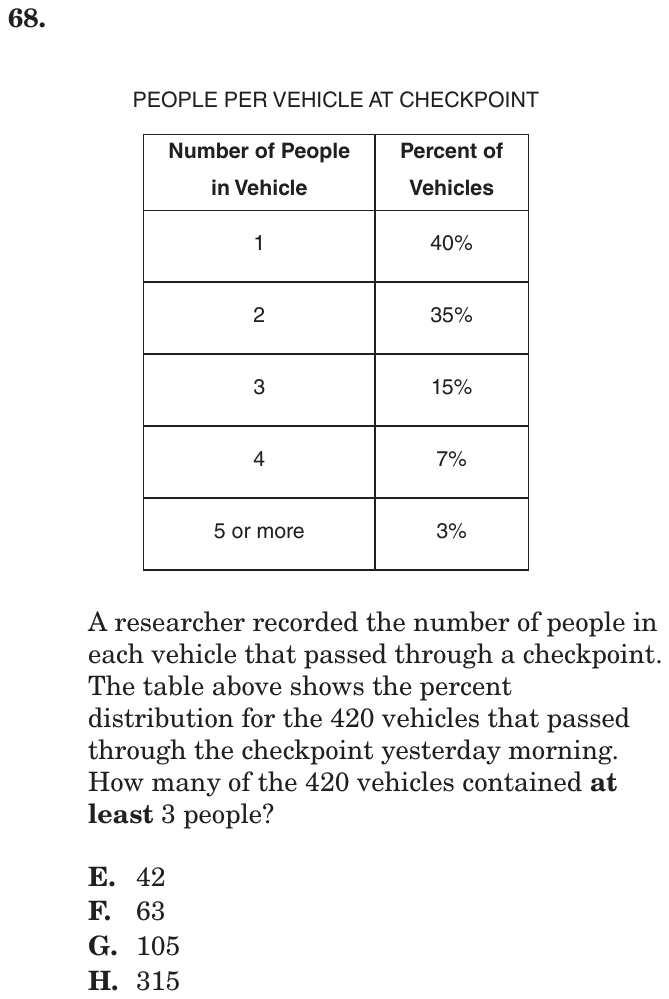
Question 40 of 48
2018 Test A Math, question 19Question
In Centerville, 45% of the population is female, and 60% of the population commutes to work daily. Of the total Centerville population, 21% are females who commute to work daily. What percentage of the total Centerville population are males who do not commute to work daily?
- A15%
- B16%
- C24%
- D39%
Show the answer
Correct answer: B
Create a table with the information provided in the problem and use subtraction to fill in the rest of the table:
| Female | Male | TOTAL | |
| Commutes to work | 21% | 39% (60 − 21) |
60% |
| Does not commute to work | 24% (45 − 21) |
16% (40 − 24) |
40% (100 − 60) |
| TOTAL | 45% | 100% |
16% of the population is male and does not commute to work.
Question analysis
A percent problem about overlapping groups in a town's population: the percents who are female, who commute daily, and who are female commuters are given. Students find the percent who are male and do not commute. A two-way table helps, since several of its cells are easy to confuse with the one asked for.
- Grade level
- Grade 7 content, by NYS standard
- Compared with grade 7
- Above grade 7 Grade 7 percent problems usually take a percent of one quantity. This needs two overlapping categories organized in a two-way table, which is not in New York's grade 7 standards, with three subtractions and two tempting cells.
- Estimated difficulty
- Hard: combines ideas, needs a plan, and has more than one tempting wrong answer.
- Thinking it demands
- Depth of knowledge 2, skills and concepts · mainly analyze
- What makes it hard
- No obvious method moderate
- Much to keep track of moderate
- Turning words into math moderate
- Solution
- 3 steps
- Reading level
- Question and choices: about grade 12, 43 words.
- Students, last 30 days
- Not enough answers yet to show (it takes 10).
Why it is hard, traps and wrong answers (shows the answer)
Why it is hard
The question gives three overlapping percents and asks for the one group none of them describes directly. Without a table, students tend to subtract the given numbers in some order, and several orders yield a listed choice. The last trap is the word "not", since the males who do commute are one cell away. Filling every cell of a two-by-two table before answering takes under a minute and leaves nothing to guess.
No obvious method moderate Working it out
Nothing in the wording points to a two-way table, yet the four groups, female or male by commuting or not, fall into place only once one is drawn. (Schoenfeld, 1985)
Much to keep track of moderate Working it out
Three given percents, 45, 60 and 21, plus their complements, 55 and 40, have to be kept straight while the cells are filled in by subtraction. (Sweller, 1988; Carpenter, Just & Shell, 1990)
Turning words into math moderate Understanding the question
"Of the total Centerville population, 21% are females who commute" is a share of everyone, not of the females, and belongs in a single cell of the table. (Hegarty, Mayer & Monk, 1995; Koedinger & Nathan, 2004)
Strategy: Make a two-by-two table of female and male against commutes and does not commute, fill in the totals, and complete each cell by subtraction.
Traps
- Misreads the question: Misses or misreads a condition or a word in the question: "at least", "each", "remaining", "not".
- Stops one step early: A choice is a number from partway through the solution.
The wrong answers, classified
A Numbers taken from the question (Hegarty, Mayer & Monk, 1995)
Subtracts one given percent from another, 60 − 45 = 15, without placing the 21% of female commuters anywhere.
C Stops one step early (King et al., 2004; Gierl et al., 2017)
Fills in the first empty cell, females who do not commute, 45 − 21 = 24, and stops before using it to reach the males' cell.
D Misreads the question (Hegarty, Mayer & Monk, 1995)
Finds the males who commute, 60 − 21 = 39, missing the word not in the question.
Worked solution, step by step
Formulas used
- Parts add up to the whole
- In a two-way table, every row and every column splits a group into two parts. a and b are the two parts, and W is the whole group. If you know the whole and one part, subtract to find the other part.
Sort out the question
Every number is a percent of the whole town. 45% of people are female. 60% commute, which means they travel to work every day. 21% are females who commute. You need the percent who are “males who do not commute to work daily”.
Make a two-way table
A two-way table sorts people two ways at once: female or male, and commutes or not. Put in what you know. The whole town is 100%.
Female Male Total Commute 21% ? 60% Do not commute ? ? ? Total 45% ? 100% Fill in the two totals
Everyone is female or male, so the males are what is left.
Everyone either commutes or does not.
So 55% are male, and 40% do not commute.
Find the males who commute
Use the commute row. All commuters are 60%, and the female commuters are 21%.
So 39% are males who commute. Watch out: the question says do not commute. Picking 39% is choice D.
Find the males who do not commute
Use the male column. All males are 55%, and the males who commute are 39%.
Watch out: 24% is the females who do not commute, . That is choice C. So the answer is B, 16%.
Check your answer
Find the same cell another way. Females who do not commute: . All who do not commute: 40%. So males who do not commute: . The answers match.
More questions like this
The original DOE question
Question 41 of 48
2018 Test A Math, question 24Question
How many more people in Center City walk to work than ride their bicycle to work?
- A2,500
- B2,700
- C2,800
- D3,000
Show the answer
Correct answer: B
According to the chart, 22% of people walk to work and 4% ride a bicycle. Subtract to find the percentage of how many more people walk than bicycle:
22% − 4% = 18%
To find the exact number of people, multiply 18% (0.18) by the number of people working in Center City (15,000):
Question analysis
This circle graph question shows how the 15,000 people working in Center City get to work, with 22% walking and 4% riding a bicycle. Students find how many more people walk than bike by combining a percent difference with a percent of a total. The choices are close together, so estimating is risky.
- Grade level
- Grade 6 content, by NYS standard
- Compared with grade 7
- Below grade 7 Reading a circle graph and taking a percent of a total are grade 6 skills. With only two short steps and friendly numbers, this is easier than typical grade 7 multistep percent work.
- Estimated difficulty
- Straightforward: two steps or one careful reading.
- Thinking it demands
- Depth of knowledge 2, skills and concepts · mainly apply
- What makes it hard
- A very close wrong answer moderate
- Reading a figure, table or graph minor
- Error-prone arithmetic minor
- Solution
- 2 steps
- Reading level
- Question and choices: about grade 7, 16 words.
- Students, last 30 days
- Not enough answers yet to show (it takes 10).
Why it is hard, traps and wrong answers (shows the answer)
Why it is hard
The method is short: subtract the percents first, or find both groups and subtract, and both reach the same number. What makes the question less safe than it looks is the tight spread of choices, all within 500 of each other, so rounding 18% or slipping on one product lands on a wrong answer. Subtracting the percents first leaves one multiplication to get right instead of two.
A very close wrong answer moderate Choosing the answer
2,700 sits only 100 from 2,800 and 300 from 3,000, so estimating 18% of 15,000 as about a fifth cannot pick it; only the exact product does. (Embretson & Wetzel, 1987; Gorin & Embretson, 2006; Ascalon et al., 2007)
Reading a figure, table or graph minor Understanding the question
The Walk 22% and Bicycle 4% labels must be picked out of five sectors, and the 15,000 total sits in a caption below the circle graph. (Lesh, Post & Behr, 1987; Kirsch & Mosenthal, 1990)
Error-prone arithmetic minor Working it out
The percent gap has to become a count, 0.18 × 15,000, a decimal times a five-digit number worked by hand without a calculator. (Brown & Burton, 1978; Junker & Sijtsma, 2001)
Strategy: Subtract the two percents first, then take that single percent of 15,000, instead of finding each group and subtracting.
The wrong answers, classified
A Little reason to choose it (Haladyna & Downing, 1993; Rodriguez, 2005)
No common working gives 2,500, which is 1/6 of 15,000 and matches no sector or difference of sectors; it mostly catches estimates.
C An arithmetic slip (Junker & Sijtsma, 2001)
Takes 4% of 15,000 as 500 instead of 600 and subtracts it from the 3,300 walkers, getting 2,800.
D Rounds too early (King et al., 2004)
Rounds the 18-point gap up to 20% to make the multiplication easy and takes 20% of 15,000, which is 3,000.
Worked solution, step by step
Formulas used
- Percent of a number
- W is the whole amount. p is the percent, and x is the part you want. Percent means out of 100, so p percent is the fraction p over 100. Multiplying the whole by that fraction gives the part.
Sort out the circle graph
A circle graph shows how a whole splits into parts. This one shows how 15,000 workers get to work. Walk is 22%. Bicycle is 4%. You need how many more people walk than ride a bicycle.
Subtract the percents first
Both percents are parts of the same 15,000 people. So you can subtract the percents first. Then you only need one multiplication.
The difference is 18% of all the workers.
Find 18% of 15,000
First find 1% by dividing by 100. Then multiply by 18.
That is 2,700 people.
Avoid rounding and answer
Watch out: don’t round 18% up to 20% to make it easy. 20% of 15,000 is 3,000, choice D. The choices are close together, so you need the exact number. So the answer is B, 2,700.
Check your answer
Find each group, then subtract. Walkers: 22% of 15,000 is 3,300. Bike riders: 4% of 15,000 is 600. . You get the same answer.
More questions like this
The original DOE question
Question 42 of 48
2018 Test A Math, question 45Question
A metal square used in an electronic device must have a thickness of 0.02 inch, with an allowable error of 1 percent. What is the greatest allowable thickness of the metal square?
- A0.0002 in.
- B0.02 in.
- C0.0202 in.
- D0.03 in.
Show the answer
Correct answer: C
Find 1% of 0.02:
The greatest allowable thickness would be
inch.
Question analysis
This percent question says a metal square must be 0.02 inch thick with an allowable error of 1 percent, and asks for the greatest allowable thickness. Students must find 1 percent of a small decimal and add it to the target thickness. Keeping track of decimal places is what makes it tricky.
- Grade level
- Grade 7 content, by NYS standard
- Compared with grade 7
- At grade 7 Percent error and tolerance problems appear in grade 7, so the idea is on level. The demand comes from taking a percent of a tiny decimal and adding the result, where a slipped decimal place is easy to miss.
- Estimated difficulty
- Moderate: several steps, or a close reading with one strong distractor.
- Thinking it demands
- Depth of knowledge 2, skills and concepts · mainly apply
- What makes it hard
- Error-prone arithmetic moderate
- Turning words into math moderate
- A very close wrong answer minor
- Solution
- 2 steps
- Reading level
- Question and choices: about grade 4, 34 words.
- Students, last 30 days
- Not enough answers yet to show (it takes 10).
Why it is hard, traps and wrong answers (shows the answer)
Why it is hard
The idea of tolerance is simple, but the numbers are tiny, and the question turns on what the 1 percent is a percent of. Students who read it as 0.01 inch land on a choice that looks sensible, and those who find the error correctly may stop before adding it. Writing 0.02 × 1.01 in one step avoids both.
Error-prone arithmetic moderate Working it out
One percent of 0.02 is 0.0002, two more decimal places, and adding it to 0.02 needs the places lined up to get 0.0202. (Brown & Burton, 1978; Junker & Sijtsma, 2001)
Turning words into math moderate Understanding the question
The phrase "allowable error of 1 percent" must be read as 1 percent of 0.02 inch, added for the greatest thickness, not 1 percent as a fixed 0.01 inch. (Hegarty, Mayer & Monk, 1995; Koedinger & Nathan, 2004)
A very close wrong answer minor Choosing the answer
The choices 0.0202, 0.02 and 0.0002 are built from the same digits, and the first two differ by only 1 percent, so only careful counting of decimal places tells them apart. (Embretson & Wetzel, 1987; Gorin & Embretson, 2006; Ascalon et al., 2007)
Strategy: Find 1 percent of 0.02 by dividing by 100, counting decimal places carefully, then add that error to 0.02 to get the upper limit.
Traps
- Stops one step early: A choice is a number from partway through the solution.
- Misunderstands the concept: A wrong belief about a concept: that percents can be added, that area grows like length, that averages can be averaged, that a bigger denominator means a bigger fraction.
The wrong answers, classified
A Stops one step early (King et al., 2004; Gierl et al., 2017)
Finds the allowable error, 1 percent of 0.02 = 0.0002 inch, and stops without adding it to the target thickness.
B Numbers taken from the question (Hegarty, Mayer & Monk, 1995)
Gives the target thickness from the stem, 0.02 inch, ignoring that the allowed error permits a slightly thicker square.
D Misunderstands the concept (Smith, diSessa & Roschelle, 1993; De Bock et al., 1998; Ni & Zhou, 2005)
Treats 1 percent as 0.01 inch, a percent of 1 inch rather than of 0.02 inch, and adds it to get 0.03.
Worked solution, step by step
Formulas used
- Percent of a number
- x is the part you want. p is the percent. n is the whole amount. Percent means out of 100, so p percent of a number is p hundredths of it.
Sort out what you know
The square should be 0.02 inch thick. An allowable error of 1 percent means it may be off by up to 1 percent of 0.02 inch. It may be that much thinner or thicker.
You need the greatest allowed thickness, so look at the thicker side.
Find 1 percent of 0.02
Dividing by 100 moves the decimal point two places to the left. So the error is 0.0002 inch.
Watch out: 1 percent here is not 0.01 inch. It is 1 percent of 0.02 inch. Adding 0.01 gives 0.03, which is choice D.
Add the error to the thickness
The thickest square is the right size plus the error. Line up the decimal points:
Watch out: 0.0002 is only the error, choice A. You must add it to 0.02. So the answer is C, 0.0202 in.
Check your answer
0.0202 is just a tiny bit more than 0.02, which makes sense for a small error. Check it: 0.0202 − 0.02 = 0.0002. And 0.0002 ÷ 0.02 = 0.01, which is 1 percent.
More questions like this
The original DOE question
Question 43 of 48
2018 Test B Math, question 4Question
Tyler has completed 60 pages in his French workbook. This is 20% of the total number of pages in the workbook. How many pages are in the workbook?
Grid-in question: work out the answer and enter it as a number.
Show the answer
Correct answer: 300
Let be the total number of pages in the workbook.
Then, 20% of is 60. Set up a proportion and solve for :
Question analysis
This grid-in percent word problem gives the number of French workbook pages Tyler has finished and says what percent of the whole book that is. Students must find the total number of pages by working backward from a part to the whole, which is where many take a percent of the wrong number.
- NYS standards
- 6.RP.3c percent as a rate per 100
- Grade level
- Grade 6 content, by NYS standard
- Compared with grade 7
- Below grade 7 Finding the whole from a part and a percent is a grade 6 skill. It takes a single division here, so it sits below grade 7, although students who reflexively take 20 percent of 60 will go wrong.
- Estimated difficulty
- Straightforward: two steps or one careful reading.
- Thinking it demands
- Depth of knowledge 2, skills and concepts · mainly apply
- What makes it hard
- Turning words into math moderate
- Solution
- 1 step
- Reading level
- Question and choices: about grade 3, 26 words.
- Students, last 30 days
- Not enough answers yet to show (it takes 10).
Why it is hard, traps and wrong answers (shows the answer)
Why it is hard
The question is short and the arithmetic is one division, so it rests on reading the second sentence the right way round. Students who see 20% next to 60 and compute 20% of 60 answer a different problem, and a grid-in gives no list of choices to make them doubt it. A quick check that 60 is one fifth of the result catches every one of these errors.
Turning words into math moderate Understanding the question
The sentence “This is 20% of the total number of pages” makes 60 the part and the total the unknown, the reverse of the familiar “find 20% of a number” pattern. (Hegarty, Mayer & Monk, 1995; Koedinger & Nathan, 2004)
Strategy: Write the finished pages as 20 percent of an unknown total and solve for the total, or think about what fraction of the whole book 20 percent is.
Traps
- Percent of the wrong amount: Finding the whole from a part, or a percent change measured from the wrong starting amount.
- Answers a different question: A choice is right for another quantity: the other unknown, the rest instead of the part, the part instead of the whole.
The wrong answers, classified
12 Percent of the wrong amount (Parker & Leinhardt, 1995)
Takes 20% of 60 instead of finding the number that 60 is 20% of, applying the percent to the wrong amount.
240 Answers a different question (King et al., 2004; Hegarty, Mayer & Monk, 1995)
Sees that 60 pages is one fifth of the book but multiplies 60 by 4, giving the pages Tyler still has left.
3 A faulty procedure (Brown & Burton, 1978; Tatsuoka, 1983)
Divides 60 by 20 instead of by 0.20, treating 20% as the whole number 20.
Worked solution, step by step
Formulas used
- Percent of a number
- The whole is the full amount, here all the pages in the book. The part is a piece of it, here the pages done. Percent means how many out of every 100. Use this when you know two of the three numbers and need the third.
Sort out the part and whole
Tyler has done 60 pages. That is 20% of the whole book. So 60 is the part. The total number of pages is the whole.
The whole is what you need to find. Call it x.
Write the percent equation
Put the numbers into the percent formula.
The fraction simplifies to . So 60 pages is one fifth of the book.
Solve for the whole book
If one fifth of the book is 60 pages, the whole book is 5 times as big.
The book has 300 pages.
Watch out: Finding 20% of 60 gives 12. That treats 60 as the whole, but 60 is the part. Also, 300 − 60 = 240 is the pages still left to do, not the total.
So you would grid 300.
Check your answer
Find 20% of your answer: . That matches the 60 pages Tyler finished. Also, 300 is bigger than 60, as a whole should be.
More questions like this
The original DOE question
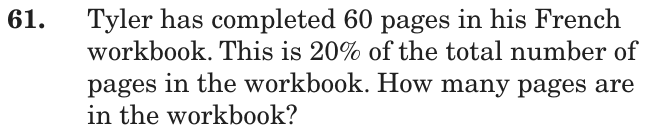
Question 44 of 48
2018 Test B Math, question 22Question
Bryana bought yards of cloth at $8.00 per yard. If there was an 8% sales tax, what was the total cost of the cloth?
- A$12.96
- B$14.08
- C$15.12
- D$16.08
Show the answer
Correct answer: C
Calculate the cost of the cloth before tax:
Now find the tax for $14 worth of cloth:
Finally, add the cost of the fabric and the tax:
$14 + $1.12 = $15.12
Question analysis
This percent word problem has Bryana buy 1 3/4 yards of cloth at $8.00 a yard and pay 8% sales tax. Students multiply a mixed number by a price, find the tax and add it to get the total cost. Handling the mixed number and taking the tax as a percent of the price both need care.
- NYS standards
- Grade level
- Grade 7 content, by NYS standard
- Compared with grade 7
- At grade 7 Sales tax on a purchase is a standard grade 7 percent problem. This one adds a mixed-number multiplication first, but the numbers are friendly and the steps are routine for grade 7.
- Estimated difficulty
- Straightforward: two steps or one careful reading.
- Thinking it demands
- Depth of knowledge 2, skills and concepts · mainly apply
- What makes it hard
- Error-prone arithmetic moderate
- Many steps minor
- Solution
- 3 steps
- Reading level
- Question and choices: about grade 3, 23 words.
- Students, last 30 days
- Not enough answers yet to show (it takes 10).
Why it is hard, traps and wrong answers (shows the answer)
Why it is hard
The method is standard for a sales-tax question, so the work lies in the number handling. Converting 1 3/4 yards correctly and taking 8% of the cost, rather than adding 8 cents, are the two places students slip. The choices punish each slip but not stopping early, since neither $14 nor $1.12 appears, which helps students who check their result against the list.
Error-prone arithmetic moderate Working it out
Two number forms meet: the mixed number 1 3/4 times $8 must become $14, and 8% of $14 must become $1.12, a decimal with two places. (Brown & Burton, 1978; Junker & Sijtsma, 2001)
Many steps minor Working it out
The steps, price before tax, then tax, then total, must be done in order, and stopping after any of them gives a number that is not among the choices. (Daniel & Embretson, 2010; Enright, Morley & Sheehan, 2002)
Strategy: Turn 1 3/4 into 7/4 or 1.75 and multiply by $8, then multiply that cost by 1.08 to include the tax in one step.
The wrong answers, classified
A An arithmetic slip (Junker & Sijtsma, 2001)
Multiplies $8 by 1.5 instead of 1.75, pricing the cloth at $12, then adds the 8% tax correctly to reach $12.96.
B Misunderstands the concept (Smith, diSessa & Roschelle, 1993; De Bock et al., 1998; Ni & Zhou, 2005)
Prices the cloth correctly at $14 but adds 8 cents, treating 8% as $0.08 instead of 8 hundredths of the price.
D Little reason to choose it (Haladyna & Downing, 1993; Rodriguez, 2005)
Needs two unrelated errors, rounding 1 3/4 yards up to 2 for $16 and then adding 8 cents instead of 8%, so few students land here.
Worked solution, step by step
Formulas used
- Cost
- Price per unit is the cost of one unit, here $8 for one yard. Number of units is how many you buy, here yards of cloth. Multiply them to get the total before tax.
- Sales tax
- The tax rate is the percent, here 8. Percent means out of 100, so 8% is 8/100, or 0.08. The price is the cost before tax. The tax is added on top of the price.
Write down what you know
Bryana bought yards of cloth. Each yard costs $8.00. There is an 8% sales tax. Sales tax is an extra amount added to the price.
You need the total cost, with the tax.
Find the cost before tax
First change the mixed number to a fraction. A mixed number is a whole number plus a fraction. is the same as , because 1 whole is 4 quarters.
The cloth costs $14 before tax.
Watch out: is 1.75, not 1.5. Using 1.5 gives $12.96, choice A.
Find the tax
The tax is $1.12.
Watch out: 8% of $14 is not 8 cents. Adding only $0.08 gives $14.08, choice B.
Add the tax to the price
The total is the price before tax plus the tax.
The total is $15.12.
So the answer is C, $15.12.
Check your answer
Estimate. 10% of $14 is $1.40, so 8% is a little less, about $1.10. Then $14 plus about $1.10 is about $15.10. Only $15.12 is that close.
More questions like this
The original DOE question
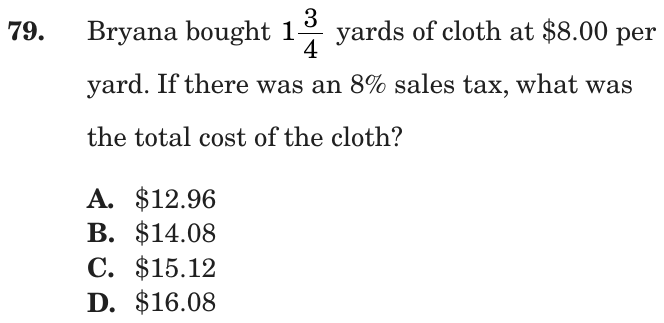
Question 45 of 48
2018 Test B Math, question 28Question
A chemical decays in such a way that the amount left at the end of each week is 20% less than the amount at the beginning of that same week. What percent of the original amount is left after two weeks?
- A40%
- B60%
- C64%
- D80%
Show the answer
Correct answer: C
Let be the original amount of the chemical. It loses 20% after each week, which means 80% of the chemical remains at the end of each week. End of first week:
At the end of the second week, 80% of the amount left at the end of the first week remains. End of second week:
Question analysis
This percent problem describes a chemical that loses 20% of what is present each week and asks what percent of the original amount remains after two weeks. Students apply a percent decrease twice in a row. Deciding which amount each week's 20 percent is taken from is the heart of the problem.
- NYS standards
- 7.RP.3 multistep ratio and percent problems
- Grade level
- Grade 7 content, by NYS standard
- Compared with grade 7
- Above grade 7 Grade 7 percent problems usually apply a single increase or decrease. Applying a decrease twice, each time to the new amount, is an early form of exponential decay that goes beyond typical grade 7 work.
- Estimated difficulty
- Hard: combines ideas, needs a plan, and has more than one tempting wrong answer.
- Thinking it demands
- Depth of knowledge 2, skills and concepts · mainly apply
- What makes it hard
- A very close wrong answer major
- Turning words into math moderate
- Variables instead of numbers minor
- Solution
- 2 steps
- Reading level
- Question and choices: about grade 8, 40 words.
- Students, last 30 days
- Not enough answers yet to show (it takes 10).
Why it is hard, traps and wrong answers (shows the answer)
Why it is hard
This is a two-step percent decrease, and the intuitive answer, 20% plus 20%, is wrong for a reason students rarely check: the second loss is taken from what is left after the first. The stem states this rule in its own words, but quickly. Starting with 100 units and working week by week makes the difference visible, since the second week removes 16 units, not 20.
A very close wrong answer major Choosing the answer
60% and 64% are four points apart, too close for a rough estimate; only seeing that week two's 20% comes from 80, not 100, separates them. (Embretson & Wetzel, 1987; Gorin & Embretson, 2006; Ascalon et al., 2007)
Turning words into math moderate Understanding the question
The stem measures each week's loss against “the amount at the beginning of that same week”, and students must see that this resets the base to 80% for the second week. (Hegarty, Mayer & Monk, 1995; Koedinger & Nathan, 2004)
Variables instead of numbers minor Understanding the question
No starting amount is given, so students must supply one, such as 100 units, or reason directly with a percent of a percent. (Koedinger & Nathan, 2004; Enright, Morley & Sheehan, 2002)
Strategy: Start with 100 units, take away 20 percent of the current amount for the first week, then take 20 percent of what is left for the second week.
Traps
- Percent of the wrong amount: Finding the whole from a part, or a percent change measured from the wrong starting amount.
- Stops one step early: A choice is a number from partway through the solution.
- Answers a different question: A choice is right for another quantity: the other unknown, the rest instead of the part, the part instead of the whole.
The wrong answers, classified
A Answers a different question (King et al., 2004; Hegarty, Mayer & Monk, 1995)
Adds the two 20% losses to get 40% and reports that amount lost, when the question asks how much is left.
B Percent of the wrong amount (Parker & Leinhardt, 1995)
Takes both weeks' 20% from the original amount, 100 − 20 − 20, missing that the second week's loss comes from the smaller 80%.
D Stops one step early (King et al., 2004; Gierl et al., 2017)
Finds the 80% left after one week and stops before applying the second week's decrease.
Worked solution, step by step
Formulas used
- Percent decrease
- p is the percent taken away, here 20. Taking away 20% leaves 80% of the amount, so you multiply by 0.80. Each week starts from the amount left at the end of the week before.
Understand the decay
Each week, the chemical loses 20% of what it had at the start of that week. The amount at the start of each week keeps changing.
So the second week’s 20% is taken from a smaller amount. You need the percent left after two weeks.
Start with 100 units
No amount is given, so pick an easy one. Start with 100 units. Then the number of units left is also the percent left.
Work out week one
20% of 100 is 20, so 20 units are lost.
After week one, 80 units are left. That is 80% of the start.
Watch out: 80% is only one week. Stopping here gives choice D.
Work out week two
Now the week starts with 80 units, not 100. Take 20% of 80.
After two weeks, 64 units are left. That is 64% of the 100 units you started with.
Watch out: Taking 20 away twice from 100 gives 60%, choice B. That uses the old amount in week two.
So the answer is C, 64%.
Check your answer
Use the percent decrease formula. Each week keeps 80%, or 0.80, of the amount. Two weeks gives , which is 64%. The two methods agree.
More questions like this
The original DOE question
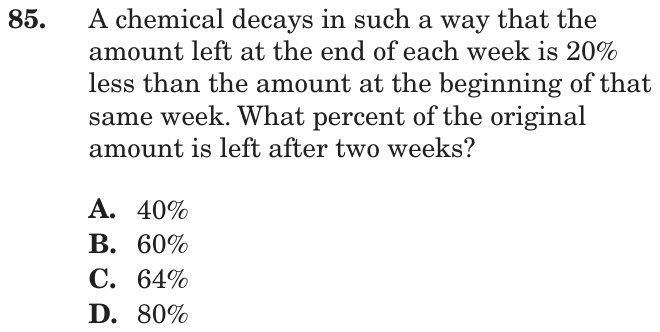
Question 46 of 48
2018 Test B Math, question 33Question
A large container is partially filled with liters of water. Ito adds 10 liters of water to the container, making it 60% full. If Ignacio adds 6 more liters of water, the container will be 75% full. What is the value of ?
- A14
- B15
- C26
- D30
Show the answer
Correct answer: A
Let be the total number of liters the container can hold.
First, solve each equation for :
Equation 1:
Equation 2:
Now, set the two equations equal to each other and solve for .
Question analysis
Water is poured into a large container in two stages: 10 liters make it 60% full, and 6 more liters bring it to 75% full. Students must work out how much water was in it to begin with. This percent word problem hides two unknowns, the starting amount and the capacity, and several in-between numbers look like answers.
- Grade level
- Grade 7 content, by NYS standard
- Compared with grade 7
- Above grade 7 Grade 7 percent problems usually give the whole and ask for a part. Here the whole is unknown and must be found from the change between two percents before a second step reaches the answer.
- Estimated difficulty
- Hard: combines ideas, needs a plan, and has more than one tempting wrong answer.
- Thinking it demands
- Depth of knowledge 3, strategic thinking · mainly analyze
- What makes it hard
- Turning words into math major
- No obvious method moderate
- Many steps moderate
- A very close wrong answer minor
- Solution
- 4 steps
- Reading level
- Question and choices: about grade 7, 40 words.
- Students, last 30 days
- Not enough answers yet to show (it takes 10).
Why it is hard, traps and wrong answers (shows the answer)
Why it is hard
The container's size is the hidden key, and nothing in the stem names it. Students who write an equation for each fill level, or who notice that 6 liters equal 15 percent, get there; others grab a number from the story or stop at the 75% level. Because every wrong choice is a number that appears in the problem or arises while solving it, a careless finish is rewarded with a match.
Turning words into math major Understanding the question
Two percent-full statements about a container of unknown size have to become equations, n + 10 = 60% of the capacity and n + 16 = 75% of it, and the capacity is never given. (Hegarty, Mayer & Monk, 1995; Koedinger & Nathan, 2004)
No obvious method moderate Working it out
The quick route is to see that Ignacio's 6 liters raise the level by 15 percentage points, which fixes the capacity at 40 liters; the wording does not point to it. (Schoenfeld, 1985)
Many steps moderate Working it out
After the capacity, the solution still needs the 60% amount, 24 liters, and a subtraction of Ito's 10 liters, so two unknowns are chased through four steps. (Daniel & Embretson, 2010; Enright, Morley & Sheehan, 2002)
A very close wrong answer minor Choosing the answer
15 sits one unit from the right 14, so a rough estimate of the starting amount cannot choose between them; only solving exactly, 24 − 10, separates them. (Embretson & Wetzel, 1987; Gorin & Embretson, 2006; Ascalon et al., 2007)
Strategy: Compare the two fill levels: the extra 6 liters account for the change in percent, which gives the capacity. Then use the 60% level to work back to the starting amount.
Traps
- Answers a different question: A choice is right for another quantity: the other unknown, the rest instead of the part, the part instead of the whole.
- Numbers taken from the question: Combines the numbers in the question without a model of the situation, or is simply a number that appears in the question.
- Wrong operation: Adds instead of multiplying, divides the wrong way round, turns a ratio or rate upside down, or undoes a step in the wrong direction (subtracts what should be added back).
The wrong answers, classified
B Numbers taken from the question (Hegarty, Mayer & Monk, 1995)
Subtracts the percents, 75 − 60 = 15, and gives a gap in percentage points as a number of liters.
C Wrong operation (Hegarty, Mayer & Monk, 1995; King et al., 2004)
Works back from the 30 liters at 75% full but adds Ignacio's 6 liters instead of removing them: 30 + 6 − 10 = 26.
D Answers a different question (King et al., 2004; Hegarty, Mayer & Monk, 1995)
Finds the 40-liter capacity and its 75% level, 30 liters, then gives the amount after both additions instead of the starting amount n.
Worked solution, step by step
Formulas used
- Percent of a number
- p is the percent. The whole is the full amount, here how much the container holds. The part is p percent of it. Percent means out of 100, so you divide p by 100 and then multiply.
Sort out what you know
The container starts with liters of water. Ito adds 10 liters, and it is 60% full. Then 6 more liters make it 75% full. You do not know how much the container holds when full. Call that its capacity. You need , the starting amount.
See what the 6 liters did
The extra 6 liters raised the level from 60% to 75%.
So 6 liters is 15% of the capacity.
Watch out: 15 is a percent, not a number of liters. Picking 15 gives choice B.
Find the full capacity
If 15% is 6 liters, then 1% is liters. A full container is 100%.
The container holds 40 liters when full.
Find the water at 60 percent
Use the percent formula with 60 for p and 40 liters for the whole.
After Ito adds his water, there are 24 liters.
Undo Ito’s 10 liters
Ito added 10 liters to the starting amount. To go back, subtract them.
The container started with 14 liters.
Watch out: 75% of 40 is 30 liters. That is the amount after both people add water, not at the start. It is choice D.
Give the answer
The question asks for , the amount before anyone added water. So the answer is A, 14.
Check your answer
Run the story forward. Start with 14 liters. Add 10 to get 24 liters, and 24 is 60% of 40. Add 6 more to get 30 liters, and 30 is 75% of 40. Both facts match.
More questions like this
The original DOE question
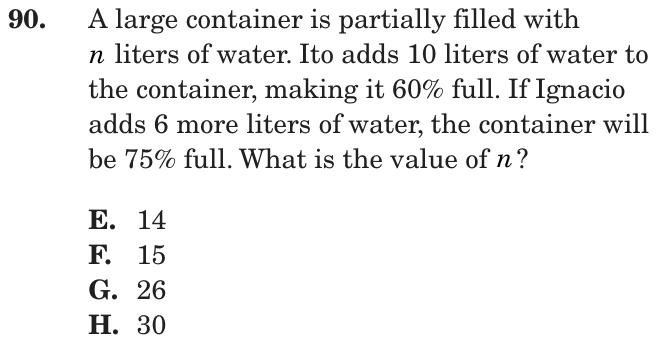
Question 47 of 48
2018 Test B Math, question 38Question
SURVEY OF CATS PER FAMILY
| Number of Cats | Number of Families |
| 0 | 15 |
| 1 | 42 |
| 2 | 35 |
| 3 or more | 8 |
The table above shows the number of cats per family in 100 households in the Blaine neighborhood. By what percentage is the number of families with 1 cat greater than the number of families with 2 cats?
- A7%
- B10%
- C17%
- D20%
Show the answer
Correct answer: D
To find by what percent the number of families with 1 cat is greater than the number of families with 2 cats, calculate the difference between the two numbers and divide by the number of families with 2 cats:
Question analysis
A table lists how many cats live in each of 100 households in the Blaine neighborhood, and the question asks by what percent the number of one-cat families exceeds the number of two-cat families. It tests percent difference. The tricky part is choosing the right base for the comparison when the table's total is a convenient 100.
- NYS standards
- 7.RP.3 multistep ratio and percent problems
- Grade level
- Grade 7 content, by NYS standard
- Compared with grade 7
- At grade 7 Percent increase and decrease is grade 7 content, and this is one standard comparison. What makes it harder than a routine exercise is choosing the base and ignoring the tempting 100-family total.
- Estimated difficulty
- Moderate: several steps, or a close reading with one strong distractor.
- Thinking it demands
- Depth of knowledge 2, skills and concepts · mainly apply
- What makes it hard
- Turning words into math moderate
- A very close wrong answer moderate
- Reading a figure, table or graph minor
- Solution
- 2 steps
- Reading level
- Question and choices: about grade 6, 47 words.
- Students, last 30 days
- Not enough answers yet to show (it takes 10).
Why it is hard, traps and wrong answers (shows the answer)
Why it is hard
The arithmetic is a single subtraction and division, so the question is really about choosing the base of a percent comparison. The 100-household total makes the count difference look like a percent already, and dividing by the larger count is the other classic slip. Students who say "greater than the 2-cat count" to themselves pick 35 as the base.
Turning words into math moderate Understanding the question
"Greater than the number of families with 2 cats" fixes the base of the percent as 35, the count being compared against, not 42 or the 100 households. (Hegarty, Mayer & Monk, 1995; Koedinger & Nathan, 2004)
A very close wrong answer moderate Choosing the answer
17% and the right 20% both come from dividing the 7-family gap by a count, 42 or 35; only choosing 35, the count being compared against, separates them. (Embretson & Wetzel, 1987; Gorin & Embretson, 2006; Ascalon et al., 2007)
Reading a figure, table or graph minor Understanding the question
Only two rows of the four-row table matter, the 42 families with 1 cat and the 35 with 2; the 0-cat and 3-or-more rows go unused. (Lesh, Post & Behr, 1987; Kirsch & Mosenthal, 1990)
Strategy: Find the difference between the two counts, decide which count the comparison is measured against, divide by it, and convert to a percent.
Traps
- Percent of the wrong amount: Finding the whole from a part, or a percent change measured from the wrong starting amount.
- Answers a different question: A choice is right for another quantity: the other unknown, the rest instead of the part, the part instead of the whole.
The wrong answers, classified
A Answers a different question (King et al., 2004; Hegarty, Mayer & Monk, 1995)
Subtracts 42 − 35 = 7 and, since there are 100 households, reads that 7-point gap in shares as a 7% increase.
B Little reason to choose it (Haladyna & Downing, 1993; Rodriguez, 2005)
No division of the 7-family gap by a count in the table gives 10%, so this mostly attracts students estimating a round percent.
C Percent of the wrong amount (Parker & Leinhardt, 1995)
Divides the 7-family difference by 42, the larger count, measuring the change from the wrong amount: 7/42 is about 16.7%, so 17%.
Worked solution, step by step
Formulas used
- Percent greater than
- The difference is how much bigger one amount is than the other. The amount you compare to is the one after the word than. Dividing shows what share of that amount the difference is. Times 100 turns that share into a percent.
Sort out the question
From the table, 42 families have 1 cat and 35 families have 2 cats. You need the percent by which 42 is “greater than the number of families with 2 cats”. The rows for 0 cats and 3 or more cats do not matter here.
Find the difference
Subtract the two counts.
There are 7 more families with 1 cat.
Watch out: 7 is a number of families, not a percent. There are 100 households, so 7% looks tempting. It is choice A, and it is wrong.
Divide by the number you compare to
The question compares with the families that have 2 cats. So divide by 35, not 42.
Watch out: dividing by 42 gives about 17%. That is choice C.
Change the fraction to a percent
Use the percent formula. One fifth of 100 is 20.
So the answer is D, 20%.
Check your answer
Find 20% of 35. That is . Add it on: . That is the number of families with 1 cat, so 20% is right.
More questions like this
The original DOE question
Question 48 of 48
2018 Test B Math, question 57Question
Carlos tossed a paper cup in the air 50 times and found that the probability of it landing on its side was 72%. If he tosses the cup in the air 150 more times, what is the total number of times he can expect the cup to land on its side?
- A72
- B108
- C144
- D158
Show the answer
Correct answer: C
The probability of the cup landing on its side is 72%. Carlos tossed the cup a total of 200 times (50 + 150). The number of times the cup lands on its side is 72% of 200:
0.72 × 200 = 144.
Question analysis
Carlos tossed a paper cup 50 times and found it landed on its side 72% of the time. If he tosses it 150 more times, students predict the total number of side landings he can expect. It tests using a probability to predict outcomes, and the word total decides which tosses to count.
- Grade level
- Grade 6 content, by NYS standard
- Compared with grade 7
- At grade 7 Predicting outcomes from a probability is grade 6 content, and the arithmetic is a single percent. What lifts it to grade 7 level is deciding exactly which tosses the word "total" refers to.
- Estimated difficulty
- Moderate: several steps, or a close reading with one strong distractor.
- Thinking it demands
- Depth of knowledge 2, skills and concepts · mainly apply
- What makes it hard
- Turning words into math moderate
- Something you must already know minor
- Solution
- 2 steps
- Reading level
- Question and choices: about grade 8, 48 words.
- Students, last 30 days
- Not enough answers yet to show (it takes 10).
Why it is hard, traps and wrong answers (shows the answer)
Why it is hard
The computation is one multiplication, so the question is decided by what "total" covers. Students who focus on the 150 new tosses answer for part of the experiment, and students who add the original 50 tosses as if every one landed on its side overshoot. Reading the last sentence twice, and noticing the word total, is the safeguard.
Turning words into math moderate Understanding the question
"150 more times" and "the total number of times" together mean all 200 tosses, so the expected count is 72% of 200, not of 150. (Hegarty, Mayer & Monk, 1995; Koedinger & Nathan, 2004)
Something you must already know minor Working it out
Students must know that an expected count is the probability times the number of trials; the stem never says to multiply. (Anderson & Krathwohl, 2001)
Strategy: Decide which tosses the word "total" covers, then multiply that number of tosses by 0.72 to get the expected count.
Traps
- Answers a different question: A choice is right for another quantity: the other unknown, the rest instead of the part, the part instead of the whole.
- Numbers taken from the question: Combines the numbers in the question without a model of the situation, or is simply a number that appears in the question.
The wrong answers, classified
A Numbers taken from the question (Hegarty, Mayer & Monk, 1995)
Reads the 72% as 72 side landings, as if there had been 100 tosses, without applying the percent to the actual tosses.
B Answers a different question (King et al., 2004; Hegarty, Mayer & Monk, 1995)
Takes 72% of only the 150 new tosses, 0.72 × 150 = 108, and leaves out the side landings expected in the first 50.
D Numbers taken from the question (Hegarty, Mayer & Monk, 1995)
Adds all 50 first tosses to the 108 expected from the next 150, as if every early toss had landed on its side.
Worked solution, step by step
Formulas used
- Expected count
- P is the probability, the chance of the result on one try, written as a decimal. n is the number of tries. Multiplying tells how many times you can expect the result. It is a good guess, not a promise.
Sort out what you know
Carlos tossed the cup 50 times. It landed on its side 72% of the time. He will toss it 150 more times. You need “the total number of times” it should land on its side. Total means all the tosses, the first 50 and the next 150.
Count all the tosses
Add the first tosses and the new ones.
There are 200 tosses in all.
Watch out: using only the 150 new tosses gives , choice B.
Change the percent to a decimal
Percent means out of 100. So 72% is 72 out of 100. Move the decimal point two places left.
Multiply to find the expected count
Use the expected count formula with 0.72 and 200 tosses.
He can expect the cup to land on its side 144 times.
Watch out: 72 is the count for 100 tosses, not 200. That is choice A.
Give the answer
All 200 tosses count, so the expected total is 144. So the answer is C, 144.
Check your answer
Split it up. In the first 50 tosses, . In the next 150, . Then . Also, 144 is a bit less than three quarters of 200, which is 150. That fits 72%.
More questions like this
The original DOE question