Question
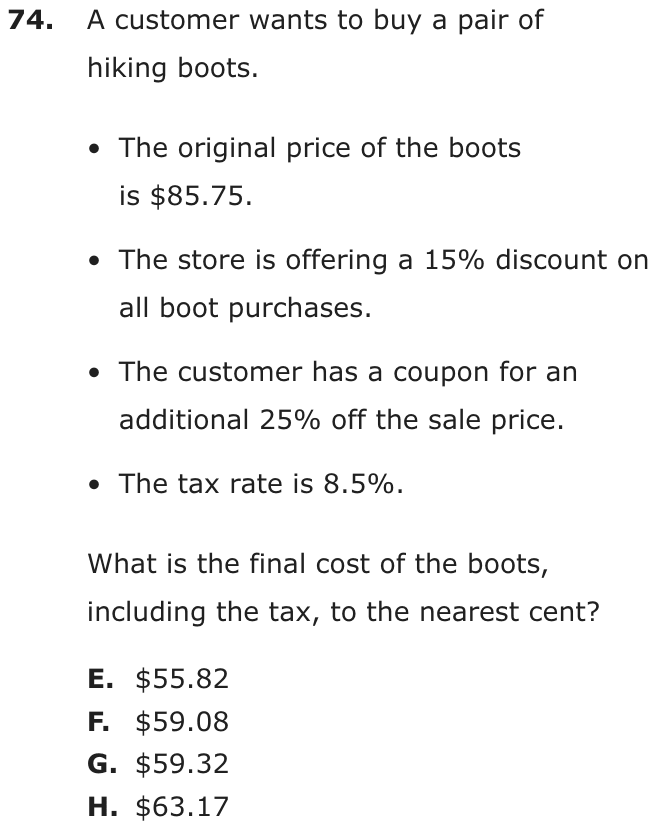
A customer wants to buy a pair of hiking boots.
- The original price of the boots is $85.75.
- The store is offering a 15% discount on all boot purchases.
- The customer has a coupon for an additional 25% off the sale price.
- The tax rate is 8.5%.
What is the final cost of the boots, including the tax, to the nearest cent?
- A$55.82
- B$59.08
- C$59.32
- D$63.17
Show the answer
Correct answer: C
First, determine the sale price after the 15% discount is applied.
Since the customer is saving 15%, this means they are paying 85% , so multiply the original price by 85% (0.85) to find the discounted price:
Next, find the price after the 25% coupon has been applied:
Since the customer is saving 25% off the sale price, this means they are paying 75% , so multiply the price found in the first step by 75% (0.75) to find the second discounted price:
Last, find the final cost after an 8.5% tax is added to the second discounted price.
Since the customer is paying 8.5% tax, this means they are paying 108.5% , so multiply the second discounted price by 108.5% (1.085) to find the final cost:
Question analysis
A pair of hiking boots costs $85.75, goes on sale at 15% off, gets an extra 25% off with a coupon, and is then taxed at 8.5%. Students find the final cost to the nearest cent. Each percent applies to the price left after the step before, so the discounts cannot simply be added, and the decimals call for careful multiplication.
- NYS standards
- Grade level
- Grade 7 content, by NYS standard
- Compared with grade 7
- Above grade 7 A discount followed by sales tax is standard grade 7 percent work. This item stacks two discounts and a tax, with cents to keep at every stage, so it takes about twice the steps and decimal multiplication of a typical problem.
- Estimated difficulty
- Hard: combines ideas, needs a plan, and has more than one tempting wrong answer.
- Thinking it demands
- Depth of knowledge 2, skills and concepts · mainly apply
- What makes it hard
- Error-prone arithmetic major
- Turning words into math moderate
- Slow to do carefully moderate
- Solution
- 3 steps
- Reading level
- Question and choices: about grade 4, 58 words.
- Students, last 30 days
- Not enough answers yet to show (it takes 10).
Why it is hard, traps and wrong answers (shows the answer)
Why it is hard
The question tests whether students treat successive percents as successive multipliers, and then holds them to three long multiplications. Adding the 15% and 25% into one discount is the tempting shortcut, and a tax read as a dollar amount is the other. The key rounds to the cent at each stage, as a register would; carried exactly, the result is $59.31, so the nearest choice, $59.32, still stands.
Error-prone arithmetic major Working it out
Three products of cents and decimals are worked by hand: 85.75 × 0.85 = 72.8875, then 72.89 × 0.75 = 54.6675, then 54.67 × 1.085 ≈ 59.32, each rounded to the cent. (Brown & Burton, 1978; Junker & Sijtsma, 2001)
Turning words into math moderate Understanding the question
The phrase "an additional 25% off the sale price" means 25% of the already discounted $72.89, not of the $85.75 original, so the two discounts multiply rather than add. (Hegarty, Mayer & Monk, 1995; Koedinger & Nathan, 2004)
Slow to do carefully moderate Choosing the answer
A reliable method needs three long decimal multiplications without a calculator, well past the minute and a half a question allows, which tempts students to combine the percents. (Lu & Sireci, 2007)
Strategy: Multiply by 0.85 for the sale, by 0.75 for the coupon on the sale price, and by 1.085 for the tax, rounding to the cent at each stage as a register would.
Traps
- Percent of the wrong amount: Finding the whole from a part, or a percent change measured from the wrong starting amount.
- Misunderstands the concept: A wrong belief about a concept: that percents can be added, that area grows like length, that averages can be averaged, that a bigger denominator means a bigger fraction.
The wrong answers, classified
A Percent of the wrong amount (Parker & Leinhardt, 1995)
Takes the 25% coupon off the original $85.75 instead of the sale price, so the discounts add to 40%: 85.75 × 0.60 × 1.085 ≈ $55.82.
B Little reason to choose it (Haladyna & Downing, 1993; Rodriguez, 2005)
No common working gives $59.08; it sits 24 cents below the right total and matches no discount or tax mistake, so it mostly catches guesses.
D Misunderstands the concept (Smith, diSessa & Roschelle, 1993; De Bock et al., 1998; Ni & Zhou, 2005)
Applies both discounts correctly, reaching $54.67, but adds $8.50 as the tax, reading 8.5% as a dollar amount instead of a percent of the price.
Worked solution, step by step
Formulas used
- Price after a discount
- p is the percent off. A discount is money taken off the price. If you save p percent, you pay the rest, 100 − p percent. For 15% off you pay 85%, so multiply by 0.85.
- Price with tax
- The price is the cost before tax. t is the tax rate, a percent. Tax is extra money added on top. You pay the whole price, 100%, plus t percent more. So for 8.5% tax you multiply by 1.085.
Sort out the question
The boots cost $85.75 at first. The store takes 15% off. Then a coupon takes 25% off the sale price. The sale price is the price after the first discount. Then 8.5% tax is added. You need the final cost to the nearest cent. A cent is $0.01, the second place after the decimal point.
Take off the 15% discount
You save 15%, so you pay 85%. That is 0.85 of the price.
A price can’t have part of a cent, so round to two decimal places. The third digit is 7, which is 5 or more, so round up.
The sign ≈ means about. The sale price is $72.89.
Take 25% off the sale price
The coupon takes 25% off $72.89, so you pay 75% of it.
The price is now $54.67. Watch out: take the coupon off the sale price, not the first price. Adding 15% and 25% to get 40% off $85.75 leads to $55.82, choice A.
Add the 8.5% tax
You pay the price plus 8.5% more, which is 108.5% of it.
Watch out: 8.5% is a percent of the price, not $8.50. Adding $8.50 gives $63.17, choice D.
See why rounding each time matters
A store rounds to the cent after each step, as you just did. The test’s answer is worked the same way. Keep every digit and round only at the end, and you get this:
That is $59.31, which is not a choice. The first two roundings each went up by a tiny part of a cent. That was just enough to push the total from $59.31 to $59.32. So here, round at each step, as a store would. So the answer is C, $59.32.
Check your answer
Check the tax a second way. 8.5% of $54.67 is , about $4.65. Then . Also estimate: two discounts leave a bit less than two-thirds of $86, near $55. Tax adds under $5, so about $59 or $60 makes sense.
More questions like this
The original DOE question