Question
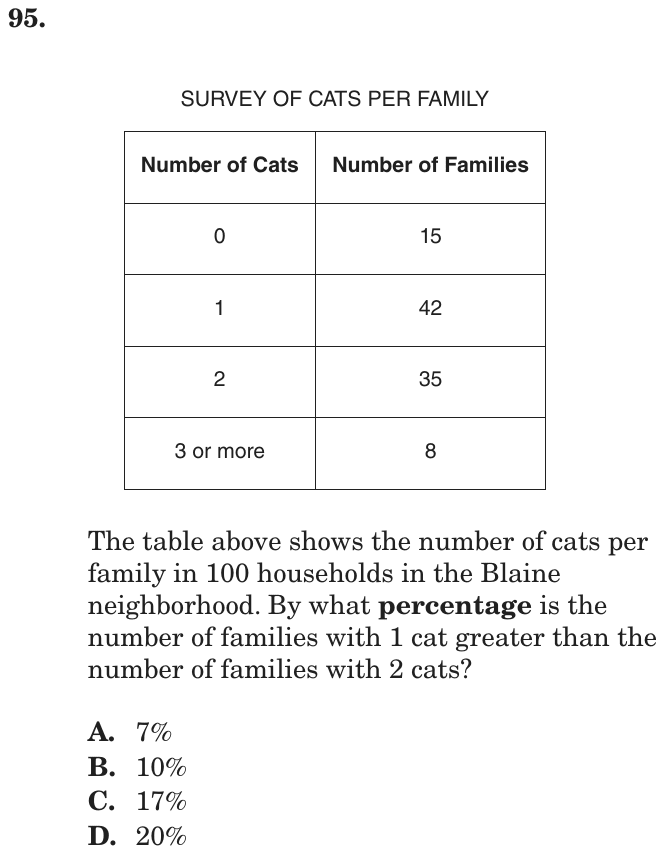
SURVEY OF CATS PER FAMILY
| Number of Cats | Number of Families |
| 0 | 15 |
| 1 | 42 |
| 2 | 35 |
| 3 or more | 8 |
The table above shows the number of cats per family in 100 households in the Blaine neighborhood. By what percentage is the number of families with 1 cat greater than the number of families with 2 cats?
- A7%
- B10%
- C17%
- D20%
Show the answer
Correct answer: D
To find by what percent the number of families with 1 cat is greater than the number of families with 2 cats, calculate the difference between the two numbers and divide by the number of families with 2 cats:
Question analysis
A table lists how many cats live in each of 100 households in the Blaine neighborhood, and the question asks by what percent the number of one-cat families exceeds the number of two-cat families. It tests percent difference. The tricky part is choosing the right base for the comparison when the table's total is a convenient 100.
- NYS standards
- 7.RP.3 multistep ratio and percent problems
- Grade level
- Grade 7 content, by NYS standard
- Compared with grade 7
- At grade 7 Percent increase and decrease is grade 7 content, and this is one standard comparison. What makes it harder than a routine exercise is choosing the base and ignoring the tempting 100-family total.
- Estimated difficulty
- Moderate: several steps, or a close reading with one strong distractor.
- Thinking it demands
- Depth of knowledge 2, skills and concepts · mainly apply
- What makes it hard
- Turning words into math moderate
- A very close wrong answer moderate
- Reading a figure, table or graph minor
- Solution
- 2 steps
- Reading level
- Question and choices: about grade 6, 47 words.
- Students, last 30 days
- Not enough answers yet to show (it takes 10).
Why it is hard, traps and wrong answers (shows the answer)
Why it is hard
The arithmetic is a single subtraction and division, so the question is really about choosing the base of a percent comparison. The 100-household total makes the count difference look like a percent already, and dividing by the larger count is the other classic slip. Students who say "greater than the 2-cat count" to themselves pick 35 as the base.
Turning words into math moderate Understanding the question
"Greater than the number of families with 2 cats" fixes the base of the percent as 35, the count being compared against, not 42 or the 100 households. (Hegarty, Mayer & Monk, 1995; Koedinger & Nathan, 2004)
A very close wrong answer moderate Choosing the answer
17% and the right 20% both come from dividing the 7-family gap by a count, 42 or 35; only choosing 35, the count being compared against, separates them. (Embretson & Wetzel, 1987; Gorin & Embretson, 2006; Ascalon et al., 2007)
Reading a figure, table or graph minor Understanding the question
Only two rows of the four-row table matter, the 42 families with 1 cat and the 35 with 2; the 0-cat and 3-or-more rows go unused. (Lesh, Post & Behr, 1987; Kirsch & Mosenthal, 1990)
Strategy: Find the difference between the two counts, decide which count the comparison is measured against, divide by it, and convert to a percent.
Traps
- Percent of the wrong amount: Finding the whole from a part, or a percent change measured from the wrong starting amount.
- Answers a different question: A choice is right for another quantity: the other unknown, the rest instead of the part, the part instead of the whole.
The wrong answers, classified
A Answers a different question (King et al., 2004; Hegarty, Mayer & Monk, 1995)
Subtracts 42 − 35 = 7 and, since there are 100 households, reads that 7-point gap in shares as a 7% increase.
B Little reason to choose it (Haladyna & Downing, 1993; Rodriguez, 2005)
No division of the 7-family gap by a count in the table gives 10%, so this mostly attracts students estimating a round percent.
C Percent of the wrong amount (Parker & Leinhardt, 1995)
Divides the 7-family difference by 42, the larger count, measuring the change from the wrong amount: 7/42 is about 16.7%, so 17%.
Worked solution, step by step
Formulas used
- Percent greater than
- The difference is how much bigger one amount is than the other. The amount you compare to is the one after the word than. Dividing shows what share of that amount the difference is. Times 100 turns that share into a percent.
Sort out the question
From the table, 42 families have 1 cat and 35 families have 2 cats. You need the percent by which 42 is “greater than the number of families with 2 cats”. The rows for 0 cats and 3 or more cats do not matter here.
Find the difference
Subtract the two counts.
There are 7 more families with 1 cat.
Watch out: 7 is a number of families, not a percent. There are 100 households, so 7% looks tempting. It is choice A, and it is wrong.
Divide by the number you compare to
The question compares with the families that have 2 cats. So divide by 35, not 42.
Watch out: dividing by 42 gives about 17%. That is choice C.
Change the fraction to a percent
Use the percent formula. One fifth of 100 is 20.
So the answer is D, 20%.
Check your answer
Find 20% of 35. That is . Add it on: . That is the number of families with 1 cat, so 20% is right.
More questions like this
The original DOE question