Also in 2026 Practice Test B Math, question 49; 2025 Practice Test B Math, question 57.
Question
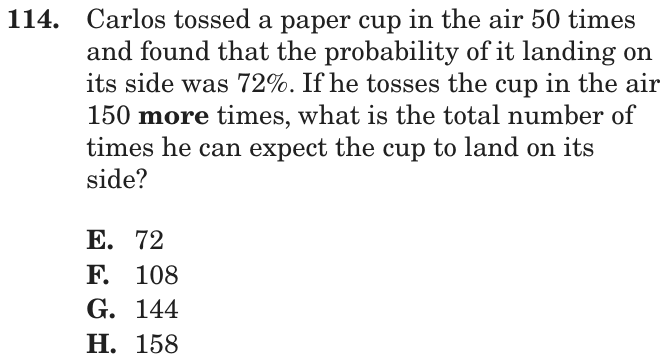
Carlos tossed a paper cup in the air 50 times and found that the probability of it landing on its side was 72%. If he tosses the cup in the air 150 more times, what is the total number of times he can expect the cup to land on its side?
- A72
- B108
- C144
- D158
Show the answer
Correct answer: C
The probability of the cup landing on its side is 72%. Carlos tossed the cup a total of 200 times (50 + 150). The number of times the cup lands on its side is 72% of 200:
0.72 × 200 = 144.
Question analysis
Carlos tossed a paper cup 50 times and found it landed on its side 72% of the time. If he tosses it 150 more times, students predict the total number of side landings he can expect. It tests using a probability to predict outcomes, and the word total decides which tosses to count.
- Grade level
- Grade 6 content, by NYS standard
- Compared with grade 7
- At grade 7 Predicting outcomes from a probability is grade 6 content, and the arithmetic is a single percent. What lifts it to grade 7 level is deciding exactly which tosses the word "total" refers to.
- Estimated difficulty
- Moderate: several steps, or a close reading with one strong distractor.
- Thinking it demands
- Depth of knowledge 2, skills and concepts · mainly apply
- What makes it hard
- Turning words into math moderate
- Something you must already know minor
- Solution
- 2 steps
- Reading level
- Question and choices: about grade 8, 48 words.
- Students, last 30 days
- Not enough answers yet to show (it takes 10).
Why it is hard, traps and wrong answers (shows the answer)
Why it is hard
The computation is one multiplication, so the question is decided by what "total" covers. Students who focus on the 150 new tosses answer for part of the experiment, and students who add the original 50 tosses as if every one landed on its side overshoot. Reading the last sentence twice, and noticing the word total, is the safeguard.
Turning words into math moderate Understanding the question
"150 more times" and "the total number of times" together mean all 200 tosses, so the expected count is 72% of 200, not of 150. (Hegarty, Mayer & Monk, 1995; Koedinger & Nathan, 2004)
Something you must already know minor Working it out
Students must know that an expected count is the probability times the number of trials; the stem never says to multiply. (Anderson & Krathwohl, 2001)
Strategy: Decide which tosses the word "total" covers, then multiply that number of tosses by 0.72 to get the expected count.
Traps
- Answers a different question: A choice is right for another quantity: the other unknown, the rest instead of the part, the part instead of the whole.
- Numbers taken from the question: Combines the numbers in the question without a model of the situation, or is simply a number that appears in the question.
The wrong answers, classified
A Numbers taken from the question (Hegarty, Mayer & Monk, 1995)
Reads the 72% as 72 side landings, as if there had been 100 tosses, without applying the percent to the actual tosses.
B Answers a different question (King et al., 2004; Hegarty, Mayer & Monk, 1995)
Takes 72% of only the 150 new tosses, 0.72 × 150 = 108, and leaves out the side landings expected in the first 50.
D Numbers taken from the question (Hegarty, Mayer & Monk, 1995)
Adds all 50 first tosses to the 108 expected from the next 150, as if every early toss had landed on its side.
Worked solution, step by step
Formulas used
- Expected count
- P is the probability, the chance of the result on one try, written as a decimal. n is the number of tries. Multiplying tells how many times you can expect the result. It is a good guess, not a promise.
Sort out what you know
Carlos tossed the cup 50 times. It landed on its side 72% of the time. He will toss it 150 more times. You need “the total number of times” it should land on its side. Total means all the tosses, the first 50 and the next 150.
Count all the tosses
Add the first tosses and the new ones.
There are 200 tosses in all.
Watch out: using only the 150 new tosses gives , choice B.
Change the percent to a decimal
Percent means out of 100. So 72% is 72 out of 100. Move the decimal point two places left.
Multiply to find the expected count
Use the expected count formula with 0.72 and 200 tosses.
He can expect the cup to land on its side 144 times.
Watch out: 72 is the count for 100 tosses, not 200. That is choice A.
Give the answer
All 200 tosses count, so the expected total is 144. So the answer is C, 144.
Check your answer
Split it up. In the first 50 tosses, . In the next 150, . Then . Also, 144 is a bit less than three quarters of 200, which is 150. That fits 72%.
More questions like this
The original DOE question