Question
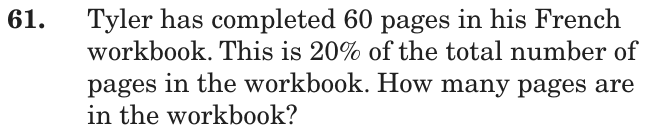
Tyler has completed 60 pages in his French workbook. This is 20% of the total number of pages in the workbook. How many pages are in the workbook?
Grid-in question: work out the answer and enter it as a number.
Show the answer
Correct answer: 300
Let be the total number of pages in the workbook.
Then, 20% of is 60. Set up a proportion and solve for :
Question analysis
This grid-in percent word problem gives the number of French workbook pages Tyler has finished and says what percent of the whole book that is. Students must find the total number of pages by working backward from a part to the whole, which is where many take a percent of the wrong number.
- NYS standards
- 6.RP.3c percent as a rate per 100
- Grade level
- Grade 6 content, by NYS standard
- Compared with grade 7
- Below grade 7 Finding the whole from a part and a percent is a grade 6 skill. It takes a single division here, so it sits below grade 7, although students who reflexively take 20 percent of 60 will go wrong.
- Estimated difficulty
- Straightforward: two steps or one careful reading.
- Thinking it demands
- Depth of knowledge 2, skills and concepts · mainly apply
- What makes it hard
- Turning words into math moderate
- Solution
- 1 step
- Reading level
- Question and choices: about grade 3, 26 words.
- Students, last 30 days
- Not enough answers yet to show (it takes 10).
Why it is hard, traps and wrong answers (shows the answer)
Why it is hard
The question is short and the arithmetic is one division, so it rests on reading the second sentence the right way round. Students who see 20% next to 60 and compute 20% of 60 answer a different problem, and a grid-in gives no list of choices to make them doubt it. A quick check that 60 is one fifth of the result catches every one of these errors.
Turning words into math moderate Understanding the question
The sentence “This is 20% of the total number of pages” makes 60 the part and the total the unknown, the reverse of the familiar “find 20% of a number” pattern. (Hegarty, Mayer & Monk, 1995; Koedinger & Nathan, 2004)
Strategy: Write the finished pages as 20 percent of an unknown total and solve for the total, or think about what fraction of the whole book 20 percent is.
Traps
- Percent of the wrong amount: Finding the whole from a part, or a percent change measured from the wrong starting amount.
- Answers a different question: A choice is right for another quantity: the other unknown, the rest instead of the part, the part instead of the whole.
The wrong answers, classified
12 Percent of the wrong amount (Parker & Leinhardt, 1995)
Takes 20% of 60 instead of finding the number that 60 is 20% of, applying the percent to the wrong amount.
240 Answers a different question (King et al., 2004; Hegarty, Mayer & Monk, 1995)
Sees that 60 pages is one fifth of the book but multiplies 60 by 4, giving the pages Tyler still has left.
3 A faulty procedure (Brown & Burton, 1978; Tatsuoka, 1983)
Divides 60 by 20 instead of by 0.20, treating 20% as the whole number 20.
Worked solution, step by step
Formulas used
- Percent of a number
- The whole is the full amount, here all the pages in the book. The part is a piece of it, here the pages done. Percent means how many out of every 100. Use this when you know two of the three numbers and need the third.
Sort out the part and whole
Tyler has done 60 pages. That is 20% of the whole book. So 60 is the part. The total number of pages is the whole.
The whole is what you need to find. Call it x.
Write the percent equation
Put the numbers into the percent formula.
The fraction simplifies to . So 60 pages is one fifth of the book.
Solve for the whole book
If one fifth of the book is 60 pages, the whole book is 5 times as big.
The book has 300 pages.
Watch out: Finding 20% of 60 gives 12. That treats 60 as the whole, but 60 is the part. Also, 300 − 60 = 240 is the pages still left to do, not the total.
So you would grid 300.
Check your answer
Find 20% of your answer: . That matches the 60 pages Tyler finished. Also, 300 is bigger than 60, as a whole should be.
More questions like this
The original DOE question