2018 Test B English
Question 1 of 57
2018 Test B English, question 1Question
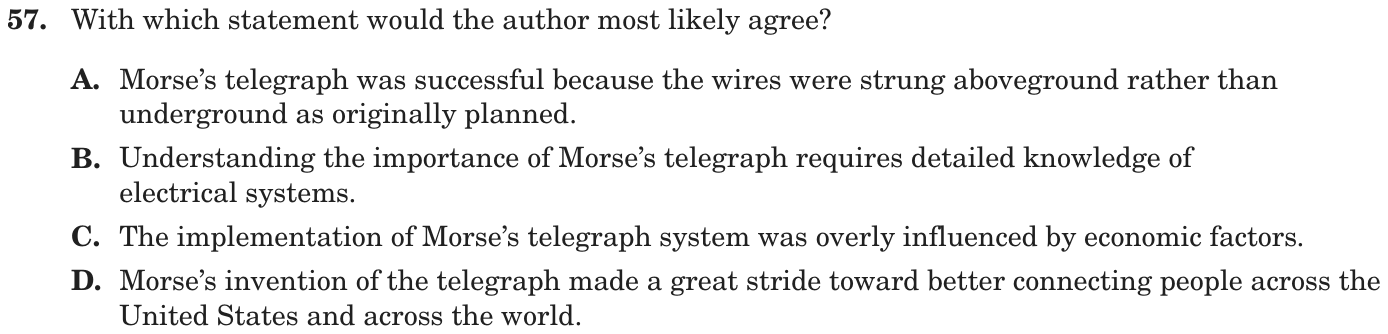
Read this sentence.
The Colosseum in Rome, Italy which is considered one of the “new” Seven Wonders of the World, is the largest amphitheater ever built and could hold more than 50,000 spectators.
Which edit should be made to correct the sentence?
- ADelete the comma after Rome.
- BInsert a comma after Italy.
- CDelete the comma after World.
- DInsert a comma after built.
Show the answer
Correct answer: B
The question asks for the correction needed for an error in the sentence. The sentence needs a comma to set off the clause “which is considered one of the ‘new’ Seven Wonders of the World,” because the clause is not essential to the meaning of the sentence (nonrestrictive clause).
Option B is correct because it places a comma where it is needed, after “Italy,” to set off the nonrestrictive clause that follows.
Option A is incorrect because when a name has more than one element, a comma is used to separate the elements for clarity.
Option C is incorrect because it would remove the comma at the end of the nonrestrictive clause, which should be set off by commas at the beginning and the end.
Option D is incorrect because a comma after “built” would separate the phrase “could hold more than 50,000 spectators,” which is part of a compound predicate that uses the subject from the main clause and so needs to stay connected to the rest of the sentence.
Question analysis
This punctuation question gives one long sentence about the Colosseum in Rome and asks which single comma edit makes it correct. Students apply the comma rules for place names and for nonessential clauses. The long subject makes it tricky, because every comma has to be weighed: added, removed or left alone.
- NYS standards
- 7L2 capitalization, punctuation, and spelling
- Grade level
- Grade 6 reading and task
- Compared with grade 7
- Below grade 7 Comma rules for place names and for extra information in mid-sentence are grade 6 punctuation, tested here in one short sentence with a single edit. Grade 7 editing usually moves on to clauses, modifiers and sentence combining.
- Estimated difficulty
- Straightforward: two steps or one careful reading.
- Thinking it demands
- Depth of knowledge 1, recall and reproduction · mainly apply
- What makes it hard
- A rule that doesn't sound wrong moderate
- Complex sentences minor
- Evidence
- Answered from one sentence or line
- Reading level
- Question and choices: about grade 6, 61 words.
- Corrected from the DOE handbook
- A grammar term in the explanation was corrected.
- Students, last 30 days
- Not enough answers yet to show (it takes 10).
Why it is hard, traps and wrong answers (shows the answer)
Why it is hard
Most students who miss this question can find the which-clause but treat its two edges differently: they see the closing comma after “World” as an error and never notice that the opening comma is missing. The question rewards marking where the extra description begins and ends before judging any single comma. Knowing that a city and its country are always separated settles the rest quickly.
A rule that doesn't sound wrong moderate Working it out
The missing comma after “Italy” does two jobs at once, closing the city–country pair and opening the which-clause, and “Rome, Italy which is considered” reads smoothly enough that few students hear the gap. (Connors & Lunsford, 1988)
Complex sentences minor Understanding the question
The sentence packs a place name, a nonessential which-clause and a compound predicate (“is the largest amphitheater ever built and could hold”) into 30 words, so every comma has to be placed within that structure. (Abedi & Lord, 2001; Freedle & Kostin, 1993; Messick, 1989)
Strategy: Mark where the extra description of the Colosseum begins and ends, then ask of each comma whether it separates a city from its country, sets off that description, or splits subject from verb.
The wrong answers, classified
A Punctuation (Connors & Lunsford, 1988)
Treats Rome and Italy as one name that needs no comma between them, not knowing that a comma always separates a city from its state or country.
C Punctuation (Connors & Lunsford, 1988)
Applies the real rule against a comma between subject and verb to the comma after “World,” missing that it closes the which-clause and must stay.
D Punctuation (Connors & Lunsford, 1988)
Adds a comma wherever the long sentence seems to pause, before “and could hold,” though that second verb shares the subject and takes no comma.
What was corrected from the DOE handbook, and why
- Explanation: The handbook calls “could hold more than 50,000 spectators” a dependent clause. It has no subject of its own: it is the second half of a compound predicate (the Colosseum “is the largest amphitheater ever built and could hold…”), which is why no comma goes before it. The site now calls it “part of a compound predicate.”
Working it out, step by step
Figure out what the question asks
This is a punctuation question. Punctuation means marks like commas and periods. The sentence has one comma mistake. You need the one edit that fixes it. Two comma rules decide it.
Learn the rule for extra information
Some groups of words just add an extra fact. The sentence still makes sense without them. Grammar books call this a nonessential clause. Put a comma before it and a comma after it, like a pair of brackets.
Example: My dog, which is brown, likes to swim. Take out the middle part and you still have My dog likes to swim.
Find the extra part in this sentence
Here the extra part starts with “which is considered” and ends with “of the World.” It gives a fun fact about the Colosseum. Without it, the sentence still works: The Colosseum in Rome, Italy, is the largest amphitheater ever built.
There is a comma at the end of the extra part, after “World.” But there is no comma at the start, after “Italy.” That is the mistake.
Learn the rule for places
When you name a city and then its country, put a comma between them. If the sentence keeps going, put another comma after the country. Example: We flew to Paris, France, last May.
So “Rome, Italy” needs a comma after “Italy” too. Here one comma does both jobs.
Check each choice
- A is wrong. The comma between “Rome” and “Italy” must stay. It splits the city from the country.
- B is right. It adds the missing comma at the start of the extra part.
- C is wrong. The comma after “World” closes the extra part, so it must stay.
- D is wrong. “Could hold” shares its subject, “The Colosseum,” with “is.” No comma goes before a second verb like that. Example: Sam ran home and ate lunch.
Watch out: C is tempting. A comma between a subject (who or what the sentence is about) and its verb (the action word) is usually wrong. Here it is fine, because it is the second comma of the pair.
Choose the answer
With the new comma, the extra part has a comma on each side. So the answer is B: insert a comma after Italy.
Why this answer and not the closest wrong one
C is the closest wrong answer. It treats the comma after “World” as a mistake. But that comma ends the extra part. If you delete it, the extra part has no comma at either end. B adds the missing first comma, so both ends are marked.
More questions like this
The original DOE question
Question 2 of 57
2018 Test B English, question 2Question
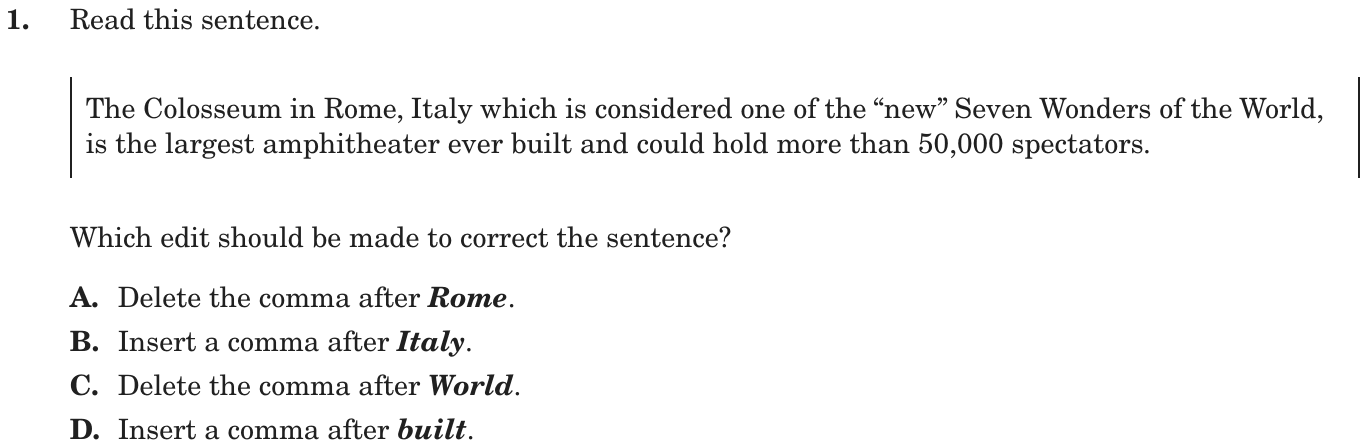
Read this paragraph.
In September 2016 the National Museum of African American History and Culture opened as part of the Smithsonian Institution, the museum is already the Smithsonian’s third most popular site. Experts say that they expect this newest Smithsonian facility to welcome nearly 4 million visitors a year. The museum features more than 30,000 objects, including Muhammad Ali’s boxing gloves and a dress sewn by Rosa Parks. A commemorative copy of the Emancipation Proclamation, written in 1863 during the presidency of Abraham Lincoln, is also on display at the museum.
Which revision corrects the error in sentence structure in the paragraph?
- AInstitution, and the
- Byear, and the
- Cobjects, which include
- DProclamation, which was written
Show the answer
Correct answer: A
The question asks for the correction of an error in sentence structure in the paragraph.
The first sentence is a run-on sentence because both clauses—“In September 2016 the National Museum of African American History and Culture opened as part of the Smithsonian Institution” and “the museum is already the Smithsonian’s third most popular site”—are independent clauses, and independent clauses should not be combined without the use of a conjunction and a comma. The revision in Option A adds the word “and” after the comma, which corrects the run-on.
Option B, Option C, Option D are incorrect responses because the corresponding underlined portions in the paragraph are not structural errors. No edits are needed to correct those portions of the text.
Question analysis
This sentence-structure question gives a short paragraph about the opening of the National Museum of African American History and Culture. Students must find which of four spots holds a real error, such as a run-on, a fragment or a misplaced phrase, and pick the revision that fixes it. Long names stretch the sentences, and the spots that need no change can look just as suspicious.
- Grade level
- Grade 6 reading and task
- Compared with grade 7
- Below grade 7 Fixing run-ons and fragments is taught before grade 7, and here students check four short spots in one paragraph for a single structural error. Long institution names add reading load but no extra grammar.
- Estimated difficulty
- Straightforward: two steps or one careful reading.
- Thinking it demands
- Depth of knowledge 2, skills and concepts · mainly apply
- What makes it hard
- A rule that doesn't sound wrong moderate
- Complex sentences minor
- Every choice must be checked minor
- Evidence
- Answered from one paragraph or stanza
- Reading level
- Question and choices: about grade 10, 111 words.
- Corrected from the DOE handbook
- A misdescribed detail in the explanation was corrected.
- Students, last 30 days
- Not enough answers yet to show (it takes 10).
Why it is hard, traps and wrong answers (shows the answer)
Why it is hard
Students who miss this one usually look for the error in the wrong place: the phrases “including Muhammad Ali’s boxing gloves” and “written in 1863” look suspicious, while the real splice hides behind the long museum name. The question rewards checking each spot for a subject and verb on both sides of its punctuation. Two choices offer the same “, and the” fix, so knowing the fix is not enough without finding where it belongs.
A rule that doesn't sound wrong moderate Working it out
The error is a comma splice after “Institution,” where a comma alone joins two complete clauses, and a comma sounds like a natural pause when the sentence is read aloud. (Connors & Lunsford, 1988)
Complex sentences minor Understanding the question
The eight-word museum name stretches the first clause, so by the time “the museum is already” arrives, it reads like a continuation rather than a new subject and verb. (Abedi & Lord, 2001; Freedle & Kostin, 1993; Messick, 1989)
Every choice must be checked minor Choosing the answer
The four underlined spots fall in four different sentences, and each has to be tested for whether a complete sentence sits on both sides of its punctuation. (Embretson & Wetzel, 1987)
Strategy: Check each sentence for a subject and main verb and count its complete thoughts, then decide whether the spot each choice changes actually breaks a rule before picking a fix.
The wrong answers, classified
B Fixes what isn't broken (Connors & Lunsford, 1988)
Recognizes “, and the” as the usual run-on fix but applies it where a period already separates two complete, correctly punctuated sentences.
C Fixes what isn't broken (Connors & Lunsford, 1988)
Believes a phrase opening with “including” after a comma is a fragment, so turns it into a which-clause, though the phrase already attaches correctly to “objects.”
D Fixes what isn't broken (Connors & Lunsford, 1988)
Thinks “written in 1863” cannot describe the copy without “which was,” though the sentence already has its verb “is” and the phrase is correctly set off.
What was corrected from the DOE handbook, and why
- Explanation: The handbook says the correct revision “adds the word ‘and’ before the comma.” In “Institution, and the,” the word “and” comes after the comma, so the site now says “after the comma.”
Working it out, step by step
Figure out what the question asks
This question is about sentence structure, or how a sentence is built. One of the four underlined spots has a mistake. You need the change that fixes it.
Learn the run-on rule
A complete sentence has a subject (who or what it is about) and a verb (the action). It can stand alone. You cannot join two complete sentences with only a comma. That mistake is called a run-on.
Wrong: I was hungry, I ate an apple.
Fixed: I was hungry, and I ate an apple.
A period would also work: I was hungry. I ate an apple.Find the run-on
Look at the first sentence. The words before the comma can stand alone: “In September 2016 the National Museum of African American History and Culture opened as part of the Smithsonian Institution.” So can the words after it: “the museum is already the Smithsonian’s third most popular site.” Only a comma joins them. That is a run-on.
Check each choice
- A is right. “Institution, and the” adds the joining word “and” after the comma. That fixes the run-on.
- B is wrong. A period already splits those two sentences correctly.
- C is wrong. “Including Muhammad Ali’s boxing gloves” already describes the objects. It needs no change.
- D is wrong. “Written in 1863” already describes the copy. The sentence already has its verb, “is.”
Watch out: C and D are not bad sentences. But they change spots that were already correct, and the run-on stays.
Choose the answer
Now the first sentence says the museum opened, and it is already very popular. Those are two complete ideas, joined the right way. So the answer is A: Institution, and the.
Why this answer and not the closest wrong one
D is a tempting choice, because “which was written” also sounds fine. But a change that sounds fine is not a fix. The question asks you to correct the error. Only A changes the first sentence, where the run-on is.
More questions like this
The original DOE question
Question 3 of 57
2018 Test B English, question 3Question
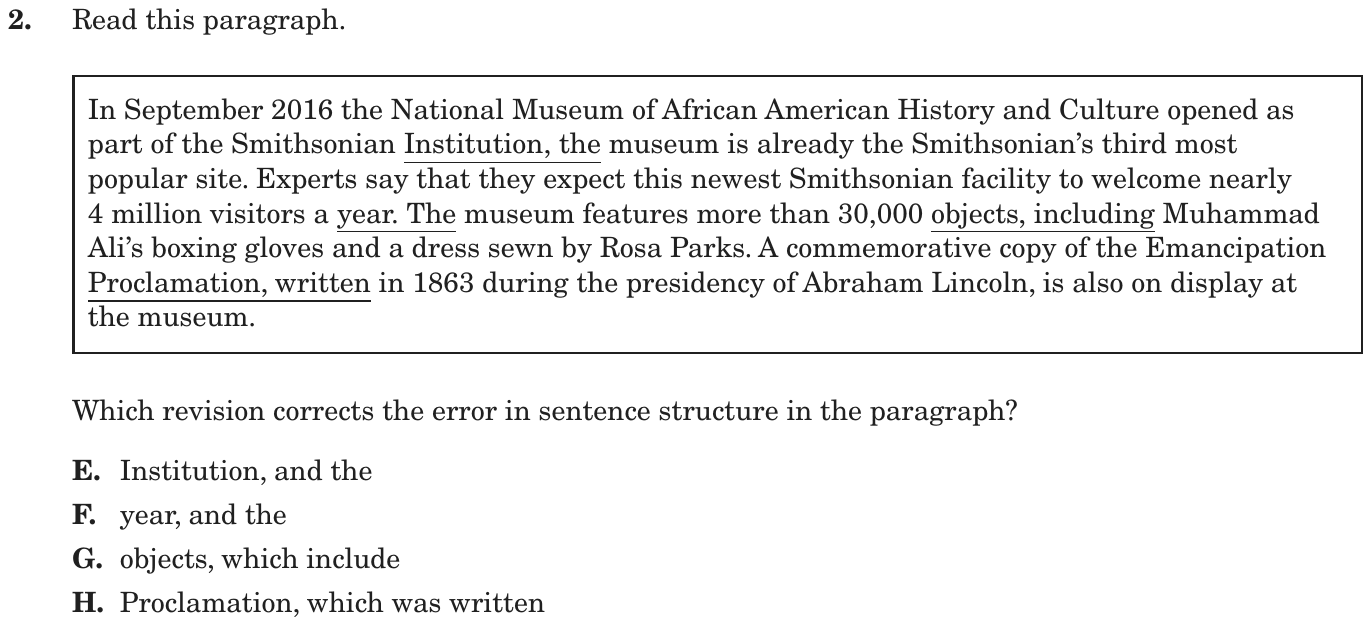
Read this sentence.
To promote their club, a bake sale will be sponsored by members of the debate team on Wednesday.
How should the sentence be revised?
- ATo promote their club, on Wednesday a bake sale will be sponsored by members of the debate team.
- BOn Wednesday to promote their club, a bake sale will be sponsored by members of the debate team.
- CTo promote their club, members of the debate team will sponsor a bake sale on Wednesday.
- DMembers of the debate team, on Wednesday to promote their club, will sponsor a bake sale.
Show the answer
Correct answer: C
The question asks for the correct revision of the sentence in the box.
The sentence is incorrect because, as written, the phrase “to promote their club” refers to the closest noun to the phrase, which is “a bake sale,” and that does not match logically.
Option C is correct because the revision has the phrase “to promote their club” clearly modifying “members of the debate team” and adds the idea that the bake sale is on Wednesday to the end of the sentence.
Option A and Option B are incorrect because the revisions do not fix the error that “to promote their club” modifies “a bake sale.”
Option D is incorrect; while the revision clarifies that “to promote their club” relates to the “members of the debate team,” the rest of the sentence is poorly written because the insertion of “on Wednesday to promote their club” in the middle of the sentence interrupts the main clause, “Members of the debate team will sponsor a bake sale.”
Question analysis
This sentence-structure question shows a sentence about a debate team’s bake sale and asks how it should be revised. Students choose the rewrite that places each phrase where it logically belongs. The rewrites move the same phrases into different orders, so students must judge both the logic and how naturally each version reads.
- NYS standards
- 7L1 grammar and usage conventions
- Grade level
- Grade 7 reading and task
- Compared with grade 7
- At grade 7 Placing phrases so they modify the right words is named in the grade 7 language standards, and this one-sentence item is a typical classroom example. Students must also judge whether each rewrite reads smoothly, not just whether it is logical.
- Estimated difficulty
- Straightforward: two steps or one careful reading.
- Thinking it demands
- Depth of knowledge 2, skills and concepts · mainly evaluate
- What makes it hard
- A rule that doesn't sound wrong moderate
- Complex sentences minor
- Every choice must be checked minor
- A very close wrong answer minor
- Evidence
- Answered from one sentence or line
- Reading level
- Question and choices: about grade 6, 95 words.
- Students, last 30 days
- Not enough answers yet to show (it takes 10).
Why it is hard, traps and wrong answers (shows the answer)
Why it is hard
The original sentence is easy to understand, which is exactly why its dangling modifier slips past students who judge by sound. Rewrites that only move “on Wednesday” keep the passive voice and the error, so asking who is doing the promoting rules them out at once. Among the rewrites that put the team members first, the remaining decision is about smoothness: whether a phrase should sit between the subject and its verb.
A rule that doesn't sound wrong moderate Working it out
“To promote their club” has no logical doer in the original, since a bake sale cannot promote anything, but the meaning is so clear that the dangling modifier is hard to hear. (Connors & Lunsford, 1988)
Complex sentences minor Understanding the question
The passive “will be sponsored by members of the debate team” pushes the real actors to the end, which is why the opening phrase lands on “a bake sale.” (Abedi & Lord, 2001; Freedle & Kostin, 1993; Messick, 1989)
Every choice must be checked minor Choosing the answer
All four rewrites shuffle the same three phrases, so each must be read whole to see which noun follows the opening phrase and whether the main clause is interrupted. (Embretson & Wetzel, 1987)
A very close wrong answer minor Choosing the answer
The interrupted rewrite uses the same words as the right one and also makes the team members the subject; only where “on Wednesday to promote their club” sits, between subject and verb, separates them. (Embretson & Wetzel, 1987; Gorin & Embretson, 2006; Ascalon et al., 2007)
Strategy: Ask who is actually promoting the club, then read each rewrite to see which words the to-phrase attaches to and how smoothly the whole sentence reads.
Traps
- Misplaced modifier: A describing word or phrase that attaches to the wrong word, or to nothing in the sentence.
The wrong answers, classified
A Misplaced modifier (Connors & Lunsford, 1988)
Moves “on Wednesday” as if the time phrase were the problem and keeps the passive voice, so “To promote their club” still describes the bake sale.
B Misplaced modifier (Connors & Lunsford, 1988)
Shuffles both phrases to the front without a comma between them, yet “a bake sale” still follows, so the club-promoting phrase still describes the sale.
D Misplaced modifier (Connors & Lunsford, 1988)
Correctly makes “Members of the debate team” the subject but misplaces “on Wednesday to promote their club” between subject and verb, an awkward interruption the best revision avoids.
Working it out, step by step
Figure out what the question asks
This question is about a modifier. A modifier is a group of words that describes something. You need the version where the describing words go with the right noun (a person, place or thing).
Learn the rule for opening phrases
Sometimes a sentence starts with a describing phrase and a comma. That phrase describes whoever comes right after the comma. So the one doing the action must come right after the comma.
Wrong: To win the race, every day was spent training. A day can’t win a race.
Fixed: To win the race, Maya trained every day.Find the problem in the sentence
The sentence starts with “To promote their club.” To promote something means to get people interested in it. Right after the comma comes “a bake sale.” So the sentence says the bake sale is promoting the club. That makes no sense. The people promoting the club are the “members of the debate team.” They should come right after the comma.
Check each choice
- A is wrong. After the comma comes “on Wednesday a bake sale.” The bake sale is still doing the promoting.
- B is wrong. It moves “On Wednesday” to the front, but “a bake sale” still follows the comma.
- C is right. “Members of the debate team” comes right after the comma. They are the ones who “will sponsor a bake sale.”
- D is wrong. It names the members first. But it stuffs “on Wednesday to promote their club” between the subject and its verb. That breaks up the sentence.
Watch out: D also makes the members the ones promoting the club, so it is tempting. But C says the same thing in a smooth, clear order.
Choose the answer
In C, the members promote their club, and “on Wednesday” comes at the end, where it reads smoothly. So the answer is C.
Why this answer and not the closest wrong one
D is the closest wrong answer. Like C, it puts the members of the debate team first. But D splits the subject from its verb with a long phrase: “Members of the debate team, on Wednesday to promote their club, will sponsor.” C keeps the main idea together, so it reads clearly.
More questions like this
The original DOE question
Question 4 of 57
2018 Test B English, question 4Question
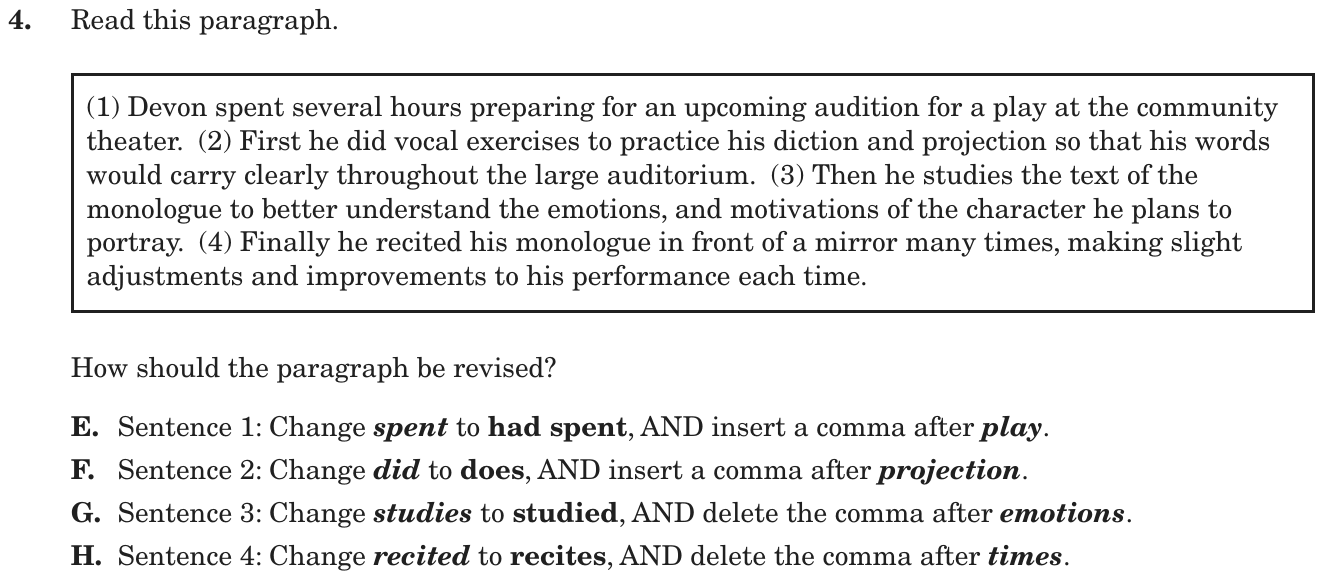
Read this paragraph.
(1) Devon spent several hours preparing for an upcoming audition for a play at the community theater. (2) First he did vocal exercises to practice his diction and projection so that his words would carry clearly throughout the large auditorium. (3) Then he studies the text of the monologue to better understand the emotions, and motivations of the character he plans to portray. (4) Finally he recited his monologue in front of a mirror many times, making slight adjustments and improvements to his performance each time.
How should the paragraph be revised?
- ASentence 1: Change spent to had spent, AND insert a comma after play.
- BSentence 2: Change did to does, AND insert a comma after projection.
- CSentence 3: Change studies to studied, AND delete the comma after emotions.
- DSentence 4: Change recited to recites, AND delete the comma after times.
Show the answer
Correct answer: C
The question asks for the necessary revisions to the paragraph. Option C is correct because the errors appear in sentence 3 of the paragraph. The word “studies” is in the present tense, but it should be changed to “studied” to match the past tense established in the paragraph (“spent,” “recited”). Additionally, the comma after the word “emotions” needs to be removed because the words “emotions and motivations” are part of a group (series) of two elements, and when there are only two elements in a series, a comma is not used.
Option A is incorrect because sentence 1 does not need to be revised. The word “spent” is correct in the past tense, and there is no need to insert a comma after the word “play.”
Option B is incorrect because sentence 2 does not need to be revised. The word “did” is correct as written in the past tense, and there is no comma needed after the word “projection” because “so” is not functioning as a conjunction but rather as part of the conjunction phrase “so that,” which does not take a comma.
Option D is incorrect because sentence 4 does not need to be revised. The word “recited” is correct as written in the past tense, and the comma after “times” is needed in order to separate the modifying phrase “making slight adjustments and improvements to his performance each time” from the main clause.
Question analysis
This grammar and punctuation question gives a four-sentence paragraph about Devon preparing for a theater audition. Each answer choice pairs a verb change with a comma change in a single sentence. Students judge verb tense and comma use together, since a choice is right only if both of its edits are needed.
- Grade level
- Grade 6 reading and task
- Compared with grade 7
- Below grade 7 Verb tense consistency and basic comma use are taught before grade 7, and this paragraph is short and plain. Each choice bundles two edits, so a student who finds one real error can confirm the answer with the other.
- Estimated difficulty
- Routine: one familiar step, little to misread.
- Thinking it demands
- Depth of knowledge 1, recall and reproduction · mainly apply
- What makes it hard
- Evidence
- Answered from one paragraph or stanza
- Reading level
- Question and choices: about grade 9, 136 words.
- Students, last 30 days
- Not enough answers yet to show (it takes 10).
Why it is hard, traps and wrong answers (shows the answer)
Why it is hard
The tense error is easy to hear: “Then he studies” breaks a past-tense story told with “spent,” “did” and “recited.” Spotting either half of the correct choice is enough to find it, which is why this is one of the easier editing questions. Students who go wrong are usually drawn by a comma rule they half remember, such as a comma before “so,” and stop checking the verb.
A rule that doesn't sound wrong minor Working it out
The comma in “emotions, and motivations” separates just two items, and many students have learned to put a comma before “and” in any list without counting the items. (Connors & Lunsford, 1988)
Every choice must be checked minor Choosing the answer
Each choice bundles a verb change and a comma change in a different sentence, so all four sentences must be checked, and a choice is right only if both of its edits are needed. (Embretson & Wetzel, 1987)
Strategy: Note the tense of the paragraph’s first verb, check every other verb against it, and only then test whether the comma half of that choice is also needed.
The wrong answers, classified
A Verb tense or form (Connors & Lunsford, 1988)
Thinks “had spent” is needed because the preparing came before the audition, and accepts a comma after “play” that would split “a play at the community theater.”
B Punctuation (Connors & Lunsford, 1988)
Follows the rule of a comma before “so” joining two clauses, missing that “so that” introduces a purpose clause and takes no comma, and accepts the present-tense “does.”
D Verb tense or form (Connors & Lunsford, 1988)
Notices that the tenses clash but takes the present-tense “studies” as the standard, shifts “recited” to match, and drops the comma that sets off “making slight adjustments.”
Working it out, step by step
Figure out what the question asks
Each choice makes two changes to one sentence: a verb change and a comma change. The right choice is the one where both changes fix real errors. If either change is not needed, the choice is wrong.
Check the verb tenses
Tense is the time a verb shows: past, present or future. A paragraph should stay in one tense. Example: Yesterday I walk to school should be Yesterday I walked to school.
This paragraph tells about the past: “spent,” “did,” “recited.” But sentence 3 says “Then he studies the text.” “Studies” is present tense. It should be “studied.”
Check the comma rule for pairs
Use commas in a list of three or more things: apples, pears, and plums. But two things joined by “and” take no comma: apples and pears.
Sentence 3 says “the emotions, and motivations.” That is only two things. So the comma after “emotions” should go.
Check each choice
- A is wrong. “Spent” is already past tense. A comma after “play” would cut off “at the community theater.”
- B is wrong. “Does” would be present tense, which is the mistake, not the fix. And “so that” takes no comma before it.
- C is right. Both changes fix real errors in sentence 3.
- D is wrong. “Recites” would be present tense. The comma after “times” is needed. It sets off the describing words “making slight adjustments.”
Watch out: D notices that the tenses don’t match, but it fixes the wrong verb. Three verbs are past and one is present, so change the present one.
Choose the answer
With both fixes, sentence 3 says he studied the text to understand the emotions and motivations of the character. So the answer is C.
Why this answer and not the closest wrong one
D is tempting because it also spots the tense problem. But it changes “recited,” which was already right, to match the one wrong verb. It also removes a comma that is needed. Both of C’s edits fix real errors, so C is the only choice that works.
More questions like this
The original DOE question
Question 5 of 57
2018 Test B English, question 5Passage The Local Library
The Local Library
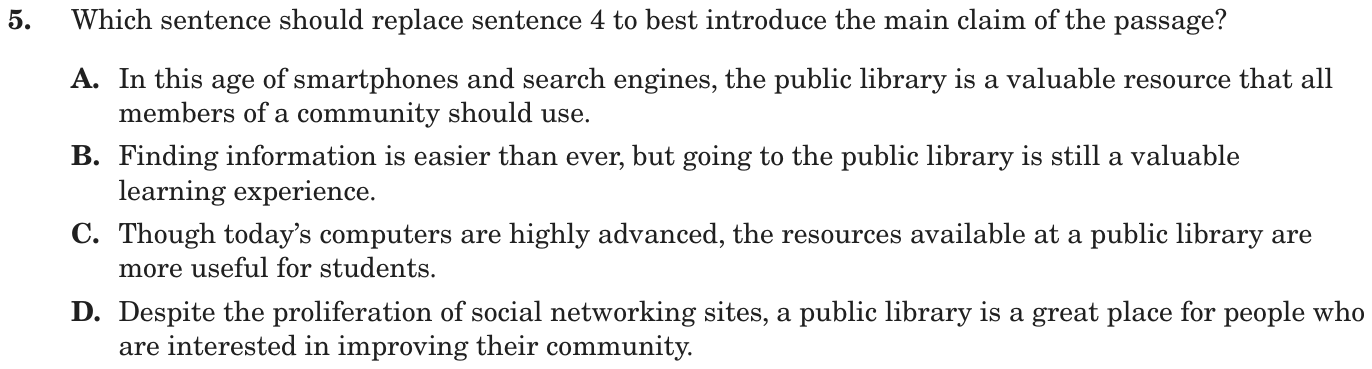
(1) According to a 2015 survey, more than two-thirds of Americans own a smartphone, which means that obtaining information or communicating with people is easier than ever before. (2) With the swipe of a finger, the tap of an icon, or a verbal command, people have instant access to articles, blogs, news, and social networking websites. (3) Even with all these immediately available sources of information, one of the best resources for many members of the community also happens to be one of the oldest. (4) The public library is a great place for people to get information.
(5) The public library serves a truly critical role in promoting community. (6) With the explosion of digital media in recent years, people in different locations can now communicate almost instantaneously. (7) And yet many people complain of feeling more isolated and alone than ever before. (8) The library stands in a rare position to help community members meet this universal need for human connection and companionship.
(9) Furthermore, libraries provide certain amenities, such as access to the Internet, for free to all people. (10) A student who does not have a computer at home can research and type a paper for school. (11) Similarly, an unemployed adult without access to the Internet can make use of library resources to find job opportunities. (12) The free items that are found at the library can help people get a lot done.
(13) Public libraries also offer a variety of resources to community members. (14) One important resource is the local librarian, who does far more than check out books and collect fines. (15) Other library resources include free or low-cost tutoring and training programs. (16) Additionally, lectures, book groups, and town meetings promote critical thinking and community engagement. (17) A typical librarian holds a master’s degree and can help library patrons navigate through the flood of information available in print and on the Internet.
(18) The hallmark of a public library is that its materials and services are accessible to all. (19) The library connects people to a network of information and resources and is an important part of a community.
Question
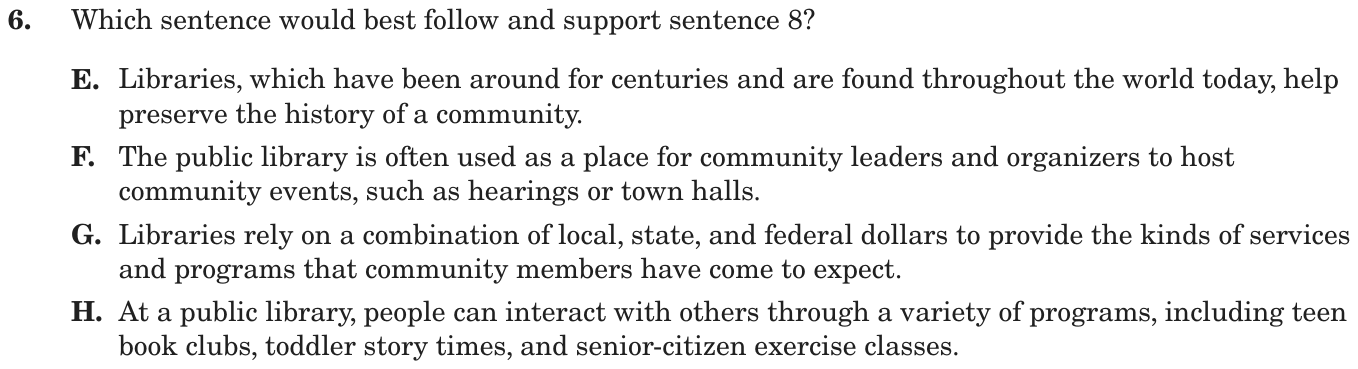
Which sentence should replace sentence 4 to best introduce the main claim of the passage?
- AIn this age of smartphones and search engines, the public library is a valuable resource that all members of a community should use.
- BFinding information is easier than ever, but going to the public library is still a valuable learning experience.
- CThough today’s computers are highly advanced, the resources available at a public library are more useful for students.
- DDespite the proliferation of social networking sites, a public library is a great place for people who are interested in improving their community.
Show the answer
Correct answer: A
The question asks for a sentence that should replace sentence 4 to introduce the main claim of the passage.
Option A is correct because it best presents the main claim that the public library is a valuable resource and should be used by community members.
Option B is incorrect because it states that going to the library can be a learning experience. This idea is implied in sentences 17 and 18, but it is not the main claim of the passage.
Option C is incorrect because it states the idea that the library is useful for students, which would be supporting evidence rather than an introductory statement expressing the main claim.
Option D is incorrect because it states that local libraries provide services to help improve communities, which is explained in sentences 15–18, but it does not present the main claim.
Question analysis
This introduction question uses a persuasive essay about public libraries that opens with statistics on smartphone ownership. Students choose a new fourth sentence that states the passage’s main claim. Every option contrasts technology with libraries, so the challenge is telling the overall argument apart from single supporting points.
- NYS standards
- 7W1a introducing claims and counterclaims
- Grade level
- Grade 7 reading and task
- Compared with grade 7
- At grade 7 Grade 7 writers learn to state a precise claim; here students must find the claim behind a whole five-paragraph essay and test each candidate opener against all of its reasons, not just one paragraph.
- Estimated difficulty
- Moderate: several steps, or a close reading with one strong distractor.
- Thinking it demands
- Depth of knowledge 2, skills and concepts · mainly evaluate
- What makes it hard
- Evidence in several places moderate
- A very close wrong answer moderate
- How sentences fit together minor
- Evidence
- Answered from the whole text
- Reading level
- Passage: about grade 11, 341 words; question and choices: about grade 12, 96 words.
- Students, last 30 days
- Not enough answers yet to show (it takes 10).
Why it is hard, traps and wrong answers (shows the answer)
Why it is hard
The risk here is settling for a true point from the essay instead of its overall claim. Every opener sets technology against the library, so the contrast itself decides nothing; what decides is whether the library is presented as a resource for the whole community or as a benefit to one group. Students who state the claim in their own words before reading the choices avoid the near-copy that narrows it to learning.
Evidence in several places moderate Working it out
The main claim is never stated in one place: it has to be pieced together from paragraphs on human connection, free Internet access, librarians and tutoring, and access for all, ending with “an important part of a community.” (Kirsch & Mosenthal, 1990; Gorin & Embretson, 2006)
A very close wrong answer moderate Choosing the answer
The learning-experience opener has the right one’s shape, a nod to technology and then “valuable,” and differs in one part of the claim: “a valuable learning experience” instead of “a valuable resource that all members of a community should use.” (Embretson & Wetzel, 1987; Gorin & Embretson, 2006; Ascalon et al., 2007)
How sentences fit together minor Working it out
Sentence 3 builds up to an unnamed “one of the best resources,” so the new sentence 4 must name the library as that resource and say why everyone should use it. (Halliday & Hasan, 1976)
Strategy: Before reading the choices, sum up in your own words what the essay wants readers to believe about the library, drawing on every paragraph, then find the opener that matches it.
Traps
- Too narrow: A single detail offered as the central idea or a summary, or a summary that keeps minor details and leaves out an essential part.
- Too broad or too strong: A choice overstates, generalizes, or uses absolute words the text does not support.
The wrong answers, classified
B Too narrow (King et al., 2004)
Echoes sentence 1’s “easier than ever” and sounds balanced, but reduces the claim to one benefit, learning, and drops the community and the free services the essay argues for.
C Too broad or too strong (King et al., 2004)
Builds on the student in sentence 10 and the essay’s technology contrast, but claims libraries beat computers, a ranking the essay never makes, since libraries offer the Internet.
D Too narrow (King et al., 2004)
Keeps the original sentence’s vague “great place for people” and narrows the audience to those improving their community, one point from paragraphs 2 and 4 rather than the claim.
Working it out, step by step
Figure out what the question asks
You need a new sentence 4. Sentence 4 ends the first paragraph, so it should state the main claim. A claim is the big point a writer tries to prove. Here it must fit the whole essay.
Sum up what the essay argues
Look at what each paragraph says about the library.
- Paragraph 2: it helps people meet the “need for human connection and companionship.”
- Paragraph 3: it offers things like “access to the Internet, for free to all people.”
- Paragraph 4: it offers librarians, tutoring, lectures and book groups.
- Paragraph 5: it is “an important part of a community.”
So the claim is this: the library is a valuable resource that everyone in the community should use.
See how sentence 4 must fit
Sentence 1 talks about smartphones. Sentence 3 says that “one of the best resources” is also “one of the oldest.” Sentence 4 should name that old resource, the library. It should also say why everyone should use it.
Check each choice
- A is right. It links back to the smartphones. It calls the library “a valuable resource that all members of a community should use.” That is the whole claim.
- B is wrong. It shrinks the claim to learning. It leaves out the free services and the human connection.
- C is wrong. It talks only about students. It also says the library beats computers, which the essay never says. The library even offers the Internet.
- D is wrong. It talks only about people who want to improve their community. It keeps the vague words “a great place.”
Watch out: B repeats “easier than ever” from sentence 1, so it sounds like it belongs. But it covers only one benefit.
Choose the answer
A names the library, calls it valuable and tells everyone to use it. So the answer is A.
Why this answer and not the closest wrong one
B is the closest wrong answer. It also starts with how easy it is to find information today, and it calls the library valuable. But it calls the library “a valuable learning experience.” The essay argues for much more than learning: free Internet, librarians, programs and a place to meet people. A covers all of that.
More questions like this
The original DOE question
The passage “The Local Library” as printed (page 120)
Question 6 of 57
2018 Test B English, question 6Uses the passage above: “The Local Library”.
Question
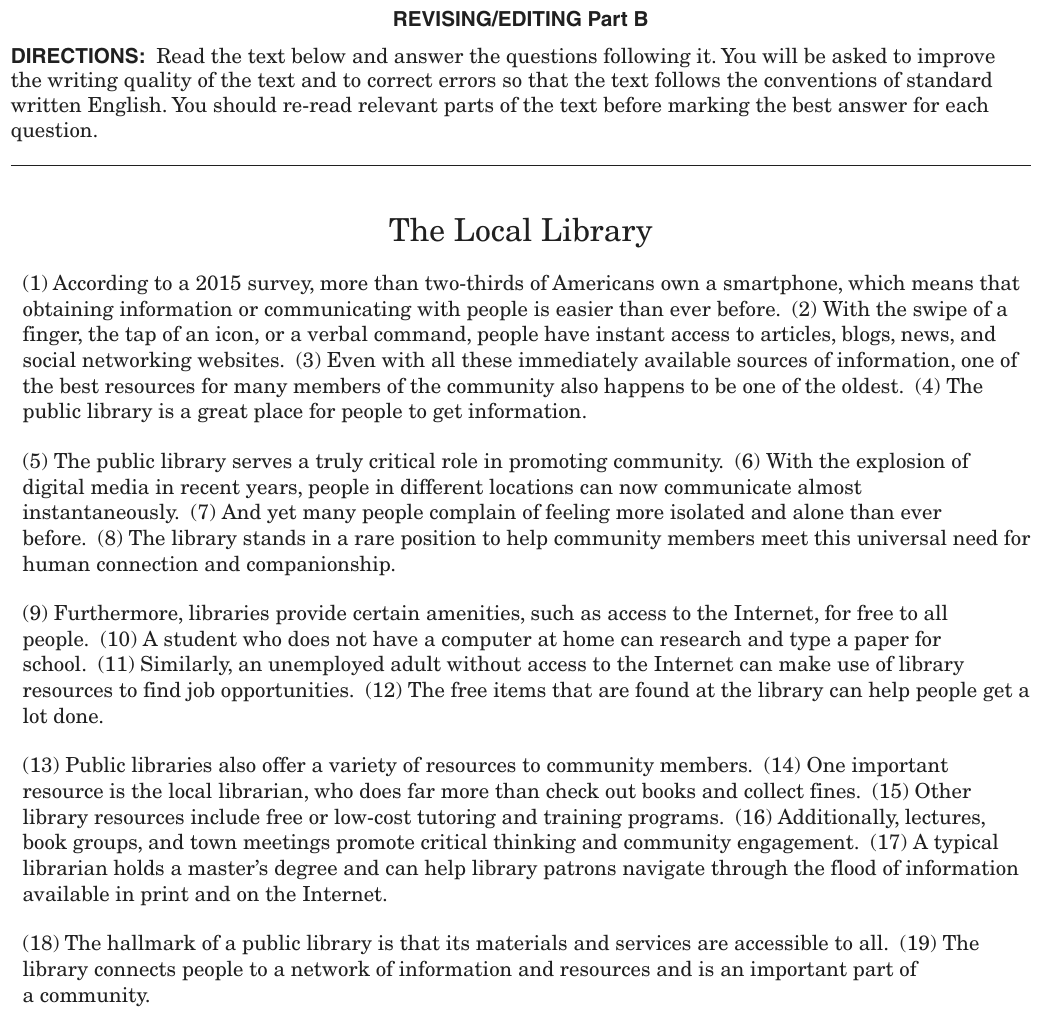
Which sentence would best follow and support sentence 8?
- ALibraries, which have been around for centuries and are found throughout the world today, help preserve the history of a community.
- BThe public library is often used as a place for community leaders and organizers to host community events, such as hearings or town halls.
- CLibraries rely on a combination of local, state, and federal dollars to provide the kinds of services and programs that community members have come to expect.
- DAt a public library, people can interact with others through a variety of programs, including teen book clubs, toddler story times, and senior-citizen exercise classes.
Show the answer
Correct answer: D
The question asks which option would provide the best support for sentence 8. Sentence 8 expresses the idea that the library helps community members meet their need for human connection and companionship.
Option D is correct because it provides support for sentence 8 and strengthens the connection between the information in sentence 8 and the main claim of the passage by listing examples of how people can connect at the library.
Option A is incorrect because it references the history of the library, which does not support the idea in sentence 8 or the main claim of the passage.
Option B is incorrect because, although it introduces the idea of community meetings, it does not support the idea in sentence 8.
Option C is incorrect because it mentions expectations by the community members and brings up a new idea that is unrelated to the main claim of the passage and that does not provide support for sentence 8.
Question analysis
This supporting-details question returns to the library essay and its point that people feel isolated in a digital world. Students pick the sentence that would best follow sentence 8 and back it up. Each option sounds like a fair statement about libraries, which is what makes the choice harder than it first looks.
- NYS standards
- 7W1b supporting claims with evidence
- Grade level
- Grade 7 reading and task
- Compared with grade 7
- At grade 7 Choosing evidence that fits a claim is standard grade 7 argument work. This item sharpens it: all four sentences are believable facts about libraries, so students must match the specific idea in sentence 8 rather than the general topic.
- Estimated difficulty
- Moderate: several steps, or a close reading with one strong distractor.
- Thinking it demands
- Depth of knowledge 2, skills and concepts · mainly evaluate
- What makes it hard
- How sentences fit together moderate
- Evidence
- Answered from one paragraph or stanza
- Reading level
- Passage: about grade 11, 341 words; question and choices: about grade 12, 104 words.
- Students, last 30 days
- Not enough answers yet to show (it takes 10).
Why it is hard, traps and wrong answers (shows the answer)
Why it is hard
Every choice says something favorable about libraries, so a student who asks only whether a sentence fits the essay will find all four acceptable. The question rewards narrowing the test to sentence 8’s own idea, the loneliness of a digital age and the need for company. The teen book clubs, toddler story times and exercise classes for seniors are what make the right sentence a support rather than a new topic.
How sentences fit together moderate Working it out
Sentence 8 ends on “human connection and companionship,” so the sentence after it must give an example of people meeting each other, not just another good thing about libraries. (Halliday & Hasan, 1976)
Strategy: Restate sentence 8 in a few words, then ask of each choice whether it gives a concrete example of that exact idea or just says something good about libraries.
Traps
- Off the point: Adds or keeps something that does not support the paragraph's or the passage's focus, or an introduction or conclusion that misses the main point.
- Wrong part of the text: A choice is true of another paragraph, stanza or speaker than the one asked about.
The wrong answers, classified
A Off the point (Halliday & Hasan, 1976)
Offers a pleasant general fact about libraries preserving community history, which matches the word “community” but says nothing about loneliness or human connection.
B Wrong part of the text (Kirsch & Mosenthal, 1990)
Describes hearings and town halls, which belong with paragraph 4’s “town meetings” and civic engagement, and concern leaders running events rather than people finding companionship.
C Off the point (Halliday & Hasan, 1976)
Brings in funding from local, state and federal dollars, a new topic that neither illustrates sentence 8’s need for connection nor advances the essay’s claim.
Working it out, step by step
Figure out what the question asks
You need the sentence that would come right after sentence 8 and back it up. To support a sentence means to give an example or a reason that proves it.
Read sentence 8 closely
Sentence 8 says: “The library stands in a rare position to help community members meet this universal need for human connection and companionship.” Just before it, sentence 7 says people feel “more isolated and alone than ever before.”
Put sentence 8 in plain words
“Isolated” means cut off from other people. “Companionship” means having friends and people around you. So sentence 8 says: people feel lonely, and the library can help them spend time with others. The next sentence should show how people meet each other at the library.
Check each choice
- A is wrong. It is about saving a community’s history, not about people meeting.
- B is wrong. Hearings and town halls are about leaders running community business. They are not about lonely people finding company.
- C is wrong. Money for libraries is a new topic. It says nothing about human connection.
- D is right. Book clubs, story times and exercise classes are real ways people “can interact with others.”
Watch out: B mentions community events, so it seems to fit. But its point is public meetings, not friendship. It fits better with the “town meetings” in sentence 16.
Choose the answer
D gives clear examples of people meeting and spending time together. So the answer is D.
Why this answer and not the closest wrong one
B is the closest wrong answer, because it also shows people gathering at the library. But hearings and town halls are public business, run by leaders. Sentence 8 is about loneliness and companionship. D shows people of every age, from toddlers to seniors, meeting and doing things together.
More questions like this
The original DOE question
Question 7 of 57
2018 Test B English, question 7Uses the passage above: “The Local Library”.
Question
Which revision of sentence 12 best maintains the formal style established in the passage?
- AThe free resources available at the library can help people accomplish many tasks.
- BAll the free materials you can get at the library can help you do many different tasks.
- CEverything that is free at the library can help people work on a lot of different things.
- DThe free resources you can find at the library can help you do whatever you need to do.
Show the answer
Correct answer: A
The question asks for the revision of sentence 12 that best maintains the formal style established in the passage.
Option A correctly maintains the formal style by using “people” instead of “you” and the more formal language “resources available” and “accomplish many tasks.”
Option B is incorrect because it uses second person, directly addressing the reader, which is informal.
Option C is incorrect because, even though it does not use second person, it uses informal language like “work on” and “things.”
Option D is incorrect because it uses the informal phrase “whatever you need to do” in addition to informally addressing the reader through the use of second person.
Question analysis
This style question asks students to revise a casual sentence about the free items at a public library so it fits the essay’s formal tone. Students compare four rewrites for word choice and for the way each one speaks to the reader. It tests whether students can hear the difference between conversational and academic writing.
- Grade level
- Grade 6 reading and task
- Compared with grade 7
- Below grade 7 Keeping a formal style is introduced in grade 6 writing, and this item tests it in one sentence with clear signals of casual language. Typical grade 7 style work asks for subtler choices of precise, content-specific words.
- Estimated difficulty
- Routine: one familiar step, little to misread.
- Thinking it demands
- Depth of knowledge 1, recall and reproduction · mainly evaluate
- What makes it hard
- Evidence
- Answered from one sentence or line
- Reading level
- Passage: about grade 11, 341 words; question and choices: about grade 8, 78 words.
- Students, last 30 days
- Not enough answers yet to show (it takes 10).
Why it is hard, traps and wrong answers (shows the answer)
Why it is hard
Sentence 12, with “free items” and “get a lot done,” sounds casual next to the essay’s survey figures and phrases like “certain amenities,” and two of the rewrites slip into addressing the reader as “you.” Most students hear that at once. The one rewrite that avoids “you” but stays vague is where careful readers can still be caught, since they stop checking once the pronoun test is passed.
A very close wrong answer minor Choosing the answer
The rewrite saying free things “can help people work on a lot of different things” matches the right one’s “can help people accomplish many tasks” in structure and pronoun; only the casual wording separates them. (Embretson & Wetzel, 1987; Gorin & Embretson, 2006; Ascalon et al., 2007)
Something you must already know minor Working it out
Students must already know the conventions of formal writing: no second-person “you,” and precise wording such as “accomplish many tasks” instead of “get a lot done.” (Anderson & Krathwohl, 2001)
Strategy: Reread a sentence or two around sentence 12 to hear the essay’s voice, then check each rewrite for whom it addresses and for casual or vague wording.
Traps
- Wordy, vague or informal: A revision is grammatical but wordy, imprecise or too casual for the passage.
The wrong answers, classified
B Wordy, vague or informal (Connors & Lunsford, 1988)
Sounds tidy and keeps the idea, but speaks to the reader directly with “you can get” and “help you,” second person that the essay’s formal voice never uses.
C Wordy, vague or informal (Connors & Lunsford, 1988)
Passes the pronoun test by using “people,” but keeps the vague, casual wording “everything that is free” and “a lot of different things.”
D Wordy, vague or informal (Connors & Lunsford, 1988)
Is drawn by the formal-sounding “resources” it shares with the right rewrite, overlooking the second person and the chatty “whatever you need to do.”
Working it out, step by step
Figure out what the question asks
You need to rewrite sentence 12 so it sounds formal, like the rest of the essay. Formal style is the careful way you would write a school report.
Learn the signs of formal style
Formal writing follows two simple rules.
- It does not talk to the reader as “you.” Talking to “you” is called second person.
- It uses exact words, not casual ones like a lot, stuff or things.
Casual: You can get tons of stuff there.
Formal: Visitors can find many useful materials there.Find the problem in sentence 12
Sentence 12 says: “The free items that are found at the library can help people get a lot done.” The phrase “get a lot done” is casual. The rest of the essay uses careful words like “amenities” and “resources.” It never says “you.”
Check each choice
- A is right. It uses “people,” not “you.” It uses exact words: “resources available” and “accomplish many tasks.”
- B is wrong. It says “you can get” and “help you.” That talks to the reader.
- C is wrong. It uses “people,” but it keeps casual words: “everything” and “a lot of different things.”
- D is wrong. It uses “you” and the chatty “whatever you need to do.”
Watch out: C passes the “you” test, so it looks safe. But its words are still casual.
Choose the answer
To accomplish a task means to get it done. A says the same thing as sentence 12, but in formal words. So the answer is A.
Why this answer and not the closest wrong one
C is the closest wrong answer. Like A, it uses “people” and says the free things “can help.” The difference is the last few words. “Work on a lot of different things” is vague and casual. “Accomplish many tasks” is exact and formal, so A matches the essay’s style.
More questions like this
The original DOE question

Question 8 of 57
2018 Test B English, question 8Uses the passage above: “The Local Library”.
Question
Where should sentence 17 be moved in order to improve the organization of the fourth paragraph (sentences 13–17)?
- Ato the beginning of the paragraph (before sentence 13)
- Bbetween sentences 13 and 14
- Cbetween sentences 14 and 15
- Dbetween sentences 15 and 16
Show the answer
Correct answer: C
The question asks where sentence 17 should be moved in order to improve the organization of the fourth paragraph. Sentence 17 describes a typical librarian and the assistance he or she provides in the library.
Option C correctly places sentence 17, an example of what else the librarian does, after the librarian is introduced in sentence 14.
Option A is incorrect because it places the sentence before the main idea of the paragraph, which states that public libraries offer a variety of resources. Sentence 17 is an example of one of the resources, so it would not be placed at the beginning of the paragraph before the main idea.
Option B is incorrect because it moves the sentence to before the librarian is introduced in the paragraph.
Option D is incorrect because sentences 15 and 16 have shifted away from the topic of the librarian, so the details in sentence 17 would not logically fit between them.
Question analysis
This organization question asks where a sentence about librarians’ training and skills belongs in the library essay’s paragraph on resources. Students read sentences 13 through 17 and look for the most logical spot for the detail. Several positions can seem reasonable at first, so the paragraph’s order of ideas has to be traced carefully.
- Grade level
- Grade 7 reading and task
- Compared with grade 7
- At grade 7 Ordering sentences so each detail follows the idea it explains is regular grade 7 revision work. This paragraph is only five sentences long and its topic shifts are easy to track, so it matches typical classroom practice.
- Estimated difficulty
- Straightforward: two steps or one careful reading.
- Thinking it demands
- Depth of knowledge 2, skills and concepts · mainly analyze
- What makes it hard
- How sentences fit together moderate
- A very close wrong answer minor
- Evidence
- Answered from one paragraph or stanza
- Reading level
- Passage: about grade 11, 341 words; question and choices: about grade 7, 33 words.
- Students, last 30 days
- Not enough answers yet to show (it takes 10).
Why it is hard, traps and wrong answers (shows the answer)
Why it is hard
This is a short paragraph with clear signals, so the work is in reading them: “One important resource” in sentence 14 introduces the librarian, and “Other library resources” in sentence 15 marks the move away. Students who notice only that sentence 17 is about librarians can put it on the wrong side of sentence 14. The question rewards tracing how each sentence hands off to the next.
How sentences fit together moderate Working it out
Sentence 17 begins “A typical librarian,” which makes sense right after sentence 14 names “the local librarian” as a resource and before sentence 15 turns away with “Other library resources.” (Halliday & Hasan, 1976)
A very close wrong answer minor Choosing the answer
“Between sentences 13 and 14” and “between sentences 14 and 15” both keep the detail beside the librarian sentence; the only difference is whether it comes before or after sentence 14 introduces the librarian. (Embretson & Wetzel, 1987; Gorin & Embretson, 2006; Ascalon et al., 2007)
Strategy: Identify what sentence 17 describes, then find the sentence it adds to most directly and check that the move keeps the paragraph’s ideas in a logical order.
The wrong answers, classified
A Sentence in the wrong place (Halliday & Hasan, 1976)
Treats “A typical librarian holds a master’s degree” as a general opener, though it would then come before sentence 13’s topic sentence about the library’s resources.
B Sentence in the wrong place (Halliday & Hasan, 1976)
Rightly keeps the detail beside the librarian sentence but puts it first, so readers learn the librarian’s degree before sentence 14 has introduced the librarian at all.
D Sentence in the wrong place (Halliday & Hasan, 1976)
Links the librarian’s degree to the “training programs” of sentence 15, though by then the paragraph has left librarians for tutoring and lectures.
Working it out, step by step
Figure out what the question asks
This is an organization question. You must decide where sentence 17 makes the most sense in paragraph 4, so the ideas come in a clear order.
Read sentence 17
Sentence 17 says: “A typical librarian holds a master’s degree and can help library patrons navigate through the flood of information available in print and on the Internet.” Patrons are the people who use the library. To navigate means to find your way. So the sentence is all about librarians.
Find the sentence it belongs with
Sentence 14 is the first to bring up librarians: “One important resource is the local librarian, who does far more than check out books and collect fines.” Sentence 17 tells more about what librarians do. So it should come right after sentence 14.
Then sentence 15 starts “Other library resources,” which moves on to a new topic. All the librarian facts should come before that.
Check each choice
- A is wrong. Sentence 13 is the topic sentence, the one that tells what the paragraph is about. One detail can’t go before it.
- B is wrong. The paragraph would talk about “a typical librarian” before sentence 14 introduces the librarian.
- C is right. Sentence 17 comes right after the sentence that introduces the librarian.
- D is wrong. By sentence 15, the paragraph has moved on to tutoring and training programs.
Watch out: B also puts sentence 17 next to sentence 14, but on the wrong side of it.
Choose the answer
The new order is 13, 14, 17, 15, 16. The paragraph names its topic, explains the librarian, then moves to other resources. So the answer is C.
Why this answer and not the closest wrong one
B is the closest wrong answer, since it also keeps sentence 17 beside sentence 14. But in B, the reader hears about “a typical librarian” before learning that librarians are a resource. In C, sentence 14 introduces “the local librarian,” and sentence 17 then adds details. That is the logical order.
More questions like this
The original DOE question

Question 9 of 57
2018 Test B English, question 9Uses the passage above: “The Local Library”.
Question
Which concluding sentence should be added after sentence 19 to support the argument presented in the passage?
- ATherefore, patrons of the public library can grow in both their social life and their level of community engagement.
- BClearly, it is in the best interest of community members to maintain, support, and use their public library.
- CAfter all, the public library has been a part of American communities since the first library was founded in 1833.
- DIn fact, community leaders must work together to find ways to generate more involvement in events at the public library.
Show the answer
Correct answer: B
The question asks for a concluding sentence that would follow sentence 19 and support the argument presented in the passage.
Option B is correct because it logically follows sentence 19 and supports the argument that the public library facilitates connections within a community and provides valuable services—some at no cost—by urging community members to use, maintain, and support their local public library.
Option A is incorrect because it does not provide a logical conclusion that fully supports the argument in the passage; the sentence addresses only one benefit of having a public library, ignoring the valuable services and resources it provides.
Option C is incorrect because it presents the idea that the library has been in existence since 1833, which does not logically provide a conclusion for the passage or support the argument developed in the passage.
Option D is incorrect because it presents a new claim—community leaders must work together to support library events—instead of a conclusion that supports the argument presented in the passage.
Question analysis
This conclusion question asks which sentence should be added after the library essay’s last line. Students choose a closing statement that best supports the argument as a whole. Several endings sound final, so the challenge is judging which one fits the complete argument rather than one part of it.
- NYS standards
- 7W1e concluding an argument
- Grade level
- Grade 7 reading and task
- Compared with grade 7
- At grade 7 Writing a conclusion that explains an argument’s significance is a grade 7 standard. This item asks students to recognize one rather than write it, but they must keep the essay’s full argument in mind to judge which closing sentence fits best.
- Estimated difficulty
- Moderate: several steps, or a close reading with one strong distractor.
- Thinking it demands
- Depth of knowledge 2, skills and concepts · mainly evaluate
- What makes it hard
- Evidence in several places moderate
- How sentences fit together minor
- Evidence
- Answered from the whole text
- Reading level
- Passage: about grade 11, 341 words; question and choices: about grade 12, 92 words.
- Students, last 30 days
- Not enough answers yet to show (it takes 10).
Why it is hard, traps and wrong answers (shows the answer)
Why it is hard
All four endings open with a word that sounds conclusive, “Therefore,” “Clearly,” “After all” or “In fact,” so the opening word is no guide. Students lose the point when they accept a closing line that is true to one part of the essay, or one that introduces something new such as a date or a task for community leaders. The right ending turns the essay’s reasons into a call to keep using and supporting the library.
Evidence in several places moderate Working it out
To judge whether an ending covers the whole argument, students must recall that the free Internet access and the tutoring sit in paragraphs 3 and 4, far from the last sentence. (Kirsch & Mosenthal, 1990; Gorin & Embretson, 2006)
How sentences fit together minor Working it out
Sentence 19 already calls the library “an important part of a community,” so the added line has to build on it, moving from praise to what readers should do. (Halliday & Hasan, 1976)
Strategy: Jot down the essay’s main reasons in a phrase each, then choose the ending that ties them together without bringing in a new fact or a new claim.
Traps
- Too narrow: A single detail offered as the central idea or a summary, or a summary that keeps minor details and leaves out an essential part.
- Off the point: Adds or keeps something that does not support the paragraph's or the passage's focus, or an introduction or conclusion that misses the main point.
The wrong answers, classified
A Too narrow (King et al., 2004)
Sounds conclusive with “Therefore” and restates the social and community-engagement benefits, but omits the free services and resources that make up half the argument.
C Off the point (Halliday & Hasan, 1976)
Is drawn by the authoritative “After all” and a historical date, but a founding in 1833 appears nowhere in the essay and supports none of its reasons.
D Off the point (Halliday & Hasan, 1976)
Knows a persuasive essay often ends with a call to action, but this one assigns a new task to community leaders instead of urging readers to use the library.
Working it out, step by step
Figure out what the question asks
You need a concluding sentence: a last sentence that wraps up the argument. A good conclusion pulls the main points together. It does not bring in a new fact or a new claim.
List the essay’s main reasons
- The library helps people connect with others (paragraph 2).
- It gives free things, like Internet access (paragraph 3).
- It offers librarians, tutoring and lectures (paragraph 4).
- It is open to all and is “an important part of a community” (paragraph 5).
All of these support one claim: people should value and use their library.
Decide what the ending should do
Sentence 19 already says the library “connects people to a network of information and resources.” The new last sentence should build on that. It can tell readers what to do, now that they know the reasons. This kind of ending is called a call to action.
Check each choice
- A is wrong. It covers only social life and community involvement. It leaves out the free services and resources.
- B is right. It tells community members to “maintain, support, and use” the library. That fits every reason in the essay.
- C is wrong. The year 1833 is a new fact that the essay never mentions. It proves nothing about the library’s value.
- D is wrong. It makes a new claim about what community leaders must do.
Watch out: A starts with “Therefore,” so it sounds like a conclusion. But it sums up only part of the argument.
Choose the answer
B ties all the reasons together and tells readers what to do. So the answer is B.
Why this answer and not the closest wrong one
A is the closest wrong answer. It sounds like an ending and repeats ideas from the essay. But it names only the social side of the library. B covers the whole argument: because the library does all these things, people should keep it going and use it.
More questions like this
The original DOE question
Question 10 of 57
2018 Test B English, question 10Passage The Tunguska Fireball
The Tunguska Fireball
On June 30, 1908, an enormous fireball shot across the sky and exploded high above the remote Tunguska River Valley in the Siberian region of Russia. Twenty miles away, huts were flattened and people were flung into the air. Villagers 40 miles away felt the heat and heard explosions, and tremors were recorded at a German seismic station more than 3,000 miles away.
What caused the intense light and the horrendous destruction of the Tunguska Fireball, as it came to be called? Scientists and laypeople have debated the question for over 100 years. Not until 1927 did a scientific expedition, led by Russian scientist Leonid Kulik, reach the remote site. Kulik discovered a vast region of scorched and downed trees, their trunks pointing away from the center of the blast. Convinced that a meteorite was responsible, Kulik searched for evidence—a crater, a buried meteorite, even fragments of the exploded mass. He never found it.
Other scientists, amateur astronomers, and the public suggested alternative theories of what had happened. Some thought it was an earthquake. Perhaps, others said, a black hole—a theoretical object in space where gravity is so strong that even light cannot get out—had collided with Earth or an alien spaceship carrying nuclear material had crashed.
For many years Russian scientists believed that the Tunguska Fireball was a comet—a cluster of dust and frozen gases—that had exploded a few hundred feet above the ground. They pointed to the lack of meteoric evidence and the June 30 date, a time of year when Earth was passing through cometary debris. Other scientists disagreed, arguing that a comet would have burned quickly in Earth’s atmosphere and could not have created such a blast.
Many Western scientists believed that a meteorite was responsible, despite the lack of evidence. The pattern of fallen trees suggested that they were knocked down by a blast about 4 miles above the ground with an energy of 15 megatons of TNT, consistent with a meteoric blast. Yet repeated searches of the surrounding forest and wetlands revealed no evidence of a meteorite.
During the 1990s an Italian physicist named Menotti Galli became interested. Galli had previously investigated whether particles from outer space can add carbon atoms to the cellulose in trees. Perhaps the trees at the Tunguska site hid evidence of such extraterrestrial material. Galli and his colleagues traveled to the site by helicopter to gather core samples from spruce trees that had lived through the blast. They analyzed the particles trapped in the trees’ resin, and the results were remarkable. Based on studying the trees’ rings during the time period when the Tunguska Fireball occurred, the researchers found that the resin contained high levels of high-proton elements, such as copper, gold, and nickel. In fact, it contained ten times more such particles than resin dating from either before or after that time period. Some previously discovered meteorites had also contained elevated levels of these elements, suggesting that the particles had an extra-earthly origin. But then where is the crater? Is it nearby Lake Cheko, as some claim? Or was the meteorite reduced to dust in the atmosphere? Can scientists rule out a comet carrying those elements? The mystery remains unsolved.
Question
What evidence best indicated the location of the blast?
- Aa lake formed from a crater
- Btremors recorded at a seismic station
- Cdamage caused to buildings
- Dthe position of the trunks of fallen trees
Show the answer
Correct answer: D
The question asks for evidence that best supports a detail in the passage. When scientists were able to travel to the site almost two decades after the blast, they found a circle of “scorched and downed trees” that marked the blast site (paragraph 2), making Option D the correct answer.
Option A is incorrect because, although the scientists searched for a crater, they never found one (paragraph 2).
Option B is also incorrect because the tremors recorded at a seismic station thousands of miles away detailed the magnitude of the event, not the location (paragraph 1).
Option C is incorrect because, although huts were flattened when the blast occurred, the destruction of the huts was not evident when the site was found almost two decades later (paragraph 1).
Question analysis
This evidence question uses a science article about the Tunguska Fireball, the mysterious 1908 explosion over Siberia. Students decide which piece of evidence best showed where the blast took place. The article piles up details about the explosion’s effects and the search that followed, so students must judge which detail really points to a place.
- NYS standards
- 7R1 textual evidence and inferences
- Grade level
- Grade 7 reading and task
- Compared with grade 7
- At grade 7 Finding the detail that answers a direct question is routine grade 7 reading, but this science article on a 1908 Siberian explosion uses dense, technical sentences. Students must also work out what a clue reveals, because the text never labels it.
- Estimated difficulty
- Straightforward: two steps or one careful reading.
- Thinking it demands
- Depth of knowledge 2, skills and concepts · mainly evaluate
- What makes it hard
- Reading between the lines moderate
- The right answer is reworded minor
- Evidence
- Answered from one paragraph or stanza
- Reading level
- Passage: about grade 10, 531 words; question and choices: about grade 5, 33 words.
- Corrected from the DOE handbook
- A misspelled place name in the passage was corrected.
- Students, last 30 days
- Not enough answers yet to show (it takes 10).
Why it is hard, traps and wrong answers (shows the answer)
Why it is hard
Every choice is connected to the blast, so the question turns on the word “location.” Students who remember the passage’s many effects, from tremors to flattened huts, have to ask which of them could point to a spot, and the crater that never turned up is the most natural guess. The direction the fallen trunks point is the only clue in the passage that does this.
Reading between the lines moderate Working it out
The passage never says the trees revealed where the blast happened; students must see that trunks “pointing away from the center of the blast” point back toward that center. (Graesser, Singer & Trabasso, 1994; Kintsch, 1998)
The right answer is reworded minor Choosing the answer
The seismic-station choice repeats the passage’s words almost exactly, while the right choice turns “their trunks pointing away” into the plainer “the position of the trunks of fallen trees.” (Freedle & Kostin, 1993; Kirsch & Mosenthal, 1990)
Strategy: For each clue in the choices, find what the passage says about it, then ask whether that clue could help someone pinpoint where the blast happened.
Traps
- Outside knowledge: A choice is plausible in the real world but not supported by this text.
- Supports only part of the claim: In a question about evidence: a line that backs one half of the claim but not the other, or a related point rather than the claim itself.
The wrong answers, classified
A Outside knowledge (King et al., 2004; Recht & Leslie, 1988)
Assumes an explosion from space must leave a crater, helped by the closing question about Lake Cheko, though Kulik searched for a crater and “never found it.”
B Supports only part of the claim (King et al., 2004; Thissen, Steinberg & Fitzpatrick, 1989)
Recalls the tremors recorded at a German station 3,000 miles away, real evidence about the blast, but the passage uses it to show the blast’s power, not where it happened.
C Supports only part of the claim (King et al., 2004; Thissen, Steinberg & Fitzpatrick, 1989)
Remembers that huts were flattened, real evidence of the blast, but they stood 20 miles away, so they show how far the damage reached rather than marking its center.
What was corrected from the DOE handbook, and why
- Passage: The handbook’s passage asks, “Is it nearby Lake Cheka, as some claim?” The lake near the Tunguska blast site that some scientists have proposed as the crater is Lake Cheko, so the site now spells it that way. No answer depends on the spelling.
Working it out, step by step
Figure out what the question asks
This asks which clue best showed where the blast happened. You need evidence about location, not about how strong the blast was.
Find the clue in paragraph 2
Paragraph 2 tells what Leonid Kulik found when he reached the site in 1927: “Kulik discovered a vast region of scorched and downed trees, their trunks pointing away from the center of the blast.”
Work out what the trees show
“Scorched” means burned. “Downed” means knocked over. The blast pushed the trees outward, so they fell pointing away from it, like spokes on a bike wheel. Follow the fallen trunks backward, and they all lead to the same spot. That spot is the center of the blast.
Check each choice
- A is wrong. Kulik looked for a crater, but “He never found it.” The lake comes up only as a question at the end.
- B is wrong. The tremors were recorded “more than 3,000 miles away.” They show how strong the blast was, not where it was.
- C is wrong. Huts were flattened 20 miles away. That shows how far the damage reached, not where the center was.
- D is right. The fallen trunks point away from the center, so they mark it.
Watch out: You might expect a blast from space to leave a crater. But the passage says no crater was found.
Choose the answer
The direction of the fallen trees points back to the center of the blast. So the answer is D.
Why this answer and not the closest wrong one
A is the closest wrong answer, because a crater would mark a spot. But no crater was ever found. The passage only asks whether Lake Cheko might be one. The trees are real evidence. Their trunks all point away from one center, so they show where the blast happened.
More questions like this
The original DOE question
The passage “The Tunguska Fireball” as printed (page 124)
Question 11 of 57
2018 Test B English, question 11Uses the passage above: “The Tunguska Fireball”.
Question
The June 30 date of the Tunguska event was significant to some scientists because it
- Asuggested that the explosion may have been caused by a comet.
- Bhighlighted why tree resin from the time of the blast contained high-proton elements.
- Cindicated that the blast may have resulted from Earth’s impact with a black hole.
- Dexplained why debris from outer space would have burned up in the atmosphere.
Show the answer
Correct answer: A
The question asks why the June 30 date bears significance to some scientists. Scientists noted that Earth was passing through cometary debris on June 30, 1908 (paragraph 4), which supports the idea stated in Option A, making it the correct response.
Option B is incorrect because, while it states a detail from the passage, the detail is not connected to the June 30 date.
Option C is incorrect because it states a theory regarding the cause of the impact that is not tied to the date of June 30.
Option D is incorrect because this detail is used in the passage to suggest that such a blast could not have been caused by a comet.
Question analysis
This key-details question from the Tunguska Fireball article asks why the date of the 1908 explosion mattered to some scientists. Students must find where the passage connects the date to a theory about the blast. Several choices borrow real details from elsewhere in the article, which makes careless matching easy.
- NYS standards
- 7R1 textual evidence and inferences
- Grade level
- Grade 6 reading and task
- Compared with grade 7
- Below grade 7 Locating a stated reason in one paragraph is lighter than most grade 7 reading tasks, which ask students to analyze or infer. Here the date is linked to its explanation in a single sentence, and the main work is finding it.
- Estimated difficulty
- Routine: one familiar step, little to misread.
- Thinking it demands
- Depth of knowledge 1, recall and reproduction · mainly understand
- What makes it hard
- Evidence
- Answered from one paragraph or stanza
- Reading level
- Passage: about grade 10, 531 words; question and choices: about grade 7, 65 words.
- Students, last 30 days
- Not enough answers yet to show (it takes 10).
Why it is hard, traps and wrong answers (shows the answer)
Why it is hard
This is a locate-and-read question: once the second mention of June 30 is found in paragraph 4, the link to cometary debris is stated plainly. The only real trap sits in the same paragraph, where the next sentence brings in a comet burning up in the atmosphere. Students who read one sentence too far can attach the date to the objection instead of the theory.
Evidence in several places minor Working it out
June 30 first appears in paragraph 1 only as the date of the blast; its significance comes three paragraphs later, inside the Russian scientists’ case for a comet. (Kirsch & Mosenthal, 1990; Gorin & Embretson, 2006)
Reading between the lines minor Working it out
The sentence says only that the scientists “pointed to” the date, and students must connect that back to the comet theory stated one sentence earlier. (Graesser, Singer & Trabasso, 1994; Kintsch, 1998)
Strategy: Skip past the opening, scan for the next mention of June 30, and read that whole sentence to see what the scientists used the date to support.
Traps
- Wrong part of the text: A choice is true of another paragraph, stanza or speaker than the one asked about.
- Twists what the text says: Uses the text's topic and ideas but changes what it says: who did it, how much, when, or why.
The wrong answers, classified
B Wrong part of the text (Kirsch & Mosenthal, 1990)
Borrows the high-proton elements in tree resin from Galli’s paragraph, a striking real finding that the passage never connects to the date of the blast.
C Wrong part of the text (Kirsch & Mosenthal, 1990)
Picks the black hole from paragraph 3’s list of public guesses, a theory the passage mentions but never ties to the time of year.
D Twists what the text says (King et al., 2004)
Finds the right paragraph but attaches the date to the next sentence’s objection, that a comet would have burned up, which the date does not explain.
Working it out, step by step
Figure out what the question asks
This asks why the date June 30 mattered to some scientists. Find where the passage uses the date as a clue, and see what it was a clue for.
Find the date in paragraph 4
Paragraph 4 begins: “For many years Russian scientists believed that the Tunguska Fireball was a comet.” The next sentence says they “pointed to the lack of meteoric evidence and the June 30 date, a time of year when Earth was passing through cometary debris.”
Put the clue in plain words
A comet is “a cluster of dust and frozen gases” that moves through space. “Cometary debris” means bits left behind by comets. Around June 30, Earth passes through those bits. So the scientists said the date fits a comet. The date was a clue for the comet idea.
Check each choice
- A is right. The date suggested that the blast came from a comet.
- B is wrong. The tree resin comes from Galli’s work in paragraph 6. It has nothing to do with the date.
- C is wrong. The black hole idea in paragraph 3 is never linked to the date.
- D is wrong. Other scientists said a comet “would have burned quickly.” That argues against the comet. It does not explain the date.
Watch out: D comes from the very next sentence, so it is easy to mix up. But that sentence argues against the comet, and it is not about the date.
Choose the answer
The Russian scientists used the date to support the comet idea. So the answer is A.
Why this answer and not the closest wrong one
D is the closest wrong answer, since it comes from the same paragraph. But the burning-up point is what other scientists used against the comet idea. The date was used for it. A matches what the Russian scientists “pointed to”: Earth was passing through comet bits on June 30.
More questions like this
The original DOE question

Question 12 of 57
2018 Test B English, question 12Uses the passage above: “The Tunguska Fireball”.
Question
What did Galli’s analysis of tree resin at the site reveal?
- ACertain elements were unusually abundant around the time of the blast.
- BParticles from outer space can add carbon atoms to trees.
- CSpruce trees were able to survive the Tunguska explosion.
- DMeteorites are composed of gold, copper, and other high-proton elements.
Show the answer
Correct answer: A
The question asks for the evidence found after Galli’s analysis. Galli discovered unusually high levels of some elements, such as copper, gold, and nickel, which are common elements in particles from outer space that were abundant in the tree resin (paragraph 6), as stated in Option A.
Option B is incorrect because it refers to a prior finding of Galli’s, not what his analysis of the tree resin revealed.
Option C is incorrect because, although the spruce trees did survive the blast, they were the trees Galli studied rather than a revelation from his studies.
Option D is incorrect because it was previously known that meteorites contained these elements, and that information was not revealed by Galli’s analysis.
Question analysis
This key-details question asks what an Italian physicist’s study of tree resin at the Tunguska site revealed. Students read one dense paragraph about his research and pick the finding it reports. Several statements in that paragraph sound like discoveries, so students must tell the study’s result from background facts.
- NYS standards
- 7R1 textual evidence and inferences
- Grade level
- Grade 7 reading and task
- Compared with grade 7
- At grade 7 Reading closely for what a study found is typical grade 7 work with informational text. The extra effort here comes from technical vocabulary such as resin, cellulose and high-proton elements, packed into one long paragraph.
- Estimated difficulty
- Straightforward: two steps or one careful reading.
- Thinking it demands
- Depth of knowledge 2, skills and concepts · mainly understand
- What makes it hard
- The right answer is reworded moderate
- Hard words minor
- Evidence
- Answered from one paragraph or stanza
- Reading level
- Passage: about grade 10, 531 words; question and choices: about grade 8, 51 words.
- Students, last 30 days
- Not enough answers yet to show (it takes 10).
Why it is hard, traps and wrong answers (shows the answer)
Why it is hard
The Galli paragraph mixes four kinds of statement, his earlier research, his hunch, his method and his findings, and only the findings answer the question. Students who match words rather than sentence roles are drawn to the one about carbon atoms, which repeats the passage most closely. The right choice uses none of the passage’s technical terms, so it can look less supported than it is.
The right answer is reworded moderate Choosing the answer
The right choice restates “ten times more such particles than resin dating from either before or after” as “unusually abundant around the time of the blast,” while a wrong one copies Galli’s earlier question almost word for word. (Freedle & Kostin, 1993; Kirsch & Mosenthal, 1990)
Hard words minor Understanding the question
“Cellulose,” “resin” and “high-proton elements” go unexplained in the 189-word Galli paragraph, so students who stall on them may lose track of which sentence reports the result. (Perfetti, 2007; Freedle & Kostin, 1993)
Strategy: In the Galli paragraph, find the sentences that report what the resin analysis itself showed, and check each choice against those sentences rather than the rest of the paragraph.
Traps
- True but not the answer: A choice says something accurate about the text that does not answer this question.
- Too broad or too strong: A choice overstates, generalizes, or uses absolute words the text does not support.
The wrong answers, classified
B Twists what the text says (King et al., 2004)
Turns what Galli “had previously investigated” before the trip, whether space particles add carbon to trees, into a result of the Tunguska resin analysis.
C True but not the answer (King et al., 2004; Embretson & Wetzel, 1987)
States a true detail, that the sampled spruces lived through the blast, but that is why they could be studied, not what studying them revealed.
D Too broad or too strong (King et al., 2004)
Inflates the remark that some earlier meteorites “had also contained elevated levels” into a claim about what all meteorites are made of, and that was known before Galli.
Working it out, step by step
Figure out what the question asks
This asks what Galli’s study of the tree resin found. Resin is the sticky sap inside a tree. You need the result of the study, not facts from before it.
Find the results in paragraph 6
Paragraph 6 says “the resin contained high levels of high-proton elements, such as copper, gold, and nickel.” Then it adds: “it contained ten times more such particles than resin dating from either before or after that time period.”
Put the results in plain words
Elements are basic materials, like gold and copper. The resin from the time of the blast had ten times more of them than resin from before or after. “Unusually abundant” means there was much more than normal. That is just what Galli found.
Check each choice
- A is right. Certain elements were much more common around the time of the blast.
- B is wrong. Galli “had previously investigated” this question before the trip. It was not a result of this study.
- C is wrong. The spruce trees did survive, but that is why he could study them. It is not what he found.
- D is wrong. Only “some previously discovered meteorites” had these elements. That was known before Galli, and it does not say what all meteorites are made of.
Watch out: B uses words from paragraph 6, but they describe Galli’s earlier work.
Choose the answer
The resin showed far more of these elements than usual, right around the time of the blast. So the answer is A.
Why this answer and not the closest wrong one
B is the closest wrong answer, because it comes almost word for word from paragraph 6. But that sentence tells what Galli “had previously investigated” before this trip. The question asks what the Tunguska resin showed. Only A gives that result.
More questions like this
The original DOE question
Question 13 of 57
2018 Test B English, question 13Uses the passage above: “The Tunguska Fireball”.
Question
Based on the passage, what is the most likely reason it took nineteen years from the date of the explosion before scientists first visited the Tunguska site?
- AThe scientists feared radioactivity from a nuclear explosion.
- BThe site was far from civilization and difficult to reach.
- CScientists hoped to establish a cause before exploring the site.
- DCraters from the explosion hampered travel to the area.
Show the answer
Correct answer: B
The question asks for the most likely reason it was difficult for scientists to discover the site of the Tunguska explosion. Paragraph 2 notes that the site of the blast was very “remote,” as stated in Option B.
Option A is incorrect because, although one theory in paragraph 3 involves an alien spaceship carrying nuclear material, the passage never suggests that scientists feared radioactivity or stayed away from the site because of it.
Option C is incorrect because, even before visiting the site, scientists debated possible causes of the explosion (paragraphs 2–3).
Option D is incorrect because the passage states in paragraph 2 that no evidence of a crater, or craters, was ever found.
Question analysis
This inference question asks why nineteen years passed between the 1908 Tunguska explosion and the first scientific expedition to the site. The passage never states the reason outright, so students must work it out from clues in the article. Reasons that sound sensible but rest on nothing in the text are the main trap.
- NYS standards
- 7R1 textual evidence and inferences
- Grade level
- Grade 7 reading and task
- Compared with grade 7
- At grade 7 Making a logical inference from stated details is core grade 7 reading, and this one sits squarely at that level. Students connect a few details and set aside reasons that sound sensible but lack support in the text.
- Estimated difficulty
- Straightforward: two steps or one careful reading.
- Thinking it demands
- Depth of knowledge 2, skills and concepts · mainly understand
- What makes it hard
- Reading between the lines moderate
- The right answer is reworded minor
- Evidence in several places minor
- Evidence
- Answered from several paragraphs or stanzas
- Reading level
- Passage: about grade 10, 531 words; question and choices: about grade 8, 64 words.
- Corrected from the DOE handbook
- A statement in the explanation that the passage contradicts was corrected.
- Students, last 30 days
- Not enough answers yet to show (it takes 10).
Why it is hard, traps and wrong answers (shows the answer)
Why it is hard
Because the reason is never stated, the wrong choices are all reasons a reader could invent: fear of radiation, a wish to settle the cause first, craters in the way. The question rewards checking each invented reason against the text, where the craters are ruled out outright and the other two have no support. The word “remote,” used twice, is the only real evidence, and the right choice rewords it.
Reading between the lines moderate Working it out
No sentence explains the 19-year wait; students must connect “the remote Tunguska River Valley” in paragraph 1 with “reach the remote site” in paragraph 2 and conclude the place was hard to get to. (Graesser, Singer & Trabasso, 1994; Kintsch, 1998)
The right answer is reworded minor Choosing the answer
The right choice never uses the passage’s key word “remote,” spelling it out as “far from civilization and difficult to reach,” so a word-matching student may not recognize it. (Freedle & Kostin, 1993; Kirsch & Mosenthal, 1990)
Evidence in several places minor Working it out
The stem’s “nineteen years” appears nowhere in the passage; students must link 1908 in paragraph 1 to “Not until 1927” in paragraph 2 to find the sentence that matters. (Kirsch & Mosenthal, 1990; Gorin & Embretson, 2006)
Strategy: Test each reason against the passage: keep it only if a word or detail in the text backs it up, and drop any that the text contradicts or never mentions.
Traps
- Outside knowledge: A choice is plausible in the real world but not supported by this text.
The wrong answers, classified
A Word match (Freedle & Kostin, 1993)
Latches onto “nuclear material” from paragraph 3’s alien-spaceship theory and builds a reason from it, though the passage never mentions radiation or any fear of the site.
C Reads too much in (Graesser, Singer & Trabasso, 1994)
Reads the long debate over the cause, mentioned just before the 1927 expedition, as the reason for waiting, but nothing says scientists delayed to settle the cause first.
D Outside knowledge (King et al., 2004; Recht & Leslie, 1988)
Assumes an explosion this large must have left craters that blocked the way, though Kulik searched for a crater and the passage says “He never found it.”
What was corrected from the DOE handbook, and why
- Explanation: The handbook rejects Option A because none of the explanations in the passage “suggest a nuclear explosion or radioactivity,” but paragraph 3 mentions “an alien spaceship carrying nuclear material.” The site now says that, although that theory involves nuclear material, the passage never suggests scientists feared radioactivity or stayed away from the site because of it, so Option A is still wrong.
Working it out, step by step
Figure out what the question asks
This asks you to make an inference: a smart guess based on clues in the passage. Why did it take nineteen years for scientists to reach the blast site?
Find the dates and the clue word
The blast happened in 1908 (paragraph 1). Paragraph 2 says: “Not until 1927 did a scientific expedition, led by Russian scientist Leonid Kulik, reach the remote site.” From 1908 to 1927 is 19 years. Paragraph 1 also calls the place “the remote Tunguska River Valley.”
Figure out what remote means
“Remote” means far away from towns, roads and people. A remote place is hard to get to. The word “reach” hints that getting there was the hard part. Even in the 1990s, Galli’s team traveled “to the site by helicopter.”
Check each choice
- A is wrong. The passage mentions “nuclear material” only in one wild guess. It never says anyone feared it.
- B is right. It spells out what “remote” means: far away and hard to reach.
- C is wrong. Nothing says scientists waited to find the cause first. Going to the site was a way to find it.
- D is wrong. No crater was ever found, so craters could not block the way.
Watch out: C sounds sensible, because people argued about the cause for years. But the passage never links that argument to the wait.
Choose the answer
The site was far from everything and hard to get to. So the answer is B.
Why this answer and not the closest wrong one
C is the closest wrong answer, because the passage does mention a long debate about the cause. But no sentence says scientists stayed away to settle the cause first. The word “remote” appears twice, in paragraphs 1 and 2. It points straight to B.
More questions like this
The original DOE question
Question 14 of 57
2018 Test B English, question 14Uses the passage above: “The Tunguska Fireball”.
Question
What is the primary role of paragraph 1 in the structure of the passage?
- AIt explains the scientific importance of the explosion.
- BIt indicates the magnitude of the explosion.
- CIt provides possible causes of the explosion.
- DIt describes the human suffering caused by the explosion.
Show the answer
Correct answer: B
The question asks for an explanation of how paragraph 1 supports the passage. Paragraph 1 provides several examples of the severe damage caused by the explosion, as stated in Option B.
Option A is incorrect because the scientific aspects of the explosion are not discussed until later in the passage.
Option C is incorrect because paragraph 1 discusses some of the effects of the blast rather than the potential cause. Although human suffering is one detail described in paragraph 1, this is not the primary evidence of the explosion’s destruction, making Option D incorrect.
Question analysis
This text-structure question asks what job the first paragraph does in the article about the 1908 Tunguska explosion. Students decide how the opening details set up the rest of the passage. The paragraph is vivid, so it is easy to fix on one striking image instead of its overall purpose.
- NYS standards
- 7R5 structure and genre features
- Grade level
- Grade 7 reading and task
- Compared with grade 7
- At grade 7 Explaining how one section fits the structure of an informational text is a grade 7 skill, and an opening paragraph is the most familiar case. Students check its details and compare them with what later paragraphs take up.
- Estimated difficulty
- Straightforward: two steps or one careful reading.
- Thinking it demands
- Depth of knowledge 2, skills and concepts · mainly analyze
- What makes it hard
- How, not what moderate
- Evidence
- Answered from one paragraph or stanza
- Reading level
- Passage: about grade 10, 531 words; question and choices: about grade 8, 44 words.
- Corrected from the DOE handbook
- A typo in the explanation was corrected.
- Students, last 30 days
- Not enough answers yet to show (it takes 10).
Why it is hard, traps and wrong answers (shows the answer)
Why it is hard
Paragraph 1 is short and vivid, and the main risk is naming one of its images instead of what they add up to. Students who keep the whole passage in view can also rule out the two choices that describe later paragraphs, the causes and the science. The question rewards stepping back from the details to ask why the article opens with them before raising its question about the cause.
How, not what moderate Working it out
The question asks what paragraph 1 does, and the answer lies in its pattern of distances, flattened huts at 20 miles, heat at 40 miles, tremors at 3,000 miles, each farther away yet still felt. (Anderson & Krathwohl, 2001)
Strategy: Reread paragraph 1 and ask what all of its details have in common, then make sure the choice describes the whole paragraph rather than one detail or a later section.
Traps
- Wrong part of the text: A choice is true of another paragraph, stanza or speaker than the one asked about.
- Too narrow: A single detail offered as the central idea or a summary, or a summary that keeps minor details and leaves out an essential part.
The wrong answers, classified
A Wrong purpose or structure (Anderson & Krathwohl, 2001)
Takes the seismic-station detail as science and calls the paragraph an explanation of the blast’s scientific importance, though it reports effects and explains nothing.
C Wrong part of the text (Kirsch & Mosenthal, 1990)
Confuses effects with causes: possible causes, from meteorite to black hole, are debated from paragraph 2 on, while paragraph 1 only shows what the blast did.
D Too narrow (King et al., 2004)
Fixes on huts flattened and people flung into the air, the most human detail, and makes it the purpose of a paragraph mostly about how far the blast reached.
What was corrected from the DOE handbook, and why
- Explanation: The handbook’s explanation begins “The questions asks”; the site now reads “The question asks.”
Working it out, step by step
Figure out what the question asks
This asks about the role of paragraph 1: what job it does in the whole passage. To find a paragraph’s role, look at what all its details have in common.
List the details in paragraph 1
- A fireball “exploded high above the remote Tunguska River Valley.”
- “Twenty miles away, huts were flattened and people were flung into the air.”
- “Villagers 40 miles away felt the heat and heard explosions.”
- Tremors were recorded at a station “more than 3,000 miles away.”
Find what the details share
Each detail is farther away than the one before: 20 miles, then 40 miles, then 3,000 miles. Yet the blast was still felt each time. Together, the details show how huge and powerful the explosion was. “Magnitude” means size or strength. So the paragraph shows the magnitude of the blast.
Check each choice
- A is wrong. The paragraph reports what happened. It never explains why scientists care.
- B is right. The details show how big and strong the blast was.
- C is wrong. Possible causes, like a meteorite or a comet, come later, starting in paragraph 2.
- D is wrong. People being flung is only one detail. Most details are about distance and power.
Watch out: D grabs the most dramatic detail. But a paragraph’s role must fit the whole paragraph, not one line.
Choose the answer
Every detail in paragraph 1 shows how big and far-reaching the explosion was. So the answer is B.
Why this answer and not the closest wrong one
D is the closest wrong answer, because paragraph 1 does mention people being hurt. But that is one detail. The heat felt 40 miles away and the tremors 3,000 miles away are not about suffering. They are about size and power. B fits every detail in the paragraph.
More questions like this
The original DOE question
Question 15 of 57
2018 Test B English, question 15Uses the passage above: “The Tunguska Fireball”.
Question
The author includes a series of questions at the end of the last paragraph most likely to
- Aencourage further study of the Tunguska event.
- Bsuggest that the Tunguska event had multiple causes.
- Creflect a personal curiosity about the Tunguska event.
- Demphasize that the Tunguska event has not yet been fully explained.
Show the answer
Correct answer: D
The question asks how the questions at the end of the last paragraph affect the passage. Although the passage introduces a number of theories about the Tunguska explosion, no definitive explanation has been reached. This idea is stated in Option D.
Option A is incorrect because, although the passage does not discourage further study, it does not specifically promote it.
Option B is incorrect because, although the author presents multiple possible causes, the passage suggests that the damage was most likely caused by one of these possibilities rather than several of them simultaneously. The author is certainly curious about the actual cause of the Tunguska explosion but objectively presents the questions about it that remain unanswered, making Option C incorrect.
Question analysis
This author’s-craft question asks why the Tunguska article ends its last paragraph with a string of questions. Students must decide what purpose the questions serve in a passage that presents several competing theories. Each choice offers a reasonable-sounding motive, so students must judge which one the passage as a whole supports.
- Grade level
- Grade 7 reading and task
- Compared with grade 7
- At grade 7 Explaining why an author uses a device such as rhetorical questions is grade 7 structure work. Students must infer purpose from the ending’s context, and some wrong choices name purposes that sound natural for questions in general.
- Estimated difficulty
- Moderate: several steps, or a close reading with one strong distractor.
- Thinking it demands
- Depth of knowledge 3, strategic thinking · mainly analyze
- What makes it hard
- How, not what moderate
- Evidence in several places minor
- Evidence
- Answered from one paragraph or stanza
- Reading level
- Passage: about grade 10, 531 words; question and choices: about grade 9, 51 words.
- Corrected from the DOE handbook
- A misspelled place name in the passage was corrected.
- Students, last 30 days
- Not enough answers yet to show (it takes 10).
Why it is hard, traps and wrong answers (shows the answer)
Why it is hard
All four purposes sound like reasons a writer might end with questions, so the work is in matching the purpose to this article’s stance. It has laid out competing theories without choosing one, and the questions keep that balance before the flat statement that the mystery is unsolved. Students lose the point by reading the questions as a call to action, a personal voice, or a claim that several causes acted together.
How, not what moderate Working it out
Students must name what four closing questions do, and the clue is the short sentence right after them, “The mystery remains unsolved,” which the questions lead up to. (Anderson & Krathwohl, 2001)
Evidence in several places minor Working it out
The questions revisit theories from across the article, the missing crater, the meteorite, the comet, so seeing that none has won means recalling paragraphs 2 through 5. (Kirsch & Mosenthal, 1990; Gorin & Embretson, 2006)
Strategy: Reread the whole last paragraph, then decide what closing on a string of questions does for the reader of this science article.
Traps
- Reads too much in: A reasonable-sounding conclusion that goes further than the text allows.
- Wrong tone or attitude: Misjudges the tone, attitude or point of view, such as reading admiration as criticism, or taking a character's or subject's feelings for the author's.
The wrong answers, classified
A Reads too much in (Graesser, Singer & Trabasso, 1994)
Hears the open questions as a call for more research, a reasonable guess about why writers ask questions, but the article never urges anyone to study the event.
B Twists what the text says (King et al., 2004)
Reads the questions’ list of possibilities, a crater lake, dust, a comet, as causes acting together, though they are competing explanations for one blast.
C Wrong tone or attitude (Graesser, Singer & Trabasso, 1994)
Takes the questions as the writer’s own wondering aloud, but the article reports others’ theories in a neutral voice and never uses “I” or a personal reaction.
What was corrected from the DOE handbook, and why
- Passage: The handbook’s passage asks, “Is it nearby Lake Cheka, as some claim?” The lake near the Tunguska blast site that some scientists have proposed as the crater is Lake Cheko, so the site now spells it that way. No answer depends on the spelling.
Working it out, step by step
Figure out what the question asks
This asks why the author ends with a string of questions. You need their purpose: what the questions do for the reader.
Read the end of paragraph 6
The passage ends: “But then where is the crater? Is it nearby Lake Cheko, as some claim? Or was the meteorite reduced to dust in the atmosphere? Can scientists rule out a comet carrying those elements? The mystery remains unsolved.”
Work out what the questions do
Each question goes back to an idea from earlier: the missing crater, the meteorite, the comet. None of them has a sure answer. Right after the questions, the author says it plainly: “The mystery remains unsolved.” So the questions stress that no one knows for sure what happened.
Check each choice
- A is wrong. The author never asks readers or scientists to study the event more.
- B is wrong. The questions list different possible causes. They compete with each other. They are not causes that worked together.
- C is wrong. The author reports facts and never says “I” or shares feelings.
- D is right. The questions show the event is still not fully explained.
Watch out: Questions can sound like a call for more research. But nothing in the passage tells anyone to study more.
Choose the answer
The questions remind you that every idea is still in doubt. So the answer is D.
Why this answer and not the closest wrong one
A is the closest wrong answer. Open questions might make a reader want more research. But the passage never urges anyone to study the event. The questions lead straight into “The mystery remains unsolved.” That sentence tells you their purpose.
More questions like this
The original DOE question

Question 16 of 57
2018 Test B English, question 16Passage Excerpt from A Voice in the Wilderness
Excerpt from A Voice in the Wilderness
by Grace Livingston Hill
With a lurch the train came to a dead stop and Margaret Earle, hastily gathering up her belongings, hurried down the aisle and got out into the night.
It occurred to her, as she swung her heavy suit-case down the rather long step to the ground, and then carefully swung herself after it, that it was strange that neither conductor, brakeman, nor porter had come to help her off the train, when all three had taken the trouble to tell her that hers was the next station; but she could hear voices up ahead. Perhaps something was the matter with the engine that detained them and they had forgotten her for the moment.
The ground was rough where she stood, and there seemed no sign of a platform. Did they not have platforms in this wild Western land, or was the train so long that her car had stopped before reaching it?
She strained her eyes into the darkness, and tried to make out things from the two or three specks of light that danced about like fireflies in the distance. She could dimly see moving figures away up near the engine, and each one evidently carried a lantern. The train was tremendously long. A sudden feeling of isolation took possession of her. Perhaps she ought not to have got out until some one came to help her. Perhaps the train had not pulled into the station yet and she ought to get back on it and wait. Yet if the train started before she found the conductor she might be carried on somewhere and he justly blame her for a fool.
There did not seem to be any building on that side of the track. It was probably on the other, but she was standing too near the cars to see over. She tried to move back to look, but the ground sloped and she slipped and fell in the cinders, bruising her knee and cutting her wrist.
In sudden panic she arose. She would get back into the train, no matter what the consequences. They had no right to put her out here, away off from the station, at night, in a strange country. If the train started before she could find the conductor she would tell him that he must back it up again and let her off. He certainly could not expect her to get out like this.
She lifted the heavy suit-case up the high step that was even farther from the ground than it had been when she came down, because her fall had loosened some of the earth and caused it to slide away from the track. Then, reaching to the rail of the step, she tried to pull herself up, but as she did so the engine gave a long snort and the whole train, as if it were in league against her, lurched forward crazily, shaking off her hold. She slipped to her knees again, the suit-case, toppled from the lower step, descending upon her, and together they slid and rolled down the short bank, while the train . . . ran giddily off into the night.
The horror of being deserted helped the girl to rise in spite of bruises and shock. She lifted imploring hands to the unresponsive cars as they hurried by her—one, two, three, with bright windows, each showing a passenger, comfortable and safe inside, unconscious of her need.
A moment of useless screaming, running, trying to attract some one’s attention, a sickening sense of terror and failure, and the last car slatted itself past with a mocking clatter, as if it enjoyed her discomfort.
Margaret stood dazed, reaching out helpless hands, then dropped them at her sides and gazed after the fast-retreating train, the light on its last car swinging tauntingly, blinking now and then with a leer in its eye, rapidly vanishing from her sight into the depth of the night.
She gasped and looked about her for the station that but a short moment before had been so real to her mind; and, lo! on this side and on that there was none!
The night was wide like a great floor shut in by a low, vast dome of curving blue set with the largest, most wonderful stars she had ever seen. Heavy shadows of purple-green, smoke-like, hovered over earth darker and more intense than the unfathomable blue of the night sky. It seemed like the secret nesting-place of mysteries wherein no human foot might dare intrude. It was incredible that such could be but common sage-brush, sand, and greasewood wrapped about with the beauty of the lonely night.
No building broke the inky outlines of the plain, nor friendly light streamed out to cheer her heart. Not even a tree was in sight, except on the far horizon, where a heavy line of deeper darkness might mean a forest. Nothing, absolutely nothing, in the blue, deep, starry dome above and the bluer darkness of the earth below save one sharp shaft ahead like a black mast throwing out a dark arm across the track.
As soon as she sighted it she picked up her baggage and made her painful way toward it, for her knees and wrist were bruised and her baggage was heavy.
A soft drip, drip greeted her as she drew nearer; something plashing down among the cinders by the track. Then she saw the tall column with its arm outstretched, and looming darker among the sage-brush the outlines of a water-tank. It was so she recognized the engine’s drinking-tank, and knew that she had mistaken a pause to water the engine for a regular stop at a station.
cinders: track bed made from the residue of burnt coal
From A VOICE IN THE WILDERNESS by Grace Livingston Hill—Public Domain
Question
In paragraph 2, how does the phrase “when all three had taken the trouble to tell her” affect the tone in the first part of the excerpt?
- AIt creates an accusatory tone by suggesting that Margaret believes that others are responsible for her problem.
- BIt introduces a defiant tone by suggesting that Margaret left the train early to prove a point.
- CIt suggests a frustrated tone by showing that Margaret feels confused by the inconsistent help offered by the railroad employees.
- DIt establishes an appreciative tone by showing that Margaret feels cared for by the railroad employees.
Show the answer
Correct answer: C
The question asks how the phrase affects the tone in the first part of the excerpt. The phrase includes the words “all three” and “taken the trouble,” emphasizing Margaret’s early frustration as she recalls with some confused irritation that the men thought she needed an abundance of help earlier, but none of them is around to help when the train stops, as indicated in Option C.
Option A is incorrect because when Margaret recalls the interaction, there is no indication that she blames the men for her current problem.
Option B is incorrect because, while the description of how Margaret “hastily [gathers] up her belongings” and “[hurries] down the aisle” (paragraph 1) gives the appearance of being defiant, there is no evidence that she intentionally put herself in this vulnerable position just to make a point.
Option D is incorrect because when Margaret recalls the interaction, there is no evidence that she appreciates the care shown to her, but rather she seems a bit offended that the men do not think she could take care of herself, as shown by the author’s description of the forceful way she exits the train without assistance when it stops.
Question analysis
This tone question looks at a phrase from the opening of Grace Livingston Hill’s novel A Voice in the Wilderness, as Margaret Earle steps off a train at night. Students decide what attitude the phrase about the three railroad men creates. The wording is low-key and old-fashioned, which makes the attitude behind it easy to misjudge.
- Grade level
- Grade 8 reading and task
- Compared with grade 7
- Above grade 7 Grade 7 tone questions usually rest on clearly charged words; this one hinges on an understated phrase in century-old prose. Students must read how Margaret feels about the trainmen from context, without help from any strongly worded clue.
- Estimated difficulty
- Hard: combines ideas, needs a plan, and has more than one tempting wrong answer.
- Thinking it demands
- Depth of knowledge 2, skills and concepts · mainly analyze
- What makes it hard
- A very close wrong answer major
- Complex sentences moderate
- Reading between the lines moderate
- Hard words minor
- Evidence
- Answered from one paragraph or stanza
- Reading level
- Passage: about grade 8, 981 words; question and choices: about grade 10, 96 words.
- Students, last 30 days
- Not enough answers yet to show (it takes 10).
Why it is hard, traps and wrong answers (shows the answer)
Why it is hard
The phrase is understated, and old-fashioned wording hides how Margaret feels. Students who sense criticism of the trainmen often push it too far into blame, which she does not reach until paragraph 6, while those who take “taken the trouble” at face value hear gratitude. The question rewards reading the whole sentence: “it was strange” and her quick excuse about engine trouble show puzzlement and mild irritation, not accusation.
A very close wrong answer major Choosing the answer
The accusatory choice and the frustrated choice both find a negative attitude toward the railroad employees; only the degree separates them, since Margaret calls their absence “strange” and excuses it rather than blaming them. (Embretson & Wetzel, 1987; Gorin & Embretson, 2006; Ascalon et al., 2007)
Complex sentences moderate Understanding the question
The phrase sits deep inside a 66-word sentence that opens with her swinging the suit-case down and closes with voices up ahead, so its contrast is easy to lose. (Abedi & Lord, 2001; Freedle & Kostin, 1993; Messick, 1989)
Reading between the lines moderate Working it out
Margaret never says she is annoyed; the feeling comes from the contrast between “all three had taken the trouble to tell her” and none of them coming to help. (Graesser, Singer & Trabasso, 1994; Kintsch, 1998)
Hard words minor Understanding the question
Each choice turns on a tone word, “accusatory,” “defiant,” “frustrated,” “appreciative,” and students unsure of these labels cannot match them to the scene. (Perfetti, 2007; Freedle & Kostin, 1993)
Strategy: Reread the full sentence the phrase sits in, ask how Margaret feels about the three men at this moment, and match both the feeling and its reason to a choice.
Traps
- Too broad or too strong: A choice overstates, generalizes, or uses absolute words the text does not support.
- Wrong tone or attitude: Misjudges the tone, attitude or point of view, such as reading admiration as criticism, or taking a character's or subject's feelings for the author's.
The wrong answers, classified
A Too broad or too strong (King et al., 2004)
Rightly hears criticism of the three trainmen but inflates puzzlement into blame; she even excuses them with possible engine trouble, and only in paragraph 6 thinks “They had no right.”
B Reads too much in (Graesser, Singer & Trabasso, 1994)
Builds a story of defiance from her hasty exit in paragraph 1, though nothing suggests she left the train early to prove anything to anyone.
D Wrong tone or attitude (Graesser, Singer & Trabasso, 1994)
Takes “taken the trouble” as gratitude for the men’s care, reading the phrase on its own and missing the sentence’s point that none of them came to help.
Working it out, step by step
Figure out what the question asks
This asks about tone: the feeling or attitude that the words give. What does one phrase show about how Margaret feels toward the train workers?
Read the whole sentence
In paragraph 2, Margaret thinks “it was strange that neither conductor, brakeman, nor porter had come to help her off the train, when all three had taken the trouble to tell her that hers was the next station.”
Work out the feeling
A conductor, a brakeman and a porter are train workers. To take the trouble means to make an effort. All three made an effort to tell her about her stop. But now none of them comes to help. That doesn’t add up, and she calls it “strange.” She feels puzzled and a bit annoyed. That is frustration.
She even makes excuses for them: “Perhaps something was the matter with the engine.” So she is not blaming them.
Check each choice
- A is wrong. “Accusatory” means blaming. Margaret makes excuses for the workers instead.
- B is wrong. “Defiant” means boldly refusing to obey. Nothing shows she left the train to prove a point.
- C is right. The workers were helpful at first and then vanished. She is confused and frustrated.
- D is wrong. “Appreciative” means thankful. The point is that nobody came to help.
Watch out: A is tempting because she does find the workers’ absence odd. But odd is not the same as their fault.
Choose the answer
The phrase shows Margaret puzzled by help that came and then disappeared. So the answer is C.
Why this answer and not the closest wrong one
A is the closest wrong answer, because both A and C find something negative in her thoughts. But A goes too far. Margaret does not blame the workers. She guesses they “had forgotten her for the moment.” She is puzzled, not accusing, as C says.
More questions like this
The original DOE question
The passage “Excerpt from A Voice in the Wilderness” as printed (pages 128–129)
Question 17 of 57
2018 Test B English, question 17Uses the passage above: “Excerpt from A Voice in the Wilderness”.
Question
Which sentence from the excerpt best supports the idea that traveling to new places by train is unfamiliar to Margaret?
- A“With a lurch the train came to a dead stop and Margaret Earle, hastily gathering up her belongings, hurried down the aisle and got out into the night.” (paragraph 1)
- B“Perhaps something was the matter with the engine that detained them and they had forgotten her for the moment.” (paragraph 2)
- C“Did they not have platforms in this wild Western land, or was the train so long that her car had stopped before reaching it?” (paragraph 3)
- D“She could dimly see moving figures away up near the engine, and each one evidently carried a lantern.” (paragraph 4)
Show the answer
Correct answer: C
The question asks for evidence from the passage that best supports the claim that Margaret is unfamiliar with traveling to new places. If Margaret has never traveled to this region by train before, she must guess or attempt to interpret what she sees. This idea is best represented in the sentence in paragraph 3 (Option C) where she questions whether the stations in the West have platforms.
The sentence in paragraph 1 (Option A) is an incorrect response because Margaret’s actions in the sentence are decisive as she gathers her belongings to disembark; she is familiar with rail travel.
The sentence in paragraph 2 (Option B) is an incorrect response because, in the sentence, Margaret is using her knowledge about trains to attempt to interpret the actions of others; she is familiar with trains, even if a particular destination has not been mentioned.
The sentence in paragraph 4 (Option D) is an incorrect response because, while the sentence shows that Margaret is trying to better understand her situation in the darkness, her ability to identify the train’s engine and the figures carrying lanterns indicates some familiarity with her mode of travel.
Question analysis
This textual-evidence question asks which sentence from the train scene in A Voice in the Wilderness best shows that traveling to new places is unfamiliar to Margaret. Students compare four quotations from the opening paragraphs of the excerpt. The pull comes from lines that reveal her state of mind but prove something other than the claim.
- NYS standards
- 7R1 textual evidence and inferences
- Grade level
- Grade 7 reading and task
- Compared with grade 7
- At grade 7 Choosing the quotation that best supports an idea is standard grade 7 evidence work. Here most of the quotations hint at Margaret’s unease, so students must match the claim precisely rather than settle for any sign of uncertainty.
- Estimated difficulty
- Moderate: several steps, or a close reading with one strong distractor.
- Thinking it demands
- Depth of knowledge 2, skills and concepts · mainly evaluate
- What makes it hard
- Every choice must be checked moderate
- Reading between the lines minor
- Evidence
- Answered from several paragraphs or stanzas
- Reading level
- Passage: about grade 8, 981 words; question and choices: about grade 11, 113 words.
- Students, last 30 days
- Not enough answers yet to show (it takes 10).
Why it is hard, traps and wrong answers (shows the answer)
Why it is hard
All four sentences show Margaret uncertain, so mood alone cannot decide this. The claim has two parts, travel by train and new places, and the right sentence is the only one where her uncertainty is about the region itself. Students lose the point when they settle for a sentence that shows doubt about the delay or the darkness instead.
Every choice must be checked moderate Choosing the answer
The four quotations come from the first four paragraphs and all show Margaret unsure in the dark, so each has to be tested against the claim’s specific idea of new places. (Embretson & Wetzel, 1987)
Reading between the lines minor Working it out
The right sentence is a question about “this wild Western land,” and students must infer that only a newcomer to the West would wonder whether its stations have platforms. (Graesser, Singer & Trabasso, 1994; Kintsch, 1998)
Strategy: Underline the key words of the claim, then test each quotation against every one of those words rather than against its general mood.
Traps
- Supports only part of the claim: In a question about evidence: a line that backs one half of the claim but not the other, or a related point rather than the claim itself.
The wrong answers, classified
A Supports only part of the claim (King et al., 2004; Thissen, Steinberg & Fitzpatrick, 1989)
Shows her on a train and reads the hurried exit as a nervous newcomer’s, but the sentence shows only haste and confidence, with no sign that the place is new to her.
B Supports only part of the claim (King et al., 2004; Thissen, Steinberg & Fitzpatrick, 1989)
Sees uncertainty in “Perhaps something was the matter with the engine,” but she is guessing about one delay like an experienced rider, not puzzling over a new place.
D Supports only part of the claim (King et al., 2004; Thissen, Steinberg & Fitzpatrick, 1989)
Notices the guesswork in “dimly” and “evidently,” but the sentence reflects darkness, and she still recognizes the engine and lanterns, which shows she knows trains.
Working it out, step by step
Figure out what the question asks
This asks for evidence: the sentence that best proves an idea. The idea is that traveling by train to new places is unfamiliar, or new, to Margaret.
Underline the key words
The idea has two parts: train travel and new places. All four sentences show Margaret unsure in the dark. But the right one must show that this place is new to her.
Look closely at paragraph 3
Paragraph 3 asks: “Did they not have platforms in this wild Western land, or was the train so long that her car had stopped before reaching it?” A platform is the raised floor where you get on and off a train. Margaret wonders whether stations out West even have platforms. She calls it “this wild Western land.” Only someone new to a place would wonder that.
Check each choice
- A is wrong. It shows her getting off quickly. Nothing shows the place is new to her.
- B is wrong. She guesses about engine trouble. That shows she knows how trains work.
- C is right. She does not know what stations are like in this new land.
- D is wrong. She can’t see well because it is dark. She still knows the engine and the lanterns.
Watch out: B starts with “Perhaps,” so it sounds unsure. But she is guessing about one train, not about a new place.
Choose the answer
Only the question about platforms shows that the place is strange to her. So the answer is C.
Why this answer and not the closest wrong one
B is the closest wrong answer, because Margaret is unsure in it too. But in B she guesses about the engine, like any rider who knows trains. In C, she wonders what stations in “this wild Western land” are like. That shows the place is new to her.
More questions like this
The original DOE question
Question 18 of 57
2018 Test B English, question 18Uses the passage above: “Excerpt from A Voice in the Wilderness”.
Question
Read this sentence from paragraph 4.
Yet if the train started before she found the conductor she might be carried on somewhere and he justly blame her for a fool.
How does the sentence contribute to the development of the plot?
- AIt shows how Margaret’s reliance on the guidance of others leads to the external conflict she faces.
- BIt reveals how Margaret’s concern about the opinions of others causes the external conflict she faces.
- CIt highlights how Margaret’s indecision results in the external conflict being prolonged.
- DIt illustrates how Margaret’s confusion makes it difficult for her to fully understand the external conflict.
Show the answer
Correct answer: D
The question asks which sentence correctly explains the connection between the sentence from paragraph 4 and the overall plot of the excerpt. The train’s need to stop for water is not evident to Margaret, which causes the external conflict. The sentence from paragraph 4 reveals how Margaret’s confusion over her best course of action prevents her from recognizing the nature of the external conflict; therefore, Option D is correct.
Option A is incorrect because Margaret’s reliance on others is not demonstrated in the sentence, and her reliance on others does not contribute to the external conflict.
Option B is incorrect because her concern for the opinion of others is not the main cause for her external conflict.
Option C is incorrect because Margaret’s indecision has no effect on the cause of the conflict.
Question analysis
This plot-development question quotes one sentence from A Voice in the Wilderness in which Margaret worries the train will carry her off and the conductor will think her a fool. Students explain how that sentence connects her state of mind to the story’s external conflict. Every choice links a believable trait to the conflict, which makes this one of the trickier questions on the excerpt.
- NYS standards
- 7R3 plot elements and ideas
- Grade level
- Grade 8 reading and task
- Compared with grade 7
- Above grade 7 Grade 7 plot questions usually link one event to its result. This one asks how a single sentence of Margaret’s private worry bears on the external conflict, which students must first pin down using the whole excerpt.
- Estimated difficulty
- Among the hardest on the SHSAT: a non-obvious approach, heavy reading, or a well-hidden trap.
- Thinking it demands
- Depth of knowledge 3, strategic thinking · mainly analyze
- What makes it hard
- Every choice must be checked major
- A very close wrong answer moderate
- Complex sentences moderate
- Evidence in several places moderate
- Hard words minor
- Evidence
- Answered from the whole text
- Reading level
- Passage: about grade 8, 981 words; question and choices: about grade 9, 101 words.
- Students, last 30 days
- Not enough answers yet to show (it takes 10).
Why it is hard, traps and wrong answers (shows the answer)
Why it is hard
This is one of the hardest questions on the excerpt because every choice is half plausible: Margaret does want the conductor, does fear being called a fool, and does waver. The decisive half is the second one, what the trait does to the conflict, and judging it requires knowing the conflict is a water stop she mistook for a station. Students who check only the first half will usually choose the worry about others’ opinions.
Every choice must be checked major Choosing the answer
Every choice pairs a trait, reliance, worry about opinion, indecision or confusion, with an effect on the conflict, so each must be tested twice: is the trait in the sentence, and does it do that? (Embretson & Wetzel, 1987)
A very close wrong answer moderate Choosing the answer
The indecision choice is nearly the right one: “indecision” and “confusion” name almost the same state in paragraph 4, so only the effect, prolonging the conflict versus making it hard to understand, separates them. (Embretson & Wetzel, 1987; Gorin & Embretson, 2006; Ascalon et al., 2007)
Complex sentences moderate Understanding the question
The sentence is old-fashioned and elliptical: “he justly blame her for a fool” silently shares the “might” of “she might be carried on,” which makes its meaning hard to parse. (Abedi & Lord, 2001; Freedle & Kostin, 1993; Messick, 1989)
Evidence in several places moderate Working it out
The nature of the external conflict, a stop to water the engine rather than a station, is revealed only in the excerpt’s last paragraph, far from paragraph 4. (Kirsch & Mosenthal, 1990; Gorin & Embretson, 2006)
Hard words minor Understanding the question
The choices rely on the literary term “external conflict,” and students unsure what it means cannot judge how a thought in Margaret’s head relates to it. (Perfetti, 2007; Freedle & Kostin, 1993)
Strategy: Check each choice in two halves: is the trait really shown in this sentence, and does that trait truly cause or change the trouble Margaret ends up in?
Traps
- Half right: One half of a two-part choice is right and the other is not.
The wrong answers, classified
A Reads too much in (Graesser, Singer & Trabasso, 1994)
Reads her wish to find the conductor as dependence on others, but the sentence shows her weighing a risk, and nothing makes reliance the cause of her being stranded.
B Half right (King et al., 2004; Thissen, Steinberg & Fitzpatrick, 1989)
Gets the first half right, since she fears the conductor will think her “a fool,” but that worry does not cause the conflict; the train leaves after a water stop.
C Half right (King et al., 2004; Thissen, Steinberg & Fitzpatrick, 1989)
Spots her wavering in paragraph 4, with its two “Perhaps” sentences and a “Yet,” but the indecision does not stretch out the conflict, which arrives when the train pulls away.
Working it out, step by step
Figure out what the question asks
This asks how one sentence helps build the plot, the events of the story. The choices use the term external conflict: a problem between a character and something outside her. Margaret’s problem is that she got off where there is no station, and the train leaves her behind.
Read the sentence in plain words
The sentence is: “Yet if the train started before she found the conductor she might be carried on somewhere and he justly blame her for a fool.” In plain words: If the train leaves with me still on it, I might miss my stop. Then the conductor could rightly call me foolish.
See where it fits in paragraph 4
Just before, she thinks “Perhaps she ought not to have got out” and “Perhaps the train had not pulled into the station yet.” Her thoughts go back and forth. She cannot tell whether she is at her station or not. She is confused.
Learn what is really happening
At the end of the excerpt, she learns the truth. She “had mistaken a pause to water the engine for a regular stop at a station.” Because she is confused, she worries about the wrong danger. She fears being carried too far. The real danger is being left behind.
Check each choice
- A is wrong. The sentence doesn’t show her depending on others, and that is not what strands her.
- B is wrong. She does worry about being called a fool. But that worry doesn’t cause her problem. The water stop does.
- C is wrong. Her back-and-forth doesn’t make the problem last longer. The trouble comes when the train pulls away.
- D is right. Her confusion keeps her from seeing what is really going on.
Watch out: B is half right, since she fears looking foolish. But the question asks what that does to the conflict, and her worry does not cause it.
Choose the answer
The sentence shows Margaret’s mixed-up thinking about a problem she does not understand yet. So the answer is D.
Why this answer and not the closest wrong one
B is the closest wrong answer. Its first half is true: Margaret worries the conductor will think she is a fool. But B says this worry causes her problem. It doesn’t. The train stopped for water, and she got off. D fits better, because the sentence shows how confused she is.
More questions like this
The original DOE question
Question 19 of 57
2018 Test B English, question 19Uses the passage above: “Excerpt from A Voice in the Wilderness”.
Question
Read this sentence from paragraph 4.
She strained her eyes into the darkness, and tried to make out things from the two or three specks of light that danced about like fireflies in the distance.
The simile used in the sentence affects the tone of the paragraph by emphasizing a
- Afeeling of comfort as Margaret connects her unfamiliar surroundings with familiar images.
- Bsense of lonesomeness as Margaret realizes that she is on her own in the wilderness.
- Csense of tranquility as Margaret is distracted from the urgency of her situation by the beauty of the night.
- Dfeeling of dread as Margaret regards the desolation of the land that surrounds her.
Show the answer
Correct answer: B
The question asks how the simile in the sentence from paragraph 4 reflects the tone of the paragraph. The image of two or three fireflies creating small specks of light in the darkness creates a sense of isolation or loneliness in Margaret, as shown in the sentence, “A sudden feeling of isolation took possession of her” (paragraph 4). Therefore, Option B is correct.
Option A is incorrect because Margaret is confused and indecisive, showing her discomfort with her situation.
Option C is incorrect because Margaret expresses distress in her situation, questions her decision, and worries about being labeled a “fool” (paragraph 4).
Option D is incorrect because the simile is meant to show how far away things are from Margaret, not create a feeling of dread, which develops later in paragraph 9.
Question analysis
This figurative-language question asks how a simile comparing distant lights to fireflies affects the tone of paragraph 4 in A Voice in the Wilderness. Students connect the image to Margaret’s state of mind as she stands beside the stopped train in the dark. The choices range from calm to fear, so the answer must rest on what Margaret is thinking.
- Grade level
- Grade 7 reading and task
- Compared with grade 7
- At grade 7 Explaining how a simile shapes tone is regular grade 7 work with figurative language, and this one is typical. Students must read the comparison in the light of the paragraph around it, since the image alone could suggest several moods.
- Estimated difficulty
- Moderate: several steps, or a close reading with one strong distractor.
- Thinking it demands
- Depth of knowledge 2, skills and concepts · mainly analyze
- What makes it hard
- A very close wrong answer moderate
- Figurative or literary language moderate
- Hard words minor
- Evidence
- Answered from one paragraph or stanza
- Reading level
- Passage: about grade 8, 981 words; question and choices: about grade 9, 109 words.
- Students, last 30 days
- Not enough answers yet to show (it takes 10).
Why it is hard, traps and wrong answers (shows the answer)
Why it is hard
The simile itself is gentle, which is why the comforting reading tempts some students, but the paragraph around it is not: two sentences later, “A sudden feeling of isolation took possession of her.” That sentence decides the question. The harder choice is between loneliness now and the dread and desolation that come after the train has gone, so the question rewards keeping to paragraph 4.
A very close wrong answer moderate Choosing the answer
The dread choice is built like the lonesomeness choice, a feeling plus Margaret alone in empty country, “the desolation of the land” beside “on her own in the wilderness”; only the feeling named, dread rather than loneliness, separates them. (Embretson & Wetzel, 1987; Gorin & Embretson, 2006; Ascalon et al., 2007)
Figurative or literary language moderate Understanding the question
Fireflies are usually a cheerful, homey image, so students must read the simile through its setting, “two or three specks of light” far off in the dark, to see that it stresses distance. (Graesser, Singer & Trabasso, 1994; Kintsch, 1998)
Hard words minor Understanding the question
The choices hinge on near-synonyms for feelings, “lonesomeness,” “tranquility,” “dread” and “desolation,” whose shades of meaning have to be weighed against one paragraph. (Perfetti, 2007; Freedle & Kostin, 1993)
Strategy: Picture the scene the comparison creates, then reread paragraph 4 around it and choose the feeling that the paragraph itself supports.
Traps
- Wrong part of the text: A choice is true of another paragraph, stanza or speaker than the one asked about.
- Taking figurative language literally: A choice reads a figure of speech or image at face value.
The wrong answers, classified
A Taking figurative language literally (Graesser, Singer & Trabasso, 1994)
Takes fireflies at face value as a cozy, familiar image, but Margaret is straining to see and wondering whether she should have left the train, hardly comforted.
C Wrong part of the text (Kirsch & Mosenthal, 1990)
Brings in the beauty of the night, which belongs to paragraph 12’s stars and sky after the train has gone, not to this anxious moment beside it.
D Wrong part of the text (Kirsch & Mosenthal, 1990)
Moves ahead to the dread and desolate land of paragraphs 9 to 13, after the train leaves; here the faraway lights stress distance and a first feeling of isolation.
Working it out, step by step
Figure out what the question asks
This asks about a simile: a comparison that uses “like” or “as.” How does this simile shape the tone, or feeling, of paragraph 4?
Find the simile
Margaret looks into the dark and sees “two or three specks of light that danced about like fireflies in the distance.” The far-off lights are compared to fireflies.
Picture what it shows
Fireflies are tiny lights. Here there are only two or three, and they are far away. Everything else is dark. The picture makes Margaret seem small and far from other people. A few lines later, the paragraph says it: “A sudden feeling of isolation took possession of her.” Isolation means being alone and cut off.
Check each choice
- A is wrong. Fireflies can seem cozy, but Margaret is straining to see. She feels alone, not comforted.
- B is right. The tiny, faraway lights stress that she is on her own.
- C is wrong. The beauty of the night comes later, in paragraph 12. Here she is worried.
- D is wrong. Dread and the empty land come later, after the train leaves.
Watch out: D jumps ahead. Her terror starts in paragraph 9, and the empty land appears in paragraphs 12 and 13. Both come after the train is gone.
Choose the answer
The few faraway specks of light in the dark make Margaret feel small and alone. So the answer is B.
Why this answer and not the closest wrong one
D is the closest wrong answer, because Margaret does feel dread later in the story. But in paragraph 4 the train is still there, and the land has not been described yet. The paragraph names the feeling itself: “a sudden feeling of isolation.” Lonesomeness matches that.
More questions like this
The original DOE question
Question 20 of 57
2018 Test B English, question 20Uses the passage above: “Excerpt from A Voice in the Wilderness”.
Question
Read paragraph 9 from the excerpt.
A moment of useless screaming, running, trying to attract some one’s attention, a sickening sense of terror and failure, and the last car slatted itself past with a mocking clatter, as if it enjoyed her discomfort.
The imagery in this sentence conveys the
- Agrowing irritation Margaret feels as she is ignored by people on the train.
- Beffort Margaret is making despite being physically unable to keep up with the train.
- Canger that Margaret is experiencing as she watches the train leave without her.
- Dvulnerability Margaret feels as the train leaves her behind.
Show the answer
Correct answer: D
The question asks for an explanation of what the imagery in the excerpt from paragraph 9 conveys. The words “useless” and “failure” in the sentence indicate that Margaret’s best efforts do not help her. The phrase “the last car slatted itself past” shows that Margaret is helpless to stop the train from departing, which leaves her completely vulnerable, as described in Option D.
Option A is incorrect because describing Margaret’s “sickening sense of terror” indicates that she is extremely afraid of being left behind rather than increasingly irritated with the other passengers.
Option B is incorrect because Margaret spends her time “screaming, running, trying to attract some one’s attention” in an effort to be noticed so that the train will stop, not attempting to run as fast as the train.
Option C is incorrect because while Margaret’s screaming and running could easily suggest feelings of anger, descriptions of her “sickening sense of terror and failure” indicate otherwise.
Question analysis
This imagery question quotes paragraph 9 of A Voice in the Wilderness, a single long sentence describing the moment the last car of the train rattles past Margaret. Students decide what feeling the imagery conveys. The scene is full of action and noise, so it is easy to name an emotion that fits her behavior but not the words used.
- Grade level
- Grade 7 reading and task
- Compared with grade 7
- At grade 7 Reading imagery for a character’s feelings is everyday grade 7 work. Paragraph 9 is a single sentence with strong emotional words, so the task stays inside one sentence rather than ranging across the story.
- Estimated difficulty
- Straightforward: two steps or one careful reading.
- Thinking it demands
- Depth of knowledge 2, skills and concepts · mainly analyze
- What makes it hard
- Figurative or literary language moderate
- Complex sentences minor
- A very close wrong answer minor
- Evidence
- Answered from one paragraph or stanza
- Reading level
- Passage: about grade 8, 981 words; question and choices: about grade 9, 97 words.
- Corrected from the DOE handbook
- A misspelling of the main character’s name in the explanation was corrected.
- Students, last 30 days
- Not enough answers yet to show (it takes 10).
Why it is hard, traps and wrong answers (shows the answer)
Why it is hard
The sentence names Margaret’s feelings outright, “terror and failure,” and calls her screaming “useless,” so the question is mostly about trusting those words over the noisy action around them. Students who read the actions alone tend to name anger or irritation. Seeing that a train which seems to enjoy her distress makes her look powerless, not angry, is what leads to the right reading.
Figurative or literary language moderate Understanding the question
The last car “slatted itself past with a mocking clatter, as if it enjoyed her discomfort,” and students must see that the personified mockery stresses her helplessness, not her temper. (Graesser, Singer & Trabasso, 1994; Kintsch, 1998)
Complex sentences minor Understanding the question
Paragraph 9 is one 36-word sentence that lists fragments, “useless screaming, running” and “a sickening sense of terror and failure,” before its only main verb arrives. (Abedi & Lord, 2001; Freedle & Kostin, 1993; Messick, 1989)
A very close wrong answer minor Choosing the answer
The anger choice shares the right one’s frame, a feeling as the train leaves her behind, and differs only in the feeling named, which the sentence’s “terror and failure” settle. (Embretson & Wetzel, 1987; Gorin & Embretson, 2006; Ascalon et al., 2007)
Strategy: Pick out the words in the sentence that name feelings, along with what the personified train seems to do, and match the choice to those words.
Traps
- Wrong tone or attitude: Misjudges the tone, attitude or point of view, such as reading admiration as criticism, or taking a character's or subject's feelings for the author's.
- Twists what the text says: Uses the text's topic and ideas but changes what it says: who did it, how much, when, or why.
The wrong answers, classified
A Wrong tone or attitude (Graesser, Singer & Trabasso, 1994)
Rightly sees that no one notices her, but names irritation, a mild and growing annoyance, where the sentence speaks of a “sickening sense of terror.”
B Twists what the text says (King et al., 2004)
Treats her running as a race to keep pace with the train, though she runs and screams only “to attract some one’s attention” so the train will stop.
C Wrong tone or attitude (Graesser, Singer & Trabasso, 1994)
Reads the screaming and the train’s “mocking clatter” as signs of anger, overlooking “terror and failure,” the words the sentence uses for what she feels.
What was corrected from the DOE handbook, and why
- Explanation: The handbook spells the name “Margret” once, in the reason Option C is wrong. The passage and the rest of the explanation spell it “Margaret,” as the site now does.
Working it out, step by step
Figure out what the question asks
This asks about imagery: words that help you see, hear or feel a scene. What do the images in paragraph 9 show about Margaret?
Find the key words
Paragraph 9 describes “useless screaming, running, trying to attract some one’s attention.” She feels “a sickening sense of terror and failure.” Then “the last car slatted itself past with a mocking clatter, as if it enjoyed her discomfort.”
Work out what the words mean
“Useless” and “failure” tell you nothing she does works. “Terror” is great fear. The train even seems to mock her, like a mean person laughing. Giving human traits to a thing is called personification. All of this shows she is helpless. That feeling is vulnerability: being open to harm, with no way to protect yourself.
Check each choice
- A is wrong. Irritation is mild annoyance. The sentence says “terror.”
- B is wrong. She runs to get someone’s attention, not to keep up with the train.
- C is wrong. Screaming might suggest anger, but the sentence names “terror and failure.”
- D is right. She is helpless as the train leaves her behind.
Watch out: The train is “mocking,” which might make you think of anger. But it is the train that seems mean. Her own feelings are fear and failure.
Choose the answer
The images show a girl who can do nothing as the train leaves. So the answer is D.
Why this answer and not the closest wrong one
C is the closest wrong answer, because screaming and a mocking train can suggest anger. But the sentence names her feelings directly: “a sickening sense of terror and failure.” Those are the feelings of someone who is helpless, not angry. D matches those words.
More questions like this
The original DOE question
Question 21 of 57
2018 Test B English, question 21Uses the passage above: “Excerpt from A Voice in the Wilderness”.
Question
How does Margaret’s experience in paragraph 9 emphasize a theme of the excerpt?
- AIt confirms Margaret’s understanding that she cannot rely on help from anyone else.
- BIt leads Margaret to realize that her efforts to change her situation are ineffective.
- CIt causes Margaret to believe that her own actions led to an unfavorable outcome.
- DIt reinforces Margaret’s frustration about her lack of control over her surroundings.
Show the answer
Correct answer: A
The question asks about the relationship between the theme and paragraph 9, where Margaret desperately tries to get someone on the train to notice her. One important theme of this excerpt concerns Margaret’s willingness to take action to ensure that she reaches her destination. This determination, described in Option A, is why she gathers her belongings together without help, gets off the train without being assisted by employees, and then attempts to climb back on while the train employees are busy examining the engine.
Option B is incorrect because, while the narrator describes her screaming as useless, she does not feel that her efforts overall are useless, and she does not give up until paragraph 10.
Option C is incorrect because, while Margaret is feeling a sense of “failure” in paragraph 9, she does not condemn herself as the train moves away.
Option D is incorrect because Margaret has expressed “terror” in paragraph 9 over being unable to catch someone’s attention, not frustration over her lack of control over her surroundings.
Question analysis
This theme question focuses on paragraph 9 of the Grace Livingston Hill excerpt, where Margaret screams and runs as the train pulls away without her. Students decide which larger idea of the excerpt that desperate moment reinforces. All four choices describe feelings she could plausibly have, so students must tie the moment to what the whole story keeps showing.
- Grade level
- Grade 8 reading and task
- Compared with grade 7
- Above grade 7 Grade 7 theme questions ask how a theme develops; this one asks students to decide which theme a single desperate moment reinforces, with four answers that all fit the scene. Weighing them takes the whole excerpt and fine judgment.
- Estimated difficulty
- Among the hardest on the SHSAT: a non-obvious approach, heavy reading, or a well-hidden trap.
- Thinking it demands
- Depth of knowledge 3, strategic thinking · mainly analyze
- What makes it hard
- Reading between the lines major
- Evidence in several places moderate
- Evidence
- Answered from the whole text
- Reading level
- Passage: about grade 8, 981 words; question and choices: about grade 10, 65 words.
- Students, last 30 days
- Not enough answers yet to show (it takes 10).
Why it is hard, traps and wrong answers (shows the answer)
Why it is hard
This is among the hardest questions in the set because every choice describes a feeling Margaret could reasonably have, and two of them borrow the paragraph’s own words, “useless” and “failure.” The answer depends on seeing paragraph 9 as the end of a pattern rather than a single moment of panic. Students who reason from that one paragraph usually conclude she has given up, which the rest of the excerpt contradicts.
Reading between the lines major Working it out
The theme is never stated; it has to be inferred from paragraph 9’s unanswered cries for attention and what they show about whether anyone will come to her aid. (Graesser, Singer & Trabasso, 1994; Kintsch, 1998)
Evidence in several places moderate Working it out
The same pattern starts in paragraph 2, where no trainman comes to help, and returns in paragraph 8’s passengers “unconscious of her need,” so the theme rests on evidence across the excerpt. (Kirsch & Mosenthal, 1990; Gorin & Embretson, 2006)
Strategy: Decide what idea the excerpt keeps returning to from its first paragraph to its last, then ask which choice that moment in paragraph 9 most directly strengthens.
Traps
- Too broad or too strong: A choice overstates, generalizes, or uses absolute words the text does not support.
- Wrong tone or attitude: Misjudges the tone, attitude or point of view, such as reading admiration as criticism, or taking a character's or subject's feelings for the author's.
The wrong answers, classified
B Too broad or too strong (King et al., 2004)
Generalizes the “useless screaming” of one moment into a realization that all her efforts fail, though she soon picks up her baggage and heads for the dark shaft ahead.
C Reads too much in (Graesser, Singer & Trabasso, 1994)
Turns the paragraph’s “sense of terror and failure” into self-blame, though Margaret never says her own choice to leave the train caused her trouble.
D Wrong tone or attitude (Graesser, Singer & Trabasso, 1994)
Names frustration over things she cannot control, which fits the indifferent train, but paragraph 9 stresses terror at going unnoticed rather than frustration.
Working it out, step by step
Figure out what the question asks
This asks about a theme: a big idea the story keeps coming back to. How does what happens in paragraph 9 support a theme?
Look at paragraph 9
In paragraph 9, Margaret is “screaming, running, trying to attract some one’s attention.” But no one notices her, and the train goes on without her. Her calls for help get no answer.
Find the same idea earlier
This has happened before. In paragraph 2, none of the three train workers “had come to help her off the train.” In paragraph 8, the passengers are “comfortable and safe inside, unconscious of her need.” Here, “unconscious of her need” means they don’t know she needs help. Again and again, no one comes to help her.
Check each choice
- A is right. Paragraph 9 shows once more that she cannot count on anyone else.
- B is wrong. One moment of useless screaming doesn’t mean she gives up. Later she picks up her bags and walks on.
- C is wrong. She never blames herself for her trouble.
- D is wrong. The paragraph shows terror at not being noticed, not frustration about control.
Watch out: B takes one failed moment and makes it about all her efforts. The rest of the excerpt doesn’t support that.
Choose the answer
Paragraph 9 adds one more time that nobody helps Margaret. So the answer is A.
Why this answer and not the closest wrong one
B is the closest wrong answer, because her screaming is called “useless.” But a theme must fit the whole excerpt. Margaret keeps acting: in paragraph 14 she “picked up her baggage” and walked on. What stays true from paragraph 2 to paragraph 9 is that no one helps her. That is A.
More questions like this
The original DOE question

Question 22 of 57
2018 Test B English, question 22Uses the passage above: “Excerpt from A Voice in the Wilderness”.
Question
Read paragraph 10 from the excerpt.
Margaret stood dazed, reaching out helpless hands, then dropped them at her sides and gazed after the fast-retreating train, the light on its last car swinging tauntingly, blinking now and then with a leer in its eye, rapidly vanishing from her sight into the depth of the night.
What does the figurative language in this sentence emphasize?
- Athe sense of doubt that Margaret experiences when she is deciding what to do next
- Bthe anger that Margaret feels toward the people on the train who she expected to help her
- Cthe embarrassment that Margaret feels when she imagines what others will think of her
- Dthe hopelessness that Margaret feels when she accepts that the train is continuing on
Show the answer
Correct answer: D
The question asks for what the figurative language illustrates in the sentence. As Margaret stands and reaches out “helpless hands,” the language used to describe the train as “swinging tauntingly” and having “a leer in its eye” confirms Margaret’s fears of being left alone and feeling foolish; there is nothing she can do to change the situation, as expressed in Option D.
Option A is incorrect because, while the image of Margaret’s helpless hands dropping at her sides could suggest a sense of doubt, the figurative language in the sentence emphasizes a different feeling about her situation and does not indicate her intentions.
Option B is incorrect because, while the figurative language seems to give a malevolent quality to the train, it is not referring to the people onboard, who are described in paragraph 8 as “comfortable and safe inside, unconscious of her need.”
Option C is incorrect because, while Margaret is worried in paragraph 4 about embarrassing herself, she now feels “dazed” because she is overwhelmed with the seriousness of what has just happened.
Question analysis
This figurative-language question quotes paragraph 10 of A Voice in the Wilderness, where Margaret watches the train disappear and its light seems to taunt her. Students decide what the personification of the train emphasizes about her situation. The image is vivid but brief, so students need to link it to the feeling the whole paragraph builds.
- Grade level
- Grade 7 reading and task
- Compared with grade 7
- At grade 7 Interpreting personification is part of grade 7 work on figurative language. This sentence gives the train a leer and a taunting light, so students must decide whose feeling the image reflects, a step beyond naming the figure of speech.
- Estimated difficulty
- Moderate: several steps, or a close reading with one strong distractor.
- Thinking it demands
- Depth of knowledge 2, skills and concepts · mainly analyze
- What makes it hard
- Figurative or literary language moderate
- Complex sentences minor
- Evidence
- Answered from one paragraph or stanza
- Reading level
- Passage: about grade 8, 981 words; question and choices: about grade 8, 122 words.
- Students, last 30 days
- Not enough answers yet to show (it takes 10).
Why it is hard, traps and wrong answers (shows the answer)
Why it is hard
The figurative language belongs to the train, so students have to translate a taunting, leering light into a statement about Margaret’s state. Some read the taunt as the cause of an emotion, embarrassment or anger, instead of as a picture of how powerless she is. Her “helpless hands,” dropped to her sides as the light vanishes, confirm that she has accepted the train is gone.
Figurative or literary language moderate Understanding the question
The train’s light is personified, “swinging tauntingly, blinking now and then with a leer in its eye,” and students must decide what a mocking machine says about Margaret rather than about the train. (Graesser, Singer & Trabasso, 1994; Kintsch, 1998)
Complex sentences minor Understanding the question
Paragraph 10 is a single 48-word sentence that strings together participle phrases, “reaching out,” “swinging tauntingly,” “rapidly vanishing,” so the figurative part arrives only after her gestures. (Abedi & Lord, 2001; Freedle & Kostin, 1993; Messick, 1989)
Strategy: Find the phrases that give the train human traits, then ask what they add to the picture of Margaret standing by the track, using only this sentence.
Traps
- Wrong part of the text: A choice is true of another paragraph, stanza or speaker than the one asked about.
- Twists what the text says: Uses the text's topic and ideas but changes what it says: who did it, how much, when, or why.
The wrong answers, classified
A Reads too much in (Graesser, Singer & Trabasso, 1994)
Reads “dazed” and the dropped hands as doubt about her next step, though the sentence shows her watching the train vanish, not weighing what to do.
B Twists what the text says (King et al., 2004)
Transfers the train’s taunting leer to the people aboard, though paragraph 8 says the passengers were “unconscious of her need,” and nothing here shows anger at them.
C Wrong part of the text (Kirsch & Mosenthal, 1990)
Carries over paragraph 4’s worry that the conductor would “blame her for a fool,” a feeling the taunting light seems to echo, though she is now dazed rather than embarrassed.
Working it out, step by step
Figure out what the question asks
This asks about figurative language: words that mean more than their plain meaning. What feeling does it stress in paragraph 10?
Find the figurative language
Paragraph 10 describes the train’s last light “swinging tauntingly, blinking now and then with a leer in its eye.” Margaret stands “reaching out helpless hands, then dropped them at her sides.”
Work out what it means
“Tauntingly” means in a teasing, mean way. A leer is a nasty, sly look. A light can’t really tease anyone. The author gives the train human traits to show it is leaving her, and she can do nothing. When she drops her hands, she stops trying. She accepts that the train is gone. That feeling is hopelessness.
Check each choice
- A is wrong. She is not deciding what to do next. She is just watching the train go.
- B is wrong. The mean look belongs to the train, not the people. The passengers did not even know she needed help.
- C is wrong. She worried about looking foolish back in paragraph 4. Now she is “dazed.”
- D is right. Her dropped hands and the mocking light show she has lost hope.
Watch out: The teasing light may remind you of her fear of being called a fool. But that was earlier. Here she has lost all hope of stopping the train.
Choose the answer
The figurative language shows Margaret giving up as the train disappears. So the answer is D.
Why this answer and not the closest wrong one
C is the closest wrong answer, because a teasing train seems to fit embarrassment. But Margaret is not thinking about what others will say. She stands “dazed” and drops her “helpless hands.” The mocking light shows the train is gone for good. That is hopelessness, so D fits better.
More questions like this
The original DOE question
Question 23 of 57
2018 Test B English, question 23Uses the passage above: “Excerpt from A Voice in the Wilderness”.
Question
How does paragraph 11 contribute to the plot of the excerpt?
- AIt reveals that the reality of the situation is different from Margaret’s assumptions.
- BIt illustrates that Margaret’s main problem is her own imagination.
- CIt shows that Margaret is surprised by the unexpected adventure she is about to undertake.
- DIt provides additional insight into how Margaret reacts to stressful situations.
Show the answer
Correct answer: A
The question asks how paragraph 11 helps shape the overall plot of the excerpt. In paragraph 5, Margaret assumes there is a station, “It was probably on the other [side], but she was standing too near the cars to see,” but in paragraph 11, the station that had been “so real” in Margaret’s mind actually does not exist, supporting Option A as the correct response.
Option B is incorrect because Margaret’s main problem is not that she has imagined the station on the other side of the train but that it actually isn’t there.
Option C is incorrect because, while Margaret seems somewhat in awe of her surroundings in paragraph 12 and she “gasped” in paragraph 11, her exclamation is one of shock at the discovery, not surprise over an unexpected adventure.
Option D is incorrect because the paragraph mainly describes what Margaret does in the particular situation she is currently in but does not explain or provide details that give insight to Margaret’s personality in general.
Question analysis
This plot question asks what paragraph 11 of the Grace Livingston Hill story, a single exclaiming sentence, adds after the train has gone. Students explain the paragraph’s role in the plot, linking it to earlier moments in the excerpt. Its old-fashioned phrasing, including the word “lo,” can make the meaning hard to pin down.
- Grade level
- Grade 7 reading and task
- Compared with grade 7
- At grade 7 Explaining how one short paragraph moves a plot forward appears in the grade 6 structure standard and carries into grade 7 plot analysis. It is typical work, but students must connect this one-sentence moment to what came before and after it.
- Estimated difficulty
- Moderate: several steps, or a close reading with one strong distractor.
- Thinking it demands
- Depth of knowledge 2, skills and concepts · mainly analyze
- What makes it hard
- A very close wrong answer moderate
- Evidence in several places moderate
- Hard words minor
- Evidence
- Answered from several paragraphs or stanzas
- Reading level
- Passage: about grade 8, 981 words; question and choices: about grade 10, 59 words.
- Students, last 30 days
- Not enough answers yet to show (it takes 10).
Why it is hard, traps and wrong answers (shows the answer)
Why it is hard
Paragraph 11 is one short exclaiming sentence, and its job is to overturn what Margaret, and the reader, had assumed since paragraph 3. Students who connect it to those earlier guesses see the reversal at once; students who read it alone fasten on her gasp or on “so real to her mind.” The question rewards reading the paragraph as a turning point in the plot rather than a window into her character.
A very close wrong answer moderate Choosing the answer
The imagination choice and the right one both describe a gap between what Margaret pictured and what is there; the separating detail is where the trouble lies, in her mind or in the missing station. (Embretson & Wetzel, 1987; Gorin & Embretson, 2006; Ascalon et al., 2007)
Evidence in several places moderate Working it out
The assumption the paragraph overturns was set up earlier: in paragraph 3 she looked for a platform, and in paragraph 5 she decided the building “was probably on the other” side. (Kirsch & Mosenthal, 1990; Gorin & Embretson, 2006)
Hard words minor Understanding the question
The archaic “lo!” and “on this side and on that there was none” are how the paragraph announces its reversal, and students unused to such phrasing may miss it. (Perfetti, 2007; Freedle & Kostin, 1993)
Strategy: Reread paragraph 11 with the paragraphs just before it, ask what new fact it gives Margaret, and judge each choice by whether the paragraph itself shows it.
Traps
- Twists what the text says: Uses the text's topic and ideas but changes what it says: who did it, how much, when, or why.
- Too broad or too strong: A choice overstates, generalizes, or uses absolute words the text does not support.
The wrong answers, classified
B Twists what the text says (King et al., 2004)
Twists “so real to her mind” into a claim that her imagination is the problem, when the station she pictured is simply not there and the danger is real.
C Wrong tone or attitude (Graesser, Singer & Trabasso, 1994)
Rightly hears surprise in her gasp and “lo!” but reads it as excitement about an adventure ahead, when it is shock at finding no station at all.
D Too broad or too strong (King et al., 2004)
Offers a general claim about how she handles stress, which could fit almost any paragraph, though this one reports a single discovery that moves the plot.
Working it out, step by step
Figure out what the question asks
This asks how paragraph 11 moves the plot forward. What new thing does Margaret learn there?
Read paragraph 11
Paragraph 11 says: “She gasped and looked about her for the station that but a short moment before had been so real to her mind; and, lo! on this side and on that there was none!”
Put it in plain words
“Lo!” is an old word that means Look! The words “on this side and on that there was none” mean there was no station on either side of the track. Earlier, in paragraph 5, she guessed the station “was probably on the other” side. She was sure it was there. Now she sees that it does not exist.
Check each choice
- A is right. What she believed (a station) is different from what is real (no station).
- B is wrong. Her imagination is not the problem. The missing station is a real problem.
- C is wrong. Her gasp is shock, not excitement about an adventure.
- D is wrong. The paragraph shows one discovery. It says nothing about how she handles stress in general.
Watch out: B uses the idea that the station was “so real to her mind.” But her trouble is real, not imagined: she truly is stranded.
Choose the answer
Paragraph 11 shows that the station she counted on is not there. So the answer is A.
Why this answer and not the closest wrong one
B is the closest wrong answer, because both A and B notice a gap between what Margaret pictured and what is there. But B blames her imagination. The real problem is outside her head: there is no station, and the train is gone. A says this correctly.
More questions like this
The original DOE question

Question 24 of 57
2018 Test B English, question 24Uses the passage above: “Excerpt from A Voice in the Wilderness”.
Question
How do the details in paragraphs 12–13 about the setting help support the theme of the excerpt?
- AThey show that Margaret is overwhelmed by the darkness that surrounds her.
- BThey suggest that the situation is frustrating but that Margaret is hopeful.
- CThey reveal that the landscape is beautiful and that Margaret is alone.
- DThey demonstrate that Margaret is easily discouraged and frightened.
Show the answer
Correct answer: C
The question asks how the details about the setting support the theme of the excerpt. In paragraph 12, phrases such as “vast dome of curving blue” and “the beauty of the lonely night” describe the beauty of the place. However, in paragraph 13, the author writes, “no building broke the inky outlines of the plain, nor friendly light streamed out to cheer her heart” to express how alone Margaret really is. These phrases demonstrate that Option C is correct.
Option A is incorrect because positive phrases such as “largest, most wonderful stars” show that Margaret is not overwhelmed by the darkness.
Option B is incorrect because, while Margaret is feeling helpless and alone at the recent realization that there is no station (paragraph 11), the descriptions of the landscape, which focus on the beauty and mysteriousness of the place, do not signify hope but rather how quiet and isolated the location is.
Option D is incorrect because, while Margaret has expressed fear in paragraphs 9–11, the details in paragraphs 12–13 do not show that she is discouraged but rather that she is aware of her situation because she sees no buildings or light.
Question analysis
This theme question asks how the description of the night landscape in paragraphs 12 and 13 of A Voice in the Wilderness supports the excerpt’s theme. Students interpret details of sky, stars and plain and decide what they show about Margaret’s situation after the train leaves. Several choices sound reasonable for a stranded traveler, so students must stick to what the paragraphs actually show.
- Grade level
- Grade 7 reading and task
- Compared with grade 7
- At grade 7 Linking setting details to a theme is typical grade 7 literary analysis. What raises the load is the language: two paragraphs of dense, old-fashioned description with words like unfathomable and greasewood.
- Estimated difficulty
- Moderate: several steps, or a close reading with one strong distractor.
- Thinking it demands
- Depth of knowledge 3, strategic thinking · mainly analyze
- What makes it hard
- Figurative or literary language moderate
- Hard words minor
- Evidence
- Answered from several paragraphs or stanzas
- Reading level
- Passage: about grade 8, 981 words; question and choices: about grade 8, 61 words.
- Students, last 30 days
- Not enough answers yet to show (it takes 10).
Why it is hard, traps and wrong answers (shows the answer)
Why it is hard
These two paragraphs pull in opposite directions, wonder at the starry sky and emptiness on the plain, and the right answer is the one that keeps both. Students who notice only the dark imagery overstate her fear, and those who notice only that her situation is hard may add a hope the text denies when no “friendly light” comes to cheer her. Checking each half of a two-part choice separately is the safest way through.
Figurative or literary language moderate Understanding the question
Paragraph 12 calls the sky “a low, vast dome of curving blue” and the land a “secret nesting-place of mysteries,” beauty and menace mixed, so students must hold both feelings at once. (Graesser, Singer & Trabasso, 1994; Kintsch, 1998)
Hard words minor Understanding the question
Words such as “unfathomable,” “greasewood” and “sage-brush” slow the reading of two descriptive paragraphs where every detail matters to the theme. (Perfetti, 2007; Freedle & Kostin, 1993)
Strategy: List the main details in paragraphs 12 and 13, decide what they suggest about Margaret’s situation, then test every part of each choice against that list.
Traps
- Half right: One half of a two-part choice is right and the other is not.
- Too broad or too strong: A choice overstates, generalizes, or uses absolute words the text does not support.
The wrong answers, classified
A Too narrow (King et al., 2004)
Fixes on the inky outlines and heavy shadows and overlooks the “largest, most wonderful stars she had ever seen,” so it reports only the darker half of the description.
B Half right (King et al., 2004; Thissen, Steinberg & Fitzpatrick, 1989)
Accepts that her situation is hard but adds hope, which paragraph 13 denies when no “friendly light streamed out to cheer her heart.”
D Too broad or too strong (King et al., 2004)
Judges her character as easily discouraged, though these paragraphs describe the setting she sees, and in paragraph 14 she sets off at once toward the dark shaft.
Working it out, step by step
Figure out what the question asks
This asks how the setting in paragraphs 12 and 13 supports the theme. The setting is where and when a story happens. You need a choice that fits all the details, not just some.
List the details in paragraph 12
Paragraph 12 describes the sky and the land. It has “the largest, most wonderful stars she had ever seen.” It ends with “the beauty of the lonely night.” These details are beautiful. But notice the word “lonely,” too.
List the details in paragraph 13
Paragraph 13 says: “No building broke the inky outlines of the plain, nor friendly light streamed out to cheer her heart.” It adds, “Not even a tree was in sight.” There are no houses, no lights and no people. She is completely alone.
Check each choice
- A is wrong. There is darkness, but the wonderful stars show she also sees beauty. A leaves that half out.
- B is wrong. No friendly light comes to cheer her, so nothing here shows hope.
- C is right. The land is beautiful, and she is alone in it.
- D is wrong. These paragraphs describe the place, not her character. Right after them, she sets off on her own.
Watch out: A notices only the dark half of the description.
Choose the answer
The setting is lovely and empty at the same time. So the answer is C.
Why this answer and not the closest wrong one
A is the closest wrong answer, because the paragraphs do mention dark shadows and “inky outlines.” But A leaves out the beauty: the wonderful stars and the blue sky. The phrase “the beauty of the lonely night” holds both halves together, and so does C.
More questions like this
The original DOE question

Question 25 of 57
2018 Test B English, question 25Passage Excerpt from “Niagara Falls”
Excerpt from “Niagara Falls”
by Rupert Brooke
The real secret of the beauty and terror of the Falls is not their height or width, but the feeling of colossal power and of unintelligible disaster caused by the plunge of that vast body of water. If that were taken away, there would be little visible change, but the heart would be gone.
The American Falls do not inspire this feeling in the same way as the Canadian. It is because they are less in volume, and because the water does not fall so much into one place. By comparison their beauty is almost delicate and fragile. They are extraordinarily level, one long curtain of lacework and woven foam. Seen from opposite, when the sun is on them, they are blindingly white, and the clouds of spray show dark against them. With both Falls the colour of the water is the ever-altering wonder. Greens and blues, purples and whites, melt into one another, fade, and come again, and change with the changing sun. Sometimes they are as richly diaphanous as a precious stone, and glow from within with a deep, inexplicable light. Sometimes the white intricacies of dropping foam become opaque and creamy. And always there are the rainbows. If you come suddenly upon the Falls from above, a great double rainbow, very vivid, spanning the extent of spray from top to bottom, is the first thing you see. If you wander along the cliff opposite, a bow springs into being in the American Falls, accompanies you courteously on your walk, dwindles and dies as the mist ends, and awakens again as you reach the Canadian tumult. And the bold traveller who attempts the trip under the American Falls sees, when he dare open his eyes to anything, tiny baby rainbows, some four or five yards in span, leaping from rock to rock among the foam, and gambolling beside him, barely out of hand’s reach, as he goes. One I saw in that place was a complete circle, such as I have never seen before, and so near that I could put my foot on it. It is a terrifying journey, beneath and behind the Falls. The senses are battered and bewildered by the thunder of the water and the assault of wind and spray; or rather, the sound is not of falling water, but merely of falling; a noise of unspecified ruin. So, if you are close behind the endless clamour, the sight cannot recognise liquid in the masses that hurl past. You are dimly and pitifully aware that sheets of light and darkness are falling in great curves in front of you. Dull omnipresent foam washes the face. Farther away, in the roar and hissing, clouds of spray seem literally to slide down some invisible plane of air.
Beyond the foot of the Falls the river is like a slipping floor of marble, green with veins of dirty white, made by the scum that was foam. It slides very quietly and slowly down for a mile or two, sullenly exhausted. Then it turns to a dull sage green, and hurries more swiftly, smooth and ominous. As the walls of the ravine close in, trouble stirs, and the waters boil and eddy. These are the lower rapids, a sight more terrifying than the Falls, because less intelligible. Close in its bands of rock the river surges tumultuously forward, writhing and leaping as if inspired by a demon. It is pressed by the straits into a visibly convex form. Great planes of water slide past. Sometimes it is thrown up into a pinnacle of foam higher than a house, or leaps with incredible speed from the crest of one vast wave to another, along the shining curve between, like the spring of a wild beast. Its motion continually suggests muscular action. The power manifest in these rapids moves one with a different sense of awe and terror from that of the Falls. Here the inhuman life and strength are spontaneous, active, almost resolute. . . . A place of fear.
One is drawn back, strangely, to a contemplation of the Falls, at every hour, and especially by night, when the cloud of spray becomes an immense visible ghost, straining and wavering high above the river, white and pathetic and translucent. The Victorian lies very close below the surface in every man. There one can sit and let great cloudy thoughts of destiny and the passage of empires drift through the mind; for such dreams are at home by Niagara. I could not get out of my mind the thought of a friend, who said that the rainbows over the Falls were like the arts and beauty and goodness, with regard to the stream of life—caused by it, thrown upon its spray, but unable to stay or direct or affect it, and ceasing when it ceased. In all comparisons that rise in the heart, the river, with its multitudinous waves and its single current, likens itself to a life, whether of an individual or of a community. A man’s life is of many flashing moments, and yet one stream; a nation’s flows through all its citizens, and yet is more than they. In such places, one is aware, with an almost insupportable and yet comforting certitude, that both men and nations are hurried onwards to their ruin or ending as inevitably as this dark flood. Some go down to it unreluctant, and meet it, like the river, not without nobility. And as incessant, as inevitable, and as unavailing as the spray that hangs over the Falls, is the white cloud of human crying. . . . With some such thoughts does the platitudinous heart win from the confusion and thunder of a Niagara peace that the quietest plains or most stable hills can never give.
From LETTERS FROM AMERICA by Rupert Brooke—Public Domain
diaphanous: sheer, translucent
platitudinous: clichéd, common
Question
The central idea that the Falls communicate a feeling of “unintelligible disaster” (paragraph 1) is conveyed in paragraph 2 through a description of
- Athe glow of the precious stones visible within the water.
- Bthe dynamic flow of the colors that are visible in the water.
- Cthe sudden appearance and disappearance of rainbows.
- Dthe sounds associated with a sense of falling.
Show the answer
Correct answer: D
The question asks for a specific detail from paragraph 2 that conveys the central idea that the Falls communicates a feeling of “unintelligible disaster” (paragraph 1). The sound of falling is described in paragraph 2 as “a noise of unspecified ruin,” so Option D is correct because it best connects with the idea of “unintelligible disaster” mentioned in paragraph 1.
Option A is incorrect because, although the water is described as “diaphanous as a precious stone” in paragraph 2 because of the “glow” coming from the interaction of the light, there are no stones within the water.
Option B is incorrect because the details in paragraph 2 about the flow of colors in the water are described as an “ever-altering wonder,” which conveys a sense of beauty and not a sense of disaster.
Option C is incorrect because the rainbows in paragraph 2 are described as “vivid” and accompanying someone “courteously” while he or she walks, which contributes to the idea that the appearance and disappearance of the rainbows are a pleasant experience and not disastrous.
Question analysis
This question on Rupert Brooke’s essay “Niagara Falls” asks which descriptive detail in paragraph 2 conveys the central idea that the Falls feel like an “unintelligible disaster.” Students must connect an idea from the opening paragraph to supporting evidence in a very long paragraph packed with vivid images, and judge the feeling each image creates.
- Grade level
- Grade 8 reading and task
- Compared with grade 7
- At grade 7 Linking a detail to a central idea is standard grade 7 work, but the evidence sits inside a paragraph of several hundred words of century-old prose, with words like “diaphanous” and “gambolling,” and must be matched by meaning rather than wording.
- Estimated difficulty
- Moderate: several steps, or a close reading with one strong distractor.
- Thinking it demands
- Depth of knowledge 2, skills and concepts · mainly analyze
- What makes it hard
- A lot to read moderate
- Figurative or literary language moderate
- Hard words minor
- Evidence
- Answered from one paragraph or stanza
- Reading level
- Passage: about grade 9, 987 words; question and choices: about grade 9, 58 words.
- Students, last 30 days
- Not enough answers yet to show (it takes 10).
Why it is hard, traps and wrong answers (shows the answer)
Why it is hard
The challenge is to find, in the essay’s longest paragraph, the one image that feels like disaster rather than beauty. Most of the paragraph is lovely, colors and rainbows that change and return, and the wrong choices draw on those passages. Students who keep the feeling of “unintelligible disaster” in mind, rather than just looking for things that appear and disappear, will find it in the sound of the water near the end.
A lot to read moderate Understanding the question
Paragraph 2 runs 407 words through colors, rainbows and a trip behind the water, and the sentence that matters, ending “a noise of unspecified ruin,” comes near its end. (Kintsch, 1998; Gorin & Embretson, 2006; Freedle & Kostin, 1993)
Figurative or literary language moderate Understanding the question
Students must judge the feeling each image creates, and only the sound “not of falling water, but merely of falling” carries a sense of disaster; the colors and rainbows are wonders. (Graesser, Singer & Trabasso, 1994; Kintsch, 1998)
Hard words minor Understanding the question
The key phrase “unintelligible disaster” must be matched to “unspecified ruin,” and words such as “diaphanous” and “intricacies” crowd the images around it. (Perfetti, 2007; Freedle & Kostin, 1993)
Strategy: Keep the words “unintelligible disaster” in mind, find each choice’s detail in paragraph 2, and ask what feeling the author’s words give that detail.
Traps
- Supports only part of the claim: In a question about evidence: a line that backs one half of the claim but not the other, or a related point rather than the claim itself.
- Taking figurative language literally: A choice reads a figure of speech or image at face value.
The wrong answers, classified
A Taking figurative language literally (Graesser, Singer & Trabasso, 1994)
Takes the simile “as richly diaphanous as a precious stone” to mean stones in the water, and links its “inexplicable light” to “unintelligible,” though the image is lovely.
B Supports only part of the claim (King et al., 2004; Thissen, Steinberg & Fitzpatrick, 1989)
Picks the shifting greens, blues and purples, hard to pin down like something unintelligible, but the author calls the color “the ever-altering wonder,” delight rather than disaster.
C Supports only part of the claim (King et al., 2004; Thissen, Steinberg & Fitzpatrick, 1989)
Notices that a rainbow “dwindles and dies” and “awakens again,” which sounds unsettling, but the bows are vivid and keep the walker company “courteously,” so nothing suggests disaster.
Working it out, step by step
Figure out what the question asks
Paragraph 1 says the Falls give a feeling of “unintelligible disaster.” “Unintelligible” means impossible to understand. You need the detail in paragraph 2 that feels like a disaster you can’t understand.
Find the matching words
Near the end of paragraph 2, the author goes behind the Falls. He says “the sound is not of falling water, but merely of falling; a noise of unspecified ruin.”
Work out what the words mean
“Merely” means just. The noise is not of water but of falling itself, as if everything were crashing down. “Ruin” means destruction, much like disaster. “Unspecified” means not named or not clear. So the sound is a crash of destruction you can’t explain. That matches “unintelligible disaster.”
Check each choice
- A is wrong. The water is only compared to a precious stone. There are no stones, and the image is lovely, not scary.
- B is wrong. The colors are called “the ever-altering wonder.” That is beauty, not disaster.
- C is wrong. The rainbows are “very vivid” and walk beside you “courteously,” which means politely. They are pleasant.
- D is right. The sound of falling is the “noise of unspecified ruin.”
Watch out: A rainbow that “dwindles and dies” sounds sad. But it “awakens again,” and the rainbows are a delight.
Choose the answer
Only the sound of falling carries the sense of a disaster. So the answer is D.
Why this answer and not the closest wrong one
C is the closest wrong answer, because a rainbow that “dwindles and dies” might seem gloomy. But the author makes the rainbows friendly and beautiful. “A noise of unspecified ruin” almost repeats the words “unintelligible disaster,” so D is the best match.
More questions like this
The original DOE question
The passage “Excerpt from “Niagara Falls”” as printed (pages 134–135)
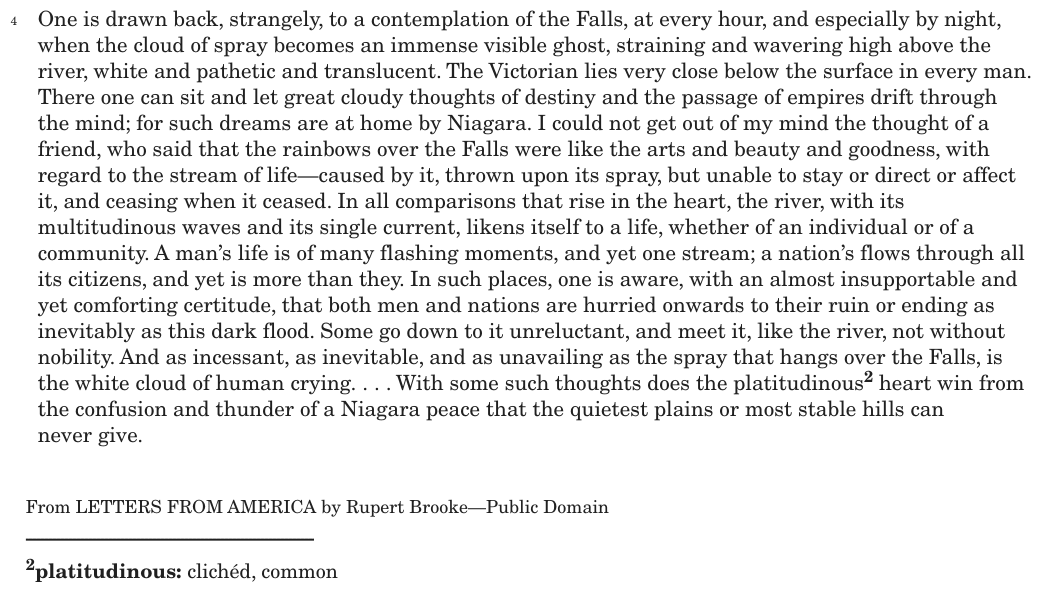
Question 26 of 57
2018 Test B English, question 26Uses the passage above: “Excerpt from “Niagara Falls””.
Question
Read this sentence from paragraph 2.
They are extraordinarily level, one long curtain of lacework and woven foam.
What is the effect of comparing the American Falls to a “long curtain of lacework and woven foam”?
- AIt demonstrates the timelessness of the American Falls.
- BIt conveys the secretive nature of the American Falls.
- CIt illustrates the elegant uniformity of the American Falls.
- DIt communicates the intense strength of the American Falls.
Show the answer
Correct answer: C
The question asks for the effect of the comparison being made in the sentence in paragraph 2. The word “lacework” in the sentence suggests an elegant piece of craftsmanship, and the “one long curtain” and “extraordinarily level” aspects of the Falls mean that the Falls are uniform or consistent; therefore, Option C is correct.
Option A is incorrect because neither “lacework and woven foam,” nor the quality of being extremely level, are related to timelessness.
Option B is incorrect because, while a curtain may suggest the idea of something being hidden or secret, the description of a delicate “lacework” curtain does not suggest this purpose.
Option D is incorrect because “lacework” is generally fragile and does not suggest great strength.
Question analysis
In this figurative language question, students explain the effect of a comparison in Rupert Brooke’s “Niagara Falls”: the American Falls as “one long curtain of lacework and woven foam.” They need to picture the image and read the sentences around it, since a curtain, lace and foam can each call up quite different qualities.
- Grade level
- Grade 7 reading and task
- Compared with grade 7
- At grade 7 Explaining the effect of a metaphor in a quoted sentence is routine grade 7 work. The older prose is harder than most grade 7 texts, but the sentences around this one give direct context clues.
- Estimated difficulty
- Straightforward: two steps or one careful reading.
- Thinking it demands
- Depth of knowledge 2, skills and concepts · mainly analyze
- What makes it hard
- Figurative or literary language moderate
- Hard words minor
- Evidence
- Answered from one sentence or line
- Reading level
- Passage: about grade 9, 987 words; question and choices: about grade 10, 70 words.
- Students, last 30 days
- Not enough answers yet to show (it takes 10).
Why it is hard, traps and wrong answers (shows the answer)
Why it is hard
The image is clear once pictured, and the sentences around it, about the American Falls being “delicate and fragile” and “extraordinarily level,” confirm what it means. Students go wrong by bringing in what they associate with curtains or with Niagara in general, hiding or power, instead of what this curtain is made of. The right choice also uses an abstract word that has to be connected back to “level.”
Figurative or literary language moderate Understanding the question
Students must translate “one long curtain of lacework and woven foam” into qualities: lace is delicate and finely made, and one long level curtain is even from end to end. (Graesser, Singer & Trabasso, 1994; Kintsch, 1998)
Hard words minor Understanding the question
The right choice uses “uniformity,” which students must link to “extraordinarily level” and “one long curtain,” just as “elegant” must be linked to the lacework. (Perfetti, 2007; Freedle & Kostin, 1993)
Strategy: Picture the image first, then reread the few sentences around it about the American Falls and keep only the choice that both the image and those sentences support.
Traps
- Wrong part of the text: A choice is true of another paragraph, stanza or speaker than the one asked about.
- Dictionary meaning, not meaning here: A common meaning of the word that does not fit its use in this text.
The wrong answers, classified
A Little reason to choose it (Haladyna & Downing, 1993; Rodriguez, 2005)
Nothing in lace, foam or a level edge suggests lasting through time, so this attracts mainly students guessing that a natural wonder must seem timeless.
B Dictionary meaning, not meaning here (Perfetti, 2007)
Uses the common sense of a curtain as something that hides, but this curtain is lacework, open and decorative, and nothing behind it is concealed.
D Wrong part of the text (Kirsch & Mosenthal, 1990)
Carries over the “colossal power” of paragraph 1, though paragraph 2 says the American Falls do not inspire that feeling as the Canadian do and calls their beauty fragile.
Working it out, step by step
Figure out what the question asks
This asks about the effect of a comparison. The author compares the American Falls to “one long curtain of lacework and woven foam.” What quality does that picture give them?
Read the sentence and its neighbor
The full sentence is “They are extraordinarily level, one long curtain of lacework and woven foam.” The sentence just before it says, “By comparison their beauty is almost delicate and fragile.”
Picture the comparison
Lacework is fancy cloth with fine, delicate patterns. It looks elegant, which means graceful and beautiful. “Extraordinarily level” and “one long curtain” mean the Falls are even all the way across, with no breaks. That evenness is uniformity: being the same all the way through. So the picture shows elegant uniformity.
Check each choice
- A is wrong. Nothing about lace or foam suggests lasting forever.
- B is wrong. A curtain can hide things, but lace is open and see-through. Nothing is hidden.
- C is right. Lace is elegant, and a level curtain is uniform.
- D is wrong. Lace is fragile, not strong.
Watch out: Paragraph 1 talks about “colossal power,” so D can seem right. But paragraph 2 says the American Falls “do not inspire this feeling” the way the Canadian Falls do.
Choose the answer
The lace curtain makes the American Falls look graceful and even. So the answer is C.
Why this answer and not the closest wrong one
D is the closest wrong answer, because the Falls seem powerful in other parts of the essay. But this sentence is about the American Falls, whose beauty is “delicate and fragile.” Lace is delicate, not strong. A smooth, level curtain of lace shows grace and evenness, as C says.
More questions like this
The original DOE question
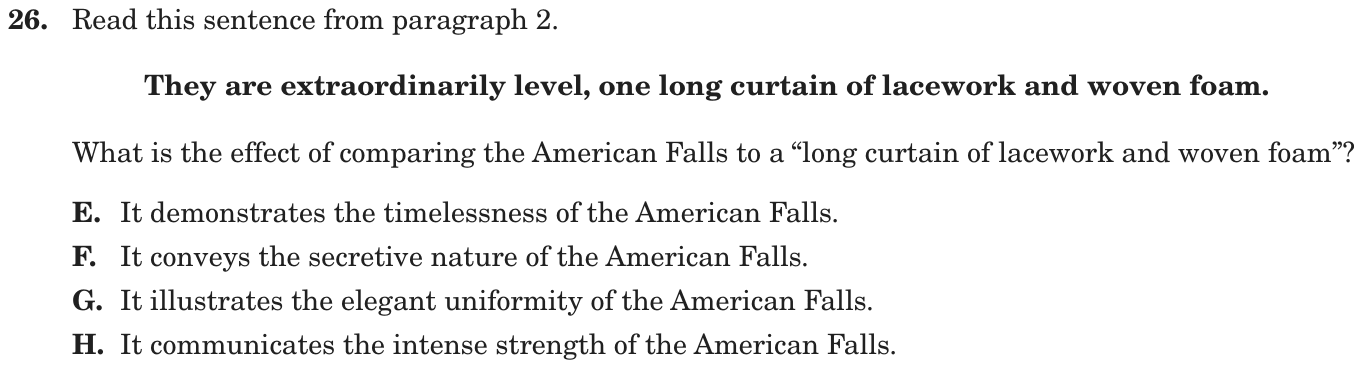
Question 27 of 57
2018 Test B English, question 27Uses the passage above: “Excerpt from “Niagara Falls””.
Question
Read this sentence from paragraph 3.
These are the lower rapids, a sight more terrifying than the Falls, because less intelligible.
Which statement best describes how the sentence fits into the overall structure of the excerpt?
- AIt signals a change from the positive aspects of the Falls to the negative aspects.
- BIt indicates a progression from the literal description of the water to a discussion of timeless truths.
- CIt highlights a shift from the qualities of the Falls to the qualities of the river.
- DIt introduces a contrast between the obvious and the hidden features of the rapids.
Show the answer
Correct answer: C
The question asks for the statement that best describes how the sentence from paragraph 3 fits into the overall structure of the excerpt. The first sentence of paragraph 3 moves the description “beyond the foot of the Falls” to “the river” and then begins to describe this location before confirming it again with the words “these are the lower rapids.” This emphasis on the shift in location is best stated in Option C, making it the correct response.
Option A is incorrect because, as the first sentence in paragraph 3 states, the paragraph describes the river and not aspects of the Falls.
Option B is incorrect because the entire paragraph describes only the literal movements of the river.
Option D is incorrect because the features of the rapids, as described in paragraph 3, are all obvious and not hidden.
Question analysis
This text structure question asks how a sentence about the lower rapids fits into the overall organization of Rupert Brooke’s excerpt about Niagara Falls. Students need a mental map of all four paragraphs, because every choice describes a believable shift in the essay and only a clear sense of what each paragraph covers separates them.
- NYS standards
- 7R5 structure and genre features
- Grade level
- Grade 8 reading and task
- Compared with grade 7
- Above grade 7 Grade 7 structure questions usually ask what one paragraph does; this one asks how a mid-paragraph sentence fits the whole essay, which requires summarizing four dense paragraphs of century-old prose.
- Estimated difficulty
- Hard: combines ideas, needs a plan, and has more than one tempting wrong answer.
- Thinking it demands
- Depth of knowledge 3, strategic thinking · mainly analyze
- What makes it hard
- How, not what major
- Much to keep track of moderate
- Hard words moderate
- Evidence
- Answered from several paragraphs or stanzas
- Reading level
- Passage: about grade 9, 987 words; question and choices: about grade 8, 97 words.
- Students, last 30 days
- Not enough answers yet to show (it takes 10).
Why it is hard, traps and wrong answers (shows the answer)
Why it is hard
Structure questions about a single sentence are hard when the sentence itself compares two things, here the rapids and the Falls. Students lose the point by choosing a shift that does occur somewhere in the excerpt, or by reading “more terrifying” as the first negative note in an essay that has been about terror from its first line. Placing the sentence means seeing that paragraph 3 leaves the Falls for the river.
How, not what major Working it out
The question asks where the sentence sits in the excerpt’s plan, and its own words mislead: it names “the Falls” and “terrifying,” though its role is to name the new subject, the river’s lower rapids. (Anderson & Krathwohl, 2001)
Much to keep track of moderate Working it out
Students need a map of four long paragraphs at once, the Falls’ power, the two Falls’ beauty, the river below, and night reflections, to see what changes at this sentence. (Sweller, 1988; Carpenter, Just & Shell, 1990)
Hard words moderate Understanding the question
“Less intelligible” means harder to understand, and students who take it to mean less visible are led toward a contrast between obvious and hidden features. (Perfetti, 2007; Freedle & Kostin, 1993)
Strategy: Before reading the choices, jot a few words on what each paragraph is about, then see what changes just before and after this sentence.
Traps
- Wrong part of the text: A choice is true of another paragraph, stanza or speaker than the one asked about.
The wrong answers, classified
A Twists what the text says (King et al., 2004)
Hears “more terrifying” as a turn from the Falls’ beauty to their dangers, but the rapids are not the Falls, and paragraphs 1 and 2 already describe the Falls’ terror.
B Wrong part of the text (Kirsch & Mosenthal, 1990)
Names a real progression in the excerpt, from description to reflections on destiny and empires, but that turn comes with paragraph 4, not with the rapids.
D Wrong purpose or structure (Anderson & Krathwohl, 2001)
Reads “less intelligible” as less visible and sees a contrast between obvious and hidden features, though the surging, leaping rapids are described in full view.
Working it out, step by step
Figure out what the question asks
This asks about structure: how the essay is put together. What change in the essay does this sentence mark?
Map the four paragraphs
- Paragraph 1: the power of the Falls.
- Paragraph 2: the beauty of the two Falls, and the trip behind them.
- Paragraph 3: the river below the Falls and its rapids.
- Paragraph 4: thoughts about life and history while watching the Falls.
See what changes in paragraph 3
Paragraph 3 begins “Beyond the foot of the Falls the river is like a slipping floor of marble.” “Beyond the foot” means past the bottom. The author has moved down the river. Then this sentence names the new place: “These are the lower rapids.” Rapids are parts of a river where water rushes fast over rocks. So the sentence marks a shift from the Falls to the river.
Check each choice
- A is wrong. The terror of the Falls was already in paragraph 1. And the rapids are not the Falls.
- B is wrong. The essay does move to deep thoughts, but that happens in paragraph 4.
- C is right. The focus moves from the Falls to the river.
- D is wrong. “Less intelligible” means harder to understand, not hidden. The rapids are in plain view.
Watch out: B names a real shift in the essay, but in the wrong place.
Choose the answer
The sentence names a new part of the river to describe. So the answer is C.
Why this answer and not the closest wrong one
B is the closest wrong answer, because the essay really does move from describing water to thinking about life. But that turn comes in paragraph 4, with “thoughts of destiny.” This sentence still describes water, just a different part of it. That is the shift in C.
More questions like this
The original DOE question
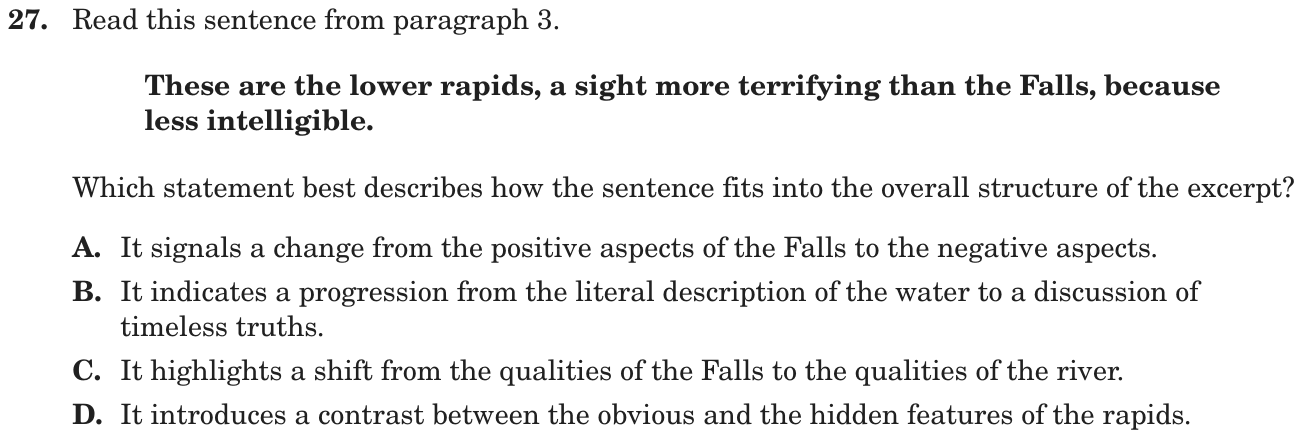
Question 28 of 57
2018 Test B English, question 28Uses the passage above: “Excerpt from “Niagara Falls””.
Question
Which sentence from the excerpt best supports the idea that the essence of the Falls lies in their emotional impact?
- A“If that were taken away, there would be little visible change, but the heart would be gone.” (paragraph 1)
- B“By comparison their beauty is almost delicate and fragile.” (paragraph 2)
- C“One is drawn back, strangely, to a contemplation of the Falls, at every hour, and especially by night, when the cloud of spray becomes an immense visible ghost, straining and wavering high above the river, white and pathetic and translucent.” (paragraph 4)
- D“A man’s life is of many flashing moments, and yet one stream; a nation’s flows through all its citizens, and yet is more than they.” (paragraph 4)
Show the answer
Correct answer: A
The question asks for the sentence from the excerpt that best supports the idea that the essence of the Falls lies in their emotional impact. The first sentence in the excerpt establishes that the “real secret of the beauty and terror of the Falls” is “the feeling of colossal power and of unintelligible disaster.” Option A is correct because the sentence in Option A best supports this notion by identifying these qualities as “the heart,” or essence, of the Falls.
While “delicate” and “fragile” are words that can be connected with certain kinds of emotions, in the sentence in Option B, they are connected with physical beauty, so Option B is incorrect.
Option C is incorrect because, while the sentence in Option C describes the power of the Falls to engage one in thought, it does not best support the idea that the essence of the Falls lies in their emotional impact.
Option D is incorrect because the sentence in Option D describes thoughts one may have while watching the Falls and is not focused on the Falls’ emotional impact.
Question analysis
In this textual evidence question, students choose the quotation from Rupert Brooke’s “Niagara Falls” that best supports the idea that the essence of the Falls lies in their emotional impact. Every choice is a vivid sentence from the excerpt, so the challenge is matching that precise idea instead of settling for a line that only sounds emotional.
- Grade level
- Grade 8 reading and task
- Compared with grade 7
- At grade 7 Grade 7 evidence questions usually offer one sentence that clearly matches the claim. Here all four quotations are long or figurative lines of older prose, and the claim itself, about an essence, is abstract.
- Estimated difficulty
- Moderate: several steps, or a close reading with one strong distractor.
- Thinking it demands
- Depth of knowledge 2, skills and concepts · mainly evaluate
- What makes it hard
- Reading between the lines moderate
- Hard words minor
- Evidence
- Answered from one paragraph or stanza
- Reading level
- Passage: about grade 9, 987 words; question and choices: about grade 11, 115 words.
- Corrected from the DOE handbook
- A misquotation of the passage in the explanation was corrected.
- A stray apostrophe in the explanation was removed.
- Students, last 30 days
- Not enough answers yet to show (it takes 10).
Why it is hard, traps and wrong answers (shows the answer)
Why it is hard
Every quotation carries feeling, so the test is whether a sentence says what the Falls’ essence is, not merely whether it is emotional. The right one is short and plain and depends on the sentence before it, which defines “that” as the feeling of power and disaster. Students who choose by the intensity of the language pass over it for the ghostly night scene or the reflections on life.
Reading between the lines moderate Working it out
The right sentence never says “emotion” or “essence”: students must see that “that” points back to “the feeling of colossal power,” and that “the heart” means the essence. (Graesser, Singer & Trabasso, 1994; Kintsch, 1998)
Hard words minor Understanding the question
The claim’s key word, “essence,” has to be matched to the text’s “real secret” and “heart,” two everyday words used here in an abstract sense. (Perfetti, 2007; Freedle & Kostin, 1993)
Strategy: Restate the idea in your own words, that the Falls matter because of how they make people feel, and test each quotation: does it say what the Falls’ essence is, or something else?
Traps
- Supports only part of the claim: In a question about evidence: a line that backs one half of the claim but not the other, or a related point rather than the claim itself.
The wrong answers, classified
B Supports only part of the claim (King et al., 2004; Thissen, Steinberg & Fitzpatrick, 1989)
Treats “delicate and fragile” as emotional words, but the sentence describes how the American Falls look beside the Canadian, not where the essence of the Falls lies.
C Supports only part of the claim (King et al., 2004; Thissen, Steinberg & Fitzpatrick, 1989)
Backs the emotional half, the spray as an “immense visible ghost” that draws people back, but describes the Falls’ pull without saying that their essence lies there.
D Supports only part of the claim (King et al., 2004; Thissen, Steinberg & Fitzpatrick, 1989)
Chooses a moving reflection the Falls inspire, but this sentence is about how a river resembles human lives and nations, not about the Falls’ emotional impact.
What was corrected from the DOE handbook, and why
- Explanation: The handbook quotes the first sentence as saying the “real secret of the beauty and terror of the Falls . . . lies in the feeling of colossal power and unintelligible disaster.” The passage says the real secret “is not their height or width, but the feeling of colossal power and of unintelligible disaster.” The site now quotes it exactly.
- Explanation: The handbook writes “the power of the Falls’ to engage one in thought”; the site drops the stray possessive apostrophe: “the power of the Falls to engage one in thought.”
Working it out, step by step
Figure out what the question asks
This asks for evidence for an idea: the essence of the Falls lies in their emotional impact. “Essence” means the most important part, what makes something what it is. “Emotional impact” means the way it makes people feel.
Read the opening of paragraph 1
The essay begins: “The real secret of the beauty and terror of the Falls is not their height or width, but the feeling of colossal power and of unintelligible disaster.” So the real secret of the Falls is a feeling.
Read the sentence that comes next
Next comes: “If that were taken away, there would be little visible change, but the heart would be gone.” “That” means the feeling. Take the feeling away, and the Falls would look the same. But “the heart” would be gone. Here, the heart means the most important part, the essence. So the essence is the feeling.
Check each choice
- A is right. It says the Falls would lose their heart without the feeling they create.
- B is wrong. It compares how the two Falls look, not what their essence is.
- C is wrong. It shows the Falls pull people back, but it never says the feeling is their essence.
- D is wrong. It compares a river to human lives and nations.
Watch out: C is full of feeling, with the spray like a ghost. But it describes a view, not what the Falls truly are.
Choose the answer
Only A says that the feeling is the heart of the Falls. So the answer is A.
Why this answer and not the closest wrong one
C is the closest wrong answer, because it is an emotional description. But it does not say where the essence of the Falls lies. A does. Without the feeling, almost nothing you can see would change, yet “the heart would be gone.”
More questions like this
The original DOE question
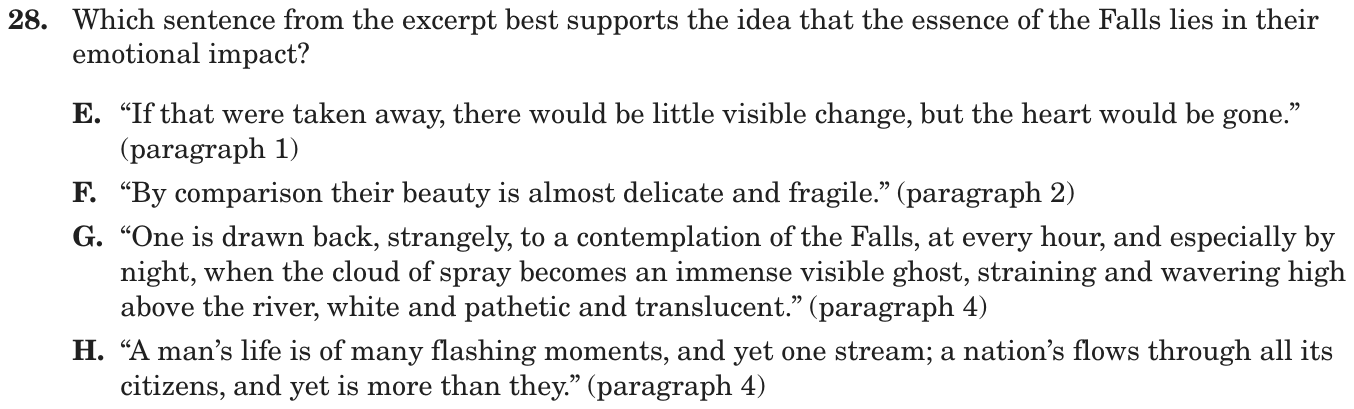
Question 29 of 57
2018 Test B English, question 29Uses the passage above: “Excerpt from “Niagara Falls””.
Question
Read this sentence from paragraph 4.
There one can sit and let great cloudy thoughts of destiny and the passage of empires drift through the mind; for such dreams are at home by Niagara.
The sentence most contributes to the development of ideas in the excerpt by
- Asuggesting that viewing the Falls can be a life-changing experience.
- Bshowing that the cliffs of the Falls are a good place for self-examination.
- Cemphasizing that the grandeur of the Falls seems impossible to grasp.
- Dhighlighting the type of reflection that is inspired by a visit to the Falls.
Show the answer
Correct answer: D
The question asks how the sentence from paragraph 4 contributes to the development of ideas in the excerpt.
The description of “cloudy thoughts of destiny and the passage of empires” in the sentence refers to the types of thoughts a person might have while observing the Falls, as stated in Option D.
Option A is incorrect because the sentence focuses on the idea that the Falls are a place of great contemplation but does not clarify that these thoughts are life-changing.
Option B is incorrect because the sentence does not describe focused thoughts of a personal nature; the grand, sweeping nature of the Falls inspires thoughts of the same caliber as “the passage of empires.”
Option C is incorrect because the sentence is about how the Falls inspire great thoughts but is not about how difficult it is to grasp the grandeur of the Falls.
Question analysis
This question asks how a sentence near the end of Rupert Brooke’s “Niagara Falls” contributes to the development of ideas in the excerpt. Students must make sense of abstract phrases such as “cloudy thoughts of destiny” and “the passage of empires” and then decide exactly what the sentence adds, since several choices sound close.
- Grade level
- Grade 8 reading and task
- Compared with grade 7
- At grade 7 Explaining how a sentence develops ideas is a grade 7 skill, and this sentence is quoted in full. The challenge is its abstract, old-fashioned wording, which a grade 7 reader must translate before comparing the choices.
- Estimated difficulty
- Moderate: several steps, or a close reading with one strong distractor.
- Thinking it demands
- Depth of knowledge 2, skills and concepts · mainly analyze
- What makes it hard
- A very close wrong answer moderate
- Figurative or literary language moderate
- Hard words minor
- Evidence
- Answered from one paragraph or stanza
- Reading level
- Passage: about grade 9, 987 words; question and choices: about grade 7, 94 words.
- Corrected from the DOE handbook
- A grammar slip in the explanation was corrected.
- Students, last 30 days
- Not enough answers yet to show (it takes 10).
Why it is hard, traps and wrong answers (shows the answer)
Why it is hard
The sentence is about thinking, and most of the choices describe thinking too, so the difference lies in what kind of thought and how much the sentence claims. Students lose the point by inflating daydreams into a life-changing experience or by turning thoughts about empires into self-examination. Paraphrasing the sentence before reading the choices, people sit by the Falls and think about destiny and history, keeps the right one in view.
A very close wrong answer moderate Choosing the answer
The self-examination choice and the right one both say the Falls prompt reflection; they differ in one detail, what the thoughts are about, and the sentence’s “destiny and the passage of empires” is not the self. (Embretson & Wetzel, 1987; Gorin & Embretson, 2006; Ascalon et al., 2007)
Figurative or literary language moderate Understanding the question
“Great cloudy thoughts” drifting through the mind borrow the image of the Falls’ spray, and “such dreams are at home by Niagara” treats the Falls as the natural home of this kind of daydream. (Graesser, Singer & Trabasso, 1994; Kintsch, 1998)
Hard words minor Understanding the question
“The passage of empires” and “destiny” are abstract, and students who cannot pin them down may not see that the thoughts concern history, not the thinker. (Perfetti, 2007; Freedle & Kostin, 1993)
Strategy: Paraphrase the sentence in plain words first, then test each choice against your paraphrase, rejecting any that adds a claim the sentence does not make.
Traps
- Too broad or too strong: A choice overstates, generalizes, or uses absolute words the text does not support.
- Wrong part of the text: A choice is true of another paragraph, stanza or speaker than the one asked about.
The wrong answers, classified
A Too broad or too strong (King et al., 2004)
Inflates the sentence’s daydreaming into a life-changing experience, though the author says only that great thoughts drift through the mind, not that they change anyone.
B Twists what the text says (King et al., 2004)
Turns the reflection inward, but the thoughts named are of “destiny and the passage of empires,” history on a grand scale, and the sentence says nothing about cliffs.
C Wrong part of the text (Kirsch & Mosenthal, 1990)
Borrows the earlier idea that the Falls and rapids are hard to understand, from paragraphs 1 and 3, but this sentence is about the thoughts they inspire.
What was corrected from the DOE handbook, and why
- Explanation: The handbook writes “the grand, sweeping nature of the falls inspire thoughts.” The subject “nature” takes “inspires,” and the passage always capitalizes “the Falls,” so the site now reads “the grand, sweeping nature of the Falls inspires thoughts.”
Working it out, step by step
Figure out what the question asks
This asks what one sentence adds to the essay’s ideas. Put the sentence in plain words first, then test each choice against it.
Read the sentence closely
The sentence says: “There one can sit and let great cloudy thoughts of destiny and the passage of empires drift through the mind; for such dreams are at home by Niagara.”
Put it in plain words
“Destiny” means what is meant to happen in the future. “The passage of empires” means great nations rising and falling over time. “At home by Niagara” means these dreams fit naturally at the Falls. So sitting by the Falls makes you think big thoughts about fate and history. The sentence names the kind of reflection, or deep thinking, the Falls bring on.
Check each choice
- A is wrong. Thoughts drift by, but nothing says they change a person’s life.
- B is wrong. The thoughts are about history and fate, not about yourself. The sentence doesn’t mention cliffs.
- C is wrong. This sentence is about the thoughts the Falls inspire, not about how hard they are to grasp.
- D is right. It names the type of thinking a visit to the Falls brings on.
Watch out: B is close, since both B and D are about reflection. Check what the thoughts are about: empires, not yourself.
Choose the answer
The sentence shows what kind of thoughts the Falls inspire. So the answer is D.
Why this answer and not the closest wrong one
B is the closest wrong answer, because both B and D say the Falls make people reflect. The difference is the topic. Self-examination means thinking about yourself. The sentence names “thoughts of destiny and the passage of empires.” Those are big ideas about history, not about the self.
More questions like this
The original DOE question
Question 30 of 57
2018 Test B English, question 30Uses the passage above: “Excerpt from “Niagara Falls””.
Question
In paragraph 4, the idea that human life and history travel toward the same ending is illustrated mainly through
- Athe discussion of how the rainbows visible in the Falls are like the art and beauty created by humankind.
- Bthe comparison between the movement of water in the Falls and the human experience.
- Cthe inclusion of details that show that every observer’s experience with the Falls is different.
- Dthe acknowledgment that contemplating the Falls at night sparks an awareness of humankind’s destiny.
Show the answer
Correct answer: B
The question asks how the discussion of human life and history is illustrated in paragraph 4 of the excerpt. The author concludes in paragraph 4 that the Falls can be compared to people and history by writing, “both men and nations are hurried onwards to their ruin or ending as inevitably as this dark flood,” making Option B correct.
Option A is incorrect because the discussion of rainbows in paragraph 4 focuses on the fate of art and beauty, not of humanity (“I could not get out of my mind the thought of a friend, who said that the rainbows over the Falls were like the arts and beauty and goodness, with regard to the stream of life—caused by it, thrown upon its spray, but unable to stay or direct or affect it, and ceasing when it ceased”).
Option C is incorrect because, in paragraph 4, the author talks about people in general when discussing “men and nations” and provides no evidence of the differences in specific individuals’ experience of the Falls.
Option D is incorrect because, while the setting at night does provide a place of contemplation, the author notes the “dark flood” as the overall illustration of the human experience.
Question analysis
In this question about the closing paragraph of Brooke’s “Niagara Falls,” students identify the main way the author illustrates the idea that human lives and history move toward the same ending. The paragraph is dense and philosophical and holds several images and reflections, so students must find the one that carries this particular idea.
- Grade level
- Grade 8 reading and task
- Compared with grade 7
- Above grade 7 Grade 7 students often trace how an idea is illustrated in a modern text; this paragraph is abstract reflection in long, formal sentences, with words like “certitude” and “multitudinous,” and offers several competing images to sort through.
- Estimated difficulty
- Hard: combines ideas, needs a plan, and has more than one tempting wrong answer.
- Thinking it demands
- Depth of knowledge 2, skills and concepts · mainly analyze
- What makes it hard
- Complex sentences major
- The right answer is reworded moderate
- Hard words minor
- Evidence
- Answered from one paragraph or stanza
- Reading level
- Passage: about grade 9, 987 words; question and choices: about grade 10, 80 words.
- Students, last 30 days
- Not enough answers yet to show (it takes 10).
Why it is hard, traps and wrong answers (shows the answer)
Why it is hard
Paragraph 4 holds three images, the night spray as a ghost, the friend’s rainbows, and the river as a life, and the question asks which one carries the idea of a shared ending. Students who recognize the stem’s idea in the word “destiny” or in rainbows “ceasing when it ceased” can stop too soon. The test is the word “illustrated”: only the comparison of the dark flood to men and nations shows them traveling to an end.
Complex sentences major Understanding the question
The key sentence buries its point in qualifiers: “one is aware, with an almost insupportable and yet comforting certitude, that both men and nations are hurried onwards to their ruin or ending as inevitably as this dark flood.” (Abedi & Lord, 2001; Freedle & Kostin, 1993; Messick, 1989)
The right answer is reworded moderate Choosing the answer
The right choice sums up the river-as-life comparison in plain words, “movement of water” and “human experience,” while wrong choices reuse the paragraph’s own “rainbows,” “art and beauty,” “night” and “destiny.” (Freedle & Kostin, 1993; Kirsch & Mosenthal, 1990)
Hard words minor Understanding the question
“Multitudinous,” “certitude,” “insupportable” and “unavailing” all fall in the sentences that carry the idea, so students must read through them to reach the comparison. (Perfetti, 2007; Freedle & Kostin, 1993)
Strategy: Locate the sentences in paragraph 4 about what happens to people and nations, then decide which choice best describes how those sentences make their point.
Traps
- Supports only part of the claim: In a question about evidence: a line that backs one half of the claim but not the other, or a related point rather than the claim itself.
- Outside knowledge: A choice is plausible in the real world but not supported by this text.
The wrong answers, classified
A Supports only part of the claim (King et al., 2004; Thissen, Steinberg & Fitzpatrick, 1989)
Picks the friend’s rainbow comparison, which is in paragraph 4 and does end “ceasing when it ceased,” but the ending it shows belongs to art and beauty, not people and nations.
C Outside knowledge (King et al., 2004; Recht & Leslie, 1988)
Brings in the commonsense idea that every visitor sees the Falls differently, but the paragraph speaks of “one” and of men and nations in general, never of differences.
D Supports only part of the claim (King et al., 2004; Thissen, Steinberg & Fitzpatrick, 1989)
Combines the night view with “thoughts of destiny,” both in the paragraph, but those describe when reflection happens, not the image that shows lives and nations sharing an end.
Working it out, step by step
Figure out what the question asks
This asks how paragraph 4 shows one idea: that people and nations all move toward the same ending. You need the main way the author makes that point.
Find the sentences about people and nations
Paragraph 4 says the river, “with its multitudinous waves and its single current, likens itself to a life, whether of an individual or of a community.” Later it says “both men and nations are hurried onwards to their ruin or ending as inevitably as this dark flood.”
Put the comparison in plain words
“Multitudinous” means very many. The river has many waves but one current. In the same way, a life has many moments but one path. “Inevitably” means in a way that cannot be stopped. The water rushes over the Falls no matter what. Every person and every nation reaches an end, too. The author shows this by comparing the moving water to human life.
Check each choice
- A is wrong. The rainbows stand for art and beauty, not for people and nations.
- B is right. The river’s rush to its end is compared to human lives and history.
- C is wrong. The author speaks of people in general. He never shows observers seeing the Falls differently.
- D is wrong. Night is when the thinking happens. It is not the picture that shows the shared ending.
Watch out: D uses real details from paragraph 4, night and destiny. But they tell when the author thinks, not how he shows the idea.
Choose the answer
The idea is shown through the river and its comparison to people. So the answer is B.
Why this answer and not the closest wrong one
D is the closest wrong answer, because paragraph 4 does mention night and “thoughts of destiny.” But those details only set the scene for thinking. The shared ending is shown through the river: people and nations are hurried onward like the dark flood. That comparison is B.
More questions like this
The original DOE question
Question 31 of 57
2018 Test B English, question 31Uses the passage above: “Excerpt from “Niagara Falls””.
Question
With which statement would the author of this excerpt most likely agree?
- AA sense of ease and assurance comes with accepting one’s fate.
- BNo matter where one’s path goes in life, one will always have regrets.
- CThe best way to overcome fear is to recognize it and then defy it.
- DReason will die out with humanity, but art will remain immortal.
Show the answer
Correct answer: A
The question asks for the statement the author would agree with most. In paragraph 4, the author states that the Falls make a person feel “with an almost insupportable and yet comforting certitude, that both men and nations are hurried onwards to their ruin or ending.” Later, the final sentence says, “With some such thoughts does the platitudinous heart win from the confusion and thunder of a Niagara peace.” This sentence supports the author’s belief that a person can find peace in accepting the certainty of his or her own ending, as expressed in Option A.
Option B is incorrect because the author does not discuss regrets in the excerpt.
Option C is incorrect because, while the excerpt discusses fear when looking at the power of the Falls, the excerpt does not support the idea that one should defy fear.
Option D is incorrect because the excerpt states in paragraph 4 that art and beauty are “caused by” the stream of life and end with it, “ceasing when it ceased.”
Question analysis
This question asks students to infer which statement about life the author of “Niagara Falls” would most likely agree with, based on the reflections that close his essay. It is hard because the evidence sits in long, abstract sentences of century-old prose and must be pieced together from more than one place in the final paragraph.
- Grade level
- Grade 9 reading and task
- Compared with grade 7
- Above grade 7 Grade 7 point-of-view questions usually rest on a clearly stated opinion. Here the author’s view must be pieced together from abstract reflection on lives, nations and the river, with words like “insupportable” and “platitudinous,” which is closer to high school reading.
- Estimated difficulty
- Among the hardest on the SHSAT: a non-obvious approach, heavy reading, or a well-hidden trap.
- Thinking it demands
- Depth of knowledge 3, strategic thinking · mainly analyze
- What makes it hard
- Reading between the lines major
- Complex sentences major
- The right answer is reworded moderate
- Hard words moderate
- Evidence
- Answered from one paragraph or stanza
- Reading level
- Passage: about grade 9, 987 words; question and choices: about grade 6, 61 words.
- Corrected from the DOE handbook
- A misreading of a word in the passage was corrected in the explanation.
- Students, last 30 days
- Not enough answers yet to show (it takes 10).
Why it is hard, traps and wrong answers (shows the answer)
Why it is hard
This question asks for the author’s outlook, which he reaches only in the closing sentences of a long, abstract paragraph. The mood there is gloomy, with ruin, a dark flood and human crying, so students who read the mood but not the argument choose regret. The comfort and peace he finds in that certainty are easy to miss in the inverted final sentence, and they are exactly what the answer rests on.
Reading between the lines major Working it out
The author never states a belief; students must combine “comforting certitude,” people who meet their end “unreluctant” and “not without nobility,” and the closing “peace” into an attitude of accepting fate. (Graesser, Singer & Trabasso, 1994; Kintsch, 1998)
Complex sentences major Understanding the question
The last sentence inverts normal order, “With some such thoughts does the platitudinous heart win from the confusion and thunder of a Niagara peace,” so its subject and object are hard to find. (Abedi & Lord, 2001; Freedle & Kostin, 1993; Messick, 1989)
The right answer is reworded moderate Choosing the answer
The right statement uses none of the passage’s words, turning “certitude” into “assurance” and “peace” into “ease,” while wrong choices pick up “fear” and “art.” (Freedle & Kostin, 1993; Kirsch & Mosenthal, 1990)
Hard words moderate Understanding the question
“Certitude,” “unreluctant,” “unavailing” and “platitudinous” carry the author’s attitude, and the glossary defines only the last of them. (Perfetti, 2007; Freedle & Kostin, 1993)
Strategy: Reread the second half of paragraph 4 slowly, translating each long sentence into plain words, then choose the statement those lines support without adding ideas the author never mentions.
Traps
- Outside knowledge: A choice is plausible in the real world but not supported by this text.
- Reads too much in: A reasonable-sounding conclusion that goes further than the text allows.
The wrong answers, classified
B Reads too much in (Graesser, Singer & Trabasso, 1994)
Reads “the white cloud of human crying” and the dark flood as a claim about lifelong regret, though the author never mentions regret and finds comfort in the end.
C Outside knowledge (King et al., 2004; Recht & Leslie, 1988)
Falls back on familiar advice about facing fears, prompted by the excerpt’s talk of terror, but the author recommends accepting what is inevitable, not defying it.
D Twists what the text says (King et al., 2004)
Reverses the friend’s rainbow comparison: art and beauty are “caused by” the stream of life and end with it, “ceasing when it ceased,” so art is not immortal.
What was corrected from the DOE handbook, and why
- Explanation: The handbook rejects Option D because paragraph 4 says art is “unable to stay.” In the passage, art and beauty are “unable to stay or direct or affect” the stream of life: “stay” means to stop or hold back the stream, not to last. What shows that art is not immortal is that it is “caused by” the stream of life and ends with it, “ceasing when it ceased,” which the site now quotes.
Working it out, step by step
Figure out what the question asks
This asks which statement the author would most likely agree with. He never states his belief outright, so you must infer it from his words, especially at the end of paragraph 4.
Find what he says about endings
In paragraph 4, he says that at Niagara one feels “with an almost insupportable and yet comforting certitude” that people and nations reach an end. He adds: “Some go down to it unreluctant, and meet it, like the river, not without nobility.” His last sentence says the heart can “win from the confusion and thunder of a Niagara peace.”
Put his words in plain English
“Certitude” means being sure. “Insupportable” means too hard to bear. So knowing that everything ends is hard, yet it is also comforting. “Unreluctant” means willing. Some people meet their end willingly, with dignity. And the Falls give the heart peace. Put together: accepting what must happen brings calm.
Check each choice
- A is right. He finds comfort and peace in accepting fate. That is “ease and assurance.”
- B is wrong. He never mentions regrets.
- C is wrong. He talks about accepting what must happen, not about fighting fear.
- D is wrong. Art and beauty are “caused by” life and end with it, “ceasing when it ceased.” So art does not last forever.
Watch out: “The white cloud of human crying” sounds sad, so B may tempt you. But sadness is not regret, and the author ends on peace.
Choose the answer
The author finds calm and comfort in accepting what must come. So the answer is A.
Why this answer and not the closest wrong one
B is the closest wrong answer, because paragraph 4 mentions human crying and ruin. But the author never talks about regret. He calls the certainty of an ending “comforting,” and the essay closes on the word “peace.” Feeling calm by accepting fate is what A says.
More questions like this
The original DOE question
Question 32 of 57
2018 Test B English, question 32Passage Uncovering the Past
Uncovering the Past
Archaeology as a distinct branch of science is only about two centuries old. The first archaeological activities focused largely on the search for clues about earlier human societies. In the nineteenth century, most archaeologists were amateurs trained in ancient languages and history. Many were art historians whose interest lay in the artwork and monuments of ancient civilizations. For the most part, their excavations were aimed at uncovering and removing priceless artwork and other valuable artifacts for museum display. Collectively, these early archaeologists are now considered traditional archaeologists.
Today, however, there is a different approach to archaeology, one that tries to reconstruct the everyday life of people in ancient times by applying the scientific methods of a range of specialized fields. Modern archaeologists take full advantage of available technology. Laptop computers enable digging teams to record their finds at each level of an excavation. With sketchpad computer software, archaeologists can draw their finds in the field. Three-dimensional computer modeling enables researchers to create floor plans and elevations for the structures they uncover. Archaeologists can also use remote sensing technologies such as radar and lidar, which is similar to radar but it uses laser light instead of radio waves. These technologies enable scientists to detect traces of early settlements that are not visible to the human eye.
The excavations at Kourion, a Roman port city on the island of Cyprus in the Mediterranean Sea, serve as an example of the modern approach. Portions of Kourion had been unexpectedly buried by a massive earthquake in the fourth century A.D. Traditional archaeologists were interested primarily in the remains of Kourion’s theater, temple, and classical monuments. They also collected precious objects, such as jewelry, found in nearby tombs. Modern archaeologists, however, have focused their studies and excavations on the settlement itself. This preserved seaport has proved to be a gold mine of important information about everyday life sixteen centuries ago.
During one excavation of a house at Kourion, for example, forensic anthropologists were able to reconstruct the skeleton of a young girl, whom they called Camelia. On the basis of her teeth, they determined her age to be about thirteen, although measurement of her skeleton showed that she was only the size of a modern eleven-year-old. The study of the teeth also confirmed her sex and pointed to her excellent health; Camelia had no cavities. Even after centuries, the forensic scientists could study the physical evidence in ways similar to those used in criminal investigations to determine the circumstances of Camelia’s death.
Other specialists on this excavation included a zooarchaeologist, who identified animal remains, including the skeleton of a mule found near Camelia. Another specialist, a paleobotanist, studied the contents of a bake oven at the site and identified four domesticated grains among the charred crumbs—evidence of a kind of ancient multigrain bread.
Although the archaeologists at this site unearthed a few beautiful items, the excavation did not uncover any priceless artwork for museums. Nonetheless, the archaeological processes used in Kourion have given us a valuable insight into everyday life in a Roman city.
Question
Which of the following best describes the goal of modern archaeology?
- Ato use science to learn how people lived in the past
- Bto find artwork from ancient civilizations
- Cto search for evidence of ancient settlements
- Dto uncover precious objects for display in museums
Show the answer
Correct answer: A
The question asks for a summary of what the goal of modern archaeology is in general. The passage is mostly about how archaeology has evolved from efforts to discover ancient artwork and museum pieces to using technology to piece together a sense of life in early civilizations, which is best described in Option A.
Option B is incorrect because it states the goal of archaeology in the past, not in modern times.
Option C is incorrect because finding settlements is not the goal but just the first step in the modern archaeological process.
Option D is incorrect because it states the goal of traditional, rather than modern, archaeology.
Question analysis
Based on the informational passage “Uncovering the Past,” students identify the goal of modern archaeology. The passage describes two approaches to digging up the past, an older one and today’s, so the question checks whether students can keep the two approaches straight and state the newer one’s purpose.
- Grade level
- Grade 7 reading and task
- Compared with grade 7
- Below grade 7 Easier than most grade 7 central-idea questions: the goal is stated almost directly in the passage, so the task is careful locating and paraphrase rather than interpretation or synthesis.
- Estimated difficulty
- Straightforward: two steps or one careful reading.
- Thinking it demands
- Depth of knowledge 2, skills and concepts · mainly understand
- What makes it hard
- Evidence
- Answered from several paragraphs or stanzas
- Reading level
- Passage: about grade 13, 514 words; question and choices: about grade 6, 43 words.
- Students, last 30 days
- Not enough answers yet to show (it takes 10).
Why it is hard, traps and wrong answers (shows the answer)
Why it is hard
The goal is stated in the first sentence of paragraph 2, so the question mostly rewards keeping the passage’s two approaches apart. Students who skim pick up paragraph 1’s vivid aims, artwork and museum display, and attach them to the wrong group. The subtler loss comes from confusing a modern technique with the purpose it serves.
The right answer is reworded minor Choosing the answer
Paragraph 2 says archaeologists apply “the scientific methods of a range of specialized fields” to “reconstruct the everyday life of people”; the key restates this plainly, while the artwork and museum choices reuse paragraph 1’s exact words. (Freedle & Kostin, 1993; Kirsch & Mosenthal, 1990)
Strategy: Find where the passage first describes today’s approach, put its aim into a few words of your own, and match that to a choice.
Traps
- Wrong part of the text: A choice is true of another paragraph, stanza or speaker than the one asked about.
- Too narrow: A single detail offered as the central idea or a summary, or a summary that keeps minor details and leaves out an essential part.
The wrong answers, classified
B Wrong part of the text (Kirsch & Mosenthal, 1990)
Matches “artwork” and “ancient civilizations” from paragraph 1, which describes the nineteenth-century art historians, the traditional approach that the modern one replaced.
C Too narrow (King et al., 2004)
Detecting “traces of early settlements” with radar and lidar is something modern archaeologists do, but it is one tool serving the goal of reconstructing everyday life, not the goal itself.
D Wrong part of the text (Kirsch & Mosenthal, 1990)
Picks up the aim paragraph 1 states outright, excavations “aimed at uncovering and removing priceless artwork” for museums, which belongs to traditional archaeologists, not to the modern approach.
Working it out, step by step
Figure out what the question asks
This question asks for the main goal of modern archaeology. Archaeology is the study of how people lived long ago, using the things they left behind. The passage describes two groups. First come the early, traditional archaeologists. Then come today’s modern ones. You need the goal of the modern group only.
Find where modern archaeology begins
Paragraph 1 is about the traditional group. Paragraph 2 turns to today. Its first sentence says there is now “a different approach to archaeology, one that tries to reconstruct the everyday life of people in ancient times by applying the scientific methods of a range of specialized fields.” The last paragraph agrees. It says the work at Kourion gave “a valuable insight into everyday life in a Roman city.”
Put the goal in your own words
To reconstruct something is to build it again. Here it means building a picture of daily life from clues. The “scientific methods” are the tools of science, like computers, radar and lab tests. So the goal is this: use science to learn how ordinary people lived long ago. Finding treasure is not the point.
Check each choice
- A fits. It says the same thing in plain words: science, plus how people lived.
- B is wrong. Finding artwork was the goal of the traditional group in paragraph 1.
- C is close but wrong. Radar and lidar help find “traces of early settlements.” But that is a tool and a first step, not the goal.
- D is wrong. Paragraph 1 says digs for “priceless artwork and other valuable artifacts for museum display” were the old goal.
Choose the answer
Modern archaeology uses science to rebuild everyday life in the past. So the answer is A, “to use science to learn how people lived in the past.”
Why this answer and not the closest wrong one
Choice C is the trap. Ask why modern archaeologists look for old settlements. They look so they can learn about daily life there. Finding the place is only a step along the way. Learning how people lived is the goal, and only A says that.
More questions like this
The original DOE question
The passage “Uncovering the Past” as printed (page 138)
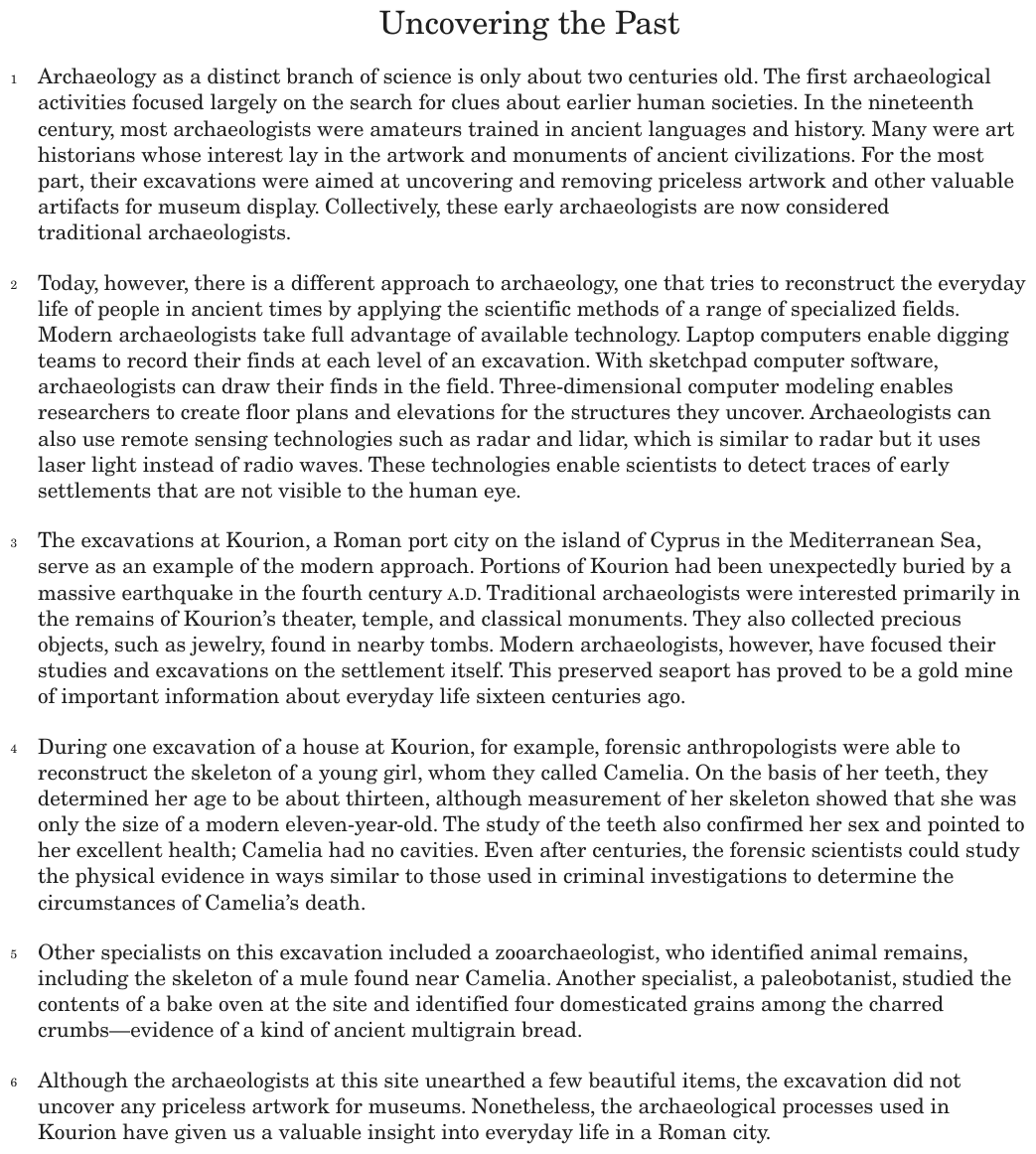
Question 33 of 57
2018 Test B English, question 33Uses the passage above: “Uncovering the Past”.
Question
What would a traditional archaeologist be most interested in finding at a site like Kourion?
- Aa human skeleton
- Bbeautiful jewelry or ceramics
- Cevidence of foods eaten
- Dthe remains of animals
Show the answer
Correct answer: B
The question asks what artifacts a traditional archaeologist would be interested in finding based on the material in the passage. The passage explains that, unlike modern archaeologists, traditional archaeologists are interested in valuable items from the past rather than learning about the people from the past and their lifestyles. Jewelry and ceramics are examples of valuable items, which makes Option B correct.
Option A is incorrect because human skeletons would be valuable to modern archaeologists, not traditional archaeologists.
Option C is incorrect because it is a detail that relates to modern archaeologists’ efforts to study people, not just valuable items.
Option D is incorrect because the remains of animals would also advance the goals of modern, rather than traditional, archaeologists.
Question analysis
This inference question asks what a traditional archaeologist would most want to find at Kourion, the Roman port city described in “Uncovering the Past.” Students apply the passage’s account of how older and newer archaeologists differ to a new case, and every choice is something an archaeologist might plausibly dig up.
- NYS standards
- 7R1 textual evidence and inferences
- Grade level
- Grade 6 reading and task
- Compared with grade 7
- Below grade 7 Easier than typical grade 7 inference work: the passage names what traditional archaeologists collected at this very site, so the task is mostly recall and matching, with little real inference.
- Estimated difficulty
- Routine: one familiar step, little to misread.
- Thinking it demands
- Depth of knowledge 2, skills and concepts · mainly understand
- What makes it hard
- Much to keep track of minor
- Reading between the lines minor
- Evidence
- Answered from several paragraphs or stanzas
- Reading level
- Passage: about grade 13, 514 words; question and choices: about grade 8, 30 words.
- Students, last 30 days
- Not enough answers yet to show (it takes 10).
Why it is hard, traps and wrong answers (shows the answer)
Why it is hard
This is one of the easier questions in the set because paragraph 3 names jewelry among the precious objects traditional archaeologists took from tombs near Kourion. The only real risk is recalling the striking finds of paragraphs 4 and 5, Camelia’s skeleton, the mule and the bake oven, without noticing that modern specialists made them. Ceramics are never mentioned, but they fit the passage’s picture of valuable objects.
Much to keep track of minor Working it out
Every choice is something an archaeologist could find at Kourion, and three of them come from the modern team in paragraphs 4 and 5, so each find must be sorted by which group wanted it. (Sweller, 1988; Carpenter, Just & Shell, 1990)
Reading between the lines minor Working it out
The stem asks what a traditional archaeologist “would” want, a hypothetical, though paragraph 3 nearly answers it: traditional archaeologists “collected precious objects, such as jewelry, found in nearby tombs.” (Graesser, Singer & Trabasso, 1994; Kintsch, 1998)
Strategy: Reread what the passage says traditional archaeologists looked for, at Kourion and in general, then choose the item that fits that description.
Traps
- Wrong part of the text: A choice is true of another paragraph, stanza or speaker than the one asked about.
The wrong answers, classified
A Wrong part of the text (Kirsch & Mosenthal, 1990)
Recalls Camelia, the most memorable find in the passage, but her skeleton was reconstructed by forensic anthropologists studying everyday life, the modern approach, not by collectors of valuables.
C Wrong part of the text (Kirsch & Mosenthal, 1990)
Remembers the paleobotanist who found four grains in a bake oven, work that serves the modern goal of learning how people lived rather than collecting precious objects.
D Wrong part of the text (Kirsch & Mosenthal, 1990)
Draws on the zooarchaeologist who identified a mule skeleton near Camelia, a modern specialist’s finding about daily life rather than a valuable object of the kind traditional archaeologists sought.
Working it out, step by step
Figure out what the question asks
This is an inference question. An inference is a smart guess based on clues in the text. The question asks what a traditional archaeologist would want to find at Kourion. Traditional archaeologists are the early ones from paragraph 1, not today’s scientists.
Find what traditional archaeologists wanted
Paragraph 1 says their digs “were aimed at uncovering and removing priceless artwork and other valuable artifacts for museum display.” Paragraph 3 talks about Kourion itself. It says traditional archaeologists cared about the theater and the temple. “They also collected precious objects, such as jewelry, found in nearby tombs.”
Put the clue in plain words
An artifact is an object that people made long ago. “Precious” and “priceless” both mean worth a lot. So the traditional group hunted for beautiful, valuable things to show in museums. Jewelry is named. Ceramics (pots and dishes made of baked clay) are not named. But fine ones are the same kind of prize.
Check each choice
- A is wrong. Camelia’s skeleton was studied by forensic anthropologists, scientists who study human bones. They were part of the modern team in paragraph 4.
- B fits. Jewelry is exactly what paragraph 3 says they collected.
- C is wrong. The grains in the bake oven were found by a paleobotanist, an expert in old plants. This expert was on the modern team in paragraph 5.
- D is wrong. The mule skeleton was found by a zooarchaeologist, an expert in old animal remains. This expert was also on the modern team.
Choose the answer
Traditional archaeologists wanted valuable objects for museums. Every other choice is something the modern team studied. So the answer is B, “beautiful jewelry or ceramics.”
Why this answer and not the closest wrong one
Every choice is something found at Kourion, so ask who wanted it. The skeleton, the grains and the animal bones all teach about daily life. That was the modern goal. Only jewelry is a treasure for a museum case.
More questions like this
The original DOE question

Question 34 of 57
2018 Test B English, question 34Uses the passage above: “Uncovering the Past”.
Question
What role does paragraph 2 play in the structure of the passage?
- AIt provides a contrast to the topic discussed in the first paragraph.
- BIt details examples that support the central idea of the first paragraph.
- CIt states a theory that will be explained further in the third paragraph.
- DIt summarizes the information found in the rest of the passage.
Show the answer
Correct answer: A
The question asks how paragraph 2 supports the structure of the passage. The first paragraph provides history on the field of archaeology, specifically what has come to be known as traditional archaeology. Paragraph 2 describes how modern archaeology differs from traditional archaeology, which is detailed in Option A.
Option B is incorrect because paragraph 2 provides no support for paragraph 1.
Option C is incorrect because paragraph 2 provides facts about modern archaeology and does not introduce a theory.
The remainder of the passage describes how modern archaeology was used at one specific dig, which is not mentioned in paragraph 2, making Option D incorrect.
Question analysis
Students explain the role paragraph 2 plays in the structure of “Uncovering the Past,” a short informational passage about how archaeology has changed over two centuries. The key is to see how the second paragraph relates to the first, and choices that describe common paragraph jobs can sound right if students skim.
- NYS standards
- 7R5 structure and genre features
- Grade level
- Grade 7 reading and task
- Compared with grade 7
- At grade 7 This matches a routine grade 7 structure task: identify one paragraph’s job using the paragraph before it. The passage is short and clearly organized, so the demand lies mostly in reading the choices carefully.
- Estimated difficulty
- Straightforward: two steps or one careful reading.
- Thinking it demands
- Depth of knowledge 2, skills and concepts · mainly analyze
- What makes it hard
- How, not what minor
- Evidence
- Answered from several paragraphs or stanzas
- Reading level
- Passage: about grade 13, 514 words; question and choices: about grade 7, 59 words.
- Students, last 30 days
- Not enough answers yet to show (it takes 10).
Why it is hard, traps and wrong answers (shows the answer)
Why it is hard
Paragraph 2 announces its own role with “however” and “different approach,” so students who read its first sentence closely find the answer quickly. Points are lost by students who judge the paragraph by its bulk, which is mostly a list of technologies, and so take it for support or a summary. The question rewards reading a paragraph’s opening for its relation to what came before.
How, not what minor Working it out
The stem asks for paragraph 2’s job, and the signal is its opening, “Today, however, there is a different approach,” which turns from paragraph 1’s traditional archaeologists to a contrasting method. (Anderson & Krathwohl, 2001)
Strategy: Summarize paragraph 1 and paragraph 2 in a phrase each, then describe in your own words how the second relates to the first before reading the choices.
Traps
- Half right: One half of a two-part choice is right and the other is not.
The wrong answers, classified
B Half right (King et al., 2004; Thissen, Steinberg & Fitzpatrick, 1989)
Rightly sees that paragraph 2 details examples, laptops, 3-D modeling and lidar, but those examples illustrate the new approach rather than supporting paragraph 1’s account of traditional archaeology.
C Wrong purpose or structure (Anderson & Krathwohl, 2001)
Notices that paragraph 3 presents Kourion as “an example of the modern approach,” so paragraph 2 seems to set it up, but paragraph 2 describes methods and tools, not a theory.
D Wrong purpose or structure (Anderson & Krathwohl, 2001)
Assigns paragraph 2 a stock role, summary, without checking it: the paragraph never mentions Kourion, Camelia or the specialists who fill the rest of the passage.
Working it out, step by step
Figure out what the question asks
This question is about structure, which means how the parts of a passage fit together. It asks what job paragraph 2 does. To answer, you need to know what paragraph 1 says. Then you need to see how paragraph 2 relates to it.
Sum up paragraph 1
Paragraph 1 starts, “Archaeology as a distinct branch of science is only about two centuries old.” It describes the early archaeologists. They dug up “priceless artwork and other valuable artifacts for museum display.” The paragraph ends by calling them “traditional archaeologists.”
Look at how paragraph 2 begins
Paragraph 2 opens with “Today, however, there is a different approach to archaeology.” The word “however” signals a contrast, a turn to something different. The words “different approach” say the same thing. The rest of the paragraph lists modern tools, like laptops, 3-D computer models, radar and lidar. So paragraph 2 sets modern archaeology against the traditional kind.
Check each choice
- A fits. Paragraph 2 contrasts the new approach with the old one in paragraph 1.
- B is wrong. Paragraph 2 does give examples, but they show the new approach. They do not support paragraph 1’s picture of traditional archaeology.
- C is wrong. Paragraph 2 describes methods and tools. It does not state a theory, an idea that still needs proof.
- D is wrong. A summary would mention Kourion, Camelia or the experts. Paragraph 2 names none of them.
Choose the answer
Paragraph 2 turns away from paragraph 1 and describes a different way of doing archaeology. So the answer is A, “It provides a contrast to the topic discussed in the first paragraph.”
Why this answer and not the closest wrong one
B is the closest wrong choice, because paragraph 2 really is full of examples. But ask what the examples are examples of. They show modern tools, the opposite of the old approach. Examples of a different side create a contrast, not support.
More questions like this
The original DOE question
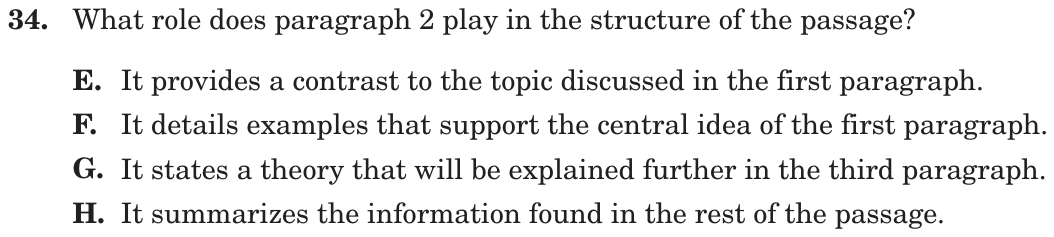
Question 35 of 57
2018 Test B English, question 35Uses the passage above: “Uncovering the Past”.
Question
Which conclusion is best supported by the information in paragraph 4?
- AForensic anthropologists specialize in the excavation of ancient theaters and temples.
- BForensic anthropologists can obtain a variety of information by examining teeth.
- CForensic anthropologists believe that people in the past were smaller than people are today.
- DForensic anthropologists primarily investigate ancient crimes.
Show the answer
Correct answer: B
The question asks for the concluding sentence that best summarizes the information from paragraph 4. Paragraph 4 explains that Camelia’s age was determined through an examination of her teeth, which makes the conclusion in Option B the correct answer.
Option A is incorrect because the excavation discussed in the paragraph is at a house, not a theater or temple.
Option C is incorrect because, although Camelia’s body was smaller than a thirteen-year-old’s would be expected to be, the passage does not go into enough detail to suggest that all people from the past were smaller than people are today.
Option D is also incorrect because there is no evidence in the passage of Camelia’s death being the result of a crime.
Question analysis
This question asks which conclusion is best supported by paragraph 4 of “Uncovering the Past,” where forensic anthropologists study the skeleton of a girl they named Camelia. Students must draw a reasonable conclusion from several specific details and avoid reading more into the paragraph than it says.
- NYS standards
- 7R1 textual evidence and inferences
- Grade level
- Grade 7 reading and task
- Compared with grade 7
- At grade 7 A standard grade 7 inference task: draw a conclusion from one short, concrete paragraph. The scientific terms are explained by context, and the main demand is checking each conclusion against what the paragraph actually says.
- Estimated difficulty
- Straightforward: two steps or one careful reading.
- Thinking it demands
- Depth of knowledge 2, skills and concepts · mainly understand
- What makes it hard
- The right answer is reworded moderate
- Reading between the lines minor
- Evidence
- Answered from one paragraph or stanza
- Reading level
- Passage: about grade 13, 514 words; question and choices: about grade 14, 52 words.
- Students, last 30 days
- Not enough answers yet to show (it takes 10).
Why it is hard, traps and wrong answers (shows the answer)
Why it is hard
The right conclusion is a generalization the paragraph never states, while two wrong ones grow out of its most striking phrases. Camelia’s small size and the comparison with criminal investigations each invite a conclusion that sounds scientific but rests on one detail or misreads a comparison. Students who list what the scientists learned from the teeth before reading the choices avoid both.
The right answer is reworded moderate Choosing the answer
The key folds three findings from the teeth, Camelia’s age, her sex and her health, into “a variety of information,” while the wrong choices reuse “modern eleven-year-old,” “criminal investigations” and paragraph 3’s theater and temple. (Freedle & Kostin, 1993; Kirsch & Mosenthal, 1990)
Reading between the lines minor Working it out
No sentence states the conclusion; it has to be built by noticing that the teeth gave the age, the sex and “excellent health,” and then generalizing about what teeth can reveal. (Graesser, Singer & Trabasso, 1994; Kintsch, 1998)
Strategy: List what the scientists learned in paragraph 4, then test each choice by asking whether the paragraph gives direct evidence for it.
Traps
- Too broad or too strong: A choice overstates, generalizes, or uses absolute words the text does not support.
- Taking figurative language literally: A choice reads a figure of speech or image at face value.
- Wrong part of the text: A choice is true of another paragraph, stanza or speaker than the one asked about.
The wrong answers, classified
A Wrong part of the text (Kirsch & Mosenthal, 1990)
Borrows the theater and temple from paragraph 3, where they interested traditional archaeologists, though paragraph 4 describes forensic work on a girl found in a house.
C Too broad or too strong (King et al., 2004)
Generalizes from one skeleton: Camelia was “only the size of a modern eleven-year-old,” but one girl cannot show that ancient people in general were smaller, and the paragraph reports no such belief.
D Taking figurative language literally (Graesser, Singer & Trabasso, 1994)
Turns the comparison “in ways similar to those used in criminal investigations” into the scientists’ purpose, though it describes only their methods and nothing suggests a crime.
Working it out, step by step
Figure out what the question asks
This asks for a conclusion, an idea you can figure out from facts. The facts must come from paragraph 4, the paragraph about the girl called Camelia. The right choice needs direct support there. A choice that sounds smart but goes past the facts is wrong.
List what the scientists learned
Paragraph 4 says, “On the basis of her teeth, they determined her age to be about thirteen.” Then it says, “The study of the teeth also confirmed her sex and pointed to her excellent health; Camelia had no cavities.” Her skeleton also showed she was “only the size of a modern eleven-year-old.”
Find the pattern in those facts
Forensic anthropologists are scientists who study human bones, a bit like crime-lab experts. Look at how much came from the teeth alone. The teeth told them her age. They told them she was a girl. They showed she was healthy. That is three kinds of facts from one source. So you can conclude that teeth give many kinds of information.
Check each choice
- A is wrong. The theater and temple are in paragraph 3. Camelia was found in a house.
- B fits. Age, sex and health add up to “a variety of information” from teeth.
- C is wrong. One small girl does not prove that all people long ago were smaller. The paragraph never says the scientists believe that.
- D is wrong. The scientists worked “in ways similar to those used in criminal investigations.” That means their methods were like crime-lab methods. It does not mean they study crimes.
Choose the answer
Paragraph 4 shows teeth revealing age, sex and health. So the answer is B, “Forensic anthropologists can obtain a variety of information by examining teeth.”
Why this answer and not the closest wrong one
C is the closest trap, because Camelia really was small for her age. But a conclusion about all ancient people needs facts about many people. Paragraph 4 gives facts about one girl. B needs only what the paragraph shows: many facts from one set of teeth.
More questions like this
The original DOE question

Question 36 of 57
2018 Test B English, question 36Uses the passage above: “Uncovering the Past”.
Question
As described in paragraphs 4–5, what did the archaeological team learn about life in Kourion?
- APeople in Kourion had a better diet than people have today.
- BPeople in Kourion kept a wide variety of domesticated animals.
- CPeople in Kourion had a shorter life expectancy than people have today.
- DPeople in Kourion made bread from various domesticated grains.
Show the answer
Correct answer: D
The question asks what archaeologists learned about the ancient culture based on the evidence found in paragraphs 4–5. Paragraph 5 states that a paleobotanist identified four domesticated grains within a bake oven at the site, which supports Option D.
Option A is incorrect because there is not enough evidence in either paragraph to support the broad assumption that people in Kourion had a better diet than people today.
Option B is incorrect because the passage mentions the discovery of the remains of only one domesticated animal, which does not support the idea that Kourion people kept a wide variety of domesticated animals.
Option C is incorrect because paragraph 4 states that Camelia’s age was determined to be about thirteen at the time of her death, but since her death was likely caused by a natural disaster, the suggestion that all Kourion people had a shorter life expectancy than people today is not supported.
Question analysis
Students find what the archaeological team learned about everyday life in ancient Kourion from the paragraphs about Camelia’s skeleton and the other specialists in “Uncovering the Past.” The tricky part is telling a fact the passage states from a bigger claim that a few clues might seem to suggest.
- NYS standards
- 7R1 textual evidence and inferences
- Grade level
- Grade 6 reading and task
- Compared with grade 7
- Below grade 7 Below typical grade 7 demand: the answer rests on one stated detail, much like a grade 6 key-detail question, and the relevant paragraphs are short and concrete.
- Estimated difficulty
- Routine: one familiar step, little to misread.
- Thinking it demands
- Depth of knowledge 1, recall and reproduction · mainly understand
- What makes it hard
- Evidence
- Answered from several paragraphs or stanzas
- Reading level
- Passage: about grade 13, 514 words; question and choices: about grade 8, 56 words.
- Students, last 30 days
- Not enough answers yet to show (it takes 10).
Why it is hard, traps and wrong answers (shows the answer)
Why it is hard
The answer is stated almost word for word at the end of paragraph 5, where the grains are called “evidence of a kind of ancient multigrain bread.” The wrong choices stretch real details, Camelia’s healthy teeth, her early death and a single mule, into claims about a whole population. Students who separate what the team found from what a reader might guess rarely miss it.
Every choice must be checked minor Choosing the answer
Three choices compare Kourion with today or generalize from one find, so each has to be traced back to paragraphs 4 and 5 to see whether the team actually learned it. (Embretson & Wetzel, 1987)
Evidence in several places minor Working it out
The facts are split between two paragraphs: Camelia’s age, size and teeth in paragraph 4, and the mule and the bake oven in paragraph 5, where the bread detail closes the paragraph. (Kirsch & Mosenthal, 1990; Gorin & Embretson, 2006)
Strategy: Reread the paragraphs about Camelia and the other specialists, list each fact actually stated about how people lived, and choose the one choice that appears on your list.
Traps
- Too broad or too strong: A choice overstates, generalizes, or uses absolute words the text does not support.
- Outside knowledge: A choice is plausible in the real world but not supported by this text.
The wrong answers, classified
A Reads too much in (Graesser, Singer & Trabasso, 1994)
Reads Camelia’s cavity-free teeth and “excellent health” as proof of a better diet than today’s, a comparison the passage never makes and one girl cannot support.
B Too broad or too strong (King et al., 2004)
Stretches the single mule skeleton into “a wide variety” of animals, borrowing the word “domesticated” from the paleobotanist’s grains in the next sentence.
C Outside knowledge (King et al., 2004; Recht & Leslie, 1988)
Brings in the familiar idea that people in the past died young and treats Camelia’s death at about thirteen as proof, though one early death says nothing about life expectancy.
Working it out, step by step
Figure out what the question asks
This is a key-details question. It asks what the team actually learned about daily life in Kourion. Look only at paragraphs 4 and 5. The right answer will be stated there, not guessed.
List the facts in paragraphs 4 and 5
Paragraph 4 is about Camelia. She was about thirteen, small for her age, and healthy, with no cavities. Paragraph 5 names two more experts. A zooarchaeologist found “the skeleton of a mule found near Camelia.” A paleobotanist studied a bake oven. This expert found “four domesticated grains among the charred crumbs—evidence of a kind of ancient multigrain bread.”
Explain the hard words
A paleobotanist studies plants from long ago. “Domesticated” grains are grains that people grew on farms, like wheat. “Charred” means burned black. “Multigrain” bread is made from more than one kind of grain. So the burned crumbs show that people in Kourion baked bread from several farm grains.
Check each choice
- A is wrong. Camelia had healthy teeth, but the passage never compares her diet with ours.
- B is wrong. The team found one mule. One animal is not “a wide variety.”
- C is wrong. Life expectancy means how long people usually live. One girl who died young cannot show that.
- D fits. It matches the bake oven and its four grains.
Choose the answer
Only one choice is stated in the passage: bread made from four farm grains. So the answer is D, “People in Kourion made bread from various domesticated grains.”
Why this answer and not the closest wrong one
A, B and C each take one find and stretch it into a rule about everyone. Ask yourself how many examples back each one up. One girl or one mule is not enough. D needs no stretch, since paragraph 5 calls the crumbs “evidence of a kind of ancient multigrain bread.”
More questions like this
The original DOE question

Question 37 of 57
2018 Test B English, question 37Uses the passage above: “Uncovering the Past”.
Question
What is the most likely reason the author mentions the zooarchaeologist (paragraph 5)?
- Ato introduce the topic of other artifacts discovered near Camelia
- Bto contrast this position with that of the paleobotanist
- Cto complete the list of archaeological specialists
- Dto provide an example of a particular field in modern archaeology
Show the answer
Correct answer: D
The question asks for the strongest reason for the author mentioning the zooarchaeologist in the passage. The primary purpose of the passage is to explain and describe modern archaeology, the technology it employs, and various aspects of the field. Zooarchaeology is a specialty within the field, which is stated in Option D.
Option A is incorrect because other artifacts found near Camelia could have been introduced without mentioning the zooarchaeologist.
Option B is incorrect because the text does not state any comparisons between zooarchaeologists and paleobotanists.
Option C is incorrect because the passage does not provide a list of archaeological specialists.
Question analysis
This author’s purpose question asks why the writer of “Uncovering the Past” mentions a zooarchaeologist, a scientist who identifies animal remains, in the account of the Kourion excavation. The detail is only one sentence long, so students must judge its job in the passage, and more than one choice offers a reason that sounds sensible.
- NYS standards
- 7R5 structure and genre features
- Grade level
- Grade 7 reading and task
- Compared with grade 7
- At grade 7 Explaining why an author includes a detail is core grade 7 work. Here the detail is short and clear, but the choices include reasons that sound reasonable, so students need a firm grasp of the passage’s purpose.
- Estimated difficulty
- Moderate: several steps, or a close reading with one strong distractor.
- Thinking it demands
- Depth of knowledge 3, strategic thinking · mainly analyze
- What makes it hard
- How, not what moderate
- Evidence in several places minor
- Evidence
- Answered from several paragraphs or stanzas
- Reading level
- Passage: about grade 13, 514 words; question and choices: about grade 11, 49 words.
- Corrected from the DOE handbook
- A wrong term in the explanation was corrected.
- Students, last 30 days
- Not enough answers yet to show (it takes 10).
Why it is hard, traps and wrong answers (shows the answer)
Why it is hard
The detail is one clause long, and the question turns on its job in the passage rather than its content. Students who stay inside paragraph 5 see a list of specialists or a find near Camelia and choose a reason drawn from there. Connecting the specialist to paragraph 2’s range of specialized fields is the step that separates the right answer from the plausible ones.
How, not what moderate Working it out
The stem asks why the zooarchaeologist is mentioned, not what he found, so the mule skeleton is beside the point; the answer lies in what this specialist illustrates about the modern approach. (Anderson & Krathwohl, 2001)
Evidence in several places minor Working it out
The reason links back to paragraph 2, where the modern approach applies “the scientific methods of a range of specialized fields”; the zooarchaeologist is one of those fields at work. (Kirsch & Mosenthal, 1990; Gorin & Embretson, 2006)
Strategy: State the passage’s main point in a sentence, then ask what this one-sentence mention of a specialist adds to that point.
Traps
- Wrong purpose or structure: Names a purpose, structure or effect that the part does not serve, or describes what a part says when the question asks what it does.
The wrong answers, classified
A Wrong purpose or structure (Anderson & Krathwohl, 2001)
The zooarchaeologist did identify a mule “found near Camelia,” but the passage never goes on to a topic of nearby artifacts; the next sentence turns to another specialist.
B Wrong purpose or structure (Anderson & Krathwohl, 2001)
Sees the zooarchaeologist and the paleobotanist named side by side and assumes a contrast, but the passage compares nothing about them; each is simply another specialist.
C Wrong purpose or structure (Anderson & Krathwohl, 2001)
Treats the specialists of paragraphs 4 and 5 as a roster the author is finishing, but the zooarchaeologist is not the last one named, and the passage offers examples rather than a complete list.
What was corrected from the DOE handbook, and why
- Explanation: The handbook says the text makes no comparison between “zooarchaeologists and paleoarchaeologists.” The other specialist in paragraph 5, and in Option B, is a paleobotanist, so the site now says “paleobotanists.”
Working it out, step by step
Figure out what the question asks
This question asks why the author mentions the zooarchaeologist. It is not asking what this expert found. Think about the purpose of the detail, the job it does for the whole passage.
Find the detail and its link
Paragraph 5 begins, “Other specialists on this excavation included a zooarchaeologist, who identified animal remains.” A specialist is an expert in one narrow field. Now look back at paragraph 2. It says modern archaeology uses “the scientific methods of a range of specialized fields.”
Connect the detail to the main idea
A zooarchaeologist is an expert in animal remains from long ago. “Zoo” means animals. This expert is one of those specialized fields at work. So the author names the zooarchaeologist as an example. The example shows what “a range of specialized fields” looks like on a real dig. The word “included” also tells you the passage gives examples, not a full list.
Check each choice
- A is wrong. This expert found a mule near Camelia, but the passage never moves on to other objects found near her.
- B is wrong. The paleobotanist comes next, but the author never compares the two jobs.
- C is wrong. The zooarchaeologist does not complete a list. The paleobotanist is named next, and “included” means only some experts are named.
- D fits. The zooarchaeologist is one example of a specialized field in modern archaeology.
Choose the answer
The zooarchaeologist shows one of the many science fields that modern archaeology uses. So the answer is D, “to provide an example of a particular field in modern archaeology.”
Why this answer and not the closest wrong one
C is the strongest trap, because paragraphs 4 and 5 name several experts in a row. But to complete a list, this expert would have to be named last. The paleobotanist comes after. D also ties back to the main idea of the passage, the use of many science fields. A good purpose answer usually does that.
More questions like this
The original DOE question

Question 38 of 57
2018 Test B English, question 38Passage Snowy Mountains
Snowy Mountains
by John Gould Fletcher
Higher and still more high,
Palaces made for cloud,
Above the dingy city-roofs
Blue-white like angels with broad wings,
Pillars of the sky at rest
The mountains from the great plateau
Uprise.
But the world heeds them not;
They have been here now for too long a time.
The world makes war on them,
Tunnels their granite cliffs,
Splits down their shining sides,
Plasters their cliffs with soap-advertisements,
Destroys the lonely fragments of their peace.
Vaster and still more vast,
Peak after peak, pile after pile,
Wilderness still untamed,
To which the future is as was the past,
Barrier spread by Gods,
Sunning their shining foreheads,
Barrier broken down by those who do not need
The joy of time-resisting storm-worn stone,
The mountains swing along
The south horizon of the sky;
Welcoming with wide floors of blue-green ice
The mists that dance and drive before the sun.
“Snowy Mountains” by John Gould Fletcher—Public Domain
Question
The description in the first stanza (lines 1–7) helps establish a central idea of the poem by
- Acomparing the length of time the mountains have existed with the length of time the city has existed.
- Bcontrasting the grandeur of the mountains with the structures in the city below them.
- Cimplying that the mountains are a source of inspiration to the people in the city below.
- Dsuggesting that the mountains are larger than the people in the city realize.
Show the answer
Correct answer: B
The question asks how the description in the first stanza helps establish a central idea of the poem. The poem is mostly about the grandeur of the mountains in spite of the spread of civilization. The first stanza contrasts these two elements, which is stated in Option B.
Option A is incorrect because it is a detail that is referenced later in the poem.
Option C is incorrect because the poem actually communicates the message that people do not recognize the greatness of the mountains.
Option D is incorrect because, although the first stanza mentions the size of the mountains, it does not imply that people cannot see how large the mountains are.
Question analysis
This question about John Gould Fletcher’s poem “Snowy Mountains” asks how the first stanza’s description helps establish a central idea of the poem. Students must interpret images such as palaces, pillars and angels, decide what the opening lines do with them, and judge which choice states that role without adding ideas.
- Grade level
- Grade 7 reading and task
- Compared with grade 7
- At grade 7 Linking one stanza to a poem’s central idea is a common grade 7 task, and these images are vivid and concrete. The inverted, century-old syntax adds a little challenge but no unusual demand.
- Estimated difficulty
- Straightforward: two steps or one careful reading.
- Thinking it demands
- Depth of knowledge 2, skills and concepts · mainly analyze
- What makes it hard
- Figurative or literary language moderate
- Complex sentences minor
- Evidence
- Answered from one paragraph or stanza
- Reading level
- Passage: 161 words (a poem; reading level not measured); question and choices: about grade 8, 77 words.
- Students, last 30 days
- Not enough answers yet to show (it takes 10).
Why it is hard, traps and wrong answers (shows the answer)
Why it is hard
The first stanza sets its majestic images directly against “the dingy city-roofs,” so students who read it as a picture find the contrast without much trouble. The losses come from importing ideas from later in the poem, people’s neglect in stanza 2 or the passing of time, into seven lines that contain neither. The inverted word order slows a first reading but does not hide the meaning.
Figurative or literary language moderate Understanding the question
The contrast is carried by images, not statements: “Palaces made for cloud” and “angels with broad wings” rise “Above the dingy city-roofs,” and students must read grandeur and drabness from those pictures. (Graesser, Singer & Trabasso, 1994; Kintsch, 1998)
Complex sentences minor Understanding the question
The stanza is one inverted sentence: five lines of images come before its subject, “The mountains,” in line 6 and its verb, “Uprise,” in line 7. (Abedi & Lord, 2001; Freedle & Kostin, 1993; Messick, 1989)
Strategy: Reread lines 1–7 and sum up in a phrase what the stanza does, then check each choice against those seven lines.
Traps
- Reads too much in: A reasonable-sounding conclusion that goes further than the text allows.
- Wrong part of the text: A choice is true of another paragraph, stanza or speaker than the one asked about.
- Outside knowledge: A choice is plausible in the real world but not supported by this text.
The wrong answers, classified
A Wrong part of the text (Kirsch & Mosenthal, 1990)
Brings in time, which the poem raises only in line 9 and line 18; the first stanza sets mountains against city by height and splendor, not by age.
C Outside knowledge (King et al., 2004; Recht & Leslie, 1988)
Assumes that majestic mountains inspire the people below them, a common idea about nature, but the stanza shows no reaction from the city, and the next stanza says the world “heeds them not.”
D Reads too much in (Graesser, Singer & Trabasso, 1994)
Combines line 1’s “Higher and still more high” with the poem’s later charge that people ignore the mountains, but nothing in lines 1–7 says the city misjudges how large they are.
Working it out, step by step
Figure out what the question asks
This question asks how the first stanza helps build a central idea of the poem. A stanza is a group of lines in a poem, like a paragraph. A central idea is a main message. Only lines 1 to 7 matter here, from “Higher and still more high” to “Uprise.”
Read the pictures in lines 1–7
The mountains are called “Palaces made for cloud” in line 2. In line 4 they are “Blue-white like angels with broad wings.” In line 5 they are “Pillars of the sky at rest.” Palaces, angels and pillars are all grand, high and beautiful. But line 3 places them “Above the dingy city-roofs.”
Explain what the pictures show
“Dingy” means dull and dirty. So the stanza sets two things side by side. Up high are the shining, noble mountains. Down below are the drab roofs of the city. This is a contrast: two things put together to show how different they are. Grandeur means greatness and splendor. The stanza shows the mountains’ grandeur next to the plain city.
Check each choice
- A is wrong. Time is not in lines 1–7. It first comes up in line 9, “They have been here now for too long a time.”
- B fits. Grand mountains rise over dingy city roofs.
- C is wrong. The stanza never shows people being inspired. In fact, line 8 says “the world heeds them not,” or pays them no attention.
- D is wrong. Line 1 says the mountains are high. But nothing says the city misjudges their size.
Choose the answer
The first stanza puts splendid mountains above a dull city. So the answer is B, “contrasting the grandeur of the mountains with the structures in the city below them.”
Why this answer and not the closest wrong one
D is the closest trap. It mixes line 1 with an idea from later in the poem, that people ignore the mountains. But the question is about lines 1–7 only. Those lines show a contrast in looks: high and splendid against low and dingy. They say nothing about what people think.
More questions like this
The original DOE question
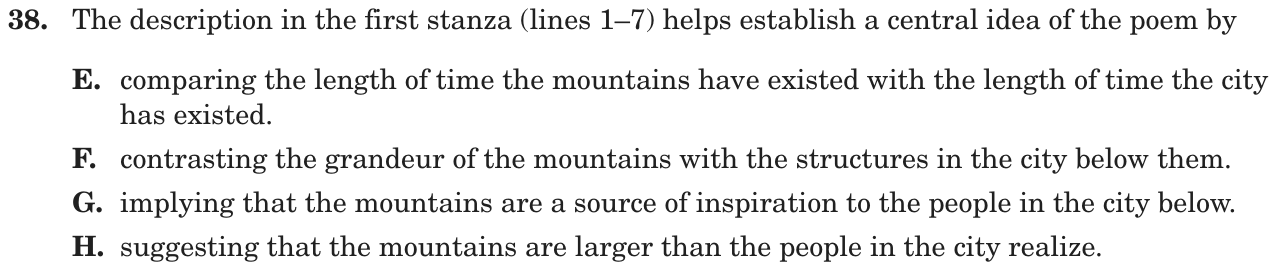
The passage “Snowy Mountains” as printed (page 142)
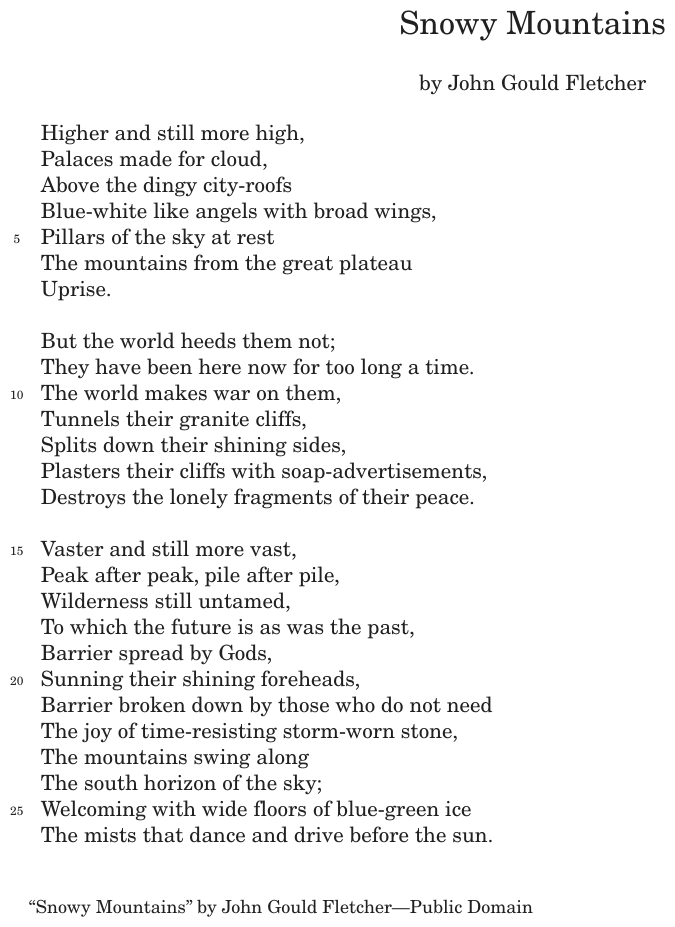
Question 39 of 57
2018 Test B English, question 39Uses the passage above: “Snowy Mountains”.
Question
Read line 1 and line 15 from the poem.
Higher and still more high,
Vaster and still more vast,
The parallel structure of the two lines
- Aemphasizes how the sense of wonder the speaker has at the beginning of the poem changes to a fear of the mountains.
- Breinforces the sense of awe the speaker experiences when considering the magnificence of the expansive mountains.
- Creveals that the mountains are continually expanding both in height and land mass.
- Dstresses a contrast between the height of the mountains and the area of land the mountains cover.
Show the answer
Correct answer: B
The question asks how the parallel structure of lines 1 and 15 affects the poem. Lines 1 and 15 communicate the feeling that the mountains are even higher and vaster than can be comprehended upon first view. This observation reflects the awe that the speaker feels, which is reinforced by the parallel structure of the lines, as stated in Option B.
Option A is incorrect because the speaker never hints at fear when describing the mountains.
Option C is incorrect because it reflects a literal interpretation of the figurative language in the two parallel lines: the mountains do not actually grow larger but are simply larger than can be understood at first.
Option D is incorrect because the parallel structure of lines 1 and 15 is not meant to stress any sort of contrast between height and area but to reinforce the speaker’s feeling by complementing each other.
Question analysis
Students analyze the effect of parallel structure in the poem “Snowy Mountains,” where line 1, “Higher and still more high,” and line 15, “Vaster and still more vast,” echo each other. The question asks what that repeated pattern adds to the poem, so noticing the echo is only the first step.
- Grade level
- Grade 8 reading and task
- Compared with grade 7
- At grade 7 Analyzing how a poetic device such as parallelism shapes meaning is solid grade 7 work. The lines are short and quoted, but students must move from a structural pattern to what it contributes to the poem.
- Estimated difficulty
- Moderate: several steps, or a close reading with one strong distractor.
- Thinking it demands
- Depth of knowledge 2, skills and concepts · mainly analyze
- What makes it hard
- How, not what moderate
- Figurative or literary language minor
- Evidence
- Answered from several paragraphs or stanzas
- Reading level
- Passage: 161 words (a poem; reading level not measured); question and choices: about grade 6, 92 words.
- Corrected from the DOE handbook
- A grammar slip in the explanation was corrected.
- Students, last 30 days
- Not enough answers yet to show (it takes 10).
Why it is hard, traps and wrong answers (shows the answer)
Why it is hard
Seeing the parallel lines is easy because the stem quotes them; deciding what the echo achieves is the real task. The strongest wrong answer rests on a true difference between height and breadth, and another takes the comparative phrases literally. Students who ask how the speaker feels in both stanzas, rather than what each line measures, arrive at awe.
How, not what moderate Working it out
The stem asks what the shared pattern of lines 1 and 15 does, so students must move from noticing “still more” twice to naming the feeling the echo strengthens. (Anderson & Krathwohl, 2001)
Figurative or literary language minor Understanding the question
“Still more high” and “still more vast” express how the mountains seem to an awed viewer, not a measurement, and a literal reading makes them sound like mountains that keep growing. (Graesser, Singer & Trabasso, 1994; Kintsch, 1998)
Strategy: Say what each line describes and what it suggests, then ask what using the same pattern twice adds, and check every part of each choice against the poem.
Traps
- Taking figurative language literally: A choice reads a figure of speech or image at face value.
- Half right: One half of a two-part choice is right and the other is not.
The wrong answers, classified
A Wrong tone or attitude (Graesser, Singer & Trabasso, 1994)
Senses that the mood shifts after the first stanza, but the shift is to criticism of people in stanza 2, and the echo in line 15 returns to admiration, not fear.
C Taking figurative language literally (Graesser, Singer & Trabasso, 1994)
Reads “still more high” and “still more vast” as physical growth, when the comparatives express how the mountains’ size keeps impressing the speaker.
D Half right (King et al., 2004; Thissen, Steinberg & Fitzpatrick, 1989)
Correctly notes that line 1 is about height and line 15 about breadth, but the parallel wording joins the two dimensions in one feeling rather than setting them against each other.
What was corrected from the DOE handbook, and why
- Explanation: The handbook writes “how the parallel structure of lines 1 and 15 affect the poem.” The subject “structure” takes “affects,” as the site now reads.
Working it out, step by step
Figure out what the question asks
This asks about parallel structure. That means using the same pattern of words twice. Here, line 1 says “Higher and still more high,” and line 15 says “Vaster and still more vast.” You need to say what repeating this pattern does.
Look at where the lines sit
Line 1 opens the first stanza. Line 15 opens the third stanza. In between, stanza 2 shows people harming the mountains. Line 1 is about height. Line 15 is about vastness, which means huge size that spreads far. “Still more” means even more. Each line seems to say the mountains are bigger than you can take in.
Name the feeling the pattern shows
Both lines sound like a person staring up in amazement. That feeling is awe: wonder mixed with deep respect. Repeating the pattern brings the feeling back after the angry second stanza. So the echo reinforces, or makes stronger, the speaker’s awe. It is not a measurement. The mountains are not really growing.
Check each choice
- A is wrong. The speaker never shows fear. Line 15 brings back the same wonder as line 1.
- B fits. The repeated pattern stresses the speaker’s awe at the huge mountains.
- C is wrong. It reads the lines literally, as if the mountains keep growing. The words express a feeling, not a fact.
- D is wrong. Height and spread are different. But the matching pattern joins them in one feeling. It does not set them against each other.
Choose the answer
The same pattern, used twice, repeats the speaker’s sense of wonder. So the answer is B, “reinforces the sense of awe the speaker experiences when considering the magnificence of the expansive mountains.”
Why this answer and not the closest wrong one
D is tempting because it is half true: one line is about height and one is about spread. But parallel structure makes two things sound alike, not opposite. Matching words link ideas. That is why B, which names one shared feeling, fits better than a contrast.
More questions like this
The original DOE question
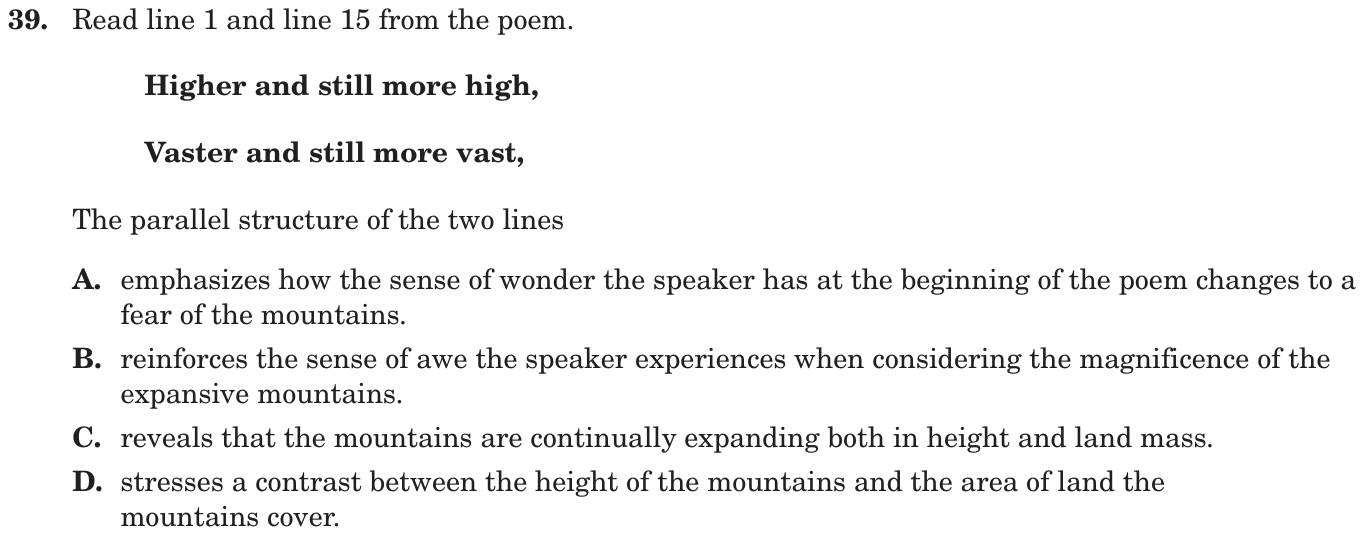
Question 40 of 57
2018 Test B English, question 40Uses the passage above: “Snowy Mountains”.
Question
Read line 5 from the poem.
Pillars of the sky at rest
The line helps develop the theme of the poem by suggesting that the mountains
- Aserve a noble and supportive purpose in the world.
- Battract the clouds with their strength and permanence.
- Cremain untamed through the ages.
- Dprovide protection for the people.
Show the answer
Correct answer: A
The question asks how the line from the poem helps develop the theme of the poem. Line 5 helps develop the theme that the mountains are more important than people realize by suggesting that the mountains serve a noble, foundational purpose in the world, as explained in Option A.
Option B is incorrect because, while the poem does describe the strength and permanence of the mountains, the line does not suggest that these traits attract the clouds.
Option C is incorrect because, while the line states that the highest peaks are “at rest,” that phrase describes stillness, not wildness; the poem calls the mountains “still untamed” only later (line 17), and line 5 does not suggest it.
Option D is incorrect because, while pillars are strong and may indicate shelter, there is no suggestion in the line that the mountains are protecting the people. Additionally, this concept is not a theme of the poem.
Question analysis
This figurative language question asks how the metaphor “Pillars of the sky at rest” in “Snowy Mountains” helps develop the poem’s theme. Students must work out what calling mountains pillars of the sky suggests about them, and it is tricky because every choice sounds like something this poem could say.
- Grade level
- Grade 8 reading and task
- Compared with grade 7
- Above grade 7 Grade 7 students interpret metaphors, but here they must also connect a short image to the poem’s theme and choose among abstract options, a step closer to grade 8 work on figurative meaning and theme.
- Estimated difficulty
- Hard: combines ideas, needs a plan, and has more than one tempting wrong answer.
- Thinking it demands
- Depth of knowledge 3, strategic thinking · mainly analyze
- What makes it hard
- Figurative or literary language major
- The right answer is reworded moderate
- Combines ideas minor
- Evidence
- Answered from one sentence or line
- Reading level
- Passage: 161 words (a poem; reading level not measured); question and choices: about grade 3, 52 words.
- Corrected from the DOE handbook
- A claim in the explanation that the poem contradicts was corrected.
- Students, last 30 days
- Not enough answers yet to show (it takes 10).
Why it is hard, traps and wrong answers (shows the answer)
Why it is hard
This is hard because every choice says something the poem could plausibly mean, and two of them borrow real phrases from other lines. Students who test choices against the poem as a whole find support for the wrong ones; the question rewards testing them against the single image of pillars holding up the sky. Seeing that pillars both support and ennoble a structure leads directly to the key.
Figurative or literary language major Understanding the question
The answer depends on unpacking one metaphor: pillars hold up a roof, so “Pillars of the sky” casts the mountains as supports of the heavens, and “at rest” adds a calm, dignified strength. (Graesser, Singer & Trabasso, 1994; Kintsch, 1998)
The right answer is reworded moderate Choosing the answer
The key uses words the poem never does, “noble” and “supportive,” while wrong choices echo “cloud” from line 2 and “untamed” from line 17 and so look anchored in the text. (Freedle & Kostin, 1993; Kirsch & Mosenthal, 1990)
Combines ideas minor Working it out
Students must interpret the image and then link it to the poem’s theme, that the mountains matter more than the world below recognizes. (Embretson, 1998; Daniel & Embretson, 2010)
Strategy: Ask what a pillar is and why a poet might call mountains “pillars of the sky,” then test each choice against line 5 alone before thinking about the rest of the poem.
Traps
- Wrong part of the text: A choice is true of another paragraph, stanza or speaker than the one asked about.
- Half right: One half of a two-part choice is right and the other is not.
- Reads too much in: A reasonable-sounding conclusion that goes further than the text allows.
The wrong answers, classified
B Half right (King et al., 2004; Thissen, Steinberg & Fitzpatrick, 1989)
Strength and permanence fit both pillars and the poem, but attracting clouds comes from line 2’s “Palaces made for cloud,” and line 5 says nothing about drawing clouds in.
C Wrong part of the text (Kirsch & Mosenthal, 1990)
Takes “Wilderness still untamed” from line 17, a genuine idea of the third stanza, and attaches it to line 5, whose pillars “at rest” suggest calm support, not wildness.
D Reads too much in (Graesser, Singer & Trabasso, 1994)
Follows the pillar image one step too far, from pillars to a roof to shelter for people, though neither the line nor the poem shows the mountains protecting anyone.
What was corrected from the DOE handbook, and why
- Explanation: The handbook rejects Option C by saying the mountains “do not remain untamed or untouched,” but line 17 calls them “Wilderness still untamed,” and the handbook’s own explanation of the third-stanza question relies on that line. The site now says that “at rest” describes stillness, not wildness, and that the poem calls the mountains “still untamed” only later, in line 17, so line 5 does not suggest it.
Working it out, step by step
Figure out what the question asks
This asks what one image, line 5, adds to the poem’s theme. A theme is the big message of a poem. Here the theme is that the mountains are great and important, even though people ignore them. You need to decide what “Pillars of the sky” says about the mountains.
Look closely at line 5
Line 5 reads “Pillars of the sky at rest.” It is part of the first stanza’s list of grand pictures. The list also has “Palaces made for cloud” in line 2. Line 5 is a metaphor. A metaphor calls one thing by the name of another to compare them, without using “like” or “as.”
Explain what pillars do
A pillar is a tall, strong column that holds up a roof. Big, important buildings, like temples and courthouses, have pillars. So calling the mountains “Pillars of the sky” makes them seem to hold up the sky. That is a supporting job. It is also a grand, noble one. “At rest” adds calm. The pillars stand still and steady.
Check each choice
- A fits. Holding up the sky is a noble, supportive job.
- B is wrong. Clouds come from line 2. Line 5 says nothing about pulling clouds in.
- C is wrong. “Wilderness still untamed” is line 17, not line 5. Pillars “at rest” suggest calm, not wildness.
- D is wrong. Pillars hold up roofs, and roofs can shelter people. But the line never shows the mountains protecting anyone.
Choose the answer
Pillars hold things up and make a building grand. So the answer is A, “serve a noble and supportive purpose in the world.”
Why this answer and not the closest wrong one
C is the strongest trap, because the poem really does call the mountains untamed. But that is line 17. Test each choice against line 5 alone. A pillar is a support, and a pillar of the sky is a grand one. Only A comes straight from that picture.
More questions like this
The original DOE question
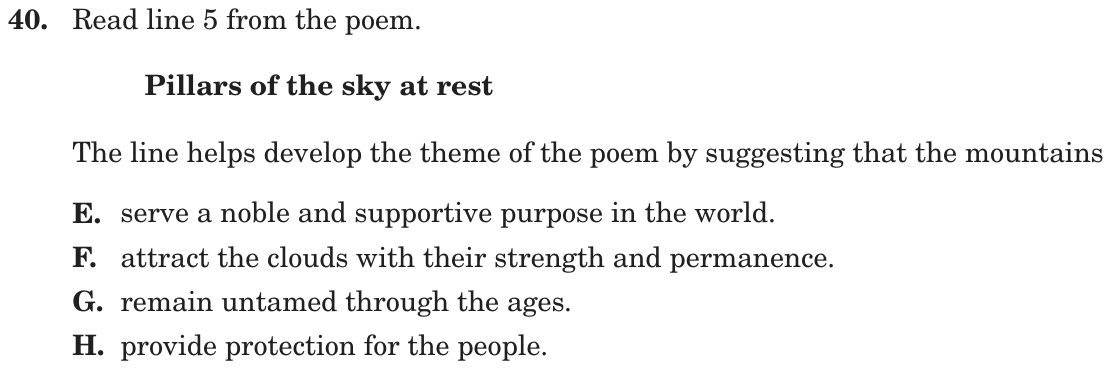
Question 41 of 57
2018 Test B English, question 41Uses the passage above: “Snowy Mountains”.
Question
How does isolating the word “Uprise” in line 7 affect the meaning of the poem?
- AIt creates a contrast between the great plateau and the city buildings.
- BIt reveals the similarity between the tall buildings in the city and the tall mountains on the horizon.
- CIt creates a vision of the region before people developed the land.
- DIt emphasizes that the mountains dominate the landscape.
Show the answer
Correct answer: D
The question asks how the isolation of the word affects the meaning of the poem. The isolation of the word “Uprise” powerfully emphasizes the first stanza’s description of the magnificent mountains standing tall above the land below, as expressed in Option D.
Option A is incorrect because the word describes the mountains and, therefore, does not create a contrast between the plateau and the city buildings, but rather between the mountains and the plateau.
Option B is incorrect because the word contrasts the mountains with the plateau; it does not compare the mountains to the buildings in the city.
Option C is incorrect because the first stanza describes the already developed land over which the mountains rise.
Question analysis
In “Snowy Mountains,” the opening stanza builds a long sentence about the mountains and saves its verb, “Uprise,” for a line of its own. This poetry structure question asks how isolating that single word affects the poem’s meaning, so students need to think about how a line break shapes what the reader notices, as well as about what the stanza describes.
- Grade level
- Grade 8 reading and task
- Compared with grade 7
- At grade 7 Grade 7 poetry questions often ask about word choice; this one asks about a structural choice, a one-word line, which is less familiar, though the stanza’s images make the intended effect fairly easy to sense.
- Estimated difficulty
- Moderate: several steps, or a close reading with one strong distractor.
- Thinking it demands
- Depth of knowledge 2, skills and concepts · mainly analyze
- What makes it hard
- Complex sentences moderate
- How, not what moderate
- Evidence
- Answered from one paragraph or stanza
- Reading level
- Passage: 161 words (a poem; reading level not measured); question and choices: about grade 8, 64 words.
- Students, last 30 days
- Not enough answers yet to show (it takes 10).
Why it is hard, traps and wrong answers (shows the answer)
Why it is hard
Students who see that “Uprise” is the verb the whole stanza has been building toward recognize the effect quickly: the mountains rise over everything else in the picture. Those who treat the word as one more image look for a comparison instead and find several, because the stanza is full of buildings, roofs and a plateau. The real test is sorting which contrast belongs to the mountains.
Complex sentences moderate Understanding the question
The stanza is one long sentence that withholds its subject until line 6 and its verb until line 7, so “Uprise” lands as the payoff of five lines of images. (Abedi & Lord, 2001; Freedle & Kostin, 1993; Messick, 1989)
How, not what moderate Working it out
The question asks about a line break, a structural choice, rather than a word’s meaning, and students must judge what setting one verb on its own line makes the reader notice. (Anderson & Krathwohl, 2001)
Strategy: Read the stanza aloud and notice where the long sentence finally reaches its verb, then ask what ending on that single word makes the reader see.
Traps
- Taking figurative language literally: A choice reads a figure of speech or image at face value.
- Half right: One half of a two-part choice is right and the other is not.
The wrong answers, classified
A Half right (King et al., 2004; Thissen, Steinberg & Fitzpatrick, 1989)
Rightly senses a contrast in the stanza but pairs the wrong things: “Uprise” sets the mountains against the land below them, not the plateau against the city’s buildings.
B Twists what the text says (King et al., 2004)
Notices that the mountains are compared to “Palaces” and “Pillars,” but those grand buildings are set against the “dingy city-roofs,” so the stanza contrasts mountains and city rather than likening them.
C Taking figurative language literally (Graesser, Singer & Trabasso, 1994)
Takes “Uprise” at face value, as mountains pushing up out of the plateau long ago, but line 3’s “dingy city-roofs” place the scene in a land already built on.
Working it out, step by step
Figure out what the question asks
This asks about a choice the poet made in how the poem looks. Line 7 is only one word: “Uprise.” You need to say what setting that word alone on its line does to the meaning.
Find the sentence the word ends
The whole first stanza is one long sentence. Lines 1 to 5 are a string of pictures: palaces, angels, pillars. The subject, “The mountains from the great plateau,” does not come until line 6. Line 7 then gives the verb, or action word, which is “Uprise.” A plateau is a wide area of high, flat land.
Think about the effect
“Uprise” means rise up. The reader waits six lines for this action. Then it stands by itself, like the mountains standing alone over the land. The short line makes you stop and picture them rising above everything, even “the dingy city-roofs.” So the mountains dominate the scene. To dominate is to tower over and be the main thing you notice.
Check each choice
- A is wrong. “Uprise” is about the mountains rising. It does not set the plateau against the city buildings.
- B is wrong. The stanza does not show the city and the mountains as alike. The city roofs are “dingy,” while the mountains are like palaces.
- C is wrong. Line 3 already shows a city, so this is not the land before people.
- D fits. The lone word makes the mountains tower over the whole picture.
Choose the answer
Ending the long sentence on one lone word makes the mountains stand out over everything. So the answer is D, “It emphasizes that the mountains dominate the landscape.”
Why this answer and not the closest wrong one
A is the closest trap, because the stanza does contain a contrast. But it is between the mountains and everything below them. “Uprise” is the mountains’ own action, so its effect must be about the mountains. Only D keeps the focus there.
More questions like this
The original DOE question
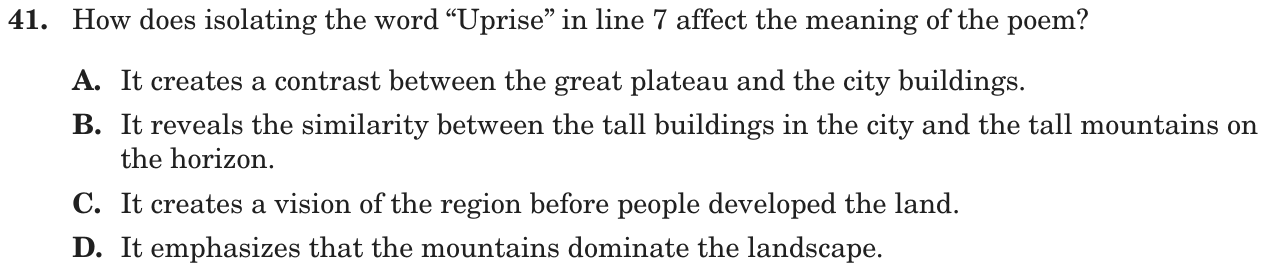
Question 42 of 57
2018 Test B English, question 42Uses the passage above: “Snowy Mountains”.
Question
How does the poet develop the speaker’s point of view in the second stanza (lines 8–14)?
- Aby describing images of the mountains’ awe-inspiring size and strength
- Bby illustrating the differences among the various ways humans can impact the natural environment
- Cby criticizing society for taking careless, destructive courses of action against nature
- Dby demonstrating how the mountains and the people are able to benefit from each other
Show the answer
Correct answer: C
The question asks how the poet develops the speaker’s point of view in the second stanza. In the second stanza, the speaker criticizes the destructive actions of “the world” (lines 8 and 10) against the mountains—actions such as tunneling “their granite cliffs” (line 11) and destroying “the lonely fragments of their peace” (line 14)—as described in Option C.
Option A is incorrect because the speaker’s descriptions of the mountains’ grandeur mainly occur in the first and third stanzas, while in the second stanza, the speaker focuses on humanity and its negative effect on the mountains.
Option B is incorrect because the wording of the second stanza—“makes war” (line 10), “Splits down their shining sides” (line 12), and “Destroys the lonely fragments” (line 14)—communicates the speaker’s position that people’s main impact on the mountains is destructive; the wording does not illustrate different ways people impact the natural environment.
Option D is incorrect because no benefit to the mountains is described by the speaker in the second stanza.
Question analysis
Students explain how the poet develops the speaker’s point of view in the second stanza of the poem “Snowy Mountains,” the seven lines about what “the world” does to the mountains. The main challenge is staying focused on these lines and their word choice while the four choices range across the poem’s ideas.
- Grade level
- Grade 6 reading and task
- Compared with grade 7
- Below grade 7 Easier than typical grade 7 work: the stanza is short and its attitude comes through plainly in its verbs, so the task resembles grade 6 questions that ask how a point of view is developed.
- Estimated difficulty
- Straightforward: two steps or one careful reading.
- Thinking it demands
- Depth of knowledge 2, skills and concepts · mainly analyze
- What makes it hard
- How, not what moderate
- Figurative or literary language minor
- Evidence
- Answered from one paragraph or stanza
- Reading level
- Passage: 161 words (a poem; reading level not measured); question and choices: about grade 10, 66 words.
- Students, last 30 days
- Not enough answers yet to show (it takes 10).
Why it is hard, traps and wrong answers (shows the answer)
Why it is hard
The speaker’s disapproval is loud in lines 8–14, so most students identify the criticism quickly. The wrong choices work by describing the poem rather than this stanza, or by describing the stanza’s list neutrally and missing its anger. The question rewards staying inside the seven lines and reading the attitude in their verbs.
How, not what moderate Working it out
The stem asks how the point of view is built, and the answer is in the verbs: the world “makes war,” “Tunnels,” “Splits,” “Plasters” and “Destroys,” each casting people as attackers. (Anderson & Krathwohl, 2001)
Figurative or literary language minor Understanding the question
The stanza personifies the mountains as victims, with “the lonely fragments of their peace,” so the speaker’s criticism of people comes through sympathy for the mountains. (Graesser, Singer & Trabasso, 1994; Kintsch, 1998)
Strategy: Underline the verbs in lines 8–14 and ask what attitude toward people they show, then match both that attitude and the way it is expressed to a choice.
Traps
- Twists what the text says: Uses the text's topic and ideas but changes what it says: who did it, how much, when, or why.
- Wrong part of the text: A choice is true of another paragraph, stanza or speaker than the one asked about.
The wrong answers, classified
A Wrong part of the text (Kirsch & Mosenthal, 1990)
Describes the first and third stanzas, which admire the mountains’ height and vastness; stanza 2 mentions “granite cliffs” and “shining sides” only as things people damage.
B Twists what the text says (King et al., 2004)
Sees the list of actions, tunneling, splitting, plastering, but these are all attacks in one “war,” not different kinds of impact laid side by side for comparison.
D Wrong tone or attitude (Graesser, Singer & Trabasso, 1994)
Reads the tunnels and advertisements as people making use of the mountains, a kind of benefit, and misses the hostility of “makes war on them.”
Working it out, step by step
Figure out what the question asks
This asks how the poet shows the speaker’s point of view in lines 8 to 14, the second stanza. Point of view here means the speaker’s attitude, or feelings and opinion. Stay inside these seven lines.
Find the action words
Line 8 says, “But the world heeds them not.” “Heeds” means pays attention to. Then come the verbs, the action words. The world “makes war on them,” “Tunnels their granite cliffs,” “Splits down their shining sides,” and “Plasters their cliffs with soap-advertisements.” Line 14 ends, “Destroys the lonely fragments of their peace.”
Name the speaker’s attitude
Every verb shows people attacking the mountains. “War” is a strong, angry word. The mountains even seem to have feelings. They are lonely, and their peace is broken. So the speaker is criticizing people, or pointing out what they do wrong. People hurt the mountains without caring. That is careless and destructive.
Check each choice
- A is wrong. Awe at the mountains’ size is in stanzas 1 and 3, not stanza 2.
- B is wrong. The stanza lists several harms, but they are all part of one “war.” It does not compare different kinds of impact.
- C fits. The speaker blames people for destroying the mountains.
- D is wrong. No one benefits here. People attack, and the mountains lose their peace.
Choose the answer
The second stanza blames people for attacking the mountains. So the answer is C, “by criticizing society for taking careless, destructive courses of action against nature.”
Why this answer and not the closest wrong one
B is the closest trap, because the stanza does list several actions. But a list of differences would treat them calmly, side by side. These lines are angry. Words like “war” and “Destroys” show blame, which is exactly what C says.
More questions like this
The original DOE question
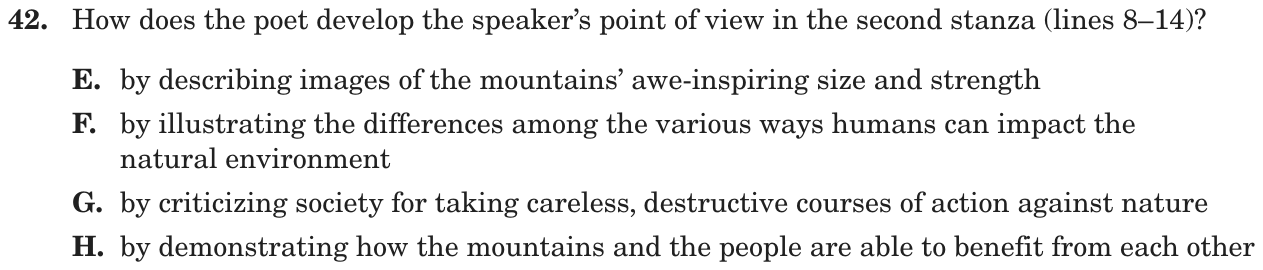
Question 43 of 57
2018 Test B English, question 43Uses the passage above: “Snowy Mountains”.
Question
Which line from the poem best supports the idea that people have forfeited priceless natural beauty in order to make a profit?
- A“Above the dingy city-roofs” (line 3)
- B“The world makes war on them,” (line 10)
- C“Tunnels their granite cliffs,” (line 11)
- D“Plasters their cliffs with soap-advertisements,” (line 13)
Show the answer
Correct answer: D
The question asks for the line from the poem that best supports the idea that people have forfeited natural beauty for profit. Advertisements are often used as a means to gain a profit, as implied by the soap advertisement in line 13 (Option D). Additionally, the word “Plasters,” in line 13, communicates a negative connotation for the use of advertisements on the priceless natural beauty of the mountains, making Option D the correct response.
Option A is incorrect because, while city roofs may spoil the natural beauty, they do not directly symbolize financial gain or profit in line 3.
Option B is incorrect because, although making a profit might have been the root cause of the damage that was done to the mountains, making war on the mountains is not a direct message about profit or financial gain in line 10.
Option C is incorrect because, although tunneling through the mountains affects the natural beauty of the mountains, it does not directly symbolize financial gain or profit in line 11.
Question analysis
This textual evidence question asks which line of the poem “Snowy Mountains” best supports the idea that people have given up priceless natural beauty in order to make money. Several lines show people harming or crowding the mountains, so students must find the one detail that also points to profit.
- NYS standards
- 7R1 textual evidence and inferences
- Grade level
- Grade 7 reading and task
- Compared with grade 7
- At grade 7 A typical grade 7 evidence question: the lines are quoted with their numbers, and the task is matching a two-part claim to the right line, with one concrete clue separating it from the others.
- Estimated difficulty
- Straightforward: two steps or one careful reading.
- Thinking it demands
- Depth of knowledge 2, skills and concepts · mainly evaluate
- What makes it hard
- Every choice must be checked moderate
- Reading between the lines minor
- Hard words minor
- Evidence
- Answered from one sentence or line
- Reading level
- Passage: 161 words (a poem; reading level not measured); question and choices: about grade 6, 45 words.
- Students, last 30 days
- Not enough answers yet to show (it takes 10).
Why it is hard, traps and wrong answers (shows the answer)
Why it is hard
Most of the second stanza supports half of this claim, which is why the question is a test of the other half. Students who look only for harm to the mountains have three good candidates and often settle on the most forceful, “makes war on them.” The one line with a commercial product in it is the only one that shows beauty given up for money.
Every choice must be checked moderate Choosing the answer
Lines 10, 11 and 13 all show people harming the mountains, so each must be tested against the second half of the claim, making a profit, which only one line carries. (Embretson & Wetzel, 1987)
Reading between the lines minor Working it out
Profit is never named: it has to be inferred from “soap-advertisements,” which exist to sell a product, while “Plasters” supplies the defacing of natural beauty. (Graesser, Singer & Trabasso, 1994; Kintsch, 1998)
Hard words minor Understanding the question
The stem’s word “forfeited,” meaning gave up or lost, carries half the claim, and a student unsure of it may look only for damage instead of a trade of beauty for gain. (Perfetti, 2007; Freedle & Kostin, 1993)
Strategy: Split the claim into two parts, lost natural beauty and making a profit, and choose the line that clearly shows both rather than only the first.
Traps
- Supports only part of the claim: In a question about evidence: a line that backs one half of the claim but not the other, or a related point rather than the claim itself.
- Outside knowledge: A choice is plausible in the real world but not supported by this text.
The wrong answers, classified
A Reads too much in (Graesser, Singer & Trabasso, 1994)
Associates the “dingy city-roofs” with industry and money-making, but line 3 only sets the scene below the mountains and shows neither profit nor harm to them.
B Supports only part of the claim (King et al., 2004; Thissen, Steinberg & Fitzpatrick, 1989)
Picks the stanza’s most forceful image of attack, but making “war” on the mountains shows destruction in general, with no hint that money is the motive.
C Outside knowledge (King et al., 2004; Recht & Leslie, 1988)
Supplies a reason from the real world, tunnels dug for railroads or mines that earn money, though the line itself shows damage without any sign of profit.
Working it out, step by step
Figure out what the question asks
This asks for evidence, a line that proves an idea. The idea has two parts. First, people gave up natural beauty. To forfeit means to give up or lose something. Second, they did it to make a profit, which means to earn money. The right line must show both parts.
Test each line for harm
Lines 10, 11 and 13 all show people harming the mountains. Line 10 says “The world makes war on them.” Line 11 says the world “Tunnels their granite cliffs.” Line 13 says it “Plasters their cliffs with soap-advertisements.” Line 3, “Above the dingy city-roofs,” shows no harm to the mountains at all.
Test the lines for money
Now look for the money part. Advertisements are signs that try to get people to buy something. Soap ads exist to sell soap and make money. “Plasters” means covers thickly, like smearing paste on a wall. So line 13 shows beautiful cliffs covered with ads to earn money. War and tunnels show harm, but no money.
Check each choice
- A is wrong. City roofs set the scene. They show no profit and no harm to the mountains.
- B is wrong. “War” shows harm, but nothing in the line points to money.
- C is wrong. Tunnels harm the cliffs, but the line gives no reason. Guessing about mines or trains uses outside ideas.
- D fits. Ads mean money, and plastered cliffs mean lost beauty.
Choose the answer
Only line 13 shows beauty traded for money. So the answer is D, “Plasters their cliffs with soap-advertisements,” from line 13.
Why this answer and not the closest wrong one
Watch out: B feels strongest, because war is the harshest word in the stanza. But it only proves half the idea, the harm. The idea also needs a reason that involves money. A soap ad is the only thing in these lines that is about selling.
More questions like this
The original DOE question

Question 44 of 57
2018 Test B English, question 44Uses the passage above: “Snowy Mountains”.
Question
Which detail from the poem reflects the speaker’s view that people often fail to appreciate what is familiar?
- A“The mountains from the great plateau” (line 6)
- B“They have been here now for too long a time.” (line 9)
- C“Splits down their shining sides,” (line 12)
- D“To which the future is as was the past,” (line 18)
Show the answer
Correct answer: B
The question asks for the detail from the poem that reflects the speaker’s view that people often fail to appreciate that which is familiar.
Line 9 (Option B) most directly supports this idea by implying that the mountains have been here for so long that people are accustomed to seeing them and no longer appreciate their beauty and value, making Option B the correct response.
Option A is incorrect because line 6 describes the mountains’ location, rather than their longevity or familiarity.
Option C is incorrect because, in line 12, the mention of harm that has been done to the mountains does not connect to a sense of overfamiliarity.
Option D is incorrect because, although line 18 alludes to the longevity of the mountains, it does not connect the longevity with a sense of overfamiliarity or the failure of people to appreciate the mountains’ worth.
Question analysis
Students pick the detail from the poem “Snowy Mountains” that reflects the speaker’s view that people often fail to appreciate what is familiar. The idea is never stated outright, so students must read each quoted line in its context and decide which one implies both familiarity and a loss of appreciation.
- Grade level
- Grade 7 reading and task
- Compared with grade 7
- At grade 7 Evidence questions like this are typical grade 7 work, but the support here is implied rather than stated, which adds an inference step beyond simple matching of words.
- Estimated difficulty
- Moderate: several steps, or a close reading with one strong distractor.
- Thinking it demands
- Depth of knowledge 2, skills and concepts · mainly evaluate
- What makes it hard
- Reading between the lines moderate
- Every choice must be checked minor
- Evidence
- Answered from one sentence or line
- Reading level
- Passage: 161 words (a poem; reading level not measured); question and choices: about grade 3, 52 words.
- Students, last 30 days
- Not enough answers yet to show (it takes 10).
Why it is hard, traps and wrong answers (shows the answer)
Why it is hard
The claim joins two ideas, long familiarity and failing to appreciate, and the right line shows them only together with the line before it. Students who match the idea of time pick the line about the future and the past, and those who match neglect pick a line of damage. Reading line 9 as the explanation for line 8 is the key move.
Reading between the lines moderate Working it out
The line never says “familiar”; its meaning comes from its place right after “But the world heeds them not,” where being here “too long” reads as the reason for that neglect. (Graesser, Singer & Trabasso, 1994; Kintsch, 1998)
Every choice must be checked minor Choosing the answer
Each quoted line has to be read in its stanza, because out of context lines 9 and 18 both sound like statements about time. (Embretson & Wetzel, 1987)
Strategy: Restate the claim as “people stop valuing something because they are used to it,” then check each quoted line within its stanza for a reason people might stop noticing the mountains.
Traps
- Supports only part of the claim: In a question about evidence: a line that backs one half of the claim but not the other, or a related point rather than the claim itself.
The wrong answers, classified
A Little reason to choose it (Haladyna & Downing, 1993; Rodriguez, 2005)
Line 6 only places the mountains above “the great plateau” and touches neither familiarity nor appreciation, so it mainly draws students who are guessing.
C Supports only part of the claim (King et al., 2004; Thissen, Steinberg & Fitzpatrick, 1989)
Shows people harming the mountains, which fits the speaker’s complaint that they are not valued, but “Splits down their shining sides” gives no sign that familiarity is the cause.
D Supports only part of the claim (King et al., 2004; Thissen, Steinberg & Fitzpatrick, 1989)
Notices that line 18 stresses how long the mountains endure, but it describes their permanence, not people growing used to them and ceasing to value them.
Working it out, step by step
Figure out what the question asks
This asks for a line that shows one of the speaker’s views: people often fail to appreciate what is familiar. Familiar means something you know well and see all the time. To appreciate is to value something. So the line must show people no longer valuing the mountains because they are used to them.
Read each line in its place
Line 9 says, “They have been here now for too long a time.” Read it with line 8 just before it: “But the world heeds them not.” “Heeds” means pays attention to. So the world ignores the mountains. Line 9 gives the reason. They have been around so long that people are used to them.
Explain what line 9 means
The mountains have not done anything wrong by being old. The words “too long” show how people feel about them. Something you see every day starts to seem plain. You stop noticing it. That is exactly the idea in the question: people stop valuing what is familiar.
Check each choice
- A is wrong. Line 6 only tells where the mountains are, above “the great plateau.”
- B fits. It explains that people ignore the mountains because they have seen them for so long.
- C is wrong. Line 12 shows harm, but it does not say familiarity is the cause.
- D is wrong. Line 18 means the mountains do not change over time. It is about how long they last, not about people getting used to them.
Choose the answer
Line 9 explains why the world ignores the mountains: people are too used to them. So the answer is B, “They have been here now for too long a time.”
Why this answer and not the closest wrong one
D is the closest trap, since lines 9 and 18 both talk about time. But line 18 praises the mountains for lasting. Line 9 follows “the world heeds them not” and explains it. Only line 9 links long familiarity to people not caring.
More questions like this
The original DOE question
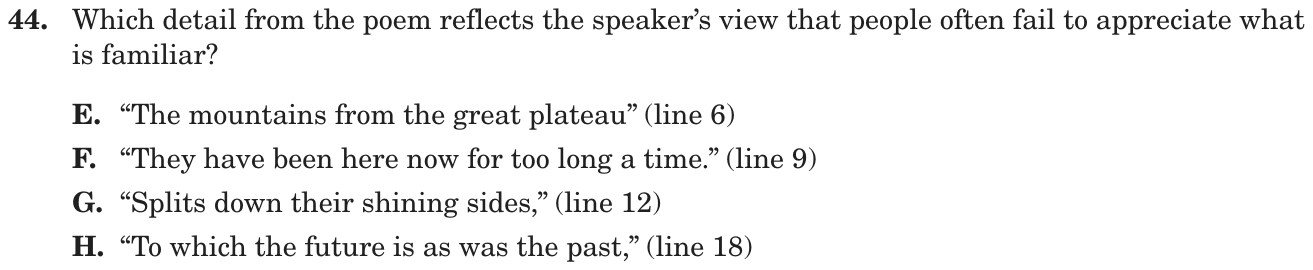
Question 45 of 57
2018 Test B English, question 45Uses the passage above: “Snowy Mountains”.
Question
How do the details in the third stanza (lines 15–26) contribute to the development of the theme of the poem?
- Aby reflecting nature’s capacity to resist change
- Bby showing that nature is capable of influencing human will
- Cby exposing how a lack of awareness leads to nature’s ruin
- Dby explaining why people must respect nature
Show the answer
Correct answer: A
The question asks how the details in the third stanza contribute to the development of the theme of the poem. In the third stanza, phrases such as “Wilderness still untamed” (line 17), “time-resisting storm-worn stone” (line 22), and “The mountains swing along” (line 23) convey the message that in spite of the destruction described in the second stanza, the mountains manage to maintain their wild magnificence. This message is communicated in Option A.
Option B is incorrect because, while the phrase “Barrier broken down” (line 21) conveys the idea that people can have some effect on the natural landscape, it does not convey how nature affects people.
Option C is incorrect because the phrase “those who do not need” (line 21) implies a choice to damage nature and not a lack of awareness or understanding.
Option D is incorrect because the third stanza is not a call to humanity to respect the mountains but a description of the untamed, welcoming mountains and the joy they provide for those who appreciate them.
Question analysis
This theme question asks how the details in the third stanza of “Snowy Mountains” contribute to the poem’s message. The stanza piles up images of peaks, gods, ice and mist alongside a line about a barrier broken down, so students must weigh all of its details and decide which idea about nature and people they add up to.
- Grade level
- Grade 8 reading and task
- Compared with grade 7
- Above grade 7 Grade 7 students trace how a theme develops, but this stanza is one long, layered sentence that mixes praise with loss, and the choices offer different, believable messages about nature, which makes it closer to grade 8 work.
- Estimated difficulty
- Hard: combines ideas, needs a plan, and has more than one tempting wrong answer.
- Thinking it demands
- Depth of knowledge 3, strategic thinking · mainly analyze
- What makes it hard
- Complex sentences moderate
- Figurative or literary language moderate
- Evidence in several places moderate
- Evidence
- Answered from one paragraph or stanza
- Reading level
- Passage: 161 words (a poem; reading level not measured); question and choices: about grade 7, 54 words.
- Corrected from the DOE handbook
- A misquotation of the poem in the explanation was corrected.
- Students, last 30 days
- Not enough answers yet to show (it takes 10).
Why it is hard, traps and wrong answers (shows the answer)
Why it is hard
The third stanza holds both endurance and damage, and the question asks which one its details mostly build. Students who fix on the broken barrier choose ruin, which the poem’s second stanza seems to confirm, while those who count the stanza’s details find untamed wilderness, time-resisting stone and mountains swinging along the horizon. The long, inverted sentence makes that count slow, which is why the question is hard.
Complex sentences moderate Understanding the question
Lines 15–26 form one sentence in which a string of descriptive phrases precedes the subject, “The mountains,” in line 23, so the stanza’s overall point is hard to hold together. (Abedi & Lord, 2001; Freedle & Kostin, 1993; Messick, 1989)
Figurative or literary language moderate Understanding the question
The mountains are given “shining foreheads,” said to be “spread by Gods,” and shown to “swing along” and welcome mists, and these personifications carry the stanza’s message of endurance. (Graesser, Singer & Trabasso, 1994; Kintsch, 1998)
Evidence in several places moderate Working it out
The theme has to be built from details scattered through twelve lines, “Wilderness still untamed,” “the future is as was the past,” “time-resisting storm-worn stone,” and weighed against the one line of damage. (Kirsch & Mosenthal, 1990; Gorin & Embretson, 2006)
Strategy: List what the third stanza says about the mountains and what it says about people, then pick the choice that fits most of those details, not just one line.
Traps
- Too narrow: A single detail offered as the central idea or a summary, or a summary that keeps minor details and leaves out an essential part.
- Outside knowledge: A choice is plausible in the real world but not supported by this text.
- Reversed relationship: Cause and effect, or the order of events, turned around.
The wrong answers, classified
B Reversed relationship (King et al., 2004)
Reverses who acts on whom: the stanza shows people breaking down the barrier and the mountains enduring, with no sign that nature shapes what people want.
C Too narrow (King et al., 2004)
Builds on line 21’s “Barrier broken down,” a single line of damage among many lines of endurance, and so mistakes one detail for the stanza’s contribution.
D Outside knowledge (King et al., 2004; Recht & Leslie, 1988)
States a familiar environmental lesson, that people must respect nature, but the stanza describes the mountains and never argues or explains what people should do.
What was corrected from the DOE handbook, and why
- Explanation: The handbook quotes line 21 as “those who do not heed.” The line reads “Barrier broken down by those who do not need,” so the site now quotes “those who do not need.”
Working it out, step by step
Figure out what the question asks
This asks what the third stanza, lines 15 to 26, adds to the poem’s theme, or big message. You need to look at all the details in those twelve lines and see what most of them say. Don’t build your answer on just one line.
Collect the stanza’s details
The stanza calls the mountains a “Wilderness still untamed” in line 17. Line 18 says “the future is as was the past,” so they do not change. Line 22 speaks of “time-resisting storm-worn stone.” Line 23 says “The mountains swing along.” Only line 21 shows harm: “Barrier broken down.”
Explain what the details add up to
“Untamed” means still wild and not controlled by people. “Time-resisting” means holding out against time. “Storm-worn” means worn by storms but still standing. Even after the harm in stanza 2, the mountains are still wild. They still swing along the edge of the sky. So the stanza shows that nature can resist change. Capacity means ability.
Check each choice
- A fits. Most details show the mountains lasting and staying wild.
- B is wrong. It flips who acts. People act on the mountains. The mountains do not change what people want.
- C is wrong. Line 21 shows some damage, but it is one line. The rest of the stanza shows the mountains enduring, not ruined.
- D is wrong. The stanza describes the mountains. It never tells people what they must do.
Choose the answer
Most of the third stanza shows the mountains staying wild and strong over time. So the answer is A, “by reflecting nature’s capacity to resist change.”
Why this answer and not the closest wrong one
C is the strongest trap, because stanza 2 really is about harm. But this question is about stanza 3. Count its details. Untamed wilderness, an unchanging future, time-resisting stone and mountains swinging along all show endurance. Only one line shows damage, so A fits the stanza as a whole.
More questions like this
The original DOE question
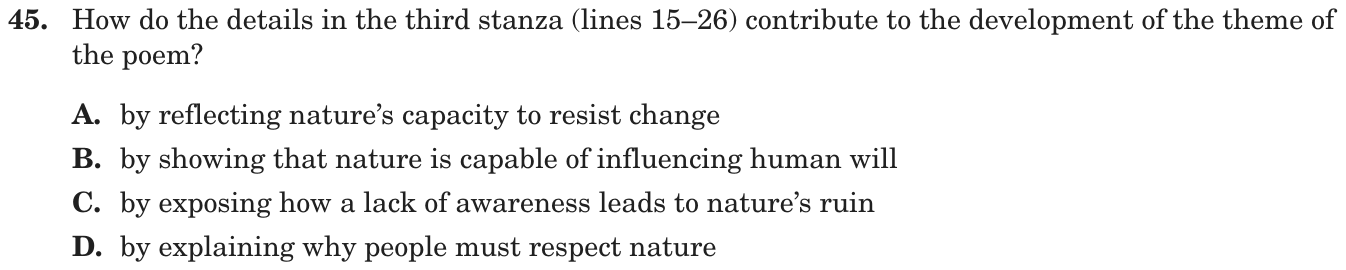
Question 46 of 57
2018 Test B English, question 46Uses the passage above: “Snowy Mountains”.
Question
Read lines 21–22 from the poem.
Barrier broken down by those who do not need
The joy of time-resisting storm-worn stone,
How do the lines help convey the speaker’s point of view?
- AThey suggest that the speaker wants to remove the obstacles that prevent others from experiencing the wonders of nature.
- BThey reveal the speaker’s opinion that some people are too busy to appreciate natural beauty.
- CThey suggest the speaker’s dismay that people destroy the natural landscape without understanding the ramifications of their actions.
- DThey explain that the speaker is confident that nature will never be fully destroyed by people.
Show the answer
Correct answer: C
The question asks how the lines help convey the speaker’s point of view. The words “those who do not need / The joy” in lines 21–22 suggest the speaker’s sadness that people do not realize that they are destroying something wonderful and irreplaceable, as expressed in Option C.
Option A is incorrect because the word “barrier” (line 21) refers to the speaker’s opinion that the mountains were “spread by Gods” (line 19) and not to an obstacle that the speaker thinks should be removed.
Option B is incorrect because, while the lines indicate that people have lost the need to connect with nature, they do not reveal that the speaker thinks that the cause of this loss is busyness.
Option D is incorrect because, although the speaker does say that the stone is “time-resisting” (line 22), this belief is only a small detail of the speaker’s point of view.
Question analysis
Students explain how lines 21–22 of the poem “Snowy Mountains” convey the speaker’s point of view about people who break down the mountains’ barrier. The lines are hard to parse because a phrase runs across the line break and “need” is used in an unusual way, so students must first work out what the sentence says before judging the speaker’s feeling.
- Grade level
- Grade 8 reading and task
- Compared with grade 7
- Above grade 7 Reading a speaker’s attitude is grade 7 work, but this sentence runs across a line break with unusual phrasing, and the choices require fine distinctions between feelings and reasons, which pushes it above typical grade 7 demand.
- Estimated difficulty
- Hard: combines ideas, needs a plan, and has more than one tempting wrong answer.
- Thinking it demands
- Depth of knowledge 2, skills and concepts · mainly analyze
- What makes it hard
- Complex sentences major
- Reading between the lines moderate
- Hard words minor
- Evidence
- Answered from one sentence or line
- Reading level
- Passage: 161 words (a poem; reading level not measured); question and choices: about grade 9, 99 words.
- Students, last 30 days
- Not enough answers yet to show (it takes 10).
Why it is hard, traps and wrong answers (shows the answer)
Why it is hard
Two lines of compressed, inverted verse must be untangled before any choice can be judged, and the meaning of “need” in them is unusual. Once the lines are paraphrased as people who do not value the old stone breaking it down, the speaker’s sorrow is clear, but two wrong choices offer neighboring readings. One supplies a reason the poem never gives, and the other carries the stanza’s idea of endurance into a certainty the lines contradict.
Complex sentences major Understanding the question
The sentence breaks mid-phrase, “those who do not need / The joy of time-resisting storm-worn stone,” and has no main verb of its own, so students must first work out who breaks what. (Abedi & Lord, 2001; Freedle & Kostin, 1993; Messick, 1989)
Reading between the lines moderate Working it out
Neither dismay nor ignorance is stated; both have to be inferred from describing people as not needing “the joy” of what they break down. (Graesser, Singer & Trabasso, 1994; Kintsch, 1998)
Hard words minor Understanding the question
“Barrier” here means the mountain range as a wall, not an obstacle, and the key uses “ramifications,” a word many students will not know. (Perfetti, 2007; Freedle & Kostin, 1993)
Strategy: Rephrase the two lines in plain words, starting with who breaks the barrier and what they do not need, then decide which feeling of the speaker that wording reveals.
Traps
- Dictionary meaning, not meaning here: A common meaning of the word that does not fit its use in this text.
- Outside knowledge: A choice is plausible in the real world but not supported by this text.
- Too broad or too strong: A choice overstates, generalizes, or uses absolute words the text does not support.
The wrong answers, classified
A Dictionary meaning, not meaning here (Perfetti, 2007)
Takes “Barrier” in its everyday sense of an obstacle to clear away, but here it is the mountain range itself, “spread by Gods,” which the speaker values.
B Outside knowledge (King et al., 2004; Recht & Leslie, 1988)
Supplies a familiar modern explanation, that people are too busy for nature, though the lines say only that some people do not need this joy, not why.
D Too broad or too strong (King et al., 2004)
Stretches “time-resisting” into certainty that nature can never be destroyed, though the same sentence shows the barrier being broken down by people.
Working it out, step by step
Figure out what the question asks
This asks what lines 21 and 22 show about the speaker’s point of view, or feelings and opinion. The lines are tangled, so first you need to put them in plain words.
Read the lines in their place
The two lines are “Barrier broken down by those who do not need / The joy of time-resisting storm-worn stone,” in the third stanza. Two lines earlier, line 19 calls the mountains a “Barrier spread by Gods,” or a wall made by the gods. So the barrier is the mountain range itself. It is not an obstacle in someone’s way.
Put the lines in plain words
Here is the meaning. The mountains are being broken down by people who feel no need for the joy that old, strong stone gives. These people do not value what they are destroying. The speaker is sad and upset about this. That feeling is dismay. Ramifications are the results that follow from an action. People break the mountains without seeing what they lose.
Check each choice
- A is wrong. The “barrier” is the mountains, which the speaker loves. The speaker does not want them removed.
- B is wrong. The lines never say why people don’t value the stone. Being too busy is a reason brought in from outside.
- C fits. The speaker is dismayed that people destroy the mountains without seeing their worth.
- D is wrong. The same lines show the barrier being “broken down.” They show worry about harm, not confidence that nature is safe.
Choose the answer
The lines show sorrow at people breaking down something they do not value. So the answer is C, “They suggest the speaker’s dismay that people destroy the natural landscape without understanding the ramifications of their actions.”
Why this answer and not the closest wrong one
B is the closest trap. It also says people fail to value nature. But it adds a reason, being busy, that the poem never gives. The lines only say these people “do not need” the joy. C stays with what the lines show: harm done by people who don’t see its cost.
More questions like this
The original DOE question
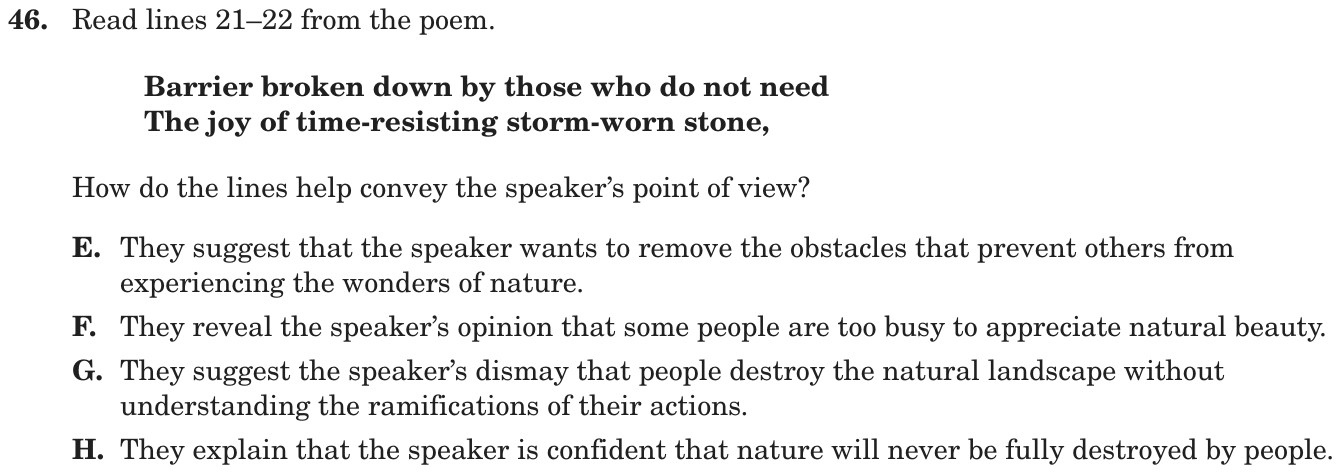
Question 47 of 57
2018 Test B English, question 47Uses the passage above: “Snowy Mountains”.
Question
Read lines 23–26 from the poem.
The mountains swing along
The south horizon of the sky;
Welcoming with wide floors of blue-green ice
The mists that dance and drive before the sun.
The personification in these concluding lines of the poem suggests that the mountains are
- Agracious hosts who are untroubled by the actions of people.
- Bunaware of their coming destruction.
- Clively entertainers who are not bothered by the everyday concerns of people.
- Dtoo proud to reveal their pain.
Show the answer
Correct answer: A
The question asks what the personification in the lines suggests in the poem. Line 25’s use of the word “Welcoming” suggests that the mountains are kind hosts. Lines 23 and 26, with language such as “The mountains swing along” and “The mists that dance and drive before the sun,” imply the carefree nature of the mountains as they resist the destructive work of humanity. Therefore, Option A is correct.
Option B is incorrect because the wording in the lines is positive and victorious, with no language to suggest coming destruction.
Option C is incorrect because, although the lines mention that “the mountains swing along” (line 23) and “the mists . . . dance” (line 26), the personification is used to describe the mountains’ perseverance, rather than to suggest that the mountains are entertaining others.
Option D is incorrect because the lines refer to the joy of the mountains as they “swing along” (line 23) and do not suggest pride.
Question analysis
This personification question asks what the final four lines of the poem “Snowy Mountains” suggest about the mountains, which “swing along” the south horizon of the sky. Students must interpret human qualities given to nature, and the trick is that several choices assign the mountains feelings or roles that only partly match the lines.
- Grade level
- Grade 7 reading and task
- Compared with grade 7
- At grade 7 Interpreting personification is a familiar grade 7 skill, and these lines are short and quoted. The challenge is choosing among character descriptions that each match part of the imagery, a typical rather than unusual demand.
- Estimated difficulty
- Moderate: several steps, or a close reading with one strong distractor.
- Thinking it demands
- Depth of knowledge 2, skills and concepts · mainly understand
- What makes it hard
- Figurative or literary language moderate
- A very close wrong answer moderate
- Complex sentences minor
- Evidence
- Answered from one sentence or line
- Reading level
- Passage: 161 words (a poem; reading level not measured); question and choices: about grade 6, 78 words.
- Students, last 30 days
- Not enough answers yet to show (it takes 10).
Why it is hard, traps and wrong answers (shows the answer)
Why it is hard
The closing lines are calm and generous, and the question asks students to turn their personification into a character. The trap is assigning actions to the wrong actor: the dancing belongs to the mists, and taking it for the mountains’ makes them performers rather than hosts. Students who carry the destruction of earlier stanzas into these lines also misjudge the mountains’ ease.
Figurative or literary language moderate Understanding the question
The personification has to be sorted by actor: the mountains “swing along” and are “Welcoming,” while it is the mists that “dance and drive before the sun.” (Graesser, Singer & Trabasso, 1994; Kintsch, 1998)
A very close wrong answer moderate Choosing the answer
The hosts choice and the entertainers choice share one frame, mountains unbothered by people; they differ only in the role, and line 26 settles it, since the mists, not the mountains, “dance.” (Embretson & Wetzel, 1987; Gorin & Embretson, 2006; Ascalon et al., 2007)
Complex sentences minor Understanding the question
In “Welcoming with wide floors of blue-green ice / The mists,” the object comes after a long phrase and a line break, so who welcomes whom is easy to miss. (Abedi & Lord, 2001; Freedle & Kostin, 1993; Messick, 1989)
Strategy: Note each human action in lines 23–26 and who performs it, then choose the description that fits every one of those actions.
Traps
- Half right: One half of a two-part choice is right and the other is not.
- Reads too much in: A reasonable-sounding conclusion that goes further than the text allows.
The wrong answers, classified
B Reads too much in (Graesser, Singer & Trabasso, 1994)
Reads the mountains’ carefree “swing along” as obliviousness and adds the earlier stanzas’ damage, but these lines are serene and say nothing about destruction to come.
C Half right (King et al., 2004; Thissen, Steinberg & Fitzpatrick, 1989)
Gets the mountains’ unconcern about people nearly right, but takes “swing” and “dance” as entertaining when the mists do the dancing and the mountains welcome them as hosts.
D Wrong tone or attitude (Graesser, Singer & Trabasso, 1994)
Imagines hidden suffering behind the calm, perhaps from “storm-worn stone,” but the lines show the mountains at ease and welcoming, with no hint of pride or pain.
Working it out, step by step
Figure out what the question asks
This asks about personification in lines 23 to 26. Personification means giving human actions or feelings to something that is not human. You need to decide what kind of person the mountains seem to be.
Sort the actions by who does them
Line 23 says “The mountains swing along.” Line 25 says the mountains are “Welcoming with wide floors of blue-green ice.” Whom do they welcome? Line 26 answers: “The mists that dance and drive before the sun.” So the mountains swing and welcome. The mists are the ones that dance.
Explain what the actions suggest
To swing along is to move in an easy, carefree way. Welcoming guests onto your floors is what a host does. A host is a person who has guests over. The mountains are kind hosts to the mists. Gracious means kind and polite. They also seem calm. After all the harm in stanza 2, they are untroubled, or not bothered.
Check each choice
- A fits. The mountains welcome guests and stay calm.
- B is wrong. These lines say nothing about harm still to come.
- C is wrong. The mists dance, not the mountains. The mountains are hosts, not entertainers.
- D is wrong. The lines show ease and welcome. Nothing hints at pride or hidden pain.
Choose the answer
The mountains swing along and welcome the mists like hosts. So the answer is A, “gracious hosts who are untroubled by the actions of people.”
Why this answer and not the closest wrong one
C is very close, since it also says the mountains don’t worry about people. The difference is the role. An entertainer performs for others. A host welcomes others in. In line 26 it is the mists that “dance,” and the mountains are “Welcoming” them. That makes the mountains hosts.
More questions like this
The original DOE question
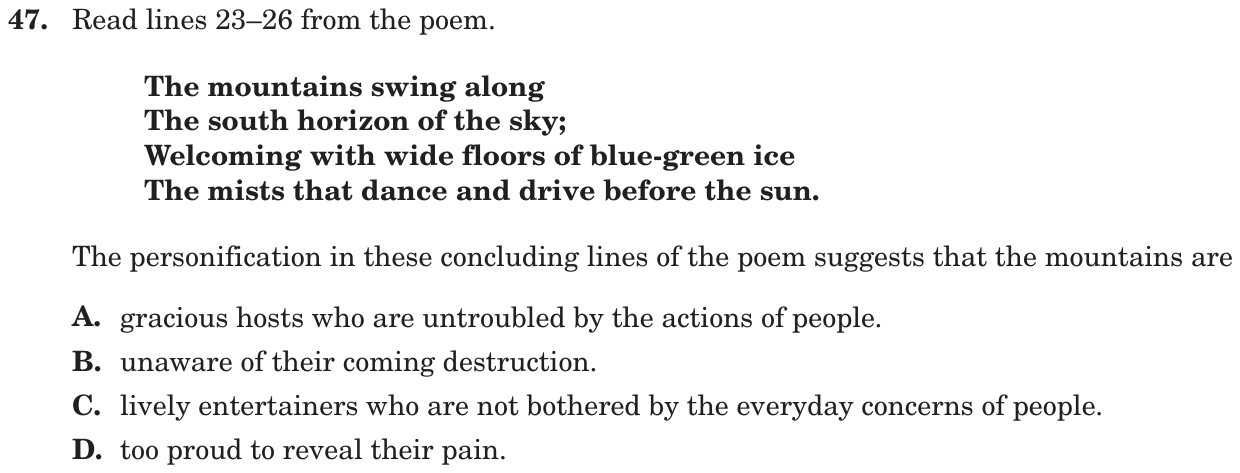
Question 48 of 57
2018 Test B English, question 48Passage Invention of the Telegraph
Samuel Morse, an American inventor, is credited with creating the electronic telegraph, a communication device that allows users to send messages using a system of short and long pulses that represent letters, numbers, and punctuation. In 1843 the United States Congress passed the Telegraph Bill, which provided Morse with the funds to build an electric telegraph system.
Invention of the Telegraph
Earlier Signal Systems
Long before Samuel F. B. Morse electrically transmitted his famous message “What hath God wrought?” from Washington to Baltimore on May 24, 1844, there were signaling systems that enabled people to communicate over distances. Most were visual or “semaphore” systems using flags or lights. In the eighteenth century, such systems used an observer who would decipher a signal from a high tower on a distant hill and then send it on to the next station. The young American republic wanted just such a system along its entire Atlantic coast and offered a prize of $30,000 for a workable proposal. The framers of this legislation had no way of knowing that when they used the word “telegraph” to refer to this visual semaphore system, they would be offered an entirely new and revolutionary means of communication—electricity.
The Growth of an Idea
The idea of using electricity to communicate over distance is said to have occurred to Morse during a conversation aboard ship when he was returning from Europe in 1832. Michael Faraday’s recently invented electromagnet was much discussed by the ship’s passengers, and when Morse came to understand how it worked, he speculated that it might be possible to send a coded message over a wire. While a student at Yale College years before, he had written his parents a letter about how interesting he found the lectures on electricity. Despite what he had learned at Yale, Morse found when he began to develop his idea that he had little real understanding of the nature of electricity, and after sporadic attempts to work with batteries, magnets, and wires, he finally turned for help to a colleague at the University of the City of New York, Leonard D. Gale.
Gale was a professor of chemistry and familiar with the electrical work of Princeton’s Joseph Henry, a true pioneer in the new field. Well before Morse had his shipboard idea about a telegraph, Henry rang a bell at a distance by opening and closing an electric circuit. In 1831, he had published an article, of which Morse was unaware, that contained details suggesting the idea of an electric telegraph. Gale’s help and his knowledge of this article proved crucial to Morse’s telegraph system because Gale not only pointed out flaws in the system but showed Morse how he could regularly boost the strength of a signal and overcome the distance problems he had encountered by using a relay system Henry had invented. Henry’s experiments, Gale’s assistance, and, soon after, hiring the young technician Alfred Vail were keys to Morse’s success.
Obstacles and Opportunities
By December 1837, Morse had enough confidence in his new system to apply for the federal government’s appropriation, and during the next year he conducted demonstrations of his telegraph both in New York and Washington.
However, when the economic disaster known as the Panic of 1837 took hold of the nation and caused a long depression, Morse was forced to wait for better times. It was during this period that Morse visited Europe again and tried not only to secure patent protection overseas but to examine competing telegraph systems in England. . . .
By 1843, the country was beginning to recover economically, and Morse again asked Congress for the $30,000 that would allow him to build a telegraph line from Washington to Baltimore, forty miles away. The House of Representatives eventually passed the bill containing the Morse appropriation, and the Senate approved it in the final hours of that Congress’s last session. With President Tyler’s signature, Morse received the cash he needed and began to carry out plans for an underground telegraph line.
Realizing a Great Invention
Morse had hired the ingenious construction engineer Ezra Cornell to lay the pipe carrying the wire, and although Cornell did his job superbly, one of Morse’s partners, Congressman F. O. J. Smith, had purchased wire with defective insulation. Too much time had been wasted laying bad wire, and with the project on a rigid deadline, something had to be done quickly. Cornell suggested that the fastest and cheapest way of connecting Washington and Baltimore was to string wires overhead on trees and poles. The desperate Morse gave the go-ahead, and the line was completed in time for the dramatic and spectacularly successful link between the Supreme Court chamber of the Capitol building and the railroad station in Baltimore.
Soon, as overhead wires connected cities up and down the Atlantic coast, the dots-and-dashes method that recorded messages on a long moving strip of paper was replaced by the operator’s ability to interpret the code in real time. . . . Telegraph lines soon extended westward, and within Morse’s own lifetime they connected the continents of Europe and America.
“Invention of the Telegraph”—Public Domain/Library of Congress
legislation: Telegraph Bill
dots-and-dashes method: the short and long pulses of Morse code that are sent and received by telegraph operators
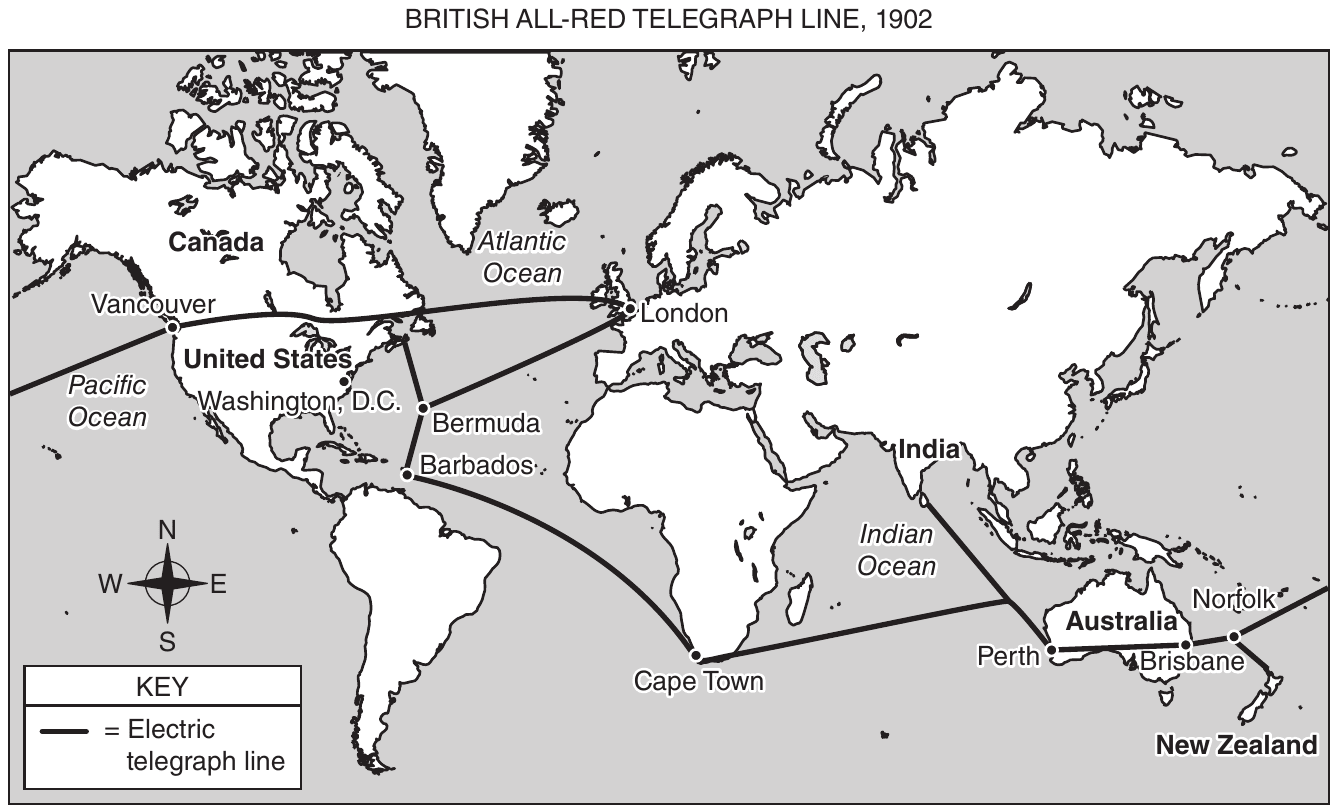
The first transatlantic electric telegraph message was sent in 1858, and by 1902 the British All-Red Line connected most of the world.
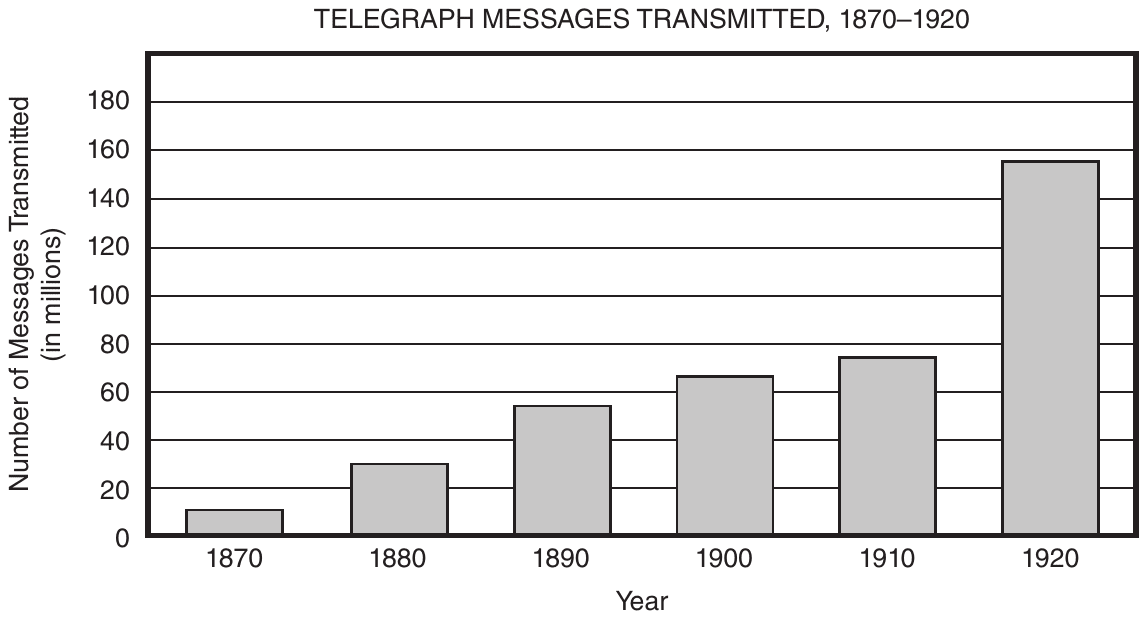
Source: U.S. Bureau of the Census. Historical Statistics of the United States, Colonial Times to 1970, Bicentennial Edition, Part 2. Washington, D.C., 1975.
Question
Which statement describes how the author’s use of problem-solution in paragraph 2 contributes to the development of ideas in the passage?
- AMorse’s discussion on a ship about Faraday’s electromagnet reminded him of the Yale College lectures on electricity, which he had enjoyed but had not fully understood, inspiring him to learn more about electricity from his colleague Gale.
- BMorse’s discouragement over his lack of knowledge of electricity prompted him to experiment with batteries, magnets, and wires, which led to the development of a new long-distance communication system.
- CMorse’s difficulty in understanding how Faraday’s electromagnet worked was frustrating, and it pushed him to create a system for sending signals over wires.
- DMorse’s longtime fascination was not enough to make up for his lack of knowledge about electricity, so he eventually sought help from Gale.
Show the answer
Correct answer: D
The question asks for the best explanation of how the use of problem-solution in paragraph 2 helps develop the ideas in the passage. Option D is correct because it explains that Morse realized his problem was that he was not knowledgeable enough to continue his experimentation without help, so the solution was to seek help from a colleague.
Option A is incorrect because, while the discussion on the ship fascinated Morse and reminded him of the lectures he had attended at Yale College, it was his failed attempts with electricity that caused him to reach out to Gale for help.
Option B is incorrect because, while “Morse found when he began to develop his idea that he had little real understanding of the nature of electricity” (paragraph 2), the paragraph does not state that he was discouraged; it was his failed experimentation that resulted in him first realizing that he needed help.
Option C is incorrect because the paragraph states that “Morse came to understand how [Faraday’s electromagnet] worked,” and that understanding is what caused him to think about sending messages over a wire. Also, Morse’s difficulty was in understanding the properties of electricity in general once he began his experimentation.
Question analysis
In this text structure question about “Invention of the Telegraph,” students explain how the problem-and-solution pattern in paragraph 2 develops ideas about Samuel Morse. All four choices are long sentences built from real details about the ship, Yale and Gale, so students must check each one’s account of what led to what.
- Grade level
- Grade 8 reading and task
- Compared with grade 7
- Above grade 7 Identifying problem and solution is familiar from earlier grades, but these choices are long, detail-packed chains in which a single misplaced cause makes an option wrong, which demands closer checking than typical grade 7 items.
- Estimated difficulty
- Hard: combines ideas, needs a plan, and has more than one tempting wrong answer.
- Thinking it demands
- Depth of knowledge 2, skills and concepts · mainly analyze
- What makes it hard
- Every choice must be checked major
- A very close wrong answer moderate
- The right answer is reworded moderate
- A lot to read moderate
- How, not what minor
- Evidence
- Answered from one paragraph or stanza
- Reading level
- Passage: about grade 11, 910 words; question and choices: about grade 16, 132 words.
- Corrected from the DOE handbook
- A wrong paragraph number in the explanation was corrected.
- A misspelled name in the explanation was corrected.
- A punctuation slip in the explanation was corrected.
- Students, last 30 days
- Not enough answers yet to show (it takes 10).
Why it is hard, traps and wrong answers (shows the answer)
Why it is hard
Every choice is assembled from things the paragraph really mentions, so recognition is useless and only the order of causes decides. The most tempting wrong choice ends with Gale, the right solution, but invents a reminder of the Yale lectures to get there; others turn the failed experiments into the solution or reverse what Morse understood. The question rewards reading each long choice clause by clause, which costs time.
Every choice must be checked major Choosing the answer
Each choice is a chain of two or three causes built from real details, the ship, Faraday, Yale, the batteries and wires, Gale, so every link has to be checked against paragraph 2’s order of events. (Embretson & Wetzel, 1987)
A very close wrong answer moderate Choosing the answer
The Yale-reminder choice and the key both join Morse’s enjoyment of electricity, his weak grasp of it and his turn to Gale; they part on one detail, the claim that the shipboard talk “reminded him” of Yale, which the paragraph never makes. (Embretson & Wetzel, 1987; Gorin & Embretson, 2006; Ascalon et al., 2007)
The right answer is reworded moderate Choosing the answer
The key turns the Yale letter and the shipboard speculation into “longtime fascination,” a phrase the passage never uses, while the wrong choices repeat its names and phrases and so look better supported. (Freedle & Kostin, 1993; Kirsch & Mosenthal, 1990)
A lot to read moderate Understanding the question
The four choices run to about 110 words, the longest 37, and paragraph 2 itself packs a voyage, a college letter, failed experiments and a colleague into four sentences. (Kintsch, 1998; Gorin & Embretson, 2006; Freedle & Kostin, 1993)
How, not what minor Working it out
Students must name the paragraph’s problem, too little understanding of electricity, and its solution, Gale, before judging which account of the pattern is accurate. (Anderson & Krathwohl, 2001)
Strategy: Name the problem and the solution in paragraph 2 in a few words each, then choose the option whose sequence of events matches the paragraph exactly.
Traps
- Reversed relationship: Cause and effect, or the order of events, turned around.
- Half right: One half of a two-part choice is right and the other is not.
The wrong answers, classified
A Half right (King et al., 2004; Thissen, Steinberg & Fitzpatrick, 1989)
Ends correctly with Morse learning from Gale, but invents its cause: the paragraph never says the shipboard talk reminded Morse of Yale, and it skips the failed experiments that sent him to Gale.
B Reversed relationship (King et al., 2004)
Reverses cause and effect: the “sporadic attempts” with batteries, magnets and wires exposed Morse’s weak grasp of electricity and sent him to Gale, rather than flowing from discouragement and producing the system.
C Twists what the text says (King et al., 2004)
Says Morse struggled to understand Faraday’s electromagnet, but the paragraph states that he “came to understand how it worked,” and that understanding is what gave him the idea.
What was corrected from the DOE handbook, and why
- Explanation: The handbook places the sentence “Morse found when he began to develop his idea that he had little real understanding of the nature of electricity” in paragraph 3. It is in paragraph 2, the paragraph the question is about, so the site now says “(paragraph 2).”
- Explanation: The handbook spells Leonard Gale’s name “Gail.” The passage spells it “Gale,” and so does the site now.
- Explanation: The handbook capitalizes “Also” after a semicolon (“over a wire; Also, Morse’s difficulty…”). The site starts a new sentence instead: “over a wire. Also, Morse’s difficulty…”
Working it out, step by step
Figure out what the question asks
This asks about problem-solution in paragraph 2. Problem-solution is a way to organize writing. First you learn about a problem, then how someone solved it. Find the problem and the solution. Then pick the choice that tells them in the right order.
Find the problem in paragraph 2
Paragraph 2 starts with “The idea of using electricity to communicate over distance.” It says Morse had enjoyed the electricity lectures at Yale. But then comes the problem: “Morse found when he began to develop his idea that he had little real understanding of the nature of electricity.”
Find the solution
The same sentence goes on: “after sporadic attempts to work with batteries, magnets, and wires, he finally turned for help to a colleague.” “Sporadic” means now and then, not steady. A colleague is a coworker. So Morse was interested in the subject, tried on his own, and did not succeed. His interest was not enough. His solution was to ask Gale for help.
Check each choice
- A is wrong. It ends with Gale, but the paragraph never says the ship talk “reminded him” of Yale. It also skips the failed tries.
- B is wrong. It has the order backward. The experiments showed the problem. They did not build the system.
- C is wrong. The paragraph says Morse “came to understand how it worked,” meaning the electromagnet.
- D fits. Long interest was not enough, so he got help from Gale.
Choose the answer
The problem was Morse’s weak grasp of electricity, and the solution was Gale. So the answer is D, “Morse’s longtime fascination was not enough to make up for his lack of knowledge about electricity, so he eventually sought help from Gale.”
Why this answer and not the closest wrong one
A is the closest trap. Like D, it mentions Yale, Morse’s weak grasp of electricity and Gale. But it adds a link the paragraph never makes, that the ship talk reminded him of Yale. With long choices, check every part. One made-up link makes the whole choice wrong.
More questions like this
The original DOE question
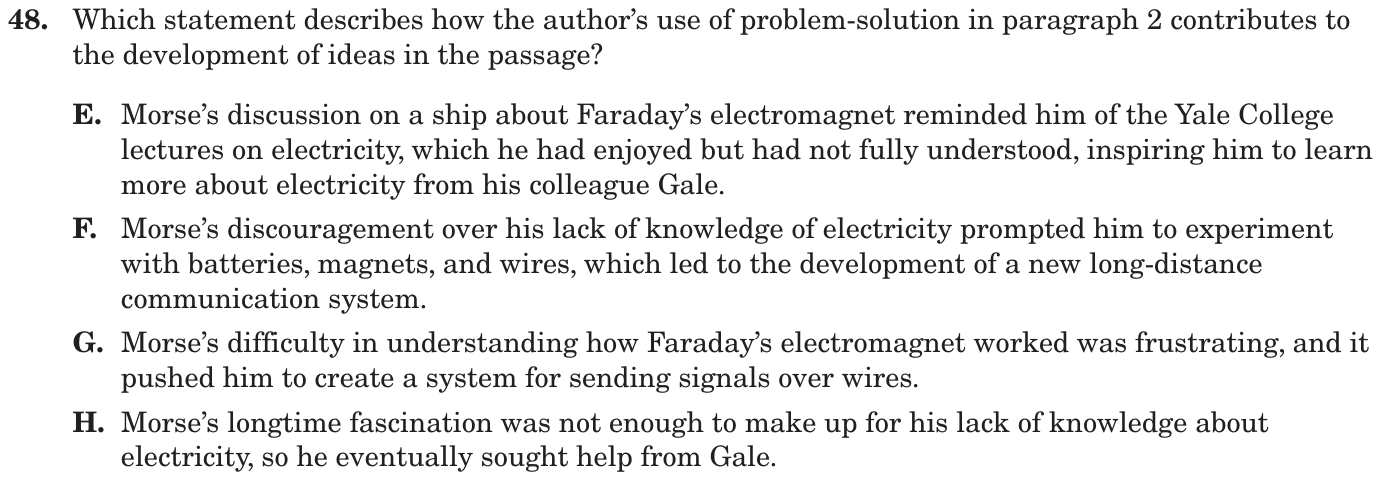
The passage “Invention of the Telegraph” as printed (pages 146–148)
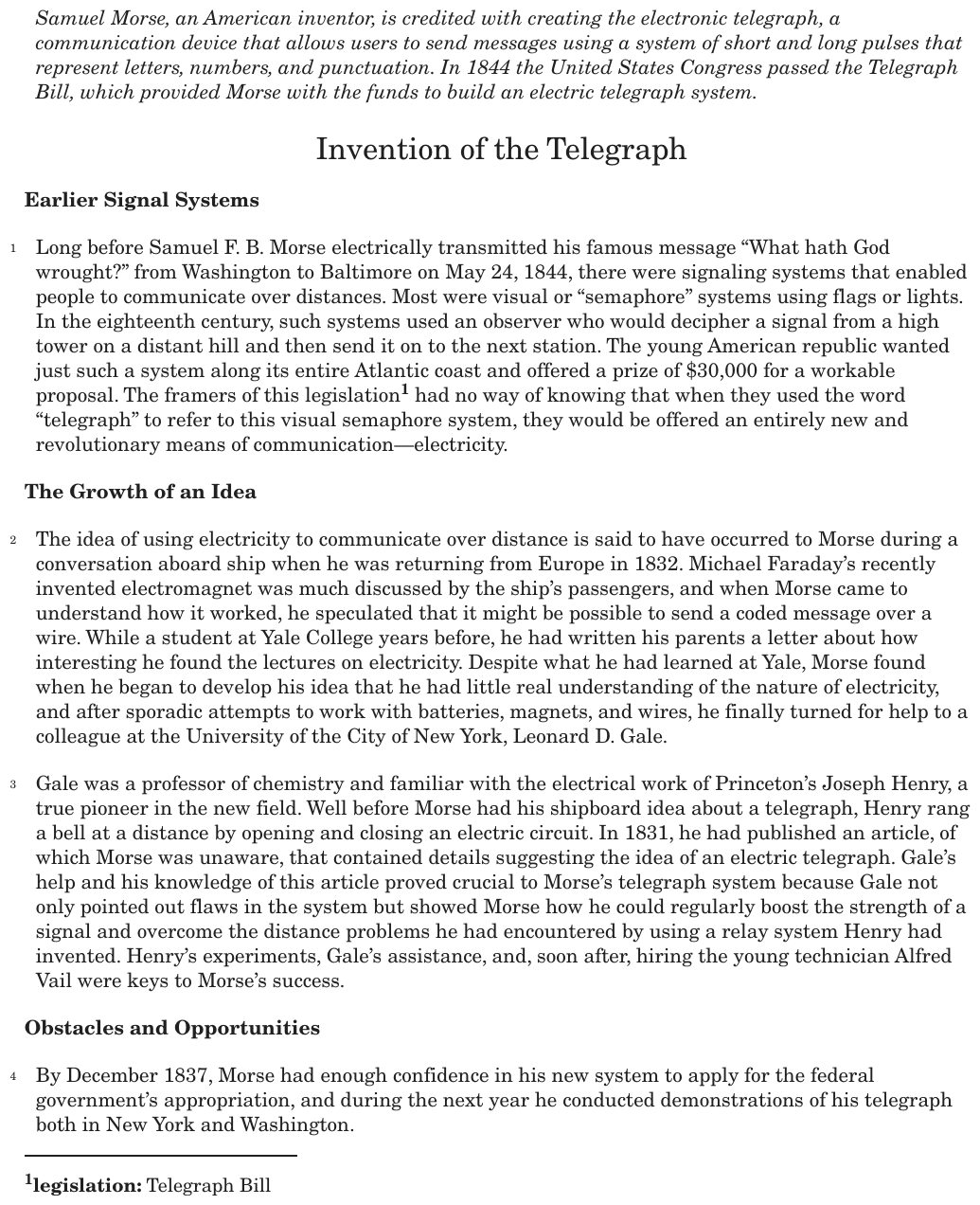
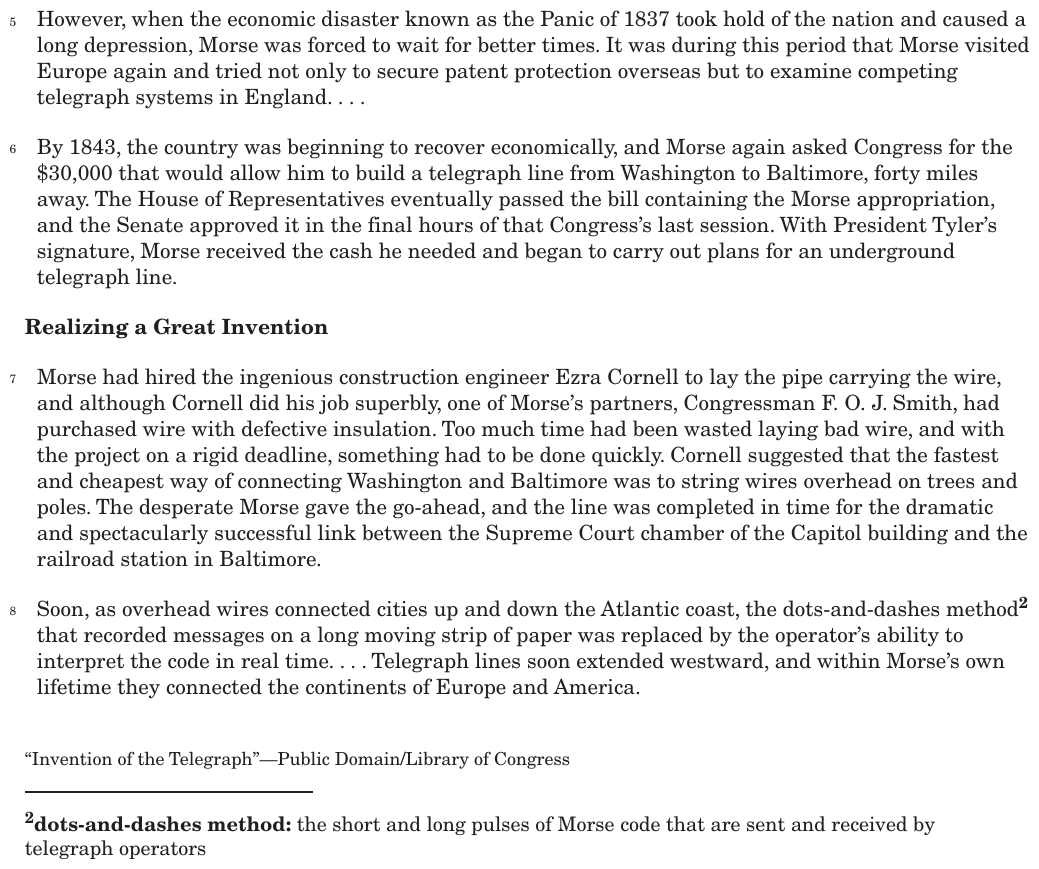
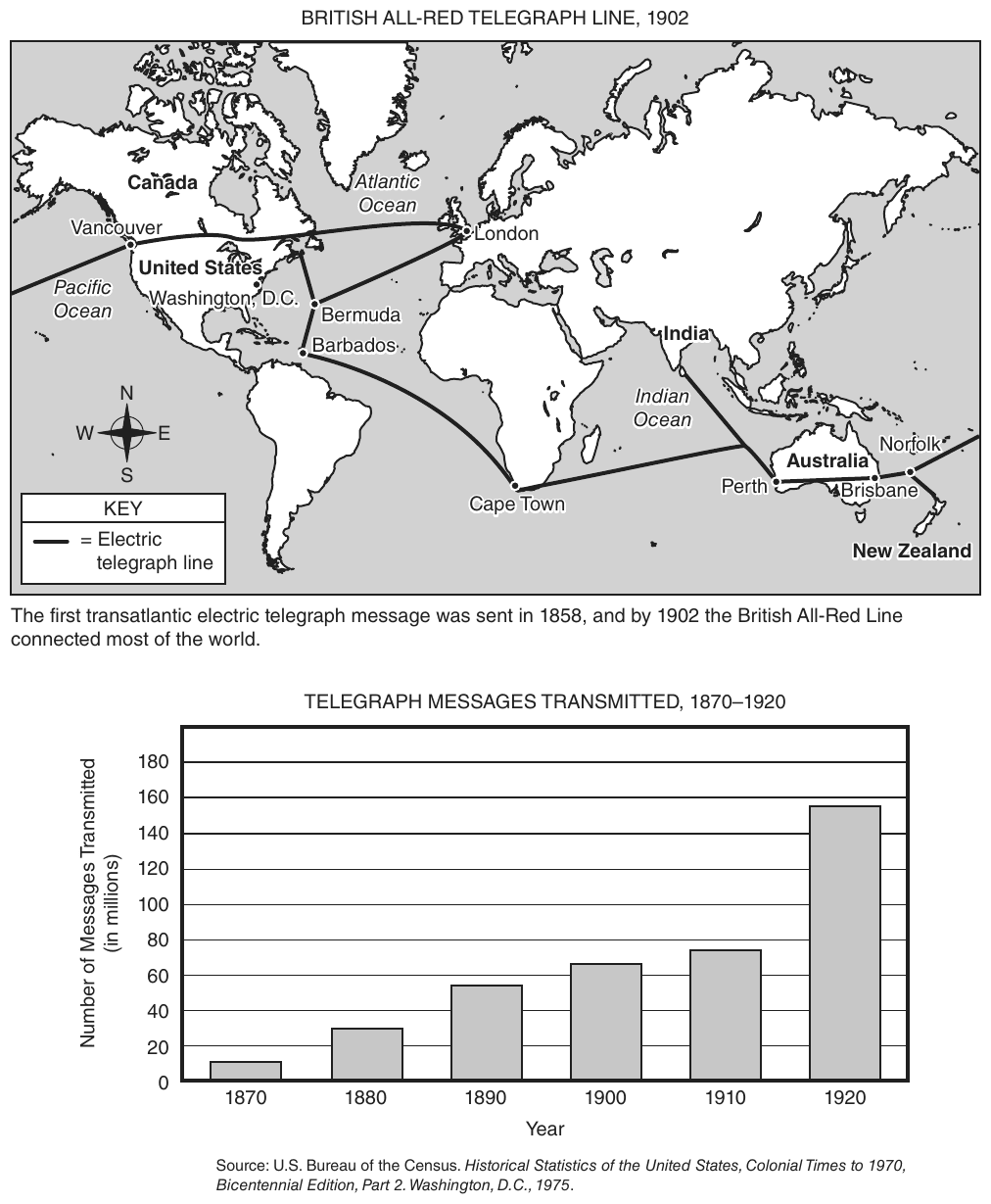
Question 49 of 57
2018 Test B English, question 49Uses the passage above: “Invention of the Telegraph”.
Question
Which statement describes how the author’s use of sequencing in paragraph 3 contributes to the overall structure of the passage?
- AIt shows that several people were simultaneously attempting to create an electric telegraph.
- BIt shows how the invention of the electric telegraph depended on information and techniques discovered by others.
- CIt shows that multiple means of long-distance communication were being used at the same time.
- DIt shows how quickly long-distance communication changed from visual signals to electrical signals.
Show the answer
Correct answer: B
The question asks how the use of sequencing, or arranging in chronological order, in paragraph 3 contributes to the overall structure of the passage. Paragraph 3 outlines the information that Gale knew who Henry was (“Well before Morse had his shipboard idea about a telegraph, Henry rang a bell at a distance by opening and closing an electric circuit”) and that Gale told Morse. Gale’s input was “crucial to Morse’s telegraph system,” and hiring Vail was an additional and necessary help.
Therefore, Option B is correct because the creation of Morse’s telegraph involved a series of steps that each built upon earlier ideas and inventions from others, such as Henry, Gale, and Vail.
Option A is incorrect because, although the inventions and advancements of others assisted in the development of the telegraph, the passage does not suggest that the other men were attempting to create their own telegraph systems.
Option C is incorrect because the only other long-distance communication system mentioned in the passage is the outdated semaphore system discussed in paragraph 1.
Option D is incorrect because the telegraph system was in development for more than ten years because of the lack of funding and the need for further experimentation.
Question analysis
Students explain how the sequence of events in paragraph 3 of “Invention of the Telegraph” contributes to the passage’s overall structure. The paragraph names several people and their roles in a few long sentences, and the choices make claims about the invention’s history that must each be checked against it.
- Grade level
- Grade 8 reading and task
- Compared with grade 7
- At grade 7 Sequencing is familiar grade 7 structure work. This paragraph packs several people and dates into long sentences, but once the order is clear the role of the sequence is fairly direct, so the demand is typical.
- Estimated difficulty
- Moderate: several steps, or a close reading with one strong distractor.
- Thinking it demands
- Depth of knowledge 2, skills and concepts · mainly analyze
- What makes it hard
- Complex sentences moderate
- How, not what moderate
- Much to keep track of minor
- Evidence
- Answered from one paragraph or stanza
- Reading level
- Passage: about grade 11, 910 words; question and choices: about grade 12, 77 words.
- Students, last 30 days
- Not enough answers yet to show (it takes 10).
Why it is hard, traps and wrong answers (shows the answer)
Why it is hard
Paragraph 3 is dense, but its last sentence nearly states the answer: Henry’s experiments, Gale’s help and Vail were “keys to Morse’s success.” Students lose the point when Henry’s telegraph-like article makes them imagine a race, or when the stem’s “overall structure” sends them back to the semaphore towers of paragraph 1. The question rewards reading the time markers as a chain of borrowed knowledge.
Complex sentences moderate Understanding the question
The key facts sit in embedded sentences, such as “an article, of which Morse was unaware, that contained details suggesting the idea,” and a 53-word sentence on what Gale showed Morse. (Abedi & Lord, 2001; Freedle & Kostin, 1993; Messick, 1989)
How, not what moderate Working it out
The stem asks what the order of events contributes to the passage’s structure, so students must see the time words, “Well before,” “In 1831,” “soon after,” as showing Morse building on others’ work. (Anderson & Krathwohl, 2001)
Much to keep track of minor Working it out
Four people, Henry, Gale, Vail and Morse, and two of Henry’s inventions have to be kept straight to see who supplied what to whom. (Sweller, 1988; Carpenter, Just & Shell, 1990)
Strategy: Put the events of paragraph 3 in order, noting who did what and when, then ask what that order shows about Morse’s invention.
Traps
- Twists what the text says: Uses the text's topic and ideas but changes what it says: who did it, how much, when, or why.
- Too broad or too strong: A choice overstates, generalizes, or uses absolute words the text does not support.
- Wrong part of the text: A choice is true of another paragraph, stanza or speaker than the one asked about.
The wrong answers, classified
A Twists what the text says (King et al., 2004)
Reads Henry’s article “suggesting the idea of an electric telegraph” as a rival effort, but the paragraph places Henry’s work “well before” Morse’s and shows it helping him.
C Wrong part of the text (Kirsch & Mosenthal, 1990)
Brings back the flag and light systems of paragraph 1, which came before the telegraph; paragraph 3 describes no other means of communication in use alongside it.
D Too broad or too strong (King et al., 2004)
Follows the passage’s overall move from semaphore to electricity but adds “how quickly,” though Morse’s idea of 1832 did not become a working line until 1844.
Working it out, step by step
Figure out what the question asks
This asks about sequencing in paragraph 3. Sequencing means putting events in time order. You need to say what that order shows about Morse’s invention.
Put paragraph 3’s events in order
Paragraph 3 uses time words. “Well before Morse had his shipboard idea about a telegraph, Henry rang a bell at a distance.” It adds that “In 1831, he had published an article” that hinted at an electric telegraph. Then Gale showed Morse “a relay system Henry had invented.” Last, Morse hired Alfred Vail “soon after.”
See what the order shows
A relay is a device that boosts a signal so it can travel farther. Each event in the order is someone else’s work that helped Morse. Henry’s work came first. Gale passed it on. Vail added his skill. The last sentence sums it up: these were all “keys to Morse’s success.” So Morse built his telegraph on what others had found.
Check each choice
- A is wrong. Henry’s work came “well before” Morse’s and helped him. Nobody was racing at the same time.
- B fits. The order shows Morse depending on earlier work by Henry, Gale and Vail.
- C is wrong. Paragraph 3 talks only about electric work. Flags and lights are in paragraph 1.
- D is wrong. Nothing here shows speed. Morse’s idea came in 1832, and his line opened in 1844.
Choose the answer
The time order shows one person’s work feeding the next, all leading to Morse. So the answer is B, “It shows how the invention of the electric telegraph depended on information and techniques discovered by others.”
Why this answer and not the closest wrong one
A is the strongest trap, because Henry’s article had details “suggesting the idea of an electric telegraph.” That can sound like a rival. But the time words show Henry came first, and Gale used his work to help Morse. Earlier work that helps is what B describes.
More questions like this
The original DOE question
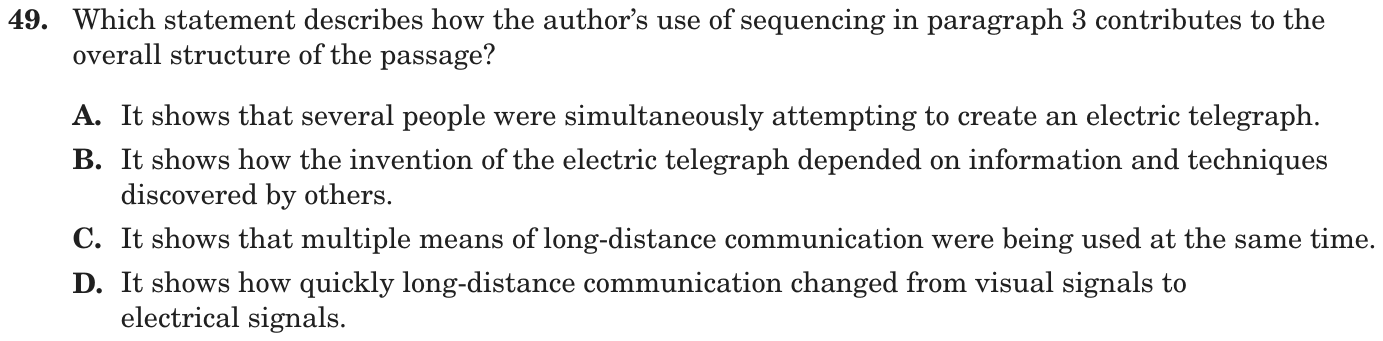
Question 50 of 57
2018 Test B English, question 50Uses the passage above: “Invention of the Telegraph”.
Question
Read this sentence from paragraph 7.
The desperate Morse gave the go-ahead, and the line was completed in time for the dramatic and spectacularly successful link between the Supreme Court chamber of the Capitol building and the railroad station in Baltimore.
The words “dramatic” and “spectacularly” in the sentence convey a
- Asense of relief and fulfillment that the line was finished.
- Bsense of wonder and of celebration that the telegraph line was completed on time.
- Cfeeling of excitement about the future possibilities of the telegraph.
- Dfeeling of confidence about being able to continue the work.
Show the answer
Correct answer: B
The question asks what the words “dramatic” and “spectacularly” convey in the sentence. Morse and Cornell rushed to post the wires overhead, and the “rigid deadline” (paragraph 7) was successfully met. The words have a positive and victorious tone that is consistent with the feeling of wonder that it worked and of celebration that the construction was completed, making Option B correct.
Option A is incorrect because, while there may have been some feelings of relief and fulfilment that the lines were in place, the passage does not say so, and instead it focuses on the wonder and joy Morse and Cornell felt overcoming setbacks and completing the construction of Morse’s telegraph system.
Option C is incorrect because the passage does not share whether Morse or Cornell considered the future possibilities of the telegraph, only that the finished product was “dramatic,” implying it was amazing to see.
Option D is incorrect because, while the passage later discusses the expansion of overhead wires “up and down the Atlantic coast” and how they “connected the continents of Europe and America” (paragraph 8), there is no evidence shared in the passage that Morse planned to continue his work with electricity.
Question analysis
This word choice question asks what the words “dramatic” and “spectacularly” convey in a sentence from “Invention of the Telegraph” about the first Washington-to-Baltimore line. Students must read the connotations of two words in context, and the choices name feelings that are all believable for a project rushed to meet a deadline.
- Grade level
- Grade 7 reading and task
- Compared with grade 7
- At grade 7 Reading the connotation of words in context is typical grade 7 work. The sentence is quoted, but the choices are close in meaning, which demands careful attention to what the two words themselves suggest.
- Estimated difficulty
- Moderate: several steps, or a close reading with one strong distractor.
- Thinking it demands
- Depth of knowledge 2, skills and concepts · mainly understand
- What makes it hard
- A very close wrong answer moderate
- Reading between the lines moderate
- Every choice must be checked minor
- Evidence
- Answered from one sentence or line
- Reading level
- Passage: about grade 11, 910 words; question and choices: about grade 9, 94 words.
- Students, last 30 days
- Not enough answers yet to show (it takes 10).
Why it is hard, traps and wrong answers (shows the answer)
Why it is hard
Every choice names a reasonable emotion for the end of a race against a deadline, which makes this a question about two words rather than about the situation. Students who read the whole sentence are pulled toward relief by “desperate,” and those who read ahead are pulled toward the future by paragraph 8. The words point to an audience impressed by a public success, not to Morse’s private feelings or plans.
A very close wrong answer moderate Choosing the answer
The relief-and-fulfillment choice has the same shape as the key, a pair of feelings about finishing the line; only the feelings differ, and “desperate” nearby favors relief while “dramatic” and “spectacularly” point to wonder. (Embretson & Wetzel, 1987; Gorin & Embretson, 2006; Ascalon et al., 2007)
Reading between the lines moderate Working it out
“Dramatic” and “spectacularly” describe the event, not anyone’s emotions, so the feeling they convey, wonder at the result and celebration of its success, has to be inferred from their connotations. (Graesser, Singer & Trabasso, 1994; Kintsch, 1998)
Every choice must be checked minor Choosing the answer
All four choices name positive feelings that suit a project rushed to completion, so none can be dismissed by tone alone. (Embretson & Wetzel, 1987)
Strategy: Ask what kind of event people call dramatic or spectacular, then pick the feeling those two words express, not a feeling the surrounding story might suggest.
Traps
- Wrong tone or attitude: Misjudges the tone, attitude or point of view, such as reading admiration as criticism, or taking a character's or subject's feelings for the author's.
- Wrong part of the text: A choice is true of another paragraph, stanza or speaker than the one asked about.
The wrong answers, classified
A Wrong tone or attitude (Graesser, Singer & Trabasso, 1994)
Takes Morse’s likely feeling, relief for a “desperate” man facing a “rigid deadline,” for what the author’s words convey, though “dramatic” and “spectacularly” celebrate an impressive success.
C Wrong part of the text (Kirsch & Mosenthal, 1990)
Looks ahead to paragraph 8, where lines spread along the coast and to Europe, but the sentence celebrates the first link itself, not hopes for what came later.
D Reads too much in (Graesser, Singer & Trabasso, 1994)
Assumes that success breeds confidence to keep going, but the sentence says nothing about further work, and the two words describe the event itself.
Working it out, step by step
Figure out what the question asks
This is a word-meaning question. It asks what feeling two words give the sentence: “dramatic” and “spectacularly.” Focus on those two words, not on how Morse might have felt.
Read the sentence in its setting
Paragraph 7 tells of a race against time. Bad wire had wasted time, and the project had “a rigid deadline.” Cornell’s idea of wires on poles saved the day. Then “the line was completed in time for the dramatic and spectacularly successful link between the Supreme Court chamber of the Capitol building and the railroad station in Baltimore.”
Explain the two words
Something dramatic is exciting and striking, like the big moment in a play. Something done spectacularly is done in an amazing way that is wonderful to see. Both words describe the event as a grand public success. They make you feel wonder and want to celebrate. The sentence also says the line was done “in time,” or on time.
Check each choice
- A is wrong. The “desperate” Morse may have felt relief. But the two words describe an amazing event, not a quiet sigh of relief.
- B fits. The words show wonder and celebration, and the line was finished on time.
- C is wrong. The sentence is about this first link. The future comes later, in paragraph 8.
- D is wrong. The sentence says nothing about going on with more work.
Choose the answer
“Dramatic” and “spectacularly” cheer a thrilling success that came right on time. So the answer is B, “sense of wonder and of celebration that the telegraph line was completed on time.”
Why this answer and not the closest wrong one
A is the closest trap because “desperate” is in the same sentence. Relief is a quiet, private feeling that a worry is over. But “dramatic” and “spectacularly” are loud, showy words. People use them for something amazing to watch. That points to wonder and celebration, as B says.
More questions like this
The original DOE question
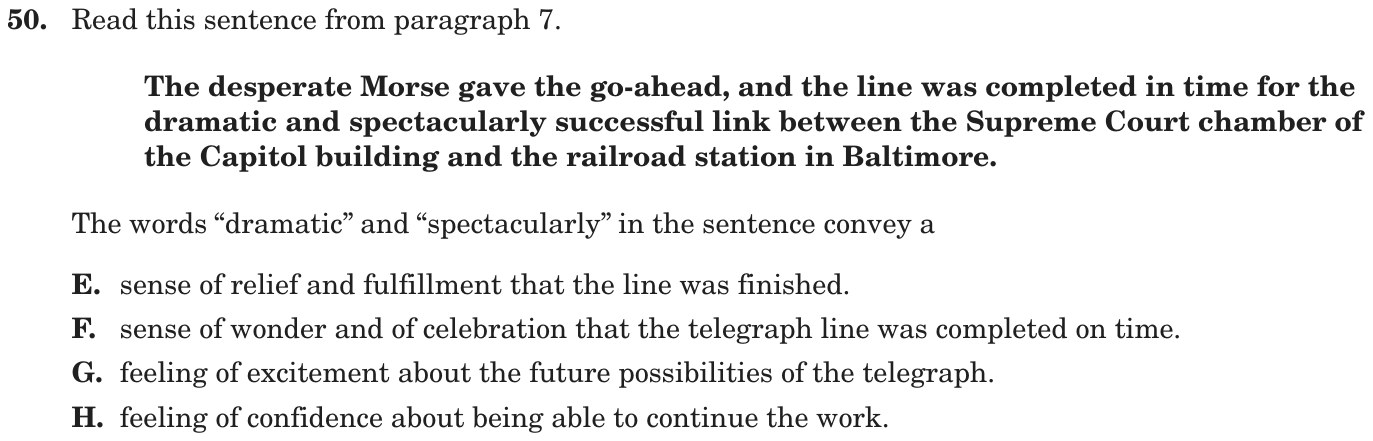
Question 51 of 57
2018 Test B English, question 51Uses the passage above: “Invention of the Telegraph”.
Question
Which excerpt from the passage supports the idea that Morse was aware of his limitations?
- A“After sporadic attempts to work with batteries, magnets, and wires, he finally turned for help to a colleague.” (paragraph 2)
- B“Gale’s help and his knowledge of this article proved crucial to Morse’s telegraph system.” (paragraph 3)
- C“Henry’s experiments, Gale’s assistance, and, soon after, hiring the young technician Alfred Vail were keys to Morse’s success.” (paragraph 3)
- D“Morse had hired the ingenious construction engineer Ezra Cornell to lay the pipe carrying the wire.” (paragraph 7)
Show the answer
Correct answer: A
The question asks for support from the passage for the idea that Morse was aware of his limitations.
Option A is correct because the sentence from paragraph 2 details the materials with which Morse experimented unsuccessfully before turning to others for assistance.
Option B is incorrect because, although the sentence from paragraph 3 notes that Gale provided necessary assistance, it makes no reference to Morse admitting defeat and requesting his help.
Option C is incorrect because, although the sentence from paragraph 3 makes it clear that Henry, Gale, and Vail contributed to Morse’s success, the sentence does not specifically say that Morse realized that he needed assistance to succeed.
Option D is incorrect because the sentence from paragraph 7 refers to Morse seeking help from Ezra Cornell in constructing his system, not in developing a way to make it work.
Question analysis
Students choose the excerpt from “Invention of the Telegraph” that best supports the idea that Samuel Morse was aware of his own limitations. Several choices show other people helping Morse, so students must find the one that reveals Morse’s own awareness of his limits.
- NYS standards
- 7R1 textual evidence and inferences
- Grade level
- Grade 7 reading and task
- Compared with grade 7
- At grade 7 This is a standard grade 7 evidence question with a careful distinction: all four excerpts involve help from others, and only close reading shows which reveals Morse’s own awareness rather than other people’s contributions.
- Estimated difficulty
- Moderate: several steps, or a close reading with one strong distractor.
- Thinking it demands
- Depth of knowledge 2, skills and concepts · mainly evaluate
- What makes it hard
- Reading between the lines moderate
- Every choice must be checked moderate
- Evidence
- Answered from one sentence or line
- Reading level
- Passage: about grade 11, 910 words; question and choices: about grade 11, 85 words.
- Corrected from the DOE handbook
- A misspelled name in the explanation was corrected.
- Students, last 30 days
- Not enough answers yet to show (it takes 10).
Why it is hard, traps and wrong answers (shows the answer)
Why it is hard
The right excerpt is the only one in which Morse himself does something that shows he knew he was out of his depth: he tries, fails sporadically, and asks for help. The others show that help mattered, or that Morse hired people, which a hurried reader takes as the same thing. The question rewards separating evidence of what Morse knew about himself from the author’s account of his success.
Reading between the lines moderate Working it out
Awareness is a state of mind, and no excerpt states it; it has to be read from Morse’s own action, turning for help “after sporadic attempts” to do the work himself. (Graesser, Singer & Trabasso, 1994; Kintsch, 1998)
Every choice must be checked moderate Choosing the answer
All four excerpts involve help from others, so each must be tested for whose view it gives: Morse’s recognition of a gap or the author’s verdict on who mattered. (Embretson & Wetzel, 1987)
Strategy: For each excerpt, ask whose thinking it reveals: does it show Morse realizing something about himself, or only that others helped him succeed?
Traps
- Supports only part of the claim: In a question about evidence: a line that backs one half of the claim but not the other, or a related point rather than the claim itself.
The wrong answers, classified
B Supports only part of the claim (King et al., 2004; Thissen, Steinberg & Fitzpatrick, 1989)
Shows that Gale’s help “proved crucial,” the author’s judgment of its result, but says nothing about Morse realizing he lacked the knowledge to go on alone.
C Supports only part of the claim (King et al., 2004; Thissen, Steinberg & Fitzpatrick, 1989)
Lists Henry, Gale and Vail as “keys to Morse’s success,” an author’s summary of contributions rather than evidence of what Morse understood about his own limits.
D Reads too much in (Graesser, Singer & Trabasso, 1994)
Reads hiring Cornell as an admission of weakness, but hiring a construction engineer to lay pipe is ordinary delegation and shows nothing about Morse’s knowledge.
What was corrected from the DOE handbook, and why
- Explanation: The handbook lists “Henry, Gail, and Vail.” The passage spells the name “Gale,” as the site now does.
Working it out, step by step
Figure out what the question asks
This asks for evidence that Morse was aware of his limitations. Limitations are things a person can’t do or doesn’t know. Being aware of them means Morse himself knew he needed help. So look for an excerpt that shows Morse’s own thinking or action.
Find the excerpt about Morse’s action
Choice A comes from paragraph 2: “After sporadic attempts to work with batteries, magnets, and wires, he finally turned for help to a colleague.” Earlier in that same sentence, the passage says he “had little real understanding of the nature of electricity.”
Explain what the action shows
“Sporadic” means now and then, not steady. Morse tried on his own a few times and did not succeed. Then he “finally turned for help.” A person asks for help when he knows he can’t do a job alone. So this action shows that Morse knew his limits.
Check each choice
- A fits. Morse himself chose to ask for help after failing.
- B is wrong. It gives the author’s view that Gale’s help “proved crucial,” or very important. It does not show what Morse knew about himself.
- C is wrong. It lists who helped Morse succeed. That is the author’s summary, not Morse’s thinking.
- D is wrong. Hiring a builder to lay pipe is a normal part of a big job. It says nothing about Morse’s knowledge.
Choose the answer
Only one excerpt shows Morse realizing he needed help. So the answer is A, the sentence from paragraph 2 that says he “finally turned for help to a colleague.”
Why this answer and not the closest wrong one
B is the strongest trap, because Gale’s help really mattered. But ask whose view each excerpt shows. B is the author judging the result. A is Morse’s own choice after failing. Knowing your limits shows in what you do about them, and only A shows that.
More questions like this
The original DOE question
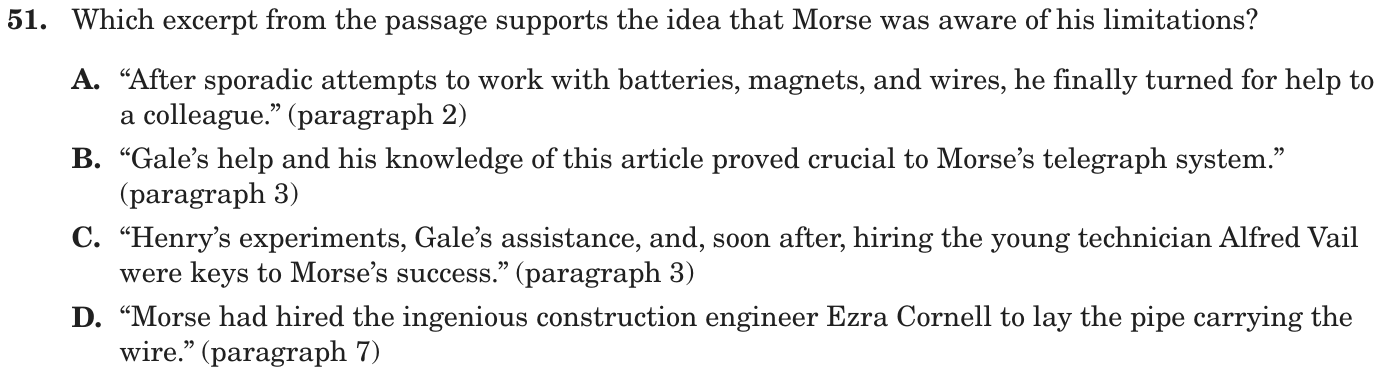
Question 52 of 57
2018 Test B English, question 52Uses the passage above: “Invention of the Telegraph”.
Question
The details of the section “The Growth of an Idea” convey a central idea of the passage by suggesting that
- Athe collaborative efforts of colleagues resulted in successful communication over a wire.
- Ba great deal of interest and work was devoted to understanding how to use electricity to send signals.
- CFaraday’s invention of the electromagnet inspired the invention of the telegraph.
- Dcolleges like Yale played a great role in making new discoveries about electricity and its applications.
Show the answer
Correct answer: B
The question asks how a passage section helps convey a central idea of the passage. Paragraph 3 states that “Henry’s experiments, Gale’s assistance, and, soon after, hiring the young technician Alfred Vail were keys to Morse’s success.” The level of interest inspired Morse and others to work together to find a way to use electricity to send long-distance messages.
Option B is correct; the section helps convey a central idea because, overall, the section focuses on what fascinated Morse enough to begin his work and how others were just as interested and willing to work to achieve this goal.
Option A is incorrect because, although the word collaborative suggests that multiple people contributed to the telegraph’s success, the option does not clarify the research and effort needed in order to understand how to use electricity to send signals.
Option C is incorrect because when Morse came to understand how Faraday’s electromagnet worked, Morse wondered if it might be possible to send a coded message over a wire, but that thought later evolved into the telegraph only after more research and experimentation.
Option D is incorrect because the influence of what Morse learned at Yale was only a minor factor in his development of the telegraph.
Question analysis
This central idea question asks what the details in the section “The Growth of an Idea” suggest about the passage “Invention of the Telegraph.” The section covers Faraday’s electromagnet, Morse’s Yale lectures, and help from Gale, Henry and Vail, so students must judge which statement those details support as a group, and more than one choice sounds right.
- Grade level
- Grade 8 reading and task
- Compared with grade 7
- Above grade 7 Grade 7 central-idea questions usually have one clearly best summary. Here two paragraphs of names and events must be weighed, and several choices restate true details, so judging which fits the whole section is unusually demanding.
- Estimated difficulty
- Among the hardest on the SHSAT: a non-obvious approach, heavy reading, or a well-hidden trap.
- Thinking it demands
- Depth of knowledge 3, strategic thinking · mainly understand
- What makes it hard
- A very close wrong answer major
- Evidence in several places moderate
- The right answer is reworded moderate
- Evidence
- Answered from several paragraphs or stanzas
- Reading level
- Passage: about grade 11, 910 words; question and choices: about grade 12, 77 words.
- Students, last 30 days
- Not enough answers yet to show (it takes 10).
Why it is hard, traps and wrong answers (shows the answer)
Why it is hard
This is among the hardest questions in the set because the most tempting wrong choice reads like a paraphrase of the section’s final sentence. Rejecting it means noticing that the section never shows a message getting through and never shows Henry working with Morse, who had not even read his article. The right choice is vague by design, and only a summary of both paragraphs together shows that it fits better.
A very close wrong answer major Choosing the answer
The colleagues choice and the interest-and-work choice both describe effort spent on sending signals by wire; they part on one claim, that the effort “resulted in successful communication,” which the section never shows, the working line arriving in paragraph 7. (Embretson & Wetzel, 1987; Gorin & Embretson, 2006; Ascalon et al., 2007)
Evidence in several places moderate Working it out
The idea emerges only from details across two paragraphs, passengers discussing the electromagnet, Morse’s Yale letter, his failed attempts, Henry’s bell and article, Gale’s relay advice, taken together. (Kirsch & Mosenthal, 1990; Gorin & Embretson, 2006)
The right answer is reworded moderate Choosing the answer
The key names none of the section’s people, while the wrong choices echo its “colleague,” “over a wire,” Faraday’s electromagnet and Yale, and so look more firmly rooted in the text. (Freedle & Kostin, 1993; Kirsch & Mosenthal, 1990)
Strategy: Summarize paragraphs 2 and 3 together in one sentence of your own before reading the choices, then choose the statement closest to your summary, checking that every part of it is true of this section.
Traps
- Half right: One half of a two-part choice is right and the other is not.
- Too narrow: A single detail offered as the central idea or a summary, or a summary that keeps minor details and leaves out an essential part.
- Too broad or too strong: A choice overstates, generalizes, or uses absolute words the text does not support.
The wrong answers, classified
A Half right (King et al., 2004; Thissen, Steinberg & Fitzpatrick, 1989)
Rightly sees teamwork in the section’s close, but successful communication over Morse’s wire comes later, under “Realizing a Great Invention,” and the passage never shows Henry working with Morse.
C Too narrow (King et al., 2004)
Treats the spark as the whole story: Faraday’s electromagnet gave Morse the idea, but the section goes on to years of failed attempts and help from others.
D Too broad or too strong (King et al., 2004)
Inflates a passing mention: Morse’s Yale lectures appear once, and the section notes that despite them he had “little real understanding of the nature of electricity.”
Working it out, step by step
Figure out what the question asks
This asks what the section “The Growth of an Idea” says about a central idea, or main message. The section is paragraphs 2 and 3. Sum up both paragraphs together before you look at the choices.
List the section’s details
On the ship, Faraday’s electromagnet “was much discussed by the ship’s passengers.” Morse had found the electricity lectures at Yale interesting. He made “sporadic attempts” on his own. In paragraph 3, Henry “rang a bell at a distance by opening and closing an electric circuit.” Gale showed Morse how to use Henry’s relay system.
Find what the details share
Look at what links these details. Passengers talked about electricity. Morse was curious and kept trying. Henry ran tests and wrote an article. Gale gave advice. All of it is people taking an interest in electricity and working to send signals with it. That is the section’s main point. A working telegraph line does not appear until paragraph 7.
Check each choice
- A is close but wrong. Morse’s telegraph does not send a message until paragraph 7. Also, Henry never worked with Morse. At first, Morse did not even know about Henry’s article.
- B fits. It covers the interest and the work in both paragraphs.
- C is wrong. The electromagnet gave Morse the idea, but that is only the start of the section.
- D is wrong. Yale is only a small part of paragraph 2. And “Despite what he had learned at Yale,” Morse still knew little.
Choose the answer
The section shows lots of interest and effort aimed at sending signals with electricity. So the answer is B, “a great deal of interest and work was devoted to understanding how to use electricity to send signals.”
Why this answer and not the closest wrong one
A sounds like a summary of the section’s last sentence, which is why it tempts. But it claims the teamwork “resulted in successful communication,” and that only happens in a later section. B claims less, so every detail in paragraphs 2 and 3 fits it.
More questions like this
The original DOE question
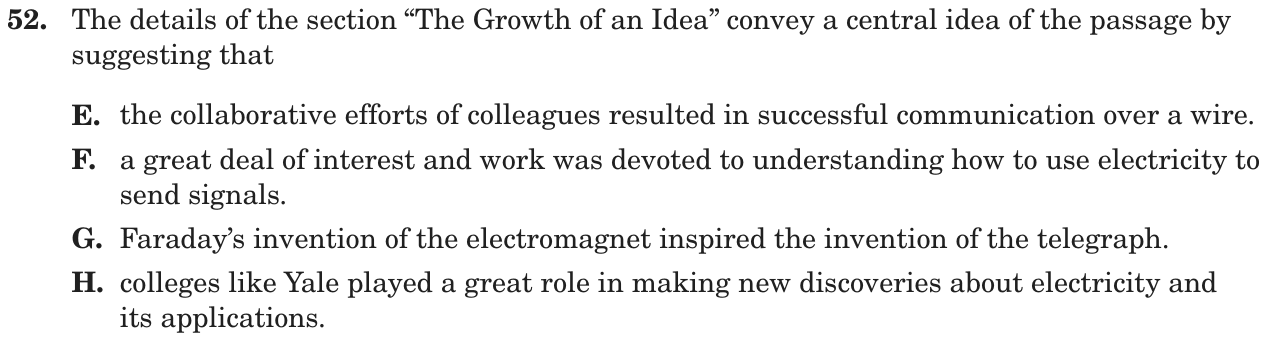
Question 53 of 57
2018 Test B English, question 53Uses the passage above: “Invention of the Telegraph”.
Question
How does the graph support the ideas in paragraph 8?
- AIt indicates how welcome the improvement of long-distance communication was in the United States.
- BIt provides evidence of the dramatic increase in the number of telegraph messages as Morse’s system expanded across the United States.
- CIt reveals that by the twentieth century millions of people had used the telegraph despite earlier hesitations about the system.
- DIt shows how improvements that allowed Morse code to be read in real time made relaying telegraph messages faster and increased the system’s usage.
Show the answer
Correct answer: B
The question asks how the graph supports the ideas in paragraph 8. The graph shows the number of messages transmitted from 1870 to 1920. In 1920 almost 160 million messages were transmitted, showing a “dramatic”—more than double—increase from 1910, which makes Option B the correct answer.
Option A is incorrect because, while it can be implied from the expansion shown on the graph that people possibly welcomed the improvement in long-distance communication, the graph does not state this explicitly.
Option C is incorrect because the graph does not show how many people used the telegraph, but rather it shows the number of messages sent. Additionally, paragraph 8 provides no details about hesitation on the part of individuals.
Option D is incorrect because, while improvements in recording and interpreting code were made, the graph does not show the effect of this advancement on the speed or number of messages being transmitted.
Question analysis
This question asks how a graph that accompanies “Invention of the Telegraph” supports the ideas in paragraph 8, the passage’s closing account of what followed the first telegraph line. Students must connect a data display to a paragraph of text, and the choices differ in how much they claim a graph of this kind could prove.
- Grade level
- Grade 7 reading and task
- Compared with grade 7
- At grade 7 Connecting a graph to a paragraph is standard grade 7 work with mixed formats. The demand is typical: read the paragraph, read the data, and check that a claim about the graph does not go beyond it.
- Estimated difficulty
- Moderate: several steps, or a close reading with one strong distractor.
- Thinking it demands
- Depth of knowledge 2, skills and concepts · mainly analyze
- What makes it hard
- Reading a figure, table or graph moderate
- A very close wrong answer moderate
- Combines ideas minor
- Evidence
- Answered from one paragraph or stanza
- Reading level
- Passage: about grade 11, 910 words; question and choices: about grade 11, 88 words.
- Corrected from the DOE handbook
- A misreading of the graph in the explanation was corrected.
- Students, last 30 days
- Not enough answers yet to show (it takes 10).
Why it is hard, traps and wrong answers (shows the answer)
Why it is hard
The graph is simple to read; the challenge is deciding how much a count of messages can prove. Wrong choices claim the graph shows public feeling, numbers of people, or the effect of one improvement, and the last of these is tempting because paragraph 8 mentions that improvement. Students who ask what the vertical axis measures can reject all three quickly.
Reading a figure, table or graph moderate Understanding the question
The bar graph counts messages in millions, rising from about 10 in 1870 to about 155 in 1920; it measures neither people, nor speed, nor causes, which is what rules out three choices. (Lesh, Post & Behr, 1987; Kirsch & Mosenthal, 1990)
A very close wrong answer moderate Choosing the answer
The key and the real-time-reading choice both tie the rise in messages to a change described in paragraph 8; they part on one detail, the claim that relaying became “faster,” which a count of messages cannot show. (Embretson & Wetzel, 1987; Gorin & Embretson, 2006; Ascalon et al., 2007)
Combines ideas minor Working it out
Students must join the graph’s fifty years of growth to paragraph 8’s spread of overhead wires along the coast, westward and across the ocean. (Embretson, 1998; Daniel & Embretson, 2010)
Strategy: Reread paragraph 8 and look at what the graph measures, then for each choice ask whether both the paragraph and the graph back it up.
Traps
- Reads too much in: A reasonable-sounding conclusion that goes further than the text allows.
- Twists what the text says: Uses the text's topic and ideas but changes what it says: who did it, how much, when, or why.
The wrong answers, classified
A Reads too much in (Graesser, Singer & Trabasso, 1994)
Infers from the growth that people welcomed the telegraph, which may be true, but a count of messages cannot show how anyone felt about the change.
C Twists what the text says (King et al., 2004)
Treats messages as people, reading “in millions” as millions of users, and adds “earlier hesitations” that neither the graph nor paragraph 8 mentions.
D Reads too much in (Graesser, Singer & Trabasso, 1994)
Takes real-time reading of code from paragraph 8 and credits it with the rise in messages, but the graph shows only totals, not what caused them or how fast messages moved.
What was corrected from the DOE handbook, and why
- Explanation: The handbook says 1920 showed an “almost double” increase from 1910. The graph shows about 75 million messages in 1910 and about 155 million in 1920, so the number more than doubled. The site now says “more than double.”
Working it out, step by step
Figure out what the question asks
This asks how the bar graph supports paragraph 8. To answer, you need to know two things. What does paragraph 8 say? And what does the graph actually measure?
Read paragraph 8
Paragraph 8 says that “overhead wires connected cities up and down the Atlantic coast.” Then “Telegraph lines soon extended westward, and within Morse’s own lifetime they connected the continents of Europe and America.” So the main idea is growth. The telegraph spread farther and farther.
Read the bar graph
The graph’s title is Telegraph Messages Transmitted, 1870–1920. Its side axis counts messages, in millions. The bars rise every ten years. There were about 10 million messages in 1870 and about 75 million in 1910. In 1920 there were about 155 million. That last jump is more than double. The graph counts messages. It does not count people, speed or feelings.
Check each choice
- A is wrong. A count of messages can’t show how welcome something was. That is a feeling.
- B fits. The bars show a huge rise in messages as the lines spread.
- C is wrong. The graph counts messages, not people. Nothing mentions “earlier hesitations” either.
- D is wrong. Paragraph 8 does mention reading code “in real time,” or right away. But the graph shows totals only. It can’t show what caused the rise or how fast messages moved.
Choose the answer
The graph shows messages rising from about 10 million to about 155 million as the wires spread. So the answer is B, “It provides evidence of the dramatic increase in the number of telegraph messages as Morse’s system expanded across the United States.”
Why this answer and not the closest wrong one
D is the closest trap, since paragraph 8 really does mention reading code in real time. But ask what the side of the graph measures. It counts messages, nothing else. A count can show that use grew, as B says. It can’t show that messages got faster, or why.
More questions like this
The original DOE question
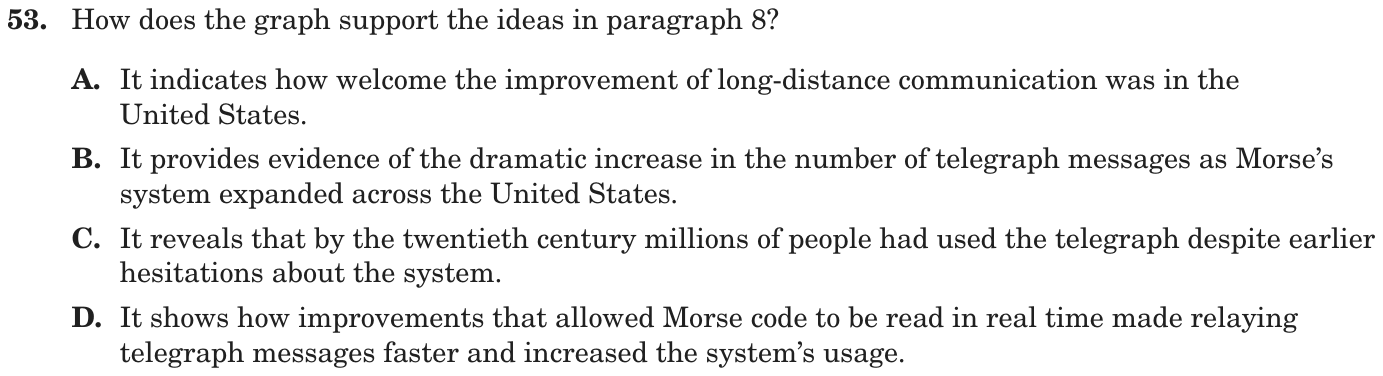
Question 54 of 57
2018 Test B English, question 54Uses the passage above: “Invention of the Telegraph”.
Question
Which sentence is the best summary of how Morse obtained the funding necessary to build his telegraph system?
- AMorse applied for a federal grant that was delayed until 1843, so he spent time traveling in Europe, where he concentrated on obtaining a patent for his system.
- BMorse applied for a government grant that required both houses of Congress and the president to pass a bill awarding him $30,000 for his telegraph project.
- CMorse applied for a government appropriation and conducted telegraph demonstrations to show that his system could work, and after a delay caused by a financial depression, Congress approved the $30,000 appropriation in 1843.
- DWorking with Gale and Vail allowed Morse to find flaws in Henry’s work and to develop his own ideas before applying for the federal government appropriation.
Show the answer
Correct answer: C
The question asks for the best summary of Morse’s efforts to fund the construction of his telegraph system. Option C is correct because it details all the steps that resulted in Morse obtaining the appropriation, or $30,000 needed.
Option A is incorrect because it focuses on what Morse did while his application for the funding was delayed.
Option B is incorrect because, while it begins with Morse applying for the grant, it focuses on the process required for the government to approve the appropriation.
Option D is incorrect because it relates how Morse worked with others to develop his ideas about the telegraph before applying for funding for its construction.
Question analysis
Students choose the best summary of how Samuel Morse obtained the money to build his telegraph, an account spread across three paragraphs of “Invention of the Telegraph.” Each choice is a long sentence with accurate-sounding facts, so the task is to find the one that covers the main steps in order without drifting to side events.
- Grade level
- Grade 7 reading and task
- Compared with grade 7
- At grade 7 Summarizing a sequence is core grade 7 work. The facts are clearly stated, but the four long choices each mix accurate details with gaps or shifts in focus, so careful checking, not inference, is the main demand.
- Estimated difficulty
- Moderate: several steps, or a close reading with one strong distractor.
- Thinking it demands
- Depth of knowledge 2, skills and concepts · mainly understand
- What makes it hard
- A very close wrong answer moderate
- Evidence in several places moderate
- A lot to read minor
- Evidence
- Answered from several paragraphs or stanzas
- Reading level
- Passage: about grade 11, 910 words; question and choices: about grade 13, 127 words.
- Corrected from the DOE handbook
- A date in the passage introduction was corrected.
- Students, last 30 days
- Not enough answers yet to show (it takes 10).
Why it is hard, traps and wrong answers (shows the answer)
Why it is hard
A good summary has to be complete as well as accurate, and two wrong choices are accurate but incomplete. Students who check only whether each statement is true find little to reject in the choice about Congress and the president, so they need to test coverage: application, demonstrations, delay, approval. The right choice is the longest and the only one that covers every stage.
A very close wrong answer moderate Choosing the answer
The Congress-and-president choice and the key both start with Morse applying and end with the $30,000 approved; they part on one stretch of the story, the demonstrations and the depression’s delay, which only the key includes. (Embretson & Wetzel, 1987; Gorin & Embretson, 2006; Ascalon et al., 2007)
Evidence in several places moderate Working it out
The funding story runs across paragraphs 4 to 6: the application in December 1837, demonstrations in New York and Washington, the Panic of 1837, the trip to Europe, and the 1843 request and vote. (Kirsch & Mosenthal, 1990; Gorin & Embretson, 2006)
A lot to read minor Understanding the question
The four choices are each a long sentence of 26 to 33 words, packed with dates, institutions and places that must all be checked. (Kintsch, 1998; Gorin & Embretson, 2006; Freedle & Kostin, 1993)
Strategy: Before reading the choices, list the funding steps in paragraphs 4 to 6 in order, then pick the summary that includes the key steps and leaves out side details.
Traps
- Too narrow: A single detail offered as the central idea or a summary, or a summary that keeps minor details and leaves out an essential part.
- Wrong part of the text: A choice is true of another paragraph, stanza or speaker than the one asked about.
The wrong answers, classified
A Too narrow (King et al., 2004)
Builds the summary around Morse’s trip to Europe, a side event during the delay, and leaves out his demonstrations and Congress’s eventual approval of the money.
B Too narrow (King et al., 2004)
Gives only the last stage, the House, the Senate and the president’s signature in paragraph 6, and omits the demonstrations and the depression that delayed the money.
D Wrong part of the text (Kirsch & Mosenthal, 1990)
Describes how Morse developed the telegraph in paragraph 3, not how he paid for it, and garbles it: Gale found flaws in Morse’s system, not in Henry’s work.
What was corrected from the DOE handbook, and why
- Passage: The handbook’s introduction says Congress passed the Telegraph Bill “In 1844.” Congress passed the $30,000 appropriation in March 1843; 1844 is the year of Morse’s first message. Paragraph 6 describes the 1843 approval, and Option C, the correct answer, says 1843, so the introduction now reads “In 1843.”
Working it out, step by step
Figure out what the question asks
This asks for the best summary of how Morse got the money to build his telegraph. A summary is a short retelling of the main steps. A good summary must be true and also complete. It should cover all the main steps, in order.
Find the funding steps
The story runs through paragraphs 4 to 6. In paragraph 4, Morse applied “for the federal government’s appropriation” in 1837. The next year he “conducted demonstrations of his telegraph both in New York and Washington.” In paragraph 5, the Panic of 1837 “caused a long depression,” so he had to wait. In paragraph 6, Congress passed the bill in 1843, and President Tyler signed it.
Explain the hard words
An appropriation is money the government sets aside for a certain use. A demonstration is a show of how something works. A depression is a long time when business is bad and money is short. So the steps are: apply, show that the system works, wait out the hard times, then win approval of the $30,000.
Check each choice
- A is wrong. It focuses on the trip to Europe, a side event. It leaves out the demonstrations and the final approval.
- B is wrong. It is true but tells only the last step, the vote and the signature. It skips the demonstrations and the delay.
- C fits. It covers the application, the demonstrations, the delay and the 1843 approval.
- D is wrong. It is about building the system, not paying for it. Also, Gale found flaws in Morse’s system, not in Henry’s work.
Choose the answer
Only one choice covers every main step, from the first application to the final approval. So the answer is C, the summary that ends with Congress approving “the $30,000 appropriation in 1843.”
Why this answer and not the closest wrong one
B is the closest trap, because everything in it is true. But a summary has to be complete, not just true. B leaves out the demonstrations and the long wait during the depression. C covers the whole story from start to finish, so it is the better summary.
More questions like this
The original DOE question
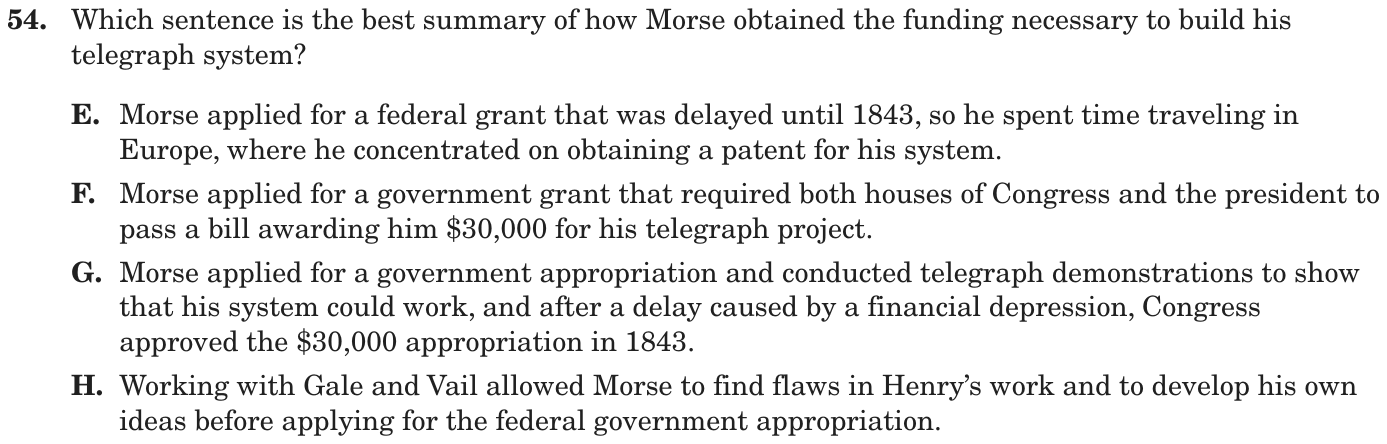
Question 55 of 57
2018 Test B English, question 55Uses the passage above: “Invention of the Telegraph”.
Question
How does the map provide additional support for a central idea of the passage?
- Aby demonstrating that Morse’s telegraph system greatly exceeded the limitations of previous long-distance communication systems
- Bby indicating that Morse was lacking foresight by seeking a patent only in North America
- Cby proving that Gale’s advice helped Morse extend the telegraph’s range much farther than first thought possible
- Dby providing a graphic that shows the surprisingly immense influence Morse’s telegraph had across the world
Show the answer
Correct answer: A
The question asks how the map provides additional support for a central idea of the passage. The map shows the telegraph line crossing continents in 1902, just forty-four years after the first transatlantic message was sent in 1858. This is a much greater distance than the first line Morse built between “the Supreme Court chamber of the Capitol building and the railroad station in Baltimore” (paragraph 7), making Option A correct.
Option B is incorrect because the map shows the distance the line covers; it does not indicate Morse’s lack of foresight in seeking patents only in North America.
Option C is incorrect because, while Gale’s advice was crucial to Morse’s success, the map shows the physical line stretching across continents many years later, after their initial work.
Option D is incorrect because, while it can be inferred that the telegraph had influence across the world, the amount of influence cannot be determined.
Question analysis
This question asks how a map that accompanies “Invention of the Telegraph” supports a central idea of the passage about Samuel Morse’s invention. Students must link the information in a map to the passage’s main point, and choices that sound alike differ in how much they claim, so careful reading of each one decides it.
- Grade level
- Grade 8 reading and task
- Compared with grade 7
- Above grade 7 Connecting a map to a central idea is grade 7 work, but this one requires tying a visual to the whole passage and weighing choices that differ by a single word or claim, which pushes it above typical demand.
- Estimated difficulty
- Hard: combines ideas, needs a plan, and has more than one tempting wrong answer.
- Thinking it demands
- Depth of knowledge 3, strategic thinking · mainly analyze
- What makes it hard
- A very close wrong answer major
- Evidence in several places moderate
- Reading a figure, table or graph moderate
- Evidence
- Answered from the whole text
- Reading level
- Passage: about grade 11, 910 words; question and choices: about grade 11, 77 words.
- Corrected from the DOE handbook
- An inaccurate detail in the explanation was corrected.
- Students, last 30 days
- Not enough answers yet to show (it takes 10).
Why it is hard, traps and wrong answers (shows the answer)
Why it is hard
Two choices describe the map’s reach in nearly the same terms, and the difference is in what each claims the map proves. A map of lines can show distance covered, which outruns the hilltop towers of paragraph 1, but it cannot measure influence or reveal surprise. Students lose time because the right choice depends on a paragraph read many minutes earlier.
A very close wrong answer major Choosing the answer
The choice about the telegraph’s “surprisingly immense influence” sounds like a fair reading of a map spanning five continents and differs from the key mainly in claiming influence rather than reach. (Embretson & Wetzel, 1987; Gorin & Embretson, 2006; Ascalon et al., 2007)
Evidence in several places moderate Working it out
The previous systems are in paragraph 1, towers on hills relaying flag and light signals, far from the map at the end of the passage, and the two must be compared. (Kirsch & Mosenthal, 1990; Gorin & Embretson, 2006)
Reading a figure, table or graph moderate Understanding the question
The map shows a 1902 British line from London across the Atlantic to Canada, south to Bermuda, Barbados and Cape Town, and on to India, Australia and New Zealand, with Washington left off it. (Lesh, Post & Behr, 1987; Kirsch & Mosenthal, 1990)
Strategy: First state the passage’s central idea in a sentence, then ask which choice describes something a map of telegraph lines could actually show that also fits that idea.
Traps
- Too broad or too strong: A choice overstates, generalizes, or uses absolute words the text does not support.
- Reads too much in: A reasonable-sounding conclusion that goes further than the text allows.
The wrong answers, classified
B Twists what the text says (King et al., 2004)
Seizes on the unconnected Washington dot as a failure of Morse’s, though paragraph 5 says he sought patent protection overseas and a map of lines shows nothing about patents.
C Reads too much in (Graesser, Singer & Trabasso, 1994)
Recalls that Gale’s relay advice solved Morse’s “distance problems,” but a map of lines built decades later cannot prove what Gale’s advice made possible.
D Too broad or too strong (King et al., 2004)
Overstates what the map shows: the lines prove how far the telegraph reached by 1902, not how much it changed the world or that the change was surprising.
What was corrected from the DOE handbook, and why
- Explanation: The handbook says the 1902 line came “forty-four years after the first message was sent in 1858.” The first telegraph message was Morse’s in 1844 (paragraph 1); 1858 is the year of the first transatlantic message, as the map’s caption says. The site now says “the first transatlantic message.”
Working it out, step by step
Figure out what the question asks
This asks how the map supports a central idea, or main message, of the passage. You need two things: what the map actually shows, and which big idea of the passage it backs up.
Read the map and its caption
The map shows the British All-Red Telegraph Line in 1902. A thick black line stands for telegraph wire. It runs from London across the Atlantic Ocean to Canada and on to Vancouver. It also goes to Bermuda, Barbados and Cape Town. Then it crosses the Indian Ocean to India, Australia and New Zealand. The caption says that by 1902 the line “connected most of the world.”
Compare it with earlier systems
Now look back at paragraph 1. Earlier systems used flags or lights. An observer had to “decipher a signal from a high tower on a distant hill and then send it on to the next station.” Decipher means figure out. Those signals only worked if you could see the next tower. The line on the map crosses whole oceans. That shows how far the new system went past the old limits.
Check each choice
- A fits. Lines across oceans go far past towers on hills.
- B is wrong. A map of wires shows nothing about patents. Paragraph 5 even says Morse tried to get patents overseas.
- C is wrong. The map is from 1902, long after Gale helped. It can’t prove what his advice did.
- D is wrong. The map shows how far the lines reached, not how much they changed lives. It also can’t show that anything was surprising.
Choose the answer
The map shows wires circling the globe, far beyond hilltop flags and lights. So the answer is A, “by demonstrating that Morse’s telegraph system greatly exceeded the limitations of previous long-distance communication systems.”
Why this answer and not the closest wrong one
D is the closest trap, because the map does cover the world. But a map of lines shows reach, meaning how far something goes. Influence means how much it changed people’s lives, and a map can’t measure that. A claims only what the map can show: distance far past the old towers.
More questions like this
The original DOE question
Question 56 of 57
2018 Test B English, question 56Uses the passage above: “Invention of the Telegraph”.
Question
The idea that, in the mid-nineteenth century, the United States was mostly unaware of the possibilities of electricity is illustrated in the passage mainly through the
- Adescription of the government’s initial desire to expand a semaphore signaling system that used either flags or lights along the Atlantic Coast.
- Bdelay by the House of Representatives to pass the bill funding Morse’s telegraph line six years after he first applied for the appropriation.
- Cdiscussions of the newly invented electromagnet that sparked the idea of sending codes through wires.
- Ddescription of how an electric circuit could be closed to ring a bell at a distance.
Show the answer
Correct answer: A
The question asks for information that conveys the idea that the United States was mostly unaware of the possibilities of electricity in the mid-nineteenth century. The passage states that most signaling systems at the time were “visual or ‘semaphore’ systems using flags or lights” (paragraph 1) and that the United States was looking for “just such a system along its entire Atlantic coast” (paragraph 1).
Option A is correct because waving lights and flags reveals how limiting and simple the system of the time was, and Option A states that the United States wanted to expand this system, not improve upon it.
Option B is incorrect because the delay in funding had to do with the Panic of 1837 and the “long depression” (paragraph 5), not because the House of Representatives was not aware or ready for innovation in the use of electricity.
Option C is incorrect because it focuses on what prompted Morse to consider an electronic wire-based communications system.
Option D is incorrect because it describes a basic aspect of an early electrical discovery that demonstrated the interest of scientists in the possibilities of electricity, not the United States as a whole.
Question analysis
Students identify how “Invention of the Telegraph” mainly illustrates the idea that, in the mid-1800s, the United States was largely unaware of what electricity could do. The idea is implied rather than stated, so students must decide which detail truly reveals the nation’s thinking at the time.
- Grade level
- Grade 8 reading and task
- Compared with grade 7
- Above grade 7 Grade 7 evidence questions often match a stated idea to a sentence. This idea is only implied, so students must infer what a historical detail reveals about a whole nation’s understanding, closer to grade 8 inference.
- Estimated difficulty
- Hard: combines ideas, needs a plan, and has more than one tempting wrong answer.
- Thinking it demands
- Depth of knowledge 3, strategic thinking · mainly evaluate
- What makes it hard
- Reading between the lines moderate
- Evidence in several places moderate
- Hard words minor
- Evidence
- Answered from one paragraph or stanza
- Reading level
- Passage: about grade 11, 910 words; question and choices: about grade 12, 102 words.
- Students, last 30 days
- Not enough answers yet to show (it takes 10).
Why it is hard, traps and wrong answers (shows the answer)
Why it is hard
The stem asks about a whole nation’s understanding, so details about individuals with electrical interests, the ship’s passengers and Henry, show the opposite of what is needed. The real trap is the funding delay, which looks like official indifference but has an economic cause the passage states. Students who remember that the semaphore plan came with a remark about not knowing electricity was coming find the answer.
Reading between the lines moderate Working it out
The idea is implied: wanting a semaphore system shows unawareness only alongside paragraph 1’s comment that its framers “had no way of knowing” they would be offered electricity. (Graesser, Singer & Trabasso, 1994; Kintsch, 1998)
Evidence in several places moderate Working it out
The choices point to four separate places, paragraph 1’s semaphore plan, the funding delay of paragraphs 4 to 6, the shipboard talk in paragraph 2 and Henry’s bell in paragraph 3, and each must be checked there. (Kirsch & Mosenthal, 1990; Gorin & Embretson, 2006)
Hard words minor Understanding the question
“Semaphore” and “appropriation” are uncommon words, and the passage defines “semaphore” only in passing, as systems “using flags or lights.” (Perfetti, 2007; Freedle & Kostin, 1993)
Strategy: For each choice, find the detail in the passage and ask whether the author uses it to show what the country did or did not understand about electricity.
Traps
- Twists what the text says: Uses the text's topic and ideas but changes what it says: who did it, how much, when, or why.
- Supports only part of the claim: In a question about evidence: a line that backs one half of the claim but not the other, or a related point rather than the claim itself.
The wrong answers, classified
B Twists what the text says (King et al., 2004)
Reads the long wait for funding as doubt about electricity, but the passage gives a different cause, the Panic of 1837 and the “long depression” that followed.
C Supports only part of the claim (King et al., 2004; Thissen, Steinberg & Fitzpatrick, 1989)
The ship’s passengers did discuss the new electromagnet, but that shows a few people interested in electricity, not a country unaware of what it could do.
D Supports only part of the claim (King et al., 2004; Thissen, Steinberg & Fitzpatrick, 1989)
Henry’s bell rung at a distance is a real detail, but it shows a scientist exploring electricity’s uses, the opposite of unawareness, and says nothing about the nation.
Working it out, step by step
Figure out what the question asks
This asks which part of the passage best shows an idea. The idea is that in the mid-1800s, the United States mostly did not know what electricity could do. Look for a detail about the country as a whole, not about one scientist.
Find the detail in paragraph 1
Paragraph 1 says most early systems were visual, or semaphore, “systems using flags or lights.” Then it says, “The young American republic wanted just such a system along its entire Atlantic coast.” The next sentence explains that its lawmakers “had no way of knowing” they would be offered “an entirely new and revolutionary means of communication—electricity.”
Explain what the detail shows
A semaphore system sends signals people can see, like waving flags. The country asked for that old kind of system. It did not ask for an electric one, because it did not know one was possible. “Revolutionary” means bringing a huge change. So the government’s plan shows how unaware the nation was of what electricity could do.
Check each choice
- A fits. The government wanted to spread flags and lights, not electric signals.
- B is wrong. The delay had a money cause. The Panic of 1837 “caused a long depression.” It was not about electricity.
- C is wrong. Passengers talking about the electromagnet shows interest in electricity, the opposite of not knowing about it.
- D is wrong. Henry ringing a bell shows one scientist exploring electricity. It says nothing about the whole country.
Choose the answer
The country’s wish for a flags-and-lights system shows it did not yet see what electricity could do. So the answer is A, the description of the government’s plan for a semaphore system along the Atlantic Coast.
Why this answer and not the closest wrong one
B is the closest trap, because a long wait for money can look like doubt about electricity. But paragraph 5 gives the real cause, the Panic of 1837 and the hard times after it. A is backed by the passage’s own words: the lawmakers “had no way of knowing” electricity was coming.
More questions like this
The original DOE question
Question 57 of 57
2018 Test B English, question 57Uses the passage above: “Invention of the Telegraph”.
Question
With which statement would the author most likely agree?
- AMorse’s telegraph was successful because the wires were strung aboveground rather than underground as originally planned.
- BUnderstanding the importance of Morse’s telegraph requires detailed knowledge of electrical systems.
- CThe implementation of Morse’s telegraph system was overly influenced by economic factors.
- DMorse’s invention of the telegraph made a great stride toward better connecting people across the United States and across the world.
Show the answer
Correct answer: D
The question asks which statement best represents a viewpoint held by the author of the passage. Paragraph 8 states that “Telegraph lines soon extended westward, and within Morse’s own lifetime they connected the continents of Europe and America.”
Therefore, Option D is correct because the author presents Morse’s telegraph as a great leap in the ability to quickly communicate messages over distances never before imagined.
Option A is incorrect because the author explains that the aboveground wiring was used only because “Cornell suggested that [it was] the fastest and cheapest way” (paragraph 7), not because it would be more successful.
Option B is incorrect because the author conveys the importance of this advancement in communication without providing detailed information about electrical systems.
Option C is incorrect because, while the Panic of 1837 caused a delay in Morse’s funding, the author shows that Morse received the appropriation in 1843 and was able to overcome the financial setback he faced.
Question analysis
This question asks which statement the author of “Invention of the Telegraph” would most likely agree with, based on the passage’s account of Samuel Morse’s work. Students must infer the author’s view from the passage as a whole, and every choice takes up a real topic from the story, so each must be checked for how strongly it is supported.
- Grade level
- Grade 7 reading and task
- Compared with grade 7
- At grade 7 Inferring an author’s position from an informational text is typical grade 7 work. The author’s attitude is fairly clear in the passage’s word choice, so this matches a routine state-test question in demand.
- Estimated difficulty
- Straightforward: two steps or one careful reading.
- Thinking it demands
- Depth of knowledge 3, strategic thinking · mainly analyze
- What makes it hard
- Reading between the lines moderate
- Evidence in several places minor
- Evidence
- Answered from the whole text
- Reading level
- Passage: about grade 11, 910 words; question and choices: about grade 12, 70 words.
- Students, last 30 days
- Not enough answers yet to show (it takes 10).
Why it is hard, traps and wrong answers (shows the answer)
Why it is hard
The passage’s admiration for Morse’s achievement is steady from the first paragraph to the map, so most students recognize the author’s view. The wrong choices each take a real episode, the overhead wires, Morse’s struggle with electricity, the depression, and turn it into a judgment the author never makes. Watching for evaluative words such as “overly” and “because” separates them.
Reading between the lines moderate Working it out
The author never states an opinion outright; it shows in word choice such as “revolutionary,” “ingenious,” “spectacularly successful” and the heading “Realizing a Great Invention.” (Graesser, Singer & Trabasso, 1994; Kintsch, 1998)
Evidence in several places minor Working it out
Support for the key is spread from paragraph 1’s “revolutionary means of communication” to paragraph 8’s lines that “connected the continents” and the map caption’s line that “connected most of the world.” (Kirsch & Mosenthal, 1990; Gorin & Embretson, 2006)
Strategy: Look for the author’s own judgments, the words that show approval or criticism, then choose the statement those words support most directly.
Traps
- Too broad or too strong: A choice overstates, generalizes, or uses absolute words the text does not support.
- Reads too much in: A reasonable-sounding conclusion that goes further than the text allows.
The wrong answers, classified
A Reads too much in (Graesser, Singer & Trabasso, 1994)
Turns a deadline fix into the reason for success: Cornell proposed overhead wires as “the fastest and cheapest way” after bad wire wasted time, not as a better design.
B Twists what the text says (King et al., 2004)
Shifts Morse’s own need to understand electricity onto the reader, though the author conveys the invention’s importance with almost no technical detail about how it works.
C Too broad or too strong (King et al., 2004)
Economic factors did matter, the Panic of 1837 delayed funding and cost drove the overhead wires, but “overly” adds a criticism the author never makes.
Working it out, step by step
Figure out what the question asks
This asks which statement the author would most likely agree with. The author never states an opinion directly. So look for word choice that shows approval or criticism. Then pick the statement those words support.
Find the author’s judging words
Start with paragraph 1. There the author calls electricity “an entirely new and revolutionary means of communication,” which is strong praise. The last section has the heading “Realizing a Great Invention,” more praise. In paragraph 8, the lines spread until “they connected the continents of Europe and America” in Morse’s lifetime. The map caption adds that by 1902 the line “connected most of the world” as well.
Put the author’s view in plain words
“Revolutionary” means bringing a huge change. “Great Invention” is plain praise. The author also shows the lines spreading from city to city, then across oceans. So the author admires the telegraph as a big step forward in linking people. That is what “a great stride” means: a big step forward.
Check each choice
- A is wrong. Overhead wires were used because they were “the fastest and cheapest way” after bad wire wasted time. That doesn’t make them the reason for success.
- B is wrong. The author shows the telegraph’s importance with almost no technical detail.
- C is wrong. Money problems did delay Morse. But “overly” means too much, and the author never makes that complaint.
- D fits. The author praises how the telegraph connected the country and the world.
Choose the answer
The author’s words praise the telegraph for linking people far apart. So the answer is D, “Morse’s invention of the telegraph made a great stride toward better connecting people across the United States and across the world.”
Why this answer and not the closest wrong one
C is the closest trap, because money troubles really did matter. The Panic of 1837 delayed the funding. But the word “overly” turns a fact into a complaint, and the author never complains. D matches the praise the author gives from the first paragraph to the map.
More questions like this
The original DOE question