Passage Excerpt from A Voice in the Wilderness
Excerpt from A Voice in the Wilderness
by Grace Livingston Hill
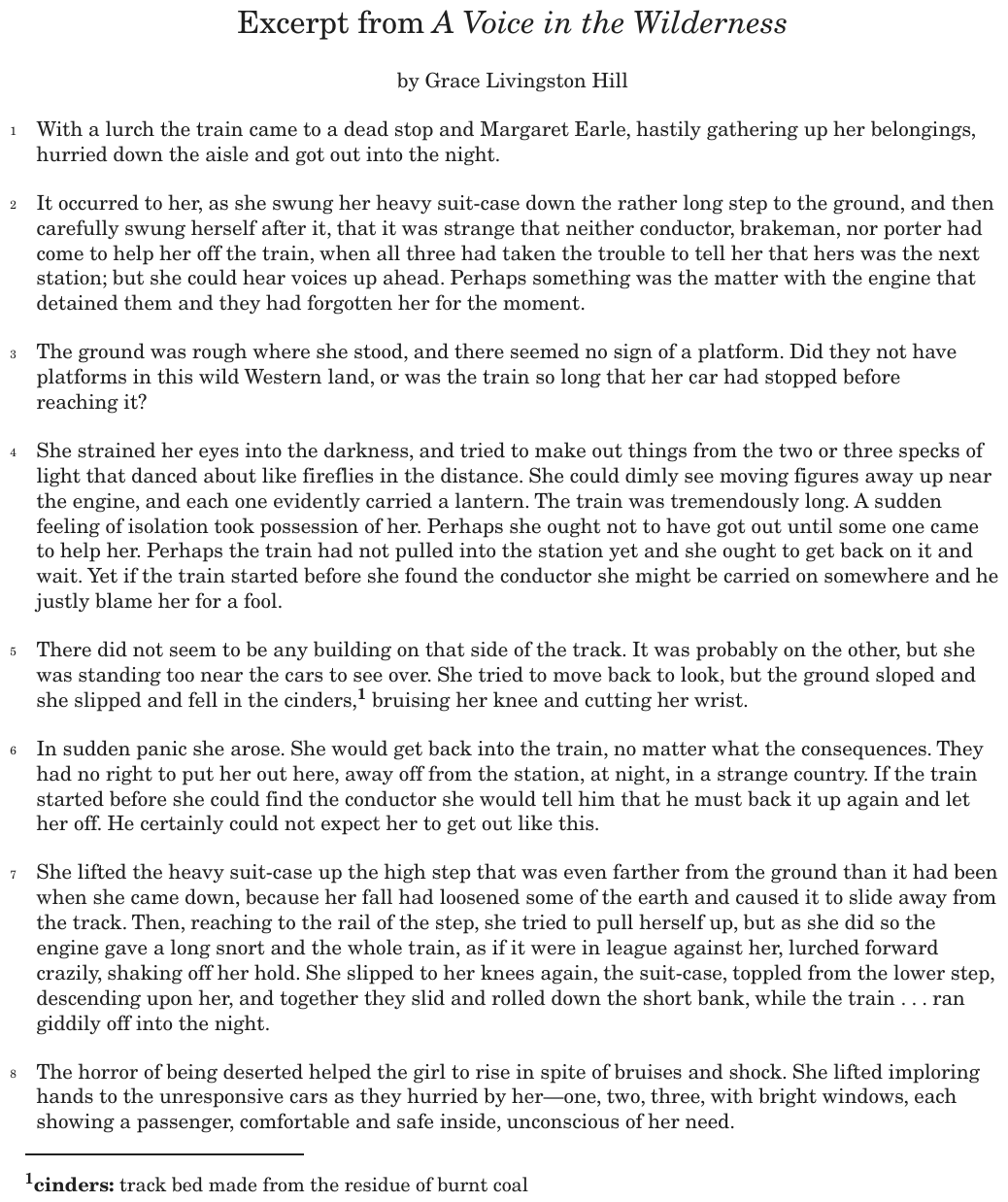
With a lurch the train came to a dead stop and Margaret Earle, hastily gathering up her belongings, hurried down the aisle and got out into the night.
It occurred to her, as she swung her heavy suit-case down the rather long step to the ground, and then carefully swung herself after it, that it was strange that neither conductor, brakeman, nor porter had come to help her off the train, when all three had taken the trouble to tell her that hers was the next station; but she could hear voices up ahead. Perhaps something was the matter with the engine that detained them and they had forgotten her for the moment.
The ground was rough where she stood, and there seemed no sign of a platform. Did they not have platforms in this wild Western land, or was the train so long that her car had stopped before reaching it?
She strained her eyes into the darkness, and tried to make out things from the two or three specks of light that danced about like fireflies in the distance. She could dimly see moving figures away up near the engine, and each one evidently carried a lantern. The train was tremendously long. A sudden feeling of isolation took possession of her. Perhaps she ought not to have got out until some one came to help her. Perhaps the train had not pulled into the station yet and she ought to get back on it and wait. Yet if the train started before she found the conductor she might be carried on somewhere and he justly blame her for a fool.
There did not seem to be any building on that side of the track. It was probably on the other, but she was standing too near the cars to see over. She tried to move back to look, but the ground sloped and she slipped and fell in the cinders, bruising her knee and cutting her wrist.
In sudden panic she arose. She would get back into the train, no matter what the consequences. They had no right to put her out here, away off from the station, at night, in a strange country. If the train started before she could find the conductor she would tell him that he must back it up again and let her off. He certainly could not expect her to get out like this.
She lifted the heavy suit-case up the high step that was even farther from the ground than it had been when she came down, because her fall had loosened some of the earth and caused it to slide away from the track. Then, reaching to the rail of the step, she tried to pull herself up, but as she did so the engine gave a long snort and the whole train, as if it were in league against her, lurched forward crazily, shaking off her hold. She slipped to her knees again, the suit-case, toppled from the lower step, descending upon her, and together they slid and rolled down the short bank, while the train . . . ran giddily off into the night.
The horror of being deserted helped the girl to rise in spite of bruises and shock. She lifted imploring hands to the unresponsive cars as they hurried by her—one, two, three, with bright windows, each showing a passenger, comfortable and safe inside, unconscious of her need.
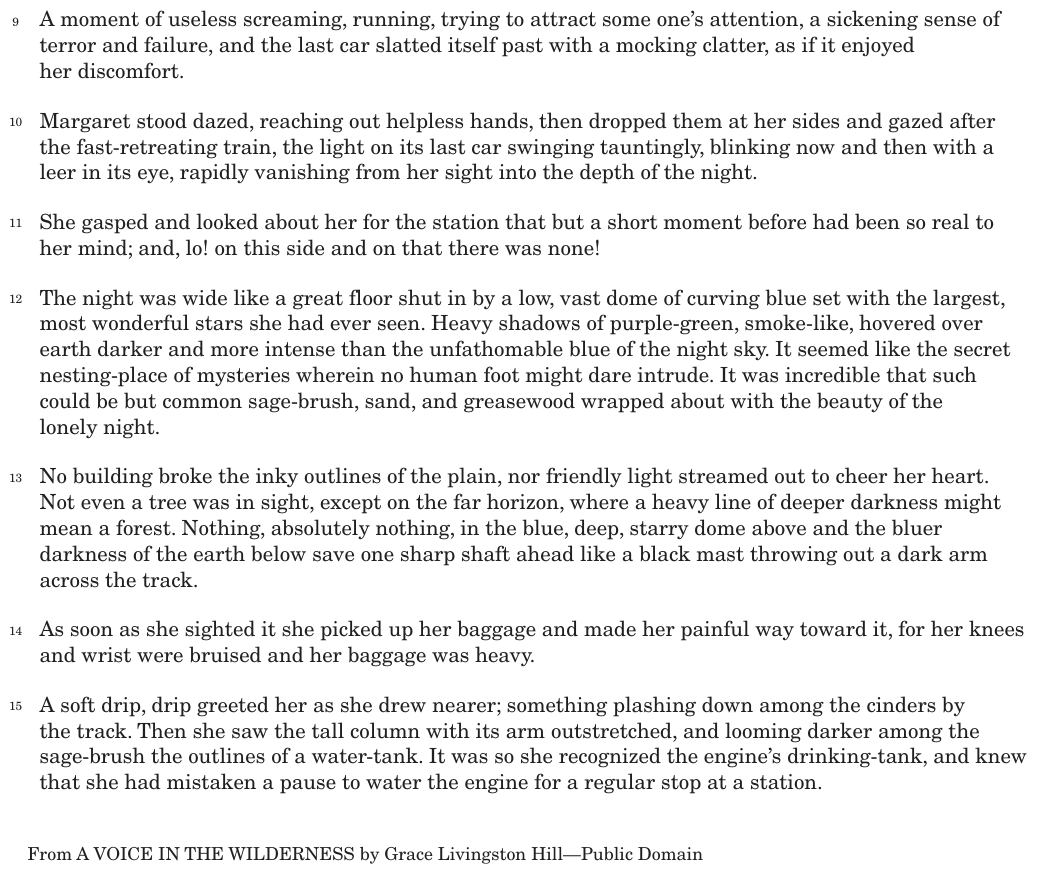
A moment of useless screaming, running, trying to attract some one’s attention, a sickening sense of terror and failure, and the last car slatted itself past with a mocking clatter, as if it enjoyed her discomfort.
Margaret stood dazed, reaching out helpless hands, then dropped them at her sides and gazed after the fast-retreating train, the light on its last car swinging tauntingly, blinking now and then with a leer in its eye, rapidly vanishing from her sight into the depth of the night.
She gasped and looked about her for the station that but a short moment before had been so real to her mind; and, lo! on this side and on that there was none!
The night was wide like a great floor shut in by a low, vast dome of curving blue set with the largest, most wonderful stars she had ever seen. Heavy shadows of purple-green, smoke-like, hovered over earth darker and more intense than the unfathomable blue of the night sky. It seemed like the secret nesting-place of mysteries wherein no human foot might dare intrude. It was incredible that such could be but common sage-brush, sand, and greasewood wrapped about with the beauty of the lonely night.
No building broke the inky outlines of the plain, nor friendly light streamed out to cheer her heart. Not even a tree was in sight, except on the far horizon, where a heavy line of deeper darkness might mean a forest. Nothing, absolutely nothing, in the blue, deep, starry dome above and the bluer darkness of the earth below save one sharp shaft ahead like a black mast throwing out a dark arm across the track.
As soon as she sighted it she picked up her baggage and made her painful way toward it, for her knees and wrist were bruised and her baggage was heavy.
A soft drip, drip greeted her as she drew nearer; something plashing down among the cinders by the track. Then she saw the tall column with its arm outstretched, and looming darker among the sage-brush the outlines of a water-tank. It was so she recognized the engine’s drinking-tank, and knew that she had mistaken a pause to water the engine for a regular stop at a station.
cinders: track bed made from the residue of burnt coal
From A VOICE IN THE WILDERNESS by Grace Livingston Hill—Public Domain
Question
Read paragraph 10 from the excerpt.
Margaret stood dazed, reaching out helpless hands, then dropped them at her sides and gazed after the fast-retreating train, the light on its last car swinging tauntingly, blinking now and then with a leer in its eye, rapidly vanishing from her sight into the depth of the night.
What does the figurative language in this sentence emphasize?
- Athe sense of doubt that Margaret experiences when she is deciding what to do next
- Bthe anger that Margaret feels toward the people on the train who she expected to help her
- Cthe embarrassment that Margaret feels when she imagines what others will think of her
- Dthe hopelessness that Margaret feels when she accepts that the train is continuing on
Show the answer
Correct answer: D
The question asks for what the figurative language illustrates in the sentence. As Margaret stands and reaches out “helpless hands,” the language used to describe the train as “swinging tauntingly” and having “a leer in its eye” confirms Margaret’s fears of being left alone and feeling foolish; there is nothing she can do to change the situation, as expressed in Option D.
Option A is incorrect because, while the image of Margaret’s helpless hands dropping at her sides could suggest a sense of doubt, the figurative language in the sentence emphasizes a different feeling about her situation and does not indicate her intentions.
Option B is incorrect because, while the figurative language seems to give a malevolent quality to the train, it is not referring to the people onboard, who are described in paragraph 8 as “comfortable and safe inside, unconscious of her need.”
Option C is incorrect because, while Margaret is worried in paragraph 4 about embarrassing herself, she now feels “dazed” because she is overwhelmed with the seriousness of what has just happened.
Question analysis
This figurative-language question quotes paragraph 10 of A Voice in the Wilderness, where Margaret watches the train disappear and its light seems to taunt her. Students decide what the personification of the train emphasizes about her situation. The image is vivid but brief, so students need to link it to the feeling the whole paragraph builds.
- Grade level
- Grade 7 reading and task
- Compared with grade 7
- At grade 7 Interpreting personification is part of grade 7 work on figurative language. This sentence gives the train a leer and a taunting light, so students must decide whose feeling the image reflects, a step beyond naming the figure of speech.
- Estimated difficulty
- Moderate: several steps, or a close reading with one strong distractor.
- Thinking it demands
- Depth of knowledge 2, skills and concepts · mainly analyze
- What makes it hard
- Figurative or literary language moderate
- Complex sentences minor
- Evidence
- Answered from one paragraph or stanza
- Reading level
- Passage: about grade 8, 981 words; question and choices: about grade 8, 122 words.
- Students, last 30 days
- Not enough answers yet to show (it takes 10).
Why it is hard, traps and wrong answers (shows the answer)
Why it is hard
The figurative language belongs to the train, so students have to translate a taunting, leering light into a statement about Margaret’s state. Some read the taunt as the cause of an emotion, embarrassment or anger, instead of as a picture of how powerless she is. Her “helpless hands,” dropped to her sides as the light vanishes, confirm that she has accepted the train is gone.
Figurative or literary language moderate Understanding the question
The train’s light is personified, “swinging tauntingly, blinking now and then with a leer in its eye,” and students must decide what a mocking machine says about Margaret rather than about the train. (Graesser, Singer & Trabasso, 1994; Kintsch, 1998)
Complex sentences minor Understanding the question
Paragraph 10 is a single 48-word sentence that strings together participle phrases, “reaching out,” “swinging tauntingly,” “rapidly vanishing,” so the figurative part arrives only after her gestures. (Abedi & Lord, 2001; Freedle & Kostin, 1993; Messick, 1989)
Strategy: Find the phrases that give the train human traits, then ask what they add to the picture of Margaret standing by the track, using only this sentence.
Traps
- Wrong part of the text: A choice is true of another paragraph, stanza or speaker than the one asked about.
- Twists what the text says: Uses the text's topic and ideas but changes what it says: who did it, how much, when, or why.
The wrong answers, classified
A Reads too much in (Graesser, Singer & Trabasso, 1994)
Reads “dazed” and the dropped hands as doubt about her next step, though the sentence shows her watching the train vanish, not weighing what to do.
B Twists what the text says (King et al., 2004)
Transfers the train’s taunting leer to the people aboard, though paragraph 8 says the passengers were “unconscious of her need,” and nothing here shows anger at them.
C Wrong part of the text (Kirsch & Mosenthal, 1990)
Carries over paragraph 4’s worry that the conductor would “blame her for a fool,” a feeling the taunting light seems to echo, though she is now dazed rather than embarrassed.
Working it out, step by step
Figure out what the question asks
This asks about figurative language: words that mean more than their plain meaning. What feeling does it stress in paragraph 10?
Find the figurative language
Paragraph 10 describes the train’s last light “swinging tauntingly, blinking now and then with a leer in its eye.” Margaret stands “reaching out helpless hands, then dropped them at her sides.”
Work out what it means
“Tauntingly” means in a teasing, mean way. A leer is a nasty, sly look. A light can’t really tease anyone. The author gives the train human traits to show it is leaving her, and she can do nothing. When she drops her hands, she stops trying. She accepts that the train is gone. That feeling is hopelessness.
Check each choice
- A is wrong. She is not deciding what to do next. She is just watching the train go.
- B is wrong. The mean look belongs to the train, not the people. The passengers did not even know she needed help.
- C is wrong. She worried about looking foolish back in paragraph 4. Now she is “dazed.”
- D is right. Her dropped hands and the mocking light show she has lost hope.
Watch out: The teasing light may remind you of her fear of being called a fool. But that was earlier. Here she has lost all hope of stopping the train.
Choose the answer
The figurative language shows Margaret giving up as the train disappears. So the answer is D.
Why this answer and not the closest wrong one
C is the closest wrong answer, because a teasing train seems to fit embarrassment. But Margaret is not thinking about what others will say. She stands “dazed” and drops her “helpless hands.” The mocking light shows the train is gone for good. That is hopelessness, so D fits better.
More questions like this
The original DOE question
The passage “Excerpt from A Voice in the Wilderness” as printed (pages 128–129)