Passage Uncovering the Past
Uncovering the Past
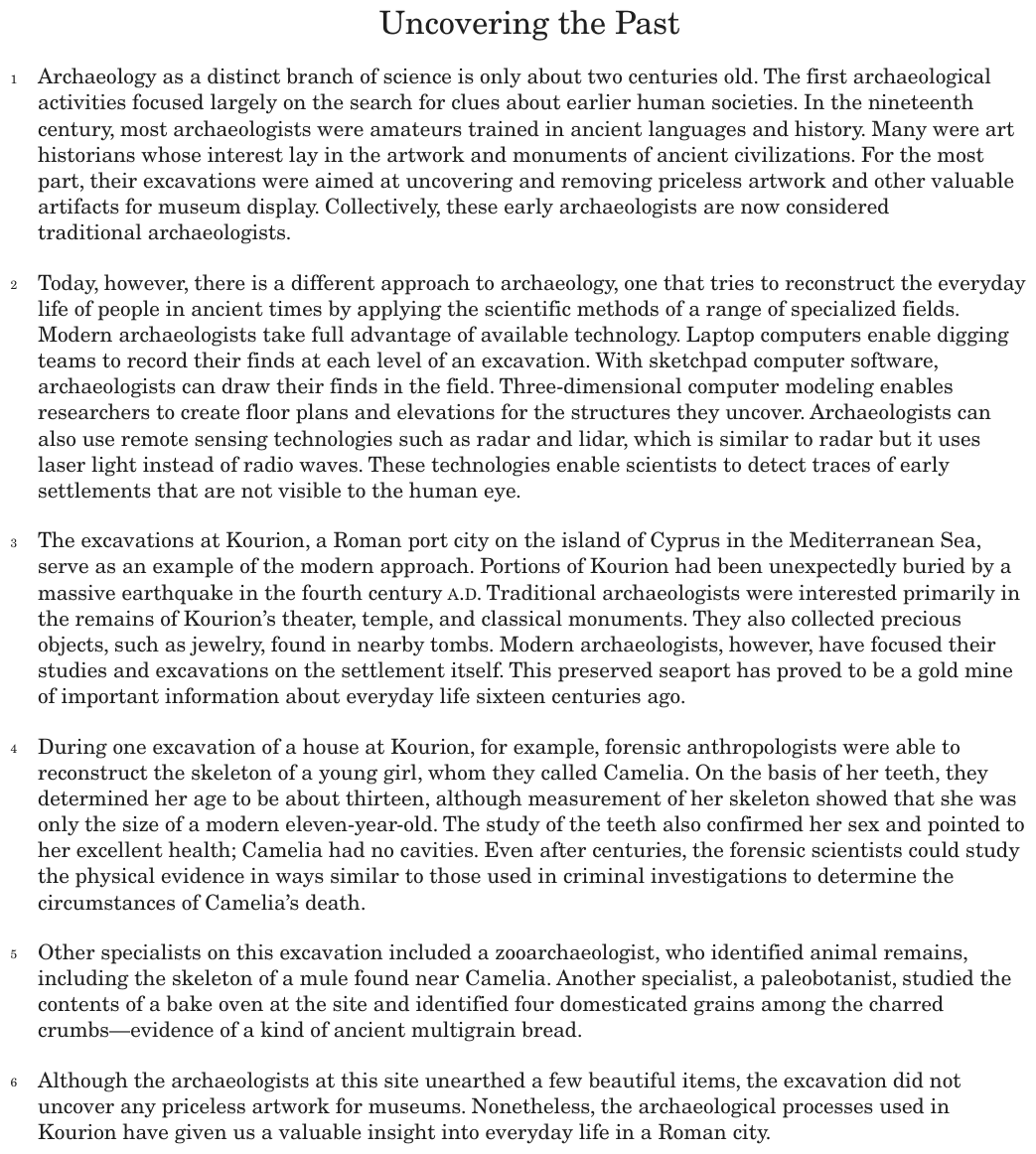
Archaeology as a distinct branch of science is only about two centuries old. The first archaeological activities focused largely on the search for clues about earlier human societies. In the nineteenth century, most archaeologists were amateurs trained in ancient languages and history. Many were art historians whose interest lay in the artwork and monuments of ancient civilizations. For the most part, their excavations were aimed at uncovering and removing priceless artwork and other valuable artifacts for museum display. Collectively, these early archaeologists are now considered traditional archaeologists.
Today, however, there is a different approach to archaeology, one that tries to reconstruct the everyday life of people in ancient times by applying the scientific methods of a range of specialized fields. Modern archaeologists take full advantage of available technology. Laptop computers enable digging teams to record their finds at each level of an excavation. With sketchpad computer software, archaeologists can draw their finds in the field. Three-dimensional computer modeling enables researchers to create floor plans and elevations for the structures they uncover. Archaeologists can also use remote sensing technologies such as radar and lidar, which is similar to radar but it uses laser light instead of radio waves. These technologies enable scientists to detect traces of early settlements that are not visible to the human eye.
The excavations at Kourion, a Roman port city on the island of Cyprus in the Mediterranean Sea, serve as an example of the modern approach. Portions of Kourion had been unexpectedly buried by a massive earthquake in the fourth century A.D. Traditional archaeologists were interested primarily in the remains of Kourion’s theater, temple, and classical monuments. They also collected precious objects, such as jewelry, found in nearby tombs. Modern archaeologists, however, have focused their studies and excavations on the settlement itself. This preserved seaport has proved to be a gold mine of important information about everyday life sixteen centuries ago.
During one excavation of a house at Kourion, for example, forensic anthropologists were able to reconstruct the skeleton of a young girl, whom they called Camelia. On the basis of her teeth, they determined her age to be about thirteen, although measurement of her skeleton showed that she was only the size of a modern eleven-year-old. The study of the teeth also confirmed her sex and pointed to her excellent health; Camelia had no cavities. Even after centuries, the forensic scientists could study the physical evidence in ways similar to those used in criminal investigations to determine the circumstances of Camelia’s death.
Other specialists on this excavation included a zooarchaeologist, who identified animal remains, including the skeleton of a mule found near Camelia. Another specialist, a paleobotanist, studied the contents of a bake oven at the site and identified four domesticated grains among the charred crumbs—evidence of a kind of ancient multigrain bread.
Although the archaeologists at this site unearthed a few beautiful items, the excavation did not uncover any priceless artwork for museums. Nonetheless, the archaeological processes used in Kourion have given us a valuable insight into everyday life in a Roman city.
Question
Which conclusion is best supported by the information in paragraph 4?
- AForensic anthropologists specialize in the excavation of ancient theaters and temples.
- BForensic anthropologists can obtain a variety of information by examining teeth.
- CForensic anthropologists believe that people in the past were smaller than people are today.
- DForensic anthropologists primarily investigate ancient crimes.
Show the answer
Correct answer: B
The question asks for the concluding sentence that best summarizes the information from paragraph 4. Paragraph 4 explains that Camelia’s age was determined through an examination of her teeth, which makes the conclusion in Option B the correct answer.
Option A is incorrect because the excavation discussed in the paragraph is at a house, not a theater or temple.
Option C is incorrect because, although Camelia’s body was smaller than a thirteen-year-old’s would be expected to be, the passage does not go into enough detail to suggest that all people from the past were smaller than people are today.
Option D is also incorrect because there is no evidence in the passage of Camelia’s death being the result of a crime.
Question analysis
This question asks which conclusion is best supported by paragraph 4 of “Uncovering the Past,” where forensic anthropologists study the skeleton of a girl they named Camelia. Students must draw a reasonable conclusion from several specific details and avoid reading more into the paragraph than it says.
- NYS standards
- 7R1 textual evidence and inferences
- Grade level
- Grade 7 reading and task
- Compared with grade 7
- At grade 7 A standard grade 7 inference task: draw a conclusion from one short, concrete paragraph. The scientific terms are explained by context, and the main demand is checking each conclusion against what the paragraph actually says.
- Estimated difficulty
- Straightforward: two steps or one careful reading.
- Thinking it demands
- Depth of knowledge 2, skills and concepts · mainly understand
- What makes it hard
- The right answer is reworded moderate
- Reading between the lines minor
- Evidence
- Answered from one paragraph or stanza
- Reading level
- Passage: about grade 13, 514 words; question and choices: about grade 14, 52 words.
- Students, last 30 days
- Not enough answers yet to show (it takes 10).
Why it is hard, traps and wrong answers (shows the answer)
Why it is hard
The right conclusion is a generalization the paragraph never states, while two wrong ones grow out of its most striking phrases. Camelia’s small size and the comparison with criminal investigations each invite a conclusion that sounds scientific but rests on one detail or misreads a comparison. Students who list what the scientists learned from the teeth before reading the choices avoid both.
The right answer is reworded moderate Choosing the answer
The key folds three findings from the teeth, Camelia’s age, her sex and her health, into “a variety of information,” while the wrong choices reuse “modern eleven-year-old,” “criminal investigations” and paragraph 3’s theater and temple. (Freedle & Kostin, 1993; Kirsch & Mosenthal, 1990)
Reading between the lines minor Working it out
No sentence states the conclusion; it has to be built by noticing that the teeth gave the age, the sex and “excellent health,” and then generalizing about what teeth can reveal. (Graesser, Singer & Trabasso, 1994; Kintsch, 1998)
Strategy: List what the scientists learned in paragraph 4, then test each choice by asking whether the paragraph gives direct evidence for it.
Traps
- Too broad or too strong: A choice overstates, generalizes, or uses absolute words the text does not support.
- Taking figurative language literally: A choice reads a figure of speech or image at face value.
- Wrong part of the text: A choice is true of another paragraph, stanza or speaker than the one asked about.
The wrong answers, classified
A Wrong part of the text (Kirsch & Mosenthal, 1990)
Borrows the theater and temple from paragraph 3, where they interested traditional archaeologists, though paragraph 4 describes forensic work on a girl found in a house.
C Too broad or too strong (King et al., 2004)
Generalizes from one skeleton: Camelia was “only the size of a modern eleven-year-old,” but one girl cannot show that ancient people in general were smaller, and the paragraph reports no such belief.
D Taking figurative language literally (Graesser, Singer & Trabasso, 1994)
Turns the comparison “in ways similar to those used in criminal investigations” into the scientists’ purpose, though it describes only their methods and nothing suggests a crime.
Working it out, step by step
Figure out what the question asks
This asks for a conclusion, an idea you can figure out from facts. The facts must come from paragraph 4, the paragraph about the girl called Camelia. The right choice needs direct support there. A choice that sounds smart but goes past the facts is wrong.
List what the scientists learned
Paragraph 4 says, “On the basis of her teeth, they determined her age to be about thirteen.” Then it says, “The study of the teeth also confirmed her sex and pointed to her excellent health; Camelia had no cavities.” Her skeleton also showed she was “only the size of a modern eleven-year-old.”
Find the pattern in those facts
Forensic anthropologists are scientists who study human bones, a bit like crime-lab experts. Look at how much came from the teeth alone. The teeth told them her age. They told them she was a girl. They showed she was healthy. That is three kinds of facts from one source. So you can conclude that teeth give many kinds of information.
Check each choice
- A is wrong. The theater and temple are in paragraph 3. Camelia was found in a house.
- B fits. Age, sex and health add up to “a variety of information” from teeth.
- C is wrong. One small girl does not prove that all people long ago were smaller. The paragraph never says the scientists believe that.
- D is wrong. The scientists worked “in ways similar to those used in criminal investigations.” That means their methods were like crime-lab methods. It does not mean they study crimes.
Choose the answer
Paragraph 4 shows teeth revealing age, sex and health. So the answer is B, “Forensic anthropologists can obtain a variety of information by examining teeth.”
Why this answer and not the closest wrong one
C is the closest trap, because Camelia really was small for her age. But a conclusion about all ancient people needs facts about many people. Paragraph 4 gives facts about one girl. B needs only what the paragraph shows: many facts from one set of teeth.
More questions like this
The original DOE question

The passage “Uncovering the Past” as printed (page 138)