Passage The Local Library
The Local Library
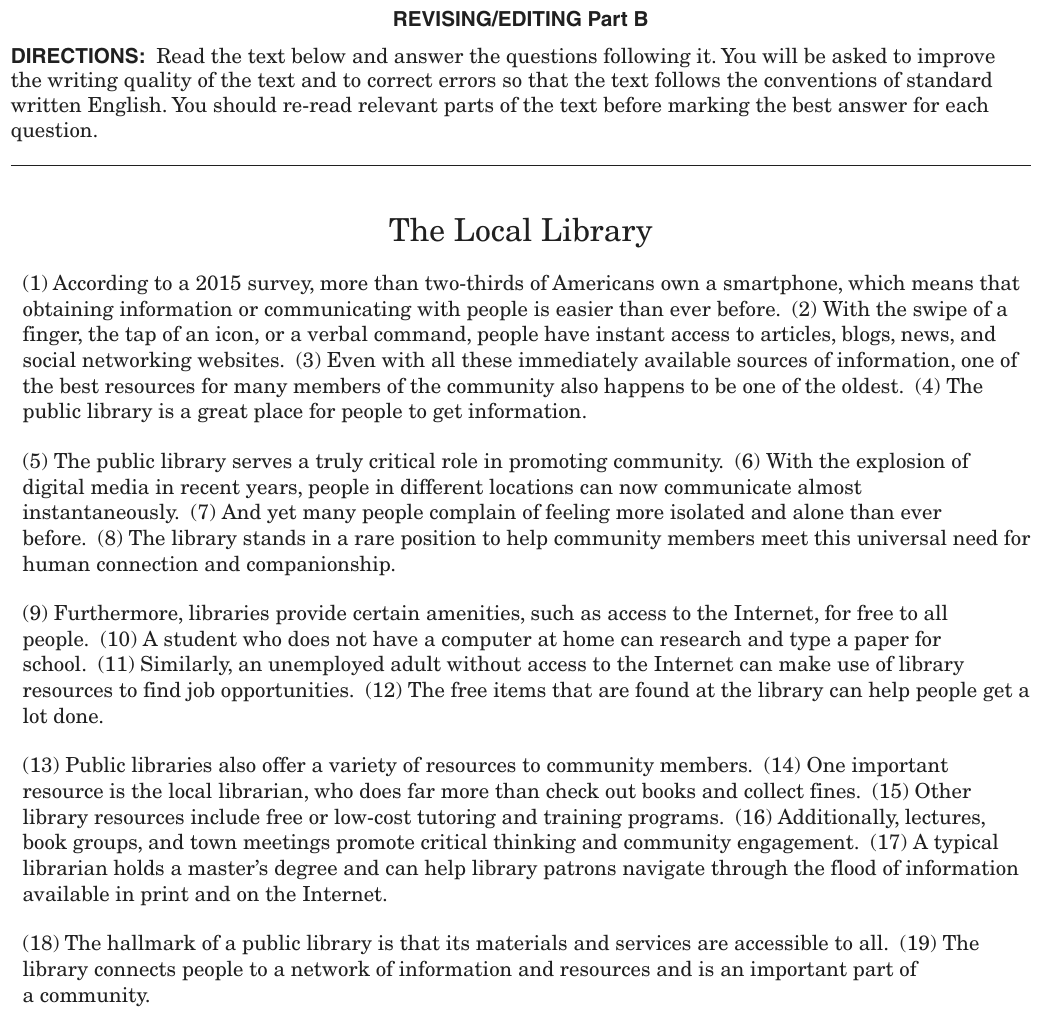
(1) According to a 2015 survey, more than two-thirds of Americans own a smartphone, which means that obtaining information or communicating with people is easier than ever before. (2) With the swipe of a finger, the tap of an icon, or a verbal command, people have instant access to articles, blogs, news, and social networking websites. (3) Even with all these immediately available sources of information, one of the best resources for many members of the community also happens to be one of the oldest. (4) The public library is a great place for people to get information.
(5) The public library serves a truly critical role in promoting community. (6) With the explosion of digital media in recent years, people in different locations can now communicate almost instantaneously. (7) And yet many people complain of feeling more isolated and alone than ever before. (8) The library stands in a rare position to help community members meet this universal need for human connection and companionship.
(9) Furthermore, libraries provide certain amenities, such as access to the Internet, for free to all people. (10) A student who does not have a computer at home can research and type a paper for school. (11) Similarly, an unemployed adult without access to the Internet can make use of library resources to find job opportunities. (12) The free items that are found at the library can help people get a lot done.
(13) Public libraries also offer a variety of resources to community members. (14) One important resource is the local librarian, who does far more than check out books and collect fines. (15) Other library resources include free or low-cost tutoring and training programs. (16) Additionally, lectures, book groups, and town meetings promote critical thinking and community engagement. (17) A typical librarian holds a master’s degree and can help library patrons navigate through the flood of information available in print and on the Internet.
(18) The hallmark of a public library is that its materials and services are accessible to all. (19) The library connects people to a network of information and resources and is an important part of a community.
Question
Where should sentence 17 be moved in order to improve the organization of the fourth paragraph (sentences 13–17)?
- Ato the beginning of the paragraph (before sentence 13)
- Bbetween sentences 13 and 14
- Cbetween sentences 14 and 15
- Dbetween sentences 15 and 16
Show the answer
Correct answer: C
The question asks where sentence 17 should be moved in order to improve the organization of the fourth paragraph. Sentence 17 describes a typical librarian and the assistance he or she provides in the library.
Option C correctly places sentence 17, an example of what else the librarian does, after the librarian is introduced in sentence 14.
Option A is incorrect because it places the sentence before the main idea of the paragraph, which states that public libraries offer a variety of resources. Sentence 17 is an example of one of the resources, so it would not be placed at the beginning of the paragraph before the main idea.
Option B is incorrect because it moves the sentence to before the librarian is introduced in the paragraph.
Option D is incorrect because sentences 15 and 16 have shifted away from the topic of the librarian, so the details in sentence 17 would not logically fit between them.
Question analysis
This organization question asks where a sentence about librarians’ training and skills belongs in the library essay’s paragraph on resources. Students read sentences 13 through 17 and look for the most logical spot for the detail. Several positions can seem reasonable at first, so the paragraph’s order of ideas has to be traced carefully.
- Grade level
- Grade 7 reading and task
- Compared with grade 7
- At grade 7 Ordering sentences so each detail follows the idea it explains is regular grade 7 revision work. This paragraph is only five sentences long and its topic shifts are easy to track, so it matches typical classroom practice.
- Estimated difficulty
- Straightforward: two steps or one careful reading.
- Thinking it demands
- Depth of knowledge 2, skills and concepts · mainly analyze
- What makes it hard
- How sentences fit together moderate
- A very close wrong answer minor
- Evidence
- Answered from one paragraph or stanza
- Reading level
- Passage: about grade 11, 341 words; question and choices: about grade 7, 33 words.
- Students, last 30 days
- Not enough answers yet to show (it takes 10).
Why it is hard, traps and wrong answers (shows the answer)
Why it is hard
This is a short paragraph with clear signals, so the work is in reading them: “One important resource” in sentence 14 introduces the librarian, and “Other library resources” in sentence 15 marks the move away. Students who notice only that sentence 17 is about librarians can put it on the wrong side of sentence 14. The question rewards tracing how each sentence hands off to the next.
How sentences fit together moderate Working it out
Sentence 17 begins “A typical librarian,” which makes sense right after sentence 14 names “the local librarian” as a resource and before sentence 15 turns away with “Other library resources.” (Halliday & Hasan, 1976)
A very close wrong answer minor Choosing the answer
“Between sentences 13 and 14” and “between sentences 14 and 15” both keep the detail beside the librarian sentence; the only difference is whether it comes before or after sentence 14 introduces the librarian. (Embretson & Wetzel, 1987; Gorin & Embretson, 2006; Ascalon et al., 2007)
Strategy: Identify what sentence 17 describes, then find the sentence it adds to most directly and check that the move keeps the paragraph’s ideas in a logical order.
The wrong answers, classified
A Sentence in the wrong place (Halliday & Hasan, 1976)
Treats “A typical librarian holds a master’s degree” as a general opener, though it would then come before sentence 13’s topic sentence about the library’s resources.
B Sentence in the wrong place (Halliday & Hasan, 1976)
Rightly keeps the detail beside the librarian sentence but puts it first, so readers learn the librarian’s degree before sentence 14 has introduced the librarian at all.
D Sentence in the wrong place (Halliday & Hasan, 1976)
Links the librarian’s degree to the “training programs” of sentence 15, though by then the paragraph has left librarians for tutoring and lectures.
Working it out, step by step
Figure out what the question asks
This is an organization question. You must decide where sentence 17 makes the most sense in paragraph 4, so the ideas come in a clear order.
Read sentence 17
Sentence 17 says: “A typical librarian holds a master’s degree and can help library patrons navigate through the flood of information available in print and on the Internet.” Patrons are the people who use the library. To navigate means to find your way. So the sentence is all about librarians.
Find the sentence it belongs with
Sentence 14 is the first to bring up librarians: “One important resource is the local librarian, who does far more than check out books and collect fines.” Sentence 17 tells more about what librarians do. So it should come right after sentence 14.
Then sentence 15 starts “Other library resources,” which moves on to a new topic. All the librarian facts should come before that.
Check each choice
- A is wrong. Sentence 13 is the topic sentence, the one that tells what the paragraph is about. One detail can’t go before it.
- B is wrong. The paragraph would talk about “a typical librarian” before sentence 14 introduces the librarian.
- C is right. Sentence 17 comes right after the sentence that introduces the librarian.
- D is wrong. By sentence 15, the paragraph has moved on to tutoring and training programs.
Watch out: B also puts sentence 17 next to sentence 14, but on the wrong side of it.
Choose the answer
The new order is 13, 14, 17, 15, 16. The paragraph names its topic, explains the librarian, then moves to other resources. So the answer is C.
Why this answer and not the closest wrong one
B is the closest wrong answer, since it also keeps sentence 17 beside sentence 14. But in B, the reader hears about “a typical librarian” before learning that librarians are a resource. In C, sentence 14 introduces “the local librarian,” and sentence 17 then adds details. That is the logical order.
More questions like this
The original DOE question

The passage “The Local Library” as printed (page 120)