Passage Uncovering the Past
Uncovering the Past
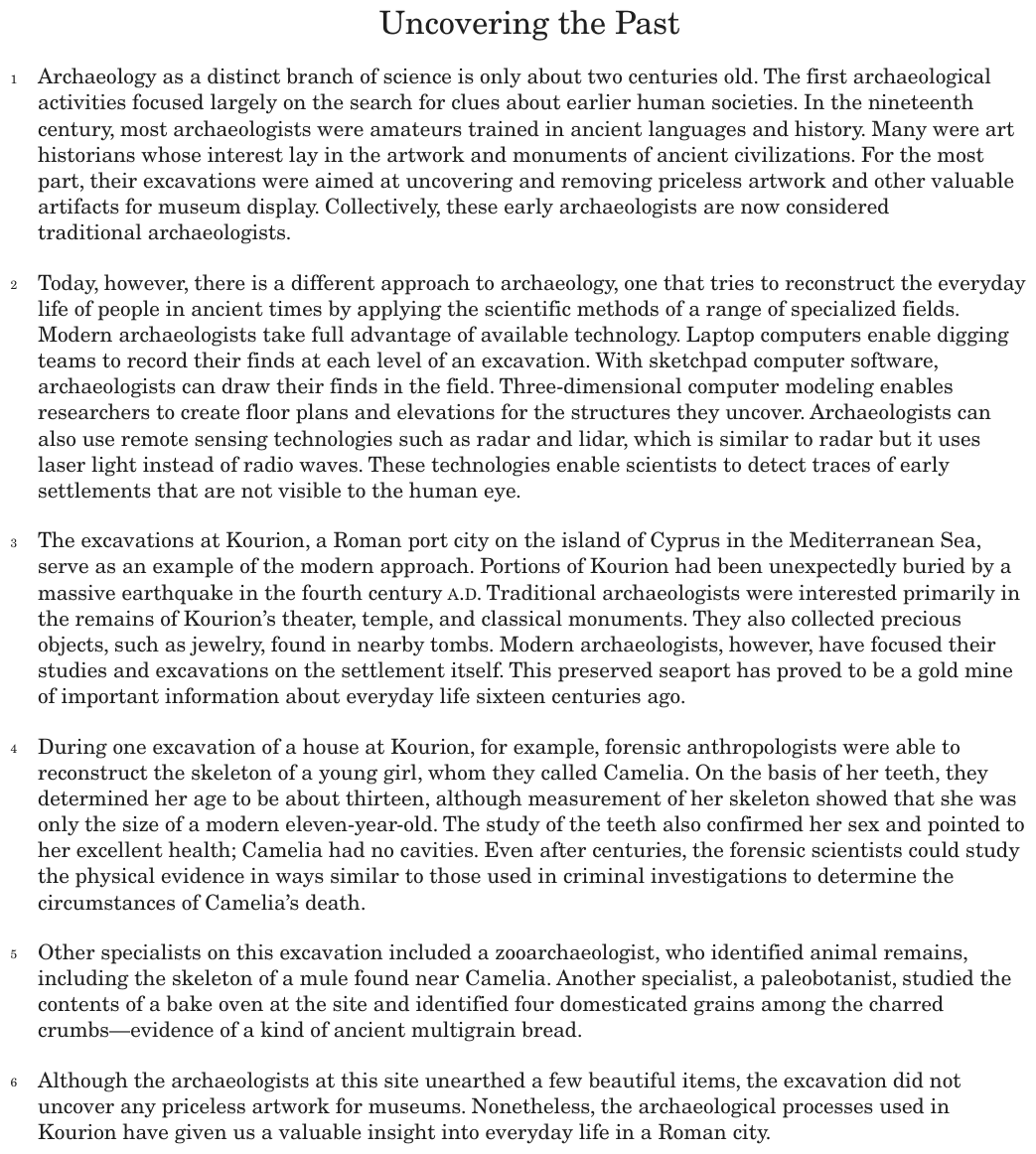
Archaeology as a distinct branch of science is only about two centuries old. The first archaeological activities focused largely on the search for clues about earlier human societies. In the nineteenth century, most archaeologists were amateurs trained in ancient languages and history. Many were art historians whose interest lay in the artwork and monuments of ancient civilizations. For the most part, their excavations were aimed at uncovering and removing priceless artwork and other valuable artifacts for museum display. Collectively, these early archaeologists are now considered traditional archaeologists.
Today, however, there is a different approach to archaeology, one that tries to reconstruct the everyday life of people in ancient times by applying the scientific methods of a range of specialized fields. Modern archaeologists take full advantage of available technology. Laptop computers enable digging teams to record their finds at each level of an excavation. With sketchpad computer software, archaeologists can draw their finds in the field. Three-dimensional computer modeling enables researchers to create floor plans and elevations for the structures they uncover. Archaeologists can also use remote sensing technologies such as radar and lidar, which is similar to radar but it uses laser light instead of radio waves. These technologies enable scientists to detect traces of early settlements that are not visible to the human eye.
The excavations at Kourion, a Roman port city on the island of Cyprus in the Mediterranean Sea, serve as an example of the modern approach. Portions of Kourion had been unexpectedly buried by a massive earthquake in the fourth century A.D. Traditional archaeologists were interested primarily in the remains of Kourion’s theater, temple, and classical monuments. They also collected precious objects, such as jewelry, found in nearby tombs. Modern archaeologists, however, have focused their studies and excavations on the settlement itself. This preserved seaport has proved to be a gold mine of important information about everyday life sixteen centuries ago.
During one excavation of a house at Kourion, for example, forensic anthropologists were able to reconstruct the skeleton of a young girl, whom they called Camelia. On the basis of her teeth, they determined her age to be about thirteen, although measurement of her skeleton showed that she was only the size of a modern eleven-year-old. The study of the teeth also confirmed her sex and pointed to her excellent health; Camelia had no cavities. Even after centuries, the forensic scientists could study the physical evidence in ways similar to those used in criminal investigations to determine the circumstances of Camelia’s death.
Other specialists on this excavation included a zooarchaeologist, who identified animal remains, including the skeleton of a mule found near Camelia. Another specialist, a paleobotanist, studied the contents of a bake oven at the site and identified four domesticated grains among the charred crumbs—evidence of a kind of ancient multigrain bread.
Although the archaeologists at this site unearthed a few beautiful items, the excavation did not uncover any priceless artwork for museums. Nonetheless, the archaeological processes used in Kourion have given us a valuable insight into everyday life in a Roman city.
Question
Which of the following best describes the goal of modern archaeology?
- Ato use science to learn how people lived in the past
- Bto find artwork from ancient civilizations
- Cto search for evidence of ancient settlements
- Dto uncover precious objects for display in museums
Show the answer
Correct answer: A
The question asks for a summary of what the goal of modern archaeology is in general. The passage is mostly about how archaeology has evolved from efforts to discover ancient artwork and museum pieces to using technology to piece together a sense of life in early civilizations, which is best described in Option A.
Option B is incorrect because it states the goal of archaeology in the past, not in modern times.
Option C is incorrect because finding settlements is not the goal but just the first step in the modern archaeological process.
Option D is incorrect because it states the goal of traditional, rather than modern, archaeology.
Question analysis
Based on the informational passage “Uncovering the Past,” students identify the goal of modern archaeology. The passage describes two approaches to digging up the past, an older one and today’s, so the question checks whether students can keep the two approaches straight and state the newer one’s purpose.
- Grade level
- Grade 7 reading and task
- Compared with grade 7
- Below grade 7 Easier than most grade 7 central-idea questions: the goal is stated almost directly in the passage, so the task is careful locating and paraphrase rather than interpretation or synthesis.
- Estimated difficulty
- Straightforward: two steps or one careful reading.
- Thinking it demands
- Depth of knowledge 2, skills and concepts · mainly understand
- What makes it hard
- Evidence
- Answered from several paragraphs or stanzas
- Reading level
- Passage: about grade 13, 514 words; question and choices: about grade 6, 43 words.
- Students, last 30 days
- Not enough answers yet to show (it takes 10).
Why it is hard, traps and wrong answers (shows the answer)
Why it is hard
The goal is stated in the first sentence of paragraph 2, so the question mostly rewards keeping the passage’s two approaches apart. Students who skim pick up paragraph 1’s vivid aims, artwork and museum display, and attach them to the wrong group. The subtler loss comes from confusing a modern technique with the purpose it serves.
The right answer is reworded minor Choosing the answer
Paragraph 2 says archaeologists apply “the scientific methods of a range of specialized fields” to “reconstruct the everyday life of people”; the key restates this plainly, while the artwork and museum choices reuse paragraph 1’s exact words. (Freedle & Kostin, 1993; Kirsch & Mosenthal, 1990)
Strategy: Find where the passage first describes today’s approach, put its aim into a few words of your own, and match that to a choice.
Traps
- Wrong part of the text: A choice is true of another paragraph, stanza or speaker than the one asked about.
- Too narrow: A single detail offered as the central idea or a summary, or a summary that keeps minor details and leaves out an essential part.
The wrong answers, classified
B Wrong part of the text (Kirsch & Mosenthal, 1990)
Matches “artwork” and “ancient civilizations” from paragraph 1, which describes the nineteenth-century art historians, the traditional approach that the modern one replaced.
C Too narrow (King et al., 2004)
Detecting “traces of early settlements” with radar and lidar is something modern archaeologists do, but it is one tool serving the goal of reconstructing everyday life, not the goal itself.
D Wrong part of the text (Kirsch & Mosenthal, 1990)
Picks up the aim paragraph 1 states outright, excavations “aimed at uncovering and removing priceless artwork” for museums, which belongs to traditional archaeologists, not to the modern approach.
Working it out, step by step
Figure out what the question asks
This question asks for the main goal of modern archaeology. Archaeology is the study of how people lived long ago, using the things they left behind. The passage describes two groups. First come the early, traditional archaeologists. Then come today’s modern ones. You need the goal of the modern group only.
Find where modern archaeology begins
Paragraph 1 is about the traditional group. Paragraph 2 turns to today. Its first sentence says there is now “a different approach to archaeology, one that tries to reconstruct the everyday life of people in ancient times by applying the scientific methods of a range of specialized fields.” The last paragraph agrees. It says the work at Kourion gave “a valuable insight into everyday life in a Roman city.”
Put the goal in your own words
To reconstruct something is to build it again. Here it means building a picture of daily life from clues. The “scientific methods” are the tools of science, like computers, radar and lab tests. So the goal is this: use science to learn how ordinary people lived long ago. Finding treasure is not the point.
Check each choice
- A fits. It says the same thing in plain words: science, plus how people lived.
- B is wrong. Finding artwork was the goal of the traditional group in paragraph 1.
- C is close but wrong. Radar and lidar help find “traces of early settlements.” But that is a tool and a first step, not the goal.
- D is wrong. Paragraph 1 says digs for “priceless artwork and other valuable artifacts for museum display” were the old goal.
Choose the answer
Modern archaeology uses science to rebuild everyday life in the past. So the answer is A, “to use science to learn how people lived in the past.”
Why this answer and not the closest wrong one
Choice C is the trap. Ask why modern archaeologists look for old settlements. They look so they can learn about daily life there. Finding the place is only a step along the way. Learning how people lived is the goal, and only A says that.
More questions like this
The original DOE question
The passage “Uncovering the Past” as printed (page 138)