Also in 2026 Practice Test C English, question 12.
Passage Excerpt from “Niagara Falls”
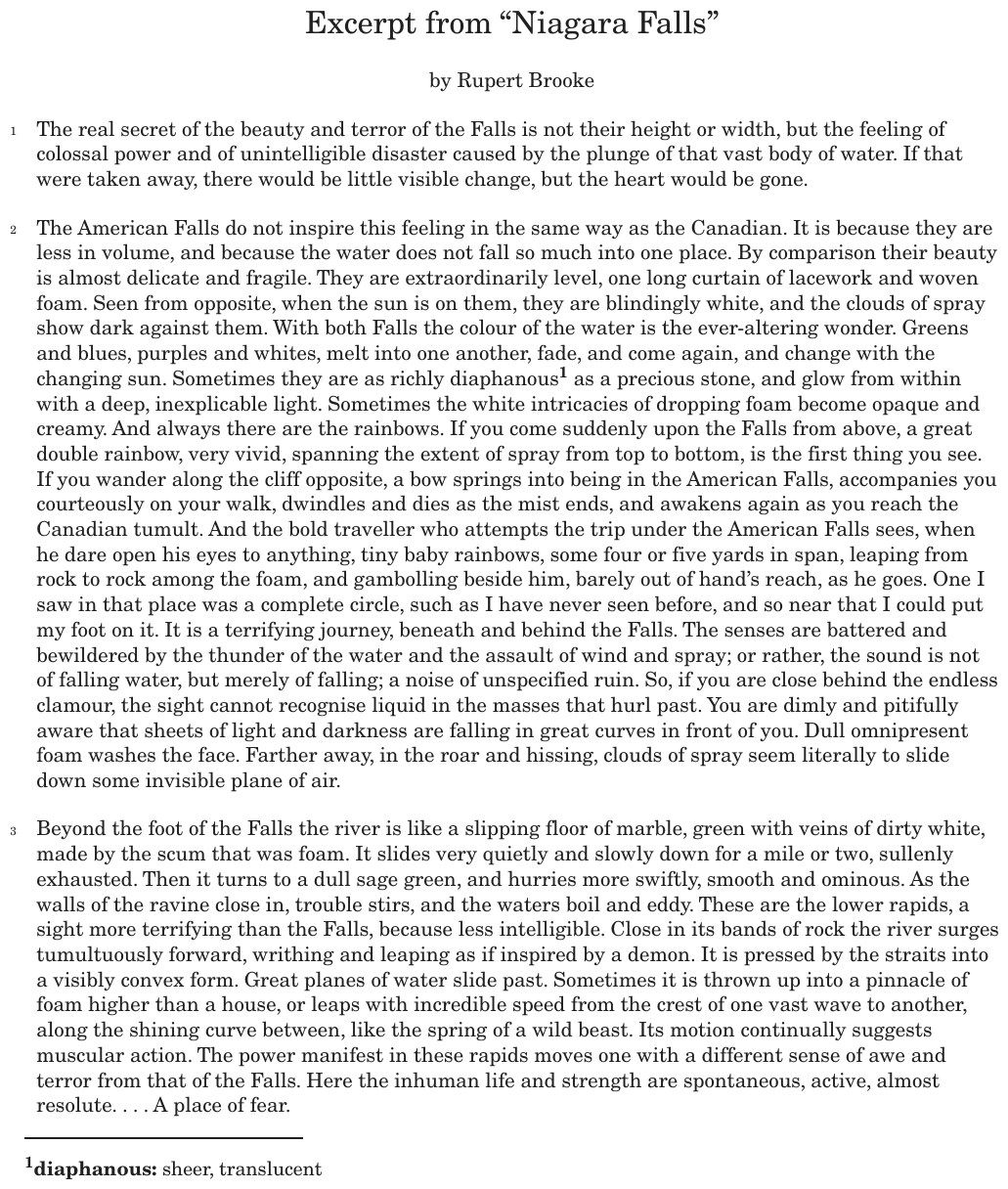
Excerpt from “Niagara Falls”
by Rupert Brooke
The real secret of the beauty and terror of the Falls is not their height or width, but the feeling of colossal power and of unintelligible disaster caused by the plunge of that vast body of water. If that were taken away, there would be little visible change, but the heart would be gone.
The American Falls do not inspire this feeling in the same way as the Canadian. It is because they are less in volume, and because the water does not fall so much into one place. By comparison their beauty is almost delicate and fragile. They are extraordinarily level, one long curtain of lacework and woven foam. Seen from opposite, when the sun is on them, they are blindingly white, and the clouds of spray show dark against them. With both Falls the colour of the water is the ever-altering wonder. Greens and blues, purples and whites, melt into one another, fade, and come again, and change with the changing sun. Sometimes they are as richly diaphanous as a precious stone, and glow from within with a deep, inexplicable light. Sometimes the white intricacies of dropping foam become opaque and creamy. And always there are the rainbows. If you come suddenly upon the Falls from above, a great double rainbow, very vivid, spanning the extent of spray from top to bottom, is the first thing you see. If you wander along the cliff opposite, a bow springs into being in the American Falls, accompanies you courteously on your walk, dwindles and dies as the mist ends, and awakens again as you reach the Canadian tumult. And the bold traveller who attempts the trip under the American Falls sees, when he dare open his eyes to anything, tiny baby rainbows, some four or five yards in span, leaping from rock to rock among the foam, and gambolling beside him, barely out of hand’s reach, as he goes. One I saw in that place was a complete circle, such as I have never seen before, and so near that I could put my foot on it. It is a terrifying journey, beneath and behind the Falls. The senses are battered and bewildered by the thunder of the water and the assault of wind and spray; or rather, the sound is not of falling water, but merely of falling; a noise of unspecified ruin. So, if you are close behind the endless clamour, the sight cannot recognise liquid in the masses that hurl past. You are dimly and pitifully aware that sheets of light and darkness are falling in great curves in front of you. Dull omnipresent foam washes the face. Farther away, in the roar and hissing, clouds of spray seem literally to slide down some invisible plane of air.
Beyond the foot of the Falls the river is like a slipping floor of marble, green with veins of dirty white, made by the scum that was foam. It slides very quietly and slowly down for a mile or two, sullenly exhausted. Then it turns to a dull sage green, and hurries more swiftly, smooth and ominous. As the walls of the ravine close in, trouble stirs, and the waters boil and eddy. These are the lower rapids, a sight more terrifying than the Falls, because less intelligible. Close in its bands of rock the river surges tumultuously forward, writhing and leaping as if inspired by a demon. It is pressed by the straits into a visibly convex form. Great planes of water slide past. Sometimes it is thrown up into a pinnacle of foam higher than a house, or leaps with incredible speed from the crest of one vast wave to another, along the shining curve between, like the spring of a wild beast. Its motion continually suggests muscular action. The power manifest in these rapids moves one with a different sense of awe and terror from that of the Falls. Here the inhuman life and strength are spontaneous, active, almost resolute. . . . A place of fear.
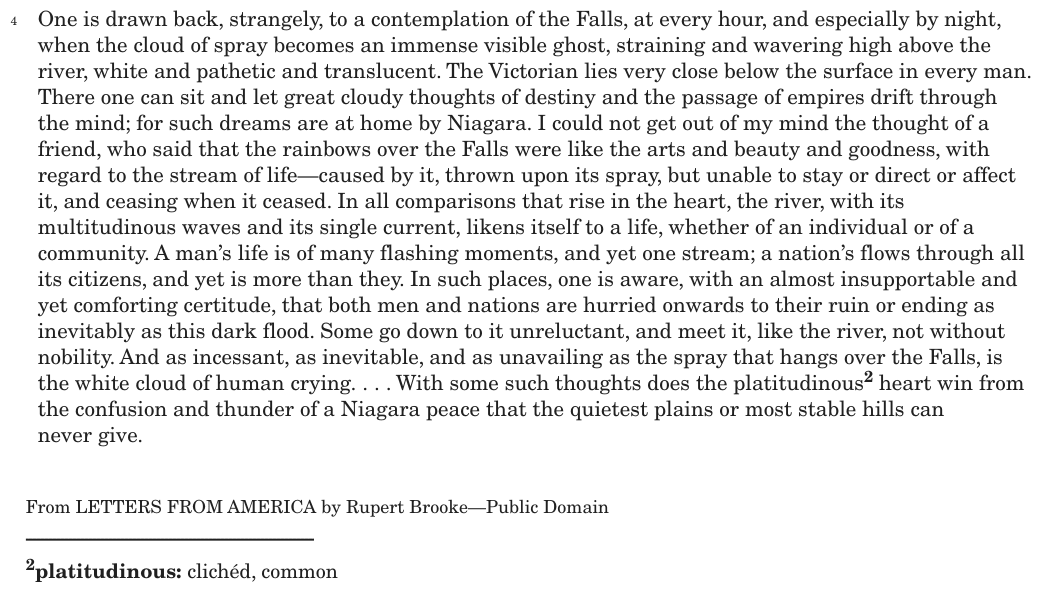
One is drawn back, strangely, to a contemplation of the Falls, at every hour, and especially by night, when the cloud of spray becomes an immense visible ghost, straining and wavering high above the river, white and pathetic and translucent. The Victorian lies very close below the surface in every man. There one can sit and let great cloudy thoughts of destiny and the passage of empires drift through the mind; for such dreams are at home by Niagara. I could not get out of my mind the thought of a friend, who said that the rainbows over the Falls were like the arts and beauty and goodness, with regard to the stream of life—caused by it, thrown upon its spray, but unable to stay or direct or affect it, and ceasing when it ceased. In all comparisons that rise in the heart, the river, with its multitudinous waves and its single current, likens itself to a life, whether of an individual or of a community. A man’s life is of many flashing moments, and yet one stream; a nation’s flows through all its citizens, and yet is more than they. In such places, one is aware, with an almost insupportable and yet comforting certitude, that both men and nations are hurried onwards to their ruin or ending as inevitably as this dark flood. Some go down to it unreluctant, and meet it, like the river, not without nobility. And as incessant, as inevitable, and as unavailing as the spray that hangs over the Falls, is the white cloud of human crying. . . . With some such thoughts does the platitudinous heart win from the confusion and thunder of a Niagara peace that the quietest plains or most stable hills can never give.
From LETTERS FROM AMERICA by Rupert Brooke—Public Domain
diaphanous: sheer, translucent
platitudinous: clichéd, common
Question
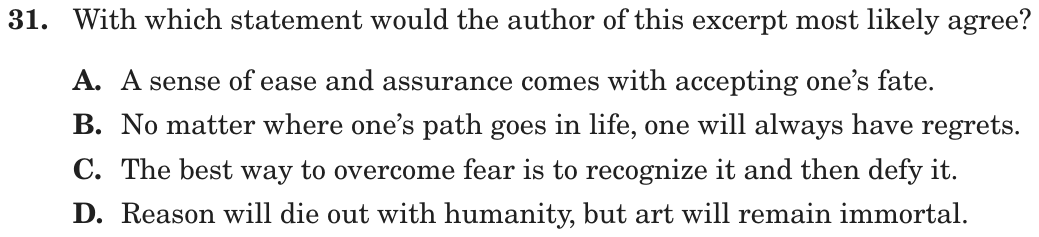
With which statement would the author of this excerpt most likely agree?
- AA sense of ease and assurance comes with accepting one’s fate.
- BNo matter where one’s path goes in life, one will always have regrets.
- CThe best way to overcome fear is to recognize it and then defy it.
- DReason will die out with humanity, but art will remain immortal.
Show the answer
Correct answer: A
The question asks for the statement the author would agree with most. In paragraph 4, the author states that the Falls make a person feel “with an almost insupportable and yet comforting certitude, that both men and nations are hurried onwards to their ruin or ending.” Later, the final sentence says, “With some such thoughts does the platitudinous heart win from the confusion and thunder of a Niagara peace.” This sentence supports the author’s belief that a person can find peace in accepting the certainty of his or her own ending, as expressed in Option A.
Option B is incorrect because the author does not discuss regrets in the excerpt.
Option C is incorrect because, while the excerpt discusses fear when looking at the power of the Falls, the excerpt does not support the idea that one should defy fear.
Option D is incorrect because the excerpt states in paragraph 4 that art and beauty are “caused by” the stream of life and end with it, “ceasing when it ceased.”
Question analysis
This question asks students to infer which statement about life the author of “Niagara Falls” would most likely agree with, based on the reflections that close his essay. It is hard because the evidence sits in long, abstract sentences of century-old prose and must be pieced together from more than one place in the final paragraph.
- Grade level
- Grade 9 reading and task
- Compared with grade 7
- Above grade 7 Grade 7 point-of-view questions usually rest on a clearly stated opinion. Here the author’s view must be pieced together from abstract reflection on lives, nations and the river, with words like “insupportable” and “platitudinous,” which is closer to high school reading.
- Estimated difficulty
- Among the hardest on the SHSAT: a non-obvious approach, heavy reading, or a well-hidden trap.
- Thinking it demands
- Depth of knowledge 3, strategic thinking · mainly analyze
- What makes it hard
- Reading between the lines major
- Complex sentences major
- The right answer is reworded moderate
- Hard words moderate
- Evidence
- Answered from one paragraph or stanza
- Reading level
- Passage: about grade 9, 987 words; question and choices: about grade 6, 61 words.
- Corrected from the DOE handbook
- A misreading of a word in the passage was corrected in the explanation.
- Students, last 30 days
- Not enough answers yet to show (it takes 10).
Why it is hard, traps and wrong answers (shows the answer)
Why it is hard
This question asks for the author’s outlook, which he reaches only in the closing sentences of a long, abstract paragraph. The mood there is gloomy, with ruin, a dark flood and human crying, so students who read the mood but not the argument choose regret. The comfort and peace he finds in that certainty are easy to miss in the inverted final sentence, and they are exactly what the answer rests on.
Reading between the lines major Working it out
The author never states a belief; students must combine “comforting certitude,” people who meet their end “unreluctant” and “not without nobility,” and the closing “peace” into an attitude of accepting fate. (Graesser, Singer & Trabasso, 1994; Kintsch, 1998)
Complex sentences major Understanding the question
The last sentence inverts normal order, “With some such thoughts does the platitudinous heart win from the confusion and thunder of a Niagara peace,” so its subject and object are hard to find. (Abedi & Lord, 2001; Freedle & Kostin, 1993; Messick, 1989)
The right answer is reworded moderate Choosing the answer
The right statement uses none of the passage’s words, turning “certitude” into “assurance” and “peace” into “ease,” while wrong choices pick up “fear” and “art.” (Freedle & Kostin, 1993; Kirsch & Mosenthal, 1990)
Hard words moderate Understanding the question
“Certitude,” “unreluctant,” “unavailing” and “platitudinous” carry the author’s attitude, and the glossary defines only the last of them. (Perfetti, 2007; Freedle & Kostin, 1993)
Strategy: Reread the second half of paragraph 4 slowly, translating each long sentence into plain words, then choose the statement those lines support without adding ideas the author never mentions.
Traps
- Outside knowledge: A choice is plausible in the real world but not supported by this text.
- Reads too much in: A reasonable-sounding conclusion that goes further than the text allows.
The wrong answers, classified
B Reads too much in (Graesser, Singer & Trabasso, 1994)
Reads “the white cloud of human crying” and the dark flood as a claim about lifelong regret, though the author never mentions regret and finds comfort in the end.
C Outside knowledge (King et al., 2004; Recht & Leslie, 1988)
Falls back on familiar advice about facing fears, prompted by the excerpt’s talk of terror, but the author recommends accepting what is inevitable, not defying it.
D Twists what the text says (King et al., 2004)
Reverses the friend’s rainbow comparison: art and beauty are “caused by” the stream of life and end with it, “ceasing when it ceased,” so art is not immortal.
What was corrected from the DOE handbook, and why
- Explanation: The handbook rejects Option D because paragraph 4 says art is “unable to stay.” In the passage, art and beauty are “unable to stay or direct or affect” the stream of life: “stay” means to stop or hold back the stream, not to last. What shows that art is not immortal is that it is “caused by” the stream of life and ends with it, “ceasing when it ceased,” which the site now quotes.
Working it out, step by step
Figure out what the question asks
This asks which statement the author would most likely agree with. He never states his belief outright, so you must infer it from his words, especially at the end of paragraph 4.
Find what he says about endings
In paragraph 4, he says that at Niagara one feels “with an almost insupportable and yet comforting certitude” that people and nations reach an end. He adds: “Some go down to it unreluctant, and meet it, like the river, not without nobility.” His last sentence says the heart can “win from the confusion and thunder of a Niagara peace.”
Put his words in plain English
“Certitude” means being sure. “Insupportable” means too hard to bear. So knowing that everything ends is hard, yet it is also comforting. “Unreluctant” means willing. Some people meet their end willingly, with dignity. And the Falls give the heart peace. Put together: accepting what must happen brings calm.
Check each choice
- A is right. He finds comfort and peace in accepting fate. That is “ease and assurance.”
- B is wrong. He never mentions regrets.
- C is wrong. He talks about accepting what must happen, not about fighting fear.
- D is wrong. Art and beauty are “caused by” life and end with it, “ceasing when it ceased.” So art does not last forever.
Watch out: “The white cloud of human crying” sounds sad, so B may tempt you. But sadness is not regret, and the author ends on peace.
Choose the answer
The author finds calm and comfort in accepting what must come. So the answer is A.
Why this answer and not the closest wrong one
B is the closest wrong answer, because paragraph 4 mentions human crying and ruin. But the author never talks about regret. He calls the certainty of an ending “comforting,” and the essay closes on the word “peace.” Feeling calm by accepting fate is what A says.
More questions like this
The original DOE question
The passage “Excerpt from “Niagara Falls”” as printed (pages 134–135)