Passage Snowy Mountains
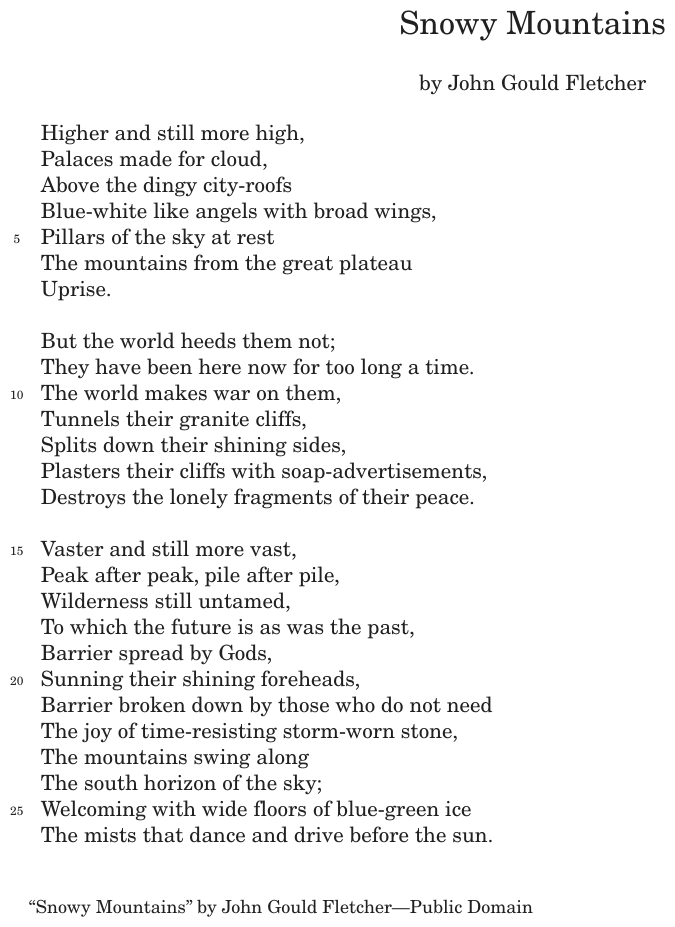
Snowy Mountains
by John Gould Fletcher
Higher and still more high,
Palaces made for cloud,
Above the dingy city-roofs
Blue-white like angels with broad wings,
Pillars of the sky at rest
The mountains from the great plateau
Uprise.
But the world heeds them not;
They have been here now for too long a time.
The world makes war on them,
Tunnels their granite cliffs,
Splits down their shining sides,
Plasters their cliffs with soap-advertisements,
Destroys the lonely fragments of their peace.
Vaster and still more vast,
Peak after peak, pile after pile,
Wilderness still untamed,
To which the future is as was the past,
Barrier spread by Gods,
Sunning their shining foreheads,
Barrier broken down by those who do not need
The joy of time-resisting storm-worn stone,
The mountains swing along
The south horizon of the sky;
Welcoming with wide floors of blue-green ice
The mists that dance and drive before the sun.
“Snowy Mountains” by John Gould Fletcher—Public Domain
Question
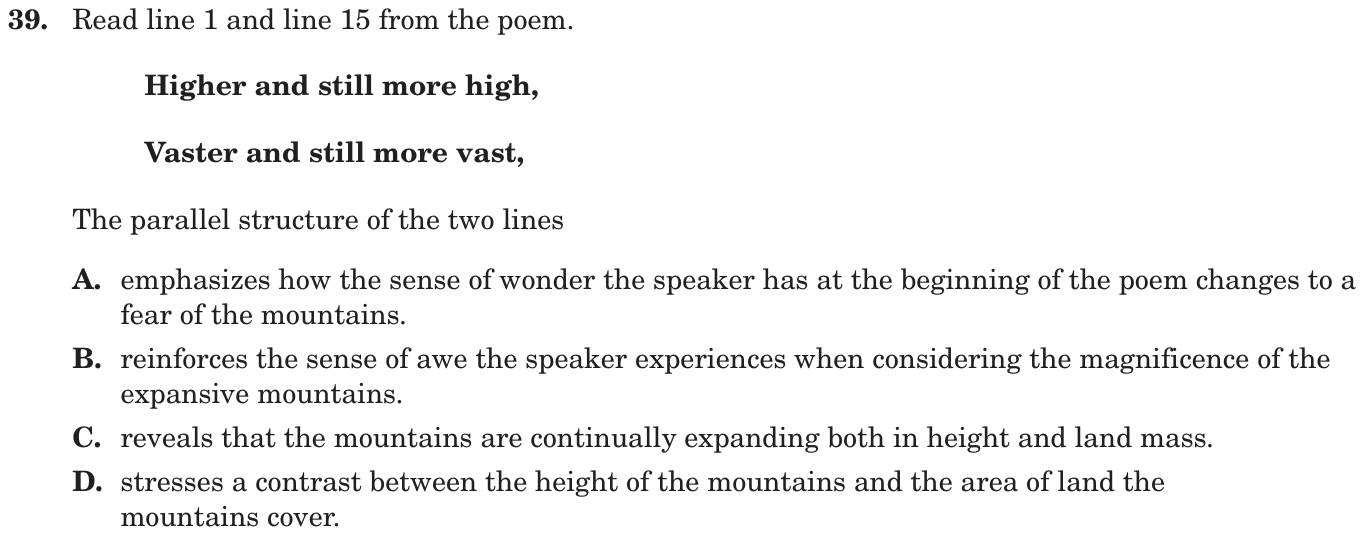
Read line 1 and line 15 from the poem.
Higher and still more high,
Vaster and still more vast,
The parallel structure of the two lines
- Aemphasizes how the sense of wonder the speaker has at the beginning of the poem changes to a fear of the mountains.
- Breinforces the sense of awe the speaker experiences when considering the magnificence of the expansive mountains.
- Creveals that the mountains are continually expanding both in height and land mass.
- Dstresses a contrast between the height of the mountains and the area of land the mountains cover.
Show the answer
Correct answer: B
The question asks how the parallel structure of lines 1 and 15 affects the poem. Lines 1 and 15 communicate the feeling that the mountains are even higher and vaster than can be comprehended upon first view. This observation reflects the awe that the speaker feels, which is reinforced by the parallel structure of the lines, as stated in Option B.
Option A is incorrect because the speaker never hints at fear when describing the mountains.
Option C is incorrect because it reflects a literal interpretation of the figurative language in the two parallel lines: the mountains do not actually grow larger but are simply larger than can be understood at first.
Option D is incorrect because the parallel structure of lines 1 and 15 is not meant to stress any sort of contrast between height and area but to reinforce the speaker’s feeling by complementing each other.
Question analysis
Students analyze the effect of parallel structure in the poem “Snowy Mountains,” where line 1, “Higher and still more high,” and line 15, “Vaster and still more vast,” echo each other. The question asks what that repeated pattern adds to the poem, so noticing the echo is only the first step.
- Grade level
- Grade 8 reading and task
- Compared with grade 7
- At grade 7 Analyzing how a poetic device such as parallelism shapes meaning is solid grade 7 work. The lines are short and quoted, but students must move from a structural pattern to what it contributes to the poem.
- Estimated difficulty
- Moderate: several steps, or a close reading with one strong distractor.
- Thinking it demands
- Depth of knowledge 2, skills and concepts · mainly analyze
- What makes it hard
- How, not what moderate
- Figurative or literary language minor
- Evidence
- Answered from several paragraphs or stanzas
- Reading level
- Passage: 161 words (a poem; reading level not measured); question and choices: about grade 6, 92 words.
- Corrected from the DOE handbook
- A grammar slip in the explanation was corrected.
- Students, last 30 days
- Not enough answers yet to show (it takes 10).
Why it is hard, traps and wrong answers (shows the answer)
Why it is hard
Seeing the parallel lines is easy because the stem quotes them; deciding what the echo achieves is the real task. The strongest wrong answer rests on a true difference between height and breadth, and another takes the comparative phrases literally. Students who ask how the speaker feels in both stanzas, rather than what each line measures, arrive at awe.
How, not what moderate Working it out
The stem asks what the shared pattern of lines 1 and 15 does, so students must move from noticing “still more” twice to naming the feeling the echo strengthens. (Anderson & Krathwohl, 2001)
Figurative or literary language minor Understanding the question
“Still more high” and “still more vast” express how the mountains seem to an awed viewer, not a measurement, and a literal reading makes them sound like mountains that keep growing. (Graesser, Singer & Trabasso, 1994; Kintsch, 1998)
Strategy: Say what each line describes and what it suggests, then ask what using the same pattern twice adds, and check every part of each choice against the poem.
Traps
- Taking figurative language literally: A choice reads a figure of speech or image at face value.
- Half right: One half of a two-part choice is right and the other is not.
The wrong answers, classified
A Wrong tone or attitude (Graesser, Singer & Trabasso, 1994)
Senses that the mood shifts after the first stanza, but the shift is to criticism of people in stanza 2, and the echo in line 15 returns to admiration, not fear.
C Taking figurative language literally (Graesser, Singer & Trabasso, 1994)
Reads “still more high” and “still more vast” as physical growth, when the comparatives express how the mountains’ size keeps impressing the speaker.
D Half right (King et al., 2004; Thissen, Steinberg & Fitzpatrick, 1989)
Correctly notes that line 1 is about height and line 15 about breadth, but the parallel wording joins the two dimensions in one feeling rather than setting them against each other.
What was corrected from the DOE handbook, and why
- Explanation: The handbook writes “how the parallel structure of lines 1 and 15 affect the poem.” The subject “structure” takes “affects,” as the site now reads.
Working it out, step by step
Figure out what the question asks
This asks about parallel structure. That means using the same pattern of words twice. Here, line 1 says “Higher and still more high,” and line 15 says “Vaster and still more vast.” You need to say what repeating this pattern does.
Look at where the lines sit
Line 1 opens the first stanza. Line 15 opens the third stanza. In between, stanza 2 shows people harming the mountains. Line 1 is about height. Line 15 is about vastness, which means huge size that spreads far. “Still more” means even more. Each line seems to say the mountains are bigger than you can take in.
Name the feeling the pattern shows
Both lines sound like a person staring up in amazement. That feeling is awe: wonder mixed with deep respect. Repeating the pattern brings the feeling back after the angry second stanza. So the echo reinforces, or makes stronger, the speaker’s awe. It is not a measurement. The mountains are not really growing.
Check each choice
- A is wrong. The speaker never shows fear. Line 15 brings back the same wonder as line 1.
- B fits. The repeated pattern stresses the speaker’s awe at the huge mountains.
- C is wrong. It reads the lines literally, as if the mountains keep growing. The words express a feeling, not a fact.
- D is wrong. Height and spread are different. But the matching pattern joins them in one feeling. It does not set them against each other.
Choose the answer
The same pattern, used twice, repeats the speaker’s sense of wonder. So the answer is B, “reinforces the sense of awe the speaker experiences when considering the magnificence of the expansive mountains.”
Why this answer and not the closest wrong one
D is tempting because it is half true: one line is about height and one is about spread. But parallel structure makes two things sound alike, not opposite. Matching words link ideas. That is why B, which names one shared feeling, fits better than a contrast.
More questions like this
The original DOE question
The passage “Snowy Mountains” as printed (page 142)