Also in 2024 Test B English, question 41; 2026 Practice Test A English, question 1; 2025 Practice Test A English, question 1.
Passage Snowy Mountains
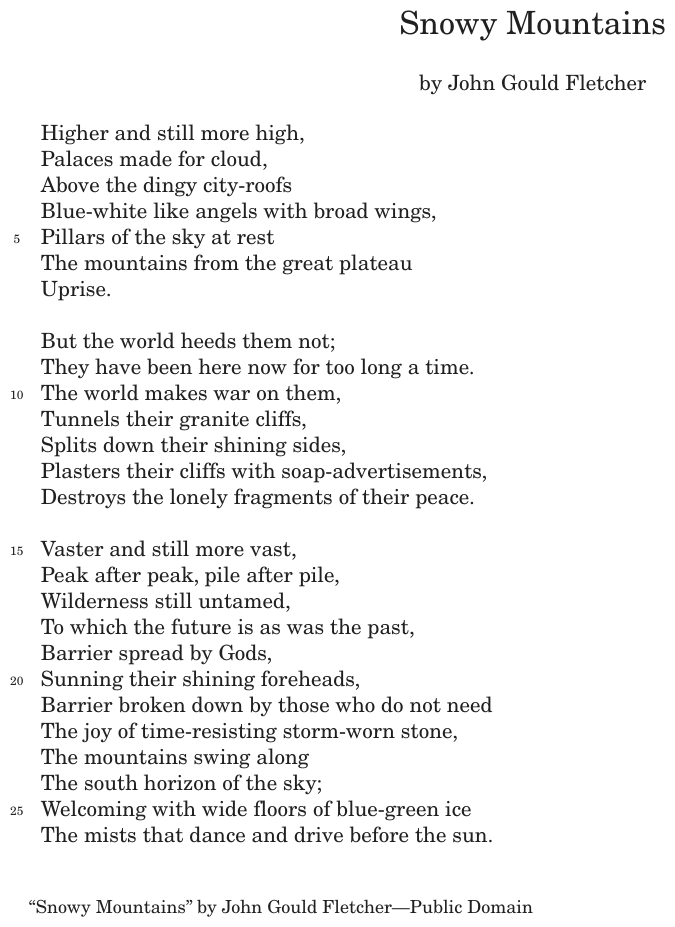
Snowy Mountains
by John Gould Fletcher
Higher and still more high,
Palaces made for cloud,
Above the dingy city-roofs
Blue-white like angels with broad wings,
Pillars of the sky at rest
The mountains from the great plateau
Uprise.
But the world heeds them not;
They have been here now for too long a time.
The world makes war on them,
Tunnels their granite cliffs,
Splits down their shining sides,
Plasters their cliffs with soap-advertisements,
Destroys the lonely fragments of their peace.
Vaster and still more vast,
Peak after peak, pile after pile,
Wilderness still untamed,
To which the future is as was the past,
Barrier spread by Gods,
Sunning their shining foreheads,
Barrier broken down by those who do not need
The joy of time-resisting storm-worn stone,
The mountains swing along
The south horizon of the sky;
Welcoming with wide floors of blue-green ice
The mists that dance and drive before the sun.
“Snowy Mountains” by John Gould Fletcher—Public Domain
Question
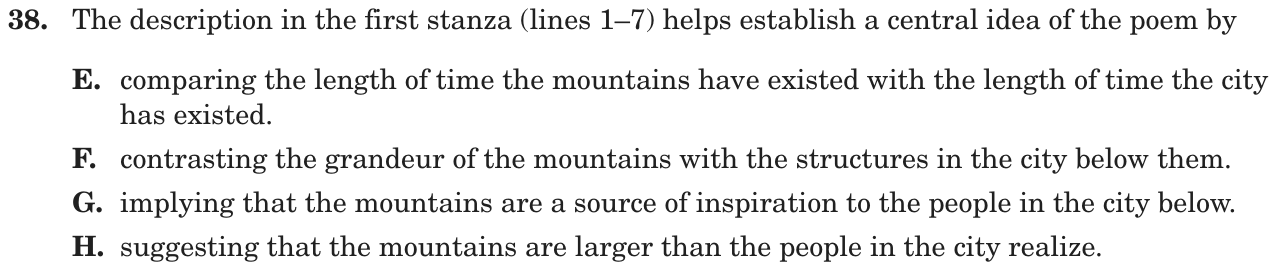
The description in the first stanza (lines 1–7) helps establish a central idea of the poem by
- Acomparing the length of time the mountains have existed with the length of time the city has existed.
- Bcontrasting the grandeur of the mountains with the structures in the city below them.
- Cimplying that the mountains are a source of inspiration to the people in the city below.
- Dsuggesting that the mountains are larger than the people in the city realize.
Show the answer
Correct answer: B
The question asks how the description in the first stanza helps establish a central idea of the poem. The poem is mostly about the grandeur of the mountains in spite of the spread of civilization. The first stanza contrasts these two elements, which is stated in Option B.
Option A is incorrect because it is a detail that is referenced later in the poem.
Option C is incorrect because the poem actually communicates the message that people do not recognize the greatness of the mountains.
Option D is incorrect because, although the first stanza mentions the size of the mountains, it does not imply that people cannot see how large the mountains are.
Question analysis
This question about John Gould Fletcher’s poem “Snowy Mountains” asks how the first stanza’s description helps establish a central idea of the poem. Students must interpret images such as palaces, pillars and angels, decide what the opening lines do with them, and judge which choice states that role without adding ideas.
- Grade level
- Grade 7 reading and task
- Compared with grade 7
- At grade 7 Linking one stanza to a poem’s central idea is a common grade 7 task, and these images are vivid and concrete. The inverted, century-old syntax adds a little challenge but no unusual demand.
- Estimated difficulty
- Straightforward: two steps or one careful reading.
- Thinking it demands
- Depth of knowledge 2, skills and concepts · mainly analyze
- What makes it hard
- Figurative or literary language moderate
- Complex sentences minor
- Evidence
- Answered from one paragraph or stanza
- Reading level
- Passage: 161 words (a poem; reading level not measured); question and choices: about grade 8, 77 words.
- Students, last 30 days
- Not enough answers yet to show (it takes 10).
Why it is hard, traps and wrong answers (shows the answer)
Why it is hard
The first stanza sets its majestic images directly against “the dingy city-roofs,” so students who read it as a picture find the contrast without much trouble. The losses come from importing ideas from later in the poem, people’s neglect in stanza 2 or the passing of time, into seven lines that contain neither. The inverted word order slows a first reading but does not hide the meaning.
Figurative or literary language moderate Understanding the question
The contrast is carried by images, not statements: “Palaces made for cloud” and “angels with broad wings” rise “Above the dingy city-roofs,” and students must read grandeur and drabness from those pictures. (Graesser, Singer & Trabasso, 1994; Kintsch, 1998)
Complex sentences minor Understanding the question
The stanza is one inverted sentence: five lines of images come before its subject, “The mountains,” in line 6 and its verb, “Uprise,” in line 7. (Abedi & Lord, 2001; Freedle & Kostin, 1993; Messick, 1989)
Strategy: Reread lines 1–7 and sum up in a phrase what the stanza does, then check each choice against those seven lines.
Traps
- Reads too much in: A reasonable-sounding conclusion that goes further than the text allows.
- Wrong part of the text: A choice is true of another paragraph, stanza or speaker than the one asked about.
- Outside knowledge: A choice is plausible in the real world but not supported by this text.
The wrong answers, classified
A Wrong part of the text (Kirsch & Mosenthal, 1990)
Brings in time, which the poem raises only in line 9 and line 18; the first stanza sets mountains against city by height and splendor, not by age.
C Outside knowledge (King et al., 2004; Recht & Leslie, 1988)
Assumes that majestic mountains inspire the people below them, a common idea about nature, but the stanza shows no reaction from the city, and the next stanza says the world “heeds them not.”
D Reads too much in (Graesser, Singer & Trabasso, 1994)
Combines line 1’s “Higher and still more high” with the poem’s later charge that people ignore the mountains, but nothing in lines 1–7 says the city misjudges how large they are.
Working it out, step by step
Figure out what the question asks
This question asks how the first stanza helps build a central idea of the poem. A stanza is a group of lines in a poem, like a paragraph. A central idea is a main message. Only lines 1 to 7 matter here, from “Higher and still more high” to “Uprise.”
Read the pictures in lines 1–7
The mountains are called “Palaces made for cloud” in line 2. In line 4 they are “Blue-white like angels with broad wings.” In line 5 they are “Pillars of the sky at rest.” Palaces, angels and pillars are all grand, high and beautiful. But line 3 places them “Above the dingy city-roofs.”
Explain what the pictures show
“Dingy” means dull and dirty. So the stanza sets two things side by side. Up high are the shining, noble mountains. Down below are the drab roofs of the city. This is a contrast: two things put together to show how different they are. Grandeur means greatness and splendor. The stanza shows the mountains’ grandeur next to the plain city.
Check each choice
- A is wrong. Time is not in lines 1–7. It first comes up in line 9, “They have been here now for too long a time.”
- B fits. Grand mountains rise over dingy city roofs.
- C is wrong. The stanza never shows people being inspired. In fact, line 8 says “the world heeds them not,” or pays them no attention.
- D is wrong. Line 1 says the mountains are high. But nothing says the city misjudges their size.
Choose the answer
The first stanza puts splendid mountains above a dull city. So the answer is B, “contrasting the grandeur of the mountains with the structures in the city below them.”
Why this answer and not the closest wrong one
D is the closest trap. It mixes line 1 with an idea from later in the poem, that people ignore the mountains. But the question is about lines 1–7 only. Those lines show a contrast in looks: high and splendid against low and dingy. They say nothing about what people think.
More questions like this
The original DOE question
The passage “Snowy Mountains” as printed (page 142)