Passage Uncovering the Past
Uncovering the Past
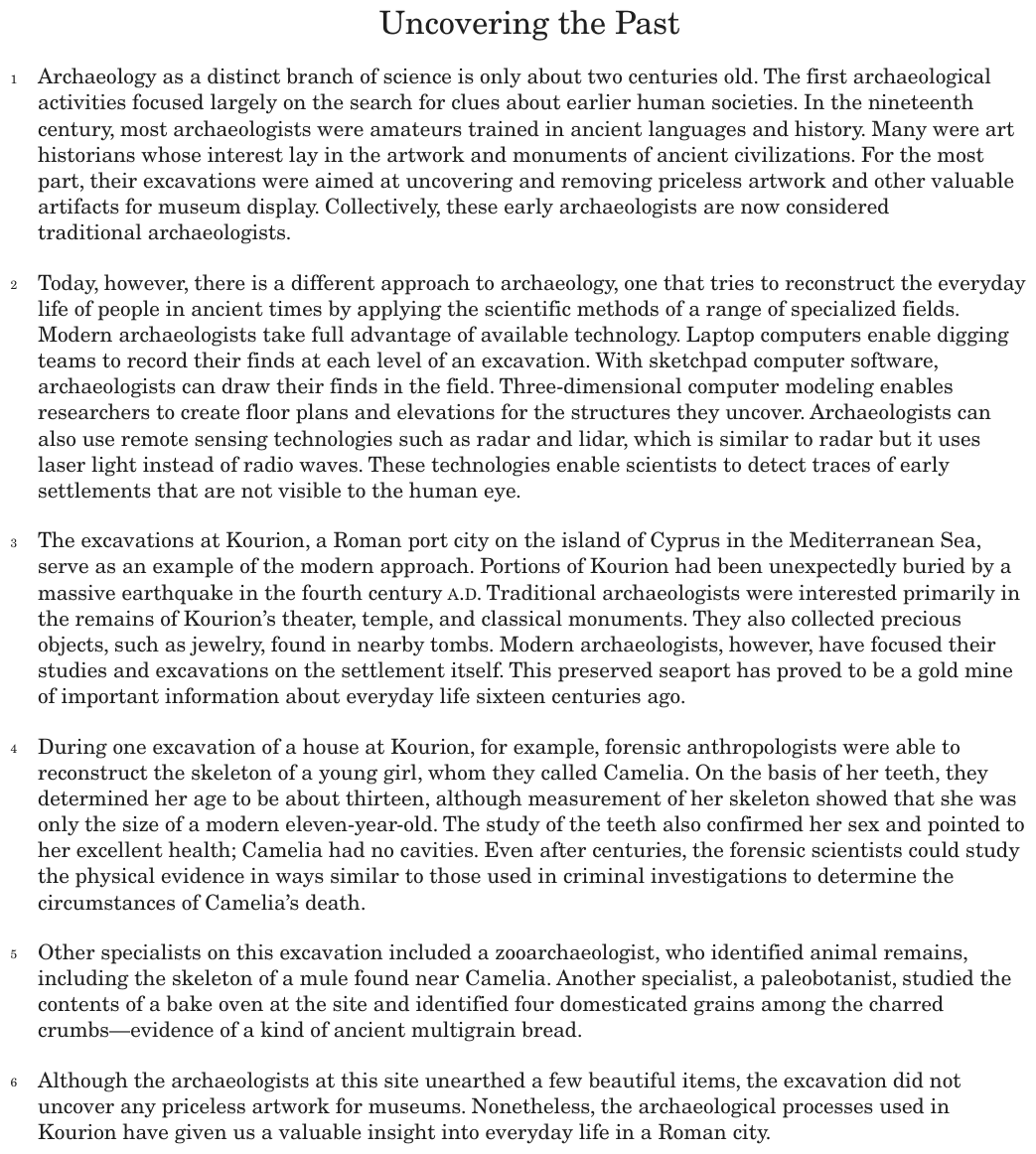
Archaeology as a distinct branch of science is only about two centuries old. The first archaeological activities focused largely on the search for clues about earlier human societies. In the nineteenth century, most archaeologists were amateurs trained in ancient languages and history. Many were art historians whose interest lay in the artwork and monuments of ancient civilizations. For the most part, their excavations were aimed at uncovering and removing priceless artwork and other valuable artifacts for museum display. Collectively, these early archaeologists are now considered traditional archaeologists.
Today, however, there is a different approach to archaeology, one that tries to reconstruct the everyday life of people in ancient times by applying the scientific methods of a range of specialized fields. Modern archaeologists take full advantage of available technology. Laptop computers enable digging teams to record their finds at each level of an excavation. With sketchpad computer software, archaeologists can draw their finds in the field. Three-dimensional computer modeling enables researchers to create floor plans and elevations for the structures they uncover. Archaeologists can also use remote sensing technologies such as radar and lidar, which is similar to radar but it uses laser light instead of radio waves. These technologies enable scientists to detect traces of early settlements that are not visible to the human eye.
The excavations at Kourion, a Roman port city on the island of Cyprus in the Mediterranean Sea, serve as an example of the modern approach. Portions of Kourion had been unexpectedly buried by a massive earthquake in the fourth century A.D. Traditional archaeologists were interested primarily in the remains of Kourion’s theater, temple, and classical monuments. They also collected precious objects, such as jewelry, found in nearby tombs. Modern archaeologists, however, have focused their studies and excavations on the settlement itself. This preserved seaport has proved to be a gold mine of important information about everyday life sixteen centuries ago.
During one excavation of a house at Kourion, for example, forensic anthropologists were able to reconstruct the skeleton of a young girl, whom they called Camelia. On the basis of her teeth, they determined her age to be about thirteen, although measurement of her skeleton showed that she was only the size of a modern eleven-year-old. The study of the teeth also confirmed her sex and pointed to her excellent health; Camelia had no cavities. Even after centuries, the forensic scientists could study the physical evidence in ways similar to those used in criminal investigations to determine the circumstances of Camelia’s death.
Other specialists on this excavation included a zooarchaeologist, who identified animal remains, including the skeleton of a mule found near Camelia. Another specialist, a paleobotanist, studied the contents of a bake oven at the site and identified four domesticated grains among the charred crumbs—evidence of a kind of ancient multigrain bread.
Although the archaeologists at this site unearthed a few beautiful items, the excavation did not uncover any priceless artwork for museums. Nonetheless, the archaeological processes used in Kourion have given us a valuable insight into everyday life in a Roman city.
Question
What is the most likely reason the author mentions the zooarchaeologist (paragraph 5)?
- Ato introduce the topic of other artifacts discovered near Camelia
- Bto contrast this position with that of the paleobotanist
- Cto complete the list of archaeological specialists
- Dto provide an example of a particular field in modern archaeology
Show the answer
Correct answer: D
The question asks for the strongest reason for the author mentioning the zooarchaeologist in the passage. The primary purpose of the passage is to explain and describe modern archaeology, the technology it employs, and various aspects of the field. Zooarchaeology is a specialty within the field, which is stated in Option D.
Option A is incorrect because other artifacts found near Camelia could have been introduced without mentioning the zooarchaeologist.
Option B is incorrect because the text does not state any comparisons between zooarchaeologists and paleobotanists.
Option C is incorrect because the passage does not provide a list of archaeological specialists.
Question analysis
This author’s purpose question asks why the writer of “Uncovering the Past” mentions a zooarchaeologist, a scientist who identifies animal remains, in the account of the Kourion excavation. The detail is only one sentence long, so students must judge its job in the passage, and more than one choice offers a reason that sounds sensible.
- NYS standards
- 7R5 structure and genre features
- Grade level
- Grade 7 reading and task
- Compared with grade 7
- At grade 7 Explaining why an author includes a detail is core grade 7 work. Here the detail is short and clear, but the choices include reasons that sound reasonable, so students need a firm grasp of the passage’s purpose.
- Estimated difficulty
- Moderate: several steps, or a close reading with one strong distractor.
- Thinking it demands
- Depth of knowledge 3, strategic thinking · mainly analyze
- What makes it hard
- How, not what moderate
- Evidence in several places minor
- Evidence
- Answered from several paragraphs or stanzas
- Reading level
- Passage: about grade 13, 514 words; question and choices: about grade 11, 49 words.
- Corrected from the DOE handbook
- A wrong term in the explanation was corrected.
- Students, last 30 days
- Not enough answers yet to show (it takes 10).
Why it is hard, traps and wrong answers (shows the answer)
Why it is hard
The detail is one clause long, and the question turns on its job in the passage rather than its content. Students who stay inside paragraph 5 see a list of specialists or a find near Camelia and choose a reason drawn from there. Connecting the specialist to paragraph 2’s range of specialized fields is the step that separates the right answer from the plausible ones.
How, not what moderate Working it out
The stem asks why the zooarchaeologist is mentioned, not what he found, so the mule skeleton is beside the point; the answer lies in what this specialist illustrates about the modern approach. (Anderson & Krathwohl, 2001)
Evidence in several places minor Working it out
The reason links back to paragraph 2, where the modern approach applies “the scientific methods of a range of specialized fields”; the zooarchaeologist is one of those fields at work. (Kirsch & Mosenthal, 1990; Gorin & Embretson, 2006)
Strategy: State the passage’s main point in a sentence, then ask what this one-sentence mention of a specialist adds to that point.
Traps
- Wrong purpose or structure: Names a purpose, structure or effect that the part does not serve, or describes what a part says when the question asks what it does.
The wrong answers, classified
A Wrong purpose or structure (Anderson & Krathwohl, 2001)
The zooarchaeologist did identify a mule “found near Camelia,” but the passage never goes on to a topic of nearby artifacts; the next sentence turns to another specialist.
B Wrong purpose or structure (Anderson & Krathwohl, 2001)
Sees the zooarchaeologist and the paleobotanist named side by side and assumes a contrast, but the passage compares nothing about them; each is simply another specialist.
C Wrong purpose or structure (Anderson & Krathwohl, 2001)
Treats the specialists of paragraphs 4 and 5 as a roster the author is finishing, but the zooarchaeologist is not the last one named, and the passage offers examples rather than a complete list.
What was corrected from the DOE handbook, and why
- Explanation: The handbook says the text makes no comparison between “zooarchaeologists and paleoarchaeologists.” The other specialist in paragraph 5, and in Option B, is a paleobotanist, so the site now says “paleobotanists.”
Working it out, step by step
Figure out what the question asks
This question asks why the author mentions the zooarchaeologist. It is not asking what this expert found. Think about the purpose of the detail, the job it does for the whole passage.
Find the detail and its link
Paragraph 5 begins, “Other specialists on this excavation included a zooarchaeologist, who identified animal remains.” A specialist is an expert in one narrow field. Now look back at paragraph 2. It says modern archaeology uses “the scientific methods of a range of specialized fields.”
Connect the detail to the main idea
A zooarchaeologist is an expert in animal remains from long ago. “Zoo” means animals. This expert is one of those specialized fields at work. So the author names the zooarchaeologist as an example. The example shows what “a range of specialized fields” looks like on a real dig. The word “included” also tells you the passage gives examples, not a full list.
Check each choice
- A is wrong. This expert found a mule near Camelia, but the passage never moves on to other objects found near her.
- B is wrong. The paleobotanist comes next, but the author never compares the two jobs.
- C is wrong. The zooarchaeologist does not complete a list. The paleobotanist is named next, and “included” means only some experts are named.
- D fits. The zooarchaeologist is one example of a specialized field in modern archaeology.
Choose the answer
The zooarchaeologist shows one of the many science fields that modern archaeology uses. So the answer is D, “to provide an example of a particular field in modern archaeology.”
Why this answer and not the closest wrong one
C is the strongest trap, because paragraphs 4 and 5 name several experts in a row. But to complete a list, this expert would have to be named last. The paleobotanist comes after. D also ties back to the main idea of the passage, the use of many science fields. A good purpose answer usually does that.
More questions like this
The original DOE question

The passage “Uncovering the Past” as printed (page 138)