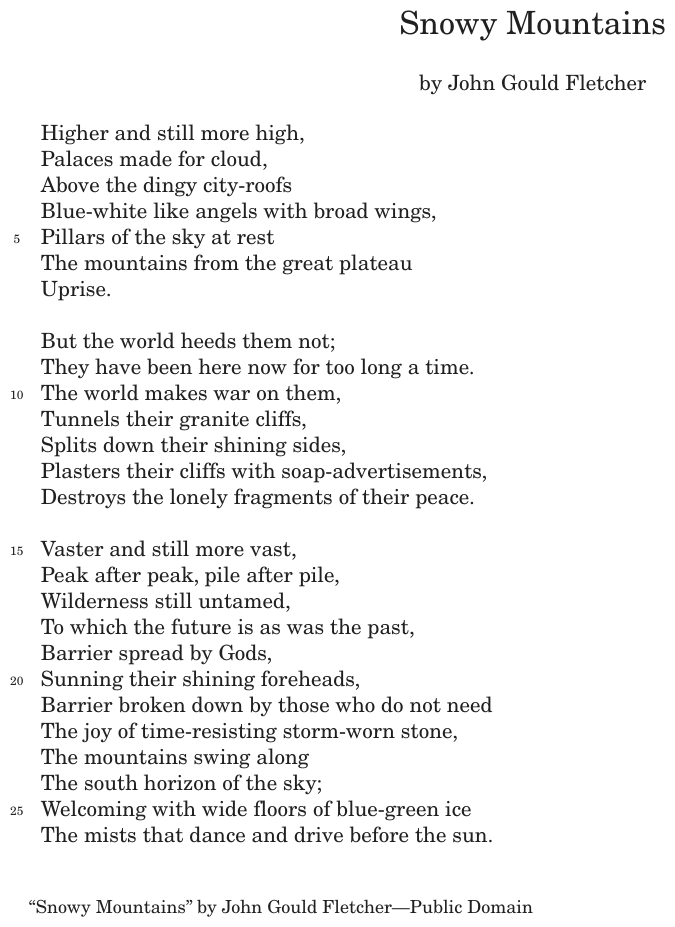
Passage Snowy Mountains
Snowy Mountains
by John Gould Fletcher
Higher and still more high,
Palaces made for cloud,
Above the dingy city-roofs
Blue-white like angels with broad wings,
Pillars of the sky at rest
The mountains from the great plateau
Uprise.
But the world heeds them not;
They have been here now for too long a time.
The world makes war on them,
Tunnels their granite cliffs,
Splits down their shining sides,
Plasters their cliffs with soap-advertisements,
Destroys the lonely fragments of their peace.
Vaster and still more vast,
Peak after peak, pile after pile,
Wilderness still untamed,
To which the future is as was the past,
Barrier spread by Gods,
Sunning their shining foreheads,
Barrier broken down by those who do not need
The joy of time-resisting storm-worn stone,
The mountains swing along
The south horizon of the sky;
Welcoming with wide floors of blue-green ice
The mists that dance and drive before the sun.
“Snowy Mountains” by John Gould Fletcher—Public Domain
Question
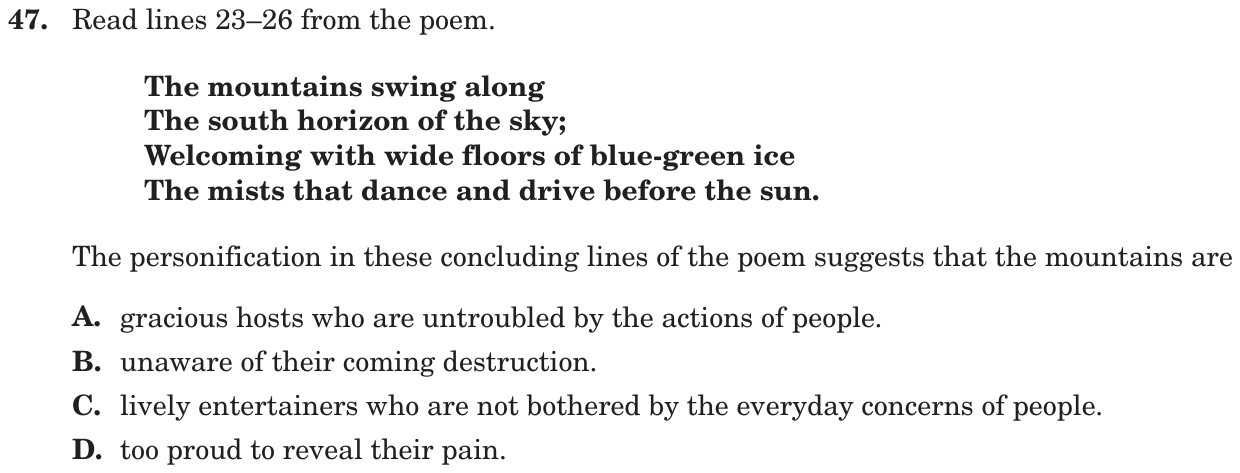
Read lines 23–26 from the poem.
The mountains swing along
The south horizon of the sky;
Welcoming with wide floors of blue-green ice
The mists that dance and drive before the sun.
The personification in these concluding lines of the poem suggests that the mountains are
- Agracious hosts who are untroubled by the actions of people.
- Bunaware of their coming destruction.
- Clively entertainers who are not bothered by the everyday concerns of people.
- Dtoo proud to reveal their pain.
Show the answer
Correct answer: A
The question asks what the personification in the lines suggests in the poem. Line 25’s use of the word “Welcoming” suggests that the mountains are kind hosts. Lines 23 and 26, with language such as “The mountains swing along” and “The mists that dance and drive before the sun,” imply the carefree nature of the mountains as they resist the destructive work of humanity. Therefore, Option A is correct.
Option B is incorrect because the wording in the lines is positive and victorious, with no language to suggest coming destruction.
Option C is incorrect because, although the lines mention that “the mountains swing along” (line 23) and “the mists . . . dance” (line 26), the personification is used to describe the mountains’ perseverance, rather than to suggest that the mountains are entertaining others.
Option D is incorrect because the lines refer to the joy of the mountains as they “swing along” (line 23) and do not suggest pride.
Question analysis
This personification question asks what the final four lines of the poem “Snowy Mountains” suggest about the mountains, which “swing along” the south horizon of the sky. Students must interpret human qualities given to nature, and the trick is that several choices assign the mountains feelings or roles that only partly match the lines.
- Grade level
- Grade 7 reading and task
- Compared with grade 7
- At grade 7 Interpreting personification is a familiar grade 7 skill, and these lines are short and quoted. The challenge is choosing among character descriptions that each match part of the imagery, a typical rather than unusual demand.
- Estimated difficulty
- Moderate: several steps, or a close reading with one strong distractor.
- Thinking it demands
- Depth of knowledge 2, skills and concepts · mainly understand
- What makes it hard
- Figurative or literary language moderate
- A very close wrong answer moderate
- Complex sentences minor
- Evidence
- Answered from one sentence or line
- Reading level
- Passage: 161 words (a poem; reading level not measured); question and choices: about grade 6, 78 words.
- Students, last 30 days
- Not enough answers yet to show (it takes 10).
Why it is hard, traps and wrong answers (shows the answer)
Why it is hard
The closing lines are calm and generous, and the question asks students to turn their personification into a character. The trap is assigning actions to the wrong actor: the dancing belongs to the mists, and taking it for the mountains’ makes them performers rather than hosts. Students who carry the destruction of earlier stanzas into these lines also misjudge the mountains’ ease.
Figurative or literary language moderate Understanding the question
The personification has to be sorted by actor: the mountains “swing along” and are “Welcoming,” while it is the mists that “dance and drive before the sun.” (Graesser, Singer & Trabasso, 1994; Kintsch, 1998)
A very close wrong answer moderate Choosing the answer
The hosts choice and the entertainers choice share one frame, mountains unbothered by people; they differ only in the role, and line 26 settles it, since the mists, not the mountains, “dance.” (Embretson & Wetzel, 1987; Gorin & Embretson, 2006; Ascalon et al., 2007)
Complex sentences minor Understanding the question
In “Welcoming with wide floors of blue-green ice / The mists,” the object comes after a long phrase and a line break, so who welcomes whom is easy to miss. (Abedi & Lord, 2001; Freedle & Kostin, 1993; Messick, 1989)
Strategy: Note each human action in lines 23–26 and who performs it, then choose the description that fits every one of those actions.
Traps
- Half right: One half of a two-part choice is right and the other is not.
- Reads too much in: A reasonable-sounding conclusion that goes further than the text allows.
The wrong answers, classified
B Reads too much in (Graesser, Singer & Trabasso, 1994)
Reads the mountains’ carefree “swing along” as obliviousness and adds the earlier stanzas’ damage, but these lines are serene and say nothing about destruction to come.
C Half right (King et al., 2004; Thissen, Steinberg & Fitzpatrick, 1989)
Gets the mountains’ unconcern about people nearly right, but takes “swing” and “dance” as entertaining when the mists do the dancing and the mountains welcome them as hosts.
D Wrong tone or attitude (Graesser, Singer & Trabasso, 1994)
Imagines hidden suffering behind the calm, perhaps from “storm-worn stone,” but the lines show the mountains at ease and welcoming, with no hint of pride or pain.
Working it out, step by step
Figure out what the question asks
This asks about personification in lines 23 to 26. Personification means giving human actions or feelings to something that is not human. You need to decide what kind of person the mountains seem to be.
Sort the actions by who does them
Line 23 says “The mountains swing along.” Line 25 says the mountains are “Welcoming with wide floors of blue-green ice.” Whom do they welcome? Line 26 answers: “The mists that dance and drive before the sun.” So the mountains swing and welcome. The mists are the ones that dance.
Explain what the actions suggest
To swing along is to move in an easy, carefree way. Welcoming guests onto your floors is what a host does. A host is a person who has guests over. The mountains are kind hosts to the mists. Gracious means kind and polite. They also seem calm. After all the harm in stanza 2, they are untroubled, or not bothered.
Check each choice
- A fits. The mountains welcome guests and stay calm.
- B is wrong. These lines say nothing about harm still to come.
- C is wrong. The mists dance, not the mountains. The mountains are hosts, not entertainers.
- D is wrong. The lines show ease and welcome. Nothing hints at pride or hidden pain.
Choose the answer
The mountains swing along and welcome the mists like hosts. So the answer is A, “gracious hosts who are untroubled by the actions of people.”
Why this answer and not the closest wrong one
C is very close, since it also says the mountains don’t worry about people. The difference is the role. An entertainer performs for others. A host welcomes others in. In line 26 it is the mists that “dance,” and the mountains are “Welcoming” them. That makes the mountains hosts.
More questions like this
The original DOE question
The passage “Snowy Mountains” as printed (page 142)